






This handbook consists of two volumes which describe the ITER design from its inception up to the design, construction and assembly in 2025
The handbook is not designed to be read as a continuous sequence of chapters. Instead, it is composed of focused, self-contained sections that address specific topics. Each chapter can be read and understood independently, allowing readers to engage with the material most relevant to their needs without requiring familiarity with preceding chapters. As a result, the reader will find certain overlapping content in chapters.
It is to be noted that at the time of writing, the design for some systems is still on-going. Therefore, the reader should consider that whilst there is significant value of this important point-in-time study, an update would be required as the Project progresses
A broad Project overview is given in the first volume, to provide the reader with background information necessary to understand the context in the subsequent more-detailed chapters of the second volume, dedicated to the individual systems composing ITER.
For the overall table of contents of the Handbook and to access each one of the chapters, please refer to https://www.iter.org/scientists/iter-technical-reports
This chapter is authored by Gianfranco Federici and co-authored by the Handbook Editors Federico Casci, Stefano Chiocchio, Richard Hawryluk, John How, Akko Maas, Masanori Onozuka, René Raffray, Gabriella Saibene, Bill Spears and Eisuke Tada
“Engineeringisaboutdiscovering, designingandbuildingthings.Engineering isaboutsolvingproblems,providing leadership,andinspiringothers,allwith theaimofcreatingabetterfuture.”
ProfessorRobert(Bob)Conn.
Michael Roberts, Director of International Programs at the Office of Fusion Energy Sciences of the US Department of Energy wrote in his unpublished memoir:
“The year was 1988. The energy crises of the seventies were history1. Yet, population growth, limited energy resources, and the staggering environmental consequences of over-use of fossil fuels had begun to haunt policy makers and politicians around the world. Alternatives were limited – fusion as a form of a new nuclear energy technology seemed promising and had been advanced as a panacea for world energy problems since the late 1950s with but little concrete result.”
The parallel with today is rather striking and fusion is again seen by many as the ideal solution to the same – if not more urgent- energy and environmental problems affecting our planet.
1 The 1970s energy crisis occurred when the Western world, faced substantial petroleum shortages as well as elevated oil prices. The two worst crises of this period were the 1973 oil crisis and the 1979 energy crisis, when, respectively, the Yom Kippur War and the Iranian Revolution triggered interruptions in Middle Eastern oil exports
INTRODUCTION
Vol.1, Ch. 3, p. 1
The basic concept of producing energy by bringing together and fusing the nuclei of the lightest elements is itself straightforward in principle but accomplishing it presents extraordinary scientific and technological challenges, especially when aiming at producing a net positive amount of energy in the process. In a fusion reaction, light atomic nuclei fuse together to form heavier products. Of all the possible fusion reactions, that between deuterium (D) and tritium (T) nuclei is most easily produced. When, D and T are sufficiently heated, they form an ionised gas, a plasma. In this plasma, the electrons are stripped from the atoms, making the gas electrically conductive. As the nuclei have a positive electrical charge, they repel each other unless given sufficient kinetic energy, and when they collide, they can fuse. In a tokamak, D-T fusion requires temperatures over about 100 000 000 K. At sufficiently high densities and energy confinement, the reactions can produce a burning plasma in which self-heating by fusion-produced helium nuclei (alphaparticles) can maintain plasma temperature and thus sustain new fusion reactions in the plasma. The ultimate goal of this approach is to use the heat from the fusion reactions to produce steam, drive a turbine, and generate electricity, or provide process heat for industry.
Security declassification in the 50s allowed magnetic fusion scientists and engineers to collaborate internationally, but progress during the following two decades was slow, as scientists struggled to address several scientific and technical difficulties that threatened their ambitious goals. In 1968, Soviet scientists achieved a breakthrough and announced that modifications made to their fusion experiments showed significantly improved performance. Since then, the Soviets’ tokamak design2 – the Russian acronym for toroidal kamera magnetik (‘toroidal chamber with magnetic coils’) has become the focus for nuclear fusion research world-wide.
After the Soviet results were confirmed, the Soviet Union, Europe, USA, and Japan announced plans to build their own large tokamaks as a step toward building an actual energy-producing reactor, a goal which appealed to policy makers in search of alternative energy supplies, because in the late 1970s the oil price was high, and energy security was a top political issue.
However, even as the results from these large tokamaks proved encouraging, the fusion community, individually and institutionally drawn together by common scientific concerns, realised that further significant scientific and technical issues needed to be addressed to achieve a burning plasma (i.e., one where the fusion power is substantially higher than the auxiliary heating power used to heat the plasma) as a step toward net energy production, which also entailed solving complex fusion engineering issues. Based on the knowledge at the time, it was clear that a larger DT tokamak facility was necessary to achieve a burning plasma, which could also serve as an engineering test facility to develop and test reactor technologies in an integrated system.
The initial international cooperation for a nuclear fusion project that was the foundation of ITER began in 1978 with the International Tokamak Reactor [1], or INTOR, which had four partners: the Soviet Union, the European Atomic Energy Community (Euratom), the United States, and Japan.
2 In a tokamak, where the plasma is magnetically confined into a doughnut-shaped vacuum, higher temperatures, longer confinement times, and increased plasma stability are obtained. A magnetic field due to a combination of currents in external coils and in the plasma is used to confine the plasma.
It started with an American president meeting a Soviet Secretary-General and agreeing that cooperating in the field of fusion science was a promising way of easing tensions between their two countries. The year was not November 1985 but June 1973; the place was not Geneva but Washington D.C., and the participants were not Ronald Reagan and Mikhail Gorbachev but Richard Nixon and Leonid Brezhnev.
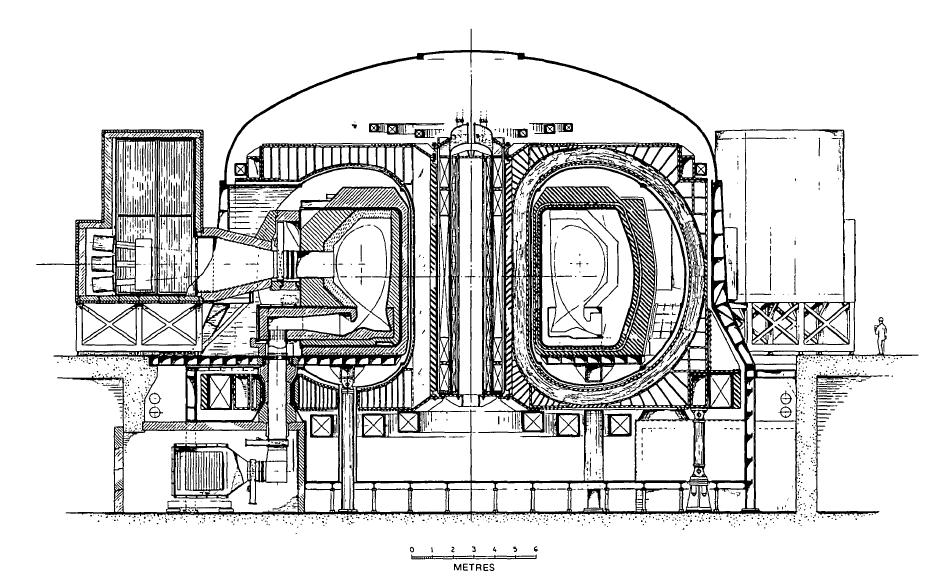
Increasing pressure to "internationalise" large scientific projects like magnetic fusion continued unabated in the early 1980s. Fusion offered a long-term, highly rewarding peaceful endeavour for Soviet and American cooperation. Science had become a new arm of diplomacy and a proposal for fusion collaboration involving not merely the USSR and the USA, but also Japan and the European Community (with whom the Soviet Union had no relations at the time) was put on the agenda for an important post-cold war Summit of the Head of States, Ronald Reagan and Mikhail Gorbachev, in Geneva in 1985. This triggered the series of steps that ultimately led to the International Thermonuclear Experimental Reactor (ITER) project emerging from the 1985 Geneva Summit.
Vol.1, Ch. 3, p. 3

Fig.3.2. Cover of the Time Issue, 18 November 1985 [2].
Diplomacy and international scientific contacts made possible the emergence of the "ITER Activity" by August 1988. ITER design activities addressed a common technical need which, together with on-going research and development, served as a common focus for all national programmes. In addition, a design team at a Joint Work Site at Garching in the Federal Republic of Germany had brought together, for months at a time, forty professionals for integrated planning and design. An equal division of responsibility and contribution had been established as the cooperation principle, while approximately 180 professionals back home provided support. Internationalisation of fusion research and planning had moved beyond the ad hoc sharing of ideas and knowledge of INTOR. A formal activity had been set up, under the auspices of the IAEA, which pointed to possible construction of an experimental device to resolve one of humanity's most pressing problems. The move toward a more formal, codified international fusion project was born in the spirit of the energy crisis of the 1970s. Yet, it reached fruition as an instrument of East-West detente a decade and a half later.
After three years of close and effective collaboration, at the end of the ITER Conceptual Design Activity or CDA, the fusion community had in hand a technical description of their vision of the next major step in the worldwide quest for useful power from controlled thermonuclear fusion. Some designs for a fusion engineering test reactor or a Next-Step fusion experimental reactor were developed and available for all Parties to use either in their own national programmes or as part of a larger international collaborative programme. The ITER team estimated that before ITER construction could begin, a 6-year design effort would be necessary for detailed engineering, further component development, and consideration of possible construction sites. Since ITER was viewed by the four Parties not only as a scientific and technical demonstration of the feasibility of
INTRODUCTION Vol.1, Ch. 3, p. 4
fusion power, but also of the safety and environmental advantages, those considerations needed to be particularly emphasised in the engineering design.
While the proposed follow-on collaboration would be a challenge, to address the outstanding scientific and technical issues as well as how to organise such a complex endeavour, the Parties recognised that great benefits would accrue from sharing scientific and technological resources as well as costs in a priority energy development area. Moreover, after reviewing the conceptual design and related R&D, the ITER Council (which had provided overall direction for the previous team effort), cited the importance of taking the necessary steps to maintain the momentum of this unique international co-operation.
Significant differences of viewpoint emerged, for example, concerning the site where the Engineering Design Activities (EDA) should be carried out. Although a single design site would have been highly desirable, in the end the only way to make progress was to take advantage of the burgeoning internet and have a project managed by a strong director and supported by a design team located at three sites. Thus, the ITER design team was spread around the world, at Garching (Germany), San Diego (USA) and Naka (Japan), and a strong collective endeavour was required to maintain the required cohesion.
Designing and constructing ITER necessitated extensive R&D programmes characterised by wideranging, long-term international collaborations and major innovations. Much of the ongoing R&D within each Party contributed to the design and the results (except for details marked as "business confidential") were shared between Parties as the engineering design evolved. Due to the substantial jumps in technology required, seven large, specialised engineering R&D projects were set up to study key issues at the scale that would be required in building ITER.
The large engineering projects addressed superconducting magnet technology, including central solenoid (CS) and toroidal field (TF) coils, vacuum vessel technology, blanket technology, divertor technology, remote handling technology for maintenance of in-vessel components such as blanket module and divertor cassette. In addition, there was a considerable development in documenting the properties of structural materials under irradiation, data that would be essential for obtaining an operating license. In parallel with these engineering activities was a robust worldwide scientific programme in plasma physics that addressed key issues that affected the design including the requirements for achieving a burning plasma.
The first 10 years after the start of the EDA saw a multitude of changes and evolutions in the design and the way in which it would operate. Size, performance and cost were critical for the project and in 1998, a comprehensive design satisfying the objectives was produced. However, the completion coincided with a time of concern over the costs of such large projects, and with a glut of fossil-fuel-based energy available the urgency of fusion disappeared. This led the USA to
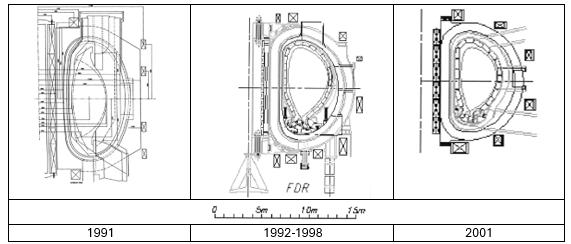
leave the partnership, and the San Diego site to close. The remaining Parties rescaled the machine overall configuration while maintaining as much as possible the original project goals, and the project team at the remaining two sites (enhanced by the Russian Federation Design Centre) produced a smaller and cheaper design in 2001 to match them, over a 3-year extension of the engineering design phase, using many of the same technical solutions, verifications and analyses developed for the previous design.
A more detailed account of the technical evolution, the main historical events, and major milestones on the road to ITER construction from its inception until today are described in Chapters 5 and 6.
Chapter 7 in Volume 1 details more explicitly the main design evolution that have characterised the project from its inception until today. It also outlines the extensive R&D programs that were launched to verify the design feasibility of ITER and to establish a sound technical basis for its construction.
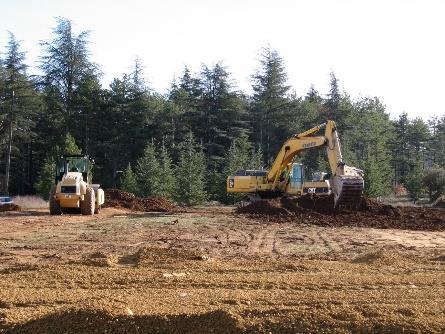
The transition from the engineering design activities to a commitment towards construction was slow and uncertain as the selection of the construction site dragged on for almost five years. During this period design work continued at a reduced level, focusing on preparing specifications for long lead procurements, and in further detailing of specifications and planning. With a view to the site decision too, efforts were made to establish the project infrastructure of the future organisation.
INTRODUCTION
Vol.1, Ch. 3, p. 6
In addition to Europe, Japan and the Russia Federation, the People’s Republic of China presented a formal request to join ITER on 10 January 2003 while President George W. Bush announced the return of the United States in the ITER Project on 30 January 2003. The Republic of Korea following suit six months later. Finally, India joined ITER in December 2005, bringing the Member Parties to seven. ITER acquired a truly global dimension involving de-facto thirty-three nations.
The ITER Organization, which is an international organisation, was created by an international agreement signed in July 2006, but was only formally established on 24 October 2007 after its ratification by all Parties. As signatories to the ITER Agreement, the seven members agreed to share the cost of project construction, operation and decommissioning, and share in the experimental results and intellectual property generated by the project. Following a drawn-out political resolution, the decision was taken finally to build ITER in southern France at Saint Paullez-Durance, near Cadarache, a research centre for nuclear energy. The competing sites were Rokkasho-Mura in the Aomori Prefecture, in the north of Japan, Vandellos close to Barcelona, Spain, and Clarington in Toronto, Canada
As part of the agreement on hosting ITER in Europe, Europe contributed the largest portion of construction costs (45.6%); the remainder was shared equally by China, India, Japan, Korea, Russia and the United States (9.1% each). In addition, as part of compensation for siting ITER in Europe, the agreement stated that Japan would receive an additional 9.1% of the procurements from Europe. Japan and the EU also agreed to jointly conduct the so-called "Broader Approach Activities" as a satellite project supporting ITER, including a new superconducting tokamak, JT60SA, which is now operational in Japan, a cutting-edge supercomputer centre in Rokkasho for plasma physics computations, as well as a tritium-handling laboratory, and the International Fusion Materials Irradiation Facility (IFMIF) engineering validation and engineering design activities.
The ITER Agreement distributed the procurement of the ITER systems and components among the Members, accordingly, based on the project cost estimate that had been produced with the help of the original three Member's industry. These procurements, at various levels of specification: from build-to-print to functional, were then to be provided "in kind", with finance and technical work and deliverables under the responsibility of each Member's Domestic Agencies (DAs) in accordance with the Procurement Arrangement concluded between ITER Organization (IO) and each DA. 10% of the original estimate was to be made available for direct procurement by the ITER Organisation. In this way, the scientific and industrial capability in each Member would be prepared for the step after ITER collaboration that will demonstrate industrialscale fusion electricity.
For all Members, the benefits of participation are significant: by contributing a portion of the project's costs, Members benefit from 100% of the scientific results and all generated intellectual property apart from business confidential, except for the Test Blanket Modules (TBM) and related intellectual property, which is not formally part of the ITER agreement. The price is that the
splitting of procurements would inevitably lead to some engineering duplication and interface complexities, extra manpower, and increased costs.
A team to manage the next phase of the project was assembled, both by the ITER Organization (partly informally even ahead of the formal ratification) but also by the DAs. With the site and licensing regime now chosen, and new expertise involved, several high-level assessments revealed the need to implement some additional design improvements for the site adaptation
Taken together, the ITER Members represent three continents, approximately 40 languages, half of the world's population and 73% of world’s global gross domestic product. In the offices of the ITER Organization and the DAs, in laboratories and in industry, thousands of people are working toward the success of ITER.
The ITER Tokamak will be the largest fusion device ever built to date. The size and layout of ITER is dominated by its ambitious requirements to demonstrate that fusion reactions can produce significantly more energy than the energy supplied to the plasma. Tokamak fusion facilities like ITER use a combination of heating systems, strong magnets, and other systems to create energyreleasing fusion reactions in super-hot plasmas. The magnetic fields generated by its magnets confine the charged particles inside the doughnut-shaped reactor vessel so that these can fuse and produce fusion energy. A significant indicator of a reactor’s performance is its fusion power gain, or the ratio between the fusion power produced and the power injected into the plasma to drive the reaction. It is expressed by the symbol ‘Q’. To date, magnetic confined fusion systems (using DT mixtures) have achieved gains just short of 1 by producing up to 16 megawatts (MW) of fusion power for 22 MW injected and recently produced a total of 69 megajoules (MJ) of fusion energy over 5 seconds in the Joint European Torus (JET).
A Q value of 10 has been set as a target for ITER so that the plasma's ability to sustain the fusion reaction on its own significantly dominates external power supplied to heat or control the plasma. To better understand how to achieve and control this self-sustaining reaction for long periods of time in an eventual power plant, ITER aims to eventually generate and maintain Q values of 10 for periods of a few minutes. These developments will be a significant stepping stone towards achieving commercial fusion energy and will represent a historic bridge between experimental research and the first demonstration fusion power plants, or DEMOs. Envisioned DEMOs will achieve a net electrical energy gain, even accounting for all in-plant power consumption and turbo-generator efficiency. Multiple preliminary concepts for DEMO-type reactors are already under consideration.
As for the question of size, this book explains the rationale behind the choice of parameters in relation to ITER objectives. ITER's configuration and layout have been chosen to satisfy performance and cost requirements, both of which constrain its design, following well-established
guidelines, principles and theories, while ensuring achievement of its main objectives and minimisation of risks and failures. The confinement of energy in a tokamak increases with the size and plasma current. Considering the available and well-advanced superconducting magnet technology during the design phase, ITER is larger than existing tokamaks to provide the necessary plasma and alpha-particle confinement to achieve the required value of Q.
The combination of higher power and longer pulse duration than in smaller devices has required the development of reliable methods to extract the heat from the in-vessel components The increased fusion power and pulse duration has necessitated adequate radiation shielding of critical equipment, e.g., the superconducting magnets. These are just examples of the strong interplay between the scientific and technical requirements affecting the ITER design. An important contribution by the fusion scientific community was to establish the design guidelines. This work continues to this day as additional research results are folded into the design and operational planning for ITER.
Weighing 23 000 tonnes and standing at nearly 30m tall, the ITER Tokamak will be an impressive sight. With ITER’s tokamak height and radius being about twice that of JET’s, its plasma volume will increase tenfold. Applying novel designs and innovative materials, ITER also integrates some of the most powerful plasma-heating devices ever used. Design complexity arises from the use of tritium, a radioactive fuel which in future devices must be generated by the fusion facility itself (though not in ITER), as well as from the highly energetic neutrons produced by the DT reaction, which irradiate the facility and deposit their energy in components outside of the plasma.
The combination of size, pulse duration and fusion power, as well as corresponding radiological issues, are far greater in ITER than in previous large tokamaks such as the Tokamak Fusion Test Reactor (TFTR), and JET, which operated with DD and DT plasmas and JAERI Tokamak-60 (JT-60) which operated solely with DD plasmas. Because of this, the ITER team had no or very limited precedents on which to base their design and prototype component manufacturing. Not only was the design first of its kind but nearly all major components and subsystems were as well.
Taking such a leap has relied upon the experience and foresight of its designers and the ingenuity of the scientists who have planned its operation scenarios. The designers have had to work with large gaps in the understanding of burning plasma conditions, and no previous technical solutions for many of the sub-systems. Designing the machine despite such uncertainty has been a major challenge. The decision was taken with the siting in France to subject ITER to the licensing restrictions for French nuclear plants, while the technical need for such constraints was unclear. This has placed additional necessary efforts on the design for site adaptation and its operational flexibility.
The year 2007 marked the formal start of the ITER Project.
As the details of procurements began to be finalised with manufacturers in the Member states, several unforeseen technical challenges related to design integration and fabrication emerged, leading to cost overruns and schedule slippages. Several significant issues were identified mainly due to insufficient design readiness of some systems or immaturity of their underlying technologies, together with underestimation of the manufacturing complexity of some long-lead items.
Schedule delays also occurred in the set-up of the organisations and procurement systems in the ITER Organization and Domestic Agencies as well as the impact of clarified technical requirements from the regulator. Management of ITER also went through significant changes, both in personnel and structure, in response to the project management challenges. The original expectations and hope that ITER construction and commissioning could have been completed within 10 years proved to be not possible to fulfil for several reasons that are addressed in this book.
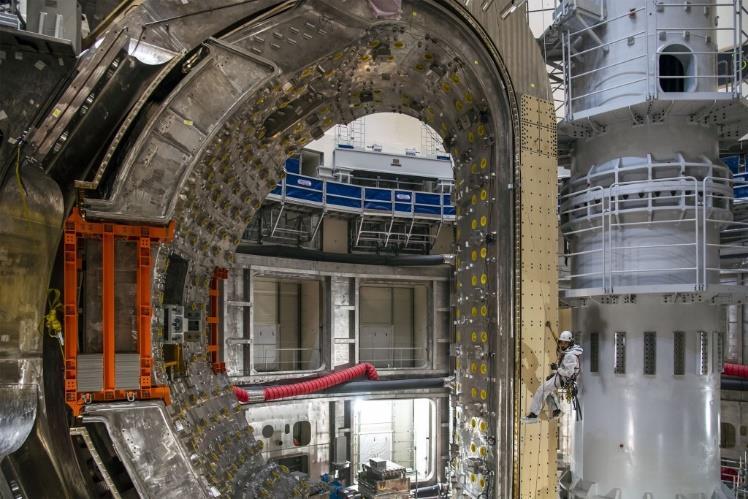
Fig.3. 5. The first sector of the ITER vacuum vessel was installed in May 2022. In-situ repairs were planned due to deviations from the allowable tolerance of the field joints but its qualification for the repair welding was not possible. Subsequently, the sector had to be removed from the pit in July 2023 for repair in 2024 [5].
As in any other project the baseline is a reference project plan that includes agreed scope, schedule, and cost, against which progress, and performance are to be measured. In a complex and multi-country mega-project such as ITER, a credible baseline plan is essential to provide clear guidance, manage resources effectively, identify and mitigate risks, ensure coordination and collaboration, measure performance, control costs, maintain quality, manage changes, and ensure compliance.
Faced with the challenges of a first-of-its-kind project, major changes to the construction baseline and research operations plan were made in 2016 which formally led to postponing the startup of operations over several years, and by establishing a more integrated management approach with the DAs. This plan included producing a first plasma in 2025 as an engineering commissioning test of the machine, albeit with very minor research capability due to the planned limited heating and reduced number of diagnostic systems and in-vessel components.
But more recently ITER has had to revise once again its baseline because the previous 2016 plan could not be achieved. Since October 2020, it was made clear, publicly and to ITER stakeholders, that a first plasma in 2025 could no longer be achieved. Several factors contributed to this realisation.
The COVID-19 pandemic shut down some factories supplying ITER components, reduced the associated workforce, and triggered other impacts such as backlogs in maritime shipping and challenges in conducting quality control inspections. Some of ITER’s first-of-a-kind components proved more challenging than envisioned. Quality issues were experienced in design, manufacturing, and project culture- leading to some key components requiring repairs, after delivery and before installation, with the additional processes, equipment and storage needed adding to the costs. In addition, the planning for some aspects of manufacturing and assembly proved to be not well prepared in advance, taking into consideration the first-of-a-kind nature.
A new baseline was proposed in 2024 to mitigate the operational risks in preparation for DT operations, to reflect the latest knowledge and development obtained from fusion programs around the world. The main technical features of the baseline 2024 will be presented in this book. It also reduces project technical risks by additional testing of some toroidal and poloidal field coils, fully to 4K, before installation.
More time is dedicated to commissioning. An initial temporary “first wall” is installed, to be used up to full plasma current, to protect the shield blocks and vacuum vessel with no risk of water leaks during a "Start of Research Operations (SRO)" testing phase. It also adds more external heating capacity, to allow testing during SRO that can simulate the full heat loads to be experienced in the DT operation phase. All systems, including the disruption mitigation system, will be fully tested during the SRO phase except those linked with tritium and the Neutral Beam Injectors.
The baseline 2024 envisages the SRO starting in 2034, featuring a more complete machine, consisting of more than two years of substantive research, including DD operations. The achievement of full magnetic energy will be delayed by about three years from the previous baseline, being now targeted in 2036. DD fusion operation is targeted for 2035.
The start of DT operation phase will be about four years delayed from the previous baseline, from 2035 to 2039. One further key feature of the new baseline is the use of tungsten instead of beryllium for the first wall plasma-facing material.
For a long time, tungsten has been considered as being more relevant for future “DEMO” machines and eventual commercial fusion devices due in good part to its high temperature capability. However, it has a high atomic number and tungsten impurities in the plasma would radiate more of the energy away with the risk of quenching the plasma. Recent physics studies and tests in existing tokamaks have shown that this risk is now manageable in ITER. This decision also simplifies the safety case for the machine, since it eliminates the hazards related to the chemical toxicity of beryllium and leads to a reduction of the in-vessel tritium inventory.
Chapter 8 in Volume 1 deals chiefly with the construction of ITER, which is still underway and addresses the licensing process, and the problems arising from the manufacturing of some of the critical systems while Chapter 10 in Volume 1 collects the final remarks and main lessons learnt in the process.
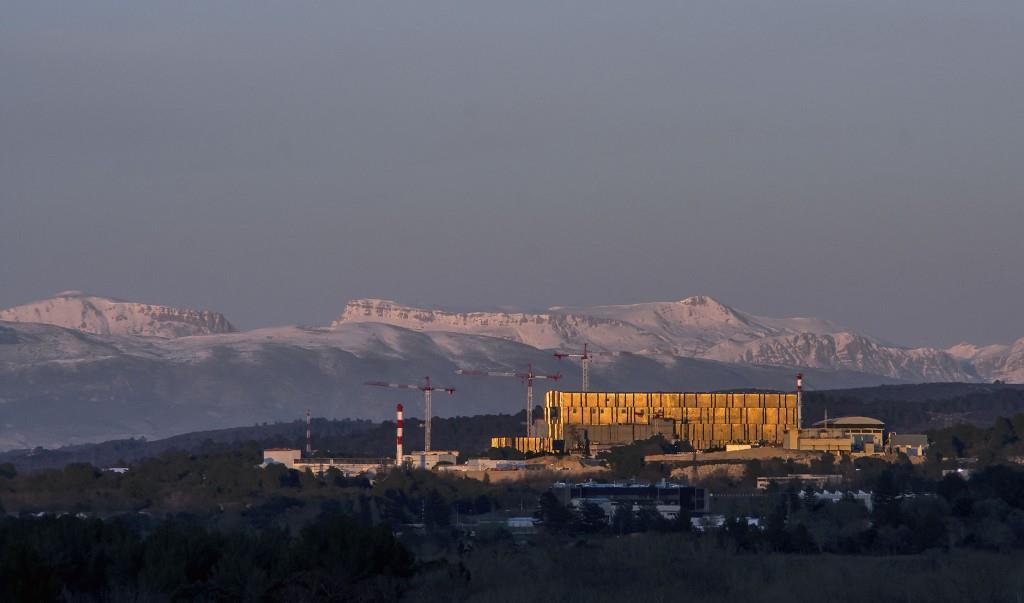
In certain fields of research like fusion, astronomy and high-energy physics, scientists and engineers begin developing plans for their ‘next big machine’ before the current one has even started operating. This is done in part because of the long lead-times for securing the continuity of investments in developing specific technologies and strengthening the supply chain and industrial production capacity as well as the necessary political support, developing the requisite science case, and working out design parameters. Another factor driving this strategy, of course, is the desire of researchers and engineers for continuity of budgets and personnel to maintain institutional security and knowledge continuity. In this regard, fusion energy research is no exception. For example, in Europe, discussions about building the next big fusion facility began even before dignitaries attended JET’s groundbreaking ceremony in 1978.
ITER is a critical step towards producing and delivering electricity from fusion to the grid. Based on experimental and theoretical results from the world-wide fusion community, and the anticipation of successful component construction, integration and assembly, there is a high degree of confidence that the ITER design is credible and will produce substantial net fusion power when operating in its DT phase.
The burning plasma experiment ITER provides, in the opinion of the authors, an essential proof of principle and optimisation step toward building a demonstration fusion plant, which would be the next major step towards the ultimate realisation of fusion as an abundant, carbon-free energy source capable of delivering base load electricity. Despite its inevitable technical and
organisational difficulties and delays, ITER is still regarded by many as the most reliable path for the study of high gain burning plasmas and for developing essential power-plant technologies most candidate fusion system will require. Nevertheless, in parallel to ITER, new important burning plasma facilities are being built in China and the US to explore burning plasma regimes. In addition, there are many fusion startups worldwide aspiring to shortcut the difficulties ITER faces, in time to help with the climate crisis, and the knowhow generated in designing, constructing, commissioning, and operating ITER could also help them. One purpose of this book is to provide also this fusion community with an authoritative document on the engineering basis and the lessons learned in designing and constructing ITER.
The pursuit of fusion energy still requires significant effort and time and the prospects of commercialisation of fusion energy are still uncertain and depend critically on solving a few overarching scientific and technological challenges that go beyond ITER. The challenges are in some cases specific to a specific design concept, but some are common to any design.
Chapter 9 in Volume 1, therefore, chiefly addresses the gaps to be filled beyond ITER. For all magnetic fusion energy (MFE) and inertial fusion energy (IFE) systems, the performance and reliability of the core systems are essential for the deployment of future fusion power plants. As an example, the low readiness of the breeding blanket and fuel cycle, that would only in part be validated in ITER, represents one of the most challenging areas on the critical path to harnessing fusion power.
The main goal of this book is to document the ITER engineering design, to safeguard ITER's legacy and prevent the loss of knowledge, by capturing the main lessons learned from its design and construction. The audience for this book is primarily scientists and engineers engaged in fusion research both working on ITER and those working on other fusion projects as well as large engineering projects.
The ITER project represents a huge financial, scientific, and personnel challenge. The intellectual, economic and material resources involved in its design, fabrication and use represent a major social, cultural and technological endeavour. There was a prevailing sense that, given the scale and potentially transformative influence of ITER, its knowledge basis should be preserved. Nothing about ITER has been easy, but documenting its evolution, successes and lessons learnt provides a valuable tool in preserving and advancing knowledge.
As already stated, ITER has been around for a long time. As a measure of ITER’s longevity, almost all the people involved in the beginning of its original design are now retired and only a very few working on the construction know the full details of its origin, or the sweat and tears expended when it was designed more than 20 years ago. In fact, many of the younger engineers now working on it will not have been born when the project started.
The wealth of knowledge gained, and lessons learned over the course of ITER’s history to date are spread across not only an immense spectrum of documentation in ITER’s document management systems but also in the knowledge and experience of individuals involved in ITER in the past and at present. It is crucial to ensure that the rationale behind the ITER design choices, the lessons learned from the design process, construction, assembly, and commissioning spanning several generations are available and easily accessible to the fusion community in general and especially to those who need to take decisions on its evolution. A comprehensive compendium is, therefore, required to consolidate this information in an accessible and understandable manner to facilitate the preservation and transfer of knowledge.
The scope of the ITER Engineering Basis Handbook is itself ambitious, as there is a lot of ground to cover in ensuring a full understanding of the complexities, from the project genesis and the design evolutions, from conception right through to today. It needs to include a clear description of the device- and the reasoning behind the many technical choices that were made along the way to ensure that systems meet the established project specifications and requirements in terms of performance and operation. These choices encompass everything from the shape and parameters of the plasma, the magnet design and vacuum systems to the safety and confinement process.
As will be discussed, the evolution of our scientific understanding has impacted the engineering requirements and design decisions. This is done in a stand-alone manner that avoids privileged access to document management systems. It documents not just when and what technical decisions and fundamental technology choices were made, but why they were made. A huge amount of research and development was required, and was done, and the lessons learned are documented.
The goal is full transparency- so that the Engineering Basis Handbook can serve as a valuable tool for all ITER stakeholders, as well as being a useful reference across the private sector, and a global educational resource for those studying within the nuclear fusion domain.
This should be a useful and important contribution of the ITER Project. By its very nature, ITER is meant to be a gift to humanity and to society, and sharing insider knowledge is an important part of it. After all, knowledge- just as much as megawatts- is power.
This handbook is not designed to be read as a continuous sequence of chapters. Instead, it is composed of focused, self-contained sections that address specific topics. Each chapter can be read and understood independently, allowing readers to engage with the material most relevant to their needs without requiring familiarity with preceding chapters. As a result, the reader will find certain overlapping content in chapters.
Choosing the right sequence of presenting the content has not been simple. After exploring several options, the author’s made a choice that considered the perspective audience groups, including:
• the general reader with basic scientific background;
• ITER engineers who can better understand both their predecessors and each other's work;
• those asked to take informed decisions on the next generation of devices, which will benefit from ITER’s activities across design, integration, manufacture, assembly, and commissioning;
• private companies and public-private consortiums to become aware of the challenges and possible pitfalls;
• engineering students and professionals alike that benefit from using this handbook as an educational resource;
• historians of science and technology.
This handbook consists of two volumes which describe the ITER design from its inception up to the design, construction and assembly in 2025, including the considerations of the 2024 Baseline. It is to be noted that at the time of writing, the design for some systems is still on-going. Therefore, the reader should consider that whilst there is significant value of this important point-in-time study, an update would be required once ITER is completed. The individual sections in Volume 2 summarise the status of the respective systems at the time of writing, indicating where further developments are pending.
A broad overview is given in the first volume, to provide the reader with background information necessary to understand the context in the subsequent more-detailed chapters of the second volume. The authors recommend that as construction is completed and machine commissioning and operation starts a further volume reporting on this important phase should be added.
The first volume primarily addresses:
• the project genesis, project phases and key design evolution aspects from its conception until today as known and experienced by the experts;
• ITER’s design and the way it has been built, resulting from international collaboration and complex interactions between the scientific and engineering community, government, and industry as well as the Member’s representing their governments;
• a concise explanation and reasoning of design guidelines and specifications, and of the design evolution as a result of new scientific and technical insights;
• the main engineering and technology challenges associated with the underlying design features and technology choices adopted for some of ITER’s systems/ components, emphasising those where major gaps with existing devices had to be addressed;
• major innovations that the design and construction ITER required;
• the extensive R&D and design verification programmes characterised by wide-ranging, long-term international collaborations;
• the main manufacturing challenges that have emerged and repair or risk mitigation actions being implemented;
• safety and radiological confinement strategy and analysis, and the basis of the nuclear licensing process;
• the evolution of project management principles and tools throughout the project’s phases;
• important lessons learned from throughout the ITER project phases.
In the second volume, the emphasis switches to a more detailed description of the ITER physics basis, plant and of its main systems as presently constructed and assembled. It provides a comprehensive coverage of the fundamental aspect of the design, design methodologies and principles, the underlying technical design basis for ITER and its evolution from the years of conception to assembly and construction, as well as the technical, scientific, and regulatory rationale behind the major decisions and the importance of design integration and interface management.
The role of R&D and of prototype development and testing for validating the performance of state-of-the-art components, the fabrication challenges, and the lessons learned, are described. Incorporated throughout are many illustrative examples and case studies, which provide the reader with a substantial learning experience, especially in areas of practical application.
A concise, but important description of the main plasma physics challenges related to burning plasma physics in ITER including energy confinement, MHD stability and control, plasma exhaust and impurity control, and energetic particle behaviour are included, emphasising the impact on the design and the remaining uncertainties, as well as pointing to the underlying physics driving the engineering of the tokamak and its systems.
This second volume then covers extensively the engineering details and lessons learned on all major plant systems, components, tools and design considerations, including:
• tokamak basic machine design, the ITER Plant layout and site services (electrical, cooling and cryogenic systems layout), the nuclear buildings including ventilation, fire protection and detritiation systems; the active maintenance facility; the main loads at plant and systems level; the materials used for the construction of the tokamak and also those protecting the core of the machine; nuclear shielding and safety considerations and safety features; the assembly sequence and tooling remote handling approach; and design methodologies and tools (codes & standards);
• magnet systems including vessel coils, vacuum vessel, first wall, shielding blanket & limiters blanket cooling manifolds, divertor, auxiliary heating systems, power supply systems, cryogenic systems, cryostat thermal shields, water cooling systems, fuelling systems, vacuum and pumping systems, fuel cycle and tritium plant, remote handling
INTRODUCTION
Vol.1, Ch. 3, p. 17
systems and tools, plasma diagnostics, and port plug integration, ITER central control, and plant system integration, and test blanket modules.
As in Volume 1, case studies have been included, to provide the reader with a substantial learning experience. Complete references are included. Supplementary information on topics not fully covered, therefore, can be easily found.
In summary, this book is intended to describe the complexity of magnetic fusion systems including the strong interplay between scientific, engineering, and regulatory issues and will help the industrial community to implement better solutions in the future
The ITER project is unusual in the scope of its partnership as there has never been a collaboration of this many countries on a project of this size, and the strong level of commitment by all the involved Parties is essential for its success. The expectation at the start of the ITER project in 2007 that design, construction and assembly would be completed in 10 years proved to be overly optimistic and created additional challenges for the Project with their governing bodies. Through all hardship, the team spirit, in pursuit of important scientific and technical goals, has endured.
The participants were attracted to the project by the opportunity to work on a grand scientific challenge and to pursue their commitment to fusion as a pathway to low-carbon energy and as a foundation for sustained global security and stability. These were more than just big science projects- the teams have continued working through adversities because of the camaraderie between people passionately committed to their mission.
ITER's contribution to fusion physics and engineering is immense, and the next generation of devices will be advanced due to ITER’s pioneering activities in design, integration, manufacture, assembly, and operation that could never have been learned in any other way. It will provide the long-awaited opportunity to study in detail a burning plasma at a power plant scale and ITER’s success is key to the deployment of future plants delivering fusion electricity to the grid.
INTRODUCTION Vol.1, Ch. 3, p. 18
[1] INTOR Group, “INTOR conceptual design summary,” Nuclear Fusion, vol. 22, p. 135, 1982. Available online at: https://iopscience.iop.org/article/10.1088/0029-5515/22/1/014/meta
[2] Cover of the Time Issue, 18 November 1985 : Cover illustration : “LET’S TALK – The Summit,” © [1985] [Pending permission].
[3] ITER EDA Documentation Series No. 22: International Thermonuclear Experimental Reactor (ITER) Engineering Design Activities (EDA), Summary of the ITER Final Design Report, July 2001. Vienna, Austria: International Atomic Energy Agency, 2001.
[4] [Work begins at the ITER Site of Cadarache], ITER Newsline, ITER Organization, 2007. [Online]. Available: https://www.iter.org/fr/node/20687/21-open-positions-iter
[5][Photograph of the first sector of the ITER vacuum vessel], ITER Newsline, ITER Organization, 2022. [Online]. Available: https://www.iter.org/node/20687/steep-climb
[6] [Photograph of an architectural paradox], ITER Newsline, ITER Organization, 2024. [Online]. Available: https:// https://www.iter.org/fr/node/20687/architectural-paradox
CDA – Conceptual Design Activity
CS – Central Solenoid
DA / DAs – Domestic Agency / Domestic Agencies
DD – Deuterium–Deuterium
DEMO – Demonstration Fusion Power Plant
D – Deuterium
DT – Deuterium–Tritium
EDA – Engineering Design Activities
EU – European Union
Euratom – European Atomic Energy Community
IAEA – International Atomic Energy Agency
IFMIF – International Fusion Materials Irradiation Facility
INTOR – International Tokamak Reactor
JET – Joint European Torus
JT-60 – Japan Atomic Energy Research Institute Tokamak
JT60-SA – JT-60 Super Advanced
MJ – Megajoule
MHD – Magnetohydrodynamics
INTRODUCTION
MW – Megawatt
R&D – Research and Development
SRO – Start of Research Operations
T – Tritium
TBM – Test Blanket Module
TF – Toroidal Field (coil)
TFTR – Tokamak Fusion Test Reactor
US DOE – United States Department of Energy
INTRODUCTION Vol.1, Ch. 3, p. 20