YEAR XL
ricostruire
No. 5/2017
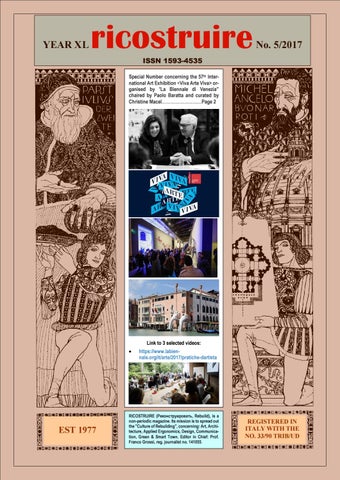
ISSN 1593-4535 RICOSTRUIRE the information of Special Numberintends concerning the 57th Intertheses and works in the field of Architecnational Art Exhibition <Viva Arte Viva> orture, Arts and Design, as a mediation beganised by “La Biennale di Venezia” tween chairedthebytechnological Paolo Barattaand andspiritualistic curated by tendencies of our age. It expresses the Christine Macel………………………Page 2 need to give architectural design and Design itself a new value, for a more open dialogue with the social and cultural context, by widening its space of intervention to the world of Communication, in order to express its "duties of criticism". The promotion of this e-magazine requires a new form of dialogue with the reader, starting from the belief that professional training and the production of buildings, objects and landscape architecture, today need the work of a typical architect, builder and designer, indefatigable revealer of "formulae" and impressions, which translate into an architecture and a design made of orders, proportions, harmonies, to communicate the culture of Man and Nature. It is renewed in the moment in which modernism and its utopian ideology have shown Man not having been able to fully exploit the existing technological potential and the arsenal represented by the historical experiences in each place. Finally, we wish to orientate the field of intervention also towards the study of integrated communication systems, to be used in the architectural design of interiors, exteriors and urban furniture and in designing objects and services. In fact, in the analysis of future architectural structures, it will be increasingly necessary to take into account the needs dictated by the growing use of new media (new-media) and, in particular, technical equipment, installation of new technologies, such as the wired area, the intelligent building, home automation and many other applications. Ergonomics Applied to Industrial Design will be the basis and the fa3 selected videos: cilitator toLink wintothe future challenges.
https://www.labiennale.org/it/arte/2017/pratiche-dartista The VRBS FELIX Manifesto for a Wellbeing City, Green, Smart and Mild……..….Page 2 VRBS FELIX (Happy City), the Next Town Vision with a “Green and Smart” Human Centered Design………………………Page
EST 1977
RICOSTRUIRE (Реконструировать, Rebuild), is a non-periodic magazine. Its mission is to spread out the "Culture of Rebuilding", concerning: Art, Architecture, Applied Ergonomics, Design, Communication, Green & Smart Town. Editor in Chief: Prof. Franco Grossi, reg. journalist no. 141055.
RICOSTRUIRE magazine - YEAR XL - No. 5/2017 – Page 1
REGISTERED IN ITALY WITH THE NO. 33/90 TRIB/UD
which must be recognized in full - this is also a symptom of several positive, wide-ranging phenomena. First of all, there is the public’s growing familiarity with contemporary art. It is nice to think that this bond is the outcome of their desire to have art and artists as travel companions. Secondly, we have noted a growing desire to discover firsthand the vitality of art, compared to the world’s daily onslaught of sounds and images whose goal is to induce certain forms of behavior (occasionally, one striking facet of this onslaught regards the market value which some works of contemporary art have attained).”
The 57th International Art Exhibition, titled Viva Arte Viva, was opened to the public from May to November 2017, at the Arsenale and Giardini venues, and in several locations in Venice. The show featured 120 invited artists, of which 103 were participating for the first time, 86 National Participations, a Special Project, and 23 Collateral Events. The Exhibition offered a route that unfolded over the course of nine chapters or families of artists, beginning with two introductory realms in the Central Pavilion in the Giardini, followed by seven more realms to be found in the Arsenale and the Giardino delle Vergini. “Viva Arte Viva” was an Exhibition inspired by humanism” - declared curator Christine Macel. President Paolo Baratta said that the Exhibition, which lasted over 6 months, registered over 615,000 visitors with an increase of 23% when compared to the 501,502 visitors of 2015. High number of young visitors: visitors under 26 years of age were 31% of the total. In particular, the students who visited the Exhibition as part of a group amounted to 15% of the total number of visitors. “Above and beyond the satisfaction which records can give – stated President Paolo Baratta - to which we must neither bow nor become accustomed, it pleases me to think that – along with the merits of our curator Christine Macel,
The Italian Pavilion, titled "The Magic World"
The Italian Pavilion at the Tese delle Vergini in the Arsenale, sponsored and promoted by the Italian Ministry of Cultural Heritage and Tourism, was curated by Cecilia Alemani. The project of Padiglione Italia at 57th International Art Exhibition in Venice fully embodies the teme proposed by this year’s curator, Christine Macel, who has defined
RICOSTRUIRE magazine - YEAR XL - No. 5/2017 – Page 2
Viva Arte Viva as a Biennale with artists, of artists, and for artists. By drawing attention to them and to their creative quests, the exhibition “Il mondo magico” [The magical world] offered the possibility for a novel and intriguing interpretation of reality. The brainchild of pavilion curator Cecilia Alemani, the title was a direct reference to the book of the same name by Ernesto de Martino, published by Einaudi in 1948. And just as his Il mondo magico proposed a return to the imaginary and the fantastic as a means for experiencing the richness and multiplicity of the world, the artists chosen by the curator (Giorgio Andreotta Calò, Roberto Cuoghi, and Adelita Husni-Bey) pursued their adventures in the sphere of magic and imagination, each producing profoundly distinct creative results, in terms of both content and form. This project was certainly ambitious, multifarious, and innovative. According to guidelines issued by the Directorate General for Contemporary Art and Architecture and Urban Peripheries, the number of artists was kept to three and they were given a year to develop their projects. This laid the groundwork for organizing Italy’s presence at La Biennale and establishing timelines and methods that have allowed all involved to be most effective in their respective roles. The outcome was a reaffirmation of Italy’s contemporary identity at the Venice Biennale, an event that had always represented a vital occasion for sharing and exchange within a global culture. Andreotta Calò, Cuoghi, and Husni-Bey had thus been provided everything they need to produce ambitious, complex works, negotiating the compelling and fascinating space of the Tese delle Vergini, which posed infinite challenges and possibilities for venue design. Lastly, a rich and variegated program of side events has been developed, featuring in particular workshops geared to students at Italian fine arts academies. Through direct contact with the artists and professionals who created Padiglione Italia, they have gained invaluable awareness of the complexity and variety of professions associated with the contemporary arts, their future field of action. These artists, all born in Italy between the seventies and eighties, emerged on the scene in the
first decade of the new millennium and, despite many stylistic differences, shared a fascination with the transformative power of the imagination and an interest in magic. In their works, Andreotta Calò, Cuoghi, and Husni-Bey constructed parallel universes that teemed with references to magic, fancy, and fable, creating complex personal cosmologies.
The Italian Pavilion
They saw themselves not just as producers of artworks, but as active interpreters and creators of the world, which they reinvented through magic and the imagination. For the invited artists, magic was not an escape into the depths of irrationality but rather a new way of experiencing reality: it was a tool for inhabiting the world in all its richness and multiplicity. Within the landscape of contemporary Italian art, these artists used magic as a cognitive instrument for reconstructing and reinventing reality, sometimes through fantasy and play, sometimes
RICOSTRUIRE magazine - YEAR XL - No. 5/2017 – Page 3
through poetry and imagination. This approach allowed them to create complex aesthetic universes that eschew the documentary-style narrative found in much recent art, relying instead on an alternative form of storytelling woven from myths, rituals, beliefs, and fairy tales. Like the rituals described by Ernesto de Martino, the works of the three artists staged situations of crisis that are resolved through processes “Hands on” by Lorenzo Quinn of aesthetic and ecstatic trans- figuration. If one looks closely, these works offered up the image of a country, both real and fanciful, where ancient traditions coexist with new global languages and vernaculars, and where reality and imagination melt together into a new magical world. The new idea of the 57th Venice Biennale of Arts, “At lunch with the artists”. This new format, named “Tavola Aperta” (Open Table) which gives the word to the artists, was introduced firstly during the 2017 edition and received a great consensus. This new format, which gives the word to the artists, was introduced firstly during the 2017 edition and received a great consensus. These convivial meetings went on for all the six months, every week in front of the Central Pavilion of the Gardens and in the Arsenal's Arms Room. So, for the duration of the 2017 Biennale Arte Viva Arte Viva, every week an artist held an Open Table, meeting the audience during a lunch to share, in order to hint at their work and dialogue. Participation in Tavola Aperta was, of course, was opened to everyone, by reservation and subjected to availability. Here there are the names of the artists who participated in the initiative: Koki Tanaka, Franz Erhard Walther, Lisa Reihana, Cevdet Erek, Lee
Wan Corea, Qiu Zhijie, Tang Wu, Jian’an, Riccardo Guarneri, Naufus Ramírez-Figueroa, Lady Kathleen, Richardson Walter, Barbara Paca, Mike Bourscheid, Giorgio Griffa, Edith Dekyndt, Sebastián Díaz Morales, Jeremy Shaw, Erwin Wurm, Lantian Xie, Peter Miller, Xavier Veilhan, Ronan Zaslonov, Kader Attia, Enrique Ramírez, Wendelin Van Oldenborgh, Tintin Wulia, Antoni Miralda, Joan Rabascall, Dorothée Selz, Edi Rama, Anri Sala, Lee Mingwei, Martin Cordiano, Katherine Nuñez & Issay Rodriguez, Taus Makhacheva, Olafur Eliasson, Ciprian Muresan, Carlos Amorales, Jelili Atiku, Erika Verzutti, Yee Sookyung, Mariechen Danz, Alicja Kwade, Boris Mikhailov, Irina Korina, Sung Hwan Kim, Giorgio Andreotta Calò, Pauline Curnier Jardin, Yorgos Sapountzis, Tina Gverovic, Marko Tadic, Zad Moultaka, McArthur Binion, Shimabuku, Hassan Khan, Cynthia Gutiérrez, Teresa Lanceta, Julian Charrière, Thu Van Tran, Bonnie Ora Sherk, Marie Voignier, Dirck Braeckman, Rina Banerjee, Andy Hope 1930, Hale Tenger, Grisha Bruskin, Recycle Group, Sasha Pirogova, Søren Engsted, Franck Leibovici, Michele Ciacciofera, Salvatore Arancio, Michael Beutler, Dawn Kasper, Marko Pogacnik, Milenko Matanovic, David Nez, Anne Imhof, Radenko Milak, Roman Urantjek, Fiete Stolte, Ernesto Neto. (Francesca Grossi)
RICOSTRUIRE magazine - YEAR XL - No. 5/2017 – Page 4
Tavola Aperta (Open Table, at lunch with artists)