Year XLIV
ricostruire magazine
No. 2/2021
ISSN 1593-4535
www.italiandesignschool.it
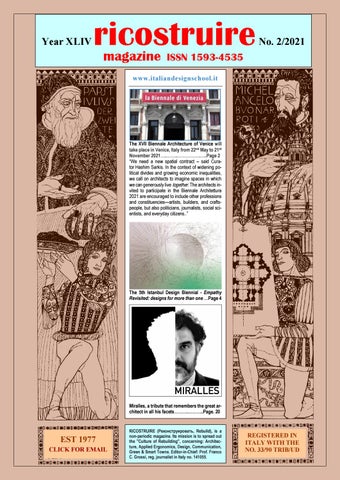
The XVII Biennale Architecture of Venice will take place in Venice, Italy from 22nd May to 21st November 2021…..……..…………….…..Page 2 “We need a new spatial contract – said Curator Hashim Sarkis. In the context of widening political divides and growing economic inequalities, we call on architects to imagine spaces in which we can generously live together. The architects invited to participate in the Biennale Architettura 2021 are encouraged to include other professions and constituencies—artists, builders, and craftspeople, but also politicians, journalists, social scientists, and everyday citizens..”
The 5th Istanbul Design Biennial - Empathy Revisited: designs for more than one …Page 4
Miralles, a tribute that remembers the great architect in all his facets……….………..Page. 20
EST 1977 CLICK FOR EMAIL
RICOSTRUIRE (Реконструировать, Rebuild), is a non-periodic magazine. Its mission is to spread out the "Culture of Rebuilding", concerning: Architecture, Applied Ergonomics, Design, Communication, Green & Smart Towns. Editor-in-Chief: Prof. Franco C. Grossi, reg. journalist in Italy no. 141055.
REGISTERED IN ITALY WITH THE NO. 33/90 TRIB/UD
The 17th International Architecture Exhibition, titled How will we live together?, is curated by Hashim Sarkis and organized by La Biennale di Venezia. The exhibition will be open to the public from Saturday 22nd May to Sunday 21st November 2021 at the Giardini and Arsenale venues. STATEMENT BY HASHIM SARKIS “We need a new spatial contract – said Curator Hashim Sarkis. In the context of widening political divides and growing economic inequalities, we call on architects to imagine spaces in which we can generously live together. The architects invited to participate in the Biennale Architettura 2021 are encouraged to include other professions and constituencies—artists, builders, and craftspeople, but also politicians, journalists, social scientists, and everyday citizens. In effect, the Biennale Architettura 2021 asserts the vital role of the architect as both cordial convener and custodian of the spatial contract.”
“In parallel, the 17th Exhibition also maintains that it is in its material, spatial, and cultural specificity that architecture inspires the ways we live together. In that respect, we ask the participants to highlight those aspects of the main theme that are uniquely architectural.” “The question How will we live together? is as much a social and political question as a spatial one. Aristotle asked it when he was defining politics, and he came back to propose the model of the city. Every generation asks it and answers it differently. More recently rapidly changing social norms, growing political polarization, climate change, and vast global inequalities are making us ask this question more urgently and at different scales than before. In parallel, the weakness of the political models being proposed today Hashim Sarkis compels us to put space first and, perhaps like Aristotle, look at the way architecture shapes inhabitation for potential models for how we could live together.” “The Biennale Architettura 2021 is motivated by new kinds of problems that the world is putting in front of architecture, but it is also inspired by the emerging activism of young architects and the radical revisions being proposed by the profession of architecture to take on these challenges. But more than ever, architects are called upon to propose alternatives. As citizens, we mobilize our synthetic skills to bring people together to resolve complex problems. As artists, we defy the inaction that comes from uncertainty to ask ‘What if?’. And as builders, we draw from our bottomless well of optimism. The confluence of roles in these nebulous times can only make our agency stronger and, we hope, our architecture more beautiful.”
RICOSTRUIRE - YEAR XLIV - No. 2-2021 – Page 2
HOW WILL WE LIVE TOGETHER? The International Exhibition will be articulated between the Central Pavilion at the Giardini, the Arsenale, and Forte Marghera, including 110 Participants in competition coming from 46 Countries with increased representation from Africa, Latin America, and Asia. In addition to the invited Participants, the Biennale Architettura 2021 also includes Stations and Co-Habitats, researchers out of competition on the themes of the Exhibition and developed by universities around the world. Organised in five scales between the Arsenale and the Central Pavilion at the Giardini, the Exhibition also presents large installations connected to one of the five scales, which will be placed in the external spaces of the Arsenale and the Giardini. “How will we play together?” is the project devoted to children’s play at Forte Marghera, presented by five architects and an architectural photographer.
WEEKENDS ON ARCHITECTURE The Weekends on Architecture will supplement the curatorial programme for the 17th International Architecture Exhibition through a series of lectures and panels that will bring together architects and scholars from around the world to address the question How will we live together?. Between October and November 2021, there will be three weekends for six appointments, and in each meeting two topics inspired by the recurring issues in the participants’ projects will be discussed: new challenges that climate change is putting in front of architecture; the role of public space in recent urban uprisings; new reconstruction methods; the changing forms of collective housing across the globe; the Architecture of Education and the Education of the Architect; the relationship between curation and architecture. The full programme will be available soon.
NATIONAL PARTICIPATIONS There are 63 National Participations in the historic Pavilions at the Giardini, at the Arsenale and in the historic city centre of Venice. 4 Countries are participating for the first time at the Biennale Architettura: Republic of Azerbaijan, Grenada, Iraq, and Uzbekistan. The Italian Pavilion at the Tese delle Vergini in the Arsenale, sponsored and promoted by the Ministero della Cultura, Direzione Generale Creatività Contemporanea, is curated by Alessandro Melis.
BIENNALE SESSIONS: THE PROJECT FOR UNIVERSITIES For the eleventh consecutive year La Biennale dedicates the Biennale Sessions project to Universities, Fine Arts Academies and Higher Education Institutions. The goal is to offer favourable conditions for students and teachers to organize three-day group visits for fifty people or more, offering the possibility to organize seminars free of charge at the Exhibition’s venues, and assistance in organizing their journey and stay.
COLLATERAL EVENTS There will be 17 Collateral Events at the 17th International Architecture Exhibition How will we live together? curated by Hashim Sarkis. The Collateral Events approved by the Curator have been promoted by non-profit national and international bodies and institutions. Organized in various venues across the city, they present a wide range of projects and participations that enrich the pluralism of voices that distinguishes the Exhibition in Venice.
EDUCATIONAL For the past decade, La Biennale has been devoting increased attention to learning activities, and has developed a growing commitment to socalled “Educational” initiatives addressed to the audience of its Exhibitions’, to universities, young people, and children from schools at all levels. In the past two years, La Biennale’s major Exhibitions – Biennale Architettura 2018 and Biennale Arte 2019 – had 114,672 participants in Educational activities in total, amongst whom 68,205 were youngsters. A broad Educational programme has been scheduled for
RICOSTRUIRE - YEAR XLIV - No. 2-2021 – Page 3
2021 as well, addressed to individuals and groups of students, children, adults, families, professionals, companies, and universities. All the initiatives aim at actively involving the participants, and are led by professional operators, carefully trained by La Biennale di Venezia. Educational activities are divided into two categories: Guided Tours and Workshop Activities.
The 5th Istanbul Design Biennial: Empathy Revisited: designs for more than one
The 5th Istanbul Design Biennial brings together ideas and projects that seek to define a new role for design based on empathy. As a mediator of emotions and feelings, design is presented here as a practice that takes care as its main purpose. Designers adopt sensitive, diplomatic, sometimes therapeutic functions, with the aim of connecting us with
one another but also with the world around us, with other species, with microorganisms, soil, water and even the universe. Aspiring to carve out a space of responsibility and nourish a culture of attachment towards the more-than-human, this biennial explores designs for multiple bodies, dimensions and perspectives. The projects on display encourage us to rethink practices of care and civility at this critical moment in time, and to collectively build new systems and structures for reconnecting. The biennial offers critical tools and alternative pathways in face of urgent climate and economic crises, a general state of social deprivation and an exhausted global industrial model. Designs for more than one are those that take into consideration not just their immediate user or client, but the many constituents and complex entanglements inherent to any design process. The 5th Istanbul Design Biennial, curated by Mariana Pestana with Sumitra Upham and Billie Muraben, started in October 2020 during a global pandemic, a unique moment in time when the whole world was engaged in imagining what would come next. In a time of rupture and questioning, in the face of the many and constantly shifting challenges and regulations brought about by the pandemic, the biennial has revised a programme which, rather than resisting or ignoring the current scenario, adapted to it. It reappraises the traditional biennial model to propose a generative and locally produced programme, developed in dialogue with, and catered for, the citizens of Istanbul. Concerned with legacy, many of the projects will continue to live post-2020 and new works have emerged in April 2021. Amidst an acute ecological crisis and a general state of social isolation, the biennial invites us to think critically about how we relate to one another and to others, be them human or other bodies – biological, bacterial, or geological. The biennial has brought together ideas and projects that seek to define a new role for design based on empathy. As a mediator of emotions and feelings, design is presented here as a practice that takes care as its main purpose. Designers adopt sensitive, diplomatic, sometimes therapeutic functions, with the aim of connecting us with one another, but also with the world around us, other species, microorganisms,
RICOSTRUIRE - YEAR XLIV - No. 2-2021 – Page 4
soil, water and even the universe. Aspiring to carve out a space of responsibility and nourish a culture of attachment towards the more-thanhuman, this biennial has explored designs for multiple bodies, dimensions and perspectives. The projects display encourage us to rethink practices of care and civility at this critical moment in time, and to collectively build new systems and structures for reconnecting. The biennial offers critical tools and alternative pathways in the face of urgent climate and economic crises, a general state of social deprivation and an exhausted global industrial model. Designs for more than one are those that take into consideration not just their immediate user or client, but the many constituents and complex entanglements inherent to any design process. Key features of this biennial Timeline: The biennial started in October 2020 and continues to evolve digitally and physically for six months, until the end of April 2021, in a slow and productive cycle. Works continue to develop, be produced and broadcasted, with new installations opening throughout the period. In the Spring of 2021, it will be possible to see how the works have integrated with the city, and how research projects around the Mediterranean have progressed. Production: The biennial is held with a new structure, with a focus on newly commissioned projects, by practitioners from a variety of backgrounds and disciplines, and most of the works being produced in Istanbul to support the local industry. Audience: The format of the biennial proposes a new mode of engagement, reversing the notion of who the biennial is for. The biennial programme has been designed so that the works in Istanbul have a longerterm life and become a part of the city; being useful, engaging and meaningful to people living in Istanbul. Furthermore, the biennial meets people where they are – out in the street, in parks or even at home
– and invites them in as participants in the New Civic Rituals, researchers at the Library of Land and Sea, and critical cooks in the Critical Cooking Show. Legacy: This biennial is an evolving conversation that began in autumn 2020 and will extend into the future, with many of the projects becoming long-term installations in public spaces around the city, or continuing their life cycle digitally, thus creating opportunities for new beginnings.
Some works presented Dansbana! Kalamis: Dansbana! 2020 Supported by IASPIS, Consulate General of Sweden and Kadıköy Municipality
RICOSTRUIRE - YEAR XLIV - No. 2-2021 – Page 5
Dansbana! Kalamis creates a place for dancing in the city. Developed in dialogue with the Kadıky Municipality and local dancers, the design is inspired by the underwater world and the geological richness of the area, located on the bank of the Bosporus. The intervention is a dance platform equipped with bluetooth speakers, allowing anyone to dance to their own music, morning till evening, every day. Dansbana! Kalamis is a permanent installation in the park, with the aim to create a new meeting spot in Istanbul for dancers of all kinds. Statistics show that many public spaces for outdoor activities, such as football fields or skateboard ramps, are primarily used by boys. Girls are heavily underrepresented as users of public spaces, and Dansbana! was created with a desire to change that through dance. The design of a shell as background for the dancers evokes the famous Sandro Botticelli’s The Birth of Venus, a subordinate depiction of women, to propose instead an active, empowering representation.
design produces a new configuration of intimate spheres between public and private realms.
Public Devices for Therapy - Soraia Gomes Teixeira – 2020 Supported by Jofebar, Panoramah!, Pláka Porto, Istanbul Metropolitan Municipality and Beşiktaş Municipality. The shift to the digital has accelerated atomisation between people through the promotion of virtual experiences via social networks, where physical encounter is absent. In 2020, this distance was suddenly verbalised and made mandatory by the rapid transmission of SARSCoV-2 – an enemy with an invisible body – imposing the absence of personal contact and instigating mistrust towards the bodies of others. Public Devices for Therapy aims to help us regain confidence in proximity to each other’s bodies in the form of a collection of large-scale objects resembling sports equipment. Mediators of collective therapy between bodies in public space, the devices encourage observation and touch, bringing people close together again to rebuild their trust in one another, while safely regulating proximity between them. In doing so, this
Sundial of the Blind - Eli Bensusan – 2020 Supported by Istanbul Metropolitan Municipality and Kadıköy Municipality Sundial of the Blind connects the southern hook of Moda Park with the North Star, inviting visitors to reconsider their location and position. It evokes the hidden geographical, historical, cultural and mythological layers of the ancient town of Khalkedon, where it is displayed. By looking at the shadow of the ‘gnomon’ (the part of the sundial that is parallel to Earth’s axis), and locating the hour line on which it falls, you can tell the time. Direct sunlight is necessary, so one can read the time only
RICOSTRUIRE - YEAR XLIV - No. 2-2021 – Page 6
between sunrise and sunset. In the morning, the shadows fall to the west of the gnomon, and in the afternoon, to the east.
At night you can sit on the dial, and observe the celestial globe rotating around the Northern Star, which the marble sphere points at. The ancient town of Khalkedon was called ‘the city of the blind’ in a prophecy uttered by the Oracle of Delphi in the temple of Apollo – the god of sunlight, poetry, music, and healing. Thus, several clues to a riddle are written in Braille on the sundial, waiting to be reconstructed by the observer. This piece uses design as a tool to reconnect citizens with immediate and distant bodies and myths, generating a multi-layered image of contemporary Kadıköy that transcends temporal relations. Germinator - SKREI with Francisca Sottomayor & Sofia Magalhães 2020-21 - Supported by Ek Biç Ye İç, Pláka Porto and Kadıköy Municipality.
Germinator is a public sprouting cabinet, a self-irrigating system made up of low-heat terracotta pieces where seeds germinate. Easy to use and low cost, Germinator invites citizens to learn about and participate in the germination and cultivation of quality seeds. The seeds produced here will go on to be used as a food source for the community, encouraging self-sufficient food supplies, which in turn reduces dependency on human-made energy sources. The seed is an age-old symbol of change and renewal – from ancient Egyptians’ germination of seeds in the coffins of the deceased as an expression of life springing from death, to the Persian New Year (Nowruz) ritual of spring renewal through germinating lentils. In this tradition, Germinator is a symbol of a new beginning for the way in which human beings interact with their environment, and a new era of how human beings can choose to grow and source their food. It affirms modes of commoning around a nutrient-dense genetic heritage, and architecture’s role in generating self-sufficient food security systems. Desiccate With Care - public works with Freddie Wiltshire and Billy Adams – 2021 - Supported by British Council and Kadiköy Municipality. Desiccate With Care turns food dehydration and preservation into a collective civic practice. The work takes as its starting point the Turkish
RICOSTRUIRE - YEAR XLIV - No. 2-2021 – Page 7
culinary tradition of giving vegetables a second life by preserving them under an open-air drying ceiling. The process of dehydration and the cultures that surround it are explored, while produce is gathered to test and discuss drying rituals from around the world. As a counter-narrative to modern immediacy, this slow race against decay sets a new pace for public life. The process of air-drying food has been a performative preservation technique for centuries. Examples are found around the world. In New Mexico and Arizona decorative and pungent ristas are fixed outside homes to welcome visitors. In Norway the hjell, a rich fish from the north, is hung to dry for months on wooden A-frame cathedrals of ice. In Japan, the colourful hoshigaki ritual sees thousands of persimmon fruits left to shrink deliciously in the gentle autumn breeze. The process of drying food was a necessity that has slowly evolved into a social ritual.
ultimately, to be subject to nature. Inspired by the street-food culture of Istanbul, Guixé’s specific accessories equip the solar kitchen.
Solar Kitchen is a new development of the Solar Kitchen Restaurant project started in 2011 together with Antto Meliasniemi. Microbial Fruits of Istanbul - Orkan Telhan + alii - 2021
Solar Kitchen - Martí Guixé – 2021 -Supported by Acción Cultural Española (AC/E) and Istanbul Bilgi University.
This project is commissioned in co-production with the Mutant Institute of Environmental Narratives (IMNA) of Matadero Madrid and supported by Acción Cultural Española (AC/E), Weitzman School of Design and Kadıköy Municipality.
This public solar kitchen uses alternative energy – the sun – as its power source. It plays with the flexibility of its users, and their willingness to adapt to atmospheric conditions. At the mercy of the weather, it forces us to reconnect with the environment, to deal with the unexpected and
Microbial Fruits of Istanbul is a platform that tells the complex histories of Istanbul community gardens (bostans) from the perspective of microorganisms.
RICOSTRUIRE - YEAR XLIV - No. 2-2021 – Page 8
in the project will be shared with the support of Kokopelli Sehirde and Nadas Istanbul. Buyukada Songlines - Studio Ossidiana – 2021 -Supported by Stimuleringsfonds, Istanbul Metropolitan Municipality and the Consulate General of the Kingdom of the Netherlands
A garden of gardens, a hybrid between a soil microbiology lab and a fruit tree, it displays microbial cultures collected from a variety of gardens in the city of Istanbul, which date back over 1,500 years. Developing a new ‘oral-culture’, this installation allows the audience to experience, empathise with, and learn about the heritage of gardens in relation to the ecological and socio-political realities of our time. As microbial fruits are distributed to the visitors, a robotic speaking parrot delivers their histories in the form of fables written for future generations. By using microbes that have evolved in the micro-climates of the Istanbul gardens, the project invites visitors to consume place-specific histories shaped by climate change. Microbial Fruits of Istanbul is a project by the Mutant Institute of Environmental Narratives (IMNA), Matadero Madrid's laboratory for climate action, in partnership with Istanbul University Department of Molecular Biology and Genetics, Kokopelli Sehirde and Nadas collectives. The microbial cultures used
Buyukada Songlines is a design project and a journey. A floating garden inhabited by plants, soil, insects and birds, it will travel across Istanbul’s Prince’s Islands archipelago in the spring of 2021, before heading towards the mainland. During its travels, the garden will host people and other animals, events and conversations, becoming a nomadic pavilion populated by the life and the stories of the archipelago. Part of a tradition of water pavilions that bind water cities across Europe and Asia, Buyukada Songlines is an investigation of our complex relationships with other species: from the horses and the horse masters of
RICOSTRUIRE - YEAR XLIV - No. 2-2021 – Page 9
Buyukada, to the transplanted corals of Neandros, the garden collects stories and species, becoming a living embassy of the archipelago and its complex ecologies. The project is realised by Studio Ossidiana (Alessandra Covini, Giovanni Bellotti, Sze Wing Chan) with Sera Tolgay, Daniel Marshall, Merve Yucel, Kerim Bayer, and Ahmet Topbas. Point Cloud - Soft Baroque – 2020 - Supported by Istanbul Metropolitan Municipality and Beşiktaş Municipality
designs are created without human input. In this future, do machines create designs for their own pleasure? Each piece of Point Cloud is an IRL low-resolution version of a point cloud, but rather than linking each point with a smooth mesh, the connections between the nodes are erratic arcs. The pieces form a strange and abstract diagram that suggests a metaphorical interlinking of datum points, ideas, bodies and systems. Point clouds can be used to map the topography of landscapes, the anatomy of objects, expressions on faces and the movements of bodies. A new generation of programming is using this 3D information to curate artificial intelligence systems, which collect point clouds of common objects and 'learn' to model original recreations. This raises questions about digital systems in the art and design industries, and the possibilities of objects conceived without human intervention. Sobya't Thawra - The Revolution Woodstove - Bits to Atoms + BeirutMakers - 2019/20 - Supported by Istanbul Metropolitan Municipality and Beyoğlu Municipality.
When machines “read” reality, they create point clouds – these are digital nodes that join together to form three-dimensional shapes. With the advent of artificial intelligence, machines and software are now able not just to “read” reality but also to generate new forms and designs. These furniture pieces are inspired by such technological developments. They invite you to consider how the world looks from the eyes of a machine and also to imagine an automated future scenario where
This outdoor woodstove is locally manufactured from an open-source CAD file shared by Bits to Atoms. Using laser-cut black steel, it takes about an hour to assemble, and makes use of a centuries' old technique known as wedge joinery, making it fairly simple to reproduce anywhere. The stove has an oven, two niches for coffee and tea kettles, and it functions in rainy weather. Originally created in Lebanon to support and reflect the values of the revolution, the stove is now accessible in the public space to use in Istanbul. On 17 October 2019, Lebanon witnessed the emergence of an unprecedented political movement driven forward by widespread popular protests calling for sweeping economic and political change. The Sobya't Thawra, a transliteration from Arabic meaning the ‘Revolution Stove’, was conceived as a simple contribution to the resistance, intended to cover the most practical needs of heating and cooking while outdoors in the cold weather. Protesters would
RICOSTRUIRE - YEAR XLIV - No. 2-2021 – Page 10
sleep around the stove, gather nearby to hold political discussions, and disassemble its smaller parts to protect them from theft during the early hours of the morning. In the hope of keeping the revolution alive, Bits to Atoms provide access to the CAD cutting file on their website, which can be sent to any steel laser-cutting centre for production by anyone interested in assembling the woodstove themselves.
Networks of Trusts - Kyriaki Goni – 2019 - Supported by Onassis Foundation Networks of Trust is an offline network hosting short stories about possible futures for the Aegean and Mediterranean area, in terms of population movement, technology and the climate emergency. A multimedia installation of network nodes, drawings, audio, flags, notes and ‘community building realtime science fiction’, its data storage system is re-
silient to potential censorship and control, and access is based on proximity. The project is based on the principle of an island, combining isolation and connectivity as a starting point for reimagining the future of networks.
The Map of Empathic Society - The Rodina – 2020 - Supported by the Consulate General of the Kingdom of the Netherlands in Istanbul and Het Nieuwe Instituut The Map of Empathic Society invites viewers to step in and become part of the installation. The shapes in the map forming the regional lines are based on extraterrestrial meteorological weather flows, while the geometric forms work as a vertiginous way to pull the viewer into this playground. Inspired by Johan Huizinga's writings about the homo ludens and Donna Haraway's theory of multispecies togetherness, The Rodina
RICOSTRUIRE - YEAR XLIV - No. 2-2021 – Page 11
believes in the importance of caring and playing in order for an empathic society to develop. The map was developed with a strong sensitivity to the concept of uncertainty as a critical tool, and notions of networked affect. The fictional names point to imagined places that the mind might visit.
The Care of Seed: An Entangled Kinship - Luigi Coppola, Vivien Sansour and Pelin Tan - 2020 What can we learn from recording and collecting seeds? Can non-human-centred ethics help us understand heritage and cross-narratives? Seeds are living data. They carry histories, heritage and methodologies, which intersect with human knowledge of Earth and nature. Across the Mediterranean region, collecting and archiving heirloom seeds is becoming a form of solidarity and resistance against extractive capitalism
and industrialised agriculture, a practice to protect and restore our natural habitats and biodiversity. Such forms of practice are critical of dominant monocultural approaches, and embrace interspecies hybridisation and circulation.
The Care of Seed: An Entangled Kinship, is a collective research project by artists Luigi Coppola and Vivien Sansour, with researcher Pelin Tan. It reimagines forms of cartography, survival infrastructures and practices of empathy within kinship. Through a process of mapping, the project explores the value of heirloom seeds, and the archives recovering and revitalising abandoned land, strengthening communities and producing new economies.
RICOSTRUIRE - YEAR XLIV - No. 2-2021 – Page 12
Satellite Kitchens – TiriLab – 2020 - Thesprotia
at the same time, intimate cooking. Satellite Kitchens is a research project by TiriLab, investigating the kitchen as a space of assembly, resistance, empowerment and care. It maps the typologies of communal kitchens within more than forty communities in the Thesprotia hinterland, capturing their unique interior and spatial configurations, as well as the recipes and stories of the cross-cultural generations of women who have occupied them. TiriLab’s research tracks how the kitchens have evolved and been used in different communities and settlements, serving as a mediator between cultures and urban and rural contexts. The Cosmogony of (Racial) Capitalism - Dele Adeyemo – 2020 - Supported by Het Nieuwe Instituut
Thesprotia, a rural region of northwestern Greece, is home to a variety of outdoor kitchens, constructed and organised mostly by women. These seasonal kitchen huts were traditionally designed to provide shelter for the whole family. Despite the transition in the 1970s from nomadism to more stable communities, with permanent houses and interior kitchens with electric stoves and running water, these exterior spaces continue to exist, although they have evolved and transformed. Separate from the main house, these detached kitchens are personal spaces built around a wood-fire oven, where women have cooked and gathered fordecades. Inside these social and culinary laboratories, goat’s cheese is prepared, eggs are stored, vegetables are cooked and recipes are exchanged. They are spaces for storytelling, socialising and
The Cosmogony of (Racial) Capitalism is a design-led investigation into the material cultures present at the birth of capitalism and its emergence out of the relations of power forged in the integrated network of the sugar-cane plantation. Prototyping practices of colonisation, industrial agricultural production and Atlantic slavery, Europe's sugar cane plantations would propel the expansion of capitalism across the planet, transforming notions of race in the process. Taking as its point of departure the meeting between the Portuguese and the Edo people in the
RICOSTRUIRE - YEAR XLIV - No. 2-2021 – Page 13
Kingdom of Benin, a leading society in West Africa among the Yoruba, Dele Adeyemo recovers long-neglected histories that narrate the extension of the Mediterranean world to the Guinea Coast. By revisiting the cartographic practices of these European and African societies, he explores the initial conditions in which global capitalism came into being. Mattering of a Productive Mythology - Aslı Uludağ - 2020
However, in the 1960s this mythology was redefined, when exploration and mapping of the region heralded the Büyük Menderes Graben as Turkey’s primary geothermal field. Today, this landscape, riddled by over 300 boreholes, provides deep subsurface heat to over forty geothermal energy plants, which dump geothermal fluids into the surface environment, killing the olive and fig trees. This has triggered a powerful and organised resistance, led by local women and fruit growers, who are fighting to protect the land from this slow violence. This research project by Aslı Uludağ maps the instruments that have been used to rewrite the mythology that governs the Büyük Menderes Graben and have materially and spatially transformed this region. With support from the women of Kızılcaköy, the olive and fig growers and their lawyer, the project explores and contributes to the toolkit utilised by the locals in their fight against this environmental violence. Earthable - Aslıhan Demirtaş 2020
The Büyük Menderes Graben is a rift valley within the ridges that characterise the Aegean coast of Turkey, cutting a pathway along the horizontal plane. The Graben guides the flows of air and water between the sea and the inland areas, creating climatic conditions ideal for the fruit trees that are the primary source of income for the local population and have been the focus of the mythology that has defined the region as the ancient land of olive and figs. RICOSTRUIRE - YEAR XLIV - No. 2-2021 – Page 14
The word Earthable is derived from the verb ‘to earth’. It is an occurrence oscillating between a table, an agricultural field, a garden, a plant pot filled with soil loaned from a local farm in Istanbul, and a home to trillions of living bacteria, nematodes, protozoa and kilometres of mycorrhiza. Earthtable serves as a stark reminder of the value of soil in our cities. It belongs to a world where materials occur rather than exist. Throughout the biennial, Earthable will undergo a process of generation and regeneration through interaction with pollen, the sun and people. The Tent as an Image of the Cosmos - Black Athena Collective – 2020 When certain people are written out of official narratives, what kind of hierarchies are generated as a result? Can counter-histories re-engage processes of mistranslation? The Tent as an Image of the Cosmos uses the myths surrounding Egypt’s Library of Alexandria as its starting point, to address significant gaps in the writing of history. Known as the ancient world's single greatest archive of knowledge, the Great Library continues to possess a distinct status and legacy twentythree centuries after its founding. Yet the most iconic episode of its history is its apocryphal fiery destruction. Not only do we fail in our attempts to account for the knowledge that was lost, but we are also unable to make a definitive claim as to its real mechanism of destruction. No images of Alexandria’s ancient library exist; to reconstruct the image of the library from references and accounts filled with misinformation and contradictions requires the insertion of fantasy and myth. This research project by Black Athena Collective continues its investigation of the Mediterranean and Red Sea
region to challenge contemporary understandings of an area entangled in colonial logics and to investigate how migration has shaped notions of culture in the region. TheOtherForest – theOtherDada – 2020 – Urban
Urban forests are scientifically proven to be an effective and cost-efficient solution for cities to fight climate change and the many urban challenges that we face as society. In May 2019, theOtherDada planted over 1,200 trees from 16 different native species in Beirut. Utilising the innovative Miyawaki Technique, the forests created will be 100% more biodiverse, 30 times denser, growing 10 times faster and absorbing noise and pollution 30 times more efficiently than conventional man-made forests. The first site of this intervention acted as a response to the concrete walls that were built in 1968 to enclose the river, blocking access to the local community and transforming the site into a heavily polluted dumping ground. The aim of the urban forest is to clean the air, radically reduce flooding, recharge groundwater, reintroduce nature and become self-
RICOSTRUIRE - YEAR XLIV - No. 2-2021 – Page 15
sufficient within three years. This research project documents the afforestation project carried by theOtherDada and explores the potential of nature-based solutions to address climate change in cities. Asako Iwama, Iris Lacoudre, Camille Sineau - Hands Correspondence
The idea had been to prepare a shared meal, around a large sofra, as a way to celebrate the hand as a tool. But suddenly, they were cut off from one another, prohibited from moving, touching or sharing. What should have been a public gathering and performance moved to the intimate sphere of their respective apartments. The very absence of that dinner revealed that everyday cooking gestures are shared across borders, beyond the confines of our kitchens. Ayşenaz Toker and Merve Tuna - object*oriented*magic
Kitchen tools offer a support structure that generates social, environmental and spatial situations, due to the gestures they involve and relations they create. Here, the question of the tool is reduced to its most archaic form, the hand, and by extension the body. In that sense, the proposal is not to invent a new tool, but rather to focus on the tactility of food making and sharing, in its most simple, intimate and domestic form. The conversation between Iwama, Lacoudre and Sineau unfolded in their separate kitchens, in front of screens, in three different cities.
object*oriented*magic creates new superstitions as an antidote to our relationship with the material world, which is framed by a rationalist approach to apprehending reality. Drawing from vernacular folk beliefs, psycho-magic, witchcraft, alchemy and astrological methods;
RICOSTRUIRE - YEAR XLIV - No. 2-2021 – Page 16
o*o*m creates ritualistic assemblages with everyday objects, recharging them with magic, mystery and myth and revealing their inherent vibrancy. Using everyday objects as ingredients for spells, the manual of object*oriented*magic offers guidance on handling everyday problems to the lost souls of the modern world. Three recipes from the manual are selected for this episode of the Critical Cooking Show. *Divided They Fall* transposes a folk spell into the work environment, using office objects along with cats and dogs to disperse colleagues who are against you. A spell to increase the chance of mating, *Winds of Change & Weeds of Sex* directs the energy of sexual residues to the spellmaker with the help of everyday objects. *Delivering the Proof in the Policy of Truth* uses kitchen tools to expose hypocrites, peeling off their masks and feeding their skin back to them. By introducing a layer of irrationality, o*o*m suggests alternative narratives that go beyond normative human-object relations, reframing the meanings assigned to the things that occupy our environment.
Gaia world (after Lovelock and Margulis), but will constitute a work on its own, with its own internal logic and character.
BUREAU (Daniel Zamarbide) with Chef Walter El Nagar with Filipe Felizardo - Mush Rooms - Supported by Fundação EDP and MAAT – Museum of Art, Architecture and Technology To be contemporary might just mean to re-learn how to dwell in instability, in uncertainty. Now that the notion of progress (or capitalist modernism) seems to be quite fragile and finally questionable, whatever was a solid given or truth is in its way to evaporation. The viral crisis that the world population is going through confirms the volatility of a stable world as we have understood up to this day. The same crisis has called for, or reminded us the importance of a political attitude towards newly perceived paradigms. Politics needs to enter, through new tools and new understandings in many aspects of our everyday life. BUREAU’s attempt with this project is a small contribution to that positioning, through a design piece; a world that’s indirectly inspired by Donna Haraway’s String Figures (and other SF’s) and Bruno Latour’s
depatriarchise design, Mayar El-Bakry and Romi Lee - Cooking w/Stories: Tools, Memories, and Narratives - Supported by Prohelvetia In a long, narrow, modernist kitchen, Mayar El-Bakry, a Swiss Egyptian designer, is cooking. Using anonymously designed cooking tools and objects ubiquitous to the SWANA region, she is preparing a variety of dishes: falafel, ma’amoul, kousa mahshi, tajine and other staples of the region. Each cooked dish highlights one protagonist tool or object, telling a different story. As we delve into these fragments of everyday home cooking, the voices and rich diasporic narratives of people from the SWANA region – who are now immigrants in Europe – unfold. The show is an experimental visual document that intimately embraces the overlooked, invisible, marginalised design that surrounds us, drawing
RICOSTRUIRE - YEAR XLIV - No. 2-2021 – Page 17
on personal memories, experiences and the collections of mundane kitchen tools gathered over the years and brought to Europe upon emigrating.
In the film, storylines of memories, activities and sensual experiences are carefully interwoven and brought to life through a combination of sound, moving images, photographs and texts. In this way, overlooked narratives unfold and offer the view of a rich landscape, instead of the binaries that prevail in both design and cooking. Ilana Harris-Babou - Nature is Healing In Nature is Healing, Ilana Harris-Babou presents the imaginary correspondence of a character who has fled Brooklyn for the countryside during the Spring of 2020. The protagonist documents her failed attempts at self-sufficiency, her pursuits mimicking Instagram trends that surfaced in the early days of social distancing in New York City. She tries to grow a garden, keep scallions alive on her windowsill, make sourdough, and keep a journal. Each of her projects wilts or goes bad.
In the end, she finds solutions to her problems that are as absurd as they are instructional. In turns humorous and melancholic, the work explores the pitfalls of avoidance in times of crisis, and the strategies we use to distract ourselves. Mariana Sanchez Salvador & Rain Wu - As Above, so Below Empathy begins with acknowledging the position of our body in relation to the world. In As Above, so Below Mariana Sanchez Salvador & Rain Wu consider the macro and micro scales of our world to exercise empathy not simply towards a different body, but also across time and dimensions. Food is followed from past to present and into the future, and from the micro to the macro scale – the meal, the settlement, the landscape, the cosmos, down to the microbial and viral in our guts and in the air – in order to discover a new perspective on our world. Food spans across all aspects of our lives, from the most profane everyday nourishment to the sacrifices that made an anthropological imprint on the collective psyche.
RICOSTRUIRE - YEAR XLIV - No. 2-2021 – Page 18
why the main form for the performance is that of a historical hallucination’, says Vivian Caccuri.
It connects science and myth, known and unknown. The film makes use of archive images and microscopic photography of edible substances – fruits, vegetables, grain, fish, vitamins – as a metaphor of the macro, to create a timeless, scale less world. Vivian Caccuri - The New World Syrup & The Fever Hand The New World Syrup & The Fever Hand is a performance lecture inspired by the return of yellow fever in South America. This old disease is deeply connected to the colonial sugar plantations in the Americas, and thrived in the Brazilian Northeast coast – its sugar production region – where plantations created the perfect environment for Aedes aegypti, the carrier mosquito imported from the African continent by European slave ships to the Americas. With at least thirty-six deaths between 2018 and 2019, Brazil has a seasonal period for yellow fever, which occurs from December to May. ‘It’s ironic that yellow fever “chose” to come back during such political turmoil in Brazil. This is
She makes links between sugar cane, yellow fever, Catholicism, the way in which music reflected colonial interactions, and the consequences for South American bodies. The artist makes use of a music piece composed by herself on a large church-style pipe-organ, drawings, historical images, video, sounds and her own voice to tell this semi-fictional story. Zuri Camille de Souza - Let us Heal Together Filmed in the midst of the two-month lockdown in Marseille, Let us Heal Together is a visual exploration of this chalky, herbaceous land; a guided meditation into developing a relationship with the plants around
RICOSTRUIRE - YEAR XLIV - No. 2-2021 – Page 19
us. Whilst the flora explored are specific to the landscape, the intentions and ways of approaching them are more global and can be received as an approach or way of thinking; like a base-recipe that can then be developed and adapted according to tastes, desires and seasons.
Bringing into dialogue the blue waters of the Mediterranean, and the intricate ecology of the garrigues – white stone, rosemary, thyme and wild asparagus coexisting with salsifis, sarriette and acanthus – Let Us Heal Together serves as a personal archive of a daily ritual adopted by Zuri Camille de Souza, the act of walking her dog, morning and evening, on the hill, following unknown (and then familiar) paths; harvesting herbs; observing the changing of a meadow during the blissful coming of spring and the searing, dry summer that followed.
opens the curtain on an industry socially designed to remain out of sight. Working against the common assumption of the slaughterhouse as a space designed to confine and conceal the violent encounter between butchers and cattle, the video delves into the complex cultural tales of a country known worldwide for its meat production and steak culture.
What if meat isn’t separated from cattle? What if humans and animals are part of the same overarching narrative? By looking at disparate stories surrounding cattle and meat, The Case of Meat speculates about modes of kinship with other species, their role as co-workers and cohabitants of our world, and the making of a common history.
Valeria Meiller & Agustin Schang - The Case of Meat
Miralles, a tribute that remembers the great architect in all his facets.
The Case of Meat explores manifold stories behind the meat industry in Argentina. Taking off from the personal narrative of Tata Moya, an ex-worker at a slaughtering facility in the Argentine pampas, this film
Barcelona, March 2021. – the Fundació Enric Miralles, with the participation of Barcelona City Council and the Generalitat of Catalonia, promotes a choral tribute to Enric Miralles, one of the most emblematic
RICOSTRUIRE - YEAR XLIV - No. 2-2021 – Page 20
figures of contemporary Catalan architecture. Last year was the 20th anniversary of his death.
MIRALLES activities are curated by Benedetta Tagliabue and Joan Roig and organized by the Fundació Enric Miralles with the support of the Barcelona City Council and the Generalitat of Catalonia, in collaboration with the Barcelona School of Architecture (ETSAB), the Official College of Architects of Catalonia (COAC) and the support of Miralles Tagliabue EMBT architecture studio. Along this year new exhibitions and presentations will be added to the events framed in the MIRALLES program. MIRALLES. A quarts de quatre…
MIRALLES is a program of exhibitions and activities that shows to the public the architect’s legacy: works in Barcelona -the city where he lived and worked-, Catalonia and worldwide. The tribute addresses the different facets of him as a multidisciplinary creator: architect, designer, photographer, and teacher.
Exhibition co-curated by Benedetta Tagliabue and Joan Roig that shows his work as an architect focused on four of his most representa-
RICOSTRUIRE - YEAR XLIV - No. 2-2021 – Page 21
tive works: the Scottish Parliament in Edinburgh, the Igualada Cemetery, the Santa Caterina Market in Barcelona, and the Sports Pavillion in Huesca. Original and unpublished material will be exhibited: models, plans, photographs and videos. The entire creative process of Miralles that will show to the general public, from the first approaches to the construction. MIRALLES. Photos & Collages
This exhibition shows part of the photographic documentation of the life and work of Enric Miralles. Photographs taken by himself that cover both his personal and professional life. Directly from the private archive of Enric Miralles, his emblematic photographic collages will be shown for the first time. This exhibition is coordinated by Salvador Gilabert, professor and project manager at Miralles Tagliabue EMBT architecture studio.
MIRALLES. To be continued… The Fundació Enric Miralles has, among its objectives, the preservation of the architect's works, ideas, and creative spirit for the benefit of futuregenerations. ‘MIRALLES. To be continued…’ covers the legacy that Miralles left in his studio and how it has marked the trajectory of Miralles Tagliabue EMBT throughout these 20 years.
Models at different scales and referring to various phases of creation, sketches, photographs, correspondences, collages and projections are the protagonists of this exhibition project that will feature reflections by Martha Thorne. MIRALLES. Perpetuum Mobile Exhibition of Enric Miralles as a designer. Furniture and objects that he
RICOSTRUIRE - YEAR XLIV - No. 2-2021 – Page 22
designed along his life for his own use will be shown together for the first time. 'Inestable', 'Dolmen', 'Troncos' and 'Tropical' tables, the 'Lelukaappi' shelving inspired by the work of the architect Alvar Aalto and several chairs and unpublished lamps. The exhibition, curated by Benedetta Tagliabue and Joan Roig, and organized with the support of American Hardwood Export Council (AHEC) with wood donated by AE Maderas, is completed with unpublished plans, drawings, and sketches of the design process of these pieces. MIRALLES. Converses The Barcelona College of Architects of Catalonia (COAC) joins the tribute to Miralles with a cycle of three talks with international guests. Architects, academics, and artists will share their experiences with Enric Miralles and will talk about his career and influence. Meetings between Rafael Moneo and Benedetta Tagliabue, Liz Diller and Beatriz Colomina; and Soraya Smithson and Carme Pinós.
MIRALLES. A l’escola His work as a teacher was a very important facet in the life of Enric Miralles, who worked as a professor at various universities. The exhibition ‘MIRALLES. A l’escola’, curated by Carme Ribas and Ton Salvadó, focuses on the activity of the ETSAB, where he trained and to which he dedicated most of his teaching activity.
RICOSTRUIRE - YEAR XLIV - No. 2-2021 – Page 23
RICOSTRUIRE - YEAR XLIV - No. 2-2021 – Page 24