YEAR XLI
ricostruire magazine
No. 2/2018
ISSN 1593-4535
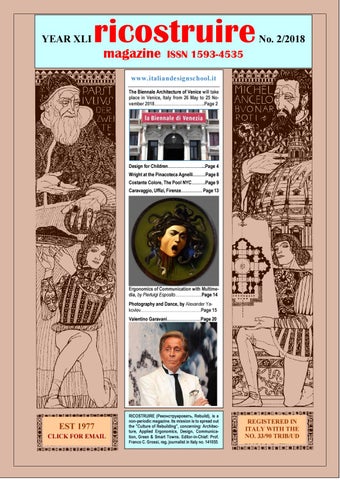
RICOSTRUIRE intends the information of www.italiandesignschool.it theses and works in the field of Architecture, Arts and Design, as a mediation beThe Biennale Architecture of Venice will take tween the technological and spiritualistic place in Venice, Italy from 26 May to 25 Notendencies of our age. It expresses the vember 2018………………………….…..Page 2 need to give architectural design and Design itself a new value, for a more open dialogue with the social and cultural context, by widening its space of intervention to the world of Communication, in order to express its "duties of criticism". The promotion of this e-magazine requires a new form of dialogue with the reader, starting from the belief that professional training and the production of buildings, objects and landDesign for Children……………………...Page 4 scape architecture, today need the work of the Pinacoteca Agnelli………Page aWright typicalatarchitect, builder and designer, in-8 defatigable revealer "formulae" and im-9 Costante Colore, Theof Pool NYC……….Page pressions, which translate into an architecCaravaggio, Uffizi, Firenze…………… Page 13 ture and a design made of orders, proportions, harmonies, to communicate the culture of Man and Nature. It is renewed in the moment in which modernism and its utopian ideology have shown Man not having been able to fully exploit the existing technological potential and the arsenal represented by the historical experiences in each place. Finally, we wish to orientate the field of intervention also towards the study of integrated communication systems, to be used in the architectural design of interiors, exteriors and urban furniture and in designing objects and services. In fact, in the analysis of future architectural structures, be increasingly necesErgonomicsitofwill Communication with Multimesary to take into account the needs dia, by Pierluigi Esposito……………….Pagedic14 tated by the growing use of new media Photography and by Alexander Ya(new-media) and,Dance, in particular, technical kovlev…………………………………….Page 15 equipment, installation of new technologies, suchGaravani……………………Page as the wired area, the intelligent Valentino 20 building, home automation and many other applications. Ergonomics Applied to Industrial Design will be the basis and the facilitator to win the future challenges. The VRBS FELIX Manifesto for a Wellbeing City, Green, Smart and Mild……..….Page 2 VRBS FELIX (Happy City), the Next Town Vision with a “Green and Smart” Human Centered Design………………………Page
EST 1977 CLICK FOR EMAIL
RICOSTRUIRE (Реконструировать, Rebuild), is a non-periodic magazine. Its mission is to spread out the "Culture of Rebuilding", concerning: Architecture, Applied Ergonomics, Design, Communication, Green & Smart Towns. Editor-in-Chief: Prof. Franco C. Grossi, reg. journalist in Italy no. 141055.
RICOSTRUIRE - YEAR XLI - No. 2-2018 – Page 1
REGISTERED IN ITALY WITH THE NO. 33/90 TRIB/UD
The Biennale Architettura 2018 will be accompanied throughout its duration by a programme of conversations: the Meetings on Architecture are an opportunity to listen to the voices of the protagonists of the Exhibition.
The 16th International Architecture Exhibition FREESPACE will open to the public on 26 May at the Giardini and the Arsenale venues, and elsewhere in Venice. Curated by Yvonne Farrell and Shelley McNamara, the exhibition includes 71 architects and firms, 63 National Participations and 12 Collateral Events. The 71 participants will be joined by two Special Sections: the first is titled Close Encounter, meetings with remarkable projects (16 participants) and will present works that originate in a reflection on buildings that are part of the history of Architecture; the second is titled The Practice of Teaching (13 participants) and will collect projects developed as part of teaching experiences. The collaboration with the Victoria and Albert Museum continues with the Special Project Applied Arts Pavilion in the Arsenale; a further Special Project will be set up at Forte Marghera in Venice Mestre.
La Biennale Architecture, Venice – Map of National Pavilions at “Giardini”.
RICOSTRUIRE - YEAR XLI - No. 2-2018 – Page 2
During the exhibition an important prize will be awarded:
Kenneth Frampton Golden Lion for Lifetime Achievement
in the ambiance of the Architecture Biennale - Sessions , dedicated to university training institutions. The Kazan State University of Architecture and Engineering will present a project concerning the “minimum” to live freespace. This work will be carried out in cooperation with the Italian University of Basilicata, “Matera 2019” (www.unibas.it), focusing the attention on the quality of the space. "Minimum to live” wants to investigate the possibility of designing a quality architecture even in small space dimensions.
The acknowledgment to Kenneth Frampton will be awarded on Saturday 26 May at Ca’ Giustinian, the headquarters of La Biennale di Venezia during the awards ceremony and inauguration of the Biennale Architettura 2018, which will open to the public at 10 am on that same day. Frampton is an English architect, historian, critic and educator. Trained at the Architectural Association School of Architecture, London, he has taught since 1972 at the Graduate School of Architecture, Planning, and Preservation at Columbia University, New York. As an architect, writer and critic, as teacher and researcher, he has affected and inspired several generations of students and architects. Modern Architecture: A Critical History is one of his most recognized books.
KSUAE will be the sole Russian University attending the Biennale Sessions 2018. Also in 2018, as in the previous edition of the Venice Architecture Biennale, the Kazan State University of Architecture and Engineering (www.kgasu.ru) will be the only Russian University to present a project
The main entrance to the campus of the Kazan State University of Architecture and Engineering, in Kazan, Republic of Tatarstan, Russian Federation.
RICOSTRUIRE - YEAR XLI - No. 2-2018 – Page 3
At the Triennale of Milano ended the exhibition: “Giro Giro Tondo - Design for Children”.
Pietro Corraini; Animation, curated by Maurizio Nichetti, and Tools, curated by Francesca Balena Arista. Among these sections there were focus areas devoted to leading figures in the history of design and education. These included Bruno Munari, curated by Alberto Munari, and Riccardo Dalisi, curated by Francesca Picchi in collaboration with Studio Dalisi, and then there was one on the education and Teachers, curated by Monica Guerra and Franca Zuccoli, and one on the imagery of storytelling, in Pinocchio, curated by Enrico Ercole. Here some images of the exhibition.
A new history of Italian design, devoted to the world of children and to the design and architecture that has been created for them was shown at the Triennale of Milano. It included the games and images that have amused and informed them, the spaces within which they took their first steps, and the objects they used to discover the world. The opening was an Ouverture, devoted to play design, curated by Stefano Giovannoni, with a powerful figurative component and a pop spirit. Then, the exhibition path, under the Art Direction of Giovannoni, winds through visual, auditory and perceptive suggestions that accompanied and guide visitors through various thematic sections: Furniture, curated by Maria Paola Maino; Games, curated by Luca Fois with Renato Ocone; the Architectures, curated by Fulvio Irace; Signs, curated by RICOSTRUIRE - YEAR XLI - No. 2-2018 – Page 4
RICOSTRUIRE - YEAR XLI - No. 2-2018 – Page 5
RICOSTRUIRE - YEAR XLI - No. 2-2018 – Page 6
RICOSTRUIRE - YEAR XLI - No. 2-2018 – Page 7
Frank Lloyd Wright (1867 -1959) Between USA and Italy
20 books and many articles and was a popular lecturer in the United States and in Europe. Wright was recognized in 1991 by the American Institute of Architects as "the greatest American architect of all time".
This exhibition is presented at the Pinacoteca Giovanni e Marella Agnelli (Lingotto, Via Nizza, Torino, 28 March - 1 July 2018), by the Avery Architectural & Fine Arts Library, Columbia University; in collaboration with Miriam & Ira D. Wallach Art Gallery, Columbia University and curated by Jennifer Gray. The images are from the Frank Lloyd Wright Foundation Archives (The Museum of Modern Art | Avery Architectural & Fine Arts Library, Columbia University, New York). Frank Lloyd Wright1 (born Frank Lincoln Wright, June 8, 1867 – April 9, 1959) was an American architect, interior designer, writer and educator, who designed more than 1,000 structures, 532 of which were completed. Wright believed in designing structures that were in harmony with humanity and its environment, a philosophy he called organic architecture. This philosophy was best exemplified by Fallingwater (1935), which has been called "the best all-time work of American architecture". His creative period spanned more than 70 years. Wright was the pioneer of what came to be called the Prairie School movement of architecture and he also developed the concept of the Usonian home in Broadacre City, his unique vision for urban planning in the United States. In addition to his houses, Wright designed original and innovative offices, churches, schools, skyscrapers, hotels, museums and other structures. He often designed interior elements for these buildings as well, including furniture and stained glass. Wright wrote
Frank Lloyd Wright at Taliesin West.
1
Brewster, Mike (July 28, 2004). "Frank Lloyd Wright: America's Architect". Business Week. The McGraw-Hill Companies. Archived from the original on March 2, 2008. Retrieved January 22, 2008. RICOSTRUIRE - YEAR XLI - No. 2-2018 – Page 8
Solomon R. Guggenheim Museum (New York, New York). Exterior perspective.
Costante Colore THE POOL NYC celebrated the opening of the new exhibition space in Milan at Palazzo Fagnani with a group show focused on colour. Masieri Memorial students' library and residence (Venice, Italy). Unbuilt Project, perspective..
Always Colour, from the dawn of art till today. In Costante Colore (Constant: Colour) the works on display are an ode to colour, the pictorial substance that is declined according to the expression of each artist.
RICOSTRUIRE - YEAR XLI - No. 2-2018 – Page 9
We focus on the way of using the colour in order to highlight the importance and the constancy in the world of art regardless the subject or the medium of the work on exhibit.
Thus the colour does not change according either to the media with which it is related or to the centuries that pass by. Colour has existed for centuries and will keep changing because it is part of the nature of art itself: it acts today, as it has always acted, with the same intensity. The declination of colour follows different patterns of time and medium. In the Middle Age, colours had to be bright and intense, applied with strong colour saturation, without nuances, in order to underline its symbolism. In the sacred place the colour revealed the presence of God: colours are the result of the interaction between light and darkness. From the 13th century the colour symbolizing the highest nobility was blue, a metaphor of spirituality and transcendence. In the Certosa of Pavia the lapis lazuli used by Bergognone for the Coronation of Mary between Francesco Sforza and Ludovico il Moro still appears today an extraordinary and shining blue. The colour evolves, changes, becomes warmer, becomes fluorescent, becomes neon light, becomes non-colour. Black and white gain significance in Art History. Colour becomes clarity with Impressionism, does not stop with DaDa, shines in Secessionism, triumphs with Pop-Art, degenerates with Expressionism, erupts with Abstractism, subsides with Minimalism, suffers in the Arte Povera, stabilizes with Transavanguardia. The artistic movements evolve, the centuries pass by, the colour keeps burning.
The colour on glass, on ceramics, crayon, neon light, in pen and wash drawings, in acrylics, in oil paintings and videos. Bright, soft, metallic, primary, artificial, natural, complementary colour. Colour is matter, scent, space. Colour is life. Colour arouses strong emotions such as tension, obsession, eroticism, action, joy, euphoria, rupture, movement, pain, desire, passion, surprise, chance, option, balance, entropy, physicality, transfiguration, proportion, coherence. Colour is the mathematical constant: it is the only value that remains unchanged when the elements with which it is related change.
When the television develops colour, the image lights up, everything comes to life and lights up. Colours exploded in TV, but lived for a long time in art. There is no trend that sets the standard for the use of colour. In fashion each year has a colour, but art has not, and any shade can be used and with any nuance can be dared. There are colours that were unthinkable a few decades ago. The colours are affected by the atmosphere in a particular historical and political moment. Tastes adjust to the spirit of the period. A specific chromatic sense dominates every age. Chromatic sense means a balance of united colours.
RICOSTRUIRE - YEAR XLI - No. 2-2018 – Page 10
The colour is exhaustion, impression, redundancy, exasperation, suffering, discomfort, madness, exaggeration, sensitivity, extenuation, tradition, appearance, substance, interiority, expression, mania, immediacy, reflection, spontaneity, gesture, rhythm, fire, warmth, cold, intolerance, magic, dream, recurrence, spasm, puff, sexuality, intransigence, zeal, alacrity, energy, assiduity, annoyance, beauty. Colour is naturally creativity, genius. Artists: Ercole Barovier, Gina Beavers, Fulvio Bianconi, Bertozzi & Casoni, James Case-Leal, Eteri Chkadua, Stefania Fersini, Patrick Jacobs, Joseph Kosuth, Aldo Mondino, Francesco Mori, Jonathan Rider, Andrea Salvatori, Carlo Scarpa, Bianca Sforni, Federico Solmi, Giuseppe Stampone, Giulio Turcato, Vinicio Vianello, Matteo Vinti. http://www.thepoolnewyorkcity.com/ Here some images of the exhibition.
RICOSTRUIRE - YEAR XLI - No. 2-2018 – Page 11
RICOSTRUIRE - YEAR XLI - No. 2-2018 – Page 12
Caravaggio and the 17th century at the Uffizi Galleries in Florence The Uffizi opened its doors to the city of Florence to introduce its new rooms devoted to Caravaggio and the 17th century. The Director of the Uffizi Galleries, Eike Schmidt, will be personally illustrating to all those in attendance this important scheme for the enhancement and care of the museum's collections based on the use of innovation to link the history and the future of the gallery's exhibition rooms. The exhibition was set up in honor of Anna Maria Luisa de' Medici, who bound the Medici collections to the city of Florence forever and the 275th anniversary of whose death is on the 18th of February.
The Uffizi Galleries in Florence An encounter with great Western art: an everlasting wonder The Gallery entirely occupies the first and second floors of the large building constructed between 1560 and 1580 and designed by Giorgio Vasari. It is famous worldwide for its outstanding collections of ancient sculptures and paintings (from the Middle Ages to the Modern period). The collections of paintings from the 14th-century and Renaissance period include some absolute masterpieces: Giotto, Simone Martini, Piero della Francesca, Beato Angelico, Filippo Lippi, Botticelli, Mantegna, Correggio, Leonardo, Raffaello, Michelangelo and Caravaggio, in addition to many precious works by European painters (mainly German, Dutch and Flemish).
Moreover, the Gallery boasts an invaluable collection of ancient statues and busts from the Medici family, which adorns the corridors and consists of ancient Roman copies of lost Greek sculptures. RICOSTRUIRE - YEAR XLI - No. 2-2018 – Page 13
Ergonomics of Communication with Multimedia By prof. Pierluigi Esposito, University of Udine, Italy Beside the fact that it could or could not be one of the biggest innovation in the field of communications, Internet is certainly a source of reflections and considerations that involve the psychic, emotional and social sphere of individuals and the cultural, politic and economic sphere of the community. The communicative process that takes place inside the World Wide Web (WWW) concerns extremely complex and singular socio-cognitive dynamics: the computer makes possible to construct instruments that put themselves in between the intelligence of the subjects and the passivity of objects and allows users to have a connection with virtual environments that require new behavioural and reasoning mechanisms. It also allows areas to assume different meanings and to develop sites of social interaction where it is possible to create combined behavioural structures and interpersonal relationships that were unconceivable until the present day. In the human-machine interaction, mental abilities are involved to give a meaning and an explanation to situations presented to the computer, which cannot always find a solution to them. In monitoring the video framework, attention, perception and shortterm memory are involved, whereas long-term memory handles the comprehension of objects and spaces. Education develops through not only words and ideas behind them, but also through using and testing software operations. Problem-solving situations evolve to reach a goal or to fix an incorrect procedure inside the machine itself. On the other hand, problem-setting conditions arise from the attempt to do researches or to organize different website information.
Individual’s identity can shift between fictional figures and personalities, while people can create “global villages”, virtual areas that can be accessed by anybody, independently of geographical distances and, theoretically, social status. Language is an important part of each of these aspects, which permit or inhibit their development. Almost every problem regards the difficulty finding a common point between man and computer and between people who come from different cultures and different knowing. Natural language is incomprehensible to a machine, which can work only with binary value. On the contrary, men cannot possibly think in terms of one and zero. The reason why interfaces are important is that they make possible for man and computer to communicate to each other on a level that is understandable for both. Their implementation is necessary, both for users and for the computer, which primary duty is to handle information and command. The moment when a computer is linked to another by putting it “on the Net”, its functions gain new meanings, opportunities but problems too. The possibility to share resources and to exchange information forces to put into consideration not only the codes needed to interact with the machine but also the ones which by the users communicate. The Web has tens of millions of people connected within, who come from hundreds of countries all over the world. That said, it seems clear that these considerations bring to linguistic and cultural problems, economic interests and socio-political issues. The language used for communicating should be possible to read and its data accessible to all its “citizens”, even to the ones who don’t have a deep understanding of the operation of hypertext, networks and computers too. Cognitive ergonomics studies give the instruments to make possible the creation of easier and easier environments, that can be immediately understood and “navigated”.
RICOSTRUIRE - YEAR XLI - No. 2-2018 – Page 14
This simplification of the IT world is still not enough to be comprehended by most of the population. Web communication was made to be a medium, therefore it must include everyone and not letting anybody aside for a group of “lucky” and specialized users. The aim of this thesis is to offer a consideration about the communication through the computer, about cognitive difficulties that come out when users try to approach to the machine and about methods to resolve this set of problems. The complexity of the topic forced me to sacrifice an incredible amount of information and, above all, thoughts that kept overflowing during the writing of the text. It appears almost impossible to analyse in an organic and stable way each content which can be found on the Internet. The circulation of new concepts always goes with the ones who try to write a systematic report, creating the conditions for different scenarios, which make outdated the information gained previously.
Photography and Dance Photographer Alexander Yakovlev (Александр Яковлев) has realized many amazing studio portraits, filled with expression, dynamics and great skill of dancers. The most popular in his portfolio is a picture called "The Big Bang Theory"
Internet seems to be a reality that cannot be pictured: it is something that needs to be followed in its constant flux. The same design principles that will be discussed in this work may vary from the actual ones if, for example, Web environments become three-dimensional and the information will reach the users just like television does. The thing that certainly won’t change is the cognitive limit and the individuals and society need, where technology spreads. The improvement of accessibility to the Net goes through the understanding of mental mechanisms, which people use for collocating themselves in space, both real and virtual. By utilizing these, individuals have also the chance to analyse needs and motivations that bring them to investigate relations and information too. It would be interesting if men could be at the centre of the design of these new technologies, even if, in a world where only half of the population ever used a telephone, maybe it would not be enough.
RICOSTRUIRE - YEAR XLI - No. 2-2018 – Page 15
As for the dance genre, here you will find a variety from the breakdance ballet. Alexander Yakovlev "shoots" in static poses or freezes crazy movements in the air.
RICOSTRUIRE - YEAR XLI - No. 2-2018 – Page 16
He makes black-and-white and color photos, sometimes uses flour for taking pictures, in order to emphasize the movement in the frame.
RICOSTRUIRE - YEAR XLI - No. 2-2018 – Page 17
RICOSTRUIRE - YEAR XLI - No. 2-2018 – Page 18
RICOSTRUIRE - YEAR XLI - No. 2-2018 – Page 19
universe, present in over 100 countries through 175 Valentino directly-operated boutiques and over 1500 points of sale.
The Maison Valentino was founded in 1960 by Valentino Garavani and Giancarlo Giammetti. Valentino is a protagonist of international fashion, and from 2008 until 2016, has gone through an impactful creative evolution. The Maison Valentino plays a major role in the luxury division through tradition and innovation, a necessary combination for a creative industry that generates the sense of beauty. Valentino’s fashion is displayed through the Haute Couture and Prêt-à-Porter lines for women and for men and through the Valentino Garavani accessories lines that include shoes, bags, small leather goods, eyewear, scarves, ties and fragrances. An aesthetic
Valentino Garavani
RICOSTRUIRE - YEAR XLI - No. 2-2018 – Page 20
An aesthetic, contemporary vision and the excellence in the execution, are the guidelines of the industrial process and of the artisanal and handmade workmanship that are entirely produced in the historic Atelier of Piazza Mignanelli in Rome, where the specialized ‘Bottega Couture’ couture school, has recently opened. The Brand Today Valentino S.p.A. is controlled since 2012 by Mayhoola for Investments S.P.C., a holding company sustained by a group of private investors from Qatar. The acquisition has brought a rapid growth in the potential of the Valentino brand. Valentino is amongst the leaders of international fashion to believe in the elevated added value that derives from a global vision of style, developed through collections of Haute Couture, Prêt-à-Porter, Valentino Garavani accessories, eyewear and fragrances licensed in partnership with Puig. Collections HAUTE COUTURE Valentino Haute Couture is the collection of unique dresses, that in respect of the artisanal tradition of Couture, is entirely handmade by a team of about 60 specialized seamstresses, guided by four Premières within the Atelier of Palazzo Mignanelli in Rome. Haute Couture is above all a culture of handicraft, of time and of passion. Events as Sala Bianca 945 in New York in December 2014, or the most recent Mirabilia Romae in July 2015 in Rome have celebrated the Maison with a special Valentino Haute Couture Collection. In 2015, in the historic headquarters of Palazzo Mignanelli, the ‘Bottega Couture’ Haute Couture School was instituted, with the goal of passing down to the new generations a manual job that is the heritage of history and of Italian savoir-faire. 2018 Collection, Embroidered tulle evening dress RICOSTRUIRE - YEAR XLI - No. 2-2018 – Page 21
PRÊT-À-PORTER The Valentino women’s and men’s Prêt-à-Porter lines denote the global aesthetics in the creations that interpret the personal style decisions towards an ideal of timeless beauty. Haute Couture is certainly a reference for perfect workmanship and craftsmanship and is translated also to the other lines: every collection expresses the beauty and elegance, the perfect execution and is produced with industrial avant-garde techniques and an elevated content of artisanal handicraft. The men’s line, launched in 2012 as a ‘special guest’ at Pitti Uomo in Florence, has retrieved the elements of traditional Italian tailoring and brought them into a variation of contemporary fashion. VALENTINO GARAVANI Valentino Garavani is the collection dedicated to accessories. Bags, shoes, small leather goods, belts, bijoux for women and men encounter the essential characteristics of Valentino’s fashion with an aesthetic and contemporary vision, conveying the handmade details, typical of Haute Couture and the elements of high craftsmanship. OTHER LINES Furs, soft accessories, eyewear and fragrances complete the offer.
Karlie Kloss wearing a Valentino look from the Prefall 2018 Collection
RICOSTRUIRE - YEAR XLI - No. 2-2018 – Page 22