YEAR XLI
ricostruire
No. 1/2018
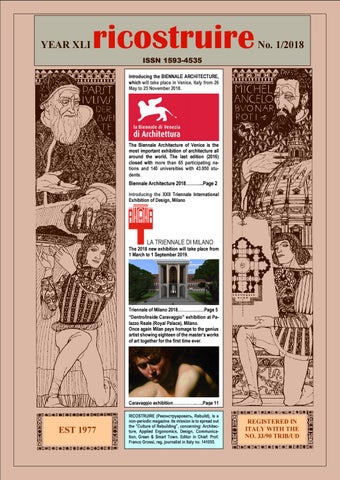
ISSN 1593-4535 RICOSTRUIRE theARCHITECTURE, information of Introducing the intends BIENNALE theses andtake works in in theVenice, field of Architecwhich will place Italy from 26 May to 25 November 2018. ture, Arts and Design, as a mediation between the technological and spiritualistic tendencies of our age. It expresses the need to give architectural design and Design itself a new value, for a more open dialogue with the social and cultural context, by widening its space of intervention to the world of Communication, in order to express its "duties of criticism". The promotion this e-magazine requires a newisform The ofBiennale Architecture of Venice the of dialogue withexhibition the reader, starting from most important of architecture all around The last editionand (2016) the beliefthe thatworld, professional training the closed withofmore than 65objects participating naproduction buildings, and landtions and 140 universities withthe 43.950 scape architecture, today need workstuof . architect, builder and designer, inadents typical defatigable revealer of 2018………...Page "formulae" and imBiennale Architecture 2 pressions, which translate into an architecture and a design made of orders, proporIntroducing the XXII Triennale International Exhibition of Design, Milano tions, harmonies, to communicate the culture of Man and Nature. It is renewed in the moment in which modernism and its utopian ideology have shown Man not having been able to fully exploit the existing technological potential and the arsenal represented by the historical experiences in each place. Finally, we wish to orientate Thefield 2018 of new exhibition will place from the intervention alsotake towards the 1 March to 1 September 2019. study of integrated communication systems, to be used in the architectural design of interiors, exteriors and urban furniture and in designing objects and services. In fact, in the analysis of future architectural structures, it will be increasingly necessary to take into account the needs dictated by the growing use of new media (new-media) and, in particular, technical Triennale of installation Milano 2018…………….…Page equipment, of new technolo-5 “Dentro/Inside Caravaggio” at Pagies, such as the wired area,exhibition the intelligent lazzo Reale (Royal Palace), Milano. building, home automation and many other Once again Milan pays homage to the genius applications. Ergonomics Applied to Inartist showing of the master's works dustrial Designeighteen will be the basis and the faof art together for the first time ever. cilitator to win the future challenges. The VRBS FELIX Manifesto for a Wellbeing City, Green, Smart and Mild……..….Page 2 VRBS FELIX (Happy City), the Next Town Vision with a “Green and Smart” Human Centered Design………………………Page Caravaggio exhibition……………..…..Page 11
EST 1977
RICOSTRUIRE (Реконструировать, Rebuild), is a non-periodic magazine. Its mission is to spread out the "Culture of Rebuilding", concerning: Architecture, Applied Ergonomics, Design, Communication, Green & Smart Town. Editor in Chief: Prof. Franco Grossi, reg. journalist in Italy no. 141055.
RICOSTRUIRE - YEAR XLI - No. 1/2018 – Page 1
REGISTERED IN ITALY WITH THE NO. 33/90 TRIB/UD
“Freespace” is the title of the 16th Architecture Exhibition (2018), La Biennale Architecture of Venice. (from 26 May to 25 November 2018). Yvonne Farrell and Shelley McNamara are the curators of the 16th International Architecture Exhibition, that will take place from May 26th to November 25th 2018 (Preview May 24th and 25th) in the Giardini and the Arsenale, and around other venues in Venice. The Biennale Architettura 2018 will be titled Freespace, word which describes a generosity of spirit and a sense of humanity at the core of architecture's agenda, focusing on the quality of space itself. With the theme of Freespace, the Biennale Architettura 2018 will present for public scrutiny examples, proposals, elements - built or unbuilt - of work that exemplifies essential qualities of architecture which include the modulation, richness and materiality of surface; the orchestration and sequencing of movement, revealing the embodied power and beauty of architecture.
Yvonne Farrell and Shelley McNamara with Paolo Baratta Yvonne Farrell and Shelley McNamara titled the 16th International Architecture Exhibition Freespace, and explained their choice with the following words: «Freespace describes a generosity of spirit and a sense of humanity at the core of architecture's agenda, focusing on the quality of space itself. Freespace focuses on architecture’s ability to provide free and additional spatial gifts to those who use it and on its ability to address the unspoken wishes of strangers. Freespace celebrates architecture’s capacity to find additional and unexpected generosity in each project - even within the most private, defensive, exclusive or commercially restricted conditions. Freespace provides the opportunity to emphasize nature’s free gifts of light - sunlight and moonlight, air, gravity, materials - natural and manmade resources.
RICOSTRUIRE - YEAR XLI - No. 1/2018 – Page 2
Freespace encourages reviewing ways of thinking, new ways of seeing the world, of inventing solutions where architecture provides for the wellbeing and dignity of each citizen of this fragile planet. Freespace can be a space for opportunity, a democratic space, un-programmed and free for uses not yet conceived. There is an exchange between people and buildings that happens, even if not intended or designed, so buildings themselves find ways of sharing and engaging with people over time, long after the architect has left the scene. Architecture has an active as well as a passive life. Freespace encompasses freedom to imagine, the free space of time and memory, binding past, present and future together, building on inherited cultural layers, weaving the archaic with the contemporary». «With the theme of Freespace, the Biennale Architettura 2018 will present for public scrutiny examples, proposals, elements - built or unbuilt - of work that exemplifies essential qualities of architecture which include the modulation, richness and materiality of surface; the orchestration and sequencing of movement, revealing the embodied power and beauty of architecture. The exhibition will have a spatial, physical presence of a scale and quality, which will impact on the visitor, communicating architecture’s complex spatial nature. The exhibition invites emotional and intellectual engagement of the many who come to the Biennale in order to understand architecture more fully, to stimulate discussion on core architectural values and to celebrate architecture’s proven and enduring contribution to humanity. When Jørn Utzon thinks about a concrete and tiled seat at the entrance of Can Lis, Majorca, it is moulded perfectly to the human body for comfort and pleasure. Spatially, it is a ‘word’ of greeting, of welcome. Angelo Mangiarotti ‘says’ the same thing at the entrance to 24 Via Quadronno, Milan where a gently sloping path, with a seat at the entrance threshold ‘holds’ you and welcomes your home from the city.
Lina Bo Bardi raised the museum of modern art in Sao Paolo in order to make a ‘belvedere’ for the citizens to overlook the city. The Medici Palace in Florence represents power and wealth but the stone seat which forms part of the solid façade almost turns the building inside out. The solid wall becomes the enclosing wall of the public space. What is solid seems outward looking and generous. We believe that everyone has the right to benefit from architecture. The role of architecture is to give shelter to our bodies and to lift our spirits. A beautiful wall forming a street edge gives pleasure to the passer-by, even if they never go inside. So too does a glimpse into a courtyard through an archway; or a place to lean against in the shade or a recess which offers protection from the wind and rain. We are interested in going beyond the visual, emphasizing the role of architecture in the choreography of daily life. We see the earth as Client. This brings with it long-lasting responsibilities. Architecture is the play of light, sun, shade, moon, air, wind, gravity in ways that reveal the mysteries of the world. All of these resources are free. It is examples of generosity and thoughtfulness in architecture throughout the world that will be celebrated in the 16th International Architecture Exhibition. We believe these qualities sustain the fundamental capacity of architecture to nurture and support meaningful contact between people and place. We focus our attention on these qualities because we consider that intrinsic to them are optimism and continuity. Architecture that embodies these qualities and does so with generosity and a desire for exchange is what we call Freespace. We invite all participants and every national pavilion to bring to Venice their Freespace, so together we may reveal the diversity, specificity and continuity in architecture based on people, place, time, history, to sustain the culture and relevance of architecture on this dynamic planet.
RICOSTRUIRE - YEAR XLI - No. 1/2018 – Page 3
“A society grows great when old men plant trees whose shade they know they shall never sit in” - Greek Proverb. »
President Paolo Baratta stated: «As was the case for the previous editions of the Biennale Architettura, we continue our investigation into the relationship between architecture and civil society. The divide between architecture and civil society, caused by the latter's increasing difficulty in expressing its own needs and finding appropriate answers, has led to dramatic urban development whose main feature is the marked absence of public spaces, or the growth of other areas dominated by indifference in the suburbs and peripheries of our cities. The absence of architecture makes the world poorer and diminishes the level of public welfare, otherwise reached by economic and demographic developments. To rediscover architecture means to renew a strong desire for the quality of the spaces where we live, which are a form of public wealth that needs to be constantly protected, renovated and created.
This is the path taken by the next Biennale Architettura.»
La Biennale Architecture, Venice – Map of National Pavilions at “Giardini”.
RICOSTRUIRE - YEAR XLI - No. 1/2018 – Page 4
The XXII Triennale International Exhibition is entitled “Broken Nature: Design Takes on Human Survival” will take place from 1 March to 1 September 2019 at Triennale di Milano,
Muzio. Over the years, the event has hosted the greatest Italian and international architects, designers and artists, including Franco Albini, Gae Aulenti, Cini Boeri, Anna Castelli Ferrieri, Pier Giacomo e Achille Castiglioni, Giorgio de Chirico, Lucio Fontana, Franca Helg, Arata Isozaki, Le Corbusier, Vico Magistretti, Enzo Mari, Alessandro Mendini, Bruno Munari, Charlotte Perriand, Renzo Piano, Gio Ponti, Ettore Sottsass, Nanda Vigo and Marco Zanuso. In the 2000s, Triennale became what it is today: a cultural institution open to the city with a continuous, multidisciplinary program that includes exhibitions of architecture, design, the visual arts, photography and fashion, conferences, theatre and art performances, and concerts. In 2016, Triennale decided to revive the International Exhibition and inaugurated its twenty-first edition, entitled 21st Century: Design after Design. The organization of the twenty-second edition reaffirms the decision to keep the event going in the future. This new Design exhibition (XXII Triennale International Exhibition) it will be curated by Paola Antonelli, Senior Curator of Architecture and Design at the Museum of Modern Art in New York. The theme of the XXII International Exhibition will be a means to reflect on the role of design in seeking a new balance between humans and nature. The principal aim of the project is to provide critical instruments to rethink lifestyles and habits, and to look to the future with a greater degree of awareness and sensitivity.
The Triennale of Milano Entrance The Triennale International Exhibition is one of the world’s most important events devoted to design and architecture. Originally launched in Monza in 1923, it is the only cultural event in the world that has been permanently recognized since its inception by the Bureau International des Expositions. In 1933 the Triennale was moved to the Palazzo dell’Arte in Milan, which was specially built by the architect Giovanni
Sottsass at the Triennale of Milano Curated by Barbara Radice, the exhibition “There is a Planet”, on show at the Triennale di Milano, marks the centenary of the birth of Ettore Sottsass
RICOSTRUIRE - YEAR XLI - No. 1/2018 – Page 5
Ettore Sottsass Marking the centenary of the birth of Ettore Sottsass (Innsbruck 1917– 2007 Milan), the Triennale Design Museum is presenting a monographic exhibition devoted to him in the spaces of the Galleria dell’Architettura. It will be accompanied by a book and a catalogue. The title of the exhibition, and of the book, “There is a Planet”, is that of a project that Sottsass started in the 1990s for the German publisher Wasmuth, but never completed. The project for the book, now published by Electa , was to form five groups of photographs taken by Sottsass on his travels around the world, each with its own title and essay. The photos would be of architecture, houses, doors, people and situations involving dwellings and, in more general terms, the presence of humans on the planet. Here there are some picture of the exhibition. RICOSTRUIRE - YEAR XLI - No. 1/2018 – Page 6
RICOSTRUIRE - YEAR XLI - No. 1/2018 – Page 7
The famous Olivetti Valentine, Sottsass 1969
RICOSTRUIRE - YEAR XLI - No. 1/2018 – Page 8
RICOSTRUIRE - YEAR XLI - No. 1/2018 – Page 9
Some peace, some quiet, some doubts, some weakness, some curiosity, some questions, some ambiguity, some thoughts, some care, some loneliness, some fear, some “maybe”, some “who knows”, some attention, some help, some perplexity, some sweetness, some bitterness, bye I’m off ... Ettore
RICOSTRUIRE - YEAR XLI - No. 1/2018 – Page 10
The ‘Dentro/Inside Caravaggio’ exhibition 2018 at Palazzo Reale (Royal Palace) in Milano, Italy
Through diagnostic methods such as reflectographs and x-rays, which penetrate to a different extent under the pictorial surface, it is possible to analyse Caravaggio’s creative process, his idiosyncratic painting technique, his changes of heart, modifications and adjustments in composition. Amongst the museums and collections in Italy participating in the exhibition are: Galleria degli Uffizi, Palazzo Pitti and Fondazione Longhi, Florence; Galleria Doria Pamphilj, Musei Capitolini, Galleria Nazionale d’Arte Antica-Palazzo Corsini, Galleria Nazionale d’Arte Antica-Palazzo Barberini, Rome; Museo Civico, Cremona; Banca Popolare di Vicenza; Museo e Real Bosco di Capodimonte and Gallerie d’Italia Palazzo Zevallos, Naples.
Milano, Palazzo Reale – Royal Palace (Opening hours on Monday January 29th from 09.30 - midnight | from Tuesday January 30th to Sunday February 4th from 09.30 midnight | Last admission at 23.00). This exhibition, curated by Rossella Vodret, presents an unexplored new perspective of the years of the artist’s extraordinary production, under the light of some new documents and more recent researches. Once again Milan pays homage to the genius artist showing eighteen of the master's works of art together for the first time ever. Deemed as unique, this retrospective not only presents the public with works on loan from other major Italian museums, and from equally important foreign museums, but for the first time ever Caravaggio's canvases will be flanked by their respective radiographic images thanks to the innovative use of multimedia equipment, enabling the audience to follow and discover the artist's journey from his initial thoughts to the final achievement.
RICOSTRUIRE - YEAR XLI - No. 1/2018 – Page 11
Amongst the most prestigious loans from abroad: Sacra famiglia con San Giovannino - Sacred Family with the Infant Saint John the Baptist (1604-1605) Metropolitan Museum of Art, New York; Salomé con la testa del Battista - Salomé with the head of John the Baptist (1607 or 1610) National Gallery, London; San Francesco in estasi - St. Francis of Assisi in ecstasy (c.1597) Wadsworth Atheneum of Art in Hartford; Marta and Maddalena (1598) Detroit Institute of Arts; San Giovanni Battista - St. John the Baptist (c.1603) Nelson-Atkins Museum of Art in Kansas City; San Girolamo - Saint Jerome in Meditation (1605-1606) Montserrat Museum, Barcelona. Some stolen images inside the exhibition:
RICOSTRUIRE - YEAR XLI - No. 1/2018 – Page 12
Michelangelo Merisi (Michele Angelo Merigi or Amerighi) da Caravaggio; 28 September 1571 – 18 July 1610) was an Italian painter active in Rome, Naples, Malta, and Sicily from the early 1590s to 1610. His paintings combine a realistic observation of the human state, both physical and emotional, with a dramatic use of lighting, and they had a formative influence on Baroque painting. Caravaggio employed close physical observation with a dramatic use of chiaroscuro that came to be known as tenebrism. He made the technique a dominant stylistic element, darkening shadows and transfixing subjects in bright shafts of light. Caravaggio vividly expressed crucial moments and scenes, often featuring violent struggles, torture and death. He worked rapidly, with live models, preferring to forego drawings and work directly onto the canvas. His influence on the new Baroque style that emerged from Mannerism was profound. (from Wikipedia)
RICOSTRUIRE - YEAR XLI - No. 1/2018 – Page 13
Self Portrait by Michelangelo Merisi from Caravaggio also called "The cursed painter"
RICOSTRUIRE - YEAR XLI - No. 1/2018 – Page 14