Year XLVI
ricostruire
No. 1/2023
magazine ISSN 1593-4535 www.italiandesignschool.it
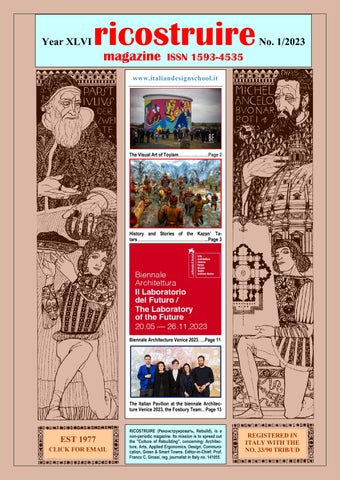
The Visual Art of Toyism………….….…..Page 2
History and Stories of the Kazan’ Tatars…………………………………………...Page 3
Biennale Architecture Venice 2023…..Page 11
The Italian Pavilion at the biennale Architecture Venice 2023, the Fosbury Team…Page 13
EST 1977 CLICK FOR EMAIL
RICOSTRUIRE (Реконструировать, Rebuild), is a non-periodic magazine. Its mission is to spread out the "Culture of Rebuilding", concerning: Architecture, Arts, Applied Ergonomics, Design, Communication, Green & Smart Towns. Editor-in-Chief: Prof. Franco C. Grossi, reg. journalist in Italy no. 141055.
REGISTERED IN ITALY WITH THE NO. 33/90 TRIB/UD
TOYISM The “Toyism” is a typical expression of the visual arts, so called, as they are perceived mainly through the sense of sight. In particular, in my opinion, this movement of free expression can be traced back to the revolution of the arts launched by Futurism, born in Italy at the beginning of the twentieth century. Indeed, there is a great elective similarity to this movement. Even in our age, in fact, as then, there is a great evolution in the world of art and culture, determined by globalization, wars, but above all by the new information and communication technologies, which contribute to eliminating the factors “space-time”. Other references are found in Indian mandalas, in murals in Cuba, in the album covers of the "Beatles in India". In short, it is an innovative art form, which could be defined as a "shamanic", since, with the images, a real ritual, a spiritual practice, is created through the emotion of the observer. In this case Toyism turns out to be a real "interface" between man and the metaphysician, which materializes, gives substance, reveals and celebrates the invisible. The visual sensation, mediated by the attention to aesthetics, leads to an abstract perception, which feeds pleasure, fun and "play". On another hand, Toyism represents a synthesis of globalization in the visual arts, as it is independent of the artist's location and his socio-cultural origins. In 1935 Kurt Koffka, Gestalt (shape, figure) psychologist, thus defined the goal of the psychology of perception “to explain why do things appear as they do”. Hence, visual perception is not completely resolved by the images collected by the eyes. Indeed, identical stimuli sometimes produce different perceptions. In perception, the culture, the environment and the experiences of the individual are decisive, also because perception is not an immediate process, but leads to the interpretation of signs, to which a meaning is attributed. Koffka also argued that regularity, symmetry, cohesion, maximum simplicity, allow us to better perceive the structure of an element of reality. Our perceptive system, when faced with a set of
objects, tends to focus on the enclosed shapes and designs. In mathematics Euler Venn graphically represented sets by means of closed lines.
At Top Speed Through Europe, Toyism Art by Dejo
RICOSTRUIRE magazine ISSN 1593-4535 - YEAR XLVI - No. 1-2023 – Page 2
The outlines belong to the figures and define their shape, this is the value of the Toyism’ representations, which are enclosed by well-defined contours. Jean Piaget explained that, since the age of 2-3, children are able to use symbols.
Interpretation of Toyism by Maria Vittoria, 5 years old. This translates into a mode of communication full of "free associations", without any logical connection, in which reasoning shifts from one idea to another, making a reliable reconstruction of the reasoning almost impossible. Bruno Munari stated that children explore the world through drawing; they are used to imagining, fantasizing and being creative with elastic thinking, before being trapped by experience and knowledge. Thus, an anonymous artist becomes a child again to ignore the constraints of the mind. This is the great magic of Toyism, by representing the world with the innocent gaze of children. Franco Claudio Grossi
The history and origins of the proud Tatar people are described here, the majority of whom now live in the Republic of Tatar stan, which is part of the Russian Federation and which has its own culture, language and traditions. The denomination Tatar stan is composed of the terms "Tatar" and "stan" (land) and means <land of the Tatars>. The Tatars were originally nomadic populations of Central Asia and Mongolia, who were unified in the XIII century by the leader and ruler Genghis Khan. The Mongol territory was characterized by boundless plains, which the Mongols, nomadic shepherds, whose main activity was the breeding of camels, horses, sheep, goats and cattle, crossed with their fast horses in order to always reach new pastures. Temüjin Borjigin, later named Genghis Khān, lived from 1162 to 1227 A.D. and the title Khān, which means Lord, leader, was attributed to the rulers of the lordships called khanates. Genghis Khan, after having unified the Mongol tribes, founding the Mongol Empire, with the capital Karakorum, led them to conquer most of Central Asia, China, Russia, Persia, the Middle East and part of Europe east, giving life, even if for a short time, to the largest terrestrial empire in human history, with 33 million square kilometers.
RICOSTRUIRE magazine ISSN 1593-4535 - YEAR XLVI - No. 1-2023 – Page 3
in 1220 he conquered Persia. The Mongol-Tatars occupied city after city and then Afghanistan, a mountain country inhabited by warlike and intractable peoples. The Tatars had therefore arrived everywhere, with their Golden Horde, and had numerous contacts with the Slavic world, in particular they settled in today's Russia. When Genghis Khan died in 1227, due to a fall from his horse, the empire he established was divided among his sons. He left behind an empire that stretched from Siberia to Kashmir, Tibet, the Caspian Sea, the Sea of Japan.
The Statue of Gengis Kahan is located on the bank of the Tuul River at Tsonjin Boldog, 54 km (33.55 mi) east of the Mongolian capital Ulaanbaatar, where, according to legend, he found a golden whip The power of the Mongol leader extended from the Great Wall of China to the Tarbagatai mountains in Kazakhstan, and from the Gobi Desert to the offshoots of Siberia. About thirty-two peoples bowed before him, and he divided them into three great groups (of the center, of the right hand and of the left hand) in the same ordering as the troops supplied by them would assume. In the spring of 1211 Genghis gathered his entire army, about two hundred thousand warriors, crossed the Gobi Desert and reached the border of the Chinese empire. After numerous defeats, Chinese Emperor Xuanzong, of the Jin dynasty, was forced to negotiate peace with Genghis, which cost him all the imperial treasury and thousands of captives. Genghis Kahn nevertheless attacked Beijing and destroyed it; it was the summer of 1215. In 1218 he annexed the kingdom of the Qara Khitai (or Cathay) as vast as Mongolia itself, and
In 1236 Volga Bulgaria was conquered and, in 1237, the subjugation of Russia began. The Tatar-Mongols quickly gained control of the steppes, absorbing the local Turkic populations into their army. And in 1240 they captured and plundered Kiev, ending its prosperity. Soon all the Russian principalities were conquered, except Novgorod which, ruled by Alexander Aleksandr Jaroslavič Nevskij, recognized the supremacy of the Khan. In 1241 two major armies under Batu, son of Genghis and Subedei, who was the great strategist of Genghis, invaded Hungary while a smaller army invaded Poland as a diversion to prevent
RICOSTRUIRE magazine ISSN 1593-4535 - YEAR XLVI - No. 1-2023 – Page 4
aid from reaching the Hungarians from the north. The Golden Horde was born. The Golden Horde was the denomination of the dynasty of Mongol origin, but founded on Turkish or Turkified majority populations and its influence was established by Bātū, grandson of Genghiz Khān, over a vast area of the southern Russia, from the Caucasus to the middle Volga, and on the steppe of Asia, between Siberia, the Caspian and the Aral. The Golden Horde represented the reunification of the Blue Horde and the White Horde, the imperial khanates of the Western and Eastern Territories respectively, unified with the native Central Asian territories of the Mongols. In 1242 Bātū established the Horde headquarters at Saraj on the lower Volga. Upon his death in 1255, the Horde very quickly lost its Mongol identity and most of its population was then ethnic Turks, Uzbeks and other Altaic peoples.
Nomadism gave way to sedentarization and Saraj became a large and prosperous metropolis, one of the most densely populated in the Middle Ages. The Horde, always following the influence of the subject peoples, adopted the Islamic religion abandoning the original animistic beliefs of the Mongols. In 1440, the Horde was also devastated by civil war. From the original empire several autonomous khanates had then formed: the Khanate of Siberia, of Kazan', of Astrachan', of Qasim, of Crimea and of Nogai. None of these new states was able to stand comparison with the Grand Duchy of Moscow, which thus finally freed itself from Mongol control around 1480. The fate of the various khanates was to be annexed by Russia sooner or later. Both Kazan' and Astrachan' were conquered by Ivan IV, known as the Terrible, who, after these annexations, renamed his state "Russia" in 1550. By the end of the same century, the Khanate of Siberia also suffered the same fate. The Crimean Khanate, thanks to its alliance with the Ottoman Empire, was able to maintain its independence from Russia until the reign of Catherine II in the second half of the 18th century. The Golden Horde khanate fell apart and split into other khanates, including that of Kazan'. The Kazan Khanate was a Tatar state in medieval Europe which occupied, between 1438 and 1552, the lands that originally belonged to the Volga Bulgars. The Khanate included the current territories of Tatarstan, Marelia, Chuvascia, Mordovia, part of Udmurtia and Bashkiria. The Volga, the Kama and the Vjatka were the main rivers of the Khanate, which represented, moreover, the major communication routes.
RICOSTRUIRE magazine ISSN 1593-4535 - YEAR XLVI - No. 1-2023 – Page 5
The Khanate simultaneously covered many Russian territories and its capital was the city of Kazan.
Ancient painting representing Kazan The majority of the population belonged to the Kazan Tatar ethnic group (Bulgarians of the Volga, Muslims from 922 AD who spoke Turkish), even if they were not always used to identifying themselves as Tatars; most of the time they called themselves simple Muslims or "Kazan people". Islam was the state religion. Russian sources indicate that at least six languages were used in the khanate. The first and most widely used was undoubtedly the Tatar language, which included the central and western dialects of the Kazan Tatars. The writing of literary works in Tatar promoted the spread of this language in the state. The urban population of the Khanate made clay, wooden and metal tools,
leather, armors, plows and jewels and also traded with Central Asia, the Caucasus and Muscovy (Duchy of Moscow), especially in fine furs, honey and wax. In the 16th century, Russia became the khanate's main economic partner. In general, the culture of the Kazan Khanate descended from that of the Volga Bulgars, while some cultural elements of the Golden Horde were present to a more limited extent. Much of the urban population was able to read and write; large libraries were present in the mosques and Kazan' became, in the Middle Ages, one of the most important scientific and theological centers of the Muslim world. But in addition to Islamic literature, a secular one was produced. Throughout its history, the khanate was repeatedly subjected to struggles for the throne, so much so that the Khans were replaced 19 times in 115 years. At the end, Kazan was placed under siege by the troops of Ivan IV Vasiljevic called the Terrible, who, in August 1552, defeated the Tatar troops outside the city and, after two months of siege and the destruction of the walls of the citadel, the Russians entered the city on October 3, 1552. Ivan The Terrible
RICOSTRUIRE magazine ISSN 1593-4535 - YEAR XLVI - No. 1-2023 – Page 6
The defenders were executed and the population massacred. The reports of the historians of Kazan' indicate the number of victims at 110,000 civilians and soldiers and the Orthodox religion was imposed. Following the capture of Kazan and to commemorate this event, Ivan the Terrible, who was the first to assume the title of “Tsar of all the Russias”, had St. Basil's Cathedral built in Moscow.
the princess was captured and she was forced to tell the invader that she would marry him only if he had a seven-story tower built, one for each day of the week and was also supposed to be the highest in the city. Ivan managed to have it built in just seven days. Then Syuyumbike climbed to the top of the tower and after admiring her beautiful Kazan, she was so overwhelmed by her emotion for her people, that she could not bear to have to marry the tsar and she threw into the void.
An ancient painting of Syuyumbike
The St. Basil's Cathedral built in Moscow. Precisely in this period the epic story of the indomitable last Tatar princess Syuyumbike was born. Syuyumbike represents the national heroine of the Tatars of Tatarstan. When Ivan the Terrible decided to conquer Kazan, fascinated by the description of Princess Syouyoumbeeke's beauty, he sent an emissary to her city asking for his hand, but the proud princess rejected his proposal. Thereupon, Ivan the Terrible, very angry, broke through the city walls and entered it with a huge army, so
The Syuyumbike Tower in Kazan. Regarding the Kazan Tatars today, they live in the Republic of T The Republic of Tatar stan, which is part of the Russian Federation, is located in the European part of Russia, about 800 km east of Moscow,
RICOSTRUIRE magazine ISSN 1593-4535 - YEAR XLVI - No. 1-2023 – Page 7
at the confluence of the Volga and Kama rivers and has about 4 million inhabitants.
Map of Russia
The Tatarstan Republic Tatarstan is one of the most economically and industrially developed regions of Russia and is rich in natural resources, including oil. The flag of Tatarstan, was introduced in 1991. Its coat of arms represents the winged white snow leopard. Location of Tatarstan RICOSTRUIRE magazine ISSN 1593-4535 - YEAR XLVI - No. 1-2023 – Page 8
Its capital is Kazan´, with 1.2 million inhabitants and the term qazan means 'boiler' or 'cauldron' in the Tatar and Turkic languages. And, today, people get married under a cauldron-shaped building!
A curiosity, in Tatar stan the 4 monotheistic religions coexist peacefully and the temple of all religions was built to certify this religious tolerance.
Public wedding building in Kazan
The temple of all religions in Kazan And to safeguard the city there is Zilante, the fantastic creature of the snake king, who lives on the mountain of the Kazanka river near its influx into the Volga river.
The sculpture depicting Zilante in Kazan
Since the beginning of the second millennium the city has been undergoing total renewal. The historic center, including the Kremlin, was rebuilt. Kazan celebrated its millennium in 2005, since the foundation of the city. During the millennium celebrations, one of the largest mosques in Russia, the Kul-Sharif, was completed, the painting depicting Our Lady of Kazan was returned to the city, the Millennium Bridge was inaugurated and the Kazan subway went into operation. Today's Tatars are an ethnic group of Turkish origin. The term was first used to refer to those populations arriving from Siberia in Eastern Europe via the Mongol Empire in the 13th century. Later it was extended to all nomadic invaders of Asia, whether they be from the regions north of Mongolia or from the regions of Central Asia. Most Tatars live in the Tatar-
RICOSTRUIRE magazine ISSN 1593-4535 - YEAR XLVI - No. 1-2023 – Page 9
stan region of Russia, Crimea, Uzbekistan, Kazakhstan, Belarus, Lithuania, Poland, China, Romania, Bulgaria and Turkey.
Republic, most of which are Tatars, Russians, Chuvashes, Udmurts, Mordovians, Maris, Ukrainians and Bashkirs. Among the peoples of Tatarstan, the biggest group is Tatars, for 53,2%, followed by Russians, for 39.7% and Chuvashes, for 3.1%.
The Historic and Architectural Complex of the Kazan Kremlin, UNESCO World Heritage. At the beginning of the third millennium, they exceeded ten million. Almost all Tatars are Sunni Muslims, while a minority of less than 10% is made up of Orthodox Christians. The majority of those living in European Russia are descendants of the Volga Bulgars, who were subdued during the Tatar-Mongol invasion of Russia in the 13th century and took the name of their conquerors. The Tatars of Siberia are the survivors of the Turco-Mongol population of the region east of the Urals, who then mixed with the Mongol peoples and with the peoples of Uralic origin. After ups and downs, the Republic of Tatarstan was established in 1990 and the millennium from the foundation of Kazan was celebrated in 2005. Today Tatarstan, where about 4 million people reside, is a constitutional democratic state associated with the Russian Federation and one of the most economically and industrially developed federal entities in Russia. Tatarstan is one of Russia’s most ethnically diverse areas of. Representatives of over 173 ethnic groups live in the
The Centre of Kazan
RICOSTRUIRE magazine ISSN 1593-4535 - YEAR XLVI - No. 1-2023 – Page 10
THE 18TH BIENNALE ARCHITECTURE VENICE 2023
calls and meetings - stated Lesley Lokko - the question of whether exhibitions of this scale — both in terms of carbon and cost — are justified, has surfaced time and again.
18th Architecture Biennale Curator Lesley Lokko with Biennale President Roberto Cicutto.
The 18th International Architecture Exhibition, titled The Laboratory of the Future, will be open to the public from Saturday May 20 to Sunday November 26, 2023 at the Giardini and the Arsenale, and at Forte Marghera; it will be curated by Lesley Lokko and organized by La Biennale di Venezia. “What does it mean to be ‘an agent of change’? Over the past nine months, in hundreds of conversations, text messages, Zoom
In May last year, I referred to the exhibition several times as ‘a story’, a narrative unfolding in space. Today, my understanding has changed. An architecture exhibition is both a moment and a process. It borrows its structure and format from art exhibitions, but it differs from art in critical ways which often go unnoticed. Aside from the desire to tell a story, questions of production, resources and representation are central to the way an architecture exhibition comes into the world, yet are rarely acknowledged or discussed. From the outset, it was clear that the essential gesture of The Laboratory of the Future would be ‘change’.”
RICOSTRUIRE magazine ISSN 1593-4535 - YEAR XLVI - No. 1-2023 – Page 11
“For the first time ever, the spotlight has fallen on Africa and the African Diaspora, that fluid and enmeshed culture of people of African descent that now straddles the globe. What do we wish to say? How will what we say change anything? And, perhaps most importantly of all, how will what we say interact with and infuse what ‘others’ say, so that the exhibition is not a single story, but multiple stories that reflect the vexing, gorgeous kaleidoscope of ideas, contexts, aspirations, and meanings that is every voice responding to the issues of its time?” “It is often said that culture is the sum total of the stories we tell ourselves, about ourselves. Whilst it is true, what is missing in the statement is any acknowledgement of who the ‘we’ in question is. In architecture particularly, the dominant voice has historically been a singular, exclusive voice, whose reach and power ignores huge swathes of humanity — financially, creatively, conceptually — as though we have been listening and speaking in one tongue only. The ‘story’ of architecture is therefore incomplete. Not wrong, but incomplete. It is in this context particularly that exhibitions matter.” “The Laboratory of the Future is an exhibition in six parts. It includes 89 participants, over half of whom are from Africa or the African Diaspora. The gender balance is 50/50, and the average age of all participants is 43, dropping to 37 in the Curator’s Special Projects, where the youngest is 24. 46% of participants count education as a form of practice, and, for the first time ever, nearly half of participants are from sole or individual practices of five people or less. Across all the parts of The Laboratory of the Future, over 70% of exhibits are by practices run by an individual or a very small team.” “Central to all the projects is the primacy and potency of one tool: the imagination - Lokko said. It is impossible to build a better world if one cannot first imagine it. The Laboratory of the Future begins in the Central Pavilion in the Giardini, where 16 practices who represent a distilled force majeure of African and Diasporic architectural production have been gathered. It moves to the Arsenale complex, where participants in the Dangerous Liaisons section – also represented in Forte Marghera in Mestre - rub shoulders with the Curator’s Special
Projects, for the first time a category that is as large as the others. Threaded through and amongst the works in both venues are young African and Diasporan practitioners, our Guests from the Future, whose work engages directly with the twin themes of this exhibition, decolonisation and decarbonisation, providing a snapshot, a glimpse of future practices and ways of seeing and being in the world. We have deliberately chosen to frame participants as ‘practitioners’ – the Curator stated – and not ‘architects’ and/or ‘urbanists’, ‘designers’, ‘landscape architects’, ‘engineers’ or ‘academics’ because it is our contention that the rich, complex conditions of both Africa and a rapidly hybridising world call for a different and broader understanding of the term ‘architect’. National Participations 63 National Participations will organize their exhibitions in the historic Pavilions at the Giardini (27), at the Arsenale (22) and in the city centre of Venice (14). Niger participates for the first time at the Biennale Architettura; Panama participates for the first time with its own pavilion and has already participated in previous editions as part of the I.I.L.A. (Italo-Latin American International Organization). The Holy See returns to the Biennale Architettura, participating with its own Pavilion on the Island of San Giorgio Maggiore (it participated in the Biennale Architettura for the first time in 2018). Franco C. Grossi
RICOSTRUIRE magazine ISSN 1593-4535 - YEAR XLVI - No. 1-2023 – Page 12
THE ITALIAN PAVILION AT THE BIENNALE ARCHITECTURE 2023 The Italian Pavilion at the 18th International Architecture Exhibition, named “SPAZIALE: Everyone Belongs to Everyone Else” is curated by the Fosbury Architecture collective team composed of Giacomo Ardesio, Alessandro Bonizzoni, Nicola Campri, Veronica Caprino, and Claudia Mainardi. The name they have chosen is already the program of their modus operandi: inspired by the high jump champion Dick Fosbury with his new way (today we would define it disruptive) of overcoming the back bar, question the traditional methods of design.
The project will be structured in two successive phases. The first phase - Spaziale presents - is underway and setting up the second phase that will begin at the opening of the Biennale Architettura 2023: from January to April 2023, 9 site-specific interventions are being activated in as many selected locations throughout Italy. A website and Instagram account, launched in January, tell the work in progress and the evolution of this first phase. The second phase - SPAZIALE: Everyone Belongs to Everyone Else – in the Italian Pavilion from May 20 to No-
vember 26, 2023, will be the formal and theoretical synthesis of the processes triggered in the nine sites in the previous months, providing a renovated portrait of Italian architecture within the international context.
The Fosbury Architecture Team In its breadth, the project is founded on Fosbury Architecture's vision that Architecture is a research practice beyond the construction of buildings and that Design is always the result of collective and collaborative work that goes beyond the idea of the architect-author. According to this vision, “space” is understood as physical and symbolic place, geographical area and abstract dimension, system of known references and territory of possibilities. The Italian Pavilion - as Fosbury Architecture underscores - represents an opportunity to foster pioneering actions along a temporal horizon that stretches beyond the duration of the Biennale Architecture 2023. It is precisely by pursuing the concept of "The Laboratory of the Future", in order to investigate sustainable ways of living for the future, that the scientific, curatorial and research activity of Fosbury Architecture takes place. Francesca Grossi
RICOSTRUIRE magazine ISSN 1593-4535 - YEAR XLVI - No. 1-2023 – Page 13