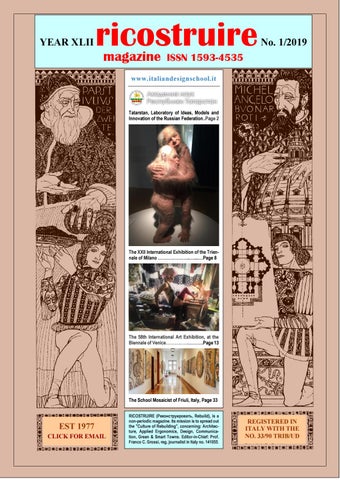
YEAR XLII
ricostruire magazine
No. 1/2019
ISSN 1593-4535
RICOSTRUIRE intends the information of www.italiandesignschool.it theses and works in the field of Architecture, Arts and Design, as a mediation between the technological and spiritualistic tendencies of our age. It expresses the need to give architectural design and DeTatarstan, Models sign itself aLaboratory new value,offorIdeas, a more open and diInnovation thesocial Russian alogue withofthe andFederation..Page cultural context,2 by widening its space of intervention to the world of Communication, in order to express its "duties of criticism". The promotion of this e-magazine requires a new form of dialogue with the reader, starting from the belief that professional training and the production of buildings, objects and landscape architecture, today need the work of a typical architect, builder and designer, indefatigable revealer of "formulae" and impressions, which translate into an architecture and a design made of orders, proportions, harmonies, to communicate the culture of Man and Nature. It is renewed in the moment in which modernism and its utopian ideology have shown Man not having been able to fully exploit the existing technological potential and the arsenal represented by the historical experiences in each place. Finally, we wish to orientate the of intervention also towards the Thefield XXII International Exhibition of the Trienstudy integrated communication sysnale ofof Milano …………………..…....…Page 8 tems, to be used in the architectural design of interiors, exteriors and urban furniture and in designing objects and services. In fact, in the analysis of future architectural structures, it will be increasingly necessary to take into account the needs dictated by the growing use of new media (new-media) and, in particular, technical equipment, installation of new technologies, such as the wired area, the intelligent building, home automation and many other applications. Ergonomics Applied to InThe 58thDesign International Art basis Exhibition, at fathe dustrial will be the and the Biennaletoofwin Venice……………..……….Page 13 cilitator the future challenges. The VRBS FELIX Manifesto for a Wellbeing City, Green, Smart and Mild……..….Page 2 VRBS FELIX (Happy City), the Next Town Vision with a “Green and Smart” Human Centered Design………………………Page The School Mosaicist of Friuli, Italy, Page 33
EST 1977 CLICK FOR EMAIL
RICOSTRUIRE (Реконструировать, Rebuild), is a non-periodic magazine. Its mission is to spread out the "Culture of Rebuilding", concerning: Architecture, Applied Ergonomics, Design, Communication, Green & Smart Towns. Editor-in-Chief: Prof. Franco C. Grossi, reg. journalist in Italy no. 141055.
RICOSTRUIRE - YEAR XLII - No. 1-2019 – Page 1
REGISTERED IN ITALY WITH THE NO. 33/90 TRIB/UD
Tatarstan, Laboratory of Ideas, Models and Innovation of the Russian Federation
“INTEGRATION AND MODERNIZATION POTENTIAL OF EURASIA: STATE, PROJECTS AND FORMATS OF IMPLEMENTATION” (June 10-11, 2019, Kazan, Russia) ******* ТАТАРСТАН, ЛАБОРАТОРИЯ ИДЕЙ, МОДЕЛЕЙ И ИННОВАЦИЙ РФ, НЕКОТОРЫЕ ПРАКТИЧЕСКИЕ ПРЕДЛОЖЕНИЯ ДЛЯ ИНТЕГРАЦИИ В ЕВРАЗИЮ. TATARSTAN, LABORATORY OF IDEAS, MODELS AND INNOVATION OF THE RUSSIAN FEDERATION, SOME PRACTICAL PROPOSALS FOR INTEGRATION INTO EURASIA. Franco C. Grossi professor emeritus at КИУ University, Kazan, Russian Federation
VIII КАЗАНСКИЙ ЕВРАЗИЙСКИЙ НАУЧНОПРАКТИЧЕСКИЙ ФОРУМ. «ИНТЕГРАЦИОННЫЙ И МОДЕРНИЗАЦИОННЫЙ ПОТЕНЦИАЛ ЕВРАЗИИ: СОСТОЯНИЕ, ПРОЕКТЫ И ФОРМАТЫ РЕАЛИЗАЦИИ» (10-11 июня 2019 г., Казань, Россия) VIII KAZAN EURASIAN SCIENTIFIC AND PRACTICAL FORUM.
Abstract: Tatarstan is greatly expanding and, owing to its cultural and economic growth, is becoming a point of reference for the whole Russian Federation. Also Russia has made great strides, but its economic progress is "compressed" to the east by China and to the west by Europe. This economic gap is also due to the lack of an appropriate birth and development of SMEs, that in China and Italy are the main factor for the production of their respective GDPs. In Italy, for example, the SMEs are the 99.9% of all Italian companies and like that in China. So, I would consider it interesting, for Tatarstan, to establish collaborative relations in Eurasia and, at first, with China and with some European countries. As regards Europe I suggest Italy, above all, because Italian and Russian citizens have many similarities and their mutual skills could lead to fruitful collaborative relationships. Until now, Russia has done nothing but extract raw materials and with them pay all the products it has imported from abroad so far. Now it is time to start with a major evolution in manufacturing, and safety, quality and ergonomics will be the pillars of this change in order to successfully compete in the global market [Grossi, 2016]. The reorganization of production cycles
RICOSTRUIRE - YEAR XLII - No. 1-2019 – Page 2
in factories, so to increase their efficiency, the emergence of many new SMEs to produce new GDP and the starting of new specialized courses at the service of companies, can be some important growth factors for the Republic of Tatarstan. 1. Introduction of some New Production Models, so as to Implement Safety, Quality and Efficiency of Companies. The first industrial revolution brought to the pursuit of economic efficiency and in business logic and the work factor played a very special role [Taylor, 1911]. Then, new models of working organization were applied. At the beginning of the seventies the factory of typewriters Olivetti studied and implemented the so called "Integrated Mounting Units" (IMUs), small structures that had the task and responsibility to realize a part of the machine or the whole machine [Boffo, 2012]. Each IMU was formed by a working group (typically from 10 to 30 workers) which worked independently in a defined area of the plant ("mounting island"), also with responsibility regarding the final quality. The same assembly mode, always at the beginning of the seventies, was experimented in the automotive industry, by Volvo, at its Kalmar and Udevalla plants, where skilled workers left the traditional assembly line and, gathered in teams, built entire complete vehicles. They built cars, in real "production islands", according to customer order, with a short delivery time, thus avoiding stocks, anticipating, therefore, the “just in time”. [Engström, Jonsson, & Medbo, 1998]. In the late 1990s, a new production strategy, the World Class Manufacturing [Olofsson, 2016], was developed in the USA, which integrates into the Total Maintenance Productivity (TPM) methodology, both the Lean Manufacturing and the Total Quality Management logics. Fiat Chrysler Automobiles has acquired the most innovative and ingenious best Practices born from WCM and continuously studies new application. The main innovation that FCA has developed, is the so called ETU (Elementary Technology Unit), i.e. an autonomous and independent production cell, controlled
by its team leader. We now consider to use the methodologies of Ergonomic Design to carry out comparative objective evaluations in each ETU. In this case we are supported by a specific ISO standard, the ISO/DIS 9241-11.2 (Ergonomics of human-system interaction - Part. 11: Usability), which provides us with the guidelines for measuring the usability of a production process. Usability means making products and systems easier to use, and matching them more closely to user needs and requirements. In order to increase productivity and reduce costs, it is essential to have an effective system for measuring, controlling and improving the efficiency of production [Kennerley et al., 2003], for example referring to the OEE (Overall Equipment Effectiveness) method. Effectiveness is the relation between what theoretically could be produced at the end of a process and what actually came out or was produced at the end of the process. Therefore, basically for the OEE is Effectiveness, i.e. the rate between what a machine theoretically could produce and what it actually did [Zepf, 2013]. The above-described ISO standard, specifies the quantification of Usability, which is implemented through “effectiveness”, “efficiency” and “satisfaction” measurements, that are defined as follows: Effectiveness, i. e. the accuracy and completeness with which users achieve specified goals, Efficiency, i. e. the resources used in relation to the results achieved, Satisfaction, i. e. the person's perceptions and responses that result from the use of a system, product or service. In our case, attention will focus on effectiveness, to better speed up production, on efficiency, for economizing work effort resources, and on satisfaction, to ensure greater pleasantness to the operator. By implementing these factors, we will achieve very interesting results. 1.1 Effectiveness, Optimizing the Movements of Workers The Collins Dictionary defines “therblig” as a basic unit of work in an industrial process used to analyze and achieve economy of motion. If the task is repetitive, of relatively short duration, and will be performed many times, it may be appropriate to analyze the therbligs that make up
RICOSTRUIRE - YEAR XLII - No. 1-2019 – Page 3
the work cycle as a part of the work design process. One way is to use cameras, by filming working operation and recording them. Once this is done, the filming must be analyzed and must be drawn up a micro motion analysis checklist for possible improvements [Biswas, 2016]. A better way is to place video targets on the bodies of workers, which can be recognized by a computer, in order to make their movements more essential, adopting the computational computation. In this case the targets, are taken up by cameras and detected by a special program which then provides for the development of "minimum paths" of the limbs and the bodies of the workers, so to complete the operations more quickly. Obviously, the program will also consider the fact of not to make too many repetitive movements and of the due pause times. Another way is to use Virtual Reality, Augmented Reality and Mixed Reality, that simulate a physical presence in places in the real world or an imagined world, allowing the workers to interact in that world. Modern manufacturing factories are already beginning to adopt the AR systems [Wright, 2017], so to put together thousands of components in a precise sequence as quickly as possible. 1.2 Efficiency, by Diminish the Efforts of Workers [Grossi, 2017] In this case, the goal will be to decrease the strain of workers during their activity motions. The movement in the human body is determined by the action exerted by the muscles on the bone levers, so for the knowledge of human motion, a great scientific speculation was devoted into the study of the structure and functioning of the muscular tissue. For measuring the force/effort (efficiency) in individual ETUs, we must determine the efforts produced in the movements of the single workers. To proceed in this direction, we either can apply targets on their bodies, or using Electromyography (EMG), a functional type of recording and analysis of the myoelectric signal, that is, of the electric bio-potential activity produced by skeletal muscles. EMG is performed using an instrument called “Electromyograph” to produce a record called an ele-
ctromyogram [Kamen, 2004], which allows us to analyze the efforts, to be able to then decrease. 1.3 Pleasantness The last topic of this project is related to how to make the work more pleasant, especially when the required efforts are at the limit of human tolerability. Let's take for example the automotive production, where the assembly of a car is still an intensive process and some tasks are still particularly burdensome, repetitive and demanding from a muscular point of view. In this case it is necessary a mechanical help for the limbs and the spine of the workers, in order to alleviate their fatigue, facilitate their movements and make their activity more pleasant. So, the so-called "exoskeleton" has been thus devised and more and more innovative models have been tested on some production lines, in order to refine and fine-tune the necessary technology to adapt them to workers. An exoskeleton (also known as powered armor, exoframe, hardsuit, or exosuit) is a wearable robotic mobile machine that is powered by a system of electric motors, pneumatics, levers, hydraulics, or a combination of technologies that allow for limb movement, with increased strength and endurance [McGowan, 2018]. 1.4 Conclusions So, because of this proposed production model, we will be able to achieve three goals: to improve the safety and the quality of work, by making manual operations less difficult and also increasing the execution rate (Effectiveness); to reduce the worker’s efforts throughout the production chain (Efficiency); to get that the executed work inside the ETUs can be perceived as absolutely more enjoyable (Satisfaction). The aim is to design a production line human centered and to increase the OEE. This because, in our opinion, everything winds about working efficiency. A new logistics model of the factory will be designed, which
RICOSTRUIRE - YEAR XLII - No. 1-2019 – Page 4
now will include its subdivision into ETUs. The tests will then be carried out into individual ETUs, by using Usability measures. This will make it possible to choose those specific movements with less muscle energy dispersion and a more pleasantness, which will also result in faster work execution, with greater satisfaction from workers. Finally, making the summation of the enhancement results achieved in all ETUs, we will get a percentage improvement of the plant's OEE. These results, subsequent to the use of the ergonomic design methodologies, will contribute both to the increase of the factory output (OEE from 50/65% towards 75/85%), and to the respect of workers' needs. 2. Program for a massive birth of new SMEs The birth of a lot of new small businesses will certainly be the driving factor for Tatarstan's GDP growth. It is time to give birth to a new class of entrepreneurs, which can be inspired from forms of cooperation rich in know-how. So, the first thing to do, is to recruit many future young entrepreneurs and to inculcate in their minds the “corporate culture”, with the creation of a special school for enterprises, with e-learning and AI facilities, of an observatory and of an annual conference on SMEs, on the model of Italian SMEs. To do this it is necessary to push young people for success while respecting the social models of behavior, which respond to the cultural expectation and the needs of the community. They will have to wear, as a "social dress", a patrimony of values, able to develop their entrepreneurial activity and worthily represent their mission. It will be important to select a lot of brand values, in order to increase competitive advantages in the global market [Porter, 1985]. Then helping them to draw up a well-done business plan, also containing the marketing and communication strategy. At the beginning it will be also important to get them inside of Start Up "containers", in "smart office" mode, with shared Hi-Tech platforms, in order to implement their skills of team working. Therefore, it is necessary to organize a growth path on the use of knowledge and relationships, in order to favor the development of a more meaningful and ethical criterion of "doing
business", within a series of events aimed at sharing the most relevant problems, of the most significant experiences and with the contribution of institutions, associations, companies, experts, professionals and universities. This proposed program must aim to both provide a concrete answer to the demand for intellectual and professional training coming from the world of entrepreneurship (above all focusing on young mobile professionals), and to encourage the sharing of knowledge, acting as a proactive aggregator in a process of continuous improvement and cultural growth. The goal is to build together a business model, which makes innovation, ethics, creativity and sustainability its strengths, contributing incessantly to increase its value chain in a continuous search for new ones’ competitive advantages. The new entrepreneurs of the Third Millennium should operate in a mobile and flexible way, be characterized by an intellectual dynamism, which allows them both to proceed to the solution of problems, and to always reach new results and this by means of a permanent training process, which shall not end with the end of the studies, but that will be projected along the whole of the professional life, allowing them a continuous acquisition of new knowledge, attitudes and notions. 3. Introduction of new courses, which are missing in Russia, Russia is the largest country in the world and for this reason many of its cities are geographically isolated. However, using modern ICT technologies, it is now possible to overcome the problem of distances and encourage remote learning. KIU is an example of this new deal, using its e-learning network. As regards know-how, Tatarstan is very strong in various disciplines, from IT to Oil Technologies, from Physics to Mathematics, but it lacks important practical courses, such as: 3.1 Industrial Design and Ergonomics. It is known that in the Global Manufacturing Market there is a shortage of the training offer related to some professional figures related to the
RICOSTRUIRE - YEAR XLII - No. 1-2019 – Page 5
world of contemporary industry; such as, for example, a designer oriented to methodologies and systemic processes that characterize the industrial future, both systemic-processual, and systemic-creative. Therefore, this course intends to promote a training experience aimed at comparing the historical practices of Design with the emerging problems typical of the complex societies in which we live, strictly connected to the changes that socio-economic globalization puts into place constantly. In this sense, new methodological instruments would be offered, in the optics to propose an evolving mental scale oriented towards the construction of more complex and performing product-system maps and design practices. The main purpose of the course is therefore to create advanced professionalism in the field of Design, in particular by stimulating the ability to conceptualize and organize processes that go beyond the "pure product" dimension as we have known it in the past decades, able to contribute to the cultural and productive valorization of the industries operating in the territory as well as of the territory itself. In a nutshell, it will be about promoting innovation seen as an emerging process, the result of various interacting components such as: deepening of new methodologies, new skills and design minds, new expressive strategies. All oriented to the construction of a figure of designer, especially designed for companies, with advanced capacity for prefiguration and management of processes, not only exquisitely designed, but also able to effectively relate to the current sociological, technological and semiotic complexity. The growing demand for quality is increasingly taking shape also in terms of improving living conditions and the level of satisfaction of human well-being needs. The evolution of this conviction, sufficiently tested, has shifted the interest from the industrial product to all the other components of the production system and has given birth to a new field of study, called "Ergonomics", or “User Centered Design”. Ergonomics, deals with problems relating to man-product-environment relationships, adding up, elaborating and integrating research and the solutions offered by various sciences such as medicine, physiology, psychology, sociology, physics,
technology, etc., in order to achieve an optimal adaptation of the system: product -man - work environment and habitat. 3.2 Advanced Communication Sciences for Companies The adjective "mass", which made history in the last century (mass communication, mass media, mass production, mass consumption) has now completely transformed into that of "personal" (personal computer, personal trainer, personal shopper). Personalization is the leitmotiv of the third millennium, it is a complete turnaround also in the market; today we want customized cars, customized garments and not only in the luxury sector. This also has repercussions on the scale of values to achieve goals, to succeed and to obtain social recognition. Thus a new creative class is born, made up of people who wish to leverage on their individual abilities to distinguish themselves from the "mass". And "personal branding" is their marketing strategy [Reed, 2017], through which they are characterized and distinguished in a unique and immediately recognizable way. These people, in effect, represent the brand of themselves, as their public image perfectly outlines their mission, their shared value and their style of communication. And to effectively achieve their consecration in society, this new creative class must follow a real ritual. First of all, “Ethos”, that is the respect of the rules of the game, in compliance with the behavioral models of the environment in which they operate. Then “Logos”, or the ability to communicate with one's peers, in their society and in their own time, in order to approach and persuade others, to find a common language that makes clear, understandable, simple and convincing what is difficult, obscure, veiled and complex. Finally, “Pathos”, that is, to amplify their visibility with an adequate scenography, applied in a way compatible with all the media used and, above all coherently, so as to always guarantee a little more than what was promised. So, to reach this goal, a new model of Communication could be adopted, the "Active User in Advance Feedback" [Grossi, 2015].
RICOSTRUIRE - YEAR XLII - No. 1-2019 – Page 6
3.3 New Typologies of Marketing It is known that all marketing techniques are designed to try to impress and affirm the company's brand in the minds of customers and prospects, and when the brand conquers the minds of the customers, the desired result is approaching already more than 50%. It is therefore necessary to effectively promote all those values that should be "perceived" by consumers, communicating them to them in an effective, efficient and pleasant. This is a new type of marketing, which could be described as "advanced" [Kotler, 1999], which concerns the study of what kind of products and with what characteristics the company should put into production in the future. In this case, in short, we have to manage to develop the company's strategy to be followed so that the company, between three and five years, can have available an offer that allows to achieve good market positions. The new training courses identify some innovative types of marketing, which would be able to overcome the problems of perception and affordance which germinate and are determined using methodologies based on the proposals on an emotional level. Up to now we have tried to influence the users by using only the emotional components of the product, falling into a gap between perceived quality and actual quality. Now we are trying to develop a new ergonomic concept path that combines the characteristics of the object with the image of the brand to refer to, so to create additional competitive advantages. The aim is therefore to make use of the most recent scientific discoveries concerning the study of cognitive processes, those on generative semeiotics, Gestalt psychology, synesthetic sensory applications, and new studies on the evolution of neocortex (mirror neurons, memes, etc.), in close connection with the communicative value of the new media. REFERENCES Biswas, A., (2016). Motion study on shopfloor and design of work, 13 October 2016, https://www.slideshare.net/avijitbiswas8/motion-studyon-shopfloor-and-design-of-work.
Boffo, V. (2012). A glance at work. Educational Perspectives, Firenze University Press, Florence, Italy, page 29. Engström, T., Jonsson, D., &Medbo, L. (1998). The Volvo Uddevalla plant and interpretations of industrial design processes, MCB University Press Ltd., Bingley, West Yorkshire, UK. Grossi, F. C. (2015), The “AUAF” Model of Communication, in https://www.academia.edu/12200615/The_AUAF_Model_of_Communication Grossi, F. C. (2016). The "Made in Russia" Buildings in Arboreal Essence, a Penta-Sensorial Holistic Ergonomic Design Applied to Buildings and to Interior Furnishing, presented at the 14th Biennale Architecture of Venice, 5 July 2016. Grossi, F. C. (2017). An Ergonomic Project to Increase Factory Efficiency, proceedings of the 7th International Conference on Production Engineering and Management, 29 September 2017. Kamen, G. (2004). Electromyographic Kinesiology. In Robertson, DGE et al. Research Methods in Biomechanics, Human Kinetics Publ., Champaign, IL, USA. Kennerley, M., Neely, A., &Adams, C. (2003). Survival of the fittest measuring performance in a changing business environment, Measuring Business Excellence 7(4) (2003) 37–43. Kotler, P. (1999), Kotler on Marketing: How to Create, Win, and Dominate Markets, Free Press, NY, 1999. McGowan, B. (2018). Industrial Exoskeletons: What You're Not Hearing, Occupational Health & Safety, 1 October 2018, https://ohsonline.com/articles/2018/10/01/industrial-exoskeletonswhat-youre-not-hearing.aspx Olofsson, O. (2016). Succeeding with Standardized Work, WCM Consulting AB, Vaxholm, Sweden. Porter, M. E. (1985), Competitive Advantage: Creating and Sustaining Superior Performance, Free Press, New York, 1985
RICOSTRUIRE - YEAR XLII - No. 1-2019 – Page 7
Proffitt, D. R., Stefanucci, J., Banton, T., &Epstein, W. (2003). The Role of Effort in Perceiving Distance, American Psychological Society, Vol. 14, No. 2, March 2003, pp. 106-112.
The XXII International Exhibition of the Triennale Milano, Italy.
Reed, C. J.. (2017), Personal Branding Mastery for Entrepreneurs, Evolve Global Publishing, NSW, Australia, August 28, 2017. Taylor, F. W. (1911). The Principles of Scientific Management, Harper & Brothers, New York, NY, USA and London, UK. Vorne Industries (2002). Calculate OEE, http://www.oee.com/calculating-oee.html Wright, I. (2017), What Can Augmented Reality Do for Manufacturing? - https://www.engineering.com/AdvancedManufacturing/ArticleID/14904/What-Can-Augmented-Reality-Do-for-Manufacturing.aspx Zepf, P. J., (2013). How to Calculate Overall Equipment Effectiveness: A Practical Guide, Automation World, August 2, 2013. THE AUTHOR Franco C. Grossi is president of the “Italian Design School”, professor emeritus at “КИУ” and at “КГАСУ” Universities, Russia, expert no. 6533 at the Ministry of Education and Science of the Russian Federation, Moscow and no. EX2013D138315 at the European Commission, Eurasian ergonomist at IREA, Russia and member of SIE Italy, former professor at the Universities of Trieste and Udine, grossi@ieml.ru , president@italiandesignschool.it.
The XXII International Exhibition of Triennale Milano, Italy, titled Broken Nature: Design Takes on Human Survival, opened on March 1st and will end on September 1st, 2019. It is curated by Paola Antonelli, Senior Curator of Architecture and Design and Director of Research & Development at The Museum of Modern Art. The Triennale Building, Milano, Italy. RICOSTRUIRE - YEAR XLII - No. 1-2019 – Page 8
Broken Nature is the thematic exhibition from which the XXII International Exhibition takes its name.
The exhibition is composed of a thematic exhibition and 21 International Participations that represent all continents by offering different themes, perspectives and contexts.
Think Evolution #1: Kiku-ishi (Ammonite), by Aki Inomata, 2016-17.
The thematic exhibition is an in-depth exploration of the strands that connect humans to the natural environment that have been intensely compromised, if not entirely severed, over the years. By casting a wide net on architecture and design projects, Broken Nature underlines the concept of restorative design, highlighting objects and concepts at all scales that reconsider human beings’ relationship with their environments – including both natural and social ecosystems. A number of directly commissioned works complement the loans in the thematic exhibition and will highlight design approaches aimed not
RICOSTRUIRE - YEAR XLII - No. 1-2019 – Page 9
only at correcting humanity’s self-destructive course, but also at replenishing our relationship with the environment and with all species – including other human beings.
The Lion of Women, Chiara Vigo, 1996. Chiara Vigo dives to the depths of the Mediterranean off the Sardinian shore to Harvest, by means of a small scalpel, the world’s most coveted thread - a technique passed on to her by more then a thousand years of matrilineal family heritage. The keratinous fibers are produced by the coming into contact of saltwater and a proteine secreted by the “Pinna Nobilis”, or pen shell. Sea-silk threads are extracted from raw fibers about three times finer than human hair, then spun around a spindle until they are long enough to be submerged and dyed in a solution of pies, lemon and algae. The resulting filament magically becomes elastic with a golden glow, and is ready to be woven and then embroidery - in this case on hand spun antique yellow linen from 1938, made from a species of flax now extinct.
These projects are often continuations of a body of work previously started and are meant to encourage designers to consider their practice as long-term research.
Sanctuary, by Patricia Piccinini, 2018. She shows the “Bonobos”, humans’ closest living relatives, tend to resolve conflict through sexual relationship rather than violence.
RICOSTRUIRE - YEAR XLII - No. 1-2019 – Page 10
The great animal orchestra, by Bernie Krause.
RICOSTRUIRE - YEAR XLII - No. 1-2019 – Page 11
Lithopy is a future utopic land, where life is based on lithium reserves, blockchain and satellites. RICOSTRUIRE - YEAR XLII - No. 1-2019 – Page 12
A Urban Rural community.
The 58th International Art Exhibition, at the Biennale of Venice. The 58th International Art Exhibition, titled May You Live In Interesting Times, will take place from 11th May to 24th November 2019. The title is a phrase of English invention that has long been mistakenly cited as an ancient Chinese curse that invokes periods of uncertainty, crisis and turmoil; "interesting times", exactly as the ones we live in today. The 58th Exhibition is curated by Ralph Rugoff, currently the director of the Hayward Gallery in London. Between 1985 and 2002 he wrote art and cultural criticism for numerous periodicals, publishing widely in art magazines as well as newspapers, and published a collection of essays, Circus Americanus (1995). During the same period, he began working as an independent curator. The International Exhibition and the Invited Artists
the beginning we were criticized for the presence of the pavilions, considered old-fashioned in times of cosmopolitanism and globalization, we live in times where some people raise the doubt that cosmopolitanism might also have been a way for the most influential cultural and political realities to exert a sort of soft power. We are an international exhibition that since those years put the word “open” and “plateau of humankind” as the subtitle for all the following biennials». «During these years, we have increased the number of visitors and found a new partner. Over the course of the past years, the double cost of transportation in the lagoon obliged us to ask for additional support, and our expressions of gratitude and our wall labels included many market participants. The increase in the number of our visitors has allowed us to considerably cut back on this practice, as you can see in the drastic reduction in our expressions of gratitude, both when presenting the works and in the catalogues. Our visitors have become our main partner; more than half of them are under 26 years of age. Calling notice to this result seems to me the best way to celebrate the twenty years which have passed since 1999. »
«The title of this Exhibition could be interpreted as a sort of curse – stated President Paolo Baratta - where the expression “interesting times” evokes the idea of challenging or even “menacing” times, but it could also simply be an invitation to always see and consider the course of human events in their complexity, an invitation, thus, that appears to be particularly important in times when, too often, oversimplification seems to prevail, generated by conformism or fear. And I believe that an exhibition of art is worth our attention, first and foremost, if it intends to present us with art and artists as a decisive challenge to all oversimplifying attitudes. »
«We want to offer them an open gym - Baratta concludes - where they can feel involved in encounters with the works and the artists, in the direct discovery of the “other” which the work of art offers>>.
«Twenty years have passed since, in this same location, I presented my first Exhibition -President said - after the Biennale underwent major reform in 1998. Let me tell you, they have been very interesting times. At
The Exhibition develops from the Central Pavilion (Giardini) to the Arsenale and includes 79 participants from all over the world.
<<To us, it is important that, when entering the exhibit, the “public” becomes “visitors,” who then become “viewers” of the works. First, the necessary disorientation, then the involvement, followed by the discovery; it is almost a fencing drill. To share this direction is one of the reasons we have asked Ralph Rugoff to collaborate with us on this twentieth anniversary».
RICOSTRUIRE - YEAR XLII - No. 1-2019 – Page 13
Ralph Rugoff has declared: «May You Live in Interesting Times will no doubt include artworks that reflect upon precarious aspects of existence today, including different threats to key traditions, institutions and relationships of the “post-war order.” But let us acknowledge at the outset that art does not exercise its forces in the domain of politics. Art cannot stem the rise of nationalist movements and authoritarian governments in different parts of the world, for instance, nor can it alleviate the tragic fate of displaced peoples across the globe (whose numbers now represent almost one percent of the world’s entire population)», «But in an indirect fashion, perhaps art can be a kind of guide for how to live and think in ‘interesting times.’ The 58th International Art Exhibition will not have a theme per se, but will highlight a general approach to making art and a view of art’s social function as embracing both pleasure and critical thinking>>. RICOSTRUIRE - YEAR XLII - No. 1-2019 – Page 14
<<The Exhibition will focus on the work of artists who challenge existing habits of thought and open up our readings of objects and images, gestures and situations. Art of this kind grows out of a practice of entertaining multiple perspectives: of holding in mind seemingly contradictory and incompatible notions, and juggling diverse ways of making sense of the world>>. <<Artists who think in this manner offer alternatives to the meaning of so-called facts by suggesting other ways of connecting and contextualising them. Animated by boundless curiosity and puncturing wit, their work encourages us to look askance at all unquestioned categories, concepts and subjectivities. It invites us to consider multiple alternatives and unfamiliar vantage points, and to discern the ways in which “order” has become the simultaneous presence of diverse orders».
RICOSTRUIRE - YEAR XLII - No. 1-2019 – Page 15
National Participations The Exhibition also includes 89 National Participations in the historic Pavilions at the Giardini, at the Arsenale and in the historic city centre of Venice. Four countries are participating for the first time at the Biennale Arte: Ghana, Madagascar, Malaysia, and Pakistan. The Dominican Republic exhibits for the first time at the Biennale Arte with its own national pavilion. The Italian Pavilion at the Tese delle Vergini in the Arsenale, sponsored and promoted by the Ministero per i Beni e le Attività Culturali Direzione Generale Arte e Architettura Contemporanee e Periferie Urbane, is curated this year by Milovan Farronato. RICOSTRUIRE - YEAR XLII - No. 1-2019 – Page 16
Collateral Events 21 Collateral Events which are admitted by the curator and promoted by non-profit national and international bodies and institutions, take place in several locations; they offer a wide range of contributions and participations that enrich the diversity of voices that characterizes the Biennale. Special Projects Forte Marghera Special Project, Mestre, Ludovica Carbotta, one of the artists taking part in the International Exhibition, has been invited by Ralph Rugoff to expressly make a work in Forte Marghera, inside the building called the Austrian Polveriera.
RICOSTRUIRE - YEAR XLII - No. 1-2019 – Page 17
Applied Arts Pavilion Special Project, Arsenale, Sale d’Armi Marysia Lewandowska is the artist set to exhibit in the Pavilion of Applied Arts located in the Arsenale, Sale d’Armi. The project, renewed for the fourth consecutive year, is the result of the collaboration between La Biennale and the Victoria and Albert Museum, London.
RICOSTRUIRE - YEAR XLII - No. 1-2019 – Page 18
RICOSTRUIRE - YEAR XLII - No. 1-2019 – Page 19
RICOSTRUIRE - YEAR XLII - No. 1-2019 – Page 20
RICOSTRUIRE - YEAR XLII - No. 1-2019 – Page 21
RICOSTRUIRE - YEAR XLII - No. 1-2019 – Page 22
RICOSTRUIRE - YEAR XLII - No. 1-2019 – Page 23
RICOSTRUIRE - YEAR XLII - No. 1-2019 – Page 24
RICOSTRUIRE - YEAR XLII - No. 1-2019 – Page 25
RICOSTRUIRE - YEAR XLII - No. 1-2019 – Page 26
RICOSTRUIRE - YEAR XLII - No. 1-2019 – Page 27
RICOSTRUIRE - YEAR XLII - No. 1-2019 – Page 28
RICOSTRUIRE - YEAR XLII - No. 1-2019 – Page 29
RICOSTRUIRE - YEAR XLII - No. 1-2019 – Page 30
RICOSTRUIRE - YEAR XLII - No. 1-2019 – Page 31
RICOSTRUIRE - YEAR XLII - No. 1-2019 – Page 32
The School Mosaicist of Friuli, Italy. Founded in 1922 the school Mosaicists aims at the didactic commitment, the association between tradition and renewal, between productive reality and cultural reality. In the brightness of the mosaic and Terrazzo laboratories, gavings, stumps and T still today mark the time of a work of distant memory. The sensitivity of the craft, untouched throughout history, in modern times feeds on new stimuli through the incomparable encounter with artists, designers and designers. The same pioneers of modern mosaic, the Sequals mosaicists of the last century, have been able to establish relationships with painters and architects by branching out their art all over the world, from the decoration of the Library of Congress in Washington to that of the OpÊra in Paris. With these premises, in its didactic and productive typology, the school realizes important interventions mosaic of international recall, passing through the study and the application of the Roman, Byzantine and modern mosaic. The school today seeks above all not to forget its own reason to be and enhances the mosaic as a cultural fact as well as technical: the study, research, experimentation and use of the most innovative technologies are signs of openness and growth to and from the mosaic Art of contemporaneity. It was Lodovico Zanini, delegate for Friuli of the humanitarian of Milan, to suggest the establishment of a school for Mosaicists and Ezio Cantarutti, mayor of Spilimbergo, to concretize the work. Thus in 1922 was born in Spilimbergo the mosaicists of Friuli’s school. Here and nowhere else for the deep-rooted tradition of the mosaic and the terrace present in the Mandamento. RICOSTRUIRE - YEAR XLII - No. 1-2019 – Page 33
In fact for all the ‘ 500, the ‘ 600, the ‘ 700 and the 800 from Spilimberghese there was a strong seasonal emigration to Venice, artistic crossroads par excellence between East and West, between Rome and Byzantium and therefore natural heir to the Roman and Byzantine mosaic tradition that here Admirably melt.
The “Serenissima” offered the Frisian workers a job but also gave them a brilliant idea: to use the stones of their rivers. With these the craftsmen of Sequals, Colle, Solimbergo, Arba, Fanna, Cavasso Nuovo and Spilimbergo – after having collected and selected them on the Greti of the rivers Meduna and Tagliamento – departed towards Venice. From the first half of ‘ 800 the mosaicists began to go beyond Venice: from France to the United States; from Canada to Venezuela; from Argentina to Australia. Many of them made great fortunes.
RICOSTRUIRE - YEAR XLII - No. 1-2019 – Page 34
Just think of the Impresarians as the Odorico, the Ciani, the Turk, the Tramontin and especially that Gian Domenico Facchina who was born in Sequals in 1826 worked initially in Venice where he also founded a factory for the production of “Venetian enamels” (The tiles that They serve to make a mosaic). Subsequently transferred to Paris he performed works of great prestige that went to embellish town halls, churches, mosques, palaces in Bucharest, in The Hague, in Izmir, in Lourdes, in Buenos Aires, in Tokyo as well as at the Teatro Operà in Paris.
Since the beginning, the Mosaicists School of Friuli, obtained a first important recognition: the awarding of the Diploma of Honour to the first international Exhibition of Decorative Arts of Monza for a fountain performed on cardboard of the arch. Raimondo D’ Aronco. The cycle of studies was structured in three years and the programming envisaged both subjects of general cul-ture and the development of drawings, sketches and cartons as indispensable prerequisites for the conception of Mosaic compositions, whose execution was supported by Practical mosaic exercises and terrace in the laboratory.
RICOSTRUIRE - YEAR XLII - No. 1-2019 – Page 35
Later the school was called to perform the entire mosaic cycle of Foro Italico in Rome. Almost 10,000 sq. m. Performed on cartoons by Angelo Canevari, Giulio Rosso, Gino Severini and Achille Capizzano. In more recent times, the mosaic works of the monastery of St. Irene near Athens (over 1,000 sq. m.), the Kawakyu Hotel in Japan (1,600 sq. m.) and the restoration work of the mosaics of the Foro Italico in Rome were important. All works carried out in collaboration with the Mosaic Laboratories managed by former students of the Spilimbergo school.
The mosaic lining of the Dome of the Holy Sepulchre in Jerusalem (MQ. 345) is instead a work entirely carried out inside the school.
RICOSTRUIRE - YEAR XLII - No. 1-2019 – Page 36
Today the school mosaicists of Friuli is a reference point in the world for the training of professionals and the dissemination of the art of Mosaic.
It is a sui generis school precisely because it imports students from all over the world (currently 22 are the nationalities present) and exports works of art in the most significant places, from New York to Beijing, from Tokyo to Sant’Antonio (Texas-USA). The goal is to combine the preservation of tradition with innovation. The aim is to experiment and research to find new solutions, especially in the field of urban furnishing and interiors. For this close to the traditional subjects of study: Mosaic, terrace and drawing are flanked by the computer graphics, the mosaic design and the theory of color.
In recent years the school has been open to the full range. It is confronted with increasing conviction, competence and success in various fields: from architecture to design; From contemporary art to restoration.
Numerous works are carried out in collaboration with architects and designers (both Italian and other nationalities), which embellish restaurants, churches, villas and various places all over the world. Just think of the great mosaic “Saetta Iridescente” for the new metro station Temporary Word Center Path Sation (Ground Zero) in new York; to the mosaic as a furnishing complement for two restaurants always in New York; to the mosaic sculpture at the entrance of the Orbessano FIAT Research Centre in Turin; to the mosaic pavement of the Piazza della Transalpina between Gorizia and Nuova Gorica; to the
RICOSTRUIRE - YEAR XLII - No. 1-2019 – Page 37
parietal and paving coverings for a restaurant in Tokyo; to the parietal decorations for the cultural center “Chicasaw” in Oklaohoma (USA); to the mosaic cycle for the Volksbank of Graz (Austria) and the one for the Church of San Lorenzo (L’Aquila); to the “Bible in the open air-the Old Testament” for the commune of Cercivento (Udine).
RICOSTRUIRE - YEAR XLII - No. 1-2019 – Page 38
RICOSTRUIRE - YEAR XLII - No. 1-2019 – Page 39
Works carried out on sketches by artists such as Zigaina, Dorazio, Ciussi, Celiberti, Licata, Cascella, Della Torre, Finzi, Gianquinto, Basaglia, Nespolo, Pittino, Pizzinate, Pozzati, Soffiantino, Lojze spacal, Strazza, Tadini, Titan, Treccani, Turchiaro, Voltolina, Nane Zavagno, De Luigi, Anzil, Mitri, just to name a few.
Wangaratta – Geelong – Sydney (2007); “Un, deux, trois…. cailloux. Exhibition of the “School Mosaicists of Friuli”, Mosaique d’hier et d’aujourd’hui “in Arles (2007); “Mosaic only” in Moscow (2008); “The school mosaicists of Friuli” in Randers (2009); “The school mosaicists of Friuli” in Trieste (2009); “The school mosaicists of Friuli” in Udine (2009); “School mosaicists of Friuli” in Eeklo and Antwerp (2009); “The school mosaicists of Friuli” in Valaské Mezirici (2010); “The school mosaicists of Friuli” in Basel (2010); “The school mosaicists of Friuli” in Bratislava (2011); “Scuola Mosaicists of Friuli 19222012” and “artist mosaics from the experience of the school mosaicists of Friuli the works of artists” at Villa Manin of Passariano – Udine; “The school mosaicists of Friuli” in Bolzano and Verona; “The school mosaicists of Friuli” in Stuttgart (2013).
Important interventions in the field of restoration of mosaics (those dating from the end of ‘ 800 and all ‘ 900). Think of the prestigious mosaics of the sanctuary of Lourdes in France, the mosaic work at the Venice railway station and the Dome “Maison Simons” in Quebec, Canada. In recent years the school has participated and organized exhibition events such as: “the school mosaicists of Friuli” in Angers (1997); “Aime… Comme mosaique “in Paris (1998); “Mosaic is” at Villa Manin of Passariano (2000); “The new mosaic: Selections from Friuli” in Toronto (2003); “La mosaique dans tous ses éclats” in Marseille (2005); “The school mosaicists of Friuli” in Obernaì (2005); “The school mosaicists of Friuli” in Rome (2006); “The school mosaicists of Friuli” in Veszprèm (2006); “Mosaic: Selections from Friuli” in Melbourne (2006); “Mosaic Now: Works from Italy and Australia” in RICOSTRUIRE - YEAR XLII - No. 1-2019 – Page 40