YEAR XLI
ricostruire magazine
No. 6/2018
ISSN 1593-4535
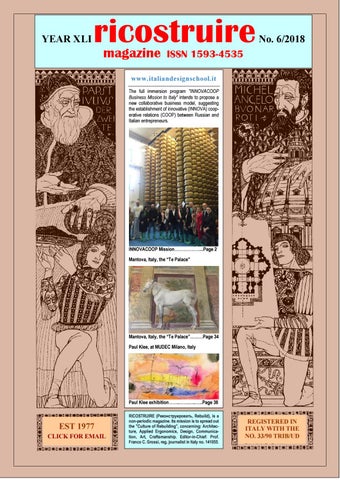
RICOSTRUIRE intends the information of www.italiandesignschool.it theses and works in the field of Architecture, Arts and Design, as a mediation beThe full immersion program "INNOVACOOP tween theMission technological and spiritualistic Business to Italy" intends to propose a tendencies of ourbusiness age. Itmodel, expresses the new collaborative suggesting need to give architectural andcoopDethe establishment of innovativedesign (INNOVA) sign itself a new(COOP) value, for a more open and dierative relations between Russian alogue with the social and cultural context, Italian entrepreneurs. by widening its space of intervention to the world of Communication, in order to express its "duties of criticism". The promotion of this e-magazine requires a new form of dialogue with the reader, starting from the belief that professional training and the production of buildings, objects and landscape architecture, today need the work of a typical architect, builder and designer, indefatigable revealer of "formulae" and impressions, which translate into an architecture and a design made of orders, proportions, harmonies, to communicate the culture of Man and Nature. It is renewed in the moment in which modernism and its utopian ideology have shown Man not having been able to fully exploit the existing technological potential and the arsenal represented by the historical experiences in each place. Finally, we wish to orientate INNOVACOOP Mission………………...Page 2 the field of intervention also towards the study of integrated communication sysMantova, Italy, the “Te Palace” tems, to be used in the architectural design of interiors, exteriors and urban furniture and in designing objects and services. In fact, in the analysis of future architectural structures, it will be increasingly necessary to take into account the needs dictated by the growing use of new media (new-media) and, in particular, technical equipment, installation of new technologies, such as the wired area, the intelligent building, home automation and many other applications. Ergonomics Applied to InMantova,Design Italy, the 34 dustrial will“Te be Palace”………Page the basis and the facilitator to win the future challenges. Paul Klee, at MUDEC Milano, Italy
The VRBS FELIX Manifesto for a Wellbeing City, Green, Smart and Mild……..….Page 2 VRBS FELIX (Happy City), the Next Town Vision with a “Green and Smart” Human Centered Design………………………Page Paul Klee exhibition……..…….…..…..Page 38
EST 1977 CLICK FOR EMAIL
RICOSTRUIRE (Реконструировать, Rebuild), is a non-periodic magazine. Its mission is to spread out the "Culture of Rebuilding", concerning: Architecture, Applied Ergonomics, Design, Communication, Art, Craftsmanship. Editor-in-Chief: Prof. Franco C. Grossi, reg. journalist in Italy no. 141055.
RICOSTRUIRE - YEAR XLI - No. 6-2018 – Page 1
REGISTERED IN ITALY WITH THE NO. 33/90 TRIB/UD
ICT, help to properly and effectively communicate the artifacts to the market. We will visit five Italian clusters of SMEs, concerning: Agribusiness, IT, Food, Agricultural Machinery, Tourism and Automotive This was the program’ locations:
INNOVACOOP
The full immersion program "INNOVACOOP Business Mission to Italy" intends to propose a new collaborative business model, suggesting the establishment of innovative (INNOVA) cooperative relations (COOP) between Russian and Italian entrepreneurs. This model is based on the birth and the development of new SMEs, having for reference the Italian one, because, as you certainly know, in Italy the 99,9% of all the companies are SMEs. In Italy, out of 4,338,766 companies, 4,335,448 (99.9%) are in fact small and medium-sized enterprises. Furthermore, almost all SMEs (95%) are companies with fewer than 10 employees. The rest consists of companies employing 10 to 49 employees (196,090 units, equal to 4.5%), while the largest companies (from 50 to 249 employees) are just 21,867, or 0.5% of total. The Italian SMEs are not only numerically the backbone of the national productive system, but also their contribution in terms of employment is significant: they employ, in fact, over 81% of the employed, particularly in the services sector (about 49%). A similar situation is also recorded in terms of added value: 72.4% (excluding agriculture) is produced by SMEs, of which more than half are from service companies. After five years spent in Russia, the organizer is now able to say that three tools are lacking within the Russian Federation: Ergonomics, Industrial Design and the Sciences of Communication. Ergonomics helps the designer to improve his own skills in order to define the real needs of customers, Industrial Design allows to establish the appropriate interfaces man-object-environment and how to industrialize the product/service and the Sciences of Communication, with a smart use of
Veneto food and machinery cluster in San Giovanni in Lupatoto, Veneto Region. Kilometrorosso IT cluster in Bergamo, Lombardia. Agribusiness Lombardia Cluster in Pegognaga, Mantova, Lombardia Region. Confindustria Emilia Automotive cluster and Tourism Cluster in Modena, Emilia Romagna Region. Visit to Mantova and to Cerin – Carbide Precision Tools, Affi, Veneto. Regiopn.
The mission in Italy of the General Director of seven Russian Federation Clusters was led by dr. Arthur Nikolaev, First Deputy Chairman of the Board of the Union of the Chambers of Commerce and Industry of the Republic of Tatarstan, Russia. The mission took place on November 2018 from 4th to 10th.
RICOSTRUIRE - YEAR XLI - No. 6-2018 – Page 2
Here the participants: 1. Union of the Chambers of Commerce and Industry of the Republic of Tatarstan Artur Nikolaev, First Deputy Chairman of the Board, Chief of the Delegation
2. Astrakhan Regional Innovation Center Iunusova Dinara, General Director Kovaleva Tatiana, Manager 3. Center for cluster development of the Kurgan region Sukharev Sergei, General Director 4. Fund for the development of small and medium-sized businesses of the Murmansk region Popov Vladimir, Deputy General Director Shaimova Olesia, Manager 5. Crimean Naval Industrial Cluster Maria Bychkova, General Director 6. Technopark of St. Petersburg Zinina Marina, General Director Elaksina Olga, Head of Department 7. Center for Cluster Development of Tomsk Region Khaletckaia Irina, Head of Department 8. Julia Kazantceva, interpreter 9. Franco Grossi, mission organizer.
Figura 1
Visiting Italian Industrial Clusters
Veneto food and machinery cluster in San Giovanni in Lupatoto. Map Source: https://annamappa.com/russia/
The participants to the mission with the major of Pegognaga Dimitri Melli. RICOSTRUIRE - YEAR XLI - No. 6-2018 – Page 3
1. Veneto food and machinery cluster in San Giovanni in Lupatoto, Veneto Region. Compared to other municipalities in the entire province of Verona, the “Lupatotino” territory has shown a unique dynamic in its ability to industrialize. Despite being one of the smallest municipalities in the province, with a territory of only 20 square kilometers, over the past hundred and fifty years it has reached a population density among the most others in Italy and an unrepeatable industrial development.The entrepreneurial spirit of the inhabitants of San Giovanni Lupatoto dates back to the nineteenth century: the Austrian barracks for cavalry wanted by General Josef Radetzky was used following the annexation to the Kingdom of Italy as an industrial factory where glass plates and bottles were made with employees 800 workers. There are several companies in the area,
including the main factory of the Vicenzi Group company, the Pastificio Rana of Giovanni Rana and Melegatti.
The major conferred a Diploma to all the participants of the mission.
The delegation was received by the Mayor of San Giovanni in Lupatoto.
RICOSTRUIRE - YEAR XLI - No. 6-2018 – Page 4
Visiting the “Pastificio Rana�
Giovanni Rana is the president and founder of the "Pastificio Rana". He was born in Cologna Veneta, in the province of Verona, on October 15, 1937. At the age of thirteen he started working with his brothers in the family bakery, until his artisan production was twenty years old of tortellini. Guiding him on his journey is an intuition "belly" but strongly rooted in the social and historical Italian fabric of the postwar period, when a new generation of women is preparing to work outside the home, drastically the time to devote to cooking and in particular to the realization: fresh pasta homemade.
The history of the Rana pasta factory is identified with that of Giovanni Rana's life. Since October 15, 1937, when Giovanni was born in Cologna Veneta near Verona, he has brought a bit of turmoil to the Rana family. He prefers manual work instead to study and in 1950, at just 13 years of age, he joined his brothers in the family bakery in San Giovanni Lupatoto. Giovanni quickly learns the secrets of baking, but the future that awaits him is very different from what everyone had imagined for him. Society and work are evolving rapidly and Giovanni is ready to seize the opportunities: it is 1960 and Italy is in the midst of the economic boom, which leads to an increase in wealth, consumption and employment, including women. This last factor becomes the spark to start a new professional activity. "If the young brides no longer have the time to make tortellini, I will do it for them!" he must have said to himself, before buying the legendary "Guzzino" used, with which he personally delivers them to the first client families. And The legendary "Guzzino" with which Giovanni Rana this is how fresh homemade brought fresh pasta to his customers' homes. pasta turns into fresh pasta that Giovanni Rana brings you home. On March 28, 1962 the doors of the Rana pasta factory officially opened. A great milestone to celebrate, but stopping now is out of the question. Two hands to knead the tortellini, in fact, are no longer sufficient, so Giovanni understands that it is time to embrace a new growth strategy. The fresh handmade pasta, according to an Italian tradition handed down from generation to generation, is ready to become fresh pasta to be produced on an industrial scale. But the machines
RICOSTRUIRE - YEAR XLI - No. 6-2018 – Page 5
available at the time proved to be inefficient for the type of production that Giovanni had in mind. Thus, with the help of local engineers and mechanics, he designs and develops new machinery, which can respond to the growing demand for volumes and varieties of pasta. The investment is impressive and difficult to sustain, but it pays off in a short time: production grows from 15 kg of tortellini per hour to hundreds of kilos per hour ... far too many to fit in the basket of your motorcycle! The time has come for Giovanni Rana's stuffed pasta to prepare to travel all over Italy. The seventies begin and the company needs a more spacious factory. Giovanni spontaneously thought of building it in San Giovanni Lupatoto, near his new home.
makes its way. in addition to the Italian one. In a few years his dream came true, but with such a large customer base, a new way to make himself known and get straight to people's hearts must be found. The company starts investing in advertising and Giovanni lends himself to putting his face on it. Giovanni Rana products are conquering palates all over the world, and something new "is cooking". The Rana family, in fact, enters the world of fast food restaurants with the opening of the first "Da Giovanni" restaurant, in the province of Brescia. A challenge that commits the family to bring to the table what has so far stopped at supermarkets. The dream of the Rana family to land their products in America not only comes true, but becomes even bigger! The first pasta and fresh sauce factory in Chicago and the first restaurant in New York, inside the exclusive Chelsea neighborhood, open practically at the same time. Today the "Pastificio Rana" invoices 702 million euros (of which 246 mil. in America), with 3,500 employees and a profit of 28 million.
Not only business has grown in recent years, but also Giovanni's ambition and the more the attachment to his land is strengthened, the more the idea of opening the distribution of Rana products to new markets RICOSTRUIRE - YEAR XLI - No. 6-2018 – Page 6
RICOSTRUIRE - YEAR XLI - No. 6-2018 – Page 7
Visit to Vicenzi, factory of fine Italian pastries Hystory of Matilde Vicenzi: a Name, a Story, a Success. Matilde Vicenzi was the founder of the company that bears her name today. At the beginning of the century, this very charismatic woman was a good example of a female intrapreneurship, who was later a point of reference for her grandson Giuseppe Vicenzi, who transformed the family business into an important group. The Company The first pastry shop of Matilde Vicenzi. The Vicenzi Group includes brands of excellence like Matilde Vicenzi, dedicated to the fine Italian pastries, and Grisbì, the famous filled pastry. With its leadership of the largest range of typical Italian products, Vicenzi Group stands out as a premium manufacturer of pastries, fresh and assorted, cake bases, biscuits and bakery products, courtesy products and single dose and invoices 125 million euros. The Vicenzi Group, as we know it today, was established in 2005 when Giuseppe Vicenzi completed an important operation by deciding to acquire all the Parmalat bakery branch including two well-known brands, Grisbì and MrDay. Another key asset of the company philosophy is the presence on the markets: with a mix of strategic diversification in distribution, from classical supermarket chains to gourmet food shops, from the vending channel to the Ho.re.ca channel, bars and airports with single dose products. RICOSTRUIRE - YEAR XLI - No. 6-2018 – Page 8
With the president, Giuseppe Vicenzi
RICOSTRUIRE - YEAR XLI - No. 6-2018 – Page 9
Visit to Nival Group, logistics and packaging The Nival Group is an innovative company with more than 20 years of experience offering a global supply of Outsourced Services for companies. The Nival Group is highly specialized in integrated logistics, end-of-line processing civil and industrial cleaning, and transport and caretaking services. With its impressive operational flexibility, Nival can outsource the management of end-of-line and warehouse activities, organizing them in accordance with all required technical specifications and providing for all other needs in the manufacturing process right up to storage of the finished product. A guaranteed system for managing genuine contracts and the rapid organization of efficient workflows has made the Nival Group one of the industry’s top firms all over Italy, as demonstrated by our outstanding references. Since its foundation in 2008, the Nival Group and all its member companies have increased their turnover, reaching a total of more than € 90 million in 2017.
RICOSTRUIRE - YEAR XLI - No. 6-2018 – Page 10
2. Visit to Kilometrorosso IT cluster in Bergamo, Lombardia.
Kilometro Rosso is one of the leading Italian innovation districts, a place where research and business meet, and which acts as a technology transfer agent. Today, the campus hosts 60 Resident Partners – companies, laboratories, and research centers – with its 1,700 employees and researchers.
The district believes in the Open Innovation paradigm, which focuses on activating synergies among individuals with different competencies. This results in the reduction of the time needed to develop innovative solutions to introduce to the market. In order to continue pursuing its mission, Kilometro Rosso offers a variety of services, both directly and through the Resident Partners community. Created and developed on the bases of private ownership, Kilometro Rosso chooses an inclusive approach, comprehensive of businesses, universities, geographical territory and institutions, which work together to enhance their value as individual entities, increasing their competitiveness.
RICOSTRUIRE - YEAR XLI - No. 6-2018 – Page 11
Being a Resident Partner of Kilometro Rosso means having access to a wide range of relationships and skills, as well as to an architecturally unique context, which covers an area of 40 hectares, in the heart of Lombardy, one of the most advanced industrialized areas in Europe. Inaugurated in 2009, Kilometro Rosso and its Resident Partners represents a landmark on the international research and technology transfer scene: 28 laboratories, 23 funded R&D projects for over 105 million Euros, 58 patents filed in 2018, 70,000 delegates from all over the world, 120 annual events that promote technological innovation with over 10,000 participants and more than 450,000 registrations per year. The campus also gains visibility thanks to its “red wall”, designed by Les Ateliers Jean Nouvel, and which is seen by over 100 million vehicles on highway A4 every year.
tion), APSTI (The Italian Scientific and Technological Parks Network) and AIRI (Italian Association for Industrial Research). To build on this, part of the strategic objectives is the establishment of agreements with selected parks and/or players in Europe, and in the rest of the world, to facilitate the exchange of information between resident companies from both sides in an Open Innovation logic. Regarding the start-up ecosystem, Kilometro Rosso is already part of the main circuits in Italy (like, for example, the Gaetano Marzotto Award). Growth in this segment will be pursued through an extension of its reach in the field, building connections with other circuits of national relevance (Unicredit Start-Lab, PNI, Intesa Start-up Initiative, Edison Pulse, etc). International reach will be a natural consequence.
In order to facilitate Open Innovation and exchange of knowledge, skills, and experiences of diverse groups, Kilometro Rosso gathers multisectoral initiatives, articulated in the following technological clusters: Higher Education, Composite Materials, Life Sciences, Mechanics and Mechatronics, Energy and Sustainability, Engineering, Prototyping and Design, ICT, Advanced Innovation Services. Kilometro Rosso is already well connected to the community of Italian and international science parks, being an active member of the IASP (International Association of Science Parks and Areas of Innova-
RICOSTRUIRE - YEAR XLI - No. 6-2018 – Page 12
Visit to Cosberg The company was established in 1983 thanks to a far-sighted intuition of its owner Ganluigi Viscardi. Since then, this Italian entity based in Terno d’Isola has been conceiving, designing and creating machines and modules for the automation of assembling processes. Cosberg takes immediately its path, based on development of prototypes, investing every year more than 10% of its turnover in developing new solutions for industrial automation. Thanks to the support of Gianluigi’s brothers, Antonio and Ermanno Viscardi, who share the same open-minded vision of doing business, in a short time Cosberg converted itself from a family sizez into a multinational industrial enterprise. Nowadays, the systems created by Cosberg are successfully operated in all main fields of industry , in electro-mechanics , electronics and white-goods. Specific care and sensitivity applied to each singular customer identified immediately the featuring values of the company, that contributed to create over the years a business group composed by two European branch offices in France and Slovenia, one based in Brazil and three sister-companies in Italy. RICOSTRUIRE - YEAR XLI - No. 6-2018 – Page 13
With the president Gianluigi Viscardi.
Inside the R & D Department.
TTTT
RICOSTRUIRE - YEAR XLI - No. 6-2018 – Page 14
3.
Agribusiness Lombardia Cluster in Pegognaga, Mantova.
Visit to Cremonini plant (slaughtering, boning, processing and packaging of meat)
The company, through Inalca Food & Beverage, operates in a leading position in the distribution activities abroad of food products, typical of Made in Italy, with its own logistics platforms in various countries. 40% of Inalca's turnover is generated abroad.
Founded in 1963 by Luigi Cremonini, the Group, with 18,500 employees and a turnover of 4,1 Billion Euros, today operates in three business areas: production, distribution and catering. The Group counts 15 production plants in Italy, 27 distribution platforms in the world, 35 distribution centers in Italy, 200 refreshment points in Italy, 200 trains served per day. The Cremonini Group, through Inalca, is the absolute leader in Italy and one of the major European players in the beef sector, holds the leadership in Italy in the production of hamburgers and is the largest Italian producer of canned meats. Furthermore, through the subsidiary Italia Alimentari (born from the merger of Montana Alimentari and Ibis), it is one of the top Italian operators in the salami & snack sector.
RICOSTRUIRE - YEAR XLI - No. 6-2018 – Page 15
Inalca is a company of excellence recognized worldwide; oversees the entire beef production chain, from breeding to the finished product. It produces and markets a complete assortment of fresh and frozen beef, vacuumpacked and in a protective atmosphere, ready-made products, hamburgers, canned meats and meat extracts, both under its own brand and for third parties. Over 500,000 tons of meat are sold by the company every year, including 100,000 tons of fresh and frozen hamburgers. Inalca is the leading Italian producer and one of the European leaders in the canned meat sector, with a production capacity of 200 million cans per year equal to approximately 50,000 tons. Cremonini is the first private company in Europe in the production of beef and processed meat products (Inalca, Montana, Manzotin and Ibis) and is the number one in Italy in the marketing and distribution of food products to the foodservice (MARR). It holds the leadership in Italy in railway station buffets and boasts a significant presence in the main Italian airports and in motorway catering (Chef Express). In Europe it is one of the major operators in the on-board restaurant sector. In commercial catering it is present in Italy with Roadhouse brand restaurants. RICOSTRUIRE - YEAR XLI - No. 6-2018 – Page 16
RICOSTRUIRE - YEAR XLI - No. 6-2018 – Page 17
Visit to Caramasche Parmigiano Reggiano Dairy, 1559 At first glance and at first taste, a Caseificio Caramasche's Parmigiano Reggiano flake arouses a thousand feelings. Every shape is different from all the others, so that we can perceive with our senses its infinite peculiarities. The sensorial analysis starts from sight, which offers us various emotions and hues. The intensity of yellow increases with seasoning, a young cheese will be in a light yellow while a seasoned one will appear in a strong straw yellow.
Another noticeable feature is the cheese's granular texture, which in a 24-month old Parmigiano Reggiano is more evident and, as time passes, we will more and more notice the appearance of white crystals: this is tyrosine, an amino acid released with seasoning.
RICOSTRUIRE - YEAR XLI - No. 6-2018 – Page 18
To fully smell the scent of Caseificio Caramasche's 1559 Parmigiano Reggiano you can take a piece of cheese and split it, the scents change according to the seasoning: a touch of milk, butter, fresh grass, dried fruits and spices. When tasting it you will immediately perceive its grainy texture, its friability and even solubility.
All animals are locally grass-fed, as they believe in their work and in that of their neighbours. From the milk collection basin, only one for all the Consortium members.
The more seasoned the Parmigiano wheel is, the more it will melt in your mouth. Moreover, there is a perfect balance between salty and sweet. A younger cheese will be sourer; a more seasoned one will also be slightly spicy. Where does its excellence come from? It comes from 1874 “Caramasche” founding year. Caramasche has been producing Parmigiano Reggiano for 140 years and it will keep on making it better and better. It comes from experience. An experience recognised and certified by the Parmigiano Reggiano Consortium. From the historical identification number, 1559, one of the oldest of the Consortium.
From the 0-km milk, collected within only 10 km from the dairy farm, because the farther it travels, the higher levels of pollution it collects. From the valuing of its land.
Caramasche is one of the very few cooperatives that can afford the luxury of mixing the milk of all its members because we are absolutely sure of the quality of each one of the dairies. This is why Caramasche always has top quality standards. From the 98% of their first choice cheese one of the highest percentages in the whole Consortium. From the Carbon FootPrint Certification, that enhances our good taste while reducing environmental impact. They were the first to obtain this certification, as our Parmigiano is good, but if it respects the environment it is even better. The Cooperative Caramasche is the first producer of Parmesan cheese in the world to get the prestigious Carbon Foot Print certification by the TUV. The exceptional result rewards the joint efforts
RICOSTRUIRE - YEAR XLI - No. 6-2018 – Page 19
conducted by all members and employees of their dairy in recent years and offers you a better product, good not only on your table but also with the environment. The dairy farm White walls, big basins, fresh milk and the hand-made production process that has remained almost unaltered over the centuries. The Caseificio Caramasche is surrounded by nature, grazing lands, a seasoning area and centuries-old stories. The making of Parmigiano Reggiano is a sensorial journey that brings us back in time, nothing has changed in our ritual for no less than nine centuries. We have been making it for more than 140 years, more precisely since 1874.
The preparation of milk by adding the starter whey, a natural crop of lactic bacteria, the milk coagulation and the addition of natural rennet taken from the stomach of nursing calves.
RICOSTRUIRE - YEAR XLI - No. 6-2018 – Page 20
And here is the wise hand of the dairyman who breaks the curd with the sticker and chooses the coking temperature, opens the steam and starts the granules dehydration. But it is not over: he delicately takes the mix in his hands, looks at it and understands how this can be shaped. After the immersion in a saturated natural-salt solution, it is then time to start the seasoning.
RICOSTRUIRE - YEAR XLI - No. 6-2018 – Page 21
RICOSTRUIRE - YEAR XLI - No. 6-2018 – Page 22
Visit to “Coop La Redenta”, whose business is the production of certified feed for animals. The “La Redenta” agricultural cooperative was founded on 20 January 1947 at the "Casa del Popolo" in Pegognaga, in full post-war effort and now has 140 members.
The production has specialized in the cultivation of high quality maize and alfalfa free from molds and abnormal fermentations, indispensable for the feeding of cows destined for the products cultivated by "La Redenta" is the result of an experimented working methodology (sowing, irrigation, harvesting, artificial drying) and continuous and punctual monitoring of the data.
The company has 30 employees, manages 3,000 hectares of land, boasts a fleet of 70 tractors and produces 150,000 quintals of "furmantun" corn and 75,000 quintals of "Spanish" alfalfa.
This company ranks between animal husbandry and monoculture, encouraging expertise and advanced technical support. It is important to highlight the fact that "La Redenta" is able to supply corn-free from aflatoxins and "Don", a new toxin that creates various problems for the feeding of cattle and pigs.
The production has specialized in the cultivation of high quality maize and alfalfa free from molds and abnormal fermentations, indispensable for the feeding of cows destined for the products cultivated by "La Redenta" is the result of an experimented working methodology (sowing, irrigation, harvesting, artificial drying) and continuous and punctual monitoring of the data
RICOSTRUIRE - YEAR XLI - No. 6-2018 – Page 23
“Piggly”,
pig farm
Presentazione dell’allevamento Piggly.
RICOSTRUIRE - YEAR XLI - No. 6-2018 – Page 24
RICOSTRUIRE - YEAR XLI - No. 6-2018 – Page 25
Visit to “Gonzaga” Cellar The Gonzaga Winery is a cooperative of winegrowers that was founded in 1928 on the initiative of a small group of winemakers who at the time grew around 2,000 quintals of grapes. Owing to trust and great perseverance, today, Gonzaga’s Winery counts around 100 members who cultivate more than 30,000 quintals of grapes to produce DOC and IGT Lambrusco Mantovano. All members are supervised by a group of specialized agronomists. For years they have been working following the Integrated Pest Management parameters, guaranteeing a top-quality product while at the same time respecting the environment by reducing the use of plant protection products to a minimum. During the years, the Gonzaga Winery has provided itself with advanced equipment for the processing and vinification of grapes and bottling of wines, respecting their character and conserving their particular qualities. Lambrusco is definitly the top quality wine in southern Mantuan Po. Here it finds its greatest expression thanks to clavey grounds, rich in moisture. From Ruberti to Maestri, getting through Salamino and Marani, every current Lambrusco variety is controlled by a set of rules careful to terroir, for the benefit of unique and prestigious wines. In 1987 Lambrusco got the registered designation of origin (DOC), thanks to passion and professionalismof Mantuan vine-dressers. Mantua is the cradle of these vineyards and age-old traditions: find out here our origins and some news about Mantuan recipes and customs.
RICOSTRUIRE - YEAR XLI - No. 6-2018 – Page 26
Visit to the Comune of Pegognaga Pegognaga is an Italian town of 7,000 inhabitants in the province of Mantua in Lombardy. The inhabited center is crossed in the north by the 45th Parallel, the equidistant line between the North Pole and the Equator. The toponym derives, according to some, from the Latin "Pecunius", the name of a Roman patrician, who in the first century AD. he would have founded a small agricultural village here: according to another interpretation, it would instead be connected to the term "pecunia", which in Latin means money, wealth, referring to lands that can offer profitable crops.In the period between the 1st and 4th centuries AD the center, which at that time had the typical characteristics of a Roman peasant village, took the name of "Flexum". With the beginning of the barbarian invasions it was destroyed and abandoned, disappearing from history for a long time. In 820 new settlements began to be registered and in 877 the Pigugnaria court appeared, denomination, which would gradually change over the centuries until the current Pegognaga . At the beginning of the 11th century it came under the dominion of Matilde di Canossa, who tried to give the small town its own physiognomy through new building works. During the following two centuries the town was disputed by the Municipalities of Reggio Emilia and Mantua, with a conflict that ended with an administration agreement in a political condominium between the two provinces, signed in Pegognaga in 1257. Subsequently the community became part of the possessions of the Municipality of Gonzaga, under whose regency it lived one of the most flourishing periods in its history. The main agricultural settlements, a dozen scattered courtyards, which still exist today, can be dated from the 1500s, while only in 1907 did the millennial reclamation work complete, which transformed the marshland into one of the most fertile in Padania. In Pegognaga, there has always been an attempt to enhance agriculture.
The most common crops are those of forages and cereals. Another important economic resource is certainly represented by breeding, in particular pigs and cattle. The latter are the source of a thriving dairy production: in the municipal area there are in fact numerous companies operating in this sector, some of which deal with the production of Parmesan cheese. The significant economic and building development of Pegognaga in recent years has favored the establishment of several artisan companies belonging to the metalworking and construction sector and medium-sized industry operating in the components, armature and construction sector.
From left: Franco Grossi, Dimitri Melli, major of Pegognaga and Arthur Nikolaev
The Pegognagese cuisine is characterized by gastronomic specialties inspired by the Gonzaga cuisine and the Mantuan peasant tradition. The
RICOSTRUIRE - YEAR XLI - No. 6-2018 – Page 27
typical lunch starts from the first dishes of fresh homemade pasta: the agnoli in broth, often washed down with red wine (bevr in vin), the pumpkin tortelli, the bigoi (rustic spaghetti made with the press), the tagliatelle or the maltagliati in broth. Among the latter, stews, stews, boiled meats and sausages reign supreme, including Mantuan salami, cotechini, salamelle and cicciole (pork fat), often accompanied by polenta that replaces bread. Parmigiano Reggiano is the doc cheese of local production, used both as a meal and to be grated as the main ingredient of most local dishes. Among the typical desserts we find the sbrisolona (a low and dry dessert made with almonds, butter and flour), the tagliatelle cake and the apple pie. Pegognaga is the production area for crunchy and salty mashed schiacciatine, also with cicciole and onion, which can be purchased in all bakeries.
The major of Pegognaga, Dimitri Melli, conferred a Diploma to all participants
4. Confindustria Emilia Automotive cluster and Tourism Cluster in Modena, Emilia Romagna Region. A seminar at the headquarters of the Automotive Cluster (named Motor Valley) Confindustria Emilia in Modena, The Italian "Motor Valley" cluster, which includes the world's most beautiful automobile factories: Ferrari, Lamborghini, Maserati, Pagani, Dallara and also Ducati motorcycles. The Motor valley also includes: 4 international race tracks, 6 specialized training centers, 11 exciting museums, 19 impressive collections and 188 sports teams. The Motor Valley counts 461 manufacturing companies for the automotive industry. Founded in 1910, Confindustria is the main representative organization of manufacturing and service companies in Italy. It groups, on a voluntary basis, more than 149,288 companies of all sizes for a total of approximately 5,516,975 employees. The basic value that inspires the action of the organization of entrepreneurs is the belief that free enterprise and the free exercise of economic activity, in a market economy context, are factors of development and progress for the whole of society. Based on its Statute, Confindustria aims to contribute, together with political institutions and economic, social and cultural organizations, national and international, to the economic growth and social progress of the country. To this end RICOSTRUIRE - YEAR XLI - No. 6-2018 – Page 28
Confindustria represents the needs and proposals of the Italian economic system towards the main political and administrative institutions, including Parliament, the Government, trade union organizations and other social forces. Confindustria Mantova is an organization that has more than 400 associated companies, of which 87% made up of small and medium-sized companies under 100 employees, for a total of 7 billion euros in turnover and 22,000 employees. An Association of representation, services and identity, to increase corporate culture and contribute to the development of civil society. In its mission it plays a role of protection and promotion of associated companies towards institutions, public administrations, economic, political, trade union and social organizations. Alongside companies, the Association works by offering services and consultancy with a team of professionals in response to corporate and entrepreneurial problems.
RICOSTRUIRE - YEAR XLI - No. 6-2018 – Page 29
Lombard municipalities in 1167 Modena joined the Lombard League against Federico Barbarossa. The University of Modena, founded in 1175 and expanded by Francesco II d'Este in 1686, focuses on economics, medicine and law, and is the second oldest athenaeum in Italy. The Biblioteca Estense houses historical volumes and 3,000 manuscripts. From 1598 to 1859 it was the capital of the Duchy of Modena and Reggio and is an ancient university and archiepiscopal see. In 1757, Duke Francesco III d'Este founded the Military Academy for the training of officers of the Estense army based in the Ducal Palace. With the unification of Italy, the Palazzo Ducale was the seat of the military school of the Kingdom of Sardinia, then the Kingdom of Italy, which evolved over the decades to become the Military Academy of Modena, and partly housed in the Baroque Ducal Palace.
Visit to the Comune of Modena
The delegation met the Councilior for Tourism of the Comune of Mantova
Modena (from Latin: Mutina) is a city and comune (municipality) on the south side of the Po Valley, in the Province of Modena in the Emilia-Romagna region of northern Italy. In the sources, the first news about Modena dates back to the war between the Romans and Boi who lived in the area. The center served as a military garrison even before the official foundation of the city by the Romans. The city, in fact, was ritually founded in 183 BC, as a colony of Roman law, by the triumvirs Marco Emilio Lepido, Tito Ebuzio Parro and Lucio Quinzio Crispino who brought two thousand citizens from Rome. Modena has been a ducal city of the Lombard Kingdom (Ducati Longobards) since the 6th century on the border with the possessions of the Eastern Roman Empire, that is, the Byzantine Empire. (History of Modena). Like most
Modena, the "Piazza Grande".
The Cathedral of Modena, the Torre della Ghirlandina and the Piazza Grande are a UNESCO World Heritage Site since 1997. In Modena, balsamic vinegar is produced, famous all over the world, whose properties were first described by Donizone, a Benedictine monk who lived between the eleventh and twelfth centuries.
RICOSTRUIRE - YEAR XLI - No. 6-2018 – Page 30
Balsamic vinegar, the production areas.
The characteristic ampoules that enclose the precious balsamic vinegar of Modena
The municipal vinegar factory, with barrels.
The Cathedral of Modena with the Ghirlandina Tower.
RICOSTRUIRE - YEAR XLI - No. 6-2018 – Page 31
5. Visit to Mantua and to Cerin SpA Visit to Mantova Mantua (Mantova, 49,000 inhabitants) is a city and comune in Lombardy, Italy, and capital of the province of the same name. Mantua was an island settlement which was first established about the year 2000 BC on the banks of River Mincio, which flows from Lake Garda to the Adriatic Sea. In the 6th century BC, Mantua was an Etruscan village which, in the Etruscan tradition, was re-founded by Ocnus. The name may derive from the Etruscan god Mantus. In 2016, Mantua became Italian Capital of Culture. In 2017, Mantua was the European Capital of Gastronomy, included in the Eastern Lombardy District (together with the cities of Bergamo, Brescia, and Cremona). In 2007, Mantua's centro storico (old town) and Sabbioneta were declared by UNESCO to be a World Heritage Site. Mantua's historic power and influence under the Gonzaga family has made it one of the main artistic, cultural, and especially musical hubs of Northern Italy and the country as a whole. The Gonzagas protected the arts and culture, and were hosts to several important artists such as Leone Battista Alberti, Andrea Mantegna, Giulio Romano, Donatello, Peter Paul Rubens, Pisanello, Domenico Fetti, Luca Fancelli and Nicolò Sebregondi. Though many of the masterworks have been dispersed, the cultural value of Mantua is nonetheless outstanding, with many of Mantua's patrician and ecclesiastical buildings being uniquely important examples of Italian architecture. Mantua is noted for its significant role in the history of opera; the city is also known for its architectural treasures and artifacts, elegant palaces, and the medieval and Renaissance cityscape. It is the place where the composer Monteverdi premiered his opera L'Orfeo and where Romeo was banished in Shakespeare's play Romeo and Juliet. It is the nearest town to the birthplace of the Roman poet Virgil, who was commemorated by a statue at the lakeside park "Piazza Virgiliana". Mantua is surrounded on three sides by artificial lakes, created during the 12th century as the city's defence system. These lakes receive water from the Mincio River, a tributary of the Po River which descends from
Lake Garda. The three lakes are called Lago Superiore, Lago di Mezzo, and Lago Inferiore ("Upper", "Middle", and "Lower" Lakes, respectively). A fourth lake, Lake Pajolo, which once served as a defensive water ring around the city, dried up at the end of the 18th century. The area and its environs are important not only in naturalistic terms, but also anthropologically and historically; research has highlighted a number of human settlements scattered between Barche di Solferino and Bande di Cavriana, Castellaro and Isolone del Mincio. These dated, without interruption, from Neolithic times (5th–4th millennium BC) to the Bronze Age (2nd–1st millennium BC) and the Gallic phases (2nd– 1st centuries BC), and ended with Roman residential settlements, which could be traced to the 3rd century AD. In 2017, Legambiente ranked Mantua as the best Italian city for the quality of the life and environment.
RICOSTRUIRE - YEAR XLI - No. 6-2018 – Page 32
Visit to Cerin Cerin SpA has been present on the market since 1971 and currently represents one of the most well-known and well reputed Italian manufacturer of carbide precision tools.
During the years Cerin SpA has become leader in the field and have been known on the domestic and international markets as high quality manufacturer thanks, and above all, to the constant commitment focused to the main purpose: total customer's satisfaction pursued through: Quality of the Products, Efficiency of the inner structure, Services available for the customers and Research and Development engaged in new product development.
From left: Arthur Nikolaev and Boris Coscov, president of Cerin SpA
A service of technical and commercial assistance is always available to meet customer needs.
RICOSTRUIRE - YEAR XLI - No. 6-2018 – Page 33
Mantova, Italy, the “Te Palace” One of the most beautiful villas in Italy and a masterpiece of the Mannerism “palazzo Te” was built by Giulio Romano between 1525 and 1535, as a suburban residence for Federico II Gonzaga. “Te” seems to be a place-name and has no relation with the word “tea” (te in Italian means tea). Federico chose this place where the family used to keep their horses and Giulio Romano, enclosing the old stables, created an extraordinary palace: the square plan recalling that of a roman villa, with a central courtyard and a low profile rustic architecture naturally blending in the green landscape of the surroundings. The back of the palace opens onto a garden with two side pools called Peschiere. An exedra was later added to close the garden. In the left corner of it a small building known as Secret Garden, a very private place probably recalling Isabella d’Este garden in the Ducal Palace. At Palazzo Te Federico spent his time with his mistress Isabellla Boschetti, the real love of his life, but the private residence soon became a state palace for the court official receptions. In 1530 the Emperor Charles V came to Mantua and was received here with great ceremony. On that occasion Federico was given the title of Duke. The Emperor came a second time, two years later, and was able to admire the vault of the Giants’ room, at the time almost completed. For the decoration project Giulio Romano playfully followed the natural inclinations of the Duke, with the first half of the palace celebrating private passions and the second one public virtues and political aspirations. Among the beautiful rooms the outstanding Horses salon, pride of the family and Federico’s craze. The best horses of the stables are portrayed lifesize along the walls with an amusing perspective play. Just one step forward, the Room of Psyche is a triumph of sensuality: once the banquet room, it is maybe the most renowned room of the palace where Giulio and school expressed themselves at their best. Here is told the myth
of Eros and Psyche and their tormented love (probably hinting at the real story of Federico and Isabella). The vault, divided into octagons and lunettes is striking for the conveying power of the figures painted, their volumes and light and shades, according to the canons of Raphael (Giulio Romano’s master). The explicit erotic scenes with the gods’ loves and a statue of Venus (once at the centre of the room) described by Vasari as
RICOSTRUIRE - YEAR XLI - No. 6-2018 – Page 34
‘incredibly sensual’ made Psyche’s one of the most well-known rooms of the 16th century.
powerful that one feels as if everything is actually crashing down on them. With the almost grotesque faces of the giants, the classic proportions.
Passing under the beautiful David’s Loggia celebrating the military virtues of the Bible King, the decoration theme turns into a celebrative representation of the past and present empires leading to the most famous Giant’s Room. Here Giulio Romano with spectacular paintings covering the entire surface of the walls celebrated the victory of the Emperor Charles V. The room has still got an interesting acoustics due to its shape, made on purpose to enhance the sound in it.
A scene of the Fall of Giants
Here it is told the story of the fall of the Giants from Olympus after their rebellion against Jupiter. The tragic scene sees the giants completely swept away by a terrible landslide of rocks and struck by Jupiter’s lightning. The visual impact is so
RICOSTRUIRE - YEAR XLI - No. 6-2018 – Page 35
The Fall of Giants, ceiling.
Room of Horses
RICOSTRUIRE - YEAR XLI - No. 6-2018 – Page 36
Cupid and Psyche Room, the Vault.
RICOSTRUIRE - YEAR XLI - No. 6-2018 – Page 37
Paul Klee, at MUDEC Milano, Italy (Impressions of a tourist).
Paul Klee (18 December 1879 – 29 June 1940) was a Swiss-born artist. His highly individual style was influenced by movements in art that included Expressionism, Cubism, and Surrealism. Klee was a natural draftsman who experimented with and eventually deeply explored color theory, writing about it extensively; his lectures Writings on Form and Design Theory (Schriften zur Form und Gestaltungslehre), published in English as the Paul Klee Notebooks, are held to be as important for modern art as Leonardo da Vinci's A Treatise on Painting for the Renaissance. He and his colleague, Russian painter Wassily Kandinsky, both taught at the Bauhaus school of art, design and architecture in Germany. His works reflect his dry humor and his sometimes childlike perspective, his personal moods and beliefs, and his musicality. MUDEC Born from an industrial archeology recovery operation in the area of the former Ansaldo factory, in the Tortona area, MUDEC is a meeting place between cultures and communities. The abandoned factories, real monuments of industrial archeology, have been transformed into laboratories, studios and new creative spaces. RICOSTRUIRE - YEAR XLI - No. 6-2018 – Page 38
MUDEC, Entrance to Museum.
Portrait of a Complicated Woman, 1931
Physognomic Genesis, 1929
RICOSTRUIRE - YEAR XLI - No. 6-2018 – Page 39
Virgin Dreaming, 1903
The Red House 1913
Mask of Wild Animal, 1939
The Eye, 1938 RICOSTRUIRE - YEAR XLI - No. 6-2018 – Page 40
Rocky Landscape with Palms and Firs, 1919.
(Untiled) Plants around the Brown Rock, 1932 Portrait of a House, 1935
RICOSTRUIRE - YEAR XLI - No. 6-2018 – Page 41
Small Structures in Layers,1928.
High Guardian, 1940
RICOSTRUIRE - YEAR XLI - No. 6-2018 – Page 42
Young Sportswomen, 1938
Strong Weather, 1933
RICOSTRUIRE - YEAR XLI - No. 6-2018 – Page 43
Disturbed, 1934
With the Snake, 1924.
RICOSTRUIRE - YEAR XLI - No. 6-2018 – Page 44
Clown with wide ears, 1925
Itinerant Artist, a poster, 1940.
In Women's Chamber, 1938. RICOSTRUIRE - YEAR XLI - No. 6-2018 – Page 45
Snail, 1924
Figura 2Old Walls, Sicily, 1924.
Study in Stone, 1923. RICOSTRUIRE - YEAR XLI - No. 6-2018 – Page 46
Mud-Woodlouse-Fish, 1940. RICOSTRUIRE - YEAR XLI - No. 6-2018 – Page 47
Layers Collapse, 1927.
City with Gothic Cathedral, 1925.
Landscape in Green with Walls, called "Forest Architecture", 1919.
Paths on the Edge of the Village, 1933.
RICOSTRUIRE - YEAR XLI - No. 6-2018 – Page 48
Crosses and Columns, 1931.
Garden Rhythm, 1932
RICOSTRUIRE - YEAR XLI - No. 6-2018 – Page 49
Artificial Clifts, 1927. RICOSTRUIRE - YEAR XLI - No. 6-2018 – Page 50