YEAR XLI
ricostruire magazine
No. 3/2018
ISSN 1593-4535
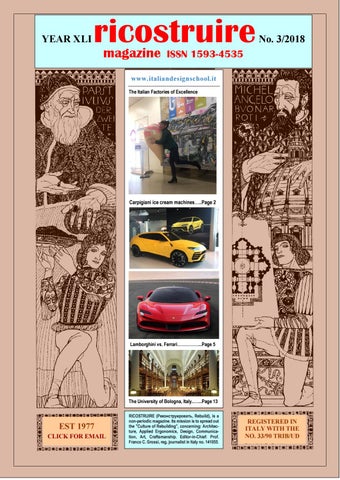
RICOSTRUIRE intends the information of www.italiandesignschool.it theses and works in the field of Architecture, Arts and Design, as a mediation beThe Italian Factories of Excellence tween the technological and spiritualistic tendencies of our age. It expresses the need to give architectural design and Design itself a new value, for a more open dialogue with the social and cultural context, by widening its space of intervention to the world of Communication, in order to express its "duties of criticism". The promotion of this e-magazine requires a new form of dialogue with the reader, starting from the belief that professional training and the production of buildings, objects and landscape architecture, today need the work of a typical architect, builder and designer, indefatigable revealer of "formulae" and impressions, which translate into an architecture and a design made of orders, proportions, harmonies, to communicate the culCarpigiani ice cream machines…..Page 2 ture of Man and Nature. It is renewed in the moment in which modernism and its utopian ideology have shown Man not having been able to fully exploit the existing techLamborghini vs. Ferrari…..………….…Page nological potential and the arsenal repre-5 sented by the historical experiences in each place. Finally, we wish to orientate the field of intervention also towards the study of integrated communication systems, to be used in the architectural design of interiors, exteriors and urban furniture and in designing objects and services. In fact, in the analysis of future architectural structures, it will be increasingly necessary to take into account the needs dictated by the growing use of new media (new-media) and, in particular, technical equipment, installation of new technologies, such as the wired area, the intelligent building, home automation and many other applications. Ergonomics Applied to Industrial Design will be the basis and the facilitator to winvs. theFerrari……………...Page future challenges. Lamborghini 5 The VRBS FELIX Manifesto for a Wellbeing City, Green, Smart and Mild……..….Page 2 VRBS FELIX (Happy City), the Next Town Vision with a “Green and Smart” Human Centered Design………………………Page The University of Bologna, Italy..…...Page 13
EST 1977 CLICK FOR EMAIL
RICOSTRUIRE (Реконструировать, Rebuild), is a non-periodic magazine. Its mission is to spread out the "Culture of Rebuilding", concerning: Architecture, Applied Ergonomics, Design, Communication, Art, Craftsmanship. Editor-in-Chief: Prof. Franco C. Grossi, reg. journalist in Italy no. 141055.
RICOSTRUIRE - YEAR XLI - No. 3-2018 – Page 1
REGISTERED IN ITALY WITH THE NO. 33/90 TRIB/UD
THE ITALIAN FACTORIES OF EXCELLENCE: CARPIGIANI, ICE CREAM MACHINES.
Carpigiani is an Italian company, located near Bologna, specializing in the production of ice cream making machines. It claims control of about half of the world market for ice cream machines, including machines both for Italian-style gelato and soft ice cream. Brothers Bruto and Poerio Carlo Carpigiani created the "Gastecnica S.a.s dei fratelli Carpigiani" in 1944. Carpigiani produced and patented a gelato machine, named "Autogelatiera". The Carpigiani soft serve ice cream machines make a fluffy, whippy ice cream due to their clever whipping action, mixing air and ice cream mix, during the ice cream making process. The technological growth in the 1960s brought Carpigiani to become the worldwide leader in the ice cream machinery, with the invention of the "hard-o-matic". In 1964 an American secondary company was founded with the name Coldelite U.S.A., in 1971 Carpigiani bought Cattabriga (concurrent firm), in 1989 the ALIU GROUP bought the Carpigiani Bruto S.p.A. In 1993 Carpigiani was certified UNI EN ISO 9001:1987. It was the first company in the business to receive this certification. In 2003 Carpigiani established the “Gelato University” as a school to teach about artisan gelato making using Carpigiani products.
Today Carpigiani is present in the markets of Italy, Spain, France, Germany, Netherlands, United Kingdom, United States, Canada, Japan, Russia, Estonia, Brazil, Ethiopia and Australia.
With some students and professors of the Kazan Innovative University, Russia (www.ieml.ru), visiting the Carpigiani factory and the Museum of Gelato.
The “Gelato University” The “Gelato University” is a center of cultural excellence dedicated to the understanding and study of the history, culture, and technology of gelato and the expertise of the innovators who drove its evolution over the centuries. It was set up by ice cream machine maker Carpigiani in 2003, with the aim of teaching students from around the world how to make gelato ice-cream. The Carpigiani Gelato University attracts
RICOSTRUIRE - YEAR XLI - No. 3-2018 – Page 2
thousands of people from diverse countries interested in perfecting their gelato making skills or to learn the basics of gelato every year.
The University is concentrated on delivering "the art and science of gelato production, the comprehensive training of gelato entrepreneurs, and the promotion of Italian gelato as a natural and flavorful food suitable for all cultures". Students learn from professional instructors as well as work with state-of-the-art gelato machines and facilities. Successful graduates of this University are able to bring back with them the skill to open or perfect their own Italian gelato entrepreneurship anywhere around the world. The Museum of “Gelato” From its origins to today, the museum features an interactive tour that highlights three principal themes regarding gelato: the evolution of gelato over time, the history of production technology, and the places and ways it is consumed. The museum’s 1000 square meters are home to 20 original machines, multimedia presentations, 10,000 historical images and documents, precious tools and accessories, and original video interviews. The Gelato Museum is located in the Carpigiani headquarters at Anzola dell’Emilia, within an industrial space which has been transformed into an innovative structure dedicated to the study and analysis of artisan gelato’s history.
Inside the Museum of "Gelato"
Inside the Gelato University RICOSTRUIRE - YEAR XLI - No. 3-2018 – Page 3
brought the sorbet as well. The architect Bernardo Buontalenti is credited with the egg cream gelato, but Francesco Redi and Lorenzo Magalotti made it famous by singing its praises and describing its ingredients. Francesco Procopio Cutò, later known as François Procope des Couteaux, sold sorbets to Parisian intellectuals in his café. The Neapolitan doctor Filippo Baldini wrote that sorbet is good both for your body and your mood. 19th – 20th Centuries ascent and global diffusion of Gelato Customs changed over time and gelato and sorbets started to play significant roles in the menus of important luncheons and suppers. Sorbet, gelato, hard treats, and frozen creams appeared in the haute cuisine recipe books. With the invention of artificial ice, gelato moved out into the streets with the help of street vendors pushing their carts in search of new customers. It was a new era: a powerful host of Zoldan, Cadorean, and Friulian gelato artisans spread gelato throughout the world.
An old cart to sell ice cream
The history of “Gelato” 12.000 BC to 13th Century AD from Snow Wells to Sorbet In Mesopotamia, dispatch runners traveled one hundred kilometers on foot to get the snow and ice necessary to cool the drinks served during the royal banquets and religious ceremonies held at Mari Palace. During endless feasts, the Romans paraded their gold and silver colj nivarum, using them to filter the snow. The Arabs developed shrb (sugar syrup) and in Palermo they grew 400 different types of flowers to flavor their sorbets. 16th – 18th Centuries Gelato and the birth of a noble trade Caterina de’ Medici and Cosimo Ruggieri, celebrated alchemist and astrologist, took the Florentine Renaissance to Paris, and they may have
1900 – 1950 from ice and salt to new technologies To make it easier to eat gelato in the streets, an Italian developed the cone. The gelato shops started to take shape and to gain their autonomy. The Gelato Manual was published in Italy. Science and technology were harnessed in the service of gelato artisans, bringing innovation to gelato production. Machines from the automatic Motogelatiera to other more sophisticated post-war batch freezers were developed. 1950 – 1985 Gelatieri and manufacturers unite: Gelato becomes the flagship of made in Italy Gelato consumption grew rapidly, to the point where industrial ice cream made its way into the Italian market. Gelato artisans risked extinction. However, the united front of artisans and suppliers and the commitment of artisans to better train themselves resulted in a marked quality improvement. Pots and stoves were removed from the production area. The pasteurizer, a new, revolutionary machine, was able to guarantee food safety. Each year new technology was developed to pro-
RICOSTRUIRE - YEAR XLI - No. 3-2018 – Page 4
vide artisans with solutions that made gelato safer and easier to produce, freeing up the operator’s creativity. Gelato is removed from the tubs and placed in glass display cases. Dedicated trade shows are born and gelato became a science. Here are the curricula of the founders.
Bruto Carpigiani (1903-1945), technician and designer, has always been considered as the “myth”, the founder, the father of an entire generation of designers, technicians and entrepreneurs of Bologna packaging. He is responsible for technological innovations and prototypes such as the Zeta wheel, an ingenious mechanism that transforms the continuous rotary motion into an intermittent one, allowing the user to obtain stopping and movement times preordained by the user. In 1942 Carpigiani founded the Ark that works as a subcontractor for the A.C.M.A .; but he works hard at a new, more hygienic gelato machine, quick and efficient compared to those of the competition. The design and the prototype saw the light shortly before the death of Brutus in 1945. The following year his brother Poerio founded the Carpigiani that – starting from the 60s, with the spread of the Italian gelato culture in the world – is affirmed as a market leader for the production of “Italian style” gelato machines.
Poerio Carpigiani (1911-1982) He is acknowledged to play a leading role in spreading the culture and business of artisanal gelato in the world. In 1969, after having absorbed Cattabriga, owner since 1927 of the automatic batch freezer patent, the company moved its headquarters from the center of Bologna to Anzola dell’Emilia. Those years also saw the beginning of a strong expansion of Carpigiani in the world, with the first acquisitions and with the establishment of offices throughout Europe. The company has always been committed to spreading the culture of Italian gelato abroad.
LAMBORGHINI vs. FERRARI The main variances in the assembly lines and the differences in the production of two world-class automotive factories are described here: Lamborghini of Sant'Agata Bolognese and Ferrari of Maranello. We visited the two factories in March 2018 with students and colleagues of the Kazan Innovative University (Kazan, Republic of Tatarstan, Russian Federation - www.ieml.ru), during a tour through the Automotive District in the Region Emilia Romagna, Italy,
RICOSTRUIRE - YEAR XLI - No. 3-2018 – Page 5
Lamborghini The history of ‘Lamborghini Automobili’ officially starts in 1963, when Ferruccio Lamborghini decided to build a factory of luxury sports cars. Ferruccio was already a very wealthy man. In the period following World War II, he founded his tractor factory, which he launched with energy and determination, creating a major point of reference in this industry. Other businesses followed, and he amassed his fortune at the perfect time, before his fiftieth birthday. By the early Sixties, Lamborghini was a powerful and successful man who knew exactly what he wanted, but when he said he would build a super sports car to compete with Ferrari, many people thought he was mad. Constructing that kind of car was viewed as an unexplainable extravagance, a hazardous leap in the dark, and something that would squander his fortune without ever turning a profit. [1] Automobili Lamborghini's current sales network boasts 135 dealers in 50 countries, and there were 3,815 deliveries to customers worldwide in 2017, with a sales network of 145 dealers in 50 countries; there are 1,500 employees and a turnover of 1 billion euros. In the Lamborghini production line [2] employees work from 8 a.m. to 5 p.m. from Monday to Friday, though the nearby carbon fiber plant operates three shifts in order to keep up with high demand. They are easily identifiable in Sant’Agata because they wear a black Lamborghini uniform that clearly indicates whether they’re assembly line workers, part of the factory’s logistics team, assigned to the prototypebuilding division, or someone else entirely. The most impressive part of touring the factory is to see the cars being assembled by hand. In fact, there are only two robots in the entire plant, a machine that drops the bare bodies onto the assembly line and a rotisserie that turns the cars upside down when needed. As a result, the factory is a lot quieter and more spacious than most people imagine it to be.
A screen located above each station keeps track of how long the car has been there for, which helps workers manage their time more efficiently.
RICOSTRUIRE - YEAR XLI - No. 3-2018 – Page 6
Inside the Lamborghini Museum
RICOSTRUIRE - YEAR XLI - No. 3-2018 – Page 7
and, in late 1943, Auto Avio Costruzioni moved from Modena to Maranello. The end of the war saw Ferrari design and build the 1,500 cm³ 12-cylinder 125 S, which made its competitive debut at the Piacenza Circuit on May 11th 1947. The legendary symbol used by Ferrari has heroic origins. It was first adopted as a personal emblem by a highly decorated Italian World War I pilot, Francesco Baracca, a cavalry officer, who had it painted on the fuselage of his aircraft. At the end of the war, Baracca’s parents offered to allow Enzo Ferrari use the Cavallino Rampante (Prancing Horse) symbol. He adopted it as the logo for his racing Scuderia, placing it on a yellow shield in honor of his hometown of Modena and topping it with the Italian tricolor. The classic Ferrari red is the color assigned by the International Automobile Federation to Italian grand prix cars in the early years of the last century. [3] Ferrari has 3,500 employees and has 200 dealers in 60 countries. In 2018, there were 8,400 deliveries and a turnover of 3.4 billion euros.
The new Lamborghini URUS
Ferrari Enzo Ferrari (1898-1988) devoted his entire life to designing and building sports cars and, of course, to the track. Having been made an official Alfa Romeo driver in 1924, within five years he had gone on to found the Scuderia Ferrari, which assisted mostly gentlemen drivers in racing their cars. In 1938, Enzo Ferrari was appointed head of Alfa Corse but quit the position in 1939 to set up his own company, Auto Avio Costruzioni, which operated out of the old Scuderia buildings in Modena. This new company produced the 1,500 cm³ 8-cylinder 815 spider, two of which were built for the Mille Miglia in 1940. All racing activities ground to a halt, however, with the outbreak of the Second World War
RICOSTRUIRE - YEAR XLI - No. 3-2018 – Page 8
Entering the Ferrari ancient factory
Inside the Ferrari Museum
RICOSTRUIRE - YEAR XLI - No. 3-2018 – Page 9
The Ferrari cittadella has been completely redesigned and renovated as part of a project begun in the 1990s with the aim of creating a dynamic complex developed in harmony with the needs of the company workforce. This is an ongoing project and encompasses everything from the layout of the buildings to the pathways for both people and components alike, the functionality of the various activities carried out, and, most importantly of all, the well-being of the people that do the actual work. Some of the world’s finest architects have been involved in the various stages of the campus’s development which began with the Renzo Piano-designed Wind Tunnel where actual road and track conditions are simulated to hone our road and track cars.
Ferrari is a robotized factory, where Craftsmen and High-Tech Robots Build the World’s Most Famous Cars.
[4]
The Luigi Sturchio-designed New Logistics building is the nerve center of all transportation and delivery operations relating directly to the Scuderia Ferrari’s activities. while Marco Visconti is responsible for
RICOSTRUIRE - YEAR XLI - No. 3-2018 – Page 10
the gleaming New Mechanical Machining Area (New Engine Machining Area) where our 8 and 12-cylinder engine components are made in surroundings in which cutting-edge machine tools are interspersed with green areas not only to create a more attractive workplace but to regulate its microclimate. Visconti also designed the New Paint Technologies area which marries superb standards of quality with equally high working and environmental protection conditions, and the Company Restaurant, a very bright, welcoming, relaxing space designed to promote interaction between employees during downtime. The work of Massimiliano Fuksas, the Product Development Centre is where our engineers and technicians research and develop every component used in our cars. Over 150 bicycles have been made available to employees to make moving around the cittadella easier too.
Spread over four levels interlinked by an attractive network of transparent walkways and stairs, this bright, airy building is a fine example of bioclimatic architecture in action. Last but not least, the New Assembly Line area from the pen of Jean Nouvel, where technological excellence and meticulous craftsmanship combine as our 8 and 12-cylinder cars are assembled in a light-filled, transparent space also enriched by green areas.
RICOSTRUIRE - YEAR XLI - No. 3-2018 – Page 11
Viale Enzo Ferrari is a large boulevard that winds its way through the campus with other smaller “streets”, named in honor of the great Ferrari drivers who won a World Championship, opening off it.
It is lined by low environmental impact buildings with plenty of green and relaxation areas and in which noise, light and temperature levels are all optimized. Working in these clean, functional surroundings not only improves our employees’ quality of life and output but also contributes to the creativity and overall excellence of our product. In the course of 2008, Ferrari launched its in-house power generation programme. Now, thanks to its new photovoltaic and three-generation systems (the latter producing combined heat, power and cooling), Ferrari is fully self-sufficient in terms of energy production and has reduced its overall CO2 emissions by around 40%.
Robots have long been a part of the automotive assembly process, but now some factories are trying out a new exoskeleton designed to make physical tasks easier for the human half of the man-machine combination.
The Exoskeleton Vest gives factory workers an extra 2 to 7 kg of lifting assistance.
The 4,3 kg device straps onto the shoulders and arms of a worker and uses unpowered springs to give them a little super strength. The vest provides an extra 2 to 7 kg of lifting assistance, which can be helpful for picking up heavy objects, but in this case is being mainly tested during tasks requiring employees to raise their arms overhead to work on the underside of vehicles suspended from above.
RICOSTRUIRE - YEAR XLI - No. 3-2018 – Page 12
F1 simulating a Pit Stop
Ferrari F1 driving simulators
THE UNIVERSITY OF BOLOGNA, ITALY
REFERENCES [1] https://www.lamborghini.com/en-en/brand/history [2] https://www.digitaltrends.com/business/lamborghini-factory-tourpictures-production-process/#/12 [3] https://auto.ferrari.com/en_EN/ongoing-heritage/company/history/ [4]https://auto.ferrari.com/en_EN/ongoing-heritage/company/maranello/factory/
The origins of the University of Bologna go way back, and it is considered to be the oldest university in the Western world. Its history is intertwined with that of the great names of science and literature, it is a keystone and a point of reference for European culture. Here the milestones 1088: the Bologna "Studium" was founded by students and for students. It is the oldest university in the Western world. 1888: the celebrations of the Eighth Centennial relaunched the role of the University of Bologna within Europe, thanks to the work of Giosuè Carducci, who in 1906 won the Nobel Prize for Literature.
RICOSTRUIRE - YEAR XLI - No. 3-2018 – Page 13
1988: on 18 September in Piazza Maggiore, Bologna, the rectors of 430 universities from all the continents signed the Magna Charta Universitatum Europaeum during the nine hundredth anniversary of the University of Bologna, formally recognized as the Alma Mater of all universities. Subsequently signed by another 400 rectors, the Magna Charta affirms the autonomy of universities, the solid ties between teaching and research, rejecting any limits posed by "all geographical and political boundaries". 1989: previously limited to the province of Bologna, the Alma Mater initiated a programme of decentralization throughout Romagna, becoming the most extensive of all Italian universities. In 2000 the University recognized special forms of autonomy for the Romagna campuses, establishing the scientific and teaching campuses of Cesena, ForlĂŹ, Ravenna and Rimini. In 1998 the University also inaugurated a campus in Buenos Aires. 1993: the first reform of the University Statute, inspired by the principle of autonomy of the university. 1999: on 19 June in the Aula Magna of the University of Bologna, 29 European Ministers of Higher Education signed the Bologna Declaration, establishing a European Higher Education Area. This was the start of a reform process known as the Bologna Process, committing the signatory countries to a project to restructure the university systems with a view to convergence, ending in 2010.
KIU (www.ieml.ru) students and professors visiting the University of Bologna.
RICOSTRUIRE - YEAR XLI - No. 3-2018 – Page 14