
‘SHE’S
‘SHE’S
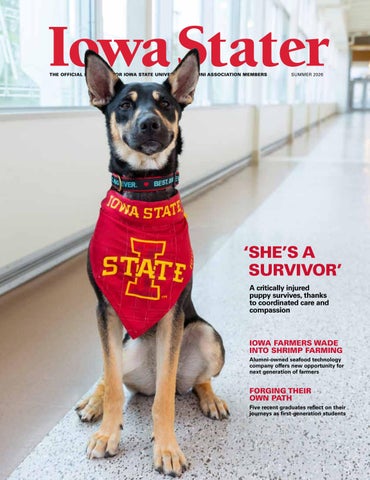
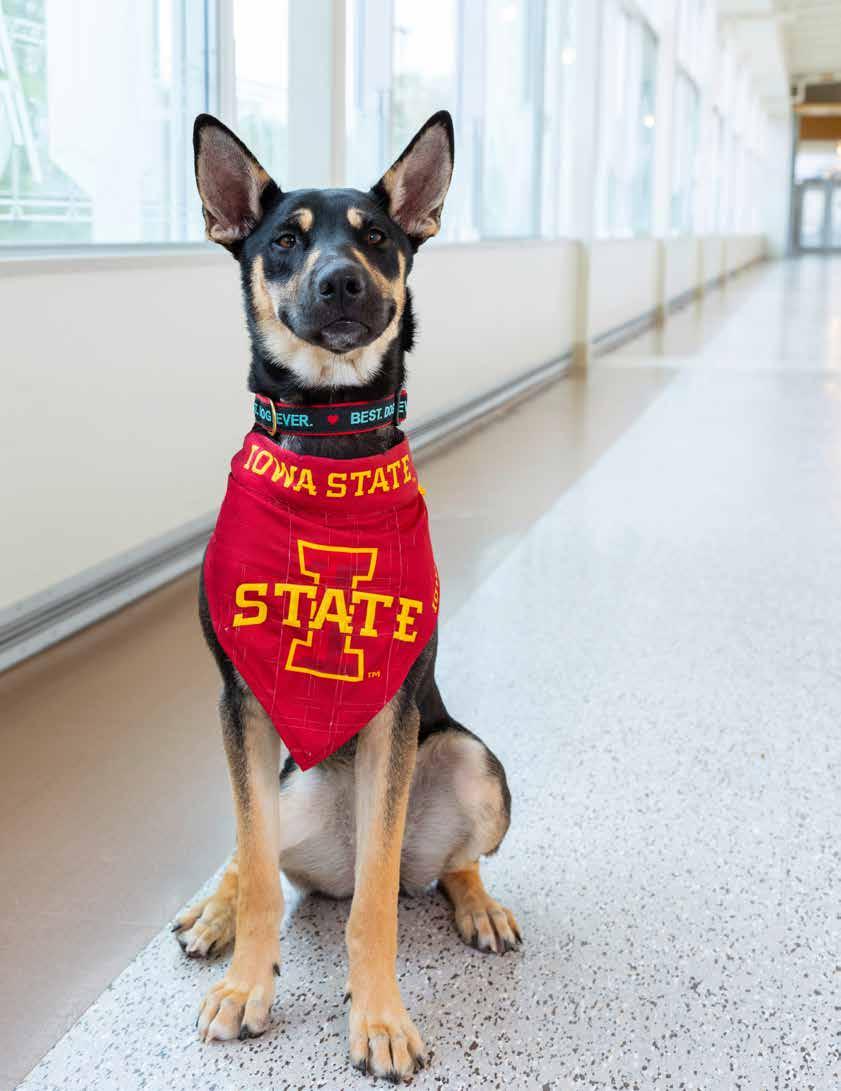
A critically injured puppy survives, thanks to coordinated care and compassion
Alumni-owned seafood technology company offers new opportunity for next generation of farmers
Five recent graduates reflect on their journeys as first-generation students
Iowa Farmers Wade Into Shrimp Farming
Alumni-owned seafood technology company offers new opportunity for next generation of farmers
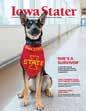
‘She’s a Survivor’
critically injured puppy survives, thanks to coordinated care and compassion
Forging Their Own Path
recent graduates reflect on their journeys as first-generation students
Letter from the President: I Was a First-Gen Student, Too
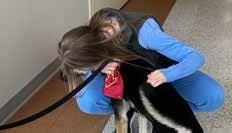
One of my favorite moments during the production of each magazine is when our team prints a draft of the issue and pins it to the wall. After months of word documents and PDFs and completed tasks, we get to take a step back and see how everything has come together. For this issue, one question popped up: Are there, can there be, too many dogs in a magazine?
As the owner of a senior dog and cat, and regular animal shelter volunteer, I’m a sucker for any animal, so I’m going to say no. Plus, our cover story about Honey captures so many special elements — the connection and responsibility humans feel for their pets, the power of community, and the care and talent that College of Veterinary Medicine faculty, staff, and students
bring to their patients.
But for those not as endeared to animals, I promise this issue has heartwarming and inspirational stories for you as well. Much like children, you’re not supposed to have favorites, but the following three stories have stuck with me well beyond the first drafts: A retired professor repairs and donates violins to local schools (pg. 8), five first-generation graduates share their journeys to and through Iowa State (pg. 28), and a former professional golfer recalls how his career nearly ended five years after he graduated (pg. 14).
We hope you enjoy this issue amid the dog days of summer.

Editor Kirsten Kraklio
Assistant Editor Caleb Grizzle
Designer Jenny Witte
Photographers Ryan Riley, Christopher Gannon, Simone Stecker, Matt Van Winkle
Creative Consultant 2communiqué
Editorial Board
Kirsten Kraklio, Director of Communications, University
Marketing and Communications
Brian Meyer, Associate Director for University Marketing and Communications, Iowa State University
Sherry Speikers, Director of Editorial Services, ISU Foundation
Postmaster: Send address changes to Iowa Stater, ISU Alumni Center, 429 Alumni Lane, Ames, IA 50011-1403
© 2026 by Iowa State University of Science and Technology
Iowa State University does not discriminate on the basis of race, color, age, ethnicity, religion, national origin, pregnancy, sexual orientation, genetic information, sex, marital status, disability, or status as a U.S. veteran. Inquiries can be directed to the Office of Equal Opportunity and Compliance, 3280 Beardshear Hall, 515-294-7612.
GET IN TOUCH WITH US!
ISU Alumni Association ISU Alumni Center 429 Alumni Lane Ames, IA 50011-1403
iowastater@iastate.edu 1-877-ISU-ALUM (478-2586)
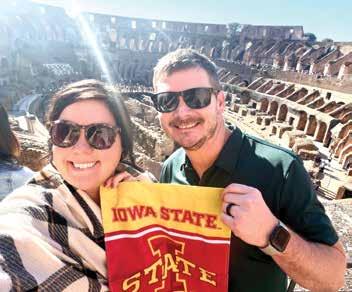
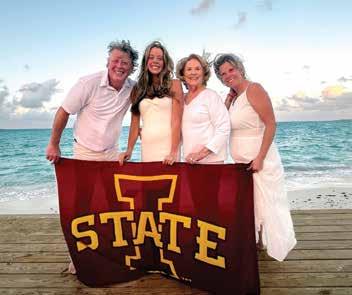
LEFT: On a trip to Europe, Cassie (’13) and Mike (’09) Bexten represented Cyclones everywhere in the Colosseum. RIGHT: Rich
Rogers May (’59), and Allison Stenseth Manzer (’03) showed off their Cyclone pride on a recent trip to Exuma in the Bahamas.
Shayne
a sophomore studying business, is a fifth-generation Iowa Stater.
“I just read the story about the Lake LaVerne restoration. When they dredge it, they may find my $12 Dietzgen slide rule, which I threw out in the lake, threw it as far as I could, when I dropped out of the architecture program in 1960 and moved over into Distributive Studies-English. The slide rule of your distinguished alumnus, Ted Kooser, who would go on to be U.S. Poet Laureate and a Pulitzer Prize winner ought to be of some value today! The leather case probably decayed or was eaten by fish long ago, but those slide rules were impervious to decay and destruction.”

Wesley Buchele (’54) and Virgil Haverdink (’64, ’67) conceived and patented the idea for the large round hay baler, now the industry’s predominant forage-handling machine.
UPDATES AND INNOVATIONS FROM THE IOWA STATE COMMUNITY
MOMENT
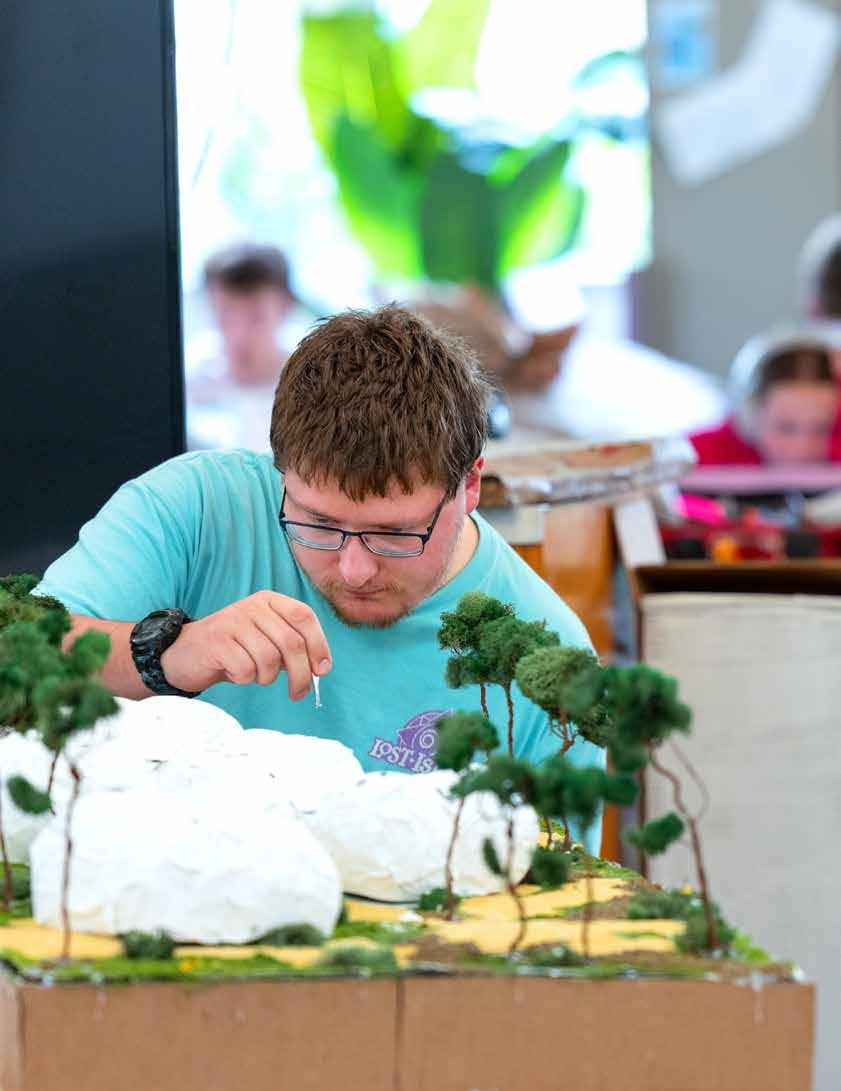
Aydan Rickels, a senior in architecture, assembles his final studio project for the College of Design’s architectural design class. In the course, students are tasked with creating housing solutions for an urban context that consider user occupation, inclusive design, and measurable environmental impacts.
Image by Christopher Gannon
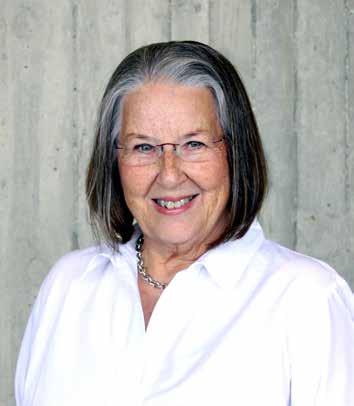
LYNETTE L. POHLMAN (’72, ’76) RETIRED IN JUNE after more than 55 years with University Museums, 46 of them as its director. Pohlman was the founding staff member of University Museums. She arrived as a student employee in the early 1970s, before the Farm House Museum or Brunnier Art Museum opened, and has been the connective thread through every chapter of this institution’s history since.
Under her leadership, the permanent collections grew to 30,000 objects. Additionally, the Art on Campus Collection grew from roughly two dozen works of art to thousands of community-led commissions across campus, University Museums earned four consecutive accreditations from the American Alliance of Museums, more than 600 exhibitions were curated, and more than 300 conservation projects were completed. At Pohlman’s request, no retirement event was held; but gifts to selected funds can be made at isu.foundation/PohlmanRetirement.

IOWA STATE UNIVERSITY’S $6 BILLION annual economic impact supports one out of every 36 jobs in Iowa, according to an analysis conducted for the Iowa Board of Regents. The university’s total impact includes $2.1 billion in economic development and added income from ISU startups and Iowa-based businesses assisted by Iowa State’s Center for Industrial Research and Service and the Small Business Development Center. The analysis also shows the education and training Iowa State provides for state residents provides the greatest impact. Iowa State alumni generated $2.5 billion in added income for the state economy based on increased productivity at the businesses where they work and higher earnings.
DetectionExplosivesDog

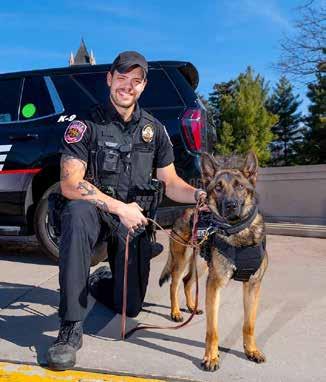

Weight: 50 pounds
Breed: Belgian Shepherd
Birthplace: Poland
First Day at ISU: March 22
Handler: Solomon Farner (’24)
Fun Fact: Zak has his own passport
About:
Two-year-old Zak was selected for ISU because of his drive, size, demeanor, and ability to detect odors that could be used to create an explosive device. Zak joining ISU PD means the university won’t need to rent other dogs as frequently from the University of Iowa, Johnston Police Department, or the fire marshal. While owned by Iowa State, Zak will be available for loan to other organizations in need across the state.
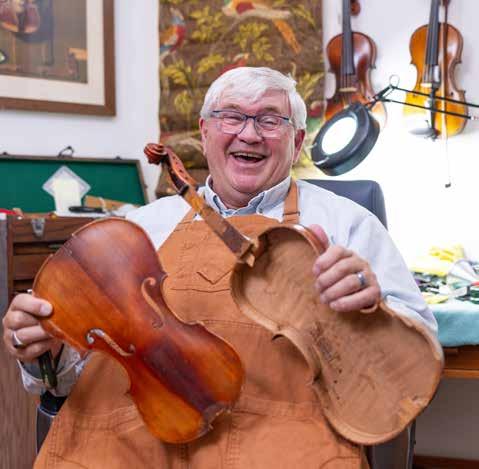
PAUL LASLEY FIXES, DONATES VIOLINS FOR LOCAL STUDENTS BY DAVE ROEPKE
PAUL LASLEY STILL REMEMBERS HOW HE FELT playing the only conspicuously silver-colored metal clarinet in the elementary school band, a dinged-up school-provided loaner that was an obvious outlier compared to his bandmates’ new black wooden models.
“The quality of my playing was just as good as anybody else’s, but there still was a stigma. It made me feel disadvantaged,” he says.
Lasley made a quiet vow back then. Someday, he’d provide fledgling musicians with instruments they would be proud to borrow. Six decades later, the former Iowa State University sociology professor is making good on
the promise. He’s fixed and donated 45 used violins for the Stephens Auditorium instrument drive, which provides local school districts with instruments to lend to band and orchestra students.
“If only one kid who plays one of those violins bonds with it, and they play until they are an old person like me, that’s a gift to me to know there are people out there who will follow in my footsteps,” he says.
Music has been with Lasley all his life. He recalls sitting on his grandma’s lap as a 4-year-old, learning to press the keys on her pump organ. During most of his four decades on Iowa State’s
faculty, he played stand-up bass in a light jazz ensemble, Paul Lasley and the Guys.
Though he had always been enamored with violins or, as Lasley calls them, fiddles he didn’t start playing one until after retiring in 2021. When the neck broke loose on one of his fiddles, he fixed it himself. Making furniture has been another long-standing hobby, so he had some of the necessary clamps, planes, chisels, and glues.
While Lasley is quick to point out he’s no luthier, (an expert in restoring stringed instruments) that first repair turned out well. A makeshift workshop soon overtook his home office. Fiddles, each with their own nickname, cover the workshop’s walls.
The surplus of revived violins led Lasley to Stephens Auditorium, which since 2023 has collected 140 musical instruments to distribute to local schools. No one has contributed more than Lasley, says Lorna Carroll, outreach coordinator at Stephens.
“I’ve had teachers tear up when they see the instruments they’re getting,” she says. “It’s life-changing for some kids. These students will probably never meet Paul. But look at the lives he’s touching out of pure generosity.”
For Lasley, providing school children with a quality instrument isn’t just a fulfillment of a long-held dream. It’s also his way of making a statement about music’s necessity.
“Music is the language of the soul,” he says. “It’s part of our being and our culture. It’s our future.”
To help support repair costs and the purchase of used violins, bows, and cases, visit isu.foundation/stephensviolin.
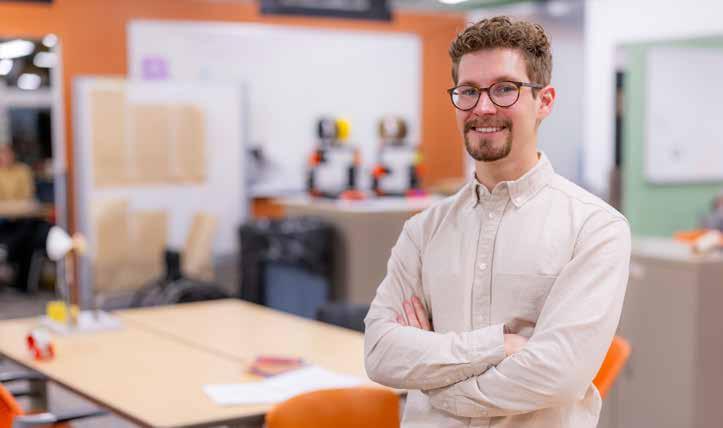
ANTHONY WARD (’21) HAS ALWAYS BEEN WIRED to tinker — take ideas apart and build them into something better. At Iowa State University, that mindset became a pathway to a career and, now, a connection he carries back to campus.
As a student, Ward built a foundation in product development, learning skills such as research and conceptual ideation, 3D modeling, graphic design, and manufacturing.
That hands-on experience quickly translated beyond campus. During his senior year, Ward connected with Canyon Coolers through a sponsored design studio a handson, collaborative classroom that enables students to work on real-world projects where he and his peers were tasked with developing a product for the company. After the studio, he was hired as an intern to keep doing the work and assist with other designs.
And continue he did. Today, Ward serves as COO of Canyon Coolers in Flagstaff, Arizona.
In his role, Ward applies the skills
he built through his involvement in CYstarters, Iowa State’s summer startup accelerator. Alongside fellow industrial design student Ben Grote (’21), he launched Vamose, a fully patented gym bag that attaches to a backpack an innovation sparked in part by Ward’s instinct to improve on shortcomings he saw in traditional gym bag designs.
“Through CYstarters, I was able to develop business skills and practices that would have otherwise taken years,” Ward says.
Those combined experiences — design, business, and hands-on application — prepared him to navigate the complexities of the consumer products industry.
“My background in industrial design gave me an in-depth understanding of manufacturing, product deployment, development, and marketing,” Ward says.
Even as his career has taken him beyond Ames, Ward remains closely connected to Iowa State. He’s currently
leading the development of a custom Iowa State cooler, timed to launch around football season.
“I have a lot of fond memories of tailgating at Jack Trice,” Ward says. “A cooler kind of finds itself at the center of all the tailgate action, so I’m super excited to contribute to that.”
Ward’s connection to his alma mater comes full circle in yet another way: Canyon Coolers is sponsoring another industrial design studio on campus in which students are designing new products under the Canyon brand the same type of experience that first introduced Ward to the company.
“I wanted Canyon to work with Iowa State because I have seen firsthand the talent of the students in the industrial design program and how well it prepares them to solve real-world problems while still in school,” Ward says. “It’s great to play a part in shaping tomorrow’s working professionals, and the students really are capable of producing some excellent work.”
SCHMITZ
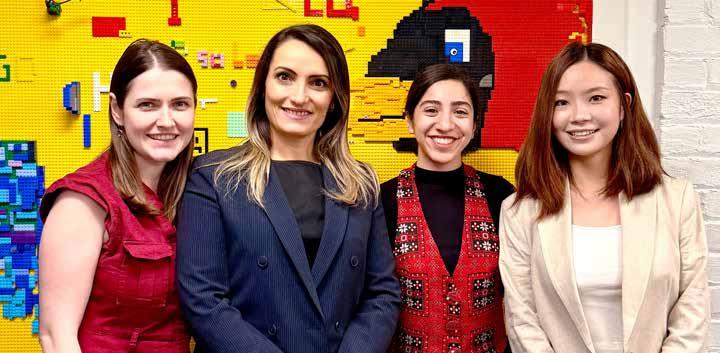
THE CONVERSATION ABOUT GENERATIVE ARTIFICIAL INTELLIGENCE in schools is often centered on cheating — how to spot it, how to stop it, and who’s at fault.
But there’s also a deeper and more urgent conversation underneath that one, says Evrim Baran (’11), professor of educational technology and human-computer interaction and the Helen LeBaron Hilton Chair in the College of Health and Human Sciences.
What does it mean to teach kids really teach them in a world where AI is rapidly evolving?
“Teachers are looking for guidance regarding AI that goes deeper than simple tutorials or product demonstrations,” she says. “They want to build critical judgment skills and not just proficiency so they can better prepare their students for an AI-integrated future.”
These needs are the foundation for a new Critical AI in Education Pathways micro-credential course developed by Baran and her team of graduate students. The course is designed to help educators develop critical AI literacy skills and feel prepared to teach, design, and lead in an AI-enabled world. The online, self-paced course features five modules covering the foundations of artificial intelligence, the ethics of AI in education, pedagogical integration, implementation, and human-centered AI in education.
“Because AI is becoming part of the everyday environment that students interact with both inside and outside of school it’s important that critical AI literacy education for teachers is grounded in real examples and situations,” Baran says.
What does this mean for elementary, middle, and high school teachers?
“We’ve seen shared concerns about the limitations of AI among K-12 teachers at every level, including information accuracy and potential biases, cognitive offloading, and possible over-reliance on these technologies among students,” Baran says. “There are also well-being and value concerns such as students using these technologies for personal advice or mental health support.”
That’s why, Baran says, the course focuses on helping teachers engage with students in activities that use critical thinking skills around AI rather than replacing important reasoning and problem-solving skills with AI tools.
The Critical AI in Education Pathways micro-credential course fulfills one licensure renewal credit for Iowa teachers and is available through the Iowa State University Extension and Outreach store: education.iastate.edu/learn-by-doing/micro-credentials.
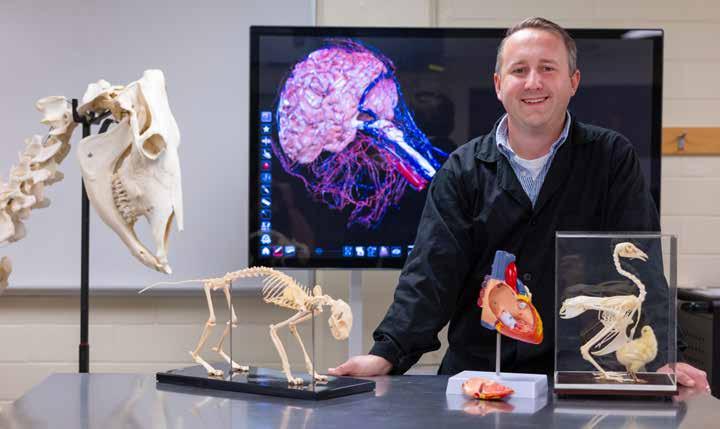
BY KARL KERNS, ASSISTANT PROFESSOR IN THE DEPARTMENT OF ANIMAL SCIENCE
INNOVATION IS IN MY BLOOD, JUST LIKE IT IS AT THE UNIVERSITY. I’m not good about sitting idle and regurgitating the same thing each semester — I am always asking myself what we can do better. Around the time artificial intelligence entered our collective vernacular, we began to create a custom AI tutor that leverages our class teaching materials to help students review lessons, receive custom study sessions, and quiz themselves on course content.
It’s been a year since we launched the AI tutor for students, and so far we’re seeing about a nearly 5 percentage point increase in their grade if the students use the tutor at all, and about 9 percentage points better on their final letter grade if they use it four or more times. This AI tutor also helps to level the playing field: there’s no cost to the student, and no concerns about scheduling or availability of a traditional tutor. It can be accessed anywhere, anytime.
Another example of how we’re innovating is our use of the
Anatomage Table. We are the first animal science program in the nation, possibly the world, to incorporate this state-of-theart, cutting-edge virtual anatomy and physiology dissection table technology in the classroom. The 3D virtual technology allows students to see a heart pumping in real time and watch blood flow — something that can’t ethically be done otherwise. The tool offers students additional viewpoints and specimens to look at and reinforces the ideas that we talk about in the classroom.
Our students’ needs have evolved; what they expect from their coursework, faculty, and university is different from what it was 20, 30, 40 years ago. I know this personally — I graduated from Iowa State University in 2014 and have taught for six years. While the foundation of what we’re teaching in animal science doesn’t change, how we’re teaching it can and does — and we’ll continue to look for opportunities to innovate.
THEN AND NOW
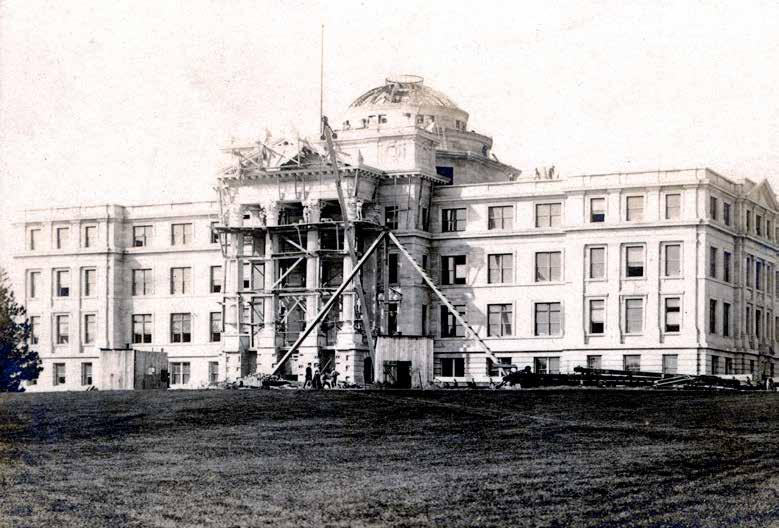
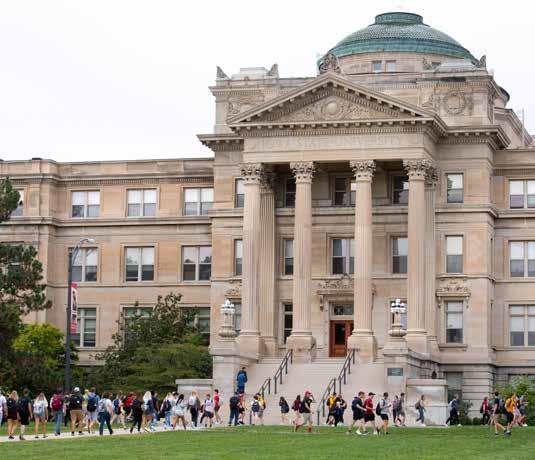
BEARDSHEAR HALL — originally known as the Central Building until it was renamed in 1938 to honor Iowa State's fifth president, William N. Beardshear — was constructed in 1906 for just over $400,000. While use of the space has changed over the years, the structure has remained nearly the same except for an updated inscription over the east entrance, the installation of air conditioning in the 1970s, and improvements to meet fire codes. Following fires that damaged Beardshear’s predecessor, Old Main, in the 1900s, the new building was built to be more fireproof with Bedford limestone and scagliola columns used in its construction.
COMPETITOR
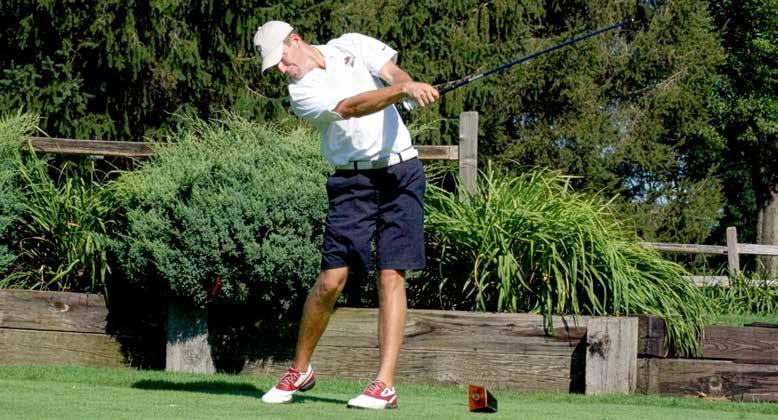
IN THE FALL OF 2008, CYCLONE MEN’S GOLFER Chris Baker (’08) stepped onto the field of Jack Trice Stadium as Iowa State’s male athlete of the year. Baker returns to the same field this fall to celebrate his induction into the Iowa State Athletics Hall of Fame. But the journey hasn’t always been easy — five years after he graduated, Baker’s pro golf career was nearly over.
“There are guys you see on TV that make it straight from college to winning on the PGA Tour, but that wasn’t me,” Baker says.
After some success on mini-tours, Baker found himself searching online job boards and facing an exit from professional golf.
“2012 and 2013 were the two toughest years for me,” Baker says. “I was done. I was out of money, and I wasn’t willing to go into debt to play golf.”
Baker found himself back in Iowa, preparing to play in one of the last tournaments he had already paid the entry fee for.
Baker won the Greater Cedar Rapids Open and, with it, a $20,000 check. His career trajectory changed course from there. With his winnings, he paid the bills and signed up for Q School (a qualifying tournament to continue his journey to the PGA Tour).
“For most of my time playing professionally, there wasn’t job security; if I didn’t play well, I wasn’t sure what I was going to do the next year,” Baker says. “It was daunting, but I knew I could make it, and I was willing to do whatever I needed to.”
Sheer determination, stubbornness, a strong support group, and a lifelong dream to do something no Cyclone had accomplished before kept Baker going.
In 2019, Baker earned his PGA Tour Card at the Korn Ferry Tour Championship in Newburgh, Indiana, becoming a 33-year-old PGA Tour rookie, with friends, family, and his now wife, Kristen, cheering him on.
“Getting your PGA Tour card is a thrill,” Baker says. “But being able to get the tour card just two hours from my
hometown (Brownstown, Indiana) — I couldn’t make it up any better.”
Baker’s professional successes include being the only Cyclone to earn a PGA Tour Card (2019–21), a top-30 finish at the U.S. Open — the best finish by a Cyclone in a major (2021) — four professional event wins, and $1.4 million in career earnings.
“I treasure my time at Iowa State and owe a lot of my success in my professional career to what I learned here,” Baker says.
Throughout Baker’s career, he always looked out for fellow Cyclones in professional golf and made time to visit with the Cyclone men’s golf team. Baker carried that same spirit into his next chapter as he retired from full-time competitive golf in 2025.
“I am proud to be a part of Iowa State Athletics. I love to see Iowa State golfers do well,” Baker says. “I know I was the first Cyclone to make the PGA Tour, but I want more to make it. I want to see other Iowa State golfers have that same success.”
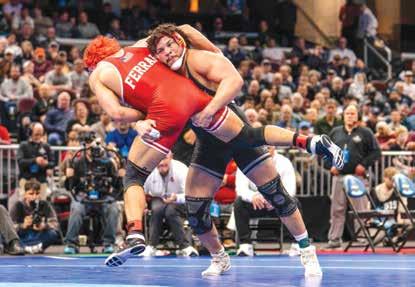
YONGER BASTIDA (’26) wrapped up his Iowa State career as a two-time All-American, 2026 Big 12 Wrestler of the Year, a four-time NCAA Qualifier, and a two-time Big 12 champion. He concluded his 2026 campaign as NCAA Runner-Up with a 29-1 record. The Trinidad, Cuba, native navigated jumping weight classes at Iowa State, transitioning from freestyle to folkstyle, and a language barrier when he first arrived on campus. Bastida took each challenge in stride on his way to one of the most successful Iowa State wrestling careers in program history.

WOMEN’S WRESTLING WILL DEBUT as Iowa State University’s 18th intercollegiate athletics program during the 2027-28 academic year. Two-time World Wrestling Championships silver medalist Alli St. John has been selected as the first head coach of the Iowa State women’s wrestling program. “I am incredibly honored and grateful for the opportunity to be the first head coach of women’s wrestling at Iowa State University,” St. John says. “Iowa State has a rich wrestling tradition, and I’m excited to expand that legacy on the women’s side as we work to build a premier program in Ames.” Kevin Dresser has been named as Iowa State’s director of wrestling, and Brent Metcalf the head coach of men’s wrestling.
RACHEL JOSEPH (’25), the six-time all-American, three-time Big 12 Champion, and Celia Barquin Arozamena Iowa State Female Athlete of the Year (2024-25), continued her historic Cyclone career in track and field in 2026 with multiple record-breaking finishes during the indoor season. En route to her third-straight NCAA finals appearance, Joseph achieved the impressive feat of now owning the top 25 400m times in Iowa State history.

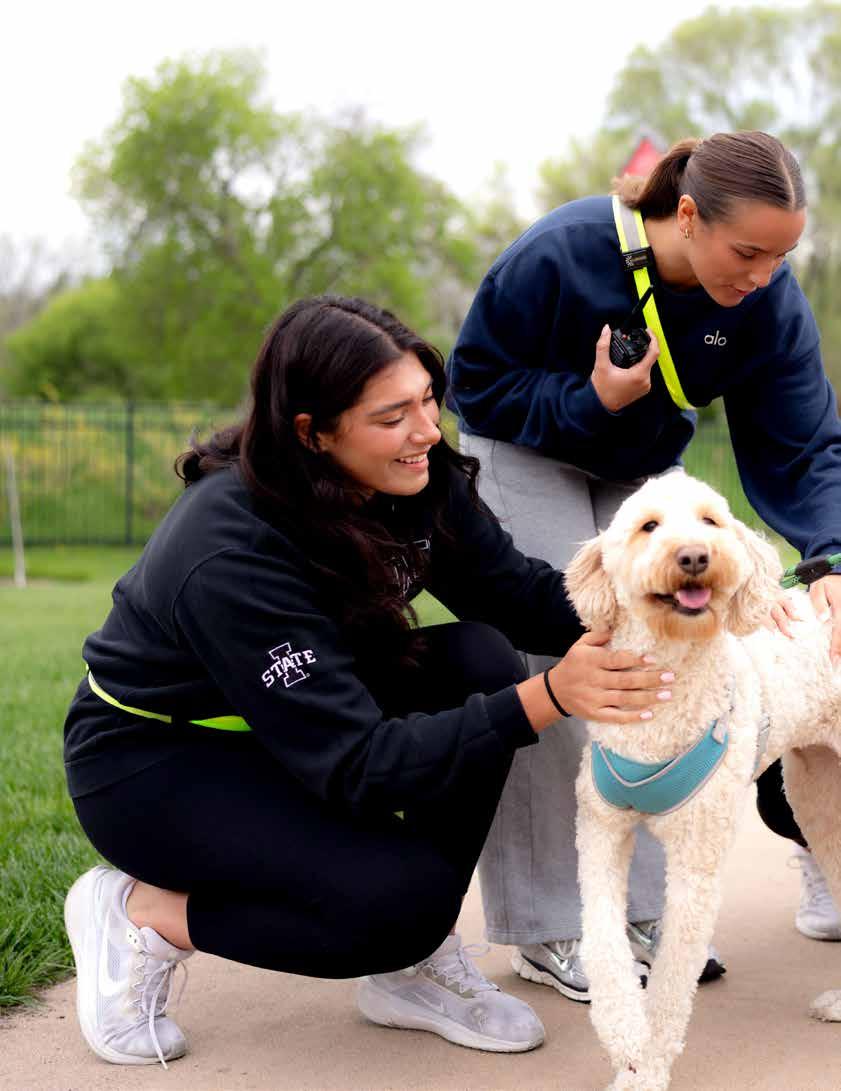
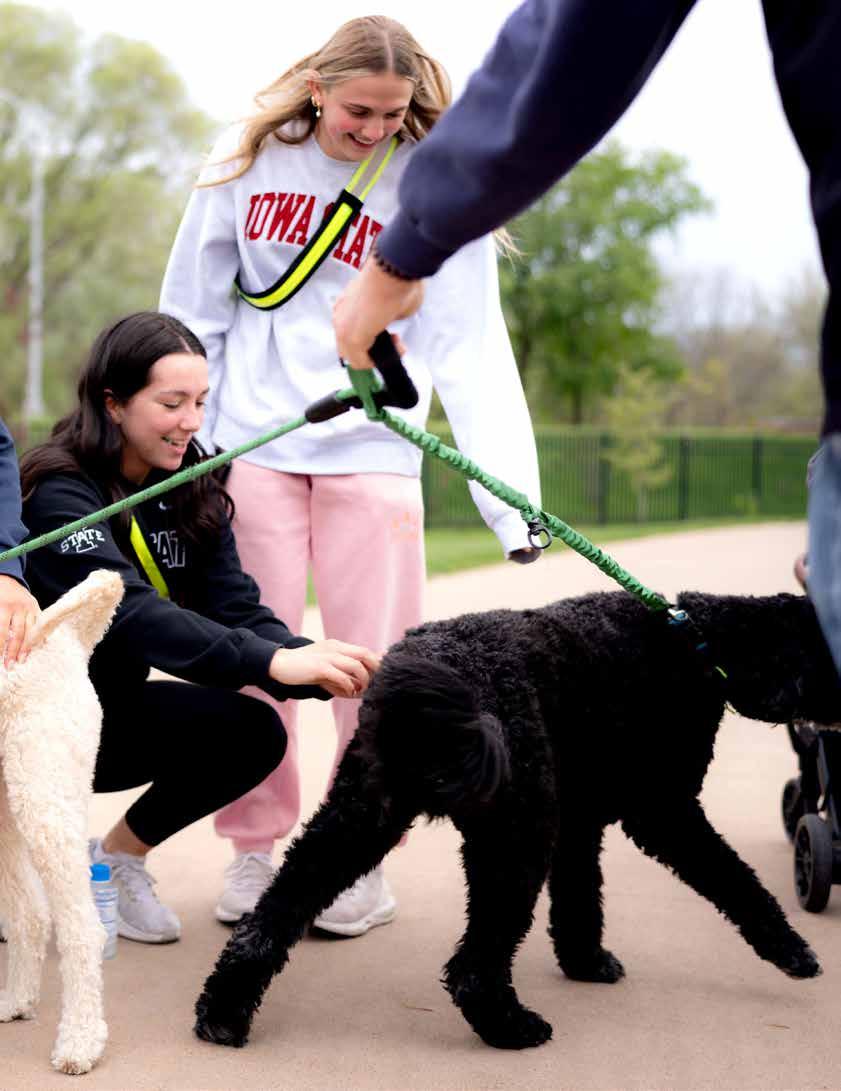
Iowa State volleyball players, Nayeli Gonzalez, Annalise Grant, Ava Martin, and Layna Waselewsky volunteered at Reiman Gardens during Rovers at Reiman. They helped greet guests, guide dogs on outdoor pathways, and more. Rovers at Reiman, a Tuesday night event in April and September, allows visitors to enjoy the gardens with their dogs. Visit reimangardens.com/events for more information.
Image by ISU Athletics
Alumni-owned seafood technology company offers new opportunity for next generation of farmers
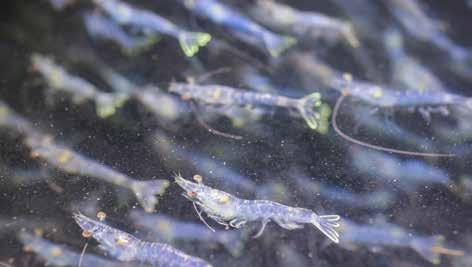
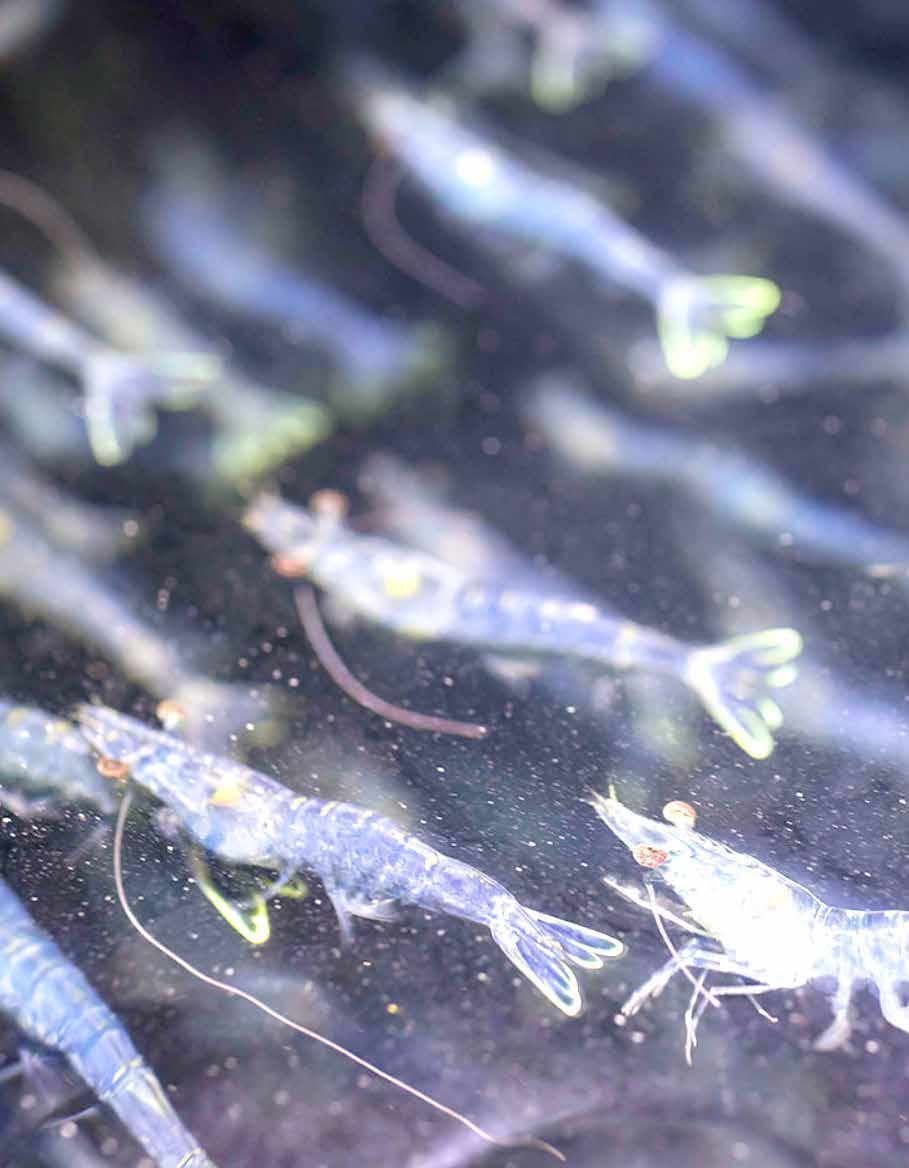
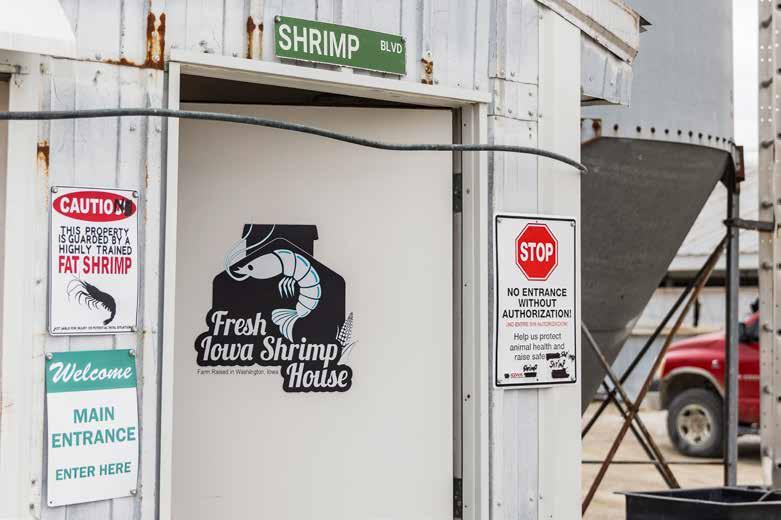
More than 1,000 miles from the nearest ocean, shrimp farming is taking hold in several rural Iowa locations thanks to two Iowa State University alumni.
Midland Co., a land-based seafood technology company, was co-founded by Jackson Kimle (’16) and Matt Ellis (’19) in 2018. Collaborating with farmers, the company raises “sustainable, ethical, and delicious” shrimp.
A goal in starting the business was to offer farmers an alternative species to raise beyond the traditional cows, pigs, or poultry.
“Farmers are looking for ways to diversify their farms and drive income,” Kimle says. “We wanted to enable farmers to get involved in shrimp farming and be able to have a scalable business model that provides capital and labor.”
A unique addition to Iowa’s landlocked farming community, shrimp is the No. 1 seafood consumed in the United States. In 2023, Americans consumed 1.7 billion pounds of shrimp (5.10 pounds per person), according to the National Fisheries Institute.
Knowing there was demand, Kimle and Ellis set out to create a system to provide fresh, high-quality shrimp to Midwesterners. Midland Co. has contracts with six farmers — four in Iowa, one in Minnesota and one in New Hampshire — to raise Pacific white shrimp.
They work with interested farmers to determine whether shrimp is a good fit for their operation, considering existing infrastructure, labor requirements, and cost. If a farmer is approved, Midland Co. employees install all the equipment, and Kimle checks in with each farmer weekly to see how things are going.
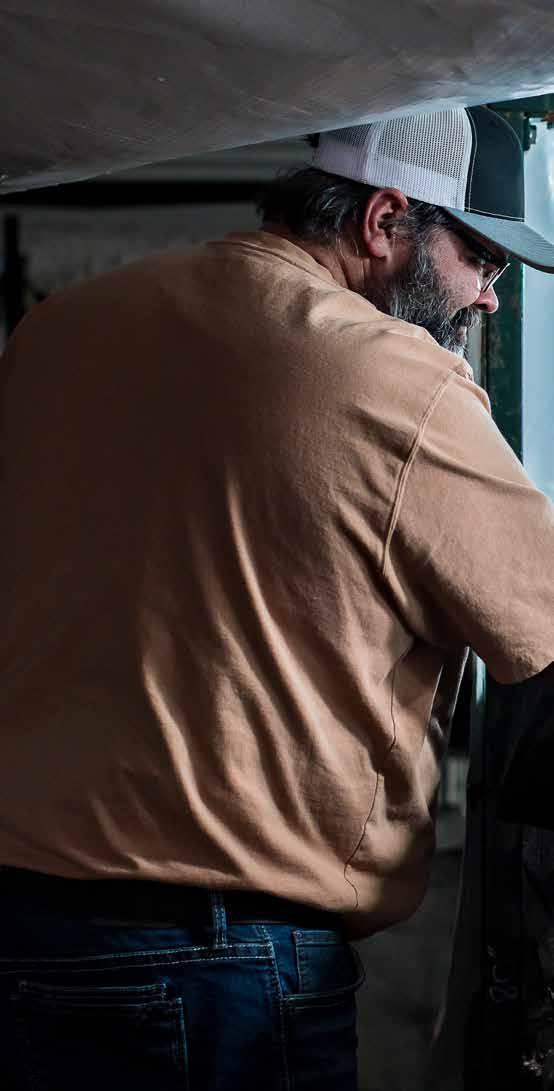
Ted Hammes (’81) of Story City, Iowa, joined Midland Co. as one of its first contract shrimp farmers in 2024. A retired agricultural business professional, Hammes was looking for a hobby to keep him busy. He decided to try shrimp farming after attending a seminar where Kimle talked about the business.
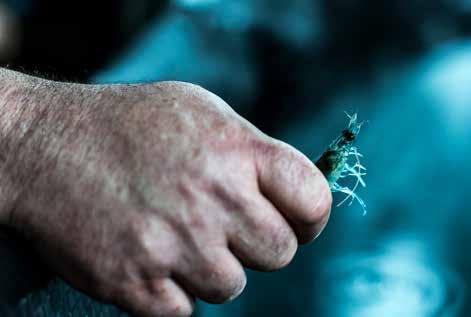
“It’s pretty interesting to see the
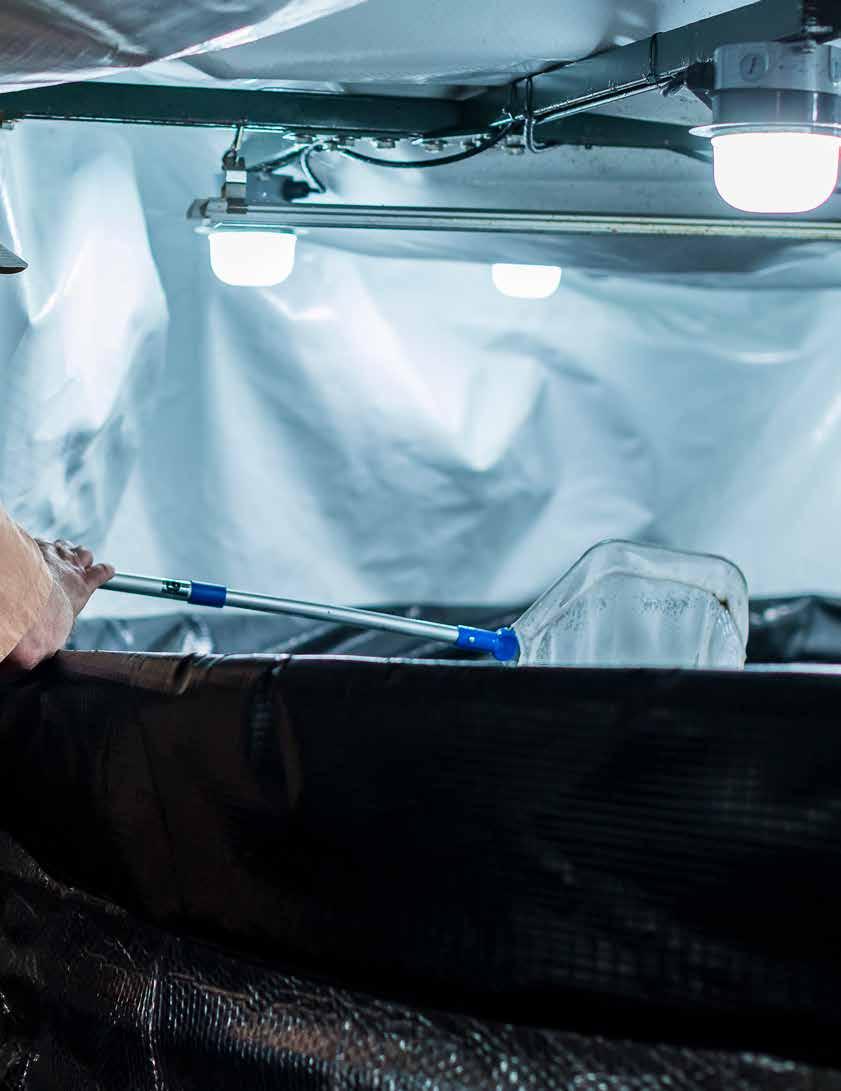
baby shrimp when they first arrive at around 20 days old — they’re very tiny,” Hammes says of his shrimp operation in Hampton, Iowa. “It’s very satisfying to net them from the tanks when they’re fully grown and realize the final product is ready for consumption.”
Ken (’97) and Aimee (’00) Reed of Washington, Iowa, are in year two of raising shrimp. Each month, they make the six-hour trek to a shrimp breeder in Minnesota, where they pick up 25,000
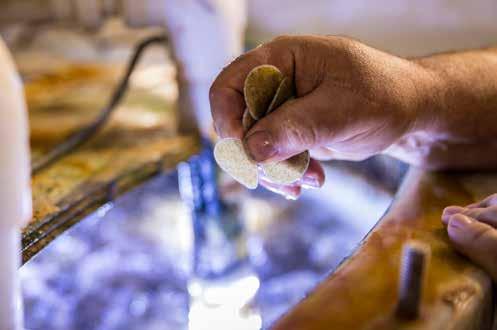
12- to 18-day-old shrimp. Once home, the shrimp are slowly acclimated to the warm water of a nursery tank, where they live until they reach 35 days in age. At that point, the shrimp are transferred to finisher tanks and harvested once they are 90 to 100 days old. Some of the shrimp are sent to a processor in Minnesota, while others are sold directly to customers by the Reeds.
As former hog farmers, the Reeds say raising shrimp is not much different.
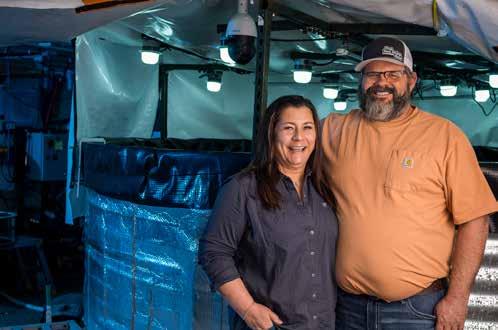
“The basics of animal husbandry are all there whether you’ve raised turkeys, chickens, cows, or pigs, you already have the basics of what you need to raise shrimp,” Ken Reed says. “You have to feed and check on them every day, and you learn to recognize when they don’t look healthy.”
Eric (’87) and Ann (’87) Franzenburg of Pheasant Run Farm near Belle Plaine, Iowa, are getting their shrimp operation up and running. The shrimp will complement the farm’s existing cut flowers, medicinal herbs, fruits, and vegetables.
“We’re excited about the future of shrimp production on our farm and being able to provide a clean, locally grown product to our customers,” Eric Franzenburg says.
Aimee Reed encourages those interested in raising shrimp to do their research, saying “it’s not going to be a cake walk.”
“Our first year was a learning curve for us. We’ve definitely had our good days and our bad days,” she says. “Working with Jackson and Matt, we’ve spent a lot of time researching, thinking, and learning how to make our operation run at its best.”
Midland Co. did its own researching, thinking, and learning while creating its patented algae-based wastewater treatment system for the shrimp. The system eliminates the need to dilute and discharge the saltwater to refresh the system.
Explaining how the system works, Ellis says shrimp excrete solid and dissolved waste in the form of nitrogen, phosphorous, and carbon dioxide. The algae take up those elements and put oxygen back into the water. In turn, the shrimp eat the algae, along with other food, while some of the algae are removed via a filtration system.
“Algae require a lot of the same things plants need to grow, so I’ve been able to take what I learned in my
horticulture classes at Iowa State and apply it to this algae technology,” Ellis says.
The Reeds plan to expand their operation to include two more nursery tanks and four more grower tanks, with a capacity to have 250,000 shrimp on their farm at a time. This will enable them to increase their direct-to-consumer sales from once every couple of
months to monthly.
“The demand for shrimp has been crazy in this area,” Aimee Reed says.
Consumers and shrimp enthusiasts can also find Midland Co. Shrimp in select Fareway Meat Market and Fareway Stores in central Iowa; Omaha and Lincoln, Nebraska; Kansas City, Missouri; and Olathe, Kansas, at several independently owned grocery stores and markets, and from farm-totable partners.
Kimle says consumers have commented that Midland Co. shrimp
is “some of the best shrimp they’ve had.” Because it is so fresh, it has a clean, sweet flavor like lobster.
Looking ahead, Kimle anticipates significant growth for the business — more contracts with farmers, more stores selling their shrimp, and the addition of automation to their growing systems.
“Shrimp is a high-quality product that farmers enjoy and can be proud of,” Kimle says. “And it’s something the next generation of farmers can get excited about.”
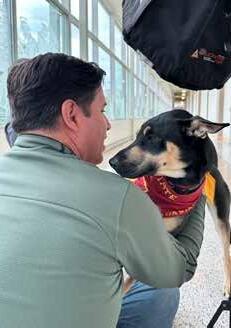
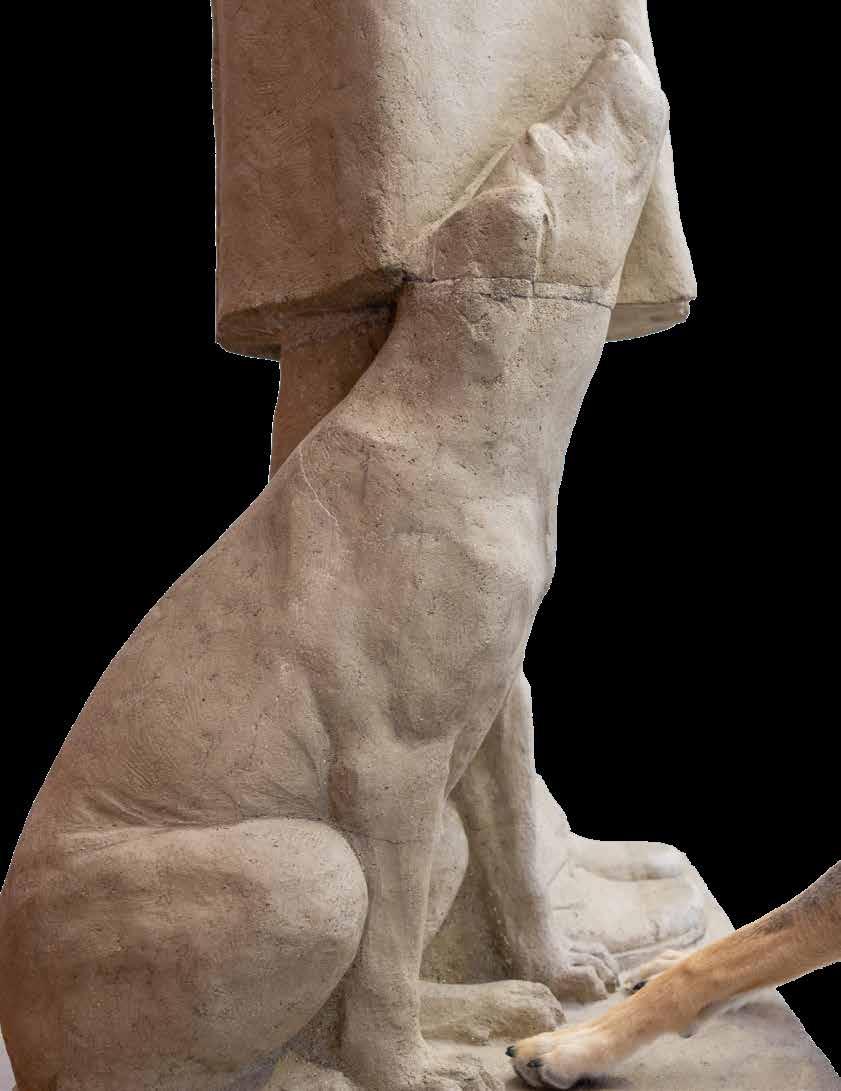
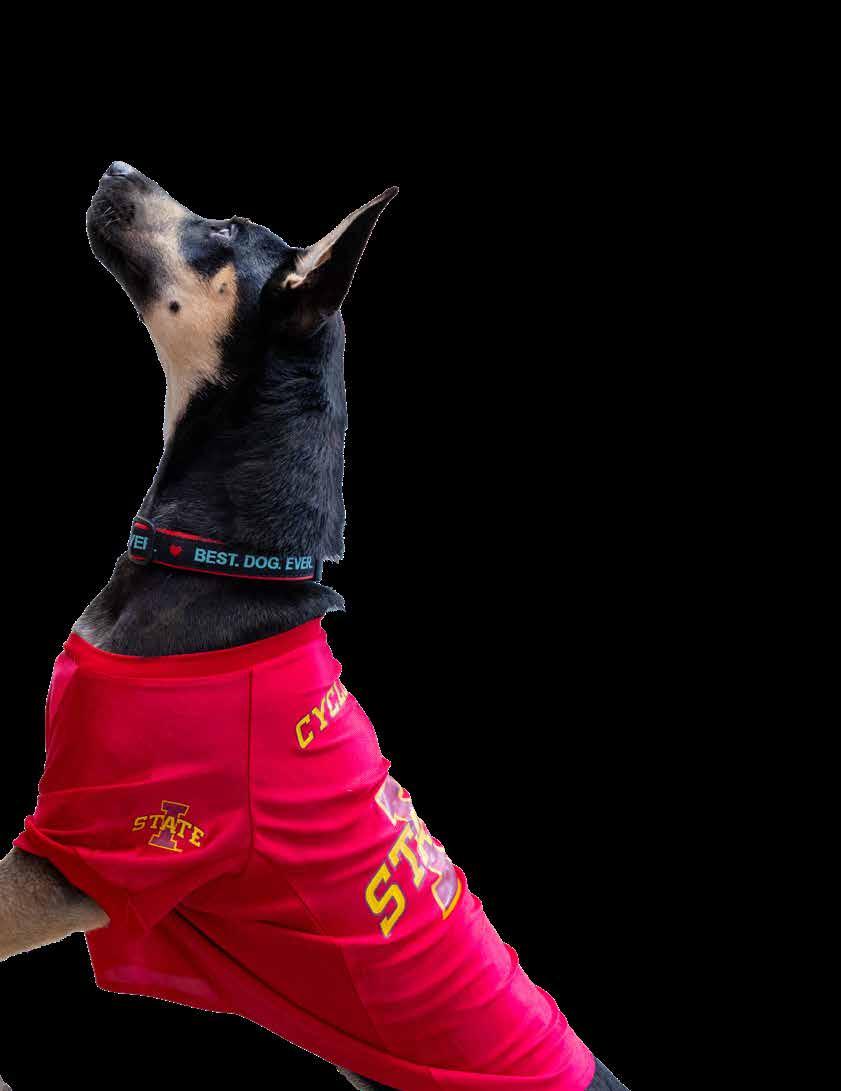
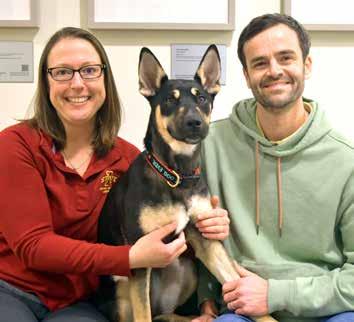
Honey looks up to “The Gentle Doctor” sculpture. The original sculpture, created by Christian Petersen in 1976, greets patients at the entrance of the Hixson-Lied Small Animal Hospital.
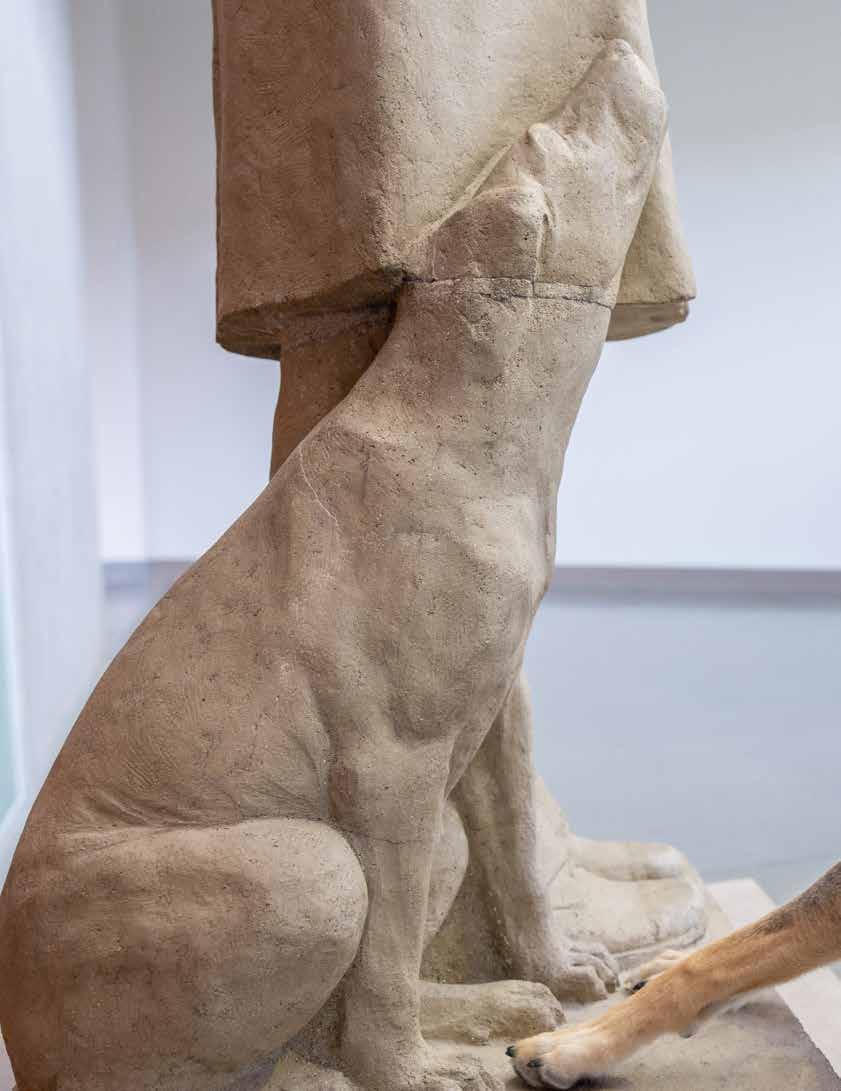
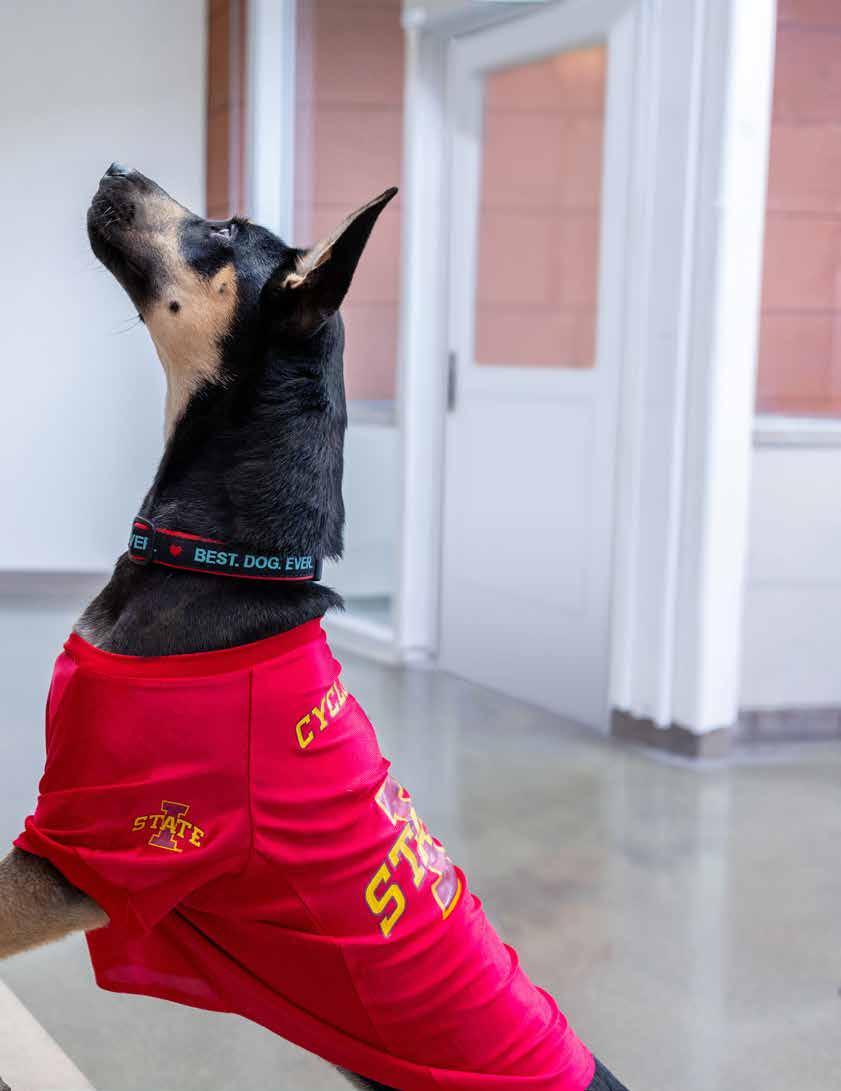
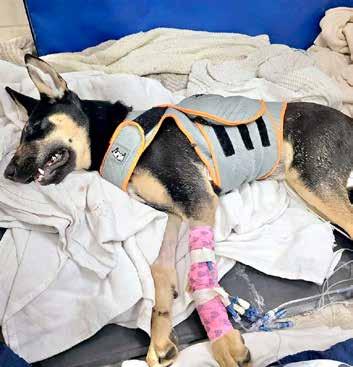
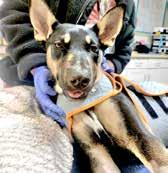
On Christmas Eve 2025, a 5-month-old puppy named Honey was hit by a car in Des Moines, Iowa. She arrived at Iowa State University’s Hixson-Lied Small Animal Emergency and Critical Care Service that evening suffering from severe injuries including multiple facial, orbital, ocular, skull, and mandible fractures that were causing bleeding into her brain.
The initial prognosis wasn’t optimistic.
“I didn’t think she’d ever recover from her injuries, but I knew if she didn’t die in the first 24 hours, maybe she could make it,” says Dr. Kamila Correa, the emergency and critical care resident on duty that Christmas Eve night.
Complicating matters was that Honey’s owner was experiencing homelessness.
“He begged me to save her, so I had to try,” Correa says.
Over the next 100 days, Correa and hundreds of College of Veterinary Medicine faculty, staff, and fourth-year veterinary students stepped up to make Honey’s recovery a reality. The units involved in Honey’s care include orthopedic surgery, anesthesia, canine rehabilitation, internal medicine, ophthalmology, and emergency and critical care services.
Because of the nature and cost of the care needed for Honey’s recovery, her owner surrendered the puppy to Critter Crusaders of Cedar Rapids, who immediately began a very successful fundraising campaign. The organization continues
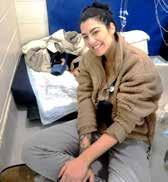
to update Honey’s former owner on her recovery.
“We’ve seen a lot a trauma in the 18 years of Critter Crusaders, and I did not have a lot of expectations that Honey would live,” says Jan Erceg, co-founder of Critter Crusaders.
Honey survived those initial 24 hours, but she wasn’t out of the woods by any stretch of the imagination. She was unresponsive for several days after her initial surgeries. With Correa by her side, slowly, but surely, she began to improve.
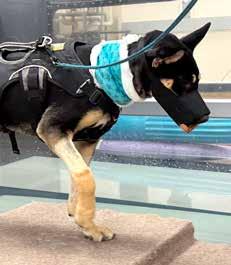
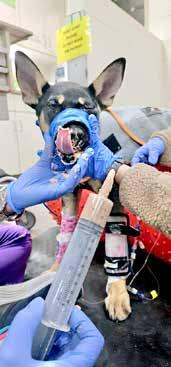
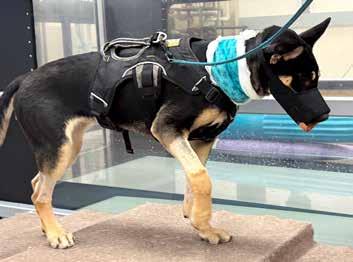
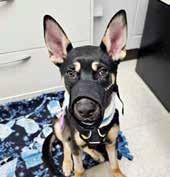
Honey received traumatic brain injury treatments — medications to prevent increased intracranial pressure as well as anti-seizure medicine. Because she was unable to stand and walk independently, she required a urinary catheter, IV fluids, and tube feeding. She also had to wear a muzzle to stabilize her jaw fractures.
Less than two months after her injury, Honey was a completely different puppy. The muzzle came off. She was able to take medications and water on her own. The fractures across her skull, sinuses, and orbits stabilized. And her energy levels increased dramatically — from sleeping almost every minute of every day to racing zoomies around the yard.
During her recovery, Honey was fostered by the German Shepherd Dog Rescue in Ames. Her foster parents, Laura (’10, ’13) and Matt (’08) Bradner, are no strangers to being fosters.
“Honey was our 38th foster, five of which we ended up adopting,” Laura says. “We foster because of our passion for
animals. Fostering is not easy and definitely not glamorous at times but knowing we’re making the difference for that one dog makes it all worth it.”
After foster failing their fifth dog, who suffers from severe anxiety, the Bradners decided to take a break.
Then Erceg from Critter Crusaders called about Honey on Christmas Day.
“When we got the call, we knew we needed to step up and open our home,” Laura says.
Most of the Bradners’ previous fosters have had just one medical ailment, which was not the case with Honey.
“When I first saw Honey, Dr. Correa brought me back to the ICU and I couldn’t believe what I saw,” Laura says. “There was this lifeless dog hooked up to what felt like 100 machines; her only sign of life was breathing.”
Challenges remained for Honey and the Bradners even as she slowly began to recover.
“It’s been a rollercoaster as each new issue surfaced but the entire team at Iowa State’s small animal hospital have risen to the challenge each time,” Laura says.
Honey has also risen to the challenge.
“At first Honey was like a newborn: she ate, she drank, she went to the bathroom, she slept,” Laura says. “That was all. But each day, new behaviors were unlocked from her little injured brain.”
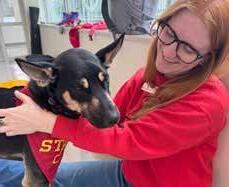
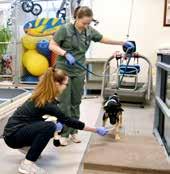
Honey has been an almost daily visitor to the Canine Rehabilitation Center in the Hixson-Lied Small Animal Hospital, where she has received the care and treatment to continue to improve.
With her improvement has come her endless joy in meeting people.
“Since I work in the VDL (Veterinary Diagnostic Laboratory) in the College of Veterinary Medicine, I drop her off in rehab every day,” Laura says. “The walk to and from rehab is met with smiles, tail wags, and pets each morning from everyone she meets.”
And Correa continues to see Honey even though she has been discharged from the Hixson-Lied ICU.
“When Honey left the ICU, I was happy and very proud of her,” Correa says. “But I shouldn’t be surprised. She has amazing strength, resilience, and a will to live. She’s a survivor.”
Honey also has a new home, becoming a permanent member of Bradners’ family.
But Honey will always be a part of the Hixson-Lied and Critter Crusaders families. The two groups gathered on the 100th day since Honey’s injuries to bid her “farewell” in a special ceremony.
“The entire team at the Hixson-Lied Small Animal Hospital has risen to every challenge Honey faced,” Laura says. “These doctors, vet techs, support staff, and fourth-year students make the College of Veterinary Medicine so special.”
Many Iowa State alumni are proud to be able to trace their family’s Cyclone legacy back generations. But nearly 21% of Iowa State students have a different story, and are instead working to establish a new family legacy as first-generation students. These students often face financial, academic, and personal challenges in their pursuit, and yet they persist. Here, five recent graduates reflect on their journeys as first-generation students.

‘I’M CONFIDENT’
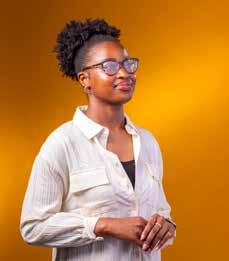
What power lies in a person’s name? For Confident Fandeh (’26), it was a challenging adjective she had to evolve into.
“I was a very shy kid coming out of high school, but I’ve grown so much within my name while here at Iowa State,” she says. “Even moving away from Des Moines, alone, did so much for me as an individual and finding who I am as a person and truly walking in my name. Waking up every morning
and literally telling myself: ‘you’re confident; I’m Confident.’ It’s something that I struggled with ever since I was young, and having that name felt like a pressure in a way. But being here as a first-gen and figuring things out has taught me so much about myself and what it means to be confident within.”
While in high school, Fandeh worked as a certified nurse assistant; as graduation neared, she wasn’t sure nursing was a path she wanted to pursue further. A fan of HGTV, Fandeh
instead set her sights on design.
“I came into the architecture program blindly, which I’m glad that I did because if I knew what architecture really was, it probably would’ve put a little fear in me,” she says. “I always knew my life would be tailored toward helping people, which is why nursing was such a big thing to me, but then with architecture I realized this is something that can also help people. Putting a roof over somebody’s head, preserving a home, or building new spaces where people can come together as a community and feel welcome and have a space tailored toward them — it’s all about the people.”
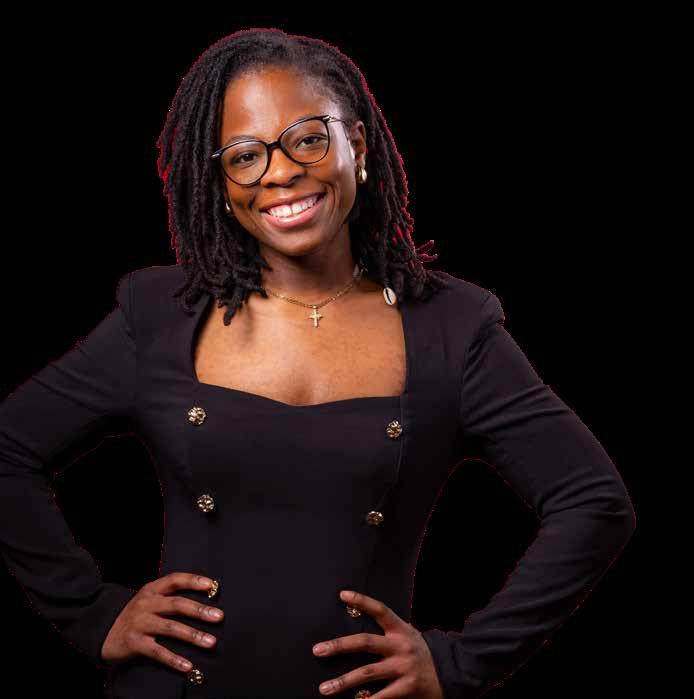
People and communities have been a large part of Fandeh’s journey at Iowa State. She was a part of the African Student Association and Black Student Association. She mentored younger students in the College of Design and volunteered with the ISU 4U Promise — a program that helped Fandeh prepare for and fund her education at Iowa State.
“Shari [Miller] and Katie [Richardson Bruna], who are the two leads of ISU 4U, prepared me to come to Iowa State since I was in sixth grade and have been alongside me as I’m about to wrap up my journey,” she says. “It feels like a full-circle moment.”
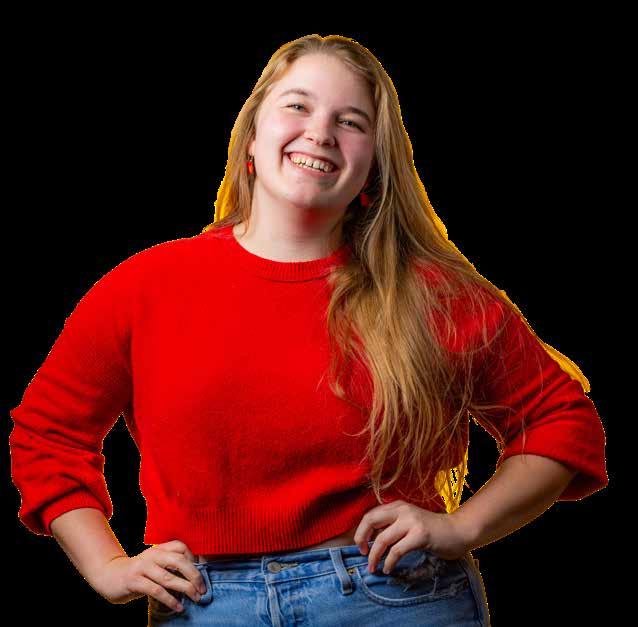
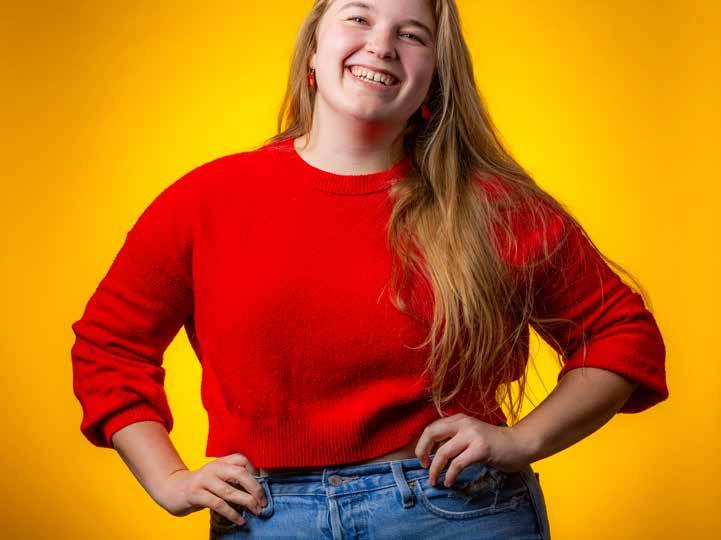
When Beau Mohr (’26) reflects on advice she would give to her younger self, a simple but powerful mantra arises: It gets better; just keep going.
In the years before Mohr arrived at Iowa State, her family unit faced disruption — her father had died and her mother was no longer in contact with Mohr or her two siblings. Extended family supported her while she finished high school, but once at Iowa State, Mohr was on her own to navigate new challenges like the housing portal, financial aid, finding friends and community groups, and adjusting to a population much larger than her 1,100-person hometown.
“It’s been a long journey, but I’ve been on the dean’s list every semester,” she says. “My entire education has been funded through scholarships and grants, and I am on track to graduate debt-free.”
Mohr approached her Iowa State journey with curiosity, never shying away from an opportunity to talk to new people
or join new organizations. She was actively involved with TRIO programs, study abroad, Collegiate Women in Business and Cardinal Eats clubs, and worked for three years as a student assistant at Friley Windows.
“My advice to other first-gen students is to try to seek out opportunities yourself; don’t let them come to you, and don’t be afraid to ask questions,” she says.
Mohr’s tenacity combined with the university’s resources resulted in her signing a job offer with HNI, a global furniture manufacturing corporation, before she even crossed the graduation stage.
“It’s a breath of fresh air knowing I’ll get to experience the things I learned in the classroom in a real-world setting, especially as I begin my career in a field I’m genuinely passionate about,” she says. “And truly, the opportunities, decisions, and knowledge Iowa State University has given me have shaped who I am today. They’ve helped me grow into someone who feels confident in their ideas.”
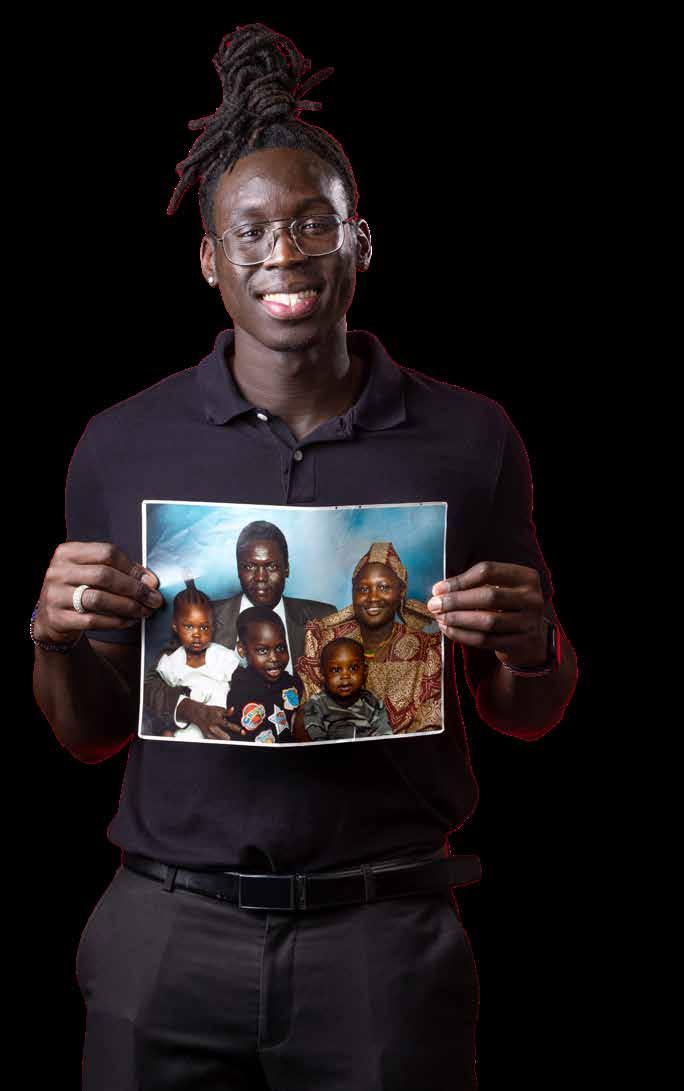
‘I DON’T GIVE UP’
“
Our greatest glory is not in never falling but in rising every time we fall.” This is the quote that Prince Tut (’26) often returns to when he seeks inner support. Born in Omaha, Nebraska, to Sudanese refugees, Tut is the third of nine children. When Tut was a child, his family experienced housing insecurity and moved around nearly a dozen times until they settled in Des Moines when he was in fourth grade.
In middle school, he joined the Science Bound program, which introduced him to academic paths at Iowa State, including kinesiology, biology, and engineering. It was the latter that he most connected with. Two autoimmune diagnoses his senior year of high school made the transition to Iowa State trickier, but Tut was determined.
“I didn’t want it to stop me,” he says. “I don’t give up, but I don’t take on unnecessary pain. If I have to go through stress, blood, sweat, tears, I want something to come out of it. That’s how I viewed my whole major while dealing with my medical conditions and financial burdens I had along the way. I was able to go forward, deal with the adversity, and stay passionate for engineering.”
At Iowa State he was involved with the National Society of Black Engineers, STEM Scholars, and the Multicultural Business Network. After his first year at Iowa State, he worked at the Biorenewables Research Laboratory; the following summer he worked as a research engineer at the University of Nebraska-Lincoln. As he plans for his post-grad life, Tut says a similar engineering career in the agriculture industry may be in his future.
For now, Tut is ready to celebrate his successes at Iowa State with his siblings, parents, and the wider Sudanese community who have supported him.
“I don’t want them to go through the same experiences that I did. Growing up shouldn’t be that hard and I want to make it easier on them,” he says. “Every time I think about the situation of how my mom and dad had to escape war and go to America and all the struggles they had. ... There are a lot of people that I wanted to prove wrong.”
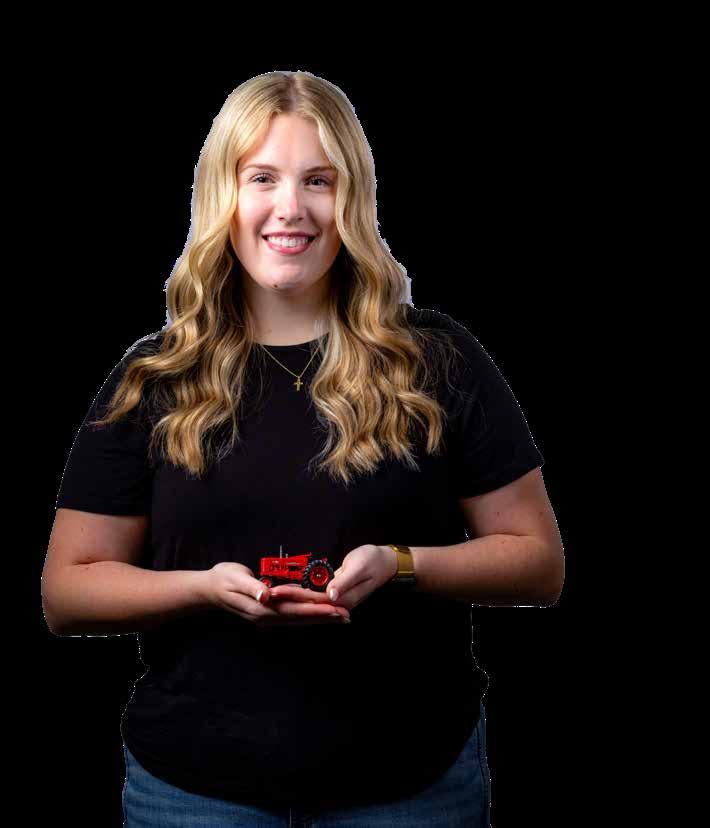
‘I
Carly Lawler (’26) grew up in Eastern Iowa, cheering for the University of Iowa Hawkeyes; she has fond memories of her grandparents’ sixthgeneration — now hobby — farm but otherwise wasn’t raised in a hands-on
agriculture environment. And yet when she graduated high school, it was Iowa State University, and agriculture studies that called to her.
“I did one tour here,” Lawler says. “I originally had a couple of tours scheduled at other universities, but after
meeting with professors and touring campus more, I canceled my other tours. I knew that Iowa State was the
As the first in her immediate and extended family to attend a university, she learned to navigate the new environment and immediately began
“Opportunity is the word to describe my experience at Iowa State,” she says, “I participated in a short-term travel course and a semester abroad, I’ve worked multiple jobs on campus, I’ve been in numerous leadership positions throughout different organizations on campus. I’ve had so many amazing opportunities that, honestly, it still feels
Those opportunities also helped Lawler overcome feelings of doubt and reinforced her sense of belonging.
“I did have an identity crisis, especially not growing up directly in agriculture,” she says. “The majority of my peers in my major either grew up on a farm, worked on a farm, or were in 4-H or FFA. ... None of my professors or anyone I interacted with at Iowa State ever made me feel like I was out of place. If anything, they reminded me that I belong here, and that being a firstgeneration student who didn’t grow up in agriculture doesn’t diminish my ability or my place in this industry.”
Lawler’s classes offered hands-on experiences, including learning how to wire circuits and breaker boxes, operate a feed mill, and tackle a real-world grain handling systems project. She landed internships with Land O’Lakes, Sukup Manufacturing Company, and CNH Industrial, and after graduation, Lawler will work full time with CNH in its sales and marketing rotational development program.
“I feel so blessed that Iowa State has set me up for success in my future career by exposing me to all these realworld experiences,” Lawler says. “I feel so confident going into this new chapter of my life.”
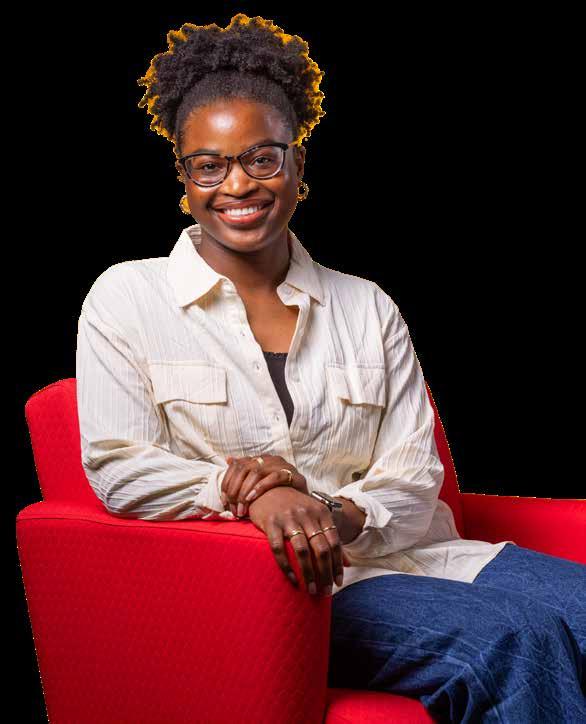
Danielle Nagaito (’26) spent her early years in a small town in Illinois, surrounded by immigrants from African and Spanish-speaking countries. It was there that she saw firsthand how social determinants and lack of access to quality health care can affect families.
Her passion for science and languages took hold early and continued as her family moved to Ottumwa, Iowa, and through her time at Iowa State University.
Iowa State was one of seven universities she was considering; knowing that her goal was ultimately to pursue medical school, Nagaito opted for the most cost-effective school.
“I thought I was just going to cruise through and do my thing and graduate and be done,” Nagaito says. “But I’m really, really glad that I came here and didn’t go anywhere else. I’ve met some amazing people, some of my best friends. The support that you get from faculty, mentors, and your peers is invaluable.”
At Iowa State, Nagaito quickly jumped into research, joining a lab her second semester of her first year. Each summer, Nagaito furthered her hands-on learning through a variety of research programs — most recently at George Washington University, where she researched the effects of non-nutritive sweeteners on pregnant women. She was also a part of the 2022 President Leadership Class, LAS
PULSE, NCORE-ISCORE, and biological science advisory board. Outside of the classroom, Nagaito worked at Homestead Adult Care and UnityPoint.
Before Nagaito begins her next phase of academics, she is ready to celebrate her successes with her family.
“My family is very proud, they’re very happy,” she says. “Especially because we’re immigrants and I feel like that’s not a narrative that is shown a lot
in this country — that there are people who come here and we do want go to school, we do want to get good jobs, we do want to contribute to society, and we do want to make an impact. It has been very important to me and very empowering being able to be at a university where there are people from different walks of life who are doing the thing, even though the odds may be against them.”


Jr. Cyclone Club members spent a day this spring at the Bergstrom Football Complex, meeting Iowa State football players, going through drills, and playing games with the team. The Jr. Cyclone Club is the official kids’ club for Cyclone fans 12th grade and younger. Club members receive football tickets for the grass hillsides of Jack Trice Stadium and general admission seats at volleyball, women’s basketball, wrestling, soccer, and softball games, along with other event and merchandise perks.
Image by ISU Athletics
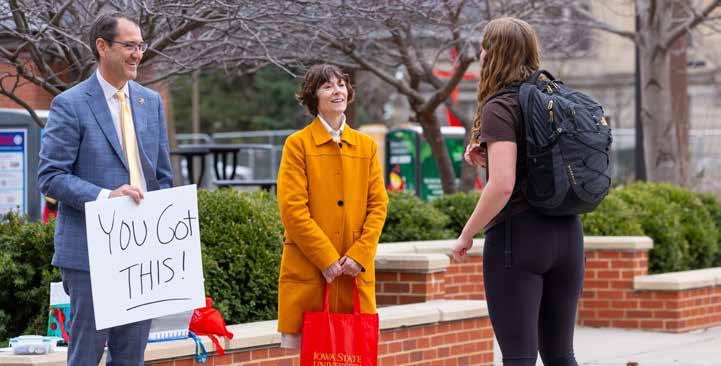
IN MY FIRST 100 DAYS AS PRESIDENT OF IOWA STATE UNIVERSITY, one thing continues to stand out: our land-grant mission is more than a historic principle, it’s a daily practice. And it matters more than ever.
At its core, the land-grant mission is about access. It’s about opening doors to higher education and creating pathways to opportunity. I see that mission come to life every day at Iowa State — especially for the students who are the first in their family to attend college. Today, more than one in five Cyclones has that distinction.
I know that experience well. I was a first-generation college student here at Iowa State, and I still remember those early days — the daunting feeling of navigating a large campus and quietly wondering if you’ll make it to graduation. I also know how powerful it can be when someone takes the time to offer guidance and encouragement.
The act of caring for one another is something I see across the ISU community. Our faculty and staff do it every day — providing a world-class education, inspiring a spirit of innovation, and connecting students with the resources they need to reach their goals in the classroom and beyond. Putting students first is one of Iowa State’s defining qualities. Alumni and friends also contribute to our supportive
culture. Nearly three-quarters of our undergraduate students receive a scholarship or grant to help pay for their education. As a result, nearly 50% of Iowa State students graduate without any debt. We are grateful for alumni and friends who believe in making an Iowa State education accessible and affordable. Your generosity helps set our graduates up for success.
Earlier in this issue of Iowa Stater, you met five first-generation Cyclones who earned their degrees in 2026. Their stories reflect the power of an Iowa State education to change lives and the determination of students who are ready to make their mark on the world.
As I reflect on my first 100 days, I’m honored to lead a university that stays true to its purpose while looking boldly to the future. Iowa State opened doors for me, and now, I get to open doors for the next generation of Cyclones. Thank you for joining me in this life-changing mission.
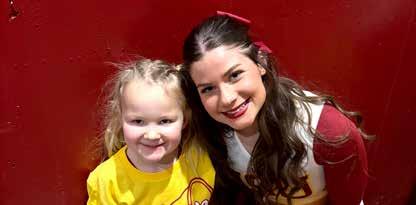
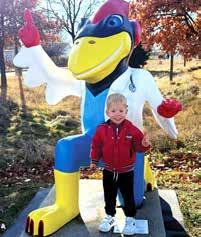
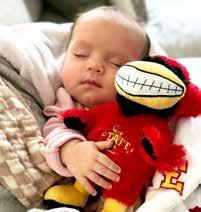
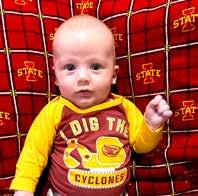
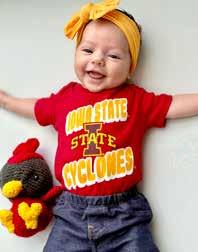
To submit a photo of your future Cyclones for Iowa Stater magazine, email your photo and the names of those in the photo to iowastater@iastate.edu
IF YOU’RE HEADED TO ...
FOR SUMMER VISITORS.
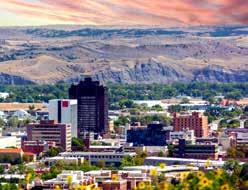
Each of Montana’s larger cities offers a variety of unique eateries. In Billings, Walkers Grill, Bistro Enzo, The Marble Table, and Jake’s are crowd favorites. Don’t forget to set aside some time to walk the Billings Brew Trail, which includes six breweries, two distilleries, and one cider mill.
Live music abounds across the state in the summer and early fall with numerous outdoor festivals and venues. You can catch major acts at the KettleHouse Amphitheater, The Old Saloon, or at The ELM in Bozeman.
Numerous day hikes of all skill levels pepper the mountains and foothills across the state. Meier says his family's favorite is Mystic Lake. Portions of Glacier and Yellowstone National Park lie within Montana, along with numerous state parks and recreational areas. The best time to visit both national parks is late summer through September.
Live in Montana or thinking about a visit? Connect with the ISU Alumni of Southern Montana and Northern Wyoming on Facebook to help plan your visit.
WE ASKED, YOU ANSWERED:
“A ham, turkey, and tomato sandwich out of the vending machine after morning class, at the Hub, while reading the Iowa State Daily.”
THERON BOBZIN (’85, ’97)
“For lunch, I would go to the Hub on central campus and in one of the vending machines there was a sandwich called a ‘Crusty.’ It was some kind of spreadable meat between bread crusts. It was a favorite as it was only 35 cents, which was a great deal for a student on a very limited budget.”
LOREN ANDERSON (’77)
“This is going back five decades, but once in a blue moon, the Friley cafeteria would serve boneless ribs for dinner. They were fantastic! Being 20 years of age or so, I could have probably eaten five times the amount they served us.”
BRADLEY BUECKER (’77)
“There’s nothing like a Clyde’s burger, onion rings and their ranch!! Mmm nostalgia!”
—SAMANTHA PAVLICEK (’13)
“Whenever we would have dinner exchanges in the dorms, we would order turkey canoes and the chocolate mint dessert!”
DONNA SCHOEPPNER (’86)
“I loved the sack lunch program with the dining halls! Came in handy when all my classes were way across campus.”
SALLY GARVER (’85)
“The taco truck outside of the engineering building on the west side of campus!”
KATARINA KOHN
“Broccoli
cheddar soup and a scotcheroo from the Hub!”
MARY TRUDEAU (’14)
“My favorite food on campus was scalloped pineapple from the dorms. I had never had it before, and I have not had it since. A close second was the chocolate mint ice cream dessert that the dorms served for special occasion dinners. Thanks for the walk down memory lane 50 years later.”
JANE HERMANSON (’77)
“Oak Hall food service chocolate chip cookies. Holly Griener (’73) was our food service director and a great person to work for.”
“The
Blue Bunny ice cream flavors in Convos were always a hit!”
“Chocolate malts from the Union Cafeteria!”
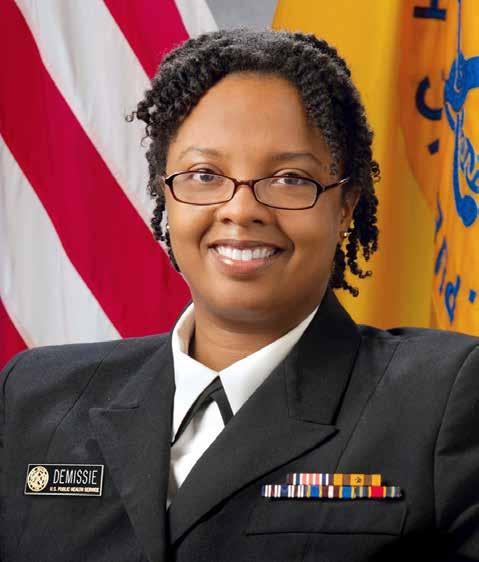
Teenagers are a mystery, though slightly less so to Zewditu Demissie (’02).
Demissie is the associate director for science in the Division of Birth Defects and Infant Disorders as well as acting associate director
for Science of the Public Health Infrastructure Center at the Centers for Disease Control and Prevention (CDC). In a previous role, she spent a decade studying teen risk behaviors as a part of the Youth Risk Behavior Surveillance System (YRBSS). YRBSS tracks key health risks among U.S.
high school students. Demissie led and served as guest editor for the 2019 YRBSS surveillance report release, which is used by parents, school systems, nonprofits, and health departments to create policies at schools that support healthy learning environments.
“It was the most defining moment of my career,” she says.
That is saying something for the 16-year CDC veteran. Across several CDC positions, she has reviewed scores of scientific proposals and documents to ensure they meet research, regulatory, and ethical standards and maintain scientific integrity. She has also authored more than 60 scientific publications.
“My career at the CDC has given me the chance to work across topics and study so many areas: violence prevention, birth defects, infant disorders, physical activity, nutrition,” she says. “I have loved that opportunity.”
Similar to her experience at the CDC, her time at Iowa State University was full of exploration and creating a unique path for herself. As a National Achievement Scholar, Demissie built her undergraduate career melding interests in psychology, biological sciences, and research. She chose Iowa State in part because her father, a University of Iowa graduate, loved his time in the state and spoke highly about the Iowa State campus.
“Everyone was so friendly and kind,” she recalls of her college visit. Campus proved big enough to offer research opportunities, yet small enough that she could be in student government, serve as a resident advisor, and compete in Yell Like Hell at Homecoming.
“If you would have known me as a child, you would have thought that I would have stayed in Champaign (Illinois), my hometown,” Demissie says. “Going away to school at Iowa State was the best decision of my life.”
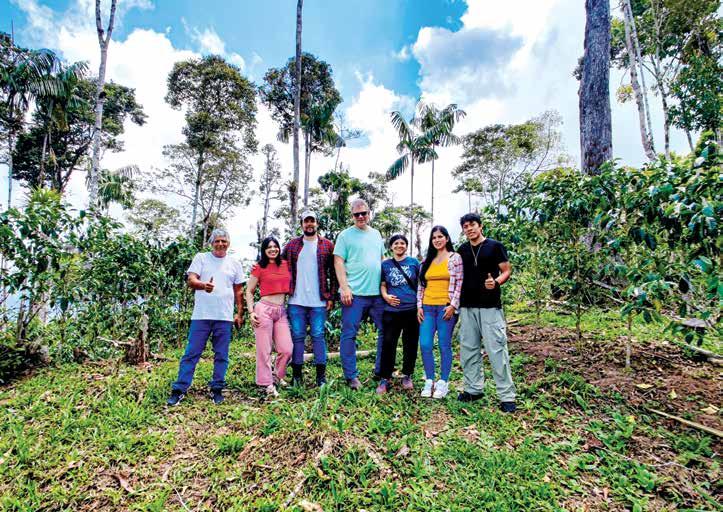
Surrounded by burlap bean sacks, Danny Rittgers (’16) explains commonalities between working with coffee and corn. Apply heat, and aromatic coffee beans’ shells crack like popping corn.
“The way we roast the coffee, it’s just like corn dryers for seed corn,” Danny says. “We watch those drying curves, and we use the data. This is just a higher temperature and smaller scale.”
Both crops are part of Danny’s story, the twists and turns of which took him from surfing international beaches to studying at Iowa State University, through the forests of Peru, where he met his wife, Gigi, and back to the Midwest. In his day job, Danny leads global seed data integrations at Corteva Agriscience. Nights and weekends, he can be found firing up a commercial-grade coffee roaster in De Soto, Iowa.
Before co-founding Curious Joe Coffee together, the couple worked side by side at an agroforestry company in Gigi’s home country. Their meet-cute came after an old surfing buddy reached out for Danny’s help managing operations. As a nontraditional college student studying Spanish Language and Cultures, Agricultural Businesses, and International Agriculture, Danny saw the opportunity in Peru as a chance to gain practical experience.
“I took it as an internship,” he says. “I had to keep a journal
and write papers. I ended up spending a total of six or seven months there and eventually proposed.”
The newlyweds welcomed their first child just before Danny’s graduation. It was a full-circle moment for the thirdgeneration Cyclone born in Ames.
“My first outing was at my dad’s graduation,” Danny says. His mom worked as a cook at a fraternity house.
Starting a direct-trade coffee company together allows Gigi and Danny to share their passion for specialty foods while ensuring their supply chain remains aligned with their values.
“We thrive on working directly with growers,” Gigi says.
After moving to Iowa, she enrolled in ISU’s Intensive English and Orientation Program to refine her communication skills. Conversing with Curious Joe customers at the Grimes Farmers Market, Gigi connects each product to specific farmers and processing methods. A label for “The Explorer’s Reserve,” for instance, lists the region of origin (Pozuzo, Pasco, Peru), estate (Gregorio Espinoza – Finca Batan), elevation (1,700 meters), variety (Catuai), and process (Hydro-Honey).
“We focus on three things: sustainability, ethics, and quality,” Danny says. “We watch the entire journey. The only way I can truly guarantee those three things is to trace everything from seed to cup.”
— BRIANNE SANCHEZ
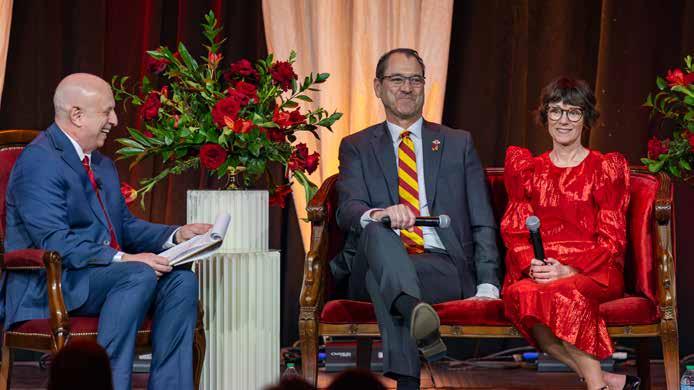
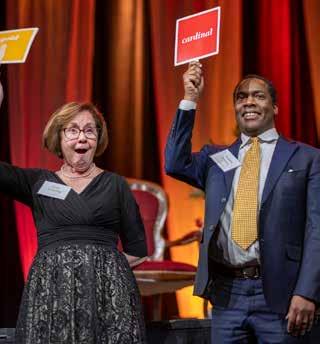
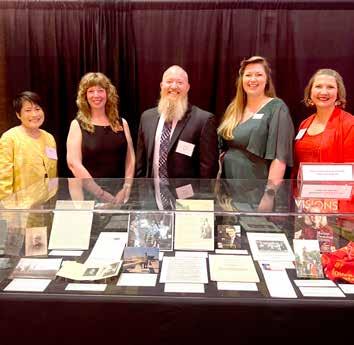
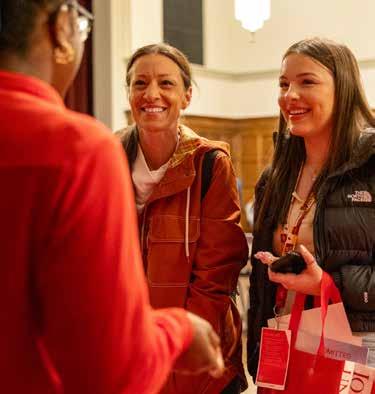
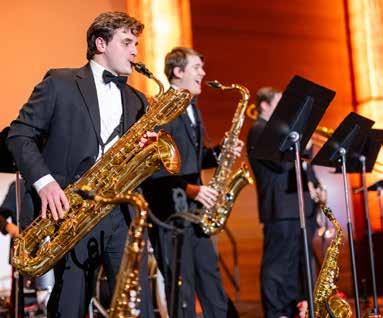
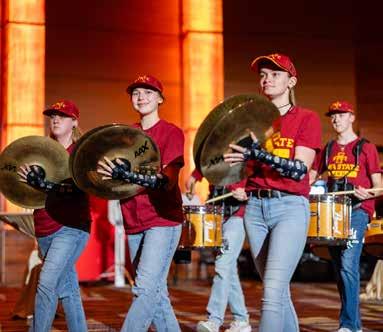
Over 400 Cyclone alumni and friends gathered for the 2026 Cardinal & Gold Gala at the Community Choice Credit Union Convention Center in Des Moines earlier this year to celebrate the generosity, pride, and enduring spirit that defines the Iowa State community.
HIGHLIGHTS OF THE EVENT INCLUDE:
1. A Q&A with President David Cook (’92) and Katie Cook (’94), hosted by John Walters
2. Nearly $20,000 raised for Iowa State’s Students Helping Our Peers (SHOP) food pantry through games and a silent auction. An estimated 36% of Iowa State students experience food insecurity; SHOP offers nutritious and culturally appropriate food items, along with hygiene products, to undergraduate and graduate students, visiting scholars, post-doctorates, and their families.
3. A pop-up exhibit curated by Special Collections and University Archives showcasing highlights from the first 16 university presidents. Artifacts included photos, documents, and items connected to notable activities and achievements from various presidents found in University Archives, including a page from President Adonijah Welch’s inaugural speech, the 1992 President’s Leadership Class booklet from class founder President Martin Jischke, and one of the most recent acquisitions: President Wendy Wintersteen’s (’88) Innovate at Iowa State scarf.
4. Entertainment provided by brass band DJ Johnny and the BPM, as well as 60 members of the Cyclone Football ‘Varsity’ Marching Band.
5. A big thank you to our event sponsors Sigler and Markey’s, as well as vendors, including alumna-owned business Bella Flora Event Design, Capture Photobooth, and Vintage Love Rentals.

The Wallace E. Barron All-University Senior Award recognizes outstanding seniors who display high character, outstanding achievement in academics and university or community activities, and promise for continuing these qualities as alumni. The award is named for Wallace E. “Red” Barron (‘28) director of alumni affairs at Iowa State from 1937 to 1968.
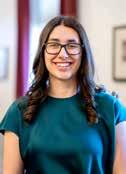

EMMA ALSTOTT
Global Resource Systems, Horticulture
Fort Dodge, Iowa
Emma Alstott’s enthusiasm for plant science and food security drives her to help others. Alstott served as an executive officer in the Horticulture Club, secretary of Good Earth Student Farm, and a participant in the Globe Leadership Fellows program. She is a 2024 Goldwater Scholar, Ryan Hrubes Memorial Leadership in Agriculture Scholarship recipient, and Pi Alpha Xi and Gamma Sigma Delta member. Her research on fire blight and fruit crop disease has resulted in two peer-reviewed publications, grants, and 15 research presentations.
“Emma’s astounding undergraduate achievements in academics, research, extension, leadership, and commitment to community all portend how she will continue to display these exemplary qualities as an alumnus,” writes a nominator.
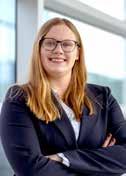
Mechanical Engineering
Schaumburg, Illinois
Madi Dohrn demonstrates exceptional commitment to service, leadership, and student engagement. Dohrn has twice ranked first among all Iowa State student-athletes in volunteer service, contributing nearly 600 hours. She is the ISU Swim and Dive volunteer coordinator, a year-round volunteer with Food at First, and an active member of the Pay It Forward Club.
“Ultimately, service and leadership are oftentimes actions with no quantifiable return,” writes a nominator. “There is no trophy, no GPA, and no title to show for her efforts. But the lives Madi has positively impacted show her character far more than any award or accomplishment could. She chooses to make a difference, over and over, time and time again.”
CLARE MEYER
Business Management
Eden Prairie, Minnesota
Clare Meyer brings strong leadership, service, and a community-centered approach to all her efforts. She has engaged in organizations across campus, notably Chi Omega and the Student Alumni Leadership Council, where she served as Homecoming co-director.
Meyer pairs her leadership with academic achievement, earning six Dean’s List honors and a number of scholarships. Her commitment to service extends into the community through membership in Letters of Love, fundraising for organizations including Make-A-Wish Iowa, and active involvement in her faith community.
“Clare is a consistent leader who communicates with enthusiasm in all situations,” writes a nominator. “She stands firm in her values while extending grace in both emotionally and logistically challenging circumstances.”

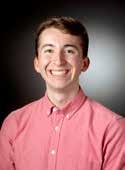
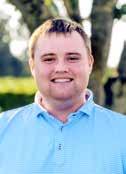
Agricultural Business, Economics, Agriculture and Rural Policy, International Agriculture Montezuma, Iowa
Haylie Moore is a standout student-leader pursuing four majors and a minor while taking on leadership roles across Iowa State University and beyond. Moore’s academic honors include the George Washington Carver Scholastic Leadership Scholarship, the Bright Scholars of Iowa Award, the Outstanding Achievement in Third Year Chinese Award, and top placements in the Pappajohn Center Case Competition.
“Her actions consistently show that she values collaboration, education, and making a positive impact, embodying the highest standards of character and integrity,” writes a nominator. “She not only strives for excellence but also inspires others to do the same.”
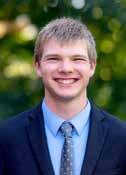
Industrial Engineering, German Waverly, Iowa
Willem Potter exemplifies high character through his academic excellence, leadership across campus, and commitment to serving others. At Iowa State, Potter has held leadership roles in multiple engineering organizations. He co-founded Alpha Pi Mu’s Strike Force initiative, helping improve traffic flow and safety at a local elementary school. His outreach with the Society of Women Engineers through the SWENext program — teaching high school students 3D modeling and printing — highlights his commitment to inspiring future engineers.
“Willem’s character is defined by intellectual curiosity, responsibility, and genuine care for people,” writes a nominator. “Whether in the classroom, lab, or community, Willem consistently demonstrates integrity, humility, and a commitment to improving the lives of others.”
Biochemistry, Genetics Center Junction, Iowa
Tristan Weers brings leadership and commitment to every space he occupies. Weers was selected into the prestigious President’s Leadership Class, of which he is now the senior teaching assistant. He also shaped the Stupka Undergraduate Research Symposium through roles ranging from operations chair to communications lead. Weers has been an author on two published scientific papers, conducted advanced research in the Peters lab, and completed a research internship at the Max Planck Institute in Germany.
“From seniors to first-year students, everyone seems to have something positive to say about Tristan,” writes a nominator. “It is a testament to Tristan’s nature that he continues to maintain these interpersonal relationships while balancing all his other accomplishments.”
Animal Science
Epworth, Iowa
Ryan Wolf is committed to advancing the future of animal science. Wolf served as vice president of the College of Agriculture and Life Sciences Student Council, president of the Dairy Science Club, and a peer mentor and teaching assistant in the Department of Animal Science. He was also involved with the Iowa FFA Association and the Youth Dairy Classic.
Wolf conducted research in the Carpenter Dairy and Schnable labs and earned the American FFA Degree, Blue and Gold Leadership Award, and George Eastman Young Leader Award.
“His natural ability to connect with others strengthens every environment he joins,” writes a nominator. “He continually seeks opportunities to support peers, improve systems, and contribute to the broader animal science community.”
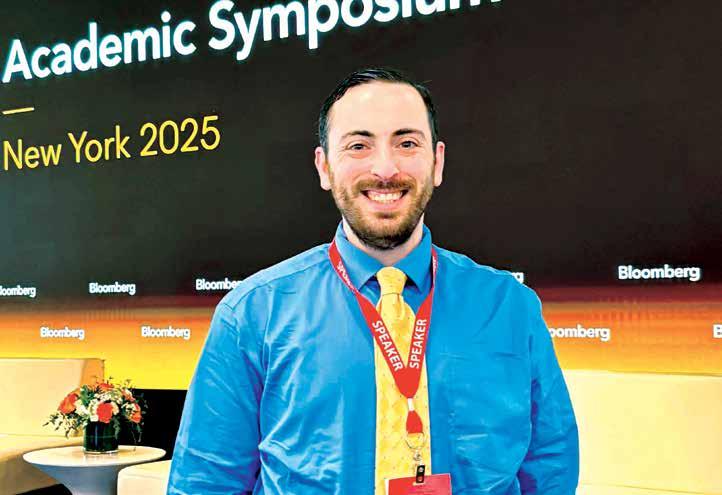
Peter Myers’ high school students often share the same financial dream: They want to be a millionaire.
In Myers’ role as a financial literacy advocate and educator on Long Island, New York, his follow-up to their stated dream comes easily.
“That’s a great goal, but how are we going to get there?” Myers asks.
At Iowa State, Myers became passionate about financial literacy which he describes as being empowered and equipped with the tools to navigate budgets, investments, and debt — while working in student government. After graduation, Myers worked in corporate finance until he decided to shift his focus to education.
“At The Greater Des Moines Partnership, I started building out financial literacy workshops, and that’s where the passion grew even more,” Myers says. “I could see it was making
a difference for people.”
In New York, Myers’ efforts have helped move financial literacy coursework from optional for schools to a requirement to be taught in grades K–12. Myers has seen the positive impact the coursework can have on students and their families. Students’ focus evolves from wealth as a status to how they can alter generational cycles of financial struggles.
“I have had students ask me, ‘How can I build credit, and how can I help my mom and dad get out of debt or build their credit score?’” Myers says. “There are so many avenues like sports gambling, day trading, or cryptocurrency that are targeted to and appeal to students as ways they can gain wealth quickly, but it’s my goal to help them understand the risks that come with each outlet so they see a clearer, steadier path to financial freedom for themselves and others.”
— CALEB GRIZZLE
Peter Myers, a financial literacy educator and advocate, shares some his best practices for creating healthy conversations around money with young people.
1. Break down stigma around finance conversations by sharing your personal journey with money.
2. Make conversations personal to them; for example, talk about saving up to go to the movies or for a new purchase.
3. Be honest about financial tradeoffs when traveling or making family purchases.
4. Pay the bills in the family room, or a place that they can be curious and ask questions.
5. Help them set simple financial goals from a young age so they can learn that saving takes time.
ANNUAL
Rich Manzer pg. 4
Allison Stenseth Manzer pg. 4
Aimee Reed pg. 21
Ken Reed pg. 21
Carly Lawler pg. 32
Samantha Pavlicek pg. 38
Clare Meyer pg. 44
Brent Knoot pg. 47
LIFE
Sandy Rogers May pg. 4
Ted Kooser pg. 4
Lynette L. Pohlman pg. 6
Paul Lasley pg. 8
Eric Franzenburg pg. 22
Ann Franzenburg pg. 22
Tina Hansen pg. 37
Lisa Niess pg. 37
Cody Niess pg. 37
Judy Underwood Maubach pg. 37
Keith Meier pg. 37
Theron Bobzin pg. 38
Bradley Buecker pg. 38
Loren Anderson pg. 38
Donna Schoeppner pg. 38
Sally Garver pg. 39
Jane Hermanson pg. 39
Shane Jacobson pg. 48
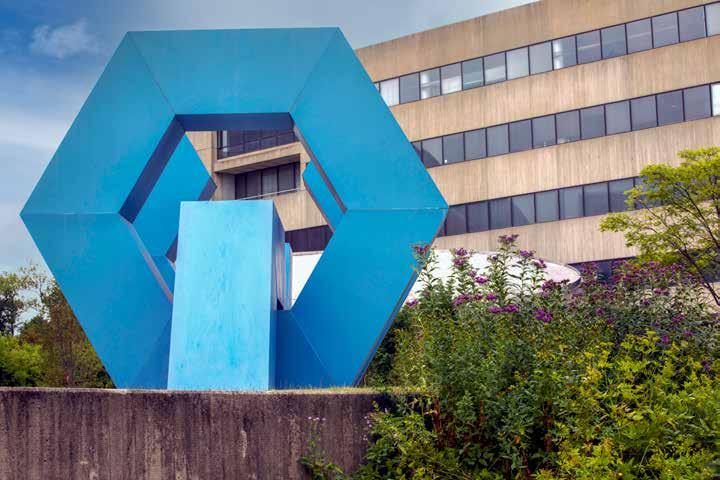
Brent Knoot (’92, ’95) is our spring 2026 pop quiz winner. “Sequence,” completed in 1979 by John Douglas Jennings (’79) can be found outside the College of Design building.
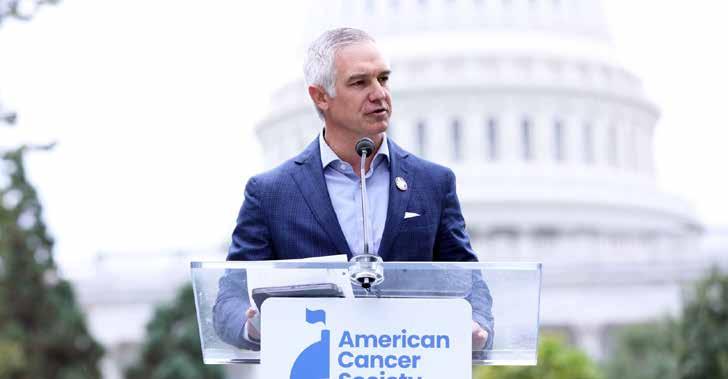
CEO of the American Cancer Society and American Cancer Society Cancer Action Network
ACyclone is leading the charge to end cancer as we know it, for everyone.
Shane Jacobson (’03, ’08) will soon wrap his first year with the American Cancer Society (ACS) and its advocacy affiliate, the American Cancer Society Cancer Action Network (ACS CAN). With a research portfolio of more than $500 million and a multitude of patient support programs, the ACS is the nation’s largest funder of cancer research outside the federal government, and Jacobson is responsible for guiding the ACS and ACS CAN in efforts across strategic planning, research, fundraising, policy, and stakeholder engagement.
It’s a role that reflects his lifelong passion for advancing and turning mission into impact. Prior to joining the ACS, Jacobson served as CEO of the V Foundation for Cancer Research and has more than 20 years of nonprofit experience, including work in development and alumni relations at Iowa State. Jacobson reflects on his journey.
What led you to your role as CEO of the American Cancer Society and American Cancer Society Cancer Action Network?
The American Cancer Society is where science meets patients, and I knew I wanted to lead at that intersection. I believe we are in a position to truly bend the arc of cancer like no other and shape the future of cancer and the cancer landscape to save more lives. So, when considering the opportunity and recognizing that it’s not a matter of “if” but “when” we will beat cancer, I felt the opportunity to serve as CEO and do everything I can to shorten the distance
between that “if” and “when” moment — was significant because it touches every household in America.
What advice would you share with others who are interested in working in the nonprofit space?
Lead with your ears. Nonprofits provide support for communities; they provide needed services, funding, research, and advocacy. By really listening to stakeholders and communicating effectively, you can create meaningful impact. As a result, you will be a force multiplier and drive systemslevel change.
Is there a specific lesson from Iowa State that you often reference?
I often think back to what I learned in my communications studies major; in particular, the program and program faculty taught me the importance of clarity in communications. It’s not just a skill; as the result of clarity, we can save time. I think about that a lot because in my work, in the areas of health care and cancer research, time saves lives.
You have stayed involved with Iowa State; what does the university mean to you?
I love Iowa State. The university has a strong culture of innovation and leadership, and to me, innovation is all about turning brilliant ideas into real-world outcomes. In my work, that means real impact for cancer patients. Iowa State’s commitment to innovation and the pursuit of what’s possible produces alumni who add a lot of value to their communities and the larger world. And that means Iowa Staters are shaping the future.





















WE WILL FUND








CHEERING, BELIEVING, AND UNITING IN SUPPORT FOR OUR STUDENT-ATHLETES








Your investment ensures Iowa State Athletics continues to thrive and strengthens Cyclone excellence.







The official student-athlete support fund that provides critical resources for revenue-sharing efforts that directly impact ISU coaches’ retention and recruiting of top Cyclone student-athletes.













Provides Iowa State Athletics leadership with the flexibility to strategically address the department’s most critical needs while ensuring timely and effective responses to the evolving needs of Cyclone Athletics.





Contributions support the department’s cost of student-athlete scholarships, while advancing the educational mission of Iowa State Athletics and helping Cyclone student-athletes excel in the classroom.

























Email: iowastater@iastate.edu