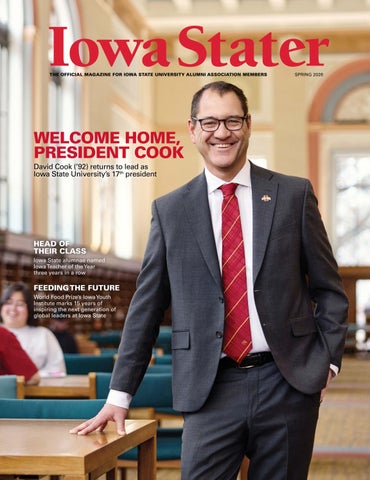
David Cook (’92) returns to lead as Iowa State University’s 17th president
HEAD OF THEIR CLASS
Iowa State alumnae named Iowa Teacher of the Year three years in a row
FEEDING THE FUTURE
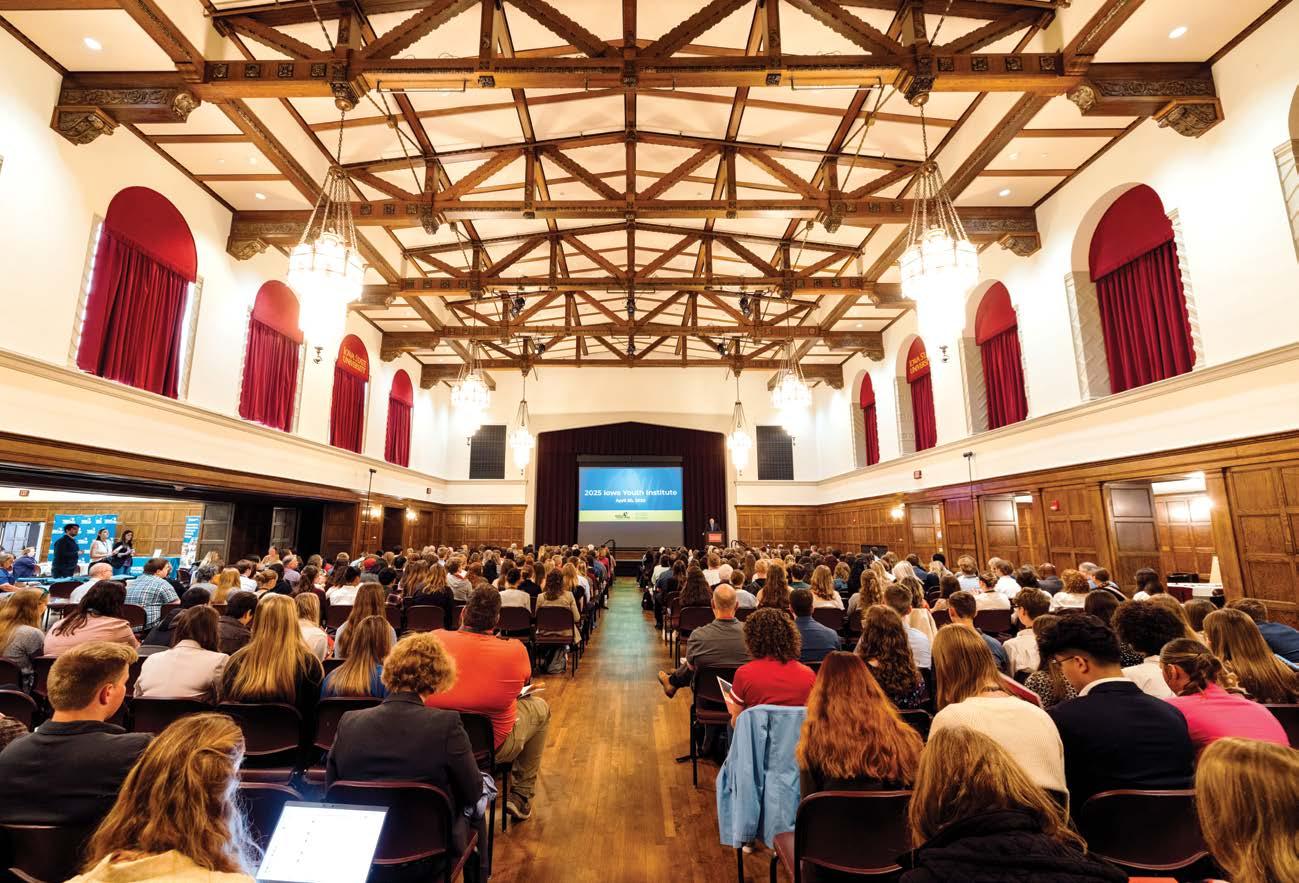
World Food Prize’s Iowa Youth Institute marks 15 years of inspiring the next generation of global leaders at Iowa State
Reminiscing in the Reading Room
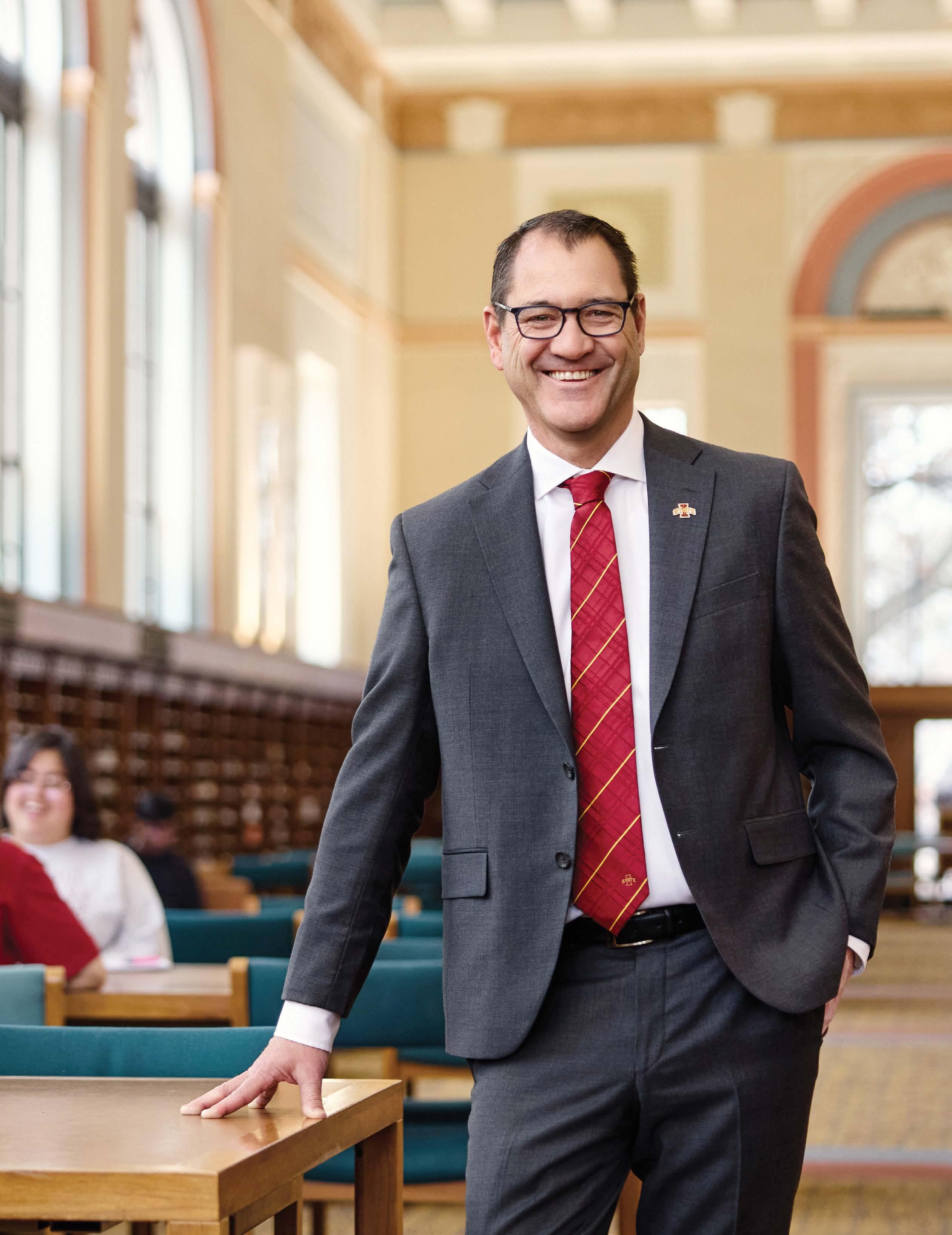
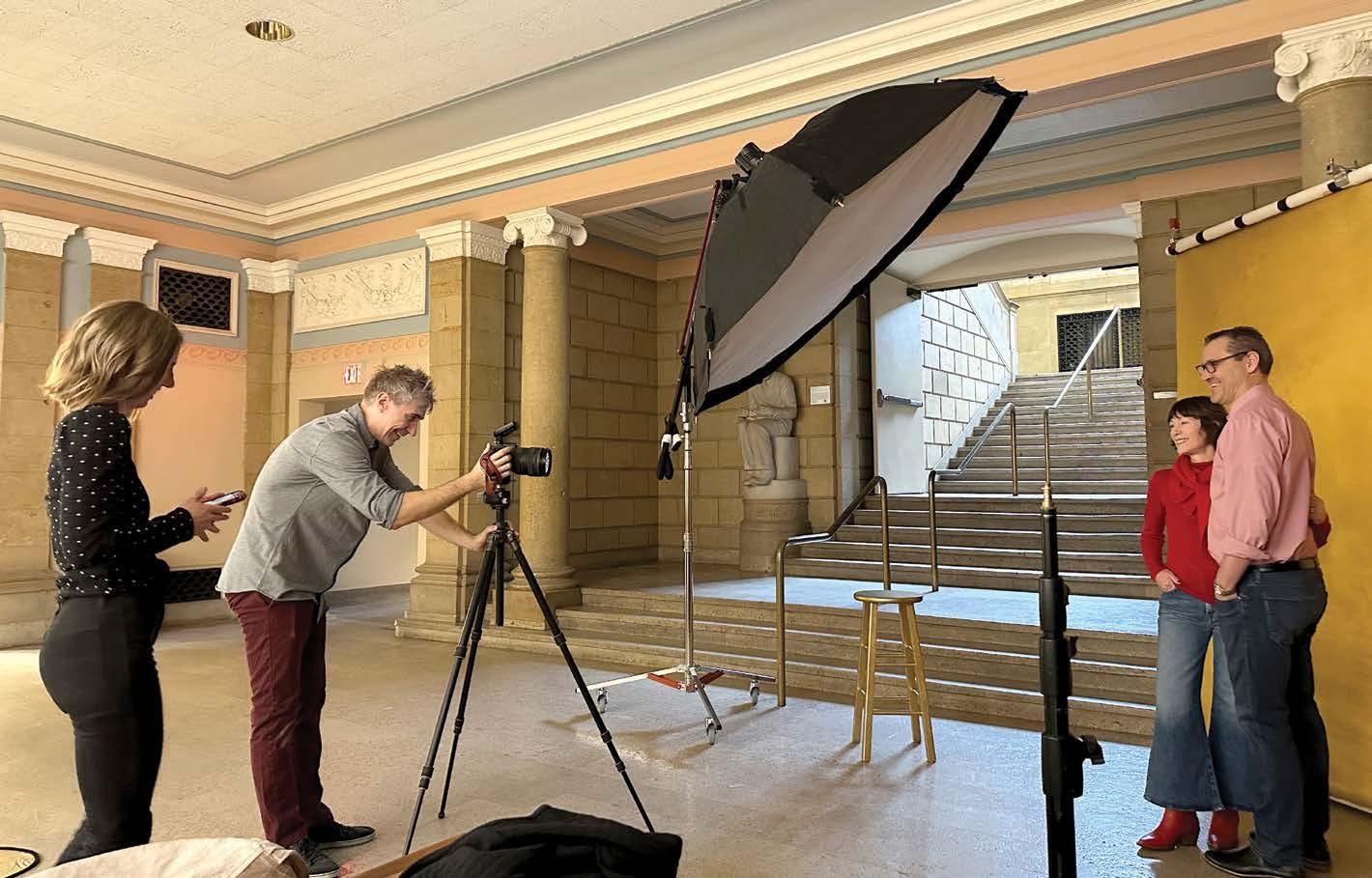
For our cover photoshoot
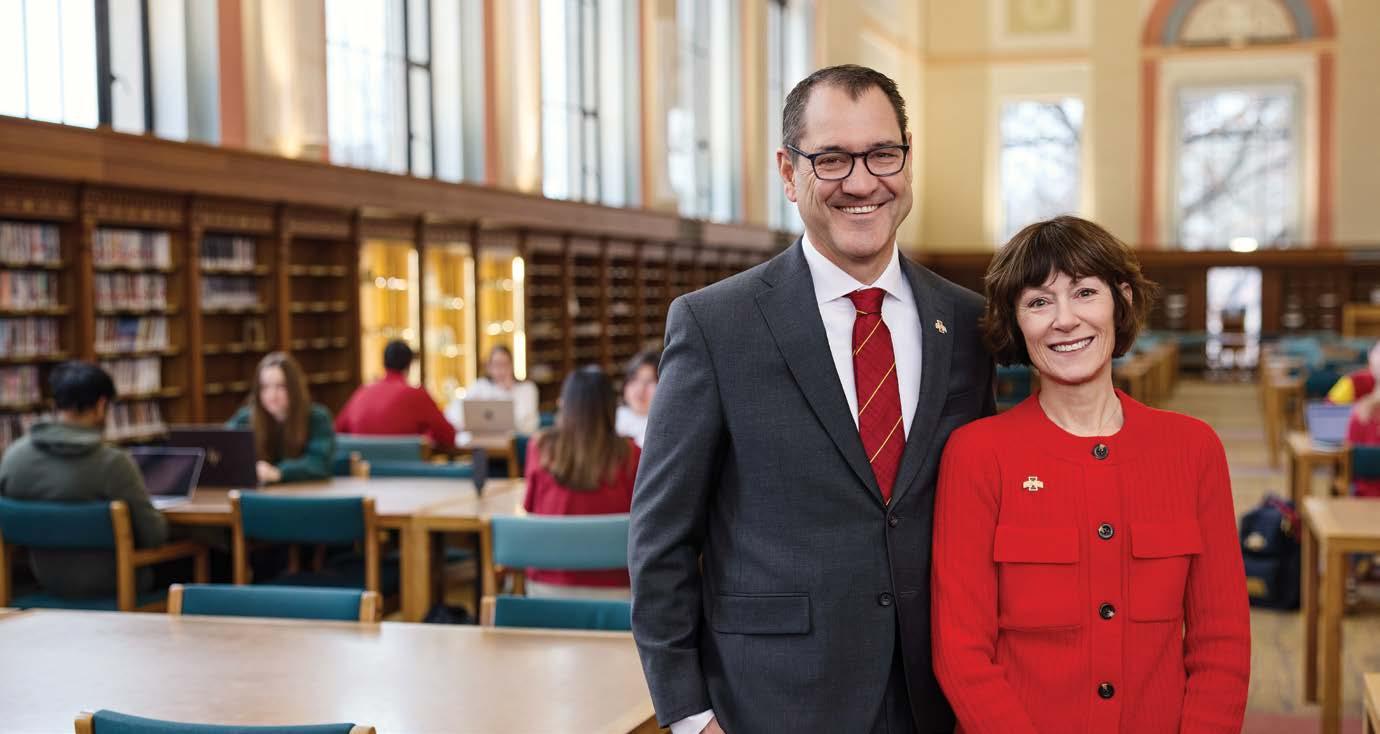
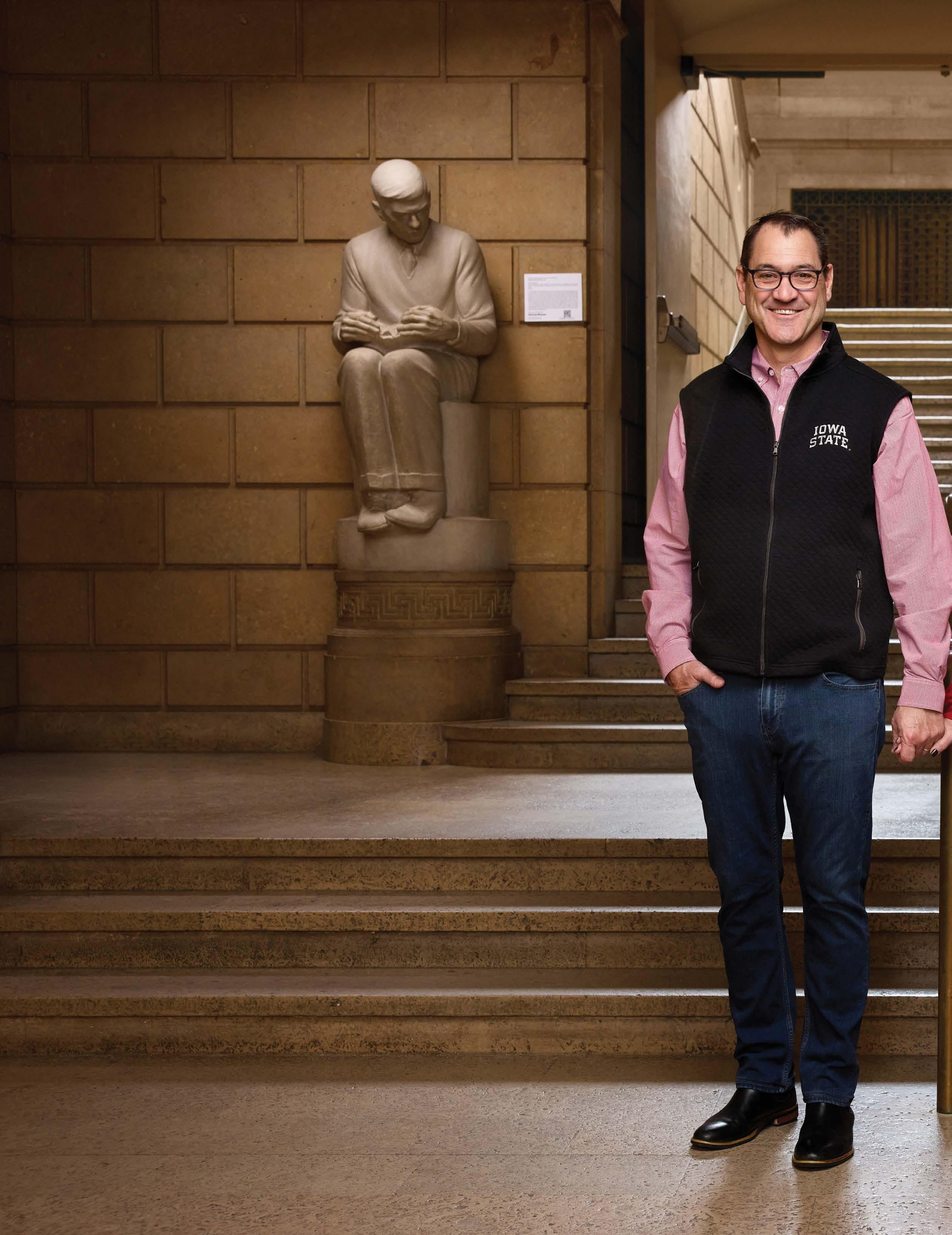
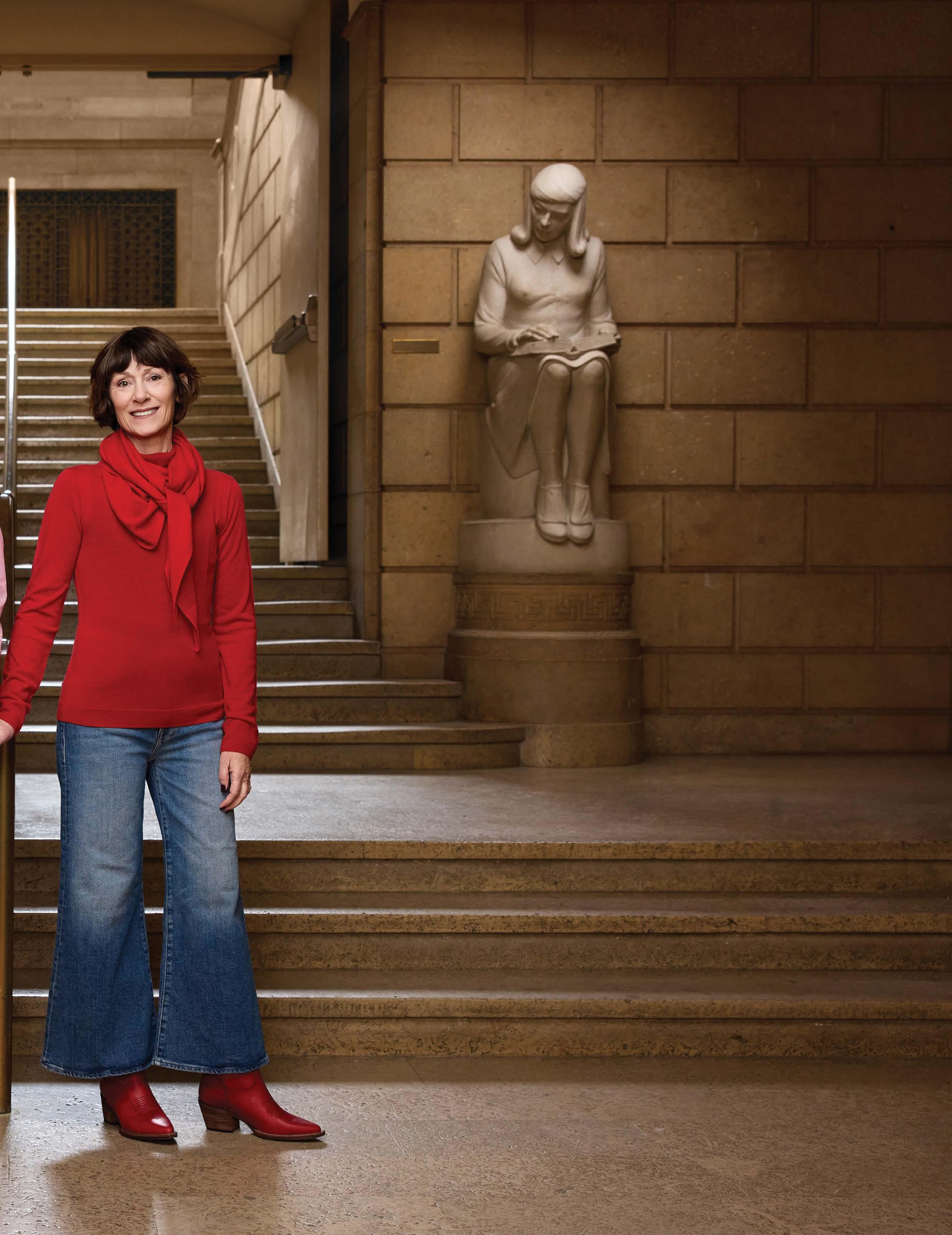
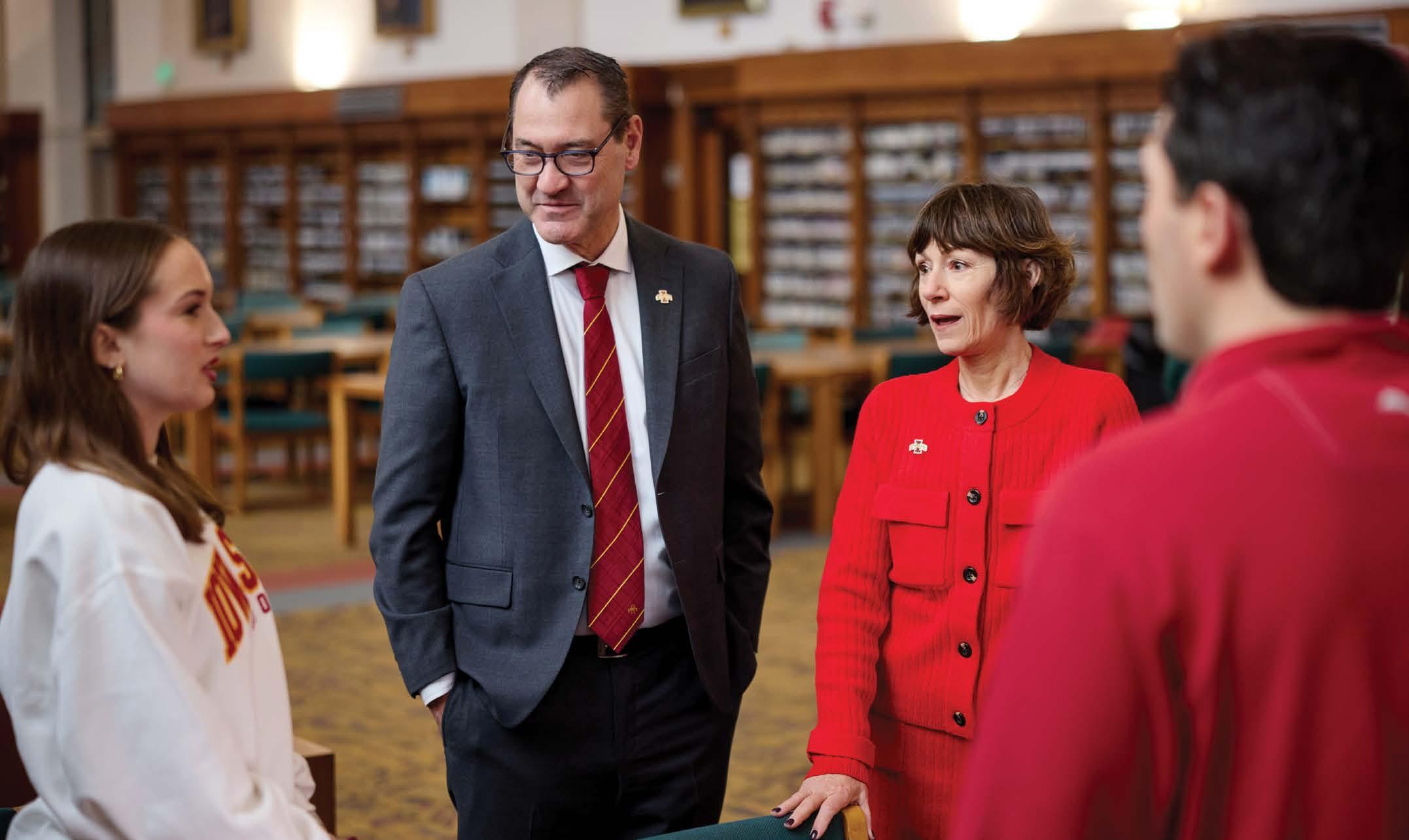
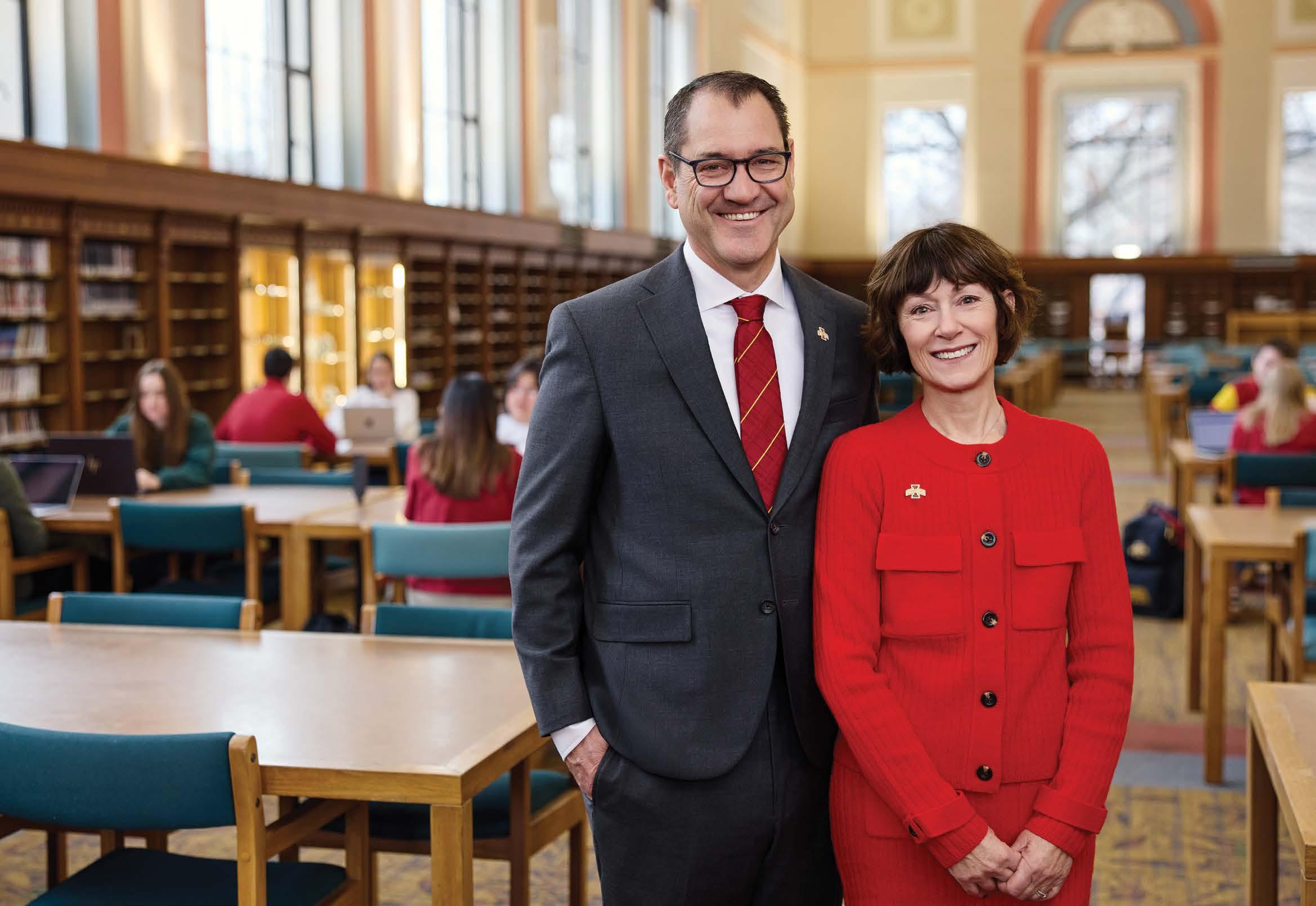
with President David Cook (’92) and First Lady Katie Cook (’94), we first gathered in the Parks Library reading room, or what many alumni likely remember as the periodical room. Names change, interests change, technologies change. Gone are the local newspapers and magazines, the shelves now filled with CDs and DVDs (which, yes, believe it or not, students still use and enjoy).
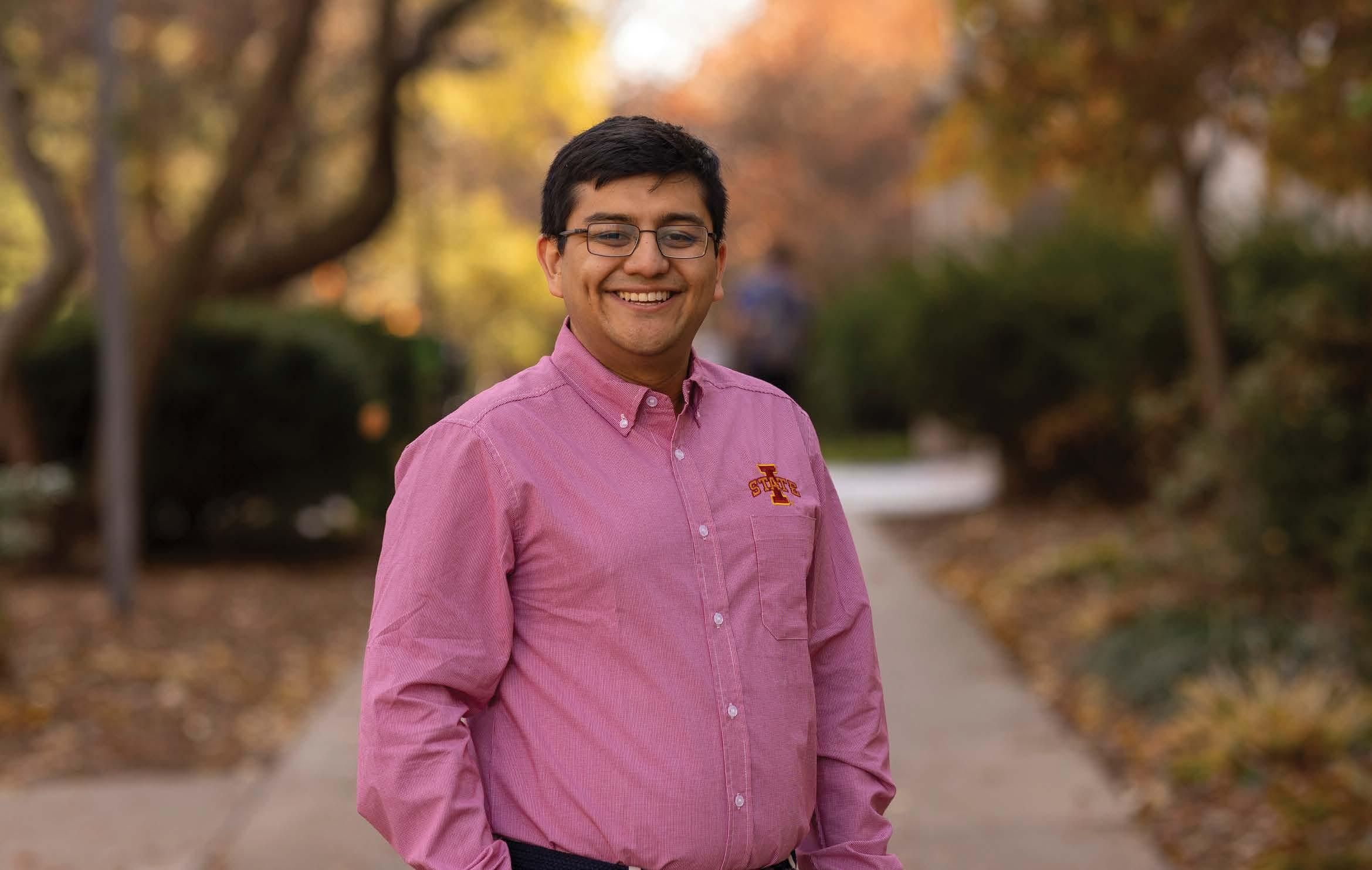
When Dan McClanahan (’08), the photographer behind this issue’s cover, was a student at Iowa State, he was pursuing a career in print journalism. But a pivot led him and his now-wife, Alex (’08), to open a photography studio.
“We met at ISU, so campus is a big part of why we love and stayed in Ames,” Alex says. “Staying connected to it through our lenses feels personal, especially when we get to revisit spaces that are nostalgic to us personally.”
Dan agrees: “My photographic journey started as a student here, so it feels very full-circle to get to use my skills on campus.”
There in Parks Library, a special moment began: One alumni couple returning to campus to photograph another alumni couple’s return home.
Dan recalled attending then-President Gregory Geoffroy’s leadership class, which President Cook will now lead.
Dan and Alex met in the Memorial Union at the end of their freshman years; the Cooks love to drop into the Memorial Union to chat with students. Campus may evolve, trends come and go, but the impact of the experiences had at Iowa State remains. In this issue, you’ll learn about upcoming renovations planned for Lake LaVerne (pg. 12), researchers working to advance humanoid robots (pg. 10), and the costume shop supervisor behind more than 200 ISU Theatre productions. And of course, you’ll learn more about David and Katie Cook’s journey as students and alumni that led them home to Iowa State.
Iowa Stater
Editor Kirsten Kraklio
Assistant Editor Caleb Grizzle
Designer Jenny Witte
Photographers
Dan McClanahan, Christopher Gannon, Matt Van Winkle, Ryan Riley, Grace Starr, Rachel Mummey
Creative Consultant
2communiqué
Editorial Board
Kirsten Kraklio, Director of Communications, University
Marketing and Communications
Brian Meyer, Associate Director for University Marketing and Communications, Iowa State University
Sherry Speikers, Director of Editorial Services, ISU Foundation
Postmaster: Send address changes to Iowa Stater, ISU Alumni Center, 429 Alumni Lane, Ames, IA 50011-1403
Iowa State University does not discriminate on the basis of race, color, age, ethnicity, religion, national origin, pregnancy, sexual orientation, genetic information, sex, marital status, disability, or status as a U.S. veteran. Inquiries can be directed to the Office of Equal Opportunity and Compliance, 3280 Beardshear Hall, 515-294-7612.
GET IN TOUCH WITH US!
ISU Alumni Association
ISU Alumni Center 429 Alumni Lane Ames, IA 50011-1403 iowastater@iastate.edu 1-877-ISU-ALUM (478-2586)
Alex and Dan McClanahan photograph Katie and David Cook in Parks Library.
Why did The Princeton Review rank us #9 for undergraduate entrepreneurship programs internationally for 2026?
• Our ISU Pappajohn Center for Entrepreneurship provides comprehensive entrepreneurial resources, from pitch competitions to mentorship.
• At the Pappajohn Center, we continually create hands-on programs, like CYstarters, CyBIZ Lab, Pitch and Smart Start Workshops, and more.
• With our innovative campuswide Start Something network, students in all majors can develop their entrepreneurial capacity.
We’re dedicated to preparing the next generation of talent with unlimited opportunities so they can hit the workforce sprinting. Learn more about our dedication to innovation and entrepreneurship. isupjcenter.org
• At our $84 million Student Innovation Center, students have access to a 146,000-square-foot innovation playground where they can create and collaborate in our state-of-the-art makerspaces.
LONG OVERDUE
“Chris Murray was the hockey coach when I played for Iowa State from 1965 to 1969. I think that this scholarship is long overdue. He was an unassuming gentleman who somehow got us to do things we did not know we could do. He was always there, from skating on Lake LaVerne to the hockey rink behind Beyer Hall to local ice on flooded tennis courts in Ames. Thank you to the ladies who got this scholarship rolling.”
JIM TAYLOR (’71, ’72)
TRIP OF A LIFETIME
“I was grabbed by your picture and account of ballooning over the Masai Mara. I did the same in 2022. While ours was not an ‘official’ ISU event, our safari was planned and led by emeritus professor Jim Pease (’92) and was truly a trip of a lifetime. Thanks for the memories.”
TERRY PROESCHOLDT, (’71, ’77, ’92, ’99)
WELL WISHES
“Those of us who have followed the career of our departing president, Dr. Wendy Wintersteen (’88), are not surprised at her dedication and success. I have known President Wintersteen since her first job as an extension specialist. One of Dr. Wintersteen’s early assignments was as state coordinator of restricted-use pesticide training. She approached the job, which some considered unpopular, with a passion to improve the training to be of value to all participants. She applied the same work ethic and skills in all her career, culminating as ISU president. We wish her well in her retirement.”
OBER J. ANDERSON (’58, ’64), RETIRED POLK COUNTY EXTENSION DIRECTOR
FOLLOW AND CONNECT WITH US: @ISUALUM
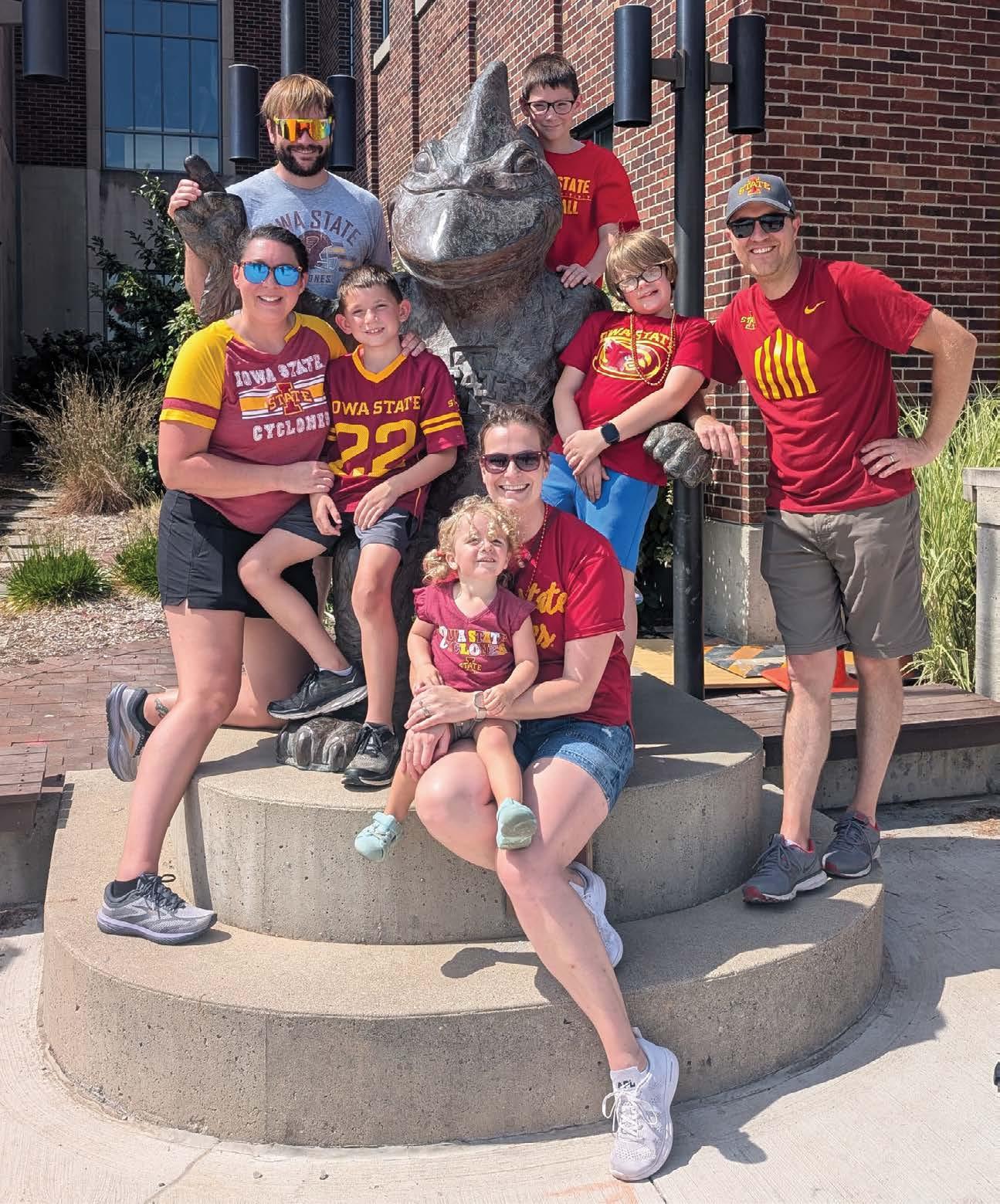
Nick Wilson (’09), Quinten Wilson, Everett Junge, Bryan Junge (’08), Kaylee Wilson (’09, ’11), Tristan Wilson, Charlotte Junge, and Kristina Junge (’08) show off their Cyclone spirit outside of
The Hub
Notes of Innovation
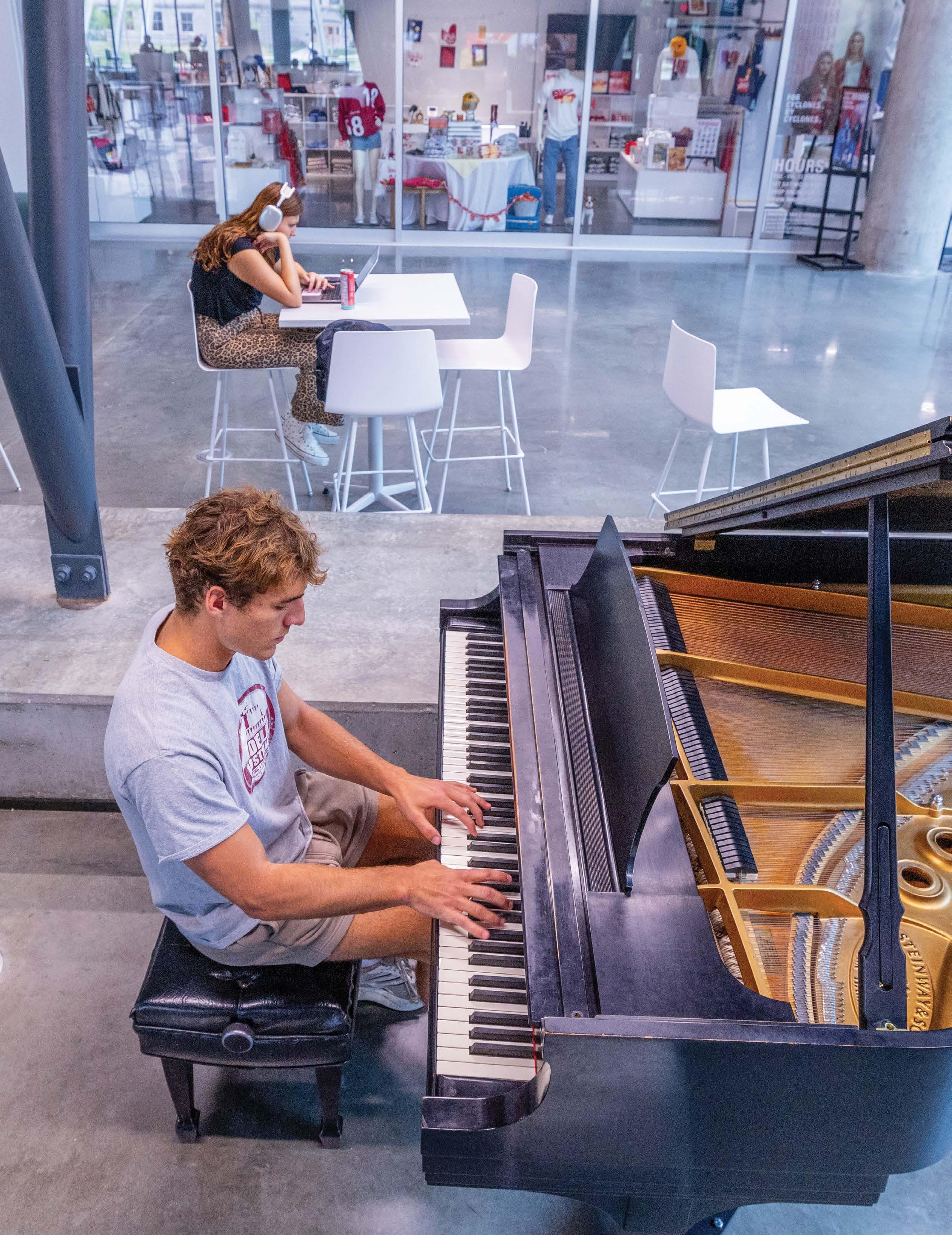
Kaden Schmidt, a junior studying aerospace engineering, plays the baby grand piano in the Student Innovation Center. The piano — believed to be one of the original Steinways purchased when Music Hall opened in 1980 — is on longterm loan from the Department of Music and Theatre for pianists of any caliber to play.
Image by Christopher Gannon
Iowa State University Launches Cidery
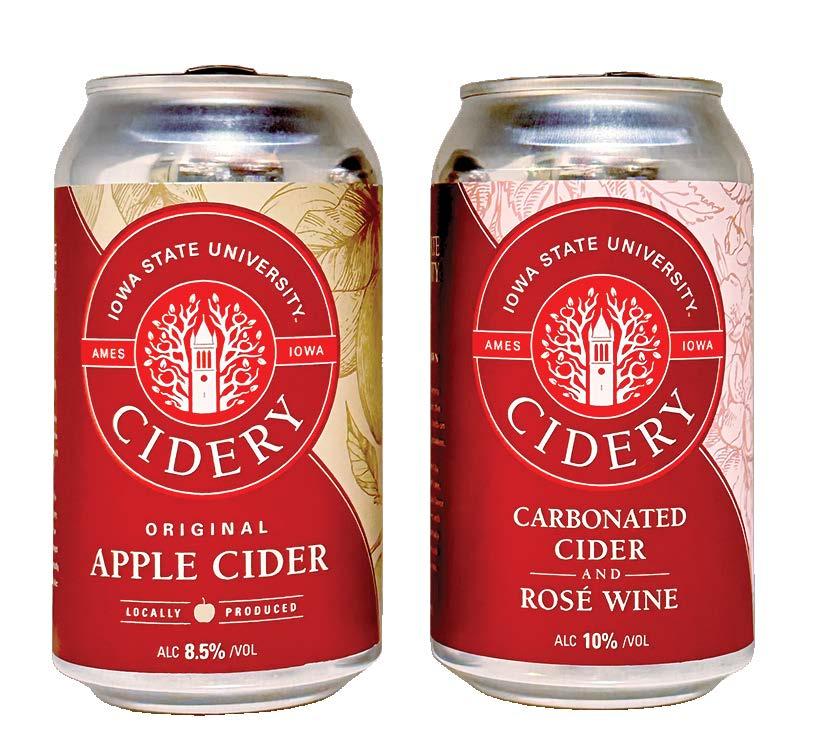
The Midwest Grape and Wine Industry Institute at Iowa State University has launched the Iowa State University Cidery. All fruit used to produce the ciders is grown locally at the Horticulture Research Station, reinforcing the program’s dedication to Iowa and value-added agriculture.
Student employees played an integral role in the creation, production, and marketing of the ciders.
Ella Janssen, a senior in graphic design, designed the Cidery’s labels and brand imagery, bringing the new beverages’ look to life.
ISU rank on The Princeton Review’s Top 50 Entrepreneurship Programs. It was the only university in Iowa to make the list.
PATRICK SCHNABLE ELECTED TO NATIONAL ACADEMY OF INVENTORS
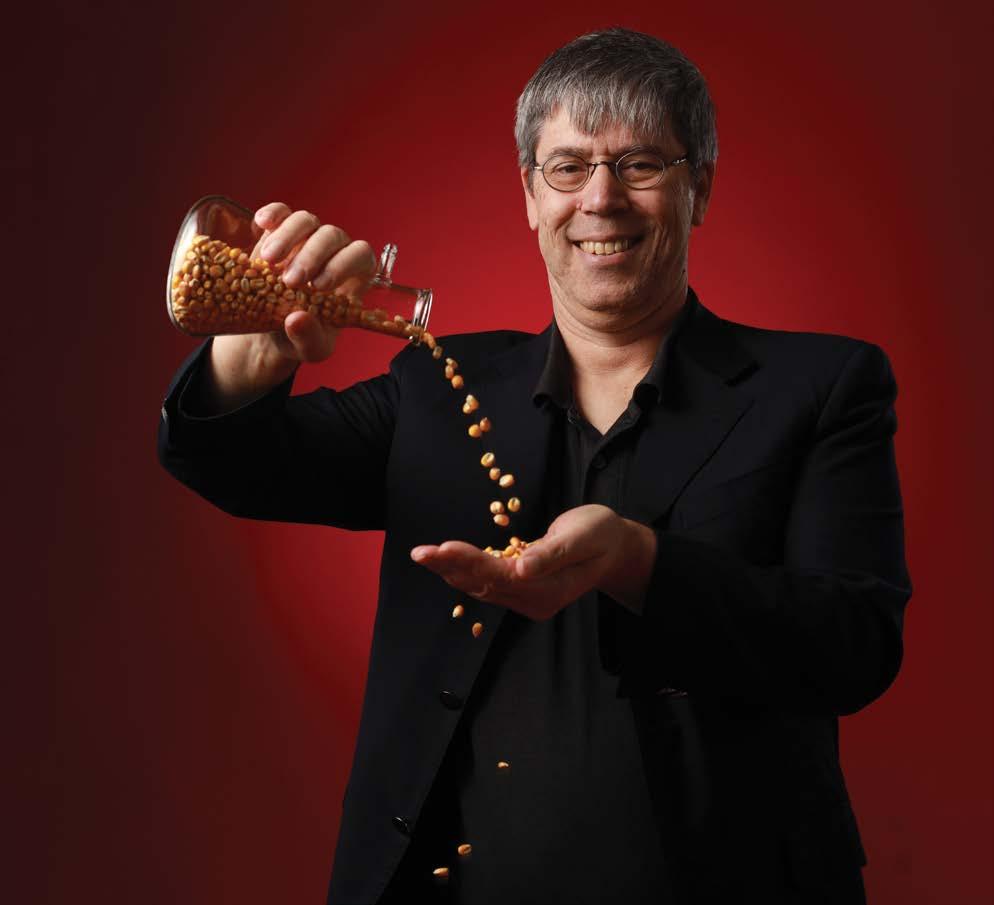
The National Academy has elected Iowa State University agronomy professor Patrick Schnable (’86) as one of its 2025 fellows.
With strong institutional backing and collaboration with colleagues from numerous fields outside of his expertise in the genetic control of corn traits, Schnable has founded five startups in his 37 years as an Iowa State faculty member and holds 17 U.S. utility patents and two plant variety protections.
Schnable joins a class of 185 new fellows in the National Academy of Inventors, the highest professional distinction awarded exclusively to inventors.
HEARD ...
The young men in our program deserve a lot of credit, a lot of praise, and a lot of respect for what they do every single day and how they work. ... When everybody asks the question sarcastically ‘Does academics still matter?’ Yes, it matters — it is extremely important. The families in our program know that. The players in our program know that. And they understand that is every bit as important as anything we do beyond that.”
— T.J.
Research Park Receives National Recognition as Community of Innovation
Iowa State University’s 550-acre research park — home to 144 companies and 2,500 employees — has earned national recognition. Last fall, the Association of University Research Parks named Iowa State’s Research Park its Distinguished Community of Innovation of the Year.
The award recognizes ecosystems that are driving the journey of research translations from concept to market and creating measurable impact.
“We are honored to receive this recognition for our success as a national model for university-affiliated innovation,” says Rick Sanders, ISU Research Park president. “The Iowa State University Research Park strives every day to connect innovative companies to the resources available at Iowa State University as we work to make Iowa and the world a better place.”
‘A Piece of Home on the Other Side of the World’
SOPHIE CHEN (’95) NEVER IMAGINED IOWA STATE would be part of her story.
Originally from Malaysia, she was studying hospitality in Switzerland and met an Iowa State professor. That connection led her to Ames on a snowy night in the early 1990s.
“Dr. James Huss picked me up at the
airport. On our drive, I saw miles of white stuff and thought, ‘What did I get myself into?’” laughs Chen.
From sharing a room for the first time in Helser Hall to walks across campus for her 8 a.m. food science class in MacKay, Chen adjusted to life in the United States.
“Being at Iowa State and immersing myself in a culture where people speak their mind and express themselves helped me throughout my career,” Chen says.
Chen worked in leadership roles for some of the global hospitality industry’s largest corporations; it’s there that she found a passion for helping others develop their potential. When a move took her to Singapore, she decided to start her own business as a leadership and executive coach for women.
While Chen was busy growing her business, Maya Manal France was in high school 25 miles from Ames, with no plans to attend Iowa State. It was too close to home.
“I didn’t choose Iowa State, it kind of chose me,” says France, currently a junior studying data science. “I was offered a George Washington Carver scholarship, and it’s a great school for STEM. So, I said yes, and it’s been one of the best decisions I’ve made.”
Determined to see the world and aspiring to run her own business in the future, France explored Iowa State’s opportunities, including study abroad, which took her to Singapore, and the College of Liberal Arts and Sciences Start Something Academy, which paired her with Chen as her mentor.
“Having Sophie there gave me a sense of grounding and it felt like I had a piece of home on the other side of the world,” France says.
Their connection was instant. Over shared meals and late-night texts, their conversations covered school, business, and the big topics of life.
“It became more than a mentorship; she truly became like an aunt to me,” says France. “She opened my eyes to what a global career can look like.”
For Chen, the experience was just as meaningful, especially since she hasn’t been back to Ames since graduation.
“Being Maya’s mentor brought back so many memories,” she says. “I loved how it connected me back to ISU.”
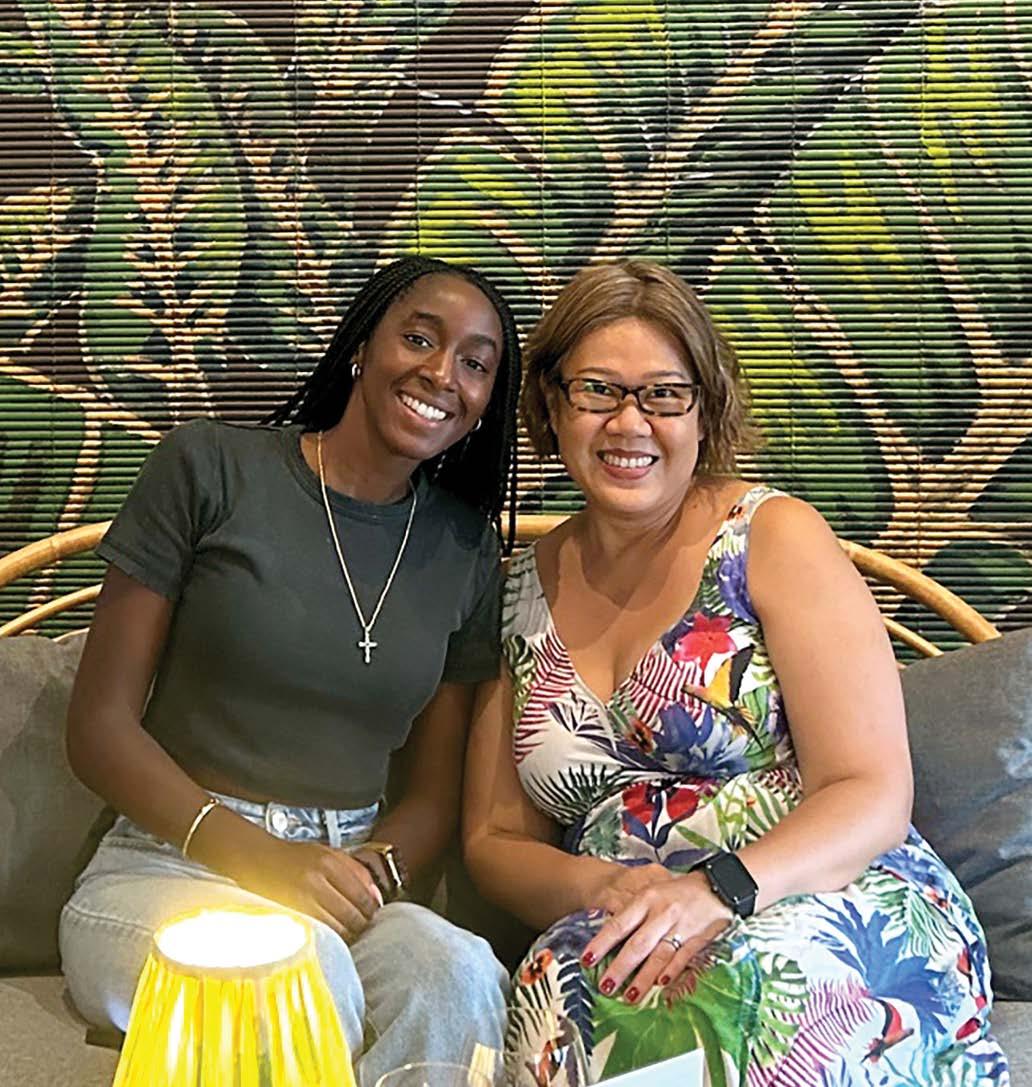
Maya Manal France, left, and Sophie Chen, right, met through an ISU mentorship program.
Capturing Carbon With Corn
THERE ARE HUNDREDS OF THOUSANDS of abandoned oil and gas wells in the United States. These underground shafts are inches wide and miles deep and need to be filled and capped to limit greenhouse gas emissions and safety risks.
Plugging spent crude oil wells with a bio-oil made from plant-based leftovers like corn stalks and forest debris could be a possible solution with a two-birds-one-stone appeal, based on research led by Iowa State mechanical engineering professor Mark Mba-Wright.
“On the one hand, you have these underutilized waste products. On the other hand, you have abandoned oil wells that need to be plugged. It’s an abundant resource meeting an urgent demand,” Mba-Wright says.
The core of the proposed system is fast pyrolysis, a process of transforming dried particles of biological material into liquid bio-oil by exposing them in an oxygen-free environment to a few
seconds of intense heat exceeding 1,000 degrees Fahrenheit. Various uses for bio-oil have been identified, and more are being studied. It’s a research focus at Iowa State’s Bioeconomy Institute, where Mba-Wright is an associate director.
The plant matter used to make bio-oil holds carbon pulled from the air as carbon dioxide. So injecting carbon-rich bio-oil into underground shafts acts as a form of sequestration, permanently removing its carbon from the atmosphere.
Based on research by Mba-Wright’s team, a network of 200 mobile biooil production facilities across the U.S. could be an economically and technically feasible expansion of the technology, which is already in limited commercial use. In a recent study, they estimated that the proposed system of small bio-oil units could sequester carbon dioxide for about $152 per ton. That would make bio-oil sequestration competitive
with the dominant method of removing atmospheric carbon, direct air capture, with less upfront investment.
“One of the innovations here is that you can do carbon capture with units the size of a skid loader or a combine. You can start small,” Mba-Wright says. “We’re trying to show carbon removal doesn’t need to be either/or. There are a lot of opportunities.”
In the system envisioned in Mba-Wright’s analysis, each mobile fast pyrolysis unit would process about 10 tons of feedstock a day. In the Midwest, the main biomass source studied was corn stover, the portion of the plant left in the field after harvest. That could generate a new revenue stream in rural farming communities, an associated benefit that direct air capture doesn’t offer.
“Bio-oil from Midwestern farmlands is a win-win strategy for farmers and energy companies to meet society’s growing demand for clean energy solutions,” he says.
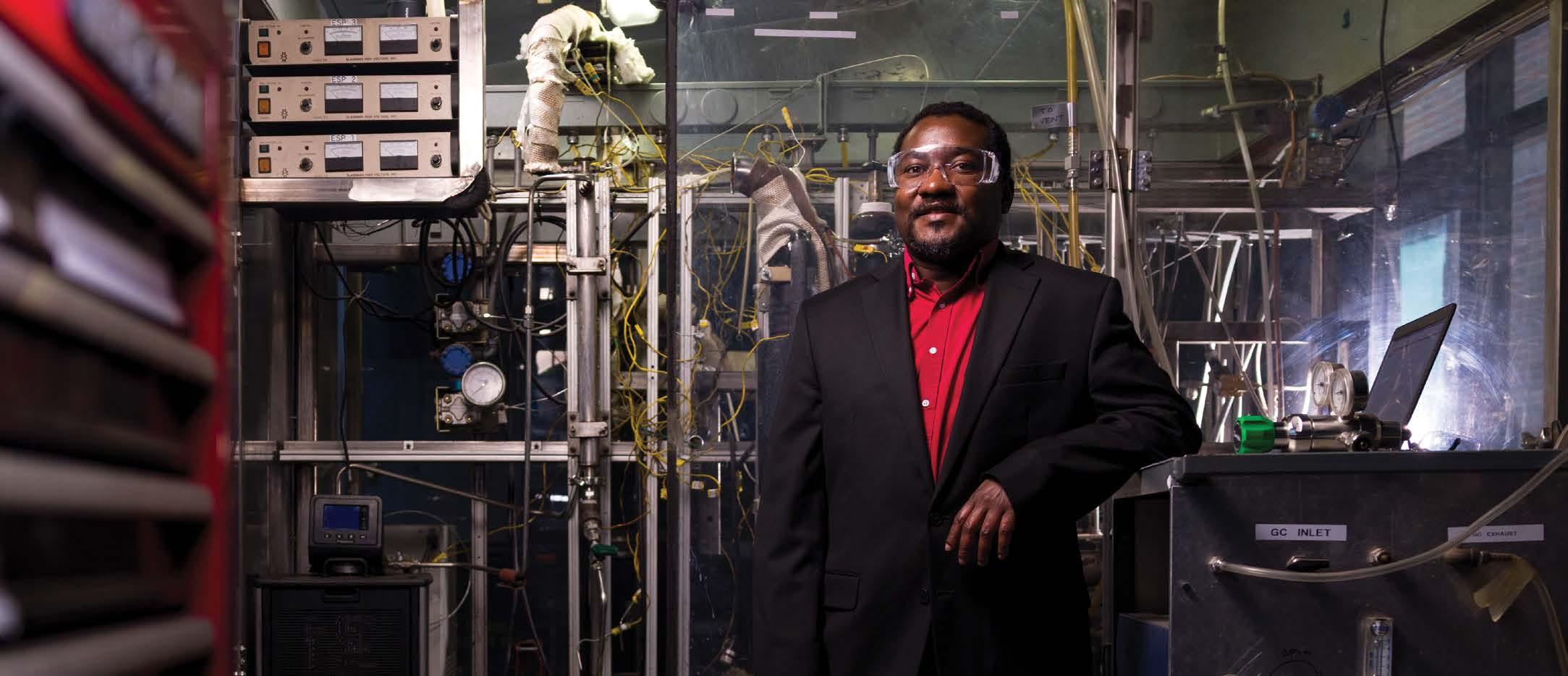
Mark Mba-Wright’s research shows that plugging spent crude oil wells with a bio-oil made from plant-based leftovers like corn stalks and forest debris could be a possible solution to the hundreds of thousands of underground shafts that need to be filled to limit greenhouse gas emissions and safety risks.
INNOVATION
Real Experiments, Real Robots, Real Data
ISU LAB USES HUMAN-LED, HANDS-ON RESEARCH TO ADVANCE HUMANOID
AT THE END OF A WINDING BACK HALLWAY on the first floor of Atanasoff Hall, an unassuming, locked door leads to a space filled with cutting-edge possibilities: the ISU computer science robotics lab.
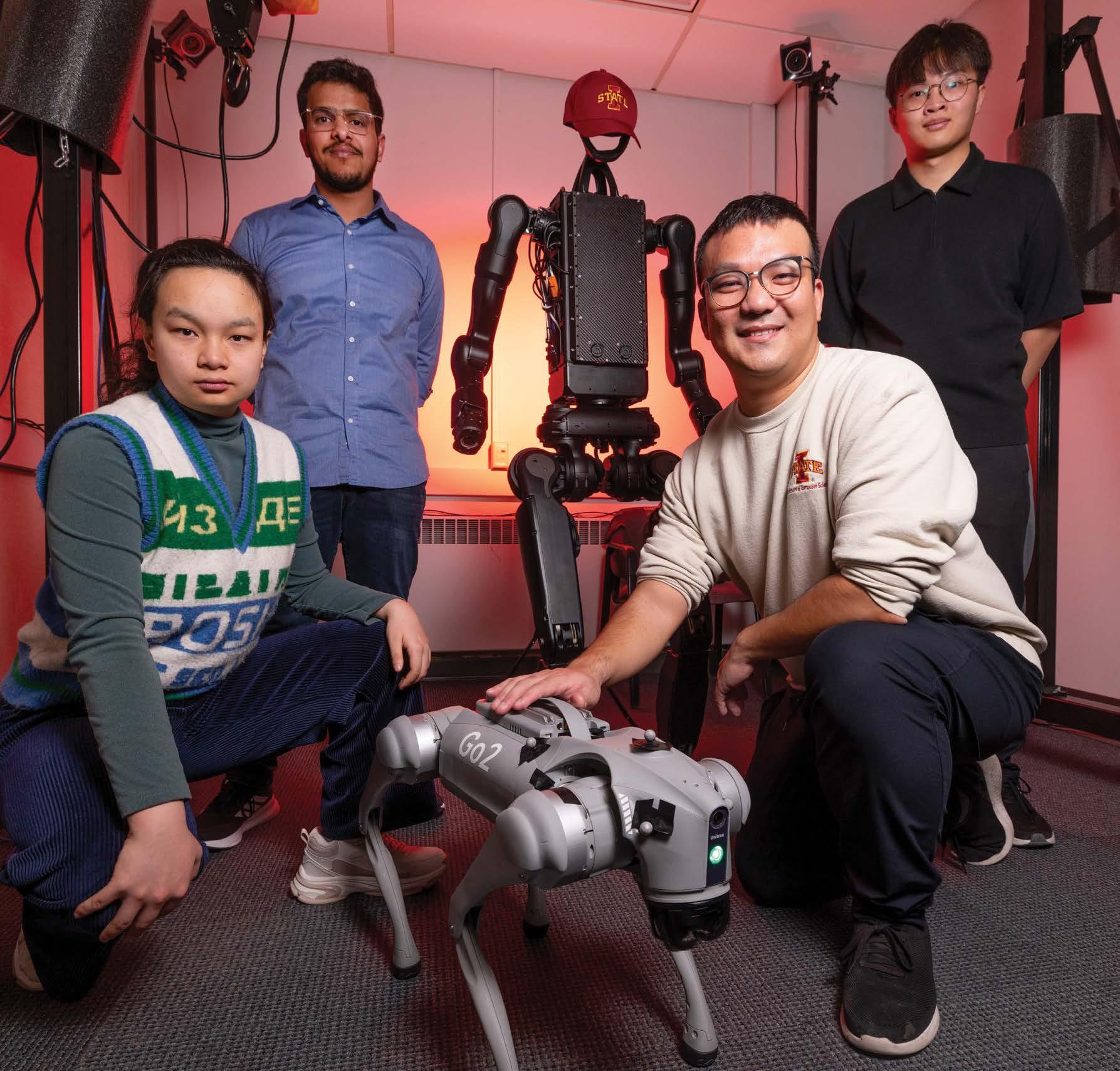
The lab is currently home to two highly advanced legged humanoid robots. One stands about the height of an average adult while the other is roughly as tall as a typical 10-year-old. A quadruped robot with dog-like attributes sits obediently nearby.
This is where Bowen Weng, roboticist and assistant professor of computer science at Iowa State University, and a group of graduate student researchers are working to safely advance the physical capabilities of robots.
ROBOTS BY LISA SCHMITZ
“As humans, we often take our physical intelligence for granted because it becomes so automatic when we’re still young,” Weng says. “But the truth is, it’s remarkable.”
Human coordination and motor skills develop throughout early childhood, and it doesn’t take long for these abilities — also known as physical intelligence — to become second nature for most people, including deceptively complex actions such as walking, grasping objects, and navigating our way across a room.
“Once humans master a skill, the physical intelligence needed to perform that skill becomes a background process, and our minds are freed up to focus on other tasks,” Weng says.
Humanoid robots are designed with a body shape that resembles the human form and are built to interact with human environments and tools, setting them apart from other robots. However, tasks that are largely intuitive in humans are notoriously difficult to replicate in machines.
“Humanoid robots struggle with physical intelligence because it requires adapting to unpredictable environments, integrating sensory feedback in real time, and mastering complex motor skills,” Weng says.
In the lab, Weng and team use computer software and hand-held controllers to take the humanoid robots through commands to stand up from a lying position, sit down, walk, turn
around, wave their arms, and shake hands. Their research is focused on enhancing test algorithms for specific capabilities that can one day be used for humanoid robots and support their safe interaction with humans.
“Mobile robots that feature limbed structures — particularly legs — are becoming increasingly relevant because of how versatile and adaptable they can be across many different environments and applications,” Weng says.
Legged robotic systems have shown significant promise in a variety of areas, he adds, from assisting with repetitive assembly and heavy lifting in manufacturing to providing enhanced mobility solutions in health care, navigating rubble during dangerous
search and rescue missions, and entering hazardous environments that are unsafe for humans.
Zaid Mahboob, a doctoral student in computer science who is working with Weng, says the goal is to create collaboration, not competition, between humans and humanoid robots.
“We want to help improve the precision, accuracy, and speed of the robots so they can safely and effectively collaborate with humans,” Mahboob says.
Yuija Chen, a doctoral student in computer science, says the opportunity to conduct research using real robots was an important part of her decision to come to Iowa State.
“Most of the robotics labs are just
interested in simulation and that kind of thing, but in [the Iowa State] lab, we are conducting real experiments using real robots to get real data,” Chen says.
Weng says humanoid robots still face hurdles to widespread adoption, including high development and unit costs, infrastructure gaps and limited use cases, and social and ethical challenges. These barriers make ongoing research to improve the safety and efficacy of robots even more important.
“The bottom line is, you have to be able to trust it,” Weng says, “and the path to proving the trustworthiness of humanoid robots is through human-led research.”
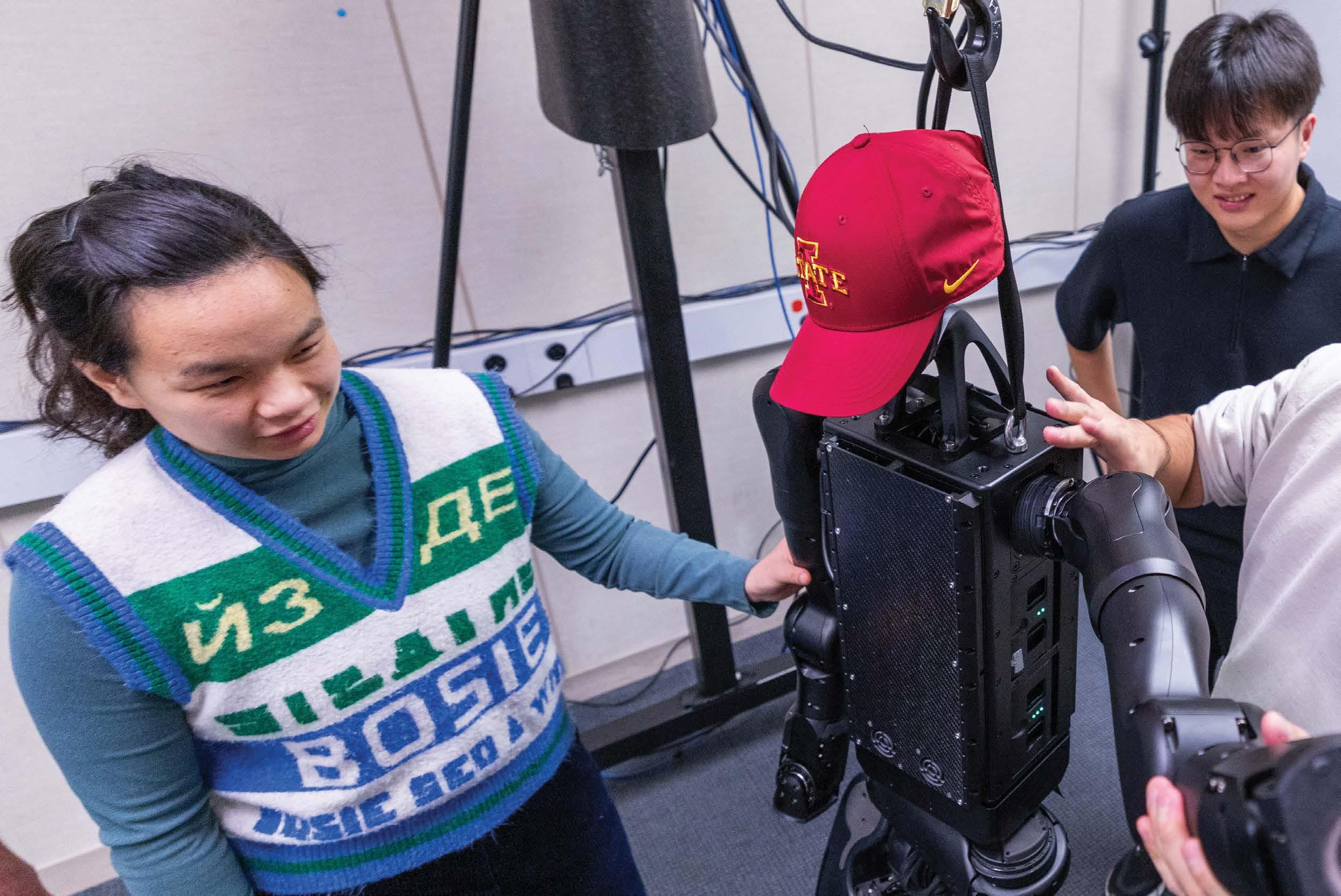
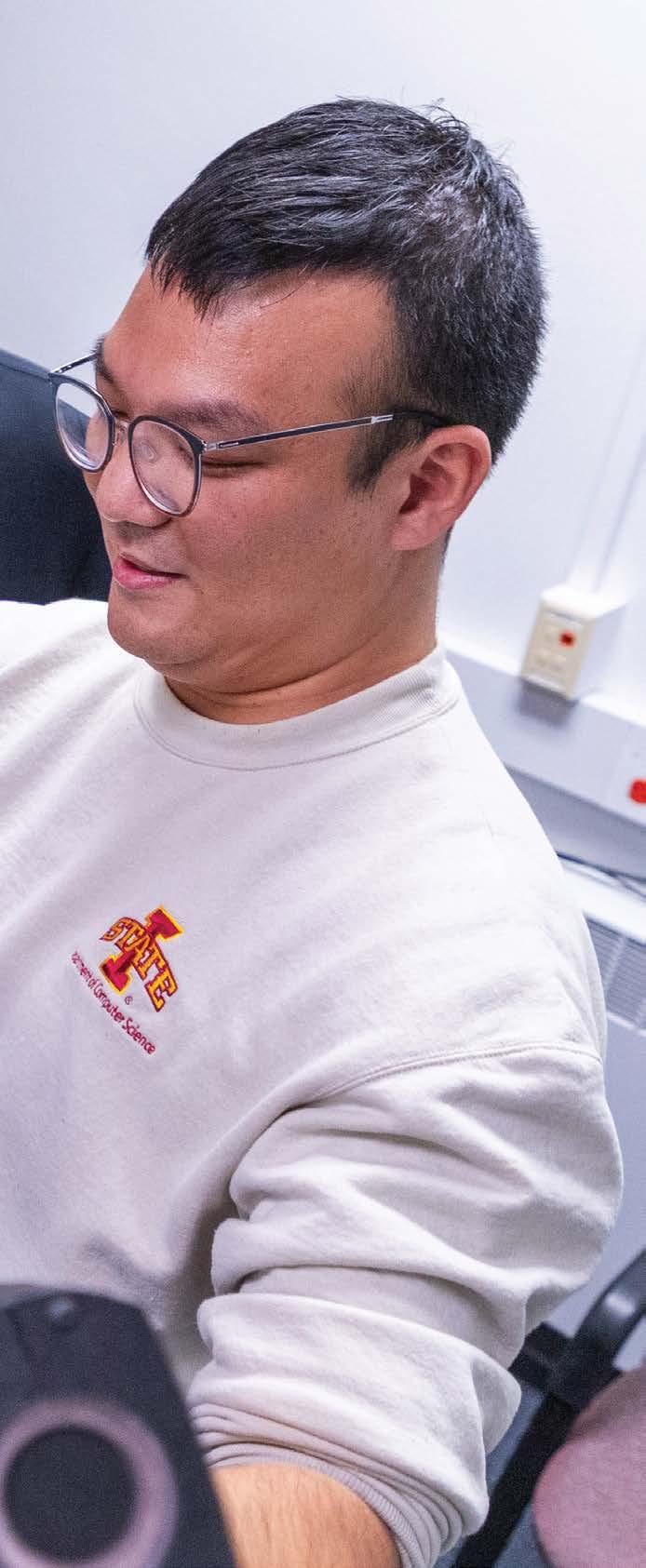
LEFT: Roboticist and assistant professor of computer science Bowen Weng, right, and graduate student researchers Yuija Chen, left, and Dylan Khor, center, lead a humanoid robot through a series of commands. ABOVE: Graduate student researchers Yuija Chen, Zaid Mahboob and Dylan Khor, and roboticist and assistant professor of computer science Bowen Weng are working to help advance the physical capabilities of robots while developing safety standards to support safe human-robot interaction.
A Show of Love, Again
TRADITION SAYS IF YOU WALK THREE TIMES AROUND LAKE LAVERNE with your beloved, the two of you are destined to be together. Fittingly, the lake itself was born from a love story: LaVerne Noyes, a member of the first graduating class of 1872, gifted the lake as a show of devotion to his alma mater.
After graduation, Noyes invented a series of farm implements before establishing the Aermotor Windmill Company in Chicago. When the business became a global success, he wanted to give back to the school that gave him his start.
In 1914, Noyes helped develop a vision to beautify the south end of campus. With a substantial donation, he hired Chicago landscape architect O.C. Simonds, who designed a lake in what was then a marsh area fed by College Creek, creating a park-like setting and a grand southern entrance to the college. The lake was dedicated in 1916, when the official name of Lake LaVerne was also adopted.
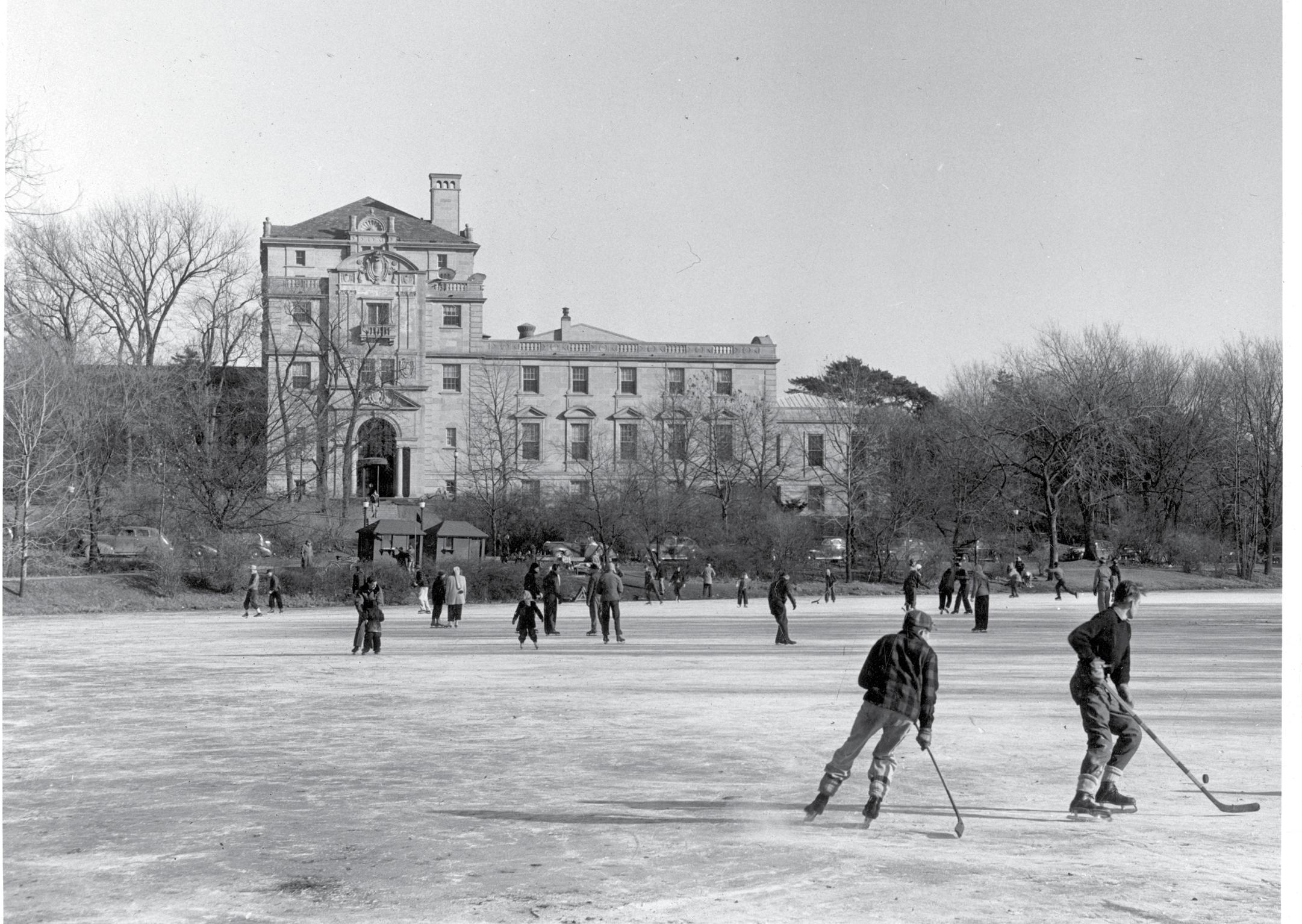
While some seek out the spot for romance or solace, it’s also been a place for entertainment. In the 1930s, the lake sported a regulation-size hockey rink. It was also home to the popular canoe-racing tradition during VEISHEA; at the 1935 event, a swan-shaped float opened to reveal its passengers: four swans, two of whom would be named Lancelot and Elaine. The lake hosted generations of swan pairs until 2022, when heavy algae growth made it unsuitable for replacing the retiring pair.
The 110th anniversary of the dedication of Lake LaVerne in 2026 marks the perfect time to show it some love once again. Following results of a survey, plans have been made to drain and dredge Lake LaVerne this summer, reshape and stabilize the shoreline, and create space for more seating. The restoration promises to return the beloved lake to the token of affection Noyes intended, making it swoon-worthy — and swan-worthy — once more.
ISU PLANS RESTORATION EFFORTS AS LAKE LAVERNE CELEBRATES 110 YEARS SINCE ITS DEDICATION BY BETSY HICKOK TRADITION
One Full-Ride MBA Scholarship. Endless Possibilities.
We are thrilled to introduce the Emerging Leader MBA Scholarship — a full-ride for one outstanding candidate joining our online MBA program in fall 2026. This includes tuition and fees.
Why Choose Iowa State University?
• Ultimate Flexibility: Designed for ambitious professionals on the move.
• World-Class Faculty: Taught by the same experts who teach the #1 fulltime MBA in Iowa.
• Tailored Specializations: Customize your path to fit your goals.
This scholarship is about empowering visionary leaders, strengthening Iowa’s talent pipeline, and shaping a more competitive business landscape for tomorrow.
Don’t miss this opportunity. Apply by May 15.
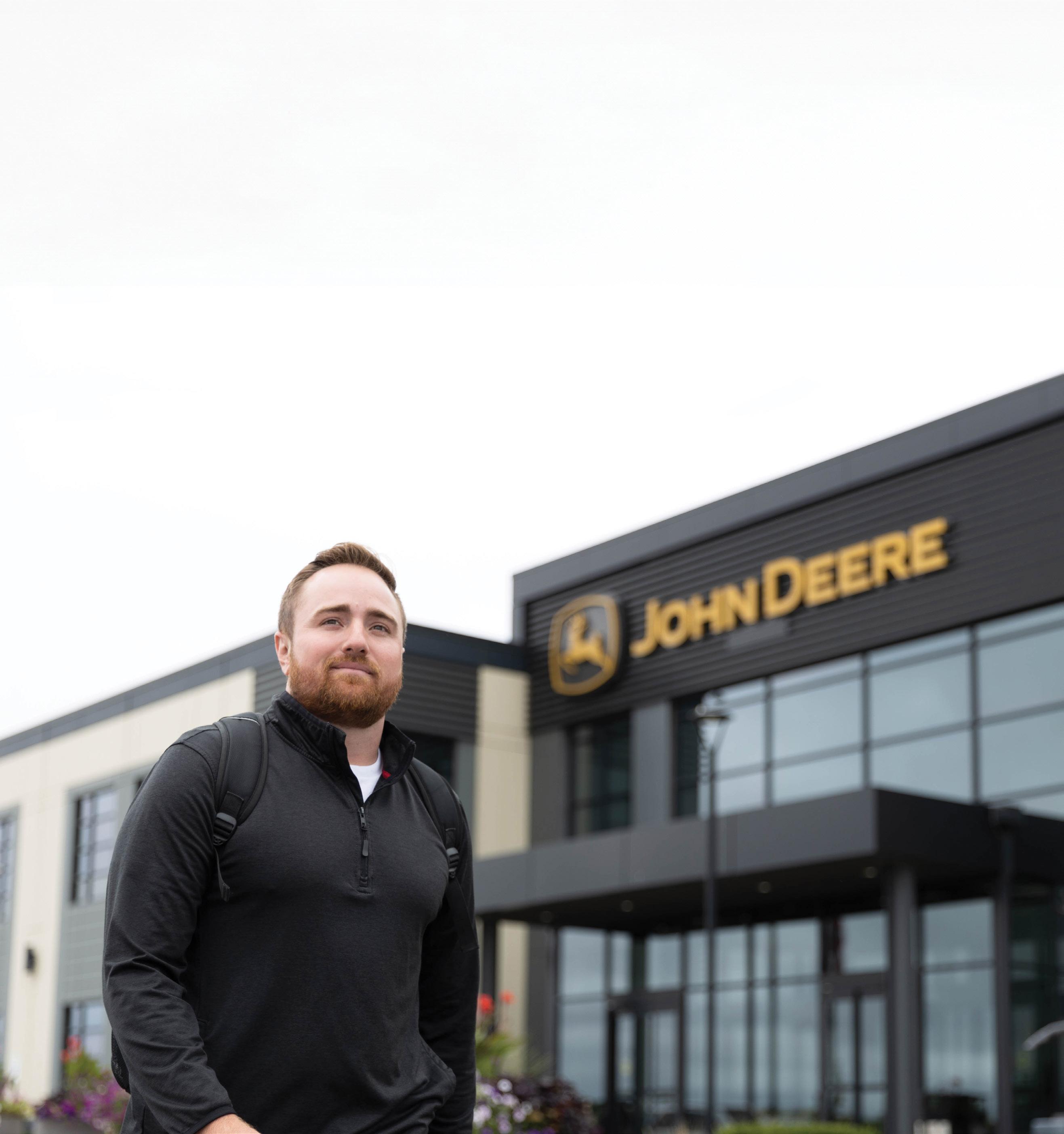
“It’s one of the best decisions I’ve made.”
Zachary Stuart (‘17 supply chain management; ‘24 PMBA) Program Manager, John Deere
CYCLONE SWEEP
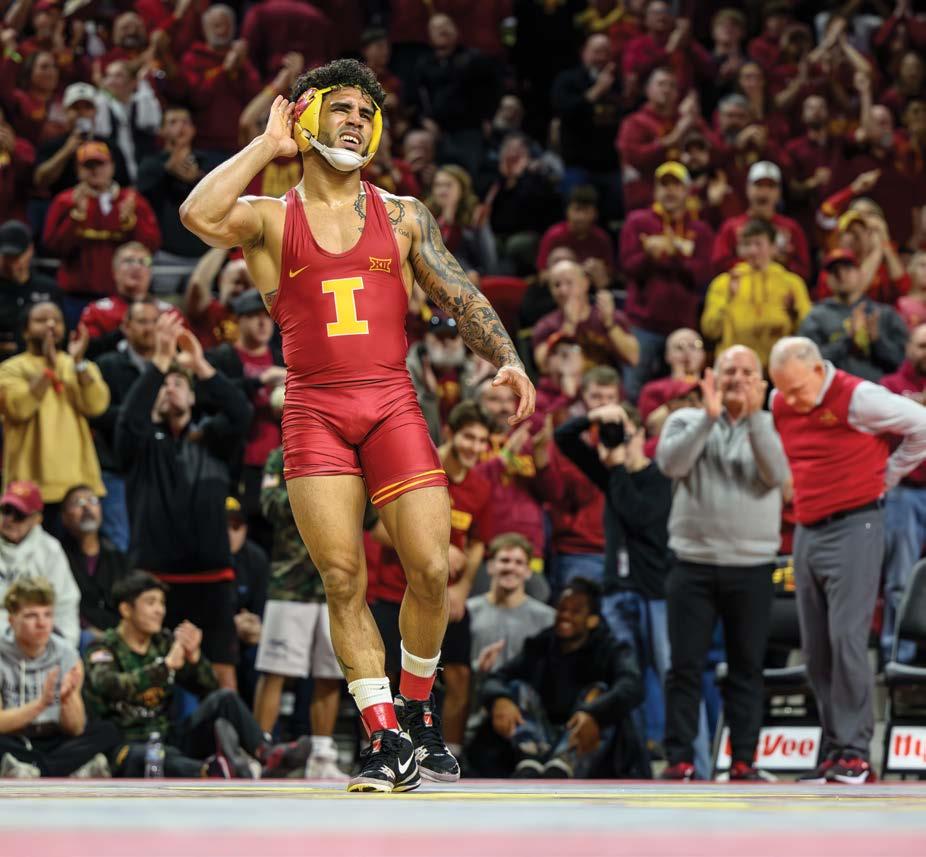
FOR THE FIRST TIME EVER in one academic year, Iowa State defeated the University of Iowa in football, wrestling, and men’s and women’s basketball. These Cy-Hawk victories helped secure the fourth Cy-Hawk Series win for Iowa State in the past five years.
Second-Year Success
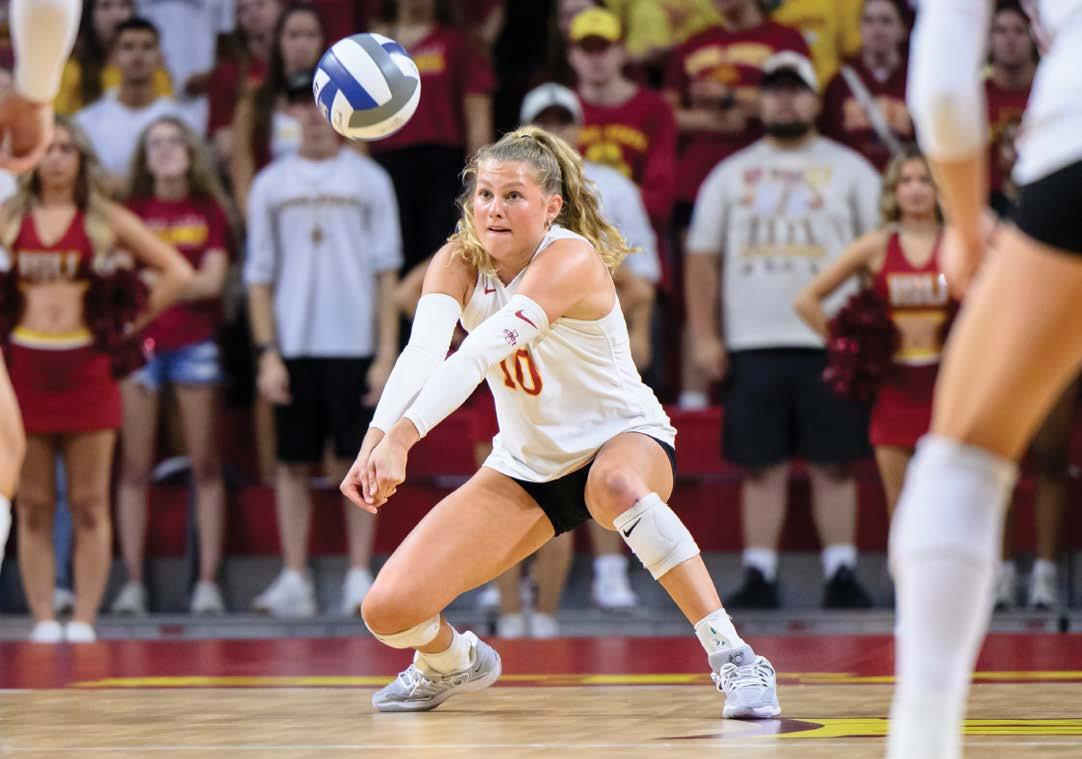
CYCLONE VOLLEYBALL SOPHOMORE RACHEL VAN GORP followed up her promising freshman campaign with a standout 2025 season. Van Gorp was named American Volleyball Coaches Association (AVCA) Libero of the Year. Van Gorp’s lengthy list of 2025 accolades also include AVCA Second Team All-America, AVCA First Team All-Region, Big 12 Libero of the Year, and First Team All-Big 12 honors.
NEW FACES
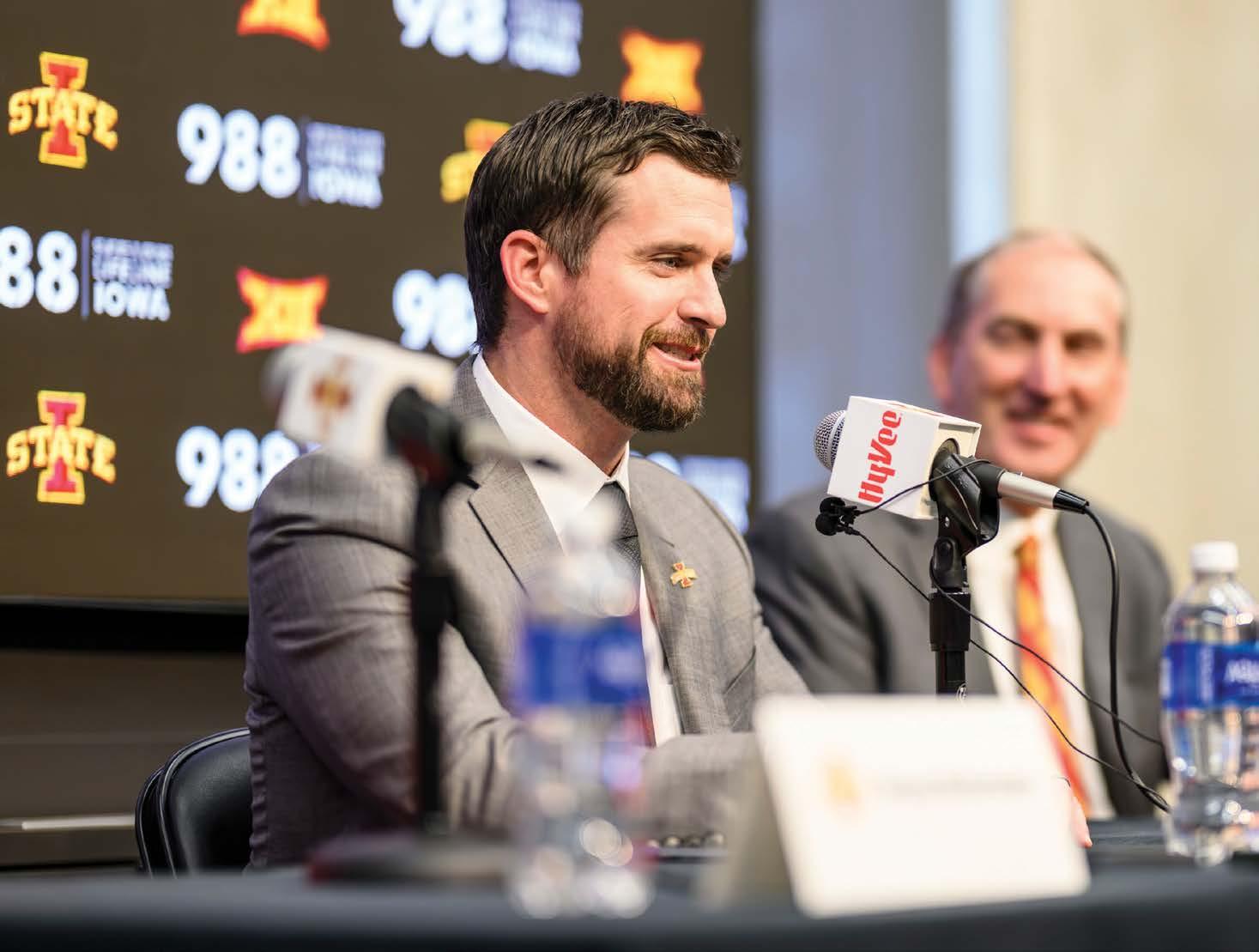
THE SIDELINES AT JACK TRICE STADIUM will look different this year with new Iowa State football head coach Jimmy Rogers at the helm, but the new staff and roster Rogers has built have their sights set on continued Cyclone success. “From the administration to the alumni and current studentathletes, this university has everything needed to compete at the highest level in college football,” Rogers says.
Jimmy Rogers and Jamie Pollard
Anthony Echemendia
Rachel Van Gorp
COMPETITOR
Remembering Her Roots
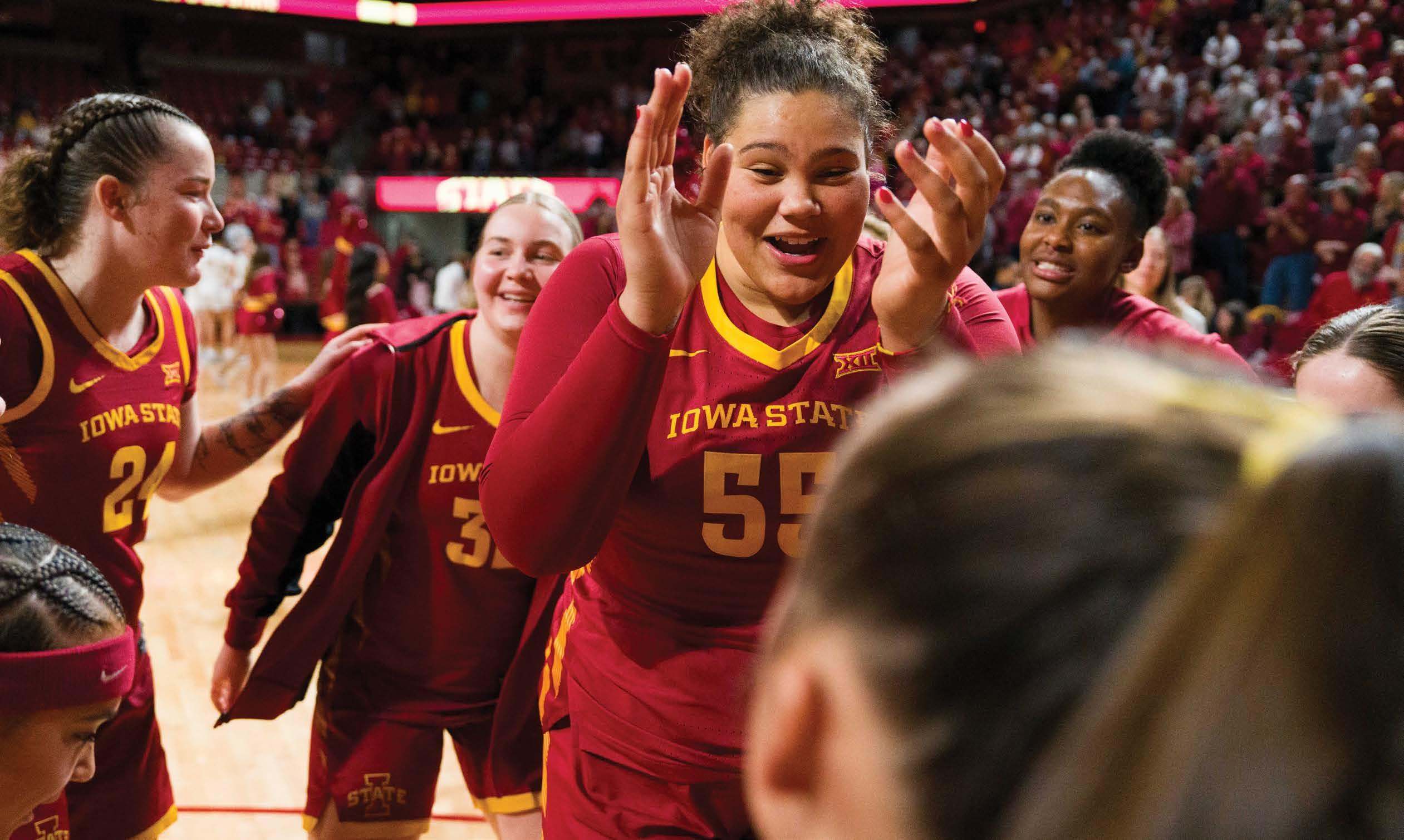
AUDI CROOKS IS GIVING BACK TO HER COMMUNITY
ON A SUNNY FOOTBALL SATURDAY LAST FALL, a few young Cyclone entrepreneurs were in for a star-studded surprise: Audi Crooks stopped to say hello, and then purchased their entire inventory of homemade bracelets. Later that day, Crooks and her teammates were spotted handing out the bracelets to other kids at the game.
“Audi is establishing herself as one of the best players in the country,” says head coach Bill Fennelly. “All while leading our team the Iowa State Way.”
The Iowa State Way — the pursuit of excellence in athletics, academics, and character — shines through in Crooks’ approach to life and basketball.
Crooks plays with perfect pace and grace on the court, knowing the right time for a cut, post move, or pass — a savvy that helps her dominate games. The third-year post player routinely puts up record-setting stat lines that
leave opponents frustrated and the sports media world in awe of her play.
The pace and grace Crooks employs on the court extend off it, never in too much of a hurry, often giving of her time to greet fans or show up for her community when they need it the most.
In the spring of 2025, Crooks launched the Audi Crooks Foundation and began giving back to students and families in need. When funding for SNAP benefits was paused later that fall, Crooks stepped up through her foundation, launching a new program in Kossuth County that allowed residents to request a care package to be delivered to their homes, without questions.
“My mom is a social worker, and hearing from her about how impactful SNAP benefits are opened my eyes to the importance of food security,” Crooks says.
Crooks’ foundation has also
supported the Boys & Girls Clubs of Story County and a free food resource program that serves preschoolers through 12th graders in Emmetsburg, Iowa.
“Remembering your roots is important, so pouring back into the community that raised me was a no-brainer,” Crooks says.
Crooks’ hometown coach at Bishop-Garrigan High School often credits her with changing the way they practice to this day because of the joy and passion that she brought each day.
The legacy Crooks hopes to leave in Ames is no different.
“I hope to be remembered as a Cyclone who cared about others — teammates, coaches, and staff,” Crooks says. “When you love the people who surround you, the losses are easier, and the success is much greater.”
FROM
Springtime Sculptures
originally
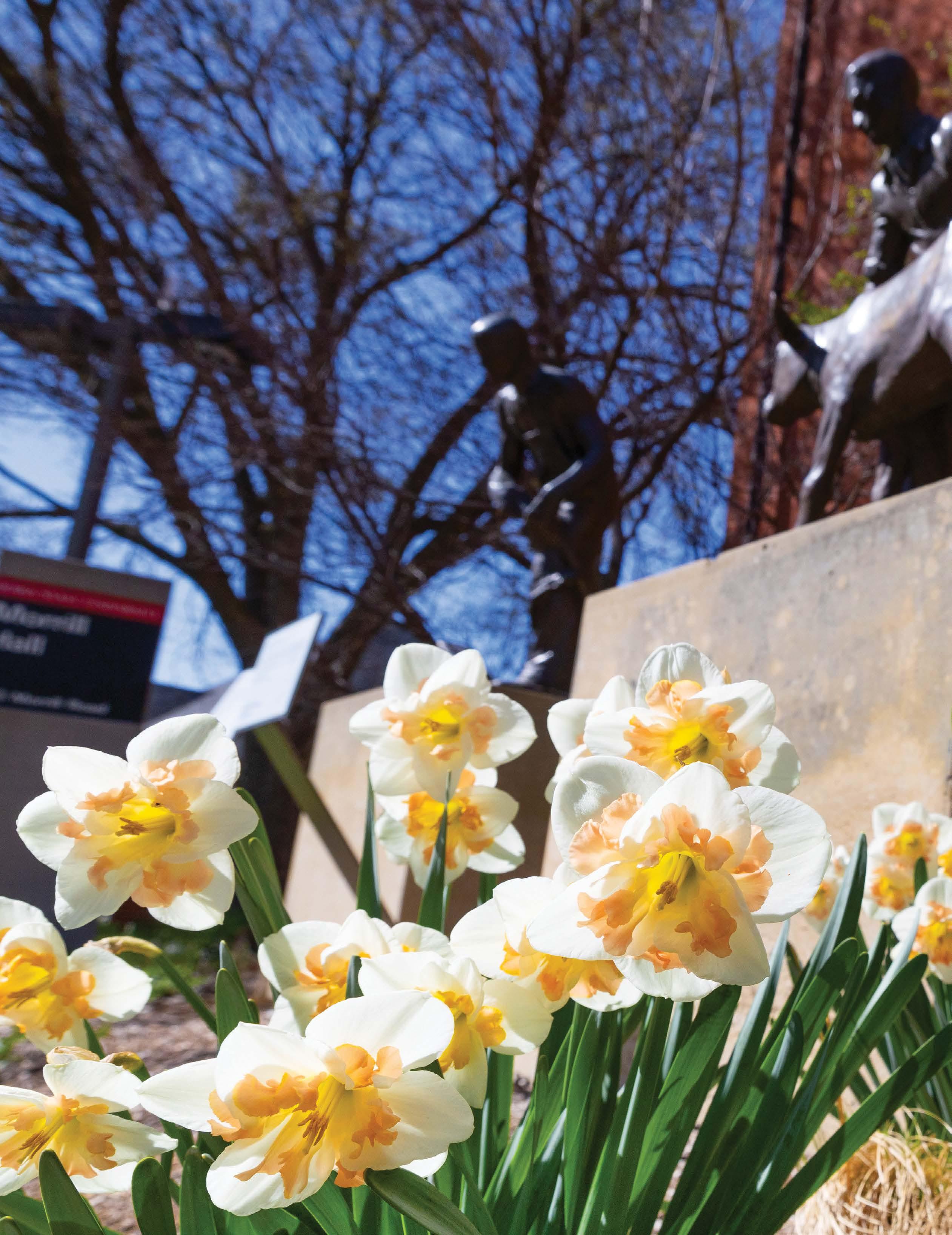
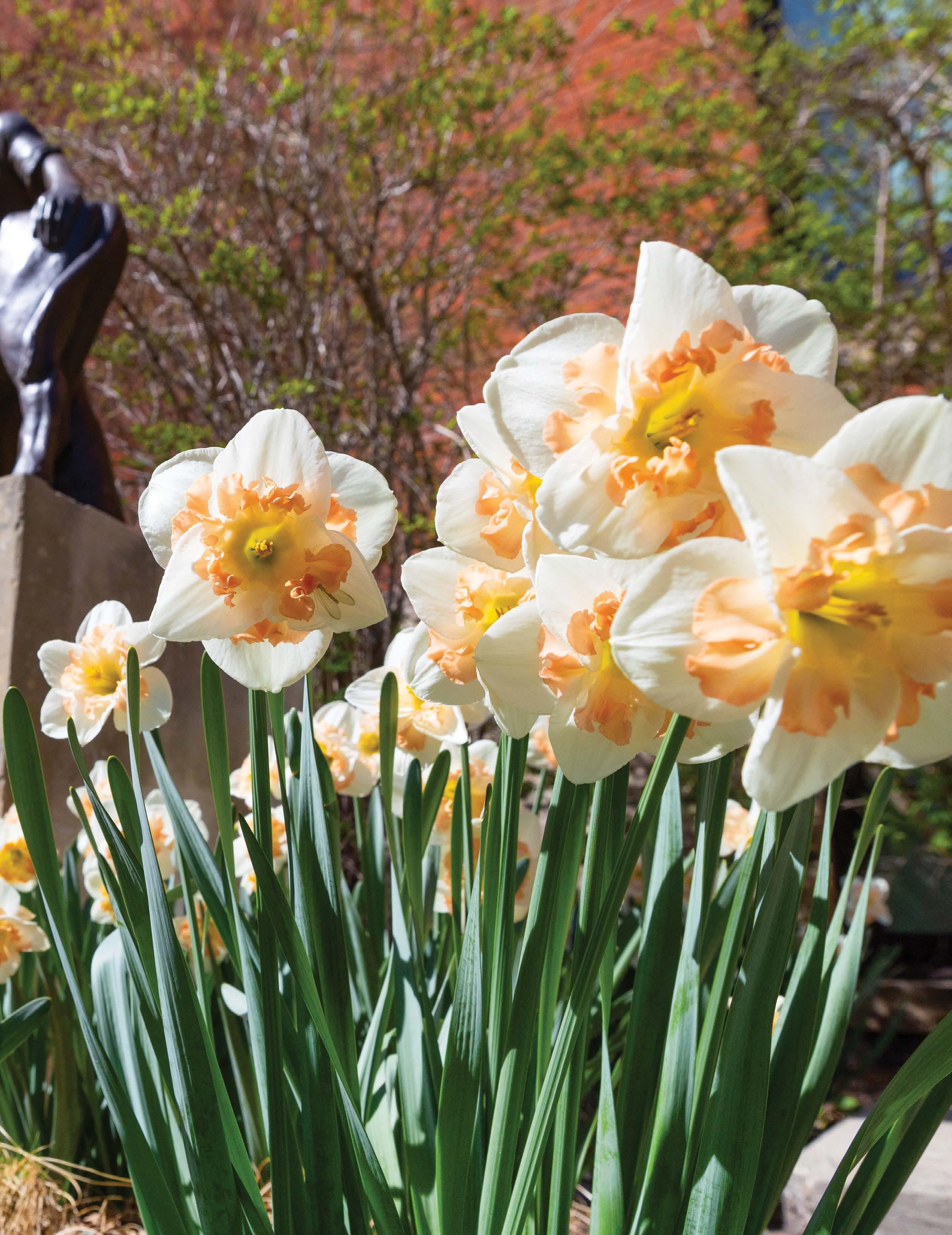
Daffodils bloom outside of Morrill Hall in front of a pair of Christian Petersen sculptures, “Cornhusker” (1941) and “4-H Calf” (1941).
Both works of art were
commissioned for the lobby of the Sheldon-Munn Hotel in Ames, Iowa.
Image by Christopher Gannon
POSTCARD
CAMPUS
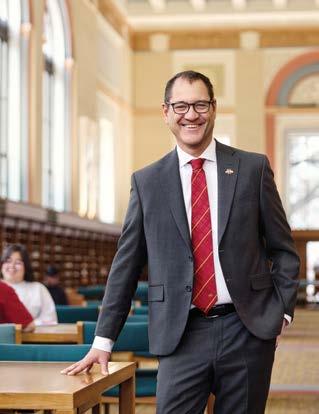
Welcome Home, President Cook
STORY BY MEGAN LANDOLT
IMAGES BY DAN McCLANAHAN
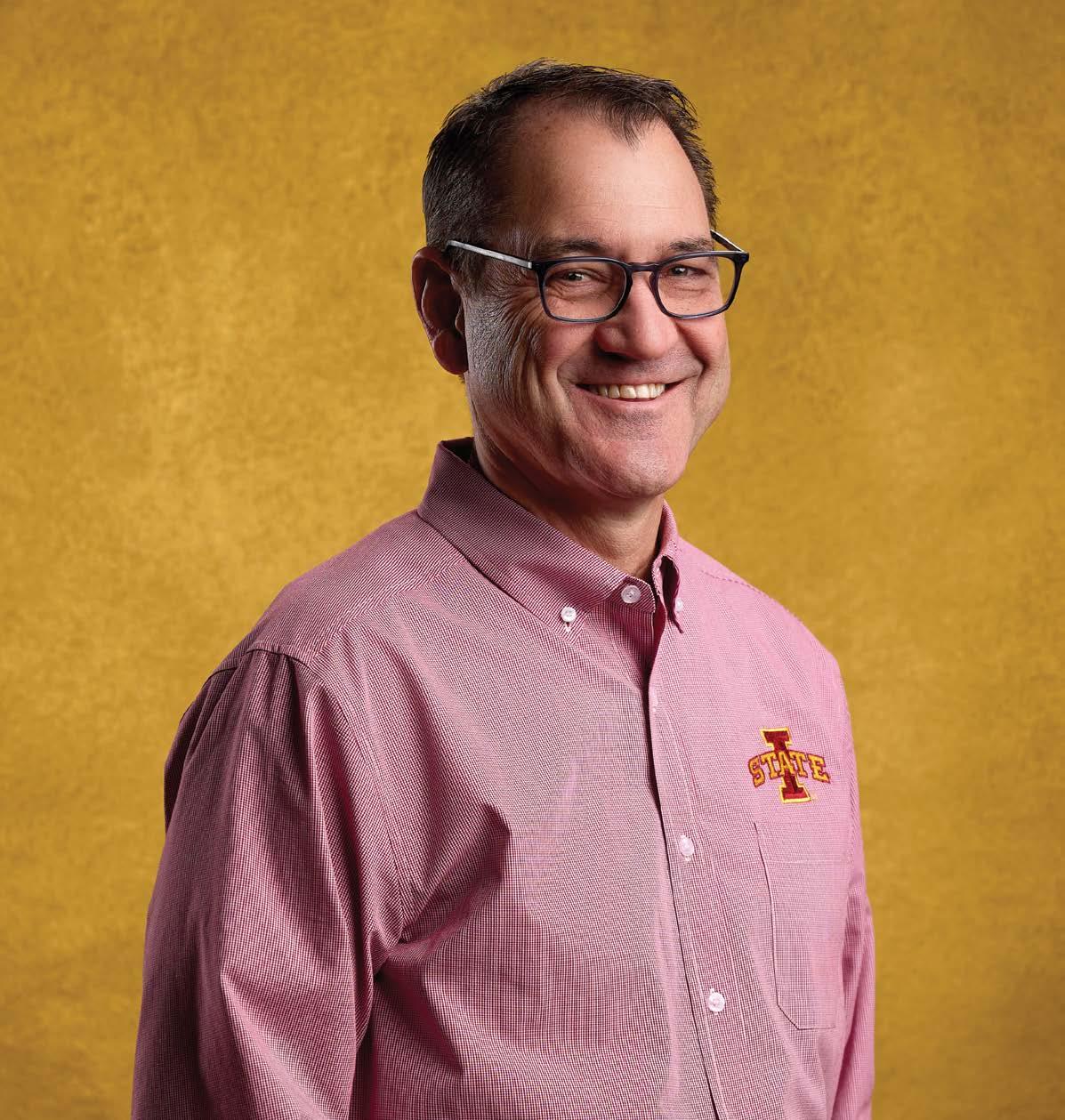
David Cook (’92) returns to lead university as ISU’s 17th president
David Cook never imagined his career would bring him back to his hometown — let alone to lead his alma mater.
“I never had this idea of coming back to Ames or being the president of Iowa State,” Dave (’92) says. “That was never a goal.”
But his wife, Katie (’94), is quick to point out, “You would throw it out there — ‘But if I could be president of Iowa State?’ I just don’t think you ever thought it could really happen.”
On March 1, that quiet aspiration became a momentous reality as David Cook began his tenure as the 17th president of Iowa State University.
“We’re very blessed to be returning home. Coming back to the university that created this amazing journey for me — where it all began — is special,” he says. “I was somebody who didn’t know if they belonged at college or even what I wanted to be. Iowa State opened up so many doors. Now, having an opportunity to lead an institution that can do that for others — that’s the appeal.”
We’re very blessed to be returning home. Coming back to the university that created this amazing journey for me — where it all began — is special.” “
— David Cook, Iowa State University President
A Special Place to Grow Up
Dave was born in Ames, attended Ames High School, and graduated from Iowa State University. Growing up near the Iowa State campus shaped his childhood.
“I have very fond memories of going to Iowa State with my dad,” Dave says. “Going to Beyer Hall. Going to Lake LaVerne to fish or ice skate.”
Dave always knew higher education was part of his plan, and he credits his parents for instilling core values.
“I was raised to work hard and be independent. Those were the things that had a profound influence on me,” he says.
He pursued undergraduate degrees in political science and speech communication, reflecting interests formed at a young age.
“I remember when I was 6 years old in 1976, and we went and watched President Gerald Ford speak outside of Fisher Theater,” he says. “There is something about being in Ames and having Iowa be the epicenter of presidential elections, and I think that’s probably something that just got my attention early on.”
As a first-generation college student, Dave initially felt out of his element. “The first day they passed out the syllabus, I had no idea what that was. I remember thinking, ‘Oh my gosh, I don’t belong here.’”
But soon he found his footing and built connections,
including through his fraternity, Pi Kappa Alpha.
“One of the great things about a university is it provides you a way to get involved and get engaged with different organizations,” Dave says. “And for me, Greek life was a great way to meet a really diverse group of folks. I have lifelong friends from those days.”
Mentors Made a Difference
Though he originally planned on law school, Dave was inspired by a communication studies professor to consider a different path. Terry Pickett, who worked for Iowa State from 1981 to 2000, encouraged Dave to attend graduate school at his alma mater, the University of Kansas.
At KU, Dave earned both a master’s degree and doctorate in organizational communication. He lived in Shanghai while conducting his dissertation research at an engineering firm. He then spent 14 years at the University of Kansas Medical Center, where he earned tenure in the School of Medicine.
In 2011, he was selected for an American Council on Education Fellowship at the University of North Carolina at Chapel Hill. Dave attributes this experience to opening his eyes to higher education leadership.
“What was great about it was there were people who invested in me, who believed in me, who mentored me to
give me that opportunity,” he says. “That’s what got me thinking maybe I want to be a president someday.”
Dave went on to hold executive leadership roles at the University of Kansas, including vice chancellor for Public Affairs and Economic Development and vice chancellor of the KU Edwards Campus, where he served as the top senior advisor to Kansas Chancellor Douglas Girod.
Katie proudly recalls: “[Chancellor Girod] so believed in Dave and wanted him to be a president. He believed that Dave should take that next step.”
That next step came in 2022, when Dave was named president of North Dakota State University. He quickly made an impact — stabilizing enrollment after years of decline, increasing retention rates, and growing the number of graduates. Under his leadership, NDSU also broke records for research expenditures and strengthened its position as an R1 institution.
Dave and Katie are proud of what they accomplished over the past four years in Fargo and believe that experience has prepared them well for the leap to Iowa State University.
“There are a lot of amazing things happening at Iowa State — let’s build on it and take it to the next level,” Dave says. “The world is changing, and we’ve got to evolve and change, too.”
Dave and Katie are both Ames natives and say growing up near Iowa State shaped their childhood. As students, the Cooks found lasting friendships through Greek life.
Land-Grant Passion, Future-Focused
With the shifting landscape of higher education, Iowa State, like every university, must adapt and innovate for a successful future. Dave recognizes the challenges. In fact, he sees this as an opportunity to reaffirm the promise of land-grant institutions.
“As a first-generation college student, the land-grant mission is deeply personal to me because it’s about ensuring access to education,” Dave says. “Iowa State has been committed to this since opening its doors nearly 160 years ago. Today, more than one in five ISU students (20.7%) are the first in their family to go to college.”
With its dynamic “Innovate at Iowa State” culture, Dave believes the university has created a winning formula. Combining academic excellence and experiential learning with innovative and entrepreneurial thinking, Iowa State graduates are equipped for a rapidly changing world. Dave wants to build on this progress, especially in areas such as artificial intelligence.
“Iowa State is well-positioned to be a true leader in artificial intelligence — figuring out how to embrace the ethical use of AI across all disciplines,” he says. “What excites me most is that AI’s impact isn’t limited to STEM fields. Every discipline has a role to play, and the social sciences and humanities are more important now than ever. AI is promising for advancing research and expediting discovery as
well as transforming education and teaching. I envision that becoming a North Star and a pillar.”
While digital innovation has made vast amounts of information widely accessible to the masses, Dave emphasizes a defining characteristic of Iowa State: extension and outreach.
“We have faculty and staff extension specialists in every county in Iowa listening to and learning from citizens, sharing their expertise, and building trust,” he says. “That’s the beauty of a land grant.”
Among the many areas where Iowa State excels is agricultural innovation. Iowa State is also home to the only U.S. Department of Energy national laboratory located on a university campus, the Ames National Laboratory. With this unique combination, Dave is confident ISU can push new boundaries.
“Energy and agriculture are issues of national defense,” Dave says. “The connection between them has never been more paramount than it is right now. How do we bring those together — what’s the moon shot? I think that’s very exciting.”
Industry partnerships are another aspect of Dave’s vision. He notes the Iowa State University Research Park has set a national standard for connecting companies with university talent and innovation and launching new businesses. He also pointed to the CyTown development as a catalyst for new
Dave plans to continue elevating the university’s “Innovate at Iowa State” culture, especially in areas like artificial intelligence.
“
There are a lot of amazing things happening at Iowa State — let’s build on it and take it to the next level. The world is changing, and we’ve got to evolve and change, too.”
— David Cook, Iowa State University President
partnerships and revenue.
“I’m thrilled that we have this kind of strategic thinking happening and very optimistic about the opportunities ahead,” he says.
Dave says he feels fortunate to be stepping into the top role at a university that is already on solid footing and acknowledges former President Wendy Wintersteen (’88) for her exceptional leadership.
“She’s done an amazing job, and the whole team has helped set me up to be successful in a way that I never expected,” he says.
Dave hasn’t wasted any time getting up to speed and considering ways to hasten Iowa State’s momentum. Even before his tenure officially began, he spent hours meeting with university leaders and stakeholders. For Dave, alumni are a vital part of shaping the university’s future.
“I think the role of alumni is more critical now than ever,” he says. “They want to give back to the institution that changed their lives. They can help us get through challenges and think about the opportunities.”
As the pace of change accelerates, Dave is clear-eyed about what it will take for Iowa State to thrive into the future.
“We’ve got to be willing to think differently because the way we do things now isn’t going to be the way successful universities do things 10 years from now, five years, or even two years from now.”
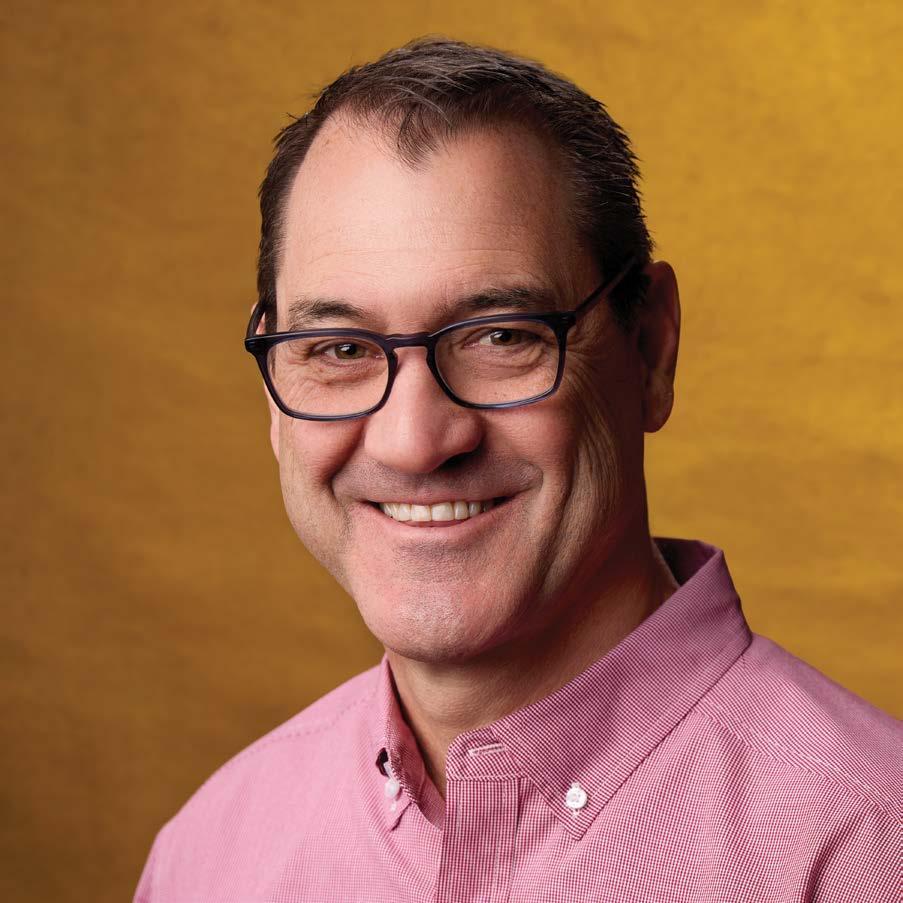
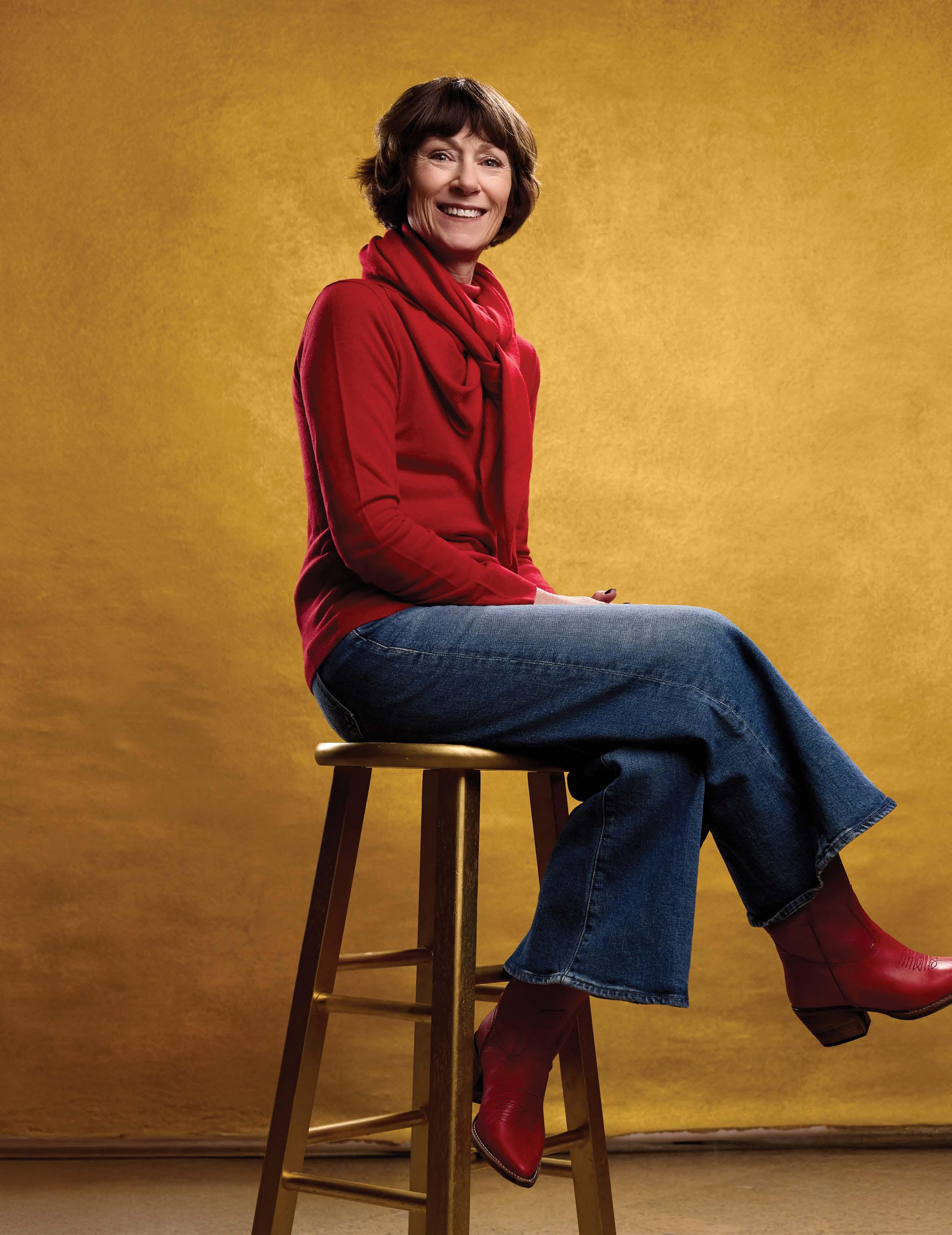
Meet President Cook
Age: 56
Family: Married to Katie Cook for 27 years (and dated for 10 years prior); two sons, Gage, 27, and Peyton, 24; daughter Ella, 23; and two dogs, Motley (like the band, Mötley Crüe) and Lola; and Katie’s horse, Titan.
Favorite Family Activities: Playing games — which, they warn, can get competitive!
Favorite Book: Anything about history, political science, or the Constitution.
Hobbies: Recent interest in hunting and fishing and the occasional round of golf.
Words to Live By: “Left foot, right foot, breathe.” This signature mantra from legendary Tennessee coach Pat Summitt encourages perseverance and a focus on incremental progress, not perfection. Dave and Katie adopted this refrain following her breast cancer diagnosis in 2023. They are pleased to share that Katie’s health is now stable and she’s doing well.
Katie says her favorite part of being first lady is interacting with students. She and Dave regularly stop by the dining halls to get to know students better.
Called Back to Ames
Growing up in Ames, Iowa State University was always a part of Katie Cook’s life. She rode her bike around campus and took her dogs and horse to ISU’s Lloyd Veterinary Medical Center.
“I just thought that Iowa State was the most incredible place in the entire world,” Katie says.
After graduating from Ames High School, Katie knew college was the next step. While Iowa State seemed like the natural choice, her mom had a different idea.
“My mom believed strongly in creating independence, so she made me go out of state,” she says. “She felt it was really important for me to experience places outside of Ames and Iowa.”
Two-hundred and eighty miles away in central Minnesota, Katie attended St. Cloud State University. But after one year away, she felt called back home.
“I made one of my good friends that I had met at St. Cloud transfer back with me to Iowa State our sophomore year,” Katie says. “She didn’t know anything about Iowa State, but I convinced her we needed to go.”
The two lived together in Elm Hall and pledged sororities. Joining Chi Omega, says Katie, helped her find her place.
“Iowa State is a big campus. [Through my sorority], I made great friends — and those connections lasted not only through college but have continued to grow.”
After graduation, Katie left Ames again to start her teaching career in Kansas. Dave was already there working for the University of Kansas.
Katie spent more than 29 years in the field of special education, working in K-12, higher education, and consulting. She has a master’s degree and doctorate in special education with an emphasis on behavior disorder and autism spectrum disorder.
While balancing careers and continuing their education, Katie and Dave expanded their family, welcoming two sons
and a daughter.
In 2022, Dave was named president of North Dakota State University, and the couple headed north to Fargo. As first lady, Katie found creative ways to make an impact, including combining her expertise in special education and her passion for horses.
“I helped teach a pilot course [for our secondary education program] that combines instruction about disabilities and special education with hands-on application,” Katie says. “Students apply what they’ve learned working with individuals with disabilities through our equine therapy program.”
While Katie and Dave valued their time at NDSU, they’re honored and excited to return home and experience their alma mater from a new perspective.
“It will be fun for us to bridge our memories of being from Ames and being students at Iowa State to now coming back to the university in a leadership role,” Katie says.
In her role as first lady, Katie is eager to find ways to contribute. “I love working with individuals with disabilities,” she says. “I love learning about agriculture. So, it might mean going to guest lectures to continue learning or volunteering when appropriate.”
Her favorite part of the job, however, (and Dave’s too!) is interacting with students. Katie and Dave plan to continue the tradition of teaching the President’s Leadership Class — a weekly course for 30 freshmen that provides insight into how the university operates and fosters leadership development.
The Cooks will also continue a custom they started at NDSU — connecting with students over a meal.
“We go to the dining halls probably twice a week,” Katie says. “We love it. It’s such a good way to interact with the students on a different level where they will have honest conversations and you get to know them more personally.”
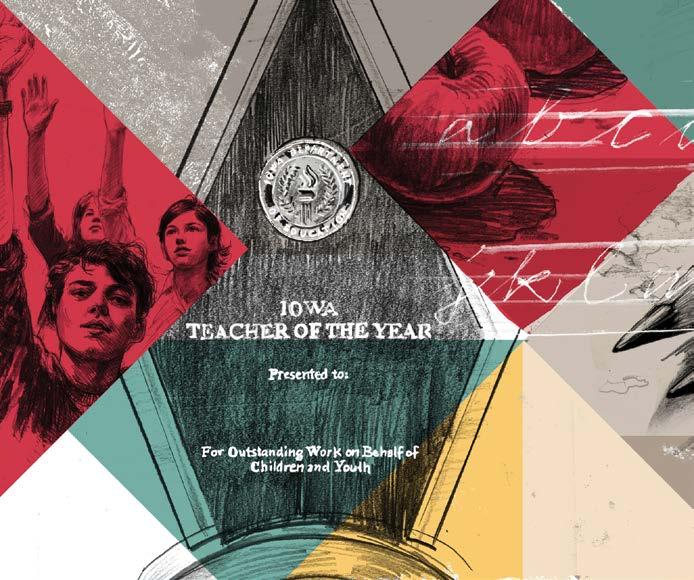
Iowa State Alumnae Named
Iowa Teacher of the Year
Three Years in a Row
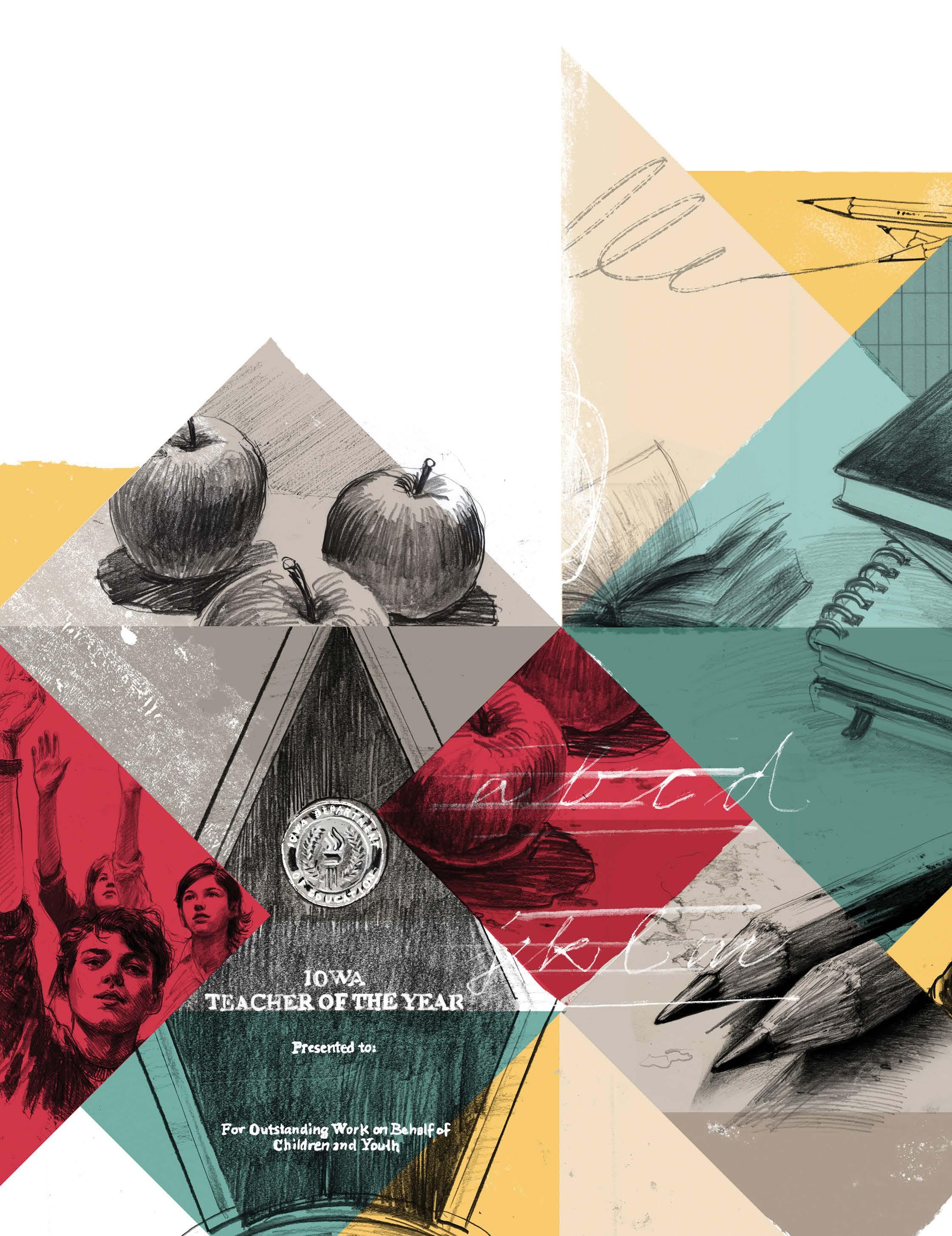
HEAD OF THEIR CLASS
STORY BY BRIANNE SANCHEZ
ILLUSTRATIONS BY JULIAN RENTZSCH
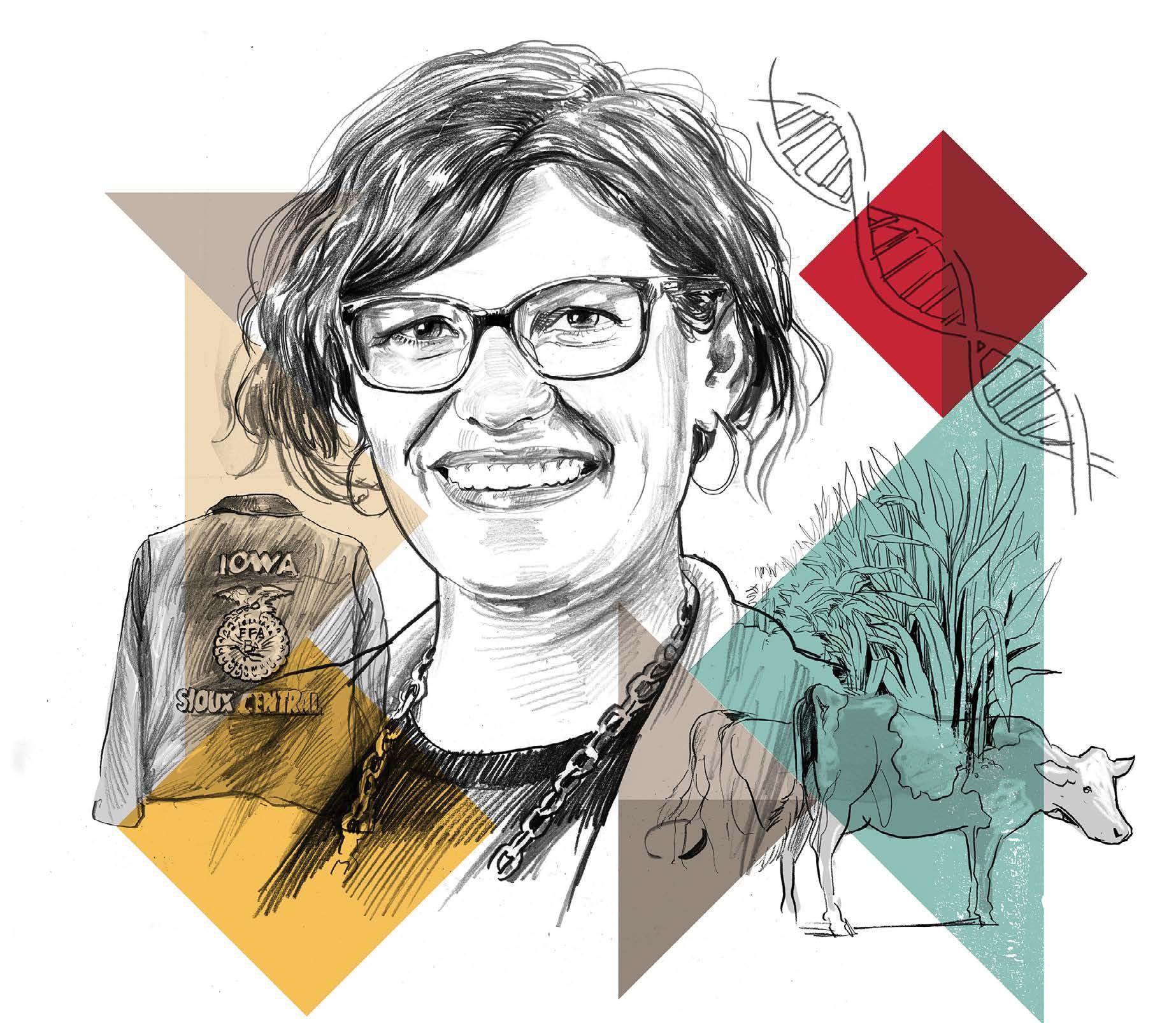
Educators hope to grow their impact with each graduating class. Full-circle moments often take years to realize, but 2025 Iowa Teacher of the Year Melanie Bloom (’01, ’08) believes in the power of mentorship.
A “magical conversation” she had with an FFA leader during high school led Bloom to later establish Sioux Central Community School District’s first full-time agriculture program. Now, some of her former students, like Iowa State University Extension and Outreach Clay County staffer Michele Hogrefe (’11), are professionals in the field.
“I’ve been around long enough to be able to influence [Michele], and now she’s influencing my kids,” Bloom says. “It’s been amazing to watch.”
Hogrefe, who wrote a letter supporting Bloom’s award nomination, was thrilled to see her mentor recognized in such a major way. Established in 1958 through an appropriation from the Iowa legislature, the Iowa Teacher of the Year award comes with a service term that releases the teacher from classroom responsibilities for an academic year. Honorees serve as ambassadors for their profession, helping the Iowa Department of Education host an Emerging Educators Academy, traveling for speaking engagements in districts across the state, and participating in workshops and celebrations. They even visit Space Camp and the White House.
While Iowa State graduates account for around 15 percent of active public school teachers in the state of Iowa, ISU alumnae recently reeled off a streak of three awards in a row. Before Bloom, Ann Mincks (‘07) was honored in 2024, and Krystal Colbert (‘07) in 2023.
Iowa State School of Education Director Ann Gansemer-Topf (‘92, ‘04) believes several advantages help ISU alumni stand out among their peers. Many Cyclones build a teaching portfolio as undergraduates, with lesson plans and projects that demonstrate in-demand skills. Faculty with current classroom, research, and ed-tech experience foster collaboration, while students also benefit from the expansive resources at ISU.
“We live our mission of empowering educators through evidence-based practice,” Gansemer-Topf says. “One of our hallmarks is that we get our students out in the classroom early and often, so they can integrate methods they are learning into their teaching.”
CONNECTING REAL - LIFE EXPERIENCES
Storytelling is embedded in Melanie Bloom’s teaching practice. Students who might struggle with a textbook definition of an animal’s “flight zone” remember her cautionary tale about a cow kicking a gate — straight into her face.
“When you make it personal and human, kids connect to that so much better than just me telling them, ‘You need to be careful working with animals,’” Bloom says.
That’s the approach she appreciated at Iowa State, where she was riveted by the relatable stories that peppered lectures in Dr. Richard Wilhelm’s livestock heritage class. Bloom’s equally passionate about inquiry-led student experiences.
“As an ag teacher, I have to be a jack of all trades,” she says. “I really can’t master any, except for maybe classroom facilitation.”
Bloom calls resources developed by the Curriculum for Agricultural Science Education project “rocket fuel” that propelled her teaching to new levels. The emphasis on hands-on learning influenced her to create a World Food Prize-inspired global grains project. Students research and grow commodities not typically seen in Iowa, like teff and sorghum.
She wants her Sioux Central High School students to see themselves as problem-solvers, and — potentially —
Iowa Staters. Trips to campus include a stop at Kildee Hall, which holds memories from many of the classes she attended for her degrees in animal and life sciences and agricultural education. Bloom remembers her initial intimidation upon entering an auditorium filled with hundreds of students after graduating from a class of 26.
“Yes, there’s a lot of people, but that just meant that there were a lot more people like me that I got to find,” Bloom says. “I keep telling kids that, within two or three weeks, campus shrank down to the people that I saw in classes all the time, or the clubs and activities I was in.”
BROADENING HER IMPACT
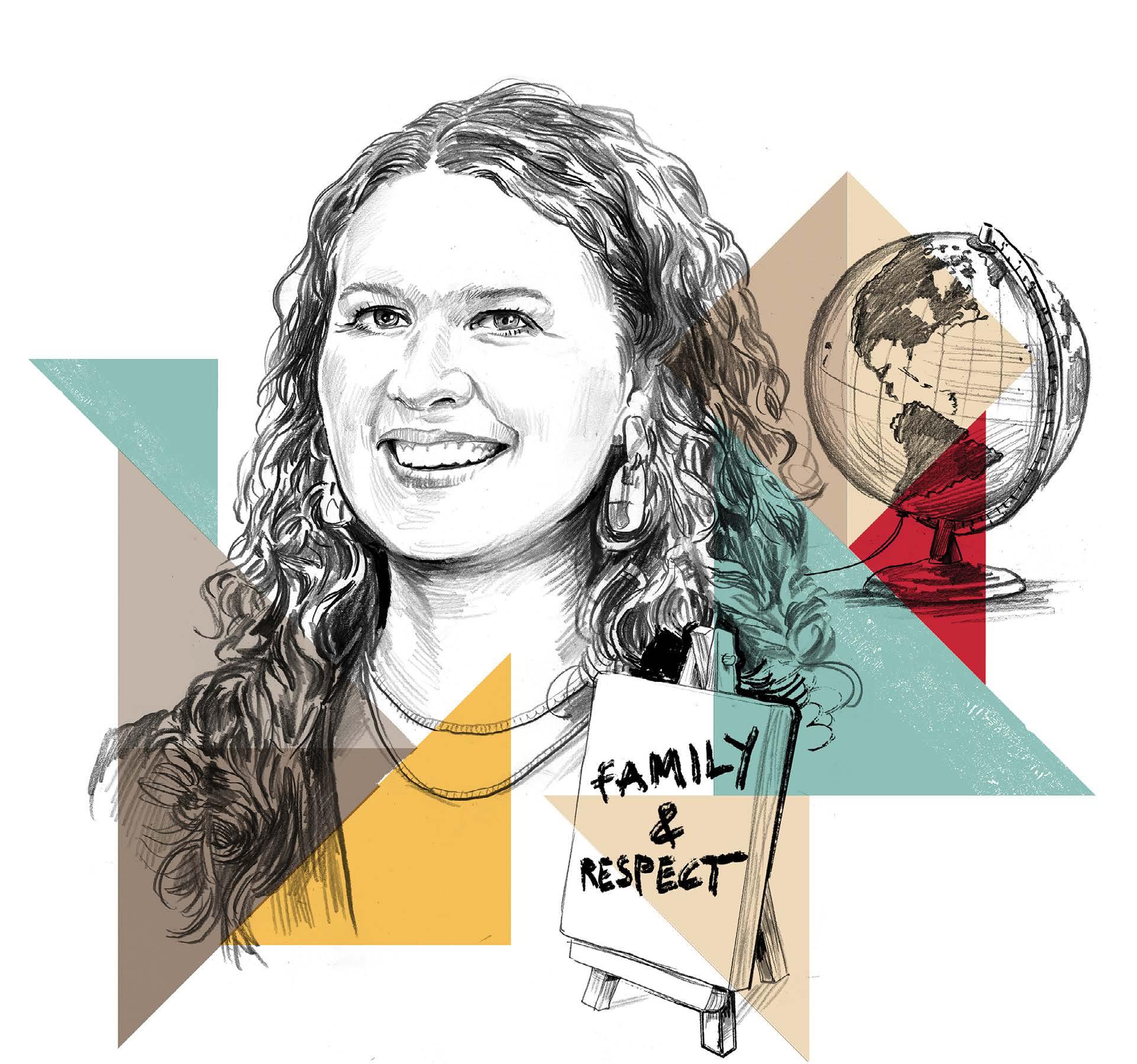
Although raised in a family of educators, Ann Mincks didn’t see herself becoming a teacher. She arrived at Iowa State undeclared, then sought classes and extracurricular activities that would help her discover her passions. Landing a campus job with the ISU Writing and Media Center proved a “pivotal” opportunity to define her professional goals.
“I had the opportunity to work with a lot of international students at the writing center,” Mincks says. She also studied in Spain to broaden her horizons. “Realizing that I really enjoyed teaching and learning from students all over the world, I was starting to carve my path into English Language Learner Education.”
Mincks, who was recognized in 2024 for her work as an ELL teacher for Des Moines Public Schools, approached her service as Teacher of the Year with the same intentionality she demonstrated as an undergrad. Her appointment coincided with the 50th anniversary of the landmark Lau v. Nichols
Supreme Court ruling, which advanced the fight for equal education for students with limited English proficiency.
During visits to dozens of rural, suburban, and urban districts in all regions of the state, Mincks conducted an informal landscape analysis of current services for Iowa’s 40,000 multilingual learners.
“I wanted to explore whether, 50 years later, all students are receiving the resources and supports they need to be successful,” Mincks says. She looked for bright spots and areas that needed growth.
Mincks says her experiences inspired a desire to do more systemic work. She recently transitioned to a program coordinator role for English for Speakers of Other Languages within West Des Moines Community Schools.
“After having that year of interacting with state- and federal-level administrators, I was really excited about that sense of agency I had to impact at the district level.”
LEADING YOUNG LEARNERS
Elementary educator Krystal Colbert admits: She used to be terrified of public speaking. A summer speech course helped her gain confidence. It also introduced her to her future husband, Jason Colbert (‘07, ‘11), a fellow Cyclone who asked to borrow a pencil on their first day.
“Somehow, I survived the class, and Jason won me over,” Colbert says.
As 2023 Iowa Teacher of the Year, she put her public speaking skills to use in a major way. When it came time to outline her professional platform, she began jotting down key lessons inspired by her time at Iowa State and during her
first few years in the classroom. Growth mindset. Relationships. All means all. Celebrate. Evolve as a teacher. An acronym — G.R.A.C.E. — emerged from the brainstorm, surfacing a message she’s carried since she was a student.
“I remember my professor saying, ‘No one expects you to go out there and be perfect your first few years of teaching — or ever,’” Colbert says. “That has always stuck with me: This idea of giving grace to ourselves, giving grace to the people we work with, giving grace to our students and their families.”
Colbert continues to share this
message with the ISU student teachers whom she mentors. Her second grade students at Mitchellville Elementary hear it, too. They offer each other guidance while building prototypes for a STEM Challenge and other collaborative projects.
“We don’t have just one teacher; we have 24 teachers in our classroom,” Colbert says. “They have really embraced that way of thinking. When students are able to share their thinking and learning, it helps me understand whether they’ve got that skill down. They’re helping their friends hear it in a different way.”
SHARING THE MAGIC
Hailing from a proud Iowa State family, Jen Petersen (’17) is preparing her son,
to be a future Cyclone. They experienced the magic of Hilton Coliseum on January 2, when Iowa State men’s basketball defeated West Virginia in front of a sellout crowd of 14,267.
Stellan,
Image by Grace Starr
CYCLONE STORIES: DORIS NASH (’91) / AMES, IOWA
Behind the Seams
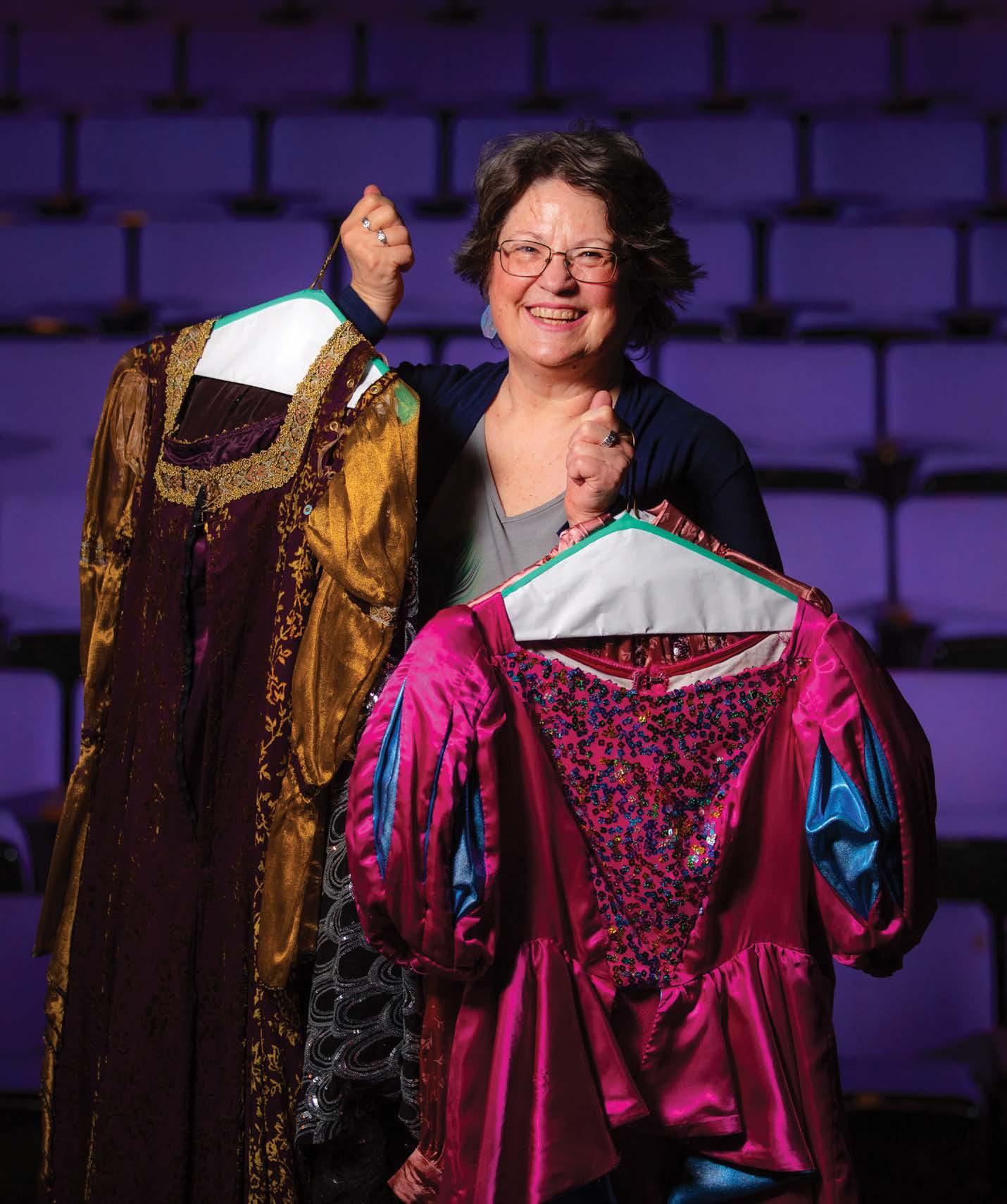
Down a flight of stairs past the entrance to Fisher Theater, Doris Nash (’91) can be found among shelves of fabric, sewing machines, and tables, performing her brand of magic. Since 1989, Nash has worked as the costume shop supervisor helping everyone from professional costume designers to Iowa State
freshmen make their visions a reality for more than 200 ISU Theatre productions.
“I love that no two productions are ever the same,” Nash says. “Even when we remounted ‘A Christmas Carol’ so many years, the different casts made each show unique and special.”
The versatile Iowa native holds bachelor’s degrees in vocal performance from Coe College in Cedar Rapids and clothing and textiles from Iowa State.
Over her career, Nash honed her skills working summers with the Santa Fe Opera and the Colorado Shakespeare Festival.
Before every first stitch begins, Nash sits down with a designer to review their sketches or photographs to determine what is and isn’t possible.
“She seems to have Mary Poppins’ bag of tricks, plus tips and knowledge to pull things out and make it all happen,” says Kelly Schaefer, a theater teaching professor who works with Nash in the costume shop. “Doris can take a pencil sketch on a napkin that I might do and bring it to life. It is incredible.”
Nash’s process starts with measuring the actors (though her meticulous ways and years of experience allow her to eye correct sizes before ever grabbing a tape measure), drafting a pattern, fittings, and then making changes as needed until the costume is complete. The time Nash puts in depends on the costume, number of pieces, type of fabric, and trim and detailing. It can be three hours for a simple skirt to 40-plus for an Elizabethan-style gown.
“Each show is a different combination of pulled-from-stock, purchased, rented and built-fromscratch costumes,” Nash says.
Nash isn’t alone in the shop: Each year, she works with a group of students to build their hand and machine sewing skills, giving them more intricate and demanding tasks as they prove their ability.
The clock is always ticking toward opening night. Nash and the stitchers feel fortunate if they have six weeks to put costumes together. She has developed a network of other costume shop leaders, connected through Facebook, who share tips and tricks, many of which she passes on to students.
“She is incredibly dedicated to the students,” Schaefer says. “She has been instrumental in helping the department become more inclusive of all of our students.”
— JEFF BUDLONG
Future Cyclones
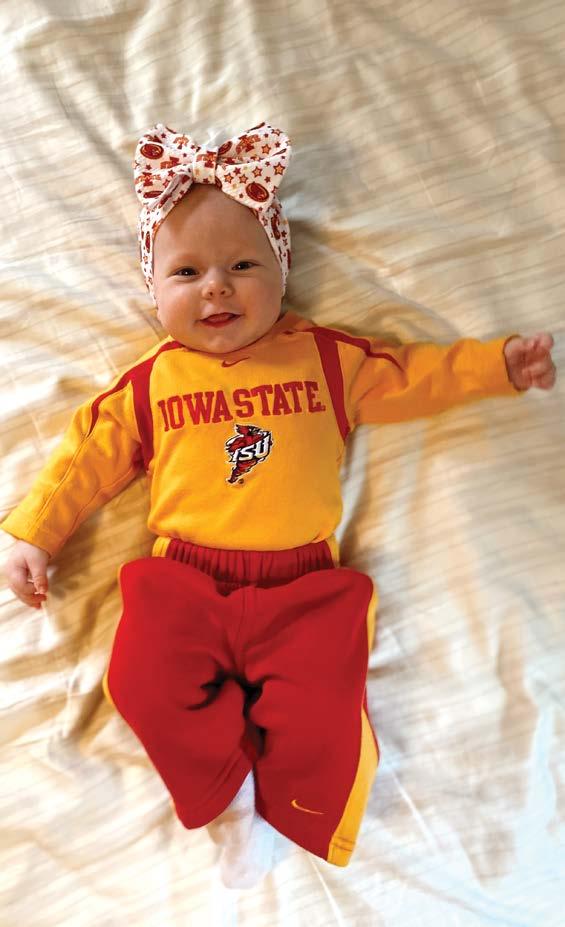
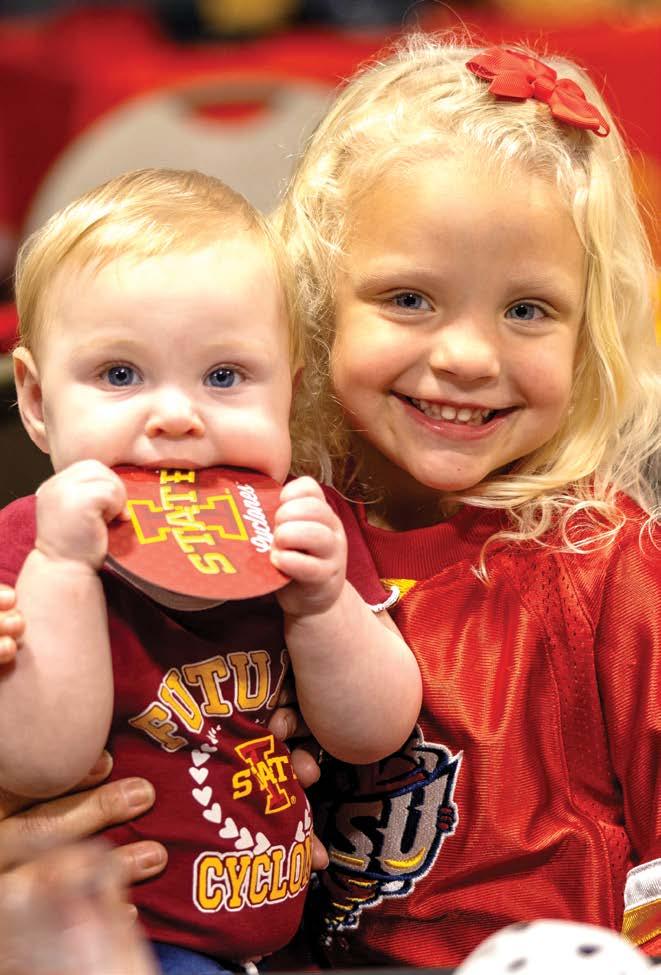
To submit a photo of your future Cyclones for Iowa Stater magazine, email your photo and the names of those in the photo to IowaStater@iastate.edu.
IF YOU’RE HEADED TO ...
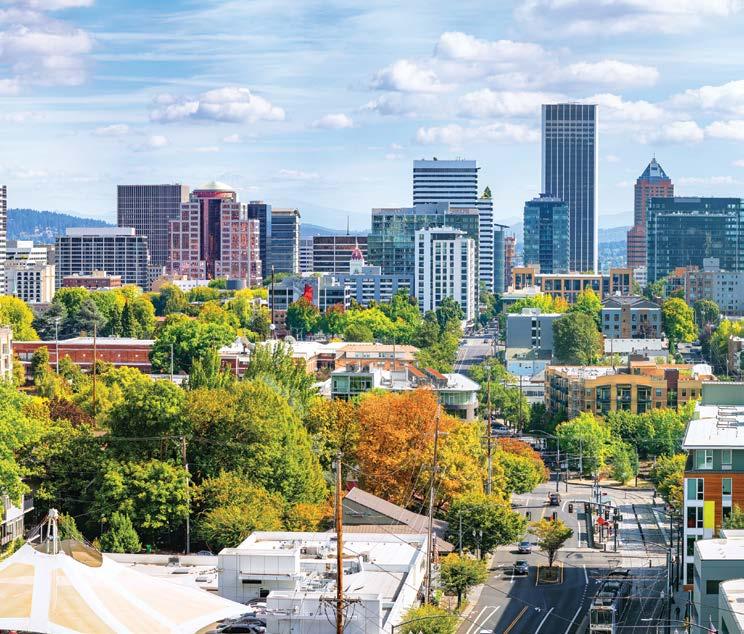
Portland
Experience the beautiful outdoors by visiting Forest Park, one of the largest urban forests in the United States, spanning 5,200 acres and home to 80-plus miles of trails. Take a short drive outside of the city to the coast for more sightseeing.
Find your next favorite read at the world’s largest independent bookstore, Powell’s City of Books. Boasting over 1 million new and used books — including several thousand rare books — Powell’s covers a whole city block and is a must-visit.
Enjoy food and drinks at Huber’s, the oldest restaurant in Portland, known for its famous tableside Spanish coffee. Higgins, McMenamins, and Broadway Grill and Brewery (a Cyclone game watch staple) are just a few of the many great spots to dine.
Connect with Iowa State Alumni of Portland’s group on Facebook to help plan your next visit.
ISUAA PORTLAND CLUB LEADER ALAN DEUTMEYER (’88) SHARES SOME OF HIS FAVORITE PLACES TO VISIT.
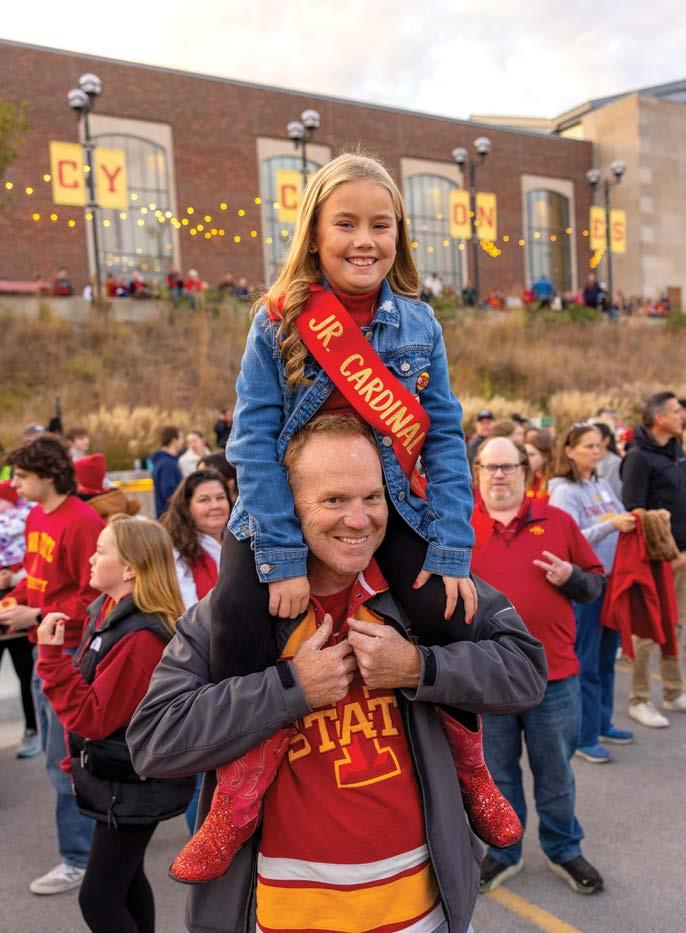
1. Landry Marcussen, daughter of Randy and Tatum (’02) Marcussen, enjoys the festivities of ISU Homecoming with her father.
2. Piper Crowe, daughter of Lauren (’19) and Jon (’18) Crowe, reps the Cyclones with her cardinal and gold gear.
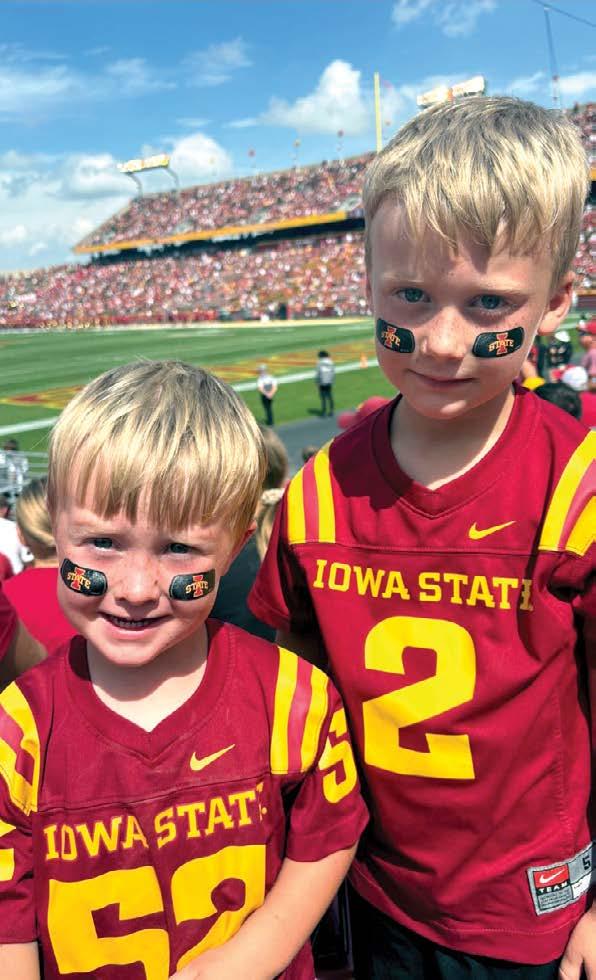
3. Bennett and Beau Grote, sons of Brayton (’17) and Kirstin (’18) Grote, cheer on the Cyclones at Jack Trice Stadium.
4. Gwen Klocke, daughter of Maggie (’17) and Tate (’16) Klocke, and Jules Manternach, daughter of John (’01) and Jill Manternach, support the Cyclones at the ISU Alumni Homecoming happy hour event.
What Couldn’t You Have Survived College Without?
The Honors Cottage. P.S. for all of you who answer, ‘my computer,’ we (the Honors Program) all shared one Mac computer, one mainframe terminal, and one printer.
The gyro cart across from the fire
My friends, who are still some of my very best friends, and an electric typewriter.
— JOANIE TEKIPPE (’82)
Pizza Pit, Do-Biz cookies, Great Plains Sauce & Dough and my sorority sisters.
FAC at People’s after a long week of classes.
Parks Library!
— ALICIA DANIELS (’02)
— MISSY NEPPLE BORIS (’94)
station on Welch Ave.
— CHRISTOPHER HENCYK (’00)
— CHER BROWN (’94)
— SUSAN PETERSON GLENN (’90)
ISUCF‘V’MB!! 100% the best decision I made in college.
Lumpy’s.
My Pi Phi sorority sisters and SALC leadership opportunities!!
A job. I did survive without a phone, computer, social media, internet, etc.
My Day Runner Planner, and 100 Blue books to start each semester.
— GRAYE DIERICKX (’15)
Cy Ride.
— ANNA KATHRYN (’22)
Jeff’s Pizza!
— BECKY WINKIE (’15)
— AL KOENIGS (’07) Caffeine.
— PHIL SANTOS (’97)
— JOHN COX (’95)
— JUDY KILGORE (’89)
— LAURA IDE HARTMAN (’90)
FEEDING THE
FUTURE
World Food Prize’s Iowa Youth Institute Marks 15 Years of Inspiring the Next Generation of Global Leaders at Iowa State
STORY BY STEVE SULLIVAN
Alyssa Brown (’20) entered a world of opportunity when she followed a high school teacher’s advice and signed up for the Iowa Youth Institute.
The Iowa Youth Institute is one of the youth programs offered by the World Food Prize, which was founded by Nobel Peace Prize Laureate Norman Borlaug. The institute has been hosted at Iowa State since its launch in 2012. It was created to inspire high school students to explore global food security issues and offers students a chance to learn more about Iowa State and qualify for scholarships.
Approximately 300 students participate in the Iowa Youth Institute annually, each completing a research paper which they then present at Iowa State to a group of peers and university and industry experts.
Brown attended the Iowa Youth Institute during all four years of high school. Her first experience was in 2013, when she presented a paper on water and sanitation services in Ethiopia.
“As a high school freshman, I was a little intimidated,” Brown says. “It was my first time at Iowa State and the first time doing this kind of academic presentation in front of my peers. The experience expanded my ability to present confidently and interact with peers in meaningful ways.”
Brown’s involvement with the Iowa Youth Institute
allowed her to participate in the Global Youth Institute in 2014, which, in turn, opened the path to a Borlaug-Ruan International Internship in 2016.
“I did anthropometric and nutrition research in Guatemala,” she says. “It was my first time out of the country and a career-changing experience.”
As an Iowa State student, she volunteered at the Iowa Youth Institute and the Norman E. Borlaug International Dialogue, also known as the Borlaug Dialogue, making connections that led to a Land O’ Lakes internship involving travel to Africa, and an internship with the Global Alliance for Improved Nutrition in India, supporting nutrition education and micronutrient research.
Brown now works for the World Food Prize Foundation, coordinating the Borlaug Dialogue and Iowa Hunger Summit.
“High school Alyssa would be stunned at what I’m doing now — interacting with global nutrition and agricultural experts, including Nobel Prize laureates and government and corporate leaders,” she says.
Since 2012, more than 3,600 students have presented their research at the Iowa Youth Institute, and more than 75% of Iowa’s public schools have participated. To date, the College of Agriculture and Life Sciences has distributed more than $800,000 in scholarships to Iowa students for their involvement in the Iowa Youth Institute and the World Food Prize Foundation’s Youth Programs.
Raegan Kramer (’18), who attended the same Western Dubuque High School as Brown, presented a persuasive essay on why Kenya should repeal a ban on GMOs at the Iowa Youth Institute.
“Being on campus is exciting because it makes you feel like you’re already established at Iowa State, so the transition when you become a student is a little easier,” Kramer says.
She also participated in the Global Youth Institute, which led to being a World Food Prize USDA Wallace-Carver Fellow. The fellowship, in turn, provided her with a prestigious summer internship in Ames.
“I interned with the USDA over two summers and had a hands-on, real-world experience of doing research in a lab,” says Kramer, who now leads a biostatistics team at Syngenta. “I learned the scientific method and how to investigate different hypotheses. It helped me realize that I wanted to go to graduate school.”
Catherine Swoboda (’08, ’10), associate teaching professor in global resource systems, helped create the Iowa Youth Institute. Driven by growing interest in STEM, the idea of basing the Iowa Youth Institute at Iowa State received strong support from then-Governor Terry Branstad’s administration and the College of Agriculture and Life Sciences, then under the deanship of Wendy Wintersteen (’88), Swoboda says.
“If you think about the shared missions of Iowa State as a land-grant institution and the World Food Prize Foundation,
it makes for an incredible partnership,” Swoboda says. “Dr. Borlaug dedicated his life to fighting global hunger, and I think enthusiasm surrounding the Iowa Youth Institute would make him very happy and give him hope.”
Andrew Zehr (’01, ’03) worked with Swoboda during those early days of the Iowa Youth Institute. Now director of communication and marketing for the College of Agriculture and Life Sciences, he remains focused on the institute as an important recruiting opportunity.
“We work really hard to recruit students who participate in the Iowa Youth Institute,” he says. “A lot of students are more likely to consider careers in agriculture when they can look at it through a problem-solving lens.”
Zehr and Swoboda note that the institute attracts students who end up in a range of majors and careers paths, ranging from agriculture to health care. This diversity “gives you a real sense of the far-reaching impact the program has had and will continue to have,” Swoboda says.
Zehr’s two sons have participated in the Iowa Youth Institute, and his oldest, Nolan, is now at Iowa State studying global resource systems and environmental science. His path may have been decided at an early stage thanks to his dad’s involvement in the youth program. For a fourth grade “wax museum” project, while his peers dressed up like Michael Jordan and other recognizable celebrities, Nolan dressed as who else? Norman Borlaug.
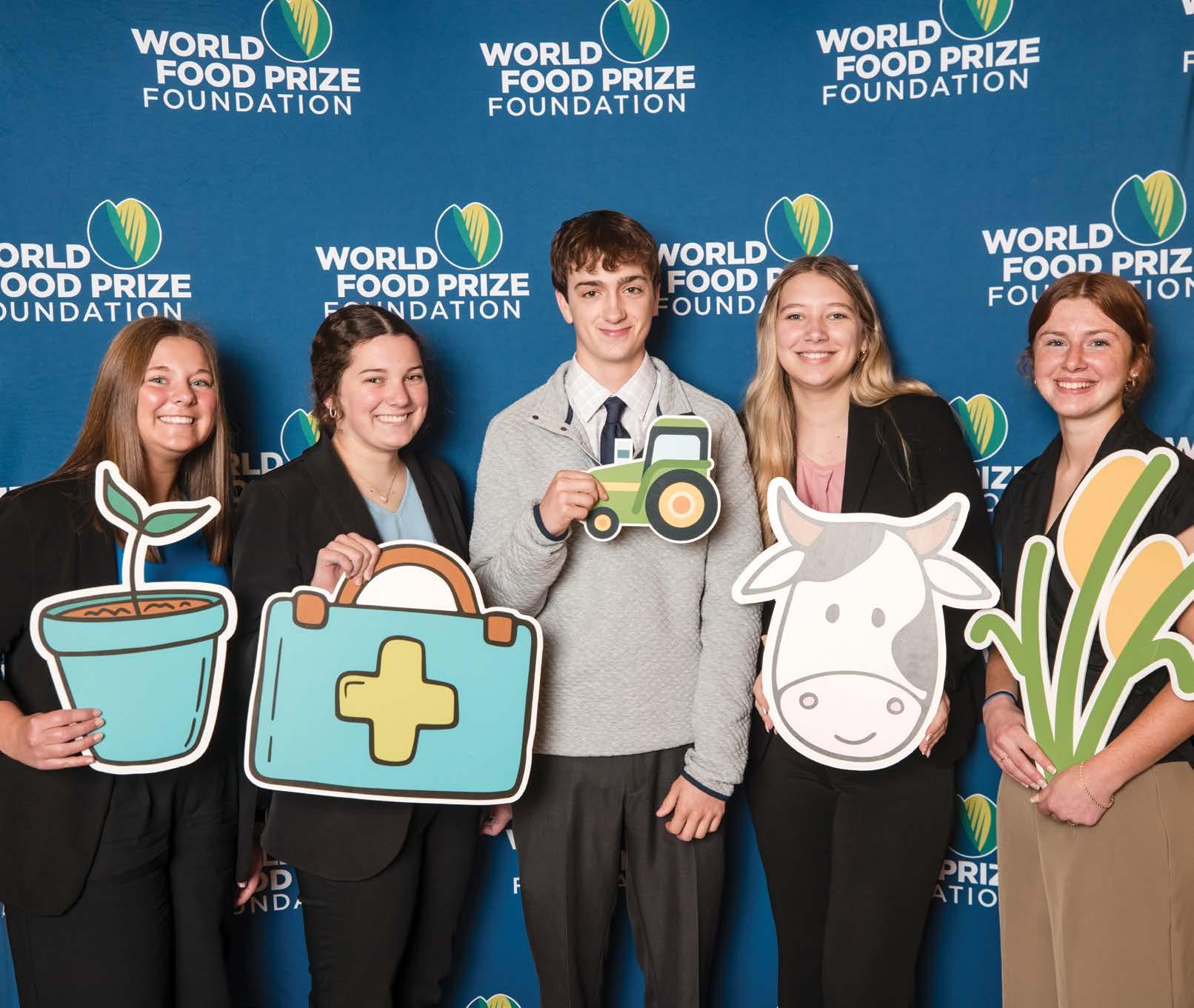
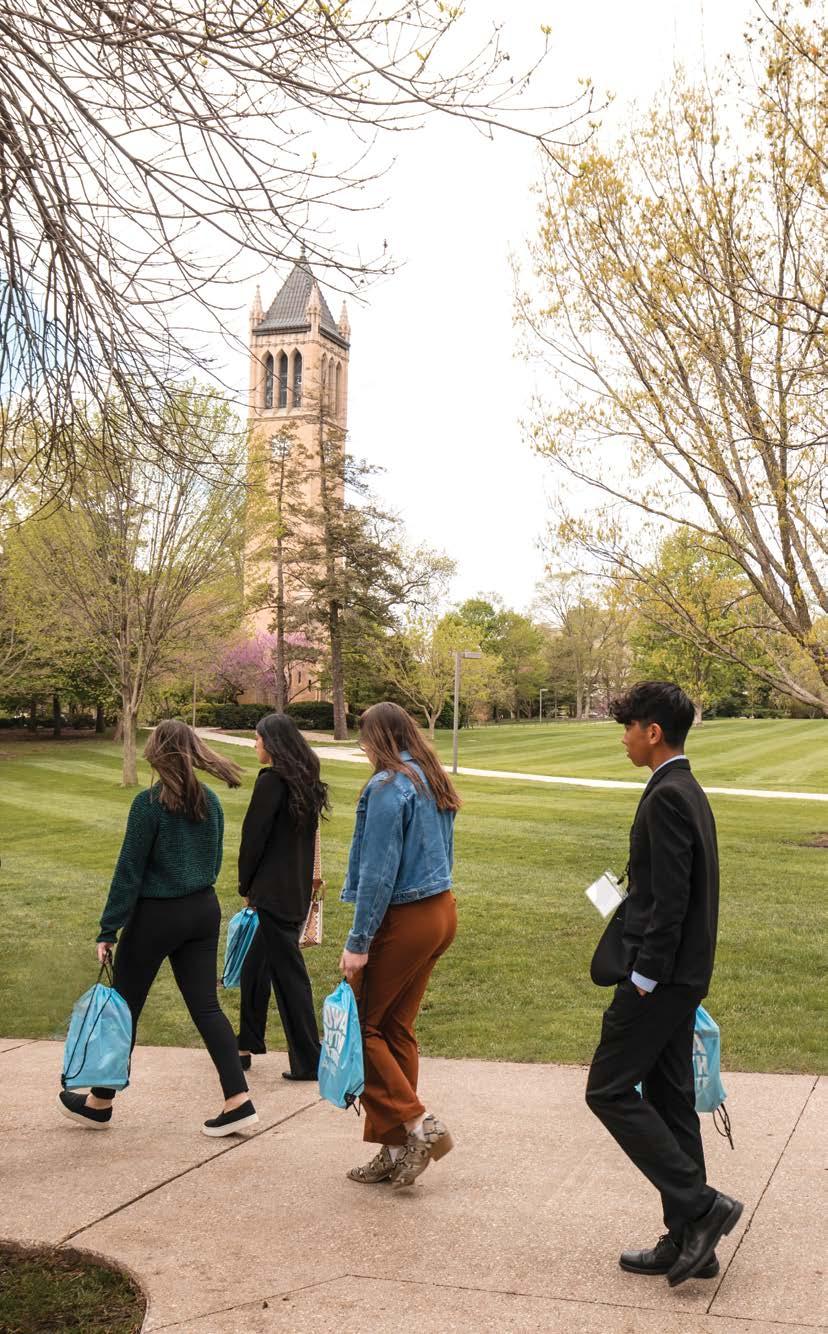
Iowa Youth Institute participants write and present a research paper at Iowa State to a group of peers and university and industry experts. The experience allows the high school students to explore global food security issues and offers them an opportunity to learn more about Iowa State and qualify for scholarships.
Beyond the Hurdles
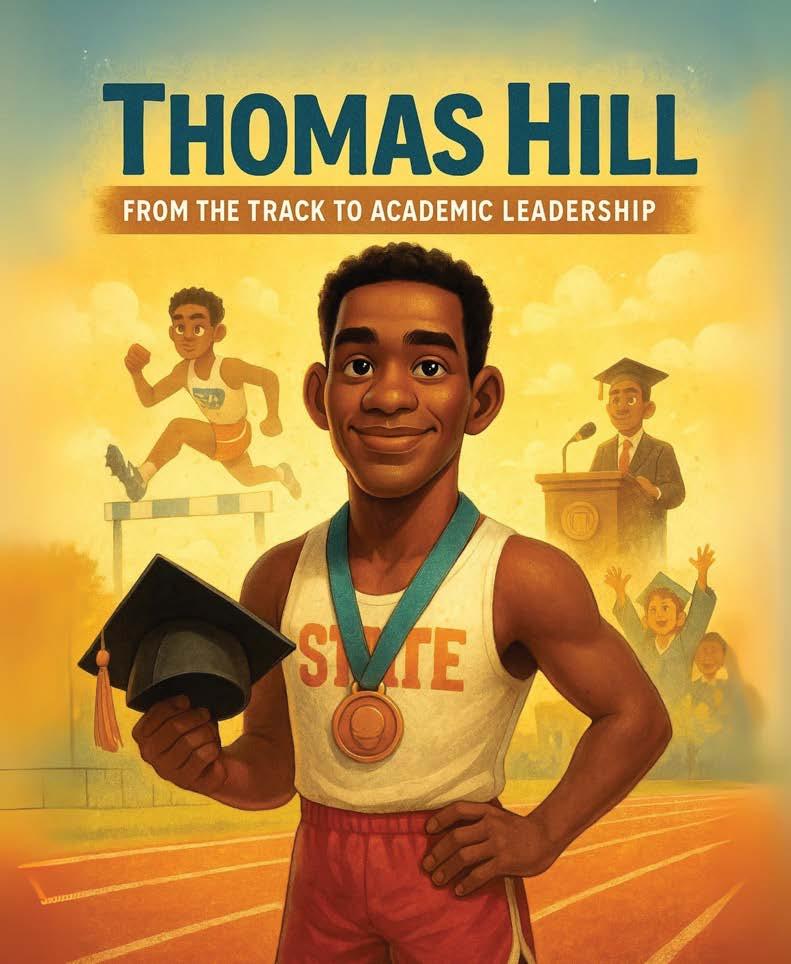
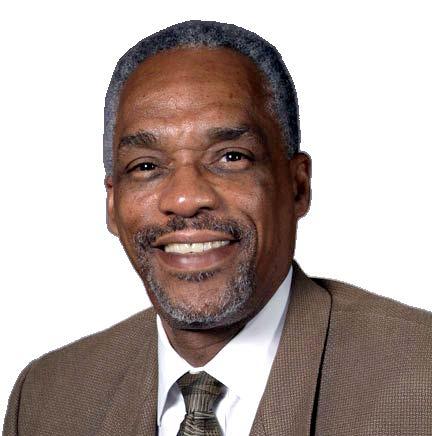
It’s a story worth telling: Raised in New Orleans’ Magnolia Housing Project by a single parent, Thomas Hill earned respect as a collegiate and Olympic hurdler and then as a student affairs leader. Even so, it was simply a yen to assist a few causes dear to him that led to a children’s book about his life, “Thomas Hill: From the Track to Academic Leadership,” published last summer by Curry Brothers Publishing.
He grew up running, but who doesn’t? Hill, however, was exception-
ally agile over hurdles, and he ran at Arkansas State University, capturing the NCAA indoor 60-yard high hurdles title in 1970, the same year he tied two world records and ranked as the world’s best high hurdler. At the 1972 Olympic Games, he earned bronze in the 110-meter high hurdles.
Equally important, Hill completed his bachelor’s degree in 1972. Master’s and doctoral degrees in counselor education followed, as did positions in coaching, athletics student life, and student services at the U.S. Military Acad-
emy, Arkansas State, Tulane University, University of Oklahoma, and University of Florida before he arrived in Ames. At Iowa State, he led the student affairs division for 18 years (1997-2015).
“A children’s book is not something I thought I’d be involved in, but it’s been an eye-opening experience,” Hill says. “It underscored the fact that when young kids see someone who looks like them, it becomes real for them.”
Hill says the book fits into a retirement project to document his family’s history. Those who know him won’t be surprised to learn it also supports a connect-the-dots philanthropic web.
Executive editor Gerald Curry and Hill are brothers in Sigma Pi Phi, an African American professional fraternity. They’re also members of a group organizing a reunion of 1964, 1968, and 1972 American track and field Olympians. To raise funds for it, Curry proposed a subscription children’s book series about Olympians and professional athletes who, like Hill, overcame incredible odds. Curry’s staff wrote the book.
“A tenet of the fraternity is academic achievement, so Gerald gets the importance of that balance,” Hill says. “Kids will focus on athletics and seem to think that if you’re a good athlete, you can’t be a scholar as well.
“I tell my grandsons (ages 17 and 14) just as I told my sons, it’s not that they can go together; they have to be together.”
Royalties from individual sales of Hill’s book support New Orleans high school graduates via the Mattie Hill Memorial Scholarship Foundation, established 30 years ago by Hill and his four brothers to honor their mother, the biggest proponent of education they knew. Royalties also are shared with Iowa State’s Thomas and Billye Hill endowed scholarship fund, which supports student development.
“Sharing this with Iowa State is consistent with who we are as a family,” Hill says. “Our intent has always been to help students.”
— ANNE KRAPFL
CYCLONE STORIES: THOMAS HILL / MIDLOTHIAN, TEXAS
Perfect Chemistry
Bogota has never been cold enough for Colombia native Andres Garcia Alejo (’18, ’24). Rolling up to Iowa State University on a frosty January night, he was garbed in a hefty winter coat and undaunted.
“I knew I wanted to be a chemist, so Iowa State was my first choice,” says Garcia Alejo, who had learned of the university in the heart of Iowa from a recruiting fair in his home country.
Standing outside on the eve of classes that January, Garcia Alejo had no way of knowing how much of an impact this school and town would have on his future. As a transfer student, he jumped right into campus life — he served as president of the chemistry club, helped with International Students and Scholars Office events, and participated in undergraduate research. It was his research work that inspired him to pursue his doctorate in quantum chemistry.
“After applying, getting accepted, and visiting different schools, I realized not only were the quantum chemistry groups here the best, but ISU is where I wanted to be,”
Garcia Alejo says.
He knew that all work and no play wouldn’t do during his graduate studies, so he joined the campus Latin dance club.
“Colombians are really good dancers, but I wasn’t,” Garcia Alejo says, laughing. “At home, I was embarrassed to try.
Here, I had the chance to learn from scratch. At one social, the instructors told us to pair up. I looked across the hall, and there she was.”
“She” was Sarah Norvell, Garcia Alejo’s now-wife. “We had really good chemistry,” he says, no pun intended.
After completing his doctorate, Garcia Alejo left Iowa for Hawaii to pursue his postdoctoral studies at the University of Hawaii.
“Hawaii is nice, but it isn’t Ames,” he says. “I made a pledge to myself that I wanted to return and work for ISU in order to give back to the community that had given me so much.”
Garcia Alejo secured a role that combined his passions for science and Iowa State in the Science Bound Program. As a program specialist, he visits high schools across the state, preparing students for success in STEM, agriculture, and education studies at ISU.
“We make sure they have all the tools to succeed — not just academically, but in life,” Garcia Alejo says of his Science Bound scholars.
Garcia Alejo’s return to Iowa State was also a return to his new Midwest family; his wife, as well as his in-laws, all work for the university.
“We are a happy Cyclone family,” he says.
— KATE TINDALL
CYCLONE STORIES: ANDRES GARCIA ALEJO (’18, ’24) / AMES, IOWA
Alumni Steering Airport Project
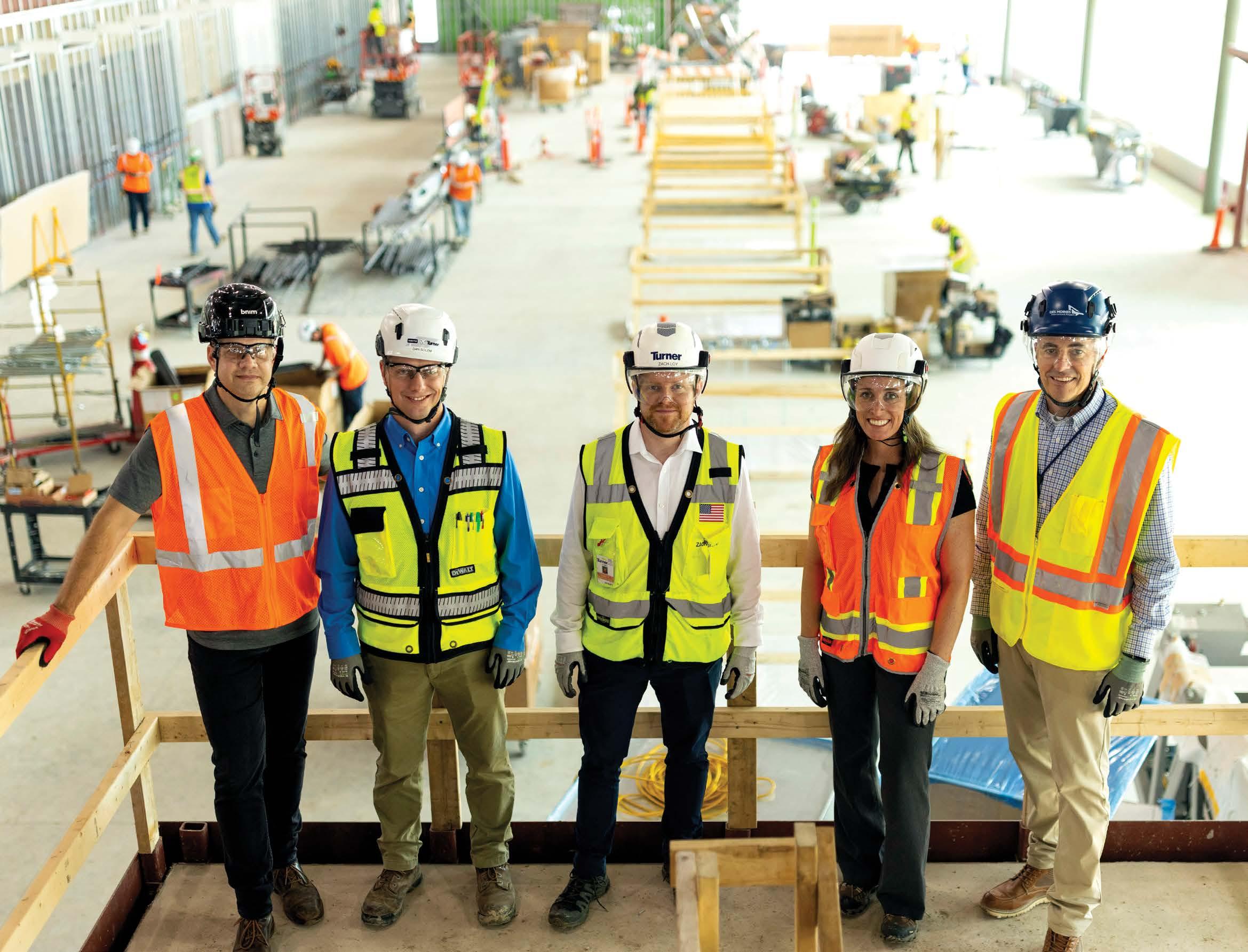
The Des Moines International Airport is undergoing a major terminal update, known as “Lift DSM,” to modernize facilities and accommodate growing air travel in the state. Iowa State alumni are at the helm of the $700 million public improvement project.
“The goal is really to address the constraints that we have in the existing terminal,” says Brian Mulcahy (’92), CEO of the Des Moines Airport Authority. “The new terminal will allow us to have the opportunity to get more airlines in here because we’ll have more room to service them.”
Lynnette Mellett (’03) is the project manager for HNTB, leading planning, architecture, engineering, and design on
the project.
“It’s so fun to be a part of the early stages when you are in the planning process,” Mellett says. “And to see where we ultimately ended up — I think it’s going to be a gorgeous building in the end.”
Jeff Shaffer (’02), project architect with BNIM, says growing up in Des Moines and using the current airport helped guide designs in making the new terminal a better experience for travelers.
“Large open spaces, very intuitive wayfinding, access to a lot of natural daylight and views — we know that traveling can be stressful, so [we’re] trying to eliminate all those barriers and make [travel as] pleasant as it can be,” Shaffer says.
Construction engineering graduates
Zach Loy (’08), vice president and general manager for Turner Construction Company, and Dan Solem (’04), project executive for Weitz Co., have been instrumental in managing the hundreds of trade workers and on-site staff moving the project forward.
“We’re coming out of a terminal that we’ve used for 75 years, so the intent is that this is going to be another 50 to 60 years that we will use this terminal,” Solem says.
“This project represents the front door to Greater Des Moines,” adds Loy.
The new terminal is on track to open in January 2027.
Iowa State alumni Jeff Shaffer (’02), Dan Solem (’04), Zach Loy (’08), Lynnette Mellett (’03), and Brian Mulcahy (’92), are working together on renovations to help modernize and expand facilities at the Des Moines International Airport.
2026 DISTINGUISHED AWARDS CELEBRATION
Iowa State University’s highest awards will be presented to the following alumni and friends at the 2026 Distinguished Awards Celebration on Friday, May 1. The ceremony will take place in the Memorial Union at 2 p.m. This event is open to the public.
ORDER OF THE KNOLL CORPORATION AND FOUNDATION AWARD
MidAmerican Energy Company Des Moines, Iowa
ORDER OF THE KNOLL FACULTY AND STAFF AWARD
Stanley R. Johnson and the late Maureen Kilkenny
Stanley: Senior Fellow, National Center for Food and Agricultural Policy
Maureen: Senior Fellow, National Center for Food and Agricultural Policy Reno, Nevada
ORDER OF THE KNOLL CARDINAL AND GOLD AWARD
James L. Melsa
(‘60 ELECTRICAL ENGINEERING)
Dean Emeritus of the College of Engineering, Iowa State University Naperville, Illinois
ORDER OF THE KNOLL CAMPANILE AWARD
The late Bruce H. Grasser
(‘64 CHEMICAL ENGINEERING)
Retired business consultant, Lubrizol Corporation Chardon, Ohio
Thomas A. Smith and Evonne E. Smith
THOMAS: (‘68 GEOLOGY, MS ‘71)
President/Owner, Geophysical Insights
EVONNE: (‘68 GEOLOGY, MS ‘71)
Owner, Geophysical Insights Austin, Texas
DISTINGUISHED ALUMNI AWARD
Beth Ford
(‘86 MANAGEMENT)
President and CEO, Land O’Lakes Arden Hills, Minnesota
Dan J. Houston (‘84 MARKETING)
Retired Chairman, President, and CEO, Principal Financial Group West Des Moines, Iowa
Wendell Sander (‘56 ELECTRICAL ENGINEERING, MS ‘62, PHD ‘63) Retired DEST, Apple Computer Cupertino, California
ORDER OF THE KNOLL TRUE AND VALIANT AWARD
Gerald A. Kolschowsky and Karen A. Kolschowsky
GERALD: (‘62 AGRICULTURAL BUSINESS) Former Chairman and Co-CEO, OSI Industries, LLC
KAREN: HONORARY ALUMNA AWARD 2008 Sarasota, Florida
YOU’RE INVITED TO ATTEND THE 2026 DISTINGUISHED AWARDS CEREMONY
Friday, May 1, 2 p.m., Memorial Union. Reception to follow ceremony.
Nominate alumni and friends for spring 2027 awards by Aug. 15 at ISU.Foundation/Awards
ISU ALUMNI ASSOCIATION MEMBER INDEX
ANNUAL
Ann Gansemer-Topf pg. 26
Maggie Klocke pg.33
Missy Nepple Boris pg. 34
Alicia Daniels pg. 34
Phil Santos pg. 35
Anna Kathryn pg. 35
Thomas Hill pg. 40
Andres Garcia Alejo pg. 41
LIFE
Gregory Geoffroy pg. 2
Wendy Wintersteen pg. 4
Chris Murray pg. 4
Jim Taylor pg. 4
Terry Proescholdt pg. 4
Ober J. Anderson pg. 4
Nick Wilson pg. 4
Kaylee Wilson pg. 4
James Huss pg. 8
Brittney Rutherford pg. 8
Jamie Pollard pg.14
Bill Fennelly pg. 15
Doris Nash pg. 32
John Manternach pg. 33
Cher Brown pg. 34
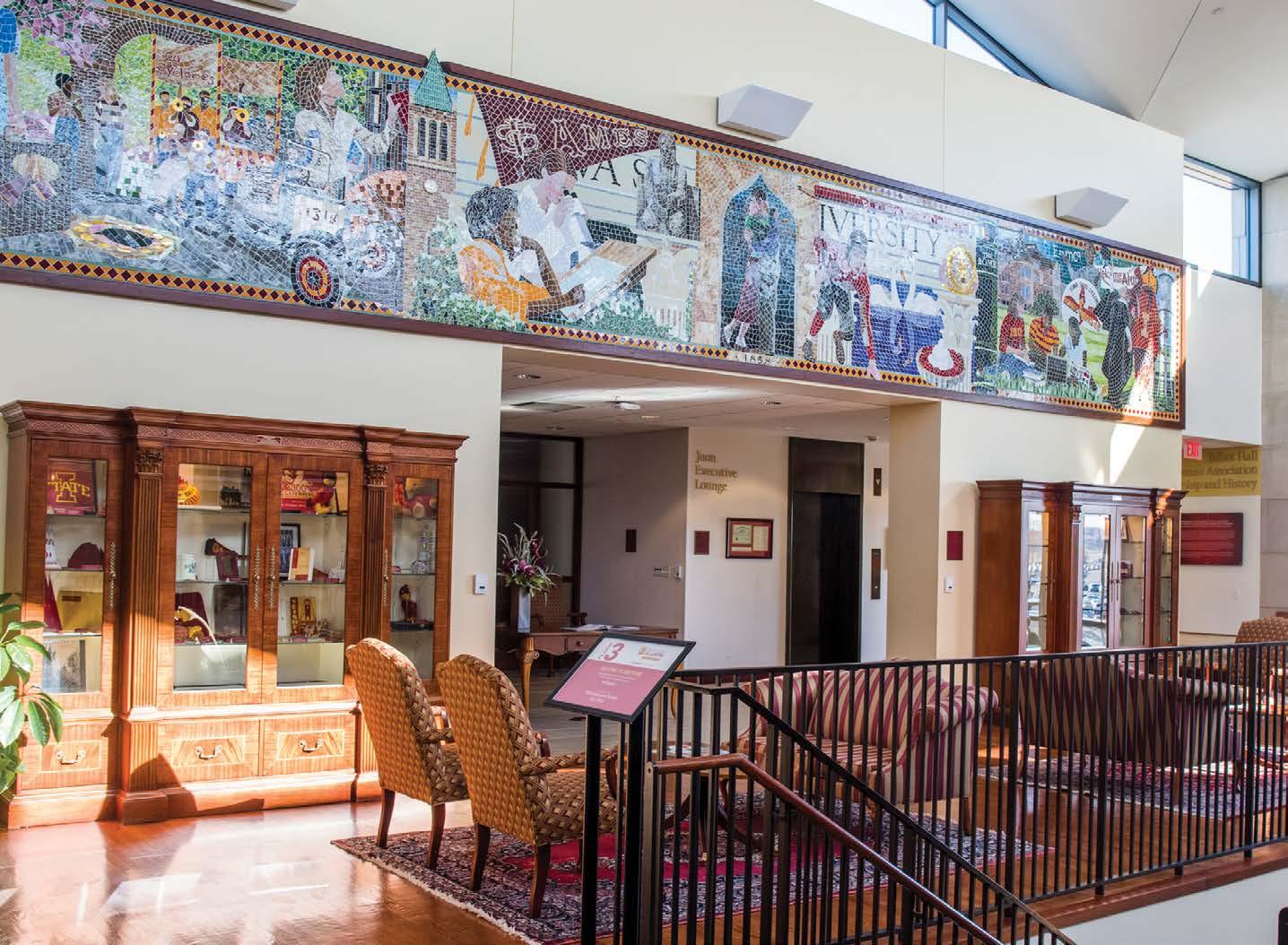
Audrey Hunt (’17) is our fall 2025 Iowa Stater pop quiz winner. “The Spirit of Iowa State,” by Clint Hansen (’87), was completed in 2008 on the third floor of the ISU Alumni Center. The 38-foot-long stained glass mural contains 28,000 pieces of glass.
Joanie Tekippe pg. 34
Susan Peterson Glenn pg. 34
Judy Kilgore pg. 35
Laura Ide Hartman pg. 35
Diane Martinson pg. 35
Graye Dierickx pg. 35
Kate Tindall pg. 41
James L. Melsa pg. 43
Thomas A. Smith pg. 43
Evonne E. Smith pg. 43
Gerald A. Kolschowsky pg. 43
Karen A. Kolschowsky pg. 43
Dan J. Houston pg. 43
Wendell Sander pg. 43
Audrey Hunt pg. 45
For 22 years, the ISUAA Sustaining Life Donor program has provided vital annual support for student and alumni initiatives. Your generosity helps strengthen programs that connect, serve, and celebrate Cyclones everywhere.
Thank you to our new and returning sustaining donors whose 2025 gifts continue to make a meaningful impact.
View this year’s sustaining donor list at ISUalum.org/Sustaining. Thank
Kimberly Morford Baeth
President of Cutting Edge Success, Founder of Golden
Kimberly Baeth (’93) loves parties and multitasking, so while she’s a fan of pulling off surprises, no one was shocked when she quit her first job to start a business. She set out to solve a simple problem and ended up creating Golden Openings, a multimillion-dollar event business that forever changed the special events industry. Baeth sold Golden Openings in 2024 and started Cutting Edge Success in 2025 to help entrepreneurs achieve their dreams. Baeth reflects on her entrepreneurial path and how she stays connected to her alma mater.
How did you get the idea to start Golden Openings?
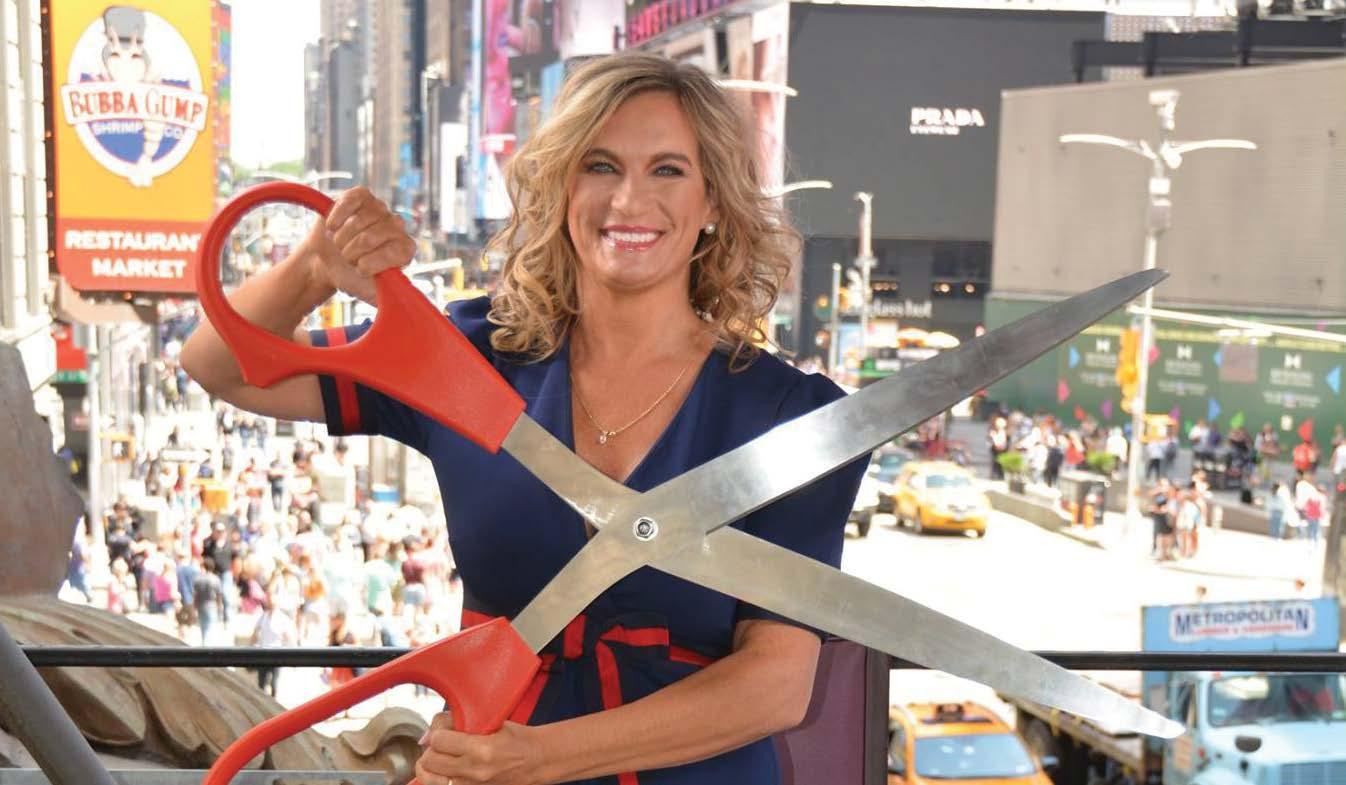
I was working at a chamber of commerce and was sent to a ribbon cutting where I was given a small ribbon and a pair of rusty, gross scissors. I am always about making things magical but when I got to the event, there was no excitement, no pizazz. I thought,
“gosh, we could at least have a big pair of scissors.” For my 26th birthday, I asked my dad, (the “Concrete King” of Marshalltown) to make me a big pair of wood scissors with razor blades. Word got out and our chamber phone rang off the hook for ribbon cuttings and scissor rentals. Eventually my dad said he couldn’t keep making them; thankfully, we had a relative who worked in manufacturing and was able to help me patent and trademark my first pair of large stainless-steel scissors. From there it took off fast: we started making keys to the city and other props that no one was using before for ceremonial events.
What was your most memorable moment during your time at Golden Openings?
We worked with nearly all of the Fortune 500 companies, Disney, the White House, professional sports teams, celebrities, thousands of cities, universities, franchises, and more. I’ve spent an entire day with Warren Buffett — not
Openings
many people can say that! It is difficult to single out one favorite customer or memory. Over the years, we were honored with over 35 awards, including the U.S. Chamber’s Dream Big Small Business of the Year and Community Champion Award, for all of America. That was surreal!
You have stayed involved with Iowa State in a variety of ways; what does it mean to you to return to campus? It means the world to me to give back to ISU. I have spoken with numerous clubs, organizations, and workshops over the years. I have also donated several pairs of cardinal and gold scissors, custom ribbons, ceremonial shovels, and more. It has been so exciting to see ISU and the students grow and thrive. I’ve enjoyed helping support new programs and opportunities in Ivy, Greenlee, and the Pappajohn Center that I would have loved to have had during my time at ISU.
— KIRSTEN KRAKLIO
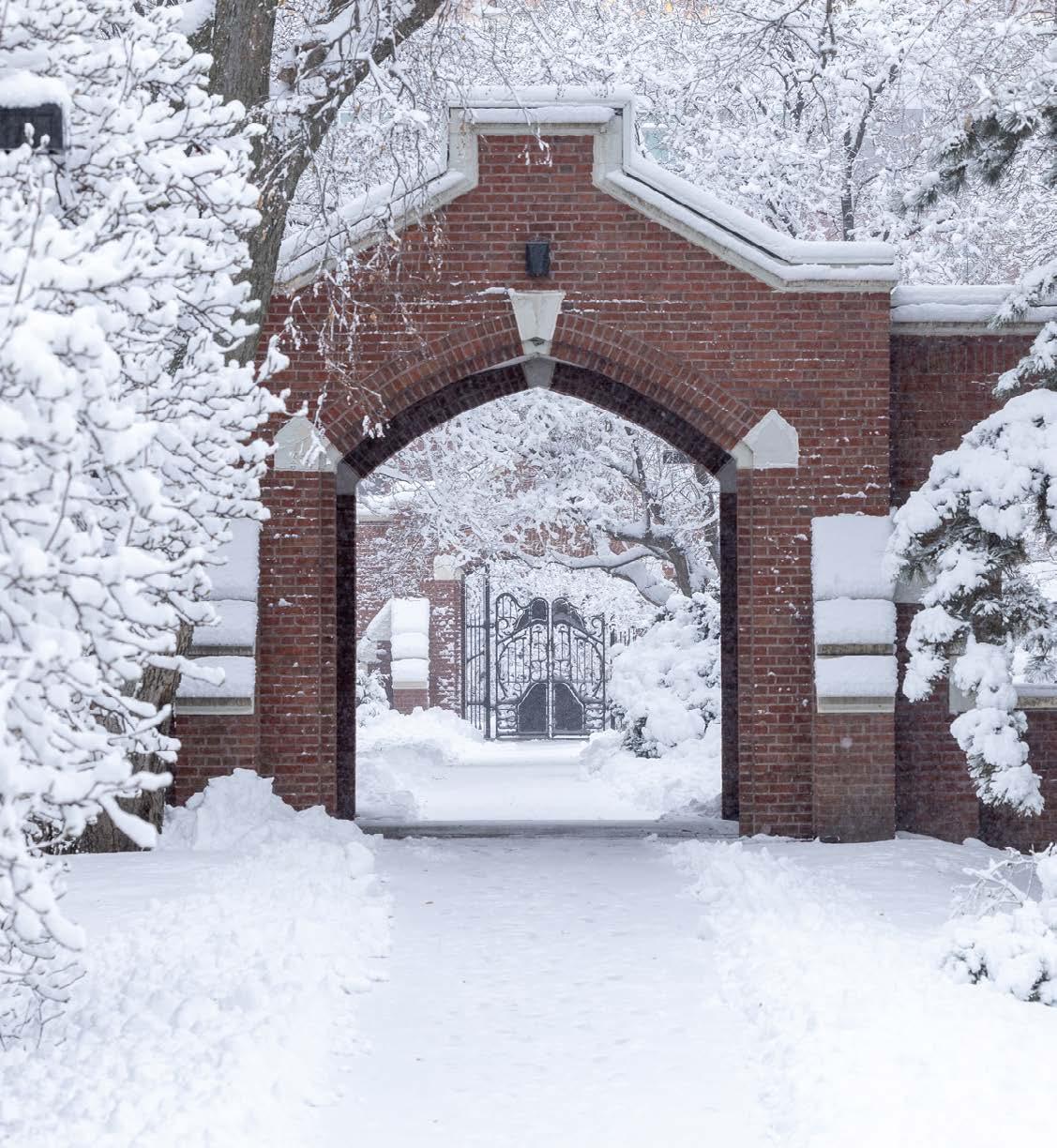
Name this location correctly to be entered for a chance to win an Iowa State-themed prize.