SU MM ER
2018
A N I N D I A N A S TAT E T E A C H E R S A S S O C I AT I O N P U B L I C AT I O N
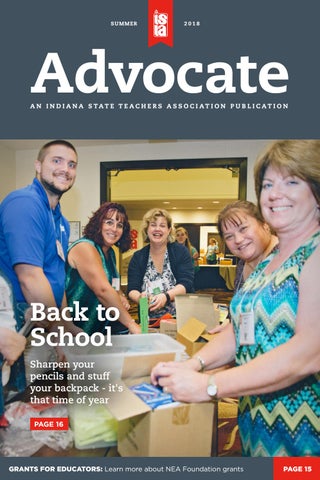
Back to School Sharpen your pencils and stuff your backpack - it's that time of year PAGE 16
GRANTS FOR EDUCATORS: Learn more about NEA Foundation grants
PAGE 15
Helping educators today and tomorrow
Founded by Educators for Educators®, Horace Mann is dedicated to helping educators and their families protect what’s important today and prepare for a successful tomorrow. Products and services especially designed with educators in mind • Auto, home and life insurance and retirement solutions with personalized service for all school employees • Educator rates and discounts on auto insurance and special educator rates for life insurance • Special auto and home insurance benefits and features just for educators • Convenient payroll deduction available to pay auto and life insurance premiums
For more information or to request a no-cost workshop at your school, contact your local Horace Mann representative.
Solutions to the challenges educators face • Student Loan Solutions Workshop • DonorsChoose.org Workshop and Funding • Financial Success Workshop • State Teachers’ Retirement System Workshop (not available in Utah)
Your school must approve payroll deduction for premium payments. Horace Mann Insurance Company and its affiliates underwrite Horace Mann home and auto insurance. Horace Mann life insurance and annuity products are underwritten by Horace Mann Life Insurance Company.
2
SUMMER 2018
horacemann.com
OUR KID S . OUR S C H OOLS . OU R F U T U RE .
Teresa Meredith President
IN THIS ISSUE
Keith Gambill Vice President Doug Taylor Treasurer Dan Holub Executive Director
Make your students feel welcome in the new year.
Indiana State Teachers Association Publisher
Page 16
Keith Clock Contributor
Kim Clements-Johnson Editor
Melanie Harris Contributor
05
06
08
Perspectives
Ask Eric
Our Rights
Expand your horizons and your classroom resources.
ISTA’s legal counsel answers your questions.
Use ISTA materials to start or refresh an association bulletin board.
10
14
18
Our Advocacy
Our Members
Professional Development
New education laws went into effect July 1.
Build your book list with recommendations from educators.
Establish a mutually beneficial mentor/mentee relationship.
Kara Seward Contributor
EDITORIAL BOARD Jennifer Andrews Elkhart Teachers Association Sarah Chism Greater Clark Para-Educator Association Andrew Cowells Concord Teachers Association Bianka Tinklenberg Plymouth Education Association Steve Wynn ISTA UniServ Director
PURPOSE, MISSION, AND VALUES
20
21
22
Our Association
Our Association
Extra Credit
Resources to advance social justice issues in schools.
Learn more about the role of an NEA board member.
Check out healthy, quick lunch options.
We want to hear from you! Send ISTA your comments about the new magazine. If you have story ideas or want to be a contributor, email communications@ista-in.org.
Advocate is the official publication of the Indiana State Teachers Association, the state level of the United Education Profession. The content of the Association’s publications will be consistent with its mission, strategic objectives and policies.
PURPOSE
To develop and organize members as leaders, professionals and active citizens to improve the professional status of educators and educational opportunities for Hoosier kids.
MISSION
The Indiana State Teachers Association is a professional association organized to sustain quality public education, improve students’ educational opportunities and advance the professional status of educators.
GOALS
• Unified voice - we are stronger together. • Economic security and professional working conditions for educators. • Premier public education system that serves all kids regardless of ZIP code, culture or ability.
ISTA-IN.ORG
3
PRESIDENT’S LETTER
“The collective voice of educators is powerful – we know it and we’ve seen it.” - Teresa Meredith
I
still remember how I felt on my first day of school as a teacher. It’s nearly identical to how I felt the first time I walked into school as a student. A heady combination of joy and nerves jumbled together in a slightly nauseating mix. I was nervous. Would I be liked? Would I know what to do? And, hoping I wouldn’t get lost. Coupled with fear was hope. Hope for what was sure to be a good year. Hope for making new friends. Hope for choosing the right profession. I quickly discovered that my colleagues’ dreams mirrored my own as they mentored me and invited me to join the Association, attend trainings, meetings and gatherings. They checked in on me, offered help and simply let me know I could lean on them when necessary. There’s a kind of comradery you feel when you know you aren’t alone. Someone who really gets it – whatever “it” is – who understands the work challenges you face and is standing with you. Nowhere has comradery been more evident than in states like West Virginia, Arizona, Oklahoma and Kentucky where educators donned #RedforEd and carried signs that said, “United We Stand,” “Strong Can’t Be Wrong” and “Fund Our Future.” They linked arms, rallied and raised their collective voices. Educators around the country watched, inspired and encouraged, as the future of our profession unfolded. The power of educators was on full display and their message has become a rallying
4
SUMMER 2018
Teresa Meredith, ISTA President @istapresident
cry for public education and educators around the country. They proved that when we stand up for ourselves, we stand up for our students. The collective voice of educators is powerful – we know it and we’ve seen it. ISTA has a long history of standing up and fighting for our profession and our kids. And, that legacy continues. But we need all Hoosier educators to join and elevate our voice. We simply need to ask our peers to join us on this journey by becoming a member. Membership recruitment is the responsibility of us all. Remember, we were all once new to our field or as members. Reach out to educators – veteran or new – and ask them to join. Our collective wisdom and action are what have gotten us this far. Let’s invite others to join us on this journey and be part of something bigger. Together, we’ll continue to fight for our kids, our schools and our future.
PERSPECTIVES
DESTINATION EDUCATION As educators, we’re always interested in learning. Spend your next weekend or fall break discovering educator resources, curriculum and new places at these regionally significant sites and museums.
Frank Lloyd Wright’s Samara House Take a tour of the National Historic Landmark Samara home in West Lafayette designed by Wright. The house was commissioned by Purdue University Professor Dr. John Christian and his wife Catherine in the early 1950s. Visit samara-house.org for more information on touring the home. The Frank Lloyd Wright Trust has published numerous educator resources with interactive lesson plans for all grade levels and subjects. Find more information at teachingbydesign.org.
Conner Prairie Conner Prairie has more to offer than just science or history lessons. Visit the 1816 Lenape Indian Camp to learn about the relationship between the original fur traders and the Lenape Indians. Fast forward 20 years, and enter Prairietown. Be transported back in time to learn about education, commerce, trade and what it was like to be a resident there in 1836. Cross the covered bridge into the town of Dupont and the year 1863. This is an immersion into Indiana during the Civil War. Find educator resources to enhance your curriculum or a class field trip to Conner Prairie at connerprairie.org/education-research/educators.
Falls of the Ohio The Falls of the Ohio State Park in Clarksville features the world’s most accessible Devonian-age fossil beds. The state park is also host to the historic George Rogers Clark home site, which holds significance as the area where Clark retired, but also where his brother, William Clark, set off for his journey with Meriwether Lewis to explore the western U.S. Bring the history of the Falls of the Ohio into your classroom with resources at fallsoftheohio.org/resources-2.
Find additional sites and museums on ISTA’s Pinterest board Destination Education.
ISTA-IN.ORG
5
ASK ERIC
Ask Eric Eric Hylton is ISTA’s legal counsel. He is an attorney and partner at the law firm of Riley, Bennett & Egloff, LLP in Indianapolis. Hylton holds degrees from Indiana University-Bloomington Kelley School of Business and Indiana University-Indianapolis School of Law. Hylton answers common member questions about legal protections and services, due process and member support.
Do I have the unilateral right to remove a student from my classroom for disruptive behavior? Yes. Indiana Code 20-33-8-25 states that a teacher who has students under their charge can take disciplinary action against a student to, “ensure a safe, orderly, and effective educational environment.” One of the disciplinary actions includes removal of a student from a teacher’s class for a period not to exceed five class periods for middle, junior high or high school students; or one school day for elementary school students.
What obligations do I have to the student who is removed? The student must be assigned regular or additional school work to be completed in another school setting.
Hylton answers common member questions about legal protections and services, due process and member support. Submit your questions to communications@ista-in.org.
6
SUMMER 2018
in partnership with
ISTA-IN.ORG
7
OUR RIGHTS
Building Your Association Bulletin Board A bulletin board in your work site can be a great communication tool. With ISTA materials sent quarterly and your local’s information, an association bulletin board can engage and inform members and nonmembers alike. For the second membership year in a row, ISTA is providing a packet of materials to get your bulletin board ready for the new school year. Even if you’re not a bulletin board superstar, you too can create an eye-catching association bulletin board with just a few tacks and ISTA bulletin board materials! Here’s a preview of what you can expect in the bulletin board packet this fall.
Need more content for your bulletin board? Visit ista-in.org/resources for additional content you can download and print yourself.
8
SUMMER 2018
Don’t have an association bulletin board?
Show your creativity and share your bulletin board!
Contact your UniServ Director for more information and learn whether your contract supplies a bulletin board for your work site.
Post to social media and tag ISTA. /ISTAMEMBERS @ISTAMEMBERS /INDIANASTATETEACHERS
Share Why You’re a Member Ask members to fill out a bubble sharing their reasons for being an ISTA member. This is a great way for non-members to see real-life examples of why membership is valuable.
Go Green Badge If you’re a green local – one that has earned 70 percent or more membership – proudly display your green local badge. Learn more about the Go Green campaign from your association representative.
Bulletin Board Borders Make your bulletin board stand out with ISTA's custom borders.
ISTA-IN.ORG
9
OUR ADVOCACY
Top Five New Education Laws At the beginning of the 2018 legislative session, ISTA was tracking more than 150 education-related bills. While many of these bills were not heard, died or were incorporated into other bills, ISTA followed each one to ensure members were represented and had their interests heard.
1. HB 1001 - School Funding This bill provides relief for schools facing cutbacks due to a school funding shortfall based upon erroneous estimates. State estimates suggested that the shortfall could be as high as $60 million next year. The bill makes the additional funding for this year up to $25 million and caps the second year at $75 million.
2. HB 1315 – Loss of Teacher Rights
Here are five education laws effective July 1 with the most impact on your work.
This controversial bill passed during the one-day special legislative session. The bill takes away local control of schools in Gary and Muncie. As of the date of publication, collective bargaining rights for Muncie teachers remain unclear. For all other Indiana teachers, the bill authorizes an emergency manager, assigned to the school district, to lay off up to five percent of teachers mid-year.
3. SB 230 – Suicide Prevention Requires teachers and certain school employees to receive at least two hours of suicide awareness and prevention training.
4. SB 297 – Soft Skills Curriculum Requires each school to include interdisciplinary employability skill standards, also known as soft skills. The bill also establishes the work ethic certificate program.
5. HB 1421 – School Discipline This bill aims at reducing student suspensions and expulsions as exclusionary policies, which often disproportionately and negatively impact minority students. ISTA also successfully added teachers and education support professional organizations (originally only parent groups and state educational institutions) as collaborators in the implementation of school discipline and behavioral improvement plans.
10
SUMMER 2018
P R E PA R E F O R
ELECTION DAY Are you ready for Election Day? Take steps to ensure you can vote on Nov. 6. Visit indianavoters.com to: •
Register to vote. It’s okay if you’re not, but use your voice this November. The deadline to register is Oct. 9.
•
Check your voting status. Confirm you have the correct residence, birthdate and other important details so that you don’t have to vote on a provisional ballot in November.
•
Plan to support candidates that respect your profession and protect public education. Tell everyone you know to get registered!
Confirm your polling place. Find the voting location in your precinct.
Need a refresher on your elected officials? Check out the Indiana Political Action Committee for Education elected guide at ipace-in.org/electedguide.
Your Elected Officials Enter the home address where you are registered to vote: 123 Main St. #101, City, State Please include the street direction (N, S,E,W) if needed. Search
ISTA-IN.ORG
11
ORGANIZING IN ACTION
Membership: Engagement is Key In our local teachers’ association, we focus on ways to engage new members and maintain engagement with current members. Joy Lohmeyer Joy Lohmeyer is the New Albany-Floyd County Education Association president. She is an engagement coach at New Albany High School.
Nationally renowned educator, Robert Marzano, says that to foster engagement, decisions should be based on four emblematic questions:
• • • •
How do I feel? Am I interested? Is this important? Can I do this?
Now, Marzano, of course was discussing student engagement, but these focus questions work for engagement within our professional organization, too!
How do I feel? Our local brainstorms ways to get positive messages across to our members and potential members. We create and share a list of how the local, ISTA and NEA have represented the interests of educators and students. We want our colleagues to feel positively about their professional organization. The messaging is simple: The association is not for “them” – it’s for “us.” It is all of us representing and supporting one another and building a stronger profession!
12
SUMMER 2018
Am I interested? For members to remain interested and for new hires to be interested enough to become a member, they must be wellinformed! The key to getting and keeping people interested is speaking with colleagues face-to-face about what interests them – their needs, what they want to see in their profession and making changes through discussion.
Is this important? Educators have to feel that it is important to join together to have dialogue, solve problems that arise and build a strong profession. The idea that we are stronger together is central to our purpose. Membership is important, because it gives teachers a way to address and solve issues as a group.
Can I do this? Finally, building and maintaining membership is about participation. Finding ways for new members to participate at a level they can feel comfortable with is important. To that end, we have created Association leadership teams, in many of our buildings. Rather than a head building representative, we have a team that divides the tasks. We look to engage members based on the amount of time commitment they can give. Creating an atmosphere where participation is doable is key to having cohesive building membership. Each local is unique and has unique ideas and structures. As you implement your membership plan for 2018 – 19, I encourage you to work with your leadership and consider the four questions that drive engagement. Using this lens can make our profession and our organization stronger!
Join Now Launched ISTA has launched a new online platform to join the Association – recruiting new members has never been easier! Tell potential members to visit ista-in.org/JoinNow to watch member testimonial videos, learn more about ISTA and join. Every member can work with their membership team to recruit new members. Talk to your association representative to learn more.
ISTA-IN.ORG
13
OUR MEMBERS
BOOK RECOMMENDATIONS FOR THE NEW YEAR “The Hundred Dresses” by Eleanor Estes and illustrated by Louis Slobodkin Grade Levels: Pre-K – 2 “It is a story that goes into bullying of a girl and is a great tool to teach perspective as well as a concept which we began discussing last week which is Stand Up, Don't Stand By. Additionally, the perspective teaching opportunities in the story are so clear that using T-Charts to discuss characters feelings at different points is really fun." Maxie Bolden III, Teacher at Coquillard Primary Center, South Bend Publisher: Scholastic
“The Lion, the Witch and the Wardrobe” by C.S. Lewis Grade Levels: 3 – 5 “I love teaching the classic novel. It is such an exciting book with so many rich details. The world of Narnia truly sparks the imagination of my students, which leads to great discussion.” Lindsay Terry, High Ability Teacher at Delaware Trail Elementary School, Brownsburg Publisher: HarperCollins
“Chinese Cinderella: The True Story of an Unwanted Daughter” by Adeline Yen Mah Grade Levels: 6 – 8 “Every year I am surprised that this book resonates with my seventh-graders – boys and girls alike. Her true story of growing up in a family where she was bullied and not wanted is such a testament to strength of will, the power of love and the ability to forgive. The book also undergirds how her education and her own curiosity and motivation to learn is what changed her destiny. I have been teaching it for ten years now, and it is still a compelling book.” Lisa Mills, English and Language Arts Teacher at West Lafayette Junior/Senior High School, West Lafayette Publisher: Penguin Random House
“Night” by Elie Wiesel Grade Levels: 9 – 12 “When I teach this memoir, we do an in-depth view of the Holocaust and war literature from all of the U.S. wars. So, as a part of the unit, we watch clips from Memphis Belle, Schindler’s List, Remembering the Camps and the Oprah interview with Elie Wiesel. It becomes a greatly interactive piece of literature where we can read and watch history unfold. This is a short memoir – only 80 pages – so adding additional literature surrounding the same theme is easy." Kristi Monesmith, English and Language Arts Teacher at Bremen High School, Bremen Publisher: Penguin Modern Classics
14
SUMMER 2018
Stephanie Dege Stephanie Dege is the early college academic honors biology teacher at Michigan City High School. She received a bachelor’s degree from Aquinas College in Grand Rapids, Mich., master’s degree in education from Nova Southeastern University and master’s +15 from Loyola Marymount University.
Funding Unique Lessons As teachers face continual decreases in budgets, we must look beyond our districts for project funding. I teach academic honors biology in the Early College Program at Michigan City High School (MCHS). In 2016, I needed significant funding for a team I co-founded with Nicole Messacar, Education Coordinator at the Laporte County Soil and Water Conservation District. We established the MCHS Wolves Environmental Restoration Team, a stewardship team partnered with the Michigan City Parks Department. Our goal is to remove invasive species and replace them with native plants to restore healthy habitats in our community. I began my funding journey by researching online for grants for educators. I found the NEA Foundation’s website and their Student Achievement Grants. They look to fund projects that improve student learning, critical thinking and problem solving. The online application process is straightforward, and they review applications three times per year. If awarded, you have one year to complete your project and report back. We are fortunate to have been awarded $5,000 Student Achievement Grants in both 2016 and 2018. This funding has allowed us to complete environmental work that earned us the 2017 Indiana Governor’s Award for Environmental Excellence. If you are looking to fund a unique project for your school, I highly encourage you to apply. If you would like to learn more about our team you can find us on Facebook by searching for MCHS Wolves Environmental Restoration Team.
NEA Foundation Grants Access educator grants from the NEA Foundation. Global Learning Fellowship Increases access to global education professional development opportunities for K – 12 public school educators. • Applications open fall 2018.
Student Achievement Grants Stimulates students’ curiosity and excitement about learning and helps them become successful 21st-century citizens. • Three grant deadlines open during the year – Oct. 15, Feb. 1 and June 1.
Learning & Leadership Grants Provides funding to thousands of educators, enabling them to develop their professional practice to improve student learning. • Three grant deadlines open during the year – Oct. 15, Feb. 1 and June 1.
Subscribe to the NEA Foundation’s e-newsletter to get the latest information on grants, applications and deadlines.
Don’t forget, ISTA offers grants and scholarships to members and local associations. Most deadlines are March 1, but consult the ISTA website to confirm.
ISTA-IN.ORG
15
OUR PROFESSION
I D E AS TO W E LCO M E K I DS
TO
Share and find more ideas on ISTA's Pinterest back-to-school board at pinterest.com/istaindiana.
16
SUMMER 2018
Ways to Make Students Feel Welcome in the New Year Assign seats before school starts. Prevent students from being caught in the embarrassing situation of getting shunned or shooed away from a seat supposedly being saved for a friend. Try handing your students a number as he or she enters the room. You now have a seating chart.
Get creative with lines. Instead of lining up kids by last name, try lining up according to where the student was born to see who was born the furthest away. Then, have them find other commonalities and differences from the person in front of them.
Use students’ names from day one. As quickly as possible, start calling students by their names. Students can quickly make paper name tents using note cards and prop them on their desks. Using a student’s name creates a sense of familiarity. When you know someone, you call them by name.
Write about self. Some students only think teachers, bus drivers and nurses exist in their proper domains – classroom, school bus or nurses’ office. Humanize yourself. Make a list of things about yourself and bring in a picture of yourself when you were the same age as your students. Assign students to make their own lists and bring in a favorite picture of themselves. Use the lists as writing prompts to write a personal narrative. Read the narratives out loud in the classroom – it will help you and the class get to know one another.
Send home a packet of important forms. Most teachers send home a welcome packet that includes a letter, syllabus and upcoming events. Try adding something unique to your welcome packet this year. It can’t hurt to approach local businesses for “buy one, get one free” coupons, complimentary movie tickets or other deals, especially when they know you will be giving them to families in the community.
Get to know you, without words.
Contact families before you go home for the day.
Encourage your students to get to know you. Make a picture collage of things that are important to you or your hobbies. Have them describe the pictures and guess what the picture means to you. Then have the students make picture collages to find out more about them.
This year, try emailing each of your classes with a personalized note about the first day of school. If you take notes during the day, you can share specific positive observations in your message. Parents will quickly see that their kids are in the hands of a teacher who cares enough to share his or her enthusiasm with families.
ISTA-IN.ORG
17
PROFESSIONAL DEVELOPMENT
Insights from Mentoring Last year then-Indiana Student Education Association member Gianna Mesarina student taught in ISTA member Jane Dykstra’s class at Peifer Elementary in Schererville. ISTA asked Mesarina and Dykstra to share their insights on making a mentor/mentee relationship successful. What did you do to prepare for working with your mentee? As soon as I found out Gianna was going to be in my classroom we met and discussed our philosophies and expectations. We learned we are very much alike.
Jane Dykstra Jane Dykstra is a kindergarten teacher at Peifer Elementary School in Schererville, IN. She has taught for 10 years with eight years at the Lake Central School Corporation. Dykstra graduated from Purdue University Northwest in December 2007.
What is your approach to creating a solid relationship with your mentee? Trust! To create a solid relationship, you have to mentor and trust your mentee. Gianna and I do things differently. I mentored in the beginning and trusted her when she took over the teaching. Gianna did respond well to any suggestions I had.
What was the best thing you taught your mentee? We don’t know what our students’ home lives are like. We may be the only positive person in their day. We have to accept each child for who they are, and always make sure we give our all in a happy, positive and upbeat way.
A mentorship can mean learning goes both ways. What do you feel you learned from your mentee? Gianna’s excitement for teaching reminded me to stay excited in the classroom, keep looking for new ways of doing things to reach every learner’s needs and always smile.
18
SUMMER 2018
Building a Mentorship Program for ESPs Picture this – it’s your first day as a new educator. It’s hard to keep education support professionals (ESP) in challenging environments with little support or mentorship. One solution is working with your district to implement a mentoring program. NEA ESP Quality has worked with ESPs across the nation who have done this very thing.
Sarah Chism Sarah Chism is a paraprofessional at Greater Clark County Schools.
Members can download a handbook to guide them through implementing a mentoring program. Topics include what exactly mentoring is, roles and responsibilities of mentors and mentees and steps to implementing a mentoring program. Mentoring is a great way to elevate the professionalism of all ESP career families.
What did you do to prepare for working with your mentor? Before coming into Mrs. Dykstra’s classroom, I made sure to communicate with her frequently and even visited her classroom. I was open and honest about my feelings about student teaching, and she was open and honest about her own experiences. We started off with really great conversation that led to an even more amazing student teaching experience.
Gianna Mesarina Gianna Mesarina is from Hammond and is a recent graduate of Purdue University.
What is your approach to creating a solid relationship with your mentor? Communication is the key to everything. Throughout my student teaching, I opened up to Jane as a person, not just as someone who I have to share a classroom with. By creating this bond with her, our energy in the classroom was phenomenal, and the children in the class picked up on this. Over the 16 weeks she became a mentor, a colleague, but most of all, she became my friend. What was the best thing you learned from your mentor? My mentor did a phenomenal job of reminding me why I went into teaching. She always came to school with a smile on her face and was always interested in the students. She tailored her instruction to meet the different abilities in her classroom. She really lived up to the saying, “Those who love teaching, teach students to love learning.” A mentorship can mean learning goes both ways. What do you feel you taught your mentor? There are many things I believe I taught my mentor teacher in regards to new technologies such as Kahoot! and Class Dojo, as well as new methods that I learned throughout my time at Purdue University. I am glad she was open to my style of teaching, and even adapted some of these things into her everyday classroom. I feel honored!
ISTA-IN.ORG
19
OUR ASSOCIATION
Additional Reading ISTA President Teresa Meredith tasked the ISTA standing committees to read and discuss these books to provoke thought and conversation, challenge one’s own biases, rethink behaviors and inspire action. Pick one, or read them all, to further your understanding and awareness of social justice issues. "Just Mercy" by Bryan Stevenson Published by Penguin Random House
"Brown Is the New White" by Steve Phillips Published by The New Press "Between the World and Me" by Ta-Nehisi Coates Published by Penguin Random House "The New Jim Crow" by Michelle Alexander Published by The New Press "Waking Up White, and Finding Myself in the Story of Race" by Debby Irving Published by Elephant Room Press
20
SUMMER 2018
Advancing Social Justice Goals At the ISTA Representative Assembly in April, delegates adopted new Associationwide goals, including supporting a “premier public education system that serves all kids regardless of ZIP code, culture or ability.” As public educators, this has been a long-held belief and commitment, but it is now codified in our mission and strategic planning. ISTA’s pledge is an opportunity for every member to assess and integrate diversity inclusion, cultural competency and social justice into their interactions with students, classroom lessons and in the workplace. What can you do in your school or classroom to further this goal? •
Pursue ways to create diversity awareness or to celebrate diversity in your school community.
•
Develop culturally-responsive and studentcentered curriculum.
•
Form strategies to foster social justice in your school with an inclusive mindset. Consider who may be left out and remedy.
The National Education Association (NEA) has published a diversity toolkit for educators to expand their awareness of social justice topics and reflect and embrace all students in the classroom. The toolkit features additional information and suggestions on how to approach this important issue in our schools and classrooms.
Learn What an NEA Board Member Does Hilda Kendrick-Appiah addressing delegates at the ISTA RA.
Every state affiliate of the NEA has representation on the NEA board of directors. Indiana has two board members currently serving. At the ISTA Representative Assembly (RA), Hilda Kendrick-Appiah was re-elected to serve as a National Education Association (NEA) board member. This is her second three-year term. Kendrick-Appiah was encouraged by former ISTA president Nate Schnellenberger to run for one of the NEA board positions. Her interest in advocacy and public education funding was a big driver in her decision to run initially and for re-election. “Lobbying members of Congress is an awesome way to talk about educational policies and also share personal teaching stories,” said Kendrick-Appiah. That’s a big part of her role as an NEA board member. NEA directors visit Washington, D.C., three times each year and spend time on Capitol Hill with the Indiana congressional delegation. Many conversations revolve around fully funding public education, but Kendrick-Appiah foresees another issue that may be the largest education topic in the coming years – school safety.
“I hope it will be a gun violence act to make our educational communities safer,” said Kendrick-Appiah. “I don’t want more children or educators shot in our schools.” NEA board members are also responsible for fund raising to support pro-public education candidates on the federal level through the NEA Fund for Children and Public Education. Getting the right elected officials in office can help NEA achieve significant policy wins for public education.
If you’re interested in running, visit ista-in.org/ governing-documents for more information and to complete a candidate form. There will be an open NEA board of directors position next year. KendrickAppiah recommends that members considering running should be active at the state level and attend the ISTA and NEA RAs, join advocacy opportunities at the Statehouse and locally and become familiar with the NEA constitution, bylaws and standing rules. She adds, “A member should be healthy and energetic! It takes energy and commitment!”
ISTA-IN.ORG
21
EXTRA CREDIT
EATING ON THE RUN Educators seldom get a leisurely lunch, but more often opt for a quick, easy lunch option, which may not be the healthiest. Here are some ideas on how to fix quick, healthy lunches that will keep you fueled throughout the school day.
22
Bento Box
Salad Shakers
This Japanese-inspired option allows for variety and portion control. You can really make this one your own. Fill each quadrant with your favorite healthy options from sushi to grilled chicken or vegetables and rice.
Layer your favorite salad ingredients in a canning jar. Add dressing. Shake, and lunch is served! Easy to eat at your desk, in the lounge or on the go.
Meal Prep
Avocado Toast
Don’t have time during the week to make your lunches? Meal prep may be for you. Find one day of the week to make a large meal. Pack the meal in containers to grab before you leave in the morning. You’ll have a fresh, healthy lunch every day of the week.
Avocado toast may have gotten a bad rap as a Millennial go-to, but avocados have major health benefits. In addition to being loaded with vitamins, avocadoes have more potassium than bananas, loads of fiber and can be part of a cholesterol-lowering diet.
SUMMER 2018
ABrightFuture For NEA Members and their families
The NEA® Smart Option Student Loan® by Sallie Mae® You know the value of higher education; making it a reality is a smart decision. The NEA is here to help you or a member of your family* find a way to achieve your goal. Flexible repayment options. Make payments while in school or you can defer payments until after graduation1. The choice is yours!
Great rates — no origination fees. The NEA® Smart Option Student Loan® by Sallie Mae® offers competitive rates1. Borrow up to 100% of the school-certified undergraduate or graduate school expenses not covered by scholarships, grants or federal loans2. The NEA Exclusive Rate Reduction lets you reduce your interest rate by a quarter percentage point after making your first 12 on-time principal and interest payments3. Plus, there are no origination fees or prepayment penalties. All offered for NEA Members and their families.
To learn more, visit www.neamb.com/sl or call 1-866-898-5198.
in partnership with *The NEA Student Loan Program has been developed for NEA members and their families. Parents, spouse or domestic partner, and children are eligible family members. Borrow Responsibly We encourage students and families to start with savings, grants, scholarships, and federal student loans to pay for college. Students and families should evaluate all anticipated monthly loan payments, and how much the student expects to earn in the future, before considering a private student loan. 1 Interest rates for Fixed and Deferred Repayment Options are higher than interest rates for the Interest Repayment Option. You’re charged interest starting at disbursement, while in school and during your six-month separation or grace period. When you enter principal and interest repayment, Unpaid Interest will be added to your loan’s Current Principal. Variable rates may increase over the life of the loan. Advertised APRs assume a $10,000 loan to a freshman or first-year graduate, as applicable, with no other Sallie Mae loans. 2 Sallie Mae reserves the right to approve a lower loan amount than the school-certified amount. 3 NEA Members can earn a 0.25 percentage point interest rate reduction by making their first 12 on-time principal and interest payments or paying ahead an amount equal to the first 12 on-time principal and interest payments. Although you may still earn the benefit if you pay ahead the required amount, the benefit will not be activated until after the 12th principal and interest payment would have been due. Any period in which your loan is in a forbearance, deferment, or Graduated Repayment Period will not count towards satisfying the on-time principal and interest payment requirement. NEA’s Member Benefits Corporation receives compensation from Sallie Mae for this program. NEA’s Member Benefits Corporation does not receive any dues dollars from NEA to support Member Benefits programs. This information is for borrowers attending degree-granting institutions only. Applications are subject to a requested minimum loan amount of $1,000. Current credit and other eligibility criteria apply. SALLIE MAE RESERVES THE RIGHT TO MODIFY OR DISCONTINUE PRODUCTS, SERVICES, AND BENEFITS AT ANY TIME WITHOUT NOTICE. Smart Option Student Loans are made by Sallie Mae Bank or a lender partner. Sallie Mae, the Sallie Mae logo, and other Sallie Mae names and logos are service marks or registered service marks of Sallie Mae Bank or its subsidiaries. All other names and logos used are the trademarks or service marks of their respective owners. SLM Corporation and its subsidiaries, including Sallie Mae Bank, are not sponsored by or agencies of the United States of America. Information advertised valid as of 2/26/18. © 2018 Sallie Mae Bank. All rights reserved. MKT13343 0318 SL170718 ISTA-IN.ORG 23
BUILDING A SUCCESSFUL MENTORSHIP
PAGE 18
/ I N DI A N ASTATETEACHER S
@I STA M EM B ER S
/ I STA M EM B ER S
150 W. Market St., Ste. 900 Indianapolis, IN 46204