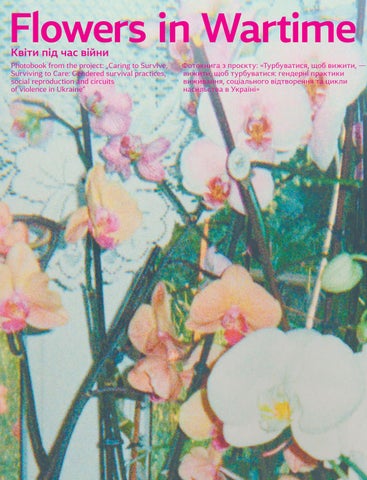
Flowers in Wartime Квітиипіддчассвійни
Photobook from the projectу „Caring to Surviveя Surviving to Careу Gendered survival practicesя social reproduction and circuits of violence in Ukraine”
ФотокнигааззпроєктууууТурбуватисяяящоббвижитиии―― вижитииищоббтурбуватисяяягендернііпрактикии виживанняяясоціальногоовідтворенняятаациклии насильствааввУкраїніі
1
2
Передмова
«
Коли Міра виходила з дому, взяла намистину з шкатулки Коли Тім виходив з міста, підняв камінчик на вулиці Коли Ярка лишала сад, взяла кісточку абрикоси Коли Віра виходила з дому, то не взяла нічого cкоро я повернусь, сказала і нічогісінько не взяла Міра виростила шкатулку із намистини ростить новий дім в шкатулці Тім почав нове місто з каменю Місто схоже на рідне, тільки немає моря Ярка посадила кісточку абрикоси довкола кісточки сад став Ярчин А Віра яка не взяла нічого розказує цю історію.
»
Так починається вірш Вікторії Амеліної «Історія для повернення», у якому оповідь про дім вибудована навколо кількох образівпредметів, для когось, можливо, непомітних. Деталі важливі. Але й від того, хто говорить, нерідко залежить і сам сюжет: ниточки розмов пов’язують деталі одну з одною й витворюють плетиво оповіді. Хто сьогодні стане Вірою, що несе в собі надію та переконання в тому, що колись цей предмет оживе й перетвориться на щось більше: на повернення дому чи на повернення когось додому? У війни багато свідків — але не всі хочуть говорити про свої досвіди — можливо, не зараз. У війни багато викликів — але деякі з них, здається, не можна вирішити саме тепер. У війни багато емоцій — і поміж страхом, болем, тугою і важкістю в ній також є місце для надії, і віри, і того, що залишається неназваним. У ній є місце для любові, яку люди виявляють одне до одного, піклуючись і часто відчуваючи й інший бік цієї любові — те, що в своєму тексті Ніна Потарська назвала «воєнною економікою турботи» (wartime care economy). Книжка перед вами — також про це неназване. Вона його 1
2
показує через óбрази та історії. Вона говорить досвідами тих, хто опинився на периферії уваги — в різних містах України, ближче і далі від фронту, — піклуючись про інших. Це дослідження — унікальне і важливе, бо поряд із міркуваннями науковиць наводить погляди самих жінок і чоловіків, які належать до цих вразливих груп, що говорять від власного імені за допомогою фотографій. Метод «Photovoice» обрано не випадково, адже він сфокусований на тому, щоби проявити голоси, яких досі не було чути. І хоча його винайшла Керолайн К. Ванг на початку 1990-х років, коріння його сягає глибше — до партисипативних практик та соціальної фотографії, що за допомогою документування нерівності та несправедливості намагалися змінити ставлення до маргіналізованих груп та вплинути на умови їхнього життя. На відміну від гостросоціальної фотографії та досвіду Доротеї Ланж, Вокера Еванса, Ґордона Паркса та інших, що знімали життя американців під час Великої депресії, метод «Photovoice» Керолайн К. Ванг і Мері Енн Берріс, розширює рамку фотографії до візуального антропологічного дослідження та деконструює питання художника чи художниці як авторів фотопроєктів. Він дає нагоду спільнотам безпосередньо брати участь у своїй репрезентації та вивченні. Цінність цих знімків саме в цій змінній парадигмі, емансипації героїв та їхній активній співучасті. Що таке війна, чим вона є та як вона неспішно й непомітно проникає у повсякденне життя, змінюючи наш побут та різні стани цивільних та військових, — здається, це одне з найбільш цікавих питань, яке за повідомленнями з фронту маргіналізується саме собою, бо здається, що в ієрархії історії пріоритет і увага прикуті саме до тих місць, де відбуваються бойові дії. Та саме в фотографіях, зроблених учасниками проєкту «Flowers in Wartime», розкриваються деталі повсякдення воєнного часу: картоплина, наче серце, як символ першого врожаю, «дуже красиве небо — ніби з іншого світу» (якого саме? чи йдеться про світ без війни?), капці для гостей, ніжно складені на порозі будинку, заквітчаного яскравими вазонами. Образ за образом, знімок за знімком ці історії «оживають» та перетворюються на насичені деталями оповіді. Із початком повномасштабного вторгнення питання про те, хто має право розповідати історії, чий голос стає публічним або може стати публічним, інтегрувалися до дебатів про епістеміологічну справедливість. Як і інші проєкти, як-от «Плівки з передової: фотографії, листи та артефакти українських військо-
вих» Сергія Мельниченка чи «Behind Blue Eyes», ініційованого Дімою Зубковим та Артемом Скороходьком, проєкт «Flowers in Wartime» долучається до розмови про справедливість, розширюючи коло учасників та учасниць цього невидимого круглого столу. Саме тому й аудиторія цього проєкту значно ширша — від науковців, активістів і тих, хто цікавиться історією соціальної фотографії чи партисипативними проєктами, до тих, хто просто живе по сусідству. Адже в цих знімках можна побачити відображення власного життя, розпізнати свій побут. І почати розмову про те, а що є особливого в житті кожного — намистинка з шкатулки, камінчик на вулиці, кісточка абрикоси, світанки й заходи сонця, риболовля чи шматок оповіді, яка не вміщається в кишеню. Катерина Яковленко, журналістка та дослідниця сучасного мистецтва, шефредакторка сайту «Суспільне Культура»
3
Foreword
«
»
When Mira was leaving home she took a bead from her jewelry box When Tim was leaving his town he picked up a rock from the street When Yarka was leaving her garden she took an apricot pit When Vira was leaving home she took nothing I will be back soon, she said and took nothing at all Mira has grown a jewelry box from her bead She is growing a new home in the box Tim has started a city from his rock The city is like his hometown Except there is no sea Yarka has planted her apricot pit Now she has her own orchard around it And Vira who took nothing at all She is telling this story. [1]
These are the first lines of the poem “Homecoming Story” by Victoria Amelina, in which the notion of ‘home’ is constructed around a few images or objects that might otherwise have gone unnoticed. The details are important. However, the one who is speaking often shapes the narrative — threads of conversations connect details and weave a fabric of meaning. Who would become today’s Vira, the one who carries hope within her, along with the belief that one day this object will come to life and transform into something bigger: a return home, or the return of someone to their home? The war has many witnesses, but not all of them are willing to speak about their experiences — at least not yet. The war brings many challenges, yet some of them — perhaps — cannot be resolved immediately. The war contains many emotions, and between fear, sadness, and heaviness, there is still some space left for hope, faith, and something that can’t quite be named. There is a place for love that people show towards each other through acts of care, while also often experi- 5
6
encing the other side of that love. In her text, Nina Potarska calls it the wartime care economy. The publication you are holding in your hands is about this ‘nameless something’. It is approached through images and stories. It speaks through the experiences of those who happened to be on the periphery of the attention while taking care of others — in different cities across Ukraine, both near to and far from the frontline. This research is unique and important because, alongside the perspectives of academics, it presents viewpoints of the women and men who belong to vulnerable groups and who speak on their own behalf through photographs. The Photovoice method was not chosen by chance, as it is specifically focused on bringing forward voices that have not previously been heard. Although it was developed by Caroline C. Wang in the early 1990s, its roots reach much deeper — into participatory practices and social documentary photography, which sought, through documenting inequality and injustice, to transform attitudes toward marginalised groups and influence their living conditions. Unlike the socially engaged photography of Dorothea Lange, Walker Evans, Gordon Parks, and others who documented the lives of Americans during the Great Depression, the Photovoice method developed by Caroline C. Wang and Mary Ann Burris expands the framework of photography into the realm of visual anthropological research and deconstructs the notion of the artist or photographer as the sole author of a photographic project. It creates an opportunity for communities to participate directly in their own representation and study. The value of these photographs lies precisely in this shifting paradigm, in the emancipation of the participants, and in their active involvement in the process. What is war, what does it feel like, and how does it slowly and imperceptibly infiltrate transforming the routines and emotional states of both civilians and military personnel? This is perhaps one of the most compelling questions, yet it is marginalized by news from the frontline as if, within the hierarchy of history, priority and attention are granted only to places where active hostilities are taking place. However, the photographs taken by the participants of the Flowers of Wartime project reveal details of wartime everyday life — a heartshaped potato as a symbol of the first harvest; ‘the sky is very beautiful, as if it came from another world’ (which world, exactly? a world without war?); slippers carefully arranged on the doorstep of a blooming house for the guests. Image after image, photo after photo, these
stories come to life and unfold into narratives full of small details. Since the beginning of the full-scale invasion, the question of who has the right to tell stories, whose voice becomes public — or might become public — was integrated into debates on epistemic justice. Like other projects such as Frontline Tapes: Photographs, Letters, and Artifacts of Ukrainian Soldiers by Serhii Melnychenko or Behind Blue Eyes, initiated by Dmytro Zubkov and Artem Skorokhodko, the Flowers in Wartime project contributes to this conversation about justice by expanding the circle of participants gathered around this metaphorical round table. For this reason, the audience of the project is also much broader, ranging from scholars, activists, and those interested in the history of social documentary photography or participatory practices, to people who simply live next door. In these images, one may recognise reflections of one’s own life and everyday routines, and begin a conversation about what is unique in each person’s life: a bead from a jewelry box, a small rock found on the street, an apricot pit, sunrises and sunsets, fishing, or a fragment of a story too large to fit into a pocket. Kateryna Iakovlenko, a journalist and researcher of contemporary art, editor-in-chief Suspilne Culture website
1. Transl. by the author. Victoria Amelina. “Homecoming Story”. Amelina About Ukraine . December 19, 2022. URL: https://amelina.substack.com/p/homecoming-story.
7
Повсякдення
8
Everyday Life
9
Місто просинається. Побажаємо йому мирного неба.
The city is waking up. Let’s wish it peaceful skies above.
Микола
Mykola
11
Дуже красиве небо — ніби з іншого світу. Перетин двох світів.
The sky is very beautiful, as if it came from another world. An intersection of two worlds.
Любов Нестеренко
Liubov Nesterenko
13
Шоіра (фрагмент)
Shoira (part)
15
Микола
Mykola
17
Анна М.
Anna M.
19
Капці для гостей.
Slippers for guests.
Жанна Сапожнікова
Zhanna Sapozhnikova
21
Старі єврейські будинки в Демидівці.
Old Jewish houses in Demydivka.
Анастасія Дишкант
Anastasiia Dyshkant
Анастасія Дишкант
Anastasiia Dyshkant
23
Щоденний маршрут на роботу. Цікаво зазирнути всередину цих будинків.
The everyday route to work. I’m curious to look inside these houses. Lviv.
Іра
Ira
25
Годинник із живих квітів. Дивлюсь на нього, як на символ часу та руху, де квіти — життя, а стіна позаду — фортеця, котра нас оберігає. Стежка внизу — наш шлях, яким ми йдемо — із кожним кроком повільно звужується.
A flower clock. For me, it is a symbol of time and movement, where flowers represent life, while the wall behind is a fortress that protects us. The trail below is the path of life we follow; it slowly narrows with each step.
Алла Ільчук
Alla Ilchuk
Мальви. Краса у нашому дворику.
Mallows. Beauty in our yard.
Алла Ільчук
Alla Ilchuk
27
Найкраща мотивація вставати рано-вранці. Дикі качки допомагають ловити рибу — заганяють її на гачок. Микола
The best motivation to wake up early in the morning. Wild ducks help with fishing — they drive the fish onto the hook. Mykola
29
Шоіра (фрагмент) \ Shoira (part)
31
Фрагмент фото з першої частини воркшопів з учасницями й учасниками.
A fragment of a photo from the first part of the workshops with the participants.
Вечірня молитва. Світло від свічки.
An evening prayer. Candlelight.
Марія
Maria
33
Столик у бабусі: її маленький світ.
A nightstand at my grandma’s — her little world.
Оля
Olia
35
Фіалки на підвіконні.
Violets on the windowsill
Марія
Maria
37
На ліжку кепка, на ній — тамга. Тамга є національним символом кримських татар, їхньої ідентичності, культури та боротьби за свої права.
A cap on a bed, a tamga on it. A tamga is a national symbol of the Crimean Tatars — their identity, culture, and struggle for rights.
Amet Dilâver oğlu Bekir
Amet Dilâver oğlu Bekir
39
Частина світу бабусі — її ванна. Навіть у хаосі є свій ритм, котрий не можна порушувати.
A part of my grandma’s world — her bathroom. Even in chaos, there is a rhythm that must not be disturbed.
Оля
Olia
41
Кішка Кнопа та племінниця Мілослава. Коті 8 років, її кошеням зняли з дерева. Жанна Сапожнікова
Knopa, the cat, and my niece Miloslava. The cat is 8 years old. When she was a kitten, we brought her down from a tree. Zhanna Sapozhnikova
43
Марія
Maria
Наталія Кривохижа Nataliia Kryvokhyzha
45
До нас в гості прийшли подружжя художників, які якраз повернулись із виставки, і Олесь — реставратор. Усі ці люди із захватом смакували перший огірочок в сезоні, який я зірвала і принесла до столу. Смак літа!
An artist couple came to visit us; they had just returned from an exhibition. Oles is a restorer. All of them eagerly tasted the first cucumber of the season, which I had picked and brought to the table. The taste of summer!
Анастасія Дишкант
Anastasiia Dyshkant
47
Буде компот.
There will be kompot.
Жанна Сапожнікова
Zhanna Sapozhnikova
49
Заготовки на зиму. Хочеться вкусити помідора, щоб аж до стелі бризкнув.
Winter preparations. I want to bite into a tomato so juicy it would squirt right to the ceiling!
Жанна Сапожнікова
Zhanna Sapozhnikova
51
Мій світ квітів тут невидимий, але бачимо світ помідорів мого чоловіка.
My world of flowers is invisible here, but you can see my husband’s world of tomatoes.
Наталія Кривохижа
Nataliia Kryvokhyzha
53
Дядя Алік приїхав додому на ровері, поклав сигарети на своє крісло і пішов запускати курей спати. Муркунь тим часом зайняв його місце і позіхає. «Курочка встала — місце продала». Анастасія Дишкант
Uncle Alick came home with a bike, placed his cigarettes on the armchair, and went out to let the chickens into the henhouse for the night. Murkun, the cat, meanwhile, took over his seat and is yawning. Move your feet, lose your seat. Anastasiia Dyshkant
55
Вид на небо дав натхнення. Начебто і повсякденне, але вражає. Микола
The view of the sky was inspiring. So ordinary, yet striking. Mykola
57
Біль, втрата, руйнація, насильство
58
Pain, Loss, Destruction, Violence
59
Завжди дуже шкода прикутих на ланцюг собак. Пес на ім’я Сцикун.
I always pity chained dogs. The dog is named Stsykun.
Анастасія Дишкант
Anastasiia Dyshkant
61
Футболка-«піксель» серед руїн викликала в мене асоціацію з прапором свободи. Ті самі руїни з прапором з «пікселя» — як символ сили та незламності Харкова.
A camouflage T-shirt among the ruins reminded me of a flag of freedom. The same ruins with the camo flag, like a symbol of Kharkiv’s resistance.
Оля
Olia
63
На компі наклейка «Азову». Мені її подарував Рома. Роми немає вже 1 рік та 9 місяців. Наклейка досі є.
There is an Azov sticker on the laptop. Roma gave it to me. Roma died one year and nine months ago. The sticker is still there.
Анастасія Дишкант
Anastasiia Dyshkant
65
Насіння цього соняха мені прислала моя тьотя з Німеччини. Вони втікли туди від війни.
My aunt sent me these sunflower seeds from Germany. They fled there because of the war.
Анастасія Дишкант
Anastasiia Dyshkant
67
Гарні дівчата-близнючки принесли квіти полеглому воїну. Марсове поле. Львів.
Beautiful twin girls brought flowers to a fallen warrior. Field of Mars, Lviv.
Алла Ільчук
Alla Ilchuk
69
Чоловік та донька. Ірина Зацеляпіна
My husband and my daughter. Iryna Zatseliapina
71
Зруйноване тролейбусне депо у Харкові.
A destroyed trolleybus depot in Kharkiv.
Наталія Кривохижа
Nataliia Kryvokhyzha
Пошкоджений завод «Електрон» біля мого дому.
The damaged Elektron plant next to my house.
Оксана Яцкович
Oksana Yatskovych
73
Алея Слави. Місто Мерефа, Харківська область. Невелика частина алеї, яку я проходжу дорогою на роботу.
The Alley of Glory. Merefa city, Kharkiv region. A small part of the alley I pass by on my way to work.
Жанна Сапожнікова
Zhanna Sapozhnikova
75
В квартирі батьків Роми.
At Roma’s parents’ apartment.
Анастасія Дишкант
Anastasiia Dyshkant
77
Воїн повертається додому на щиті. Це проміжна зупинка, до дому ще десяток кілометрів. На фоні — плакати з портретами загиблих воїнів. Там, серед них, і мій Рома. Демидівка, Рівненщина. Анастасія Дишкант
The warrior returns home aut in scuto. It is just an intermediate stop; home is still a dozen kilometers away. In the background are posters with portraits of fallen soldiers. My Roma is among them. Demydivka, Rivne region. Anastasiia Dyshkant
79
Турбота, піклування
80
Care
81
Картоплина любові. Хлопець викопав на городі картоплю у вигляді серця і подарував мені. Сказав, що спеціально для мене таку виростив.
A potato of love. My boyfriend dug up a heart-shaped potato in the garden and gave it to me, saying he’d grown it like that especially for me.
Анастасія Дишкант
Anastasiia Dyshkant
83
Кіт Василь, кіт Монік, собачка Аліса.
Vasyl, the cat, Monik, the cat, Alisa, the dog.
Ірина Зацеляпіна
Iryna Zatseliapina
85
Анна М.
Anna M.
87
Ззаду на дошці написано: «сексуальність», «батьківство». Ці теми ми записали, щоб проговорити на сімейній рефлексії. Але на фото Костя сексуально їсть морозиво і по-батьківськи ділиться з Мусею — нашою котодонею.
On the board behind, it says: ‘sexuality’ and ‘parenthood’. We wrote these topics down to discuss during our family reflection session. But in the photo, Kostya is sensually eating ice cream and sharing it — like a father — with Musia — our cat-daughter.
Анастасія Дишкант
Anastasiia Dyshkant
89
Шоіра
Shoira
91
Чоловік лікує лапку улюбленому Гольфіку.
My husband treating our beloved Holfik’s paw.
Жанна Сапожнікова
Zhanna Sapozhnikova
Онука Марія з ротвейлером Кешем.
My granddaughter Maria with Cash, the Rottweiler.
Ірина Зацеляпіна
Iryna Zatseliapina
93
Наталія Кривохижа / Nataliia Kryvokhyzha
95
Шоіра / Shoira
97
Примус — не завжди ненависть. Турбота — не завжди любов. Страшно — не завжди нашкодять. Клітка — не завжди НАЗАВЖДИ...
Coercion does not necessarily mean hateress. Care does not necessarily mean love. Fear does not necessarily mean you will be harmed. A cage is not always FOREVER…
Любов Нестеренко
Liubov Nesterenko
В той час, коли я дбаю за квітами, мій чоловік дбає за голубами, котрих він розводить.
While I take care of the flowers, my husband takes care of the pigeons he breeds.
Шоіра
Shoira
99
Онука Марія підливає город влітку. Ірина Зацеляпіна
My granddaughter Maria waters the garden in summer. Iryna Zatseliapina
101
Шоіра / Shoira
103
Щоденна праця та турбота дають свої плоди. Мій квітник.
Daily work and care bear fruit. This is my flower bed.
Шоіра
Shoira
105
Анна М.
Anna M.
Мамині гладіолуси. Село Зашків.
My mom’s gladioluses. Zhashkiv village.
Оксана Яцкович
Oksana Yatskovych
107
Олічка, моя похресниця.
Olichka, my goddaughter.
Оксана Яцкович
Oksana Yatskovych
Гортензії в нашому садку. Село Щирець.
Hydrangeas in our garden. Shchyrets village.
Оксана Яцкович
Oksana Yatskovych
109
Тато і часник. Село Зашків.
My dad and garlic. Zashkiv village.
Оксана Яцкович
Oksana Yatskovych
111
Збір озимої цибулі і часнику. Мій перший врожай на новому місці і наш перший врожай як пари.
Harvesting winter onions and garlic. My first crops in the new place and our first crops since we’ve been together.
Анастасія Дишкант
Anastasiia Dyshkant
113
Шоіра
Shoira
115
Поливаю квіти. А ялинку садила ще моя мама, коли я була малою.
Watering the flowers. This fir tree was planted by my mom when I was a young child.
Жанна Сапожнікова
Zhanna Sapozhnikova
117
Турбота та піклування одне про одного в родині.
Taking care of each other in our family.
Наталія Кривохижа
Nataliia Kryvokhyzha
Приготування чебуреків вдома. Тітка Оксана місить тісто, а дядько Сергій кладе фарш і скручує. Дядькові Сергію не подобається, як робить тісто тітка Оксана. Я просто дивлюсь і чекаю, коли будуть готові.
Cooking cheburekis at home. Aunt Oksana kneads the dough, while Uncle Serhii adds the filling and rolls them up. Uncle Serhii does not admire the way aunt Oksana works with the dough. Meanwhile, I am just sitting there waiting for cheburekis to be ready.
Анастасія Дишкант
Anastasiia Dyshkant
119
«Прожарка ковдр». Ці ковдри я давала людям, котрі виїжджали з Харкова на початку повномасштабного вторгнення у 2022 році.
Disinfecting blankets in the sun. I gave them to people who were fleeing from Kharkiv at the beginning of the full-scale invasion in 2022.
Жанна Сапожнікова
Zhanna Sapozhnikova
121
Не так вже й просто добитись, щоб орхідеї квітнули.
It’s not easy to make orchids blossom.
Ірина Зацеляпіна
Iryna Zatseliapina
123
Піклування про пані Галину.
Taking care of Ms. Halyna.
Наталія Кривохижа
Nataliia Kryvokhyzha
Моя донька в гостях у бабусі. Теплий та ніжний момент турботи, спокою та любові, що, здається, з’єднує покоління. Бабуся з деменцією розбирає гостинці від правнучки — повільно, з дитячою цікавістю, ніби відкриває скриньку з теплими спогадами, що на мить повертають їй ясність і радість.
My daughter visiting her grandmother. A warm and tender moment of care, calm, and love that seems to connect generations. The grandmother, living with dementia, unpacks the treats from her great-granddaughter — slowly, with childlike curiosity, as if opening a box of warm memories that briefly bring her clarity and joy.
Оля
Olia
125
Натхнення, ресурс
126
Іnspiration and Inner Resources
127
Марія
Maria
129
Селфі з внутрішньою дитиною, яку я сама намалювала.
A selfie with my inner child that I drew myself.
Анна М.
Anna M.
Коли навколишній світ руйнується, допомагає концентрація на внутрішньому світі.
When the world around you falls to pieces, it helps to focus on your inner world.
Любов Нестеренко
Liubov Nesterenko
131
Магія перетину стихій. Повітря — небо, вода — озеро, вогонь — сонце, і рояль — символ музики та звуку. Озеро Світязь.
The magic of the elements intertwining. Air is the sky, water is the lake, fire is the sun, and the piano is a symbol of music and sound. Svitiaz Lake.
Алла Ільчук
Alla Ilchuk
Краса неба. Хмари пливуть над Оперним театром у Львові: над Генієм Слави (в центрі), Генієм Драматичного мистецтва (ліворуч), Генієм Музики (праворуч). Це символізує перемогу мистецтва над буденністю. Алла Ільчук
The beauty of the sky. Clouds drift above the Opera Theater in Lviv: above the sculpture of Glory (in the centre), the sculpture of Performing Arts (on the left), and the sculpture of Music (on the right). It symbolizes the triumph of art over the everyday. Alla Ilchuk
133
Син захотів провести час разом. Орендували човен у парку. Хоч він вже виріс, а тішить, що хоче проводити час із мамою. Наталія Кривохижа
My son wanted to spend some time together, so we rented a boat in the park. Although he has grown up, it brings me joy that he still wants to spend time with his mom. Nataliia Kryvokhyzha
135
Річниця весілля сина. Син — військовий, приїхав додому на дві доби. Привіз кота Покровськ дружині.
My son’s wedding anniversary. He is in the army and came home for two days. He brought his wife a cat named Pokrovsk.
Жанна Сапожнікова
Zhanna Sapozhnikova
137
Квіти на тлі білої хати.
Flowers juxtaposed against a white house.
Марія
Maria
Моє натхнення — повертати до життя чужі закинуті рослини. І бачити, як життя розквітає.
It inspires me to bring someone’s abandoned plants back to life. And see life bloom.
Наталія Кривохижа
Nataliia Kryvokhyzha
139
Жанна Сапожнікова / Zhanna Sapozhnikova
Лілія. Квітка, яка пережила негоду — сильний вітер та град. Для мене вона символ незламності. Хоча краплі на листках — як сльози.
A lily. The flower that survived a storm — strong wind and hail. It is a symbol of resilience for me. Although drops on its leaves look like tears.
Алла Ільчук
Alla Ilchuk
141
Улюблений кіт Робінзон відпочиває у дворі нашого будинку.
My favorite cat, Robinson, resting in the yard of our house.
Жанна Сапожнікова
Zhanna Sapozhnikova
143
На фестивалі готуємо плов.
Cooking pilav at the festival.
Amet Dilâver oğlı Bekir
Amet Dilâver oğlı Bekir
145
Сірим будням — парасольковий протест: кольорові плями серед сірої повсякденності.
An umbrella protest for gray everyday life. Colorful spots among gray routine. Kharkiv.
Оля
Olia
147
В Харкові День міста. Я біля Оперного театру.
It is Kharkiv City Day. I am next to the Opera Theater.
Наталія Кривохижа
Nataliia Kryvokhyzha
149
Ліворуч: дитяча бібліотека міста Люботин, Харківська область. Праворуч: виставка у бібліотеці для дорослих.
On the left is the Youth Library of Liubotyn in the Kharkiv region, and on the right is an exhibition at the Adult Library.
Ірина Зацеляпіна
Iryna Zatseliapina
151
Мрія мати власне житло.
The dream of having your own home.
Іра
Ira
153
Вилазка на річку Орільку з рідними та друзями.
An escape to Orilka River with friends and relatives.
Жанна Сапожнікова
Zhanna Sapozhnikova
В селі, на природі.
In the village, out in nature.
Марія
Maria
155
Люся лізе цілюватись.
Liusia comes for kisses.
Анастасія Дишкант
Anastasiia Dyshkant
Поруч.
Poruch (By Your Side).
Анна М.
Anna M.
157
Фіона їсть на лавці, Люся дивиться в камеру і теж їсть. Демидівка, Рівненщина.
Fiona is eating on the bench. Liusia looks at the camera and is also eating. Demydivka village, Rivne region.
Анастасія Дишкант
Anastasiia Dyshkant
159
160
161
Ніна Потарська — соціологиня та дослідниця феміністичної політичної економії, Центр соціальних і трудових досліджень (Україна/Канада)
162
Дванадцять років тому, після початку російської війни на сході України у 2014 році, мені зателефонувала знайома — Саша Дворецька з організації «Схід SOS», яку я знала за активізмом та правозахисною діяльністю. Вона попросила тимчасово прихистити жінку зі Слов’янська — міста, яке на той час опинилося в епіцентрі бойових дій. Надії (ім’я змінено, нині вона досі служить медиком) потрібно було доглядати за чоловіком після операції на серці. Вдень вона була в лікарні в Києві, а ввечері ми сиділи разом на кухні й довго говорили. Вона розповідала про життя під обстрілами — але не так, як це зазвичай висвітлюють новини. Вона пояснювала, як знайти воду. Як приготувати їжу, коли немає світла. Як заспокоїти чоловіка після операції. Ми говорили про страх і невизначеність. А ще — про дуже конкретні речі: як спланувати день, як не втратити контроль, як триматися за звичне, коли все навколо руйнується. Поки ми сиділи на кухні й говорили про операцію та страх, у публічному просторі з’являлися узагальнені та часто стигматизуючі наративи щодо мешканців Донбасу. Зокрема, ширилися риторичні запитання на кшталт «хто покликав “русский мир”?», а сам регіон нерідко описувався як відмінний у культурному й освітньому сенсі від інших частин України. У низці публічних висловлювань та медійних матеріалів того часу Донбас інтерпретувався як простір з «іншою» ідентичністю або «особливим менталітетом», що подекуди подавалося як одне з пояснень причин війни [1],[2]. Знайомство з Надією стало для мене точкою переосмислення — воно змінило моє бачення подій і загострило увагу до проблеми перенесення відповідальності за складні політичні процеси та рішення на звичайних людей. Тоді я ще не називала це дослідженням. Але саме в цих розмовах я вперше побачила, що війна проживається не лише як подія, а як і повсякденний процес. І що те, що утримує життя в цих умовах, — це не лише ресурси чи рішення, а й безперервна робота турботи. Не як абстрактна категорія, а як щоденні дії: приготувати, доглянути, заспокоїти, підтримати. Саме тут я вперше побачила, що повсякденність — це не фон війни. Це її центр. Саме в цьому сенсі турбота стає не так іде-
1. Гнатів, Олег. “Юрій Андрухович: тактичне завдання — перемогти у цій війні, а стратегічне — в мирній адаптації всіх тих людей Донбасу, які це не «кінчені»”. Курс. 21.07.2014. https:// kurs.if.ua/articles/yuriy_ andruhovych_taktychne_ zavdannya__peremogty_u_ tsiy_viyni_a_strategichne__v_ myrniy_adaptatsii_vsih_tyh_ lyudey_donbasu_yaki_shche_ ne_kincheni_3236.html/ 2. Zhurzhenko, Tatiana. “A Divided Nation? Reconsidering the Role of Identity Politics in the Ukraine Crisis.” Die Friedens-Warte, vol. 89, no. 1/2, 2014, pp. 249–67. http://www.jstor.org/ stable/24868495.
єю, як практикою, через яку відтворюється саме життя. Я буквально не могла перестати про це думати й шукала змоги хоча б якось полегшити це важке відчуття несправедливості та глухого кута, де знову винні жінки, що несуть цю невидиму провину, яку суспільство й політики на них повісили. Здається, я тоді говорила про це з усіма друзями та колегами і нарешті знайшла полегшення — я вирішила хоча б поїхати й записувати інтерв’ю про щоденне життя та про те, як люди справляються і підлаштовують побут та своє життя під військові реалії. Вже під час польової роботи, через пів року після початку дослідження, я почула слова, які гостро ілюстрували це відчуття відторгнення:
«
Я одного не пойму: зачем вы нас от себя оттолкнули, начиная от платежных систем… Там отделили, тут отделили, потом еще и блок-постами отделили. И я считаю, что это была большая ошибка…
»
(Антрацит, 2015)
Моя реакція пов’язана з відчуттям глибинної несправедливості через те, що жінка — як дружина, мати чи «берегиня» — опиняється в позиції постійної відповідальності та очікуваного служіння іншим, не отримуючи натомість ні належної матеріальної підтримки, ні навіть найпростішого визнання чи вдячності. Водночас у контексті війни героїзована роль чоловіка як військового й захисника нерідко набуває рис своєрідної індульгенції, що ускладнює змогу критично осмислювати деякі вияви насильства. Аргумент, що «це наші герої, вони ризикують за нас життям», часто призводить до мовчазного прийняття ситуацій, у яких потреби жінок відсуваються на другий план. Така логіка є типовою реакцією держави на екзистенційну загрозу, однак вона системно недооцінює роль жінок, яка є фундаментальною для виживання суспільства. Правозахисники та журналісти звертали увагу на випадки, коли участь у бойових діях або статус учасника АТО/УБД враховувалися судами як пом’якшувальна обставина навіть у справах, пов’язаних із насильницькими злочинами. Натомість жінки продовжують нести на собі основний тягар турботи — часто непомітної та недооціненої. Йдеться про невидимість щоденних зусиль, емоційного навантаження 163
164
і постійної боротьби за збереження життя навіть у найекстремальніших умовах війни. Цей текст спирається на аналітичну підтримку Оксани Дутчак, а також на польові дослідження, які глибоко мене вразили й ще довго не відпускали. У свідченнях жінок звучало відчуття системного знецінення їхнього досвіду та світу, який вони намагаються втримати. Відтоді це питання не зникло — воно лише ставало чіткішим і політично значущішим. Я дедалі більше розуміла, що те, що ми називаємо «повсякденністю», насправді є простором, де відбувається соціальне відтворення життя — підтримка, відновлення і продовження самого існування в умовах, які його постійно підривають. З часом цей досвід став основою моєї роботи з темою повсякденності. І метод «Photovoice» — це один із інструментів, який дозволяє запросити до процесу дослідження самих учасниць та учасників, які нерідко залишаються «за кадром», а їхні голоси інтерпретують дослідники. Це альтернатива екстрактивістському методу, за якого «висмоктаний» досвід загортають у глянцеву обгортку, безнадійно спотворюючи через чуже сприйняття. Вперше за багато років моє відчуття провини та сорому трохи зменшилося. У цьому проєкті ми попросили учасників і учасниць зафіксувати свою повсякденність, фотографуючи на одноразові плівкові камери: те, що вони бачать щодня, що вони роблять, що для них є важливим і дорогим, що їх підтримує у непевності сьогодення. Ці фотографії не про війну, як ми звикли її бачити. Вони про життя всередині війни. Фотографії показують те, що складно описати словами: як виглядає турбота, втома, спроба зберегти нормальність. Ці моменти можуть здаватися незначними, «звичайними», але саме вони тримають життя. Водночас сама ідея нормальності виявилася для мене непростою. Нормальність здається чимось очевидним лише доти, доки вона не починає вислизати. Чим глибше людина занурюється у воєнний контекст, тим складніше визначити, що саме можна назвати нормальним. Звичні практики зберігаються, але їхній зміст змінюється. Те, що в мирному житті сприймалося б як виняткова ситуація, поступово стає частиною буденності. Мабуть, про нормальність можна говорити лише як порівняти з іншим контекстом — там, де безпека є передбачуваною, інституції працюють стабільно, а люди не змушені щодня думати про ризик втратити дім, близьких чи власне життя. Можливо, саме тому серед фотографій так багато квітів.
Комусь це може здатися спробою приховати складне або негарне повсякдення за красивою обкладинкою. Але, працюючи з цими світлинами та історіями, я дедалі більше думаю про інше. У ситуації, коли так багато речей виходять з-під контролю, можливість утримувати красу стає одним зі способів утримувати себе. Не тому, що люди заперечують війну чи намагаються від неї відвернутися, а тому, що краса допомагає зберігати зв’язок із тим життям, яке існувало до неї, і з власним уявленням про себе. Колись в Авдіївці я зробила комплімент жінці щодо її нігтів. У той час я сама була у відрядженні, постійно між поїздками і зустрічами, і мої власні руки давно залишилися без уваги. Її відповідь тоді мене вразила і досі повертається до мене щоразу, коли я дивлюся на себе в дзеркало. Вона сказала: «Мої нігті — це єдина краса, яку я можу контролювати. Навіть якщо в мене залишаться останні гроші, я все одно зроблю собі гарний манікюр». Тоді я не до кінця зрозуміла, що саме стоїть за цими словами. Зараз мені здається, що йшлося не про нігті. Доглянуті руки давали їй відчуття нормальності. Вони нагадували, хто вона є поза війною, поза тривогами, поза необхідністю постійно пристосовуватися до нових втрат і ризиків. Вони підтримували зв’язок із її мирним життям і мирними звичками. Дивлячись на фотографії, зібрані в цьому проєкті, я часто згадую цю розмову. Квіти, світло у вікні, домашні речі, улюблене горнятко, красиво накритий стіл чи доглянутий садок не приховують війну. Вони показують те, що люди намагаються зберегти всередині неї. Іноді саме ці маленькі прояви краси допомагають утримати відчуття безперервності власного життя тоді, коли все інше здається крихким і непевним. У наших попередніх дослідженнях ми говорили про турботу як ключову інфраструктуру виживання. Але в цьому проєкті стало особливо помітно, що це не лише аналітична рамка, а щось, що має конкретну матеріальність й існує у щоденному житті. У фотографіях і розповідях учасниць та учасників турбота постає як набір повторюваних дій і рішень — часто непомітних, але критично важливих. Це те, як організовано день, як підтримується зв’язок між людьми, як зберігається змога жити в умовах постійної нестабільності. Ми звикли думати про війну через призму великих подій: фронт, геополітику, інституції, відбудову. Але війна насправді проживається інакше. Вона проживається через повсякдення — 165
як люди прокидаються, готують їжу, доглядають за дітьми, підтримують близьких і намагаються втримати життя там, де воно постійно опиняється під загрозою. Ця «праця з виживання» часто стає виснажливим, нескінченним процесом без вихідних. Одна з учасниць дослідження так описала цей стан:
« (Харків, 2024)
Я мама, я розумію, що це просто одна величезна робота, в якій немає ні вихідних, ні лікарняних, нічого немає, це просто такий суцільний нон-стоп.
»
Повсякденність у проєкті за методом «Photovoice» — це не фон. Це центральний простір, де стають видимими процеси виживання, турботи і гідності. Це простір, де люди змушені ставати «алхіміками» власного життя, намагаючись витворити порядок із хаосу. Методика «Photovoice» дає змогу побачити ці процеси зсередини. Вона зміщує фокус з інтерпретації дослідника на досвід самих учасників і учасниць. Через фотографії та супровідні історії вони не лише розповідають про своє життя, але й визначають, що для них є важливим, що потребує уваги, що варте того, щоб бути побаченим. Коли ми пропонуємо зафіксувати свій день, люди часто вагаються, чи є їхній досвід достатньо «важливим» для науки, але саме в цьому й полягає суть методу — зробити видимим те, що здається звичним:
«
(Харківська область, 2024)
166
Воно, наче, цікаво, просто я не розумію, наскільки цікавим моє життя буде людям, щоб про нього розповідати.
»
Для багатьох участь у дослідженні та фіксація свого побуту стають способом висловити свої надії щодо майбутнього, які виходять за межі просто припинення вогню. Це мрія про стабільність, де повсякденність нарешті перестане бути полем битви. Через проєкт за методикою «Photovoice» ми можемо побачити, що відновлення мирного життя починається не з бетонних конструкцій, а з відновлення змоги просто жити, коли догляд за дітьми чи старенькими батьками не є подвигом на межі виснаження, а частиною стабільного та гідного життя. Ми намагаємося підсвітити те, що повсякденність у кризо-
вих умовах не просто руйнується, а перебудовується. Люди змушені опановувати нові ролі та ритми, часто повертаючись до забутих навичок:
«
(Харків, 2024)
Війна відібрала ту роботу, кар’єру, яка була на той час... я був змушений повернутися до своєї першої професії [психолога].
»
Турбота — про дітей, старших, близьких, спільноти — стає центральною інфраструктурою виживання. Ця праця виснажлива і безперервна: «Це просто такий суцільний нон-стоп» (Харків, 2024). Вона охоплює всі сфери — від контролю за онлайн-навчанням («доводиться контролювати їх, дивитися, як вони вчаться... бо зараз ці телефони дуже сильно відволікають») до складного догляду за хворими батьками: «якби ліки можна було отримувати безоплатно для дідуся і батька» (Харків, 2024). Саме через ці практики відбувається те, що можна назвати відтворенням життя: підтримка тіла, емоцій, зв’язків, відчуття сенсу. Найбільшим прагненням стає захист ментального стану найвразливіших:
«
(Львів/Херсонська обл., 2024)
Хочеться вже спокойствіє. Бо дуже воно на нерви дєйствує... щоб не дьоргались діти, не лякалися.
»
Зрештою, це життя концентрується на найближчих, стаючи єдиним джерелом сенсу: «У мене зараз все життя полягає в ньому [синові]» (Львів, 2024), — і надією на відновлення людяності: «Коли настане мир, люди почнуть смакувати то життя по-іншому і стануть добрішими одине до одного» (Львів, 2024). Турбота тримається на людському ресурсі, який має свою межу виснаження:
«
(Львів, 2024)
Коли ти не маєш часу і мусиш про інших дбати, ти стаєш злою. І тоді песики — це не мило і прикольно...
»
Цей підхід також пов’язаний із глобальнішою проблемою майбутнього після війни — відновлення та відбудови з думкою про потреби людей. Якщо ми серйозно ставимося до питання відбудови України, ми маємо мати на увазі не лише інфраструктурні 167 або економічні потреби, але й те, як люди реально живуть —
як вони щодня відновлюють життя у малих, повторюваних діях. Це означає визнання того, що справжня реконструкція починається не з бетону, а з відновлення соціальної тканини. У межах проєкту ми пропонуємо концепцію «воєнної економіки турботи» (wartime care economy), яка підсвічує величезний обсяг немонетизованої праці, що виконується переважно жінками. Офіційні плани відбудови часто фокусуються на макроекономічних показниках, проте вони ігнорують той факт, що без підтримки процесів соціального відтворення — догляду за пораненими, виховання дітей, емоційної підтримки близьких — фізична інфраструктура не зможе функціонувати. Відновлення життя у малих діях — це також питання суб’єктності та гідності. Наше дослідження «Турбуватися, щоб вижити, вижити, щоб турбуватися» показує, що навіть такі «необов’язкові» для виживання дії, як догляд за садом чи кімнатними рослинами, є актами опору руйнуванню. Це створення простору, де людина знову має контроль, де вона може вирішувати і плекати щось, що має майбутнє. Для багатьох учасниць і учасників дослідження це стає «власним проєктом», який дає надію на завтрашній день там, де зовнішні обставини пропонують лише невизначеність. Отже, людиноцентричне відновлення має враховувати «невидимі» втрати війни: виснаження тих, хто надає допомогу, розрив соціальних мереж та інтенсифікацію домашньої праці. Ми стверджуємо, що стійкий мир і відбудова можливі лише тоді, коли політика держави перестане сприймати турботу як «приватну справу» жінок і визнає її фундаментальною інфраструктурою виживання нації. Відбудова — це не просто повернення до «норми», це створення умов, де щоденна праця з підтримки життя є видимою, захищеною та розподіленою. Про це свідчать і роздуми учасників і учасниць дослідження про речі, які тримають людину зсередини:
« (Харків, 2024)
168
Відрізняється лише порядком. Внутрішнім порядком. І от у нас є все, щоб зробити алмаз. Але у нас немає внутрішнього порядку і, скажімо так, поваги до себе… Поваги до себе, що ми постійно вважаємо, що ми не можемо зробити чогось. Вважаємо, що хтось для нас є паном, який нам щось дасть.
»
Без фокусу на цих невидимих процесах відновлення може залишитися суто формальним — таким, що відбудовує фізичні структури, але не підтримує саме життя. Це спроба переосмислити повсякденність і винести її на головну сцену, де поруч із виживанням щодня «проростає» наше спільне майбутнє. Це запрошення змінити оптику: розгледіти у «звичайних» ритуалах турботи той самий невидимий каркас, на якому насправді тримається стійкість усього суспільства.
Джерела Казанський, Денис. “В облозі. Донецьк живе страшними міфами”. Український Тиждень. 03.02.2014. https://tyzhden.ua/v-oblozidonetsk-zhyve-strashnymymifamy/ Мацюпа, Катерина. “Прикритися героїзмом”. Lb.ua. 29.07.2017. https://lb.ua/ociety/2017/ 07/29/372616_prikritisya_ geroizmom.html?utm_ source=chatgpt.com Касяненко, Наталія. “Статус учасника бойових дій пом’якшує покарання за корупцію”. Радіо Свобода. 02.08.2016. https://smarturl.click/3a9qm Потарська, Ніна, Дутчак, Оксана. Війна і трансформація повсякденності: жіночий погляд. Київ: Фонд ім. Г. Бьолля, 2015.
169
Юлія Воротняк — інтерв’юерка, асистентка дослідження
Я пишу цей текст у проміжках між циклами прання, поки кур’єр везе їжу, бо сьогодні я не подбала про наявність продуктів, з яких можна «створити» (?) обід. Чек за той самий набір продуктів, що й два тижні тому, зріс у півтора рази. Кіт шкребеться у двері на балкон — треба його випустити. О ні, тепер уже впустити.
170
Кидаю погляд на монстеру. Звичайна кімнатна рослина, яка є чи не в кожному домі. Її листя потемніло — слід цієї зими, коли ми опалювали житло дровами. Я пишу цей текст, поки мій партнер гуляє з нашим півторамісячним сином, бо якщо той просто спатиме поруч і раптом захникає — мій мозок одразу перемкнеться на задоволення його потреб і вгадування: чи це п’яточка зачухалась, чи він зголоднів?
Раптом дзвонить друг. Тепер — військовий. Він ним не був до цієї війни. Звичайний дизайнер, веселий, активний чоловік, романтик. Колись протягом місяця робив щоденну виставку в себе на кухні в орендованій квартирі, очолював фестиваль перформансу, мав час і ресурс бути другом. Сьогодні він дзвонить, бо раптом у Львові — між навчанням і перебуванням на позиціях, він має кілька годин, і ми можемо побачитись. Чи можу я відмовити йому через побутові справи і текст до книжки. Чи можу я розраховувати на те, що ми побачимось іншим разом? Чи може він бути недоречним зараз? Кіт знову шкребеться в двері. Пральна машина закінчила цикл. Це не просто обставини — це той самий контекст повсякденності, про який ідеться в цій книжці. Якось один мій знайомий сказав, що побут — це база. Основа, на яку нашаровується все інше. Але чому тоді так складно знайти час і змогу бути поза цією базою і нашарувати на неї щось інше і змістовне? Можливо, тому що ця база не є нейтральною. Вона вимагає постійної присутності, включеності, дрібної, але безперервної роботи. І саме ця робота найчастіше залишається непоміченою — як щось само собою зрозуміле, як те, що «просто є». Але без неї не відбувається нічого іншого. Коли війна руйнує життя, міста, стосунки і спільноти, питання відновлення зазвичай стосуються інфраструктури, економіки та інституцій. Проте питома частина того, що допомагає людям виживати і жити далі, залишається поза цими рамками.
171
Йдеться про повсякденність. Про щоденні практики, які підтримують у нас життя: приготування їжі, догляд за дітьми і старшими, допомога близьким, відновлення звичних ритмів. Саме через ці повторювані дії відбувається те, що в соціальних науках називають соціальним відтворенням — процесом підтримки і продовження життя навіть у нестабільних і небезпечних умовах. У контексті війни ці практики не зникають. Вони ускладнюються, трансформуються, але залишаються критично важливими. Саме з цим рівнем досвіду працює цей проєкт. Я долучилася до нього через польову роботу у Львові і області: проводила інтерв’ю, зустрічалася з людьми, слухала їхні історії. Це були розмови про дуже конкретні речі: як організовується життя під час війни, як змінюються щоденні практики, як люди справляються з навантаженням і невизначеністю. Мені ближче називати себе не дослідницею, а збирачкою історій. Мене більше цікавить сам процес — зустрічі, розмови, довіра, яка виникає між людьми. І відповідальність за те, що ти робиш із цими історіями далі. Є речі, які складно або неможливо проговорити. Є досвід, який існує на рівні рутин, образів, простору. Проєкт за методом «Photovoice» став способом працювати з ним інакше. Він дає змогу змістити фокус: від відповідей на питання — до самостійного визначення, що є важливим; від інтерпретації дослідника — до спільного створення значень. 172
Учасники стають фотографами і фіксують своє повсякден-
не життя, а потім разом обговорюють ці зображення. Важливо, що в цьому процесі вони самі визначають межі. Як близько вони готові нас підпустити. Що залишиться приватним, а що можна показати. Це змога контролювати власну історію — і спосіб, у який вона стає видимою. Але цей метод не можна звести лише до процедури. Він украй залежить від того, в яких умовах він відбувається. Підготовка до воркшопів була для нас (команди) окремим завданням. Ми свідомо формували змішану групу — люди з Харкова і Львова, з різним досвідом війни, різними життєвими ситуаціями. Ми розуміли, що це може створити як нові зв’язки, так і напругу. Було багато невизначеності. Чи зможуть вони говорити одне з одним? Чи буде між ними дистанція? Як вони відреагують на досвід одне одного? Тому ми думали не тільки про програму, але й про безпеку — не лише фізичну, а й емоційну. Місце проведення, змога приїхати з дітьми, присутність психолога, час на знайомство і формування довіри — все це було частиною методу. Йшлося про створення простору, в якому люди можуть бути такими відкритими, як їм цього хочеться. Перший воркшоп був дуже інтенсивним. Багато людей, багато розмов, постійне перемикання між організаційними питаннями і змістовою роботою. Я взяла до рук камеру разом з учасниками — спочатку з практичної причини: протестувати процес, зробити
173
групові фотографії. Але в якусь мить почала просто фотографувати. Свою плівку я проявила значно пізніше. І вже не надто пам’ятала, що саме фотографувала. На знімках залишилися дуже прості речі: діти, коти, білизна, світло, рослини. І валіза, яку я так і не розпакувала після воркшопу. Те, що не помічаєш, коли живеш всередині цього. Після першого воркшопу я дізналася, що вагітна. Учасники фотографували, а потім повертали нам камери, я забирала їх із пошти — одну за одною. І майже кожна була запакована по-особливому. Хтось повертав у оригінальній коробці, хтось обгортав у фольгу, хтось клав у коробочку від парфумів. Усередині іноді були записки, цукерки, дрібні речі. Це чомусь дуже мене зачепило. Я думала чому і згадала, як колись, коли я була студенткою, батьки передавали мені передачки — і там усе було продумано до деталей, ідеально підібраний розмір коробки, щоб все, що має мене потішити, склалось, як тетріс. Мій тато тоді казав, що вся любов в тому, як це запаковано. А ще згадала, як мені передавали передачу батьки подруги — вони навіть спакували букет троянд зі свого городу так, що він доїхав живим і красивим навіть поштою. Дивлячись на ці камери, я подумала, що це теж про турботу. Не лише про те, що люди показують на фотографіях, а про те, як вони це передають. Другий воркшоп нагадував за відчуттями зустріч випускників.
174
Ми зустрілися, щоб дивитися фотографії і говорити про них. Було затишно. Здавалося, ніби ми показуємо одне одному сімейні альбоми.
І дуже швидко стало зрозуміло, що зображення саме собою часто не має сенсу без історії. Наприклад, фото картоплини у формі серця — мила деталь. Але коли ти дізнаєшся, що це перша картоплина зі спільного врожаю пари, вона вже про щось більше. Або старі, потерті капці, які сушаться поміж квітів. І за ними — історія родини, імена людей, зв’язки, які не видно на зображенні. Фотографії ставали точкою входу. А сенс з’являвся в розповідях. Ця книжка є результатом цього процесу. Фотографії та підписи створені учасниками й учасницями проєкту. Тексти — на основі спільних обговорень, інтерв’ю й аналізу. Вона поєднує різні рівні: досвід, рефлексію і інтерпретацію. Мій досвід піклування напряму наклався на цей проєкт. Теми, з якими ми працювали, — турбота, повсякденність, навантаження — перестали бути лише аналітичними. Вони стали щоденною практикою. За кілька днів до народження мого сина ми почали перемовини з видавцями щодо цієї книжки. Але для мене важливо ще одне. Ми часто працюємо з текстами, які залишаються всередині професійного кола. Досвід звичайних людей у них присутній, але опосередковано. Ця книжка — спроба зробити цей досвід видимим і доступним інакше. 175
Аґнєшка Фаль-Дутра Сантос — дослідниця гендеру, політики та конфліктів, Женевський інститут міжнародних відносин та розвитку та Бернський університет Юлія Сорока — соціологиня, дослідниця в галузі соціології культури, гендерних студій, докторка наук з соціології
1.
176
З чого почалася ця книжка? Ознайомлення з методикою «Photovoice»
Коли війни руйнують життя й спільноти, що необхідно, щоб відбудувати їх? Це питання лягло в основу проєкту «Піклуватися, щоб виживати, виживати, щоб піклуватися», який досліджує (по-)воєнну відбудову України через призму фемінізму, звертаючи особливу увагу на роль і важливість доглядової праці в ній. Проєкт постав у результаті співпраці між українськими та швейцарськими інституціями: Женевським інститутом міжнародних відносин та розвитку, Харківським національним університетом імені В. Н. Каразіна, Центром соціальних і трудових досліджень і Міжнародною жіночою лігою за мир та свободу. Ми — група дослідниць і дослідників, активісток і активістів, які працюють у цих інституціях, — об’єдналися навколо наших запитань до панівних наративів про відбудову й того, як вони оминають увагою й підтримкою щоденну доглядову працю. З самого початку роботи над цим проєктом ми прагнули осмислити поняття «відновлення» та «відбудова» в контексті вторгнення Росії в Україну. І хоча нас об’єднувала спільна мета, наші особисті досвіди та життєві обставини, які сформували наше розуміння відновлення, виживання й турботи, сильно відрізнялися. Серед нас були як українці, так і іноземці. Дехто з нас під час роботи над проєктом постійно жив на території України (відчуваючи на собі тягар тривоги через постійну небезпеку), тоді як інші то виїжджали за межі країни, то поверталися назад, але однак ніколи не припиняли думати про своїх близьких в Україні. Ми всі мали обов’язки турбуватися про когось, хоча вони й проявлялися по-різному. Хтось піклувався про маленьких дітей, інші виховували підлітків, тож стикалися з іншими складнощами. Більшість із нас мусили опікуватися батьками, які
старішали. Двоє учасниць проєкту виносили й народили дітей за цей час — одна в Україні, інша — в Швейцарії. Наші унікальні досвіди сформували різні погляди на турботу та відбудову (зокрема на роль турботи і доглядової праці у процесах відбудови), і через це ми також по-різному реагували на представлені в цій книжці фотографії. З часом це «ми» розширилося, сюди додалися ще й інші люди — жінки і чоловіки із Харкова та Львова, які вирішили долучитися до дослідницького проєкту як фотографки та фотографи. Ця книжка показує різні досвіди й погляди цих «ми», які долучилися до її створення. Тут годі шукати єдиного панівного голосу, а натомість вона радше нагадує колаж із далеких голосів, які розмовляють між собою. Фотограф_ки самі написали підписи до фото. Над текстами працювали учасниці дослідницької групи — Юлія Воротняк, Ніна Потарська, Юлія Сорока й Аґнєшка Фаль-Дутра Сантос, а до їх редагування доклалися, зокрема, Елена Субач і Елізабет Прюґл. На відміну від багатьох написаних у співпраці статей, ми пишаємося різноманітністю стилів письма й підходів, які простежуються в текстах. Сподіваємось, що це збагатить видання й допоможе вам глибше зрозуміти фотографії та їхнє значення.
*** Вторгнення Росії спричинило до ланцюгової реакції насильства, яке поширилося далеко за межі лінії фронту. Воно зруйнувало домівки людей і засоби до існування, завдало шкоди цивільній інфраструктурі, зокрема школам і лікарням, а також створило значне навантаження на стосунки в сім’ях та зв’язки всередині суспільства: багатьох чоловіків мобілізували, численні родини були змушені залишити свої домівки, рятуючись від насильства. Крім того, життя в умовах постійної небезпеки позначилося на психічному та емоційному благополуччі мільйонів українців. Більшість із наявних нині програм реконструкції зосереджуються на відновленні економіки, тоді як соціальна інфраструктура — відбудова шкіл, дитячих садків — подекуди згадується, але рідко стає пріоритетною. Щоденна праця для підтримки зв’язків усередині родин і спільнот часто залишається невидимою, хоча вона забезпечує спокій і дарує надію одне одному, дітям та літнім людям, а також просто рухає життя вперед, навіть коли довкола вибухають снаряди. Оскільки ми застосовували саме феміністич177 ну політичну економію, ця праця не оминула нашу увагу —
178
до речі, феміністичні економісти часто називають її ще доглядовою працею, або працею соціального відтворення. Більшість економічних дискусій і рішень у світі ігнорують доглядову працю. Ми побачили, що подібна ситуація значною мірою характерна і для дискусій та рішень, пов’язаних із відновленням України. Ми прагнули розробити проєкт, який би враховував специфіку українського контексту та серйозно ставився до досвідів і поглядів людей, чиї голоси часто замовчуються або залишаються недооціненими. Проєкт «Піклуватися, щоб виживати, виживати, щоб піклуватися» окреслює різні шляхи, якими різноманітні групи українців можуть адаптувати свої практики турботи, щоб вижити й відповісти на воєнне насилля. Проєкт відбувався в Харкові і Львові. Учасниці нашої команди змогли опитати 59 українок і українців із різних соціальних груп, як-от жінок, чоловіків, небінарних осіб різного віку та професій, внутрішньо переміщених осіб, тих, хто повернулися додому, а також тих, хто нікуди не виїздили. Єдиною умовою для участі була наявність у них певного типу обов’язків турботи — щодо дітей, літніх людей, переміщених родичів — чи виконання доглядової роботи в межах власної професійної діяльності — йдеться про медсестер, вчителів та соціальних працівників. Від самого початку команда проєкту прагнула працювати на засадах партисипативного підходу. Ми створили дорадчу дослідницьку раду, до складу якої увійшли українські науковиці та науковці, активістки та активісти. Вона допомагала розробляти дизайн дослідження та надавала експертну підтримку на всіх його етапах — від формування методології до аналізу отриманих даних. А втім, ми хотіли більшого — щоб учасниці та учасники дослідження — навіть ті, хто далекі від академічного середовища чи активізму — могли впливати на хід дослідження та його аналіз, а не бути лише джерелами інформації. Метод «Photovoice» став ідеальним інструментом для втілення цього задуму. «Photovoice» — це метод дослідження, перевага якого полягає в залученні учасників та їхніх точок зору в саме дослідження [1]. Це можливо, коли основним медіумом стає не письмо чи публічний виступ, а візуальне осмислення повсякденності та надання учасницям і учасникам дослідження особливого інструменту для трансляції своїх спостережень. Так вони можуть долучитися як до наповнення даними проєкту, так і до їх аналізу. Як правило, під час роботи за цим методом
1.
проводять два воркшопи, у проміжку між якими учасниці та учасники роблять фотографії. Перший воркшоп має на меті ознайомити учасниць і учасників із темами дослідження загалом та фотографуванням як дослідницьким методом. Під час першої зустрічі важливо, щоб учасниці та учасники разом із дослідницями обговорили теми дослідження та виробили спільне розуміння ключових питань. Разом вони також визначають, як саме будуть представлені майбутні фотографії. Після цього учасниці та учасники отримують одноразові фотоапарати й протягом кількох тижнів або місяців роблять певну кількість світлин. Другий воркшоп дає змогу показати свої фото іншим й обговорити їх, щоб і ті безпосередньо долучилися до аналізу ключових понять і тем дослідження. Наші воркшопи з методу «Photovoice» відбулися в липні й жовтні 2025 року в Трускавці на заході України, у відносно спокійному місці, відомому мінеральними водами та санаторними умовами. Учасницями й учасниками стали добровольці з-поміж опитаних у Львові та Харкові — хоча їм усім було запропоновано взяти участь у проєкті за методикою «Photovoice», лише 14 осіб вирішили долучитися. Протягом двох воркшопів учасниці та учасники й дослідниці працювали разом над обговоренням основних тем дослідження, випрацьовуючи спільне їх розуміння, та фотографій інших учасниць і учасників. Унаслідок цього процесу й постало дане видання. Це результат спільних зусиль учасниць і учасників дослідження, які, власне, робили фото, та дослідниць. Щоб наголосити на центральній активній ролі учасниць і учасників дослідження в створенні цієї книжки, ми послідовно називаємо їх фотографками й фотографами, а не учасницями й учасниками дослідження. Саме вони згрупували фотографії в розділи та написали до них підписи. Дослідниці ж створили свої аналітичні тексти-рефлексії, спираючись на обговорення та внесок у дослідження фотографок і фотографів.
Julia Coffey, “Images as ‘Potentials’: Feminist New Materialist Orientations to Photovoice,” Qualitative Research 23, no.4 (2023): 847–65, https://doi. org/10.1177/я14687941211049334; Camille A. Sutton-Brown, “Photovoice: A Methodological Guide,” Photography and Culture 7, no. 2 (2014): 169–85, https://doi.org/10.2752/17514521 4X13999922103165.
2.
Щоденне життя
З чого складається так зване «щоденне життя» й яких змін
179
зазнає повсякдення перед обличчям війни й насильства? Це непрості питання, які повсякчас поставали під час наших обговорень на обох воркшопах, у яких брали участь дослідниці, фотографки й фотографи. Для дослідницької групи «щоденне життя» стало одним із понять, яке визначило й окреслило роботу над проєктом із самого початку. Ми всі виробили власні підходи до розуміння цього поняття з огляду на наші погляди, життєвий досвід й сфери зацікавлень. Нове світло на поняття «щоденного життя» пролили також інтерв’ю, які ми провели в Харкові та Львові: вони підсвітили, як деякі ритми повсякдення вмить розсипалися на друзки, коли людям довелося переїздити або зіштовхнутися з новою реальністю — насильством, закриттям бізнесу, розлукою та втратами — друзів і родичів, які вступили до війська, були поранені чи загинули. Водночас щось залишилося незмінним, як-от погодувати кішку й вигуляти собаку з самого ранку, приготувати їсти родині, підтримувати розмірений ритм турботи, бо, як зауважила одна з опитаних, «все одно треба їсти, правда ж?». Фотографки й фотографи також додали власні важливі інсайти до поняття «щоденного життя» і значення, яке ми в нього вкладаємо, особливо під час війни. Щоденне життя як ритм і рутина Для деяких учасниць і учасників «щоденне життя» стало тими аспектами побуту, які були захищені — і, мабуть, потребували захисту — від насильства. Одна з фотографок поділилася думками під час показу своїх фото:
« 180
Для мене цей проєкт про щось внутрішнє, про битву, про щоденне життя. Тому я, мабуть, і не знімала Харків, бо він радше про мене. Про моє життя. І це моє життя, бо я щодня відводжу свою доньку на танці. І це про близькість до неї: я сиджу чекаю, поки вона танцює, п’ю каву — це моє життя. Це моя щоденна рутина.
»
Рутина й той ритм, який вона задає, є визначальною рисою фотографій, зібраних у цьому розділі. Іра зафіксувала свій щоденний маршрут на роботу у Львові, а Наталя — свого чоловіка за роботою в саду. «Світ помідорів мого
чоловіка» — так вона підписала цю фотографію. І справді, здається, що чоловік на знімку перебуває у власному світі — цілком занурений у свою справу, серед дерев і кущів, що займають більшу частину кадру. Цей світ дарує йому заспокійливу рутину та ритм повсякденної праці. Мотив «створення власного світу» простежується й на інших фотографіях. Оля показує «світ бабусі», фотографуючи різні предмети та дрібнички на столі й у ванній кімнаті. «Навіть у хаосі є свій ритм, котрий не можна порушувати», — пише вона в підписі до фото. Під час обговорення цього знімка Оля пояснила, що йдеться про людину, яка живе з деменцією, і що «для неї це порядок, який не можна порушувати». Зовнішній безлад і нагромадження речей є частиною повсякденного світу цієї бабусі. Саме завдяки сталому ритму вона заспокоюється, а можливо, навіть може впоратися з життям. Щоденне життя як радість від простих речах На інших фотографіях щоденне життя показано крізь красу природи. Микола сфотографував небо: на одній світлині зображено небо над ранковим містом, на іншій — темні хмари, ймовірно, на заході сонця. «Погляд на небо дав натхнення, — пише він. — Начебто і повсякденне, але вражає». На воркшопі ця фотографія зворушила всіх — краса стала мовою, зрозумілою кожному, незалежно від життєвого досвіду чи походження. Краса в простих речах є наскрізною темою й інших фотографій, які, на думку учасниць та учасників, відображають повсякдення: ми бачимо мальви в саду Алли та фіалки на підвіконні Марії. Деякі фотографії цього розділу також передвіщають інші теми, які розгортаються в книжці, зокрема тему турботи, рослин і тварин. Однак у цьому розділі щоденні, цілком буденні практики піклування набувають іншого значення, перетворюючись на своєрідне святкування життя. На одній із фотографій зображено банки, напхані помідорами, огірками та фруктами, готові до консервування. Авторка знімка Жанна підписала його просто: «Заготовки на зиму». Проте під час обговорення фотографії одна з учасниць вигукнула: «Хочеться вкусити помідора, щоб аж до стелі бризкнув!». Ця фотографія відображає не лише реальність повсякденної праці — заготовку 181
сезонних продуктів на зиму, — а й радість від знайомих смаків, закатаних у банки. А Настя Дишкант сфотографувала людей, які зібралися за столом просто неба, і пригадала: «Усі ці люди із захватом смакували перший огірочок у сезоні, який я зірвала і принесла до столу. Смак літа!» Світи, які фотографки та фотографи облаштовують у своїй повсякденності, належать їм, але водночас є частиною спільного досвіду. Багато фотографій із цього розділу викликали жваві обговорення, вигуки та щирий сміх під час групового перегляду. Щоденне життя задають ритми, звички та досвіди. Його також можна розділити з іншими — тими, кому ці досвіди відгукуються. Тут повсякденне окреслюється не лише через ритми, а й через тілесні, чуттєві переживання, які дарують людям відчуття звичного, перебування вдома, можливо — хоча в умовах війни це може звучати несподівано — безпеки. Так само як хаос на кухні, приліжковій тумбі чи в ванній кімнаті мав прихований порядок для бабусі з деменцією, так для багатьох фотографок та фотографів саме смаки й запахи, наповнені знайомими значеннями та спогадами, ставали джерелом стабільності, повторюваності та рутини — того, що ми називаємо повсякденністю.
3. Означення болю, втрати й насильства Під час війни біль, руйнування, втрати з випадкових перетворюються на звичні. Одним із завдань під час проведення семінарів за методикою «Photovoice» було запобігання ретравматизації учасників. Тому безпосередньо біль, руйнування й втрати не були предметом обговорення (звичайно, якщо учасники не згадували про них самі). Але на знімках ця тема природно з’явилася й тому мала стати одним із розділів фотокниги. Руїни
182
В колекції фотографій за методом «Photovoice» є декілька знімків руїн розбитих під час бойових дій будівель. На рештках пофарбованої жовтим стіни бачимо деталі муралу про космос у Харкові. За стіною — гора з цегли, шматків дерева, металевих конструкцій,
віконних рам, електричних дротів, на яку перетворився будинок після влучання снаряду. На іншому знімку — зруйнований фасад заводу електроніки у Львові. Будівля встояла, відірвані шматки фасаду та розтрощеного навісу над входом прибрали; у порожніх вікнах бачимо чорні сліди пожежі. 24-поверховий будинок по сусідству із помешканням учасниці має вишукані балкони округлої форми. Якщо вдивлятися знизу у вражаючу перспективу будинку на тлі блакитного неба, можна побачити розбиті вибуховою хвилею вікна. На ще одному фото реклама перукарні грайливо запрошує нас всередину, але розбиті вікна й порожнє фоє говорять про реальність війни. Учасниця сфотографувала широкий Харківський проспект у вечірніх сутінках; вздовж проїзної частини припарковано тролейбуси: чому вони тут? Відповідь на це питання на іншому її фото: тролейбусне депо розбито — поламані рами без скла, пробитий дах і яскраві тіні дерев у літньому сонці на стіні. Ці сліди насилля війни є частиною повсякденного життя учасників, супроводжують їх дорогою на роботу, в магазин, у справах, на прогулянках. Руїни нагадують про жах і розгубленість перших днів повномасштабного вторгнення, про відчуття вибухової хвилі, що розхитує стіни будівель, про страшні звуки вибуху та падіння зруйнованих будівель. Руїни нагадують про крихкість людського життя, про його незахищеність та потенційну загроженість, деградацію звичних уявлень про безпеку (дах над головою, надійний замóк, міцні стіни). Руїни нагадують про загиблих. Загиблі, поранені На фото з міста у Харківській області бачимо галерею портретів загиблих військових, які народилися й жили тут. Портрети виконані в єдиному стилі: на кожному — слова «Слава героям!», біля кожного — живі квіти. Подібні галереї зараз створені, напевно, в кожному українському місті і стали ознакою публічного простору країни у війні, елементом актуальної української культури, як і ритуал хвилини мовчання (відбувається щодня о 9:00 ранку за київським часом). Ще ближче до втрати підводить нас фото приватного вівтаря на честь загиблого сина. Його портрет висить на стіні в кутку кімнати, під ним на комоді ікони, квіти, українські прапори й 183
2. Жадан, Сергій, «Бути соняшником в полях Донбасу», УкрЛіб, https://www.ukrlib.com.ua/books/ printit.php?tid=26990 3. Hannah Arendt, On Violence, A Harvest Book (Harcourt, Brace, 1976). 4. Cynthia Cockburn, The Continuum of Violence: A Gender Perspective on War and Peace (2004), 24–44, https://doi.org/10.1525/ california/9780520230729.003.0002; Aida A. Hozić and Jacqui True, eds., War Economy: Gendered Circuits of Violence and Capital (Routledge, 2025), https://doi.org/10.4324/ 9781003571667; Punam Yadav and Denise M. Horn, “Continuums of Violence,” in Routledge Handbookof Feminist Peace Research, 1st ed., by Swati Parashar et al., ed. Tarja Väyrynen (Routledge, 2021), https://doi. org/10.4324/9780429024160-12.
фотографії. Це — Роман, колишній хлопець учасниці, він загинув у 2023 році на сході України. Фото зроблено в будинку його батьків у Рівненській області. В їхньому селі на три тисячі осіб населення понад сто загиблих воїнів. На іншому фото учасниці — широка панорама площі біля цвинтаря: жовті та блакитні квіти на могилах, державні прапори, люди навколішки зустрічають кортеж із труною загиблого. На Личаківському цвинтарі в центрі Львова розташоване Марсове поле — масштабне місце поховання загиблих військових. Тут сфотографовані двоє дівчаток-близнючок віком приблизно десять років. Разом із мамою вони прийшли доглядати могилу свого батька. Жовто-блакитні та чорно-червоні прапори майорять над могилами поруч. Люди повертаються з війни з пораненнями та ампутаціями. Одна з учасниць волонтерила на змаганні «Kordon Race» — благодійному забігу з перешкодами за підтримки Державної прикордонної служби. Він має категорію «SPECIAL» для ветеранів із травмами та ампутаціями. На фото четверо людей стоять під офіційною аркою змагання після його закінчення, один із чоловіків має два протези замість ніг.
Розлука
184
Ще один прояв насильства війни — розлука, примусове роз’єднання близьких людей, неможливість бути разом. На фото зі Львова — чоловік фотографки у військовій формі на фоні панорами міста. Вони не бачилися понад шість місяців. Та відпустка закінчилася, і він повертається на службу. За допомогою знімка ми бачимо чоловіка очима його дружини. На іншому фото люди опиняються між квітів, що виступили на передній план. Це молода пара, чоловік і жінка, які стоять обнявшись, вони розмовляють. Це син і невістка фотографки. Вони святкують річницю весілля. Син приїхав із підрозділу на сході України і вже за два дні має повернутися на службу. Лист до чоловіка, якого тиждень тому мобілізували, бачимо на знімку фотографки з Харкова. Разом із чоловіком вони рятувалися в метро на самому початку повномасштабного вторгнення, разом
поховали її матір, піклувалися про двох неповнолітніх дітей. Тепер їх розлучили. Написання листа допомогло учасниці трохи заспокоїтися, вгамувати сльози, зібратися. Підсвічена спалахом фотокамери, на нас дивиться квітка соняшника в сутінках на тлі заходу сонця. З підпису до фото дізнаємося, що насіння соняшника прислала учасниці її тітка. Після початку повномасштабної війни вона з дітьми виїхала до Німеччини, і рослина нагадує про їхню відсутність, про їхню розлуку. Вдивляючись, пригадуємо, що квітка соняшника стала в українській культурі символом пам’яті про полеглих у боях за Україну, як про це пише Сергій Жадан у вірші «Бути соняшником в полях Донбасу» [2]. На фотографіях у книжці насильство постає багатовимірним. Є фізичне насильство, видиме в руйнуваннях та зображеннях людей із пораненнями та ампутаціями. Є також емоційне насильство — страх, тривога та глибокий біль від розлуки з близькими, невідомості щодо їхнього місця перебування, коли і чи повернуться вони. І є економічне насильство: що відбувається з засобами до існування людей, коли закриваються магазини та підприємства, коли зруйновано трамвайні лінії, що ускладнює пересування. Ми також розуміли, що насильство війни часто перетинається з його іншими формами або виявами, які існували до повномасштабної війни. Наприклад, ми приділяли увагу структурному насильству — насильству, що вчиняється, коли системи змінюються, порушуючи права людини. Це комплексне та багатовимірне розуміння насильства було важливим для нас у проєкті «Піклуватися, щоб виживати, виживати, щоб піклуватися». На першому семінарі з методу «Photovoice» Юлія Сорока пояснила це через метафору світлофора: ми готові стояти та чекати зеленого світла, якщо світлофор працює справно, тобто підкорятися правилу разом з іншими людьми. Влада в такому разі належить всім, хто прийняв та дотримується цього правила. Якщо червоне світло для мене не змінюється на зелене, моє право перейти дорогу порушується. Тривала відсутність регуляції руху на перехресті змушує залишатися на місці або шукати іншого переходу. Це означає, що мої інтереси (перейти дорогу) вже не можуть бути реалізованими, а щодо мене здійснюється насильство. Таке розуміння ґрунтується на ідеях Ханни Арендт, яка визначає насильство як застосування інструментів примусу, а владу — як готовність групи діяти злагоджено [3]. У проєкті ми застосовуємо низку концепцій, що допомагають розібратися у питанні насиль- 185
5. Aida Hozić and Jacqui True, “Toward a Feminist Theory of the War Economy,” in War Economy: Gendered Circuits of Violence and Capital (Routledge, 2026). 6. Tiina Vaittinen et al., “Care as Everyday Peacebuilding,” Peacebuilding 7, no. 2 (2019): 6, https://doi.org/10.1080/ 21647259.2019.1588453. 7. Kimberly Hutchings, “Making Sense of Masculinity and War,” Men and Masculinities 10, no. 4 (2008): 389–404, https://doi.org/ 10.1177/1097184X07306740; Zulema Elisa Rodríguez Triana, “Narrativas de mujeres: el cuidado como mediación para la paz,” Ánfora: Revista Científica de La Universidad Autónoma de Manizales, Ánfora: Revista Científica de la Universidad Autónoma de Manizales 31, no. 56 (2024): 121–44; Tarja Väyrynen, “Mundane Peace and the Politics of Vulnerability: A Nonsolid Feminist Research Agenda,” in Feminist Interventions in Critical Peace and Conflict Studies, 1st ed., vol. 1, with Laura McLeod and Maria O’Reilly (Routledge, 2021), https:// doi.org/10.4324/9781003170853-2.
186
ства, які ґрунтуються на феміністичній теорії в галузі політичної економії та міжнародної безпеки. Концепція континууму насильства [4] дає нам змогу побачити, як поширюється насильство проти прав окремих осіб або груп і як посилюються знецінення, приниження та експлуатація. Завдяки цьому ми можемо побачити, наприклад, зв’язок між використанням зневажливих етнічних прізвиськ і злочинами на ґрунті ненависті, мізогінічними жартами та гендерним насильством. Через цю призму ми можемо зрозуміти «циркуляцію» [5] насильства війни. Воно не зупиняється на лінії фронту, а проникає в фізичний та соціальний простір через ракети і дрони, а також і через жорстку економію, зростання кількості конфліктів у суспільстві. Це насильство відбивається у болю переселенців і людей на тимчасово окупованій території. Фотографії відображають цю складну реальність — біль і втрати війни виходять на перший план, але перетинаються з повсякденними боротьбою та стражданнями, нагадуючи нам, що насильство — це не проста річ.
4.
Турбота і піклування
Турбота — одне з ключових понять для нашого проєкту. З самого початку нам було важливо помістити доглядову працю (тобто щоденні зусилля, спрямовані на турботу про інших) у центр нашого дослідження. Хоча це поняття (тобто ідея про соціальне відтворення як необхідну і, безсумнівно, часто недооцінену складову економіки) добре розроблене в дискурсі феміністичної економіки, більшість дискусій про турботу під час війни й (по-)воєнної відбудови розглядають його як етичне явище чи ставлення людини, один із способів буття в світі [6], що часто протиставляється «нетурботливому» (uncaring) ставленню, яке призводить до насилля [7]. Однак у нашому проєкті ми хотіли підсвітити не тільки турботу як концепт, а й саму дію — тобто радше тисячі щоденних дій — піклування. Це розрізнення, яке нам завжди й так здавалося очевидним, стало вкрай важливим, коли ми почали обговорювати, який переклад краще підібрати до слова «care» в українській мові.
Ми швидко зрозуміли, що можна використовувати обидва терміни — «турбота» і «піклування». Перший радше означав ідею чи турботливе ставлення, а другий мав сенс дії чи праці з піклування. Доглядова праця — турбота про дітей, людей літнього віку та хворих, годування сімей і спільнот, збереження і підтримка культурної спадщини — це завжди важливо для виживання як окремих осіб, так і спільнот, і суспільств. Її важливість стає особливо помітною, коли насилля вибиває з колії звичної рутини ці щоденні дії. Наприклад, коли, щоб забезпечити себе їжею та ліками, доводиться стояти в довгих чергах, їздити на далекі відстані, вдаватися до нелегальних практик, коли задля збереження зв’язків із родиною доводиться долати пропускні пункти й піддавати себе небезпеці або коли щоденна рутина з турботи та соціального відтворення порушується повітряними тривогами й годинами, які доводиться проводити в бомбосховищі. Ми швидко усвідомили під час обговорення з фотографками й фотографами на першому воркшопі за методом «Photovoice», що турботу й піклування неможливо відділити одне від одного — ці два поняття тісно переплетені в реальності та нашій свідомості. Це підтверджує гіпотези, наявні в українській науковій думці, як-от у працях нашої колеги Олени Стрельник, з якою ми мали нагоду обговорити це питання під час конгресу Соціологічної асоціації України. Тож цей розділ охоплює обидва концепти, а фотографії в ньому присвячені тисячам маленьких і великих щоденних дій, до яких наші фотографки й фотографи вдаються, коли піклуються про інших, а також турботливий спосіб мислення про інших і їхні потреби. Як вже згадувалося, фотографки й фотографи були відібрані до проєкту через ті обов’язки піклування, які вони виконують, — або в особистому житті (діти, батьки, які старіють, члени родини з інвалідністю), або професійно (соціальні працівники, медики й вчителі). Тож цей розділ просякнуто темою турботи та її фіксацією в житті через об’єктив камери. На плівку потрапили десятки зображень дітей, літніх людей, рослин і тварин — невелика частина з них і представлена в цьому розділі. Піклування про живих істот Один із ключових меседжів фотографок і фотографів у цьому роз187 ділі: турбота — це більше ніж піклування про дітей чи старших.
Турбота про дітей та старших — власних батьків і батьків чоловіка чи дружини, дідусів і бабусь, — а також людей, які потребують постійної опіки, була головним обов’язком майже всіх фотографок і фотографів. Вони наголошували на цьому в своїх наративних інтерв’ю. Однак траплялися й незліченні фотографії тварин і рослин, про яких вони теж піклувалися, що розширювало розуміння турботи до стану існування. Цуценя, яке причаїлося в кутку фотографії, двоє котів і собака, які розляглися на ліжку, маленький кролик, який згорнувся в кріслі біля іграшкового ведмедика, — усі ці образи говорять про живі турботу і зв’язок. Кролик — це подарунок фотографки доньці. Тож він є не лише тим, про кого піклуються, а й відображенням материнської турботи про щастя дитини, прагненням порадувати її навіть під час війни. Підписи до фотографій із тваринами також розповідають важливі історії. Один із них звучить так: «Чоловік лікує лапку улюбленому Гольфіку», а в іншому йдеться про «Мусю — нашу котодоню». Тварини тут очевидно постають частиною родини. Турбота про них так само визначає щоденні ритми та звички учасниць і учасників, як і турбота про інших членів сім’ї. Це перегукується з думками, висловленими під час наративних інтерв’ю, коли багато хто розповідав, що вони прокидаються рано, аби вигуляти собаку чи погодувати кота. Фотографія кота в переносці відсилає до десятків історій, які ми почули за час інтерв’ю, про людей, які, рятуючись від війни, разом зі своїми домашніми улюбленцями долали шлях через усю Україну. Своєю простотою цей знімок нагадує нам, що звичні жести піклування стало складніше виконувати в умовах війни. Водночас він підкреслює важливе місце, яке тварини займають у сім’ях, що переживають насильство війни: вони є не лише тими, про кого піклуються, а й джерелом розради, надії та любові. Незмінне: турбота як константа й джерело надії
188
І справді, фотографії нагадують нам про те, що доглядова праця — це безперервний процес, особливо в умовах війни. На фотографії зображено дві пари рук, які готують чебуреки. Підпис до знімка розповідає про суперечку, що відбувається: як саме слід місити тісто? Це буденна сварка про спільний ритуал посеред війни. Ця фотографія нагадує нам про багатовимірність
турботи: двоє людей готують їжу одне для одного та для своїх близьких — вияв любові й піклування. Але водночас вони дбають і про свою спадщину, зберігаючи традиції та кухню тієї частини України, куди вони наразі не можуть повернутися. Під час нашого воркшопу одна з учасниць показала цілу серію фотографій, зроблених на кухні, — натюрмортів, як вона їх назвала. На одній зі світлин закипає п’ятилітрова каструля компоту зі слив, зібраних із дерева в її саду, на іншій — приготовано тісто і м’ясо на пельмені, на ще одній — червоні та жовті помідори у трилітровій банці за мить до заливання маринадом. Під час обговорення на другому воркшопі центральне місце, яке посідає кухня та їжа, викликало в усіх учасниць і учасників відчуття чогось знайомого. Почалася жвава розмова про власне кухонне начиння: «У мене є така сама ємність для борошна», «А я використовую її для квашення огірків». І знову їжа постає не лише засобом для виживання. Її приготування є також турботою про душу, традиції та емоційне благополуччя близьких людей. Приготування їжі зображається на фотографіях як вияв турботи та любові, але й вирощування продуктів означає те саме. Починає цей розділ фотографія картоплини у формі серця. Її авторка потім із теплом розповідала про «перший урожай нашої пари», маючи на увазі світлину із озимою цибулею, часником і кабачками. Ще одна фотографія дає нам змогу підгледіти краєм ока ті невеликі ритуали турботи, які тривають попри війну. На ній ми бачимо правнуку, яка приїхала в гості до бабусі та привезла їй подарунок. Бабуся «розбирає гостинці (…) повільно, з дитячою цікавістю, ніби відкриває скриньку з теплими спогадами, що на мить повертають їй тепло і радість». І тут турбота — так само як і їжа — означає більше, ніж просто задоволення життєвих потреб. Йдеться про створення та підтримування зв’язків і близькості, плекання надії та збереження власних традицій і ритуалів під час війни. Турбота про тих, хто тут, і тих, хто деінде Турбота і піклування нікуди не зникають перед обличчям насильства, але це не означає, що вони не зазнають змін. Власне, війна створила потребу в нових способах піклування. На одній із фотографій зображено покривала та ковдри, які сохнуть на мотузках для білизни під жарким липневим 189 сонцем. Фотографка розповіла, що її надихнули композиція
та перспектива ліній. «Навіщо таке фотографувати?» — незадоволено кинув їй чоловік. Але значення цього фото стає очевидним у контексті її особистої історії: у березні 2022 року до її дому приїхали дванадцятеро родичів і друзів із Харкова та області, які рятувалися від обстрілів. І кожному потрібні були ліжко, подушка й ковдра. Через війну нам потрібно було піклуватися про тих, хто поруч, тих, хто приїхав здалеку, а також навіть про тих, хто далеко. Інша фотографка зафіксувала процес виготовлення злакових батончиків для солдатів — її волонтерську діяльність. «Ну, це злакові батончики», — пояснила вона. Разом із іншими волонтерами вона виготовляє їх на обладнанні пекарні, яку їм надали в користування. На кожен батончик вони клеять наліпку «Ми пишаємося вами». Вони пишаються цим пакуванням і «красивими злаковими батончиками». І тут батончики перетворюються з поживної їжі на послання єдності та надії для тих, хто на передовій. Турбота як джерело надії На світлинах і коментарях фотографок і фотографів до них турбота постає постійною працею, яку війна часто ускладнює — наприклад, коли людям доводилося переїжджати разом зі своїми тваринами та дітьми або приймати у своїх домівках внутрішньо переміщених осіб, — але й водночас джерелом надії. Це виразно помітно на фотографіях рослин. Вони домінують у розділі, присвяченому турботі, і очевидно, що догляд за рослинами був центральним елементом у розумінні фотографів і фотографок поняття «турбота». Квіти є не лише об’єктом турботи — як і кроленя, яке придбали, щоб подарувати радість доньці фотографки, — вони також є способом зробити сувору реальність світлішою. «Щоденна праця та турбота дають свої плоди», — з гордістю пише одна з фотографок, демонструючи на знімку свій квітник. Та сама фотографка також сфотографувала жовті квіти на тлі сіро-блакитної стіни. Описуючи знімок, вона розмірковувала:
« 190
Так, що я роблю, так це іду туди, біжу, шукаю, приношу красу додому. Щоб мої діти пораділи. Я йшла по дорозі, і біля церкви у нас багато-багато цих квітів. Я пройшла і подумала: “Боже, чого воно таке красиве”.
»
А ішов дощ у той день. Так сіро, але квіти залишаються яскравими. Знаєте, тут має бути щось замість цього, і нехай це буде краса квітів. Рослини також символізують зв’язок з іншими людьми. На одній зі світлин зображені квіти в саду матері фотографки. На іншій, доволі темній фотографії, ми бачимо кут цегляного приватного будинку, жовту вертикальну трубу на стіні, стовбур великого дерева, жіночу постать зі спини та квіти. Фотографка розповіла, що це будинок, у якому вона прожила все своє життя. Його збудували її батьки з червоної потрісканої цегли, яку можна було дістати у 1950-х роках у невеликому містечку поблизу Харкова; ялинку посадила її мати, і тепер дерево сягає понад 20 метрів заввишки. Під час сильного вітру дерево гнеться й небезпечно нахиляється, і сусіди побоюються, що воно впаде та пошкодить будинок. Цей страх може здаватися безглуздим у контексті війни, але він нікуди не зникає — так само, як і зв’язок між фотографкою та її матір’ю: останньої вже давно немає, але вона ніби й досі присутня в цьому дереві, яке турботливо відкидає на фотографку тінь, поки вона доглядає інші рослини в саду. Усі ці роздуми формують складне й багатогранне розуміння турботи. Вона вкорінена в повсякденних, часто непомітних діях. Вона охоплює як невеликі вчинки — поливання рослин чи приготування чаю та кави, — так і більш складні обов’язки, такі як щоденний догляд за літньою бабусею або людиною, яка потребує постійної опіки. Доглядова праця й так нелегка, а війна тільки ускладнює її. Водночас саме турбота допомагає зберігати не лише фізичне благополуччя людей, тварин і рослин, а й духовне та психологічне здоров’я, а також власну ідентичність. Завдяки турботі підтримується надія, захищаються ідентичність і спадщина, зберігається пам’ять — навіть тоді, коли війна в самому розпалі.
5.
Натхнення, надії і мрії
Хоча в центрі історій фотографок і фотографів біль і втрати, тема натхнення і надії на майбутнє також чітко простежувалася на знімках. Це потужний меседж: роль турботи не лише в підтримці й відновленні сімей і спільнот, але й в плеканні й живленні надії, солідарності й сили духу. 191
8. Shirin M. Rai, Depletion: The Human Costs of Caring (Oxford University Press, 2024).
Світлини в цьому розділі об’єднані питанням: що дає вам сили рухатися далі, прокидатися й вставати щодня? Усі фотографи мали обов’язки, пов’язані з турботою про інших, які вимагали від них щоденної доглядової праці, що нерідко доводила їх до стану крайнього виснаження. В науковий обіг думку про те, що доглядова праця або праця соціального відтворення може призводити до виснаження, нещодавно ввела Ширін Рай [8]. Подібно до природних ресурсів, ресурс людських сил і стійкості не є безкінечним. Його необхідно підтримувати та відновлювати. Однак домінантні економічні моделі, які роблять доглядову працю невидимою, обмежують інвестиції в інфраструктуру догляду та майже повністю перекладають тягар турботи на окремих людей — майже без підтримки ззовні, — ускладнюють це відновлення. У контексті війни ця проблема лише загострюється: лікарні та школи закриваються, тоді як потреби в піклуванні зростають. Турбуватися стає дедалі складніше логістично, і люди, які доглядають інших, стикаються з новим викликом — необхідністю долати постійний страх, стрес і травму як у самих собі, так і в тих, про кого вони піклуються. Це чітко простежувалося в інтерв’ю, проведених у межах проєкту «Піклуватися, щоб виживати»: кілька учасниць і учасників зізналися, що їм іноді було складно знаходити внутрішні ресурси, щоб рухатися далі. Проте фотографії свідчать про те, що, попри всі труднощі, надія, натхнення та мрії про майбутнє залишаються важливою складовою реальності українців. Фотографії у цьому розділі — як і в усіх попередніх — відбиралися і групувалися за темами самими фотографками й фотографами. Вони перегукуються й тісно переплетені з іншими темами. Тут і пейзажні, і побутові сцени, і миті приготування їжі й догляду за рослинами та навіть тваринами. Але в цьому розділі фотографки й фотографи прямо говорили про значення щоденних дій і ситуацій. Підпис під фотографією з кактусами — якісь трохи мляві, інші повні життєвих соків: «Моє натхнення — повертати до життя чужі закинуті рослини. І бачити, як життя розквітає». На іншому фото — зображення зблизька рожевої лілії з мокрими від дощу листками: «Лілія. Квітка, яка пережила негоду — сильний вітер та град. Для мене вона символ незламності. Хоча краплі на листках — як сльози». У цьому розділі рослини та квіти уособлюють
9. Cooper, Davina. Towards an adventurous institutional politics: The prefigurative ‘as if’ and the reposing of what’s real. The Sociological Review, 68(5) (2020), 893-916.
192
Що надає вам сил вставати зранку?
витривалість, виживання, і досить легко уявити, що в них фотографки й фотографи бачать самих себе. Сподівання і мрії про майбутнє, втілені в сьогоденні Фотографії в цьому розділі говорять не лише про виживання — вони дають змогу зазирнути у світ мрій і сподівань на майбутнє, які втілюються через невеликі повсякденні практики життя — поводитися так, ніби бажане майбутнє вже настало. В науковій літературі таке проживання мрій наяву називають префігурацією [9] — жити вже тепер майбутнє, до якого ми прагнемо. Звісно, ні фотографки і фотографи, ні ми як дослідниці не можемо покласти край війні лише одним бажанням — як і жити, вдаючи, що її не існує. Проте ми можемо зберігати й плекати мрії та надії, щоб одного дня вони змогли розквітнути. Отже, у цьому розділі ми бачимо багато мрій — як великих, так і малих: від власного житла до возз’єднання з родиною. Ми також бачимо обережні, несміливі спроби втілити ці мрії в життя у дрібних повсякденних жестах: пара, яка насолоджується товариством одне одного, намагаючись не думати про те, що чоловік незабаром повернеться на фронт; мати, яка радіє прогулянці на човні зі своїм сином; родина, що збирається разом на «вилазку». Плекання зв’язків із близькими червоною ниткою проходить крізь багато світлин у цьому розділі. Фотографки й фотографи не можуть завершити війну, але вони можуть оберігати й захищати стосунки у своєму житті від насильства та його наслідків. Стосунки між людьми як осердя цього розділу пропонує новий спосіб осмислення відбудови — як відновлення не лише інфраструктури та економіки, а й зв’язків і соціальних мереж. Це подекуди відбувається у приватному просторі домівок людей, але рідко, якщо взагалі, належним чином прописано в офіційних політиках і планах. Натхнення мистецтвом Ще однією важливою темою фотографій є мистецтво. На одній світлині зображено піаніно, що стоїть на мокрій землі. На іншій — портал Львівської опери на тлі блакитного неба. Авторка описує три скульптурні фігури, видимі крізь портал, і висновує, що вони символізують «перемогу мистецтва над повсякденністю». Мотив «перемоги над повсякденністю» виринає ще 193
раз —на фотографії з кольоровими парасольками на тлі сірого та хмарного неба. «Я назвала це фото “Сірим будням — парасольковий протест”», — розповідала фотографка про те, як випадково в сіру і дощову пору натрапила на парасольки на одній із вулиць Харкова. Вона не згадує про війну, але чомусь одразу здається, що «протест» кольорових парасольок, можливо, спрямований не лише проти погоди, а й страху та покори від постійного життя під обстрілами. Під час обговорення фотографії інша фотографка поділилася своєю любов’ю до Харкова: «Харків уміє тішити. Він дуже красивий, особливо, коли міський голова хороший. Хоча Харків щодня обстрілюють, Харків не занепадає духом, бо тут є такі чудові інсталяції. (…) Вони кажуть: “Що ви робите, тут же щодня стріляють”. А ми відповідаємо: “Так, ми живемо в цьому, але ми все одно живемо з цією красою. (…) Так, тривають обстріли, але все одно живіть — треба жити, життя триває”». Отже, мистецтво стає інструментом префігурації — способом жити так, ніби насильство припинилося або принаймні не є визначальною рисою існування тих, хто його переживає. Фотографія різнокольорових парасольок спонукає нас замислитися: насильство здатне забирати життя, але чи має воно силу визначати його?
6.
194
Підсумки
Отже, чому «Flowers in Wartime»? Яке важливе повідомлення несуть для нас квіти, сади та цуценята про (по-)воєнне відновлення України, якщо розглядати його крізь призму доглядової праці? Квіти радують око і душу у перервах між повітряними тривогами; водночас це крихкий об’єкт турботи, який, здавалося б, безпосередньо не потрібен для виживання, але який людина добровільно обирає як щось більше, ніж базові потреби — й тому воно ще цінніше. Квіти та сади (які часто фотографували і обговорювали фотографки і фотографи) є важливими як чиїсь власні проєкти — простір самостійного вибору та рішень, де дії приводять до результату, який залежить від людини та є під її контролем. Поряд із практичними функціями — мати цибулю й картоплю для їжі та квіти, щоб покласти на могилу, — квіти й сади дають (або принаймні обіця-
ють) відчуття власної сили, впевненості та надії у завтрашньому дні. Це простір, який людина контролює сама і який стає особливо цінним перед обличчям невизначеності та небезпек війни. Так ми можемо побачити, що піклування і турбота, як і доглядова праця, є не лише реакцією на зовнішні чинники — як-от потребу виживати під час війни, економічні складнощі і культурні вимоги — а є проактивною, самодостатньою, складною й внутрішньо впорядкованою діяльністю, яку важко оцінити, коли вона розглядається як другорядна, незначна або підпорядкована. Ми не зможемо йти далі в відновленні й префігурації майбутнього українського суспільства, якщо не визнаємо важливість турботи. Під час воркшопів за методом «Photovoice» фотографки й фотографи спостерігали та інтерпретували свій досвід поза межами звичних і знайомих значень. «Я зрозуміла себе, коли презентувала вам свої фотографії», — сказала одна з фотографок на останньому обговоренні. Час для такої рефлексії був особливо важливим, оскільки у повсякденному житті фотографкам і фотографам часто заважали не лише сувора реальність війни, а й безперервна щоденна доглядова праця. Під час презентації та подальших обговорень фотографки й фотографи побачили багато різних значень, закладених у їхніх фото. Ця множинність значень була очевидною й в дискусіях і також відображена в книжці. Ми намагалися передати її в наративі, але достатньо просто поглянути на фотографії — і на те, як різні розділи та теми плавно переходять одне в одного, — щоб зрозуміти багатошарові, складні та взаємопов’язані значення, що стоять за, на перший погляд, простими сценами й предметами. Допомога у щоденній доглядовій праці постала перед нашими очима по-новому — не як щось порожнє, а як щось змістовне й цінне, водночас індивідуальне і впізнаване для нашої групи. Фактично ми створювали нові значення повсякденної турботи для самих себе, водночас формуючи себе як групу в цьому процесі та взаємно надаючи сил одне одному. Ця книга є можливістю для кожного з нас — фотографів, дослідників і вас, шановні читачки та читачі — продовжити розмову, залучати дедалі більше людей до спільного осмислення досвіду повсякденної турботи під час війни та значення доглядової праці, а також префігурувати наше майбутнє. На завершення важливо згадати про процес, у результаті якого ця книжка постала. Під час його дизайну і реалізації ми дотримувалися наших феміністичних переконань щодо виро- 195
блення знання, що ґрунтується на досвіді різних людей і на повазі до фотографок і фотографів, їхньої суб’єктності та експертності. Це був навчальний процес, який став можливим лише завдяки спільним зусиллям, залученості та співпраці між членами команди, зокрема: Юлії Воротняк із Центру соціальних і трудових досліджень, яка завдяки своїм майстерним комунікаційним навичкам координувала весь процес, допомагала учасникам і учасницям почуватися комфортно та вирішувала всі їхні питання до, під час і після воркшопів; Елені Субач — нашій фотографці-експертці, яка підготувала захопливі заняття, щоб допомогти учасницям і учасникам почуватися впевненіше з камерою як інструментом самовираження; психологині Юлії Галаган, яка дбала про добробут усіх учасників; дослідницям — Юлії Сороці з Харківського національного університету імені В. Н. Каразіна, Ніні Потарській із Центру соціальних і трудових досліджень, Елізабет Прюґл та Аґнєшці Фаль-Дутра Сантос із Женевського інституту міжнародних справ та розвитку, які розробляли й постійно адаптували методологію, та — що вкрай важливо — уважно слухали й докладали всіх зусиль, щоб їхні власні наперед сформовані уявлення не затьмарювали уявлень учасників і учасниць. Та найважливіше, мабуть, що ця книга не існувала б без праці, креативності та залученості наших учасниць і учасників дослідження: Жанни Сапожнікової, Алли Ільчук, Amet Dilâver oğlı Bekir, Іри, Ірини Зацеляпіної, Нестеренко Любові, Марії, Миколи, Анни М., Анастасії Дишкант, Кривохижої Наталі, Оксани Яцкович, Олі, Шоіри. 14 українок і українців, чиї фотографії та підписи складають основу книги і чиї інсайти та рефлексії були вирішальними для (пере)осмислення наших уявлень про концепції, яких вони стосуються. Те, як фотографії згруповані в розділах, також було вирішено під час обговорення учасниками і учасницями на другому дні другого воркшопу за методом «Photovoice». Вони працювали в групах, разом категоризуючи свої фотографії за темами. Ці теми відображено в структурі книги.
196
198
199
Nina Potarska — sociologist and feminist political economy researcher, Centre for Social and Labour Research (Ukraine/Canada)
Twelve years ago, after the outbreak of Russia’s war in eastern Ukraine in 2014, I received a call from an acquaintance, Oleksandra Dvoretska, from the organisation East SOS, whom I knew through her activism and human rights work. She asked me to temporarily provide shelter to a woman from Sloviansk, a city that at the time was at the epicenter of the hostilities. Nadia (name changed; she still serves as a medic) had to care for her husband after his heart surgery. She spent her days at the hospital, but in the evenings we would sit together in the kitchen and have long conversations. She told me about her life under shelling but not in the way it is usually reported in the news. She explained how to find water, how to cook 2. Zhurzhenko, Tatiana. “A Divided Nation? when there was no electricity, and how to calm a husband Reconsidering the Role of recovering from heart surgery. Identity Politics in the Ukraine We talked about fear and uncertainty as well as very Crisis.” Die Friedens-Warte, practical things — how to plan your day, how not to lose your vol. 89, no. 1/2, 2014, pp. 249–267. http://www.jstor. sense of control, and how to hold on to familiar routines when org/stable/24868495. everything around you is falling apart. While we sat in the kitchen talking about surgery and fear, generalized and often stigmatizing narratives about people from Donbas were beginning to emerge. Rhetorical questions such as “Who called for the ‘Russkiy Mir’ (Russian World)?” were spread, while the region itself was often portrayed as culturally and educationally distinct from the rest of Ukraine. In many public statements and media articles of the time, Donbas was interpreted as a place with an “other” identity or a “particular mentality,” which was sometimes presented as one of the explanations for the outbreak of the war. [1], [2] Meeting Nadia became a turning point for me. It changed the way I understood the events and sharpened my awareness of the problem of shifting responsibility for complex political processes and decisions onto ordinary people. At the time, I did not yet think of this as research. But it was through those conversations that I first came to see war experience not only as an event, but as an everyday process. Through these conversations I also began 200 to understand that what sustains life under such circumstances is 1. Hnativ, Oleh. “Yuriy Andrukhovych: the tactical task is to win this war, and the strategic one is the peaceful integration of all those people from Donbas who are not ‘lost’ yet.” Kurs. 21 July 2014. https://kurs.if.ua/articles/ yuriy_andruhovych_taktychne_ zavdannya__peremogty_u_tsiy_ viyni_a_strategichne__v_myrniy_ adaptatsii_vsih_tyh_lyudey _donbasu_yaki_shche_ne_ kincheni_3236.html/
not only resources or political decisions, but the continuous work of ‘care’ — not as an abstract concept, but as a series of everyday acts: cooking, looking after, comforting, and supporting. It was then that I first realised that everyday life is not the background for war — it is its centre. In this sense, care changes from pure idea to practice that reproduces life itself. I literally could not stop thinking about it and searched for any opportunity to ease at least a bit this heavy feeling of injustice and dead end that women are again guilty and burdened with this invisible guilt imposed on them by society and politicians. It seems that at the time I talked about it with all my friends and colleagues. Eventually, I found a sense of relief when I decided that I could at least travel there and record interviews about everyday life and about how people cope and adapt their daily routines and lives to the realities of war. Half a year after the beginning of my research, during field work, I heard something that vividly captured this sense of rejection:
« (Antratsyt, Luhansk Region, 2015)
«
(In Russian) I just cannot understand one thing: why did you push us away, starting with the banking system… You cut us off here and there, and later you cut us off with checkpoints. I believe it was a huge mistake…
My reaction is connected to a sense of profound injustice arising from the fact that a woman — as a wife, mother, or care taker — is placed in a position of constant responsibility and expected service to others, without receiving in return either adequate material support or even the most basic recognition or gratitude. At the same time, in the context of war, the heroic role of men as soldiers and protectors often takes on the character of a kind of indulgence, which makes it more difficult to critically reflect on certain forms of violence. The argument that “these are our heroes, they are risking their lives for us” often leads to the silent acceptance of situations in which women’s needs are pushed to the background. This logic is a typical state response to an existential threat; however, it systematically underestimates the role of women, which is fundamental to the survival of society. Human rights advocates and journalists have drawn attention to cases 201
202
in which participation in combat operations or the status of an Anti-Terrorist Operation (ATO) veteran was taken into account by courts as a mitigating circumstance, even in cases involving violent crimes. On the contrary, women continue to bear the greatest burden of care — one that is often overlooked and underestimated. I am referring to the invisibility of everyday efforts, the emotional burden, and the constant struggle to preserve life even under the extreme conditions of war. This text draws on analytical insights provided by Oksana Dutchak, as well as the findings of field research that deeply affected me and stayed with me long afterward. The women’s testimonies revealed a profound sense that their experiences and the world they try to preserve are systematically belittled. Since then, this question has not disappeared — it has only become clearer and more politically significant. I increasingly came to understand that what we call “everyday life” is, in fact, the space where the social reproduction of life takes place: the support, renewal, and continuation of existence itself under conditions that constantly undermine it. Over time, this experience became fundamental to my work on the topic of everyday life. The Photovoice method is one of the tools that makes it possible to include in the research process participants who often remain behind the scenes while their voices are interpreted by researchers. It offers an alternative to extractive research methods, which package lived experience into a polished narrative, often distorting it irretrievably through someone else’s perspective. For the first time in many years, my feelings of guilt and shame began to diminish. In this project, we invited participants to document their everyday lives using disposable film cameras — to capture what they see each day, what they do, what matters to them, what they hold dear, and what helps sustain them amid the uncertainty of the present. These photographs are not about war as we are accustomed to seeing it. They are about life within war. The images reveal what is difficult to put into words: what care looks like, what exhaustion looks like, and what it means to try to preserve a sense of normality. These moments may seem insignificant or “ordinary,” yet they are precisely what keep life going. At the same time, the very idea of normality proved dif-
ficult for me. Normality seems self-evident only until it begins to slip away. The deeper one becomes immersed in the context of war, the harder it is to define what can still be considered normal. Familiar routines persist, but their meaning changes. What would be perceived as an exceptional circumstance in peacetime gradually becomes part of everyday life. Perhaps normality can only be understood in relation to another context — one in which safety is predictable, institutions function reliably, and people are not forced to think every day about the risk of losing their homes, their loved ones, or their own lives. Perhaps that is why so many of the photographs feature flowers. To some, this might seem like an attempt to conceal a difficult or unappealing reality behind a beautiful façade. Yet the more I work with these images and stories, the more I find myself thinking otherwise. In a situation where so much has slipped beyond one’s control, the ability to preserve beauty becomes one way of preserving oneself. Not because people deny the war or try to look away from it, but because beauty helps sustain a connection to the life that existed before it — and to one’s own sense of self. Once, in Avdiivka, I made a compliment to a woman on her nails. At the time, I was constantly traveling for work, moving from one trip and meeting to the next, and my own hands had long been neglected. Her response struck me then, and it still returns to me every time I look at myself in the mirror. She said: “My nails are the only beauty I can control. Even if I were down to my last hryvnia, I would still get myself a beautiful manicure.” At the time, I did not fully understand what lay behind those words. Now, it seems to me that they were never really about the nails. Well-groomed hands gave her a sense of normality. They reminded her of who she was beyond the war, beyond the anxieties, beyond the constant need to adapt to new losses and risks. They helped her maintain a connection to her life before the war and to the routines and habits that belonged to it. As I look at the photographs collected in this project, I often find myself returning to that conversation. Flowers, light in a window, familiar household objects, a favorite mug, a beautifully set table, or a carefully tended garden do not conceal the war. They reveal what people are trying to preserve within it. Sometimes it is precisely these small expressions of beauty 203 that help sustain a sense of continuity in one’s life when
everything else feels fragile and uncertain. In this project, we asked participants to document their everyday lives using disposable film cameras: what they see every day, what they do, what matters to them, what they cherish, and what sustains them amid the uncertainties of the present. These photographs are not about war as we usually see it. They are about life within war. They capture what is difficult to put into words: what care looks like, what exhaustion looks like, and what it means to try to preserve a sense of normality. These moments may seem insignificant or “ordinary,” yet they are precisely what keep life going. In our previous studies, we discussed care as a key component of the infrastructure of survival. However, this project made it particularly clear that care is not only an analytical framework but also something with a tangible material presence in everyday life. In the photographs and stories shared by participants, care emerges as a series of repetitive actions and decisions — often barely noticeable, yet crucial. It shapes how the day is organised, how connections between people are maintained, and how the capacity to live under conditions of permanent instability is sustained. We usually think about war through the lens of major events: the front line, geopolitics, institutions, reconstruction. Yet war is actually lived differently. It is lived through everyday life — through the ways people wake up in the morning, cook, care for children, support their loved ones, and strive to sustain life where it is constantly under threat. This “labour of survival” often becomes an exhausting, never-ending process without breaks. One of the study participants described this condition as follows:
«
(Kharkiv, 2024)
204
I am a mother, and I understand that it is one continuous job without days off, sick leave — nothing. A non-stop job.
«
In the project based on the Photovoice method, everyday life is not merely a backdrop. It is the central space where the processes of survival, care, and dignity become visible. It is a space in which people are compelled to become “alchemists” of their own lives, striving to create order out of chaos. The Photovoice methodology makes it possible to see these processes from within. It shifts the focus away from the researcher’s interpretation and toward the experiences of the participants themselves. Through their photo-
graphs and accompanying narratives, participants not only tell the stories of their lives but also define what matters to them, what requires attention, and what is worthy of being seen. When we asked people to document their daily lives, they were often hesitant, wondering whether their experiences were “important” enough for research. Yet this is precisely the core of the method — to make ordinary things visible:
«
(Kharkiv region, 2024)
It seems interesting, but I just don’t understand whether my life is interesting enough for other people to tell them about it.
«
For many participants, taking part in the study and documenting their everyday lives becomes a way of expressing their hopes for the future that go beyond a simple ceasefire. It is a vision of stability in which everyday life is no longer a battlefield. Through Photovoice method, we can see that the restoration of peaceful life does not begin with concrete structures, but with the restoration of the capacity simply to live, where caring for children or elderly parents is no longer an act of endurance at the edge of exhaustion, but part of a stable and dignified life. We tried to highlight that everyday life in times of crisis is not only destroyed but also restructured. People have to take on new roles and rhythms, often returning to forgotten skills: “The war took my career back then… I was forced to return to my first occupation [as a psychologist] ” (Kharkiv, 2024). Care — for children, older people, loved ones, and communities — becomes a central part of the infrastructure of survival. This work is exhausting and continuous: “A non-stop job” (Kharkiv, 2024). It spans all spheres of life, from organising online education for children (“you have to supervise them, watch how they study… because the phones are very distracting nowadays”) to the demanding care of ill parents: “I wish medications could be provided free of charge for my grandfather and father” (Kharkiv, 2024). It is through these practices that what might be called the reproduction of life takes place — the support of the body, emotions, relationships, and a sense of meaning. The strongest wish is to protect the mental state of the most vulnerable: 205
«
(Lviv/Kherson region, 2024)
I just want a bit of calm. Because it gets on my nerves so much… I want children not to get scared and not to tremble
«
In the end, life becomes concentrated on loved ones and turns into its central source of meaning: “He [my son] is now my whole life” (Lviv, 2024) — as well as a hope for restored justice: “When peace comes, people will start to experience life differently and will be kinder to each other” (Lviv, 2024). Care depends on human resources that have their own limits of exhaustion:
« (Lviv, 2024)
206
When you don’t have time and you have to take care of others, you become angry. And then puppies are not cute or funny anymore…
«
This approach is also connected to the broader question of the post-war future — recovery and reconstruction shaped by attention to people’s needs. If we are serious about Ukraine’s reconstruction, we must take into account not only infrastructural and economic priorities, but also how people actually live — how they rebuild life through small, repetitive acts. This means acknowledging that rebuilding does not begin with concrete, but with the renewal of the social fabric. In this project, we introduce the concept of a wartime care economy, which highlights the vast amount of unpaid work, mostly performed by women. Official reconstruction plans often focus on macroeconomic indicators, but they overlook the fact that without sustaining processes of social reproduction — caring for the wounded, raising children, and providing emotional support for loved ones — physical infrastructure will not function. The restoration of life through small acts is also a question of subjectivity and dignity. Our study, “To Care in Order to Survive, to Survive in Order to Care,” shows that even actions that are seemingly “non-essential” for survival — such as caring for a garden or houseplants — can become acts of resistance against destruction. They create a space where a person regains a sense of control, where they can make decisions and nurture something that has a future. For many participants, this becomes a “personal project” that offers hope for tomorrow in a context where external circumstances offer only uncertainty.
Sources Kazanskyi, Denys. “Under Siege. Donetsk Lives by Terrifying Myths.” Ukrainsky Tyzhden. 3 February 2014. https://tyzhden. ua/v-oblozi-donetsk-zhyvestrashnymy-mifamy/ Matsiupa, Kateryna. “Hiding Behind Heroism.” Lb.ua. 29 July 2017. https://lb.ua/ society/2017/07/29/372616_ prikritisya_geroizmom.html Kasyanenko, Nataliia. “The Status of a Combatant Reduces Punishment for Corruption.” Radio Svoboda. 2 August 2016. https://smarturl.click/3a9qm Potarska, Nadiia, and Oksana Dutchak. War and the Transformation of Everyday Life: A Female Perspective. Kyiv: Heinrich Böll Foundation, 2015.
So, human-centre restoration should take into account the “invisible” losses of war — fatigue among those who provide care, the rupture of social networks, and the intensification of domestic work. We argue that long-lasting peace and reconstruction are only possible if state policy stops treating care as a “private matter” of women and recognises it as a fundamental infrastructure for the survival of society. Reconstruction does not simply mean a return to “normality,” but the creation of conditions in which the everyday work of sustaining life becomes visible, protected, and shared. This is also reflected in the interviews of study participants about the things that hold a person together from within:
Only the order is different. Inner order. And we have everything to make a diamond. But we don’t have inner order and, let’s say, self-respect… Self-respect, because we constantly believe that we are incapable of doing something. We think that someone is a master over us, who will give us something.
«
(Kharkiv, 2024)
Without focusing on these invisible processes, restoration can become a mere formality — one that rebuilds physical structures but does not sustain life. It is an attempt to rethink everyday life and bring it to the forefront, where our shared future is nourished alongside survival. It is an invitation to shift perspective and see, in the “ordinary” rituals of care, the invisible framework that holds the resilience of society.
207
Yuliia Vorotnyak — interviewer, research assistant
I am writing this text in breaks between cycles of laundry, while waiting for a courier to bring food because today I didn’t take care of groceries to “create” (?) dinner. The bill for the same set of products has increased by 1.5 times within two weeks. The cat scratches at the balcony door — I have to let him out. Oh no, now I need to let him back in. A glance at the monstera — a common plant that lives in almost every home. Its leaves have darkened as a result of this winter, when we had to heat the house with wood. I am writing this text while my partner is on a walk with our 1.5-month-old son, because if he were to sleep nearby and suddenly whimper, my brain would immediately switch to fulfilling his needs and start guessing — is his heel itchy, or is he hungry? 208
A sudden call from a friend. He is a serviceman now. He was not a soldier before the war, just a typical designer — a funny, active man, full of romance. Once, he held a one-month exhibition in his kitchen in a rented flat, managed a performance festival, and had time and resources to be a friend. Today he calls because he is spontaneously in Lviv — he has a few hours free between military training and deployment to the front — so we can meet. Can I refuse him because of everyday things and my need to write text for a book? Can I assume we will meet some other time? Could he be being inappropriate now? The cat scratches at the door again. The washing machine has finished its cycle. It is not just about the circumstances, but about the very context of everyday life that this book dwells on. A friend of mine once said that everyday things are the base on which all other layers are built. But why, then, is it so difficult to find the time and possibilities to go beyond this base and build something else — something meaningful — on top of it? Maybe because this base is not neutral. It demands constant presence, attentiveness, and small but continuous work. And that work mostly goes unnoticed, taken for granted as something that “simply exists.” Yet without it, nothing else happens. When war destroys lives, cities, relationships, and communities, questions of reconstruction tend to focus on infrastructure, the economy, and institutions. Yet a large part of what helps people survive and continue living remains beyond these frameworks. I am talking about everyday life.
209
About the everyday practices that sustain life within us: preparing food, caring for children and older people, helping loved ones, and restoring familiar rhythms. It is through these repeated actions that what social scientists call social reproduction takes place — the process of sustaining and renewing life even under unstable and dangerous conditions. In the context of war, these practices do not disappear. They become more complex and transform, but they remain crucial. This project engages with precisely this level of experience. I became involved in the project through fieldwork in Lviv and the region: conducting interviews, meeting with people, and listening to their stories. These conversations focused on very concrete matters: how life is organised during wartime, how everyday practices change, and how people cope with burdens and uncertainty. I would rather call myself a collector of stories than a researcher. I am more interested in the process itself — in the meetings, the conversations, and the trust that emerges between people. And in the responsibility of deciding what to do with these stories afterwards. There are things that are difficult or impossible to put into words. There are experiences that exist at the level of everyday actions, images, and spaces. The project that used Photovoice method became a tool to work with it differently. It helps to shift the focus: from answers to questions — to independently defining what matters; from the researcher’s interpretation to the shared creation of meaning.
210
Participants become photographers, documenting their every day life and then discussing these images together.
Importantly, in this process, participants define the boundaries themselves. They decide how close they are willing to let us come, what will remain private, and what can be shown. It is an opportunity to retain control over their own story — and over the way it becomes visible. But this method cannot be reduced to a mere sequence of actions. It is deeply shaped by the conditions in which it takes place. Preparing for the workshops was a task in itself for us (the team). We deliberately brought together a mixed group — people from Kharkiv and Lviv, with different experiences of war and different life circumstances. We understood that this could create both new connections and moments of tension. There was a lot of uncertainty. Would they be able to talk to each other? Would there be a distance between them? How would they react to each other’s experiences? Therefore, we were thinking not only about the program but also about safety — not only physical, but emotional as well. The location, the possibility of joining with children, the presence of a psychotherapist, and time for meeting one another and building trust — all of this was part of the method. It was about creating a space where people could be as open as they wished. The first workshop was very intense. There were many people, many conversations, and a constant shift between organisational tasks and the work itself. I also took a camera in my hands, like the participants — at first for practical reasons: to test the process myself and to take group photos. But at some point, I started taking photographs of my own.I developed the film much later and could barely remember what I had photographed. Very simple things remained in the photographs — children, cats,
211
light, plants. And a suitcase left unpacked after the workshop. All the things that usually go unnoticed when you are living inside the process. After the first workshop, I learned that I was pregnant. Participants took photographs and then returned the cameras; I collected them from the post, one by one. Almost every camera was packaged in a special way. Some participants returned theirs in the original box, some wrapped them in aluminium foil, and others placed them in perfume boxes. Inside, there were sometimes notes, sweets, or small gifts. I was somehow deeply touched by this. I kept wondering why, and then I remembered that, a long time ago, when I was a student, my parents used to send me parcels. Everything inside was carefully thought through down to the smallest detail — the box was always the perfect size, and everything that might bring me joy fit inside like a game of Tetris. My father used to say that love is in the way things are packed. And I remembered how a friend’s parents once sent me a parcel. They had even packed a bouquet of roses from their garden in such a way that it arrived fresh and beautiful despite the journey with the post. Looking at these cameras, I thought that this, too, was about care. Not only what people chose to show in their photographs, but also the way they transported them. The second workshop felt like a class reunion. We met to look at the photographs and talk about them. It was a very warm gathering. It felt as though we were sharing family albums. Soon it became clear that an image by itself does not mean much without the story behind it. 212
For example, a photograph of a heart-shaped potato might seem like a cute detail. But when you learn that it was the first potato harvested together by a couple, it takes on a very different meaning. Or a pair of old, worn-out slippers drying among flowers. Behind them lies a family story, people’s names, and relationships that remain invisible in the photograph. The photographs became an entry point, and meaning emerged through the stories. This book is the result of that process. The photographs, as well as the captions, were created by the project participants. The texts emerged from our collective discussions, interviews, and analysis. The book combines several layers — experience, reflection, and interpretation. My experience of care directly overlapped with this project. The themes we were working with — care, everyday life, and burden — stopped being purely analytical. They became part of daily practice. A few days before my son was born, we began negotiations with publishers about this book. There is one more important thing for me. We often work with texts that remain within a professional bubble. The experiences of ordinary people are present there, but not directly. This book is an attempt to make this experience visible and accessible in a different way.
213
Agnieszka Fal-Dutra Santos — gender in politics and conflict researcher, Geneva Graduate Institute and University of Bern Yuliia Soroka — sociologist, researcher in Cultural sociology, gender studies, Doctor of Science in Sociology
1.
214
Where did this book come from? Introducing Photovoice
When wars destroy lives and communities, what does it take to rebuild them? This is the question that animates the Caring to Survive, Surviving to Care project, which examines (post-)war recovery in Ukraine through a feminist lens, paying particular attention to the role and importance of care work in it. The project is a collaboration between institutions located in both Ukraine and Switzerland: the Graduate Institute for International and Development Studies (IHEID) in Geneva, the Kharkiv National Karazin University, the Centre for Social and Labour Research and the Women’s International League for Peace and Freedom. We — a group of researchers and activists working in these institutions — have come together driven by our questions around the prevailing narratives around reconstruction, and the way in which the everyday work of care is invisible and unsupported in them. Since the beginning of the project, we have been driven by a desire to understand “recovery” and “rebuilding” in the context of Russian invasion in Ukraine. But while we are united by this common goal, our individual perspectives and realities that shaped our understandings of recovery, survival and care have been vastly different. Some of us are Ukrainians while others are not. Some of us lived in Ukraine throughout the project — experiencing first-hand the anxiety of the constant threat — while others moved in and out of the country, but lost sleep thinking of loved ones in Ukraine. All of us have care responsibilities in our lives, but they have also taken different shapes. Some of us care for young children, while those who are raising youths must answer different, difficult, questions. Most of us have a responsibility for our aging parents. Two of us carried and birthed children during the course of the project — one in Ukraine and one in Switzerland. Our unique experiences have shaped our divergent perspectives on care and recon-
struction (the role of care and care labour in reconstruction), and the way the photographs exhibited in this book resonated with us. Over time our “we” grew to include more people — women and men from Kharkiv and Lviv who decided to participate in the research project as photographers. This book reflects the diverse experiences and perspectives of the “we” behind it. It is not written in a unified voice, but is instead a collage of distinct voices, in conversation with one another. The captions of all photographs were written by the photographers themselves, while the text was written by some of the research team — Yuliia Vorotnyak, Nina Potarska, Yuliia Soroka and Agnieszka Fal-Dutra Santos, and edited by others — Elena Subach and Elisabeth Prügl in particular. Unlike in some other co-authored publications, we were proud to make the differences in our style, approach and perspective shine through the text. We hope they add to the richness of this book, and help you to reflect more deeply on the photographs and the meaning they convey.
*** The Russian invasion has had ripple effects of violence that extend far beyond its frontlines. It has destroyed people’s homes and livelihoods, damaged civilian infrastructure including schools and hospitals, and has also put strain on family relations and community ties: many men were conscripted and many families were forced to leave their homes to flee violence. Moreover, life under constant threat has affected the mental and psychological wellbeing of millions of Ukrainians. Most existing recovery plans focus primarily on rebuilding the economy. While social infrastructure — rebuilding schools, daycare centres, hospitals and clinics — is sometimes mentioned, it is rarely prioritized. What remains largely invisible is the daily work involved in sustaining or re-establishing family and community ties, providing solace and hope to one another, to one’s children and to the elderly, and in simply keeping life moving forward even as the bullets continue to fly. Using a feminist political economy lens, we were very aware of this work — which feminist economists often refer to as “social reproduction” or “care labour.” Most economic discussions and decisions worldwide overlook care labour — we realized that this was also largely the case in the discussions and decisions around Ukraine’s recovery. Our intention 215 was to design a project that is attuned to the specific realities of
1.
Ukraine and that takes seriously the experiences and perspectives of those who are often silenced or not sufficiently appreciated. The Caring to Survive, Surviving to Care project maps the different ways in which diverse Ukrainians have adapted their caring practices in order to survive and respond to the violence of war. It focused on Kharkiv and Lviv, where our team members were able to interview 59 Ukrainians of diverse backgrounds — comprising women, men and non-binary persons of different ages and from different professions; those who were displaced by the war, those who returned, and those who have not moved. Critically, all of the research participants had some caring responsibilities in their life — some cared for children, elderly or disabled relatives while others performed care labour as part of their paid work — as nurses, teachers or social workers. From the outset, the project team sought to adopt a participatory approach. We established a research advisory board consisting of Ukrainian academics and activists. This board helped with research design and provided inputs and expertise at all stages — from developing the methodology to analysing the emerging data. Still, we wanted to go further and to make sure that our participants — even those far removed from academia and the activist world — could also shape the research and analysis, beyond being sources of information only. The Photovoice method became the perfect tool to realize this ambition. Photovoice is an established research method that has been recognised as a way to allow participants to bring their own perspectives and unique points of view into the research. [1] It does so by offering a medium other than writing or speech, inviting visual representations of the everyday and providing a distinctive tool for research participants to communicate meaning. In this way, the method allows research participants to be involved both in shaping the research data and in analysing research results. The method is typically implemented through two workshops, with participants using the period between them to take photographs. The first workshop serves to familiarize the participants with the broad research themes and with photography as a method. Importantly, during this first encounter, the research participants discuss the research themes with the researchers and arrive at a shared under-
Julia Coffey, “Images as ‘Potentials’: Feminist New Materialist Orientations to Photovoice,” Qualitative Research 23, no. 4 (2023): 847–65, https://doi. org/10.1177/я14687941211049334; Camille A. Sutton-Brown, “Photovoice: A Methodological Guide,” Photography and Culture 7, no. 2 (2014): 169–85, https://doi.org/10.2752/17514521 4X13999922103165.
216
standing of the topics. Together, the researchers and the participants decide how to frame the photographs. The participants then receive disposable cameras and are asked to take a certain number of photographs over several weeks or months. The second workshop provides the participants with an opportunity to present their photos to the rest of the group and discuss them together, in turn directly contributing to the analysis of the key concepts within the research. In our project, the Photovoice workshops took place in Truskavets — a town in Western Ukraine, in a relatively secure location, which is known for its mineral waters and calming atmosphere — in July and October 2025. The participants were self-selected from among the interviewees in Lviv and Kharkiv. All interviewees were offered a possibility to join the Photovoice exercise and 14 decided to take part. Throughout the two workshops, the participants and researchers worked together to discuss key research themes, developed shared understandings of them, and to reflect on the photographs taken by the participants. This book is the result of the process and is a shared product of the efforts of research participants who took the photos and the researchers. To acknowledge the central and active role of the research participants in shaping this book, we refer to them as photographers, rather than research participants, throughout the book. The grouping of the photographs and the captions were proposed by the photographers. The analysis and reflections were written by the researchers, based on discussions with and input from the photographers.
2. The everyday What constitutes “everyday life” and how does the “everyday” change in the face of war and violence? These are not easy questions and they are ones that influenced many of our discussions in both workshops that brought the researchers and photographers together. For the research team, “the everyday” was one of the concepts that framed and defined our work on the project from the outset. We all have had different approaches to it — coming from different perspectives, lived experiences and disciplines. The interviews in Kharkiv and Lviv also shed new light on the “everyday” — showcasing how some rhythms of everyday life were shattered in an 217 instant when people had to move or face the new reality of
violence, businesses closing down, friends and relatives going to war, being wounded or even killed, but how other rhythms remained unchanged — beginning the day by feeding the cats or walking the dog, preparing meals for the family, maintaining the steady rhythm of care, because — as one of our interviewees pointed out, “we still have to eat, don’t we?” The photographers also brought important insights into the notion of the “everyday” and its meaning, especially during the war. Everyday as the rhythm and routine To some, the “everyday” emerged as the aspects of life that were sheltered — and perhaps needed sheltering — from the violence. One photographer reflected when sharing her photographs:
«
218
To me, this project was more about something inside, about the battle, about everyday life. That’s why I somehow didn’t take pictures of Kharkiv, because it’s more about me. About my life. And this is my life, because I take my daughter to dance every day. And it’s right next to her, I sit while she dances, I drink coffee and this is my life. This is my daily routine.
«
Routines, and the rhythm they bring with them, are a defining feature of the photographs in this section. Ira captured her daily route to work in Lviv, while Nataliia captured her husband at work in their garden. “My husband’s world of tomatoes”, she calls the picture. Looking at the man in the picture, completely engrossed in the work he is carrying out, the trees and bushes taking up most of the frame, we have an impression that he is indeed in his own world — a world that provides him with the comforting routine and rhythm of mundane work. The theme of “creating one’s own world” is also visible in other pictures — Olia pictures the “world of a grandmother” through photographing different items and knick-knacks on the table and in the bathroom. “Even in chaos, there is a rhythm that must not be disturbed ”, she writes in the caption. In the discussion of the picture she explained that the person in question lives with dementia and “for her, this is an order that cannot be broken”. The apparent chaos and mess is part
of the everyday world of the “grandma.” Through the constancy of its rhythm, it brings comfort, or maybe even order, into her life. Everyday as finding joy in simple things In other pictures, the “everyday” appears as being reflected in the beauty of nature. Mykola shares pictures of the sky — one over a city waking up and another one, dark, perhaps at sunset. “The view of the sky was inspiring”, he writes, “ordinary, yet striking.” The photograph moved everyone when shared during the workshop — its beauty a language that was shared by all, regardless of different backgrounds and experiences. The beauty in the simplicity of things is a recurring theme in other photographs the photographers selected to represent the everyday: we see malvins in Alla’s garden and violets on Maria’s window sill. Some of the pictures in this section also foreshadow other themes represented in this book: in particular — care, plants and animals. In this section, however, the daily — perhaps even mundane— tasks of caregiving take on a different hue, becoming a celebration of life. A photograph represents jars filled with tomatoes, cucumbers and fruit, ready to be preserved. Zhanna, the photographer, writes: “Winter preparations.” Yet, when viewing the photograph, another photographer exclaimed: “I want to bite into a tomato so juicy it would splash all the way to the ceiling!” The photograph represents not only the reality of a daily task: preparing seasonal food to preserve for the winter, but also the joy in the familiarity of the flavours contained by the jars. Similarly, Nastya shares a photograph of a group of people gathered around an outdoor table and recalls: “All of them eagerly tasted the first cucumber of the season, which I had picked and brought to the table. The taste of summer!” The worlds the participants carve out to themselves in their “everyday” are theirs, but they are also shared: many of the photographs in this section evoked lively debate, exclamations and warm laughter when shared among the group. The everyday is created through the rhythms, routines and experiences, but it is also shared with others with whom these experiences resonate. Here, the everyday emerges as defined not only through rhythms but through embodied sensory experiences that bring 219
those experiencing them a sense of familiarity, of being at home, perhaps — although it may seem strange in the context of war — of being safe. Just like the chaos in her kitchen, on her bedside table and in her bathroom hid a sense of order for the grandma with dementia, for many of the photographers it was the tastes and smells that carried familiar meanings and memories that provided a sense of stability and routine — the sense of everydayness.
3. Framing the pain, loss and violence During war, pain, destruction, and loss cease to be exceptional and become part of everyday life. In the Photovoice process, pain, destruction, and loss were not initially included as guiding themes, in order not to expose the photographers to the risk of re-traumatization. However, this theme emerged naturally in the photographs, highlighting the centrality of living through — and with — the pain, to the everyday life of Ukrainians. Ruins
220
This photo collection includes several images of buildings destroyed during the conflict. On the remains of a yellow-painted wall, we can see fragments of a space-themed mural in Kharkiv. Behind the wall lies a pile of bricks, pieces of wood, metal structures, window frames and electrical wires — the remains of the house after it was hit by an artillery shell. Another photograph shows the damaged façade of an electronics factory in Lviv. The building has remained standing; the torn-off sections of the façade and the shattered canopy over the entrance have been cleared away; behind the empty windows, we can see black marks left by fire. The 24-storey building next to the photographer’s home features elegant, curved balconies. Gazing at the striking view of the building from below against the backdrop of a blue sky, we notice windows shattered by a blast wave. In another photo, an advertisement for a hairdressing salon playfully invites us inside, but the shattered windows and empty foyer speak of the reality of war. Another photographer took a photo of the wide Kharkiv Avenue in the evening twilight; trolleybuses are parked along the carriageway: why are they here? The answer to
the question lies in another of her photos: a wrecked trolleybus depot. Broken frames without glass, a punctured roof, and the shadows of trees on the wall, brightened by the summer sun. These traces of wartime violence are part of the photographers’ daily lives, accompanying them to work, to the shops, on personal errands, and on walks. The ruins serve as a reminder of the horror and confusion of the first days of the full-scale invasion, of the sensation of a blast wave shaking the walls of buildings, and of the terrifying sounds of explosions and collapsing structures. The ruins serve as a reminder of the fragility of human life, its vulnerability to potential threats, and the erosion of conventional notions of safety (a roof over one’s head, a secure lock, sturdy walls). The ruins serve as a reminder of those who have perished. The fallen, the wounded In another photo, taken in the town of Merefa in the Kharkiv region, we see a gallery of portraits of fallen soldiers who were born and lived here. The portraits are all in the same style; each bears the words ‘Glory to the heroes!’, and each is accompanied by fresh flowers. Similar galleries have now been created in virtually every Ukrainian city and have become a hallmark of the country’s public spaces during the war, an element of contemporary Ukrainian culture alongside the ritual of the minute’s silence (held every day at 9:00 am Kyiv time). A photograph of a private shrine dedicated to a fallen son brings us even closer to the sense of loss. His portrait hangs on the wall in the corner of the room; beneath it, on a chest of drawers, are icons, flowers, Ukrainian flags and other photographs. This is Roman, the photographer’s former boyfriend; he was killed in 2023 in eastern Ukraine. The photo was taken at his parents’ home in the Rivne region. In their village, with a population of three thousand, there are over a hundred fallen soldiers. In another photograph, there is a wide panorama of the square near the cemetery: yellow and blue flowers on the graves, national flags, and people kneeling to greet the cortege carrying the coffin of the fallen soldier. In the centre of Lviv, at Lychakiv Cemetery, there is a separate military cemetery. Here, another photographer captured two twin girls, about ten years old. They had come with their mother to tend their father’s grave. Yellow-and-blue and black-and-red flags fly above 221 nearby graves.
People are returning from the war with injuries and amputations. A photographer volunteered at the ‘Kordon Race’, a charity obstacle course supported by the State Border Guard Service. There is a SPECIAL category for veterans with injuries and amputations. In the photo, four people are standing under the official race arch at the finish line; one of the men is wearing two prosthetic legs. Separation
222
Another manifestation of the violence of war is separation: the forced separation of loved ones and the impossibility of being together. The photo shows a photographer from Lviv — her husband in military uniform against the backdrop of a city panorama. They have not seen each other for over six months. Now his leave is over, and he is returning to duty. Through the camera lens, via this photograph, we see the husband through his wife’s eyes. In another photo, the people in the background are framed by the flowers in the foreground. A young couple, a man and a woman, stand embracing and talking. They are the photographer’s son and daughter-in-law. They are celebrating their wedding anniversary. The son has arrived from his unit in eastern Ukraine and is due to return to duty in just two days. A letter to her husband, who was mobilized a week ago, can be seen in the photograph from the photographer in Kharkiv. Together with her husband, they took refuge in the metro at the very start of the full-scale invasion; together they buried her mother and looked after their two young children. Now they have been separated. Writing the letter helped the photographer to calm down a little, hold back her tears and pull herself together. Illuminated by a camera flash, a sunflower gazes at us in the twilight against the backdrop of the setting sun. From the author’s caption beneath the photo, we learn that her aunt sent her the sunflower seeds. After the war began, she left for Germany with her children. The plant serves as a reminder of their absence, of their separation. As we look at it, we recall that the sunflower has become a symbol in Ukrainian culture of remembrance for those who fell while defending Ukraine, as poet Serhiy Zhadan writes in ‘‘To Be a Sunflower in the Fields of Donbas.’’ [2] From the photographs in the book, violence emerges as multidimensional — there is the physical violence, visible in the destruction
and in the images of soldiers with injuries and amputations. There is also the emotional violence — the fear, the anxiety, and the profound pain of being separated from one’s loved ones, not knowing where they are or when or indeed whether they will return. There is economic violence, too: 3. Hannah Arendt, On Violence, what happens to people’s livelihoods when stores and busiA Harvest Book nesses close down, when tram lines are destroyed, making (Harcourt, Brace, 1976). it more difficult to move around? 4. Cynthia Cockburn, This complex and multi-dimensional understandThe Continuum of Violence: ing of violence was important to us in the Caring to Survive, A Gender Perspective on War and Peace (2004), Surviving to Care project. 24–44, https://doi.org/10.1525/ We also understood that the violence of war often california/9780520230729.003. intersects with other forms or emanations of violence that 0002; Aida A. Hozić and Jacqui True, eds., War Economy: pre-date the war. For example, we have been attentive to Gendered Circuits of Violence structural violence — the violence perpetrated when sysand Capital (Routledge, 2025), tems and structures prevent one from living one’s life. At https://doi.org/10.4324/97810 the first Photovoice workshop, one of our team members — 03571667; Punam Yadav and Denise M. Horn, “Continuums Yuliia Soroka — explained it using the metaphor of a traffic of Violence,” in Routledge light. We are ready to stand and wait for the green light if Handbookof Feminist Peace the traffic light is working properly, that is, to obey the rule Research, 1st ed., by Swati Parashar et al., ed. Tarja Väyrynen alongside other people. Power here belongs to everyone (Routledge, 2021), https://doi. who has accepted and adheres to this rule. If the red light org/10.4324/9780429024160-12. in my direction does not change to green, my right to cross 5. Aida Hozić and Jacqui True, the road is violated. A prolonged lack of traffic regulation at “Toward a Feminist Theory of the junction forces me to stay where I am or look for anoththe War Economy,” in War er crossing. This means that my interests (to cross the road) Economy: Gendered Circuits of can no longer be realized, and violence is being perpetrated Violence and Capital (Routledge, 2026). against me. This understanding is based on the ideas of Hannah Arendt, who defines violence as the use of instruments of coercion, and power as a group’s willingness to act in concert. [3] In the project, we use several concepts to frame violence, drawing on feminist political economy and feminist security studies. The concept of the continuum of violence [4] allows us to see how violence against individual or group rights is spreading and seeping through different levels and sites: from the home, to the frontline, to the street, and how devaluation, humiliation, and exploitation persist in both war and peace. Thanks to this, we can see, for example, the relation between spreading derogatory ethnic nicknames and hate crimes, misogynistic jokes and gender-based violence. 223 Going further, using the lens of “circuits of violence” [5], we can 2. Zhadan Serhii, ‘‘To Be a Sunflower in the Fields of Donbas’’ (ukr.), UkrLib, https://www.ukrlib.com.ua/ books/printit.php?tid=26990
understand the “circulation” of the violence of war, which doesn’t stay on the frontline but spreads geographically and socially, not only by rockets and drones, but also through economic austerity and increasing tension within society, echoing in the pain of those who were displaced, and people living under Russian occupation. The photographers’ pictures reflect this complex reality — the pain and loss of war are at the forefront, but they intersect with everyday struggles and suffering, reminding us that violence is not a simple thing.
4. Care and caring
224
Care is one of the main concepts in our project. From the outset, we were committed to keeping the labour of care — the everyday effort of caring for others — at the centre of the project. While this concept is well-established in feminist economics — the idea of social reproduction as the necessary and yes, often under-valued part of the economy — in most discussions around care in the context of war and (post-)war rebuilding, the focus is on care as an ethic or an attitude, a way of being in the world [6] that is often contrasted with the “uncaring” attitude that leads to violence. [7] In our project, however, we wanted to make visible not only care but also the act — or rather, thousands of everyday acts — of caring. This distinction — which was always clear to us — became even more evident when we began to discuss the appropriate translation of “care” to Ukrainian. We quickly realized that we could use two terms — “турбота” or “піклування” — the first aligning more with the idea or the attitude of care and the other expressing the act or labour of caring. Care labour — caring for children, the elderly and the sick, feeding families and communities, preserving and cultivating cultural heritage — is always necessary for the survival of individuals, communities and societies, and its salience becomes particularly visible when violence makes these everyday acts less routine. For example, when securing food or medicine requires standing in long lines, traveling long distances, or resorting to peddling and trafficking; when preserving family ties demands crossing checkpoints and putting oneself in danger; or when the routine of care and social reproduction is disturbed by airstrikes and spending prolonged times in bomb shelters. During the discussion with the photographers in the first Photo-
6. Tiina Vaittinen et al., “Care as Everyday Peacebuilding,” Peacebuilding 7, no. 2 (2019): 6, https://doi.org/10.1080/ 21647259.2019.1588453. 7. Kimberly Hutchings, “Making Sense of Masculinity and War,” Men and Masculinities 10, no. 4 (2008): 389–404, https://doi.org/ 10.1177/1097184X07306740; Zulema Elisa Rodríguez Triana, “Narrativas de mujeres: el cuidado como mediación para la paz,” Ánfora: Revista Científica de La Universidad Autónoma de Manizales, Ánfora: Revista Científica de la Universidad Autónoma de Manizales 31, no. 56 (2024): 121–44; Tarja Väyrynen, “Mundane Peace and the Politics of Vulnerability: A Nonsolid Feminist Research Agenda,” in Feminist Interventions in Critical Peace and Conflict Studies, 1st ed., vol. 1, with Laura McLeod and Maria O’Reilly (Routledge, 2021), https://doi. org/10.4324/9781003170853-2.
voice workshop it quickly became clear that it was impossible to completely separate турбота and піклування; they were interconnected in their minds and realities. This is in line with the reflections emerging from other Ukrainian scholars’ work, such as our colleague Olena Strelnyk, with whom we had the pleasure to discuss this issue during the Sociological Congress of Ukraine. This section thus captures both of the concepts, and the photographs in it demonstrate both the thousands of smaller and larger everyday actions our photographs perform as they care for others and the constant mindset of care — of thinking of others and their needs. It is important to note that all of our photographers were selected for the project because of their care responsibilities (either in their personal life — for children, elderly parents, family members with disabilities, or professionally — as social workers and teachers). Therefore, care was omnipresent in the way they captured their lives through camera. Among the photos they took there were dozens of pictures of children, the elderly, of plants and animals — a small portion of those is showcased in this section of the book. Caring for all living things
One key message that the photographs in this section convey is that to the photographers, care meant much more than childcare and eldercare. Caring for children and for elderly parents, parents-inlaw, grandparents and dependents was a key responsibility for nearly all of the photographers — as they emphasized in the narrative interviews we conducted with them. However, there are also countless photos of animals and plants as the objects of their care, conveying a broad sense of caring as a way of being. The puppy, sitting timidly in the corner of the frame, two cats and a dog lounging on the bed, a little bunny nestled in the armchair next to a teddy bear, all speak to nourishing connection and care. The rabbit was a gift for the photographer’s daughter — it is thus both a recipient of care itself, and a reflection of the mother’s preoccupation with her daughter’s happiness and the desire to bring her joy even in 225 the midst of the war.
The captions of the animal photographs also tell an important story. One reads, “My husband treating our beloved Holfik’s paw” and another refers to “Musia — our cat-daughter.” Animals are clearly part of families. Caring for them is as important in defining the daily rhythms and routines of the photographers as is the care for other family members. This resonates with conversations in the narrative interviews, where many interviewees shared that they begin their day early in order to walk their dogs or feed their cats. The picture of the cat in a travel carrier reminds us of the dozens of stories we heard in our interviews of people moving across Ukraine with their pets as they escaped war. In its simple framing it reminds us that the care Ukrainians ordinarily perform is made more difficult by the reality of war. At the same time, it underscores the central place animals hold in the families experiencing the violence of war: they are recipients of care, but are also a source of solace, of hope and love. The things that don’t change — caring as a constant and a source of hope
226
Indeed, the photographs remind us that the labour of care is constant, especially in the conditions of violence. A photograph shows two sets of hands making chebureks — `a traditional Crimean dish, with the caption commenting on the disagreement over how the dough should be handled — an everyday dispute over a shared ritual amidst the war. The photograph reminds us of the many dimensions of care — the two people prepare food for each other and their loved ones — a loving act of care. But they also care for their heritage — maintaining the tradition and the flavors of the part of Ukraine they cannot return to for now. During our workshop, another photographer showed an entire collection of kitchen photos — still lifes, as she described them. A five-litre pot of kompot (traditional Ukrainian boiled fruit drink) made from plums picked from her own tree is almost boiling; dough and meat have been prepared for making dumplings; red and yellow tomatoes are already in a three-litre jar waiting to be marinated. During the discussion in the second Photovoice workshop, the centrality of kitchen and food evoked a shared sense of familiarity, and there is a lively discussion about the appliances and utensils used: “I have a container like that for flour”, “I use it for pickling cucumbers”. Once again, food is more than nourishment for the body — preparing it is
also caring for the soul, for the tradition, and for the mental well-being of one’s loved ones as well. Preparing food is depicted in the photographs as a sign of care and love — but so is growing food. The section opens with a photograph of a heart-shaped potato. The same photographer later lovingly speaks about “first harvest as a couple” when describing a photograph showing winter onions, garlic and zucchini. Another photo also provides us with a glimpse of small rituals of care that continue despite the war. Here, we see a granddaughter visiting her grandmother and handing her a gift. The grandmother “unpacks the treats (…) slowly with child-like curiosity, as if opening a box of warm memories that briefly bring her clarity and joy.” Once again the care — and the food — is about more than sustenance. It is about creating and sustaining bonds and ties, cultivating hope and not losing one’s traditions and rituals in the midst of war. Caring for those here and those elsewhere Care and caring are constants in the face of violence, but they are not unchanged. Indeed, the war has created the need for new ways of caring. One photograph captures quilts and blankets drying on lines in the hot July sun. The photographer says she was inspired by the idea of composition and perspective, which she saw embodied in the lines. “Why photograph this?” her husband asked with dissatisfaction. But the meaning of this photograph becomes clear in the context of her story: in March 2022, in addition to her family, her home was shared by twelve relatives and friends from Kharkiv and the region who were fleeing the shelling, and each of them needed a bed, a pillow and a blanket. The war made it necessary to care for those who have been close to us, those who have come from afar, and even for those that are away. Another photographer captured the process of making energy bars for soldiers, as part of her volunteer work. “Well, these are energy bars,” she explained. She told us that she makes them with other volunteers in the premises of a bakery that were made available to them. On each bar, they stick a label that reads “we are proud of you.” She is proud of the packaging and of the “beautiful energy bars.” Once again the bars become more than nutritious food sent to those on the frontline — they become a carrier of the message 227 of unity and hope.
Care as a source of hope Throughout the images and the photographers’ commentary on them, we see care as a constant labour, often made more difficult by war — like when they had to move with their animals and children or host internally displaced persons in their homes — but also as a source of hope. This last interpretation of care is particularly clear also in the pictures of plants. These dominate the section on care — it is clear that caring for plants was central to how the photographers interpreted “care.” The flowers are more than an object of care — like the little rabbit, bought to bring the photographer’s daughter joy — they are a way to brighten grim reality. “Daily work and care bear fruit,” writes one photographer proudly, showing off her flower garden in her picture. The same photographer also took a picture of yellow flowers against a gray-blue wall. In describing it, she reflected:
«
228
«
Yes, what I do, go there, run, search, bring beauty to my home. So that my children would be happy. I was walking along the road, and near the church we have many, many of these flowers. And I walked by and thought, “Oh my God, why does this look so beautiful.” And it rained that day. So much gray, but how bright everything is preserved in flowers. You know, it must be substituted so that the beauty of flowers must be here.
The plants also mark a connection to others. One picture represents flowers in the photographer’s mother’s garden. In another, rather dark, photograph, we see the corner of a single-family brick house, a yellow vertical pipe on the wall, a trunk of a large tree, a female figure from behind, and flowers. The photographer who took the picture shared that this is the house where she has lived her whole life. It was built by her parents from red, cracked bricks that were available in the 1950s in a small town near Kharkiv; the fir tree was planted by her mother (who has long since passed away), and now it is more than 20 meters tall. The tree bends and leans heavily in strong winds, and the neighbours fear that it will fall and damage the house — a fear that may seem trivial in
the context of war, but remains real, just as the connection between the photographer and her mother — long gone, but somehow still present in the tree that lovingly casts a shadow 9. Cooper, Davina. Towards an on her as she cares for the other plants in the garden. adventurous institutional From all of these reflections, the understanding of politics: The prefigurative ‘as if’ care that emerges is a complex one. Care is rooted in everyand the reposing of what’s real. The Sociological Review, 68(5) day, often invisible acts. From small ones — like watering (2020), 893-916. plants or preparing tea and coffee, to some more demanding — like everyday care for an elderly grandmother or dependent. The care work is not easy, and is often made more difficult in the war. But it is also the way to preserve not only the physical well-being of humans, animals and plants, but also the spiritual and mental well-being and one’s identity. Through care, hope is sustained, identity and heritage is protected, and memory is kept alive — even as the war rages on. 8. Shirin M. Rai, Depletion: The Human Costs of Caring (Oxford University Press, 2024).
5.
Inspiration, hopes and dreams
Despite the centrality of pain and loss in the photographers’ stories, the themes of inspiration and hope for the future also emerged clearly from the photographs. They send a powerful message about the place of care in not only maintaining and rebuilding families and communities, but also sustaining and nurturing hope, solidarity and the strength of spirit. What gives you the strength to get up in the morning? The pictures in this section coalesce around the question: what gives you the strength to carry on, to get up each day? All of the photographers had caring responsibilities which required them to engage in care labour daily, often to the point of extreme exhaustion. In scholarly literature, the idea that care work or social reproduction labour can lead to depletion has recently been proposed by Shirin Rai. [8] Like natural resources, the resource of human strength and resilience is not infinite. It needs to be nurtured and replenished. However, dominant economic models that make care work invisible, limit investment in care infrastructure and place the burden of care almost entirely on individuals — with little to no support — make such nurturing difficult. This is amplified in the context of war when 229
hospitals and schools are closed down and care needs increase. It becomes logistically more difficult to care, and carers are faced with a new challenge of addressing the constant fear, stress and trauma — both in themselves and in their wards. This was clear in the interviews for the Caring to Survive project, where several interviewees shared that it was sometimes difficult for them to find resources to carry on. However, in the photographs, we see that despite this difficulty, hope, inspiration and dreams for the future remain an important part of Ukrainians’ reality. The photographs in this section — as in all previous ones — were selected and grouped into this theme by the photographers themselves. They present a wide cross-section of, and intersect with, the other themes. We have scenes of nature and everyday life, of cooking and caring for plants, and even of animals. However, here, the photographers were explicit about the meaning of everyday actions and situations. Under a photograph of cactuses — some withered, others growing strong — the caption reads: “My inspiration is to restore life to abandoned plants and to see life bloom.” Another, a close-up picture of a pink lily with its leaves still wet from rain is described as follows: “A flower that survived the storm — through heavy winds and hail. To me, she is a symbol of resilience. Though the drops on her leaves look like tears.” In this section, the plants and flowers become a symbol of resilience, of surviving, and it does not take much to imagine that the photographers see themselves in them. Hopes and dreams for the future — enacted today
230
The photographs in this section speak about more than mere survival — they provide a glimpse of dreams and hopes for the future, made real through small everyday performances, of living “as if” the desired future was already here. In academic literature, such enacting of dreams as if they were already real is referred to as prefiguration [9] — living today the future we want to see. Of course, it is impossible for the photographers or us as researchers to end the war merely by wishing it to end or living as if it was not there. But it is possible to preserve and nurture the dreams so that they may one day blossom. Thus, we see in this section many dreams, large and small — from owning one’s own place, to being reunited with the family. And we see the cautious, timid attempts of making these dreams true in
small ways: a couple enjoying each other’s company, trying not to think about the fact that the husband will soon return to the front; a mother enjoying a boat trip with her son; a family coming together for a picnic. Cultivating the ties with loved ones is a key thread that unites many of the pictures in this section. The photographers do not have the power to end the war, but they can safeguard and protect the relationships in their life against the violence and its consequences. The centrality of relationships in this section provides a new way of looking at reconstruction — as rebuilding not only infrastructure and economy, but also relations and social networks. Something that happens in the private space of people’s homes, but is rarely, if ever, adequately addressed in official policies and plans. Inspiration through art Another important theme in the photographs is art. A picture of a piano set on the ground covered with water. Another of a blue sky with the portal to the Opera House in Lviv set against it. The author describes the three sculptural figures visible through the portal and concludes that they symbolize “the triumph of art over the everyday.” The theme of “triumphing over the everyday” is visible again in the picture of colorful umbrellas against a gray, cloudy sky. “I called this photo ‘An umbrella protest for gray everyday life’,” shared the photographer, commenting that she came across the umbrellas in one of the streets of Kharkiv during a period when the weather was gray and rainy. She does not mention the war, but somehow one gets an impression that the “protest” of the colorful umbrellas may be directed not only against the weather but also against the fear and resignation life under constant shelling may bring. When discussing the photograph, another photographer shared her love for Kharkiv: “Kharkiv knows how to please. It is very beautiful, especially at such a time when the mayor is great. Although Kharkiv is shelled every day, Kharkiv is not discouraged because this kind of installation is there (…) They come and say, ‘What are you doing, they are shooting here every day’. But we say, ‘Yes, we live in this but we still live with this beauty. (…) Yes, they are shelling but live anyway, you have to live, life goes on.” Art, then, becomes a tool of prefiguration, of living as if the violence was not ongoing or — at the very least — was not the defining feature of the existence of those who experience it. The photograph 231
of the colorful umbrellas invites us to reflect: violence has the power to end life; but does it have the power to define it?
6.
232
Conclusion
So, why flowers during a war? What important message can flowers, gardens and puppies convey about Ukraine’s (post-)war recovery, viewed through the prism of care labour? Flowers are a delight for the eyes and the heart in between air-raid sirens; they are also a delicate object of care, seemingly not a direct necessity for survival, chosen freely by a person as something beyond the essential, and therefore even more valued. Flowers and the gardens (often captured and discussed by the photographers) are significant as one’s own project — a space for independent choice and decisions, where activity leads towards a result that depends on and is controlled by the individual. Alongside practical uses — to have onions and potatoes to eat and flowers to put on a grave — flowers and gardens offer (or at least promise) a sense of one’s own strength, confidence, and hope for tomorrow — a space controlled by oneself, which becomes especially precious in the face of the uncertainties and dangers of war. This allows us to see that care, caring, and care labour cannot be seen as only reaction to external circumstances — the need to survive during the war, economic situation or cultural demands — care is a pro-active, self-sufficient, complicated and internally structured activity which is hard to assess when regarded as secondary, minor, or subordinate. We cannot go further in the recovery and prefiguration of the future of Ukrainian society without recognising care. During the Photovoice workshops, the photographers observed and interpreted their experience beyond the ordinary and familiar meanings. “I have understood myself when presenting my photos to you,” said one photographer in the final discussion. Having the time for such a reflection was doubly important, since in everyday life the photographers are often prevented from it not only by the grim reality of war, but also by the incessant, daily labour of caring. During the presentation and subsequent discussions, photographers have seen multiple different meanings that their photos really have. The multiplicity of meanings was clear in the discussions, and is also reflected in the book. We attempted to capture it in the narrative, but it is enough to take a look at the pictures — and how the different sections and themes seam-
lessly flow into each other — to understand the multi-layered, complex and interconnected meanings behind the seemingly simple scenes and objects. Help with the everyday labour of care appeared before our eyes in a new way, not flat, but meaningful and valuable, simultaneously individual and recognisable by our group. Actually, we were creating new meanings of everyday care for ourselves, creating ourselves as a group in this process, and empowering each other at the same time. This book is a possibility for each of us — the photographers, the researchers and you, dear reader — to continue the conversation, to include more and more people in sharing the experience of wartime everyday care and the meanings of care labour, and to prefigure our future. In conclusion, it is important for us to acknowledge the process through which this book came to be. The design and execution of the process were guided by our feminist commitment to producing knowledge(s) that are grounded in diverse people’s experiences and in respect towards the photographers, their agency and expertise. It was a learning process that was only made possible thanks to the shared effort, commitment and collaboration among the team members, including Julia Vorotnyak from the Centre for Social and Labour Research who used her masterful communication skills to coordinate the entire process, put participants at ease and address all of their concerns before, during and after the workshops; Elena Subach, our expert photographer who prepared engaging sessions to make the participants feel more at ease with the camera as a tool for self-expression; Yuliia Galagan, our psychologist who ensured everyone’s wellbeing; the researchers — Yuliia Soroka from the Karazin University, Nina Potarska from the Centre for Social and Labour Research, Elisabeth Prügl and Agnieszka Fal-Dutra Santos from the Geneva Graduate Institute, who crafted and constantly adapted the methodology and — critically — listened attentively and made every effort not to let their own preconceived ideas cloud those of the participants. Perhaps most importantly, this book would not exist without the work, creativity and commitment of our research participants: Zhanna Sapozhnikova, Alla Ilchuk, Amet Dilâver oğlu Bekir, Ira, Iryna Zatseliapina, Liubov Nesterenko, Maria, Mykola, Anna M., Anastasiia Dyshkant, Nataliia Kryvokhyzha, Oksana Yatskovych, Olia, Shoira. 14 Ukrainian women and men whose photographs and captions constitute the core of the book and whose insights and reflections were 233 critical to (re-)shaping our understandings of the concepts
that this book addresses. The way the photographs have been divided into sections has also been guided by the participants’ discussion of them — during the second day of the second Photovoice workshop they worked in groups to categorize their photographs together into themes. These themes are reflected in the structure of the book.
234
Джерела / Sources Arendt, Hannah. On Violence. A Harvest Book. Harcourt,Brace, 1976. Cockburn, Cynthia. The Continuum of Violence Gender Perspective on War and Peace. 2004. https://doi.org/10.1525/california/ 9780520230729.003.0002. Coffey, Julia. “Images as ‘Potentials’: Feminist New Materialist Orientations to Photovoice.” Qualitative Research 23, no. 4 (2023): 847–65. https://doi.org/10.1177/14687941211049334. Cooper, Davina. Towards an adventurous institutional politics: The prefigurative ‘as if’ and the reposing of what’s real. The Sociological Review, 68(5) (2020), 893-916. Hozić, Aida, and Jacqui True, eds. War Economy: Gendered Circuits of Violence and Capital. Routledge, 2025. https://doi.org/10.4324/9781003571667. Hozić, Aida, and Jacqui True. “Toward a Feminist Theory of the War Economy.” In War Economy: Gendered Circuits of Violence and Capital. Routledge, 2026. Hutchings, Kimberly. “Making Sense of Masculinity and War.” Men and Masculinities 10, no. 4 (2008): 389–404. https://doi.org/10.1177/1097184X07306740. Rai, Shirin M. Depletion: The Human Costs of Caring. Oxford University Press, 2024. Rodríguez Triana, Zulema Elisa. “Narrativas de mujeres: el cuidado como mediación para la paz.” Ánfora: Revista Científica de La Universidad Autónoma de Manizales. Ánfora: Revista Científica de la Universidad Autónoma de Manizales 31, no. 56 (2024): 121–44.
Sutton-Brown, Camille A. “Photovoice: A Methodological Guide.” Photography and Culture 7, no. 2 (2014): 169–85. https://doi.org/10.2752/17514521 4X13999922103165. Vaittinen, Tiina, Amanda Donahoe, Rahel Kunz, Silja Bára Ómarsdóttir, and Sanam Roohi. “Care as Everyday Peacebuilding.” Peacebuilding 7, no. 2 (2019): 194–209. https://doi.org/10.1080/21647259.2019. 1588453. Väyrynen, Tarja. “Mundane Peace and the Politics of Vulnerability: A Nonsolid Feminist Research Agenda.” In Feminist Interventions in Critical Peace and Conflict Studies, 1st ed., vol. 1, with Laura McLeod and Maria O’Reilly. Routledge, 2021. https://doi.org/10.4324/9781003170853-2. Yadav, Punam, and Denise M. Horn. “Continuums of Violence.” In Routledge Handbook of Feminist Peace Research, 1st ed., by Swati Parashar, Élise Féron, and Catia Cecilia Confortini. Edited by Tarja Väyrynen. Routledge, 2021. https://doi.org/10.4324/9780429024160-12.
Авторки книги / Book authors Аґнєшка Фаль-Дутра Сантос дослідниця гендеру, політики та конфліктів, Женевський інститут міжнародних відносин та розвитку та Бернський університет
Agnieszka Fal-Dutra Santos gender in politics and conflict researcher, Geneva Graduate Institute and University of Bern
Ніна Потарська соціологиня та дослідниця феміністичної політичної економії, Центр соціальних і трудових досліджень (Україна/Канада)
Nina Potarska sociologist and feminist political economy researcher, Centre for Social and Labour Research (Ukraine/Canada)
Юлія Сорока соціологиня, дослідниця в галузі соціології культури, гендерних студій, докторка наук з соціології
Yuliia Soroka sociologist, researcher in сultural sociology, gender studies, Doctor of Science in Sociology
Елена Субач візуальна художниця та фотографка
Elena Subach visual artist and photographer
Юлія Воротняк інтерв’юерка, асистентка дослідження
Yuliia Vorotnyak interviewer, research assistant
Ми висловлюємо подяку Елізабет Прюґль професорці міжнародних відносин Женевського інституту міжнародних відносин та розвитку за підтримку та цінні поради протягом усього процесу роботи, а також за рецензування чернеток розділів.
We thank Elisabeth Prügl, Professor of International Relations, Geneva Graduate Institute, for her support and insights throughout the process and her review of the draft chapters.
Квіти під час війни Фотографії: Алла Ільчук, Amet Dilâver oğlu Bekir, Анастасія Дишкант, Анна М., Жанна Сапожнікова, Іра, Ірина Зацеляпіна, Любов Нестеренко, Марія, Микола, Наталія Кривохижа, Оксана Яцкович, Оля, Шоіра Тексти: Аґнєшка Фаль-Дутра Сантос, Катерина Яковленко, Ніна Потарська, Юлія Воротняк, Юлія Сорока, Артдирекція і упорядництво книги: Елена Субач Дизайн та верстка: Катерина Дрозд Переклад англійською: Ірина Курганська Редагування і корекція: Ірина Курганська, Том Джіуретіс Проєктний менеджмент: Анастасія Леонова, Елена Субач Видавництво: ist publishing Папір: Munken Lynx, Munken Pure Гарнітура: Accia Variable Друк: PublishPro, Київ Наклад: 500 прим.
Видавець: ФОП Носко Катерина Ігорівна ist publishing — комерційне найменування e-mail: team@istpublishing.org Свідоцтво про внесення суб’єкта видавничої справи до Державного реєстру видавців, виготовлювачів і розповсюджувачів видавничої продукції ДК № 7984 від 7.11.2023 Новини видавництва ist publishing на сайті: www.istpublishing.org
© Photo Voice, 2026 © ist publishing, 2025
Ця книга не може бути використана повністю та частково в будь-якому вигляді без письмової згоди видавництва ist publishing.
ISBN 978-617-8696-12-2 УДК 305(477)»364»(084.12) Ф81
Flowers in Wartime Photos: Alla Ilchuk, Amet Dilâver oğlu Bekir, Anastasiia Dyshkant, Anna M., Zhanna Sapozhnikova, Ira, Iryna Zatseliapina, Liubov Nesterenko, Maria, Mykola, Nataliia Kryvokhyzha, Oksana Yatskovych, Olia, Shoira Texts: Agnieszka Fal-Dutra Santos, Kateryna Iakovlenko, Nina Potarska, Yuliia Vorotnyak, Yuliia Soroka Art direction and book editing: Elena Subach Design and layout: Kateryna Drozd English translation: Iryna Kurhanska Editing and proofreading: Iryna Kurhanska, Tom Giuretis Project management: Anastasiia Leonova, Elena Subach Publisher: ist publishing Paper: Munken Lynx, Munken Pure Typeface: Accia Variable Print: PublishPro, Kyiv Print run: 500 copies
Publisher: Individual Entrepreneur Kateryna Ihorivna Nosko ist publishing — trade name e-mail: team@istpublishing.org Certificate of Registration of a Publishing Entity in the State Register of Publishers, Manufacturers, and Distributors of Publishing Products DK No. 7984, dated 7 November 2023 Follow ist publishing at: www.istpublishing.org Find our news at our website: www.istpublishing.org
© Photo Voice, 2026 © ist publishing, 2025
This book may not be used, in whole or in part, in any form whatsoever without the written permission of ist publishing.
Проєкт «Фотоголос» було реалізовано в межах програми «Піклуватися, щоб вижити. Виживати, щоб піклуватися» (Caring to Survive, Surviving to Care), за підтримки Швейцарського національного наукового фонду та Швейцарської агенції з розвитку та співробітництва в рамках програми SOR4D. Проєкт реалізували Женевський інститут міжнародних і дослідницьких студій (Geneva Graduate Institute), Харківський національний університет імені В. Н. Каразіна, Центр соціальних і трудових досліджень та Жіноча міжнародна ліга за мир і свободу.
The Photovoice project was implemented as part of the programme Caring to Survive, Surviving to Care, supported by the Swiss National Science Foundation and the Swiss Agency for Development and Cooperation under the SOR4D scheme. The project was implemented by the Geneva Graduate Institute, V. N. Karazin Kharkiv National University, the Centre for Social and Labour Research, and the Women’s International League for Peace and Freedom.
241
242