EMPOWERING THE OCEANIA CLEANING AND HYGIENE INDUSTRY
incleanmag.com.au
CLEANING TO THE RIGHT CRITERIA
Infection control cleaning standards under the microscope
CLEANING FOR LITTLE LEARNERS
The challenges of early learning environments
PURPOSE BEYOND THE PAY CHEQUE Staff retention through recognition and training
August / September / October 2026
JOIN OUR
COMMUNITY As the leading global association for manufacturers, distributors, wholesalers, building service contractors, in-house facility teams, and residential cleaners, ISSA is dedicated to driving real results, helping you grow your business, elevate your team’s performance, and accelerate your professional success.
Prove Your Impact Unlock the Value of Clean Members get Complimentary Access to the VOC Report and Toolkit Access updated tools to set smarter business goals, educate stakeholders, and share how strategic investments in cleaning can help your clients reap big returns.
Members Gain Access via their Complimentary Online Learning Subscription Calculate facility maintenance timelines with verified products and brands, streamline operations, and increase your profitability using ISSA’s trusted productivity tool.
Elevate with ISSA Healthcare Do you help maintain a healthcare facility? Thrive with a collaborative dedicated to infection prevention and safety in healthcare and aged care environments.
Experience the Power of Connection and Industry Expertise | Join Today
Editor’s letter
R
eady. Set. Expo! There is a particular energy that builds each year as the ISSA Cleaning & Hygiene Expo draws near – from panel discussions in the Education Theatre to the dynamic show floor exhibitions – and this edition is timed to ride that wave straight into Melbourne. From Thursday 8 October to Friday 9 October the Melbourne Convention and Exhibition Centre will become the beating heart of Australasia's cleaning and facility solutions industry, with a new Healthcare Surfaces Forum kicking things off on Wednesday 7 October for those focused on infection prevention and patient outcomes. Fittingly, our feature story tackles the patchwork of infection control standards across Australian states and healthcare settings, calling for a nationally harmonised approach ahead of the Expo's own Healthcare Forum. Elsewhere in the issue, we look beyond the pay cheque at what truly keeps cleaning teams loyal, exploring culture, psychological safety and communication in a workforce that is often dispersed and culturally diverse. Our technology feature turns to the world of sensors and wearables to explore how operators can convert that data into genuine business intelligence and simplified, exception-based decision-making. A dedicated piece on early learning environments examines the equipment and chemistry needed to protect our youngest cohorts, linking hygiene standards to reduced absenteeism and better educational outcomes. Two thought-provoking opinion pieces round things out. One makes the case for turning health and safety into a genuine sales advantage, complete with a real-world case study showing a 30 to 40 percent revenue increase. The other explains why certification and robust management systems now matter as much as service quality when it comes to winning tenders. There is a lot to digest before you hit the show floor, so take this issue with you, and I’ll see you at the Expo. Tim McDonald
Editor editor@incleanmag.com.au
FOR MORE INDUSTRY NEWS FOLLOW US ON
CHECK OUT INCLEANMAG.COM.AU
Niche Media takes its corporate and social responsibilities seriously and is committed to reducing its impact on the environment. We continuously strive to improve our environmental performance and to initiate additional CSR-based projects and activities. As part of our company policy we ensure that the products and services used in the manufacture of this magazine are sourced from environmentally responsible suppliers.
PEFC/21-31-119 PEFC Certified
This magazine has been printed on paper produced from sustainably sourced wood and pulp fibre and is accredited under PEFC chain of custody. PEFC certified wood and paper products come from environmentally appropriate, socially beneficial and economically viable management of forests.
Paper from sustainably managed forests and controlled sources pefcaustralia.org.au
INCLEAN is published by Niche Media Pty Ltd on behalf of ISSA – the Association for Cleaning & Facility Solutions Ground Floor, 15 Paran Place, Glen Iris VIC 3146 Australia MANAGING DIRECTOR, GROUP PUBLISHER Paul Lidgerwood EDITOR Tim McDonald editor@incleanmag.com.au SUBEDITOR Madeleine Swain ACCOUNT MANAGER – OCEANIA & ASIA PACIFIC Alicia Morgan sales@incleanmag.com.au PRODUCTION MANAGER Alvin Wu EDITORIAL DESIGNER Norsham Husaini Print Post Approved Publication No. PP: 255003/09765 To subscribe, email info@incleanmag.com.au
INCLEAN powered by ISSA ABN: 44 617 407 020 P: +61 2 9890 4951 A: Suite 1, Level 1, 52 O’Connell Street, Parramatta, NSW, 2150 W: issa.com/oceania DISCLAIMER: This publication is published by Niche Media PTY LTD. Materials in this publication have been created by a variety of different entities and, to the extent permitted by law, the Publisher accepts no liability for materials created by others. All materials should be considered protected by Australian and international intellectual property laws. Unless you are authorised by law or the copyright owner to do so, you may not copy any of the materials. The mention of a product or service, person or company in this publication does not indicate Publisher endorsement. The views expressed in this publication do not necessarily represent the opinion of the Publisher, its agents, company officers or employees. Any use of the information contained in this publication is at the sole risk of the person using that information. The user should make independent enquiries as to the accuracy of the information before relying on that information. All express or implied terms, conditions, warranties, statements, assurances and representations in relation to the Publisher, its publications and its services are expressly excluded save for those conditions and warranties which must be implied under the laws of any State of Australia or the provisions of Division 2 of Part V of the Trade Practices Act 1974 and any statutory modification or re-enactment thereof. To the extent permitted by law, the Publisher will not be liable for any damages including special, exemplary, punitive or consequential damages (including but not limited to economic loss or loss of profit or revenue or loss of opportunity) or indirect loss or damage of any kind arising in contract, tort or otherwise, even if advised of the possibility of such loss of profits or damages. While we use our best endeavours to ensure accuracy of the materials we create, to the extent permitted by law, the Publisher excludes all liability for loss resulting from any inaccuracies or false or misleading statements that may appear in this publication. Copyright © 2026 - ISSA.
incleanmag.com.au 3
What’s on
MOST CLICKED incleanmag.com.au
Kikkoman Biochemifa joins ISSA Cleaning & Hygiene Expo as Education Theatre Takeover Sponsor
ISSA Show Asia 16-18 September 2026
Where innovation meets clean: Elevating Facility Solutions across Asia. COEX Magok, Seoul, South Korea
The hygiene monitoring and food safety specialist returns to the Expo with a partnership that supports industry education and informed decision-making.
ISSA Cleaning and Hygiene Expo 8-9 October 2026 Australasia’s premier event for cleaning and facility solutions. Melbourne Convention and Exhibition Centre (MCEC), Melbourne VIC
Fair Work Commission draws the line on app access
A decision handed down on 30 July 2026 tested a question many cleaning operators face with rostering and job allocation moving increasingly to apps: Does cutting off a worker’s login equal termination of their employment?
Digital accountability for national cleaning operations
Associated Cleaning Services Pty Ltd has launched ACS Connect, a purposebuilt mobile platform rolled out to cleaning teams across more than 500 client sites. The platform gives ACS cleaning teams a direct digital connection to site operations.
ISSA Show North America 16-19 November 2026
North America’s premier event for the commercial cleaning and maintenance industries. Mandalay Bay Convention Center, Las Vegas, NV
ON THE COVER
Cleaning operator fined for unpaid wages
Operating with little regard for two separate Compliance Notices, the operator of a Sydney cleaning business was hit with a combined $21,114 in penalties and back-pay orders following Federal Circuit and Family Court proceedings.
RapidClean strengthens national network with five new members The new additions serve to strengthen RapidClean’s position as one of Australia's leading cleaning and hygiene cooperatives, supported by more than 500 dedicated professionals and a fleet of over 150 delivery vehicles.
Quayclean secures biggest private school contract in its 23-year history
The nation’s largest provider of cleaning and hygiene services to private schools and colleges secured the Catholic Diocese of Maitland-Newcastle (CDMN) schools contract, the single biggest private school agreement in the company’s 23-year history.
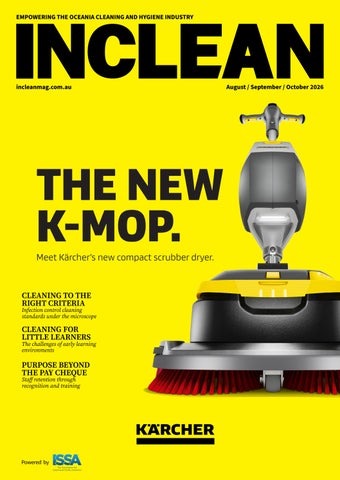
The K-Mop 46 is the expert when it comes to professional cleaning. It sets new standards with its impressive handling and intuitive operation. It can be used effortlessly and professionally, making it the ideal choice for almost all premises. For cluttered areas, sanitary facilities or larger areas, the K-Mop 26 is the perfect solution for efficient cleaning.
4 INCLEAN August / September / October 2026
IN THIS ISSUE ISSUE #3 VOLUME 39
AUGUST / SEPTEMBER / OCTOBER 2026
Regulars
03 Editor’s Letter 06 NEWS 54 Restoration industry finds its voice at the RIA conference and trade show 58 Opinion Winning more tenders: why good cleaning alone is no longer enough 62 Opinion Beyond compliance: turning health and safety into profit
14
64 Facility management The FM workforce of the future 66 Products
26
20 Features 11 ISSA Where cleaning, clinical and manufacturing minds meet on the surfaces that matter most
26 Data intelligence delivered The cleaning industry needs to transform its data into a business advantage.
14 Cleaning to the right criteria Infection control cleaning standards vary across Australia Find out why that matters.
32 Cleaning for little learners Early learning environments demand tailored infection control strategies.
20 Purpose beyond the pay cheque The industry’s greatest asset remains its people.
38 ISSA CLEANING & HYGIENE EXPO 2026 40 Program 48 Exhibitors
32 incleanmag.com.au 5
NEWS
and unwavering commitment to our members have helped strengthen the cooperative and position Rapid Group for the future,” Thyne said. He added that Hill leaves the business in an exceptionally strong position and thanked him on behalf of the Board and members for his dedication, professionalism and passion.
Wayne Hill to step down as Rapid Group prepares for next chapter
R
apidCleanʼs CEO retires in October after three and a half years steering strong industry growth. After steering Rapid Group Co-operative Ltd through a period of transformation and expansion, CEO Wayne Hill has confirmed he will retire in October 2026. Hill will officially conclude his tenure at the close of the RapidClean Australia & New Zealand Conference in Brisbane, where 6 INCLEAN August / September / October 2026
members, suppliers and industry partners will have the chance to acknowledge his contribution to the cooperative and to the wider commercial cleaning sector. Rapid Group chairman David Thyne said Hillʼs leadership had guided the organisation through a period of significant change while deepening relationships across its national member network. “Wayne has provided outstanding leadership during his time as CEO. His strategic vision, collaborative approach
BUILDING ON STRONG FOUNDATIONS
Throughout his tenure, Hill worked closely with members, suppliers and the head office team to expand the cooperativeʼs national capabilities, while holding firm to its founding values of local ownership, collaboration and member success. He will continue in the role until October, ensuring a smooth handover and ongoing support for members while the Board orchestrates the search for a new chief. The Board has already begun the succession process and is focused on appointing a leader who can build on the foundations Hill has established, continuing the cooperativeʼs trajectory of growth and member-focused service. Hillʼs departure marks the end of a tenure defined by collaboration and steady expansion, and the cooperative's national network now looks ahead to the next phase of its development under new leadership. ■
GREEN‘N’GOLD Revive School Carpets Hot Water Extraction Cleaner
GECA CERTIFIED ENVIRONMENTALLY PREFERABLE EXCELLENT CLEANING POWER SAFE TO USE ON ALL WASHABLE FIBRES USE IN EXTRACTION MACHINES OR AS A PRE-SPRAY
Nylon & Synthetics
100% Wool & Wool Blends
Stain-Resistant Carpets
Revive your school’s carpets for next term with Green’N’Gold. Contact your local agar distributor today.
1800 301 302 | agar.com.au/distributors | sales@agar.com.au
NEWS
Cleaners among least AI-exposed workers
A
new federal government report has placed commercial and domestic cleaners among the Australian occupations least likely to be disrupted by artificial intelligence in the near term. The ʻAI and Employment in Australiaʼ report from the Department of Employment and Workplace Relations draws on automation exposure scores developed by Jobs and Skills Australia. It ranks occupations across five groups from most to least exposed to generative AI. Domestic cleaners sit in the least exposed quintile alongside handypersons, carers and tradespeople. The report attributes the lower exposure of these roles to 8 INCLEAN August / September / October 2026
their reliance on physical presence, adaptability and situational judgement. By contrast, occupations involving repetitive cognitive tasks such as filing and registry clerks or keyboard operators recorded the highest exposure scores. The reportʼs authors stress that the scores are estimates rather than predictions. No Australian occupation was considered completely exposed or insulated from generative AI. Minister for Employment and Workplace Relations Amanda Rishworth said the technology was changing how Australians work but had not yet caused widespread labour market disruption.
For the cleaning industry, the findings offer reassurance as robotics and smart technology continue to enter commercial operations. Autonomous floor scrubbers and sensor-based hygiene monitoring are increasingly supporting cleaning teams while changing how work is organised. The report also highlights the importance of skills development as AI capabilities evolve. For cleaning businesses, investment in technology literacy and supervisory training could help workers adapt while strengthening recruitment and career pathways. For now, the data suggests cleaners remain among Australiaʼs occupations with the strongest protection from AI-driven disruption. ■
Contact your local RapidClean Member Today WWW.RAPIDCLEAN.COM.AU
Scan for more info
NEWS
Safe Work Australia refreshes chemical database
S
afe Work Australia has launched an upgraded Hazardous Chemical Information System (HCIS) ahead of new workplace exposure limits (WELs) taking effect from December 2026. The refreshed platform gives businesses a centralised source for hazardous chemical information. It brings Globally Harmonised System of Classification and Labelling of Chemicals (GHS) data and workplace exposure limit information together on a single page. The upgrade replaces the previous fragmented search experience with a single search function and a modern interface designed to make information easier to locate. The system is also compatible
with mobile phones and tablets, allowing safety teams and site supervisors to access information while working on-site. GHS classification data sourced from the European Chemicals Agency and the Australian Industrial Chemicals Introduction Scheme has also been updated. For cleaning and facilities management businesses, the HCIS provides a practical reference for checking information contained in safety data sheets (SDS) and product labels. The system is also designed to help manufacturers and importers determine whether a product is hazardous and comply with classification, labelling and SDS requirements. Nowchem managing director John Lamont says the update has improved the
consistency of chemical reviews by making classification and exposure limit information easier to verify. “Smaller operators may not have the resources to regularly monitor regulatory changes, which can lead to outdated SDSs (Safety Data Sheets), incorrect labels or inadequate workplace risk assessments,” he says. With the December 2026 deadline approaching, Lamont recommends businesses review SDS documents, labels and hazardous chemical registers early. He also advises prioritising products with hazardous classifications or frequent employee contact. Safe Work Australia says businesses should use the HCIS to access current classification and exposure limit information as they prepare for the transition. ■
Quadrant eyes stake in Quayclean Private equity firm Quadrant has begun exclusive due diligence at Australian cleaning and waste management company Quayclean as it considers a potential controlling interest in the business. According to a report in The Australian Financial Review, Quadrant is understood to be assessing a stake from Quayclean’s owners, the Petrevski brothers and chief executive Mark
10 INCLEAN August / September / October 2026
Piwkowski, with the proposed transaction reportedly valuing the business at about $75 million. Quayclean says it regularly considers strategic options to support its growth and has discussed its ambitions with potential growth partners. “Our goal has always been to build our position as a sustainable pre-eminent cleaning and waste services provider,” the company says. “Our aim is for customers to
have certainty and reliability of service outcomes, adopt strong governance, and ensure high customer satisfaction.” Quadrant has not publicly commented on the reported interest. Quayclean says it will provide updates if and when any developments occur, while remaining focused on serving its customers and stakeholders. ■
ISSA
Where cleaning, clinical and manufacturing minds meet on the surfaces that matter most
Ahead of the ISSA Cleaning & Hygiene Expo, a new one-day forum brings healthcare's cleaning and infection prevention worlds together in Melbourne. Words Tim McDonald
A
surface in a hospital corridor is never just a surface, and the professionals responsible for keeping it safe rarely sit in the same room to say so. That gap is exactly what the new Healthcare Surfaces Forum, hosted by ISSA Healthcare and sponsored by VIRTUAL MGR, is intended to close. Taking place on Wednesday 7 October 2026 at the Melbourne Convention and Exhibition Centre, the Forum lands the day before the ISSA Cleaning & Hygiene Expo, running Thursday 8 to Friday 9 October at the same venue.
WHAT THE DAY INVOLVES
The Healthcare Surfaces Forum is designed as a collaborative working forum rather than a traditional conference. Expert presentations and facilitated discussions will examine key issues affecting environmental hygiene in healthcare. A key focus will be the gap between what evidence, standards and guidance tell us should happen and what can realistically and consistently be achieved in complex healthcare environments. Following the morning program, participants will move into interactive breakout sessions after lunch to delve further into the issues raised and identify practical priorities for improvement and future collaboration.
WHO SHOULD BE IN THE ROOM The Forum brings together those who influence healthcare environmental hygiene and surface outcomes, including building service contractors, environmental services professionals, healthcare executives and facility managers, infection prevention and clinical leaders, manufacturers and suppliers, researchers, scientists and educators.
can be measured and sustained. Using the EPIS framework – Exploration, Preparation, Implementation and Sustainment – and a practical healthcare case study, he will demonstrate how evidence can be translated into practice to support lasting improvements in healthcare cleaning.
WHY COLLABORATION MATTERS
FROM EVIDENCE TO ACTION
Liz Orr, Manager of Infection Prevention and Surveillance Service at The Royal Melbourne Hospital, will present Where Evidence Meets Reality. Orr will examine what current evidence is telling us about environmental cleaning, contamination and infection risk, while exploring the realities of translating research, standards and guidance into consistent everyday practice. Her presentation will lead into the panel discussion, From Evidence to Action: What Does Better Healthcare Cleaning Require? Bringing together Linda Lybert, Executive Director of the Healthcare Surfaces Institute and ISSA Healthcare lead; Liezl Foxcroft, CEO of the Master Cleaners Training Institute; and Carrie Spinks, Infection Prevention and Control Consultant, the panel will explore what better healthcare cleaning requires in practice. The discussion will consider leadership, resources, workforce capability and organisational culture, alongside the collaboration needed across infection prevention, environmental services, facilities and other stakeholders to translate evidence into consistent practice. Associate Professor Dr Gavin MacgregorSkinner, Senior Director at ISSA and the Global Biorisk Advisory Council (GBAC), will explore how healthcare organisations can move from knowing what should change to implementing improvements that
For Lybert, a persistent issue is the disconnection between the different disciplines responsible for healthcare environments. “Surface safety can no longer be treated as an afterthought,” Lybert says, pointing to the consequences surface decisions can have for patients, workers and sustainability. Bringing different areas of expertise together can expose blind spots that may not be apparent when each discipline considers the problem independently. That philosophy sits at the heart of the Forum – creating an environment where participants can question, discuss and work through issues together.
GETTING THERE
Registration for the Healthcare Surfaces Forum is available through the ISSA Cleaning & Hygiene Expo registration process. For an industry where responsibility for environmental hygiene and surface safety is spread across many disciplines, the Forum provides an opportunity to bring those responsible for research, prevention, products, surfaces and cleaning practice into the same conversation. The goal is not simply to discuss what better healthcare environmental hygiene looks like, but to help determine what it will take to achieve it. ■ Visit issa.com/oceania/healthcare-forumoceania for more information. incleanmag.com.au 11
SPONSORED CONTENT
Own the floor: Kärcher sets a new standard for compact floor care The Kärcher K-MOP 46 Compact Scrubber Dryer arrives soon in Australia.
12 INCLEAN August / September / October 2026
SPONSORED CONTENT
P
rofessional cleaning in Australia is about to experience a complete transformation. After years of development and rigorous testing, Kärcher has announced the highly anticipated Australian launch of the K-MOP 46 will be in late 2026. By putting the operator at the centre of the design, this equipment focuses on superior ergonomics and user-friendly operation, reducing fatigue and streamlining day-to-day work for frontline cleaning staff. Tailored specifically for those who demand the highest standards of hygiene, efficiency and operator wellbeing, the K-MOP 46 seamlessly bridges the gap between raw cleaning power and effortless handling.
DESIGNED FOR THE HUMAN ELEMENT
During the development process, Kärcher’s engineering team focused heavily on the real-world challenges faced by commercial cleaning teams; from physical strain and operator fatigue to time-sensitive schedules and high-traffic public commercial spaces. Through extensive collaboration with specialised ergonomics experts based in Stuttgart, Germany, Kärcher has crafted a machine that actively relieves physical strain while maximising on-the-job productivity, even when dealing with shrinking labour resources. The outcome is a highly manoeuvrable, low-profile machine that glides effortlessly through confined amenities, heavily furnished corporate offices and expansive commercial foyers.
This nimble design is underpinned by intelligent weight distribution, featuring a four-litre (4L) clean water tank meticulously paired with a deck-mounted 4L dirty water tank. This configuration significantly reduces the physical weight experienced in the user's hand compared to traditional handle-mounted systems, heavily minimising operator fatigue. Furthermore, a fully height-adjustable handle allows operators of all heights to maintain a perfect, comfortable posture throughout their entire shift, while two exceptionally powerful counter-rotating disc brushes offer a generous 460-millimetre cleaning width to aggressively tackle the toughest embedded grime.
A POWERHOUSE OF OPERATIONAL EFFICIENCY
Beyond its ergonomic benefits, the K-MOP 46 possesses the capability to replace multiple traditional cleaning tools, drastically reducing equipment changeover times. With an impressive practical coverage rate of 1200 square metres per hour (m²/h), it sets a completely new benchmark for what compact scrubbers can accomplish day-to-day. Designed for total simplicity, the language-free display uses clean, intuitive icons to eliminate training barriers and get teams operating confidently from day one. When it comes to clean-up, the responsive, liftable squeegee with high-vacuum suction delivers a dry, safe floor ready for immediate foot traffic. Its compact footprint also means it requires up to 71 percent less storage space compared to a conventional scrubber dryer, making it
an ideal asset for mobile cleaning teams or sites with limited storage capacities.
SUSTAINABILITY WITHOUT COMPROMISE
Resource conservation was treated as a non-negotiable priority during the years of refining this technology. The K-MOP 46 uses up to 80 percent less water and detergent than a standard 15-litre mop and bucket set-up. Constructed intelligently from 28 percent recycled plastic and featuring a dedicated eco!efficiency mode, the machine successfully balances high-performance cleaning with genuine environmental accountability. Powering the unit is the renowned Kärcher Battery Power+ platform. Utilising a robust 36-volt lithium-ion battery, it delivers up to 60 minutes of continuous operation. Because the system can charge a secondary battery to 80 percent concurrently, cleaning teams are guaranteed continuous, uninterrupted productivity. When utilised in combination with Kärcher's Plug-in Connect Module for real-time fleet management and the certified, ecofriendly CA 50 C floor cleaner, the K-MOP 46 does not just clean floors – it completely revolutionises an entire facility management strategy. It is time to step into the future of professional cleaning. ■ Experience the latest in cleaning innovation first-hand. Come and see the K-MOP 46 in action at ISSA this year at Kärcher Stand 70. Be one of the first in Australia to demo the product and regain control of your cleaning operations. karcher.com.au incleanmag.com.au 13
FEATURE
CLEANING TO THE RIGHT CRITERIA Infection control cleaning standards vary across Australian states, territories and public and private healthcare facilities. Here is why that gap matters. Words Tim McDonald
A
visitor moving from a public hospital ward in one state to a private day surgery in another could reasonably assume that infection control cleaning follows a single, nationally agreed rulebook, given how much is at stake in either setting. That assumption would be wrong. What actually governs healthcare cleaning in this country is a patchwork of state and territory guidelines, facility-specific policies and accreditation requirements, some overlapping neatly and others pulling in different directions entirely. In an industry the entire purpose of which is built on the protection of patients from preventable harm, that kind of inconsistency sits in direct opposition to its plight. Dr Rodney E Rohde, Regentsʼ Professor and University distinguished chair in the Texas State University system, sees that inconsistency as a direct line to patient risk rather than an administrative inconvenience. “Variation in cleaning standards can become a patient safety issue when it translates into differences in what gets cleaned, how often it is cleaned, which products and procedures are used and whether cleaning effectiveness is actually verified,” he says. Environmental surfaces, he explains, are part of a wider transmission network for organisms capable of persisting on surfaces and moving between hands, equipment and patients, which is why an organised cleaning program matters more than a written policy sitting in a folder somewhere.
14 INCLEAN August / September / October 2026
Line the frameworks up side by side and the scale of the issue starts to come into focus. Every state health department publishes its own infection control and environmental cleaning standards and, while most lean on the ʻAustralian Guidelines for the Prevention and Control of Infection in Healthcareʼ as a starting point, the way those principles get translated into actual cleaning frequency, chemical selection and staff training can look quite different once you cross a border. A cleaning regime signed off as compliant in Queensland may not clear the bar in Victoria, leaving private hospital groups operating across several states to juggle several compliance systems at once, none of which talks to each other.
STATE BY STATE VARIATION IN STANDARDS
New South Wales Health, Queensland Health and the health departments of Victoria, South Australia, Western Australia and the territories each maintain their own environmental cleaning policy documents, each updated on its own timetable and reviewed on its own cycle. Because nobody is writing these from a shared template, basic definitions drift apart: what counts as a high-touch surface, how often shared equipment needs wiping down, what terminal cleaning after a patientʼs discharge actually requires. Facility managers who move between states often describe having to relearn compliance requirements almost from scratch, and it is smaller providers, without a compliance team to absorb that relearning curve, who tend to feel it most.
FEATURE
That absence of a single national standard has knock-on effects for procurement and training too. Contractors servicing healthcare clients across state lines end up building separate protocols, separate audit checklists and, in some cases, entirely separate chemical approval lists for each jurisdiction in which they operate. All of that duplication costs money, and it creates more opportunities for something to slip through, particularly where cleaning has been outsourced to contractors already stretched across multiple client specifications.
PUBLIC AND PRIVATE GAPS
There is a second, less visible fault line running between the public and private sectors. Public hospitals generally operate under government-mandated cleaning standards tied to funding agreements, with compliance checked through formal health department audits and public reporting. Private facilities tend to set their own internal standards instead, answerable to accreditation bodies rather than government regulators directly, and how rigorous those standards turn out to be depends heavily on the individual provider. Private day surgeries sit in something of a regulatory blind spot. Many fall outside the direct reach of state health department audits altogether, relying on accreditation from bodies the infection control requirements of which were never written with cleaning specifically in mind. Aged care occupies a comparable
position, governed by a separate federal framework that overlaps only awkwardly with the state-based systems built for hospitals. What emerges is a sector where the strength of infection control cleaning often has more to do with an individual facilityʼs internal culture than with any enforceable external standard, which is an uncomfortable thing to admit about a system meant to protect vulnerable people.
CONSEQUENCES OF INCONSISTENT STANDARDS
None of this stays confined to paperwork for long. Healthcareassociated infections remain one of the more stubborn patient safety problems in Australian hospitals, and environmental cleaning, often treated as background work rather than clinical practice, is one of the more effective lines of defence against pathogen transmission available. Understaffed cleaning teams, disinfectants left on surfaces for too short a dwell time or high-touch points missed altogether all push transmission risk in the wrong direction. Rohde is blunt about where the real gaps sit. “The gaps that concern me most are inconsistent attention to high-touch surfaces, inadequate cleaning during patient occupancy and at discharge, insufficient training and staffing, poor accountability and reliance on visual appearance alone as proof that cleaning was effective,” he says. “A room can look clean without necessarily having been cleaned thoroughly.” That distinction runs through almost every gap this feature has identified so far. incleanmag.com.au 15
FEATURE
A room can look clean without necessarily having been cleaned thoroughly.
- Rodney Rohde
The fallout reaches well past the ward itself. A facility that fails an infection control audit faces reputational damage, the possible loss of accreditation and, in the more serious cases, direct regulatory intervention. An outbreak traced back to inadequate cleaning can force ward closures, push elective surgeries onto waiting lists and land facilities with costs far higher than what proper cleaning protocols would have required in the first place. For an industry already dealing with workforce shortages and rising input costs, that is an expensive lesson to learn twice.
TWO PERSPECTIVES, ONE STANDARD
At Clean Focus – a national provider working across health and wellness environments, gyms and medical centres in Queensland, New South Wales and Victoria – founder Jordan Panos and chief operations officer Niki Panos see this inconsistency from opposite ends of the same business, and the gap between their two vantage points says something about how deeply the problem runs. Jordan Panos, who spends his time thinking about growth and national capability, argues the true cost of inconsistency is rarely counted properly. “When people think about inconsistent standards, they probably think about having a different checklist at each site. The real cost goes much further than that. Every variation has to be operationalised.” He is careful to note that uniformity for its own sake is not the goal. “Iʼm not advocating for every healthcare environment to operate identically. Risk has to lead the standard. But if two comparable facilities are trying to achieve the same infection-control outcome, and weʼre building two completely different administrative systems around achieving it, I think the industry should be prepared to ask why.” For Niki Panos, whose role covers people, systems, training and compliance, the same inconsistency shows up first on the ground rather than on a spreadsheet. “A policy can be 50 pages long, but eventually somebody has to walk into that facility and know exactly what to do. Which product am I using? What is the process? What PPE (personal protective equipment) is required?” When requirements shift between sites, she says, the effect goes well beyond paperwork. “Youʼre not simply changing paperwork. Youʼre changing what needs to be trained, understood, supplied, supervised, audited and remembered.”
16 INCLEAN August / September / October 2026
Multiplied across a national operation, those individual adjustments become something closer to a structural cost. “One additional training requirement may not sound significant. One different product list may not sound significant,” Jordan Panos says. “But multiply those requirements across sites, clients, teams and jurisdictions and suddenly youʼve created another layer of infrastructure. That is the hidden financial conversation.” Niki Panos adds a caveat of her own, warning against mistaking sameness for good practice. “The danger is assuming standardisation automatically means better operations. It doesnʼt. If one healthcare environment has a genuinely different risk profile, then our processes should change.”
HEALTHCARE SURFACES UNDER THE MICROSCOPE
It is at the level of individual surfaces that the inconsistency does the most damage. Bed rails, call buttons, door handles and shared medical equipment show up again and again in the research as significant vectors for pathogen transmission, and yet how often and how thoroughly they get cleaned still varies enormously from one facility to the next. Some hospitals have brought in colour-coded cleaning systems and ATP (adenosine triphosphate) bioluminescence testing to check surfaces objectively, while others still rely on a visual check, a method with well-documented blind spots when it comes to catching microbial contamination that the eye simply cannot see. Rohde argues that cleaning frequency should never be treated as one-size-fits-all. “Cleaning frequency should be risk-based rather than uniform: the higher the patientʼs vulnerability, degree of contamination and frequency of touching, the greater the need for cleaning and disinfection,” he says. On the question of proof, he is equally direct about the limits of the human eye. “Visual inspection is useful for identifying obvious soil, but it is a relatively weak measure of cleaning performance itself.” Fluorescent markers and ATP bioluminescence testing offer a more objective check, he explains, confirming that a surface was physically wiped and measured for residual organic material, though neither proves a surface is free of pathogens. The strongest approach, in his view, combines visual assessment with objective auditing and ongoing staff feedback, which studies have shown produces sustained improvement in hightouch-surface cleaning. Newer surface materials and disinfection technology could close some of that gap, but only where facilities actually have the budget and the regulatory clarity to bring them in properly. Antimicrobial coatings, low-touch electrostatic disinfection systems and real-time monitoring tools are becoming more available on the Australian market, though uptake is heavily concentrated in well-resourced metropolitan hospitals. Smaller regional and private facilities, working with tighter budgets and less access to specialist infection control staff, tend to fall further behind, widening exactly the gap these standards were supposed to close.
FEATURE
BUILDING A SHARED STANDARD
Fixing this will take more than individual facilities trying harder. There have been growing calls from within the industry for a nationally harmonised approach to healthcare cleaning, one that sets consistent minimum benchmarks for cleaning frequency, chemical selection and staff competency across both public and private settings. Such a framework would not need to strip state health departments of their oversight; it could simply set a benchmark that no facility, wherever it sits or however it is funded, is allowed to fall beneath. Asked what a harmonised standard should treat as nonnegotiable, Rohde points to routine cleaning of high-touch surfaces and shared equipment, defined risk-based frequencies for routine, isolation, outbreak and discharge cleaning, and correctly applied products at the right concentration and contact time. Standardised training and competency assessment belongs alongside objective quality checks, he says, along with documented auditing and close coordination between environmental services, infection prevention, nursing and facility leadership. None of it works, he adds, without “sufficient staffing, time, equipment and institutional support to actually meet the standard”. His broader point is one this feature keeps circling back to: “Cleaning should be treated as a clinical patient-safety intervention, not simply a housekeeping function.” Jordan Panos frames the goal in similarly practical terms, warning against simply adding another layer to an already crowded regulatory landscape. “The last thing the industry needs is another standard sitting on top of all the existing standards. Standardise the foundation. Customise the risk. The opportunity isnʼt less
compliance. Itʼs making compliance more consistent, more usable and ultimately more effective.” Niki Panos would add a further test before any new standard is considered fit for purpose, one grounded firmly in what happens at site level rather than in the document itself. “Put it in front of the frontline. Can we train it clearly? Can supervisors observe it? Can we measure it? Can we repeat it consistently across locations? If the answer is ʼyesʼ, youʼve got something operationally meaningful.” The people writing standards need clinical and infection control expertise, she says, but the people implementing them have insight worth listening to as well, because ultimately, standards do not clean healthcare environments. People do. The Healthcare Forum, running on 7 October as part of the ISSA Cleaning & Hygiene Expo, offers a genuine chance to push this conversation from industry commentary into something more practical. With cleaning professionals, epidemiologists and healthcare administrators in the same room, the forum is wellplaced to prompt exactly the cross-sector dialogue a harmonised standard will eventually need. For an industry that spends most of the year working state by state and facility by facility in relative isolation, comparing notes directly with clinicians and regulators matters more than any single item on the conference program. Until a national standard exists, closing these gaps is left to individual facilities, the contractors who service them and the professionals managing all of it day-to-day. The evidence points to one fairly stark conclusion: the costs of inconsistency, in infection risk, reputational damage and money spent putting things right after the fact, add up to far more than what it would cost to get healthcare cleaning right from the start. ■ incleanmag.com.au 17
The Express Pro System
Freudenberg Home and Cleaning Solutions Pty Ltd Customer Service: Phone 1300 669 686, or email csvic@fhp-ww.com
NI
ER
MI A
OF I B
RE
As a single system built for a wide range of floor cleaning applications, it adapts effortlessly to your daily operational needs. Equipped with ergonomic handles, V frames, and advanced microfibre mops, it streamlines workflows while lowering ongoing costs.
CR
CLE
Combining ergonomic design with high-performance microfibre technology, the Express Pro System helps teams clean faster, reduce physical strain, and deliver consistent results across commercial settings, including healthcare, hospitality, and facility cleaning.
W
Ready for every cleaning task.
NG PO
We have you covered Solutions for every application. Oates, Vileda Professional and Research Products provide innovative cleaning solutions and systems for professional users in various application areas, such as Healthcare, Office and Building Cleaning, Hospitality and Controlled Environments.
Freudenberg Home and Cleaning Solutions Pty Ltd Customer Service: Phone 1300 669 686, or email csvic@fhp-ww.com
FEATURE
PURPOSE BEYOND THE PAY CHEQUE While innovation and technology continue to transform the cleaning industry, the greatest asset remains its people. Words Charlotte Huston
A
ttracting skilled team members in the cleaning and hygiene industry, while important, is only half the story. Retaining them is where the real work begins. Juggling pressures like labour shortages, contract continuity, recruitment, training costs and client confidence means cleaning operators recognise that remuneration alone is just one building block of the retention equation. In an industry also underpinned by culturally and linguistically diverse workforces, employers are increasingly investing in organisational environments where employees feel safe, both physically and psychologically. So, what is giving workers purpose beyond the pay cheque?
MORE THAN MONEY MATTERS
Like any industry, fair compensation is fundamental to staff retention, as employees balance cost-of-living pressures, family responsibilities and competing commitments. “Employees need to feel that they are being paid fairly and in line with their entitlements,” says Kaveesha Mahanama, head of people, safety and compliance at ARA Indigenous Services, an Indigenousowned and operated cleaning and property maintenance business. 20 INCLEAN August / September / October 2026
“But pay alone does not create loyalty. It may attract them, but it is the organisation’s culture that often determines whether they choose to stay.” Employees want to know they are trusted and appreciated, particularly when undertaking work independently across multiple sites. According to Cleanstar co-owner Lisa Michalson, strong leadership, meaningful recognition, flexibility where possible, personal growth and a positive workplace culture often determine whether someone stays or looks elsewhere. “In my experience, employees rarely leave great organisations; they leave environments where they don’t feel advocated for, don’t see a future or don’t believe their voice matters,” she says. Quayclean Australia head of people and culture, Nagwa Assafiri, shares a similar perspective but acknowledges that some workplace attrition is inevitable. “Some employees move on because their visas expire, others because fixed-term contracts come to an end following major events or seasonal work, and some pursue careers aligned with their professional qualifications or long-term aspirations. While those departures are a normal part of the business, our focus is always on creating an environment where people choose to stay because they feel respected, challenged and supported.”
FEATURE
Assafiri notes shifting employee expectations since the COVID-19 pandemic, which highlighted the essential and perhaps unseen role of frontline cleaning teams. “Employees now expect to be recognised for the value they bring and want to feel connected to the organisation they work for, even if they are based on a client site rather than in a traditional office environment. Retention is no longer something that happens by chance; it needs to be a deliberate part of an organisation’s people strategy.”
IT’S JUST GOOD BUSINESS
A good example of this employee growth fostered by a positive workplace culture is Tom Mills. Currently the chief operating officer at Quayclean Australia, he started as a casual cleaner raking lawns following the Melbourne Cup Carnival in 2004. Mills agrees that while remuneration is only one part of the retention equation, it must first be fair, acknowledging that underpayment and sham contracting remain ongoing issues within parts of the cleaning industry. This makes compliant employment practices a key point of difference for responsible operators.
“Directly employing staff, as we do at Quayclean, so they are working under the Cleaning Services Award, is a big driver for retaining staff. This Award offers great rates, especially working on weekends and public holidays, and guarantees employment benefits like overtime, leave entitlements and other protections,” Mills says . Beyond creating a positive workplace culture, retaining experienced employees makes sound business sense. Recruitment, onboarding and training require significant time and investment, while high staff turnover can disrupt service delivery, client relationships and operational performance. “It’s a significant cost to lose staff,” he adds. “Every departure carries costs, as well as a productivity cost on-site while a replacement gets up to speed with site operations. Experienced staff tend to work faster, safer and to a higher standard, which shows up directly in audit scores, client satisfaction and ultimately contract retention. In many cases, our staff become part of our clients' teams, so it's a true partnership.”
OUT ON-SITE, BUT NOT OUT OF MIND
It may be fair to assume people forget the highly independent and autonomous nature of cleaning, which is usually outside standard incleanmag.com.au 21
FEATURE
Creating that sense of belonging takes deliberate effort.
- Kaveesha Mahanama business hours, across multiple sites and involves limited day-to-day interaction with senior leaders. As a result, building connections requires more than policies or occasional team meetings. Mahanama explains, “In that working environment, culture cannot rely only on what is written in policies or communicated from the head office. It needs to be experienced consistently through the way supervisors lead, how issues are responded to, how safety is prioritised and how employees are included and connected to the broader organisation.” This can be achieved through regular check-ins, timely responses to concerns, recognising good performance and involving employees in conversations about safety and site expectations, all of which help strengthen engagement. It is vital that employees do not feel invisible. “Creating that sense of belonging takes deliberate effort,” Assafiri concurs. “We ensure our teams stay connected through regular communication, mobile communication platforms, encouraging leadership and opportunities to come together through initiatives. Whether someone is working at a stadium, university, transport hub or commercial site, we want them to feel part of one team rather than simply working at one location.” Ultimately, retention is rarely driven by a single initiative. It is built through consistent experiences that make employees feel valued. ISSA associate director of education, training and field services Derek Oliveira agrees. “Retention is about giving people a reason to see a future in the industry, not simply a job today,” he says. “When we invest in practical training, capable supervisors and clear development pathways, we build confidence and capability in our people while creating stronger, more resilient businesses.”
A SHARED LANGUAGE
Australia's cleaning industry is diverse, and that's one of its strengths. Yet, this diversity means employers need to communicate clearly and effectively. “When people understand both the 'how' and the 'why' behind their work, they become more engaged, safer and more likely to stay,” Michaelson says. “Safety procedures, equipment training and operational expectations need to be understood by everyone, not simply delivered.” At Cleanstar, this includes visual demonstrations, practical training, translated resources where appropriate, and fostering an environment where people feel comfortable asking questions. At ARA Indigenous Services, ‘toolbox talks’ – short pre-shift safety meetings – are tailored to suit the workforce. Delivering them in multiple languages, alongside translated handouts and visual aids, helps ensure critical safety and operational information is understood by everyone. Removing language barriers not only improves safety and compliance, demonstrating a legitimate commitment to supporting every employee. 22 INCLEAN August / September / October 2026
TECHNOLOGY TOOLKIT
When used effectively, technology can strengthen employee engagement, particularly through training and communication. Digital learning platforms, instructional videos and online resources enable organisations to deliver consistent information across multiple sites while giving employees access to services whenever they need it. Learning Management Systems (LMSs) play an important role in employee development, delivering structured and consistent inductions, compliance training, safety education and other essential workplace learning. By providing a centralised platform for onboarding and ongoing training, an LMS helps ensure employees receive the knowledge and help they need to perform their roles confidently and safely. However, technology cannot and should not replace personal connection. Mahanama says, “Technology can deliver information, track completion and improve consistency, but employees still need regular check-ins, supervisor support, recognition and personal connection.”
A NEW FACET OF SAFETY
Described as one of the most positive developments the industry has seen, the sharpened focus on psychological health and safety reflects a broader shift in how organisations approach employee wellbeing. Today, wellbeing extends beyond physical safety, with employers increasingly recognising the importance of psychological safety, respectful workplaces, manageable workloads and open communication. “Psychosocial health and safety has shifted wellbeing from being viewed as a 'nice to have' to an essential part of good organisational governance,” Assafiri says. “Employers are recognising that supporting mental health, preventing workplace stress and creating psychologically safe workplaces are not only legal obligations, but also critical to retaining good people.” “Cleaning can be physically demanding, so reducing fatigue through better equipment, ergonomic design and smarter cleaning systems plays an important role in wellbeing,” adds Michalson. “Products that reduce repetitive strain, minimise manual effort and improve efficiency contribute directly to healthier, happier employees.” Successful businesses understand that retention is not simply an HR initiative. It is also a business strategy. It begins with fair and compliant employment practices, is reinforced through strong leadership and workplace culture, and is guided by effective communication, ongoing training, innovation and genuine care for people. In an industry where people remain the greatest asset, operators that invest in creating safe, inclusive and supportive workplaces are more likely to not only retain skilled employees, but also strengthen client relationships, improve service delivery and position themselves for long-term growth. ■ Be sure to catch Derek Oliveira’s workshop, ʻFrom Supervisor to Leader ‒ Building the Skills That Drive Operational Excellenceʼ on Friday 9 October as well as the Expo Floor Education Theatre panel where he and Liezl Foxcroft discuss the question, ʻAre We Training People for Todayʼs Jobs or Tomorrowʼs Industry?ʼ
INTUITIVE USER DISPLAY
ULTRA COMPACT
CLASS LEADING ERGONOMICS
The new Kärcher K-Mop 46 compact scrubber dryer. Combining a wide 46cm cleaning path with a highly manoeuvrable, compact design, it breezes through tight spaces. Featuring fatigue-reducing brush power, intuitive and easy to understand controls and sustainable eco-modes, it’s the ultimate ergonomic floor scrubber for modern commercial cleaning professionals. karcher.com.au
SCAN TO LEARN MORE
SPONSORED CONTENT
Clean Plus Chemicals does manufacturing better Clean Plus channels three decades of chemistry expertise into a bold new local manufacturing story.
W
hile most industry profiles reach instinctively for the well-worn origin story of a modest warehouse and a founder with nothing but grit, Clean Plus has other plans for its history, treating the past 34 years less as a museum piece and more as fuel for what comes next. Founded in 1992 by industrial engineer and managing director Wasim Farhart, the Australian-owned manufacturer began life in a 200-square metre warehouse and now operates across two facilities spanning 8000 square metres in Auburn, Sydney, backed by distribution warehouses in Melbourne and Brisbane, and an export reach that stretches to New Zealand, the Pacific Islands, Vietnam, the Philippines and China. “Our strategy has been B2B from day one,” says Farhart. “After 34 years, we’ve become a major player in the market, with the capability and infrastructure to drive our next phase of growth.” That capability is most evident in Auburn, where manufacturing, dispatch and R&D operate across neighbouring facilities.
24 INCLEAN August / September / October 2026
Clean Plus has significantly expanded its manufacturing capability, investing heavily in the infrastructure needed to operate at a far greater scale, with purpose-built blending systems, expanded automated packaging capabilities and major upgrades across both sites. A new R&D lab is currently under construction, complementing the dedicated quality assurance lab completed last year. “We’ve tripled our manufacturing capacity and made major investments across almost every part of the operation,” says Clean Plus head of operations Daniel Farhart. “From new blending and packaging infrastructure through to upgraded systems, sustainability initiatives and an expanded team, we’ve built the platform to support the next stage of our growth.”
LOCAL LABS, GLOBAL AMBITION
Clean Plus develops and manufactures products for a broad network of distributors and private-label partners, alongside its own established product range. That partner-led model has become increasingly valuable as international brands with
an Australian presence, or ambitions to establish one, look to localise manufacturing. “We’re seeing more global brands looking for a strong local manufacturing partner,” says Daniel Farhart. “They want to reduce international freight costs, shorten lead times and build more resilient supply chains, while also improving the sustainability of their manufacturing and distribution.” Ongoing volatility across global supply chains has only strengthened the case for manufacturing closer to home. For Clean Plus, the opportunity is to combine the responsiveness of a local manufacturer with the systems, technical capability and quality standards expected by major brands. Its certification across three ISO standards reinforces that proposition, positioning the business to compete on capability and quality, not simply geography.
BETTING ON PARTNERS NOT CUSTOMERS
The decision not to sell directly is not incidental but structural, built into the business from day one and central to its strategy today. “Our customers’ growth is our growth,” says Daniel Farhart. “They’re dealing with a manufacturer that isn’t competing with them directly, and that can help create their dream, whether that’s a brand-new product or a private-label concept.” Thirty-four years in, the team still frames the business as unfinished. “I’m still as motivated as I was on day one,” says Wasim Farhart. Daniel Farhart adds, “We’ve built a strong business over the past 34 years, but our biggest years are still ahead of us. We feel we’re only getting started, and we’re incredibly excited about what the next 34 years will look like.” ■
TECHNOLOGY
DATA INTELLIGENCE DELIVERED The cleaning industry’s most pressing need is to take the enormous amounts of data currently captured by smart equipment and embedded technologies and transform that into an operational business advantage. Words Varun Godinho
T
o have a conversation about the integration of technology into the cleaning space is to have a conversation that’s four years overdue. We’ve moved well beyond the point of making a case for embedding smart technologies into cleaning products and platforms. Today, an impressive array of sensors and technologies already capture vast amounts of data. The real challenge for facility managers in 2026 isn’t that they require smarter equipment. Instead, the focus now is on organising the existing data into evidence-based actionable outcomes that have a measurable impact on daily operations, as much as they do on the balance sheets. Data in the service of operational efficiency is an underlying theme that the industry as a whole is working towards. As CleanTasker CEO Kiran Vilasagaram explains, the volume of data available today is only growing. “Modern cleaning platforms are now capable of capturing operational data across almost every aspect of service delivery, including cleaner attendance, shift monitoring, geolocation and NFC (near field communication) verification, facial recognition, task completion, time spent on specific areas, inspection scores, corrective actions, client requests, response times, photo evidence, consumable replenishment and, increasingly, continuous location tracking through Bluetooth beacons and wearable devices. “The opportunity for the industry is to capture this information in a consistent, reliable and unobtrusive way, creating a rich operational picture that can support better decision-making, compliance and service transparency,” Vilasagaram says. 26 INCLEAN August / September / October 2026
LEVERAGING DATA
According to a recent ‘Australian Cleaning Industry Snapshot 2026’ report by Clean Group, the sector has more than 180,000 direct employees and around 250,000 people engaged overall, once subcontractors are factored in. Labour, undoubtedly, is one of the industry's highest costs. Better data about when, where and how human resources are deployed is a financially significant decision for businesses, especially smaller ones operating on thinner margins. Mark Fermor, managing director at CleanERP, says that technology today can take the guesswork and gut instinct from managers when it comes to employee management. He argues that regular cleaning schedules are generally quite static and only change when the client alters the scope of work. Weekly variations are usually driven by employee annual leave, sick leave or no-shows, and these are then left to be managed by the site managers. “Good systems now let staff indicate ‘free to work at’ availability, so managers can search for qualified people. In practice, however, most managers still rely heavily on their own knowledge of their pool of staff. They ‘just know’ who is available and suitable. Systems support that process, but a significant amount of the operational IP still sits with the managers themselves rather than in the software,” Fermor says . iQCheckPoint manager of strategic partnerships Dan Graoroski also cites an example of data that can offer a snapshot of public area traffic analysis, which in turn can be used to determine cleaning demand. Together, that can directly strengthen labour
TECHNOLOGY
incleanmag.com.au 27
TECHNOLOGY
efficiency modelling. “Facilities managers use the data to make better decisions about cleaning and resources,” Graoroski says. “They change cleaning schedules based on how often areas are used, assign staff to busy areas when needed and order cleaning supplies only when dispensers are running low. This improves efficiency, reduces waste and lowers costs while keeping facilities clean and safe.” Graoroski says that the data can also be vital to safety monitoring. It can track high-traffic areas and identify locations at higher risk of slips or hazards. Traffic analytics should work in concert with robotic scrubbers and other smart equipment to automatically clean high-use areas and also enable faster cleaning responses, thereby improving public safety.
SAFEGUARDING DATA
With the copious amounts of data being collected, there are legitimate concerns about how to safeguard it while upholding the highest standards of individual privacy protection. Vilasagaram outlines that some of the data captured today includes sensitive operational information, such as geolocation data, selfie photos for attendance verification, site photographs, identity documents and police clearances. “Unfortunately, many smaller organisations still rely on consumer messaging platforms such as WhatsApp to manage operations, resulting in sensitive business information being stored on personal devices with limited governance or auditability.” He adds that protecting this information is a leadership responsibility. Best practices begin with those leaders selecting a secure software platform that follows recognised security standards, provides role-based access, comprehensive audit trails and encrypted cloud infrastructure, and also supports Australian data residency so that the data is retained onshore. “Organisations should implement clear data retention policies, collect only information that is genuinely required, comply with privacy legislation and invest in regular staff awareness training,” Vilasagaram says. “Technology alone cannot eliminate risk. People remain one of the most significant cybersecurity vulnerabilities.” Other suggestions tabled to protect data include companies using encryption for email and storage, strong passwords and two-factor authentication. Alongside those industry-specific controls sit other technical requirements such as ISO certification and alignment with the Essential Eight, the baseline of eight cyber security mitigation strategies developed by the Australian Signals Directorate. Safeguarding information is also necessary for effective business continuity. Fermor says that an important control mechanism is segregation of access. “When a manager leaves for a competitor, they inevitably take knowledge with them. But it is critical that no single person holds a complete set of client and contact information that can walk out the door. Access should be limited strictly to what each role needs,” says Fermor. 28 INCLEAN August / September / October 2026
BUILDING COMPETITIVE ADVANTAGES
Vilasagaram says that cleaning and facilities managers now need to contend with what he refers to as ‘exception-based operational intelligence’ where dashboards present prioritised order of actions instead of overwhelming managers with graphs, tables and disconnected reports. By highlighting what needs attention today, managers can spend less time analysing data and more time solving problems before they impact clients. “Rather than simply confirming work was completed, managers want systems that identify recurring quality issues, unreliable attendance, assets requiring repeated attention and emerging operational risks,” Vilasagaram says. “These insights enable better staffing decisions, workload balancing and smarter scheduling of periodic work.” AI will identify emerging risks with increasing accuracy, predict contract health, recommend staffing adjustments and highlight sites likely to experience quality issues before complaints occur. Rather than reviewing dozens of reports, managers will receive prioritised recommendations tailored to their role. Fermor says that the deployment of AI into current software models will go a long way toward giving managers the answers they need without forcing them to dig through layers of unnecessary data. It will turn large volumes of operational, financial and workforce data into single, actionable answers. “The real need is simplification – turning large volumes of information into clear answers. AI will play a major part in this because it can take 10 pages of reports and reduce them to a simple yes/no or a clear recommendation,” Fermor says . “Managers should not have to log in, navigate menus, run reports, cross-match figures and then make a decision. The systems of the near future will simply answer questions such as ‘am I over budget at this site?’ or ‘do I have enough qualified staff available for this ad hoc job next Tuesday?’ That shift – from data hunting to direct answers – is what will finally make the data useful at scale across the industry.” Vilasagaram meanwhile predicts that over the next three to five years, the industry will see the increasing pervasiveness of predictive maintenance insights, automated executive summaries and greater integration with building systems, allowing cleaning operations to become more proactive, efficient and outcome-focused than ever before. “The competitive advantage will come from transforming operational data into meaningful intelligence that highlights exceptions, predicts emerging risks and recommends actions. Organisations that can identify patterns early and act proactively will outperform those continuing to measure success purely by the volume of information they collect,” he says. Data was always king. But now, those who can effectively interpret that data are the real kingmakers. ■
SPONSORED CONTENT
Bringing global hygiene science to Melbourne Kikkoman Biochemifa's Alissa Shida shares ATP testing insights and invites readers to her Expo stand.
H
aving joined Oceaniaʼs ISSA circuit only a year ago, Alissa Shida has quickly become the regional face readers are likely to recognise on the show floor this year, adjusting her focus to a market she describes as still learning what next-generation ATP (adenosine triphosphate) testing can do. As regional manager for Kikkoman Biochemifa, Shida spends her days working directly with distributors and clients, training them not just to run ATP tests, but also to interpret what the results actually mean for their cleaning programs. “We advise them on how they can improve their cleaning schedules in general,” she says, describing a role that blends technical education with hands-on troubleshooting, from correcting detergent dosages to identifying when cleaning chemicals are interfering with test accuracy. That troubleshooting spans an unusually broad range of settings, ranging from healthcare facilities to clean rooms and aged care, as well as crowd venues and education settings that are all on Shidaʼs client list, each bringing its own validation challenges. Standards differ by country and industry, she explains, with some healthcare markets already operating under an established hygiene benchmark while others require Kikkoman Biochemifa to help build one from the ground up. In these cases, an initial standard is set and tested until roughly 80 percent of results pass, then it’s revalidated every few months and gradually tightened as cleaning teams improve, all without demotivating the
staff doing the work. Surface material, more than facility size, tends to determine how difficult that process becomes, with carpeted areas in particular proving harder to bring under control than hard flooring. Underpinning all of this is the sensitivity gap Shida is most keen for INCLEAN readers to understand. “Standard ATP tests detect a single compound,” she says, “but Kikkoman Biochemifaʼs A3 system also picks up its degradation products, ADP and AMP, which appear in far higher concentrations wherever bodily fluids are present.” In clean rooms and aged care especially, this distinction is significant: a conventional ATP reading may suggest a surface is clean, while an A3 reading on the same surface reveals residual contamination that would otherwise go undetected. It is a meaningful point of difference in a market where many operators have grown wary of ATP testing altogether, having encountered false negatives that left them unable to trust
their own results. “Thereʼs much more sensitive technology in the market and it is still keeping the same simplicity of an ATP meter,” Shida says.
FIND HER ON THE SHOW FLOOR
Kikkoman Biochemifa will bring both the A3 system and its EasyPlate range to the ISSA Cleaning & Hygiene Expo in Melbourne from 8-9 October, offering a faster alternative to outsourced laboratory testing for detecting yeast, mould, total plate counts, coliforms and staphylococcus. Samples are collected and plated directly onto the appropriate medium before incubating, with results available within 24 hours – a considerable saving in both time and cost against sending samples off-site. Shidaʼs speaker session will focus on trend tracking through the companyʼs companion app, giving facilities a documented history of hygiene performance they can produce at audit time instead of relying on memory or estimation. Readers attending this yearʼs Expo are encouraged to stop by the stand and put questions directly to Shida, whose first Oceania show last year left her with a clear sense of the gap in industry awareness around ATP and A3 testing. Many operators, she found, are still unfamiliar with the practical difference between the two, which is exactly the conversation she is hoping to continue in Melbourne. For Shida, that combination of demonstration and dialogue sits at the centre of the visit, giving cleaning and FM professionals the chance to see, not just hear about, how a more sensitive test performs on their own surfaces. ■ incleanmag.com.au 29
SPONSORED CONTENT
F
The next generation of Tennant floor cleaning
or years, robotics remained a concept reserved for warehouses, manufacturing facilities and futuristic factories, but that future has now arrived. Autonomous cleaning machines are operating in real-world environments, working alongside people and taking on repetitive floor care with a level of consistency that can be difficult to achieve manually. Tennant's X4 ROVR and X6 ROVR sit at the centre of this change, combining proven floor-cleaning technology with artificial intelligence, intelligent navigation and autonomous operation to create a smarter approach to facility cleaning. Tennant reports that more than 50,000 autonomous mobile robots powered by BrainOS® have been deployed globally, including approximately 13,000 Tennant machines.
SMALL IN SIZE, BUT BIG ON PERFORMANCE
Built for smaller and more congested environments, the X4 ROVR is designed to take on the spaces where manoeuvrability matters most. With a compact 500-millimetre dual-disc scrubbing path and 38-litre solution and recovery tanks, it can cover up to 1860 square metres per solution tank while navigating around obstacles with minimal assistance. Powered by BrainOS®, the X4 ROVR combines advanced robotics with 3D environmental perception and obstacle detection, so if its route is blocked, it can identify the obstruction, adjust its path and continue cleaning efficiently. The result is more than automation: it is a reliable cleaning partner that can take on repetitive floor care while cleaning teams focus their attention where it is needed most.
SCALING UP THE CLEAN
Purpose-built for larger and more complex commercial environments, the X6 ROVR 30 INCLEAN August / September / October 2026
takes autonomous cleaning to another level beyond what the X4 ROVR offers smaller spaces. It can cover up to 6967 square metres per solution tank, with a 650-millimetre dual-disc scrub path, 95-litre solution and recovery tanks and up to six hours of autonomous scrubbing time, keeping cleaning going for longer while requiring minimal oversight. That larger recovery tank does more than hold water, removing the dirt, grime and debris that accumulates across the floor and capturing the mess that would otherwise stay embedded in the daily traffic of a busy facility. For environments such as manufacturing, warehousing and other high-traffic facilities, this creates an opportunity to maintain a consistently high standard of clean throughout the day, instead of cleaning only when floors look dirty.
INTELLIGENCE THAT WORKS AROUND YOU
Designed for the realities of modern facilities, these machines account for the fact that people move, equipment
moves, aisles become blocked and layouts change, so cleaning cannot simply stop every time something gets in the way. With BrainOS® technology, advanced sensors and intelligent navigation, Tennant's robotic scrubbers are built to operate safely alongside people and adapt to changing environments, while operators can establish cleaning routes and schedules that integrate autonomous cleaning into existing facility operations. This combination of cleaning performance and intelligent autonomy is changing the role of the floor scrubber, turning it from a machine requiring constant attention and manual labour into a technology that can quietly and consistently get the job done.
IS THE FUTURE OF CLEANING GETTING EVEN SMALLER?
From the compact X4 ROVR to the highcoverage X6 ROVR, Tennant is building a robotic cleaning portfolio designed to meet facilities wherever they are on their automation journey, and the next step is already on the horizon: the X2 ROVR Scrub, coming soon. ■
THE NEXT GENERATION OF CLEAN IS HERE
EXPERIENCE INNOVATION & BOOK A DEMO w w w.te n n a n tco.co m .a u
FEATURE
CLEANING FOR LITTLE LEARNERS Early learning environments demand infection control strategies tailored to childrenʼs developing immune systems and behaviours. Words Tim McDonald
A
nyone who has spent time in a childcare centre or early learning classroom knows that young children explore the world with their hands and, more often than not, their mouths, which means that even the most diligent educators are working against a tide of constant surface contact, shared toys and close physical proximity that adult workplaces simply do not contend with. Add developing immune systems that have not yet built up resistance to common pathogens, and it becomes clear why infection control in these settings cannot be treated as an afterthought bolted onto a standard commercial cleaning regime. It needs to be purpose-built and constantly reassessed as new equipment and evidence come to light.
EQUIPMENT BUILT FOR BUSY, OCCUPIED ROOMS
Because cleaning in these settings so often happens while children and educators are still in the room, the equipment itself has become a focal point for suppliers working in the sector. Kärcher sales and service director Mick Askew says noise is one of the clearest examples of this, given that naptimes and 32 INCLEAN August / September / October 2026
quiet learning periods punctuate the day in ways that make scheduling cleaning around them impractical. Askew notes that ultra quiet vacuums allow staff to clean during naptimes or without disrupting learning times. Battery-powered equipment plays a similar role, and Askew says Kärcherʼs Battery Universe platform lets staff move quickly between rooms without needing to plug in, which matters in centres where power points are limited and trailing cords are an obvious hazard around small children. Cleanstar co-founder Lisa Michalson says much of the same thinking shapes what her company builds for the sector. “We look for equipment that is safe, quiet, easy to manoeuvre, cordless and capable of delivering a high standard of cleaning,” she says. “These are busy environments, often with cleaning taking place while children and educators are still present, so noise level and ease of operation are important.” Filtration is a detail Michalson returns to as well, warning that fine dust, allergens and other particles can easily become airborne during cleaning, and recommending vacuum cleaners with high-quality HEPA filtration wherever possible.
FEATURE
Manoeuvrability around cluttered rooms is another shared theme. “Childcare centres have a lot of furniture, toys and tight spaces to clean around, so equipment needs to be lightweight and easy to control rather than large and cumbersome,” Michalson says.
Centres donʼt necessarily want bigger or more powerful machines, they want equipment that allows staff or cleaners to get the job done efficiently with minimal disruption.
- Lisa Michalson
STEAM AND CHEMICAL SELECTION WORKING TOGETHER
Where the conversation turns to disinfection itself, Askew says steam cleaning has become important because it allows centres to achieve high-level disinfection, cited at a 99.999 percent reduction of germs, without introducing chemical residue onto surfaces or toys that children will inevitably touch with or put in their mouths. High-touch areas like door handles and shared equipment remain a particular focus, sanitised throughout the day rather than as a single end of day task. Most centres still rely on a layered chemical program for situations that fall outside what steam alone can cover, and Clean Plus business development manager Adam Young says getting that layering right is where many providers fall short. “The starting point should always be a neutral detergent cleaner for routine removal of dirt and food incleanmag.com.au 33
FEATURE
residue, since soil left behind can reduce the effectiveness of whatever sanitiser or disinfectant follows,” Young says. From there, he says the disinfectant should be matched to the level of risk rather than applied uniformly, with food safe sanitiser for eating areas and hospital grade disinfectant reserved for nappy change stations and any contamination involving blood, vomit or faecal matter. Contact time is the detail Young most would like providers to understand, describing it as the most commonly overlooked factor in childcare disinfection. “A disinfectant only works if it is left wet on the surface for the full period stated on the label,” he says. “This can range from one minute to 15 or more depending on the product and pathogen.” For norovirus outbreaks specifically, among the hardest common pathogens to eliminate, Young points to chlorine-based disinfectants left wet for at least ten minutes, alongside daily sanitising of frequently mouthed toys and laundering of soiled linen to the AS4146 Australian standard.
DEMAND SHIFTING TOWARD CONTINUOUS, LOW-DISRUPTION CLEANING
Askew says the clearest change he has observed in demand across Australian and New Zealand education and childcare providers in recent years is a move away from thinking of cleaning purely as something that happens after the children have gone home, toward continuous cleaning built into the working day itself. Michalson has seen a similar move on the equipment side. “What we have noticed in recent years is a greater focus on productivity, ergonomics and cordless equipment,” she says. “Centres donʼt necessarily want bigger or more powerful machines; they want equipment that allows staff or cleaners to get the job done efficiently with minimal disruption.” Awareness of filtration and indoor air quality has grown alongside this, she says, making HEPA filtration an increasingly important factor when centres choose a vacuum. Asked what advice she would give a centre deciding what equipment to invest in, Michalson points past the sticker price. 34 INCLEAN August / September / October 2026
“We always recommend looking beyond the initial purchase price and considering the total cost of cleaning,” she says. “Labour is generally the biggest cost associated with cleaning, so a slightly higher investment in equipment that allows someone to clean faster, more effectively and with less physical effort can provide much better value over its lifetime.” She recommends that centres weigh flooring type, facility layout and who will operate the equipment, alongside filtration, ergonomics, noise, consumables and after sales support, and to ask for a demonstration in their own environment wherever possible.
LINKING CLEANING STANDARDS TO ATTENDANCE OUTCOMES
Perhaps the most compelling argument for investment in infection control is the one Askew makes around absenteeism, presenteeism and the broader cost of illness moving through a centre. “Cutting down cross-contamination means fewer children falling ill,” he says, “which translates into decreased absenteeism for both children and the staff caring for them, an outcome that matters in a sector already grappling with workforce shortages.” A child who is frequently unwell misses the continuity of routine and structured learning that early years programs are built around, and a staff member managing illness or covering for an absent colleague cannot deliver the same quality of engagement as a fully resourced team. Staff wellbeing carries the same weight in this equation as illness prevention, since the physical demands of cleaning work can sideline a team just as effectively as a virus moving through a centre. Askew flags ergonomics as an area Kärcher has deliberately designed around, pointing to the companyʼs BVL range as built to reduce strain on staff carrying out repetitive cleaning tasks throughout the day. Presenteeism among cleaning and education staff can stem from physical injury as readily as from illness caught on-site, which is why the providers doing this well are the ones treating equipment, chemical selection and staff wellbeing as a single connected system, not three separate line items on a budget. ■
SPONSORED CONTENT
Professional cleaning. Made smarter
C
ommercial cleaning machines are often measured by what happens on the floor – cleaning performance, productivity, runtime and durability. Aventurier believes there is another part of the equation: the experience of the people who use, manage and maintain those machines every day. For cleaning contractors and facility teams, performance is about more than square metres per hour. Training new operators takes time. Troubleshooting can interrupt a shift. Routine maintenance adds another task to already busy teams. And when equipment is difficult to understand or uncomfortable to operate, even a capable machine can become less effective in the real world. These challenges helped shape the development of the Aventurier Artist 1.
DESIGNED AROUND THE OPERATOR
Cleaning teams often bring together operators with different levels of experience, making simplicity an important part of day-to-day performance. Artist 1 is built around an intuitive operating philosophy. Straightforward controls and a clear display help operators become familiar with the machine quickly, while intelligent self-diagnostics monitor key systems and help identify issues when attention is required. Voice guidance provides additional information directly to the operator, making troubleshooting easier to understand and helping reduce uncertainty when an issue occurs. The objective is simple: make professional cleaning equipment easier to work with. 36 INCLEAN August / September / October 2026
LOOKING BEYOND SQUARE METRES PER HOUR
PROFESSIONAL PERFORMANCE, WITHOUT UNNECESSARY COMPLEXITY
Simplicity does not mean compromising cleaning capability. Artist 1 combines twin-brush scrubbing with effective dirty-water recovery in a compact and highly manoeuvrable platform designed for commercial environments. Ergonomic handling, low-noise operation and simple daily maintenance support operators throughout the working day, while a quickly swappable battery allows teams to extend operating periods by changing batteries, rather than taking the machine out of service to recharge. The result is a machine designed around not only how well it cleans, but also how easily it fits into a professional cleaning operation. “Artist 1 was not designed simply to be smaller. It was designed to make professional cleaning smarter, simpler and more human.”
Traditional productivity measures remain important. But operational performance also includes the time required to train people, solve problems, maintain equipment and keep machines available for work. For contractors managing multiple sites and diverse teams, reducing unnecessary complexity can create value well beyond the cleaning head. That is where Aventurier sees the next opportunity for compact scrubber dryers. The category itself is established. The opportunity is to rethink the experience around it – combining professional cleaning performance with smarter interaction, easier operation and more intuitive support for the people behind the machine. ■ Professional cleaning. Made smarter. See Artist 1 live in Melbourne. Experience Artist 1 at the ISSA Cleaning & Hygiene Expo 2026, 8-9 October at the Melbourne Convention & Exhibition Centre. Visit Aventurier Australia – Stand 20 aventurieraustralia.com.au
ARTIST 1
Professional cleaning. Made smarter.
Designed around the people who clean.
SEE IT LIVE
• • • •
ISSA Cleaning & Hygiene Expo 2026 8–9 October · Melbourne Convention & Exhibition Centre Aventurier Australia · Stand 20
Intelligent self-diagnostics. Voice-guided support. Professional twin-brush cleaning. Quickly swappable battery.
SMARTER. SIMPLER. MORE HUMAN.
www.aventurieraustralia.com.au
2026 ISSA EXCELLENCE AWARDS ENTRANT
SHOW DIRECTORY 2026
INNOVATIONS. SOLUTIONS. PARTNERSHIPS.
AUSTRALASIA’S PREMIER EVENT FOR CLEANING AND FACILITY SOLUTIONS
MELBOURNE CONVENTION AND EXHIBITION CENTRE Thursday 8 October 10am - 6pm Friday 9 October 10am - 4pm cleaninghygieneexpo.issa.com
GOLD SPONSOR
EDUCATION THEATRE SPONSOR
GOLD SPONSOR
GOLD SPONSOR
COFFEE CART SPONSOR
WOMEN IN CLEANING & FACILITY SOLUTIONS BREAKFAST SPONSOR
PHONE +61 (02) 9890 4951 EMAIL oceania@issa.com 38 INCLEAN August / September / October 2026
OWNED BY
MEDIA PARTNER
WELCOME TO THE ISSA CLEANING & HYGIENE EXPO 2026 On behalf of ISSA, the worldwide cleaning and facility solutions association, it is my pleasure to welcome you to the ISSA Cleaning & Hygiene Expo 2026. We are delighted to return to Melbourne, bringing the industry together at the Melbourne Convention and Exhibition Centre for three days of education, innovation, connection and opportunity. Our industry continues to evolve at an extraordinary pace. New technologies, changing workforce expectations, sustainability, infection prevention and a growing focus on operational excellence are reshaping the way we work. The Expo gives us an important opportunity to come together, share knowledge and explore the ideas and solutions that will help shape what comes next and continue advancing our industry. Education is once again at the heart of this year’s program. This year marks the launch of the ISSA Healthcare Surfaces Forum, taking place on Wednesday 7 October, the day before the Expo doors open. The Forum will bring together healthcare professionals, environmental services teams and industry experts to explore the important role of surface management and infection prevention in creating safer healthcare environments. The expo will take place on Thursday 8 October and Friday 9 October, with the Thursday morning kicking off with the Women in Cleaning & Facility Solutions Breakfast. Join keynote speaker Dr Amy Silver, who will present ’The Courage to Lead the Future’. The Education Theatre on the show floor will bring together industry experts and thought leaders to explore key topics including business growth, workforce development, infection prevention, ESG initiatives and automation. While our deep-dive workshops will take learning further, providing practical strategies and insights that can be applied within your organisation. Across the show floor, you will discover the latest products, equipment and technologies from leading local and international suppliers. Experience solutions first-hand, see live demonstrations, ask questions and connect directly with the people behind the innovations transforming cleaning and facility solutions. We will also celebrate the products, technologies and services driving our industry forward through the ISSA Excellence Awards, with products showcased in the Innovation Zone and winners announced during the Awards celebration. Most importantly, the Expo is about people. It is where conversations become connections, ideas create opportunities and relationships are built that continue well beyond the event. Thank you for being an integral part of the ISSA community and contributing to this show’s success. Have a great Expo and enjoy your time in Melbourne!
KIM ALTHOFF, EXECUTIVE DIRECTOR , ISSA incleanmag.com.au 39
WEDNESDAY 7 OCTOBER 2026 SPECIAL EVENT 10:00am - 4:00pm
ISSA HEALTHCARE SURFACES FORUM
ROOM Eureka 3 ISSA Member $250 Ex GST | ISSA Non- Member $350 Ex GST SPEAKERS AND PANELLIST Liz Orr, Manager Infection Prevention and Surveillance Service Infection Prevention and Surveillance Service (IPSS) at Royal Melbourne Hospital | Liezl Foxcroft, CEO at Master Cleaners Training Institute & General Manager for CrestClean Commercial Cleaning | Carrie Spinks, Infection Prevention and Control Consultant at Australasian College for Infection Prevention and Control Ltd | Linda Lybert, Executive Director at Healthcare Surfaces Institute a Division Of ISSA and ISSA Healthcare Lead | Associate Professor Dr. Gavin MacgregorSkinner, Senior Director at ISSA and the Global Biorisk Advisory Council (GBAC), a division of ISSA
of applying that evidence in complex healthcare settings and what is needed to strengthen environmental hygiene outcomes. The program will also examine the role of surfaces, products and materials within healthcare environments, including the importance of informed selection, compatibility, performance and effective cleaning practices. Collaborate, Explore, Solve After lunch, delegates will move into interactive breakout sessions to delve deeper into the issues raised throughout the morning. Participants will share perspectives, explore challenges and opportunities, and work together to identify practical solutions and priorities for future action. Who Should Attend Building Service Contractors, EVS professionals, healthcare executives and facility managers, infection prevention and clinical leaders, manufacturers and suppliers, researchers, scientists and educators. Brought to you by
Healthcare surfaces play a critical role in patient safety and infection prevention. Yet responsibility for their selection, cleaning and performance often spans multiple disciplines, creating challenges in translating evidence, standards and guidance into consistent practice. Hosted by ISSA Healthcare, and sponsored by Virtual Mgr this highly interactive Forum brings together infection prevention professionals, environmental services (EVS) leaders, clinicians, researchers, healthcare executives, facility managers, manufacturers and Building Service Contractors to explore how evidence-based environmental hygiene, surface selection, cleaning practices and innovation can support safer healthcare environments. From Evidence to Action Rather than a traditional conference, the Forum is designed to encourage collaboration across healthcare, research and industry. Expert presentations and panel discussions will explore what current evidence is telling us about environmental cleaning and infection risk, the realities
40 INCLEAN August / September / October 2026
Sponsored by
THURSDAY 8 OCTOBER 2026 SPECIAL EVENT
WORKSHOPS
WOMEN IN CLEANING AND FACILITY SOLUTIONS BREAKFAST
BRINGING SCIENCE TO CLEANING DECISIONS – PROTECTING PEOPLE, PRESERVING ASSETS AND CREATING HEALTHIER INDOOR ENVIRONMENTS
8:00am – 9:30am
ROOM Eureka 3 ISSA Member $45 Ex GST | ISSA Non-Member $65 Ex GST The Courage to Lead the Future SPEAKER Dr Amy Silver CLINPSYD MPHIL MA BSC(HONS) CATDip MAPS, Silver Leadership Pty Ltd.
You’re invited to an inspiring and exclusive breakfast celebration hosted by the ISSA Hygieia Network, a community dedicated to advancing the careers of women through education, mentoring, networking and support programs. Join renowned clinical psychologist, leadership expert and best-selling author Dr Amy Silver as she explores why courage is becoming one of the most important leadership skills in today's rapidly changing world. Drawing on the psychology of fear and high performance, Amy will share practical strategies to help leaders thrive through uncertainty and lead with greater confidence. Following Dr Amy Silver’s keynote, a panel of industry leaders will bring the conversation into the realities of leadership in cleaning and facility solutions. They’ll explore what courageous leadership looks like in practice from overcoming self-doubt and backing yourself, to creating workplaces where people feel confident to speak up, supporting and mentoring the next generation, and having the courage to embrace change as the industry evolves. Open to all – both women and men – who are passionate about empowering people and strengthening our industry. Brought to you by
Sponsored by
10:00am – 12:00pm
ROOM Eureka 2 ISSA Member $100 Ex GST | ISSA Non-Member $150 Ex GST
SPEAKER Associate Professor Dr Gavin Macgregor-Skinner, Senior Director, ISSA and the Global Biorisk Advisory Council (GBAC), a division of ISSA
This interactive workshop examines the latest peer-reviewed research and explores what it means for workforce health, product selection, indoor environmental quality, safety culture and o perational performance. Designed to bridge the gap between scientific evidence and everyday practice, the workshop will challenge conventional thinking and provide practical guidance on how organisations can better protect cleaning professionals, create healthier indoor environments and make more informed operational decisions. Attendees will gain a practical understanding of how scientific evidence can be translated into safer, more effective workplace practices. Through expert discussion, realworld examples and interactive participation, attendees will leave with practical strategies they can apply across their own workplaces. Workshop themes • Protecting the Health of Cleaning Professionals – Understanding the latest evidence on occupational health risks and practical strategies to reduce them. • Creating Healthier Indoor Environments – Exploring how cleaning practices and product selection influence indoor air quality and occupant wellbeing. • Building a Culture of Safety and Professional Excellence – Strengthening workforce capability through leadership, training and evidence-based practices. • Measuring What Matters – Using data, monitoring and continuous improvement to improve safety, quality and operational outcomes. Who should attend • building service contractors • cleaning business owners and managers • cleaning supervisors and operational leaders • facility and property managers • environmental services (EVS) professionals • workplace health and safety professionals • procurement and quality managers • product manufacturers and distributors
incleanmag.com.au 41
THURSDAY 8 OCTOBER 2026 10:30am – 11:15am
BUSINESS RESILIENCE IN A CONNECTED WORLD PANELLISTS Dan Graoroski, Solution Architect, iQCheckPoint | Alex Hailstones, Soft Services Product Manager, Sodexo | Petros Papasotiriou, Sales Director, PUDU Robotics AUS/NZ
Digital technologies are reshaping the cleaning and facilities industry. From AI, workforce management platforms and cloudbased reporting to robotics, connected equipment and smart buildings, organisations are embracing innovation to improve productivity, service delivery and customer experience. As technology becomes more integrated into everyday operations, businesses also need to ensure they are building resilience alongside innovation.
examine what effective workforce development looks like todayand what it needs to become over the next decade. Panellists will share practical examples of how businesses are building capability, improving confidence, increasing retention and creating more resilient workforces, while also discussing the role of technology, leadership and industry collaboration in shaping the future. Whether you are a contractor, facility manager, manufacturer or supplier, this session will provide practical insights into developing a workforce that is better equipped for the changing demands of the industry.
12pm – 12:45pm
REVENUE IS VANITY. PROFIT IS SANITY. CASH IS REALITY SPEAKER Brad Horan, Business Growth Consultant, Lucrature
This panel will explore how organisations can confidently embrace digital transformation while managing the risks that come with greater connectivity. The discussion will examine how technology is changing the way services are delivered, what organisations need to consider around cybersecurity, data, workforce capability and operational continuity, and how businesses can prepare for an increasingly connected future. Whether you're investing in new technologies or simply looking to future-proof your business, this session will provide practical insights into building a resilient, trusted and competitive organisation in a rapidly evolving industry.
A growing business isn't necessarily a profitable one. In an industry where labour represents a significant proportion of operating costs and contracts can run on tight margins, understanding the numbers behind your business is critical.
ARE WE TRAINING PEOPLE FOR TODAY’S JOBS OR TOMORROW’S INDUSTRY?
This practical session explores the difference between revenue, profit and cash flow, and the financial measures cleaning business owners and managers should really be watching. From pricing and contract profitability to margin erosion, growth and knowing when to walk away from unprofitable work, Brad Horan will examine how better financial visibility can lead to better business decisions.
PANELLISTS Liezl Foxcroft, CEO, Master Cleaners Training Institute | Derek Oliveira, Associate Director of Education, Training and Field Services, ISSA
Attendees will leave with practical questions they can apply to their own business to determine not simply how much work they're winning, but how much value that work is actually creating.
11:15am – 12:00pm
12:45pm – 1:30pm
HUMANOIDS ARE COMING – IS THE INDUSTRY READY? Labour shortages, evolving client expectations, new technologies and increasing compliance requirements are reshaping the skills needed across the cleaning and facilities industry. Yet many organisations are still relying on workforce development models that were designed for a very different market. This panel will explore how leading organisations are preparing the next generation of frontline workers and leaders. From practical and simulation-based learning to coaching, digital training, workforce compliance and career pathways, the discussion will
42 INCLEAN August / September / October 2026
SPEAKER Tom Culver, Founder, The Robot Factory
For decades, automation in cleaning has focused on specialised machines designed to perform a single task. Humanoid robotics is set to take that a step further – bringing
intelligent machines capable of navigating environments built for people, using familiar tools and working alongside human teams. With the world's biggest technology companies investing billions of dollars in humanoid development, the conversation is no longer if this technology will influence industries, but when and how.
WORKSHOPS 1:00pm – 4:00pm
THE HEALTHCARE CLEANING MASTERCLASS: PRACTICAL STRATEGIES FOR HIGH-RISK ENVIRONMENTS ROOM Eureka 3 ISSA Member $120 Ex GST | ISSA Non-Member $180 Ex GST
SPEAKER Linda Lybert, Executive Director, Healthcare Surfaces Institute a Division of ISSA and ISSA Healthcare Lead
While widespread adoption in cleaning may still be some years away, the pace of innovation is raising important questions for business leaders today. This thought-provoking session explores what humanoid robotics could mean for the cleaning and facilities industry, separating hype from reality. Rather than focusing on individual products, it examines the opportunities, challenges and strategic decisions organisations should be considering now. From workforce capability and operational models to client expectations and business readiness, attendees will gain practical insights into how the next generation of robotics could reshape the industry and how businesses can prepare with confidence.
Healthcare and aged care are two of the most specialised and highly regulated sectors in the cleaning and facilities industry. Success requires far more than technical cleaning knowledge – it demands an understanding of infection prevention, patient safety, healthcare procurement, workforce capability, compliance obligations and operational risk. Achieving these outcomes relies on collaboration between a diverse range of healthcare professionals, each bringing unique expertise and perspectives to a shared goal: delivering safer environments for patients, staff and visitors. This masterclass brings those perspectives together to provide practical insights that strengthen capability, improve service delivery and support long-term success.
1:30pm – 2:15pm
WHY GOOD COMPANIES LOSE TENDERS – HOW TO WIN MORE PANELLISTS Anthony LeBransky, Director, Henry Belles | Derek Oliveira, Associate Director of Education, Training and Field Services, ISSA | Mikhail Shchepin, Founder and CEO, BidPilot
This interactive workshop provides practical guidance on operating successfully within healthcare environments. Whether you're looking to enter the sector or strengthen your existing healthcare capability, attendees will gain valuable insights into best practice, tender readiness, workforce development and the standards that underpin safe, highperforming healthcare services. Participants will leave with practical knowledge, greater confidence and a clearer understanding of what it takes to build trusted, long-term partnerships in one of Australia’s most demanding and rewarding service sectors.
Great service doesn't automatically win contracts. In today's competitive market, the difference often comes down to how well you tell your story, demonstrate value and respond to the tender process. This panel session takes attendees through the complete tender journey from preparing before the opportunity arises and making the most of site meetings, through to writing compelling submissions, participating in interviews and learning from posttender feedback. Drawing on extensive experience managing competitive tenders across multiple industries, the panel will share what happens behind the evaluation process and what separates winning submissions from those that fall short. Attendees will gain practical strategies to present their organisation with greater impact, avoid common mistakes and use AI as a tool to strengthen their competitive advantage.
What you'll take away • a clearer understanding of the Australian healthcare and aged care landscape • practical strategies to strengthen healthcare cleaning operations • greater confidence in infection prevention principles and risk management • insights into healthcare procurement processes and tender expectations • better understanding of workforce capability and compliance requirements • practical tools to improve service quality and operational performance • knowledge you can immediately apply within your organisation, and • connections with healthcare leaders, industry experts and peers.
incleanmag.com.au 43
THURSDAY 8 OCTOBER 2026 2.15pm – 3.00pm
WORKFORCE REFORM – WHAT EMPLOYERS NEED TO KNOW. PANELLISTS Erin Barlow, Director Intelligence, Compliance and Enforcement, Labour Hire Authority | Emma Starkey, Head of Enforcement, Portable Long Service Authority
Australia’s cleaning and facilities management workforce is evolving. Changing employment models, increasing compliance expectations, labour mobility and growing workforce shortages mean employers need to understand more than ever about their responsibilities and the systems designed to support both businesses and workers.
This practical panel brings together sector leaders to explore what workforce reform means in practice. The discussion will examine employer obligations, labour hire requirements, portable long service leave, workforce integrity and the role industry plays in creating fair, compliant and sustainable workplaces. Attendees will gain practical insights into common misconceptions, emerging workforce trends and the steps good employers are taking to reduce risk, improve compliance and build stronger organisations. The panel will also highlight why many cleaning workers may be entitled to benefits they are unaware of, and why greater awareness is beneficial to both employees and employers alike. Whether you are a contractor, facility manager, operations leader or business owner, this session will provide practical knowledge to help you navigate an increasingly complex workforce landscape while strengthening your organisation for the future.
3:00pm – 3:45pm BEYOND PHYSICAL SAFETY – PSYCHOSOCIAL HAZARDS AND THE NEW RULES FOR BUSINESS
SPECIAL EVENT ISSA EXCELLENCE AWARDS AND CELEBRATION
PANELLISTS Melissa Behrend, Director, HR On Call | Lorraine Rogic, CEO, Logic Business Resources | Dr Denis Boulais, Associate Director of People and Sustainability, Quad Services Pty Ltd
Thursday 8 October 2026 4:30pm – 6:00pm
On 8 October, the Expo will host a lively networking and drinks function, offering canapés, refreshments and the chance to connect with peers, suppliers and thought leaders from across the sector. It’s also when the ISSA Excellence Award-winners will be announced– a highlight of the Expo calendar. As one of the most anticipated elements of the Expo, the return of the ISSA Excellence Awards shines a spotlight on the innovations redefining the cleaning and hygiene space. These awards recognise excellence across categories, including equipment, janitorial, paper and dispensing, service and technology, and cleaning agents, as well as environmental awareness and sustainability. The People's Choice Award, which will be decided through onsite voting by attendees of the ISSA Cleaning and Hygiene Expo, will be announced on the second day. Make sure to visit the ISSA Innovation Zone on the show floor to see the products first hand and cast your vote Join us in honouring the finalists and celebrating the winners!
44 INCLEAN August / September / October 2026
For decades, workplace safety in the cleaning industry has focused on managing physical risks. Today, employers are also expected to identify and manage psychosocial hazards such as excessive workloads, workplace conflict, bullying, fatigue, isolated work and poor workplace support. With new workplace safety regulations, evolving industrial relations obligations and growing expectations from clients and insurers, psychological health has become a business issue, not just an HR responsibility. This session explores what these changes mean for cleaning businesses and why understanding psychosocial hazards is now essential for managing risk, supporting your workforce and protecting your organisation. Hear from industry experts as they unpack the changing obligations, explain what regulators and clients are looking for, and discuss practical strategies to identify risks, strengthen workplace culture and embed effective management systems. Whether you're a business owner, manager or supervisor, you’ll leave with a clearer understanding of the changes, the potential business impacts and the practical steps you can take to build a safer, more resilient and future-ready organisation.
FRIDAY 9 OCTOBER 2026 WORKSHOPS
8:30am – 12:30pm ISSA Member $160 Ex GST | ISSA Non-Member $240 Ex GST ROOM Eureka 3
FROM SUPERVISOR TO LEADER – BUILDING THE SKILLS THAT DRIVE OPERATIONAL EXCELLENCE SPEAKER Derek Oliveira, Associate Director of Education, Training and Field Services, ISSA
Strong supervisors are the link between strategy and successful day-to-day operations. They influence team culture, productivity, quality, customer satisfaction and ultimately business performance. Whether you’re preparing for your first supervisory role, looking to strengthen your leadership capability or responsible for developing frontline leaders within your business, this practical workshop provides the skills and frameworks needed to lead with confidence. Drawing on internationally recognised Cleaning Management Institute (CMI) leadership principles, the workshop explores how to motivate teams, manage performance, communicate effectively, coach employees and create consistent operational standards. It also provides business owners and managers with practical approaches to developing supervisors, improving accountability and building leadership capability throughout their organisation. Participants will leave with practical tools they can immediately apply to strengthen team performance, improve service delivery and create a culture of continuous improvement. Key takeaways • make the successful transition from team member to supervisor. • build engaged, accountable and high-performing teams. • coach employees, manage performance and confidently handle difficult conversations. • improve productivity, quality and operational consistency through effective leadership systems, and • develop future leaders and create a culture of continuous improvement.
10:30 - 11:15am
CAN YOU PROVE IT’S CLEAN? THE HIGH COST OF ASSUMPTION PANELLISTS Alissa Shida, Regional Manager, Kikkoman Biochemifa Company | Rachel Meryment, Certification Manager, HACCP International | Associate Professor Dr Gavin MacgregorSkinner, Senior Director, ISSA and the Global Biorisk Advisory Council (GBAC), a division of ISSA | Anil Patel, Chairman, Virtual Mgr
Visual inspection has long been the benchmark for assessing cleaning quality, but in today’s risk-conscious environments, looking clean is no longer enough. Across healthcare, aged care, foodservice, hospitality and commercial facilities, organisations increasingly need evidence that cleaning processes effectively reduce risk and deliver measurable outcomes. This session explores how independent certification, product selection, ATP testing and other verification methods are transforming cleaning into an evidence-based process. Through practical examples, experts will examine what good evidence looks like and how verification can strengthen quality assurance, support procurement decisions, reduce infection and contamination risks, protect reputation and build greater confidence in cleaning outcomes.
11:15am – 12:00pm
THE NEXT COMPETITIVE ADVANTAGE: ASSET STEWARDSHIP SPEAKER Stuart Nicol, Director, Quipment Pty Ltd | Kathy Freeth, Head of Cleaning, City FM Australia
Cleaning has traditionally been measured by appearance, frequency and cost. But as buildings become more expensive to operate and sustainability expectations grow, organisations are asking how cleaning can help protect the value of buildings and assets. This panel will explore how cleaning is evolving from a support service into a strategic contributor to asset performance. The discussion will examine how smarter product selection, maintenance practices, workforce capability and innovation can reduce lifecycle costs, improve building performance, support ESG objectives and create measurable value for building owners and occupiers. incleanmag.com.au 45
12:00pm – 12:45pm
BUILDING SMARTER CLEANING OPERATIONS PANELLISTS Mark Fermor, Managing Director, CleanERP | Badi Noble, Director, Olinga Services | Awais Ibrahim, Founder, Squadly
WORKSHOPS
1:30pm – 4:30pm ISSA Member $120 Ex GST | ISSA Non-Member $180 Ex GST ROOM Eureka 3
BUILDING A BUSINESS THAT WINS – FROM COMPLIANCE TO COMPETITIVE ADVANTAGE SPEAKER Lorraine Rogic, CEO, Logic Business Resources How can cleaning operations become more efficient, transparent and easier to manage while delivering better outcomes? As expectations rise, organisations are under pressure to improve productivity, demonstrate performance, strengthen compliance and deliver greater value, often without additional resources. This panel explores how leading organisations are connecting people, processes and data to improve visibility, streamline workflows and support better decision-making. Panellists will share practical approaches to reducing administrative burden, improving service delivery and using automation and data where they create genuine value. Attendees will gain practical ideas for building more efficient, resilient and future-ready cleaning operations that meet evolving client and operational expectations.
12:45pm – 1:30pm
WHEN BUILDINGS MAKE PEOPLE SICK – WHERE CLEANING FITS PANELLISTS Dr Claire Bird, Technical and Managing Director, Litmas | Brad Prezant, Managing Director, Prezant Environmental | Matthew Peacock, Senior Mechanical Engineer, A.G. Coombs Advisory Pty Ltd
Concerns around indoor air quality, mould, moisture, microbial contamination and occupant wellbeing are reshaping how we think about healthy buildings. Addressing these risks requires collaboration between cleaning professionals, facility managers, occupational hygienists and building services specialists. This panel explores where cleaning fits within the healthy buildings ecosystem, including how building design and ventilation influence indoor environments, the role cleaning plays in reducing risk and when specialist intervention is required. Experts will examine how greater collaboration can improve building performance and occupant health, while providing practical insights into recognising hidden risks, understanding cleaning's limits and opportunities contributing to healthier, more resilient buildings.
46 INCLEAN August / September / October 2026
In this interactive three-hour workshop, Lorraine Rogic (Logic Business Resources) demonstrates how effective governance and well-designed management systems can move an organisation beyond simply ‘meeting requirements’ to creating greater operational consistency, stronger accountability, increased client confidence and sustainable business growth. Whether your organisation is looking to improve operational performance, strengthen tender capability or prepare for future growth, attendees will leave with practical strategies they can begin implementing immediately. Workshop themes • Theme 1 – Governance and Compliance That Builds Better Businesses • Build governance that reduces risk, strengthens accountability and supports long-term business success. • Theme 2 – Culture and Management Systems That Drive Performance • Discover how governance, leadership, culture, ISO and CIMS work together to improve decision-making, consistency and operational performance. • Theme 3 – Creating Commercial Advantage • Build client confidence, strengthen tender competitiveness and position your business for sustainable growth. • Theme 4 – Building Your Roadmap • Leave with a practical action plan to strengthen governance, improve performance and drive continuous improvement. Who should attend Business owners and directors, general managers, operations managers, quality/safety/compliance professionals, business development and tender managers and anyone responsible for improving business performance and preparing their organisation for future growth.
1:30pm-2:15pm
THE BLIND SPOTS IN ENVIRONMENTAL HYGIENE: WHAT ARE WE STILL MISSING? PANELLISTS Timna Kerr, Director: Community Healthcare & Clinical Solutions, GAMA Healthcare Australia | Linda Lybert, Executive Director, Healthcare Surfaces Institute a Division Of ISSA and ISSA Healthcare Lead | Kate Hughes, Founder, Director, Pure Wheelchairs
Healthcare cleaning has advanced significantly over the past decade, with stronger standards, improved products and greater recognition of environmental hygiene as a key component of infection prevention. Yet healthcare-associated infections remain a significant challenge, raising an important question: what are we still overlooking? This thought-provoking panel explores the hidden gaps that continue to influence infection risk. From the latest evidence linking cleaning to patient outcomes, to the role of surfaces and materials in healthcare design and the often-overlooked contamination risks. Our experts will challenge conventional thinking about where pathogens persist and why traditional approaches don't always go far enough. Attendees will gain practical insights into emerging evidence, overlooked risk areas and opportunities to strengthen environmental hygiene programmes and cleaning routines.
explore the expectations of today’s workforce, the realities of balancing sustainability with commercial outcomes, and what the industry must do differently to attract and develop its next generation of leaders. Expect practical perspectives, honest discussion and ideas for leaders at every stage of their career.
EDUCATION THEATRE SPONSORED BY
YOU DECIDE THE WINNER! Who will take home the ISSA Excellence Awards People’s Choice Award? Cast your vote onsite during the ISSA Cleaning & Hygiene Expo, then join us for the big reveal. Winner announced Friday, 9 October at 3:30pm at the Education Theatre.
2:15pm – 3:00pm
LEADING THE NEXT GENERATION – WHAT CLEANING’S EMERGING LEADERS ARE DOING DIFFERENTLY PANELLISTS Luc Tunbridge, National Cleaning Manager, ISS Facility Services | James Ferdinands, National Sales Manager – PH AU, Essity | Michael Green, National Sales Manager, Sabco Professional | Ayman Girgis, Cleaning Manager – NSW DCs, City Facilities Management | Hugo Wiffen, Strategic Operations Lead, Re Vera Group.
What does the next generation of leadership look like in cleaning and hygiene? Finalists from the 2025 ISSA Emerging Leaders program come together for a candid conversation about leading teams, building careers, delivering commercial results and challenging established ways of working. Representing service providers, manufacturers and suppliers, Luc Tunbridge, James Ferdinands, Michael Green, Ayman Girgis and Hugo Wiffen will
incleanmag.com.au 47
2026 EXHIBITORS
SPONSORS & PARTNERS IQ Checkpoint GOLD SPONSOR
Makita GOLD SPONSOR
Stand 55
Stand 68
Cleaning Workforce Management Software Efficiently manage your cleaning workforce with iQCheckPoint! This software enables you to schedule cleaning staff, streamline payroll, communicate schedule changes, onboard staff, provide training, assign tasks, conduct site inspections and more.
Makita is leading the way in cordless commercial cleaning, power garden and power tool solutions. Makita’s 18V LXT & 40V Max XGT battery platforms deliver market leading performance and the dual battery ‘X2’ technology provides even more power.
SC Johnson Professional GOLD SPONSOR
Kikkoman Biochemifa Company EDUCATION THEATRE SPONSOR Education Theatre
Stand 12 SC Johnson Professional® ANZ delivers integrated hygiene, skin care and cleaning solutions that support operational efficiency and user confidence. The portfolio is designed to help organisations maintain hygiene standards and support effective hygiene practices across their facilities.
Kikkoman Biochemifa is a subsidiary of the global soy sauce leader, Kikkoman Corporation. Established in 2011, it leverages core fermentation expertise and cutting-edge biotechnology to manufacture advanced industrial enzymes, functional cosmetic and pharmaceutical ingredients, and rapid hygiene monitoring systems like the A3 ATP test for food safety.
Tork WOMEN IN CLEANING & FACILITY SOLUTIONS BREAKFAST SPONSOR
INCLEAN MEDIA PARTNER ISSA Oceania & Asia-Pacific OWNED BY
Stand 71
Stand 22
Tork inspires and supports you to think ahead so you are always ready for business – from rethinking the ultimate guest experience and cleaning efficiencies, to reimagining new ways to become more sustainable.
ISSA, the leading global association for the cleaning and facility solutions industry, brings together a thriving community of more than 11,000 members worldwide. In Australasia, ISSA powers both INCLEAN Media, the region's leading independent source of news, insights and industry intelligence, and the ISSA Cleaning & Hygiene Expo, Australia's premier event for the cleaning and facilities sector. Together, these platforms connect industry professionals, thought leaders and businesses, fostering collaboration, innovation, and growth across the built environment. Through education, industry insights, networking opportunities, business resources and trusted media, ISSA empowers its community to elevate industry standards, drive innovation and demonstrate the essential role cleaning plays in creating healthier, more sustainable and higherperforming spaces.
Rapidclean Co-Operative Ltd. COFFEE CART SPONSOR Stand 66 Discover RapidClean at the ISSA Expo – local service, national strength. With 80 stores, expert support, trusted brands and competitive pricing, RapidClean delivers tailored solutions in cleaning, packaging, safety and hygiene across Australia and New Zealand.
ABCO Products Pty Ltd Stand 74 Abco delivers innovative cleaning solutions across Australia and New Zealand, partnering with businesses to optimise performance, reduce operational risk and increase profitability through tailored strategies, industry expertise and market-leading products.
AgiBot Innovation Shanghai Technology Co Ltd Stand 58 AgiBot is a leading Chinese robotics company specialising in generalpurpose embodied AI and humanoid robots. Founded in 2023, the firm develops advanced robotic systems integrating locomotion, interaction, and manipulation intelligence. Its diverse portfolio serves industrial, commercial and research applications, driving large-scale global commercial deployment and automated solutions.
48 INCLEAN August / September / October 2026
Anhui Huanmei Brush Co Ltd Stand 62 A leading Chinese manufacturer of sweeping brushes, equipped with cutting-edge production facilities, offering a comprehensive range of road sweeping and indoor floor cleaning brushes, with premium custom solutions tailored to your needs.
Australia Pacific Industry Certification Pty Ltd POD 60 Australia Pacific Industry Certification helps cleaning and facility management businesses achieve ISO 9001, ISO 14001 and ISO 45001 certification. It simplifies compliance, strengthens management systems, improves performance and helps organisations build credibility and win contracts.
REGISTER NOW: cleaninghygieneexpo.issa.com
Australian Cleaning & Restoration Academy (ACRA) Stand 38B ACRA delivers industry-led cleaning and restoration training at interactive flood facility training centres. It offers flexible learning options, online assessments, competency-based reviews and on-site toolboxes. This builds specialised skills, confidence and real-world capability.
2026 EXHIBITORS
Eaco Systems Stand 19 Eaco Systems is the operating platform for commercial cleaning and facility management. Rostering, geo-fenced time and attendance, forms, compliance, subcontractor management and client portals in one place, across your staff, your contractors and your clients.
EZshine Diamond Clean Solution Stand 49 Aventurier Stand 20 Aventurier is a venture-backed commercial cleaning hardware manufacturer founded to address the specific shortfalls of traditional floor scrubbers and mops in compact-to-mid-sized spaces.
EZshine was created to provide a chemical-free diamond clean solution to help customers achieve a great clean and shine result. It also provides ongoing labour saving value for daily cleaning and maintenance works.
F-matic Australia Stand 36 Building Service Contractors Association of Australia POD 61 BSCAA is the national peak body representing employers in Australia's cleaning, security, facilities management, and grounds maintenance industries. Established in 1964, it advocates for members, promotes best practice and champions professionalism across building services.
F-matic's success stems not only from the exceptional quality of its products but also from its customer-focused mindset and values-driven approach. These principles are deeply woven into its culture, guiding every decision it makes. As a family-owned business with over 43 years of innovation, it is passionate about delivering excellence in air care and hygiene solutions.
Dolphy Australia Stand 16
Freudenberg Home & Cleaning Solutions Stand 51
DOLPHY offers a range of unique, stylish, and elegant dispensers ideal for hotels, industries, apartments, malls, schools, hospitals, clinics, restaurants and homes. It prioritises customer satisfaction through integrity, innovation and excellent service from purchase to support.
Oates, Vileda Professional and Research Products provide innovative cleaning solutions and systems for professional users in various application areas, such as healthcare, office and building cleaning, hospitality and controlled environments.
CenoBots Inc. Stand 64 CenoBots is a global autonomous cleaning robotics company dedicated to making commercial and industrial cleaning smarter, more efficient and easier to manage. With deployments in more than 30 countries and regions, CenoBots combines AI-driven navigation, 3D LiDAR and multisensor perception to help facilities improve cleaning consistency, reduce manual workload and operate more efficiently across retail, healthcare, transportation, education and hospitality environments.
Chaobao Stand 46 Chaobao is a factory located in Guangzhou, China, established in 1988. It manufactures all kinds of cleaning products, including scrubbers, vacuum cleaners, floor machines, blowers, cleaning tools and hotel products.
CleanERP Stand 56 CleanERP delivers modern cloud-based ERP solutions for finance, payroll and contract management, specialised for cleaning, hygiene and property services. Its AI-first platform, CleanAI, helps companies across Australia, New Zealand and the UK operate more efficiently.
CleanTasker - Cleaning Facility Management Software Stand 73 CleanTasker is an integrated commercial cleaning management software that boosts efficiency and client satisfaction. It helps retain contracts, cut costs and win more clients by supporting field activities and ensuring agreed outcomes. Revolutionise your cleaning operations today.
Guangdong Baiyun Cleaning Company Limited Stand 27 Founded in 1988, Guangdong Baiyun Cleaning Company Limited (formerly Guangzhou Baiyun Cleaning Tool Co Ltd) has been a comprehensive enterprise that integrates research and development, production and sales. Baiyun Cleaning focuses on the cleaning equipment supplies industry and on the revitalisation of the national industry as its mission. It adheres to a 'clean technology' business philosophy, relying on its professional R&D team, advanced production equipment and the advantages of its marketing service system to lead reform in the cleaning industry.
GUANGDONG NEWMADE EPT CO LTD Stand 14 Founded in 2010 , Newmade is a Chinese manufacturer with a plant area of 56,000 square metres. Its product range includes burnishers, vacuums, blowers, cleaning trolleys,bins, warning signs, mops, windows and floor squeegees, telescopic poles, etc.
Guangzhou Euro Asia Aerosol & Household Products Manufacture Co Ltd Stand 3 Founded in 2008, Guangzhou Ouya Aerosol & Daily Chemicals Manufacturing Co Ltd. is a Hong Kong-owned company founded by the founder of Guangzhou Botny Chemical Co Ltd, which manufactures personal care products, sanitation products and households.
incleanmag.com.au 49
REGISTER NOW: cleaninghygieneexpo.issa.com
2026 EXHIBITORS
Hygiene Systems Australia Stand 26
Portable Long Service Authority Stand 35
Hygiene Systems has been taking care of Aussies since 2001. Its drive to consistently innovate in technology, consumables design and low environmental impact aligns with its customers’ values, which means it is trusted to protect employees, customers, patients, students and anyone else who visits its clients’ premises every day.
The Portable Long Service Benefits Authority is an independent statutory body established to oversee the Long Service Benefits Portability Act 2018 (the Act), creating a scheme allowing long service benefits to be transferable for workers in the community services, contract cleaning and security industries. The Portable Long Service Benefits Scheme allows workers to accrue long service benefits based on their total time in an industry, not with a single employer.
I-team ANZ Stand 33 i-team ANZ delivers innovative, high-performance cleaning solutions across Australia and New Zealand. Best known for the revolutionary i-mop range, they help organisations clean smarter, faster and more sustainably. Our portfolio combines advanced floorcare equipment, robotics and practical cleaning innovations designed to improve productivity, reduce labour demands and deliver consistently better cleaning results.
Restore Solutions Stand 38A
JEENOR Stand 18
Robo-Tek International Stand 4
Founded in 2008 and headquartered in Hangzhou, Jeenor is a professional manufacturer of non-woven master rolls and finished products. Its products serve key industries including household and home, industrial manufacturing, healthcare and medical, food service and processing, hotel and hospitality, automotive and new energy, electronics, rail transit, personal and beauty care, etc. Exported to over 70 countries and regions worldwide, it enables reliable solutions for global markets.
Robo-Tek believes cleaning should be smarter — not harder. It’s an Australian company designing reliable robotic solutions for homes, facilities and hospitality — taking the effort out of everyday maintenance. From crystal-clear pools and spotless floors to streak-free windows and high-performing solar panels, every Robo-Tek product is built for Australian conditions and backed by local support. The company stands for performance, service and integrity — and if it doesn’t get it right, it will make it right. That’s the Robo-Tek Promise.
Restore Solutions supplies premium European restoration equipment, meters, instruments, products and chemicals, supported by competitive pricing, express pickup, delivery options, warranties and manufacturer backing to help professionals access trusted products quickly and confidently.
Kärcher Stand 70 Robotec Stand 72 Kärcher brings quality, German engineered cleaning solutions to your doorstep. With over 90 years’ of experience designing purpose-built machines that provide excellent results, it is the global leader in cleaning. Its range includes sweepers, scrubber dryers, steam cleaners, spray extractors, dry vacuum cleaners, high pressure washers and vehicle wash system solutions.
Robotec is at the forefront of the autonomous cleaning revolution, bringing cutting-edge robotics solutions to commercial spaces across Australia. As an authorised Australian partner for Gausium, it represents a global leader in autonomous service robotics.
Sabco Australia Pty Ltd Stand 42 Labour Hire Authority Stand 34 The Labour Hire Authority (LHA) protects Victorian workers from exploitation by hosts and providers of labour hire services, and works to improve the transparency and integrity of the labour hire industry.
Sabco Professional offers high-quality cleaning solutions for commercial and industrial environments. With a focus on innovation and efficiency, it provides a range of products designed to meet the rigorous demands of professional cleaning services.
Nanjing TVX Cleaning Equipment Co Ltd Stand 47
Shanghai Innovative Services Co Ltd Stand 7
TVX supplies full-line professional cleaning machines for commercial, industrial and residential sectors. It pursues innovations in robotics, loT and ESG sustainability, delivering tailored cleaning solutions and reliable fullcycle support for global partners.
Innovative Services: where cleaning meets innovation. Its tools, forged with bold ideas, bring a new,efficient spark to keeping spaces pristine.
Shanghai Jiechi Environmental Protection Technology Co Ltd Stand 30
Pudu Robotics HK Limited Stand 28 Pudu Robotics, a global leader in service robotics, enhances productivity and living standards with innovative technology. Holding nearly 1000 patents, it offers robots for dining, retail, healthcare and more. With 80,000 units shipped to over 60 countries, Pudu Robotics is at the forefront of the industry.
50 INCLEAN August / September / October 2026
Shanghai Jiechi Cleaning Equipment Co Ltd is a manufacturer of professional floor scrubbers, sweepers and industrial cleaning solutions, offering OEM and customised services to global partners across commercial, industrial and public facility markets.
REGISTER NOW: cleaninghygieneexpo.issa.com
2026 EXHIBITORS
Sorbent Paper Co. Stand 40
The Geelong Brush Company Stand 9
Sorbent Solaris Paper is a leading Australian managed and operated manufacturer of washroom tissue paper products. The range is designed to be soft, strong and absorbent with the iconic Australian brand Sorbent that is ubiquitous with Australian bathrooms, providing extra luxury for those discerning users. Livi is the market leading wholesale/ business brand that is globally recognised and distributed in 37 countries across five continents
Founded in 1936 by Victor C Durran, The Geelong Brush Company began as a quality manufacturer for small and specialised industrial markets. During the early years, the company took advantage of improving technologies and entered a wider and larger sector of the Australian brushware market.
Splish Splash Rainwear POD 59
The Robot Factory Stand 10
Splish Splash Rainwear - Australian importer of Elka Pro waterproof workwear. European-designed and manufactured for professionals needing durable, comfortable, certified protection against chemicals, infectious agents and water across food processing, cleaning and industrial sectors.
The Robot Factory's goal is to be the number one service robot company in Australia. To accomplish this goal, it needs to do just three things. Number one is to source the finest service robots on the planet. Robots that perform their tasks optimally with a proven ROI. The robots it has on offer all come with warranties and service that you can trust. It sells great robots! The second goal is to be able to service and support the robots it sells at any time and at any place.
Squadly Stand 48
Whiteley Stand 32
Squadly is an Intelligent Operations Platform that runs jobs, crews and cash flow automatically – booking staff, updating customers and sending invoices – so work keeps moving, even when you’re off the clock.
Whiteley, an Australian family-owned manufacturer, has innovated cleaning and disinfecting products for over 90 years. Based in the Hunter Region of NSW, it is recognised for its cutting-edge technologies in infection control, professional cleaning and hygiene solutions. Visit booth 148 for effective cleaning solutions.
Stelco Chemicals International Stand 6 Melbourne-based Stelco Chemicals International manufactures Australianmade, ISO 9001-certified cleaning chemicals for industrial, commercial, domestic, laundry and specialty applications, with in-house R&D, custom formulation, and toll and contract (private-label) manufacturing — reliable local supply.
Winc Stand 44
Synergy Pacific Stand 29
Wuxi Wonderful Import & Export Co Ltd Stand 2
From private label manufacturing to trusted brands like Whisper, Synergy supplies hygiene paper products and more, backed by tailored sales, marketing, forecasting, warehousing, logistics and manufacturing solutions that help businesses streamline operations and grow.
Wuxi supplies a full range of cleaning products, hardware, traffic‑safety goods and accessories for global customers. Drawing on extensive export experience, it delivers one‑stop supply‑chain services with consistent quality and competitive pricing.
TEAM Software by WorkWave Stand 25
Zhejiang Dongyi Magnetic Industry Co Ltd Stand 21
TEAM Software by WorkWave develops market-leading, industry-specific workforce management solutions for the commercial cleaning and security markets. Trusted for 35+ years, TEAM provides specialised enterprise technology that reduces risk, drives efficiency and maximises profitability.
Winc is a workplace supplies company that takes care of everything a workplace needs to work – including cleaning and hygiene supplies! It also offers Australian made, First Nations and sustainable options.
Zhejiang Dongyi Magnetic Co Ltd, established in 2004, is a leading Chinese manufacturer of vacuum cleaners. It offers a complete service system from R&D to sales and holds ISO9001:2000 certification. Dongyi has established long-term relationships with Europe, the US, Northeast Asia and beyond.
Terracyclic International Stand 1 Terracyclic’s Bio Bin features a disposable lid and liner cartridge system, eliminating cleaning, reducing waste and cutting costs. Its self-deodorising, antibacterial components ensure protection for users. Awarded Carbon Footprint Accreditation, it’s a smart, eco-friendly sanitary disposal unit.
incleanmag.com.au 51
WAVELYTICS®: TRANSFORMING DATA INTO DECISIONS A new wave of data intelligence tools to utilise your business data for growth.
Seamless, Smarter & Enriched Insights
AI DATA ENRICHMENT
Access to Top KPIs in your Industry
BENCHMARK ANALYTICS
Enhanced Insights & Recommendations
DECISION INTELLIGENCE
DATA FACTORY
Data Factory
Plug-and-Play Curated Data Integrated curated data sources Quick time to market Near real-time data Lower cost in house Secure data sharing Build your own and integrate with other sources
Benchmarking* Q1 2027
Access to Top Industry KPIs
Data-backed goal setting Employee productivity and engagement Business optimisation Best practice identification
Plug-and-Play Curated Data
Decision Intelligence
Out-of-the-Box Enhanced Insights & Recommendations Industry-specific KPIs Best-in-class Out-of-the-box solution Actionable insights Build on the permissions you already have
See how Wavelytics® will give your operation a COMPETITIVE EDGE.
RIA
RESTORATION INDUSTRY FINDS ITS VOICE AT THE RIA CONFERENCE AND TRADE SHOW Exhibitors, workshops and a landmark Women in Restoration breakfast defined the RIA Conference this year. Words Tim McDonald
B
ringing together restorers, insurers, standards bodies and equipment suppliers under one roof for three days, the RIA (Restoration Industry Association) Conference and Trade Show at The Star Gold Coast once again proved itself the calendar fixture the Australian and New Zealand restoration industry builds its year around. Speaking with exhibitors across the trade floor, a consistent picture emerged of an industry being reshaped by tighter standards, growing technical sophistication and a hard-won reckoning with what quality actually costs.
STANDARDS ARE DRIVING REAL CHANGE ON THE GROUND
Having built a niche service around a specialist corner of the industry, Russell Dickson, director of Coathanger Services, pointed to the compliance environment as the single biggest driver of change in his business over the past year. “Policy implementation because of the standards, especially in relation to the mould standards, has given us a volume increase in our business because more work has to be done, and we need a specialist to do it,” he said. He also singled out the growing seniority of RIA attendees as a marker of the conference's rising standing. “There are people here today that would never have been at an RIA conference five years ago,” Dickson said. “That is a huge win for the RIA.” Daniel Jungfleisch, owner of Trade Select Group, focused on the growing role of artificial intelligence in restoration businesses. “You've got no structure behind it, you've got no security behind it, your data leaks out everywhere,” he said of 54 INCLEAN August / September / October 2026
software built on AI without the right expertise. “When you click AI into someone with 25 years of software development, it becomes like a superhero,” he said. “Whereas if you use AI without that foundation, you're like a kid that puts a cape on, jumps off the building and falls flat on his face.”
PRICING PRESSURE AND EVOLVING NATIONAL STANDARDS
Gary Carroll, of Restore Solutions and the Australian Cleaning and Restoration Academy, raised a concern that cut across the trade floor. “There’s a lot more cheaper and cheaper equipment coming to Australia,” he said. “Everythingʼs done to a price these days, so itʼs all about price, price, price rather than quality.” He added that restorers themselves feel the squeeze, “getting screwed on the top, so they tend to work to a price rather than the standard they should be working to”. He credited the RIA with backing that fight, “doing a great job to get the restorers paid the money that theyʼre due and put the standards in place”. That advocacy theme ran directly into the conference program, where Mark Cornelius, first vice president of the IICRC (Institute of Inspection Cleaning and Restoration Certification) Board, updated delegates on standards shaping restoration work worldwide. “The S700 has been called back into revision,” he explained. “Weʼre incorporating some of the 760 into the 700, and utilising information from the 550 in the 500.” He summed up the conferenceʼs value simply. “When you get a group of highly skilled people in the same building, great things happen, and the more this happens, the easier it is for the industry to evolve.”
RIA
A PACKED PROGRAM BUILT AROUND EDUCATION
The trade floor conversations were reinforced by a substantial education program, opening with a full-day AI workshop from Time Under Tension, followed by economic and Standards Australia briefings, and breakout sessions on installation standards, succession planning, laser technology, respiratory standards and biological hazards, alongside a panel on standards myths and misconceptions. David Saunders, an IEP (indoor environmental professional) with IECL (Indoor Environmental Consulting and Labs) – who inspects properties for mould, moisture and methamphetamine contamination – reinforced how much that education matters at the coalface. “I probably only do sampling about 60 percent of the time, because, if I find major mould in the property, there's no use costing the clients extra money,” he said. Saunders has attended RIA for around 15 years. “Everything in here, you've just got to add little bits and pieces, and it adds to a bigger story, which gives you a better understanding of the industry,” he said.
WOMEN IN RESTORATION BREAKFAST SETS THE TONE FOR DAY TWO
No session captured the conference's evolving culture better than the Women in Restoration Breakfast, held on the morning of day two and led by Megan Coburn with support from Beyond Clean. Bringing women from across the sector together before the trade show floor even opened, the breakfast has become a fixture that speaks to the industry's shifting demographics, paired with a mental health session from Craig Hamilton later that day.
A CLOSING CALL TO KEEP INVESTING IN THE INDUSTRY
HEALTH AND SAFETY ON THE FRONTLINE
Natalie Tijsen, a field technician with Mycologio, also known as Mycotec or Microlab, said her job starts long before any sampling takes place. “The mycotoxins from mould, as well as the issues regarding bacteria, are directly linked to peopleʼs health,” she said. “Thereʼs a lot of miscommunication out there, and that doesn’t mean people are uneducated, it just means they haven’t had it explained properly.” She pointed to the trust her role depends on. “We may be seen as the people telling restorers their job wasnʼt done well, but weʼre here to help,” she said. “The client ends up living in a healthy home and the technicians arenʼt being exposed as frequently or as dangerously.” Wayne Midson from San-Air Australia, brought a productfocused view to the same conversation. “In the past, people have been using harsh products to clean mould and thinking it was working,” he said. “Ours is a safe product for the technicians to use.” He saw the conferenceʼs real value in the technicians who are coming through. “Theyʼre the managers of the future,” he said. “If we give them a five-minute rundown, theyʼll go away and do their own research.”
Closing out the three days, RIA Inc chairperson Brodie West drew a clear line between what the Association can and cannot do for members. “We can't give rates or set rates, but what we can do is advocate for better rates,” she told the room, before thanking the exhibitors directly. “They didn't just write a cheque and turn up,” she said. “Without you, there is no trade show, and without a trade show, there is no conference of this size.” West framed attendance as a genuine business decision, confirming next year's conference will move to the Novotel Twin Waters on the Sunshine Coast, from Tuesday 3 to Thursday 5 August. “You spent three days investing in your business and this industry,” she said. “We've come a long way, and I hope you'll see a lot of forward momentum and growth in the next 12 months.”
A GALA FIT FOR THE OCCASION
After three full days of listening, learning and networking, delegates dressed in their finest and made their way up to the rooftop level of The Star for the closing gala dinner. An indoor/outdoor set-up greeted guests, with a pair of fire twirlers kicking the evening off in style before the crowd moved inside to an array of Mexican and Italian food, flowing drinks and a live jazz band underpinning the hum of conversation. It made for a fitting way to unwind, not only from the event itself, but on the strength and solidarity of an industry that had spent three days investing in itself. ■ incleanmag.com.au 55
SPONSORED CONTENT
Global technology, Australian support, built to perform
Bennett Equipment Australia combines internationally engineered cleaning machinery with dedicated nationwide sales, service and support.
B
ennett Equipment Australia is the exclusive Australian distributor of Bennett professional cleaning equipment, providing sales, service and support through a nationwide distribution network that combines local knowledge, industry experience and responsive after-sales care with the manufacturing strength of one of China's leading producers of professional cleaning equipment. Established in 2007, Bennett has built an international reputation for the design and manufacture of innovative, reliable and high-performance cleaning machines, and the company now operates two major production facilities covering more than 20,000 square metres, with continual investment in technology, product development and manufacturing excellence. Facing mounting pressure to do more with less, operators across warehousing, retail, healthcare, education and hospitality need equipment that earns its keep on the floor, not in the brochure. Bennett has engineered its range around a straightforward premise: commercial-grade cleaning performance should never come bundled with unnecessary complexity or inflated ownership costs. The walk-behind scrubber range delivers compact, manoeuvrable cleaning for tighter commercial and healthcare environments, while the ride-on range is purpose-built for large-scale productivity across warehouses, shopping centres and manufacturing facilities. Sweepers provide fast, effective collection of dust and debris across car parks, logistics sites and industrial facilities, and the floor polisher range rounds out the offering for maintenance and restoration work where finish and durability matter most.
56 INCLEAN August / September / October 2026
WHAT SETS BENNETT APART
Unlike many overseas equipment brands sold through third-party resellers, Bennett Equipment Australia is Australian-owned and operated, and this local footprint is where the genuine point of difference lies. Every machine is backed by ISO 9001 certified manufacturing processes and more than 15 years of specialist design experience, but the company's real commitment extends well beyond the machinery itself into commissioning, operator training, preventative maintenance, technical support and spare parts availability. Customers are not simply buying a scrubber or a sweeper, they are securing a long-term service relationship built around one guiding principle: Bennett supports its equipment for the life of the machine, whether a business runs a single unit or manages a national fleet. Because facilities across Australia vary enormously in scale and application, Bennett's equipment has been engineered to suit an equally broad spread of environments, from warehousing, logistics and manufacturing through to
retail, healthcare, aged care, education, hospitality, transport and commercial cleaning contracting. Whether the job calls for quiet, manoeuvrable machines suited to high-traffic public spaces or heavy duty equipment built for demanding industrial conditions, the range has been designed to suit the environment, not force a single machine to do every job. Labour remains one of the largest costs associated with commercial cleaning, and the right machine can dramatically increase the amount of floor area a single operator covers while delivering more consistent results day after day. Bennett's machines have been designed around productivity, simplicity and operator efficiency, helping businesses clean more effectively while making better use of their existing workforce, and the team can help identify the right machine for any facility, application and budget. Bennett Equipment Australia would rather put a machine to work than make a pitch, offering to assess individual facilities, recommend the most suitable equipment and arrange an on-site demonstration so cleaning performance, productivity and ease of operation can be judged on real floors, in real conditions. No showroom demonstration, no guesswork, just genuine results, backed by a team that answers the phone when something needs sorting. Ready to see the difference? Request a demonstration or speak with the Bennett Equipment Australia team today, and discover what the right cleaning equipment can do for your operation. ■ Bennett Equipment Australia P: 1800 577 477 W: bennettaustralia.com.au
2026 BENNETT Floor Scrubber / Floor Sweeper / Scrubber-Sweeper Machine / Floor Polisher
Jason Bennett 0409 382 691 jason@bennettaustralia.com.au
1800 577 447 www.bennettaustralia.com.au info@bennettaustralia.com.au
Steve Smith 0458 695 010 steve@bennettaustralia.com.au
OPINION
Winning more tenders: why good cleaning alone is no longer enough Cleaning businesses need strong management systems and certification to win competitive facility management tenders.? Words Armin Honarasa
I
work with many cleaning and facility management businesses, both through ISO certification and auditing, and one thing I have noticed is how much the expectations of clients have changed. A company may have excellent cleaners, experienced supervisors and very happy customers, but when it comes to a major tender, the question is not just whether they can provide a good cleaning service. The client also wants to know how the business is managed. For years, cleaning businesses could compete largely on price, experience and a promise that the job would get done. If your crews turned up, delivered a good service and charged a competitive rate, you were in the game. Those things still matter, but increasingly they are only part of the picture. Look at the questions being asked in many commercial and government tenders today and you can see the change. How do you ensure your people are properly trained? How do you manage health and safety risks across different sites? What happens when there is a complaint or an incident? How do you monitor the performance of your services? How do you manage subcontractors? What environmental impacts have you considered? And, perhaps most importantly, how can you demonstrate that these things are actually happening?
58 INCLEAN August / September / October 2026
These are not questions designed simply to make a tender more complicated. They reflect the risk a client takes when appointing a contractor. A cleaning contractor may have employees working inside offices, schools, healthcare facilities, warehouses and other sensitive environments. Cleaners may have access to buildings after hours, use chemicals and equipment, handle waste, work around members of the public and sometimes perform higherrisk activities. In many cases, the cleaning contractor becomes part of the client's dayto-day operations. So, while the client is purchasing a cleaning service, they are also choosing an organisation they may need to rely on every day for several years.
A cleaning company that says, ‘We provide excellent service’ is making a claim.
BEING GOOD IS DIFFERENT FROM PROVING YOU ARE GOOD
This is where I think some cleaning businesses underestimate the importance of their management systems. Almost every tenderer can say that they are committed to quality, that safety is a priority and that customer satisfaction matters to them. The challenge is demonstrating it. If a business says it delivers quality, how does it measure that quality? Are inspections undertaken? Are results recorded and reviewed? What happens when the same complaint occurs more than once? If safety is a priority, how are hazards identified? How does the company know employees have received the necessary training? What happens after an incident or near miss? If environmental responsibility is important, how does the business manage chemicals, waste, water consumption and other environmental impacts relevant to its operations? A cleaning company that says, ‘We provide excellent service’ is making a claim. A company that can demonstrate training records, site inspections, risk assessments, customer feedback, incident investigations and completed corrective actions is providing evidence. That evidence can make a significant difference when a client is comparing
OPINION
organisations with similar experience, capability and pricing. This does not mean creating paperwork for the sake of paperwork. In fact, one of the problems I see when auditing businesses is documentation that exists, but does not reflect what actually happens. A procedure copied from a template has little value if supervisors and employees do something completely different. A useful management system should reflect the real business. Responsibilities should be clear, processes should be practical and the records being kept should have a purpose. For example, when a customer complains, closing the complaint quickly is important. But a well-managed business should also ask why it happened. Was the scope unclear? Was someone inadequately trained? Was supervision insufficient? Has the same issue occurred at another site? Fixing the complaint addresses today’s problem. Understanding its cause may prevent tomorrow’s. This is the discipline that clients increasingly want to see.
TENDER READINESS STARTS BEFORE THE TENDER
Another issue I regularly see is businesses becoming interested in their management systems when a major tender opportunity arrives. Suddenly, the tender asks for policies, risk assessments, safety statistics, environmental commitments, training records, performance measures and evidence of continual improvement. The business may already be doing many of these things informally, but it has difficulty demonstrating them. The temptation is to quickly create documents before the submission deadline. The problem is that evidence cannot always be created overnight. A policy may be written today, but meaningful records develop through actually operating the system. Training records, inspections, customer feedback, incident investigations, management reviews and corrective actions demonstrate
A policy may be written today, but meaningful records develop through actually operating the system.
what a business has been doing over time. This is why tender readiness should really be part of normal business management rather than something that begins when the tender is released. It also becomes increasingly important as a company grows. In a small cleaning business, the owner may know every customer, employee and site personally. Problems can be resolved with a phone call and much of the company’s knowledge sits with a few experienced people. As the business grows to dozens or hundreds of employees across multiple sites, that becomes harder to maintain. The company needs repeatable processes, clear responsibilities and reliable information. In simple terms, growth requires systems. This is where recognised management standards such as ISO 9001 for quality, ISO 45001 for occupational health and safety, and ISO 14001 for environmental management can become valuable. But the certificate itself should not be confused with the management system. These standards provide frameworks that help organisations establish responsibilities, manage risks, monitor performance and continually improve. Certification then provides independent assurance that the management system has been assessed against a recognised standard. For some tenders, ISO certification may be mandatory. For others it may be
preferred, or contribute to the client’s assessment of the contractor’s capability. And sometimes it may not be specifically requested at all. Even when certification is not required, the management discipline behind these standards can still strengthen a tender response because the business already has the evidence the client is looking for. The mistake is pursuing certification simply to obtain a certificate for the next tender without properly implementing the system behind it. The certificate should provide assurance that a functioning management system exists; it should not be the system's only purpose. There are other factors that matter too. Competitive and realistic pricing remains critical. So do experience, references, capable people, appropriate resources and a clear understanding of the client's requirements. Increasingly, environmental and social considerations, technology, reporting capability and the ability to demonstrate innovation can also influence tender evaluations. And, ultimately, there is still no substitute for delivering a good cleaning service. What has changed is the level of assurance clients increasingly expect around that service. They are not only asking, ‘Can this company clean our facilities?’ They are also asking, ‘Can we trust this organisation to manage the responsibility that comes with the contract?’ For cleaning businesses wanting to move into larger commercial, government or facility management contracts, that is an important distinction. Good cleaning gets noticed. Competitive pricing gets considered. Experience builds confidence. But being able to demonstrate that your business is organised, accountable, safe, responsive and capable of delivering consistently can help turn a capable cleaning company into a credible longterm contractor. And, increasingly, that is what clients are looking for. ■ incleanmag.com.au 59
SPONSORED CONTENT
Is cleaning the blind spot in your sustainability strategy? WHY THIS MATTERS FOR YOUR CERTIFICATION TARGETS
Building certifications such as NABERS and WELL are placing increasing weight on operational practices, not just materials and design. Cleaning methodology sits squarely within that scope – covering water use, chemical exposure, indoor air quality and the life cycle impact of finishes and furnishings. A dry cleaning program is one of the few sustainability upgrades a facility manager can implement without a capital works budget, a design consultant or downtime for occupants. MilliCare's approach also extends beyond a single clean. Our maintenance programs are designed to keep carpets cleaner for longer, further extending replacement cycles and giving building owners a measurable, ongoing sustainability lever rather than a one-off initiative.
F
acility and building managers often make smart, informed choices about materials, embodied carbon and operational efficiency. Yet one area is often overlooked: carpet cleaning. With constant pressure to find sustainability wins, switching from conventional hot water extraction to a dry deep cleaning system could deliver an easy and impactful one. Hot water extraction (often referred to as ‘steam cleaning’) is a water and energy intensive process. The MilliCare Dry Deep Cleaning system uses 99.5 percent less water and 85 percent less electricity than conventional steam cleaning, while delivering results that are on par, if not better. Each year, MilliCare saves hundreds of thousands of litres of water from literally being poured down the drain. But the water and energy savings are only part of the story. The bigger blind spot is what happens after the clean. 60 INCLEAN August / September / October 2026
A CREDENTIALED APPROACH THE HIDDEN COST OF WET CLEANING
Hot water extraction saturates carpet fibres and backing, which means extended drying times, often 12 to 24 hours, during which floors are unusable, tenancies are disrupted and the risk of mould, mildew and delamination increases. Repeated saturation over the life of a carpet accelerates wear on the backing and adhesive, which is one of the most common reasons commercial carpet is prematurely replaced. Dry deep cleaning avoids this altogether. Because little to no moisture is introduced into the carpet structure, floors are typically back in use within an hour, with no disruption to trading hours, tenant access or building operations. More importantly, the carpet itself lasts longer, deferring the embodied carbon, cost and landfill impact of a full carpet replacement.
MilliCare's technicians are IICRC-certified and our dry deep cleaning process holds CRI certification as an approved deep cleaning method, giving facility managers confidence that sustainability gains aren't coming at the expense of results. For sustainability and facility teams looking for wins that don't require new capital or new specifications, cleaning is often the easiest place to start and the one most likely to be overlooked. If your building's sustainability strategy hasn't reviewed how its floors are cleaned, it may be time to ask the question. ■ For more information or a free carpet audit feel free to contact us: Sydney Office – Kerry P: 0403 332 143 E: kerry@millicare.com.au Melbourne Office – Alexander P: 0461 441 358 E: alexander@millicare.com.au
The World’s Only Dry Certified Deep Carpet Clean
Before MilliCare
After MilliCare
World Class Results with:
99.5% Less Water 85% Less Energy* *When compared to industry standard hot water extraction (steam cleaning)
Other Benefits Include: No Disruption to Operations Improved Indoor Air Quality Extended Carpet Lifespan
millicare.com.au
OPINION
Beyond compliance: turning health and safety into profit Most cleaning businesses see health and safety as a necessary cost, but what if it could also be a money maker? Words Brad Horan
T
he health and safety systems already in your cleaning business can help you win better work, reduce haggling and make more profit from recurring contracts. A commercial cleaning business that changed the way it quoted increased revenue 30 percent to 40 percent. The business already had strong health and safety systems in place: staff were trained, chemical controls documented, strict site inspection processes and practical checklists implemented, but it was all compliance not being used as a sales tool. The company typically provided one quote for tasks, frequency and price, which in effect gave the customer only one thing to focus on – price. And they did. The business had more value than the quote showed. On paper, it just looked like vacuuming, mopping, bathrooms and bins. A cheaper operator would submit a similar list, and it would pretty much look the same. So customers haggled and pushed for the lowest number. The business owner knew they had to make a change.
ONE PRICE STARTS A PRICE FIGHT, THEY THOUGHT
Most established cleaning companies already have valuable systems. Too often, those systems disappear into a backoffice folder, leaving the customer to see only a task list and a total, not why one cleaner is safer, more reliable or better suited to their workplace.
62 INCLEAN August / September / October 2026
If every proposal looks the same, price becomes the only point of comparison. Not because every customer wants the cheapest cleaner, but because the quote gives them little else to consider. A chemical register on its own is paperwork. In a medical practice, documented processes can help it pass audits, avoid costly corrective work, protect its reputation and continue operating without disruption. In a law firm, a checklist that keeps reception, meeting rooms and shared areas consistently sharp helps reinforce trust. It supports the impression of care and professionalism that helps retain clients, win referrals and convert new business. Customers do not pay more for paperwork. They pay more when better cleaning helps them avoid expensive problems and produce better business outcomes.
THE SAME CLEAN IS WORTH DIFFERENT AMOUNTS
A café, medical practice and law firm may all need floors, bathrooms, kitchens and common areas cleaned. That does not mean they value the outcome in the same way. For a café on tight margins, a weekly cleaning bill can look significant. The site still needs a safe, appropriate service, but the owner may prefer a solid core clean with periodic work added when needed. A medical or dental practice has different stakes. It may have vulnerable patients, stricter hygiene expectations and audits to prepare for.
I recently spoke with a cleaner who picked up several medical and dental sites after those sites failed audits. The cleaner could show audit-worthy, documented schedules and processes. They weren’t buying a cleaner. They were buying confidence that the same problem would not happen again. A law or accounting firm is protecting something else. Its wages bill may make the cleaning contract look small. If three senior people are off sick, what does that cost in paid time, delayed work and disrupted clients? A cleaner cannot promise nobody will get sick. But a wellmaintained workplace matters when the people inside it are expensive to replace, even for a day.
Customers do not pay more for paperwork. They pay more when better cleaning helps them avoid expensive problems and produce better business outcomes.
OPINION
The aim is to increase customer value faster than delivery cost. A 35 percent increase in price does not require a 35 percent increase in cost.
Presentation matters too. A client walks into reception. Fingerprints catch the light on the glass door. There is dust above the magazines and scuffing near the meeting rooms. The visitor may not consciously list any of it. The office simply feels a little tired. Now reverse it. Clear glass. A sharp reception area. Shared spaces that look properly cared for. The visitor may not know why the office feels professional. They simply assume the firm pays attention to detail. That impression has value.
SELL THE RISK YOU REMOVE
Before quoting, the cleaner needs to find out what matters at that site. A short Health and Safety Value Check can do that. This is not a 40-page report or a free compliance consultancy. It is a practical site review that identifies higher-risk surfaces, traffic, presentation standards, periodic work and the consequences of getting the service wrong. Has the site been audited recently? Were issues raised? Which areas must always be ready for patients or clients? Are vulnerable people using the site? What happens when several staff members are absent? Are there specific waste, recycling or disposal requirements? The client does not need to identify the technical cleaning risks. That is the cleaner’s job. A small pack for each customer type can support the conversation. It may include relevant processes, a sample checklist,
de-identified photographs and examples of similar sites. The point is to walk into a medical practice thinking about medical practices, and into a professional office thinking about the details that matter there.
GIVE THEM THREE WAYS TO BUY
Once the value is clear, the quote should turn it into choices. Imagine the original recurring quote was $1000. Instead of submitting that single number, the cleaner presents three options at $1000, $1350 and $1800. The first option is the minimum safe and acceptable service. It meets the site’s core cleaning and health and safety requirements, and keeps the customer compliant and out of trouble. The second adds the level of cleanliness and presentation that matters to staff and customers. It may include greater attention to touchpoints, reception areas and kitchens, along with periodic floor care and regular reviews. The increase in price is reasonable, but the increase in visible and practical value is substantial. The third is the pinnacle: greater frequency, stronger oversight and a consistently polished workplace. It is priced significantly higher and will not suit everyone, but it establishes what the best possible result looks like. The three levels also create a natural path upwards. A customer starting with the minimum already knows which additional services are available. A quarterly steam clean, seasonal deep clean or additional
audit review can be added later. Some customers will trial these services before moving permanently to the middle option. The aim is to increase customer value faster than delivery cost. A 35 percent increase in price does not require a 35 percent increase in cost. The team is already travelling to the site, setting up and completing the main surfaces. Another 45 minutes can cover phones, shared touchpoints, kitchens and smaller high-value areas without adding another trip or a second set-up. That is where the additional profit comes from. Offering three pricing options also creates a clear comparison. Consumerchoice research calls this the compromise effect: buyers often favour a meaningful middle option because it is easier to justify than either extreme. In one study, the middle price point was chosen about 2.5 times more often when positioned between a lower and higher alternative. This does not mean customers automatically choose the middle. The differences must be genuine. But when the first option is clearly basic, the premium option sets the benchmark and the middle delivers a substantial increase in value, the middle becomes easier to choose and justify. When the cleaning business made these changes the conversation changed from ‘what is your best price?’ to ‘which combination works for us?’
STOP HIDING THE VALUE
You may not need to invent more value. It may already be sitting in your training, documentation, processes and experience. The problem is that it is not showing through in your quote or sales process. Before sending another single-price quote, give them three genuine choices and let them decide what better cleaning is worth to them. You may be surprised by how few choose the cheapest one. ■ incleanmag.com.au 63
FACILITY MANAGEMENT
THE FM WORKFORCE OF THE FUTURE Developing a precedent for attracting, retaining and cultivating the right people for the industry requires hiring managers to focus on a unique set of key parameters. Words Julie Statevski
A
t its core, facilities management (FM) is a peopledriven sector. Across large, multi-site operations, the ability to deliver consistent outcomes comes down to the strength, reliability and structure of the workforce behind it. As expectations around technology, sustainability and compliance continue to increase, building and retaining the right workforce is becoming more complex and critical than ever before.
ATTRACTING, HIRING AND RETAINING THE RIGHT PEOPLE
To attract and hire the right candidates, organisations need to provide clarity and transparency from the outset. Candidates are far more likely to engage when they clearly understand what the role involves day-to-day, what success looks like and what is expected of them. In practice, this level of clarity is essential to setting teams up for consistent performance across different sites and service environments. Equally important is positioning facilities management as a stable and rewarding career, with genuine opportunities for progression beyond entry-level roles. Retention is strengthened when employees see a clear pathway for growth, feel supported by leadership and work within structured environments where expectations are consistent.
EVOLVING EXPECTATIONS ACROSS THE SECTOR
Today’s workforce must be adaptable, capable of balancing traditional service delivery with evolving operational demands. The FM sector is also evolving rapidly. Increasing expectations around technology, sustainability and compliance are reshaping how services are delivered. 64 INCLEAN August / September / October 2026
Technology is no longer a support function – it is embedded in daily operations, from workforce management systems and reporting tools to compliance tracking. At the same time, sustainability initiatives and regulatory requirements are raising the standard of accountability across all sites. For operators, this means building teams that are not only reliable, but also capable of working within increasingly structured and datadriven environments.
THE SKILLS THAT UNDERPIN PERFORMANCE
The most successful employees consistently demonstrate behavioural strengths such as accountability, reliability and resilience. These qualities are critical to delivering consistent, dayto-day operations, particularly in environments where performance must be maintained across multiple locations. Those well-suited to FM roles typically demonstrate a strong work ethic, dependability and reliability, and the ability to follow direction. They communicate respectfully and are willing to adapt to changing site needs. In many cases, these qualities are often more valuable than prior experience, particularly in frontline roles, as they form the foundation for long-term performance and operational consistency.
WHAT EFFECTIVE WORKFORCE STRATEGIES LOOK LIKE
In my experience, one of the most common challenges in the industry is workforce reliability, particularly across multiple sites and geographically dispersed teams. Maintaining consistency at scale requires not only the right people, but also the right systems, leadership and accountability measures to be put into practice.
FACILITY MANAGEMENT
Finding and retaining dependable employees can be difficult and, in many cases, the demand for labour outweighs supply. To mitigate these challenges, effective workforce strategies need to be proactive, not reactive. In large-scale FM environments, this means anticipating workforce needs, embedding structure early and ensuring alignment across all sites. Consistency across all sites is critical. Without structure, performance varies and operational risk increases.
BUILDING INCLUSIVE AND SUPPORTIVE CULTURES
Inclusive cultures are built through consistent behaviour, not just policy. This includes treating all employees fairly, ensuring expectations are applied consistently with clear communication across all levels and providing equal access to opportunities. In practice, this consistency is what drives engagement across diverse workforces. When employees feel respected and included, engagement improves and retention becomes more sustainable. For organisations operating across multiple sites, this alignment is essential to maintaining culture at scale.
CREATING CAREER PATHWAYS THAT DRIVE RETENTION
Retention improves when employees can see a future within the organisation. Promoting from within – internal progression – is one of the most effective ways to build capability and retain experienced staff. Employees are more likely to stay when they can see a pathway from entry-level roles to supervisory and management
positions. Promoting from within not only strengthens retention, but also builds leadership capability grounded in operational experience. For example, from cleaner to leading hand to supervisor to site manager and then operations manager. This is the internal progression we’ve seen first-hand countless times in SKG Services where our own group chief operating officer experienced a strong growth trajectory over 30 years transitioning from cleaner to chief operating officer. Creating opportunities to develop new skills and establishing recognition programs for performance and contribution are other ways FM businesses can create clear pathways that encourage their people to stay and grow within the industry.
INVESTING IN THE FUTURE WORKFORCE
Investment in people through recruitment, training and leadership ensures long-term sustainability. Without a stable and capable workforce, service delivery becomes inconsistent and operational risks increase, particularly in complex, multi-site environments. Ultimately, the success of the built environment depends on the strength of the people who deliver services within it. Organisations that take a structured, proactive approach to workforce management and invest in building capable and reliable teams will be best positioned to meet the evolving demands of the industry and succeed well into the future. ■ Julie Statevski is the general manager for Group HR, People and Culture at SKG Services incleanmag.com.au 65
PRODUCTS
Durolla
Durolla offers a complete line of high-quality tissue and paper towel dispensers that are innovative, practical and durable. With a reputation for excellence in design and reliability, Durolla provides cost-effective washroom hygiene dispensing solutions. Units can be customised to meet corporate branding and/or locking requirements, while catering for a range of paper specifications. Durolla has extensive export experience and excels in proactive market development to ensure consistent and reliable customer service.
Durolla dispensers@durolla.com durolla.co.nz
Sanitol™ Jade
Sanitol™ Jade is a uniquely formulated antibacterial hand sanitiser designed to prevent the spread of harmful germs. Sanitol™ Jade has a rapidly acting formula that kills 99.99 percent of germs, protecting you against a range of potentially unsafe microorganisms. Sanitol™ Jade is an effective component of a personal hygiene program, and its scientifically advanced formula is gentle on all skin types. Benefits:
MilliCare Hard Floor Care
Breathe new life into your vinyl, bolon, natural stone and tiled floors with MilliCare Hard Floor Care. Our trained technicians bring the chemistry, equipment and expertise to deliver a world class result in office, healthcare or hospitality environments, restoring shine and keeping your space looking its best
`
Contains natural emollients to replenish the skin’s lipids – leaves hands feeling soft, smooth and revitalised.
`
Natural skin conditioners and light pleasant fragrance – ideal for all ages to use.
`
A refreshing gel that kills germs without the need for water.
Whiteley whiteley@whiteley.com.au 1800 833 566 whiteley.com.au
MilliCare Sydney – 0403 332 143 Melbourne – 0461 441 358 millicare.com.au
ENYCLEAN
Environmentally Preferable Heavy-Duty Detergent Degreaser
GECA CERTIFIED CUT THROUGH DIRT, OIL & GREASE mUospe bin scrubbers,
uck spray ets or by and w ipe
HEAVY-DUTY CLEANING FOR FLOORS, WALLS & EQUIPMENT Contact Agar now for more information.
66 INCLEAN August / September / October 2026
1800 301 302 agar.com.au
PRODUCTS
ATP Test (Kikkoman A3) Fast, Simple Hygiene Monitoring
Kikkoman A3 provides rapid hygiene monitoring by detecting ATP, ADP and AMP for a more comprehensive assessment of cleanliness. Using Lumitester Smart with LuciPac A3 Surface, Water – or Pre-Moistened swabs – yields results in just 10 seconds, enabling quick, simple and effective hygiene verification across various industries.
Easy Plate™ Series
Simplify Your Microbiological Testing Easy Plate is a ready-to-use microbial testing plate designed to simplify routine microbiological analysis. The series offers solutions for testing various microorganisms, including aerobic bacteria, coliforms, E. coli, yeast and mould, Staphylococcus aureus, Enterobacteriaceae and Listeria spp. Easy handling and clear colony visualisation help streamline laboratory workflows and routine testing.
Test kit | Kikkoman Biochemifa Company info_biochemifa@mail.kikkoman.co.jp
MilliCare Office Chair Care
Test kit | Kikkoman Biochemifa Company info_biochemifa@mail.kikkoman.co.jp
Desk chairs are a surprising source of poor indoor air quality in office spaces. A MilliCare deep clean removes dirt, dust, allergens and other pollutants from chairs and, as a result, from the air around them. Our chemistry, equipment and methodology deliver a healthier workspace without disrupting your team.
MilliCare Sydney – 0403 332 143 Melbourne – 0461 441 358 millicare.com.au
ULTRA
Ultra Concentrate Chemical Range
GRAB A COFFEE ON US AND SEE THE RAPIDCLEAN RANGE
Powerful Cleaning. Precision Dilution. Professional Results.
Smarter chemical dispensing starts here. Visit RapidClean on Stand 66 at the ISSA Cleaning & Hygiene Expo to see the RapidClean Ultra Concentrate Range in action. Discover how closed-loop dispensing can improve safety, reduce waste and lower costs, and grab a FREE coffee from our sponsored coffee cart while you’re there.
Dispensed via a Closed-Loop System
www.rapidclean.com.au
Stand
66
Scan for more info
incleanmag.com.au 67
PRODUCTS
New from IPC – exclusive to RapidClean
Take your cleaning capability to the next level with two new professional IPC machines, available exclusively through RapidClean. The IPC GP 1/27 EXT Wet Extraction Machine is ideal for cleaning small and medium textile surfaces, such as rugs, carpets and sofas, in offices and car washes. The IPC GP 1/27 EXT is a professional and compact extractor and vacuum cleaner with a powerful 1200W motor. For exterior cleaning, the IPC PW-C21 High Pressure Washer delivers professional coldwater cleaning up to 160 bar of pressure with a durable brass pump head, ceramic-coated pistons and adjustable pressure.
Aventurier Artist 1
Whether maintaining offices, hospitality venues or industrial sites, these IPC machines provide the performance, durability and reliability professionals expect.
Aventurier Artist 1 combines professional twin-brush cleaning with intelligent selfdiagnostics, voice guidance and intuitive operation. Designed for commercial environments, its compact, manoeuvrable design and quickly swappable battery help simplify everyday cleaning.
Discover the full IPC range and find your local RapidClean Member today.
RapidClean
Experience Artist 1 live at the ISSA Cleaning & Hygiene Expo 2026 in Melbourne, Stand 20.
02 4721 1993 sales@rapidclean.com.au
Aventurier Australia
rapidclean.com.au
1300 721 747 aventurieraustralia.com.au
CleanLIFE Hand & Surface Sanitising Wipes with Dispenser
Create a cleaner, more hygienic environment with the CleanLIFE Hand & Surface Sanitising Wipes Refill Bag and CleanLIFE Dispenser Display Unit. Together, they provide a convenient, high-capacity hygiene solution for busy commercial environments. The alcohol-free antibacterial wipes kill 99.99 percent of germs while remaining gentle on skin and safe for use on non-porous surfaces. Paired with the purpose-built dispenser, the system offers quick, hygienic access to wipes while keeping workspaces neat and reducing waste. Designed to hold generous 1000-wipe refill rolls, the sleek and durable dispenser is easy to load and delivers a smooth pull every time. It's an ideal hygiene station for gyms, offices, healthcare facilities, schools, retail stores and other high-traffic environments where hand and surface hygiene is a priority. A complete hygiene solution for high-traffic workplaces. Available through your local RapidClean Member.
RapidClean 02 4721 1993 sales@rapidclean.com.au rapidclean.com.au
68 INCLEAN August / September / October 2026
PRODUCTS
Sabco
Upgrade commercial waste separation with Sabco Professional’s EnviroPlastic Deluxe Recycling Station. Designed for indoor environments, each 40-litre bin combines a premium appearance with durable construction made from recycled plastic. The modular system lets facilities configure the right waste streams for their space, with dedicated options for paper and cardboard, organics, landfill, and bottles and cans. A secure bagretention system keeps liners neatly in place, while the Always UP lid technology supports convenient disposal and a tidy presentation. Practical, flexible and built for professional use, the Deluxe Recycling Station makes smarter waste management easier across workplaces, facilities and public spaces. SABC-2079B, SABC-2079G, SABC-2079R, SABC-2079Y
Sabco Professional sabcoprofessional.com.au/product/enviroplastic-deluxe-recycling-station
Enterprise Workforce Management
Timegate+ simplifies enterprise workforce management for cleaning and facilities operations. It automates timekeeping and compliance while leveraging builtin award interpretation for complex pay rules. Featuring embedded analytics and Decision Intelligence, Timegate+ transforms operational data into actionable insights to reduce errors and drive profitability.
TEAM Software 03 8899 6683 teamsoftware.com/en-au
Karcher
Kärcher’s new K-MOP 46 compact scrubber dryer is the next generation of ergonomics and efficiency for the professional cleaning sector. Engineered to minimise operator fatigue, this nimble machine features an ergonomic deck-mounted tank system and height-adjustable handle. Delivering a 460mm cleaning width, 1200-square metre per hour coverage, and 36-volt battery power, it maximises on-site productivity while drastically cutting water consumption.
Kärcher Australia 03 9765 2322 professionalenquiries.au@karcher.com
Viraclean
Viraclean hospital grade disinfectant is proven to kill a wide range of bacteria and viruses, including coronaviruses such as SARS-CoV-2 (COVID-19), influenza virus, hepatitis B group virus, VRE, MRSA and more. It can be used on floors, desks and high-touch areas, such as door handles, railings, workstations and telephones. Viraclean is user-friendly and has a pleasant lemon fragrance. It’s available in ready-to-use squeeze-on and spray-on formats and has great materials compatibility. If you want proven protection against pathogens, a premium quality TGA-registered hospital grade disinfectant like Viraclean is a very good choice. `
Proven to kill bacteria and viruses including SARS-Cov-2 (COVID-19) in 60 seconds
`
Excellent materials compatibility
`
Preferred hospital grade disinfectant in Australia and New Zealand
Whiteley whiteley@whiteley.com.au 1800 833 566 whiteley.com.au incleanmag.com.au 69
PRODUCTS
C660 BT
Walk-behind, self-propelled floor scrubber `
Ergonomic handle
`
Silent design
`
On-board charger
`
Water level sensor
`
Wide mouth water inlet
Bennett Australia steve@bennettaustralia.com.au 1800 577 477 0458 695 010 bennettaustralia.com.au
Make smarter decisions, faster
Timegate+ tracks scheduling, time and attendance and compliance across every site. Wavelytics® Decision Intelligence turns that data into clear answers on cost, coverage and risk, so managers act on facts instead of guesswork.
TEAM Software 03 8899 6683 teamsoftware.com/en-au
R75-66D
Pro Ride-On floor scrubber `
Ride-on scrubbing machine
`
On board charger
`
Automatic lifting
`
LCD display
`
Front light
`
Arc shaped squeegee
Bennett Australia steve@bennettaustralia.com.au 1800 577 477 0458 695 010 bennettaustralia.com.au
70 INCLEAN August / September / October 2026
Mountain Fresh & Lime Fresh
Bring tired washrooms back to life. Mountain Fresh powers through heavy scale, soap scum, rust and uric acid build-up, while Lime Fresh keeps washrooms fresh, hygienic and looking sharp every day. Two powerful formulas. Two fresh fragrances. One complete washroom cleaning system. Restore with Mountain Fresh. Maintain with Lime Fresh.
Clean Plus Chemicals reception@cleanplus.com.au cleanplus.com.au 02 9738 7444
PRODUCTS
TwistPro Handle
Designed to make cleaning safer, easier and more comfortable. Featuring an ergonomic rotating ball and lightweight aluminium construction, TwistPro helps reduce fatigue and supports smoother movement during repetitive cleaning tasks. The innovative design helps minimise strain on the wrists, shoulders and arms, making it ideal for teams working extended shifts or managing large cleaning areas. Product benefits:
Karcher
The game-changing Kärcher 36V Batterypowered BVL 5/1 Bp backpack vacuum makes cleaning effortless, weighing just 4.6 kilograms – 50 percent lighter than Kärcher’s previous models. It offers limitless mobility without sacrificing cleaning power. Constructed from ultra-light, durable expanded polypropylene, it features a 5-litre container, a 64-minute runtime and is AGR certified for back friendliness, ensuring maximum comfort for extended use.
`
Lightweight aluminium telescopic handle
`
Adjustable length of 98 to 160 centimetres
`
Ergonomic rotating ball design
`
Anti-slip top grip design
`
4 colour code clips included
Vileda Professional csvic@fhp-ww.com vileda-professional.com.au
Kärcher Australia
Check out video
03 9765 2322 professionalenquiries.au@karcher.com
Inox Scour N Sponge
The INOX Scour N Sponge combines the cleaning power of a stainless steel ball with the flexibility of a sponge to clean edges of the pan. The unique INOX yarn is knitted to increase its durability and life compared to the average stainless steel ball. It is ideal for cleaning stainless steel pots, pans, dishes, cutlery, coffee machine steam wand and more. Product benefits:
Advanced Fly Guard+
Clean Plus Advanced Fly Guard+ delivers powerful cleaning and disinfecting performance – while repelling flying insects with natural essential oils. Built for the places flies love most – bins, drains, grease traps, food areas and outdoor spaces. One product. Three powerful actions.
Clean Plus Chemicals
`
Heavy duty cleaning performance
`
Unique design holds more water to create more detergent foam
`
Easy removal of stubborn burnt on and baked-on grease and grime
`
Designed to be durable and hold shape longer than the average stainless-steel ball
Oates Professional csvic@fhp-ww.com professional.oates.com.au
reception@cleanplus.com.au cleanplus.com.au 02 9738 7444 incleanmag.com.au 71