SEPTEMBER/OCTOBER 2026/1448 | $4.00 | WWW.ISNA.NET
CANADIAN MUSEUM SPOTLIGHTS PALESTINIAN PLIGHT | WHEN DID THE WAR AGAINST IRAN START?
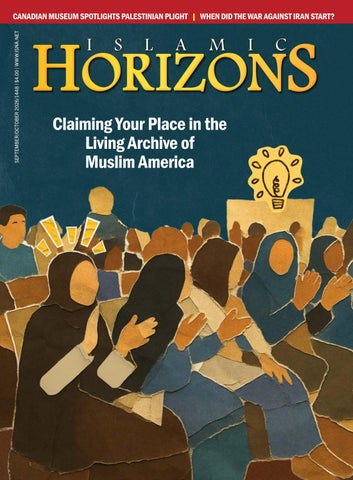
Claiming Your Place in the Living Archive of Muslim America
| VOL. 55 NO. 5 SEPTEMBER/OCTOBER 2026 | READ ON-LINE: HTTPS://ISLAMICHORIZONS.NET | VISIT ISNA ONLINE AT: WWW.ISNA.NET
ISNA MATTERS 8
ISNA on the Go
FAMILY LIFE 41 Affordable Is Not Always Sustainable
COVER STORY
FINANCE
14 Claiming Your Place in the Archive of Muslim America 16 Interfaith Detroit
43 BlackRock and the Architecture of Global Finance
SEERAH
45 Why is the Muslim World Lagging Behind?
18
Beyond the Viral Moment
EDUCATION 20
A Peek Inside Ribāt University
PALESTINE 22 Canadian Museum Spotlights Palestinian Plight
U.S. AFFAIRS 26
Media Empires in the 21st Century
THE MUSLIM WORLD 28 When Did the West’s War Against Iran Start? 30 The Forgotten Genocide 32 The High Representative Showdown
SOUTH ASIAN AFFAIRS 34 The Ideological Architecture and Global Impact of Hindutva 36 Kashmir: A Case of Unfinished International Commitment
OPINION
24
U.S. Support to Israel and Its Domestic Alternatives
ISLAM IN AMERICA 47 $17.74: The Measure of a Human Being
FEATURE 49 Leadership Without Argument 51 Making the ‘Legends of Islam: The Sahabiyat’ 53 The Beauty and History of Arabic Calligraphy
ENVIRONMENT 55
The Global Water Deficit
39
FOOD
The Pressure of Raising Muslim Children in the West
57 Your Beef, Lamb, Chicken May Contain Pork
IN MEMORIAM 61 62
John Louis Esposito Yahiya Emerick
DEPARTMENTS 6 10 59
Editorial Community Matters New Releases
Front cover design: Crystal Habib. DESIGN & LAYOUT BY: Gamal Abdelaziz COPYEDITOR: Luke Peterson, PhD. The views expressed in Islamic Horizons are not necessarily the views of its editors nor of the Islamic Society of North America. Islamic Horizons does not accept unsolicitated articles or submissions. All references to the Quran made are from The Holy Quran: Text, Translation and Commentary, Abdullah Yusuf Ali, Amana, Brentwood, MD.
SEPTEMBER/OCTOBER 2026 ISLAMIC HORIZONS
5
EDITORIAL
Lend Your Voice to the Muslim American Mosaic
R
asheed Rabbi, writing about the 63rd Annual Islamic Society of North America (ISNA) Con vention, likens the convention floor to a magnifying lens that brings subtle internal habits to light. Nothing here is insignificant. The way participants greet one another, practice patience in crowded hallways or registration lines, or quietly assist elders are all brought into focus, tested, and refined into the building blocks of Muslim American ethics. He stresses this vibrant vision of commu nity is incomplete without the story of every Muslims American. Whether you are seeking to reconnect with your roots, contribute your talents, or simply experience the warmth of a global family under one roof, there is a place for you here. Attend the annual convention with a full presence; lend your voice to the mosaic, stand shoulder-to-shoulder with your brothers and sisters, and help build the future of our community together. ISNA is deeply committed to building interfaith dialogue. Each convention focuses on this effort. Victor Ghalib Begg, co-founder of Interfaith Partners, takes readers through Detroit’s century of building bridges across faiths. He notes that few American cities have developed a deeper tradition of cooperation across religious lines than Detroit. Home to one of the nation’s largest Muslim commu nities, metro Detroit has spent generations transforming religious diversity into a source of civic strength. That achievement, Begg reminds, did not happen overnight. Common ground, he states, is not found by accident. It is built through trust, persistence, and the courage of people from different traditions who choose to stand together — one conversation, one relationship, and one act of hope at a time. Since the hyper ethnonationalist Bharatiya Janata Party first rose to power, the country’s non-Hindu minorities (Indian Muslims being the largest among them) have faced growing racism. While frequently con flated with Hinduism, Hindutva is a distinct, modern, and explicitly political project. It seeks to redefine India — historically a plu ralistic, secular, and multireligious society — as a Hindu nation. This ideology, from its 20th-century roots to its contemporary status as a dominant political force, has profound 6
implications for Indian democracy, global human rights, and the stability of liberal values in diaspora communities. Luke Peterson arouses readers’ attention to the fact that the recent strike against Iran was not something that happened yesterday, but it is a long-drawn hunger for control over Iran’s will. Through manipulation and execu tion, European states, he reminds, sought to maximize their financial and political advan tages at Iran’s expense through a variety of both direct and indirect means including direct military warfare, forced famines, financial strangleholds, and the crushing of Iran’s early democratic movements. Indeed, the West’s exploitation and abuse of Iran is centuries old, not simply the prod uct of a few months’ worth of bombardment and political posturing by Washington and Tel Aviv. Imam Saffet Catovic, a former Bosnian diplomat and someone who witnessed the horrors of the 1990s genocide firsthand, notes that the international community is once again at a crossroads in Bosnia and Herzegovina. The decision on who will be the next High Representative, he reminds, is not a minor diplomatic tussle. It is a defining moment that will reveal whether the world has truly learned the lessons of Srebrenica or is willing to sac rifice justice and stability for corporate profit. He notes that the recent standoff between the U.S. and European powers over this appointment is deeply alarming. The Trump administration’s push for an inexperienced diplomat with no meaningful connection to Bosnia, he writes, is a transparent ploy to install a proxy who will greenlight the $1 billion “Southern Interconnection” gas pipeline, awarded without a competitive tender to a company with zero track record but deep ties to political insiders. We at Islamic Horizons are delighted to share the news about the launch of a much-needed podcast: “Legends of Islam: The Sahabiyat” — recommended for ages 10 and up — which is streaming free on Apple Podcasts, Spotify, and YouTube. Treat yourself and your loved ones to episodes so lovingly crafted. You’ll walk away owing a debt to these remarkable women. What started with a breath ends with a prayer — may God bless all of the Sahabiyat (radi Allahu anha). ih
ISLAMIC HORIZONS SEPTEMBER/OCTOBER 2026
PUBLISHER The Islamic Society of North America (ISNA) PRESIDENT Syed Imtiaz Ahmad CHIEF EXECUTIVE OFFICER Azhar Azeez EDITOR Omer Bin Abdullah ASSISTANT EDITOR Bareerah Zafar EDITORIAL ADVISORY BOARD Iqbal Unus, Chair: M. Ahmadullah Siddiqi, Rasheed Rabbi, Wafa Unus ISLAMIC HORIZONS is a bimonthly publication of the Islamic Society of North America (ISNA) P.O. Box 38 Plainfield, IN 46168‑0038 Copyright © 2026 All rights reserved Reproduction, in whole or in part, of this material in mechanical or electronic form without written permission is strictly prohibited. Islamic Horizons magazine is available electronically on ProQuest’s Ethnic NewsWatch, Questia.com LexisNexis, and EBSCO Discovery Service, and is indexed by Readers’ Guide to Periodical Literature. Please see your librarian for access. The name “Islamic Horizons” is protected through trademark registration ISSN 8756‑2367 POSTMASTER Send address changes to Islamic Horizons, P.O. Box 38 Plainfield, IN 46168‑0038 SUBSCRIPTIONS Annual, domestic – $24 Canada – US$30 Overseas airmail – US$60 TO SUBSCRIBE Contact Islamic Horizons at https://isna.net/SubscribeToIH.html On-line: https://islamichorizons.net For inquiries: membership@isna.net ADVERTISING For rates contact Islamic Horizons at (703) 742‑8108, E-mail horizons@isna.net, www.isna.net CORRESPONDENCE Send all correspondence and/or Letters to the Editor at: Islamic Horizons P.O. Box 38 Plainfield, IN 46168‑0038 Email: horizons@isna.net
ISNA MATTERS
ISNA on the Go
Outreach and Advocacy in the U.S. and Beyond So far in 2026, Islamic Society of North American (ISNA) CEO Azhar Azeez and other ISNA representatives have visited a total of 154 mosques across the United States and Canada and plan on visiting more throughout the rest of the year. This outreach effort, which started with 40 mosques during this past Ramadan, is part of ISNA’s mission of providing quality services and a safe space for all Muslims in North America. Mosques visited over the past few months include Islamic centers in Texas, California, Georgia, Ohio, Michigan, Illinois, Florida, Missouri, Virginia, New York, Wisconsin, Indiana, and several parts of Canada such as Toronto, Mississauga, Brampton, Burlington, Windsor, and London. “It was a rewarding experience to visit so many mosques across the country in 2026,” said Azeez. “Everywhere we went, we received an overwhelmingly warm response. These [mosques] welcomed us with open hearts and open arms, and their generosity in supporting the programs and services offered by ISNA was truly inspiring. We are deeply grateful to every community that hosted us and partnered with us in advancing ISNA’s mission of serving the Muslim community across North America.” The ISNA team also attended the Summer Leadership Summit in Flint, Mich. and the Association of Physicians of Pakistani Descent of North America’s (APPNA) 49th Annual Convention
ISNA CEO Azhar Azeez delivering the Jummah khutbah (sermon) at the American Muslim Community Center in Longwood, Fla.
8
in Orlando, Fla. In late July, Azeez joined the commemoration of the 75th anniversary of the 1951 Refugee Convention with the United Nations High Commissioner for Refugees (UNHCR) in Geneva, Switzerland. During that event, Azeez met with UNHCR High Commissioner and former Iraq President Brahim Salih. During their meeting, Azeez highlighted the humanitarian crises affecting civilians in Gaza, the West Bank, Lebanon, and Sudan and drew attention to the ongoing plight of Rohingya refugees living in Bangladesh. He emphasized the urgent need for increased humanitarian assistance and appealed for greater international support and funding to help alleviate the suffering of displaced and vulner able populations. Throughout the commemorative events, Azeez also met with numerous dignitaries, UN officials, goodwill ambassadors, religious leaders, distinguished guests, and well-known public figures from around the world, reaffirming ISNA’s commitment to humanitarian service, global cooperation, and advocacy for human rights, refugees, and displaced communities. The outreach team, in addition to the CEO, included Executive Director of Development Basharat Saleem, Outreach Coordinator Syed Ansar Hasan, and Fund Development Coordinator Ahmed Badawi. ih
Azeez (left) with High Commissioner of UNHCR and former President of Iraq Barham Salih during the 75th anniversary of UNHCR in Geneva, Switzerland.
ISLAMIC HORIZONS SEPTEMBER/OCTOBER 2026
Azeez delivering the Jummah Khutbah at Masjid al Sahaabah in Watauga, Texas.
ISNA Executive Director of Development Basharat Saleem (center) meeting with Imams in Detroit. ISNA Outreach Coordinator Syed Ansar Hasan at the Islamic Association of North Texas, Richardson.
Azeez delivering the Jummah Khutbah at East Cobb Islamic Center in Marietta, Ga.
Azeez delivering the Jummah Khutbah at Dallas Central Mosque in Richardson, Texas.
Azeez at the 75th anniversary of the 1951 Refugee Convention in Geneva, Switzerland.
Azeez (left) and Saleem (right) at the APPNA 49th Annual Convention.
ISNA Fund Development Coordinator Ahmed Badawai at East Cobb Islamic Center in Marieta, Ga.
Azeez (center right) at Dallas Central Mosque. SEPTEMBER/OCTOBER 2026 ISLAMIC HORIZONS
9
COMMUNITY MATTERS ➤
T
he Dearborn Heights Imam Al-Hasanain Mosque, the new $20 million headquarters of the Islamic Institute of America, was inaugurated June 12. The first official Jummah was held there on June 5. The Institute’s earlier headquarter, the Islamic Center of America in Dearborn, was the nation’s largest mosque when it opened in 2005. The new mosque is one of the largest and most significant Islamic developments in Michigan in recent years, Ebtissam Khanafer reported for The Arab American News. The opening ceremony brought together a diverse group of religious leaders and public officials including Detroit Archbishop Edward Weisenburger; Dearborn Heights Mayor Mo Baydoun; Dearborn Mayor Abdullah Hammoud; Rep. Rashida Tlaib (D-Mich.); Democratic U.S. Senate candidate Abdul El-Sayed; Iraqi Consul General in Detroit Mohammed Hassan Saeed Mohammed; Imam Fadhel Al-Sahlani, serving as the representative of Grand Ayatollah Sayyid Ali al-Sistani in North America; and Imam Mohammad Mardini, founder of the American Muslim Center in Michigan. A key factor in making the project possible was the donation of the land by Mike and Shadia Shehadi. In 2024, Shehadi purchased a 37-acre property in the Metro Detroit area to establish a nonprofit Muslim cemetery which he is fully funding and maintaining. The 7-acre, approximately 60,000 sq. ft. complex besides the mosque, includes educational and youth facilities and cultural and community spaces — such as the Imam Al-Muttaqeen Hall, a commercial kitchen, and parking for more than 500 vehicles. The mosque, which can accommodate more than 1,100 worshippers, features golden domes that have already made it a prominent landmark in metro Detroit’s religious landscape. “Religious institutions are not only places of worship,” said Tlaib. “They also have a responsibility to stand with the oppressed, defend justice and strengthen human connections.” Mayor Baydoun, calling the opening a historic day for Dearborn Heights, noted that the mosque stands in an area that also includes Christian churches, creating what he described as “a powerful example of religious coexistence and cultural and religious diversity.” “Four years ago, we began building this institution. Today, we see that dream become reality through the grace of God and the generosity of this community,” said Imam Sayed Hassan Qazwini, who founded the Institute in 2015. He emphasized that the success of a mosque should not be measured by its chandeliers, decorations, or architecture but by its impact on people’s lives. “Our goal was never simply to build four walls. Our goal was to build a strong community and prepare a generation that takes pride in its faith and Islamic identity.” The three-story Dearborn Mosque, which spans almost an entire block, was founded by the American Moslem Society and built in 1937 by the nascent Islamic community (then mostly Sunni Muslims from the Bekaa Valley in Lebanon). It was the second mosque constructed in the United States. Estimates for the Muslim population in metro Detroit typically range from 250,000 to 300,000 people, placing the region in the top five most prominent Muslim hubs in the U.S. The city of Dearborn, which borders Dearborn Heights, has the highest concentration of Arab Americans and Muslims per capita in the U.S., according to 2020 U.S. Census data. ih
10
ISLAMIC HORIZONS SEPTEMBER/OCTOBER 2026
Dearborn ‘Wall of Tears’ Display Serves as a Powerful Memorial to Gaza’s Children
Artist Phil Buehler stands in front of his work, “The Wall of Tears.” The piece names thousands of children who were killed in the Gaza genocide from 2023-25 (Photo courtesy of the artist).
The City of Dearborn hosted the outdoor “Wall of Tears” installation June 11 to July 31 at PEACE Park East. The 100-foot bilingual mural in Arabic and English fea tures the names, ages, and stories of 18,457 Palestinian children killed in Gaza since Oct. 2023. These names represent only a portion of the children killed in Gaza, serving as a reminder of the scale of loss endured by Palestinian families and communities. Organizers noted that total child fatalities are estimated to exceed 75,000, underscoring the magnitude of the immense loss of young lives. Behind every statistic is a human life, a family, and a future that should never be forgotten. Created by artist Phil Buehler, the instal lation spans the park and invites visitors to reflect on the individual lives behind the headlines, transforming statistics into names, stories, and memories. Buehler is known for large-scale public art installations exploring human rights, social justice, and historical memory. Dearborn Mayor Abdullah Hammoud described the installation as both a memorial and a call to conscience, urging visitors to reflect on the human suffering caused by the war in Gaza and its expansion into neigh boring Lebanon. Other speakers were Rep. Rashida Tlaib (D-Mich.) and Rabbi Alana Alpert of Congregation T’chiyah. Previously exhibited in cities including New York, London, San Francisco, New Jersey, and several Australian cities, the installation has drawn international atten tion for its focus on remembrance and social advocacy. It is expected to travel next to Mexico City, Dallas, and Portland.
New York City Honors Martyred Muslim Officer
A
street in Bronx, N.Y. was renamed Detective Didarul Islam Way on July 18 in honor of New York Police Department (NYPD) Detective Officer First Grade Didarul Islam, a Bangladeshi American Muslim officer who was killed while attempting to protect others during a mass shooting in Midtown Manhattan in July 2025. Officer Islam, 36, a father of three — including a child born after his death — and a member of the NYPD assigned to the 47th Precinct, was working a security detail when he was fatally shot confronting the gunman. He was hailed as a hero for his courage and selfless service and was promoted to detective at his funeral. “Officer Didarul Islam embodied the highest ideals of public service, courage,
“We salute Mr. Buehler on this power ful memorial. We also commend the city of Dearborn and Mayor Hammoud for host ing this memorial,” said American Human Rights Council-USA Executive Director Imad Hamad. “Gaza City” is another art installation by Buehler in collaboration with Palestinian photojournalist Shroug Alaiya, who took the dozens of photographs that Buehler digitally stitched together to create the cyclorama. With concern for her privacy and safety, Alaiya was asked if she wanted to be credited with the artwork, to which she responded, “You can mention my name, no risk in this. I’ve already survived a genocide.” “Gaza City” was displayed at the Henry Ford Centennial Library on June 13. That installation was also presented by Jewish Voice for Peace-Detroit and the U.S. Pal estinian Community Network. It was also featured in a screening of “The Voice of Hind Rajab.”
Family members, NYPD, and community members remember Detective Didarul Islam at street co-naming ceremony. (Photo credit: Police Benevolent Association of the City of New York on Instagram).
and sacrifice,” said Afaf Nasher, executive director of the New York chapter of The Council on American Islamic Relations. “As a Muslim, immigrant, husband, father, and dedicated NYPD officer, he gave his life protecting others without hesitation. We welcome the decision to permanently honor his legacy by naming a street after him so future generations of New Yorkers will remember his heroism and commitment to serving all members of our city’s diverse communities.” ih
Connecticut Law HB 5468 Provides Islamic and Arab Studies Curriculum
Connecticut educators now need to develop resources for teaching Islamic and Arab studies under a new state law, HB 5468, that went into effect early July, Michael Gagne reported for CT Insider. The law directs the Connecticut State Department of Education (ED) to make Islamic and Arab studies curriculum materials available to local districts and to encourage those districts to provide that new instruction. After the state develops those
materials, it will be optional for districts to include such studies in their own course offerings. The ED plans to have the resources available by Jan. 1, 2027. Muslim leaders praised the measure as overdue, citing a general societal misunder standing of Muslim and Arabic cultures and Islamophobic incidents that have occurred in Connecticut schools. “The understanding and education around Islam and Muslim culture needs to start hap pening at schools in the social studies curricu lum and the history curriculum,” said Farhan Memon, executive director of the Council on American Islamic Relations Connecticut. He said his organization will work with the ED to make sure Muslim communities have input into the created curriculum. Having a cur riculum available is “a positive sign” toward countering those trends, he added. “When young people understand dif ferent cultures, they’re less likely to rely on stereotypes and more likely to engage respectfully with people from different back grounds,” said Fahd Syed, chair of Waterbury city’s Human Rights Commission. He said one of the issues now is that cur rent textbooks “present a highly biased view of Islam and Muslims as well.” Waterbury schools superintendent Dar ren Schwartz indicated that the new house bill provides some possibilities to establish a full-credit or half-credit Islamic and Arab studies course within his district. He added, “Waterbury has done a nice job of recog nizing the various cultures, religions, races that do exist here in the Waterbury Public Schools.” He also noted that a few years ago, the district added Eid al-Fitr to its calendar. Irving City Council Member Abdul Khabeer Incumbent Irving (Texas) City Coun cil member Abdul Khabeer, who has held the seat since 2023, won re election to the Irving City Council District 3 seat with almost 55% of the vote. He was sworn in June 13 and will hold the seat for the next three years. The retired business consultant, who holds an MBA and previously served on the city’s Zoning Board of Adjustment and Appeals, won $17 million in improvements to the pothole-riddled Esters Road, includ ing the restoration of twice-weekly trash pick-up, upgrades to the nearby cricket fields, and the installation of a pedestrian-ac tivated crosswalk signal on Esters.
SEPTEMBER/OCTOBER 2026 ISLAMIC HORIZONS
11
COMMUNITY MATTERS Khabeer’s campaign website reads, “With a deep commitment to the residents of Dis trict 3, [Khabeer] focuses on the infrastruc ture and safety requirements that sustain our growing city.” District 3 surrounds Dallas Fort Worth International Airport and parts of Las Colinas and neighborhoods around Esters Road. It has a population of around 30,000 people. As with many local elections, turnout was low. Voters cast a total of 2,330 ballots. Judge Haaris M. Syed of Los Angeles County Haaris M. Syed of Los Angeles County was appointed to serve as a judge in the Los Angeles County Superior Court on June 26. Syed — a Democrat — has served as a Commissioner at the Los Angeles County Superior Court since 2026. He also served as a Deputy Public Defender at the Los Angeles Public Defend er’s Office from 2005 to 2026. Before that, he worked as an Associate at Augustini & Wheeler from 2004 to 2005. Syed earned his JD from Loyola Law School in Los Angeles and holds dual Bach elor’s degrees in Comparative Literature and Philosophy from the University of Califor nia, Irvine. Syed also served as a trainer in the Misde meanor Training Program, mentoring new attorneys in trial practice and client‑centered advocacy. His dedication to youth advocacy earned him the Los Angeles Public Defend ers Association’s Judy Schecter Award for Juvenile Attorney of the Year. Syed, a father of two, has long worked with youth beginning as a summer camp counselor in his teens. He has served as a counselor with the Muslim Youth Camp, taught at the Explore Islam School, and founded the Boys Youth Group at the Is lamic Center of South Bay. Judge Lubna Qazi-Chowdhry Attorney Lubna Qazi-Chowdhry was confirmed by the State Senate and sworn in by New Jersey Supreme Court Associate Justice Ra chel Wainer Apter on Jan. 22 as an Administrative Law Judge in the New Jersey Of fice of Administrative Law. She is the first Muslim woman to serve in that role. 12
Before beginning her judicial service in Newark, Qazi-Chowdhry graduated from the University of California, Irvine and Western State College of Law at Westcliff University, Tustin. The multilingual Judge Qazi-Chowdhry’s career spans federal and state agencies, private practice, and judicial clerkship, with experience across adminis trative legislation, civil rights, health, and matrimonial law. Nassau County Women’s Bar Association President Tanya Sophia Mir Tanya Sophia Mir (BA, College of Wil liam & Mary; JD, Hofstra University School of Law ‘13), the deputy County Attorney at the Nassau County Attorney’s Office in New York, was in stalled as president of the Nassau County Women’s Bar Association on June 9. A dedicated public servant, Mir prose cutes juvenile delinquency and child abuse and neglect matters in Nassau County Family Court. She has devoted her entire legal career to Nassau County Family Court, beginning at the Legal Aid Society of Nassau County. Mir is deeply committed to advancing family law practice. She has served as chair of the Family Court Law and Procedure Com mittee of the Nassau County Bar Association since 2024 and as a member of the Nassau County Women’s Bar Association’s Board of Directors since 2023. She also serves on the We Care Advisory Board for the Nassau County Bar Association and the Nassau County Family Court Children’s Center Advisory Council. She is also certified by the Supreme Court of New Jersey as a matrimonial attorney. James Beard Foundation Media Award Winner Ahmed Ali Akbar Ahmed Ali Akbar was the only Chi cago journalist to win a James Beard Founda tion Media Award this year. He received the honor at a ceremony held at the Art In stitute of Chicago on June 13. Akbar won the Food ways category for his Chicago Tribune article “The hunt for the bean pie street sellers of legend, and how this dessert is a symbol of liberation for many Black Muslims” pub lished last January, Louisa Kung Liu reported for The Chicago Tribune on June 16.
ISLAMIC HORIZONS SEPTEMBER/OCTOBER 2026
Akbar told Liu that he “submitted it for consideration simply because [he thinks] it needs to be understood more as an incredibly important part of not just Black history, not just Muslim American history, but Amer ican history.” According to Akbar, the history of the bean pie touches on questions of civil rights, healthy eating, structural racism, and liberation. This is the second Beard Award for the former Tribune reporter who is currently an editor at Acacia Magazine, a writer, and a podcast host. He was among five Chicago Tribune Guild journalists laid off last June. Akbar won his first Beard medal for an Eater article on the secretive world of mango importing, which he covered further at The Tribune, tracking down the coveted fruit to a warehouse in Romeoville in 2024. He told Liu that he is working on a story about halal certification now. That began with his Tribune article on Quesabirria Jalisco in Pilsen, he said, a halal taqueria run by a non-Muslim Mexican man who was trained by a Palestinian. It’s expected to be published in Acacia this fall. Akbar runs a newsletter, “Rad Brown Dads” and will be working on his debut book next, a memoir and exploration of American Muslim food. Rochester Public Schools
Rochester (Minn.) Public Schools have added Eid al-Adha to its academic calendar for 2027-28. The resolution was approved 4:1. This adjustment was developed by the Rochester Education Association, along with the Rochester Principals Association. In the public hearing, one speaker objected, saying, “Christmas break became winter break. Easter break became spring break. . . yet this Muslim holiday is to be an official school holiday. This is an abomina tion.” Another speaker, however, interjected, “If religious accommodation is important... then equal consideration should be given to all faith communities.” Yahye Ahmed, co-advisor for the Muslim student associations at Mayo and John Mar shall high schools, described the inclusion of the holiday on the calendar as a signif icant step for the district. He told Jordan
Shearer of The Post-Bulletin that the district’s Muslim community has been advocating for the inclusion of the holiday for about five years. Council on American Islamic Relations Minnesota Executive Director Jaylani Hus sein, welcoming the decision, said, “Students of every faith should have the right to ob serve their religious holidays without being penalized for it.” Canadian High Schooler Launches Clever New Fajr App
Ottawa, Canada high schooler Yahia Ebrahim launched Yaqzah, an iPhone app, in July. The free app, available on the App Store, is a Fajr alarm designed to wake you up rather than just notifying you. When the alarm rings at Fajr, the user has to reconstruct the verses of four short surahs (Al-Fatiha, Al-Ikhlas, Al-Falaq, An-Nas) in the correct order to turn the alarm off. The alarm does not stop even if the user closes the app or tries to silence it. There is an emergency bypass that requires typing out a full paragraph, so it can never trap someone in a real emergency, but the design makes it far harder to swipe away or hit snooze while half asleep. Ebrahim said that he developed the app after he kept sleeping through Fajr and every Islamic alarm app he tried had a soft adhan chime that he would often swipe away. He said the community’s default framing for missing Fajr is that it is a spiritual failing. “I came to believe it is really a systems problem. So I built Yaqzah to test that theory.” Ebrahim says that the app will be free forever with no ads or paid features. How ever, there is an optional “Support Yaqzah” button that opens a webpage where users can contribute if they like the app. “50%
Arizona Governor Vetoes Senate Bill 1018
Arizona Gov. Katie Hobbs (D) vetoed Senate Bill 1018, passed along partisan lines in June with the Repub lican majority supporting it, which seeks to classify the Sharia as “foreign law.” In her veto letter, Hobbs said, “The practical effects of this unconstitutional legislation will be a lawsuit that the state of Arizona will lose, costing taxpayers millions of dollars.” The bill also expanded the foreign law definition to include foreign religious or cultural laws, customs, and practices and other conduct that violates state law. Azza Abuseif, the executive director for the Arizona chapter of the Council on Ameri can-Islamic Relations, said the organization welcomed Hobbs’ decision to veto the “unnec essary and discriminatory legislation.” “Bills targeting so-called ‘Sharia Law’ are not about protecting anyone’s rights or safety. They are about exploiting fear and promoting harmful stereotypes about Islam and Mus lims,” Abuseif said. He added these bills “send a message that Muslim Arizonans are somehow suspect or unwelcome in their own communities.” “Arizona’s Muslim community contributes to every aspect of our state’s civic, economic and cultural life. Public officials should focus on bringing people together and addressing the real challenges facing Arizona families, rather than advancing legislation rooted in prejudice and misinformation,” Abuseif said. ih of every dollar received is donated to Bar rhaven Islamic Center, a mosque in Nepean, Ottawa, as sadaqah. The other 50% covers the actual costs of running the app,” Ebra him said. App Store link: https://apps.apple.com/ app/yaqzah/id6788536099 Website: https://www.getyaqzah.app Support page (with the mosque donation model explained): https://www.getyaqzah. app/support
location right here in South Lansing to meet and to pray,” he said. The center will also host community events, classes, and more as building reno vations are completed. Albuquerque Islamic Center Moving Forward
The Islamic Center of South Lansing Gets Approval
The city of Lansing, Mich. granted the Islamic Society a special land use permit allowing them to build the Islamic Center of South Lansing in an unused building. The opening ceremony for this new building, held on June 19, featured remarks from Mayor Andy Schor. “I was here for the first prayer at this new location, and I’m thrilled that the Muslim community has chosen this
Bernalillo County’s Planning Com mission accepted a long denied application on July 1 allowing the Albuquerque Islam ic Center to move forward with building a two-story center on a new 4-acre site. The Center, which was founded in 2014, said it has worked on the project for the past two years. The proposed campus would include a mosque, though plans for a school were dropped as part of the approval process. ih
SEPTEMBER/OCTOBER 2026 ISLAMIC HORIZONS
13
COVER STORY
CLAIMING YOUR PLACE IN THE ARCHIVE OF MUSLIM AMERICA Reflection during ISNA’s Annual Convention
P
erhaps you are reading this in motion — moving through the halls of the Islamic Society of North America’s (ISNA) conven tion, shifting between sessions, greeting colleagues, and catching familiar faces in passing. This swift movement mirrors Labor Day weekend itself, slipping by as it unfolds. Yet within this rush lies a profound opportunity to participate in living history. Before momentum carries you away, pause and claim your place in this moment. Don’t let the crowds at Detroit’s Huntington Place reduce you to a mere spectator. You are an active participant. Your presence folds directly into a legacy of Muslim American institution-building that began in the 1960s and has unprece dentedly evolved through political storms, cultural shifts, and generational transitions. This annual gathering is the latest expression of that enduring legacy.
14
BY RASHEED RABBI Such rapid evolution cannot emerge through a passive presence at conferences or streaming talks from home. Institutions are built when ideas are enacted. They develop when discourse is embodied. Their synergy mobilizes when knowledge is negotiated face-to-face. The ISNA Annual Convention creates a shared space where knowledge becomes practice and participants become co-builders of a living community. Every session is designed to spark com mitment and animate ideas. Far beyond acknowledgement, Muslim American struggles, achievements, and aspirations are actively shaped here. Neither the past nor the future sits in a silo but they interact, collide, and create new meaning in real time, form ing a dynamic archive of the community. Every engagement is etched into this narrative. Every conversation is carried forward. Every act of service adds another chapter to Muslim American life — a story
ISLAMIC HORIZONS SEPTEMBER/OCTOBER 2026
continuously re-authored by those who inherit it, including you. Reflect and retain your finest self to this live record of struggle, endurance, and renewal. This path of personal and collective evolution is captured in this year’s theme, grounded in the urgency of our present moment: “Persevere, Interconnect, Be GodConscious, Strengthen Each Other for True Prosperity.” A flagship session will com mence the convention, setting three inter locking priorities for a three-day journey of institution-building — righteous char acter, communal and civic responsibility, and united prosperity.
➊ An Incubator for Righteous Character
The convention floor functions as a mag nifying lens, bringing subtle internal habits to light. Nothing here is insignificant. The way participants greet one another, practice patience in crowded hallways or registration
lines, or quietly assist elders are all brought into focus, tested, and refined into the build ing blocks of Muslim American ethics. The Friday evening and Saturday morn ing sessions initiate this ethical transforma tion through taqwa (God-consciousness). Each gathering calls us to operationalize taqwa within our everyday interactions across self, family, and community. They untether us from mundane attachments and dare us to seek definitive answers to our silent quests, hard questions, and longing for mentorship and integrity. Transformation is immediate here. If any discussion moves us, we don’t need to defer it for later; we can live it out in the bazaar, the prayer hall, or the hotel lobby. Moral talk and moral practice meet in real time, among real people. These actions become a living archive of how Muslims find firm grounding within a predominantly JudeoChristian landscape. Righteousness is reinforced through rituals. While collective prayers, Quran recitations, and communal supplications provide settings for symbolic rituals, each ISNA session acts as a formative ritual. Together, they shape dispositions, align intentions, and reinforce the ethical com mitments that attendees carry back into their everyday lives. These shared experiences reassure us that Muslim American identity is not an abstract concept confined to panel discus sions. Rather, it is a lived experience to be seized at every turn. The convention invites you to fully own who you are: your hijab, kufi, prayer beads, and traditional greetings. Let them become second nature. Beneath the bustle, the convention cre ates a quiet space to identify the pressures that constrain you elsewhere. Reclaim your space without hesitation and step into the rare ease of being fully understood. Embrace your moral and spiritual aspirations with out self-censorship and feel what it means to be present and visible without needing translation, dilution, or apology. Carry this experience home as a living memory of unburdened belonging.
➋ A Conduit of Communal and Civic Duty
Character development is not a solitary endeavor but a socially mediated process, and the convention compels us to confront the civic realities collectively: voting, policy engagement, community safety, educational equity, and the broader responsibilities of
citizenship. Such civic engagement is espe cially salient during mid-term election cycles when public visibility ensures that community concerns are heard. Lean into this space and share the communal burdens. Understand the bigotry, discrimination, and oppression facing our broader com munity, and commit to shouldering them collectively. ISNA welcomes the opportunity to commemorate the 250th anniversary of
uniformity but alignment of collective well-being. Hearing Somali families speak ing Maay Maay in the hallway or South Asian elders greeting you with “Assalamu alaikum, beta” are not language differences to disregard. Black Muslim youth leading spoken-word sessions and converts sharing their first Ramadan stories are not gaps to close. Instead, these distinct expressions are invitations to form compassionate connec tions that move beyond surface interactions.
The convention floor functions as a magnifying lens, bringing subtle internal habits to light. Nothing here is insignificant. The way participants greet one another, practice patience in crowded hallways or registration lines, or quietly assist elders are all brought into focus, tested, and refined into the building blocks of Muslim American ethics. American independence. Join them with a commitment to complete the unkept promise of independence. Debate strategies, share experiences, and organize to overcome discrimination, surveillance, and political marginalization. Treat your Saturday afternoon sessions as a civic classroom — a place to interpret legislation, navigate political structures, and mobilize for collective interests. Become lit erate in the responsibilities of communal to national belonging to enrich Muslim American narrative. Recognize that voting, policy engagement, community safety, and educational equity are not distant issues but part of your moral horizon. These conver sations curate the living continuum of not only what the community has endured but what it hopes to archive for posterity. The convention frames civic responsibil ity not as partisan maneuvering but princi pled pursuit of communal justice and peace. It serves as a rehearsal ground to anticipate citizen responsibilities and prepare for the political challenges ahead, adding your own chapter to the living archive of Muslim American civic life.
➌ Pursuit of United Prosperity
Finally, the ISNA Convention thrives on a fundamental principle that unity is not
Rather than distracting us, these dif ferences must anchor us in the reality of plurality. We not only need to acknowledge but to accept them as a set of living relation ships that each of us must nurture. Instead of flattening these distinctions, ISNA builds a vibrant and breathing mosaic. The “diversity of [y]our languages and colors” serves as a set of divine signs to compete in goodness and conform to a community of excellence: the Ummah (Quran 30:22). This Ummah requires physical prox imity, and the ISNA Convention leverages that proximity to its fullest. Standing shoul der-to-shoulder in prayer with thousands of strangers is the bedrock of this closeness. The bond expands continuously as participants sit together in sessions, share shawarma or biriyani at crowded tables, and navigate packed hallways side-by-side with strollers, wheelchairs, or backpacks. Artificial hier archies fade, giving way to an embodied, shared purpose — lived evidence of how unity is felt far beyond abstract theory. Building on this spirit of togetherness, the convention operates as a dynamic net working ecosystem. Community leaders, activists, scholars, and organizers converge to facilitate direct conversations. In a single afternoon, you may find a youth director asking what your mosque needs, a civil rights
SEPTEMBER/OCTOBER 2026 ISLAMIC HORIZONS
15
COVER STORY attorney explaining how policy shapes your school district, or an imam inviting you into a mentorship circle. Through these interactions, partnerships form in real time. The Ummah begins to step off the pages of the sacred text and into social reality forged through interaction, exchange, and initiative. Each connection becomes another layer in the archive of communal infrastructure. Intergenerational transmission deepens the maturity and continuity of this infrastructure. Elders recount building early mosques in rented storefronts, fighting immigration battles, and surviving insti tutional challenges. Meanwhile, younger attendees bring digital fluency, political urgency, and cultural creativity. When these voices meet, communal memory is updated, expanded, and passed on as a living record of adaptation and aspiration. The cultural validity of Ummah comes alive in the bazaar through Muslim art, literature, halal entrepreneurship, clothing, and calligraphy from every cultural lineage. These expressions do more than entertain; they remind us that our identity is textured, visible, and an undeniable part of the American landscape. Mutual recognition or united community fuels collective prosperity. The concluding Sunday sessions showcase inspiring glimpses of that united success, sending attendees home with more than just fond memories. They leave with concrete commitments — to support local masjids, mentor youth, join advocacy groups, and build educational programs that advance the broader American society. The current of collective prosperity sustains the Ummah. It becomes an active project — something each of us help build and strengthen long after the convention ends, writing the forward-facing pages of Muslim American life for ourselves and for future generations to come.
Be a Part of the Archive
As the final sessions end and the convention halls slowly quiet down, remember that the momentum doesn’t stop here — it moves forward with you. This vibrant vision of community is incomplete without your story. Whether you are seeking to reconnect with your roots, contribute your talents, or simply experience the warmth of a global family under one roof, there is a place for you here. Attend the annual convention with a full presence; lend your voice to the mosaic, stand shoulder-to-shoulder with your brothers and sisters, and help build the future of our community together. ih Dr. Rasheed Rabbi is an Islamic Horizons board member and the founder of e-Dawah and secretary of the Association of Muslim Scientists, Engineers and Technology Professionals. He serves as a khateeb at the ADAMS Center and is a certified Muslim chaplain at iNova Fairfax, iNova Loudoun, and Virginia’s Alexandria and Loudoun Adult Detention Centers.
16
INTERFAITH DETROIT A Century of Building Bridges Across Faiths BY VICTOR GHALIB BEGG
F
or more than four decades, I have had the privilege of wit nessing and contributing to Detroit’s remarkable interfaith story. As a co-founder of Interfaith Partners, a founding board member of the InterFaith Leadership Council of Metropolitan Detroit (IFLC), and Vice President Emeritus of the Michigan Roundtable, I have been fortunate to help shape that journey. Few American cities have developed a deeper tradition of cooperation across religious lines than Detroit. Home to one of the nation’s largest Muslim, com munities, metro Detroit has spent generations transforming religious diversity into a source of civic strength. That achievement did not happen overnight. It emerged through decades of relationship building, courageous leadership, and the recognition that com munities of faith could address shared challenges more effectively together than apart.
The Roots of Detroit’s Interfaith Tradition Throughout the 20th century, Detroit stood among the nation’s leading centers of interfaith innovation. Like Chicago, New York, Washington, D.C., London, and Rome, Detroit faced religious and racial tensions but responded by building relationships and institutions that brought communities together. As Detroit grew, so did its religious diversity. Jewish congregations became established parts of civic life, Black American Muslims built communities through the Nation of Islam and later Sunni institutions, and Arab American immigrants established lasting communities. The American Moslem Society Mosque in Dearborn, founded in 1937, was among the nation’s earliest mosques. But Detroit’s diversity also reflected the prejudices of its era. During the 1930s and 1940s, Father Charles Coughlin’s nationally broadcast radio sermons frequently promoted hostility toward Jews. In response, Christian and Jewish leaders created a local chapter of the National Conference of Christians and Jews (NCCJ). Known as the Detroit Roundtable of Catholics, Jews, and Protestants, it became one of the region’s earliest and most influential interfaith organizations. For much of its history, organized interfaith work in Detroit focused pri marily on Christian-Jewish relations. But by the 1980s, late Rev. Oscar Ice of the NCCJ noticed that Muslims were largely absent from the conversation and sought to broaden the circle. Through my work with the Islamic Association of Greater Detroit, I had the opportunity to participate in that important transition.
ISLAMIC HORIZONS SEPTEMBER/OCTOBER 2026
A new era of cooperation followed. Over time, the Detroit Roundtable evolved into the Michigan Roundtable for Diversity and Inclusion, known today as the Michigan Roundtable for Just Communities, reflecting a broader commitment to justice, inclusion, and cooperation among all communities. The Muslim community itself continued to grow. When I arrived in Detroit in 1969, I remember only a small number of mosques. Today, Muslim institutions throughout metro Detroit include schools, health pro grams, food assistance efforts, counseling services, and community initiatives that are deeply woven into the region’s civic life. 9/11 and a New Era of Cooperation The attacks of Sept. 11, 2001 became one of the greatest tests of those relationships. Within hours of the attacks, Muslim leaders recognized that their communities faced not only grief but also the possibility of suspicion and backlash. Christian and Jewish leaders understood that solidarity would be essential. On Sept. 12, more than 50 religious lead ers gathered in Dearborn. Many were meet ing together for the first time. They came with a shared purpose: to reject collective blame, support one another, and offer a message of hope during a moment of national fear. As those conversations continued, many recognized that the response could not end with a single gathering or public statement. The relationships formed during that difficult moment needed to become the foundation for deeper engagement. Four days later, religious leaders from across metro Detroit gathered at the his toric Fort Street Presbyterian Church on the Downtown Detroit riverfront for an interfaith service. Jewish, Muslim, and Christian influ ential leaders stood together before the com munity and the media, affirming compassion, rejecting hatred, and reminding the public that justice must never become vengeance. The message was clear: Detroit’s reli gious communities would face uncertainty together. What began as an emergency response became the foundation of a stronger inter faith movement. From Crisis Response to Community Building The years following Sept. 11 marked a tran sition from occasional cooperation to orga nized partnership. Leaders began creating structures that could bring communities together not only during crises but also in the everyday life of the region.
Support from the Andrus Family Fund in 2002 helped advance efforts to create a stronger metropolitan faith community. Leaders from Christian, Muslim, and Jewish traditions worked together to expand inter faith engagement beyond clergy and orga nizational leaders and into neighborhoods, schools, and community organizations. Those efforts became Interfaith Partners of the Michigan Roundtable and later the InterFaith Leadership Council of
One example was “The Children of Abraham,” a production developed through Mosaic Youth Theatre of Detroit by Christian, Muslim, and Jewish teenagers. Supported by the Fetzer Institute, it explored faith, iden tity, and hope and later became a nationally broadcast television documentary. The movement also inspired the Women’s Interfaith Solutions for Dialogue and Outreach in Metro Detroit, founded by Shahina Begg, Gail Katz, and Trish Harris.
Today, metro Detroit remains recognized for its sustained commitment to interfaith engagement. Its story is not one of perfect agreement or the absence of conflict. It is the story of communities that repeatedly chose conversation over division and relationship over suspicion. Metropolitan Detroit (IFLC). As an active interfaith partner, I witnessed the transfor mation of a hopeful idea into an enduring regional institution. In 2004, Hamtramck, a city surrounded by Detroit, faced controversy when a local mosque sought permission to broadcast the adhan (call to prayer) publicly. The proposal generated intense opposition and attracted activists from outside the com munity. Rather than allowing conflict to deepen divisions, the IFP encouraged dia logue and community engagement. The city ultimately approved the request, and the experience became a model for how dia logue could transform conflict into greater understanding. Several years later, when Florida pastor Terry Jones threatened to burn copies of the Quran outside Dearborn’s Islamic Center of America, metro Detroit again responded through unity rather than division. The IFLC organized the Vigil for the Beloved Community, bringing together approxi mately 1,500 people from multiple faith tra ditions. The gathering demonstrated that the region’s interfaith relationships had matured into a shared moral commitment to oppose hatred and religious intolerance. Building Understanding Across Generations Over time, Detroit’s interfaith movement expanded beyond responding to conflict and began focusing on education, culture, and personal relationships.
Through programs such as Five Women, Five Journeys, women from different faith tradi tions shared personal experiences, explored common concerns, and built friendships across religious boundaries. Together, these efforts demonstrated that lasting under standing is created not only through formal dialogue, but through relationships that grow over time and across generations. Detroit’s Enduring Legacy Today, metro Detroit remains recognized for its sustained commitment to interfaith engagement. Its story is not one of perfect agreement or the absence of conflict. It is the story of communities that repeatedly chose conversation over division and relationship over suspicion. Looking back, I believe Detroit’s greatest achievement has not been the institutions it created, but the relationships it nurtured. The region reminds us that cooperation requires honesty, patience, and trust, not the absence of differences. Common ground is not found by acci dent. It is built through trust, persistence, and the courage of people from different traditions who choose to stand together— one conversation, one relationship, and one act of hope at a time. ih Victor Ghalib Begg is the co-founder Interfaith Partners, founding board member of the IFLC, and the vice chair emeritus for the Michigan Roundtable for Just Communities. He is also the author of Our Muslim Neighbors, Achieving the American Dream — An Immigrant’s Memoir and a columnist for Our Muslim Neighbors.
SEPTEMBER/OCTOBER 2026 ISLAMIC HORIZONS
17
SEERAH
Beyond the Viral Moment Moral Foundations, Public Leadership, and the Prophetic Standard BY RASHEED RABBI
T
rust in leadership in the United States has collapsed to historic lows. A Dec. 2025 Pew Research study revealed that 83% of Americans do not trust the federal govern ment to act in the public interest, while an April 2025 Harris Poll found that 77% struggle to name an admirable leader worth looking up to. This crisis cannot be pinned solely on current officeholders or candidates; it traces back to the post-9/11 era with a steep decline since 2007. Nearly a quarter-century into this downward trend, the depth of the systemic erosion remains unaddressed. No foreign adversaries, domestic dissen sions, unfunded benefits, or climate crises are liable for this leadership deficit. The cause is internal: a failure of moral authority rooted in the broader patterns of absent character, unchecked ambition, and an individualistic culture. Exacerbating these conditions, the mainstream media habitually obscures these glaring deficits even though it is institutionally tasked with scrutinizing and disclosing the moral character of public leaders. Today, viral moments substitute for moral discipline. Charisma eclipses character. Image overtakes integrity. Contradictions in per sonal conduct are dismissed as irrelevant noise. This cultural drift directly violates the foundational warnings of the sacred text: “Do not incline toward those who do wrong” (Quran 11:113) and “Cooperate in righteous ness and piety, and do not cooperate in sin and aggression” (5:2). These verses prohibit normalizing wrongdoing to prevent institu tions from losing their normative grounding and legitimacy (Imam Ghazali, Ihyā’ ‘Ulūm al-Dīn). Modern social science echoes this reality too. Sociologists Robert Bellah and James Davison Hunter have contended that civic responsibility relies upon a shared moral cul ture, the basic criterion for evaluating leader ship. Jonathan Haidt’s 2016 Moral Foundations Theory (MFT) offers a practical framework, identifying five intuitive pillars for leaders’ moral judgment: Care/Harm, Fairness/ Cheating, Loyalty/Betrayal, Authority/ Subversion, and Sanctity/Degradation. 18
While these foundations represent basic civic expectations, every election season reveals how far partisan politics, red and blue alike, have drifted from them. Modern social science can diagnose this decay, but the prophetic tradition — culminating in the life of Prophet Muhammad (salla Allahu ‘alayhi wa sallam) — realizes its cure. His life does not merely conform to the metrics of MFT but exceeds them, providing a timeless, exacting standard against which all claims to authority must be measured. ❶ Care/Harm | Protection of the Vulnerable vs. Stratified Scorn The Care/Harm foundation calls for vigilant protection of the vulnerable and alleviation of human suffering. Prophetic leadership established this pillar not through rhetoric, but through immediate and absolute solidar ity with the marginalized. Among many, the Prophet supported Bilal, a formerly enslaved Abyssinian; Khabbab, a tortured blacksmith; Ammar, whose family faced brutal oppres sion; and Suhayb, an exploited Byzantine migrant (radi Allahu ‘anha). He didn’t even hesitate to refuse the polit ical bargain that Quraysh elites offered before the boycott (615–616 CE): “If you abandon these poor followers — the weak, the slaves, and the humble — we will sit with you, listen to you, and even accept your leadership.” Revelation followed to affirm this stance, “Do not repel those who call upon their Lord morning and evening seeking His Face” (6:52). Even in the crucible of war, his care remained absolute. Following the Battle of Badr (624 CE), he mandated that captives be fed before the Muslim army itself, offer ing freedom to any prisoner who taught 10 children to read. By contrast, modern American political discourse increasingly relies on social division. When confronted with systemic critique, con temporary administrations routinely delegit imize opponents as “fringe,” “uneducated,” or “delusional.” From public mockery of vulnerable groups to the rhetorical dismissal of suffering, modern political power operates by entrenching hierarchy rather than dismantling it. Imperative: Modern leaders must mea sure their authority by the active protection of
ISLAMIC HORIZONS SEPTEMBER/OCTOBER 2026
the vulnerable rather than the consolidation of elite privilege. ❷ Fairness/Cheating | Integrity vs. Hypocrisy Fairness demands procedural justice, absolute truthfulness, and reciprocal trust. Long before receiving revelation, the Prophet was known throughout Arabia as al-Sādiq al-Amīn — the truthful and the trustworthy. During the reconstruction of the Kaaba in 595 CE, when tribal factions stood on the brink of civil war over placing the Black Stone, he devised a solution that preserved the fairness for every clan equally by placing the stone on a cloth for all tribes to lift it together. In 622 CE, when the Meccan persecution reached its peak — with a 1,000-dirham bounty placed on his head — his fierce ene mies still entrusted him with their valuable possessions. They sought his death, but yet trusted his word. Modern leadership presents a stark study in hypocrisy. The Clinton administration pub licly emphasized personal responsibility and family values while being derailed by perjury and adultery. The current Trump administra tion campaigned on themes of law, order, and anti-corruption, yet faced multiple federal and state indictments, civil fraud judgments, and convictions related to both business records and criminal activities. A prominent pro gressive candidate for Congress, Alexandria Ocasio‑Cortez’s advocacy for family‑support policies invites examination of how her pri vate approach to long‑term relationships informs voter perceptions of authenticity. Evaluated through Moral Foundations Theory, these behaviors represent a collapse of procedural fairness as prominent, modern actors weaponize moral standards against political adversaries while claiming selective immunity for themselves. Imperative: Modern leaders must embody unwavering coherence in their private character and public conduct that forge trust even among their fiercest polit ical adversaries.
power is weaponized to bypass, corrupt, or transcend the law, subversion occurs. Prophetic governance established an uncompromising precedent to avoid sub version: no individual, regardless of rank or faith, stood above morals. When Abu Jandal escaped Mecca in chains and sought protec tion, the Prophet returned him to honor the Hudaybiyyah treaty. When Tumāmah ibn Ubayrik (radi Allahu ‘anh), a Muslim com panion, stole a shield and hid it in a Jewish man’s home, the Prophet refused to defend ❸ Loyalty/Betrayal | Principled Pact vs. Tribal Factionalism The Loyalty/Betrayal foundation distinguishes between principled commitment to justice and tribal self-interest. Prophetic loyalty was bound to moral law, never factional gain. At the Treaty of Hudaybiyyah in 628 CE, the Prophet honored every clause of the agreement — even terms that appeared deeply unfavorable to his own followers. When indi viduals fled Mecca seeking refuge, he returned them in accordance with the pact, prioritizing long-term contractual integrity over shortterm political advantage. In Medina, the Prophet upheld agreements with Jewish tribes who remained faithful, demonstrating loyalty to justice rather than group identity. He honored Abu Bakr’s (radi Allahu ‘anh) sacrifices — “No one has favored me with his wealth more than Abu Bakr” — and affirmed the contributions of Ali, Bilal, and others. Modern political systems often invert this structure by elevating personal loy alty above institutional duty. Individuals who publicly defend the president during periods of controversy frequently receive promotions, endorsements, or visible praise. Reporting indicates that Speaker Mike Johnson repeatedly aligned himself with President Trump during legislative stand offs and high‑stakes negotiations, receiv ing strong presidential backing in return. Similarly, Kash Patel advanced into senior national‑security roles while consistently defending the president during investi gations and security disputes — a pattern noted in coverage surrounding his later prominence and scrutiny as FBI Director. Imperative: Modern leaders must sever loyalty from partisan self-interest and bind it strictly to institutional oaths, contrac tual integrity, and universal justice. ❹ The Authority/Subversion | Subjection to Law vs. Executive Arbitrariness Legitimate authority requires leaders to submit themselves to the very rules they enforce. If
Today, viral moments substitute for moral discipline. Charisma eclipses character. Image overtakes integrity. Contradictions in personal conduct are dismissed as irrelevant noise. the Muslim wrongdoer. Revelation confirmed the Jewish man’s innocence: “Do not be an advocate for the deceitful” (4:105). Contemporary governance exhibits an inverse model, prioritizing personal fealty over institutional obligation. Nonpartisan research bodies like the Brookings Institution have documented unprecedented cabinet turnover and public infighting across recent presidential administrations. Executive leadership has repeatedly attacked its own cabinet appointees — including former Attorneys General and FBI Directors — and publicly pressured Department of Justice officials to prioritize personal allegiance over constitutional duty. Similarly, modern congressional caucuses routinely enforce party-line discipline over independent oversight, reducing national governance to factional self-preservation. Imperative: Executive authority must surrender personal privilege and cease pro tecting allies or flouting justice for political convenience. ❺ Sanctity/Degradation | Elevation of the Sacred vs. Profanation of Public Life The Sanctity/Degradation foundation con cerns a society’s obligation to safeguard intrin sically valuable norms, human dignity, and
civic institutions against moral degradation. In the Prophetic tradition, sanctity encom passed human life, personal honor, communal spaces, and environmental integrity. In his Farewell Sermon in 632 CE, the Prophet formally declared human life, prop erty, and personal honor inviolable (harām) and prohibited blood feuds and extrajudicial vengeance. In military engagements, he estab lished explicit non-combatant immunity and strictly prohibited harm to civilians, infra structure, and agricultural resources while protecting sacred and communal spaces from political violence. He also protected sacred spaces from vio lence and factional conflict. By analogy, gov ernments must safeguard houses of worship, schools, courts, hospitals, and cultural heritage sites as contemporary sanctuaries. Allowing intimidation or political manipulation in these spaces degrades communal integrity. In modern public life, these boundaries are routinely violated. Anti-war discourse is deliberately coarsened for political mobiliza tion. Institutions meant to function as civic sanctuaries — such as ICE facilities and public universities — are repurposed for short-term partisan advantage. Human dignity is system atically degraded in favor of media image and engineered polarization. Imperative: Modern governance must actively elevate public discourse, treat human dignity as non-negotiable, and protect civic sanctuaries from political exploitation. Beyond the Viral Moment: Toward a Prophetic Paradigm of Victory A political culture that prioritizes the viral moment over enduring character will inevi tably breed systemic collapse. Social science can measure our decline, but it cannot rescue us from it. To restore legitimacy to public life, we must move past performance, optics, and political expediency. While modern institutions fracture under the weight of self-interest and moral com promise, the Prophetic model remains an eternal beacon — unbroken and supreme. To heal a broken public square, we must look beyond the fleeting noise of the viral moment and return to the timeless nobility of the Prophetic Standard: where character conquers charisma, integrity reigns over image, and ultimate authority belongs to moral truth alone. ih Dr. Rasheed Rabbi, an Islamic Horizons board member, is the founder of e-Dawah and secretary of the Association of Muslim Scientists, Engineers and Technology Professionals. He serves as a khateeb at the ADAMS Center and is a certified Muslim chaplain at iNova Fairfax, iNova Loudoun, and Virginia’s Alexandria and Loudoun Adult Detention Centers.
SEPTEMBER/OCTOBER 2026 ISLAMIC HORIZONS
19
EDUCATION
A Peek Inside Ribāt University A Story of Fundraising, Education, Faith, and Sisterhood BY TAYYABA SYED
W
hat do core memories look like for a 12-year-old girl? Learning to ride a bike with dad, baking desserts with mom, playing make-believe with an older sibling? For Illinois preteen Hafsa Quadri, it has been all of this and more. Since 2019, Quadri has been the youngest annual fundraiser for Rabata, a Muslim women's nonprofit. What initially began as simply donating her small sadaqah (charity) collection box to Rabata every Ramadan has now evolved into an annual crowdfunding effort by this young philanthropist. Since the age of six, Quadri has also been a beneficiary of Rabata as an Islamic Studies student in its children’s online educational program called Dragonflies. “I really appreciate the sisterhood and community I have grown up with through Rabata,” Quadri shared. “It gives me a sense of belonging and makes me feel proud to be a young Muslim girl, and I want other girls to experience this too.” Quadri said this mission is the reason she started fundraising for Rabata in the 20
first place which has led her to earn the title of official ambassador. “I used to take whatever I collected during the year and personally deliver it to their headquarters in Minneapolis every Ramadan,” Quadri said. “I would sit with Rabata’s founder Tamara Gray, and we would count the money together. It would be a couple hundred dol lars, which I could manage. However, when I was nine, I raised almost $400, and that’s a lot of money for a kid to be lugging around!” Quadri then decided she would try to find another way to raise money for Rabata. She received her own personal donation link and recorded a video of herself asking family and friends to support the cause. She shared what this organization meant to her and asked for donations, repeatedly hitting new annual records year after year. However, this year, Quadri found an even greater motivation to raise funds.
Introducing Ribāt University
In Sept. 2026, Rabata is launching Ribāt University (formerly known as the Ribaat Academic Institute), an online,
ISLAMIC HORIZONS SEPTEMBER/OCTOBER 2026
degree-granting institution, offering under graduate and graduate degrees, certificates, ijāza (formal license in Islamic scholarship) programs, and continued education courses for Muslim women worldwide — the world’s only global university for Muslim women. Quadri plans to attend when she is ready for college in six years. “This Ramadan, I doubled my fundraising goal, because this is so important to me,” she said. Not only did Quadri meet her goal, she surpassed it by focusing on the idea of an affordable undergraduate and graduate program “for women, by women.”
An Accessible Option for Muslim Women
“Our daughters shouldn’t have to choose between sacred and secular education,” said Houston resident Heather Elsayed, 39, who works as the admissions officer for Ribāt University. “And we as women should have access to [affordable] education in any season of our lives, which is exactly what Ribāt is offering.” To support this effort, Elsayed works closely with students, guiding them through
a rigorous application process and find ing inspiration for herself along the way. “Women have been telling me how they always wanted to get a degree or further their education but could not continue for one reason or another,” Elsayed said. One of Ribāt University’s goals is to keep tuition as affordable as possible for students. Today, annual tuition and fees start at around $5,000 per year for their associate and bach elor of arts programs. Making traditional
student affairs as a department, I saw there were many things we were already applying to Ribāt but not officially.”
Building Something that Will Last
What had once been a heartfelt effort now needed structure, compliance, and accred itation. The expansion of the team and addition of dedicated admissions support has not only lightened the load but sharp ened the vision to serve women globally
The expansion of the [university] team and addition of dedicated admissions support has not only lightened the load but sharpened the vision to serve [Muslim] women globally through accessible, structured, and spiritually-grounded higher education. And the demand is already there. knowledge affordable and accessible has always been a vision of Rabata since its inception in 2011. Michigan endocrinologist Dr. Saadia Mian, 50, originally served as a member of Rabata’s founding board. She remembered the organization wanting to start a university as one of its long-term strategic goals. She has now returned onto the board grateful to see that vision take fruition and flight. “We, as a board, wanted to provide something for generations to come and give access to sound Islamic scholarship to as many Muslim women and girls as possible,” she said, “especially in the current learning landscape where degrees are important and recognized.” Houston-based Dean of Student Affairs Maha Gaafar, 45, is working to ensure that the university upholds a certain academic standard. She had been unofficially in this role since 2017, supporting, helping, and advising students to complete their teaching certification by 2020. “That was our first graduating class, and I found myself really involved with student affairs,” said Gaafar. “Before discussions of transitioning Ribāt into an official university began, I had already started my masters in higher education administration to gain clarity and direction on what I can do better as an administrator. As I was learning about
through accessible, structured, and spiri tually-grounded higher education. And the demand is already there. “We have talked individually with many of the original Ribaat Academic Institute students about continuing their future stud ies at the university level with Ribāt,” stated Gaafar, who is now pursuing her doctorate in student affairs. “Many have shown interest and already applied for our graduate and post-graduate degree programs. Our goal is to reach 500 women; I’m aiming for 200 for starters.” One of those students is Orlando optom etrist Dr. Farhana Yunus, 51, of the first grad uating cohort in 2020. She is applying for the Doctor of Theology in Islamic Belief and Practice at Ribāt for this Fall. If she was to pursue the degree full time, it would take approximately three years to complete. However, Ribāt aims to work within the different seasons of a woman’s life. “I’m going to take my time with it,” said Yunus, who initially began her studies with Ribāt in 2013, taking one class at a time and building up from there. “I work full time as an optometrist and have five kids. I will need to see how much time I can dedicate to the program, but I appreciate the flexibility I have with Ribāt. I call myself a lifelong learner, so I will take any opportunity I can get to continue learning.”
Yunus said she has not been able to find an environment like Ribāt anywhere else and continues to share her knowledge and experiences with as many women as pos sible. She even takes what she has learned and brings it to her local community as a lead for the Orlando Rabata chapter. And after she completes her doctorate, she plans to give back by becoming a teacher for the university. “The teachers [at Ribāt] become your mentors, and I want to emulate that,” stated Yunus. “I love the education Ribāt provides. We have amazing, qualified women as teach ers, and we get to learn in an all-female envi ronment. The spiritual sisterhood stays with you your whole life. Rabata and Ribāt are teaching us how to practice and live our faith as Muslim women in all facets of our lives, wherever we may be in the world. It is a global movement to bring positive cul tural change through education, now taking institutional form. I want to help keep it going not for myself but for my daughter, my future granddaughters, great grand daughters, and those that will come long after we’re gone.” ih Tayyaba Syed is an award-winning author, journalist, and teacher. She conducts literary and faith-based presentations for all ages and sits on the board of directors for Rabata, a women’s nonprofit. The mom of three lives in Illinois with her family. Learn more at www.tayyabasyed.com.
ISNA Monthly Sustainer – A Good Deed Done Regularly!
You can make an impact with as little as
$10 per month!
www.isna.net • (317) 839-8157
Convenient. Secure. Affordable.
SEPTEMBER/OCTOBER 2026 ISLAMIC HORIZONS
21
PALESTINE
Canadian Museum Spotlights Palestinian Plight Granting Palestinians the Power to Narrate BY MONIA MAZIGH However, some politicians, such as the Minister of Canadian Identity and Culture Marc Miller, and some sections of Canadian media continue to defend the indefensible by equating the narrative of Indigenous Palestinians with the narratives of the settler aggres sors. Today, Canadian Palestinians who lived through the Nakba have the right to tell their stories without interference from those who expelled them or from politicians or special interest groups. Why are there still attempts to eliminate the narrative account of dispossession that scores of thousands of Palestinians and their forebears faced? Palestinian American academic Edward Said, in his seminal 1993 book, Culture and Imperialism, wrote, “The power to narrate, or to block other narratives from forming and emerging, is very important to culture and imperialism, and constitutes one of the main connections between them.” And as a direct result of the Nakba, many Palestinians ended up residing in Canada after being driven off of their homeland by armed Israeli factions and aggressively warned against returning to their homes. The CMHR exhibition, therefore, has merit as a piece of Canadian heritage. The stories of Palestinian Canadians are intertwined with
Member of the Palestinian Content Advisory Network at the Canadian Museum for Human Rights Nahla Abdo (left) with Canadian Museum for Human Rights CEO Isha Khan (right).
W
innipeg’s Canadian Museum of Human Rights (CMHR) sparked discourse among media outlets and politicians following the launch of its exhibi tion, “Palestine Uprooted: Nakba Past and Present.” Some Canadians saw this exhibition — which is open through 2028 — as a glimmer of hope for healing the lingering wounds inflicted by the Canadian settler-colonial model on its own Indigenous populations, or as an acknowledgement of Canada’s Truth and Reconciliation Commission (2008-15) and the 2021 United Nations Declaration on the Rights of Indigenous Peoples Act. Some believed this exhibition would serve as an initial step demonstrating the nation’s dedication to informing Canadians about the historical and contemporary abuses associated with the forced displacement and dispossession of Palestinians by Israel. The exhibition, it would be assumed, would serve two purposes: educate the public and recognize Palestinian sufferings represented by the Nakba. 22
ISLAMIC HORIZONS SEPTEMBER/OCTOBER 2026
When people tell their story, they hold artifacts in their hands, emotions in their hearts, show pictures in their photo albums, and bring out clothing from their old chest boxes as tears roll down their cheeks. All this makes their memories remain alive and real — like their grandmother’s dresses, embroideries received as gifts, and artwork religiously preserved over the years. These are all ways to remember childhood scents, their homes and their ancestors, and of course, their homeland. This is a way to tell their truths.
Installation view of Palestine Uprooted: Nakba Past and Present at the Canadian Museum for Human Rights in Winnipeg, Manitoba. (Photo by Annie Kierans, courtesy the Canadian Museum for Human Rights)
The painting Bound Together in Gaza by Gazan artist Malak Mattar, 2020, on display at the CMHR. (© Malak Mattar)
the stories of other communities who found refuge on Canadian soil after war, genocide, or natural disasters in their homeland. Why is it then, that when Palestinian Canadians seek to describe their dispossession, forced exile, or lived tragedies, certain groups attempt to silence them or assert that the exhibit is biased because it doesn’t present the “other side of the story”? Has there ever been a display describing the Holodomor, the Soviet state-enforced famine in Ukraine in the 1930s that resulted in the deaths of millions, that concurrently provided official Soviet narratives defending Stalin’s actions? Or would there be a poster in the same exhibition indicating that Russians believe the famine was an unintended consequence of severe, expansive economic policies, industrial growth, and/or poor agricultural management that impacted other ethnic groups? When people tell their story, they hold artifacts in their hands, emotions in their hearts, show pictures in their photo albums, and bring out clothing from their old chest boxes as tears roll down their cheeks. All this makes their memories remain alive and real — like their grandmother’s dresses, embroideries received as gifts, and artwork religiously preserved over the years. These are all ways to remember childhood scents, their homes and their ancestors, and of course, their homeland. This is a way to tell their truths. This is exactly what the CMHR exhibition intends to do in part by showing pictures of Palestinians walking after they have been
dispossessed and expelled from their homes displaying the sorrow and despair in their faces. The exhibition highlights children, women, and old men holding what is left from their home: ancient keys half broken, half damaged by the rust and the passage of time, belonging to homes they still dream of going back to. But the exhibition isn’t only about victimization of Palestinians; it is about their dreams, their resistance, and their resilience to build over the years through tatreez embroidery representing olives, wheat, fish, dates, native flowers and plants, wedding ceremonies, and religious scenes. Through contemporary painting, Palestinian artists represent the feeling of balancing between war and tragedy, between hope and despair. The exhibition also features yellowed pieces of paper kept in old suitcases like birth certificates, more documented proof that Palestinians belong to Palestine, even if that isn’t officially recognized in their current passports. It is also the certificate of registration of a house that once belonged to your great-grand father, but now only exists on paper. The actual house itself is still in place, but now in the hands of Israeli settlers that stole it during the Nakba. Museums shouldn’t be places of political correctness or clos ets for hiding skeletons. Museums should be places where strong emotions can surface even when these emotions will make some others feel uncomfortable. Indeed, museums should make us all feel uncomfortable so we can wake up and act to stop the killings, to prevent another genocide, and to stop all forms of complicity in any form of injustice. The museum informs that 186 dignitaries from 46 countries have visited the CMHR in the past two years, all with their own points of view. “This [exhibit] is about our shared humanity and really, sharing one community’s experiences,” CMHR CEO Isha Khan told CBC. “It doesn’t negate that Jewish people have faced displacement and been impacted by that, or certainly that they’re experiencing record levels of antisemitism today.” “It helps us understand what the impacts of forced displace ment are, and Palestinian Canadian stories belong in our collective memory, and that’s what museums like ours do,” said Khan. ih Monia Mazigh, PhD, writes in English and French about politics, national security, Muslim women, and literature. She is a prize-winning novelist, essayist, and a human rights activist. Palestine Uprooted: Nakba Past and Present, Exhibition from June 27, 2026 to Nov. 30, 2028 at the Canadian Museum for Human Rights, Winnipeg, Canada.
ISNA Monthly Sustainer – A Good Deed Done Regularly!
You can make an impact with as little as
$10 per month!
www.isna.net • (317) 839-8157
Convenient. Secure. Affordable. SEPTEMBER/OCTOBER 2026 ISLAMIC HORIZONS
23
U.S. AFFAIRS
U.S. Support to Israel and Its Domestic Alternatives Where Do Priorities Lie? BY ASLAM ABDULLAH
F
ew relationships in American foreign policy have been as endur ing or as expensive as that between the United States and Israel. Since recognizing Israel in 1948, the U.S. has become its largest and most consistent benefactor. According to the Congressional Research Service, Israel is the largest cumula tive recipient of U.S. foreign assistance since World War II, receiving approximately $174 billion in bilateral assistance and military funding in 1945 dollars, or nearly $298 bil lion in 2024 dollars. The debate over this assistance is not simply about foreign policy. It is also about priorities. Every dollar allocated abroad is a dollar unavailable for domestic needs. The issue is not whether aid to Israel has strategic value; rather, it is whether Americans should periodically evaluate such commitments con sidering pressing challenges at home — dan gerous, aging infrastructure, deeply unequal educational opportunities, spiraling health care costs, and numerous public-safety con cerns. Public budgets are moral documents. They reveal not only what a nation can afford but also what it chooses to value.
The Scale of American Assistance to Israel
The current framework for U.S. aid to Israel is a 10-year Memorandum of Understanding covering fiscal years 2019-28. Under this agreement, the U.S. committed $38 billion, consisting of $33 billion in foreign military financing and $5 billion for missile defense. This translates into approximately $3.8 bil lion annually. Following the events of Oct. 7, 2023, and the subsequent Israeli genocide in Gaza, Congress approved additional emer gency funding for Israel. The Congressional Research Service reported that the April 2024 national security supplemental included $3.5 billion in military funding and $5.2 billion for missile defense systems. Total 2024 fiscal year obligations related to Israel therefore reached approximately $12.5 billion. These funds do not appear 24
as direct cash payments to Israeli citi zens. They support military procurement, advanced weapons systems, aircraft, missile defense, and related security infrastructure. Nevertheless, the figures help illustrate the scale of American commitment. With Israel’s population at roughly 10 million people, the annual baseline aid amounts to about $376 per Israeli resi dent. Spread across the American pop ulation, the same annual commitment amounts to about $11 per U.S. resident. Individually, such figures appear modest. Collectively, they represent resources sub stantial enough to influence major domestic policy priorities.
Clean Water and Public Health
One of the clearest examples of this domestic need is the drinking water infrastructure. In 2024, the Environmental Protection Agency (EPA) finalized regulations requir ing replacement of lead service lines within 10 years. The agency estimated that as many as 9 million homes may still be connected to legacy lead pipes. The EPA estimates place the annual incremental cost of compliance between $1.47 billion and $1.95 billion, while projected benefits range from $13.5 billion to $25.1 billion annually. By this measure, the baseline annual aid to Israel of $3.8 billion equals roughly two years of the annual cost required to address
The debate over this assistance is not simply about foreign policy. It is also about priorities. Every dollar allocated abroad is a dollar unavailable for domestic needs.
ISLAMIC HORIZONS SEPTEMBER/OCTOBER 2026
one of America’s most pressing public health hazards. The $12.5 billion sent to Israel in 2024 equals more than six years of those annual costs. This comparison does not imply that for eign aid funds could simply be transferred to infrastructure programs. Budgetary and political realities are more complicated. However, the comparison highlights the magnitude of the resources involved. Lead contamination is not merely an infrastructure problem. It affects childhood development, educational outcomes, and long-term health. Access to clean water remains one of the most basic responsibilities of contempo rary government. The question is whether national priorities adequately reflect that responsibility.
Investing in the Future
Education is another area where the oppor tunity costs of U.S. aid to Israel become visible. According to the National Center for Education Statistics, the federal gov ernment spent approximately $16,280 per public elementary and secondary school student during the 2020–21 school year. At that rate, the annual $3.8 billion aid com mitment to Israel could finance roughly 233,000 academic years of public education. Considering the $12.5 billion sent to Israel in 2024, the equivalent rate spent on education for American students rises to approximately 768,000 academic years. Educational challenges cannot be solved simply by reallocating foreign assis tance; more money spent on education for American students would best address these challenges. Educational outcomes depend on governance, curricula, teacher training,
services contribute to national stability just as much as international military alliances.
Health Care and Well-Being
parental involvement, and local administra tion. Yet funding clearly remains a necessary component of educational success. And education yields long-term returns that extend far beyond the classroom. Better schools contribute to economic productiv ity, social mobility, civic engagement, and reduced costs on social ills. Investments in education also strengthen a nation from within. The comparison therefore raises a broader question: how should policymakers balance external security commitments with investments in America’s human capital?
Public Safety and Community Stability
Public safety represents another critical national concern. The Bureau of Labor Statistics reports that police officers and detectives earned a median annual salary of approximately $77,000 in 2024. Including benefits, equipment, training, supervision, and operational costs, estimates of total annual support per officer often range between $100,000 and $150,000. Using those figures, the annual $3.8 bil lion aid commitment could support roughly 25,000 to 38,000 officer-years across the country. The $12.5 billion sent to Israel could support significantly more. However, modern public safety is about more than per sonnel numbers. Effective crime reduction also requires community policing, youth development programs, violence-inter ruption initiatives, mental-health services, substance-abuse treatment, and successful reentry programs for former offenders. Domestic security requires investment just as international security does. Surely safe neighborhoods, trusted public institu tions, and effective and widely available local
According to the Kaiser Family Foundation, the average annual premium for employ er-sponsored family health coverage reached nearly $27,000 in 2025. Measured against this benchmark, the annual $3.8 billion aid commitment equals roughly 141,000 family-policy years of health coverage. The 2024 fiscal year level of support for Israel at $12.5 billion equals approximately 463,000 family-policy years. Health care determines whether children receive preventive care, whether chronic illnesses are managed effectively, whether expectant mothers receive adequate treat ment, and whether families face financial hardship because of medical emergencies. Community health centers provide another illustration. Federally-funded cen ters served more than 32 million people in 2024, delivering primary care, dental ser vices, behavioral health support, and pre ventive medicine to populations that might otherwise lack access to these vital services. Therefore, a healthy population is not merely a social objective; it is a national-se curity asset. Economic productivity, mil itary readiness, educational achievement, and overall quality of life all depend on a country’s public health.
The Arithmetic of Citizenship
Large federal expenditures appear small when distributed across the entire pop ulation. $11 per resident annually seems insignificant. Even $37 per resident may not appear substantial. But public finance operates through accumulation. Individual appropriations may seem modest, but together they shape the qual ity of schools, roads, water systems, hos pitals, and public institutions available to a country’s residents. The question is not whether foreign aid is inherently wasteful. Many policymakers argue that support for Israel advances strategic interests, strength ens regional alliances, enhances intelligence cooperation, and contributes to broader American objectives in the Middle East. The more fundamental question is whether every major expenditure should be evaluated against competing domestic priorities. A democratic society has an obligation to ask not only what it gains abroad but also what opportunities it forgoes at home.
Two Visions of Security
At its heart, the debate over U.S. aid to Israel reflects two different understandings of secu rity. One vision looks outward. It emphasizes alliances, military partnerships, deterrence, regional influence, intelligence cooperation, and geopolitical stability. Supporters of aid argue that assistance to Israel strengthens a key ally and advances broader American strategic interests. The second vision looks inward. It defines security in terms of healthy communities, safe drinking water, quality schools, afford able health care, and public safety. Under this framework, national strength begins with the well-being of citizens. These visions are not necessarily incompat ible. A great power can maintain international commitments while investing in domestic renewal. The challenge lies in achieving the proper balance. The issue should not be reduced to slogans or partisan talking points. Mature democracies periodically reassess priorities, measure outcomes, and ask whether existing allocations reflect contemporary needs. The annual aid framework of approxi mately $3.8 billion — and the significantly larger emergency appropriations approved in recent years — reflect a longstanding strategic partnership. Yet these figures also invite reflection. Viewed against domes tic benchmarks, they are large enough to influence public health initiatives, educa tional opportunities, health care access, and community safety. The debate, therefore, is not simply about Israel. Nor is it about whether America should abandon allies or retreat from international responsibilities. The deeper question concerns balance. Can the U.S. continue supporting allies abroad while simultaneously investing more aggressively in the needs of its own citizens? Can it maintain global influence while ensur ing clean water, quality education, acces sible health care, and safe communities at home? A strong republic must do both. A country’s greatness is measured not only by the alliances it sustains overseas but also by the opportunities, security, and dignity it provides within its own borders. The conversation about aid to Israel should therefore be viewed not merely as a foreign-policy debate, but as a broader discussion about national priorities, dem ocratic accountability, and the true meaning of security in the 21st century. ih Aslam Abdullah, PhD, is a resident Islamic Scholar at Islamicity, author, and speaker.
SEPTEMBER/OCTOBER 2026 ISLAMIC HORIZONS
25
U.S. AFFAIRS
Media Empires in the 21st Century The Restriction of Knowledge in the Digital Age BY LUKE PETERSON model of news and entertainment media blurs the lines that separate government policy, business interests, and fact-based public information. According to these new parameters, professional journalism within the contemporary U.S. is much less regulatory than it is commercial, and less altruistic than it is profit motivated. In the media environment in the digital age, the interests of public consumers become sub servient to the interests of corporate boards, company shareholders, and especially media moguls and their families.
The Big Seven
I
n the two centuries since the appearance of the partisan “penny press” newspapers throughout the United States, the process of providing information to Americans has changed dramatically. Since the 19th century, newspapers have steadily declined across the U.S. as viable business ventures in their own right instead of being subsumed within broader news corporations and collective media conglomerates. Routinely termed “media empires” by analysts in recognition of both their out-sized influence and their transnational nature, these massive media systems today account for a huge portion of the news provided across the U.S. Media empires now saturate audiences with 24/7 information in the form of news websites, cable and local news stations, radio stations, and print publications. Media empires also engage in the production of non-news media forms such as television, music, and movie production. But these empires are not numerous, nor do they pro liferate within the current media market. Rather, they often consolidate their number with smaller corporations subsumed by larger and larger media conglomerates. As such, today there are “fewer than 10 mostly U.S.-based media conglomerates towering over the global market” (Herman and McChesney, 1997). For the American media consumer fol lowing authoritative news coverage of a given event or series of events, this corporate 26
confluence across ostensibly competitive media conglomerates leads to a substantially narrowed ideological approach to the news leading to consistent repetition of the same perspectives or representations from mul tiple news outlets. This narrowing is most often visible in coverage of U.S. foreign policy and/or the coverage of events that are geographically distant from the experiential verification of the audience. The few extant media empires therefore have huge influence over the formation of public opinion in the U.S. even with the proliferation of alternative or indepen dent online news sources. As such, while the news media in the days of the penny press was thought to be a regulator of both unjust government policies and unfair busi ness practices, the contemporary corporate
ISLAMIC HORIZONS SEPTEMBER/OCTOBER 2026
In the years since media empires began to consolidate and grow, news media produc tion has shifted substantially online with more than 56% of news readers in the U.S. disclosing that they “often” get their news from online sources. Those websites that are most commonly visited by news seekers in the U.S. are tracked by the Press Gazette, a London-based magazine elucidating trends within the global journalism industry. According to its investigations charting internet traffic in the U.S. between Dec. 2024 and Nov. 2025, there were roughly 45.6 bil lion visits to major news sites generated from IP addresses within the country’s boundar ies. Of those visits, more than half sought out sites controlled by just seven media empires, each controlled by a single mogul or ruling family and each containing dozens of media agencies and affiliated corporate holdings. ❶ The New York Times (the OchsSulzberger Family). This family has been in control of the country’s most highly-re garded paper of record since 1896 during the Gilded Age inequality towards which the country appears to be racing once again. The Ochs-Sulzberger family are unfailingly supportive of Israel and are openly hostile to progressive policies within America, facts that are borne out by the opinions and edi torial expressions represented on their news website daily. Four generations of the same family have owned this media empire which today boasts more than 5.5 billion visitors to its news website every year.
❷ News Corp/Fox (the Murdoch Family). Just slightly behind the OchsSulzberger empire, Fox News receives around 5.46 billion visitors to its websites annually which include (but are not lim ited to) Fox News, The Wall Street Journal, the New York Post, British media such The Times, and the tabloid, The Sun. News Corp is owned by right-wing billionaire oligarch Rupert Murdoch who built an expansive global media empire expressing far-right
addition to his millions in donations to GOP candidates, Rowan also sponsored Trump’s 2025 “Compact for Academic Excellence in Higher Education,” a proposal to severely limit international student admissions to U.S. universities while also censuring professorial free speech including any speech critical of U.S. policy or the U.S. relationship with Israel. ❺ Comcast. Comcast is a media and technology company overseeing sites that are visited 2.4 billion times a year. Their owner,
News in the contemporary U.S. is not produced according to democratic means. Rather, the consolidation of media monopolies has expanded rapidly since the advent of the Internet, a feature of the media environment that has substantially narrowed the acceptable ideologies proffered in the mainstream news. political views while denigrating progres sive causes. Today, Murdoch’s billionaire son Lachlan is the head of both News Corp and the Fox Corporation, the two primary wings of this widespread, ultra-right news media empire. ❸ Paramount, Warner Brothers, Discovery, CNN, HBO, and TikTok. This media giant is headed by another of Trump’s close associates, David Ellison who, despite the centrist and occasionally critical nature of CNN, is a vocal Trump supporter who recently hosted a private dinner in Washington, D.C. to honor the increasingly unpopular autocrat. For his part, Trump has taken a personal interest in the sale of this massive media empire to the streaming giant Netflix for $83 billion which indicates his intentions to change CNN’s editorial perspective by installing favorable pundits at the news agency. This news and entertainment conglomerate has 4 billion visitors in the course of a year. ❹ Yahoo! News and Apollo Global Management. Owned by Republican mega-donor Marc Rowan, Yahoo! News and its affiliated sites receive 2.7 billion views annu ally operating as an aggregate news site. Still, Rowan’s influence on the rightward drift of the American news media environment is clear. In
billionaire media mogul Brian Roberts, pre sides over a media empire including NBC News, CNBC, and MSNBC, all of which are among the 50 most popular news sites in the U.S. Long viewed as mouthpieces for criti cism against the status quo, Comcast hold ings actually present a pro-state, pro-cor porate viewpoint across their websites and news programming. Station hosts who were formerly critical of the Trump administra tion were recently removed, leaving this media empire now largely devoid of progres sive or minority commentators. Comcast was recently among 37 private donors who contributed to the construction of Trump’s new White House ballroom. ❻ Microsoft/MSN. Possibly the excep tion that proves the rule, Microsoft is not actually family-run but rather owned by a small number of shareholders who dominate the media and tech company’s policy deci sions. MSN sites heavily promote automated content given the company’s deep ties to AI development with their CEO Satya Nadella, also known to be cordial with the Trump White House. Microsoft also contributed to the construction of the Trump ballroom and before that, donated $1 million to his inaugu ration fund. Microsoft/MSN sites are visited by an average of 2.1 billion viewers a year.
❼ IAC Inc. Rebranded as People Incorporated, IAC Inc. is an umbrella cor poration for a variety of news and entertain ment outlets like People Magazine and The Daily Beast. Their most senior corporate executive is billionaire Barry Diller who, in a deviation from the norm, has publicly criticized Trump administration policies. Their websites generate 1.9 billion views per year making them less than half the size — and half of the influence on public discourse — of the largest media empires listed here.
News and Knowledge in the Digital Age
As is evident given the descriptions of media empires above, news in the contemporary U.S. is not produced according to democratic means. Rather, the consolidation of media monopolies has actually expanded rapidly since the advent of the Internet, a feature of the media environment that has substantially narrowed the acceptable ideologies proffered in the mainstream news. In practical terms, these relatively new media structures and the continual drive for profit and accept ability by the state have narrowed the range of perspectives provided in the coverage of current events. For news media consumers therefore, the proliferation of available, modern news media sites does not bring with it a prolif eration of points of view when it comes to covering those events. Instead, to a great extent mega-media corporations provide news from those points of view that are most popular, most acceptable, and there fore, most profitable for the individual news outlets and their parent corporations. These restrictions upon available news media perspectives are particularly prevalent in U.S. coverage of events in the Middle East. As such, a subsequent article following up on this topic will examine the relevance of the aforementioned media structures upon U.S. news coverage of recent events in the Middle East. ih ** Excerpts from this article were adapted from the author’s book entitled Palestine-Israel in the Print News Media: Contending Discourse (London: Routledge). ** This article is the first in a two-part series on media empires and the authoritative news coverage of the Middle East for Islamic Horizons. Dr. Luke Peterson is a professor who lectures on Middle East history and politics, U.S. foreign policy, and the Arabic language. His latest book, The U.S. Military in the Print News Media: Service and Sacrifice in Contemporary Discourse, is available in paperback from most online book sellers.
SEPTEMBER/OCTOBER 2026 ISLAMIC HORIZONS
27
THE MUSLIM WORLD
When Did the West’s War Against Iran Start? Anglo-American Meddling Across the Generations BY LUKE PETERSON
L
ong before the unprovoked Feb. 28 American-Israeli attack against Iran, successive U.S. presidential admin istrations meddled in Iran’s internal affairs to the detri ment of the Iranian people. Arguably the most prominent example of these duplicitous and anti-democratic American policies came with the now-infamous (and publicly acknowledged) CIA-led coup that ousted democratically elected, nationalist Prime Minister of Iran Mohammad Mossadegh in 1953. As a result of this illegal political interference, Iran was robbed of a true people’s champion in Mossadegh whose political power and plans for the nationalization of the Iranian oil industry were thwarted by his appointed replacement, the venal young Iranian king, Shah Reza Pahlavi. Pahlavi lived out his days as an egotist, a charlatan, an American puppet, and a serial political abuser who caused poverty, despair, and ultimately death for thousands of his own people. But the manipulation of political leadership, natural resources, and electoral politics of Iran to benefit Western elites did not, in fact, originate with the American neocolonialist expansion in the 20th and 21st centuries. Centuries before, colonial governments and occupying powers from Europe sought to take advantage of the influence, intellectual capacities, and natural resources of the ancient state of Persia and its people. Indeed, to find the source of this corrupt and self-serving western meddling, we must travel far back in the historical annals of the Middle East, further back than the 1953 coup, and further back even than the discovery of oil for the first time in the Middle East at Masjed-i-Soleyman, a city in southwestern Persia, in May 1908. Throughout the 19th century, Britain and Russia, and, to a lesser extent, France and Germany, colluded to exploit the king dom of Persia, treating that vast state and its myriad peoples as a helpless pawn in the “Great Game”— a massive geopolitical chess match between European rivals, none more fiercely opposed in design and objectives during this period than Great Britain and the Russian Empire. Through the manipulation and execution of this Game (which was really anything but), European states sought to maximize their financial and political advantages at Iran’s expense through a variety of direct and indirect means including warfare, forced famines, financial strangleholds, and the crushing of Iran’s early democratic movements. Indeed, the West’s exploitation and abuse of Iran is centuries old, not simply the product of a few months’ worth of bombardment and political posturing by Washington and Tel Aviv.
The Anglo-Persian War (1856–1857)
Half a century before the U.S. sought to mimic its European forebears by engaging in its own colonial enterprises in the Middle East, the British Empire launched a direct military invasion of Iran. In 1856, still reeling from defeat in the Russo-Persian Wars of the 1820s, Iran’s Qajar Dynasty attempted to reclaim the historically-Persian city of Herat, located today in modern Afghanistan. 28
ISLAMIC HORIZONS SEPTEMBER/OCTOBER 2026
“The Cat That Wanted to Be Alone” by Leslie Illingworth, published in the British magazine Punch on Dec. 5, 1945, depicts Iran as a Persian cat on a Persian carpet with a British lion, an American eagle, and a Russian bear hovering over it. [The cartoon was published during the Iran Crisis, which arose after Soviet Union refused to withdraw its troops from Iran following World War II.]
Fearful of Russia’s influence in the Persian court — an influence gained by the Russian victory in the Russo-Persian Wars — London viewed the Qajar attempt to regain Herat not as an effort to right a historical wrong, but rather as a means for Russia to gain a foot hold in South Asia. Given the proximity between modern-day Afghanistan and India, the crown jewel in the entire British imperial project, from the perspective of Her Majesty’s Government, this could not be allowed. Qajar forces successfully captured Herat on Oct. 25, 1856, and on Nov. 1, British Governor General of India Lord Charles John Canning declared war on Persia. The British Empire exploited their colonies to fill the ranks, deploying the British East India Company’s Bombay Army troops in 1856. This army — white British officers commanding Indian soldiers — landed at Kharg Island on Dec. 1, 1856, pushing on to assault and capture Bushehr on Dec. 5.
The British army went on to defeat Persian forces at the Battle of Khush-Ab in Feb. 1857, later capturing Ahvaz before paus ing their invasion, still wanting Persian forces to remain robust enough to oppose a potential Russian invasion in the future. The Treaty of Paris in March 1857 forced Persia to relinquish all claims to Herat in exchange for the withdrawal of British troops from southern Iran. At least 2,000 Persian soldiers died or were wounded in this war.
The Constitutional Revolution (1905–1911)
Ireland during the mid-19th century, these policies led directly to the Persian Famine (1917–19), which, combined with subsequent outbreaks of cholera and influenza, killed an estimated 2 to 4 million Iranians, nearly a third of the country’s entire population.
The Early US Financial Overhaul (1920s–1940s)
Unlike Great Britain, the early U.S. did not use military force in Iran before 1953, but meddled heavily through financial administration. In the aftermath of the British-led devastation of WWI, the Iranian government hired American diplomat and trade negotiator Arthur Chester Millspaugh to revitalize Iran’s Ministry of Finance and to attempt to remedy the country’s fractured economy.
By the early 1900s, Iranian citizens, tired of Qajar corruption and nepotism, revolted against the dynastic monarchy. Merchants, tradesmen, and clerics demanded reform from Muzaffar al-Din Qajar, the Qajar Shah. The Shah agreed to their demands, includ Through the manipulation and execution ing the formation of a transparent judicial [of the so-called “Great Game”] ... European system and a functioning majlis (parliament) — promises he ultimately did not fulfill. states sought to maximize their financial In Summer 1906, a public confrontation and political advantages at Iran’s expense between the Shah’s supporters and student reformers resulted in a student being killed. through a variety of direct and indirect means Weeks later, more than 12,000 demonstra tors gathered in front of the British Embassy including warfare, forced famines, financial (the Shah’s principal backers) to demand strangleholds, and the crushing of Iran’s early the fulfillment of Muzaffar’s promises. He ultimately relented, forming a parliamen democratic movements. Indeed, the West’s tary body and ordering a constitution to be written. He signed the Iranian Constitution exploitation and abuse of Iran is centuries into law days before his death in Jan. 1907. old, not simply the product of a few months’ But the colonial powers of the day would not allow these democratic reforms to stand. worth of bombardment and political posturing Terrified that a democratic, indepen by Washington and Tel Aviv. dent Iran would soon want to protect its own resources from foreign control, Britain and Russia signed the 1907 Anglo-Russian Convention, a blatantly imperial document formalizing their shared Millspaugh was given immense power to redesign tax codes, control of Iran. It divided Persia into spheres of influence: Russia alter banking regulations, and redirect public monies across the would control the North and Britain the southeast. Naturally, no country. He would remain a feature of successive, American-backed Iranian officials, either from the decaying Qajar monarchy, or from Iranian administrations for years, first in the government of Reza the new, democratic reform movement, were consulted in this Shah (1925–1941), and then in the service of his much more pliable, imperial pact’s authorship. much less astute son, Mohammad Reza Shah, from 1942 to 1945. When the new Iranian government hired an American financial Officially setting out to modernize the state, Millspaugh actually advisor, Morgan Shuster, to help them create a national budget and crippled Persian technocrats, severely disrupting the state’s economic reform the Iranian economy, Russia sent troops to Tehran to expel development. The Iranian economy would go on to be subservient to him. Britain backed the Russian play, and together they forced the the whims of American bureaucrats and Washington policymakers closure of the democratic parliament. This effectively ended Iran’s well into the 1970s. first fledgling democracy.
World War I: Exploitation and Famine (1914–1919)
During World War I, Iran officially declared their own, strict neutrality in relation to the horrendous conflagration in Europe and throughout the Mediterranean Basin. But Britain and Russia completely ignored Iran’s neutrality and instead, transformed the country and its ancient communities into a series of blood-soaked battlefields, ostensibly to fight the Ottoman Empire. British troops requisitioned and plundered Iranian crops, stole livestock, and redirected grain shipments to feed their own armies while leaving the Iranian peasantry destitute. Predictably, as in
Generational Damage
In view of this history, it would be incredibly shortsighted to view the current assault on Iran’s sovereignty being perpetrated by the U.S. and Israel as a novel political conflict. Likewise, anticipating new results from this round of conflict while reading from centuries old policy playbooks defies both logic and reason. The ultimate failure of this year’s U.S.-Israeli attacks to dislodge or deter national self-determination in Iran, therefore, remains utterly predictable. ih Dr. Luke Peterson is a professor who lectures on Middle East history and politics, U.S. foreign policy, and the Arabic language. His latest book, The US. Military in the Print News Media: Service and Sacrifice in Contemporary Discourse, is available in paperback from most online book sellers.
SEPTEMBER/OCTOBER 2026 ISLAMIC HORIZONS
29
THE MUSLIM WORLD
The Forgotten Genocide Millions of Kazakhs Perished from Soviet Repression BY NAWAL ALI
T
here’s a small museum in Shymkent, Kazakhstan — a few minutes walk from Abay Park — that most tourists walk right past. Inside, a sculpture of human figures in agony stands at the center of the main hall. The Museum of Victims of Political Repression opened in 2001, on the 10th anni versary of Kazakhstan’s independence. It’s one room filled mostly with names on panels, old photos, and there’s a booklet you can pick up at the front desk if you want more detail about what’s on the walls. I didn’t expect a single room to hold this much. Political repression in Kazakhstan looks small when a country finally gets to tell its own story after 70 years of state mandated silence. Underfunded, the museum is easy to miss if you’re not looking for it. It’s also hard to shake once you’ve stood inside it.
A Conquest, and a Country that Refused to Disappear
You have to go back to the 19th century to understand what happened to Kazakhstan. The Russian Empire spent decades absorbing the Kazakh steppe: first military garrisons, then administrative reorganization, then resettling Russian and Ukrainian peas ant farmers onto land that had sustained nomadic Kazakh herding for generations. 30
Tsarist policy pushed the Kazakh people toward assimilation and later, Russification. A nomadic, Turkic, Muslim population was forced to become something more palatable to St. Petersburg. But the Kazakhs pushed back. Uprisings occurred throughout most of the 19th cen tury. By the early 20th century, a Kazakh nationalist intelligentsia called the Alash movement formed around the idea of self determination, led by people like Akhmet Baitursynov, Mirzhakyp Dulatov, and Alikhan Bokeikhan. In 1917, amid the collapse of the Russian Empire, they briefly declared an autono mous Kazakh government. It didn’t survive. The Bolsheviks folded Kazakhstan into the new Soviet state, and within two decades, nearly every prominent Alash figure, the same names now on the walls in Shymkent, had been arrested, exiled, or executed.
The Kazakh Famine
What followed is now known as the Asharshylyk, “the great hunger,” one of the least-discussed episodes of mass murder in human history. Historians still can’t agree on an exact number of victims who died from this state-organized famine. Starting in 1930, Soviet authorities forced collectivization onto a population that had
ISLAMIC HORIZONS SEPTEMBER/OCTOBER 2026
lived as pastoral nomads for centuries. Livestock got seized. Herding families were pushed onto collective farms in a landscape that could not sustain that kind of agricul ture. Previously, the Kazakh economy ran almost entirely on animals, and one estimate suggests that the average Kazakh household had 41 animals in 1929, right before collec tivization began. By 1933, that number had dropped to 2.2. Roughly 90% of the republic’s herds were gone. Without livestock, starvation moved fast, and it didn’t let up for three years. Historians estimate somewhere between 1.3 and 2.3 million Kazakhs were killed in the Asharshylyk, with 4 million victims cited by local sources. Between 38% to 66% of all ethnic Kazakhs died. That’s a higher share than any other ethnic group killed in the Soviet famines of that era, higher even than Ukraine’s Holodomor, a state led, Soviet-era famine that gets far more attention interna tionally today. Kazakhs made up 57% of the republic’s population in 1926. By 1939 that number had fallen to 38%, making them a minority in their own homeland. A commission con vened once Kazakhstan became indepen dent investigated the famine in 1991 and concluded, in its own words, that the scale of it was monstrous enough to call it a man ifestation of “genocidal policy.” But still, that description is insufficient to describe what the Kazakh people truly lived through during this period. My friend and Kazakh data analyst, Malika Metall, told me that during the worst of it, some Kazakhs were driven to eat their own children just to survive. Survival of the fittest, she called it. Others ate the carcasses of dead animals, whatever hadn’t already been seized by the state or became too rotten to safely consume. None of this made it into Soviet records at the time, but historian Sarah Cameron’s 2018 book, The Hungry Steppe, the closest thing to a definitive academic account of the famine, documents extreme starvation behavior that lines up with what Malika described. Of course, these were only family sto ries passed down for generations without an official academic endorsement behind them. But when Soviet state archives finally opened, they corroborated what the sto ries had been saying all along. The Soviet state never investigated the famine while it was happening. And it never atoned for it afterwards. Public discussion of the famine remained suppressed until the 1990s.
I didn’t expect a single room to hold this much. Political repression in Kazakhstan looks small when a country finally gets to tell its own story after 70 years of state mandated silence. Underfunded, the museum is easy to miss if you’re not looking for it. It’s also hard to shake once you’ve stood inside it. Built for Coal, Not for People
Most of the Shymkent Museum covers the Great Purge of 1937 and 1938 — the arrests, the executions, the disappearances of that Alash generation. The museum’s guide pointed me toward something else running alongside it: a network of forced labor camps built across Kazakhstan during the same period. The biggest of these was Karlag, the Karaganda Corrective Labor Camp, founded in 1931 and eventually stretching across more than 4.2 million acres of cen tral Kazakhstan. Over the nearly 30 years it operated, hundreds of thousands of pris oners passed through its doors. But what the guide explained, and what historians increasingly emphasize, is that these camps weren’t dropped onto the map at random. Karaganda sat on one of the richest coal basins in the Soviet Union. Karlag existed largely to supply free labor for the coal and metallurgical industry Moscow built. Prisoners laid railways, worked mines, and fed themselves from state farms carved out of the same steppe their families once grazed animals on. An estimated 5 million people
passed through these labor camps and forced settlements in Kazakhstan across the Soviet period though that number includes people from many national groups exiled from else where in the USSR, not only Kazakhs. As such, Kazakh historians sometimes call their own country “the prison of the Soviet Union.”
From Enemy to Asset
Kazakhstan’s relationship with Moscow shifted again during World War II. Afraid a German advance would wipe out Soviet industrial capacity in the west, the USSR moved huge portions of its factories east into Central Asia, Kazakhstan included. Almost overnight, a population the state had spent a decade trying to break was rein vented as essential to the Soviet war effort. Real economic benefits came with those industrial jobs too, even if the underlying relationship remained exploitative. Wartime propaganda leaned hard on the idea of Soviet unity against a shared enemy, and for many Central Asians who fought and worked alongside Russians against Nazi Germany, that unity was genuine rather than just fed to them as state propaganda from Moscow.
Some people in the region still remember the Soviet period that way, as a time of unity, pointing to the war, and further back, to a 19th century steppe culture caught between Russian and British imperial ambitions. Others haven’t forgotten the famine, or what came after it. Kazakhstan housed the USSR’s main nuclear testing site at Semipalatinsk, near Semey, where more than 456 nuclear tests went off between 1949 and 1989. The destructive fallout from the radiation spread during these tests still impacts the region’s population today. And when the USSR invaded Afghanistan in 1979, the initial force they sent across the border was made up largely of Uzbek, Tajik, and Turkmen soldiers chosen for their language and cultural ties to the Afghans. Moscow later formed the so-called “Muslim Battalions,” recruiting from across Uzbek, Tajik, Turkmen, Kazakh, and Kyrgyz pop ulations in Central Asia on the theory they could pass more easily among Afghans than a Slavic conscript could. More than 20,000 Kazakhs were sent to fight in Afghanistan, and over 900 didn’t come home. In Shymkent there’s a small memorial to the pilots among them who died standing just off to the side of the city’s main war memorial, a short walk from the museum documenting everything the Soviet state had perpetrated against Kazakhstan by then. A nation that survived a famine, a purge, and forced labor in a massive gulag also sent its own men to fight alongside its former jailers, people it might, in any other circumstance, have called brothers. I left that one-room museum thinking less about the sculpture at its center than about the small memorial standing nearby, and about Malika’s voice telling me what her family survived. No textbook told me that. Neither did the plaques on the wall. That kind of thing lives somewhere else, passed hand to hand, across the genera tions that the Soviet state never planned to give voice to. Conquest, starvation, forced labor, and finally, war asked Kazakhs to die for the same country that tried to break them earlier. Kazakhstan’s 20th century was an attempt to remake an entire people. The language is still here. The steppe is still here. The people are still here. None of that happened by acci dent. And yet their suffering has been all but forgotten by the rest of the world. ih Nawal Ali is the founder of The Steppe Project, a research project focused on nomadic culture and Islam in Central Asia.
SEPTEMBER/OCTOBER 2026 ISLAMIC HORIZONS
31
THE MUSLIM WORLD
The High Representative Showdown A Test of Conscience for Bosnia and the World BY IMAM SAFFET CATOVIC
This energy project cannot be separated from the political context. Dodik, an official convicted for defying the peace accord’s terms, was ousted for his crimes. He has now been rehabilitated by the current U.S. administra tion. After sanctions were lifted on Dodik, he welcomed the U.S. president’s son, Donald Trump Jr., to Banja Luka and subsequently gave his blessing to the pipeline. This points to a dangerous cycle: the U.S. removes conse quences for secessionist behavior in exchange for lucrative business concessions.
Undermining Bipartisan Achievement and American Credibility
Office of the High Representative in Sarajevo.
T
he international community is once again at a crossroads in Bosnia and Herzegovina. The decision on who will be the next High Representative is not a minor diplomatic tussle. It is the executive who guides civilian compliance within the frame work of the post-war Dayton Accords and has the authority to pass laws and remove local public officials who break the peace agreement. It is a defining moment that will reveal whether the world has truly learned the les sons of Srebrenica or is willing to sacrifice justice and stability for corporate profit. The recent standoff between the U.S. and European powers over this appointment is deeply alarming. The Trump administra tion’s aggressive push for an inexperienced diplomat with no meaningful connection to Bosnia is a transparent ploy to install a proxy who will greenlight the $1 billion Southern Interconnection Gas Pipeline. This project, awarded without a competitive tender to a company without a successful track record but with deep ties to political insiders, epit omizes everything wrong with the current U.S. approach. The manipulation of political processes for economic gain can lead to catastrophic consequences. The Bonn Powers, which allow the High Representative to impose laws and remove officials, are not tools to be wielded for commercial advantage. They 32
are a safeguard created to prevent the unrav eling of the Dayton Peace Accords and the resurgence of genocidal politics. Yet, we are now witnessing a calculated effort to turn these powers into a weapon against the very state they were meant to protect.
A Pipeline Built on Sand and Secession
The pipeline project is a perfect storm of cor ruption, environmental destruction, and his torical revisionism. Qualification for such an infrastructure project in the Balkans appears to be based solely on political connections rather than expertise in energy or development. The Bosnian parliament was pressured into passing a law specifically tailoring the contract for a politically connected firm, bypassing any transparent tender process. Transparency International warned that this sets a “catastrophic” precedent in a country already plagued by corruption. But the damage goes far beyond financial malfeasance. The pipeline will cut through state prop erty, a political and legal minefield that former President of Republika Srpska Milorad Dodik — a Serbian Orthodox Christian — exploited to advance his secessionist agenda. European officials fear that a compliant High Representative would issue a special law dividing state property between the entities, effectively handing Dodik a victory. This would undermine Bosnia and Herzegovina’s constitutional order and directly assault the sovereignty that Dayton established.
ISLAMIC HORIZONS SEPTEMBER/OCTOBER 2026
This reckless maneuvering undermines decades of bipartisan congressional work by several U.S. administrations to bring an end to the genocide in Bosnia and Herzegovina. From the Clinton administration’s leadership in brokering the Dayton Accords to succes sive congresses that funded peacekeeping and reconstruction, the U.S. invested enor mous political capital and moral authority in ending Europe’s worst atrocity since the Holocaust. Now, this legacy is being squan dered for short-term commercial gain. The current approach also fundamen tally undermines the Dayton Peace Accords itself. While Dayton has significant flaws, it remains a historic accomplishment of American diplomacy that stopped the blood shed and established a framework for peace. To weaken Dayton for corporate profit is to betray the memory of the 100,000 victims of the genocidal war, the majority of whom were Bosniak Muslims. The international community must understand that this betrayal will further diminish American reputation and respect. The Bosnia intervention was a moral high point in American foreign policy over the course of the last 30 years. Today, that cred ibility is being traded for a pipeline con tract. When the U.S. abandons its princi ples for profit, the world takes notice, and trust erodes. American leadership, already strained, will suffer lasting damage that no amount of diplomacy can quickly repair.
The Qualities Bosnia’s High Representative Must Possess
Rather than focusing on someone particular, the world must insist that Bosnia’s next High Representative embody specific, non-nego tiable qualities. First, the new High Representative must possess proven experience in Bosnia and
Herzegovina and the Balkans, with deep knowledge of the country’s complex political landscape, its three constituent peoples, and the painful history that continues to shape its present. This is not a position for a dip lomatic tourist or a political favor-seeker. It requires someone who has walked Sarajevo’s streets, visited the memorials of Srebrenica, and understands the daily realities of ordi nary Bosnians struggling to build a future from the ashes of a genocidal war.
the fragile peace. Bosnia cannot afford another high official who merely administers Dayton’s decline while ethnic tensions fester. Fourth, the new High Representative must resist any and all pressure to privi lege corporate interests over public good. This means saying no to the Southern Interconnection pipeline if it is found to vio late environmental standards, bypass legal processes, or strengthen Dodik’s hand. The High Representative must be immune to the
The manipulation of political processes for economic gain can lead to catastrophic consequences. The Bonn Powers, which allow the High Representative to impose laws and remove officials, are not tools to be wielded for commercial advantage. They are a safeguard, created to prevent the unraveling of the Dayton Peace Accords and the resurgence of genocidal politics. Yet, we are now witnessing a calculated effort to turn these powers into a weapon against the very state they were meant to protect.
Second, the High Representative must demonstrate an unwavering commitment to justice and truth. This means actively coun tering genocide denial and historical revi sionism, not accommodating them. The UN General Assembly established July 11 as the International Day of Reflection for the 1995 Srebrenica Genocide, yet leaders like Dodik continue to deny this judicially-settled fact. A High Representative who is silent on this issue is complicit in the erasure of history. The right person will speak truth to power, not flinch in the face of ethnonationalist rhetoric, and ensure that the memory of the victims is honored through action, not empty words. Third, the High Representative must be willing to use the Bonn Powers not to advance corporate interests, but to uphold the constitutional order and protect Bosnia and Herzegovina’s sovereignty. Former High Representative Christian Schmidt demon strated that willingness by annulling Dodik’s separatist actions, leading to his ouster. A new High Representative must continue this legacy of principled intervention, pushing back against secessionist moves that threaten
influence of politically-connected firms and must protect Bosnia’s natural heritage — its forests, rivers, and biodiversity — from exploitation. The environmental and cli mate impacts of any major project must be rigorously assessed, with transparency and public accountability. Fifth, and perhaps most importantly, the High Representative must uplift the voices of the underrepresented. This includes the survivors of the genocide, the families of the missing, the displaced communities still seeking justice, and the youth of Bosnia who deserve a future free from the dead hand of ethnic division. The High Representative must champion the cause of a democratic, inclusive Bosnia and Herzegovina, not an ethnically-partitioned statelet. They must work to dismantle the structures of discrim ination and build institutions that serve all citizens equally.
A Moral and Environmental Imperative
Our obligations extend beyond political stability to the stewardship of creation. Environmental organizations have highlighted
the severe flaws in the pipeline plan, noting that the Environmental and Social Impact Assessment ignores the vast greenhouse gas emissions from burning the gas. At full capac ity, this pipeline would release more than 3 million tons of carbon dioxide annually. The project threatens biodiversity, passing through key protected sites and river crossings, while committing Bosnia and Herzegovina to a fossil fuel future when it should be capitalizing on its enormous renewable energy potential. The Trump administration’s policy for the Balkans seems to explicitly prioritize “direct return” for U.S. companies over “open-ended institution building.” This is a cynical trade: sacrificing democratic institutions, envi ronmental integrity, and global stability for short-term corporate profit. The EU’s warn ing that this project jeopardizes Bosnia’ and Herzegovina’s European integration is not just political posturing; it is a recognition that this reckless gamble undermines the rule of law.
A Call for Courage and “Good Trouble”
European allies have shown principled resis tance, but they must do more. The Peace Implementation Council must reject any High Representative who would merely be a front for a corrupt business deal and an instrument of secessionist agendas. The choice of High Representative is not a matter of bureaucratic procedure; it is a moral test. Now is the time to make “good trouble.” We must mobilize our communities, our gov ernments, and our international institutions to uphold the truth. We cannot allow the world to fail Bosnia again, just as it is failing Gaza. The same patterns of dehumanization, greed, and denial that enabled genocide in the 1990s are at play in the halls of power today. The international community must decide between corporate interests or jus tice, fossil fuels or a livable planet, secession or sovereignty. The decision on the High Representative will determine whether Bosnia and Herzegovina moves toward a stable, democratic future or slides back into the abyss of conflict and denial. The legacy of Srebrenica, the hopes of Bosnia’s youth, and the credibility of American leadership all hang in the balance. “Never Again” means never again for everyone. We must hold the line. ih Imam Saffet Catovic is Director of UN Operations for Justice For All, a U.S.-based Muslim human rights organization accredited by the UN. He is also a former Bosnian diplomat who served during the 1990s genocide and has dedicated his life to the pursuit of justice for victims of atrocity crimes worldwide.
SEPTEMBER/OCTOBER 2026 ISLAMIC HORIZONS
33
SOUTH ASIAN AFFAIRS
The Ideological Architecture and Global Impact of Hindutva Will India Survive as a Pluralistic, Secular, and Multireligious Society? BY SALEEM BHARATI expanded to include a vast array of affiliated social, cultural, and political entities, most notably the Bharatiya Janata Party (BJP).
The Fascist Connection
Indian Prime Minister Narendra Modi paying homage at the portrait of Vinayak Damodar Savarkar on his birth anniversary at the Parliament House in New Delhi on May 28, 2014 (Gazette of India, Government of India).
H
indutva, through a frame work of “Hindu-ness,” rep resents one of the 21st centu ry’s most consequential and controversial political ideologies. While fre quently conflated with Hinduism, Hindutva is a distinct, modern, and explicitly political project. It seeks to redefine India — histori cally a pluralistic, secular, and multireligious society — as a Hindu nation. This ideology, from its 20th century roots to its contemporary status as a dominant political force, has profound implications for Indian democracy, global human rights, and the stability of liberal values in diaspora communities.
Origins and Historical Formulation
Hindutva’s ideological foundations were formalized in the 1920s, a period marked by shifting nationalist fervor under British colonial rule. While the term was coined in the late 19th century by thinkers like Chandranath Basu, it was Vinayak Damodar 34
Savarkar who transformed it into a cohe sive political framework in his seminal 1923 pamphlet Hindutva: Who is a Hindu? Savarkar’s definition was deliberately secular and ethnonationalist. He defined a “Hindu” not only by theological belief, but by geography, bloodline, and culture — where a citizen’s “Fatherland” (pitr-bhumi) and “Holy Land” (punya-bhumi) had to coincide within the Indian subcontinent. This effectively marginalized communities whose religious origins lay outside India — specifically Muslims and Christians — portraying them as inherently “alien” to the national project. In 1925, this ideology gained its orga nizational backbone with the founding of the Rashtriya Swayamsevak Sangh (RSS). Modeled as a paramilitary volunteer orga nization, the RSS focused on long-term soci etal infiltration, youth indoctrination, and cultivation of a disciplined, militant Hindu identity. This network, known as the Sangh Parivar (Family of the Sangh) eventually
ISLAMIC HORIZONS SEPTEMBER/OCTOBER 2026
During the 1930s and 1940s, the RSS and other Hindu nationalist thinkers’ organiza tional structures and political rhetoric fre quently mirrored those of Italian Fascism and German Nazism. Archival records, including the dia ries and writings of early leaders such as B.S. Moonje, reveal direct admiration for Benito Mussolini and Adolf Hitler. These leaders were drawn to the fascist concepts of “national regeneration,” the creation of a “new man” through disciplined physical training, and the consolidation of a homoge nized national identity by excluding internal “others.” The RSS’ paramilitary nature with its emphasis on uniforms, marching drills, and a rigid, hierarchical command structure was explicitly inspired by the fascist par ties’ youth wings. While Hindutva’s modern supporters often distance themselves from these historical associations, scholars argue that the movement’s foundational logic — which posits a “natural” majority that must defend itself against internal “enemies”— is structurally inseparable from that era’s fascist ethos.
From Ideology to Statecraft
Since the 2014 election of Prime Minister Narendra Modi, the Hindutva agenda moved from the fringes of Indian politics to the machinery of the state. The contempo rary objective is the institutionalization of majoritarianism. Rewriting National Identity: Hindutva seeks to replace India’s post-in dependence commitment to secularism with a narrative of ancient Hindu glory. This involves the systematic revision of historical textbooks to emphasize a “golden age” of Hindu civilization while casting medieval
Muslim rule as a period of subjugation and oppression. Legal Marginalization: Legislation such as the Citizenship Amendment Act creates a religious test for citizenship. Combined with state-level policies like the strict enforcement of cow slaughter bans, which have empowered vigilante groups to target minorities, these laws serve to redefine the boundaries of who belongs to the nation. Institutional Capture: Beyond legis
phenomenon with significant reach into the United States and other Western democracies. In the U.S., Hindutva-affiliated organi zations have sought to gain political influ ence by aligning themselves with domes tic far-right movements, often utilizing Islamophobic rhetoric that mirrors their operations in India. Reports from institu tions like the Rutgers Center for Security, Race, and Rights have highlighted how these
Archival records, including the diaries and writings of early leaders such as B.S. Moonje, reveal direct admiration for Benito Mussolini and Adolf Hitler. These leaders were drawn to the fascist concepts of “national regeneration,” the creation of a “new man” through disciplined physical training, and the consolidation of a homogenized national identity by excluding internal “others.” lation, critics argue that the movement has effectively consolidated power by exerting influence over the judiciary, media, and law enforcement. This has created an envi ronment where dissent is often branded as “anti-national,” shrinking the space for civic debate and political opposition.
Threats to Civilization and Secularism
The primary threat Hindutva poses to Indian civilization lies in its rejection of the “unity in diversity” that has characterized the subcon tinent for millennia. By enforcing a mono cultural definition of Indian-ness, Hindutva threatens to unravel the fragile social fabric of the world’s largest democracy. The ideology demands conformity. It seeks to suppress the voices of Dalit, Adivasi, and religious minorities whose cultural his tories do not align with the Brahminical, upper-caste-centric vision of the Hindutva elite. This approach does not just threaten the rights of minorities; it distorts India’s intellectual and historical truth, turning the country’s diverse past into a weapon for con temporary power consolidation.
Challenges to the U.S. Constitution
Hindutva’s influence is no longer confined to India. It has become a transnational
networks stifle academic freedom, erode plu ralism, and utilize transnational surveillance. Stifle Academic Freedom: There are documented instances of harassment and smear campaigns against scholars, journalists, and activists who critically examine or discuss Hindutva, challenging the First Amendment protection of open, evidence-based inquiry. Erode Pluralism: By promoting a supremacist ideology that targets Indian American Muslims, Sikhs, and Christians, these groups undermine the foundational American value of religious equality. The use of financial and political influence to lobby for policies that align with the Indian government’s nationalist agenda can also create a climate of fear and self-censorship within the South Asian diaspora. Transnational Surveillance: The movement has been accused of tracking and harassing critics living abroad, poten tially violating the civil rights of Americans who exercise their right to criticize foreign governments. Hindutva poses a fundamental challenge to the global liberal-democratic order. By prioritizing an exclusionary, ethno-religious identity over the universal rights of citizen ship, it undermines the very democratic
values that allow for a pluralistic society to function. In India, the ongoing project to con vert a secular republic into a majoritarian state threatens the rights of millions and risks long-term social instability. In the U.S. and abroad, the movement acts as a disruptive force that seeks to normalize intolerance under the guise of cultural pride. Understanding Hindutva requires seeing it for what it is: a political tool that uses the language of history and religion to consolidate power, exclude the “other,” and challenge the democratic principles of equality, secularism, and individual liberty. As the movement continues to evolve, the challenge for the international community is to remain vigilant against the spread of these supremacist ideologies. Protecting the integrity of democratic discourse requires a clear-eyed recognition that the rise of exclusionary nationalism — whether in New Delhi or elsewhere — is a global concern that demands a robust defense of pluralism, free speech, and the equal protection of all citizens under the law. ih Saleem Bharati is an Indian American writer who uses this pen name fearing repercussion in the U.S.
ISNA Monthly Sustainer – A Good Deed Done Regularly!
You can make an impact with as little as
$10 per month!
www.isna.net (317) 839-8157
Convenient. Secure. Affordable.
SEPTEMBER/OCTOBER 2026 ISLAMIC HORIZONS
35
SOUTH ASIAN AFFAIRS
Kashmir: A Case of Unfinished International Commitment When Narrow Interests Undermine Human Rights BY GHULAM NABI FAI
C
onflict in Kashmir affects the lives, dignity, and future of more than 23 million people. Beyond these demographics, the unresolved dispute continues to shape relations between two nuclear-powered countries, India and Pakistan, and remains one of the principal obstacles to lasting peace and stability in South Asia — a region that is home to nearly one-fifth of humanity. In many ways, the situation in Jammu and Kashmir distinguishes the region from other international disputes and human rights crises. Since 1948, Jammu and Kashmir remains internationally recognized as a disputed terri tory. United Nations Security Council (UNSC) resolutions 39 and 48, negotiated through the UN Commission for India and Pakistan and endorsed by the Security Council in 1948, affirmed the final status of the territory was to be determined through “the free and impartial expression of the will of the Kashmiri people under UN auspices” (emphasis added). But the conflict is not merely a territo rial disagreement between two neighboring states; it is also a human and political ques tion involving the aspirations, identity, and democratic rights of 23 million Kashmiris. Despite repeated international expres sions of concern regarding human rights conditions in the region, there remains a striking gap between the scale of reported suffering and the level of sustained inter national diplomatic engagement directed toward resolving the dispute. Kashmir, therefore, represents a paradox within the UN itself. In its founding years, the body devoted substantial diplomatic effort to the issue. In Jan. 1949, it established the UN Military Observer Group in India and Pakistan, one of its oldest peacekeeping mis sions. Yet, despite this institutional history, the dispute today remains unresolved. These realities make the continued international disengagement from Kashmir increasingly difficult to understand, espe cially considering the grave consequences the conflict poses for regional and global security. 36
Kashmir and the International Community
The Kashmir dispute has long carried the potential for serious regional instability. Since both countries contending for rule in the territory possess nuclear capabilities, the international community has repeatedly acknowledged that any escalation could have catastrophic consequences. Meanwhile, both countries have been investing heavily on military arms. India’s reported defense budget for the 2025-26 fiscal year ranges between $78 to 85 billion, which is about 15% of its total national budget and approximately 2% of its GDP. Pakistan’s reported defense spending for that period is $9 billion, which accounts for approximately 14.5% to 15% of the total federal budget, translating to about 2% of the country’s GDP. Meanwhile, India’s poverty rate remains higher than the world average, affecting roughly 24% of its population. Pakistan’s poverty levels are significantly higher than the global average. World Bank data released Sept. 2025 showed nearly 45% of Pakistanis live below the global threshold, and 16.5% subsist in extreme poverty. Despite these dangers, international engagement has often remained limited and reactive. Since the latest phase of uprising and mass unrest in 1989-90, the UN largely confined itself to statements of concern rather than sustained diplomatic intervention. The result has been the absence of any effective political framework capable of guiding the parties toward a peaceful and durable settlement. A striking misconception that has increas ingly shadowed international discourse is the notion that the Line of Control (LoC) represents a permanent political settlement. Historically, the LoC emerged as a temporary ceasefire arrangement pending a final reso lution of the dispute in accordance with the now 78-year-old UN resolutions. For count less families divided across the region, the LoC symbolizes not peace, but separation, militarization, and uncertainty. Any lasting solution must therefore be rooted not merely in strategic calculations,
ISLAMIC HORIZONS SEPTEMBER/OCTOBER 2026
but in principles of justice, democratic legit imacy, and the consent of the people most directly affected.
The Need for Renewed Diplomatic Engagement
For decades, the international community has largely emphasized bilateral dialogue between India and Pakistan as the preferred path toward settlement. However, the histor ical record demonstrates that meaningful progress has often required constructive international facilitation or encouragement. This does not necessarily require largescale international intervention, military deployment, or confrontation with any party. Rather, what is needed is sustained diplomatic engagement that encourages dia logue, confidence-building, de-escalation, and inclusion of Kashmiri voices in discus sions concerning their future. The UN Secretary-General, with the sup port of the Security Council and influential member states, could potentially play a con structive facilitating role aimed at reducing tensions and creating conditions conducive to peace.
Human Rights Post 2019
The developments following Aug. 5, 2019 — when India revoked Articles 370 and 35A of its Constitution and reorganized the status of Jammu and Kashmir — generated widespread concern among human rights
have also publicly argued variously that the Kashmiris’ aspirations and sentiments cannot be ignored indefinitely. These discussions within India demonstrate that space for reflection and dialogue contin ues to exist, even amid political polarization.
Immediate Confidence-Building Measures
The situation in Jammu and Kashmir possesses several characteristics that distinguish the region from other international disputes and human rights crises. organizations, legal experts, and international observers. The constitutional arrangement, which came into effect in Oct. 1949, granted Kashmir autonomy of internal administra tion, allowing it to make its own laws. Article 35A which was added to 370 in 1954, empow ered Kashmiri lawmakers to ensure special rights and privileges for the disputed state’s permanent residents. Amnesty International, Human Rights Watch, and other international human rights organizations have routinely doc umented Indian-imposed restrictions on freedom of expression, assembly, political participation, and media activity in the region. Concerns have also been raised regarding prolonged detentions, demo graphic changes, property rights, and lim itations on civil liberties. Critics argue that these measures risk deepening alienation among the Kashmiris and undermining prospects for recon ciliation. Supporters of the policy, on the other hand, maintain that integration and administrative restructuring are necessary for
development and India’s “national cohesion.” The sharp divergence in these perspectives demonstrates the urgent need for inclusive dialogue rather than further polarization.
Voices Within India
Thoughtful and diverse perspectives on Kashmir have long existed within India itself. Journalists, intellectuals, former military officials, and civil society voices have often questioned whether a purely security-driven approach can resolve a long-standing, and deeply political conflict. On May 12, India’s Rashtriya Swayamsevak Sangh General Secretary Dattatreya Hosabale emphasized that “the doors of dialogue should not be closed.” Similar observations were made by Former Indian Army Chief Gen. Manoj Mukund Naravane in a social media post on May 15. He suggested influen tial voices increasingly recognize the impor tance of engagement and diplomacy. Indian writers and intellectuals such as Arundhati Roy, Vir Sanghvi, Swaminathan Aiyar, Sumatra Bose, and Gautam Navlakha
If serious progress toward peace is to be achieved, certain humanitarian and politi cal measures are essential for an atmosphere conducive to dialogue. These may include: Reduction of tensions and protection of civilians. Release of political detainees and human rights defenders. Restoration of freedoms of expression, assembly, and association. Facilitation of peaceful political activity. Greater access for journalists, inter national observers, and humanitarian organizations. Encouragement of contact between families and communities divided by the LoC. Inclusion of Kashmiri representatives in any future peace process. Such measures would not prejudice the final political status of the territory but could help build confidence and reduce mistrust among all stakeholders.
Finding a Peaceful Resolution
Nearly eight decades after the adoption of the relevant UNSC resolutions, the Kashmir dispute remains unresolved. The passage of time does not diminish the importance of peace, justice, human dignity, or the principle that the voices of the people directly affected should be heard. History demonstrates that even deeply entrenched conflicts can find peaceful res olution when political courage, diplomacy, and international engagement converge. Historical examples such as the conflicts in Namibia, East Timor, and South Sudan illustrate that prolonged disputes are not beyond settlement when there is a genuine commitment to democratic principles and peaceful negotiation. The path forward in Kashmir cannot lie in perpetual confrontation, militarization, or silence. It must rest upon dialogue, respect for human rights, regional stability, and the meaningful participation of the Kashmiri people themselves. ih Ghulam Nabi Fai, PhD., is Secretary General for the World Kashmir Awareness Forum. He can be reached on WhatsApp at 1-202-6076435 and via email at gnfai2003@yahoo.com.
SEPTEMBER/OCTOBER 2026 ISLAMIC HORIZONS
37
FAMILY LIFE
The Pressure of Raising Muslim Children in the West Can Muslim Households Successfully Create Environments Where Faith and Western Life Coexist Without Contradiction? BY HAMZA
T
here is a pressure that exists in immigrant Muslim households in the West. Sometimes, it exists quietly in dinner table conver sations, in arguments over clothing, in the silence between parents and children who both love each other but no longer fully under stand one another. It is the pressure of trying to preserve something while living inside a society that constantly reshapes identity. For many Muslim families, raising children becomes more than parenting. It becomes preservation. When Identities Collide Muslim parents in the West are often balancing two fears at the same time. One fear is losing their children to the surrounding cul ture. The other is damaging their children through excessive control. Between these two fears exists a constant tension that shapes many Muslim households. Many immigrant parents arrive in the West carrying memories of home. They remember commu nities where religion was embed ded into daily life. Islam was not something that had to be defended every day because it surrounded them naturally. In the West, however, many parents feel that faith must be actively protected. What was once embedded in the cultural atmosphere sud denly becomes a conscious effort. This effort, however, often relies on methods that no longer fit the moment. Mohammed*, a community leader in Dallas who works closely with Muslim families, and who asked to remain anonymous, believes this is where much of the strain begins. “The greatest challenge comes from the fact that parents are trying to raise their children the way they were raised,” he said. “What worked a long time ago does not necessarily mean it will work today.” Approaches built on pressure or criticism, he explained, tend to push children further away rather than draw them closer. In 2017, the Pew Research Center found that Muslim Americans overwhelmingly iden tify as both Muslim and American, with nearly nine in 10 saying they are proud to hold both identities simultaneously. This balance is often
harder within the home itself. Parents and chil dren may technically share religion, language, and family, but they experience society differ ently. The parents remember migration. The children remember school cafeterias, social media, and trying not to feel different. This creates a cultural gap that is deeper than language alone. In many homes, par ents speak from memory while children speak from experience. Parents compare life to the country they left behind. Children compare life to the classmates around them. Both per spectives are real, but they often collide.
Dr. Rezwan Khan, a board-certified adult and geriatric psychiatrist, frames this divide with compassion. “The generational gap often stems from different life experiences rather than a lack of love or respect,” he said. Parents carry the memory of the societies they left behind, while their children grow up in an entirely different environment. Misunderstanding arises, he noted, when either side assumes the other should see the world the same way. Language, Media, and Division One of the clearest examples of this divide is language itself. Many second-generation Muslim children slowly lose fluency in their parents’ native tongue over time. But language is not only communication; it is emotional inheritance. Once language weakens, cer tain emotions, jokes, and traditions become harder to transfer. Grandparents become more distant. Stories lose texture. A child may still love their culture while no longer fully under standing it.
At the same time, Muslim children in the West face pressures their parents often did not experience growing up. Young Muslims today are not only navigating school and family expectations; they are also navigat ing algorithms, influencer culture, political polarization, and constant public discourse around Islam. A Muslim teenager may feel pressure to represent Islam perfectly while also wanting the freedom to simply be young. Mohammed sees the same pattern in the families who come to him. Beyond social media, he pointed to a wider landscape of exposure that many parents feel unprepared to address. “Parents are not equipped,” he said. “They don’t have the education or the awareness to deal with these kinds of situa tions.” The result, he explained, is that parents are often reacting to a world they never had to navigate at their own children’s age. This pressure becomes espe cially heavy after moments of public tension involving Muslims. Many Muslim children grow up aware that their religion is constantly discussed politically. This creates a defensive posture from an early age. Some children become more religious as a result, while others distance themselves from faith because they associate it with scrutiny, conflict, or restriction. A younger perspective makes this tension vivid. Ahmed*, a Muslim recording artist who grew up in the West, and who asked to remain anonymous, described the experience as sit ting in two rooms at once. “You’re [in a room where you’re] supposed to be a certain kind of son, a certain kind of Muslim, a certain kind of ‘good’,” he said, “and [in] another room where you’re just trying to be a kid who wants to exist without explaining himself.” Ahmed did not resolve that pull so much as learn to live inside it. “I built something in between — almost like wearing a mask that let me move through both worlds without losing either one.” What shaped him most, he said, was not choosing a side but the quiet that surrounded him. “Not talking about what we’re feeling, not making our parents worry, not giving the culture more ammunition to stereotype us — that silence shaped me more than any single decision.”
SEPTEMBER/OCTOBER 2026 ISLAMIC HORIZONS
39
FAMILY LIFE Parents respond to this environment dif ferently. Some become stricter in order to protect their children from perceived moral decline. Others become more flexible out of fear that excessive pressure will push their children away entirely. Both responses usually come from love, but both can also produce unintended consequences. Finding the Balance, Creating the Bridge Studies on immigrant family dynamics fre quently show that second-generation children acculturate faster than their parents, leading to conflict over values, autonomy, and identity. This is especially visible in discussions around marriage, gender roles, friendships, career choices, and religious practice. Parents may interpret independence as rebellion, while children may interpret protection as distrust. These tensions surface most clearly in what parents fear losing. The worries Mohammed hears most often are strikingly consistent. “Parents worry most about what will happen to their children when it comes to marriage,” he said, “and whether their kids are going to stay on this deen or not.” Underneath those concerns, he observed, is a generational dif ference in how effort and responsibility are understood — parents who worked hard to build stability, and children who did not wit ness that struggle firsthand. What the children themselves carry often goes unspoken at home. Mohammed said young people frequently confide struggles they would never raise with their parents. “What young people tell me is that they’re struggling with their faith, struggling with their iman [the sincerity of their faith], and struggling to communicate with their parents,” he said. Part of the breakdown, he suggested, is that honesty is met with alarm rather than patience. “If parents even hear something slightly unpleasant from their kids, they lose their minds.” Over time, children learn that silence feels safer than truth. This is where Khan’s clinical experience comes in. He urges parents to reverse the instinct to correct before they understand. “Listen first, lecture less,” he advised. “Be warm but firm — love and boundaries together.” The home, in his view, should become “a place for respectful discussion rather than fear of punishment” where a child can voice doubt without fearing that the relationship itself is at risk. Khan pointed to what the West can offer when it is paired with faith. “The United States offers tremendous opportunities for education, personal growth, and critical thinking,” he said. “When these strengths are combined with a strong Islamic foundation, young Muslims can become compassionate leaders.” Mohammed echoed this from a 40
different angle, emphasizing stability. “You have to respect that this country does offer a certain level of safety,” he said, “and the kids benefit from that.” In many cases, Muslim families in the West produce children who become bridges between worlds rather than victims of them. They learn how to translate cultures for their parents while also explaining their parents to wider society. This can create emotional exhaustion, but it can also create maturity and empathy at a young age.
faith endures not through enforcement but through relationships. “Faith is transmitted most effectively through consistent love,” he said. He also encourages parents to watch for the quieter signals — shifts in a child’s mood, behavior, or social patterns that may mark the early signs of distress — and to respond with presence rather than punishment. Above all, he wants young Muslims to hear one message from the adults around them: “You can be Muslim, American, and successful.” Ahmed emphasized connection rather
The challenge is not whether Muslim children in the West will change. They inevitably will. The challenge is whether that change happens through understanding or through fracture. Embracing the Silence For many young Muslims, the silence they grow up with eventually finds another outlet. Ahmed believes art becomes the place where they finally say what they have carried since childhood. “You can’t always have direct con versation at the dinner table,” he said, “but you can put it in a verse, in a visual, in a tone. Music lets you process contradiction without needing permission first.” He sees it less as rebellion than as being witnessed. “A lot of us grew up watching our parents carry entire histories of migration and sacrifice quietly, and we inherited that instinct to stay quiet too,” he said. “Art breaks that pattern.” The deeper issue is that many Muslim fam ilies are trying to answer a question larger than parenting itself: what deserves to survive across generations? Every argument about clothing, language, friendships, or religion is often really an argument about continuity. Parents fear that once certain traditions disappear, the family itself will slowly dissolve into individualism and forgetfulness. Yet children are not museums. They cannot simply preserve culture unchanged. Every generation adapts inherited identity to its own time and place. The challenge is not whether Muslim children in the West will change. They inevitably will. The challenge is whether that change happens through understanding or through fracture. The healthiest Muslim families are often not the ones with perfect obedience, but the ones where communication survives disagree ment. Children who feel heard are more likely to remain connected to faith and family over time. Likewise, parents who adapt without abandoning their principles often preserve deeper trust with their children. Khan’s guidance reinforces this. He believes
ISLAMIC HORIZONS SEPTEMBER/OCTOBER 2026
than control. “To parents, I’d say the goal was never obedience, it was always connection,” he said. “If your kid feels safe enough to disagree with you and still come home, you didn’t lose them. You kept them.” To young Muslims, he offered a reminder to extend the same understanding upward. “Your parents aren’t the culture you’re trying to escape — they’re the first generation trying to survive it. A lot of what feels like control is actually fear dressed up as rules.” The distance between them, he suggested, is often a matter of translation. “They’re just scared in a language you were never taught to translate. Learn it anyway. That’s where the bridge gets built.” Raising Muslim children in the West there fore is an act of negotiation between memory and reality. Parents carry inherited worlds. Children inherit fragmented versions of those worlds while trying to build identities of their own. Neither side fully controls the outcome. What remains important is sincerity. Many Muslim parents sacrifice comfort, homeland, and familiarity so their children can have opportunities they never had themselves. Many Muslim children carry invisible emo tional burdens while trying to honor both faith and belonging. Beneath the arguments and misunderstandings is usually the same desire on both sides: dignity, stability, and meaning. The cultural gap is real, but it is not insur mountable. If approached with patience, humil ity, and honesty, it can become less of a wall and more of a bridge between generations. ih *Names have been changed for privacy reasons. Hamza is a writer and researcher and the founder of Nascent Oasis. His work explores Muslim history, culture, media, and social issues with a focus on fostering understanding through storytelling. He is passionate about highlighting overlooked narratives and the contributions of Muslims to global civilization.
Affordable Is Not Always Sustainable Rethinking Homeownership Beyond Mortgage Approval BY MOHAMED ELHAD B. M. ABDALLAH
F
or generations, homeownership has represented far more than a financial transaction. For many families, especially within immi grant and minority communities, owning a home symbolizes dignity, stability, sacrifice, and the hope of creating a stronger future for the next generation. For Muslim communities across the United States, that aspiration often carries an addi tional ethical and spiritual dimension. Families do not simply search for affordability. They also seek financial decisions that align with their values, responsibilities, and long-term well-being. One important question, however, receives far less attention than it is due: What happens after one becomes a homeowner? Public discussions about housing afford ability usually focus on access. Can a family qualify for a mortgage? Can they manage the down payment? Can they secure a monthly payment that appears reasonable at the time of purchase? These questions matter, but they do not tell the full story. A household may qualify for homeownership while remaining financially vulnerable afterward. Affordable entry into homeownership does not always produce sustainable homeownership. That distinction matters now more than ever. The Changing Reality of Housing Costs Over the past several years, many American households have found themselves under growing financial strain. Home prices have climbed rapidly in many parts of the country. At the same time, mortgage rates rose substan tially after years of unusually low borrowing costs. In addition, the broader cost of main taining a home continues to move upward. Insurance premiums have increased. Property taxes are on the rise. Utilities, repairs, main tenance, and homeowners’ association fees all consume larger portions of household budgets today than ever before. A household may feel confident on the day mortgage approval arrives. The payment appears manageable. The numbers work on paper. But several months later, the reality of ownership begins to look different. An unex pected air conditioning repair appears during
the summer. Daycare costs increase. Grocery bills rise faster than expected. Insurance premiums renew at a higher rate. None of these pressures alone may seem catastrophic, yet together they steadily reduce financial flexibility. The mortgage payment itself may remain current while the household quietly loses its financial breathing room. This is one of the most overlooked real ities in housing discussions. The true cost of homeownership extends far beyond the monthly mortgage payment. Families must also navigate health care expenses, trans portation costs, emergency repairs, child care obligations, and periods of reduced or interrupted income. Even financially respon sible families can become vulnerable when multiple pressures converge. Qualifying for a mortgage does not neces sarily mean that a family has achieved longterm financial resilience. A borrower may satisfy lending standards while still lacking enough remaining capacity to absorb future economic shocks. That distinction separates affordable homeownership from sustainable homeownership. Approval Does Not Equal Stability In housing finance discussions, a lot of atten tion naturally centers on approval. Can the borrower qualify? Does the income support
the payment? Does the file satisfy underwrit ing requirements? These questions matter, but they do not capture the full reality of household stress after closing. Most mortgage systems evalu ate measurable factors such as income, debt levels, employment history, credit scores, and down payment. Yet two families with simi lar incomes may experience very different financial lives. One household may have savings, stable health care coverage, and family support during emergencies. Another may face med ical expenses, caregiving responsibilities, or little reserve beyond each paycheck. On paper, both of the borrowers may appear qualified. In practice, their ability to withstand potential financial stress may be very different. The central issue is not only whether a family can make next month’s payment. It is whether the household can remain stable through years of changing costs, repairs, job uncertainty, and unexpected disruptions. In many cases, financial fragility develops quietly long before formal delinquency appears. A Broader Understanding of Affordability Public discussions often reduce affordability to a single calculation. If the monthly payment falls below a certain percentage of household income, the home may appear affordable. Real life rarely operates that way.
SEPTEMBER/OCTOBER 2026 ISLAMIC HORIZONS
41
FAMILY LIFE A spreadsheet can estimate affordability. Living within a budget is something else entirely. A household’s financial well-being depends not only on the mortgage payment itself, but also on what remains after housing costs are paid. Families still need room for emergency savings, health care needs, chil dren’s education, retirement preparation, charitable giving, and unexpected hardship. These questions shift the conversation away from basic affordability and toward sustainability. That distinction matters because sus tainable homeownership strengthens both household stability and community wellbe ing. Unsustainable homeownership, even when it appears manageable at the outset, can gradually lead to financial exhaustion, emotional strain, and long-term instability. Ethical Dimension of Housing Finance Islamic principles emphasize fairness, trans parency, responsibility, moderation, and protection from harmful financial behavior. For that reason, Islamic finance discussions often focus on contract structures, legal inter pretation, and technical compliance. These matters remain important because families want confidence that their financial decisions align with their values. But another question also matters: Does the financing arrangement support long-term household stability? A contract may satisfy formal requirements while still leaving a family under persistent strain. Ethical evaluation should therefore consider not only the structure of the agree ment, but also the lived realities that follow after it is signed. Ideally, financing should help families understand their obligations clearly, avoid excessive pressure, make informed deci sions, and preserve dignity over time. No financial system can eliminate uncer tainty. But financial structures can either deepen household fragility or encourage greater resil ience. Communities should be able to discuss this distinction openly and thoughtfully. The Need for Better Financial Education One of the greatest challenges facing modern borrowers is not necessarily irresponsibility or lack of intelligence. More often, families lack clear guidance regarding the long-term realities of homeownership. Many people understand the excitement of purchasing a home, but receive limited preparation for maintenance costs, refinanc ing risks, liquidity constraints, opportunity costs, or the emotional pressure associated with long-term debt obligations. 42
In highly competitive housing markets, families may also feel intense pressure to act quickly before prices rise. Others fear they may permanently lose the opportunity to become homeowners. Under that pressure, many households focus heavily on obtain ing approval while giving far less attention to long-term sustainability. This is where community education becomes especially important. Mosques, community organizations, financial edu cators, and ethical finance providers can all play constructive roles in improving financial literacy and supporting healthier decision-making. The goal should not be to discourage homeownership. Homeownership remains
The Generational Affordability Problem Many younger families today are entering adulthood in a housing environment very different from the one their parents expe rienced. In numerous metropolitan areas, homes that sold for a few hundred thousand dollars two decades ago are now priced far beyond what many middle-income families can comfortably afford. This reality creates pressure not only for first-time buyers, but also for families inheriting property. A home passed from one generation to another may carry rising taxes, maintenance costs, insurance expenses, and financial obligations that younger heirs struggle to sustain.
The central issue is not only whether a family can make next month’s payment. It is whether the household can remain stable through years of changing costs, repairs, job uncertainty, and unexpected disruptions. In many cases, financial fragility develops quietly long before formal delinquency appears. an important pathway toward stability and wealth creation for many families. The larger goal should be to help households pursue it responsibly and sustainably.
As a result, the challenge is no longer simply gaining access to homeownership. Increasingly, the challenge is maintaining it across generations.
Sustainability: A Community Issue Financial strain inside a household rarely stays confined to a monthly budget. Over time, constant pressure affects sleep, relation ships, planning, and peace of mind. Parents may postpone health care visits, delay savings goals, or quietly carry anxiety about unex pected expenses. Children notice stress inside the home as well, even when families try to shield them from it. By contrast, financially-stable households tend to strengthen the communities around them. Sustainable homeownership supports neighborhood continuity, educational stabil ity for children, local participation, and stron ger intergenerational foundations. Families with financial breathing room are also better positioned to contribute to charitable, civic, and community institutions. For this reason, home financing should not be viewed only as a private financial matter. Its quality should not be measured solely by loan volume or transaction growth, but also by the long-term stability of the households it serves.
Looking Forward Homeownership will likely remain a cen tral aspiration for many American families, including Muslim households seeking both financial stability and ethical alignment in their decisions. The future conversation around housing should move beyond a single question: Can we afford to buy the home? A more important question may be whether families can sustain a stable, healthy, and resilient life after the purchase. That distinction determines whether homeownership fulfills its deeper promise of dignity, security, and long-term well-being. Affordability matters. But affordability alone is not always sus tainable. ih
ISLAMIC HORIZONS SEPTEMBER/OCTOBER 2026
Mohamed Elhad B. M. Abdallah is a doctoral candidate at The University of Texas at Dallas. His research focuses on housing finance, mortgage risk, borrower constraints, and faith-aligned home-financing structures. He is also the founder of Elhad Management Solutions LLC, a Texas-based advisory practice supporting small businesses through modern bookkeeping and data-driven financial tools. His work bridges academic research, financial practice, and community development.
FINANCE
BlackRock and the Architecture of Global Finance States, Citizenship, and Moral Capital BY ASLAM ABDULLAH
T
oday, political power is not not built solely upon elite wealth. It emerged exercised only through parlia through the integration of ordinary citizens’ ments, armies, monarchies, savings into global financial networks. or elected governments. Increasingly, power flows through financial systems, investment networks, pension funds, digital infrastructures, debt markets, and the algorithmic man agement of capital. Enter BlackRock, founded in 1988, and now one of the most influential financial institutions in modern history affecting approximately 56 Muslim countries. BlackRock is the world’s largest asset manager, overseeing trillions of dollars in investments for pension funds, sovereign wealth funds, governments, universities, insurance companies, corporations, and individual investors. Its rise was accel erated by the globalization of finance, the expansion of passive investing and exchange-traded funds (ETFs), and the emergence of financial technology plat forms capable of analyzing risk across markets. One of BlackRock’s most important BlackRock headquarters at 50 Hudson Yards, creations is Aladdin, its risk analysis and New York City. portfolio management platform used not only internally by BlackRock but also by Government Influence banks, pension systems, insurance compa The 2008 global financial crisis transformed nies, and finance departments worldwide. BlackRock from a major investment firm Through it, BlackRock developed visibil into a systemically important institution at ity into how global markets function. In the center of modern finance. Governments the modern era, informational awareness and central banks increasingly turned to of global capital flows has become a new BlackRock for assistance in managing dis tressed assets and stabilizing markets. This form of power. BlackRock’s iShares division became development raised a profound question: one of the dominant forces behind ETFs when private financial institutions become and passive investing. Traditional investing essential to public economic management, sought to outperform the market through where does democratic accountability reside? active stock selection. Passive investing Critics argue that firms such as BlackRock instead tracks indexes such as the S&P exercise immense influence without elec 500, reducing costs for ordinary investors. toral legitimacy, while defenders maintain This transformed global finance. Millions of that the complexity of modern financial sys teachers, retirees, workers, and middle-class tems requires specialized expertise beyond families indirectly depend upon BlackRock- the capacity of governments alone. managed funds through pensions and retire The truth is that both realities exist ment systems. Thus, BlackRock’s power was simultaneously. The debate surrounding
BlackRock, therefore, extends beyond eco nomics. It touches the moral foundations of modern civilization itself. Throughout history, prophets, philosophers, and moral traditions warned against the concentration of wealth detached from ethical responsi bility. The central issue is not merely the accumulation of capital, but the purpose it serves. If markets become the primary measure of human value, there is a danger that dignity becomes secondary to profit ability, communities become subordinate to investment logic, and human life is reduced to financial calculation. BlackRock’s relationship with the Muslim world illustrates this tension. The company does not maintain the same level of presence across all Muslimmajority countries. Instead, its influence operates through multiple layers: direct offices in major Gulf financial centers, relationships with sovereign wealth funds and public investment institutions, exposure to infrastructure and energy markets, technology and risk-manage ment services, and indirect participa tion through global investment funds. In many Muslim-majority societies, the influence of BlackRock is not measured by the visibility of its offices, but rather by the pathways through which global cap ital enters diverse national economies.
Persian Gulf Economies
Its strongest and most formal pres ence exists in the Gulf region. Since opening its first Middle East office in 2009, BlackRock established regulated operations in Dubai, Abu Dhabi, Kuwait City, Doha, and Riyadh. These locations are strategically significant because Gulf states command some of the world’s largest sovereign wealth funds and are pursuing ambitious programs of economic diversifi cation. Countries such as Saudi Arabia, the United Arab Emirates, Qatar, and Kuwait are investing heavily in infrastructure, artifi cial intelligence, renewable energy, logistics, tourism, and global financial markets. For BlackRock, the Gulf represents not merely another regional market, but a bridge between global finance and some of the largest concentrations of Muslim capital. Many Muslim-majority countries are also state-centered economies in which sover eign wealth funds, central banks, finance ministries, and national energy companies play decisive roles in capital allocation. In
SEPTEMBER/OCTOBER 2026 ISLAMIC HORIZONS
43
FINANCE these contexts, BlackRock’s importance lies in its ability to manage institutional wealth, advise governments, and structure longterm investment strategies. This relationship differs fundamentally from ordinary retail investment. In much of the Muslim-majority world, BlackRock engages the state before it reaches the individual citizen. Saudi Arabia offers the clearest exam ple of this intersection between finance, energy, and geopolitics. The presence of
geopolitical landscape. Muslim populations now exceed 2 billion people and continue to grow rapidly. The Gulf exports capital; coun tries such as Indonesia, Malaysia, Pakistan, Bangladesh, Egypt, and Nigeria absorb and circulate it through expanding populations and developing markets; North Africa con nects Muslim-majority societies to Europe through migration, tourism, and energy; while Central Asia offers minerals, transit corridors, and emerging post-Soviet mar
The issue, therefore, is not whether markets should exist, but whether financial power remains accountable to society. In the Islamic tradition, wealth is regarded as a trust tied to responsibility, not as an absolute instrument of power. Investment is never entirely neutral when it shapes housing, food systems, energy, labor, public debt, and the future of younger generations. Saudi Aramco CEO Amin H. Nasser on BlackRock’s board symbolizes the close relationship between global finance and the energy economy. Saudi Arabia’s Vision 2030 strategy and Public Investment Fund reflect a broader transformation in which energy-rich Muslim-majority states seek to reposition themselves as global capital platforms. In this environment, BlackRock becomes more than an asset manager; it becomes part of the financial architecture of states through which national wealth is diversified and connected to international markets.
BlackRock and the Muslim World
Outside the Gulf, BlackRock’s role is often indirect yet significant. Countries such as Indonesia, Malaysia, Turkey, Egypt, Morocco, Kazakhstan, Pakistan, Bangladesh, and Nigeria are represented in BlackRock portfolios through emerging-market funds, sovereign bonds, exchange-traded funds, and infrastructure investments. Even with out local branches, BlackRock may still hold stakes in banks, telecommunications firms, utilities, energy companies, and publicly traded corporations through index-based investing. The broader Muslim-majority world must therefore be understood not simply as a corporate market, but as a civilizational and 44
kets. Across all these regions, BlackRock’s presence reflects the growing integration of Muslim-majority societies into the struc tures of global finance. Ultimately, the question raised by BlackRock’s expanding influence is not only economic but ethical. Can global finance ever be accountable to human dignity, public welfare, and moral responsibility?
Islamic Finance and the Moral Question of Capital
BlackRock is not an Islamic financial insti tution, yet it operates extensively in regions where Shariah-compliant banking, sukuk markets, halal investment principles, and Islamic principles of economic justice shape public expectations. This creates an important moral and civilizational question. Muslim-majority societies often welcome global capital to support development, infra structure, and economic diversification, but they also carry ethical traditions that ask whether wealth serves justice, accountability, and the common good. The issue, therefore, is not whether markets should exist, but whether financial power remains accountable to society. In the Islamic tradition, wealth is regarded as a trust tied to responsibility, not as an absolute instrument of power. Investment is never entirely neutral when it shapes housing, food
ISLAMIC HORIZONS SEPTEMBER/OCTOBER 2026
systems, energy, labor, public debt, and the future of younger generations. The Muslim world occupies a cen tral place in any discussion of BlackRock because it combines demography, energy, and sovereign capital. Muslims constitute nearly a quarter of humanity, and many Muslim-majority countries are young, rap idly urbanizing societies requiring largescale infrastructure and investment. Several possess major energy reserves and sover eign wealth funds, while others face debt vulnerability and dependence on external capital. BlackRock’s role across this geogra phy, therefore, reflects how global finance increasingly intersects with the future of states, societies, and moral traditions. Its presence, however, is not uniform across the 56 Muslim-majority countries. BlackRock’s institutional footprint is stron gest in the Gulf states, where it engages more directly with sovereign funds, investment partnerships, and financial markets. In countries across Asia, Africa, and Turkey, its role is often expressed through portfo lio investments, market exposure, sover eign bonds, and institutional mandates. In smaller economies, its influence may be indirect, operating through global funds and international financial networks rather than physical offices. Its power is therefore mea sured less by visible presence and more by the pathways through which capital moves. BlackRock is not merely an investment company; it is one of the defining institu tions of contemporary global capitalism. Its leadership and directors represent immense concentrations of financial expertise, tech nological influence, corporate governance experience, and political connectivity. Their decisions affect pensions, energy systems, infrastructure, housing markets, climate policy, and international economic stability. To supporters, BlackRock rep resents the sophistication and efficiency of modern financial management. To critics, it symbolizes the rise of financial influence operating beyond meaningful democratic accountability. Ultimately, the debate surrounding BlackRock raises a larger question that extends far beyond one corporation: will humanity continue to govern capital through ethical responsibility and public account ability, or will capital increasingly govern humanity itself? ih Aslam Abdullah, Ph.D., is a Resident Scholar at Islamicity.com.
OPINION
Why is the Muslim World Lagging Behind? Three Problems Affecting Global Muslims BY MD MAHMUDUL HASAN
M
uslims around the world live in pitiable conditions. For centuries, Muslim com munities have been crum bling from internal weaknesses and are at the receiving end of external aggression and exploitation. Muslims who are better off have not come to the aid of those victimized by Western superpowers. The decline in the Muslim world started arguably in the late 16th century, and 19th century European colonialism marked the rock-bottom in the plight of Muslims. And since formal decolonization began around the mid-20th century, the condition of global Muslim communities have not improved. Some Muslim nations have improved their economic condition and developed the service sector but have not changed much in most other measures of development. Moreover, whatever prosperity they have achieved stems largely from the discovery of natural resources, not from the optimiza tion of human capital. Conversely, non-Mus lim-majority countries like Singapore — not known for resource-dense lands — have achieved prosperity unreachable for Muslim-majority countries. Other countries like China and India have amassed extraordinary power and influence yet to be achieved by any Muslim country. Even though some Muslim-majority coun tries have high per capita incomes, they are not known for quality human resources in education, technology, or other areas that determine a nation’s competitive edge in today’s world. In many Western and Muslim-minority countries, Muslims are disproportionately profiled and marginalized while many com munities globally face systemic discrimina tion, invasion, occupation, and the constant fear of human rights violations. Under such circumstances, it is important to ascertain what makes Muslims vulnerable to discrim ination and oppression.
Islam and the Problem ofInefficiency
Despite organizing rallies, denouncing injus tices, and condemning oppressors, Muslims
may not be able to protect themselves from aggression. They need to be strong enough to prevent harm. The main reason for Muslims’ centuries-old suffering is that as a global community, they are weak and inefficient. While some individual Muslims soar high, most Muslim nations are conspicuous by their un-competitiveness and inefficiency. There is a marked resurgence in religious consciousness among Muslims. However, their apparent growth in religiosity has not necessarily resulted in their intellec tual advancement, material prosperity, or safe and honorable position in the world. Therefore, the question of Islam cannot be dissociated from the investigation of why Muslims have fared so badly for centuries. These conditions collectively beg the questions: is Islam the cause of the Muslim predicament? The primary sources of Islam contest the hypothesis that the religion contributes to the weakness and humiliation of its follow ers. Islam is rather a recipe for progress, suc cess, and dignity. It is true that believers are tested and tried through various challenges, but their adherence to Islam should elevate their standing in the world, not diminish or degrade it (Quran, 29:2).
A more specific answer to the question above poses three problems that stand out in Muslims’ perception and practice of their religion. Collectively, these three issues have held them back for centuries despite Islam being the world’s second largest, and the most rapidly expanding, religion.
➊ Misunderstanding Ibadah and Amal Salih
The root word of the term ibadah (worship) is ’abd, submission to God. The Quranic term amal salih translates to good or vir tuous deeds. Both terms refer to lawful activities that are done in accordance with obedience to God. These include all virtuous and beneficial activities done for mundane or transcendent purposes. Any good work that is done to please God comes under the purview of ibadah and amal salih. However, most Muslims have confined ibadah and amal salih to certain rituals such as mandatory or optional prayers, obligatory and voluntary fasting, du’a (supplication), Quranic recitation, praising and glorifying God, dhikr (remembrance), performing Hajj or Umrah, doing charitable work, and other practices of mostly spiritual nature.
SEPTEMBER/OCTOBER 2026 ISLAMIC HORIZONS
45
OPINION While these practices are important for the development of the soul, these alone are not enough to help Muslims secure protection from persecution or guarantee them a voice in running the world. If moral high ground or excellence in ritual matters were enough for victory in this world, Prophet Muhammad (salla Allahu ‘alayhi wa sallam) and his Companions (‘alayhum rahmah) would have won all wars against their opponents. Victory in the Battle of Badr and defeat in the Battle of Uhud were determined by the degree of the Muslims’ worldly and spiritual skills. In Islamic preaching and religious exhor tation, diligence, hard work, and perseverance in fields other than ritual observance are not adequately emphasized. If religious motivation were added to superior performance in science and technology, as well as other much needed fields, Muslims would successfully compete with other communities and avert many highly sophisticated, technology-enabled attacks to which they have remained vulnerable.
➋ Losing Sight of the Primacy of Education
In 1927, during a series of lectures in India titled “Cultural Side of Islam,” British con vert Marmaduke Pickthall said, “Neither the Holy Quran nor the Holy Prophet ever contemplated the existence of an ignorant Muslim. Indeed, ‘ignorant Muslim’ is a contradiction in terms. In the great days of Islam, an ignorant Muslim, like an indigent Muslim, could hardly have been found.” Despite Islam’s overwhelming emphasis on intellectual endeavor, scholarly pursuit, and cerebral excellence, today’s Muslims are not universally regarded as the best in all academic fields. Few of the best schol ars, publishers, journals, media outlets, and universities are in Muslim-majority nations. Rather, in Muslim societies, mistakenly, knowledge is bifurcated into two categories — religious and secular. Since, in most reli gious discussions, only the former is consid ered religiously sanctioned, most Muslims have diminished passion for mastery of the latter. Even if imams and Islamic preach ers highlight the importance of knowledge, they bifurcate and often limit it to what they call “Islamic knowledge.” It is forgotten that Islam cries out for competence in all fields of (beneficial) knowledge. In this sense, the second problem is related to the first one. As ibadah and amal salih are misperceived only as ritualistic work, ilm (knowledge) is misconstrued as 46
If religious motivation were added to superior performance in science and technology, as well as other much needed fields, Muslims would successfully compete with other communities and avert many highly sophisticated, technology-enabled attacks to which they have remained vulnerable. the understanding of the Quran, Sunnah, and similar branches alone. It is forgotten that Islam gives pre-eminence to all fields of (beneficial) knowledge. Muslims’ competi tive edge in all branches of knowledge would contribute to their freedom from harm in an era characterized by technology-driven warfare.
➌ Homogenizing the Responsibilities of all Muslims
This world is transitory and the life Hereafter is eternal. Therefore, success in the other world in the form of entry into Paradise is the goal for all Muslims. While such a worldview is not necessarily wrong, most Muslims are at fault in outlining their responsibilities exclusively for the achievement of a blissful afterlife. Devout Muslims of all backgrounds usually follow a uniform checklist of work to achieve salvation in the afterlife and enter paradise. While all Muslims are obligated to carry out certain basic rituals and other practices, the privileged among them are mandated to shoulder greater responsibilities. The Quran states that God gives some humans higher sta tuses to see how they use them (6:165). Rich and knowledgeable Muslims have greater responsibilities than those who are poor or less resourced throughout the Muslim world. Some Muslims — of all abilities and sta tuses — seem to be singularly focused on a set of ritual practices, hoping that these alone will lead them to Jannah (Heaven) in
ISLAMIC HORIZONS SEPTEMBER/OCTOBER 2026
the afterlife. However, while the lesser-re sourced may please God by carrying out certain rituals, the wealthy and powerful among us will be accountable to Him for much higher responsibilities. Without a clear understanding of this, the community will lose both skill and ability ultimately lead ing to the sub-optimization of the potential of the gifts given to Muslims worldwide. Thus, homogenizing the responsibilities of Muslims of all backgrounds and abilities constitutes a waste of talent that has been hindering their progress for centuries.
Rehabilitating the Ummah
These three problems are not country or culture specific. They have been affecting Muslims around the globe for centuries. They point to inaccurate understanding by Muslims about their religion and about their duties here on Earth. But Islam holds the transformative potential to reshape Muslims’ standing in the world and to restore their lost honor and dignity. The problem, therefore, lies with Muslims themselves. They must identify the reasons that have made them weak and easy targets for oppression, reprioritize their lives and activities, and focus on things that truly matter for their success in both worlds. In this regard, greater responsibilities rest on the shoulders of imams, civic and social leaders, and above all, well-educated Muslims. The former should provide a comprehensive understanding of ibadah and amal salih, while the latter should realize that their obligations as educated Muslims are much greater than performing certain rituals. ih Md Mahmudul Hasan, PhD, is professor of English at the International Islamic University Malaysia. Email: mmhasan@iium.edu.my.
ISNA Monthly Sustainer – A Good Deed Done Regularly!
You can make an impact with as little as
$10 per month!
www.isna.net • (317) 839-8157
Convenient. Secure. Affordable.
ISLAM IN AMERICA
$17.74: The Measure of a Human Being
discipline, accountability, purpose, and hope. This aspect of the story deserves particu lar attention within the Muslim community. Malcolm X’s legacy is often discussed in terms of civil rights, racial justice, and political awak ening. Less frequently acknowledged is the profound impact his life continues to have on incarcerated individuals searching for BY FAISAL KUTTY meaning and redemption. American prisons ome stories challenge have long been important sites of our politics. Others chal Islamic conversion and renewal, lenge our assumptions. with thousands embracing the faith each year. For many, Islam is not an A rare few challenge our humanity. Filmmaker Justin inherited identity but a conscious Mashouf ’s short documentary choice — a path toward reclaiming “$17.74” belongs to the latter dignity in environments that often category. strip it away. At first glance, the film tells The documentary quietly cap a simple story. Hamzah Jihad tures this reality. Furqaani’s Islam is Furqaani, an African American neither performative nor ideolog Muslim incarcerated in Folsom ical. It manifests itself in a deeply State Prison in Northern California personal sense of responsibility for nearly four decades, earns 13 toward others. That responsibil cents an hour for his work as a ity finds expression when news of prison porter and janitor. After Gaza reaches him. more than 136 hours of labor, he One of the film’s most power raised a mere $17.74. ful moments comes as Furqaani During this time, Israel’s geno reflects on what he learned about Hamzah Jihad Furqaani earns 13 cents an hour for his work as a cide in Gaza is unfolding. Disturbed conditions in Gaza. Reports of prison porter and janitor. by the suffering he sees, Furqaani water being cut off, hospitals under donates his entire paycheck to relief efforts siege, families displaced, and civilians killed for Palestinians enduring bombardment, left him unable to remain passive. Sitting in displacement, hunger, and loss. His dona prison, possessing almost nothing, he nev tion inspires an outpouring of support from ertheless concluded that he had to do some strangers around the world, generating more thing. The simplicity of that decision is what makes it so powerful. than $100,000 to help him prepare for his release and reentry into society after almost Many of us, blessed with freedom, edu 40 years behind bars. cation, financial resources, and public plat Yet to describe “$17.74” as merely a story forms, often convince ourselves that our indi about generosity would miss its deeper vidual contributions are too small to matter. significance. Furqaani reached the opposite conclusion. He understood that moral responsibility is not About the Filmmaker measured by what we possess but by what Mashouf, a four-time Emmy Award-winning we are willing to sacrifice. Producer/Director Justin Mashouf. filmmaker, spent years documenting the lives In Islamic tradition, charity has never of incarcerated Muslims and those attempt when we refuse to reduce a human being to been evaluated solely by its monetary value. ing to rebuild their lives after imprisonment. the worst moment of his life? Prophet Muhammad (salla Allahu ‘alayhi More than 15 years ago, while researching wa sallam) taught that one should protect what became his documentary, “The Honest Transformation Behind Bars oneself from Hellfire even if only by giving Struggle,” he encountered Furqaani through Furqaani’s story begins with tragedy. As a half a date in charity (Sahīh al-Bukhārī 6540, correspondence with Muslim prisoners. teenager, he was involved in a shooting that Sahīh Muslim 1016). What matters is sincer Although Furqaani never appeared in that resulted in the death of his uncle, an event that ity, sacrifice, and the recognition of another film, the two remained in contact over the altered the course of his life forever. Sentenced person’s humanity. years. Their relationship forms the foundation while still young, he spent decades navigating By that standard, Furqaani’s $17.74 is an of “$17.74” and gives the documentary an the harsh realities of incarceration. extraordinary charitable act — one through intimacy and authenticity that would oth During those years, however, another which the prisoner becomes a leader. erwise be impossible. transformation occurred. Like countless What emerges is not a portrait of a saint, incarcerated men before him, Furqaani Challenging Our Mindset nor an attempt to excuse past mistakes. encountered Islam. Inspired by The Society often imagines incarcerated people Rather, Mashouf invites viewers to confront Autobiography of Malcolm X, he embraced as burdens, cautionary tales, or statistics. Yet a question many prefer to avoid: what happens the faith and found in it a framework for here is a man whom many would quickly
Reflections on Justin Mashouf›s Documentary About Faith, Prison, and Gaza
S
SEPTEMBER/OCTOBER 2026 ISLAMIC HORIZONS
47
ISLAM IN AMERICA dismiss as having little to offer demonstrating a level of moral clarity that often eludes those living comfortably beyond prison walls. While governments debated the efficacy of ceasefires and politicians cynically calculated electoral consequences, Furqaani acted. The film also invites reflection on another uncomfortable reality. Furqaani’s modest pay check was not merely a symbol of generosity; it was also a reminder of the often-overlooked realities of prison labor and mass incarceration in America. Without turning the documentary into a political manifesto, Mashouf subtly raises
Furqaani’s story.Yet even then, Furqaani’s focus remained elsewhere. Rather than celebrating the funds raised on his behalf, he urged supporters to con tinue directing their attention toward those suffering in Gaza, Yemen, and parts of Africa. Having spent decades with almost nothing, he still worried more about others than himself. A Priceless Lesson At a time when public discourse is increas ingly dominated by self-promotion, man ufactured grievance, and political division,
What emerges is not a portrait of a saint, nor an attempt to excuse past mistakes. Rather, Mashouf invites viewers to confront a question many prefer to avoid: what happens when we refuse to reduce a human being to the worst moment of his life? questions about punishment, rehabilitation, and the value society places on human life. Perhaps that is why Gaza’s suffering res onated so deeply with Furqaani . Those who experienced exclusion often recognize it in others. Those who know what it means to be forgotten are frequently the first to notice those whom the world has abandoned. From a prison cell thousands of miles away, Furqaani saw not statistics nor headlines but human beings whose dignity was being denied. His response was not political calculation. It was empathy. These themes should resonate strongly with Muslims. The Quran repeatedly reminds believers to stand firmly for justice and insists upon the inherent dignity of every human being (4:135). The Islamic tradition does not deny accountability for wrongdo ing. It also refuses to deny the possibility of transformation. While the experiences are obviously dif ferent, both issues of mass incarceration in America and the Gaza genocide raise difficult questions about human dignity, invisibility, and society’s obligations toward vulnerable populations. Both challenge us to see individ uals rather than categories and to recognize humanity where others have learned not to look. What makes “$17.74” especially compel ling is that it never allows despair to have the final word. When Mashouf shared Furqaani’s dona tion online, he could not have anticipated the response. Thousands were moved by 48
Furqaani offers a radically different model of human engagement. He reminds us that com passion is not dependent upon circumstance. Empathy is not reserved for the privileged. Moral leadership can emerge from the most unexpected places. The genius of Mashouf ’s film is that it recognizes this truth and allows it to unfold naturally. He does not preach. He does not manipulate. He simply introduces viewers to a man whose actions force us to reconsider what it means to live faithfully in a broken world. As the film concludes and Furqaani pre pares for life beyond prison walls, viewers are left with a question that extends far beyond one man’s story: what would we do if all we had was $17.74? For Muslims, the question is even more direct. Would we still recognize our obliga tions to others? Would we still see Gaza’s chil dren as our concern? Would we still believe that even the smallest act of compassion matters? Furqaani answered those questions long ago. A man confined to a prison cell looked across continents and saw the suffering of strangers as his own. In doing so, he embodied one of the Prophet’s most enduring teachings: believers are like a single body; when one part suffers, the whole body responds. His gift to Gaza was worth $17.74. Its lesson is priceless. ih Faisal Kutty is a lawyer, law professor, and affiliate faculty member at the Rutgers University Center for Security, Race, and Rights. You can follow him on X @faisalkutty.
ISLAMIC HORIZONS SEPTEMBER/OCTOBER 2026
63 Years of Community Service ISLAMIC SOCIETY OF NORTH AMERICA ISNA has been serving and strengthening the Muslim community for decades through programs and services that educate, inspire, and connect. Your support makes it possible to empower our youth through MYNA, provide scholarships, host the Annual Convention and educational conferences, pub‑ lish Islamic Horizons magazine, advance the ISNA Green Initiative, foster interfaith understanding, and offer vital services such as mental health support, chaplaincy, and matrimonial assistance. Become a monthly donor today and help sustain the programs that strengthen our families, nurture our future leaders, and serve our community yearround. Your recurring gift, no matter the amount, creates a lasting impact and ensures ISNA can continue this important work for generations to come. Please support ISNA with your recurring monthly donations.
Please donate to ISNA today. Donate online at:
https://isna.net/donate or call:
(317) 839-8157
FEATURE
Leadership Without Argument Lessons From Surah Ash-Shūrā on Restraint Under Pressure BY ALI ISSA
M
any breakdowns in rela tionships and organizations begin not with disagreement itself, but with self-justifica tion. In Leadership and Self-Deception (2000), the Arbinger Institute argues that conflict escalates when people stop seeing others as moral equals and begin viewing them instead as obstacles, irritants, or problems to manage. Once this internal shift occurs, even principled individuals can justify conduct they would normally recognize as harmful. What the Arbinger framework identifies diagnostically the Quran addresses at a moral and spiritual level. Long before contemporary leadership theory described defensiveness, escalation, and self-deception, the Quran regulated the inner posture a believer must maintain when disagreement intensifies. Verse 15 of Surah Ash-Shūrā (Chapter 42) states, “So to that, invite. And remain steadfast as you are commanded. And do not follow their inclinations. And say: I believe in whatever God has sent down of Scripture, and I am commanded to judge justly between you… There is no argument between us. God will bring us together, and to Him is the final return.”
What makes the verse striking is not simply its call to patience or fairness, but the sequence itself. The verse anticipates tension. It assumes disagreement will per sist. Yet instead of teaching believers how to overpower opponents or secure victory in argument, it regulates what a person is allowed to become under pressure.
Presumption and Pressure: The Path to Disagreement
Most disagreements do not begin with hos tility. They begin with pressure. A conversa tion tightens. Tone sharpens before words do. A person feels dismissed, challenged, or misunderstood. Inside, something subtle shifts. The desire to explain becomes the urge to defend. The wish to be understood quietly turns into the need to secure ground. This is often where restraint begins to dissolve. The verse begins instead with an invita tion: “So to that, invite.” Invitation here is not merely persuasion. It reflects a moral pos ture — remaining open without becoming forceful, engaged without becoming emo tionally urgent. This becomes especially difficult when the response is dismissive or sharp. Under pressure, conversations often
stop being searched for understanding and quietly turn into contests of validation. The Quran interrupts that movement early. Invitation assumes dignity on both sides. It reflects confidence that does not require escalation. In everyday Muslim life, this appears in small but consequential moments: a parent resisting the urge to humiliate a child during correction, a mosque board member listening before reacting defen sively, or a colleague refusing to mirror the hostility of a tense exchange. These moments rarely appear dramatic from the outside, yet they often determine whether disagreement remains contained or becomes destructive. The verse then continues, “And remain steadfast as you are commanded.” Restraint becomes most difficult when it appears inef fective. Patience can feel invisible. Calmness may be mistaken for weakness. Under such conditions, people begin quietly renegotiat ing their ethics. Harshness starts sounding like honesty. Impatience becomes reframed as clarity. Reaction begins to feel justified. The Arbinger framework warns that self-deception rarely appears to the self as such. People continue believing they are acting reasonably even while their conduct gradually deteriorates. The Quran addresses this danger by anchoring behavior not to emotional reaction or desired outcome, but to command. Steadfastness here is not stubbornness. It is the discipline of remaining governed when external pressure intensifies. The verse does not promise that restraint will soften the other person. Instead, it asks whether a believer can remain anchored even when restraint feels unrewarded.
Applications for the Here and Now
This becomes especially relevant in modern communal life. In families, workplaces, Islamic schools, and community organiza tions, many conflicts persist not because solutions are absent, but because pressure changes the emotional posture people carry into disagreement. Once defensiveness set tles in, preserving dignity often becomes more important than preserving truth.
SEPTEMBER/OCTOBER 2026 ISLAMIC HORIZONS
49
FEATURE It is precisely at this point that the verse introduces one of its most searching com mands: “And do not follow their inclinations.” The danger here is not simply anger. It is self-justification. A person begins telling themselves that their tone is warranted, their reaction under standable, their harshness earned. In lead ership settings, this often appears subtly. A manager leaves a difficult meeting convinced every interruption was necessary. A parent explains impatience as firmness. A com munity member reframes dismissiveness as efficiency or principle.
Fairness becomes costly when someone feels dismissive, unfair, or openly hostile. In such moments, many people begin withholding justice emotionally before they withhold it behaviorally. The inner logic quietly changes: Why should I remain fair when they are not? The Quran refuses this logic. Justice here is not dependent on reciprocity. It does not wait for apology, agreement, or a softened tone. It is practiced while tension still exists. The command is not to guarantee harmony, but to preserve integrity. The Arbinger framework similarly
Long before contemporary leadership theory described defensiveness, escalation, and self-deception, the Quran regulated the inner posture a believer must maintain when disagreement intensifies. This mirrors what Arbinger describes as self-deception, a state in which the self becomes increasingly committed to defend ing its own perspective while reducing others to obstacles or threats. The Quran addresses this same internal danger more directly. It does not ask whether the reaction feels justi fied. It asks whether one is willing to follow that inclination. The problem is not conviction itself. The problem is that conviction quietly hardens into entitlement. The other person stops being encountered as a moral equal and instead becomes a burden to manage or an obstacle to overcome. In this sense, the verse regulates not only behavior, but the internal reasoning that permits behavior to deteriorate while still appearing righteous to the self. One of the profound leadership insights that emerges from the sequence of commands in 42:15 is that people rarely lose integrity suddenly. More often, integrity erodes grad ually through repeated internal permission. The verse then restores the believer to firmer ground: “And I was commanded to judge justly between you.”
Justice and Fairness in Leadership
Justice becomes hardest precisely when it feels undeserved. It is not difficult to be fair when others are respectful and cooperative. 50
warns that once defensiveness takes hold, fairness gradually collapses into emotional retaliation and self-protection. The Quran addresses the same danger through moral accountability. Justice is not measured by the conduct of others, but by obedience to God. The passage concludes with one of the most difficult forms of restraint: “There is no argument between us. God will bring us together, and to Him is the final return.” This is not surrender, nor indifference. It is the refusal to become consumed by persuasion after integrity has already been fulfilled. By the time the verse reaches this conclusion, invitation has already occurred, steadfastness has already been demanded, inclination has already been restrained, and justice has already been preserved. What remains is the burden of outcome.
without emotional entanglement. It is the ability to step away from escalation while remaining morally intact. Surah Ash-Shūrā does not promise res olution. It promises formation. The verse offers a discipline for remaining governed when pressure intensifies: invitation without force, steadfastness without escalation, resis tance to self-justification, justice without reciprocity, and release without surrender. The Arbinger model diagnoses how defensiveness and self-deception fracture relationships and leadership. The Quran goes further by disciplining the inner posture that prevents those fractures from taking hold in the first place. Leadership, in this sense, is measured quietly — not by persuasion or victory, but by what a person refuses to become under pressure. ih References to Leadership and Self-Deception (The Arbinger Institute) are used diagnostically to describe patterns of self-justification, defensiveness, and rela tional breakdown frequently observed in leadership and organizational settings. The Quranic framework remains primary throughout the discussion. Ali Issa is an author and leadership advisor with over 35 years of experience. He founded 35N Consulting through which he advises organizations and leadership teams on strategy, trust, and human-centered leadership.
ISNA Monthly Sustainer – A Good Deed Done Regularly!
You can make an impact with as little as
$10 per month!
Quranic Leadership: Quiet, Poise, and Posture
Many people know the exhaustion of cir cular conversations where every response produces more defensiveness than clarity. The temptation at that stage is to continue pressing until the other side finally concedes or acknowledges fault. The Quran offers another possibility: to release the argument without releasing principle. “There is no argument between us” is not a withdrawal from truth. It is accountability
ISLAMIC HORIZONS SEPTEMBER/OCTOBER 2026
www.isna.net (317) 839-8157
Convenient. Secure. Affordable.
Making the ‘Legends of Islam: The Sahabiyat’ An Audio Podcast Honoring Great Women of Islam BY BISAN HAMMID
I
take a few deep breaths to settle my nerves and pause a moment to bring myself into character. Calling Rufaidah Al-Aslamia a “character” feels wrong. It evokes a sense of myth, and there is nothing mythical about a woman who provided the first mobile health units in recorded history. I steady myself, remembering from my training that even posture informs perfor mance. I have big shoes to fill, and I am standing in the closet that I’ve converted into my personal recording studio, trying not to hunch over my script. Rufaidah led teams of nurses on the bat tlefield. My line is, “Standby, everyone! The wounded will soon be here!” The director wants it delivered with both urgency and steadiness, like an army commander giving orders. I take a breath, and I begin.
A Dream Turned Into Reality
I had wanted to be a voice actor since I was 10, but it was not until I turned 25 that I finally pursued my dream. Less than a year in, I landed my first voiceover gig on Eid al-Fitr. This path felt right, even more so when I got the opportunity to audition for the role of Rufaidah in the dramatized audio podcast series “Legends of Islam: The Sahabiyat.” Each episode is meant to play like a movie for your ears. I was finally getting to use my talent in service of what I believe. I credit the films and stories about valiant Muslim men and women I consumed as a child for instill ing a strong Muslim identity in me. Being part of “Legends of Islam” was a chance for me to pay it forward to the next generation. Rufaidah was so respected and honored by Prophet Muhammad (salla Allahu ‘alyhi wa sallam) that he granted her space in his masjid to set up a medical tent. Her esteemed standing among the Sahaba raised an obvi ous question: how does a voice actor at the beginning of their career approach playing someone from that era? Our team relied on meticulous research as well as our imaginations. It was beautiful working with fellow Muslim creatives for
“Legends of Islam” Voice Actor Bisan Hammid
the first time. The production team at Nayla Media gave me time to prepare for the role. Our director, Jawad Jafry, combed through the script, setting the mood and motivation
for each scene. Fellow voice actor AbdulHakim Dyer listened to my voice acting story and said, “you are a professional voice actor,” encouraging me to pause and let that reality sink in. It gave me confidence. I was to play Rufaidah as a child and an adult, as well as play a cameo role as an elderly woman. I recorded some trial takes of young Rufaidah. “Try not to sound so… ‘My Little Pony’,” was my brother’s feedback. I was prepared to do as many takes as needed to properly explore the emotional nuances, intensity, and pacing of each scene while maintaining control of technical aspects like my breath and other mouth noises. Coincidentally, Rufaidah’s father and mine share the same name and occupation. For her childhood scene, I drew from my own experience as the daughter of a physi cian who believed in me and championed my achievements.
SEPTEMBER/OCTOBER 2026 ISLAMIC HORIZONS
51
FEATURE Who Was Rufaidah Al-Aslamia?
from the ground up to the highest standard of the mind.” We provide the soundtrack, Rufaidah pioneered mobile field hospitals through six distinct stages. and you contribute the rest. Whether it’s and provided mobile health units to people The first stage is research. We draw on the Rufaidah, Umm Sulaym, Sumayyah, or living on the outskirts of Madinah. I related works of classical scholars such as Ibn Hajar, Nusaybah, the “movie” playing in your mind to organizing something from the ground Ibnul Athir, and Ibn Saad; the writings of is deeply personal — and that powerful, vis up. As a founding organizer of a grassroots modern historians like Talib Hashimi and ceral experience belongs exclusively to you. Palestinian solidarity group in my city, I coor Ahmad Khalil Juma; and books of Hadith Jafry, the creative lead, assumes the roles of producer, director, and dinated volunteers and learned to lead without a playbook. I drew writer, shaping the tone of each on those activities to portray her episode. Quick ensures that the as a confident, grounded leader. storytelling remains authentic and I imagined Rufaidah as having historically accurate. Ilyas Mao of VocalTunez creates moving seen it all. Years of providing critical care and tending to her soundtracks solely using his voice community’s medical needs gave and percussive sounds. Our narra her wisdom and empathy. I saw tor, Amal Ahmed Albaz, anchors each episode. her expertly delivering care and guidance to those in need. The series features a talented But portraying Rufaidah on the group of voice actors, including battlefield was the hardest. I had Dawud Wharnsby-Ali, Ginella to insert emotion without clipping Massa, Yasmeen Ansari-Roberts, my audio, finding the line between Abdul-Hakim Dyer, and many others. Our combined talents volume and intensity. It taught me to speak strongly, with control. open the door for your imagina The Mosque at Salaman, loca tion to take control. As a founding organizer of a tion of the Battle of The Trench grassroots Palestinian solidarity Impacts of the Project where Rufaidah Al-Aslamia treated the injured. This project changed more than group in my city, I coordinated The woman I was trying to my resume. Before joining the portray was centuries ahead of “Legends of Islam” team, my volunteers and learned to lead her time. Rufaidah’s legacy is own knowledge of the Sahabiyat without a playbook. I drew was limited. I had no idea of their rooted in the Islamic paradigms of ihsan (spiritual excellence) and extraordinary contributions to on that to portray her as a service to humanity. Rufaidah our deen. In fact, most people I confident, grounded leader. was a medical practitioner in the speak to know very little of their battles of Badr, Uhud, Khandaq, phenomenal impact. In a world and Khaibar; she invented what full of chaos and debasement, we would consider an early triage system. and tafsir. With this foundation, we write their examples call us to a higher standard She also sought out communities outside of the script. Wherever the historical record of character and morality. Their knowledge, Madinah who needed her help. speaks, we strive to preserve it; wherever it wisdom, resilience, and courage are needed Rufaidah provided pediatric, geriatric, falls silent, we present a dramatized look at today more than ever. “Legends of Islam” and palliative care, much of it at her own our protagonist’s journey while being mind builds pride in our shared heritage and expense. She trained other women in nurs ful of the spiritual and historical context. stands as a needed counter to the misguided, ing, including some of the Mothers of the Each script and the finalized podcast distorted notions of Islam and gender roles Believers, who in turn formed her clinical are vetted and approved by historian and being peddled online. The immersive stories of our Sahabiyat team. Prophet Muhammad gave her his Islamic scholar Dr. Abdullah Hakim Quick. blessing and encouraged her work. In every The approved script is recorded by profes — recommended for ages 10 and up — tent she raised and every life she tended, sional voice actors, and custom soundtracks stream free on Apple Podcasts, Spotify, and Rufaidah embodied ihsan in its truest form: are created by our composer. Then we start YouTube. Treat yourself and your loved ones a legacy of compassion and purpose that post-production — editing, sound effects, to episodes that are lovingly crafted. You’ll still calls every Muslim to greatness today. soundscapes — and finally, the episode is walk away owing a debt to these remarkable professionally mastered for streaming. Each women. Making the Podcast stage of our process is focused on making lis When the director calls for a wrap, silence By the time the script reaches me, it’s already teners feel they’re witnessing history unfold. fills my makeshift studio. What started with been through a lot. “Legends of Islam: The Recording alone and being directed a breath ends with a prayer — may Allah Sahabiyat” is a unique podcast series. Each remotely, it was easy to forget I was part of bless Rufaidah and all of the Sahabiyat. ih episode brings to life the biography of a dif a larger effort. “Legends of Islam” is founded ferent Sahabiya. All our episodes are built on a production technique known as “theatre Bisan Hammid is a voice actor based in Atlanta, Georgia. 52
ISLAMIC HORIZONS SEPTEMBER/OCTOBER 2026
The Beauty and History of Arabic Calligraphy The Crossroads of Culture BY MARYAM MOSS
A
rabic calligraphy takes a familiar path — developing as a practical solution and culminat ing in both informal expression and art in its own right. However, it stands apart from other crafts due to a basic, yet sustained, function. Arabic calligraphy beautifies, yet its abstract form — without iconography — preserves the originality and integrity of scripture. Its origins can be traced to Prophet Muhammad’s (salla Allahu ‘alayhi wa sallam) lifetime when scribes first copied the rev elation onto parchment, bones, and wood. Later, during the rule of the first caliphs, manuscripts bearing chapters and verses of the Quran were collected, verified, and standardized into a complete text. Soon after, numerous other copies were distrib uted throughout the growing Islamic empire. The earliest known script used was known as Kufic, named after the historic city of Kufa in Iraq. Its bold font and well-defined strokes made Arabic characters easier to read.
Functional and Artistic Versatility
Kufic became the standard font for tran scribing the Quran and predated the more intricate, decorative styles used by trained artisans under the later Umayyad, Abbasid, and Ottoman dynasties. Several new styles, including naskh, thuluth, diwani, rayhani, and others emerged between the first few centuries of Islam into the 1800s and beyond. In every case, the unique visual and structural qualities of each style supported recordkeeping, architecture, and personal craftsmanship throughout the Muslim world. As stated by UNESCO, “the fluidity of Arabic script offers infinite possibilities, even within a single word, as letters can be stretched and transformed in numerous ways to create different motifs.” Manuscripts, which could be lavishly illustrated with ink and penned in differ ent calligraphic fonts yet remain portable, were valuable to nomadic cultures in Arabia. Other cultures like the Ottoman empire fused native art and social custom with European traditions.
come to define calligraphy during the Ottoman Empire where the cursive diwani and thuluth styles were popular.
Calligraphy and Community in Detroit
At Kitaab Cafe and Bookstore in Metro Detroit.
Renowned calligrapher Mustafa Rakim was famous for manipulating the curvature and elongated lines in letters like the ain ع and alif اto hint at animate forms — coincid ing with the expressionism and post-impres sionism of the thriving art scene in Europe. Like Rakim, these 18th and 19th century European artists did not copy from previous sources but used brushstroke, shape, and dimension to symbolize realities. As a result, an expressive quality would
At a May 3 calligraphy workshop in Kitaab Cafe and Bookstore in Detroit, a cohort of Muslim women were introduced to the fun damentals of the artistic tradition. The event was hosted by Tadabbur, a Michigan-based nonprofit that offers a variety of social and educational programs to help Muslim women rediscover Islamic scholarship and sisterhood. Tadabbur was joined by artist Zahra Abdulameer who guided participants through each meticulous stage — from individual letter prototypes to replicating the luscious, controlled strokes of the naskh style in ink. For some attending, the experience was entirely new. For others, it evoked family histories such as the art of henna that their mothers and grandmothers used to practice, or the intricate handwriting systems found across cultures.
SEPTEMBER/OCTOBER 2026 ISLAMIC HORIZONS
53
FEATURE
This cultural exchange — from the Arabian Peninsula to the Far East — occurred in both directions. Ninth century Iraqi potters attempted to recreate the luster of the Chinese porcelain traded along the Silk Road. The inscription reads Ghibta [happiness].
As the women found joy and traces of heritage in their craft, Abdulameer enriched the experience with a technical explanation. She explained that even the letter alif — ا often envisioned as linear — isn’t just a straight line, but assumes a dart shape. All Arabic characters follow a topography of nuqtals ەەە — dots that denote the size, width, and inflec tions of each stroke in a letter’s formation. One participant later reflected on this clever principle. “Every letter is in [stages] — in three portions — and that’s how you keep the shape and integrity of the letters,” she said.
Calligraphy and Artistic Evolution Under Islamic Empire
As the spread of Islam took this new form of calligraphy beyond Arabia, it became a point of cross-cultural intellectual exchange. By roughly 1250 AD, Islam had reached China where Arabic calligraphy — inter preted through ancient Chinese tradition — acquired new philosophical value. Yin and Yang — two opposing forces in Chinese cosmology — relate to the Quran’s mention of complementary pairs: “Glory to God, Who created in pairs all things that the earth produces, as well as their own (human) kind and (other) things of which they have no knowledge” (36:36). The angle of the hand, the pattern created by each set of nuqtal dots, and the degree of pressure to be exerted on the pen all become a way to replicate natural harmonies in human invention. As renowned calligrapher Haji Noor Deen expressed at a workshop hosted in 2025 at the Islamic Association of Greater 54
As the spread of Islam took this new form of calligraphy beyond Arabia, it became a point of cross-cultural intellectual exchange. By roughly 1250 CE, Islam had reached China, where Arabic calligraphy — interpreted through ancient Chinese tradition — acquired new philosophical value. Detroit,“Calligraphy in the Chinese style,” Arabic calligraphy found agreement with the universal harmonies of Chinese thought. Yin and Yang, two elemental forces that correspond with each other in nature, align with the principles of Arabic calligraphy, in which balance is key to achieving the ideal shape for a letter. In most styles, the width of any stroke follows a gradient — thickening or narrowing from bottom up or top-down along the flow of ink. Without this prin ciple, letters would lack the elegance and symphony that give calligraphy its prestige.
Calligraphy as Function
In China today, calligraphy adorns domestic and religious objects including Quran stands, furniture, and mosque entryways, but also becomes a symbol of belonging and hospital ity. The meticulous letter detail along a restau rant isn’t only meant to be admired but also identifies a Muslim-owned establishment. The art of Islamic calligraphy — first developed as a standardized writing system to distribute mushafs (physical copies of
ISLAMIC HORIZONS SEPTEMBER/OCTOBER 2026
the Quran)– has changed many hands throughout the Muslim world from sultans to unknown artists. Now, some self-taught calligraphers are trading reed pens for Apple pencils, affirming a centuries-old theme of original invention and adaptation. Others, formally trained in a style, are ambassadors of the earliest calligraphic schools. In most cases, there is a fusion of both traditional and modern — proof that the line between these is rarely ever definite. By the end of the workshop at Kitaab Cafe in Detroit, several Bismillah Ar-rahman Ar-Rahims had been reproduced in ink. Bearing the qualities of formal style, yet not without a personal touch, the finished pieces were ready for participants to take home and retell the story of their making. ih Maryam Moss is an undergraduate pursuing a major in Journalism and Media Studies and a minor in International Relations at Oakland University. *All photos used are under the Metropolitan Museum of Art’s Open Access initiative or provided by Tadabbur. Those borrowed from the museum are available for unrestricted use under Creative Commons Zero (CC0).
ENVIRONMENT
The Global Water Deficit A Matter of Scarcity or Bankruptcy BY THE ISNA GREEN INITIATIVE TEAM
greatest threat to access to fresh water. Emerging contaminants include phar maceuticals, hormones, industrial chem icals, detergents, cyanotoxins, per- and polyfluoroalkyl substances (PFAS), and nanomaterials. According to UNICEF: More than 2 billion people live in coun tries where the water supply is inadequate. Half of the world’s population could be facing water scarcity as early as 2025. Approximately 700 million people could be displaced by severe water scarcity by 2030. By 2040, nearly one in four children worldwide will live in areas experiencing extremely high-water stress. Regions particularly vulnerable to severe water stress include South Asia, Sub-Saharan Africa, and the Southwestern United States.
Water Scarcity
Lake Urima, located in the Iranian region of Azerbaijan, near the Armenian border and south of the Caspian Sea, at its greatest extent, was the largest lake in West Asia.
I
n God’s mercy, He has provided us with water, a resource that is essential for sustaining human life and for the survival of nearly all ecosystems on the planet. The Quran states, “Have you considered the water that you drink? Is it you who brought it down from the clouds, or is it We Who bring it down? If We willed, We could make it bitter. Why then are you not grateful?” (56:68). There is a growing global scarcity of water, much of which is the result of human activities, as is the case with many other cli mate-related phenomena. According to the United States Geological Survey, “About 71% of the Earth’s surface is water-covered, and the oceans hold about 96.5% of all Earth’s water. Water also exists in the air as water vapor, in rivers and lakes, in ice caps and glaciers, in the ground as soil moisture and in aquifers.” The earth’s water supply is continu ously moving from one place to another and changing from one form to another through the hydrological cycle. However, the availability of freshwater necessary to sustain human activities is extremely limited. As above, only about 3% of the earth’s
water is freshwater. Of that, only about 1.2% is readily accessible for drinking and other human uses. The vast majority is locked in polar ice caps, glaciers, and deep ground water aquifers. According to the United Nations World Water Development Report 2024: Water for Prosperity and Peace: Agriculture accounts for approxi mately 70% of global freshwater withdraw als, followed by industry (under 20%) and domestic use (about 12%). Groundwater supplies about 25% of irrigation water worldwide and approx imately half of the freshwater withdrawn for domestic purposes. Municipal water demand has increased significantly relative to other sectors and is expected to continue rising as urbanization expands and water and sanitation systems grow. Roughly half of the world’s population experiences severe water scarcity for some part of the year. In lower-income countries, poor water quality is primarily due to inadequate waste water treatment, whereas in higher-income countries, agricultural runoff poses the
There is now widespread recognition that water shortages have progressed from “water stress” to “water scarcity.” The factors contributing to water scarcity are complex and vary significantly across countries and regions. Drought, over-allocation of water resources, groundwater depletion, land and soil degradation, deforestation, pollution, and climate change are driving this crisis beyond natural climatic fluctuations alone. Water scarcity is altering ecosystems, communities, and global markets. Climate change is also causing increasingly unpre dictable rainfall patterns in many parts of the world. As a result, water scarcity has emerged as one of the most urgent global challenges, with far-reaching humanitarian, environ mental, and economic consequences. Water availability is declining across many of the world’s major food- and fiber-producing regions. At the same time, rapid urban population growth is increasing flood risks, while wetlands, rivers, estuaries, and lakes are shrinking at an alarming rate. For example, Lake Urmia in Northwestern Iran, once one of the world’s largest hyper saline lakes, has largely dried up because of upstream water withdrawals and diver sions that drastically reduce the inflow of fresh water. Climate change and prolonged drought have further worsened the situation, turning the exposed lakebed into a major source of salt and dust storms. These trends underscore a growing real ity: water scarcity is no longer a distant threat
SEPTEMBER/OCTOBER 2026 ISLAMIC HORIZONS
55
ENVIRONMENT but a present and escalating crisis. Other factors contributing to water scarcity include: Rising standards of living in developing countries result ing in greater per capita water consumption. Economic and industrial growth, which requires substantial water supplies for manufacturing, energy production, and infrastruc ture like the rapid global expansion of data centers. Water scarcity is also expected to increase price volatility, particularly in agricultural markets, as demand for water-dependent commodities outpaces production. The result ing political, social, and economic risks will be especially severe for countries that rely heavily on food imports. Businesses dependent on these commodities will likewise face increasing financial risks.
Water Bankruptcy
For example, the Senegal River Basin Organization, established in 1972 by Guinea, Mali, Mauritania, and Senegal, enables these coun tries to jointly manage the river’s resources. Nevertheless, water has increas ingly become a source of tension both within and between nations. For example, Ethiopia’s construction of the Grand Ethiopian Renaissance Dam has led to an ongoing dispute with Egypt over allocation of the waters of the Nile. Similarly, India’s statements regarding the possible suspension of the 1960 Indus Waters Treaty have raised concerns that water disputes could further intensify existing political tensions with Pakistan.
The earth’s water supply is continuously moving from one place to another and changing from one form to another through the hydrological cycle. However, the availability of freshwater necessary to sustain human activities is extremely limited.
The report “Global Water Bankruptcy: Living Beyond Our Hydrological Means in the PostCrisis Era” published by the United Nations University Institute for Water, Environment and Health in Jan. 2026 argues that the world has already entered an era of global water bankruptcy. Many human water systems have entered a post-crisis state in which previous environmental baselines can no longer be restored. The global freshwater cycle has crossed its safe planetary boundary. Together with climate, biodiversity, and land systems, freshwater has been pushed beyond its safe operating limits. The report concludes that humanity is now living beyond its hydrological means and calls for a fundamental reset of the global water agenda before irreversible damage pushes more river basins beyond recovery. Likewise, the Council on Foreign Relations report “The Global Water Crisis: Stress, Scarcity, and Conflict” states that nearly 75% of the world’s population lives in countries classified as either “water inse cure” or “critically water insecure.” The Middle East and North Africa is con sidered the most vulnerable global region because of its naturally arid climate and limited freshwater resources. Other highly 56
vulnerable regions include South Asia, Sub-Saharan Africa, and the Southwestern United States. To meet growing demand, affluent coun tries such as some Gulf states rely heavily on seawater desalination. Qatar, for example, obtains approximately 90% of its drinking water through desalination. However, desalination also presents environmental challenges. The discharge of concentrated brine into the oceans reduces oxygen levels, damages marine ecosystems, and disrupts marine biodiversity.
Water Stress and Conflict
Water stress and scarcity can also contribute to violent conflict. Many freshwater resources cut across international borders, forcing governments to cooperate to successfully manage them. Since 1948, approximately 300 international water agreements have been signed.
ISLAMIC HORIZONS SEPTEMBER/OCTOBER 2026
What Comes Next?
The reality is unmistakable: the freshwater that sustains human civ ilization and Earth’s ecosystems is becoming increasingly scarce. Recognizing the seriousness of this crisis requires all of us to use water wisely and support long-term planning to prevent future catastro phes. The UN, governments around the world, and numerous organi zations are addressing this grow ing challenge, but the road ahead remains steep and difficult. Part of UNICEF’s strategy to combat water scarcity includes: Identifying new water resources. Improving water-use efficiency. Planning for urban water scarcity. Expanding climate-resilient water technologies. Promoting responsible water-use behaviors. Strengthening national water planning. Supporting the WASH (Water, Sanitation, and Hygiene) sector. As always, the ISNA Green Initiative Team seeks to raise awareness about cli mate change, environmental sustainabil ity, and our responsibility to protect God’s creation. Caring for the Earth is part of the trust (amanah) that God has placed upon humanity. We sincerely appreciate your continued support. ih The ISNA Green Initiative Team is composed of: Huda Alkaff, Saffet Catovic, Nana Firman, Uzma Mirza, and S. Masroor Shah (Chair).
FOOD
Your Beef, Lamb, Chicken May Contain Pork Food of People of the Book No Longer Resembles Their Historical Diets BY MOHAMMAD ABDULLAH
J
ews and Christians, as the “People of the Book,” hold a special status in Islam due to shared faith in the God of Abraham, Moses, and Jesus (‘alayhum as salaam). The Quran states, “This day are (all) things good and pure made lawful unto you. The food of the People of the Book is lawful unto you, and yours is lawful unto them” (5:5). Some Islamic scholars consider that “food” in this verse refers to meat of ani mals slaughtered by the People of the Book (Zabih Ahle Kitab). Using this analogy, some Muslims consider it is permissible to eat. Others disagree and even caution the pos sibility of their meat being mixed with pork, lard, or alcohol — now a common practice. Throughout history, meat has been cen tral to human culture and communal iden tity. In Judaism and Islam, meat represents much more than mere substance. Its con sumption is governed by divine laws that regulate animal selection, humane treatment, purity, and goodness. The authority to interpret 5:5 lies exclusively with Fiqh scholars. However, in modern times, along with religious knowledge, we also need the knowledge of today’s industrial slaughterhouse systems to understand the difference between general commercial meat, certified-kosher and halal meats, and the problem of “economically motivated adulteration” (EMA). The Quran states, “O’ Messengers, eat from good things [made lawful as sustenance] and do righteous deeds” (23:51). The command to
be righteous in deeds refers to the command to eat from what is halal (lawful), especially meat. Eating something that isn’t halal can block righteous deeds. Ultimately, eating halal and tayyab (wholesome/pure) food is especially important because what we con sume becomes part of the body and can affect us physically and spiritually. Understanding Today’s Meat Market During Prophets Moses and Muhammad’s times, cattle, sheep, and goats grazed on pas tures, chickens pecked on grassy ground, eating grains and insects. The local butchers slaughtered animals by cutting their throat with a sharp knife, an action that ensures the animal experiences a swift loss of conscious ness by anemia of the brain caused by the simultaneous and instantaneous severance of the carotid arteries and jugular veins. Today, meat products come from the global marketplace. As globalization con tinues, food producing companies compete by producing more, faster, and cheaper. Companies use procedures such as vertical integrated farming system; concentrated animal feeding operations where rendered animal by-products are fed back to animals; and the use of pre-slaughter stunning meth ods and techniques that help fast moving production lines run un-interrupted. Consumers must also be aware of fillers, extenders, and blenders, which are functional ingredients for improving texture, enhanc ing moisture retention, reducing production costs, and maintaining consistent batch sizes.
Because pork is significantly cheaper to produce than beef, blending the two allows stretching the meat budget while retaining essential moisture and flavor. The United States Department of Agriculture (USDA) allows adding 10% of pork to beef, but it must be clearly labeled as a mixed-meat product, and both declared in the ingredients list in order of predominance. However, such labelling is not required of neighbors, friends, and eateries. Pre-Slaughter Stunning To keep animal slaughtering lines running uninterrupted, plants use pre-slaughter stun ning methods required under the Humane Methods of Slaughter Act (1958). In the U.S. and Canada, the most common methods are the Pneumatic Captive-Bolt (Cattle), the Electrical or Pneumatic Captive-Bolt (Sheep/ Goats), or simply Electrical or Gas stunning (Poultry). Today, cattle slaughter lines run up to 400 cattle per hour. In February, the USDA proposed allowing young chicken slaughter lines to operate at up to 170 birds per minute, and turkey lines up to 60 birds per minute. Exposing animals, especially poultry, to electrical current can sometimes stop the heart directly, or cause lethal electrocution if voltage levels are too high. In high-vol ume industrial meat production, stunning is intended to induce unconsciousness rather than death, but accidental fatalities do happen. For example, a Canadian Food Inspection Agency funded study found that prolonged exposure to gas mixtures designed to induce unconsciousness leads to irrevers ible stunning and eventually death. In Europe, Controlled Atmosphere Stunning of poultry slaughter is favored because birds are often stunned in their trans port crates. The regulation requires strict, legally-binding guidelines for all stages of poultry processing including stunning and bleeding during which plant personnel must check that the stunning method has been successful on a continuous basis before the birds are bled. Researchers at the National Center for Biotechnology Information outlined their observations regarding stunning methods to weigh their compatibility with halal require ments, concluding, “It is difficult to be sure if a stunning method, reversible or non-re versible, works consistently and effectively at all the times and under all conditions.” From the Islamic perspective, pre-slaugh ter stunning must not kill the animals because God forbids consuming maytah, the meat of an animal that dies before being properly slaughtered or hunted (5:3).
SEPTEMBER/OCTOBER 2026 ISLAMIC HORIZONS
57
FOOD Bleeding In traditional meat plants, each animal is shackled by the hind legs after stunning, hoisted above the ground, and placed on an overhead moving rail and bled. The bleeding technique for cattle is called vertical cut when the sticking knife is inserted just above the breastbone pointed towards the head and a main blood vessel is cut. The trachea and esophagus are not cut. Sheep and goat are bled using the chest stick method, when the knife is inserted at the depression in front of the breastbone and directed upward towards the tail. This severs the major blood vessels arising from the heart. In poultry slaughter plants, chickens are hung upside down by their legs on a moving shackle line. They typically pass through an electrified water pan to stun them, followed by automatic sharp rotary blades that slit the neck (ventral cut) to sever major blood vessels. But individual birds react differently, and strong electric current death can happen before the neck incision for bleeding. Clearly, modern industrial methods have fundamentally changed the nature of slaugh ter. Commercial meat processing no longer resembles the historic, traditional methods practiced by the People of the Book. Can Muslims Eat the Food of the People of the Book? Dining with non-Muslim colleagues, neighbors, and friends and eating vegetar ian or fish-based dishes is widely practiced and encouraged for building community. However, for meat to be considered halal, the animal must be a permissible type and slaughtered according to the Islamic requirements. Notably, 5:5 grants permission only for “good/pure” (tayyibat) food and not a blan ket approval for just any kind of food. Since pork is expressly defined as forbidden and inherently impure in both the Quran (5:3), and the Bible (Deuteronomy 14:8; Leviticus 11:8), it is automatically excluded from the “good” category. The same goes for alcoholic drinks that are labeled kosher. However, pigs proved highly economical to raise, and pork eventually became the most widely consumed meat worldwide. Today, it is a common industry practice to mix pork with beef in order to deflect the rising costs of livestock farming. Mixing pork and beef is common in dishes such as meatloaf, meat balls, hamburgers, tacos and burritos, and Bolognese sauce. Similarly, some restaurants and home cooks use lard for flavoring and texture such as for cooking french fries. 58
But true meat content is heavily depen dent upon regulatory oversight. Products with more than 3% raw meat or 2% cooked meat generally fall under USDA and Food Safety and Inspection Service (FSIS) jurisdiction. The U.S. Food and Drug Administration regulates products with lower meat content like flavoring that uses small amounts of meat. Products labeled as having a “natural casing” are usually pig or lamb intestines or skin derived
Comparably, Muslims account for about 1% of the U.S. population and have much less impact on American markets. In the past, some staples in both religions were pareve (containing no meat or dairy), such as falafel and hummus. Today, although such products might count as kosher and halal in theory, they may not always be so in practice. While verse 5:5 grants permission to share halal food with non-Muslims, in the
Modern industrial methods have fundamentally changed the nature of slaughter. Commercial meat processing no longer resembles the historic, traditional methods practiced by the People of the Book. collagen. For example, pork casings are the standard choice for chicken sausage links. Sheep casings are smaller and used for breakfast-style links. According to the Physicians Committee for Responsible Medicine, 71% of surveyed Mexican restaurants in Texas and 50% in California were found to use lard in their regular cooking practices. Eating Kosher Many Muslims consume kosher-certified meats, provided no prohibited ingredi ents (like pork or alcohol) are mixed in. Originally, kosher rules were strictly lim ited to animal species, slaughter methods (Shechita), and the separation of meat and milk. Observant Jews were highly restricted when dining out and observance was uni form across traditional communities. Today, levels of stringency vary significantly across denominations. For instance, a 2021 Pew Research Center report found only about 24% of conservative Jews say they keep kosher in their homes. While the core Kashrut laws remain unchanged, keeping kosher has shifted from localized, home-based preparation to an industrialized “kosher-industrial complex.” Today, there is a booming market for kosher-certified convenience foods, and major manufacturers seek kosher certifica tion to appeal to both religious Jews and to the general public. In the U.S., Jews account for about 2% of the total population. Yet, about 40% of packaged foods and beverages in a typical supermarket are kosher certified.
ISLAMIC HORIZONS SEPTEMBER/OCTOBER 2026
modern supply-chain, misrepresentation, substitution, mislabeling, and other meth ods of food fraud are incredibly common . For example, a Canadian Food Inspection Agency-funded study conducted by The University of Guelph utilized DNA barcod ing to analyze 100 sausages labeled as con taining only a single meat type. It found that 20% of samples collected from grocery stores nationwide were mislabeled and cross-spe cies contaminated. Certification and Recommendation Oukosher.org states, “there are [a] number of different kosher certification organizations, each known as ‘hechsher’” and each coming from a different Jewish organization or rabbi. As a result, many food products that were never kosher certified are now carrying the kosher symbols. For Muslim consumers, whether sticking to a strictly halal-certified diet or not, they should inquire about the meat they consume to ensure it is truly permissible. Special atten tion should be given to labels that commu nicate the use of pork or lard, or alcohol. When dining with Christian or Jewish friends neighbors or colleagues, politely inquire about the meat that is being served. When in doubt, opt for vegetarian options. Avoid eating non halal-certified meat at restaurants as they are not required to disclose if pork or lard is mixed in with the meat. ih Mohammad Abdullah, DVM, is retired after serving 29 years with the U.S. Department of Agriculture’s Food Safety and Inspection Service. He is the author of A Closer Look at Halal Meat from Farm to Fork (Ahmed Jakda Publishing, 2016).
NEW RELEASES Mosque: An Architect’s Exploration of Form, Faith and Meaning Marwa Al-Sabouni 2026. Pp. 208 (60 black-and-white illus.). HB $25.95 Thames & Hudson, New York, N.Y. n Mosque: An Architect’s Exploration of Form, Faith and Meaning, Marwa Al-Sabouni, PhD, a Syrian award-winning architect, author, and international speaker, explains that while prayers can be done in a hotel room, on the road, on board a plane, or at home, there are still rules that must be followed. She questions, “If anywhere on Earth can be a place for prayer, what is the meaning of the mosque?” Today, there are an estimated 3.6 million mosques around the world. Since the first mosque was built by the Prophet Muhammad (salla Allahu ‘alyahi wa sallam) in Medinah in 622 CE, mosques have been spaces where worship and social life flourish side by side. Al-Sabouni interweaves her personal experiences and reflections to usher readers inside the mosque to understand its spiritual mean ing, social significance, and enduring cultural value of these holy sites. This book is a journey through the history and popular repre sentation of the mosque around the world, its role in society, and its various forms, from ancient to contemporary, through the eyes of a young Syrian architect.
I
The Complicit Lens: US Media Coverage of Israel’s Genocide in Gaza Robin Andersen 2026. Pp. 236. 22.94. Kindle $6.99 OR Books, NewYork, N.Y. n The Complicit Lens: US Media Coverage of Israel’s Genocide in Gaza, media scholar Robin Andersen examines the manner in which U.S. estab lishment outlets echo Israeli narratives on Gaza, mimin imizing atrocities like the Flour Massacre as “aid-related deaths” to whitewash genocide and excuse war crimes amid global outrage. This vitally necessary and meticulously researched book examines the way U.S. establishment media ran interference for Israel’s ongoing genocide in Gaza, aligning its cov erage with Israeli military narratives whilst downplaying, and even condoning, the wholesale massacre of Palestinians. Commencing with the Oct. 7, 2023 attack, Andersen scrutinizes mainstream journalism, contrasting it with social media reports and international news coverage. It reveals how legacy media presented Israeli violence as defensive and justified, casting doubt on IDF bombings, employing passive language to deflect blame for atrocities, and repeating Israeli talking points, often word-for-word. Massacres of those seeking food became “aid-related deaths,” whilst missile attacks on tented refugees were “tragic mistakes.” Meanwhile, wellworn tropes of war propaganda, including claims of the beheading of babies and mass rapes, subsequently revealed to be without founda tion, were used to justify Israeli actions and obscure their culpability for mass murder. Andersen documents the targeting of journalists and aid work ers in what has become the deadliest conflict for each of these professions on record. She spotlights the editorial censorship that prohibited the use of terms such as “genocide” and “massacre” in the reporting of Palestinian deaths. And, as global protests against the Gaza genocide gathered strength, she examines the media’s portrayal of these demonstrations as violent or hostile, particu larly those led by young people and Jewish organizations around the world.
I
Islamic Ethics and Spiritual Sovereignty: Genres of Tradition in Muslim South Asia Ali Altaf Mian 2026. Pp.460. HB $150. PB $35. Kindle $27.99 University of Notre Dame Press, Notre Dame, Ind. n Islamic Ethics and Spiritual Sovereignty: Genres of Tradition in Muslim South Asia, Ali Altaf Mian explains how attention to genre and embodiment illuminates the concepts and practices of the Islamic tradition — and how theologians, Sufis, and ordinary Muslims respond to the often incapacitating tribulations of existence in modernity. This book draws from the vast textual archive of one of modern South Asia’s foremost Muslim theolo gians and Sufis: Maulānā Ashraf ‘Alī Thānavī (1863–1943). Through an expert examination of Thānavī’s writings, Mian offers new insights into tradition as a discursive and affective crucible of ethical transfor mation and spiritual sovereignty. Philologically attuned and philosophically oriented, Mian eluci dates connections between forms of life and forms of language. He further shows how intended and unconscious movements between genres in the life of tradition attend to the felt and perceived needs of the ensouled body at the dual scales of singularity and collectivity. With thorough attention to textuality and psychic life, Mian elabo rates a trans-genre reading practice to appreciate ritual law and eth ical agency in the modern world. While modernity has largely been about individualism, the rise of literalism, and the disciplining of desire, the capacity of religious traditions to respond to these hard ships depends on renewing community, engaging textuality and the play of genres, and bracing the unknowability of desire.
I
Muhammad Nejatullah Siddiqi: A Mujaddid and Pioneer of Islamic Economics and Finance Imtiyaz Yusuf, Mohammad Ahmadullah Siddiqi, et. al. 2026. Pp. 448. PB $12.99 Kindle $4.99 Center for Islam in the Contemporary World at Shenandoah University, Winchester Va. rof. Nejatullah Siddiqi was a pioneering thinker and developer of the concepts of Islamic economics, banking, and finance in the modern age. This festschrift comprises articles by prominent scholars in Islamic economics, banking, and finance from around the world, highlighting the lasting impact of Dr. Siddiqi’s pioneering work on the opera tions, development, and global growth of these areas of banking and finance both in academia and in the practical world. In his foreword, Malaysian Prime Minister Anwar Ibrahim writes about Siddiqi’s influence, tracing connections between his pioneering ideas in Islamic economics emphasizing social justice, human dig nity, and alternatives to conventional financial models like Malaysia’s MADANI policy initiative. Ibrahim discusses issues such as ethical economic systems, good governance, and the pursuit of holistic well-being (falah) that reso nate across cultures and regions. Besides his contributions to the fields of Islamic Economics, banking, and finance, Siddiqi, an emeritus professor of Management Studies at the Aligarh Muslim University in India, was also an orig inal thinker and scholar in Islamic Thought, Islamic Studies, and Maqasid al-Shariah. He was also the founder of the journal Islamic Thought, published from Aligarh during the 1970s. In 1982, he received the King Faisal International Prize for service to Islamic Studies and has since received several other prestigious awards.
P
SEPTEMBER/OCTOBER 2026 ISLAMIC HORIZONS
59
NEW RELEASES How to Sell a Genocide: The Media’s Complicity in the Destruction of Gaza Adam H. Johnson (Foreword by Noura Erakat) 2026. Pp. 236. PB $19.95. eBOOK $17.95 Pluto Press, Las Vegas, Nevada s bombs rained down on Gaza in Oct. 2023, images of mass death and destruction gripped the world, and openly genocidal statements from Israeli leaders foretold the magnitude of horrors to come. But the U.S. media downplayed, obscured, and repackaged an emerging campaign of extermination into a slick “war on terror” framework. How to Sell a Genocide is a thorough indictment of U.S. corporate media’s role in enabling—and, at times, directly inciting—one of the most devastating campaigns of mass killing in modern memory. Johnson unpacks how major news outlets like The New York Times, CNN, and MSNBC systematically sanitized Israel’s war crimes, hid the U.S.’s central role in these crimes, and thoroughly dehumanized the Palestinian people. Drawing from deep, original data-driven analysis, Johnson dissects the mechanics of propaganda, from the selective empathy, strategic omissions, overt racism, and repetition of state-sanctioned falsehoods to the demonization of humanitarian workers and dishonest coverage of campus protests. Johnson argues that the genocide could not have been sustained without the active, sustained complicity of the U.S. media. (Note: All royalties from the sale of this book will be donated to the Middle East Children’s Alliance)
A
If You Cannot Say GENOCIDE:Essays on Conscience and Witness Yahia Lababidi 2026. Pp. 256. HB $30.00. Kindle $16.50 New Village Press, New York, N.Y. ahia Lababidi’s collection of 47 essays, written in response to the ongoing devastation in Gaza, are acts of witness shaped by grief, memory, and a refusal to turn away from human suffering. This is a book of conscience under pressure, written from an Arab American perspective shaped by exile and moral inquiry. It is the work of a poet who could no longer write poems and who feared for his soul if he remained silent. Urgent, searching, and unflinching, Lababdi asks what fidelity to truth demands when language itself is under siege. Moving between personal narrative, literary reflection, and cul tural critique, the essays in If You Cannot Say GENOCIDE consider what it means to speak honestly when the language needed to name violence is contested or constrained. Lababidi reflects on how story telling can hold experience against erasure, and how public discourse shapes what is seen, acknowledged, or conversely, what is denied. The book remains grounded in the ethical stakes of witnessing and the responsibility of language in moments of collective crisis.
Y
Iran’s Grand Strategy: A Political History Vali Nasr 2026. Pp. 405. HB $21.95. PB $21.39. Kindle $9.78 Princeton University Press, Princeton, N.J. n Iran’s Grand Strategy: A Political History, political scientist Vali Nasr dismantles simplistic portray als of Iran as a theocratic pariah state, revealing how its strategic moves on the world stage are driven by two perva sive threats — external aggression and internal dissolution. Iran presents one of the most significant foreign policy challenges for the U.S. and the West, yet very little is known about what the country’s goals really
I
60
ISLAMIC HORIZONS SEPTEMBER/OCTOBER 2026
are. The book examines Iran’s political history to explain its actions and ambitions on the world stage, showing how, behind the veneer of theocracy and Islamic ideology, today’s Iran is pursuing a grand strat egy aimed at securing the country internally and asserting its place in the region and the world. Nasr traces the roots of Iran’s strategic outlook to its experiences over the past four decades from war with Iraq from 1980 to 1988, to the subsequent American containment of Iran, invasion of Iraq in 2003, and posture toward Iran thereafter. Nasr reveals how these experiences have shaped a geopolitical outlook driven by pervasive fear of America and its plans for the Middle East. Nasr challenges the notion that Iran’s foreign policy simply reflects its revolutionary values or theocratic government. He pro vides invaluable insights into what Iran wants and why, explaining the country’s resistance to the U.S., its nuclear ambitions, and its pur suit of influence and proxies across the Middle East. Prison to Mecca: A Journey From Prison to Pilgrimage: Finding Mecca After a Life Sentence Gregory Mitchell Sr. 2026. Pp. 134. HB $31.95. PB $22.95. Kindle $6.99 Aspire Book Publishers, Lawrenceville, Ga. or more than 30 years, Gregory Mitchell’s world was reduced to the cold, unforgiving walls of a maximum-security prison. Sentenced to 36 years to life for a crime committed in his youth; he entered incarcer ation hardened by violence, shaped by poor choices, and burdened by a life without purpose. Freedom seemed unimaginable, and redemption even more so. Yet within the silence of isolation and the weight of despair, an unexpected transformation began to take root. As the years passed, Mitchell turned inward, confronting the man he had been and the consequences of his actions. Through spiritual study, an unrelenting pursuit of knowledge, and a deepening connection to his faith, he discovered a path toward healing, accountability, and inner freedom.
F
Muslim Cool: Race, Religion, and Hip Hop in the United States Su’ad Abdul Khabeer 2026. Pp. 288. PB $30.00 New York University Press, New York, N.Y. he 10th Anniversary Edition of Muslim Cool: Race, Religion, and Hip Hop in the United States explores the complexity of identities formed at the crossroads of Islam and hip hop. Su’ad Abdul Khabeer’s groundbreaking study of race, religion, and popular culture in the 21st century United States introduced a new concept. The book serves as a way of being an Muslim American — displayed in ide ology, dress, social activism in the ’hood, and in complex relationships to state power. Constructed through hip hop and the performance of Blackness, Muslim Cool engages with the Black American experience to challenge racist norms in the U.S. as well as dominant ethnic and religious structures within Muslim American communities. Abdul Khabeer, drawing on over two years of ethnographic research, illuminates the ways in which young and multiethnic Muslim Americans draw on Blackness to construct their identities as Muslims. The new edition features a new preface which offers insights into what has changed and what has stayed the same since it was first published. The book demonstrates that connections to Blackness made through hip hop are both critical and contested—critical because they push back against the pervasive phenomenon of anti-Blackness and contested because questions of race, class, gender, and nationality continue to complicate self-construction in the culture of the contemporary United States. ih
T
IN MEMORIAM
John Louis Esposito 1940 – 2026
Author, Professor, and Scholar of Islamic Studies
J
ohn Esposito was a professor of religion, international affairs, and Islamic studies at Georgetown University in Washington, D.C. He was also the founding director of the Prince Alwaleed Center for Muslim-Christian Understanding at that university. He frequently appeared as a prominent featured speaker and guest at the Islamic Society of North America annual conven tions, serving as a keynote speaker in 2003. “John has provided a powerful example of Abu Taleb of the 21st century,” then Secretary General Syed Muhammad Syeed said when introducing him at the convention’s Community Service Recognition Luncheon. Esposito, in his address, urged, “Unite and cooperate: still not done enough. When you are under siege, there is no time to split.” He warned of what he called the “Muslim Coach Potato” syndrome, where some Muslims are content with playing the role of the commentators rather than activists. For nearly 20 years after completing his Ph.D., Esposito taught religious studies (including Hinduism, Buddhism, and Islam) at the College of the Holy Cross, a Jesuit
college in Massachusetts. There, he held the Loyola Professor of Middle East Studies position, was the chair of the Department of Religious Studies, and director of the College of the Holy Cross’s Center for International Studies. At Georgetown, Esposito taught as both professor of religion and international affairs and professor of Islamic studies. Esposito completed his doctoral studies at Temple University under the supervision of the influential Islamic scholar Isma’il Raji al-Faruqi. Esposito published Islam and Politics in 1984, and Islam: The Straight Path in 1988. Both books were well received, going through many editions and translations. In addition to more than 35 books, he was editor-in-chief of a number of Oxford reference works, including The Oxford Encyclopedia of the Modern Islamic World (six vols.), The Oxford History of Islam, The Oxford Dictionary of Islam, The Oxford Encyclopedia of the Islamic World (six vols), and Oxford Islamic Studies Online. In 1988, he served as president of the Middle East Studies Association of North America. He also served as president of
the American Academy of Religion and president of the American Council for the Study of Islamic Societies. He served as vice chair of the board of directors of the Center for the Study of Islam & Democracy from 1999 to 2004 and was a member of the World Economic Forum’s Council of 100 Leaders, the High Level Group of the U.N. Alliance of Civilizations, and the E. C. European Network of Experts on De-Radicalisation. Esposito was an advisor to the award-win ning, PBS-broadcast documentary “Muhammad: Legacy of a Prophet” (2002). He was also a recipient of the American Academy of Religion’s 2005 Martin E. Marty Award for the Public Understanding of Religion and of Pakistan’s Quaid-e-Azam Award for Outstanding Contributions in Islamic Studies. In 2003, he received the Georgetown University School of Foreign Service Award for Outstanding Teaching. Esposito founded the Center for MuslimChristian Understanding at Georgetown University in 1993 and served as its director. The center received a $20 million endow ment from Saudi Arabian Prince Alwaleed Bin Talal “to advance education in the fields of Islamic civilization and Muslim-Christian understanding and strengthen its presence as a world leader in facilitating cross-cultural and inter-religious dialogue.”
SEPTEMBER/OCTOBER 2026 ISLAMIC HORIZONS
61
IN MEMORIAM In an interview with István Vass of The Long Brief in 2023, he reminisced, “When I went to Temple University for a doctorate, it was to be in Catholic Studies. I had no inter est in studying Islam. I only agreed to take one course because the PhD was in world religions, and it was suggested, in addition to my courses in Hinduism and Zen Buddhism, I take a course. I thought and intended that I would be a married Catholic professor, theologian. However, I became fascinated to discover that Islam and Muslims could also be traced back to the family of Abraham.” Esposito continued, “If you look today at the West in terms of its politics and the role of religion, religion plays more of a diverse role than one might think. The Christian far right appeals to its brand or interpretation of Christianity, but you shouldn’t confuse it with more mainstream Christianity.” In a 2019 interview with Hanako Cho of The Liberty Web, Esposito said, “I think the major challenge that we have is the need for a very strong sense of pluralism, both political and religious,” and advised that the resolution of problems in the Middle East, whether it be about Iran or Palestine, needs to be one that is based on diplomacy and negotiation. Malaysian Prime Minister Anwar Ibrahim, described Esposito as “one of the world’s foremost scholars of Islam,” said, “I will remember John as a formidable scholar, yes, but more than that, as a friend whose counsel I valued over many years. John was as generous in private conversation as he was rigorous on the page. And he stuck with me through thick and thin. “On behalf of Malaysia, I extend my deepest condolences to his beloved wife, Jean, and to John’s family, colleagues and students. May his scholarship and the dia logue he spent his life building continue to bear fruit. He was, to the end, a true friend to the Muslim world.” Georgetown University Prof. Josef Meri remembered Esposito as a man of deep Catholic faith who “saw no contradiction between fidelity to one’s own faith and genu ine reverence for the faith of others.” He said, “Indeed, for John, the one flowed naturally from the other. It was entirely consistent with the man: someone who took both faith and reason seriously, and who devoted his life to the proposition that what unites us is greater than what divides us.” He is survived by his wife of six decades, Dr. Jeanette P. Esposito. ih 62
Yahiya Emerick 1971 – 2026
Y
ahiya Emerick, born John Joseph, was a prolific Muslim American author and educator. He passed away in July of this year. Emerick, born into an Irish American Baptist family in the Midwest, by his own account, had an “unremarkable childhood” but was an avid reader from a young age. His curiosity about religion was sparked around age 15 after a sermon on the Trinity left him more confused than enlightened, setting him on a path of theological questioning that would eventually lead him away from the faith of his upbringing. That search came to a head during his freshman year at Michigan State University. After roughly six months of reading the Quran, he found he could not deny what he experienced as a personal appeal from God to the reader, and at age 19, he converted to Islam. He later obtained a graduate degree in history. Emerick, who served as a Muslim lec turer, educator, prayer leader, and author, founded Amirah Publishing in 1992 to further his goal of publishing Americanoriented literature on Islam. He authored 50 books for adults and children and has been published in many magazines including the Journal of Religion and Education. Emerick’s Complete Idiot’s Guide to Understanding Islam has been distributed worldwide by Alpha Books. From 1998 until 2008, his books were published by Noorart, Inc. Emerick also authored a translation of the Quran, The Meaning of the Holy Qur’an in Today’s English, and its junior version, The Meaning of Qur’an for School Children.
ISLAMIC HORIZONS SEPTEMBER/OCTOBER 2026
Alongside his writing, Emerick built a long career in Islamic education. He served as vice principal of a full-time Islamic school in Westbury, N.Y. and taught in Sunday school, summer programs, and full-time Muslim schools across North America. He also served as president of the Islamic Foundation of North America, a nonprofit devoted to Islamic education and outreach, a role he held into the early 2000s. Along with his father-in-law, Shamshir Ali Baig, he was among the founders to Muslim Center of Flushing, N.Y. He was also the former president of the Islamic Foundation of North America and was active as a lecturer, prayer leader, and voice in interfaith dialogue. A seasoned Muslim school teacher, he offered a candid view of the problems faced by Muslim schools in the United States, along with an explanation of why these institutions are so necessary. In a 2010 interview with the blog Muslim Children’s Books and Media Emerick advised the young: “The world is entering a very new and untested period. I believe we, as Muslims, need to transform ourselves to meet this chal lenge. We must come out of our cocoons, smell the chai and see how we can make Islam relevant for the coming centuries.” He continued, “Future generations will either have an easier time being Muslim or a harder time based on our groundwork today. That’s a big responsibility and it is what Allah requires of us. Strive together in His cause, the Quran tells us, and we will be compensated with satisfaction and Allah’s good pleasure. Truly that is what seekers should work to achieve! Ameen.” He had advised parents, “Muslims take it for granted that a kid from a Muslim family will be and stay Muslim by osmosis and asso ciation.” In a secular environment, he said, “Muslims have… to do da’wah to our own children in order to win their loyalty for life. I write books, therefore, to bring Islam to our young people in a way tailored for them. Too many of our ‘scholars’ live in ivory minarets and fail to see the lives of the real people below them.” Abdul Malik Mujahid, founder of Sound Vision, MuslimNetwork.TV, and JusticeForAll.org, remembered Emerick. “I don’t’ know anyone who has done what Yahiya has done for Islamic education of Muslim children,” he said. “May Allah accept him.” He is survived by his wife, Raishma, and his son. ih
The Islamic Society of North America (ISNA) P.O. Box 38 • Plainfield, IN 46168-0038
NON PROFIT ORG. US POSTAGE PAID PERMIT #8 Hanover, NH