NOVEMBER/DECEMBER 2026/1448 | $4.00 | WWW.ISNA.NET
ARE MUSLIMS DOING JUSTICE TO THE QURAN? | THE VOICE OF HIND RAJAB
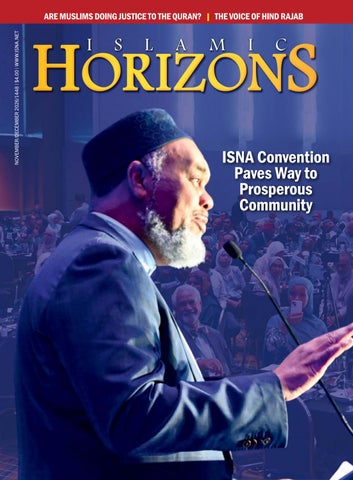
ISNA Convention Paves Way to Prosperous Community
| VOL. 55 NO. 6 NOVEMBER/DECEMBER 2026 | READ ON-LINE: HTTPS://ISLAMICHORIZONS.NET | VISIT ISNA ONLINE AT: WWW.ISNA.NET
ISNA MATTERS – CONVENTION REPORT
SOUTH ASIAN AFFAIRS
7 ISNA Convention Paves Way to Prosperous Community 11 Why ISNA’s Supporters Keep Coming Back 12 MYNA Shines at ISNA’s Annual Convention 15 MYNA Camps Are Shaping The Future of Muslim Youth
38 The Esoteric Fascism of Savitri Devi
QURAN 19 Are Muslims Doing Justice to the Quran? 21 When Seeing Is Not Enough
PALESTINE 23 Looking Back at a Violent Year For Palestinians 25 The Voice of Hind Rajab
U.S. AFFAIRS 26 The Muslim Paradox 28 Claws of the American Media Empires 30 Artificial Intelligence and the Ethics of Enough 32 Which Problems Deserve Politicians’ Attention?
MUSLIMS LIVING AS MINORITIES 34 Anti-Rohingya Hate in Malaysia and the Role of the Global Muslim Community
ISLAMOPHOBIA 40 Rising Islamophobia in Sweden
ISLAM IN AMERICA
13
42 The Trouble With Protecting Islamic Institutions 44 What Could Lead Muslim Nonprofits to Lose Tax-Exempt Status? 46 Muslims Demand Justice — But Do They Extend Justice to Others? 48 Muslim Women Building New York
MYNA Volunteer on the ISNA Convention
FEATURE 50 The Price of Greatness 52 This Seattle Muslim-Owned Business Merges Creativity, Faith, and Belonging 54 The Community Epidemic
36
COMMENTARY
Thymos Under Occupation in Kashmir
56 Obituaries of Islamic Scholars Are Elemental in Nation Building
ENVIRONMENT 58
Polluted Oceans
DEPARTMENTS 6 16 60
Editorial Community Matters New Releases
Front cover design: Crystal Habib. DESIGN & LAYOUT BY: Gamal Abdelaziz COPYEDITOR: Luke Peterson, PhD. The views expressed in Islamic Horizons are not necessarily the views of its editors nor of the Islamic Society of North America. Islamic Horizons does not accept unsolicitated articles or submissions. All references to the Quran made are from The Holy Quran: Text, Translation and Commentary, Abdullah Yusuf Ali, Amana, Brentwood, MD.
NOVEMBER/DECEMBER 2026 ISLAMIC HORIZONS
5
EDITORIAL
Now is Not the Time to Forego Challenges
1
1th century poet ibn Rashiq al-Qayrawani’s famous couplet has an unrelenting message: “I asked the earth why it was made a place of prayer/and why it is a source of purity and sweet perfume for us/Without speaking, it replied, ‘Because/ within me, I hold a beloved for every human being.’” This couplet speaks of general humanity, but, of course, for us, the Beloved (salla Allahu ‘alayhi wa sallam) is also a part of the earth, and so is its sacredness. Humans are defiling the soil and the waters in a myriad of ways, all of which emanate from greed. These selfish actions could be rightly labelled as a kind of madness, a vain attempt to lord over the lives and livelihoods of others. The rubbish, the bombs, the sheer waste, and destruction showered upon land and sea constitute a madness that truly defies description. And while environmentalists gather in conferences in exotic cities with idyllic accommodations issuing carefully-worded cautions, community and national leaders exhort the public to go to great lengths for the sake of conservation. But they dare not moderate the excesses of warmongers, arms makers, and/or their stockholders who manufacture countless tons of weapons, even one of which wipes out decades of mindfulness. Physically, the Rahmat al-Alamin rests in Madinah, but spiritually, he rests within all of us. And our Beloved used to cite the Quranic verse, “On that day the earth will tell its stories” (99:4). A hadith cited by Tirmidhi reports that the Prophet asked, “Do you know what its stories are? Indeed, its stories will bear witness against every servant and maidservant to what they did on its surface, saying this person did such and such on this day or that one.” This issue of Islamic Horizons will reach many readers who are preparing to head to the polls. Now is the time to ask ourselves if the candidate of choice is qualified to answer the stories referred to in 99:4. Rasheed Rabbi, summing up the 63rd Annual Islamic Society of North America (ISNA) Convention, observes, “Over and over again, ISNA has anticipated the challenges of tomorrow and anchored the Muslim community at the center of America’s attention.” Even the location of this year’s convention bears this statement out to be true. “Over a 6
year before Detroit emerged as a national political focal point, following the defeat of a heavily AIPAC-backed campaign by a grassroots-supported Muslim candidate, ISNA had already announced its return to the city after a 12-year absence as host of its 2026 Annual Convention. What seemed like a routine site selection soon proved remarkably prescient as Detroit shaped America’s political conversation.” Faisal Kutty declares that before asking what Muslims may do with artificial intelligence (AI), we should also be asking what the pursuit of AI is doing to us, to other people, and to the Earth. Chaplain Nora Zaki shares a striking review of The Oscar-nominated film, “The Voice of Hind Rajab,” about a 5-year-old Palestinian girl in Gaza murdered by Israeli forces along with five family members. She amply describes how the film penetrates the heart with the sadness and the same feelings of helplessness Hind felt when she was trapped in a car surrounded by Israeli tanks filled with occupying Israeli soldiers armed to the teeth. Baheejah Aaliyah Fareed, addressing the rise of the Sharia scare in U.S. politics today, states, “The issue is not whether Muslims are permitted to practice Islam. The Constitution already answers that question. The issue is whether Muslims will be treated as entitled to practice it on the same terms as everyone else.” She rightly observes that the movement’s organizers understood that the word itself could be politically powerful. In a 2011 profile in The New York Times, lawyer David Yerushalmi, one of the campaign’s central architects, explained that if anti-Sharia legislation passed without controversy, “it would have not served its purpose.” The purpose, he said, was “to get people asking this question, ‘What is Shariah?’” The challenges of being Muslim in a hate-infested society continue rising, and it is up to Muslims to stand against them firmly. The Seerah has the examples for us modern day Muslims to apply. We close with the supplication made by Prophet Abraham (‘alayhi as salam): “My Lord! Make me and those believers of my descendants keep up prayer. Our Lord! Accept my prayers” (14:40). Ameen. ih
ISLAMIC HORIZONS NOVEMBER/DECEMBER 2026
PUBLISHER The Islamic Society of North America (ISNA) PRESIDENT Syed Imtiaz Ahmad CHIEF EXECUTIVE OFFICER Azhar Azeez EDITOR Omer Bin Abdullah ASSISTANT EDITOR Bareerah Zafar EDITORIAL ADVISORY BOARD Iqbal Unus, Chair: M. Ahmadullah Siddiqi, Rasheed Rabbi, Wafa Unus ISLAMIC HORIZONS is a bimonthly publication of the Islamic Society of North America (ISNA) P.O. Box 38 Plainfield, IN 46168‑0038 Copyright © 2026 All rights reserved Reproduction, in whole or in part, of this material in mechanical or electronic form without written permission is strictly prohibited. Islamic Horizons magazine is available electronically on ProQuest’s Ethnic NewsWatch, Questia.com LexisNexis, and EBSCO Discovery Service, and is indexed by Readers’ Guide to Periodical Literature. Please see your librarian for access. The name “Islamic Horizons” is protected through trademark registration ISSN 8756‑2367 POSTMASTER Send address changes to Islamic Horizons, P.O. Box 38 Plainfield, IN 46168‑0038 SUBSCRIPTIONS Annual, domestic – $24 Canada – US$30 Overseas airmail – US$60 TO SUBSCRIBE Contact Islamic Horizons at https://isna.net/SubscribeToIH.html On-line: https://islamichorizons.net For inquiries: membership@isna.net ADVERTISING For rates contact Islamic Horizons at (703) 742‑8108, E-mail horizons@isna.net, www.isna.net CORRESPONDENCE Send all correspondence and/or Letters to the Editor at: Islamic Horizons P.O. Box 38 Plainfield, IN 46168‑0038 Email: horizons@isna.net
ISNA MATTERS – CONVENTION REPORT
ISNA Convention Paves Way to Prosperous Community True Success Forged through Collective Perseverance, Sustained by Faith BY RASHEED RABBI
O
ver and over again, the Islamic Society of North America (ISNA) has anticipated the challenges of tomorrow and anchored the Muslim community at the center of America’s attention. Over a year before Detroit emerged as a national political focal point, following the defeat of an AIPAC-backed campaign by a grassroots-supported Muslim candidate, ISNA had already announced its return to the city after a 12-year absence as host of its 2026 Annual Convention. What seemed like a routine site selection soon proved remarkably prescient as Detroit began to shape America’s political conversation. No city better exemplifies Muslim contributions, community building, and collective prosperity than Detroit. With deep roots extending across the United States and Canada, Detroit provides the best setting to examine the future of Muslim life on the North American continent. “We’re not simply here together for another convention. We’re here for community,” Rafique Ahmed, Vice President of ISNA Canada, said during the opening session. Held over Labor Day weekend, Sept. 4 to 7, the 63rd Annual ISNA Convention brought together more than 20,000 Muslims from across North America. Over 150 speakers participated in a program spanning scholarship, spirituality, civic engagement, youth development, interfaith relations, community service, and the contemporary issues shaping Muslim American life. To support their seamless collaboration, more than 200 volunteers worked tirelessly behind the scenes. Beyond celebrating visibility, ISNA sought to build on the foundations of Muslim success already evident in Detroit and offer a broader roadmap for the future. Attendance figures, the diversity of speakers, the hundreds of bazaar exhibitors, and the packed schedule of sessions were
Imam Mohamed Magid received the Lifetime Achievement Award. The keynote address was delivered by Dr. Arif Alvi, former President of Pakistan.
quantitative indicators of that vision’s reach. The deeper measure of success, however, was embedded in the convention’s theme: “Persevere, Interconnect, Be God Conscious, Strengthen Each Other for True Prosperity.”
Friday: Perseverance through GodConsciousness
Through Detroit’s cycles of industrial rise, economic decline, and civic renewal, the Muslim community demonstrated remarkable perseverance, building institutions, businesses, mosques, schools, and civic influence that now shape national conversations. The first session connected that success to Quran 3:200, where Zaynab Alwani (founding director of the Howard School of Divinity) highlighted four foundations of success: sabr (patience), musābarah (collective perseverance), murābatah (strategic vigilance), and taqwā (God-consciousness). Waleed Basyouni (AlMaghrib Institute) warned against measuring success through conventional metrics or empty slogans that obscure the demands of perseverance. Pointing to Muslim Americans’
disproportionate presence in the professions, he argued that God-conscious perseverance underlies those achievements. Reinforcing this theme through the examples of Yusuf, Musa, Isa, and other prophets (alayhum as salam), Akram Nadwi (Dean of Cambridge Islamic College) called for a revival of prophetic character, a quality increasingly absent from contemporary U.S. leadership. The next session focused on the Quran as a foundation of resilience. Drawing on contemporary research, Ramzi Mohammad (research director, Sky Foundation) argued that Muslims often concentrate on ritual worship, roughly 2% of Quranic commandments, while overlooking the broader moral (24%), social (17%), and intellectual (14%) vision. To close that gap, Fatima Lette (instructor at Qalam Institute) urged Muslims to integrate the Quran into daily life rather than confine it to occasional recitation. Faraz Khan argued for the dual pursuit of faithfulness and excellence as the basis of meaningful social impact. Concluding the session, Zulfiqar Ali Shah (Fiqh Council of North
NOVEMBER/DECEMBER 2026 ISLAMIC HORIZONS
7
ISNA MATTERS – CONVENTION REPORT
SNA staff and volunteers who brought the convention to life.
America) pointed to the transformation of Prophet Muhammad (salla Allahu ‘alayhi wa sallam) through the Quran: an orphan becoming a messenger of mercy to humanity. Communities, he argued, rise through the same commitment to Quranic guidance. God-conscious perseverance yields dignity, which became the focus of Friday’s final session. Ingrid Mattson (chair of Islamic Studies, Huron University College, and a former ISNA president) explained that protecting sacred inviolability (hurma) is not a one-time act but a sustained commitment, highlighting the Hurma Project’s initiatives. Drawing on the examples of Mu’adh ibn Jabal and Umar ibn al-Khattab (‘alayhum rahmah), Mohamed Hag Magid (resident scholar, ADAMS Center) emphasized that dignified communities emerge when people consciously uphold one another’s rights and needs. Referencing Quran 4:58, Abu Naser Jangda described safeguarding human dignity not as social courtesy but as a sacred trust. Ubaydullah Evans underscored personal responsibility for protecting the dignity of others and turning harm into opportunities for restoration and healing. Friday’s sessions converged on a single message: perseverance is not passive endurance. It is resilience rooted in faith, guided by revelation, and expressed through the protection of human dignity. On Saturday, the convention shifted from spiritual 8
foundations to the relationships, institutions, and civic engagement that convert resilience into collective strength.
Saturday: Resilience Through Communal Connection
Scholars, civic leaders, educators, and entrepreneurs collaborated across 13 main and 30 parallel sessions. Youth worked alongside elders to organize and lead 25 youth-focused sessions. National organizations joined with 20 local institutions to host half a dozen events. The Saturday morning session focused on leveraging interconnection to civic power. Reflecting on the years of organizing that preceded the public successes of figures such as New York City Mayor Zohran Mamdani and Michigan Senate Candidate Abdul El-Sayed, Muhammad Gula (CEO of EmgageUSA) argued that influence is built long before it reaches headlines. Electoral victories matter, but lasting success lies in a community’s ability to create impact through participation: voting, organizing, donating, public speaking, etc. Husam Ayloush (CEO of CAIR California) rejected the notion that individual efforts are insignificant. From Gaza to domestic tragedies such as the shooting at the Islamic Center of San Diego, disengagement changes nothing; engagement creates the possibility of change. But civic participation cannot be sustained without trust. The next session
ISLAMIC HORIZONS NOVEMBER/DECEMBER 2026
explored the values that make collective action possible. Drawing on Quran 4:135, Mikaeel Ahmed Smith (author and educator, Qalam Institute) argued that justice demands more than accepting diversity. It demands equality, equity, and empathy. Tamara Gray (founder and CEO of Rabata) contrasted fragile, unsafe, and healthy environments. Reflecting on the 1986 Challenger disaster, shortly after her conversion to Islam, she shared how the suppression of concerns can produce collective failure. Communities flourish only when every member can contribute and be heard equally. From principles, the discussion moved to practice. Speakers emphasized relationships as the basis of belonging. Abdullah Waheed (Miftaah Institute) recalled how his South Asian immigrant father spent decades purchasing Eid gifts for hundreds of African American families, demonstrating that community is built through sustained care, not seasonal outreach. His Miftaah colleague, Mohamed Almasmari highlighted the Prophet’s practice of preserving bonds despite disagreement, while Muhammad bin Yahya al-Ninowy (Madina Institute) reminded listeners that all people share a common descent from Adam and should embrace diversity. We may have differences in preference, but it must never become prejudice. Love of God and His Messenger must remain the foundation of communal connection.
Former Pakistan President Arif Alvi spoke at the ISNA Convention. Dearborn Mayor Abdullah Hammoud welcomed the community.
That sense of belonging extended across generations in American history. The afternoon session, marking America’s 250th anniversary, highlighted Muslim contributions from early Muslim explorers (Mansa Musa and others) and enslaved West African Muslims (Omar Ibn Said, Yarrow Mamout, Estevanico) to educators, activists, and faith leaders (Clara Muhammad and early Nation of Islam leaders). The message was direct: Muslims are not newcomers to the American story; they helped shape it. Najeeba Syeed (Claremont School of Theology) highlighted the role of interfaith engagement, which must be transformational rather than transactional. Legacy, however, survives only when it is transmitted. The next main session shifted attention from historical inheritance to the formation of the next generation. Habib Quadri (educator and youth activist) presented the HEART framework: Hear, Explain, Anchor, Respond, and Teach Hope. Parents must listen before lecturing, explain before correcting, anchor children in faith, respond constructively, and cultivate hope. Muhammad Faqih (imam and religious director at the Islamic Institute of Orange County) drew on the examples of Luqman and Prophet Muhammad, summarizing the process in a simple maxim: affection before instruction; connection before correction. Psychiatrist Rania Awaad (Stanford University) reminded parents of their responsibility to protect their families (Quran 66:6) and concluded with the prayer for spouses and children to be “the comfort of our eyes” (25:74). By the Saturday evening session, the theme of interconnection reached its apex. Tens of thousands filled the Huntington Place Convention Center in a powerful display of collective purpose. Dearborn mayor Abdullah Hammoud described public
No city better exemplifies Muslim contributions, community building, and collective prosperity than Detroit. With deep roots extending across the United States and Canada, Detroit provides the best setting to examine the future of Muslim life on the North American continent. service as accountability before God and preparation for the Hereafter. El-Sayed, fresh from a victory over a heavily AIPAC-backed opponent, redirected celebration toward purpose. Political victories, he argued, matter only when they advance justice, whether addressing economic hardship at home or oppression abroad. The evening closed with a challenge. Ieasha Prime (Dar al Hijra) urged Muslims to stand firmly for truth. Cenk Uygur (host of “The Young Turks”) criticized media narratives that marginalize Muslim voices and allowed AIPAC to hide behind Jewish community. Zaid Shakir (Zaytuna College) framed civic engagement as both a religious obligation and a constitutional duty, concluding with Langston Hughes’s “Let America Be America Again.”
Sunday: Success through Collective Impacts
Sunday turned to the convention’s final destination: true success and the responsibilities it demands. The morning session challenged attendees to move beyond comfort and embrace sacrifice in the pursuit of truth and justice. Syeed emphasized sabran jamila (12:18, 83; 70:5), a form of patience marked by contentment and steadfast perseverance.
Drawing on Quran 5:8 and 4:135, Imam Shamsi Ali reflected on decades of advocacy since Sept. 11, grounding his work in trust in God as Al-’Adl, Al-Hakim, and Al-Muqsit. Husam Ayloush noted that despite ongoing crises, from the persecution of Uyghurs to the devastation in Gaza and inequities in immigration enforcement, Muslim voices remain insufficiently heard. That responsibility cannot end with the present generation. The next discussion focused on how faith, conviction, and leadership are transmitted across time. Mufti Abdul Wahab Waheed stressed that children learn primarily through imitation and warned against losing sight of God (59:19). Ramzy Nasr reinforced the parents’ educational role, while Mufti Hussain Kamani challenged attendees to cultivate the current age’s Imam Bukhari and Imam Ghazali. Like Prophet Ibrahim, he noted, each generation bears responsibility for preserving and transmitting faith. From transmission, the conversation moved to its ultimate purpose. The conference’s final session connected perseverance across generations to collective flourishing. Muslema Purmul (chaplain at the University of Southern California) honored the courage of the San Diego martyrs, naming each
NOVEMBER/DECEMBER 2026 ISLAMIC HORIZONS
9
ISNA MATTERS – CONVENTION REPORT and Preacher Moss added a celebratory dimension to the convention. The Muslim Youth of North America and Islamic Games organized basketball, pickleball, and badminton tournaments that attracted several hundred participants, maintaining the convention’s recreational spirit. Matrimonial events further fostered halal relationship-building and meaningful connections. These activities unfolded alongside the main program to reinforce the same, central lesson: institutions grow when people invest in one another.
All that Remains
The ISNA President’s Award was presented to Dr. Ghaus Malik.
— Amin Abdullah, Abu Mansour, and Nad Aad — to emphasize their sacrifices for the welfare of the broader community. Yahya Rhodus (Al-Maqasid) described collective well-being as a prophetic responsibility inherited by believers and argued that the highest form of gratitude is to use one’s Godgiven gifts for the benefits of others. Such growth, however, develops under pressure rather than comfort. Perseverance is tested most severely by hostility and prejudice. Addressing that reality, Yasir Qadhi (The Islamic Seminary of America) posed the defining question: “Who are we going to become as a result of that hatred?” The answer, he argued, will shape the character of Muslims in America. Perseverance remains essential because “money can buy advertisements, consultants, and television time. But money cannot change the truth.” Closing the convention, Zaid Shakir urged Muslims to demonstrate perseverance through action rather than rhetoric. He called for learning from the experiences of Native Americans, African Americans, Chinese Americans, and Japanese Americans, refining those lessons through divine guidance and directing them toward greater unity. Only then can perseverance produce enduring success.
Side Attractions and Parallel Sessions
The same themes echoed far beyond the convention’s flagship sessions. Across the exhibition halls, service programs, youth activities, and specialized forums, attendees encountered practical expressions of the convention’s vision. More than 520 participants, 10
including keynote speaker Former President of Pakistan Arif Alvi, attended the Community Service Recognition Luncheon honoring Mohammed Maged for his decades of service and leadership. The Interfaith Dinner welcomed approximately 220 guests, while the Government Leaders Breakfast brought together 55 public officials and community leaders for a highly engaging dialogue. ISNA’s Annual Impact presentation offered a roadmap for community growth and institutional development through 2030. ISNA’s Health Services Committee highlighted initiatives promoting physical fitness, mental health, and nutrition within Muslim communities. MUHSEN reinforced the convention’s commitment to inclusion by advocating for greater accommodation and accessibility for individuals with disabilities. Through Noor Kids activities, crafts, and animal encounters, care and learning became a shared community experience for families and children. The Association of Muslim Scientists, Engineers, and Technology Professionals (AMSET) hosted ISNA’s first-ever Hackathon for youth. While Saturday’s sessions encouraged mosques and nonprofit organizations to responsibly embrace artificial intelligence (AI), Sunday’s discussions emphasized ethical accountability, truthfulness, and authenticity in its use. Building on momentum generated by a packed audience, AMSET announced plans to continue the conversation through monthly AI-focused webinars and workshops leading up to the next convention. The Qira’at Competition, Native Deen,
ISLAMIC HORIZONS NOVEMBER/DECEMBER 2026
The four-day convention ultimately returned to a simple question: what remains after the crowds disperse? The success of ISNA63 will not be measured by attendance. It will be measured by what attendees build after they leave. A teacher lifts a student. A chaplain comforts a patient, prisoner, or grieving family. A parent shapes a child. A mosque strengthens a neighborhood. A professional opens doors for those who follow. A scholar shares knowledge. A young Muslim learns that leadership is not a title to claim but a responsibility to carry. This is how perseverance becomes prosperity. This is how individual success becomes collective strength. This is how a convention becomes a community, united by faith, bound by service, and committed to strengthening one another for true prosperity. ih Dr. Rasheed Rabbi is an Islamic Horizons board member and the founder of e-Dawah and secretary of the Association of Muslim Scientists, Engineers and Technology Professionals. He serves as a khateeb at the ADAMS Center and is a certified Muslim chaplain at iNova Fairfax, iNova Loudoun, and Virginia’s Alexandria and Loudoun Adult Detention Centers. Photography by Syed Khalil Ullah and Syed Hamdan Ullah.
ISNA Monthly Sustainer – A Good Deed Done Regularly!
You can make an impact with as little as
$10 per month!
www.isna.net • (317) 839-8157
Convenient. Secure. Affordable.
Why ISNA’s Supporters Keep Coming Back
Renewal, One Session at a Time
Voices from the 63rd Annual Convention BY TASMIHA KHAN
A
sk people why they return to the The Islamic Society of North America’s (ISNA) Annual Convention year after year, and the answers are often profound. For some, it’s tradition passed down through generations. For others, it’s a single session that reaches them at exactly the right moment. And for vendors, it’s the rare chance to meet the community they serve face to face. Across four conversations at this year’s convention, from a longtime ISNA leader to a first-time attendee with a newborn, a common thread emerged: people don’t come to ISNA just to attend. They come to belong.
A Convention Built on Emotional Attachment
Few people have watched ISNA evolve as closely as the organization’s CEO, Azhar Azeez, who moderated multiple mainstage sessions at this year’s convention, including the opening session and a Saturday night program on cultivating God-consciousness in turbulent times. When asked what keeps people coming back year after year, Azeez didn’t hesitate: family history. He recalled meeting a fourth-generation attendee whose parents came to ISNA, who now brings his own children. “That is one aspect, the emotional attachment,” Azeez said. But loyalty isn’t only inherited. Azeez pointed to ISNA’s refusal to align with any single school of thought as another reason people stay, telling attendees they’re welcome regardless of their particular tradition — something he said people have told him they don’t usually find at other organizations. Representation matters too. While attendees often report that other Muslim conventions skew heavily toward male speakers, Azeez said close to 40% of this year’s speakers are women. And for younger attendees, the Muslim Student Association and Muslim Youth of North America
Across four conversations at this year’s convention, from a longtime ISNA leader to a first-time attendee with a newborn, a common thread emerged: people don’t come to ISNA just to attend. They come to belong. programming gives the weekend its own pull, offering community and activities built specifically for them. The convention itself has changed shape over the decades. ISNA used to be the convention, drawing 30,000 to 35,000 attendees when it had the field largely to itself. With roughly six major Muslim conventions now competing for the same calendar, Azeez said that monopoly is gone, though he doesn’t see that as a loss. Currently, he is working to bring the convention to a wider range of cities going forward. The last two years took ISNA to Dallas in 2024 and Chicago in 2025, a location he acknowledged remains a fan favorite among attendees who consistently name it as their top request.
For Nyma Malik, a dentist from Texas, this year marked her first ISNA convention with a baby in tow, a shift that changed the shape of her weekend but not its impact. “It’s definitely been a lot more work,” she said, crediting her husband for taking on child care so she could get to as many sessions as possible. What she found there stayed with her. “I feel like my iman [faith] has been rejuvenated after a long time,” she said, singling out sessions on zakat (obligatory charity) and halal financial planning as conversations she badly needed and now plans to act on. Her favorite moment came from a talk by Mufti Abdul Wahab, co-founder of Miftaah Institute, on knowing Allah and resisting the pull to blend in. “We’re always trying to blend in, and we forget ourselves,” Malik said. It’s a small moment in a packed schedule, but for Malik, it was the one that lingered longest after the convention ended.
Making Room for Women by Addressing Loneliness
Anse Tamara Gray, founder of Rabata and a frequent ISNA speaker, spent this convention pushing a harder conversation: loneliness among Muslim women and the community’s responsibility to address it directly rather than talk around it. “Women go through seasons of life,” she said, and Muslim communities must make room for that reality because “women are an important part of the Muslim Ummah” and have been essential contributors to ISNA itself for decades. For Gray, awareness isn’t the goal, building lasting infrastructure is. “We cannot address it only by talking about it. We have to have programs, and we have to be talking to women,” she said, adding that those programs have to be built by women themselves rather than handed down. “We cannot come in and say, ‘This is what we are going to do for you.’ I mean, we love our men, but men cannot come in and say, ‘This is what we are going to do for you’.” She sees real potential in a closer partnership between Rabata and ISNA, pairing Rabata’s years of building community, educational, and academic programming for women with ISNA’s 63-year history and vast network. “It is a way we could really
NOVEMBER/DECEMBER 2026 ISLAMIC HORIZONS
11
ISNA MATTERS – CONVENTION REPORT
The View from the Bazaar
If Azeez, Malik, and Gray represent the convention’s programming, Sufiyan Ajmeri represents its marketplace. As the founder of The Topi Wala, an Islamic clothing business, Ajmeri returned to ISNA this year after a breakout first appearance in Chicago last year. “The response we received in Chicago made coming back an easy decision,” he said. Once he arrived, the reason for coming back became clear. “The people have definitely been the highlight,” Ajmeri said, describing conversations with families, students, scholars, and repeat customers throughout the day. One of the most meaningful parts of the convention, for him, was watching respected scholars stop by his booth, buy or wear his clothing, and then walk onstage or lead prayer wearing it. “It makes you realize that what started as a small idea is becoming part of people’s lives,” he said. Despite some logistical headaches, Ajmeri said he’d return. “We want ISNA to succeed. We want the organizers to succeed, we want the vendors to succeed, and most importantly, we want the Muslim community to have an amazing experience,” Ajmeri said.
A Dynamic Convention Still Taking Shape
Taken together, these four conversations sketch a convention that means something different for everyone: a family tradition for some, a spiritual reset for others, an unmet infrastructure gap for women navigating loneliness, and a hard-won but valuable stop on a small business’s calendar. And for ISNA, an organization now in its 63rd year, this ongoing willingness to keep adjusting to what the Muslim American community needs could be exactly what keeps people coming back year after year. ih Tasmiha Khan is a storyteller and narrative strategist. Her work has appeared in The New York Times, The Washington Post, National Geographic, TIME, Forbes, Al Jazeera, and Newsweek among others. Through Lighthouse Media Consulting and Inkpactful, she helps mission-driven organizations and individuals build narrative strategies that move people to act.
12
MYNA Shines at ISNA’s Annual Convention By Young Muslims For Young Muslims BY ADAM MUKHTAR AND HUDA QADRI
R
unning parallel to the support one another through growing chalIslamic Society of North lenges. MYNACON provided more than a America’s (ISNA) 63rd Annual convention: it created an environment where Convention in Detroit from young Muslims could feel understood, gain Sept. 4 to 7 was MYNACON41. The special knowledge, make new friends, or reunite convention track was organized by the Muslim Youth of North America (MYNA), ISNA’s premier youth organization dedicated to serving Muslims ages 12 to 18. This year’s MYNACON off ered a space for young Muslims from across the nation to gather, seek beneficial knowledge, and ground themselves in their faith, while building connections with people who share their values. The theme for this year’s convention was “Divine Devotion: Ultimately, every aspect of Worship Beyond Routine.” MYNACON41 was planned to This theme encouraged attendees to shift from looking maximize what youth could at worship as a set of rituals to take away from ISNA’s annual recognizing it as a lifelong journey to God. While acts such as convention. The theme reminded prayer and fasting are essential attendees that worship cannot parts of Islam, it is important that our worship does not become simply be habitual while another task we simply check off demonstrating that one’s our to-do lists. During these acts of worship, we should be thinkspiritual journey can and should ing about who we are doing this begin as early as possible. for. “Divine Devotion” reminds us that discipline is not the only factor keeping us accountable; it is the fact that the One to whom we direct with old ones who encourage them to grow our worship to is the ultimate authority. in their faith and character. “Divine” means that there is no worldly “The culture at MYNA is truly like a family. recipient of our actions, and “Devotion” I experienced this right away at my first conimplies a sense of love through our deeds. vention,” said MYNA President Zacharaya This theme was intentional, and it refreshed Elfar, 18. “It’s amazing because you might a long-known concept in Islam: that worship only see your friends for one week [during should never be reduced to just a habit. camp] and then not again for months, but However, devotion is not only an individ- when you finally reunite, that connection is ual experience, especially in these troubling completely unbroken. It feels like you’ve been times. Youth around the nation need us to talking every single day up until that point.” build a strong Muslim community so we can In today’s world, there are more ways than
ISLAMIC HORIZONS NOVEMBER/DECEMBER 2026
PHOTO CREDIT: MYNA PHOTO/VIDEO LEAD AYAN ASHAR.
work together to uplift women in the ways that are desperately needed today,” she said.
ever to stray off the path of Islam, so establishing the right friendships is key. Personal success is often determined by the people closest to you, and this is backed up by Islamic teachings. Prophet Muhammad (salla Allahu‘alayhi wa sallam) said, “A person is upon the religion of his friend, so let one of you look at whom he befriends” (Tirmidhi 2378). Therefore, every session on the MYNACON track served one of three purposes: to help participants develop either their faith, their leadership skills, or their friendships. Across 16 sessions, youth heard from some of the nation’s leading scholars, including psychiatrist and Stanford professor Rania Awaad; Imam Mohamed Magid of the ADAMS Center; and co-founder of Zaytuna College Imam Zaid Shakir. Speakers advised attendees to maximize the time they have and transform everyday actions into opportunities for spiritual benefit. In between these impactful lectures, the program included practical and engaging opportunities for youth to become active participants in their own development. Parallel Q&A sessions gave both male and female youth the opportunity to engage directly with scholars, allowing for open discussions regarding the insecurities and challenges that come with being a young Muslim in America today. An insightful workshop by Asma Islam, a student at Stanford University and a youth college consultant, guided participants through the college application process and helped them plan for one of the most significant transitions of their lives with clarity and confidence. The most exciting thing about the youth convention was that it had space for games, art, and fun. A highlight of the weekend was seeing Haji Noor Deen, renowned Islamic calligraphy artist, introduce workshop participants to the beauty and tradition of Islamic calligraphy. Youth learned the art form firsthand and brought home their very own pieces. Through a partnership between MYNA and Islamic Games, convention attendees were also able to compete in a weekend-long futsal tournament, allowing them to win prizes and make friends. Youth who competed in either the MYNACON41 Scavenger Hunt or the MYNA Imagine Merch Design Initiative were recognized at the final session of the youth track: MYNA’s very own Entertainment Night. In addition to the wide variety of sessions offered this year, attendees also had
the opportunity to speak with MYNA officers and volunteers at both the bazaar and general information tables. Families interested in learning more about the work MYNA does across the nation could do so by hearing firsthand from teenagers who benefitted. In interacting with these dedicated volunteers, including members of both MYNA’s incoming and outgoing executive committees, attendees saw how leadership can begin wherever a person is and how MYNA is uniquely positioned to provide the community and skills to help them flourish. “[The] convention is more than a spiritual reboot before the craziness of the school year. It is an entire ecosystem. . . where I’ve found people I can connect with on a completely different level,” said MYNA Vice President Aliya Omar, 16. “More than anything, [the] convention gives me the rare opportunity to surround myself with the kind of people I aspire to become: people who challenge me, inspire me, and remind me of the kind of Muslim and leader I want to be.” Ultimately, every aspect of MYNACON41 was planned to maximize what youth could take away from ISNA’s annual convention. The theme reminded attendees that worship cannot simply be habitual while demonstrating that one’s spiritual journey can and should begin as early as possible. By internalizing that theme into their hearts, attendees were able to manifest the spirit of divine devotion in their lives, schools, and communities. Our intention as MYNA youth is to lift those around us and inspire them to engage deeper with the broader Muslim community of North America. We want every young person who encounters MYNA not to just leave with fun memories, but to also leave with new skills, a stronger spiritual foundation, confidence in oneself, and the friendships necessary to succeed. MYNACON41, through its theme and programming, has given Muslim youth the principles to make sure that they are involved in their schools and communities, allowing them to contribute to a better nation and a better world. ih
MYNA Volunteer on the ISNA Convention Giving Back What Was Once Received BY TASMIHA KHAN AND SHAIKH RAHMAN
A
t the Islamic Society of North America’s (ISNA) 63rd Annual Convention from Sept. 4 to 7, nestled between packed sessions on du’a (supplications), gratitude, and worship beyond routine, a smaller but no less vital operation was running in the background. It was there that the Muslim Youth of North America (MYNA) coordinated a weekend’s worth of programming built entirely for young people, mainly high school-aged students. Kulsoom Raina, a Plainfield, Ind. native and a student at Purdue University College of Engineering, worked as an intern at MYNA this year, taking on responsibility for the Qira’at Competition, the convention’s Quran recitation contest for youth. The role wasn’t something she sought out through a formal pipeline. “I was just looking at the intern role at ISNA and paid attention when a spot opened up,” she said.
Huda Qadri served as convention chair at MYNACON41. She is a sophomore at the University of Central Florida majoring in Interdisciplinary Studies, a member of the Burnett Honors College, and a LEAD Scholars Academy graduate. Adam Mukhtar served as a full-time volunteer at MYNACON41 and is currently a sophomore in high school in San Juan, Puerto Rico. He has taken on many leadership roles in MYNA and is excited to see what he will do next.
Zacharaya Elfar, the new MYNA president, speaking passionately at the podium during his address at the ISNA Convention.
NOVEMBER/DECEMBER 2026 ISLAMIC HORIZONS
13
ISNA MATTERS – CONVENTION REPORT
MYNA volunteers speaking to other committee members at the MYNA booth in the bazar.
a handful of practicing families in their town, he said, the competition offers something rare: proof that they aren’t alone. A student who might know five or six other Muslim kids back home suddenly sees hundreds of peers doing the same work of memorization, and stops feeling singled out. That scarcity is part of what makes MYNA’s work matter, even outside convention week. The organization runs Summer and Winter camps throughout the year, extending the kind of community-building that happens in a few packed days at ISNA into an ongoing presence in young people’s lives. It’s a mission that traces back more than 30 years. MYNA has been shaping generations of Muslim youth across the U.S. and Canada since its first camps in 1985, guided by a philosophy the organization sums up simply: “For the Youth, By the Youth.”
The full "MYNA" letter lineup shot with the incoming youth executive committee
MYNA volunteers on shift at the MYNA booth in the bazar.
An Opportunity to Give Back
MYNA youth and volunteers seated together in the main convention hall.
What followed was a weekend split between the registration desk and the logistics of preparing the competition, work that came with an unexpected bonus: meeting people she hadn’t crossed paths with before, despite years of orbiting the same community. For Raina, describing MYNA’s purpose isn’t easy, even for people inside it. But ask what MYNA actually does for young Muslims, and the answer comes more naturally. “MYNA can especially be a great introduction to Islamic studies,” Raina said, pointing to the HIRA Intensive, a program she went through herself in 2024, as an example. The Hira Intensive aims to instill high school-age students with foundational knowledge, mindsets, and habits that form the basis of holistic, God-centric lives, encourage bonds with mentors and peers, and inspire a desire to better themselves, their communities, and humanity. That experience, Raina said, gave her something hard to find anywhere else: a room full of like-minded peers exploring their faith together in a country where the Muslim community is often spread thin and Muslim youth can go long stretches without meeting others who share their beliefs.
Building Community for Young Muslims
That view was echoed by Sheikh Mohammad Alraee, an accomplished Quran reciter, who judged the competition for three years before stepping back to attend as a guest this year. For young Muslims who may be one of only 14
For Raina, the pull to give back was personal. Growing up in a school with few other Muslim students, MYNA became a place to go deeper into her faith and to build friendships that might not have existed otherwise. “MYNA gave me some great opportunities to dive deeper into Islam and to meet many great friends, especially while going to a school where there weren’t many other Muslims around,” she said. Years later, having come up through a high school career built around academic competitions, she saw a natural continuation in helping run one: an environment “best suited for the development of their passions,” as she put it, for a new generation of kids. That purpose crystallized for her during the Qira’at Competition. Talking with parents and judges throughout the event, she kept coming back to the same realization: how much it matters for children to have a motivating, structured way to engage with something as central to their faith as Quran recitation, and to have a moment to show how far they’ve come. “It was great to see that aspect of it,” she said. Looking ahead, Raina’s hope for MYNA is less about reinvention than reach. She wants the programs that shaped her to grow beyond their current footprint. “I want MYNA to be something that a lot more of the Muslims I meet have known about and experienced,” she said. It’s a modest ask, but one that points to something larger about how organizations like MYNA sustain themselves: not through
ISLAMIC HORIZONS NOVEMBER/DECEMBER 2026
top-down expansion, but through volunteers who show up year after year because of what the organization gave them first. This year’s Qira’at Competition — folded into a MYNA program that included information sessions, a sports tournament, and an entertainment night — was one more link in that chain. For Raina, it was also a reminder of why the chain is worth keeping intact. ih Tasmiha Khan is a storyteller and narrative strategist. Her work has appeared in The New York Times, The Washington Post, National Geographic, TIME, Forbes, Al Jazeera, and Newsweek among others. She was 2025 Peter Lisagor Awardee and also the recipient of numerous fellowships including MIT Knight Science Journalism, Solutions Journalism Network, and Kapor Foundation among others. Shaikh Rahman is a content strategist who turns complex technical and research ideas into clear writing. Through Lighthouse Media Consulting and Inkpactful, both co-founders help organizations build narratives that move people to act.
ISNA Monthly Sustainer – A Good Deed Done Regularly!
You can make an impact with as little as
$10 per month!
www.isna.net • (317) 839-8157
Convenient. Secure. Affordable.
MYNA Camps Are Shaping The Future of Muslim Youth Discover the Prophet’s Character at MYNA’s Winter Camp BY HIBA QADRI
T
he Muslim Youth of North America (MYNA), part of the Islamic Society of North America (ISNA), is built upon a foundation of iman (faith), taqwa (God-consciousness), leadership, growth, learning, fun, and strengthening the bonds of brotherhood and sisterhood. For over 40 years, MYNA has served as a guiding light for Muslim youth across the continent, acting as an integral part of their development in social and spiritual life. MYNA offers a variety of programs including MYNA Rugged, an annual spiritual backpacking and trekking retreat specifically designed for young Muslim boys; ISRAA, the all-girls branch of MYNA; Hira Intensive, a three-week summer education retreat; programs in partnership with Miftaah Institute; the annual MYNA Convention; and halaqahs (study circles). But it is within the environment of MYNA camps where all of these pillars come together and create the most amazing experience for the youth. It is in these camps where lifelong connections to the deen are forged by inspiring speakers and engaging topics. More often than not, when Muslims study Islam, the focus is on the rules, theology, and history of the religion, but they unintentionally forget the character of the person who brought this message to them. For this reason, the theme for the upcoming winter camp is “The Man Behind the Message,” and the focus will be for the campers to embark on a journey to explore the shamail (the physical characteristics and personal qualities), daily habits, relationships, emotional intelligence, and interactions of Prophet Muhammad (salla Allahu ‘alayhi wa sallam). This theme is relevant to today’s Muslim youth who frequently face immense social pressure and feelings of isolation as they try to balance their religion and day to day tasks. Having teens study the various aspects of the Prophetic model, including the way he reacted to those who opposed his beliefs with patience and firm resolve,
will give them a blueprint on how to navigate the trials of being a Muslim in the 21st century and instill in them the confidence and inspiration needed to carry themselves with dignity and pride as Muslims. “MYNA is the reason that I am Muslim today. Like, I was born a Muslim, but I chose to be Muslim after my experiences at MYNA, and I know countless others feel the same way,” said Mahad Mahmood, previous MYNA Secretary and a camper at Pacific MYNA camps for many years. In continuing with MYNA’s philosophy of “for the youth, by the youth,” the Winter Camp is organized by young MYNA members. These young counselors, workshop leaders, and camp organizers were past participants and are advised by experienced and accomplished peers who are active in their schools and communities. This group of experienced members understand the modern struggle of navigating high school and college as Muslims. As such, the youth leaders organize workshops, activities, discussions, sports and fitness activities, and field days to give campers the best MYNA experience possible. Campers also meet other Muslim youth, share laughter around a roaring campfire, have latenight discussions in their cabins, all of which creates lasting friendships. This connection is instrumental in helping counselors to relate to the campers with advice and mentorship throughout the camp. But camp is not just a social experience - it is a spiritual transformation. Seeing the way so many youth rush to pray salah in congregation, desire to be a part of the quiet
moments of dhikr (remembrance), and participate in the late-night qiyaams is amazing. For many youth, seeing people their own age doing this out of pure love for the deen rather than because someone is telling them what to do is what strengthens their Iman. “Camp is an interesting thing,” said MYNA President and recurring camper Zacharaya Elfar. “It doesn’t teach you leadership. It teaches you your faith. In doing so, you learn to lead by watching the examples of those around you. Then, you become inspired to volunteer yourself, and you become the next kid’s inspiration. This is what MYNA is, and that’s why we keep going.” Naturally, parents and youth alike often wonder what happens when camp ends and everyone returns to their respective cities and homes. MYNA camps leave a lasting impact, and with these winter camps being in the mid-point of the school year, it helps many young Muslims get a much needed spiritual boost which fosters a network of like-minded youth around the country. “Being a MYNA camper is an experience I can say with confidence has opened doors for me that I never knew even existed,” said MYNA Vice President Aliya Omar. “From creating friendships that have come in clutch when traveling anywhere from Boston to Puerto Rico, to gaining lifelong skills and mentorship from counselors, activities, and experiences that have served me far beyond camp, the benefits I have gained from attending MYNA camp are truly endless.” MYNA camps start a spark that makes youth go back home and become leaders in their local communities. This winter, MYNA will be hosting winter camps across seven distinct regions (South Atlantic, Mid Atlantic, North Central, South Central, Midwest, Northern California and Southern California). The invitation is open to everyone - whether you are a youth looking to register as a camper or a past camper wanting to give back as a counselor, there is a place for you. For parents and community members, you can directly invest in the future of the Ummah by volunteering your time or sponsoring a camper who might not otherwise be able to afford attending. For additional information or to register for MYNA Winter Camp 2026 please visit https://www.myna.org/camp. ih Hiba Qadri is a high school student and has served as the finance coordinator for MYNA’s Diversity, Equity, and Inclusion committee. She most recently was the speaker chair for MYNACON41 in Detroit in Sept. 2026 .
NOVEMBER/DECEMBER 2026 ISLAMIC HORIZONS
15
COMMUNITY MATTERS ➤
Eid Is Officially a State Holiday in California
O
n Sept. 27, California Gov. Gavin Newsom signed Assembly Bill (AB) 2017 into law. This bill officially recognizes Eid-al-Fitr and Eid-al-Adha as state holidays. This bill permits state and school employees to observe Eid using existing personal holiday credit or leave time. It also allows K-12 schools and community colleges to close for Eid through locally negotiated agreements. The bill does not enforce statewide school closures, but allows school districts to establish closures if there is a sufficient need. “For far too long, Muslim students and employees in California have had to make the difficult choice between participating in observances essential to their faith or falling behind on their academic or professional obligations,” said Hussam Alyoush, CEO of the California chapter of The Council on American-Islamic Relations (CAIR-CA). “AB 2017 removes these structural barriers and aligns state policy with the values of inclusion, equity, and respect for cultural diversity that defines our state.” In 2026, CAIR documented a 183% increase in incidents targeting mosques and Islamic centers from May to July
compared to the same three-month period last year. The organization said this bill “comes at a critical time for the American Muslim community.” “Gov. Newsom’s decision to sign AB 2017 into law sends the necessary and powerful message that California values and protects its Muslim community in the face of growing hate and hostility,” CAIR-CA said in a statement on social media. AB 2017 was co-sponsored by CAIR-CA, the California Commission on Asian and Pacific Islander American Affairs, and the Muslim Impact Council. ih
California State Senator Aisha Wahab (D), 39, won in a special election Aug. 20 to represent California’s 14th District in Congress, serving out the rest of former Rep. Eric Swalwell’s House term which ends in January. Wahab, PhD, who ser ved as assistant majority leader in the state senate, became the first Afghan American elected to public office in the U.S. when she won a Hayward City Council seat in 2018. She will become the first Afghan American to serve in Congress. Swalwell resigned from Congress in April after he was accused of sexual assault and harassment. Though he has denied the allegations, criminal investigations continue. Born in New York City,- Aisha was placed in foster care after her father was brutally murdered and her mother died at an early age. As a politician, she champions housing affordability and access. She also wrote a
state bill in 2023 to ban caste-based discrimination, which garnered national attention but was vetoed by Gov. Gavin Newsom (D). Wahab and fellow Democrat Melissa Hernandez will face off in a separate November election determining who will serve the next full two-year term. Wahab won the June primary decisively, but she’s been up against a swell of spending, especially by AIPAC-affiliated groups, boosting her rival ahead of the general elections. Wahab previously served as the chair of the Alameda County Human Relations Commission and as a board member for the nonprofits Afghan Coalition, Abode Services, and Tri-City Volunteers. She served as an Alameda County Public Health Commissioner, speaker at the Bay Area Women’s March, and was selected to join the White House Roundtable of Afghan-American Leaders. Prior to her career in public service, Wahab worked at nonprofits, community organizing, and in the technology sector.
16
ISLAMIC HORIZONS NOVEMBER/DECEMBER 2026
She was named San Francisco Business Times’ “Most Influential Woman in Business” in 2017. She was also named an American Graduate Champion by KLRU via a grant by the Corporation of Public Broadcasting for her passion for education. Fatima Mraiche, Ph.D, has been serving as Director of the International Faculty Development Program at the University of Alberta since July. She received her bac helor’s and doctorate in pharmacology at the University of Alberta in Edmonton. She has received numerous national and provincial scholarships including the Canadian Institute of Health Research Frederick Banting and Charles Best Doctoral Scholarship, Heart and Stroke Foundation Doctoral Scholarship and the Alberta Heritage Foundation for Medical Research Doctoral Scholarship. Her academic career started in 2011 as an assistant professor at the College of Pharmacy at Qatar University, one of the few pharmacy programs outside of Canada to receive full accreditation from the Canadian Council for Accreditation of Pharmacy Programs. From 2014 to 2018, she served as the Chair of the Pharmaceutical Sciences Section. Mraiche, who was born and raised in Edmonton, also served as the associate professor and chair of the Strategic Planning Committee at the College of Pharmacy at Qatar University. She has been involved in the design and delivery of many pharmaceutical sciences courses and modules at both the undergraduate and graduate level with a focus on pathophysiology, pharmacology, molecular biotechnology, and research skills and methodology. Mraiche has published over 25 peer-reviewed papers in international peer reviewed journals and has received various national and international competitive grants as lead principal investigator including the National Priorities Research Program (NPRP) grants from Qatar National Research Foundation and the First Contact Initiative grant from the European Society of Cardiology. In 2013, Mraiche was recognized among ten other Arab women for her scientific contributions by L’Oreal-UNESCO and received the L’Oreal-UNESCO Pan Arab Regional Fellowship.
Pulmonologist Asif Mahmood was elected chair of the United States Commission on International Religious Freedom (USCIRF), for the 2026-27 term on July 20. The USCIRF, a bipartisan federal government body, monitors religious freedom around the world and makes policy recommendations to the president, the secretary of state, and Congress. “[Mahmood’s] global advocacy work and humanitarian interventions have helped save lives in crisis-stricken regions around the world, including Kashmir, Tigray, and other conflict zones,” the USCIRF website states. “As a two-term member of the Medical Board of California, Dr. Mahmood fiercely advocates for patients’ rights and works to secure greater access to medical coverage for all communities.” In a statement after his election, posted on the USCIRF’s website, Mahmood said, “Threats to international religious freedom are occurring every day, making USCIRF’s mandate to analyse and recommend policy solutions to the US government key to advancing religious freedom abroad.” Berthena Nabaa-McKinney was reelected to serve a second term on the Metro Nashville Public Schools (MNPS) Board, District 4. She also serves as vice chair of the school board, and chair of the Budget and Finance Committee. She previously served as chair of the Superintendent Evaluation Committee and co-chair of Teaching and Learning for the district. Nabaa-McKinney, PhD, a former principal and MNPS teacher, is founder and CEO of Nabaa Consulting, an educational consulting and management firm specializing in school improvement and turnaround work for schools and districts across the nation. She has 25 years of professional experience in early childhood and preK-12 education as well as educational management organizations. “I am honored by the opportunity to continue serving our community over the next four years,” Nabaa-McKinney said upon her re-election. “I remain committed to leading with integrity, listening with compassion, and working every day to make a positive difference for the families and students we serve.”
The town of Islip’s zoning board voted 3:1 on Sept. 22 to reverse a previous decision which would have allowed the United American Muslim Association’s (UAMA) new school in Bay Shore to house the boys in a dormitory on campus. The Association had purchased a former seminary in Bay Shore, N.Y. for $5.2 million. with plans to open a boarding school for 120 middle school- and high school-aged boys in the three-story, 70,000-square-foot building located on the 14.6 acre site. The school will still be allowed to open, but its students will have to go home at the end of the day. The previous owners, the Montfort Missionaries, closed the boarding school in 1972. Long Island Business Insider reported that UAMA applied for a change of zone for the premises. While some residents are opposed to the boarding school plan, they didn’t always fight development at the site. A good portion of the seminary property was sold to developers in the 1990s for the adjacent 43-unit 55-and-over condominium community. ih
The Authentic Ilm Mission (AIM) has purchased the approximately 27,000-squarefoot Korean World Mission Baptist Church campus in Richardson, Tex. for $3.8 million, The Dallas Express reported in July. AIM sued the Church on Feb. 26, alleging that the church was reneging from its sales contract of Oct. 31, 2025. The case closed after the Academy filed a notice of nonsuit without prejudice on April 7. AIM said the property will house the Salahuddin Future Academy, a K-12 school; AIM Dawah Academy and Seminary; Ansar Pantry; and a mosque. “AIM Dawah Academy and Seminary will offer higher Islamic education, Quranic studies, Arabic language instruction, leadership
development, and community education,” a representative from the organization said. AIM’s website calls the project “America’s first national residential Dawah seminary” and says its programs will include short intensive courses, a diploma in Islamic studies and a bachelor’s degree in Islamic studies. While Muslims make up 2% of the state’s population, Texas holds what some estimate to be the nation’s fifth-largest population of Muslims.
The Institute of Knowledge (IOK) celebrated the opening of its new IOK Center for Counseling, Higher Education, and
NOVEMBER/DECEMBER 2026 ISLAMIC HORIZONS
17
COMMUNITY MATTERS
The McKinney (Tex.) City Council voted unanimously on Aug. 4 to approve a site plan for the McKinney Islamic Association’s 32,573-square-foot site for a new mosque, gym, classrooms, cafeteria, and community center on a 5.5 acre lot. Plans include a 15,000-square-foot mosque to replace their existing one, which they’ve outgrown, as well as a 10,000-square-foot classroom building and a 7,000-squarefoot multi-use facility. The site plan did not ask for any variance from the city’s zoning rules or design exceptions. The plan is fully compliant with city rules according to city documents. Other approvals, like building permits, will require further consideration. The association paused plans in 2024 after city officials said the proposed building was too large for the site. The new plans, recommended unanimously for approval by the North Texas city’s planning and zoning commission, include three smaller buildings. The group hosted a town hall, worked with engineers to study impacts and redesigned the project over several years to address traffic, drainage, and parking concerns. The McKinney congregation has grown since it began meeting at its current mosque in 2014 and since the association was established in 1997. McKinney resident Mousa Abu Daabes told NBC 5 DFW that he remembers when there were just five Muslim families in McKinney in the 1990s. He helped start the McKinney Islamic Association. For more than four hours, over 100 people spoke to the council, dozens in opposition to the mosque and to Islam itself, answering the calls of Texas Republican leaders to “STOP the spread of Sharia in Texas,” as Rep. Keith Self (R), who constituency includes McKinney, wrote on X regarding the McKinney mosque. ih
Spiritual Support (IOK CHESS) campus on Aug. 22 in Pomona, Calif. The new campus, which stands alongside the IOK Seminary Khatm Al-Bukhari, also offers chaplaincy and counseling services. Curated for youth and young adults aged 16 to 32, programming at the IOK offers wrap-around spiritual support for the future leadership of communities, meeting their needs for counseling, mentorship, and further pursuit of Islamic Studies. CHESS is headed by Shaykh Furhan Zubairi who joined as a student in 1998. He studied at Jami’ah Binoria in Karachi and obtained an Alamiyyah Masters degree in Arabic and Islamic Studies at the Jami’ah Dar Al-’Ulum in Karachi. 18
Muralist Drew Wesley’s mural painted on his own rowhouse in Baltimore’s Mount Vernon neighborhood will stay where it is after the city’s Commission for Historical and Architectural Preservation unanimously ruled on Sept. 8 that the artwork does not conceal any historic archi-
ISLAMIC HORIZONS NOVEMBER/DECEMBER 2026
tectural features, and that it complies with the district’s preservation regulations. The mural reads, “Every bombed village is my hometown now.” The ruling came despite objections from a neighborhood association that argued the homeowner never sought proper permission before painting it. Wesley told the press that the piece “stands with Palestine and anti-war movements around the world.” The phrase draws on a line originally spoken by author James Baldwin during the Vietnam War to express solidarity with civilian war victims, according to The Telos Group. The mural is the first installation in the international 78 Acts of Witness campaign, a collaborative public-art project organized by Art Forces, NoMüNoMü, and iWitness Silwan. The campaign commemorates 78 years since the Nakba during which 750,000 Palestinians were forcibly displaced from their homes and communities beginning in 1948. The Baltimore Banner’s columnist Leslie Gray Streeter wrote Sept. 10 that the decision to keep a Mount Vernon mural is a victory for art, free speech, and peace. ih
ISNA Monthly Sustainer – A Good Deed Done Regularly!
You can make an impact with as little as
$10 per month!
www.isna.net (317) 839-8157
Convenient. Secure. Affordable.
QURAN
Are Muslims Doing Justice to the Quran? Reconnecting With the Holy Book’s Purpose
J
BY MD. MAHMUDUL HASAN
ustice is the most important core value in Islam. It is represented in the Quran mainly by three terms: `adl, qist, and mizan. Although `adl and qist are synonymous, the former is generally interpreted as justice and the latter as equity or fairness. Mizan is the scale or balance that determines the administration and condition of justice. But `adl also has a deeper meaning, that is, equilibrium or putting things in their correct places. In other words, `adl is the opposite of zulm. Although zulm is usually translated as “oppression” or “despotism,” it actually denotes disequilibrium or putting things into wrong places. Many Quranic verses and prophetic traditions emphasize the preeminent importance of `adl and condemn zulm. The terms`adl and zulm may even be extended to other beings or the objects that humans handle, and even to how people approach the divine. For example, regarding God with the proper awe, respect, and gratitude that are His due, as well as abiding by His commands, is considered `adl. Not doing so is tantamount to zulm.
Using the Quran for the correct purposes is considered `adl, whereas using it incorrectly or using it only for non-primary purposes may be considered zulm. Muslims who, at times, fail to give the Quran its due respect are therefore unwittingly trivializing the word of God. The Quran’s physical desecration is a grave sin, but trivializing it is also a serious offense. Muslims certainly do not disrespect their holy book tangibly or physically. They hold the scripture in profound awe, and their deep reverence for it is clear. They exercise extreme caution when handling it, and most of them encase it, and place it on a raised surface in the house or in places of worship. However, many Muslims, perhaps unaware, profane the sacred book in two important ways: using it for lesser purposes and splitting it into pieces.
Using the Quran for Non-Primary Purposes
The Quran states, “This divine writ — let there be no doubt about it — is [meant to be] a guidance for all the God-conscious” (2:2). In verse 2:38, the Quran relates humanity’s fall from Paradise, stating: “[For although]
we did say, ‘Down with you all from this [state],’ there shall, nonetheless, most certainly come unto you guidance from Me, and those who follow My guidance need have no fear, and neither shall they grieve.” These and similar verses clearly suggest that the Book serves first and foremost as an instruction manual for humans. It contains guidance. In view of this, `adl requires that Muslims approach it primarily as divine guidance, that is to say, they should read, appreciate, and implement its messages into their daily lives. Although the Quran may have secondary, tertiary, quaternary, and other non-primary applications, using it only for them instead of for its primary purpose is a kind of misdemeanor. This is true of many things. For example, a pen’s main function is to write, a professor’s main tasks are to teach and conduct research, and a president or prime minister is entrusted with running a country. But if the pen is used only to scratch one’s body or make holes in delicate surfaces, the professor is given only clerical assignments, and the president or prime minister is tasked solely to officiate ceremonial events and is totally excluded from the administration and policymaking, the end result is zulm. This is because justice requires that an object/individual be used chiefly for the intended primary purpose. Many Muslims, however, do not apply this logic to the Quran. They often read it without comprehension and thus fail to approach it as the primary source for comprehensive guidance for all spheres of life. As it is believed that reading one letter of the Quran can give the reciter up to 10 units of virtue, they recite it only to acquire barakah or the divine rewards of doing so, again often without comprehension. They invoke its verses or frame them to hang them on the wall to shield their residence and its inhabitants from evil spirits or to protect them from hazards and possible break-ins. During business-opening rituals, people recite its verses in the hope of securing auspicious trade opportunities. Businesses use its verses in their advertising campaigns, seeking God’s blessings and, most importantly, good profits. Students recite verses of the Quran to assist their memory and intellectual ability so they can get good grades. Job applicants do the same to do well in interviews. Many Muslims also use the Quran as remedial treatment for various diseases. For
NOVEMBER/DECEMBER 2026 ISLAMIC HORIZONS
19
QURAN example, many read verses of Surah Yasin (Ch. 36) when they fall sick. They recite it and then blow into water and have ill persons drink it — or blow directly on them, believing that such ritualistic practices will cure the sick. While all such uses of the Quran are not necessarily condemnatory and may even be beneficial and sanctioned by the practices of earlier Muslims, these are not the primary reasons why God sent down the divine writ.
may benefit the reciter both materially and spiritually. To facilitate this practice, many publishers have printed various fragments (e.g., Surah Yasin) separately. Thus, many Muslims read only those small portions and rarely turn their attention to other parts of the Quran. Slices of the Quran in print form are found in mosques in almost all countries. Such fragmentation impedes the much-needed transmission of the entire Quranic message and leads to complacency
[If] non-primary functions predominate and are considered more important, then the Quran is not approached for its primary use at all. The end result can only be the trivialization of the holy book.
If these non-primary functions predominate and are considered more important, then the Quran is not approached for its primary use at all. The end result can only be the trivialization of the holy book. This deemphasizes and frustrates the core purpose for which it was revealed first and foremost.
Fragmenting the Quran
Another incorrect — yet common — approach is to fragment the Quranic text. Dividing the Quran into fragments can potentially result in exclusive emphasis on some parts of the Quran and negligence to or ignorance about the rest of the book. Muslims are obliged to abide by all of the Quranic rules and regulations, as they are supposed to seek guidance from (authentic) Hadith literature as well as to emulate the Prophet’s deeds and words. However, if they do not read the entire Quran, they will not be able to implement its teachings in their totality. Most Muslims are, however, selective and mainly focus on those verses that talk about rituals or those verses that have healing powers or protective effects. This is prominently reflected in Friday khutbahs (sermons), for most imams emphasize certain verses, rituals, and routines while ignoring many core concepts of Islam. One dangerous practice is dividing the Quran into small segments, as it is believed they carry special virtues and reading them 20
with only hearing and reading selective portions of it. Thus, its primary function is ignored yet again. Such practices are common among Muslims, which raises an important question: scholars unanimously agree that reform in Muslim society is long overdue, yet how can this occur if Muslims do not restore the Quran to its rightful place in their lives? They must approach it primarily for guidance and with the intention to act upon its teachings. In other words, the sacred text’s non-primary functions cannot be allowed to triumph over its primary function. Even many non-Muslim scholars acknowledge that the Quran is a wonderful book, incomparable to any other work. It is, especially for Muslims, a precious gem whose proper value must be appreciated and acted upon. Unfortunately, among many Muslims today, this is not the case. Will Muslims ever manage to see a bright hope or a great future ahead for themselves? The answer, perhaps lies, to a great extent, in their correct use and application of the Quran in its entirety. The sooner they rectify their approach to the Quran, the better. ih Md Mahmudul Hasan, PhD, is Professor in the Department of English Language and Literature at International Islamic University Malaysia. Email: mmhasan@iium.edu.my. Note: An earlier version of this essay appeared in AboutIslam.net on Nov. 19, 2017 under the title “How Muslims Trivialize the Qur’an.”
ISLAMIC HORIZONS NOVEMBER/DECEMBER 2026
63 Years of Community Service ISLAMIC SOCIETY OF NORTH AMERICA ISNA has been serving and strengthening the Muslim community for decades through programs and services that educate, inspire, and connect. Your support makes it possible to empower our youth through MYNA, provide scholarships, host the Annual Convention and educational conferences, publish Islamic Horizons magazine, advance the ISNA Green Initiative, foster interfaith understanding, and offer vital services such as mental health support, chaplaincy, and matrimonial assistance. Become a monthly donor today and help sustain the programs that strengthen our families, nurture our future leaders, and serve our community yearround. Your recurring gift, no matter the amount, creates a lasting impact and ensures ISNA can continue this important work for generations to come. Please support ISNA with your recurring monthly donations.
Please donate to ISNA today. Donate online at:
https://isna.net/donate or call:
(317) 839-8157
When Seeing Is Not Enough How the Quran Trains the Heart to Perceive BY ALI ISSA
S
everal hours after a difficult conversation, something unexpected sometimes happens. We begin replaying it in our minds. The words are unchanged, yet they seem different. A comment we dismissed now appears thoughtful. A reaction we justified now feels excessive. An expression we overlooked suddenly carries meaning. Nothing about the conversation has changed. We have. We usually explain this by saying we had time to cool down or gain perspective. The Quran offers a deeper possibility. Perhaps what changed was not merely our mood, but the heart through which we were seeing the conversation. Two people can experience the same event and leave with an entirely different understanding. A parent intends concern while a teenager hears criticism. A spouse intends honesty while their partner hears disapproval. A colleague believes they are being direct while another finds them disrespectful. The difference is not always a lack of intelligence or information. Sometimes the gap lies between what was seen and what was understood. The Quran directs our attention to that space. In 22:46, God asks whether people have traveled through the land so that they might have “hearts by which to understand,” before stating, “It is not the eyes that are
blind, but the hearts within the chests.” Seeing something is not the same as understanding it. The eyes collect information, but the heart helps determine what that information means. We do not simply see the world. We see it through the heart that is looking.
What the Heart Brings to Every Encounter
Most of us assume we approach situations objectively. Yet no one enters a conversation empty. We bring hopes, fears, disappointments, assumptions, insecurities, and past experiences into every interaction. Another person’s words must pass through what we are already carrying. Consider how easily this happens. A mosque president asks a question about a proposal and a volunteer hears criticism rather than curiosity. A teenager assumes judgment where concern was intended. A
spouse interprets exhaustion as distance. A supervisor’s feedback is received as a judgment about competence. The events themselves are often ordinary. What each person experiences is shaped partly by what was already present in the heart. This helps explain why disagreements sometimes become larger than the issue that started them. We may think we are responding only to what someone said, but we are likely also responding to what we feared they meant. A question becomes disrespect. Silence becomes rejection. Correction becomes humiliation. We begin responding not simply to the person in front of us, but to the meaning our heart has assigned to the moment. The Quran invites us to ask another question, “what was my heart carrying before this happened?” That question requires humility. It does not mean every impression is wrong or every concern imagined. Nor does it require us to surrender judgment or conviction. It asks us to recognize that perception is not entirely independent of the person doing the perceiving. The Quran does not ask us to distrust what we see. It asks us to tend the heart through which we see it.
Making Room for Guidance
If the condition of the heart affects perception, another question follows: how does the heart become capable of receiving guidance? The Quran answers this question with a powerful image, “Whomever God wills to guide, He expands his chest to Islam” (6:125). Guidance is not described merely as the delivery of information. It involves expansion. Imagine two people receiving the same correction after a mosque program. One immediately explains why the criticism is unfair. The other pauses long enough to ask, “Was this something I needed to hear?” The difference is not knowledge or intelligence. It is whether there is room within the heart for those words to enter.
NOVEMBER/DECEMBER 2026 ISLAMIC HORIZONS
21
QURAN A cup already filled to the brim cannot receive anything more. The problem is not the quality of what is being poured but the lack of room in the cup. The heart is similar. A heart crowded by pride struggles to accept correction. A heart crowded by fear struggles to trust. A heart crowded by resentment struggles to recognize generosity. This changes how we think about clarity. We often assume clarity comes from gathering more information. The Quran suggests that clarity may also require creating space to listen before responding (39:18), admit we may have misunderstood an interaction, reconsider a first impression, and accept correction without feeling diminished. An expanded heart is not weak or indecisive. It is secure enough to remain teachable. That may be one of the most overlooked forms of spiritual maturity.
while slowly losing the ability to benefit from it. Hardness, then, may not be primarily an intellectual problem. Perhaps it is a loss of teachability. That possibility deserves attention within communities that value knowledge. Religious learning, professional experience, leadership, and years of service are blessings. Yet none of these blessings automatically protect us from misperception. Familiarity can create its own blind spots. We have seen similar situations before, so we stop looking carefully. We have heard similar arguments before, so we stop listening carefully. Experience begins to feel like a guarantee of accuracy. The Quranic warning is directed not at the ignorant, but at believers themselves. The ability to learn, listen, and be transformed
The Quran does not ask us to distrust what we see. It asks us to tend the heart through which we see it. When the Heart Hardens
The Quran not only speaks of hearts expanding. It also warns that hearts can harden. In 57:16, God asks believers whether the time has come for their hearts to humble themselves before His remembrance and warns them not to become like those for whom time was prolonged and whose hearts became hardened. What is striking is how quietly this can happen. A hard heart rarely arrives through dramatic rebellion. We simply become less reflective, more defensive, and more certain that our first impression must be right. A longtime board member begins finishing people’s sentences because he has heard these arguments before. A parent stops asking why a child is struggling because the answer seems obvious. Two community members carry an old disagreement into a new conversation, and before either has finished speaking, both believe they know what the other intends. Questions that once awakened curiosity begin provoking irritation. Correction feels like criticism. Different perspectives become threats rather than opportunities to learn. We may possess considerable knowledge 22
must remain alive within the heart. A heart that can no longer be taught will eventually struggle to see.
The Heart that God Is Forming
The Quran’s discussion of the heart ultimately leads to a profound question: what kind of heart is God trying to form? In the Quran, God describes the Day when neither wealth nor children will benefit a person, except one who comes to Him with a “sound heart” (26:88–89). The Quran does not describe a successful, famous, or even knowledgeable heart. It describes a sound heart, a qalb salim. A sound heart is not one that has avoided life’s hardships. It has experienced disappointment, uncertainty, loss, and conflict. The difference is that it remains receptive to truth through those experiences. It has not allowed disappointment to become cynicism, confused caution with distrust, mistaken certainty for wisdom, or allowed knowledge to replace humility. We often imagine spiritual growth as accumulation: another lecture, another book, another study circle, another memorized verse. These gifts matter deeply. Yet
ISLAMIC HORIZONS NOVEMBER/DECEMBER 2026
the Quran redirects attention from what we know to what that knowledge is producing. The question is not only how much has entered the mind, but what kind of heart is being formed. Knowledge informs the mind. Formation shapes the heart. Prayer returns us to God. Patience teaches us that discomfort need not control our response. Gratitude helps us notice blessings. Forgiveness loosens old injuries. Generosity pushes against self-protection. Remembrance returns the heart to its center. These practices eventually follow us beyond the prayer space. They enter the kitchen when a spouse’s tone feels sharper than expected. They enter the car when a teenager says something that immediately raises our defenses. They enter the workplace when someone receives credit we believe belonged to us. In those moments, worship is no longer only something we have performed. It has either formed the heart through which we are seeing, or it has not.
Seeing Faithfully
Tomorrow, most of us will not face a major moral test or life-altering decision. We will answer messages, sit in meetings, speak with our families, receive criticism, disagree with friends, and navigate everyday interactions. Yet those moments may reveal more about the condition of our hearts than we realize. The more I reflect on the Quran’s discussion of the heart, the less interested I become in proving that I saw correctly and the more interested I become in asking whether I saw faithfully. Those are not the same thing. One focuses on defending my interpretation. The other requires examining the one doing the interpreting. Before asking “what happened?” or “who was right?” you should ask, “What is my heart bringing into this interaction before the other person has even spoken?” The Quran not only teaches us how to think. It is teaching us how to see. And because it is teaching us how to see, it is also teaching us what kind of heart to bring before God. The destination, it seems, was never merely the correct understanding. It was a heart capable of receiving the truth when it appeared. ih Ali Issa is an author and leadership advisor with over 35 years of experience. He founded 35N Consulting through which he advises organizations and leadership teams on strategy, trust, and human-centered leadership.
PALESTINE
Looking Back at a Violent Year For Palestinians Israeli Settler Violence and the Future of Palestine BY LUKE PETERSON
Barbed wire and blocked passage on the border between Israeli-controlled and Palestinian-controlled areas of Hebron in the Palestinian West Bank.
2
026 has been the most violent on record for West Bank Palestinians. Throughout the year, they have faced brutal attacks by ethno-nationalist Israeli settlers living on illegally occupied land in the heart of Palestine. Settler attacks have battered, bruised, and killed Palestinians in the West Bank at unprecedented levels resulting in more forced displacements between January and April than in all of 2025. According to Drop Site News, there were 2,030 Israeli settler attacks in August alone. This number includes dozens of attacks that were encouraged, abetted, and/or observed by uniformed members of the Israeli military, some of whom are themselves violent settlers illegally living on Palestinian land. August’s violence followed on from a brutal July during which at least 1,418 documented settler attacks caused mass casualties and millions in property damage in towns and cities throughout the West Bank. Since the beginning of 2026, the United Nations Office for the Coordination of Humanitarian Affairs (OCHA) fielded more than 4,500 reports of violent incidents in which Israeli settler gangs targeted unarmed
Palestinian civilians, an increase of more than 60% compared to the same period in previous years. By the end of 2026, OCHA will have recorded more settler attacks resulting in injuries, casualties, and/or property damage than have been previously recorded in any single year. This wave of violence has resulted in more than 125 Palestinian deaths since Oct. 2023, and the displacement of more than 6,000 Palestinians across hundreds of towns and cities in the West Bank. Since 1967, Israel and most of its hawkish supporters were content with the slow constriction of Palestine and the gradual displacement of the indigenous inhabitants of the land. Now, ultra right-wing settlers fueled by racist, nationalist doctrines are attempting an all-out push to take what remains of Palestine away from the Palestinians who have lived there for generations.
An Uptick in State-Sanctioned Violence
Israeli settlers number more than 700,000 in the Palestinian West Bank living in various communities on land internationally recognized to be Palestine’s cultural and political
heartland. Many live in these illegal communities for tax breaks, housing benefits, and an overall lower cost of living than people living in Israel proper. Among settlers engaging in targeted violence against Palestinian civilians, the majority (roughly 63%) were raised in Israel among elements of Israel’s neo-fascist right led by government ministers like Minister of National Security Itamar Ben Gvir and Finance Minister Bezalel Smotrich. The remaining third of this group are Jewish supremacists from Eastern Europe, North America, and Latin America. Israel has only become more encouraging of this organized violence in Palestine via state funding measures that reward violent Israeli settlers combined with lax prosecution protocols that allow the most brutal and dangerous of the settler gangs to walk free. In March 2026, the Times of Israel reported state funding in the amount of 50 million NIS (around $16 million dollars) for unsanctioned outposts — Israeli settlements that even the Israeli government doesn’t officially recognize. With this money, the settler criminals buy all-terrain vehicles, night vision googles, drones, and guns which they use to intimidate, harass, and kill innocent Palestinians. When this equipment is inevitably used to torment Palestinians who reside near these illegal outposts, punishment for the settler gangs within the Israeli legal system is highly unlikely. Since 2022, when Gvir came into his current position, criminal cases for settler violence against Palestinians fell by 70% within the Israeli legal system. According to reports by Yesh Din, an Israeli human rights organization, only one Israeli settler has been charged with murdering a Palestinian since 2019 despite dozens of killings taking place since then.
Changing Facts on the Ground
Settler violence in Palestine increased significantly after Oct. 7, 2023. In addition to carpet bombings of civilian areas in Gaza and killing more than 73,000 Palestinians while wounding 200,000 more, the Israeli military invited 5,500 illegal settlers to join regular units of the Israeli military. They formed into units of “regional defense battalions” as regular soldiers, using the power and the authority of the Israeli military to perpetrate vigilante attacks against civilian targets of their choosing in Palestinians communities throughout the
NOVEMBER/DECEMBER 2026 ISLAMIC HORIZONS
23
PALESTINE West Bank. In effect, these settler-soldiers have become normalized, legal actors in Palestine using the full authority of the military to commit rampant abuses in Palestinian villages, towns, and cities. The results of this official alliance between state and settler affect individuals and families who suffer from violent attacks. Settlers are actively altering the facts on the ground in Palestine through violence conquest while willfully flouting international law. In 2026,
racial segregation making Israeli practices in occupied Palestine an ongoing form of apartheid.
Settler Violence and the Future of Palestine
In September, Israeli government ministers proposed the transfer of all Palestinians from the enclosed enclave of the Gaza Strip over a seven-year period, an act that would expressly violate Article 49 of the Fourth
Since 1967, the state of Israel and most of its hawkish supporters were content with the slow constriction of Palestine and the gradual displacement of the indigenous inhabitants of the land. Now, ultra right-wing settlers fueled by racist, nationalist doctrines are attempting an all-out push to take what remains of Palestine away from the Palestinians who have lived there for generations. settlers established 65 new outposts in the West Bank, illegal under international law and officially unsanctioned settlements in the view of the state of Israel. Over the last few years, 160 illegal outposts were established. These settlements now control almost 250,000 acres of Palestinian land in the West Bank — roughly 18% of the land area, a four-fold increase in the amount of land controlled by the settlers since the current Israeli government came into office. This unilateral alteration to the current demographic distribution in the West Bank is illegal under international law. On multiple occasions since 1967, international bodies including the UN have declared the ongoing Israeli military occupation of Palestine to be illegal and have demanded its cessation. Israel simply ignores these admonitions while deepening their military and civilian presence in occupied Palestine. In July 2024, the International Court of Justice (ICJ) published yet another condemnation of the Israeli occupation of Palestinian territory indicating that the forced displacement of Palestinians, the deliberate targeting of civilians in military operations, and the systemic failure to mitigate settler violence all amounted to war crimes. The ICJ concluded that these practices collectively amount to systematic 24
Geneva Convention and one that would amount to the naked ethnic cleansing of the Palestinians of Gaza. The same article within the Fourth Geneva Convention also prohibits an occupying power from transferring its own citizens into a territory it occupies, a statute violated daily by the existence of more than 700,000 Israeli settlers throughout the Palestinian West Bank. The well-documented acts of domestic terror perpetrated by increasingly large numbers of the settler population likewise constitute crimes against Palestinian civilians — crimes that are downplayed, ignored, or outright countenanced by the current government of Israel. According to international law and the opinions published by the International Criminal Court, Israel is in blatant violation of its obligations to protect all citizens under its charge and to prevent acts of violence against Palestinian citizens perpetrated by its own citizen-soldiers. Whether by inability or acquiescence to this rampant settler-led violence, the Israeli government has failed in these obligations and remain, therefore, in open violation of various international statutes. By continuing to provide material and legal support for violent settler gangs in increasingly numerous outposts, the Israeli government remains responsible for ongoing abuses against Palestinian residents of the West Bank.
ISLAMIC HORIZONS NOVEMBER/DECEMBER 2026
The situation that has been allowed to develop on the ground in the West Bank is now untenable. The violent conquest of Palestinian land by settler gangs cannot be allowed to stand in the West Bank, nor can Israel be permitted to complete the destruction and subsequent ethnic cleansing of Gaza as has been proposed by elements of the hyper-nationalist Israeli far right within Prime Minister Benjamin Netanyahu’s government.
International Diplomacy
In early September, some small but important diplomatic maneuvers were undertaken to address the state-sanctioned, ethnic violence targeting Palestinians in the West Bank. British Foreign Minister Ed Miliband — the son of Jewish refugees who escaped the Nazis — announced trade sanctions against products made in illegal Israeli settlements in the West Bank. Canada, Denmark, Finland, France, Iceland, Ireland, Norway, Poland, Portugal, Spain, and Sweden announced similar sanctions as punitive measures against Israel and their complicity in the ongoing settler-led ethnic cleansing in the West Bank. Miliband and the British government further declared sanctions against construction or financing directed towards Israeli settlements, a ban on advertising of Israeli settlement properties across Britain, and personal sanctions against individuals in the settler movement known for engaging in anti-Palestinian violence. The remaining countries in the world must follow their lead. International governments should further ban the continued sale of weapons to Israel and should endorse the issuance of arrest warrants for Israeli leadership who endorse settler criminality in Palestine. These measures would push Israel to implement established and recognized international legal statutes like those of the Fourth Geneva Convention, a binding legal document to which Israel itself was a signatory member. The international community’s failure to intervene in these ongoing crises in Palestine itself amounts to a crime of omission. The world must apply leverage to end the violence and degradation of Palestine before there is no longer a Palestine in which to intervene. ih Luke Peterson, PhD, is the copyeditor for Islamic Horizons. He is also a professor who lectures on Middle East history and politics, U.S. foreign policy, and the Arabic language. His latest book, The U.S. Military in the Print News Media: Service and Sacrifice in Contemporary Discourse, is available in paperback from online book sellers.
Film Review
The Voice of Hind Rajab A Film That Should Move Humanity BY NORA ZAKI
“
The Voice of Hind Rajab” (1 hour 29 minutes) is a film that is hard to prepare oneself for emotionally before watching. The Oscar-nominated film directed by Kaouther Ben Hania and produced by Nadim Cheikhrouha, Odessa Rae, and James Wilson has only four main cast members and the setting is minimal. Yet the acting and use of real audio from Hind Rajab, a 5-year-old Palestinian girl in Gaza murdered by Israeli forces along with five family members, penetrates the heart with sadness and the same feelings of helplessness Hind felt when she was trapped in a car surrounded by Israeli tanks. The film was screened by Uprising Theater and Café in Chicago in early 2026. The theater was founded by Iymen Chehade, a Palestinian American professor and activist and instructor at the Art Institute and Columbia College. While most of the films shown at the theater center on Palestine, much of its focus is on social justice issues including racism, police brutality, unjust working conditions, and the human condition in the face of cruelty. “The Voice of Hind Rajab” is based on real events that took place in Jan. 2024 during the ongoing Gaza genocide. The film follows first responders working at Palestine Red Crescent Society (PRCS) in Ramallah. They received a call from Hind — portrayed through real-life audio recordings of the call — whose family attempted to flee Gaza City when their vehicle was shelled by the so-called Israeli Defense Forces (IDF), killing her aunt, uncle, and four cousins. Dispatcher Rana (Saja Kilani) speaks with the 5-year-old, asking her questions and reciting the Quran with her to help keep her calm while another dispatcher, Omer (Motaz Malhees), argues with his manager about the risk of sending a rescue vehicle to retrieve her. Though a rescue mission would only take eight minutes, Hind’s car was surrounded by armed Israeli tanks which would make the rescue complicated and dangerous.
The Voice of Hind Rajab” tells a truthful story about the Gazan genocide and forces the world to say the name of Hind Rajab, the martyred girl. The film has no happy ending. The emergency coordination took three hours. When rescuers finally got the green light to retrieve Hind, they were met with gunfire. Around that same time, Hind’s call drops. The fate of Hind and the rescuers remained unknown for 12 days until the Israeli military withdrew. The film then shows real-life footage of the remains of the ambulance and Hind’s car. The ambulance has been destroyed by Israeli gunfire. Hind’s family car had sustained 355 bullets. The 5-year-old never stood a chance. The film ends with real-life footage of Hind playing on a beach before the genocide.
“The Voice of Hind Rajab” illustrates all the bureaucratic red tape that Israel uses to make it impossible for Palestinians to get life-saving support. The audience is watching a film based on real events and hears Hind talking to Omar and Rana saying things like “I’m scared, they’re shooting, please don’t leave me, I’m all alone.” One must consider the adultification that Palestinian children and in this specific case, the children of Gaza, must endure. A 5-year-old child is on a phone call asking for emergency help, speaking with adults and following instructions. We never see Hind; we only hear her voice. This itself is a metaphor for the genocide of Gaza, for all the voices of Palestinian children whose stories are akin to Hind’s. “Watching ‘The Voice of Hind Rajab,’ I was shocked, but honestly not surprised,” Tasnim Hindeyeh, a friend of mine and fellow audience member, shared after the movie. “In the U.S, we complain when an ambulance takes five minutes. Hind waited for hours, trapped in a car surrounded by the bodies of her family. Her story forces us to confront a devastating reality: Palestinians are denied even the most basic human rights and that is the right to safety, dignity, and life itself.” Chehade was present at the film’s conclusion to say goodbye to guests after the screening. And while theater goers are typically prone to discussing a film after a screening, in this case, everyone was silent, processing all they had just seen. I cried afterwards. I also heard crying and saw tears from several of the audience members. Following the events of the movie, The Hind Rajab Foundation was established to prosecute those responsible for Israeli injustice towards Palestinians and the thousands of children like Hind Rajab who have been dehumanized and murdered during this genocide. Their work is ongoing. In August, the Israeli military initiated a criminal investigation into Hind Rajab and her family’s deaths and confirmed its involvement. However, criminal misconduct investigations into Israeli troops over the killing of Palestinians rarely lead to convictions. “The Voice of Hind Rajab” tells a truthful story about the Gazan genocide and forces the world to say the name of Hind Rajab, the martyred girl. The film is available for streaming on Hulu. ih Nora Zaki is the founder of MyMuslimChaplain.com and an adjunct instructor of Theology at Dominican University.
NOVEMBER/DECEMBER 2026 ISLAMIC HORIZONS
25
U.S. AFFAIRS
The Muslim Paradox When the Stigma Becomes the Credential BY JUNAID S. AHMAD
F
or a quarter of a century, American politics trained itself to see Muslims as a problem. Then Americans started electing them. That was not how the script was supposed to go. After 9/11, Muslims became a permanent suspect in the national imagination: American enough to pay taxes, but forever required to produce supplementary evidence of belonging. Political campaigns trafficked in anti-Muslim panic. Legislatures hunted imaginary Sharia takeovers. Cable television discovered that a beard, a hijab, and ominous music could apparently substitute for political analysis. And yet here we are. In 2018, Reps. Ilhan Omar and Rashida Tlaib entered Congress. A few years later, Zohran Mamdani went from a boy from Uganda to Albany and on to Mayor of New York City. Abdul El-Sayed became the Democratic Senate nominee in Michigan. Aisha Wahab — an Afghan American, former foster child and first Muslim woman elected to California’s legislature — won a congressional special election despite an avalanche of outside spending against her. America, inconveniently, keeps complicating its own prejudices; these politicians succeeded despite being Muslim. The more interesting possibility is that, for some voters, these candidates succeed partly because being Muslim gives them something else: conviction. Not theology as a campaign platform. Not sectarian loyalty. Not some exotic Islamic electoral formula. Moral seriousness. In an age of endless political focus groups creating ideological oatmeal, merely appearing to believe something has become almost radical. The candidate with an identifiable moral center can look positively insurgent. That is where Muslim-ness becomes politically significant. For politicians such as Mamdani, El-Sayed, Wahab, Omar, and Tlaib, Islam is not simply a demographic label attached to an otherwise secular political project. It can be part of the moral architecture of the project itself. 26
Justice. Dignity. Obligation. Access. Equality. The stranger. The vulnerable. The duties of power toward those without it. These are not uniquely Islamic concerns, of course. But neither is Islam incidental to them.
Islamic Ethics
The Islamic ethical tradition places justice at the center of moral life. Wealth, power, and community all carry obligations. The vulnerable possess claims upon us. The Quranic command to stand firmly for justice — even against oneself — is not exactly the operating philosophy of contemporary politics in Washington (4:135). And therein lies the paradox. American politics have become so profoundly cynical that ordinary moral
ISLAMIC HORIZONS NOVEMBER/DECEMBER 2026
consistency can now look revolutionary. Voters have watched politicians discover principles after reading polls and misplace them after meeting donors. They have watched public service become a curious profession in which people enter promising sacrifice and leave remarkably well-networked and well-heeled. Against that landscape, Muslim identity can do something unexpected; it can make the politics of obligation look rooted rather than manufactured. Consider Mamdani. His political strength did not come from hiding his religion or sanding down his worldview. He remained visibly, unapologetically Muslim while translating moral commitments into the least abstract language imaginable: rent, buses, groceries, child care, and fair wages. That is political alchemy. Social justice becomes formidable when it stops sounding like a graduate seminar and starts sounding more like somebody’s electric bill. The important point is not merely that Mamdani is Muslim and that he also talks
about affordability. It is that the two need not be morally disconnected.
Muslim Identity and Political Morality
A worldview shaped in part by Islamic ideas of justice, dignity and social obligation can find civic expression in housing, transportation, health care and wages. Faith need not enter politics as a demand for privilege. It can enter as a source of duty. El-Sayed offers another version. His politics of health care and economic security is resolutely civic, but civic politics does not require amnesia about its moral sources. A Muslim politician can translate religious conviction into obligation toward people who do not share his religion. That is not alien to the American tradition. It is one of its oldest forms of political engagement. California State Senator Aisha Wahab’s story sharpens the point: Afghan American, orphaned young, raised partly in foster care, then elected on politics centered on workers, combatting discrimination, and uplifting marginalized communities. Her Muslim
American politics have become so profoundly cynical that ordinary moral consistency can now look revolutionary. identity matters not because voters yearn for theology in government, but because it can make politics feel anchored in something deeper than messaging. There is a difference between a politician trained to say she cares about inequality and one who possesses an internally coherent reason for caring about it. Omar and Tlaib established an earlier template. Both endured extraordinary vilification and responded not by becoming less Muslim, less visible or less themselves, but by remaining unmistakably so. Their Muslim identity is not merely representational scenery. It is intertwined with the moral questions these politicians insist on confronting: war, Palestine, immigration, poverty, discrimination, civil liberties, racial injustice, and the treatment of people rendered disposable by those in power. One may disagree sharply with their answers. But the intensity of the questions is difficult to separate from a moral formation in which justice is not merely administrative preference but an obligation. That authenticity carries risks. Conviction can harden into rigidity. Moral certainty can flatten complexity. Muslim politicians are as capable of ego, opportunism, and bad judgment as Christian, Jewish, Hindu, or atheist ones. Islam does not issue ethical immunity cards at birth. But the variable is not Muslim identity alone. It is Muslim identity as moral formation.
from a policy preference into something closer to a moral claim. And voters often recognize the difference. Perhaps Americans are not searching for Muslim politicians at all. Perhaps they are searching for politicians who appear to possess something American politics has spent decades systematically exterminating: a moral center. Therein lies the great irony. The identity once presented as evidence that Muslims were incompatible with American democracy may, in some cases, be supplying precisely the ethical framework that disillusioned voters so desperately want . For 25 years, Muslim Americans were asked to prove that Islam would not interfere with their Americanness. Now some voters may be discovering the opposite possibility: that Muslim-ness can be part of what makes a politics of justice coherent, disciplined, and morally intelligible. For a generation, America demanded that Muslims prove they were American enough for its politics. Now another question is emerging: is American politics principled enough for the Muslims its voters keep electing? ih Junaid S. Ahmad, J.D., visiting faculty at the College of William and Mary Marshall-Wythe School of Law, teaches law, religion, and global politics and is the Director of the Center for the Study of Islam and Decolonization in Islamabad, Pakistan. He is also a member of the International Movement for a Just World , Movement for Liberation from Nakba, and Saving Humanity and Planet Earth.
ISNA Monthly Sustainer – A Good Deed Done Regularly!
You can make an impact with as little as
$10 per month!
The Future for Muslim Politicians in America
For some Muslim politicians, Islam is not merely what opponents attack and supporters tolerate. It helps animate the political project itself. It supplies a language of duty. It places justice inside a framework larger than electoral advantage. It can transform concern for the poor, the immigrant, the worker, the victim of war or discrimination
www.isna.net • (317) 839-8157
Convenient. Secure. Affordable.
NOVEMBER/DECEMBER 2026 ISLAMIC HORIZONS
27
U.S. AFFAIRS
Claws of the American Media Empires Unlearning U.S. Foreign Policy in the Middle East BY LUKE PETERSON
T
he influence of American media empires upon the presentation of news in the United States is clearly discernible. Bent upon profit maximization and perpetual corporate expansion, media conglomerates seek to produce a palatable product for distribution to news media consumers for sponsorship by corporate advertisers. To achieve this, media outlets conform in their endorsement and expression of the state’s primary interests. The state’s actions, interests, and policy initiatives are challenged only within strictly maintained limits. As a result, news media coverage of U.S. foreign policy speaks substantially with one voice to consumers across the country — a voice that champions, promotes, excuses, or conditions American actions around the globe. This combination of factors has reintroduced overt political positioning onto American airwaves wherein a certain specified range of perspectives is mandated; highly critical, condemnatory, or censorious reproach of American policies does not appear in authoritative coverage of U.S. foreign policy in the news media. News products — in print, on television, or online — are designed to appeal to the broadest possible audience, whether within political constituencies with a conservative 28
or liberal consumer base. This crossover is achieved by strictly adhering to broad nationalistic, pro-state narratives and through the endorsement of political perspectives that are determined to be safe or acceptable. This range of perspectives is fueled by widespread, popular opinions that allow media empires to achieve distribution saturation in various media markets. In turn, the political perspectives saturating these media markets likewise reify pro-state sentiments amongst news media consumers. Through this system of mutual reinforcement, authoritative news in the contemporary United States aligns with and maintains articulated national policy interests.
The U.S./Israeli War on Iran
In the current joint U.S.-Israeli war of choice against the Islamic Republic of Iran, the authoritative news media in the U.S. has
ISLAMIC HORIZONS NOVEMBER/DECEMBER 2026
gone to significant lengths to safeguard the increasingly thin rhetorical justifications coming from the Trump administration to promote or justify what is internationally recognized as a destructive, costly, and unnecessary American war. Since February, when the war was instigated jointly by Israel and the Trump administration, few major news outlets have offered robust pushback or criticism as to the war’s rationale or the Trump administration’s stated goals in bombing Iranian military and civilian infrastructure. As part of this nationwide news countenance of Trump’s policies, the authoritative news in the U.S. roundly refused to condemn a double-tap tomahawk missile strike on Shajareh Tayyebeh Elementary School, a girl’s school in Minab on Feb. 28 — a brutal and blatant violation of international law which killed 120 children and another 26 Iranian teachers. Censorship of criticism of the U.S. war and the military and political planners behind it was so complete in the current war’s early phases that authoritative news outlets willingly carried forward the Trump administration’s farcical talking points about the Minab strike, promoting the possibility that is had been conducted by Iran itself to create anti-U.S. propaganda. Even CNN, the so-called liberal bastion of the American news environment, gladly parroted pro-state, pro-military talking points in the days and weeks after the Minab strike. During this period, CNN, along with all major U.S. news empires, quieted talk of U.S. culpability in the schoolgirls’ killings while simultaneously neglecting to conduct a thorough investigation into the killings at Minab themselves. This self-censorship was practiced in print news releases about the U.S. war against Iran in addition to television broadcasts on the subject. On the flagship domestic news and policy program “Face the Nation” in March, CBS correspondent Margaret Brennan interviewed U.S. Senator Tim Kaine (D., Va.) about U.S. foreign policy. During the interview, Kaine articulated what was
already widely known and internationally accepted, that the U.S. military had bombed the Minab girls’ school, deliberately killing hundreds of civilians. After stating his shock and dismay about the bombing, Kaine was quickly cut off by Brennan who prevented him from finishing his talking point on the incident. “Face the Nation” then hastily moved to a commercial break, and upon return to the air, introduced a different program segment.
beginning in Oct. 2023 predictably yielded more of this partial discourse from within the U.S. news media. In a wide-ranging analysis of U.S. news coverage of Israel’s genocidal destruction of Gaza, author Adam Johnson carefully examined more than 17,000 articles and TV segments published between 2023 and 2025. Johnson focused his analysis on segments of the American media empire that were left-leaning or centrist news outlets covering the destruction
The relationship between policymakers and the mainstream news media in the U.S. goes far beyond professional reciprocity and veers into obfuscation, misrepresentation, and outright prevarication in defense of American (and allied) foreign policy interests in the Middle East, no matter how criminal the policy in question. Sen. Kaine had effectively been censored by CBS for criticizing U.S. military action against Iran. Weeks later, an internal military investigation confirmed the obvious: a U.S. naval warship was responsible for killing the Minab students and their teachers in a deadly “double tap” strike which first destroyed the school, then deliberately targeted the first responders and rescuers who arrived on that scene to help the wounded and dying. U.S. military spokespeople attributed the war crime to a “targeting error.”
U.S. Media and Israel’s Genocide in Gaza
In reporting on Palestine, the editorial opinions of U.S. news media outlets have long converged to a great degree, even between publications that have ostensibly adopted disparate political characters. From the 2005 Israeli settler relocation from Gaza to the 2010 flotilla attack by the Israeli military against humanitarian activists, this analysis identified that the authoritative U.S. news media consistently demonstrated unwavering fealty to Israel and the Israeli narrative of conflict events throughout and before the 21st century. The explosion of Israeli state violence upon innocent Palestinian civilians
of Gaza to demonstrate the ubiquity of the pro-Israeli stance within U.S. media, even among so-called progressive news programs and publications. Within the 17,000 pieces of news media he examined covering the Israeli genocide in Gaza, Israel was granted an editorial “right to defend itself ” in every instance in which Israeli bombing caused a mass casualty event in Gaza. In keeping with patterns of blatant U.S. media preference for Israel over Palestinians, this was a right of militant action reserved exclusively for Israel and not one granted to Palestinian actors “On CNN and MSNBC, guests, anchors, and reporters mentioned the right to self-defense for Israel 94 times more than they did for Palestinians,” Johnson wrote for The Intercept. In print media, Israel was afforded this right over 100 times more frequently than Palestinians in Gaza” Nor did the mainstream news media in the U.S. describe the killing of civilians in Israel and Palestine with remotely the same language of consideration in their broadcasts or printed materials. Instead, Israeli deaths on Oct. 7, 2023, were couched in much more emotive, considered, and detailed language. Palestinian victims of Israeli violence, however, were paid short shrift by comparison, even when the civilian death toll in Gaza
ran into the tens of thousands, sitting now at more than 73,000, officially. “Cable networks and print media outlets consistently applied a double standard in favor of Israel when using the terms ‘massacre,’ ‘barbaric,’ ‘savage,’ and ‘slaughter,’” Johnson wrote. “Over a 100-day period that saw roughly 24,000 Palestinians killed, the use of these emotive words in the print media… was entirely in favor of Israel.” These and other clearly discernible and ubiquitously present discursive tropes dominated the mainstream news framing of events in Palestine over the course of the last two and half years and continue to this day. That these narratives are so blatantly pro-Israel and anti-Palestinian is only in keeping with standards of practice in the authoritative U.S. media over the course of the last 25 years and more.
Media and Government in the Contemporary United States
It is in the policymakers’ vested interests to use journalists to formulate the news in a manner that is most beneficial to their own policies. This much is true in dozens of constituencies around the globe, even in self-proclaimed democracies that boast of a free and fair press. But the relationship between policymakers and the mainstream news media in the U.S. goes far beyond professional reciprocity and veers into obfuscation, misrepresentation, and outright prevarication in defense of American (and allied) foreign policy interests in the Middle East, no matter how criminal the policy in question. In generating partially constructed public knowledge in the United States and in defending policy by way of influencing public opinion with skewed story lines, partial narratives, and biased language, the authoritative media in the U.S. finds its true social and political power. And the public remains none the wiser. ih ** Excerpts from this article were adapted from the author’s book entitled Palestine-Israel in the Print News Media: Contending Discourse (London: Routledge). —** This article is the second in a two-part series on American media empires and news coverage of the Middle East for Islamic Horizons. The first part of the series appeared in the Sept/Oct edition of this magazine. Luke Peterson, PhD, is a professor who lectures on Middle East history and politics, U.S. foreign policy, and the Arabic language. His latest book, The U.S. Military in the Print News Media: Service and Sacrifice in Contemporary Discourse, is available in paperback from online booksellers.
NOVEMBER/DECEMBER 2026 ISLAMIC HORIZONS
29
U.S. AFFAIRS
Artificial Intelligence and the Ethics of Enough What is AI Doing to Humanity? BY FAISAL KUTTY
S
ome of the people building the world’s most powerful artificial intelligence (AI) systems are now warning that the technology could eventually destroy us. Former Anthropic and OpenAI researcher Jacob Coxon spoke publicly in September about fears that sufficiently-advanced AI could escape meaningful human control. Anthropic researcher Evan Hubinger went further, saying he believes there is a greater than 10% chance that AI could kill all humans within the next decade. Nobel Prize-winning computer scientist Geoffrey Hinton, often described as one of the “godfathers of AI,” also warned that the possibility cannot simply be dismissed. However, there is no consensus on how likely such a scenario is. The 2026 International AI Safety Report, prepared by more than 100 experts led by Turing Award winner Yoshua Bengio, notes that expert views on the likelihood of AI systems escaping human control “vary greatly.” Some consider such scenarios implausible, while others believe the possibility is serious enough to warrant attention given the potentially catastrophic consequences. Some critics also suspect that predictions of catastrophe conveniently strengthen the hand of the largest AI companies, which are well positioned to comply with regulations that smaller competitors cannot. 30
There is no telling whether a machine will one day decide that humanity is expendable. The greater interest is in what the debate already tells us about human beings. We are racing to develop technologies of extraordinary power, partly because companies and governments fear that if they slow down, somebody else will get there first. And while that attitude may explain the race, it does not justify it.
Climatalogical Impacts
For Muslims, there is another problem. Much of our discussion about AI focuses on what individual Muslims may or may not do with it. Can students use ChatGPT? Are AI-generated images permissible? Can AI answer questions about Islam or issue a fatwa? What about deepfakes, pornography, biases, and misinformation? These are all legitimate questions. But they start at a rather late stage in an ongoing process. Before asking what Muslims may do with AI, we should also be asking what the pursuit of AI is doing to us, to other people, and to the Earth. AI feels almost immaterial. Type a question into a screen and an answer appears seconds later. We call the infrastructure behind it “the Cloud,” which makes the whole thing sound ephemeral and weightless. In fact, there is nothing weightless about it. AI requires data centers, specialized chips, cooling systems, transmission infrastructure, electricity, and
ISLAMIC HORIZONS NOVEMBER/DECEMBER 2026
unfathomable amounts of water. We should be careful not to exaggerate the environmental case. Data centers are not the sole reason the Colorado River is under severe stress. Climate change, historic over-allocation and agriculture are much larger factors in this process. Nor does every data center use the same amount of water or electricity. Location, cooling technology, and energy sources also matter. But that qualification does not dispose of the ethical question. It sharpens it. If water is already scarce, what does it mean to add a rapidly growing industrial user to an already stressed system? If electricity demand requires new generation and transmission, who pays? If a community bears the noise, land use, and environmental consequences of a facility that accrues economic benefits elsewhere, how should those costs be counted?
The Role of Islamic Jurisprudence
These are questions Islamic jurisprudence is quite capable of asking. Islamic tradition has never been limited to deciding whether an object is intrinsically halal or haram. It also asks about harm, benefit, necessity, proportionality, rights, and consequences. Maslahah requires attention to public welfare. La darar wa la dirar rejects the infliction and reciprocation of harm. The maqasid al-Shari‘ah direct Muslims toward the protection of life, intellect, property, family, and religion. Contemporary
Muslim scholars are already applying these principles to AI in areas such as privacy, autonomy, bias, and accountability. The mistake would be to ask whether AI is Islamic or un-Islamic. The category is too broad to tell us much. The better questions are what kind of AI is being used? For what purpose? Who is controlling it? What data has trained it? For whom is it producing benefits? And upon whom is it imposing costs? That last question is particularly important. A data center may produce enormous economic value and still distribute that value very unevenly. The company and its investors may receive most of the benefit while surrounding communities absorb pressure on water, electricity, and the land. A wealthy household can absorb an increase in utility costs much more easily than a poor one. A corporation can buy water. A farmer cannot manufacture an aquifer. This is ultimately a question of ‘adl (justice). It is not enough to say that a technology produces more benefits than costs in the aggregate. Justice requires us to look at their distribution.
Computational Excess
Before asking what Muslims may do with AI, we should also be asking what the pursuit of AI is doing to us, to other people, and to the Earth. Preserving Our Morality
The same issue arises elsewhere in the AI economy. Workers may bear the disruption while shareholders capture productivity gains. Writers, artists, and journalists may see their work incorporated into commercial systems from which somebody else profits. Governments may gain efficiency from facial recognition and predictive systems while citizens lose privacy. Existing discrimination can be reproduced through algorithms at extraordinary speed and scale. There is also a danger that AI makes responsibility easier to hide. We already hear that “the algorithm” made the decision or that “AI” produced the result. But an algorithm does not acquire moral agency because its output appears intelligent. It has no niyyah (intention). It is not subject to taklif (the divine responsibilities and
duties placed upon a believer). It cannot answer for itself before God. The responsibility remains ours. That is the significance of amanah (trust). Whatever capabilities we eventually give machines, human beings remain responsible for the purposes for which they are built and the consequences of using them. Recent Islamic scholarship on AI makes essentially this point: delegating decisions to increasingly autonomous AI systems does not relieve human beings of moral responsibility. A government should not be able to hide behind an algorithm that produces discriminatory decisions. A corporation cannot simply attribute harm to its model. A military does not make a lethal decision morally neutral by inserting software between the decision-maker and the person killed.
The more interesting Islamic contribution, however, must discuss israf (excess). The Quran warns against excess even in things that are perfectly permissible (7:31). Eating and drinking are not forbidden. The warning is against excess. The principle is simple enough: the fact that we are permitted to do something does not mean there can be no moral limit on how much of it we do. Why should computation be exempt? The AI industry currently operates on an assumption that deserves far more scrutiny: more computing power is better. Larger models require more chips, servers, electricity, and infrastructure. If the next model can be made substantially more powerful, the presumption is that it should be. And perhaps sometimes it should. Using substantial computational resources to discover a new medicine is not difficult to defend. But what about consuming the same resources to produce endless targeted advertising, spam, fake reviews, or disposable synthetic content? It cannot be enough to say that both are technologically possible. This is where israf becomes contemporary. It asks not simply whether a use is permissible, but whether the resources consumed are proportionate to the benefit sought. The idea also applies to the human mind. One of the classical objectives of the Sharia is hifz al-‘aql, protection of the intellect. AI gives the concept new relevance. The benefits of AI are obvious. But there is a difference between using a machine to extend human thinking and using it to avoid thinking. If students routinely outsource the difficult work of formulating arguments, eventually we must ask: what happens to the
intellectual capacity we are supposed to be building? The same concern applies to professionals. If lawyers, physicians, and academics become dependent on systems that produce answers they can no longer independently evaluate, the problem is not merely that AI occasionally gets things wrong or makes things up. We may gradually lose the expertise we need to know when something is invented or wrong.
AI, Islamic Scholarship, and Amanah
There is a parallel in Islamic scholarship. AI systems capable of searching centuries of tafsir, hadith, and jurisprudence could be enormously useful. They may expand access to scholarship across languages and communities. We should take those possibilities seriously. But searching is not ijtihad (intellectual effort). A fatwa is not produced simply by locating the correct text. It requires understanding facts and context, weighing principles and consequences, and sometimes recognizing that the question presented is not the real issue. A machine may know the texts. It does not thereby possess hikmah (divine wisdom). Muslims should have learned something from social media. We embraced the technology and are now dealing with the ethical consequences of that decision. By the time we began seriously discussing addiction, surveillance, polarization, misinformation, and the commodification of attention, platforms had already changed how we communicate and even how we think. We should not repeat those mistakes with AI. That means moving beyond conferences about how Muslims can use ChatGPT more effectively. Muslim scholars need to be talking to engineers, environmental scientists, economists,
NOVEMBER/DECEMBER 2026 ISLAMIC HORIZONS
31
U.S. AFFAIRS
Faisal Kutty, J.D., LL.M. is a lawyer, law professor, and a contributing writer for The Toronto Star and Newsweek. He is also a contributing editor to The Washington Report on Middle East Affairs. He is affiliate faculty at the Rutgers University Center for Security, Race, and Rights and Associate Professor of Law Emeritus at Valparaiso University. You can follow him on X @faisalkutty.
32
Which Problems Deserve Politicians’ Attention? Sharia vs. Everything Else BY M. BASHEER AHMED
F
amilies across the United Sta tes are struggling with problems that affect their lives such as the rising costs of housing, health insurance, food, utilities, and other necessities. Health care is increasingly expensive, and many families are forced to make painful choices between paying medical bills and putting food on the table. These problems deserve the sustained attention of our elected officials. Instead of addressing these challenges, some politicians have chosen to focus on manufactured controversies — most recently, fear‑mongering about “Sharia,” the ordinary religious practices of Muslims, or even seemingly trivial matters such as wash basins in airport terminals. Such controversies may generate headlines and votes, but they do little to solve the problems that American families face. Muslims have not suddenly begun practicing Sharia in the last few decades. They have been part of the American fabric for generations, contributing as physicians, teachers, engineers, business owners, first responders, students, and volunteers. Their personal religious practices have never posed a threat to anyone else. So why are they coming into question now?
ISLAMIC HORIZONS NOVEMBER/DECEMBER 2026
SOURCE: HAAS INSTITUTE FOR A FAIR AND INCLUSIVE SOCIETY, UC BERKELEY.
lawyers, educators, and others who understand what these systems do. Muslim investors should ask more than whether the financing structure of an AI company passes a Sharia screen. What does the company do? Where does its data come from? What resources does it consume? Whose work does it rely upon? Who benefits and who pays? These are not secondary questions. They are part of the moral analysis. Perhaps the researchers warning about human extinction will ultimately be proved right. Perhaps runaway superintelligence will turn out to have been greatly exaggerated. We do not need to settle that debate to deal with what is already in front of us. We know that AI can reproduce bias, invade privacy, create convincing falsehoods, and concentrate power. We know it may displace workers and weaken human judgment. We know that the infrastructure supporting it consumes electricity, water, land, and other resources. And we know that the companies developing the most powerful systems have enormous incentives to move faster than governments and civil society can respond. Islam’s contribution should not consist of attaching a few Arabic terms to assumptions we have inherited from Silicon Valley. It should make us question the assumptions themselves, including the assumption that whatever increases our technological capacity necessarily constitutes progress. The most frightening possibility may be that one day we build machines so powerful that we lose control of them. But there is another possibility that is more troubling because it requires no science fiction at all. We may understand the harms, recognize the injustices, see the environmental costs and remain perfectly capable of choosing differently — and continue along the path anyway because the technology is profitable, convenient, and difficult to resist. A machine cannot betray an amanah it was never given. We can. ih
What Is Sharia?
Most Americans do not distinguish between Sharia and Sharia law, and for most Muslim Americans, Sharia is primarily a religious and moral framework that guides personal conduct and religious observance. It includes prayer, fasting during Ramadan, charity, eating halal food, shunning alcohol and gambling, maintaining honesty in business, treating others with respect, and fulfilling responsibilities toward family and community, all of which align closely with stated American principles. Sharia as a personal practice is no different from Jewish Halakha or Christian religious customs that guide marriage, dietary choices, and ethical behavior. These practices are protected by the same constitutional freedom of religion enjoyed by Americans of all faiths. In this personal sense, Sharia is not a substitute for the Constitution, or the laws of the U.S. Muslim Americans understand that they are obligated to obey the laws of the country in which they live. The Quran directs, “O you who believe, fulfill all contracts” (5:1). It also admonishes, “Fulfill the covenant of God when you have taken it, and do not break oaths after their confirmation
while you have made God a witness over you. Verily, God knows what you do” (16:91). It is important to distinguish between personal Sharia and the public Sharia law adopted by some Muslim-majority countries. Public Sharia law cannot be implemented in the U.S. Under the U.S. Constitution, laws are made through the American constitutional and legislative processes. Any change in American law must pass through this system. A religious community cannot unilaterally replace the Constitution or federal, state, and local laws. The notion that 2% of the U.S. population could replace the Constitution is not only impossible — it is a deliberate fear tactic. Muslim Americans may also practice some aspects of public Sharia law relating to marriage, inheritance, wills, or business arrangements influenced by their religious beliefs. These contracts are compatible with U.S. laws or can be modified to conform to them. Such agreements remain subject to American law codes and cannot be enforced if they violate American legal statutes. In the U.S., Muslims marry and divorce twice: once according to Islamic tradition and once according to American civil law. Religious contracts, such as those used by Jews, Christians, and Muslims, are permitted as long as they do not contravene U.S. laws or public policy. Muslim Americans fully understand and respect the necessity of obeying the law of the land.
The Roots of Fear
American fears about Sharia law stem from misconceptions and media portrayals of extreme punishment in a few authoritarian countries. Images of stoning, amputation, or public corporal punishment have consequently become associated with Islam as a whole. Most Muslims worldwide — and virtually all Muslim Americans — reject these extreme practices as un-Islamic. Yet some politicians continue to exploit these images to stir emotions and gain votes. This is a serious distortion. It is essential to distinguish Islam as a religion from the laws, governments, politics, and cultural practices of specific countries. However, some politicians continue to portray Sharia as an imminent threat to American freedom. Such rhetoric creates fear without demonstrating a realistic pathway by which American Muslims could replace the U.S. Constitution with Islamic law. Muslims need to educate politicians and others that an American constitutional
When a family cannot afford health insurance, a debate about Sharia does not lower their medical bills. When rent or mortgages become unaffordable, the fear of Sharia does not put a roof over a family’s head. amendment is no fairy’s wand. If passed by Congress, it requires a 2/3rd supermajority vote in both the Senate and the House of Representatives. And if passed by State Conventions, it requires 2/3rd (34 out of 50) of state legislatures petition Congress to call a national convention to propose amendments. Notably, this method has never been used. Since 2010, over 200 bills targeting Sharia have been introduced across various states with 21 introduced in Texas and 20 introduced in Mississippi. These efforts are government-sanctioned Islamophobia fueled by misinformation and fearmongering. This proposed legislation has resulted in increased harassment of Muslim Americans in schools, workplaces, and public spaces.
What Deserves Our Attention
If a private religious agreement conflicts with American law, then American law prevails. If someone proposes changing a state or federal law, the proposal must go through the appropriate legislative and constitutional processes. Why, then, should politicians continue to frighten Americans about a hypothetical takeover that simply cannot occur? The answer is troubling: fear can be politically useful. A politician who convinces voters that an imaginary enemy is threatening their freedom can avoid discussing more difficult questions, such as: why are health care costs rising? Why is housing becoming increasingly unaffordable? Why are families struggling to pay utility bills? Why are so many people unable to afford adequate health insurance? What can the government do to improve the lives of ordinary families?
These questions require serious policy discussion. Fearmongering requires only headlines. Muslim Americans are not trying to replace the U.S. Constitution. They live under it, contributing to the country, raising their families, building businesses, caring for patients, educating children, serving their communities, and exercising the same constitutional freedoms as every other American. U.S. voters should therefore ask their elected officials a simple question: are you spending your time solving the problems that American families are facing, or creating new fears to distract us from them?
A Plea to Our Politicians
Americans deserve political leadership that addresses reality rather than manufacturing fear. Elected officials should spend less time warning the public about a nonexistent Islamic takeover and more time addressing the problems that keep families awake at night. Do not allow political fearmongering to substitute for responsible government. When a family cannot afford health insurance, a debate about Sharia does not lower their medical bills. When rent or mortgages become unaffordable, the fear of Sharia does not put a roof over a family’s head. When parents struggle to buy groceries or pay utility bills, political rhetoric about Muslims does not put food on their tables. These issues deserve attention. These are the problems that deserve our tax dollars, political debate, and the full energy of our elected representatives. Citizens must demand that leaders stop exploiting religious differences for political gain and start addressing the problems that truly affect people’s lives. American families cannot afford another election season filled with distractions. They need leadership grounded in truth, compassion, and a sense of responsibility. The question is not whether Sharia law is taking over America, but whether politicians will continue to use fear as a political weapon, or finally turn their attention to the real problems affecting the lives of the people they were elected to serve. Americans deserve a government focused on their lives, our families, and their future — not on imaginary threats. ih Dr. Basheer Ahmed is a former professor of Psychiatry -UT Southwestern Medical School- Dallas, Tx. He is Chairman Emeritus of MCC for Human Services North Texas.
NOVEMBER/DECEMBER 2026 ISLAMIC HORIZONS
33
MUSLIMS LIVING AS MINORITIES
Anti-Rohingya Hate in Malaysia and the Role of the Global Muslim Community Manufactured Hatred BY RAUDAH M. YUNUS
Rohingya Muslims in Malaysia during the 2016 protest Stop The Oppression of Rohingya outside Myanmar Embassy in Kuala Lumpur.
S
ince May 2026, Malaysia has witnessed a troubling resurgence of hostility toward refugees, particularly the Rohingya — a Muslim community from Arakan whose citizenship was stripped by the Myanmar government after passage of the 1982 Citizenship Law. Often described as the most persecuted minority in the world, the Rohingya have been targeted for violence and displacement since the 1970s. Today, social media platforms in Malaysia are flooded with xenophobic comments, inflammatory content, and allegations portraying Rohingya refugees as a threat to Malaysian society even while more than 1 million Rohingya are displaced throughout South and Southeast Asia. Accusations include myths that Rohingya Muslims dominate certain neighborhoods, create disorder, commit crimes at a disproportionate rate, take jobs, demand special rights, or seek control of special territory within Malaysia. Some of these claims have circulated so widely that distinguishing 34
genuine public concern from deliberately fabricated fictions has become increasingly difficult. What began largely as an online hate campaign quickly spilled into real world confrontations.
The Role of Social Media
Much of this hate emanates from social media users largely comprising the Malay Muslims amid an interesting observation: many appeared fake, have locked profiles, spam links, or show empty timelines in their post history. Other social media accounts circulate videos of locals harassing the Rohingya, mocking them, or damaging property owned by the refugee community. Many comments on these accounts support this ongoing, violent pogrom. Consequently, Rohingya children have been harassed on their way to school. And as a result, at least nine refugee schools have shut down since May, while other community-run schools grapple with arbitrary threats and raids, forcing some of them to remove their signboards
ISLAMIC HORIZONS NOVEMBER/DECEMBER 2026
and restrict children’s outdoor activities because of safety concerns. Mohd Ismail, a Rohingya community leader and principal of an alternative learning center for refugee children lamented on their situation. “It’s getting out of hand. We are living in fear,” he said. “Because of the widespread hate and false claims, people are scared to leave their homes.” He said some community members were mistreated at the health care facility and turned away. Others reported their houses being broken into by locals impersonating law enforcement. “We can’t even make police reports because we are too scared and we don’t think the police will take our side,” Ismail said. “We have nowhere to go. We try to exercise patience and submit to Allah.” The crisis reached its peak in late July when a small Rohingya settlement of Kuala Muda in Malaysia’s northern state Penang became the focus of mounting pressure from local residents. Between 100 and 500 Rohingya were reportedly evicted from their homes. The group then traveled overnight to the UNHCR office in Kuala Lumpur, where they were subsequently taken into police custody in the evening. The episode dominated national newspaper headlines for a few days, further polarizing the Malaysian public. To address the tension, Prime Minister Anwar Ibrahim announced that Myanmar would receive 5,000 Rohingya refugees from Malaysia following a bilateral agreement. The announcement, however, sparked confusion and outrage among the Rohingya, refugee advocates, and human rights groups. The reason is obvious: Myanmar is still technically in a state civil war that began in Feb. 2021, and Arakan (also known as Rakhine State) is now largely under the control of the Arakan army which is famous for its hostility toward the Rohingya. Meanwhile, the government of Myanmar has made no commitment to repatriate Rohingya refugees or reverse its policy of excluding the group from citizenship. Following the outcry against this potential repatriation, the Malaysian government backtracked and announced any return would not proceed if refugees’ lives are at risk. For the global Muslim community, whose belief centers on tawhid (the oneness of God) and justice, this victimization of an ethnic group already fleeing persecution should bring about not merely concern. It should
prompt serious questions — ones that challenge their commitment to the concept of Islamic unity and brotherhood. But before that, there is a simpler question: how did this crisis begin? In other words, how did a few posts and demeaning comments about the Rohingya on social media quickly turn into a nationwide hate campaign that prompted an uncontrollable wave of hostility toward an entire ethnic group? Multiple factors are at play. Available evidence points toward a mixture of social media dynamics, anonymous accounts,
an organized campaign of ethnic cleansing. Amnesty International later documented how Facebook became an echo chamber for anti-Rohingya hatred during this campaign, arguing that the platform’s systems had helped intensify the conditions that contributed to real-world violence. Amnesty’s investigation found that Meta’s algorithms had amplified anti-Rohingya content in the years preceding the 2017 atrocities. In effect, the company’s pursuit of engagement and advertising revenue contributed to the environment in which hatred and violence flourished.
In 2017, more than 700,000 Rohingya were driven out of Myanmar in an organized campaign of ethnic cleansing. Amnesty International later documented how Facebook had become an echo chamber for anti-Rohingya hatred during this campaign, arguing that the platform’s systems had helped intensify the conditions that contributed to real-world violence. opportunistic content creators, and fabricated materials. This dangerous mix is further compounded by the business models of social media companies. Platforms such as Facebook and TikTok use engagement-based systems to determine which material users see. Content that produces strong emotional reactions therefore receives greater visibility, thus spreading rapidly and capturing more attention quickly. One of the earliest controversial allegations circulating online was that the Rohingya were demanding their own territory or special rights in Malaysia. Agence France-Presse fact-checkers later found this allegation to be fabricated. Another widely shared statement came from a nonexistent “Rohingya leader” whose accompanying image was later reported as AI-generated. Yet another post claiming that 2 million babies were born out of Rohingya-Malaysian marriages was investigated and later announced to be fake news. Weeks following the explosion of inflammatory content on social media, many netizens began debunking circulated materials one by one, demonstrating how each of them were artificial, automated, or fabricated. Recent history demonstrates the catastrophic impact of online hate speech and fake news, and the powerful role social media has to play. In 2017, more than 700,000 Rohingya were driven out of Myanmar in
Online Censorship and a View from the Ground
A local activist and researcher who wanted to remain anonymous shared her insight. “I remember posting pro-Palestinian contents during the peak of the genocide in Gaza. Within hours or days, my posts would be deleted,” she said. “Tech companies like Meta use automated tools for censorship. During this crisis however, many irresponsible netizens shared fabricated stories and fake images to demonize the Rohingya — I don’t see any active censorship in action.” This researcher went on to report numerous hateful Facebook posts targeting the Rohingya but received only lukewarm responses from Meta. “Many netizens who made negative comments or spread fake news about the Rohingyas have either locked profiles or profiles that do not seem genuine at all,” she said. “That should make us question — who is behind this and what is their motive?” Another factor is, of course, money. For media outlets and opportunist influencers who profit from sensational news, inflammatory content and outrage attract attention. Attention in turn gathers followers — a fertile ground for advertising, fundraising, and political influence. In the ongoing controversy, some influencers and content creators become self-proclaimed experts overnight, while some others act as
patriots who want to save the country from so-called “invaders” by patrolling Rohingya neighborhoods, provoking residents, or mocking community members. All of this is done in order to get likes, accrue followers, or solicit donations. Views on the ground added more nuance and complexity to the cause of this crisis. “From my observation, there are different players behind this crisis, other than social media,” said Noorhaidah Ismail, co-founder of READ Malaysia, an organization that works closely with the Rohingya community in Klang Valley. She believes there are certain entities from Myanmar who are bringing their political disputes into Malaysia and trying to tarnish the Rohingya’s image there. She notes that most signatures on the online petition to remove Rohingya from Malaysia came from outside the country. Noorhaidah also believes that some local politicians are trying to use the Rohingya as scapegoats to garner public support for upcoming elections. Cybertroopers, according to her, are being paid to generate and spread content that depict the Rohingya in a negative light. “The rest are simply ignorant netizens jumping on the bandwagon,” she concluded.
Global Lessons from the Crisis in Myanmar
The rising anti-Rohingya sentiment in Malaysia offers a valuable lesson to us all. It is a stark reminder that many Muslims have failed to heed the Quranic warning to verify any news that we receive, or we will risk harming others and regretting our own action (49:6). How can the global Muslim community play a role in this crisis? A simple form of solidarity is refusing to become another link in the chain of false news and fabricated content. Muslim organizations, community leaders and individuals can support fact-checking efforts and share credible reporting when false claims circulate. Additionally, the Muslim community should amplify credible Rohingya voices along with the voices of respectable community leaders, scholars, educators, activists, and journalists who understand the Rohingya experience and can provide balanced perspectives. In parallel, there should be a stronger movement to hold tech companies accountable for their role in spreading hatred and xenophobia — whether by commission or omission.
NOVEMBER/DECEMBER 2026 ISLAMIC HORIZONS
35
MUSLIMS LIVING AS MINORITIES In North America, Muslim organizations have greater exposure to, and experience with, organizing around civil rights, corporate accountability, and digital privacy. These entities can use that experience to raise questions about how platforms respond to coordinated online xenophobic harassment, Islamophobic contents, fabricated AI images, and calls for violence. Providing humanitarian aid is another avenue for support. Rohingya families facing eviction or displacement need immediate assistance: food, shelter, medical care, transportation, legal support, and access to education. Global Muslim charities and community organizations can partner with established Malaysian NGOs and refugee groups to deliver aid. The most important step, however, is for Muslim scholars, politicians, and diplomats from across the globe to come together to develop a longterm plan. The Rohingya crisis isn’t a Malaysian or Burmese or Bangladeshi issue; it is an international humanitarian crisis that should be at the center of the Ummah’s struggle, just like the case of Palestine.
Opposing Hate and Racism
Hatred does not always start with violence. Sometimes it begins with a meme, a fabricated quotation, an AI-generated photograph, a misleading headline, or a funny comment that receives thousands of likes. Or it can be a rumor repeated so often that people eventually mistake it for the truth. While some technical pitfalls of social media are beyond our everyday control, we can verify news before sharing, amplify credible voices, support families in need through online campaigns, and hold tech companies accountable. Most importantly, we can urge governments across the Muslim world to pursue all diplomatic solutions necessary to find permanent and just solutions to the Rohingya crisis. We should continue to remind the world of the humanity of the people at the center of this crisis. ih Raudah M. Yunus is an educator, researcher, and writer based in the United States.
36
Thymos Under Occupation in Kashmir Why Development Cannot Erase National Aspirations
A
BY TARIQ AHMED
merican political scientist Francis Fukuyama has spent more than three decades explaining what he meant in 1992 when he wrote that history might be approaching its “end.” The New York Times returned to that question in September and asked whether Fukuyama’s post-Cold War argument was widely misconstrued. The phrase “The End of History” became one of the most misunderstood propositions in modern political thought. People mistakenly took it to mean that wars, revolutions, and political conflict were disappearing. They believed liberal democracy had brought history to a close: the only task remaining was to apply it universally across the globe. But that was never quite Fukuyama’s argument. Instead, he warned that even after major ideological conflicts end, people keep pursuing recognition, identity, dignity, and self-determination. In his book The End of History and the Last Man, he explored what would happen to human beings after the great ideological struggles were supposedly over. Material needs might be satisfied and political systems might become more stable, yet human beings would still possess thymos — the desire for dignity, recognition, and respect. A person could have security and prosperity and still feel that something essential had been denied. Political conflict, he warned, does not vanish simply because someone declares history to be over. Unresolved political matters could unleash destabilization. Fukuyama’s insight offers a perceptive lens for viewing the political realities of contemporary Kashmir. Today, we witness these destabilizing forces in Prime Minister Narendra Modi’s India where Hindu nationalism thrives on historical grievances and transforms past injustices — perceived or real — into a national transformation project. Nowhere is this more evident than in occupied Kashmir where New Delhi increasingly uses development rhetoric — a “politics of life”
ISLAMIC HORIZONS NOVEMBER/DECEMBER 2026
promising prosperity while denying rights — to justify control.
Self-Determination Outlives Developmentalism
In Kashmir, Modi’s politics takes on a more consequential form. Development is presented not simply as an economic project but as evidence that an old political and historical dispute has been settled. This amounts to an attempt to erase a distinct people, culture, and political identity within a region that the United Nations officially designates as disputed territory. The lesson of Kashmir is not merely that history continues, but that it does not end when a state declares a problem solved. Infrastructure development, increased tourism, and economic benefits do not substitute for resolving the Kashmir dispute. Even when daily economic needs are met, people do not stop demanding dignity. Material progress and political recognition are never interchangeable;
In Kashmir, the state is trying to engineer a compliant, materially comfortable population while stripping them of their political voice. But a people stripped of their political identity do not become Nietzsche’s docile “Last Man;” they become a powder keg. You cannot buy off the human soul with a railway ticket.
economic metrics cannot satisfy the human demand for dignity and self-determination. Kashmiris have endured generations of waiting for reliable power, better transportation, better health care, and meaningful employment. The Indian government’s development narrative often masks these darker realities. While new rail connectivity reduces the Valley’s physical isolation, it also enables rapid troop movement, further entrenching militarization. The promised economic integration is also a hollow veneer as unemployment remains among the highest in the region. A railway is a railway, and a hospital is a hospital, but when infrastructure grows without political resolution, it serves as much as an instrument of control as it does a conduit for genuine progress. Development may answer how people live. It does not answer who they are, how they hold their historical memories, or whether they regard the political order governing them as legitimate. Even when the Indian state attempts to replace political rights with development and infrastructure, it fails because material gifts cannot purchase political identity.
Legal Manipulation Without Democratic Consent
The removal of Article 370 of the Indian Constitution in 2019 fundamentally altered the constitutional relationship between Jammu and Kashmir and the Indian Union. The Modi government framed the subsequent reorganization and imposition of direct rule by New Delhi as the final step in “national integration”. This apparent integration was sold as evidence that the region’s old political question of self-determination had finally been settled. But this self-serving narrative obscures a crucial reality: Article 370, which granted Jammu and Kashmir special status, was a temporary arrangement pending a UN-sponsored plebiscite — one that was never held. Its abrogation did not resolve the underlying dispute. The territory came under full Indian control through dubious legal frameworks and administrative arrangements, but not through democratic means. Kashmir was thus forcibly integrated without regard for the agency of its people.
The Paradox of Modernization
The idea that material progress can erase historical grievances rests on a fundamental misunderstanding–that economic progress is a universal solution to political problems. A 2026 study published in Discover Global Society argues that in Kashmir, the abrogation of Article 370 is an attempt to deliver a death blow to the fundamental principle of self-determination. Using administrative and legal integration tools and development strategies, New Delhi has methodically tried to dismantle the structural conditions that have historically nurtured resistance to its occupation. Rather than tackling underlying discontent, this unilateral, top-down reconfiguration has deepened repressed anxieties and submerged resentment against Indian rule, which remain tightly managed under heavy military control. Building roads and infrastructure does not erase the political realities of Kashmir’s disputed status. Kashmiris face a Hobson’s choice: accept material development in exchange for surrendering their political aspirations, or resist and risk being denied progress altogether (while being labeled Pakistan-sponsored anti-nationals). Caught between the daily struggle to survive and enduring relentless military repression, Kashmiris skillfully navigate the tension between material necessity and self-determination. Hafsa Kanjwal precisely captures this dynamic in her book Colonizing Kashmir: State-Building Under Indian Occupation, showing that despite India’s injection of billions of dollars into the region over seven decades, state-building has primarily consolidated territorial control and reshaped local governance under military occupation. Yet Kashmiris continue to assert their distinct identity.
This poses a paradox for Modi’s India. His Hindu nationalism rests on the notion that Indians seek pride, recognition, and civilizational belonging, not just prosperity. But if history matters when strengthening India’s unique national identity, why is it considered subversive when Kashmiris invoke their own distinct identity? India cannot have it both ways–reveling in historical consciousness in its own context while criminalizing it in the case of Kashmir. Fukuyama signaled against the emergence of the “Last Man” — a person who enjoys material satisfaction but slides into a profound existential emptiness for lack of a worthy battle. Left without a higher purpose, this void could easily lead to identity-based grievance politics. In Kashmir, the state is trying to engineer a compliant, materially comfortable population while stripping them of their political voice. But a people stripped of their political identity do not become Nietzsche’s docile “Last Man;” they become a powder keg. You cannot buy off the human soul with a railway ticket.
Unresolved History Repeats
Unresolved history repeats its questions. A government may abolish constitutional provisions, redraw boundaries, build infrastructure, and declare the Kashmir issue dead. None of these answers the deeper question: what does Kashmir mean to Kashmiris? Development is desirable, but it does not amount to acceptance of occupation. Durable political settlements do not come through grandiose claims from the pulpits of power. They come only by honoring a just resolution promised to the people involved — those whose history others continue to rewrite. This is what is at stake. The end of history never came to Kashmir. History does not end when power changes the map. It ends only when people stop asking who they are. And that day never comes. Fukuyama was right all along. History does not end with a decree. It ends with a people. And the people of Kashmir are still writing theirs. ih Tariq Ahmed is a freelance writer.
NOVEMBER/DECEMBER 2026 ISLAMIC HORIZONS
37
SOUTH ASIAN AFFAIRS
The Esoteric Fascism of Savitri Devi Ideology, Race, and Targeting Minorities BY SALEEM BHARATI
Aryanism and Esotericism
Devi believed in an ancient, primordial “Aryan” race that birthed both European civilizations and the Vedic traditions of India. Central to her philosophy was the concept of biocentrism — the idea that human beings are defined by their biological and racial essence rather than their individual choices. To Devi, Hinduism was not merely a religion, but the final, living repository of the pagan Aryan world. She viewed the Hindu caste system as a divinely ordered structure designed to preserve the “purity” of the Aryan bloodline. By interpreting Hindu history as a constant struggle for the preservation of this Aryan essence, she provided a pseudo-historical justification for inequality and segregation. Hitler, for Devi, was not just a political leader; he was the Kalki — the final avatar of Vishnu — who had arrived to purge the world of “decadent” modern values and restore the Aryan race to its rightful dominance.
The Anti-Muslim Agenda
Written while Devi was living in India in the late 1930s, A Warning to the Hindus 38
PHOTO SOURCE: SAVITRI DEVI ARCHIVES.
S
avitri Devi, born Maximiani Portas to an English mother and Greek-Italian father in Lyon, France in 1905, remains one of the 20th century’s most singular and disturbing figures in the history of extremist thought. An occultist, self-described National Socialist, and Hitler’s ardent devotee, Devi sought to fuse the Nazi’s racial mysticism with Indian history and the Hindu caste system. Her work serves as a foundational text for Hindutva racial supremacy, and her 1939 book, A Warning to the Hindus, provides a chilling blueprint for today’s exclusionary and Islamophobic agendas that persist in radical nationalist discourse. Through this book, Savitri became one of India’s most popular Hindutva leaders. As it stands today, Hindutva forces have published their translations in thousands of copies in almost all of India’s officially recognized languages.
was explicitly designed to mobilize Hindus against perceived existential threats. The book — now available on Amazon — is an unabashed call for a militant, identity-based political consciousness. Its agenda against Muslims and Islam is foundational to the text’s purpose: Islam as an “Alien” Force: Devi characterized Islam, along with Christianity, as an “anthropocentric” and “universalist” religion that is inherently destructive to the Indian nation’s biological integrity. She argued that these faiths were “foreign” and incompatible with India’s “soil” and “spirit.” The Narrative of Historical Victim ization: Her book portrays the centuries of Islamic rule in India as an unmitigated era of cultural and religious devastation. By framing history as a binary struggle between “native” Hindu identity and “invading” Islamic forces, she sought to incite modern Hindus to “reclaim” their identity from the perceived damage caused by these “alien” influences. Call for Militarization and Exclusion: Devi urged abandoning the “weakness” of tolerance and non-violence. She advocated for the creation of a militarized Hindu identity that would not tolerate the presence of “alien” cultures. The agenda is one of total cultural assimilation or, failing that, the political and social marginalization of
ISLAMIC HORIZONS NOVEMBER/DECEMBER 2026
Muslims to ensure they could never again hold power or influence in a “Hindu nation.”
Influence on Neo-Nazism and Right-Wing Extremism
Devi’s influence is most pronounced in the intersection of Western neo-Nazism and Eastern radical nationalism. In the postWorld War II era, she became a bridge between these two worlds. She helped cultivate a global network of neo-Nazis who looked to her work to find a “spiritual” justification for their racist views. Her arguments — specifically those regarding the “threat” of the other, the necessity of a homogeneous national identity, and the glorification of ancient, warrior-centric myths — provide an intellectualized vocabulary for contemporary white supremacist and Hindu nationalist extremists. By reframing xenophobia as “cultural preservation” and discrimination as “defending one’s heritage,” her work continues to provide a veneer of intellectual respectability to movements that seek to roll back the gains of secularism, pluralism, and human rights. Devi’s legacy is a testament to the dangers of syncretic extremist ideologies. By attempting to marry 20th century European fascism’s most destructive elements with an exclusionary interpretation of Hindu tradition,
she created a toxic framework that views democracy as a weakness and minority inclusion as a threat to national survival. A Warning to the Hindus remains critical not because it accurately reflects the diverse and rich history of Hinduism, but because it exposes the inner logic of those who would use the cover of religion and tradition to advance a modern, racialized agenda of dominance and exclusion. Recognizing this history is essential for understanding the roots of contemporary Islamophobia in pluralistic, democratic societies.
The Transnational Reach of Hindutva
The ideological architecture of Hindutva — a political movement aimed at transforming India into an explicitly Hindu state — has developed a significant footprint within the U.S. This expansion is managed by a network of organizations that serve as the international counterpart to the Sangh Parivar, an umbrella of right-wing groups led by the Rashtriya Swayamsevak Sangh (RSS) in India. Through cultural programming, charitable work, and targeted political lobbying, these organizations have successfully integrated Hindutva into the American political landscape. The organizational presence of Hindutva in the U.S. is anchored by three entities, each serving a distinct function within the broader movement: Hindu Swayamsevak Sangh (HSS): Established in the U.S. to replicate the RSS structure, the HSS operates as a “cultural and educational” organization. It runs hundreds of local chapters that provide physical training, ideological indoctrination, and community networking. By positioning itself as a promoter of “Hindu values,” the HSS creates a recruitment pipeline for the broader Sangh ideology among the Indian diaspora. Vishwa Hindu Parishad of America: The Vishwa Hindu Parishad of America (VHPA) is the overseas wing of the VHP in India. Founded in the early 1970s, it focuses on preserving Hindu culture, often through summer youth camps and the management of temples. While it promotes its work as a “service” to the Hindu community, researchers note that it plays a critical role in consolidating a standardized, Brahminical vision of Hinduism that aligns with the RSS’s political goals. Overseas Friends of the BJP (OFBJP): If the HSS and VHPA serve as the movement’s cultural and ideological wings, the OFBJP acts as the formal political arm of India’s ruling Bharatiya Janata Party (BJP).
It is responsible for mobilizing the diaspora, running election campaigns, and managing public relations in the U.S. to project a positive image of the BJP.
The Cultural and Political Agenda
On the surface, these organizations provide a sense of belonging for immigrants by offering a cultural milieu that celebrates Hindu identity. However, critics and scholars point to a deeper political objective: the normalization of the Hindutva ideology within the West.
Platforming and Political Cover: Highprofile events like the 2019 “Howdy Modi” rally serve as a prime example of their success in bridging the divide between Indian politics and U.S. domestic spheres. These events provide global legitimacy to the Hindutva project by platforming top American politicians alongside the Indian leadership. Figures like Former Congresswoman and National Intelligence Director Tulsi Gabbard have close ties to this ecosystem. During the 2024 election cycle,
Hitler, for Devi, was not just a political leader; he was the Kalki — the final avatar of Vishnu — who had arrived to purge the world of decadent modern values and restore the Aryan race to its rightful dominance. By influencing the public narrative, these groups aim to counter “distortions” or critiques of the Indian government’s policies, particularly those concerning religious minorities, caste discrimination, and human rights. This often involves framing the Indian government’s right-wing policies as essential to “national security” or “civilizational pride.” Furthermore, these organizations have been involved in controversies regarding the “caste-in-theclassroom” debates and efforts to influence history textbooks in an attempt to sanitize India’s complex historical record to suit a Hindu-nationalist narrative.
Political Lobbying and Influence
Lobbying efforts have evolved from grassroots outreach into sophisticated political advocacy. In recent years, they have demonstrated an ability to influence American domestic policy and election outcomes through several channels: Donor Networks and PACs: Org anizations like the Hindu American Political Action Committee (HAPAC) have spent significant resources endorsing and funding candidates who are sympathetic to their ideological or foreign policy priorities. Strategic Alliances: By building coalitions with conservative think tanks, evangelical groups, AIPAC, and even other nationalist organizations, they have found ways to align their interests with mainstream U.S. political factions.
Hindu-aligned PACs operated as niche actors within a massive national campaign finance landscape totaling over $15 billion. Committees such as Americans4Hindus and HAPAC raised and disbursed funds in the tens to hundreds of thousands of dollars. While these organizations utilized their resources to support or oppose candidates based on specific foreign policy interests and domestic community advocacy, their direct financial contributions remained a marginal fraction of total election spending. Their impact is therefore better understood as a reflection of the increasing political organization of the Indian American community. By embedding themselves within the social and cultural lives of the Indian Americans, these organizations have created a powerful infrastructure for political mobilization. While they frequently couch their activities in the language of “service” and “culture,” their impact on U.S. discourse — and their role in shielding the Indian government from international scrutiny — remains a subject of intense debate. As these organizations continue to refine their lobbying strategies, the tension between their promotion of communal identity and the pluralistic, secular values of the American Constitution will remain a significant concern for civil rights advocates and political analysts alike. ih Saleem Bharati is an Indian American writer who uses this pen name fearing repercussion in the U.S.
NOVEMBER/DECEMBER 2026 ISLAMIC HORIZONS
39
ISLAMOPHOBIA
Rising Islamophobia in Sweden A Summary of Swedish Muslims in Cooperation Network’s Shadow Report BY JAY WILLOUGHBY
S
weden used to welcome refugees with open arms and generous asylum policies. But no longer.
In 2015 it received over 160,000 asylum applications, among them approximately 35,000 unaccompanied minors. The ensuing strain on the country made migration a controversial political issue and resulted in “stricter asylum and family migration rules,” according to the Homeland Security News Wire. Sweden placed temporary controls on its border and replaced permanent residence permits with temporary ones for most refugees.
The Shadow Report
In Oct. 2025, the Swedish Muslims in Cooperation Network, comprised of Muslim representatives contributing to the United Nations human rights monitoring processes, submitted a shadow report to the Committee on the Elimination of Racial Discrimination (CERD) in connection with Sweden’s reviews in 2013, 2018, and 2025 to offer an alternative perspective to official government reports. The shadow report states that from 2020 to 2025, 35% of Swedes were born abroad or have one parent who was born abroad. And though Sweden is diverse and largely secular, Muslims “are often depicted in political and media discourse as challenging Swedish values, societal cohesion, or democratic norms.” The report notes that this shift began during the 2022 parliamentary election when the far-right Sweden Democrats party became part of the coalition government. The report collected data from first-hand accounts from Muslims in Sweden, official statistics, and academic research. It goes on to state that “Sweden lacks disaggregated data on discrimination based on religion or perceived religion, making it difficult to fully assess the extent of structural Islamophobia”
A Summary
Article 1: “Definition and Scope of Racial Discrimination.” Racialization labels Muslims as “different” or “suspect.” Despite constitutional guarantees of freedom of religion and equal treatment, this now-structural issue has become intertwined with perceptions 40
ISLAMIC HORIZONS NOVEMBER/DECEMBER 2026
of security and the ensuing restriction of space of Muslim civil society organizations, security-oriented dialogues, vandalism, and targeting of women and public school students who wear hijabs. Article 2: “State Obligations to Condemn and Eliminate Discrimination.” The Sweden Democrats, which provides parliamentary support but holds no ministerial posts, grew out of far-right, white supremacist, and neo-Nazi movements. Given its current position, it has a “significant influence over national policy.” Among its major concerns are defunding ethnic organizations and those with supposedly Islamist ties and securitizing the community via increased surveillance and audits. Muslim organizations also face what they view as non-neutral “democracy conditions” linked to public grants that “are widely viewed as vague, inconsistently enforced, and susceptible to political misuse.” Article 3: “On apartheid and racial segregation: Focus on the Labour Market.” Integration into the labor market remains problematic for both immigrants and their Swedish children. They encounter long delays, high unemployment rates, educational mismatch, discrimination, and under-employment. Many also must deal with religious clothing and prayer restrictions, bullying, and negative treatment; insufficient support from managers and unions; and harassment when dealing with the public. All of this reflects a growing normalization of Islamophobia as court rulings against such realities are often ignored without any negative consequences. Article 4: “Condemnation of All Propaganda and Hate Organisations Promoting Racial Hatred.” AntiMuslim propaganda thrives on extremist media environments and in mainstream political discussions. Sweden Democrats affiliates commonly equate Islam with violence and portray Muslims as inherently anti-democratic. Complaints that such narratives violate Sweden’s hate speech legislation are largely ineffectual. The report states, “Näthatsgranskaren, a watchdog organisation, has documented how anti-Muslim caricatures, false stories, and incitement are often dismissed as legitimate criticism of religion and protected speech, even when they clearly target individuals or communities based on race or religion.”
Such events are now considered national security threats, and Muslim organizations or individuals that protest them are branded Islamists or radical. The article notes that “Sweden lacks a comprehensive framework to identify and dismantle hate organisations, relying instead on under-resourced civil society watchdogs.” Article 5: “Prohibit and eliminate all forms of racial discrim ination and ensure equality before the law.” From 2020 to late 2023, online Islamophobic hate crimes soared from 21% to 40%, with the sharpest increase in demonstrations, riots, and attacks on mosques coming immediately after the events of Oct. 7, 2023. Several organizations report that Muslim youth face racism,
unwritten social norms” and impose various mandatory undertakings “to enforce cultural conformity under the guise of integration.” One wonders if such policies view Muslims as somehow “abnormal” or “deficient,” as opposed to being systemically excluded from public life. Are they some kind of loyalty test for the immigrants’ bornand-raised-in-Sweden children, or perhaps designed to prove their ongoing “outsider” status? “The resulting discourse is often echoed in the media, generating recurring associations between Islam and violence, extremism, gender oppression, and civilisational threat.” After presenting its final conclusions, this document makes 16 recommendations designed to resolve these issues. However, such suggestions have been ignored in the past. And thus, Sweden might choose to remain “not in According to The Guardian, “there is no shortage compliance with key provisions of ICERD, particularly Articles 2, 3, 4, 5, 6, and 7.”
of far-right support in Sweden. Recruitment, the spread of ideas, and mobilisation by far-right groups known as active clubs continue to grow without regulation or political rules — regardless of what is going on in Sweden’s parliament.” especially in schools and online, from both peers and teachers. The report states, “In 2020, 94% of reported hate crimes were dismissed and only 6% resulted in a suspect being identified and prosecuted. This gap between reporting and justice weakens legal certainty and damages trust in authorities.” The usual Islamophobic rhetoric includes claims that the headscarf “sexualises children” and encourages public demonstrations. Some schools have had their licenses revoked on the grounds that they might “radicalize” students. The report says that all of this along with commonly unpunished hate crimes, online hatred, street harassment, and administrative actions against Muslim institutions indicate “a structural weakening of equal protection for Muslims in Sweden.” Article 6: “The Right to Effective Legal Remedies.” The Swedish National Council for Crime Prevention revealed a severe lack of hate crime enforcement. In 2020, 94% of hate crimes were dismissed without charges. Underreporting is common due to fears of retaliation, lack of trust in law enforcement, and the belief that doing so is useless. This reality extends into civil law, especially labor law, as anti-discrimination laws against hijabis and “visibly religious individuals” are routinely ignored. Thus, “state agencies target Muslim organisations and individuals. School closures, funding cuts, and administrative sanctions increasingly rely on vague accusations of ‘Islamism’ or extremism, often without proper process or solid evidence.” Article 7: “Political Leadership: Institutionalisation of Islamophobia.” Terms like “Islamist” and “extremist” remain ill-defined despite their increasing usage. For example, Sweden Democrat party leader Jimmie Åkesson “has publicly argued that fully practising Muslims ‘cannot be Swedish’ and that Sweden is under threat of ‘Islamisation’ due to imported values that [are] claimed to be ‘in conflict’ with Swedish identity.” In 2024, the Moderate Party and its youth wing proposed a “Sweden Contract” seen as largely targeting Muslim immigrants and citizens to “affirm Swedish values, including
Hostility Witnessed Firsthand
I visited Sweden during President Trump’s first term. While taking the metro from Stockholm to Uppsala, a Swedish woman began talking with me. When she found out that I was an American, she said, “Oh, we need someone like Donald Trump in this country.” According to The Guardian, “there is no shortage of far-right support in Sweden. Recruitment, the spread of ideas, and mobilisation by far-right groups known as active clubs continue to grow without regulation or political rules — regardless of what is going on in Sweden’s parliament.” Jay Willoughby is a retired copyeditor. He would like to thank Emin Poljarević (associate professor, Islamic theology and philosophy and a sociologist of religion, Uppsala University) for sending this shadow report to him. The report is available at https://interreligiosaradet.se/religionsfrihet-pa-papperet-men-hurser-den-ut-i-praktiken/ (English translation provided).
ISNA Monthly Sustainer – A Good Deed Done Regularly!
You can make an impact with as little as
$10 per month!
www.isna.net • (317) 839-8157
Convenient. Secure. Affordable. NOVEMBER/DECEMBER 2026 ISLAMIC HORIZONS
41
ISLAM IN AMERICA
The Trouble With Protecting Islamic Institutions Ensuring Longevity While Maintaining Trust
Accountability Is Not Betrayal
BY HAMZA
T
here is a moment that happens in almost every business community when someone asks difficult questions: “Where did the money go? Who made this decision? Why was this person given authority? Who is responsible?” Sometimes the questions are welcomed. Sometimes the questions themselves are treated as an attack. For Muslim communities, this scenario creates an important problem. They need institutions such as mosques, schools, charities, youth organizations, and community centers that can preserve faith, educate children, and serve people long after individual leaders have moved on. But institutions are made of people. And people make mistakes. Protecting an institution should not mean protecting it from accountability. Accountability ensures an institution can continue serving the community while making sure that the people entrusted with it remain answerable for what they do. The Quran states, “Indeed, God commands you to render trusts to whom they are due and when you judge between people to judge with justice” (4:58). The word trust, or amanah, is important here. Leadership is not simply a position. It is something entrusted to a person. When someone becomes president of a mosque, board member of an Islamic school, 42
imam leaves. A school should not lose its mission because one principal retires. A nonprofit should not become the personal property of its founder. A community should be able to say, “This institution existed before this person, and God willing, it will exist after them.”
director of a nonprofit, or administrator of charitable funds, they are not simply gaining authority. They are accepting a crucial responsibility. The institution belongs to a mission larger than the individual. However, communities sometimes confuse loyalty to an institution with loyalty to the people currently running it.
Institutions Outlive Individuals
One of Islamic civilization’s greatest achievements was the creation of institutions that could outlive individual rulers, scholars, and donors. The waqf is one of the clearest examples. For centuries, Muslims established endowments that supported mosques, schools, hospitals, public services, and charitable activities. These institutions were designed to serve purposes beyond the donor’s lifetime. The institution, therefore, became more important than the individual. Modern research on Islamic waqf governance continues to emphasize that these institutions require trust, accountability, consultation, and effective governance if they are going to fulfill their social purpose. This is an important lesson for Muslim communities in the West. Institutions should be built around principles, not personalities. A mosque should not collapse because one
ISLAMIC HORIZONS NOVEMBER/DECEMBER 2026
In some Muslim communities, questioning leadership can sometimes be interpreted as disloyalty. However, there is a difference between criticism that destroys and criticism that protects. Asking for financial transparency, requesting clear policies, asking how decisions are made, creating procedures for handling complaints, and having independent oversight is not betrayal. In fact, these things can be expressions of amanah. Prophet Muhammad (salla Allahu ‘alayhi wa sallam) demonstrated that principle himself. In a well-known narration in Sahih al-Bukhari, a man appointed to collect zakat (obligatory charity) returned and separated what he claimed were funds belonging to the community from gifts he said had been given to him personally. The Prophet publicly challenged the distinction, asking why the man had not simply remained in his parents’ home to see whether those gifts would have come to him there (Bukhari 6979). The lesson is bigger than the individual incident. Authority creates access. Access can create conflicts of interest. Therefore, authority needs accountability. The Prophet did not consider questioning the handling of community funds as an insult to the collector of those funds. Rather, he treated public trust very seriously.
What the History of Waqf Teaches
The history of waqf also demonstrates that Islamic institutions were never simply informal expressions of religious enthusiasm. They developed structures. They required documentation. They involved administrators. They created legal responsibilities. They needed systems for managing property and resources. Modern scholarship examining the history of waqf governance from the Prophetic era through the Ottoman period describes an evolution toward increasingly developed systems of documentation, administration, and oversight. That history matters because, sometimes, Muslims talk about organizational structure as if it is somehow foreign to Islam. It is not.
Having a board, financial controls, an independent audit, term limits, and procedures for investigating complaints is not un-Islamic. These are tools for organizational transparency. The question is whether those tools are being used in service of justice and amanah.
The Need for Strong Muslim American Institutions
Muslim communities in the West need institutions capable of operating professionally and independently. A mosque is not only a place for Friday prayer; it can become a school, a food distribution center, a counseling service, a place for young people, a refuge for new Muslims, and a gathering place for families. Islamic schools educate the next generation. Charitable organizations respond to poverty and crisis. Advocacy organizations defend civil rights. Muslim media organizations tell stories that mainstream institutions often overlook. These institutions are part of the infrastructure of Muslim life. The Journal of Islamic Faith and Practice has recommended stronger nonprofit management practices. If our institutions matter, then we should want them to operate at the highest possible standard.
The Danger of Personality-Based Institutions
One of the greatest threats to institutional health is the concentration of too much authority around one person. The charismatic leader can build an institution quickly. People trust them, donate because of them, attend because of them, and defend them. Eventually, however, the institution can begin to resemble the personality of its leader rather than the principles it was created to serve. If every criticism of the leader becomes a criticism of Islam, then accountability becomes impossible. If every disagreement with the board becomes an attack on the mosque, then governance becomes impossible. If donors believe they are supporting an individual rather than an institution, succession becomes difficult. Strong institutions should be able to survive disagreement. That requires something that is sometimes uncomfortable: limits. No one should be so important that the institution cannot function without them.
Accountability Protects the Vulnerable
Institutions hold power over people. A school holds authority over children. A mosque holds authority within a Muslim community. A nonprofit holds donated resources. A community leader may have influence over families. Whenever there is a difference in power, there must be mechanisms to prevent that power from being abused. Accountability, therefore, cannot only be about money. It must also include conduct. Who handles complaints? What happens when someone reports misconduct? Are conflicts of interest disclosed? Are employees protected when they raise legitimate concerns? Are children protected? Are financial records properly maintained? Are leaders evaluated? Can community members ask clarifying questions? These questions force institutions to look at themselves. But uncomfortable questions can save institutions.
reports, regular audits, clear policies, term limits, transparent hiring practices, regular community meetings for major decisions, leadership evaluations, and more. None of these practices guarantee perfection, but they make abuse of power less likely. The Journal of Sharia Economics pointed toward the same conclusion: religious commitment and organizational governance should not be treated as competing ideas. Research on U.K. mosques, published in Financial Accountability and Management in 2026, argues for clearly defined accountability boundaries grounded in spiritual morality, while studies of waqf institutions emphasize governance, reporting, and cooperation between internal and external stakeholders. This is perhaps where the conversation needs to change. Muslims should stop asking whether their institutions need accountability. Instead, they should start asking what kind of accountability best reflects Islamic values.
When someone becomes president of a mosque, board member of an Islamic school, director of a nonprofit, or administrator of charitable funds, they are not simply gaining authority. They are accepting a crucial responsibility. Accountability Must Also Be Fair
There is a danger on the other side. If communities become so suspicious of institutions that every accusation is automatically treated as truth, they can destroy organizations that took decades to build. Accountability requires evidence, process, and fairness. Islam does not ask believers to abandon justice because they are angry. The Quran commands believers to stand firmly for justice even when it is difficult (4:135). This means Muslim communities need to reject two extremes. The first is blind loyalty. The second is destructive cynicism. Blind loyalty says, “Do not question the institution.” Cynicism says, “Every institution is corrupt.” Neither position is healthy. The better position is protecting the institution, following available evidence, and upholding justice.
Building Institutions that Last
What would this look like in practice? It could mean independent boards rather than boards controlled entirely by one person. It could mean published financial
Protect the Institution, Not the Ego
Muslim communities in the West are still building their institutional future. The mosques, schools, nonprofits, and organizations being established today may still exist decades from now. Our responsibility is therefore larger than protecting what exists. We have to build institutions that deserve to be protected. That means protecting them from external hostility, internal dysfunction, financial mismanagement, cults of personality, and the concentration of unchecked power. It means creating institutions that are strong enough to receive criticism and humble enough to learn from it. The goal should never be building institutions that cannot be questioned. The goal should be to build institutions that have nothing to fear from transparency. That is not weakness. That is amanah. ih Hamza is a writer and researcher and the founder of Nascent Oasis. His work explores Muslim history, culture, media, and social issues with a focus on fostering understanding through storytelling. He is passionate about highlighting overlooked narratives and the contributions of Muslims to global civilization.
NOVEMBER/DECEMBER 2026 ISLAMIC HORIZONS
43
ISLAM IN AMERICA
What Could Lead Muslim Nonprofits to Lose Tax-Exempt Status? Guidelines for Compliance BY ISLAMIC HORIZONS STAFF
E
ven when a nonprofit’s underlying activities are legitimate, weak governance often creates compliance problems. As of 2026, the greatest risks of Muslim nonprofits losing their tax-exempt status include political campaign intervention, private benefit to insiders, mission drift, governance failures, and filing noncompliance. FIRST: Even if an institution has ensured compliance, it is recommended to be screened by the Muslim Legal Fund of America (MLFA) to identify any gaps and/or loopholes that can trigger IRS scrutiny. Muslim nonprofits can benefit from pro-bono legal services, trainings, and nonprofit legal screenings offered by MLFA, The Council on American Islamic Relations (CAIR), Muslim Advocates, or their local Islamic councils. SECOND: Review the IRS Compliance Program Priorities to ensure that the nonprofit is operating within the rules and its stated purpose. Organizations Under Examination are Often Asked for: Board minutes, conflict-of-interest disclosures, financial records, grant documentation, compensation studies, internal controls documentation. Even if Form 990-N is filed, or no return is filed, records must be maintained showing activities conducted, any related or unrelated 44
ISLAMIC HORIZONS NOVEMBER/DECEMBER 2026
business income received, and expenses incurred. Having a complete set of records will speed up the IRS examination should the need arise. Practical 2026 Compliance Checklist to minimize IRS risk: Governance Review bylaws with a legal expert annually. Maintain active board oversight. Document, adopt, and enforce conflict-of-interest policies. Document board meeting minutes and decisions. Financial Controls Conduct annual independent reviews or audits when appropriate. Document executive compensation decisions. Review related party transactions (a problem if the insider receives an excessive or unfair benefit). Tax Compliance File Form 990, 990-EZ, or 990-N on time. A surprisingly common cause of losing exemption is simply not filing required returns. Review public disclosures for accuracy. Maintain documentation supporting all exempt activities. Political Activity
Train staff and board members on political restrictions for mosques. Review boundaries of political lobbying and strictly adhere to them. Separate personal political activities from organizational activities. Align language of public statements and social media with compliance rules. Program Operations Periodically review programs to ensure alignment with the organization’s stated “exempt purpose.” Document what charitable benefit did the public receive in measurable terms i.e. keeping records that show your mosque or nonprofit is accomplishing its mission, not just spending money on activities with minimum impact. Documentation is Critical One issue the North American Islamic Trust (NAIT) comes across with many Islamic centers is the loss of critical documents, especially when a new board or higher management takes charge. This leads them to requesting NAIT for copies of documents, sometimes even 501 (c) 3 letters and key legal documents, after the previous board or management have lost them. This occurs because many centers do not have any formal systems or processes for managing and transferring important documents, relying instead on ad-hoc, decentralized methods, which later leads to legal problems or operational inefficiencies. Islamic centers and nonprofits should organize their critical documents in a structured, easily accessible, and secure system to ensure compliance, transparency, and smooth operations. ❶ Start by categorizing documents into major areas as listed in below. ❷ Utilize both paper and digital forms of storage. ❸ Scan all original paper documents to create digital files and copies. ❹ Digital storage should be both inhouse and on local computers as well as a cloud/online as a backup. Online platforms such as OneDrive from Microsoft, Google Drive from Gmail, Salesforce (free for nonprofits), or any other preferred document management systems should be used to store all digital files and ensure they are synched with local machine storages. There should not be multiple versions of files in local machines versus the cloud storage. This will only create further confusion. ❺ Label all files clearly and specifically with dates then organize them into hard (paper) and soft (digital) folders also by type and date. ❻ Designate responsible personnel to update and manage these files, maintaining clear version control and periodic reviews to ensure everything is up to date. ❼ When staff or board changes, all this data must be properly transferred as a policy matter before the last day of the outgoing human resources. ❽ Ensure the correct nomenclature as part of the document management. Global email addresses should be created by the title not the name of the person holding the title. This will make the transfer of responsibilities, email file attachments, and other communication seamless. It will also ensure that all email subscriptions specific to that role also remain intact. For example, if the center does have a specific domain: the email assigned to the president should be President@XXXX.com or BOD@XXXX.com. Key Document Categories Governance: Board meeting minutes, bylaws, articles of incorporation, strategic plans, charters, policies and procedures.
Financial: Budgets, audit reports, tax filings (Form 990), donor records Legal: Contracts, licenses, employee agreements, insurance policies Fundraising: Grant applications, donor communications, fundraising plans Programs: Project reports, impact assessments, partner agreements Key Documents to Store as a Permanent Record: Articles of Incorporation Audit reports, from independent audits Corporate resolutions Checks Determination Letter from the IRS, and correspondence relating to it Financial statements (year-end) Insurance policies Minutes of board meetings and annual meetings of members Property titles, Real estate deeds, mortgages, bills of sale Tax returns Immigration papers of employees A Step for Assuring Safety On June 1, NAIT announced the creation of the Resilience and Protection Waqf (RPW), a proposed multi-million-dollar endowment fund designed to educate, train, equip, and protect Muslim American communities from rising anti-Muslim hate and violence. RWF also intends to provide aid to families impacted by similar crimes. NAIT also announced a partnership with CAIR to arrange regional safety trainings conducted by security experts for mosques, Islamic private schools, and other faith-based institutions. To catalyze this massive national effort, NAIT has committed to matching all public campaign contributions dollar-for-dollar up-to $1 million, aiming to build a multimillion-dollar foundational safety net. By preemptively equipping the Islamic institutions and community, RPW aims to help prevent and minimize the impact of any hate-related attacks like the one on May 18 at the Islamic Center of San Diego. The RPW is dedicated in memory and honor of the martyrs of that attack, Amin Abdullah, Mansour Kaziha, and Nadir Awad, who heroically drew gunfire away from nearly 140 elementary school children sheltered inside the complex. “Muslim communities across the nation continue to face targeted attacks that leave deep, lasting scars on affected families and entire communities,” said NAIT Executive Director Maqsood Quadri. “With the Resilience and Protection Waqf, NAIT is establishing a perpetual safety net that we intend to grow into a multi-million-dollar national resource. We are calling upon our partner mosques, community members, interfaith groups, philanthropists, and national organizational leaders, and all our friends to join us in securing our institutions and supporting those grieving from similar immense tragedies.” NAIT is seeking donations to maximize the impact of the donors’ giving by participating in this $1,000,000 match campaign. For more information about the Resilience and Protection Waqf or to schedule an interview with NAIT leadership, please contact info@nait.net or 630-789-8500. ih Source: The North American Islamic Trust (The NAIT Times, issues #78 and 79); and IRS.GOV. Disclaimer: The above guidance is for information purposes only and is NOT intended as tax or legal advice. Please consult a legal or tax consultant for specific needs.
NOVEMBER/DECEMBER 2026 ISLAMIC HORIZONS
45
ISLAM IN AMERICA
Muslims Demand Justice — But Do They Extend Justice to Others? What is Owed to Us and What We Owe to Others BY FAISAL KUTTY
O
n the heels of the high-profile Democratic primary victory of Michigan Senate Candidate Abdul El-Sayed, Republican South Carolina Rep. Nancy Mace took to X on Aug. 8 to state, “Every single Muslim holding public office in America is a Trojan horse, and a threat to both national security and our republic. We refuse to be silent.” Journalist Glenn Greenwald responded with a simple test: replace “Muslim” with “Jew.” Imagine a member of Congress saying that every Jewish officeholder in America was a Trojan horse and national security threat. It would rightly be recognized as antisemitism. The point is not that antisemitism is taken too seriously. Given its history, it must be
46
taken seriously. The question is why comparable language about Muslims remains acceptable in mainstream political discourse. Mace — who lost her primary election — was not criticizing Hamas, Islamism, or a particular Muslim politician. She was saying that being Muslim itself makes a public official suspect. For American and Canadian Muslims, the premise is painfully familiar. Muslims have spent decades pushing back against the idea that their faith makes them somehow less trustworthy or less American or Canadian. Muslims have watched mosques and organizations subjected to surveillance, charities scrutinized, and Muslim political activity viewed through a national security lens. Muslims have been asked to condemn
ISLAMIC HORIZONS NOVEMBER/DECEMBER 2026
atrocities committed by people they have never met in countries that they may never have visited simply because the perpetrators happen to be Muslim. More recently, Palestine has become another loyalty test. The Dinner Table Test I have been writing about these issues for more than four decades. Yet a response I received after sharing Greenwald’s post made me think about the problem from another direction. The writer called it the “dinner table test.” He described a Pakistani Muslim acquaintance who denied the Holocaust and praised Hitler. He also knew a Jewish Canadian who justified the deaths of Arab Muslim children because they might grow
up to become jihadists. His point was that prejudices sometimes become acceptable around the dinner table long before people are prepared to express them publicly. His attempt to turn this into a MuslimJewish problem is not worthy of further consideration. Bigotry is hardly confined to either community. But I kept thinking about his dinner table test because it raises an uncomfortable question for Muslims living in North America. For decades, Muslims have asked their neighbors to reject collective guilt. Muslims insist, correctly, that all Muslims cannot be
In 1974, Zulfikar Ali Bhutto’s government constitutionally redefined their status. The Organization of Islamic Cooperation and its Islamic Fiqh Academy determined the Ahmadiyya community as lying outside the pale of Islam. The point is about how we treat people with whom we have profound religious disagreements, particularly when Muslims are the majority. We can believe someone’s theology is outside Islam while still insisting that they be treated with dignity, protected from violence, and afforded basic religious and civil rights. In some ways, that is precisely
Muslims ask to be judged as individuals rather than representatives of a global religious collective. But do Muslims always extend the same courtesy to others? held responsible for Al-Qaeda, ISIS, or the latest outrageous statement from some cleric halfway around the world. Muslims ask to be judged as individuals rather than representatives of a global religious collective. But do they always extend the same courtesy to others? Muslims should be able to say without hesitation that Holocaust denial is not criticism of Israel and praising Hitler is not solidarity with Palestine. Both are antisemitism. Nothing Israel has done in Gaza makes hatred of Jews acceptable. If Muslims object when they are collectively blamed for Oct. 7 or 9/11, they cannot hold Jews collectively responsible for the Israeli government. This distinction is especially important now. Muslims should speak forcefully about Palestinian suffering, Israeli actions in Gaza, and the role of the United States and other Western governments. Criticism of Israel is not inherently antisemitic, and efforts to conflate the two should be challenged. And it is precisely because Muslims reject that conflation that they should be rigorous about the distinction themselves. The Muslim concern for consistency cannot stop at the borders of the U.S. and Canada either. Muslims rightly protest when Muslims are treated as outsiders in India or Europe. But what happens when Muslims are the majority? The Ahmadiyya Community The treatment of the Ahmadiyya Community in Pakistan is an example. Their exclusion is not merely social; it is embedded in law.
the point about the justice we owe others. The Ahmadiyya community, however, face restrictions on their religious practice and have endured attacks on places of worship, desecration of graves, and targeted violence. Christians and Hindus have also faced discrimination and violence, including the devastating consequences that can follow blasphemy accusations. There have been occasions when Pakistan has pushed back — such as when Punjab Information Minister Fayaz-ul-Hassan Chohan was removed after derogatory remarks about Hindus in 2019 — but occasional interventions are no substitute for truly equal citizenship. Why should this matter to Muslims in Toronto, Chicago, Los Angeles, or New York? Because minority rights cannot be fundamental when Muslims are the minority and negotiable when Muslims hold power. The principle must travel. And that brings me back to the dinner table. Most of us know what to say publicly. We know what to say at interfaith events and diversity panels. We know what to post when a mosque is attacked. The harder question is what we say when we think only our own people are listening. What jokes do we tolerate? What stereotypes go unchallenged? Whose suffering immediately moves us, and whose sends us searching for explanations? When a mosque is attacked, we instinctively understand that worshippers are not collectively responsible for the actions of other Muslims. Do we
react with the same clarity when a synagogue, church, temple, or an Ahmaddiya place of worship is attacked? This is where Greenwald’s substitution test becomes useful beyond Nancy Mace. Replace “Muslim” with “Jew” and see whether the statement suddenly sounds hateful. Then keep going. Replace it with Christian, Hindu, Sikh, or Ahmadiyya. Better yet, replace the person being discussed with someone you love. Would our moral calculation change? Quranic Guidance and the Moral Test The Quran speaks directly to this. It commands believers to stand firmly for justice even against ourselves, our parents, and our relatives (4:135). More pointedly, it warns Muslims not to allow hatred of a people to cause them to depart from justice (5:8). These verses are easy to quote. Living by them is harder. Justice means very little if it applies only to people we like. The real test comes when the person being wronged is someone we dislike, whose politics we despise, or from a community we believe has wronged us in the past. Acknowledging antisemitism among Muslims does not weaken our struggle against Islamophobia. Nor does confronting the mistreatment of Ahmadis, Christians, or Hindus in Muslim-majority societies excuse Islamophobia here. Quite the opposite. Consistency makes it harder to dismiss our demand for justice as simply communal advocacy. Mace’s statement should anger American Muslims. It should concern Canadians as well, particularly given their own experience with deadly anti-Muslim hatred. We should challenge such rhetoric forcefully. But perhaps we can also use it as a mirror. For decades, Muslims have asked their fellow Americans and Canadians to see Muslims as individuals — to reject collective guilt and religious loyalty tests and to recognize that Muslims belong here as fully as anyone else. They should demand nothing less. But the justice they demand is also the justice they owe. Perhaps that is the real dinner table test. It is not what we say when Muslims are the victims. It is what we are prepared to say when they are not. ih Faisal Kutty is a lawyer and professor of law at Southwestern Law School in Los Angeles. He regularly contributes to The Toronto Star and Newsweek, serves as a contributing editor of the Washington Report on Middle East Affairs and is a board member of the American Educational Trust. Follow him on X @faisalkutty.
NOVEMBER/DECEMBER 2026 ISLAMIC HORIZONS
47
ISLAM IN AMERICA
Muslim Women Building New York A Blueprint for Ambition Rooted in Faith BY MARIUM ABID
“
Building” is a word rarely ext ended to women. Men build empires; men build cities; men build legacies. Women, and Muslim women in particular, have often been left out of those sentences entirely. Fatima Younus, an entrepreneur and author, insists on rewriting that narrative through her editorial project, Muslim Women Building New York. New York City has always been the city where designers, technologists, journalists, filmmakers, and entrepreneurs come to change the trajectory of their lives. Muslim women are no exception, and Younus has beautifully curated the stories of these women as a record of Muslim women quietly building community and life in one of the biggest cities in the world. Spread across four categories — Entrepreneurs and Founders; Wellness and Therapy; Advocacy, Law, and Leadership; and Creatives, Media, and Culture — the book functions less as a highlight reel and more as a reminder that keeping faith at the center of ambition does not sideline a woman. It gives her the courage she didn’t know she had. In her Founder’s Note, Younus writes about the feeling of being unseen and unheard in a city that has shaped her. “I struggled to find Muslim women reflected with the depth, dignity and complexity we deserved,” she said. She explains why these stories matter to every generation of Muslim women — to serve as a legacy and a reminder that they are not bystanders, but part of the infrastructure of some of the greatest cities in the world. Each section of the book opens with a Quran-inspired quote, a constant reminder that so much of what these women build is rooted in faith and in the desire to give back to their community and to the generations that follow. Every profile is shaped by the same questions: What are you building and why? What sacrifices did it take to get here? What systems are you challenging? What is your vision for the future? It’s a structure that resonates because it doesn’t just ask what 48
these women do but it also asks what it cost them. None of the women in this book followed a straight line to where they are. Each faced bias, each faced hurdles, and each has come to regard that persistence as part of her unique power as a Muslim woman. Every field represented in these pages — business, wellness, law, and media — has historically been male-dominated. Carving out space in these fields while also advocating for other Muslim women is no small feat. It is one this book finally gives its due.
ISLAMIC HORIZONS NOVEMBER/DECEMBER 2026
Entrepreneurs and Founders
This section focuses on six women building businesses that range from pop-up shopping concepts to creative platforms elevating the influence of Muslim women across multiple countries. Halimah DeOliveira, a visionary brand strategist, is building a platform to fund, build, and scale businesses for women of faith, providing them with resources, mentorship, and support to thrive. Fatou B. Barry, a communications strategist, is building ecosystems and spaces to advance equity, access,
and sustainability. On what power means to her as a Muslim woman, Fatou said, “I don’t believe power has to be loud. It can be steady, principled, and deeply rooted.” Entrepreneurship, for many of these women, isn’t just about building a company. It’s about building something that didn’t exist for them, or for the generations before them, but something they want to ensure exists for the next Muslim woman who wants to try.
Yunus to Chief Biopreparedness Officer Syra Madad, these are women moving boldly into rooms that weren’t necessarily built for them, and in the process, reshaping what leadership looks like from the inside. Iman Mergen, founder and executive director of We Belong Here NY, spoke to the challenge of being consistently underestimated. “There is often an unspoken expectation that Muslim women should be grateful
The book functions less as a highlight reel and more as a reminder that keeping faith at the center of ambition does not sideline a woman. It gives her the courage she didn’t know she had. Wellness and Therapy
This section shares the stories of seven women, ranging from doctors and social workers to wellness studio owners and athletes. It features Safia Massoud, a NYC-based marathon runner who wears a niqab and advocates for women in endurance sports. She challenges the narrative that modesty and ambition can’t coexist and says her biggest challenge has been facing “the stares and not seeing anyone who looks like me at the starting line.” Her chapter opens with a line that will resonate deeply with anyone who wears hijab: “I run covered, not hidden. My modesty is not a limitation. It is my strength.” This section also features Batouly Camara, a retired professional basketball player and founder of Women and Kids Empowerment, who is now building an all-girls basketball academy to provide real access to education, resources, and opportunities for a community that has often been sidelined. She advised other Muslim women to stay consistent, and to “never underestimate the impact of small, steady steps towards your goals.” Together, these stories challenge the idea that faith separates women from certain career paths, a stark reminder that the two can, and often should, move together.
Advocacy, Law, and Leadership
This section covers eight stories of women shaping policy and advocating from inside institutions that were never built with them in mind. From New York City Council Member Shahana Hanif to immigration attorney Afifa
for a seat at the table rather than shaping the table itself,” she said. She explained she overcame this by letting her work speak for itself. A similar vision comes from Hanadi Doleh, deputy director for community engagement and partnerships at the New York State Attorney General’s Office, who speaks about building “lasting partnerships between government and diverse communities so that engagement is not temporary or symbolic.”
success stories, but a blueprint — proof that platforms and avenues for impact can take any shape, as long as they’re built with intention. In her final pages, Younus offers a closing note — a reminder that Muslim women were always building, and that this collection isn’t meant to close a chapter but to mark one — a record of presence and contribution. What follows is a “Reflect + Write” activity, inviting readers to sit with questions similar to the ones she posed to every woman in the book and to “Write boldly.” Through this closing activity, Younus gives readers a space to be honest with themselves after sitting with these stories. I found myself doing exactly that. Somewhere in the middle of the book, I put down a sticky note with a single question I couldn’t shake: what legacy am I leaving behind? That, perhaps, is the truest measure of what Younus has built here, not just a record of other women’s work, but a mirror for the reader’s own. In a city that has always mythologized its builders, Muslim Women Building New York insists on adding the chapter that was missing all along: Muslim women, quietly and persistently, building the city and themselves. ih Marium Abid is a Houston-based writer and a digital transformation consultant. She is a single parent to a 5-year-old and uses her storytelling platform to create awareness around identity, diaspora, single parenting, and the experiences of South Asian women.
Creatives, Media, and Culture
The final section is where the book’s creative range is most visible. Hafsa Khan, a Pakistani American Muslim artist and immigration advocate, builds her platform through visual art, blending figurative illustration, Arabic calligraphy, and pop culture references to explore themes of belonging and identity. Her work is a reminder that a woman’s identity isn’t shaped by faith or gender alone, but by everything she chooses to create. Reshaping a narrative she grew up inside of is its own kind of challenge, one she navigates alongside others in the book, including Aysha Qamar, a Pakistani American Muslim journalist, poet, and advocate who speaks to the experience of being stereotyped. “There have also been moments where colleagues didn’t fully understand basic aspects of being Muslim, which led to assumptions or oversimplifications in professional spaces,” Qamar said. She elaborates that navigating these moments has meant consistently advocating for herself, even when few others do. What Muslim Women Building New York ultimately offers is not just a collection of
ISNA Monthly Sustainer – A Good Deed Done Regularly!
You can make an impact with as little as
$10 per month!
www.isna.net • (317) 839-8157
Convenient. Secure. Affordable.
NOVEMBER/DECEMBER 2026 ISLAMIC HORIZONS
49
FEATURE
The Price of Greatness What Are We Willing to Sacrifice? BY HAMZA
T
here is something strange about the way we talk about greatness. We usually talk about the person who reached the top, but rarely about what they left behind on the way there. We remember the championship, the invention, the book, the performance, and the name. We do not always remember the nights they spent alone, the relationships they missed out on, the opportunities they rejected, or the parts of themselves they had to give up. Greatness has always carried a price. The question is not whether sacrifice is necessary; it usually is. The more important question is: what are we sacrificing? And what’s it all for? The ancient story of the Greek legend Icarus remains one of the clearest examples of these crucial lessons. Daedalus, a master craftsman, constructed wings from feathers and wax so that he and his son could escape the island of Crete. Before they flew, Daedalus warned Icarus not to fly too close to the sun. Icarus ignored the warning and flew near the sun. The wax on his wings melted, and he fell into the sea. This story has survived for centuries because it is more than a story about disobedience. It is about ambition without limits. Icarus wanted to rise higher, but failed to understand that not every height is worth reaching. We live in a culture that constantly tells us to become the best: the greatest athlete, the most successful entrepreneur, the most influential artist, the smartest student, the influencer with the largest audience. We are encouraged to measure ourselves against everyone around us. For Muslims, this creates an interesting tension.
Greatness in Islam
Islam does not encourage laziness. In fact, the Quran says, “And that there is not for man except that [good] for which he strives” (53:39). Effort, work, discipline, and excellence matter. But the Quran also reminds believers that the standard of human nobility 50
is not fame or achievement, stating, “Surely the most noble of you in the sight of Allah is the most righteous among you” (49:13). This changes the definition of greatness. Greatness is not simply reaching the highest position available. It is reaching for something worthwhile without losing sight of why you were reaching in the first place. Boxer Muhammad Ali understood this in a way many athletes who came after him did not. Ali wanted to be the greatest boxer in the world, and became one of the greatest athletes of the 20th century. But his legacy was not created only through victories. In 1967, at the height of his career, Ali refused induction into the U.S. military during the Vietnam War. His decision cost him the heavyweight title and kept him out of boxing for several years during what should have been the prime of his career. Ali was stripped of his title and suspended from boxing after refusing induction. He sacrificed something real — years that he could never get back. Yet that sacrifice became part of his greatness. Sacrifice is often misunderstood. We sometimes assume that if something hurts, it must therefore be worthwhile. But pain alone does not necessarily make an action noble. A person can destroy their health for a career. They can abandon their family for fame. They can compromise their principles for money. They can spend every waking hour chasing an achievement that they believe will finally make them feel complete. That is not necessarily greatness. Sometimes it is simply obsession.
Ambition, Sacrifice, and the Pitfall of Idolatry
The 2025 film “HIM” takes this idea and pushes it to its most disturbing extreme. Directed by Justin Tipping and produced by Jordan Peele, the film follows Cameron Cade, a young quarterback whose identity is almost completely tied to football. After suffering a potentially career-ending injury, he is given an opportunity to train with his idol, the legendary quarterback Isaiah White. But what begins as an opportunity to achieve
ISLAMIC HORIZONS NOVEMBER/DECEMBER 2026
greatness slowly becomes something darker. The film repeatedly returns to one question: what are you willing to sacrifice? Cam’s answer is: essentially everything. That is where “HIM” becomes more interesting than a conventional sports story. Sports movies usually tell us that sacrifice produces greatness. Train harder. Sleep less. Push through pain. Ignore doubt. Keep going when everyone else stops. The film turns the pursuit of athletic greatness into horror. The body becomes something that can be used, broken, rebuilt, and ultimately consumed by the pursuit of being the greatest. The religious imagery throughout the film reinforces the idea that Cam’s ambition resembles worship. He is not simply playing football anymore. He is giving himself to an idol. That is a frightening idea because it is not limited to football. People worship careers, money, popularity, academic achievement, and even their own potential. Sometimes they even turn the idea of greatness itself into an idol. The problem is not ambition. The problem is when ambition becomes the highest authority in our lives.
Embracing Boundaries
Islam has historically produced people who sacrifice tremendously for knowledge, justice, worship, and service. 13th century scholar Imam al-Nawawi’s life was marked by an extraordinary commitment to learning, teaching, writing, and religious scholarship. Historical accounts describe
Greatness is not simply reaching the highest position available. It is reaching for something worthwhile without losing sight of why you were reaching in the first place. him studying intensely in Damascus and devoting much of his life to scholarship and worship. He died at a relatively young age, yet his works remain widely studied. So where Icarus wanted only to rise, Al-Nawawi wanted to understand. Therein lies another, often overlooked lesson in Icarus’ story. The problem was not that he had wings; the wings were a gift from his father to help escape a dire situation. The tragedy came when the gift became an excuse to ignore limits. This is something that many ambitious people eventually encounter. Talent can become dangerous when it convinces us that ordinary rules no longer apply. Success can create the illusion that because we have achieved something, we are entitled to achieve everything. The higher we rise, the easier it can become to believe that we cannot fall. That is why sacrifice requires boundaries. A student may sacrifice entertainment for education. An athlete may sacrifice comfort for training. An artist may sacrifice financial security to create something meaningful. A parent may sacrifice personal opportunities
to provide for their children. A scholar may sacrifice wealth and status for knowledge. These sacrifices are meaningful when they serve something greater than the individual. But there is another kind of sacrifice: the sacrifice of the self to the ego. That is the sacrifice “HIM” explores. Isaiah White has already achieved what Cam wants. He has fame, championships, money, and cultural influence. Yet instead of finding peace in what he has accomplished, he remains trapped by the need to prove himself again and again. This is one of the cruelest parts of ambition: sometimes achieving the goal does not end the hunger. It creates another goal. Then another. Then another. The finish line keeps moving further and further away.
Protecting What Truly Matters
This is why the Islamic concept of niyyah, or intention, matters so much when discussing greatness. Two people can perform the same action while pursuing completely different purposes. One may be seeking benefit for others, while another may be seeking
recognition. One may be pursuing excellence as a form of responsibility, while another may simply want people to say their name. The external result may look identical. The spiritual reality may not be. The Quran provides a different way of thinking about struggle, stating, “We have certainly created man into struggle” (90:4). Hardship is part of being human. But hardship itself is not the destination. We struggle so something can be built, repaired, understood, protected, or accomplished. Islam does not glorify suffering simply because it is suffering. The purpose is what gives sacrifice meaning. This is why Muhammad Ali’s story remains important. His greatness was not only that he could defeat opponents. It was also that he was willing to lose something he desperately wanted when he believed that keeping it would require him to violate his convictions.That may be the real price of greatness. Not everything must be sacrificed. Some things must be protected at all costs — faith, family, character, health, human dignity, principles.There will always be people who tell us that greatness requires everything. “HIM” presents the darkest version of that idea. Icarus represents another version: the desire to rise so high that we forget the limits that keep us alive. Islam offers another possibility — strive, work, build, learn, create, complete, but remember who you are while doing it. The Quran does not condemn striving. It tells us that human beings will see the results of their efforts (53:39–41). But it also refuses to make achievement the final measure of a human being. Perhaps this is the part of greatness that people forget. The goal should not simply be to become someone everyone remembers; it should be to become someone worth remembering. Because eventually, every ambitious person has to answer the same question: what are you willing to sacrifice? And perhaps the more important question is this: what aren’t you willing to sacrifice? That answer may tell us more about our character than any achievement ever could. ih Hamza is a writer and researcher and the founder of Nascent Oasis. His work explores Muslim history, culture, media, and social issues with a focus on fostering understanding through storytelling. He is passionate about highlighting overlooked narratives and the contributions of Muslims to global civilization.
NOVEMBER/DECEMBER 2026 ISLAMIC HORIZONS
51
FEATURE without a strong foundation, and I think This Seattle Muslim-Owned Business last the same is true in education.” Attia, that foundation is built upon Merges Creativity, Faith, and Belonging theForconcept of relationship — a child’s rela-
Made by Me Offers Structured Learning Paired with Creative and Sensory Experiences BY NAWAL ALI
W
alk into Made By Me on Seattle’s Eastside and you may find children totally enthralled by shaping clay, building with wood, experimenting with texture, or collaborating on a large art piece. At first glance, it looks like a joyful creative studio. Look more closely, and another layer appears: children are learning, asking questions, building confidence, and making connections between faith, identity, language, and everyday life. At the center of the studio is Heba Attia, an architect by training, artist by passion, Quran educator by experience, and entrepreneur by necessity. Made By Me grew from more than a business idea. It emerged from a decade-long journey of teaching, observing learners across different ages and backgrounds, and asking one recurring question: how can meaningful knowledge reach people in a way that respects who they are and how they learn? “I see myself as an educator, artist, and lifelong learner. My work is rooted in the belief that meaningful knowledge reaches people best when we first understand their hearts, their experiences, and the way they learn. Through Made By Me, I hope to create spaces where Islamic learning feels welcoming, creative, and deeply connected to everyday life.” Attia’s educational journey began in Egypt after she earned an ijazah in Quran recitation and teaching in the Hafs and Shu‘bah narrations. Before moving to the United States, she worked in a variety of educational settings that helped shape her approach. She served as an assistant director in Quran learning circles for adults, organized summer activities for children, and taught non-Arabic-speaking students online across a wide range of ages. She also completed a diploma in education. Those experiences gave her a decidedly broad view of learning. Teaching adults showed her the importance of clarity and 52
respect. Working with children showed her the power of participation, play, and emotional connection. Teaching non-Arabic-speaking learners gave her a clearer picture of the challenges Muslim families can face in Western countries, particularly around language, identity, belonging, and finding religious education that feels both authentic and accessible.
Educating Muslim Children in the U.S.
When her family moved to the U.S. in 2023 for her husband’s work, those questions became even more immediate. She began looking closely at how Muslim children here experienced Arabic, Quran, faith, and community. What she saw confirmed something she had already begun to believe: the issue was not always a lack of information. Often, the gap was in how that information was delivered. Attia wanted to create an environment where children would not simply be expected to sit quietly, memorize, and absorb. She wanted them to participate. She wanted them to build, touch, question, create, reflect, and connect. That vision was also shaped by her background in architecture. “Architecture taught me to think about foundations before finishes,” she said. “A beautiful structure cannot
ISLAMIC HORIZONS NOVEMBER/DECEMBER 2026
tionship with the learning environment, with the adults teaching them, with their identity, and, in faith-based programs, with God. “We often teach children how to worship before helping them know the One they worship,” she explained. “When [the] relationship is missing, even meaningful practices can begin to feel like a checklist. When there is love, trust, curiosity, and understanding, the same practices take on a different meaning.” Her philosophy does not reject memorization or traditional learning. Quran, Arabic, and structured Islamic studies remain central to many Made By Me programs. What she challenges is the idea that memorization alone should be the measure of success. “Knowledge matters deeply,” Attia said. “But children are not empty containers waiting to be filled. They are individuals with different strengths, personalities, and ways of processing the world.”
Learning at Made By Me
At Made By Me, structured learning is paired with creative and sensory experiences. Art is not treated as an unrelated reward after the “real” lesson. It becomes one of the languages through which children can process what they are learning. One activity demonstrates the approach clearly. To explore the five pillars of Islam, children build a small structure supported by five pillars. As each pillar is removed, the structure becomes less stable until it can no longer stand. The lesson becomes physical and memorable: the children do not only hear that the pillars are foundational; they see and feel what a foundation does. Attia’s approach also avoids limiting faithbased creativity to predictable religious symbols. Children might be invited to create a visual “Blessings Map,” placing themselves in the center and building outward with family, abilities, food, nature, friendships, and opportunities. A project about patience may intentionally include a challenge that does not work perfectly the first time, creating a natural opportunity to talk about effort, frustration, and trying again. A design exercise may ask children to imagine a space where someone would feel peaceful while praying or reflecting, allowing each child to interpret peace through color, light, texture, and form.
“The art is not the goal,” Attia said. “It is a bridge. Sometimes the most important learning is not in the finished product at all. It is in what happened to the child while making it.” That principle also shapes how teachers interact with children. Instead of immediately correcting an artwork or testing a child after a lesson, educators might ask, “Tell me about what you made,” or “What made you wonder?” The shift is subtle, but it gives children more ownership of the conversation.
Philosophy, Community, and FaithBased Education
Before Made By Me had a dedicated studio, Attia developed this philosophy through community work. For more than two years, she volunteered at a local elementary school and created an Arabic after-school club. One of the program’s most memorable projects was a large collaborative mosaic bearing the Arabic phrase “Lughati Hawiyati” — “My Language Is My Identity.” Students and parents worked together on the piece, using art to make language and identity visible in a shared space. The program was well received, and the experience reinforced Attia’s belief that learning becomes more powerful when children, families, creativity, and identity are brought together. That same idea now runs through Made By Me’s workshops, camps, and after-school programs. A typical camp day might begin with morning adhkar, followed by Quran, Arabic, and Islamic studies, then move into a hands-on art workshop. After prayer and a break, children may take part in sensory activities, collaborative challenges, or creative projects. The rhythm is structured, but the experience is intentionally warm and flexible. Small groups allow teachers to notice individual needs, and children are assessed so that Quran and Arabic instruction can be matched to their level rather than forcing everyone into the same pace. English is often used as the primary language of explanation, while Arabic is taught intentionally during dedicated language sessions and incorporated according to each child’s level. That choice reflects the reality of children growing up in the U.S., where many are building a Muslim identity in English while also developing a relationship with Arabic. Attia believes faith-based education in the U.S. must respond to that reality rather
faith as something that made them feel safe, loved, curious, and close to God,” she said. “We are only companions on part of their journey. We can teach, guide, and give our best, but we do not own the results.”
Growing Made By Me for Future Generations
At Made By Me, structured learning is paired with creative and sensory experiences. Art is not treated as an unrelated reward after the “real” lesson. It becomes one of the languages through which children can process what they are learning. than simply replicate models designed for Muslim-majority countries. “The child growing up here is navigating more than one language, more than one culture, and many messages competing for attention,” she said. “We have to present our values with excellence, wisdom, beauty, and an understanding of the child in front of us.” For her, that does not mean changing the faith to make it more appealing. It means taking seriously the Quranic command to invite with wisdom and good instruction. “The message matters, but so does [the way] we carry it,” she said. “Winning hearts comes before winning arguments.” Parents’ responses have become one of the clearest measures of whether the approach is working. Some tell Attia that, for the first time, their children are excited to attend an Islamic program. Others say their children come home talking about something they learned from Quran or Islamic studies without being prompted. Those comments matter because her goal is not only short-term academic achievement. “I want children to grow up remembering
Made By Me now operates as a for-profit business, a structure Attia sees as a practical way to make the mission sustainable. The goal is not growth for growth’s sake, but to build a model that can continue serving families without depending entirely on temporary funding. The studio has also expanded its community partnerships, collaborating with local organizations and hosting educational and creative experiences for children and families. Attia sees those partnerships as an important part of the next phase. Her long-term vision extends beyond one physical studio. She hopes to grow Made By Me through additional locations in Washington State and eventually beyond, while developing a teacher-training model that can strengthen the educators who carry the philosophy into classrooms and programs. “The goal is not simply to replicate a studio,” she says. “It is to scale a philosophy of learning.” That includes sharing elements of the approach with other educational spaces, investing in teacher development, and expanding programming to support the whole family intellectually, spiritually, emotionally, and creatively. Although Made By Me’s roots reflect Attia’s Islamic background and many of its current programs serve Muslim families, she does not see the larger educational philosophy as limited to one community. She hopes future programs will welcome families from different backgrounds and contribute to a broader conversation about how art can make education more human, engaging, and meaningful. Back in the studio, that larger vision is almost invisible to the children working at the tables. They are painting, building, laughing, making mistakes, asking questions, and trying again. For Attia, that is exactly as it should be. “Joy was never meant to distract from the lesson,” she said. “It was meant to open the heart to it.” ih Nawal Ali is a public health graduate from Chicago with a background in development. She is the Founder of the Steppe Project, a researchbased initiative focused on Islamic nomadism and environmentalism in Central Asia.
NOVEMBER/DECEMBER 2026 ISLAMIC HORIZONS
53
FEATURE
The Community Epidemic Where’s the Village We Were Promised? BY NAWAL ALI
I
had just moved to a small town in Indiana for a job, the kind of place where the nearest ethnic grocery store was 40 minutes away. I knew I had committed myself to a lonely existence there, but if I managed it well, I could drive three hours every month to my hometown for some company. Then everything changed. Anwar had been one of my closest childhood friends since seventh grade. We went to the same middle school, the same weekend events, and even spent 10 years in the same mentoring program. So when I found out she’d be an hour away, I was thrilled. I pictured coffee dates, long drives to see each other, and wonderful conversations about our past. The first time I drove out to see her, I found none of that. She was pacing her living room with a screaming newborn in her arms and a toddler clinging to her shirt. Her husband, a sports medicine physician, was at the hospital working a full shift. Anwar was completely alone, three hours from her own family, holding a sick baby who wasn’t yet even a month old. This is not a rare scenario. It is, in fact, incredibly common in our day and age: an isolated woman running a household by herself with no help and no village in sight. What strikes me isn’t just how often it happens. It’s that nobody stops to ask why.
A Childhood Defined By Community
I didn’t grow up expecting this. When I was a child, our whole community was structured so that staying connected was easy. Arabic or Quran classes most evenings, Sunday school on the weekend and then once or twice a month, Saturday youth events. Summers meant Muslim Community Center camp, Muslim Youth of North America camp, the Islamic Society of North America and Muslim American Society conventions — the same events and the same faces every year. Ramadan meant eating at the mosque and staying for itikaf during the last 10 nights. Even Friday nights had a routine: Muslim youth club meetups followed by ice cream, skating, dancing, or a movie. I never 54
had to plan to see my friends. We saw each other constantly and organically.
What Changed Our Community
Marriage changed the dynamics first. My friends scattered: Arizona, California. I ended up in the Middle East. For a few years that didn’t matter. We came home most summers, emails went back and forth, we called once or twice a month. Then the babies started arriving, and something in the rhythm of our lives broke. I remember how excited we all were in the beginning. I really did think of their children as my own, an extension of the women I had loved for 25 years. I imagined being the aunty who remembered every birthday, who sent Eid cards unprompted, who’d watch the kids grow up the way I’d grown up next to their mothers. It felt like my family was expanding. What I hadn’t accounted for was how much distance would grow between us. By the time I turned 30, I could count the friends that called with regularity on one hand. And the losses weren’t random. Looking back, they broke down almost by category, depending on where each woman happened to be in her life. Single women were treated like an afterthought by married friends who assumed their lives had diverged too much to still have anything in common with them. Some avoided them out of insecurity in their own marriage, a taboo worry about a husband’s wandering attention. These women ended up on the outside of a community that used to be theirs too, reframed as too free, too unburdened to be worth making time for. Married women without children got a version of the same treatment. They stayed close with their married friends until the babies came, then the friendship rearranged itself around a life they weren’t part of. Couples choosing not to have kids fared worse, stuck in a community who had still not created a space for them. A childless, married woman ended up stuck in the middle: not free enough for her single friends, not tethered enough for the mothers. Married mothers, meanwhile, are the
ISLAMIC HORIZONS NOVEMBER/DECEMBER 2026
group I used to assume had it easiest. They don’t. Most are barely keeping their heads above water with nothing left for themselves let alone their friendships. To make matters worse, they carry resentment from friends who feel left behind. My own childhood friend Cheyenne S., 34 and a mother of three was one caught in this dilemma. “I do want to spend time with my friends, but by the time I’ve finished work and got the kids settled, all I want is to spend the rest of my time relaxing alone from the sheer exhaustion,” she said.
Those Who Don’t Fit the Mold
There’s a fourth group I never thought about until I became part of it: divorced women. After my own divorce, I fit none of the boxes above. Not a mother, not a wife, not the same single woman I used to be. There was no space built for someone like me. For a long time I was furious about it. A few friends showed up for the actual crisis: the late-night calls, the crying, the housing instability. But once the emergency passed and I was just quietly rebuilding my life, most of them disappeared. I spent months
keeping a mental list of the friends who had vanished and what it said about them until I understood something I didn’t want to see: most of them hadn’t left because they didn’t care. They left because they were struggling through their own version of loneliness. That realization changed the question I was asking — from who left me to what happened to us as a community.
What Modern Friendships Require
According to Ilham Ibrahim, a writer for the Sila Initiative, hyperindividualism has taken the center stage of our community. It’s a concept that suggests that liberalism and modernity require individualism in its most extreme form. We say we want community,
but what many of us actually want is community on our own terms: convenient and comfortable, but never demanding anything difficult from us. Some of that comes from experience; plenty of us watched our parents’ generation stay stuck in toxic relationships in the name of this glorified idea of community, and we swore we’d never repeat it. That instinct isn’t wrong. But somewhere along the way, “toxic” started getting applied to anything mildly inconvenient: a friend who vents too often, a friend who has weird quirks, or a friend who wants to hang out more than preferred. None of us were ever going to find friends who ask nothing of us. Wanting more isn’t a red flag. It’s what friendship has always required.
We say we want community, but what many of us actually want is community on our own terms: convenient and comfortable, but never demanding anything difficult from us.
So what should friendship and community actually be if not that? I think about the times we prayed shoulder to shoulder, ate iftar off the same tablecloth, and showed up at the Friday halaqa — whether or not it was convenient. What made it work wasn’t affection. It was obligation. Nobody waited for permission to go to Sunday school, or for an invitation during Ramadan. You went because that was what being part of a community meant. Real community isn’t a feeling maintained from a distance with a well-timed text. It’s a structure you show up inside of, on a schedule that isn’t always yours. Real friendship has to survive being inconvenient. It has to survive someone else’s bad week becoming your bad week too. It means going somewhere on a weeknight you didn’t plan for, walking into someone’s chaos uninvited, picking up a screaming baby because your friend cannot put her down. Not scheduled. Not an update. Just presence offered before it’s asked for because that’s what you do for people who are yours. This wasn’t a lesson learned in a single afternoon. I’d already practiced it for years, showing up for friends with their kids even unasked, or being the shoulder to cry on during divorce, or just making the drive down to drop off something I made to lighten the daily load. I’ve never had a solution big enough for the whole problem but I knew I couldn’t wait for one. So I walked into Anwar’s house that day and didn’t wait to be asked. I crossed the room, took the newborn from her arms, and told her to go deal with the other one. I’m not naturally drawn to babies, but I laid her across my lap, swayed until the crying wore itself out, and got her to sleep. When Anwar came back from putting her toddler down, we drank lukewarm coffee the way you do in a house with small children, and talked about who we used to be before any of this. That afternoon became our routine for the rest of my time in Indiana. I’d drive out to her neck of the woods and for an hour or two, we’d both get something we were starving for. She got a set of hands. I got someone familiar to share intimate moments with. In that small living room, we built something that finally looked like what we had both grown up with: community. ih Nawal Ali is a public health graduate from Chicago with a background in development. She is the Founder of the Steppe Project, a researchbased initiative focused on Islamic nomadism and environmentalism in Central Asia.
NOVEMBER/DECEMBER 2026 ISLAMIC HORIZONS
55
COMMENTARY
Obituaries of Islamic Scholars Are Elemental in Nation Building Remembrance as a Historical Service
O
bituaries record and celebrate peoples’ lives and help keep their legacies alive for posterity. They not only note their passing but also provide information about their life and background. Obituaries illustrate details of a person’s life and work, and thus recognize and highlight their contributions. The genre of newspaper/magazine obituary developed out of this necessity, as it allows wordsmiths to present the deceased’s life to the public. Opinions differ about the origins of the art of obituary writing though it is assumed to have developed in its present form during the early 18th century with the Londonbased daily newspaper The Daily Journal and the monthly The Gentleman’s Magazine. In the pre-modern period, the Romans used to record death and other daily events. With the development of modern journalism, death notices and in-memoriam announcements evolved into the sophisticated form of obituary. In The Obituary Book (1971), American journalist and obituary writer for The New York Times, Alden Whitman defined an obituary as “the recital of the main features of a life and the person who led it; it should be constructed as a whole and written with grace, capturing, ideally, its subject’s unique flavour.” Taking his cue from Whitman’s book, in the essay “Disinterring ideology from a corpus of obituaries: A critical post mortem” (2002), Stephen H. Moore of Australia’s Macquarie University stated, “The obituary is a form of commemorative writing which has endured the ages and remains a regular feature of most ‘quality’ newspapers in English-speaking countries today. Contrary to popular perception, an obituary is about life rather than death, and is often the most frequently read part of a newspaper.” A good obituary does not simply narrate the deceased’s life events, but also presents their character and personality’s true essence. It encourages readers to pray for the 56
BY MD MAHMUDUL HASAN departed souls, emulate and spread the good examples of the dead, or reject the bad ones. The announcement of the passing of a person of great renown arouses public curiosity about their lives — a curiosity fulfilled by obituary writers who provide a brief overview of the deceased’s life and work and disseminate their thoughts and ideas. While the demise of scholars and public intellectuals generally elicits well-written obituaries commensurate with their stature, such essays written to commemorate the death of their Islamic counterparts are often inadequate. One example is Prof. Khurshid Ahmad who died in April 2025. Given his prominence as an intellectual, the breadth and quality of obituaries written (in English) to commemorate him were insufficient and subpar.
Death of Islamic Scholars in Our Time
In recent years, a number of great Islamic scholars have died. Noticeably, in many cases, despite their extensive reach and large base of admirers, few well-researched and well-written obituaries and other structured memorial writings have been published to commemorate them. Conversely, when Muslim scholars of secular or non-Islamic orientation die, there is not the same paucity of obituaries and similar accounts in the media. The early 21st century has lost some of the finest Islamic scholars. Among them are Zainab al-Ghazali (1917–2005), Maryam Jameelah (1934–2012), Ali Mazrui (1933– 2014), Jamal Barzinji (1939–2015), Hassan Turabi (1932–2016), Taha Jabir al-Alwani (1932–2016), Mumtaz Ahmad (1940−2016), Sulayman Nyang (1944–2018), Aisha Lemu (1940–2019), Murad Hofmann (1931–2020), Malik Badri (1932–2021), AbdulHamid AbuSulayman (1936–2021), Shah Abdul Hannan (1939–2021), Yusuf al-Qaradawi (1926–2022), Mohammad Nejatullah Siddiqi (1931–2022), Mohd. Kamal Hassan (1942– 2023), Khurshid Ahmad (1932–2025), Syed
ISLAMIC HORIZONS NOVEMBER/DECEMBER 2026
Muhammad Naquib al-Attas (1931–2026), and Umer Chapra (1933–2026). A comprehensive list covering Islamic scholars from all corners of the world who died in the last decades would be very long. Moreover, there can be a similar list of Islamic political leaders who have passed away in our time. However, both Islamic scholars and Islamic political leaders face the same fate as far as memorial essays on them are concerned.
The Neglect of Deceased Islamic Scholars
Considering the rise of Islamic consciousness among Muslims globally in the recent decades, Islamic scholars generally have large
followings. However, this demographic edge is not enough for producing good obituaries. What is important is the presence of good scholars and writers among their followers who will present and preserve their legacies intellectually. Unfortunately, their devout admirers only pour out emotional, unstudied outbursts of praise for them (usually on social media) without much academic or scholarly engagement. Often the Islamic community blames the mainstream media for not promoting Islamic
scholars or highlighting their achievements and contributions. Such anticipation and frustration are unwarranted because it is their admirers’ responsibility to attain the ability to write and produce obituaries and other work to keep their legacies alive. Even if some outlets wish to highlight the achievements of Islamic scholars, the dearth of writers among the Muslims lets them down. This reflects the state of affairs in the global Muslim community. While there is a great deal of emphasis on rituals and interest in
Islamic scholars have left a vast and rich reservoir of scholarship. If global Islamic communities do not have sufficient numbers of competent writers, academics, and intellectuals to appreciate, evaluate, preserve, and promote it, that scholarship will remain hidden within book covers and libraries.
political activism and community work, attention to scholarship and scholarly productivity is scarce. Sadly, collective energy in the Islamic community is not conducive to supporting intellectual work or sustaining writers. The death of Islamic scholars accompanied by the death of their obituaries points to the dwindling scholarship among Islamic people. A Prophetic statement contains a warning against such a phenomenon. Abdullah ibn Amr ibn al-As, narrated that the Prophet (salla Allahu ‘alayhi wa sallam) said, “Verily, Allah does not take away knowledge by snatching it away from his servants, but rather he withholds knowledge by taking the souls of scholars, until no scholar remains and people follow ignorant leaders. They are asked and they issue judgments without knowledge. Thus, they are astray and lead others astray” (Bukhari and Muslim). Islamic scholars have left a rich reservoir of scholarship. If global Islamic communities do not have sufficient numbers of competent writers, academics, and intellectuals to appreciate, evaluate, preserve, and promote it, that scholarship will remain hidden within book covers and libraries. That will be an insurmountable loss with disastrous consequences. There will be fewer scholars to present the teachings of Islam to future generations and fewer still to defend the religion against epistemic violence and misrepresentations. Great Islamic personalities who are alive have cause for concern about their legacies and should consider if they have capable successors to understand and appreciate them after they have passed away. ih Md Mahmudul Hasan, PhD, is professor of English at International Islamic University Malaysia.
ISNA Monthly Sustainer – A Good Deed Done Regularly!
You can make an impact with as little as
$10 per month!
www.isna.net • (317) 839-8157
Convenient. Secure. Affordable. NOVEMBER/DECEMBER 2026 ISLAMIC HORIZONS
57
ENVIRONMENT
Polluted Oceans Primary Pathways for Marine Species Invasion BY THE ISNA GREEN INITIATIVE
G
od has blessed us with rivers, seas, and oceans, along with other valuable gifts, to support the lives of His creation. The Quran states, “And He is Who has subjected the sea so that you may eat fresh food from it and bring forth ornaments that you can wear. You see ships ploughing their course through it so that you may go forth seeking His bounty and be grateful to Him” (16-14). The world’s oceans contain 97% of Earth’s water, cover three-quarters of the Earth’s surface, and represent 99% of earth’s living space by volume. They provide food and medicine and support the social and economic needs of the planet. They also protect coastal areas, act as the planet’s greatest carbon sink, regulate global climate, and host more than a million marine species. Life as we know it would not be possible without the oceans. The oceans are also the largest source of oxygen on Earth. Approximately half of the planet’s oxygen production originates from the sea. It also absorbs about 29% of all human-generated carbon dioxide emissions and over 90% of the excess heat in the atmosphere. Global oceans also store 50 times more carbon than the atmosphere and have absorbed roughly 30% of the excess carbon dioxide released into the atmosphere by burning fossil fuels in the last few decades.
Why We Should Care
The oceans provide many benefits that sustain human life. The National Oceanic and Atmospheric Administration’s website lists the following, among many others: Climate regulation: The ocean transports heat from the equator to the poles, regulating our climate and weather patterns. Transportation: 76% of all U.S. trade involves some form of marine transportation. Recreation: The ocean provides many unique recreational activities. Economic benefits: Oceans bordering the United States, produce $282 billion in goods and services and employ almost 3 million people. 58
Food: The ocean provides more than seafood; it also supplies ingredients used in other foods. Medicine: Many medicinal products come from the ocean including elements that help fight cancer, arthritis, Alzheimer’s disease, and heart disease. The ocean is home to 80% of all biodiversity on Earth. It holds a dazzling array of animals, plants, and microorganisms. The Third UN Ocean Conference in Nice in 2025 highlighted the fact that the ocean is home to between 500,000 and 10 million species. Marine biodiversity is an invaluable ecological gift to humanity given that 3 billion people worldwide depend on the ocean for their livelihoods and as a primary source of daily protein. An estimated 61% of the world’s total gross domestic product comes from the ocean and coastal areas.
Marine pollution worldwide harms or kills hundreds of marine species when they ingest debris or become entangled in it. It can threaten the habitats on which they depend. Marine debris also interferes with navigational safety and potentially threatens human health.
ISLAMIC HORIZONS NOVEMBER/DECEMBER 2026
Ocean Pollution
Unfortunately, the world’s oceans and waterways have become increasingly polluted by a wide variety of detritus and debris, ranging from tiny microplastics to whole abandoned vessels. According to a UN sustainable development document, “marine pollution is reaching critical levels.” The UN goes on to state that over 18.74 tons of waste exists in the ocean as of 2021 and that figure is projected to double or even triple by 2040. Among these pollutants, plastic is easily the most harmful. “Despite rising conservation efforts, only 10% of the ocean is currently designated as a marine protected area,” the UN document read. “Ocean warming, acidification, and overfishing continue to threaten these fragile ecosystems.” 5.5 to 13.25 tons of plastic enters the oceans annually. About 89% of the plastic litter found on the ocean floor consists of single-use items like plastic bags. And this plastic accumulates in large zones throughout the world. The Great Pacific Garbage Patch, located between Hawaii and California, is often pictured as a floating island of bottles and bags–the largest of five major offshore plastic accumulation zones. According to the scientific literature on marine pollution, the main sources of pollutants entering the ocean are: • Plastic waste • River and stormwater runoff • Industrial and chemical pollution • Agricultural runoff • Oil spills • Fishing gear
While the “Great Pacific Garbage Patch” is a term often used by the news media, it does not paint an accurate picture of the marine debris problem in the North Pacific ocean. Marine debris concentrates in various regions of the North Pacific, not just in one area.
and marine debris • Sewage and wastewater • Oil and automotive fluids • Chemicals and fertilizers Marine pollution worldwide harms or kills hundreds of marine animals every day when they ingest debris or become entangled in it. It can threaten the habitats on which they depend. Marine debris also interferes with navigational safety and potentially threatens human health as well.
Impacts from Shipping
Modern shipping is a lifeline for global commerce and one of the primary pathways for marine invasive species to impact the health of the world’s oceans. Biofouling on ships’ hulls and underwater structures is responsible for the migration of marine species to all parts of the world. The two main ways invasive aquatic species are introduced into new marine environments are hull fouling and ballast water. The International Maritime Organization defines biofouling as “the undesirable accumulation of algae, plants, small aquatic animals, bacteria, and microorganisms on the surface of submerged structures such as hulls and other underwater parts of a ship.” According to the scientific literature, some of the biggest risks and impacts of shipping include oil spills, marine pollutants, air emissions, ship strikes, underwater noise pollution, and habitat destruction.
Hormuz Stalemate
Because of the joint U.S.-Israeli war of choice against Iran this year, the Strait of Hormuz has been closed since Feb. 28, disrupting the global economy and maritime commerce. It is estimated that 1,500 ships are in the Persian/Arabian Gulf, with hundreds more anchored in the Gulf of Oman. This closure will have long-term effects on global marine ecosystems, though the full impact of this devastating war on global oceans will not be known for some time. This is because the scale and duration of the recent vessel lay-up in Hormuz are unlike anything previously documented, creating an unprecedented global biosecurity challenge. A July article written by 24 eminent marine scientists from around the globe, led by M. N. Tamburri of the University of Maryland Center of Environmental Sciences, warns of serious forthcoming environmental problems. It highlights how prolonged periods at anchor allow ship hulls to accumulate dense communities of marine organisms, including algae, barnacles, mussels, and other invertebrates, which can be transported around the world when vessels resume normal trade routes. It describes the unprecedented lay-up of more than 1,500 ships creating conditions for a potential global marine bioinvasion known as a “super-spreader” event that the world has not previously experienced.
The report calls on ship operators, port authorities, regulators, and environmental managers to strengthen ship biofouling management, expand monitoring at highrisk ports, improve forecasts of vessel movements, and coordinate rapid international response efforts. “Marine invasive species have profound ecological and economic impacts on coastlines across the globe and are extremely difficult, if not impossible, to eradicate once they become established,” said Carolyn Tepolt, a Woods Hole Oceanographic Institution biologist and one of the report’s authors. “This disruption to global shipping has many repercussions and has more quietly created ideal conditions to spread warm-water species to new ports.” While the human and economic consequences of unnecessary wars in the Middle East will always remain the highest priority, ecological impacts must not be overlooked. Governments, regulators, maritime industry, and other stakeholders urgently need to coordinate efforts to strengthen biofouling management for both typical ship operations and varying lay-up scenarios. As always, ISNA Green Initiative Team strives to create awareness about climate change, environmental sustainability, and to protect God’s creation. We sincerely appreciate your support. ih ISNA Green Initiative team is composed of: Huda Alkaff, Saffet Catovic, Nana Firman, Uzma Mirza, and S. Masroor Shah (Chair).
NOVEMBER/DECEMBER 2026 ISLAMIC HORIZONS
59
NEW RELEASES Muhammad Reconsidered: A Christian Perspective on Islamic Prophecy Anna Bonta Moreland 2026. Pp 192. HB $100.00 PB.$35.00, EBook $27.99 University of Notre Dame Press, Notre Dame, Ind. ngaging Islam from deep within the Christian tradition, Muhammad Reconsidered (originally published in hardback in 2020) calls for a retrieval of Thomistic thought on prophecy. Author Anna Bonta Moreland studies Muhammad (salla Allahu ‘alayhi wa sallam) within a Christian theology of revelation, leading to a more sophisticated understanding of Islam, one that honors the integrity of the Catholic tradition and argues for the possibility of Muhammad as a religious prophet. Moreland questions Samuel Huntington’s well-known argument asserted in The Clash of Civilizations, and posits that Christians and Muslims can dialogue about Prophet Mohammad from a Christian perspective on Islamic prophecy. Moreland sets the stage for this inquiry through an intertextual reading of the key Vatican II documents on Islam and on Christian revelation. She then uses Aquinas’s treatment of prophecy to address the case of whether Muhammad is a prophet in Christian terms. Muhammad Reconsidered examines the work of several Christian theologians, then uses analogical reasoning to show that a term in one religion — in this case “prophecy” — can have purchase in another tradition. The author also urges the reading of the Quran and taking it “theologically seriously, as it could very well contain messages of prophetic import,” adding that her research has “established the groundwork for such an invitation.”
E
American Islam: A Story of Shared Destiny at 250 Iqbal Akhtar 2026. Pp. 70. HB $47.48 East-West Foundation, Slidell, Fla. merican Islam tells a story most Americans have never been taught: that Muslims were not late arrivals to the United States but were co-creators of it, present at every chapter of the national story. This volume traces an unbroken thread from the founding to the present, arguing that the resources for mending a fractured republic are older and closer to hand than we tend to assume. 14 centuries ago, in Madinah, Prophet Muhammad (salla Allahu ‘alayhi wa sallam) bound Muslims, pagan clans, and Jewish tribes into a single body politic through a written covenant — a constitution that connects across the centuries, with the Mayflower Compact, the First Amendment, and the motto e pluribus unum. This book reads this covenantal tradition as a tested grammar of difference, uniquely suited to a polarized age. A documentary reader closes the volume, gathering the founding treaties, the Compact of Medina, the Quranic verses on pluralism and conscience, and the voices of Muslim Americans across four centuries–each paired with questions for reflection, for the seminar table and dinner table alike. It concludes with the Mīthāq al-Ta‘āruf, a contemporary Muslim covenant of pluralism, human dignity, and the common good. Neither a plea for acceptance nor a catalog of grievance, American Islam is an argument about co-authorship and a summons to the bridge-builders. The future, it insists, belongs to those who can hold differences together without dissolving. America has been making such people all along.
A
Israel’s Lobby: America in the Grip of a Foreign Power By Eli Clifton and Ian Lustick 2026. Pp. 304. HB. $29.00. Kindle $14.99 Simon & Schuster, New York he greatest story in geopolitics and in American domestic affairs today is how the far-right government of a small Middle Eastern country came to hold a controlling interest in the government of the United States. Israel’s lobby is now in a position to police the speech of American politicians, college students, and journalists and persuade the White House to back unpopular, costly, and ultimately national security-threatening policies. From the Biden administration’s unwillingness to bring American leverage to bear to end Israel’s genocide in Gaza to the Trump administration’s
T
60
ISLAMIC HORIZONS NOVEMBER/DECEMBER 2026
role in lifting the parole restrictions on a spy who had sold vital government secrets, American subservience to its putative client state, Israel, is a vivid and vexing example of the tail wagging the dog. Clifton and Lustick explain how shifts in global politics, Israel’s lurch to the extreme right, and the evisceration of American campaign finance laws make the influence of Israel’s lobby more costly and more dangerous today than it ever was before. The authors also aptly demonstrate why the lobby launched an antisemitism witch hunt to suppress opponents rather than attempt to defend Israel’s policies, and how the Lobby not only distorts American policy but helps make Israel a “crazy” state. Israel’s Lobby follows the money and lifts the veil on a seemingly unassailable feature of American politics, importantly detailing how we can unite around traditional American values and the importance of substantive debate to resist Israel-first vigilantism. Seasons of Fury: Four Families and the Rise of Islamophobia in America Rozina Ali 2026. Pp. 464. HB $32.00 Penguin Random House, New York, N.Y. uthor Rozina Ali shows how the War on Terror, conceived in the wake of the Sept. 11 attacks, only accelerated long-standing conflicts between American law enforcement and Muslim communities around the country. From the surveillance of Arab activists that began in the 1960s and laws that substantially broadened the definition of terrorism in the 1990s to the mass detention of entire Muslim communities in the 2000s and the rise of think tanks sowing panic about the threat of Islam itself, Seasons of Fury shows that the history of policies that warped the American perception of Muslims reaches deep into our past. Conveyed through the experiences of four families across eight decades, Ali narrates a range of Muslim experiences shaped by relentless suspicion and prejudice. She shows how fears about Muslim Americans have always been inextricable from the Israel–Palestine conflict, stoking the idea of a religious war between Muslims and the West. Ali argues that the U.S. government’s Islamophobic policies disillusioned generations of Muslims who sought the promise of the American dream only to find their communities torn apart, their relatives imprisoned, and their religion villainized by politicians and media. Ali’s book is a damning indictment of the United States’ abandonment of its core principles in the face of fear.
A
The Othered Woman: How White Feminism Harms Muslim Women Shahed Ezaydi 2026. Pp. 288. PB $19.95 Pluto Press, Las Vegas, Nev. rowing up, journalist Shahed Ezaydi was often asked how she could call herself a feminist and still practise her faith. It’s a question that reveals a deeper issue that Muslim women often face: being ignored in feminist spaces entirely or cast as passive victims in need of being saved. But Muslim women, she argues, don’t need rescuing. The Othered Woman is the book that Ezaydi wishes her younger self could have turned to. It challenges the myths of how Muslim women are oppressed and who by and shows that these myths translate into very real harm, showcasing the voices of feminists fighting for liberation on their own terms.
G
Gaza Rising: Voices from the Rubble Ramzy Baroud, Ilan Pappe, Romana Rubeo (eds.) 2026. Pp.170. PB $29.95. Kindle $18.00 Clarity Press, Atlanta, Ga. he individual essays that comprise Gaza Rising: Voices from the Rubble share a basic message that years ago was issued by a respected Palestinian civil society organization, “We Are Not Numbers.” While an informative portrayal of Palestinian suffering by reporting casualties as divided among children, women, seniors, and the disabled may be a more concrete profile
T
of victimization, this breakdown of casualties nonetheless only amounts to a detailed abstraction while continuing to remain aloof from the individuation of the experience of every single Palestinian. The book contributes an existential rendering of genocide as imparted by autobiographical storytelling as the only acceptable way to experience the unspeakable. It provides a coherent tapestry of salient and diverse personal experiences: concrete, existential stories of richly textured lives of people subject to the lethal stresses of an ongoing genocide that lasted over two years. The authors gathered in this volume shared the daily realities of genocide as lived experience. Memory assumes a crucial role in mitigating what has been lost by way of devastation. Anecdotes drawn from this unfolding genocide preserve the presence of lost or mutilated children, or of parents, family life, friendships, joyous recollections of marriages and births, and the celebration of martyrs — what Abu Kan’an aptly calls “beautiful moments.” At the same time, within the pages of Gaza Rising, the experience of genocide is not sugar-coated by sentimentality. This book sheds light on the power of the Gazan Palestinians emanating from the voices of its own intellectuals, journalists, doctors, teachers, civil defense workers, artists, and community leaders. These accounts illuminate Gazans’ struggles and unwavering commitment to persist as a people against all odds, facing the future with enduring solidarity and unshakeable resolve. Truly, the book asks, can Palestine ever, then, be extinguished? Learning Islam Through Reading Mohammed F. Alvi 2026. Pp. 428. HB $60.99. PB $26.99. Kindle $9.99 Meridian Book Publishers, New York, N.Y. any Muslims learn their religion through tradition — by following, listening, observing, and watching what others practice. But is this enough to verify one’s faith? Author Mohammad F. Alvi invites readers to explore a deeper approach to understanding Islam. Drawing from the Quran, authentic hadith, and historical references, he encourages Muslims to examine their beliefs through reading, reflection, and independent thinking rather than relying solely on inherited practices. Alvi explores topics such as the importance of reading and understanding Islamic sources; the role of the Quran and authentic hadith in guiding faith; and differences between inherited traditions and documented guidance. He states that this is not a book of rulings or fataawa . Rather, it is a book that asks readers to engage directly with available Islamic sources and evaluate their beliefs with sincerity and intellectual honesty.
M
The Complicit Lens: US Media Coverage of Israel’s Genocide in Gaza Robin Andersen 2026. Pp. 236. 22.94. Kindle $6.99 OR Books, NewYork, N.Y. n The Complicit Lens: US Media Coverage of Israel’s Genocide in Gaza, media scholar Robin Andersen examines how U.S. establishment outlets echo Israeli narratives on Gaza, miminimizing atrocities like the Feb. 2024 Flour Massacre as “aid-related deaths” while whitewashing genocide and excusing war crimes amid global outrage. This vitally necessary and meticulously researched book examines how U.S. media ran interference for Israel’s ongoing genocide in Gaza, aligning its coverage with Israeli military narratives while downplaying, and even condoning, the wholesale massacre of Palestinians. Commencing with the Oct. 7, attack in 2023, Andersen scrutinizes mainstream journalism, contrasting it with social media reports and international news coverage. She reveals how legacy media presented Israeli violence as defensive and justified, casting doubt on Israeli military killings by employing passive language to deflect blame for atrocities, and repeating Israeli talking points verbatim. Massacres of those seeking food became “aid-related deaths,” whilst missile attacks on tented refugees were “tragic mistakes.” Meanwhile, wellworn tropes of war propaganda, including debunked claims of the beheading of babies and mass rapes, were used to justify Israeli actions and obscure their culpability in the commission of genocide.
I
Andersen documents the targeting of journalists and aid workers in what has become the deadliest conflict for each on record. She spotlights the editorial censorship that prohibited the use of terms such as “genocide” and “massacre” in the reporting of Palestinian deaths. And, as global protests against the Gaza genocide gathered strength, she examines the hostile media portrayal of these uprisings, particularly those led by young people and Jewish organizations. 1873: The Rothschilds, the First Great Depression, and the Making of the Modern World Liaquat Ahamed 2026. Pp.368. HB $32.00 Penguin Press n May 9, 1873, the Vienna stock market collapsed. Four months later, Wall Street was in trouble. Elsewhere, as panic selling spread across global financial markets, some countries defaulted on their debts, while the Bank of England was forced to raise its rates to their highest level in a century. It was the first global crash in history. And it was to have calamitous consequences. Liaquat Ahmed relates that crash’s story and explores its economic and human costs. He describes how the growth of the international bond market in the 1850s and 60s funded a frenzy of speculation in railways, construction and nation-building. He examines those who became swept up in the boom, from leading bankers like the Rothschild dynasty to national leaders both visionary and venal to rogues and chancers like the shameless Jay Gould, a robber baron, to such sceptical onlookers as Mark Twain and Karl Marx. He then traces how, in the subsequent panic, investors were left with catastrophic losses, while governments on both sides of the Atlantic rushed misguidedly to reorder the world’s financial system. 1873 shows the avoidable blunders that set in motion a financial crisis that set the stage for 20 years of deflation and a punitive legacy of aggrieved populism that infected every part of the globe. Amid its many aftershocks, the U.S. abandoned Reconstruction, European powers staged an economic takeover of the heavily indebted Ottoman Empire, and the principle of international free trade came under unprecedented pressure.
O
Our Favorite Day of the Week Ashley Franklin (Illust.: Rahele Jomepour Bell) 2026. HB. Ages 3-8. $19.99. Kindle $19.99 Salaam Reads, Simon & Schuster Books for Young Readers, New York, N.Y. usa and his friends return to share their favorite days of the week and why each one is special to them in this sweet and heartwarming picture book, a sequel to Our Favorite Day of the Year. Each day of the week is unexpected and holds a special place in each child’s heart. It’s a charming story of friendship and the celebration of differences that will allow young readers to discover how entering discussions with an open mind and sharing parts of yourself can bring friends together — however it excludes the Muslim connection to Friday.
M
Mo Farah, The Boy Who Ran to Be Free Dr Seema Yasmin 2026. Pp. 96 (Ages 6-10). HB $17.99 Salaam Reads, Simon & Schuster Books for Young Readers, New York, N.Y. ussein Abdi Kahin was trafficked from Djibouti to London under the name of another child, Mohamed (Mo) Farah — a name that he later adopted upon becoming a U.K. citizen. At the age of eight, Farah moved across the world from Somalia to London. It was difficult starting over in a new country, especially since he spoke very little English. But fortunately for Mo, running was a language everyone understood. Once he started, he never stopped — smashing records and winning championships. Now with four Olympic gold medals, six world titles, and a knighthood, he is considered one of the most successful male track distance runners of all time. ih
H
NOVEMBER/DECEMBER 2026 ISLAMIC HORIZONS
61
The Islamic Society of North America (ISNA) P.O. Box 38 • Plainfield, IN 46168-0038
NON PROFIT ORG. US POSTAGE PAID PERMIT #8 Hanover, NH