A6
3R
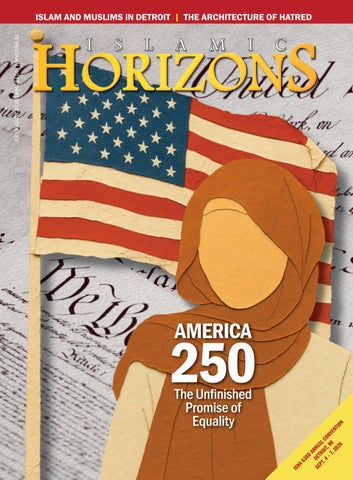
250
The Unfinished Promise of Equality
DA N S E DE T N U P T RO A L . 4 IT CO – 7 , M NV EN ,2 I T IO 02 6 N
ISN
JULY/AUGUST 2026/1448 | $4.00 | WWW.ISNA.NET
ISLAM AND MUSLIMS IN DETROIT | THE ARCHITECTURE OF HATRED
AMERICA
| VOL. 55 NO. 4 JULY/AUGUST 2026 | READ ON-LINE: HTTPS://ISLAMICHORIZONS.NET | VISIT ISNA ONLINE AT: WWW.ISNA.NET
ISNA MATTERS 8
From Global Turmoil to Local Tension
ISNA CONVENTION 10 Islam and Muslims in Detroit 11 Malcolm X, Warith Deen Mohammed, and Detroit’s Muslim Reorientation
INDEPENDENCE DAY 17 18
America 250 Being Muslim American in 2026
RISING HATE IN THE UNITED STATES 20 The Architecture of Hatred 22 The Modern Hate Industry 24 Combating Hate in the Modern Day 26 The Quran on Countering Hatred 28 Hatred Viewed Through World Religions
SEERAH 30
Mecca to San Diego
ISLAM IN CANADA 32
Hijab Ban in Quebec
EDUCATION 34 E xploring AI Policies for American Islamic Schools
PALESTINE 36
Meeting Yasser Arafat
ISLAM IN AMERICA 38 Moral Responsibility in a Time of Catastrophe 40 The Right to be Different 42 Renewal in Lubbock
INTERVIEW 43 First Nationally-Released Muslim Animated Feature Is a Mainstream Box Office Hit.
44
From Storytelling to Leaving a Legacy
FEATURE 45 The Open Door 50 Why Stories of Muslim Friendship Matter
FAMILY LIFE 52 Finding Quality Child Care in America Is Hard. Muslim Educators Are Expanding Options.
ENVIRONMENT 54
A Look Into Bio-Based Products
COMMENTARY
48
56 Is the Bangladesh Revolution Waning?
When Not to Move
ISLAMIC ART 58 Inside the Ancient Art of Samarkand Silk Paper Making
IN MEMORIAM 61
Akhtar Sadiq
DEPARTMENTS 6 14 60
Editorial Community Matters New Releases
Front cover design: Crystal Habib. DESIGN & LAYOUT BY: Gamal Abdelaziz COPYEDITOR: Luke Peterson, PhD. The views expressed in Islamic Horizons are not necessarily the views of its editors nor of the Islamic Society of North America. Islamic Horizons does not accept unsolicitated articles or submissions. All references to the Quran made are from The Holy Quran: Text, Translation and Commentary, Abdullah Yusuf Ali, Amana, Brentwood, MD.
JULY/AUGUST 2026 ISLAMIC HORIZONS
5
EDITORIAL
Time to Celebrate and Confront Hate
B
efore the start of the 10 most blessed days of the Islamic year, and before Eid al-Adha, hate descended upon Muslim Americans during a spine-chilling tragedy when three Muslims were shot and martyred at the Islamic Center of San Diego. Their sacrifices helped save the children at the center’s school. The suspects were found dead with self-inflicted gunshot wounds, and besides a cache of weapons, a trove full of hate-filled writings were also found.. We must investigate who and what infiltrated these young minds to commit murder. Was it the oft-experienced racial, ethnic, and religion issues that establishment politicians, think tanks, and the media constantly perpetuate? This is a circumstance that should not be overlooked at polling booths this November nor even afterwards. Attorney Faisal Kutty, writing on America 250 points out, “When entire communities are collapsed into caricature, democratic norms begin to erode. The First Amendment protects the right to express hateful or offensive views. But constitutional protections do not transform dehumanization into civic virtue. Democracies do not collapse only through coups or authoritarian decrees. They can also weaken gradually when political discourse normalizes the idea that some citizens stand outside the circle of equal concern.” Aslam Abdullah, reflecting on this constant cycle of hatred, says, “Hate crimes do not arise in a vacuum. They are often preceded by narratives that portray entire communities as threats, outsiders, invaders, or enemies. Repeated often enough, such narratives create what many scholars now describe as a “‘hate industry’” — an ecosystem of political rhetoric, social media campaigns, sensational media content, fundraising networks, and ideological activism that profits from fear and division.” Rasheed Rabbi, continuing his series on marking the 1500th birth year of Prophet Muhammad (salla Allahu ‘alayhi wa sallam) writes about confronting the halls of power with the Prophetic blueprint. He asks Muslim Americans, “To truly honor our martyrs and prevent the next executioner from taking another life, we must confront the defining question that political leaders in this country refuse to face: Why?” 6
Kutty, writing on the growing debate over whether zakat may be used to support political advocacy in response to the devastation in Gaza, has revealed something deeper than a disagreement about Islamic jurisprudence. He offers, “Money alone rarely determines political behavior, especially for marginalized communities. Power operates through media ecosystems, ideological alliances, corporate interests, and geopolitical priorities that often override moral appeals.” As we inch closer to ISNA’s 2026 Annual Convention, Rabbi also explores this year’s theme — “Persevere, Interconnect, Be God-Conscious, Strengthen One Another for True Prosperity” — as an intentional, strategic antidote to this fractured global climate. He states society frequently measures prosperity through material accumulation, but true communal success emerges only when individuals anchor their worldviews in an unchanging relationship with the Divine (taqwa) fiercely support one another (rabata), and persevere patiently (sabr) to contribute positively to the broader society. Grounded in the definitive Quranic mandate of verse 3:200, this call for “True Prosperity” (Falah) is deliberately framed against a backdrop of severe global and domestic vulnerability. Tariq Shah introduces future convention attendees to Detroit, the host city of ISNA’s convention, pointing out that the city’s renaissance echoes the story of its Muslim community, from early traders and factory workers to contemporary physicians, scientists, entrepreneurs, and civic leaders. Detroit, he states, boasts one of the country’s largest and most diverse Muslim populations. Detroit has journeyed through triumph, turmoil, and tribulation, yet stands today as a city that embodies resilience, faith, and renewal. In a time when faith identities are politicized, Detroit offers a counternarrative: — that coexistence and contribution cannot only survive but thrive side by side. Luke Peterson takes readers along memory lane, reminiscing about his meeting with Palestinian Authority President, Yasser Arafat in Ramallah, who died a few weeks after this meeting with American students in 2004. ih
ISLAMIC HORIZONS JULY/AUGUST 2026
PUBLISHER The Islamic Society of North America (ISNA) PRESIDENT Syed Imtiaz Ahmad CHIEF EXECUTIVE OFFICER Azhar Azeez EDITOR Omer Bin Abdullah ASSISTANT EDITOR Bareerah Zafar EDITORIAL ADVISORY BOARD Iqbal Unus, Chair: M. Ahmadullah Siddiqi, Rasheed Rabbi, Wafa Unus ISLAMIC HORIZONS is a bimonthly publication of the Islamic Society of North America (ISNA) P.O. Box 38 Plainfield, IN 46168‑0038 Copyright © 2026 All rights reserved Reproduction, in whole or in part, of this material in mechanical or electronic form without written permission is strictly prohibited. Islamic Horizons magazine is available electronically on ProQuest’s Ethnic NewsWatch, Questia.com LexisNexis, and EBSCO Discovery Service, and is indexed by Readers’ Guide to Periodical Literature. Please see your librarian for access. The name “Islamic Horizons” is protected through trademark registration ISSN 8756‑2367 POSTMASTER Send address changes to Islamic Horizons, P.O. Box 38 Plainfield, IN 46168‑0038 SUBSCRIPTIONS Annual, domestic – $24 Canada – US$30 Overseas airmail – US$60 TO SUBSCRIBE Contact Islamic Horizons at https://isna.net/SubscribeToIH.html On-line: https://islamichorizons.net For inquiries: membership@isna.net ADVERTISING For rates contact Islamic Horizons at (703) 742‑8108, E-mail horizons@isna.net, www.isna.net CORRESPONDENCE Send all correspondence and/or Letters to the Editor at: Islamic Horizons P.O. Box 38 Plainfield, IN 46168‑0038 Email: horizons@isna.net
ISNA MATTERS
From Global Turmoil to Local Tension ISNA’s 2026 Annual Convention Charts Path to Prosperity BY RASHEED RABBI
A
mericans can feel the world tightening around them. Families carry a quiet yet persistent anxiety about the future. The young face growing, overwhelming questions about identity, belonging, and purpose. Communities feel stretched, divided, and exhausted while navigating political polarization, rapid technological change, and conflicts that reverberate far beyond national borders. The sense that “something fundamental is shifting” is evident in the heaviness of our daily conversations, suspended in the tension of our neighborhoods, and palpable in the unease of our hearts. Scholars call this era a “polycrisis” — a convergence of shocks that collide and amplify one another. Analysts describe it as a “great unraveling” when familiar structures no longer provide the stability they once did. The World Economic Forum’s 2026 Global Risks Report warned that misinformation, geopolitical fragmentation, and economic fragility now form a “turbulent risk landscape” while the International Monetary Fund (IMF) noted that global growth has slowed to its weakest pace in three decades. Whatever name we give to this moment, communities feel the same truth: the world is changing faster than we can easily process. Shying away from this moment only tightens the grip of fear. This is why the Islamic Society of North America (ISNA) invites all to do the opposite: to unfold, to lean in, and to delve deeper into the very pressures pulling our lives apart. ISNA’s 63rd Annual Convention arrives as a vital space for renewal, bringing together scholars, educators, community leaders, families, and youth to confront this volatile moment with raw honesty, learn from one another, and reinforce the bonds that sustain us.
A Timely Call for Collective Prosperity
This year’s convention theme — “Persevere, Interconnect, Be GodConscious, Strengthen One Another for True Prosperity” — is an intentional, strategic antidote to this fractured global climate. Society frequently measures prosperity through material accumulation, but true communal success emerges only when individuals anchor their worldviews in an unchanging relationship with the Divine (taqwa), fiercely support one another (rabata), and persevere patiently (sabr) to contribute positively to the broader society. Grounded in the definitive Quranic mandate of verse 3:200, this call for “True Prosperity” (Falah) is deliberately framed against a backdrop of severe global and domestic vulnerability. We are navigating a time fractured by interconnected macro-pressures, chief among them being the erupting armed conflicts stretching from Eastern Europe to the Middle East and the Indo-Pacific. As diplomatic mistrust deepens between nations, critical trade routes break down, foreign investments shrink, and essential supply chains stall. While rocketing gas prices are the most immediate shockwave felt from the U.S.-Iran war, the deeper economic fallout permeates the kitchen table realities of everyday American life. Food, transportation, and necessities have grown increasingly expensive for a 8
ISLAMIC HORIZONS JULY/AUGUST 2026
nation that boasts the world’s top consumers — yet where nearly 40% of adults still struggle to cover a sudden $400 emergency expense. This convergence of hyperinflation, persistent recession warnings, and a sharp decline in institutional trust has dragged global economic momentum to its weakest point in thirty years, according to the IMF, bringing a toxic mix of inflation, recession worries, and a sharp decline in institutional trust. More than an annual gathering, the convention serves as a vital infrastructure for community renewal. Through over 10 main sessions, 20+ parallel sessions, and nearly 85 esteemed speakers, including reflections from both Shia and Sunni perspectives, ISNA provides a shared platform for Muslims from every walk of life to confront reality with analytical clarity. It brings necessary awareness to the political, social, familial, and economic shifts reshaping our lives and facilitates a collective process of envisioning a coherent path forward.
A Convention Designed for the Moment
Recognizing these compounding factors, ISNA has curated targeted session tracks that directly address both the critical challenges and timely opportunities facing Muslim Americans today. The path from survival to true prosperity begins in these rooms: Cultivating God-Consciousness Across Time and Space In a volatile economic and social moment, maintaining ethical integrity can feel nearly impossible, but the values Islam gave humanity have outlasted every era of upheaval. Across centuries, Muslim societies nurtured religious tolerance, egalitarianism, and moral discipline, all stemming from a deep God-consciousness (taqwa). This session elaborates on how Muslim Americans can be the
force of unity, ethical integrity, and depolarization during times of Young Muslims are navigating high-pressure educational and prosystemic instability. Participants will analyze practical strategies to fessional systems that frequently trade ethical leadership for compliance move taqwa from an abstract concept into a functional framework driven by fear. People fear losing jobs, so they work in silence. People for navigating corporate workplaces, secular educational institutions, fear getting sick, so they buy insurance built on lies. People fear perseand highly reactive digital spaces. cution, so they accept injustice as the price. Fear produces compliance, Protecting Children’s Hearts Through Political Turmoil which slowly erodes truth. This session confronts this culture of fear During this time of widespread turmoil, families feel the tremor and equips the next generation with intellectual confidence and the first. Parents in the U.S. struggle to navigate a world where fear rare skill of “Prophetic Diplomacy:” speaking uncompromising truth outruns facts, identity is constantly contested, and children meet without relying on cruelty, internet outrage, or passive submission. instability far too early. They must be protected from becoming Solidarity Against Injustice Universally, Not Selectively either traumatized or desensitized as images of war and suffering Muslims are commanded to stand up for justice unconditionally, saturating daily life. This session addresses a critical question: ISNA’s 63rd Annual Convention arrives as a vital in a world that seems dangerous and unsafe, space for renewal, bringing together scholars, how can parents cultivate a baseline of emotional and physical safety for their children? educators, community leaders, families, and Rather than retreating into isolation, families will learn how to help children process difyouth to confront this volatile moment with raw ficult global realities from a grounded lens honesty, learn from one another, and reinforce of faith, resilience, and emotional security. Safeguarding Dignity: Preventing the bonds that sustain us. Moral Erosion True prosperity collapses when a community tolerates exploitation within its own walls. In recent tragic even if it is against themselves, their parents or their kin (Quran 4:135). incidents of spiritual abuse and the exploitation of vulnerable seg- Solidarity cannot be selective. When foreign conflicts routinely spill ments of society, the role of Muslim Americans in protecting the over into domestic debates — driving radicalization, localized hossanctity and dignity of their fellow humans remains vital. tility, and extremist narratives — our faith demands oppression must Confronting the enormity of exploitation, vulgarity, and moral be condemned universally. This session explores how to maintain decay spreading through everyday American social life, this panel principled moral clarity in an increasingly polarized world, refusing calls the community back to the enduring path of moral restraint, to let ethical solidarity be tainted by partisan or political pressures. chastity, and healthy mindsets, even in a culture that normalizes Technology, AI, and the New Digital Landscape Many miss that a new power structure is emerging — not built vice and hypersexuality and mocks discipline. Speakers will map out practical paths to revive the sacred dignity of the human being on armies or borders, but on algorithms, data, and digital influand fully restore collective trust in our community leadership. ence. AI and social platforms now shape identity, behavior, and Voicing Vulnerability Through Civic Presence belief faster than families can respond. They are dominated by an Civic engagement is no longer an optional political exercise; extraordinarily small elite of corporations and government actors, it is a fundamental shield for Muslim Americans. The urgency of intensifying fears of surveillance, control, biases, and unaccountable maintaining a visible public presence beyond voting or advocacy influence. Federal policy prioritizes global technological dominance, becomes a communal responsibility when court decisions, federal often at the expense of the ethical safeguards a nation needs most. actions, school policies, and foreign-policy crises shape our families, our safety, and our future. Prospering Together This is especially true when far-right political figures weap- The challenges facing our world in 2026 are undeniable, but they onize global crises to portray Muslim communities as cultural do not have the power to define our future. Throughout history, or national security threats. In response to such accusations, this communities rooted in faith, knowledge, and structured mutual session explores how Muslims can constructively engage in civic support have consistently transformed periods of deep societal life, confront bigoted rhetoric, build meaningful local alliances, uncertainty into historic opportunities for renewal and structural growth. and mobilize effective advocacy. ISNA’s 2026 Annual Convention stands in that same tradition. Purging the Disease of Racism and Ethnocentrism The Prophet (salla Allahu ‘alayhi wa sallam) explicitly censured It invites our community to reconnect with God, learn from one tribalism, identifying internal prejudice as a remnant of jahiliyya another, fortify our institutions, and reaffirm our foundational (ignorance) that completely contradicts the Quranic vision of all commitment to justice, compassion, and service. At a time when people standing equal before God. As social and economic anxi- powerful forces are pulling societies apart, ISNA provides the space eties frequently trigger “us versus them” mentalities, it is vital that to do the vital work of coming together — to persevere, interconnect, our institutions actively root out localized biases. This interactive strengthen one another, and truly prosper as one community. ih discussion provides an actionable blueprint for transforming our Dr. Rasheed Rabbi, an Islamic Horizons board member, is the founder of e-Dawah and secretary of the mosques from comfortable ethnic or cultural enclaves into genuinely Association of Muslim Scientists, Engineers and Technology Professionals. He serves as a khateeb at inclusive, diverse spaces that model true prophetic brotherhood. the ADAMS Center and is a certified Muslim chaplain at iNova Fairfax, iNova Loudoun, and Virginia’s Cultivating Effective Leadership for the Next Generation Alexandria and Loudoun Adult Detention Centers. JULY/AUGUST 2026 ISLAMIC HORIZONS
9
ISNA CONVENTION
Islam and Muslims in Detroit Past, Present, and Future BY TARIQ SHAH
O
nce the nation’s industrial hub, the Motor City’s renaissance echoes the story of its Muslim community, from early traders and factory workers to contemporary physicians, scientists, entrepreneurs, and civic leaders. Detroit boasts one of the country’s largest and most diverse Muslim populations, with estimates ranging from 240,000 to 300,000 Muslim residents from across the globe living in the Greater Detroit Area. It stands apart as a city where faith, culture, and social consciousness converge, making interfaith cooperation and civic engagement a reality rather than an aspiration.
From the Factory Floor to the Mosque Dome
In the early 20th century, Muslim immigration to Detroit was mainly driven 10
by employment opportunities in Henry Ford’s automobile factories. Many Muslim migrants, faced with the dilemma of practicing their faith in an environment that did not understand or accommodate it, found solace in preserving their spiritual identity. Cut off from religious institutions and the guidance of scholars, they faced challenges in maintaining basic rituals like prayer, fasting, and teaching the Quran to their children. Yet, this struggle also presented an opportunity. In response to limited resources, Detroit Muslims created makeshift mosques in basements and living rooms. This was not just an attempt at belonging but an act of creation — building a future where their children could be both Muslim and American. This aspiration to bridge two worlds without compromising either continues to shape the Muslim American experience today.
ISLAMIC HORIZONS JULY/AUGUST 2026
By the 1920s, the Highland Park mosques emerged as the first organized places of worship for Detroit’s Muslims. By the middle of the century, the Albanian Islamic Center became a lasting spiritual anchor for the ever-growing community. Over the ensuing years, Detroit emerged as a pivotal stronghold for the Nation of Islam, influencing leaders such as Elijah Muhammad and Malcolm X. It served as a foundational framework for Black identity, economic autonomy, and activism. In the following decades, Black Muslims, inspired by movements for self-determination, civil rights, and the global winds of decolonization created communities rooted in Islam and social justice. The 1970s and 1980s brought a sizable influx of South Asian, Turkish, and North African immigrants who further enlarged this diverse tapestry.
Emerging from these intertwined histories is a new Muslim identity that expresses a shared ethos grounded in service, responsibility, and faith. This civic identity transcends outdated ethnic labels and is rooted in an American belonging connected to a wider global Muslim consciousness.
Malcolm X, Warith Deen Mohammed, and Detroit’s Muslim Reorientation
The Detroit Mosaic Today
With more than 90 mosques and Islamic centers across the Greater Detroit Area, Muslim life here is vibrant and visible. The city’s Islamic congregations are not just places of prayer but living centers of community life with health fairs, legal aid clinics, youth sporting events, and interfaith dialogues. Interfaith collaboration in Detroit is not merely symbolic; it is the most effective antidote to the manufactured binary that casts Muslim communities as either instruments of a political agenda or a source of American peril. Interfaith dialogue affirms all of us as equal partners in building a just future. Dearborn, Hamtramck, and Sterling Heights are veritable emblems of American pluralism. In Hamtramck, Muslims now form much of the city council. The community’s diversity is striking: Arab Americans are the largest segment, followed by South Asians, African Americans, Bosnians, and a growing number of Latino Muslims. Each contributes to Detroit’s cultural fabric — from Yemeni bakeries in the South End to Pakistani tech start-ups downtown. Detroit’s Muslim community has risen from a once marginalized segment of the society to one assuming leadership and service roles. Their mosques now grace skylines once defined solely by smokestacks. In an age of politicization and weaponization of religious identities, Detroit emerges as a beacon of hope and guidance.
The Cost of Progress
Detroit’s Muslim community has often found itself in the crosshairs of right-wing influencers and subjected to stereotypical local and national media coverage viewed through the lens of 9/11. Yet through resilience and purpose, the Muslim response has been one of engagement and outreach manifested through civic initiatives and humanitarian service. Detroit Muslims collaborated with churches, synagogues, and other faith communities in disaster relief and food bank programs, continuing to dispel stereotypes. This progress, however, has not come without a price. Muslim Americans —including
T
he story of Islam among African Americans in Detroit presents a captivating journey, moving from a localized and forceful response to oppression toward a universal, scripturally aligned faith. In response to intense racism and the economic hardship of the Great Depression, the Nation of Islam (NOI) appeared under Wallace Fard Muhammad around 1930. His movement gave African Americans a spirited message of dignity, discipline, and hope. Nevertheless, diverging from the core principles of mainstream Islam, NOI claimed the superiority of Black people and claimed they were the original human beings. This racial doctrine profoundly deviated from the Quranic message, which affirmed the intrinsic equality of all individuals before God. These early undercurrents brought about profound spiritual transformation of two pivotal NOI figures: Malcolm X and Warith Deen Mohammed, Elijah Muhammad’s son. Malcolm X’s personal journey became the inflection point for the broader community, marking a significant turning point. Once the NOI’s most influential national voice, his 1964 Hajj offered an immediate and decisive rejection of the NOI’s theology. Witnessing Muslims of different races and nationalities worshiping side by side — equal before God — he embraced Sunni Islam. Inspired by the universal decree of the Quran, he
declared genuine human worth lies not in race, but in piety. His shift marked a historic moment, recasting the Muslim Black community’s perspectives on race. The final historic shift came after Elijah Muhammad’s death in 1975 when Warith Deen Mohammed dismantled the organization’s ideology. He underscored Islam’s universal and inclusive message and rejected the notion of superiority of a specific racial identity. This message of inclusivity redirected a large segment of his followers to embrace mainstream Islam’s universal brotherhood of humankind. He was not merely correcting a deviant theology; he was widening the canvas and expanding the community’s spiritual horizons. This shift represented a reimagining of Black Muslim identity aligned with the core spiritual message of Islam. Detroit’s mosques, once molded by the racial doctrines of a segregated movement, grew into spaces defined by Qur’anic universalism- open doors where believers of every background could stand shoulder to shoulder. This departure was not simply a change in doctrine; it was a shift in belonging, a return to roots. For many in Detroit, this was less about conversion than about homecoming. This faith honored the dignity they had always intrinsically carried within themselves and knit their lives into the community of shared struggle, culture, and devotion they experience today. ih
Detroit’s own community — have to live through the long shadows of routinized Islamophobia. Characteristically, they have countered slander with grace, replied to exclusion with contribution, and transformed
pain into purpose. Sustained by their faith in humanity’s shared destiny, their composure and magnanimity, tested time and again, stand as quiet testimony to the moral strength that upholds their civic and spiritual journey.
JULY/AUGUST 2026 ISLAMIC HORIZONS
11
ISNA CONVENTION
On inaugural day, public officials, politicians, and neighbors visited the IAGD mosque.
Cultural studies scholars noted how Muslims in greater Detroit have shown resilience and growth precisely during moments of crisis, increasing Muslim institutions and visibility while simultaneously being expected to prove their Americanness. When hate arrived in downtown Dearborn on Nov. 19, 2025, the community’s response was a powerful testament to courage and compassion. On that day, as anti-Islam protesters attempted to burn a copy of the Quran, local Muslims stepped forward to protect the sacred text and vowed they would do the same for a Bible. Neighbors from all walks of life came together, standing shoulder to shoulder. They turned an anxious moment into a powerful show of unity, respect, and shared humanity. In Dearborn, love and moral courage prevailed over fear and division.
Institutions That Anchor, Inspire, and Empower
Detroit’s Muslim organizations form the backbone of the city’s civic life. The Michigan Muslim Community Council (MMCC) and the Council of Islamic Organizations of Michigan anchor this ecosystem. The Muslim Students’ Association at Wayne State University frequently organizes charity weeks, public forums, and faith-based advocacy campaigns. Women’s networks — from neighborhood halaqas to entrepreneurial cooperatives — amplify voices that were once marginalized. Muslim women in Detroit today lead non-profits, run public health 12
initiatives, and organize interfaith service projects that reshape the city’s social landscape. Prominent Muslim professionals — physicians, engineers, scientists, educators, and public servants — stand at the heart of Detroit’s renewal. In their pursuit of meaning and belonging, they turn work into worship
Detroit has journeyed through triumph, turmoil, and tribulation, yet stands today as a city that embodies resilience, faith, and renewal. In a time when faith identities are politicized, Detroit offers a counter-narrative: that coexistence and contribution cannot only survive but thrive side by side.
ISLAMIC HORIZONS JULY/AUGUST 2026
and service into strength. In a 2014 study, the Institute for Social Policy and Understanding observed that this synthesis of faith and civic purpose has made Detroit’s Muslims among the most engaged and community-minded Americans. This significant trajectory led to a powerful social and political rise from the margins to the mainstream. The appointment of individuals like Dr. Abdul El-Sayed, Detroit’s youngest health director, in 2015 and Mayor Abdullah Hammoud’s 2022 electoral success marked a watershed moment for Michigan politics and empowered and engaged the Muslim community in the state. As the number of Muslim legislators increases, Muslim lawmakers in Lansing established a cohesive, faith-based caucus within the state legislature. The annual Michigan Muslim Capitol Day, when Muslim citizens meet lawmakers and other public officials, embodies the community’s growing activism and symbolizes a maturing American Muslim identity: confident, participatory, and rooted in faith. The newly-minted mosque and Islamic center in Rochester Hills is not just a place of worship, but a bold expression of Muslim community pride, permanence, and a platform for public engagement. With its expanded facilities, educational programs, and family-centered events, the center reflects a confident faith woven into the rhythms of American suburban life.
Impacts of Collaboration
Detroit’s story is ultimately a tale of resilience. Muslims have moved from the margins to the mainstream, from factory laborers to lawmakers. Their mosques now share skylines once defined solely by smokestacks. In a time when faith identities are politicized, Detroit offers a counter-narrative: coexistence and contribution thrive side by side. It is the Muslims’ faith in the one God that has guided the community and the city’s rebirth, turning places of worship into centers of service, estrangement into cooperation, and struggle into steadfast resolve. This renewal echoes a Quranic truth — that strength and prosperity find purpose only when joined with justice (‘adl) and excellence (ihsān) — the compassion that beautifies every human endeavor. Examples of this include enduring collaborations and partnerships between African American Muslim organizations and interfaith or intrafaith partners, bridging
racial, ethnic, religious, and urban-suburban divides. The Greater Detroit Area remains a national model of interfaith collaboration, with Muslims, Christians, and Jews actively partnering through initiatives like the InterFaith Leadership Council and joint service projects to advance the common good, combat prejudice, and strengthen the community. The story of Detroit’s renewal is perhaps nowhere more vivid than along the northeast corridor of Dexter-Linwood, where DREAM of Detroit — Detroit Revival Engaging American Muslims — is restoring not just homes but hope. The once abandoned landscape now stands transformed by faith in action: gardens sprouting from empty lots, workshops where young and old labor together, and a moral imagination that unites African American and immigrant Muslims in shared purpose, transcending race, class, and space. Here, Islam’s prophetic ethic of rebuilding, serving, and dignifying every human space takes visible form. In uniting diverse believers, DREAM is redrawing the city’s moral map: turning places long marked by fear into sanctuaries of trust and transforming the work of urban renewal into worship itself. These practices constitute a fulfillment of the Quranic injunction, “Do good, for Allah loves good doers” (2:195). Black Muslim communities have made significant contributions through an enduring legacy of localized care and neighborhood stewardship, especially in urban centers like West Detroit. Continuing a tradition of social uplift, these communities — often through mosques and Muslim-led institutions — vigorously addressed socioeconomic challenges such as poverty and structural neglect. Steered by their community’s own needs and aspirations, Black Muslim in Detroit developed a unique approach to activism that remains central to their progress. This approach manifests in aid — soup kitchens, food pantries, shelters — as well as in housing rehabilitation, advocacy, and neighborhood revitalization. These measures cater not only to the basic needs of low-income residents but also focus on neglected areas and counter marginalization, thus positioning Black Muslims as key stewards of communal welfare and influential advocates for racial justice. In this spirit of finding meaning and purpose, Detroit’s Muslims embody a harmony
between worldly striving and spiritual perseverance: sabr. They have shown that every act of restoration is an act of ibadah (worship), steadfast even through trials.
The Road Ahead
As Detroit reshapes its economic and cultural revival, its Muslims foresee a future that reflects the Prophet’s saying: “The best of people are those most beneficial to others.” A new generation of Muslim Detroiters is reclaiming their narrative through film, podcasts, and digital media. For example, Lena Ramadan’s documentary “Dearborn, USA”, screened at the 2023 Freep Film Festival, centers Arab American women’s lived experiences and counters prevailing stereotypes with intimate, homegrown storytelling. Guided by the Islamic principle of khalifa — stewardship of the Earth — young Muslims are also joining hands with organizations like Detroiters Working for Environmental Justice. As reported by Planet Detroit, these faith-led efforts — from cleanups to pollution advocacy — are helping build a healthier, more just city. The final chapter of Detroit’s Muslim story has not yet been written. Challenges remain — from Islamophobia to socioeconomic disparity — yet the community is on a confident and creative trajectory. A new crop of Muslim youth, grounded in faith and equipped with the structures of science, technology, and civic life, is not just redefining what it means to be both Muslim and American but also shaping the community’s future. And just as in all human circumstances, differences of opinion and approach will arise. Detroit’s Muslim community has long transcended internal differences — sectarian, ethnic, and organizational — to serve the common good. It has offered consequential examples of this ethic in practice: collaborative mosque initiatives, cross-organizational partnerships, and youth-led civic projects that bring diverse perspectives into constructive conversation. The signing of the Muslim Code of Honor in 2007 at the Islamic House of Wisdom was a defining moment where Sunni and Shia leaders rejected sectarian differences and affirmed shared responsibility. The Code explicitly rejected declaring other Muslims as non-believers (takfīr) or using incendiary and insulting language about each other’s revered figures. That spirit led to the 2012 alliance of the Islamic Shura Council of Michigan and the
MMCC which brought together multiple leadership structures and united Arab, African American, South Asian, immigrant, and convert communities. Today, unity endures through the Imams Council of Michigan where Sunni and Shia leaders jointly coordinate service, crisis response, and public messaging. Detroit’s Muslim story reveals a community that steadily moved from the margins to the mainstream of civic life. Their past is a testament to their resilience. Their present showcases political sophistication and a sense of social responsibility. And their future, with its potential to shape the region’s democratic and inclusive trajectories, is a source of inspiration and motivation for all. As Detroit continues to be challenged by inequality, uneven development, and the demands of an inclusive society, its Muslims are well poised to actively engage in writing Detroit’s next chapter. In this evolving landscape, Detroit’s Muslims are not simply participants in the city’s trajectory—they are integral and invested co-authors of its political and social future. ih Tariq Shah is a citizen writer who lives in the suburban Detroit area.
ISNA Monthly Sustainer – A Good Deed Done Regularly!
You can make an impact with as little as
$10 per month!
www.isna.net (317) 839-8157
Convenient. Secure. Affordable.
JULY/AUGUST 2026 ISLAMIC HORIZONS
13
COMMUNITY MATTERS ➤
Muslim Student Triumphs Over Hate Four Twin Cities Community Leaders Given JFK Profile in Courage Awards
On May 31, Caroline Kennedy and Jack Schlossberg presented the John F. Kennedy Profile in Courage Award at the John F. Kennedy Presidential Library and Museum in Boston to Imam Yusuf Abdulle, co-founder, Somali American Leadership Table and executive director of the Islamic Association of North America, and three other community leaders. The Award is being presented to the people of the Twin Cities of Minnesota for risking their lives to protect their neighbors and immigrant community members from an unprecedented federal law enforcement operation, peacefully defending the human rights and values that serve as the foundation of our Constitutional democracy. The awardees reflect the broad coalition of communities that came together during the recent ICE anti-immigrant surge in Minneapolis, and the many actions residents took to support their neighbors. The award recognizes public servants for making a courageous decision of conscience without regard for personal or professional consequences. In 2025, in response to rising hate crimes and political attacks targeting Somali Americans, Imam Abdulle co-founded the Somali American Leadership Table, an advocacy group that helped convene the Somali community in response to federal enforcement actions in Minnesota. Rather than retreat in the face of pressure from the highest levels of power, Imam Abdulle and his community chose to publicly stand together and defend their neighbors. Imam Abdulle is also part of a broad community of religious leaders across traditions in the Twin Cities who played a visible role during this period, helping to lead protests and guide response efforts. A lawsuit brought by the Hillside Islamic Center obliged the town of North Hempstead to grant conditional approval 14
The disfigured painting.
A former Half Hollow Hills High School West student in Dix Hills, N.Y. agreed to a $125,000 settlement with the district after her painting on her school parking spot — part of a school tradition — was removed in 2024, reported Marisa Kabas of The Handbasket. The then senior, a Muslim American of Pakistani descent, had painted a watermelon slice with a kaffiyeh pattern, her name in Roman and Arabic letters, and a message that said, “PEACE BE UPON YOU,” according to a complaint filed by her mother, Nighat Malik, in March 2025. The watermelon, which has the red, white and green colors of the Palestinian flag, is seen as a symbol of solidarity with Palestine. Responding to complaints from Jewish members of the school community, the district painted over
the watermelon in Sept. 2024. Her lawyers argued the administrators violated the student’s right to free speech. Attorney Andrew B. Stoll, who represented the student and her mother along with CAIR’s New York chapter, said that the settlement shows “there’s no Palestine exception in the First Amendment.” Steven C. Stern, who represented the district’s insurance provider, had alleged that the watermelon image “symbolized antisemitic hate speech” to some, adding the district should be allowed to regulate such a painting in its parking lot, which is open to students, faculty, parents, and community members. The student, who wishes to remain anonymous, was vice president of the student executive council, vice president of the Muslim Students Association and had a 4.0 GPA. She graduated last June and is now in college and said she felt betrayed by her school. “I hope that it would really encourage any minority and the Muslim community and the Palestinian community to not be silenced and not be censored, and to know that they have the right and their voice matters,” Malik told Kabas. ih
for the mosque’s long-delayed expansion on April 15. The settlement resolves federal litigation filed after the town previously denied the Hillside Islamic Center’s expansion proposal,
despite findings that the plan met applicable zoning requirements. The resolution includes approval of the project, subject to conditions, and marks a significant step toward addressing concerns raised about the treatment of the Muslim community in the land use process. Hillside Islamic Center, a two-story, 5,428-square-foot masjid, regularly accommodates approximately 600 to 700 congregants for Friday prayers. During Ramadan, due to limited space, worshippers have been forced to pray outdoors in a tent to manage overflow. The approved expansion will add a third floor and 63 additional
The original parking spot after painting.
ISLAMIC HORIZONS JULY/AUGUST 2026
parking spaces to better serve the growing community’s needs. The approval is conditional and requires the mosque to submit a revised site plan addressing several requirements, including modifications to parking lot design, traffic flow adjustments, and technical corrections to prior submissions. Additional conditions include restrictions on the use of certain spaces within the building, a prohibition on the use of tents for services, and requirements related to parking management during high-attendance periods such as Friday prayers and Ramadan. CAIR-NY, welcoming the decision, noted that the case reflects broader challenges faced by Muslim communities across the country when seeking to establish or expand places of worship, often resulting in unnecessary legal disputes and community harm.
On April 20, North Haven Public Schools officially recognized Eid-al-Fitr as a district-wide holiday. CAIR-CT expressed appreciation to Patrick Stirk, North Haven’s Superintendent of Schools, and the Board of Education for ensuring that all students feel acknowledged, respected, and welcomed. This recognition sends a powerful message to Muslim students and families that their identities and religious practices are valued within the school community. “The recognition of Eid as a holiday is more than symbolic—it directly impacts students’ mental health, sense of belonging, and ability to fully participate in both their academic and religious lives without feeling marginalized or excluded,” said Farhan Memon, Chairman of CAIR-CT. CAIR-CT said that this achievement was the direct result of the North Haven community’s sustained efforts — especially the students who courageously spoke up, shared their experiences, and advocated for their right to be recognized. Their voices brought visibility to the real challenges Muslim students face and helped drive meaningful change. We also recognize the
Mayor Amir Omar (first right) and Azhar Azeez (3rd right) at the investiture.
Dr. Basheer and Shakila Ahmed flank Mustapha Ishak-Boushaki.
University of Texas Dallas (UTD) President Prabhas Moghe and Dean of Science and Mathematics David Hyndman presided over the award of Drs. Basheer & Shakila Ahmed of the Distinguished Chair in Natural Sciences and Mathematics to Prof. Mustapha Ishak-Boushaki. Ishak-Bousakhi, an Algerian theoretical physicist, specializes in cosmology many community members and organizers who have worked tirelessly behind the scenes over the past two years to build momentum, engage stakeholders, and ensure this effort remains a priority. Dr. Khaled Muhammed, president of the North Haven Islamic Center, said “It reinforces that our children are valued and that their identity is recognized as part of the fabric of this town.” The Bethel Board of Education officially recognized Eid al-Fitr as a school holiday on April 24. “Recognizing Eid al-Fitr is more than a calendar change — it is a statement of inclusion, dignity, and respect,” said Farhan Memon, Chairman of CAIR-CT. “When Muslim students see their holidays acknowledged, they know they are fully seen and fully valued. This kind of leadership helps create safer, more welcoming schools for all children.” Memon extended gratitude to Board Superintendent Dr. Christine Carver, and
and astrophysics. Drs. Basheer & Shakila Ahmed have given a major gift to the UTD, which has established the chair in their honor, and named an auditorium for them. The Ahmeds invited family and guests on April 16 to the investiture, which included Mayor of Richardson Amir Omar, ISNA CEO Azhar Aziz, and other distinguished community leaders. Basheer Ahmed, a former professor of psychiatry at Southwestern Medical School, Dallas, is Chairman Emeritus of MCC for Human Services, President of American Muslims for Human Rights, and President Emeritus of Institute of Medieval and Post-Medieval Studies. ih the Board for fostering an inclusive educational environment. Eman Beshtawii, president of Al-Hedaya Islamic Center added, “This recognition is a meaningful step toward ensuring that every student feels a true sense of belonging. It creates an environment where diversity is celebrated and all families feel welcomed. It’s a clear message that affirms Bethel’s appreciation of diversity, inclusion, and equity.” Bethel Public Schools student Z, who led the effort, said, “The moment our Board voted to recognize Eid was heartwarming. I felt a greater sense of belonging and felt truly seen. Seeing Eid recognized by our school district means so much to Muslim students like me. It makes us feel included and respected, and it shows that our community matters.” This achievement reflects the advocacy, persistence, commitment and leadership of local students, community organizers, and Al Hidaya Islamic Center. Unfortunately, anti-Muslim bullying remains a serious concern in Connecticut schools. Last year, two Muslim students in Waterbury were violently assaulted in what authorities later classified as a hate crime.
JULY/AUGUST 2026 ISLAMIC HORIZONS
15
COMMUNITY MATTERS
PHOTO BY MICHAEL MARSLAND.
Yale Honors Dr. Mattson with Honorary Degree
Front row (l-r), Ingrid Mattson, Lynn Nottage ’89 M.F.A., Yale President Maurie McInnis, JoAnne Stubbe, and Kurt Schmoke ’71. Back row (l-r) Emery N. Brown, Katie Ledecky, Kwame Anthony Appiah, and Robert D. Putnam ’65 M.A., ’70 Ph.D.
During its 325th graduation ceremony on May 18, Yale University awarded honorary degrees to Prof. Ingrid Mattson, a former president of the Islamic Society of North America, and seven others whose achievements in their fields have benefited the common good. The awarding of honorary degrees, which has been a Yale tradition since 1702, recognizes pioneering achievement or exemplary contribution to the common good. “The eight individuals we honor this morning serve as examples to you, our graduates, to encourage you to aspire to excellence and to value those elements of human character that they embody: creativity, curiosity, discipline, integrity, and a passion for public service,” said Yale President
Maurie McInnis. “Their presence here also honors you who graduate today, and all of us who are here to salute you.” Dr. Mattson’s honorary degree citation read, “Muslim scholar, interfaith leader, author, bridge builder, and champion of peace: a reading of the Quran helped transform your life and heralded your conversion to Islam. As the first woman and first convert to lead the Islamic Society of North America, and a continuing advocate for Muslims and for positive resolution of conflicts and differences everywhere, you have brought integrity, wisdom, and a steadfast commitment to dialogue across faiths. Your initiatives have consistently emphasized ethical leadership, mutual understanding, and the constructive role of Islam in pluralistic societies. “Compassionate and powerful force for good in a troubled world, Yale wishes you a thousand blessings as it honors you with the degree of Doctor of Divinity.” ih
Maliha Khan, founder and CEO of Khanect the Dots, was named a Bronze Stevie Award winner in the Women in AI Leadership category at the 24th annual American Business Awards. She was the only honoree from Missouri recognized in the category this year. The American Business Awards, announced on April 24, are the nation’s premier business awards program, recognizing organizations and professionals driving innovation, growth, and impact across industries. More than 3,600 nominations from organizations of all sizes were submitted this year for consideration. Khan was recognized for her leadership in helping businesses and professionals adopt artificial intelligence in practical, human-centered ways. Khan was recognized alongside leaders from national firms including BDO USA, Robert Half, Blackbaud, and Ruder Finn.
“Being recognized in this category means a lot,” said Khan. “I believe small businesses, women-owned businesses, and underrepresented communities deserve access to AI in ways that remain human-centered, strategic, and true to who they are.” The Kansas City-based Khanect the Dots helps organizations bridge the gap between strategy and execution — what Khan calls the messy middle — where strong ideas frequently stall. Her firm helps brands move forward with clarity by blending strategic thinking, creative execution, and practical AI adoption. Khan has trained business owners and entrepreneurs through partnerships with the Missouri SBDC at UMKC, Central Exchange, and KC Game Plan, and is actively involved in the region’s entrepreneurial ecosystem. More than 250 professionals worldwide participated in the judging process to select this year’s Stevie Award winners.
16
ISLAMIC HORIZONS JULY/AUGUST 2026
Sara Hamdaoui, a junior at Crofton High School, was elected as the 2026–27 Student Member of the Anne Arundel County Board of Education. Hamdaoui was elected by members of the Chesapeake Regional Association of Student Councils, reflecting strong support from student leaders across Anne Arundel County. In her new role, she will serve as a vital voice for students, helping shape education policy and representing the interests, concerns, and aspirations of her peers. In a statement, CAIR Maryland said, “Sarah Hamdaoui’s election is a powerful example of the leadership, civic engagement, and excellence that young people in our community bring to public service. We applaud her commitment to representing students across Anne Arundel County and are confident she will serve with integrity, insight, and compassion.” “Student voices matter,” the organization added. “When young leaders like Sara step forward, they not only strengthen our schools, but also help build a more inclusive and representative future for all.” CAIR encourages continued civic engagement among Muslim youth and all students across the state, emphasizing that leadership opportunities such as the SMOB role play a critical part in developing the next generation of public servants. Since the first wave of refugees in the early 1980s, many first- and second-generation Vietnamese and Cambodian Cham are pursuing higher education. Back home, the Cham in the countryside were seen primarily as farm workers. In the U.S., however, their reputation is changing. The community is producing Jimmy Davoud at university teachers, medi- his graduation. cal doctors (Drs. Tuoi Tai, Ariya Chau, and Mrs. Osman); nurses (Jimmy Davoud, who graduated on May 18 with an AAS in nursing and plans to do a BSN in nursing), health care management (Sakirah Tu), the chip and software industries (Senior Test Engineers Rohim Ach and Sean Tu), paralegals (Ramadan Mohammad), and Boeing engineers (Sahrudine Abdulhaliem) and managers (Basari Math). ih
INDEPENDENCE DAY X, Florida Representative Randy Fine said, “the choice between dogs and Muslims is not a difficult one.” Around the same time, legislation branded as the “Protecting Puppies from Sharia Act” was introduced in Congress. In Georgia, campaign advertisements warned darkly of a supposed “Sharia takeover.” In Texas, Republican primary voters were asked to weigh in on whether “Sharia Law” should be prohibited. None of this emerged in a vacuum. America has seen this all before. History Repeats Itself Years ago, American Catholics were once accused of harboring secret loyalty to Rome and of being antithetical to constitutional democracy. In that same period, Jews were treated as perpetual outsiders whose allegiances could never fully be trusted. Japanese Americans were forcibly interned during World War II under the language of national security. Black Americans were denied equal citizenship for generations while the Constitution itself was invoked to justify exclusion. Each era produced its own vocabulary of hate, its own rationale for treating certain groups as exceptions to the nation’s stated ideals. The language changes. The structure remains. The current “Sharia threat” narrative follows precisely this historical BY FAISAL KUTTY pattern. There is no evidence that Islamic law is replacing American constitutional governance. American courts remain bound by the 50 years ago, a group of men gathered in Philadelphia Constitution, statutes, and precedent. Religious principles, whether and declared that all white men are created equal, endowed with Jewish, Christian, Muslim, or otherwise, hold no independent soverunalienable rights to life, liberty and the pursuit of happiness. eign authority in American courts. They never have. They never will. This sentiment would only later expand to include the rest of Yet the rhetoric persists because it serves a political function. It humanity. The words were revolutionary. The reality was far from it. transforms demographic change into cultural panic. It converts comThe Declaration of Independence was both a soaring moral promise plexity into threat. It invites citizens to see neighbors not as fellow and a profound contradiction. It proclaimed universal equality while participants in a pluralistic democracy but as alien forces from which slavery remained embedded in the republic’s economic and political the nation must defend itself. foundations. Indigenous peoples were described as obstacles to civiThe danger is not merely rhetorical. Dehumanization has consequences. lization. Women were excluded from political participation. The new When entire communities are collapsed into caricature, democratic nation announced liberty to the world while withholding it from scores norms begin to erode. The First Amendment protects the right to of thousands who lived within its borders. express hateful or offensive views. But constitutional protections do And yet, despite those contradictions, the Declaration endured not transform dehumanization into civic virtue. Democracies do not because generations of Americans refused to treat its failures as proof collapse only through coups or authoritarian decrees. They can also of its emptiness. Instead, they treated them as unfinished obliga- weaken gradually when political discourse normalizes the idea that tions. Abolitionist Frederick Douglass confronted the hypocrisy of some citizens stand outside the circle of equal concern. Independence Day while still insisting the Constitution contained This is why the current moment matters far beyond one politician, anti-slavery principles worth redeeming. President Abraham Lincoln one campaign ad, or one legislative proposal. described the Declaration as a moral standard meant to apply to all The Declaration of Independence was radical not because the people and all times. The Civil Rights Movement forced the United States colonies demanded self-governance. Many societies have done that. to confront the distance between its Its radicalism lies in its assertion constitutional ideals and its social that legitimacy itself depends upon When entire communities are collapsed the equal dignity of human beings. realities. Each generation expanded the circle of those entitled to belong That principle remains among the into caricature, democratic norms fully within the American promise. most powerful moral claims ever begin to erode. The First Amendment That struggle remains unfinished. articulated in political history. It has inspired abolitionists, anti-coprotects the right to express hateful Reviving Hate lonial movements, women’s rights As the U.S. celebrates the 250th advocates, labor organizers, and or offensive views. But constitutional anniversary of its independence, civil rights leaders around the protections do not transform Americans find themselves once world. again wrestling with an old But the Declaration’s promise dehumanization into civic virtue. temptation: defining who truly survives only if Americans conbelongs in the political commutinue to enlarge rather than narrow Democracies do not collapse only nity and who remains suspect, the meaning of belonging. through coups or authoritarian decrees. conditional or expendable. The The Muslim Monolith targets change across generations. They can also weaken gradually when The logic does not. Today, Muslims in the U.S. are political discourse normalizes the idea judges, soldiers, teachers, physiIn recent months, Americans watched elected officials, and politcians, police officers, journalists, that some citizens stand outside the ical candidates revive rhetoric poracademics, and public servants. traying Muslims and immigrants as They are politically, ethnically, and circle of equal concern. civilizational threats. In a post on theologically diverse. Yet American
America 250
The Unfinished Promise of Equality
2
JULY/AUGUST 2026 ISLAMIC HORIZONS
17
INDEPENDENCE DAY political discourse often treats Muslims as a monolith, flattening 2 billion people into a singular and threatening abstraction. That flattening is not merely inaccurate. It is historically illiterate. Islamic law itself contains centuries of disagreement, debate, and interpretive diversity. On issues as simple as dogs, Muslim scholars have long differed. Some legal schools viewed dogs as ritually impure, while others, particularly within the Maliki tradition, treated them as pure animals. The Quran itself recounts the story of the Companions of the Cave whose dog loyally guarded them (Chapter 18). In his book Reasoning with God: Reclaiming Shari‘ah in the Modern Age, Islamic legal scholar Khaled Abou El Fadl described Islamic law as a moral enterprise shaped through reasoning and interpretation rather than rigid command. In her book The Axis of Good: Muslims Building Alliances with Other Communities, former Islamic Society of North America President Ingrid Mattson argued that contemporary Muslim communities navigate inherited texts through lived realities and changing social conditions. Islamic tradition also preserves a famous narration in which the Prophet Muhammad (salla Allahu ‘alayhi wa sallam) tells of a prostitute who encountered a dog dying of thirst. She gave the animal water, and God forgave her because of that act of compassion (Sahih al-Bukhari 3221, Sahih al-Muslim 2245). The moral of the story is one of mercy, not exclusion. That moral imagination stands in sharp contrast to political rhetoric that asks Americans to choose between dogs and Muslims, as though an entire religious community can be weighed against an animal species and dismissed in a single sentence. America’s founders themselves understood that democracy would require constant vigilance against factionalism and manufactured fear. President and constitutional architect James Madison warned that political leaders would attempt to inflame divisions for personal gain. President George Washington cautioned against the corrosive effects of factional politics. They understood that constitutional government depends not only on institutional design but on civic restraint. A Country in the Balance America’s 250th anniversary, therefore, arrives at a moment of testing. Will the country continue moving toward a broader understanding of equality, or retreat into a politics of suspicion and exclusion? Will constitutional principles remain universal, or become conditional upon identity, religion, and/or cultural conformity? Will the language of liberty continue expanding the circle of belonging, or will fear once again redraw its boundaries? These are not abstract questions. They shape immigration policy, religious freedom, educational debates, campaign rhetoric, and most crucially, the everyday lives of millions of Americans. The United States has never perfectly lived up to the Declaration of Independence. But its greatest moments have come when Americans insisted the country move closer to its ideals rather than abandon them. The abolition of slavery, the defeat of segregation, the expansion of voting rights, and the protection of religious liberty all emerged from struggles to force the nation to honor its own principles more fully. That is the challenge of democratic maturity. A confident constitutional order does not require scapegoats. A resilient democracy does not preserve itself by manufacturing internal enemies. And a nation founded on universal equality cannot remain true to itself while treating entire communities as permanently suspect. 250 years after the signing of the Declaration of Independence, the American experiment remains woefully unfinished. The question is not whether the country has failed its ideals in the past. It has. The question is whether Americans still possess the civic courage to keep enlarging them. The answer will determine whether the next chapter of American history honors the promise of 1776 or retreats from it. ih Faisal Kutty, J.D., LL.M., is a lawyer, law professor, and regular contributor to The Toronto Star and Newsweek. You can follow him on X @faisalkutty.
18
ISLAMIC HORIZONS JULY/AUGUST 2026
Being Muslim American in 2026 Loving Your Community while Remaining Steadfast in Your Faith BY ZAHARA ALZUBAIDI
T
he fastest path toward cultural self-erasure is creating a narrative defined solely by pain. Western Muslims in the media are often viewed through the lens of their trauma: perpetually misunderstood or in danger, facing academic or work discrimination. This struggle is real, but surrendering to it is to erase all our celebrations and accomplishments. Growing up Muslim in Kentucky was a mixed bag of struggle and success, but ultimately, it promoted growth founded on a uniquely Muslim American joy. The beauty of the Muslim American experience is often found in these unexpected spaces of cultural juxtaposition. During long Ramadan nights at the local mosque, children run themselves ragged in the youth rooms after iftar. Just before exhaustion sets in, someone shouts that a few uncles walked to the Speedway down the street and returned with two dozen slushies. A chaotic race to the lobby ensues, where aunties stand portioning the vibrant drinks into little cups, laughing at the collective excitement. The contrast of cold, syrupy sweetness cutting through the heavy Kentucky humidity is a reminder that communities can actively choose to define their identity through these shared moments. Choosing this joy requires fighting a real, modern temptation to withdraw. It’s easy to self-isolate, to retreat behind mosque walls, when it feels like the outside world perpetually demands Muslims defend their right to exist. Of course, it’s attractive to stay where you are understood, where you don’t need to prove your humanity. But my journey in spiritual care taught me that the only antidote for feeling misunderstood is reaching back out to the world with radical love and relentless curiosity. Lesson One: People Cross Paths For a Reason The lessons came long before community support was a formal part of my education. Fresh out of high school in 2021, I was working
behind a pharmacy counter as the world struggled to reshape itself in the wake of a global pandemic. Trust in the health care system was at an all-time low across America. There were both positive and tense experiences, but the first memorable lesson featured an elderly woman with electric purple hair. She had rigid features and never spoke much, so the mind was left to imagine every reason an elderly southern white Christian woman would avoid speaking with a young hijab-clad Arab woman. One day, I cautiously complimented her purple hair, expecting only a polite thanks or maybe no response at all. Yet her entire face lit up. “I’ve been dyeing it this color myself, since I was your age,” she fervently expressed. “It’s my choice what I do with my hair, and it makes me feel closer to God.” I told her I knew exactly how she felt, and the conversation ended with grins and a firm handshake — a rare experience in 2021. After that interaction, something shifted. She started bringing her grandchildren, who always lingered to talk about weekend plans or to show off school awards. Weeks later, she arrived visibly thinner. More surprisingly, her hair dye had faded to gray for the first time since I started seeing her. She broke down only minutes into our conversation, and I pulled her aside. Her husband had filed for divorce, and she lost her health insurance as a result. The Medicaid customer service line was already pulled up on my phone, but that wasn’t what she wanted to talk to me about. She asked if “your people” believed that her experiences were divine punishment and if divorced women were sinful. I told her the Quran says God doesn’t test a soul with more than it can bear (2:286). She had more questions — she’d been skipping Sunday church to escape the judgment of women in her congregation and was reading the Bible at home instead. Did I think God would be okay with her staying away from His house? It was a baffling moment. Why did this Christian woman want a Muslim opinion on whether it was okay to skip church? But her questions exposed a deeper connection as she looked past the superficial differences between us and chose to focus on the one major commonality: we were both religious women. I told her any house with somebody praying is a house of God and we sat in silence for a while as she cried. She explained that she felt God put a veiled woman in her path that day to redirect her during her crisis of faith and asked if it was allowed for Muslims to pray with Christians. We held hands, she thanked God for our conversation, and didn’t just pray for herself. Despite all her hardships, she prayed for my safety instead. We never crossed paths again. Lesson Two: To See and Be Seen The next lesson is that connecting with the community as a Muslim often means never mentioning religion at all. Another regular patient at the pharmacy was a middle-aged white man who came every week in a politically-charged red hat. But while it was possible to connect with the purple-haired woman through a shared aspect of our identities as religious women, there was no obvious way to connect with the man in the red hat. And so for weeks, every transaction was brisk. Then suddenly, he had a new medication, and it rang up for hundreds of dollars. Panic spread on his face as the discount code only took a few dollars off. I told him I understood this was scary, but he would be able to come back for the medication in a few days, and suggested he see his doctor as soon as possible to work out a solution. Maybe it would be something easily fixable, like the pill would be cheaper than the capsule; or maybe there was a similar medication that was more affordable. The next week, he came back in and was cheerful. There was no good solution with the medication, but he wanted to express his thanks to me. I had no idea what I’d done to deserve being thanked, but he
insisted he’d needed someone to understand him at the moment and help him make a plan. While the pharmacy counter taught me how to find community in the rhythm of counting pills and managing crises, my path eventually led me to a space where that community became entirely unintentional. When I formally entered my Clinical Pastoral Education chaplaincy unit, there was no stipend, so I worked part time at a makeup counter. I assumed this gig was going to be disconnected from the “real” emotional work, but it was the stage for many surprising connections. Sitting in front of the mirror, people quickly became comfortable sharing their celebrations and problems with the person holding the
My journey in spiritual care taught me that the only antidote for feeling misunderstood is reaching back out to the world with radical love and relentless curiosity. blending brush. In this space, the hijab wasn’t a wall but a conversation starter. The same interaction seemed to repeat every few days — a client would accidentally let out an “Oh my God!” while describing a hectic week, then freeze, and ask if that was offensive. Then they’d ask more, and eventually they’d be faced with the strange realization that there was a woman in hijab doing their makeup while explaining she hoped to be certified as a hospital chaplain. The tension would quickly break with this line I’d repeat like a script: “I love God and I love people. Isn’t that the job description for a chaplain? Is there something I’m missing?” Contented and looking visibly more bold, they’d ask, “I respect your religion, but can you explain why you don’t love Jesus?” The question wasn’t accusatory, they were looking for a path to connect with me and asking me to explain what seemed like the biggest obstacle to forging that connection. I’d tell them about Surah Maryam (chapter 19) in the Quran and all the places where the story of the miraculous birth was told, and we’d agree that we had more similarities in faith than differences. The Muslim American Story Reflecting on my journey from the long Ramadan nights of my childhood to interactions in clinics and makeup counters, I realize that the narrative of the Western Muslim does not have to be a tragedy. Being a Muslim American in 2026 requires believers to resist the comfortable temptation to pull inward and hide behind the safe, familiar walls of our mosques, and to realize we have the agency to choose a different path. True khidmah (devotion) is found when we willingly step out into the secular, unpredictable, and sometimes hostile spaces of the world, carrying our identity as a bridge to reach others. When we actively choose to define our identity through these shared, human moments of joy and connection, we thrive as Muslim Americans. As America celebrates its 250th anniversary, believers should reflect on their predecessors, the first Muslims to reach America. The first Ramadan in America was celebrated by enslaved Africans. They faced unbelievable challenges in persevering in their faith but held steadfast, choosing joy. By stepping out into the world with radical love and relentless curiosity, we honor 250 years of Muslim American history. ih Zahara Alzubaidi is an Iraqi American writer and future physician with a passion for providing holistic care. She is currently pursuing Clinical Pastoral Education to bring holistic spiritual care into her future medical practice.
JULY/AUGUST 2026 ISLAMIC HORIZONS
19
RISING HATE IN THE UNITED STATES
The Architecture of Hatred And Who Gets Hurt BY ASLAM ABDULLAH
Islamic Horizons invited Aslam Abdullah, Ph.D., to coordinate a Special Section on the rising hate in the United States.
T
he attack on the Islamic Center of San Diego (ICSD) on May 18 was not an isolated act. Like many hate crimes in modern America, it unfolded within a larger atmosphere shaped by years of inflammatory rhetoric, online radicalization, conspiracy theories, and the normalization of hostility toward religious and racial minorities. While investigators determine the precise motives behind the attack, the broader national context reveals a troubling reality: the United States has entered an era in which hate has become organized, monetized, amplified, and industrialized. According to the FBI, the United States recorded approximately 10,700 hate crimes in 2025. Although this represents a modest decline from the 11,679 incidents reported in 2024, experts emphasize that these figures still rank among the highest levels recorded since federal hate crime tracking began in the early 1990s. Advocacy organizations and researchers repeatedly caution that these numbers likely capture only a fraction of actual incidents because many victims never report attacks and many law enforcement agencies either fail to participate fully in federal reporting systems or classify incidents differently. The FBI defines hate crimes as criminal offenses motivated wholly or partly by bias related to race, religion, ethnicity, sexual orientation, disability, or gender identity. Yet behind the statistics lies a deeper social reality: hate crimes do not arise in a vacuum. They are often preceded by narratives that portray entire communities as threats, outsiders, invaders, or enemies. Repeated often enough, such narratives create what many scholars now describe as a “hate industry” — an ecosystem of political rhetoric, social media campaigns, sensational media content, fundraising networks, and ideological activism that profits from fear and division.
Hate Crime Statistics in the Contemporary United States
Since 2020, several distinct patterns have emerged in American hate crime data. 20
Race-based hate crimes remain the largest category every year, with anti-Black incidents consistently representing the single biggest bias category in the country. Anti-Jewish hate crimes have risen sharply since 2022 and now dominate religion-based hate crimes. AntiAsian incidents surged during the COVID19 pandemic. Anti-Muslim and anti-Sikh incidents increased following international conflicts and rising political polarization. LGBTQ-related hate crimes also climbed significantly as cultural battles intensified across America’s political landscape. African Americans continue to face the largest number of hate crime incidents nationwide. In 2020, the United States recorded approximately 3,886 anti-Black hate crimes during a year marked by pandemic tensions, nationwide protests, and political unrest. Although the numbers later declined somewhat, anti-Black incidents remained historically high, with more than 3,000 reported cases in 2024. Jewish Americans have experienced one of the sharpest increases in targeted hate crimes in recent years. Anti-Jewish incidents rose from roughly 950 in 2020 to nearly 1,938 in 2024, as reported by the Pew Research. Following the outbreak of the Israeli genocide of the Palestinians in Gaza in Oct. 2023, antisemitic incidents surged dramatically across the country. Although Jewish Americans comprise roughly 2% of the U.S. population, they account for approximately 70% of religion-based hate crimes. Synagogues, schools, community centers, and visibly Jewish individuals have increasingly become targets of threats, vandalism, harassment, and violence. Muslim Americans also remain among the most targeted religious communities in the United States. Reported anti-Muslim hate crimes rose from approximately 110 incidents in 2020 to 228 in 2024, with a particularly sharp increase following the Gaza genocide. Mosques, Islamic schools, Muslim-owned businesses, and visibly Muslim individuals frequently become targets during periods of geopolitical crisis. The
ISLAMIC HORIZONS JULY/AUGUST 2026
attack on the Islamic Center of San Diego (ICSD), therefore, fits within a broader national trend in which international con-
flicts fuel domestic hostility toward ordinary Muslim Americans who bear no responsibility for events overseas. Sikh Americans, despite their relatively small population, continue to experience disproportionately high levels of hate crimes. Many Sikhs are targeted because attackers mistakenly associate turbans and beards with extremist stereotypes about Muslims. Anti-Sikh incidents rose significantly after 2020, peaking near 198 incidents in 2022 before declining slightly in subsequent years. Sikh advocacy organizations have repeatedly
warned that ignorance, racial profiling, and extremist propaganda continue to place their communities at risk. Hispanic and Latino communities also faced rising hostility linked to anti-immigrant rhetoric, border politics, and demographic anxieties. By 2024, reported antiLatino hate crimes had climbed to nearly 800 incidents annually. LGBTQ communities likewise saw significant increases in hate crimes after 2020. In 2024 alone, hate crimes against
gay men exceeded one thousand reported cases, while anti-transgender incidents surpassed 335. Researchers note that political and cultural polarization around gender identity and sexuality contributed to an increasingly hostile environment for many LGBTQ individuals.
The Extremism Industry
What connects these trends is not merely prejudice itself, but the machinery through which prejudice is produced, circulated, and amplified. Social media platforms now
allow conspiracy theories and inflammatory content to spread at unprecedented speed. Algorithms reward outrage, anger, and fear because emotionally-charged content generates clicks, engagement, advertising revenue, and political mobilization. A sensational anti-Muslim post, antisemitic conspiracy video, racist meme, or anti-LGBTQ rant can reach millions within hours. Online ecosystems then reinforce these narratives
Responding to Hate
The response to such attacks, however, reveals another side of American society. After hate crimes targeting mosques, synagogues, Black churches, Asian communities, and LGBTQ centers, interfaith coalitions, and civic organizations often mobilize rapidly in solidarity. Religious leaders, neighbors, activists, and ordinary citizens gather to condemn violence and reaffirm consti-
Hate crimes do not arise in a vacuum. They are often preceded by narratives that portray entire communities as threats, outsiders, invaders, or enemies. Repeated often enough, such narratives create what many scholars now describe as a “hate industry” — an ecosystem of political rhetoric, social media campaigns, sensational media content, fundraising networks, and ideological activism that profits from fear and division. through repetition, creating digital communities where hatred becomes normalized and validated. Many scholars and civil rights organizations describe modern extremism as an industry. Hate today is not merely personal animosity; it is often institutionalized through networks of media personalities, influencers, political campaigns, online fundraisers, ideological organizations, and algorithm-driven platforms. Fear becomes profitable. Outrage becomes monetized. Entire communities become symbolic targets in broader political and cultural wars. The attack on ICSD, therefore, raises urgent questions about the relationship between rhetoric and violence. When political figures describe Islam as incompatible with Western society, when commentators repeatedly equate Islam with terrorism, when online networks circulate endless narratives portraying minorities as invaders or threats, some individuals internalize those messages in dangerous ways. Most people exposed to hateful rhetoric never commit violence, but repeated dehumanization lowers moral barriers and creates environments where aggression becomes easier to justify.
tutional principles of equality and religious freedom. These moments demonstrate that hate does not define the entire nation, even when it becomes highly visible. Yet solidarity alone cannot fully address deeper structural problems. The rise of the hate industry challenges Americans to confront how political incentives, media ecosystems, and digital technologies increasingly reward division. A society saturated with fear-based narratives eventually risks normalizing suspicion toward entire groups of people. When that happens, violence becomes not an aberration but a foreseeable consequence of a culture increasingly shaped by anger and dehumanization. The ICSD attack should therefore be understood not only as a criminal act against one religious community, but as part of a larger warning about the state of American public life. Hate crimes are rising across multiple communities because the narratives fueling hatred increasingly circulate without restraint. The challenge facing the nation is not merely how to punish individual attackers, but how to resist the broader systems that manufacture fear, amplify prejudice, and turn division into a profitable enterprise. ih
JULY/AUGUST 2026 ISLAMIC HORIZONS
21
RISING HATE IN THE UNITED STATES
The Modern Hate Industry
T
he modern hate industry is not sustained merely by individual prejudice or isolated acts of extremism. It survives because powerful political, economic, ideological, and technological incentives make fear and division profitable. Hatred today is often manufactured, amplified, and circulated through systems that reward outrage, deepen polarization, and transform social anxieties into political capital and financial gain. While ordinary communities suffer the consequences — through violence, suspicion, fear, and social fragmentation — certain actors benefit from keeping society emotionally divided. At the political level, fear has long been one of the most effective tools for mobilizing public support. Throughout history, political movements often strengthened themselves by identifying enemies — outsiders blamed for economic decline, cultural change, insecurity, or national humiliation. In modern democracies, where attention is fragmented and elections are highly competitive, inflammatory rhetoric frequently attracts greater public attention than thoughtful policy discussion. Politicians who present themselves as defenders of a threatened nation can rally voters more easily when they convince people that danger is immediate and internal. Minority communities often become symbolic targets in these narratives because they are visible, vulnerable, and politically convenient. Muslims, Jews, immigrants, Black Americans, Asians, Sikhs, LGBTQ communities, and others are periodically portrayed as threats to national identity, public safety, economic stability, or traditional values. Such rhetoric simplifies complex social problems into emotionally powerful stories of “us versus them.” Fear becomes easier to sell than nuance. Anger becomes easier to organize than empathy.
Modern Media
The media ecosystem also benefits from polarization. Modern digital platforms are driven by engagement, and engagement is driven by emotional intensity. Algorithms on social media platforms tend to reward 22
The Economy of Extremism content that provokes outrage, fear, anger, or shock because such content keeps users scrolling, commenting, sharing, and returning. Calm analysis rarely spreads as rapidly as emotionally charged accusations or conspiratorial narratives. Consequently, inflammatory content often receives disproportionate visibility. This creates a dangerous cycle. Politicians seeking attention make provocative statements. Media outlets amplify them because controversy generates ratings and clicks. Social media platforms amplify outrage widely because algorithms prioritize high engagement. Influencers, podcasters, activists, and ideological commentators then monetize the resulting emotional reaction through advertising revenue, subscriptions, donations, merchandise, and political fundraising. In this environment, hate becomes an economy of its own. Entire industries have emerged around grievance and fear. Some organizations raise millions of dollars, warning supporters that civilization, religion, culture, or national identity is under attack. Others build audiences by constantly presenting minorities as existential threats. Online personalities gain followers by offering simplistic explanations for social frustrations and directing public anger toward visible groups. Fear becomes branding. Outrage becomes a business strategy. The psychological dimension is equally important. Periods of economic instability, rapid demographic change, technological disruption, war, or social transformation often create widespread uncertainty. Many people experience feelings of loss, anxiety, alienation, or cultural displacement. Hate movements offer emotionally satisfying explanations for these anxieties by providing clear villains and simplified narratives. Instead of confronting complicated structural problems — inequality, economic insecurity, institutional distrust, political corruption, or global instability — it becomes easier to blame minorities, immigrants, religious groups, or ideological opponents.
The Role of the Internet
The internet intensifies this process dramatically. In earlier eras, extremist propaganda
ISLAMIC HORIZONS JULY/AUGUST 2026
circulated slowly through fringe publications or isolated gatherings. Today, a teenager with a smartphone can encounter thousands of pieces of inflammatory content within days. Online echo chambers reinforce emotional biases by constantly feeding users similar content, making extreme views appear normal within digital communities.
Repetition gradually lowers moral resistance. Suspicion becomes certainty. Hostility becomes identity. Most individuals exposed to hateful rhetoric never commit violence, but constant dehumanization changes how societies perceive targeted groups. Once people are repeatedly described as invaders, enemies, criminals, traitors, or threats to civilization, some individuals find it easier to rationalize acts of aggression against them. Yet despite the growing danger, laws and public officials often struggle to control the hate industry. One reason lies in the constitutional structure of the United States itself. The First Amendment provides extremely broad protections for speech, including speech that is offensive, inflammatory, or
hateful. Unless speech directly incites imminent violence or constitutes a criminal threat, the government generally does not prohibit it. This legal protection reflects America’s deep historical commitment to protecting dissent and preventing state censorship. However, in the digital age, the same protections also make it difficult to contain the mass circulation of hateful narratives.
The Politics of Hate
Another challenge is political polarization. Public officials increasingly operate in divided political environments where
incidents under broader criminal categories without recording bias motivations. As a result, official statistics likely underrepresent the true scale of the problem. The global nature of digital communication creates additional obstacles. Social media companies operate across borders; extremist content can spread instantly through encrypted apps, anonymous accounts, livestreams, podcasts, and decentralized online networks. Even when
The greatest danger of the hate industry is not only the violence it inspires, but the slow erosion of the moral foundations that allow diverse societies to live together peacefully. platforms remove harmful material, similar content often reappears within hours. Governments struggle to regulate rapidly evolving technologies without also threatening legitimate free expression. There is also a deeper institutional problem: modern democratic societies often react to hate only after violence occurs. Public attention spikes after attacks on mosques, synagogues, Black churches, Asian communities, or LGBTQ spaces, but the broader systems that normalize hatred frequently remain intact. The machinery of outrage continues operating long after public mourning fades.
condemning extremists on one’s “own side” risks alienating supporters. Some politicians, therefore, hesitate to confront inflammatory rhetoric, especially if such rhetoric energizes voting bases or generates media attention. In certain cases, officials themselves participate in the rhetoric, further weakening the moral authority needed to consistently confront hate. Law enforcement also faces structural limitations. Hate crimes are notoriously difficult to investigate and prosecute because proving motive requires demonstrating biased intent. Many victims do not report incidents out of fear, distrust, language barriers, or concern that authorities will not take them seriously. Some agencies lack specialized training for identifying hate crimes, while others classify
and coexistence. The greatest danger of the hate industry is not only the violence it inspires, but the slow erosion of the moral foundations that allow diverse societies to live together peacefully. At the same time, history also shows that hate industries eventually face resistance when citizens, religious leaders, educators, journalists, and civic institutions consciously defend truth, empathy, and constitutional equality. The challenge for
democratic societies is not simply to punish individual acts of hatred after they occur, but to confront the broader systems that transform fear into profit and division into political strategy. ih
ISNA Monthly Sustainer – A Good Deed Done Regularly!
You can make an impact with as little as
$10 per month!
Checking the Power of Hate
The ultimate purpose of the hate industry is therefore not merely the spread of prejudice. Its deeper function is power — political, cultural, ideological, and economic. Divided societies are easier to manipulate because fear weakens social trust and reduces complex public problems into emotional battles between competing identities. When communities fear one another, they become less capable of building the broad coalitions necessary to address deeper structural issues. The attack on a mosque, synagogue, church, or community center is thus never only about one building or one community. It reflects a larger crisis in public culture. A society constantly fed suspicion and outrage gradually loses its ability to see fellow citizens as human beings worthy of dignity
www.isna.net (317) 839-8157
Convenient. Secure. Affordable.
JULY/AUGUST 2026 ISLAMIC HORIZONS
23
RISING HATE IN THE UNITED STATES
Combating Hate in the Modern Day
C
Methods for Combating Racism and Religious Hatred
ombating hate cannot be left to law enforcement agencies or government institutions alone. The problem is too deep, too culturally ingrained, and too widespread. Every segment of society — ordinary citizens, interfaith organizations, educators, journalists, and public officials — must play a deliberate role in rebuilding a culture of dignity, constitutional equality, and human solidarity. Hate spreads collectively; therefore, resisting hate must also become a collective effort.
Civic Responsibility
The first responsibility belongs to ordinary citizens. Democracies ultimately reflect the moral character of their populations. When citizens remain silent in the face of dehumanization, intolerance gradually becomes normalized. Hatred survives not only because extremists speak loudly, but also because too many people assume someone else will respond. Citizens must therefore learn to challenge prejudice in everyday life — in conversations, workplaces, schools, online spaces, and local communities. One of the most effective ways to weaken hatred is through human contact. Hate thrives on distance, stereotypes, and ignorance. People fear communities they do not know. Citizens should therefore actively participate in community programs, neighborhood dialogues, volunteer projects, and cultural exchanges that bring people from different backgrounds together. Research repeatedly shows that direct interaction reduces prejudice more effectively than abstract arguments Contact hypothesis, which was proposed by Gordon Allport (1897-1967) states that social contact between social groups is sufficient to reduce intergroup prejudice. A person who has shared meals, friendships, and conversations with people of different religions or ethnicities becomes far less vulnerable to propaganda portraying entire groups as enemies. Citizens must also become more responsible consumers of information. The digital age has created an environment where misinformation, conspiracy theories, and inflammatory content spread rapidly. Individuals should learn to question sensational claims, 24
verify sources, and resist the emotional manipulation of outrage-driven media. Sharing false or hateful content without verification contributes directly to the spread of division. Media literacy must become a civic responsibility.
Building Interfaith Trust
Interfaith organizations play a particularly crucial role because they stand at the intersection of moral leadership and public trust. Religious communities possess enormous power to shape attitudes about compassion, justice, and human dignity. When interfaith groups remain passive, extremists exploit religious differences to deepen polarization. But when churches, mosques, synagogues, temples, and other faith communities work together visibly and consistently, they undermine the central narrative of the hate industry: the belief that diverse communities cannot coexist peacefully. Interfaith cooperation must move beyond symbolic photo opportunities and occasional public statements after tragedies. Religious communities should organize sustained joint programs — feeding the homeless together, responding to disasters together, holding youth leadership programs together, and respectfully studying one another’s traditions. Shared service builds relationships stronger than rhetoric. Communities that work together become harder to divide. Religious leaders also carry a moral responsibility to confront hatred within their own communities rather than only criticizing prejudice directed against themselves. Moral credibility grows when leaders consistently defend the dignity of all people, regardless of political convenience. A church defending a mosque, a mosque defending a synagogue, or a synagogue defending immigrant communities sends a powerful message that human dignity transcends ideological boundaries. Muslim communities themselves also have an important role in combating hate. Although Muslims are often targets of Islamophobia, they cannot respond merely defensively. Muslim organizations, scholars, professionals, and civic leaders should increase engagement with wider society through education, outreach, and public service. Many Americans still know very
ISLAMIC HORIZONS JULY/AUGUST 2026
little about Islam except through headlines dominated by conflict, terrorism, or geopolitical crises. This ignorance creates fertile ground for fear-based propaganda. Mosques and Islamic centers should therefore expand open house programs, educational seminars, neighborhood partnerships,
and interfaith initiatives. Muslims working in medicine, education, law enforcement, business, academia, journalism, and public service should become more visible contributors to civic life. The most powerful answer to dehumanization is humanization. When people encounter Muslims as neighbors, teachers, doctors, volunteers, colleagues, and friends, extremist narratives lose credibility. Muslim communities must also invest in youth development. Young Muslims growing up in environments saturated with online
hostility often experience alienation, anxiety, and identity struggles. Community institutions should provide mentorship, mental health support, civic education, leadership training, and opportunities for constructive engagement. Strong, confident, educated youth are less vulnerable both to external hatred and to extremist reactions born from frustration or isolation. At the same time, Muslim leaders must continue speaking clearly against all forms of extremism, violence, and hatred, regardless of the source. Consistent moral clarity
threats, they legitimize prejudice and create climates where violence becomes more likely. Public officials should therefore reject the political temptation to exploit fear for short-term electoral gain. Leaders at every level — federal, state, and local — should speak consistently and clearly against hate crimes and dehumanizing rhetoric. Condemnation should not depend on the identity of the victims or political calculations. Governments must also improve hate crime reporting systems, strengthen protections for vulnerable com-
remain the only guiding principle for platforms shaping public consciousness.
A Struggle for Civilization
Ultimately, the fight against hate is not only political or technological; it is moral and civilizational. Societies survive not merely through laws or institutions, but through shared ethical commitments. When communities begin viewing one another primarily through fear, suspicion, and resentment, democratic culture weakens from within. The greatest danger of the hate industry is
Hate no longer spreads only through isolated extremists or fringe groups. It is amplified through social media, political rhetoric, sensational media ecosystems, conspiracy networks, and organized campaigns that profit from fear and division. The consequences are visible in rising hate crimes as well as in the growing atmosphere of suspicion that weakens social trust across America.
strengthens public trust and reinforces the Islamic ethical principles of justice, mercy, and respect for human life.
Repairing Public Discourse
Public officials bear perhaps the greatest institutional responsibility because their words shape the tone of national discourse. Political leaders must recognize that rhetoric has consequences. When elected officials demonize minorities, spread conspiracy theories, or portray entire communities as
munities, and provide better training for law enforcement agencies to identify and respond to bias-related crimes effectively. Educational institutions also require greater support. Schools should teach constitutional values, civil rights history, religious literacy, digital media literacy, and critical thinking skills from an early age. Young people must learn how propaganda operates and how prejudice has historically led to violence and social collapse. Democracies cannot survive if citizens lose the ability to distinguish disagreement from dehumanization. Tech companies likewise cannot escape responsibility. Social media platforms have become some of the most powerful distributors of inflammatory content in human history. While protecting free speech remains essential, companies must develop more transparent systems for limiting algorithmic amplification of violent extremism, coordinated hate campaigns, and demonstrably false incitement narratives. Profit cannot
not simply isolated acts of violence, but the gradual destruction of social trust itself. The attack on a mosque, synagogue, church, or community center should therefore concern every citizen regardless of religion or ideology. Once hatred becomes normalized against one group, no community remains permanently safe. History repeatedly demonstrates that societies built on fear eventually consume themselves through division and instability. Yet history also offers hope. Hate industries can be weakened when ordinary people refuse to surrender their humanity. They lose power when citizens defend one another publicly, when religious communities build genuine solidarity, when educators teach truth courageously, when public officials reject fear-based politics, and when communities choose empathy over suspicion. The struggle against hate is therefore not only about protecting minorities. It is about protecting the moral foundations of democratic society itself. ih
JULY/AUGUST 2026 ISLAMIC HORIZONS
25
RISING HATE IN THE UNITED STATES
The Quran on Countering Hatred
H
Uplifting Humanity through Islam
atred is among the most destructive forces in society. It divides communities, corrupts moral judgment, fuels injustice, and often leads to violence. In every age, societies have struggled with prejudice based on race, religion, tribe, class, ethnicity, or ideology. The modern world, despite its technological advancement, continues to experience rising polarization, hate crimes, dehumanizing rhetoric, and organized campaigns of fear directed against entire communities. In this environment, the guidance of the Quran and the Sunnah offers not merely spiritual comfort but a profound ethical framework for overcoming hatred and rebuilding human dignity. The Quran recognizes that human beings are naturally diverse in language, ethnicity, culture, and belief. However, it does not view diversity as a threat; rather, it is presented as part of the divine design meant to encourage mutual understanding and cooperation. The Quran states, “O mankind! We created you from a male and a female and made you into nations and tribes so that you may know one another. Surely the most honored of you in the sight of God is the most righteous among you” (49:13). This verse establishes one of the most important foundations for combating hatred: human worth is not based on race, nationality, tribe, or social identity, but on moral character and righteousness. The Quran shifts human attention away from superiority and toward responsibility. Diversity is not a justification for hostility but an invitation to knowledge, encounter, and coexistence. The Quran repeatedly warns believers against allowing hatred to destroy justice. It states, “Do not let the hatred of a people lead you to injustice. Be just; that is closer to righteousness” (5:8). Human beings often justify cruelty when directed against perceived enemies. The Quran rejects this entirely. Moral integrity is tested precisely when emotions are strongest. A believer is not permitted to abandon fairness because of anger, fear, political conflict, or communal rivalry. The Quran also teaches that evil cannot be overcome merely by returning evil in 26
equal measure. Instead, it emphasizes moral transformation through patience, dignity, and goodness: “Repel evil with what is better, and the one between whom and you was enmity may become as though he were a devoted friend” (41:34). This verse does not deny the reality of conflict or injustice. Rather, it teaches that hatred often grows when hostility is constantly mirrored back and forth between communities. Responding with wisdom, restraint, and principled conduct can break cycles of resentment that otherwise deepen over generations. The Quran, therefore, encourages believers to rise above vengeance-driven behavior and pursue reconciliation whenever possible. The Sunnah of Prophet Muhammad (salla Allahu ‘alayhi wa sallam) provides practical examples of these Quranic principles in action. The Prophet lived in a society deeply divided by tribalism, revenge culture, racism, and cycles of violence. Yet his mission consistently sought to transform hearts rather than inflame hatred. One of the clearest examples appears in the conquest of Mecca. After years of persecution, exile, insults, torture of his followers, economic boycotts, and war, the Prophet entered the city victorious. By the norms of tribal Arabia, this was the moment for revenge. Yet instead of mass punishment, he declared general amnesty for most of his former enemies, citing the Quran, “No blame will there be upon you today” (12:92). This act of mercy transformed many hearts and prevented further cycles of bloodshed. The Prophet demonstrated that true strength lies not in humiliating opponents, but in rising above vengeance when one has the power to retaliate. The Prophet also confronted racial prejudice directly. In one famous incident, Abu Dharr (alayhi rahmah) insulted Bilal ibn Rabah (alayhi rahmah), an African companion, by referring to his mother’s race. The Prophet immediately rebuked him, saying, “You are a man in whom there remains ignorance” (Sahih al-Bukhari, Vol. 1, Book 2, Hadith 30). The Prophet identified racism not as sophistication or strength, but as a remnant
ISLAMIC HORIZONS JULY/AUGUST 2026
of ignorance and moral corruption. Islam challenged the social hierarchies of its time by teaching that all people stand equal before God. The Sunnah further teaches believers to guard not only their actions but also their speech and emotions. The Prophet
said, “A Muslim is the one from whose tongue and hand people are safe” (Sahih Muslim 41). In another narration, he warned believers not to hate, envy, or turn against one another, but instead to live as brothers and sisters in humanity. The emphasis on controlling speech is especially relevant today, when social media allows anger and dehumanization to spread instantly across societies. Islam recognizes that words shape hearts, and hearts shape actions.
The Quran also addresses the psychological roots of hatred. Suspicion, mockery, backbiting, arrogance, and gossip all contribute to social fragmentation. Believers are instructed, “Do not ridicule one another… do not insult one another… avoid much suspicion… and do not backbite one another” (49:11–12). Hatred rarely begins with violence. It often starts with language, stereotypes, humiliation, and social contempt. By prohibiting these behaviors, the Quran seeks
possesses dignity because human beings are creations of God. Importantly, the Quran commands Muslims not to isolate themselves from others (Sunan Ibn Mājah 4032). Instead, it encourages cooperation in goodness and justice. Muslims are instructed to stand firmly for truth, defend the oppressed, fulfill trusts, honor agreements, feed the needy, care for neighbors, and treat others with kindness. The Prophet maintained
This does not mean passivity in the face of oppression. Islam permits defending oneself and standing firmly against injustice. But even resistance must remain within ethical boundaries. Hatred itself is never allowed to become the governing principle of moral action. The Quranic response to hatred is not merely emotional tolerance but moral transformation. It seeks to build individuals and communities capable of restraining anger,
The Prophet identified racism not as sophistication or strength, but as a remnant of ignorance and moral corruption. Islam challenged the social hierarchies of its time by teaching that all people stand equal before God.
to protect the moral fabric of society before hatred escalates into open conflict. Another essential Quranic principle is the sanctity of human life: “Whoever kills a soul… it is as though he has killed all humanity; and whoever saves a life, it is as though he has saved all humanity” (5:32). This verse elevates every human life to immense moral significance. It challenges ideologies that reduce people to labels, categories, or enemies unworthy of compassion. The Quran insists that every person
treaties with non-Muslim communities, visited the sick regardless of faith, accepted gifts from others, and stood respectfully during a Jewish funeral procession. When the companions questioned why he stood for a Jewish funeral, he replied, “Was he not a human soul?” (al-Bukhari 1250, Sahih Muslim 961). This response reflects the universal moral vision of Islam. Human dignity does not disappear because of religious differences. At the same time, the Quran recognizes that hatred cannot be defeated only through external laws or political systems. The struggle is also internal. Pride, anger, envy, greed, insecurity, and arrogance are spiritual diseases that fuel prejudice and cruelty. The Quran repeatedly calls believers toward purification of the heart. Prayer, remembrance of God, fasting, charity, humility, repentance, and self-accountability are presented as ways to discipline the ego and soften the heart. In the modern world, where the hate industry profits from outrage, division, and fear, these teachings are extraordinarily relevant. The Quran and Sunnah offer an alternative moral vision grounded in justice, mercy, truthfulness, patience, dignity, and compassion. They reject collective blame, racial superiority, and dehumanization. They call believers to resist anger-driven behavior and to uphold justice even toward opponents.
protecting dignity, speaking truth, and preserving justice in times of fear and conflict. In a world increasingly fractured by polarization and suspicion, these teachings remind humanity that peace cannot emerge from humiliation and vengeance alone. Lasting peace requires disciplined hearts, moral courage, and a commitment to seeing the humanity of others even amidst profound disagreement. The Quran and Sunnah, therefore, call humanity toward a higher path — one in which justice is stronger than prejudice, mercy stronger than vengeance, and human dignity stronger than hatred. ih
ISNA Monthly Sustainer – A Good Deed Done Regularly!
You can make an impact with as little as
$10 per month!
www.isna.net • (317) 839-8157
Convenient. Secure. Affordable.
JULY/AUGUST 2026 ISLAMIC HORIZONS
27
RISING HATE IN THE UNITED STATES
Hatred Viewed Through World Religions Each Religion Has Reflections on the Dangers of Hatred and the Ethical Paths to Overcome it
H
atred has haunted human societies throughout history. It has fueled wars, persecution, revenge, communal violence, racism, and oppression across civilizations. Yet despite the diversity of the world’s religions and spiritual traditions, there exists a remarkable moral convergence on one central principle: hatred ultimately destroys both the victim and the one who carries it. Hinduism, Buddhism, Zoroastrianism, Sikhism, the Old Testament, and the New Testament each offer profound reflections on the dangers of hatred and the ethical paths by which it may be overcome. Though their theological frameworks differ, these traditions consistently call humanity toward compassion, justice, self-restraint, forgiveness, and moral transformation.
Hinduism
In Hindu thought, hatred is understood as one of the destructive forces that bind the soul to ignorance and suffering. Hindu scriptures repeatedly teach that anger, greed, pride, attachment, and hatred cloud human judgment and distance individuals from spiritual truth. The Bhagavad Gita describes hatred as arising from uncontrolled desire and ego, leading to confusion and moral ruin. Krishna teaches Arjuna that the disciplined person must rise above hatred and attachment alike, acting with self-control and inner balance. One famous principle declares that the wise see all beings with equal vision — whether learned or humble, human or animal — because the divine presence exists in all creation. The Hindu ideal of ahimsa, or nonviolence, became one of the tradition’s most influential contributions to global ethics. Although developed further in Jainism and Buddhism, ahimsa has deep roots in Hindu spirituality. It teaches that violence in thought, word, or deed harms both society and the individual’s spiritual state. Hatred is therefore not overcome merely by suppressing outward aggression, but by purifying the inner self. Compassion, 28
meditation encourages practitioners to consciously wish for peace, safety, and happiness not only for loved ones but also for strangers and adversaries. In this way, Buddhism seeks to break cycles of hatred by transforming the consciousness from which hatred emerges.
Zoroastrianism
self-discipline, meditation, and service to others become spiritual practices that weaken anger and cultivate harmony.
Buddhism
Buddhism offers perhaps the clearest spiritual analysis of hatred in world religious literature. The Buddha identified hatred, greed, and delusion as the “three poisons” that generate human suffering. According to Buddhist teaching, hatred arises from ignorance of the interconnected nature of existence. Individuals become trapped in cycles of anger because they cling to ego, fear, and attachment. One of the most famous teachings of the Dhammapada declares, “Hatred is never appeased by hatred in this world. By non-hatred alone is hatred appeased.” This principle lies at the heart of Buddhist ethics. Violence and revenge only perpetuate suffering. Hatred survives by feeding upon itself. Therefore, the Buddhist path emphasizes compassion (karuna), loving-kindness (metta), mindfulness, and inner awareness. Meditation is not merely a private spiritual exercise but a means of transforming destructive emotions before they manifest in harmful actions. Through disciplined awareness, individuals learn to observe anger without becoming enslaved by it. Buddhist traditions also emphasize universal compassion extending even toward enemies. The cultivation of loving-kindness
ISLAMIC HORIZONS JULY/AUGUST 2026
Zoroastrianism, one of the world’s oldest monotheistic traditions, frames the struggle against hatred within a cosmic moral conflict between truth and falsehood, light and darkness, good and evil. Founded on the teachings associated with Zarathustra (Zoroaster), the tradition emphasizes moral responsibility and ethical choice. Human beings participate actively in the struggle between constructive and destructive forces through their thoughts, words, and deeds. The central ethical principle of Zoroastrianism — “Good Thoughts, Good Words, Good Deeds” — directly challenges hatred at every level of human behavior. Evil is not only external; it manifests in corrupt thinking, harmful speech, cruelty, dishonesty, and injustice. Hatred becomes a force aligned with chaos and destruction, while truthfulness, compassion, justice, and righteousness align human beings with divine order. Zoroastrian ethics place strong emphasis on self-restraint and social responsibility. Individuals are called to resist envy, vengeance, greed, and malice while contributing positively to society. The struggle against hatred, therefore, becomes both personal and communal. Moral civilization itself depends on humanity’s willingness to choose truth and goodness over destructive passions.
Sikhism
Sikhism emerged in a period marked by communal conflict, social hierarchy, and political oppression in South Asia. Sikh gurus consistently rejected hatred, caste discrimination, religious bigotry, and revenge. Guru Nanak, the founder of Sikhism, emphasized the unity of humanity under one Creator and rejected divisions rooted in religion, ethnicity, or status. He taught that no person
should be viewed as inferior because all are equally created by God. Sikh scriptures repeatedly emphasize humility, compassion, truthfulness, and service. Hatred is viewed as a spiritual disease rooted in ego and attachment to worldly power. Sikhism teaches that the divine light exists within every human being, making prejudice and cruelty violations of spiritual truth. At the same time, Sikhism also recognizes the moral necessity of resisting oppression. The later Sikh Gurus developed a tradition that combined spiritual devotion with courage and defense of justice. However, even resistance to injustice was never meant to be rooted in hatred or vengeance. The ideal Sikh struggles against tyranny while maintaining inner discipline, humility, and compassion. The Sikh institution of langar — the communal kitchen where people of all backgrounds eat together equally — symbolizes the rejection of social hatred and the affirmation of shared human dignity.
The Old Testament
The Old Testament, or the Hebrew Bible, contains complex reflections on hatred because it emerged within societies marked by warfare, exile, tribal conflict, and survival struggles. Yet alongside passages describing conflict, the Hebrew scriptures repeatedly call for justice, mercy, compassion, and restraint. The Torah commands, “You shall love your neighbor as yourself ” (Leviticus 19:18). This principle became foundational not only in Judaism but also in Christianity. The Hebrew prophets consistently condemned oppression, corruption, exploitation of the poor, and injustice toward strangers. Hatred was often linked with moral blindness and abandonment of covenantal responsibility before God. The Book of Proverbs repeatedly warns against anger and revenge: “Hatred stirs up strife, but love covers all offenses.” Another passage teaches, “If your enemy is hungry, give him bread to eat; if he is thirsty, give him water to drink” (Jeremiah 31:27). These teachings reveal an important moral principle within the Hebrew tradition: justice must not become cruelty, and moral integrity must remain stronger than vengeance. The prophetic tradition also insists on protecting the vulnerable, including foreigners, widows, and orphans, reminding the Children of Israel repeatedly that they
themselves were once strangers in Egypt. The memory of suffering is meant to cultivate empathy rather than superiority.
The New Testament
The New Testament develops these ethical teachings further through the life and teachings of Jesus (‘alayhi assalam). Love, forgiveness, mercy, and reconciliation stand at the center of Christian ethics. Jesus directly challenged cycles of revenge and hatred by teaching, “Love your enemies and pray for those who persecute you” (Matthew 5:44).
Despite theological differences, these traditions converge around several shared truths. First, hatred is understood not merely as a social problem but as a spiritual and moral corruption that damages both individuals and communities. Second, hatred often arises from ignorance, ego, fear, greed, or attachment to power. Third, genuine peace requires inner moral discipline rather than merely external laws. Finally, compassion, justice, self-restraint, truthfulness, humility, and service emerge repeatedly as the antidotes
Hinduism, Buddhism, Zoroastrianism, Sikhism, the Old Testament, and the New Testament each offer profound reflections on the dangers of hatred and the ethical paths by which it may be overcome. Though their theological frameworks differ, these traditions consistently call humanity toward compassion, justice, self-restraint, forgiveness, and moral transformation. This teaching remains one of the most radical ethical statements in religious history because it calls believers not merely to tolerate enemies but to actively resist hatred within themselves. Jesus repeatedly emphasized forgiveness, humility, and compassion, warning that anger and contempt can corrupt the human heart long before physical violence occurs. The parable of the Good Samaritan further challenged social prejudice by portraying compassion coming from a member of a despised outsider group (Luke 10:25-37). Jesus intentionally broke social and religious boundaries to emphasize that human dignity transcends tribal identity. The New Testament teaches that hatred contradicts divine love and that reconciliation is central to spiritual life. The Apostle Paul later wrote, “Do not be overcome by evil, but overcome evil with good” (Romans 12:21). This principle echoes moral themes found across many religious traditions: hatred cannot ultimately heal society because it reproduces the very darkness it seeks to destroy.
to hatred. In the modern world, where social media, political polarization, and organized propaganda often amplify fear and division, these teachings are more relevant than ever. They remind humanity that civilization cannot survive solely through technology, wealth, or military strength. Societies endure when they cultivate moral habits that restrain anger and preserve human dignity amid difference. Hatred will likely always exist as part of the human condition. Yet these religious traditions insist that human beings are not condemned to remain prisoners of hatred. Through spiritual discipline, moral courage, compassion, justice, and conscious effort, individuals and communities can resist the forces that divide humanity against itself. The enduring wisdom of these traditions lies in their shared conviction that peace begins not only in institutions or governments but also in the transformation of the human heart itself. ih Aslam Abdullah, Ph.D., is a Resident Scholar at Islamicity.com.
JULY/AUGUST 2026 ISLAMIC HORIZONS
29
SEERAH
Mecca to San Diego Confronting the Halls of Power with the Prophetic Blueprint
PHOTO: NARDINE SAAD – SAN DIEGO, CALIFORNIA.
BY RASHEED RABBI
T
he May 18 Islamic Center of San Diego shooting shattered far more than the walls of a sacred space. Three innocent men — Amin Abdullah, Mansour Kaziah, and Nadir Awad — were killed in a hail of gunfire inside a place meant for peace. The trauma extends beyond the bullet-pierced walls and bloodstained carpet; it fractures the entire community’s psychological architecture. This horror burrows deep into the worshippers’ hearts, into the nightmare of children, and the collective memory of a people who now fear seeing their own faces in the next headline. Gathering to worship has become a gamble with targeted violence. Yet, a grim irony emerges from this tragedy: the victims’ trauma is often drowned out by the grotesque pathology of the perpetrator. To truly honor our martyrs and prevent the next executioner from taking another life, we must confront the defining question that political leaders in this country refuse to face: Why?
The Digital Incubator of Hate
In San Diego, the answer did not take long to surface. Investigators recovered vitriolic anti-Islamic writings in the suspects’ vehicle. Their personal documents revealed that the execution was sudden, but the 30
hatred was entirely calculated. Former FBI Assistant Director Chris Swecker told “Fox and Friends” that the carnage was “directly related to political hate speech.” His statement was not an analysis; it was an alarm. Research confirms that radicalizing rhetoric is actively shaping civic behavior, particularly among impressionable youth. Social media algorithms amplify outrage, rewarding raw hostility over empathy. As teenagers absorb a constant flow of dehumanizing language online, they become vulnerable to adopting these extreme ideas and acting on them violently. Alarmingly, “most of these killers tend to be 18, 19 years old,” according to Sen. Chris Murphy (D-Conn.).
Top-Down Pipeline of Radicalization
The blame for this crisis belongs squarely to political leaders who mainstream xenophobia for applause. There is a direct, algorithmic pipeline running from the halls of government to the digital feeds of volatile teenagers.. By declaring that “pluralism is a lie” and posting that “Muslims don’t belong in American society,” Rep. Andy Ogles (R-Tenn.) normalized racist exclusion at the highest levels of government. Sen. Tommy Tuberville (R-Ala.) furthered this hostility
ISLAMIC HORIZONS JULY/AUGUST 2026
by labeling Islam a “cult,” calling for sweeping immigration bans and falsely claiming that Muslims are actively subverting the American way of life. Similarly, New York City Councilwoman Vickie Paladino (R) openly called for the “expulsion of Muslims” while Rep. Keith Self (R-Tex.) launched a derogatory “Sharia-Free America” campaign, backwardly disparaging Islam as being “stuck in the 8th century.” It is such politicians, who are trapped in a primitive loop of tribal hatred for political gain. They embody the eerie warning repeated throughout the Quran: “Deaf, dumb, and blind, they cannot return to reason” (2:18). They remain blind to their own words’ historical bloodline, unable to see the deaths of Abdullah, Kaziah, and Awad who share a direct lineage with the martyrs of Islam. They cannot see that their modern rhetoric echoes the cruelty of Meccan Quraish tyrants, who tortured and publicly executed Sumayyah bint Khabbat (‘alayha rahmah) with a spear for refusing to renounce her faith — marking her as Islam’s first martyr. They cannot hear their own statements reverberating the tyranny that dragged Bilal ibn Rabah (‘alayhi rahma) through the burning sands under the crushing weight of a boulder, seared Khabbab ibn al-Aratt (‘alayhi rahma) with white-hot iron rods for teaching the Quran in secret, and isolated, tortured, and imprisoned Mus’ab ibn ‘Umair (‘alayhi rahma). Mirroring the Meccan persecutions, the San Diego shooting stands as a modern atrocity fueled by institutionalized Islamophobia. Different eras, different weapons — but the exact same demonic intent: to terrorize, target, and slaughter people solely for their devotion to Islam. This top-down bigotry functions like a boomerang, swinging backward to corrupt and destroy the broader youth of America by turning them into radicalized executioners. The only force that ever broke such cycle was the prophetic model that ended the dark age of ignorance (Ayyam al-Jahiliyyah). Prophet Muhammad (salla Allahu ‘alayhi wa sallam) protected not only the Muslims from being victimized, but he also rescued the perpetrators of Arabia from the deadly precipice of systemic hostility and blood feuds. He did not merely shield the vulnerable; he forged an unbreakable, pluralistic sanctuary that shattered barriers of race, religion, and clan. Today, his
timeless paradigm offers a dual blueprint for community survival and political accountability.
the fabric of the nation. Elevating minority voices builds the foundations of a stable society that outgrows its hatred.
Rejecting Violence and Extending Solidarity
Remembering the Hereafter to Build Resilience
The Prophet never responded to persecution with matching retaliation. Instead, he transformed grief into structural support and deep empathy. When Sumayyah was murdered, the Prophet could not physically intervene against her executioners, but he comforted her family and protected her surviving son, Ammar ibn Yassir (‘alayhi rahma). He honored Bilal’s (‘alayhi rahma) cry of “Ahad, Ahad” (The One, The One) as a supreme symbol of defiance and facilitated his freedom through Abu Bakr (‘alayhi rahma). He elevated Khabbab’s steadfastness and honored Mus‘ab’s sacrifice. For modern Muslim Americans, this strategy demands us to move beyond fundraising for temporary crises alone. Communities must establish permanent institutional support networks, including culturally-competent professional mental health counseling and robust legal aid for affected families. For political leaders, this prophetic precedent models the necessity of immediate, structural de-escalation. Instead of using these tragedies to inflame partisan divisions, leaders must deploy concrete civil protection assets to vulnerable minority groups during moments of heightened crisis.
Preserving Dignity to Prevent Dehumanization
Dignity is a shield against internalized oppression. The Prophet systematically elevated the very people whom the ruling elite sought to crush. He appointed Ammar, the son of the martyred Sumayyah, as a community leader; he elevated Bilal, a former slave, to be the first mu’adhdhin (caller to prayer) in Islam; he honored Khabbab as one of his earliest, closest advisors; and he appointed Mus’ab as Islam’s first ambassador. To implement this today, Muslim communities must heighten visible civic engagement — public service, local governance, and coalition-building — to counter isolation and reclaim our own narrative agency. Likewise, political leaders must abandon dehumanizing myths that portray Muslims as systemic threats or perpetual outsiders. True leadership requires publicly recognizing Muslim Americans’ contribution to
The Prophet instilled sabr (patience) not as passive endurance, but as disciplined resilience rooted in the Hereafter where human worth will be conferred by God, not by the violence of oppressors. His recognition of Sumayyah’s eternal honor as Islam’s first martyr, his vision
past empty “thoughts and prayers.” They must regulate hate-fueled digital algorithms, reform gun laws that put military-style firearms in the hands of radicalized teenagers, and aggressively prosecute institutionalized Islamophobia as domestic terrorism.
Preventing Propaganda with Integrity
The Prophet countered the Quraish leaders’ relentless propaganda campaigns which routinely framed Muslims as existential threats to traditional values. He demonstrated that
To truly honor our martyrs and prevent the next executioner from taking another life, we must confront the defining question that political leaders in this country refuse to face: Why? of Bilal’s footsteps in Paradise, and his assurance to Khabbab of imminent divine justice collectively reoriented the persecuted toward a transcendent horizon. This framework encourages modern Muslims to vocalize the courage and sacrifice of our martyrs across public forums and digital platforms, helping communities process grief systematically while preventing internalized defeatism. For political leaders, this serves as a stark warning. Leaders must remember that their words carry eternal consequences, and they will ultimately be held responsible for the real-world blood spilled by the xenophobia they choose to mainstream for political capital.
Implementing Practical and Strategic Protection
When local persecution escalated in Mecca, the Prophet actively sought practical and geopolitical protection for his followers. He organized the migration (Hijrah) of the most vulnerable believers to Abyssinia (modern day Ethiopia), a territory ruled by a just Christian king. It was a calculated public safety maneuver designed to preserve human life through existing legal and diplomatic frameworks. Following this blueprint, Islamic institutions must implement standardized security protocols, upgrade physical safety infrastructure at mosques and schools, and actively cooperate with civil rights organizations to secure legal protections. On a policy level, political leaders must move
public character (akhlaq) is true power. His unassailable adherence to business ethics, transparency, and civil diplomacy forced even his primary political adversaries to formally recognize him as Al-Amin (The Trustworthy). The response to systemic lies remains an uncompromising commitment to truth, justice, and visible community service, rendering anti-Muslim stereotypes absurd to the wider public. For politicians, this is a call to abandon dangerous opportunism that corrodes public trust. If modern leaders hope to save American youth from the perils of algorithmic radicalization, they must model the very integrity their rhetoric is currently destroying. They must stop exploiting base human emotion for votes and start displaying the moral courage required to unite a fracturing nation. The Prophet never normalized hate; he upheld a strategic defense that restored victims’ rights, silenced tyrants, and demolished tribal supremacy. Today, his legacy is not distant history — it is a live, tactical blueprint to break the bigotry before another innocent life is taken. 14 centuries after Mecca, in the shadow of San Diego, his model stands as an unyielding anchor for a grieving community and a stark roadmap to rescue American youth from the abyss of hatred. ih Dr. Rasheed Rabbi, an Islamic Horizons board member, is the founder of e-Dawah and secretary of the Association of Muslim Scientists, Engineers and Technology Professionals. He serves as a khateeb at the ADAMS Center and is a certified Muslim chaplain at iNova Fairfax, iNova Loudoun, and Virginia’s Alexandria and Loudoun Adult Detention Centers.
JULY/AUGUST 2026 ISLAMIC HORIZONS
31
ISLAM IN CANADA
Hijab Ban in Quebec The Only Successful Political Card BY MONIA MAZIGH
W
hen I first set foot in Montreal in 1991, my main worry was about how I would be accepted in the streets of this new bustling city with my hijab and long dresses. At that time, I was escaping the oppression that swiped my home country, Tunisia, against “religious symbols” or what the authorities then called “the sectarian dress” or “the religious garment,” targeting mainly women wearing hijab and men with beards. Walking freely in the streets of Montreal and later joining, despite all the obstacles, the university of my choice for graduate school were the best pieces of evidence that things in French Canada were somehow different from France itself with its brutal colonial past in the Maghreb. After all, we were in a North American context where freedom of religion reigns and where individualism was valued above all else. Growing up as a Tunisian, France was our point of reference for literature, music, and even human rights. But those human rights
32
came to a halt when it came to women who wanted to preserve their modesty in public by covering their hair. In Tunisia, at the time I started wearing the hijab, I remember the first controversy named “l’affaire du foulard de Creil (Creil scarf affair)” in 1989 when three teenage girls were expelled from their Creil high school in Northern France because the principal found that their hijab contradicted the principle of laïcité, secularism. At that time, I was shocked. I deeply sympathized with these Muslim girls who were my age and who, like me, wanted to practice Islam while pursuing their education.
The Canadian Context
In the early 1990s, things in Montreal were drastically different from France. There was no colonial past between Quebec and the new immigrants arriving from Northern Africa. There were no social and political tensions between Quebec and its new French-speaking immigrants from Morocco, Algeria, and Tunisia. Quebec had no ghettos with social housing filled with immigrants,
ISLAMIC HORIZONS JULY/AUGUST 2026
no thuggery, and no drug rings. What really mattered for the Quebec government in those days was the protection of the French language which is why these francophone immigrants, many of whom were highly educated, were selected by the provincial immigration system. At that time, the debate about laïcité didn’t connect to immigration policies. It mainly concerned the separation between the government and the Catholic church which, until the quiet revolution of the 1970s, was blamed for harshly restricting Quebecois women.
Targeting the Hijab in Quebec
The rise of identity politics in the mid 2000s changed things. Today, laïcité in Quebec encompasses the hijab and therefore connects deeply with the region’s immigration policies. In April, the Coalition Avenir Quebec (CAQ), a right-leaning, nationalist, provincial political party in Quebec passed Bill 9, officially named “An Act respecting the reinforcement of laïcité.” The bill “expands secularism laws by banning religious symbols for subsidized daycare workers and prohibiting prayer spaces in public institutions like schools and hospitals. The law further restricts collective prayer in public spaces and phases out funding for religious private schools.”
The bill’s language omits two key phrases: Muslim women and hijab. However, anyone familiar with Quebec politics can quickly deduce that this bill targets Muslim workers who wear hijab who have been a strong pillar of the province’s French-language education system and within its daycare centers. Indeed, many highly educated Muslim women originating from North Africa — after arriving in Quebec and facing obstacles with the recognition of their professional degrees — found their last chance at a career either in the school system or in the daycare businesses.
as part of a larger legal challenge about the use of notwithstanding clauses by some Canadian provincial governments. Last winter, CAQ Premier Francois Legault resigned after his approval rate plummeted to an unprecedented level after a long fight with family doctors and specialists. The newly-chosen Premier Christine Frechette, who once was the political opponent of Bernard Drainville, sponsor of Bill 21, jumped on the so-called laïcité wagon. In her first meeting with her federal counterpart, Prime Minister Marc Carney, she warned him not to touch the notwith-
Quebec’s independence seems to be more like a dream for baby boomers rather than for the younger Quebecois generations, protecting the so-called “laïcité” by banning Muslim women from wearing the hijab in their workplace. This cynical strategy has proven to be a successful rallying cry for parties engulfed in controversies, economic downfall, and environmental crisis. Despite the precarity of some of these positions, and the difficult conditions in schools under the CAQ government, thousands of immigrant Muslim women have invested their time and professional expertise in these fields. Bill 9, passed on March 25, squashed the dreams of these women and brought their careers to a halt. Many lost their jobs only to be replaced by new workers who are prevented from applying if they wear hijab.
An Expansive Attack on Religion
The bill isn’t new. Last year, the CAQ, in its continuous bid to strengthen secularism (as imagined by them) in the education system, extended the ban on religious symbols to a wider range of school support staff , and in 2019, it passed Bill 21, prohibiting public sector employees in positions of authority — including teachers, police officers, and judges — from wearing religious symbols (e.g., hijabs, turbans, kippahs, crosses) at work. But in Canada, all bills that pass into law are measured against the notwithstanding clause, a legal stipulation shielding them from challenges under the Canadian Charter of Rights and Freedom. Bill 21 is currently subject to a Canadian Supreme Court review
standing clause. The constitutional override, she insisted, was “an important tool for Quebec.” With these words, she sealed the fate of Muslim women in hijab living and working in Quebec to the sovereignty of the Quebecois nation. Many politicians and political observers understood the danger of these identity politics and Machiavellian tactics. Even Carney, a staunch federalist, assured his colleague Frechette that he has “no intention of amending or placing limits” on the clause. It would appear, then, that the fear of the Quebec sovereigntist movement (added to the actual real threats of Alberta’s separatism) weighs more than the right of Muslim women to keep their hijab over their head.
Identity, Sovereignty, and the Future of Canada
is placed at the heart of the sovereignty and independence project. In this political framework, Muslim women in hijab represent the biggest threat to the nation’s survival. It is not the failing education system, not the declining health care system, not the low birth rate, not even the hegemony of the English language as it threatens to extinguish French music, and culture. No. It seems that only the banning of the hijab can protect not only Quebec, but the whole of Canada as a cohesive country. Unbeknownst to many, Muslim women in hijab became the glue of the Quebecois nation and of Canada. Quebec’s independence seems to be more like a dream for baby boomers rather than for the younger Quebecois generations, protecting the so-called “laïcité” by banning Muslim women from wearing the hijab in their workplace. This cynical strategy has proven to be a successful rallying cry for parties engulfed in controversies, economic downfall, and environmental crisis. Years ago, I reluctantly left Quebec. I loved Montreal, its European architecture, and its eclectic French culture. However, while living there, I constantly felt the urge to defend my hijab and defend my rights as a Muslim woman. Only decades later, I felt that the problem wasn’t with me and my hijab. The real problem was the mainstream media and the political landscape that othered me in my own home. And to this day in Quebec, Muslim women’s way of dressing, their livelihood, their very existence remain embedded in politics, and this will not change any time soon. ih Monia Mazigh is a prize-winning novelist, essayist, and human rights activist. She writes in English and French about politics, national security, Muslim women, and literature.
ISNA Monthly Sustainer – A Good Deed Done Regularly!
You can make an impact with as little as
$10 per month!
Many Canadian Muslims, especially those living and working in Quebec, are framing this as a fight for their rights, which is valid. However, what the Parti Quebecois, a political party advocating for Quebec’s independence from the rest of Canada, wants is to follow in the footsteps of the French government. In this framing, one that accords with that of the European political right, laïcité,
www.isna.net • (317) 839-8157
Convenient. Secure. Affordable.
JULY/AUGUST 2026 ISLAMIC HORIZONS
33
EDUCATION
Exploring AI Policies for American Islamic Schools An Educator’s Perspective BY RAUDAH M. YUNUS
M
isuse of Artificial Intelligence (AI) is a global problem, not one that is specific to Islamic schools or the United States. Fierce debates rage across institutions as teachers helplessly watch students rely on AI writing tools for drafting their essays and completing their assignments and projects. In the earliest days of AI, discussions around this technology centered on how to prevent students from using AI for schoolwork or how to ban AI altogether. But educators and school administrators are beginning to realize that banning AI is a losing battle. AI is here to stay and will only grow in scope and complexity. The only practical way of living with AI is to navigate its use in a nuanced, intelligent, and ethical way.
Understanding the Consequences of AI
While AI has countless benefits, its detriment cannot be overemphasized. There is growing evidence in scientific literature on AI’s paradoxical nature: it can have both negative and positive impacts on students’ cognition and academic performance depending on how it is used. What educators are witnessing today, however, is primarily the abuse of AI. This is nothing surprising given that human nature inclines towards convenience and shortcuts. AI provides just that. Teachers are frustrated for several reasons; students are increasingly depending on AI tools and seem to be losing basic skills such as spelling, writing, and basic calculations. AI’s ability to summarize, quickly gather information from a wide range of sources, and simplify a complex language means students no longer need to perform the most basic task in knowledge seeking: reading. Where reading stops, the crisis in knowledge begins.
What We Cannot Lose
Reading is fundamental to acquiring knowledge. When one stops reading, one stops learning. There is a difference between the 34
slow, immersive, traditional reading that we used to do versus the (often summarized) reading done on a screen or through digital platforms. This is not to say that reading digitally has no value; e-books and numerous digital platforms have played a tremendous role in storing, preserving, and transporting information and knowledge across the globe. However, the reading that youth and students commonly do today is of a very different quality. For the most part, reading has become a brief activity that is diminished in depth and complexity, and devoid of intellectual struggle. The common tendency today is to consume processed or abridged materials that are broken down into summaries and bullet points. Consequently, students scan through key points instead of reading complete documents. While this saves time, it reinforces the shortening of attention spans by rewarding speed and brevity. This is contrary to the benefits of actual reading during which one focuses for longer periods, grapples with complex texts, and learns to prioritize and organize arguments through cognitive exertion.
The Art of Writing
Frequent utilization of AI writing tools can greatly reduce students’ writing abilities especially when they are used to replace, and not augment, writing skills. Writing
entails multiple cognitive processes. One must plan, organize, outline, and create the essay skeleton before they can actually write. And the actual drafting itself is rarely a linear process; a good writer re-reads the first draft many times, revises, edits, re-reads again, and finalizes. It is a time consuming, yet highly intellectually-rewarding exercise. Writing is known to enhance one’s ability to structure and systematize thought, express views with clarity, and minimize errors or slips that often occur while speaking. As such, losing writing skills is the second greatest harm AI can do to students who use AI to write for them, and not with them.
What Schools Must Do
Considering the harms of AI, schools cannot afford to ignore this phenomenon. A comprehensive policy considering this complex
Educators and school administrators are beginning to realize that banning AI is a losing battle. AI is here to stay and will only grow in scope and complexity. The only practical way of living with AI is to navigate its use in a nuanced, intelligent, and ethical way.
ISLAMIC HORIZONS JULY/AUGUST 2026
technology is urgently needed — one that governs how school administrators, teachers, and students can approach the use of AI. For Islamic schools, this plan must guide AI use in a manner that aligns with Islamic adab (etiquette), while maximizing benefit and minimizing harm. A school’s AI policy should not be exclusively about what students can or cannot do, but should also provide a broader ethical framework on navigating this tool with wisdom, caution, and excellence (ihsan). To date, not many schools have articulated AI policies. The number is, however, slowly growing as administrators are faced with AI-related issues. Existing policies generally focus on a set of best practices such as seeking community input, building flexibility into the policy, including data protection guidelines, highlighting inbuilt biases within AI, and pairing school policy with training and professional development.
AI Use in Islamic Schools
While these are valuable tips to be considered by Islamic schools when designing their own AI blueprint, there are additional aspects that can be integrated into AI policies for Islamic schools. Against this backdrop, Islamic schools ought to consider three elements when planning their AI policies. First, Islamic schools are not like public schools, or other educational institutions that are devoid of religious orientations.
Almost all Islamic schools in the U.S. incorporate a spiritual dimension in their vision and mission, making the cultivation of Islamic virtue and character in students a huge priority. As the AI policy is likely to be a cross-cutting theme in all school activities, it needs to be aligned with the school’s vision, and its goal of character-building. In other words, the policy language and considerations should not be restricted to technicalities such as data protection and privacy, student safety, or guidance as to which platforms are appropriate. Rather, the policy content should be oriented towards helping the school achieve its Islamic goals, beginning with the most essential ingredient: intentionality. An Islamic school should first ask its board and staff members, “Why are we choosing to use AI? And how can we use it in a manner that will realize our bigger, nobler mission?” Second, Islamic schools should revisit (and perhaps unlearn) the conventional meaning and nature of knowledge seeking. What may appear as seeking knowledge in today’s educational institutions may not necessarily be consistent with how Islam defines knowledge, how it determines and ranks the methods of knowing, or how it upholds the etiquette of acquiring knowledge. Having clarity around these topics will allow schools to delineate the role and use of AI with greater nuance.
For instance, embracing the adab of seeking knowledge may result in a specific way of using AI in the teaching and learning process. Additionally, a firm comprehension of what knowledge means — and how it differs from information — may yield insights into the best use of AI as opposed to reaching out to traditional human sources. Relatedly, Islamic schools may also want to make a clear distinction between learning outcomes that can be achieved through smart use of AI and those that are better reached without AI involvement. Third, while boundaries exist to demarcate smart, responsible use of AI from AI abuse and academic dishonesty, Islamic schools should adopt moderation. The widely-used AI tools today are a relatively new phenomenon. As much as school administrators and teachers are still trying to wrap their heads around this technology, students, too, are struggling to understand them while learning through trial and error. Young learners’ levels of spiritual and intellectual maturity cannot be relied upon to fully grasp the difference between right and wrong. In addition, the temptation facing our children today is far greater than what we could have imagined 10 or 20 years ago. Given this harsh reality, schools should not view their AI policy primarily as a method to legitimize punishment, but rather as a window of opportunity to educate both teachers and learners. Moderation also means accommodating flexibility and change, while accepting that a successful implementation of AI policy in school cannot be rushed. It is a gradual process that comes with reiteration. While AI policy is a necessity today for Islamic schools and beyond, the use and misuse of AI is growing exponentially and will continue to rise. As such, Islamic schools and institutions of higher education must rise to this challenge. Without being proactive, we will be left behind in a constant reactive mode — waiting for problems to happen and then scrambling for solutions. When a growing number of Islamic schools begin implementing AI policies, Muslim educators, school administrators, scholars, and policymakers can come together to compare and deliberate over best practices that can further guide our community’s response to this educational challenge across the globe. ih Raudah M. Yunus is an educator, researcher, and writer based in the United States.
JULY/AUGUST 2026 ISLAMIC HORIZONS
35
PALESTINE
Meeting Yasser Arafat A Travelogue BY LUKE PETERSON
in the Middle East, the politics of American imperialism, and the ongoing American role in the bloodshed. My professor Carole Walker, who insisted students call her by her first name, and I began looking for opportunities for me to travel to Palestine. In Spring 2004, I received an email from her detailing an opportunity to volunteer with a group in the West Bank working to counteract Israeli policies in the Bethlehem District. After I finished reading the email, I quickly responded expressing my enthusiasm for the program. I did not know at that time that this single email exchange was a critical step to my meeting Palestinian Authority Chairman Yasser Arafat. Soon, I finalized the details with my professor and began to prepare for my journey to Palestine. In many ways that were not yet clear to me, the most important journey of my life had begun.
Welcome to the Occupation
Palestinian Authority President Yasser Arafat (middle) with Luke Peterson (middle right) and his travel group. (Al-Quds newspaper, Jerusalem, Palestine)
G
rowing up in San Antonio, Texas, there were few institutions that loomed as large in the culture of the 1990s than the University of Texas at Austin. The music, the food, the academic rigor, and the openness of the culture there made it a beacon for idealistic teenagers like me. When my older brother was accepted to study there, it was only a matter of time before I graduated high school and followed suit. I was young, passionate, idealistic, and hopeful. With a laundry hamper full of clothes and a bookbag full of books and CDs, I drove 70 miles north to my new dormitory in Austin in Aug. 1995. During my undergraduate career, my declared major of history and my abiding interest in human rights allowed me to read extensively about the Palestinian Israeli Conflict. I concentrated my studies on the role the United States played in the conflict. Watching the news during the late 1990s only increased my feelings of responsibility for the injustice in Palestine given the U.S. support for Israeli policies. I met with other people who expressed similar views, and we looked for ways to activate on campus to achieve peace and justice in Palestine. But my period of study at the university ended quickly. After I graduated, I was encouraged to find a career 36
immediately and for the next few years, I largely left my knowledge of injustice in the Middle East behind.
Graduate Study: A Focus on Palestine
At the beginning of my graduate study some years later, I was given the opportunity to work with some outstanding professors who showed their interest in me as a student researcher. One of these professors lived in Beirut during the Lebanese Civil War of the 1970s, and as a result, she had developed many relationships with Lebanese Palestinians. She and I spoke at great length outside of the classroom about the conditions
ISLAMIC HORIZONS JULY/AUGUST 2026
I arrived at Tel Aviv’s Ben Gurion airport on June 14, 2004. After only a few minutes of walking through the airport, I was amazed at the open display of rifles and guns hanging limply from the shoulders of Israelis from all walks of life. It soon because clear to me that Israeli society was aggressive and extensively armed, and it was evident that what I had seen in the airport was only a sampling of what Palestinians face every day on their streets, in front of their schools, and at one of the myriads of military checkpoints throughout the West Bank. I encountered one of these checkpoints at the artificial border (now a 30-foot concrete wall) between Jerusalem and Bethlehem. Intimidating though the teenaged Israeli soldiers were, they nevertheless sped me through the military chokepoint without a thorough inspection of my bag or my person. It soon became evident to me that my blue, American passport coupled with my blonde hair and fair complexion meant that I wouldn’t have to face the extraordinary harassment and abuse that Palestinians face at these checkpoints every day. Once situated in Bethlehem, I began my work at Beit Jala Municipal offices, a city situated at Bethlehem District’s western edge. I soon developed a daily routine where I worked as a volunteer, studied Arabic in the afternoons, and visited different parts of the West Bank on the weekends. I soon came to realize that, unlike what I had come to believe from news media representations
The Tent restaurant, now Saint Charbel, located on the way between the Shepherd’s Fields and the Nativity Church.
While sat at table… a waiter approached me carrying a telephone and said there was a call for me. Surprised, I picked up the receiver to speak with Elias, one of the directors of my program. Elias informed me that I was to be part of a small group traveling to Ramallah the next morning to have an audience with Palestinian Authority President Yasser Arafat. I quickly agreed to be ready early the next day. of Palestine, it was neither a violent nor a dangerous place. In fact, the Palestinians with whom I interacted typically treated me like family or as if I was a very close friend who had been absent for too long. Palestinian generosity was a constant during my time in the region despite the fact my American identity meant that I had contributed tax dollars to funding the ongoing Israeli occupation. Never before or since have I never been so warmly and lovingly received in any of my travels. In the town of Beit Sahour to the east of Bethlehem, there is a still operative restaurant called The Tent (Mat’am-al-Khayma) — now called Saint Charbel — that had become well-known among the foreign volunteers working in the West Bank that summer.
While sat at a table there with a group of westerners and Palestinians, a waiter approached me carrying a telephone and said there was a call for me. Surprised, I picked up the receiver to speak with Elias, one of the directors of my program. Elias informed me that I was to be part of a small group traveling to Ramallah the next morning to have an audience with Palestinian Authority President Yasser Arafat. I quickly agreed to be ready early the next day, paid my bill at The Tent, and found a taxi back to Bethlehem.
Meeting Arafat
Early the next morning, we bussed from Bethlehem to Ramallah. Travel to the compound was long and circuitous because of the number of Israeli checkpoints present along
the journey, but after more than two hours we arrived at our destination. Palestinian Authority policemen searched us briefly in the entryway to Arafat’s Presidential Compound where he had been sequestered by Israeli forces and monitored 24/7 since the Second Intifada in 2002. The guards then led us to a small room where we found Arafat standing in the doorway, his famous keffiyeh dangling down his right lapel. He greeted each one of his visitors with a broad smile, a warm handshake, and a kiss on each cheek. I remember feeling his scratchy beard rub against my cleanshaven face. “Hello Mr. President,” I said to him in Arabic, proud to have the confidence to speak the phrase aloud. I looked him in his eyes, and he smiled, clearly happy to receive guests in his compound. We sat around a large, oval-shaped table in an otherwise compact reception room. I was seated at the president’s left hand, and a picture from that day shows Arafat’s hand in mine upraised in victory. Arafat spoke to us for an hour, describing the incredibly difficult situation in Palestine and the difficulties in his life more specifically. He informed us that for several years, his life revolved around only three rooms and that he was unable to travel to see his family. He said he prayed continuously for peace in Palestine, and that he hoped the people in the room with him would be part of bringing the urgent need for that peace back to their governments around the world. Our meeting ended and we returned to Bethlehem. The following day I was shocked to see my photograph in the newspaper next to Arafat. I was sure it would complicate my travel back to the U.S. a month later. When Arafat died weeks after I returned to the U.S., I had mixed feelings. Many viewed and continue to view him as either a purveyor of violence or traitor to his own people for his support of the Oslo Accords. Others lionize him as a hero whose life work placed the issue of freedom and justice for Palestine on the world map. For me, he was a small, sickly man with a broad smile and a kind face. And to this day, his many prayers for peace in Palestine have, as yet, gone unanswered. ih Luke Peterson, PhD, is a professor who lectures on Middle East history and politics, U.S. foreign policy, and the Arabic language. His latest book, The U.S. Military in the Print News Media: Service and Sacrifice in Contemporary Discourse, is available in paperback from most online book sellers.
JULY/AUGUST 2026 ISLAMIC HORIZONS
37
ISLAM IN AMERICA
Moral Responsibility in a Time of Catastrophe Zakat and Conscience BY FAISAL KUTTY
T
he growing debate within our community over whether zakat (obligatory charity) may be used to support political advocacy in response to the devastation in Gaza has revealed something deeper than a disagreement about Islamic jurisprudence. It has exposed profound anxieties about religious integrity, institutional trust, moral compromise, and the fear that what is sacred is slowly being absorbed into systems that do not honor it. These concerns are real and they deserve careful reflection rather than dismissal. For generations, zakat has symbolized solidarity with the vulnerable and submission to divine command. It is not merely a financial obligation. It is worship, moral discipline, and social responsibility. When Muslims hear that zakat may, in limited circumstances, be directed toward legal or political advocacy, many instinctively worry that something essential is being diluted. In an era marked by institutional failures and political cynicism, such apprehension is understandable. Critics of expanded zakat eligibility warn that it risks turning a sacred obligation into a flexible funding pool for institutions, professionals, and advocacy networks. They fear that resources meant for the poor may be diverted toward consultants, researchers, and political intermediaries. They point to the long record of broken promises by political leaders and ask why religious funds should enter a system that has repeatedly failed Palestinians and marginalized Muslims. These concerns reflect an instinct to protect the sanctity of worship and the dignity of the poor. They are rooted in sincerity, not obstructionism. At the same time, they risk narrowing our moral imagination at precisely the moment when our tradition calls for thoughtful engagement.
The Requirements of Islamic Law
Islamic law was never developed in isolation from social realities. From its earliest 38
centuries, fiqh emerged through engagement with famine, war, displacement, empire, and political instability. Scholars were constantly forced to ask how religious obligations should function under changing conditions. Zakat administration itself has taken many forms across Islamic history — sometimes centralized, sometimes decentralized, sometimes public, sometimes private. Adaptation has always been part of the tradition. The real question before us is not whether adaptation is permissible. It always has been. The real question is whether adaptation is governed by ethical discipline, transparency, and accountability. When institutions fail to meet these standards, trust erodes. When donors feel that zakat circulates among insiders rather than reaching those in need, skepticism grows. That skepticism is justified. But it should lead us toward institutional reform and clearer guardrails, not toward disengagement. An example of disciplined juristic reasoning in this area can be found in a Feb. 2026 fatwa (non-binding legal opinion) issued by Sheikh Ahmad Kutty, resident scholar at the Islamic Institute of Toronto, in response to a request from The Muslim Fund. Rather than treating zakat as a flexible or unrestricted resource, Kutty reaffirmed its moral hierarchy. “The foundational principle in the distribution of [zakat] is that its primary recipients are the poor and needy (al-fuqara’ wa-l-masakin), whose rights to sustenance, shelter, health care, education, and basic dignity must always be given precedence,” he wrote. This is not a marginal observation. It is the foundation of the ruling. Any broader application of zakat is expressly subordinated to the rights of the vulnerable. Only after establishing this principle does he turn to the Quranic category of “fi sabil Allah” (“for the sake of God”), noting that it is expressed in general terms and that classical interpretations — often focused on armed defense — reflected historical circumstances rather
ISLAMIC HORIZONS JULY/AUGUST 2026
than an exhaustive definition. Kutty situated contemporary advocacy within this framework, observing that in contexts marked by Islamophobia, legal marginalization, and threats to Muslim civil rights, legitimate defense may include intellectual, legal, educational, and institutional efforts that preserve Islam, protect Muslim communities, and safeguard their dignity and lawful rights. Crucially, this permissibility is tightly conditioned. He emphasized that such allocations must not undermine or displace the poor, that zakat must be administered through trustworthy, transparent, and accountable institutional structures, and that supported activities must not serve partisan, personal, or discretionary public interests. This is not an endorsement of unrestricted political spending. It is a carefully-bounded recognition that, in certain circumstances, protecting the community may require more than direct cash assistance, while insisting that moral hierarchy, transparency, and restraint remain paramount.
The Source of Skepticism
Much of the discomfort surrounding political zakat stems from deep disillusionment with American politics. Many Muslims watched politicians accept donations, attend community events, and then vote in ways that betray every promise they made. They
have seen Palestinian suffering dismissed, minimized, or rationalized despite years of civic engagement. It is easy, under these conditions, to conclude that political participation is futile and morally corrosive. There is truth in this frustration. Money alone rarely determines political behavior, especially for marginalized communities. Power operates through media ecosystems, ideological alliances, corporate interests, and geopolitical priorities that often override moral appeals. Yet political systems, however
To disengage from these processes because they are imperfect may feel principled. But it also means surrendering influence to those with fewer ethical constraints. Islamic ethics was never about retreating from flawed systems. It has been about engaging them with restraint, conscience, and accountability. From early Islamic governance to colonial and postcolonial contexts, scholars and community leaders have navigated unjust structures while trying, albeit imperfectly at times, to limit harm.
Money alone rarely determines political behavior, especially for marginalized communities. Power operates through media ecosystems, ideological alliances, corporate interests, and geopolitical priorities that often override moral appeals. Yet political systems, however flawed, remain central to shaping humanitarian outcomes. flawed, remain central to shaping humanitarian outcomes. Decisions about weapons transfers, diplomatic protection, humanitarian access, refugee policy, and international accountability are political decisions. They are not made in charitable spaces alone.
Some argue that politics contaminates worship, that involvement with electoral machinery undermines spiritual integrity. This concern resonates deeply. Modern politics often rewards cynicism and punishes moral courage. Many people of faith experience this as spiritually alienating. But our tradition never assumed that ethical life unfolds in pristine conditions. Much of Islamic jurisprudence was developed under unjust rulers and corrupt administrations. Scholars did not wait for ideal circumstances. They worked within constraints, striving to preserve moral boundaries. Sometimes, living an ethical life involves choosing between imperfect options rather than pristine ones. The challenge is not to avoid moral risk entirely — that is impossible — but to manage it responsibly.
A Time of Moral Urgency
The devastation in Gaza intensified these debates because it confronts us with urgent moral questions. When entire populations are displaced and destroyed, people ask what meaningful solidarity looks like. Some respond through humanitarian relief. Others through legal advocacy. Others through political mobilization. Others through public education. These approaches are not competitors. They are complementary responsibilities.
Direct aid is indispensable. It saves lives. But financial relief alone cannot dismantle the structures that perpetuate violence. Structural injustice requires structural responses. At the same time, advocacy without compassion becomes hollow. Our moral tradition calls us to integrate both. Legitimate concerns remain about the risk of zakat being captured by intermediaries or professionalized advocacy networks. Any system that privileges insiders over beneficiaries violates Islamic ethical principles. This danger must be confronted honestly. It demands strong governance: audits, public reporting, community oversight, conflict-of-interest rules, and financial transparency. These are not modern inventions foreign to Islam. They reflect classical commitments to amanah (trust), hisbah (accountability), and adalah (justice). If zakat is extended beyond direct aid in limited circumstances, it must be subject to higher scrutiny, not lower. Sanctity requires discipline. Ultimately, zakat is not merely a financial obligation. It is a moral covenant. It embodies Muslims’ commitment to human dignity, social solidarity, and divine accountability. Preserving its sanctity does not mean isolating it from the world. It means ensuring that when it engages the world, it does so with integrity, humility, and responsibility.
The Path Forward
We are living in an age of mass suffering, moral fragmentation, and institutional failure. In such a moment, neither naïve political optimism nor principled withdrawal is sufficient. We need institutions and jurisprudence capable of navigating injustice without surrendering principle. That requires honesty about our failures, commitment to reform, and willingness to engage complexity. This path is more difficult than categorical rejection. It demands patience, vigilance, and moral courage. But it is the path our tradition has always chosen at its best. It is the path of responsible stewardship in a broken world. Disclosure: The author is related to Shaykh Ahmad Kutty, whose fatwa is cited in this article. The views expressed here are the author’s own and are based on his independent professional and ethical analysis. ih Faisal Kutty is a lawyer, law professor, and affiliate faculty member at the Rutgers University Center for Security, Race, and Rights. You can follow him on X @faisalkutty.
JULY/AUGUST 2026 ISLAMIC HORIZONS
39
ISLAM IN AMERICA
The Right to be Different CAIR’s 2026 Civil Rights Report BY COREY SAYLOR
T
he Council on American-Islamic Relations’ (CAIR) 2026 status of Muslim civil rights report details how recent months saw powerful political leaders and institutions try to put conditions on freedom. You can be like them, speak their approved lines, worship their approved ways, and trace your ancestry to their approved places, or you do not belong.
The Department of Labor put the message bluntly in a Jan. 10 social media post: “One Homeland. One People. One Heritage. Remember who you are, American.” The annual civil rights report, first issued in 1997, shows that Islamophobia in the United States remains at record highs. CAIR received 8,683 complaints nationwide in 2025 — the highest number of single-year complaints CAIR has recorded. This summary presents some of the key attacks on civil rights as well as the rights to be different and to dissent documented in the report. Florida, Illinois, Minnesota, Oklahoma, and Texas are national standouts in a record setting year. All five states have seen increasing complaints in each of the last three years. CAIR-Minnesota reported a 96% increase in complaints in 2025 over the previous year. 23% of their year total was recorded in December, after President Trump disparaged Somali Americans and initiated Operation Metro Surge, subjecting Minnesotans of Somali descent to immigration enforcement action. Federal data shows that 58% of the estimated 107,000 people of Somali descent in Minnesota are American born. Of those Somalis who were born outside of the U.S., 87% are naturalized citizens. Throughout Operation Metro Surge, many braved ICE’s cruelty and police-state style tactics to reassert American norms of due process and rule of law. It took the killings of two Americans to finally raise the pressure, but this public pushback resulted in the government ending Operation Metro Surge. CAIR-Chicago, covering Illinois, reported a 65% increase in complaints over 2024. Texas Gov. Abbott and other state officials used the power of their offices to frame Muslim life as uniquely suspicious and threatening. Their targets included an Islamic center, a proposed mosque-centered 40
development, Muslim funeral practices, Islamic mediation services, Islamic schools, and CAIR itself. Florida officials, including Gov. Ron DeSantis, also used state authority to cast Muslim advocacy and institutions as suspect. This included targeting CAIR, suggesting that Islamic schools may be categorically disqualified from otherwise available public funding, and advancing proposals framed as prohibitions on “sharia.” In 2024 CAIR found that Muslims — along with Palestinians, Arabs, Jews, African Americans, Asian Americans and others — were targeted due to their antigenocide and anti-apartheid viewpoints and these viewpoints were central to driving anti-Muslim discrimination at the time. As a result, it became difficult to untangle when attacks relied on Islamophobic or anti-Palestinian racist stereotypes. Anti-Muslim narratives more clearly resurfaced in 2025, particularly the notion that the religious principles followed by Muslims are inherently threatening and anti-American. Five bills aimed either effectively banning Islam from the U.S. or banning Muslims from coming to the country were introduced in the U.S. Congress in 2025. These were supported by high-ranking federal officials who have among them claimed Islam is not a religion but a cult or political ideology Rep. Brandon Gill (R-Tex.) called Islam, “a political ideology.” Alabama Senator Tommy Tuberville claimed, “Islam is not a religion. It is a cult.” Rep. Randy Fine (R-Fla.) called for the destruction of mainstream Muslims. In December, Reps. Chip Roy (R-Tex.) and Keith Self (R-Tex.) founded the so-called “Sharia-Free America Caucus.” As of March 2026, they claimed almost 60 members. Member remarks make it clear that Islam is the target of the caucus’ work. Self believes,
ISLAMIC HORIZONS JULY/AUGUST 2026
“While Western civilization has evolved, Islam has not. Islam is stuck in the eighth century, and if they succeed at imposing their beliefs upon us, we will be dragged back into the Dark Ages.” Roy thinks America is seeing “the Islamification of our country.” Government officials used collective and ideological punishment to target both non-citizens and citizens who are perceived to be ethnically or ideologically undesirable. Framing speech supporting Palestinian human rights as inherently threatening and biased, the Trump administration justified several visa revocations and high-profile arrests based on the targeted individual’s viewpoints. Initial public claims of criminal or otherwise illegal behavior were largely unsupported by any evidence. Secretary of State Marco Rubio signed a two-page document that alleged no criminal conduct by Mahmoud Khalil but said he could be deported for his beliefs. The administration accused Rumeysa Ozturk of supporting terror but did not produce evidence supporting the allegation in court. Observers suggest that Ozturk was targeted for a 2024 opinion piece in a Tufts University student newspaper which challenged the university’s policies toward Israel.
Immigration officers detained British Muslim journalist and political commentator Sami Hamdi at San Francisco International Airport on the morning of Oct. 26, 2025. Hamdi had traveled to California on a valid visa for a series of public appearances in which he spoke about Palestinian human rights and the Israeli genocide in Gaza. After anti-Muslim, pro-Israel extremists began urging U.S. officials to revoke his visa and remove him from the country, the government secretly revoked his visa and then detained him. The legal document initiating Hamdi’s removal case charged only a visa overstay — an overstay created by the government’s own secret revocation of Hamdi’s legitimately issued visa. After more than two weeks in ICE custody based on nothing more than the government-manufactured visa-overstay allegation, Hamdi left the U.S. voluntarily. By Sept. 2025, a federal judge ruled in a case brought by the American Association of University Professors and the Middle East Studies Association that government officials “deliberately and with purposeful aforethought” coordinated two federal agencies to “intentionally to chill the rights to freedom of speech and peacefully to assemble” of the group’s members.
Officials applied collective suspicion to Afghans, Somalis, and Syrians rather than relying on individualized assessments. While many ethnicities were targeted in 2025, the singling out of Syrians, Afghans, and Somalis fits a long pattern in which Muslim communities are framed as uniquely suspect. Language describing countries as “hotbeds of terrorism,” rhetoric labeling Somalis as “garbage,” and the framing of Muslim-majority nations as inherent security risks reveal how cultural prejudice informed state action. In two high profile cases, the American public chose to be represented in government by Muslims, rejecting the idea that being Muslim disqualifies a person from public service. Voters in New York City selected Zohran Mamadani as their mayor. Mamdani won 50% of the vote in a three-way race, eight points ahead of his nearest competitor. Voters in Virginia selected Ghazala Hashmi as their lieutenant governor. Hashmi won 56% of the vote, beating her competitor by 12 points. Litigation proved relatively effective in asserting constitutional boundaries, with courts repeatedly rejecting censorship and viewpoint discrimination while protecting some rights to privacy — with the caveat that litigation is often reactive rather than preventive. Palestine Legal and CAIR announced a settlement agreement for their client, University of Maryland Students for Justice in Palestine (UMD SJP), with the University of Maryland (UMD) after winning a court ruling against the school. UMD officials had likely engaged in a long U.S. tradition of justifying silencing disfavored speech — in this instance, anti-genocide voices — by citing the potential for public disorder — in this instance, threats made by pro-Israel individuals. The $100,000 settlement was the largest ever secured for pro-Palestine student protesters. CAIR-NY, CAIR National, and the law firm of Dratel & Lewis intervened on behalf of Mahmoud Khalil and other plaintiffs after a Congressional committee demanded that Columbia University turn over personal information that likely involved hundreds of students. Columbia has not furnished any records to the federal government since a Court order was issued in response to the lawsuit. Columbia is, in fact, banned from providing any student records to the federal government without first notifying the Court.
By the end of 2025, the legal status of Muslim Americans remained formally unchanged, but the conditions under which rights could be exercised had narrowed. A defining feature of 2025 was the increased use of discretionary authority — executive proclamations, emergency powers, immigration discretion, regulatory investigations, and funding conditions — by public officials to achieve outcomes that would likely fail in court. Equal access to social opportunities — education, travel, civic participation, and nonprofit activity — was increasingly contingent on political alignment, silence, or litigation capacity. Equal protection depended less on neutral administration and more on after-the-fact judicial correction. For Americans concerned with limited government, equal treatment under the law, and constitutional restraint, these developments raise broader questions. Systems that rely on suspicion, discretionary power, and after-the-fact correction do not remain confined to one community. The long-term health of American democracy depends on whether rules are applied evenly — and whether rights are protected before, not after, they are tested. ih Corey Saylor is the research and advocacy director at CAIR, the nation’s largest Muslim civil rights organization.
ISNA Monthly Sustainer – A Good Deed Done Regularly!
You can make an impact with as little as
$10 per month!
www.isna.net • (317) 839-8157
Convenient. Secure. Affordable.
JULY/AUGUST 2026 ISLAMIC HORIZONS
41
ISLAM IN AMERICA
Renewal in Lubbock Students Gift New Life to Abandoned School Building
PHOTO © MOHAMAD ALTABAA.
BY ISLAMIC HORIZONS STAFF
Volunteers gather to celebrate the opening of the new Unity Center in Lubbock, Texas.
B
efore January, Arnett Ele mentary School in Lubbock, Texas was an abandoned school building closed in 2011. Texas Tech University third-year medical student Mohamad Altabaa, along with a friend, gave the building a new life after they bought it and transformed it into a mosque and community center. “It was in horrible condition,” Altabaa told Religion News Service, noting the building had been unused since a church sold it in 2024. “I just had a feeling like we need to purchase it and turn it into a community center — to do good in the community.” After purchasing the building, Altabaa shared the renovation process through a nine-part video series on Instagram featuring volunteers, crews hauling debris, the opening of an underground water main, and the tackling of various odd jobs. These videos have since gone viral with more than 1 million views and 100,000 likes on one video alone. What followed was a burst of grassroots support that grew far beyond the small city in the Texas Panhandle. Volunteers from across the state and 42
country came to clean, paint walls, cut grass, and prepare the center. Hundreds more donated to defray renovation costs. Among the volunteers were people like Monisa Yusra, a 22-year-old from Chicago, who flew into Lubbock with eight women from her newly-launched Khidmah Club, a Muslim women’s travel group focused on service trips. Over two days, they packed 30,000 meals for local shelters through the Islamic Relief Fund. Volunteers also put finishing touches on the center by vacuuming, painting, and hanging artwork mailed in by supporters. On Feb. 14, the Unity Center opened just in time for Ramadan. Unlike many mosque projects in the United States that rely on large donors and community elders, the Unity Center was powered by grassroots support mostly from students and young professionals. Religion News Service reported that an online fundraiser raised close to $100,000 for immediate renovation costs such as fixing water leaks, restoring electricity, and polishing the gym floors. Nonprofit MSA Unity is managing the renovation funds.
ISLAMIC HORIZONS JULY/AUGUST 2026
The Muslim community in Lubbock pitched in as well by providing hotel accommodation for volunteers. A cleaning company also donated supplies. “I think people are able to recognize something when it’s rooted in good intentions, and when someone has a vision and they passionately express it,” said Ayah Al-Rahawan, a Texas Tech senior who was one of the first volunteers to come to the project. “People are just drawn to that.” The former school is in a residential community. To break down barriers between Muslims and their neighbors, volunteers have made a point of going door to door, inviting them for a barbecue and other events. During Ramadan, the center hosted nightly Taraweeh prayers, an open-invite Iftar dinner, and religious programming. The center also hosted community-focused events like late-night hangouts that featured a soft-serve ice cream machine, a coffee cart, and a soon-to-be-ready soccer field made from the former turf at the Texas Tech football team’s practice field. The organizers have other plans for the center which sits on 5.8 acres of land. Altabaa is in talks with the South Plains Food Bank to set up a food distribution hub and hopes to open a clinic, school, community garden, and more. However, as with many Muslim-centered projects, the Unity Center has faced criticism from right-wing Christians. Anti-Muslim campaigner Amy Mek’s Rise Align Ignite Reclaim foundation made videos targeting Altabaa and likened the center to a sinister “Islamic takeover” plot, an oft-repeated Islamophobic trope. Fortunately, local pushback has been confined to Facebook comments thus far. ih
ISNA Monthly Sustainer – A Good Deed Done Regularly!
You can make an impact with as little as
$10 per month!
www.isna.net • (317) 839-8157
Convenient. Secure. Affordable.
INTERVIEW
First Nationally-Released Muslim Animated Feature Is a Mainstream Box Office Hit
the Muslim team that created the movie. “The representation of Muslims, Arabs, and Southeast Asians in children’s media is less than 1%,” she noted. “Arabs are always side characters, not main characters, in mainstream children’s media, regardless of Arabs and Muslims being some of the highest taxpayers in the U.S. and Canada. I thought, ‘Well, that’s not fair. We have to do something about that.’” When Muslim children in North America and Europe do see Muslims on screen, they are consistently portrayed in a negative light, BY SANDRA WHITEHEAD especially recently with Islamophobia on the Time Hoppers: The Silk Road,” Filling the Gap rise, Dayrit said. “This film is the chance to the first Muslim-made and Dayrit said two unique aspects of the film see themselves on the big screen and their Muslim-themed animated feature are its admirable Muslim characters and heritage presented in a positive light.” in the U.S., debuted Feb. 7 and Having a diverse, predominantly 8 in a limited run in 516 locations that Muslim team create the film made it quickly expanded to 660 locations after representative, Dayrit noted. “Kids from strong audience turnout. On opening different backgrounds will see it. We weekend, it ranked No. 7 at the U.S. box want the characters to be very relatable.” office, bringing in more than $1 million “Time Hoppers: The Silk Road” porin ticket sales, outselling other notable trays four Muslim children as heroes and mainstream movies. Rotten Tomatoes’ highlights Muslim scholars and scienPopcornmeter tagged it as a “hot, full tists from Islam’s Golden Age, from the bucket” with a 99% favorable rating from seventh to the 13th centuries, includthe audience. ing Al-Khwarizmi, the father of algebra; A simultaneous release in Canada Ibn Al-Haytham, the pioneer of optics; resulted in an expansion in bookings astronomer Maryam Al-Astrolabi, and Mansa Musa, patron of science, educafrom 15 to nearly 40 Landmark Cinemas, 90% of the theater’s footprint. It also tion, and the arts. The characters are achieved significant success in its April voiced by prominent Muslim Americans 17 to 19 U.K. premier, opening in about including scholars Omar Suleiman and 200 cinemas. The film achieved a top Dalia Mogahed, and musician and actor 10 ranking in box office performance, Omar Regan. Set in 2050, the children expanded to about 300 locations, and stumble on the ability to time travel and earned an extended run. embark on a mission to save the great “Every theater had multiple screenmen and women who built the foundations of modern science. ings in multiple time slots and we also had the No. 1 average of viewers per screen,” “‘Time Hoppers’ is not just for “Time Hoppers” co-writer and director Muslims; it’s for everyone,” Dayrit said. Flordeliza Dayrit told Islamic Horizons. “We want this movie to be a celebration Dayrit, a Canadian Muslim, is co-founder of who we are and of our Muslim and When Muslim children in and chief operating officer of Muslim Arab contributions to the world. These North America and Europe do people were heroes.” Kids TV, a leading children’s streaming see Muslims on screen, they platform for Muslim audiences. Dayrit credits Muslim families for the film’s remarkable success. “The “Time Hoppers” is now streaming are consistently portrayed in on Fandango at Home (Vudu), Prime Muslim community is showing maina negative light, especially Video, Plex, and Muslim Kids TV, and stream media our stories matter,” she said. “Muslims are posting on social the team is already working on a sequel. recently with Islamophobia on “We’re getting a lot of requests from the rise, Dayrit said. “This film is media that this is the representation distributors and theater chains in Canada we’ve been waiting for. We need more the chance to see themselves on films that showcase our community in and Europe to re-release “Time Hoppers,” and from others in Asia to release it in the big screen and their heritage positive ways.” ih Malaysia, Pakistan and India,” Dayrit presented in a positive light.” Sandra Whitehead, an author, educator, and journalist in said. “This film is a historic milestone Milwaukee, is the lead reporter for the Wisconsin Muslim for our community.” Journal.
“Time Hoppers: The Silk Road” Honors Muslims in Science, Education, and the Arts
“
JULY/AUGUST 2026 ISLAMIC HORIZONS
43
FEATURE
From Storytelling to Leaving a Legacy A Conversation with Emmy-Winning Journalist Arjumand Hashmi Khan BY TAYYABA SYED
O
ne of Emmy-Winning Journalist Arjumand Hashmi Khan’s fondest memories with her mother is sitting down to watch the daily news together. As an immigrant, her mother relied on the news to learn about American culture, something Khan was also observing. However, as Khan grew older and more aware, she noticed no one on the television looked like her. The people being featured did not represent her or her community. She turned this void into her calling, and storytelling became Khan’s passion from a young age. “I would see people doing amazing things on the news, but achievements from our Muslim community weren’t being included,” Khan, 48, recalled. “I wanted to help bring those forward and showcase them to the masses.” Storytelling became a form of dawah for this Skokie, Ill.-based writer. There were so many firsts to share about her Chicago Muslim community. Khan felt obligated to highlight them as a beneficiary. In high school, though, Khan learned that journalism was considered a dying industry, causing her to turn her focus to the art of storytelling, truthtelling, and unbiased reporting. Columbia College of Chicago was where she began to foster this art form and with it, doors started opening. “Chicago became my muse, a city built on the shoulder of immigrants,” Khan shared. “I got to work with Mayor [Brandon] Johnson and landed my first internship at CBS 2 Chicago for a year.” Khan had to start from the ground up and worked the assignment desk overnight. She was newly married, a senior in college, and trying to manage the graveyard shift. “It was really hard and tough on my body,” Khan said. “I remember having to work on the weekends sometimes, but we all have to start somewhere. When the opportunity arose, I took it and owned it. I am grateful for my supportive husband and family through it all.” This persistence and drive did not go unnoticed. She was then hired by ABC 7 as the first hijabi woman to walk into the newsroom 44
Arjumand Hashmi Khan conducting a press conference in Bridgeview, Illinois.
In high school, though, Khan learned that journalism was considered a dying industry, causing her to turn her focus to the art of storytelling, truthtelling, and unbiased reporting. and quickly became a trusted source and representative for the Muslim community. Shortly thereafter, the 9/11 tragedy hit, and newsrooms across America realized how they were all missing Muslim stories, not just about them but by them. This is when Khan’s presence and perspective became crucial in bringing an authentic Muslim narrative forward, and her career took off. “Our story was not being told by us, but stereotypes were being projected and portrayed,” Khan said. “It became a public safety issue. I provided them names of Muslims
ISLAMIC HORIZONS JULY/AUGUST 2026
doing great work in our communities: professionals, doctors, school board members, etc. ABC 7 was one of the first news channels to tell those stories.” She went on to work for 16 years with the news station, winning two Emmy awards along the way. Khan’s first win with her team was in 2002 for a post-9/11 story called “Homeland Security.” Khan was part of the special projects team as a researcher, connecting ABC 7 to the families featured in the story. “My work was able to shine, but I give credit to my parents and husband as I was trying to raise a family at the same time,” Khan said. “My father set me up for success: be on time for work, do your best, represent yourself with excellence. However, I’m human and did make mistakes along the way but always bounced back. I was straight out of college, and my boss told me, ‘this is not a training ground.’ I had no choice but to stay on top of my game, and that’s where family support was so needed.” Khan won her second Emmy award in 2007 for a breaking news story when a plane ran off the runway and hit a car at Chicago Midway International Airport. ABC7 News was the first on the scene with Khan and her team working to get the news accurately and quickly.
After having her fourth child, Khan left ABC to stay at home and raise her family. The long hours and working on around-the-clock news was too taxing. She instead decided to put her energy and expertise towards giving back to her family and community. As time went on, Khan started doing more independent work in media relations, marketing, community relations, and public relations. “There were still so many Muslim stories that needed to be shared, and the community was turning to me to help showcase them,” Khan said. “The storytelling never stopped for me.” Around the time of the Covid-19 pandemic, The Council on Islamic Organizations of Greater Chicago (CIOGC) reached out to Khan and asked her to handle their communications and their media. The Muslim community was taking the lead in helping with vaccine clinics and providing care to COVID19 patients as health care professionals and first responders. The community needed to be seen, and the world needed to be shown the good they were doing. However, Khan had been at home for eight years at that point and did not feel ready, but the CIOGC reassured her that they would support her transition back to the workforce. “I had mixed feelings,” Khan shared, “but this time I was working on the community side instead of the corporate side like the majority of my career. I have quickly realized it’s more about legacy-writing and documenting decades of sacrifice from our elders and pioneers. We are preserving history and protecting the Muslim identity for generations to see and benefit rather than trying to prove who we are.” According to Khan, storytelling builds a sense of trust, honors those who came before us, and inspires those who will come after us. Her best advice is to stay connected to communities. She said anyone considering journalism should know that the opportunity is always there. Muslims only have visibility through their stories, and Muslims should be the ones bringing them to the world. ih Tayyaba Syed is an award-winning author, journalist, and teacher. She conducts literary and faith-based presentations for all ages and sits on the board of directors for Rabata, a women’s non-profit. The mom of three lives in Illinois with her family. Learn more at www.tayyabasyed.com.
The Open Door The Complicated Relationship Between Muslims and Jews in Central Asia BY NAWAL ALI
B
efore Bukharan Jews had a synagogue, they prayed in a mosque. Without reservations, the Maghoki Attori, one of the oldest mosques in Central Asia, opened its doors to the local Jewish community before they had a space of their own. This was not a political gesture. It was an expression of something the Islamic tradition has always held: the people of the book are owed protection, dignity, and space to practice their faith. The door was open because Islamic ethics required it to be, and that posture of obligation would define the
relationship between these two communities for centuries to come. In the early 1600s, Muslim vizier Nadir Divan-Begi wanted a piece of land at the center of the city of Bukhara for a madrassa and a reservoir. But the land in question belonged to an elderly Jewish widow who refused to sell. He brought her before the Emir expecting the court to resolve the matter in his favor. Instead, a panel of Islamic scholars ruled that her property rights were fully protected under Islamic law. She could not be moved without her consent. In time, though, she came to Divan-Begi ready to negotiate terms.
Dome at the entrance to the Jewish cemetery in Bukhara. JULY/AUGUST 2026 ISLAMIC HORIZONS
45
FEATURE portion of the community interpreted the end of Soviet rule not as liberation but as the beginning of Muslim governance. Within a decade, the majority had emigrated to Israel and the United States. They had endured decades of state atheism without fleeing. What finally moved them was the idea of their Muslim neighbors being in charge. The community that had prayed in Muslim mosques, been defended by Muslim courts, and sustained by Muslim economies looked at Muslim independence and decided it could not stay. This was not a response to violence or discrimination or any measurable change in how they were being treated. It was a preemptive departure driven by the assumption that Muslim self-governance would mean Jewish suffering, an assumption for which there was no basis after centuries of shared communal experience in the region. What followed that departure, and what has been done with the political freedom it led to, is what makes the relationship so difficult today.
Gate of the Jewish Cemetery in Bukhara.
She had no heirs and no need for money. What she wanted was a plot of his land on which to build a synagogue. He agreed, handed over the land, and the Jews of Bukhara built the city’s first synagogue. She spent the rest of her days on its upper floor and left instructions for the floor to be converted into an additional prayer room for the community after her death. History did not preserve her name, but the Muslims did preserve that space as an obligation to the Jewish community. Centuries later, that same quiet obligation is still present. The only museum dedicated to Bukharan Jewish history and culture in the region is owned by a Muslim. Others have bought and restored Jewish homes dating back centuries, left behind by families who emigrated to Israel. Hebrew inscriptions remain on the walls of buildings, maintained by people who cannot read them. The Jewish cemeteries are tended by Muslim families. The history of an entire community is being held almost exclusively by Muslims.
Why They Left
At its height, the Bukharan Jewish community numbered close to 90,000 across Central Asia. Fewer than 10,000 remain in Uzbekistan today. That collapse did not happen during the Soviet era when mosques, churches, and synagogues were shut down and religious practice was driven underground. Muslims, Christians, and Jews navigated that period side by side, under the 46
The community that had prayed in Muslim mosques, been defended by Muslim courts, and sustained by Muslim economies looked at Muslim independence and decided it could not stay. This was not a response to violence or discrimination or any measurable change in how they were being treated. It was a preemptive departure driven by the assumption that Muslim selfgovernance would mean Jewish suffering. same suppression, the same surveillance, the same enforced Soviet secularism. The Jewish community stayed through all of it. The Jewish community left Uzbekistan after it gained independence in 1991. A large
ISLAMIC HORIZONS JULY/AUGUST 2026
What Muslims Received in Return
When I visited Bukhara, I tried five times across two separate trips to visit the synagogue. Each time, the gate was bolted. There was no sign, no posted hours, no one around to ask. I eventually made my way to the Jewish cemetery instead. An officer stationed at the entrance told me it, too, was closed due to political tensions. He meant the ongoing genocide in Gaza. A cemetery watched over by a Muslim guard whose job is to protect it, shut to visitors because of what was being done on the other side of the world. The same pattern followed me to Samarkand. The Jewish cemetery there was locked as well despite being listed as open. In contrast, every mosque I passed on that trip was open without ceremony. Tourists and strangers walked in freely, no guards, no cameras, no explanation required. There was nothing to push past. When I reached the Samarkand synagogue, it had the look of a place not expecting anyone, an emptiness that signals to the traveler to move on. I pushed the door lightly and it opened. A rabbi and his wife were inside. The congregation had dwindled to under a hundred people in the entire city. In the corner sat their most treasured possession, an ancient copy of the Torah written on deerskin. I asked the rabbi about relations with the Muslim community. “Good,” he said
tersely, the same word delivered in the same manner that I had heard from other members of the Jewish community in Samarkand. The rabbi then asked me for a donation, and not a modest one. I had just spent days walking through Muslim spaces that charged no one for anything, mosques that absorbed thousands of visitors without a fee, without a transaction at the end of the experience. Muslims in Uzbekistan have also historically contributed financially to Jewish communal institutions, supporting that small community because it lacked the resources to sustain itself . Within that context, the rabbi’s request for a large donation said something. To some Jews in the community, we were not neighbors, or fellow people of faith, or even guests. We were a financial opportunity.
The Accounting
That dynamic becomes harder to sit with when you consider where much of the Bukharan Jewish community has planted itself politically. The community is overwhelmingly Zionist. Many of those who emigrated to Israel did not simply build new lives there but became vocal supporters of a state that has intentionally displaced and killed Muslims in staggering numbers. Those who maintained ties to Uzbekistan continue to buy property, return for summers, and run businesses in an economy sustained by Muslim citizens. They left their ancestral homes because they feared what Muslim governance might look like even though there had been no indication of hostility. Today, when they return, they find their heritage protected, their property respected, and their institutions quietly supported. And still, the political alignment holds. Communities carry wounds that shape their choices in ways that cannot always be fully seen. The attachment to a guaranteed homeland is not difficult to understand when your community is too small to defend itself. That context is not nothing. But context does not close the distance between what has been given and what has been returned. The generosity extended to Jewish communities across the Muslim world was never incidental. It came from a tradition that commands the protection of non-Muslim communities, that opened mosque doors before synagogue doors existed, that upheld a Jewish woman’s property rights in a court that had every reason to look the other way. That tradition never framed any of this as
Hebrew inscriptions inside a centuries-old home formerly inhabited by a Jewish family in Bukhara.
a favor. It framed it as a duty, one that was honored consistently across centuries, and one that has largely gone unacknowledged by the people who benefited most from it.
Obligations of the Faith
Today, that duty still stands. Muslim tradition does not release us from the responsibility of giving people their rights because those people have failed to reciprocate. It does not offer an exemption for ingratitude or political betrayal. That is not a comfortable position to occupy right now, but it is the one the faith requires, and there is a certain integrity in holding it even when it costs. What the tradition does not require is silence. It does not ask us to absorb the weight of a one-sided relationship without naming it. We have given without negotiating, protected without questioning, and
preserved what others abandoned without ever asking what any of it was worth. The locked gates, the careful answers, the donation request in a half-empty synagogue while our mosques remain open to everyone without condition all point to a relationship that has been sustained for generations nearly entirely by one side. The Islamic tradition is clear about the rights of others. What it has never asked is that we pretend the obligation runs only one way. We can honor our duties and still say plainly that they have not been honored in return. And somewhere between is a question that Islamic ethics raises without fully resolving: what exactly do we owe a neighbor who stopped acting like one? ih Nawal Ali is a public health graduate from Chicago with a background in development. She is currently researching Islamic culture in Central Asia.
JULY/AUGUST 2026 ISLAMIC HORIZONS
47
FEATURE
When Not to Move Lessons from a Sufi Teacher BY YAHIA LABABIDI
I
n the spiritual literature of Islam, Abd al-Qadir al-Jilani’s (also spelled Abdul Qadir Gilani) voice speaks with a sober authority. Teaching in 12th-century Baghdad, a city of immense cultural authority amid political fragmentation and moral volatility, he addressed seekers surrounded by wealth, ambition, and proximity to power. His counsel was shaped by this setting. He did not offer escape from the world, nor did he flatter spiritual longing. He trained the soul to survive closeness to power without being corrupted by it. Al-Jilani understood devotion as a discipline of restraint. Safety, in his teaching, lies in alignment with what has been given. To rush ahead of permission is to expose the heart to harm. To accept one’s present condition with reverence is to remain under divine care. What distinguishes his guidance is its moral exactitude. Nearness to God increases responsibility rather than license. Silence, good manners, patience, and waiting are forms of vigilance. The ego, stripped of its illusions of control, is trained to recognize that every gift arrives through permission, and that every withholding carries its own instruction. Without inward refinement, devotion collapses into what al-Jilani described as mere speech — words that sound faithful but leave the heart unchanged. In the world that al-Jilani addressed, devotion was constantly threatened by proximity to influence. Baghdad was a city of courts and commerce, scholars and patrons, saints, and impostors. Spiritual ambition could easily become another form of worldly ascent. Against this backdrop, he returned again and again to a single discipline: the refusal to move without permission.
that timing, along with all else, belongs to God. Those who rely too heavily on their own momentum, even in religious striving, risk the severance he warned of when he said whoever relies on his own strength will be cut off. In his teaching, the present condition carries instruction. Whether one is lifted or restrained, enriched or deprived, each state is governed, and therefore meaningful. Safety lies in alignment. This does not negate effort or responsibility. It refines them. Action becomes an act of obedience rather than assertion. Stillness becomes a form of attention. What is striking, especially to modern readers, is his insistence that spiritual nearness increases vulnerability. To approach the king is to stand closer to danger, because the ego is unmasked. The higher the station, the greater the need for spiritual conditioning (adab). Desire must be learned and even prayer must be purified of demand. This is why al-Jilani places such weight on adab. Such courtesy is spiritual protection. To observe restraint, to accept one’s place without craving its alteration, to ask only of God while receiving through human hands without attachment, these practices guard the heart from subtle corruption. They preserve interior freedom in conditions where freedom is easily lost.
The Burden of Haste
Read in this light, his counsel speaks directly to a culture shaped by acceleration. We live amid constant invitation to
Trust in God Requires Patience
What he trained his listeners to recognize was the danger hidden inside urgency. The mind, quick to justify itself, presents desire as necessity and haste as sincerity. Al-Jilani counters this impulse with a deeper trust in divine governance. To wait is to acknowledge 48
ISLAMIC HORIZONS JULY/AUGUST 2026
self-optimization, spiritual and otherwise. We are urged to move, respond, transform, reinvent. Waiting feels like failure. Acceptance sounds like complacency. Yet al-Jilani suggests the opposite. Haste fractures the soul. Consent steadies it. There is a particular relief in encountering a teacher who does not promise mastery. Al-Jilani does not offer techniques for bending the unseen toward one’s will. He offers something more demanding and more
One learns to remain answerable to God rather than reactive to circumstance, to cultivate dignity without display, and to trust that what is withheld may be as protective as what is granted. The soul, relieved of its frantic striving, begins to breathe again.
the heart from corruption while one acts in the world. The danger he warns against is the quiet replacement of trust with entitlement, of devotion with demand.
Practicing Patience as Worship
humane: the slow relinquishment of the fantasy of control. The soul, in his vision, is to be trained by its circumstances. This training often unfolds through waiting — the waiting that listens. The kind that reveals how much of what we call necessity is merely unexamined desire. In such waiting, one notices how quickly that the self, rushes to explain, justify, or secure itself. The pause interrupts this reflex. It creates a space where trust can take root. What emerges in that space is a subtler form of agency. One still acts, still chooses, still bears responsibility, but without the anxious insistence that outcomes confirm one’s worth or clarity. Action becomes lighter, less entangled with self-image. Even disappointment loses some of its sting, because it is no longer read as a verdict on one’s standing with God. Al-Jilani’s insistence on asking only of God while receiving through human hands reshapes how one inhabits the world. His counsel was clear: ask of God alone, not of
creation, a discipline that quietly restores dignity to daily life. Gratitude is freed from dependency. Disappointment is freed from accusation. The heart is trained to recognize channels without mistaking them for sources. Such dignity is felt as a growing steadiness, a refusal to be scattered by every opening or thwarted by every delay. The soul learns to remain present to its own condition. There is a peace here unconcerned with resolution. For contemporary readers, especially those shaped by cultures that prize unending progress and intensity, this teaching can feel counterintuitive. We are accustomed to measuring depth by experience, and sincerity by momentum. Al-Jilani proposes another measure altogether. Depth is shown by restraint. Maturity by the ability to remain where one has been placed without resentment. This names something more interior and more exacting: the work of guarding
To read al-Jilani with attention is to feel one’s inner tempo begin to slow. His teaching steadies it enough to remain with the question. In a culture accustomed to explanation, this can feel austere. Yet there is mercy in such restraint. The heart is spared the violence of premature clarity. The soul is invited to relinquish its restless accounting of progress and to learn another form of fidelity: remaining present to what has been given without demanding its transformation. In this posture, even fear begins to soften. One is no longer tasked with carrying the future alone. This is why his counsel resonates so deeply as devotional instruction rather than philosophical argument. It is meant to be practiced. Waiting becomes an act of worship. Acceptance becomes a form of vigilance. Silence, far from emptiness, becomes a shelter where intention can be purified of self-assertion. Hardship is one of its primary conditions. What changes is the soul’s posture within that hardship. The heart learns delay and difficulty as part of a larger schooling whose full meaning may remain veiled. In this way, al-Jilani’s teaching offers something especially necessary now: a way of remaining inwardly intact in an outwardly unstable world. Many today feel suspended between urgency and exhaustion, pressed to respond without being given time to listen. He reminds us that safety does not come from movement alone. It comes from knowing when not to move. To live this wisdom is to accept a quieter heroism. One learns to remain answerable to God rather than reactive to circumstance, to cultivate dignity without display, and to trust that what is withheld may be as protective as what is granted. The soul, relieved of its frantic striving, begins to breathe again. This is a spirituality of right placement. It asks us to stand where we are, fully, reverently, without resentment or haste. In doing so, it returns us to a forgotten confidence: that we are not required to force what has not yet been given, and that patience can be an expression of praise. ih Yahia Lababidi is the author of more than a dozen books, most recently Palestine Wail and Wherever You are: Essays from East to West.
JULY/AUGUST 2026 ISLAMIC HORIZONS
49
FEATURE
Why Stories of Muslim Friendship Matter Shifa Saltagi Safadi on Writing Authentic Muslim Protagonists BY AMANI SALAHUDEEN
A
uthor Shifa Safadi, 36, got her start as a Muslim book reviewer with her blog, Muslim Mommy. Today, she is well known for her own books that help immigrants and Muslim Americans feel seen. She holds a bachelor’s degree in English Literature from Indiana University Northwest and offers a thoughtful blend of culture, humor, wisdom, and lived experiences in her books. Safadi is the author of the National Book Award-winning young adult novel Kareem Between and the middle grade Amina Banana series as well as numerous picture books. Her stories highlight her Muslim identity, immigration experiences, and the awkward feelings that come with trying to fit in. Safadi, a bilingual Arabic-English speaker and a former English teacher, was born in Syria and immigrated to the U.S. with her parents when she was a young girl. She currently lives in the Chicago area with her husband and children. As a mother and educator, she is committed to creating stories where Muslim children — especially those from immigrant or refugee backgrounds — can see their lives, friendships, and struggles portrayed with authenticity and empathy. Although Safadi’s stories center Muslim and immigrant challenges, she also helps others understand these stories through her books. Safadi highlights the importance of navigating friendship through the lens of her protagonists. Islamic Horizons interviewed Safadi about her work. Islamic Horizons: Why do stories about Muslim friendships matter, and what inspired you to explore this theme in your work? Shifa Safadi: Growing up, I often felt like I was not going to fit in anywhere because [my family] moved a lot and it was always difficult for me to make friends. There were times that led me to falling to peer pressure and doing things I knew were wrong — like giving my lunch money up or letting people bully others in front of me — to fit in with the popular crowd. Peer pressure can lead 50
Author Shifa Saltagi
to bad choices if you are not careful, especially for kids. As a young teen, I was scared to seem different. I wanted kids [and adults] who read this to be empowered by this to stand up for themselves too. Books offer lessons in showing character change from [being] flawed to being better through a plot. Kareem does this in an engaging way so kids feel swept away by the fictional football story, rather than preached to in a didactic lesson. IH: How does your personal experiences shape the worlds and characters that you create? SS: I have always written as a way to express my feelings. I have always loved to write, read, and journal. So, writing is my personal experiences put into characters, but in a fictionalized way. With Kareem Between, [it shows up as] his experience growing up as
ISLAMIC HORIZONS JULY/AUGUST 2026
a Syrian American. . . trying to figure out if he can belong in America as a Muslim when he faces Islamophobia and trying to figure out if he needs to hide parts of himself in order to fit in such as his name, food, or language. I often wondered, “Do we belong here? Can I make a life here?” There’s something that a lot of immigrant kids do called code-switching. For example, when I went to school I would try to speak English perfectly, try not to be too loud or obvious. Not because I was ashamed of who I was but because I was worried about standing out. When I was at home I wanted my Arabic to be perfect to talk to my parents. But the more my English improved, my Arabic [began to diminish]. You feel more disconnected to the country that you came from after living in the U.S. for some time. Kareem Between delves into
what it means to be a Muslim, especially [as] a Syrian American Muslim. Amina Banana is based [on] my experience trying to learn English and [find] friends. Both are tailored to that age group. I started off centering trauma: that feeling of not belonging, feelings about the Muslim ban, anxiety, and mental health. The more I write, the more I am also finding topics of joy. I have a picture book coming next year called The Ka’bah Cat. I
Now that I am an agented author, I cater it more towards the general audience but still use Islamic phrases such as InshaAllah or Alhamdulilah. I don’t like to hide who I am or censor my posts in that regard. I also show that. . . my books are for everybody as well. IH: What does ‘between’ mean to you in the context of Kareem’s journey? SS: I wanted to talk about a Muslim American who feels stuck between two
Although Safadi’s stories center Muslim and immigrant challenges, she also helps others understand these stories through her books. Safadi highlights the importance of navigating friendship through the lens of her protagonists. am so excited to draw on all aspects of my life so [I can portray] both the hardships and the joy through my books. IH: How do you balance authenticity and making sure your work is still appropriate for young readers? SS: An editor mentioned something that I’ve carried with me through my writing journey: “Through the ocean and sea of issues that a character navigates you have to provide them with a boat for them to be able to float, for them to be able to sit and carry the reader through the story.” If a story is too sad or hopeless then readers will be left with a feeling of sadness rather than hope by the end of the story. My intention is to create hope. There are so many moments of hope, joy, and silliness. [Muslim stories] are not only about trauma so I intend to balance my stories with both hardships and joy. In my Amina Banana series, she realizes that there are things called idioms where American sayings [don’t mean] what they say. For example: “It’s raining cats and dogs!” She becomes confused because she doesn’t understand why people don’t say it’s raining hard. She realizes that there are Syrian idioms and symbolism in Islam as well. IH: Do you cater more towards Muslims or to a general audience for your social media platforms? SS: When I was a book reviewer, I catered more towards the Muslim audience.
cultures because that is Kareem’s main journey. I named him Kareem because it sort of rhymed with “between.” I wrote this story with the intention of talking about this “between” identity many Muslim American immigrant kids go through. I wanted to show readers that it is okay to be between. You can be Syrian, American, and a Muslim. IH: How does Amina change as a result of her friendships? SS: Amina has to learn that the true formula for friendship is kindness, and her character is helped by so many examples of friends who show that kindness to her first. Fatima welcomes her in the [mosque] and tells her that Americans can look different and be different. Crystal welcomes her and sits next to her on the bus, standing up for her and explaining idioms that confuse Amina. Her bully, Tara shows her what friendship does not look like — it does not look like being mean. Her group of friends makes an impact on her in every book and teaches her the true meaning of community. IH: What lessons can young readers take away from Amina? Safadi: Amina is a story of joy and resilience. There are so many entry points into Amina Banana. One is through normalization of a loving Muslim family, which we hardly ever see in literature or media. This normalization of hijab, salah, dua’a, Islamic weekend school, and hadith helps humanize Muslim practices and reduce the fear that
seems to surround us. Amina loves her faith so much, and it will help Muslim readers feel seen too. IH: What’s one of your future goals? SS: One of my future goals is to write mysteries for Muslim kids. There aren’t that many Muslim mysteries out there. IH: What is your main advice for young Muslims who want to be authors one day? SS: Read a lot in [your] genre of interest and take writing courses. Writing is almost a science because there are so many elements that you have to think about. Practice writing as well. ih Amani Salahudeen has an M.A. in English Education from Western Governor’s University and a B.A. in Journalism and Professional Writing from TCNJ. She is currently an elementary school English teacher.
You can make an impact with as little as
$10 per month!
www.isna.net (317) 839-8157
Convenient. Secure. Affordable.
JULY/AUGUST 2026 ISLAMIC HORIZONS
51
FAMILY LIFE
Finding Quality Child Care in America Is Hard. Muslim Educators Are Expanding Options. Where Faith and Early Childhood Meet BY TASMIHA KHAN
A
fter having her second child, Chicagoan Maryam Bozai realized she needed support. Specifically, she needed somewhere she would be comfortable leaving her oldest while she took care of her newborn. But she didn’t want to send her child to any childcare center. She was looking for an Islamic daycare, but she couldn’t find what she was looking for. So she created one herself. Bozai is the founder of Little Muslims in Chicago, an institution that weaves Islamic practices into the curriculum. As a teacher of 12 years, she decided to use her expertise to kick off the movement. “Chicago has a big Muslim community, and there are tons of Islamic schools for kids over three years old, but we have nothing for kids under three,” Bozai said. She explained that during her own search after having her second child, she found at-home care. But she wanted a center with a full-time staff. She thought if she needed this service, then others in the area would, too. “The idea is to have a Muslim environment where families can have quality child care that is encompassing Islamic values,” Bozai said.
A Difficult Industry
In every state, the cost of early child care exceeds rent payments. Only 1 in 6 families eligible for child care subsidies receive them, according to the Center on Budget and Policy Priorities. Early educators make a national average of about $12 an hour. These are just some of the reasons why early child care in the United States is a difficult market, where demand almost always exceeds supply. More than 65% of children under six have parents who both work full time, according to the Center for American Progress. More than 2 million parents, mostly women, make job changes because of a lack of child care options. This takes a toll on the U.S. 52
economy, which loses about $172 billion annually because of child care problems. Despite financial setbacks, parents nationwide continue to seek child care. Child Care Aware of America reports about 93,000 early child care centers were registered in 2022, which is a 3% increase from the previous year. Within the larger issue of limited child care options comes the notion of faith-based centers. According to the Office of Planning, Research, and Evaluation, as of 2019, about 7,550 centers were sponsored by a church or a religious school, serving around 430,000 children. In a poll by the Bipartisan Policy Center (BPC), 31% of working parent-households used center-based care, and over half of these families were affiliated with a faith organization. “Parents additionally cited trust as the leading factor for why they selected their child care program,” the report said. “Faithbased child care can offer settings and curriculums that support children’s healthy development and successful learning.” Early childhood Muslim educators agree. Husun Murrar, the founder of Altayseer Educational Center in Oak Lawn, Ill., began
ISLAMIC HORIZONS JULY/AUGUST 2026
her own initiative based on a similar experience about 15 years ago serving children three and up. “Back then, in our area, we had maybe one or two Islamic centers,” Murrar said. “Some of them were very expensive. I couldn’t afford it. So I thought, ‘Why can’t I do something?’”
More Than a Place For Muslims
Islamic institutions don’t solely teach Muslim students. At Little Muslims, Bozai’s team is made of Muslims and non-Muslims and enrolls children of different faiths as well. “We don’t discriminate against anyone’s religion,” Bozai said. “We just make it very clear that this is our program. This is what we’re teaching. If you’re okay with that, great.” Bozai said that it’s the little things that differentiate an Islamic environment from a general center. For example, only halal food is offered. General child care centers generally don’t offer halal meat which Bozai said can be an issue because children often don’t realize what is or isn’t permissible for them to eat. Even when parents request only halal meals, they are often just given vegetarian options.
At Little Muslims, the staff skips holidays like Christmas as they are not Islamic celebrations. Instead, Muslim holidays like Ramadan and Eid are scaled up. “We do a Hajj program. They practice wearing an ihram,” Bozai said. “We teach them how to do Tawaf, how to drink Zamzam [water], and the blessings of that. [We] try to get them excited about everything related to Islam.” Walking into a Little Muslim center in the morning might mean hearing the morning du’as and saying “Salaam” to teachers. Students also start learning formal Arabic at three so that they know how to read the Quran. This is all foundational to Muslim families. Muslim families traditionally rely on extended families for child care. However, Muslims in the West may find themselves in vulnerable situations where they are distant from their support systems. Bozai said many families opt for Little Muslims because they are looking for a space where their children can grow up in an Islamic environment. According to Bozai, most parents at Little Muslims are working professionals. “Parents say they feel like they’re dropping their kids off at their moms’ house,” Bozai said.
The Path to Affordability
Bozai doesn’t like to meet the standard; she prefers to exceed it. Instead of meeting Illinois’ requirement of a two to eight teacher to student ratio, hers is five to one. But having more attention to each individual student means that she has to hire additional staff. “Child care has to be expensive if you are going to do it in a quality way,” she said. “I want to pay everyone a wage that’s worth it for them to stick around.” Child care affordability is a persistent struggle for American families regardless of faith. According to the Economic Policy Institute, the national average cost of center-based child care reached $13,128 in 2024, exceeding in-state college tuition in 38 states and Washington D.C. The average family now spends 20% of household income on child care, nearly triple the federal benchmark for what is considered affordable. Federal subsidies exist but are largely out of reach. For Muslim families seeking faithbased options specifically, the limited supply of Islamic centers means even less room to negotiate on cost.
Bozai acknowledges that her center is not the most affordable. She understands that it’s hard for a typical family that might not hold higher salaried jobs. Altayseer also has trouble balancing high quality care with low costs. “I try my best to make my prices reasonable,” Murrar said. “But sometimes it’s too hard on me to keep lowering the prices.” But she said she makes an effort to help when she can. “Whenever I see somebody desperate to teach their kids, I’m willing to work with them.”
more than 100 Islamic schools nationwide, explained that it’s a core value to provide students the opportunity to become confident Muslim Americans. However, as an Islamic institution, there is a deeper goal. “I think every goal of the school is to give them the necessary tools to be productive citizens in this society,” Quadri said, “but to also give them the necessary tools to become citizens of paradise.” Like Quadri, Bozai makes it clear that her centers are providing students with the tools to become better Muslims. She made
Bozai started Little Muslims to address her own needs, but she found a business model where she can earn while serving the community. She opened a second location almost immediately due to heavy demand. She is now working on opening a third center. She once had a single mother come into her office and explain significant financial hardship. When the mother expressed how much she valued an Islamic education, Murrar offered her child free tuition. “I’m hoping that the kids will carry the education that we taught them, go through their life and bring back their kids to learn about their religion,” Murrar said. She is waiting for that full circle moment, when the generation that started during Altayseer’s beginnings returns to enroll the second generation of students.
Navigating the Loopholes
Atop standard requirements like CPR certifications and degrees in early childhood education, most staff members at Little Muslims take on in-house training where they have the opportunity to familiarize themselves with Islamic practices and cultural sensitivity. During such training, staff discuss decisions that can differ as every family has different levels of faith, Bozai said. For example, some parents like to celebrate birthdays, sending cupcakes or goody bags for the class. Other families are against birthday celebrations completely.
Openly Muslim, Openly American
Habeeb Quadri, superintendent of MCC Academy in Chicago and a consultant to
sure that people know what they’re offering when they read the name. She mentioned that Jewish and Christian centers are very open about their faith. “They’re very unapologetic about it, whereas I think Muslims, a lot of times, are hesitant and apologetic, and I think that needs to change,” she said. Bozai started Little Muslims to address her own needs, but she found a business model where she can earn while serving the community. She opened a second location almost immediately due to heavy demand. She is now working on opening a third center. “I figured out a business that’s sustainable, profitable and is benefiting my community,” Bozai said. “And I really do feel like that came from Allah.” With a goal to open an Islamic child care center in every state within the next five years, Bozai believes her goals are attached to her religion. “I feel it in my core that we have this responsibility to raise a generation of Muslims that are going to be strong in their identity, in their values, and can speak truth to power and can speak against oppression,” she said. ih Tasmiha Khan is a Nova Media Fellow and Youth Building & Belonging Fellow with bylines in The New York Times, National Geographic, and TIME. She is a mother of three and is passionate about caregiving. Support for this reporting was made possible by the Better Life Lab at New America.
JULY/AUGUST 2026 ISLAMIC HORIZONS
53
ENVIRONMENT
A Look Into Bio-Based Products A Small Step Towards Sustainability BY THE ISNA GREEN INITIATIVE TEAM
G
od has ordained that humans establish Mizan on the planet — the balance that He has embedded in all creation — commanding them to uphold justice, including justice toward the environment. The Quran states, “And He has raised up the heaven and set the balance, that you may not transgress in the balance. And establish justice and do not make deficient the balance” (55:7-9). However, human activities have led to more imbalance than the earth can sustain. Human interference with the natural world during the post-industrial era is unparalleled. The nature, scale, and pace of human-induced changes are visible in almost every ecosystem. Pollutants in the stratosphere, deforestation in the Amazon, extreme weather events, widespread fires, and severe droughts occurring at alarming levels are all examples of climate change. Reversing these trends requires sustainable solutions. The consumption of fossil fuels and the excessive use of non-renewable resources are among the most obvious causes of climate change. The annex of the G7 Leaders’ Declaration of June 8, 2015 states, “U.S. and global consumption of materials increased rapidly during the last century. Global raw material use during the 20th century rose at about twice the rate of population growth. For every one percent increase in 54
gross domestic product, raw material use increased by 0.4 percent. This increasing consumption has come at a cost to the environment, including habitat destruction, biodiversity loss, overly stressed fisheries, and desertification.” There is worldwide concern about sustainability. And yet, actions taken at governmental and non-governmental levels are insufficient. Sustainability demands a multitude of solutions like the development and production of sustainable products. On a global scale, progress can be accelerated through partnerships between governments, businesses, and nonprofit organizations. Many nonprofits provide financial support for the development of sustainable products. Recently, the Bezos Earth Fund awarded a $10 million grant to Berkeley professor Ting Xu to lead a team of scientists in creating a biodegradable protein-based fabric given that textile manufacturing is responsible for roughly 80% of the fashion industry’s environmental footprint.
Principles of Sustainability
The most cited definition of sustainability comes from the 1987 report from the United Nations’ Brundtland Commission: “Meeting the needs of the present without compromising the ability of future generations to meet their own needs.” Sustainability involves balancing environmental, social, and economic factors to create and maintain conditions
ISLAMIC HORIZONS JULY/AUGUST 2026
in which humans and nature can coexist harmoniously. Generally, the principles of sustainability are described using the following three core concepts: Environmental: Protecting natural resources, preserving ecosystems, reducing waste, and minimizing pollution to ensure that the planet can continue to support life. Social: Promoting well-being, social justice, equity, and healthy communities for all, both now and in the future. Economic: Ensuring that economic activities remain viable in the long term by balancing profitability with environmental protection and social responsibility. This also includes efforts to eradicate poverty and hunger and combat inequality.
Innovations in Sustainable Development
Sustainable development is a gradual process. It needs the availability and responsible use of resources, technological advancement, and institutional reforms along with the consideration of both present and future needs. It also requires governmental support, especially from countries that produce fossil fuel-based consumer products. Bio-based products are examples of products derived from plants, agricultural materials, trees, and other renewable resources. If managed ethically and sustainably, these can help reduce the effects of climate change. Products such as wood, pulp, biomass, and hemp can replace conventional resources currently used in construction, energy generation, plastics, furniture, and many other industries. This transition can help create a greener economy. At present, research and development efforts are accelerating globally to create commercially viable, sustainable bioproducts. Once commercially produced at large scale, these renewable resources could serve as alternatives to unsustainable materials such as plastics, petroleum, and fossil fuels. For example, bamboo, an attractive resource for sustainable materials, is fast-growing and highly versatile. Researchers at Northeast Forestry University
in China have created a bioplastic that rivals traditional plastics in strength and durability. Researchers say that this bamboo-based plastic has exceptional mechanical properties that may lead to widespread industrial applications. A study published in Microbial Cell Factories by researchers at Australia’s
1,600% of its original size. It also has a high “glass transition temperature,” a property that allows plastics to remain durable even when exposed to boiling water. A large mushroom farm near Nairobi, Kenya grows fungi on an industrial scale to produce building materials. The farm produces mycelium — the root structure
There is worldwide concern about sustainability. And yet actions taken at governmental and non-governmental levels are insufficient. Sustainability demands a multitude of solutions like the development and production of sustainable products. Monash University highlighted the potential of a new type of biodegradable plastic created by converting waste sugars into polyhydroxyalkanoates biopolymers. By selecting different bacterial strains and blending their polymers, researchers produced sustainable, compostable ultrathin films that behave like conventional plastics. These materials can also be molded into other shapes and solid forms. The German Federal Ministry of Research, Technology, and Space funded the “Biotexfuture” initiative to support the transformation of bio-based product research into commercial products. Through the Bioeconomy Innovation Spaces’ funding concept, they aim to advance bioeconomy research and drive the transition toward a sustainable, biobased economy. In a recent study published in the Journal of the American Chemical Society, Takuzo Aida at the RIKEN Center for Emergent Matter Science in Japan reported the development of a new type of plastic made from plant cellulose, the world’s most abundant organic compound. This new plastic is strong, flexible, and capable of rapid decomposition in natural environments. The material can reportedly degrade in salt water within several hours without leaving behind microplastics. According to a study published in Chem Circulatory on April 30, a robust yet environmentally friendly alternative to plastic packaging has been developed from hemp. This non-toxic plastic alternative is a stretchy thermoplastic capable of expanding up to
of mushrooms to manufacture sustainable construction materials. The company MycoTile claims this material is more sustainable than conventional brick and mortar. By combining mycelium with natural fibers and binding agents, the company creates panels that can be used for roof and wall insulation as well as interior décor, at a fraction of the cost of traditional clay bricks. The company is currently producing approximately 32,300 square feet of these materials each month.
From Research to Market
It is encouraging that there is a worldwide search for products that can be produced using renewable materials. But the success of these products depends on their commercial viability and affordability. Current research, development, and investment efforts have already resulted in the availability of sustainable products in packaging, textiles and fashion, construction, electronics and energy, home and personal care, and the automotive industry. The following are examples of commercially available sustainable materials and products*: SoyFoam™: A firefighting foam made from soybeans. Treekind: A plant-based alternative to leather made from fallen leaves and algaebased binders. Recinder: Self-glazing tiles made from recycled ceramic and ash. Ecofoam: Recycled polyurethane foam used for sustainable building applications.
Sustainable consumer products are now available in many categories. The following are among the top products frequently mentioned in the literature: Compostable phone cases Reusable cotton swabs Reusable bags Plant-based meat products Refillable containers Plant-based fibers Kitchen composters Smart thermostats As more sustainable products become available at competitive prices with non-renewable alternatives while remaining viable in the long term. Such products can protect natural resources, preserve ecosystems, reduce waste, and minimize pollution, thereby ensuring that the planet can continue to support life. As always, ISNA cares deeply about our responsibility as caretakers of this planet. Through its Green Initiative, ISNA continues to advocate for environmental sustainability. For Muslims, sustainability should be regarded as an integral part of faith rather than merely an option. We urge everyone to join us in fulfilling this responsibility. ih *The names of these products are mentioned as examples and do not constitute an endorsement. The ISNA Green Initiative Team is composed of Huda Alkaff, Saffet Catovic, Nana Firman, Uzma Mirza, and S. Masroor Shah (Chair).
ISNA Monthly Sustainer – A Good Deed Done Regularly!
You can make an impact with as little as
$10 per month!
www.isna.net • (317) 839-8157
Convenient. Secure. Affordable.
JULY/AUGUST 2026 ISLAMIC HORIZONS
55
COMMENTARY
Is the Bangladesh Revolution Waning? Comparisons and Warnings from Egypt’s Post-July Experience BY MD MAHMUDUL HASAN
I
n July 2024, Bangladeshis of all political persuasions rallied around the youth-driven, student-organized revolution that ousted Former Prime Minister Sheikh Hasina’s mafia-style autocracy. Her Bangladesh Awami League (BAL) regime, which came to power in early 2009 and continued ruling through staged elections, was toppled on Aug. 5, 2024. Its 15-and-a-half-year rule was marked by capitulation to foreign interests, massive economic crimes, bank looting, capital flight, enforced disappearance, systematic massacres, and other gruesome human rights violations. The major opposition parties at that time were unwilling or unable to launch an effective movement to challenge Hasina’s autocracy. The nation’s youth, who grew up seeing its helplessness, took to the streets to correct the course. They set a deadline, end of July 2024, to realize their goal of liberating their land from domestic despotism and foreign domination. Hasina’s government employed the various branches of the security forces to remain in power through multi-front assaults from land and air, killing thousands of citizens. The young people stood their ground against seemingly insurmountable odds, refused to give in, and forced Hasina to fall on Aug. 5, 2024 which they called July 36, 2024. She fled to India on the same day. Bangladesh Nationalist Party (BNP) politicians who are now in power celebrated the youths’ victory at that time and continue to enjoy its largesse. Opposition politicians who were complicit with Hasina’s regime celebrated the youth’s victory and continue to enjoy its largesse.
A New Government with Old Problems
Nobel laureate Muhammad Yunus formed an interim government on Aug. 8, 2024 which oversaw the Feb. 12, 2026 elections that returned the BNP to power. Besides 56
exercising their right to vote for members of parliament, Bangladeshis also cast their referendum vote on a program of constitutional reform known as the July Charter which exemplifies and upholds the spirit of the July 2024 revolution. It was formulated after extensive consultations with political parties and other stakeholders. Nearly 70% of the electorate voted for the July Charter which seeks to limit the prime minister’s and the incumbent government’s potentially limitless power in order to prevent the return of authoritarian rule. But cracks appeared between BNP and pro-July Charter political parties such as Bangladesh Jamaat Islam (BJI), the July revolution’s National Citizen Party (NCP), and their allies. While fissures and splits between these two political blocks were perceptible before the Feb. 12 vote, they have now become more visible mainly for two reasons. First, even before the election, influential BNP leaders largely opposed or were lukewarm in their support for the July Charter. Therefore, the referendum’s outcome was likely to be reflected in the parliamentary election results. Accordingly, the BJI-NCPled alliance questioned the BNP’s absolute two-third majority, and asked for recounts in 32 constituencies where its candidates were defeated by small margins. Second, after the election, the newly-elected parliamentarians were sworn in on Feb. 17. Honoring the spirit of the July Charter, members of the opposition alliance took two oaths — one as members of the 13th parliament and the other as members of the proposed Constitutional Reform Council, formed to oversee the implementation of the July Charter. However, the BNP-led alliance members, following the party’s decision, declined the other oath. Consequently, fears loom that the BNP-led government might dash the hopes from which the July 2024 revolution sprung.
ISLAMIC HORIZONS JULY/AUGUST 2026
Two Parties Diverge
As days go by, the divergence between the two main political parties (BNP and Jamaat) is becoming more obvious. This is also reflected at the grassroots level. Since the July revolution, violent BNP supporters have killed more than half a dozen Jamaat leaders and activists. Additionally, the scourge of extortion has not decreased even after the end of Hasina’s BAL (mis)rule. The extortion that BAL affiliates used to commit is now allegedly carried out by their BNP counterparts, according to The Daily Star. The Jamaat chief Shafiqur Rahman condemned a BNP minister’s soft stance on extortion, asking the rhetorical question: “Is this a declaration to nationalize extortion?” In fact, the association between the BNP and extortion has become so entrenched that any criticism of it is interpreted as an attack on the rulers themselves. Another point of ideological departure between BNP and Jamaat is on the question of India. As BNP, in the absence of the Awami League, seems to be India’s preferred political party, according to The Economic Times, Bangladeshis remain sceptical about the BNP government’s apparent loyalty to the neighboring country that consistently manipulated the Hasina regime to its advantage. The student-led movement that ended Hasina’s tyranny is largely interpreted as an opposition movement against India’s hegemony and exploitation of Bangladesh’s
While fissures and splits between these two political blocks were perceptible before the Feb. 12 vote, now they have become more visible.
land and resources that occurred on Hasina’s watch. It is commonly accepted that the behemoth neighbor was the enabler of most of Hasina’s oppression and disenfranchisement. Therefore, relapse into an India-first policy will give rise to widespread public discontent and rage against the BNP government. Political instability looms if the BNP government emerges as a replica of Hasina’s regime. As the main opposition party, Jamaat may launch movements around various issues including corruption, extortion, and foreign influence. However, will the BNP government provide the democratic space for dissent, or will it pursue an authoritarian and repressive path?
The Egyptian Experience
Unfortunately, the Egyptian experience does not provide grounds for optimism about the future of Bangladesh. If we consider a comparable political change in 1950s Egypt, the widening crevices between Bangladesh’s two major political players may bode far worse for Bangladesh than conventional political differences do. In 1952, Egypt had its own July revolution that gave Egyptians a burst of renewed anticipation and enthusiasm. It offered them a hope for a brighter future and dreams of freedom, growth, and development. Despite that and other revolutions in the past, Egypt’s dominant global image remains negative. Over the decades, corruption, political repression, instability, poverty,
destitution, and inequality have become common experiences in the country. Ancient Greek historian Herodotus dubbed Egypt as “the gift of the Nile,” and the country is often regarded as the heart of the Arab world. However, the country of rich history and beautiful landscapes currently harbours tens of thousands of political prisoners. It is also no stranger to various forms of human rights abuses including police violence and custodial torture and death. What brought Egypt to this decades-long sad state of affairs? Constitutional monarchy in Egypt was established in 1922 under King Fuad I even though real power rested in the hands of the colonial British who maintained a sizable military presence in the Suez Canal Zone. Fuad ruled the country until his death in 1936 when he was succeeded by his 16-year old son, Farouk. Farouk reigned until July 23, 1952 when he was overthrown by the military-led revolution, marking the end of the Muhammad Ali dynasty that had begun in 1805 and ruled both Egypt and Sudan for more than a century. The nature and composition of the Free Officers Movement–Egypt’s July revolution that brought down the Farouk regime in 1952–are different from that of Bangladesh’s student-led July 2024 revolution. However, similarities between the two events and their contexts are difficult to ignore. Among the reasons why the Egyptians rose against Farouk’s government was its widespread corruption and the outside (principally British) influence on its domestic and foreign policies. When corruption, repression, and foreign domination reached an unbearable level in Farouk’s Egypt, anti-regime groups came together to stage the July 1952 revolution.
Just as Britain was the dominant foreign actor that exerted overriding influences in Farouk’s Egypt, India wielded considerable influence in the domestic and foreign policies of Hasina-ruled Bangladesh. As Britain backed Farouk’s government for controlling the Suez Canal, India supported Hasina to continue using Bangladesh’s ports and other transportation infrastructure. And just as the Muslim Brotherhood was the primary target of the British-controlled Farouk regime, the Jamaat in Bangladesh was at the receiving end of much of the oppression during the India-controlled Hasina regime. As the Brotherhood’s chief Hassan al-Banna was executed on Farouk’s watch, Jamaat’s President Motiur Rahman Nizami lost his life under Hasina’s rule.
Prospects for the Future
One year after Egypt’s July revolution, in 1953 the country became a republic and Muhammad Naguib became its first president. The next year, in 1954, Gamal Abdel Nasser took power and ruled the country until his death in 1970. Soon after the 1952 political change, Egypt relapsed into the familiar pattern of dictatorship. Some form of foreign domination remains unabated even though its July revolution sought to end it. The test lies if Tarique Rahman will follow Nasser’s path, or whether he will put country before party as Bangladesh moves into the future. ih Dr Md Mahmudul Hasan is Professor of English at International Islamic University Malaysia. Email: mmhasan@iium.edu.my. Note: References are drawn from the author’s commentary in a New Age article titled “Will post-July Bangladesh learn from post-July Egypt?”
ISNA Monthly Sustainer – A Good Deed Done Regularly!
You can make an impact with as little as
$10 per month!
www.isna.net • (317) 839-8157
Convenient. Secure. Affordable.
JULY/AUGUST 2026 ISLAMIC HORIZONS
57
ISLAMIC ART
Inside the Ancient Art of Samarkand Silk Paper Making Written in History BY NAWAL ALI
B
efore modern paper, different civilizations developed their own writing tablets. The Chinese figured out early on that bamboo strips pieced together worked reasonably well. The Egyptians split papyrus reeds pressed them together into something that, technically, is not paper at all. Nonetheless, its widespread use in Egypt garnered the admiration of the Greeks and Romans. In Europe, some civilizations went with animal skin: calf, sheep, and goat hide stretched thin and dried under tension. The Mesoamericans used fig tree bark sheets which they called amate. Across South Asia, monks and scribes collected palm leaves and compiled them together with wooden binds. Each solution made sense within its geography. Then, starting around the ninth century, one city began exporting a product that made almost everything else look inadequate. Merchants carried it west toward Baghdad, then Cairo. If you picked up a book written anywhere between Persia and Spain before the 15th century, there was a decent chance the pages came from Samarkand. 58
for silkworms to spin their cocoons for the production of silk threads and when the branches got in the way, they were severed for the production of paper. It was a perfect plant to serve multiple purposes. When papermakers looked for local raw materials, it was impossible to ignore. The bast, the thin flexible layer of fibrous tissue just inside the outer bark, turned out to be exceptional: it’s long fibers were ideal natural binding with no need for additives. There was no need to bleach Samarkand paper as the mulberry tree provided a neutral tone. It came out cream colored, sometimes drifting toward light brown which made many different colored inks easily legible. Not to mention that left unbleached, the paper from this tree can outlast chemically-processed white paper by centuries. Some manuscripts written on it a thousand years ago are still perfectly legible today. Alongside this, the natural fibers of the mulberry tree offered the paper a subtle sheen, one that made any piece of calligraphy or art look especially luxurious. It was the equivalent of writing on silk itself. Historical paintings using this material give off a natural glow, still shining through even after all these years.
The Mill A Leaked Secret
In 751 CE, Arab Abbasid forces defeated a Chinese army at the Battle of Talas in what is now Kyrgyzstan. Among the prisoners taken were craftsmen who knew how to make paper. China had kept the technique to itself for centuries, but the prisoners agreed to share it in exchange for their lives. Within a generation, paper workshops opened across Samarkand. By the ninth and 10th centuries, Samarkand was not just making paper. It was making the paper. Medieval writer al-Tha’alibi recorded that Samarkand’s paper had replaced Egyptian papyrus across the Arab world. Other cities produced paper too, but Samarkand’s version was the one people wrote home about.
The Mulberry Tree
There is a reason Uzbekistan became famous for both silk and paper, and it has to do with one tree. The white mulberry tree is the only plant a silkworm will eat, which is why its planted in the region everywhere. The year round, it provided an environment
ISLAMIC HORIZONS JULY/AUGUST 2026
Meros Paper Mill sits about 6 miles outside Samarkand in the village of Koni Ghil beside the Siab River. You hear it before you see it. As you enter the area, there is a low, rhythmic thudding throughout the day. A wooden waterwheel turns thanks to the power of the flowing water in the river, its motion transferred through a shaft to heavy wooden mallets inside a stone building, each rising and falling over its own mortar. The process starts with young mulberry branches, cut in winter. After soaking, the outer bark is stripped away in long ribbons using a knife. It is then dried and pressed into cardboard. What is left underneath is the bast: pale, silky strips that peel away cleanly. Those go into iron pots to boil for four or five hours until the fibers completely soften. Then they go into the mortars under the mallets where they are pounded for hours into a fine, smooth pulp. The pulp then gets transferred to a wide shallow basin of water. A craftsman lowers a wooden-framed screen into it, lifts it out horizontally, and the fibers settle across the mesh in a thin even layer — one sheet’s worth. The craftsman leaves it on a wooden
In 751 CE, Arab Abbasid forces defeated a Chinese army at the Battle of Talas in what is now Kyrgyzstan. Among the prisoners taken were craftsmen who knew how to make paper. China had kept the technique to itself for centuries, but the prisoners agreed to share it in exchange for their lives. Within a generation, paper workshops opened across Samarkand. plank while the water drains. Eventually he flips it onto cloth, covers it with another piece of cloth, and stacks the next sheet on top. The pile gets pressed under heavy stones for the better part of a day. The total duration of the pressing depends upon the local weather. Once dry enough, the sheets come off the cloth and get fixed to glass panels with a wet brush. Then comes the step that makes it Samarkand paper. A craftsman called a mukrakash (master polisher) lays each sheet on a table and scrapes it with a seashell or animal horn in quick, light strokes. He does this for 30 seconds, maybe less. What was slightly textured becomes completely smooth, almost sleek. A brush does not catch on it. Ink goes where you put it and stays there. The sweeping curves that Arabic calligraphy requires land cleanly without bleeding, without blotching.
Color
Natural Samarkand paper is cream, but historically, a lot of what came out of these workshops was dyed. Calligraphers of old recommended tinted paper partly because white paper was thought to strain the eyes.
Reds came mainly from the pomegranate rind. Blues came from indigo. Yellows from saffron and turmeric. Color also served an aesthetic purpose beyond simple legibility. A tinted page created visual harmony between the ink and the paper itself. Gold leaf, for example, stood out against darker backgrounds. Lighter colors on the other end of the color spectrum might take on a stronger presence against light shades. In many manuscripts, the color of the paper was chosen deliberately to complement the style of writing and the decorative motifs used.
Lost Then Found
By the late 18th century, the workshops were mostly gone due to regional conflict, then Russian imperial control, then the appearance of cheap factory paper from Russia. The craft died within a generation. The revival is recent. Samarkand brothers Zarif and Islam Mukhtarov became interested in the original process in the 1990s and spent years reconstructing it from historical sources. Their family opened Meros Paper Mill in Koni Ghil on land where workshops
are believed to have stood centuries earlier. The mill now supplies paper for manuscript restoration projects across Uzbekistan and beyond including conservation work in Japan. Even the Chinese, the originators of mass produced paper, find themselves returning to the old trade.
The Feel of Paper
I picked up a finished sheet of traditionally manufactured paper at the end of my visit to Samarkand. It looked warm and had a distinct cream color. It was light but not fragile. But the surface was the highlight: smooth in a way that does not feel manufactured. Not waxy, not cold — like a high quality silk scarf. When you hold it in your hands, it is easy to understand why ancient calligraphers hoarded. A brush moving across it does not fight the page at all. The ink goes exactly where you send it. The mill produces around a hundred sheets a day. In the medieval city, there were said to be 42 workshops running. That scale is gone. But the river still turns the wheel, the mallet still falls, and the mulberry still gives up its fibers to those patient enough to ask. As I walked out of the mill, I asked the manager Sanjar Muxtorov why it’s so important to continue this legacy. Why not just use the factory cut paper and be done with it? He reaches out to grab my phone and speaks some words in Uzbek as he can only express in his native tongue the sheer relevance of this art. I look at the screen to see what the translator has formed from his words: “Alloh taqdirimizni yozgan, demak yozish Allohga xos. Qog’oz ham yozish uchun.” “Allah writes our destiny so writing is for Allah. But since we cannot write our destiny he has given us paper.” ih Nawal Ali is a public health graduate from Chicago with a background in development. She is currently researching Islamic culture in Central Asia.
JULY/AUGUST 2026 ISLAMIC HORIZONS
59
NEW RELEASES The Symmetry of Three Different Qurans Halil Hilmi Sandal 2026. Pp. 97. PB. $4.99 Independently Published he Quran presents a challenge (tahaddī) by claiming that nothing similar to the Quran can be produced. The arguments for this point are traditionally interpreted within layers of literature and meaning. However, author Halil Hilmi Sandal offers a different perspective in The Symmetry of Three Difference Qurans, arguing that “the symmetrical structure of the Quranic text, by virtue of its inimitable nature, serves as an additional argument for the tahaddī.” He takes three Mushafs (the Alifī, Husrev, and Hunsarī Mushafs) as the basis for evidence of this. As a method, he examines whether these three Mushafs possess a “superior symmetric/ordered structure” and demonstrates this through analyzing sample pages. In the research conducted on the sample set, it is shown whether the internal arrangements within the Mushafs function simultaneously. Symmetry/order was observed in the pages of all three Mushafs (99.97%, 99.83%, and 95.01% respectively). The findings demonstrate that the Quran is not only structured to be “read” but also one to be “seen.” The Quran can therefore be viewed not only as a linguistic text but also as a visually structured textual system. In the discussion section, topics of investigation are interpreted through questions and answers. In the conclusion, the decision of whether the symmetry/order claim constitutes a “tahaddī argument” is left to the reader.
T
Transformative Qur’anic Teachings: Illuminations for Contemporary Minds Mohammad Omar Farooq 2026. Pp. 336. HB $45. PB $27.83 Viewglobe Publications n an age of noise, polarization, moral confusion, and spiritual fatigue, the Qur’an is often quoted but rarely allowed to reshape the inner architecture of the self. This book approaches selected verses not as isolated moral reminders, but as catalysts for deep transformation—of identity, conscience, character, and social responsibility. Transformative Qur’anic Teachings invites readers into a serious engagement with the Quran as a living force. Each selected passage is explored for its power to recalibrate how we think, how we respond, how we lead, how we disagree, how we spend money, how we believe, and ultimately how we stand before Allah. These lessons underline the fact that transformation is not cosmetic change. It is structural realignment. The life of the Prophet (salla Allahu ‘alayhi wa sallam) embodied the Quran in motion. Yet genuine emulation begins not with imitation of form, but with internalization of foundations—tawhīd, moral courage, intellectual honesty, mercy, justice, restraint, accountability, and conscious submission. The verses in this book were selected precisely because of their foundational role in shaping such qualities. This book does not claim that these are the only important verses in the Quran. Rather, it presents them as strategic entry points — anchors from which a more comprehensive, integrated, and systematic engagement with revelation can unfold. The book may also serve readers beyond the Muslim community who seek to understand Islam through its primary source. By engaging directly with the Qur’an’s ethical vision and transformative message, non-Muslim readers can encounter Islam not through polemics, stereotypes, or political narratives, but through the text that lies at the heart of the Muslim faith.
I
60
ISLAMIC HORIZONS JULY/AUGUST 2026
If, after reading this work, a reader pauses before reacting in anger, rethinks a decision in light of divine accountability, softens a hardened attitude, questions a rigid assumption, or aspires to embody the Qur’an rather than merely defend it — then this effort will have fulfilled its purpose. Prophet Muhammad (P.B.U.H): The Eternal Blessing Mohamed Ismail 2025. Pp. 483. HB $25, PB $15.99 Lulu Press, Inc., Durham, N.C. rophet Muhammad: The Eternal Blessing is a comprehensive and enlightening biography that explores the Prophet’s life, legacy, and mission — a blend of scholarly research, historical context, and spiritual insight. Ismail presents an in-depth seerah (biography) that navigates readers through every pivotal chapter of the Prophet’s life. It integrates Quranic verses, hadith, historical references, visual timelines, and cross-religious analysis, including the presence of Muhammad (salla Allahu ‘alayhi wa sallam) in Jewish, Christian, Hindu, Zoroastrian, and Buddhist texts. The author also provides a comparison between solar and lunar calendars, enhancing the chronological accuracy of key events throughout the history of Islam. The author also takes readers through the Prophet’s trials, triumphs, battles, teachings, family life, and farewell pilgrimage. Prophet Muhammad will be equally fulfilling for students of Islamic studies, seekers of religious truth, and anyone who wants to understand the life of one of history’s most influential figures.
P
The World After Gaza: A History Pankaj Mishra 2025. Pp. 304. HB $28.00 Kindle $15.99 Penguin Press, New York, N.Y. n many ways, the postwar global order was shaped in response to the Holocaust. That event became the benchmark for atrocity, and in the Western imagination, the paradigmatic genocide. Its memory continues to orient much of our thinking, and crucially, forms the basic justification for Israel’s right first to establish itself in historic Palestine. But in many parts of the world ravaged by other conflicts or experiences of mass slaughter, the Holocaust’s singularity is not always taken for granted, even when its hideous atrocity is. Outside of the West, Pankaj Mishra argues, the dominant story of the 20th century is that of decolonization. In The World After Gaza: A History, Mishra postulates the Israeli assault on Gaza, and the polarized reaction to it, as the starting point for a broad reevaluation of two competing narratives of the last century: the Global North’s triumphant account of victory over totalitarianism (and the associated spread of capitalism) and the Global South’s hopeful vision of racial equality and freedom from colonial rule. At a moment when the world’s balance of power is shifting, and the Global North no longer commands moral authority, it is critically important that we understand how and why the two halves of the world are failing to talk to each other. As old touchstones and landmarks crumble, only a new history with a sharply different emphasis can reorient us to the political world now emerging into the light. In this concise, powerful, and pointed treatise, Mishra reckons with the fundamental questions posed by the present crisis — whether certain lives matter more than others, how identity is constructed, and what role the nation-state ought to play in the future.
I
IN MEMORIAM My Brother, My Land: A Story from Palestine Sami Hermez with Sireen Sawalha 2024. Pp. 328. HB $28.00 PB $14.23 Stanford University Press, Redwood City, Calif. y Brother, My Land: A Story from Palestine is a riveting and unapologetic account of Palestinian resistance, the story of one family’s care for their land, and a reflection on love and heartache under military occupation. In 1967, Sawalha’s mother, along with her young children, walked back to Palestine against the traffic of exile. This is the story of her family in the decades that followed Israel’s ethnic cleansing, and their lives in the Palestinian village of Kufr Ra’i. From Sawalha’s early life growing up in the shadow of the 1967 War and her family’s work as farmers caring for their land, to the involvement of her brother Iyad in armed resistance in the First and Second Intifadas, Hermez and Sawalha draw a rich story of intertwining voices, mixing genres of oral history, memoir, and creative nonfiction. Through Sawalha family’s lives, and the story of Iyad’s involvement with the Palestinian Islamic Jihad, Hermez confronts readers with the politics and complexities of armed resistance and the ethical tensions and contradictions that arise, as well as with the dispossession and suffocation of people living under a ceaseless and brutal occupation to include their ordinary lives in impossible circumstances. Readers of My Brother, My Land: A Story from Palestine will emerge with a deeper, more nuanced understanding of the history of Palestine and its ongoing occupation by Israel.
M
The Wiley Blackwell Companion to Muslim Liberation Theologies Emin Poljarevic and Ivan Ejub Kostic (eds.) 2026. Pp. 576. HB $205.00 Wiley, Hoboken, N.J. cholarship on Islamic thought has long centered abstract systems over Muslim agency. The Wiley Blackwell Companion to Muslim Liberation Theologies shifts this paradigm by introducing Muslim Liberation Theology as a distinct analytic and theological field of exploration. With over thirty original chapters from scholars representing Africa, the Americas, Asia, and Europe, this volume maps liberative praxis across Sunni and Shia perspectives including minority and majority contexts. The Companion examines theological ethics, resistance theology, liberatory practices, and sustainable change through conceptual essays and detailed case studies. Coverage within the text covers prison reform, grassroots movements, intellectual debates, and institutional contexts while at the same time engaging with pressing issues such as the War on Terror, authoritarianism
S
after the Arab Spring, Islamophobia, the destruction of Gaza, the occupation of Palestine, neo-colonial resurgence, racial capitalism, gendered oppression, and more. This text is designed for scholars and graduate students in Islamic studies, modern Islamic thought, religious studies, political theology, ethics, philosophy, and decolonial studies. The Companion also serves practitioners including faith-based NGO staff, chaplains, and policy advisers providing a systematic reference for audiences needing to rigorously engage with Muslim liberation theology. The Mariachi Muslim Wendy Diaz 2026. Pp 36. Ages 4+, HB $22.00 Ruqaya’s Bookshelf traveling mariachi singer makes an unexpected stop outside a mosque when his band’s van breaks down. As they wait, a beautiful sound drifts through the air... soft, steady, and unlike any music he’s heard before. “That’s not música. They are reciting [Quran].” That single moment of understanding sets him on a journey that changes his life forever.
Akhtar Sadiq 1946 – 2026
A
The Prophet’s Animal Friends Sumeyra Ozcan 2026. Pp. 38. (ages 4-8) HB $16.95 Simon & Schuster. New York, N.Y. hat do a talkative goat, a gentle camel, a proud little lamb, and a brave spider have in common? They all met the Prophet Muhammad (salla Allahu ‘alayhi wa sallam), and they all have a story to tell! Filled with warmth and wonder, these animal tales show the Prophet’s kindness to every creature, big and small.
W
The King’s Contest Aysha Atiq Abubakar 2026. Pp. 33 (ages 4-8) HB $16.95 Simon & Schuster, New York, N.Y. hen the Lion King retires, the jungle assumes his naughty cub will take the crown. But Asad, a tiny ant with a big heart, isn’t so sure. So when a royal contest is announced to choose the next king, Asad sets off on a brave journey to find a ruler truly worthy of leading. Along the way, he discovers that real courage isn’t about size or strength—it’s about character, conviction, and faith in God. Written in rhyme and designed as a vibrant picture book, this timeless allegory teaches children about self-worth, standing up for what’s right, and the power of doing good—no matter how small you are. ih
W
A
khtar Sadiq, Pre sident and CEO of the All American Financial Group, passed away shortly after Jummah prayer on May 1. Sadiq pioneered the way for Muslims wherever he lived from establishing new Muslim schools in Canada and other countries to paving the way for Muslims entering into federal and state political arenas in Canada and the United States. He served as treasurer and director of the United State Navy League, was an honorary commander of the United States Defense, and served as a member of Georgia Society of CPAs. Sadiq was on President Clinton’s Inner Circle Advisory Board, President Obama’s Advisory Committees, and was celebrated several times as a Georgia Outstanding Citizen and Leader by Georgia Secretary of State Cathy Cox. Sadiq also ran for the Georgia State Senate seat in 2000, 2012, 2014, and 2016. He had too many accolades to list. He is survived by Amina Sadiq, his wife of 57 years; his son Jaffer and daughter-in-law, Lina; his daughter Fauzia and son-in-law Zamir Garcia; and one grandson. ih
JULY/AUGUST 2026 ISLAMIC HORIZONS
61
The Islamic Society of North America (ISNA) P.O. Box 38 • Plainfield, IN 46168-0038
NON PROFIT ORG. US POSTAGE PAID PERMIT #8 Hanover, NH