JANUARY/FEBRUARY 2026/1447 | $4.00 | WWW.ISNA.NET
BEYOND RATIONALISM, TOWARDS RADIANCE | MASTERING THE ART OF FEARFULNESS
| VOL. 55 NO. 1 JANUARY/FEBRUARY 2026 | READ ON-LINE: HTTPS://ISLAMICHORIZONS.NET | VISIT ISNA ONLINE AT: WWW.ISNA.NET
ISNA MATTERS 8
Atlanta Gets a Taste of ISNA
COVER STORY 14
Marginalization and Miracles
SEERAH 16 The Age of Plurality 18 Beyond Rationalism, Towards Radiance
EDUCATION
40 Listening and Witnessing 42 The Science Behind Manifestation and Goal Setting
MUSLIMS LIVING AS MINORITIES 44
The Forgotten Dead of Kashmir
THE MUSLIM WORLD 46
Central Asia’s Return to Islam
48
PALESTINE
FEATURE
ISLAMOPHOBIA 28
Decolonizing the Narrative
INTERFAITH 30 The 2025 WCMIR Annual Conference From “Anthony the Turk” to 34 Zohran Mamdani
CHAPLAINCY 36 Mastering The Art of Fearlessness
QURAN 38
Echoes of the Divine in Kashmiri
ChatGPT Did My Homework — Now What?
ISNA 2025 Green Masjid Award
22 A Journey of Tajdīd, Reflection, and Renewal: The Global Association of Islamic Schools Conference for 2025 24 Higher Education in Light of Tawhidic Epistemology 26 American Charities are Funding Israeli Settlers
20
ENVIRONMENT FINANCE 50 Reimagining Ethical Mortgage Systems in America 52 The Betrayal of Spirit 54 Usman Khawaja — The Wonder Down Under
LITERATURE 56 Six Books to Gift the Littles in Your Life 57 10 Books to Read During Uncertain Times
IN MEMORIAM 60 61 61 62 62
Imam Jamil Al-Amin Imam Al-Hajj Talib ‘Abdur-Rashid Mamdouh N. Mohamed Mazhar Kazi Muhammad Yaqub Mirza
32
Evangelicals Believe Muslim American Politicians are a Threat. Here’s Why They’re Wrong DEPARTMENTS 6 10 59
Editorial Community Matters New Releases
Front cover design: Crystal Habib. DESIGN & LAYOUT BY: Gamal Abdelaziz COPYEDITOR: Luke Peterson, PhD. The views expressed in Islamic Horizons are not necessarily the views of its editors nor of the Islamic Society of North America. Islamic Horizons does not accept unsolicitated articles or submissions. All references to the Quran made are from The Holy Quran: Text, Translation and Commentary, Abdullah Yusuf Ali, Amana, Brentwood, MD.
JANUARY/FEBRUARY 2026 ISLAMIC HORIZONS
5
EDITORIAL
Has Islamophobia Become a Vote Getting Tool?
H
amza Yousaf, the former First Minister of Scotland, speaking in Washington, D.C. on Nov. 6, 2025, stated the reality
that conspiracy theories and lies told about Muslims today are “hauntingly reminiscent” of the language used to discuss Jews in the 1930s. Speaking ahead of an address at Georgetown University hosted by the university’s Center for Contemporary Arab Studies and the Muslim Public Affairs Council, Yousaf warned that there has been a “frightening rise” in Islamophobia on both sides of the Atlantic in recent months. He stressed, “It is therefore incumbent on those, both Muslim and non-Muslim, who abhor Islamophobia, to stand together, united in defiance of hatred. We must get organized and mobilize across borders to tackle this growing threat. (Amy Watson, “Former first minister Humza Yousaf warns of ‘frightening’ rise in Islamophobia in UK and US,” Nov. 6, 2025. The Scotsman). But still, the world saw wild flames of hatred raging when Zohran Kwame Mamdani campaigned for, and won, the mayoralty of New York City. And even after his decisive victory, nothing much has changed. It remains tragically ironic that the racial and religious hatred directed towards Mamdani has come, at least in part, from the descendants of those who were at receiving end of racial bigotry and fascist ideology in Europe roughly a century ago. Texas Gov. Greg Abbott (who has been in office nearly a decade), reached new lows of putridity when he repeated his thoroughly unfounded accusations about Muslim communities regarding non-existent Sharia law being mandated in that state. Whether or not he actually believes the lies he continues to peddle about Islam in Texas, his main aim in this latest Islamophobic attack seems to be the proscription of action for the nation’s prime defender of Muslim civil rights, the Council of American Islamic Relations, in his state. Texas governors do not have term limits, so Abbott’s consistent use of Islamophobic rhetoric seems to come from the notion, however misplaced, that supporting Islamophobia is a surefire way of attaining higher office in the American South. Thankfully, Abbott does not 6
have the authority to designate FTOs (“foreign terrorist organizations”); only the federal government can do that. But again, the point was not legal accuracy. And it’s not just Abbot or Florida Governor Ron DeSantis. In fact, not only a parade of Texas politicians, but also numerous others too, seem to be intent on recreating racist and segregationist laws that would have been recognizable in the American South of the 1950s, or even in Germany in the 1930s. In Texas in the 21st century, though, Muslims are the targets for legalized discrimination. The status quo in Texas is emblematic of the fact that Muslim Americans today face a similar situation to the one faced by African Americans who still struggle to be accepted as fully equal, with the same rights and respect due to others. This bleak picture is addressed by Jimmy E. Jones in this issue in his article titled “Marginalization and Miracles: Maryam (‘alayha assalaam), Malcolm, and Mamdani.” Still, through the apparent darkness, one can agree with Prof. Jones that “there’s one thing that gives me radical hope — God’s use of marginalized people.” Luke Peterson sheds light on the misuse of 501(c)(3) status by American groups funneling aid to Israel for the purposes of stealing land and colonizing Palestine through the expansion of illegal settlements. Not only are these groups making a mockery of American tax laws, but they are in plain violation of international law as well. Israeli settlements in occupied Palestinian territory, as well as in the Syrian Golan Heights, are illegal under international law. These settlements are in violation of Article 49 of the Fourth Geneva Convention, and in breach of numerous international declarations. In a 2024 advisory opinion by the International Court of Justice (ICJ) relating to the Palestinian territories, the court reaffirmed the illegality of the settlements and called on Israel to end its occupation, cease its settlement activity, and evacuate all its settlers. Is the IRS undermanned, neglectful, or are there other reasons for the U.S. federal government shrugging their shoulders at such illicit transfers? Last year, Muslim Americans said adieu to five of their prominent figures: Imam Jamil Al-Amin, Imam Al-Hajj Talib ‘Abdur-Rashid, M. Yaqub Mirza, Mazhar Kazi, and Mamdouh Mohamed. ih
ISLAMIC HORIZONS JANUARY/FEBRUARY 2026
PUBLISHER The Islamic Society of North America (ISNA) PRESIDENT Syed Imtiaz Ahmad CHIEF EXECUTIVE OFFICER Azhar Azeez EDITOR Omer Bin Abdullah ASSISTANT EDITOR Bareerah Zafar EDITORIAL ADVISORY BOARD Iqbal Unus, Chair: M. Ahmadullah Siddiqi, Saba Ali, Rasheed Rabbi, Wafa Unus ISLAMIC HORIZONS is a bimonthly publication of the Islamic Society of North America (ISNA) P.O. Box 38 Plainfield, IN 46168‑0038 Copyright © 2026 All rights reserved Reproduction, in whole or in part, of this material in mechanical or electronic form without written permission is strictly prohibited. Islamic Horizons magazine is available electronically on ProQuest’s Ethnic NewsWatch, Questia.com LexisNexis, and EBSCO Discovery Service, and is indexed by Readers’ Guide to Periodical Literature. Please see your librarian for access. The name “Islamic Horizons” is protected through trademark registration ISSN 8756‑2367 POSTMASTER Send address changes to Islamic Horizons, P.O. Box 38 Plainfield, IN 46168‑0038 SUBSCRIPTIONS Annual, domestic – $24 Canada – US$30 Overseas airmail – US$60 TO SUBSCRIBE Contact Islamic Horizons at https://isna.net/SubscribeToIH.html On-line: https://islamichorizons.net For inquiries: membership@isna.net ADVERTISING For rates contact Islamic Horizons at (703) 742‑8108, E-mail horizons@isna.net, www.isna.net CORRESPONDENCE Send all correspondence and/or Letters to the Editor at: Islamic Horizons P.O. Box 38 Plainfield, IN 46168‑0038 Email: horizons@isna.net
ISNA MATTERS
Atlanta Gets a Taste of ISNA BY CRYSTAL HABIB
I
SNA held its Regional Convention in 2025 in collaboration with MANA (Muslim Alliance in North America), MYNA (Muslim Youth of North America), and YMTA (Young Muslim Talent of America), in Duluth, Ga. outside of Atlanta, on Nov. 1-2, 2025. It was a remarkable celebration of faith and community. The opening session was addressed by Joshua Salaam, President of MANA, alongside influential figures like Farhan Syed of ISNA and Efan Quadri from YMTA. Among the highlight sessions was “Power of Faith: Unveiling the Strength of Faith for Self and Society,” featuring the insights of Akanke Rasheed (Ascension Enterprises), Imam Shamsi Ali, and Muhammad Bin Yahya Ninowy, moderated by Nabile Safdar (Endowed Professor and Vice Chair of Informatics at Emory University). This discussion explored the essence of faith as the cornerstone of a Muslim’s existence, emphasizing that faith is not just a declaration but a heartfelt commitment. The speakers engaged the audience with thought-provoking reflections urging participants to recognize the transformative power of belief in both personal and societal contexts. In the session on the “Role of Islamic Education in Identity Formation,” speakers Majida Abdul-Karim, founder and CEO of Connecting 2 Impact, and veteran educator Habeeb Quadri, delved into the vital role of Islamic education in shaping the identities of youth as they navigate being both American 8
and Muslim. They emphasized that Islamic schools are not only centers of academic learning but also nurturing environments that reinforce core values. As one insightful quote highlighted, “Islamic schools emphasize core values, fostering a strong moral foundation for young Muslims to navigate contemporary challenges.” The speakers passionately articulated the necessity of these educational frameworks in cultivating character and strengthening community bonds, ensuring that young Muslims have the skills to thrive in today’s complex world. In the impactful session titled “Indifferent World: Sufferings in Palestine, Syria, and Sudan,” speakers Imam Shamsi Ali, President of Nusantara Foundation, and Mohammed Awad confronted the dire humanitarian crises plaguing those regions. Their discussions were not only honest and heartfelt but also aimed at raising awareness and fostering solidarity with those enduring tremendous suffering. As Erfan
ISLAMIC HORIZONS JANUARY/FEBRUARY 2026
Quadri poignantly remarked, “Dua is very important,” highlighting the significance of prayer and spiritual support in times of crisis. This session served as a reminder of the pressing need for action in the face of human suffering. Nabile Safdar moderated the session titled “Countering Islamophobia with Positive Action,” which featured insightful contributions from Hiba Ghalib, Chair of the American Immigration Lawyers Association, and State Senator Nabilah Aishah Islam Parkes, who addressed the challenges posed by Islamophobia with thoughtful perspectives. Ghalib emphasized a proactive approach, stating, “We are not here against everyone who is here to harm us; we are here to help them.” The speakers passionately advocated for education and interfaith dialogue as essential tools for combatting prejudice and fostering understanding, highlighting the importance of building bridges in an increasingly polarized world. The convention culminated in an inspiring awards banquet that celebrated excellence within the community. The ISNA Muslim Organization Award was presented to Sumaya Khalifa, founder and executive director of the Islamic Speakers Bureau, recognized for her exceptional outreach efforts, “In acknowledgment of distinguished innovation and effective outreach through ISB.” The ISNA Community Service Award was awarded to Imam Furquan Mohammad, Imam at Masjid Al-Muminun in Atlanta, for his significant contributions to Dawah and community leadership, and “In recognition of distinguished service in Dawah and interfaith dialogue.” The ISNA Outstanding Youth Award honored Mukhtar Pasha Mohammad. The banquet featured special performances and heartfelt moments, making it a truly memorable celebration of faith and community. The impactful sessions, dynamic speakers, and recognition of awardees created an atmosphere of camaraderie and inspiration. Attendees left energized and equipped with newfound perspectives on faith, identity, and social responsibility, all of which reinforce the vital role of community in nurturing a brighter future for us all. ih
COMMUNITY MATTERS
Since 2023, more than 20 Canadian faculty and student unions have voted in support of Boycott, Divestment, and Sanctions (BDS) movement against Israel. The BDS movement originated in 2005 as a call from Palestinian civil society. However, university administrations have generally not adopted their BDS resolutions as institutional policy given that Israeli academic institutions and researchers increasingly collaborate with tech/defense start-ups, thinktanks, and other U.S. intellectual institutions (Shoshanna Solomon, “Israeli universities churn out startups as ties with tech industry grow,” April 23, 2023, Times of Israel). University administrations are not obliged to change policy based on votes by student unions. They have previously stated that boycotts can conflict with principles of academic freedom and respect for a diversity of opinions. Other university actions have included investigating referendum procedures as happened at the University of Waterloo. But on Oct. 10, 2025, the McGill Association of University Teachers became the latest Canadian institution to endorse the Academic and Cultural Boycott of Israel and called on their administration to boycott of Israeli academic institutions as well. The Association represents full-time professors and librarians, and its passage of this resolution represents a historic moment for the support of the academic and cultural boycott of Israel. Over 90% of voters supported the motion. This is the 21st time a Canadian faculty union has supported BDS since 2023. Labor unions such as the Ontario branch of the 240,000 member Canadian Union of Public Employees have also endorsed BDS (May 2006). So have several churches: the Presbyterian Church in Canada (June 2025); the 10
➤
Canadian Solidarity with Palestine
California Governor Stubs Anti-Civil Rights Bill Gov. Gavin Newsom (D) vetoed Calif. Senate Bill 771 on Oct. 13, 2025. This bill sought to hold social media platforms liable for algorithms that relay content violating specified California civil rights laws to their users. Newsom said, “Our first step should be to determine if, and to what extent, existing civil rights laws are sufficient to address violations perpetrated through algorithms. To the extent our laws prove inadequate, they should be bolstered at that time.” Abed A. Ayoub, National Executive Director of the American-Arab Anti-Discrimination Committee (ADC), said on X (formerly Twitter), that this pro-Israel effort is aimed at silencing anyone who speaks out against the ongoing genocide in Gaza . This bill, the enforcement arm of the controversial IHRA, started with unanimous support across both major U.S. political parties. ADC National Advocacy and Communications Manager Ellie Yousif explained that by threatening social United Church of Canada (October 2024); and the Mennonite Church of Canada Assembly (July 2016) all passed resolutions supporting BDS. On May 8, 2025, the University of Toronto Faculty Association passed a motion calling on the University Pension Plan, which manages employee pensions for several Ontario universities, to divest from companies linked to Israel. In February 2025, the Concordia University Student Union adopted two motions supporting the BDS movement with 885 votes in favor and 58 against. The university’s administration responded by temporarily barring the student union from booking spaces on campus citing spurious complaints of intimidation and discriminatory behavior during the meeting. In September 2024, the University of Saskatchewan Faculty Association voted to support BDS citing solidarity with the global movement for Palestinian rights.
ISLAMIC HORIZONS JANUARY/FEBRUARY 2026
media platforms with million-dollar fines if they do not enforce politically motivated rules, SB 771 would act as an “Israel Tax,” coercing compliance with the powerful Israel Lobby at the expense of truly free expression. In a press statement, CAIR-CA CEO Hussam Ayloush said the veto echoes Newsom’s recognition of the importance of preserving constitutionally protected speech on social media platforms while continuing the fight against hate. Ayloush added, “We all share the goal of addressing hate-fueled violence and discrimination, but California must lead by example by crafting solutions that protect vulnerable groups while reaffirming our state’s unwavering commitment to free speech. This veto affirms that the solution to online hate cannot come at the cost of silencing communities who are already disproportionately targeted— especially those raising their voices against Israel’s genocide and ongoing violence in Gaza and the West Bank.” ih
Halal School Food in California
The San Juan Unified School District (Calif.) conducted its pilot program of halal-certified bean and cheese burritos across all schools when the item appears on the school lunch menu, starting Oct. 7 through Oct. 31, 2025. Behind the scenes, San Juan Unified School District’s Nutrition Services team has been working hard to make this possible. Sneh Nair, director of nutrition services, told the San Juan Unified School District news that the idea grew out of the district’s commitment to serving its diverse community. “We are very careful,” Nair emphasized. “Only products with proper halal certification make it to our menus.”
COMMUNITY MATTERS She also encouraged families to help students feel comfortable trying the new offerings. The pilot program began 2024 at Katherine Johnson Middle School and is now expanding. The goal, however, goes beyond a single menu item.
The Zakat Empowerment Scholarship
A $50,000 Zakat Chicago Empowerment Scholarship has been initiated at the American Islamic College in Chicago aimed at supporting Zakat-eligible students pursuing Islamic education during these increasingly challenging times. The College offers accredited degrees in Islamic Studies and a distinguished Master of Divinity program aimed at cultivating Imams, Islamic school educators, and Muslim Chaplains serving in universities, hospitals, correctional facilities, and beyond. The scholarship will cover tuition, books, and other educational expenses. The Dearborn Public Schools Board of Education voted 6-0 to appoint Lamis Srour, who started with Dearborn Public Schools in 1998, as interim superintendent on Nov. 10, 2025. Srour has served as Executive Director of Student Achievement at Edsel Ford High School since 2022. In addition to overseeing a dozen schools, she also leads curriculum design and initiatives at the elementary level and oversees all early childhood programs. Additionally, she leads an interfaith consortium where local faith leaders connect with cabinet-level staff to build relationships focused on sharing of information, providing clarity, and meeting the needs of their shared communities. Srour served as an elementary school principal for nine years, during which time her school ranked among the top performing in Michigan in writing and literacy. She told the board her plans will be to continue the district’s focus on improving attendance, addressing bullying, and planning for the district’s infrastructure needs.
Mayor S.M. Fazlul Kabir
Mayor S.M. Fazlul Kabir won his re-election on November 4 as Mayor of the City of College Park, Md. The re-election of Mayor Kabir, who holds a Ph.D. in Engineering and works as an information architect for 12
The Islamic Educators’ Communication Network (IECN), a discussion group operated by the Islamic Schools League of America (www.theisla.org) has uploaded Access Module 2 from the Jerusalem & al-Aqsa: Mirror to the World curriculum (https://www. gocise.org/unit-2-islamic-religious-significance). In Module 2, students will explore the significance of Masjid al-Aqsa in Islam by examining its connection to the Prophets as referenced in the Quran and Sunnah. They will learn how the Prophet Muhammad’s (salla Allahu ‘alayhi wa sallam) Night Journey to Al-Aqsa highlights its elevated status, come to appreciate the mosque’s role as the first qibla of the early Muslim community, and understand its continued honor under successive Muslim rulers. Ultimately, students will recognize why Masjid al-Aqsa is regarded as a sacred and blessed site within the Islamic tradition. This free curriculum, designed for grades 7–12, includes both a student textbook and teacher instructional materials, offering a complete and ready-to-teach learning experience. Module 1 of the curriculum is also available and includes a student textbook, teacher guide/instructional material, and a free online, self-paced course for classroom or independent use (https://www.gocise.org/jerusalemcurriclumunit1). the federal government, reflects the confidence the people of College Park have placed in his leadership and underscores the growing voice of Muslim Americans and South Asian Americans in Maryland public life. “I’m honored to be elected mayor and grateful for the trust of our residents,” said Mayor Kabir in a statement to CAIR. “As the first American Muslim to hold this office in Maryland, I hope this victory reflects the strength of our diverse and inclusive community. I look forward to serving all of our residents with integrity and commitment.” “As we celebrate this important victory, we recognize that Mayor Kabir’s success is also a testament to a community ready to embrace inclusive leadership,” said CAIR’s Maryland Director Zainab Chaudry. “We look forward to his continued service and contributions as we work with city leadership to ensure that the values of justice, equity and civic participation are fully realized in College Park and beyond.” Mayor Kabir first made history by being elected mayor of College Park in 2023, becoming the first Muslim mayor in the State of Maryland. His re-election reinforces that historic moment and opens a new chapter for inclusive, community-based leadership in the region.
ISLAMIC HORIZONS JANUARY/FEBRUARY 2026
Dr. Abdul Ahad Haleem
Dr. Abdul Ahad Haleem was promoted to Chief Surgery Consultant for the Veterans Integrated Service Network (VISN) number 15, one of 18 regional networks serving veterans across the United States. VISN 15 encompasses 9 VA Medical Centers across Kansas, Missouri, Illinois, and Indiana. A board-certified orthopedic surgeon, Haleem serves as Chief of the Department of Surgery at the Kansas City VA Medical Center. He is also associate professor of Orthopedics at the University of Kansas Medical Center and is the Site Director for the Orthopedic Residency Program at KCVA. With over 20 years of leadership experience, Haleem has spearheaded transformative initiatives, including the establishment of Robotic Surgery and Bariatric Surgery programs at the KCVA. A graduate from Aga Khan University in Karachi, Pakistan, he completed two fellowships at the Mayo Clinic in Rochester, Minn., and received the American Academy of Orthopedic Surgeons Research Award for the Best Surgical Technique. Haleem also
Kashmiri Americans Mark October 27, the Day of Occupation
You can make an impact with as little as
$10 per month!
The World Kashmir Awareness Forum (WKAF) held an impressive and well-attended seminar titled, “The tragedy of October 27 when Kashmir was occupied” to highlight the Kashmir issue, commemorating October 27 — the day in 1947 when Indian troops invaded and occupied the region. Speakers, who included academics, human rights advocates, media and members of the Kashmiri and Pakistani diaspora, shared their perspectives on the historical and political dimensions of the conflict. The event emphasized the ongoing humanitarian concerns in the region and called for renewed international attention toward a peaceful and just resolution of the dispute over Kashmir. WKAF President Dr. Ghulam Nabi Mir, said that Oct. 27, 1947, was one of the most tragic events in Jammu and Kashmir’s national history. Prior to the invasion, India undertook covert reconnaissance missions deep into Kashmir followed by the genocidal mission called the Jammu Genocide in which over 237,000 Muslims were slaughtered, mainly in the Jammu province. Over half a million Muslims were forced into what is now Sialkot in Pakistani Punjab. This mass murder was carried out by the Patiala Sikh regiment of India and paramilitary gangs of RSS, aided and abetted by the forces of Maharaja Hari Singh — the imposed ruler who bought Kashmir from the British. Since then, Kashmiris have given their lives for decades to resist and reclaim. “We shall prevail, sooner or later — God willing,” Mir asserted. The event was also addressed by Mowahid Hussain Shah, a member of the Supreme Court Bar, Dr. Zulfiqar Kazmi, Founder of Commongrounds USA, and Ghulam Nabi Fai, PhD., Chairman, World Forum for Peace & Justice, Dr. Imtiaz Khan, PhD., a Kashmiri American scholar, Zafar Iqbal Noori, PhD., Director of Masjid Al-Hussain, and Sardar Shoaib Irshad, General Secretary for the Kashmir American Welfare Association were also in attendance. In his concluding remarks, Irshad said, “it is a fact that today the nation of Kashmir is facing an existential threat. More than 4.7 million Indians have been given domicile certificates in Kashmir in bid to change the demography of Kashmir and to change the Muslim majority of Kashmir into a minority.”
Your donation can help ISNA continue to offer: ★ The finest Muslim youth programs in the U.S. ★ State of the art leadership training programs ★ Top-quality Islamic conferences and events ★ Opportunities to build bridges of understanding through community alliances and interfaith awarness programs
(Ghulam Nabi. Fai is also the Secretary General, World Kashmir Awareness Forum) ih
served as president of the Association of Physicians of Pakistani Descent of North America (APPNA) from 2014–15. He provides volunteer orthopedic consultations at Mercy Free Health Clinic in Greater Kansas City for underserved populations. He has also sponsored annual Mathematics and English competitions for
elementary school students in Pakistan for the past 14 years. He has been actively involved with the Center for Advanced Professional Studies (CAPS) for over a decade, offering live demonstrations of knee replacement surgery and mentoring students interested in medical careers. ih
JANUARY/FEBRUARY 2026 ISLAMIC HORIZONS
13
Sign Up Today! www.isna.net
COVER STORY
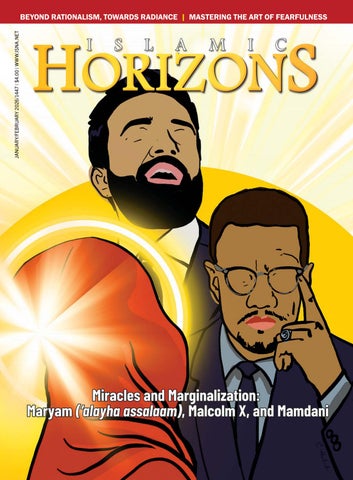
MARGINALIZATION AND MIRACLES Maryam (‘alayha assalaam), Malcolm, and Mamdani
A
BY JIMMY E. JONES
s a Muslim American of African descent who was born in 1946 in the segregated city of Baltimore, Md., these words of God from surah Ash-Sharh: “Have We not uplifted your heart for you,” (Quran 94:1) resonate greatly with me. Discriminatory federal housing policy, legally segregated schools, and other disadvantages meant that the odds for success in this life were heavily stacked against me and other Baltimore blacks from the moment of our births. Consequently, almost 80 years ago, I was born into a community that was challenged by severe poverty, debilitating drug abuse, and stifling crime. It is not surprising, therefore, that of the five males born into the Jones family, four of us ended up doing some prison time. It is only through the Mercy of God that I was never incarcerated as part of what is now known as the school to prison pipeline. Even in current post civil rights era Baltimore, the statistics tell a similar story. A report on Baltimore City published by the Vera Institute of Justice in October 2024 stated: “The gap between incarceration rates for Black and white people has narrowed in recent years. However, people of color — and Black people in particular — are still incarcerated at strikingly higher rates than white people in jails and prisons across the country.” Black people are treated more harshly than white people at every stage of the criminal legal process, causing disproportionate harm to their communities. The report further states that as of 2022, 90% of people incarcerated in Baltimore City were Black/African American even though they account for only 60% of the total city population. In short, when it comes to the jailing of African Americans in Baltimore: “The more things change, the more things remain the same.” 14
Police and Race in America
In the almost 80 years since I was born, there’s no doubt that there has been racial social and economic progress in Baltimore, and throughout the entire country. Nevertheless, people who look like me still feel a tinge of fear when a police cruiser ends up behind us in traffic. The lights do not have to be flashing and the sirens do not have to be blaring. I and others who look like me are always fearful that something unpleasant could happen during any encounter with a police officer. This issue is exacerbated by the current reality of living with a U.S. president who seems intent on dividing Americans by demonizing, among others, Black people, brown people, and Muslims. In 2025, I feel marginalized as both a person of color and a Muslim. This may sound strange coming from an old guy who, despite the odds, has become much more socially and economically successful than his mother or father could ever imagine. God has truly “uplifted my heart” by allowing me to get an advanced degree, become a tenured college professor, and be chosen as one of the leaders of a world class Islamic graduate school. Nevertheless, it seems that this country has not gotten over the idea enshrined in the United States Constitution that each of my enslaved fore-parents counted as “three fifths” of free white people (U.S. Constitution Article 1, Section 2, Clause 3). In my view, the African American is still struggling to be accepted as a full human being — one with the same rights and respect due others. This may seem like a very bleak picture. However, there’s one thing that gives me radical hope — God’s use of marginalized people.
Leadership across Generations
During a Quranic reflection in an Islamic Seminary of America course entitled “Islam in America,” Prof. Hamza Abdul-Malik, founder of Miraaj Academy, stated something
ISLAMIC HORIZONS JANUARY/FEBRUARY 2026
to the effect that “it is a Sunnah of Allah to often choose the marginalized for leadership.” His statement was an “ah ha moment” for me because I had never thought of the leaders that God discusses in the Quran in quite that way. From Abraham (‘alayhi assalam) to Muhammad (salla Allahu ‘alayhi wa sallam), we see moral exemplars who were pushed to the fringes of their respective societies even before they became known as leaders. This new understanding has caused me to reflect deeply on how God has miraculously used the marginalized as leaders in the distant past, the recent past, and in current events. To illustrate this important point, I look to the examples of Maryam (‘alayha assalaam), the mother of Isa (‘alayhi assalam) from the distant past, Malcolm X from the recent past, and Zohran Mamdani from current events. ❶ Maryam (‘alayha assalaam) from “Shonda” to Standard “Shonda” is the relatively modern Yiddish term that comes to mind when I read the following Quranic 3:27 and 28 from Surah Maryam: “Then she returned to her people, carrying him. They said in shock, ‘O Mary! You have certainly done a horrible thing! O, sister of Aaron! Your father was not an indecent man, nor was your mother unchaste.’” Had this event regarding the miraculous birth of Isa (Jesus) occurred in 2025, the
From Abraham (‘alayhi assalam) to Muhammad (salla Allahu ‘alayhi wa sallam), we see moral exemplars who were pushed to the fringes of their respective societies even before they became known as leaders. members of this young girl’s Jewish community would call it a ”Shonda” meaning a scandal. Here was a young girl from a marginalized community showing up with a baby without a legally identifiable father. Because of the patriarchal context of the times, young Maryam was further marginalized as a female. Yet, despite this double marginalization, God said the following about her in 3:42: “And ‘remember’ when the angels said, “O Mary! Surely God has selected you, purified you, and chosen you over all women of the world.” A human being cannot be raised higher in esteem than to be chosen by the Creator as being “above the women of the world.” Further evidence of this “chosen-ness” is the fact that she is the only woman mentioned by name in the Quran with her name appearing explicitly more than 30 times including the Surah named after her. Instead of being
remembered as a Shonda, she is now seen as a standard of virtue and piety for at least half the world through her veneration in both Christianity and Islam. ❷ Malcolm X — from “Satan” to Strategist. In Chapter 10 of his iconic autobiography, The Autobiography of Malcom X, Malcolm X (El-Hajj Malik el-Shabazz) describes undergoing a profound intellectual transformation in a Massachusetts state penal institution. He went from being an angry short-tempered “Satan” who ended up in solitary confinement for extended periods of time, to a self-taught bibliophile who grew to love the intellectually stimulating world of ideas. It was at this point of his life that he was also introduced to the theologically unorthodox Nation of Islam, a social cultural religious movement dedicated to “freedom, justice and equality” for black people. As a result of these two major life changes, Malcolm
X went on to be a world-renowned spokesperson for revolutionary black nationalism. Despite the racism, drug addiction, and criminality that had “weighed so heavily on his back,” he was ultimately raised to high esteem worldwide. One thing that his autobiography made clear was that he was blessed with the ability to read human beings from an early age. These keen observational skills coupled with his intellectual acuity and fiery nature combined to make a powerful voice to be reckoned with during the revolutionary social movements of the 1960’s. He ultimately died as a global human rights advocate preaching against racism and pushing for the U.S. to be held to account for its crimes against Black people. He was assassinated after becoming a Sunni Muslim pushing strategically more broadly for human rights around the world: “I’m for truth, no matter who tells it. I’m for justice, no matter who it is for or against. I’m a human being, first and foremost, and as such I’m for whoever and whatever benefits humanity as a whole.” ❸ Zohran Mamdani — from South Asian immigrant to Supercity Mayor. It may seem odd that I would place young Shiite Muslim Zohran Kwame Mamdani on the same list with Maryam, mother of Isa (Jesus), and the martyred Malcolm X. After all, at the tender age of 34, he has hardly had time to make the world changing impact of the other two leaders. However, we should not forget two things in this regard. First, Maryam was very young herself (likely a teenager) when Isa was born while Malcolm X was only 39 when he was assassinated. As an unapologetic Muslim who did not back down in his support of the Genocidestricken Gazans, some are already calling his election as New York city mayor a “Mamdani miracle” because of his improbable rise from the South Asian immigrant community to being the mayor of New York, a so-called “super city.” I am still reserving judgement on the “Mamdani miracle.” But as God says: “By the ‘passage of ’ time! Surely humanity is in ‘grave’ loss, except those who have faith, do good, and urge each other to the truth, and urge each other to perseverance” (103:1-3 ). It remains to be seen if Mamdani can live up to these principles expressed in the Quran and in the impactful lives of Maryam (‘alayha assalaam), and El Hajj Malik el-Shabazz. ih Jimmy E. Jones DMin., is Professor of Comparative Religion and Culture at The Islamic Seminary of America.
JANUARY/FEBRUARY 2026 ISLAMIC HORIZONS
15
SEERAH
The Age of Plurality
Reflecting on the Prophet’s Legacy as a Tool for Coexistence BY MOHAMMAD AHMADULLAH SIDDIQI AND MUFTI ABDUL KADIR BARKATULLA
T
he Quran (21:107) describes Prophet Muhammad (salla Allahu ‘alayhi wa sallam) as “a mercy for all the worlds.” His compassion was not confined to Muslims, but extended to Jews, Christians, pagans, and even animals and the natural environment. Some look at Prophet Muhammad’s life only in celebratory terms, neglecting to go beyond and reflect on how his life can provide a pathway to living in plural societies all over the world. In contemporary social and political settings, this means Muslims should embody universal ethical concerns transcending religious boundaries. In short, there is a need to move beyond the narrative description of his life and move to an analytical approach of its meaning in the modern world. We face many challenges in our society including false claims, environmental crises, and issues related to gender justice. Prophet Muhammad’s approach to false claims was to ground people in clarity of the revelation while acknowledging human diversity as the divine will of God (11:118-119). His teachings on our stewardship of the earth and preservation of its resources likewise remain urgent. His respect for women’s dignity and communal roles in the context of a deeply misogynistic society should be revisited without cultural distortions. The Prophet declared, “Help your brother whether he is an oppressor or oppressed” (Sahih Al-Bukhari 2444). In this hadith, he recognizes the importance of justice even for sworn enemies. For instance, the Quraysh entrusted their valuables to him despite their hostility to the young Muslim community in Mecca. Today, ethical consistency in politics, economics, and social justice resonates more than slogans of faith. The Prophet also stressed that all human beings are equal regardless of race, ethnicity, nationality, as noted in the Quran (49:13). Beyond these superficial aspects of human identity, the most honorable in the sight of God is the one who is most God-conscious. This lesson speaks directly to contemporary issues of racism, nationalism, and identity 16
politics. The Prophet’s humility — living simply, comforting the poor, and serving in his own household — models a spirituality that resists modern consumerist excesses.
The Constitution of Medina
Within a few months of settling down in Medina, the Prophet sat down with the leaders of all faiths who resided in that oasis city, and they signed what has come to be known as the Constitution of Medina. This treaty was a pioneering model of civic pluralism, granting equal citizenship to Jews, Christians, pagans, and Muslims while ensuring mutual protection and an equal share of justice in legal disputes. The document predates modern constitutionalism by many centuries ensuring that religious identity for all remains intact while the civic space in the community is shared equally. The Constitution of Medina also shows that Islamic leadership valued coexistence not assimilation. In the process of developing this treaty, Prophet Muhammad practiced the Quranic directives that, “Good deeds and evil deeds cannot be the same. Return the evil deeds of others with your good deeds, then your enemies will become your trusted friends” (41:34). Instead of living in fear or practicing retaliatory justice, Muslims were required to be generous and kind toward their neighbors regardless of their behavior. Seeking alliances to create a peaceful environment for everyone today is the call of our time. Some of the core principles highlighted in the Constitution of Medina include the following: Unity of the Community (Ummah Wāhidah). All inhabitants — Muslims (both immigrants of Mecca and local Muslims of Medina), Jews, and other tribes — were bound into one political community (ummah), while each group was permitted to maintain its own distinct religion and identity. Religious Freedom and Autonomy. Jews and other non-Muslims were explicitly granted freedom of religion and retained autonomy in their internal affairs (including local laws, rituals, and communal leadership).
ISLAMIC HORIZONS JANUARY/FEBRUARY 2026
Collective Security and Defense. All groups pledged to defend Medina collectively against external threats. No party was to support an enemy against the community.
The Rule of Justice. Justice was to be administered impartially irrespective of tribe or religion. Wrongdoing, treachery, or oppression would not be tolerated, even if by one’s own group. Mutual Responsibility and Welfare. Each clan bore responsibility for its members’ welfare (e.g., blood money, ransom), but cooperation across groups was mandated. The vulnerable and oppressed were to be protected by all groups within the city collectively. Leadership and Dispute Resolution.
Prophet Muhammad was recognized as the final authority in resolving disputes, but not in a way that abolished other groups’ selfrule. This ensured a balance between shared political unity and respect for diversity. For Muslims living outside predominantly Muslim societies, the Constitution of Medina underlines the principle of “pluralism with shared citizenship,” meaning different faiths can live under one civic framework without erasing identities. It also
Muslim (98) — the Prophet summarized Islam’s approach to people’s rights and obligations. This sermon is also known as the Universal Declaration of Human Rights and Obligations in most popular biographies of Prophet Muhammad. In it, the Prophet emphasized the sanctity of life, property, human dignity, and the equality of races and people. He recognized the rights of the weak and vulnerable and forbade economic abuses and injustice of all varieties .
For Muslims living outside predominantly Muslim societies, the Constitution of Medina underlines the principle of “pluralism with shared citizenship,” meaning different faiths can live under one civic framework without erasing identities. emphasizes religious freedom, highlighting the fact that protection of minority rights is a Prophetic precedent, not a modern concession. Further, it elaborates the concept of collective security, meaning that cooperation for the common good transcends sectarian or ethnic lines. And finally, it reminds us that justice is a universal value, one that requires equal treatment before law.
Valuing the Rights of Others
The way Prophet Muhammad engaged with the Christian delegation of Najran, a region near Yemen in the southern part of the Arabian Peninsula, is also a good example of dialogue and dawah. He allowed the Christians to perform their own prayers within his mosque. He never dismissed sincere religious inquiries but engaged them with wisdom (hikmah) and sincere l preaching (maw‘idhah hasanah — 16:125). The Prophet’s example shows how one can maintain conviction while sincerely respecting the beliefs of others. After three days of dialogue, the Christian delegation requested that they no longer continue with the dialogue, nor could they accept Islam. The Prophet not only let them go but gave them written approval to live in their communities in peace and follow their own religious traditions. Following these examples, the Prophet’s life shows us a timeless model for governance in diverse societies. In his farewell sermon — mentioned in most Hadith collections such as Sahih al-Bukhari (1623, 1626, 6361), and Sahih
It was during this sermon that the Prophet received the divine decree that God has completed His religion in Islam and made it the final religion for humankind (5:3). At this point in his life, the divine testimony that gave the Prophet his unique mission was accomplished (110). The Constitution of Medina remained mostly unnoticed throughout history in the books of Islamic jurisprudence as well in the Prophet’s biographies. Islam became a global superpower so quickly that most scholars did not feel the need to develop a jurisprudence for minorities (Fiqhul Aqalliyaat) for non-Muslims living in Muslim societies, or for Muslims living in predominantly non-Muslim societies. Most literature about the political theories of Islam perceive Muslims as a dominating force. However, now that a substantial number of Muslims live outside the Muslim world, there is a need to seek guidance from the Quran and the life of our beloved Prophet Muhammad to develop a better understanding of our role as Muslims who the Quran describes as the best of people (Khaire Ummah) (3:110). Muslims should reorient themselves with inclusiveness instead of exclusivity, engagement instead of dominance, and with being kind and merciful instead of harsh and rude. ih Ahmadullah Siddiqi, Ph.D., is Professor Emeritus of Journalism and Public Relations at Western Illinois University. This article was completed with input from Mufti Abdul Kadir Barkatulla, a Sharia scholar, London, UK.
JANUARY/FEBRUARY 2026 ISLAMIC HORIZONS
17
SEERAH
Beyond Rationalism, Towards Radiance The Prophet (salla Allahu ‘alyahi wa sallam) Lifts the Veil to Provide a Bridge to Our Total Self (Khudi)
T
BY RASHEED RABBI
he thunderclap of poet-philosopher Allama Mohammad Iqbal (d. 1938) — who famously declared “You can deny God, but you cannot deny Muhammad” — confronts the polite evasions of modern skepticism (Annemarie Schimmel, Islam: An Introduction, 1992, State University of New York Press). His stirring couplet is not a theological puzzle, but rather an open challenge to hidden doubters who indulge in “rationalism” while ignoring the pulse of their own jugular vein (Quran 50:16), forgetting that the very breath they weaponize against belief was loaned to them in the first place (15:29). Iqbal’s paradox of denial is not to dismiss God but to expose the skeptic veil that obscures the indelible presence of the Prophet (salla Allahu ‘alyahi wa sallam) as the epitome of God’s embodiment and the sole entry way for us to make the Divine experiential. God is al-Ghayb — beyond sight, sound, and shape. “He arranges every matter from the heaven to the earth” (32:5) and communicates “from behind a veil” (42:51). This veil shields humanity from direct exposure to the Divine essence, which is beyond human capacity for engagement. Yet human reason falters before this curtain. Philosophy, materialism, and atheism attempt to strip away Divinity and reduce God’s presence to what can be measured. But God cannot be domesticated by instruments of human perception. To rescue humanity from this fallibility, Prophet Muhammad (salla Allahu ‘alyahi wa sallam) was sent to sustain the Divine without a veil. God placed His Messenger as both the perfect receptacle and as a radiant exemplar. Every utterance of the shahada bears witnesses to this dual dimension of faith: first to the unseen Divine, then to His embodied manifestation in Muhammad. Without the second testimony joined to the first, the abyss between infinite reality above and finite existence below would remain unbridgeable. To bridge the two modes of faith, Iqbal presents the prophet as a Barzakhk — the threshold for realizing true human potential beyond the limits of rationalism, availing the full potential the self (Khudi).
The Prophet: Barzakh between Divine and Human, Transcendence and Immanence
Iqbal noted that we seldom perceive the Prophet as Barzakh — the axis between the Absolute and the contingent, heaven and earth, transcendence and immanence. Through him, the Word of God descended to humanity, transfiguring it into law, ethics, art, and community. Like Barzakh, the Prophet mediates the “veil” and unites both realms without dissolving. He divides without severing — a chosen way to make the invisible God experiential. Iqbal’s ecstatic devotion found expression when he beheld the Prophet’s cloak (Khirqai Sharīf) in the Khirqa Sharif Shrine (Mosque of the Cloak) in Kandahar, Afghanistan, in 1936: The coat of the “Barzakh which two cannot transgress” I saw it in the light of the hadith “I have two coats” 18
ISLAMIC HORIZONS JANUARY/FEBRUARY 2026
Mohammad Iqbal
To see him, is our heavenly night journey His religion and his ritual are the commentary of the universe, On his forehead the destiny of all things is written. The Prophet’s dual nature (having two coats), night journey, rituals, and even his very being serve as the bridge that translates transcendence into lived reality. Ibn ‘Arabī, like many past scholars, also intensifies this vision: He is the boundary (barzakh) between the necessity and contingency, and the dividing line (al-hadd al-fāsil) between determination (ta‘ayyun) and non-determination (lā ta‘ayyun), constraint (taqayyud) and absoluteness (itlāq) (Mu’ayyid al-Dīn al-Jandī, Sharh Fusūs al-hikam; 1982:64). To take the Prophet as Barzakh is to shift perspective: from seeing him merely as bearer of the Divine Word to recognizing him as cosmic interpreter, one who discloses the truth of existence itself. He is the manifested form of God’s selfknowledge — the living threshold, where Divine and human meet without confusion or separation. In this recognition, we learn that the Divine is not inaccessible, nor the human incapable. It is a perception that rationalism cannot define. Such a vision moves us from the partial to the total, from veiled perception to unveiled reality. This shift is sustained only when we accept the Prophet as the Perfect Human prototype for integrated receptivity to the Divine.
The Prophet: A Perfect Human Prototype
The notion of “prototype” recalls Adam (‘alayhi as salaam), yet as children of Adam we find our primordial father too distant to provide ongoing spiritual direction or orientation. The Prophet completes the viceregal link between the Divine and the earthly. As God says, “Today We have perfected for you your religion” (5:5), demonstrating that revelation ended with Muhammad, who stands as the symbol of perfection. Iqbal expressed this conviction in Rumuz-i-Bekhudi (“The Secrets of Selflessness,” 1918): Now God has completed for us the Divine law And completed prophethood for our Prophet Now the office of the cup bearer is given to us He gave us the last goblet He had.
Denying this walking Quran dismisses the visible aspect of God’s activity, the embodied manifestation of Divine guidance. God cannot be seen, but the Prophet is visible and palpable. He exists as an undeniable historical, spiritual, and civilizational presence, connecting humanity to the Divine without veil. As Iqbal writes in Payam-i Mashriq (“Message from the East,” 1923): O Messenger of God, with God I speak through veils, with you openly He is my hidden one, you are my evident one.
Imitate, Don’t Speculate — “What Would Muhammad Do?”
Iqbal’s veils symbolize the limits of human reason and the mystery of the Divine. The presence of the Prophet removes that limitation and reverberates eternally through civilization and the human spirit, shaping the very foundation of humanity’s unveiling of the Divine. For this reason, Iqbal The Prophet’s human and earthly bindings may urges us not to speculate about him, but to imitate him. seem complex, uneven, and less immediately This is not merely spiritual imitation like idealized than figures like Christ or Buddha ... Christians’ “What would Jesus do?” Unlike Jesus (‘alayhi as salam), Muhammad lived Yet this is precisely the unique aspect of Islam: through the full spectrum of human experithe Prophet embodies both divine contemplation ence. Muslims do not wonder “What would Muhammad (salla Allahu ‘alyahi wa sallam) and human combativeness, both spiritual do?” We know what he did with remarkable precision, even in the simplest acts of transcendence and practical construction. daily life. The tenderness of his smile is preserved to Iqbal saw the Prophet as the highest realization of human humble us. The simplicity of his meals is recorded to teach restraint. potential — the Perfect Man (Insān al-Kāmil), and the human The firmness of his justice is archived to inspire courage. The depth who reached the highest station of selfhood (Khudi). This is the of his worship is described in detail to compel surrender. We know station where heaven bends toward earth and earth rises toward how he treated the orphan, forgave his enemies, wept in prayer, and heaven. Life itself becomes a radiant passage through which the lifted the downtrodden with mercy. Infinite touches the finite, and the finite is lifted into the Infinite. The Prophet’s human and earthly bindings may seem complex, The Prophet serves as a prototype of life that corresponds to a uneven, and less immediately idealized than figures like Christ or mirror in which the Divine gazes upon creation, and creation gazes Buddha, whose perfections appear more accessible to Western upon the Divine. We witness our finite human self not crushed by imagination. Yet this is precisely the unique aspect of Islam: the God’s infinity but perfected through God’s nearness. Disregarding Prophet embodies both divine contemplation and human combatthis prophetic potential is denial of the possibility of human great- iveness, both spiritual transcendence and practical construction. He ness itself. Thus, when Iqbal says you cannot deny the Prophet, he is not a figure removed from the grit of life but one who sanctifies means that we cannot disregard the reality of human perfection it, transforming every act—whether prayer, governance, or comor the path that leads to it. passion—into a bridge between heaven and earth. God promises to preserve them: “Indeed, it is We who sent down “Only a man like you” (18:110), yet the Prophet absolves abstraction and lives among us as a reality. While God has “surely set forth the Reminder, and indeed, We will guard it” (9:15). For over 15 centuin this Quran every kind of parables for people” (18:54), Prophetic ries, the traces of his footsteps have been intact. Every gesture, every tradition translates them into simple, living human contexts. God’s word, every breath of his blessed life has been safeguarded — woven words are alive in him. Instead of confined in ink on parchment, the into chains of narration that stand unbroken and testify to their truth. Quran breathes through his deeds, his words, his compassion, his Thus, the example of Prophet is a timeless one, guiding humanity struggle to eliminate the divine veil. Hence, Iqbal fuses scripture, with clarity and strength. A person may veil the mind from the belief, and love into the figure of the Prophet: thought of God, but no one can erase the undeniable presence of “He is my Quran, He is my faith, Muhammad. He is the Barzakh — the living bridge between God He is my soul and heart—He is my Prophet” and humanity; the Perfect Man — the highest realization of human (Zabūr-i ‘Ajam — Persian Psalms). potential; and the path to Khudi—the self-made complete through This is not exaggeration. It echoes the Quran’s own descrip- closeness to God. In him, rationalism recedes, and radiance rises, tion: “Nor does he speak from [his own] desire. It is nothing but the Divine and the human converge, and true human greatness a revelation revealed” (53:3–4). The Prophet is not separate from becomes possible. ih revelation; he is its embodiment — the Quran walking upon the Rasheed Rabbi, (DMin, Boston University, MA, ’16, Hartford International University) is the community, earth, as described in the hadīth narrated by ‘Ā’ishah (radi Allahu prison, and hospital chaplain at NOVA. He is the founder of e-Dawah and Secretary of the Association ‘anha) (Muslim, Sahīh Muslim 746). of Muslim Scientists, Engineers and Technology Professionals. JANUARY/FEBRUARY 2026 ISLAMIC HORIZONS
19
EDUCATION
ChatGPT Did My Homework — Now What? Contending with AI in the Contemporary Classroom BY RAUDAH YUNUS
W
e are living in a moment of educational upheaval. Across schools and universities, students are increasingly turning to advanced Artificial Intelligence (AI) tools including ChatGPT, Grammarly, and AI-powered tutoring apps that analyze textbook problems and generate step-by-step solutions. According to a report by Education Week, approximately 85% of high school and college students, along with their teachers, reported using AI in their learning or teaching workflows (Jennifer Vilcarino and Lauraine Langreo, “Rising Use of AI in Schools Comes With Big Downsides for Students,” Education Week, Oct. 8 2025). These tools are no longer experiments on the fringes of education; they are deeply embedded in how assignments are completed and how ideas are generated. At the same time, many educators are reacting to this shift with uncertainty and even resistance. Teachers often view student use of AI as a shortcut — something that undermines genuine effort, sincere creativity, and honest learning. But this tension between skepticism and opportunity suggests that we’ve tapped into something larger: the fact that AI is transforming how we think about knowledge itself. The key question is no longer whether students will use AI, but how they can use it responsibly and intelligently.
How Teachers View AI
There are several reasons why teachers tend to view student AI use with some amount of misgiving. One major factor is unfamiliarity. Teachers today never used generative AI in their childhood years, and they are suddenly faced with technologies that can instantly produce essays, code, or analyses that once took hours to create. A 2024 study found 20
that while over 80% of U.S. educators have begun using used AI in their classrooms, only a small fraction felt confident enough to guide students on how to use it appropriately (Grant Policar, “84% of U.S. Educators Actively Use AI In The Classroom,” Study. com, 2024). This generational and technological gap makes it difficult for teachers to feel comfortable in setting rules and boundaries. Another reason lies in the association between AI and academic dishonesty. Many educators equate the use of AI with cheating, arguing that if an algorithm writes part of an essay or generates an entire report, the work no longer reflects the student’s actual ability. It raises valid concerns about authorship, effort, and fairness in grading. Teachers want to assess a student’s analytical and creative capacity, something that they fear AI might obscure or replace. Beyond this, there is a growing concern that heavy reliance on AI could dull students’ intellectual abilities. When a student can simply ask ChatGPT to summarize an article or compose a thesis paragraph, what happens to the mental process of struggling, researching, and forming original thoughts? Empirical research supports some of these fears. A 2024
study found that students who used generative AI tools in coursework scored an average of 6.7 points lower on exams than those who did not (Janik Oke Wecks at al, “Generative AI Usage and Exam Performance,” Nov. 2024) The researchers suggested that dependence on AI can interfere with deep learning and cognitive retention. A separate qualitative study among teachers revealed additional concerns. Many educators reported that AI, while promising for efficiency and personalization, also disrupted teacher-student relationships and created uncertainty about the authenticity of student work. In other words, teachers worry that AI may not only hinder learning but also erode trust — the invisible glue that holds education together.
AI Is Here to Stay
Despite legitimate worries, one fact is undeniable: AI is not going anywhere. The
When it comes to students learning to use AI responsibly, schools must take the lead. Institutions need to establish policies and practices that neither glorify nor demonize AI but present it as a tool that demands critical engagement.
ISLAMIC HORIZONS JANUARY/FEBRUARY 2026
technology is evolving at an unprecedented pace and will only become more deeply integrated into daily life for everyone, including in the education sector. According to a 2025 report by the Walton Family Foundation, 60% of U.S. K-12 public school teachers reported using AI tools, with about onethird using them weekly (“Teaching for Tomorrow: How Supporting Teachers Today Shapes Classrooms Tomorrow,” Walton Foundation, 2025). The global AI-ineducation market continues to grow rapidly and is expected to surpass billions of dollars in value by the end of the decade. This compels us to pause, and rethink whether banning AI or treating it as an academic threat is either realistic or productive. Instead of fighting against the tide, schools and educators need to focus on teaching students to use these tools constructively. The issue isn’t whether AI should exist in school settings — it already does — but how to channel it toward fulfilling the objectives and purposes of education.
Using AI to Students’ Advantage
Figuring out how to use AI wisely is tricky. Around the world, teachers, researchers, and developers are experimenting with approaches that turn AI from a crutch into a catalyst for learning. One clear guideline that has emerged is to use AI as a thinking partner, not a ghostwriter. For instance, ChatGPT’s “Study Mode” feature encourages Socratic-style questioning, prompting
students to engage in reasoning rather than passively receiving answers. This kind of AI use stimulates rather than replaces thought. Students can also benefit from using AI as a tool for exploration and synthesis rather than simple fact-finding. For example, instead of asking AI for ready-made summaries, students can request comparisons between opposing viewpoints or simulations of how ideas might apply in different contexts. This transforms AI from a shortcut into an amplifier of critical thinking. Equally important is learning how to identify reliable and evidence-based information. AI systems can generate errors or misleading claims with confidence, so students must be trained to verify AI-generated content using traditional reputable sources. The habit of cross-checking what AI provides is part of digital literacy - a skill just as essential as reading and writing in the modern age. Furthermore, AI can be a valuable brainstorming companion. Students can use it to develop outlines, generate creative prompts, or test early versions of their arguments. However, they should still take ownership of refining, analyzing, and contextualizing the ideas. This ensures that AI serves as a springboard for originality rather than a replacement for it. Transparency matters. When students use AI for any part of their work, they should clearly disclose it. A short note such as “AI was used to generate an outline, but all analysis and editing were done by the student” promotes honesty and accountability. This not only helps teachers understand the process behind the work but also encourages students to reflect on the role AI played in their thinking. More importantly, it restores trust between teachers and students and prevents teachers from guessing whether or not the students’ work is original.
Teachers Use AI Too
It is easy to frame the AI-in-education debate as “students versus teachers,” but in reality, both groups use these technologies. Many teachers now rely on AI to streamline lesson planning, generate quizzes, draft rubrics, and even help with grading. According to a recent poll, teachers who used AI weekly saved an average of 5.9 hours per week (“The AI Dividend: New Survey Shows AI Is Helping Teachers Reclaim Valuable Time,” Walton Foundation, June 25, 2025). Those hours can then be redirected toward
mentorship, feedback, and pastoral care for students. This increasing use of AI among educators reveals an important truth: AI is not just a student tool; it’s part of the professional toolkit for modern teaching too. Teachers are using AI to think more efficiently, manage workloads, and create better resources. That makes it even more important for them to model responsible use. When teachers openly demonstrate how AI can assist — but not replace — human judgment and creativity, students learn by example. The message becomes clear: AI is helpful when used thoughtfully but harmful when used to find shortcuts and avoid thinking.
Schools’ Critical Role
When it comes to students learning to use AI responsibly, schools must take the lead. Institutions need to establish policies and practices that neither glorify nor demonize AI but present it as a tool that demands critical engagement. This begins with setting clear and transparent guidelines. Schools should specify what forms of AI use are acceptable in different types of assignments. For instance, it might be fine for students to use AI to brainstorm essay ideas or check grammar, but not to generate entire research papers. Next, schools must provide targeted training for both teachers and students. Educators need to feel confident using AI tools and guiding students through them. On the other hand, students should be equipped with techniques of using AI the right way, and be made aware of its limitations, constraints, and common mistakes due to the bias in training data. A recent survey showed that until early 2025, only about 43% of school districts in the U.S. offered at least one formal AI training for teachers (“Majority of K-12 Teachers Still Lack AI Training, Survey Finds,” MGT, April 21, 2025). Transparency should also be institutionalized. Students can be required to include a short AI-use statement in major projects, explaining what tool was used and for what purposes. This kind of documentation normalizes responsible use and fosters a culture of honesty. At the same time, schools should define consequences for misuse — not to punish curiosity, but to promote accountability. A first offense might lead to revision with feedback, while repeated offenses could involve academic penalties.
JANUARY/FEBRUARY 2026 ISLAMIC HORIZONS
21
EDUCATION Adapting and Relevantizing AI in Muslim Education
Islam does not harbor a negative attitude toward technology or new discoveries. Rather, it emphasizes the adoption of technology and discovery as a tool to attain spiritual growth, well-being, and success. This means ethical stewardship of AI which includes manipulating it the right way for the right reason and minimizing its harm. Harms of AI abuse can be spiritual, psychological, intellectual, and environmental. Given its unlimited potential, AI offers opportunities Islamic schools can leverage to optimize student learning experiences. As such, there are different ways AI can be integrated into teaching and learning. First, Muslim students can be taught to think about new and emerging technologies using the Islamic lens. Here, they can be challenged with epistemological questions, such as how do we know what we know, is there a more ‘right’ way of knowing, and how do we classify and prioritize sources of knowledge. This will train their minds to approach anything new or unfamiliar with the right thought framework and attitude. Second, Muslim students can be equipped with the right skills and techniques to use and experiment with AI applications in a safe and supervised setting. Here, the goal is to instill critical thinking and curiosity as to how the technology works, its biases and limitations, and how different methods can generate different output. Comparison and contrast, followed by guided reflections, can cultivate intentional AI use that is aligned with Islamic values and higher goals. Last but equally important, Muslim students can be taught to leverage AI for the greater good. Consuming AI the right way is not sufficient; it is time that our youth aspire to become knowledge producers and not merely consumers. If AI is opening up endless possibilities to create, re-create and innovate, it also means there are infinite options for merit-making and doing good for Allah’s sake.
A Journey of Tajdīd, Reflection Association of Islamic School
Recap of the Global Association of Islamic Sch BY AHMED A MAHOMEDY
What to Do
Ultimately, the goal of incorporating AI in our education setting is to cultivate a culture of balance and critical awareness. Students and teachers should see AI not as an enemy of learning or as an easy way out but as a powerful assistant that can augment their own intelligence. By embracing AI with moderation and insight, schools can help shape a generation that uses technology with wisdom instead of dependence. The lines between “shortcut” and “smart use” will always blur, but that’s where education has its greatest role: in helping students learn to navigate those gray areas with integrity and discernment. If teachers and schools can guide students toward responsible AI use, they will not only safeguard academic integrity but also prepare students for a world in which AI is omnipresent. Education, after all, has never been about memorizing facts; it’s about knowing how to think. And thinking, even in the age of AI, is something that no algorithm can ever replace. ih Raudah M.Yunus is a researcher, writer, and an educator currently based in the United States.
22
ISLAMIC HORIZONS JANUARY/FEBRUARY 2026
O
n Oct. 5-8, 2025, the Global Association of Islamic Schools (GAIS) held its fourth Annual Conference in Colombo, Sri Lanka under the theme of “Tajdīd” (Renewal). The atmosphere was vibrant with over 350 delegates from 27 countries coming together. Each delegate brought unique experiences and perspectives. The conference carried a powerful message of revival, reflection, and purposeful growth. It reminded attendees of the constant need to revive and rejuvenate their practices in Islamic education. Day one began with salaat al-fajr, followed by a spiritually uplifting khatirah by Mufti M.I.M. Rizwe, the president of the All Ceylon Jamiyyathul Ulama and a respected Sri Lankan scholar. The conference officially commenced with a keynote address by Prof. Mohamed Abdalla, the founding director of Centre for Islamic Thought and Education at the University of South Australia. His presentation, titled “From Inspiration to Transformation: Reviving Tajdīd in Islamic Schools in the West,” left a lasting impact through its depth and clarity. He reminded attendees that true renewal begins within, through sincerity, self-reflection, and a drive for meaningful change.
n, and Renewal: The Global ls Conference for 2025
hools Conference for 2025
Imam Safi Khan, founder and Imam of Dar-us-Salaam and Al-Huda School in College Park, Md. and Haroon Baqai, principal of Al-Huda Global School presented FAITH Publications curriculum, an educational system offering a revolutionary approach to teaching Aqeedah and Fiqh through the lens of mental and emotional wellness. That evening, delegates gathered for a gala dinner which highlighted the objectives and vision of GAIS in 2025. The evening was warm and engaging filled with insightful conversation, shared laughter, and the spirit of unity.
A unique aspect of GAIS is its open-seating arrangement, where you can sit next to a renowned scholar, a school leader, or a passionate young educator, and engage in sincere conversation. This creates an atmosphere of humility, unity, and shared purpose.
A unique aspect of GAIS is its open-seating arrangement, where attendees can sit next to a renowned scholar, a school leader, or a passionate young educator and engage in sincere conversation. This creates an atmosphere of humility, unity, and shared purpose. The breakaway sessions throughout the day took advantage of that atmosphere by exploring various facets of Tajdīd and offering practical ways to apply renewal within Islamic institutions. Day two also began with fajr prayer and a khatirah, setting a spiritual tone for the day. The keynote address was presented by Abdullah Sahin, PhD, reader in Islamic Education at the Department of Education Studies at the University of Warwick in the U.K. His presentation was titled “How to Actualize Tajdīd.” He challenged us to move beyond theoretical understanding and to actualize renewal in our classrooms, leadership, and personal development. The breakaway sessions that followed were equally inspiring, led by respected scholars and educational experts who discussed Tajdīd, Tarbiyyah, Fikr, and innovative ideas in Islamic schooling. Each session offered fresh perspectives on how to nurture Deen, character, and critical thinking in our learners.
A special address was delivered by Rizvie Salih, PhD, the deputy speaker of the Parliament of Sri Lanka. He expressed his deep gratitude to GAIS for its contribution to education and its ongoing efforts to empower Islamic schools around the world. Day three focused on the strategic direction of GAIS. The GAIS Strategy Plan was presented by: Zaffar Ahmed, GAIS president and principal of Al-Falaah College, and Fahad Haroon, GAIS Vice President, Principal of Reflections School, and founding member of Burooj Institute. Their presentation outlined the association’s future vision and objectives. The day continued with insightful breakaway sessions discussing topics such as “How Islamic Is Your School?”, the framework of Tajdīd, School Accountability, and the Importance of the Arabic Language. While GAIS conferences are built around a specific theme each year, they typically go far beyond that. They unite education globally bringing together soldiers of education, individuals working tirelessly across the world to make a difference in the lives of learners. The atmosphere is one of humility, shared purpose, and hope. Participants returned home not just with knowledge and notes but with renewed hearts, inspired to implement what they have learnt, to make changes in classrooms and leadership practices, and to serve schools and learners with renewed dedication. GAIS 2025 in Sri Lanka was a reminder that education is far more than the transfer of knowledge. It is, in essence, about reviving hearts, renewing intentions, and reigniting purpose. ih Ahmed A Mahomedy is Ameer of the Johannesburg Muslim School.
JANUARY/FEBRUARY 2026 ISLAMIC HORIZONS
23
EDUCATION
Higher Education in Light of Tawhidic Epistemology Islamic Obligation in the Pursuit of Academic Knowledge BY MD MAHMUDUL HASAN
I
ntellectual practices are integral to the Islamic religion and way of life. The first revelation from God to Prophet Muhammad (salla Allahu ‘alayhi wa sallam) begins with the command to read and mentions the pen as a means to produce and distribute knowledge. Therefore, for Muslims, going to institutions of learning is not simply career preparation, it is also a religious obligation. The Prophet said, “The seeking of knowledge is obligatory for every Muslim” (Sunan Ibn Majah). However, this raises the question of which fields of study are warranted in Islam and which are deemed wasteful. Those who study religious sciences such as the Quran, Sunnah (hadith), Islamic jurisprudence, Islamic literature, and related subjects often feel connected to their religious-cultural roots and may claim to have a greater sense of belonging. Conversely, those who choose secular subjects often rooted in Western origins like anthropology, Euro-American literature, geography, history, or philosophy may be confused about the religious validity, invalidity, or value of their academic disciplines. Early Muslims distinguished disciplines inherited from pre-Islamic civilizations, such as philosophy and medicine, from Islamic religious sciences. During the precolonial period, Muslims excelled in “philosophy, astronomy, medicine, and the like” (Berkey, p. 203), but such disciplines are currently imbued with Western tenors thanks to the European colonial education strategy. Hence, these subjects are perceived by some largely as extraneous to Islam (Jonathan Berkey (2004). “Education” In Richard C. Martin (ed.). Encyclopedia of Islam and the Muslim World. Macmillan Reference USA.). In an essay titled “Islam, Coloniality, and the Pedagogy of Cognitive Liberation in Higher Education” (2025), Joseph E. B. Lumbard of Hamad Bin Khalifa University in Qatar said, “The establishment of Western educational models in most Muslim 24
countries. . . replaced the Islamic model, which is grounded in the cultivation of ethical beings” (pp. 4-5). Conversely, there has been a growth in the number of Islamic educational institutions in countries around the world including the U.S. From elementary to tertiary levels, these seats of learning cater to Muslims’ urge to be oriented in Islamic theology and sciences. While students of such institutions are thought to be grounded in the Islamic intellectual tradition, their Muslim peers who learn non-Islamic subjects like English literature might be viewed as distant from their religion. In an essay titled “English literature at English‐medium schools of Bangladesh” (Pedagogy, Culture & Society, vol. 18, no. 2, 2010), English professors Golam Gaus Al-Quaderi and Abdullah Al Mahmud contend that students of English literature in Muslim-majority Bangladesh become “culturally confused” and “unconscious agents of Western cultural imperialism” (p. 212). Although Muslim students of Islamic sciences may receive praise from fellow coreligionists, they are often perceived as out of place in a modern context. On the contrary, their peers who are oriented in Western
ISLAMIC HORIZONS JANUARY/FEBRUARY 2026
sciences may have misgivings about the validity of their pursuit of learning because Western education prevalent in Muslim nations is considered “secular” and “materialistic” (Abdullah Sahin, “Critical Issues in Islamic Education Studies: Rethinking Islamic and Western Liberal Secular Values of Education,” Religions, 2018, vol. 9, p. 3). Such confusion regarding the pursuit of education reflects the doubts and uncertainties of some Muslim learners in the modern age. In a PhD thesis titled “Faith with Doubt: American Muslims, Secularity, and the ‘Crisis of Faith’” completed at Duke University in 2017, Zaid Adhami summarizes this phenomenon: “[T]he presence of Muslim intellectuals trained in the Western academy has increasingly become part of the contentious debates over Islamic authority and authenticity. Overall, these developments have produced deeply conflicting reactions. On the one hand, a body of intellectuals, trained in the Western academy, is often looked upon with deep suspicion by those who see themselves as having been trained in more ‘traditional’ knowledge paradigms” (pp. 48-49). This dichotomous and mutually exclusive view on education is structural, not cognitive.
Another reason for this intellectual crisis among Muslim students is their unfamiliarity or lack of clarity about tawhidic epistemology which Professor Osman Bakar regards as “central” to Muslim identity. Its absence among them or lack of understanding thereof creates a crisis in educated Muslims’ relationship with their religion. In his book Islamic Civilisation and The Modern World: Thematic Essays (2014), Osman Bin Bakar, rector of International Islamic University Malaysia, said, “A tawhidic epistemology or vision of knowledge affirms the view that all true human knowledge ought to be ultimately related to the unity of God, since all things are ontologically related to their Divine Origin. Unfortunately, Muslims today no longer possess the whole of tawhidic epistemology along with its accompanying exemplary thinking culture” (p. 41). But what is tawhidic epistemology? In one of his poems, Jalaluddin Mohammad Rumi (1207–1273) said, “With two forms and with two figures but with one soul, thou and I” (Translation by A.J. Arberry, “Mystical Poems of Rumi 2”, The University of Chicago Press, 1991). He suggested human beings (or Muslims) may have different physical features or external manifestations, but all have an undifferentiated goal or purpose in life: obtaining the pleasure of God. Correlating Rumi’s analogy to tawhidic epistemology or the unity of knowledge reveals that Muslim learners may engage in different subject areas but have one goal. As long as they use their knowledge and skills for the pleasure of God in the service of fellow human beings and the environment then their scholarly endeavours and accomplishments are Islamic and will be rewarded by God. When a student learns a subject to promote good causes, protect human rights and the environment, or prevent harms and injustices, their pursuit of knowledge becomes an act of worship. For example, if a student gains skills in language and literature to challenge epistemic wrongs, their field of studies becomes Islamic and connected with the divine and has the potential to lift them to spiritual heights. Here lies the unity of knowledge which surpasses the plurality of disciplines. All branches of knowledge are geared to one common purpose. This Islamic concept of the unity of knowledge corresponds to what Professor
J. Alan Robinson states in an essay, “The Unity of Knowledge” (Syracuse University Magazine, Vol. 1, Iss. 1 [1984], Art. 7). “In [a] higher, institutional sense, knowledge is one, single whole,” he said. “Just as the universe is, by definition, the whole of reality — everything that there is — so mankind’s entire knowledge, viewed collectively rather than from wherever each of us individually happens to have taken a stand, is a unity.” The Prophet divided knowledge between
mathematics (STEM). That is conceivably the reason why such subject areas are considered secular or Western and hence some Muslim students find it hard to relate them to their religion and are not sure if learning such subjects is religiously mandated. Differing from the modern-day approach to STEM, as Bakar said, “[Early] Muslim scholars succeeded in harmonising the needs of religion with the needs of science. . . [and] were able to produce, use, and apply [science
When a student learns a subject to promote good causes, protect human rights and the environment, or prevent harms and injustices, their pursuit of knowledge becomes an act of worship … if a student gains skills in language and literature to challenge epistemic wrongs, their field of studies becomes Islamic and connected with the divine. beneficial and non-beneficial, rather than religious and non-religious. He often recited, “O God, I seek refuge with You from knowledge that is of no benefit” (Sahih Muslim, Hadith: 2722). Following in the Prophet’s footsteps, Muslims are required to seek knowledge that is beneficial for them and others and should avoid knowledge that is worthless or causes harm or leads to erroneous decisions or lifestyle choices. After learning the basics of their religion, whatever beneficial subject area they choose to study should bring them closer to God. The Quran states the responsibilities of Muslims: “You are indeed the best community that has ever been brought forth for [the good of] humankind: you enjoin the doing of what is right and forbid the doing of what is wrong, and you believe in God” (3:110). The objective of learning should be guided and driven by a desire to fulfil the responsibilities of serving humanity, promoting what is good and beneficial, preventing evils, and establishing connection with God. The Quran regards such responsibilities as a trust that human beings have undertaken and are obligated to deliver (33:72). “There is hardly any difference between [Muslims’] intellectual perspectives and the secular Western one,” Baker said regarding science, technology, engineering, and
and technology] without transgressing the moral-ethical bounds.” Conversely, soulless utilitarian approaches to STEM are often antithetical to common good and have caused the gravest offences against moral rectitude. Because of the absence of higher goals in knowledge acquisition, some Muslim practitioners and students — especially those who study non-religious subjects — are unable to establish connections between their academic work and their religion. The remedy lies in relating all knowledge to the unity of God and devoting it to servitude to Him and other good causes. That is the essence of tawhidic epistemology which has the potential to liberate especially Muslim students from uncertainties and misgivings about their programs of study. As long as the goal and purpose of knowledge seeking is the pleasure of God through righteousness, altruism, and beneficence, all branches of knowledge are good and Islamic. Thus, all academic fields are united and come under the purview of tawhidic epistemology. ih Md Mahmudul Hasan, Ph.D., is professor in the Department of English Language and Literature at the International Islamic University, Malaysia. Note: Some sections of this essay were published under the title of “The Need for Tawhidic Epistemology” (IslamiCity, April 12, 2025).
JANUARY/FEBRUARY 2026 ISLAMIC HORIZONS
25
PALESTINE
American Charities are Funding Israeli Settlers The Truth behind IRS Tax-Exempt Donations to Israel BY LUKE PETERSON
I
n August 2025, Israel approved plans for the construction of 3,400 new settler homes in East Jerusalem, Palestine. The current, right-wing Israeli government under criminally indicted Prime Minister Benjamin Netanyahu intends this plan — in keeping with the central intent of the entire Israeli settlement movement — as a project which would forever prevent a viable and contiguous Palestinian state from being founded in the West Bank. Israelis in government today publicly defend the expansion of the settlements as a method to cope with the natural increase of the settler population in the occupied Palestinian territories (a population now numbering almost a million people living in Jewish-only towns and cities). Netanyahu and his ministers intend the settler population to eventually expand to rival the indigenous Palestinian majority in the region. To recruit settlers to these communities, the Likud-headed government leverages the housing crisis within Israel proper suggesting to its citizens that a more affordable option is available to them in West Bank settlements (internationally recognized as illegal entities). Once ensconced in these Jewish-only cantons, the government offers monthly stipends and rent assistance as well. Additionally, these settlements (at least 350 of them) contain swimming pools, community centers, and large, lush, private yards, rare for homes inside of Israel. The Israeli government also provides financial assistance for settlement communities including cheap or free water, electricity, and private settler-only roads. Supplementing this state funding, though, is covert money donated by American citizens through tax-exempt, U.S. organizations officially registered as charities.
Tax-Free Ethnic Cleansing
Section 501(c)(3) of the U.S. tax code says that federal tax exemption applies to any corporation, fund, or foundation organized and operated exclusively for religious, charitable, scientific, public safety, literary, or educational purposes. As 501(c)(3) organizations like churches and charities are, therefore, not taxed. Further, every donation made to charity in the U.S. counts against that person’s overall tax bill. In other words, when charitable donations are used to support illegal Israeli settlements, the 26
U.S. government is subsidizing those donations in the form of tax credits provided to the donors. A New Lines Magazine piece titled, “A Fanatical Israeli Settlement is Funded by New York Suburbanites,” describes the Israeli settlement of Beit El, an extremist community just of the Palestinian cultural capital of Ramallah with an extensive history of violence towards Palestinian civilians. Beit El is funded nearly entirely by American charities, specifically the American Friends of Beit El group run by ultra-Zionist American Baruch Gordon (Matthew Petti. “A Fanatical Israeli Settlement Is Funded by New York Suburbanites.” Feb. 12, 2024. New Lines Magazine). But the American Friends of Beit El is hardly a unique organization. There are several dozen U.S. based charitable organizations that give money to Israeli settlement, some operating with a budget in the millions. The One Israel Fund, for example, received about $7 million in donations in 2023, a substantial increase from previous years. And while the One Israel Fund is not dedicated to sustaining one specific illegal town in occupied Palestine, other groups support a single settlement or a linked settlement bloc within the West Bank (Rachel Nelson and Matthew Petti, “U.S.-Based Charities Are Funding Israeli Settlements,” Podcast. New Lines Institute. October 16, 2025). For the American Friends of Beit El though, the faulty pretense under which they
ISLAMIC HORIZONS JANUARY/FEBRUARY 2026
send money to that settlement is the idea that they are building a religious educational facility for students to study the Torah. Beit El head Baruch Gordon also runs a separate charity called Israel Empowered. On its form 990, the document filed annually with the IRS to declare the activities of tax-exempt groups, they say their aim is to create an environment through which individuals can attain an understanding and appreciation of their Jewish heritage and identity. In fact, Gordon uses this specific charity to raise money to buy thermal drones for settlers which aids in their surveillance and torment of the indigenous Palestinians living nearby. There is little follow-up with the discrepancy in 900 filings in the U.S. though, at least in part because the current U.S. administration agrees with the colonialist goals of the settlement movement. Another more generally organized pro-Israel aid organization based in the U.S. is known as the One Israel Fund. They actually establish new settlement outposts, places euphemistically labeled as “farms,” where extremist settlers have taken over Palestinian land. The One Israel Fund sees
They obfuscate, author vague statements, or lie outright on their annual 990 filings detailing the scope of their “charitable” activities to cover up the amounts of money given to illegal Israeli settlements. This strategy makes it nearly impossible to pinpoint how much money is moving from the United States to land in illegal Israeli settlements. Clearly though, this ostensible aid activity falls outside of legal 501(c)(3) activity, which doesn’t allow any U.S.-based organization to finance illegal outposts in Israel or anywhere else. They are therefore directly responsible for fueling violence and instability in furthering the Israeli goal to annex the West Bank with as few indigenous, Palestinian inhabitants on that land as possible (Rachel Nelson and Matthew Petti, “U.S.-Based Charities Are Funding Israeli Settlements,” Podcast. New Lines Institute. October 16, 2025. https://newlinesinstitute.org/political-systems/u-s-based-charities-are-funding-israeli-settlements-podcast/).
The Impact of Christian Zionism
Pro-settler groups … operate freely as taxexempt organizations in the United States by exploiting an utter lack of IRS enforcement. They obfuscate, author vague statements, or lie outright on their annual 990 filings detailing the scope of their “charitable” activities in order to cover up the amounts of money given to illegal Israeli settlements. to it that these colonizers are supplied with paramilitary equipment like drones and all-terrain vehicles (ATVs), which have been shown by human rights organizations being used as tools for the targeting of Palestinian civilians in settler attacks. Infamous extremist Yinon Levi of the Yitzhar settlement, for instance, who recently murdered Palestinian peace activist Awdah Hathaleen in the village of Umm al-Khair, regularly used his One Israel Fund ATV to target, harass, and assault Palestinian civilians. Despite the
presence of video showing Levi shooting Hathaleen, Levi, previously sanctioned by the European Union and the Biden administration for his terrorist activities, went free after Hathaleen’s murder (Eleanor Beardsley and Nuha Musleh. “A Palestinian activist was killed by the violence he sought to stop.” August 12, 2025. NPR). Pro-settler groups like these operate freely as tax-exempt organizations in the United States by exploiting an utter lack of IRS enforcement, perhaps intentional.
The current U.S. Ambassador to Israel, Mike Huckabee, is a direct supporter of pro-settlement charities based in the U.S. This is in keeping with his position as an avowed Christian Zionist, a largely American philosophy that has deemed Israel to be the “Holy Land” that will see the Second Coming of Jesus Christ once Jews and Jews alone inhabit that territory. From this deeply flawed theological basis, Christian Zionist organizations in the U.S. send volunteers to the West Bank to help build settlements while acting as human shields for the Israeli settlement movement. Some human rights organizations even suggest that Christian Zionist pro-settlement organizations are harder to report on and often cagier in their self-declarations to the IRS. This may be a function of the fact that they are savvier to the fact that unconditional support of the Israeli settlement movement is a controversial issue in the U.S. In any case, it’s not just Jewish diaspora organizations that are offering ideological and financial support to extremist settlers. It’s also Christian Zionist groups contributing to this ongoing ethnic cleansing of Palestine.
The American Left and the Future of the Extremist Settler Movement
Among those working to arrest this disturbing trend, New York City mayor-elect
JANUARY/FEBRUARY 2026 ISLAMIC HORIZONS
27
PALESTINE Zohran Mamdani has proposed the Not on Our Dime Act. This bill would strip tax incentives away from charities that support Israeli settlements or other violations of international law. Mamdani’s motion can be seen as an extension of the former President Joe Biden administration’s sanctions on Israelis that they considered extremists in the settler movement, some of whom had a direct personal connection to American charities (Shira Li Bartov. “As NY assemblyman, Mamdani pushed bill barring nonprofits from ‘supporting Israeli settlement activity’,” Nov. 4, 2025, The Times of Israel). And officially, U.S. state and foreign policy goals have long held that Israeli settlements are in violation of international law and that the West Bank is the heartland of a future Palestinian state. During his presidency, Biden imposed sanctions on 33 individual settlers and a handful of organizations attached to these illegal outposts while also freezing millions in assets held by settler organizations. But when the Biden administration applied these sanctions, they chose to target mostly individuals for specific acts of violence. And upon ascending to his second macabre administration, Donald Trump reversed Biden’s sanctions allowing even the most violent of Israel’s extremist settler population to act with international impunity. In the future, if a U.S. presidential administration is serious about deterring settler violence and forcing a political solution in Palestine while preventing Americans from materially violating international law, they could impose sweeping sanctions that would make it very risky to fund settlements from the United States. This would require enshrining an executive order as a bill passed by Congress. If that were to happen, and sanctions were to be placed on violent settlers enshrined in permanent law, that would discourage these organizations from their continued activities which would risk U.S. sanctions and be perceived as exacerbating violence and instability in the Middle East. ih Luke Peterson is a professor of Arabic and Middle Eastern Studies based in Pittsburgh, Pennsylvania. His latest book, The U.S. Military in the Print News Media: Service and Sacrifice in Contemporary Discourse, is available in paperback from most online book sellers.
28
ISLAMIC HORIZONS
ISLAMOPHOBIA
Decolonizing the Narrative How York University’s Islamophobia Research Hub Is Rewriting the Story of Race, Power, and Belonging BY FAISAL KUTTY
Y
ork University’s Islamo phobia Research Hub (IRH; or the Hub) was formally launched last August at a moment of urgent need for rigorous, community-engaged scholarship on Islamophobia . Based at the York Centre for Asian Research in Toronto, Ont., the Hub provides an institutional home for building, mobilizing, and disseminating research that deepens the public understanding of Islamophobia, and develops real-world solutions to this
social blight rooted in academic expertise and community knowledge. Its foundational mandate is outlined on its website: Canada now records the highest number of Islamophobia-related fatalities in the G7, and the country continues to see a “disturbing upward trend in hate crimes against Muslims,” marked by everything from fatal attacks to bomb threats and daily harassment (Marie Woolf, “Canada worst in G7 for targeted killings of Muslims, MPs told,” The Globe and Mail, June 6, 2024).
The inaugural event for the IRH gathered scholars, journalists, and community organizers with keynote speaker Shree Paradkar — an investigative reporter at the Toronto Star — offering a strikingly honest and incisive reflection on Islamophobia’s colonial roots. She drew from her personal journey moving from a Singapore newsroom — a diverse, multicultural setting where Muslims were not socially or journalistically othered — to a Western newsroom, where she found Muslims repeatedly framed through suspicion, distance, or erasure.
of empathy, the same refusal to recognize the full humanity of others. While the Hub is new, its work is already shaping national discourse. Last summer, the Hub released its first major publication, “Documenting the “Palestine Exception”,” a comprehensive report analyzing how Islamophobia, anti-Arab racism, and anti-Palestinian racism intensified in Canada after Oct. 7, 2023. The report compiles interviews, organizational data, and media coverage from October 2023 through November 2024, providing a detailed picture of how individuals
By integrating decolonial analysis, communityengaged research methods, and policy relevance, the Hub is offering a model of scholarship that refuses to remain siloed. This contrast laid bare for her the extent to which Western journalistic norms continue to be shaped by colonial hierarchies, determining who is seen as fully human and who is cast as a perpetual outsider. She described how Islamophobia is sustained not only through explicit bigotry but also through “propaganda by omission” — the systematic non-coverage of Muslim perspectives within the authoritative news media . True decolonial work, she argued, requires rejecting simplistic binaries of innocence and guilt and recognizing that any community can be an oppressor or oppressed, depending on circumstance and power.
The Post 9/11 World
This assessment resonated deeply with the attendees, particularly given the broader social context in which the IRH has emerged. Islamophobia in Canada does not occur in a vacuum. As the Hub notes, its contemporary manifestations cannot be separated from “the normalization of racism and Islamophobia in the post-9/11 fabric” of political and cultural life, and the transnational circulation of Islamophobic discourses. Islamophobia has become, as many scholars now observe, the last socially acceptable form of public prejudice. Paradkar, however, cautioned against viewing this in isolation, noting that antisemitism is also resurfacing in some communities. Both forms of hatred, she argued, feed off the same failures
and organizations have experienced rising hostility, surveillance, professional repercussions, and erasure. Its findings reveal a troubling institutional pattern in which long-standing commitments to free expression, anti-racism, and human rights appear to falter when applied to Palestine. The “Palestine exception” outlined in the report illuminates how certain political topics become insulated from accountability, while the communities connected to them — especially Muslims and Arabs — become disproportionately targeted.
The IRH Team
A central part of the Hub’s strength lies in its leadership. The IRH is directed by Nadia Z. Hasan, PhD, Assistant Professor in the School of Gender, Sexuality, and Women’s Studies at York University. She is widely recognized for her scholarship and advocacy on systemic racism, Islamophobia, and the legal and administrative structures of Muslim life in Canada. Her work is deeply rooted in community organizing, and she has led multiple national advocacy campaigns challenging racism, hate, and discrimination. Under her leadership, the Hub has positioned itself not just as a research center, but as a space where scholarship and community realities inform and structure one another. Supporting Hasan is an exceptional interdisciplinary team whose expertise reflects the complexity of Islamophobia itself. York
University’s postdoctoral researchers Dr. Salmaan Khan, PhD, Maira Hassan, PhD, and Khalidah Ali, PhD, each bring distinct but interconnected areas of specialization ranging from labor inequity and political economy, to gendered racialization in Canadian courts, to the impact of Islamophobia on humanitarian aid and governance. Their work is complemented by a dedicated cohort of research assistants whose professional and academic backgrounds encompass data science, policy advocacy, refugee support, women’s studies, legal research, and anti-racist organizing. Together, this team ensures that the Hub’s work is both analytically rigorous and grounded in the lived realities of affected communities across the Canadian landscape. The Hub is further guided by a robust steering committee composed of scholars, authors, human rights advocates, and community leaders. This group provides the Hub with a wealth of expertise in politics, socio-legal studies, secularism, anti-Black Islamophobia, literature, and community organizing. Their presence signals the Hub’s commitment to multidisciplinary scholarship and its recognition that the fight against Islamophobia must operate across academic, cultural, legal, and civic spheres.
Impactful, Real-World Scholarship
What emerged clearly from the launch event was that the Islamophobia Research Hub is not merely responding to a particular political moment—it is helping define a new intellectual and community landscape. By integrating decolonial analysis, community-engaged research methods, and policy relevance, the Hub is offering a model of scholarship that refuses to remain siloed. Its work illuminates Islamophobia as a global and transnational phenomenon, while grounding solutions in local realities and community needs. As Paradkar reminded attendees, the narratives a society chooses — or chooses to ignore — shape the boundaries of its moral universe. Through its launch, its summer report, and the collective expertise of its assembled academic team, York University’s Islamophobia Research Hub has positioned itself to redraw those boundaries with clarity, compassion, and a deep commitment to justice. ih Faisal Kutty is a lawyer, law professor, and affiliate faculty member at the Rutgers University Center for Security, Race, and Rights. You can follow him on X @faisalkutty.
JANUARY/FEBRUARY 2026 ISLAMIC HORIZONS
29
INTERFAITH
The 2025 WCMIR Annual Conference How do we build a moral force strong enough to counter hatred, division, and injustice? BY ASLAM ABDULLAH
T
he World Council of Muslims for Interfaith Relations (WCMIR) convened its 2025 Annual Conference on Nov. 9, 2025, in Chicago, drawing over 100 attendees from across the United States. Scholars, clergy, civic leaders, activists, and community members gathered to address one of the most pressing questions of our era: How do we build a moral force strong enough to counter hatred, division, and injustice? The conference marked by thoughtful dialogue, spiritual grounding, and a shared sense of ethical responsibilitystood as a testament to the transformative power of interfaith cooperation.
PHOTO © ASLAM ABDULLAH
President’s Message During the opening session, Mohammad Ahmadullah Siddiqi, PhD, President of WCMIR, welcomed the attendees with a message that set the moral and intellectual tone for the day’s proceedings. His remarks carried both urgency and hope: “It is with great joy and heartfelt gratitude that I welcome you to the Annual Conference of the World Council of Muslims for Interfaith Relations. This year’s theme, ‘Challenges to Creating a Moral Force,’ speaks to one of the most urgent tasks of our time.”
He reflected on the paradoxes of the modern world, a time of remarkable technological progress but also profound moral uncertainty. Amid global tensions, widening inequalities, and ideological polarization, Siddiqi reminded the audience that the moral voice of faith communities remains indispensable. “The search for truth, compassion, and justice often struggles to be heard amid the noise of division and indifference. Yet, it is precisely in such moments that people of faith and conscience are called to stand together, to nurture a moral force that uplifts our shared humanity,” he added. Calling the gathering “more than a conference — a meeting of hearts and minds,” he invited participants to listen not only to speeches but also to the more profound wisdom that binds all faith traditions: mercy, integrity, and service. Siddiqi advised, “Let us remember that creating a moral force begins within each of us—in our intentions, our words, and our daily actions. From there, it radiates outward, touching communities, shaping institutions, and transforming societies. He expressed gratitude to the speakers, panelists, volunteers, and organizers and offered a prayer that the conference
strengthens bonds of friendship and enhance collective commitment to peace and justice. His message provided an emotional and intellectual anchor, reminding attendees why they had gathered and what they hoped to build together: a moral force rooted in compassion, courage, and unity. The conference began with moderator Hafiz Ikhlas Ansari, PhD, Director Hifdh Program at MCC Academy who framed the day’s conversations around shared values and collective responsibility. Following this, Siddiqi and Abdul Ghani Hamadeh, MD, chair of the Council of Islamic Organizations of Greater Chicago, offered opening remarks emphasizing the essential role of interreligious cooperation in turbulent times. Session I: Standing Firm for Justice & Peace Moderated by Babacar Mbengue, PhD, adjunct professor, DePaul University, and chaired by M Qutubuddin, MD, PhD, professor of psychology, and founder and trustee of American Federation of Muslims of Indian Origin, this session examined the moral imperatives of justice and peace through the lenses of theology, policy, and activism. Tanveer Azmat, PhD, Wilbur Wright College; Adjunct Lutheran School of Theology at Chicago, discussed Islamic hermeneutics and the ethical frameworks that guide resistance to oppression. Rebekah Levin, PhD, a founding and steering committee member of the Committee for a Just Peace in Israel and Palestine, offered insights from Jewish social justice traditions and her work in economic equity and community research. Keynote speaker Sunita
30
ISLAMIC HORIZONS JANUARY/FEBRUARY 2026
Viswanath, executive director of Hindus for Human Rights, delivered a powerful address on resisting fascism and reclaiming moral clarity amid rising global authoritarianism. Qutub Uddin contributed reflections on community mental health as part of moral leadership. The Q & A allowed attendees to engage directly with panelists, raising questions about collective action and shared ethical frameworks. Panelists were then presented with awards/mementos by Dr. Siddiqi and two of the WCMIR life members, Ikhlas Ansari, PhD, Imam of the MEC Mosque in Morton Grove, Ill., and Affan Badar, PhD, who is also the national vice president of ISNA Session II: My Moral Compass as a Muslim, Buddhist, Christian, and Sikh Moderated by Professor Inam Haq, this session brought multi-faith perspectives on the sources of individual and communal morality. S.S. Shiva Singh Khalsa spoke about Sikh principles of service and equality. Rev. Alvin Bibbs, President/CEO, Justice Journey Alliance, Leadership Foundation of Chicago, reflected on Christian prophetic responsibility and the courage to confront injustice. Asayo Horibe, President of the Buddhist Council of the Midwest articulated the Buddhist path of compassion, mindfulness, and non-harm. Rev. Michael Woolf, ThD, Senior Minister at Lake Street Church of Evanston, and Rev. Anna Piela, PhD, senior writer at American Baptist Home Mission Societies and the associate editor of The Christian Citizen magazine, jointly addressed moral courage in confronting Islamophobia within Christian spaces. Keynote speaker Mufti Abdul Kadir Barkatulla explored Islamic ethical traditions and the responsibility to cultivate justice and mercy in modern society. A closing dialogue invited reflections on interfaith solidarity and shared moral challenges. Keynote Session: Challenges to Creating a Moral Force Moderated by Siddiqi, the final session brought together three keynote speakers whose work intersects youth leadership, civic engagement, and environmental ethics. Chaplain Kaiser Aslam spoke on guiding Muslim youth through spiritual and moral crises in an age of social pressure and misinformation. Justin Giboney, co-Founder of the AND Campaign, offered a compelling framework for integrating Christian ethics with civic responsibility and political action. Ibrahim Özdemir, PhD, Vice President for Academic
The conference articulated several central commitments, which reflect both the ethical foundations of the represented faith traditions and the urgent realities of the modern world. Affairs at American Islamic College, delivered a philosophical and environmental perspective on how faith traditions can collaborate to create a global moral force rooted in sustainability and justice. The session concluded with a vibrant Q&A, during which many attendees engaged deeply with issues of moral courage, public leadership, and shared responsibility. In the final session, Qamrul Islam offered acknowledgments and thanks to the speakers, panelists, audience, and the volunteers. Siddiqi formally closed the conference by presenting the Declaration on Creating a Moral Force, reaffirming the collective commitment to combating hatred, injustice, and bigotry in all forms. Key Outcomes The conference articulated several central commitments, which reflect both the ethical foundations of the represented faith traditions and the urgent realities of the modern world: Opposition to hatred and bigotry: Participants agreed to collectively challenge all forms of discrimination—antisemitism, Islamophobia, racism, xenophobia, casteism, and other prejudices that harm individuals and fracture communities. Rejection of authoritarian ideologies: The conference reaffirmed a unified opposition to fascism and authoritarian movements that undermine democratic freedoms and endanger human dignity globally. A pledge to speak truth to power: Attendees committed to using their platforms to defend vulnerable populations, advocate for marginalized communities, and confront structural injustices.
Strengthening interfaith coalitions: The assembly reaffirmed that durable moral influence arises from collaboration. The participants pledged to continue building bridges between diverse faith groups, recognizing that unity magnifies impact. Commitment to collective action: Beyond dialogue, the participants agreed to develop initiatives and partnerships that advance justice, peace, and societal well-being at local, national, and global levels. The WCMIR Annual Conference concluded with a renewed sense of shared purpose. Participants affirmed that their gathering was not a symbolic event but the beginning of a deeper, collective effort to cultivate a transformative moral force in society. They departed with a clear understanding that faithbased leadership must be active, vocal, and accountable; that silence in the face of injustice constitutes complicity; and that unity across faiths is essential in resisting the forces that seek to divide humanity. The conference closed with an appeal that the convictions expressed during the gathering translate into sustained action, fostering a world where dignity is protected, justice is pursued, and solidarity forms the foundation of community life. ih Aslam Abdullah, Ph.D., is a Resident Scholar at Islamicity.com.
ISNA Monthly Sustainer – A Good Deed Done Regularly!
You can make an impact with as little as
$10 per month!
www.isna.net • (317) 839-8157
Convenient. Secure. Affordable.
JANUARY/FEBRUARY 2026 ISLAMIC HORIZONS
31
INTERFAITH
Evangelicals Believe Muslim American Politicians are a Threat. Here’s Why They’re Wrong Evangelical Abhorrence of Muslim Politicians Contradicts Christian Values BY DENNIS P. ALLAN
I
n the days after New York City Mayoral Candidate Zohran Mamdani won the Democratic Primary, a predictable form of opposition emerged from white, conservative evangelical Christians. The criticism didn’t focus on Mamdani’s policy positions or leadership qualifications, exclusively. Instead, it centered on his Muslim faith and evangelicals’ self-generated distrust of Muslims holding political office in the United States. “The canary in the coal mine is Democrats are going to double and triple down on an anti-civilizational agenda if we do not maintain Republican majorities and win in the future,” said Charlie Kirk, a right-wing evangelical political commentator and leader of Turning Point USA — Kirk was murdered by a right-wing activist, Tyler Robinson, on Sept. 10, 2025. For Kirk, and other evangelical leaders, Mamdani’s victory signaled the beginning of the collapse of Western civilization despite Christianty’s non-Western origins. Little did they realize their own religion is Eastern, and that Jesus (‘alayhi as salam) was born in Bethlehem, which was not in the states of Pennsylvania, Georgia, or North Carolina, but the Bethlehem in Palestine. Kirk’s reaction demonstrates a troubling contradiction at the heart of modern evangelicalism: the same Christians who celebrate stories of believers serving in pagan governments now insist that Muslim Americans cannot be trusted to serve in Western, democratic ones.
Diversity in Leadership in the Christian Bible
The Book of Daniel in the Old Testament directly confronts this idea. Daniel (Danyal; ‘alayhi as salam) was an Israelite exiled in Babylon who “so distinguished himself among the administrators and the satraps by his exceptional qualities that the king planned to set him over the whole kingdom” (Daniel 2:48-49). Daniel didn’t share King Darius’ Persian cultural values. But it was because of Daniel’s integrity and effectiveness as a leader that Darius sought to appoint him 32
Lakewood Church worship service, in 2013.
to such an influential political position. Later, King Nebuchadnezzar of Babylon and King Cyrus of Persia appointed Daniel to the highest levels of governmental leadership even though Daniel worshipped a different God. When evangelicals read Daniel’s story today, no one thinks, “He shouldn’t have been allowed to lead because he didn’t properly worship Babylonian or Persian gods.” Yet, many evangelical Christians today look at Muslim political leaders like Mamdani, Ilhan Omar (D-Minn.), and Rashida Tlaib (D. Mich.), all of whom have been duly elected by their constituents, insisting that they cannot be trusted because they’re not “properly” American. This evangelical distrust of Muslim political leaders didn’t emerge out of nowhere. As historian Jonathan Tran wrote in his book, Asian Americans and the Spirit of Racial Capital (Oxford University Press, 2021), fears of foreign religious and racial infiltration have long plagued the U.S.. Writing about Chinese immigrants in the late 19th century, Tran noted, “Chinese infiltrators, many worried, could take advantage of the 14th Amendment to become citizens and use the 15th Amendment as a trojan horse in order to invade America from the inside, the two
ISLAMIC HORIZONS JANUARY/FEBRUARY 2026
legitimating through enfranchisement what many feared could be a yellow invasion.” The language has changed, but the fear remains. Many evangelicals believe that nonwhite, non-Christian citizens are seeking to use democratic processes to fundamentally transform the U.S. from within. On separate occasions, Kirk said, “We’ve been warning about the rise of Islam on the [Charlie Kirk] show, to great amount of backlash. We don’t care, that’s what we do here. And we said that Islam is not compatible with Western civilization.” Then, more pointedly, “Islam is the sword the left is using to slit the throat of America.” This kind of rhetoric legitimized anti-Muslim sentiment within conservative and evangelical Americans. But this fear is rooted in a foundational myth: that the U.S. was formed as a Christian nation and, to survive, it must remain one. This belief is historically and theologically flawed. It can be argued that the U.S. is heavily influenced by Judeo-Christian values, but it was neither founded as a Christian nation nor intended to be one. The Constitution contains no reference to God, Jesus, or Christianity. The First Amendment explicitly prohibits the establishment of religion. And the 1797 Treaty of Tripoli, unanimously ratified by the Senate,
unequivocally states, “The Government of the United States of America is not, in any sense, founded on the Christian religion.” Neither is there a biblical mandate for Christians to create or maintain a Christian nation. God didn’t expect Daniel to create a theocracy in Babylon or Persia, and Jesus never instructed His disciples or followers to seek political power within the Roman empire. Instead, the biblical witness presents a different vision.
Honesty and Integrity in Political Leaders
The prophet Jeremiah (Irmiyā, or sometimes Armiya; ‘alayhi as salam) instructed Jewish exiles in Babylon, a pagan empire marked by idolatry and injustice, to “seek the peace and prosperity of the city to which I have carried you into exile” (Jeremiah 29:7). They were to participate fully in Babylon’s civic life, working alongside Babylonians for the common good, despite being religious outsiders. God didn’t tell His people to wait until Babylon became Jewish to participate in the nation’s governance. He told them to work for everyone in the city, right away and without conditions. And Joseph (Yusuf; ‘alayhi as salam) — who consistently maintained his Abrahamic faith — was put in charge of the food supply in Egypt by Pharaoh — who worshipped the diverse pantheon of ancient Egyptian gods — after interpreting Pharaoh’s dreams which predicted a severe famine (Quran Chap. 12 [Surah Yusuf]; Book of Genesis). Similarly, Daniel served at the highest levels of government in both Babylon and Persia. He didn’t serve at those levels because he shared the empire’s religion, but because he was an effective political leader. The text emphasizes that other officials “could find no corruption in him, because he was trustworthy and neither corrupt nor negligent” (Daniel 6:4). Daniel’s religious difference wasn’t a liability to be overcome, and his character and competence made him invaluable. If evangelical Christians take Daniel and Jeremiah’s examples seriously, which they claim to, then their response to Muslim political leaders should be clear. Christians should support any candidate, regardless of their religion, who demonstrates a commitment to the flourishing of all people, exhibits integrity in representing constituents, and pursues excellence in their work. This isn’t a novel or progressive reinterpretation of the biblical stories. It’s
The idea that Muslim political leaders inherently threaten American democracy is not only historically ignorant, but also theologically bankrupt. It contradicts the very biblical narratives evangelicals claim to revere and seek to uphold. a straightforward reading of them. Nebuchadnezzar and Cyrus didn’t require Daniel to renounce his faith to be a trusted leader. Instead, they recognized his religious convictions strengthened his moral character and effectiveness. It’s a profound irony. Evangelical Christians readily accept God used pagan kings like Cyrus, whom the prophet Isaiah refers to as God’s “anointed one” to accomplish God’s divine purposes for His people, yet these same Christians today cannot imagine God working through a Muslim American political leader elected by their fellow citizens. This inconsistency reveals that the objection isn’t about religious differences affecting governance. It’s about a racialized fear embedded in a false theological principle. Jesus himself modeled a radically inclusive approach to evaluating people. When a Roman centurion, a military officer representing an occupying force, came to Him for help, Jesus didn’t demand the centurion renounce Roman power or convert to Judaism. Instead, He marveled at the centurion’s faith and declared, “Truly I tell you, I have not found anyone in Israel with such great faith” (Matthew 8:10). It’s notable that Jesus praised the character and faith of someone many of His followers would have considered their enemy. This is the ethic evangelical Christians are invited by Jesus to embody. They should evaluate leaders, regardless of religious background or affiliation, based on the same criteria the biblical authors use. Are the candidates people of integrity? Do they seek the welfare
of all their constituents? Do they do their work with excellence and without corruption? The idea that Muslim political leaders inherently threaten American democracy is not only historically ignorant, but also theologically bankrupt. It contradicts the very biblical narratives evangelicals claim to revere and seek to uphold.
Diverse Representation for a Diverse Country
For everyday citizens to flourish in a diverse democratic society, we need leaders of integrity from multiple religious traditions. As such, Christians should support and advocate for political candidates who demonstrate a commitment to justice, exhibit personal integrity, and pursue the common good. And it should not matter if these leaders are Christian, Muslim, Jewish, or practitioners of any other faith. Evangelical Christians who oppose Muslim political leaders simply because of their religion aren’t protecting the U.S. or defending the faith. Instead, they’re abandoning the biblical witness in favor of racism and fear. They’re choosing to exclude instead of embracing the biblical invitation to seek the welfare of the city alongside neighbors of all backgrounds. The challenge before evangelicals in the U. S. is whether they will trust the Bible’s own examples or continue clinging to a Christian nationalist mythology that Jesus himself would almost certainly reject. Will they recognize that, as Daniel’s story demonstrates, religious difference doesn’t disqualify someone from excellent public service? Will they acknowledge that the same God who worked through Persian kings can work through Muslim city council members, state representatives, members of Congress, and even New York City mayors? Evangelical Christians claim to follow Jesus and submit to the Bible’s authority. If that’s true, they must reject fear-driven opposition to Muslim political leaders and instead champion the Bible’s own standard that any leader who serves with integrity, works for the common good, and pursues justice for all people is worthy of support. Anything less betrays both the biblical witness and the democratic ideals many evangelicals claim to cherish. ih Dennis P. Allan is a pastor at Garden City Church in Pittsburgh, Pennsylvania. He studied theology at Trinity Evangelical Divinity School and is a 2025 Public Life Fellow at the Center for Christianity and Public Life in Washington D.C.
JANUARY/FEBRUARY 2026 ISLAMIC HORIZONS
33
INTERFAITH
From “Anthony the Turk” to Zohran Mamdani Defeating Islamophobic Othering Across Four Centuries of New York History BY TARIQ SHAH
T
he act of “othering” — labeling an individual or group as fundamentally distinct and perceived as inferior to the dominant culture — is an old and potent tool of marginalization, used to deny equality and dismantle the complex identities of those on the fringes of power. And at a time when Islamophobia is resurgent in American public life, the story of New York’s first Muslim settler and its contemporary Muslim lawmaker reveals how little — and how much — has changed. The recent political ascendancy and subsequent public vilification of Zohran Mamdani, New York City’s inaugural Muslim and South Asian mayor, underscores the pervasive nature of “othering” in public discourse across the Western world, particularly in the United States. Mamdani’s Islamic identity has been weaponized through anti-Muslim bigotry and assaults on his citizenship — a reminder that visibility for marginalized voices often invites erasure. This recurring pattern spans 34
centuries, as evident in New York’s long and layered history.
Anthony Janszoon van Salee and Zohran Mamdani
Two figures, Anthony Janszoon Van Salee (d. 1676) and Mamdani, stand at opposite ends of a four-century span, yet are connected by a bond of shared heritage, perseverance, and courage. Of Dutch and Moroccan descent, Van Salee sailed to the Atlantic coastal city when it was still known as New Amsterdam. His father had converted to Islam upon his capture by Barbary pirates. It’s unknown if Van Salee was as Muslim himself; if so, he may have been the first free Muslim settler in the land that would later become the United States (though as many as 30% of brutally trafficked chattel slaves in the future United States were Muslim). Historical records referred to him as “Anthony the Turk,” employing epithets in Christian discourse that were reserved for Muslims and other minorities — “barbarian,” “infidel,” “heathen.” Such labels essentialized him, marking
ISLAMIC HORIZONS JANUARY/FEBRUARY 2026
his difference and permanently restricting his identity. He was granted a deed for landownership but denied true belonging. Arriving in the 1630s with a fortune and a family, he immediately faced the stigma of not being sufficiently Dutch. The extent of this prejudice is captured in a Dutch Colonial Council Meeting (preserved in the New York State Archives) describing him as “a Turk, a rascal, and a horned beast.” Though he owned land and traded actively, colonial records show he was repeatedly drawn into legal disputes and ultimately banished from Manhattan to the marshlands of Long Island. Four centuries later, Zohran Kwame Mamdani — born in Uganda to South Asian parents and raised in Queens — has been elected as a mayor of the Big Apple. During his campaign, Mamdani championed struggling tenants, ordinary workers, and marginalized immigrants striving to make ends meet in a city of soaring living costs. Despite efforts by the uber-rich and political elites to derail his candidacy — much as Van Salee faced elite hostility — Mamdani emerged victorious.
The Scheme of the Rich and WellConnected
Despite a multimillion-dollar campaign steeped in the tired practice of othering, attempts to define Mamdani through fearmongering and Islamophobic tropes of “Sharia lawgiver” and “terrorist cheerleader” ultimately proved unsuccessful. And even after his installation as mayor-elect, the rancid, racist campaign against him continues. His opponents — a coalition of billionaires, entrenched political figures, extremist groups, and ultra-Zionist activists — funneled vast resources into weaponizing his religion as an existential threat. Yet New Yorkers of every background — Christian, Muslim, Jewish, Hindu, Sikh, and atheist — rallied around Mamdani’s focused rhetoric on tangible concerns: affordable housing, stagnating wages, and the overall rising cost of living. Their support showed that a principled platform centered on economic dignity and social justice can defeat contrived xenophobia. Mamdani skillfully deflected smear campaigns, providing a stark contrast between a frightened establishment class defending privilege over policy with a young legislator devoted to the public good. This pivot yielded an epic success, proving that even in the face of systemic marginalization, a
focused and principled voice can secure representation and legislative power.
Two Eras One Lesson
The shared journey of van Salee, who was banished from Manhattan in the 17th century, and Mamdani, who overcame a modern machine of digital Islamophobia and media vilification, is more than a form of historical echo. It chronicles an evolving yet unbroken pursuit of belonging. Van Salee’s act of claiming land marked an early assertion of Muslim existence; Mamdani’s victory four centuries later embodies the full realization of Muslim, Arab, and Asian political presence in the nation’s flagship city, signaling an equal right to shape the city’s destiny. Their shared heritage of struggle — the passage from being labeled a “Turk” and “horned beast” to being smeared as a “terrorist cheerleader” — underscores how marginalized communities have turned suspicion into representation. Mamdani’s success is not merely a political win but the culmination of a four-century-long battle against the trite practice of social and
Two figures, Anthony Janszoon van Salee (d. 1676) and Zohran Mamdani, stand at opposite ends of a four-century span, yet are connected by a bond of shared heritage, perseverance, and courage. political othering, showing that even the deepest roots of prejudice can be undone by perseverance and principle.
Breaking the Pathological Cycle of Othering
The persistence of othering distorts the truth of our shared existence and undermines the societies that practice it. Hate, exclusion, and prejudice corrode communities from within, impeding the collective progress that binds humanity. Denying full belonging to one fractures the unity of all. Van Salee and Mamdani’s stories are
reminders that despite different origins, humans share a common destiny rooted in the universal longing for seeking meaning, dignity, justice, and opportunity. To build a better city, nation, and world, we must recognize that our fates are intertwined, our hopes shared, and our future dependent on cooperation rather than division. True strength lies not in exclusion but in empathy and solidarity — the only forces capable of sustaining peace and prosperity for us and our children. ih Tariq Shah is a citizen writer and lives in Michigan.
JANUARY/FEBRUARY 2026 ISLAMIC HORIZONS
35
CHAPLAINCY
Mastering The Art of Fearlessness Insights from the Suhaib Sultan Suhba Retreat, 2025 BY RASHEED RABBI
T
hirty Muslim chaplains and their families from around the country gathered at the Suhaib Sultan Suhba Retreat from Oct. 23–26, 2025, at Camp Dickenson, Va. The gathering carried the living spirit of the late Chaplain Sohaib Sultan, whose vision of a space for companionship and connection with the Creator continues to ignite these professionals. Though his passing on April 16, 2021 at the young age of 40 was untimely, the Association of Muslim Chaplains (AMC) has carried his mantle forward for the third year in a row, and have pledged to make this retreat an annual tradition. Despite late-season planning and the demands of family and professional life, nearly three dozen chaplains attended the retreat. Under the leadership of newly appointed CEO Nazia Haq, the retreat unfolded with precision and warmth. Jaye Star (Retreat Chair and Staff Chaplain, Michigan Medicine, University of Michigan) and Ch. Joshua Salam (AMC President and Duke University Chaplain) shouldered organizational responsibilities ensuring that every detail aligned, every session succeeded , and every moment carried significance for the attendees .
Remembering Sohaib Sultan
In the Thursday evening opening, the chaplains poured their emotions into remembering and reviving Sohaib Sultan’s presence. Ch. Asheq Fazlullah (Campus Minister, Villanova University) read from his chapter in Mantle of Mercy: Islamic Chaplaincy in North America (Muhammad A. Ali, Omer Bajwa, Sondos Kholaki, Jaye Starr (eds.), 2022,Templeton Press). The tone was solemn, the remembrance profound — all toward a collective commitment to keep Sohaib Sultan’s voice alive. ‘Isha prayer was followed by recitation and reflection on Surah Kahf. What defined the retreat was its distinct energy — the usual struggle to rise for Qiyam, Tahajjud, and Fajr dissolved. Imam Magid’s (ADAMS Center, Sterling, Va.) presence alongside dedicated spiritual professionals, amplified this energy 36
many times over, lifting the gathering to a higher plane of devotion and resolve.
Confronting Fear with Resolve
Friday was dedicated to extracting spiritual wisdom from Imam Magid. In the morning session, he explored the emotional and spiritual condition of the self, urging chaplains to leave an impact that outlives them like the prophets, the saints, and their late colleague Sohaib Sultan. At the center of such a legacy, he argued, lies one virtue: overcoming fear. To illustrate, he turned to the story of Musa (Moses, ‘alayhi as salam), showing how fear shaped the decisions of every character around him: his mother, his sister, the Israelites, Pharaoh’s wife Asiya bint Muzahim (‘alayha rahmah), the magicians, the Prophet Harun (‘alayhi as salam), and the Pharaoh himself. Each experienced a different type of fear, and each character confronted it differently. Musa’s mother, anxious as Pharaoh had decreed the killing of newborn boys, overcame fear by trusting God’s command and placing her infant in the river. His sister, fearing for her brother’s fate, followed the basket quietly and steadfastly guided events toward his reunion with their mother.
ISLAMIC HORIZONS JANUARY/FEBRUARY 2026
The Israelites endured Pharaoh’s cruelty through patience and fragile hope. Asiya defied her husband’s wrath with unwavering courage and belief. The magicians, once terrified of Pharaoh’s punishment, surrendered their fear the moment they witnessed divine truth (Quran 20:70-73 and 7:113-116). Even Musa, fleeing Egypt and later facing Pharaoh, felt fear — but he transformed it into strength through reliance on God. While explaining these dynamics, Imam Magid emphasized that fear is both a test and a crossroads. For some, it becomes a tool of oppression; for others, it opens the doorway to faith and courage. Everyone around Musa who relied on God succeeded while Pharaoh, outwardly defiant but inwardly terrified, collapsed under his own fear because he did not trust in God. Our lives mirror these stories. Fear resides within the core of human nature, but it must never be allowed to rule us. Chaplains serve in hospitals, military units, prisons, campuses, and disaster zones where people confront mortality, trauma, vulnerability, and loss — and their fear is obvious. Even beyond these settings, fear haunts every human affair: the fear of illness, poverty, loss, death, suffering, or simply the
unknown (2:150). Every person carries a hidden fear, and overcoming it makes one truly free. The key to overcoming fear, Imam Magid stressed, is to cultivate God’s presence as real, immediate, and constant. God hears what is said about us, sees how we are treated, and knows our responses. He explicitly affirms: “I am near. I respond to the supplicant when he calls upon Me” (2:186). Humans must act according to that presence. At the Nile’s edge, Musa declared, “Indeed, God is with me” (26:61–62). In the cave of Thawr, Prophet Muhammad (salla Allahu ‘alayhi wa sallam) reassured Abu Bakr (radi Allahu ‘unh), “Do not worry — God is certainly with us” (9:40). When Maryam (‘alayha asalaam) gave birth alone in isolation, she too was assured of God’s nearness (19:23–26). The Quran overflows with such examples only to remind us to anchor our awareness in the One whose presence dissolves our fear. For most Muslims, these stories are familiar, yet Imam Magid breathed new life into them. The Prophets Musa, Yusuf, Harun, Maryam, Khidr Muhammad, and his companions (‘alayhum assalam), emerged in the conversation not as distant figures but as living models of pastoral care. Each fulfilled a unique pastoral role(s), and each moved with deep awareness of God’s presence. The claim that Muslim chaplaincy is borrowed from Christianity dissolved in the presence of our own storied and sacred tradition. To make these lessons practical, Imam Magid outlined tools to harness an awareness of God’s presence: strengthening belief, engaging in dhikr, rising for tahajjud, and mastering the dimensions of sabr (patience) including its duration and its result — each of which shapes how we endure and grow. His Friday khutbah became a natural extension of these themes, emphasizing that we are accountable for overcoming fear rather than surrendering to it. In the afternoon session, he addressed chaplaincy directly, explaining how our capacity to handle grief and trauma differs from Qadr — whether Qawni (universal decree) or Shari (legislative decree) — and how dua‘ connects them all. In addition to these in-depth discussions, some chaplains and their families zip-lined for the first time, practiced archery, rode bikes, and gathered around the fire for s’mores. These activities, in addition to endless rounds of Turkish tea offered by Muhammad
Aslan (Staff Chaplain, the University of Chicago Hospital) created moments of warmth and connection.
Embodying the Practice of Fearlessness
Saturday deepened the lessons. A flexible schedule allowed conversations to take root in the chaplains’ pastoral minds. Nestled in Virginia’s rolling hills, Camp Dickenson became a sanctuary. Surrounded by forests, rivers, and open skies, it shielded chaplains
explored strategies for authoritative participation with local Imams to maximize benefit for care seekers. Finally, on Sunday, the retreat concluded with a khatam dua, sealing the chaplains’ collective pledge to carry their commitments forward without fear. What unfolded was more than a program of sessions and workshops — it was a living workshop in fearlessness. Every chaplain, whether named or working quietly behind the
Within the quietness of nature, chaplains could confront their own fears and reflect on how Quranic and prophetic lessons can temper them. Set against the vastness of creation, with unpretentious reflection, fear shrank away. In its place, courage, resilience, and renewal emerged. from the usual noises of traffic and urban living. Within the quietness of nature, chaplains could confront their own fears and reflect on how Quranic and prophetic lessons can temper them. Set against the vastness of creation, with unpretentious reflection, fear shrank away. In its place, courage, resilience, and renewal emerged. Two alternative sessions on Saturday morning offered practical ways to tame fear. Ch. Ariz Saleem (University of Illinois — Chicago) led a dua‘ workshop, showing how invoking God’s presence verbally can address fear. Ch. Daniel Coate (Chaplain, Wisconsin Department of Corrections) guided a workshop on silence and solitude — a daunting but transformative practice leading to the discovery of self and the awareness of God’s presence when handling fear. The Concentric Circle in the afternoon, facilitated by Ch. Azleena Azhar (the Islamic Association of Raleigh), created a respectful space for dialogue and reflection. Participants alternated positions — inner circle facing outward, outer circle facing inward — sharing experiences and listening deeply to one another. This exercise became a powerful tool to practice presence, attentive listening, and to articulate spiritual insights in open , relational ways. Gender-specific roles and authority in advancing Muslim women chaplains were also addressed. Sisters’ Circle, conducted by Sidra Mahmood (Williams College),
scenes, contributed to a spirit of mutual care and respect that ensured the strength of the whole. Together they discovered that fear, when met with faith, is replaced by courage; that resilience is born not in isolation but in companionship; and that the role of a chaplain is to embody this truth for others. The Suhba Retreat ended not as a closing, but as a beginning—a renewed charge to guide caregivers toward lives anchored in trust, courage, and the unwavering presence of God. ih Rasheed Rabbi, (D.Min., Boston University, MA, ’16, Hartford International University) is the community, prison, and hospital chaplain at NOVA. He is the founder of e-Dawah and Secretary of the Association of Muslim Scientists, Engineers, and Technology Professionals.
ISNA Monthly Sustainer – A Good Deed Done Regularly!
You can make an impact with as little as
$10 per month!
www.isna.net • (317) 839-8157
Convenient. Secure. Affordable.
JANUARY/FEBRUARY 2026 ISLAMIC HORIZONS
37
QURAN
Echoes of the Divine in Kashmiri Gulzar Ahmad Paray’s Quranic Translation Project Epitomizes the Paradoxical Vitality and Fragility of Vernacular Quranic Translation BY ZAMIR AHMAD BUTT
T
he translation of sacred texts into the vernacular has long been a contested yet vital domain of Islamic intellectual history, mediating between divine revelation and localized reception. In Kashmir, where Persian and Urdu have historically dominated Islamic scholarship, the rendering of the Quran into Kashmiri or Koshur — an Indo-Aryan, language spoken in the Kashmir Valley– remains an underexplored field, marked by sporadic individual efforts rather than institutionalized traditions. Islamic Horizons spoke to Gulzar Ahmad Paray to discuss his prosaic Kashmiri translation of the Quran. At 75 years old, this retired government employee from Kapran village of District Shopian, is a humble, deeply devout, and sincere individual. Paray represents an unconventional figure in Islamic translation — neither a classically trained ‘ālim (scholar) nor a formally credentialed linguist, but a devout autodidact driven by personal reverence for scripture and Kashmiri literary heritage. His manuscript, though complete, remains unpublished due to financial constraints with only the first ten chapters slated for initial publication.
The Making of a Translator
Paray’s early education was deeply influenced by his father who introduced him to Arabic and Persian through classical texts such as the Quran and poet Saadi Shirazi’s Gulistān and Būstān. This informal instruction laid the foundation for his engagement with Islamic literary traditions and was complemented by a rich exposure to Kashmiri mystical poetry, particularly the philosophical vakhs (four-lined poems) of Lal Ded (d. 1392) and the Sufi verses of Sheikh Nooruddin Noorani (Nund Rishi; d. 1438). Paray also recalls formative encounters with works like Yusuf Nāma by Mohammad Gami and Gulrez by Maqbool Kralwari. His father, well-versed in Rumi’s Mathnavi, would often recite Persian couplets at home, an oral 38
the Indian Constitution into Kashmiri followed by the Gesar Epic 2006 (Ladakhi folklore) of which he published 500 copies independently. Finally, Paray undertook the ambitious task of translating the entire Quran into Kashmiri.
Translation as Devotional Praxis: Methodology and Limitations
Gulzar Ahmad Paray
tradition that significantly shaped Paray’s literary sensibilities. Additionally, modern Kashmiri poets such as Peerzada Ghulam Ahmad Mahjoor and Abdul Ahad Azad also left a lasting imprint on his literary consciousness. Paray’s academic path, however, diverged from the conventional trajectories of Islamic scholarship. After completing grade school in Kapran, he earned a B.A. (1969) and an M.A. in Political Science (1973–74) from the University of Kashmir. He later pursued a second M.A. in Kashmiri (1980–81), signaling a dual allegiance to secular political education and the region’s literary culture. But his professional responsibilities as a government office clerk kept him outside traditional religious scholarly circles, rendering his later translation work more of a personal endeavor than an institutional one. Interestingly, Paray’s engagement with translation did not begin with religious texts. His initial attempts involved secular works, including an unsuccessful effort to translate
ISLAMIC HORIZONS JANUARY/FEBRUARY 2026
To prepare for this task, Paray consulted over a dozen translations of the Quran In Urdu, he referred to translations by Shaikh Abdul Qadir Dehlavi, Shaikh Rafiuddin Dehlavi, Moulvi Nazir Ahmad, Maulana Ashraf Ali Thanwi, Moulvi Nazar Ahmad, Mohammad Fatehullah Mohammad Khan Jalaluddin, Maulana Abul Kalam Azad, and Maulana Qasim Bukhari. He also consulted a tafsir (interpretation) of select surahs (chapters). In the Kashmiri language, Paray referred to the translation by Mirwaiz Moulvi Mohammad Yusuf Shah and Ghulam Hassan Beigh Arif ’s poetic rendering of the entire Quran titled Irfan-e-Qur’an. In English, he relied on translations by Mohammad Marmaduke Pickthall and Abdullah Yusuf Ali. This suggests a heavy reliance on Urdu translations rather than direct engagement with the original Arabic text, but Paray claims that his translation is directly from the Arabic Quran. This is contested by Prof. A.R. War, a former faculty member of Arabic at the University of Kashmir who is currently engaged in his own translation project. He cited Paray’s published siparas (sections of the Quran) and according to him, they indicate “strong reliance on Urdu sources.”
Lexical Gaps and Semantic Hurdles
During his translation work, Paray frequently could not find suitable Kashmiri equivalents for certain Arabic words. He referred to this challenge as tang-dāminee or lexical paucity in the Kashmiri language. In such instances, he often resorted to colloquial consultations with elderly villagers to approximate the meanings of the original Arabic terms.
Paray further added that translating scientific texts into Kashmiri presents significant challenges primarily due to the lack of adequate scientific terminology in the language. This observation raises critical questions: can such claims be substantiated through empirical evidence or are they merely anecdotal? This opens a valuable line of inquiry into the broader processes and constraints of scientific translation in Kashmiri. Importantly, it invites a deeper examination of whether the Kashmiri language suffers from lexical paucity in scientific vocabulary as well as its lexicon. If such limitations do exist, what historical, educational, or sociopolitical factors have contributed to this linguistic gap? And, if there is a lexical gap in Kashmiri, how exactly did Paray’s villager elders derive substitute words for his Quranic translation project? Zareef Ahmad Zareef, a renowned Kashmiri poet and linguist, offers a contrasting perspective. He contends that Kashmiri is a classical language with a rich and autonomous lexical heritage which evolved alongside Sanskrit, Pali, Hindi, and Urdu despite never receiving formal endorsement or support from the state. According to Zareef, when he addresses contemporary issues on digital platforms or composes poetry and prose in Kashmiri, he rarely feels the need to borrow words from other languages. However, he acknowledges that over the past three decades, certain terms — such as computer, internet, crackdown, tension, damakah (blast), and raid — have become part of everyday usage, as native Kashmiri equivalents for these words are currently lacking. Nonetheless, he maintains that such lexical gaps do not pose a significant obstacle in translation, particularly in the context of sacred texts where conveying meaning and essence takes precedence over strict linguistic equivalence.
Literalist Tendencies
When asked about the distinction between his work and existing Kashmiri translations — such as Syed Jalaluddin Indrabi Ajaz’s 2023 edition, or Mirwaiz Moulvi Mohammad Yusuf Shah’s Translation — Paray emphasized that he committed to a word-for-word rendering of the Quranic text. While this approach reflects a desire for linguistic precision, it risks flattening the Quran’s polysemic richness. The Quranic discourse is deeply layered, encompassing theological, legal, mystical, and epistemological dimensions that cannot be captured
through literal translation alone. The Quran was revealed in a specific historical and sociopolitical context, often addressing immediate concerns while conveying universal principles. Core concepts such as, Wahdaniyat (the oneness of God), Risālat (the mission and message of Prophet-hood), Akhirah (the Hereafter), and Tawheed (divine unity) are not merely linguistic constructs but embody profound theological and spiritual meanings. Translating these concepts requires more than lexical equivalence — it demands
it also raises important concerns about the potential dehistoricization of the sacred. By distancing the translation from historically embedded linguistic forms, Paray’s approach invites critical reflection on questions of linguistic authority, cultural continuity, and textual authenticity in the interpretation of religious scripture. This, in turn, opens a broader debate: can a translation preserve the sanctity and depth of the original if it abandons historical and sacred language ? Paray’s project epitomizes the para-
Paray’s early education was deeply influenced by his father who introduced him to Arabic and Persian through classical texts such as the Quran and poet Saadi Shirazi’s Gulistān and Būstān. interpretive sensitivity to the metaphysical, moral, and eschatological layers of the text. Thus, relying solely on a linguistic framework risk reducing the Quran to a literalist expression, neglecting the broader intellectual and spiritual traditions it informs. A meaningful translation must engage with the Quran not just as a text, but as a source of guidance that speaks to law, theology, cosmology, and the human condition.
Linguistic Pragmatism and the Question of Authenticity
Paray’s intentional avoidance of archaic Kashmiri vocabulary — such as lapun, and shup — in favor of more contemporary forms reflects a pragmatic approach to Quranic translation. For instance, in Surah Al-Anbiya (21:30): (Wa ja‘alnā minal-mā’i kulla shay’in hayy; afalā yu’minūn?)“And We made from water every living thing. Then will they not believe?” In this verse, the word mā’i in Arabic (water) could have been rendered in Kashmiri as puen or puin — both native terms in ruler Kashmir. However, Paray chose the more widely used Āb, a Persian loanword. Similarly, in his translation of Surah An-Naba (78:18):“The Day the Horn is blown, and you will come forth in multitudes” Paray translated sūr (the trumpet) as pog — a term familiar in everyday Kashmiri but one that departs from older religious diction. This strategy arguably enhances the text’s accessibility for contemporary readers, but
doxical vitality and fragility of vernacular Quranic translation: a deeply personal act of devotion that nonetheless grapples with methodological unevenness and institutional marginalization. While his work enriches Kashmiri Islamic literary heritage, its reliance on Urdu exegesis and literalism invites scrutiny regarding linguistic innovation and interpretive fidelity. Future research might comparatively analyze Paray’s translation alongside other Kashmiri renditions, probing how regional translations negotiate the interplay of divine immutability and linguistic fluidity. ih Zamir Ahmad Butt, Ph.D., is a researcher, poet, and writer, and a member of Jammu & Kashmir Urdu Council, and the Jammu 7 Kashmir Fiction Writers Guild.
ISNA Monthly Sustainer – A Good Deed Done Regularly!
You can make an impact with as little as
$10 per month!
www.isna.net • (317) 839-8157
Convenient. Secure. Affordable.
JANUARY/FEBRUARY 2026 ISLAMIC HORIZONS
39
QURAN
Listening and Witnessing Carla Power on Telling Authentic Muslim Stories BY YAHIA LABABIDI
A
fter a childhood spent split between the American Midwest, the Middle East, and Asia, journalist Carla Power grew up interested in the relationship between Muslim societies and the West. She studied Islam and Muslims through her work. It wasn’t until she sat down with her old friend Sheikh Muhammad Akram Nadwi, Dean of Cambridge Islamic College, and principal of Al-Salam Institute, for a year’s study of the Quran that she found herself engaging with the surprising ways they converged and diverged. Her friendship and studies with him inspired her book, If The Oceans Were Ink (Henry Holt, 2015), which was a finalist for both the Pulitzer Prize for General Nonfiction and for the National Book Award. Power — the daughter of a Jewish feminist and a Quaker law professor — holds a graduate degree in Middle Eastern Studies from Oxford as well as degrees from Yale and Columbia. She started her journalism career at Newsweek, first as a writer and later as a London-based foreign correspondent. Her work has been recognized with an Overseas Press Club award, a Women in Media Award, and the National Women’s Political Caucus’s EMMA Award. Power was interviewed by Islamic Horizons. Yahia Lababidi: Your books dwell in spaces that are often overlooked: madrasa libraries, kitchen tables, immigration centers. What draws you to these places of encounter and how do they shape your way of seeing? Carla Power: I feel most comfortable in liminal spaces. I remember when I was a magazine reporter at Newsweek and I’d be put on a story where there were packs of journalists pursuing it — a political summit, say, or a news story like the war in Kosovo. Often, there was pressure from our editors to pursue people in power, to attend press conferences and tap sources in high places. All I wanted to do was run the other way, to talk quietly to ordinary people, not about the events themselves, but what happens slowly, over time, in the quiet, when the press pack has moved on to the next headline. Y.L.: There is a quality to your listening 40
that feels at once intimate and spacious. How do you protect the sacredness of a conversation while writing it into public record? C.P.: The sacred quality of connection through conversation can’t be captured on the page — or rather, I haven’t managed to capture it! The moment of connection, of recognition of understanding is a purely visceral experience. I shudder when I think of the ways I’ve tried to describe it: “It slowly dawned on me that. . .” and other yawn-inducing constructions. But it’s such a joy to have two tasks in the work of listening required by non-fiction reportage: the listening and connection with the person, and then trying hard to recreate that moment of connection with the reader. It’s impossible, but it’s nice work if you can get it [and] do your darnedest to render it. Y.L.: Raised among several traditions and across multiple homelands, your early life seems to have prepared you for this form of attentive witnessing. What habits of heart or mind have proven most enduring in that work? C.P.: A nomadic childhood made a mulch to grow a certain, confident outsiderdom, a willingness to enter a situation, relaxed about the fact that one knows little or nothing about it. Certainty and complete control make me nervous, which is why I’ve never wanted to be a pundit. Moving around a good deal as a kid has made me feel very comfortable being new and naive to places, outlooks, and people which I think has made me open. I’m quite happy knowing very little about a situation, and not feeling foolish for asking questions. Nomadism gives you a sense that everyone has their reasons, undermining tendencies to judge or condemn outright. It’s great training for a writer.
Carla Power
Y.L.: In If the Oceans Were Ink, you write of Nadwi’s teaching as a transmission of trust, shaped by long devotion. How did his relationship to sacred text change your understanding of scholarship and moral inquiry? C.P.: I grew up with academic parents, steeped in Western notions of what scholarship meant. My father taught law, and my mother taught literature so I had seen questions of morality enlighten and enliven the questions they asked their students. But there was still a distance there, even when they talked about Shakespeare or the U.S. Constitution. To witness Sheikh Akram approach the readings of the Quran or fiqh not as intellectual exercises but spiritual guidance on how individuals and societies can function took the idea of moral inquiry to a whole new level, broadening and deepening the relationship with texts as guides. I’d been taught to take eclectic sources of texts as guides [on] how to live and think. Meeting the Sheikh was my first immersion with someone who saw a particular text as central, even as he was open to other influences, too. But he returned, over and over again, to the texts that grounded him.
I think curiosity is a prerequisite to being human. It’s a hugely powerful natural resource and one of the first to dry up when people get frightened or stressed.”
ISLAMIC HORIZONS JANUARY/FEBRUARY 2026
me enormous privilege to leave places at the drop of a hat. The levers of fidelity and of departure are central to power structures, both political and personal. Obviously, I’m not an advocate of stasis, or not questioning tactics, but clearly moving on. Whether it’s your factory — if you’ve found a cheaper place to set it — or your army — if you’re worried about your soldiers dying on the nightly news — [it] has created a geopolitical disregard for fidelity long before [the Trump] administration took fickleness to new depths. Y.L.: Your writing honors the obscurities that often accompany spiritual life. How do you navigate the tension between bearing witness and leaving space for what resists explanation? C.P.: I’m not great [at] writing about spirituality. Indeed, I’m far less interested in that than I am in how it animates people, societies or politics. Y.L.: In this hurried and polarized world, what convinces you that this slower, more porous way of writing still matters — that it remains worthy of the labor it asks of us? C.P.: I’m not sure it does, but I do believe that spending time and care trying to capture and understand people who see the world differently from oneself is everyone’s job, and an important one. It is the opposite of proclaiming one’s opinion, or selling a point of view or product which, in the brand-driven online universe, are too often one and the same. ih Yahia Lababidi is the author of more than a dozen books, most recently Palestine Wail and On the Contrary: Nietzsche and Wilde.
SPACE DONATED BY THE ISLAMIC SOCIETY OF NORTH AMERICA.
Y.L.: In [your book] Home, Land, Security, your method shifts from study to aftermath. What inner adjustments were required to sit with stories marked by rupture, suspicion, or grief? C.P.: I think it was a question of time. Of sitting and listening for hours and taking extra care not to be directive. The people who shared their stories were going over the worst times in their lives at my request. That’s a huge gift, and I wanted to respect it, never assuming that people just wanted to tell their story which, I think, is not always the case much as it’s assumed that it’s better to talk and be heard. Y.L.: You have written that reverent curiosity guides your reporting. In a time when both
reverence and curiosity seem in short supply, what helps you preserve that orientation? C.P.: I think curiosity is a prerequisite to being human. It’s a hugely powerful natural resource and one of the first to dry up when people get frightened or stressed. So many of the horrible things we are witnessing — the genocide in Gaza, the wars, the authoritarian takeovers of governments, the desecration of the earth — conspire to build fear and paralysis. Nothing kills our curiosity more than fear — whether it’s fear of the other or fear of losing power, money, and status by finding alternative ways to organize our societies. And you can’t have real reverence for anything without genuine curiosity about it first. Asking questions [about] it, holding it up to the light, feeling its heft — that’s the way to value something, rather than blind acceptance. Like many Americans, I’m now learning that our traditional reverence for democracy wasn’t born of curiosity, but of complacency. Y.L.: Both books are meditations on fidelity. Whether to a teacher, a tradition, or a question, you return to the ethics of staying. What have these years of listening taught you about the responsibilities that come with attention? C.P.: I’m currently working on a memoir about being an American imperialist, using my life to understand what it means, in a very personal way, to be a citizen of a global superpower. One of the themes I’m exploring is the ease with which powerful nations cannot just occupy but leave. As an individual, I know my American passport has given
JANUARY/FEBRUARY 2026 ISLAMIC HORIZONS
41
QURAN
The Science Behind Manifestation and Goal Setting A Look at Quranic Du’a and Neuroplasticity for the New Year BY BATOUL KOUSSAN
I
n Islam, du’a is described as calling on God with humility, sincerity, and trust. The Quran confirms this sacred act, as God commands, “Call upon Me; I will respond to you” (40:60). But du’a is more than spoken words; it is a dynamic interaction that bridges the spiritual and neural realms. In recent years, Western psychology and neuroscience have explored how goal setting, positive visualization, and self-affirmation can rewire the brain. These findings align remarkably with Islamic teachings on intentionality, gratitude, and reliance on God (Elliot T. Berkman. “The Neuroscience of Goals and Behavior Change.” Consulting Psychology Journal. March 2018). From a neuroscientific perspective, the human brain constantly reshapes itself through neuroplasticity, the ability to form new neural pathways through repeated thought and behavior (Matthew Puderbaugh and Prabhu Doss Emmady. Neuroplasticity. StatPearls Publishing. May 1, 2023). When believers engage in du’a and dhikr (remembrance) consistently, they effectively reinforce neural circuits linked to focus, emotional regulation, and trust (Sidra Gebirrebbi. “Prayer, Peace, and the Brain: The Psychological And Neurological Impact of Islamic Rituals.” Youth Neuropsychology Society. June 8, 2025). Over time, this creates what psychologists call a “renewed mind,” which is strikingly similar to the Quranic concept of tazkiyah al-nafs (purification of the self). Repeated positive focus through du’a can activate the brain’s prefrontal cortex, the component responsible for planning and decision-making, while calming the amygdala, which regulates fear and anxiety (Michelle Bengtson. “Can Prayer Actually Rewire the Brain? Exploring the Science of Prayer and Neuroplasticity.” Dr. Michelle Bengtson Blog. Oct. 8, 2025). In other words, a sincere believer who routinely turns to God in supplication is literally rewiring their brain to respond to stress with faith instead 42
of fear. This physiological transformation highlights the harmony between scientific discovery and spiritual practice.
Halal Manifestation
Manifestation, a popular term in modern psychology and self-help literature, refers to the act of visualizing and attracting desired outcomes. In Islam, this process is rooted not in self-centered desire but in surrender. Islam reframes manifestation as tawakkul, or complete trust in God’s decree, reminding us that outcomes in our lives rest not with human control but in divine wisdom. Neuroscience supports this divine model of intention. Studies have shown that mental rehearsal — imagining successful outcomes — activates the same neural networks involved in performing the actual action (Walshaw Josephine. “Embedding mental rehearsal in surgery: a comprehensive review of the evidence.” Frontiers in Surgery. June 13, 2025). When believers imagine themselves achieving righteous goals such as performing Hajj or serving their communities, while trusting God’s timing, they engage the same neural systems that prepare them for realworld action. Du’a, then, becomes a sacred act of cognitive alignment, where thought, faith, and action synchronize toward spiritual growth. According to the Quran, a key aspect of manifestation in Islam is niyyah, or intention (39:2-3). Every meaningful transformation begins with internal clarity. Setting intentions in du’a reorients the believer’s subconscious mind, directing neural energy toward purpose rather than distraction. From a neurological perspective, this practice strengthens the brain’s executive functions, improving focus and self-discipline (Bieleke Maik, “More than planned: Implementation intention effects in non‑planned situations.” Acta Psychologica. March 2018). From a spiritual perspective, it reminds the believer that success is a byproduct of alignment with divine will, not a replacement for it.
ISLAMIC HORIZONS JANUARY/FEBRUARY 2026
Moreover, gratitude (shukr), a frequent theme in the Quran, has been linked to increased levels of dopamine and serotonin, chemicals that regulate mood and motivation (Melissa Madeson. “The Neuroscience of Gratitude & Its Effe cts on the Brain.” PositivePsychology. com. Sept. 15, 2025). When believers express gratitude during du’a, they cultivate both spiritual humility and neurological resilience. This connection reinforces why Islam emphasizes Alhamdulillah (meaning: “all praise and thanks to God:) as a daily affirmation. Such repetition reshapes not only thought patterns but also emotional stability, anchoring believers in a sense of contentment.
While secular manifestation often centers on control, Islam invites surrender (after all, a Muslim is literally “one who surrenders” to the will of God). The Quran teaches that God is closer than the jugular vein (50:16), meaning divine support is intrinsic, not distant. By combining consistent du’a with proactive effort (sabr and ‘amal), Muslims balance hope with humility. Neuroscience affirms that sustainable motivation arises from this same balance: a calm trust in pro-
Engaging in community du’a or group dhikr amplifies this effect by synchronizing heart rates and breathing patterns, enhancing a shared sense of divine connection (Elaina Hancock. “Moving As One: Discovering How Synchronous Movements Strengthen Social Bonds.” UConn Today. Sept. 18, 2024).
A Holistic System
For Muslims striving toward personal development, integrating faith and neuroscience
Every meaningful transformation begins with internal clarity. Setting intentions in du’a reorients the believer’s subconscious mind, directing neural energy toward purpose rather than distraction.
Islamic Practices Nurture Mental Well-Being
Prayer, mindfulness, and du’a collectively nurture the parasympathetic nervous system, which induces calm. Studies show that faith-based meditation lowers cortisol levels, reduces inflammation, and enhances emotional balance (Turakitwanakan Wanpen. “Effects of mindfulness meditation on serum cortisol of medical students.” J. Med. Assoc. Thai. Jan. 2013). Islam’s daily prayer structure creates rhythmic opportunities to reset both the mind and body. Each prostration physically lowers the body while spiritually elevating the soul, serving as a built-in form of physical and neurotherapy.
cess rather than obsessive control (Ng Betsy. “The Neuroscience of Growth Mindset and Intrinsic Motivation.” Brain Sciences. 2018, Jan 26). Thus, the believer’s mind becomes both peaceful and productive, anchored in divine reliance while open to growth. Modern behavioral science also validates Islamic principles of persistence and optimism. Research on “learned optimism” shows that reframing challenges with faith-based positivity reduces depression and enhances problem-solving (Martin E. P. Seligman. Learned Optimism: How to Change Your Mind and Your Life. Vintage Books. 2006). Similarly, Quranic verses remind believers that hardship leads to ease (94:5-6). Repetition of this mantra strengthens neural resilience, conditioning the brain to interpret adversity through hope rather than despair. The believer’s neurocircuitry, therefore, becomes wired for sabr, a calm perseverance sustained by remembrance.
Surround Yourself with Goodness
Furthermore, neuroscience highlights the importance of the environment in shaping behavior. The Quran emphasizes the importance of surrounding oneself with righteous company (43:67, 25:27-29, 9:71). Studies show that mirror neurons in the brain reflect the emotions and actions of those nearby (Acharya Sourya & Shukla Samarth. “Mirror neurons: Enigma of the metaphysical modular brain.” Journal of Natural Science, Biology and Medicine. 2012, Dec.3). Thus, being in spiritually uplifting environments activates empathy and emotional regulation.
offers a holistic roadmap. Begin by setting an intention that aligns with divine purpose, whether it is improving health, nurturing relationships, or pursuing knowledge. Transform that intention into a daily du’a, with presence and conviction. Engage in shukr each morning and night, and pair du’a with tangible effort. Over time, this consistent cycle rewires both the brain and the soul, merging spiritual devotion with scientific growth. True manifestation, then, is not about attracting worldly outcomes but about transforming the self to receive divine alignment. The believer’s role is to make du’a with conviction, act with discipline, and surrender the result to God. As the Quran reminds, “Perhaps you dislike something good for you, and like something bad for you; God knows, and you know not” (2:216). This verse encapsulates the essence of spiritual neuroscience: inner peace comes not from control, but from trust in the divine. In a world obsessed with productivity and self-optimization, Islam offers a counter-narrative, one rooted in remembrance, balance, and surrender. Du’a becomes the Muslim’s version of mindful manifestation: a scientifically-supported, spiritually-grounded dialogue between the human mind and divine mercy. The heart that constantly calls upon its Creator reshapes itself, reshapes the brain, and ultimately, reshapes its own destiny. ih Batoul Koussan is a public health professional and researcher dedicated to community health promotion. She integrates Islamic principles, public health, and neuroscience to cultivate healthier, empowered communities, especially within underserved and marginalized populations.
JANUARY/FEBRUARY 2026 ISLAMIC HORIZONS
43
MUSLIMS LIVING AS MINORITIES
The Forgotten Dead of Kashmir Unmarked Graves and the Struggle for Justice BY TARIQ AHMED
A
cross picturesque Indian Occupied Kashmir, unmarked tombs in graveyards bear witness to a silence that is both unsettling and purposeful. Rows of unidentified graves lack names, bearing only numbers or dates. For the families of the missing, these sites serve not as avenues for closure but as symbols of erasure, marking the loss of life and the denial of identity, accountability, and truth.
into the matter. Human Rights Watch and Amnesty International echoed the call. These calls have fallen on deaf ears.
A Question of Law, Not Just Morality
At stake is not only morality but also binding international law. Under the International Covenant on Civil and Political Rights, to which India is a signatory, enforced disappearances and extrajudicial killings constitute grave violations. Article 6 guarantees the
Documented, Not Imagined
These graves are not a matter of conjecture. In 2009, the International People’s Tribunal on Human Rights and Justice in Kashmir (IPTK) published its report, “Buried Evidence,” documenting nearly 3,000 bodies in unmarked graves across 55 villages in the northern districts. Villager accounts, cemetery records, and municipal registers corroborated the findings. Two years later, the Jammu and Kashmir State Human Rights Commission (SHRC) confirmed at least 2,730 unidentified bodies in four districts and recommended DNA profiling to match the remains with the families of the disappeared. The SHRC noted that many of the deceased were Kashmiri residents, undermining the Indian claim that these were only “foreign militants.” The 2015 “Structures of Violence” report by IPTK and the Association of Parents of Disappeared Persons showed that human rights abuses in Indian Occupied Jammu and Kashmir are systemic, not accidental. It documented over 1,000 extrajudicial killings and 172 enforced disappearances and named 972 alleged perpetrators, including top officials. For instance, in the 1993 Sopore massacre, Indian occupation security forces killed over 40 civilians in cold blood and burned hundreds of shops. Yet, no one was held accountable, highlighting how state violence is reinforced by impunity. In its 2018 and 2019 reports, the United Nations Office of the High Commissioner for Human Rights cited these findings and called for independent investigations 44
right to life, while Article 7 prohibits cruel and degrading treatment — extending to families ignored and vicariously suppressed by the state. International humanitarian law obliges states to account for the dead in armed conflict, identify them, and return remains to families. The UN Convention on Enforced Disappearance, though not ratified by India, affirms the universal principle that families have a right to know the truth and states an obligation to investigate. By leaving thousands buried without names or inquiry, India is failing obligations under both its domestic and international law. The SHRC’s recommendations for DNA profiling align with global best practice. The Indian government’s refusal to act has intensified the violation and compounded
ISLAMIC HORIZONS JANUARY/FEBRUARY 2026
families’ suffering. As reported by The Indian Express (Jan 12, 2016), Atta Mohammad — a Kashmiri gravedigger from Uri who buried over 200 unidentified men in the “martyrs’ cemetery” and testified in the state’s probe into unmarked graves — died under suspicious circumstances, sparking fears he was silenced to bury the evidence he had unearthed. (indianexpress.com)
Parallels Between Palestine and Kashmir
The stories of Palestine and Kashmir, though distant, converge in haunting ways. Both endure prolonged occupation, systematic erasure, and a largely silent global community. In Palestine, decades of indifference enabled land theft, the denial of rights, and overwhelming military force. The genocide in Gaza is now the result of that silence, where collective punishment and demographic engineering have been normalized. Kashmir — under Indian occupation — follows a parallel path. Since 1947, enforced disappearances, unmarked graves, and silenced voices have been dismissed as internal “law and order” matters. The revocation of Article 370 in 2019 marked a turning point, erasing Kashmir’s autonomy and accelerating policies of colonial annexation and demographic change. Just as Gaza destabilizes the Middle East, Kashmir’s unresolved injustice threatens South Asia, already a region fraught with competing nationalisms, authoritarianism, and nuclear rivalries. India appears to be borrowing from the Israeli playbook: normalizing occupation, militarization, and erosion of rights under the guise of national security. The same disregard for international law that stripped Palestinians of land and life is being applied in Kashmir. Much of the world has treated Kashmir as peripheral. The tactics of suppression — whether in Palestine or Kashmir — echo each other with chilling familiarity. The international community cannot afford to overlook these warnings.
Whither The Human Rights Architecture?
International standards for addressing mass graves are clear. The 2016 Minnesota Protocol on the Investigation of Potentially Unlawful Death requires prompt, impartial, and effective investigations, including forensic exhumations, DNA identification, and transparency. The UN Principles to Combat Impunity (2005) affirm families’ “right to know” and states’ duty to preserve evidence, investigate abuses, and prosecute those responsible. These principles have shaped truth and reconciliation processes worldwide, from South Africa to East Timor. Under these criteria, Kashmir serves as a glaring example of the systemic failures of the Indian state. The SHRC’s recommendations align with international standards. India’s refusal to act is not a political decision; rather, it constitutes a violation of global principles of truth, justice, and accountability. However, it is essential to note that these principles do not appear to be the hallmarks of Prime Minister Narendra Modi’s government.
No Legal Remedies for Kashmiris
India’s legal system has too often acceded to government dictates and ignored victims’ pleas. Despite repeated petitions, courts have been reluctant to order comprehensive investigations. The Armed Forces Special Powers Act grants sweeping immunity to security forces, and India’s Supreme Court has upheld its constitutionality despite evidence of misuse. The failure was stark after Aug. 5, 2019, when Article 370 was revoked and Jammu & Kashmir lost autonomy. A communication blackout was imposed, and thousands were detained, including minors and political leaders. Hundreds of habeas corpus petitions languished for months or were dismissed on technicalities. Families waited over a year for hearings. This judicial paralysis legitimized arbitrary detention and undermined constitutional guarantees. For Kashmiris, Aug. 2019 confirmed a grim reality: India’s legal system offers no hope of redress. The Indian-imposed Jammu & Kashmir High Court, once a venue for limited remedy, now mirrors New Delhi’s positions. Investigations ordered by the SHRC into unmarked graves and disappearances were never acted upon. For many Kashmiris, these failures confirm that the legal system
The stories of Palestine and Kashmir, though distant, converge in haunting ways. Both endure prolonged occupation, systematic erasure, and a largely silent global community. is structurally aligned with state power, not justice. Trust has eroded completely.
A Practical Approach to Accountability
The path forward is neither complex nor unprecedented: ❶ Preserve evidence: Secure identified graveyards and digitize burial records and photographic evidence. ❷ Independent commission: Include forensic experts, retired judges, and international observers. ❸ DNA identification: Collect voluntary family samples under strict custody rules. Maintain a centralized, transparent, and audited database. ❹ Return and remedy: Return remains to families with documentation. Where unlawful killings are indicated, pursue prosecutions of those responsible under domestic and international law. ❺ International integration: Invite UN rapporteurs and forensic experts for technical assistance, as in other post-conflict regions.
Calls for justice in Palestine, Bosnia, or Myanmar must be matched in South Asia, where militarization and impunity mirror patterns elsewhere. For India, Kashmir’s unmarked graves challenge its democratic claims. A state aspiring to global leadership cannot selectively enforce the law. For the international community, especially Muslim-majority states, Kashmir is a test of integrity. Silence in the face of such violations is complicity. The unmarked graves of Kashmir remain stark reminders of ongoing injustice. They testify to the state’s failure to fulfill obligations under international law. Naming the deceased, identifying them scientifically, and acknowledging truth are not acts of charity but legal duties. To leave the graves unexamined is to perpetuate suffering through silence. To investigate is to restore dignity to families, accountability to institutions, and credibility to democracy. Kashmir’s graves challenge us all; will we turn away, or will we insist that even in the most contested regions, the rule of law and the right to truth must prevail? ih Tariq Ahmed is a freelance writer.
ISNA Monthly Sustainer – A Good Deed Done Regularly!
You can make an impact with as little as
$10 per month!
Time for Action is Now
Delays in justice destroy justice. Parents and other elderly relatives of the dead have died without answers. Every year of inaction has deepened distrust. Transitional justice shows that communities denied truth remain vulnerable to renewed conflict. Ignoring Kashmir’s graves ensures their persistence.
A Shared Responsibility
www.isna.net (317) 839-8157
For Muslim communities worldwide, Kashmir is not only solidarity but credibility.
Convenient. Secure. Affordable.
JANUARY/FEBRUARY 2026 ISLAMIC HORIZONS
45
THE MUSLIM WORLD
Central Asia’s Return to Islam The Quiet Transformation BY NAWAL ALI
come back into the public realm. Still, many people found themselves lost, knowing they were Muslim by heritage but lacking the knowledge to practice their faith. Real transformation began in the 2000s and accelerated dramatically over the past fifteen years. What started as individual curiosity from individuals and small groups evolved into communal rediscovery. Mosques that stood empty for decades began to overflow during Friday prayers. Quranic schools that didn’t exist during the Soviet era now serve thousands of children. Islamic bookshops now line the streets of Bishkek and Almaty, their shelves heavy with translations of classical texts.
The Numbers
Central Mosque of Imam Sarakhsi, mosque in Bishkek, Kyrgyzstan.
I
n the Bishkek Central Mosque, children tumble across prayer carpets, their laughter echoing off the marble walls. A group of them chase each other in a game of tag while others scatter into the courtyard to play soccer. The scene shifts suddenly when a voice calls out in Kyrgyz, and the children scurry inside to gather around a small chalkboard. A teacher begins reciting Surah Al-Ikhlas (Quran Chap. 112), breaking each ayah into easily digestible sounds. “Qul...” he recites with 20 young voices echoing back in unison. The repetition continues, until the entire surah is delivered from the mouths of the children. To many, this sight may be ordinary, even underwhelming, but to those who understand the history of this region, what I’m witnessing is nothing short of a spiritual revolution. Here, in the mingling of children’s play and sacred recitation, in the seamless transition from games to worship, lies the essence of Central Asia’s Islamic revival. Faith is being reborn.
The Great Severing
To understand the magnitude of this transformation, one must first grasp what was lost. Under Soviet rule, Central Asia experienced 46
what can only be described as religious eradication. The communist state didn’t merely discourage religion; it systematically dismantled it. Mosques were destroyed or converted for other uses. Religious texts were burned. Islamic scholars were imprisoned or executed. The Arabic script, in which Central Asian languages had been written for centuries, was systemically replaced by Cyrillic. But it didn’t stop there. The suppression of Islam went deeper than buildings and books. Entire generations grew up severed from the rituals of Islamic life. Children born in the 1940s, 50s, and 60s reached adulthood without ever hearing a recitation of the Quran. And by the 1980s, the Soviet Union had achieved what state communism intended: a secular and atheist population.
The Awakening Begins
But Islam somehow survived in these oppressed communities. When independence came to Kyrgyzstan in 1991, the door was opened to renewal, but this spiritual awakening didn’t happen overnight. Progress in the first decade was marked by baby steps. A handful of mosques reopened, people slowly started to return to their native language, and Islamic holidays started to
ISLAMIC HORIZONS JANUARY/FEBRUARY 2026
The numbers tell the story of this transformation. According to U.S. State Department statistics, approximately 90% of Kyrgyzstan’s population considers itself Muslim representing a dramatic revival from the past atheistic beliefs of the Soviet era (U.S. Department of State, “2020 Report on International Religious Freedom: Kyrgyzstan,” January 2021). This revival is reshaping not just religious practice but also national identity. Since independence, Kazakhstan has been promoting Kazakh as the primary language of state, culture, and education while similar policies are being implemented in Kyrgyzstan to strengthen indigenous language instruction in schools ( “The Trends of Language Shift in Education in Kazakhstan,” Eurasian Research Institute, 2024). The linguistic shift is creating new social dynamics as I discovered when speaking with a 25-year-old Russian-Kazakh woman who grew up in Almaty and now lives in Canada. “The country I left is not the country I visit now,” she told me. “I never saw religions, especially Islam, so prominently when I was growing up. There’s also a communication gap now between Russian speakers like me and ethnic Central Asians as everyone’s speaking Kazakh and Kyrgyz more.” She described how her young nieces and nephews, comfortable speaking Russian, are now required to learn Kazakh and navigate a cultural landscape that their parents barely recognize.
The Challenges of Revival
As such, this spiritual and cultural renaissance isn’t without complications. 70 years of suppression created massive knowledge gaps that are only now slowly being filled.
Religious authority is contested with different Islamic traditions competing for influence. Some embrace Sufi mysticism, traditional to Central Asia, while others gravitate toward more orthodox interpretations imported from the Middle East. Generational tensions sometimes arise as young, newly observant Muslims clash with parents who survived by keeping their faith private, even secret. Ayjarkyn is one of them. Unlike many other girls who wear the hijab, she does so without her parents’ support. Her father, Kamildin, says she began praying and dressing more conservatively after a summer job. “We aren’t against praying but why wrap yourself in a headscarf?” he asked. “We’re worried our daughter has fallen under the sway of extremists” (“Headscarf Ban Remains Live Issue in Central Asia,” Institute for War & Peace Reporting, 2008). Political authorities watch this revival with trepidation. While supportive of cultural recovery, they worry about radicalization and foreign religious influence. The government walks a careful line, promoting “traditional” Central Asian Islam while restricting interpretations deemed extreme. This balancing act necessarily creates ongoing tension between local religious figures and state officials. Kamchybek Tashiev, the head of Kyrgyzstan’s State Committee for National Security (GKNB), said, “It is no secret that movements that differ from traditional Islam are now spreading… trends that are alien to us” (“Countering a Great Jihad in Central Asia,” Foreign Policy Research Institute, 2024). Yet for all these challenges, the future is clear: Central Asia is becoming an Islamic society again, not by government decree but through the genuine spiritual hunger of its people.
Witnessing History
What I’m observing in Kyrgyzstan is truly historic: the organic birth of Islam. Unlike post-colonial Islamic revivals driven by nationalism or political movements, this awakening is deeply personal and wholly communal. It’s not about rejecting the West or asserting political power; it’s about ordinary people rediscovering meaning, purpose, and identity through Islam. In many ways, this mirrors Islam’s earliest expansion beyond Arabia. Just as the faith spread organically through trade routes and personal encounters in Persia, Africa, and the Indian subcontinent (not through conquest but through the example of Muslim
To understand the magnitude of this transformation, one must first grasp what was lost. Under Soviet rule, Central Asia experienced what can only be described as religious eradication. The communist state didn’t merely discourage religion; it systematically dismantled it. Mosques were destroyed or converted for other uses. Religious texts were burned. Islamic scholars were imprisoned or executed. The Arabic script, in which Central Asian languages had been written for centuries, was systematically replaced by Cyrillic. merchants, scholars, and mystics), so too is Central Asia’s Islamic revival spreading through individual transformation and community influence. The same pattern emerges: families learning to pray together, children absorbing the faith naturally from their environment, communities gradually organizing their lives around Islamic practices. Like those early centuries when Islam took root in new societies through the quiet power of daily practice and personal conviction, today’s Central Asian Muslims are discovering their faith not through imposition but through the authentic appeal of Islamic life itself. The children that I watched playing in the courtyard of that Kyrgyz mosque represent something profound: the first generation in nearly a century to grow up fully immersed in Islamic practice. They will learn the Quran as naturally as their great-grandparents once did. They will observe Ramadan as an annual
spiritual discipline. They will understand themselves as Muslim not despite being Kyrgyz, but because being Kyrgyz and being Muslim are inseparable parts of their identity. In mosques and madrasas, in homes where families gather for iftar during Ramadan, in the growing confidence of women wearing hijab in public spaces, Kyrgyzstan and Kazakhstan are writing a new chapter in the long story of Islam in Central Asia. The call to prayer that now rings across Bishkek isn’t just a religious practice. It’s the sound of a nation remembering its soul. In the determination of children learning Quran, is the quiet rebuilding of Islamic life, Central Asia’s return to Islam is more than a revival. It’s a people’s journey home. ih Nawal Ali is a public health graduate from Chicago with a background in development. She is currently researching Islamic culture in Central Asia.
JANUARY/FEBRUARY 2026 ISLAMIC HORIZONS
47
ENVIRONMENT
ISNA 2025 Green Masjid Award A National Effort to Make Mosques Environmentally Friendly BY ISNA GREEN INITIATIVE TEAM
I
n 2015, ISNA planted the seeds for the Green Masajid and Green Ramadan Campaigns — initiatives rooted in our shared responsibility as Muslims to also be caretakers of God’s creation. Our mission has always been simple: to help Muslim communities reconnect with the natural world, embrace sustainability, and transform our mosques into spiritual oases of tranquility and eco-conscious living. Today, a decade later, those seeds are beginning to bloom with the next generation leading the charge — a high school student reached out to us to inform us about her Eagle Scout project following the guidelines of the ISNA Green Initiative to make her local mosque more eco-friendly. A college student offered to volunteer with ISNA just for the joy of helping the environment. These moments remind us that the spirit of environmental stewardship is alive and growing stronger by the day. Every solar panel installed, every plastic bottle replaced, every community garden planted brings us closer to a cleaner, greener ummah. Together, we’re proving that caring for the Earth is not just an act of kindness— it’s an act of worship.
The ISNA Green Masjid Award
In 2024, we re-launched the ISNA Green Masjid Award, aligning it with our Green Ramadan Campaign to encourage more Masajid/Islamic centers to adopt sustainable, environmentally responsible practices. At the 2025 ISNA Annual Convention, we proudly celebrated the winners; three inspiring communities with outstanding green initiatives were recognized with awards of $700, $500, and $300. • The Islamic Center of Greater Lansing, East Lansing, Mich. • Masjid Aisha, Elkton, Md. • The Islamic Center of Madison, Wisc. Inshallah, they will continue to be a source of inspiration for others to follow during Ramadan and for the upcoming 2026 ISNA Green Masjid Awards. What follows are the stories of each of these inspiring communities provided in their own words 48
in addition to the green initiatives engaged by several like-minded mosques around the country.
Islamic Society of Greater Lansing (East Lansing, Mich.)
Congregation” winners is a testament to our environmental achievements. Moreover, our $25,000 donation to the church next door to our center for their solar panel array reflects our spirit of environmental stewardship and community support.
Masjid Aisha (Elkton, Md.)
We have implemented the following environmental care programs: an earnest attempt to recycle, including with periodic Styrofoam recycling drives, and we are working to educate our congregation about this process. We have installed a 20 kw solar array system and are striving to add panels every year until we attain full sustainability. We replaced fluorescent lamps with LED lights and have also installed water dispensing stations and water bottle filling stations with the aim of eliminating the use of plastic water bottles. Educational initiatives around these programs include taking children to recycling centers, which helps to instill environmental values from a young age. “Zero Waste Ramadan” campaigns have also significantly reduced waste generation during heavy use periods, while vermicomposting provides another step in our sustainable waste management efforts. Membership in the Capitol Area Michigan Interfaith Power and Light and its state chapter demonstrates our collaboration with like - minded organizations and being recognized as “Cool
ISLAMIC HORIZONS JANUARY/FEBRUARY 2026
Masjid Aisha is an environmentally friendly place utilizing energy saving electric lighting and natural ventilation. We combine an eco-friendly atmosphere with a spiritually serene environment and natural ventilation. Natural resources, low-energy lighting, gardening, trees, and other landscaping on our property also serve to enhance our green environment. We utilize waste management and recycling services as well as natural and environmentally friendly appliances in all our facilities.
Madison Islamic Center (Madison, Wisc.)
The effort of the Islamic Center’s administration to green the center was initiated upon its establishment. First, we selected an architect and a builder who designs and builds environmentally friendly buildings. As a result, our building is well insulated with efficient windows to conserve energy. Through the years, we have installed several improvements that further improved the efficient use of energy like motion sensitive
light switches. Our air conditioning system is a split system where the cooling system is used only in the area where it is needed, and we consider recycling of plastics, paper and boxes to be a priority. Likewise, we reuse clean empty used boxes for food distribution through our food pantry. All food pantry waste is composted and put to good use in our own vegetable garden. This year we have tomatoes, peppers, and mint growing in the garden in addition to
also in development. Our goal is not just to implement change within our property, but to serve as a model for eco-conscious Islamic living throughout the region.
Muslim Community of Western Suburbs (Canton, Mich.)
We have an informal environmental committee, and are, inshallah , in the process of formalizing it. The goal is to educate the community, establish green processes
Every solar panel installed, every plastic bottle replaced, every community garden planted brings us closer to a cleaner, greener ummah. Together, we’re proving that caring for the Earth is not just an act of kindness — it’s an act of worship. raspberries. We aim to reduce the use of plastic and Styrofoam cups, plates and bottles, especially during events and Ramadan. To accomplish this goal, we have installed water bubblers and are buying water in large containers for water dispensers. Our future plans include rebuilding the center with more sustainable and environmentally conscious designs including solar panels on our roof top.
American Muslim Community Organization (Lake in the Hills, Ill.)
Our mosque has embraced a range of environmentally friendly practices to uphold the Islamic principle of being stewards of the earth. Central to our efforts is our community garden, where we grow vegetables using organic, pesticide-free methods. In the garden, we are also able to promote composting and water conservation. Also, our vegetables are going to be sold within the community to support additional environmental projects, making the initiative self-sustaining. We ae planning on hosting educational events and khutbahs on eco-Islamic ethics encouraging greener lifestyles throughout our community. Our mosque has also transitioned to energy-efficient lighting with motion sensors in wudu stations and classrooms. We discourage the use of single-use plastics during events and offer reusable dishware in our kitchen for community meals. Rainwater collection systems and drought-tolerant landscaping are
throughout the organization, and implement those green measures in a consistent and sustainable manner. Banning Styrofoam products, adding refill stations for reusable water bottles, and making regular announcements throughout Ramadan requesting community members to bring reusable water bottles are some of our biggest priorities. We are also planning on distributing fliers educating the community about the consequences of the widespread use of plastic products and informing them of osme monthly green tips they can implement at home. To this point in time, our main challenge is the lack of understanding from the community as they see some of our measures as inconvenient to them. MCWS has been attempting to implement waste reduction measures for over 10 years now. We are far behind where we should be, however, have the potential, Insha’Allah, for much more.
awareness starting with a water bottle refill station installed this Ramadan and replacing all the Styrofoam products with compostable plates and cups. Around our campus, we’ve placed signs to gently remind our community of our commitment to sustainability. These efforts are already making a positive impact on people’s habits and outlook.
Milwaukee Islamic Dawah Center (Milwaukee, Wisc.)
Currently, we do not have a green committee. We have some practices in place, and we are working to expand our green footprint. We recycle our trash, cardboard, and paper products. We are in the process of switching to energy-saving lights in our facility. We use eco-friendly paper products for community dinners and we are undertaking a community garden to grow our own food and compost organic waste. We have two separated bins, one for trash and the other for cardboard but being a not-for-profit mosque, our limited funding often damages our capabilities to be able to make large changes in the efforts to be greener. ih The ISNA Green Initiative Team is made up of Huda Alkaff, Saffet Catovic, Uzma Mirza, and S. Masroor Shah (chair).
ISNA Monthly Sustainer – A Good Deed Done Regularly!
You can make an impact with as little as
$10 per month!
Raindrop Turkish House - Blue Mosque (The Islamic Institute) (Houston)
The Green Committee organizes nature-focused initiatives such as guided nature walks, reviewing social events to ensure they align with sustainable practices, and hosting educational programs to raise environmental awareness. We are also planning to start a community vegetable garden. Implementing green practices isn’t easy as daily life is often far removed from sustainability but have taken significant steps in a short time to raise environmental
www.isna.net (317) 839-8157
Convenient. Secure. Affordable.
JANUARY/FEBRUARY 2026 ISLAMIC HORIZONS
49
FINANCE
Reimagining Ethical Mortgage Systems in America The Next Frontier in Islamic Finance BY MOHAMED ABDALLAH
H
ome ownership has defined both economic opportunity and social mobility in the United States. It is an engine of stability and wealth creation for millions, yet it also serves as a mirror reflecting who fully participates in this quintessential American promise, and who still stands at its edges. For decades, policymakers and lenders have refined credit models, fair housing laws, and data reporting systems to make the mortgage market more transparent and equitable. The intention was noble: to ensure that every qualified household has a fair chance to own a home. But there is a quiet truth in these efforts that remains largely unspoken. For millions of Americans who shape their financial choices around faith, ethics, and communal trust, the system stops short of genuine inclusion. This is the unfinished project of financial inclusion. Consider a young family in Dallas who want to buy their first home. They qualify financially, maintain good credit, and have stable employment — but their faith prohibits them from paying or receiving interest. Their only options come from a handful of niche providers scattered across the country. Their lender understands their values but lacks access to national mortgage support systems. The family must accept higher costs, limited refinancing options, and reduced market transparency simply because their religious obligations place them outside of conventional lending designs. Across the country, faith-aligned and ethical mortgage models — such as lease-toown, cost-plus, and profit-sharing arrangements — are already in practice. These products are legal, operational, and serve real families. Yet they exist in a shadowed corner of the market, often treated as an “alternative” rather than integral. Their invisibility in data, policy, and mainstream finance is not due to noncompliance or inefficiency — it is a limitation created by design. The larger question, then, is not about access alone. It is about intention. What 50
if inclusion required more than counting everyone within the current system? What if it demanded reimagining the system itself? This question is more than theoretical. It has become the focus of a growing academic inquiry within the study of finance. The findings reveal a simple truth: when ethical intent meets empirical design, inclusion transitions from aspiration to reality. That question defines the country’s next financial frontier: how can we build mortgage systems that are not only financially sound but also ethically grounded, socially responsive, and universally inclusive?
From Accommodation to Innovation
Over the past two decades, ethical and faithbased finance has moved from the periphery of the global economy into a trillion-dollar movement. In markets such as the United Kingdom and Malaysia, Islamic and ethical mortgages are fully recognized within their respective national financial frameworks. Financial authorities track and report these products, in addition to conventional ones to ensure transparency and build public trust. The U.K., for example, introduced specific regulatory categories for Islamic mortgage products in 2004. That seemingly modest
ISLAMIC HORIZONS JANUARY/FEBRUARY 2026
policy shift allowed lenders and regulators to finally speak the same language, opening the door to fair competition and greater public trust. In Malaysia, the central bank goes even further: it tracks Shariah-compliant mortgages within the national system and backs them with clear rules and incentives that encourage ongoing innovation. These countries have demonstrated that faith-aligned finance can be both ethical and efficient when integrated into the mainstream financial system. By contrast, the United States — despite having one of the world’s most advanced financial infrastructures — has remained cautious. In the U.S., regulators mainly focus on helping faith-based finance squeeze into existing rules, often relying on exemptions or informal letters to make it work. This approach avoids legal friction but leaves the field stuck in a cycle of compliance rather than creativity. Real innovation in ethical finance doesn’t come from reshaping faith to fit market habits. It begins when markets themselves evolve — becoming flexible enough to respect faith, uphold integrity, and serve people without compromise. The aim isn’t to carve out a separate corner for faith-based finance, but rather to weave these ethical models into the nation’s broader mortgage framework where they can stand and compete on equal ground. This shift is not theoretical — it is practical and necessary. Ethical finance shares the same foundational goals as sustainability, social responsibility, and impact investing. When environmental, social, and governance (ESG) products first emerged, many investors dismissed them as fringe ideas. But once data frameworks, reporting standards, and investor education evolved, ESG became a mainstream financial pillar. Faith-aligned finance now stands at the same crossroads. Its principles — shared risk, transparency, avoidance of exploitative gain, and real-asset backing — are precisely the values that global markets now recognize as drivers of long-term stability. The only differences are visibility and policy support. The next stage of inclusion is not about granting permission to exist. It is about building platforms that enable participation, measurement, and growth. And that transformation begins with how we design, measure, and govern the system itself.
Building the Ethical Mortgage Architecture
Designing a sustainable, ethical mortgage system requires three interlocking pillars: transparency, structure, and shared value. Transparency starts with data. The absence of a product structure field in federal mortgage reporting systems such as the Home Mortgage Disclosure Act (HMDA) dataset means that faith-aligned loans are statistically invisible. Data systems record every lease-to-own or profit-based transaction as a conventional mortgage, erasing crucial distinctions. Without that clarity, researchers lose visibility into access, regulators struggle to monitor equity, and policymakers are unable to track performance patterns. At the research level, such limitations shape the evidence policymakers rely on. Structural invisibility within datasets, such as HMDA, distorts our understanding of access and performance. In the absence of product-level differentiation, we cannot quantify outcomes for faith-aligned borrowers or recognize the innovations already working quietly across communities. Introducing even a voluntary classification — such as “cost-plus,” “lease-to-own,” or “shared-equity” — would be transformative. It would not label loans by religion, but by structure, allowing fair analysis. This single step would enable evidence-based policy decisions and foster innovation across the mortgage ecosystem. Structure defines how ethical finance operates. In a conventional loan, the borrower bears almost all the risk, while the lender earns a fixed return, regardless of the borrower’s performance. In contrast, faith-aligned models like musharakah mutanaqisah (diminishing partnership) and murabaha (cost-plus sale) distribute risk and reward more equitably. For example, in a musharakah mutanaqisah arrangement, both lender and homeowner share ownership of the property. The homeowner gradually purchases the lender’s share over time, and payments include both rent for use and equity acquisition. If the property value fluctuates, both parties share in the consequence, fostering a sense of partnership rather than opposition. Such models are not only compliant within an Islamic framework — they embody ethical finance principles. They tie lending to tangible assets, reduce speculative exposure, and encourage long-term stability over short-term gain. Malaysia’s experience
Most debates on inclusion still focus on access — who gets approved and who doesn’t. But true inclusion runs deeper; it lies in the design of systems that shape how people live their values. with Bank Negara’s i-Finance framework and the U.K.’s early adoption of Islamic finance licensing demonstrate how regulation can evolve without compromising prudence. Shared value completes this design. When lending is built on partnership instead of profit extraction, trust grows. In tough times, borrowers in these arrangements stay committed because their financing feels fair and aligned with their values. Studies from the U.K. and Malaysia show the same pattern: ethical lending customers demonstrate stronger loyalty and lower default rates since they are driven by trust rather than contract. Shared value also opens the door to creative models, such as community-based guarantees, cooperative down-payment pools, and hybrid faith-ESG funds. These innovations make homeownership not only accessible but also participatory. Building an ethical mortgage architecture, therefore, is not just about new contracts — it is about a new mindset. A system that prizes long-term stability over quick gains ultimately strengthens both its moral foundation and its economic health.
Designing for Inclusion: From Policy to Practice
A healthy financial system works best when its institutions move together. For faithaligned mortgages to grow in the U.S., policy must shift from observation to action, and that requires partnership among regulators, lenders, researchers, and communities. It starts with data. National reports still overlook the diverse mortgage models already helping families. Adding a single field to the HMDA to mark loans such as “leaseto-own” or “profit-based” would make them visible without mentioning religion. That
small change would let lenders show results, researchers study fairness, and policymakers see the full picture. Transparency builds trust. Next is testing ideas in practice. Federal and state housing agencies could team up with ethical lenders to test shared-equity and asset-backed models. Real-world results would guide future policy and attract investors who care about communities as much as returns. Partnerships between ethical lenders and honest borrowers focused on real data can turn value into insight, and insight into policy. Technology helps, too. Blockchain can record shared ownership transparently, while artificial intelligence can widen access by considering rent or community-savings histories. Guided by ethics, fintech can expand opportunity instead of exclusion. Everything rests on community trust. Mosques, churches, synagogues, and civic centers can serve as literacy hubs, helping families explore financing options and connect with certified ethical lenders. These spaces already nurture trust; financial education deepens it. When data, pilot projects, research, technology, and community move together, faithaligned finance stops being an exception — it becomes a model of inclusion. Diversity in design makes systems stronger, not weaker. Most debates on inclusion still focus on access — who gets approved and who doesn’t. But true inclusion runs deeper; it lies in the design of systems that shape how people live their values. Faith-aligned finance shows that inclusion thrives not when everyone fits one mold, but when systems flex to embrace difference while maintaining fairness and stability. The question is no longer whether these models fit within the United States’ financial system — it’s whether the system can evolve to reflect the ethics and aspirations of its people. Ethical mortgage systems don’t break from American tradition; they return to its oldest promise: fairness in opportunity. Finance, at its best, is about trust, not just transactions — aligning profit with purpose and inclusion with intention. If the United States can measure what it values, it can also design for what it believes in. The next frontier of mortgage innovation isn’t technical — it’s ethical. ih Mohamed Abdallah, MBA, is a Doctor of Business Administration (DBA) student at The University of Texas at Dallas and Founder of Bookkeeper Pro. His research explores Islamic finance, inclusive mortgage systems, and faith-based finance with a focus on financial equity, innovation, and community development.
JANUARY/FEBRUARY 2026 ISLAMIC HORIZONS
51
FEATURE
The Betrayal of Spirit Muslim World’s Crisis Is Not of Faith but of Meaning BY FAISAL KUTTY
The third and perhaps most devastating crisis is confused religiosity. Many have reduced faith to performance — a theatre of emotion, ritual, and reward-seeking. They obsess over the visible forms of piety while neglecting the invisible work of conscience, compassion, and justice. The Quran cautions us against this false religiosity, stating, “Woe to those who pray but are heedless of their prayer — those who only show off and withhold small kindnesses” (107:4–7). The faith has become transactional rather than transformational. The pursuit of salvation is as consumers, not servants; Muslims defend symbols more fiercely than the live substance. The Quran reminds, “Righteousness is not in turning your faces to the east or the west, but in one who believes in God... and gives wealth, despite love for it, to relatives, orphans, the needy, the traveler, and those who ask” (2:177).
The Forgotten Legacy of Integration
T
he Muslim world today is adrift, torn between rigid conservatism that fears thought, shallow modernism that mimics Western “progress” without meaning, and a confused religiosity that substitutes emotion, ritual, and the selfish pursuit of heaven for understanding and living God’s vision. Muslims have lost the balance that once made their civilization a beacon of wisdom, mercy, and justice. The heart of malaise is not ignorance of faith, but the betrayal of its spirit.
Conservatism, Modernism, and Confused Religiosity
The first challenge is rigid conservatism, a mindset that confuses loyalty with paralysis and faith with fear. Across much of the Muslim world, religious thought has become defensive — afraid to question, afraid to evolve, and afraid to admit when centuries-old formulations may no longer serve the ethical intent of revelation. The Quran repeatedly warns against blind imitation, stating, “When it is said to them, ‘Follow what God has revealed,’ they reply, ‘No! We will follow what we found 52
our forefathers practicing.’ Even though their forefathers understood nothing and were not guided?” (2:170). This verse exposes a timeless human tendency: the comfort of inherited certainties masquerading as faithfulness. Yet revelation itself was an act of disruption. Every prophet came to challenge the inertia of his society. True piety, therefore, lies not in freezing the past but in awakening the conscience. The second crisis is shallow modernism, the uncritical imitation of Western forms of progress without their moral foundations. In the haste to appear “modern,” Muslims have absorbed technology but not accountability, democracy but not deliberation, education but not enlightenment. Muslims copy the externalities of civilization while ignoring its ethical substance. The Quran reminds,“Do they not travel through the land so that their hearts may learn wisdom and their ears may learn to hear?” (22:46). Modernism without wisdom is as hollow as traditionalism without understanding. Both fail to cultivate the reflective heart the Quran calls qalb yathfakkar — a heart that thinks.
ISLAMIC HORIZONS JANUARY/FEBRUARY 2026
This fragmentation between reason and revelation and intellect and spirit is alien to the Muslim tradition. The vitality of Islamic civilization once lay in its harmony between knowledge and devotion, faith and reason, spirituality and social responsibility. Ibn Rushd (Averroes; d. 1198 CE) taught that revelation and intellect are not rivals but reflections of the same divine truth. “Truth cannot contradict truth,” he wrote in The Decisive Treatise affirming that revelation invites the intellect, not silences it. Ibn Taymiyyah and Shah Waliullah carried this legacy of renewal within orthodoxy. Both insisted that reform must arise from within, through ijtihad and moral courage, not through mimicry of foreign paradigms. Muhammad Iqbal, the poet-philosopher of modern Islam, lamented that Muslims had “ceased to think creatively under the weight of dead habit.” His Reconstruction of Religious Thought in Islam (1930) was a clarion call to revive dynamic reasoning within the framework of revelation — to make faith intellectually alive again. In the 20th century, scholar Fazlur Rahman extended this call to engage the Quran’s moral core in the context of contemporary realities. He reminded that the Quran is not a codebook frozen in time but a living discourse aimed at producing just and ethical societies. Above all, Imam al-Ghazali — perhaps the most influential figure in the intellectual history of Islam — embodied the synthesis
of heart and mind. Having mastered philosophy, theology, and mysticism, he found that true knowledge requires humility before God and awareness of the self ’s illusions. In Ayyuha’l-Walad (Letter to a Disciple), he warned, “Knowledge without action is insanity, and action without knowledge is vanity.” Ghazali’s balance between intellect and spirit remains the antidote to our current extremes between the arrogance of reason divorced from faith and the blind zeal of faith divorced from reason.
decolonization — freeing our imagination from both the myths of Western superiority and the myths of our own infallibility.
Courage to Renew
The Quran calls upon believers to engage in constant moral renewal, stating,“Indeed, God does not change the condition of a people until they change what is in themselves” (13:11). Change begins with introspection — with courage, not blame. Too often we seek refuge in nostalgia for a glorious past or in the illu-
Modernism without wisdom is as hollow as traditionalism without understanding. Both fail to cultivate the reflective heart the Quran calls qalb yatafakkar — a heart that thinks. Intellectual and Spiritual Colonization
The crisis of the modern Muslim world is not merely self-inflicted. Centuries of colonial domination reshaped its political institutions, distorted its economies, and reprogrammed its educational systems. But the deepest colonization was of the mind. Some Muslims came to see themselves through foreign eyes, measuring progress by borrowed scales and dignity by proximity to power. This psychological captivity persists. Some Muslims oscillate between inferiority and resentment, pride and paralysis. The Quran warns against precisely this condition — a people who inherit revelation yet fail to embody it: “The example of those who were entrusted with the Torah but failed to uphold it is like that of a donkey carrying books” (62:5). When knowledge is divorced from moral purpose, it becomes a burden rather than a blessing. The late scholar Mona Abul-Fadl diagnosed this condition incisively, saying, “Minds fed on the myths of the dominant culture must be provoked into rethinking their complacencies, and weaned to the idea that whatever culture may prevail at any given moment, there is always another possibility — another way to understand, to act, and to be” (Rethinking Culture, Renewing the Academy: Tawhidi Perspectives, International Institute of Islamic Thought, Washington, D.C.). Her words resonate profoundly today. The challenge before Muslims is not only political decolonization but epistemological
sion that external enemies alone explain our weakness. But as the Quran reminds, “Say, ‘It is from yourselves’” (3:165). Renewal requires humility before revelation and boldness before the world. It requires scholars who can guide without coercion, intellectuals who can critique without alienation, and leaders who embody justice rather than exploit faith for legitimacy. The Prophet (salla Allahu ‘alayhi wa sallam) was not merely a preacher but a reformer, a builder of conscience and community. His model of leadership combined moral courage with intellectual engagement. The Quran praises such balance by stating, “Those who listen to the word and follow the best of it — they are the ones God has guided, and they are the people of understanding” (39:18). This verse is an invitation to discernment — to engage ideas critically and ethically, not to fear them.
Recovering the Spirit of Integration
The way forward lies in restoring the lost harmony between intellect and spirit, faith and reason, worship and justice. The Quran itself integrates these realms seamlessly. It demands reflection (tadabbur), reasoning (ta‘aqqul), and striving (jihad al-nafs) — all as acts of worship. “Do they not reflect upon the Quran, or are there locks upon their hearts?” (47:24). “And do not pursue that of which you have no knowledge. Indeed, the hearing, the sight, and the heart — all of these will be questioned” (17:36).
To think, then, is to worship. To act justly is to remember God. To learn is to honor revelation. Revival cannot come from importing alien ideologies or enforcing mechanical religiosity. It must come from cultivating reflective faith — one that sees the divine in the pursuit of truth and the pursuit of justice alike. The Qur’an’s vision of the ummah is not of a people obsessed with identity, but of a moral community: “You are the best community brought forth for humankind: you enjoin what is right, forbid what is wrong, and believe in God” (3:110). This verse defines the ummah not by creed alone but by moral engagement — an active striving for justice, mercy, and truth.
Betrayal of Spirit
The Muslim crisis today is, at its core, a crisis of spirit. They have the outer forms of faith — mosques, institutions, rituals — but the inner flame has dimmed. The Quran warns of those who “recite the Book but do not act upon it” (62:5) and of those whose hearts “have hardened after remembrance” (57:16). When Islam becomes a slogan rather than a discipline of the soul, Muslims betray its essence. When they invoke religion to justify power rather than to restrain it, they betray its ethics. When silence is sought in the name of unity, or questions are discouraged in the name of piety, Muslims betray the religion’s intellect. The path forward demands what the Quran calls taqwā — not fear in the sense of terror, but reverent consciousness, an awareness that liberates rather than enslaves. It is this consciousness that transforms belief into moral power, ritual into compassion, and knowledge into light. The Quran states, “It is not the eyes that are blind, but the hearts within the chests that are blind” (22:46). This verse is perhaps the most haunting commentary on the Muslims’ condition. Their blindness today is not physical but moral, not cognitive but spiritual.
Toward a Renewal of Spirit
If the early Muslims built a civilization of light, it was not through wealth or military might, but through a unity of soul and mind. They saw knowledge as worship and justice as devotion. Theirs was a civilization where scholars were saints and rulers were accountable to conscience. To heal, Muslims must rediscover that integration. They must produce a generation that reads both the Quran and the world
JANUARY/FEBRUARY 2026 ISLAMIC HORIZONS
53
FEATURE
Faisal Kutty, J.D., LL.M., is a lawyer, law professor, and regular contributor to The Toronto Star and Newsweek. You can follow him on X @faisalkutty. [Author’s Note: The thoughts narrated here crystallized after my recent travels through Malaysia, the UAE, and India — encounters that laid bare the contradictions and aspirations of contemporary Muslim societies. From the hyper-modern skylines of Dubai and Kuala Lumpur to the spiritual yearnings in Indian mosques and madrasas, I saw both the vitality and the confusion of a faith searching for balance. Returning to North America, where Islam is often lived as a minority experience — intellectually open yet socially embattled — deepened my reflections on how context shapes conviction. My earlier visits to Turkey and Saudi Arabia had already shown me two contrasting models of religiosity: one struggling to reconcile faith with freedom, the other preserving form while losing spirit. Across these geographies, a single truth emerged — our crisis is not of belief, but of meaning.]
54
ISLAMIC HORIZONS
Usman Khawaja — The Wonder Down Under Grace Under Pressure, Faith Underpinning it All BY IVANA KNEZEVIC
I
n Australian sport, few stories echo as deeply as that of Usman Tariq Khawaja, known for his calm presence, graceful technique, and his lasting legacy in a game that was not always welcoming. But beyond the records and recognition lies something more enduring — an example of how faith, humility, and self-awareness can shape a career, a character, and a community. This Pakistani-born athlete made his debut for New South Wales cricket team in 2008 and played his first international match for Australia in 2011 becoming the first Muslim and first player of Pakistani heritage to wear the Australian cricket team’s coveted Baggy Green. From 2015 to 2024, he was captain of the Queensland team and was crowned man of the match at the 2015-16 Big Bash League season during which he scored 70 runs. He was also a member of the Australian team that won the 2021–23 International Cricket Council (ICC) World Test Championship. He was the second-highest scoring batsman in the 2021–23 ICC World Test Championship. In 2023, Khawaja batted his way to a stunning 85-year Ashes first, with the classy left-hander’s steady knock seeing him become the first Australian opener to face 1,000 deliveries in a five-match Ashes series in England since 1938. At nearly 40, he continues to play. In a sport shaped by tradition and long-standing norms, his presence stood out. He did not simply enter a team. He entered a system that rarely made space
PHOTO © USMAN KHAWAJA
— al-kitab wa al-kawn — with the same reverence. They must train minds to think and hearts to feel in harmony. They must remind themselves that the renewal (tajdid) of Islam is not innovation against revelation, but faithfulness to its dynamic essence. The Prophet promised, “At the head of every century, God will raise for this ummah someone who will renew its religion” (Sunan Abi Dawud, Hadith 4291). Perhaps the time has come not for a single individual, but for a collective awakening — a generation of believers who refuse to choose between reason and revelation, between piety and progress, between identity and humanity. The Quran closes that circle beautifully: “As for those who strive in Our cause, We will surely guide them to Our paths. Indeed, God is with those who do good” (29:69). To strive for truth, to seek harmony, to serve justice — this is the path of ihsan, the path of excellence. The betrayal of spirit is not irreversible. The same faith that once illuminated the world still holds the key to our renewal — if only Muslims learn to read it anew. The message of the great thinkers — Ghazali, Ibn Rushd, Shah Waliullah, Ibn Taymiyyah, Iqbal, and Fazlur Rahman — converges in one timeless truth: loyalty to truth is not stubbornness but courage — the courage to rethink, to renew, and to rise beyond comfort toward conviction. Our revival will begin not with slogans or power, but with the reawakening of conscience — with the courage to think, the humility to listen, and the faith to act. When we do, Islam will cease to be merely a memory of greatness and once again become a living force for justice, beauty, and truth. ih
for someone who looked like him, spoke like him, or prayed like him. “I’m a Muslim, [brown] cricketer in Australia,” he said. “In a game that’s been very white dominated for a long time, I had to break down a lot of barriers to get there.” Those barriers were emotional, personal, and cultural. Navigating them required more than talent; it required resilience. And that resilience, he said, came from one constant: his faith. “My peace of mind is totally connected to my faith. One hundred percent,” he shared. “It’s the most important thing to my being.”
Perseverance in the Face of Difficulty
Despite his skill, Khawaja was dropped by the Australian team seven times in 12 years. Each time, he stuck up for himself. “I have no issue in dealing with conflict, because I’ve done it all my life,” he told The Guardian. “I’ve grown up as a [brown] cricketer in a very white, Anglo-Saxon country and a very white, Anglo-Saxon cricket team.” (Andy Bull, “Usman Khawaja: ‘I would not be where I am now without my faith’,” June 10, 2023, The Guardian).
This Pakistani-born athlete made his debut for New South Wales cricket team in 2008 and played his first international match for Australia in 2011 becoming the first Muslim and first player of Pakistani heritage to wear the Australian cricket team’s coveted Baggy Green.
In a world that is increasingly loud, fast, and performative, Khawaja’s steadiness stands apart. He attributes it to Islam. “There’s a lot of uncertainty in cricket. A lot of uncertainty in life. But I believe in qadr. I believe everything is meant to be the way God intends it to be. Whether I love it or not at the time, I always believe it is for the best.” This belief carried him through the highs and lows of international cricket. He missed selection when he expected inclusion. He watched from the sidelines when he was ready to contribute. Despite this, he stayed grounded. “Most of the worst things in my life have led to the best things,” he said. “Not always straight away. Sometimes six months, one year, two years down the track. But always, something better comes.” It is this philosophy that makes Khawaja such a powerful ambassador for Salaam, Australia’s leading Islamic finance and superannuation group. Khawaja’s alignment with Salaam is not transactional, it’s personal. “People think I play cricket, so cricket must come first,” he said. “But it doesn’t. For me, it is always faith.”
Character Building through Islam
That mindset is part of what makes Khawaja a force to be reckoned with not just in sport, but in the broader community. He carries himself with humility, even in moments of triumph. One of those moments came in his return to the 5-day Test side at the Sydney Cricket Ground in 2022. After years away from the national team, he walked onto the field with more than a bat in hand. He carried the weight of expectation, and the quiet hopes of supporters who had waited to see him return. “I reckon about 100 people came up to me before the game, wishing me well,” he recalled. “It was beautiful, but it brought pressure too. I thought I better score some runs here.” And he did. In what became one of the most emotional performances of his career, Khawaja scored centuries (100 runs) in both innings — something he had never done before. “It was the Ashes [the Australia versus England series], the biggest series for us as Australians. To do it then, in front of that crowd, after being away for so long — it was really special.” But it wasn’t the numbers that moved him; it was the support, the energy, and the kindness of strangers. “People were just genuinely happy that I was back. That meant
As Usman got older, he began focusing more on cricket as his main sport. © Usman Khawaja.
more than anything,” he said. Khawaja’s strength lies not only in his performance, but in his character. He does not pretend to have it all figured out. In fact, he is quick to speak about the emotional growth he has had to go through. “When I was younger, I struggled with my emotions,” he said. “My parents taught me to be respectful, to be composed, to learn how to lose gracefully. That didn’t come naturally. I had to work at it.” Over time, those lessons became part of him. “Now it’s instinct. I try not to give anything away on the field. If I’m anxious, or not feeling great, I don’t want the opposition to know. So, I try to stay composed. That became my shield.” Today, that calm has become part of his public identity admired by teammates, coaches, and fans.
Driven by Outcomes, not Accolades
Even with all he has achieved, he tries not to get caught up in status. “I try to remind people — I’m just like you. I have good days and bad days. I go through challenges like everyone else.”
He remembered playing for club teams, long before the international spotlight. “[My fans] loved me when I was playing for Queensland,” he said. “[They] loved me when I was just a kid playing for Valleys. That unconditional love — that means the world to me.” Khawaja said this connection to his community is central to who he is. “No matter what I do in life, the personality traits I admire most are respect and humility,” he said. “Respect for your family. Your teammates. Your elders. That is what I was taught at a young age, and that is what I try to live by.” At a time when the world often rewards noise, Khawaja chooses stillness. In a culture that pushes people to perform at all costs, he centers himself in belief. In a game that has long valued a narrow definition of identity, he has expanded the frame just by being himself. And for the thousands of young people watching, especially those who have never seen themselves reflected in the systems around them, he offers something invaluable: permission to be fully and unapologetically who you are. Cricket Australia Chief Executive Nick Hockley described him as a man who is passionate about human rights. In 2023, the ICC declined Khawaja’s request to wear a sticker depicting a black dove grasping a branch of olive oil on his bat and shoes. The emblem included the words 01: UDHR, which refers to the first article of the Universal Declaration of Human Rights. He was also barred from wearing shoes with the handwritten inscriptions “Freedom is a human right” and “All lives are equal.” The ICC claimed it broke its guidelines by sending statements on politics, religion, or race. Beyond cricket, Khwaja obtained a Bachelor of Aviation degree from the University of New South Wales before making his Test debut. He also became a qualified commercial and instrument-rated pilot and even obtained his basic pilot license before his driving license. His charity, the Usman Kawaja Foundation, aims to help young Australians from underserved backgrounds by providing them educational and cricket opportunities. In 2017, Khawaja married Rachel McLellan, a fellow alumnus of the University of New South Wales, and a Muslim who converted to the faith from Catholicism. Together they have two daughters, Aisha and Ayla. ih Parts excerpted with permission from Ivana Knezevic’s “Usman Khawaja: Grace under pressure, faith underpinning it all,” July 1, 2025, Australasian Muslim Times. www.amust.com.au.
JANUARY/FEBRUARY 2026 ISLAMIC HORIZONS
55
LITERATURE
Six Books to Gift the Littles in Your Life Encourage Education and Development Through Reading BY YUSRA SHAKAIB
Interior spread from Zain’s Super Friday supplied by author Hena Khan.
F
or Muslim parents, one of the best gifts you can to give your little ones are children’s books by Muslim authors. These books provide a vital opportunity to develop your child’s reading skills while exposing them to Muslimcentric stories with Islamic messages. When Muslim children see themselves on the printed page, they instantly connect with the words and come to know that their own stories are worth telling. “[It’s] good for Muslim children to see representation in books and to see people [who] look like their families,” said Zainub Fiaz, a Chicago schoolteacher. “[Having these books] increases their excitement. It helps them understand what’s coming and helps them plan for it [and] also lets them see how other kids may celebrate the same event.” Here are six Muslim children’s books that will make great gifts for the littles in your life. Zain’s Super Friday by Hena Khan (2023) In Zain’s Super Friday (Lee & Low Books), the main character, Zain, taps into his imagination to fight aliens and defend the earth. On an average Friday, he goes to the mosque with his father for Jummah prayer and resists the impulse to play superhero as his father gently reminds him of how he should behave. To calm his antics, the imam asks Zain to stand and lead the prayer with him. Author Hena Khan, who won the 2022 Asian/Pacific American Award for Children’s Literature for her book Amina’s Voice, emphasizes the importance of portraying Islamic values in mainstream media. “In my novels and all my stories, there’s a strong emphasis on family and community… personal growth and character… and just 56
ISLAMIC HORIZONS JANUARY/FEBRUARY 2026
strong respect for tradition,” Khan told Islamic Horizons. “Readers are entertained with Zain’s antics as they go through the steps of preparing for prayer, like making wudu and removing shoes and listening to the khutbah,” Khan said. She shared that writing books like this one allows authors to see the lives they touch and the positive influences they have on kids. “I got [feedback] from a young reader who said that my books make her more confident in who she is and more proud to be Muslim, and that was one of the most gratifying reactions to my work I’ve ever received,” she said. Ilyas and Duck: Spectacular Salah by Omar S. Khawaja (2024) Ilyas and Duck is an adorable picture book series that features a little boy named Ilyas and his best friend Duck. In Ilyas and Duck: Spectacular Salah (LBK Books), Ilyas teaches Duck about the five prayers. Duck struggles with this at first and he tries to become better by setting alarms, pausing whatever he was doing, saying “Allahu Akbar”, and making intentions. This book, through its clever rhymes and charming adventures, presents the beauty of Islamic values in the home by inspiring your children to become excited for their five daily prayers.
[It’s] good for Muslim children to see representation in books and to see people [who] look like their families,” said Zainub Fiaz, a Chicago schoolteacher.
The Kindest Red: A Story of Hijab and Friendship by Ibtihaj Muhammad (2023) The Kindest Red: A Story of Hijab and Friendship was written by Olympic medalist Ibithaj Muhammad. The book creates a world centered around a young Muslim girl as she navigates picture day at school and engages in acts of kindness with her friends. Her kindness is paid back later in the book when her friend gifts her a red sash so she can match her older sister who wears a hijab. This book (Little, Brown Books for Young Readers) is perfect for Muslim parents who are teaching their kids about the importance of the Islamic values of kindness and paying forward good deeds. Salat in Secret by Jamilah Thompkins-Bigelow (2023) Salat in Secret revolves around a very common dilemma for Muslims living in the Western world: finding a place to pray in public. The main character, Muhammed, observes his dad’s ability to pray anywhere while they are out and tries to be like him. He challenges his own sense of discomfort when he asks for a prayer space at school and tries not to be intimidated by the judgement of others. Salat in Secret (Random House Studio) presents a heartwarming story that encourages kids to be unapologetically Muslim even if it means diverging from the norm and standing out in a society that won’t cater to their needs. Saleem The Cat Learns to Say Alhamdulillah by Sameera Sajjad (2023) Saleem the cat learns to be grateful in this story after he gets lost and can’t find his way home. He realizes he took all the blessings in his life for granted, and instead of being thankful, he complains. Through his heartwarming journey, Saleem learns to say Alhamdulillah for all things that Allah has given him and, as a result, finds contentment and fulfillment in his life at home. Ibraheem’s Perfect Eid by Farhana Islam (2025) In this lovely holiday tale, a boy named Ibraheem has his eyes set on one thing: presents (Wardah Books). But as the festivities of the day go by, Ibraheem can’t seem to find a single present, and his excitement for the Eid holiday diminishes. His father saves the day not by giving him a gift, but by explaining that the significance of Eid goes beyond material possessions. Ibraheem’s father teaches him that the greatest gifts one can receive are a strong bond with your family, firm connections to your community, and the precious and ancient Islamic culture. ih Yusra Shakaib is a high school senior who enjoys writing, reporting, and traveling.
10 Books to Read During Uncertain Times From Malcolm X to Greta Thunberg, the Timeless Revolutionaries Who Helped Shape Our World BY SHABNAM MAHMOOD
D
uring every crisis, clear voices emerge to denounce state violence, guide the people, and reimagine what justice can look like. From revolutionary Black leaders to climate activists and political dissidents, these individuals have not only lived through the world’s upheavals but have helped to reshape it in the aftermath with their words and deeds. Here are 10 books by changemakers from our recent history that can guide us through times of uncertainty and unrest. The Autobiography of Malcolm X Born Malcolm Little, later known as El-Hajj Malik El-Shabazz, Malcolm X (1925–1965) remains a towering figure in the movement for Black liberation in the United States. The Autobiography of Malcolm X, co-written by Alex Haley, traces his transformation from hustler to Nation of Islam minister to global revolutionary. His unapologetic stances on Black dignity, self-defense, and anti-imperialism challenged liberal notions of gradual reform. These critical lessons remain especially resonant today amid resurgent white supremacy and unchecked police violence. Movements like Black Lives Matter draw heavily from Malcolm’s call for systemic change over and above tokenism and superficial inclusion by America’s liberal elites. Rifqa by Mohammad El-Kurd A young Palestinian poet and activist, Mohammad El-Kurd (born 1998), gained international attention for documenting the Israeli occupation of Sheikh Jarrah, his East Jerusalem neighborhood. His book Rifqa, named after his grandmother, fuses resistance poetry and memoir to tell his family’s story of generational trauma and strength. El-Kurd writes with a fire fueled by grief, reflecting on dispossession, Israeli apartheid, and the global complicity that sustains it. In recent months that have witnessed the ongoing genocide in Gaza and unchecked violence in the West Bank, El-Kurd’s voice is a piercing reminder of the human cost of Israeli settler colonialism. If I Must Die: Poetry and Prose by Reefat Alareer Reefat Alareer (1979-2023) was a Palestinian writer, poet, educator, and activist from Gaza City. He taught English literature and creative writing at the Islamic University of Gaza and co-founded the organization We Are Not Numbers which pairs young Palestinian writers with international mentors to help them tell their stories in English. This posthumous collection compiles Alareer’s poetry, essays, and reflections between 2010 and 2023, the year of his murder at the hands of the Israeli military. The title poem, “If I Must Die,” penned in 2011, gained JANUARY/FEBRUARY 2026 ISLAMIC HORIZONS
57
LITERATURE widespread attention after his death during Israel’s genocide in Gaza and was translated into over 250 languages. Alareer challenged the dominant narrative by refusing to let the story of Gaza be told solely through Western media lenses. Through his teaching, editing, and writing, he amplified the voices of young Palestinians. Alareer taught the world the meaning of Palestinian identity until his last breath while under a brutal Israeli siege. His voice democratized resistance through storytelling, and his untimely death only further solidified his legacy. This book serves as a testament to his literary contributions and to the resilience of the Palestinian people still struggling under occupation violence today.
state violence, and systematic oppression. Roy critiques the Indian caste system’s violent yet invisible architecture and the manner in which it is enforced through social rules and oppressive legal silences. These practices mirror Israel’s apartheid system not only through conspicuous displays of force but also through walls, checkpoints, IDs, and other forms of oppressive bureaucracy. Her essay collections like Field Notes on Democracy and Capitalism: A Ghost Story examine the violence of neoliberal development, caste hierarchies, and Hindu majoritarianism. In Modi’s India, where dissent is criminalized and minorities face daily persecution, Roy’s fearless writing provides both witness and warning.
Long Walk to Freedom by Nelson Mandela Imprisoned for 27 years for his anti-apartheid activism, Nelson Mandela (1918–2013) emerged not with bitterness or hatred but with a vision of national healing for all South Africans. His autobiography, Long Walk to Freedom, chronicles South Africa’s struggle against white minority rule and documents his own evolution as a political and social leader. In an age of racial reckonings and post-colonial disillusionment, Mandela’s life offers both inspiration and caution, especially as South Africa continues to grapple with racial inequality and segregation long after the end of the white apartheid regime.
Black Skin, White Masks by Frantz Fanon French Algerian psychiatrist and philosopher Frantz Fanon (1925–1961) dedicated his all-too-brief career to exposing the psychological and cultural wounds of colonialism. His seminal works, Black Skin, White Masks and The Wretched of the Earth, remain foundational texts for global liberation movements. Fanon argued that true decolonization requires not just political independence but the reclamation of dignity and self-worth. As former colonies confront neocolonial debt, militarism, and cultural erasure around the world today, Fanon’s call for total liberation still reverberates.
Orientalism by Edward Said Edward Said (1935–2003), a Palestinian American scholar and one of the founders of post-colonial studies, revolutionized the American academy with Orientalism, a searing critique of Western representations of the “East” as violent, backwards, and inferior. His later works, like Covering Islam and Culture and Imperialism, extended this institutional critique to literature, media, cultural paradigms, and geopolitical norms. Said’s analysis of representation and power remains vital in a world where Islamophobia, news media bias, and academic gatekeeping persist. He championed the right of Palestinians to narrate their own history, a vital intellectual legacy continued by thinkers like El-Kurd and Alareer.
This Is What America Looks Like by Ilhan Omar In 2016, Ilhan Omar was elected into the House of Representatives (D. Mn.), making history as the first Somali American and the first hijabi in Congress. Born in Somalia and raised in a Kenyan refugee camp before settling in the U.S., she grew up determined to give voice to marginalized Americans across the country and became a beacon of hope in an era of Islamophobia. Her memoir, This Is What America Looks Like, recounts her journey and her vision for an inclusive, anti-imperialist America. Omar has faced relentless Islamophobic, racist, and sexist rhetorical attacks, yet she continues to advocate for Palestinian rights, climate justice, and the dismantling of systems of oppression, embodying ideals of justice, liberation, access, and equality.
No One Is Too Small to Make a Differenceby Greta Thunberg At just 15, Greta Thunberg sparked a global youth climate movement by striking from school outside the Swedish parliament. Her collected speeches, No One Is Too Small to Make a Difference, call out political elites in Europe and across the world and demand urgent action on the ongoing climate crisis. Greta’s sharp moral clarity and refusal to placate the powerful echo voices like those of Mandela and Malcolm X. As climate catastrophes disproportionately affect the Global South, her advocacy highlights the need for climate justice centered on the most vulnerable among us. The God of Small Things by Arundhati Roy Booker Prize-winning author of The God of Small Things, Arundhati Roy has become one of India’s fiercest critics of ethnonationalism, capitalism, and militarism. Set in Kerala, this book explores how seemingly insignificant events shape all of our lives. The story revolves around fraternal twins who reunite as adults years later and revisit the tragic events of their childhood. At its heart, this book offers a critique of India’s societal norms. Roy explores how institutions–police, courts, and other government institutions–collude to maintain power and suppress marginalized voices. The book shares deep emotional and political resonances with the Palestinian struggle for self-determination, especially around themes of occupation, 58
ISLAMIC HORIZONS JANUARY/FEBRUARY 2026
Unbowed by Wangari Maathai Nobel Laureate and Kenyan environmentalist Wangari Maathai (1940-2011), founded the Green Belt Movement, which empowers women to plant trees and resist land grabs. Her memoir, Unbowed, focuses on ecological justice, women’s empowerment, and democracy. Maathai’s legacy is increasingly significant in today’s era of rapacious extractive capitalism. Her dedication to ethical spending and activism from grassroots mobilization and ethical expenditure is reflected in the global boycotts focused on protecting the environment and securing human rights for all. An Arabesque of Struggle and Solidarity Though spanning continents, causes, cultures, and identities, these 10 figures share more than just a literary background. They each embody a moral clarity and a defiant hope that continues to animate resistance today. Whether it is Thunberg rallying climate strikers in Sweden, El-Kurd documenting apartheid in Palestine, or Roy dissecting fascism in India, these collective voices offer tools, language, and extraordinary vision for the building of a freer, greener, more just world. Their work does not belong to the past. It belongs to all who refuse to surrender to injustice now, not just to guide us, but to galvanize us into action in the weeks, months, and years ahead. ih Shabnam Mahmood is a freelance writer and educational consultant in Chicago.
NEW RELEASES One Day, Everyone Will Have Always Been Against This Omar El Akkad 2025. Pp. HB $28.00; PB $24.60.Kindl $14.99 Audiobook $0.99 Knopf, New York, N.Y. his is award-winning novelist and journalist, El Akkad’s nonfiction debut, is a chronicle of that painful realization, by is a moral grappling with what it means, as a citizen of the U.S., as a father, to carve out some sense of possibility in a time of carnage. It is a heartsick breakup letter with the West — a brilliant articulation of the same breakup we are watching all over the United States, in family rooms, on college campuses, on city streets; the consequences of this rupture are just beginning. This book is for all the people who want something better than what the West has served up. This is the book for our time. The book is not only a New York Times Bestseller, but also National Book Award winner, and Palestine Book Award winner.
T
Genocide in Gaza: Israel, Hamas, and the Long War on Palestine Avi Shlaim 2025. Pp. 160. HB $28.72 The Irish Pages Press, Belfast, Northern Ireland/Ireland he brutal war launched by Israel on the Gaza Strip after Oct. 7, 2023, or Operations Swords of Iron to give it its official name, was a major landmark in the blood-soaked history of the Israeli-Palestinian conflict. This was the 8th Israeli military offensive in Gaza since Operation Cast Lead of December 2008. It was also the most savage, destructive, and lethal attack with a death toll that exceeded by far the combined total of the previous seven offensives. Shlaim places Israel’s policy towards the Gaza Strip under an uncompromising lens. He argues that these recurrent attacks — what Israeli generals chillingly call “mowing the lawn” (cited by Yaakov Katz in The Jerusalem Post) — are the inevitable result of Zionist settler colonialism whose basic objective is the elimination of the native population. In this war, however, Israel has gone beyond land-grabbing and ethnic cleansing to commit the crime of all crimes — genocide. Providing Israel with the weapons of mass murder as well as diplomatic protection at the UN, makes the U.S. not only complicit but an enabler of Israel’s egregious war crimes. As a historian, Shlaim is meticulous, thoughtful and robust. As a person who has lived in three worlds — Iraqi, Israeli and British, with a Jewish religion and an Arab ethnicity — few understand it as well on a personal level.
T
Everyday Islamophobia Peter Hopkins 2025. Pp. 198. $76.12 Available Open Access. Bristol University Press, Bristol, U.K. veryday experiences of anti-Muslim racism include accounts of Islamophobia in public spaces, on school playgrounds, on social media, and while riding public transportation. Peter Hopkins, Professor of Social Geography at Newcastle University, explores the complex ways in which Islamophobia pervades the daily lives of Muslims and those perceived to be Muslim, drawing upon work by leading researchers in this field. Everyday Islamophobia tends to be regarded as low level or trivial. This book considers the influence of organizations, agencies, and individuals on those who find themselves negotiating the significant harms caused by this form of racism in education, the community, and online. It concludes by exploring strategies to challenge and resist Islamophobia.
E
To Stand with Palestine: Transnational Resistance and Political Evolution in the United States Karam Dana 2025. Pp. 416. HB $89.46 PB $28.60 Kindle $14.99 Columbia University Press, New York, N.Y. n recent years, attitudes in the United States toward the Palestinian cause have shifted dramatically. Although Palestinians have long been demonized in U.S. media and politics, emergent progressive voices are increasingly challenging the status quo on Israel and Palestine and expressing solidarity with Palestinian resistance. What accounts for this evolution? Karam Dana’s book, longlisted for the 2025 Palestine Book Awards, provides a new look at activism around Palestinian issues, demonstrating how the global Palestinian diaspora has driven transnational political movements. Dana explores
I
the ways in which exile has shaped Palestinian identity and allowed for new forms of global activism. He also examines the social, political, economic, and technological forces that have created space for Palestinian voices to be heard by wider audiences worldwide. Dana draws on interviews with scholars and advocates — including members of the Palestinian diaspora — as well as public opinion data and media analysis to reach his conclusions. Through these sources, Dana traces how global Palestinian communities have influenced American views. He also addresses the backlash against pro-Palestinian advocacy but argues that solidarity with Palestinians — both in the U.S. and globally — will continue to grow . This timely and insightful book offers a look at how Palestinians have shared their story with the world and why sympathy for their plight is growing, suggesting significant implications for the global political landscape. Theology After Gaza: A Global Anthology Mitri Raheb (Author) Graham McGeoch (ed.) 2025. Pp. 394. HB $59.00. PB $39.00. Kindle $9.99 Cascade Books, Atlanta, Ga. aza has become the moral compass of our world today. Throughout the two-year Israeli destruction of that enclave, both Israeli politicians and Christian Zionists have weaponized theology against the Palestinian people. Mitri Raheb, a Palestinian Christian, along with Graham McGeoch foreground scholarly and practical responses to the Israeli invasion of Gaza in the media and popular discourse. The book also situates Gaza and Palestine in the longue durée of settler colonialism, colonialities of power, and the underside of modernity. This anthology is the fruit of the urgency of the time. Inspired by Palestinian liberation theologies, it articulates the “death of God,” and the moral and ethical outrage familiar to those versed in Western Christianity and theology. It also explores Gaza as an exteriority—an exteriority to Western Christianity and theology, to the international system, and as a counter witness to Zionism. This anthology, the first-of-its-kind, is a timely and relevant contribution that tackles a relevant issue of global importance with well-known authors and prolific writers, including both Jewish and Muslim voices working on these issues in harmony.
G
How to Free a Jinn Raidah Shah Idil 2025. Pp. 256. B $18.99. PB $19.38. Kindle $8.99 Audiobook $0.99 with membership Simon & Schuster, New York ow to Free a Jinn is a fast-paced middle-grade fiction (ages 8-12), fantasy featuring a curious girl, Insyirah Abdullah, discovering a big family secret. Insyirah’s orderly world falls into chaos when her nenek (grandmother) has a bad fall and Insyirah and her mother move back to Malaysia to care for her. Insyirah comes to find out that her new home holds wild and dangerous mysteries, and while finding her feet, Insyirah discovers that the women in her family can control jinn — powerful, ancient jungle spirits — and that, one day, she will inherit one of her own. What’s more, her new school is haunted by an evil spirit determined to force her out of Malaysia. As Insyirah discovers the fascinating ways of the unseen world, she finds that risk is everywhere. And when her family situation changes, she must gather all her resilience to overcome unexpected obstacles and make a life-changing decision. Full of intrigue, humor, warmth, action, , and a perilous unseen realm, How to Free a Jinn is highly recommended for the curious middle-grade reader in your family. .
H
Dark Nights and Light Hearts: A Muslim Book of Opposites Hena Khan (Mehrdokht Amini, Illus.) 2025. Pp. 36. HB. $17.99. Kindle $11.99 Chronicle Books, Boston, Mass. rom the warmth of burning incense to the coolness of summer rain, this richly illustrated book of opposites is a joy for the senses that celebrates Islamic culture and family togetherness through special occasions, big and small. Awardwinner Hena Khan, author of Golden Domes and Silver Lanterns, Crescent Moons and Pointed Minarets, and One Sun and Countless Stars, provides her latest offering for young, Muslim readers featuring Mehrdokht Amini’s mixed-media illustrations to go with her highly entertaining, rhyming text . Children between 3 and 5 years of age will especially enjoy Dark Nights and Light Hearts whether in a stimulating classroom environment, or at home, safe and warm while reading on a parent’s lap. ih
F
JANUARY/FEBRUARY 2026 ISLAMIC HORIZONS
59
IN MEMORIAM
Imam Jamil Al-Amin 1943 – 2025
A Seminal Figure in the Black Liberation Movement
J
amil Abdullah al-Amin, born Hubert Gerold Brown, and formerly known as H. Rap Brown, was one of the most important Muslim Americans of the 20th century. A seminal figure in the Black Liberation Movement, and a leader at the forefront of the struggle for racial justice in this country, al-Amin served as the fifth chairman of the Student Nonviolent Coordinating Committee (SNCC), Minister of Justice of the Black Panther Party, and as the Amir of the Dar Al Islam movement, the largest Black Sunni organization in America before Imam Warith Deen Mohammed’s transition of the Nation of Islam to Sunni Islam in 1975. Imam Jamil, who stood at the forefront of one of the most crucial periods in American social history , unfortunately spent the last 25 years of his life in prison for a violent crime for which he was innocent, and that someone else publicly confessed to. Otis Jackson, a man incarcerated for unrelated charges, stated that he committed the Fulton County shootings, and confessed this two years before al-Amin was convicted of that crime. Jackson, who reportedly recanted his statement under pressure two days after making it, later confessed again in a sworn affidavit. Upon hearing of Jackson’s confession, al-Amin sought a retrial through the 11th Circuit Court of Appeals. Investigative journalist Hamzah Raza, who had written about Otis Jackson’s confession to the deputy shootings in 2000, said that the court should have considered this as new evidence given that this confession had the potential of exonerating al-Amin. However, the court rejected al-Amin’s appeal on July 31, 2019. In April 2020, the U.S. Supreme Court declined to hear Al-Amin’s appeal as well though his family and supporters continued to petition for a new trial until his recent death.
The Civil Rights Movement
Imam Jamil’s activism in the civil rights movement included involvement with the SNCC, to which he had been introduced by his older brother Ed. He witnessed the first riot between whites and blacks in Cambridge, Md., over civil rights issues and was impressed by the local civil rights movement’s willingness to use armed self-defense against racist attacks. 60
Imam Jamil later organized for SNCC during the 1964 Mississippi Freedom Summer while transferring to Howard University for the continuation of his undergraduate studies. Representing Howard’s SNCC chapter, he
attended a contentious civil rights meeting at the White House with President Lyndon B. Johnson during the Selma crisis of 1965 as Black activists from Alabama attempted to march for voting rights. Elected SNCC Chairman in 1967, he continued Stokely Carmichael’s fiery support for “Black Power” and urban rebellion in the segregated neighborhoods of America’s industrial norther cities. Imam Jamil earned notice from some of the highest ranking officials in the U.S. government. A recently unclassified memo from the FBI in 1967 called for “neutralizing” al-Amin. He was also a known target of the FBI’s Counterintelligence Program (COINTELPRO), which included the government’s use of force against activists in
ISLAMIC HORIZONS JANUARY/FEBRUARY 2026
order to disrupt, harass, intimidate, and/ or disqualify civil rights leaders. The federal charges against him were never proven. During the summer of 1967, Brown toured the nation, calling for violent resistance to the government, which he called “The Fourth Reich.” “Negroes should organize themselves,” he told a rally in Washington, D.C., and “carry on guerilla warfare in all the cities.” They should, “make the Viet Cong look like Sunday school teachers.” He declared, “I say to America, Fuck it! Freedom or death!”
A Return to Islam and a Lasting Legacy
He was arrested after a reported shootout with officers in New York City following an attempted robbery of a bar there. He was convicted of robbery and served five years (1971–76) in Attica Prison in western New York state. While in prison, he converted to Islam, formally changing his name to Jamil Abdullah al-Amin. After his release, he moved to Atlanta, where he opened a grocery store. He became an imam in the National Ummah, one of the nation’s largest black Muslim groups. He also was a community activist in Atlanta’s West End neighborhood. He preached against drugs and gambling. It has since been suggested that al-Amin changed his life again when he became affiliated with the Dar ul-Islam Movement. In 2014, while incarcerated once again, Al-Amin was diagnosed with stage 4 cancer. Stripped of his freedom for a crime he did not commit, he battled cancer behind bars while still standing as a force for justice that could not be silenced. Dr. Omar Suleiman, founder of the Yaqeen Institute, reflecting on al-Amin’s enduring fight, his undeniable innocence, and his unshakeable trust in God, said that the late civil rights leader remained a giant until the very end . His son, Kairi, in tribute to his father, tweeted: “Ya Allah, please accept my father, Imam Jamil Al-Amin as a shaheed, a martyr, a dedicated servant to You. Ya Allah make his grave spacious and reserve for him the most beautiful spot in your paradise, please grant him peace, Ameen. It is no longer free my father, my father is Free.” He is survived by his wife, attorney Karima Al-Amin, and son, Kairi Al-Amin. ih
Imam Al-Hajj Talib ‘Abdur-Rashid
Mamdouh N. Mohamed
1951 – 2025
A Pillar of the New York City Community
1949 – 2025
I
mam Al-Hajj Talib ‘Abdur-Rashid served as the Imam of The Mosque of Islamic Brotherhood Inc. located in Harlem, New York , since 1989. The mosque is the lineal descendant of the Muslim Mosque Inc. founded by the late El-Hajj Malik El-Shabazz (Malcolm X), in 1964. Born as Barry Lee Hicks, in a Baptist family in Greensboro, North Carolina in 1951, in 1968 Abdur-Rashid read The Autobiography of Malcolm X, which introduced him to Islam for the first time. He converted to Islam at the age of 20. Imam ‘Abdur-Rashid was also Ameer (President) Emeritus of the Majlis AshShura (Islamic Leadership Council) of Metropolitan New York, and he served as the Deputy Ameer (Vice President) of The Muslim Alliance in North America. Imam Talib was also a member of the National Committee to Free Imam Jamil Abdullah Al-Amin, and Deputy Amir of the Muslim Alliance of North America (MANA). He was also a member of the advisory board of the Khalil Gibran Academy. Imam Talib also served as an advisor to a number of interfaith coalitions in New York, including the Harlem Congregations for Community Improvement, A Partnership of Faith in New York City, the Temple of Understanding, the Interfaith Center of New York, the Interfaith Advisory Committee to the NYC Dept. of Education, and the Bertram Beck Institute on Religion and Poverty. Imam Talib has also been a Muslim Chaplain in New York since 1977. As a chaplain, he worked at the Sing-Sing Correctional Facility in Ossining, New York for 11 years, and was a part-time employee for the New York City Department of Corrections. He was a Muslim Consultative Network board member. In 2019, Imam Abdur-Rashid joined the advisory board of CAIR and George Mason University’s Ali Vural Ak Center for Global Islamic Studies’ project “After Malcolm Digital Archive,” a university-based, community driven repository for archival materials and oral histories that document the story of African American Muslim contributions to the Black Freedom Struggle.
Teacher, Author, Technologist, and Friend
M
He authored major works during his life including A Muslim Manifesto on Darfur in 2006 and Healing Indigenous Muslim Families in America in 2007.
Awards and Recognitions
2016: The Institute for the Black World 21st Century Legacy Award 2017: Recipient of an Honorary Doctorate in Islamic Leadership from the National Institute of Muslim Human Service Practitioners The Bridge Building Award for Leadership in Community Relations The Micah Justice Award from The Micah Institute at New York Theological Seminary Citizen of the City Award from The Police Reform Organizing Project 2018: National Steering Committee member for The Poor People’s Campaign 2019: Shaykh Hassan Cisse Peace Builders Award He also served as the faith presenter at the 2020 Democratic National Convention Imam Al-Hajj Talib ‘Abdur-Rashid’s wife of 12 years, Sanaa Abdul Halim, preceded him in death in 2014. His son Ismael, also preceded him in death. He is survived by daughter, Hawwa Minnie Gilmore, and son, Adam. ih
amdouh N. Mohamed, Ph.D., author of Hajj and Umrah from A to Z, and the popular book Salaat from A to Z, as well as the co-author of a three-volume book Arabic for Children, and developer of educational software for children, passed away Oct. 18, 2025. Mohamed, who was born in Cairo, Egypt in 1949, obtained his first degree from ‘AinShams University in Egypt. He received both his Masters and a PhD in Instructional Technology from George Mason University in Fairfax, Virginia, the latter degree coming in 1997. He went on to become a professional instructional technologist, a teacher, and teacher-trainer for more than 26 years. He served as director of Arrow Consultancy and Training in Dubai from 2013 until his demise. He also conducted workshops for schools in Dubai. He was the co-founder of five educational institutions worldwide. He served as a professor in George Mason, Johns Hopkins, and Georgetown universities. He received a patent in computer design from the US Patent Office while holding various teaching, research, and training jobs. Mohamed had taught at multiple institutes in the tristate as well including in Delaware, Maryland, and Virginia. Besides serving as a lecturer at the American Open University, he served as Senior Bilingual Inspector with the Knowledge & Human Development Authority for the Government of Dubai (2008-12). He also trained teachers at Al-Huda School in Silver Spring, Md., during its early phases. He was laid to rest on October 19, 2025, in Al-Firdaus Memorial Gardens, Frederick, Md. ih
JANUARY/FEBRUARY 2026 ISLAMIC HORIZONS
61
IN MEMORIAM
Mazhar Kazi 1936 – 2025
A Legacy That Thrives
Mazhar Kazi was presented with the Community Service Award by the [then] ISNA president, Azhar Azeez, as his wife Aliya, and son Yasir Qadhi savor the moment.
M
azhar, Kadi, Ph.D. in biology from the University of Houston (UH), and a pioneer who spent decades serving new Muslims and helping build Houston’s early Islamic institutions, passed away on November
24, 2025. He was known for opening his home to converts and mentoring countless individuals, and was a founding figure of the UH MSA, the establishment of early Eid prayers in the city, and the Islamic Society of Greater Houston. He was a man who walked gently on this earth yet left a powerful legacy that continues to inspire generations. A legend in the Houston Islamic circle, an early founder of so much of what has flourished into centers and schools. He was especially focused on reverts to Islam in correctional facilities, and was regular visitor there, offering support and guidance. The flourish of massive number of tributes on social media to Mazhar Kazi, illuminate the services that he has rendered to the Houston, and the Muslim American community. ISNA recognized his services in 2018 with its Community Service Award. His janazah was held Nov. 25 at the EPIC, Plano, Texas. His teaching career had taken him to Pakistan, Saudi Arabia, and the United States. He also served a professor of medical technology in the King Abdulaziz University in Jeddah, Saudi Arabia. Earlier, he had worked as a pathologist at the Dow Medical University in Karachi, Pakistan. He authored over a dozen books on Islam, which have also translated into several languages. He is survived by his beloved wife, Aliya, as well as his sons, Shaykh Yasir Qadhi, PhD (chair of the Fiqh Council of North America, dean of The Islamic Seminary of America, and resident scholar of the East Plano Islamic Center in Plano, Texas), and Ustadh Obaid Kazi (an engineer and a hafiz, who has served on board of ISGH), together with their spouses and children. ih 62
ISLAMIC HORIZONS JANUARY/FEBRUARY 2026
Muhammad Yaqub Mirza
M
1946 – 2025
uhammad Yaqub Mirza, one of the leading lights in the Islamic financing and Shari‘ah compliance movement in North America, passed away on Dec. 3, 2025. He authored the well-received “Five Pillars of Prosperity: Essentials of Faith-Based Wealth Building” (White Cloud Press, 2nd. Ed. 2025) and taught popular courses on Islamic finance and faith-based wealth building in association with The First Investor, a Leading Sharia Compliant Investment Banking Firm. Mirza, who was born in 1946 in the Indian subcontinent, migrated to the U.S. in the early 1970s and became an early, leading student Islamic activist, earning his Ph.D. in physics in 1974, as well as a subsequent MA in Teaching Science from the University of Texas at Dallas (1975). In 1981, he cofounded the innovative and influential International Institute of Islamic Thought (IIIT) in Herndon, Va., serving also as a trustee. Three years later, he cofounded Amana Mutual Funds Trust, in Washington state, creating a Sharia-compliant investment house for American Muslims and others. He was a member of the International Advisory Council of the International Institute of Islamic Thought and Civilization, International Islamic University Malaysia. Mirza was president and CEO of the property and business management consulting firm Sterling Management Group, Inc. (SMG) since 1998. Dr. Mirza was also a member of the Board of Directors, University Islamic Financial Corporation. He volunteered his time to GMU as a member of the College of Humanities and Social Sciences Dean’s Advisory Board, and a member of the Board of Trustees, George Mason University Foundation, Inc. He was also a member of the Board of Trustees, the Executive Committee, and the Chair of the Academic Affairs Committee of Shenandoah University and advisor to the Byrd School of Business, Shenandoah University, Winchester, Va. Mirza was president and trustee of the Center for Islam in the Contemporary World at Shenandoah University. He was also a member of the Council of Advisors, the Muslim Philanthropy Initiative at Lilly Family School of Philanthropy, Indiana University. Mirza has received numerous awards and much recognition for his work in entrepreneurship and community service, including the 2002 Entrepreneur Award by the Islamic Chamber of Commerce and Industry (San Jose, Calif.), 2006 and then 2017 Award Recipient — Byrd Distinguished Entrepreneur Speaker Series, Byrd School of Business at Shenandoah University, 2012 Recognition Award for Community Service by the American Muslim Alliance, 2013 Award from the Muslim American Coalition Council and Public Affairs Council and the ISNA Community Service Award 2015. The Board of Trustees, Shenandoah University recognized Mirza’s contributions with a “Resolution of Appreciation” — October 2018. Yaqub Mirza played a pivotal role in founding the Jamal Barzinji Institute for Global Virtual Learning at Shenandoah University. He was a pillar of Islam in North America, of incalculable contribution to the American Muslim community and its growth. His humble leadership and sacrifice will be missed. He is survived by his wife, Dr. Tanveer A. Mirza, and his children Fatima Mirza, Asma Mirza, Sana Mirza, and Younus Mirza. He had a daughter-in-law, two sons-in-law, and five granddaughters. ih
The Islamic Society of North America (ISNA) P.O. Box 38 • Plainfield, IN 46168-0038
NON PROFIT ORG. US POSTAGE PAID PERMIT #15 KENT, OH