Your local magazine from Islington Council • Autumn 2026
Disover Islington’s Black history
The Poverty Truth Commission
Wallet wins to help you save
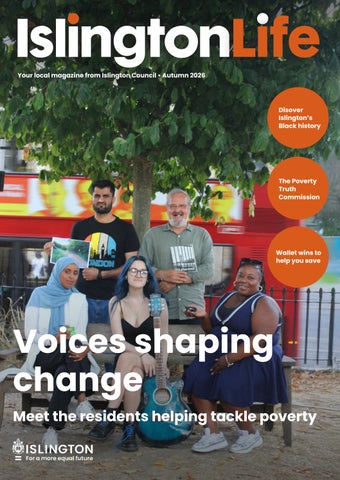
Voices shaping change
Meet the residents helping tackle poverty
Islington Life
2
3 Welcome Message from the Leader of the Council 5 News and events Library events, the council’s new TikTok channel and more! 10 In your neighbourhood Transforming estates for the better
14 Housing matters Finding a forever home on Elthorne Estate 17 Cleaner Islington Making Islington sparkle
19 Health Living with sickle cell 20 Next generation How Islington Council apprenticeships are helping young people flourish 22 Local life Stories written on our streets
On the cover 6
Black history in Islington
Islington Life, Autumn 2026
8
Wallet wins: 13 ways to help you save
12
Introducing the Poverty Truth Commission
Welcome As autumn arrives and we settle into a new season, I want to take a moment to reflect on some of the positive progress we are making together across Islington.
Cllr Una O’Halloran Leader of the Council
View this and previous issues online at issuu.com/ IslingtonLifeMag Be the first to hear about the latest news. Visit islingtonlife. london You can also find us on Facebook, Instagram and TikTok. Search for Islington Council Get in touch! Email us at IslingtonLife@islington.gov.uk
Other formats If you would like IslingtonLife in large print, audiotape or another format, please call 020 7527 7301 Recycle me! Please recycle this magazine once you’ve finished with it.
The extreme weather conditions this summer are a reminder to all of us that there is no issue more pressing than the climate crisis, with the fire at our Reuse and Recycling Centre in July showing the urgent need for action. Islington Council is doing all it can to prioritise climate resilience and climate friendly policies and will continue the work that has made us the best council in the country for our work to tackle the climate emergency. I would like to congratulate all the young people across Islington who received their GCSE, A Level, vocational and technical qualification results last month. Whether you are heading to university, starting an apprenticeship, beginning work, or considering your next steps, you should be incredibly proud of your achievements. I also want to thank the parents, carers, teachers, and support staff who have helped our young people reach this important milestone. Supporting residents into good jobs is a key priority for the council. This summer, we announced expanded support to help more than 2,000 residents access employment, training and apprenticeships. At a time when many people are looking for opportunities to develop their skills and secure stable work, we are determined to ensure that local people can benefit from the opportunities available across our borough and beyond.
3
We are also continuing to make progress in delivering genuinely affordable homes. I was delighted to see residents moving into 46 new council homes on the Elthorne Estate this summer, providing highquality homes for local people and families. Alongside this, we have committed more than £390 million over the next five years to upgrading thousands of existing council homes, improving heating systems, kitchens, bathrooms and safety standards. Everyone deserves a safe, secure and decent place to call home, and we are investing to make that a reality. Our Making It Happen programme is continuing to turn residents’ priorities into action. Investment is being directed towards safer streets, cleaner neighbourhoods, improved parks and play spaces, and practical measures that make a visible difference in people’s daily lives. These improvements are about more than physical changes. They are about fostering pride in our communities. As the evenings draw in and autumn begins, I encourage everyone to make the most of Islington’s parks, cultural venues, libraries, high streets and community spaces. There is always something happening in our borough for all ages to enjoy. Thank you, as always, for being part of our wonderful Islington community.
To receive news and updates directly to your inbox visit islington.gov.uk/StayUpdated
islingtonlife.london
IslingtonLife survey
4
Help shape the future of IslingtonLife We’re reviewing IslingtonLife to make sure it provides the information, stories and updates that matter most to you. We’d love your feedback. Drop off your completed survey to a library near you or head over to letstalk. islington.gov.uk to complete online. 1. What is your age group?
Environment and sustainability
Under 18
18–24
25–34
35–44
Arts, culture and heritage
45–54
55–64
65–74
75+
Opportunities to get involved locally
Prefer not to say
Other:
2. Which parts of IslingtonLife do you usually read? (Tick all that apply)
4. What balance of content would you prefer in IslingtonLife?
Council news, services and updates
Mostly practical information and council updates
Housing information and updates Cost of living support and advice Community stories and local people
Re:faces Events and activities
Health and wellbeing
Environment and sustainability Arts, culture and heritage Opportunities to get involved locally Other:
3. Which topics would you like us to cover more often? (Choose up to three) Council news, services and updates Housing information and updates Cost of living support and advice Community stories and local people Events and activities Health and wellbeing
Islington Life, Winter 2023
Slightly more practical information and council updates An equal mix of information and community stories 5. Have you experienced any barriers when reading IslingtonLife? (Tick all that apply) Text is too small Articles are too long Language is too complicated Too much information on a page Not enough images or visual content I would benefit from content in another language I would prefer a more accessible digital version No barriers Other:
News and events
Your library this autumn Go all in at your local library this autumn to celebrate the National Year of Reading 2026. Islington Libraries are celebrating Black History Month with a new recommended booklist, author talks, reading groups, storytelling, and family craft activities during October half-term. They are also marking Green Libraries Week with events on sustainability and a themed booklist for children and young people.
get information in a friendly, welcoming environment. islingtonlife.london/things-todo/dementia-information-fair
5
The scheme, which currently applies to Finsbury Park, Hillrise, and Tollington wards, will soon be extended to seven more wards: Barnsbury, Caledonian, Tufnell Park, Mildmay, Highbury, Junction and Laycock. From 23 November more properties will need a licence. islington.gov.uk/ PropertyLicensing
Catch us on Tik Tok
Check out islingtonlife.london for information on the events planned.
Jazz, jive and good times From toe-tapping gigs to community celebrations and unforgettable live performances, Islington Assembly Hall is one of the borough’s best-loved venues. This art deco gem has welcomed legendary artists and rising stars alike, offering something for every taste. Whether you’re dancing the night away or discovering your next favourite act, there’s always a reason to step into the spotlight at Islington Assembly Hall.
The council has launched a TikTok account, giving you another way to stay up to date with local news and community life. The channel features everything from local landmarks and borough highlights to community events and behindthe-scenes glimpses of council services. Follow us on TikTok to see the latest updates and help us connect with even more residents online. @islington.council
Dementia islingtonassemblyhall.co.uk Information Fair Whether you’re living with More homes dementia, caring for someone who is, or want to learn more, protected come along to Islington’s Dementia Information Fair. Meet local organisations, discover support services, and find out what’s available in your community. It’s a chance to connect with others and
The council’s selective licensing scheme supports well-managed, safe and good-quality homes by setting clear standards for landlords and managing agents.
islingtonlife.london
6
Local history
Black Islington: The untold stories behind our borough
Valda James, Islington’s first Black Mayor, pictured at a mayoral event in the late 1980s When people think of Black British history, they often think of Brixton, Notting Hill or Hackney. But Islington has its own rich and often overlooked story, one shaped by activists, artists, community leaders and organisations that have left a lasting mark on the borough and beyond We spoke to Tony Warner, founder of Black History Walks, and he explained part of the reason Islington’s story is less well known is that post-war migration became closely associated with a handful of London neighbourhoods. “Notting Hill and Brixton are seen as the centres of the postSecond World War migration story,” he says. “But Black people had been living in other parts of London for over 200 years. Those stories simply aren’t known.” Islington Life, Autumn 2026
Jamaican community, Sou Sou in the Bajan community and Box-Hand in the Guyanese community, where groups contributed money each week to help members save for a house deposit. “Because mainstream banks wouldn’t lend to Black families, these community banking systems enabled people to buy homes,” he says. “Some of those houses are still owned by the same families today.” As Black communities became more established in Islington, residents also began shaping the borough’s public life. One pioneering figure was Valda James, who arrived from Jamaica in 1961 as part of the Windrush generation. In 1986, she became the first Black woman elected to Islington Council and, two years later, Islington’s first Black Mayor, breaking new ground for Black representation in local government.
Building a community
Islington and the fight for justice
The story of Black Islington cannot be told without the Windrush generation. Following the 1948 British Nationality Act, people from across the Caribbean came to Britain to help rebuild the country after the Second World War. Many settled in Islington, finding work in healthcare, transport and other essential services while building families and communities in the borough.
While the struggle against apartheid took place in South Africa, fewer people know that Islington played a small but significant role in supporting the anti-apartheid movement. From the 1970s onwards, the African National Congress (ANC), the organisation led by Nelson Mandela in the fight against apartheid, operated from offices in the borough.
Like many Black communities across Britain, they often faced discrimination in housing and employment. In response, residents developed their own support networks and community-led solutions. Warner points to informal community banking schemes known as Pardner in the
But Warner says the site was much more than a meeting place. “The Anti-Apartheid Movement used to meet there, but it was also a recruitment centre,” he explains. Volunteers from across London were recruited to support the ANC’s work in South Africa,
Local history
7
gathering intelligence and assisting anti-apartheid operations. “It’s an extraordinary story that very few people know.” Another lesser-known chapter of Black Islington centres on Holloway Road and The Black House, founded by activist Michael X. Supported by high-profile figures including Muhammad Ali, John Lennon and Yoko Ono, it became a space where people could attend poetry events, watch films, learn about Black history and meet others in the community. The Keskidee Centre: culture, creativity and community If one place captures the cultural legacy of Black Islington, it is the Keskidee Centre. Founded by Guyanese architect and activist Oscar Abrams, the centre opened on Gifford Street in the 1970s and became Britain’s first dedicated Black arts and community centre. “One problem Black communities often faced was simply not having spaces of their own,” says Warner. “Oscar created one.” The centre hosted some of the most influential Black artists and thinkers of the era, including Maya Angelou, Linton Kwesi Johnson and Wole Soyinka.
It also offered theatre, music, education and community programmes, helping young people learn about both their history and their creative potential.
From Windrush families building new lives in Islington, to antiapartheid activists, community organisers and pioneering artists, Black history is woven into the fabric of the borough.
Over time, the Keskidee Centre became one of Britain’s most important Black cultural institutions, leaving a legacy that can still be felt today.
These stories remind us that Black history is not a separate history. It’s part of Islington’s story and it continues to shape the borough today.
Why these stories matter For Warner, the key message of Black History Month is simple: Black history is everywhere. “People often don’t realise just how much Black history surrounds them,” he says. “Wherever you are in London, there are stories waiting to be discovered.”
Walk the history for yourself Black History Walks offers guided tours, talks and events that bring London’s often-overlooked Black history to life. Find out more and book a tour at blackhistorywalks.co.uk
Five sites connected to Islington’s Black history 1. Former ANC headquarters, Penton Street: A base for antiapartheid organising and support for the African National Congress during the struggle against apartheid.
founded by Oscar Abrams in the 1970s. 3. The Black House, Holloway Road: A pioneering community and cultural space associated with activist Michael X.
2. The Keskidee Centre, Gifford Street: Britain’s first dedicated 4. Islington Town Hall: Host of Black arts and community centre, the first International Black and
Third World Book Fair in 1982, a landmark event in Black British literary history. 5. Islington Archives, Finsbury Library: Home to photographs, newspapers and records that help uncover the borough’s diverse and often hidden histories. islingtonlife.london
Everyday life
8
Wallet wins: 13 ways to save money in Islington
Times are tough for many households and there’s no single tip that will fix the pressure you may be feeling. But making the most of local support, free services and community resources can help your money go further. Here are 13 Islington wallet wins that could help you save money, cut costs and get support when you need it
4.
Find help with childcare and family costs
Families may be able to access support including free school meals, uniform grants and funded early learning opportunities, helping to ease pressure on household budgets.
Visit: islington.gov.uk/childrenand-families/help-withchildcare-and-family-costs
5.
1.
Check if you’re missing out on benefits
Thousands of pounds in financial support goes unclaimed every year. A quick benefits check could reveal help with housing costs, childcare, council tax or everyday living expenses. Use Islington Council’s benefits calculator to see what support you may be entitled to. Visit: islington.gov.uk/benefitsand-support/benefitscalculator
2.
Get free money and debt advice
If you’re worried about bills, Islington Life, Autumn 2026
debts or rising costs, you don’t have to face it alone. Islington Council’s Income Maximisation Team (IMAX) offers free advice and support to help residents maximise their income and manage household finances. Visit: islington.gov.uk/advice/ money-and-debt-advice
3.
Access food support near you
Local food pantries, community kitchens and food support projects can help reduce grocery bills while connecting you with other support services. Visit: islingtonfoodpartnership. org.uk/ifp-support
Borrow books, e-books and audiobooks for free
Your local library membership gives you access to books, e-books, audiobooks, magazines and newspapers without spending a penny. You can also use computers and study spaces at any of Islington’s libraries. Visit: islington.borrowbox.com
6.
Enjoy free days out in Islington’s parks
Whether it’s a family picnic, a walk with friends or a weekend workout, Islington’s parks and green spaces offer plenty of free ways to relax and stay active. Visit: islington.gov.uk/physicalactivity-parks-and-trees/ parks-and-green-space/yourlocal-parks
7.
Get free energysaving advice
If you’re eligible, the council’s Seasonal Health Intervention
Everyday life Network can provide advice on reducing energy use, cutting bills and keeping your home warm. Visit: islington.gov.uk/ environment-and-energy/ energy
8.
Repair instead of replace
Before throwing something away, see if it can be fixed. Free repair and upcycling sessions at FC Designer Collective in Finsbury Park can help extend the life of clothes, furniture and household items. Visit: tinyurl.com/repair-andupcycling-events
9.
Shop second-hand and save
From Upper Street to Holloway
Road and beyond, Islington’s charity shops are packed with affordable clothes, books, toys, furniture and unexpected bargains.
10.
Discover free events and activities
From festivals and markets to community celebrations and family activities, there are free events taking place across the borough throughout the year. Visit: islingtonlife.london
11.
Walk or cycle for everyday journeys
Choosing to walk or cycle short trips can save money on fuel and public transport while helping you stay active.
9
12.
Apply for crisis support if you need it
If you’re facing a financial emergency, Islington Council’s Crisis and Resilience Fund may be able to help with immediate essentials while also connecting you to longer-term support.
Visit: islington.gov.uk/benefitsand-support/crisis-andresilience-fund
13.
Stay up to date with local support
New grants, schemes and support become available throughout the year. Signing up for council updates can help ensure you never miss out on assistance that could save you money. Visit: tinyurl.com/cost-ofliving-bulletin
islingtonlife.london
In your neighbourhood
10
Transforming estates A new playground loved by local children, a communal garden made easier to access, and a mobility scooter hub helping residents stay independent are among the improvements making a difference on estates across Islington Since the programme began, residents have helped shape and deliver a wide range of improvements, including: 61 new cycle storage installations 42 landscape improvements 40 recycling area upgrades 31 accessibility and resurfacing schemes More than 280 resident-led improvement projects have already been delivered through the council’s estate investment programme, with a further 90 projects now approved. Alongside these projects, the programme has also delivered: 21 play area upgrades 23 security improvements eight community centre improvements eight lighting projects, creating more welcoming neighbourhoods for residents of all ages For some residents, these changes have had a significant impact on everyday life.
Islington Life, Autumn 2026
Susan Clarke, a resident of Halton Mansions, whose estate recently benefited from a new gate providing access to a communal garden, said: “The new gate has made a real difference and helped reduce the isolation I was experiencing. It’s positive to see the council recognise a need and act. The garden is a place of peace and tranquillity for me, and this is a great outcome that we can all be proud of.” Across the borough, residents are helping shape improvements that make estates better places to live. From play areas and community spaces to projects that improve access and support independent living, these changes are making a real difference to local people.
At Lindsey Mews, the estate’s old football pitch has recently been resurfaced, creating a better space for young people and families to enjoy. New natural play features and seating areas have also been installed, with further improvements to recycling facilities planned. One of the most popular projects has been the transformation of the playground at Richmond Grove. Eirlys Mckenzie, who has lived on the estate for nearly 40 years, has watched generations of children play there and says the latest improvements have been warmly welcomed by local families. They said: “I’d like to thank everyone involved in recreating
In your neighbourhood
11
our park at Richmond Grove. It looks fantastic and the children love it. I’ve lived here for nearly 40 years and we’ve always been very lucky to have our own private park. The first playground lasted about 30 years before it had to be replaced, then we had a wooden one that didn’t go down very well with the children. This one is the best so far. All the new children love it and so does my granddaughter, who now plays here. All the children have said it’s the best park.” Elsewhere, residents on the Finsbury Estate are benefiting from a new mobility scooter charging and storage hub, helping people remain independent and making it easier to get around their neighbourhood. The next phase of improvements will continue to focus on projects identified by residents, including better access to buildings, drop kerbs, upgraded lighting and improvements to shared outdoor spaces. By putting residents at the centre of decision-making, these investments are helping create places where people feel safer, more connected and proud of the neighbourhoods they call home.
From peelings to produce Most people in Islington recycle their food waste, but at Mildmay Community Centre, an exciting project is taking it one step further. Dom, Food Project Co-ordinator, explains: “Our Community Composting project gives local people a way to process their food waste in the neighbourhood and turn it into high-quality compost.” Residents drop off their food scraps, which are carefully processed and left to mature for around a year. “It develops in complexity, just like wine or cheese!” says Dom. Once its ready, residents can collect the finished compost for free. They can also donate it back to the project, and receive freshly grown produce, or seeds from the community seed bank. The compost does more than help plants grow. Healthy soil can hold on to moisture during dry periods and absorb heavy rainfall, helping gardens cope better with extreme weather. For many people who have grown up in cities, growing food can feel like a distant idea. Dom’s message is simple: “Food waste is a valuable resource, not rubbish. By turning it into compost, we can build healthy soil that produces nutritious food and keep those benefits within the community.” Mildmay’s Community Compost Hub is part of a pilot project, along with Octopus Community Network, which is funded by NLWA. To get involved with community composting visit: octopuscommunities.org.uk/urbangrowing
islingtonlife.london
12
Community voice
Meet the voices shaping change What does a set of keys, a football stadium, a guitar and a leisure centre card have in common? They each tell a story about life in Islington. Meet some of the residents helping shape the borough’s first Poverty Truth Commission through their lived experiences, insights and hopes for the future
Finding a place to belong
photograph of Gillespie Park. The image reminds him of some of his first walks through Islington, where he saw both the borough's strengths and its inequalities. "I saw beautiful green spaces and valuable services, but I also saw people sleeping on benches," he says. For Mohammed, poverty is about more than a lack of money. "It's also about barriers, exclusion and missed opportunities."
Listening differently Islington is a place of opportunity, creativity and community. But while many people thrive, others face challenges such as housing pressures and financial hardship. To tackle the root causes of poverty, it’s essential to listen to and be led by residents’ lived experiences. That’s why Islington Council is hosting London’s first Poverty Truth Commission, co-facilitated with Help on Your Doorstep. The Commission brings together residents with lived experience of poverty, alongside senior leaders from the council, businesses and community organisations, to develop practical solutions that can make a meaningful difference to people’s lives. Ahead of the full Commission coming together, Community Commissioners have been meeting to ensure lived experience is at the heart of its work. At one of their first sessions, they were asked to bring an object that reflected their experience of living in Islington. The stories behind those objects reveal belonging, resilience and hope. Islington Life, Autumn 2026
For Muna Al-Mohmadi, the object she chose was her membership card for Archway Leisure Centre. When she and her children first arrived in Islington, they were looking for stability, safety and a fresh start. Over time, the borough became much more than a place to live. "Archway Leisure Centre has been an important part of our journey," she says. "It's where my children and I have spent time together, made happy memories and felt part of the local community." "It's not just a building," she says. "It's a symbol of being part of the wider Islington community." Looking beyond what we see Mohammed Naser brought a
"As Community Commissioners, we're not only sharing our own experiences," he says. "We're bringing the voices of the communities we work with and helping shape solutions that reflect people's everyday lives." Seeing value where others might not Frankie Thomas-Hockey's object surprised people: a bin. For him, it represents transformation. When he first moved to Islington, the site where Emirates Stadium now stands was a recycling depot and industrial wasteland. Today it's a landmark known around the world.
Community Communitysafety voice The images capture the borough he explored as a child and reminds him how much it has changed over the decades. One photograph of Archway stands out in particular. "The skyline is completely different," he says. "There are new buildings and new opportunities." Liam also sees challenges that continue to affect people's lives. His hope is that the Commission can create lasting change.
"People saw value in a place that others overlooked," he says. "Sometimes people can be overlooked in the same way."
13
Bringing people together Jess Prince chose a guitar. For her, music is one of the things that makes Islington special. From local venues and community events to homegrown artists, music has helped shape her connection to the borough.
"I hope our work strengthens the community's voice," he says, "and helps make the path easier for those who come after us." The power of connection
Frankie says Islington gave him the chance to rebuild. "The Commission is an opportunity to change things," he says. "People are always more than the difficulties they face. With support and opportunity, value can be found beneath the surface."
"I believe music brings people together," she says. "It's always been part of my connection to Islington."
Change across generations
A chance to shape the future
Liam Murphy brought a photo album showing Islington in the early 1960s. For Karla Stewart-Browne, the object she chose was a set of keys. Not only her keys, but those she shares with family and friends. "We have each other's keys in case someone needs help, loses theirs or just wants to pop in for a cup of tea and a chat," she says. To Karla, those keys represent trust, support and security. "The keys symbolise community, love and friendship." Her advice to people living in Islington is clear: "Love, support and respect one another."
The Poverty Truth Commission is built on a simple idea: people with lived experience should help shape the solutions. The objects shared by Commissioners may have been ordinary, but the stories behind them were not. Together, they show an Islington that is resilient, compassionate and full of potential. Most importantly, they remind us that behind every statistic is a person, a family and a story worth hearing.
Photography by Community Commissioner Jess Prince.
islingtonlife.london
14
Housing matters
Finding a forever home on the Elthorne Estate
As Islington Council continues to deliver new council homes across the borough, more local families are getting access to high-quality, affordable housing that meets their needs For Ebru, moving into a new accessible home on the Elthorne Estate has been life-changing, giving her family the space, stability and support they need to thrive. After years of living in a onebedroom council flat with her two children, who both use wheelchairs, she has moved into a more spacious home designed to meet their needs. For the first time, her son and daughter have bedrooms of their own, and everyday life feels that little bit easier. “We love it,” she says. Islington Life, Autumn 2026
The move has transformed the practical side of family life. The ground-floor home is fully wheelchair accessible, with widened doorways, step-free access and space for the family to move around comfortably. Features that might seem simple to others make a huge difference to Ebru and her children. “Everything is new,” she says. “Even the cupboards are nice. The flooring was already done, there were blinds in the living room and we’ve got a big balcony.” But what matters most is not just the home itself. It’s being able to stay connected to the community that has always been home.
Born and raised in Islington, Ebru wanted to remain close to the people, places and services her family relies on. Her mum lives just five minutes away, the family’s GP is nearby and local shops, green spaces, transport links and healthcare services are all within easy reach. The new home is only around 10 minutes from where the family previously lived, meaning her children can stay at the same school and keep the routines that are so important to them. “The children are happy where they live,” she says. Before moving to Elthorne, Ebru had spent years searching for a home that would work for her family’s circumstances. She
Housing matters was on the housing register and regularly bid for suitable properties, while professionals supporting the family helped demonstrate their needs. When homes became available on the estate, Ebru viewed four properties and said yes to all of them, hoping one might become available. What happened next came as a surprise. “Within one day, I heard back from the council and was successful,” she says. “When you’ve been struggling for so long and something good finally happens, you’re just so happy. I still can’t believe it.” The timing was important too. Ebru was given extra time to move during the Easter holidays, allowing the family to settle in and making the transition smoother for her children. Looking around her new home today, she feels grateful to have found somewhere that works for the whole family, both now and in the future. “Islington Council saw someone in need, especially with children, and stepped in to help,” she says. Now settled into life on the Elthorne Estate, Ebru feels confident about what comes next. For Ebru and her children, the move has brought more than extra space. It has provided stability, independence and the chance to remain part of the community they know and love, in a home that truly meets their needs.
15
Rising rents, real pressures and a plan for change Private renters make up a growing part of our community, but rising costs and poor housing conditions are putting many households under pressure.
For many people in Islington, renting privately is the only realistic housing option.
Around 31% of households in the borough rent from a private landlord, a similar proportion to London as a whole. The cost of renting in the borough has risen sharply in recent years, putting pressure on household budgets at a time when many residents are already feeling the impact of rising household costs and bills. While there are signs that rent increases are beginning to slow, with annual rental growth falling from 15% in June 2024 to 5% in June 2025, rents continue to rise and remain out of reach for many households. At the same time, some private renters continue to face issues with poor housing conditions, from damp and mould to other serious hazards. The council knows that many residents are struggling, and are determined to stand up for private renters and push for change. While the council continues to build new affordable homes and bring empty properties back into use, demand for housing in Islington remains far greater than supply. That’s why the council is calling on the government to give areas like Islington stronger powers to support renters and help keep housing costs under control. Earlier this year, the council wrote to the Prime Minister and the Secretary of State for Housing, Communities and Local The average private Government to highlight what we rent in Islington reached believe is a private renting crisis £2,708 a month in in the borough. They’re calling for September 2025, up measures including emergency 4% on the previous rent controls linked to wages year and significantly and the cost of living, alongside higher than the London stronger protections for tenants.
average of £2,260 a month.
Over the coming months, we’ll be sharing more about the council’s work to support private renters, the changes they’re campaigning for, and how you can get involved. Keep an eye on the council’s website, social media channels and future editions of IslingtonLife to find out more.
islingtonlife.london
16
Housing matters
Improving homes, improving lives From a warmer home in winter to a lift you can rely on and repairs that are easier to report, investment in Islington’s council homes is making a difference to everyday life for thousands of residents
Over the next five years, Islington Council will invest £390 million in council housing, helping improve homes, modernise services and make it easier for residents to get support when they need it. Every year, around 100,000 repairs are carried out in council homes across the borough. From fixing leaks and replacing doors to tackling larger maintenance issues, the work helps keep homes safe, secure and in good condition. Getting help is becoming easier too. Residents can now report many repairs online, through WhatsApp or by phone, making
Islington Life, Autumn 2026
it simpler to raise issues and get support in a way that suits them. Alongside day-to-day repairs, significant improvements are being made inside people’s homes. Older boilers are being replaced to help keep homes warmer and reduce the risk of breakdowns, while thousands of residents are set to benefit from upgraded kitchens and bathrooms in the coming years. The investment extends beyond that with more than £25 million set to be spent improving lifts across Islington estates over the next five years, helping residents get safely and reliably in and out of their homes.
Residents are also helping shape what happens next. Feedback from tenants and leaseholders are informing improvements to both housing services and future investment priorities, ensuring changes reflect what matters most to the people who live there. For many residents, the impact is already being felt. Whether it’s a repaired leak, a warmer home or a more reliable lift, these investments are helping people live well and feel proud of where they live. Need to report a repair? Visit: www.islington.gov.uk/ request-repair
Cleaner Islington
Making Islington’s streets sparkle
17 17
from high footfall and a busy night-time economy. We’re committed to giving these areas a fresh feel for residents and visitors while supporting local businesses.” The council is investing £820,000 through the Making it Happen fund – a £5m pot dedicated to real, tangible change on the issues that matter most to local people - over the next four years to support community clean-ups, and improve neighbourhoods across the borough. The work is part of a longer-term commitment to creating cleaner, greener places while encouraging community pride and supporting safer neighbourhoods.
A clean street and welcoming public spaces help make Islington feel safer and more like home. That’s why Islington Council is working with residents to identify areas that need extra attention and take action where it matters most As part of the council’s commitment to Making it Happen, teams have carried out targeted clean-ups in busy neighbourhoods including Finsbury Park, Angel, Hornsey Road, Old Street and Nag’s Head. The work focuses on areas highlighted by residents, helping
turn local concerns into visible improvements. The clean-ups include removing fly-tipping and graffiti, washing streets and bins, and enhanced pavement cleaning to create a brighter, more welcoming environment for residents, visitors and local businesses. Mark Fontaine, Street Cleansing Operations Manager at the council, said: “These areas are often focal points for leisure and events. Finsbury Park is one of North London’s major transport hubs, which brings challenges
Sarah Armstrong, Community Safety Officer at Islington Council, said: “Creating cleaner and safer neighbourhoods go hand in hand. When residents see visible improvements in their local area, it can boost confidence in the neighbourhood and encourage greater community pride.” Residents can report litter, flytipping and street-cleaning issues through: The Love Clean Streets app or MyIslington: account.islington. gov.uk
islingtonlife.london
18
Cleaner Islington
Fire safety starts at home From e-bike batteries to smoke alarms, Islington Fire Station’s Commander Mick Palmer shares simple ways to help keep you, your family and your home safe. His advice comes after a series of fires at Islington’s Reuse and Recycling Centre, highlighting the importance of using and disposing of batteries safely Hi Mick. Tell us a bit about yourself. I have served in the London Fire Brigade for 20 years and have been Station Commander at Islington Fire Station for the past five. Before joining the brigade, I worked in a gym. I met someone training to be a firefighter, decided to apply myself and never looked back. I love the job! Following four fires at Islington’s Reuse and Recycling Centre in the past year, battery safety has come under the spotlight. Should residents be concerned about the risk of battery fires?
involving batteries are still relatively uncommon, the consequences can be serious because they can spread quickly and produce intense heat and smoke.
charging them near doorways, hallways or other escape routes. If a battery starts overheating, swelling or making unusual noises, stop using it straight away.
Instead, take them to a recycling point. Many supermarkets now accept small batteries and vapes for recycling.
That’s why it’s important to buy batteries and chargers from reputable retailers and always use the right charger for your device.
Trust me, you don’t want to experience one of these fires.
Make sure you have working smoke alarms in your home. They provide an early warning and could save your life.
What’s causing the increase in fires?
Many everyday items contain lithium-ion batteries, including phones, laptops and disposable vapes.
Lithium-ion batteries are in lots of devices we use every day, from e-bikes and e-scooters to phones and laptops.
We’re seeing more fires linked to e-bikes and e-scooters, often involving batteries or chargers that don’t meet safety standards.
They are safe when used correctly, but if something goes wrong, they can cause serious fires. While fires
A few simple steps can help reduce the risk. Never leave batteries charging unattended or overnight, and avoid
Islington Life, Autumn 2026
What about other devices at home?
One issue is that people often throw old vapes and small electrical items in household bins. When these are crushed during collection, they can start fires in bin lorries or recycling centres.
What’s your top fire safety tip?
I’d also encourage everyone to use the London Fire Brigade’s online Home Fire Safety Checker. It offers personalised advice to help keep your household safe. To find out more, visit: london-fire.gov.uk/hfsc to complete the Home Fire Safety Checker.
Health
19
Living with sickle cell As part of Sickle Cell Awareness Month this September, we spoke to Islington resident, Manuela Engelbert about living with sickle cell disease, the misconceptions that still exist, and why greater understanding matters Can you tell us about your experience of living with sickle cell? I spent most of my childhood doing the usual things: going to school, playing sport and spending time with friends. But there were also times when I experienced severe pain that nobody could explain. As I grew up, the pain became more frequent and I was diagnosed with sickle cell disease at 20, after several hospital admissions while at university. Receiving that diagnosis changed my life. Since then, I’ve learnt to manage my condition, from staying hydrated and avoiding extreme temperatures to recognising when my body needs rest. I still
live a full life, but I know my limits. What is the biggest misconception people have about sickle cell? That people with sickle cell exaggerate their pain. In reality, a sickle cell crisis can be excruciating and may require strong pain relief. Because the condition is often invisible, people don’t always understand how serious it can be. There is also a lack of awareness about who can be affected. While sickle cell mainly affects people of African and Caribbean heritage, it can also affect people from South Asian, Middle Eastern, Mediterranean and Hispanic backgrounds. How has sickle cell affected your life and what support has helped you most? Most people wouldn’t know I have sickle cell unless I tell them. I’ve had to cancel plans, miss work when unwell and sometimes deal with people not
understanding the condition. The support I’ve received from family, friends and healthcare professionals has made the biggest difference. Why is it important that conversations about sickle cell and Black health are more visible? People of African and Caribbean heritage experience health inequalities and, because sickle cell mainly affects these communities, awareness is especially important. The 2021 No One’s Listening report highlighted serious failings in sickle cell care. While awareness has improved through NHS campaigns, social media and community advocacy, there is still work to do. More open conversations can help challenge misconceptions, improve healthcare and ensure people living with sickle cell feel seen, heard and supported. What would you like readers to take away from your story? Sickle cell is much more than pain. It affects work, education, relationships and mental wellbeing. But having sickle cell does not make someone weak. People living with the condition are incredibly resilient. I hope people take the time to learn more about the condition and the people living with it. Greater understanding, compassion and support would make a real difference. For more information on sickle cell disease, including symptoms and treatments, visit: nhs.uk/conditions/sickle-celldisease/ islingtonlife.london
20
Next generation
From film scripts to flowerbeds
years and my apprenticeship finishes in October. Hopefully, I’ll be able to stay on, as there’s a role coming up and I’d love the chance to keep learning and developing. One of the things I enjoy most is that there’s always something new to discover. I’m particularly interested in garden design and I’ve been able to build that into my apprenticeship because, if there’s something you’re keen to learn, the team will help you develop those skills. My manager has been really supportive. He’s always encouraged me to find training opportunities that will help me grow and gain new experience.
After studying filmmaking at university, Luke Howard-Banyer never expected to become a park ranger. But an Islington Council apprenticeship helped him discover a career he loves and a new way to serve his community Luke’s story is one of thousands made possible through Islington Council’s investment in jobs, skills and apprenticeships. The council is investing £3.6 million to help residents access employment and training opportunities, and over the past four years more than 6,000 residents have found jobs through council-supported programmes. Since 2022, more than 1,000 residents have started apprenticeships with local businesses. Luke told us about his journey. “I went to university and studied filmmaking. I really enjoyed Islington Life, Autumn 2026
scriptwriting, but it can be a difficult industry to break into. It’s competitive, unpredictable and I wanted something that felt a bit more stable. I’d heard good things about working for the council, so I started looking at vacancies. When I came across the apprentice park community ranger role, I remember thinking, ‘That sounds fun.’ I didn’t have any experience in horticulture and knew very little about gardening, but I liked the idea of being outdoors, staying active and meeting people. I applied, got the apprenticeship and quickly realised I’d found something that really suited me. A few months into the role, I had one of those moments where it all just clicked. I thought, ‘Yeah, this is what I want to do.’ I’ve now been doing the job almost two
Because of that, I’ve taken part in several extra courses, including a recent three-day garden design intensive where I learned how to survey sites, create scale drawings and think about different design styles, landscaping techniques and planting schemes. That’s been useful because landscaping isn’t just about making something look nice. You have to think about what will grow well, what suits the surroundings and how a space will change over time. Climate change has made that even more important. Some plants that struggled to grow in the UK years ago are now thriving, while others need more support. We’re always learning and adapting, which keeps the job interesting. When people ask what I do for a living and I say I’m a park ranger, they’re often surprised. Most people don’t expect London to have park rangers, but we do, and there’s a lot more to the role
Community safety
21
and then seeing people enjoy it. I think a lot of people would be surprised by how technical horticulture can be. It’s not just planting flowers. There’s a huge amount to learn, from design and ecology to understanding how different plants behave in different environments. I never want to reach a point where I feel like I’ve learned everything. That’s why I’ve enjoyed the apprenticeship so much. It’s opened up opportunities I never expected and given me the chance to build a career where I can keep learning and developing. It turns out that sometimes the best career paths are the ones you don’t plan.”
than people realise. I’m part of the South Team and together we help look after 53 green spaces across Islington. No two days are ever the same. One morning I might be checking emails and attending a team meeting. By lunchtime I could be leading a volunteer session, planting new flower beds or helping plan improvements to a park. There’s something special about caring for a green space
Interested in exploring new opportunities for yourself? Visit the Opportunities Fair at West Library on 24 September to find out about jobs, training and apprenticeships available to Islington residents. Find out more at: islingtonlife.london/thingsto-do/exam-results-support
Staying safe after dark As the days get shorter and the nights draw in, it’s important to take extra care when travelling around the borough. There are simple steps we can all take to help keep ourselves and others safe. Street harassment is never acceptable and should be reported. This includes behaviours such as blocking someone’s path, persistent questioning, unwanted physical contact, following, intimidation and catcalling. Reporting incidents helps the police understand where problems are happening and take action. You can report non-emergency incidents online or by calling 101. Looking out for one another can make a real difference. Trust your instincts, if something doesn’t feel right, move to a safe place and seek help. If you ever feel unwell or worried for your safety while out in Islington, help is close at hand. There are more than 300 Safe Havens across the borough where trained staff can provide support. Look out for the Safe Havens logo in a window or visit islington.gov.uk/SafeHavens to find your nearest location. Plan your journey home in advance and, if using a taxi, make sure it is a licensed vehicle or black cab. Keep phones and valuables secure, particularly in busy areas, and avoid using your phone near the roadside where it could be targeted by thieves. If you are experiencing domestic abuse, contact Solace on 020 3795 5070 or email advocacy@ solacewomensaid.org. In an emergency, always call 999.
islingtonlife.london
22
Local life
Stories written on our streets
The National Year of Reading is well underway, celebrating the power of books to connect us with people and places. In Islington, writers have been telling the borough’s story for generations. Discover how their words capture the people, history and character of a changing community In 1682, writer John Oldham described Clerkenwell as a cheap place to live, joking that he stayed in an attic room “next the sky”. More than 300 years later, the area looks very different, but Islington’s streets still have stories to tell. One of Islington’s best-known literary connections is Charles Dickens. The borough appears in some of his earliest and latest works, from Sketches by Boz (1836) to Our Mutual Friend (1864-65). Dickens wrote about everyday London life, from hardworking clerks and shopkeepers to families striving for a better future. In his books, Islington is a busy and growing place full of ambition and opportunity. Years later, George Orwell found inspiration in wartime Islington. He wrote parts of Nineteen Eighty-Four while living in Canonbury after his previous London flat was damaged during the Second World War. The destruction he witnessed helped shape the bleak world of his famous novel. By the late 20th century, Islington had acquired a different reputation. In Muriel Spark’s Symposium, an elegant Islington townhouse becomes the setting for a sharp and entertaining tale of secrets and surprises.
Apply now for Islington secondary schools If your child was born between 1 September 2015 and 31 August 2016, apply now for a secondary school place at islington.gov.uk/admissions Apply by 31 October 2026 for the best chance of a Year 7 place at your preferred school.
More recently, Andrea Levy explored themes of migration, identity and belonging in her celebrated novel Small Island (2004). Levy grew up in Islington as the daughter of Jamaican parents and drew on the experiences of the Windrush generation in her work. A plaque on Twyford House off Blackstock Road celebrates her contribution to literature. Inspired to read more? Visit your local library or explore the Literary Road Map at islingtonlife. london/literaryroadmap/
Islington Life, Autumn 2026
Sign up for email tips and deadline reminders at islington.gov.uk/stayupdated
Local life
Thread of friendship
with their hands, focus their minds and connect with others. There’s no pressure to talk. Sometimes simply being around other people can make a real difference.
and everyone deserves to feel supported, connected and valued.
What challenges were participants facing before joining the programme?
Ishani: When I first signed up, I felt anxious and expected to keep myself to myself. But from the very first session, I felt comfortable enough to open up.
Gladys: Many were experiencing loneliness and isolation. Some had recently retired and lost a regular routine, while others were dealing with health challenges that left them feeling disconnected. We spoke to Gladys CobbinaAgyemang, founder of the Women’s Link Project, a local charity helping tackle loneliness and social isolation. Their latest initiative, funded through Islington Council’s Community Chest, uses embroidery to bring women together, build confidence and create lasting friendships. We also spoke to participant Ishani about the difference it has made to her life What inspired you to start the embroidery initiative? Gladys: I moved to the UK from Ghana in the early 1990s and raised my two children on my own. Life felt very different and there were times when I felt alone. When my son was young, I went through a particularly difficult period. That experience inspired me to create the Women’s Link Project, so other women would always have somewhere to turn. I chose embroidery because it allows women to learn a new skill while spending time together. Over eight weeks, participants create something
23
Loneliness can affect anyone, and it’s often hidden. What many of these women were missing was a sense of community and belonging. What changes have you seen over the last eight weeks? Gladys: The transformation has been wonderful. Women who were quiet and reserved at the start now walk into the room smiling and excited to see each other.
What impact has the course had on you?
It’s been a rewarding experience. You’re not only learning something new, you’re meeting people, building friendships and creating something to be proud of. The course has so much heart, and Gladys makes everyone feel welcome. That’s what makes it so special. Follow the Women’s Link Project on Instagram @womenslinkwlp. To learn more about Islington Council grants and funding opportunities, visit: islington. gov.uk/VCSFunding
We’ve built a real sense of community. Participants keep in touch through a WhatsApp group, arrange to meet outside the sessions and often stay behind to share food together. Those friendships have become just as important as the embroidery itself. What do you hope people take away from hearing about this work? Gladys: I hope people understand that loneliness is something we need to talk about more openly. Most importantly, I want people to know they’re not alone. Community is powerful, islingtonlife.london
THANK YOU ISLINGTON