BACK-TO-SCHOOL 2026
Vancouver Island’s Parenting Resource for 38 Years
FREE COPY
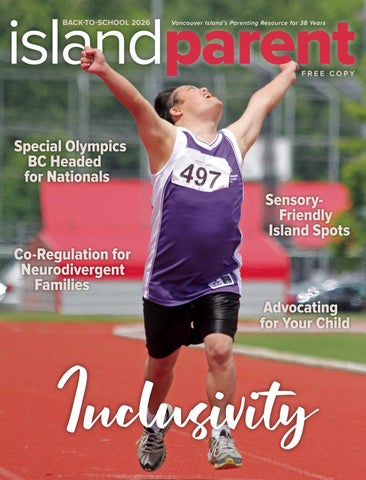
Special Olympics BC Headed for Nationals SensoryFriendly Island Spots Co-Regulation for Neurodivergent Families Advocating for Your Child
Inclusivity
2
Island Parent Magazine
IslandParent.ca
Your next family adventure could be just one email away! Sign up for the FREE Island Parent newsletter and be the first to discover what’s happening across Vancouver Island—from can't-miss events and hidden gems to parenting tips, contests, giveaways and family-friendly fun. Here’s what you’ll get: • The best local events and festivals • Fun things to do with kids every season • Parenting tips and expert advice • Camps, classes and community programs • Exclusive contests, giveaways and special offers
• The latest Island Parent digital editions and family resources
Whether you’re looking for weekend inspiration, planning your next outing or simply trying to keep up with everything happening for families on the Island, we’ve got you covered. Join thousands of Vancouver Island parents who already count on Island Parent to help make family life a little easier—and a lot more fun!
Sign up today...because the best family memories start with knowing what’s happening next!
islandparent.ca/newsletter
INTHISISSUE
6
10 Things
8
A Parent’s Guide to Invisible Disabilities
BACKTOSCHOOL2026 Jim Schneider Publisher publisher@islandparent.ca
10
Special Olympics BC Headed for Nationals
14
Parenting with Anxiety
16
12
The Quiet Art of Patience
Co-Regulation for Neurodivergent Families
Stacie Gaetz Editor editor@islandparent.ca Kristine Wickheim Account Manager kristine@islandparent.ca
Island Parent Magazine, published by Island Parent Group Enterprises Ltd., is a bimonthly publication that honours and supports parents by providing information on resources and businesses for Vancouver Island families. Views expressed are not necessarily those of the publisher. No material herein may be reproduced without the permission of the publisher. Island Parent is distributed free in selected areas. Annual mail subscriptions (7 issues) are available for $21 (GST included). Canadian Publication Mail Product Sales Agreement 40051398. ISSN 0838-5505.
For distribution inquiries, please email publisher@islandparent.ca
18
Lifelong Readers
20
Raising Inclusive Kids
On the Cover Photo courtesy of Special Olympics BC specialolympics.bc.ca
Island Parent Magazine 518 Caselton Place Victoria, BC V8Z 7Y5 250 388 6905 A proud member of
22
Becoming an Advocate
24
How BC Families Are Navigating Rising Costs
IslandParent.ca x.com/IslandParent
26 4
Sensory Spaces on Vancouver Island
Island Parent Magazine
28
facebook.com/IslandParent instagram.com/islandparent
Ultimate Lunch Box Hack IslandParent.ca
E D ITO R ’ SN OTE
Building an Inclusive & Supportive School Year
A
s crisp autumn air replaces summer’s lazy rhythm, the back-to-school season arrives on Vancouver Island bringing a mix of excitement, fresh notebooks and—for many families—a quiet underlying anxiety. Every September asks parents to reset expectations and step into new routines. However, for families navigating the world of neurodiversity, physical differences or mental health challenges, the transition into a new school year is far more complex than just buying backpacks and packing lunches. True education extends far beyond traditional desk-andpaper learning; it begins with belonging. An inclusive community isn’t built by accident—it takes intentional empathy, shared effort and a deep commitment to ensuring every child feels valued for exactly who they are. For parents of neurodivergent children or kids with special needs, back-to-school often means stepping into the role of dedicated advocate. Finding the right environment can transform a child’s educational journey. Yet, successful advocacy requires a strong foundation at home. When we practice coregulation with our neurodivergent children, helping them navigate overwhelming moments through our own calm presence, we give them the tools to thrive in a busy world.
IslandParent.ca
At the same time, inclusion is a two-way street. Raising compassionate children means actively teaching our kids how to embrace peers with different abilities, break down social barriers and build genuine friendships. When we model empathy, we see incredible inspiration right here in our local community. Like our remarkable Special Olympics BC athletes, whose determination on the national stage reminds us of what is possible when equal opportunities are created. Of course, holding space for a child’s sensory, physical or emotional needs requires immense energy. Navigating childhood anxiety can leave caregivers feeling exhausted, making self-compassion an essential practice, not a luxury. Taking time to recharge through sensory-friendly local family activities (from quiet Vancouver Island nature walks to calm indoor community spaces) allows families to find joy together without sensory overload. As this new academic year begins, remember that you do not have to carry it alone. Behind every resilient child is a community of parents, educators and advocates working toward the same goal: a world where every child belongs. Here’s to a supportive, compassionate and empowering school year ahead. – Stacie Gaetz Back-to-School 2026
5
10 Things
1 Beyond Van Gogh & Beyond Monet Exhibit
YOU N E E D TO KN OW
The interesting double feature immersive art experience takes place until August 29 at the Vancouver Island Conference Centre in Nanaimo. islandevents.ca
2
3 Cobble Hill Fair
This small-town fair offers agriculture, crafts, local talent and family games at Cobble Hill Farmers Institute & Agricultural Society on August 22. cobblehillfair.ca
4 Island Perinatal Counselling This program offers a comprehensive collection of free and affordable mental health support groups and parenting resources for expectant and new parents across Vancouver Island. crdperinatal.ca
Sails & Sagas Jubilee
A fun pirate and Viking-themed family festival that runs from August 29 to 30 in Sidney with immersive entertainment and costumes. sails.faerieevents.ca
5 BC Culture Days
A province-wide celebration of arts and culture with many free events like workshops, performances and interactive art experiences in communities across Vancouver Island from September 19 to October 12. culturedays.ca
6 Canadian Mental Health Association – BC Division
The association provides programs, education and support for mental health across all ages. It also connects families to local resources. cmha.bc.ca
8 StrongStart BC Early Learning
Free early learning drop-in programs for children up to age five and their caregivers. They operate in various schools across the island and restart in September. gov.bc.ca
7 The 158th Annual Saanich Fair
The popular fair returns September 5 to 7, bringing three days of agricultural traditions, midway rides, live entertainment, local food and fun to the Saanich Peninsula. saanichfair.ca
9 Cowichan Exhibition
This eagerly awaited yearly agricultural fair with rides, livestock, exhibits, and live entertainment takes place September 18 to 20. cowex.ca
10 Victoria Makerspace
Victoria Makerspace gives people access to 3D printers, laser cutters, woodworking tools, electronics equipment and more through a variety of programs and open use times. makerspace.ca
S PE C I A L N E E DS
Beyond
What You Can See
A Parent’s Guide to Invisible Disabilities
I
f you’ve ever seen me standing in the middle of Costco staring blankly into a freezer, there’s a good chance I wasn’t deciding between chicken fingers or pizza pockets. I was probably trying to remember why I walked over there in the first place. Before my brain injury, I would’ve laughed it off as “mom brain.” After my accident, it became my everyday reality. The tricky thing about invisible disabilities is exactly that... they’re invisible. People can’t see memory loss, sensory overload, chronic pain or the mental effort it takes just to get through an ordinary day. If you’re a parent like me, I’m sure you’ve seen something similar. You’re at the playground, the grocery store or waiting outside a classroom when you notice a child having a meltdown, covering their ears, refusing to join in or simply playing alone. 8
Island Parent Magazine
Or maybe you notice a parent who looks completely exhausted... yogurt dried in their hair, shirt inside out, surviving on very little sleep or slipping out of an event without saying goodbye. It’s funny how quickly we notice things that seem different. What if, instead of asking, “What’s wrong with them?” we asked ourselves, “I wonder what they’re carrying today?” Because not every disability is visible. I grew up with a learning disability that made school feel terrifying. Then, as an adult, I was diagnosed with ADHD. For years, I saw it as something I needed to overcome. Now I see it differently. My brain simply works differently. Play almost any song from the last 30 years and I’ll probably know every lyric. Ask me where I read something six months ago and I can often picture exactly where it was on IslandParent.ca
the page. But ask me to read a chapter in a book and I’ll probably reread the same sentence five times because halfway through, I’m wondering what’s for dinner or whether I remembered to switch the laundry. Different doesn’t mean broken. In 2023, I was involved in a motor vehicle accident that left me with a brain injury. Afterward, I looked fine. I wasn’t in a wheelchair. I didn’t have a cast. Apart from suddenly wearing glasses because of nerve damage, there wasn’t much to suggest my life had changed. But every day I was living with memory problems, balance issues, fatigue and difficulty concentrating. For a long time, people assumed I was okay because I looked okay.
IslandParent.ca
Eventually, after advocating for myself and refusing to give up, specialists finally identified the injuries I’d been living with all along. That experience changed me. It reminded me that just because someone’s struggle isn’t visible doesn’t mean it isn’t real. When we think about accessibility, we often picture ramps, elevators, automatic doors or accessible parking. Those things matter. But accessibility is also about creating spaces where people feel understood, even when their needs can’t be seen. Sometimes it means understanding why a child wears noisecancelling headphones at an assembly. Sometimes it means accepting that a family leaves a birthday party after 20 minutes because it’s simply too overwhelming. Sometimes it means recognizing that the child who can’t sit still isn’t being disrespectful, they may just learn differently. As parents, we all want the same thing. We want our children to belong. We hope they’ll be invited to play. We hope they’ll be accepted exactly as they are. The beautiful thing is that inclusion doesn’t begin with schools, policies or programs. It begins with us. Children naturally notice differences. Instead of teaching them not to notice, we can teach them how to respond, with kindness, curiosity and compassion. • Invite the child sitting alone to play. • Be patient with someone who communicates differently. • If someone asks for accommodation, remember they’ve probably spent days debating whether they should ask at all. Chances are they’ve already worried about being seen as difficult or inconvenient before they ever said a word. A little understanding can mean more than you’ll ever know. The truth is none of us know what another family is carrying. Behind every exhausted parent could be years of appointments, sleepless nights or endless advocacy. Behind every child who seems “different” is a little kid just hoping to be accepted. Inclusion isn’t about making everyone the same. It’s about making sure everyone knows they belong because at the end of the day, belonging isn’t created by buildings or policies. It’s created by people. Natausha Furlong is a writer and advocate from Victoria. Passionate about storytelling, she writes on a range of topics including parenting, health, disabilities, relationships and personal growth, with a focus on authenticity, compassion and creating meaningful connections. Back-to-School 2026
9
S PE C I A L N E E DS
TeamBC
Special Olympics Bound for National Stage
N
early 250 athletes will pursue their dreams of representing Canada at the 2026 Special Olympics Canada Summer Games. From August 11 to 15, one of Special Olympics BC’s biggest provincial teams ever will pursue personal bests at the 2026 Special Olympics Canada Summer Games in Medicine Hat. Comprising more than 244 athletes with intellectual and developmental disabilities, 75 volunteer coaches and 22 mission staff from more than 42 communities across British Columbia, Special Olympics Team BC is set to shine on the national stage and showcase their abilities. “Being part of Special Olympics Team BC means triumph, victory, and standing tall despite adversity,” says Ashley Adie, a track and field athlete from Campbell River.
10
Island Parent Magazine
Adie has competed in three other Special Olympics (2018 for track and field and 2020 and 2024 in snowshoeing). She also serves on the committee for the Special Olympics. “The Special Olympics means so much to me. I have made new friends, and it is giving me the opportunity to play the game I love at a high level,” says Maire Anderson, a Campbell River resident who will be competing in soccer. “It has been a dream of mine.” Special Olympics Team BC will be competing in 10 sports in Medicine Hat including 10-pin bowling, basketball, bocce, golf, powerlifting, rhythmic gymnastics, soccer, softball, swimming (aquatics) and track and field (athletics). “Our athletes have worked tremendously hard to earn their places on Special Olympics Team BC 2026, and I could not be more proud of how far they
have come,” says Michelle Cruickshank, Special Olympics Team BC 2026 chef de mission. “Their commitment to training, their willingness to challenge themselves and the support they show one another embody the very best of Special Olympics.” Since qualifying for their spots on Special Olympics Team BC 2026 through their performances at the 2025 Special Olympics BC Summer Games in Prince George, the provincial team athletes, coaches and mission staff have been hard at work to be at their best at National Games. Training has included sport-specific work in their local Special Olympics programs, participating in Club Fit, additional fitness and dryland training, working with sport-specific experts and focusing on diet and nutrition. In Medicine Hat, athletes will be competing for the opportunity to
IslandParent.ca
Fast Facts
• 244 athletes • 75 volunteer coaches • 22 mission staff • More than 42 BC communities represented • 10 sports: – 10-pin bowling – Basketball – Bocce – Golf – Powerlifting – Rhythmic gymnastics – Soccer – Softball – Swimming – Track and field
represent Canada at the 2027 Special Olympics World Summer Games in Santiago, Chile. “I want to extend my heartfelt thanks to our coaches, hometown training coaches, mission staff, families and supporters,” says Cruickshank. “Their unwavering commitment makes these opportunities possible and plays a vital role in every athlete’s success.” The Special Olympics Games operate on a four-year cycle for both summer and winter sports. Athletes compete in regional events and then provincial games to advance to National Games. Special Olympics Canada games are the qualifiers for international Special Olympics competition. “Special Olympics is the best of the sporting world. Everyone celebrates successes, whatever that might be, but while the disappointments exist, they don’t linger,” says Angela Behn, track and field coach from Nanaimo. “There is very little drama, and you will discover our athletes are just like any other athlete, just with extra awesomeness added.” Through these competitions and training, Special Olympics athletes build confidence, further develop their skills and make new friends. “(What I like most about taking part in softball) is the excitement you get in short spurts, and it’s a sport where even
IslandParent.ca
the most unsuspecting player can do something big,” says Coquitlam athlete Adam Advocaat. “Making a big play off a line drive, turning a double play or delivering a clutch hit gets my adrenaline going every time, and it makes up for all the slower moments of the game.” The 2026 Special Olympics Canada Summer Games will see more than 1,700 athletes and coaches from across Canada gather in Medicine Hat, creating inspiring experiences of competition and friendship in 10 sports. Being part of Special Olympics Team
BC provides athletes with opportunities to build confidence, further develop their skills and make new friends. Learn more at specialolympics.bc.ca. Stacie Gaetz is the managing editor of Island Parent Magazine and the proud mama of a delightful daughter and silly son who fill her days with love and chaos. She thoroughly enjoys supporting, connecting with and informing parents through interesting articles like this one. Reach her at editor@islandparent.ca.
Back-to-School 2026
11
PA R E NTI N G
The Quiet Art of Patience
Childhood Lessons from My Grandparents’ Garden
W
hen I think back on summer in childhood, the memories are tangible. Warm, quiet and the feeling of dry summer dust sticking to my feet. The sounds of crickets in the air—sometimes, I was quick enough to catch one. The smell of late August blackberries that had burst in my fingers while picking. We worked hard to fill our empty ice cream buckets full enough so that we could make jams, and if we were lucky, berry crumble or a pie for dessert that night. Growing up, most of my summer Sundays were spent this way, with my grandparents in the garden learning how to grow and harvest, or in the kitchen baking something for dessert or for the local fall fair. Some afternoons were spent learning about horses, riding them on the trails around the lake with my mom, or listening to stories that my grandparents told, but mostly my hands were kept busy. In dirt and in flour. Little did I know it at the time, these dustings of flour were all lessons in the quiet art of patience. Patience wasn’t the only hidden part of the curriculum. Math and science were sprinkled in. Learning how to double
12
Island Parent Magazine
a recipe. Fractions when measuring with spoons and cups. How, in baking, weighing the ingredients works best. The cost spent when the balance of ingredients is off, or how overmixing the batter makes a dense and chewy cake. Slowing down, taking our time and learning to wait were lessons in nervous system regulation. Then came the biology of seeds and why the tomatoes won’t grow any faster just because we will tell them to. Or the physics and biology of how bread needs to rest to grow. Just like we do. These days, technology moves life at an epic pace that we’ve never seen before. The answers to everything are available in a few taps of our phones. The outcome and gratification are instant. The kitchen and the garden are some of the last sanctuaries where we can’t rush the result. Sure, there may be shortcuts here and there, but the best outcome comes from waiting. When we surrender to that, there’s this unexpected positive impact on our wellness. We are forced to slow down and be present, just like when baking bread, we need the rest to grow.
IslandParent.ca
Now in my late 30s with two school-aged children, we are spending our weekends growing and baking, exploring our island’s forest and beaches. They don’t know it now, the way I didn’t then, that they’re learning the hidden curriculum. There’s been moments of negotiation and natural consequences of impatience. They learn quickly that when a strawberry is picked too early, it’s often hard and sour. Being impatient rarely gives you what you really wanted in the first place. We all hold the power in passing these life lessons on to the next generation. You don’t need affluence, an acreage or even a backyard. A small container, some seeds, dirt and a windowsill will do. The art of patience can be taught during adventures here on the island trails and beaches. Through the rising and falling of the tides, the lessons are everywhere. The quiet art of patience in my parenting years, looks slightly different. I am slowing down enough in my busy day to savour these short
IslandParent.ca
years of their childhood together and pass on the learnings of my childhood. I am relishing in the quiet presence and joy of togetherness that it brings. This time around, my patience is learned through growing children, not just carrots and berries. It has taken me many years to realize that my best memories were lessons hidden in everyday moments. I look back on my childhood, and these are the memories and moments that stick out to me. Recognizing the quiet gift that is now mine to give. I am becoming the memories that my children will now carry.
Alyssa Knight is a mom of two on Vancouver Island, raising her kids in the same slow, seasonal rhythms she grew up with. She shares relatable family life, cozy home and garden moments and from-scratch cooking with littles on Instagram at @alyssaknight.bc.
Back-to-School 2026
13
PA R E NTI N G
Parenting with
Anxiety
The importance of finding your community
W
hen my child was first diagnosed with anxiety, I thought I might be more prepared than most parents. After all, I live with anxiety myself. I know what it feels like to have your brain convince you that the worst-case scenario is just around the corner. I understand the racing thoughts, the overthinking, the physical exhaustion that comes from constantly being on high alert. I thought that experience would somehow give me an advantage. It didn’t. Because my child’s anxiety wasn’t my anxiety. It was bigger than anything I had experienced as a child. It showed up differently, attached itself to different situations and created challenges I hadn’t yet learned how to navigate as a parent.
14
Island Parent Magazine
I quickly realized that understanding anxiety and parenting a child through anxiety are two very different things. The hardest part wasn’t knowing what anxiety felt like. The hardest part was realizing that somewhere along the way, I had started carrying pieces of theirs, too. As parents, we spend years protecting our children. We buckle seatbelts, hold hands crossing the street, check for monsters under the bed and reassure them after bad dreams. We instinctively want to make the world feel safe. But anxiety doesn’t work like that. You can’t simply tell a child there’s nothing to worry about and expect the worry to disappear. You can’t hug away intrusive thoughts or promise that noth-
ing bad will ever happen. If only it were that simple. Instead, you learn a lot. You learn that some mornings start with tears before breakfast. You learn that what looks like a simple outing can require hours of preparation. You learn that celebrating small victories suddenly feels like celebrating Olympic gold medals. You become so focused on managing their anxiety that your own nervous system quietly joins the conversation. The emotional weight of parenting a child with anxiety is heavy—not because our children are difficult, but because we love them so deeply. When they hurt, we hurt. When they panic, our hearts race too. We become experts at reading tiny facial expressions, shifts in tone and sub-
IslandParent.ca
tle changes in behaviour that most people would never notice. Parenting is already full of self-doubt. Add anxiety into the mix, and every decision feels enormous. Thankfully, neither my child nor I have had to walk this road alone. One of the greatest gifts we’ve discovered is our community. Not just professionals or teachers—though they have been incredible—but other families, other kids and other adults who truly understand. There is something deeply comforting about being around people who just get it. Sometimes it’s another parent who knows exactly why you left early. Sometimes it’s another child who doesn’t question why your kid needs space. Sometimes it’s an adult who simply says, “We’ve been there,” and you don’t need to explain anything else. And sometimes, you don’t even need words at all. Just a look, or a sigh that says, “I understand.” Those moments matter more than people realize. Our community hasn’t taken the anxiety away, but it has done something even more meaningful—it has helped us carry it. The members of our community have shown up without judgement. They’ve offered grace on hard days and encouragement on better ones. They’ve reminded us that we don’t have to do this alone. If you’re parenting a child with anxiety, I hope you know this: you are not alone either. Over the past decade, anxiety in children has become increasingly more apparent, with more families finding themselves navigating worry, overwhelm, school struggles and emotional intensity in ways that previous generations may not have talked about as openly. And while that reality is difficult, it also means something important: There is a growing community of people who understand and people who won’t be surprised when things are hard. Because at the end of the day, parenting a child with anxiety can feel incredibly isolating but it is far more common than many of us realize. Erika Palmer is a writer living in Victoria with her husband and son. She believes most problems can be solved with a good cup of tea and a huge piece of chocolate. IslandParent.ca
“A hundred years from now it will not matter what my bank account was, the sort of house I lived in, or the kind of car I drove...but the world may be different because I was important in the life of a child.” – Forest E. Witcraft, teacher, scholar At Little Ears, Registered Audiologist Dr. MacAskill is the only Audiologist in Canada who is Board Certified in Pediatric Audiology. Little Ears provides care for Children (and adults) from 8 months onwards. • Child centred hearing assessments • Evidence‑based recommendations you can trust • Clear, supportive communication for parents and educators • Kid‑approved spaces and playful touches that make appointments feel easy • Locally owned and operated Whether you’re seeking answers, ongoing support, or a second opinion, Little Ears provides expert audiol‑ ogy care that meets children where they are — with patience, empathy, and a smile.
Visit LittleEars.ca
Back-to-School 2026
15
S PE C I A L N E E DS
Co-Regulation for Neurodivergent Families 5 Things to Remember When Your Child is Having a Hard Time
I
f you’re raising a neurodivergent child, chances are you’ve had moments where you’ve thought: “I’ve tried everything, and nothing is working.” Maybe your child is yelling, refusing, hiding, melting down in a parking lot or shutting down completely. Maybe you’ve tried explaining, reasoning, reminding, bribing or negotiating. Most of us have. As both a psychiatric nurse and the parent of a neurodivergent child, I’ve learned that many of these moments are not about behaviour at all. They are about feeling overwhelmed. When children become overwhelmed, their brains are not focused on learning or problem-solving. Their brains are focused on getting through what feels hard, scary, frustrating or simply too much.
What is Co-Regulation?
This is where co-regulation comes in. Co-regulation is the process of helping a child feel safe enough to regain control of their emotions and body. Before children can self-regulate, they first need repeated experiences of being regulated with someone else. One question I hear often from parents is: “Is this a meltdown or a tantrum?” While there can be differences, the answer is not always as clear-cut as social media makes it sound. A tantrum is often goal-directed. A child may be trying to get something they want or avoid something they do not want 16
Island Parent Magazine
to do. A meltdown is different. During a meltdown, a child is overwhelmed and has lost the ability to cope effectively. It is a stress response rather than a strategy. That said, both situations tell us something important. Whether a child is having a tantrum, a meltdown or something in between, I encourage parents to ask: “What is my child communicating, and what support do they need right now?” Here are five things I often remind parents and myself.
1. Connection Before Correction
When our child is struggling, we naturally want to fix the situation. The problem is that overwhelmed children often cannot process what we’re saying. Instead of correcting first, try connecting first. • “I can see this is really hard right now.” • “I’m here.” • “We’ll figure it out together.” Children are more likely to cooperate once they feel understood.
2. Your Calm Matters
Children often respond more to our nervous system than our words. You do not have to be perfectly calm. None of us are. But slowing down helps. • Lower your voice. • Take a breath. IslandParent.ca
• Sit beside your child instead of standing over them. Sometimes your calm presence is the intervention.
3. Learn the Early Warning Signs
Meltdowns rarely come out of nowhere. Many children show signs of overwhelm before things escalate. For some, it is pacing. For others, it is repetitive questions, irritability, withdrawal or increased sensitivity. The earlier we notice these signs, the more opportunities we have to offer support.
4. Keep Language Simple
When emotions are high, less is usually more. Long explanations can increase frustration. Try simple statements instead: • “You’re safe.” • “One step at a time.” • “I’m staying with you.” • “We’ll talk when you’re ready.” Simple language reduces pressure and helps children regain their footing.
5. Regulation Comes Before Problem Solving
One of the hardest lessons for parents is that we cannot teach
IslandParent.ca
during a meltdown. We can support. We can stay connected. We can keep everyone safe. The teaching comes later. Once your child is calm, that is the time to talk about what happened, what they noticed and what might help next time.
Your Are Not Getting It Wrong
Many parents worry that they are getting it wrong. I know because I’ve been one of them. The truth is that co-regulation is not about having the perfect script or always saying the right thing. It is about showing up repeatedly, especially on the hard days. Our children do not need perfect parents. They need adults who are willing to stay connected when things get messy. Sometimes the most powerful thing we can say is: “I know this is hard, and I’m not going anywhere.” May Sosa is a psychiatric nurse, clinical instructor, children’s author and founder of Stories Without Labels Co. With more than 15 years of mental health experience and lived experience parenting a neurodivergent child, May is passionate about helping families better understand behaviour, emotional regulation and connection-based support strategies.
Back-to-School 2026
17
LE A R N
Lifelong Readers Local Authors Share the Magic of Books
I
read a lot as a child. Our family didn’t have the money for vacations, but we had cloth bags that we were able to fill with library books every week. I learned some impressive packing skills trying to maximize my weekly hauls. I read picture books and chapter books, nonfiction and fiction. I read my way through the enormous box of Sweet Valley Twins books from my cousins that my mom said were “garbage,” and she hid in the laundry room.
I asked some of them to tell me about their own journeys as readers, and why books matter. “Stories allow kids to try on all sorts of scenarios,” says Laurie Elmqust, author of several books for young readers including Country Baby, Beach Baby, City Baby and Where’s Burgess? “This sort of role playing is invaluable. I also believe stories can be a comfort. Order is restored at the end of the day.”
I read Flowers in the Attic, a gift from my other cousin, much too young and had nightmares for weeks. I woke up reading, and read after school, then read until I fell asleep. Books served me well in my life: as a travel partner and friend, as a life’s work. Now, as festival producer for the Victoria Festival of Authors, I’m surrounded by them still. This October, the festival is holding a free Kids Fest to celebrate books for children. We have invited 11 local authors to lead kids through crafts and activities related to their books.
Reading Aloud
18
Island Parent Magazine
Most of the authors credited being read to for turning them into readers (and writers) in adulthood. I still read aloud to my 15-year-old each night. It’s a treasured part of my day, and I don’t think I’ll ever run out of books I want to share with him. “I remember my mother reading to my siblings and I before bed as a child,” says Courtney Defriend, author of If Instead of a Person and The Land Remembers.
IslandParent.ca
“What a gift it was to learn and connect as the last thing to do in my day. Now, it’s my turn to embrace the gift of bedtime readings with my kids and I cherish it even more.”
Challenging Books
“When I was a kid, my parents never said, ‘That is too easy for you’ or ‘This is too hard for you.’ I was a free-range reader then and am a free-range reader now,” says Troy Wilson, author of nine picture books, including Hat Cat and Liam Takes a Stand. Laurie Elmquist went further, saying that kids deserve to be challenged. She added an “Easter egg” to her picture book; Lila Makes a Monster. She wanted kids to get the connection to Frankenstein, so she asked the illustrator to draw a Frankenstein book for Lila. If kids look closely, they can see that Lila has her book open during the building of Monster.
Any Child Can Read
“When I was old enough to learn to read, I was diagnosed with dyslexia and it took me many years of tears and memorizing words to learn to read and write,” shares Andrea Fritz, a Coast Salish artist and author from the Lyackson First Nation of the Hul’qumi’num speaking Peoples. One way to find books that resonate with your child, is to let them loose in libraries. Author Haley Healey says, “I remember walking past the ginkgo tree and into the Bracebridge Public library as a little girl… It was like a trip to the most exciting place, where the books took us to places far from the lakes and white pine forests of Bracebridge.”
The Importance of Teachers
As a Grade 1 student, Wilson wrote and illustrated a book called Captain Sea Otter, which his teacher read aloud to the class. Her recognition and the appreciation of his classmates planted a seed. Years later, he published The Sinking of Captain Otter, which he launched at his old elementary school. Author Cheryl Isbister is a teacher, and her class gets to listen to her read from her books before they’re published. “Those that weren’t readers, became fluent and voracious readers” she says of her students. “If your child doesn’t yet have an author-teacher, be sure to bring them down to the Victoria Festival of Authors. I’ll be there, and so will so many amazing local authors, ready with books and activities to tempt your child to a love of reading and writing.” The Victoria Festival of Authors is Vancouver Island’s largest hybrid celebration of books and book lovers, and its 11th annual festival will take place October 12 to 18 at various locations. Learn more at victoriafestivalofauthors.ca. Laura Trunkey is a reader, writer and mom. She is also the festival producer of Victoria Festival of Authors.
IslandParent.ca
Back-to-School 2026
19
PA R E NTI N G
Inclusive Kids
How to Raise
Teaching Empathy & Belonging
W
hen a child pulls away from a classmate who’s different, it can look like unkindness. Far more often, it’s fear. The classmate who uses a wheelchair or a communication device, or who’s neurodivergent and experiences the world in their own way, can leave other kids feeling something they can’t quite name. For all of us, and especially children, belonging can feel like survival. There is safety in groups, and being excluded was once a real threat to our survival. So, when a child notices someone who seems different, a primal part of their brain registers a flicker of threat: questioning who’s in, who’s out and whether they’re safe. That discomfort can feel like an alarm going off, causing a reaction. The trouble is that kids haven’t yet learned what to do with that alarm. In my work with families, I often see what is perceived as a child’s unkindness is actually unmanaged discomfort. Overwhelmed by feelings they don’t yet 20
Island Parent Magazine
understand, kids withdraw, tease or exclude to reassure themselves that they’re the ones who belong. That impulse is usually powered by insecurity and their worry about not being “good enough.” Unfortunately, pushing another child out harms both: the one left on the outside, and the one learning that belonging is something you secure by shutting others out. Let’s teach our kids how to respond instead of reacting to their alarm system. A child can learn to notice uncomfortable feelings and remind themselves they’re still safe. We can spell it out: “It’s okay to feel unsure. That doesn’t mean anything’s wrong, or that you have to act on it.” When a child sees the alarm is false, there is no real threat and no need to fight or flee, they get some space to choose how to act rather than just react. It also helps to remember there’s no standard child that the rest depart from; fitting in simply comes more easily to some than to others. The child who in-
stinctively reads the room, who looks, talks and acts as the group expects, earns easy acceptance. But blending in is a learned coping skill, not the mark of a better kid; some work hard at it, and some can’t manage it at all. Seeing it that way makes it easier to meet the kid who stands out with real curiosity. Empathy doesn’t require sameness. A child doesn’t need to know what it’s like to be autistic, or to use a wheelchair, to care about a classmate who does. You may not know exactly what their day is like, but you do know what it feels like to be left out, laughed at, picked last. Every child has felt that, and from there they can imagine how another kid feels. The kids who stand out are so often the ones who get targeted. Bullying isn’t just shoving or name-calling. It can be relational through exclusion, with the seat left empty on purpose. That kind is easy for adults to miss and painful for a kid to experience. Naming it plainly, “leaving someone out on purpose is a way of hurting them, even when no one IslandParent.ca
Darcy Harbour, MA, RCC is a Registered Clinical Counsellor and director of Harbour Family Counselling in Saanich, where they support children, teens, families and parents. Learn more at harbourfamilycounselling.ca. IslandParent.ca
Scan to learn more
Ready to Shine in 2026! REGISTER TODAY!
From Little Dancers to Adults, STAGES has classes in Ballet • Jazz Tap • Musical Theatre Contemporary • Lyrical Acrobatics • Pre-Pointe Pointe • Hip Hop Preschool Programs and more!
Photo: Noelle Fraser
says a mean word,” gives kids language for what they witness all the time. Teach through curiosity, not lecture. Kids stop listening the moment a talk becomes a sermon, so ask more than you tell. On the drive home, wonder aloud: • “Did anything make you feel unsure today?” • “Was there anyone who seemed left out?” • “How do you think they felt?” • “What’s one small thing that might have helped?” Questions like these let the honest stuff, including your child’s discomfort, surface where you can talk about it. Kindness needs boundaries, too. Being accepting doesn’t mean tolerating being hurt. A child can include someone and still say no; they can be warm toward a classmate who’s sometimes unkind without turning into a doormat. Kids extend themselves more freely when they know their own limits still count. And then there’s the part we tend to forget: they’re watching us. Kids learn far more from what we do than what we say, from how we talk about people who are different when we think no one’s listening. Say your own choices out loud: “I’ll go say hi, they looked like they didn’t know anyone.” None of this happens in one back-toschool talk. It happens in hundreds of small moments across a year. The goal isn’t a perfect child who always gets it right. It’s a child who can feel their own discomfort, know they’re safe and keep choosing to make room.
Come Dance With Us!
250-384-3267 stagesdance@shaw.ca stagesdance.com Back-to-School 2026
21
PA R E NTI N G
Finding Your Voice
Becoming the Advocate Your Child Needs
M
y first introduction to a parent advocating for her child was in Grade 2 or 3 when a mom came in to explain what her son’s diabetes would look like in an emergency. I remember being impressed that a parent would know so much about their child’s health needs and want to teach others. That experience stuck with me as I became a mom, and I learned that I would need to become the advocate for their needs when they can’t speak for themselves. What does that look like? Well, it could be a medical need, like diabetes. It could be a learning need, like accommodations during testing. It could be a neurodiversity need, like a quiet space to bug out at school. It could be a fear that needs accommodating at swimming lessons or advocating for your child at the dentist. Whatever it is, you are the best person to do this job. You know your kid the most, and you want their lives to be full, rich and stress-free. Learning to voice your child’s needs out in the world is one of the most interesting parts of becoming a parent. Most new parents are not familiar with having to be an advocate
22
Island Parent Magazine
for someone else. You might have heard of medical advocates, legal advocates or advocates for pets, but may not have thought of yourself as an advocate for your child. Here are some strategies for becoming the advocate your child needs you to be.
Become an expert. By learning all you can about your
child’s issue, you can educate those around you. It can be a frustrating hill to climb, if you must educate your doctor or therapist about the most modern thought on your child’s issue, but it can also help raise the collective levels of awareness in our society. I knew nothing about overstimulation when I became a parent. By looking into it, I could find tools such as noise cancelling headphones, that helped to lower our families stress levels during unavoidable things like ferry rides. By asking for an accommodation in school, my kids were allowed to listen to their music during class. By advocating for a small change to protocol, the attitudes in the school started to change.
IslandParent.ca
Check in on yourself. Confronting some of the conditioning you may have been raised with will help you see where being an advocate is reasonable and expected, versus rude or pushy. Advocating can feel out of the ordinary when we are raised to be quiet and wait our turn. When your child has special or exceptional needs, it is okay to be the voice for them. If you catch yourself telling them to be quiet, this is an opportunity to check in with yourself. Are you telling yourself to be quiet too? Who benefits from this scenario?
Is it Time to See Some Bunny?
Confront your bias. If you have a friend in a school who
is a teacher, you might be less likely to bring up issues around teaching at the next parent-teacher interview. The same goes with medical, legal, religious, class or race-based bias. Most bias is learned, so check in with what you know and how you got to your place of knowing. Is it relevant to what your child is experiencing, or is it just old stuff you can park in the trash? Holding up that mirror on a regular basis can help you be an advocate for what is real, current and relevant to your situation.
Everyone welcome, including autism and paediatric care. Estevan Optometry Clinic 2544B Dunlevy Street, Victoria
778 430 2020 estevanoptometry.ca info@estevanoptometry.ca
Check in with your child on their level of comfort with
your advocacy. Some children do not want extra attention brought to their issues outside of the family unit. This is a delicate place of respecting their personhood and advocating for a healthy environment around them. If you can put yourself into your child’s shoes, what do they see? What do they hear? Who has the greatest influences on them? Where do they spend the most amount of time? Why might your advocacy be threatening their sense of peace? How can you teach them to advocate for themselves, if your version of it seems too harsh or loud to them? Who can be their safe people at school or work? Trying out some strategies for advocating with your child can be a rewarding and healing journey for families. By stopping to ask more questions, being more present and using your power as an adult for good, parents can raise healthy, bright and emotionally intelligent kids who know how to ask for what they need.
Rachel Bevington is a member of the Lower Nicola band who lives and works on Salt Spring Island as a restoration biologist and mom. When not working or playing outside, she likes to be knitting and weaving in her studio in the forest.
IslandParent.ca
Back-to-School 2026
23
PA R E NTI N G
The New Parenthood
P ivot
How BC Families Are Navigating Rising Costs
R
aising a family in British Columbia has never been a budget-friendly endeavour, but for today’s new and expecting parents, the financial game plan is changing. According to the latest Early Parent Readiness Report from Embark and Angus Reid, millennial parents aren’t just sitting back as costs climb—they are intentional, educated and ahead of the curve. The survey was conducted by Embark from to March 10 to 15, among a sample of 579 online residents of Canada who are either parents or future parents between the age of 18 and 50. Ninety percent of respondents in the survey were millennials between the age of 30 to 45.
A Focus on the Future
Despite the headlines about inflation and housing, BC parents are showing a surprising amount of grit. While only 33 percent of local respondents feel “very” prepared for the financial journey ahead, they aren't letting uncertainty stall their progress. Instead, they are prioritizing long-term stability over immediate splurges. During the survey, when asked how they would spend a hypothetical $2,500 windfall, the results were telling: • Education: 27 percent said they would tuck it away for their child’s future schooling. • Debt and Savings: Nearly half claimed they would use it to pay down debt or bolster emergency funds. • Consumer Items: Only four percent said they would spend it on “gear” like strollers or clothes.
24
Island Parent Magazine
The Rise of the RESP
Embark CEO Andrew Lo notes that families are planning for the future in other ways as well. They aren’t waiting until their kids are in grade school to think about post-secondary. “They’re taking action early and RESPs are becoming one of the most common ways they’re doing it,” says Lo. Three-quarters of respondents have opened a RESP, and in BC, 76 percent of people who took the survey feel they are well-versed in government matching programs like the Canadian Education Savings Grant (CESG).
The BC Breakdown: By the Numbers
• 46 percent of BC respondents have saved $5,000 or more for their child. • Despite their efforts, only 32 percent of parents who took the survey feel fully confident they’ll be able to cover the total cost of post-secondary education. • While 42 percent of respondents feel “somewhat” prepared, nearly a third of families report that they haven't been able to start saving yet. • BC participants received the least financial help from family (69 percent) when compared to other provinces in Canada. – 13 percent having gone to family for one-time assistance – 18 percent for ongoing support • Thirty-six percent of BC respondents report spending between $500 and $999 per month on their child, with another 29 percent spending under $500. IslandParent.ca
As other provinces flag managing finance as a top concern, BC participants are more heavily impacted by lifestyle changes, with 27 percent saying they are challenged by the loss of personal time, 26 percent have trouble balancing work and life and 23 percent report that they are struggling with sleep deprivation.
The Bottom Line
The takeaway for West Coast families? You aren’t alone if the “day-to-day” feels heavy, but taking action early is the best way to quiet the noise. Whether it’s starting a modest RESP or simply getting familiar with provincial grants, BC parents are proving that while we can’t control the cost of living, we can try our best to plan for it. Stacie Gaetz is the managing editor of Island Parent Magazine and the proud mama of a delightful daughter and silly son who fill her days with love and chaos. She thoroughly enjoys supporting, connecting with and informing parents through interesting articles like this one. Reach her at editor@islandparent.ca.
STAGES
Performing Arts School
Fall Registration OPEN Now
REGISTER TODAY!
250-384-3267 IslandParent.ca
Photos: Noelle Fraser
From Little Dancers to Adults, STAGES has classes in Ballet • Jazz • Tap Musical Theatre • Contemporary • Lyrical Acrobatics • Pre-Pointe • Pointe • Hip Hop Preschool Programs • and more! stagesdance@shaw.ca stagesdance.com Back-to-School 2026
25
E X PLO R E
Sensory Spaces on Vancouver Island Calm Places for Kids Who Feel Everything a Little More
F
or families raising sensory-sensitive, autistic, ADHD or anxious children, everyday outings can sometimes feel like too much. Although this can be challenging, exciting progress is being made on Vancouver Island, where communities are embracing sensory needs with a variety of calm, soft and easy-to-navigate spaces.
Another great spot to consider is the Victoria Bug Zoo. This is a smaller, quieter indoor attraction with low stimulation and slow-paced guided visits. It’s best to visit during weekday mornings for the most relaxed experience.
Museums & Indoor Attractions with Sensory-Friendly Programming
Some of these spaces offer sensory areas or quiet times, while it is best to visit others during off times when less people are there. The CV Kids Playhouse in Courtenay is an indoor play space with soft structures and imaginative zones. Mid-morning weekdays tend to be the least stimulating and most sensory-friendly times. Gigi’s House Play Café in Duncan combines café space for parents with a contained play area for children. Visiting during quieter weekday hours can make it more manageable for sensory-sensitive kids. Contact the place you are interested in visiting to ask them when their quiet times are and plan your visit around that.
The Maritime Museum of BC in Victoria offers designated sensoryfriendly hours with reduced lighting, quieter galleries and sensory kits including headphones and fidgets. This allows children to explore at their own pace without overwhelm. The Royal BC Museum in Victoria occasionally offers relaxed programming and sensory accommodations such as quiet spaces and reduced sensory stimuli during specific events and times.
Indoor Play & Movement Spaces
BURNABY ONLINE A PROVINCIAL ONLINE LEARNING SCHOOL
Learn Where You Want, When You Want
A Burnaby School District-Run Option for Learning Outside of the Classroom
Ongoing Registration: online.burnabyschools.ca/registration 26
Island Parent Magazine
IslandParent.ca
Naturally Sensory-Friendly Outdoor Spaces
These places don’t need special hours to visit and they’re often the most regulating environments for sensory-sensitive kids. Vancouver Island beaches offer open space, rhythmic waves and natural soundscapes, making them some of the most accessible sensoryregulating environments. Kids can move freely without social pressure or noise overload. And there are so many to choose from. Check local maps for beaches in your city or take a short trip to another city to explore their beaches. Goldstream Provincial Park in Langford offers lots of quiet forest trails, waterfalls and wide-open natural spaces, providing grounding sensory input. Beacon Hill Park in Victoria is a large, varied outdoor space with gardens, ponds, open fields, play structures and a seasonal petting zoo where children can choose their own level of stimulation. Early mornings are especially calm.
They came curious. They left courageous. Attend an upcoming Open House to discover how personalized learning, leadership and belonging come together to shape extraordinary futures.
Shopping Spaces with Sensory-Friendly Options
Many stores including Save On Foods, Thrifty Foods, London Drugs, Real Canadian Superstore and Best Buy offer select times where they dim the lights and turn off the music to create a quieter, sensory-friendly shopping hours. Call the store or visit the Autism BC website for up-to-date information. IB CONTINUUM CONTINUUM DE L’IB CONTINUO DEL IB
Support & Tools for Sensory-Sensitive Families
• Autism BC provides resources, sensory-friendly shopping listings and family support tools across BC. They also advocate for more inclusive public spaces. • Foundry BC offers tools and spaces for anxiety, overwhelm and emotional regulation for teens and pre-teens. • Canucks Autism Network (CAN) provides inclusive recreation programs, camps and sports designed for neurodivergent children and youth.
Year-Round Sensory Regulation Activities
These simple yet powerful activities require little to no planning and can be quick wins when you need to entertain your kids. Best of all, they are free and available year-round all over Vancouver Island: • Beach walks with collecting shells or watching waves • Forest walks focusing on sound and texture • Library visits during quiet hours • Swimming during low-traffic public swim times • Gardening or planting (hands-on sensory grounding) • Geocaching or scavenger hunts in nature • Bike rides on quiet trails • Picnic lunches in low-crowd parks You don’t have to wait for an exclusive event or special program to find your family’s joy. True accessibility often comes down to the quiet choices we make: the early morning calm, the hidden trail or the gentle permission to leave when we’ve had enough. Step by step, the island is opening up to your child—and the next great, peaceful family memory might be much closer than you think. Erika Palmer is a writer living in Victoria with her husband and son. She believes most problems can be solved with a good cup of tea and a huge piece of chocolate. IslandParent.ca
Back-to-School 2026
27
E AT
The Ultimate Lunch Box Hack B
ack to school is always a time of uncertainty.... Will the kids like their teachers? Will their best friends be in their class? How will the school drop offs and childcare arrangements work? Among all these concerns, there is one that is often neglected, the importance of a healthy lunch. Food is the fuel that provides the energy needed to run around the playground and learn. However, it’s not always easy to get kids to eat their school lunch. So how can you get them to eat healthy food brought from home? Let them (help) pack it! Kids who pack their own food are more likely to eat their lunch. Not only does that mean less food waste, but it also means well-fed, happy kids! It’s an easy way to teach food literacy (the understanding of how to prepare food from scratch and make healthy food choices).
It’s all about the long game. Elementary school kids who pack their own snacks become middle schoolers who pack their whole lunch. It only takes one or two days to teach kids how to pack their own lunches. While it might seem daunting, it is much easier in the long-run. Here are a few tips to ensuring kid-packed lunches are a success: • Keep all the lunch foods in one location in the fridge and cupboards. That way it’s easy to see what you have and keep track of when you need to stock up. • Make sure to leave enough time. Packing lunch shouldn’t be stressful. If the mornings are too busy, make packing lunch an after-dinner chore. • For younger kids, it’s worthwhile explaining the importance of eating from all the food groups. Or give them containers labeled with vegetables, fruit, carbs and protein so they can make sure to have a balanced lunch. • Start with snacks. Even kindergartners can pack their own treats. When they’re ready for basic knife skills, teach them how to chop fruits and vegetables. The next year, they’ll be ready to pack their whole lunch!
Dry ingredients: 11⁄2 cups whole wheat flour 2 tsp baking powder 1 teaspoon cinnamon 1⁄2 teaspoon salt Stir-In Ingredients: 1⁄2 cup grated carrot, about 1 medium carrot 1⁄2 cup grated apple, about 1 medium apple 1⁄4 cup shredded coconut 2 Tbsp flaxseed
Kitchen-Sink Muffins These muffins are a delicious way to squeeze more fruits, vegetables, and protein into school lunches! While I included coconut and flaxseed in the mix, feel free to replace them with walnuts or pecans if they’re allowed in your children’s classroom. I don’t recommend sunflower seeds because they turn a weird purplegreen colour when mixed in a batter with baking powder. Wet ingredients: 1 ripe banana 1⁄4 cup brown sugar 1 cup milk 2 eggs 28
Island Parent Magazine
Instructions: Preheat oven to 350°C. Line a 12-cup muffin tin with muffin liners. Squeeze the banana in the skin to mash it slightly. Add the mashed banana, sugar, milk and eggs to a large bowl. Mix until well combined. Mix the dry ingredients in a large measuring cup. Add the dry ingredients to the bowl of wet ingredients. Stir until it is just combined. Add the carrot, apple, coconut and flaxseed. Stir until it is evenly distributed. Divide the batter between the 12 muffin cups. Bake the muffins for 20 to 25 minutes, until fully cooked. Test with a toothpick inserted into the muffin in the centre of the pan. It’s ready when it comes out clean.
IslandParent.ca
• Packing lunch can start with baking cookies or muffins. Never discourage a kid who is keen on baking! The best way to be successful is to offer your kids lots of healthy options. That way they can choose what they want to eat. Some kids like to eat the same thing every day. Other kids change their favourites constantly. Either way, letting them choose is a big part of packing their own lunch. Here are some food options for lunch based on the food groups. Feel free to post this list on the side of your fridge for reference on those busy mornings.
Protein
• Sunflower seeds, pumpkin seeds • Chickpea snacks • Cheese • Pepperoni sticks • Peanut butter (or sunflower seed butter depending on school requirements) • Hard-boiled eggs • Edemame
Fruits & Vegetables • Carrot sticks • Cucumbers • Cherry tomatoes
IslandParent.ca
• Sweet pepper slices • Peas and green beans • Grapes • Mandarin oranges • Apples
Carbohydrates • Crackers • Pretzels • Corn chips • Rice cakes • Popcorn
Leftovers
As my kids got older, they needed more to eat for lunch. While they eat sandwiches as an after-school snack, my teen prefers leftovers for lunch because it’s the only way to fill him up. The cliché of an endlessly hungry teenager is rooted in experience! Emillie Parrish loves having adventures with her two busy children. You can find more of her recipes in her cookbook Fermenting Made Simple. fermentingforfoodies.com
Back-to-School 2026
29
Preschool & Childcare Directory
Lantzville, BC | www.aspengroveschool.ca Lantzville, BC | www.aspengroveschool.ca
Join the Aspengrove community early and Join the Aspengrove community early and experience the enriched academic and outdoor experience the enriched academic and outdoor education on our lush 40-acre campus. education on our lush 40-acre campus.
ArtsCalibre Academy Pre-Kindergarten
St. Margaret’s School
Aspengrove School
3220 Cedar Hill Road | 778-350-0427
1080 Lucas Avenue | 250-479-7171
7660 Clark Drive, Lantzville | 250-390-2201
Our comprehensive, Arts-enriched program enables children to explore and express their naturally creative gifts in an endless variety of ways, fully preparing them for Kindergarten and beyond. Accepting new students for the current school year and beyond.
Since 1908, St. Margaret’s School has been the spark to cultivate a spirit of independence, self-reliance and confidence in all of our students. SMS provides personalized learning designed to enable the girls who want to change the world in becoming the leaders who do.
A Private University Prep School for Central Vancouver Island. Offering an exceptional International Baccalaureate education, Aspengrove School inspires its community and shapes life-long learners.
OUR PRESCHOOL IS JUST THE BEGINNING APPLY TODAY | PRESCHOOL - GRADE 12 INDEPENDENT SCHOOL OUR PRESCHOOL IS JUST THE BEGINNING APPLY TODAY | PRESCHOOL - GRADE 12 INDEPENDENT SCHOOL
Ages: 3–5 yr olds Location: Victoria Website: artscalibre.ca
Piano
•
Guitar
Ages: JK/K Location: Victoria Website: stmarg.ca
•
Bass
•
Voice
Ages: 3 & 4 yr olds Location: Nanaimo Website: aspengroveschool.ca
•
Strings
•
& more!
Register For Music Lessons Today. Why Choose Long & McQuade?
K 2
Music lessons for all ages, stages, and styles. Professional instructors make learning fun. Convenient lesson times for busy families. No registration fees. Affordable instrument rentals.
16
Ask about summer lessons & summer programs!
With 17 locations across British Columbia. Visit our website to find the location nearest you!
30
Island Parent Magazine
IslandParent.ca
IslandParent.ca
Back-to-School 2026
31