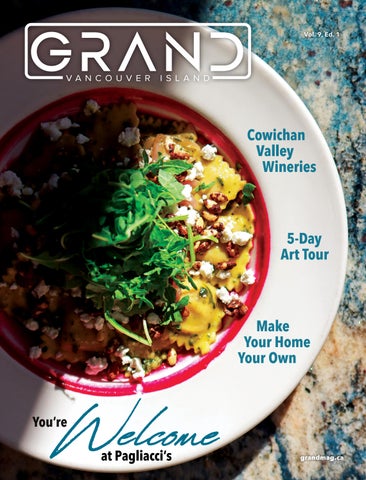
Vol. 9, Ed. 1
Cowichan Valley Wineries
5-Day Art Tour
Make Your Home Your Own
Welcome
You’re
at Pagliacci’s
grandmag.ca Vol 9, Ed 1 1
2
GRAND
GRANDmag.ca
Tweens Teens SIKORSKY S-76A
SIKORSKY S-76C+ (BC AIR AMBULANCE SERVICE)
HE LIJET FLE ET
Island Parent Group Enterprises has been a trusted voice for families and communities for over 37 years. Through our magazines—Island Parent, WestCoast Families and GRAND—we connect readers with engaging, relevant lifestyle content that celebrates parenting, family life and active living. Proudly locally owned and independently published, we enrich lives across Vancouver Island and the Lower Mainland with stories that inspire, inform and bring people together.
WINTER 2024/25
IN•FLIGHT REVIEW
Publisher Jim Schneider | jim@ifr-helijet.com
info@ipgenterprises.com Editor Stacie Gaetz | editor@islandparent.ca Graphic Design Brent Foote Account Executives:
GRANDmag.ca SIKORSKY S-76C++
Garth Eichel | garth@ifr-helijet.com Kristine Wickheim | kristine@ifr-helijet.com Raeleigh Buchanan | raeleigh@ifr-helijet.com Distribution: Distribution in all scheduled Helijet aircraft
Vol 9, Ed 1
3
Vol. 9, Ed. 1
6
7 Grand
Jim Schneider Publisher publisher@islandparent.ca Stacie Gaetz Editor editor@islandparent.ca Kristine Wickheim Account Manager kristine@islandparent.ca
8
Timeless Hospitality
14
Dog Walking
11
Cowichan Wine Country
16
What’s Next in Tech
12
Island Cheesemaking
18
GRAND, published by Island Parent Group Enterprises Ltd., is the premier digital lifestyle publication for active adults aged 50 and over living on beautiful Vancouver Island. Views expressed are not necessarily those of the publisher. No material herein may be reproduced without the permission of the publisher.
Staying Sharp Cover photo by Thomas West Photography thomaswestphotography.com
20
Arts & Culture Road Trip
22
Make Movement Count
Grand Magazine
24
Give Back to Your Garden
518 Caselton Place Victoria, BC V8Z 7Y5 250 388 6905 GRANDmag.ca
A proud member of
26 4
GRAND
28
Building Hope Make Your Home Your Own
30
Top Podcasts GRANDmag.ca
Gratitude (& Growth) at Every Age
T
he word grateful is overused. Don’t get us wrong—the concept of “gratitude” is incredibly important and can even be lifechanging in certain circumstances—but we hear “Be grateful for what you have” so often, it begins to lose meaning. In 2020, my family and I found a simple, tangible way to remind ourselves of what we already have and what still brings us joy. Each fall, my family and I have a tradition: We write the things we’re thankful for on our “Thankful Pumpkin.” I have noticed over the past five years that the good thing about getting older is you learn to value what truly matters. You appreciate the small pleasures:
GRANDmag.ca
• the quiet satisfaction of putting your garden to bed for the winter • taking the dog for a walk • dinner at your favourite winery or restaurant • learning a new skill (like cheesemaking) • exploring a local art tour You’ve lived long enough, and seen enough, not to take any of it for granted. And here’s the beautiful part: gratitude doesn’t just make you feel good—it is good for you. Research continues to show that grateful people experience lower stress, better sleep and a stronger sense of purpose. When combined with a willingness to learn and grow, gratitude becomes a
powerful tool for mental, physical and social well-being. And what better place to live that out than here on Vancouver Island, where the rhythm of the ocean, the scent of cedar and the creative energy of community are constant reminders of abundance? It is important to take stock of what we have but writing it down with a Sharpie on a pumpkin isn’t where it stops. Gratitude, at its best, isn’t just a buzzword. It’s a way of living—a daily practice that reminds you that you are still learning, still growing, still becoming…. Because no matter your age, there’s always more to discover and more to be thankful for.
Stacie Gaetz
Vol 9, Ed 1
5
Grand 7
Ideas & Inspirations
6
GRAND
Vancouver Island in a Box
Eldercare Foundation
Deliver a taste of the island to your friends’ and family’s doors. These unique and personalized gift boxes offer some of the best local products on Vancouver Island. From mouth-watering chocolate to scrumptious jerky, they have something for everyone. Their gift boxes are carefully curated to reflect the unique spirit and beauty of the area, making them the perfect gift for anyone who loves this incredible place we call home. Learn more at vancouverislandinabox.ca.
Since 1982, Eldercare Foundation has been working to improve quality of life for seniors on Vancouver Island. They partner with Island Health, donors and community organizations to fund programs that support aging in place, enhance longterm care and advance education for caregivers and healthcare professionals. Donations support art and music therapy, homelike enhancements and provide other vital items to seniors with financial barriers through the Resident-in-Need Fund. Learn more at eldercarefoundation.org.
The Truth in Truth & Reconciliation Educational Board Game The Truth in Truth and Reconciliation Educational Board Game is an essential educational resource that gives participants a vicarious experience of the process of colonization in a board game format. Through Truth and Consequence Cards, participants can explore iconic Canadian historical events from an Indigenous point of view in this immersive, thoughtprovoking educational board game. Learn more at shop. medicinewheelpublishing.com.
GRANDmag.ca
Shen Yun: China Before Communisim
Banovich by John Banovich
Flamingo Turns 50
Gratitude: Self-Care Journal App
Shen Yun is a global performing arts company that revives ancient Chinese culture through classical Chinese dance, live orchestral music and digital backdrops, showcasing myths, legends and traditional virtues often lost under communist rule. A blend of Western and Chinese instruments creates original scores for each piece. Shen Yun performs in Vancouver at the Queen Elizabeth Theatre from April 8 to 12, offering an immersive cultural journey for the whole family. Learn more at shenyun.com.
Experience three decades of natural history and personal adventure in John Banovich’s debut book. Banovich is an accomplished photographer, cinematographer, and director from Vancouver. His first book, Banovich, is a monumental 450page collection that captures the raw beauty and emotional depth of Canada’s landscapes and wildlife. It weaves an inspiring narrative of John’s near-death experience, his seemingly insurmountable challenges, and the remarkable victories that define his extraordinary journey. Learn more at shepherdsterling.com.
A flamingo by the name of Mango at Victoria Butterfly Gardens recently celebrated his golden jubilee birthday. Mango is a Caribbean flamingo (also known as an American flamingo), a species native to the Yucatán Peninsula, northern South America and Caribbean islands. While these birds typically live up to 30 years in the wild, Mango has far surpassed that, making him one of, if not the, oldest living flamingo in the world. Learn more at butterflygardens.com.
The Gratitude app is a self-care tool to help you focus on your mental health. With a gratitude journal, affirmations, vision board, and daily motivation content, Gratitude provides you with all the tools and reminders you need to gain motivation and develop a healthy self-love routine in your life. The app is completely private, so you can always be assured that your precious journal entries are for your eyes only. Learn more at by searching for “Gratitude: Self-Care Journal” wherever you access apps.
GRANDmag.ca
Vol 9, Ed 1
7
Timeless Hospitality Nourishing Souls Since 1979
P
agliacci’s Restaurant in downtown Victoria is one of those places where you instantly feel at home. Born in passion, carved from life and bathed in laughter, this establishment has become an icon in Victoria. Established in 1979, co-owner Solomon Siegel jokes that they are one of the only restaurants that is best known for the food they give away for free. From their infamous (and complimentary) focaccia bread to their renowned
8
GRAND
soup and Broadway-style cheesecake, every morsel is made on the spot and served with a smile. “The key to our long-term success has been hospitality,” says Siegel. “The goal is to make people feel cared for and welcome. Everything we do is in service of that. We have a deep respect for our guests and create an experience we would want to have.”
GRANDmag.ca
He adds that many chain restaurants see their patrons as “customers” and not guests. “You are treated like a number and feel like you are bothering them when you go to an establishment like that,” he adds. “They don’t even acknowledge you until they are ready for you. If you had a friend at your door (no matter how busy you were), you would come to the door and say. ‘Sorry, I’m so busy right now. Please come in and have a seat. Can I get you anything to eat or drink?’” “That’s how we treat people. It is a fully human experience. You are coming into our home and we want you to feel welcome.” Siegel’s father Howie opened Pagliacci’s (affectionately known as Pag’s–despite the fact that the “g” is silent) 46 years ago. Howie was born in Brooklyn and grew up in Los Angeles. He moved to the Island in the ’70s and realized there was nowhere to get a good piece of cheesecake and a cappuccino after a movie. “He called my uncle (David) and asked him to come out to Victoria so he could open the place he was looking for,” says Siegel. Siegel took the business over from his dad and uncle 12 years ago but not without some convincing that he was the right man for the job. “I grew up working here and then went off and did my own thing and when my dad and uncle were looking for a general manager, I came back because it made sense for me to get
GRANDmag.ca
back into the family business,” he says. “I had owned my own restaurant by then and worked in the world of bartending and I wanted to come in and redirect the restaurant to be its truer self.” Howie is still involved with the restaurant at 80 years old and David passed away six years ago. Siegel prides himself on staying true to the restaurant’s history. It still has many of the same food items that were on the menu when the restaurant opened almost 50 years ago. “In a way, you have to change to stay the same,” he adds. “It is really a curation because the ingredients you can get a hold of change all the time but items like the Hemingway Short Story (tortellini stuffed with beef, ricotta, Romano and Parmesan cheeses, bacon cream sauce and green onions), focaccia bread and the New York-style cheesecake will remain staples.” Another thing that has stayed true to Pagliacci’s roots is the fact that it is a lively hub for jazz music. “As far as I have been able to find, we are the restaurant that has had the longest-running free live music in all of Canada,” says Siegel. “We are really proud of this legacy. I grew up with a deep love of music from my mother and father, and the roots are deep in my soul.” He adds that instead of cutting back on live music during the pandemic, like many restaurants did, he expanded their program.
Solomon Siegel
Vol 9, Ed 1
9
“We wanted more music and got the musicians to play outside,” he says. “Music is an amazing experience that brings people together and creates memories. Good food, good wine, happy people and music…. That’s how good memories are made.” Pagliacci’s has live music every day of the week including during Sunday brunch. Siegel even plays guitar in the band The Vanity Project on Wednesdays. The restaurant has seen several world-class jazz greats play there over the years including Doctor John, Etta James, Dexter Gordon and many more. “The bands we have now, we are a home base for them,” says Siegel.
“It is a coveted thing to play at Pag’s—it’s like a tenureship. Some of them have been playing here since I was born.” In an industry with a high turnover rate, it speaks to the sense of family among the employees that many of the staff at Pagliacci’s have worked there for almost as long. “We have people who have been here since the ’80s and two of our staff just celebrated 30 years with us,” says Siegel. “It is a testament to how well we treat people, our staff and our guests. That is why we will be here for another 46 years, but you don’t have to wait that long to come see us!” Learn more about the Victoria landmark at pagliaccis.ca or visit them at 1011 Broad Street.
Stacie Gaetz
is the managing editor of GRAND. She runs on exploring new and exciting places and getting to the heart of people’s stories. If you have a story she should know about, reach her at editor@islandparent.ca. Photos on pages 8, 9 (lower right) and 10 by Thomas West Photography. 10
GRAND
GRANDmag.ca
Discover the Refined Charms of Cowichan Wine Country
L
ocated just outside the city of Victoria, the Cowichan Valley is flanked by verdant agricultural land on one side and wild coastline dotted with idyllic towns on the other. With terroir unique to this part of Vancouver Island, vintners here produce citrusy, floral whites and soft-structured red wines that reflect the rhythm of the seasons for many years. If you are a wine-lover, Cowichan Valley boutique wineries are the perfect place to tour. Many are family-run and steeped in local charm with delicious delicacies that pair perfectly with each glass of quality vino.
History
Home to 13 wineries, the Cowichan Valley is Vancouver Island’s only official winemaking region. Many are surprised to learn Cowichan is one of the largest wine regions in BC. The time, energy and love proprietors put into growing every grape is evident. Winemaking in the region officially began in 1992 when the first commercial winery opened in Duncan. Yet European homesteaders were growing grapes for private consumption as far back as the 1800s. A willingness to experiment in this new climate was evident in 1986 when an aptly titled “experimental vineyard” opened in Duncan on the lands now home to the Blue Grouse Estate Winery. Over 100 test vines of different grape varieties were grown there. This experimentation and European influence can still be seen today in the varieties of wine produced—from Spanish tempranillo and French pinot gris to more up-and-coming varieties like German bacchus and flavours that showcase other Cowichan produce, like lavender. Emandare Vineyard
Geology
The Cowichan Valley’s unique microclimate makes it the warmest and driest region on Vancouver Island. Protected by surrounding mountains, the area is shielded from Pacific storms, resulting in mild winters, minimal frost and an extended growing season. A distinctly Mediterranean climate, which is tempered by ocean breezes, keeps summer temperatures moderate and prevents extreme heat, creating ideal conditions for balanced, expressive wines. The Cowichan Valley also features a diverse soil composition that contributes to the clean, elegant structure of its wines. Formed through ancient volcanic activity, shifting tectonic plates and glacial movement, the soils are a complex mix of marine sediment, sandy loams, clay-rich pockets and silty layers. This geological diversity allows for a wide range of grape varieties and expressions across the valley.
Varietals
Sustainable production is central to the winemaking ethos in the Cowichan Valley. The area benefits from mild, maritimeinfluenced weather featuring warm summers and gentle winters, creating an ideal environment for cultivating diverse grape varieties. Cowichan Valley’s coastal climate is perfect for cool-climate grapes, resulting in fresh, expressive wines. You’ll find vibrant whites like pinot gris, chardonnay, ortega and bacchus, along with pinot noir that shines with bright fruit and balanced acidity. Thanks to the region’s cooler temperatures and long sunlight hours, it’s also ideal for crisp sparkling wines and refreshing rosés—full of lively acidity and flavour. Local varietals include: • Ortega • Bacchus • Gewurztraminer • Pinot gris • MaréchalFoch • Pinot noir
Tours
Embark on an unforgettable journey
GRANDmag.ca
Averill Creek Vineyard
through Cowichan Wine Country. Crafted in collaboration with the Cowichan Wineries Society and Tourism Cowichan, the Cowichan Wine Map invites you to discover award-winning vintages, picturesque vineyards and welcoming tasting rooms. Let the distinct charm and stories of each winery lead you to your next cherished wine. The proprietors are eager to share a deep appreciation for the beautiful surroundings that provide the area with so many ingredients over a crisp glass of Cowichan wine. Organic tending methods, natural wines and vines that have been spray-free for over 60 years are just some practices dedicated to ensuring a flourishing natural environment for future generations.
Cowichan Valley Wineries • Alderlea Vinyards • Averill Creek Vineyard • Blue Grouse Estate Winery • Cherry Point Estate Wines • Cobble Hill Winery • Divino Estate Winery • Doel Estate Winery • Emandare Vineyard • Enrico Winery • TellTale Winery • Unsworth Vineyards • Venturi-Schulze Vineyards • Zanatta Winery
With files from winebc.com and tourismcowichan.com. Download the Cowichan Wine Map at tourismcowichan.com.
Vol 9, Ed 1
11
Cheesemaking
Explore Vancouver Island’s
C
Scene
heesemaking on Vancouver Island is equal parts heritage, craft and pure West Coast flavour. While cheese has been part of Canadian cuisine since roughly the 1600s, it didn’t make its way west until the 1800s, when early settlers brought dairy cows to the coast. Vancouver Island’s mild climate and lush green pastures soon proved perfect for dairy and for the art of turning milk into cheese.
Island Terroir: The Secret Ingredient
From Settlers to Small Batches
• Although cheddar and mozzarella are still leading the way when it comes to cheese purchases, artisan varieties are now the fastest-growing cheese category in Canada. • BC’s cheesemaking scene is small but mighty, home to a few dozen independent producers, many concentrated on Vancouver Island. • Vancouver Island cheesemakers regularly take-home national awards, helping to put the island on the map for food tourism.
In the early days, cheesemaking was a homegrown affair. Families made simple farmhouse cheeses in kitchens and barns, using whatever milk they had on hand. For
So, what makes Vancouver Island cheese so special? It’s all about the terroir—the environment that gives milk (and therefore cheese) its unique taste. Plus, most island producers still use traditional methods, minimal processing and sustainable practices that reflect the region’s values.
A Few Fun Facts
Must-Try Vancouver Island Cheesemakers
a time, large-scale production shifted to the mainland, where transportation and refrigeration were easier to manage. But the island never lost its connection to smallbatch dairy. Over the past few decades, a quiet revival has transformed that humble tradition into an artisan movement. Up and down Vancouver Island you’ll find a growing number of cheesemakers crafting everything from fresh chèvre and feta to aged alpine-style wheels.
12
GRAND
Natural Pastures Cheese Company. A true pioneer in island cheesemaking, Natural Pastures creates everything from fresh bocconcini to rich, aged alpine cheeses. Their buffalo mozzarella has earned international recognition, and the Courtenay shop is a must-visit for food lovers. naturalpastures.com Little Qualicum Cheeseworks. This family-run farm and creamery in Parksville produces a wide range of cheeses—brie, blue, cheddar, feta and more—using milk from their own herd. Visitors can take self-guided farm tours and watch cheesemaking in action before tasting the results. cheeseworks.ca BoMé Cheese. BoMé Cheese is an artisan cheesemaker and café located in Coombs. They craft a wide variety of handmade cheeses including brie, blue-veined styles, alpine/herbal blends, washed-rind types and more. Their cheeses are often infused GRANDmag.ca
www.conservancy.bc.ca 1-877-485-2422
Protect the ecosystems and habitats you care about while honouring someone you love this holiday season with a TLC Tribute Gift! with flavours like garlic-chives, herbs or hemp seeds. bomecheese.ca Salt Spring Island Cheese. Just a short ferry ride from Crofton or Victoria, this Salt Spring Island creamery is famous for its stunning goat cheeses adorned with edible flowers. It’s a beloved (and yummy) stop on any island cheese tour. saltspringcheese.com
The perfect gift for everyone on your list!
Learn to Make Cheese Yourself
Feeling inspired to try your hand at cheesemaking? The island offers several hands-on specialty workshops and experiences for beginners at local recreation and community centres, or check out these cheese-making businesses: Make Cheese with Paula. Paula Maddison’s popular classes teach home cooks to make fresh cheeses like mozzarella, ricotta and chèvre—no fancy equipment required. She offers workshops across the Gulf Islands and mid-island region, as well as on the mainland. makecheesewithpaula.ca Victoria Cheese School. A hub for tastings, pairing classes and cheesemonger training, this Victoria school offers a delicious way to deepen your cheese knowledge from Camembert to cheddar. victoriacheeseschool.com So, whether you’re a serious turophile (that’s a cheese lover!) or just someone who can’t resist a gooey grilled cheese sandwich, Vancouver Island has you covered. The next time you spread a locally made creamy chèvre on a cracker or slice into a sharp, crumbly cheddar, remember that you’re tasting a bit of Vancouver Island’s rich, delicious history.
Erika Palmer
is a writer living in Victoria with her husband and daughter. She believes most problems can be solved with a glass of wine and a huge piece of cheddar. GRANDmag.ca
You can support B.C.’s biodiversity by making your tax deductible Tribute Gift to The Land Conservancy of B.C. today!
You can help amputees with a charitable estate donation in your will. Your gift provides amputees, including children, with essential artificial limbs and so much more.
estatedonation@waramps.ca waramps.ca • 1 800 465-2677 Charitable Registration No.: 13196 9628 RR0001
Vol 9, Ed 1
13
Dog Walking Tranquillity or Anxiety-Filled Chore?
G
oing for a walk with your dog can be one of life’s simple pleasures. Whether walking on a city sidewalk or a hiking path in the mountains, a calm, relaxing walk can be exactly what you need to drive away your stress. Unfortunately, the tranquillity of a walk is out of reach for many dog owners. Instead, the walk is a frustrating mess of pulling, lunging and barking, or an anxiety-filled chore of hoping not to encounter anything that might trigger overarousal or fear.
Breaking Down Loose Leash Walking into Achievable Goals
A peaceful walk is a hard-earned reward; training a dog to walk with a loose leash can be one of the most difficult skills to teach because: • We expect our dogs to walk in a way that is not natural to them. We require our dogs to walk in a straight line, stay close to us and maintain a pace that matches our own. • We prefer that our dogs ignore all the enticing smells around them and not pause to examine anything with their powerful nose. • We want our dogs to remain calm and neutral throughout the entire walk, regardless of what they see or encounter. Honestly, every walk has the potential to throw an unwelcome situation at us and our dogs. For example, the regular occurrence of encountering another dog and a human can be particularly frustrating, especially if the other dog starts straining at the end of their leash and barking excitedly.
Most dogs do not want to be friends or prefer to have a select few dog friends. Allowing two unfamiliar dogs to meet on leash, especially if one is overexcited, is abnormal for them. Dogs often feel trapped by the leash because they can’t get away from the situation, forcing the dogs into each other’s space. If the dog starts to feel uncomfortable or overwhelmed, they might try to run away or lash out to get the other dog to respect their space. If this kind of encounter occurs regularly, a dog will likely start to associate those negative feelings with any dog they see while out walking, and all sorts of unwanted, problematic behaviours will result. So, how can the aggravating routine of unwanted behaviour be transformed into the desired calm walk? We break it down into manageable goals, training each skill required individually.
Goal 1: Define Loose Leash Walking
This may seem a bit silly but taking the time to clearly define your expectations of your dog while walking is valuable. If during a walk the dog is allowed to pull, and then the next walk it is not allowed to pull, the dog is not going to understand what it is supposed to do. Decide what will work best for you and your dog and apply your expectations consistently during every walk.
Goal 2: Bolster Your Value to Your Dog
The outside world is an exciting place for our dogs. To ensure your dog will listen and engage with you, you must be more valuable to them than all the new exciting things they see or smell outside. To build value for yourself, try playing simple games or doing simple tricks regularly with your dog in your home. When you feel your dog is fully engaged while working with you in your home, try doing the same thing in quiet, low-distraction areas outside (like your backyard or an empty parking lot). While playing these games, use high-value treats or toys as a reward.
Goal 3: Teach Your Dog to Recognize a Tight Leash
No dog is born understanding how to walk on a leash, let alone a loose leash, so we must teach it just as we teach our dogs to sit or lie down. It comes down to the main concept of establishing the rule: if the dog pulls, they are not allowed to go in the direction they are pulling. 14
GRAND
GRANDmag.ca
Try calling your dog to encourage them to follow you, then turn around and walk in the opposite direction when they pull. Repeat every time they pull. A four- to six-foot leash, with a properly fitted collar or harness, is recommended. Long lines and retractable leashes are great for hikes, but when teaching
loose leash walking, they are a hindrance. Having a short leash will help you keep your balance and give you more control when your dog does pull.
Goal 4: Teach Your Dog When and Where to Sniff
Sniffing is one of the major causes of pulling; sniffing is a natural part of being a dog and dogs want to pull their owners to enticing odours. There is no standard rule on whether a dog should or should not be allowed to sniff, so you need to decide for yourself what you would like your dog to do on your walk.
Goal 5: Be Intentional on Selecting Where You Walk
What you encounter around you is what makes walking dogs potentially volatile. People, dogs, rabbits, bikes, cars, butterflies…anything and everything has the potential to distract your dog. It may be impossible for your dog to focus on you and what you are trying to teach when there is so much going on around them. If you are really struggling, being intentional in selecting quiet places to train is integral to your success.
Goal 6: Trust the Journey
It takes a significant amount of training for both you and your dog to meet all your expectations. Remember, you are training for that marathon, and everyone progresses differently and in their own time. If you are struggling, don’t be afraid to reach out to your local trainers, they are there to help you! Lastly, remember, it’s okay to advocate for yourself and your dog. If you come across another dog and do not want your dog to meet, it’s okay to politely refuse the greeting. If you do want the dogs to meet, ask if it is okay. If the other person does not want them to meet, respect that. We are all working hard with our dogs to train and create a peaceful walking routine.
Rebecca Leippi
(High 5 Dog Training Academy) Rebecca has fallen in love with helping others achieve their goals with their dogs, with a particular interest in teaching loose leash walking, puppy training, rally obedience and agility. When not teaching others, Rebecca competes in agility, rally, barn hunt and conformation with her dogs. Originally published in Paw Quarterly Magazine Summer 2024. GRANDmag.ca
Vol Vol 8,9, Ed Ed 31
15
How Today’s Tech Enriches Life’s Next Chapter
I
t was a sunny afternoon in Paris when I stepped into the Louvre Museum with an old friend. As we approached the ticket counter, I asked if he wanted to use the museum’s guided audio service. He shook his head. “Why not use your AI app instead?” he suggested.
behind a painting and the answers flowed naturally. The experience was interactive, intuitive and deeply personal. This kind of real-time, adaptive storytelling is exactly what apps like SmartGuide and Bloomberg Connects are beginning to offer. With AI and GPS
This isn’t the only way AI is changing aspects of our lives that we never thought it would. The arts, working out, home life, hobbies, socializing and more are just a few of the unexpected facets of our lives that can be improved with the use of artificial intelligence.
I launched ChatGPT on my phone and gave it a simple prompt: “Act as my museum guide. Tell me about this building.” What followed was nothing short of magical. Instead of listening to a one-size-fits-all audio recording, I found myself in a two-way conversation. I asked about the architecture, the history of the room, the meaning
working together, these apps deliver layered histories and vivid details straight to your earbuds. They turn a simple museum visit into an adventure of discovery—feeding our curiosity, encouraging exploration and making art feel personal again.
Move with Joy: Smart Exercise Experiences for 50+ Bodies
16
GRAND
Across the tech world, smart fitness is gaining momentum. Platforms like Supernatural VR and i-ActivEx are designed with older adults in mind, offering everything from dance sessions in the Alps to tai chi on virtual beaches. These programs use motion sensors, real coaches and immersive GRANDmag.ca
soundtracks to turn physical activity into a full-body experience. Running marathons has always been part of my rhythm. But this past training season, I tried something new: I built an AI trainer. Using a GPT model trained on advice from legendary coaches, I created a virtual guide that built a personalized plan, adjusted it daily and asked me how I felt after each run. It wasn’t just smart—it was encouraging. The results were some of my best yet. This isn’t about obligation—it’s about joy, confidence and rediscovering what our bodies can do.
A House That Knows You: Personalized Smart Environments
Imagine waking up to your favourite morning playlist, the lights slowly brightening like the sun. By evening, soft jazz plays as the temperature lowers and the reading lamp beside your chair flickers on. You haven’t touched a switch all day. Smart home systems like Alexa, Google Home and SmartThings can now create “routines” that mirror your lifestyle. It’s not just about convenience; it’s about comfort, rhythm and feeling seen in your own space. For older adults, especially those living solo, this can mean a safer, more responsive environment—one that quietly supports daily life without constant intervention. Whether it’s voice commands, motion sensors or adaptive lighting, your home becomes a helpful partner.
From Memory to Masterpiece: Creative Tech for Expression & Legacy Creativity doesn’t retire. In fact, many of us find more time and inspiration later in life to write, paint, sing or tell stories. Today’s tech tools are making those impulses easier to share.
GRANDmag.ca
Platforms like StoryCorps allow you to record family histories and turn them into digital keepsakes. Canva makes it easy to design a photo book or recipe journal, even for those who are not tech-savvy. AI tools now let you compose music or co-author stories with intuitive prompts. One woman I met recently used a storytelling app to create a multimedia book filled with childhood memories, family recipes and video clips. She gave copies to her grandchildren last Christmas. “Now they can hear my voice and see my face whenever they want,” she said. When it comes to creativity, tech isn’t the centre of the story—it’s the pen, the brush, the stage. It is a tool that helps us express what matters and leave something lasting behind.
Together in New Ways: Shared Immersive Experiences
A friend of mine lives three time zones away from her son and two grandkids. Visits are rare. But on her birthday this year, they “met” at the Eiffel Tower through a VR app and explored Paris together, laughing and taking virtual selfies along the Seine. Platforms like Sociavi and Rendever offer seniors a way to travel, play games or attend events with loved ones in real time, regardless of distance. These experiences go beyond Zoom calls. They offer shared presence—a sense of doing something together, not just watching. In a world where physical separation is sometimes inevitable, technology is helping maintain the closeness that matters most.
The Next Chapter
The best part about these innovations? They don’t require you to be a tech wizard. Many tools are as simple as opening an app or speaking a command. They quietly enhance our lives, not by replacing what we do,
but by supporting how we want to live. So, whether you’re curious about a smarter living space, a virtual art class or a new way to stay fit, take that first step. The future isn’t just friendly, it’s here and it’s waiting for you to enjoy it.
How to Try This at Home Explore Art Differently. Download SmartGuide or Bloomberg Connects before your next museum visit. Ask ChatGPT about the artworks around you and follow your curiosity. Make Fitness Fun. Try YouTube or VR fitness apps like Supernatural tailored to older adults. No headset? Even voice-led walking plans can add variety. Smarten Up Your Space. Use Alexa or Google Home to create routines: gentle music in the morning, dim lights at sunset, reminders to stretch or do breathing exercises. Create and Share. Visit StoryCorps.org to record a memory or try Canva to design a keepsake book of photos or family traditions. Connect Beyond Distance. Try a virtual co-watch with family using shared video links or ask your senior centre if they offer VR experiences with Sociavi or Rendever.
Alexis Santacruz
is a seasoned entrepreneur and business development expert with a strong background in sales, technology, strategy and AI-driven solutions. Alexis is passionate about empowering people to grow, companies to scale efficiently and making impactful community connections.
Vol 9, Ed 1
17
Staying Sharp
A
s we age, it’s natural to pay more attention to our bodies—our joints, our blood pressure, our sleep. But what about our brains?
You don’t need to become a marathoner, aim for about 150 minutes of moderate activity a week. That could be a morning walk along Dallas Road, an aqua-fit class,
After 50
• Leafy greens and colourful veggies (spinach, kale, peppers) • Berries (blueberries and strawberries are easy to find at local markets) • Whole grains, nuts and beans • Olive oil as your main fat • Fish a couple of times a week for brainboosting omega-3s Limit red meat, fried foods and sugar when you can. And skip the expensive “memory supplements” (the research just doesn’t back them up). Whole foods win every time.
3. Keep Learning New Things
Your brain loves a challenge. Whether it’s learning a new language, taking a painting class, trying out a new recipe or learning a song on guitar—anything that makes you think in fresh ways helps strengthen your “cognitive reserve.” Lifelong learning keeps your brain flexible and adaptable. Even a daily crossword or Sudoku can make a difference.
4. Stay Connected & Social
The truth is, cognitive decline isn’t inevitable. Just like our muscles, our brains benefit from regular “exercise” and care. Here are some proven and manageable ways to help your brain stay sharp, resilient and curious well into your later years.
a bike ride or a few hours in your garden. The key is consistency. People who stay active are far less likely to experience memory problems later in life. Think of it as one of the best medicines you don’t need a prescription for.
1. Move Your Body, Protect Your Brain
2. Eat Smart for a Healthy Brain
It’s no surprise that what’s good for the heart is good for the brain. Regular physical activity—even brisk walking—increases blood flow, reduces inflammation and promotes new brain cell growth. 18
GRAND
The MIND diet—a mix of the Mediterranean and DASH diets—has been shown to support cognitive health and slow memory decline. The focus is on simple, real foods:
Humans are wired for connection, and our brains thrive on it. People who maintain strong social ties are less likely to develop dementia. That might mean meeting friends for coffee, joining a walking club, volunteering or checking in on a neighbour. It doesn’t have to be a big social calendar, what matters is regular, meaningful connection. Victoria is rich in community life, from art classes to local choirs to volunteer programs, so finding ways to engage is easier than you might think.
5. Take Care of Your Physical Health
Your brain depends on a healthy body. Keeping tabs on your blood pressure, cholesterol, blood sugar and weight can make a huge difference in long-term brain health. If you smoke, consider quitting (your brain will thank you). And while a glass
GRANDmag.ca
Ask Yourself: 1. What’s one small habit I could start this week to support my brain? 2. How can I bring more movement or connection into my daily routine? 3. Who could I partner with to stay accountable and make it fun? Your brain, like any muscle, rewards you for the effort you give it. Keep feeding it curiosity, movement and connection and it will serve you well for many years to come. of wine can be enjoyable, excessive drinking increases the risk of cognitive decline. Moderation really is key here.
6. Prioritize Rest & Stress Relief
A tired brain doesn’t function well. Aim for seven to eight hours of quality sleep each night. Good sleep helps your brain clear toxins and consolidate memories. Try creating a relaxing bedtime routine: dim the lights, avoid screens and keep a consistent schedule. And don’t underestimate the toll stress can take. Chronic stress or untreated anxiety and depression can affect memory and focus. Whether it’s meditation, walking, talking to a counsellor or just slowing down, stress management is brain management.
7. Know What You Can (& Can’t) Control
HER FUTURE BEGINS HERE.
stmarg.ca
We can’t completely prevent Alzheimer’s or dementia but research shows we can dramatically reduce our risk through these everyday choices. Even small changes add up: one more walk a week, swapping chips for nuts, reconnecting with an old friend. The brain loves progress more than perfection.
Waypoint Counselling Network
offers a free matching service to be connected to the counsellor that best suits your needs and personal style. They also offer a regular newsletter that provides simple approaches to improve your outlook and reduce anxiety and stress. GRANDmag.ca
ST. MARGARET’S SCHOOL
Girls’ school. JK— Grade 12. Open Houses
RSVP
January 8, February 11, March 4 or April 17.
admissions@stmarg.ca (250) 479-7171
Vol 9, Ed 1
19
Your 5 Day Island Arts & Culture Road Trip A
re you looking for an adventure this winter? Discover unique local experiences where art and life are interconnected in the essence of Vancouver Island’s creative communities. A road trip over just a few days can include all of the incredible destinations on our list.
Day One – Victoria
A gallery tour is a must on the island, beginning with a self-guided tour in Victoria’s downtown area. In addition to checking out the important historical sites, the parliament buildings and museums, plan to spend a day pursuing shops and dining. Be sure to grab a coffee at one of the local roasters and tour the downtown galleries. Our recommended stops include Madrona Gallery, Mark Loria Gallery, Flux Media Gallery, Xchanges Gallery and Studios and Gage Gallery Artists Collective. Experience Indigenous arts and culture at Explore Songhees kiosks around Victoria where you can book walking tours, canoe tours and buy Indigenous art at the shop at Ship Point. Check out events and members of the Victoria Arts Council to explore your creative side and schedule a class with a local studio. In addition to your downtown walking tour, think about checking out
local artist studios that are open to the public.
Day Two – Highway 14 (2hrs, 110kms)
After thoroughly exploring Victoria, head out of the capital along the West Coast toward Sooke. Just 30 minutes West of Victoria, Sooke is an artistic and adventurous town. We recommend checking out Sooke Fine Arts Gallery. Plan to
explore nature while in Sooke and spend time walking the trails of many scenic local parks. Explore the pristine beaches and the rugged natural beauty of Jordan River, Shirley and small waterfront communities along the Pacific Marine Circle Route between Sooke and Port Renfrew at the end of Highway 14.
Day Three – Port Renfrew to Tofino (5hrs, 340kms)
The scenic drive from Port Renfrew to Tofino is the longest drive on your road trip itinerary, but don’t fret, there are plenty of awe-inspiring views and Instagrammable pit stops along the way! We recommend a stop at Cathedral Grove where towering old-growth forest reaches into the misty skies along boardwalk trails. Arriving in Tofino, head to a local spot for dinner or grab some groceries and spread a blanket on the beach (if weather allows), basking in the glory of the rugged Pacific coast.
Day Four – Tofino to Port Alberni (2hrs, 156kms) & Qualicum to Campbell River (1hr, 110kms) Spend the morning walking the beaches in Tofino with a good coffee or locally 20
GRAND
GRANDmag.ca
brewed kombucha, enjoying the true island vibe of this renowned surf town. Head out after lunch and drive the coast to Ucluelet for a beautiful ride, or head straight out of town along Highway 4 to Port Alberni and through to Parksville and Qualicum Beach. In Parksville, we recommend a stop at McMillan Arts Centre and MONK Studio Gallery. Check out Parksville Qualicum Beach Tourism for local programming and events before you plan your road trip itinerary. Drive into Campbell River for the evening, grab a bite to eat and spend the night in a local Airbnb.
Day Five – Campbell River to Telegraph Cove (2hr, 200kms)
In the morning in Campbell, check out the local museum and the beautiful gallery showroom of Mussels and More Pottery, where a local family of artists create one-of-a-kind coastal-inspired pottery works. Add to your growing collection of Island Indigenous artworks and pick up a unique treasure from Wei Wai Kum House of Treasures. Heading out of Campbell River, the drive to Telegraph Cove takes you through beautiful island highways toward an unforgettable experience. Get a blast from the past in one of the last boardwalk settlement communities remaining on Vancouver Is-
land—the picturesque village of Telegraph Cove. Experience the rustic nature of life in the cove where the old sawmill town overlooks the Broughton Archipelago. With the last local moving out in the 1980s, intensive restoration work has gone into renovating and preserving the colourful dwellings along the boardwalk that make up the Telegraph Cove Resort. Accommodations at the resort offer historical authenticity that is appreciated by tourists every season
along with the adornment of carvings by local artist Don Bastien who runs the Telegraph Cove Art Gallery. If you are looking for an artistic adventure this winter, an art tour across Vancouver Island might be just what you need. The eclectic communities inspire and cultivate a rich sense of culture, a laid back vibe and an appreciation for local business and artisanal fare of all kinds.
Kahla Yzerman Originally published on Art-BC.com. BC’s Guide to Arts, Culture & Heritage and Art-BC.com are the definitive guides to local, authentic experiences in the province of British Columbia. BC’s Guide to Arts, Culture & Heritage is a free publication created in partnership with local organizations that share a commitment to showcasing the excellence of our creative communities. Photos: page 20, (top) Qualicum Beach, (bottom) Telegraph Cove, both courtesy Tourism Vancouver; page 21, (top) Naaʔuu, a Tla-o-qui-aht cultural experience by Melissa Renwick, (bottom) Tofino by Marcus Paladino. GRANDmag.ca
Vol 9, Ed 1
21
Make Movement Count in the Colder Months
D
uring the winter months, you may notice a familiar restlessness creeping in. Joints feel stiffer. Muscles ache after sitting too long. You realize just how much easier it was to stay active in July, when walking, gardening or swimming happened almost without effort. While the temptation to hibernate is strong, the truth is that a little movement goes a long way in keeping your body supple, your mind bright and your balance steady, especially when the weather is icy and unpredictable. The good news? Staying active doesn’t have to mean long workouts or fancy equipment. In fact, the most powerful approach is often the simplest: small movements sprinkled throughout your day.
The Power of ‘Little & Often’
Think of movement like seasoning in cooking. You don’t need a huge dose all at once, you just need to add it regularly. Stretching while you chat on the phone, doing a lap around the kitchen during commercials, these small actions add up. One woman I spoke with described her toothbrush as her “personal trainer.” Twice a day, she balances on one leg while brushing, steadying herself with a hand on the counter if needed. “It’s silly, but I know my balance is better because of it,” she says with a laugh. These micro-movements don’t just ease stiffness; they build consistency. And consistency is the secret ingredient to long-term mobility.
Make a Plan That Fits You
Of course, knowing what to do is only half the battle. The other half is when. Some of us feel strongest in the mornings, when energy is fresh and willpower is high. Others prefer late afternoon, when the body has warmed up. Take a moment to notice your natural rhythm. Then, commit to two short movement breaks a day, just 10 or 15 minutes. Add them to your calendar, set a reminder on your phone, or link them to existing routines. (“After I make my morning tea, I’ll do shoulder circles.”) Movement doesn’t need to be a grand event. Treat it like brushing your teeth: a non-negotiable, bite-sized habit that pays off in ways you’ll feel daily.
The Joints That Matter Most
Start by moving your major joints, the ones that bear the brunt of daily life. Shoulders, hips and neck are the golden trio. Gentle shoulder blade circles release tension from reading or scrolling. Hip rotations keep your stride steady when walking across frosty sidewalks. And neck rolls soften the stiffness that sneaks in from too many hours indoors. You might be surprised at how much relief these simple moves bring. It’s like a daily “oil can” for the body, keeping things running smoothly.
Balancing Acts in Everyday Life
Balance, more than strength or flexibility, is often what determines how confident we feel moving through the world. As we age, balance becomes both more precious and more trainable. 22
GRAND
• Stand on one foot while waiting in line at the grocery store. • Stand on your tiptoes as you pump gas. • Try a mini “tightrope walk” down the hallway, placing one foot directly in front of the other. Every wobbly attempt is training your proprioception: your body’s ability to sense where it is in space. Over time, these little practices add up to more stability, fewer slips and greater ease in daily movement.
Guided Support at Your Fingertips
Of course, there are days when it’s hard to know what to do or harder still to motivate yourself. This is where guided programs shine. With so many accessible online platforms, you don’t have to leave home to find support. That’s one of the reasons I created Heart + Bones Online Yoga. Over the years, I’ve seen how powerful it is when movement is made simple, adaptable and welcoming to all bodies.
A Season of Possibility
What if this season became the time you deepened your relationship with movement, discovered new ways to support your body and built habits that support you in 2026 and beyond? So, the next time the couch calls, wrap yourself in that cozy blanket, but maybe do a few shoulder rolls first. Take a deep breath, notice how your body feels and remind yourself: every little movement matters.
Brea Johnson
is the founder of Heart + Bones, a leading online platform for anatomyinformed yoga, mobility and inclusive movement. With over 20 years of experience, she empowers people worldwide to move smarter and feel better through accessible online yoga classes, workshops and teacher training that support lifelong practice. GRANDmag.ca
...by learning how to protect them. Join Rocky Point Bird Observatory to expand your bird knowledge and share your passion for them with a community of bird lovers. A recent analysis has revealed that the Capital Region of British Columbia is the Birding Capital of Canada! We have confirmed an impressive total of 425 bird species, exceeding other renowned birding regions of Canada. Our region is also home to three historic Migratory Bird Sanctuaries and one of the best natural environments in urban Canada. Join this vibrant community. Learn with RPBO, share your skills, and participate in various birding adventures with our members. RPBO provides numerous opportunities for you, your family and friends to|get involved in birding. Visit our website for details on guided bird walks, or explore resources on a variety of topics, such as making your home and garden more bird-friendly. You can also join us for community events that are great for families, such as Victoria Bird Week in May and the Christmas Bird Count for Kids each December. Looking for more ways to be a champion for birds? Share your energy and skills as a volunteer, or join a “Be a Better Birder” course to increase your birding skills. Your involvement can lead to meaningful change, fostering awareness and sustainability for years to come. Be a part of RPBO and make a difference for birds! GRANDmag.ca
rpbo.org Vol 9, Ed 1
23
7 Ways to Give Back to Your Garden During the Dormant Season
D
uring the winter, many gardeners feel the pull to stop working in their yards. But the dormant season actually provides an invitation to give back. This season of quiet generosity sets the stage for renewal, resilience and the kind of unseen work that sustains every thriving spring. Here are seven ways to care for your garden now so it can rest well and rise strong.
1. Blanket the Soil, Don’t Bare It
The greatest gift you can give your garden is protection. Exposed soil loses life fast to wind and rain. Instead, mulch deeply with leaves, straw or shredded branches. For an extra boost of nutrition, spread compost or aged manure, then top with mulch. This keeps the microbial world active and prevents nutrients from
24
GRAND
leaching away. Think of it as tucking your garden in for a long, nourishing sleep.
2. Strengthen Roots & Soil Life
In the winter, planting is done but the garden isn’t asleep yet. Roots continue to grow until soil temperatures drop below 5°C. Support that underground activity by watering deeply during dry spells and covering bare soil with mulch or compost to stabilize temperature and moisture. Growth isn’t always about sowing new seeds; it’s about strengthening what’s already growing beneath the surface.
3. Leave the Leaves (with Intention)
Those scattered leaves that fell during the fall aren’t a mess; they’re habitat. Tuck them under shrubs, between perennials and over bare ground to shelter what lies
beneath. If you’re worried about smothering tender plants, simply break up thick mats or compost the extras. The goal is to keep the soil covered and your garden buzzing with hidden life through winter.
4. Protect Your Perennials
Plants, like people, benefit from warmth and stability. Cut back soft annuals, but let woody herbs like rosemary, sage and thyme stand, and they will continue to hold structure, scent and flavour through the season. Add three to four inches of mulch around roots to buffer against freeze-thaw cycles, and secure young trees or tall shrubs against winter winds with flexible ties. For tender plants, use burlap wraps or frost cloth on cold nights, or move pots into a sheltered spot near the house. A little insulation now can save years of growth later.
GRANDmag.ca
5. Feed Your Feathered Friends
The seed heads of echinacea, rudbeckia, sunflowers, coneflowers and ornamental grasses become buffets for finches, sparrows, nuthatches and chickadees through the colder months. Even kale, chard and parsley left to flower next spring will feed early pollinators when food sources are scarce. You can go a step further by adding suet feeders, seed blends rich in black oil sunflower and nyjer seed or simple bundles of twigs and leaves that offer nesting material and shelter. Birdbaths or shallow dishes of water (refilled often and placed near protective shrubs) can make a world of difference during cold snaps. A birdfriendly garden is a healthier garden: one full of natural pest control, colour, song and movement, even in the quiet months of winter.
GRANDmag.ca
6. Compost as an Act of Gratitude
Don’t let your fallen abundance go to waste. Composting kitchen scraps and garden debris returns nutrients to the soil, in a full-circle gesture of reciprocity. In mild coastal climates, decomposition continues slowly all winter. Come March, you’ll have rich humus ready for planting. Every peel, leaf and pruning adds to next year’s fertility.
7. Reflect & Reimagine
Even during the chilly months, take a slow walk through your garden. Notice what thrived, what struggled and what surprised you last season. Jot a few notes in your garden journal, as these observations will be gold when you plan next year’s beds. The winter garden reminds
us that growth often happens unseen. Roots knit deeper. Soil heals. Life reorganizes itself beneath the frost. Giving back, whether through mulch, compost or quiet attention, is how we stay part of that living cycle.
Joshua C lae Wagler
and Edible Landscapes Design are a team of passionate professionals serving homeowners, businesses, farms and DIYers to design, install and maintain landscapes that nourish, feed and regenerate. Learn more at ediblelandscapesdesign.com.
Vol 9, Ed 1
25
Building Hope Keeping Island Families Together During Medical Crises E
ach year, thousands of island families must leave home for health care. In Nanaimo, the nearest hotel is over two kilometres from the hospital. Mothers in early labour from Ucluelet face a 2.5-hour drive, while families from Port Hardy travel 388 kilometres. Jesse’s House in Nanaimo will bring families closer to care, removing a major barrier to vital health services and you can help make it a reality. Children’s Health Foundation of Vancouver Island recently announced a $10-million fundraising campaign to build a home away from home for Island families travelling to Nanaimo for their child’s health care. The announcement was made at a special groundbreaking ceremony held at the future site of the home on the Nanaimo Regional General Hospital campus on October 8. The 16-bedroom facility, named Jesse’s House, will welcome families from across Vancouver Island and the surrounding 26
GRAND
islands who need a place to stay while accessing Nanaimo Regional General Hospital and nearby health care services. Construction is estimated to be complete by spring 2027. Jesse’s House is named after Nanaimo resident Sheri Shanahan’s daughter, the late Jesse Shanahan. Shanahan has been an important partner and champion for a home away from home in Nanaimo ever since she stayed at Jeneece Place while Jesse was admitted to the neonatal intensive care unit at Victoria General Hospital. “When my family stayed at Jeneece Place, it gave us comfort during one of the hardest times of our lives,” says Shanahan. “I am so excited to have worked alongside Children’s Health Foundation of Vancouver Island to bring the vision of Jesse’s House to life. This home away from home will have a huge impact on the lives of Island families, providing a safe, warm place where they can receive the same
support that meant so much to us, and be just steps away from their child.” Jesse’s House will be the third home in the Foundation’s Homes Away From Home program, with others in Victoria and Campbell River. Jeneece Place was established in 2012, after Jeneece Edroff (now known as Frankie) asked the community to rally behind the development of a home for families to stay while their children received health care in Victoria. In 2021, together with families, health care providers and community groups from northern Vancouver Island, the Foundation expanded the model to open a second home in Campbell River called Q’walayu House. “It’s wonderful to see the Foundation expand into Nanaimo to support families north of the Malahat who need to travel to access care for their kids,” says Paul Murray, board chair of Children’s Health Foundation of Vancouver Island.
GRANDmag.ca
“Jesse’s House will have such a large impact for generations to come and we are excited to work alongside the community to bring it to life.” To date, the Foundation has generated $7 million for the project through assurances from the community, including Coastal Community Credit Union, Budget, the Rogers Foundation and an anonymous donor who stepped forward with an astounding $2 million core funding gift. “The Nanaimo community has stepped up in such a big way to meet the growing demand for a mid-Island home away from home,” said Veronica Carroll, CEO of Children’s Health Foundation of Vancouver Island. “With no government funding for this project, every bedroom, shared space and moment of support this home provides to families will be thanks to the generosity
and foresight of people in this community. It is truly inspiring.” Through a collaborative agreement with Vancouver Island Health Authority (VIHA), the Foundation has been granted a 40-year lease for a parcel of land on the Nanaimo Regional General Hospital campus. “Jesse’s House will provide much-needed comforts of home and familiarity during very difficult times for families,” says Leah Hollins, Island Health board chair. “We are so thankful to Children’s Health Foundation of Vancouver Island for their support of families, and to Jesse’s mom, Sheri, for creating such a powerful legacy from her own personal hardship. Jesse’s House will take the worry of accommodations away so families can focus their energy on their loved ones receiving care.”
The project’s lead architect is Alan Lowe, who also designed the Foundation’s two other homes, Jeneece Place and Q’walayu House. Tectonica Management Inc. of Nanaimo is the project’s construction manager. Learn more and donate at islandkidsfirst.com.
Stacie Gaetz
is the managing editor of GRAND. She runs on exploring new and exciting places and getting to the heart of people’s stories. If you have a story she should know about, reach her at editor@islandparent.ca. Photo on page 26 by Kevin Light Photography, Jesse’s House rendering on page 27 by Alan Lowe.
Making Your Home Your Own Rediscovering Your Style as an Empty Nester
W
hen the kids have moved out and the house suddenly feels quieter, it can be both strange and liberating. The oncebusy rooms that held your kid’s artwork and sports equipment now hold something new: Possibility. Whether you just finished moving them into their dorm or they have been grown and on their own for years, this is your time to rediscover your space. The time to make it truly your own again. Here’s how you can take this opportunity to design a home that reflects you.
Reimagine What Home Means
Start by looking at your space with a fresh perspective. What rooms or corners no longer serve your daily life? A grown child’s old bedroom could become an art studio, yoga space or guest room for visiting grandkids. The dining room that once hosted endless family dinners or was a spot for homework or scattered school notices might now be the perfect spot for a long harvest table to spend evenings gathering with friends.
28
GRAND
Find Your Design Style
You don’t need to know your “design style” in professional terms. Instead, think about how you want your home, or specific space, to feel. Do you want it to feel calm and airy, cozy and comfortable or modern and minimal? Start by gathering images of rooms that make you happy—Pinterest and decorating magazines or websites work great for this. You’ll likely notice patterns in what you choose such as romantic, vintage, airy or artsy. Give your style a name that fits you— think “Coastal Calm,” “Modern Rustic” or “Laid-Back Luxe.” Having your own guiding phrase makes decorating easier and helps keep your choices cohesive.
Refresh Without Renovating
You don’t need to tear down walls or get rid of all your furniture to breathe new life into your home. Small, intentional updates can make your space feel completely new. Add texture by replacing older fabrics with soft, natural materials like cotton throws, linen drapes or wool rugs. Light things up by layering your lighting
with floor lamps, pendant lights and warmtoned bulbs that mimic soft sunlight. Bring the outside in and make nature part of your design. Add a few easy-to-care for plants, a piece of driftwood or ocean art from local makers. A coat of paint in a calming soft tone or a punch of bold colour can completely transform a space. Start small, maybe change up your bedroom, or that sunlit corner you love for morning coffee. Seeing progress in one area often sparks ideas for the rest of the house.
Keep What Matters – But Curate It
This stage of life is about balance— keeping important memories close while making room for new ones. Go through keepsakes and décor with intention. Save the pieces that truly bring joy such as a photo wall, a handmade quilt, a favourite chair—then consider reimagining others. That old oak table might become your crafting desk, or a well-loved dresser could be sanded and painted to match your new colour scheme. Each change can honour your memories while celebrating where you are now.
GRANDmag.ca
“ “ Everyone Everyone Around Around TheThe World World Should Should SeeSee It.” It.” C E L E B R AT I N G
—Rita Cosby, —RitaEmmy Cosby,AwardEmmy 2 0 YAwardEARS winning winning journalistjournalist
“ Everyone Around The World Should See It.” —Rita Cosby, Emmy Awardwinning journalist
Design for Comfort & Connection
Comfort looks different for everyone, but it’s common to want spaces that invite relaxation and togetherness. Maybe it’s a cozy reading nook with a big armchair and a soft blanket. Maybe it’s an outdoor space such as a deck or patio strung with lights and filled with potted herbs and lots of greenery. And don’t forget about including space for the grandkids. Creating a small, welcoming space for grandkids can make their visits even more special. A fun bunk nook with twinkle lights, an exciting ever-changing play basket tucked under the stairs or a whimsical and cozy guest room with their favourite books can turn your home into a place they’ll always enjoy coming back to.
Invest in What You Love
The Name TheShen Name Yun Shen Means Yun Means “The Beauty “The Beauty of of Divine Beings Divine Dancing.” Beings Dancing.”
China Before Communism
EXPERIENCE 5,000 YEARS OF CIVILIZATION
For 20 years, Shen Yun has grown from its humble beginnings in New York to performing across five continents and more than 200 cities annually.
EXPERIENCE 5,000 YEARS OF CIVILIZATION
Now that you’re designing for yourself, you can invest in things that genuinely make you happy. Maybe it’s a high-quality Over 10 million people worldwide have witnessed this revival of sofa you’ve always wanted, a piece of local genuine traditional Chinese culture—a mission that has touched art or a beautiful rug that feels like walking hearts, uplifted spirits, and inspired audiences everywhere. on air. New York City When choosing new pieces, focus on Join us in celebrating 20 years of beauty, courage, inspiration at Mar 25–Apr 12 · The David H. Koch and Theater at Lincoln Center craftsmanship and comfort. And supportDecperformances! 27 · Waterbury, CT Apr 15–19 · Philadelphia, PA Apr 29–May 3 · Newark, NJ Shen Yun’s spectacular 2026 EXPERIENCE EXPERIENCE 5,000 5,000 YEARS YEARS OFOF CIVILIZATION Palace Theater MillerCIVILIZATION Theater NJPAC ing local artisans not only gives your home Mar 21–22 · Pittsburgh, PA Apr 24–26 · New Brunswick, NJ May 7–10 · Stamford, CT State Theatre New Jersey The Palace Theatre The Benedum Center for the Performing Arts character, it strengthens your connection to Order Tickets: ShenYun.com | Herman, 2026 Production With Live Orchestra —Daniel former Minister of Culture of th —Richard Swett, former U.S. Congressman the community around you. “There “There is a massive is a massive power power in this in this “I was “I was uplifted; uplifted; I was I was filled filled withwith thatthat can can embrace embrace the world. the world. hope… hope… The The world world is a better is a better place place It brings It brings greatgreat hope…” hope…” because because of Shen of Shen Yun.”Yun.” Let It Evolve Don’t stress about your home ever being —Daniel —Daniel Herman, Herman, formerformer MinisterMinister of Culture of Culture of the Czech of the Republic Czech Republic —Richard —Richard Swett, Swett, formerformer U.S. Congressman U.S. Congressman “finished.” Add to it slowly and allow your surroundings to continually reflect the life “Magnificent… “Magnificent… “I encourage “I encourage everyone everyone to see to see you’re creating now. and and all ofallusoftous—Donna learn to learn from from it.” it.” veryvery enlightening!” enlightening!” Karan, founder of DKN Just remember, this chapter isn’t —Tony always Robbins, motivational speaker —Donna —Donna Karan, Karan, founderfounder of DKNY of DKNY —Tony —Tony Robbins, Robbins, motivational motivational speakerspeaker about downsizing; it’s about right-sizing your life. A home that once revolved Let Shen LetYun Shen Take YunYou Take onYou an Unforgettable on an Unforgettable Journey Journey around raising a family can now revolve Let Shen Yun Take You on an Unforgettable Journey around you, your passions, your people New York NewCity York City and the beauty of the West Coast that surALL-NEW PROGRAM • Theater LIVEat ORCHESTRA ·12 · The Mar Mar 25–Apr 25–Apr 12 The David David H. Koch H. Koch Theater Lincoln at Lincoln Center Center rounds it.
“I was uplifted; I was filled with hope… The world is a better place because of Shen Yun.”
“There is a massive powe that can embrace the w It brings great hope…
“Magnificent…
“I encourage everyone
and all of us to learn fro
very enlightening!”
Apr 8-12 | Queen Elizabeth Theatre | PA1-877-663-7469, 604-757-0355 Apr 15–19 Apr ·15–19 Philadelphia, · Philadelphia, PA Apr 29–May Apr 29–May 3 · Newark, 3 · Newark, NJ NJ
Dec 27Dec · Waterbury, 27 · Waterbury, CT CT PalacePalace Theater Theater
Erika Palmer
is a writer living in Victoria with her husband and daughter. She believes most problems can be solved with a cup of tea and a huge piece of chocolate. GRANDmag.ca
Buy Tickets Now
Miller Miller Theater Theater
NJPACNJPAC
IPM26 ShenYun.com/Van
Mar 21–22 Mar 21–22 · Pittsburgh, · Pittsburgh, PA PA Apr 24–26 Apr 24–26 ·Code: New ·Brunswick, New Brunswick, NJ NJ May 7–10 May· 7–10 Stamford, · Stamford, CT CT Promo Falun Dafa Association of Vancouver State Theatre State Theatre New Jersey New Jersey ThePresented Palace The by Palace Theatre Theatre The Benedum The Benedum Center Center for thefor Performing the Performing Arts Arts
Order Order Tickets: Tickets: ShenYun.com ShenYun.com | 2026 | 2026 Production Production WithWith Orchestra Orchestra Shuttle Schedule Dates: April 8,Live 9, Live 11, 12, 2026 Cost (round trip): $30+Fee & GST
Tsawwassen Horseshoe Bay
Pick up from ferry 11:00 a.m. 10:30 a.m.
Leave theatre 5:00 p.m. 4:45 p.m.
Vol 9, Ed 1
29
3 Podcasts That Are Redefining
Modern Grandparenting G randparenting today looks a little different than it did a generation ago. Whether you’re chasing little ones on the beach, FaceTiming from afar or swapping stories over Sunday dinner, the role of “grandparent” has never been richer or more fun. On Vancouver Island, where active living and close family ties often go hand-in-hand, many are discovering a new way to connect, reflect and even laugh out loud: Podcasts. From heartfelt conversations about building meaningful bonds, to the hilarious chaos of becoming a grandparent sooner than expected, these shows are full of wisdom, warmth and wit. Here are three standout podcasts that will inspire, entertain and remind you why being a grandparent might just be life’s greatest adventure.
30
GRAND
1. Being Grandparents with Stevie & Deanne Fernandez
Deanne and Stevie are on a mission to learn how to become the best grandparents they can for today’s generation by working with all who listen and participate to join generations through family fun, stories of grandparents before us and plenty of laughter.
2. Underaged Grandparents with Matty and Esther Acton
The raw, funny and unexpected reality of becoming young grandparents while still navigating parenting, marriage and everything in between. Matty and Esther share humorous and raw stories about the challenges they face, often drawing from their personal experiences and listener submissions.
3. The Grand Life: Wholehearted Grandparenting with Emily Morgan Grandparenting with our whole hearts takes time and intention. This podcast entertains, educates and enlightens grandparents who want to become the best they can be. Author Emily Morgan hosts an exploration of grandparenting, the relationships within the role and the ways in which our grandparenting impacts our children and their children.
Stacie Gaetz
is the managing editor of GRAND. She runs on exploring new and exciting places and getting to the heart of people’s stories. If you have a story she should know about, reach her at editor@islandparent.ca.
GRANDmag.ca
GRANDmag.ca
Vol 9, Ed 1
31
32
GRAND
GRANDmag.ca