Read the Crew Life section for Marine Conservation and Research updates
SAY Carbon Yachts
YACHTING AND LIFESTYLE FROM MALLORCA TO THE WORLD MAY /JUNE 2026 Precision.

Read the Crew Life section for Marine Conservation and Research updates
YACHTING AND LIFESTYLE FROM MALLORCA TO THE WORLD MAY /JUNE 2026 Precision.
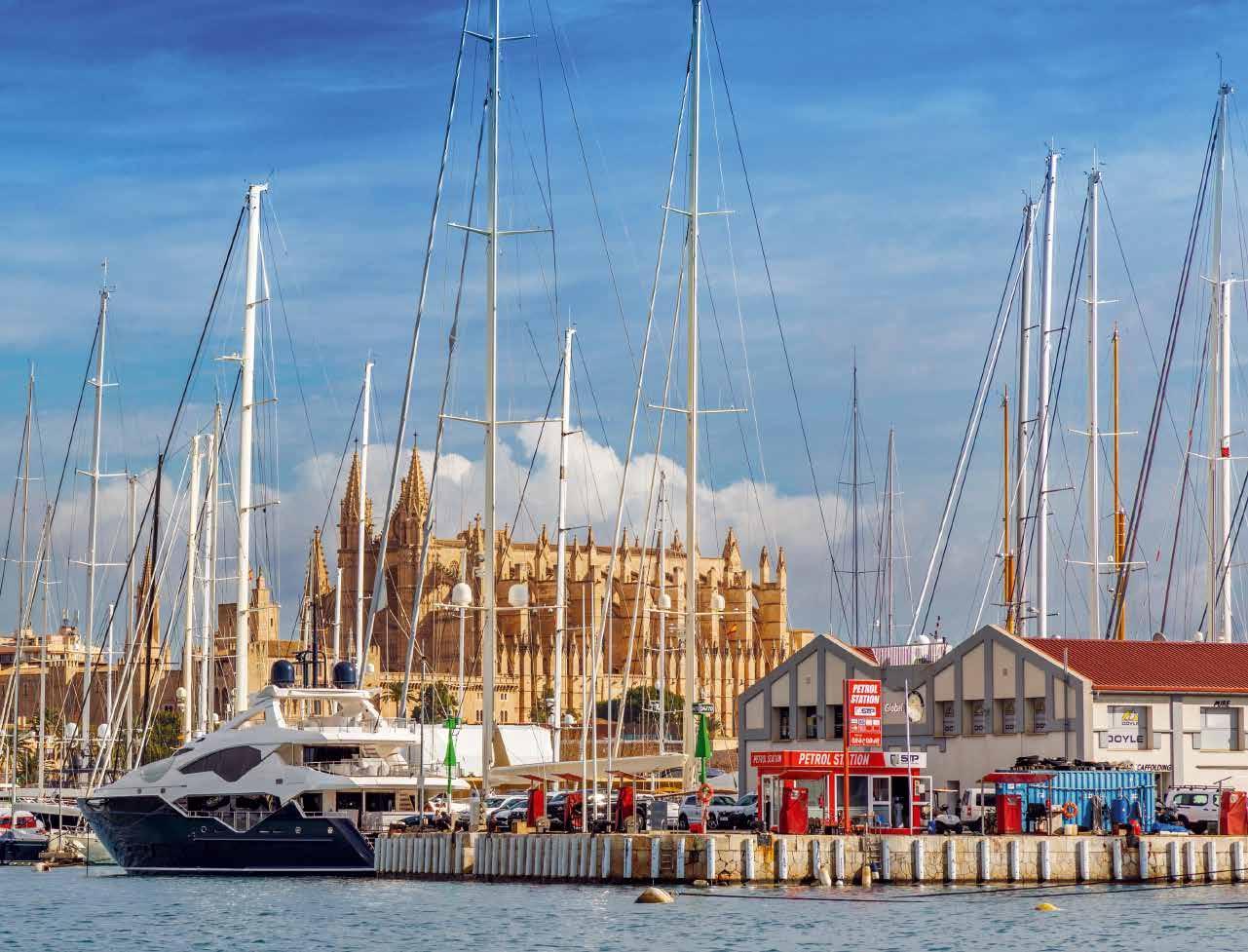
4 FUEL PUMPS 80L/MINUTE
2 HIGH FLOW-VOLUME FUEL PUMPS 280L/MINUTE
100M OF MOORINGS VOLUME DISCOUNT
SUMMER OPENING HOURS (mid May - mid September) from monday to sunday from 8:00 am to 8:00 pm
from monday to sunday from 8:00 am to 4:30 pm

https://www.portdemallorca.com/en
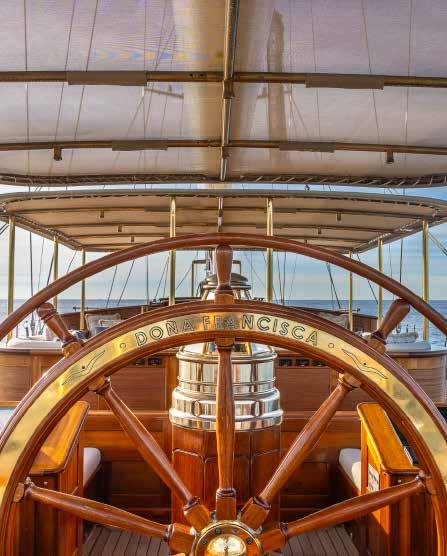
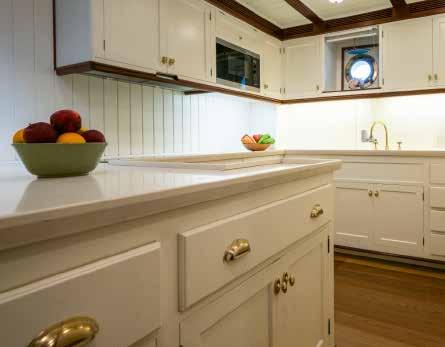
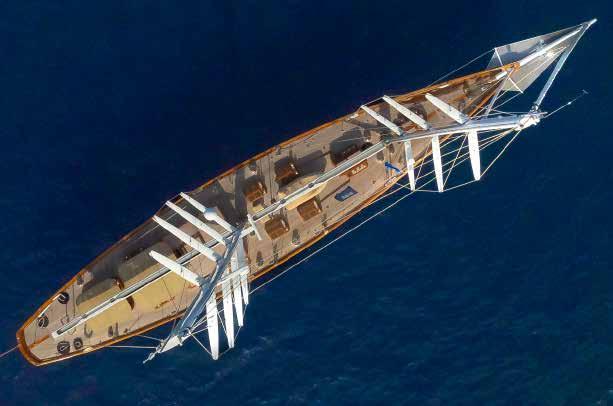
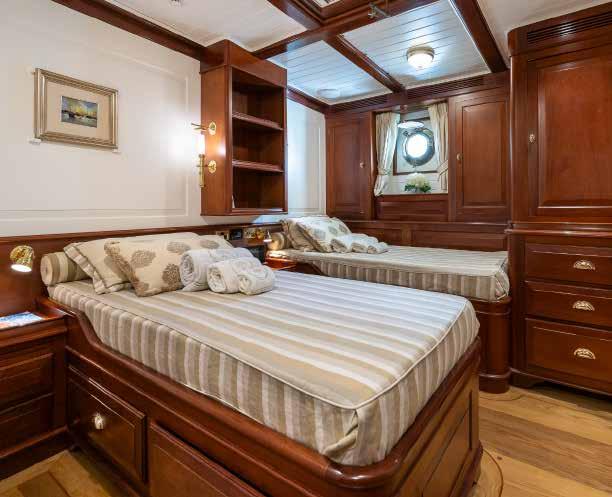
Exceptional 52.43m schooner built in carbon fibre, combining classical elegance with advanced engineering. Delivered in 2014 and refitted in 2024, she offers strong performance with speeds up to 14 knots and a shallow draft allowing access to smaller ports. She accommodates 8 guests across 4 cabins, with refined interiors inspired by early 20th-century yachts, blending rich wood finishes and bronze detailing. A full-beam main salon and dining area provide elegant spaces for entertaining at sea. Crew of up to 7. Uruguay flag, currently lying in Uruguay. BARNES Yachting will be present at the Palma International Boat Show. Contact us for further information or to arrange a private discussion.
Price on Application
BARNES Yachting Headquarter Rue du Lion-d’Or 6 | 1003 Lausanne, SWITZERLAND Europe +44 20 4587 8777 | USA +1 786 453 4454 | yachting@barnes-yachting.com
BARNES-YACHTING.COM
CEO (Creative Enthusiastic Owner) Jens Oomes
Office Manager Natalie Tempelers
Admin & Communications Marlot Cathalina
Design CreArte Studio
Editorial Support Kjell Van Hoecke
Client Relations & Partnerships Sara Vermeulen
Contributors
Marlot Cathalina
Karine Rayson, The Crew Coach
Clair Minto, Chief Stew Shop
Barry D’Arcy, Ocean Earth Chefs
Chef Raffie
Bec McKeever and Dominique Smit, Virtual Pursers
Sales: sara@theislander.online
Tzarina Mace-Ralph e3 Systems
Ricardo Sagarminaga, Alnitak
Save The Med
Joves Navegantes
Editorial contributions & press releases: editor@theislander.online
Admin: admin@theislander.online
Accounts: accounts@theislander.online
Newsletter

Event calendar

*Creative Enthusiastic Owner
Community — coming together in unity.
We are currently living in a world where division and polarisation often dominate the narrative. As an admittedly avid social media user (do check out @invisiblecrew while you’re at it!), I’m very aware of how easy it is to feel hyperconnected in the digital space, while at the same time risking missing out on genuine, human connection.
That is one of the key reasons we organise our Tune In Thursdays, held on the first Thursday of May, September, November, January and March. It is also why we are proud to support and promote events within the yachting and expat communities. Our magazine—both online and in print—exists to help keep our community connected and engaged.
Tragically, our community recently suffered a sudden loss. Captain Riccardo Benoni passed away less than a year after marrying Elettra, and just six weeks after the birth of their third child. Riccardo was best known in our community as the captain of S/Y Ammonite.
The community has already come together in a remarkable show of support for Riccardo’s family, but there is still more we can do. A GoFundMe campaign has been set up to help them regain financial stability after this unexpected loss. If you would like to contribute, please visit: https://gofund.me/e591cce24

Or scan the QR code
Recently, one of our community members, Captain Jim Passmore, stepped up to rally industry business owners in a successful effort to salvage the 1909 classic S/Y Owl, which had washed ashore in Palmanova. Be sure to read the interview with Jim in this issue to learn more about this inspiring initiative and how you can get involved.
The Islander wishes you all a safe and successful season, filled with meaningful connections that enrich your lives.
Remember both the privilege and responsibility that come with being part of the yachting community. ◆

09. Note from the CEO
12. Judged by The Cover: SAY Carbon Yachts
16. Tune in Thursdays
Industry updates
Royal Huisman
Lantimar 34. Auction for Royal Huisman Sailing Superyacht
i3
Synergy Nox
Estela Shipping
52. Meet The Crew: Vanessa Mayol Ekman
56. The Crew Coach
58. Chief Stew Shop
60. Chef Tzarina Spits it out
62. Chef’s Chat
64. Ship to Shore: Andrew Fairbrass
66. MSOS
70. Chef Raffie
72. Virtual Pursers
74. Marinepool in Palma
76. Alnitak
80. Save the Med
86. Fundacion Joves Navegants
90. Saving SY Owl
94. What's on in Mallorca
96. BMComposites
100. JoyRon Foundation
102. Mediterranean Private Diving
104. Andaman Sea
106. Mallorca Entrepreneurs
108. Sunbrella
110. RE/MAX
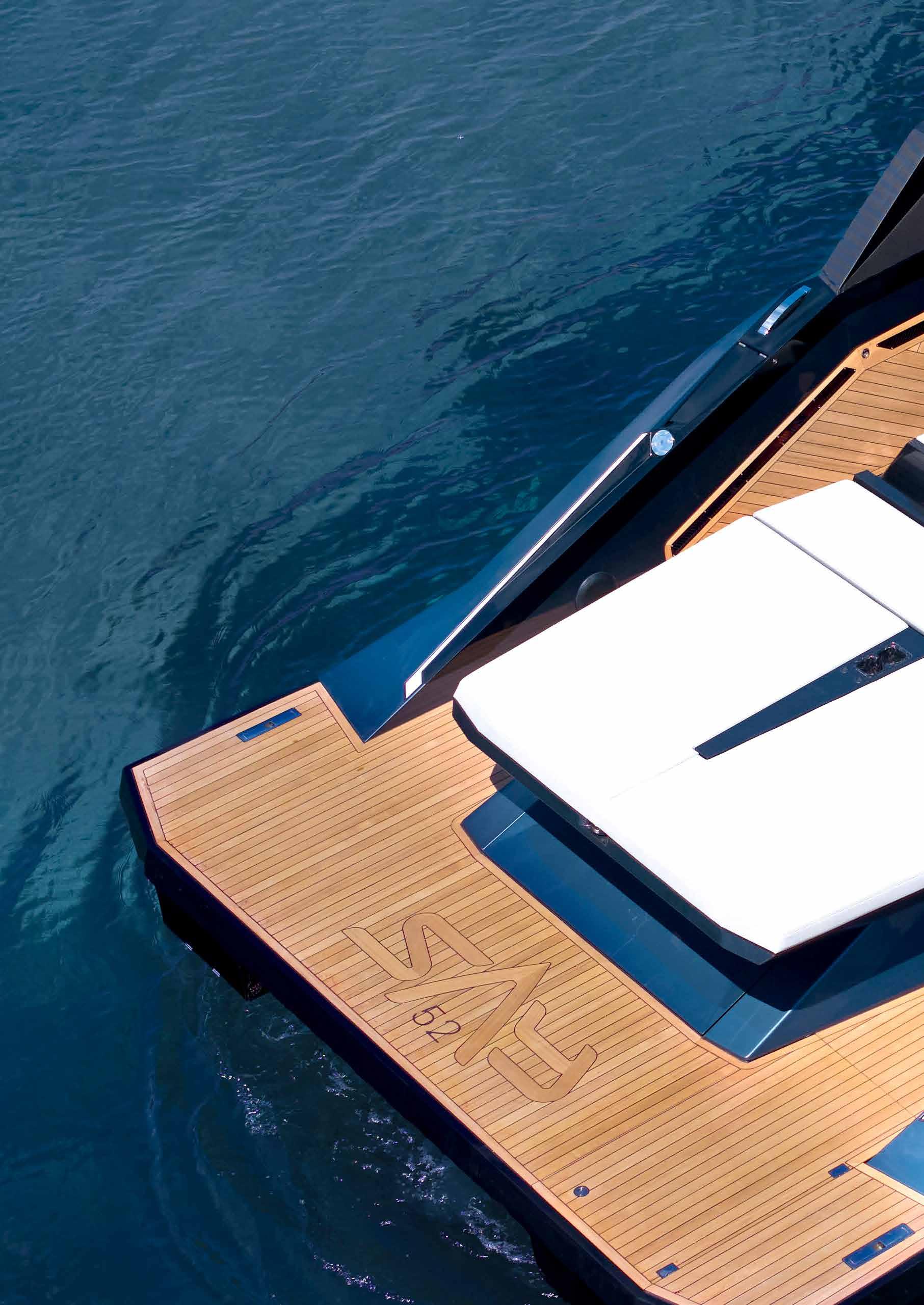
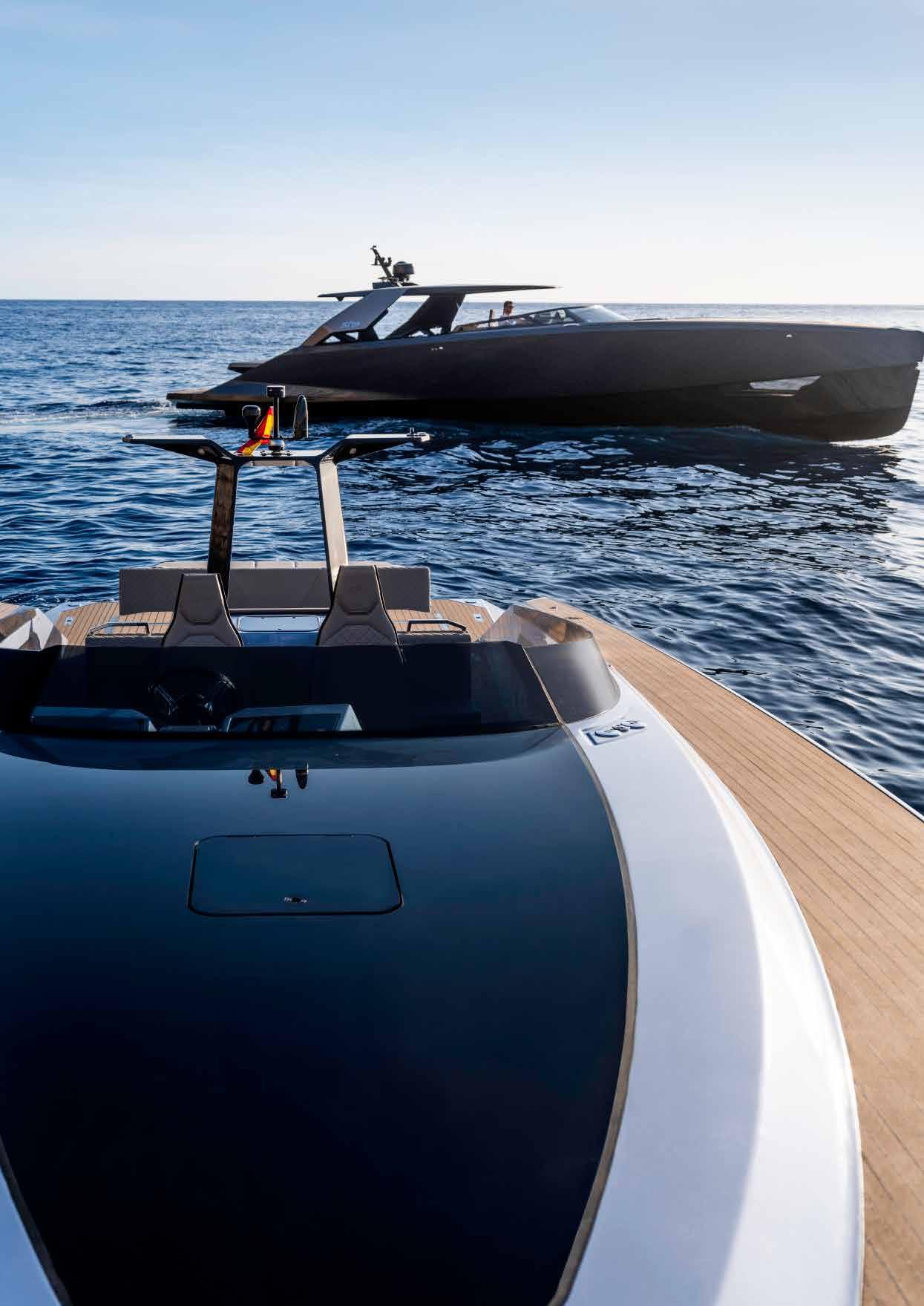
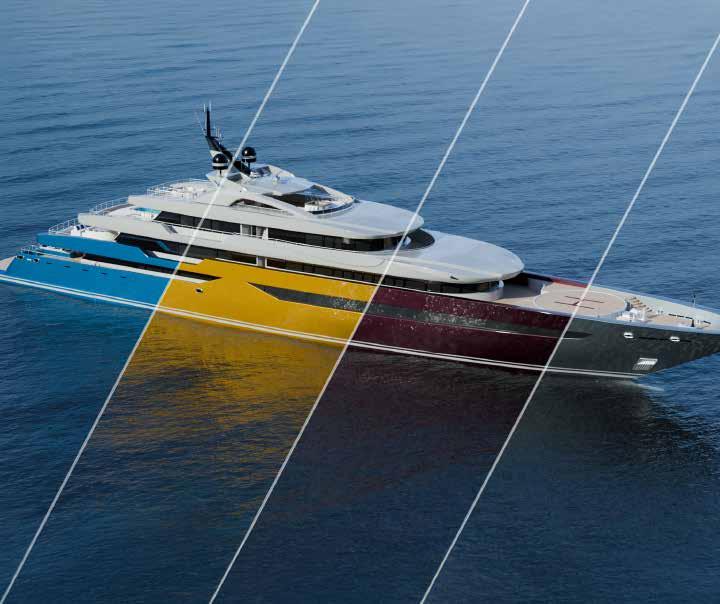
MALLORCA WELCOMES SAY CARBON YACHTS’ FIRST CLIENT LOUNGE.
Written by Lena Dobschall
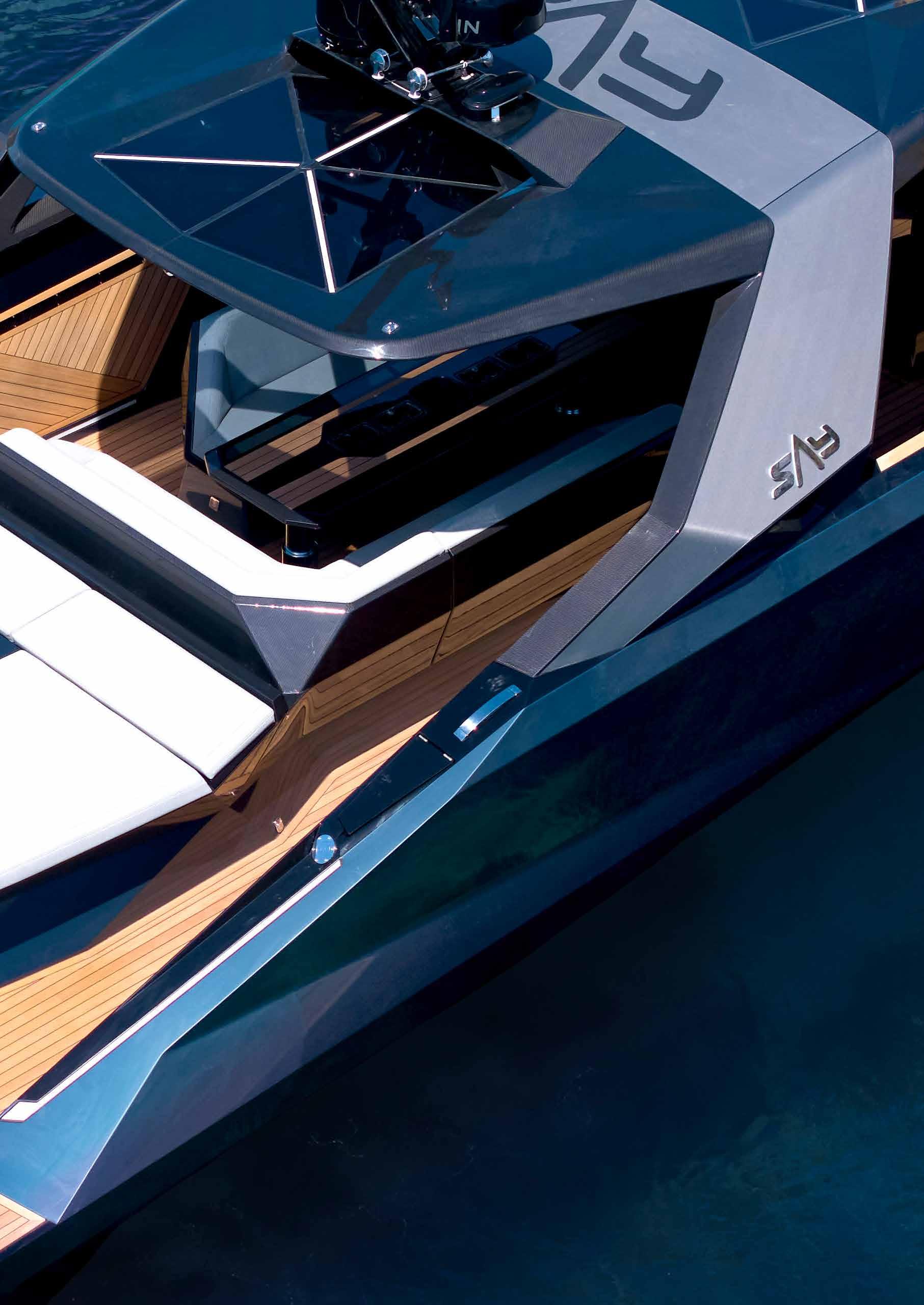
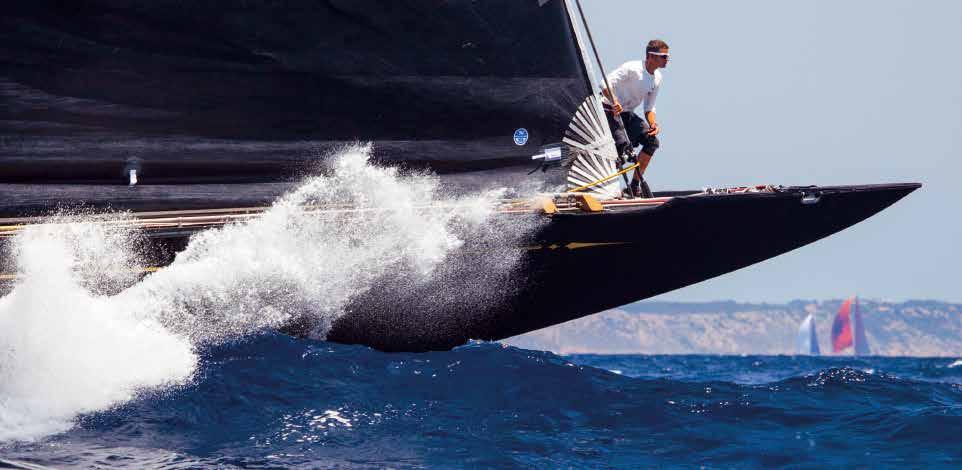
There are brands that don’t just build products, they redefine an entire category. SAY Carbon Yachts is one of them. Sleek, unmistakably modern, and engineered with a precision more commonly associated with the automotive world, the brand represents a new era of performance-driven, design-led yachting.
Founded in 2006, SAY Carbon Yachts emerged from a deeprooted expertise in advanced composites and engineering. What began as a specialist builder focused on lightweight construction quickly evolved into a pioneer of fully carbon fibre yachts, bringing Formula 1-grade materials and thinking into the marine world. Under the technical leadership of Karl Wagner, whose background includes carbon innovation at the highest level, SAY developed a clear philosophy: reduce weight, increase efficiency, and elevate the driving experience on water. The result? Yachts widely recognised as “supercars on water.”
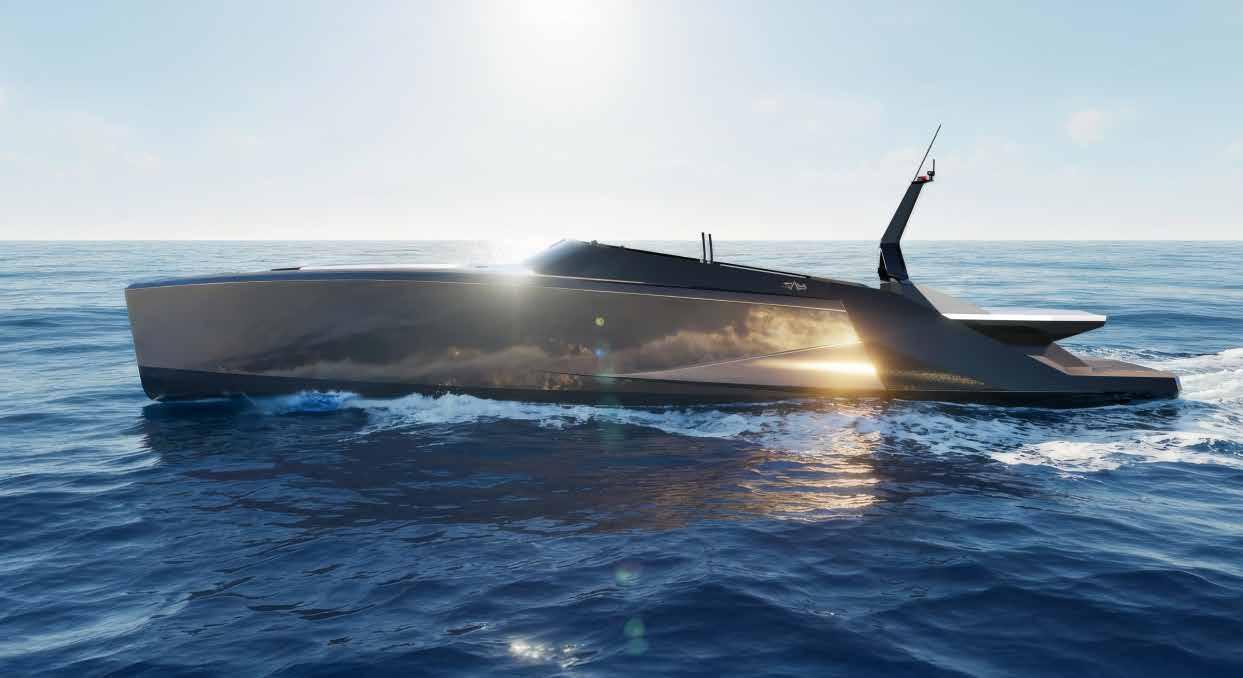
At the heart of SAY lies a simple but powerful idea: lighter boats perform better. By constructing hulls entirely from carbon fibre, SAY achieves vessels significantly lighter than conventional alternatives. This reduction in weight translates directly into higher speeds, lower fuel consumption, and a more responsive, exhilarating ride. Across the range, from the agile and versatile SAY 32, to the sporty SAY 42 and flagship
Each model reflects this balance.
SAY 32
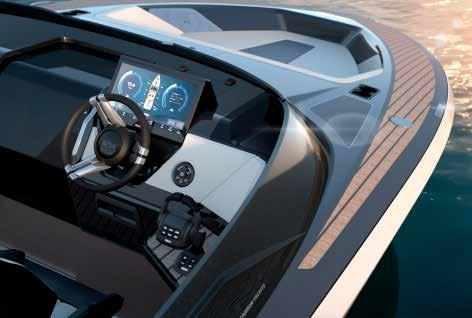
The SAY 32 represents the most versatile entry into the range. Compact, lightweight, and highly efficient, it is ideally suited as both a luxury day boat and superyacht tender. Its intelligent deck layout, combined with a low profile and refined amenities, makes it perfectly adapted to Mediterranean day cruising and effortless guest transport.
SAY 42
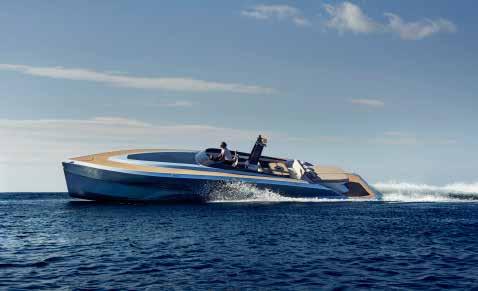
SAY 52, this philosophy remains consistent: maximum performance with minimal weight.
But SAY is not just about speed, it’s about control. The brand’s use of advanced hull technologies, including the Petestep system, allows the yachts to ride on a cushion of air, reducing drag and softening impacts. Whether at the helm of the compact SAY 32, or the more powerful SAY 42 and 52, the experience is intuitive, precise, and remarkably smooth, even at high speeds.
The Mediterranean demands versatility. Boats here are extensions of how people live. Used for beach hopping, long lunches, sunset cruising, and spontaneous escapes. SAY understands this. Its yachts are designed to transition seamlessly between these roles, offering both the thrill of performance and the comfort of a refined day boat.
42 Sport
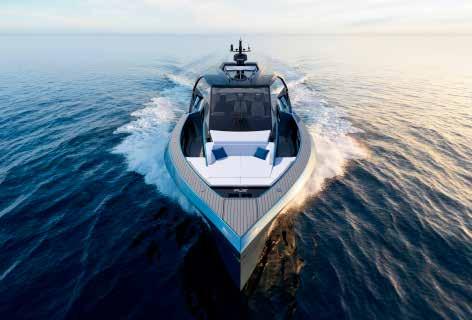
The SAY 42 Sport takes the Mediterranean lifestyle a step further. With a more hospitality-focused configuration and an open bow, it delivers more space for blissful days on the water. It is the ideal choice for owners seeking a balance between sportiness and extended day use.
The SAY 42 is a classic gentleman’s cruiser with increased space, power, and overnight cabin. It offers a more substantial platform for entertaining, while maintaining the brand’s signature lightweight performance and precise handling. Designed for those who prioritise driving pleasure, it embodies the “supercar on water” philosophy in its purest form.
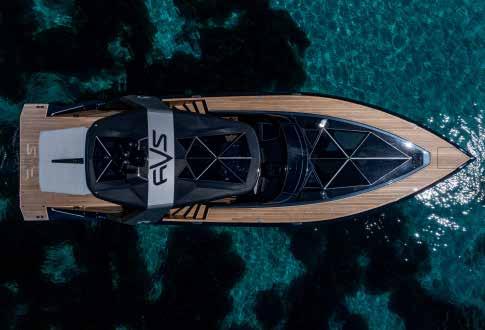
At the top of the range, the SAY 52 delivers flagshiplevel presence. Combining striking design with generous space and high-end finishes, it offers an elevated onboard experience without compromising on driveability. It is a statement yacht, powerful, refined, and unmistakably SAY.
With clean lines, open layouts, and a focus on usability, SAY Carbon Yachts embody a modern, minimalist aesthetic that resonates with today’s owners. The experience is less about excess and more about precision, less about size and more about how intelligently space is used. This duality; performance and lifestyle, is precisely why SAY Carbon Yachts is a natural fit for the Balearics.
Against this backdrop, SAY’s decision to open its first branded sales lounge in Puerto Portals feels both strategic and symbolic.
As one of the Balearics’ most prestigious marinas, Puerto Portals is a hub for discerning yacht owners and an international audience that values design, quality, and innovation. It is precisely the kind of environment where SAY’s philosophy resonates.
The new lounge will not simply be a point of sale, it will be a space where clients can engage with the brand, experience its materials, and gain insight into the engineering behind each model. It represents SAY’s commitment to the Mediterranean market and its growing presence in the region. For visitors to the marina this season, it will be hard to miss, and that is exactly the point.
In a market often driven by size and scale, SAY offers something different: precision, lightness, and a focus on the driving experience. It is a brand that speaks to a new generation of owners, those who value innovation, efficiency, and design in equal measure.
As the Balearic season begins and SAY prepares to open its doors in Puerto Portals, one thing is clear: this is a brand to watch. ◆ www.saycarbonyachts.com
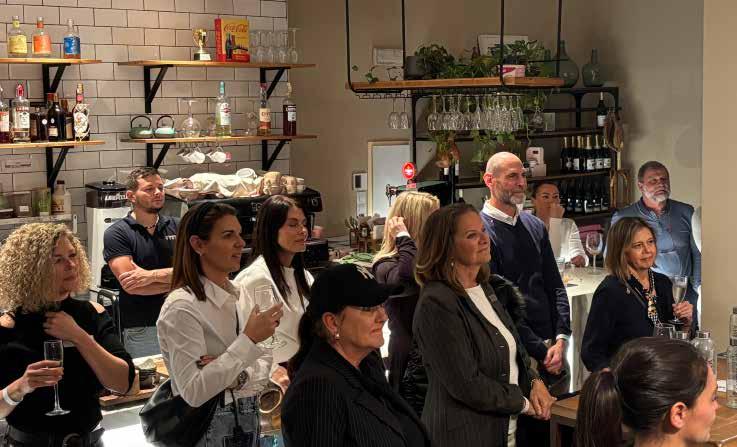
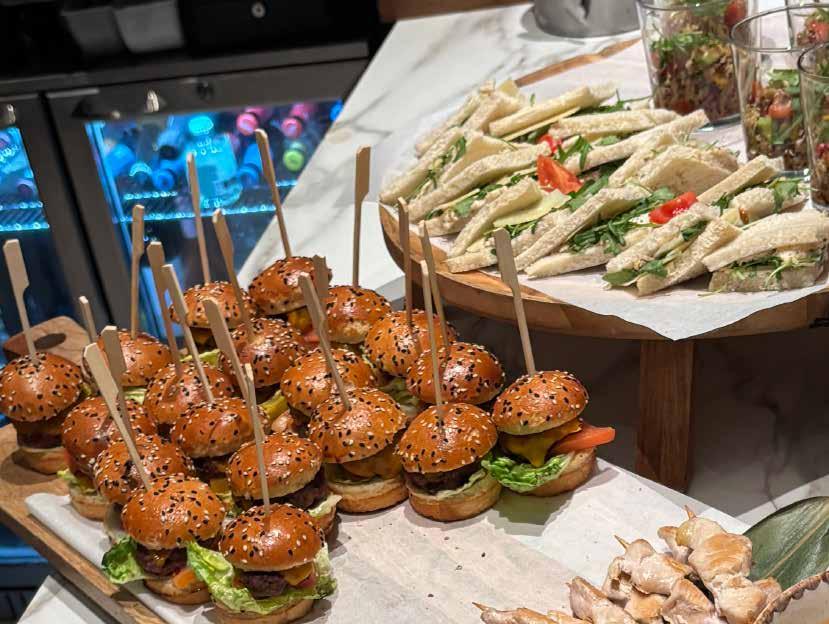
The March Tune In Thursday, hosted by Ankor.io, gathered a substantial crowd. As organisers, we are thrilled to see—across several editions now—a balanced mix of familiar and new faces. It’s a clear sign that our community is growing.
A number of the new faces became advertisers, and all of them became Islander fans! Most importantly, valuable connections were made. One of our guests had been looking
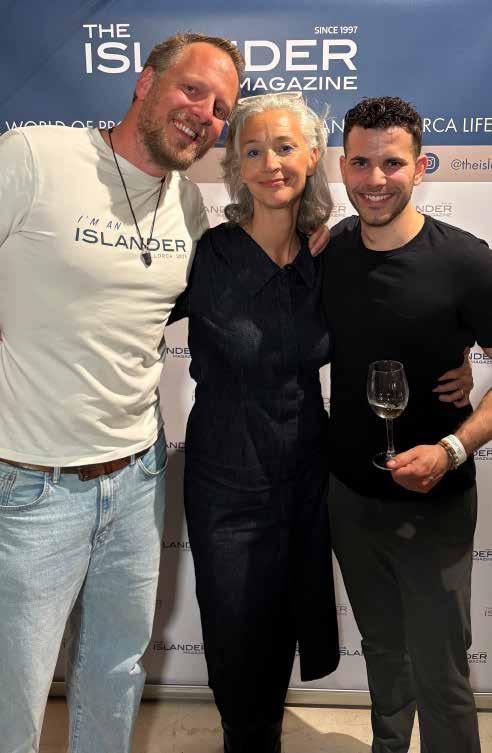
for a specific contact for several weeks after a friend had mentioned him. They were connected—and tuned in—at our event!
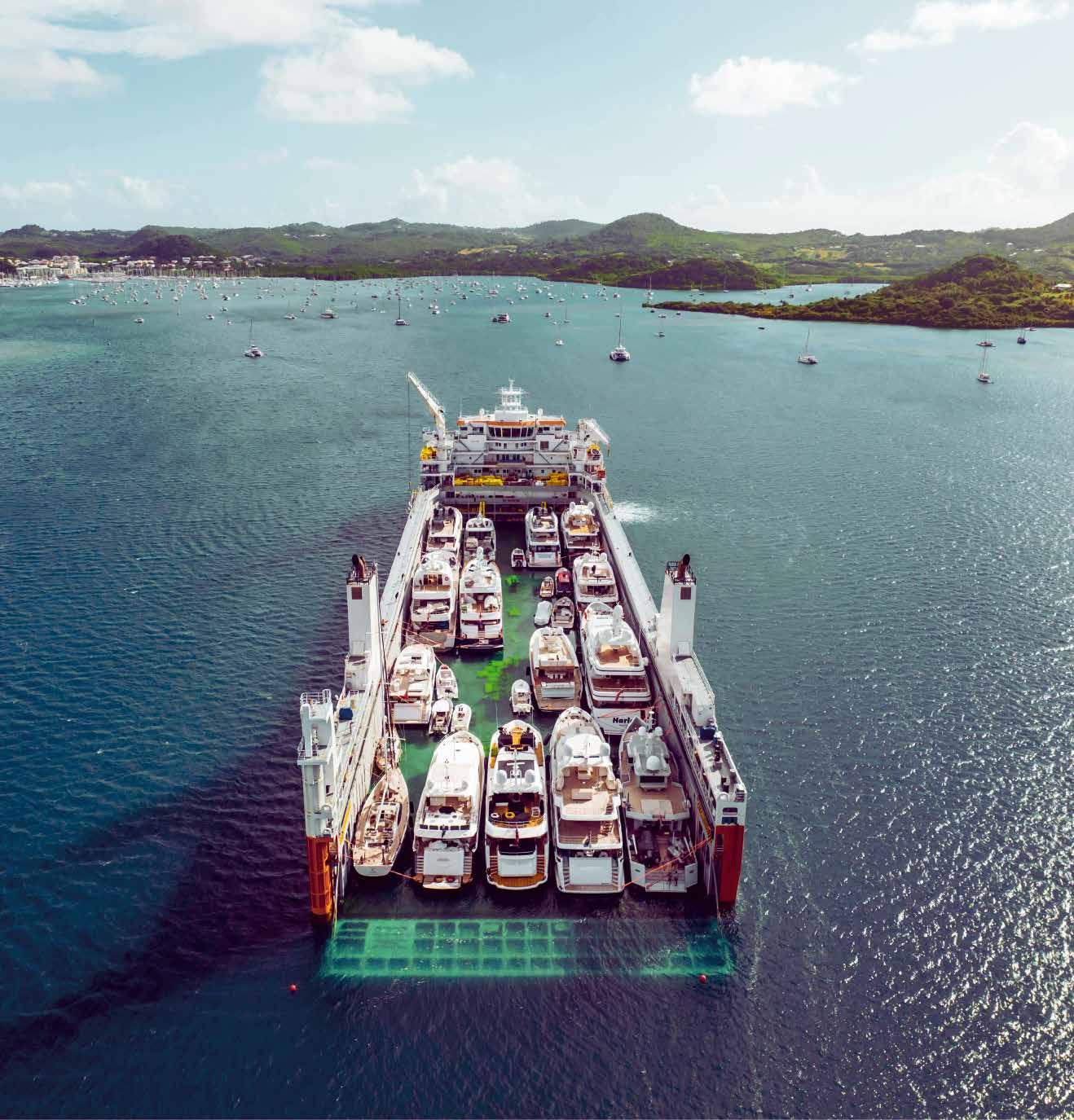
The next Tune In Thursday will take place on Thursday, 7 May at Santina Puerto Portals and will be hosted by Dockwise Yacht Transport.
We skip July, but return on the first Thursday of September.
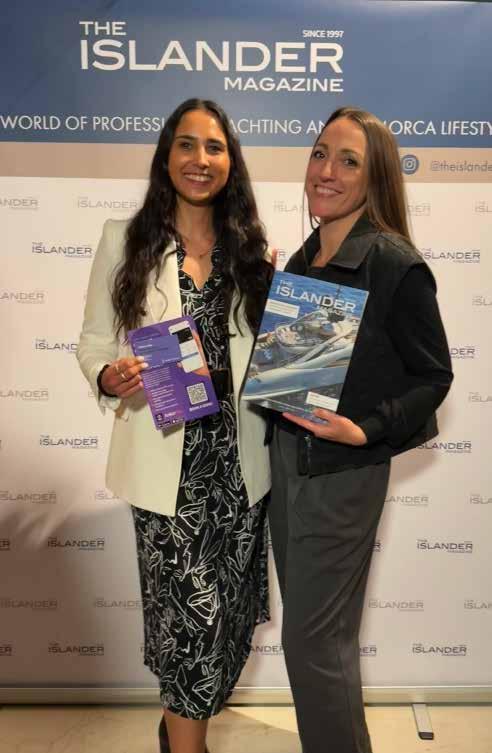

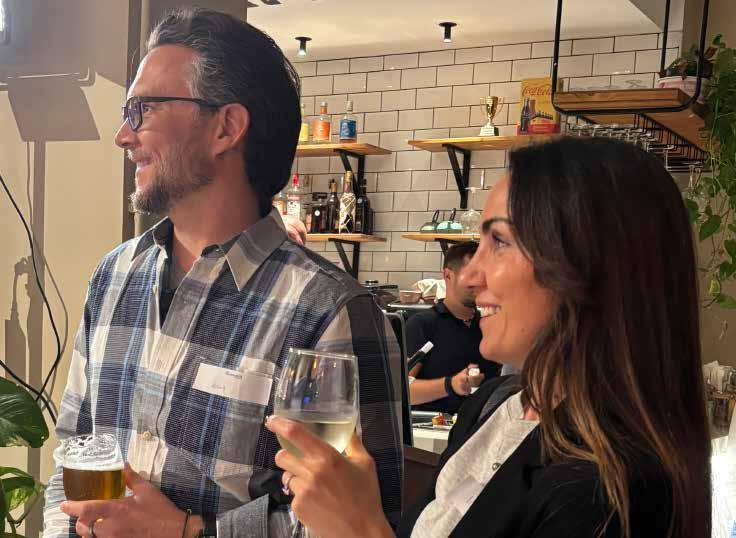
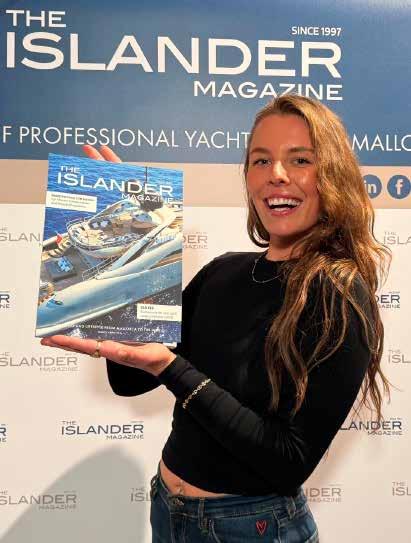
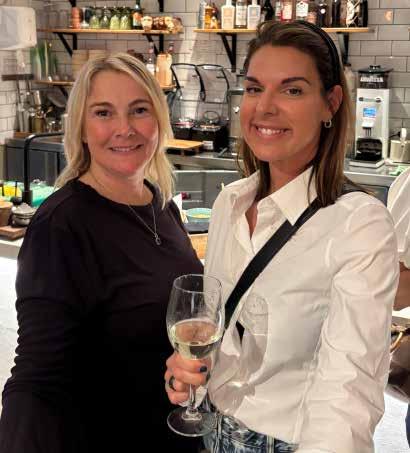
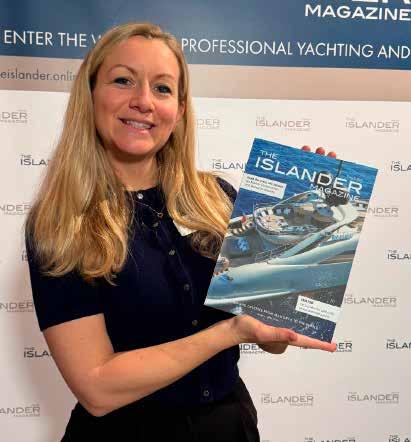



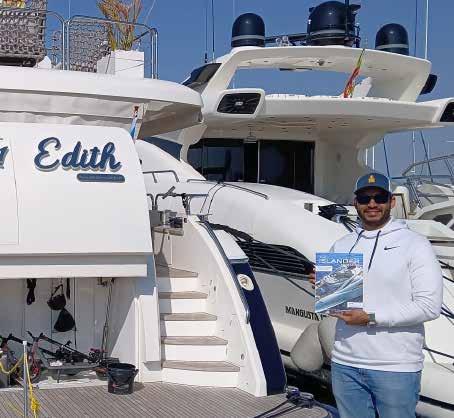
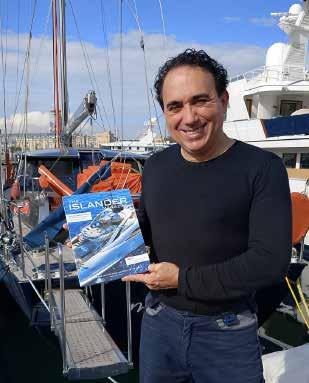
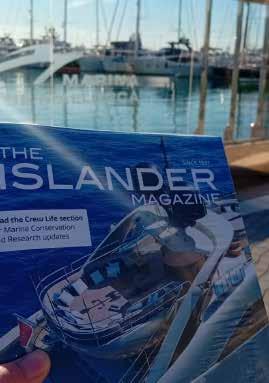
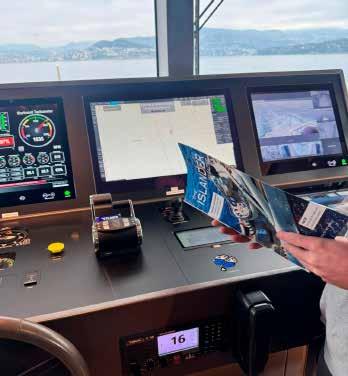
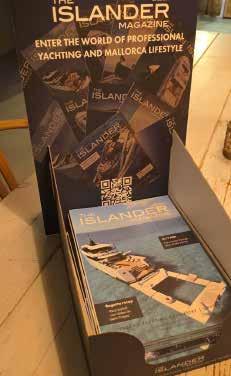
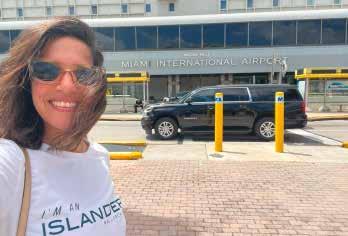
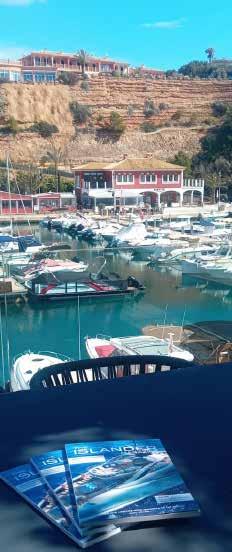
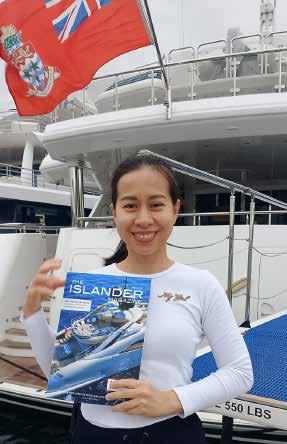
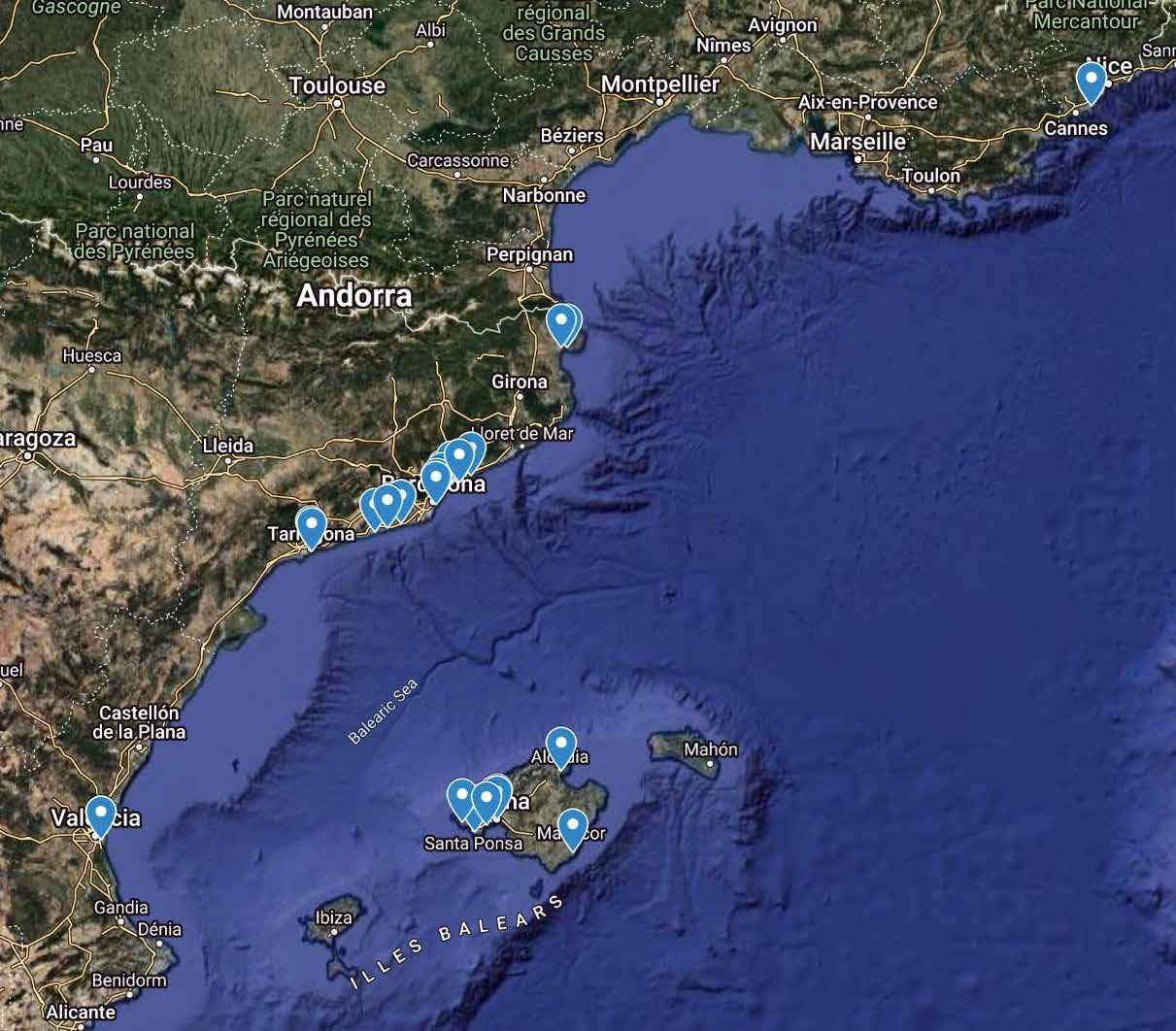
The Islander Magazine can be found in +100 pickup points in Mallorca and in all superyacht marinas of Spain. We are also represented in strategic points in the French Riviera such as at the exclusive Billionaire's Quay in the port of Antibes. And you can also find us in all Cappuccino’s in Spain and Gstaad.

22. Industry updates
26. Royal Huisman
33. Lantimar
34. Auction for Royal Huisman Sailing Superyacht
36. i3
41. Synergy Nox
44. Estela Shipping
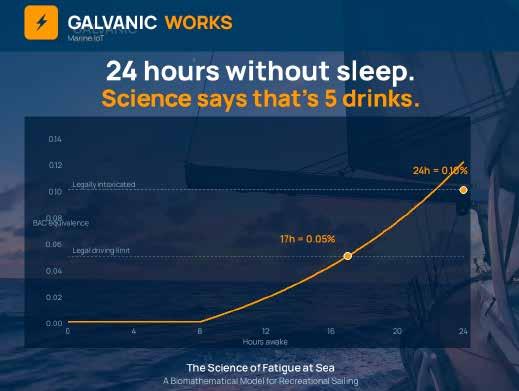
Galvanic Works, a marine technology startup based in Mallorca, has published a research paper examining crew fatigue in recreational sailing. Drawing on more than 80 peer-reviewed studies across sleep science, chronobiology, and maritime safety, the paper addresses a question the sailing community has long overlooked: how cognitively impaired do sailors actually become on overnight and multi-day passages?
The findings are striking. After just 17 hours without sleep, cognitive performance drops to a level equivalent to being over the legal drink-drive limit, and the biological low point between 2am and 6am compounds this further. At sea, fragmented sleep in rough conditions recovers as little as half the cognitive capacity of a proper night's rest on land. Crucially, sailors cannot feel it happening: self-assessment becomes unreliable after the first 24 hours.
While commercial shipping operates under strict mandatory rest regulations, recreational sailors have no equivalent framework, despite facing many of the same risks with smaller crews and less experience.
The full paper is freely available at https://galvanicworks.com/ research and www.preprints.org/manuscript/202603.1014
A free Marine Fatigue Calculator app will also be released this month on the major app stores. ◆
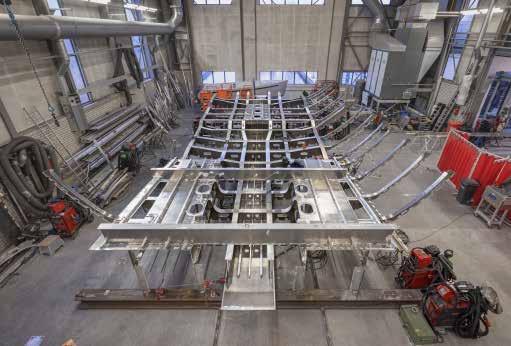
Nautor Swan has begun construction of the Swan Alloy 44, the largest sailing yacht ever created by the iconic Finnish shipyard and its first ever aluminium build in its 60-year history.
Hull and deck construction is underway at Gouwerok Shipyard in the Netherlands, where specialists have begun welding the first structural sections, including the keel and engine room foundations. Once complete, the yacht will be transported to Viareggio, Italy, for final outfitting, with launch scheduled for 2028.
The Swan Alloy 44 marks the birth of a new line of aluminium sailing yachts exceeding 40 metres, expanding Swan's legendary sailing DNA into the superyacht arena. Designed by naval architect Malcolm McKeon, the yacht measures 43.5 metres in length with a beam of 9.45 metres and features a telescopic keel with variable draft from 4.30 to 6.30 metres. The mast is produced by Southern Spars, with sails by Doyle.
Interiors are entrusted to Studio Liaigre, combining innovation, elegance and exceptional livability. The yacht will also feature dual-energy technology, with the goal of achieving full energy autonomy while sailing.
The first hull has been personally commissioned by Massimo Perotti, Executive Chairman of Sanlorenzo. "This is my first sailing yacht, and I feel a special emotion after so many motor yachts," said Perotti. "For Nautor Swan, this project opens a new chapter — remaining faithful to the values that have defined Swan for sixty years."
The project reflects the strategic vision guiding Swan's next phase of growth under Sanlorenzo's custodianship. To support the commercial launch, Nautor Swan has partnered with brokerage house Edmiston to bring the Swan Alloy range to the global market. ◆ www.nautorswan.com
Visit our website or request a quote via email fender-design.com
Yacht Support Group - Mr. Paul van Westing
our Booth @ Palma Boatshow +34 677 814 789 paul@fender-design.com

YYachts celebrates world premiere
The German shipyard YYachts will unveil its completely redesigned Y7 at the Palma International Boat Show on April 29. Following successful sea trials, the yacht is en route to Mallorca for its world premiere. Building on the success of the previous Y7 — with over 20 units sold — this new model has been refined both technically and visually.
Developed under Luca Giammattei and Francesca Modica, with naval architecture by judel/vrolijk & co, the new Y7 features a modern hull with advanced hydrodynamics, offering improved stability and performance, especially in moderate winds. A mast positioned further aft increases sail efficiency, while the redesigned deck ensures easy handling and
comfort, highlighted by an enlarged cockpit and U-shaped sofa.
Inside, the Y7 provides more space and customization options, including a VIP guest cabin or a large crew area with a mess and utility room. A new dedicated engine room improves noise reduction and exterior elegance. According to YYachts founder Michael Schmidt, every detail was rethought to make an already great yacht even better. With four units sold before launch, the Y7 embodies YYachts’ vision of high-performance, user-friendly sailing in the premium segment. ◆ www.yyachts.de/en
Henri-Lloyd, the iconic British sailing brand, has launched its Spring/Summer 2026 range with an extensive choice of technical and chemical/PFAS-free clothing. From Dri Fast Tees to high-technology offshore gear including the new Ocean Pro range, Henri-Lloyd offers a complete range for crew and corporate clothing.
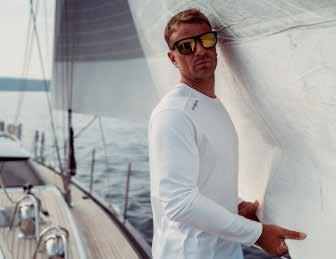
Ross Partridge, Corporate Sales Manager at HenriLloyd, says carefully curated range offers flexibility, whether on the water, on the dock or in the office, whilst still retaining an overall stylish uniformity with matching colourways. He says, “When choosing crew and corporate clothing, it’s important that it’s practical and comfortable, caters for all activities, suits and fits all of your team, comes in matching colourways, and that the supply of garments is ongoing and consistent, so new team members can be kitted out easily and that replacements are easily available, anywhere in the world.”
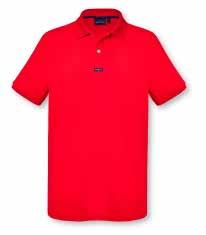
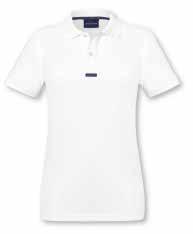
A core component of the Henri-Lloyd range is the Dri Fast Polo. This comfortable, quick drying polo is smart and practical, with added UV 50 protection against long days in the sun. Available in men’s and women’s sizing, it is available in Navy, Red, Black, White and Titanium. Pair it with Dri Fast Tees,
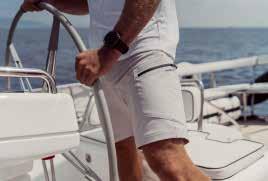
another high performance everyday essential. Extremely comfortable, quick drying and also with added UV 50 protection, the long-sleeve and shortsleeve versions are in Navy and White. The Dri Fast range is also treated with Polygiene treatments for odour control and enhanced cooling. Whether for office wear or as practical garments working on and off the water, Henri-Lloyd’s Explorer shorts and trousers are engineered for ultimate stretch and flexibility. With practical zip side and leg pockets, these great looking and fitting Explorer Shorts and Trousers are designed to keep the wearer on the go without hindering comfort or performance.
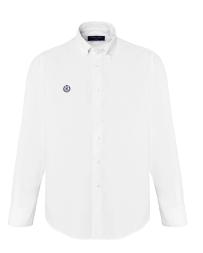
Paired with the ever-classic Oxford long-sleeve shirt – in white or light blue – they deliver a comfortable and smart outfit for day-to-day, après sailing activities or uniform. The textured 100% cotton weave provides durability and maintains shape use after use, making them eminently suitable for crew and corporate wear.
All Henri-Lloyd clothing has been designed to make it easy to create a stunning impression using personalised company or yacht branding. The Henri-Lloyd logos have been deliberately kept small and discreet, free of the chest and hidden areas to enable easy implementation of corporate styling and logos that can be embroidered, printed or heat transferred as appropriate.
Partridge concludes: “We aim to make choosing crew and corporate clothing easy and reliable. There’s a complete range, with core colourways which all mix and match and choices to suit all types of activities and weather, whilst retaining a core image. By keeping a tight and consistent range, we can also ensure regular and fast on-going supplies anywhere in the world through our network of distributors and suppliers.”. ◆
www.henrilloyd.com
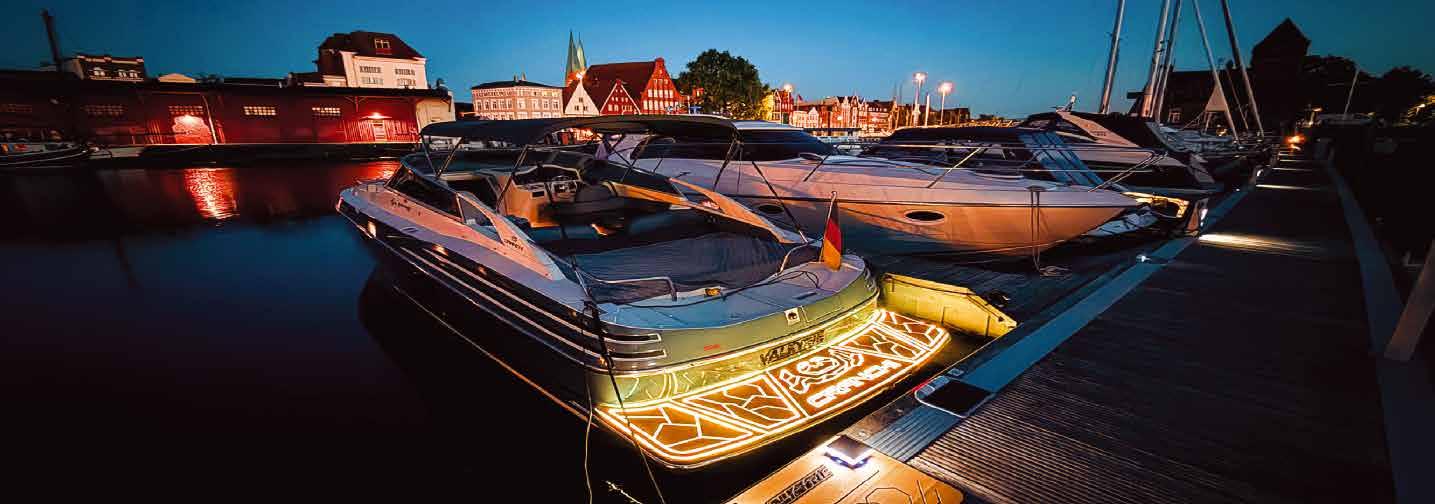

World´s rst fully illuminated deck
100% customizable, app-controlled
Starts at 5mm thickness, perfect for re ts
Highest quality Standards, made in Germany

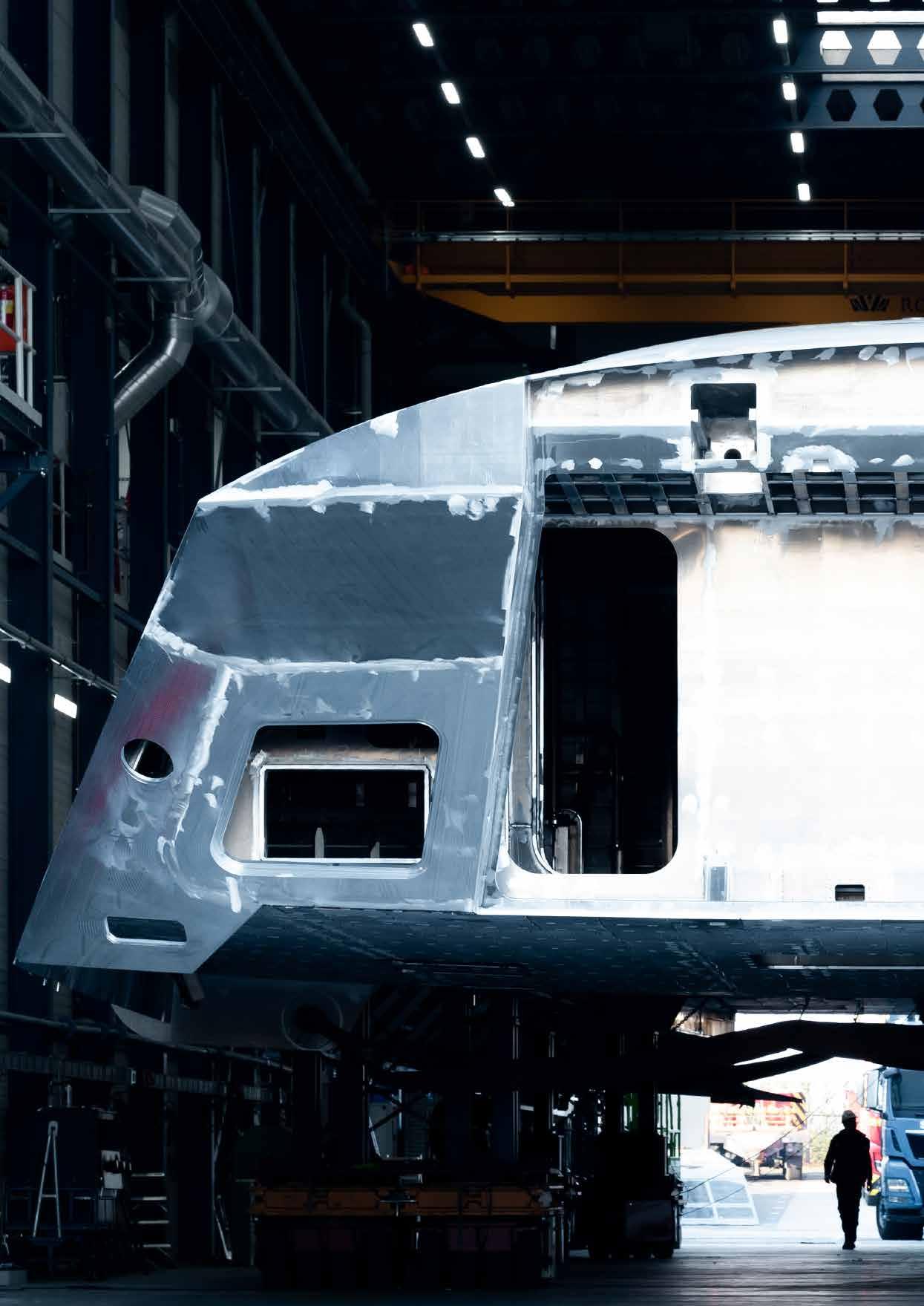
Following Royal Huisman’s announcement for its new XXL commission in May last year, the shipyard team turned the main part of the Trident series hull number 2 on 19 March 2026 at its Vollenhove facility, the Netherlands: home to the world’s finest superyacht building.
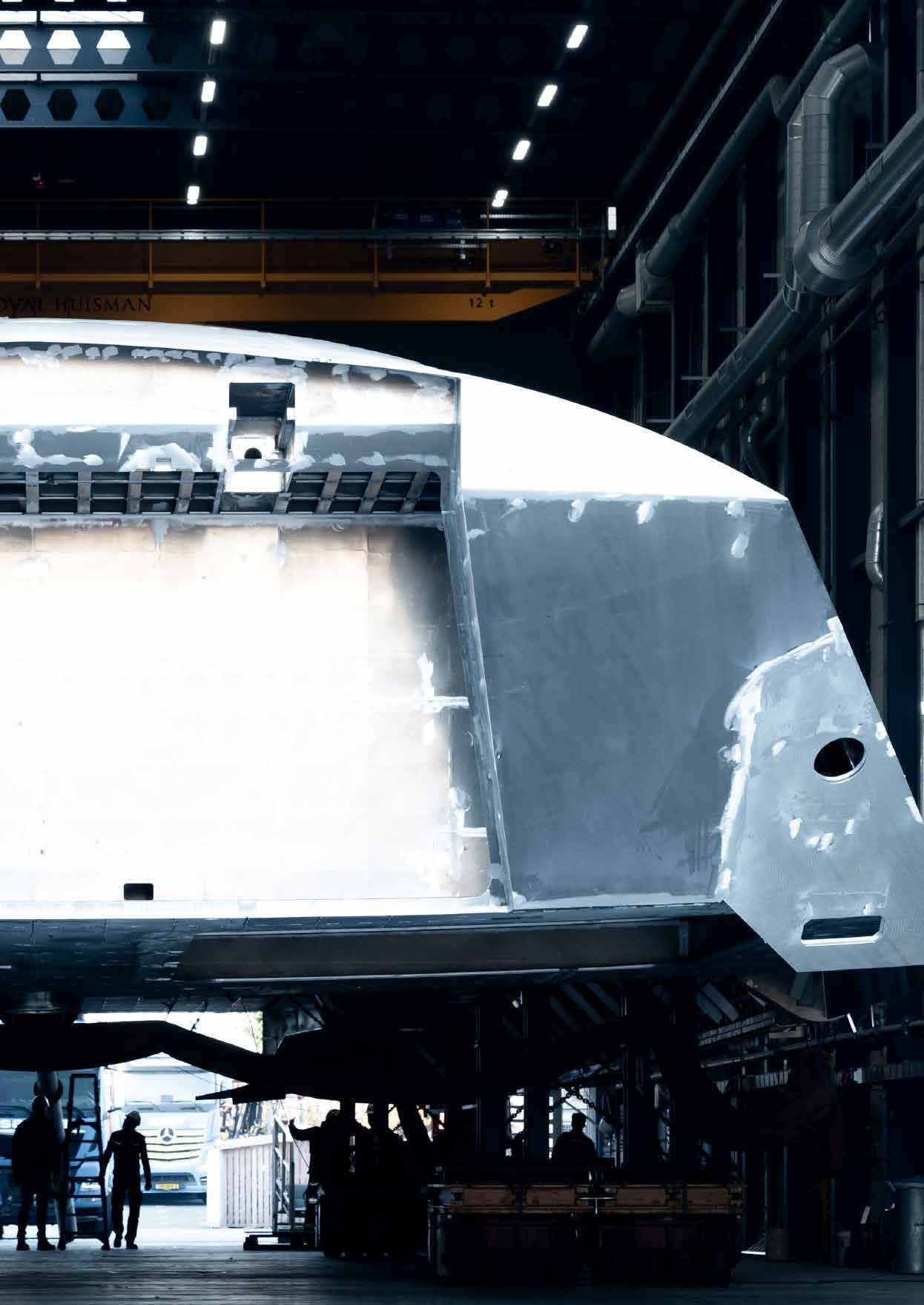
Project 412 will be a super-sized 81m / 266ft sailing yacht. The aluminum hull construction features a distinctive chine from bow to stern.
“With Project 412, we are again pushing the boundaries of true sailing at superyacht scale, and we are excited to see this fine second edition of the Trident series progress to the integration and finishing phases that define the Royal Huisman experience.”
Project 412 is part of Royal Huisman’s successful Trident 810 series. It builds on a proven architectural platform, benefiting from the confidence that comes with an already engineered foundation. Having the original delivered in 2020 and the second one under construction, owners benefit both from a reliable, short project lead time and the opportunity to personalize and realize a fully bespoke superyacht, delivered in just three years.
The operation brings a defining build milestone to completion and offers a clear sense of the yacht’s remarkable volume and proportions, now fully visible in her upright position. With the hull turning complete, the team will proceed with the next stages of build, developing onboard systems and outfitting. The bow section, which is currently nearing completion in Hall 3, will be attached to the main part at the end of March.
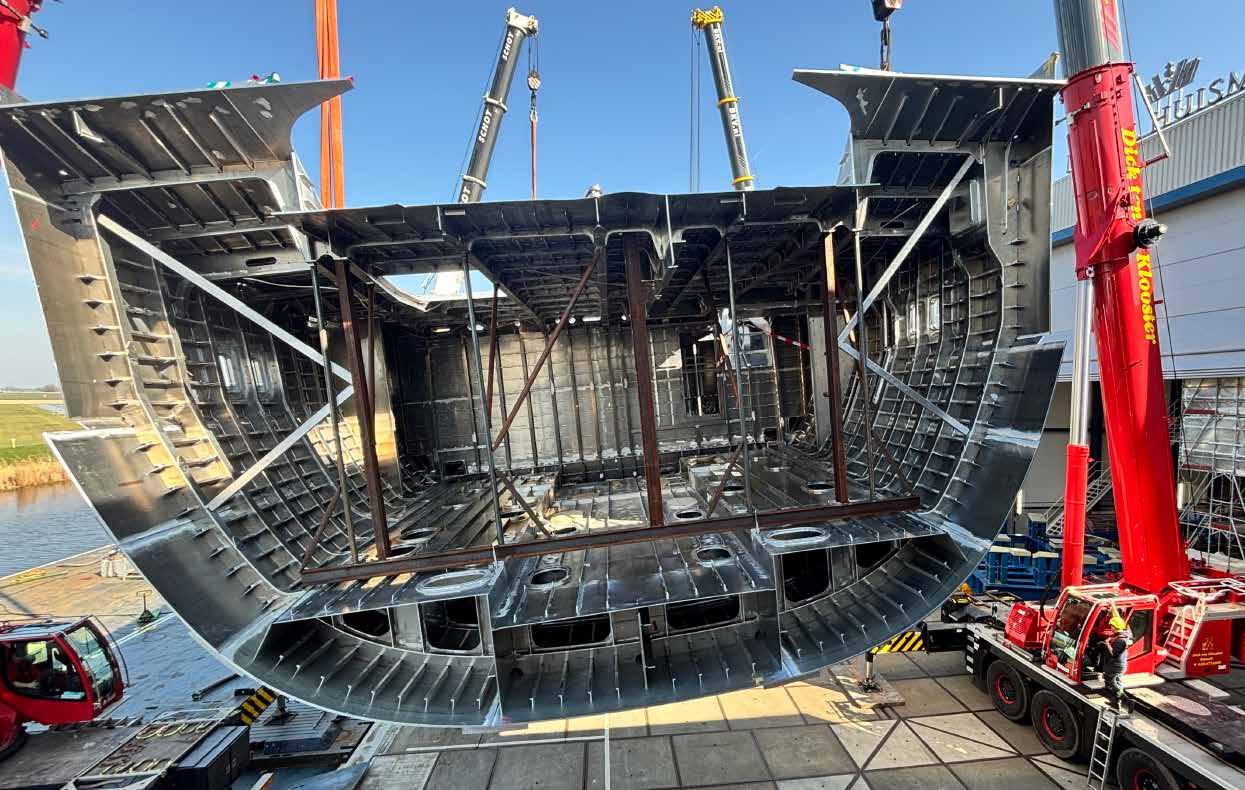
Created for a true sailing experience and world cruising, the contemporary flybridge schooner Trident will be equipped with a state-of-the-art carbon rig supplied by Rondal, combining performance with sail-handling comfort and innovation.
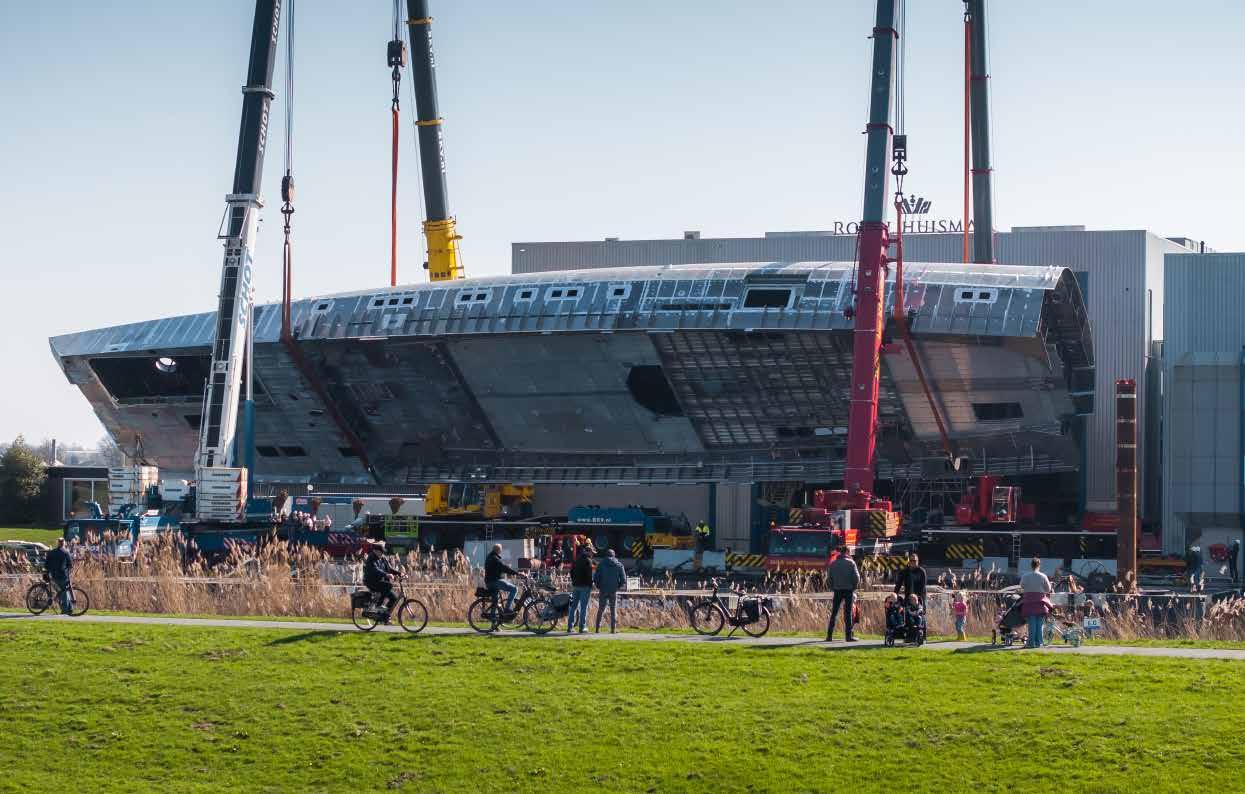
A hallmark moment in any superyacht build, the hull turning reveals the true scale of Project 412 and marks the transition from primary structure to the next phases of outfitting and systems integration.
Peter Naeyé, CEO of Royal Huisman: “Project 412 reflects the deep trust we value so highly from our clients, especially when an owner returns to build upon the proven architecture
of Royal Huisman’s flybridge schooner. The hull turning is always a proud moment, because you see the result of thousands of hours of craftsmanship in its full presence.” ◆
Brochure and more information: royalhuisman.com/trident

BECAUSE YOURDESERVESBOAT THE BEST PROTECTION
Written
Lantimar Yachting
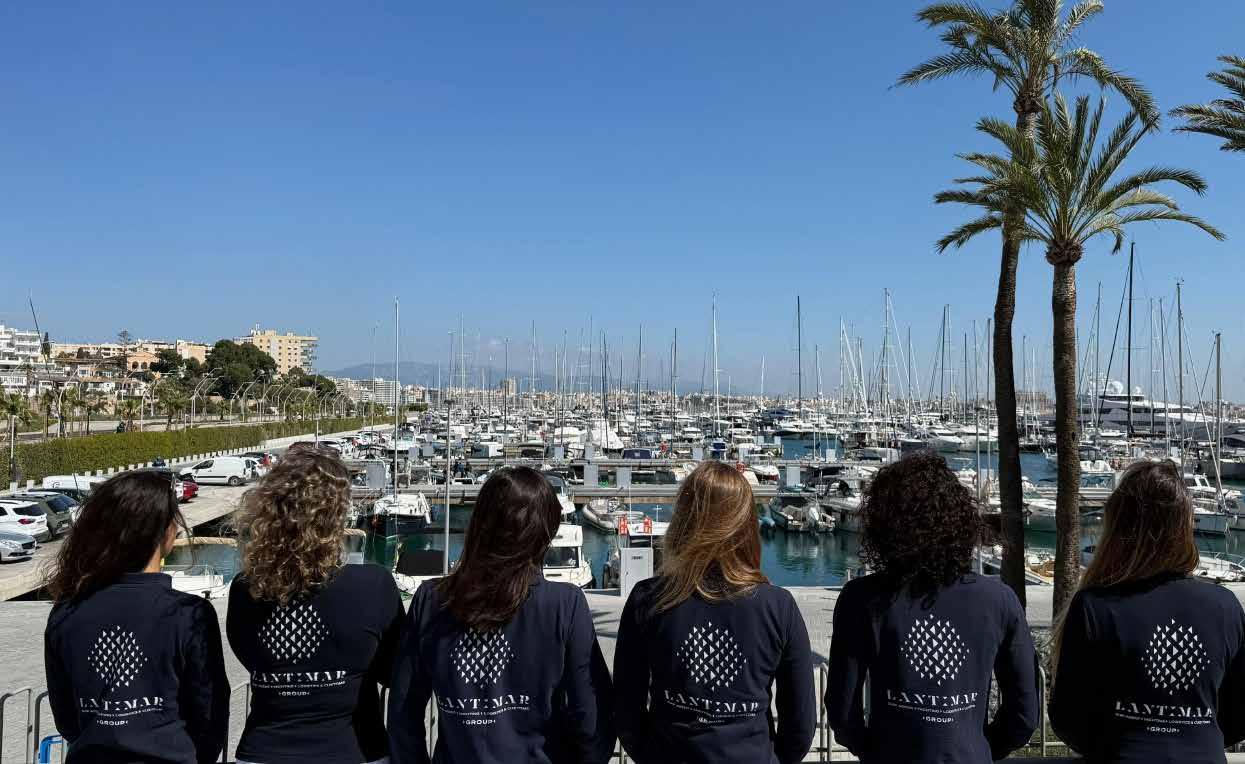
With over three decades of heritage, Lantimar Yachting has evolved from a local specialist into a cornerstone of the Spanish maritime sector. As the yachting division of the Lantimar Group, the agency provides a sophisticated framework of support designed to navigate the logistical and administrative complexities of the modern Mediterranean landscape.
What distinguishes Lantimar in a crowded market is its integrated structure. By bridging the gap between bespoke yachting services and heavy-duty logistics, the group offers a seamless operational flow. As an officially accredited Authorized Economic Operator (AEO), Lantimar operates with a level of trust and efficiency at customs that significantly reduces bureaucratic friction for its clients.
For captains and management companies, the Mediterranean’s evolving fiscal and legal environment, particularly regarding
Inward Processing (TPA) requires more than just a service provider; it demands a consultant. Lantimar’s expertise in managing refit projects under the TPA regime ensures that non-EU vessels can execute essential maintenance and spare part integrations across Spanish shipyards with full VAT compliance and optimized duty management.
Since its inception in 1992, the company has strategically expanded its footprint to cover every critical hub in the region. From the technical demands of Barcelona and Gibraltar to the high-pressure concierge requirements of Mallorca and Ibiza, Lantimar maintains a consistent standard of excellence.
Rather than a simple checklist of provisions and berths, the agency’s philosophy centers on coordination and reliability. Whether managing complex fuel bunkering through its dedicated division, Multinational Fueling, or orchestrating intricate port formalities, Lantimar acts as a silent engine behind a vessel's successful itinerary, allowing the crew to focus entirely on the guest experience. ◆ www.lantimar.com
Written by Roxanne Hughes & photos by Vasso Antoniadi
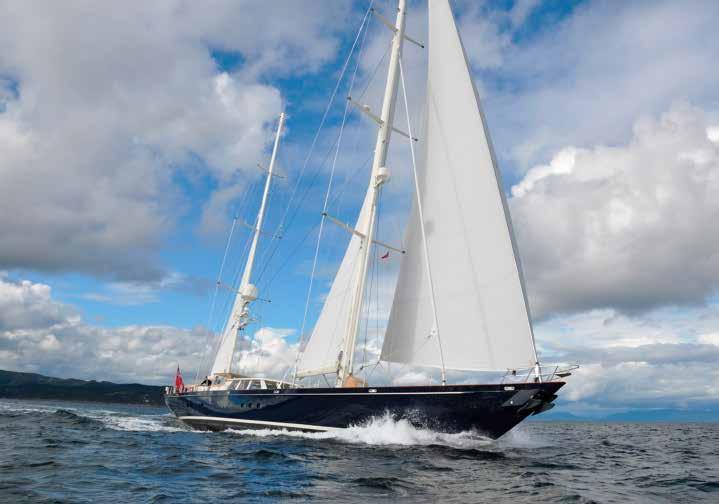
In a market where time is money and yacht value depreciates, a new model for buying and selling superyachts is gaining traction among discerning owners and buyers.
The auction house is a trusted friend of the luxury world. From fine art and antiques to vintage cars, it is where transparency, competition and global demand converge to establish true value.
Until recently, yachts sat outside that conversation. But as owners become more commercially astute - and time, certainty and discretion grow ever more valuable - the auction format is finding its place in the world of superyachts.
At the centre of this shift is Boathouse Auctions, a specialist platform bringing a modern auction model to high-quality yachts, and next to go under the hammer is the 40.7m SY Surama.
This Ted Hood design is a stunning example of Royal Huisman’s world-renowned shipbuilding pedigree. She’s presented for auction in collaboration with Burgess, Central Agent for the yacht’s sale.
Surama was conceived as a world cruiser, capable of selfsufficient, bluewater voyages. A contemporary interior by Winch adds to this yacht’s credentials, with a design that maximises natural light.
A split-level saloon offers a large lounge and dining space, and the versatile aft cockpit provides options for al fresco dining, entertaining and sunbathing. Further exterior seating is found between the dual helm stations and on the bow.
Surama has accommodation for up to eight guests in three luxurious cabins, all accessed from the central lobby. The split-level owner’s suite is positioned aft and benefits from direct access to the cockpit. Amidships, there are two en suite twin cabins, each with a Pullman berth.
When not sailing, Surama is powered by two Mercedes 570hp engines, allowing her to cruise at 11 knots with a maximum range of 4,305nm.
Boathouse Auctions’ purpose-built online platform has emerged as the leading name for yacht auctions and is quickly gaining a glowing reputation amongst buyers and sellers alike. Rather than replacing the traditional brokerage structure, Boathouse Auctions works alongside it. The listing broker’s advisory role and relationship with the seller remain fully intact, while the auction platform introduces what many owners now see as the missing ingredient: a clearly defined process that brings qualified buyers to the table simultaneously.
The result is a time-certain sale window, and this resonates with owners who understand that berthing, crew, insurance, maintenance and operating costs can quickly outweigh the marginal benefit of holding out for an aspirational asking price.
Jack Mahoney, Director of Boathouse Auctions, has seen first-hand how this structure changes behaviour on both sides of the transaction. “Selling through auction has become increasingly attractive for yacht owners who value certainty and speed,” he explains. “A well-structured auction concentrates global interest into a defined timeframe and creates healthy competition among qualified buyers. Sellers want clarity, buyers want transparency - and the auction format delivers both.”
Each auction begins with a four-week preview period, during which prospective buyers are granted full access to specifications, surveys, detailed documentation and extensive photography online. Inspections can be arranged, questions addressed and due diligence completed well before bidding opens.
Surama is lying in Bodrum, Turkey. The preview period is now open, and the auction dates confirmed for May 7th through 12th. The bidding is conducted entirely online to allow for global participation, and all bidders must pre-register and place a deposit into escrow, ensuring that only serious, qualified buyers are involved. ◆
Interested bidders are encouraged to contact Jamie Small at Burgess’ Palma office, or visit BoathouseAuctions.com
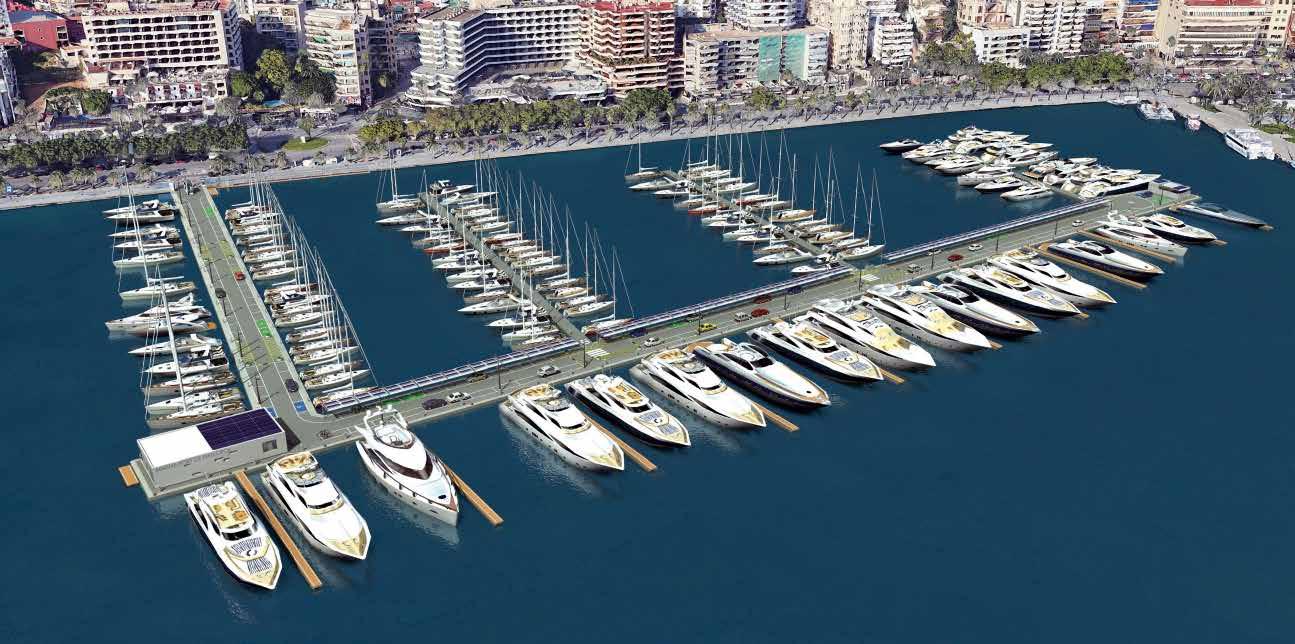
We will soon renovate our facilities to become the most environmentally committed marina in the Mediterranean.
FACILITIES
Berths up to 60m LOA. Side boarding fingers.
SUSTAINABILITY & TECHNOLOGY
Energy self-sufficiency and efficient management.
382 solar panels on roofs and pergolas.
Walkable solar tiles.
Electric charging points. Aerothermal air conditioning and wind turbine.
EFFICIENT WATER MANAGEMENT
1.000 l/hour desalination plant and 8.000-litre-tank for washing down superyachts.
Rainwater collection system for cleaning pontoons and watering plants.
RECOVERING UNDERWATER LIFE
Pioneer measures to improve marine biodiversity with BioHuts. Improve water quality with nanobubbles and multiparameter probes.
T +34 664 002 269
comercial@group-ipm.com
www.portdemallorca.com
BENEFITS FOR CLIENTS IN STP SHIPYARD PALMA
Marina Port de Mallorca and STP Shipyard Palma, both part of the IPM Group, offer the perfect mix of berthage, repair, and maintenance. Direct access to the services at STP and preference based on availability.
Written & photos by i3
In today's world, we are constantly exposed to images and messages promoting personal growth and the growth mindset.
While the concept is generally understood, a critical question remains: how many businesses within the Marine Industry genuinely adopt and exemplify this philosophy?
Kaizen, translating to "change for the better" or "continuous improvement," is a core methodology at i3 that focuses on making small, incremental positive changes consistently across all levels of the organization. It shifts the focus from sporadic, large-scale overhauls to embedding the practice of daily refinement in every process and task. This philosophy
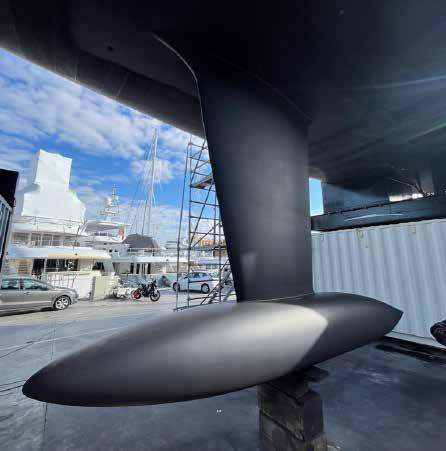
In the summer of 2025, S/Y Hummingbird underwent several upgrades to prepare for regatta competition. A significant project was the Keel Fin fairing and trailing edge. This complex task demanded a complete overhaul of the manufacturing processes, requiring the integration of design work, CNC machining for female tooling, the creation of specific manufacturing jigs, and a highly technical installation procedure.
“I3´s collaborative approach and agile attitude to finding new solutions to technical challenges allowed us to push our architect to design something quite unique. The transparent approach really helped us track time and costs ensuring everything was delivered on time and on budget”
Josh Hill - Captain S/Y Hummingbird
Project: 76m Superyacht (Anonymous client)
Implementing New technology.
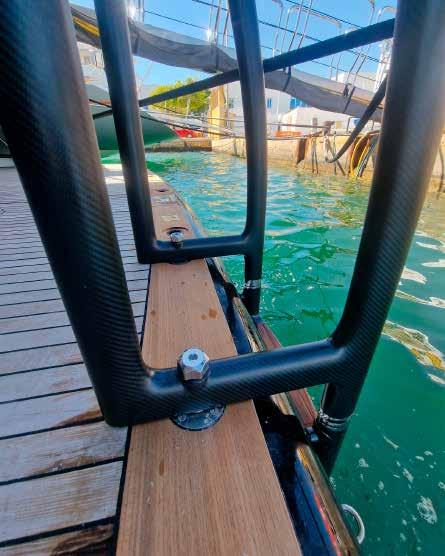
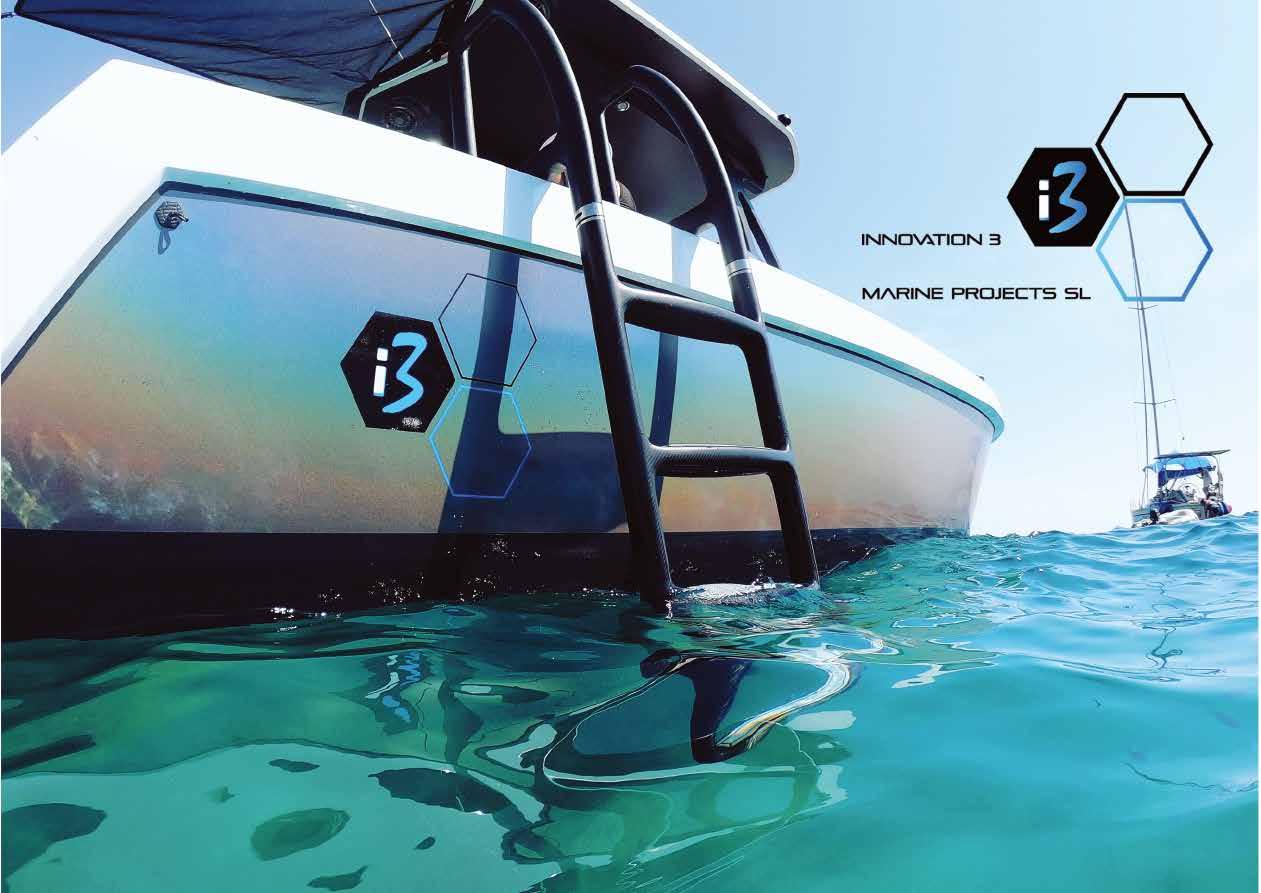
In June, i3 received a request from an existing client for port and starboard crew boarding ladders. A significant hurdle was the boat's unavailability for an on-board inspection, which would typically make manufacturing and installation impossible. However, i3 successfully delivered the project without needing access to the vessel by utilizing innovative 3D imaging and AI implementation processes.
“Really pleased with the quality of finish and fulfilment of brief with minimum fuss”
Yacht Captain
empowers every employee, from front-line staff to leadership, to actively identify inefficiencies, propose minor fixes, and contribute to a culture where challenging the status quo for continuous optimization is an everyday expectation, driving sustainable growth and efficiency.
This philosophy also fosters a sense of humility and patience, reminding us that greatness is not achieved overnight but through dedication and a commitment to progress, no matter how slight.
Since its introduction in 2025 it has become part of the identity of everyone at i3. ◆ https://i3composites.com
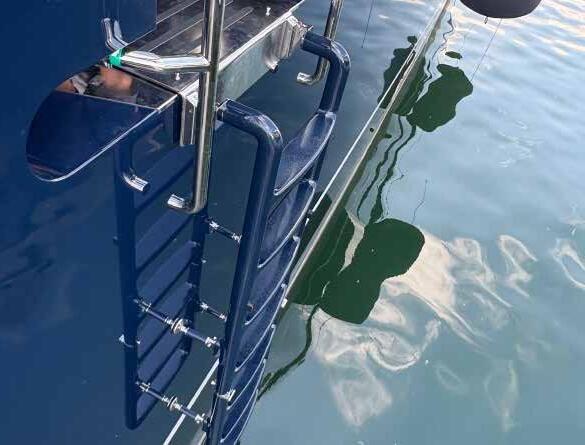
Project: M/Y Slipstream: Upgrades to swim platform and ladder
The fastening mechanism, installed at the start of 2025, was secure but time-consuming, taking several minutes to operate. Crew feedback requested an improved onboard experience. The design team swiftly responded by developing a custom quick-release pin attachment. This upgrade significantly improved functionality and enhanced the overall aesthetic.
“We had a short window in Palma to complete the upgrades and everything was handled professionally with great communication right the way through. When time is a pressure knowing you can trust your supplier makes a big difference”.
Ollie
Leonard - Chief Officer M/Y Slipstream


Written by Ella McLennan & photos by Liam Stoneman
For more than 50 years, Palma has stood at the centre of the Mediterranean refit industry. Its strength has long been defined by a dense network of skilled marine trades, a strategic location, and a climate that supports year-round operations.
In recent years, however, shifting cost dynamics have encouraged captains and project managers to explore mainland alternatives such as Vilanova, Denia, and Málaga for large-scale refit works. This growing competition has prompted reflection across the Balearic marine sector.
Yet, Mallorca continues to hold a distinct advantage: quality.
Across the island, a highly specialised workforce of carpenters, painters, metalworkers, and technical fabricators consistently deliver to the exacting standards expected by superyacht owners. This concentration of expertise remains difficult to replicate elsewhere in the Mediterranean.
At the 2025 Balearic Marine Cluster Forum, industry leaders highlighted three key priorities for maintaining Palma’s competitive edge: improved infrastructure, greater efficiency, and continued investment in innovation.
Increasingly, companies are responding.
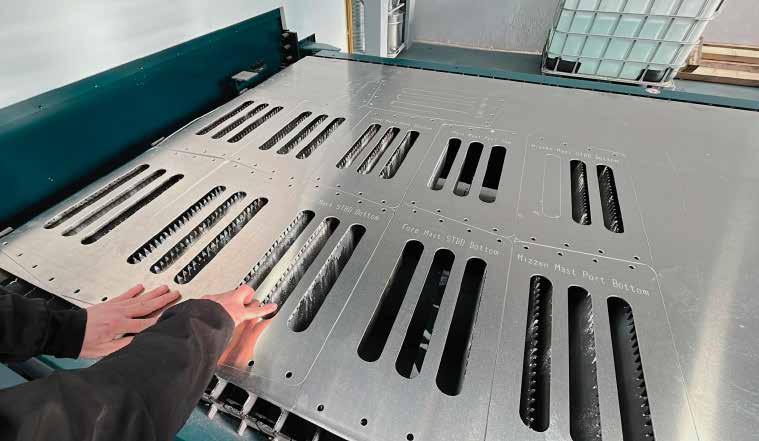
Advancements in digital design, precision manufacturing, and workflow optimisation are beginning to reshape traditional fabrication processes. In metalwork, for example, the adoption of fibre laser cutting technology is significantly improving both speed and accuracy, while reducing manual labour.
Where components once required extensive marking, cutting, and finishing by hand, they can now be produced directly from 3D models with consistent precision. This shift is particularly noticeable in commonly requested items such as Starlink brackets. By standardising designs and pre-producing base components, fabrication has moved from a multi-stage manual process to a streamlined workflow, often allowing same-day completion.
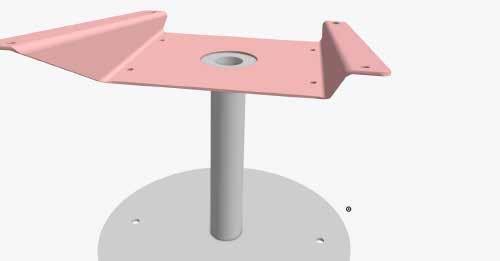
The impact on refit projects is clear. Faster production reduces bottlenecks for engineers and project managers, while improved accuracy minimises the need for rework. Lead times that once extended across several days can now be compressed into hours, supported by rapid delivery services across the island.
Precision has also improved. Modern laser systems are capable of producing complex geometries with tolerances as fine as ±0.1mm, delivering clean edges and reducing the need for secondary finishing. This allows components to move more quickly from fabrication to installation, without compromising on quality.
At the same time, the sector continues to offer the highend finishes expected in the superyacht environment, from polished and brushed metals to advanced coatings such as anodising, powder coating, and electroplating.
Beyond the island, Mallorcan expertise is also expanding. A number of companies have established operations on the Spanish mainland, creating stronger links between Palma and key refit ports such as Tarragona and Málaga. This evolution allows the Balearic skill base to support projects across a wider geographical area, while maintaining the standards developed on the island.
For captains and owners, the result is a more balanced proposition. Mallorca continues to offer the craftsmanship and experience for which it is known, now increasingly supported by modern manufacturing methods that improve efficiency and reliability.
As the Mediterranean refit landscape evolves, Palma’s future competitiveness may not depend solely on cost, but on its ability to combine tradition with innovation. In that respect, the island remains firmly at the forefront. ◆ www.synergynox.com
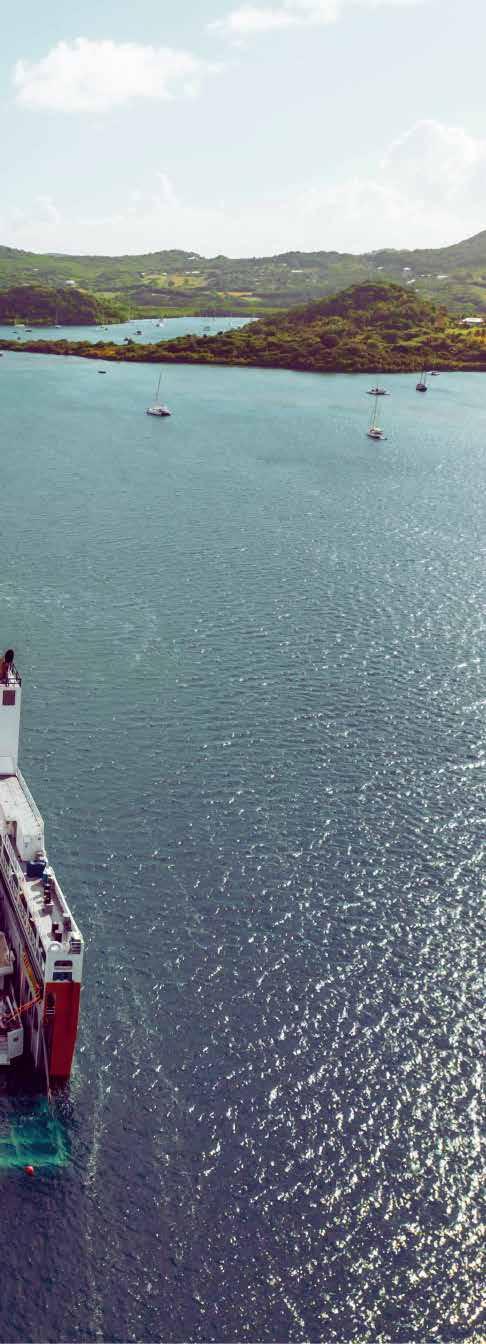
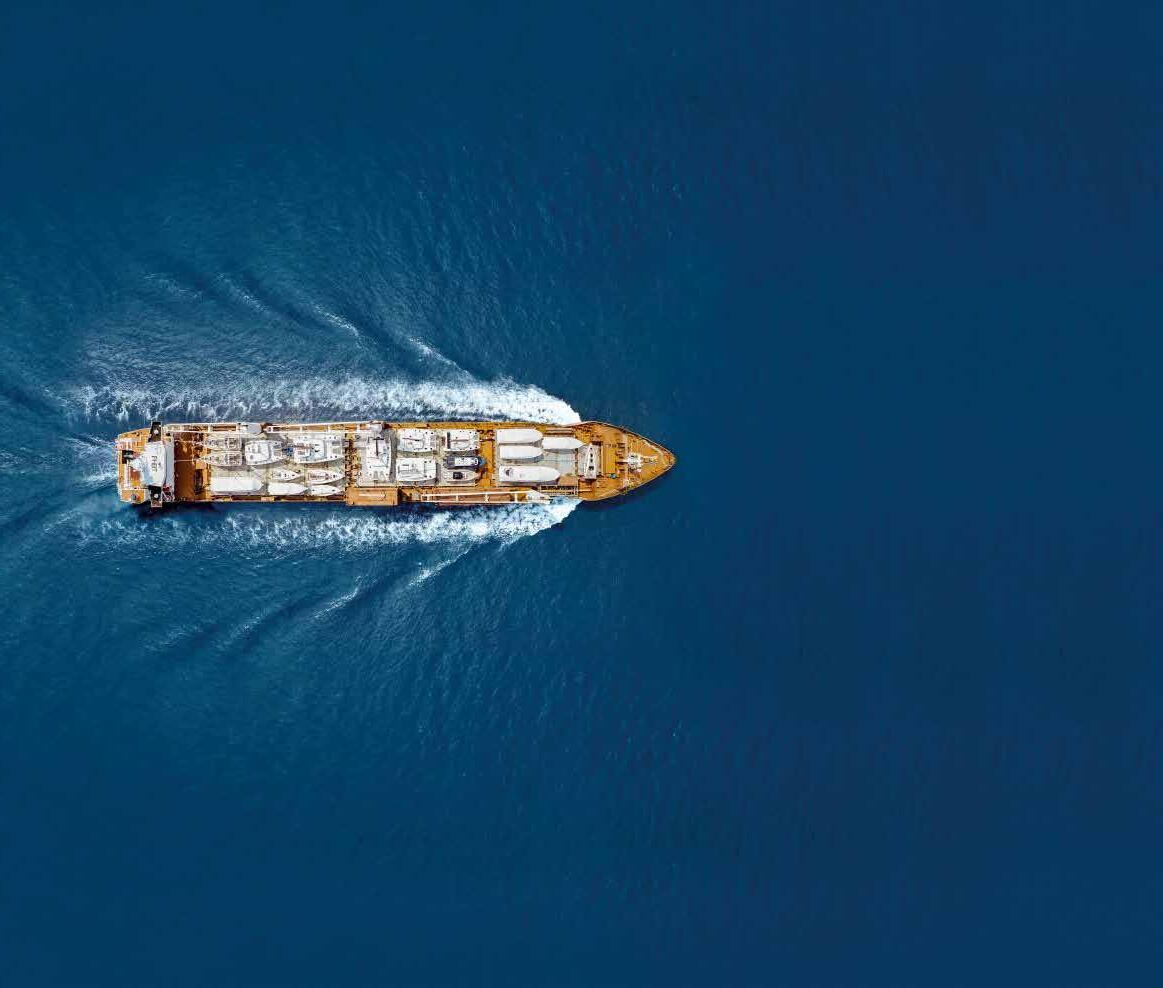
With our fixed sailing schedules and dedicated float-on/float-off yacht transport vessels, you can rest assured that your yacht is on time where it needs to be, which gives you the time to relax, enjoy, or reunite. We offer dedicated sailings to the most sought-after destinations and events.
Schedule 2026
"3rd time using DYT. They took great care of the yacht. Arrived safely in Palma from Ft Lauderdale. Would definitely use again. By far the best way to send your yacht back and forth across the ocean."
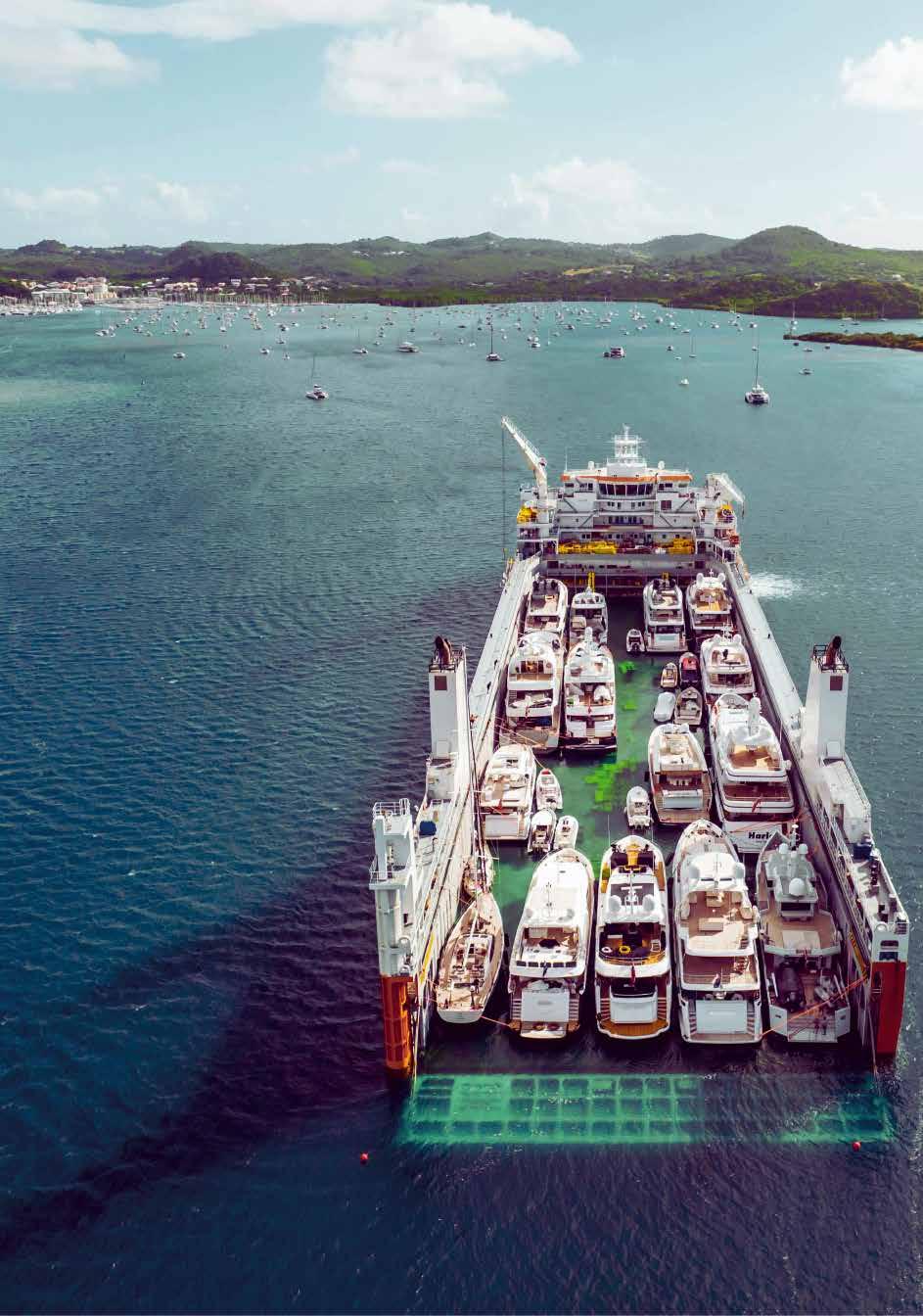
APRIL | SEPT | OCT | NOV Palma Port Everglades
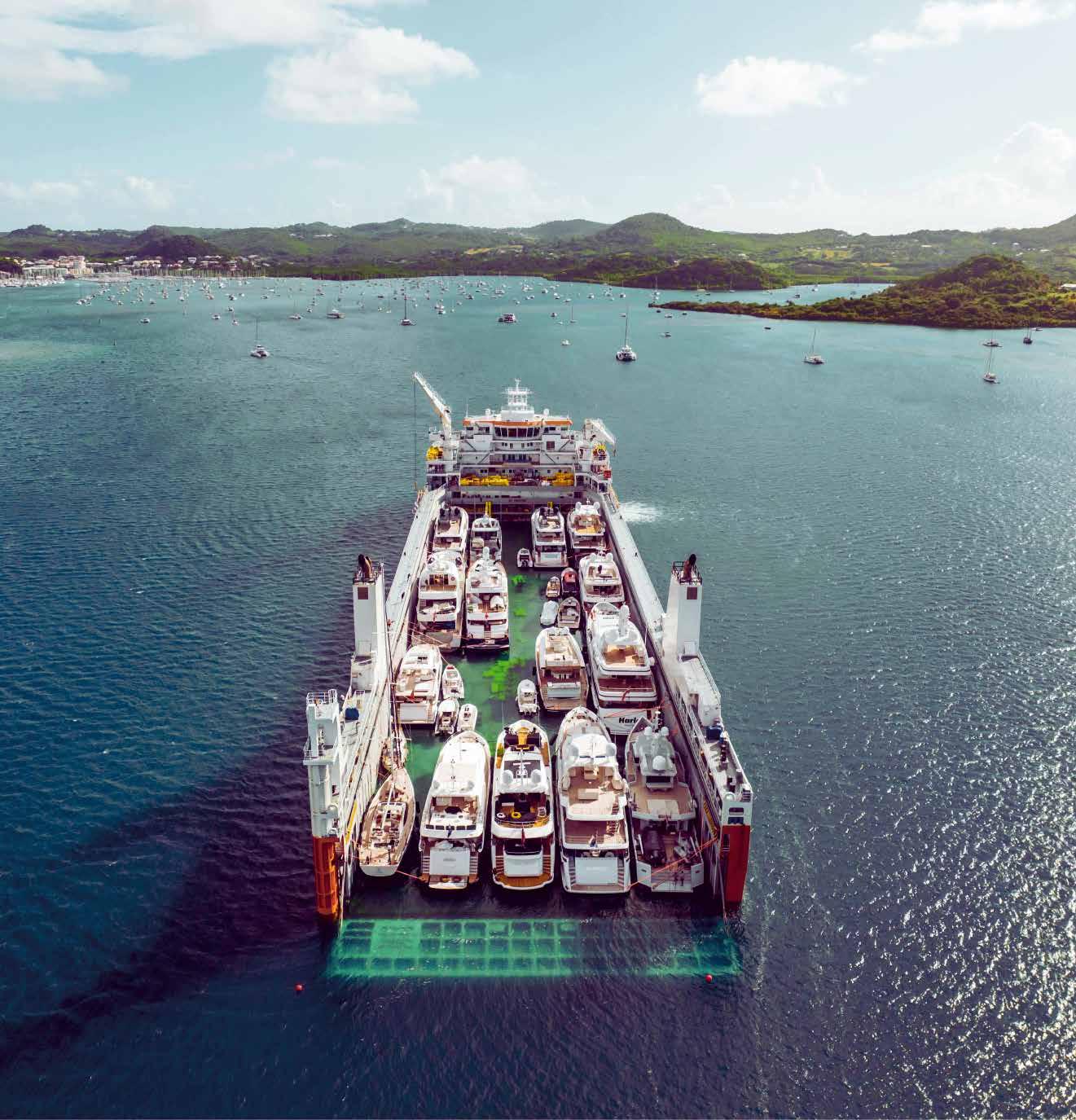
MAY | SEPT | OCT Port Everglades Palma
OCTOBER Palma St. Thomas
MAY St. Thomas Palma
NOVEMBER Palma Le Marin

Explore all our sailings
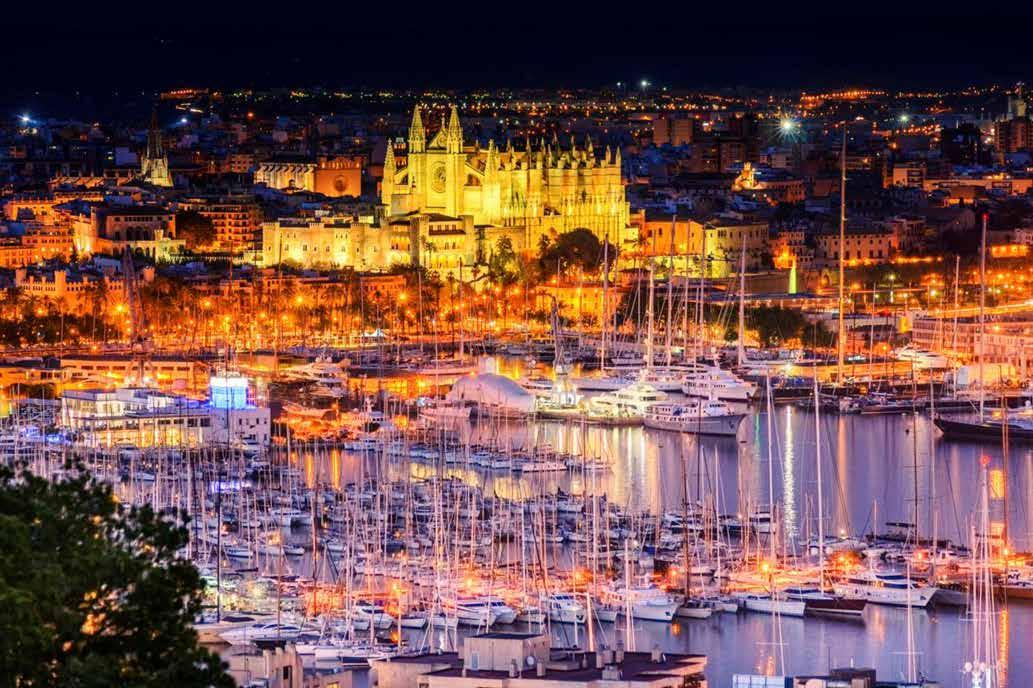
Each spring, almost without announcement, Mallorca shifts its rhythm. Harbours begin to fill, decks regain their polish, and across the Bay of Palma a familiar silhouette returns, superyachts making their way back into the Mediterranean. More than the start of a season, it is a shared feeling; a moment that, year after year, places the island firmly at the heart of the international yachting scene.
During these days, Palma naturally transforms into a global meeting point. The Palma International Boat Show and the Superyacht Village set the scene for a week where everything flows, conversations resume, projects take shape, and new seasons begin to unfold.
A season gently in motion
Before it all comes to life, the season quietly takes shape. In the months leading up to it, agencies and crews refine itineraries, curate new experiences, and uncover the details that will define the summer ahead.
On board, crews evolve into true hosts of the destination, while ashore, Mallorca continuously reinvents itself, always offering something new, from restaurants to experiences and fresh ways to explore the island.
When the week of the Palma International Boat Show arrives, everything falls effortlessly into place. The city comes alive, the sea fills with movement, and events such as PalmaVela bring both energy and elegance to the bay.
Beyond the official calendar, it is often the informal moments that define these days, a coffee that turns into a meeting, a chance encounter, a sunset conversation that leads somewhere new.
Within this setting, initiatives such as those by Estela Superyacht Agency blend naturally into the rhythm of the week. On May 1st, their Breakfast Seminars & Sunset Cocktail Captain’s Dinner will bring together industry professionals in a format that reflects Mallorca’s unique balance of insight, connection and lifestyle.
More than a destination
Mallorca has a quality that is difficult to define, yet instantly felt. Perhaps it is the light, the scale, or the seamless combination of world-class infrastructure with a sense of ease. Here, networking feels natural. It becomes part of the environment, like the sea, the architecture, or the way the day gently turns into night.
An unspoken tradition
Over time, late April has become more than just a date in the calendar. It marks the beginning of new stories, new routes, and new experiences. Because in the world of superyachts, the season does not begin abruptly. It begins softly. And it begins here. In Mallorca.
◆ https://estelashipping.es











Udo Maekler - Master Technician Marine Engineering Palma, Calle Alexandre Laborde, 3, local 3 Poligono Can Valero, 07011 Palma Office: 0034 - 971 447 477, info@me-palma.com www.me-palma.com






We craft your refit with care







52. Meet The Crew: Vanessa Mayol Ekman
56. The Crew Coach
58. Chief Stew Shop
60. Chef Tzarina Spits it out
62. Chef’s Chat
64. Ship to Shore: Andrew Fairbrass
66. MSOS
70. Chef Raffie
72. Virtual Pursers
74. Marinepool in Palma
76. Alnitak
80. Save the Med
86. Fundacion Joves Navegants
90. Saving SY Owl
Written by Jens Oomes - Photos by Vanessa Mayol Ekman
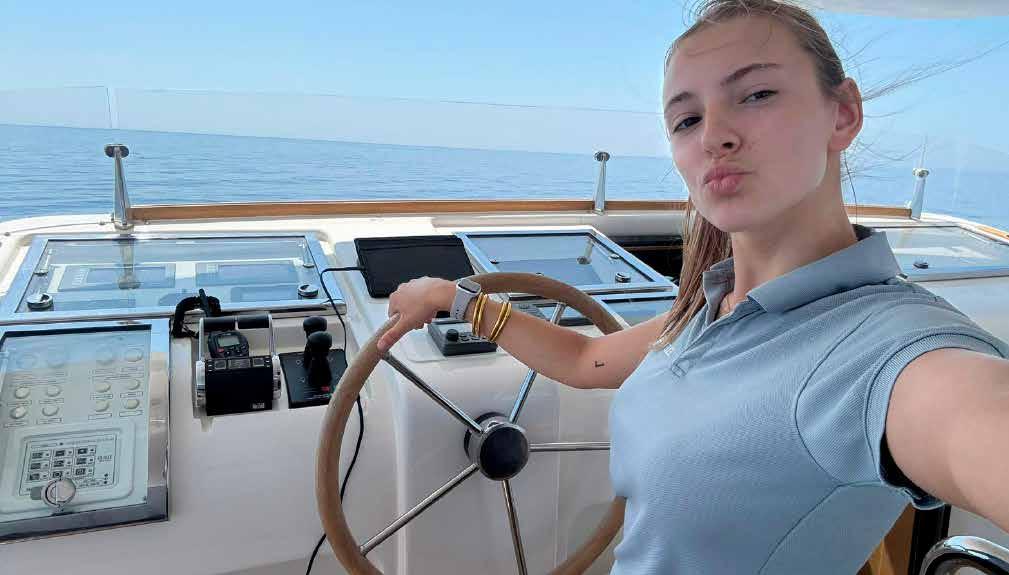
Vanessa Mayol Ekman grew up in Mallorca and has her first season in yachting under her belt. During that time, she experienced many of the challenges that green crew members face, something that inspired her to start the Mallorca Greenies community. A project The Islander is keen to support.
Vanessa, tell us about yourself and how you decided to embark on a yachting career.
I grew up in Mallorca, in Llucmajor. My mother, Jessika Ekman, works as an event planner, and my father, Toni Mayol, is a bus driver. With my mother, I speak Swedish, and Catalan with my father. At school, I learned Spanish and English.
I have always felt a strong connection to the sea, to Mallorca, and to nature and animals. I also love travelling and discovering new cultures and people. After finishing school, I wasn’t sure what to study, so I decided to start working while I figured it out.
I first worked at the airport as an administrative assistant, where I realised that a typical 9-to-5 office job wasn’t for me. After that, I worked in a restaurant, but I knew that wasn't my direction either.
Later, I had the opportunity to work in a five-star hotel in Palma. From there, I could see the harbour, and every day I watched the boats coming and going, imagining how much I would love to work on one. I decided I was
going to pursue a career in yachting after that season.
I knew someone who knew a captain, and he passed my CV on. The captain called me for an interview and hired me as a deck/stew. After three weeks, he offered me the opportunity to do a delivery from Antibes to Mallorca. It was just the two of us. I was scared, as I was still a teenager trusting someone I didn’t know, but I decided to go for it. Everything went well, despite a few cuts from the lines. I adored seeing many dolphins and we arrived safely in Mallorca. That was my first big challenge completed.
What challenges did you encounter during your first season, and how do you intend to help other “greenies”?
After the delivery, we prepared the yacht for the summer season in dry dock, and later went for a sea trial with the owner. While crossing the bay of Alcudia, the boat suddenly stopped.
That marked the end of my season in May, after two months of very hard work. The engines had broken and needed to be replaced, and the boat wouldn’t be ready until September. The captain told me I could either wait or look for another position.
I was very sad because I really liked my job and didn’t understand why it had to end so early. But I decided to keep going. I started looking for another opportunity, and within a week I joined a yacht in Palma that was heading to Greece for the entire season. It was a difficult decision for a nineteen-year-old who had never been away from her family
and friends for so long, but I did it.
Other challenges included missing my family and friends, feeling lonely at times, not always knowing how to do certain tasks, and learning how to manage anxiety. I also experienced long working hours with little sleep, and working under pressure with a captain who was often stressed and sometimes even behaved inappropriately with the crew.
With my group, I want to support other “greenies” by helping them find jobs and sharing tips to make the process easier. I want to create a community where we can learn from each other and not feel alone.
I will also share advice on how to take care of your mental and physical health, both onboard and when you return home. I think it’s also important to talk about basic self-defence, especially for women, and to encourage people to trust their instincts and not stay in toxic environments or on boats that take advantage of inexperience.
I have a position lined up as a sole stewardess. This season, I don’t want to put too much pressure on myself. Instead, I want to focus on taking better care of my well-being. I plan to wake up earlier to practise yoga or Pilates, go for a swim, or fly my drone, small things that help me feel balanced.
I feel very lucky to have a wonderful owner who allows me to be myself and enjoy my work, while still maintaining professionalism and completing my responsibilities.
““With Mallorca Greenies, I want to create a community where new crew members can learn from each other, share experiences, and feel less alone in this journey.””
Where do you see yourself in five years’ time?
In five years, I see myself working as a First Officer.
What are your favourite things about yachting and its community?
My favourite things about this industry are travelling, spending most of my time at sea, and meeting people who share a love for sailing and nature. I also love seeing incredible wildlife.
I would also like to help with topics like taxes, financial responsibility, building friendships, and sharing knowledge about Mallorca and our culture.
Are you prepared for the 2026 summer season? Which job do you have lined up, and what will you do differently compared to last season?
I am preparing myself as much as possible. I still need to complete my ENG1, I already have an appointment, and after that I will be ready.
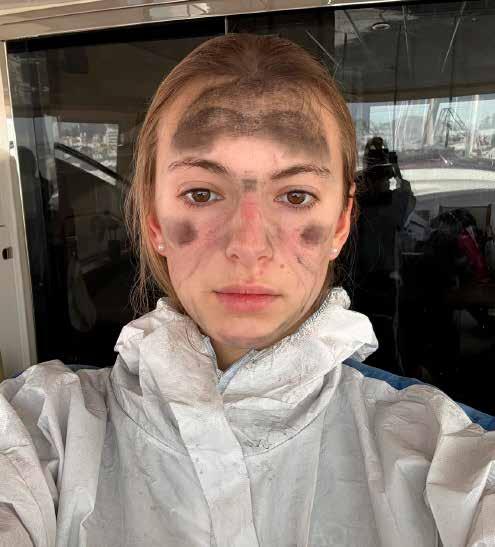
Another thing I really value is the sense of disconnection when you are out at sea—no Wi-Fi, no land in sight—and the meaningful conversations you share with others onboard.
Follow @greeniesmallorca on Instagram and DM to make contact with Vanessa. ◆
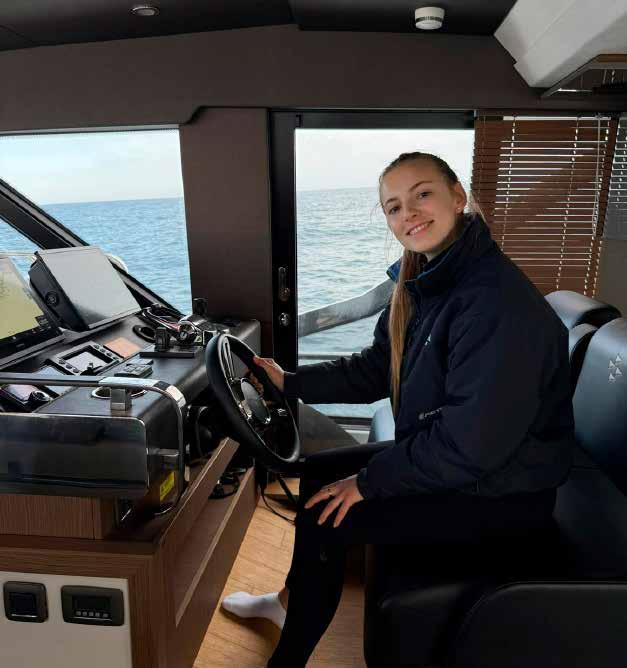


https://wops.teachable.com/p/how-to-work-on-pocket-superyachts


Written by Karine Rayson
Why crew respect some leaders and fear others
Compliance and commitment can look identical from the outside, the gap between them shapes everything from crew wellbeing to onboard safety.
On the surface, respect and fear can look remarkably similar on board a superyacht. The crew are professional.
Tasks are completed on time. Standards appear high, and no one is raising complaints. Beneath that surface, however, the experience of being led can be entirely different and the distinction matters far more than many Captains and Heads of Department recognise.
The compliance illusion
Fear also does not stay contained within individuals — it spreads across departments, shapes communication habits and affects decision-making at the moments when clarity and confidence matter most.
What respected leaders actually do
Respected leaders are not defined by popularity or their rank. They are defined by how they behave and treat their team members. The leader's crew consistently trusts them to uphold their standards, be clear in their expectations, and remain emotionally regulated under pressure.
In high-performance environments like yachting, fear-based leadership is frequently mistaken for effectiveness. When crew comply quickly, avoid obvious mistakes and keep their heads down, it can create the impression of a well-run vessel.
Compliance, however, is not the same thing as commitment, and treating the two as equivalent creates significant blind spots for those in charge. Fear tends to surface in subtle, easyto-miss ways.
Crew begin to second-guess their own judgement, apologise excessively and hesitate to act without explicit approval. Conversations quieten when certain individuals enter the room. Feedback disappears not because operations are running smoothly, but because speaking up no longer feels safe.
For leaders, this pattern creates a genuinely dangerous illusion: the absence of visible problems appears to confirm that none exist. In practice, that silence often signals the opposite. A quiet crew doesn’t mean a harmonious crew. Sometimes it is simply a careful one.
What crew are actually experiencing
Counselling work and research with crew across departments consistently surfaces the same pattern. The stress driving disengagement and burnout is not always linked to workload or long hours. More often, it is the psychological weight of working in an environment shaped by fear, the anticipation of a reaction, the uncertainty of how a leader will respond, the sustained effort of staying constantly alert.
Over time, this creates a form of fatigue that is difficult to measure and easy to overlook. Crew begin to withdraw, stop raising concerns and shift their focus from contributing to simply getting through the day.
When incidents occur, they assess the situation and respond without escalating unnecessarily. They correct behaviour without diminishing the person. Crew may forget the mistake itself. They rarely forget how a leader made them feel in that moment.
One of the most defining leadership moments on board is not when operations are running smoothly, but when something goes wrong in front of others. A miscommunication during charter, a mistake in service, a lapse in timing: these are the moments that reveal what a leader is actually like.
A fear-based response typically involves a visible shift in tone, public correction or a focus on blame. The immediate result may appear to be compliance, but the cost is real. The crew member involved withdraws, those who witnessed it take careful note, and the culture adjusts accordingly.
A respect-based response contains the situation, protects the working environment in the moment and addresses the issue constructively afterwards. Accountability is maintained, but so is dignity, and that balance is precisely where trust is built or eroded.
Why fear-based leadership develops
Fear-based leadership rarely emerges through deliberate choice. It is more often the product of a highly hierarchical industry shaped by traditional maritime command models, where leaders are frequently promoted on the basis of technical competence, with little preparation for people management.
The pressure from owners, guests, and operational demands can be significant, and without adequate support or training, leaders may default to control to manage that pressure. The pattern is learned, often across multiple vessels and years at sea, and it does not reduce its impact on the crew living within it.
What fear costs an operation
There is a widespread misconception that fear creates control. In practice, it tends to reduce visibility. When crew do not feel safe to speak up, those in charge lose access to critical information; early warning signs, operational risks and opportunities to address problems before they escalate. Issues surface later, and typically at a point where they are far harder to manage.
The relationship between leadership culture and crew retention is also well established. Crew who leave vessels after short tenures frequently cite the onboard atmosphere, and specifically their direct leader's behaviour, as the primary driver. The recruitment and retraining costs that follow are rarely tracked back to their source.
What crew consistently say they value
Across departments and vessel sizes, crew express consistent expectations of leadership and they are not particularly demanding ones. They want to understand what is expected of them. They want to be treated consistently, regardless of who is watching. They want to raise concerns without fearing the consequences. They want to feel that their contribution is recognised.
Lastly, they are craving servant leadership. These are the foundations of effective leadership in any highperforming team, and yachting is no exception.
The shifts that make the difference For leaders reflecting on their own approach, the changes that
matter most are often smaller than expected. Pausing before reacting, addressing issues privately rather than publicly, monitoring tone under pressure, checking in with crew after high-intensity situations, creating space for input even when decisions remain with leadership. None of these require a personality overhaul. They require consistency.
Applied over time, they shift a vessel's culture in ways that show up in performance, retention, and the quality of the working environment for everyone on board. The most useful question for any leader is not whether the crew are performing.
It is why they are performing, whether standards are upheld because crew feel supported, confident and accountable, or because they are managing around a reaction they have learned to anticipate.
That distinction may not be visible in any single moment, but it shapes a vessel's culture over time.
Culture, more than any checklist or procedure, determines whether a crew simply functions or genuinely performs. ◆

Karine Rayson
The Crew Coach
karine@thecrewcoach.com
https://thecrewcoach.com

Written by Clair Minto
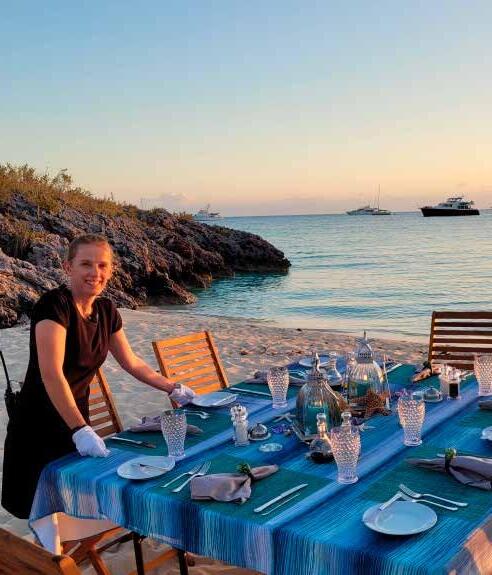
There’s a moment many chief stews have at some point in their career, usually midseason, slightly sleep-deprived, juggling a provisioning disaster while guests ask for something wildly specific, where you think: what comes after this?
And yet, when you step into the world of running a business, you quickly realise something surprising, you’ve been training for it all along! In fact, being a chief stew is probably one of the most underrated foundations for entrepreneurship. The skills aren’t just transferable, they’re already second nature.
Having built my own business, Chief Stew Shop, I’ve found myself constantly drawing on habits and instincts that were formed on board. Especially one key trait: the ability to adapt, pivot, and keep going, no matter what the day throws at you.
Here are some of the biggest lessons yachting quietly taught me about running a business.
1. Tenacity is your greatest asset
On a yacht, giving up isn’t an option.
Guests don’t see the backstory, they see the end result. Whether it’s a last-minute theme night, impossible provisioning requests, or a team member down, you have to make it work. Business is exactly the same.
Things go wrong constantly, orders get delayed, customers fall through, marketing doesn’t land the way you expected. The difference between something that succeeds and something that quietly disappears often comes down to one thing: sticking with it when it would be easier not to.
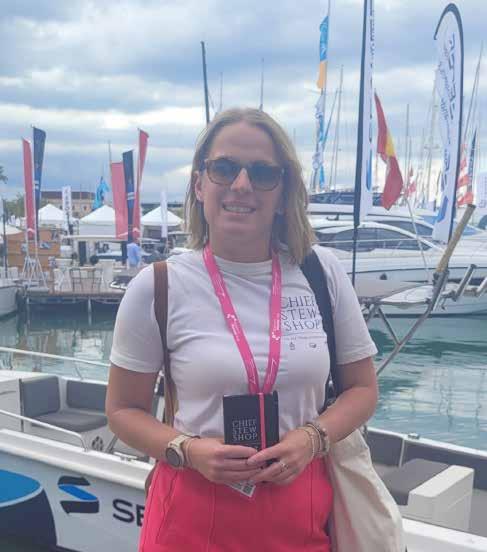
Chief stews don’t quit mid-charter and that mindset is invaluable when you’re building something of your own.
2. Flexibility is survival
If there’s one thing yachting teaches you, it’s that plans are merely suggestions. Itineraries change, weather shifts, guest preferences evolve by the hour. You learn to pivot quickly, calmly, and without making it anyone else’s problem. Running a business requires that same level of flexibility. You might start with a clear vision, but the reality will shift. Products evolve, customers respond differently than expected, and opportunities appear where you didn’t plan for them. The ability to adapt without losing momentum is a huge advantage. And for chief stews, it’s already built in.
3. You already understand high end customer service
Luxury service isn’t just about delivering what’s expected, it’s about anticipating what’s needed before it’s even asked for. That mindset is gold in business.
Whether you’re selling products or services, the brands that stand out are the ones that create an experience. Thoughtful details, consistency, and a sense that someone really gets the customer. Sound familiar? From turn-down details to perfectly timed service, chief stews operate at a level many businesses are still trying to figure out.
4. You know how to manage people
Managing a team on a yacht is not for the faint-hearted. Different personalities, long hours, high pressure and no real escape. You quickly learn how to motivate, delegate, and keep standards high, even when energy is low. In business, whether you’re working with suppliers, freelancers, or eventually building a team, those same skills apply. Clear
communication, setting expectations, and knowing when to step in (and when to step back) are all part of the job. If you’ve handled a difficult charter guest or a tense crew dynamic (or three!) you’re already well equipped.
5. Attention to detail is what sets you apart. The difference between good and exceptional service often comes down to the smallest details. A perfectly folded napkin. A well-timed drink. A cabin that feels just right. In business, it’s no different. It might be packaging, communication, branding, or the way you follow up with customers, but those small touches build trust and loyalty over time. Chief stews are trained to notice what others miss. That’s a powerful advantage.
6. You’re used to wearing all the hats!
On paper, the chief stew role is clear. In reality you’re an event planner, stock manager, HR, guest liaison, interior designer, problem-solver (often all within the same hour). Running a business feels very similar, especially in the early stages. You’re doing a bit of everything, sometimes well, sometimes learning as you go to put it gently, but always moving forward. The difference is, for a chief stew, that level of responsibility isn’t new, it’s just been given a different setting.


7. Resilience is in your DNA
Yachting isn’t easy. It demands energy, patience, and a level of resilience that not everyone has. But if you’ve made it to chief stew, you’ve already proven you can handle pressure, adapt quickly, and keep standards high even when things feel stretched. That resilience carries directly into business, because behind every “overnight success” is a long period of figuring things out, adjusting, and continuing anyway.
It’s easy to underestimate what your role has taught you. But when you step back and look at it objectively, chief stews are already operating like entrepreneurs, managing budgets, delivering high-level service, leading teams, and solving problems in real time. Running a business doesn’t require an entirely new skillset. More often than not, it’s about recognising and trusting the one you already have.◆



info@chiefstewshop.com
(+44) 781 667 8634
www.chiefstewshop.com


Tzarina Mace-Ralph is a talented yacht chef who appears in season 2 and the current season 3 of reality TV show Below Deck.
Overnight she became a public figure with a large, predominantly U.S. fan base. While the yachting industry may have its own ideas of the show, Tzarina decided intuitively to use her reach to support deep causes. She was quoted in Rolling Stone magazine on how she addressed a sexual assault case. She has been featured in medical trade magazines on the impact of truly healthy food. In her regular Islander column, she shares her thoughts and observations on the yachting industry. Specifically, matters that affect crew. From Below Deck to under the surface.
Written by Tzarina Mace-Ralph
With all my years of experience in the superyacht industry, I’ll be honest, I was once green too. We’ve all been there. New to yachting, full of excitement, but not always aware of the little things that make or break you as a crew member.
This industry has a language and etiquette all of its own. Some rules are written down in manuals, but the ones that really matter? The unspoken rules you only learn by messing up, getting a raised eyebrow from the chief stew, or a quiet word from a captain.
So, here on this platform, I want to pass those lessons on. If you’re new to yachting, these are the do’s and don’ts of yacht etiquette that I’ve learned the hard way , so you don’t have to.
Respect the hierarchy
Know who you report to, and follow that chain. Don’t skip ranks unless it’s about safety. Radio comms should be short, clear, and professional , no chit-chat, no jokes when guests are aboard.
Guests come first
When guests are on board, you’re invisible unless needed. Walk quietly, step aside on stairs, close every door and locker gently. Voices carry through bulkheads , keep them low.
Uniform and grooming
Always wear the correct uniform, clean and pressed. Hair must be neat, and for the girls: no wet hair while working. It looks unprofessional and sloppy. Light scent only , confined spaces mean overpowering perfumes or aftershaves are a nogo.
Shoes, smoking, and socials
Shoes scratch teak, so follow the boat’s policy: usually barefoot or clean deck shoes only. Smoking is only in the designated crew spot, never inside, never in uniform, and never near guests. Social media? No guest photos, no location tags in real time. NDAs are real, and breaches can cost you your job.
Crew area courtesy
The crew mess is everyone’s living room and office. Keep it tidy. No loud drama, no wandering around in towels or halfdressed. Respect quiet hours , someone is always on rest or night watch.
Cabins and bathrooms
Treat shared space like gold. Stow your gear, wipe down after showers, squeegee the glass, keep it dry. Close doors softly , never slam. Quick showers are standard; fresh water is precious.
Galley etiquette
If you’re not galley, don’t touch mise en place, guest stock, or plate garnishes. Label crew food. Clean up your own cups and dishes. The chef is under immense pressure , don’t make it harder.
Guest spaces are off-limits
Never sit on guest furniture, use their bathrooms, or dip in the jacuzzi. If you’re passing through a guest space, do it silently, quickly, and with purpose.
Alcohol and off-duty conduct
On charter, you’re sober , full stop. Off duty, follow the yacht’s alcohol policy. But never show up late, hungover, or smelling of alcohol. Nothing ruins a reputation faster.
Deck manners
Don’t touch polished stainless or varnish with greasy hands. Coil lines neatly. Don’t step into another crew member’s job without asking. Respect the work of others, even if it’s not your department.
Safety culture
Safety rules trump everything. Wear PPE, show up early for drills, and keep your headphones off on deck while underway. Ask if you don’t know , that’s professionalism, not weakness.
Confidentiality always
Conversations about guests, their food, their quirks , that all stays on board. Be warm, be polite, but don’t gossip. What happens on the yacht, stays on the yacht.
Final word
Every yacht has its quirks, but these unspoken rules are universal. Follow them, and you’ll not only survive , you’ll thrive. Yachting isn’t just about service , it’s about respect: for the guests, the vessel, your fellow crew, and yourself.
So if you’re starting your career in this industry, remember: etiquette is the difference between being seen as “green” and being seen as a pro. ◆ Instagram: @ cheftzarina
Interview by Barry D'Arcy from Ocean Earth Chefs
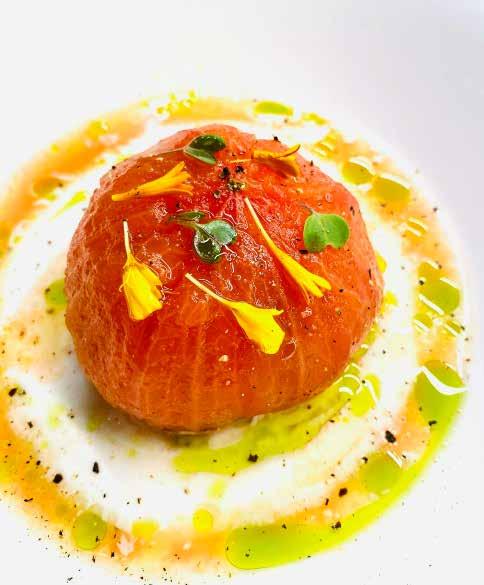
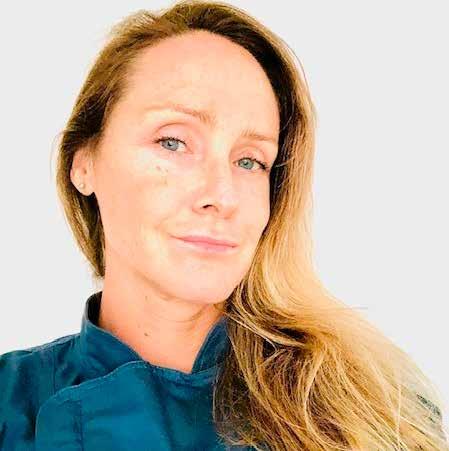
Chef Eleonore Op de Beeck, like many chefs, found her way into the yachting industry by fate and fortune. A direction she could never have imagined waited for her as a new door of opportunity opened to a new life.
Where do you come from, and what's your age?
I was born and raised in Southern Spain, although my family comes from Belgium. I'm 51.
What made you want to become a chef?
I trained as a veterinary surgeon and worked in my own practice for many years. After experiencing burnout, I began cooking on weekends to relieve stress. As cooking became a passion, I started inviting friends to try my dishes. Their encouragement led me to consider a career change.
After watching many episodes of MasterChef on TV, I decided to participate. I was part of the third edition of the Spanish Masterchef, and it didn't last long before Jordi, a Michelin-star chef in Spain and owner of Abac, threw me out on a chicken dish!
That didn't stop me, and I started with little steps into
the culinary world. I got hired as a pastry chef for a local restaurant in Marbella, then I won a local tapas competition for the "most original tapa", where I replicated a burger but made it vegan.
A friend suggested I explore the yachting industry as a chef, a field I hadn't considered before. With my limited kitchen experience, I applied for a stew/cook position on a 28m San Lorenzo yacht, was hired, and thoroughly enjoyed it. This marked the start of my new journey as a yacht chef.
Where have you worked as a chef?
I imagine, like every chef, wintering in the Caribbean, departing from Ft.Lauderdale down to all the beautiful islands, then heading to the Bahamas.
Summer cruising the Mediterranean departing normally from Palma, then going all the way to the French coast, Italian coast, Malta, and Greece. One of my best journeys was crossing the Pacific, departing from Panama, then visiting the Galapagos and French Polynesia.
How would you describe your style of cooking?
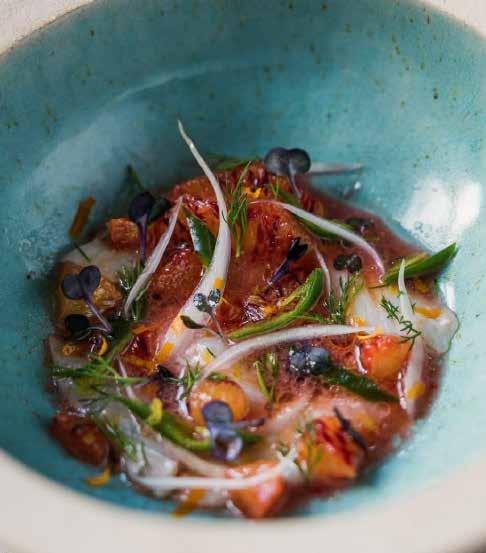
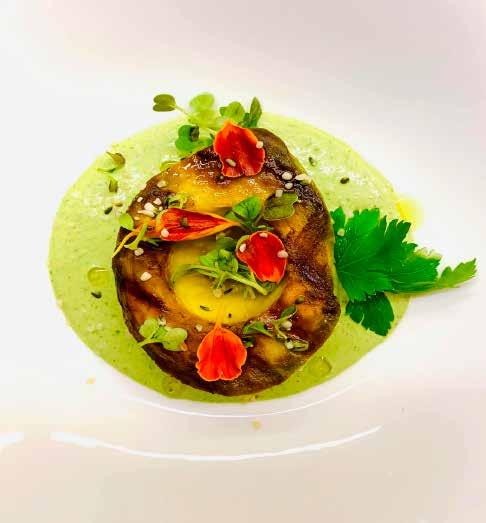
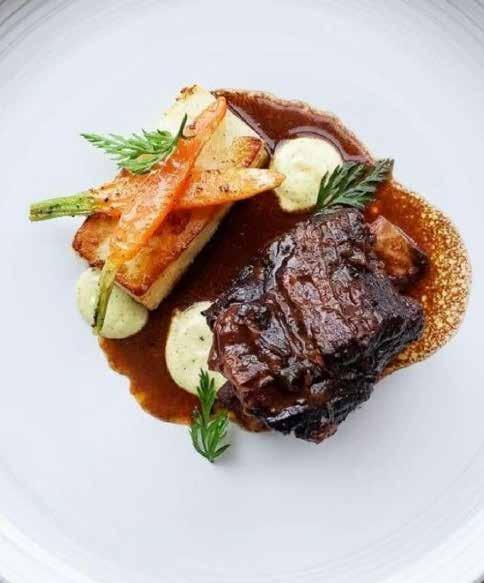
Fresh seasonal Mediterranean, presentation is key and not overcrowding the plate, less is more, especially when the ingredients are of high quality, not much needs to be done, just making sure to elevate the natural flavours of the ingredients and a few other ingredients.
What is the most challenging thing about being a yacht chef?
I guess, if you are well equipped and organised in the galley, ready for unexpected requests for guests, challenges become less so but they do appear from time to time, like that I can't find a specific ingredient that a guest wanted or when the sea is very rough during deliveries and despite having a bad stomach you still have to feed the crew or having very little time off during charters or food requests late in the evening when you thought your shift was over.
What is the best thing about being a yacht chef?
The freedom, the ability to travel and be on the ocean, which I love, and why not say it , the high pay!
Chefs that inspire you and why?
As a veggie lover, I must say Jamie Oliver and Yotam Ottolenghi are two chefs who really inspire me. Matthew Kenney, a plant-based chef, is also someone I have been inspired by, as is food stylist Sara Kiyo Popowa from Plantacademy London, who inspires me to make food look pretty and take beautiful pictures, and so many others.
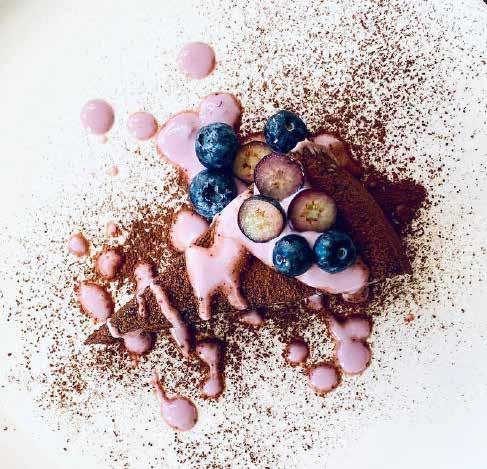
What is the best piece of advice given to you as a chef?
There's a few, but I guess the most valuable was "expect the unexpected so always be ready"...on a yacht, you don't always have the luxury to have your ingredients in hand like you have when you are working on land, so being prepared, well organized, being creative with your recipes saves you from a lot of trouble and stress.
What keeps you going on the long days in the galley?
A power nap of 20 minutes!! No joke, when I'm on my feet and up since 6am, to keep on going in the afternoon, during my rest time, just a quick nap will do the trick, for the mental part when days are long with many guests on board, I look out of the galley at the ocean and think " my office view is the best" and acknowledge how grateful I am to have this job!
What are your favourite places to eat?
I like exploring the local foods of the places I go, and I avoid at all costs the more touristy areas, as I get inspired by the food I eat and get ideas. Local, traditional, and vegan places are becoming more popular, and there are some very decent ones offering fine dining. ◆ www.oceanearthchefs.com
From early beginnings in finance to captaining yachts across the Mediterranean and ultimately building a successful marine engineering and maintenance business, Andrew Fairbrass has carved out a distinctive path in the yachting world. Now Managing Director of Berthon Spain, his journey reflects a blend of technical expertise, relentless work ethic, and an ability to adapt when life’s priorities shift. In this conversation, Andrew reflects on his career at sea, the turning points that shaped his trajectory, and how those experiences inform his leadership today
Can you take us back to the beginning, what first drew you into the world of yachting, and how did you land your first role on board?
In my early twenties, I was working in finance, but I didn’t enjoy it. I’d always been drawn to the sea, so when the 2008 financial crash happened, I took it as an opportunity to make a change. I went to the UK Sailing Academy on the Isle of Wight to complete my Yachtmaster qualification. As it turned out, I also met my future first mate and now wife there.
Our first job together was running flotillas in Greece. It was incredibly hard work for very little pay, but it was also the best summer of my life. I learned a huge amount about engineering and boat handling, and that experience gave me the foundation I needed to move forward in my career.
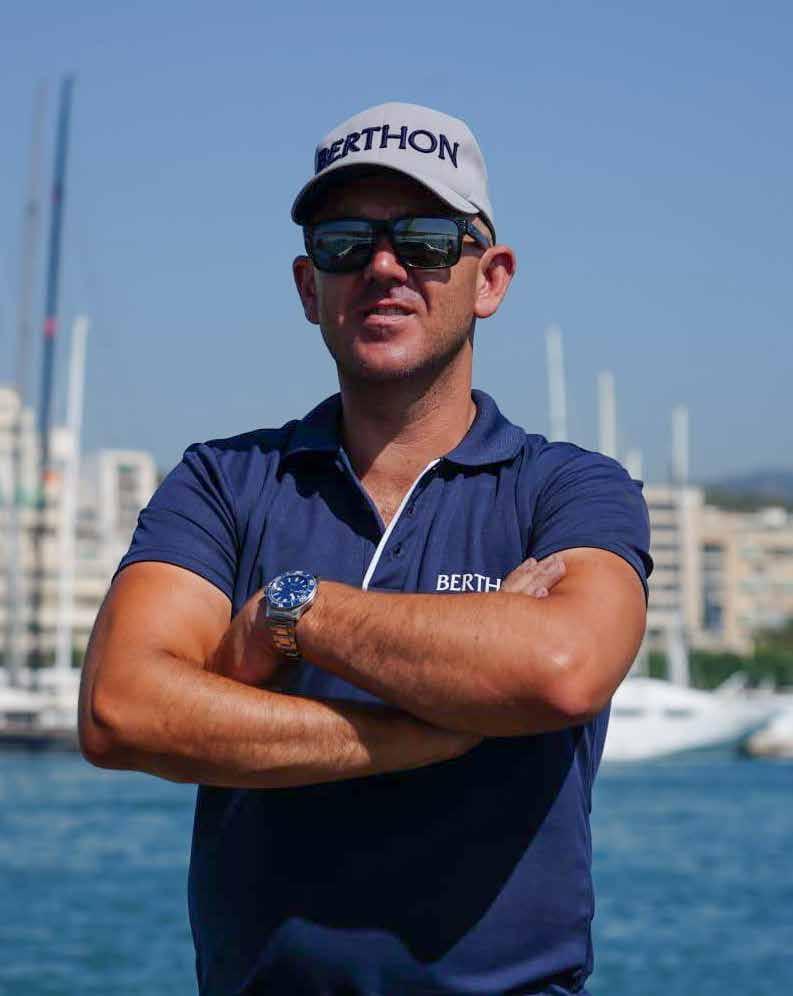
What were the defining moments or experiences during your time at sea that shaped your career and perspective on the industry?
After that first season, we moved on to a much larger project, running a newly refitted Swan 68. The owner was keen for me to take full responsibility for maintenance, which I really enjoyed. It allowed me to deepen my engineering knowledge and develop a hands-on approach that’s stayed with me ever since.
We cruised from the UK down to Palma and throughout the Mediterranean, and during that time I developed a habit that still defines how I work today. I’m not someone who can sit still, so when the owner wasn’t on board, I’d walk through the boat with a notepad, front to back, inside and out, building detailed job lists. Before long, I’d have pages of small issues to address.
I always say: if you don’t have a job to do on board, you’re simply not looking hard enough.
When did you realise you wouldn’t remain a full-time captain indefinitely, and how did you navigate that transition ashore?
After three years running the Swan, my wife became pregnant with our first child. At the time, I didn’t fully appreciate how much that would change things. I had just completed my Chief Mate 3000 qualification and, perhaps naively, thought I could continue my yachting career as before.
After our son Arthur was born, we returned to Palma and I began job hunting. I was offered a captain’s role on a Royal Huisman sailing yacht, which I turned down, much to my wife’s frustration, because I wanted to move into the powerboat sector. Shortly after, I was offered a role running a 30-metre support vessel. I turned that down as well, opting instead to take on a delivery job with Jens from Invisible Crew. The boat, based in Fort Lauderdale, needed significant work before she was seaworthy. We spent four weeks repairing and preparing her before crossing the Atlantic back to Palma. Jens was a great support throughout.
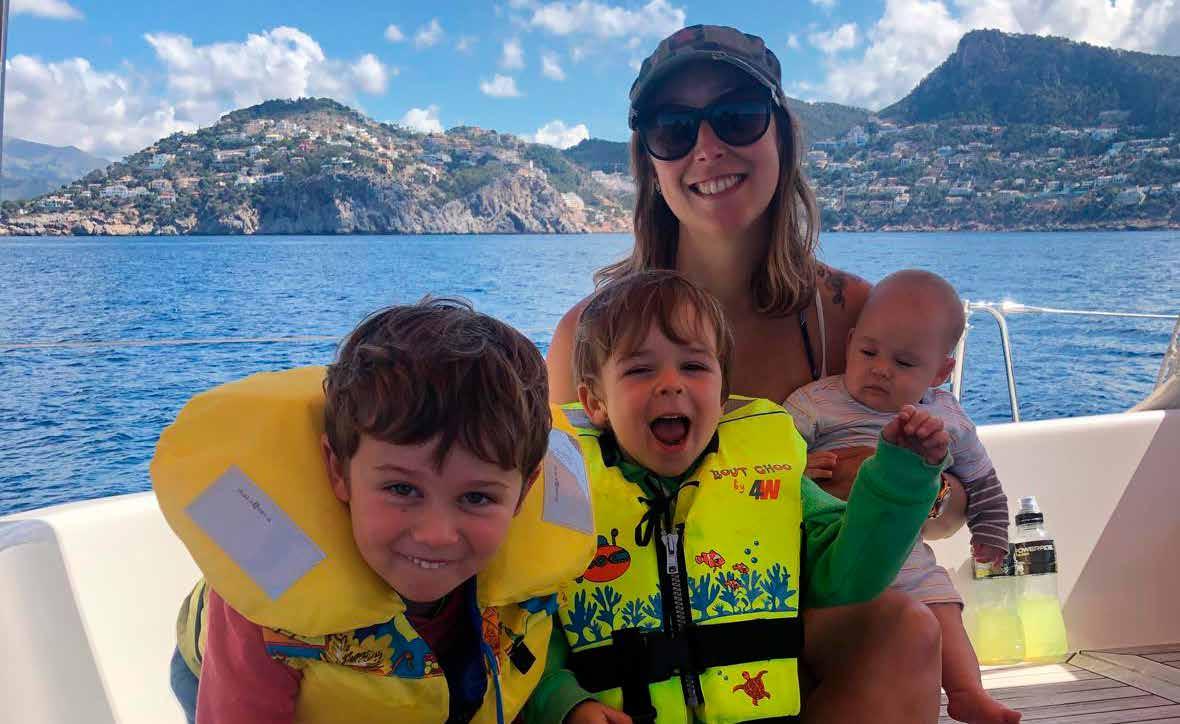
But it was during that crossing that I realised being away from my wife and son wasn’t sustainable for me. That was the moment the idea of moving ashore and building something of my own really took hold.
I continued to captain the boat until she was sold, and in that same period I was introduced to my first Oyster client by Jamie Collins at Oyster. The client called me while I was on a canal holiday, and that conversation marked the beginning of what would become Berthon Spain.
How did your business evolve from those early days into what is now Berthon Spain?
The business originally started under the name Sentinel, and we were fortunate to see strong growth quite quickly. My aim was simple: to bring the standards and professionalism of the superyacht world to the care of smaller yachts. That approach really resonated with clients, and still does.
After four successful years, I sold a share of the business to Berthon UK and rebranded as Berthon Spain. It was a natural fit, as they share the same commitment to high standards and exceptional customer service.
Looking back now, how has your time at sea influenced the way you lead, manage, and connect with clients and crew today?
My time in yachting gave me the opportunity to learn from some outstanding industry leaders, and many of those lessons still guide me today.
One of my first bosses told me: never bring a problem without a solution. That’s something I instill in my team, it encourages accountability and critical thinking. Another taught me the importance of concise communication. He didn’t want long emails, just the problem, the solution, and the cost. That’s a principle we follow closely at Berthon Spain.
Technically, I’ve retained a deep curiosity about how systems work. I still find myself down in the bilges with a torch, trying to understand new equipment. That mindset, understanding systems thoroughly and monitoring them proactively, is what separates a good captain or engineer from one who simply reacts when things go wrong.
Ultimately, I believe the real work happens when the owner or guests aren’t on board. That’s when you ensure everything is running perfectly. By the time they arrive, the boat and the team, should operate seamlessly. ◆ www.berthonspain.com
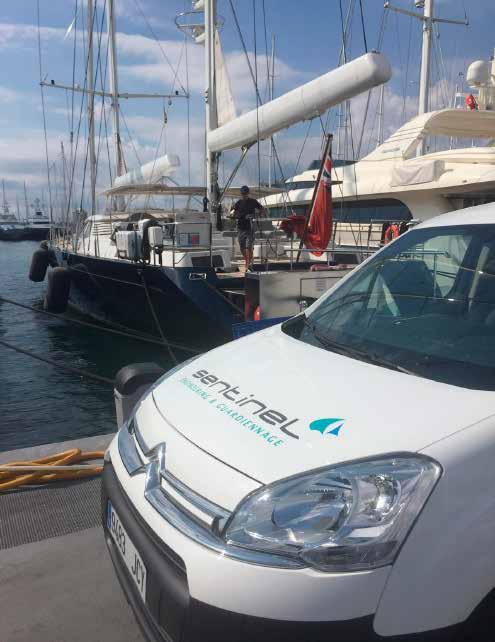
Written by Sara Grace Butler of MSOS
On a recent medical training course onboard a large motor yacht, the chef shared a story that highlights the importance of being trained for the worst case scenario.
While working in the owner’s villa, he was using a traditional wood-burning oven. As he reached inside to remove a dish, his forearm brushed against the interior wall. Instinctively he pulled back, but the damage was already done and he described how the skin on his arm began to peel away almost immediately.
What he had sustained was a deep, severe burn, likely full thickness in areas. He described not knowing what to do. There was no immediate cooling and no structured response, meaning the pain escalated rapidly, and the injury continued to worsen in those critical early minutes.
Sadly this story ended in a prolonged recovery, lasting scarring, and permanent slight restriction of movement in his arm.
He said to me something I hear far too often onboard: “I wish I had done this course before it happened.”
This story reminded me that burns can be both lifechanging and potentially career-changing injuries, and crew need to be prepared to treat a burn right at the time of injury.
Burns are one of the most common injuries encountered onboard yachts. From galley accidents to engine room and laundry room hazards, electrical faults to rope burns, the risk is ever-present in a high-paced, high-performance confined environment where heat, fuel, chemicals, and hot equipment are managed daily.
Effective burn management onboard is not about advanced medicine, it is about immediate, simple, and correct first response. The actions taken in the first 10–20 minutes can dramatically influence pain, tissue damage, infection risk, and long-term outcomes.
This article outlines how burns happen onboard, how to respond effectively, and when escalation or evacuation is required.
According to data from the MSOS TMAS service, common burns onboard yachts typically fall into several categories:
Thermal burns (most common)
• Hot liquids (coffee, boiling water, oils)
• Steam from galley equipment and irons in laundry room
• Hot surfaces (engine parts, exhausts, galley equipment, laundry)
• Open flames or flare-ups in the galley
Friction burns
• Rope burns during line handling
• Winch or capstan incidents
• High-speed deck operations under load
Electrical burns
• Faulty wiring or exposed circuits
• Contact with live systems
• Lightning-related injuries (rare but severe)
Chemical burns
• Cleaning agents
• Fuel or battery acid exposure
Cryogenic burns
• Dry ice in the galley or provisioning
• Contact with extremely cold substances causes tissue freezing
A simple, structured approach helps crew act quickly and effectively, remember the BURNS acronym:
• Break the burn
Stop the burning process immediately
Before you do anything else, make sure you're not putting yourself at risk — turn off the heat source, kill the power, or get the person away from whatever caused the burn.
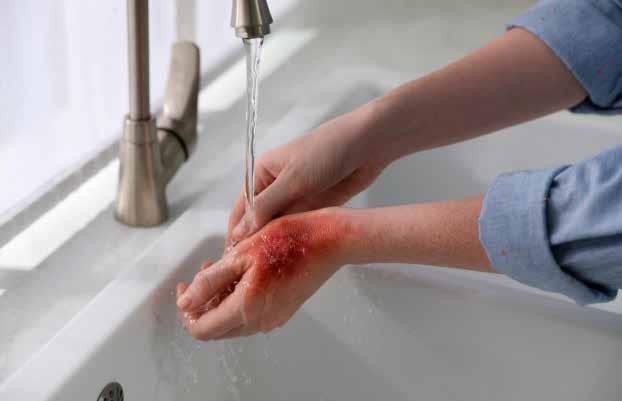
• Under cool water (CRITICAL STEP)
Begin cooling as soon as possible
Use cool (not freezing cold) running water for 20 minutes and no less.
• Remove constricting items
Rings, watches, tight clothing (before swelling occurs)
• Non stick dressing
Use a clean, non-adhesive dressing such as a burn dressing, inside dressing or cling film
• Severity - estimate size and depth
Estimate size and depth
Remember a Secondary Survey. Check for airway involvement or associated injuries
Finally, always seek medical advice from MSOS TMAS even if the burn looks minor for assessment and pain relief, and take vital signs and complete an ATMIST report form for more severe burns.
Cooling is the single most important intervention in burn care. It seems like a simple treatment, but has been shown by studies conducted by The Burns Society of the UK and other leading research bodies that the skin is an amazing thermal retainer of heat and cooling for twenty minutes does the following:
• Stops ongoing thermal damage (burns continue to “cook” tissue after the heat source is removed, body tissue often remains at 40-60 degrees long after the hot item is removed.
• Reduces pain significantly
• Minimises swelling and inflammation, reducing delayed shock from fluid loss from the burnt body tissue
• Improves healing outcomes and reduces scarring.
Cooling best practice
• Ensure water is cool, not cold (avoid ice or iced water)
• Avoid hypothermia - only cool the burn area, keep the body warm with towels and blankets
• Use galley sink sprayer for hands/arms
• Shower for larger burns
• Use tap water, shower, or hose
• Use eye wash bottles for initial cooling if no running water source available
• Do not spray water directly onto the burn area if possible spray above to run through burn to avoid damaging tissues and causing pain.
DO NOT USE
• Ice (causes vasoconstriction and tissue damage)
• Oils, butter, toothpaste or eggs (I have heard every old wives tale on courses over the years!)
• Burns dressings or adhesive dressings or burn creams to cool, they are the secondary response
AFTER COOLING COVER TO PREVENT INFECTION, THE SECOND BIGGEST CONCERN WITH BURNS ONBOARD
Covering the burn after cooling is vital as it reduces pain by protecting exposed nerve endings, prevents contamination causing infection (burn tissue is very prone to severe infection), and helps retain moisture for healing.
Cling film (plastic wrap) is an excellent burn cover and included in the MSOS Medical Kits
Lay loosely over the burn, do not wrap tightly as the burn area may swell, affecting circulation to a limb.
Cling film advantages
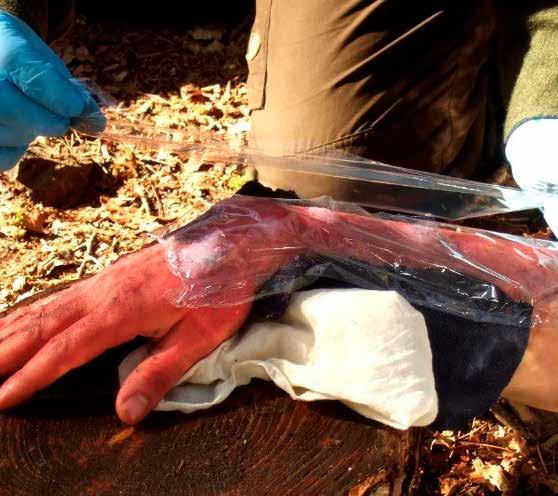
• Sterile (when first unrolled)
• Non-adherent
• Retains moisture - we don't want burns drying out too quickly
• Transparent for monitoring
• Malleable - can be shaped to the injury
Alternative dressing options
Burn dressings or iodine dressings from medical kits
Wet gauze if nothing else available
Estimating severity with burn size and depth
Understanding burn size helps determine severity and need for evacuation.
Rule of palm
The patient’s palm (must be patients palm to account for body size) equals 1% of body surface area (BSA) This is the most practical method onboard.
General guide
1. Small burn: <5% BSA
2. Moderate burn: 5–15% BSA
3. Severe burn: >15% BSA (adult)
ASSESSING BURN DEPTH
1. Superficial (first degree)
• Red, dry, painful
• No blisters
• Example: mild sunburn
2. Partial thickness (second degree)
• Blisters
• Wet, red, very painful
• Most common onboard
3. Full thickness (third degree)
• White, charred, or leathery
• May be painless (nerve damage)
• Always serious
When does a burn require evacuation?
Evacuation decisions should always involve TMAS, but key triggers include:
• Airway burns (smoke inhalation, facial burns)
• Electrical burns
• Full thickness burns
• Burns >10–15% BSA
• Burns involving:
• Face
• Hands
• Feet
• Genitals
• Major joints
• Any uncertainty about depth
• Signs of infection - casualty feels unwell or gets a fever (temp above 38 degrees), or burn area starts leaking fluid or has an odour.
• Severe pain not controlled with basic analgesia
Unique burns onboard
1. Rope burns
Characteristics
• Combination of friction and heat, consider a thermal burn
• Often deep despite small surface appearance
• Can restrict limb movement if not treated effectively and prevent deck work.
Management
• Cool thoroughly (often overlooked) and cover
• Carefully assess depth—these can be deceptive
• Rope burns often need closer monitoring due to deeper tissue damage.
2. Cryogenic burns (dry ice in the galley)
Dry ice (solid CO₂) can cause severe cold burns. These are often underestimated but can cause deep tissue injury.
Characteristics
Freezes tissue rapidly, similar to frostbite
Management
• Avoid rubbing the area to remove particles
• Do NOT use hot water
• Rewarm with cool to lukewarm water (not >37°C)
• Protect and cover as per burn protocol
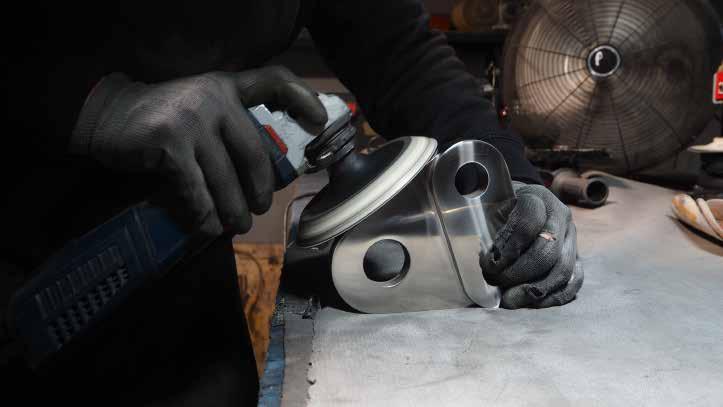
3. Electrical burns
Electrical injuries are particularly dangerous.
Why they’re serious
• Damage occurs internally along current pathways
• Small external burns can hide severe internal injury
• Risk of cardiac arrhythmias or cardiac arrest in the minutes or hours after the exposure
Management priorities
• Ensure power is OFF before touching casualty
• If casualty looks unconscious follow DRABC approach (Danger, Response, Airway, Breathing, Circulation)
• If casualty is conscious take vital signs and perform secondary survey to assess for:
• Cardiac issues
• Muscle damage
• Entry and exit wounds
Always contact MSOS TMAS for evacuation even if external damage looks minimal.
The bigger picture: preparedness onboard
Effective burn management is part of the golden triangle of yacht medical care:
• Well-stocked medical kits for your itinerary
• Pre-Season Training and regular drills for confident crew response
• Access to TMAS support
Crew who are trained, calm, and decisive can dramatically improve outcomes in what is often a high-stress, fast-moving situation. Ensure you get pre-season medical training by a qualified MSOS professional yacht medical trainer, and run regular drills based on your training weekly/monthly, if you don't use it you lose it!
Contact MSOS for support worldwide with your medical system onboard. ◆
Sara Grace Butler
DTN RN Bsc, Expert Yacht Medical Trainer, MSOS sally@msos.org.uk www.msos.org.uk

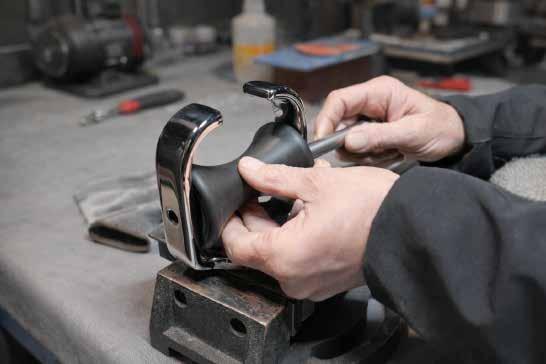
Written & photos by Chef Raffie

To:
Captain John
Subject:
Dear Captain,
I hope this message finds you well — perhaps enjoying a moment of calm on the bridge, where the fridges don’t freeze, and spinach remains in its natural, unfrozen state.
I’m writing to bring to your attention a minor incident that occurred during today’s lunch prep, which I’m affectionately calling “Caesar Salad Florentine: The Ice Age Edition.”
As you know, our guests requested a Caesar Salad with spinach. Naturally, I assured them they would receive a version so fresh, it would have made the Roman Empire proud. I had, after all, procured the finest organic spinach available — hand-selected, kissed by morning dew, and approved by three yoga moms at the market.
Imagine my surprise when I opened the galley fridge to find the spinach had been transformed into what can only be described as green granite. Apparently, the fridge has decided it’s auditioning for the role of “Blast Freezer #2” in the next Top Chef spin-off. Sadly, it succeeded. Tragically, it took the spinach with it.
Now, I understand we have to work with old outdated equipment on life support. I understand the owner doesn’t want to spend money on a new refrigerator! Ours is, after all, a charming antique collection of culinary fossils, likely eligible for retirement benefits. But I did, quite respectfully, bring this issue up with our engineer several weeks ago. I believe the technical term I used was: “Hey, the fridge is trying to kill my produce again.”
He responded with a nod that may or may not have been a neck spasm, followed by immediate disappearance. Possibly into a wormhole. Hard to say.
Interestingly, this same individual is incredibly present — borderline punctual — when it’s time to discuss beach barbecues, baseball games, or the logistics of beer distribution among the crew.
(In fact, I have reason to believe our shared bathroom may double as a private bar. The shampoo smells suspiciously like vodka, and there’s a six pack Guinness cans living under the sink like it pays rent.)
I say this not to question anyone’s work ethic, but to gently suggest that fixing vital refrigeration equipment might deserve slightly more urgency than, say, marinating steaks for a crew beach BBQ.
In the meantime, I’ve pivoted. I served the guests a deconstructed Caesar Salad with “flash-chilled spinach” and explained that it’s currently trending in Nordic culinary circles. They were mildly confused but too polite (and sunburned) to argue.
In conclusion, I remain committed to culinary excellence, even if I have to poach eggs with a lighter and keep greens in my cabin sink. I simply request that next time I go to war with a Caesar salad, someone please check if the engineer is available - or at least sober.
With respect humor and sprinkle of sarcasm, Chef Raffie Hurtado Soldier of Caesar, Survivor of Spinach. ◆
Chef Luis Rafael “Raffie” Hurtado is a globetrotting yacht chef–turned–chef-writer known for his sharp, satirical and flavorful culinary storytelling. Instagram: @chefraffie







Written by Virtual Pursers
ASeafarer’s Employment Agreement (SEA) is a critical document that outlines the terms of employment for seafarers. While many focus on salary, medical coverage, and leave entitlements, one of the most important sections of the SEA is the termination clause. This clause details the duration of your contract, the conditions under which it can be terminated, and your rights if you need to leave before the contract ends. Understanding these terms is essential for protecting your career and personal well-being while at sea.
The duration of your contract and the procedures for renewal should be explicitly stated in the SEA. Knowing how long you are expected to be onboard and the terms for contract extension will help you plan for your future.
Contract Length: Typically, seafarer contracts are fixed-term agreements, usually ranging from a few months to a year. The SEA should specify the start and end dates, giving you a clear understanding of your commitment.
Renewal Provisions: Many seafarers work multiple contracts on the same vessel, so it’s important to understand whether the SEA includes provisions for renewal. Some contracts may automatically renew unless either party provides notice, while others require explicit agreement to extend. Be sure to confirm whether the renewal process is outlined and what is required for continuation.
Understanding the renewal terms helps you avoid uncertainty about your ongoing employment and future plans.
Termination clauses in the SEA should outline the conditions under which either the employer or the seafarer can end the contract early. Some flag states have specific rules regarding contract termination, which may vary depending on the nature of the employment or the reasons for termination.
Flexible Termination with Notice: Many SEAs allow either the employer or the seafarer to terminate the contract with proper notice. The notice period can vary, but typically ranges from two weeks to a month. Some flag states have flexible termination rights, where the seafarer may leave with notice or at the end of a contract, without penalty.
Employer’s right to terminate: Employers typically have the right to terminate a contract early in cases of misconduct, poor performance, or operational issues. It’s essential to understand the grounds for termination that the employer can invoke and how they are defined in the SEA.
Some flag states impose stricter regulations, requiring a seafarer to stay onboard until a replacement is found. In
such cases, the contract may specify a grace period in which the employer is obligated to find a suitable replacement. If the vessel cannot find a replacement, you could be forced to stay on board longer than expected, so understanding these terms is vital.
The notice period and penalties associated with early termination should be reviewed carefully. These terms protect both the seafarer and the employer and help ensure a smooth transition in the event of early contract termination.
Notice Periods: If you wish to terminate your contract early, most SEAs require you to provide a notice period. This allows both you and the employer to make necessary arrangements, such as finding a replacement or planning for your departure. Confirm the exact notice period required and the procedures for leaving early.
Penalties for Early Termination: Some SEAs may include penalties for early termination, especially if the seafarer leaves before the contract’s expiration date without just cause. These penalties could involve financial compensation or other measures to cover the costs associated with finding a replacement. It’s crucial to understand the penalties for early termination to avoid unexpected financial burdens.
Flag states have varying regulations concerning contract duration, renewal, and termination, so it’s important to ensure the terms outlined in the SEA align with the relevant flag state laws.
Compliance with Local Laws: Check if the SEA complies with the flag state’s legal requirements for contract duration, termination rights, and notice periods. Flag states may also have specific provisions for repatriation and early contract termination, so verifying compliance is essential for ensuring your rights are protected.
The termination clauses in a Seafarer’s Employment Agreement are vital to ensuring you understand the expectations, rights, and responsibilities associated with your contract. By reviewing the contract duration, renewal procedures, termination rights, notice periods, and penalties, you can safeguard your career and personal wellbeing at sea. Always ensure that your SEA aligns with both your personal expectations and the legal requirements of the vessel’s flag state to promote a smoother, safer, and more fulfilling experience at sea. ◆ https://virtualpursers.com
Virtual Pursers co-founders, Bec McKeever and Dominique Smit provide yacht administrative assistance to all vessels, no matter the size of the yacht or the extent of the need.


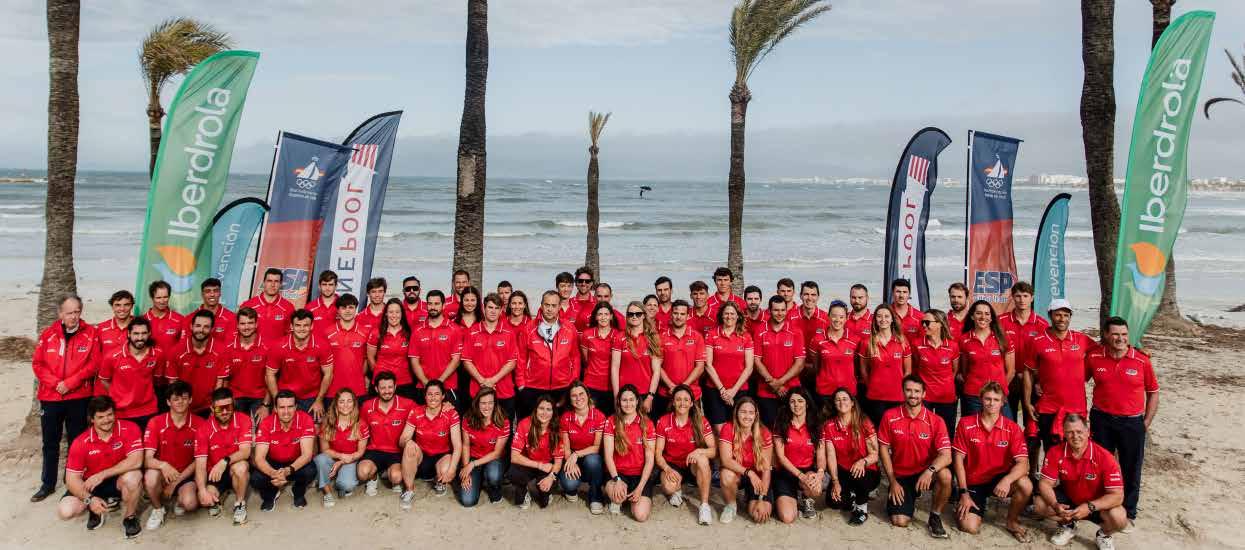
Palma de Mallorca is more than a regatta venue, it is a stage where performance, heritage and international yachting culture converge. For Marinepool, the island represents a natural Mediterranean home.
Founded in 1991 by sailors, Marinepool has evolved into a globally respected specialist for technical sailing apparel, certified lifejackets and refined superyacht crew wear. For
35 years, the brand has stood for precision, functionality and understated luxury, outfitting Olympic athletes, regatta teams and some of the world’s most distinguished yachts.
Our presence in Spain is anchored by our partnership with Real Federación Española de Vela and long-term collaborations with Club Nàutic S’Arenal and Club de Mar Palma. Marinepool proudly returns as Partner of the Princesa Sofía Regatta, has been Official Clothing Partner of the Superyacht Cup Palma since 2019, and since 2025 serves as Official Clothing Partner of the Illes Balears Clàssics.
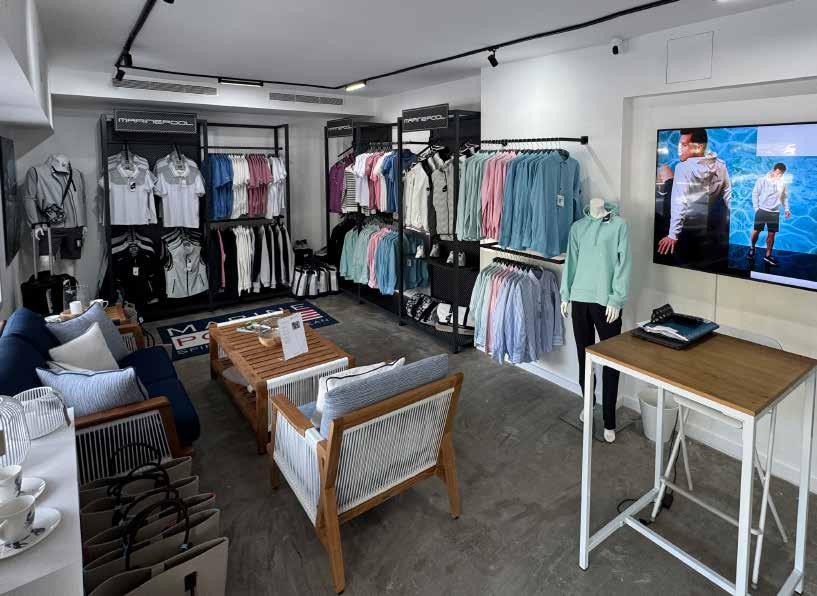
The opening of the Marinepool Showroom in Palma in 2025 marked a defining step, a refined space designed for captains, crew managers and owners who value technical excellence paired with bespoke presentations. Private fittings, tailored outfitting concepts and professional embroidery services allow each yacht to express its identity with precision.
In Palma, Marinepool celebrates 35 years of Spirit of the Ocean, where craftsmanship, innovation and Mediterranean elegance unite. ◆ www.marinepool.de
Ship and Yacht Agency
Marigot Saint Martin - Philipsburg St.Maarten and Gustavia St.Barth’s
“
Other Agents Make Money - We Make
Serving St.Maarten-St.Martin-St.Barth’s and other Caribbean Islands for over 35 years during the yachting winter season and the Mediterranean in the summer. Check out our web site for references and see why Owners, Captains, Crew and Guests of the MegaYachts, SuperYachts, Racing Yachts, Tall Ships and Sail Training Vessels work with us all the time! We are certified to handle ON BOARD Helicopter Operations, we are specialists in Provisioning and able to help with most technical issues. https://www.YachtAssistance.com e-mail: info@YachtAssistance.com Office@YachtAssistance.com - Provisioning@YachtAssistance.com Phone : +590690629955 and +596696261612
Written & photos by Alnitak - Ricardo Sagarminaga
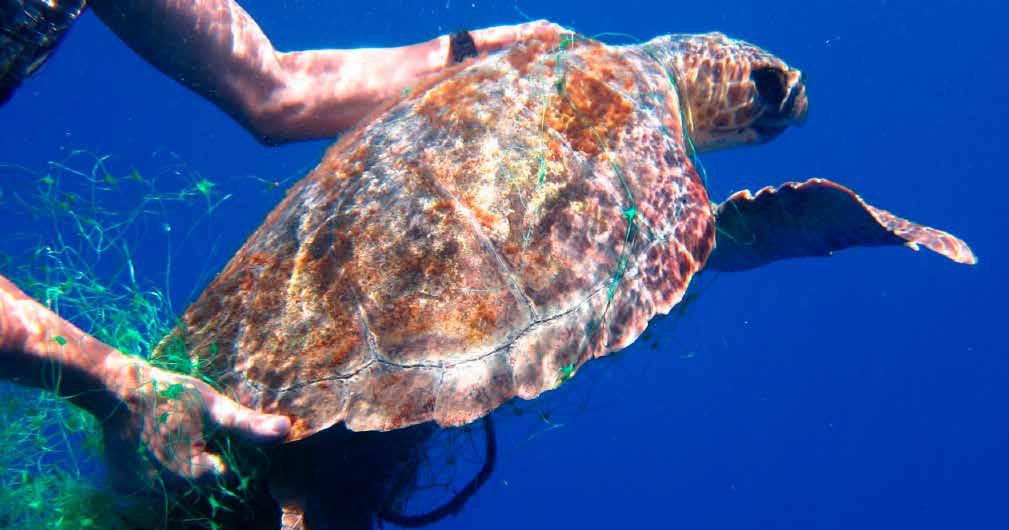
In the Mediterranean, spring and summer are the peak months for nautical tourism. Adding to over 25% of the world's shipping traffic and the activity of fishing vessels, yachts make this one of the busiest maritime hotspots. Some people see this high density of yachting as a threat to the environment; we like to see it as an opportunity. And that’s why we count on fishers and sailors as custodians of the sea. Every year hundreds of yachts come across marine turtles struggling to break free from abandoned or lost fishing gear. Sometimes they are hooked, and sometimes just entangled. But in most cases they are alive, and there is a high chance of survival if the sailors act in the right way. The potential positive impact for the conservation of endangered species such as these sea turtles is extremely significant.
In this article we want to focus on a key message to sailors with regards to their situations that occur very often when we are sailing the open seas. Usually it starts with the sighting of what looks like marine litter. But when we approach it, we find that there is something caught inside the mess of netting, ropes or fishing line.
Sometimes the victim is already dead. In this case, we want to remind sailors that a date, position, photograph and brief description sent to Observadores del Mar – Pesca fantasma, mgn@gmail.com or whatsapp 0034 619108797 can be extremely useful. Our database, consisting of over 1.000.000 reports of abandoned, lost and discarded fishing gear (ALDFG) is being used as a mapping tool for the management and prevention of this risk.
Most often, what we encounter is a turtle still alive, but entangled in ropes and netting. These turtles are usually easy to haul onboard. Once on our deck we see that the animal has its line caught around the flippers and / or neck. Our instinct is to immediately cut these lines loose. But that can be a terrible mistake.
As sailors we all know how a tourniquet functions when we need to use it during first aid. In the animal we have on deck, a tight tourniquet has in most cases already affected the limb badly, so if we cut loose the tourniquet we will be letting the poisonous blood from the rotten limb enter the blood stream. This will not kill the animal directly, but we will be releasing a turtle that will die shortly after from blood poisoning. So what can we do?
If we are sailing in the Mediterranean and have the possibility of entering a port, the best protocol is to call the emergency number (112 in Spain). The Mediterranean has a very extensive network of sea turtle recovery centers. If we can call the emergency services, they will facilitate everything so that the turtle can be picked up by a team of veterinarians in port so the animal can be treated with proper medication.
The same is applicable if we find a turtle that has a longlining hook ingested. Trying to remove the hook is something that must be avoided. Even if it's in the mouth and seems relatively easy, DO NOT try to remove the hook. The mouth and tongue are very sensitive, and any injury can lead to infection and probably death. If you can take this animal to port, the rescue centers are equipped to remove the hook in adequate conditions and with the proper handling by veterinarians.
In the case of the hooked turtle, the answer is to cut the line as close to the hook as possible. In many cases of sea turtle bycatch in long lining, studies have shown that it is often the line that kills the animal.
Often fishers will cut the turtle loose, but with several meters of line. Eventually, this line is ingested and ends up tearing the gut. Often we find turtles with lines coming out from the mouth and the cloaca. If we cannot take them to a recovery center, the best we can do is to cut the line as short as possible.
In the case of the entangled turtle, we must NEVER CUT LOOSE THE TOURNIQUET, but we can also cut off as much rope, lines and netting as possible. In this way, we will be putting back in the water an animal that will most likely lose its flipper, but will still have a chance of surviving.
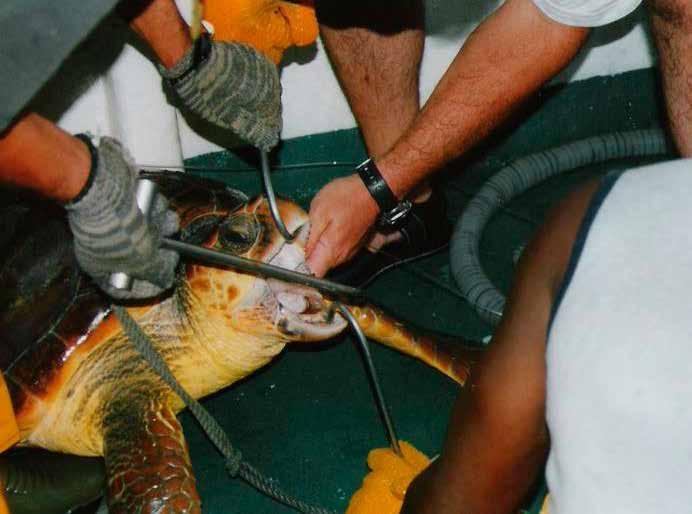
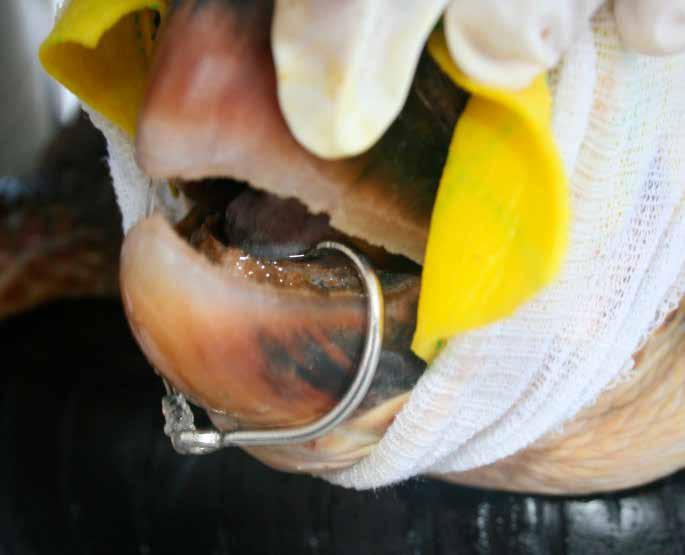
Some people may think that this does not make much sense, but the option is certainly better than condemning the animal to a terrible suffering and death by blood poisoning. In our seas, entanglement in marine litter and ALDFG is one of the main threats to sea turtles during their oceanic life stage.
Very often we come across turtles missing a flipper. Usually what happens if a turtle gets entangled, is that it will stay stuck to the ALDFG for weeks. After the flipper rots, eventually it is amputated letting the turtle loose.
This turtle will probably not be able to reproduce, but it can still play its crucial role in the open ocean ecosystem as an oasis of the “Blue Serengetti”. A juvenile or subadult loggerhead turtle constructs a habitat for over 120 species, creating a bait ball for top predators such as tunas, mahi mahi, dolphins, etc. ◆ https://alnitak.org
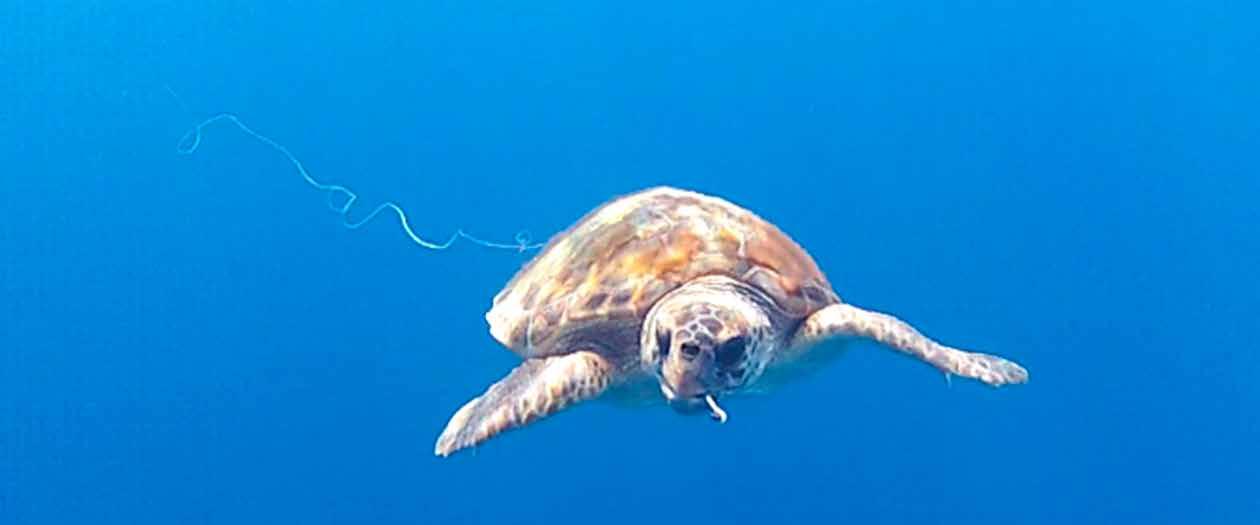



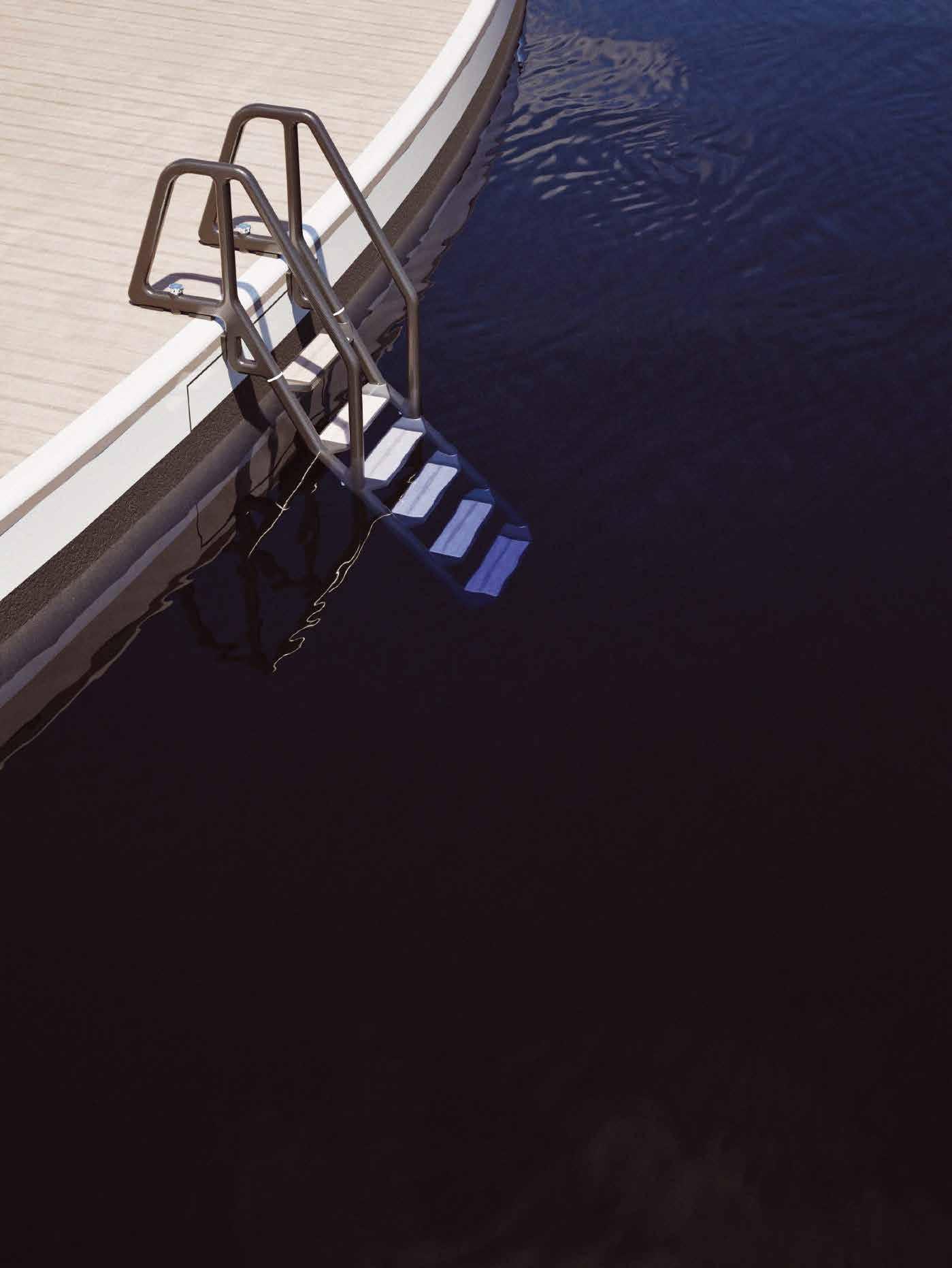
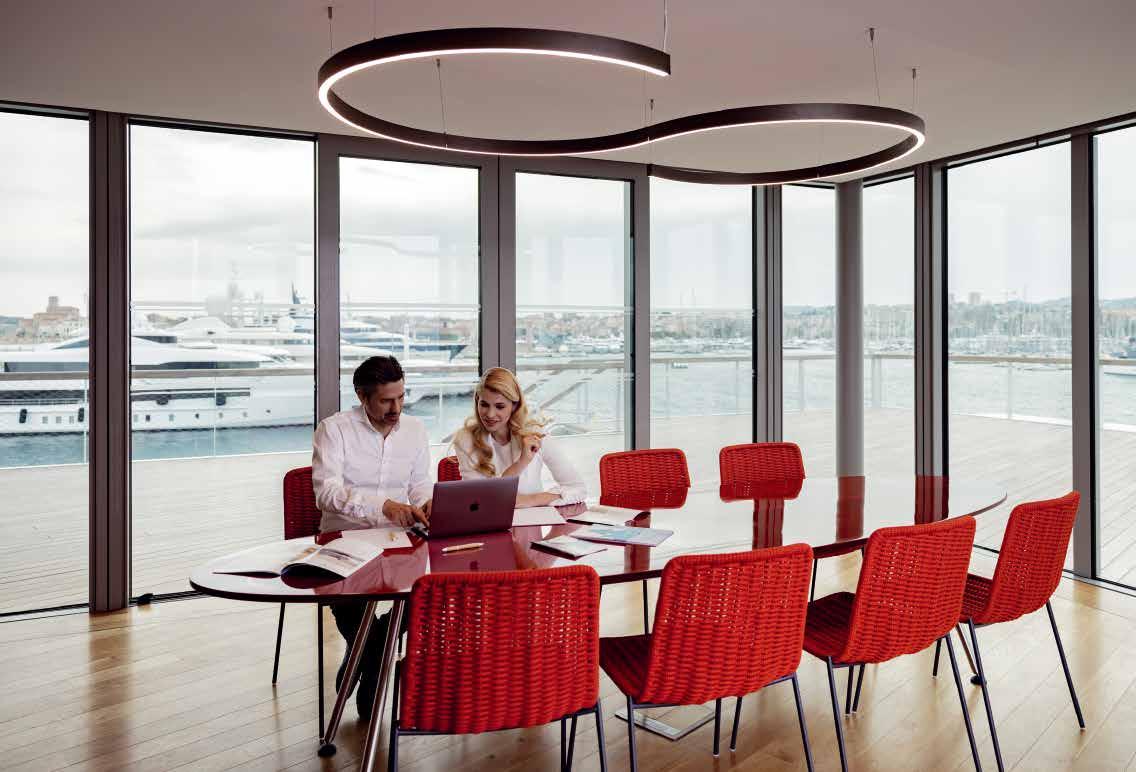
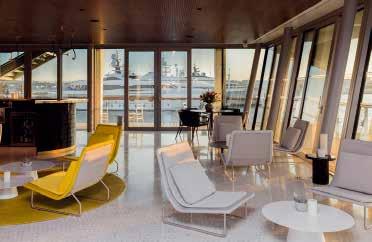

Nestled in the heart of the French Riviera the International Yacht Club of Antibes welcomes its esteemed members in search of confidentiality and prestige in breathtaking settings. commercial@vauban21.com - www.leportvauban.com
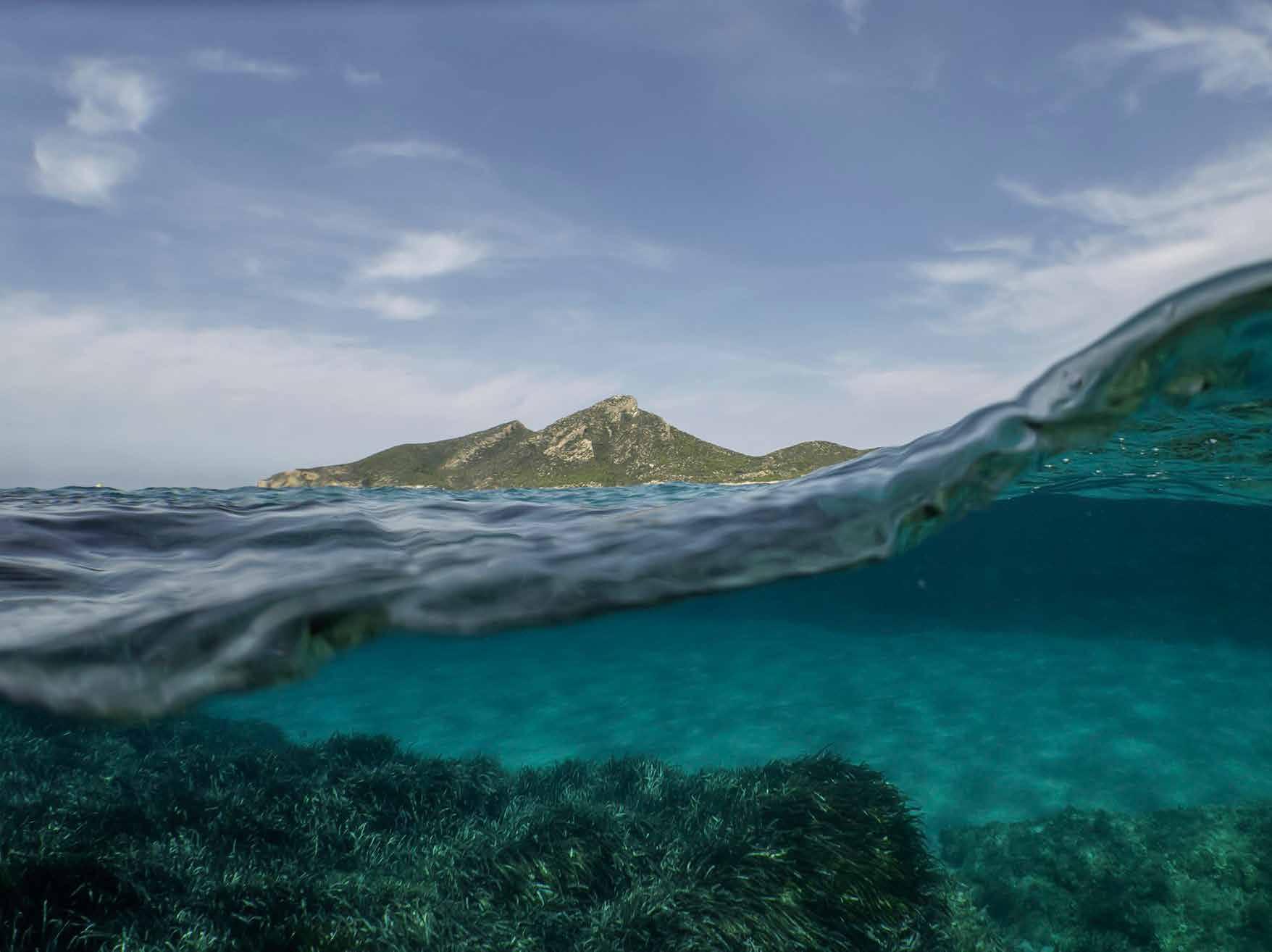
The silhouette of Sa Dragonera, a rugged dragon-like islet off the western tip of Mallorca, is one of the most iconic sights in the Balearic Islands. But while its terrestrial beauty is undisputed, its true treasure lies beneath the surface. The Reserva Marina del Freu de sa Dragonera, or Sa Dragonera Marine Protected Area (MPA), is a place where the meeting of specific currents and winds has created a mosaic of distinct underwater habitats.
Just like the particular name of the islet, which in fact does not originate from its dragon-like shape, but rather from the Latin word traconaria, referring to caves where freshwater can be found, this sanctuary of biodiversity is full of surprises.
The MPA is governed by several levels of marine protection,
including a Marine Reserve of Fishing Interest, a Site of Community Importance (Natura 2000 Network), and a Special Protection Area for Birds. It is no coincidence that these regulations are applied to this specific zone: The waters surrounding Sa Dragonera and the coastline of Sant Elm are home to a vast diversity of species and habitats.
As part of a campaign to raise awareness on the importance of safeguarding Sa Dragonera, Save the Med will be producing a series on social media and a mini-doc on Youtube throughout this year. The aim is to bring people closer to the sea and improve public knowledge of the marine habitats and species present in the area. The more we know about this submerged world, the better we can protect it. As the primary navigators of Sa Dragonera’s waters, boaters are more than just visitors; their role is pivotal in the continued conservation of these vital habitats.
We begin our journey in the first habitat type formed by shallow rocky bottoms, which can be observed below the surface. Here, the rocks are draped in "forests" of macroalgae commonly known as Cystoseira, a key indicator of good water quality. Looking closely, you might spot the umbrellashaped Acetabularia acetabulum, a remarkable singlecelled alga, while small gobies dart between shadows and Cormorants occasionally dive from above in a blur of silver bubbles.
As we move deeper into the channel called es Freu de Sa Dragonera, the rocky terrain gives way to vast emeraldcoloured plains. These are the famous Posidonia oceanica meadows, often called the "lungs of the sea." A true icon of the Balearic Islands; Posidonia symbols and references appear on everything from local crafts to business logos. Since 2018, this marine flowering plant, not to be confused with seaweed, has been officially protected by the Balearic Government under the Posidonia Decree.
This is for good reason: Posidonia seagrasses fulfill many functions of vital ecological importance, such as providing a nursery and sanctuary for many species in the reserve, such as the master-in-disguise pipefish, juvenile groupers, and the vibrant Labrus viridis. Crucially, the meadows also act as a carbon sink and a storm barrier, guarding the Balearic ecosystem.
Beyond and in between the seagrass meadows we can spot the sandy bottom habitat,vast stretches of sand. To the untrained eye, the vast stretches of sand in the channel might look like a desert. However, if you look long enough, you come to realise that these plains are hubs of camouflage and stealth. A pair of eyes might emerge from the sediment, a pearly razorfish, locally known as a Raor, or a cleverly hidden stingray. Cuttlefish hover just above the sand, changing colour in an instant to match the texture of the sea floor. Sandy bottom habitats create structures that provide shelter for a wide diversity of fish, crustaceans, and other invertebrates, forming a unique and particularly fragile community.
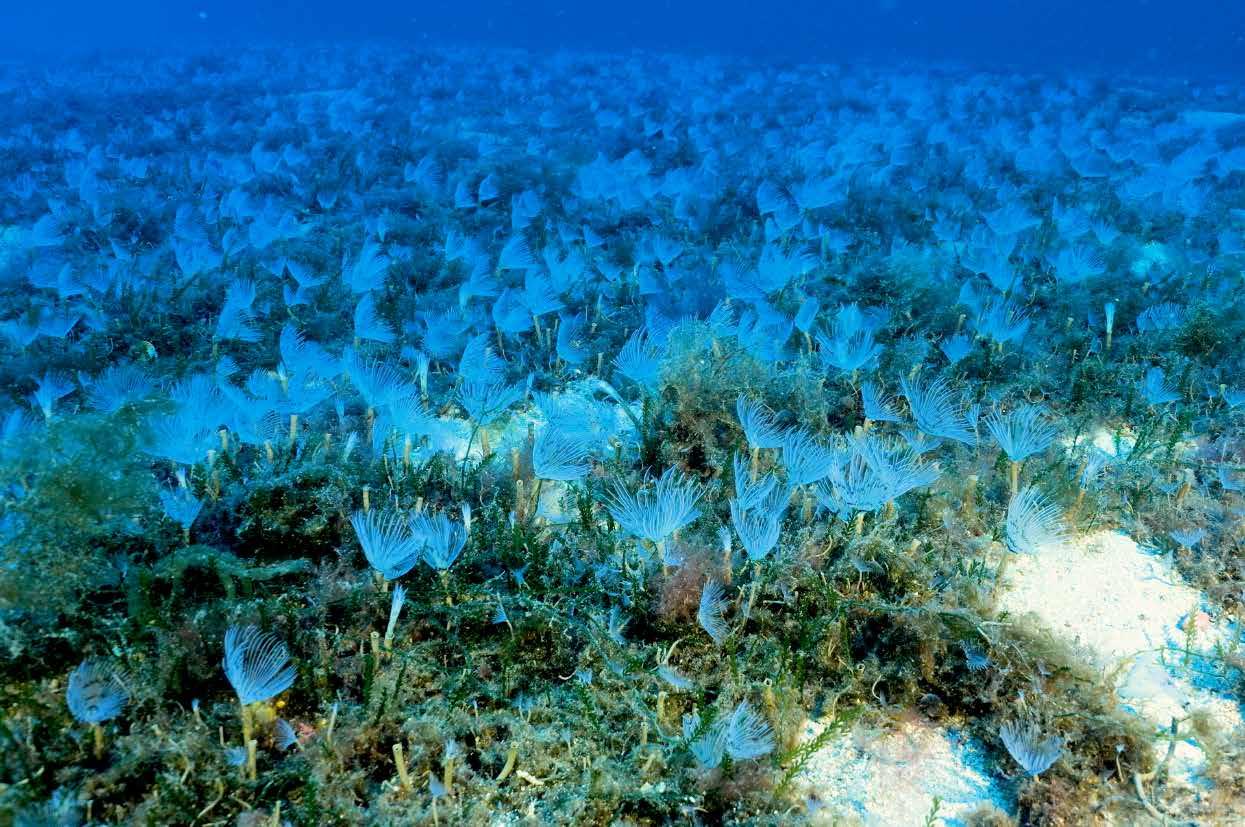
The island of Dragonera is the tail of the Serra de Tramuntana mountain range. This geological structure continues underwater in the form of massive rocky walls and fallen boulders, along the islet and into the deep waters. The walls resemble a coloured canvas and drop into the abyss, covered by Bryozoans, Sponges and Cnidarians. With the "lace" corals and yellow cluster anemones (Parazoanthus) the coralligenous habitat comes into view.
In the shadows of these boulders, the marine reserve’s protection has clearly borne fruit. Data released in 2024 by the Regional Ministry revealed a remarkable success story: in some areas, the biomass of fish with fishing interest, referring to the size and number of individuals, has increased ninefold at depths of over 20 meters since protection began in 2016. Gliding along these rocky boulders and seeking refuge in the crevices between them, populations of Dusky groupers, Brown meagres and Forkbeards have flourished.
Shaping one of the key habitats of the underwater world of Sa Dragonera are the submerged caves and crevices, formed by the rugged nature of the coastline. Entering these spaces is a transition from the emerald blue open into the shadows. Here, species change to those adapted to near-total darkness.
These caves are high-value habitats, offering a glimpse into a specialised evolutionary niche.
We move from the rugged, rocky seabed of the Sa Dragonera’s outer waters to the base of these cliffs, which quickly drop to great depths and where a very special habitat can be found: the maërl beds. These are rare, ancient, and highly sensitive marine habitats formed by fragile, slow-growing pink coralline red algae. They act as crucial biodiversity hotspots.
Last but not least, connecting all these habitats together is the water column, a vast open-water corridor where sunfish, barracudas, tuna, and Spinetail devil rays migrate, hunt, and play. This habitat is also the most visible to boaters; if they are lucky, they can marvel at dolphins splashing nearby or see the head of a loggerhead sea turtle (Caretta caretta) discreetly popping up through the surface.
What is less visible to boaters, however, is the disturbance caused by the speed and noise of passing yachts, which creates a constant disruption for the underwater residents of Sa Dragonera.
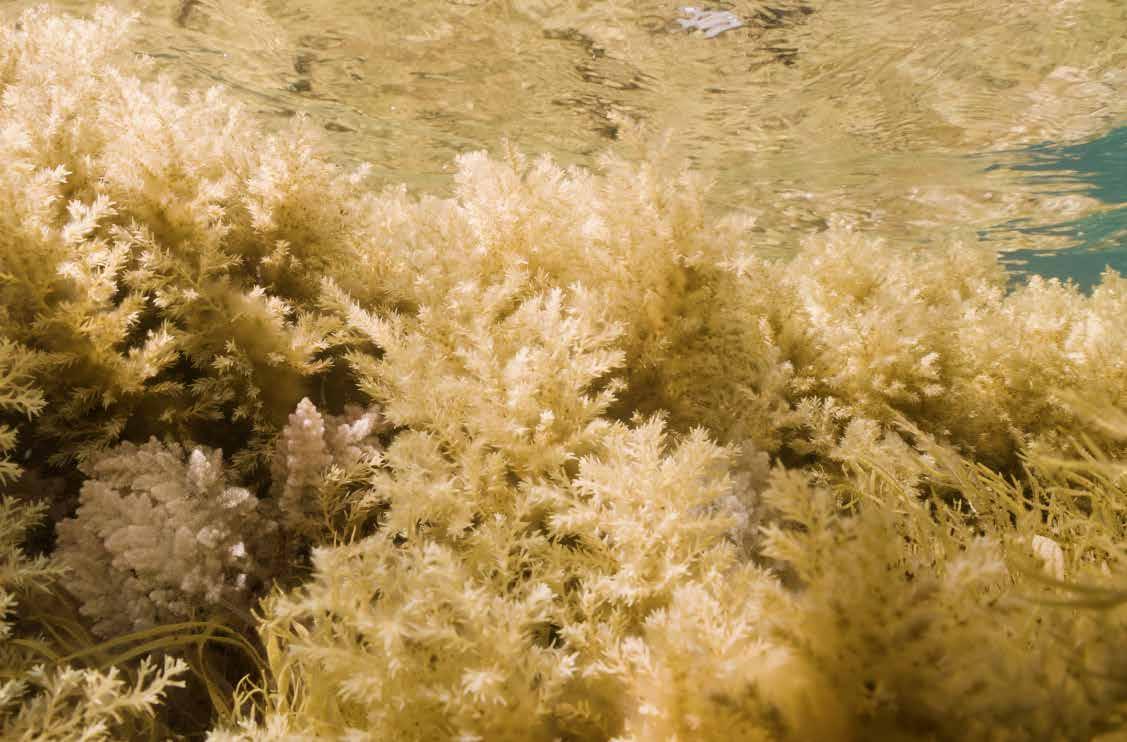
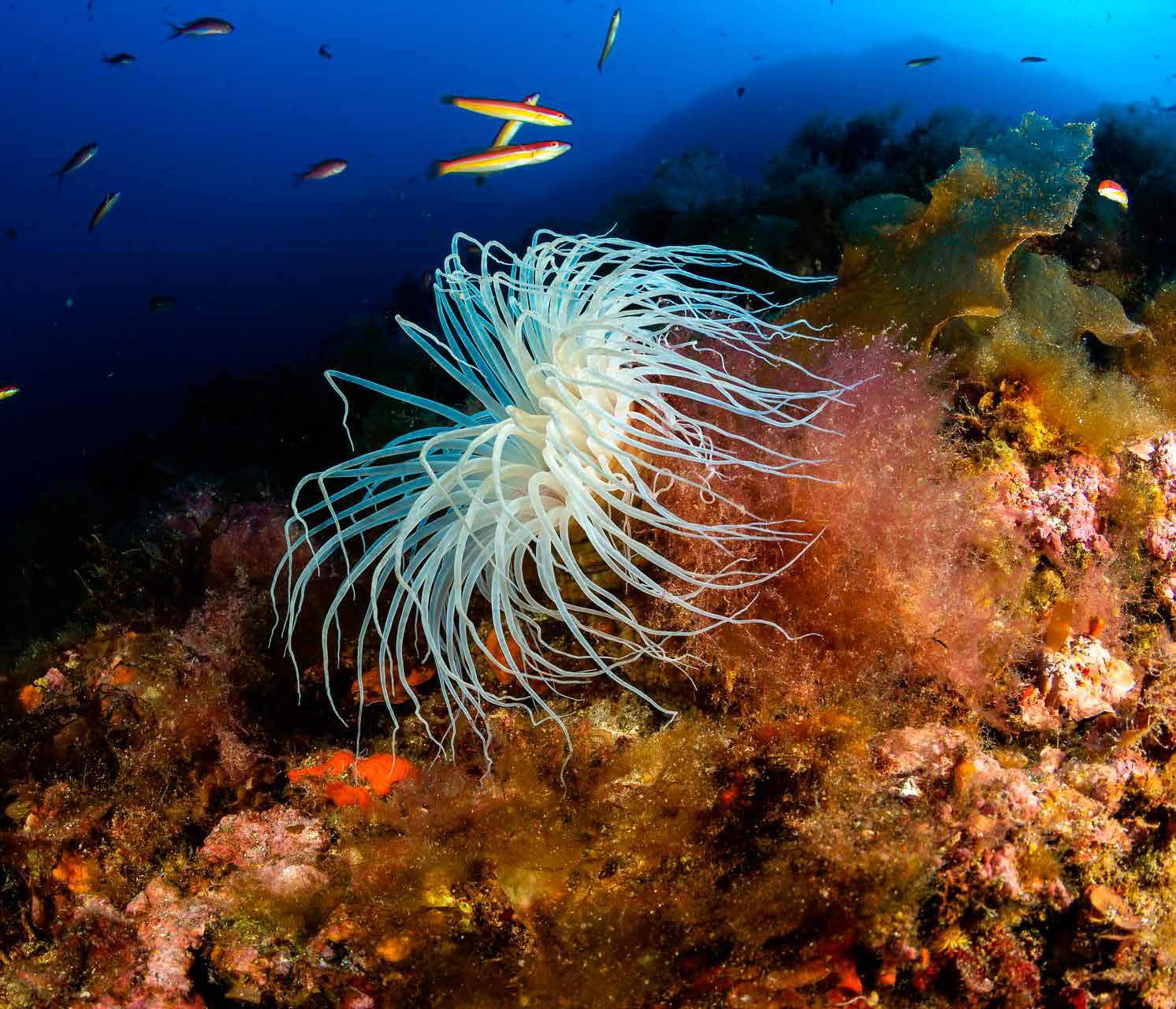
Since 2019, Save the Med has worked closely with the resident community to develop and implement best practices at sea, taking action through its Sa Dragonera Blava project. The project plays a key role in ensuring more effective management that is closely aligned with society through maintaining continuous participatory processes with local stakeholders, and in fostering a more sustainable link between the socioeconomic sphere of the area and the marine environment of Sa Dragonera and Sant Elm.
From community engagement to bringing people closer to the sea, the aim is to work towards the reduction of negative environmental impacts and pressures. For more information
on Sa Dragonera Blava’s activities, please visit www. sadragonera.org
Following a campaign led by Xarxa Dragonera Blava, demanding slower vessel speeds, the local community achieved a significant milestone last year: the introduction of a 10-knot maximum speed limit to safeguard the waters and marine life of Sa Dragonera and Sant Elm.
Looking after these waters is a responsibility we all share, and every action makes a difference.
What is your pledge to the sea?
◆ www.savethemed.org • www.sadragonera.org

Nobody.
Because back then, the owners managed. The crew improvised. And everyone pretended that was fine.
We were there too — crewing the yachts, solving problems no one had planned for.
Eventually we realised something: small yachts still come with big expectations.
So we built the support system we wished we’d had.

Written & photos by Fundació Joves Navegants
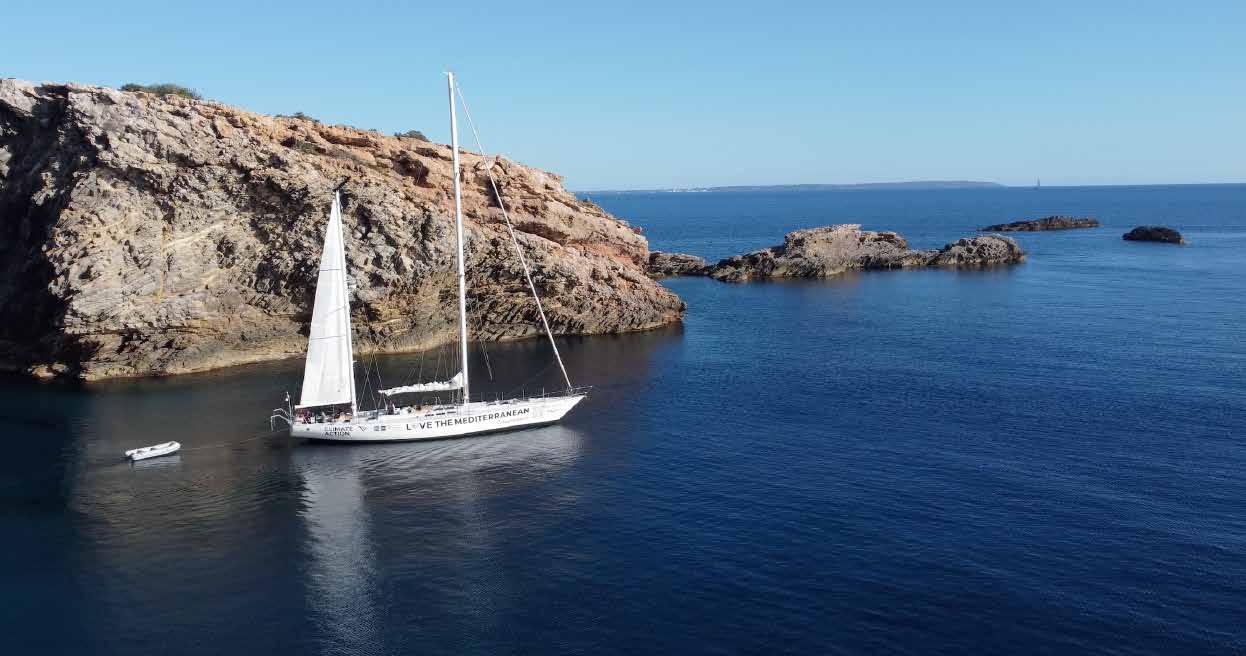
Fundació Joves Navegants begins a new phase marked by consolidation and openness. After years of work linking the sea with education and social action, the foundation returns with a clear strategic structure and a model designed to amplify its impact.
This return is not just about resuming activity, but about growing it and turning every trip to sea into an opportunity to create change.
From its base in Portocolom, the 2026 season marks the beginning of a phase where experience, science, and social commitment are integrated into a single program.
Fundació Joves Navegants operates through three areas of action activated on every trip to sea: science and knowledge, bringing observation and understanding of the marine environment closer to people; territory and community, connecting each activity with the local environment and those who inhabit it; and action at sea, using navigation and direct experience as tools for learning and transformation.
What truly defines the model is how social impact is structured. Each activity at sea is not an end in itself, but a means to sustain a social programme that guarantees access to the sea for young people at risk of exclusion.
Access to the sea is still, in many cases, a privilege. The foundation works to change this by offering outings to young people in situations of social, economic, or personal vulnerability, allowing them to come aboard, learn, share, and discover an environment that also belongs to them.
For many, it is the first time they experience the sea firsthand, and that experience has a lasting impact.
It is about building confidence, opening horizons, and creating new ways of understanding the world. Coming aboard means learning to live together, taking responsibility, and discovering an environment that generates new perspectives. The sea becomes a space of equality, where barriers are broken and opportunities are created.
The 2026 season begins with an expedition programme designed to offer unique experiences in the Mediterranean, always linked to knowledge and territory.
From the bay of Portocolom, participants explore the sea from different perspectives. Collaboration with MARE introduces underwater photography as a tool to observe and document the seabed. With SharkMed, key species such as sharks are identified, bringing science closer and dismantling
misconceptions. Expeditions to Cabrera provide insight into how a protected ecosystem functions in one of the best-preserved enclaves in the Mediterranean.
Together with Cleanwave Foundation and MedGardens, snorkeling activities highlight the restoration of posidonia, connecting directly with one of the sea’s most important habitats. This is complemented by work on marine dumping sites with TrueWorld, focusing on identifying and monitoring seabed waste, tackling a growing problem that often goes unnoticed.
All activities take place aboard the Galaxie and the Stenella, vessels that operate with reduced environmental impact.
The foundation also opens these expeditions to companies, organizations, and individuals seeking a different way to connect with the Mediterranean. These are not conventional outings, but experiences designed to understand the environment and be part of a purposedriven initiative.
Booking an activity not only offers a different perspective of the sea, but also directly contributes to the foundation’s social program. Each trip funds new opportunities for young people who would otherwise not have access to the sea. It is a direct, transparent, and measurable model: the experience of some makes possible the experience of others. Support the project and become a part of change
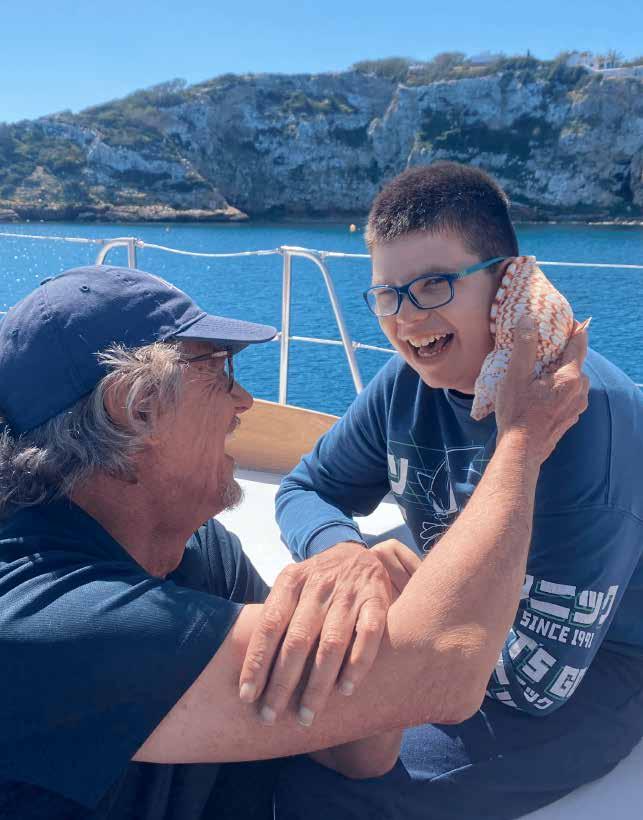
The growth of Fundació Joves Navegants depends on its ability to expand this model. Booking a trip, collaborating as a company, or supporting the project helps scale its social and environmental impact.
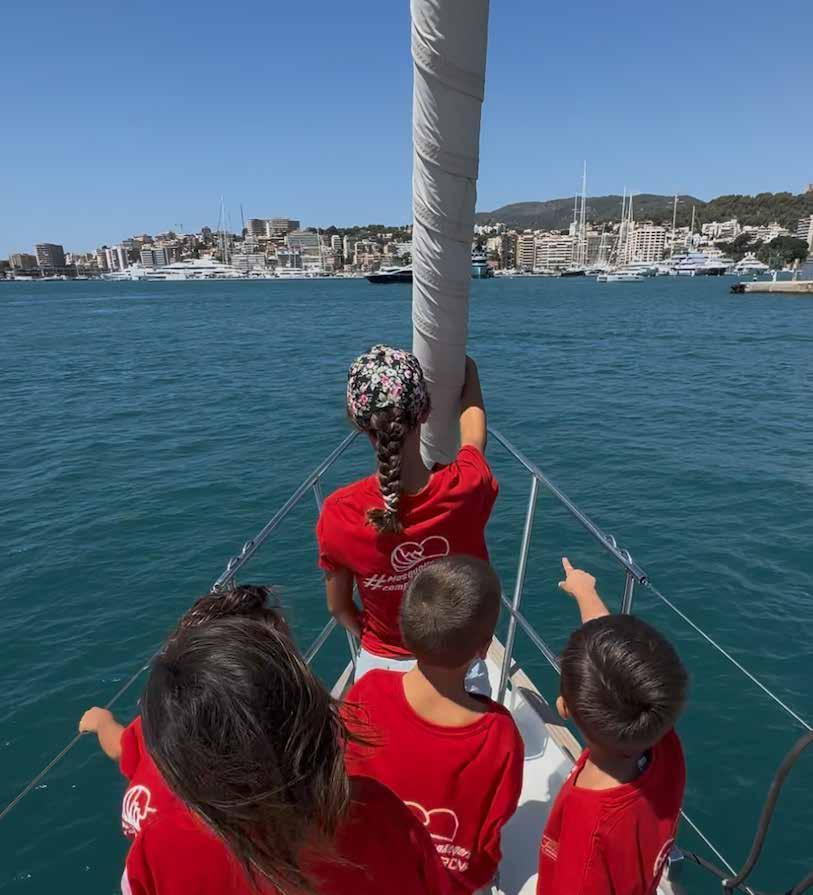
More activity means more access. More expeditions mean more opportunities. More participation means a stronger community around the sea.
The Mediterranean must be experienced to be understood, and understood to be protected. Fundació Joves Navegants proposes a way of engaging with the sea that combines experience, knowledge, and social commitment.
A project that returns with stronger structure, greater reach, and a clear purpose: to open the sea, share it, and turn it into a tool for real transformation.
Those who wish to support Fundació Joves Navegants can do so through collaboration programs or donations at www.jovesnavegants.org. Every contribution helps open the sea to those who have not yet had the opportunity to experience it.

The 2026 season is already underway. The sea is too. Becoming part of this change is possible. ◆

































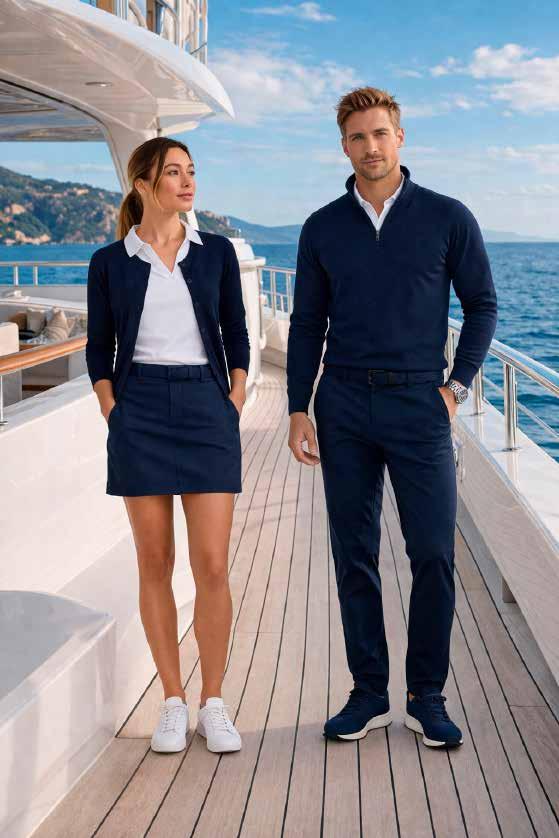
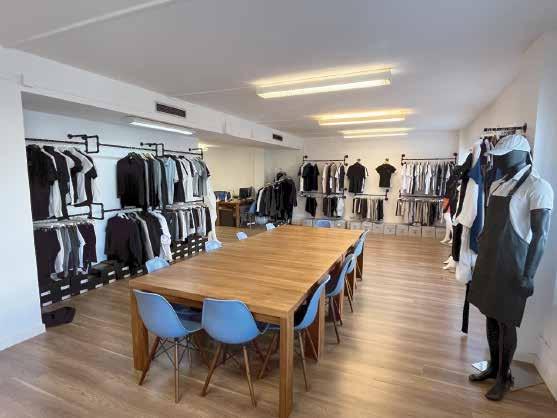


MARINE MARKETPLACE SHAPING THE REGION’S YACHTING FUTURE
Aboat on the beach. A man on a mission. We talk to Jim Passmore, local sailor and yacht manager, about the rescue of SY Owl, a 117 year old, 21 metre sailing yacht stranded on the sands of Palmanova beach.
What had happened to SY Owl?
Owl had been wintering on an unregistered mooring when a storm in early January broke her free. She was washed towards the beach and came to rest on the sand.
When I spotted her, I was horrified. The last time I'd seen Owl, she was sitting pretty on a mooring in Andratx. I spoke to the owner, who explained that the council had been patient but with the tourist season starting, he’d been given just 24 hours to come up with a plan, otherwise the diggers would move in and break her up for disposal.
Why is Owl special?
Owl is one of the last remaining boats from the Edwardian era of British yachting. Designed by Frederick Shepherd and built by the White Brothers of Southampton, who also built the 1920 gaff-cutter SY Lulworth, and she remains largely original.
She has an intriguing history. Owl survived two world wars, she has been raced, sailed across the Atlantic, and was stolen at one point, resurfacing in New Caledonia, without a mast!
So, what happened next?
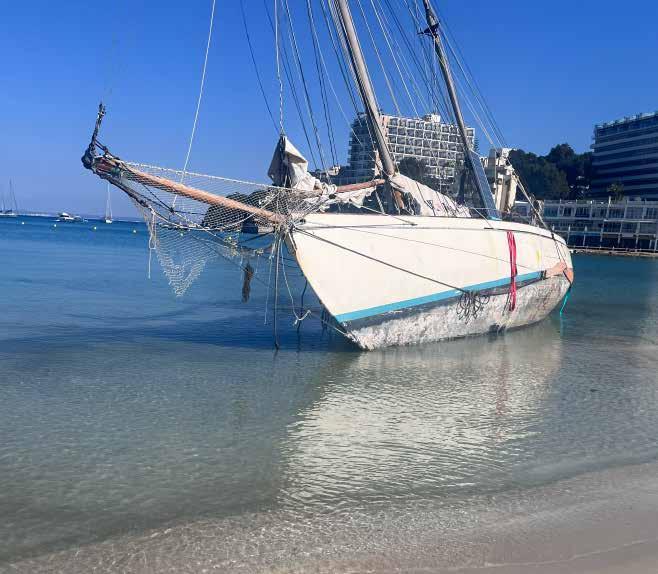
The owner was in a predicament, no insurance, and little time. I went home to a sleepless night and by 04:00, was convinced we had to help. I went to get coffee and I picked up the phone. I was not going to let that boat meet her end on the beach.
With the Owner’s agreement, I contacted Ocean Divers in Palma and Felix Busmann, a marine surveyor. We inspected the hull, found it was not particularly damaged, and began making plans.
How did the rescue mission go, what were the biggest challenges?
Here’s where it got complicated. Step one was to get the boat off the beach. Step two was to keep her afloat. Step three was to get her somewhere she could be lifted out, step four was successfully doing so, and then step five was finding somewhere to stand her.
The problem was, we couldn’t do step one until we had a plan for step five, and that’s a challenge in Mallorca this time of year! The team from Calanova Sailing School, being the closest marina, tried everything.
STP would help us get the boat out of the water, but they couldn’t offer space for her. I contacted the President of the Port Authority and, appreciating the special nature of our mission, he kindly allowed us to lift the boat out at STP and transport her to the Port Authority dock next door.
The mission began the following Monday. The effort was led by Thomas and Andreas from Ocean Divers. We had a team of eight people, all specialists, two dive boats, two large anchors and some expensive salvage equipment.
The boat’s age, wooden construction, and potentially delicate condition made it a challenge. Owl was only sitting in 70cm of water on the beach but had a 2.3m draft. Lines were affixed at the bow and stern, and we gently pulled back and forth to loosen her before placing flotation pads beneath the keel.
It took hours to move her just a few centimetres. Eventually, Ocean Divers managed to get her off the beach undamaged. Once free, we set the pumps to work. She was taking on water and would've sunk. We slowly towed her to Calanova who kindly gave us a berth for the night so we could secure her. We worked late to stem the flow of water and I stayed aboard, in rather damp conditions, to keep the pumps running.
Come sunrise, she was still afloat! On we went towards Palma, where Ocean Divers rejoined us. The team at STP were waiting, she went under the straps, came out the water, and the Port Authority were ready, having repositioned a fleet of rental cars to make space for her!
A few rules might have been bent, but this was something that just had to be done. It was a huge collective effort; I can’t thank everyone involved enough.
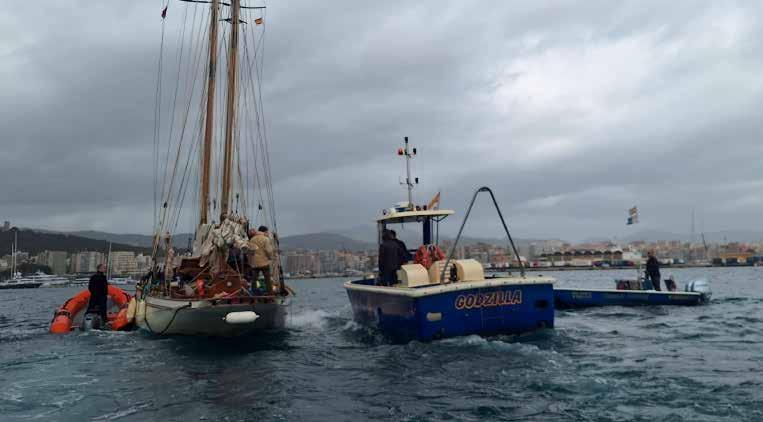
What’s the most unusual thing you’ve discovered about the boat or found aboard so far?
There were some unexpected connections – both Felix Busmann and Thomas Heinse had worked on Owl during their time as boat builders, decades ago.
Despite sitting exposed for nearly three months, nothing appeared to have been stolen. We have the bronze compass binnacle and ship’s bell small treasures, but integral to the boat’s provenance, and a slightly soggy racing certificate from 1951.
What do the restoration plans look like?
It's difficult to say. Access to the Port Authority area is tightly controlled. I've not been back onboard since she arrived there. The next step, once we get access permissions, will be to visit
with surveyors and evaluate what needs to be done.
The priority will be to make her watertight, and we can't leave her out of the water for too long as the timbers will dry out. Then we’ll make a full list of works required to restore her to her former glory.
And what does the future hold for Owl?
We’re exploring all options. When I got involved, I had no idea where this would lead. What’s most important is that Owl's story continues. Perhaps someone with appropriate resources would like to take on the restoration project, or maybe across industry contacts and private partners we can achieve some sort of shared ownership. What we have come to realise, is that there's a lot of people following this story, and a lot of people who care. One way or another, hopefully she’ll be making happy memories for many years to come. ◆
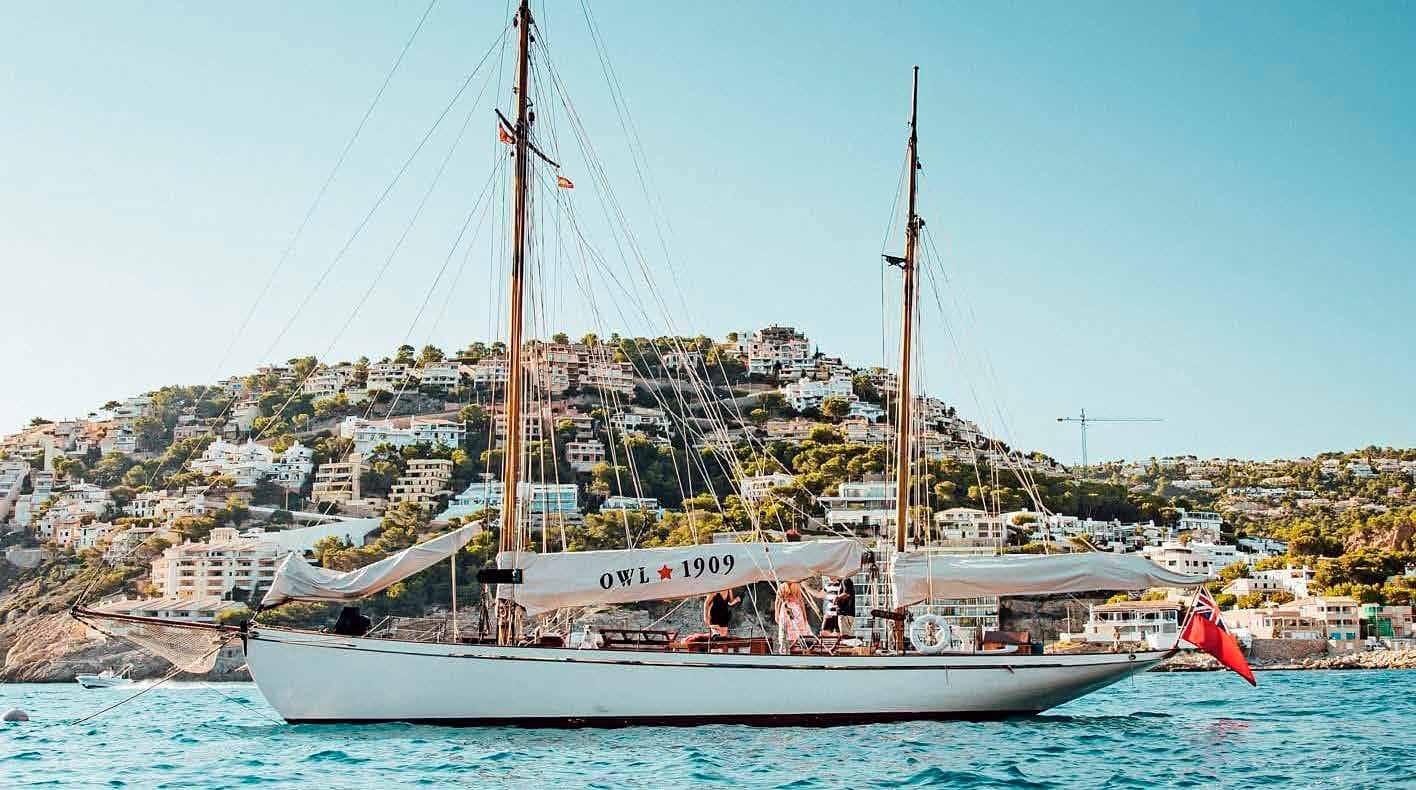

94. What's on in Mallorca
96. BMComposites
100. JoyRon Foundation
102. Mediterranean Private Diving
104. Andaman Sea
106. Mallorca Entrepreneurs
108. Sunbrella
110. RE/MAX
Written by Marlot Cathalina
29 April – 2 May
Palma International Boat Show and Palma Superyacht Village – Palma
The Palma International Boat Show and Superyacht Village stand out as Mallorca's top nautical event as they mark the official start of the Mediterranean yachting season. With impressive vessels lining the harbor and industry professionals filling the docks, it’s a fascinating mix of maritime craftsmanship, design, and Islander lifestyle. Whether you're in the business or simply yacht curious, it's well worth spending a day there. With The Islander Magazine everywhere you look, it's one of our personal favourite days in Mallorca. ◆ www.palmainternationalboatshow.com
22 May - Regata Bahía de Pollença - Port de Pollença
Enregata.com
The Pollença Bay Regatta is an offshore sailing race that connects Barcelona with northern Mallorca. The fleet departs from Port Ginesta and finishes in Pollença Bay, at the Royal Sailing Club of Port de Pollença, after roughly 104 nautical miles. The route crosses the Balearic Sea and includes rounding the iconic Cap de Formentor before entering the bay of Pollença. ◆
www.pollensa.com
9 May
IRONMAN 70.3 – Alcúdia
The IRONMAN 70.3 Alcúdia-Mallorca is drawing thousands of athletes from across the globe. Set on the north coast of Mallorca, the race combines a 1.9km swim in the Bay of Alcúdia, 90km of cycling through stunning island routes, and a run through the town's streets. Whether you're a seasoned triathlete or simply a fan of extraordinary human effort, race day in Alcúdia is fun and buzzing with energy. A great day out whether you're there to cheer, or to get inspired for next year (maybe). ◆
www.ironman.com
18–21 June Menorca Sant Joan Regatta – Barcelona to Menorca
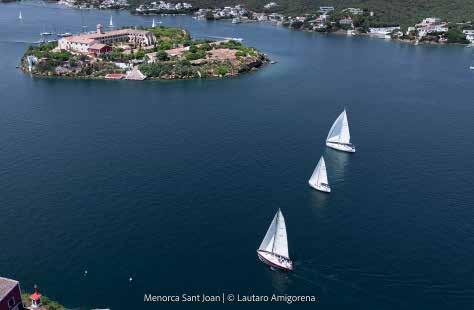
The Menorca Sant Joan Regatta is an iconic offshore sailing event connecting Barcelona with Menorca, covering 135 nautical miles across the Balearic Sea. Organised by the Real Club Náutico de Barcelona and the Club Marítimo de Mahón, the event forms part of the Spanish Offshore Championship. The regatta wraps up with a harbour race in the stunning Mahón channel, making it as much a celebration of place as it is of sailing. ◆
www.regatamenorcasantjoan.com
www.mallorcachampionships.com

www.thesuperyachtcup.com


There are moments in sport when everything aligns, the preparation, the conditions, the competitor, and the equipment, and something remarkable happens. On the waters of Palma Bay in March 2026, one of those moments belonged to BMComposites.
When five-time OK Dinghy World Champion Nick Craig stepped into a brand-new hull for the first time in competition at the fourth edition of the BMComposites Trophy, nobody could have scripted what followed. By the final race of the weekend, the new hull, fresh from the BMComposites workshop and making its race debut, had carried Craig to overall victory in one of the most competitive early-season fleets in the class.
Held from 13 to 15 March 2026 at Real Club Náutico de Palma, the BMComposites Trophy has quietly but steadily grown into one of the most anticipated fixtures on the international dinghy calendar. This fourth edition was the strongest yet, with 50 boats competing across the OK Dinghy and Snipe fleets and a start line that included some of the most decorated names in the class, among them current world number one Andy Davis, whose presence alongside Craig set the tone for some intense, high-quality racing. Palma
Bay delivered the conditions to match, and the fleet rose to meet them. As Davis himself reflected, "It's a great vibe, with everyone coming together to enjoy the racing."
The story of this regatta, however, belongs as much to the boat as to the sailor. The new BMComposites hull is the result of a focused and deliberate development programme, combining CAD design and CFD analysis to identify and refine the areas where competitive advantage is greatest. The emphasis was placed squarely on downwind performance, where, in the OK Dinghy class, races are so often decided. Craig described the result simply and memorably: "A real downwind weapon." To test a prototype of this nature at its very first event, against a fleet of this calibre, and to win, is the kind of validation that speaks for itself.
For BMComposites, the Palma-based marine composites specialists working across high-performance refit, custom development, and technical manufacture for the sailing and superyacht industries, the regatta is far more than a title sponsorship. CEO Mark Branagh competed in the fleet himself, and the debut of the new hull in world-class race conditions, gathering direct feedback from the sport's finest competitors, marks a significant and exciting step in an ongoing development journey.
The Snipe class added its own compelling chapter, with Víctor Pérez and Lucía Guerrero sailing with impressive consistency to take overall honours, ahead of Jordi Triay and Lluís Mas, with Fernando Rita and Cristián Vidal completing the podium.
With participation growing and the standard of competition continuing to rise, the BMComposites Trophy is establishing itself as a fixture with genuine soul, world-class racing, a spectacular Mallorcan setting, and an atmosphere that brings sailors back year after year. From drawing board to podium in a single weekend. For BMComposites, the journey is just beginning. ◆
Visit www.bmcomposites.com or follow @bmcomposites on Instagram, Facebook, and LinkedIn.
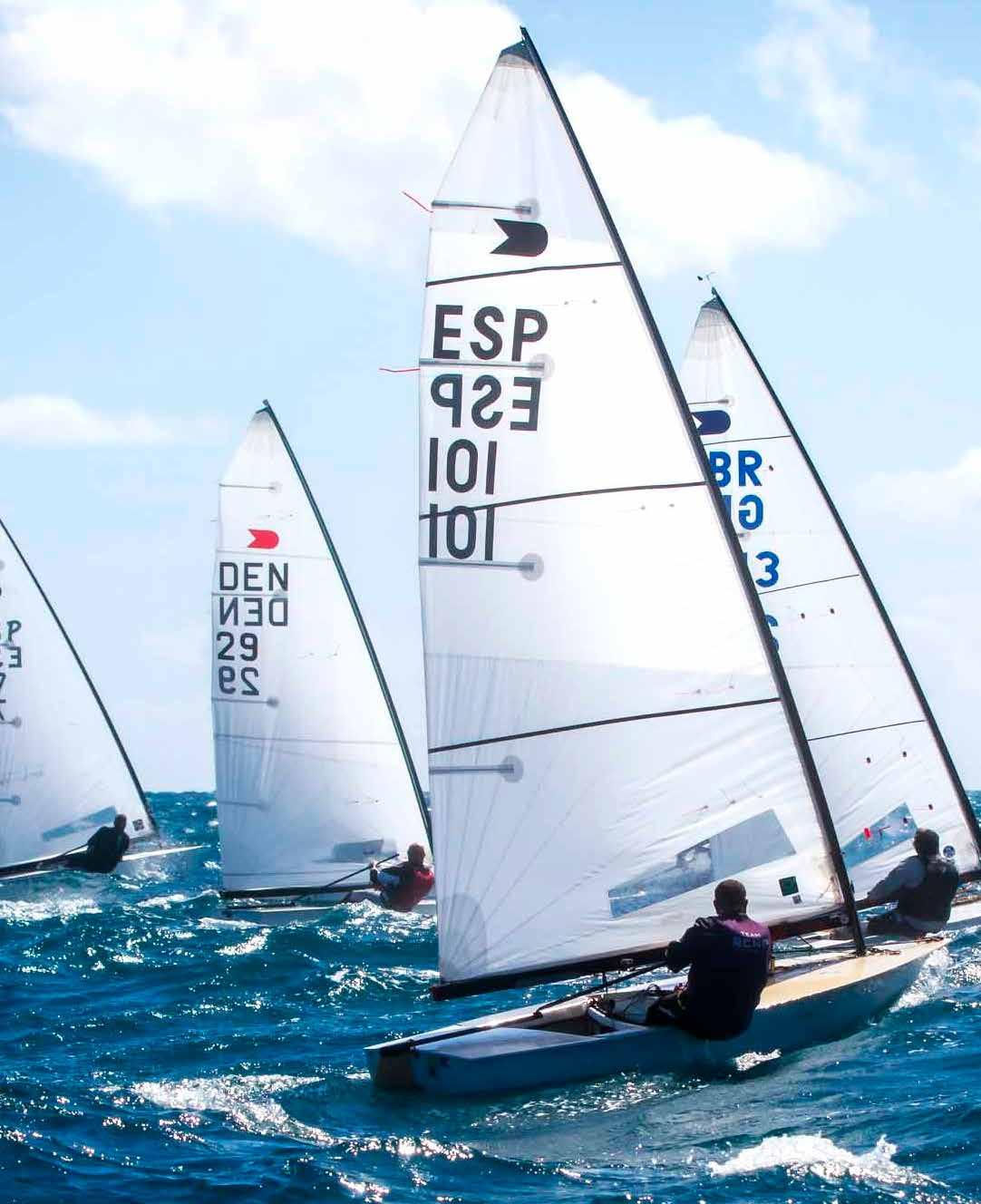
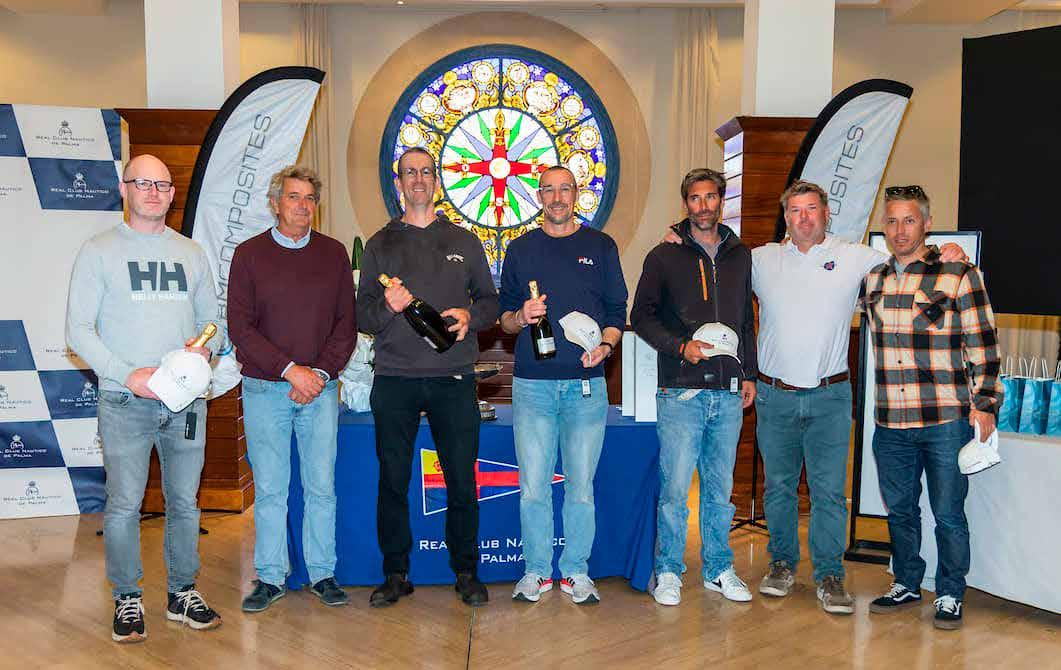

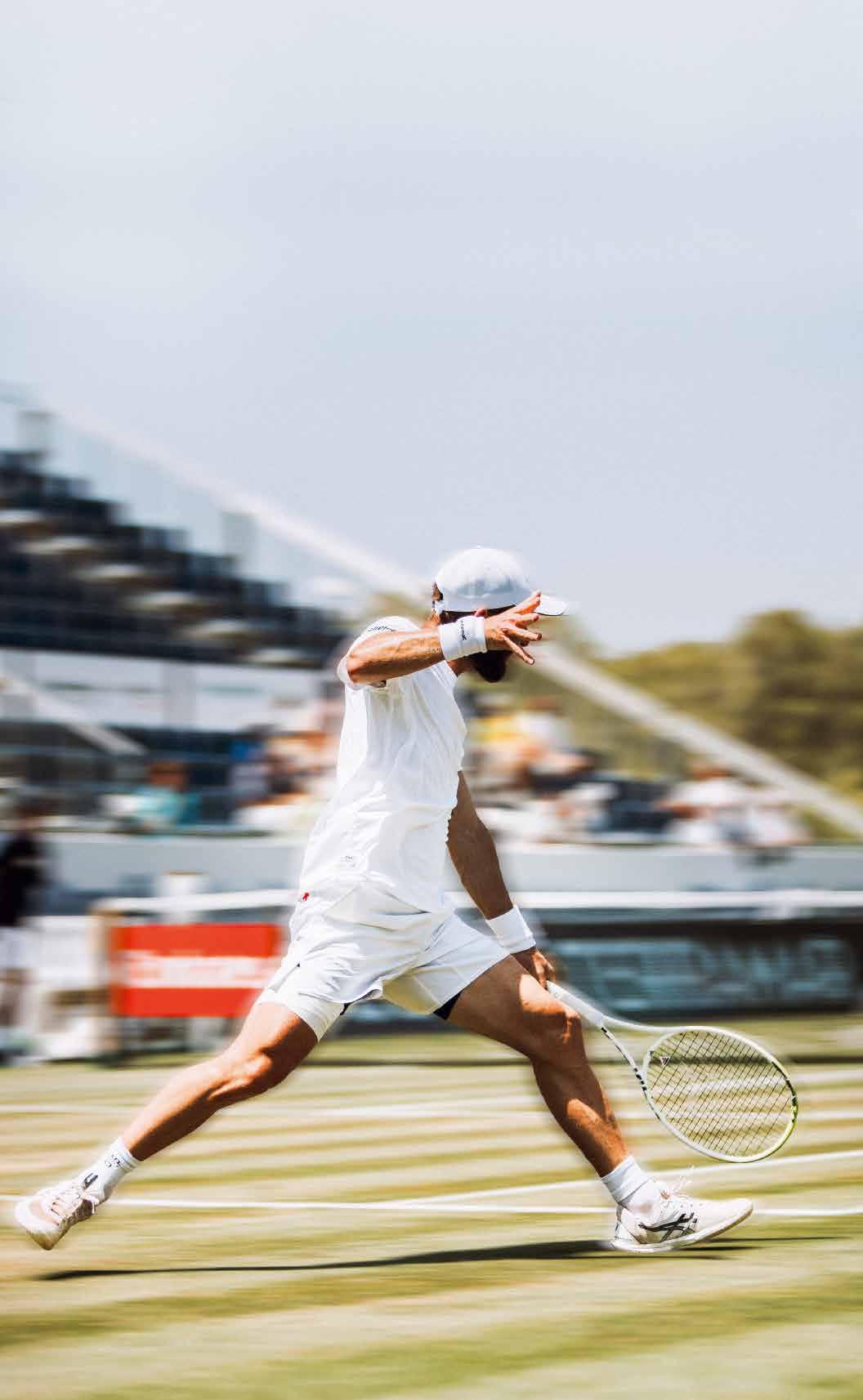


JOYRON FOUNDATION: €735,000 RAISED TO HELP CHILDREN IN NEED IN THE BALEARICS
Written
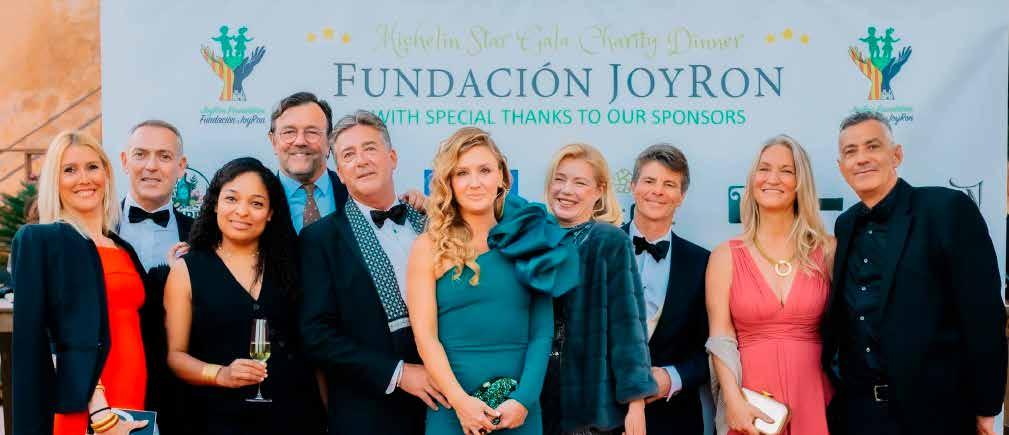
For fuller detail, please contact us as per foot of this page.
JoyRon Annual Gala Dinner: Saturday, June 27th
A Gala Dinner with all its Trimmings, includes a reception and dance entertainment. A formal event, but with a difference.Come Rave in the Cave at Galdent Llucmajor, into the early hours of Sunday.
Family Fun Day & Go-Karting Race Day: Sunday, October 11th
At Magaluf Race Track with a full day’s Go-Kart Team Racing (18 teams of 6 drivers per team) plus Charity Stall Marketplace and Children’s entertainment. Enjoy a selection of DJs throughout the day, including Diablo V. Plus, a Bar and Food Service. All provided with free admission to the venue.
Halloween Buffet and Party Night: Saturday, October 31st
With all its Fancy Dress for those who wish to dress accordingly for the occasion. The venue is to be announced in due course.
In addition to the above forthcoming events directly organised by JoyRon Foundation, we encourage and assist (if required) for Corporate and Individuals to organise their own Charity Fund Raising Corporate, Small Business or Family/Personal Friends Events for the benefit of JoyRon Foundation. The foundation will ensure that all monies donated are 100% passed onto and spent effectively to help the children in need within The Baleares. We check and ensure the money is fully used for the benefit of the child/children.
If you or the company require any assistance in the event organisation, then one or more of our volunteers can be made available to assist if needed. Should you wish to discuss, any such initiative, then please send an e-mail to
info@joyronfoundation.org or call +34 608531211. Please note the donation of the net proceeds of any such event could be eligible for the organising company or individual to receive a Spanish Tax Deductible Donation Certificate.
Here are just a few possible fund raising event suggestions: Corporate/Client Party Night – Fashion Show – Trivia Night – Golf Tournament – A Yachting Day Outing – A Fancy Dress Party – Padel/Tennis Tournament - Karaoke Contest – Charity Football Match – A Fun Run – Plus many many others.
We take this opportunity to THANK the following companies for recent Fund Raising Events organised by them for the benefit of JoyRon Foundation and thereby supporting Children in Need in the Baleares:
Pins Padel Club Palma (Padel Tournament), Sandberg Estates Portals Nous (Golf Tournament), 4Sight International (Corporate Client Christmas Party), Turtle Beach Restaurant Palmanova (Easter Eggstravaganza), Sevenstar Yacht Transport (Padel Tournament), SuperYacht Charities UK (Palma Boat Show Seafarer’s Supper).◆
JoyRon is here to help the many children in the Balearic Islands who are underprivileged and require support. Interested in event sponsorship, financial corporate or individual donations, or providing an auction item or raffle prize? New Volunteers to support us are also always welcome. Please contact us. Together we can make it happen.
Email: info@joyronfoundation.org
Call Ronald: +34 608-531-211 www.joyronfoundation.org

RIVA
CORSARO
GORGEOUS COLOUR COORDINATION WITH A MODERN MINIMAL APPROACH.
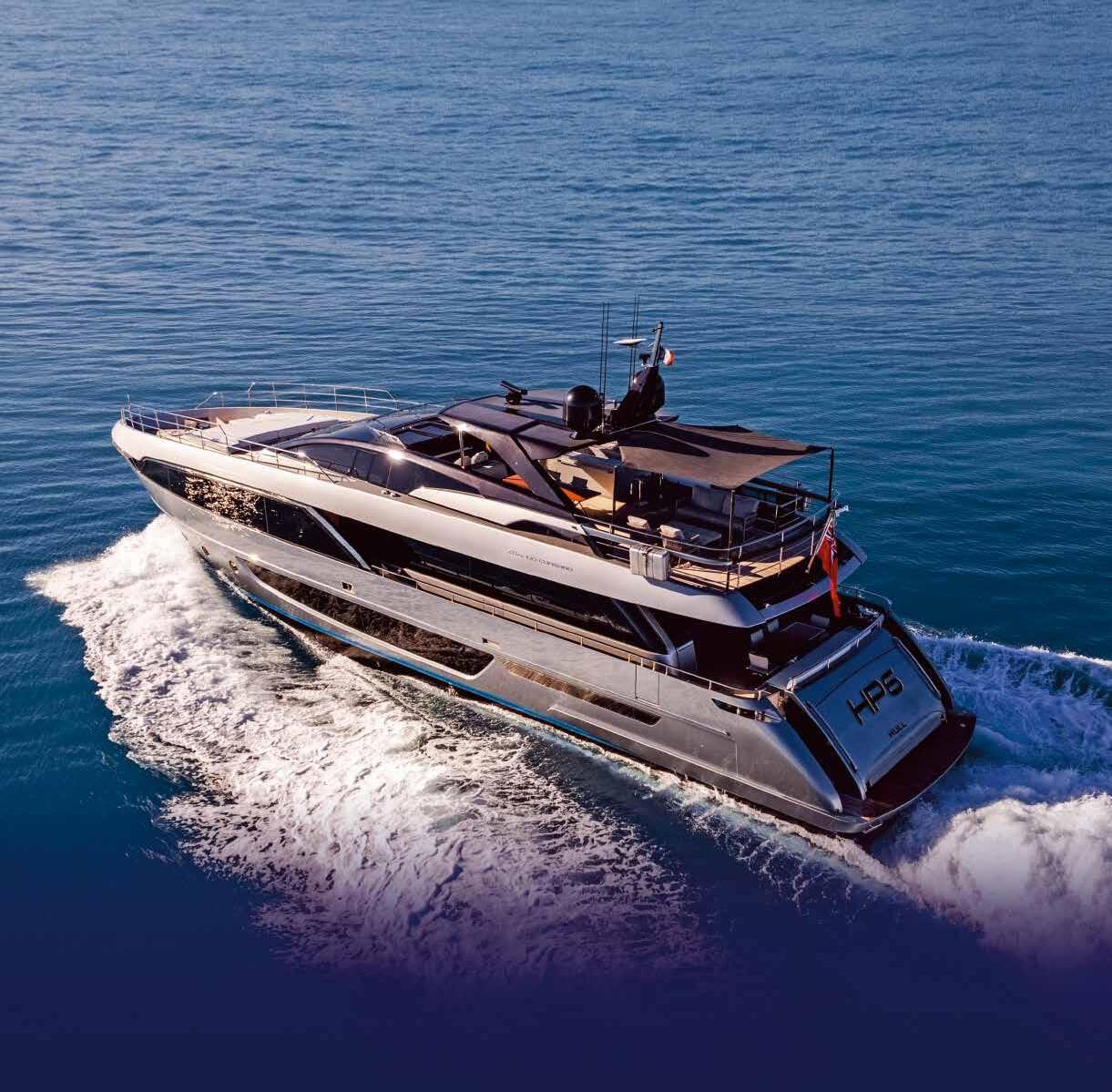
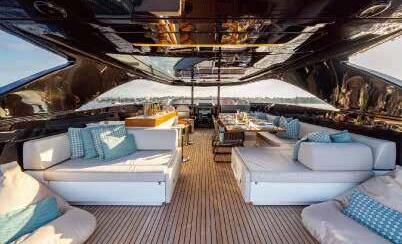
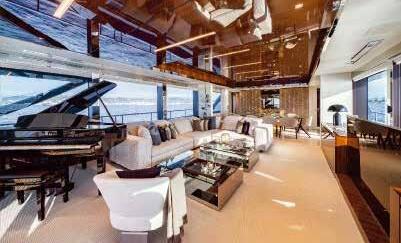
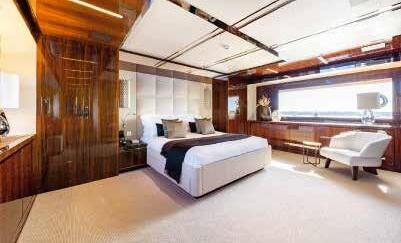

PRIVATE. PERSONAL. UNCOMPROMISED. EXPERIENCE THE OCEAN THE WAY IT WAS MEANT TO BE, WITHOUT CROWDS, PRESSURE, OR RIGID SCHEDULES.
Written & photos by Mediterranean Private Diving
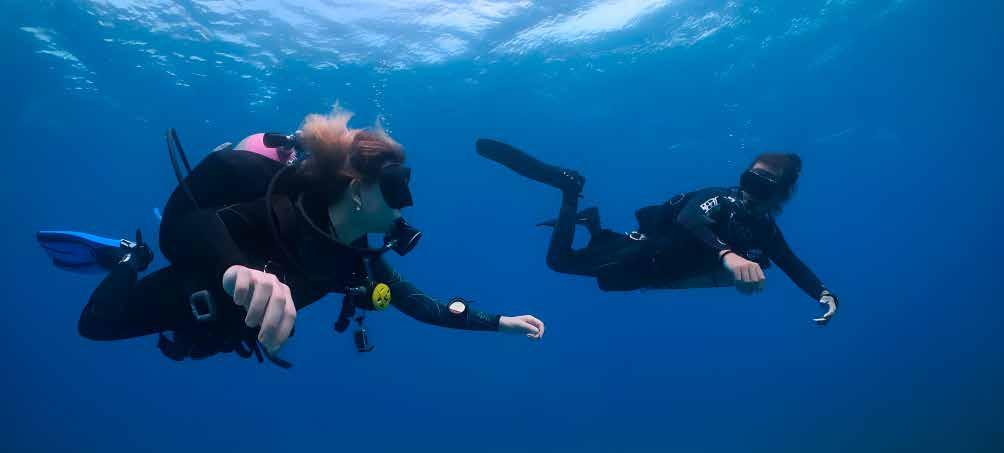
Most scuba diving experiences promise adventure, but deliver something far less refined. Crowded boats. Rigid schedules. Rushed instructions. You’re grouped with strangers, moving at someone else’s pace, following a route that feels more like a checklist than an experience.
What should feel extraordinary quickly becomes… ordinary.
And when you’ve invested time, money, and expectation into something meant to be unforgettable, that compromise is impossible to ignore.
In many parts of the world, diving has become a system.
Efficient. Repeatable. Designed to move people through the water in the same way, at the same pace, day after day. There is a certain roughness to it. Not always in skill, but in the experience itself. Briefings delivered quickly. Equipment handled routinely. Time in the water that feels structured rather than felt.
For some, that is enough.
But it leaves a question behind. Is this really what diving is meant to feel like?
Because when you hold it against the standards found elsewhere at sea, the difference becomes clear.
Time is not compressed. It is considered. Service is not functional. It is intuitive.
Expertise is not something that needs to be stated. It is simply present in every moment. Diving has the potential to exist at that level.
Not as something built around volume, but around experience. One where the structure adapts to the individual. Where the pace allows for stillness. Where the ocean is not something you move through, but something you arrive in. In that setting, the role of the instructor changes.
Less directive. More aware.
Someone who understands how each person responds to the water, and adjusts accordingly. Creating a sense of calm that carries through the entire dive.
Comfort becomes part of the experience as well. Not as an added layer, but as a baseline. The details are no longer incidental. They are intentional. Quietly shaping the day from beginning to end.
Nothing feels rushed. Nothing feels crowded. Nothing feels overlooked.
And gradually, the experience returns to what it was always meant to be.
Something immersive. Something personal.
Something that stays with you, not because of how much you did, but because of how it felt while you were there.
Once you’ve experienced diving like this, it becomes difficult to accept anything less. ◆ www.mediterraneanprivatediving.com
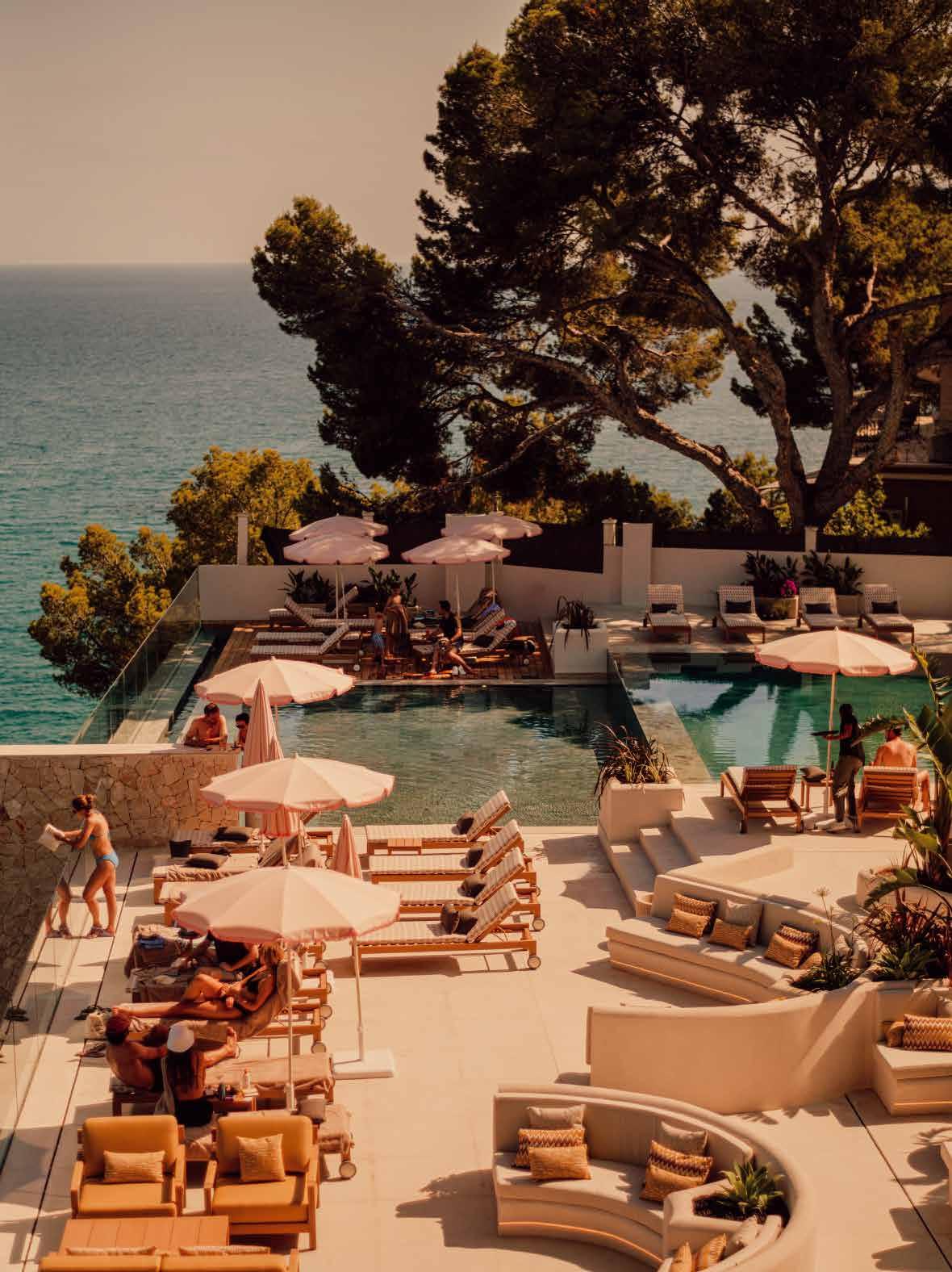

Written by The Islander & photos: Shutterstock

Superyacht visitors planning a journey to Asia Pacific can join in celebrating Thailand’s Songkran Festival in April. The hospitable country offers many vibrant festivals, and among the most famed is the nationwide water-splashing Songkran (Thai New Year in April).
Yachts and Songkran in Phuket combine a luxury marine lifestyle with Thailand's traditional New Year water festival offering unique experiences - like a yacht party with onboard water rituals, contrasting with the vibrant large-scale water fights in areas like Patong. All this is set against Phuket's stunning Andaman Sea backdrop, with yachting events often happening alongside or leading up to the main April festivities.
The Thai New Year is a time-honored tradition celebrated across Thailand from April 13th to 17th this year. In the Andaman region, which encompasses popular destinations like Phuket, Krabi, and Phang Nga, the festivities take on a coastal flair, creating an experience that is a truly unique and unforgettable way to experience the Thai New Year in a fun and exciting way. This is a way to meet new people and have fun with everyone around you.
Songkran is one of the most important events in Thailand's
calendar, with the word Songkran deriving from Sanskrit, meaning “to move” or “step forward.” In Phuket, it is a vibrant and exhilarating celebration of the Thai New Year and known for its lively water fights, cultural traditions, and festive atmosphere, transforming the island into a massive street party.
While the whole country celebrates, the Phuket Songkran Festival stands out with its beachside revelry, extended festivities, and large-scale events in hotspots like Patong Beach, Phuket Old Town, and Bangla Road. Beyond the splashing, visitors can also experience traditional temple visits, merit-making, and local parades, making Songkran Phuket a perfect blend of cultural appreciation and non-stop fun.
The annual event explodes with massive water fights, especially in Patong and Old Town. Festivities start as early as April 12, featuring cultural events like the ‘Phuket Heritage Wave’ in Old Town and extended celebrations at golf clubs, resorts, hotels and throughout the island until around April 16-17. During the celebration, there are many unique activities, like the "Joyous Songkran Splendors" provided by the Tourism Authority of Thailand (TAT) and local organizations, a not-to-be-missed celebration.
In Phuket, the festivities often extend beyond these official dates, especially in popular areas like Patong Beach, where
water fights and street parties can last for several days. New Year festivities in Thailand can be wild and wet events for people throughout the country, but the celebrations in the province of Phuket are on an international scale! If you are ready for some entertainment, then your visit is going to be a wet one on land, as water fights take place everywhere from sunrise to sundown. To tourists, locals, and expats alike, these water fights are the spirit of this holiday and celebrated by everyone for miles around!
The most famous beach resorts on Phuket are on Patong, boasting a nightlife with hundreds of restaurants and nightclubs. During the Songkran Festival, this is also where you can experience some of the biggest water fights! This beach is undoubtedly the noisiest and most entertaining place during Songkran, with revellers keeping the party going late into the night! If you're looking for excitement, this is the place to be! However, if traditional aspects of the Songkran festivities are preferred, then join the procession of Buddha images, carried with scented water through the streets of the city to pay respect to the elders.
There’s also the cultural water plays presented by locals and the fun-filled parades in the streets, celebrating the ‘Rice Goddess’. Many "dry" activities can be enjoyed throughout the festival as well, with all major activities celebrated in a beautiful botanical garden, the Queen Sirikit Park on the first day.
For a more traditional experience, head to Phuket Old Town. The water parties in Phuket Town begin in the early morning and continue until the last light of day, where partiers end up on Bangla Road. More commonly called ‘Patong Walking Street’, it’s filled with partiers moving from one restaurant or bar to another! You can imagine the crazy water fun that takes place here as festivities reach their peak! It's a great spot to experience both the lively and cultural sides of Songkran as you'll find cultural events, parades, and local rituals, along with a mix of water play.
In the past, people sprinkled small amounts of water on their friends and family to observe this tradition. Nowadays, it is water guns, water buckets, and water cans! These water fights are the most important event during the celebrations of the Songkran Festival, and they take place everywhere on the islands - along the roadsides, at every street corner, and from the backs of pick-up trucks! Revellers love the day-long events, and can't wait for the craziness to begin!
For many locals, the festival is not just a celebration but also a time for family reunions and strengthening community bonds; it is a time for them to relax and enjoy family time. It is common to see multi-generational families gathering, with elders passing down stories and traditions to the younger members, ensuring that the cultural heritage of the Thai culture region remains vibrant and alive.
As the sun sets over the Andaman Sea, the festivities continue well into the night, with beachside parties, fire shows, and live music performances that capture the infectious energy of the region. A truly immersive experience, it allows visitors to connect with the local culture on a deeper level while basking in the natural beauty of the tropical surroundings and beautiful Andaman Sea.
Looking at the best time to visit Thailand, Asia Pacific Superyachts co-founder Gordon Fernandes noted, “Phuket’s dry season is from November to April/May. During these months the northeast monsoon brings calm, turquoise waters, sunny skies, and consistent, manageable winds (10–20 knots), making it ideal for island-hopping.” Phuket is surrounded by over 30 smaller islands within its province, plus hundreds more in the immediate vicinity suitable for superyachts with prime destinations of the 100+ karst islets of Phang Nga Bay, the 6 Phi Phi Islands, and the 9 Similan Islands, offering premier diving and secluded cruising. ◆ www.asia-pacific-superyachts.com

Written by Jessika Ekman & photos by Vicki Mcleod Phoenix Media
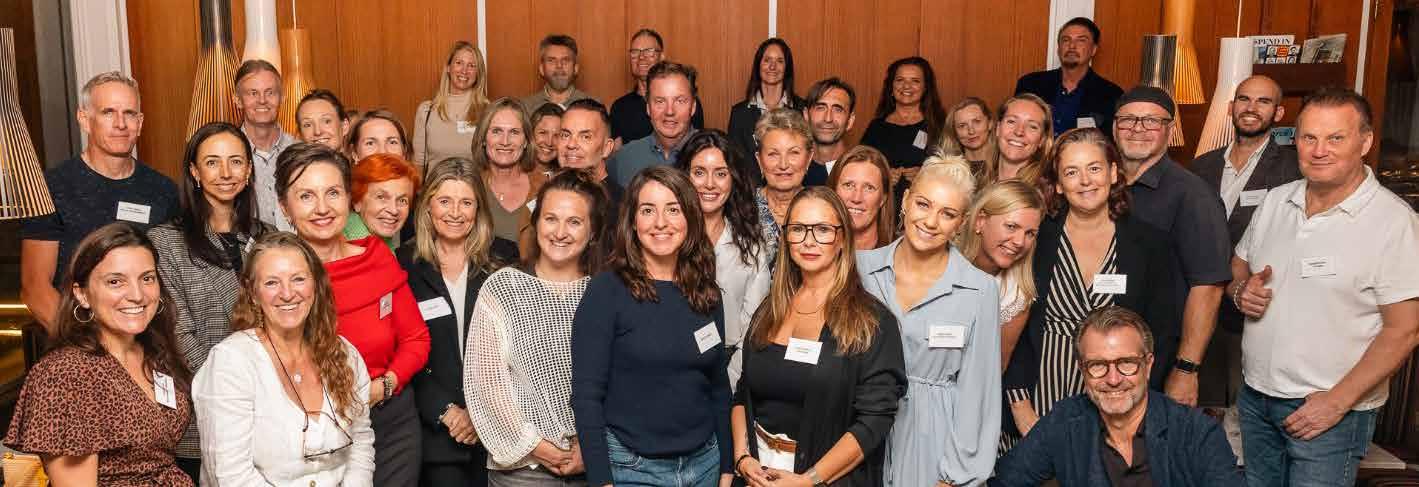
Mallorca has long attracted people ready for a new chapter. After years of working internationally, many arrive on the island with the desire to slow down, put down roots, and build something meaningful.
A large number come from industries such as yachting, tech, finance, and international hospitality. They bring global experience, strong professional expertise, and often the ambition to create something of their own.
Yet turning an idea into a business on the island is not always straightforward.
Success in Mallorca is rarely determined by a good concept alone or professional experience. More often, the deciding factor is something less visible but far more valuable: the right network.
Understanding the local business landscape, meeting trusted partners, and receiving the right introductions can make a significant difference. Without those connections, even highly experienced professionals can spend years navigating the ecosystem.
This challenge led to the creation of Mallorca Entrepreneurs. Founder Jessika Ekman, a Swedish-born event organiser who
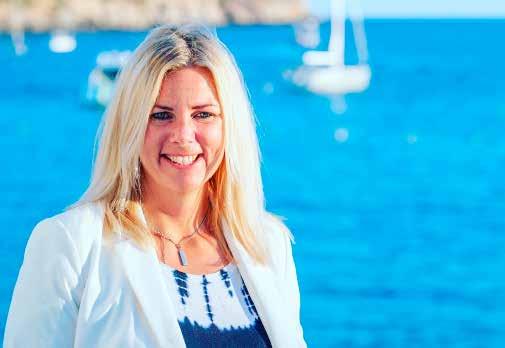
speaks six languages and has lived in Mallorca for more than 25 years, recognised a recurring pattern: talented professionals arriving with ideas and ambition but lacking access to the local business ecosystem.
What began in November 2023 as a small Facebook group quickly evolved into a growing international community. Within a year, the initiative expanded into the Mallorca Entrepreneurs member club, bringing together professionals from more than 25 nationalities across a wide range of industries. The balance is intentional: 40% men and 60% women among the founding members.
Today the community includes entrepreneurs, consultants, investors, and business owners who share an international outlook and an interest in building meaningful professional relationships on the island. The club hosts a minimum of two events per month, ranging from informal breakfasts and networking lunches to evening gatherings designed to encourage genuine conversations and connections. The next step is even more ambitious.
In May, Mallorca Entrepreneurs will open its first physical hub next to the Palma Tennis Clu, a dedicated meeting place for entrepreneurs, founders, and internationally minded professionals on the island.
The hub is designed as a space where ideas are exchanged, partnerships are formed, and new ventures can take shape. More than just a meeting place, it represents a step toward strengthening Mallorca’s entrepreneurial ecosystem and connecting the island’s growing international business community.
With a rapidly expanding network and a physical hub at its centre, Mallorca Entrepreneurs has a clear vision: to position Mallorca as one of Europe’s most attractive destinations for entrepreneurs, a place where international talent, collaboration, and new ventures can thrive. ◆ www.mallorcaentrepreneurs.com









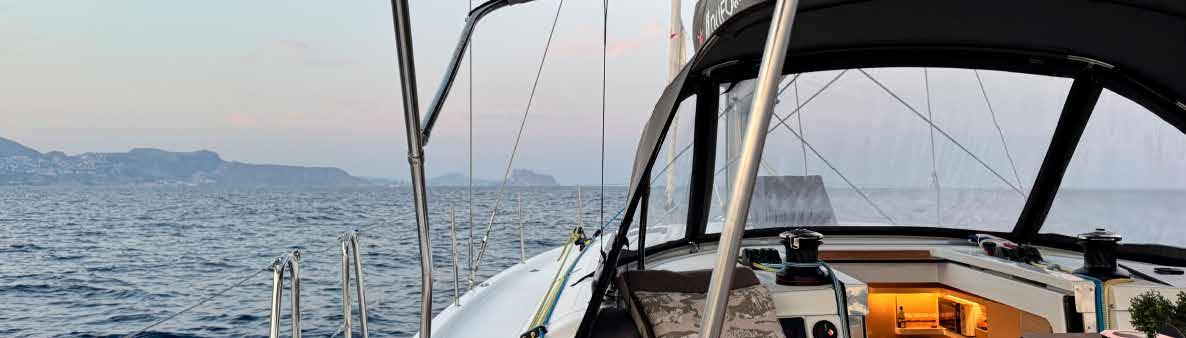
For over 65 years, Sunbrella has been shaping life on the water with fabrics designed to withstand the elements while elevating onboard comfort and style. A trusted name in marine textiles, the brand brings together performance, innovation, and design to meet the demands of both professionals and passionate boaters.
From sleek yachts to sailing boats and catamarans, Sunbrella fabrics are developed to enhance every onboard space, indoors and out. Seating, cushions, bimini tops, sunshades, and protective covers all benefit from materials engineered for durability, UV resistance, and long-lasting color. Designed and manufactured in France, the collections stand out for their rich color palettes and bold graphic expressions, continuously evolving with design trends and technological advances.
Beyond performance, sustainability is central to Sunbrella’s approach. Its solution-dyed acrylic fibers ensure exceptional color fastness while significantly reducing water consumption and the use of dyes during production. This process reflects a broader commitment to minimizing environmental impact across the entire product lifecycle.
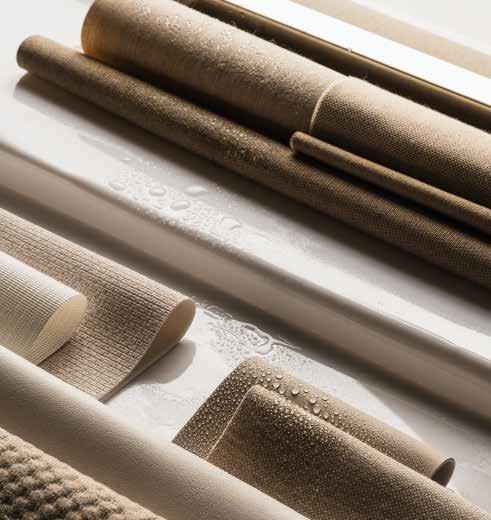
Transparency is also key. Sunbrella now provides Life Cycle Assessment (LCA) data for its products, enabling partners and end users to make informed, responsible choices. This commitment is further reinforced by the “Recycle My Sunbrella” program, which supports the recycling, reuse, and upcycling of acrylic textile waste.
This year, Sunbrella introduces a new generation of marine fabrics:
Sunbrella Plus Recycled reimagines a flagship fabric by integrating recycled fibers into its structure. Combining hightenacity yarns with 50% recycled content, it delivers the same level of performance and protection while reducing environmental impact, ideal for biminis, hoods, and marine awnings.
Coverlast offers a lightweight and flexible solution for protective covers. Easy to handle and store, it provides reliable resistance to water and weathering, making it a practical and durable choice for everyday protection.
Finally, stripes make a comeback. A timeless symbol of nautical style, they return to the collection with new designs that bring rhythm, identity, and elegance on board, while maintaining the high performance standards expected in the marine environment.
With Sunbrella, every detail is designed to enhance the experience at sea, combining peace of mind, enduring quality, and refined aesthetics. ◆ https://sunbrella.dickson-constant.com/en/sunbrella-plusrecycled-ranges

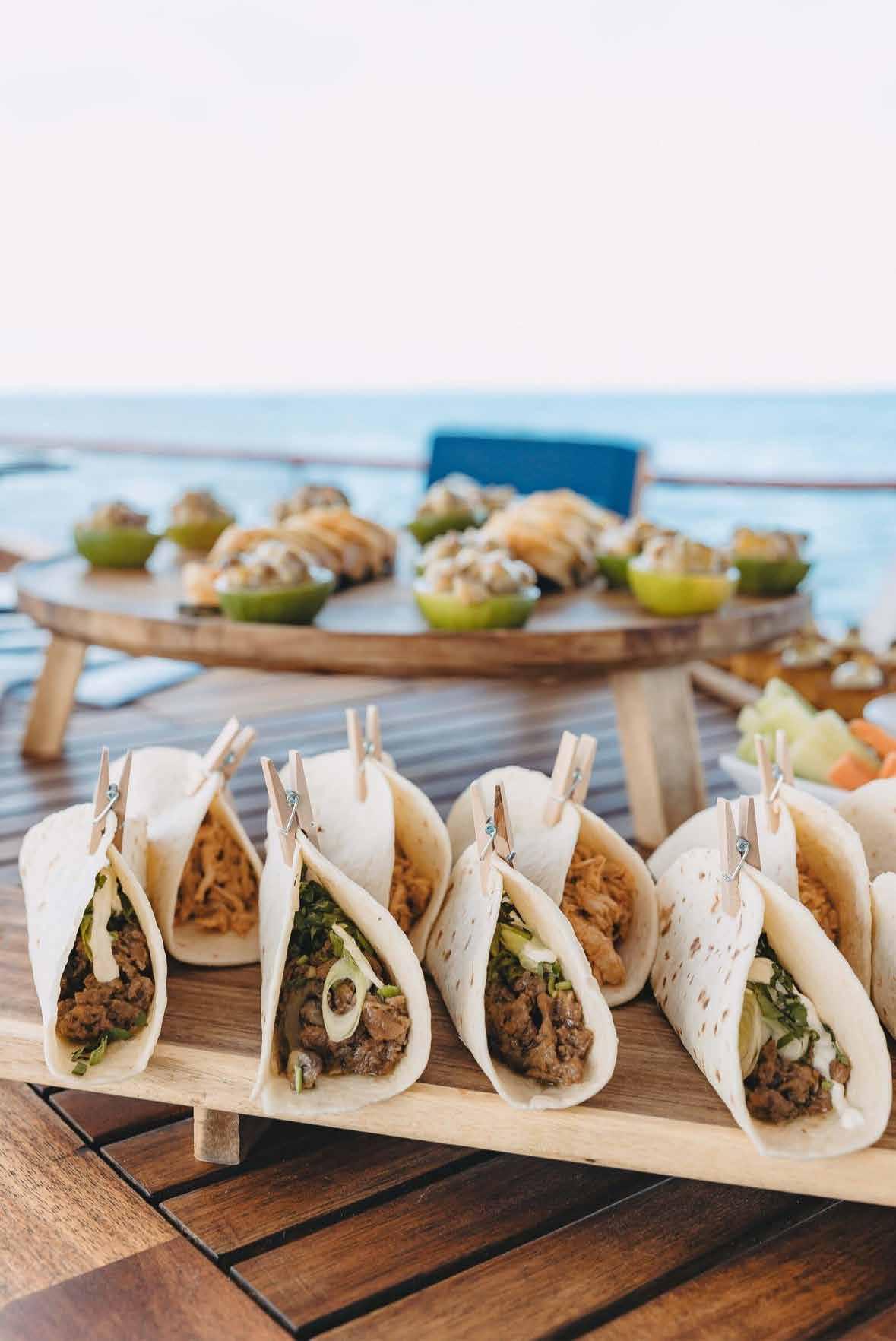





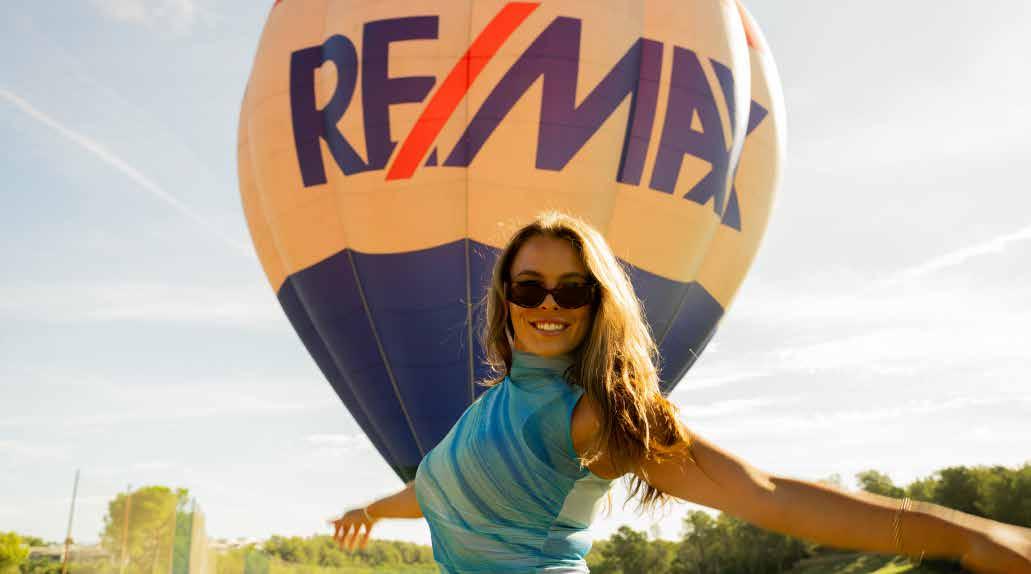
Relocating to Mallorca is often described as a lifestyle decision. For Victoria Serwatuk, it was something deeper. Not a calculated move, but a choice guided by instinct.
Originally from Canada, with roots in Serbia and Ukraine, Victoria didn’t follow a typical path into real estate. Before arriving on the island, she built her career in professional sports broadcasting, a world shaped by performance, precision and constant momentum.
“It taught me how to read people and communicate clearly,” she says. “But at a certain point, I realised something was missing.”
That realisation led her to make a bold decision. She stepped away from a structured career without a clear plan, choosing instead to follow a feeling she couldn’t ignore. What followed was not just a change in location, but a shift in perspective.
Today, based in Palma and working with RE/MAX Magic, part of the global RE/MAX network, Victoria supports international clients who are often at a turning point in their lives.
“People think they are searching for a property,” she explains. “But often they are really searching for a different way of living.”
That understanding defines the way she approaches her work. For Victoria, real estate is not transactional. It is about timing, trust and guiding people through important decisions with clarity and care.
Within RE/MAX Magic, she works closely with Damian Diaz Palermo and Juan Liska, each bringing a distinct dynamic to the team.
Damian is widely recognised in the industry, including his induction into the RE/MAX Hall of Fame. His consistency and focus set a clear standard within the team, one that is felt rather than enforced.
Juan brings a different kind of strength. His ability to connect with people is natural and immediate, creating a sense of trust that is essential in a process that often carries both excitement and uncertainty.
Together, they have created an environment where strong results go hand in hand with a personal approach. It is a balance that reflects the reality of Mallorca’s property market, where decisions are rarely just financial.
As the island continues to attract an international audience, Victoria sees a shift in what buyers are looking for. “More and more, people are searching for alignment,” she says. “The right place, but also the right feeling.”
In that sense, real estate becomes something more than a transaction. It becomes part of a bigger decision about how and where to live.And that is where the real value lies. ◆
You can contact Victoria directly at +34 610 358 431 or victoria.serwatuk@remax.es.
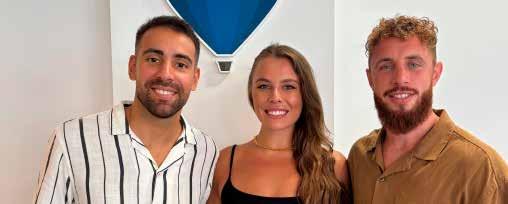
Built: 2020 - Asking price: € 435.000 EUR - VAT paid
The Prestige 420 Flybridge is a stylish and compact motor yacht offering modern design, a spacious layout, and smooth cruising, ideal for relaxed coastal adventures and entertaining onboard.
MY LOVE II is a 2020 build and 2021 model with Med specification, still in her first ownership, comprehensively equipped and well specified by her experienced yacht owner, including twin CUMMINS QSB 6.7 (2X425PS), diesel engines with joystick, 7.5 KVA Generator, 40,000 BTU tropical air condition, hydraulic bathing platform, hydraulic passarelle, full range of electronics, GPS track alarm, Bowers & Wilkens Bowers & Wilkins Sound and more.
Regular service and maintenance carried out, ideal positioned for a new owner to take over for the season 2026. Option for a berth in Mallorca can be discussed.
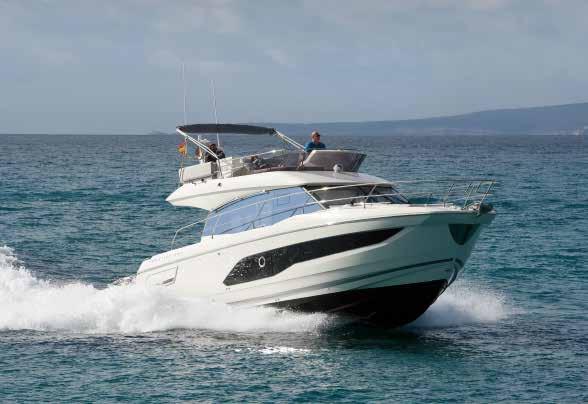
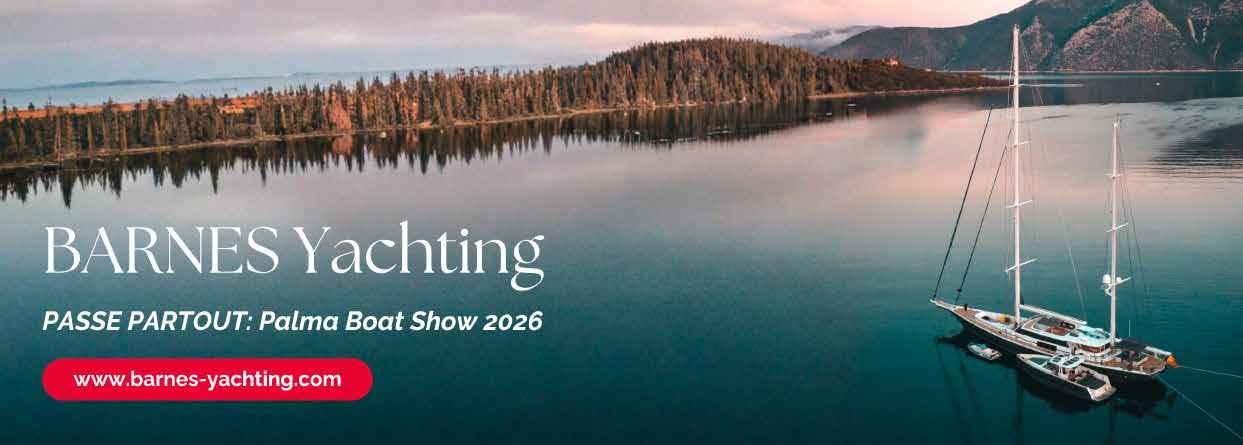

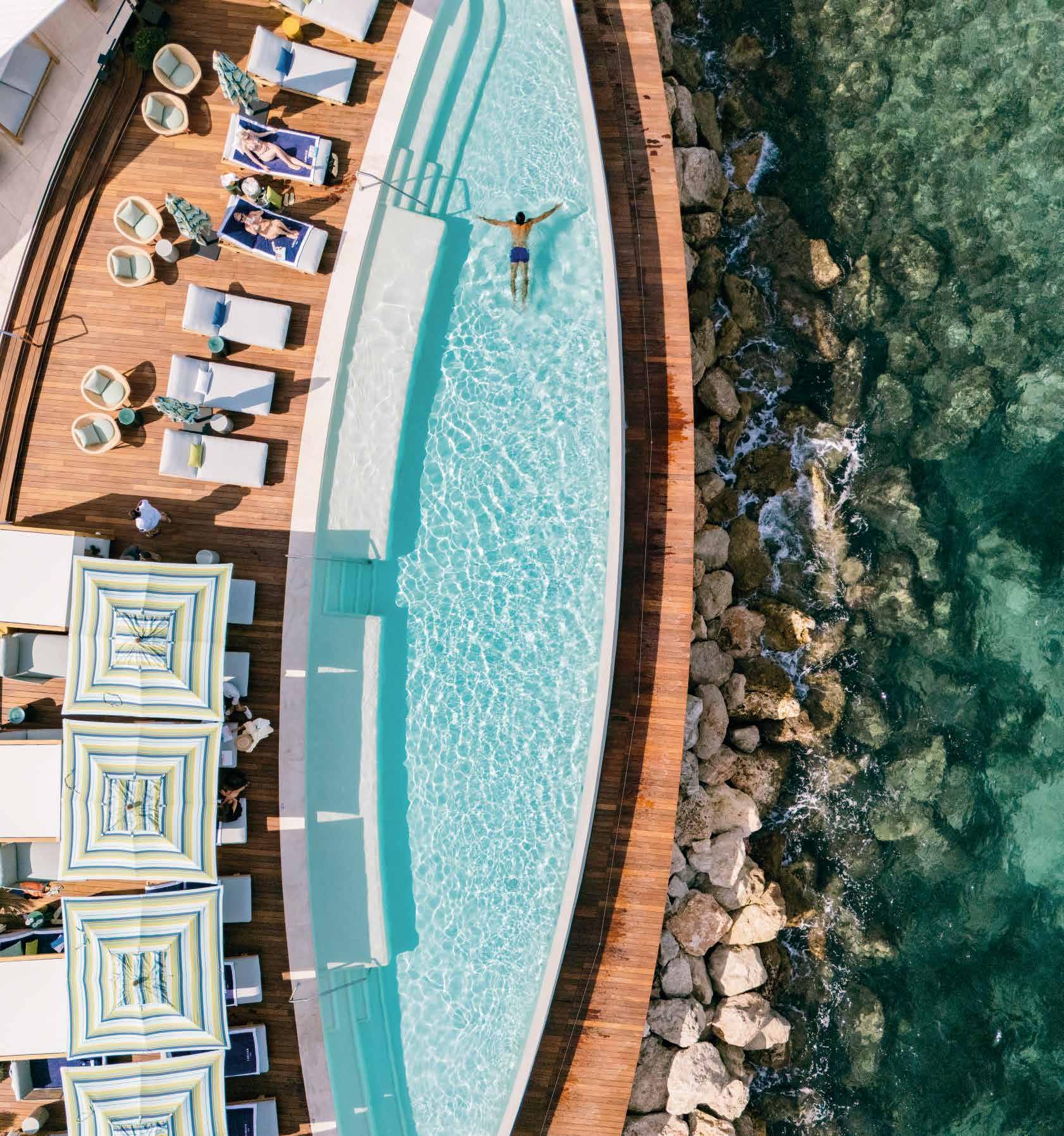
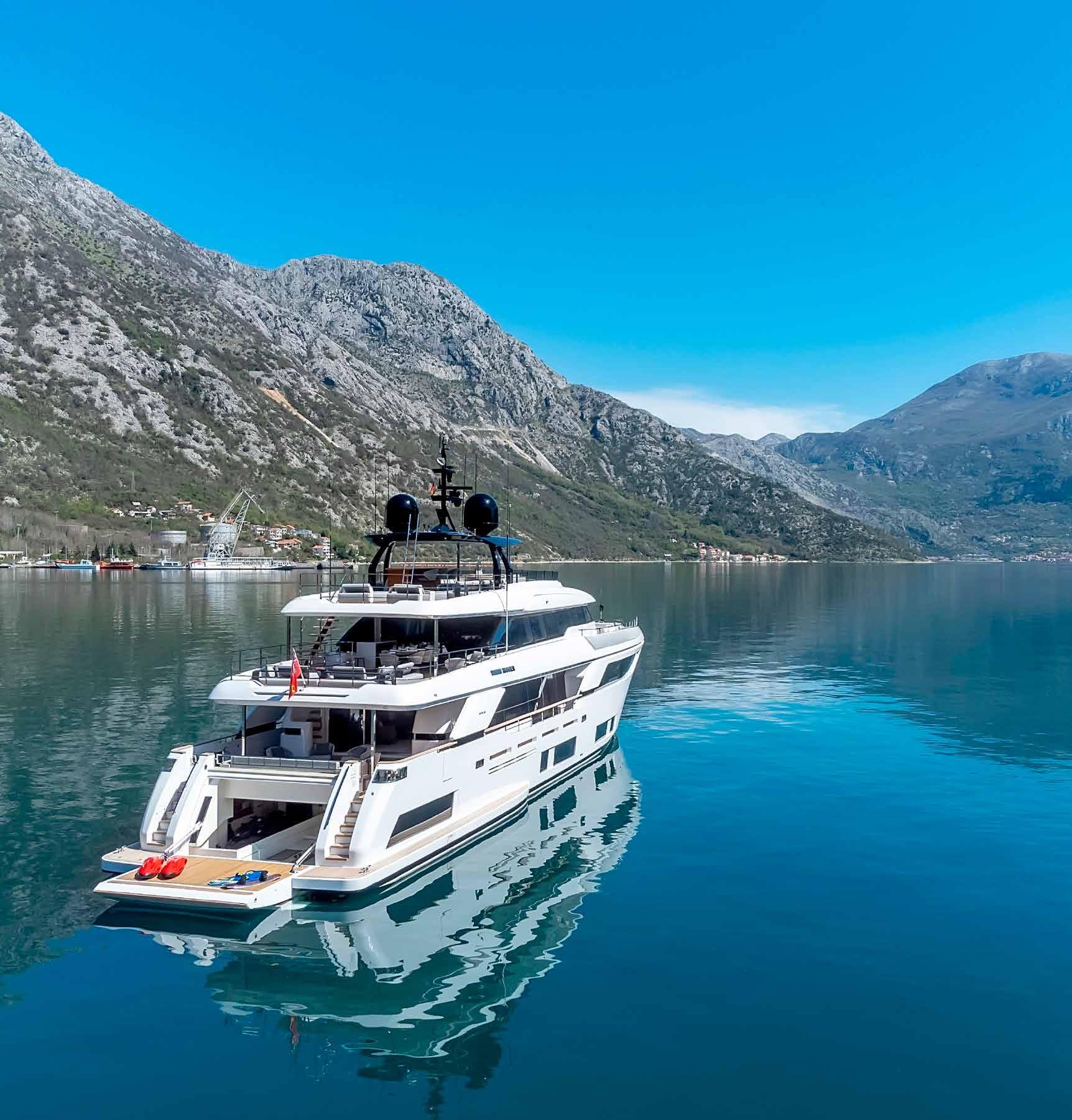
As a specialist International Yacht Brokerage, we plot a different course. Taking a more personal, more targeted approach. A boutique enterprise with international reach, we provide a bespoke, highly individual service.