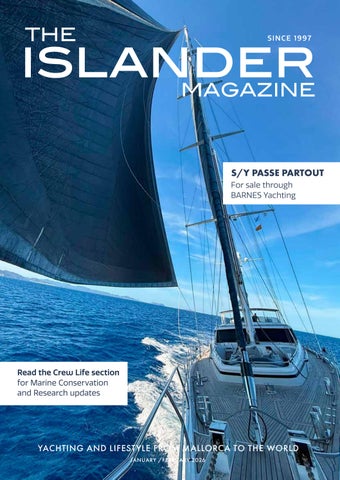
S/Y PASSE PARTOUT For sale through BARNES Yachting
Read the Crew Life section for Marine Conservation and Research updates
YACHTING AND LIFESTYLE FROM MALLORCA TO THE WORLD JANUARY /FEBRUARY 2026
Visit Our Website www.theislander.online
www.theislander.online
The Islander Team CEO (Creative Enthusiastic Owner) Jens Oomes Design CreArte Studio Accounts & Admin Marlot Cathalina Office Manager Natalie Tempelers
Editorial Support Kjell Van Hoecke Editor Jens Oomes Contributors Marlot Cathalina Karine Rayson Clair Minto Barry D’Arcy Bec McKeever and Dominique Smit (Virtual Pursers) Tzarina Mace-Ralph
Contact details Sales: sara@theislander.online Editorial contributions & press releases: editor@theislander.online Admin: admin@theislander.online Accounts: accounts@theislander.online Newsletter
Event calendar
ISLANDER YACHTING MEDIA S.L. VAT / CIF B72731938 POLIGONO 19 PARCELA 60, 07620 LLUCMAJOR, BALEARES SPAIN - DEPOSITO LEGAL: PM146-1997 Whilst the publishers have taken every care to ensure that the contents are correct they cannot take any responsibility for any losses incurred by readers as a result of any editorial or advertisement. The opinions do not necessarily reflect those of the publishers who therefore cannot take any responsibility for any opinion expressed. All rights are reserved and no part can be reproduced or stored without permission. La revista The Islander no se hace responsable necesariamente de todas las opiniones vertidas por sus colaboradores.
4
The Islander #329
Note from the CEO* *Creative Enthusiastic Owner
Welcome to our first issue of the year 2026. As we launch into a new year, I am proud to present the January – February edition of The Islander, an issue in which we have intentionally expanded our focus on marine conservation and research. This is more than a theme — it is a responsibility. As an industry powered by the oceans and privileged to spend our lives upon them, we cannot afford to underestimate the role yachting can and must play in safeguarding their future. It seems that in general, the potential of the yachting community to contribute to marine science has been overlooked. No other craft of comparable manoeuvrability and capability ventures as far and as often into remote ocean regions as yachts do. Every year, yacht crew, owners, and charter guests travel to areas that countless marine biologists, researchers and conservationists dream of accessing. Yet we reach them almost routinely, and usually without recognising the extraordinary opportunity this represents.
As the year unfolds, The Islander will continue to champion this intersection between exploration and conservation. If we can help shift perspectives — if we can inspire even a handful of yachts to collaborate with researchers, adjust their routines and perhaps adapt their charter offer by adding a research programme — the ripple effect will be far greater than we imagine. Thank you for joining us in steering the industry toward a future where yachting is not only a celebration of the ocean, but also a guardian of it.
Jens Oomes
In this issue, we shine a light on that opportunity. We highlight the inspiring work of organisations already bridging the gap between luxury yachting and scientific research. We explore practical ways in which crew, owners and guests can contribute — even with small, simple actions that collectively create meaningful impact. From data collection to micro-missions, from supporting research projects to adopting eco-conscious on board practices, yachting has the power to become a driving force for ocean knowledge and preservation. Raising awareness around this will form a strong part of our mission as a media channel. Many yacht crew are passionate about the seas, but passion only becomes progress when paired with understanding and action. That is why we have dedicated a number of pages to stories that educate, inspire and encourage. Our hope is that these insights spark conversations on board, influence decisions, and remind every reader that yachting’s connection to the marine world is not merely recreational—it is custodial.
The Islander #329
5
6
5. Note from the CEO 8. Judged by the cover 14. Tune in Thursdays
17 Industry Insider
First Pages
5
The Islander #329
18. Industry updates 24. TRIDENT 810: a true world cruiser is ready to build 30. The methanol moment: how alternative fuels are redefining the future of yachting 35. When team work makes the dream work - Meet Ben Field
83
44. Meet the crew: Mitchell Shelby 46. The Crew Coach: KPIs aren’t just for productivity — they’re for people 48. Chef Tzarina Spits it out! Learn from my mistakes. Protect yourself: red flags and safety steps for yacht crew 50. Chief Stew Shop: How to work seamlessly with deck crew (without the drama) 52. Chefs Chat - Johnathon Katz
Islander Life
Crew Life
43
54. Why yacht crew complaints are surging & what captains & managers must do 57. Ship to Shore: Esmee Yntema 60. European Resuscitation Council (ERC) Guidelines 2025 — What yacht crew need to know, and how to implement the updates
84. Thrilling finish at the Mar Blau Trophy: competitive Mallorcan club racing at its best 85. How your support helped JoyRon Foundation change children’s lives in the Balearic Islands 86. A night of giving in Palma at the 4Sight International Christmas Charity Event 90. Islander talks: Francisco upcycles used sails into bags 94. Interview with Mallorca based Isabelle Fournet on landscape, yachting, and the environment 98. Aina Bauzà first Spanish woman to finish Transat Café L’Or Atlantic race 100. Exotic Thailand Beckons 104. Gulets: The Boutique Hotels of the Sea
62. Virtual Pursers: Essential Tips for Reviewing a Seafarer’s Employment Agreement (SEA) – Compensation and Benefits (Part 5 of 6) 64. The novelties of Norway in November 68. Marine Conservation & Research
The Islander #329
7
A BROKER’S JOURNEY: THE STORY OF JOCHEN BRILL, SENIOR SALES BROKER BARNES YACHTING
W
ith more than three decades of experience across brokerage, new-build management, and technical yacht operations, Jochen Brill is recognized as one of the most respected and influential figures in the Mediterranean yachting industry.
JUDGED BY THE COVER Written & photos by BARNES Yachting
Known for his deep market intelligence, strategic negotiation skills, and long-standing relationships across Europe’s premier yachting hubs, Jochen has built a reputation for delivering exceptional results for buyers and sellers alike.
How it began Jochen began his career after completing dual degrees in Economics and Management, followed by an early chapter in the banking sector in Barcelona. His entry into the yachting world came when he joined the renowned shipyard Belliure as Export Manager, giving him a strong foundation in yacht construction, design, and international sales. He later expanded his technical expertise at the Palma Boatyard, working closely with M. Ritchie on complex refit and engineering projects. A Mediterranean specialist His brokerage career spans senior roles at some of the industry's most respected firms, including Michael Schmidt Brokerage, /Merrill Stevens, Dahm International - where he rose to the position of Sales Director - and Northrop & Johnson, where he further cemented his reputation as a leading Mediterranean sales broker. A new chapter Today, BARNES Yachting is delighted to announce that Jochen Brill has joined BARNES Yachting in Palma
10
de Mallorca as a Sales Broker for Spain. His extensive background, unparalleled regional knowledge, and decadeslong presence in the Balearics make him a significant addition to the BARNES Yachting team as the company strengthens its brokerage operations across Southern Europe.
Respected for his professionalism, technical insight, and authentic clientfirst approach, Jochen Brill remains one of the most trusted brokerage specialists in the Mediterranean yachting arena. Prestige access BARNES Yachting is reshaping access to the world of luxury boating through its forward-thinking Co-Ownership programme, a model designed to bring the dream of yacht ownership within reach. By sharing costs and responsibilities, clients enjoy all the pleasures of life at sea - freedom, privacy, and prestige - without the weight of full-time management or financial upkeep.
The Islander #329
“After thirty years in this industry, my job is still very simple: listen carefully, understand what a client really wants, and then use every bit of market knowledge to deliver the right yacht.” Jochen Brill
Extraordinary experiences on board For those wishing to indulge in the superyacht lifestyle without the long-term commitment, BARNES Yachting’s charter division opens the door to unforgettable voyages. Its fleet of beautifully maintained yachts sets the stage for exceptional experiences, complete with tailored itineraries, refined cuisine, and impeccable service. Whether exploring hidden coves or hosting sunset celebrations, every moment on board is elevated to something extraordinary. Trust and expertise At the heart of the company’s sales division lies a philosophy built on trust and expertise. Beyond facilitating transactions, BARNES Yachting curates an exclusive portfolio of some of the world’s most sought-after vessels - each selected for its craftsmanship, design pedigree, and ability to meet the expectations of a truly discerning global clientele.
The brand’s strong presence on the international yachting circuit further reinforces its leadership. From the Monaco Yacht Show to the Cannes Yachting Festival and other premier events, BARNES Yachting showcases new fleet arrivals, introduces fresh co-ownership opportunities, and connects with enthusiasts and partners who share a passion for the nautical world. Driven by innovation, service excellence, and a deep understanding of modern luxury, BARNES Yachting continues to redefine seafaring sophistication - whether through sales, charter, investment, or shared ownership. ◆ Contact Jochen today: +34 627 54 25 54 j.brill@barnes-yachting.com Barnes-yachting.com
The Islander #329
11
Edition December 2025 - SAS DICKSON CONSTANT - capital 12.640.000 euros - 381 347 970 R.C.S. Lille Métropole - Photos : Dickson-Constant Sunbrella® is a registered trademark of Glen Raven, Inc.
https://www.portdemallorca.com/en
Enjoy life on the water with Sunbrella ® fabrics S TAIN A ND MOUL D RESIS TA NT DIMENSION AL S TABILIT Y
E A S Y TO CLE A N
U V/FA DE RESIS TANT
Find the whole Sunbrella Marine collection at your nearest Sunbrella Marine Partner.
sunbrella.eu
Dream destinations Desired timings With our fixed sailing schedules and dedicated float-on/float-off yacht transport vessels, you can rest assured that your yacht is on time where it needs to be, which gives you the time to relax, enjoy, or reunite. We offer dedicated sailings to the most sought-after destinations and events.
Schedule 2026 JANUARY Papeete
Auckland
FEBRUARY Ensenada
Palma
MARCH Golfito APRIL Palma
Palma
Palma Port Everglades
MARCH | MAY Port Everglades MAY St. Thomas
Brisbane
Palma
Palma
E dyt.spain@yacht-transport.com T +34 871 201 696 WWW.YACHT-TRANSPORT.COM
Explore all our sailings
TUNE IN THURSDAYS AN INSPIRING AND FUN EVENING
O
n Thursday, 6 November, Santina in Santa Catalina gradually filled with familiar faces and newcomers arriving for what had been announced as another edition of Tune In Thursday.
The event was supported by U-Moke Mallorca, known for its electric beach car rentals and sales. www.u-moke.com
We counted at least 11 different nationalities. Mallorca expats, brokers, yacht crew, marina managers, and many more interesting people showed up for the relaxed networking session. Host Jens helped people break the ice as drinks and tapas circulated.
Want to know when our next event is? Visit our events page to register and be part of our community. https://theislander.online/events 14
The Islander #329
Scan me
The Islander #329
15
FIND HERE
SCA N
E ZIN A G
M
SCA N
THE ISLAND IND ER F O MA T E
E ZIN GA
M
The Islander Magazine can be found in +100 pickup points in Mallorca and in all superyacht marinas of Spain. We are also represented in strategic points in the French Riviera such as at the exclusive Billionaire's Quay in the port of Antibes. And you can also find us in all Cappuccino’s in Spain and Gstaad.
THE ISLAN D IND E RM OF A ET
18. Industry updates 24. TRIDENT 810: a true world cruiser is ready to build 30. The methanol moment: how alternative fuels are redefining the future of yachting
Industry Insider
35. When team work makes the dream work - Meet Ben Field
The Islander #329
Industry Insider
17
Southern Wind presents the highly anticipated SW108 Kalantis
Industry Updates Sanlorenzo’s 58steel redefines the 60-metre superyacht segment Sanlorenzo’s new 58Steel signals a confident step into the future of superyacht design between 55 and 60 metres. Building on the success of the 57Steel, the first unit Perla Lunar combines a reengineered platform with an advanced diesel-electric system that cuts emissions by around 10% while delivering an almost silent cruising experience. This innovation frees over 40 square metres of additional space on board, allowing for expansive interiors and an elevated sense of privacy and comfort.
Southern Wind has launched SW108-03 Kalantis, the third yacht in its SW108 series, with a moonlit christening that underlines her “perfect balance” of performance and sophistication. Built in full carbon with a lifting keel and high-modulus rig, Kalantis is designed both for competitive regattas and fast, comfortable world cruising. A standout feature is the Seaside Lounge: an opening transom and aft deck that create a beach club and direct connection to the sea. The deck and foredeck are optimized for toy and tender storage, while a flexible four-cabin interior and luminous saloon embody the owner’s brief for versatility and comfort. ◆ https://sws-yachts.com/yachts/sw108
YEARS
COLOUR GUARANTEE
With an increased beam of 10.8 metres, the 58Steel offers volumes comparable to a 64-metre yacht, featuring two fullbeam VIP suites on the lower deck, a Supreme VIP on the main deck and an owner’s deck conceived as a private sanctuary with pool and cinema lounge. A three-sided beach club with bar, hammam, gym and beauty salon reinforces the yacht’s strong connection to the sea, while its sculptural exterior lines express Sanlorenzo’s ongoing pursuit of elegant, sustainable innovation. ◆ www.sanlorenzoyachts.co.uk
HIGH QUALITY AND CUSTOMIZED
FENDER COVERS
WELCOME MATS | TOWELS | AND MORE Visit our website or request a quote via email
Yacht Support Group - Mr. Paul van Westing paul@fender-design.com +34 677 814 789
18
Industry Insider
The Islander #329
fender-design.com
Why 81% Americans would rather sail on a private yacht than fly on a private jet
Key Findings
Americans dream big about luxury yachting Yacht.com recently conducted a nationwide survey among 1,006 Americans to understand how they dream about, value, and prioritize luxury yachting experiences. The results reveal a striking contrast between lived experience and aspiration: only a small fraction have ever set foot on a yacht, yet an overwhelming majority would seize the chance if money were no object, and many are prepared to spend several thousand dollars for a week at sea. Mediterranean leads as Americans’ top yacht fantasy When imagining the perfect yacht voyage, the Mediterranean tops the list of dream destinations for Americans. Just over 40% name it as their first pick. The Caribbean (20%) and Northern Europe (8%) are the next two top choices. At the bottom of the list are the Middle East (0%), South America (2%) and Central America (2%). Ideal yacht trips: two weeks at sea with partners, friends and family When it comes to how long and who they’d charter a yacht with, most Americans would bring the same kinds of people and stay for the same amount of time at sea. The majority would take either a significant other or a friend (54%), while another 39% would take other family members. As far as the perfect amount of time at sea? That would be a full 14 nights. Gen Z would opt for the shortest trip, at 11 nights, while Gen X would choose the longest, at 15.
•
Only 13% of Americans have sailed on a yacht, but 94% would if it were offered for free.
•
Americans, on average, are willing to spend a total of $4,181 for a one-week private yacht trip.
•
A majority (81%) would rather sail on a private yacht than fly on a private jet, and 69% would rather travel on a yacht than visit Disney World.
•
The celebrities Americans associate most with yachting are #1 Leonardo DiCaprio, #2 Jeff Bezos, #3 Beyoncé, #4 Kim Kardashian and #5 Elon Musk.
•
If Americans could pick a captain for their dream yacht trip, they would want #1 an experienced captain, #2 Captain Jack Sparrow or #3 spouse/ partner.
Cruises are familiar, but yachts are more coveted Cruises, on the other hand, are far more familiar to many Americans. Almost half (42%) have ever taken a cruise. That’s over 3X as many Americans who have sailed on a yacht. Of all Americans, 90% would take a cruise if it were offered for free, which is less than the number that would accept a free yacht trip. In fact, 1 in 10 Americans would turn down a free cruise, but only 1 in 20 would turn down a free yacht trip. Dream cruise maps mirror yacht fantasies The top dream cruise destinations are the same as the top yachting destinations, just in slightly different order. At #1, with 25% dreaming, is the Caribbean. In a close second is the Mediterranean with 24% dreaming. Then Northern Europe lands a distant third at 10%. The bottom of the dream cruise list is the same as for yachts, in the same order — Middle East, South America and Central America. Who’s at the helm? Pros, pirates and partners When asked who should captain their dream yacht, Americans blend pragmatism and escapism: an experienced professional is the clear first choice, trailed by the fictional Captain Jack Sparrow and, endearingly, their own spouse or partner. Together, the findings sketch a portrait of a country that romanticizes life at sea and sees yachting as the pinnacle of aspirational travel, even as everyday realities of budget and time keep most people firmly on shore. ◆ www.yacht.com/american-state-of-yacht-dreams
Industry Update
The Islander #329
Industry Insider
19
What to see at boot Düsseldorf boot Düsseldorf takes place from 17 until 25 January 2026 www.boot.com
Sunseeker’s Manhattan 56 takes centre stage Sunseeker International will make a high-profile return to boot Düsseldorf 2026 with a five-yacht line-up that underlines its reputation for innovation, craftsmanship, and performance. At the heart of the display is the world debut of the Manhattan 56, joined by the Predator 75, the 76 Yacht, the 82 Ocean Enclosed and the 90 Ocean, offering visitors an in-depth look at some of the British builder’s most sought-after models. Guests are invited to step aboard and experience the meticulous detailing and refined design that define every Sunseeker.
The Manhattan 56 writes a new chapter in a celebrated story, reimagining the iconic Manhattan 55 of the 1980s, a model renowned for its style, space, versatility, and suitability for owner operation, with 103 units built. To mark the launch, Sunseeker will host an exclusive VIP evening, giving owners and brand enthusiasts a private preview and the chance to celebrate this modern evolution together. Alongside the Manhattan 56, Sunseeker will present its largest Ocean range models, conceived as havens of calm where the sea and time with loved ones take centre stage. The 82 Ocean Enclosed offers a serene retreat with expansive interiors and floor-to-ceiling glass delivering 360-degree views, highly customisable layouts, and bespoke interiors for a superyacht feel in a manageable size. The 90 Ocean, with its open Beach Club, easy water access, and generous flybridge with spa and entertainment areas, is designed for relaxed, sociable cruising. ◆ www.sunseeker.com
20
Industry Insider
Highfield Boats teases ADV9 debut Highfield Boats is gearing up for a high-energy presence at boot Düsseldorf 2026, where it will present a powerful line-up of adventure-ready RIBs and tenders, led by the world debut of its new ADV9 crossover model. Across nine days in Hall 9, Stand C25, visitors can explore a curated fleet that showcases the brand’s focus on performance, versatility, and comfort. Center stage is the ADV9, a high-performance cabin crossover capable of 50 knots and a 300 NM range, offering up to four berths, a heated cabin, galley, head, and optional camper hood for family, charter, and commercial use. Alongside it, the
award-nominated ADV7 reinforces Highfield’s credentials in the adventure segment, while the Patrol 660 provides rugged, ISO-certified capability for up to 15 passengers. The Patrol 540 Coaster serves as an ideal family starter boat, designed as a simple, ready-to-go package. Completing the display, Highfield’s premium tender range underlines the brand’s benchmark status in modern RIB manufacturing. To experience Highfield's innovative range firsthand and discover why the brand continues to set benchmarks in RIB manufacturing, visit Hall 9, Stand C25. ◆ www.highfieldboats.com
The Islander #329
Industry Update
Discover the Delta Powerboats 48 Coupé
Flensburger Yacht-Service will present the Delta 48 Coupé at boot Düsseldorf. She is a sleek, versatile, fast, and energy efficient sports cruiser made of carbon fiber. The Delta 48 Coupé on display is for sale, a full carbon sports cruiser with new features and low fuel consumption. Equipped with two inboard Volvo Penta D6-DPI 480, reaching a top speed of over 45 knots. View the remarkable Delta 48 Coupé in hall 4, stand A 61. ◆ Book your appointment at anja.eckart@fys.de www.fysbaleares.es
World´s first fully illuminated deck 100% customizable, app-controlled Starts at 5mm thickness, perfect for refits Highest quality Standards, made in Germany www.dexlit.com
Industry Update
The Islander #329
Industry Insider
21
Learn everything you need to know about working on 50ft - 100ft Luxury Yachts.
The Complete Training Program For Pocket Superyacht Crew by
Scan for more info & subscriptions
https://wops.teachable.com/p/how-to-work-on-pocket-superyachts
MARINE ENGINEERING PALMA • Marine Engines • Generators • Transmissions • Repowering • Sensor Systems • Troubleshooting O f f i c i a l
D e a l e r :
Udo Maekler - Master Technician Marine Engineering Palma, Calle Alexandre Laborde, 3, local 3 Poligono Can Valero, 07011 Palma Office: 0034 - 971 447 477, info@me-palma.com www.me-palma.com
The European Dental Practice
The Islander supports
Creating beautiful smiles
• Friendly dynamic team • Great with kids and nervous patients • Same day emergency appointments • Cosmetic treatments including whitening • Hygenist • Dental Implants • Invisible Orthodontics Monday to Friday 9.00 - 17.00 Evening & Saturday appointments available Calle Zaragoza, 1-1º, local 17-18 Mercadona Shopping Centre Son Caliu 01781 (+34) 971 681 439 / (+34) 636 308 789 www.europeandentalpractice.com
Written by Royal Huisman - Photos by Tim McKenna
TRIDENT 810
A TRUE WORLD CRUISER IS READY TO BUILD
A
series of 81m / 266ft overall length derived from the proven architecture of Royal Huisman’s flybridge schooner. Royal Huisman, known for being a true custom shipyard, turns dreams into singular yachts with design excellence, quality, and unmatched craftsmanship. TRIDENT 810 is the next step in the pursuit of the perfect custom XXL true sailing superyacht. Rather than reinventing the concept, it builds on what has already been achieved, offering owners and crew the rare opportunity to embrace a yacht that is both the essence of Royal Huisman and a true expression of their individuality.
TRIDENT 810 has dramatic, purposeful contemporary lines with a plumb bow. She is designed by Dykstra Naval Architects and Mark Whiteley Design. The very long waterline and powerful Panamax rig of TRIDENT 810 ensure effortless, mile-eating performance. Despite her massive sail area, all three mainsails can be hoisted simultaneously in no more time than it would take to hoist the sails on a yacht half her size. The efficiency of this advanced sail management system reflects the immense technical innovation behind it.
Effortless control meets grand sailing power What truly sets her apart is the effortless control she offers: an all-aluminium yacht of this magnitude can be sailed with the simplicity of a much smaller vessel. Such intuitive sail management redefines expectations and broadens horizons - even the most dedicated motor yacht owners
26
Industry Insider
will be tempted by the allure of a sailing yacht when they discover how seamlessly and enjoyably she can be sailed and with the significant efficiency advantage of free propulsion power (the wind).
The Islander #329
Engineered for enduring performance TRIDENT 810 builds upon a proven architecture, ensuring that the foundation of the yacht is already engineered to the highest Royal Huisman standards. Developed in-house and equipped exclusively with the finest onboard systems, TRIDENT 810’s architecture guarantees outstanding performance, long-term durability, and intelligent layouts designed for seamless serviceability. ◆
Learn more: royalhuisman.com/trident810
The Islander #329
+31 527 24 3131 yachts@royalhuisman.com
Industry Insider
27
Superyacht Services
Cruising Guides
Flags & Flag State Compliance
Full service superyacht navigation solutions — From Transas, Navtor, One Ocean & Compass, to Timezero, Lookout AI, and more. Onboard support to keep every voyage precise, compliant, and eeortless.
Largest selection of cruising guides and travel publications. From route planning to local insights, we provide all the materials and tools to cruise with confidence.
Comprehensive flag state compliance services to keep your vessel prepared, certified, and inspection ready. Free onboard audit services from the industry leader in flag and safety supplies.
For over 40 years, Bluewater Books & Charts has been your trusted source for navigational needs and flag state compliance. Our experienced team will steer you on a path to safe boating and maritime adventure. From oldschool cruising guides to the latest modern cartography, we invite you to “Escape from Ordinary” +1 (954) 763 6533 3233 SW 2nd Ave Fort Lauderdale, FL. 33315
www.bluewaterweb.com
Escape From Ordinary
CHARTS
GUIDES
FLAGS
SAFETY
THE METHANOL MOMENT HOW ALTERNATIVE FUELS ARE REDEFINING THE FUTURE OF YACHTING Written & photos by Archipelago Yachts
A
s the marine industry faces growing pressure to decarbonise, methanol is emerging as a realistic, scalable solution, bridging today's technology with tomorrow's zero-carbon ambitions. From container ships to superyachts, the industry accounts for nearly 3% of global greenhouse gas emissions. Regulators are tightening standards, consumers are demanding cleaner alternatives, and the window for action is narrowing. For decades, diesel has dominated, but its reign is ending. For the leisure sector, methanol offers unique advantages. Unlike hydrogen, which requires either high-pressure storage tanks or cryogenic systems, methanol remains liquid at ambient temperature and handles easily. While batteries offer zero local emissions, limited range makes them impractical for extended cruising. Methanol bridges these gaps, balancing performance, safety, and environmental responsibility.
The decarbonisation challenge High-net-worth individuals are increasingly demanding vessels that reflect their values that sustainability credentials matter as much as performance. Marinas and ports are also introducing green berth incentives and, in some cases, restricting high-emission vessels.
Despite this, diesel remains entrenched in the industry. Methanol's rising star What distinguishes methanol is its production pathway. While conventional methanol derives from natural gas, renewable e-methanol can be synthesised from captured CO₂ and green hydrogen produced via electrolysis powered by renewable energy. This circular approach means combustion CO₂ emissions are balanced by the CO₂ captured during production, achieving net-zero emissions over the full lifecycle. As renewable energy costs fall, e-methanol economics improve, making it genuinely scalable. Methanol also delivers tangible combustion benefits: significantly lower nitrogen oxide and particulate emissions than diesel, zero sulphur emissions, and carbon dioxide reductions of up to fifteen percent even with fossil-derived methanol, approaching zero with renewable variants. Crucially, methanol integrates with existing engine technologies. Modified internal combustion engines can run on methanol with minor adjustments, avoiding wholesale redesigns. It also works with fuel cells, where methanol reforms into hydrogen onboard, enabling zero-emission propulsion without pure hydrogen's storage challenges. 30
Industry Insider
All alternative fuels come with drawbacks, especially for the leisure yachting industry. Methanol strikes a pragmatic balance: safe, scalable, available now, with a clear pathway to full decarbonisation as production matures.
Technical and operational hurdles Despite its promise, methanol faces its own challenge, with renewable e-methanol remaining in limited production. Safety and regulatory frameworks also present various hurdles. Methanol is toxic if ingested and mildly corrosive, requiring robust handling procedures. Infrastructure is perhaps the most immediate constraint. Methanol refuelling facilities are sparse outside industrial ports, and leisure marinas lack incentive to invest without critical mass. Integrating methanol systems within yacht confines also presents engineering challenges. Methanol has roughly half diesel's energy density, requiring larger tanks for equivalent range.
From commercial to leisure The leap from commercial vessels to leisure yachts requires translating industrial robustness into elegance and comfort. Technologies proven in harsh commercial environments must be refined and integrated where aesthetics and user experience are paramount. The Archipelago zero.63 exemplifies this evolution. Designed as a methanol-hydrogen hybrid, it combines parallel hybrid propulsion with onboard reformers and fuel cells alongside a methanol combustion engine, enabling long-range, zerocarbon cruising. The vessel’s design is centred on flexibility and resilience. The methanol engine provides reliable propulsion and range extension, while fuel cells offer silent, emission-free operation for coastal cruising and harbour manoeuvring. Reformers convert methanol into hydrogen on demand, eliminating high-pressure storage needs, an elegant solution prioritising practicality without sacrificing ambition. For yacht builders, methanol represents a differentiation opportunity. As regulations tighten and preferences shift, early adopters gain competitive advantage. Collaborations such as the work between Archipelago Yachts and Chartwell Marine are proving essential, combining expertise to cut risk and bring solutions to market faster. Ports and marinas must evolve in tandem. ◆ www.archipelago-yachts.co.uk
The Islander #329
https://rialtoliving.com/en/
LET THE BEST SHIP YOUR YACHT
Rauma
Gdynia Southampton La Rochelle
Newport
Kiel Genoa
Tivat
Istanbul
Palma Gibraltar Palm Beach
St. John’s St. Thomas
Le Marin
PLEASE CONTACT US TO REQUEST A QUOTE T + 34 628 910 623 E l.ubbink@sevenstar-spain.com www.sevenstar-yacht-transport.com
34
Industry Insider
The Islander #329
Valetta
Marmaris
WHEN TEAM WORK MAKES THE DREAM WORK - MEET BEN FIELD Written & photos by i3
A career forged on the waves and in the workshops
B
en´s journey in the world of high-performance sailing began as a child, racing dinghies off the shores of Brighton. By the age of 16, he had transitioned to yacht racing out of Brighton Marina, quickly gaining experience on the south coast, Northern France, the Channel Islands, and Ireland. His first Atlantic delivery, at just 18, saw him sail from Brighton to St. Lucia, leading to several years immersed in Caribbean racing during the early 90s.Time period format “early ‘90s Upon returning to the UK, he honed his craft with a yacht fairing and painting company in Ancona, Italy, before embarking on formal studies in yacht manufacturing and management at the Southampton Institute (now Solent University). This academic foundation was followed by a period in London, where he applied his composite expertise to aircraft and Formula 1 projects at St. Bernard’s Composites in Farnborough. His entry into the elite world of racing and superyachts began at Green Marine, contributing to the construction of iconic vessels like the PlayStation round-the-world catamaran, Assa Abloy I & II Volvo 60s, Ghost, and Sojana. He also played a key role in building what was, at the time, the world’s largest composite superstructure for a motor yacht. In 2001, a significant career move saw him join the GBR Challenge America's Cup team, where he was instrumental in constructing both racing boats and crucial tank test models for research and development. Following this, he ventured to Fano, Italy, to build two Wally yachts, Alexa and Y3k, before his initial move to Spain, working at Barcos Deportivos in Tarragona. Ben Field contributed to Volvo 70 builds (Ericsson, Pirates of the Caribbean, two for Ericsson, one a race winner) and TP52s at Green Marine. In 2005, he led the interior structures team for Desafío Español at King Marine, Valencia, then joined Victory Challenge's shore team and collaborated with Killian Bushe. He later built Luna Rossa's STP 65, managed the TP52 Matador built at King Marine, and constructed large
booms and composite hatches at Rondal/Royal Huisman. Moving to Palma in 2009, he became Production Manager at BM Composites, also building masts for Volvo 70s (Abu Dhabi, Sanya) and wing masts for Artemis America's Cup. After BM, he was shore crew for Momo Racing (Maxi 72), then boatbuilder for Wally 80 Lyra, overseeing refits and acting as shore/race crew. He re-joined Luna Rossa in 2018 for the America's Cup in Auckland, then collaborated with Innovation 3 in Palma, before returning to Luna Rossa as a senior boat builder for the 37th America's Cup. Most recently, he has been in Holland at Rondal/Royal Huisman, building a 98-meter mast and various components, alongside an intensive testing program for new defence projects. Beyond his prolific building career, he remains an active sailor, competing in prestigious regattas such as Copa del Rey, Palma Vela, Les Voiles de St. Tropez, Loro Piana, and Maxi Worlds, as well as offshore races like the Caribbean 600, Fastnet, and Middle Sea Race, aboard a diverse range of yachts from modern classics to high-performance sports boats.
The Islander #329
Industry Insider
35
News As we go into 2026 i3 will be offering state-of-the art Rapid 3D scan to CAD solutions transforming how projects can be approached.
Did you know? Composites were invented for the military. The very first fibreglass-reinforced plastic (FRP) boat was built in 1942 by an American engineer named Ray Greene. He was commissioned by the U.S. military to create a lightweight, non-magnetic material for minesweepers. The techniques he pioneered were also used to create parts for military aircraft.
Projects
from a yacht's overall budget—resources that could be better allocated elsewhere.
75m Superyacht Composite Non Corrosion Vent Grills In the world of luxury yachting, efficiency and aesthetics often intertwine, making the i3 Louvre grills project a clever innovation. Historically, owners and crews of larger motor yachts have faced significant challenges regarding louvre grills, which serve essential functions such as engine room intake and ventilation. Painting these grills to the high standards demanded by superyachts has long been a labour-intensive and costly endeavor. The materials used often lead to persistent corrosion issues, resulting in an operational expense that can detract
Enter i3's innovative solution: meticulously engineered replacement grills designed to fit seamlessly into existing frameworks. Once painted, the new grills can be effortlessly mounted onto their composite frames, marking a significant departure from the cumbersome and inefficient alternatives currently available. For those with hands-on experience with traditional louvre grills, the advantages presented by the i3 system are clear: this is not just an upgrade; it's a game changer. ◆ https://i3composites.com
WHErE YOUR VISIONS MEET OUR INNOVATION
REFITS / REPAIRS / PRODUCTS / NEWBUILD www.i3composites.com
virgil@i3composites.com
(+34) 642 755 112
DUBAI INTERNATIONAL BOAT SHOW 8
12 APR 2026
THE EPITOME OF A LUXURY YACHTING LIFESTYLE
Scan For Info
HOSTED AT
ORGANISED BY
#DIBS2026 www.boatshowdubai.com For enquiries: Dubai.Boatshow@dwtc.com The Islander #329
Crew Life
39
Color It Your Way 5 yacht types, 121 solid and metallic color shades, and endless color combinations for hull, superstructure, and bootstripe – that’s our digital ALEXSEAL color configurator. The perfect tool to choose your favorite color shades. From now on, there are many chances for a first impression of your new yacht’s surface. Scan the QR code to explore the color configurator →
N EW
Color rator Configu instagram.com/alexsealpaint linkedin.com/company/alexseal-yacht-coatings
WWW.ALEXSEAL.COM
Your trusted Insurance Broker Protecting what matters the most, from the sea to the shore.
PERSONAL INSURANCE
MARINE INSURANCE
BUSINESS INSURANCE
Personal Advice | Multilingual Team | In House Claims Department +34 971 671 214
SANTANYÍ
WWW.SEIPPEL.COM
SANTA PONSA
INFO@SEIPPEL.COM
PORT D’ANDRATX
44. Meet the crew: Mitchell Shelby 46. The Crew Coach: KPIs aren’t just for productivity — they’re for people 48. Chef Tzarina Spits it out! Learn from my mistakes. Protect yourself: red flags and safety steps for yacht crew 50. Chief Stew Shop: How to work seamlessly with deck crew (without the drama) 52. Chefs Chat - Johnathon Katz 54. Why yacht crew complaints are surging & what captains & managers must do 57. Ship to Shore: Esmee Yntema 60. European Resuscitation Council (ERC) Guidelines 2025 — What yacht crew need to know, and how to implement the updates 62. Virtual Pursers: Essential Tips for Reviewing a Seafarer’s Employment Agreement (SEA) – Compensation and Benefits (Part 5 of 6)
Crew Life
64. The novelties of Norway in November
The Islander #329
MARINE CONSERVATION & RESEARCH 68. How your yacht can become a research vessel 70. Cabrera’s Sharks and Rays: uncovering knowledge to improve the health of the Balearic Sea 76. Behind the scenes of Fundación Palma Aquarium’s most unforgettable conservation year 80. Turning private vessels into ocean discovery platforms
Crew Life
43
MEET THE CREW INTERVIEW WITH MITCHELL SHELBY - CAPTAIN Written by Jens Oomes - Photos by Mitchell Shelby
T
his hilarious read will show you another side of the yachting industry. Warning: feelings of jealousy could arise as Mitchell Shelby probably wins the award of having the most fun in the yachting industry! Looking at your social media channels it is perhaps the fact that you bring so much of your personality to the job that intrigued us. It looks like you're always having fun, you make time to create good content and it seems your guests are mainly (good-looking!) Gen Z'rs. Are they your clients? My guests are a mix of friends I’ve collected along the way and brave souls who discover my trips through social media and decide, “Yep, I’m hopping on a boat with this guy.” I started Bluewater Breeze Co. in 2022 after realizing nobody was offering private charters for young, adventure-hungry travelers who don’t want to spend their vacation ironing polo shirts. When I captained high-end luxury charters, guests always fell into two groups: A) Adults who wanted rosé refills and five-star dining, and B) Their kids, who wanted to touch every rope, jump in at every anchorage, and push all the buttons. At 33, I’m still firmly in Group B. I prefer the “let’s see what happens today” crowd, not the “we need to be at the beach bar by 3PM sharp” crew.
44
Crew Life
How did you get into yachting? Entirely by accident—like most great stories. I started as a beach-cat captain on Waikiki, where landing a catamaran on a crowded beach while avoiding surfers felt like a high-stakes video game. If you mess up, you get a bonus round… with lawyers. Then I started doing inter-island deliveries, which led to a liveaboard captain job. One week of waking up at anchor with coffee in hand and a reef 20 feet away and I thought, “Well, I guess this is my personality now.” What is the wildest situation you ever got yourself into on board? Without question: a Waikiki landing during a rogue sneaker set. Picture this: I’m at the helm of a 45’ catamaran with 49 guests on board—half taking selfies, half asking me where the bathroom is—when a monstrous wave rises behind us like it forgot it was supposed to be in a disaster movie. This thing breaks over the stern, launches me into the wheel, shreds the bimini like tissue paper, tosses our fuel tanks overboard, and snaps the fuel line. Suddenly we’re a powerless bathtub toy being shoved toward the beach in front of 500 tourists with iPhones out. My crew activates like Marvel superheroes: one is calming guests while collecting belongings scattered across the deck. The other borrows a surfboard from a guy who definitely did
The Islander #329
NOT expect to join the mission and retrieves the fuel tanks like it’s an Olympic sport. I rebuild the fuel line on the fly, get the engines running, and somehow we make it in without anyone getting hurt. Guests thought it was “part of the Waikiki thrill package.” I didn’t correct them. This last year you have been at least in Nuku Hiva, Marquesas Islands where you met our CEO Jens, later you were in Croatia and Greece... Where else have you been, and what were your personal highlights?
I’ll be bouncing around the Caribbean as a relief skipper—like the substitute teacher of yachting, except everyone actually wants you to show up. You're currently working mostly on yachts under 60ft. Do you have any desire to work on larger yachts? If so, do you think you’ll have to become more formal or do you believe owners in this day and age are looking for outgoing crew as part of their yachting experience?
Some owners see my photo and think, “Absolutely Let’s just say I don’t exactly have the 'classic yachtie look'.With long hair, a After Greece and Croatia, I went to Turkey—aka the “I can't believe nobody not.” Others think, mustache, and a shackle earring, I tend to stand out. Some owners see my photo told me how good this is” of sailing “Finally, someone and think, “Absolutely not.” Others think, destinations. The food alone is worth crossing an ocean. The people? Even better. “Finally, someone fun.” I’m not opposed to fun.” Then I spent September and October in French Polynesia, which is basically where the ocean goes to show off. Every anchorage feels like it’s trying to win “Best Water on Earth.” Do you already know where 2026 is taking you? 2026 is shaping up like a choose-your-own-adventure novel where all the options are exotic. I’m waiting for a shipyard to finish a catamaran I’ll sail across the Pacific, and deliver to Hawaii. Since that keeps me from signing on for a full season,
bigger yachts, but if the job requires starching my uniform daily and addressing someone as ‘sir’ while handing them a cucumber water, I might not be the guy.
How do you see your mid-term career evolve and where do you see yourself in 10 years? Hopefully with a logbook full of wild stories, a few ocean crossings under my belt, and a questionable tan line. I’d love to be living on my own sailboat—no mortgage, just sunsets, sea breezes, and the occasional malfunction to keep me humble. What is your favourite cruising destination? The impossible question. Every destination is like a totally different character. But right now? French Polynesia wins. It’s close to Hawaii, the water is ludicrously blue, and the wildlife lineup looks like a roll call for an underwater superhero team—sharks, manta rays, stingrays, turtles. Every day feels like a nature documentary with a better soundtrack. Anything else you want to share with the Islander community? Sailors are a special breed—we willingly chase storms for fun, argue about knots, and think showering in the rain counts as fresh water conservation. Everyone has a story, and I love hearing them. So if you see me on a dock, come say hi. I’ll probably be barefoot, holding a coffee, and trying to look like I know which line I just tripped over. ◆
The Islander #329
Crew Life
45
CREW COACH KPIS AREN’T JUST FOR PRODUCTIVITY — THEY’RE FOR PEOPLE Written by Karine Rayson
W
Some of the people-centred KPIs included:
hen you hear “ Performance Management,” what comes to mind? Spreadsheets. Performance targets. Metrics. Micromanagement. Another tick-box exercise from corporate life creeping into yachting?
• Respectful Communication: Does the crew member navigate conflict calmly and constructively? • Team Contribution: Do they step in and support colleagues during pressure points? • Self-Management: Are they consistent, reliable, and self-aware? • Growth Mindset: Do they participate meaningfully in feedback, coaching, and learning opportunities.
It’s time to rethink that.
In fact, I encourage vessels to move away from the concept of performance management entirely and shift toward performance reviews — genuine, two-way conversations that strengthen relationships, clarify expectations, and support growth. And at the centre of effective performance reviews lies a tool many yachts still overlook: KPIs.
Yes — KPIs. But not the kind you’re used to.
In the luxury yachting sector, where exceptional service relies on teamwork, emotional intelligence, and human dynamics, KPIs can become something far more meaningful than checklists or productivity markers. When designed intentionally, with the individual in mind, KPIs create clarity, accountability, engagement, and a measurable pathway for development. Let me show you how.
Rethinking KPIs through a human lens Where do we measure psychological safety, morale, communication, teamwork, or human value?
These are the indicators that make or break a season, yet they too often go unmeasured. As part of our Uplevel Program, we’ve been working with several vessels to build holistic HR systems that blend leadership coaching with human-centric KPIs. One 50m charter yacht in particular experienced this shift firsthand. On paper, performance looked fine. Below the surface, our one-on-one crew debriefs told a different story: low morale, departmental silos, and crew feeling undervalued. What they wanted most wasn’t a pizza night or another team-building session, it was feedback, direction, and a sense of growth. But many heads of department had never been trained to conduct performance reviews that were anything more than administrative tasks. The problem wasn’t lack of effort; it was lack of structure.
Designing KPIs that measure what matters
Together with the heads of department, we co-designed a customized KPI matrix that measured not just operational performance, but the vessel’s core cultural behaviours.
46
Crew Life
These KPIs weren’t handed down from the bridge. They were co-created with the crew. For many vessels, this is where the magic happens: everyone understands what “good leadership” and “effective teamwork” look like because they helped define it.
The impact?
Fairness increased. Expectations became transparent. Trust began to rebuild. From Metrics to Momentum: Focus on supporting the crew to reach… Growth is the goal. Once these KPIs were embedded into their performance appraisals and 1:1 leadership check-ins, a shift occurred. A junior deckhand who felt unseen suddenly had a clear path forward; she could identify exactly what she needed to improve to progress in her career. With coaching and KPIaligned mentoring, she became one of the most motivated crew on board. In the galley, a chef who often struggled under pressure learned to regulate his emotions and communicate more calmly with the interior team. With consistent feedback loops, he strengthened not just his performance, but his relationships.
KPIs that cultivate culture
When done well, KPIs don’t just measure performance. They shape culture. They help the crew understand what’s expected of them not only in terms of tasks, but in how they treat each other. They make feedback conversations objective and psychologically safe. And they provide a roadmap for progression, something crew constantly say they want, yet rarely receive. For the captain of this vessel, KPIs became a time-saver and a stress-reducer. Instead of reactive management, he now had structured, consistent systems that aligned leadership across all departments.
The Islander #329
Making it work on your vessel If you’re curious about how to embed KPIs that serve both performance and people, consider starting here: 1. Redefine what success looks like Include behaviours, communication, and leadership traits, not just job tasks. 2. Make KPIs collaborative Involve crew in defining and refining them. Buy-in is everything.
The outcomes were undeniable: • • • • •
Reduced turnover Stronger cohesion Higher engagement More open communication A noticeable lift in morale
The bottom line?
KPIs are not just about getting more done. They’re about getting better together. In yachting, where the quality of crew dynamics directly affects service, safety, and longevity, we can’t afford to treat performance like a checklist. If we want to retain talent, we need to focus on the human-centric metrics.◆
3. Integrate with appraisals & coaching Use KPIs as the bridge between self-reflection, feedback, and career development. 4. Measure progress, not perfection Focus on supporting the crew to reach higher metric scores than the previous year.. Growth is the goal, not policing.
Karine Rayson The Crew Coach karine@thecrewcoach.com https://thecrewcoach.com
Tzarina Mace-Ralph is a talented yacht chef who appears in season 2 and the current season 3 of reality TV show Below Deck. Overnight she became a public figure with a large, predominantly U.S. fan base. While the yachting industry may have its own ideas of the show, Tzarina decided intuitively to use her reach to support deep causes. She was quoted in Rolling Stone magazine on how she addressed a sexual assault case. She has been featured in medical trade magazines on the impact of truly healthy food. In her regular Islander column, she shares her thoughts and observations on the yachting industry. Specifically, matters that affect crew. From Below Deck to under the surface.
CHEF TZARINA SPITS IT OUT!
LEARN FROM MY MISTAKES PROTECT YOURSELF: RED FLAGS AND SAFETY STEPS FOR YACHT CREW Written by Tzarina Mace-Ralph
R
ecently, as many of you saw on my social media, I was put in a dangerous situation on a yacht. I want to share my story so you can learn from my mistakes — and so we can all keep the crew safe. After a long break from yachting, I was eager to return. My guard was down. A friend passed me a lead for a chef job through WhatsApp. The “agency” turned out to be a management company, not a crew agent — already a red flag. The manager told me he was doing the owner a favour, finding a replacement chef immediately. Strange, but I pressed on.
So here’s what to watch for:
No contact with the captain = don’t board. Management company posing as agent = verify who’s who. Shifting details on rate, role, or itinerary = expect worse later. No written contract before travel = unacceptable. Excuses about the crew being too busy = walk away. Unclear accommodation = a welfare risk.
• • • • • •
When things feel wrong, they are. It’s better to say "no" than to walk into a trap.
Instead of the captain calling, I heard from a “personal assistant,” who quoted a different rate and role than the manager. Hours later, the owner called. Only later did I realise, the “PA” and the owner were the same person using the same number. My mistake? I hadn’t saved numbers in real time. Pro tip: always save contacts with name and role so you know who’s who.
If you do find yourself in a bad spot:
I repeatedly asked for a contract before boarding and to speak with someone actually on board — captain, chief stew, or the chef I was replacing. The answer was always, “Everyone’s too busy.” That should have been my hard stop. In our industry, not speaking with the captain is a massive red flag.
5.
I joined anyway. On arrival, no paperwork. No cabin. I was given a pull-out bed in the gym among unsecured equipment. The crew quarters had no AC. After two days, the itinerary changed and extra days were added without discussion. I raised it with the captain, the “PA,” and the manager in writing. That evening, while cooking dinner, the captain told me the owner had read my email and I was to pack and leave immediately. I was stranded ashore in Ibiza with no support. This isn’t about revenge — it’s about awareness. Many crew would have put their heads down. I didn’t. I fought back, and I want you to know you can too. We’ve all heard of a “blacklist” in yachting. Let me be clear: there isn’t one. I stood up for myself, worked my network, gathered facts, and got the best possible outcome. And yes, I’ve had jobs since.
1. 2. 3. 4.
Get safe first. Secure your passport and belongings. Document everything. Save emails, WhatsApps, photos. Stay professional in writing. Facts only, no emotion. Contact support. Organisations like ISWAN’s Yacht Crew Help, the PYA, or Nautilus can guide you. Use your network. Other crew and agents can back you up.
One more truth: management companies are not your friends. They work for the owner, not for you. Don’t let politeness fool you into thinking you’re protected. Your real protection is a proper contract, transparent terms, a reachable captain, and your own instincts. Learn from me: don’t rush, don’t ignore red flags, and don’t be afraid to walk away. This industry prides itself on seven-star service. That should extend to how crew are treated. Protect yourself — and protect the standard we all work so hard to uphold. If you’re a crew member who’s ever in danger or illegal matters are happening on board. This is who to contact:
YachtCrewHelp helpline contact details (all channels available 24/7 365 days): WhatsApp: + 447514500153 Phone: +44 203 713 7273 Email: help@yachtcrewhelp.org Live Chat: www.iswan.org.uk/yachtcrewhelp
The Islander #329
Crew Life
49
CHIEF STEW SHOP HOW TO WORK SEAMLESSLY WITH DECK CREW (WITHOUT THE DRAMA) Written by Clair Minto
I
f you’ve been in yachting for more than five minutes, you already know this:
Interior and deck crews are basically in a long-term relationship.
Small habits create huge flow: • •
You work together, depend on each other, annoy each other, and, at your best, make an effortlessly smooth guest experience. When things click between the two departments, the entire boat feels calmer, quicker, and more fun. When things don’t click… well, let’s just say the radio calls get a bit spicier. The good news is, 90% of the tension between Interior and deck isn’t personal. It’s just timing, communication, and perspective. And with a few simple shifts, the whole vibe can go from “mild turf war” to “dream team.”
Why Interior + Deck tension happens (and why it’s totally normal)
• •
It’s choreography, and when it’s done well, trust me the guests notice.
Help each other’s day, not make it harder • • •
This is where the real teamwork shows up. Tiny gestures go so far: Interior offering to help with the trash run after a passage The deck team seeing the dishwasher needs emptying and (gasp) emptying it! Plating for each other if you can’t make meal times
The Interior lives in the world of quiet elegance, lint-free everything, perfectly aligned cushions, and soft-close doors.
•
Deck lives in the world of noise, wind, salt, heat, and ‘we need to move the tender right now!”
These little cross-department favours build goodwill, trust, and that “we’re in this together” feeling everyone craves.
Both worlds are hectic, just in completely different ways. So, when Interior is lovingly placing orchids on the coffee table while the deck is dragging in wet lines and scrubbing the aft deck… a little friction is inevitable. But recognising that BOTH departments are under pressure (just different pressure) is the first step to making peace.
Respecting each other’s expertise
The golden rule: communication before action
If there were a single magic sentence that prevents 70% of departmental drama, it would be: “Hey, just a heads-up…” • • •
Deck letting Interior know when they’re about to start a washdown and to block the doors equals fewer wet carpets (and less murderous looks!) The Interior radioing deck that the guests are talking about jet skis makes sure someone is standing by to assist! And a million other little snippets of information that are easy to take for granted.
• •
Clair Minto info@chiefstewshop.com (+44) 781 667 8634
Creating a smooth guest flow (together)
www.chiefstewshop. com
Once guests are on board, the two departments ideally become one machine. Crew Life
The Interior is the domain of detail, textiles, guest psychology, and presentation. Deck is the domain of safety, logistics, machinery, and heavy lifting.
Problems start when one department “creeps” into the other’s lane. When everyone does what they do best and supports each other, life is easier for everyone. At the end of the day, the only goal is this: Make the guests feel effortlessly cared for. Not “prove Interior has it harder.” Not “prove Deck is busier.” Not “win” a departmental competition. When both teams think, “What serves the guest best right now?” the whole culture shifts. Suddenly, it’s collaboration over competition. ◆
Most drama doesn’t come from the task. It comes from being surprised by the task.
50
Clear, calm radio calls when guests move. (No mumbling. No cryptic code words.) Deck giving Interior a 2-minute warning that the tender is on approach. The Interior lets the deck know if guests are heading to the jacuzzi, so they’re ready to assist. Agreeing on who is responsible for everything such as, washing and folding towels, topping up sunscreen baskets, keeping coolers full etc.
IG: @chief_stew_shop The Islander #329
CHEF´S CHAT
JOHNATHON KATZ Interview by Barry D'Arcy from Ocean Earth Chefs
J
ohnathon Katz is a chef who doesn't fit the traditional mould of a yacht chef. With a deep connection to food and a creative,intuitive understanding of the ingredients he works with, it's easy to see why he has such an impressive food portfolio and a unique approach.
Where have you worked as a chef? Mostly on land. I ran my own restaurants back in Sweden for a few years, which was incredible but also exhausting in ways I didn't expect. After that, I moved into yachting, starting as sole chef on Blue II (56-metre). That was trial by fire but I enjoyed it. How would you describe your style of cooking? Honest and playful, full of flavour. I don't want it to feel forced or overdesigned. Food should make people curious, but also comfortable. I like food that makes you smile before you even taste it. What do you like to cook? That's always a tricky one. I enjoy almost anything, but I keep coming back to fire, grilling, smoking, and open flames. There's something raw and satisfying about it. Fire gives food depth, and it also strips cooking back to its roots. For me, it's about flavour and atmosphere; it turns cooking into an experience. Where do you get your ideas and inspiration from? Everywhere. Other chefs, sure, but also ingredients, travel, and even just walking through a market. I don't believe in borders when it comes to food. And on yachts, you often get insane produce, the kind of fruit or meat you almost don't want to touch because it's already perfect. Inspiration often comes when you least expect it.
Where do you come from, and what is your age? I'm from Gothenburg, Sweden, and I'm 37 years old. It's a port city, so the sea has always been around me. Growing up there, you get a mix of traditional Swedish food and a lot of outside influence drifting in. I think that balance of old and new shaped how I see food today. It's also a city with a strong sense of community, and food was often at the centre of that. What made you want to become a chef? I've always liked creating things, and food just gave me this perfect mix of freedom and discipline. You can play with flavours and presentation, but at the end of the day, it's also about feeding someone, which grounds you. I guess it clicked because it felt both artistic and practical. And to be honest, I love how food brings people together; it's a language without words.
52
Crew Life
The Islander #329
What is the most challenging thing about being a yacht chef? Reading people. Guests rarely say exactly what they want, but you still need to know. And you need to get it right immediately. There's no time to warm up. You have to be intuitive and confident in your choices.
What keeps you going on the long days in the galley? Stubbornness, honestly. Once I start something, I want to finish it. But also, the simple buzz of seeing people enjoy the food. That energy is addictive. And when you're tired, reminding yourself that you're lucky to do what you love helps push you through. Has the way you cook changed over the years? Yes, massively. I used to complicate things, lots of elements, lots of fuss. Now I trust simplicity more—fewer ingredients, bigger flavor. Less is more, and confidence lets you strip things back. I've learned that restraint can be just as powerful as excess. What are your favourite places to eat? I can't pick one. I love good, honest food. That could be a Michelin-starred place or a backstreet joint that only makes one dish. I've had meals in little tavernas that rival anything fine dining could throw at you. For me, it's less about the price tag and more about the soul of the food. How do you spend your time away from the galley? With my wife and our two kids. Time away from boats or kitchens is rare, so when I get it, I try to be present with them, cooking together, being outdoors, or just slowing down. Those small, simple moments are what recharge me. ◆ w
What is the most hallenging place you have worked and why? Without a doubt, my own restaurants. Everything was on me, the menus, the staff, the finances, and even whether the chairs got fixed. It was intense, but it forced me to grow up quickly as a chef and as a person. Running a business is a whole different education compared to just cooking. What is the best piece of advice given to you as a chef? Stay humble. You never stop learning. The moment you think you know it all, you're done.
The Islander #329
Crew Life
53
WHY YACHT CREW COMPLAINTS ARE SURGING & WHAT CAPTAINS & MANAGERS MUST DO Written by Rebecca Whitlocke - Photos by Cornerstone Crew Management
P
icture this: A crew member gave a verbal resignation after returning from medical leave yet never put it in writing. The captain, under strain during a tight charter run, let her work past what would have been her notice term. When tension rose and she later walked off the yacht citing an injury, management checked the file and found no formal documentation. What followed was a long dispute over pay, leave rights, and notice. The lack of a written record meant the owner later faced costs close to three times what would have been due to her had the process been handled with care. As this case file from Cornerstone Crew Management shows, oversight can turn a small lapse into a large claim.
The Islander spoke with Cornerstone Crew Management to learn why the rise in crew issues is driving more captains, owners, and managers to seek expert support for crew grievances and disciplinary matters.
David Kneen from Cornerstone
When issues become costly crises The yachting industry is facing an uncomfortable truth: crew complaints are on the rise. ISWAN’s Welfare of Yacht Crew 2024 Annual Review found a 21.4% jump in serious cases, from bullying and harassment to pay and employment disputes. Life at sea intensifies strain on crew - they work long shifts, live and work in confined spaces, and come from a mix of cultures and age groups. For an industry built on communication, safety and trust, firm steps for how to raise and handle concerns are vital. When yachts lack such structure and guidance, it can lower morale, impact the guest experience, and damage the vessel’s reputation. By contrast, yachts with strong grievance procedures and trained support keep good crew far longer. They avoid legal battles, keep onboard operations smooth, and build a reputation that draws highly-skilled crew year after year. Leila Nafa from Cornerstone and Laura Beard from Yacht Crew Help at ISWAN
54
Crew Life
The Islander #329
Clear rules protect owners, crew & the vessel
Why external support matters
Both private and commercial yachts must meet strict rules on work terms, safe working conditions, notice, and grievance procedures. These are more than legal points; they are the backbone of life on board. When these basics are skipped or handled in a rush, disputes can escalate quickly.
Industry groups and long-standing support bodies have guided yacht crew for years on how to deal with rights and disputes. A recent Cornerstone case shows why this work still matters.
Employment termination adds another layer of complexity. Even when dismissal without cause is allowed, the employer must still follow set steps: pay due wages up to the last day worked, arrange repatriation, and issue correct sea time records. Mismanagement in these areas can lead to legal risk. Yachts gain real value when they work with specialists who know employment law, Seafarer Employment Agreements (SEAs), MLC rules, and Flag State terms. Swift guidance can stop a simple case from turning into a claim. David Kneen, Head of Crew Employment at Cornerstone, explains: “Our team is fast to act. They are always at the end of the phone to guide captains and yacht managers with crewrelated matters. Their skill and knowledge set them apart. They make sure crew issues are dealt with in the right way and do not grow out of proportion. Many cases seen in the press could have been resolved with ease had the right steps been taken at the start. Cornerstone acts as the link between crew, captain, and management to find a fair and amicable solution.”
“Swift guidance can stop a simple case from turning into a claim.”
A crew member was found drunk on duty - a textbook case of gross misconduct. The captain acted fast and alerted Cornerstone. Based on the facts, misconduct of this type often allows instant dismissal under most SEA contracts and Flag state rules. The yacht manager's wish was to firstly issue a written warning, but after discussion they followed the advice given by Cornerstone that no warnings were needed, thus avoiding substantial additional costs. These cases show repeating patterns. Captains and yacht managers work under tight time frames and face tough decisions. They need expert counsel that is discreet, fair, and free of judgement. Though the employer has the legal duty to hire and dismiss the crew, grievance-management specialists add real worth. Many are former crew and know the pace and strain of yachting life. They also have procedures and guidelines in place to deal with crew complaints and disciplinary issues. Today’s yachting world is complex, fast-paced, and in full view of the public. Crew concerns can no longer be solved in isolation. As Cornerstone’s case files show, fast action and professional advice can shield owners from risk and support leaders who often carry such burdens alone. Without it, even a small slip in admin or procedure can grow into a claim that harms the yacht, the crew, and the owner’s peace of mind. ◆ https://cornerstoneyacht.com
The Islander #329
Crew Life
55
www.mallorcaclothing.com Calle de ses Rafaletes 1, Palma 605 444 555
Medical Training Courses Medical Kits Specialist Training
MCA Proficiency in Medical Care MCA Proficiency in Medical First Aid MCA Update Proficiency in Medical Care MCA Proficiency in Elementary First Aid
Telemedical support
Palma: +34 666 289 298 UK: +44 2381 787 059
www.msos.org.uk
Palma Classroom Dates: 6th May 3rd June 8th July 16th September 14th October 11th November 9th December
Email: training@msos.org.uk
SHIP TO SHORE – ESMEE YNTEMA Interview by Jens Oomes - Photos by Esmee Yntema
E
smee, with almost 50K followers on Instagram, you are quite the internet sensation! Was this part of your plan when transitioning from a liveaboard yachting career to a land-based lifestyle? Not at all. When I started posting videos, it was simply a creative outlet while I was still working on board. I wanted to show the real, unfiltered side of yacht crew life — the beautiful moments and the challenging ones. One video went viral, then another, and suddenly my community grew into the tens of thousands. People connected deeply with the honesty and the behind-the-scenes perspective. That social media growth changed everything. It gave me visibility, opened doors, and highlighted how much guidance was missing in the industry. This is ultimately what inspired me to create Esmee Academy, now available for both Spanish and English-speaking aspiring crew around the world. In a way, social media didn’t just allow me to transition to land — it gave me a new purpose. You speak fluent English, Dutch, Spanish, and some German. What made you decide to create content in Spanish? When my videos started gaining traction, I noticed a huge gap: Spanish-speaking crew had very little high-quality information about entering the industry. Yachting is very English-dominated, and that can be intimidating. I wanted to bridge that gap and give more people access to clear, realistic education. As my audience grew internationally, I expanded into Englishspeaking content as well. Today, Esmee Academy supports both Spanish and English-speaking students with equal depth and personalisation. What were your worst moments while working on yachts? Have you encountered any issues in the yachting work environment that require more awareness? Yes. The toughest moments weren’t just the long hours — that’s expected — but the lack of boundaries, the burnout culture, and the situations where the crew felt they had no voice. I’ve seen people mentally and physically exhausted, afraid to speak up because they didn’t want to be replaced or blacklisted. There are still parts of the industry where unfair treatment, miscommunication, or unrealistic expectations go unaddressed. These issues need awareness, not to criticise the industry, but to make it more sustainable and supportive for future crew.
You made headlines in Spanish newspapers talking about working conditions. Did the press portray it the way you intended? They captured the general message, but as always, headlines were more dramatic than my actual words. My intention was never to attack the industry — it was simply to highlight the reality so people could enter with the right expectations and a sense of safety. The core meaning remained: advocating for crew well-being and transparency. Have you experienced backlash from your criticism? Surprisingly, no — not at all. I actually expected criticism when I started talking openly about the reality of working on yachts, but instead I received overwhelming appreciation. Most messages were from people thanking me for my honesty and transparency. They loved that I wasn’t painting the industry as something perfect or glamorous. I was simply showing the reality. In a world where aspiring crew have so many doubts and fears, speaking the truth was exactly what people needed. They felt drawn to the fact that I didn’t sugarcoat anything. And that reaction made me realise how important it is to have real conversations about the industry.
The Islander #329
Crew Life
57
This support also motivated me to create Esmee Academy, where that same transparency continues — guiding, informing, and emotionally supporting future crew with the honesty they deserve.
What were your favourite things about working on yachts? The travel, the ocean, the sunsets — and the friendships. Crew quickly becomes like family because you go through everything together. You learn to work under pressure, solve problems fast, and maintain incredibly high standards. Those are skills and memories that stay with you forever.
You’re offering online training for aspiring crew. Do you warn them about the gruelling hours? What does the program entail? Absolutely. I’m very transparent. Esmee Academy is not just a course — it’s a personal mentorship journey. I work 1:1 with every student so I can understand their personality, background, strengths, and goals. This allows me to help place them on yachts that truly fit who they are, rather than pushing them into any environment. The program includes: • • • • • • •
A complete Starter Guide covering everything you need before joining the industry CV polishing and interview preparation Clear explanations of industry standards, roles, and expectations Honest insights into hours, pressure, and maintaining boundaries How to spot red flags and know when to step away Ongoing WhatsApp support from enrolment to well after your first job A mentor who understands the industry and helps you feel confident and supported
My goal is to make sure students are not only professionally prepared, but also emotionally supported throughout the entire journey.
Are these the reasons why many people find it hard to make the transition? Are you one of them? Many people struggle, but for me personally, the difficulty came from something different. What ultimately made me leave was no longer having a sense of purpose. The long hours and constant travelling meant no routine at all: no sports, unstable friendships outside the boat, and very little time with family — especially during moments when I needed them the most. After years of that lifestyle, I felt like I had lost my identity. I knew I needed a change. But leaving is difficult because the money is great, and that financial security keeps many people on board longer than they intend. Still, if you lose yourself in the process, it’s simply not worth it. I’m proud I made the transition. That journey eventually evolved into Esmee Academy, which gave me the purpose I was missing — helping others navigate the industry with clarity, safety, and genuine support. Do you have advice for crew who are looking to leave yachting for a land-based life? Yes: • Plan your transition early, even if you’re not ready yet. • Save intentionally — having a financial cushion gives you freedom. • Recognise your transferable skills; yacht crew have far more than they realise. • Stay connected to ex-crew networks — opportunities often come through people who understand the lifestyle. • Be patient with yourself. Leaving yachting is an emotional shift. It’s normal to feel lost before you find your next chapter. Anything else you’d like to add? I’m incredibly grateful for the community around my content and now around Esmee Academy. My mission is to make the industry more accessible, honest, and supportive — in both English and Spanish. If my journey can inspire even one person to take a step forward — whether into yachting or out of it — then everything I’ve been through makes sense. ◆ Instagram: @esmeeyntema
58
Crew Life
The Islander #329
EUROPEAN RESUSCITATION COUNCIL (ERC) GUIDELINES 2025 WHAT YACHT CREW NEED TO KNOW, AND HOW TO IMPLEMENT THE UPDATES Written by Sara Grace Butler of MSOS
T
he European Resuscitation Council’s 2025 Guidelines on Cardiopulmonary Resuscitation were launched on 22 October 2025 and are designed to tighten the earliest, most time-critical links in survival: fast recognition, immediate CPR, and rapid defibrillation. The time advantage: why the first 3 minutes matter. In resuscitation, time is survival. The critical point for crew to hold in their minds is this: • The “most savable” casualties are those who receive CPR and AED Shock in the first 3 minutes. Survival drops rapidly for every minute without effective CPR/defibrillation—7–10% per minute without bystander CPR in shockable rhythms, so after 5 minutes we are down to a 50% survival chance. • According to the updated data, in well-functioning systems, ambulance response targets for immediately life-threatening calls are around ~7 minutes, and real-world averages are often 7–8 minutes or more. For yacht crew, the message is even sharper because we operate in a unique environment, which is both positive and negative for medical response - we are far from an ambulance on a moving hospital, but we are usually closer to the casualty than any shoreside responder, and our key CPR equipment (AED, Oxygen, BVM, suction) is often minutes—or seconds—away. That proximity is a genuine advantage, but only if we are trained, confident, and drilled to act.
THE REVISED CHAIN OF SURVIVAL (ERC 2025)
ERC has revised the Chain of Survival into four “rings” reflecting the full journey: 1. Prevention + Fast Recognition - Ensure crew know the reversible causes for stopping breathing and how to treat choking, heart attack, anaphylaxis etc. Ensure all crew know their DRABC protocol well enough to teach it to someone else at all times - drill hard!
60
Crew Life
2. Early CPR + Defibrillation (together) — the two lifesaving basics combined into one ring, highlighting that compressions and shocks are inseparable priorities. Ensure crew know how to perform high quality CPR by getting an MSOS trainer on pre season to drill them, and run surprise drills to ensure crew can get a defib to all areas of the vessel in under 3 minutes, get supplementary defibs on larger vessels.
3. Recovery and Survivor support - work with your MSOS TMAS (call the doctor service) for recovery while onboard, and logistical support for evacuation. Ensure crew know how to stabilise injuries, and how to treat shock. CPR HIGH BMI CASUALTY UPDATE: • Access: open clothing early, ensure you are compressing the centre of the chest (sternum), and rotate compressors more frequently if fatigue is high. Press down harder, aim for 5-6cm depth on larger casualties. • Airway/ventilation: obese casualties may be harder to ventilate—use two-person BVM technique, adjuncts (OPA/ NPA where trained/indicated), and oxygen early. CHOKING PROTOCOL UPDATE (adult and paediatric): “alternate 5 and 5” • Recognise Choking, Act Quickly, no sound means no time! Ensure crew know the international sign for choking (hands around the neck) and to check those who quickly and silently leave the dining table. • Say ‘Keep Coughing!’ The casualty’s best way to start to clear the airway • Give five back blows in between shoulder blades, upward thrust, increase firm pressure with each blow.
The Islander #329
• Give 5 abdominal thrusts (for adults/children >1 year). First make a fist, put your arms under theirs from behind, place thumb just above belly button, other hand on top, and thrust in and up, increasing firm pressure with each thrust. Think about anatomy, if available choose a rescuer a little taller and stronger than the casualty. • If pregnant or large belly, do a chest thrust, same action but on the sternal bone • If not relieved: continue alternating 5 back blows and 5 abdominal thrusts until relieved or the person becomes unresponsive. • If the casualty becomes unresponsive: start CPR protocol.
HOW TO IMPLEMENT THE CHANGES ON BOARD (a practical 30–60 day plan) STEP 1 — Update your written SOPs (Week 1) • Replace chain of survival and choking infographics and display in galley, crew mess, bridge.
• Print out infographics or flowcharts from the Skippers Medical Emergency Handbook or Ship Captains Medical Guide 2-3 days prior to drills, ask crew to revise and then run a topic based drill.
STEP 2 — Re-map equipment for “seconds, not minutes” (Week 2)
Do a timed walk-through: “collapse in each zone.” Your aim is to know you can get hands on chest in <60 seconds and AED at side in <3 minutes in all locations onboard. Use your yacht’s layout to your advantage. • AED: consider two AEDs on larger vessels or high-risk layouts. • Oxygen/BVM: Ensure all crew know how to apply a Bag Valve Mask (Ambu Bag) with a CE grip and how to connect up oxygen. • Comms: clear plan for calling TMAS service, what to say, and how to document timeline of CPR.
STEP 3 — Drill to the new priorities (Week 3–6) Run short, high-frequency drills, preferably with trainer defib and manikin. • 3-minute drill: collapse → CPR started → AED attached → first shock (if advised). • Choking drill: transition from effective cough → ineffective cough → 5/5 alternating → unresponsive → CPR. • Run an MSOS onboard training day which includes simulated drills and latest updates to ensure best level of preparedness. STEP 4 — Debrief and measure (ongoing) After each drill, capture time to first compression, time to AED attachment, compression quality feedback (if your AED provides it), and role clarity (who did what without being told). Have a no blame training policy, if people speak up about things they would do differently, we can learn and develop. THE BOTTOM LINE FOR YACHT CREW Medical incidents occur more frequently than any other emergencies on board sadly. If you and your crew are well trained, you can respond safely, quickly and efficiently to a medical incident even under your fight-or-flight response, so drill hard! MSOS are here to support you with any of your medical training requirements, on board or in the classroom for both first response and advanced courses. Please get in touch to book your training or support with your medical system. Guidelines referenced are aligned with the European Resuscitation Council 2025 recommendations and supporting international resuscitation science.◆
Sara Grace Butler
DTN RN Bsc, Expert Yacht Medical Trainer, MSOS sally@msos.org.uk www.msos.org.uk
The Islander #329
Crew Life
61
ESSENTIAL TIPS FOR REVIEWING A SEAFARER ’S EMPLOYMENT AGREEMENT (SEA) – CERTIFICATION REQUIREMENTS (PART 5 OF 6) Written by Virtual Pursers
W
hen reviewing a Seafarer’s Employment Agreement (SEA), compensation goes beyond the basic salary. While your pay is a crucial component. Many SEAs also include additional benefits that vary depending on flag state regulations and employer policies. Understanding these provisions is vital to ensuring you receive fair compensation for your work and protection in case of injury or other emergencies.
1. Check for additional benefits In addition to the base salary, many SEAs specify other forms of compensation and benefits. These may differ depending on the flag state, the type of vessel, and the specific nature of the duties involved.
Disability Insurance: If you are injured on the job and are unable to continue working, disability insurance is crucial. Some flag states set minimum compensation levels for seafarers who are permanently or temporarily disabled. In cases where the flag state doesn’t mandate a minimum, the employer may offer additional coverage. It’s important to understand what compensation will be provided, whether for long-term disability or a one-time injury payout.
3. Understanding local flag state laws Flag states play a significant role in determining compensation levels and benefits for seafarers. Depending on where the vessel is registered, local laws may dictate specific compensation rates for overtime, hazardous duties, and insurance coverage.
Seafarers: do not only Review Flag State Regulations: Always check the SEA to confirm the employer’s focus on basic adherence to the laws of the flag state. salary, but carefully This ensures that your rights are and that you are entitled check all extra pay and respected to the minimum compensation and insurance in your SEA benefits required by law. Hazardous Duty Pay: For seafarers to be sure you are fully Understanding the compensation and working in dangerous or hazardous protected and fairly benefits outlined in your SEA is essential to protecting your financial and personal environments—such as those on oil rigs compensated. well-being. By carefully reviewing provisions or vessels operating in conflict zones— Overtime Compensation: Some flag states require employers to compensate for overtime hours worked. It’s important to review the SEA for clauses related to extra pay for hours worked beyond the standard work schedule. If you’re working on a vessel that operates in high-risk conditions, overtime pay may be particularly relevant.
additional compensation may be mandated by the flag state or stipulated in the SEA. This compensation could be a premium added to the base salary, reflecting the increased risks involved.
related to overtime, hazardous duty pay, and insurance for death or disability, you can ensure that you are fairly compensated and protected in the event of an emergency.
Understanding these benefits ensures that you are adequately compensated for the risks and extra hours involved in your job.
This is the fifth installment in our series on SEAs. Stay tuned for Part 6, where we’ll cover contract termination and dispute resolution to further guide your review process. ◆
2. Death and disability insurance Another critical aspect of compensation and benefits is insurance coverage, particularly for death or disability while on duty. Seafaring can involve dangerous tasks, and having adequate insurance coverage provides peace of mind for you and your loved ones. Death Benefits: In the unfortunate event of death while at sea, some flag states require employers to provide compensation to the family of the deceased. Review the SEA for clauses relating to accidental death benefits, which can include a lump-sum payment or ongoing support for dependents. 62
Crew Life
Virtual Pursers co-founders, Bec McKeever and Dominique Smit provide yacht administrative assistance to all vessels, no matter the size of the yacht or the extent of the need. https://virtualpursers.com
The Islander #329
THE NOVELTIES OF NORWAY IN NOVEMBER JENS OOMES SWAPS WARM WATERS FOR AN ARCTIC ADVENTURE
A chance conversation about a historic Northwest Passage expedition It’s mid-August, and I’m having a beer with marine biologist and fellow adventurer Ricardo Sagarminaga. He mentions that he was invited to join an expedition through the Northwest Passage on a replica of the first ship ever to complete the passage with Roald Amundsen at the helm. The harsh conditions of the polar region have prevented many attempts to sail from the Atlantic to the Pacific over Canada and Alaska. In 1904, the Norwegian Roald Amundsen and his team were the first ever to succeed in navigating the ice floes and making it all the way to Nome, Alaska. Joining the crew of Alma af Frøya and preparing for the cold The owners of Alma af Frøya, a replica of Amundsen’s Gjøa, intend to repeat this journey in the summer of 2026. I decided to apply to join this adventure, and it was received with great enthusiasm. I was consequently invited to help deliver Alma from the Arctic Ocean Lodge, where she is based, to Skjervøy at 70°N. It would be a wonderful way to get to know the team and test the cold waters. 64
Crew Life
Alma docked The Islander #329
First impressions up north: Sortland, silence and a sparse welcome After two flights and a two-hour bus ride, I arrived late in the evening in Sortland. What excited me immediately was how everything was different. It was cold, dark, there were about four souls out on the street, and while I thought I was going to be picked up by car, I was given very brief instructions to make my way to “the harbour behind the hotel.” Three men on a workboat were waiting for me. With very few words, they welcomed me on board. Norwegians are quiet. That’s different for me. Meeting Alma: a traditional sailing ship far from superyacht luxury We arrived at the lodge and I saw Alma for the first time. With her traditional gaff rig and wooden hull, she was once again different from the yachts I usually sail. No cabin with an ensuite bathroom, but a cosy bunk in the saloon with nothing more than a curtain for privacy. First day at sea: short days, empty fjords and first-day-ofschool nerves The next day we set sail at 1 p.m. The sun started setting less than two hours later. The vast empty landscape with snowcapped mountains and not another vessel in sight—everything was new, and I was excited and anxious like a kid on his first day of school. Night sailing along cliffs, first port and a new sense of freedom I was immediately treated to a show of the fascinating Northern Lights. We skirted steep cliffs and, at midnight, after about eight hours of cold night sailing, we entered a commercial fishing port. I found out that none of the crew had ever been there. We simply tied up to a neat commercial wharf next to a big fishing boat. No need to check in; nobody came to ask questions, let alone charge a berthing fee. Another novelty for me. Tromsø, “the Paris of the North,” and ever more intense Northern Lights The next day we cruised on, passing through Tromsø. It’s called “The Paris of the North.” With a population of about 80,000 people, at 69.9°N it is the city that lies closest to the North Pole. That night, the Northern Lights were even more spectacular than the night before.
Dream sailing in the fjords and a growing pull towards the Northwest Passage Sailing a ship with this type of rig through a sunny but crisp cold fjord, rimmed by snow-capped mountains, wasn’t just a dream come true—it made me dream of what may lie ahead! The idea of joining them on the iconic Northwest Passage on this iconic vessel is becoming more appealing by the minute. Conversations on deck: preparation, safety and the challenge of funding On deck, I had interesting conversations with ship owner Terje Andre Pedersen. The biggest topic is the preparation for such an expedition—not just the safety aspects and the practicalities, but obtaining the funding forms a challenge that is at least equal to executing the journey.
Surrounded by orcas and humpbacks: a truly otherworldly wildlife encounter The last four days of my visit were spent in the Kvænangen Fjord, surrounded by hundreds of orcas and dozens of humpback whales. Living on the boat allowed us to be in the middle of the fjord before the other ships and RIBs arrived. We were a bit distraught to see some of the RIBs chasing the whales. Our captain chose to let the ship sit idle and confidently stated: “There are so many whales here, they will come to us anyway.” And so they did. To hear them exhale, to watch them check us out… It was an out-of-this-world experience. Where to follow Alma af Frøya and how to book your place on the Northwest Passage Want to learn more about Alma af Frøya, perhaps even book your spot on the Northwest Passage? Check their Instagram @amundsen. adventure and site www.arcticoceanlodge.com, and of course, watch this space to see how Alma’s Northwest Passage expedition will unfold. ◆
WE’RE SORRY Perhaps you find this ad hard to read but it’s not even half as hard as finding suitable crew for 50-100 ft Pocket Superyachts. We know, because we have been focused on selecting and supporting crews for these yachts for 10 years now. For help with understanding this ad and running your Pocket Superyacht (as owner or crew) contact jens@invisiblecrew.com or find out more at www.invisiblecrew.com. www.invisiblecrew.com | jens@invisiblecrew.com | +34 674 83 83 68
HOW YOUR YACHT CAN BECOME A RESEARCH VESSEL OCEAN SCIENCE NEEDS HELP Written & photos by Alnitak
Y
our yacht: a research vessel. Just as the Yachts as flexible research vessels “Calypso” of Jacques Yves Cousteau was The second role a yacht can play is that of actually conducting research expeditions, either opportunistically by recording transformed to become one of the most data with diverse instruments that can be easily deployed prestigious and cost-efficient oceanographic during sailing and anchoring, or by actually offering itself as a research vessels, your yacht could also play an research vessel to different specialist teams around the world, in a similar way to what Cousteau’s Calypso once did. important role in the conservation of our oceans.
The mystery of the “Blue Serengeti”
Despite the revolution in recent decades of our science of the atmosphere and oceans thanks to satellites, electronic monitoring systems and our capacity for analyzing big data, the open-ocean ecosystem still remains the least understood part of our planet. A vast three-dimensional “Blue Serengeti”.
How yachts support high‑tech science
So what role can my yacht play in this “scientific revolution" of modern technology? Well, firstly a yacht can assist with the vital task of calibrating EMS sensing and validating modelling of big data. That in itself is not only a very significant contribution to science and conservation, but it can also be a fascinating task, keeping alive the spirit of ocean exploration in its purest form.
68
Crew Life
The cost and limits of traditional research ships
For research institutions around the world, marine surveys are a huge economic and logistical challenge. One day of an oceanographic vessel can cost between €15.000 to €60.000. Just organising the paperwork before being able to go out to sea can easily take more than 12 months. And then, when you have it all ready, the bad weather comes in and you have no options to “come next week”.
Real‑world example: Alma and Toftevaag
Before going down to the abyss in the “Cañón de Avilés” (Bay of Biscay), the research vessel Toftevaag had sent some of its scientific instruments to the Arctic Lodge, in preparation for the Amundsen Expedition of the S/T Alma in 2026. A towed array hydrophone for monitoring cetaceans and noise pollution and a “Manta trawl” for sampling microplastics are just some of the instruments the Alma will take to the Arctic in its sail through the Northwest Passage.
The Islander #329
Marine Conservation & Research
Easy ways to turn your yacht into a “citizen science” vessel
You don't need any researchers on board if there is no space, but you can still make your yacht an opportunistic research vessel, deploying gear that requires no expertise, validating oceanographic and atmospheric EMS readings, listening to whales and dolphins, sampling environmental DNA, tracking tagged bluefin tuna, sharks, cetaceans, etc. It's not only useful, but also fun for you, your crew, and your guests on board.
Going further: charter yachts as full research partners
But take it one step further: become a dedicated research vessel for a couple of weeks. This is what Alnitak is proposing in 2026 to the charter vessel “La Juliana” in the context of the project LIFE OASIS. La Juliana was actually the first ferry to what is now the National Park of Cabrera. Restored in 2020, she is now a classy charter vessel operating in the Balearic Islands. In 2026, La Juliana will contribute to LIFE OASIS by providing a two-week-sea-turtle-tagging survey along the Emile Baudot Escarpment that runs south of the Balearic Islands. In exchange, La Juliana will offer a unique added value to its guests, discovering the amazing world of sea turtles, dolphins, and sperm whales in this “Mediterranean Blue Serengeti”, through exciting research activities, using drones, ROVs, satellite tags, CTDs, etc.
LIFE OASIS: inviting the yachting sector to “never stop exploring”
More about the Life Oasis Through project LIFE OASIS, Alnitak seeks to promote an project: active engagement of the yachting sector in marine research and conservation. “Never stop exploring!”. ◆
Marine Conservation & Research
https://alnitak.org/life-oasis-project
The Islander #329
Crew Life
69
CABRERA’S SHARKS AND RAYS: UNCOVERING KNOWLEDGE TO IMPROVE THE HEALTH OF THE BALEARIC SEA Written & photos by Save The Med
O
n a quiet spring morning in 2024, long before the first tourist boats stirred the waters around Cabrera National Park, a small team of marine scientists gathered on deck. Their mission was simple in theory, daunting in practice: to uncover the hidden world of sharks and rays living in one of the Mediterranean’s most pristine marine sanctuaries—without disturbing them.
in science-speak, as elasmobranchs. One component of the work involved monitoring and observation of various species through cameras, while another used satellite tags to track the movements and migrations of the Spinetail devil ray (Mobula mobular). Because so little is known about this particular species, the latter served as a standalone focus of the research.
This is the story of Sharks and Rays of the Cabrera National Park, a research project led by Shark Med and Save the Med Foundation between April 2024 and June 2025. Powered by patience and unwavering dedication to documenting the status of elasmobranchs, the study seeks to inform conservation and protection strategies for species—many of which are endangered in the Mediterranean.
According to the 2022 IUCN Red List of Marine Mediterranean Fish, 40% of native sharks, rays and chimaeras (i.e. Chondrichthyes) are regionally threatened with extinction.
Capturing the world below: highs and lows Throughout the research period, which spanned a little over a year, the team used various non-invasive techniques and tools to study sharks, skates, and rays—collectively known, 70
Crew Life
Camera action For the first component of the study, Baited Remote Underwater Video (BRUVs) devices were placed at different depths in the sea, to observe elasmobranchs in their natural habitat without interfering with 24/7 video data capture.
The Islander #329
Marine Conservation & Research
Underwater cameras, lowered gently onto the seafloor or suspended in open water from a large, solar-powered floating surfboard, filmed the comings and goings of sharks, skates, and rays. This enabled the researchers to quantify the number of species present, monitor their abundance, and track seasonality. It is not uncommon to capture a cameo appearance by a blue shark with a fishing hook stuck in the corner of its jaw, which tells us that this species is vulnerable to nearby fishing activity, with the risk of getting maimed by fishing gear, or worse - meet its end as bycatch in a longline. For more than 3,500 hours—day and night—the cameras rolled. What they captured was a vibrant, if unevenly distributed, community in the waters of Cabrera and the Émile Baudot seamount. In all, 606 individuals appeared in the footage, representing five species of sharks and twelve of skates and rays. Four species dominated the scenes: the Smallspotted catshark (Scyliorhinus canicula), the Thornback skate (Raja clavata), the Common stingray (Dasyatis pastinaca), and the Eagle ray (Myliobatis aquila). Together,
Marine Conservation & Research
they made up 80% of the visitors to the benthic (seafloor) BRUVs. Yet the sea still had surprises. Gliding into view were rarities: Brown stingrays (Bathytoshia lata), usually elusive in the Mediterranean; White skates (Rostroraja alba), a threatened species; and last but not least: Bluntnose Sixgill sharks (Hexanchus griseus), deep-sea giants appearing unexpectedly close to 90-metre depths. And then there were the absences—species like the Common smoothhound (Mustelus mustelus) that the team expected to see in abundance, but hardly appeared at all. In the open water, the story shifted. Pelagic sharks were sparse. Only 17 Blue sharks (Prionace glauca) were filmed over months—a mere one individual every six days. Then, one day, the cameras captured something extraordinary: the first underwater footage of a shortfin mako (Isurus oxyrinchus) ever recorded in the Balearic Islands. A fleeting moment, but a historic one.
The Islander #329
Crew Life
71
Following the spinetail devil rays If the BRUVs were the eyes of the project, satellite tags became its long-distance messengers. In July 2024, three Spinetail devil rays (Mobula mobular)—graceful, threatened giants of the Mediterranean Sea—were fitted with miniPAT satellite tags. The tags would detach after weeks or months, drift to the surface, and beam home stories of the rays’ journeys. The data revealed the devil rays’ life spent on the move, with recorded migrations of up to 750 kilometres and plunges into the deep blue reaching depths of up to an incredible 700 metres. Invisible clues in every drop Alongside cameras and satellite transmitters, the team collected another kind of evidence—something that couldn’t be seen at all. Environmental DNA, or eDNA, captures traces of organisms shed into the water: skin cells, mucus, tiny fragments that serve as genetic breadcrumbs. These samples, still being processed, promise to reveal which species passed through each site— even those that evaded every camera. Once complete, the eDNA analysis may provide the most comprehensive picture yet of Cabrera’s elasmobranch diversity, and tell a more hopeful story. Both the results and the experience carried highs and lows—
72
Crew Life
surprise, hope, and concern woven together—feelings the researchers carry with them as they work to raise awareness and deepen public appreciation for these remarkable and crucial animals of the open sea. Why this matters The Balearic Sea is home to a staggering 32 species of sharks, 27 species of rays, and 1 species of chimaera. Yet, despite their importance to the marine ecosystem, almost half of these species are threatened with extinction.* To develop a truly holistic conservation strategy, it is essential to thoroughly understand not only the current state of the marine ecosystem and the endangered species within it but also to challenge the widespread myth of sharks as dangerous predators, a fear fuelled by popular beliefs and folklore. The waters surrounding Cabrera National Park, and the nearby Émile Baudot Seamount rising 90 metres from the deep, provide refuge for some of the Mediterranean’s most threatened species. But without knowing who lives there— and how they move, feed, and migrate—conservation efforts are flying blind. This project, supported by the EU’s Recovery, Transformation and Resilience Plan (PRTR), the Regional Ministry of Agriculture, Fisheries and Natural Environment, and with notable collaboration from the Marilles Foundation,
The Islander #329
Marine Conservation & Research
provides exactly the kind of knowledge needed to protect these fragile communities. By pairing modern tools with minimal disturbance, Shark Med and Save the Med are charting a path forward: research that respects the sea’s inhabitants while revealing their hidden lives. Looking ahead As the final eDNA results come in and satellite tags continue collecting data, the team is already thinking beyond Cabrera. Their research forms part of a broader effort to understand elasmobranchs throughout the Mediterranean—a sea basin where sharks and rays have declined more than in almost any other region on Earth. But for now, Cabrera remains a beacon: a place where science is shedding light on creatures older than the dinosaurs, still carving their paths through the Mediterranean’s blue depths. And thanks to a few cameras, a few tags, and a great deal of dedication, we are finally learning their stories.◆ www.savethemed.org
Marine Conservation & Research
The Islander #329
Crew Life
73
We’ll Go The Extra Nautical Mile As a specialist International Yacht Brokerage, we plot a different course. Taking a more personal, more targeted approach. A boutique enterprise with international reach, we provide a bespoke, highly individual service.
+34 691 755 115 info@arrivalyachts.com arrivalyachts.com
BEHIND THE SCENES OF FUNDACIÓN PALMA AQUARIUM ’S MOST UNFORGET TABLE CONSERVATION YEAR Written & photos by Palma Aquarium
T
he Fundación Palma Aquarium has had a very busy year, undoubtedly one to remember.
Mysterious strandings of Giant Devil Rays in the Balearic Islands An extraordinary event took place at the beginning of summer with the sudden occurrence of Giant Devil Ray (Mobula mobular) strandings. These majestic animals, which usually live in deep, open waters, appeared stranded on the islands' coasts, exhibiting unusual behaviour. This exceptional phenomenon required months of investigation, analysis, and study to try to explain what happened. The cause currently remains unknown, but it is being closely scrutinized with groups of Mediterranean marine fauna experts.
A dramatic blue shark case reveals the hidden violence of the ocean One of the cases among all the marine fauna rescue operations in 2025 is worth highlighting: the stranding of a nearly 3-metre blue shark (Prionace glauca) that appeared alive on Cala Murada beach in Manacor. This female specimen died shortly after due to a swordfish bill that had pierced its brain. During processing, the CT scan confirmed it had 4 bills lodged in its head, one of them being fatal. Conservation projects for vulnerable species have also occupied a lot of the technical team's time and effort, but the achievements have been well worth it.
Over 200 marine animals rescued in a single year The Fundación Palma Aquarium rescue team has attended a total of 218 stranded marine animals, both alive and dead, consisting of 27 cetaceans, 118 sea turtles, 5 sharks, 8 manta rays, and 60 rays.
76
Crew Life
Endangered small sharks return to the Balearic Sea
The Islander #329
Marine Conservation & Research
The small shark conservation project (Scyliorhinus stellaris), a small shark considered endangered in the Balearic Sea, has achieved important success. After 4 years of work, nearly 300 specimens have been introduced into their natural environment. Very little is known about this species, and through the collaboration of an alliance of entities that make up this project, nearly 100 specimens have been tagged to monitor the animals to learn about their habitat preference, depth, temperatures, etc., which serves as a conservation tool for the species.
Marine Conservation & Research
The Islander #329
Crew Life
77
Seahorse breeding programme boosts wild populations The seahorse reproduction program has achieved a significant milestone, with the introduction into the Balearic Sea of 728 offspring, juveniles, and breeding pairs, all born at Palma Aquarium, to reinforce the natural populations
New protection project for vulnerable pipefish This year, 2025, the Fundación Palma Aquarium launched a new protection effort with a very little-known but equally vulnerable species: pipefish. These incredible animals require protection, and the project is in its preliminary phase
78
Crew Life
The Islander #329
Marine Conservation & Research
Raising the next generation of Balearic sea turtles For many years, the Fundación Palma Aquarium has maintained close collaboration with COFIB, housing, raising, and caring for the baby sea turtles resulting from the 2025 nesting events on the beaches of the Balearic Islands. Five weeks ago, the Fundación Palma Aquarium received 14 baby sea turtle specimens. The little turtles are growing at a good pace and gaining about 10 to 15 grams each week in this fir st stage of their lives.
Education and awareness across harbours, clubs and companies In terms of environmental education, actions in ports and nautical clubs have continued, along with campaigns with fishermen, summer camps, team building with companies, and an emphasis on the importance of education as a powerful awareness tool. None of what has been implemented this year would have been possible without the invaluable help of fishermen, sponsors, media, financial institutions, diving centres, private individuals, and volunteers.◆ palmaaquarium.com
Marine Conservation & Research
The Islander #329
Crew Life
79
YACHTS FOR SCIENCE TURNING PRIVATE VESSELS INTO OCEAN DISCOVERY PLATFORMS Written & photos by Yachts for Science
Y
achts for Science and Rosie O’Donnell are transforming the superyacht industry into a powerful force for marine conservation, proving that luxury vessels can do far more than cruise from one glamorous anchorage to the next. By opening their vessels to researchers, owners are helping to answer urgent questions about the ocean while giving their yachts a deeper, more meaningful purpose. A vital platform addressing a critical data gap With less than 10% of marine life identified and only a fraction of the ocean floor mapped, marine scientists face an unprecedented knowledge deficit. Yet one of the biggest bottlenecks in ocean research is access to sea time itself. Dedicated research ships are scarce, expensive, and often unavailable when needed. Meanwhile, over 13,000 private yachts over 24 metres cruise the world's oceans, many operating in biodiversity hot spots where critical research needs to happen. Yachts for Science, a not-for-profit initiative, bridges this gap by matching mariner researchers with yacht owners who have time and space to spare. It's elegantly simple: transform downtime into discovery and pleasure into purpose. For scientists, it means access to research platforms in the right places at the right times. For yacht owners, it offers meaningful philanthropy and unforgettable experiences for family and crew. Scintilla Maris and Dr Paige Maroni's arctic mission The 45.6-metre Scintilla Maris exemplifies this partnership. Launched in 1989 as one of the last North Atlantic fishing trawlers, she was completely reimagined in 2023 as a cuttingedge eco-explorer with hybrid propulsion and dynamic positioning—ideal for sensitive polar environments. In August 2025, Scintilla Maris embarked on her first Yachts for Science mission in Iceland with deep-sea marine 80
Crew Life
biologist Dr Paige Maroni of the University of Western Australia. Departing from Akureyri in northern Iceland, the expedition traced the dramatic Eastfjords to Breiðdalsvík over six days, aiming to reveal hidden polar biodiversity, closing critical knowledge gaps, and supporting future conservation strategies. Dr Maroni's work across 2025 demonstrated how private vessels can unlock decades' worth of research data from remote, poorly studied Arctic regions that traditional research infrastructure had never reached. Maya Santangelo's manta ray research in the Marquesas In October 2025, marine biologist Maya Santangelo launched the French Polynesia Manta Project, focusing on the large but understudied manta ray populations of the remote Marquesas Islands. Working from expedition yachts yearround, her team uses photo-identification, habitat surveys, and movement tracking to understand both reef and oceanic manta ray species, their connectivity across the Pacific, and the environmental drivers shaping their behaviour. Because the Marquesas are isolated and logistically demanding, collaboration with private yachts—providing berths, tender boats, and experienced operators—has been critical to reaching remote aggregation sites and building long-term data sets that inform regional conservation strategies. Why this matters For yacht owners, hosting a mission is transformative. It contributes directly to marine conservation, generates positive global media coverage, and offers crew and guests once-ina-lifetime scientific experiences. Scientists, meanwhile, gain access to sea time they couldn't otherwise afford. And the ocean gains the research capacity it desperately needs. As more owners follow Scintilla Maris's example, the private yacht fleet is evolving from a symbol of leisure into a global network of roaming research stations—proving that a vessel can be both a place of pleasure and a platform for genuine planetary impact.◆ www.yachtsforscience.com
The Islander #329
Marine Conservation & Research
ENJOY THE EXCLUSIVITY OF THE L ATEST FRENCH RIVIERA ARCHITECTURAL GEM Nestled in the heart of the French Riviera the International Yacht Club of Antibes welcomes its esteemed members in search of confidentiality and prestige in breathtaking settings.
commercial@vauban21.com - www.leportvauban.com – +33 4 92 38 46 45
84. Thrilling finish at the Mar Blau Trophy: competitive Mallorcan club racing at its best 85. How your support helped JoyRon Foundation change children’s lives in the Balearic Islands 86. A night of giving in Palma at the 4Sight International Christmas Charity Event 90. Islander talks: Francisco upcycles used sails into bags 94. Interview with Mallorca based Isabelle Fournet on landscape, yachting, and the environment 98. Aina Bauzà first Spanish woman to finish Transat Café L’Or Atlantic race
Islander Life
100. Exotic Thailand Beckons
The Islander #329
104. Gulets: The Boutique Hotels of the Sea
Islander Life
83
THRILLING FINISH AT THE MAR BLAU TROPHY COMPETITIVE MALLORCAN CLUB RACING AT ITS BEST Written & photos by Club Náutic S'Arenal
C
lub Nàutic S’Arenal delivered an unforgettable edition of the Mar Blau Trophy on 30 November 2025, hosting 12 cruising yachts for a sun-soaked and highly competitive day on the water. One of Mallorca’s most established regattas, the event once again traced its classic route across the Bay of Palma to the Sech islet off Magaluf, before sending the fleet back to S’Arenal for a dramatic finish. Despite a promising start with bright skies, the wind was slow to fill, prompting nearly an hour’s delay. But once the west–southwest llebeig settled in at 12 to 16 knots, the fleet powered into action. Conditions proved ideal, with the first boat completing the course in 2 hours 38 minutes, while the last crossed the line just over four hours after the start. The ORC 0–4 division delivered the day’s most gripping showdown. After corrected time, the top two boats were separated by a razor-thin margin of just 48 seconds. Mestral Fast, skippered by Jaume Morell Sitjar, claimed victory, closely followed by Jose Juan Torres’ Histolab, with S’avenc,
84
Islander Life
helmed by Toni Marqués, completing the podium.
“We saw constant duelling at the front,” noted Álex Durán, sports events coordinator at Club Nàutic S’Arenal. “The final podium was decided by mere seconds.” In the ORC Social class—designed for club members and sailors seeking a more relaxed competitive environment—the time gaps were wider but the spirit equally vibrant. Mara, sailed by Jacinto Peláez Fernández, secured a commanding win, finishing 22 minutes ahead of Morfeo (Pedro Siquier Cantallops) and 28 minutes ahead of Agaloe (Toni de Andrés Mascaró). ◆ Full race results can be found at: https://regatas.cnarenal.com/es/ default/races/race-resultsall/text/ trofeo-mar-blau-es-8
The Islander #329
JOYRON FOUNDATION INFORMATION AND UPDATE HOW YOUR SUPPORT HELPED JOYRON FOUNDATION CHANGE CHILDREN’S LIVES IN THE BALEARIC ISLANDS Written & photos by JoyRon Foundation
O
ur Raised and Expensed Funds November/ December 2025. As previously reported, JoyRon Foundation, in collaboration with and supported by E-Touch Systems located within STP, organised our fourth annual Go-Kart Racing and Family Fun Day at the Magaluf Go-Kart Race Track.
We are now delighted to advise that the event raised €18,780. If you would like to re-live the event or view what you missed, please access the three-minute event video by using the link provided herewith https://youtu.be/DDsiWjhE1kM. In addition, if you would like to view the event photos, courtesy our event photographer Anete Astorys please go to the link https://astorys.gallery.photo/gallery/go-karting-2025 The funds raised have been added to other monies in the JoyRon Foundation pot and allocated as follows: • €2,500.00 to Mental Health Mallorca to cover for therapy consultation sessions for children from underprivileged families who are unable to pay the cost of such, thereby assisting the child to overcome the traumatic situation they have faced. • €8,280.00 formed part of the total cost of €14,585.00 donated by JoyRon Foundation to Fundacion Cleanwave Education Department to provide a second edition of a Nautical Training Program for 2026, for 16 socially challenged youngsters between 16 and 18 years old from various Children's Homes and/or underprivileged families in Mallorca. This thereby empowers these participants to cover therapy consultation sessions to develop their skills during 2026, to be able to seek a potential future vocation in the yachting industry. • €8,000.00 has been added to the €7,000.00 already raised, making a total of €15,000.00 to provide the 2025 Christmas Day JoyRon Gifts of 500 smartwatches for the children in the Children's Homes in Mallorca. This means one personal watch gift for each child.
In total, JoyRon spent just over €32,000 during November/December 2025 for the children and youth in need in the Balearic Islands.
managed by Fundacion Cleanwave – Education Department, took place in November. The program has provided 16 young people at risk of social exclusion with the opportunity for personal and professional development through comprehensive nautical training. This now allows them to effectively commence their integration into the yachting fraternity labour market and thereby improve their social well-being. Certified Diplomas and Scholarships are scheduled to be awarded by the end of January 2026.
ECMO machine donation to Son Espases From mid-2023 to the end of 2024 Larrick Ebanks has been in collaboration with JoyRon Foundation in order to raise funds to purchase an ECMO machine. An initiative launched by Larrick, following his survival and overcoming of a severe COVID-19-related bacterial pneumonia infection that put him into an 82-day coma and requiring him to be connected to an ECMO ventilator machine, similar to the one that has now been donated. In total Larrick was in hospital for some 11 months. Having survived the impossible, Larrick vowed to find ways to finance the purchase of another ECMO machine for Son Espases. Hence he asked JoyRon Foundation to assist him in raising the €78,000 required. This is because the new machine can also help save the lives of children with lung and heart respiratory issues. JoyRon immediately pledged €15,000 to the cause and also supported Larrick in his efforts to raise the balance. We are delighted to advise that the new ECMO machine was donated to Son Espases on 10th November 2025.◆ JoyRon is here to help the many children in the Balearic Islands who are underprivileged and require support. Interested in event sponsorship, financial corporate or individual donations, or providing an auction item or raffle prize? New Volunteers to support us are also always welcome. Please contact us. Together we can make it happen.
Update on the 2025 Nautical Training Introduction Program The last session in the 2025 Nautical Training Program, financially funded by JoyRon Foundation and operationally
Email: info@joyronfoundation.org or call Ronald at +34 608-531-211 www.joyronfoundation.org
The Islander #329
Islander Life
85
A NIGHT OF GIVING IN PALMA AT THE 4SIGHT INTERNATIONAL CHRISTMAS CHARITY EVENT Written & photos by Keith Staunton- 4 Sight International
4
Sight International’s Charity Christmas Bash lit up Palma on the evening of 5 December as the island’s yachting and business communities gathered at Canela in La Lonja for a festive evening of celebration, fundraising and joy. Organised in partnership with Sirius Maritime Group and supported by the Islander, the event highlighted the creative energy and community focus that 4Sight International brings as an all-encompassing marketing agency supporting businesses across the Balearics and beyond. Hosted by 4Sight International´s founders, Josh and Tam, the atmosphere was warm, stylish and full of Christmas excitement. Guests were welcomed into a lively setting with music, hospitality and a buzzing crowd that made this a standout event in Palma’s seasonal calendar. The intention was to celebrate Christmas while making a difference within the local community. The evening supported two important charities, Yachting Gives Back and the JoyRon Foundation. These organisations work across the Balearic Islands to help children, families and individuals facing hardship, including those affected by food insecurity. Their missions resonated strongly with those in attendance, whose generosity created a real sense of purpose throughout the night.
The raffle and auction were major highlights, featuring an excellent range of prizes donated by supportive local businesses. From exclusive experiences to sought-after gifts, the prize list encouraged friendly competition and enthusiastic bidding. Each prize represented another contribution toward improving lives in the Balearics, reinforcing the significance of the occasion beyond its social setting. The sense of togetherness made the event memorable. Guests enjoyed the chance to connect with friends and colleagues while contributing to something meaningful, showing how powerful the Mallorca community can be when it rallies behind a shared goal. It was a night full of smiles, applause and festive spirit throughout. Although the final fundraising total is still being confirmed, 4Sight International will be announcing the official amount across its social media platforms soon. With strong support and enthusiasm from across the island, 4Sight International and Sirius Maritime Group are already looking ahead to future collaborations that continue to give back and strengthen the community that makes Mallorca special.◆ https://4sightinternational.com
86
Islander Life
The Islander #329
88
Islander Life
The Islander #329
B L U E WAT E R YAC H T I N G
WE
SPECIALISE CREW IN FINDING THE BEST
bluewater CHARTER I SALES & PURCHASE I CREW
I TRAINING I MANAGEMENT
Brokerage & Charter I t:+34 971 677 154 I charter@bluewateryachting.com Training, Crew & Management I t:+34 971 677 154 I palma@bluewateryachting.com I crewpalma@bluewateryachting.com W W W. B L U E WAT E R YA C H T I N G . C O M The Islander #329
Islander Life
89
ISLANDER TALKS FRANCISCO UPCYCLES USED SAILS INTO BAGS Written & photos by Marlot Cathalina
I
n Islander Talks, Marlot Cathalina chats with an inspiring Islander of Mallorca. This time, she sits down with Francisco. Moving to Mallorca didn’t just give him a new home, it also sparked an idea. All the island’s leftover sails? Trash for many… but he turns them into beautifully designed bags that make you stop and stare. Francisco shares why Mallorca is the ideal place for his business and the challenges he faces along the way. Hi Francisco, you are originally from Argentina. What brought you to Mallorca? I was born in Argentina, but I lived in France for a while. Later, my partner and I moved to the Canary Islands. While we loved island life, we were looking for something just a bit greener. We pulled out a map of Spain, checked out the other islands, and thought Mallorca did look good. Without any background information, we moved here in high season. We didn’t know anyone, but we fell in love from day one. Mallorca gives the freedom to do it all: the sea, mountains, kitesurfing, snorkeling, hiking, and other outdoor activities. It’s just perfect and it’s hard to believe it’s already been almost three years.
90
Islander Life
Where did the idea come from to turn used sails into bags? I’ve always been drawn to the water, whether it’s kitesurfing, surfing, or sailing. Back in Argentina, I refurbished kitesurfing sails and neoprene suits as a hobby. When I went sailing in Mallorca with a friend, he casually mentioned that he was throwing away his old sails. In South America, recycling is second nature, haha. So I couldn’t see such high-quality material go to waste! They might have been too old to sail, but still perfect for creating something new and useful. And that’s how the idea for Up Sailing started, two years ago. I still work as an economist, but lately I’ve been dedicating more time to Up Sailing, which has been incredible. Where are the pieces made, and what does that process look like? From collection to creation, everything happens here in Mallorca. We start by sourcing sails from sailmakers and yacht owners across the island. Then the material is washed, cut, and only the best parts are selected for reuse. The sewing happens in a local workshop. By keeping the whole process on the island, we create a low-footprint, zero-kilometer product. Not counting the miles the sail has already lived, of course!
The Islander #329
What’s your favorite part of working on Up Sailing? What I love most is being part of a circular, community-based economy which connects different people, with different backgrounds. The project brings together a yacht owner, a sailmaker, an artisan, and someone who loves fashion, design, and sustainability. It’s incredible to see all these different worlds come together. What challenges have you faced along the way? Every sail is different, which is great because every bag we make is one of a kind. At the same time, it can be mildly chaotic when it comes to production. We’re always learning new tools and techniques to adapt to each piece of material. Another challenge is helping people understand why our bags are different, and why buying local really matters. Fast fashion comes and goes, but our bags are made to last for years! In a fast-paced consumer world that takes patience, but once people hear the story behind our bags, something clicks. They don’t just like the bag, they value what it stands for. Was there a moment that made you feel especially proud? I’m proud to turn something once seen as waste into a moment of ¨Wait, this bag is made from a sail? Wow! And along the way, it creates jobs, initiates conversations, and gets
people thinking about being more sustainable, while enjoying the privilege of living on this beautiful island. Seeing people appreciate what we do makes me proud. What response do you get from the nautical industry? Honestly, the industry’s support has been amazing. Different companies want to get involved, not just to dispose of their ‘rubbish’, but to actively contribute. Some even changed their logistics to help us, and we were gifted a sewing machine! It feels like a real shift in the industry, people are willing to help and do their part, which is amazing to see. Why does Mallorca feel like the right place for Up Sailing? Mallorca is a reference hub for the circular economy, home to many excellent preservation and sustainability organizations. The island naturally brings supply and demand together, because of its active nautical scene and flow of visitors. Combined with the Mallorcans’ lifelong connection to the sea, it’s easy to see why Mallorca is the perfect place for Up Sailing. Here, all the puzzle pieces click into place. What are your future plans for Up Sailing? We’re excited to grow and collaborate with more organizations, businesses, and NGOs to increase our impact. I’d also like to explore other products, like home décor or furniture. While
The Islander #329
Islander Life
91
we started with bags, the sky’s the limit! And if anyone has ideas or ways to get involved, we’re always open to hearing them. Last but not least: Can all islanders bring you their used sails, maybe (just maybe) in exchange for a bag? Absolutely! If you’re an islander, we’d be happy to exchange your old sails for a bag. Some sails might not be usable anymore, but please reach out to see what we can do. I’m not here to tell anyone what they should or shouldn’t do. But I do think that small gestures like this do make a difference. That’s what’s Up Sailing is about.◆ www.upsailing.es
92
Islander Life
The Islander #329
INTERVIEW WITH MALLORCA BASED ISABELLE FOURNET
ON LANDSCAPE, YACHTING, AND THE ENVIRONMENT Interview by The Islander
You were born in Mallorca but you've lived in LA and other parts of the world. How long have you been back in Mallorca and how do you compare it to the other places you've lived? I’ve been back for several years now. Mallorca feels like returning to a base that was always there, even when I lived far away. LA and other cities gave me energy, speed, and a sense of global connection, but Mallorca gives me grounding. The rhythm here is different. There’s space to breathe and to listen, which I need for both painting and writing. Your studio is set at the foot of the Serra de Tramuntana. Does the landscape influence your creative process, and have your paintings changed since moving here? Yes, the landscape shapes the work—sometimes directly, sometimes quietly in the background. The Tramuntana has a steady presence, and the sea changes every day. Since moving here my paintings have become more layered and slower in their construction. The environment has taught me patience and attentiveness. Your work often explores themes of the environment and humanity’s impact on the sea and land. In the world of luxury yachting and maritime leisure, how do you see art contributing to awareness about marine ecosystems or sustainable lifestyles? Art can create an emotional entry point into subjects we otherwise treat as data or distant issues. Many people who spend time at sea have a deep connection to the Mediterranean, and art can strengthen that connection and remind us of our responsibility toward it. I’m not trying to preach, but I do try to create moments where viewers pause and reconsider their relationship with the environment, even in settings of comfort and leisure.
Would it be correct to say that with your paintings you leave everything open for interpretation, while your audiovisual work steers towards a clear message? What is the red thread between these two extremes? Yes, that’s a fair observation. Painting allows me to leave space for interpretation, while my film and installation work often carries a more direct intention. But in both cases I’m exploring the same balance between control and chaos. They activate different parts of my brain, and those parts feed each other. When I paint, I let go of narrative structure. When I film or edit, I shape meaning with precision. Moving between these two modes keeps the work alive. 94
Islander Life
When you are painting, do you ever think of where the work will end up? Are you worried that light or location might change the experience of the piece? I don’t think about the final location while I’m painting. I need the process to stay independent of that. Once the work leaves the studio, it belongs to the world, and light will always transform it. I actually like that. A painting is not static; it continues to evolve depending on where it lives. Your studio is described as a simple, whitewashed building with large windows, surrounded by olive trees, pines and palms. Can you walk us through a typical day in your studio? I start early with coffee and silence. The morning light in the studio is calm, and that’s usually when I paint in long stretches. When I need to reset, I step outside and walk among the trees for a few minutes. It helps me clear my head. If I’m working on editing or writing, I do that in a different
The Islander #329
space so the painting studio stays dedicated to the physical process of making. Mallorca has a strong sailing and marine culture. Is there a particular moment — maybe a sailing trip, a dive, or a sea view — that has inspired one of your works? There isn’t one single moment, but many recurring ones: watching the coastline shift from the water, or seeing the sea turn from transparent to almost black under certain winds. I’m also a scuba diver, and being underwater is almost meditative for me. Those quiet moments below the surface, when the world narrows to breath and movement, often stay with me. These transitions between clarity and opacity appear in my work again and again.
The yachting community is increasingly interested in sustainability. “Mediterranean Coral Reef” touches on this idea. Do you have clients in that world, or a desire to see your work aboard a yacht as both an aesthetic and ecological statement? Yes, I’ve had collectors from the yachting community, and I appreciate when the work travels with them across the Mediterranean. If a painting on board can serve as a reminder of what lies beneath the surface—beauty, fragility, and consequence—then that’s meaningful to me. It doesn’t have to be didactic. Presence alone can spark awareness. If you had to choose one ideal setting in Mallorca to reveal a new creation to a friend or client, where would it be and why? My studio. When someone sees a new painting there, they also see the pieces around it, the traces of earlier work, and the environment that shaped it. The studio becomes part of the story. It gives context and continuity, and the new work becomes one element within a whole. That setting creates a more honest encounter with the piece. ◆ www.isabellefournet.com
AINA BAUZÀ FIRST SPANISH WOMAN TO FINISH TRANSAT CAFÉ L’OR ATLANTIC RACE Written & photos by Aina Bauza
A
ina Bauza arrives in Martinique after crossing the Atlantic and becomes the first Spanish woman to complete the iconic Transat Café L’Or race. A historic Atlantic finish for Aina Bauza Aina Bauza crossed the finish line in Martinique aboard Engie – Dessine-moi la High Tech together with French sailor Axelle Pillain, completing one of the toughest editions of the Transat Café L’Or — formerly known as the Transat Jacques Vabre. After 21 days and more than 5,000 miles in a crossing marked by storms, mandatory detours and an unpredictable Atlantic, the duo celebrates their arrival after an oceanic challenge of the highest demand. With this result, Bauza officially became the first Spanish woman to complete this prestigious transatlantic race. A brutal edition of an iconic transatlantic race The event connects the Normandy coast with the Caribbean, a challenge that combines endurance and strategy and brings together some of the world’s best offshore sailors. This year, the harshness of the Atlantic was evident from the very first night: three Ocean Fifty trimarans capsized, forcing the
98
Islander Life
rescue of their crews —all unharmed— a reminder of the level of pressure each boat must withstand. Biscay storms, forced stopover and a punishing restart The Bay of Biscay marked one of the most challenging phases. Bad weather forced the organizers to declare a safety stop in A Coruña for the Class40 fleet. Aina and Axelle arrived on 29 October after an especially challenging night and resumed racing on 1 November, once the weather offered a safer window. Despite the pause, conditions remained extremely tough: upon leaving Galicia, Engie – Dessine-moi la High Tech had to push through one weather front after another, enduring days of strong winds and very rough seas. Strategic split near the Azores and a winning southern bet As they approached the Azores, the fleet split into two major groups with opposite strategic bets. The northern route, initially faster, became trapped in large areas of calm. The southern group —where Aina and Axelle were sailing— covered more miles but ultimately found better trade winds, allowing them to maintain pace and progress toward the Caribbean.
The Islander #329
A year of records, a scholarship and a fight to continue “Just arriving feels like a reward. We are very happy with the results we achieved after sailing together for only six months, and we are eager for new adventures,” explains the Mallorcan sailor, who is currently fighting to secure the continuation of her sporting career. This has been her second major Atlantic adventure, barely a year after breaking the solo world record between Cádiz and San Salvador. Her participation was also made possible thanks to the Cap pour Elles program, a scholarship created by the race organizers that selects one team per edition to promote women’s presence in major offshore regattas. Teamwork, high demands and sharing the journey in real time In this crossing, synergy with Pillain was key: every manoeuvre, every watch, and every tactical decision demanded perfect coordination aboard the Class40 —a fast, technical and physically demanding boat. Always smiling and in good spirits, Aina shared her day-to-day life with followers through a WhatsApp community. A crossing that confirms her place in offshore sailing Upon her arrival in Martinique, Bauza completes a crossing defined by tenacity, strategy and the ability to overcome an
especially difficult Atlantic. An adventure that strengthens the project’s solidity and proves that the Mallorcan sailor has arrived on the international offshore sailing scene to stay. Uncertain future for her home club and grassroots sailing in Mallorca The Mallorcan sailor from the Club de Vela Puerto de Andratx received the latest news … during the race and expressed her concern. “I can only thank the Club de Vela Puerto de Andratx for everything it has done for me: it has supported my career with resources and opportunities that have allowed me to compete at this level. Now, knowing that it may disappear and be transferred into private hands is deeply worrying. Grassroots sport is essential in Mallorca, and it will only be preserved with genuine political will.” Open project, new goals and the search for sponsors What will the next challenge be? She will surely reveal it soon. For now, the team confirms that the project remains open and that they are still seeking new sponsors to close the budget and continue sailing next season, consolidating the project and ensuring continuity on the international offshore circuit after demonstrating great reliability in this race.◆ www.ainabauza.com
The Islander #329
Islander Life
99
EXOTIC THAILAND BECKONS Written by The Islander
T
hailand is increasingly attracting superyacht owners and charterers away from a cold European climate, actively welcoming yachting visitors with Phuket developing its infrastructure and increasing the number of high-standard marinas in its continuing quest to be a major Asian hub for luxury yachting.
100
Islander Life
The country has already seen a significant increase in superyacht arrivals, especially in Phuket, and is implementing new regulations and projects to support more visitors. This includes improving and building more marinas, streamlining procedures, and promoting the country through events like the ‘Thailand International Boat Show’. The Islander #329
The booming demand for large private yachts in Asia is also shifting the global luxury-marine landscape. According to the SuperYacht Times' Asia-Pacific Superyacht Report 2025, the number of
active superyachts (over 30 metres) in the Asia-Pacific region rose from 445 in 2023 to approximately 530 in 2024; an increase of roughly 19%. That surge is not simply in numbers. The composition of the fleet is evolving: more than 20% of these yachts now exceed 50 metres, compared with some 16% globally.
The Islander #329
Islander Life
101
Significant easing of regulations for international yachts There has been a significant easing of regulations for international yachts and for longer stays with new modern marinas opening or scheduled to open in the stunning destinations of Thailand, Indonesia, Maldives and Sri Lanka. “There are now world-class marinas and accommodation in nearly every Southeast Asia cruising region, with more coming”, enthuses Asia Pacific Superyachts GM Gordon Fernandes, reporting on new luxury marinas opening from his base in Phuket, Thailand. Thailand offers an enormous number of memorable island explorations and white sand beaches, natural beauty, cultural events and experiences, and all amidst genuinely kind and gracious people.
Andaman Sea exploring In addition to Phuket’s four modern marinas, nestled strategically at the southernmost tip of the island is the new ‘ONE°15 Marina Panwa Phuket’. The Marina project features 171 berths for superyachts up to 200 feet and 25 hardstand spaces with 80 dry-stack storage. Situated in the picturesque bay of Cape Panwa, the marina welcomes superyachts up to 37 metres. A second new dedicated Marina designed for superyachts, dubbed ‘Port Macchanu Marina’, is located on Phuket’s northeast shore and will offer berths to superyachts ranging from 40 to 80 metres with onshore facilities. The Marina is adjacent to the Phuket Premier Boatyard. Now the new shipyard can service yachts up to 60 metres. Once in Phuket it’s time to relax at many of the whitesandy beaches, perhaps visiting the island’s Wats (Buddhist temples) and interesting villages while planning upcoming island exploration. In the evening, the Patong beach area has a buzzing nightlife and 5-Star resorts and restaurants dot the tropical landscape as well as tasty street food stalls featuring the world’s #1 rated favorite food.
102
Islander Life
It is no secret that Thailand hosts some of the world’s most breathtaking natural sights, both inland and at sea. The great range of geological formations around the country offers an astonishing number of places to visit in the ‘Land of Smiles’. From the lush mountains of the central and northern areas of the country to weirdly shaped limestone formations of southern Thailand, the country owes part of its fame to its wealth of natural wonders. Nearby Phang Nga Bay Marine National Park covers an area of about 400 sq km, comprising 42 islands and islets. One of the unique sites in the region, the bay’s distinctive feature is the sheer limestone karsts that vertically jut out of the emerald-green water. Located to the north of Phuket, the bay is protected from both the northeast and the southwest monsoon seasons and waters remaining calm year-round. This adds to the appeal of its scenic wonders and abundant wildlife. James Bond Island, Koh Panyee, and Samet Nang She View Point are some of the must-visit sites in Phang Nga Bay. The Phi Phi islands are picture-postcard islands and home to classic tropical beaches, stunning rock formations, and vivid turquoise waters teeming with colourful marine life, a paradise for many people. A group of six islands, the two main islands are Phi Phi Don and Phi Phi Leh. The smaller uninhabited Phi Phi Leh hosts stunningly beautiful bays and beaches, including the world-famous Maya Bay, site of the filming of the popular The Beach (2000) film. When yachting to Khao Sok, nearby attractions include Phang Nga Bay with its iconic limestone cliffs and floating villages, the coastal towns of Krabi and Phuket, the island of Koh Samui, and the beach resort of Khao Lak. While yachting to Khao Sok itself isn't a direct option as it's landlocked, these coastal destinations are the closest and can serve as a starting point for a land journey inland to the national park. A low mountainous area covered by the oldest evergreen rainforest in the world, the central area of Khao Sok National Park hosts Cheow Lan Lake, contained by Ratchaprapha Dam. Like an inland sea, the 165-sq-km lake has the same characteristics as the famous Phang Nga Bay:
The Islander #329
tall limestone karst formations jutting out from the emerald waters of the lake, with sandstone and mudstone hills covered by vegetation even more diverse than the Amazon.
Gulf of Thailand cruising When cruising the eastern side of the country in the Gulf of Thailand, Koh Samui has gorgeous anchorages and offers side trips to world-famous diving spots Koh Tao and Ang Thong Marine Park archipelago, with over 800 islands. Samui went from a ‘backpacker’s paradise’ to spectacular high-end resorts and villas and much of the natural beauty remains, offering hidden romantic retreats and exotic rainforests, scenic hiking and waterfalls and many beautiful Wats (Buddhist temples). Ocean Marina Jomtien in the Gulf of Thailand is Thailand’s first “Platinum 5 Gold Anchor Marina”, reports Asia Pacific Superyachts co-founder, Captain Charlie Dwyer. This global accreditation is the highest accolade awarded in the industry. With over 450 modern berths, providing safe anchorage for yachts up to 75m, full vessel maintenance facilities supported by a broad range of onsite marine trades and service providers and premium leisure facilities, Ocean Marina Jomtien is Southeast Asia’s largest marina and the gateway to yachting in
the Gulf of Thailand. Taking a break to fly or journey to ‘The World’s Favorite City’, Bangkok, is where you can enjoy fantastic offers and attractions. Bangkok is world famed for its stunning international hotels and inclusive grand gala buffet dinners with top entertainment acts. Visit the capital city’s luxury hotels and shopping centres, offering a shopping paradise and famed river canal travel, matching the famed waterways of Venice. Floating markets on the canals, weekend markets and train markets offers unique gifts and fantastic food Thailand is a great option for visiting superyachts over the December through April season and the options are endless – a world of fun, sun and beautiful islands to explore while experiencing a unique culture.◆
Key developments and incentives • Marina and infrastructure development: Thailand is investing in its marinas to accommodate large vessels, with existing facilities capable of handling yachts up to 130 metres in length. Plans are also in place for new cruise terminal projects in places like Koh Samui and Laem Chabang. • Policy and regulatory changes: The government is actively revising regulations, including those for superyacht arrivals, to streamline the process for foreign-flagged yachts and boost tourism. • Financial incentives: Thailand has introduced policies like the removal of a 7% VAT on foreign-flagged superyachts over 30m operating in Thai waters, making it more attractive for charters. • Promotion and events: The country promotes itself through events like the Thailand International Boat Show, which attracts international buyers and enthusiasts and boosts Phuket's reputation as a yachting destination.
Ocean Marina Jomtien in Pattaya, Gulf of Thailand
The Islander #329
• Increased accessibility: The country has eased entry requirements and travel restrictions, making it easier for international visitors to travel to
Islander Life
103
GULETS: THE BOUTIQUE HOTELS OF THE SEA Written by Yanpy Yachts - Photos by Gulet Dragon Fly
I
f you’ve ever dreamed of an island-hopping holiday with all the comforts and personalised service of a boutique hotel, a gulet cruise should be at the top of your list for your next escape. Born on the Turkish coast as humble fishing and trading boats, gulets have evolved into shimmering maritime jewels—floating boutique hotels where craftsmanship meets contemporary comfort. Spacious, stable and surprisingly indulgent, these wooden classics offer generous decks made for unwinding and a dedicated crew ready to tailor every moment to you. From the Turquoise Coast to Croatia’s secret coves, each voyage becomes a celebration of slow luxury—travel without haste, wrapped in style and salt-tinged serenity.
What makes gulets so special? Here’s what you should know: • Spacious and remarkably stable With their generous length and characteristically wide beam, gulets offer exceptional space, stability and comfort at sea. Sun-drenched decks invite you to stretch out and relax, while 104
Islander Life
shaded alfresco dining areas set the stage for long, languid meals with family or friends. • A crew devoted to you. Onboard, the crew pampers guests with personalized, attentive service. Expect refined Mediterranean cuisine, thoughtful details and perhaps a sunset cocktail that becomes your new holiday ritual. • Perfect for private groups Most gulets accommodate between 6 and 12 guests, though some larger vessels welcome up to 20 or more—ideal for celebratory trips, multigenerational holidays or gatherings of friends. • Hours of fun on the water Many gulets come equipped with water toys such as jet skis, paddleboards, kayaks, seabobs and more, ensuring endless entertainment for guests of all ages. • A world beyond Turkey Although gulets originated in Turkey—still the heartland of these vessels—you’ll also find an excellent selection in Croatia and, to a lesser extent, in Greece, Italy and even far-flung Indonesia.
The Islander #329
• Planning ahead is key Gulets are typically booked well in advance; securing your preferred yacht six months out is common, and the most sought-after vessels are often reserved a year ahead or more. Most itineraries span one week and can be customised entirely to your interests—from anchorages and activities to menus designed around your tastes.
If you’re dreaming of a private gulet cruise— whether with family or friends—Yanpy Yachts is the leading expert in crafting these luxury nautical escapes. Their team will help you find the perfect vessel and organise every detail, from transfers to itinerary design and bespoke menus. They accompany you before, during and even after your trip, so the only thing left for you to do is enjoy the journey. ◆ www.yanpy.com
Gulet Dragon Fly is available for charter at Yanpy
BROKERAGE Prestige 520 Built: 2023 - Asking price: € 1.200.000 EUR - Vat paid
Prestige 520 for sale Cala d Or Mallorca. 'The Office' was supplied to her first and current owner from new by Ancasta Mallorca. This is a fantastic opportunity to purchase a late Prestige 520 with one of the highest specifications that we have ever delivered, including a Seakeeper 6 gyro stabiliser, Volvo Dynamic Positioning System, tender Garage and much much more. Arguably the most popular model to be built at the Prestige yard, the 520 draws on the success of her predecessor the 500. Offering separate access to a very spacious full beam master cabin plus two guest cabins forward, the 520 also benefits from class leading interior & exterior entertaining spaces . Fitted with the upgraded twin Volvo Penta IPS650 480hp engines to pod drives, she is a joy to handle, both at close quarters and underway. This particular example is extensively equipped with a long list of extras including comprehensive electronics suite, 11kw generator, tropical rated reverse cycle air conditioning, tender garage, hydraulic bathing platform, bimini along with Seakeeper 6 gyro making her highly soughtafter indeed. Part-exchange, may be considered and there is the possibility of retaining the berth in Cala d Or until the end of next season. This is an opportunity not to be missed for the coming season.
yachting@hamilton-marine.com
www.hamilton-marine.com M. (+34) 609 43 33 33 T. (+34) 971 40 44 66
Jonathan Syrett is a yachting and brokerage consultant who can accompany you on the ownership journey - and beyond. You can rely on his expertise, integrity and dedication to help you make the right decisions when buying, using and enjoying or selling a yacht. Please call, email or visit his website to find out how.
BUYING OR SELLING A BOAT? DE VALK MAKES ALL THE DIFFERENCE
>75
YEARS OF EXPERIENCE
11.000+ SUCCESFULL SALES
30
SALES OFFICES
We provide transparency, assurance and results. So you can enjoy your time on the water with no worries. Feel free to contact De Valk Palma: +34 971 40 29 11 www.devalk.nl
Scan QR for quick access