MIDDLE SCHOOL ACADEMIC PROGRAM
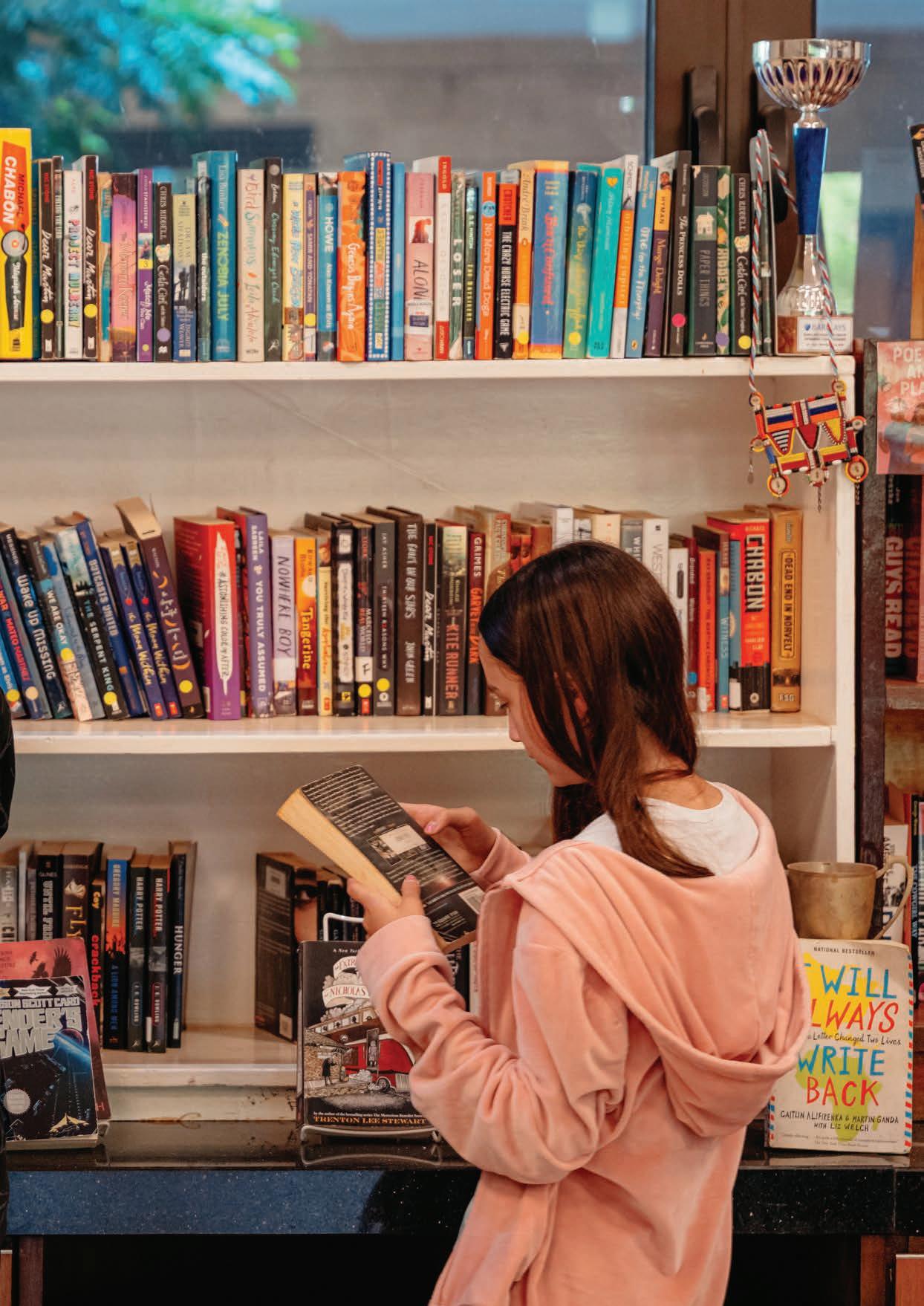

Philosophy
The ISK Middle School is dedicated to meeting the unique physical, cognitive, social, and emotional needs of students as they transition from childhood to adolescence. Through a system that fosters relationships, inquiry, personalization, and shared responsibility, our middle school strives to meet the ISK Vision, Mission, and Educational Aims in developmentally appropriate ways.
Program Overview
The Middle School Program offers students the opportunity to develop core skills, nurture connections with peers, and build a strong sense of self within an ever-changing world. Our standards-based curriculum is concept-based and designed to foster innovation, critical thinking, and curiosity. Our goal is for students to graduate from the middle school as:
· Inquirers & Creators
· Connection-Makers & Communicators
Perspective-Takers & Collaborators
· Active Change Agents
Academic Framework
We offer a balanced program appropriate for the age and development of middle-level learners, ensuring exposure to a variety of academic, physical, and creative activities:
· Core Curriculum: Mathematics, Humanities, Science, World Languages, and Physical & Health Education (PHE).
Creative Arts: Annual courses in Drama, Visual Art, and Music.
· Electives: A wide range of semester-long, project-based, and service-learning courses for Grades 7 and 8 students to explore new passions.
A Safe & Nurturing Environment
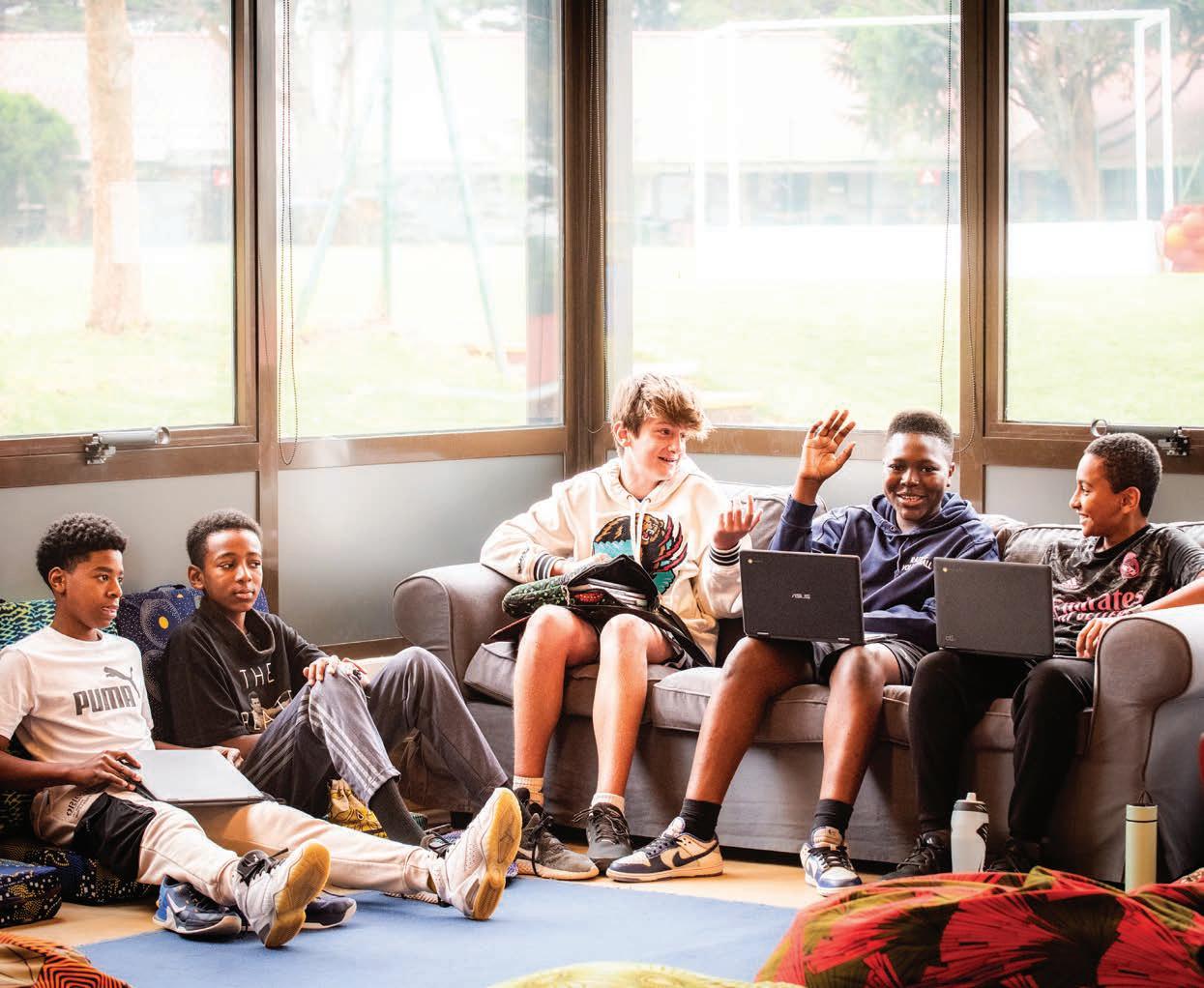
Our Middle School provides a safe, inclusive environment with an ethos of dignity, kindness, gratitude, and compassion. We recognize that peer relationships have a strong influence during adolescent development and have structures in place to support positive social growth. Our school is organized into grade-level teacher teams where individual student needs are collaboratively reviewed and supported.
The Advisory Program
The advisory program is a core aspect of how we support the development of the whole child using a holistic, research-based approach. The advisory space provides each student with an adult advocate, guide, and mentor to help them navigate their middle school experience. In advisory, we focus on three pillars:
· Community: Creating safe spaces to build relationships and support all members of our community.
· Awareness: Developing a deeper understanding of ourselves, our own identities, and our socialemotional health.
· Engagement: Connecting with peers to consolidate learning, maximize growth, and foster a passion for learning.

ISK Subject Philosophies and Program Objectives
At the International School of Kenya (ISK), all programs are guided by a clear educational philosophy that places the child at the center of learning. We believe that children learn best in an environment that nurtures curiosity, creativity, and a strong sense of belonging. The student experience is designed to support the intellectual, social, emotional, and physical development of every learner while fostering a lifelong love of learning.
The following sections outline ISK’s schoolwide subject philosophies and program objectives. These guide the learning in each subject area, highlighting how each program supports student growth, academic achievement, and preparation for continued success from Elementary, to Middle School, and throughout High School.
Mathematics
Standards: Common Core State Standards in Mathematics
Philosophy
ISK inspires Math students to engage in authentic tasks where they collaborate and persevere to reason, make sense of, and apply mathematical concepts to meaningful contexts.
Beliefs
Math learning at ISK is embedded in ‘thinking classrooms’ in which students take the lead role in the thinking, questioning, and use of Mathematics.
Independent learners in Mathematics:
· Make sense of problems and persevere in solving them.
Reason abstractly and quantitatively and appreciate the beauty of Mathematics.
· Construct viable arguments and critique the reasoning of others.
· Model with mathematics.
Use appropriate tools strategically.
· Attend to precision.
· Look for and make use of structure.
Look for and express regularity in repeated reasoning.
Derived from the 8 Standards for Mathematical Practices (Common Core State Standards in Mathematics)
Humanities
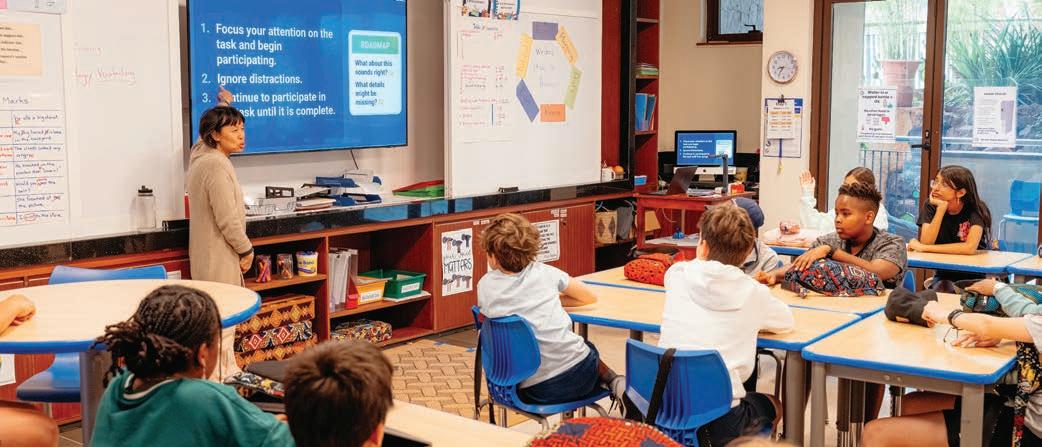
Humanities is the study of the human experience. Students in ISK’s Middle School Integrated Humanities Program explore diverse human experiences throughout the world, in both modern times and in history.
ISK Humanities integrates English Language Arts and Social Sciences. The English Language Arts program is skills-based focusing on reading, writing, language, and speaking and listening taught within the workshop model. The Social Science program applies ELA skills into Units of Study with both historic and modern lenses. Students in the Humanities program will learn to analyze, reason, communicate, and take action to make informed choices and provide solutions for a better world.
English Language Arts Standards: Common Core State Standards in English Language Arts
Philosophy
At ISK, we believe effective communicators must actively engage in spoken and written language to develop as informed, critical, and creative thinkers. We value diverse perspectives and strive to amplify the voices of our community. We recognize language as a powerful tool for change
Beliefs
Independent learners in English Language Arts:
· Communicate effectively in both spoken and written language for varied tasks and purposes, with diverse audiences;
Comprehend and evaluate increasingly complex texts;
· Critically assess and respond to different forms of media, recognizing different perspectives and biases;
· Engage in collaborative cross-cultural discussions, refining thinking and developing problemsolving strategies
Develop inquiry-based research skills.
Social Studies Standards: The College, Career, and Civic Life (C3) Framework for Social Studies State Standards
Philosophy
Social Studies at ISK empowers students to engage critically (and compassionately) with geographical, economic, social, political, and environmental issues, past and present. Our program looks to support the development of active and engaged students who strive toward a sustainable world.
Beliefs
The ISK approach to social studies is designed so that all students develop the skills and dispositions of the ISK Active Learner Roles.
Independent learners in Social Sciences :
· Are Collaborators who:
o Analyze problems by considering multiple perspectives and the work of others;
o Act on civic issues and evaluate options for action in collaboration with others;
· Are Communicators who:
o Critique conclusions and construct arguments;
o Foster civic engagement;
MIDDLE SCHOOL ACADEMIC PROGRAM
Are Thinkers who:
o Develop questions;
o Apply disciplinary concepts and tools;
o Evaluate sources and use evidence;
· Are Change-makers who:
o Take informed action Are Self-managers who:
o Plan inquiries.
Science
Standards: Next Generation Science Standards
Philosophy
Science is the collaborative and multidisciplinary approach to solving problems and understanding the world around us. It is best taught through an appreciation of natural phenomena, cultivated through experiences rooted in curiosity and wonderment.
Beliefs
Independent learners in Science: Carr y out investigations and generate questions based on observations
· Construct explanations using modeling and reasoned evidence Analyze and interpret data, evaluate information, and communicate effectively
World Languages
Standards: ACTFL World-Readiness Standards for Learning Languages
Philosophy
Acquiring a language provides valuable educational, socio-emotional, and cultural experiences for students at ISK. The World Languages Department provides a program where students develop their communicative competence and proficiency, multicultural awareness, and a lasting curiosity for language learning.
Beliefs
We believe students learn languages best when they are provided a safe environment where risk-taking is encouraged and valued to develop grit and perseverance while learning.
Independent learners of languages: Are agents of their learning;
· Use the target language in a variety of authentic situations; Think about and understand language concepts;
· Build cultural and social connections to the target language’s culture(s) and their own;
· Are engaged and motivated: Minds-on and hands-on.
Creative Arts
Standards: National Core Arts Standards (Creative Arts)
Philosophy
The Creative Arts Department at ISK cultivates a knowledge and understanding for the arts by nurturing creativity, fostering collaboration, encouraging self-expression, and promoting the belief that everyone has their own unique way of expressing themselves. Through exposure to diverse styles, artists, media, and techniques, the department empowers students to take ownership of their creative process and embrace their artistic agency.
Independent learners in the Creative Arts:
Develop and foster their passions, abilities, and technical skills;
· Develop creative and social skills through individual and group activities;
· Learn with and from peers, teachers, and community members
Critique and articulate artistic ideas;
· Explore the changing world and develop social awareness and global-mindedness;
· Demonstrate, perform, and exhibit their accomplishments through the arts.
Physical Education and Health (PHE)
Standards: SHAPE for Physical Education and Health
Philosophy
The ISK Physical and Health Education program empowers students to develop the knowledge, skills, confidence, and dispositions needed to live healthy, active, and fulfilling lives. Through a sequential K to 12 curriculum, students build physical and health literacy through meaningful movement, wellness, decision-making, and relationship-based learning. Students are supported to take responsibility for their choices, respect themselves and others, and engage in inclusive, relevant, and meaningful learning.
Physical and Health Education are integrated to help students understand the connection between movement, wellness, identity, relationships, decision-making, and community health.
Independent learners in Physical and Health Education:
· Develop physical literacy through diverse, inclusive, and meaningful movement experiences.
· Understand movement as essential to lifelong health, well-being, enjoyment, confidence, and self-expression.
· Grow when they set goals, reflect on progress, respond to feedback, and take ownership of their choices.
· Build personal responsibility, resilience, and respect for self and others.
· Develop communication, collaboration, empathy, leadership, and responsible social behavior through movement and health education.
· Use health literacy to make informed decisions, access reliable information, advocate for wellbeing, and contribute positively to their communities.
Design
Philosophy
The ISK Design program offers opportunities for students to solve authentic problems using an iterative design process. Our philosophy is cultivating a culture of creativity, innovation, and self-expression, preparing students for future design challenges and opportunities.
Beliefs
We believe students learn best when: They are given authentic, meaningful tasks that have a tangible impact.
· They feel safe to take risks and explore new ideas.
· They are encouraged to communicate their unique perspectives and ideas through their design work, empowering self-expression.
· They are exposed to relevant technologies, methodologies, and design thinking processes to inspire innovation.
SEL and Child Safety
Philosophy
Through SEL and safeguarding learning, students will develop a greater understanding of themselves, enhance their ability to care for and protect themselves by developing resiliency and making healthy choices, demonstrate empathy toward others, build healthy relationships, act with integrity, and advocate for their well-being and safety.
Beliefs
We believe that students learn SEL & Safeguarding best when: They feel safe and secure in their learning environment
· A culture of trust exists within the learning environment
· They understand the purpose and value of their learning Safe and trusted adults are known and available to students
· They feel heard and understood
Life-Centered Education
Philosophy
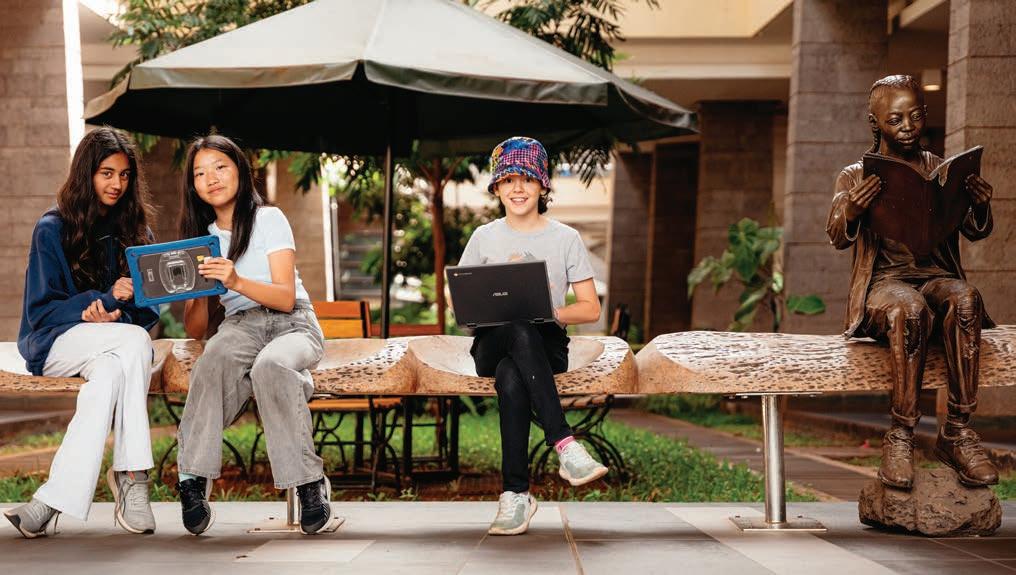
At ISK, we believe all students thrive when they feel safe, known, valued, and appropriately challenged. The Life Centered Education (LCE) advances ISK’s mission by providing individualized, purpose-driven learning grounded in each student’s IEP. These goals guide instruction, shape programming, and ensure students are consistently working toward meaningful growth across academic, social, and personal domains.
LCE is a shared responsibility. Students are supported in the least restrictive environment, with intentional access to mainstream classrooms, school activities, and community experiences. Classroom and subject teachers collaborate closely with the LCE team to implement strategies, adapt instruction, and monitor progress. Through this inclusive and coordinated approach, students build transferable skills, experience a strong sense of belonging, and are prepared for successful transitions beyond ISK.
Beliefs
· We believe our students can and want to learn to their highest individual potential; We believe our students learn in different ways;
· We believe our students learn best when they are interested in and enjoy the learning experience;
· We believe that embracing and supporting a diverse community of learners enriches the school community and positively impacts the future for all students; We believe our community is stronger when siblings are together.
Explore the Full Middle School Course Guide
The ISK Middle School Course Guide provides an overview of the academic program, course offerings, and learning experiences designed to support students during these important developmental years. As learners grow in independence, curiosity, and self-awareness, the Middle School program encourages exploration, challenge, and the development of skills needed for future success.
Students engage in a balanced and rigorous curriculum that promotes critical thinking, collaboration, creativity, and personal growth while supporting their transition toward increased responsibility and choice in learning. Guided by ISK’s Mission, Vision, and Educational Aims, the program helps students develop as Thinkers, Collaborators, Communicators, Self-Managers, and Changemakers.
Our approach to teaching and learning is grounded in inquiry, collaboration, and meaningful engagement with ideas. Through thoughtfully designed learning experiences across subject areas, students develop the skills, knowledge, and dispositions needed to think critically, communicate effectively, and work collaboratively with others.
The curriculum provides a strong academic foundation while encouraging students to explore their interests and make connections between disciplines and the world around them. Guided by ISK’s Educational Aims, our program supports students in becoming confident learners, thoughtful problemsolvers, and responsible members of their communities.
This guide includes detailed information about subject offerings, electives, student support services, and learning pathways that prepare students for success in High School and beyond. Families and students are encouraged to review the guide to better understand course options, program expectations, and the opportunities available to support each learner’s individual interests and goals.
MIDDLE SCHOOL ACADEMIC PROGRAM
HUMANITIES
Humanities is benchmarked on Common Core standards and 21st-century capacities aligned along a 6-8 scope and sequence. While units of instruction in each grade level vary, students learn essential skills in reading, writing, speaking and listening, language, and inquiry skills on a continuum of core competencies. Our units are taught in an interdisciplinary fashion to support longer, in-depth conceptual inquiry. Over an eight-day cycle, students receive a Humanities block of instruction every day, rather than separate History and English Language Arts classes. Our Units of Study apply the C3 Framework which emphasizes four major Social Studies conceptual domains (geography, history, economics, civics) explored through a research inquiry arc.
Grade 6
Introduction: Habits & Routines
Students are introduced to reading and writing workshop routines that will guide them through the year. Building reading and writing habits are an essential foundation to becoming a strong reader and writer.
Unit 1: Digging into Perspectives
Students explore how perspective impacts our understanding of stories and the past. They engage in fiction book clubs that focus on character change and perspective. Students write a scene from the perspective of a different character.
Additionally, students will learn that archaeologists piece together the past by analyzing artifacts. Our understanding of history evolves as new perspectives and discoveries emerge. Students will explore this idea through a case study focusing on Stonehenge and make connections to archaeological discoveries.
Unit 2: Power of One
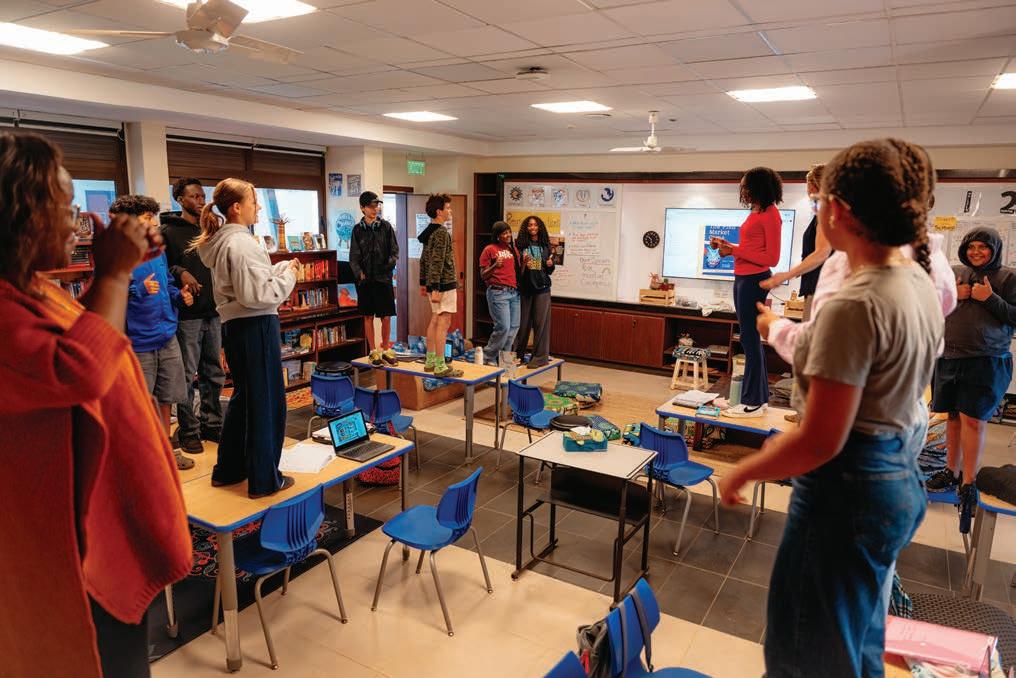
Students explore how our choices impact not only ourselves, but also others. Through a study of environmental issues and the impact on people near and far, students will look at costs and benefits for economic and personal decisions. They will then engage in a research project, analyzing the costs and benefits of choices they make, while linking their choices to one of the United Nations Sustainable Development Goals. Students will also dive into Dystopian book clubs, looking at how knowledge of a specific genre can help guide and deepen thinking about text.
Unit 3: Speak Your Truth
Students explore social issues common to the middle school experience.They will be invited to take a deep dive into an issue that speaks to them and create a Google Site educating others about this important issue. We will focus on the research process, and sharing ideas and evidence in an informational article. Students will also explore Spoken Word poetry, writing and recording their own piece connected to the issue they’ve selected.
Unit 4: This I Believe
This unit will explore different belief systems and values through the study of folktales and myths from diverse cultural regions and time periods. Students will look at how people in history have made sense of their world/physical environment and how geography shaped the elements of these stories. Students will build their background knowledge of literary motifs and themes that have come from ancient stories in order to make sense of modern allusions in texts. Students will then explore their own values and what has shaped their beliefs. As a culmination of their learning, students will communicate these values through a personal essay and podcast.
Grade 7
Unit 1: From Virus to Viral - The Story of Globalization
An exploration of how people and things go from local to global and how we are impacted by this process.
What are the benefits and detriments of interconnectivity in our world? Through case studies, students will explore how phenomena such as the Black Plague, Rap music, and Ramen--which all began at a specific location and managed to travel ferociously through continents-- had major global impacts on people and the environment. Through this unit of study, students will learn about the driving forces of globalization and the impact of humans living in an interconnected world.
Unit Two: The Power of the (S)Hero - The Purpose and Power of Heroes and Heroines in our Stories
An examination of Hero(in)es and the purpose and power they hold in the stories we tell and love.
How do stories use heroes/heroines to convey ideas around cultural values and perceptions? Students will recognize the power and purpose of characters, including how different cultures and time periods honor different human characteristics through stories. We will also study ideas around theme to understand how stories use themes to help us better understand our world. Through the study of a main character, in a novel of choice, students will determine if their character is truly a (s)hero?
Unit 3: Exploration or Exploitation? - A Critical Study of Western Colonization
A critical study of the process and purpose of Western colonization and of how mainstream history sources often fail to represent a complete story.
“Until the lion learns to write, the tales of hunting will always glorify the hunter.” The unit will launch with a case study of European exploration and subsequent colonization in North America, particularly the motivations for colonization, the impact it had on the people living in North America, and the influence on the colonizers. Students will inquire into a colonial process from history and work towards shedding light on any untold stories of Indigenous communities within the process of colonization.
Unit 4: Like the Hummingbird - How We Can Take Action for the Planet by Doing What We Can
An examination of our personal and collective impacts on our world and a reflective journey back to our own responsibilities towards our planet and communities.
As we move towards the end of our Grade 7 year, it seems perfectly appropriate that we come back full circle on the idea of “From Local to Global/ and From Global to Local”. We have seen through readings and research (Things that Go Viral and Colonization projects), and through real-life experiences (our current COVID-19 pandemic), that ALL living things are strongly connected and interdependent. Students will take inventory of their own consumption and living habits and will plan to take action toward becoming the change they wish to see in the world
Grade 8
Unit 1: Reasons and Reactions - The Why Behind Choices & Consequences
“When you make a choice, you change the future.” - Deepak Chopra
An exploration of the human experience through story, power, and choice.
How do stories help us explore the human experience?
We will use suspense stories to explore human behavior through moments of risk, pressure, and choice. At the same time, we will examine the economic forces that shape decision-making in both stories and real life. Through literary analysis and social studies concepts, we’ll uncover how characters—and people—respond to uncertainty, fear, and opportunity. We will write and present our own pieces to explore the concepts learned..
Unit 2: The Cost of Prosperity: Power, Knowledge, & Equity
“The past is never the past. Every headline has a history.” - Tamim Ansary
An inquiry into equity, economics, and power.
How can we understand the complexities of the present day? In this unit, we will explore how economics influenced major events in history that have had lasting impacts on people and societies. Using the transatlantic slave trade as a case study, we will examine how the pursuit of prosperity came at a devastating human cost. We will engage in thoughtful conversations about equity, power, and race, applying the social studies lenses introduced in our first unit. Through historical inquiry, literature, and research, we will connect past events to present day issues around the world. Our work will focus on developing strong research, information writing, and speaking and listening skills.
Unit 3: The Art of Resilience: Peace, Power, & Art
“Art speaks where words are unable to explain.” - Mathiole
A discovery of how art shapes culture and society.
How do artists use their craft to tell their own stories that connect to all human beings? In this unit, we explore how artists across genres and mediums tell powerful stories of resilience, identity, and unity in the face of adversity. Through close analysis of creative works including poetry, visual art, music, film, and performance, we examine how structure, voice, and artistic choices reflect personal and collective resistance. Building on our understanding of figurative language and our social studies lenses, we pursue personal inquiry into an artist or art form of our choice, investigating the message and meaning behind the work. We share our findings and creative responses with our community on Gallery Day.
Unit Four: The Great Debate: Media, Information, & Voice
“Media literacy makes the difference between kids being a tool of mass media or mass media being their tool.” - Linda Ellerbee
A critical inquiry into media literacy & emerging technologies.
How can we be critical consumers & creators of information? All complex issues have multiple sides. Today’s digital media landscape & the emergence of AI requires young people to have evolving literacy skills. We have access to more information than at any point in human history and we must adopt the skills, temperament, and critical consciousness necessary in the new media landscape. We will explore the skills required to interact with different forms of media, culminating in learning debate skills around complex global issues.
MATHEMATICS
The CCSS Standards for Mathematical Practices listed below drive students to make personal connections, create mathematical understanding, and develop mathematical strategies. Both content and practice in all middle school math courses lay a strong foundation for continued mathematical studies for middle school and high school mathematics.
CCSS Standards for Mathematical Practices in Grade 6
1. Make sense of problems and persevere in solving them. Students make sense of realworld fraction and decimal problem situations by representing the context in tactile and/or virtual manipulatives, visual, or algebraic models.
2. Reason abstractly and quantitatively. Students will apply the constructs of multiplication and division of rational numbers to solve application problems, including finding the area of nets.
3. Construct viable arguments and critique the reasoning of others. Students construct and critique arguments regarding the portion of a whole as represented in the context of realworld situations.
4. Model with mathematics. Students will model real-world situations to show multiplication and division of fractions and decimals
5. Use appropriate tools strategically. Students will use visual or concrete tools for division of fractions with understanding. (Such as fraction square or circle pieces, fraction equivalence towers, bar models, and number line diagrams.
6. Attend to precision. Students attend to the language of problems to determine appropriate representations and operations for solving real-world problems. In addition, students attend to the units of measure used in real-world problems.
7. Look for and make use of structure. Students examine the relationship of rational numbers to the number line and the place value structure as related to multi-digit operations. They also use their knowledge of problem solving structures to make sense of word problems.
8. Look for and express regularity in repeated reasoning. Students demonstrate repeated reasoning when dividing fractions by fractions by fractions and see the inverse relationship to multiplication.
Grade 6
Math 6
Math 6 uses a real-world, problem-solving approach to build mathematical rigor and conceptual understanding. Students will align with the Grade 6 Common Core State Standards (CCSS) by focusing on four critical areas:
1. Ratios and Rates: Connecting ratio and rate to whole number multiplication and division to solve problems.
2. Rational Numbers: Dividing fractions and expanding the number system to include negative numbers.
3. Expressions and Equations: Writing, interpreting, and using algebraic expressions and equations.
4. Statistical Thinking: Developing a foundational understanding of data and statistics
Units of Study
Unit 1: Number Sense
Students start off the year with a review of multiplication and division strategies. They also learn about ratios where they explore both concrete and abstract representations, including double number lines and tables, which they will be able to use throughout the year.
Unit 2: Multi-Digit and Fraction Computation
Students focus on the number system, honing skills they’ve been developing in previous grades with fluency, applying understandings to new computations with fractions.
Unit 3: Decimal Operations
Students will develop, practice, and demonstrate fluency with decimal operations and will apply these skills to solve problems involving decimals using all four operations.
Unit 4: Unit Rates and Percent
Students continue their study of ratios by extending the concept to rates and percentages through representations of more complex ratio, rates and percent problems.
Unit 5: Algebraic Expressions, and Equations
Students use their understanding of the number system to support their work with numerical expressions and solving equations and students revisit ratio concepts from previous units.
Unit 6: Geometry and Coordinates
Students learn how composing and decomposing unfamiliar shapes into familiar ones can extend their ability to find area and volume. Students will expand their understanding of the world of numbers to include negatives and will represent these in the coordinate Plane.
Unit 7: Statistics
In the last unit of the year, students are introduced to the study of statistics. They learn how to represent sets of data and how using different measurements about the data set can be used to analyze the information and answer the statistical question.
Adapted from FishTank Learning 2025
Grade 7
Math 7
The Math 7 course uses a real-world, problem solving approach to build mathematical rigor and conceptual understanding of the Grade 7 Common Core State Standards (CCSS). in addition to rich tasks where students are expected to develop solutions, model their thinking, communicate their ideas and justify their results, students will continue to build their foundational skills
The following areas are focal points for the year:
1. Developing understanding of and applying proportional relationships;
2. Developing understanding of operations with rational numbers and working with expressions and linear equations;
3. S olving problems involving scale drawings and informal geometric constructions, and working with two- and three-dimensional shapes to solve problems involving area, surface area, and volume; and drawing inferences about populations based on samples.
4. The CCSS Standards for Mathematical Practices drive students to make personal connections, create mathematical understanding, and develop mathematical strategies. Both content and practice in grade 7 lay a strong foundation for continued mathematical studies in middle school mathematics and beyond.
Units of Study
Unit 1: The Number System
Students will review work in fraction and decimals and extend their understanding to the full set of rational numbers. 7th grade is an important year in securing a solid foundation in operations with fractions and decimals. Extra support and encouragement is often beneficial as we will also extend students’ abilities to cover both positive and negative values.
Unit 2: Ratios and Proportional Relationships
Students extend their understanding of unit rates and analyze proportional relationships to solve realworld problems including percent problems such as tax and interest.
Unit 3: Expressions and Equations
Students dive deeper into the idea of equality to generate equivalent expressions. This develops further into solving problems and examining situations of inequality.
Unit 4: Geometry
Students solve real life problems involving scale, area, and volume.
Unit 5: Probability and Statistics
Students evaluate, develop and use probability models to find the probability of events. Students will learn more about our middle school community through statistical means. We will write surveys and learn how to use sampling to draw inferences about a population. Statistical measures also support data analysis in other disciplines.
Adapted from FishTank Learning 2025
Math 7 Accelerated
The Math 7 Accelerated Course at the ISK uses a real-world, problem solving approach to build mathematical rigor and conceptual understanding of the Accelerated Integrated Pathway Common Core State Standards (CCSS).
The following four areas are focal points for the year:
1. Students develop a unified understanding of numbers, recognizing fractions, decimals (that have a finite or a repeating decimal representation), and percents as different representations of rational numbers.
2. Students use linear equations and systems of linear equations to represent, analyze, and solve a variety of problems.
3. Students build on their previous work with single data distributions to compare two data distributions and address questions about differences between populations.
4. Students continue their work with area from Grade 6, solving problems involving the area and circumference of a circle and surface area of three-dimensional objects.
Units of Study
Unit 1: Rational Numbers
Students extend addition, subtraction, multiplication, and division to all rational numbers, maintaining the properties of operations and the relationships between additions and subtraction, and multiplication and division.
Unit 2: Ratios and Proportional Relationships
Students extend their understanding of unit rates and analyze proportional relationships to solve realworld problems including percent problems such as tax and interest.
Unit 3: Expressions and Equations
Students dive deeper into the idea of equality to generate equivalent expressions. This develops further into solving problems using numerical and algebraic expressions, equations and inequalities. They will analyze and solve linear equations and pairs of simultaneous linear equations.
Unit 4: Geometry
Students will solve real life problems involving scale, area, and volume. Students will analyze twodimensional figures, particularly triangles, using distance, and angles. In addition, students will continue to solve real-world problems involving volume of cylinders, cones and spheres.
Unit 5: Transformations
Students use ideas about distance and angles, how they behave under translations, rotations, reflections, and dilations, and ideas about congruence and similarity to describe and analyze twodimensional figures and to solve problems.
Unit 6: Irrational and Exponents
Students will know that there are numbers that are not rational and approximate them by rational numbers and work with radicals and integer exponents.
Unit 7: Statistics and Probability
Students will learn more about our middle school community through statistical means. We will write surveys and learn how to use sampling to draw inferences about a population. Statistical measures also support data analysis in other disciplines. Students evaluate, develop and use probability models to find the probability of events.
Grade 8
Math 8
The Math 8 course at the ISK uses a real-world, problem solving approach to build mathematical rigor and conceptual understanding of the Grade 8 Common Core State Standards (CCSS). They build a deep understanding of foundational algebra and geometry concepts.
The following three areas are focal points for the year:
1. Proportional and algebraic reasoning are extended to include the use of functions as a way to describe quantitative relationships in linear equations.
2. The measurement of figures, lines, and angles in two- and three-dimensional space, is investigated to determine congruence, similarity and distance.
3. The Pythagorean Theorem is introduced, creating a place for irrational numbers to complete students’ work in the real number system.
Units of Study
Students will explore three critical areas:
1. Expressions and Equations: Modeling and solving linear equations and systems of equations.
2. Functions: Using functions to describe, analyze, and graph quantitative relationships.
3. Geometr y and Measurement: Analyzing two- and three-dimensional spaces to determine congruence, similarity, volume, and distance (including the Pythagorean Theorem).
Unit 1: Solving One-Variable Equations
Students continue to hone their skill of solving equations and become more efficient and more strategic in how they approach and solve equations in one variable.
Unit 2: Functions
This unit introduces students to the concept of a function, which relates inputs and outputs. Students analyze and compare functions, developing appropriate vocabulary to use to describe these relationships.
Unit 3: Transformations and Angle Relationships
Students formalize their understanding of congruence and similarity as defined by specific movements of figures in the coordinate plane.
Unit 4: Linear Relationships & Unit 6: Systems of Linear Equations
These units are all about lines. Students make the connection between proportional relationships, functions, and linear equations.
Unit 5: Bivariate Data
Students analyze data in two variables using scatter plots and linear equations. Students create equations to represent lines of best fit of data.
Unit 7: Pythagorean Theorem and Volume Applications
Students discover the Pythagorean Theorem, which is supported by a study of irrational numbers.
Unit 8: Exponents and Scientific Notation
Students study patterns and structure of powers and use this structure to formalize properties of exponents and simplify powers.
Adapted from Match FishTank 2018
Integrated Math I
The Grade 8 Integrated Mathematics I course at the International School of Kenya uses a problem solving approach for students to build understanding of equations and expressions, the use of functions to describe quantitative relationships, and measurement in the two and three-dimensional planes to determine congruence, similarity, and distance (including the Pythagorean Theorem).
Units of Study
Unit 1: Linear Equations
Students continue to hone their skill of solving equations and become more efficient and more strategic in how they approach and solve equations in one variable. They explore graphs of lines and use equations to represent proportional relationships among two variables.
Unit 2: Systems of Linear Equations
Students apply their understanding of linear equations to solve real-life scenarios that involve systems of equations. Students will apply graphs and algebraic strategies.
Unit 3: Functions and Notation
This unit introduces students to functions. Students analyze and compare various representations of linear functions; and use function notation to describe these relationships.
Unit 4: Nonlinear Functions
Students will explore graphs of exponential growth and decay.
Unit 5: Rigid Transformations and Properties of Lines
Students develop an understanding of and use congruence and similarity to explore properties of lines (including parallel and perpendicular lines).
Unit 6: Geometric Theorems
Students explore volume, the Pythagorean Theorem, and angle theorems. Distance in the plane leads to and is supported by a study of irrational numbers.
Unit 7: Exponents and Scientific Notation
Students study patterns and structure of powers, and use this structure to formalize properties of exponents to simplify expressions and represent problems with scientific notation.
Unit 8: Bivariate Data
Students analyze representations of data in two variables in scatter plots and use linear equations to express trends in scatter plots.
Unit 9: Quadratic Equations
Students will use graphs to represent quadratic equations and apply quadratic equations to projectiles.
MIDDLE SCHOOL ACADEMIC PROGRAM
SCIENCE
Middle School Science is an exciting time for our students. They are empowered to ask questions, design investigations, and solutions, and figure out the interesting and puzzling world. At ISK we ask students to be the knowers and doers of science and we strive to develop a classroom in which the ideas we hear from our peers help to move our thinking forward as we develop our abilities to think, read, write and argue as scientists and engineers.
· Phenomenon Based: Centered around exploring phenomena or solving problems
· Driven by Student Questions: Storyline based on students’ questions and ideas
· Grounded in Evidence: Incremental building and revision of ideas based on evidence
· Collaborative: WE, the class, and the teacher figure out ideas together
· Equitable: Builds a classroom culture that values ideas and learning of all
Grade 6
Science 6
Units of Study
Unit 1: Light and Matter
Students will explore “Why do we sometimes see different things when looking at the same object? How does a one-way mirror work? Though most everyone knows that one-way mirrors exist, having students model how they work turns out to be a very effective way to develop their thinking about how visible light travels and how we see images. Initial student models in this unit will reveal a wide variety of ideas and explanations that motivate the unit investigations that help students figure out what is going on and lead them to a deeper understanding of the world around them.
Unit 2: Thermal Energy
What keeps different cups or containers from warming up or cooling down? In this unit, students investigate how energy and matter transfer between objects and their environment. Using the realworld example of how a plastic cup keeps a drink cold, students test cup features—starting with the lid—to model how evaporation transfers matter and energy. Through lab investigations and computer simulations, students explore energy transfer via light absorption and surrounding air temperature. Students apply their knowledge to design, test, and build their own insulated drink container based on specific criteria and constraints.
Unit 3: Weather, Climate & Water Cycling
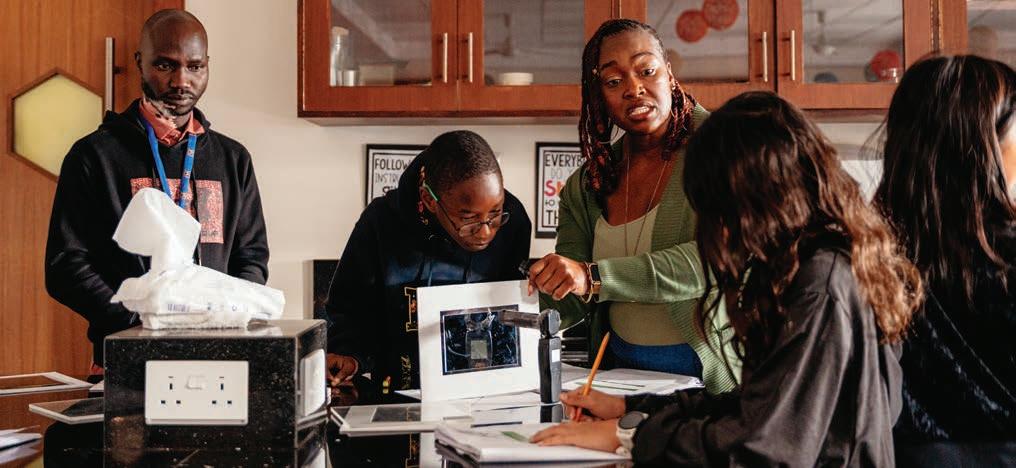
This unit is broken into four separate lesson sets. In the first two lesson sets, students explain smallscale storms. In the third and fourth lesson sets, students explain mesoscale weather systems and climate-level patterns of precipitation. The unit starts out with anchoring students in the exploration of a series of videos of hailstorms from different locations across the country at different times of the year. The videos show that pieces of ice of different sizes (some very large) are falling out of the sky, sometimes accompanied by rain and wind gusts, all on days when the temperature of the air outside remained above freezing for the entire day. These cases spark questions and ideas for investigations, such as investigating how ice can be falling from the sky on a warm day, how clouds form, why some clouds produce storms with large amounts of precipitation and others don’t, and how all that water gets into the air in the first place.
Unit 4: Plate Tectonics & Rock Cycling
In this unit, students come to see that the Earth is much more active and alive than they have thought before. The unit launches with documentation of a 2015 Himalayan earthquake that shifted Mt. Everest suddenly to the southwest. Students also discover that Mt. Everest is steadily moving to the northeast every year and getting taller as well. Students wonder what could cause an entire mountain to move during an earthquake. Students investigate other locations that are known to have earthquakes and they notice landforms, such as mountains and ridges that correspond to earthquake patterns. They read texts, explore earthquake and landform patterns using a data visualization tool, and study GPS data at these locations. Students develop an Earth model and study mantle convection motion to explain how Earth’s surface could move from processes below the surface.
Unit 5: Natural Hazards
This unit begins with students experiencing, through text and video, a devastating natural event that caused major flooding in coastal towns of Japan. This event was the 2011 Great Sendai or Tōhoku earthquake and subsequent tsunami that caused major loss of life and property in Japan. Through this anchoring phenomenon, students think about ways to detect tsunamis, warn people, and reduce damage from the wave. As students design solutions to solve this problem, they begin to wonder about the natural hazard itself: what causes it, where it happens, and how it causes damage. The first part of the unit focuses on identifying where tsunamis occur, how they form, how they move across the ocean, and what happens as they approach shore. The second part of the unit transitions students to consider combinations of engineering design solutions and technologies to mitigate the effects of tsunamis. Finally, students apply their understanding to consider how to communicate about another natural hazard to stakeholders in a community.
Unit 6: Cells & Systems
This unit launches with students hearing about an injury that happened to a middle school student that caused him to need stitches, pins, and a cast. They analyze doctor reports and develop an initial model for what is going on in our body when it heals. Students investigate what the different parts of our body are made of, from the macro scale to the micro scale. They figure out parts of our body are made of cells and that these cells work together for our body to function.
Once students have figured out what their bodies are made of and how the parts of their body work together to be able to move, they wonder how the parts of our body heal. They start by watching a timelapse of a knee scrape and notice that over time the part that was scraped is filled in with new skin cells. Students investigate what happens when cells make more cells, what cells need to make more cells, and how cells get what they need to make more cells. Students return to the healing timeline they made at the start of the unit and apply what they have figured out about the interactions between the different systems in the body to explain the various events of healing that took place for the injury at the start of the unit.
MIDDLE SCHOOL ACADEMIC PROGRAM
Grade 7
Science 7
Units of Study
Unit 1: Chemical Reactions & Matter
Seventh grade chemistry students’ conceptual understanding of chemical reactions for middle school science is foundational to much science learning. Understanding atomic level reactions is crucial for learning physical, life, earth, and space science. Even more importantly, they open up new windows of curiosity for students to see the world around them. By seventh grade, students are ready to take on the abstract nature of the interactions of atoms and molecules far too small to see.
To pique 7th grade students’ curiosity and anchor the learning for the unit in the visible and concrete, students start with an experience of observing and analyzing a bath bomb as it fizzes and eventually disappears in the water. Their observations and questions about what is going on drive learning that digs into a series of related phenomena as students iterate and improve their models depicting what happens during chemical reactions for middle school science. By the end of the unit, students have a firm grasp on how to model simple molecules, know what to look for to determine if chemical reactions have occurred, and apply their knowledge to chemical reactions to show how mass is conserved when atoms are rearranged.
Unit 2: Chemical Reactions & Energy
In this unit, students are introduced to the anchoring phenomenon—a flameless heater in a Meal, Ready-to-Eat (MRE) that provides hot food to people by just adding water. In the first lesson set, students explore the inside of an MRE flameless heater, then do investigations to collect evidence to support the idea that this heater and another type of flameless heater (a single-use hand warmer) are undergoing chemical reactions as they get warm. Students have an opportunity to reflect on the engineering design process, defining stakeholders, and refining the criteria and constraints for the design solution.
In the second lesson set, students develop their design solutions by investigating how much food and reactants they should include in their homemade heater designs and go through a series of iterative testing and redesigning. This iterative design cycle includes peer feedback, consideration of design modification consequences, and analysis of impacts on stakeholders.
Unit 3: Metabolic Reactions
This unit on metabolic reactions in the human body starts out with students exploring a real case study of a middle-school girl named M’Kenna, who reported some alarming symptoms to her doctor. Her symptoms included an inability to concentrate, headaches, stomach issues when she eats, and a lack of energy for everyday activities and sports that she used to play regularly. She also reported noticeable weight loss over the past few months, in spite of consuming what appeared to be a healthy diet. Her case sparks questions and ideas for investigations around trying to figure out which pathways and processes in M’Kenna’s body might be functioning differently than a healthy system and why.
Students investigate data specific to M’Kenna’s case in the form of doctor’s notes, endoscopy images and reports, growth charts, and micrographs. They also draw from their results from laboratory experiments on the chemical changes involving the processing of food and from digital interactives to explore how food is transported, transformed, stored, and used across different body systems in all people Through this work of figuring out what is causing M’Kenna’s symptoms, the class discovers what happens to the food we eat after it enters our bodies and how M’Kenna’s different symptoms are connected.
Unit 4: Matter Cycling & Photosynthesis
This unit on the cycling of matter and photosynthesis begins with 7th grade students reflecting on what they ate for breakfast. Students are prompted to consider where their food comes from and consider which breakfast items might be from plants. Then students taste a common breakfast food, maple syrup, and see that according to the label, it is 100% from a tree.
Based on the preceding unit, students argue that they know what happens to the sugar in syrup when they consume it. It is absorbed into the circulatory system and transported to cells in their body to be used for fuel. Students explore what else is in food and discover that food from plants, like bananas, peanut butter, beans, avocado, and almonds, not only have sugars but proteins and fats as well. This discovery leads them to wonder how plants are getting these food molecules and where a plant’s food comes from.
Unit 5: Ecosystem Dynamics
This unit on ecosystem dynamics and biodiversity begins with students reading headlines that claim that the future of orangutans is in peril and that the purchasing of chocolate may be the cause. Students then examine the ingredients in popular chocolate candies and learn that one of these ingredients-palm oil--is grown on farms near the rainforest where orangutans live. This prompts students to develop initial models to explain how buying candy could impact orangutans.
Students spend the first lesson set better understanding the complexity of the problem, which cannot be solved with simple solutions. They will figure out that palm oil is derived from the oil palm trees that grow near the equator, and that these trees are both land-efficient and provide stable income for farmers, factors that make finding a solution to the palm oil problem more challenging. Students will establish the need for a better design for oil palm farms, which will support both orangutans and farmers. The final set of lessons engage students in investigations of alternative approaches to growing food compared to large-scale monocrop farms. Students work to design an oil palm farm that simultaneously supports orangutan populations and the income of farmers and community members.
Grade 8
Science 8
Units of Study
Unit 1:
Contact Forces
Student questions about the factors that result in a shattered cell phone screen lead them to investigate what is really happening to any object during a collision. They make their thinking visible with free-body diagrams, mathematical models, and system models to explain the effects of relative forces, mass, speed, and energy in collisions. Students then use what they have learned about collisions to engineer something that will protect a fragile object from damage in a collision. They investigate which materials to use, gather design input from stakeholders to refine the criteria and constraints, develop micro and macro models of how their solution is working, and optimize their solution based on data from investigations. Finally, students apply what they have learned from the investigation and design to a related design problem.
Unit 2: Sound Waves
In this unit, students develop ideas related to how sounds are produced, how they travel through media, and how they affect objects at a distance. Their investigations are motivated by trying to account for a perplexing anchoring phenomenon — a truck is playing loud music in a parking lot and the windows of a building across the parking lot visibly shake in response to the music.
MIDDLE SCHOOL ACADEMIC PROGRAM
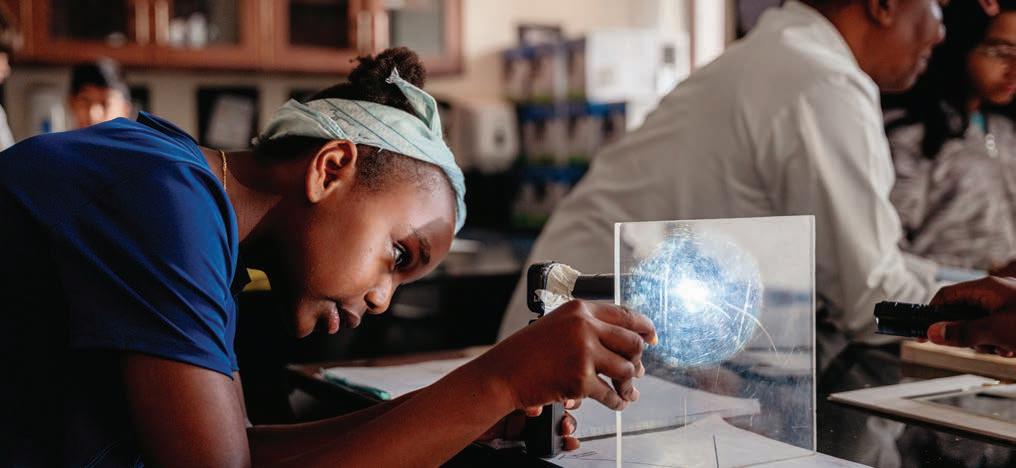
They make observations of sound sources to revisit the K–5 idea that objects vibrate when they make sounds. They figure out that patterns of differences in those vibrations are tied to differences in characteristics of the sounds being made. They gather data on how objects vibrate when making different sounds to characterize how a vibrating object’s motion is tied to the loudness and pitch of the sounds they make. Students also conduct experiments to support the idea that sound needs matter to travel through, and they will use models and simulations to explain how sound travels through matter at the particle level.
Unit 3: Earth in Space
Humans have always been driven by noticing, recording, and understanding patterns and by trying to figure out how we fit within much larger systems. In this unit, students begin observing the repeating biannual pattern of the Sun setting perfectly aligned between buildings in New York City along particular streets and then try to explain additional patterns in the sky that they and others have observed. Students draw on their own experiences and the stories of family or community members to brainstorm a list of patterns in the sky. And listen to a series of podcasts highlighting indigenous astronomies from around the world that emphasize how patterns in the sky set the rhythms for their lives, their communities, and all life on Earth, and these are added to their growing list of related phenomena (other patterns in the sky people have observed).
Unit 4: Genetics and Natural Selection
This unit on genetics starts out with students noticing and wondering about photos of two cattle, one of whom has significantly more muscle than the other. The students then observe photos of other animals with similar differences in musculature: dogs, fish, rabbits, and mice. After developing initial models for the possible causes of these differences in musculature, students explore a collection of photos showing a range of visible differences. They investigate plant reproduction, including selective breeding and asexual reproduction (in plants and other organisms) and other examples of traits that are influenced by genetic and environmental factors. Students figure out that environmental and genetic factors together play a role in the differences we see among living things.
After exploring variations in body structures and behaviors in modern penguins and ancient penguins, they also analyze data from ancient and modern species of horses, whales, and horseshoe crabs to see whether these organisms have similar patterns. Then, to figure out the cause of the changes they have observed in populations, students explore more recent cases of changing heritable trait distribution in populations and explain them by developing a model for natural selection.
PHYSICAL & HEALTH EDUCATION (PHE)
The ISK PHE department is committed to equipping and empowering students with the knowledge and skills to link Physical and Health Education, and to recognise the importance of this link as the foundation of a long, active, fulfilling life. The role of individual responsibility in maintaining optimal wellness is a major part of our Physical and Health Education curriculum. Through active participation in movement, games and sport, students will develop an appreciation of personal fitness and interpersonal skills vital to being a healthy, productive member of the community. Our Health program teaches the following skills: Communication, Self-Management, Decision Making, Analyzing Influences, Advocacy and Accessing reliable Sources of Information. Students will learn about the impact of personal choices and external factors on individual and community health.
Grade 6
The Grade 6 PHE curriculum will focus on learning and applying Health skills derived from the Health Triangle during the performance of physical activities.
Units of Study
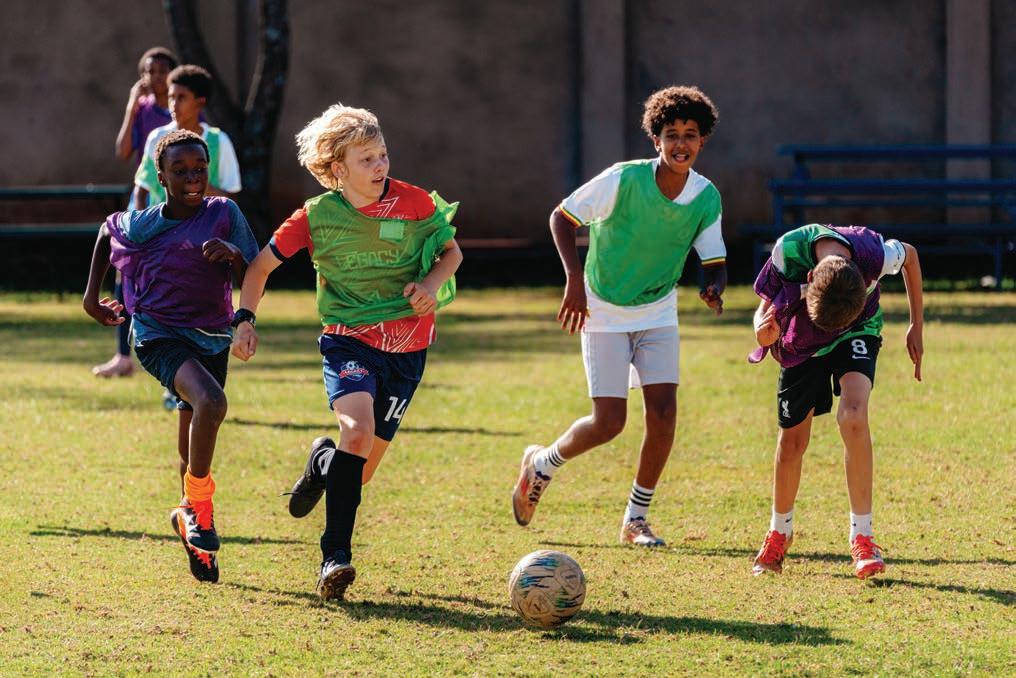
Unit 1: Umoja/Unity
Cooperative games: Focus on Communication, Collaboration, Team work, sportsmanship and Conflict resolution.
Essential Questions:
· How can communication and trust help a group accomplish a goal that they couldn’t achieve alone?
· How can we use creative problem-solving and flexible thinking to overcome challenges in a group setting?
MIDDLE SCHOOL ACADEMIC PROGRAM
Unit 2: Failure is Feedback
Aquatics and Fitness: Focus on water safety and the components of fitness.
Essential Questions:
How can learning my strokes help me become a responsible and safe aquatic citizen?
· How can I become more mentally prepared for making mistakes, and growing?
Unit 3: Smash it!
Badminton: We will learn the grip, footwork, basic shots and gameplay.
Essential Questions:
How does understanding the rules and strategies of badminton transform a rally into a competitive game?
· How can participating in a lifelong sport like badminton contribute to a healthy and active lifestyle?
Unit 4: On Purpose or By Accident?
Hockey: Safely navigating the basic skills of the game, small sided games and floor hockey
Essential Questions:
What should I plan for, and what should I just let happen?
· How does a team’s ability to communicate and move together transform a collection of individual skills into a successful offense or defense?
Unit 5: The ‘I’ in Team
Ultimate Frisbee: Learning about sportsmanship through the spirit of the game.
Essential Questions:
· How do strategy and tactics influence performance in competitive games and activities? What makes a team perform well?
Unit 6: We Like to Move It, Move It
Circus: Rhythm and Movement - Collaboration & Conflict Resolution
Essential Questions:
What is healthy risk-taking?
Why do I need to understand concepts of movement even when I can already perform the movement?
How do circus performers use teamwork, trust, and communication to create a successful and safe performance?
Grade 6 Health Class - A stand-alone class which is part of the Wheel Rotation.
Units of Study
Unit 1: Wellness
Students will:
· Analyze how internal and external factors influence our mental health and overall wellness.
· Investigate resources for support when dealing with difficult emotions. Practice stress management and self-care techniques.
· Explain situations that call for professional emotional, mental, and behavioral health services.
· Access valid and reliable emotional and mental health services.
Unit 2: Human Growth and Development
Students will:
· Analyze the physical, social, and emotional changes that occur during puberty. Explain the importance of discussing relationships with family members and other trusted adults.
· Understand the range of gender roles, identities, and expressions across cultures, and advocate for respect and inclusivity.
· Demonstrate behaviors that promote healthy relationships and avoid health risks.
Unit 3: Introduction to Substance Use and Awareness
Students will:
· Analyze how peers and family influence substance use and abuse. Promote the benefits of abstaining from or discontinuing substance use.
· Identif y scenarios where substances may be present and demonstrate strategies to avoid exposure and use.
· Access valid and reliable substance abuse services.
· Practice refusal skills to avoid substance use.
Grade 7
Engaging in a diverse range of activities - both individually and as part of a team - allows us to develop physical literacy skills, personal fitness and interpersonal skills vital to being a healthy, productive member of the community.
Units of Study
Unit 1: Movement and Coordination - Track and Field
Students will:
Learn the concepts of running, jumping and throwing.
· Develop athletic abilities and understanding.
· Use Track and Field data to improve performance.
Unit 2: Invasion Games - Ultimate Frisbee Students will:
· Create and exploit space on the field.
· Defend and close down space on the field. Link passes together to get the disc to the end zone.
· Cooperate and play as a team.
Unit 3: Net Games - Volleyball
Students will:
Enhance hand-eye coordination, spatial awareness and agility.
Link two passes together as a team before you get the ball over the net.
· React defensively to opponents play.
Unit 4: Striking and Fielding - Softball Students will:
Track the ball while batting and fielding.
· Hit and run the bases as part of a team offensive strategy.
· Field and throw the ball as part of a team defensive strategy.
Unit 5: Invasion Games - Rugby Students will:
· Use basic principles of attack and defense to create and close down spaces on the field. Link passes together to get the ball to the end zone.
· Cooperate and play as a team.
Unit 6: Rhythm and Movement - Circus Students will:
· Create and demonstrate a rhythmic routine and dance of flowing sequential movement patterns.
· Work cooperatively as part of a team and perform in front of an audience.
Connections to Health: Providing students with the skills and health literacy necessary for lifelong understanding and appreciation of wellness.
Conflict Resolution - Communication
Students will use communication skills effectively with family, peers and others.
Nutrition - Food Groups and Nutrients
Students will:
Create a daily food plan with adequate amounts for each nutrient.
· A ssess barriers to achieving a personal goal to improve healthy eating behaviors.
Grade 7 Health Class - A stand-alone Trimester class.
Health topics for grade 7 will build upon the 6th-grade foundation with a greater depth of analysis and application.
Units of Study
Unit 1: Emotional and Mental Health Students will:
· Analyze how stress impacts the body and mind, and apply a variety of healthy stress management techniques.
Evaluate strategies for expressing and managing difficult emotions in a healthy and safe way.
· Analyze the influence of technology and social media on personal well-being and identify practices that support individual and community health.
Unit 2: Human Growth and Development Students will:
Explain the male and female reproductive systems and the processes of fertilization and fetal development using accurate anatomical terminology.
A ssess characteristics of healthy and unhealthy relationships and create strategies for communicating needs and boundaries.
· Demonstrate effective communication skills to manage conflicts and evaluate the role of consent in all relationships.
· Analyze how personal values and external factors influence decisions about sexual health and advocate for healthy choices
Unit 3: Substance Use and Awareness
Students will:
· Evaluate how peers, family, media, and technology influence substance use and abuse. Construct and practice refusal skills to abstain from substance use in various social scenarios.
· Identif y valid and reliable substance abuse information and explain the importance of a support network.
Grade 8
The Grade 8 PHE curriculum will focus on learning and applying Health skills derived from the Health Triangle during the performance of physical activities.
Units of Study
Unit 1: Failure is Feedback
Focus: Net and Wall Games; Positive Relationship; Mental Toughness
Essential Questions:
How can I learn to like myself and others?
· How can I become more mentally prepared for making mistakes, and growing?
Unit 2: Splash Smart
Focus: Intro to Fitness + Aquatics; Water Safety/Water Fitness; Resilience; Positive Self-Talk
Essential Questions:
How can learning and practicing swimming skills help me stay safe in and around water?
· Why is understanding water safety important, even when I feel confident in the pool?
How can I show respect and support for others’ abilities and differences during aquatic activities?
Unit 3: Think Before You Act
Focus: Substance Use and Abuse
Essential Questions:
To what extent do outside influences shape our values?
· Why do people choose to use and abuse substances when they are aware of the detrimental effects?
Unit 4: Train to Gain
Focus: Inquiry-Based Fitness; Goal Setting; Advocacy
Essential Questions:
· What should I plan for, and what should I just let happen?
· What is the minimum amount of exercise I can do to stay physically fit? How do I develop an appropriate personal fitness program and find the motivation to commit to it?
Unit 5: The ‘I’ in Team
Focus: Invasion Games; Nutrition for Sports ; Self-Advocacy
Essential Questions:
· How do strategy and tactics influence performance in competitive games and activities?
· What makes a team perform well?
Unit 6: Relationship Building
Focus: Healthy Relationships; Sex Education
Essential Questions:
· How do I deserve to be treated? Would I want me as a friend?
· Why is sex on people’s minds all the time?
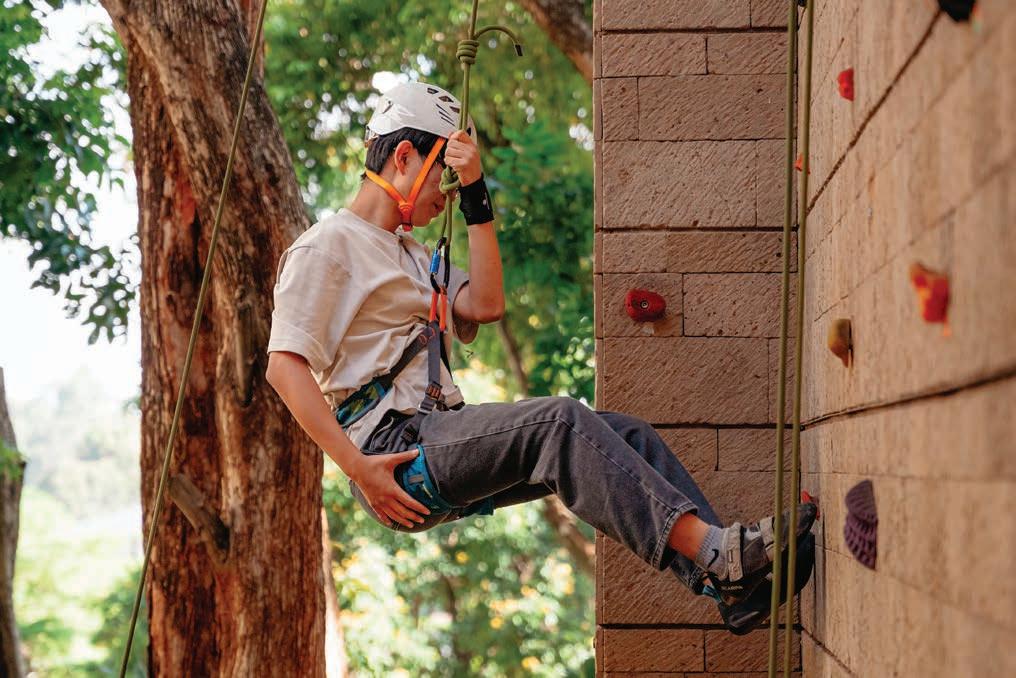
Unit 7: We Like to Move It, Move It
Focus: Rhythm and Movement - Circus/Cheerleading; Collaboration & Conflict Resolution
Essential Questions: What is healthy risk-taking?
· Why do I need to understand concepts of movement even when I can already perform the movement?
WORLD LANGUAGES
French A
This course is designed for students who have not previously studied French, as well as for those students who have completed some French, but are still at the beginning level. This course introduces students to basic grammatical concepts, vocabulary and pronunciation. Cultural aspects are also studied which allow for discussion and comparisons between cultures. This course allows students to develop basic conversational skills and to read and write passages about various topics, such as food, family, and sports.
Throughout the course students will not only develop their skills and expand their knowledge, but they will be actively engaged in becoming: self-managers, thinkers, collaborators, change-makers, and communicators in their learning spaces. (BIG 5).
Units of Study
Unit 1: Getting To Know You - Apprendre À Se Connaître
In this unit, students will learn to talk about themselves and their relationship with their surroundings. They will learn vocabulary and structures that will help them express basic ideas about the world around them and how they interact with it.
Unit 2: My School, And My House - Mon École Et Ma Maison
This unit will equip the students with vocabulary and grammar related to themselves, others, and their experiences at school and at home. This content is practical and ready to use in school and everyday contexts.
Unit 3: My City, My Hobbies And The Weather - Ce Que J’aime
In this unit, the students will learn to talk about their city, their hobbies, and the weather. They will learn to describe their preferences and opinions. They will be able to identify different aspects of their city and discuss various leisure activities.
Unit 4: Food And Culture - Nourriture Et Culture
In this unit, the students will learn about the relationship between food and culture. They will have the opportunity to describe and talk about their favorite foods, family recipes, and cultural traditions related to food. They will also explore the role of food in different cultures and how it reflects their values and history.
French B
This course is designed for students who have successfully completed the beginner level or its equivalent. The course begins with a review of the basics and moves on to cover topics such as: self and others; family; home; directions; shopping; clothes; and, activities and sports. Throughout the course students will develop their linguistic skills and expand their knowledge of the French language and Francophone culture, and will also be actively engaged in becoming effective selfmanagers, thinkers, collaborators, change-makers, and communicators. (BIG 5).
Units of Study
Unit 1: Je Suis Unique - I Am Unique
This unit helps to ensure students’ appreciation of their individuality, ethnicity, and cultural heritage. We will focus on storytelling to build their confidence.
Unit 2: Un Jour À L’école - A Day In My School Life
Students will learn how to describe their daily routine and compare it to students around the world. they will focus on common activities such as waking up, going to school, and completing homework. They will also explore how their routines compare to those of students from different parts of the world, gaining insights into cultural differences and similarities. Additionally, students will have the opportunity to discuss their favorite school subjects and teachers
Unit 3: La Nourriture - Food
Students will explore the vocabulary and expressions related to food and meals in French. They will learn how to talk about their favorite foods, describe meals, and express likes and dislikes. The unit also includes an introduction to French culinary culture, where students will compare typical French dishes with those from their own countries, gaining insight into the cultural significance of food in France. By the end of the unit, students will be able to discuss food preferences, order in a restaurant, and understand basic culinary traditions in French-speaking cultures
Unit 4: Ma Ville De Rêve - My Dream City
Students will learn how to describe their dream city in French, including discussing cities they plan to visit and what they would like to see and do there. They will explore vocabulary related to city landmarks, activities, and travel plans.
French C
This course allows students to develop advanced conversational skills and to read and write passages about various topics, such as friendship, family, past, present and future experiences, awareness about our society and our planet.
Throughout the course students will develop their linguistic skills and expand their knowledge of the French language and Francophone culture, and will also be actively engaged in becoming effective selfmanagers, thinkers, collaborators, change-makers, and communicators.
Units of Study
Unit 1: Mes Amis Francophones Et Moi - Me And My Francophone Friends
Students learn to introduce themselves and others, describe appearances and personalities, and ask and answer questions to get to know people. They explore friendship customs and greetings in Frenchspeaking cultures.
Unit 2: Voyages Et Vacances - Travel & Holidays
Students learn to describe past vacations, including destinations, activities, and travel plans. They use the passé composé to talk about past activities. They compare vacation traditions and explore how geography and climate affect travel in French-speaking regions.
Unit 3: Ça Me Passionne - My Passions
Students talk about hobbies, sports, music, and other personal interests. They describe how they spend their free time, compare leisure activities across cultures, and discuss why these activities are meaningful. They use the imperfect tense to describe activities they used to do.
Unit 4: Planète Futuroscope - The Future
Students share hopes and plans for the future, imagine schools of the future, and discuss environmental challenges and solutions. They compare ideas about education and climate change in French-speaking communities.
French D
This course enhances students’ conversational abilities and strengthens their reading and writing skills on a range of topics. Students will explore subjects such as their future, children’s rights, past, present, and future experiences, as well as gain a deeper awareness of societal and environmental issues. Throughout the course students will develop their linguistic skills and expand their knowledge of the French language and Francophone culture, and will also be actively engaged in becoming effective selfmanagers, thinkers, collaborators, change-makers, and communicators (BIG 5).
Units of Study
Unit 1: Les médias - Media
Screens and social media are a big part of our daily life. In this quarter students will learn how to debate and defend their point of view about a movie or their favorite TV show.
Students learn to talk about TV shows and movies, including genres, characters, plots, and personal opinions. They practice asking and answering questions about entertainment preferences and explore popular media from French-speaking regions.
Unit 2: Comprendre ma famille - Understanding your family
This unit aims to develop the linguistic skills necessary to talk about family and relationships. Students learn vocabulary and structures to describe family members, roles, and traditions. They compare different family structures across cultures, discuss celebrations, and explore how families reflect cultural values in French-speaking communities.
Unit 3: Le droit des enfants - The rights of the child
This unit aims to raise awareness about the fundamental rights of children worldwide, focusing on education, health, and safety. Students learn to name and discuss the basic rights of children, using appropriate vocabulary to express obligations, responsibilities, and opinions. They examine how children’s rights are protected (or not) in various countries, with a focus on French-speaking regions and global perspectives.
Unit 4: Je prépare mon futur - Prepare your future
This unit aims to equip students with the necessary language skills to discuss their future careers and the global environmental challenges. Students will articulate their career aspirations, explore various professions, and delve into the critical importance of environmental sustainability. They compare future pathways in different cultures, use future tense structures, and explore how to prepare for life after school.
Spanish A
Spanish A is designed for students who have not previously studied Spanish, as well as for those students who have completed some Spanish but are still at the beginning level. This course introduces students to basic grammatical concepts, vocabulary, and pronunciation. Cultural aspects are also studied, which allows for discussion and comparisons between cultures. This course allows students to develop basic conversational skills and to read and write passages about various topics, such as food, family, and sports.
Throughout the course, students will not only develop their skills and expand their knowledge, but they will also be actively engaged in becoming self-managers, thinkers, collaborators, change-makers, and communicators in their learning spaces (BIG 5).
Units of Study
Unit 1: Me and my context - Yo y mi entorno.
In this unit, Students will learn to talk about themselves and their relationship with their surroundings. They will learn vocabulary and structures that will help them express basic ideas about the world around them and how they interact with it.
Unit 2: My School and my home - Mi escuela y mi casa
This unit will equip the students with vocabulary and grammar related to themselves, others, and their experiences at school and at home. This content is practical and ready to use in school and everyday contexts.
Unit 3: My city, my hobbies, and the weather - Mi ciudad, mis pasatiempos y el clima
In this unit, the students will learn to talk about their city, their hobbies, and the weather. They will learn to describe their preferences and opinions. They will be able to identify different aspects of their city and discuss various leisure activities.
Unit 4: Food and Culture - La comida y la cultura
In this unit, the students will learn about the relationship between food and culture. They will have the opportunity to describe and talk about their favorite foods, family recipes, and cultural traditions related to food. They will also explore the role of food in different cultures and how it reflects their values and history.
Spanish B
Spanish B is designed for the student who has successfully completed the beginner level or its equivalent. It reviews beginners-level material, such as the present tense and some of the previously learned vocabulary/expressions. In the intermediate, students will be introduced to the past tense. Throughout the course, students will not only develop their skills and expand their knowledge, but they will be actively engaged in becoming: self-managers, thinkers, collaborators, change-makers, and communicators in their learning spaces (BIG 5).
Units of Study
Unit 1: ¡Soy único! - I Am Unique
This unit will expand students’ ability to express their emotions and opinions as well as explore and share unique cultural heritages. The unit will focus on speaking and listening to express feelings and ideas.
Unit 2: Un día en la escuela - A Day In My School Life
This unit will introduce students to important vocabulary pertaining to school and school work. Students will read about school life in other countries and compare it with their own experience. This unit will focus on reading and writing to express comparisons between cultures.
Unit 3: La comida - Food
This unit will explore food and food-related vocabulary. Students will gain conversational skills related to the cuisine of their own culture and that of Spanish speaking countries.
Unit 4: La ciudad de mis sueños - The City of My Dreams
This unit will provide students with vocabulary and sentence structures to describe their own home cities, explore other Spanish-speaking cities, and dream about what their own ‘ideal’ city would contain.
Spanish C
Spanish C is designed for students who have previously studied Spanish, and have completed Spanish B successfully. The course introduces students to advanced grammatical concepts and additional vocabulary. Cultural aspects are studied which allow for discussion and comparisons. Students develop advanced conversational skills, read and write passages with a higher degree of complexity related to various topics, such as friendship, family, past, present and future experiences, and gain an awareness about society and the planet.
Throughout the course students will develop their linguistic skills and expand their knowledge of the Spanish language and culture, and will also be actively engaged in becoming effective self-managers, thinkers, collaborators, change-makers, and communicators (BIG 5).
Units of Study
Unit 1: Mis amigos hispanohablantes y yo - My Spanish-speaking friends and me
Students learn to introduce themselves and others, describe personalities and appearances, and ask and answer questions to get to know people. They explore friendship customs and greetings in Spanishspeaking cultures, and explore the qualities of a good friend.
Unit 2: Mis vacaciones - My vacations
Students learn to describe past vacations, including destinations, activities, and travel plans. They use preterite and begin to use some imperfect tense. They compare vacation traditions and consider how geography and climate influence travel in Spanish-speaking countries.
Unit 3: De niño - My childhood
Students use the imperfect tense to describe their childhood activities, routines, and characteristics. They compare their experiences to those of children in Spanish-speaking cultures, focusing on games, traditions, and celebrations.
Unit 4: Nuestro futuro - Our future
Students discuss their hopes for the future, imagine schools of the future, and describe environmental challenges and solutions. They compare perspectives on education and climate change in Spanishspeaking communities.
CREATIVE ARTS
Drama
Drama is a practical subject that encourages discovery through experimentation, the taking of risks, and the presentation of ideas to others. It results in the development of both theatre and life skills; the building of confidence, the fostering of creativity, and the development of proficiency in collaboration.
All grade 6 students take one rotation of Drama and all grade 7 students take one trimester of Drama. Grade 7 and 8 students are able to take specialised theatre electives to deepen their understanding and explore their passions.
Drama 6: Theatre and Me
Units of Study
Unit 1: Ensemble - Building Community
Theatre artists work in collaboration with others to achieve success. In order for our class to become an ensemble, we will spend dedicated time getting to know each other and building our Drama family. This important work will propel us into greater successes during the term.
Unit 2: Transformation - Theatre Makers Transform
Performers transform their bodies and voices to create characters. We will study a piece of written text and use it to develop our skills as performers. We will tell stories and create theatrical moments while focussing on developing confidence, creativity, and collaboration skills.
Drama 7: Theatre and My Community
Units of Study
Unit 1: Ensemble - Building Community
Theatre artists work in collaboration with others to achieve success. In order for our class to become an ensemble, we will spend dedicated time getting to know each other and building our Drama family. This important work will propel us into greater successes during the semester.
Unit 2: Empathy and Community
It is only when Creators and Performers truly understand themselves that they are able to understand –and perform– others. In this unit, we take a deep look at ourselves and our positionality in the world. Then, we will explore how theatre makes meaningful connections between theatre makers and audiences. We will make theatre with, by, and for our larger ISK community. You will explore being Creators, Performers, Designers, and Directors of theatre and create something that we share with our community.
Unit 3: Transformation - Theatre Makers Transform
Performers transform their bodies and voices to create characters. Designers transform the physical space using lights, sounds, sets, and props. Directors transform the tension, emotion, atmosphere, and meaning of a space through their work. Throughout this Drama 7 course, we will explore how we can transform in order to create meaning.
Theatre Production: Grade 7 / 8 Elective (Semester Course)
Essential Questions
· What impact do my choices have? How do artists collaborate? What happens when theatre makers and audiences share an experience?
Units of Study
Unit 1: Ensemble - Building Community
Theatre artists work in collaboration with others to achieve success. In order for our class to become an ensemble, we will spend dedicated time getting to know each other and building our Drama family. This important work will propel us into greater successes during the semester.
Unit 2: Theatre Roles - Exploring it all to make choices
In theatre productions, each member of the ensemble takes on a specialized role that positively contributes to the outcome. In this unit, you will explore the roles of the Creator, Performer, Designer, and Director in order to make conscious decisions about not only what each person wants to contribute, but also about what kind of play we want to create.
Unit 3: Our Play - Working together to make theatre magic!
You are the creative team creating a full theatre production. You will specialize in an area and positively contribute to the group, ensuring our communal success. You will choose the play, develop the play, design the play, build the play, perform the play! You will identify and perform for an audience. You will consider the impact your performance has on an audience, and the impact of the performance on yourself and our ensemble!
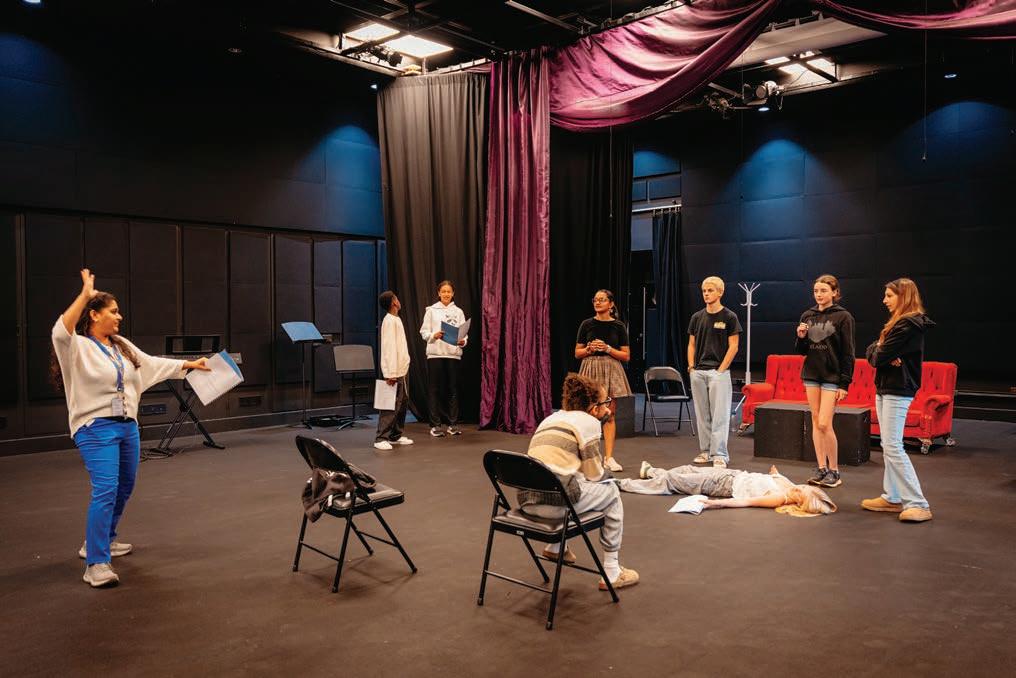
Tech Theatre: Grade 7 / 8 Elective (Semester Course)
Essential Questions
· How can I realize my artistic vision? What impact do my choices have?
Units of Study
Unit 1: Building Blocks - Community and Design Skills
Designers and technicians work in collaboration with others to achieve success. In order for our class to become an effective design team, we will spend dedicated time getting to know each other through the exploration of design problems and tasks. We will investigate what it means to be a designer and member of a team in the theatre.
Unit 2: Tech Theatre Roles - Exploring it all to find our passions
There are dozens of design and technician roles within any theatre production. In this unit, we will explore as many as we can: including lighting design, sound design, costume design, make-up design, props design, set design, including scenic painting. Safety will be an important part of this unit, because we have to make sure that we are keeping ourselves and others safe at all times!
Unit 3: Putting it all together: Bringing designs to life for a real theatre show!
This is when you get to combine your understanding of design with your practical skills. You will be designing and creating various technical items for our ISK theatre production(s) this semester. Your work will support these shows and enhance the tension, emotion, atmosphere, and meaning in the stories.
Music
Music is a dynamic force in life and we work to make it an energizing practice for us. This involves spending time regularly practicing the skills that we are working on. Setting apart a specific time and place at home helps us make this a priority for success. As we improve, we will build confidence, creativity, and be able to take part in great collaborative events.
All grade 6 students take either Choir or Band to start out their Middle School experience. As they move into Grades 7 & 8, they get to choose music as an elective to extend their dedication to the art.
Concert Choir (Yearlong Course)
Join us in a musical journey that expands your worldview and helps you find your own voice. This course goes beyond learning notes; it’s about connecting with diverse cultures, finding new ways to express yourself, and building a strong sense of community. Through a varied repertoire, you will develop healthy singing habits, enhance your music literacy, and learn to collaborate with your peers. Come explore the power of music and build your confidence as a performer and a person.
Essential Questions:
· How do performers interpret musical works?
How does understanding the structure and context of the music influence a response?
· How do musicians generate and make creative ideas?
How do musicians make meaningful connections to creating, performing, and responding? When is a performance judged ready to present? How do context and the manner in which musical work is presented influence audience response?
How do musicians improve the quality of their performance?
· How does understanding the structure and context of the music influence a response?
Units of Study
Unit 1: Building Our Choir: Foundations in Harmony
Unit 2: A World in Chorus: Jazz, Joy and Traditions
Unit 3: A Global Mosaic: The Sound of Self and Song
Unit 4: Celebrating Our Song
Beginning Band (Yearlong Course)
Essential Question: How can I make playing an instrument a dedicated part of my life?
Units of Study
Unit 1: Welcome Back Concert - Setting Up the Tools and Time for Practice
· Bringing what’s needed to school and back home when it’s needed
Finding a place and time to maintain practice at home in a regular manner
· Knowing who to ask when I have a question about what I’m doing
· Envisioning what I need to sound like.
Unit 2: Java Jazz - Mobilizing Our Skills for Jazz
· Making scales a regular part of our home practice
Playing along with others to improvise simple licks.
· Using a jazzy canon to jump start our work.
Unit 3: Holiday Concert - Using Our Skills to Celebrate the Cultures of Our Students
· Mastering three songs that represent culture we identify with Learning songs from other people’s culture
Unit 4: Marching Band for International Day - Working on a Large Group to Literally Mobilize Our Skills
· Learning to play, then memorizing our song Repetition
Unit 5: End-of-Year Concert - Summing Up Our Learning with Advanced Practice Enjoying these pieces!
· Identif ying the most difficult sections of the music to work on in practice
Concert Band (Yearlong Course)
Essential Question: With all my commitments in Middle School, how can I continue to dedicate space for music in my life?
Units of Study
Unit 1: Welcome Back Concert - Setting Up the Tools and Time for Practice
· Bringing what’s needed to school and back home when it’s needed
Finding a place and time to maintain practice at home in a regular manner
· Knowing who to ask when I have a question about what I’m doing
· Envisioning what I need to sound like.
Unit 2: Java Jazz - Mobilizing Our Skills for Jazz
Making scales a regular part of our home practice
· Playing along with others to improvise simple licks.
Using a jazzy canon to jump start our work.
Unit 3: Holiday Concert - Using Our Skills to Celebrate the Cultures of Our Students
Mastering three songs that represent culture we identify with
· Learning songs from other people’s culture
Unit 4: Marching Band for International Day - Working on a Large Group to Literally Mobilize Our Skills
· Learning to play, then memorizing our song
Repetition
Unit 5: End-of-Year Concert - Summing Up Our Learning with Advanced Practice
· Enjoying these pieces!
· Identif ying the most difficult sections of the music to work on in practice
Music Tech (Semester Elective)
Students have chosen to partake in the Music Tech elective for the entirety of the semester. During this class, students will interact and gain foundational knowledge on the methods and techniques used in the different elements of music tech. Throughout the semester, students will work in groups and individually. Though we intend on improving our technical skills, this class is heavily focused on enhancing greater life skills of collaboration, storytelling, creativity, and confidence. Students will also get a chance to explore the history of musical tech innovation. In this class, students will interact with digital music making in a variety of ways.
Essential Questions:
· How do musicians generate creative ideas?
· How do performers interpret musical works?
How do musicians make musical decisions?
· How do musicians improve the quality of their work?
How do digital music makers make meaningful connections to creating, performing, and responding?
· How do we judge the quality of musical works and performances
Units of Study
Unit 1: Soundbites and Symphonies
· Music Arranging Basics
· One Minute Compositions
Exploring Found Sounds/Soundscapes
· BBC Beethoven Remix
Unit 2: Sonic Sketches
· Arranging/Multitrack Recording
Audio Picture Books
· NPR Student Podcast Competition
Unit 3: DJ Dance Design: Crafting Interactive Soundscapes
Film scoring
· Digital arranging for games
Production: Songwriting. Rap, AI
· Visual Art Compositions
· DJ Music- Design a DJ Danceparty
Art
The Middle School Art program encourages students to tap into their imagination and explore their creative potential. This dynamic and enriching educational experience is designed to foster creativity, self-expression, and artistic skills. It provides a platform for students to explore various forms of visual art, develop their artistic abilities, and gain a deeper appreciation for the world of art.
All grade 6 students take one rotation of Art and all grade 7 students take one trimester of Art. Grade 7 and 8 students are able to take specialised art and design electives to deepen their understanding.
All Art classes encourage all students to produce creative work, develop ideas, and record their experiences. Through inquiry and exposure to art history and contemporary art from around the world, students will draw, paint, and experiment with art, craft, and design techniques. Students will evaluate and analyse creative works using the language of art, craft and design to enable them to engage in meaningful art-making.
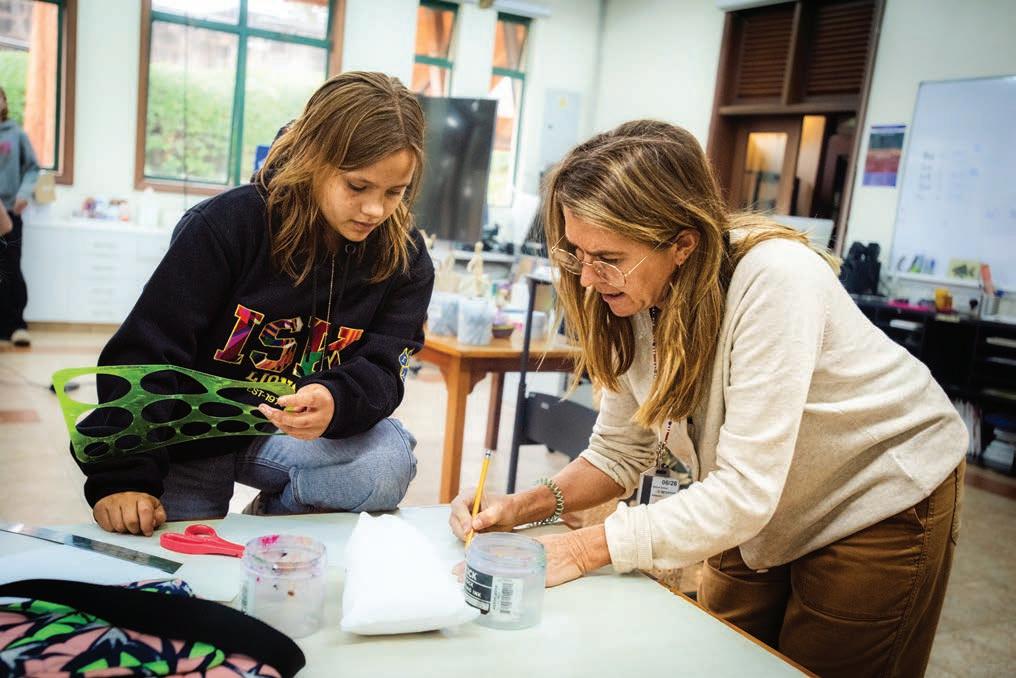
MIDDLE SCHOOL ACADEMIC PROGRAM
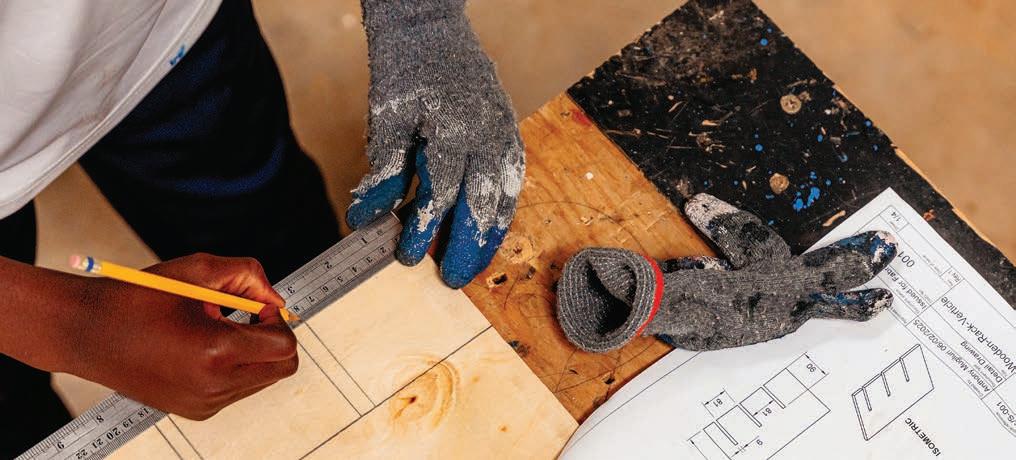
Art 6
Grade 6 students take Art classes for one rotation during the academic year. This class is one of the ‘wheel classes’: Art, African Drumming, Drama, Health, and Kenyan studies.
Units will include:
· The Sketchbook: The use of the sketchbook, visual journaling, and different ways of drawing from observation, memory and imagination.
· The Elements of Art: What are they, and why are they important? Students will learn to recognise and use the 7 Elements of Art.
· 3D Ceramics: An introduction to essential skills in ceramics to create functional and decorative vessels using hand-building techniques.
· Still Life: Starting with 20th-century artists, students will critique and explore their preferences and learn how to create composition, form, value and colour mixing. We will also look at the work of contemporary artists and those who use less traditional mediums.
Art 7
Grade 7 Students take Art classes for one trimester of the academic year and spend the other trimesters in Drama and Health classes.
Units will include:
· Graphic Design: Students will create visual compositions to solve problems and communicate ideas through the combination of typography, symbols, imagery and colour to form visual representations of ideas and messages.
· Observational Drawing: Students will learn and practice to draw what they see. Taking their subject from the world and people around them, they will explore scale and composition and experiment with techniques and materials.
· Three-Dimensional Projects: Students will use various materials manipulated into objects, characters, and scenes to produce artwork. We will collaborate with the innovation studio and use technology in a number of ways. Students will also work with clay to produce ceramic pieces.
· Printmaking, Pattern, and Surface Design: Students learn printmaking techniques such as monotype and monoprint, relief, and screen printing to create unique prints and surface design patterns. We will look at real-life examples and learn how different contemporary designers work.
STUDENT SUPPORT SERVICES
ISK’s Definition of Inclusion: Inclusion is embracing and honoring the unique learning needs of every learner. We thoughtfully combine educational excellence with equitable practices.
Learning Support (LS)
ISK serves a managed number of students representing a range of learning differences from mild to moderate needs, as well as the highly capable. The Elementary, Middle and High Schools each have dedicated Student Support Teams, and the Head of Student Support Services oversees the schoolwide program. ISK provides learning support through a balanced service delivery model of small group instruction, in-class support, co-teaching and accommodations. Differentiated instruction is at the heart of learning support at ISK and the collaborative, team approach between Learning Support and Mainstream teachers enhances the design of interventions to meet the individual needs of students. Students may be referred to Learning Support as a part of the admissions process, or they may be referred through the Response to Intervention (RTI) process. Either way, educational psychological testing is generally required to receive support in this program.
English Language Learners (ELL)
ISK provides an ELL program for students whose first language is not English and whose English language skills limit full access to the regular grade level curriculum. The ELL program provides for different levels of language proficiency while incorporating the mainstream English curricula. Entry into the ELL program is determined by means of the student’s performance on an English proficiency test, writing samples and interviews to determine if the students’ needs can be accommodated in the current program at the grade level to which the student is applying.
The language-rich environment integrates reading, writing, speaking and listening to develop students’ acquisition and proficiency of communicative and academic language skills to support them in the content classes. ELL support is provided through small pullout classes, which provide focused teaching to develop specific language skills, as well as through in-class support for language practice in the mainstream curriculum.
Life Centered Education (LCE)
MIDDLE SCHOOL ACADEMIC PROGRAM
ISK offers a continuum of support for students with mild, moderate, and intensive learning needs. Our highly qualified Learning Support Team works collaboratively with teachers to teach and support skills and dispositions for success to enable access to the curriculum. Within all classrooms, students are given support from qualified staff utilizing co-teaching, skill-based group/individual work, and sensorymotor development tools and strategies to support individuals.
In the Life Centered Education (LCE) program, students’ needs are catered for through personalized programs to develop academic and life skills. Students have multiple opportunities to learn social and emotional skills through engagement with their chronological peers through the inclusion of LCE students in the classroom, social activities, intercultural activities, and specialist classes and services such as Occupational, Sensory and Speech Therapy.
*Each student has an individualized program based on their Individualised Education Program goals. Each student has goals around their individual needs and progress monitored throughout.
Math Lab
Math Lab is a second math course in addition to a student’s grade level math class. The purpose of math lab is three-fold. The goals are to increase student confidence, reinforce foundational concepts and skills needed to be successful in mathematics, as well as give students a small amount of extra time to practice basic skills. In middle school math students must be able to accurately add, subtract, multiply and divide whole numbers, fractions and decimals. They must also be fast and accurate with their basic facts. In Math Lab students will practice their basic facts and computation skills. They will also participate in activities that promote a growth mindset, number sense and mathematical reasoning. This course is offered each semester. It is a small multi-age class, therefore students may be grouped with younger or older peers.
Literacy Lab
In Literacy Lab, students receive direct, explicit, and leveled instruction tailored to their learning needs in the areas of reading comprehension and written expression skills, such as narrative and expository essay writing. Through scaffolded lessons, the reading intervention component will specifically focus on developing skills and mastering strategies to significantly improve their comprehension. In the area of written expression, through the use of structured templates and graphic organizers, students will develop their abilities to write more sophisticated sentences and organize paragraphs, applying comprehension strategies to their independent writing. This will be accomplished through reading a variety of texts, both fiction and non-fiction, including articles, and class novels, and specific writing tasks and assignments.
INTERNATIONAL
MIDDLE SCHOOL ELECTIVES
Our electives program is open to 7th and 8th grade students. These classes provide rich opportunities for students to find new passions and explore through project-based and service learning opportunities. These courses are mission and vision driven, and aligned with our definition of learning constructing meaning through inquiry-based experiences that transcend disciplines. Students are graded based on our Big 5 (Self-Manager, Thinker, Collaborator, Changemaker & Communicator).
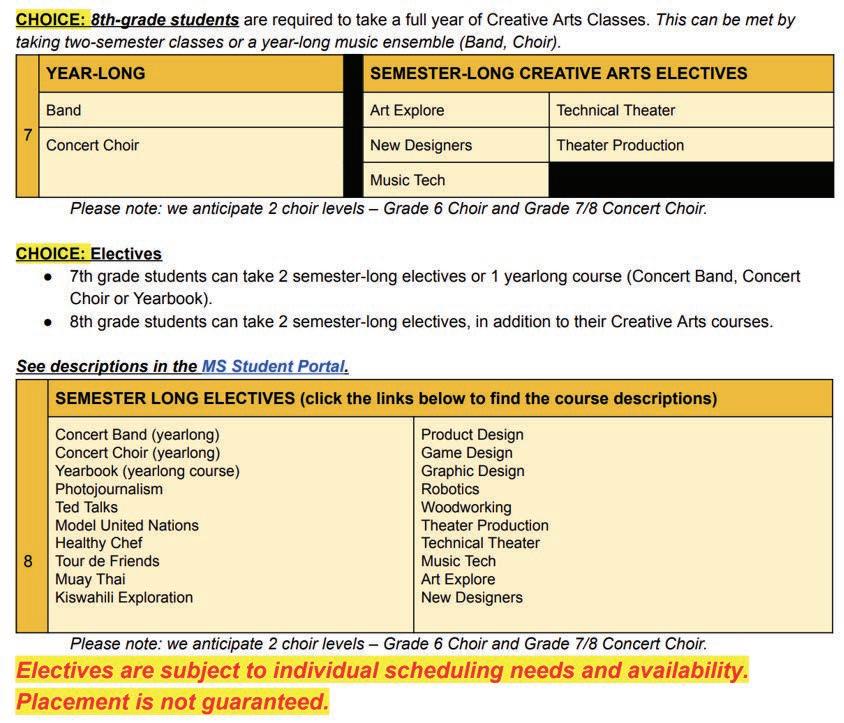
ISK MS Electives Descriptions
YEAR-LONG ELECTIVES
Band (Instrumental Music)
MIDDLE SCHOOL ACADEMIC PROGRAM
There are two levels of band - Beginning Band and Concert Band. Placement in the different levels is based on teacher recommendation.
Beginning Band This course is designed specifically for students who are interested in band but have no real background or experience (or only introductory experience from ES). This would be beginners with no or only basic knowledge of how to read music, how to play the notes, etc. to help them begin to build skills that will eventually allow them to enter the concert band.
Concert Band This course is for students with one full year experience and technical ability on a band instrument beyond a rudimentary level. Students will be placed in Concert Band based on skill level, possible audition by the band director, and availability of instruments. Students will continue to learn about contextual music theory and history and will have performance opportunities as a soloist, small ensemble player, and with the whole band.
Choir
Please note - we anticipate 2 levels of choir for 2026-27.
Choir (6th grade)
Choir is the foundation for 6th-grade vocal discovery. Students develop healthy technique while building musical independence through sight-reading and rhythmic notation. Transitioning from unison to singing in harmony, the ensemble explores diverse musical styles and basic theory to expand musical thinking and artistic expression.
Concert Choir (7th and 8th grade)
Concert Choir is the advanced ensemble for 7th and 8th-grade vocalists. Students hone sophisticated vocal technique and study complex part-singing. Through a diverse repertoire, members build advanced music literacy, cultural competency, and ensemble skills. This course balances performance opportunities, while developing musical artistry.
Yearbook (Year Long): Imagine flipping through your very own middle school yearbook years from now and seeing your photos, interviews, and creative designs, capturing all the unforgettable moments of the school year! Join the Middle School Yearbook Elective class— where you work your magic to document our school’s journey as part of a dynamic team of designers, photographers, and storytellers. You’ll gain hands-on experience in photography, creative writing, and layout design using professional tools like Adobe InDesign. You’ll also cover school events, contribute engaging content, and develop real-world skills that celebrate our school community. If you are creative, self-motivated, and ready to leave your mark, this club is the perfect place to express your voice and build lasting memories.
SEMESTER-LONG ELECTIVES 2026-27
CREATIVE ARTS
Art Explore: Art Explore will be theme-based and enable and encourage students to create art, often in response to current events and ISK celebrations or occasions as well as being an outlet for creative ideas. Units will be open to creativity and interpretation, and students will be encouraged to explore a variety of techniques and mediums.
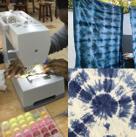
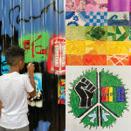
New Designers: This elective involves designing and creating with textiles. Previous experience is not necessary as projects will be suited to all levels of existing knowledge. You will have the opportunity to use hand stitching as well as sewing with a machine and gain new or further understanding of a variety of stitches and their uses to design and create functional or decorative pieces. You will be able to explore dyeing techniques, from tie-dye to Shibori, creating designs that match your style and creative ambition. Mind-hand coordination activities evoke mindfulness and instill a sense of calm.
Technical Theatre: In this class you will be a Designer and explore the world of technical theatre. You will study lighting design, sound design, costume and make-up design, props and set design, and all the things that happen behindthe-scenes to create the magic of theatre. You will specialize in design areas that you choose and then create projects that you are passionate about. You will also support our Middle School theatre productions! If you love theatre and are excited to learn about all things backstage (and to work with your hands and play in our new Blackbox booth), then this class is for you!
Theatre Production: This is your opportunity to perform in our Middle School Production! In this class, you will hone your skills as a Performer and apply them to creating characters. You will work together with your classmates as an ensemble to bring a story to life. In addition to performing, you will explore other areas of production work, such as design or even directing! Please note that, because this is our mainstage production, additional time may be required in addition to our class time (Saturday rehearsal and our evening performances.)
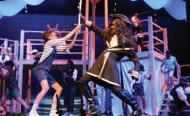
Music Tech: In this class you will embark on an exciting journey into the world of music technology. Through hands-on exploration, you will interact with digital music making in a variety of units. You will be creating unique soundscapes, audio picture books, digital compositions, and film scores. You also will be engaging with songwriting, arranging and multi-track recording, creating music videos, and hosting a DJ Dance Party. Innovation and creativity will flourish as you develop new skills and interests in the digital world of music.
HUMANITIES & STORYTELLING
Photojournalism: A picture is worth a thousand words and you can take one that speaks volumes. This class explores how the power of photojournalism to shed light upon real issues in the world, and tell stories through images. We learn about why photojournalists often risk their lives to share with the world both the beauty and the ugly of humanity.
MIDDLE
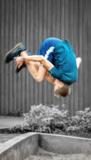
Learn industry-standard photography techniques and go on daily photoshoots to practice them. Discover how the pros write captions to tell powerful stories with pictures. Put all of the skills you learn into a photography portfolio as part of our semester-end project.
Kiswahili Exploration: This elective course is for students who are curious about learning a new language or developing their Kiswahili, while engaging with the local context in meaningful and active ways. This course introduces students to foundational Kiswahili communication skills. Students will build practical vocabulary and conversational skills in listening, speaking, reading, and writing, using real-life scenarios and collaborative activities. Through games, storytelling, music, and community-inspired projects, students will explore how language connects people and shapes everyday experiences.
IN PURSUIT OF A BETTER WORLD
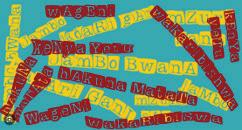
Ted Talks: Communication is the backbone of our world. Learning how to present our passions and ideas in a persuasive way is the secret to success. But, why is it so hard to speak in public? It’s time to learn the secret to public speaking success from the pros. Wow your audience, amaze your friends with humor and inspiration, and convince people to sit up and listen. The worldfamous TED talks has created a special journey for young people to share their passions and ideas. When you have worked through the official TED materials, you will have a talk that we can send to the TED organization and they will feature YOU on their official TED Youth youtube channel. Students who learn to speak powerfully in public take this skill to high school, University and beyond! It begins now...
Model United Nations (MUN): In Model United Nations, students are able to step into the shoes of ambassadors of UN member states, from Afghanistan to Zimbabwe, to debate current issues. Students, also known as “delegates,” prepare draft resolutions, plot strategy, negotiate with supporters and adversaries, resolve conflicts, and navigate the UN’s rules of procedure‐ all in the interest of resolving problems that affect every nation on Earth. Students learn to research and explore the biggest issues facing their generations and attempt to create and find solutions to these issues. These include technology, human rights, health and ecology. This course then includes academic writing, discourse and debate. In January, we will attend a conference where students will meet to debate their resolutions, address current world issues, and negotiate with students from other nations.
STEM (Science Technology Engineering Math)
Graphic Design: Graphic design is a craft where professionals create visual content to communicate messages. By applying visual hierarchy and page layout techniques, designers use typography and pictures to meet users’ specific needs and focus on the logic of displaying elements in interactive designs, to optimize the user experience. Students will learn the skills of creating compelling signs, posters, and other creations for digital and printable purposes. Some of the resources we will use: Illustrator and Photoshop.
Product Design: This class will focus on the creation of products for a variety of needs around the school and community. A willingness to learn new skills and the ability to manage your own time and meet deadlines are necessary. S ome of the resources we will use are: Illustrator, Tinkercad, 3D printer, laser cutter and wood-working tools.
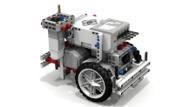
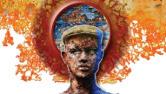
Robotics: In Robotics we will learn circuitry as well as computer programming skills. The course will consist of a series of tasks and challenges that will test your ability to persevere through problems and work with others. A good knowledge of Math and Science is beneficial to this course. Some of the resources we will use e: Little Bits, mBots, Lego EV3, soldering irons, Arduino and Adafruit.
Game Design: In Game Design, students will learn the skills to create a variety of games such as board games, card games, video games, and lawn games. In this class, you will design and build a game of your own invention that will be tested by audiences around the school. The ability to think creatively, manage your time, and meet deadlines is essential. Some of the resources we will use are: Scratch, Illustrator, 3D printer, laser cutter, woodworking tools, and various robots.
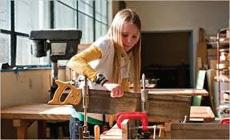
WELLNESS
Woodworking: Learn design and construction techniques used by skilled woodworkers past and present! Students will design and learn skills relating to working in wood, with the opportunity of producing a series of practical projects, incorporating hand skills and the use of power tools. Students learn to accurately measure, mark, cut and join pieces to finish your project. Modern design and manufacturing tools such as the laser cutter and CNC router will also be used to produce high quality projects.
Tour de Friends: Tour de Friends is a course that celebrates cycling, fitness, community building, and friendship. Students begin the class with some core fitness routines and running around the ISK campus, looking for the best cycling trails. Students then practice their skills on campus and graduate to nearby trails off campus in the coffee fields surrounding ISK. Students also learn a few basic tuning techniques, puncture repair and chain maintenance. The course concludes with a field trip to Karura Forest where students can utilize their skills to enjoy the beautiful trails found there. REQUIRED: Students must provide their own well-maintained bike and helmet.
Muay Thai: Muay Thai also known as The Art of Eight Limbs is an ancient martial art from Thailand which makes use of 8 points of contact including the knees, elbows, fists, and shins. As a student of this discipline you will develop your technical skills, physical conditioning, strength, and increase your self confidence. Join our Middle School Muay Thai elective to discover a new culture, get strong, feel healthy, and most importantly have some FUN in a safe and supportive environment.
Healthy Chef: Are you a foodie? Are you interested in exploring different flavors and dishes in the kitchen while learning how to cook for yourself and your family? The Healthy Chef course develops the love of healthy food and cooking Students are involved in a variety of hands-on cooking projects designed to promote kitchen skills, food preparation skills, and creativity. This class explores the nutritional benefits of various ingredients and the impact of our diets on us, our community and our planet.