Rotavirus Vaccine Post Introduction Evaluation
WHO recommends that after 6-12 months of any New Vaccine Introduction in a country, a Post Introduction Evaluation should be conducted in order to assess the impact of that vaccine introduction on the different components of the immunization system of the states and the country as a whole.
India completed the country wide expansion of RVV in September 2019. Due to the restrictions around the COVID pandemic, the RVV PIE had to be rescheduled to 2022.
The 14 states selected for PIE were Assam, Bihar, Delhi, Gujarat, Karnataka, Kerala, Madhya Pradesh, Maharashtra, Odisha, Punjab, Rajasthan, Tamil Nadu, Uttar Pradesh and West Bengal. In each of these 14 states, two districts were selected for evaluation. A full day Orientation of Evaluators was conducted on 21st March 2022 in New Delhi.
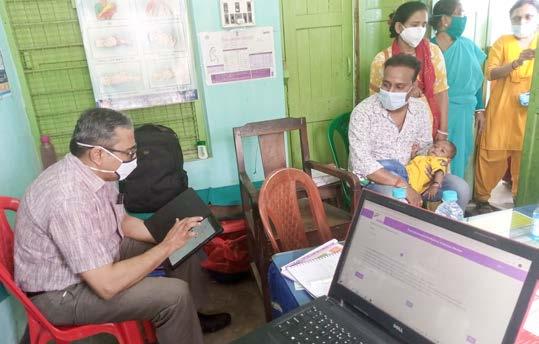
Glimpses of RVV PIE
SAPTDHARA – A method of mass communication
An important component of the Universal Immunization Programme is demand generation in the community to improve the uptake of RVV and all other vaccines given under the national immunization schedule. In rural areas the traditional media are often used for these demand generation activities. One such example is in the Ahmedabad district of Gujarat, where glove puppets are used as a communication tool to disseminate key immunization related messages to motivate the community to avail the vaccination and other health care services provided by the Government. These puppet shows are not only entertaining, but also keep the audience engaged and these facilitates effective delivery of the key messages. The activity is named as ‘Saptdhara’ and the group members who puppeteer
these are named as ‘Saptdhara Sadhak’. The group includes Medical Officers, FHS, ANM, ASHA and MPHW. These groups, by the way of puppet shows, sensitise the community on different aspects of immunization – the different vaccines available in the UIP, diseases prevented by these vaccines, new vaccine introductions, session dates, sites, etc.
Innovation
This innovative method of mass communication in Gujarat is supported and encouraged by the State. Dr. Jani, Additional Director (FW), Government of Gujarat, says: “Vaccines save millions of children’s lives every year. This message about the effectiveness of vaccination needs to be understood by all, including
children. Therefore, we support innovative ways to reach parents and children. It is very important for parents to protect their children in their infancy before they are exposed to potentially lifethreatening diseases”.
RVV-3 dose (April 2021 to March 2022)
Mind Power Game:
Please select correct characteristics of New RVV Liquid Vaccine and tick Right or Wrong in the provided boxes accordingly:
- Single dose presentation ...............................................
- 2.00 ml per dose per beneficiary
- To be kept on conditioned icepack
- No open vial policy
- Interchangeability between all kinds of Rotavirus vaccines
- 2.50 ml per dose per beneficiary
- Tube presentation
For Answer
Please scan the QR code
ROTA QUICK FACTS
Hospital-based surveillance for acute gastro-enteritis was conducted in five sentinel sites from 2012 to 2020 to monitor the vaccine impact on various genotypes and the reduction in rotavirus positivity at each site.
References:
• Varghese, T.; Alokit Khakha, S.; Giri, S.; Nair, N.P.; Badur, M.; Gathwala, G.; Chaudhury, S.; Kaushik, S.; Dash, M.; Mohakud, N.K.; et al. Rotavirus Strain Distribution before and after Introducing Rotavirus Vaccine in India. Pathogens 2021, 10, 416. https://doi. org/10.3390/pathogens 10040416 Rotavirus vaccine coverage dashboard RVV-1 dose (April 2021 to March 2022)
Source: HMIS provisional data Cumulative doses provided during April 2021 to March 2022
Editorial Board
Dr. Pradeep Haldar, MoHFW
Dr. Veena Dhawan, MoHFW
Dr. Arindam Ray, Bill and Melinda Gates Foundation
Dr. Arup Deb Roy, JSI
Dr. Amanjot Kaur, JSI
Acknowledgements: State officials, JSI State and National team