New Colors & Materials
Spotlight Page 18
Advice on Accounts
Receivable Page 26
ISFA Fabricator Profile:
Hard Rock Stone Works Page 28
Industry Outlook Page 32
Sustainability and the Surfacing Industry Page 37


New Colors & Materials
Spotlight Page 18
Advice on Accounts
Receivable Page 26
ISFA Fabricator Profile:
Hard Rock Stone Works Page 28
Industry Outlook Page 32
Sustainability and the Surfacing Industry Page 37
Countertops & Architectural Surfaces welcomes Letters to the Editor. If you have questions about the magazine, or would like to make a comment, or voice an opinion about the magazine, ISFA or the industry in general, please feel free to write to us.
Please send letters to editor@isfanow.org or to Letters, ISFA, PO Box 627, Ingomar, PA 15127, attention: Editor. Include a telephone number and address (preferably an email address). Letters may be edited for clarity or space. Because of the high volume of mail we receive, we cannot respond to all letters. Send queries about Countertops & Architectural Surfaces to editor@isfanow.org or mail to ISFA, PO Box 627, Ingomar, PA 15127, attention: Editor.
Phone: (888) 599-ISFA editor@isfanow.org www.isfanow.org
Countertops & Architectural Surfaces (ISSN 2372-983X) is published quarterly by the International Surface Fabricators Association (ISFA), with a fifth “Buyers Guide” issue publishing in October. Individual copies of Countertops & Architectural Surfaces are available at the nonmember “newsstand” price of $14.95. Countertops & Architectural Surfaces is also available by individual subscription at the following rates: ISFA nonmembers, one year (five issues) $30.00; ISFA members, one year free with every membership renewal.
Special rates and charges apply for orders outside of the United States. Call for details. To subscribe, call (888) 599-ISFA. Printed in the United States of America. Copyright © International Surface Fabricators Association 2021. All rights reserved. No part of this publication may be reprinted or otherwise reproduced without the publisher’s written permission. Countertops & Architectural Surfaces and The International Surface Fabricators Association assumes no responsibility for unsolicited manuscripts or photographs.
Materials will be returned only if accompanied by a stamped, selfaddressed envelope. For change of address, please include old label with new information, including both old and new zip codes. Allow 3-6 weeks for address change to take effect. Periodicals postage rate is paid at the Ingomar, Pa., post office as well as others. Opinions expressed by writers in this magazine are not necessarily the opinions of Countertops & Architectural Surfaces or the International Surface Fabricators Association, but rather those of the individual writers.
POSTMASTER: Send address changes to LSC Communications, Care of Countertops & Architectural Surfaces magazine, 3401 Heartland Drive Liberty, MO 64068.
Photos in this publication may not depict proper safety procedures for creative purposes. ISFA and Countertops & Architectural Surfaces support the use of proper safety procedures in all cases and urge readers to take steps to institute such procedures.
Photography/graphics provided by US Surfaces, Vadara, Eric Hausman, Drury Design and Hard Rock Stone Works.
MAGAZINE CREDITS
Publisher & Editor: Kevin Cole
Proofreader: Nancy Mueller-Truax
Design: V2 Marketing Communications
ISFA OFFICERS OF THE BOARD
Steve Mast, President
Augie Chavez, Immediate Past President
Joe Duszka, Vice President
Ted Sherritt, Treasurer
Mike Langenderfer, Co-Treasurer
Austin Maxwell, Secretary
ISFA DIRECTORS
Paul “Max” Le Pera, Director
Eric Tryon, Director
Rodrigo Velazquez, Director
Laura Grandlienard, Director
Kelley Montana, Director
Kimberley Homs, Director
Jim Callaghan, Associate Member Rep
Joe Connolly, Associate Member Rep
ISFA STAFF
Nancy Busch, Executive Director
Kevin Cole, Director of Communications and Magazine/Website Publisher & Editor
Carol Wilhite, Operations Manager
Paul Wisnefski, Account Representative
Amy Kyriazis, Program Manager
Samantha Winslow, Membership Administrator
Chris Pappenfort, Trainer
Fred Hueston, Trainer

COVER PHOTO
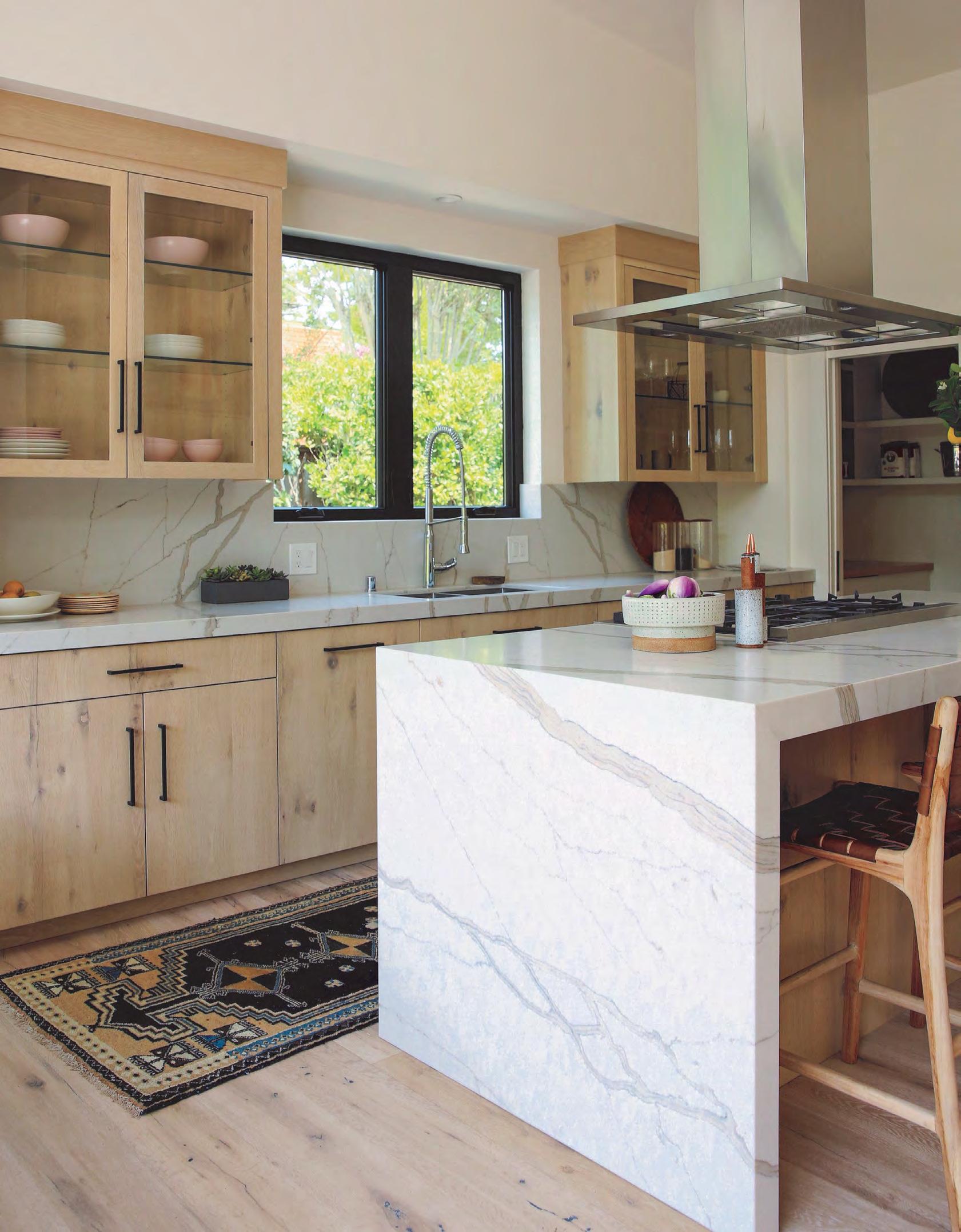
This luxe new-construction kitchen was designed by Drury Design (www.drurydesigns.com) featuring Sereno Bianco by Vadara. For more information visit www.vadaraquartz.com.
Photo Credit: Eric Hausman https://www.drurydesigns.com/
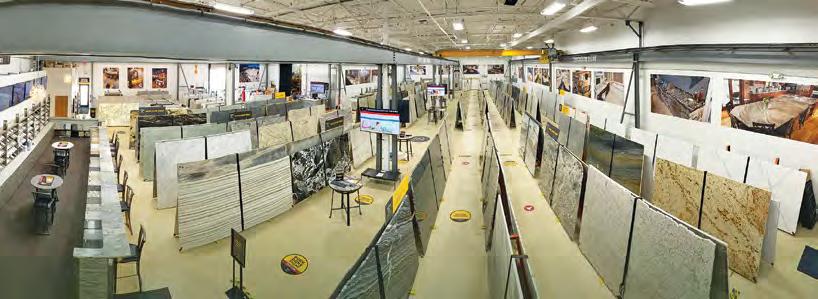



From the desk of Kevin Cole, Editor & Publisher, and ISFA Director of Communications
Welcome to the first issue of Countertops & Architectural Surfaces magazine of 2021. This marks the beginning of 13 years I have had the opportunity to serve the industry as the Director of Communications for ISFA. And I want to sincerely thank you all for allowing me to do so. Somehow, I’ve become the longest working staff member in the history of the association, and in the process have met some of the finest people I could ever have the pleasure to know.
Looking back, this industry’s come a very long way since I was first introduced to it nearly two decades ago. We’ve had plenty of ups and downs over the years, and here we still are. The landscape has certainly changed in some ways, but other things, like a belief in craftsmanship and innovation have largely remained core values.
We all know that 2020 was a difficult year for the industry and with it came unprecedented changes. New protocols were put in place to meet various government mitigation mandates. New ways of doing things had to be developed to help companies come through in good shape. Changes ranged from simple things like masks, social distancing and reinforcing handwashing and sanitizer use, to serrating shifts so as to minimize the number of people working at a time. Many office workers began working from home, and the glory of the Zoom meeting began to take the place of many daily staff meetings.
One thing, however, that did not change was the camaraderie, open discussions and sharing of ideas that we’ve seen for many years. Everyone scrambled to come up with best practices and ideas for staying in contact with staff and clients, and THEY SHARED IT! That is a beautiful thing. I saw a lot of the industry come together in a trying time and offer insight into how they were making things work.
ISFA launched regular meetings to bring together fabricators to discuss how to overcome problems they faced. These meetings then turned into full-fledged shop tours during which a fabricator would volunteer his or her time to walk through their shop with a camera, showing peers around the country their operations and discussing processes and mitigation efforts. It was uplifting to witness.
Just as 2020 was an unprecedented year of unpredictable changes that were forced on nearly all of us, so will 2021 be a year of continuing change. We are still facing a pandemic, although with 1 million to 2 million vaccinations a day and numbers of sick seemingly dropping in most places, most predict business will stabilize this year. However, there’s little doubt many of the new technologies, safety protocols and communication methods will stick around and potentially affect us all going forward.
These changes certainly are shaping the way ISFA is communicating with our members, and hopefully for the best. The association has brought together several committees from its member base to help directly influence the types of information and programming that is needed. These committees also help to determine the medium that best suits the facilitation of these needs.
For those of you who are regular readers of this publication, and I’m hoping that’s most of you, within these pages you will likely notice some differences. ISFA has set up a “Media Committee” to discuss and develop changes in a variety of places. This issue will kick off a new regular theme we hope to include in every issue — sustainability. Not only will these regular features discuss the idea of more eco-friendly products, but will also cover ways the surfacing/countertop industry can take advantage of more sustainable processes and
save money. We’ve also replaced our ISFA Fabricator Directory with an ISFA Associate Member Directory to highlight the companies that support our goal of providing educational, networking and other beneficial programming to the industry.
You will see many other changes, big and small, over the course of the year, as ISFA works to help its members get the most out of their investment in the association. While the catalyst to really dig deep, rethink our organizations and pull out the best in us has been tragic, today — right here — is where we now find ourselves.
The pandemic brought with it what will likely be lasting uncertainty. Few have been spared the pain of loss, and yet also reminded us of just how important our relationships with peers, friends and our families really are. We’ve been given a wake-up call to live a bit more for today and be thankful of the people in our lives.
Who knows what the future holds for you, me or our associates? Only time has the answer. However, when you think of me, this publication and all of the personal interactions I’ve been so fortunate to have with so many of you over my time with ISFA, I’d like to think you’ll remember them as solid efforts to help wherever possible. I hope you feel that ISFA and all of its staff are your partners in whatever may come, and are here to assist you in overcoming any obstacle.
Thanks for all the memories.
Sincerely,
Kevin Cole, Publisher & Editor kevin@isfanow.org
(815) 721-1507

ISFA Virtual Shop Tours (held monthly)
Sponsored by Park Industries Tour of McDermott Top Shop Online
March 10, 1 – 2 p.m. EST (888) 599-ISFA www.isfanow.org
Park Industries Virtual Porcelain Fabrication w/ MSI
Four Sessions held on March 17 & 18
March 17, 5 p.m. EST & 5 p.m. MST
March 18, 5 p.m. CST & 5 p.m. PST (800) 328-2309 www.parkindustries.com
Park Industries Seminar on Maintenance Minded Culture Online
March 23, 1 p.m. CST (800) 328-2309 www.parkindustries.com
ISFA Mixer
(last Thursday of every month) Online
March 25, 4 p.m. PST, 7 p.m. EST (888) 599-ISFA www.isfanow.org
Canada Woodworking East
April 8 – 9 Saint-Hyacinthe, QC Canada (888) 454-7469
Virtual Manufacturer Tours Tour of Hyundai's Hanstone Quartz Surfacing Plant Online
April 19 1p.m. EST www.isfanow.org
Park Industries Virtual Demo Edging Solutions Online
April 21, 10 a.m. CST (800) 328-2309 www.parkindustries.com
ISFA Mixer
(last Thursday of every month) Online
April 29, 4 p.m. PST, 7 p.m. EST (888) 599-ISFA www.isfanow.org
Interzum May 4 – 7 Cologne, Germany
+49 1806 077 050 www.interzum.com
Virtual Sintered/Porcelain/ Compact Surface Training Sponsored by GranQuartz Online
May 6 www.isfanow.org
ISFA Hands-On Solid Surface Training
Hosted by GECKO SSS
May 18 – 20
San Antonio, Texas (888) 599-ISFA www.ISFAnow.org
Xiamen Stone Fair
May 18 – 21 Xaimen, China
+86-592-5959616
Virtual Sintered/Porcelain/ Compact Surface Training Sponsored by GranQuartz Online
May 20 www.isfanow.org
ISFA Mixer
(last Thursday of every month) Online
May 27, 4 p.m. PST, 7 p.m. EST (888) 599-ISFA www.isfanow.org
The International Surface Event (TISE)
June 16 – 18
Las Vegas, Nev. (972) 536-6440
ISFA Mixer
(last Thursday of every month)
Online
June 24, 4 p.m. PST, 7 p.m. EST (888) 599-ISFA www.isfanow.org
Coverings 2021
July 7 – 9
Orlando, Fla. (571) 313-5801 www.coverings.com
AWFS
July 20 – 23
Las Vegas, Nev. (800) 946-2937
ISFA Mixer
(last Thursday of every month)
Online
July 29, 4 p.m. PST, 7 p.m. EST (888) 599-ISFA www.isfanow.org
HD Expo & Conference
Aug. 24 – 25
Las Vegas, Nev. (888) 769-7861
ISFA Mixer
(last Thursday of every month)
Online
Aug. 26, 4 p.m. PST, 7 p.m. EST (888) 599-ISFA www.isfanow.org
Cersaie
Sept. 27 – Oct. 1 Bologna, Italy +39 0536 818111
ISFA Mixer
(last Thursday of every month)
Online
Sept. 30, 4 p.m. PST, 7 p.m. EST (888) 599-ISFA www.isfanow.org
Marmomac 2021 Sept. 30 – Oct. 2 Verona, Italy +39 045 8298 561
NeoCon Oct. 4 – 6 Chicago, Ill. (312) 527-7583
ISFA Mixer
(last Thursday of every month)
Online
Oct. 28, 4 p.m. PST, 7 p.m. EST (888) 599-ISFA www.isfanow.org
Woodworking Machinery & Supply Conference and Expo Nov. 4 – 6 Mississauga, ON Canada (319) 389-3352
ISFA Annual Conference & Meeting
Sponsored by GranQuarz, Park Industries, Infinity Surface, Crossville and Integra Adhesives Fall – TBD (888) 599-ISFA www.ISFAnow.org

Submit your event for consideration in Calendar of Events by emailing Editor Kevin Cole at kevin@isfanow.org.


Required disclosures and notifications of COVID-19 exposures and infections BY
A recent California study has revealed the construction industry has the highest COVID-19 positivity rate of all industries. Yet, a year into the pandemic, many construction-related businesses are still unaware of their reporting obligations or how to otherwise handle a worker’s COVID-19 positive test or potential exposure.
There is no centralized law regulating the disclosure and notification of COVID-19 cases in the workplace. Instead, to determine their obligations, businesses must piece together regulations issued at federal, state and local levels, and strike a careful balance between maintaining workplace safety and protecting employee privacy.
Overall, reporting obligations can be divided into three broad categories: 1) disclosures to OSHA (federal level); 2) disclosures at the state level; and 3) disclosures in the workplace.
1. Disclosures to OSHA
At the federal level, COVID-19 record keeping and reporting obligations are established by OSHA. However, OSHA does not require all cases of COVID-19 to be reported. In practice, the duty to report COVID-19 cases to OSHA will only be triggered in rare circumstances.
Whether an employer needs to report COVID-19 cases to OSHA is primarily based on the answer to three questions.
a. Is the COVID-19 case work-related?
Only work-related COVID-19 cases must be documented and reported to OSHA. But, how do employers know if a COVID-19 case is workrelated?
In the construction industry, a COVID-19 case is work-related if: i) there is evidence of other COVID-19 cases among workers who work closely together and there is no alternative explanation for the infection’s source; or ii) the employer has evidence (either through the employee or other sources) indicating the infection may have taken place at work.
If the employer determines that the COVID-19 case is not work-related, no disclosure or record keeping is necessary. However, if it concludes that the COVID-19 case is work-related, the employer must anwers two questions to determine if the case should be reported to OSHA.
b. Did the COVID-19 work-related case result in hospitalization?
Not all work-related COVID-19 cases resulting in hospitalizations need to be reported to OSHA. To be reportable, it must be an in-patient hospitalization (for treatment) and must have occurred within 24 hours of the employee’s exposure to COVID-19 in the workplace.
Employers have 24 hours to report the case to OSHA. The reporting clock starts when the employer “know[s] both that the employee has been in-patient hospitalized and that the reason for the hospitalization was a work-related case of COVID-19.”
In other words, if the work-related COVID-19 case did not result in hospitalization, or if the in-patient hospitalization did not occur within 24 hours of the exposure in the workplace, then the employer does not need to report the case to OSHA.
c. Did the COVID-19 work-related case result in fatality?
OSHA also requires employers to report COVID-19 fatalities, but only if the death occurred within 30 days of the employee’s work-related exposure. In those instances, the employer has eight hours to report the fatality to OSHA. The reporting clock starts when the employer “know[s] both that the employee has died, and that the cause of death was a work-related case of COVID-19.”
In sum, OSHA’s guidance provides simple reporting rules that are only triggered in rare cases. However, employers should bear in mind that the states and cities in which they operate may have stricter COVID-19 reporting requirements than those set forth by OSHA.
2. Disclosures at the State Level
In addition to the OSHA rules described above, there are currently 28 OSHA-approved COVID-19 workplace safety and health programs operated by individual states and U.S. Territories, each with its own rules. These rules in some cases (for example Cal-OSHA) expand the reporting obligations described above.
States are also enacting their own laws relating to notice and reporting obligations for COVID-19 workplace exposures. Because California has the
PATRICIA BRUM
most comprehensive reporting obligations of all states, this article will use its recently enacted law as an illustrative example.
On September 17, 2020, the California governor signed Assembly Bill (“AB”) 685 into law. This new legislation, which went into effect on January 1, 2021, imposes strict notice requirements relating to COVID-19 work-related exposures on employers.
In particular, AB 685 requires California employers to notify employees, employees of subcontractors at the work site and union representatives, if applicable, whenever the employer receives a “notice of potential exposure” to a “qualifying individual” at the work site. The new law also requires employers to notify the local public health agency of a COVID-19 outbreak in the workplace.
a. Notice to Employees and Their Representatives
Within one business day of learning of a “potential exposure” to a COVID-19 case in the workplace, California employers are required to:
■ Provide written notice to all employees and employers of subcontracted employees who were at the work site within the infectious period who may have been exposed to COVID-19;
■ Provide written notice to employee representatives, including unions and sometimes attorneys, who may represent employees;
■ Provide written notice to employees and/or employee representatives regarding COVID-19related benefits that employee(s) may receive, including workers’ compensation benefits, COVID-19 leave, paid sick leave, and the company’s anti-discrimination, anti-harassment, and anti-retaliation policies; and
■ Provide notice to employees regarding the company’s disinfection protocols and safety plan to eliminate any further exposures, per CDC guidelines.
Written notice includes personal service, postings, e-mail or text message if it can reasonably be anticipated to be received by the employee within one business day of sending and shall be in both English and the language understood by the majority of the employees.
In addition to providing notices to employees and their representatives, employers in California must provide notice to the local public health agency within 48 hours of learning of a “COVID-19 outbreak” in the workplace. Currently, a COVID-19 outbreak in the workplace occurs when at least three probable or confirmed COVID-19 cases are reported within a 14-day period in persons with close contact at work and from different households.
The notice to the local public health agency must include the names, numbers, occupations and work sites of the qualifying individuals. The employer must also include the business address and NAICS code of the work site where the qualifying individuals work. Finally, the employer must continue to give notice to the local public health agency of any subsequent cases.
There is no federal law that specifically mandates employers to notify their employees if someone has tested positive or if there has been a potential exposure in the workplace. However, states and local governmental agencies are beginning to impose those obligations on employers.
Irrespective of any state and local laws mandating disclosure, the Center for Disease Control and Prevention (CDC) encourages employers to notify not only their employees, but also contractors and on-site visitors of potential COVID-19 exposures in the workplace. As a result, employers are faced with the difficult task of crafting notices that comply with the CDC recommended practice and at the same time protect employees’ privacy.
Below are two basic principles that businesses should consider regarding COVID-19 disclosures in the workplace:
1. The employer should disclose to employees that a co-worker (or a visitor to the work site) has tested positive for COVID-19 without disclosing the identity of the person.
2. If known, the employer should also notify specific co-workers, clients, vendors or visitors that a person with whom they were in close contact in the work site over the past 14 days has tested positive. Again, employers should strongly consider not disclosing the identity of the person who has tested positive.
The lack of centralized regulations regarding the disclosure of COVID-19 exposures and infections in the workplace makes it difficult for businesses to determine their obligations when learning that an employee or visitor to the work site has tested positive.
Federal OSHA regulations provide the initial framework to determine whether a business has the duty to report the COVID-19 infection or exposure, but the inquiry doesn’t end there.
Businesses must also check potential rules and regulations enacted at the state and local level. At a minimum, businesses should consider notifying their employees that a co-worker has tested positive for COVID-19 without disclosing the identity of the person who tested positive.
Patricia Brum is an attorney with Snell & Wilmer LLP, a full-service business law firm with more than 450 attorneys in 15 offices in the United States and Mexico. Before becoming a lawyer, Patricia worked in the surfaces industry for more than 15 years. She currently represents distributors, fabricators and installers in legal disputes in California. For more information, contact her at pbrum@swlaw.com.

Caesarstone® U.S. acquired Omicron Granite & Tile, which will immediately increase Caesarstone’s distribution network and provide 17 new locations from which Caesarstone will operate. Based in Pompano Beach, Fla., Omicron Granite & Tile, a supplier of quartz and stone surfaces, has 17 showrooms and indoor warehouses across the Southeast and Ohio Valley regions of the United States. The acquisition is designed to leverage the strength of the Caesarstone brand through a robust U.S distribution network to best serve customers and promote its award-winning designs.
MSI, supplier of countertop, wall tile, hardscaping and flooring products, launched a new image search tool that allows users to find the closest MSI match of any product using artificial intelligence. The image search tool is the newest in the company’s extensive digital portfolio; from its multisurface visualizer to a real-time inventory search, MSI’s digital tools make the design process easier from start to finish. Users can upload a photo of any product to the search tool and immediately view the results, including the closest MSI product matches. Results can be filtered for more concentrated selections, by only choosing the product categories in which they are most interested. Additionally, coordinating choices are available to complete the look.
LOTTE Chemical announces the addition of a third engineered-stone production line at its Belenco plant in Turkey. The expanded production volume of the Turkish plant supplements LOTTE’s Yeosu plant in South Korea. The combined capacity of the two facilities is 22 million sq. ft. per annum. LOTTE is working to establish itself as one of the top quartz surfacing manufacturers in the world, serving a rapidly growing global customer base. The company’s $30 million investment in the new production line will help ensure a stable and secure global supply chain for its engineered stone products. The Turkish facility’s manufacturing capabilities are complemented by distribution efficiencies through the port of Izmir and access to ample raw materials from a nearby stone mine. Acquired by LOTTE in March 2019, Belenco is the largest manufacturer of engineered stone in Turkey. Belenco utilizes state-of-the-art Breton manufacturing technology – a process that

Hyundai L&C USA, LLC, (Living & Culture), promoted Brian Park to CEO. In addition to all sales, marketing, product development, product management and operations responsibilities, Park adds HR, Accounting and P&L responsibility to his list of duties. H.S. Kim, the president of Hyundai L&C North America, will continue to support Park to be successful in his new role. Park arrived at Hyundai L&C USA in November 2019. As the company’s executive vice president of sales, marketing and operations, Park was tasked with growing the premium surfacing business, as well as further laying the groundwork to launch the company’s flooring products in the United States. Under Park’s guidance and leadership, the HanStone Quartz and Hanex Solid Surfaces brands have enjoyed record sales, in spite of the pandemic.
produces high-quality, technologically advanced engineered stone. LOTTE has been a licensee of Breton technology since 2018, utilizing the process in the development of its popular Cirrus Collection of quartz surfaces. Comprised of 93 percent high-density quartz, LOTTE’s Radianz surfaces resemble high-quality natural stone, with the benefit of resisting scratches, growth of bacteria and color deflection. Radianz quartz is durable, hygienic, and available in a wide assortment of colors and patterns suitable for commercial and residential applications.
CaraGreen Healthy Materials and OHM International have established a joint sales and marketing partnership. OHM will leverage its distribution infrastructure and brick and mortar locations and showrooms throughout the East Coast alongside CaraGreen’s strong virtual and online presence, as well as its showrooms and warehouses throughout the East Coast. OHM’s extensive relationships in the kitchen and bath space coupled with CaraGreen’s focus on securing architect and designer specifications will help create a unique opportunity for both partners to leverage their strengths for select brands within
their portfolios. Brands that OHM offers that will now be promoted by CaraGreen include Geoluxe Pyrolithic Stone, Enigma Surfaces and Diresco Bio-UV Quartz. In turn, OHM will be promoting several of CaraGreen’s sustainable brand portfolios, including Durat Solid Surface, PaperStone, GEOS Recycled Glass Surfaces and elementAl surfaces. This partnership represents the shifting market that is focused on sustainability, education and availability. As consumers look to find more unique, sustainable and affordable products, this combined portfolio is designed to offer a solution for nearly every customer. Similarly, as architects and designers shift their searches online, the accessibility and ease of finding these products through trusted partners becomes paramount.
Neolith® teamed up with Treedom, a global ecological initiative that seeks to protect our natural world by encouraging corporations to plant trees. The company planted 300 new trees (one for each of its distributors) in some of the world’s most threatened and fragile ecosystems across Cameroon, Kenya, Haiti and Ecuador. The benefits are myriad, including increase CO2 absorption, protecting flora and fauna and combating soil erosion. The program also empowers the local community, with direct funding to local farmers, training to diversify and offer more incoming green opporutnities. This is the latest milestone in Neolith’s drive to become the most sustainable brand of sintered stone in the world, and builds on a number of other initiatives launched in 2020 as part of its “SIX·S” campaign.
The National Kitchen & Bath Association (NKBA) set its board of directors for 2021, which will be led by newly elected Chair, Michael Mahan, vice president of Schneider Electric. Mahan served as vice chair in 2020 and has served on the board since 2018. Joining Mahan as board officers are Vice Chair Basil Larkin, vice president of sales for Hestan Commercial Corp., and Secretary/Treasurer Randy Warner, vice president of sales at the Luxury Division for Samsung-Dacor. Outgoing Board Chair Allison Lowrie, chief marketing officer for ANGI Homeservices, will remain on the board as a director. She is joined by other returning board members Kristen Elder, showroom and builder vice president, Ferguson Enterprises; Jan Heck,

president and CEO, Miele USA, and Jan Neiges, CMKBD, Principal, Jan Neiges CMKBD LLC. New directors joining the board include, Louis M. “Lou” Rohl, founder of House of ROHL, son of HoR Founder and Kitchen & Bath Hall of Famer Ken Rohl, who also served on the board, and Mikael Akerberg, CEO of Nobilia North America. Board members Lorenzo Marquez, founder and president of Marqet Group, and Steve Joseph, founder and CEO of Smart Home Products, have completed their terms.

Leon Zanger, one of the founders of the American stone and tile design resource Walker Zanger, died at the age of 93 because of complications of COVID-19. Born in Belgium, Zanger and his family fled Europe during the 1940 German invasions and immigrated to the United States when he was 12 years old. Before the family arrived in the United States, they settled in Portugal for a few
years where Zanger watched in awe as workers paved the streets with marble. This first experience with this extraordinary material — which Zanger had only seen used at museums and palaces of Belgium — never left his mind. It would lead to the Walker Zanger brand’s inspired beginnings. He started Walker Zanger in 1953 with partner Marvin Walker, importing marble from Portugal and pioneered the use of the material for tabletops. In 1963, Zanger began importing stone tiles, breaking open the stone tile market in residential settings. The company grew from there, expanding to find unique products to allow the creation of bold visions and unconventional designs.
Lapitec recently presented its updated website at www.lapitec.com, featuring revamped content and high-impact graphics. Available in four languages (English, Italian, Spanish and German), this intuitive site is designed to help users discover the product in a simple way, encouraging them to explore the numerous possible applications assisted by photographs of completed projects. The website can therefore be used as a working
tool to meet project requirements — users can carry out advanced searches by intended use, for example, or by shade or finish. The new website forms part of a wider rebranding process that began in 2019.
Hardwoods Distribution Inc. (HDI), through its subsidiary Hardwoods Specialty Products US LP (Hardwoods), purchased Aura Hardwoods. Aura will operate as part of the Hardwoods Northern California Group led by General Manager Mike Couture. Together, with Senior General Manager of California Nick Smith, they are responsible for optimizing Hardwoods’ expanding California business. Additionally, HDI, through its subsidiary Rugby Architectural Building Products, purchased River City Millwork which operates in Rockford, Ill. It will continue to conduct business under the River City Millwork brand at its current location, as part of the Rugby Architectural Building Products division of HDI. Within Rugby, the new acquisition will operate as part of the Rugby Midwest Region with oversight by Midwest Regional Manager Rod Beason.


Antolini introduced its newest marble, Lincoln Stone, to the extensive Exclusive Collection.
Lincoln Stone is a delicate, elegant and timeless natural stone, distinguished by a sophisticated surface, which appears as a precious work of art. Antolini’s carefully selected natural stone designs allow for stylistic freedom. With worldwide exclusivity over astonishing materials and sole access to the quarries, Antolini is able to offer desired and recognizable natural masterpieces in multiple finishes through a network of distributors and partners.
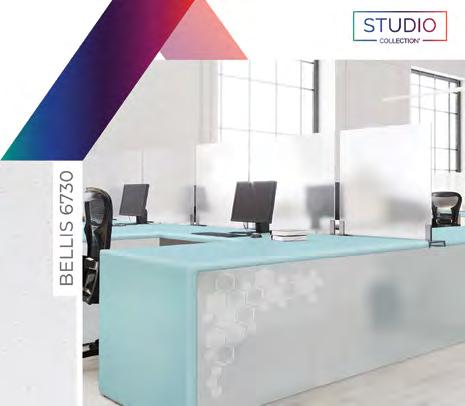
Bellis 6730, by the STUDIO Collection®, is a fine, cool white particulate pattern that invites the eye in for a further look. This modestly complex new material was designed in a 6mm panel caliper, to meet the needs of the growing partitions market and serve the requirement to separate spaces differently. This clean, Class I handcrafted architectural resin is bacteriostatic, hygienic and one of the cleanest most malleable materials to
solve the needs of formed or flat panel separation solutions.

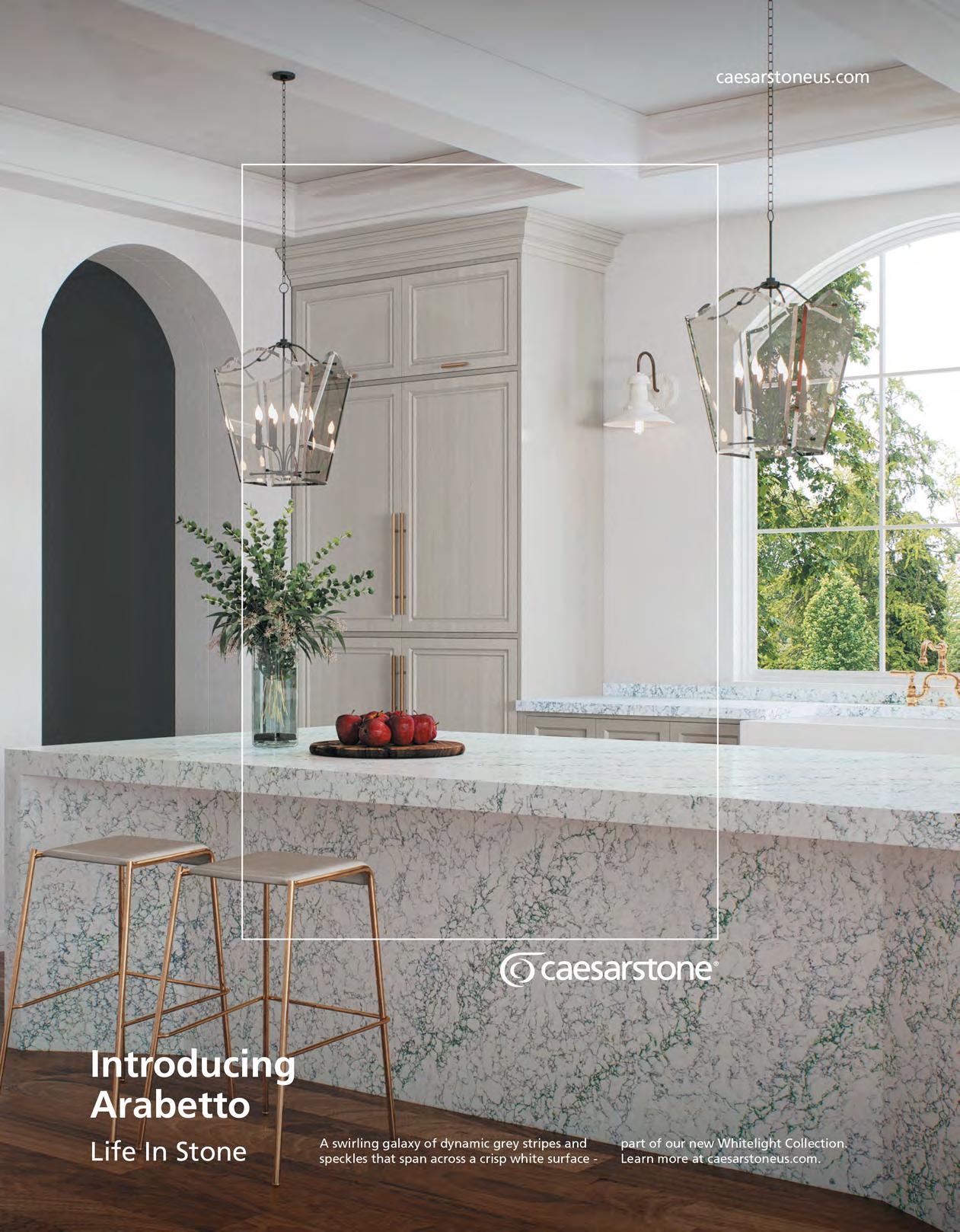
Whitelight, Caesarstone’s newest collection, reveals lighter neutral colors for interiors that provide a sense of wellness and serenity. Crisp pearly lusters and soft sandy hues connect the home from the inside with the earthy warmth of the world outside. This lightness creates a sophisticated backdrop, refocusing humancentered spaces that merge style with cleanliness.
The Whitelight Collection includes two new designs: the flowing beauty of dynamic veining with 5171 Arabetto, and the graceful timelessness of the classic 5112 Aterra Blanca. The two surfaces will be featured alongside 5114 Calacatta Maximus and the stylish beauty 5151 Empira White. Also part of the Whitelight Collection are 5143 White Attica, 1111 Vivid White and 5031 Statuario Maximus.
See Our Ad on Page 21

Making designs take shape is easier and more efficient than ever with new Corian® Solid Surface
in Widesheet Dimensions featuring Class A Fire rating – more sizes and colors!
The Corian® Design support network has stood side-by-side with architects, designers and fabricators across the globe for more than 50 years, working to provide local service and support to customers so they can create solutions that solve the toughest design challenges. It helps optimize the fabrication process for faster installations in applications that previously required multiple sheet seams to be joined. For the typical project, this means faster, less laborintensive installation periods, and less material for fabricators to inventory. It’s perfect for large-scale commercial applications and businesses including healthcare, education, food service and retail.
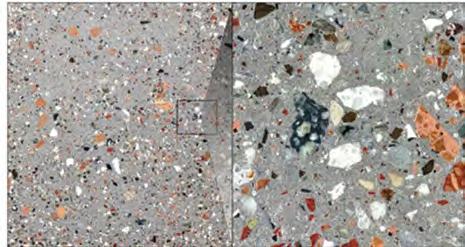
CoveringsETC, a provider of sustainable hard-surface finish materials, launched its new product line Urban Fossil – an alluring collection of Terrazzo designs that are made of 100 percent recycled material and is also 100 percent recyclable. CoveringsETC’s Eco-Terr® family of products offers a select variety of specialty Terrazzo finishes, while following strict Future Friendly™ guidelines that showcase a production model for circular economy initiatives that contribute toward a zero-waste society. The manufacturing process of Eco-Terr is chemicalfree with zero VOCs, which improves indoor air quality and it does not support microbial growth. Eco-Terr has an LCA of 60+ years. The Urban Fossil collection has a contemporary look with a diversity of aggregates that vary in shape, size and color, making each piece unique.
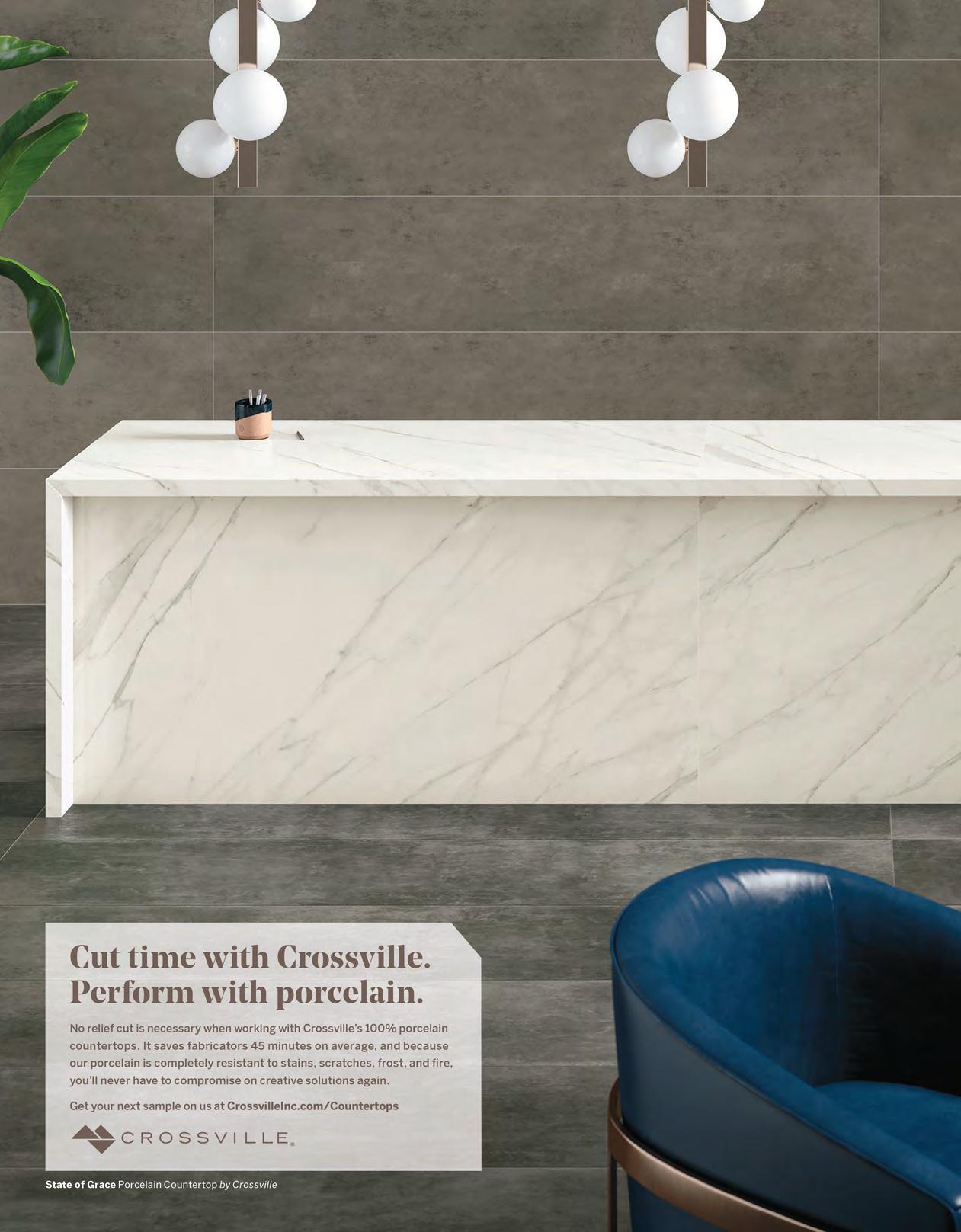
Crossville Porcelain Countertops in unpolished Femme Fatale are 100 percent pure porcelain slabs ready for creative fabrication and lasting installations. The modern, timeless look of Femme Fatale coupled with its superior performance characteristics make it great for residential and commercial applications. With the enduring porcelain body, UV- and freeze-thaw stablity, Femme Fatale can be fabricated for outdoor use with no worry of yellowing, fading or discoloration. This durable surfacing material is resistant to cracks and stains. Extremely low maintenance and simple to clean, the Femme Fatale Crossville countertops are made to be strong and stylish for years to come.
See Our Ad on Page 17
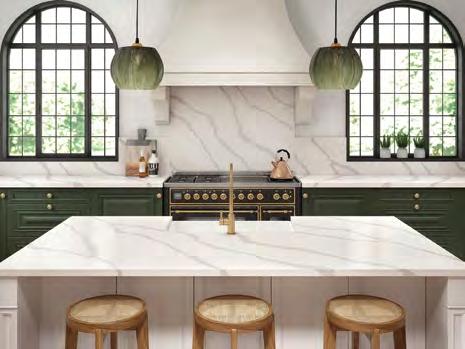
Daltile launched two new designs into its ONE Quartz National Marble Series. These new colors are made in the United States with imported materials in Dal-Tile Corporation’s quartz plant in Dickson, Tenn. These two new marble designs, Statuary Unity and Statuary Glory, offer beautiful wide veining against modern white backgrounds, with Glory’s background just a hint warmer than Unity’s. Both designs are extra-large quartz slabs (136 by 79 in.) and are available in 2cm and 3cm thicknesses nationwide.
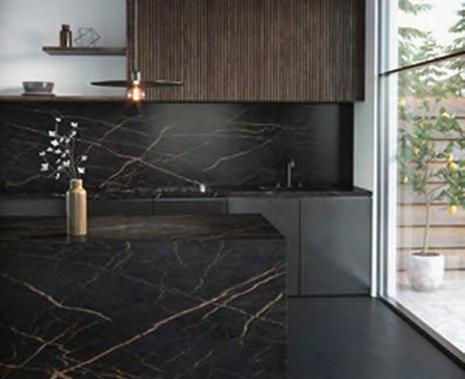
Cosentino expanded the color offering for Dekton Slim, the large format surface with an ultrathin 4mm thickness, which includes four hues from the Dekton 2020 and Natural Collections. The new colors include Helena, Laurent and Rem from the 2020 Collection, and Aura15, a luminary from the Natural Collection. These latest additions bring the Dekton Slim offering to a total of 20 colors, further expanding its potential applications. Created from a blend of raw materials like glass, quartz and porcelain, Dekton has a high resistance to UV rays, scratches, stains and thermal shock. It can be quickly cleaned with a damp cloth and soap, and no sealing is required. Its large format covers sizable surfaces, reducing the number of joints needed.
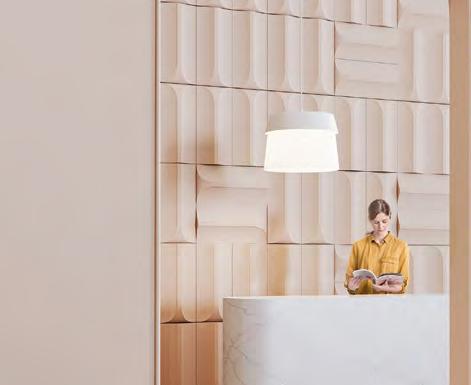
A crisp, clean and modern interpretation of a classic Calacatta veining pattern, Light Haze by Durasein is a perfect solid surface decor for projects you’ve been dreaming of! This lustrous color and classic veining may look like they came straight from the quarry, but behind its pretty face, the material is one tough customer – standing up to scratches, impact, fire, stain and chemical damage! Accompanied by a wide range of fabrication benefits setting it apart from its natural inspiration, it can be bent, twisted and kept looking fresh. Looking for something different? No sweat! Take a stroll through the company’s numerous collections and you’re sure to find a material match made in heaven.

Durat’s Solids collection, a colorful take on solid surface, has colors ranging from modern neutrals and retro hues to Durat’s signature oranges, greens, reds and blues. The only U.S. made solid surface designed in Europe, Durat offers a customizable option to allow minimization of waste during manufacturing, reducing project costs and creating a solution for your design. There are no minimums for purchase with Durat’s custom color match program. Durat also offers integrated color-matched sinks in the solids collection. Design with Durat’s solid colors for your seamless, sustainable solid surfaces.
elementAl Surfaces launched six new colors in its high recycled content acrylic line of sheet goods, the Heavy and Light Collections. The Heavy collection’s newest color offerings are Swagger and spectrAl. The Light collection introduces its colorful trio Aurora, Starburst and Lantern and their darker counterpart Blacklight. These semitranslucent panels spark curiosity and evoke feelings of light and transparency in any space. They are available in various sizes and thicknesses and have a color match program for designers who have their own ideas. elementAl is made in the United States and distributed exclusively by CaraGreen.
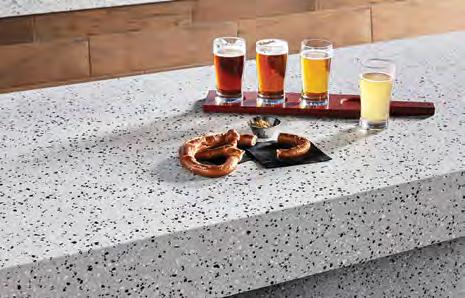
Formica recently rebranded its solid surface offerings as Everform™ Solid Surface and offers eight new designs that bring the solid surface collection to 38 patterns, influenced by terrazzo, micropattern, soft and ethereal trends.
This quality product is ideal for high-traffic environments with its renewable, hygienic and nonporous properties. Everform Solid Surface can also be molded into virtually any shape to support maximum design flexibility and pairs beautifully with coordinated accessories such as sinks and wet walls. It’s perfect for commercial surfaces and is particularly well suited to healthcare and education design projects.
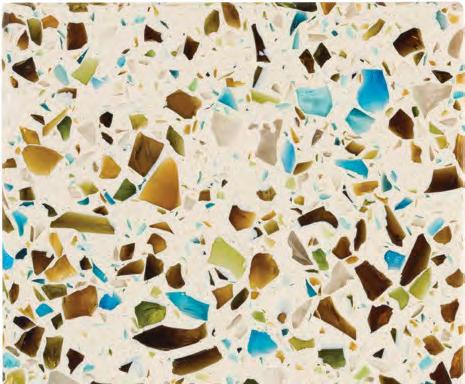
GEOS Recycled Solid Surface launched its Curated Collection, a refined palette of 10 colors named after geographic locations whose landscape is reflected in the recycled glass that makes up the products’ unique aesthetic. Destinations such as Auckland, Avalon, Rincon (pictured here) and Juneau are expressed by emulating the landscapes and waterways with green, blue and brown glass suspended in contrasting backgrounds. GEOS is a go-to surface for biophilic design.
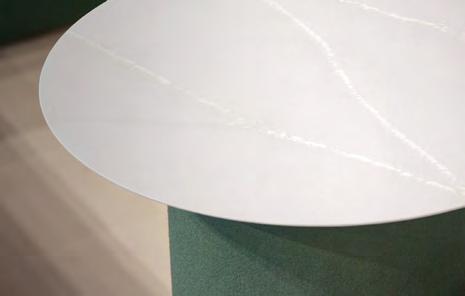
The Cascade and Venato color palettes are bringing a new level of warmth and sophistication to the Hanex line with eight new colors. The Cascade Color Palette features six designs, all with subtle movement, with colors ranging from white or grey to beige or black. Cascade is designed with elegance and refinement in mind. The Venato Color Palette brings bold and striking veining to the forefront. Featuring Venato Sparkle and Venato Snow, these marble-inspired designs are made to enhance the look of any space.
See Our Ad on the Inside Front Cover

Inspired by nature and designed for everyday, there are five new colors from HanStone Quartz. Calacatta Extra features bold and confident veining. Calacatta Venato expresses elegance with its classic veining and warm hues. Parchment and Vellum continue the pattern of warmth found in the 2021 colors, echoing the simplicity of nature, while Paros brings together calm and complexity with this sophisticated design inspired by the Greek isles.
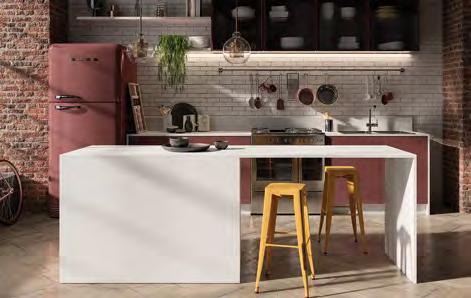
LG Hausys made several new color introductions to its HI-MACS® brand. The new Wood Collection consists of three colors: Crème Oak, Gray Teak and Dark Walnut. Four new colors were also added to the Aurora Collection: Aurora Ecru, Aurora Midnight, Aurora Frost and Aurora Ocean Gray. HI-MACS colors offer durability and are manufactured to prevent everyday wear and tear, as well as a high resistance to stains, chemicals and heat.
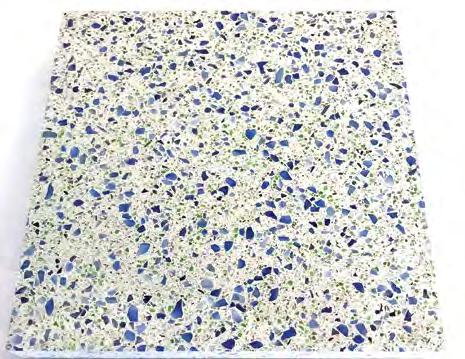
Made from 100 percent pre-consumer recycled glass, cement and nontoxic pigments as its three core ingredients, IceStone is a sustainable,
responsibly made, eco-friendly countertop material. As most of the names of IceStone’s colors are inspired by nature, so is Ocean Grass, which consists of large blue glass with tiny hints of clear and emerald green glass in a soft white background. IceStone is stain- and heat-resistant, UV stable, and doesn’t have to be sealed. IceStone is also a Cradle to Cradle certified countertop surface made in America.

The new Laminam surface Ardesia a Spacco is inspired by “Pietra di Lavagna,” a natural slate that’s been used for 2,500 years. With its silky surface, Ardesia a Spacco is available in a traditional Nero (black) and an original Bianco finish (pictured here). The search for aesthetic uniqueness combined with Laminam’s technological potential brought about the development of a surface structure where the deepest split, which can reach a depth of 1.5mm, is gently in contact with the shallowest split. The result offers interior designers and architects a product that combines performance with the beauty of the material that inspired it. It has expanded applications such as kitchen countertops, in traditional or facade construction and in design.
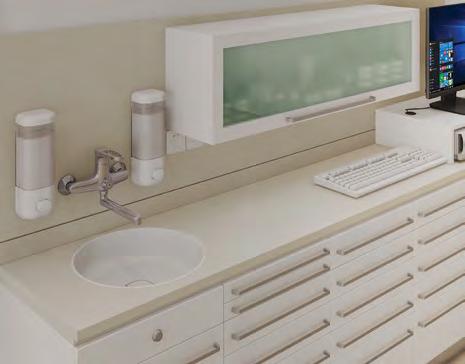
New colors of Meganite solid surface created in collaboration with international color guru Leatrice Eiseman (Leatrice Eiseman.com) are available now. Developed for use in many applications, this contemporary collection of neutral shades is both subtle yet durable. It creates a timely and inviting aesthetic that provides a sense of strength and resilience in
the new normal environment. The ALL-NEW enhanced antimicrobial solid surface, AcryMed, is certified in accordance with ISO 22196 and JIS Z 2801 testing standards, and it offers integrated hygienic surface protection. The technology protects the product itself against stain and odorcausing bacteria, and does not protect users or others from disease-causing bacteria. Regular cleaning cannot be replaced.
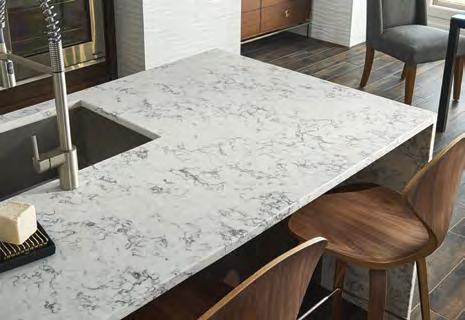
MSI introduced Q with LumaLuxe. The material has the same qualities that make Q quartz a durable and beautiful surface, but it has additional technology to enhance realism and depth. LumaLuxe is a Quartz breakthrough that enhances the way light interacts with the surface. An exclusive MSI formulation, it enhances countertops’ beauty, improves shine, dimension and drama, with colors and patterns you can’t find anywhere else. It’s manufactured using the internationally patented Bretonstone® system of Breton S.p.A. based in Italy. As with MSI’s other premium quartz countertops, Lumaluxe is waterproof, stain- and mildew-resistant and food-safe.
See Our Ad on Page 5
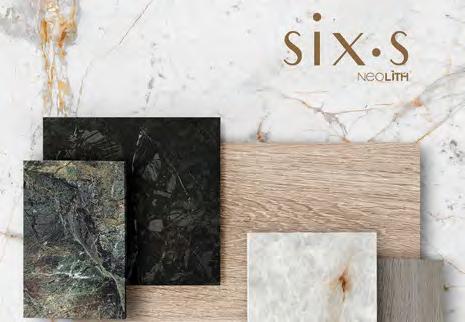
Neolith® launched its Six•S Collection which reflects the material’s design techniques of realism and unique-to-touch finishes. Inspired by global biodiversity, green principles and the ongoing fight against COVID-19, these new introductions look beyond immediate visual appeal, exploring Neolith’s core values. All Neolith slabs are 100 percent natural, carbon-neutral and suitable for professional or residential surfacing
application. These slabs are also among the safest and most hygienic materials available, without compromising on performance and visual appeal. The SIX•S Collection consists of Himalaya Crystal, Layla, Abu Dhabi White, Amazonico, Winter Dala and Summer Dala.
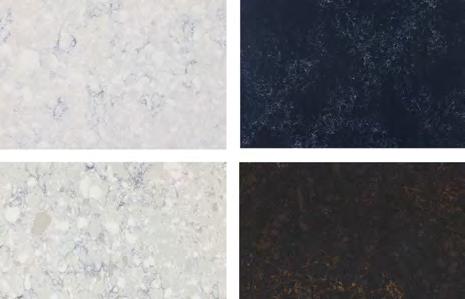
Radianz® added 15 new colors and patterns to its 2021 line of nonporous, heat- and scratchresistant quartz surfaces, manufactured with Breton technology. The additions feature stylized surface options emulating natural stone. Three newly added white colors — Angel, Polar and Pacifica White — round out the Radianz Classic Collection palette, providing beautiful options for commercial and residential applications. Four new Cirrus Collection colors — Pegasus, Aries, Starry and Aquarius — are inspired by precious metals, delivering a sense of elegance and luxury, perfect for contemporary designs. All eight new colors in the premium Cirrus Collection combine high-end quality and exquisite style, with most colors and patterns available in jumbo sizes of 65 by 130 in.
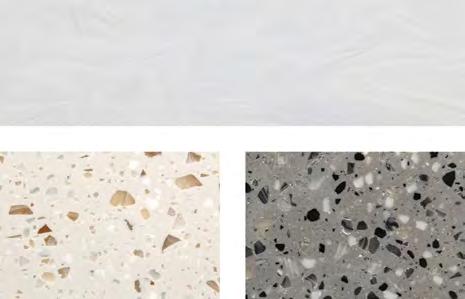
Staron® expanded its 2021 line of premium solid surfaces with 18 additions. The new colors deliver the same solid performance for which Staron is known: nonporous construction for easy cleanup, durability, low maintenance requirements and dimensional flexibility for use in numerous commercial and residential applications. Fourteen new colors belong to nature-inspired collections. Two new colors — Bologna and Torino — are in the Terrazzo Collection, providing the oldworld look of aggregate. Arctic White joins the Supreme Collection, providing a stunning option with marble-like veins that appear to shimmer in changing light. There’s also a new addition to
the Evermoin® Collection — Angel White — a fresh option engineered for environments like healthcare facilities that require ultra-hygienic materials.
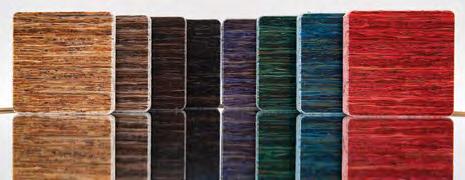
The Pacific Collection from Torzo Surfaces embodies the Northwest’s rugged coastline and timber heritage. Towering evergreen forests are a hallmark of the Pacific Northwest. The company’s home state of Oregon is a leading producer of wood products, sustainably sourced from vast timber lands of Douglas fir and Ponderosa pine. TorZo infuses recycled wood waste with organic dye and acrylic resin to create a durable and unique architectural surface with Cascadian aesthetic. Pacific is available in colors ranging from warm and neutral to cool and dark. Recycled wood chips are FSC-certified and there is no added urea formaldehyde.
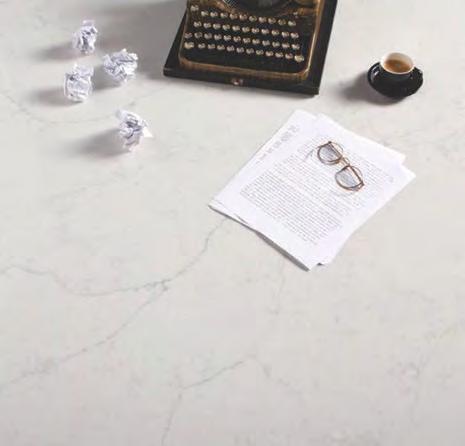
Vadara Quartz added six new fashion-forward colors to its 2021 lineup. Bella Dolce, Calacatta Fresco, Calacatto Oro, Cascada Perla, Solano Bella and Varenna represent the next generation of Vadara’s handcrafted quartz surfaces. A musing of the natural patterns found in quartzite and marble, the new hues expand the calacatta and artisan-inspired collections. The latest additions feature unique design aesthetics with dimensional backgrounds and dramatic, dynamic veining inspired by the stories of nature. Designed for modern living, the surfaces are hygienic, durable, offered in both 2cm and 3cm thicknesses and are intended for most interior applications.
See Our Ad on Page 15

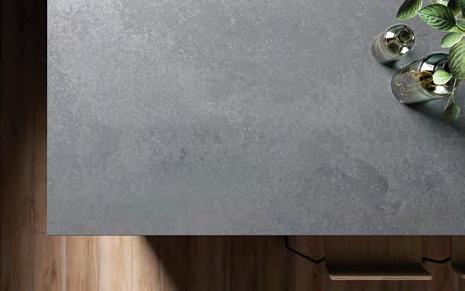
The LG Hausys Viatera quartz surface brand introduced several new colors for 2021. The Viatera Urban Collection and Viatera Calacatta Collection expand the brand’s total number of collection offerings from three to five. A new color, Adiago Gold, has been added to the existing Viatera Masterpiece collection. The Urban Collection debuts with two colors: Metro and Gotham, both available in Brushed Finish. The new Calacatta Collection offers a bright, natural white background, intricate veining and large, elegant patterns. Each new Viatera color comes in a Jumbo II size slab of 63 by 130 in., which can accommodate larger layouts, including
kitchen islands, with fewer seams. They are available in 2cm and 3cm thickness and backed by a 15-year transferable warranty.
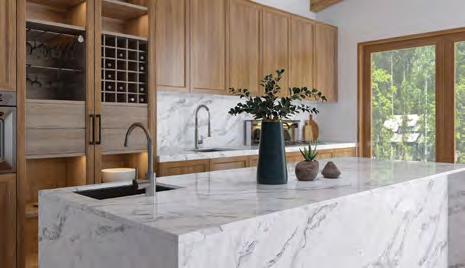
Vicostone, a leader in design-driven, quartzbased engineered stone, added seven new colors in 2021. New white-marble-looks feature warm veining and ultra-defined details that are on-trend and stylish. Exotic patterns and captivating compositions inspired by nature showcase Vicostone’s innovative manufacturing capabilities. All of the colors are available at its showrooms and distribution hubs in Dallas, Houston, Atlanta and Chicago. Samples can be ordered online or via authorized Vicostone representatives. All
of the new colors are available in 2cm and 3cm thicknesses in Jumbo slabs (130 by 65 in.), with Thasos also available in Standard slabs (119 by 56 in.).
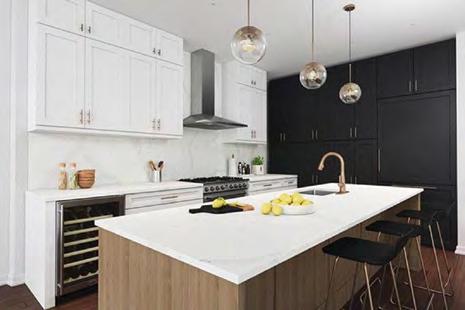
Wilsonart, a leading manufacturer of engineered surfaces, launched its Calacatta Quartz Collection. The new designs are inspired by Calacatta marble, derived from Italy’s Carrara region. Wilsonart’s design team spent months refining the vibrant whites and deep, elegant veining of its Calacatta Collection, providing timeless designs that effortlessly complement a wide variety of interiors.

BY KEVIN COLE, EDITOR
At the virtual ISFA Annual Conference held at the end of last year, participants were treated to two full days of expert presentations, networking opportunities and breakout sessions in which the current conditions the industry faced were the center of discussion. Numerous topics were brought up and one of them was the difficulty many were facing getting paid. This seemed particularly troubling for those who focused more on commercial work.
In many cases fabricators talked of projects stalled out, builders drawing out payment well beyond the set terms and even potentially defaulting as, unfortunately, some businesses went under. At the same time, cash flow was critical to keep the lights on, the machines running and whatever work there was flowing through the shop so that the businesses could hold on long enough for things to turn around.
Obviously it is difficult for businesses that have paid for inventory and spent the manhours getting jobs done to then have to wait exorbitant times to see the fruits of their labor. This can snowball on itself when these businesses are also having to pay their staff and their own operating costs.
While things have started picking back up for some, although for most not to the levels that were seen before the pandemic, there are still funds out there that many are trying to collect. This is especially true after the second and third spikes of the pandemic, which put a lot of companies in precarious situations not only with their accounts receivable, but also with their accounts payable. At the same time, fabricators were having to come up with new ways to communicate with customers, meet demands with a reduced output capacity and alter processes to meet various new governmental standards to prevent the spread of COVID to workers and clients. Implementing alternative strategies in a short time can be even more taxing on cash flow.
So, how do you overcome the drying up of receivables while keeping your business afloat? And, how do you avoid damaging relationships
with your vendors when at times it is difficult just to make payroll?
We asked a couple of fabricators, one more residential geared and one more commercial oriented, to find out how they handled it. Additionally, we inquired with a distributor to see how they can help their customers to come through intact and ready for the upswing that everyone is hoping will arrive with the end of the pandemic now in sight and, with that, hopefully the strengthening of the economy.
Kevin Maxwell, owner of Maxwell Counters Inc. in Central Illinois, offered his input. Maxwell Counters works with a variety of materials, including laminate, solid surface, quartz surfacing, natural stone, sintered materials and even butcher block. The company goes to market via both wholesale and retail channels, fabricating and installing largely residential but also commercial projects.
While Maxwell said he hasn’t seen much of a significant impact on average days to pay, he did say that problems with collections are most frequent with kitchen & bath outlets and builders, which then impacts downstream suppliers. “Failing to collect down payments, or completion payments and then chasing outstanding money, leaves suppliers unpaid,” said Maxwell. “So we have measures in place to make sure we are collecting in a timely manner.”
He explained that every Thursday he holds a short (15-minute) management and bookkeeping review of accounts receivable in which his team discusses any outstanding balances and action items. They go over accounts and monitor collections that can be updated by managers or bookkeeping staff. “If necessary, we exercise lien rights,” said Maxwell. “Rarely do we need to progress past initial lien letter notification.”
When asked what measures he would suggest companies avoid when trying to collect payment owed, Maxwell said, “You can't be afraid to ask for payment. I hear people express concern they don’t want to upset a customer, but good customers pay on time.”
At this time, he said he doesn’t believe the current conditions will affect the way he operates his business in the long term.
While Maxwell Counters seems to be doing OK with its tried and true methods of collections and not really experiencing many problems, that’s not the case with everyone.
Michael Bentz, who works in the accounting department for large solid surface, millwork and casework company ASST in McSherrystown, Pa., offered perspective from the commercial side of the business. ASST fabricates and installs engineered materials for Division 6 and 12 commercial projects, working in the healthcare, education and corporate arenas, and while business has been relatively stable over the past year, they have seen some changes in their receivables.
“We are seeing the length of time increasing for most payments,” explained Bentz. “More of our customers have gone silent when it comes to communication about when payment can be expected.” And obviously, that is problematic.
As such, ASST has put measures in place to try to help ensure it is able to collect payment in a timely manner. “We try to stay in better contact with our customers and communicate more effectively,” said Bentz. "Everyone benefits from timely payment because as projects run more smoothly, we can avoid costly delays.”
He explained that ASST is using the mechanic’s lien and bond claim process, and will be doing more proactive work in this area to protect the company’s interests. However, he also suggested that it’s smart to avoid being inflexible and unwilling to communicate with customers, adding, “Negotiation is key and working together is necessary to get a desired result.”
When asked when he might expect things to ease up making the collection process more “normal,” Bentz replied, “I don’t think it will be soon. The economy will need to fully open and people will have to get more comfortable going out and returning to places that have become a threat to their health. With the length of time that will have passed before this happens, I believe it will be a significant amount of time before things normalize.”
In the end, Bentz said the process changes ASST has made will likely affect collections for the business in the long-term, saying, “I suspect that many changes will remain and I don’t see how it couldn’t affect the way that
our business operates long-term. Caution will be the watch word.”
A Distributors Advice on the Situation
CaraGreen, a distributor based in Raleigh, N.C., of sintered stone, sustainable composite materials, solid surface, bio-based surfaces and bio-UV quartz, offered its take on the best way to deal with problems with collections. CaraGreen is a bit different than some other distributors, taking a forward-looking stance and curating a collection of more healthy alternatives to conventional building materials that it promotes to architects and designers in an effort to give them new tools and materials to build more sustainable, but still beautiful spaces. However, the company definitely has a solid understanding of distribution in general.
Jessica McNaughton, president of CaraGreen, gave her insight from a distributor’s point of view. She said that her company has seen several customers experiencing cash flow problems right now. McNaughton explained that while some residential businesses remained strong throughout the pandemic, there were commercial projects that were put on hold, which meant payment schedules negotiated as part of the project sometimes meant that CaraGreen’s customers were not being paid.
When asked what advice McNaughton might offer to fabricators that have been put into financial troubles because of jobs that are slow to pay, she said, "Communicate with us. Nothing is more frustrating than trying to chase down payment and not getting a response. We consider our fabricators our partners and want to be able to have transparency. If you are not being paid, or able to pay right away, let us know so we can manage our business on our end."
If you have good distribution partners, they should be understanding and work with you on payment plans, deferrals, or extended terms. "There are times we may need concessions from our fabricator partners," said McNaughton. "Establishing open, transparent rapport regarding payments today can benefit the distributor down the road."
When it comes to advice for fabricators, she offered up her advice on measures that may work well when they are in tough financial situations and ways to best work with vendors. “If a company is struggling, the last thing it needs is some distributor coming in swinging their … legal action. For the distributors
it is really important to have a measured, understanding approach to the conversation to avoid defensiveness and hostility,” she expounded. “For the fabricator, don’t ignore calls for payment; that does not make them go away, and it only increases the concern of the distributor. Communicate, cooperate and collaborate on ways to work together to resolve the issue.”
As far as things returning to normal, McNaughton was optimistic about the spring, hoping the vaccine would gain traction and drive the need for people to go back to offices, schools and social institutions. “There was a lot of business that was put on hold that is going to get released late in the spring and early summer. That, coupled with the economic stimulus for small businesses, will hopefully be enough to kickstart the economy again in 2021,” she explained. “There will be an inherent desire for space because we have all gotten used to separation. I find it very hard to stand really close to someone now because it feels unnatural. The buildings we used to frequent are going to need redesigning for this new desire for separation. It will be interesting to see how the open office concept changes, and how surfacing plays a role in building these new spaces.”
In closing, McNaughton discussed ideas that fabricators would benefit from long-term once the economic crisis passes. “If we learned anything, it is that an online presence is critical. We were already there, with social media platforms, content creation, education courses and webinars, as well as a podcast and a blog. So,we had a good digital presence, but we had no idea how important that was going to be until the pandemic hit, and the only place you could be found was online, as in-person visits were on hiatus,” she said. “Fabricators need to come to this same realization. Right now foot traffic and word-of-mouth just can't be dependable. A fabricator’s website needs to look sharp, be intuitive and give the clients exactly what they need, or they will go away. Having good tools on a website to help clients visualize slabs, get quotes or interact with people in real time will be key differentiators for fabricators going forward.”
Editor Kevin Cole, who can be reached at kevin@ isfanow.org or (815) 721-1507, wishes to acknowledge and thank Kevin Maxwell and Maxwell Countertops, Inc. (www.maxwellcounters.com), Michael Bentz of ASST (www.asst.com) and Jessica McNaughton of CaraGreen (www.caragreen.com). Without their time and assistance this article would not have been possible.
BY KEVIN COLE, EDITOR
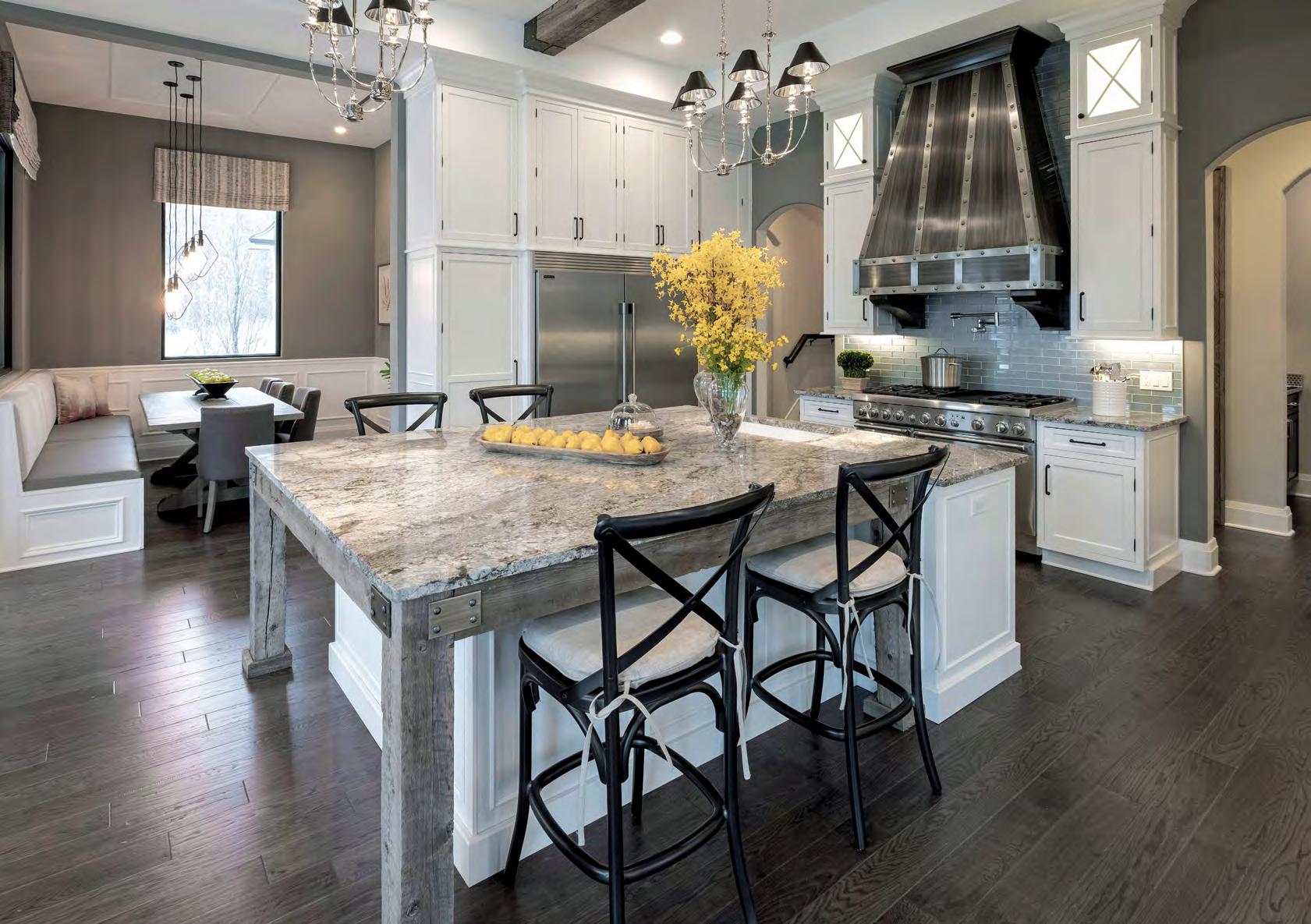
Hard Rock Stone Works was founded in 2005 by three people who had a shared vision to develop a successful business during a time when the countertop/surfacing industry was booming.
They worked nonstop, took a few chances and, with the support of family and friends, their business grew. Today they’re proudly a leading fabricator with a talented team and highly advanced machinery and equipment to expertly handle virtually any stone or hard surface material. Along the way they’ve added fine cabinetry, professional plumbing, a commercial division and "Rock Shop," an online store.
“We started with a few guys doing everything from selling to installing,” explained Hard Rock Stone Works President Steve Amodeo. “Now, after 16 years of planning and hard work, we are a leader in the industry with roughly 150 employees and two showrooms.”
Hard Rock Stone Works offers granite marble, quartz, quartzite, soapstone, porcelain and ultracompact surfaces (i.e., Dekton by Cosentino). This allows the company to be able to proudly advertise itself as a virtually one-stop shop for nearly all high-end
surfaces, which in turn increases its visibility in the market. “Offering all of these materials really holds our staff to a higher standard,” explained Amodeo. “We are constantly learning and adapting to the characteristics of each product, through material handling, fabrication, installation, and continued care and maintenance.”
However, he said it is not without at least some drawbacks, with the primary one being that it’s more challenging to reduce remnants because of the wide variety of materials being fabricated on any given day. As such, the company works diligently to get the most out of the materials everyday.
After many years focusing on residential work, more than half a decade ago Hard Rock Stone Works decided to test the waters in the commercial arena, and it has certainly paid off for the company. In the beginning, the company started with a single employee being

Over the course of 16 years, Steve Amodeo lead Hard Rock Stone Works from a small crew to a company with 150 employees and two locations.
a one-man commercial team. He estimated and sold jobs, and was also a project manager. This quickly became too much for one person with such a large demand in the commercial world. Now six employees are part of the commercial division of Hard Rock Stone Works. “With the six team members, we have more than 60 years of experience in the stone
industry,” explained Amodeo. “We have three estimators, two project managers and one sales rep. All of them are well diversified in the other fields of their day-to-day tasks. Many have come from different departments within the company, from fabrication and installation to purchase management and engineering, allowing us to be fully faceted in all aspects of the commercial building process. We utilize the latest software for takeoff and for submitting our quotes. If you can dream it, we can make it happen.”
Amodeo also talked about the valued engineering that Hard Rock Stone Works offers to its commercial clients. “In the construction industry, it is common for projects to tend to go over budget. This is where value-engineered alternatives can come into play,” he offered up. “Typically, when a stone is specified, whether it be a quartz, marble, granite or other materials, there are other stones that are similar and can be a fraction of the cost. So, we always give a base bid proposal for the specified materials. Then we supply our clients with an alternate bid for the other very similar surfacing options. This gives our clients a side-by-side comparison on where they can save on costs.”
Now, commercial work makes up 25 to 35 percent of the company’s business!
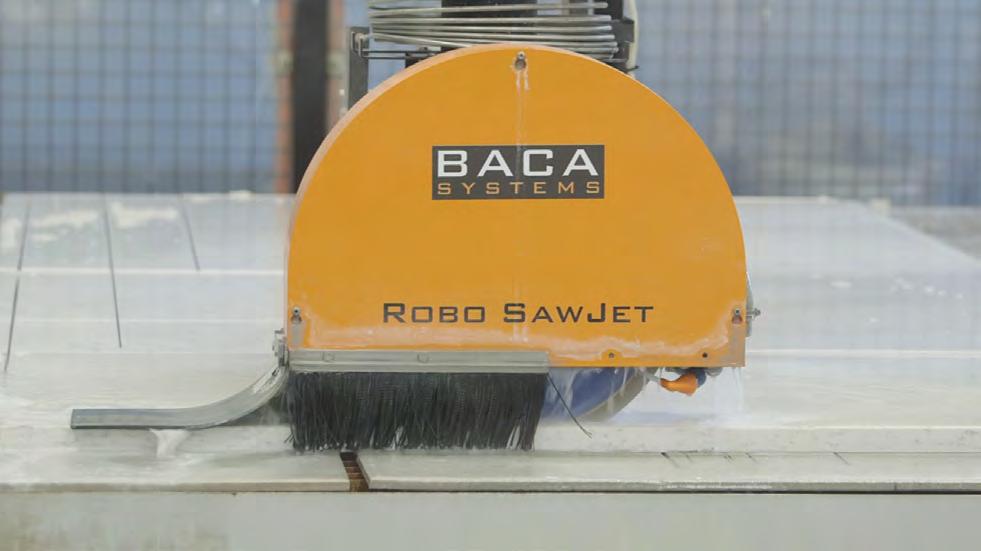
So how does a company with just a few employees push growth so much that they are now cutting 3,800 sq. ft. of natural stone and another 6,200 sq. ft. of engineered materials a week? One big way is to invest in the latest technologies. “Investing in and embracing technology has greatly impacted our success. BACA robotics has been a great partner to us,” said Amodeo. “Plus, the ability to use SlabSmith to photograph our inventory and provide slab layouts to our customers sets us apart from a lot of the competition. And
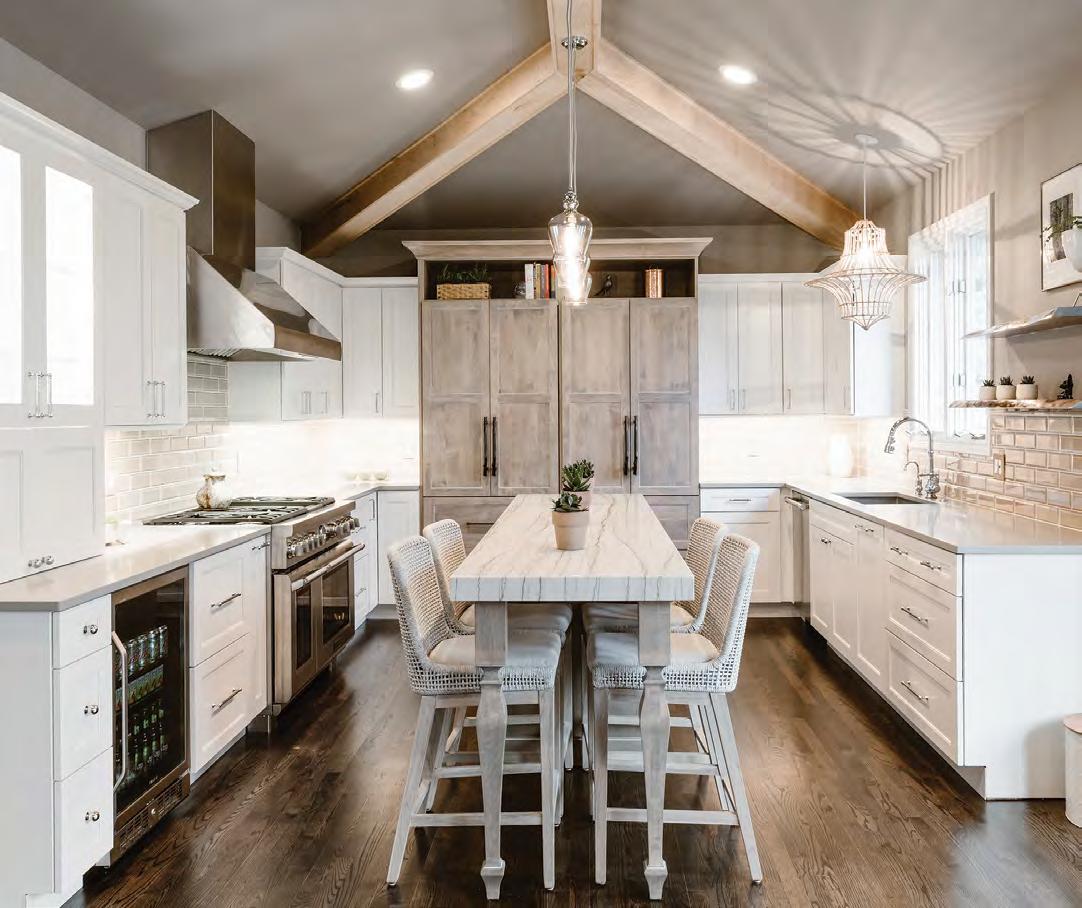
Hard Rock Stone Works bills itself as a one-stop shop, offering not only a variety of surfacing materials, but also also professional cabinetry and plumbing services.
our 3-D laser templators allow us to precisely measure not only in everyday-type projects, but in particular custom areas such as fireplaces and shower surrounds.”
In addition to technology, Hard Rock Stone Works has grown by offering cabinetry, having carpenters on staff and working with professional plumbers to offer one-stop shopping convenience. “We are a customerdriven company with our No. 1 goal being to provide the best experience possible. We have unique services and warranties that our competition isn’t equipped to back up or stand behind" Amodeo explained. "We proudly display a large range of standard to exotic slabs at our Sterling Heights location and offer a range of reliable cabinetry out of our Troy location. Our showrooms are also astounding, once we get a potential customer through the door it is almost impossible for them to say no to HRSW.”
“We handle all facets of sales through any source possible. We divvy the sales up into four segments: Commercial, National Accounts [big box stores], Premium Accounts [kitchen & bath outlets, builders, designers and contractors], and Retail [direct sales],” he
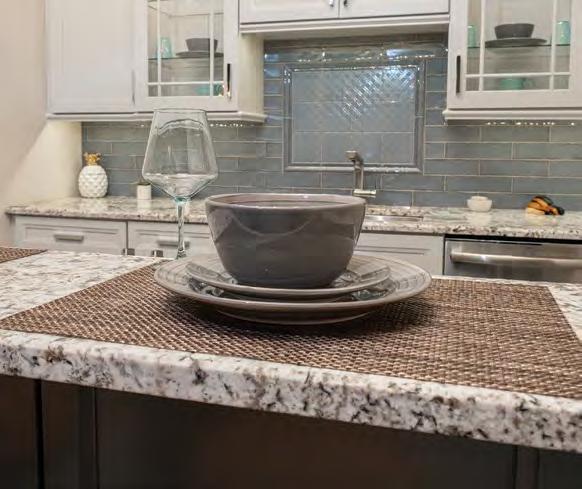
The company handles only stone and hard surfacing materials, with 38 percent being natural stone and 62 percent being engineered materials.
continued. “Each segment is roughly equal, although as mentioned before, retail is a bit heavier than the other sales categories.”
As far as the materials of choice in Hard Rock Stone Works’ market, Amodeo said without a doubt that quartz surfacing has seen exponential growth and dominated the industry year over year for quite a while. “We carry a wide variety of quartz manufacturers samples,”
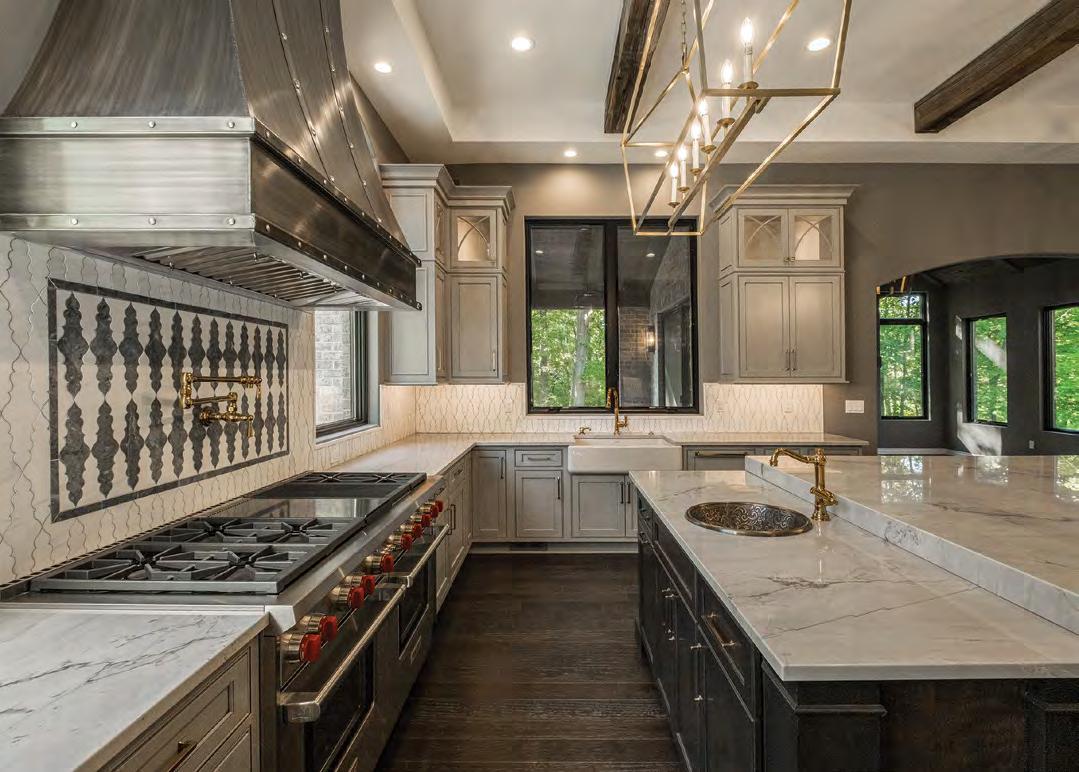
The company goes to market in a variety of ways from direct sales and big box stores to kitchen & bath outlets and architects and designers. This diversity often leads to amazing projects such as this one with Mont Tremblant Quartzite. The kitchen was designed by Kirkshire Design Group and the home built by Cranbrook Custom Homes.
said Amodeo when asked about the popularity of quartz surfacing, “However, I do not believe that one brand necessarily matters too much to the end user. Their decisions are driven based on availability, price and color palette.”
With the strange past year everyone has faced, which included the pandemic alongside of socio-economic and political unrest, Hard Rock Stone Works has fared well. “I am fortunate to say that as a team we have put forth an extensive effort to get creative and thrive during these times,” explained Amodeo. "We have invested a lot of time to adapt digitally, including providing estimates via our website or live chat, virtual slab views and our online inventory, or our 3-D room visualizer. We have aggressively sought and created solutions.”
He also highly credited his staff for being very disciplined when it comes to safety in the time of COVID-19. They not only regularly sanitize and wear their masks to avoid the spread of the virus, but also provide personal protective equipment to their clients to help ensure that everyone stays safe and healthy.
But they didn’t get where they are alone. “Being involved in the industry is extremely important,” Amodeo expounded on the worth
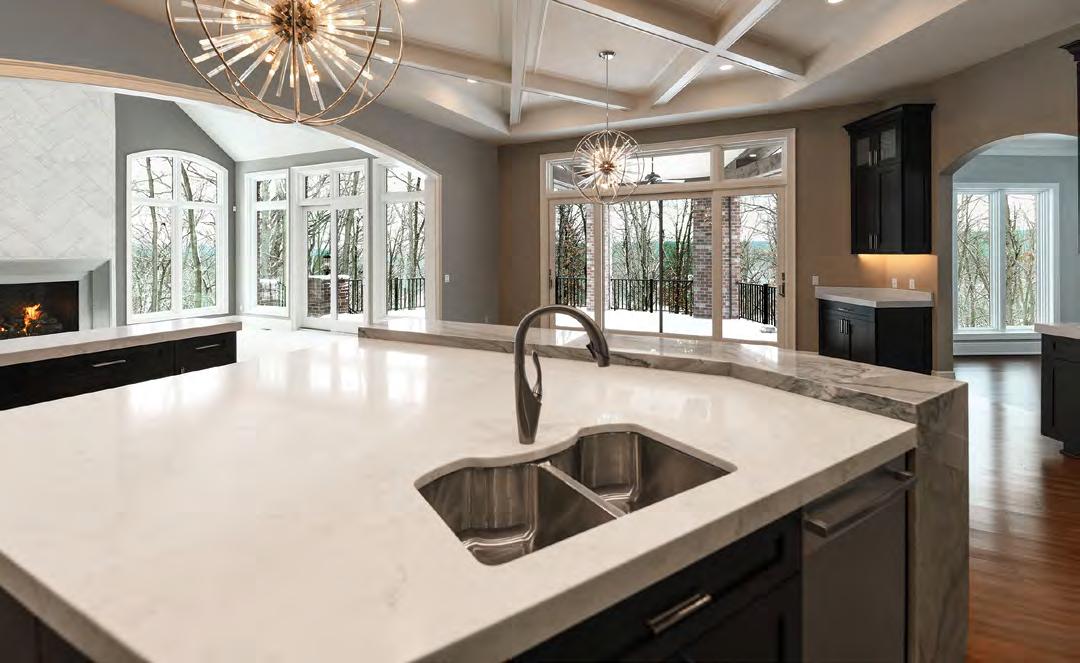
(Middle image) The countertops here were fabricated by HRSW of both Aurea Quartz and Macaubas Fantasy Quartzite. The kitchen was designed by Kirkshire Design Group and the home built by Cranbrook Custom Homes.
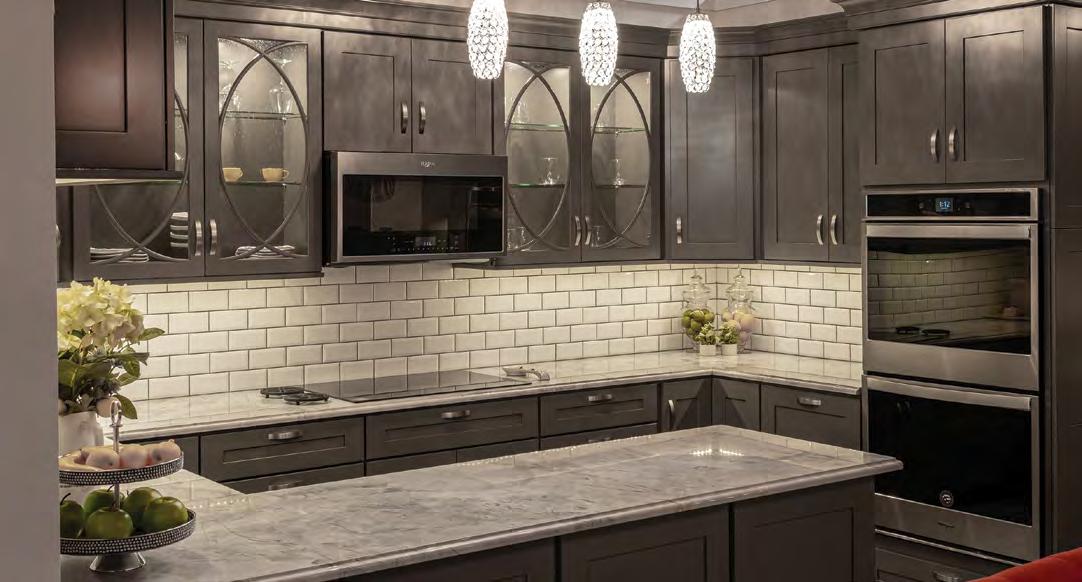
(Bottom image) In an average week, the company cuts 10,000 sq. ft. of hard surfacing material, with the largest portion being used in direct residential sales.
Hard Rock Stone Works has invested heavily in taking advantage of digital fabrication and advanced machinery, such as 3-D templating, online visualization tools and state-of-the- art robotic cutting systems.
of learning from others: “We really value the strength of our partnerships in the industry. We proudly host tours, events, and meetings to our main connections, and have an extensive network of people both inside and out of the industry.”
When asked for advice to others in the surfacing/countertops industry, Amodeo had this to say, “Be positive. Be professional. Lead by example. Don’t be afraid of change. It’s easy to become stagnant and set in our ways. If you are not staying on your toes, educating yourself and adapting to the world and technology that is forever changing, then you
are doing yourself a disservice. However, make sure to choose your partners wisely because they can make or break your business.”
“We are extremely optimistic about the future and are thankful to move forward in a positive direction,” added Amodeo. And in all reality, right now who can hope for better than that?
Certainly, this is a sign of bigger things to come.
Editor Kevin Cole can be reached at kevin@isfanow. org or at (815) 721-1507.
For more information on Hard Rock Stone Works visit www.hardrockstoneworks.com or call (586) 532-7763.

BY KEVIN COLE, EDITOR & PUBLISHER

Forecasting is never a simple task. Our economy has many complex pieces that affect each other and are difficult to align or predict. The general economy is subject to change based on a variety of elements, and some markets will hold up through these changes while others will falter. Making a forecast for 2021 and beyond is further complicated by the current social unrest, a slowing trade war with China and, of course, the COVID-19 pandemic that has taken more than 500,000 lives in the United States, drove our economy off of a cliff in 2020 and is still causing damage in various forms.
Certainly predicting this year and beyond is a tricky and uncertain task. However, there are some indicators that can help make a relatively educated guess as to the future. These range from broad statistics that affect almost every business segment to factors that are much more closely related to the countertops industry.
Anecdotally, when the virus first hit, the results affected companies in different regions or markets in diverse ways. Some were relatively unhurt, whereas others suffered major damage. That said, as of late, many people have said they are feeling much more confident or even growing as we move through 2021. However, this analysis will look at the broad factors that interplay with the countertop industry and work its way down to more closely related data.
Looking at 2020, the general economy did not fair well according to the Bureau of Economic Analysis, with the overall GDP falling 3.5 percent because of the pandemic. This was the worst year for the United States since the end of World War II. However, while Q1 fell 5 percent and Q2 fell to a record negative 32 percent, Q3 hit recordbreaking GDP growth of 33.4 percent and Q4 stayed positive at 4 percent growth. Overall it was a tough year, but with an ending that is trending toward actual growth in 2021.
“U.S. Real GDP growth will rise by 2.0 percent (annualized rate) in Q1 2021 and 4.4 percent (yearover-year) in 2021,” according to a statement released February 10 by the Conference Board, a 501 nonprofit business membership and research group. “Following a lull in the economic recovery in recent months, we expect the pace of the rebound to reaccelerate as new COVID-19 infection rates decline, the vaccination program expands and the prospects of another large fiscal support program improve. We expect the recovery to continue into next year and forecast growth of 3.1 percent (year-over-year) in 2022.”
The Congressional Budget Office (CBO) issued a forecast February 1 that was a little more pessimistic than the Conference Board, projecting the economic expansion that began in mid-2020 will continue into 2021, but with Real GDP only projected to reach the prepandemic level of 3.7 percent about mid2021, which is still a solid rebound considering the past year.
In 2020, unemployment jumped from 4.4 percent in March to a near-record high of 14.8 percent in April, slowly moving back a point or two over the course of the year, ending at 6.7 percent. However in January 2021, it fell another 0.4 percent to 6.3 percent.
While the CBO’s outlook predicts the unemployment will improve regularly, it also assessed the United States won’t hit prepandemic unemployment levels (which were basically full employment) again until at least 2024.
"As 2020 ended, many hoped that 2021 would see us putting issues like the COVID-19 pandemic, turmoil surrounding the U.S. presidential election and sustained economic uncertainty behind us. A month into the new year, it’s clear that these and other challenges are not fading as quickly as we would like. Instead, COVID-19 continues to cause tremendous
1,380,000 990,100 389,800
Source: U.S. Census Bureau
1
uncertainty over how the first quarter and beyond will unfold,” stated CEO Chris Daum in the latest Construction Outlook by FMI, a construction industry consulting company. “While there are reasons to be hopeful as the new U.S. administration and Congress announce ambitious plans to deploy vaccines and stimulate the economy, including investing in infrastructure, uncertainty remains our biggest certainty.”
“At the end of 2019, the engineering and construction (E&C) industry enjoyed full backlogs and project pipelines, as well as strong prospects for growth, despite the persistent challenge of finding and retaining skilled labor,” continued Daum. “That all changed as COVID-19 began disrupting life and commerce in midMarch of 2020. While some geographies and industry sectors remained unscathed, or even thrived, most of the industry struggled with the pandemic’s impacts on people, projects and
profits. These challenges continue to define the E&C industry’s operating environment as we move into 2021.”
Overall, while there is an air of caution, particularly about a slow start, most of the wideranging economy forecasts predict by the end of 2021 there will be a renewal in the general growth that slammed to a halt in 2020.
The surfacing industry is tied closely to the housing market, and in 2020, in spite of all of the troubles, it showed overall growth.
While still well below peak levels in 2006 during the housing bubble, in 2020 housing starts grew overall by nearly 7 percent, about twice that of 2019. Single-family housing starts grew a healthy 11.5 percent, which was a significant increase over the 1.5 percent growth level in 2019, a real boon for homebuilders in spite of the economy. However, multi-family units, which grew by more than 7.7 percent in 2019 and 9 percent in 2018, saw a slowdown last year, dropping by 3.2 percent in 2020 (see Figure 1). Overall, single-family housing remains significantly below its 2006 peak, whereas multifamily housing hit a new peak in 2019, sliding back a bit in 2020.
In 2019 the largest gains in housing were in the South, which still fared well in 2020 with a 10.1 percent overall increase. However, the Midwest, which had seen decreased housing starts in both 2019 and 2018, saw the largest gains in 2020 at 13.3 percent. The West faired decently with a 6.2 percent increase in housing, but the Northeast fell 3.3 percent.
The National Association of Home Builders’ (NAHB) Housing and Interest Rate Forecast released February 20 is for ongoing gains for single-family construction in 2021, though at a slower growth rate than in 2020. It predicts housing starts will rise nearly 3 percent overall in 2021 to 1.42 million and another 2 percent to 1.45 million in 2022. It also predicts a 13.5
Source: 2008-2020 U.S. Census Bureau; 2021-2022 FMI Construction Outlook forcasted Figure 2
percent increase in existing single-family home sales in 2021 and modest 1.5 percent increase in that same category in 2022.
The Wall Street Journal’s economist survey, which takes into account the opinions of more than 60 economists, isn’t as optimistic as the NAHB, pegging housing start increases at 1.51 percent in 2021 and holding steady at the same 1.51 percent in 2022. It also projects about half the increase in home prices of 6.3 percent in 2021 and 4.5 percent in 2022 – both pretty large variations with the NAHB forecast.
Taken as a whole, these housing numbers and predictions seem to bode well for any market segments that are related, such as countertops and surfacing.
When it comes to nonresidential construction, three of the five major areas historically related to surfacing took hits in 2020, with gains seen only in the commercial and healthcare segments, of about 1 percent and 4 percent respectively. Lodging took the biggest hit, with about a 17 percent drop, office building saw a drop of about 6 percent and education slid down about 4 percent in 2020 (see Figure 2)
Unfortunately, according to FMI, the next two years are going to fare even worse. Lodging is predicted to drop another 20 percent in 2021 and 14 percent more in 2022. FMI pegs office building to fall 14 percent in 2021 and another 10 percent in 2022. The FMI Construction Overview predicts the commercial segment will fall 10 percent and 11 percent in 2021 and 2022, respectively, healthcare dropping 3 percent in 2021 and another 2 percent in 2022, and Educational building to fall 5 percent in 2021, but stabilize in 2022 showing relatively flat numbers.
The Consensus Construction Forecast from the American Institute of Architects (AIA), an average of forecasts from eight major building market institutions, also predicts a tough year for nonresidential construction. “Business
conditions at architecture firms also underscore the view that 2021 will be a challenging year for the construction industry. The AIA’s Architecture Billings Index (ABI), which measures revenue trends at U.S. architecture firms, recorded a decline starting last March and has seen additional declines in every subsequent month. Given that AIA research has demonstrated that the ABI leads nonresidential construction spending by an average of nine to 12 months, construction activity in 2021 is projected to be weak,” stated the report. “The steepest declines in the ABI occurred in March through May, at which point the downturn began to moderate. However, in recent months the movement toward recovery has lost momentum, suggesting that architecture firms are entering 2021 facing a continued sluggish design market.”
However, unlike FMI (which is one of the firms taken into account by the consensus), there is some optimism that 2022 things will turn around and may to return to slow growth, with 3 percent gains in the overall building market in 2022 matched by both the commercial and institutional sectors.
Ultimately, though, it looks like most of the businesses leveraged heavily in the nonresidential building markets are going to face at least one rough year (2021) or potentially two, with both FMI and the AIA consensus report predicting 2023 to be a much better year for growth. Until then, it seems the only certainty is uncertainty.
In spite of the massive downturn and layoffs in the economy in the first half of 2020, remodeling and home improvement continued to grow every quarter, albeit with some ups and downs.
“The interior design industry, business, profession, and practice show positive signs for recovery from the impact of COVID-19, emerging stronger and more adept in responding to critical issues that have emerged in 2020,” according to the American Society of Interior Designers (ASID) in a statement it released with
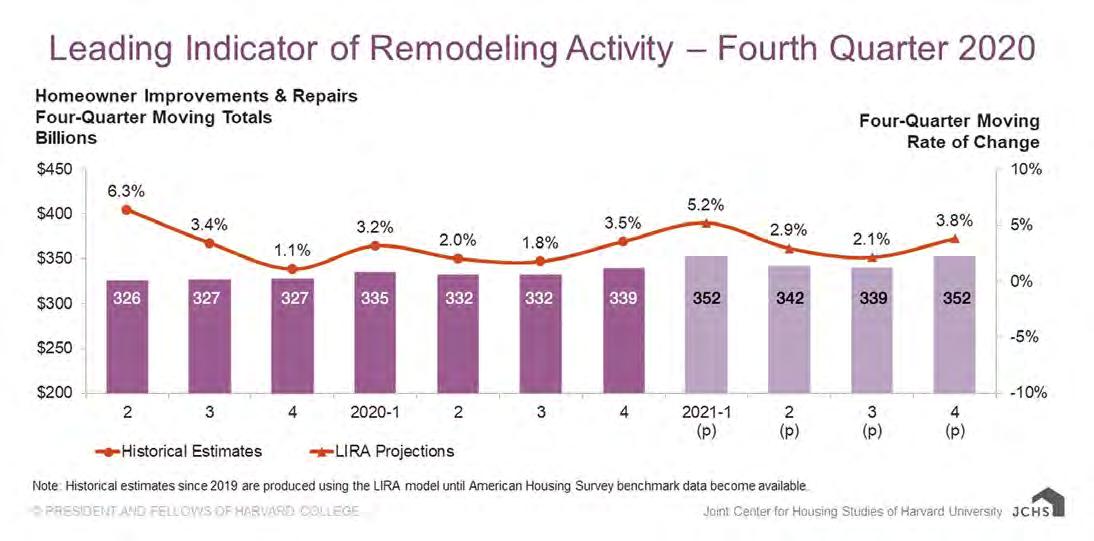
its recent State of Interior Design Report. “The U.S. economy in 2020 was tumultuous, but the overall economic outlook for 2021 and 2022 is positive despite the expected slower recovery. Spending in the residential market had sustained the industry overall, balancing the drop in the commercial sectors.”
The Remodeling Futures Program at the Joint Center for Housing Studies of Harvard University agreed, issuing a statement along with its latest Leading Indicator of Remodeling Activity (LIRA) released January 21. “Annual gains in spending for improvements and repairs to owner-occupied homes are expected to be modestly higher in 2021 compared to last year,” stated the release.
“The LIRA projects an uptick in year-overyear growth of home renovation and repair expenditure from 3.5 percent at the close of 2020 to 3.8 percent by year-end 2021 (see Figure 3)
“The remodeling market continues to benefit from a strong housing market—including accelerating growth in homebuilding, sales, and home equity,” says Chris Herbert, Managing Director of the Joint Center for Housing Studies. “In addition to routine replacement and repair projects, homeowners are likely to pursue more and larger discretionary home improvements this year as the broader economy recovers.”
Kitchen Cabinetry sales numbers are another predictor for the countertop industry, and the news here looks pretty good, especially considering the obstacles of 2020. Overall growth
increased relatively significantly in 2020 vs. 2019, largely in the last half of the year. This represents nine consecutive years of overall growth after crippling declines from 2005 to 2011.
Sales, as reported in the Kitchen Cabinet Manufacturers Association’s (KCMA) monthly Trend of Business Survey, jumped from an increase of just 0.6 percent in 2019 to 2 percent in 2020, however actual sales hit numbers not
seen since 2007 (see Figure 4). Considering around 75 percent of the kitchen cabinet market participates in the survey, the numbers are a reliable gauge of where the segment stands.
Lower-end stock cabinets rose from 4.5 percent growth in 2019 to 5.1 percent in 2020. Mid-priced semi-custom cabinets dropped for a second consecutive year, albeit at a slower pace, falling 1.9 percent growth in 2020 on the back of a 4.1
Source: Kitchen Cabinet Manufacturers Association (KCMA) Trend of Business Reports, www.kcma.org.
Figure 4
percent drop in 2019. High-end custom cabinets showed a marked improvement growing 4 percent in 2020 after taking a 1.2 percent dive in 2019.
The cabinetry market definitely appears to be getting stronger, with the market climbing back to more than 83 percent of its peak in 2006 and has made quite a comeback from its low in 2011. With the heavy connection between cabinetry and countertops, particularly in the residential market, this is a very positive sign.
While all of the previous factors laid out influence the countertop industry, and most of them point to recovery, there is some published research that offers more specific countertop numbers. However, before we get to that topic, it is important to note that troubles caused by winter storms in February in the Gulf Coast have caused shutdowns to numerous U.S. petrochemical plants, some of which sustained heavy damages.
5
So, in the short run, this is potentially likely to impact the current quartz and solid surface supply, possibly driving up material prices and lead times for these materials (read more about this problem at www.isfanow.org/petrochem).
Regarding the countertop-specific research, The Freedonia Group was kind enough to share some of the findings released in its “Countertops” report put out February 2020. The 225-page study examines a number of factors related to the U.S. countertop industry (see Figure 5).
While the study was released prior to the pandemic, so the short-term information may be a bit out of context, the longer-term market predictions range all of the way out to 2029 and should be more relevant.
According to the report, U.S. demand for countertops is forecast to increase 2.8 percent per year to 932 million sq. ft. in 2024, valued at about $42.1 billion, a marked decline from the growth rate in the period between 2014 and
2019. “Going forward, market advances will be bolstered by increasing residential kitchen and bathroom remodeling,” states the report. “Consumers will be willing to trade up to more expensive materials to improve home values. We will also see trends favoring larger kitchens and multiple bathrooms in single-family homes.”
The report puts forth that kitchen and bath remodeling is the driving factor for the U.S. countertop market. “Dominated by kitchen and bathroom remodeling applications market growth will be supported by the fact that countertop replacement remains the most popular home remodeling project,” states the report. “Additionally, rising consumer interest in engineered stone and porcelain slabs will drive demand for countertops as homeowners look to trade up. The shift away from laminates to engineered stone and niche materials will also support value demand growth through 2024.”
While it projects laminate countertops will continue to maintain the largest square foot share of the market, the Freedonia report predicts that share will continue to decline. A negative growth of 0.4 percent is expected annually through 2024. “Despite being the dominant countertop surface material in the United States for decades, laminates are expected to continue to lose market share as other more aesthetically pleasing materials become more popular,” states Freedonia’s report. “However, use of laminates will remain widespread – particularly among budget-conscious consumers – due to their relatively low price points and minimal maintenance requirements. In order to stay relevant, laminate countertop manufacturers have expanded and diversified their offerings of specialty and decorative laminates and moved into other countertop materials, such as engineered stone.”
The report looks ahead to show that engineered stone, which includes quartz surfacing, engineered marble and now cement-based polymers, will overtake granite and natural stone demand by 2024. Going forward, it predicts engineered stone will grow 6.9 percent per year, but will be tied by “Other Materials,” largely because of tariffs/duties on Chinese imports and the growth in large format compact materials, like sintered stone.
Lumping together solid surface and other cast polymers, Freedonia has the group pegged with the fourth highest demand from 2019 all the way through 2029. Of interest is that demand for solid surface in the nonresidential arena was second only to laminate and is predicted
to remain so through 2029. However, it is slated to grow at the slowest rate other than laminate (which is predicted to continue to lose market share in terms of square feet).
Freedonia lists tile as the fifth highest in demand, although most would say it is more for use in backsplash applications in today’s market. It predicts continued growth of 2.3 percent from 2019 to 2024, matching solid surface.
Lastly, the report had “Other Materials” pegged at a growth rate of 6.9 percent between 2019 and 2024, rivaling the growth of engineered stone. It states that porcelain and sintered surfaces are rapidly growing in popularity, which is the driver behind this category, although does mention wood, bamboo, stainless steel and other metals.
Over the long-term, if the Freedonia report is accurate in its predictions, even with 2020’s damage not factored in, growth still lies ahead in the countertop industry.
When viewed as a whole, the data paints a mostly positive picture, with some potential volatility in the commercial markets. However, overall, when looking at the data in terms of
the general economy down through more specific and related markets, it seems like a safe summation to say that 2021 will be a year of recovery, particularly in the residential market, for the countertop/surfacing industry after the volatility seen in 2020.
Of course, as 2020 demonstrated so clearly, any number of factors, whether socioeconomic, political or health-based, can be disastrous and difficult to factor into a business plan. There are a lot of predictions looking beyond 2020, but it is certainly tough to know which is the most trustworthy given current unique factors.
Taking that into account, the pertinent action is to solidify cash flow and face business challenges, such as issues related to labor and market diversification, now while business appears to be steadying, and hope the growth stabilizes in the long term. But, most of all, keep in mind that there are always factors that are problematic, if not impossible to take into account, and so making sure your fundamentals are solid can make all the difference.
Editor & Publisher Kevin Cole can be reached at kevin@ isfanow.org or (815) 721-1507.
The author would like to thank the federal government for a variety of statistical information, as well as acknowledge the following sources used in the creation of this article:
The American Institute of Architects (AIA), www.aia.org, a professional association for architects
The American Society of Interior Designers (ASID), www.asid.org, a community of designers, industry representatives, educators and students committed to interior design
The Conference Board, www.conference-board.org, a global, independent business membership and research group
FMI, www.fminet.com, a construction industry consulting and investment banking services company
The Freedonia Group, a research firm that recently released a “Countertops” study, available for purchase at www.freedoniagroup.com
The Joint Center for Housing Studies (JCHS) at Harvard University, www.jchs.harvard.edu
The Kitchen Cabinet Manufacturers Association (KCMA), www.kcma.org, a nonprofit representing cabinet manufacturers
The National Association of Home Builders (NAHB), www.nahb.org, with members that construct 80 percent of new U.S homes
The Wall Street Journal, www.wsj.com, a businessfocused international newspaper

BY MATTHEW BODOFF, JESSICA MCNAUGHTON AND P. “MAX” LE PERA
People have pushed back against “green” for decades, insisting it is costly and is simply an overzealous push by tree huggers who believe they need to save the planet. However, the reality is that our planet is being damaged by air and water pollution, and our natural resources are severely depleted, as we demand more and more at the expense of our planet. It is easy to feel far removed from this in an industry where we are very consumer facing and are indulging customers’ needs to get exactly what they want, be it granite, solid surface, quartz, porcelain, sintered stone or any number of other products.
There is great hope however, and it can be found in the developing and expanding cultural values of our “next-gens.” The generation of Millennials that we often roll our eyes at are becoming the new homebuyer, the new kitchen remodeler or the new designer. They choose materials based not just on their aesthetics, but also consider the story of what it is, where it came from and how it got here. Following right behind Millenials are our teenage Gen Zs who will be reared in the growing paradigm of sustainability and all it portends in renewable energy and the 4 R’s: reduce, reuse, recycle and repurpose.
Progressive fabricators are aware of this, and for the last several years many of them have started to incorporate sustainable business practices into their operations.
The adoption of these environmental practices can be broken into three phases as follows:
Phase One: Offering “green” products, product transparency, water reclamation programs and renewable energy
Phase Two: Focusing on offering optimized products, waste reclamation and employee health
Phase Three: Supply chain/enterprise integration, closed loop fabrication and operations; sustainable fabrication certifications, circularity and synergy; and leveraging next generation technology
While this article dives into these three phases as they apply to surface fabricators, this progression also applies to manufacturers and distributors and has already started to take place in those areas. We will expand upon their roles when we get to Phase Three during which this whole ecosystem takes on a more well-defined
framework poised for virtually unlimited growth and efficacy.
Early adopters who latched on to the idea of respecting the environment in their operations were quick to support products made with large amounts of recycled materials, including several brands of solid surface and quartz, but also recycled glass surfaces from vendors like GEOS, IceStone and Vetrazzo, as well as recycled paper products like PaperStone and Richlite. It was a relatively easy first step to say that you were “eco-friendly” by just supporting the brands that made those claims themselves, and was a relatively low-cost way to get into the game.
At the GECKO facility where Indeko was inspired to take on the solar panel installation, Augie Chavez, CEO of GECKO, also had installed a rainwater recapture system to mitigate the use of municipal water, further lessening the impact that the facility has on the environment.
Other fabricators went further, like Rockin’teriors in Raleigh, N.C., who insisted on curating their offering and vetting their vendors and brands to ensure they were only offering brands that they trusted and supported their mission of sustainability. When sintered stone came to market, they quickly embraced brands like Dekton, Lapitec and Neolith and their resin-free, mineral-based composition, becoming one of the premiere fabricators of these materials in their market. Rockin’teriors also embraced sustainability as part of its corporate culture,
maintaining an exceptionally clean facility with a complete water recapture system that was designed into the construction of the initial facility. They also embraced a completely wet cutting and finishing system, so as to protect employees from airborne crystalline silica.
Beyond materials, renewable energy is a relatively low-cost way to get into the sustainability game, and solar panels can be added to lower energy costs, along with using skylights as a natural lighting option. These additions are not free, but the ROI can be realized quickly, as evidenced by Indeko, one of the leading fabricators in Mexico, who, after observing the installation of solar panels at an ISFA Roundtable hosted by GECKO Solid Surface Solutions, added these energy saving panels on their own facility.
At the GECKO facility where Indeko was inspired to take on the solar panel installation, Augie Chavez, CEO of GECKO, also had installed a rainwater recapture system to mitigate the use of municipal water, further lessening the impact that the facility has on the environment.
Other important Phase One environmental efforts include OSHA compliance, offering personal protective equipment (PPE) for employees, and having programs and internal audits to ensure that safety measures and protocols are being implemented. Ventilation, air monitoring and wet systems are crucial and no longer considered a “nice to have” as the silicosis crisis besets the industry. These programs are critical and employee health and safety have now crossed over into environmental efforts. The environment inside your facility and the impact on your team is as important, if not more, than the environment outside that your operations are impacting.
People are what drive a company’s success and protecting them is imperative.
These Phase One steps are relatively easy, and signal to customers that these facilities and the people that are taking care of them and their projects really do care. Some argue that customers don’t care and the bottom line is dollars and cents. This is the case in many instances, but why lose customers that do care when you can take relatively low-cost steps to signal you care about the environment in which you live, and the environment in which your employees work.
Once a fabrication shop has established its baseline commitment to environmental stewardship, it is likely that the business will continue seeking opportunities to further improve and align. Possibilities lie both in and outside of the facility. Inside the shop, improvements could be made to indoor air quality, more energy-efficient lighting, the amount of paper being used, and water reclamation programs. Outside options include finding ways to mitigate the impact on the local environment through emissions abatement, water treatment and irrigation, precipitation capture and use, and moving to renewable energy.
So what is the next step for fabricators to be better environmental stewards? The No. 1 thing every business should have is a “Business Sustainability Plan.” This is a living document explaining how the company wants to pursue environmental responsibility. It will also include detailed actions required of all employees to ensure that they behave in an environmentally sustainable way, and not just paying lip service to a new idea. Finally, many companies, including large global manufacturers such as INEOS, have begun to tie employee safety, health and environmental stewardship to their financial bonus scheme. This monetization of health and safety performance encourages the whole team to work together to build a safer and better workplace.
Manufacturers also continue to push themselves in factory operations, local environmental impact and material composition. Europe is ever increasing its profoundly influential position in the surfacing space. This leadership, coupled with the environmental standards expected in that
part of the world, drives those companies to push each other to minimize their health impacts.
Improvements to ingredients used in surfacing products such as the elimination of nonrenewable-based resins, silica or harmful elements are being developed at a record pace.
content that earns LEED points. Product lines, such as ECO by Cosentino, Compac’s Obsidiana and Diresco’s Bio-UV Quartz, have found ways to use a majority of, or even 100 percent, recycled materials without sacrificing beauty or durability.
Product lines, such as ECO by Cosentino, Compac’s Obsidiana and Diresco’s Bio-UV Quartz, have found ways to use a majority of, or even 100 percent, recycled materials without sacrificing beauty or durability.
Growing in popularity are a class of surfaces loosely known as “sintered surfaces” (a designation afforded by the predominant manufacturing process of sintering), which are actively promoting their environmental friendliness marketing messages. These materials are devoid of resins making them strong candidates for more cost-effective recycling and reuse. Some manufacturers are touting 100 percent water recycling and other sustainable operational aspects of their business furthering their alignment with trending more eco-friendly preferences.
Partially driven by the silicosis concerns with crystalline silica, new products using safer alternatives will become more commonplace in the next several years.
Environmental stewardship in surfacing materials has evolved significantly over the last decade. What began as a movement in the manufacturing of the surfaces trying to use recycled materials, such as stone remnants, glass and mirror, has now become a group of fully evolved brands that believe creating environmentally responsible products is key to their brand ethos.
What was once a niche marketing effort for a select group of customers now has to be considered mainstream in the purchasing decisions for all consumers. According to Silestone Product Manager Alba Gilabert Garcia, “The reality is that after the COVID-19 situation, the end consumer and society in general have become much more aware of sustainability. Between two products of the same design and performance, the one that is more sustainable will be sold.”
On the quartz surfacing front, there are many brands that offer colors that have recycled
Solid surfacing materials have historically been above average when it comes to recycling of their end products. The very nature of the material makes it reasonable and cost-effective to recycle either as new products or chopped up to be used as a raw material for new aesthetics. Durat, a solid surface manufacturer in Finland, and Alkemi by Renewed Materials, Inc. are brands that are not only leading, but pushing the sustainable story in solid surface by using a substantial portion of post-industrial waste, such as metals and plastics, in their manufacturing processes.
Phase Three — It’s Time To “CEASE” Waste
CEASE is an acronym for Circular Economy, Alignment, Synergy, Energy. Phases 1 and 2 saw the initiation and continued maturation of sustainable efforts on the parts of fabricators and manufacturers. Phase 3 represents a calibration of efforts to create alignment in the enterprise chain. It is denoted by the last “E” in CEASE, which represents the possibility of combining numerous waste streams (wood, paper, cardboard, food waste, construction waste, PVC, plastic bottles and polymers, etc.) to be the raw materials needed to create clean and safe energy.
The term “circular economy” has become part of our everyday language. It broadly describes any process or system that is able to keep resources in use for as long as possible and, ultimately at the end of their “useful” life, weave in the ability to recover and recycle/regenerate them.
The circular economic model interlaces several independent doctrines such as biomimicry, the blue economy, cradle-to-cradle and “natural” capitalism. As a result, there will be numerous societal, economic, environmental and business benefits. The model aims at building a restorative existence, not one of runaway depletion and waste.
The thinking here is that with alignment comes a creation of energies, and collaborations are optimizers and opporunity-based cost eliminators.
Alignment and synergy are separate but symbiotic concepts. Alignment is a measure that supports interconnectedness between fabricators, distributors and manufacturers, as well as designers, specifiers and end users. This could mean ensuring materials can and will eventually be reclaimed, or it could mean that jobs that require some degree of eco-friendly products be distributed and converted to finished goods by those who are “walking the walk” on the sustainable journey. It could also be establishing benchmarks requiring some degree of accountability to maintain and grow a “greenfriendly” organization.
The thinking here is that with alignment comes a creation of energies, and collaborations are optimizers and opportunity-based cost eliminators.
Energy is essential to life and therefore sustainability. Essentially, everything requires some form of energy to work/exist, whether thermal, kinetic, chemical, nuclear, electrical etc. The demands for energy are nearly endless and constantly increasing. Therefore, an integral part of the sustainable journey includes not only safer, cleaner and more efficient forms of energy,
but also renewable energy. Some examples are wind energy, water wave energy, solar energy — all God given and freely provided resources. Our challenge is to learn to harness them in a clean, safe and cost-efficient way. Fantastic strides are being made to these ends. However, utilizing waste streams for energy is a sleeper that is looming, and is potentially more bountiful, less expensive to harness at scale and whose technology is fundamentally rooted in proprietary science that will soon make its global appearance.
Albert Einstein proved the equivalence of matter and energy more than a century ago, and yet converting matter to energy in a safe, cost effective and environmentally safe way for use in smaller scales other than the nuclear furnace of the core of the sun has been elusive … that is, until now.
There are truly next-generation technologies emerging that convert waste into synthetic gas or even a crude oil (depending on the influence). It may be that using one of these technologies on a societal scale in which waste streams can be combined will give rise to copious amounts of lean energy.
Microgrids are a very real possibility and can be fueled by your waste! Junk mailers, cardboard, any type of wood including wooden pallets and skids, landscape trimmings and clippings, paper, clothing waste, food waste, plastic bottles, toys, carpeting, siding, PVC, cabinets, flooring, TIRES (!!), and more can all be converted into energy. This illustrates the powerful effect Phase 3 will have on the entire sustainable paradigm. With alignment comes plans to recycle commercial waste streams, which sadly are not nearly as regulated as residential or industrial waste streams. By all measures commercial waste is many fold that of residential, and yet most businesses are not required to recycle meaning their waste ends up in landfills much of the time. Therefore, Phase 3 will see alignment amongst businesses of all sorts within a community banding together to redirect their waste from landfills into a waste-based energy system where they can reap some reward for their waste.
Phase 3 would perhaps be better called “Phase 3+” to signify there may not be a discrete end to the sustainable story and allow for an ever increasing elevation in scope and sophistication of the sustainable journey for the enterprise and surrounding communities.
Fabricators, distributors, manufacturers, designers, architects, commercial property owners and anyone else who has a stake in the health and wellness of our planet collectively can
play a tremendous role in preserving it and natural resources. However, they must proactively choose to begin or further their sustainable journey. ISFA will continue to look into sustainability and what that portends for the building materials industry. A designation known as LEEF™ Certification — Leadership in Energy and Environmental Fabrication — will help distinguish those who champion focus and commitment to the sustainable journey.
Indeed, the sustainable framework is a dynamic one as the actions within each phase will certainly continue to evolve and remain interconnected. The individual actions taken by all parties in Phases 1, 2 and 3(+) add to the overall effectiveness of the conservation of energy and natural resources. It is the cooperation and alignment of the parties and the phases that produce real results worthy of making a tangible and positive impact on the global environment and our communities.
May we never forget our obligation to leave this world to our future generations in a state better than we found it.

Matthew Bodoff is a business development manager for INEOS Composites focusing on its North American engineered stone business. He has more than 20 years of experience in the composites industry, especially around the use of polyester resins in various building and construction applications. During his time with INEOS Composites (formerly known as Ashland Specialty Resins), Matthew traveled the globe working with quartz slab producers and equipment manufacturers. He can be reached at matthew. bodoff@ashland.com

Jessica McNaughton, a former ISFA board member, is president of CaraGreen, a curator and distributor of best-in-class sustainable materials based in Raleigh, N.C. CaraGreen offers healthy alternatives to traditional building materials and serves as an educator on industry issues that have a human or environmental health impact, with several education courses on the latest green building standards and trends in the industry. She can be reached via email at jessica@caragreen. com or on the web at www.caragreen.com

Paul “Max” Le Pera is president and founder of Global Surfacing Alliance LLC; a global consortium of partnerships, alliances and ventures, primarily devoted to sourcing and launching both proprietary products and disruptive technologies. His business touches myriad industries including, renewable energy, building materials, plumbing and cannabis (industrial hemp), to name a few. Paul is both a member of the Board and VP of Global Standards for ISFA. He can be reached at PMax@GlobalSurfacingAlliance.com.

From the Desk of Nancy Busch, Executive Director
Your network is your net worth — Porter Gale
Changes in the world have made some forms of communication less relevant. For instance, I ran across an old form that had fax instructions. Yikes! So, ISFA has been working to update our member and staff communications.
We’re also updating how we communicate our benefits to members. In 2021 we want to make sure all members are getting the most for their investment.
We’re taking stock of all the ways ISFA can, does and should bring value to our members. Don’t get me wrong — the basic benefit list is a good one and is surely worth the return on investment. However, benefits are only as good as they relate to our members and are used. Also, the options we have for networking have drastically changed. How can we make sure existing members know what is available to them, and also keep them connected to the network?
So, we’ve recently added Samantha Winslow as Membership Administrator to our team. Her experience as a successful small business owner and her marketing skills gives us a head start on our goals this year.
Next, we set out to create a new marketing piece to tell our members and potential new members about all the great things available to them. Looking at the flatness of the words on the two-dimensional page, I think to myself: These are great, but something is missing.
What was missing was all the everyday stories behind the words. Storytelling is an innate way to learn and teach, and a critical form of communication.
Personal and persuasive, stories make those bullet points on a page spring to life.
A member recently reached out to me looking for some ideas or contacts that could help him. I asked around and was grateful for the opportunity to try to help.
While it may not be specifically stated in the list of membership benefits, the conversation we had
was exactly what ISFA business is about to me. I made a couple of effortless texts and emails within my network and he had an answer. By the way, in the exercise, one of those in my network asked me for information on where we sourced our ISFA mugs. Turns out she has been searching for a good mug and really enjoyed the ones we provided for our virtual annual conference. I couldn’t begin to remember, but Carol Wilhite, our director of operations, had the answer back at lightening speed. These examples might seem small, but they have saved our members a lot of time.
Even if they’re short or nondramatic, relaying stories helps illustrate any situation and make them relatable. Stories are also easier to remember than stand-alone facts. Therefore, storytelling is a powerful tool for growing your business. A story, though, is only as good as the networking associated.
Without one you really can’t have the other. Assigning value to having a network available for situations that come up, whether professional or personal, is difficult. Even harder is assigning value to the satisfaction being a solution for another. They are both priceless.
ISFA was founded upon the principle of “members helping members.” Now more than ever, it’s important to stay connected and surround yourself with a network of successful, positive influences and experiences. ISFA has a diverse, competent and accomplished network. Because no one is the master of everything, it takes just such a collective to further one another’s business and community missions.
If you want to learn a new story to tell, network more and I’m certain you’ll find one. If you can’t think of where to start, give me a call.

Nancy Busch, ISFA Executive Director nancy@isfanow.org

Because of the ongoing uncertainty caused by the pandemic and the instruction by federal, state and local officials to avoid travel where possible, ISFA’s first live event will be it’s Solid Surface Fabrication Training in May. All participants will be required to wear proper protective gear and social distance per COVID-19 guidelines.
Virtual Shop Tours Program
Sponsored by Park Industries
Zoom-based tours of fabrication facilities will be held monthly. The next tour will be of McDermott Top Shop in Jefferson, Wis., March 10 at 1 p.m. EST www.isfanow.org/shop-tour
Virtual ISFA Mixer
Zoom-based networking events will be held monthly. Every last Thursday of the month Next event March 25, 7 p.m. EST www.isfanow.org
Virtual Manufacturer Tours Program
Zoom-based tours of manufacturing facilities will be held monthly. The first tour will be of Hyundai’s Hanex Solid Surface plant in Ontario, Canada April 19 at 1 p.m. EST https://www.isfanow.org/manufacturertours-1
Virtual Sintered/Porcelain/Compact Surface Training
Sponsored by GranQuartz
May 6 - Crossville & Laminam
May 20 - DuPont Endura www.isfanow.org or email nancy@isfanow.org
Hands-on Solid Surface Training
May 18 – 21
San Antonio, Texas
www.isfanow.org/solid-surface-fabricationor or email carole@isfanow.org
ISFA Annual Conference & Meeting
Sponsored by GranQuartz, Park Industries, Infinity Surfaces, Crossville and Integra Adhesives
TBD – Fall 2021
For additional information and registration options, please visit www.isfanow.org or email nancy@isfanow.org.
As it has done in the past, setting forth standards for both solid surface and quartz surfacing, ISFA is once again working on raising the bar. The surfacing industry has enjoyed an overall healthy growth curve for several decades now, and while there are certainly bumps in the road, overall it appears there is no end in sight. Despite political turmoil, a global pandemic, recovering from a great recession, our building materials industry is amazingly resilient. As you might expect, surfacing has seen growth parallel to building materials. With growth comes increased competition – more products, more manufacturers, more variants, options and formulations. As a result of this manifestation, a rather profound sense of urgency has emerged: an urgency to fortify our industry’s “bridles and reins,” in the form of standards.
With countless entities actively vying for a slice of the American pie, ISFA has responded assertively assuming a significant contributory role in two landmark initiatives that will establish an all-encompassing framework of standards for the surfacing options the organization champions.
Standards provide the fundamental building blocks for product development and make it easier to understand and compare competing products and what expectations should be had with each. As a result, users perceive standardized products and services as dependable, safer and more durable.
This raises user confidence by providing a common language to measure and evaluate performance.
The first of the two most notable initiatives involve ISFA leaders, Executive Director Nancy Busch and its newest Board Member Kimberly Homs, principal of Great In Counters in Rhode Island, as well as Chuck Sawyer, former iSFA executive director. Coordinating with Nancy, Kimberly and Chuck will be liaisons between ISFA and the Architectural Woodwork Institute (AWI), which is widely known as the global leader in architectural woodwork standards, related interior finishes and industry-specific education.
The second landmark initiative for creating surfacing standards is ISFA’s role in working with the International Organization for Standardization (ISO) and their United States arm, the American National Standards Institute (ANSI). ISO has recently launched an initiative to create “international standards for the manufacturing, fabrication and installation of engineered surfaces.” ISFA’s own, Nancy Busch and Board Member Paul Max Le Pera are representatives on the United States Technical Advisory Group (TAG) committee serving ANSI. In addition, Busch and Le Pera, who has also recently been appointed VP of Standards for ISFA, have been named as lead delegates, representing the U.S. TAG on the global committee. The U.S. TAG’s role is to clearly
ISFA's vision is to be recognized as the expert and authority serving the manufactured surfaces industry. As such, getting direct input from members who want to make an impact not only on their own businesses, but the industry as a whole is critical. So, ISFA has established several committees to offer an outlet for contributing their insight to help shape the organization via a small donation of time on a semi-regular basis.
The following committees are looking for members who will join us to provide input and feedback in support of ISFA's Vision, Mission and Values:
■ Membership Committee — This team will develop and review programs in support of ISFA members.
■ Events Committee — This committee will provide support for event development and


define the United States’ position on the standards being created and cooperate with similar global committees to script one global unifying set of standards for engineered stone.
As part of Le Pera’s new executive role within ISFA, he will oversee the entire framework of standards creation amalgamating the work with ISO/ ANSI and AWI into a paradigm ISFA will adopt, utilize and deploy as part of the association’s rapidly evolving value offering to its members. The importance of these labors are to protect ISFA members, provide a value members would not be able to ascertain on their own and, ultimately, honor the purpose and mission of ISFA: “The International Surface Fabricators Association exists to help members increase profitability, quality, safety and professionalism by facilitating education, standards and camaraderie within the manufactured surfaces industry.”
planning, including the annual conference.
■ Media Committee — The goal of this committee is content inspiration for ISFA’s Countertops and Architectural Surfaces magazine.
If you are interested in being a part of a committee, please contact Executive Director Nancy Busch at nancy@isfanow.org.
from Association
ISFA Communications Director Kevin Cole, the longest serving staff member in the history of the association, announced he is leaving the organization to pursue other opportunities. First hired in December of 2008, he served the association for more than 12 years.


During his tenure, ISFA grew from just the face of solid surface to representing all surfacing/ countertop materials. Cole was responsible for developing Countertops & Architectural Surfaces magazine, serving as Publisher, Editor and Ad Sales Director for both its print and online offerings. He also held various other duties assisting the entire organization with such things as PR, marketing and managing the various iterations of the ISFA website, as well as taking on numerous other responsibilities as needed over the years. His final day is March 9, but he will continue helping ISFA where needed, when possible.
Cole has been a longtime friend of the countertop/surfacing industry having first begun working at various related publications in 2003. He was honored by the ISFA membership being inducted into the prestigious ISFA Hall of Fame in 2017. “I am grateful to have been able to serve ISFA and all of its wonderful members for so long and have made many great friends over the years,” said Cole. “I think I have reached my peak with the association, but will cherish my years at ISFA while I pursue my new career path. I wish the association all the best and know it will prosper with Executive Director Nancy Busch at the helm.”
“We are thankful for all Kevin has done for ISFA. He’s been a real pillar in our organization,” said ISFA President Steve Mast, echoing the sentiments of the full ISFA Board of Directors.
“It has been a pleasure working with him across the years, and we sincerely wish him only continued success and a bright future.”
In an effort to keep up with ISFA’s growing membership and an increase in industry needs, in January the association hired an additional staff member. Samantha Winslow, based in Olympia, Wash., has taken on the newly created position of Membership Administrator. In her new role Winslow will assist with a number of growing initiatives ISFA has and will be developing as we move into whatever the future turns out to be in the “new normal.” She is already expanding the association’s social media reach and increasing awareness of the numerous member benefits.
Winslow has several years of experience working in customer relations and being a small business owner, specializing in sales, advertising and social media. She is inspired by her husband and their son to help encourage and motivate others.
In her free time, Winslow enjoys being creative and spending quality time with her family.
“Samantha has already proven to be an asset to the association in just the short time she has worked here,” said Executive Director Nancy Busch. “We were fortunate to find someone with strong drive and a positive attitude. She’s fitting right into the ISFA team, and we expect big things from her as she integrates further into the staff.”
Thank You and Welcome to These New and Renewing ISFA Members
(In Alphabetical Order)
Akrilika
Cambria USA
Creative Countertop Solutions, Inc.
Cutting Edge Countertops, Inc.
DeLorenzo Marble
Dixie Plywood & Lumber
Durasein USA
Dwyer Marble & Stone Supply
Ellis Page Company, LLC
GEM Industries
Hallmark Building Supplies
INEOS Composites
InnoChem/Akemi
Laminam
Laser Products Industries, Inc.
LOTTE Chemical
Montage Decor, LLC
Park Industries
Schechner Lifson Corp.
Shad’s Custom Countertops, Inc.
Sterling Surfaces MA
Stone Services Group
Swan Surfaces
The Countertop Factory
Top Advantage Surfaces, Inc.
TOP PRIORITY INC.
Willis – Pacific Northwest Branch
Steve Mast
President Precision Countertops 26200 S.W. 95th Ave. Ste. 303 Wilsonville, OR 97070 (503) 660-3023
Steve.m@ precisioncountertops.com www.precisioncounter tops.com
Augie Chavez
Immediate Past President GECKO SSS 4630 Sinclair Rd. San Antonio, TX 78222 augie@geckosss www.geckosss.com
Joe Duszka Vice President Carolina Custom Surfaces 100 Landmark Dr. Greensboro, NC 27409 (336) 215-5518
Joe@carolinacustom surfaces.com www.carolinacustom surfaces.com
Ted Sherritt Treasurer FLOFORM Countertops 125 Hamelin St.t Winnipeg, MB R3T 3Z1 Canada (204) 474-2334 tsherritt@floform.com www.floform.com
Mike Langenderfer Co-Treasurer
The Countertop Shop 9300 Airport Rd. Monclova, OH 43542 (419) 868-9101 mike@countertopshop.net www.countertopshop.net
Austin Maxwell Secretary Maxwell Countertops 324 S. Plum St. Farmer City, IL 61842 (309) 928-2848 austin@maxwell counters.com www.maxwellcounters.com
Kelley Montana Director
Humboldt Countertops & Surfacing 70 W. 4th St. Eureka, CA 95501 (707) 442-5918 kmontana@humtop.com www.humtop.com
Paul “Max” Le Pera Director
Global Surfacing Alliance 106 Melrich Rd. Cranbury, NJ 08512 (908) 358-5252 pmlp33@gmail.com
Laura Grandlienard Director ROCKin’teriors 230 Hampton Woods Ln. Ste. 100 Raleigh, NC 27607 (919) 577-0207 laura@rockinteriors.com
Rodrigo Velazquez Director INDEKO Blvd los charros 1500 Col. Belenes Industrial Nte Zapopan 45150 Mexico 52 331-028-7863 rodrigo@weareindeko.com
ISFA PO Box 627
Ingomar, PA 15127 (888) 599-ISFA www.isfanow.org
Executive Director
Nancy Busch (253) 691-0169 nancy@isfanow.org
Director of Communications
Kevin Cole
Magazine/Website
Publisher & Editor (815) 721-1507 kevin@isfanow.org
Eric Tryon Director Founding Member of Rockheads Group 845 McFarland Pkwy. Alpharetta, GA 30004 (678) 614-7111 tryonea@gmail.com www.rockheadsusa.com
Kimberly Homs Director Great in Counters 100 Whipple St. Providence, RI 02908 (401) 233-0666 kimberly@greatin counters.com www.greatin counters.com
Jim Callaghan Associate Member Representative and Executive Committee Member GranQuartz 3950 Steve Reynolds Blvd. Norcross, GA 30093 (248) 660-3291 jcallaghan@granquartz.com www.granquartz.com
Joe Connolly Associate Member Representative SASSO 220 N. Smith St. Ste. 414 Palatine, IL 60067 (224) 200-8004 Jconnollysassousa @gmail.com www.sassousa.com







Operations Manager Carol Wilhite (412) 487-3207 carol@isfanow.org
Membership Administrator Samantha Winslow (888) 599-ISFA samantha@isfanow.org
Account Representative Paul Wisnefski (262) 498-4184 wisnefski@sbcglobal.net
Program Coordinator Amy Kyriazis (412) 487-3207 amy@isfanow.org
Solid Surface Fabrication Trainer
Chris Pappenfort (417) 598-2390 chris@isfanow.org
Quartz/Stone Fabrication Trainer
Fred Hueston (321) 514-6845 fred@isfanow.org




The ISFA Booster Club is a program comprised of ISFA members committed to growing ISFA membership, benefits and programs. Each club member makes a financial contribution and participates in a quarterly conference call led by Executive Director Nancy Busch and Vice President Steve Mast. During the calls new ideas for projects and programs to benefit ISFA members and the industry are discussed, as well as timelines for implementation. Those interested in joining can contact nancy@ isfanow.org for more information.




AAA Adhesive
1226 79th St. S.
St. Petersburg, FL 33707-2719 520-954-0534 www.aaaglue.com
ACS In’l. 4775 S. 3rd Ave. Tucson, AZ 85714 520-889-1933 www.acstone.com
Aetna Plywood Inc. 1401 St. Charles Rd. Maywood, IL 60153 708-343-1515 www.aetnaplywood.com
Akrilika Svobody Str. 29 Moscow 125362 Russian Federation 79119451961 www.akrilika.com
Al-Badaha Company for Modern Industries PO Box 126444 23643 Saudi Arabia 920002964 www.albadaha.com
Alf Noon for Modern Kitchen Co. PO Box 54210
Al Raboua Sari St. Beside the Municipal Airport Jeddah 21514 Saudi Arabia 966 12 275 2309
Andres O’Neil & Lowe
212 N. Defiance St. Archbold, OH 43502 419-636-5050 www.andresoneilandlowe.com
Aristech Surfaces 7350 Empire Dr. Florence, KY 41042 859-283-1501 https://aristechsurfaces.com/
BACA Systems 101 Premier Dr. Orion Township, MI 48359 248-791-3060 www.bacasystems.com
BB Industries LLC 4100 Appalachian Way Knoxville, TN 37918 800-575-4401 www.bbindustriesllc.com
BNP Media 210 Rte. 4 E. Ste. 203 Paramus, NJ 07652 201-291-9001 www.bnpmedia.com
Breton S.p.A. Via Garibaldi 27 Castello di Godego 31030 Italy 39 0423 7691 www.breton.it/en/
Caesarstone US 1401 W. Morehead St. Charlotte, NC 28208 818-378-2667 www.caesarstoneus.com
Cambria USA 31496 Cambria Le Sueur, MN 56058 507-665-5003 www.cambriausa.com
CaraGreen Inc. 1406 Transport Dr. Raleigh, NC 27603 919-929-3009 www.caragreen.com
CH Briggs Co. 2047 Kutztown Rd. Reading, PA 19605 800-355-1000 www.chbriggs.com
Chemcore Industries Inc. 5311 Fleming Ct. Austin, TX 78744 512-243-6823 www.chemcore.com
Chemical Concepts Inc. 410 Pike Rd. Huntingdon Valley, PA 19006 800-220-1966 www.chemical-concepts.com
Chintan Corp. 901 Mauryansh Elanza Nr. Parekh Hospital Shaymal Cross Rds. Satelite Rd. Ahmedabad 380 015 India 9825023859 www.neonnex.in
Colonial Saw 122 Pembroke St. Kingston, MA 2364
781-585-4364 www.csaw.com
Cosentino USA
355 Alhambra Circle 10th Floor Coral Gables, FL 33134 302-229-8216 www.cosentino.com
CountertopResource.com 4904 S.E. 34th Ave. Portland OR 97202 971-274-0403 www.countertopresource.com
Crossville Inc.
349 Sweeney Dr. Crossville, TN 38555 931-456-2110 www.crossvilleinc.com
Dal-Tile Corp. 7834 CF Hawn Freeway Dallas, TX 75217 214-309-3162 www.daltile.com/
Dixie Plywood & Lumber PO Box 2328 Savannah, GA 31402 912-447-7000 www.dixieply.com
Dongguan Kongder Industrial Materials Co. Room 3006-3007 G1 Building Hongtu Rd. Nacheng District Dongguan Guangdong 523071 China 86 13925574811 www.dgkongder.com
Duda Consulting 3601 S.W. River Pkwy. Portland, OR 97239 503-949-7738
DuPont 200 Powder Mill Rd. Wilmington, DE 19803 314-941-5179 www.corian.com
Durasein USA
7030 Quad Ave. Ste. 3 Rosedale, MD 21237 877-771-7712 www.durasein.com
Durcon
206 Allison Dr. Taylor, TX 76574 512-595-8000 www.durcon.com
Dwyer Marble & Stone Supply 23177 Commerce Dr. Farmington Hills, MI 48335 248-476-4944 www.dwyermarble.com
Etemplate Systems, Div of Tri-Tech 106 Wind Chime Ct. Raleigh, NC 27615 919-676-2244 www.etemplatesystem.com
Evans Midwest
11441 E. Lakewood Blvd. Holland, MI 49424 616-546-8225 www.evansmidwest.com
Evolv Surfaces
1313 Armstrong Ave. San Francisco, CA 94124 415-767-4600 www.Evolvsurfaces.com
Federal Brace 710 E. Catawba St. Ste. A Belmont, NC 28012 877-353-8899 www.federalbrace.com
GEM Industries 5030 N. Hiatus Rd. Sunrise, FL 33351 954-749-1228 http://gem-industries.com/
Gemstone 2040 Industrial Pkwy. Elkhart, IN 46516-5411 574-294-8899 www.gemstonesinks.com
Gluewarehouse.com
455 W. Victonia Compton, CA 90220 877-595-4583 www.gluewarehouse.com
Granite Gold Inc.
12780 Danielson Ct. Ste. A Poway, CA 92064
858-499-8934
www.granitegold.com
GranQuartz
3950 Steve Reynolds Blvd. Norcross, GA 30093
800-458-6222
www.granquartz.com
Groves Inc. 818 Trakk Ln. Woodstock, IL 60098 815-337-9780
www.groves.com
Companies
Hallmark Building Supplies
901 Northview Rd. Ste. 100 Waukesha, WI 53188 800-642-2246 www.hllmark.com
Hey Remodelers
402 Pequot Ave. #772 Southport, CT 06890 203-993-6676 www.heyremodelers.com
Hyundai L&C USA
2839 Paces Ferry Rd. Ste. 1100 Atlanta, GA 30339 888-426-9421 www.hyundailncusa.com
IceStone LLC
63 Flushing Ave. Bldg. 12 Unit 283 Brooklyn, NY 11205 718-624-4900 www.icestoneusa.com
Ignite Consulting Group 450 N. Addison Ave. Elmhurst, IL 60126 630-606-8055 www.HotSauceYourTops.com
INEOS Composites
5200 Blazer Pkwy. Dublin, OH 43017 614-790-2078 www.ashland.com
InnoChem/Akemi
160 Candlewyck Dr. Avondale, PA 19311 770-409-8789 www.akemi.com
IPS/Integra Adhesives 455 W. Victoria Compton, CA 90220 604-850-1321 www.integra-adhesives.com
Jaeckle Distributors
4101 Owl Creek Dr. Madison, WI 53718 608-838-5400 www.jaeckledistributors.com
Karran USA - Plexicor USA PO Box 667 1291 E. Ramsey Rd. Vincennes, IN 47591 410-975-0128 www.karran.com
Kohler Co. PO Box 899 Kohler, WI 50344
920-457-4441 www.kohler.com
Krion Solid Surface
SA CTRA Villareal-Puebla De Arenoso KM1 Villareal 12540 Spain 34964506464 www.krion.com/en/
Laminam 156 State St. Boston, MA 02109 289-924-0394 www.laminamusa.com
Lapitec Via Bassanese 6 Vedelago 310503 Italy www.lapitec.com
Laser Products Industries Inc. 1344 Enterprise Dr. Romeoville, IL 60446
630-755-5402 www.laserproductsus.com
LG Hausys America Inc.
900 Circle 75 Pkwy. Ste. 1500 Atlanta, GA 30339
678-535-4113 www.lghausys.com
LOTTE Chemical
6 Centerpointe Ste. 100 La Palma, CA 90623 714-443-0964 www.lottechem.com
Marble & Granite, Inc.
270 University Ave. Westwood, MA 02090 781-915-1250 www.marbleandgranite.com
Meganite Inc. 1461 S. Balboa Ave. Ontario, CA 91761 909-391-8886 www.meganite.com
Mirage Granito Ceramico SpA DBA
Infinity Via Giardini Nord 225 Pavullo Nel Frignano Modena 41026 Italy 39 0536 329322 www.infinitysurfaces.it
Moksh Tech #1204 Pushpak Landmark Bldg. Near Titanium City Center and Nagar Rd. Prahlad Nagar Ahmedabad 380 015 India
301-252-2673 www.mokshcad.com
Moraware Inc. 13125 Welcome Way Reno, NV 89511 866-312-9273 www.moraware.com
MSI Surfaces 2095 N. Batavia St. Orange, CA 92865 714-685-7500 www.msisurfaces.com
Natural Stone Institute 380 E. Lorain St. Oberlin, OH 44074 440-250-9222 www.naturalstoneinstitute.org
Ollin Stone 301 E. Ball Rd. Anaheim, CA 92805 714-535-0800 www.ollinstone.com
Pacific Shore Stones 10220 Metropolitian Dr. Ste. A Austin, TX 78758 512-568-0649 www.pacificshorestones.com
Park Industries PO Box 188 St. Cloud, MN 56302 320-251-5077 www.parkindustries.com
Parson Adhesives Inc. 3345 Auburn Rd. Ste. 107 Rochester Hills, MI 48309 248-299-5585 www.chromalok.com
Plastiglas de Mexico SA. De CV. Frente a la Estacion del Ferrocarril FFCC Maciovio Herrera S/N Ocoyoacac 52740 Mexico www.piedmontplastics.com/ suppliers/plastiglas-de-mexico
Princeton Chemical Co. 7030 Quad Ave. Ste. 3 Rosedale, MD 21237 877-778-6878 www.princetonchemical.com
Pure Surfaces/Basix Surfaces West 16411 Carmenita Rd. Cerritos, CA 90703 704-702-0441
https://pure-surfaces.com/
Quote Countertops
11811 N. Tatum Blvd. #3078 Phoenix, AZ 85028 619-726-7660 www.quotecountertops.com
Regent Stone Products 2656 Quality Ct. Virginia Beach, VA 23454 800-624-8210 www.regentstoneproducts.com
RouterBitsNow 1226 79th St. S. St. Petersburg, FL 33707-2719 520-954-0534 www.routerbitsnow.com
Sasso USA 220 N. Smith St. Ste. 414 Palatine, IL 60067 224-200-8004 www.sassousa.com
Schechner Lifson Corp. 4 Chatham Rd. Summit, NJ 07901 908-598-7813 www.saferocks.com
Sierra Forest Products
5825 Harold Gatty Dr. Salt Lake City, UT 84116 801-710-5415 www.sierrafp.com
Siom Marble & Granite Factory LLC Sector 5 Emirates Industrial City PO Box 22149 Sharjah 22149 United Arab Emirates 971654-22240 www.siommarble.com
SolidSurface.com 6641 N. Cibola Tucson, AZ 85718 520-247-3304 www.solidsurface.com
Stone Services Group 10308 S. Keeler Ave. Oak Lawn, IL 60453 815-210-1006
https://stoneservicesgroup.com/
Companies
Swan Surfaces
200 Swan Ave. Centralia, IL 62801
800-325-7008
www.swanstone.com
Synchronous Solutions
3405 Rainbow Dr. Waxhaw, NC 28173
704-560-1536
www.synchronoussolutions.com
The Stone Collection 11935 N. Stemmons Freeway #100 Dallas, TX 75206
972-488-5700 www.thestonecollection.com
US Surfaces
4601 Spicewood Springs Rd.
Building 1 Ste. 100 Austin TX 78759
512-454-2229
www.ussurfaces.com
Vicostone USA
11620 Goodnight Ln. Ste. 100 Dallas, TX 75229
972-243-2325
https://us.vicostone.com/
Water Treatment Solutions 6 Merrill Industrial Dr. Hampton, NH 03842 603-758-1900 www.watertreatmentonline.com
Web-Don 1400 Ameron Dr. Charlotte, NC 28206 800-532-0434 www.web-don.com
Welnest 350 South St. McSherrystown, PA 17344 844-935-6378 www.welnest.net
Willis 1149 Pioneer Rd. Burlington, ON L7M 1K5 Canada 289-775-5814 www.4willis.com
Wilsonart PO Box 6110 2501 Wilsonart Dr. Temple, TX 76503-6110 800-433-3222 www.wilsonart.com

Park Industries® is a family-owned business located in St. Cloud, Minn., that’s dedicated to quality, customer service and innovative technology. Park began providing full-service solutions to the stone industry in 1953, and has grown to become North America’s largest stoneworking equipment manufacturer. Park Industries is an American built manufacturer and takes great pride in the quality and craftsmanship devoted to each machine. With more than 15,700 machines sold, Park machines are designed and built for maximum durability, minimal downtime and high efficiency. The company offers a full line of solutions for any size of shop including: Bridge Saws; Edge Polishers; Miter Saws; CNC Saws; CNC SawJets; CNC Routers; Thinstone Saws; Stone Splitters; Water Systems; and Shop Performance Software Suite.
Park Industries focuses specifically on Precision, Performance, and Peace of Mind®. This combination is designed to increase clients’ profitability and machine uptime. Park Industries is not an assembly house. It uses fully integrated manufacturing, from concept and design to manufacturing and support — EVERYTHING is done at its facilities in St. Cloud. Park has full control over every aspect of the process, resulting in expected machine quality and accuracy, as well as allowing it to offer aworld-class customer experience with aftercare and support.
In 2020, throughout the pandemic, Park Industries continued launching new products and solutions including the SABERjet™ XP Two Table SawJet, Park IQ™ Business Intelligence Software, Side-Shot™ Digital Slab Station, TITAN® 3000 CNC Router Series, CrossCut™ Miter Saw Series, and HydroClear™ PRO Water Clarification Systems.
Wood Stock Supply Inc. 4705 S. I-90 Service Rd. Rapid City, SD 57703 605-341-6900
www.woodstocksupply.com
Zeal Quartz
1238 S.E. 15th Ave. Ocala, FL 34471-4635 623-826-3741
www.enigmasurfaces.com
ZOLLER Inc.
3900 Research Park Dr. Ann Arbor, MI 48108 734-332-4851 www.zoller.info
By partnering with Park Industries and investing in its fabrication solutions, customers are also partnering with the company’s culture and people — each one eager to help in a friendly, positive way. From its beginning, Park has always been focused on a strong company culture that treats associates and customers the right way, or as the company has coined it — The ParkWay. This includes placing value on trust, integrity and respect that spill over into providing dependable, high-precision manufacturing solutions that enables customers, associates and the community to thrive.
Regarding surface fabrication trends, Park notes remodeling and new home construction continue to grow at impressive rates, while labor shortages challenge the industry. As a result, it sees a significant shift in manual shops converting to digital fabrication, which helps increase production capacity while reducing labor needs and making them more profitable. Park Industries has hosted Digital Stoneworking Events (DSE) since 2007 that focus on taking the guesswork out of what “going digital” means. These events (www.parkindustries.com/events) have provided thousands of fabricators the knowledge and tools to evolve their businesses.
The company certainly knows its business, having launched its first CNC Router for the countertop industry in 1988 and employing more than 270 associates with an average of 10 years of service. It was named the 2020 Manufacturer of the Year by the Manufacturers Alliance of Minnesota, and recently introduced ProGUARD® Solutions, a suite of services to reduce downtime and help optimize machines.
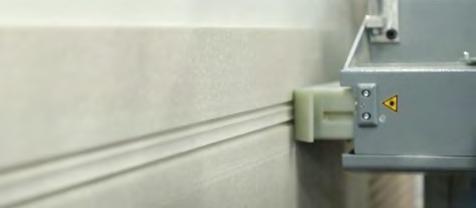
Colonial Saw now offers three more STRIEBIG vertical panel saw models with expanded capability for V-grooving and coving solid surface material: the Standard S, Evolution and Control. STRIEBIG originated V-grooving and coving solid surface on a vertical panel saw in the late ’90s beginning with their “Optisaw 2” model, and now all of the 7 ½-hp models have that capability. The newer models have the advantage of a fine adjustment thumbwheel and digital counter built into the saw head for fast, simple and very precise adjustment of the groove depth. With the new models the capability must be ordered at the time of the machine order, and it is not able to be retrofitted to existing machines. Compact saws are also not available for V-grooving. Only the Standard model (and older Optisaw 2s) can be retrofitted for V-grooving and coving.

The exclusive Pearl Pneumatic Wet Polisher and Pearl Pneumatic Wet Grinder now offered by GranQuartz are designed for continuous and convenient operation. Both the polisher and grinder are made with aircraft aluminum castings, sealed bearings and are equipped with rear air exhaust, vented through a hose protection sleeve for ultimate durability and safety. In addition, each product goes through a 100 percent quality control process prior to shipping. Handles and wrenches are included.
MSI is continually expanding its sink options. The company offers a full collection of timeless farmhouse apron sinks to complement kitchen
and bath styles. MSI’s undermount sinks provide a clean, seamless look offered in durable 16-gauge stainless steel and beautiful premium fireclay options, as well as single and double bowls. Additionally, the company provides a comprehensive collection of pressed and handcrafted sinks, including durable stainless steel in major gauges and sizes, single and double bowls, quartz composites and porcelain. MSI provides a limited lifetime warranty on stainless steel and quartz sinks.

While it is always preferable to use the recommended adhesive color match, there are times when fabricators have to get by with an alternate. Join.It by Princeton Chemical has specifically formulated an adhesive color for that exact situation, and many fabricators have found it useful to dramatically reduce the need for a large inventory of colors. Join-It calls it Outre White. Outre White blends into the surfacing material when a tight fit is achieved for seams and laminations. It is a highly translucent adhesive designed to pick up the surrounding material color and also mimic the light refraction properties of the surface that is being joined. Join.It produces strong, durable bonds on a range of surfacing materials including solid surface, quartz and natural stone.
Designed to provide more functionality, Karran has released two new workstation sinks. Both are single-bowl designs: one a traditional undermount and the other a stunning apron front design. These new workhorses for kitchens are produced from high-quality 16-gauge

stainless steel. They come complete with an assortment of useful accessories and are paired with beautiful, commercial-grade stainless steel faucets.

Ceramic slabs in large formats have become increasingly popular in recent years because of their advanced properties and versatility. Oversized ceramic slabs can be used for countertops, floors, walls, cabinets, vanity tops, stairs, furniture and even facades. TYROLIT offers a wide range of tools for the most demanding ceramic materials in all thicknesses. The diamond tools are available for virtually all ceramic, porcelain, sintered and compact materials. Tool options include straight and bevel cutting, drilling, profiling, flush fitting, edge polishing and all common manual operations. They were designed with tool bonds that allow high speeds with minimum noise and spindle absorption. The available profiles are regularly being expanded according to market requirements. Each tool is provided with an individual measuring card to help ensure easy setup to avoid downtime.
ChromaLok 7300 Rodding
Bonder is a rubber-filled methacrylate adhesive designed to bond fiberglass and steel
rods in natural stone countertops. This fastcuring (15 to 20 minutes) toughened adhesive improves load tolerance significantly while saving fabrication time. Chromalok 7300 uses a 400ml 1:1 cartridge system to eliminate waste and save money while speeding up overall fabrication time. Users can just remove pooled water and go, with no need to torch the
The Italia 5-axis, mono-block CNC bridge saw from Prussiani was designed for cutting porcelain and natural or synthetic stone. The Italia’s maximum blade size is 24 ½ in. for thicker material, but can also handle blades down to minimum of 11 ¾ in., which increases the rigidity and decreases deflection for faster and cleaner cuts in porcelain materials. The machine is built with high-volume water flow to maximize the cooling rate of the tooling when cutting porcelain. The compact mono-block structure reduces the footprint of the machine but maintains large working dimensions.

Fab Slabs is a brand of natural antibacterial kitchen accessories including cutting boards, platters and pizza boards. Each of these beautiful, richly toned accessories is hand-crafted in Australia of sustainable camphor laurel trees that are naturally and
permanently antibacterial. In addition to being a permanently antibacterial type of timber, camphor laurel is a problem weed along the riparian areas of much of southeast Queensland and northern New South Wales. The timber is kiln-dried in the company’s state-of-the-art solar kilns capable of drying around 7,500 boards at a time. All of these kitchen accesories are made from one single slab without laminating pieces together.
afin® Acryclean silicone remover from AKEMI is an ultra-pure solvent for use on natural stone, ceramics, quartz and glass. Acryclean removes deposits of silicone, grease and oil. It cleans and degreases before gluing, sealing or coating. It can also be used to remove tapes, stickers and foils on ceramics and polished natural stone.
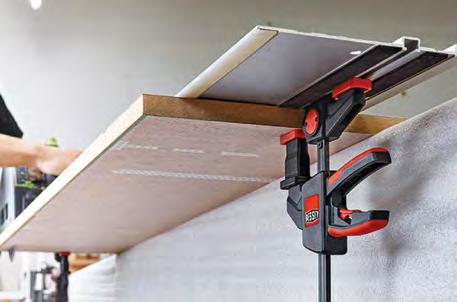
Bessey’s new clamp, EZR table clamp, was designed primarily to work with track saw guides (slots/grooves, 12mm by 6.5mm to 12mm by 8mm from Festool, Protool, Metabo, Makita, Hitachi/Hikoki and DeWalt). However, the EZR offers single-handed clamping and spreading of work pieces with 100 lbs. of clamping force. Step-over work is made possible by inserting a 2-in. adaptor into the upper or lower jaw. The easy-to-use release mechanism can quickly convert from clamping to spreading without tools simply by using a push-button release. The EZR-SET contains two one-handed table clamps with 6-in. clamping capacity (spreading width 4 ¾ in. to 12 in.) and 2-3/8 in. throat depth.
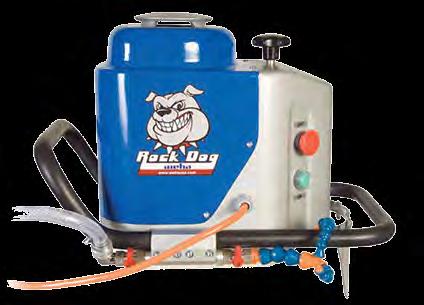
The Weha Rock Dog Router is a 9,000-rpm single-speed router that can profile practically any edge including granite, marble, quartz, quartzite, or any other stone. Made with a Unibody Aircraft Aluminum housing, it has a 2.4-hp 220 Single-Phase motor and can profile up to 6cm without any problems. The router comes with an aquaplaning base for easy movement across the surface, and its 22mm by 10mm thread spindle accommodates practically all router bits on the market. It comes with a 20-ft.-long, heavy 12-gauge AWF with ground power cord. The water connection is a quick disconnect for easy connection to the shop water lines.
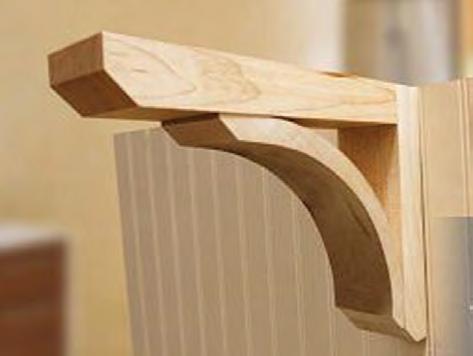
Federal Brace introduced two models to its Made In the USA Reinforced Wood Corbel Collection: the Lincroft Wood Corbel (pictured here) and the Cumberland Wood Corbel. The Lincroft is low profile, sleek and sports chamfered edges with a minimal gusset section. Overall measurements of 12 by 10 in. and a width of 3 in. combined with an internal hidden steel rib provide sturdy carrying capacity. The Cumberland Wood Corbel has an unfinished wood grain pre-routed for a 0.25-in.-thick steel support rib. Its low-profile gusset won’t interfere with knees under counters. The hidden steel support brackets under the corbels can support all stone and solid surfaces.
Used 2007 Techno LC Series 4896 3-axis
CNC Router, 48 x 96 x 5 (X,Y,Z)
■ Gantry Table with 5 HP HSD Auto Tool Changer Spindle.
■ Four Tool Holders, Four Tool Stations, 13 collets of different sizes.
■ Computer Console, CPU, Monitor, Windows-based G code interface.
■ Vacuum Table.
Lightly used, less than four hours per week over lifetime of machine.
Contact Fletcher Smith of Counterscapes, Inc. at (903) 581-5676
ISFA is only a click away, providing you with news, information and more! isfanow.org
ISFA Fabricators, do you have used equipment you would like to sell? Looking to fill a key position? Why not submit a FREE classified ad? That’s right, relevant classifieds in this publication are free to ISFA fabricator members! Just send us the text you’d like to run and we’ll do the rest.
Email us today at editor@isfanow.org.
For those of you who are not fabricator members, email kevin@isfanow.org or call (815) 721-1507 to get a quote.

Share this copy with a colleague or friend.
Better yet, have them subscribe at isfanow.org/magazine.



From the Desk of Steve Mast, ISFA President
Saying the world had to make changes in 2020, is an obvious understatement. Last January, I had never heard of the Coronavirus, but it forced our business to do many things differently. Almost immediately, we had to change the way we communicated, both internally with our teams and externally with our customers. Our biggest change was to embrace new communication technologies. In hindsight, many were positive and will likely stay with us, even after the world returns to “normal.”
Technologies adopted out of need are now part of everyday business. Many were possibly inevitable “down the road.” I’d heard at ISFA roundtables that some shops were already using them. However, last spring we were forced to make the change much faster than intended. We had to embrace new technology and do things differently, simply to do business. So, I want to share some of the technologies we adopted and how they impacted us. This is certainly not an endorsement of any of these specific platforms; these are simply the ones we chose to use.
Zoom is a virtual meeting platform. I’d never heard of it before 2020, but it went from 10 million daily participants in December 2019 to 300 million by April 2020. At our shop in Oregon, it was almost impossible for our teams to come into the office with the pandemic guidelines. We allowed them to work from home, and utilized Zoom to stay in touch every day. We now hold Zoom calls twice a day to check in and update everyone. We also have virtual meetings with our vendors about product updates and attend many virtual meetings, such as shop tours. We work with home centers and traditionally would have their associates take guided tours of our shop. Now we grab our cell phones and give them virtual tours online, which makes it easier for them to attend and ask questions. The free version is great. Calendly is a free online appointment scheduler. Prior to the pandemic we did a lot of sales via
free in-home estimates. Customers would call and sometimes play phone tag to book sales appointments. Our sales team could do about three appointments a day and spent a lot of time driving. Plus, many times only one homeowner would be there, so we couldn’t get that “final” decision. With Calendly the customer can book either virtual or in-showroom appointments online, making the whole process more efficient. Our sales team sells more and drives less. Also, with virtual appointments it’s easier to get both homeowners involved because they don’t both need to be home. All of our salespeople have their own Calendly calendars for customers to book directly on our website. The free version can do a lot of what you need.
Slack is a workplace messaging program. At our shop we now use it to communicate very efficiently within specific “channels” or teams. It’s kind of like an organized way of group texting, and far more efficient than email. For example, we can have a channel that includes our associates from the office with outside contractors, and it’s easy to attach images or documents. Slack is also free.
BlueBeam is something we now use for doing online takeoffs of commercial plans. We used to print plans, highlight areas of countertops and then use a scale to determine dimensions. With our teams working from home, we’re able to easily do takeoffs, send revisions to customers without scanning and share them with installers without printing. Now we do all takeoffs online, highlight the areas and save to a PDF for use with tablets. It’s faster and more efficient. Bluebeam has a onetime cost of $349.
Paycomm is a payroll and HR software we had before last year. However, with everyone working from home and all the new COVID-19 guidelines, we made big changes to how we use the application far beyond the payroll tools. We scanned and attached 25 years of employee records and folders to be accessed
virtually. In addition, job applicants can now complete applications online and in multiple languages without any paperwork. Once hired, the onboarding process of filling out forms and uploading documents is all virtual and done by the new hire. Paycomm allows us to create extensive online training videos and tests, so work from home users can learn remotely. The online training also helps managers get new hires up to speed quickly, and they can learn at their own pace. If someone needs to watch a video multiple times, it’s easy. Anytime we have changes or new processes to implement, we create a quick video and test to send to our teams through the learning platform. Our HR has become truly virtual.
Like many, change is difficult for us, especially when it involves new processes and technologies. Even if the outcome is beneficial, we just naturally resist change. This carries over to our personal lives. With schools closed, we had to implement online learning for our three kids, and it was tough, but just like work, we pushed our way through it. Last year we dealt with everything the best we could and adapted. Looking back, I see many positive technological impacts on the way we work.
I’m not sure how these technologies will be used and evolve in the future. Will our staff still work from home after the pandemic, such as is a growing trend? Even with all this technology, I miss seeing everyone every day at the office; it’s not quite the same to me. I do know that no matter what happens going forward, we will find a way to adapt, and with some help from technology, it’s a little easier.

Steve Mast, ISFA President steve.m@precisioncountertops.com