Urban Garden Target Group : Youth aged 18 to 25
Duration: Daily from early spring through late autumn
Theme: Youth-led Climate Action, Biodiversity & Urban Gardening
Location: GAME House Viborg
Why it matters? The Urban Garden turns climate awareness into hands-on action, empowering young people to take ownership of nature, food and biodiversity in their local community. It brings together GenGreen’s focus on youth-led climate action with GAME’s work to create inclusive spaces where young people can learn, connect and lead.
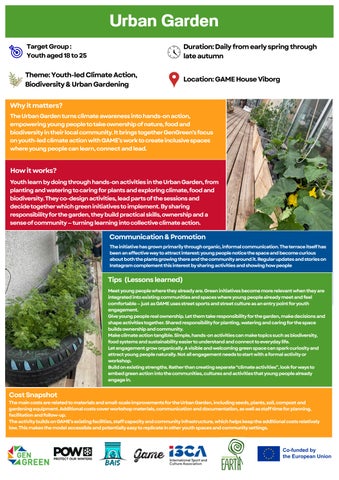
How it works? Youth learn by doing through hands-on activities in the Urban Garden, from planting and watering to caring for plants and exploring climate, food and biodiversity. They co-design activities, lead parts of the sessions and decide together which green initiatives to implement. By sharing responsibility for the garden, they build practical skills, ownership and a sense of community — turning learning into collective climate action.
Communication & Promotion The initiative has grown primarily through organic, informal communication. The terrace itself has been an effective way to attract interest: young people notice the space and become curious about both the plants growing there and the community around it. Regular updates and stories on Instagram complement this interest by sharing activities and showing how people
Tips (Lessons learned) Meet young people where they already are. Green initiatives become more relevant when they are integrated into existing communities and spaces where young people already meet and feel comfortable — just as GAME uses street sports and street culture as an entry point for youth engagement. Give young people real ownership. Let them take responsibility for the garden, make decisions and shape activities together. Shared responsibility for planting, watering and caring for the space builds ownership and community. Make climate action tangible. Simple, hands-on activities can make topics such as biodiversity, food systems and sustainability easier to understand and connect to everyday life. Let engagement grow organically. A visible and welcoming green space can spark curiosity and attract young people naturally. Not all engagement needs to start with a formal activity or workshop. Build on existing strengths. Rather than creating separate “climate activities”, look for ways to embed green action into the communities, cultures and activities that young people already engage in.
Cost Snapshot
The main costs are related to materials and small-scale improvements for the Urban Garden, including seeds, plants, soil, compost and gardening equipment. Additional costs cover workshop materials, communication and documentation, as well as staff time for planning, facilitation andGENGREEN follow-up. INITIATIVE 123 Anywhere St., Any City 123-456-7890 The activity builds on GAME’s existing facilities, staff capacity and community infrastructure, which helps keep the additional costs relatively low. This makes the model accessible and potentially easy to replicate in other youth spaces and community settings.
Quick Results The Urban Garden has quickly created curiosity and engagement around climate, food, biodiversity and sustainable living. By taking responsibility for everyday tasks such as planting, watering and caring for the plants, young people have developed a stronger sense of ownership and shared responsibility. Importantly, these activities have also become a social part of their everyday lives, where young people enjoy spending time together while caring for something they have created collectively. This makes climate action feel practical, meaningful and connected to community.
Expected Impact short term and long term Short term: Young people gain practical knowledge, confidence and ownership through hands-on involvement in the Urban Garden. They develop stronger connections to nature, food and biodiversity, while building community through shared responsibility and collective action. Long term: The aim is to make climate action a natural part of existing youth communities and spaces. By embedding green initiatives into GAME’s existing activities and communities, young people can continue to develop and lead local sustainability initiatives, creating a lasting culture of shared responsibility and youth-led climate action.
https://www.instagram.com/p/DaDJVvfIrXG/
Testimony from MAIA
Name
"What I like most is that we do it together. Taking care of the garden gives us a reason to spend time together, and it feels good to be responsible for something that we have created as a group. It has become a community where everyone can contribute."
Testimony from JARA "The garden has made me curious about what we can create ourselves that is also good for the climate. I didn’t think much about things like growing food or caring for biodiversity before, but now I want to learn more and see what other things we can do together."