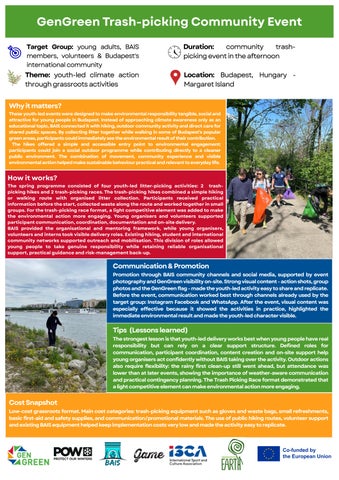
GenGreen Trash-picking Community Event Target Group: young adults, BAIS members, volunteers & Budapest's international community
Duration: community trashpicking event in the afternoon
Theme: youth-led climate action through grassroots activities
Location: Budapest, Hungary Margaret Island
Why it matters?
These youth-led events were designed to make environmental responsibility tangible, social and attractive for young people in Budapest. Instead of approaching climate awareness only as an educational topic, BAIS connected it with hiking, outdoor community activity and direct care for shared public spaces. By collecting litter together while walking in some of Budapest's popular green areas, participants could immediately see the environmental result of their contribution. The hikes offered a simple and accessible entry point to environmental engagement: participants could join a social outdoor programme while contributing directly to a cleaner public environment. The combination of movement, community experience and visible environmental action helped make sustainable behaviour practical and relevant to everyday life.
How it works?
The spring programme consisted of four youth-led litter-picking activities: 2 trashpicking hikes and 2 trash-picking races. The trash-picking hikes combined a simple hiking or walking route with organised litter collection. Participants received practical information before the start, collected waste along the route and worked together in small groups. For the trash-picking race format, a light competitive element was added to make the environmental action more engaging. Young organisers and volunteers supported participant communication, coordination, documentation and on-site delivery. BAIS provided the organisational and mentoring framework, while young organisers, volunteers and interns took visible delivery roles. Existing hiking, student and international community networks supported outreach and mobilisation. This division of roles allowed young people to take genuine responsibility while retaining reliable organisational support, practical guidance and risk-management back-up.
Communication & Promotion Promotion through BAIS community channels and social media, supported by event photography and GenGreen visibility on-site. Strong visual content - action shots, group photos and the GenGreen flag - made the youth-led activity easy to share and replicate. Before the event, communication worked best through channels already used by the target group: Instagram Facebook and WhatsApp. After the event, visual content was especially effective because it showed the activities in practice, highlighted the immediate environmental result and made the youth-led character visible.
Tips (Lessons learned) The strongest lesson is that youth-led delivery works best when young people have real responsibility but can rely on a clear support structure. Defined roles for communication, participant coordination, content creation and on-site support help young organisers act confidently without BAIS taking over the activity. Outdoor actions also require flexibility: the rainy first clean-up still went ahead, but attendance was lower than at later events, showing the importance of weather-aware communication and practical contingency planning. The Trash Picking Race format demonstrated that a light competitive element can make environmental action more engaging.
Cost Snapshot Low-cost grassroots format. Main cost categories: trash-picking equipment such as gloves and waste bags, small refreshments, 123 Anywhere St., Any City 123-456-7890 basic first-aidGENGREEN and safetyINITIATIVE supplies, and communication/promotional materials. The use of public hiking routes, volunteer support and existing BAIS equipment helped keep implementation costs very low and made the activity easy to replicate.
Quick Results A large, diverse group of community participants took part in the beach-volleyball activity. Young volunteers gained practical experience in organising and communicating a grassroots sport event. GenGreen and BAIS visibility was integrated directly into the activity and final group moments. The format demonstrated a replicable way to combine movement, community-building and climateconscious youth engagement.
Expected Impact short term and long term Short term: the activities increased environmental awareness through direct action, strengthened social connections and gave young organisers practical experience in teamwork, peer leadership, communication and event delivery. Participants could immediately see the result of the clean-up activities. Long term: the expected impact is a stronger culture of youth ownership and environmentally responsible behaviour within BAIS' community. By showing that sustainability can be embedded in ordinary hikes, competitions and social sport events, the actions provide formats that can be repeated without complex infrastructure. Young people who gained experience as organisers can transfer these skills to future community initiatives, while participants may be more likely to treat care for public spaces, waste reduction and sustainable event habits as normal parts of active citizenship and grassroots sport.
Watch our implementation video for inspiration! Facebook | Instagram Testimony from: Virág (30), Trash-picking event organizer, BAIS
I was driven by a love for outdoor movement and a desire to protect our green spaces, so I organized a trash-picking race for BAIS on Margaret Island. The mission was simple: combine fitness with real environmental impact. The rules were simple, but the energy was pure chaotic fun. Everyone was running around, squatting and chasing after every piece of litter they could find. To keep things spicy, we added two special prizes. The Cigarette Butt Champion was awarded to the team with the sharpest eyes and highest count of micropollutants. The Oddity Trophy was reserved for whoever collected the most unique piece of trash. What made working with this group unforgettable was watching standard clean-up work turn into a scavenger hunt. The moment someone spotted a bizarre item, from ancient boots to mystery vintage electronics, the park lit up with cheers and laughter. By the end of the day, we left Margaret Island noticeably greener, logged a killer workout, and proved that saving the planet is a lot more fun when you turn it into a sport!