
D2.1. Report



AI MOVE project is a European collaboration aimed at supporting grassroots sport organisations to better understand and responsibly adopt artificial intelligence. The project brings together partners from across Europe with expertise in sport development, digital innovation, and community engagement.
It focuses on preparing the foundation for AI implementation, raising awareness among organisational leaders about AI benefits and risks, building capacity through tools and pilot actions in Poland and Denmark, and widening engagement to support policy debate and knowledge exchange across the sector.
This document presents the outputs of the first mapping deliverable: an identification and structured description of real-world practices where AI is being implemented in grassroots sport contexts. The mapping was designed to be practical, focusing on examples that are relevant, transferable, and feasible for grassroots sport organisations.
This document is organised into three sections:
• Section 1 describes the methodology used to identify and select practices.
• Section 2 introduces the six categories used to organise them.
• Section 3 presents the full list of mapped practices and the five selected for in-depth case study development.
The full interactive collection, including all 25 mapped practices with detailed information in multiple languages, is available at: https:// aimovemapping.lovable.app/ and the AI MOVE project website: https:// ai.isca.org/resources-use-cases
To complement the mapping, AI MOVE consortium distributed a survey to project partners and their networks to better understand current AI use, attitudes, and needs in grassroots sport.
The results paint a picture of a sector that is actively engaging with AI, but largely on its own, without formal support structures. The most common uses of AI among respondents are communication and marketing 80% rate), followed by social media content creation, data analysis, funding and report writing, and administration (all around 64%. All these are areas where AI tools are widely accessible and require relatively low technical skill to get started. Coaching support and volunteer management, by contrast, are much less common current uses (less than 20%, suggesting that AI adoption in sportspecific roles still has significant room to grow.
Usage is frequent: 67% of the respondents use AI daily and 24% use it weekly, indicating that for many in this group, AI has already become part of their working routine. The benefits they report are clear: saving time is the most widely felt benefit 76%, followed by faster content creation, improved communication, reduced workload, and improved efficiency.
Yet significant barriers remain. Data protection and privacy concerns, and doubts about accuracy and reliability, are the top challenges (almost half of the respondents agree on this), followed by lack of training and lack of knowledge or skills. Perhaps most tellingly, 73% of the respondents report that their organisation has no AI strategy, policy, or guidelines in place. Around a third have received no training on AI at all, and while confidence levels are moderate, there is clearly a need for more structured support.
These findings reinforce the purpose of this mapping. Grassroots sport organisations are already using AI, but largely informally and without governance frameworks. The practices documented here are intended to offer concrete, evidence-based examples of what AI can look like in community sport, and to help organisations move from fragmented experimentation toward more intentional and responsible adoption.
The mapping was designed as a practical, grassroots-first exercise. The goal was not to produce an exhaustive directory of AI tools available on the market, but to identify real-world examples where AI is being used in ways that are relevant, transferable, and feasible for community sport organisations, and where there is credible evidence of implementation. This distinction matters: many AI tools exist, but far fewer have been meaningfully tested and adopted in grassroots contexts, with all the constraints of limited budgets, volunteer capacity, and varying levels of digital confidence that characterise community sport.
Use cases were sourced using a multi-channel approach to ensure both breadth and relevance across different grassroots sport contexts.
Desk research involved systematic online scanning of AI-enabled tools, platforms, pilots, and programmes relevant to grassroots sport. This included a review of organisational websites, published case studies, blogs, product documentation, and public announcements, with extraction of verifiable information on functionality, target users and evidence.
Partner network outreach drew on the AI MOVE project partner network, with partners contributing practices identified through their national and European networks. Outreach focused on organisations actively working with grassroots clubs, federations, community programmes, and youth sport settings.
A survey distributed to partners and their networks provided a complementary layer of insight, helping the project team understand current AI use, barriers, and priorities in grassroots sport. Survey findings informed both the selection of practices and the framing of the mapping categories.
Selection criteria
Practice was included if it demonstrated:
• Grassroots relevance: demonstrably applicable to community sport organisations such as clubs, associations, community programmes, and youth pathways, and not only to elite environments.
• Clear value creation: addresses a meaningful grassroots challenge, including time and cost pressures, coach capacity, participation, inclusion, safeguarding, communications, or impact measurement.
• AI-enabled functionality: AI is materially part of the solution, not only generic digitalisation.
• Replicability: a plausible pathway exists for other organisations to adopt or transfer the approach, even if at a smaller scale.
• Evidence : presence of credible references such as public documentation, user stories, partner validation, or demonstrated deployments.
• Feasibility and accessibility: reasonable requirements for skills, data, infrastructure, and cost relative to grassroots constraints.
• Responsible use considerations: identifiable safeguards or an ability to implement the solution responsibly, covering privacy, minors, bias, and transparency.
The mapping produced 25 practices in total. Of these, five were selected for in-depth case study development. The selection was again guided by grassroots relevance and strength of evidence, but with an important additional emphasis: for the detailed case studies, the project team decided not only to describe the tools themselves, but to understand and document the experience of organisations actually using them. What did implementation look like in practice? What worked, what was harder than expected, and what would they do differently? What does adoption require in terms of time, skills, and organisational readiness?
This perspective is what the five detailed case studies are designed to capture, and what makes them most useful for other clubs and associations considering similar approaches. These five case studies are developed in full in D2.2.
This mapping represents a first round of collection and is not exhaustive. The 25 practices reflect what was identifiable and verifiable through desk research and partner networks at the time of mapping. It is important to acknowledge
that AI in sport is a rapidly evolving field. New tools, pilots, and implementations are emerging continuously, and the landscape looks meaningfully different even from one year to the next. What is considered innovative today may be standard practice tomorrow, and tools that do not yet exist may become highly relevant to grassroots sport in the near future. This mapping should therefore be read as a snapshot rather than a definitive guide.
For this reason, the interactive collection, that was developed at: https:// aimovemapping.lovable.app/ is designed as a living resource. Additional practices will be added as the project progresses and as new evidence emerges from consultations, partner networks, and the broader field. The mapping is also more oriented toward Europe and English-language sources, reflecting the reach of the project partnership, though efforts were made to include examples from a broader range of contexts where strong evidence existed.
Organising AI practices into categories is not straightforward, as AI tools often serve multiple purposes at once. The six categories used in this mapping are therefore not rigid boundaries but practical groupings, designed to help grassroots sport organisations navigate the collection and identify practices most relevant to their own context and challenges.
The categories were developed inductively from the mapping itself, shaped by what was actually found in the field rather than imposed in advance. They reflect the areas where AI is showing the most practical relevance for community sport organisations today, and where the needs of grassroots clubs and associations are most clearly visible. Together they cover the full range of organisational life in grassroots sport: from how clubs develop their people, to how they run their operations, communicate with their communities, support their athletes, protect their members, and demonstrate their impact.
• Education and Training covers AI supporting coach development, lesson planning, learning content generation, and scalable training delivery.
• Athlete Performance, Development and Pathways covers AI enabling video analysis, performance tracking, coaching assistance, development planning, and talent identification or pathway support.
• Operations and Workflow Automation covers AI reducing administrative burden through scheduling, registration support, member management, and operational automation.
• Communications and Content covers AI improving consistency and quality of communications, content production, match reporting, and community engagement workflows.
• Inclusion, Safeguarding, Equity and Responsible Use covers AI supporting accessibility and inclusion, alongside safeguards in content moderation and responsible deployment, especially where minors are involved.
• Impact Measurement, Insights and Reporting covers AI supporting monitoring, insight generation, reporting, participation trends, and programme impact measurement.
The survey conducted as part of this project offers a useful lens for reading these categories. Respondents confirmed that communications and content, administration, and data analysis are the areas where AI is most actively used today, mapping directly onto the Communications and Content and Operations and Workflow Automation categories.
At the same time, the survey highlighted that coaching support and training remain underdeveloped areas of AI adoption, despite being central to what grassroots sport organisations do, pointing to the continued importance of the Education and Training and Athlete Performance categories.
And with data protection and responsible use emerging as the top concern among respondents, the Inclusion, Safeguarding, Equity and Responsible Use category reflects not just an opportunity but an urgent priority for the sector.
CHAPTER 4
The first round of mapping produced 25 practices across 11 countries, spanning all six categories. Together they show that AI is already being applied in grassroots sport in diverse ways, from automating club administration and generating match reports, to supporting volunteer coaches, improving online safety, and tracking athlete development. The practices vary in cost, technical complexity, and maturity, reflecting the range of starting points that different organisations may have.
SchoolAI USA
Teachers use generative AI to create customised movement breaks, energisers, and physically active lessons adapted to student age, classroom size, and learning goals.
GoNoodle - USA
GoNoodle uses AI-assisted tools to generate movement videos, physical activity instructions, and personalised movement content including brain breaks, dance and exercise instructions.
Move.ai - United Kingdom
Uses AI motion capture to generate movement content and animation from real human movement, supporting coaching content creation and session design.
Sports Fusion Ltd - United Kingdom
Sports Fusion explores how AI tools can support learning, feedback, and development in grassroots sport environments, with a focus on volunteer coaches and participants.
DGI Nordsjælland - Denmark
DGI Nordsjælland supports grassroots sports clubs by offering hands-on AI workshops and tailored club development programmes for volunteer-based clubs, with a focus on responsible AI implementation, organisational anchoring, and long-term capability building alongside the practical adoption of generative AI tools.
Smørum Golfklub - Denmark
Smørum Golfklub participated in DGI’s AI development programme, a structured three-module programme designed to help volunteer-based clubs adopt generative AI tools in practice while strengthening organisational readiness, responsible implementation, and internal capability building within the club.
Teampact - South Africa
A data-light mobile app and dashboard that helps organisations track attendance and activity delivery in real time, designed to work even where connectivity is limited.
ReSpo.Vision - Poland
ReSpo.Vision uses AI and computer vision to analyse standard football match videos and automatically track players in 3D space, extracting detailed performance and biomechanical insights without requiring wearable sensors.
Coach Rob - United Kingdom
Coach Rob is a conversational AI chatbot built to support volunteer grassroots football coaches with age-appropriate training ideas, coaching Q&A, and session planning.
Coach Frank - USA
Coach Frank is a free mobile app for football coaches that instantly creates custom session plans, designed to meet the needs of players and their environment.
Veo - Denmark
AI-powered sports camera system that records the full field, automatically creates a follow-cam view, and lets teams analyse and share games with optional AI analytics and player tracking.
TwinPlay AI Italy
TwinPlay uses computer vision to automatically track basketball actions during training, providing objective performance data to coaches and players without manual stat collection.
Enduco - Germany
Enduco is an AI-driven endurance training app that creates personalised training plans based on fitness data and adapts them over time.
AI.IO / AiScout - United Kingdom
AiScout allows grassroots players to upload drill videos that are analysed by AI and compared against benchmarks used by professional clubs, opening up talent identification pathways.
Loop Athlete - Canada
Loop Athlete helps coaches, athletes, and parents stay aligned through structured feedback, evaluations, progress tracking, and analytics.
Spiideo - Sweden
AI-powered automated sports camera with cloud platform that captures panoramic game footage and uses AutoFollow and player tracking for video analysis and livestreaming.
TeamLinkt - Canada
TeamLinkt is a digital platform for grassroots sports clubs and leagues that includes an AI-powered assistant to automate and support administrative tasks such as scheduling, registrations, member communication, and notifications.
Clubee - Luxembourg
Clubee is a digital platform with AI features that automate membership management, communications, scheduling, and administrative tasks for clubs and federations.
Chisel / MOTGU
Denmark
The sports club used generative AI to plan, structure, and publish all social media posts for a major gymnastics show event, creating a full 14-day posting schedule in under two hours.
Olympism365 Innovation Hub - IOC Switzerland
NOVA is an AI-powered conversational learning avatar that provides ondemand guidance, reflection prompts, and resource signposting for practitioners in sport and development contexts.
TextRudi - Germany
TextRudi is an AI-based chat tool designed to help sports clubs generate press releases, newsletters, and social media content quickly and consistently.
GrassRoots Club - United Kingdom
GrassRoots Club is a community sports platform that includes AI-generated match reports alongside club management features, helping clubs maintain a consistent presence with minimal effort.
Exergame Fitness - USA
Exergaming uses AI-driven game mechanics to encourage physical activity through interactive and adaptive experiences, with AI personalising activities based on age, ability, and motivation.
Areto Labs - Canada
Areto combines human judgment with machine speed to detect and respond to online hate, violence, scams, bot attacks, and misinformation, helping sport organisations create safer digital communities.
Playverto - United Kingdom
A gamified data-collection platform that helps organisations run engaging digital research experiences and analyse results via dashboards, while contributing to an anonymised data commons.
CHAPTER 5
We developed a visual, interactive online page that presents the mapped use cases: https://aimovemapping.lovable.app/
The interactive page allows users to search by keyword, tag, or organisation name, and to filter by category, audience, sport type, sport setting, cost level, and implementation effort. Each practice includes a short description, country, keyword tags, sport type, audience and setting, website, impact and outcomes, highlights, barriers, responsible AI considerations, cost level, and implementation effort level. A summary is also provided in the native language of the origin country.
Collection is also presented at the AI MOVE project website: https://ai.isca.org/ resources-use-cases
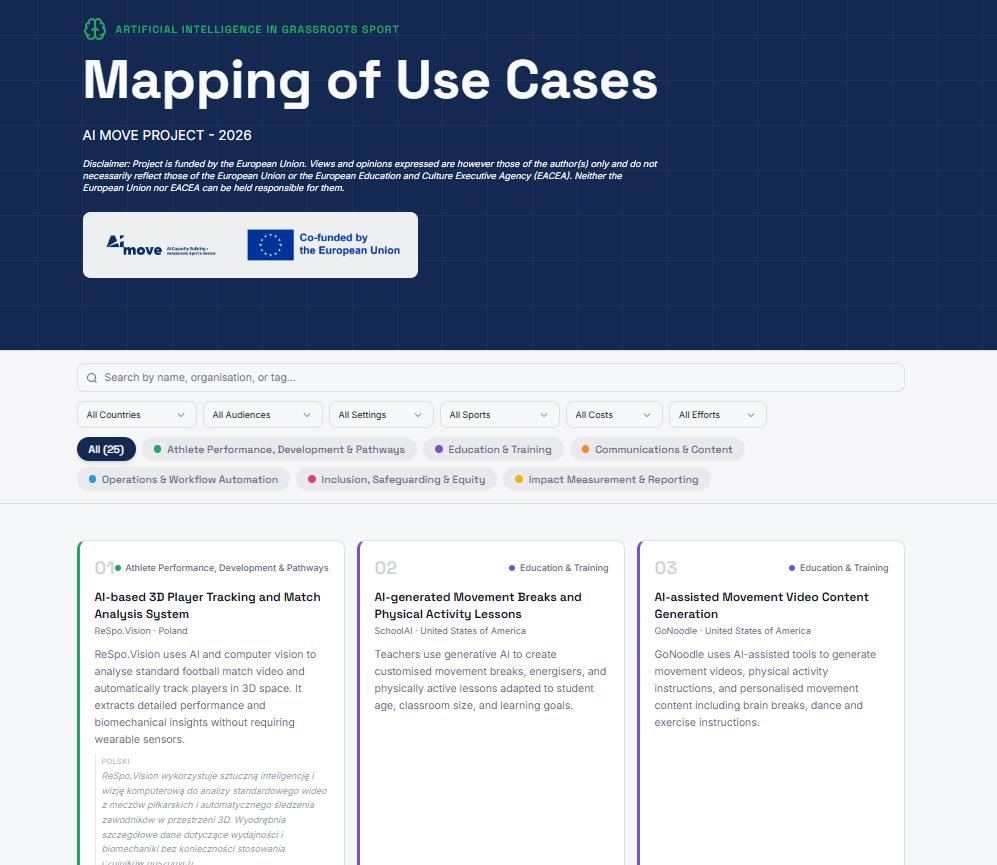
1 Screenshot of the AI Move Mapping interactive web page (https://aimovemapping.lovable.app/).
CHAPTER 6
From the 25+ use cases identified, five were selected for in-depth development, each presented via mixed-format interactive content and a separate written article. The selection was guided by grassroots relevance, strength of evidence, and coverage across the six categories. Survey findings also informed the selection: respondents identified communication, administration, and coaching support as the areas where AI is most actively used or most needed, and highlighted training, confidence-building, and responsible use as key priorities. The five case studies reflect these realities directly.
Crucially, the aim of these case studies goes beyond describing the tools themselves. For each practice, the project team tried to understand and document the perspective of organisations actually using them. What implementation looked like on the ground, what worked, what was harder than expected, and what other grassroots organisations should know before taking a similar step were some of the crucial points that were aimed to be addressed. This practitioner perspective is what gives the case studies their value, and what distinguishes them from a simple tool overview.
• Smørum Golfklub with DGI Nordsjælland Denmark) - AI development programme Education and Training)
• Veo Denmark) - AI-powered cameras for performance recording and analysis Athlete Performance, Development and Pathways)
• Clubee Luxembourg) - AI-powered club management tool Operations and Workflow Automation)
• Olympism365 Innovation Hub – IOC Switzerland) - NOVA AI avatar Communications and Content)
• Areto Labs Canada - responsible AI content moderation Inclusion, Safeguarding, Equity and Responsible Use)
Each of these practices will be analysed in depth in D2.2, including implementation approach, impact, barriers, responsible use considerations, and key learnings for grassroots organisations looking to adopt similar approaches.

The practices mapped in this deliverable demonstrate that AI is already being applied in grassroots sport in ways that are practical, accessible, and relevant to community organisations. The examples span coaching support, volunteer time-saving, safer digital communities, more consistent communications, and better access to knowledge, all areas that matter to clubs and associations of all sizes and levels of digital maturity.
The AI MOVE survey reinforces this picture. Grassroots sport organisations and their networks are not waiting for permission to use AI: many are already using AI daily and reporting tangible benefits. But the same survey reveals a sector navigating AI largely without formal support: most organisations have no AI strategy or policy, training is patchy, and concerns about data protection, accuracy, and reliability remain prominent.
This gap between active use and structured, responsible adoption is precisely where the AI MOVE project is designed to contribute. The practices in this collection are not presented as models to copy, but as evidence that AI can work in grassroots contexts, and as starting points for organisations to reflect on where and how it might work for them.
There are a few observations from the mapping which are worth highlighting. First, the most relevant AI applications for grassroots sport tend to address persistent, everyday challenges - reducing repetitive administrative work, helping volunteers communicate more consistently, supporting coaches without specialist backup - rather than complex or high-profile technology. Second, responsible use is not a separate concern to be addressed later; it is embedded in the selection criteria for this mapping and should be embedded in any adoption process. Data protection, consent, transparency, and the specific considerations that apply when working with minors all matter from the start. Third, confidence and organisational readiness are as important as the tools themselves. As the Smørum Golfklub example illustrates, building shared understanding within a club or organisation is often the most valuable first step.
Finally, it is worth emphasising that this mapping is a starting point, not a conclusion. Tools that are emerging today may become mainstream within a few years, and challenges that currently feel significant may become easier to navigate as grassroots organisations build experience and develop better governance frameworks. The AI MOVE project will continue to track this evolution, adding practices to the interactive collection and deepening understanding through consultations and case study work as the project progresses.


Funded by the European Union. Views and opinions expressed are however, those of the author(s) only and do not necessarily reflect those of the European Union or the European Education and Culture Executive Agency (EACEA). Neither the European Union nor EACEA can be held responsible for them.