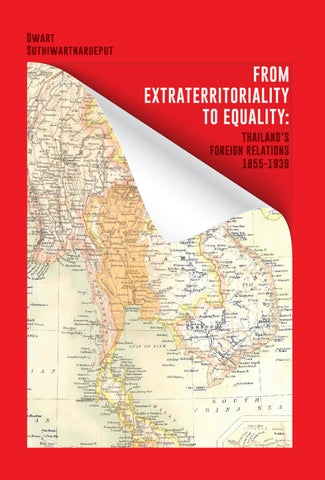
––––– F ROM E X T R AT E R R I TOR IALITY T O E Q U A L I TY: T HAI L A N D ’ S F O R E I G N RELATI O NS 1855-1939 –––––
OWAR T SUTHIWAR TNA RU EPU T
––––– FOREWORD –––––
The International Studies Center (ISC) wishes to express its deep appreciation to Ambassador Owart Suthiwartnarueput for permitting the ISC to publish, for the first time, his doctoral thesis “The Evolution of Thailand’s Foreign Relations Since 1855: From Extraterritoriality to Equality”, under a new title of “From Extraterritoriality to Equality: Thailand’s Foreign Relations, 1855-1939,” as another volume in the ISC’s series of books on diplomatic history. Following the practice with the theses that the ISC has published, few editorial changes as necessary and prudent were made in order to keep this book as close as possible to the original thesis submitted to The Fletcher School of Law and Diplomacy, Tufts University, in 1956. The conclusion of the Bowring Treaty with Great Britain in 1855, at the beginning of the reign of King Mongkut (Rama IV), ushered in the new era of Siam’s (as Thailand was then known) relations with the Western nations. Under the Bowring and the “Bowring-type” Treaties, Siam relinquished its autonomy in judicial and fiscal matters to these Western countries under extraterritorial regime, which became well established in Siam by 1870. Subsequent colonial expansion caused further problems
4
FROM EXTRATERRITORIALITY TO EQUALITY:
for Siam. Consequently, two major trends appeared consistently through the course of Siam’s foreign policy. One was its efforts to maintain independence in the face of encroaching colonial powers; the other was its endeavours to regain judicial and fiscal autonomy. Ambassador Owart’s work dealt mainly with the latter trend of policy. He examined, in detail, the legal aspect, the development and the functioning of the extraterritorial system in Siam. He recounted Siam’s relentless efforts, through a long series of comprehensive reforms, especially in the legal field, to reduce and eventually to rid itself of extraterritorial burdens. An intensive study was made of the negotiations with the Western powers over these extraterritorial privileges, which they gradually relinquished and were totally abolished in 1939. The ISC hopes that readers will find this book a useful source material on the subject of extraterritorial system in Siam, which was central to Siam’s foreign relations during 1855-1939. International Studies Center December 2021
THAILAND’S FOREIGN RELATIONS 1855-1939
5
––––– P R E FA C E –––––
Upon King Mongkut’s accession to the throne in 1851 Thailand, then called Siam, emerged from a relatively secluded position. Recognizing the futility of resisting the commercial expansion by Western nations, he opened the country to foreign traders and in 1855 concluded a treaty with Great Britain known as the Bowring Treaty. By this treaty British subjects were granted the rights of free trade and consular jurisdiction. Other countries quickly followed the British example, and by 1870 the extraterritorial regime was well established in Siam. All these treaties were unilaterally irrevocable and contained no time limit. To some Western powers, commercial expansion was linked with colonial designs. Consequently, two major trends appeared consistently through the course of Siam’s foreign policy. One was its efforts to maintain independence in the face of encroaching colonial powers and the collapsing independence of its neighbors; the other was its endeavors to regain judicial and fiscal study autonomy. This study is concerned with latter trend of policy. It attempts to deal with the question of extraterritoriality in Siam since 1855, a brief treatment of its
6
FROM EXTRATERRITORIALITY TO EQUALITY:
short-lived and imperfect state in the latter part of the 17th century being included. An examination is then made of the legal aspect and the functioning of the extraterritorial system, as well as of its effects on the country both economically and administratively. As hardships caused by the system grew, Siam initiated a long series of comprehensive reforms, especially in the legal field, as part of its policy to reduce and eventually to rid itself of extraterritorial burdens. These reforms are discussed, and an intensive study is made of the attempts by the Siamese government to relinquish these extraterritorial privileges—steps by step—until they were totally abolished in 1939. This study relies chiefly upon manuscript materials in the official archives of the British, French, and the United States governments. Documents at the Royal Thai embassies in London, Paris, and Washington D.C. were also used. Several consultations were had with Dr. Francis Bowes Sayre, former Adviser in Foreign Affairs to the Siamese government, who kindly gave the author permission to use his private papers relating to his mission to Europe as Siamese plenipotentiary in 1924-25.
THAILAND’S FOREIGN RELATIONS 1855-1939
7
––––– L I ST O F A B B R E V I AT I O NS ––––– A.J.I.L American Journal of International Law B.F.S.P
British and Foreign State Papers
D.S.
National Archives, Washington D.C., Department of State Manuscripts
F.E.Q.
Far Eastern Quarterly
F.O.
Public Record Office, London, British Foreign Office Manuscripts
J.S.S.
Journal of the Siam Society
London
Official documents and manuscripts at the Royal Thai Embassy: London
Ministère des Affaires Etrangères
French Ministry of Foreign Affairs Manuscripts
Paris
Official documents and manuscripts at the Royal Thai Embassy: Paris
R.P.P.
Revue Politique et Parlementaire
Washington
Official documents and manuscripts at the Royal Thai Embassy: Washington
8
FROM EXTRATERRITORIALITY TO EQUALITY:
––––– CONTENTS ––––– Prologue Chapter 1 Emergence of Extraterritoriality in 1885
12
Chapter 2
Legal Regulations for Extraterritoriality
90
Chapter 3
Functioning and Effects of Extraterritoriality
112
Chapter 4
Gradual Limitation of Extraterritoriality
146
Chapter 5
Complete Abolition of Extraterritoriality and Restoration of Equality
240
42
Notes
296
Bibliography
352
THAILAND’S FOREIGN RELATIONS 1855-1939
9
A map of “Burma, Siam, French Indo-China, and Straits Settlements”, published in 1902, by Dodd, Meade & Co., an American publishing house based in New York City. The map shows areas marked “French Sphere of Influence” and “British Sphere”, respectively, highlighting the terms of the Anglo-French Agreement of 1896.
––––– PROLOGUE –––––
HISTORICAL SKETCHES1
The Sukhothai Period (1257-1350)2 The Sukhothai period was comparatively short, yet it included one of the most flourishing epochs in the history of the Thai people during the reign of King Ram Kamhaeng, the first Thai king to be called “the Great”. As third ruler of the Sukhothai dynasty, Ram Kamhaeng came to the throne in 1277, when the country was hardly able to survive, let alone to stand against many hostile neighbors. When he died, forty years later, the hegemony of Sukhothai over the Indo-Chinese peninsula was undisputed. To judge only from the territorial expansion achieved during his time, one may readily appreciate Ram Kamhaeng’s accomplishments. Within four decades, the country had grown from one virtually confined within the Chao Phya River valley 3 into a large kingdom spreading to Luang Prabang in the North, to Vien Chan in the East, to Jahore at the tip of the peninsula in the South, and to the Irawaddy River reaching out into the Gulf of Bengal in the West. It was King Ram Kamhaeng who, in 1283, reorganized the Thai alphabet, through an adaptation of the Khmer characters; it has been in use to this day with only slight modifications effected by King Vajiravudh (Rama VI) of the Chakkri dynasty. Most of what had happened before and during Ram Kamhaeng’s reign has been known through his stone inscriptions which survived all enemy attacks upon the kingdom.4 Historians of Sukhothai owe much to the far
THAILAND’S FOREIGN RELATIONS 1855-1939
13
sightedness of this king, for these stone inscriptions are almost the only extent source of information concerning Sukhothai before and during his time.5 A thorough administrative reorganization was also accomplished in his reign. The concept that justice was given to the people directly by the king himself was eloquently demonstrated by his own exemplary performance.6 As happened to Burma after King Anuruth’s death, King Ram Kamhaeng’s demise in 1317 was followed by the decline of his kingdom. Sukhothai never recovered its golden days and continued on its downward path until 1378, when it lost all its power and yielded hegemony over the country to the fast-rising kingdom of Ayuthya. The Ayuthya Period (1350-1767)7 The year following King Ram Kamhaeng’s death, Tavoy and Tenasserim declared their independence of Sukhothai. His successor failed to bring them back under his suzerainty. The Chief of the city of U-Thong8 and his son-in-law, a descendant of King Chaisiri seeing Sukhothai’s weakness, took upon themselves to conquer and annex both Tavoy and Tenasserim to their territory in 1326. The achievement at once enhanced U-Thong in the eyes of the Chiefs of other Thai cities who, one by one subsequently, came to seek U-Thong’s protection. In 1344, the Chief of U-Thong died. He was succeeded by his son-in-law, who soon transferred the capital of his newly formed state to nearby Ayuthya. There, in 1350, he was proclaimed king under the name of Rama Thibodi I. By this time, Sukhothai was too weak to redeem itself, let alone assert its power over
14
FROM EXTRATERRITORIALITY TO EQUALITY:
Ayuthya. The existence of two capitals, nevertheless, continued until 1378, when Sukhothai was annexed and thereby the kingdom of Siam was re-united under the sole control of Ayuthya. Nothing of great significance took place during the following hundred years. At the beginning of the 16th century, the first contact was made between Siam and a Western nation: Portugal. The year 1538 marked the beginning of a countless number of wars between the Siamese and the Burmese – conflicts which ended in the passing of Ayuthya under Burma’s control in 1569. The Siamese, however, regained their independence fifteen years later under the leadership of Prince Naresuan, then heir to the throne of Ayuthya. His reign, which began in 1590, once again carried Ayuthya to the zenith of its power and won him a place among the few “great” rulers of the country. Unlike the sequel to King Ram Kamhaeng’s reign, the end of King Naresuan’s rule was followed by a long period of peace and tranquility which, in turn, attracted venturers from a number of Western nations. Among them were the Dutch who came in 1604, followed by the British in 1613 and the Danish in 1621. All were welcomed and allowed to carry on their trade at Ayuthya and at other sea ports in the kingdom. All went well until the arrival of French missionaries in 1662, which led, two decades later, to an exchange of embassies between the courts of Ayuthya and Versailles. A keen rivalry among the European nations, particularly between the French and the Dutch, developed from their efforts to seek privileges from Ayuthya. This rivalry, which was aggravated by an intrigue within the courts of Ayuthya and Lopburi (a temporary capital during King Narai’s
THAILAND’S FOREIGN RELATIONS 1855-1939
15
reign), eventually culminated in a violent revolution in 1688. The revolution brought an abrupt end to the early contacts with the European powers. History has proved time and again that domestic dissensions invite external troubles. As an illustration, the revolution of 1688 at Ayuthya soon brought in its wake the resumption of perennial wars with Burma. Each battle contributed to the further weakening of the former country, and eventually, in 1767, Ayuthya collapsed for the second and the last time under the might of Burmese armies which utterly destroyed this once flourishing city and capital of the kingdom of Thailand for 417 years. The Short-Lived Dhonburi Period (1768-1782) As a result of thorough destruction by the Burmese, Ayuthya became a mass of debris and ruins. A considerable number of its population who could not escape in time were captured and taken as prisoners to Burma, a practice customary on the part of victorious kingdoms in those days. One of the most popular sayings among the Thai even nowadays is “Ayuthya never lacks a saviour”. This probably was derived from what subsequently happened to this city. The Burmese, after being satisfied that there was nothing of any value remaining in Ayuthya, left behind a small force for the final mopping up of the city. Curiously enough, the rest of the country was left more or less intact. Owing to the feudal system then in existence, the kingdom was broken into various independent regions. Wars among these regions finally reduced their number to five.
16
FROM EXTRATERRITORIALITY TO EQUALITY:
The leader of an eastern region, Phya Tak Sin, emerged as the most powerful of the five. He fought his way to Dhonburi, where he established a new capital in 1768. After overwhelming the Burmese forces stationed at Ayuthya, he promptly proceeded upon the task of unifying the country. This undertaking, of course, involved overcoming all the other remaining regions by force. Once the unification had been achieved, the rehabilitation of the newly united kingdom came as a next logical step. Within the span of barely fifteen years, Siam regained most of its lost territories, even acquired new ones, and once again established itself as a powerful kingdom. If King Tak Sin’s achievements constitute an illustrious chapter in Thai history, the tragic end of his life was in contrast. Toward the last years of his reign, the relentless stress and strains caused by the burdens he had been shouldering began to take their toll. In 1782, he became mentally deranged and was deposed. The throne then passed on to his ablest warlord, Chao Phya Chakkri, the founder of Bangkok and of the present Chakkri dynasty. The Bangkok Period (1782 to the present)9 Since some of the major events during this period will be treated subsequently in the present work, only a survey of some salient events is attempted here. Upon ascending the throne as “Buddha Yod Fa”, retroactively known as “Rama I”10, Chao Phya Chakkri decided, largely for strategic reasons, to move the capital to Bangkok which is on the other side of the Chao Phya River across from Dhonburi. Most of his time and that of his successor, King Lert-La
THAILAND’S FOREIGN RELATIONS 1855-1939
17
or Rama II, was devoted to the consolidation of the country, a task marked by many wars with Burma and other neighbors. As a matter of fact, the menace from Burma did not subside until the last year of King Lert-La’s reign (1824), when that kingdom became involved in an armed conflict with Great Britain. That struggle by stages led to the loss of Burma’s independence. It was during King Lert-La’s reign that the contact with the West was resumed after a long lapse following the revolution of 1688. It began with his permission to Portugal to establish a consul at Bangkok in 1820. The following year saw the arrival of Dr. John Crawford who had been commissioned by the government of India to negotiate a commercial treaty with the Siamese government. His mission was not successful, however. Dr. Crawford’s mission, nevertheless, initiated a new series of contacts with the Western world. Thus, during King Nang Klao or Rama III’s reign (1825-1851), two commercial treaties were concluded at the court of Bangkok. The first one was signed in 1826 with Captain Henry Burney, who represented the same British government of India. The second instrument was concluded seven years later with the United States government, represented by Edmund Roberts. Both treaties, containing similar clauses, were based on a footing of equlity. The ascension to the throne of King Mongkut, or Rama IV, in 1851, marked a turning point in Siam’s modern history. He assumed the reins of the country while colonialism was gaining momentum in Southeast Asia. The French had already installed themselves in Annam. Great Britain, on the other hand, had annexed to its Indian possessions the entire region of Lower Burma. It was fortunate that King Mongkut should 18
FROM EXTRATERRITORIALITY TO EQUALITY:
have had enough farsightedness to realize the full strength of the colonial tides then lapping around his kingdom, and that he opened its door to whomever wanted to seek access thereto. In 1855, he concluded a momentous treaty with Great Britain. This treaty, which was perhaps better known as the “Bowring Treaty” established extraterritoriality in Siam for the first time since the reign of King Narai of Ayuthya (1656-1688) and thereby ushered in a new diplomatic era. Plenipotentiaries from the United States and France came in the following year to conclude similar treaties. So did many other European powers, ending with Spain in 1870. All treaties embodied similar provisions respecting extraterritorial privileges. Appreciating the soundness of King Mongkut’s policy, King Chulalongkorn or Rama V, who succeeded to the throne in 1868, continued in his father’s footsteps with the same mixture of progressiveness and conservative caution. He realized that the raison d’être of extraterritoriality was the unsatisfactory state of Siamese law and its administration. Therefore, he initiated what was to be a long trend of general reforms, not merely with respect to the judicial system of the country but in all other branches of the government as well. For greater effectiveness of these reforms, foreign advisers were employed in various administrative and technical posts. Royal children were sent to Europe for their education. King Chulalongkorn himself made two visits there in 1897 and 1907. The codification of laws, a prerequisite of judicial improvements and a vital condition for the abolition of extraterritoriality, was begun in his time (it was completed in 1935). Slavery was abolished in 1905.
THAILAND’S FOREIGN RELATIONS 1855-1939
19
King Chulalongkorn’s reign was marked by several territorial cessions both to France and Great Britain. These cessions are believed to have partially contributed to the preservation of the country’s independence while all its neighbors were losing theirs. By the time his son, King Vajiravudh or Rama VI, came to the throne in 1910, colonialism had already reached its peak. Hence, he could better afford time and effort to the task of effecting judicial reforms with an eye to the eventual relinquishment of the extraterritorial system. Between 1920 and 1927 a new series of treaties was concluded, by which virtual abolition of extraterritoriality was achieved. The achievement may also have been due in part to Siam’s entry into the First World War on the Allies’ side and its subsequent membership in the League of Nations. In the peace treaties of 1919-1920 with Germany, Austria, and Hungary, all the extraterritorial privileges hitherto enjoyed by the subjects of these countries were renounced. King Prachadhipok (Rama VII) succeeded his brother in 1926 and shortly afterwards faced a serious financial problem caused by the worldwide effects of the economic depression. This and other problems including the need for a quicker pace in the progress of the country, finally brought about a coup d’etat in 1932, with the result that the regime was changed from an absolute to a constitutional monarchy. Owing to a disagreement over governmental policy, King Prachadhipok abdicated the throne in 1934. His place was filled by his nephew, King Ananda Mahidol, who became the eighth monarch
20
FROM EXTRATERRITORIALITY TO EQUALITY:
of the Chakkri dynasty. Two years later, another series of treaties was concluded, completely terminating the remaining vestiges of the extraterritorial system, and thus fully restoring to Siam its judicial and fiscal autonomy. However, it was in this reign that the country declared war on the Allies in January 1942 – the act which was denounced as null and void upon the termination of the Second World War. King Ananda Mahidol had just reached his maturity when the war was over; but unfortunately, he did not live long enough to play his role as the first democratic ruler. His tragic death in 1946 brought to the throne his brother, Bhumibol Adulyadej, who was crowned in 1950 as King Rama IX. TRANSIENT EXTRATERRITORIALITY IN THE 17TH CENTURY
It might not be too far-fetched to say that the Papal Bull decreed by Pope Alexander VI in 1493, apportioning the unknown world between Spaniards and Portuguese, was instrumental in making possible the first contact between the Siamese and Westerners. Spain was allotted the western half of the Atlantic, while Portugal, which was to have the fruits of conquest in and beyond Africa, became the first European nation to reach the shores of Siam. When the Portuguese captured Malacca in 1511, they discovered that it had been a vassal state of Siam for almost two centuries, so they sent a mission to Ayuthya to explain the circumstances which had led to the seizure of this town.11 The mission was well received. In 1516, an agreement was concluded
THAILAND’S FOREIGN RELATIONS 1855-1939
21
with Portugal, the first of its kind ever made between Siam and a European power. Portugal was to supply Ayuthya with arms and ammunition and in return, the Portuguese were allowed freely to trade, and preach the Christian religion throughout Siam. Portugal’s recently acquired title to Malacca was not disputed.12 The Portuguese continued to enjoy a virtually exclusive position until 1581 when their power began to decline. However, their relations with the Siamese remained undisturbed until the end of the century, when the Dutch came to present themselves at the court of Ayuthya and established formal relations with Siam. Treaty with the Dutch East India Company in 1664 The Dutch East India Company was founded in 1602. The first voyage to the Far East, sponsored by the company, was made by Admiral Wybrand van Warwyck, who arrived at Pattani, a southern tributary state of Siam, in December 1603. His primary object was to pave the way for future trade with China. Upon finding that Siam had been trading regularly with that country, van Warwyck despatched Cornelis Speks to Ayuthya.13 His reception was friendly and warm, as evidenced by King Eka-Thotsarot’s decision to send a Siamese mission to the Netherlands in return in 1606. Cornelis Speks found Ayuthya to be another promising port of trade, and requested the right to establish a Dutch factory there. The right was granted.14 On June 12, 1617, a treaty formally establishing a commercial relationship between the two countries was signed; thereby the Dutch were given a special
22
FROM EXTRATERRITORIALITY TO EQUALITY:
privilege to trade in hides.15 Meanwhile their commercial rivals, the English, found their way to Ayuthya in 1612.16 At this point, it is noteworthy that in its relations with foreign powers, Siam had already adopted a clear-cut “open door” policy, namely, equal commercial opportunity for all.17 One writer, well acquainted with Siam, ascribed its open-door policy to respite from the warfare in which the country had been continually engaged since the time of King Ram Kamhaeng of Sukhothai (1277-1317).18 Dutch trade in Siam prospered until 1662. In that year, the Dutch, who were at war with the Portuguese, captured a junk flying the Portuguese colors in the Gulf of Tonkin. The junk was fully loaded with merchandise belonging to King Narai of Ayuthya. The King thereupon claimed a large indemnity, and the favor hitherto enjoyed by the Dutch suffered a setback. In the following year, the English re-opened their factory at Ayuthya after an absence of over 40 years. This was understandably another setback to the Dutch. Already displeased with the existing system of royal monopoly and with the alleged violations by Siam of the agreement of 1617, the Dutch needed only an incident to provide the grounds for resorting to drastic measures. In 1663, the Dutch factory at Ayuthya was besieged by a band of armed Chinese. The Chief Merchant, Poolvoet, under instructions from Batavia, escaped unnoticed from the capital with the goods and all his men, and proceeded to establish a blockade at the mouth of the Chao Phya River with a Dutch fleet.19 Siam could ill afford the loss of lucrative Dutch trade. Even less could it resist the Dutch by force. A Siamese embassy
THAILAND’S FOREIGN RELATIONS 1855-1939
23
was therefore sent to Batavia to restore friendly relations. The Governor-General of the Netherlands East Indies, reciprocated by sending Pieter de Bitter to Ayuthya with a view to effecting a settlement of the dispute. As a result, the “Treaty and Alliance of Peace” was concluded on August 22, 1664.20 According to the above treaty, the Dutch were granted the “sole and exclusive right to export all cow and deer hides that may be had in Siam” (Article VI), and freedom of trade in all parts of the kingdom was reassured (Articles II, III, and IV). The treaty was to last “forever” (Article XVIII). The most significant provisions appeared in Article VIII, which read: Should (God forbid) any of the Company’s residents commit a grave crime in Siam, neither the King nor the Siamese Courts shall judge him, but he shall be delivered to the chief of the Honourable Company, in order to be punished according to Dutch law; and in case the said chief himself commit a capital crime, His Majesty shall have the power to place him under arrest until notice shall have been given of the same to the Governor-General.
Thus, for the first time, Siam consented to limit its judicial sovereignty by granting to the Dutch the right to administer justice among themselves within its kingdom. In short, a Dutch trader who committed a crime would be exempted from Siamese jurisdiction, even though it should be a crime against a Siamese. Moreover, it was to be Dutch law which was to be applied to such cases.
24
FROM EXTRATERRITORIALITY TO EQUALITY:
It should be noted that only criminal offences, and only those of a grave nature, were dealt with, and that no mention was made of civil cases. A brief pause may be taken to consider why such privileges were accorded to the Dutch. A cursory glance over the contemporary situation will show that the influence of the Dutch was at its height, and that Portuguese power was rapidly declining. The English were concerned only with commercial prospects which, incidentally, were not very hopeful at the time – a fact which had compelled them to close their factories both at Ayuthya and Pattani for over four decades. The Japanese were so scattered and unsupported by any strong government-backed organization that their voice was quite negligible. This being the case, the blockade of the Chao Phya River, the lifeline of the Siamese, was enough to force Ayuthya to yield to the Dutch demands. An allusion has even been made that the treaty was signed under duress, and that this was just one of many instances in which a strong navy could be employed as an effective diplomatic weapon to achieve results otherwise more difficult to obtain.21 On the other hand, the demands – particularly those on jurisdictional privileges – were not actually as imposing nor as cumbersome as they would seem to have been. This was due to an already existing system which had arisen out of expediency. According to that practice, various national groups were allowed to live in so-called “camps”. Each camp was headed by a “captain”, who was selected by his own people, with the Siamese King’s approval. All the differences among the nationals in a camp were settled by the captain who, in turn, was answerable for all
THAILAND’S FOREIGN RELATIONS 1855-1939
25
his actions to a Siamese official designated for the purpose. The captain was regarded as a Siamese functionary and appears to have been entirely under Siamese jurisdiction. He had no official relationship with his own government.22 It also appeared that each camp, while enjoying a certain degree of autonomy, assumed collective responsibility for the wrong done by a member of the group.23 Although it is still unknown whether this system had been created by any treaty stipulations, it corresponded well with the needs of the time and worked as a sort of modus vivendi in preserving harmony between the different civilizations.24 To retrace our steps somewhat, Siam’s fear of growing Dutch influence after the conclusion of the treaty of 1664 was real, though not yet extreme. The conclusion of the treaty coincided with the arrival in Ayuthya of the French, whose intentions were then considered to be chiefly religious. It was therefore quite natural that Siam should have extended its warm welcome to the timely newcomers. As later events unfolded, however, France’s fast-rising and all-embracing influence which finally led to the revolution of 1688 may leave one to wonder if the arrival of the French was fortunate for the country after all.25 During the revolution of 1688, the Dutch rendered some help in the suppression of French influence in Siam. In recognition of this help, the treaty of 1664 was “confirmed and renovated” by the Siamese government on November 14, 1688.26 However, the judicial privileges granted in the treaty were seldom used by the Dutch, owing to the small number of their company’s agents residing in the country and the rapid decline of their trade which finally ceased altogether in and after 1740. There was little doubt
26
FROM EXTRATERRITORIALITY TO EQUALITY:
that the decline in trade was considerably precipitated by the turbulences of wars between Siam and Burma. With regard to other European nations, their trade practically disappeared after the revolution and was not revived until early in the 19th century. Treaties with France in 1685 and 168727 On August 22, 1662, a group of French missionaries led by Monseigneur de la Mothe-Lambert, Bishop of Beryte, reached Ayuthya by an overland route through Tenasserim. He was followed shortly afterwards by Monseigneur Pallu, Bishop of Heliopolis, who decided to choose Ayuthya as the site for the Eastern headquarters of the French Mission Étrangères in 1664. The cordiality of Siam’s welcome, the extent of its religious toleration, and the interest in Roman Catholicism shown by King Narai himself, misled the French missionaries into hoping that they might be able to convert both the King and his people to the Christian faith in due times. This hope prompted the French bishops to request their King to communicate directly with King Narai, and official relations between the two countries thus began in 1873.28 In the meantime, the French East India Company was founded in 1664 with a view to carrying out commercio-colonial projects.29 Four years later, the first factory of the company was set up at Surat.30 This development pleased the missionaries who hitherto had had difficulties in communicating with their homeland, because of the hazards of overland transportation. On the other hand, the company found its new venture in Siam much facilitated by the favorable impressions which the
THAILAND’S FOREIGN RELATIONS 1855-1939
27
missionaries had created among the Siamese. Consequently, Monseigneur Pallu decided to maintain this mutually beneficial alliance. Indeed, the bishops were actually authorized to exercise control over the management of French trade in Siam.31 The company’s first ship carrying M. Deslandes-Bourreau, an envoy from King Louis XIV, arrived at Ayuthya in September 1680. King Narai thereupon decided to send an embassy to France in return.32 This was to be purely a goodwill mission. The embassy left on Christmas Day 1680. Unfortunately, it never reached the destination. The ship which carried the mission was wrecked off the coast of Madagascar, and all members of the embassy met a tragic end at sea. As indicated earlier, if only to check and thwart the growing menace of the Dutch, the presence of French influence was already more than welcome.33 Therefore when King Louis requested the protection of French trade in Siam in 1682, the reply from King Narai was favorable. On December 3, 1684, a treaty was signed between M. Deslandes-Bourreau, who had remained in Ayuthya since 1680, on behalf of the French company, and Ocun Pipat Ta Cussa for the Siamese government.34 By this treaty, the French company was assured full commercial freedom and a monopoly in pepper trade in Siam and its dependencies as far as Ligor. The treaty was intended to last “for centuries to come”.35 On January 25, 1684, King Narai sent his second mission to France to investigate the fate of the first embassy. As a result, the French government decided to despatch its first embassy to Siam.36
28
FROM EXTRATERRITORIALITY TO EQUALITY:
The person chosen to head the embassy was Chevalier de Chaumont, a converted Protestant. Apparently, this was a good choice for the objects of the mission which were twofold. Primarily, he was to persuade King Narai to embrace the Catholic faith, as this was regarded as the surest way to achieve the conversion of the whole nation. His second object was to obtain all possible commercial advantages.37 De Chaumont’s embassy left Brest on March 3, 1685, aboard the Oiseau, accompanied by the Maligne. He arrived off the bar at the mouth of the Chao Phya River on September 23 of the same year. A public audience was granted on October 18, and the reception was all that could be done to honor the ambassador from the Roi-Soleil. Although de Chaumont failed in his attempt to convert King Narai, he succeeded in concluding two treaties: one religious and the other commercial. Both were signed at Louvo38 between de Chaumont and Constantine Phaulkon who acted on behalf of the King of Siam.39 The religious treaty, which was signed on December 10, 1685, granted (under Article I) full liberty to the missionaries to instruct the Siamese in science, law and other subjects, provided these subjects were not opposed to the interests of the government or to the laws of the country (Article I)40 Articles III and IV accorded certain privileges to the “converts”. They were granted relief from services owed by law to their mandarins on Sundays and other Feast Days determined by the Church, except when the services were matters of urgent necessity. The judgment as to the “urgent” nature was to be jointly administered by a mandarin appointed by the Siamese King and a representative of the French
THAILAND’S FOREIGN RELATIONS 1855-1939
29
Bishop.41 The converts were also accorded relief from duties of service when incapacitated by old age or infirmity. The final decision in this respect rested, however, with the mandarin alone. The most significant provisions of this treaty were contained in Articles II and V. Article II, granting protection to French missionaries, stipulated that: If the Apostolic missionaries do not transgress these privileges [namely, instructing the Siamese in religion, science, law, etc., not opposed to the interests of the government and the laws of the country]42 then all their affairs will be judged by a Mandarin who will be presented by the Bishop and nominated by the King provided he be qualified to fill this employment.
While Article II granted jurisdictional protection to the Missionaries, Article V accorded a similar privilege to the “converts”, although not quite to the same extent. A partial text of this article ran as follows: The Ambassador of France further requests that, in order to avoid the acts of injustice and the persecutions which may be attempted upon the converts to Christianity, His Majesty will have the goodness to nominate a qualified Siamese Mandarin who shall be a man of good repute and of justice, who shall hear and judge all such cases, and who shall receive nothing for his judgments. His Majesty the King of Siam grants the request of the Ambassador of France that the Mandarin, of whom mention is made in Article II, shall be the judge of all such cases aforesaid; and to avoid all disputes, petitions, and delays of processes, His Majesty
30
FROM EXTRATERRITORIALITY TO EQUALITY:
commands that the Mandarin shall, after having made himself acquainted with the case, refer the same to one of the judges of the King for his advice thereon before passing sentence, so that there may be no appeal therefrom.
Two points of note arise out of a comparison of the two articles. One is in relation to the appointment of the “mandarin”. A question may be asked whether, under Article V, he would also need to be chosen by the French bishop as was the case under Article II. The phrase “of whom mention is made in Article II” in Article V appears to have eradicated any doubts that the procedures of selecting and nominating the mandarin were to be the same in both cases, namely, he would be presented by the French bishop and nominated by the Siamese King. The other point is in connection with the referring of cases to one of the King’s judges for advice. The grant of these judicial privileges to the converts was not, therefore, unconditional.43 The commercial treaty was signed on December 11, 1685, the day following the conclusion of the religious agreement.44 By this commercial treaty, the French East India Company obtained various rights and privileges. Among them were: (a) the right to establish “factories” in all parts of the kingdom (Articles I and VII); (b) complete liberty of commerce with an exemption from export and import duties, but on condition that all goods must be bought from the royal warehouses (Article II); (c) the exclusive right to the tin trade at Jonsalem (present city of Phuket) (Article VI); (d) the right to use and fortify Singora (Article IX).45
THAILAND’S FOREIGN RELATIONS 1855-1939
31
In addition to the above concessions, an extraterritorial privilege was granted not only to Frenchmen in the employ of the company but also to those who had no connection with the company, provided they were not in the service of the Siamese King or his ministers. Article V, which dealt with this important question, stated that if any Frenchman not in the service of the King of Siam or his ministers should commit a theft or any mischief against the company or among themselves, the trial and punishment would be left to the “captain”.46 However, if any party were not content with the judgment of the captain and should request justice from the Siamese ministers, the King would suspend the execution of the captain’s judgment, pending an order from the King of France. Also, in the event any Frenchman, whether or not he was an employee of the company, should commit an action worthy of “inspection of justice”, civil or criminal, against anyone who was not French, the captain could sit with the Siamese judges to administer justice according to the laws of the kingdom. However, the King of Siam expressed his wish that it would be better for the King of France to nominate a judge fully authorized to render justice without the officers of the company being obliged to interrupt their trade to do it. The religious treaty with France with all its advantageous provisions, was unprecedented. The commercial treaty did not constitute a new departure, for there had been a similar agreement concluded with the Dutch East India Company in 1664; also there had been the de facto operation of the so-called “camp” system. A quick comparison of the system provided for in the two instruments and the old “camp” system may therefore be worth undertaking. 32
FROM EXTRATERRITORIALITY TO EQUALITY:
Under the French commercial treaty of 1685, there was no indication that the “captain” still remained responsible to the Siamese official for his acts, as was the case under the pre-existing system. Nevertheless, the captain’s authority was as yet incompletely independent of Siamese jurisdiction in that a discontented party could appeal to the Siamese government which, in turn, could withhold the enforcement of the judgment at least until the King of France should have been informed. Since the final word on the case rested with the ruler of France, this vital stipulation signified the existence of extraterritoriality in Siam, however imperfectly it might, at the time, be defined. The French treaty was one step ahead of the Dutch treaty of 1664 in that it dealt with both civil and criminal cases, whereas the agreement with the Dutch covered only criminal offences and only those of a “grave” nature.47 Yet, in a way, it was also less advantageous in its provision for French interests. The French made allowance for interventions by the Siamese authorities with respect to the execution of the judgment, whereas under the Dutch treaty the chief of the company was given exclusive authority to decide cases. An advantage in France’s favor was that the French treaty made no exception for Frenchmen not in the employ of the company, while the Dutch treaty extended its operation only to the Dutch who were connected with their company. The French treaty also dealt with disputes involving Frenchmen and other nationals, while no corresponding provisions were found in the Dutch treaty. Therefore, this may be counted as one more concession given to France, although it
THAILAND’S FOREIGN RELATIONS 1855-1939
33
was certainly hampered by the stipulation that Siamese judges were to sit with the captain in the settlement of such disputes. The last sentence of Article V referred to the Siamese King’s wish that a judge be nominated by the King of France to render justice in the cases in question. This wish never was translated into reality, for, under a new treaty concluded two years later, no appointment of French judges was stipulated; instead it provided for this function to be performed by a “principal officer” of the company, holding a commission from the King of France. In connection with the law to be applied, the Dutch treaty clearly specified that only Dutch laws would be used. The French treaty, on the other hand, was vague. It referred only to the “règlements de la compagnie” which, however, could mean French laws as well.48 For all these concessions to France, Siam received nothing in return, except perhaps a tacit understanding that France would render assistance against the Dutch if necessary.49 It may be interesting, therefore, to find out what the main factors were which brought about the conclusion of these two treaties. There was little doubt that the treaty of 1664 with the Dutch company served in some respects as a precedent for the commercial treaty with France twenty years later. Yet it was doubtful that the Dutch treaty was the sole contributory factor. Chevalier de Chaumont seemed so concerned with his major object of converting King Narai that he pursued it almost to the extent of ignoring all other purposes. In fact, it appeared that Phaulkon, for whatever ulterior motives, had associated himself fully with the French cause and was instrumental in making the
34
FROM EXTRATERRITORIALITY TO EQUALITY:
conclusion of the two treaties possible. When it became clear that the conversion of King Narai was beyond the realm of possibility, this remarkable man, Phaulkon, was said to have advised the French ambassador through Abbé de Choisy, who noted as interpreter,50 that the better way to achieve the King’s conversion was to succeed first in converting the majority of his subjects, and that consequently the course to follow was to seek religious concessions in order that the work of French missionaries among the Siamese could be facilitated. At the same time according to Phaulkon, a number of commercial privileges should also be sought.51 If an eye witness’ account could be taken as substantial evidence, then according to Abbé de Lionne, a member of de Chaumont’s mission, Phaulkon literally thrust these treaties into de Chaumont’s hand. They were signed when the ambassador was about to leave the country, and no time was thus made available for discussion. It is even likely that their conclusion was made without King Narai’s knowledge, and Phaulkon had no authority to grant those concessions.52 Phaulkon himself claimed that King Narai gave his approval when he later brought the subject to His Majesty’s attention.53 Chaumont left for France on December 22, 1685, taking along with him the third Siamese embassy to the court of Versailles.54 By this time Phaulkon had been so closely allied with French interests that he had become alienated from all other powers. Apparently, he must have convinced King Narai of the necessity to have a French garrison in Siam, since an object of the third Siamese embassy to King Louis was to request that French troops be stationed at Singora.55 The none too happy relations
THAILAND’S FOREIGN RELATIONS 1855-1939
35
between the Siamese government and the British East India Company, which finally led to war in 1687, plus the memories of the recent Dutch blockade, probably accounted for King Narai’s consent to make such a request.56 Ostensibly in response to King Narai’s request, Louis XIV despatched his second embassy to Ayuthya, led by Claude Céberet du Boullay and Simon de la Loubère, and accompanied by a French expeditionary force under the command of General Desfarges. Actually, however, two other factors inspired King Louis’ decisions. One was a general dissatisfaction felt among French circles in connection with the commercial treaty of 1685. According to them, the concessions granted by the Siamese government were inadequate.57 The second factor was purely political: colonial expansion. These were plainly evident in the instructions given to the two plenipotentiaries. Céberet was to conclude a new commercial treaty with more favorable terms than the old one, while de la Loubère was entrusted with negotiation concerning both religious and political matters.58 The French embassy arrived in Ayuthya on September 27, 1687.Three weeks later, the French troops entered and manned the fortresses at Bangkok. Shortly afterwards, Mergui was taken as a command post for a French garrison under M. de Beauregard, who also took over the governorship of the town. De la Loubère failed to reach an agreement with the Siamese government on religious and political matters, but Céberet succeeded in his mission. On December 11, 1687, a new commercial treaty was signed at Lopburi by Okya Phra Sadet Surendhara Dhibodi, acting Phra Klang, and Ok Phra Si Phiphat
36
FROM EXTRATERRITORIALITY TO EQUALITY:
Ratana Rachakosa on behalf of King Narai, and by Messieurs de la Loubère and Céberet on behalf of King Louis XIV.58 The treaty, which embodied all that was desired by King Louis XIV, naturally was more unilateral and contained more favorable terms than the earlier one. In general, it confirmed and extended all the privileges which had been granted two years before. Full freedom of trade in the entire kingdom was again reassured, with the same exemption from export and import duties (Article II). Agents of the company were given the right of residence as well as the right to establish factories anywhere in the land (Article VII), whereas under the old treaty only the right to build factories had been accorded. The extraterritorial privileges granted under the earlier treaty of 1685 were considerably extended. Under Article V of the new treaty, those in the employ of the company but not of French nationality, hitherto unprotected by special privileges, were to be accorded extraterritorial protection. In short, all individuals in the service of the company, regardless of their nationality, were now entitled to the same privilege. In place of the “captain” of the old agreement, the new treaty created a position of the “principal officer” of the company, who would be commissioned by the King of France to perform judicial junctions over everyone employed by the company and in all disputes, civil and criminal. Provisions allowing the discontented party to appeal directly to the Siamese government for a temporary suspension of the execution of judgment were no longer to exist. The judgment by the “principal officer” was final, with one exception. In the event a Frenchman in the service of the company should commit
THAILAND’S FOREIGN RELATIONS 1855-1939
37
a homicide or other crime against another Frenchman, also in the service of the company, the principal officer could only arrest the offender and ship him to France along with all pertinent information. The trial and punishment would be conducted there. As to the case between those under the company, regardless of their nationality, and any other individual not in the service of the company, the treaty clearly stipulated that the jurisdiction remained with the Siamese King. However, since French interests were involved, the principal officer of the company was granted the right to sit in a Siamese court and to have a definite voice (voix définitive) in the determination of the case, provided that he first took an oath to judge according to right and justice. It should be noted that in the disputes in which the individuals not connected with the company were involved, no difference was made as to the procedures to be followed, regardless of whether those individuals in the employ of the company were defendants or plaintiffs. All disputes under this category would go to a Siamese court in which the principal officer always had the right to sit and to participate in the settlement. This procedure was not adopted by the treaties of the 19th century which revived the system of extraterritoriality. The following chapters will indicate how and to what degree the difference in protection was admitted in the cases in which subjects of a treaty power were defendants or plaintiffs. Another point of interest was the “definite voice” to be exercised by the principal officer. Since this treaty was never put into operation, no evidence is available regarding the extent of this right. It would seem, however, that he was to have the final word in the judgment of cases in which he participated. 38
FROM EXTRATERRITORIALITY TO EQUALITY:
At this juncture, a few words concerning the domestic situation appear to be necessary. As Phaulkon’s influence grew, along with that of the French, so did the amount of discontent among the Siamese. Phra Pet Racha, an able military officer formed a strong anti-foreign faction which rapidly gained wide popular support. The current foreign policy, believed to have been engineered by Phaulkon, was distasteful to this faction, for such a policy had brought into the country a considerable number of foreigners. The presence of French troops and their garrisoning of both Bangkok and Mergui fortresses were particularly a constant reminder of a potent menace and danger. To add further to the country’s plight, it had been at war with the English East India Company since August of 1687, a conflict for which Phaulkon was supposed to be responsible. Religious prejudices were also aroused to a certain degree despite the traditional toleration in religious matters which had characterized the Siamese people. The French missionaries gained high favor. King Narai himself, for all his firm belief in Buddhism and his polite refusal to espouse an alien faith, was nevertheless suspected of Christian leanings. The situation deteriorated when it was learned that he intended to make Prince Piya, his adopted son and a Catholic, his successor to the throne—an intention which was fully supported by Phaulkon.60 The opportune moment came when King Narai fell seriously ill in March 1688. Phra Pet Racha and his party took the occasion to rise and take over control of state policy. He then immediately proceeded to suppress all foreign influences, chiefly the French. Phaulkon was executed on the charge of high
THAILAND’S FOREIGN RELATIONS 1855-1939
39
treason on June 5 of the same year. Upon King Narai’s death, shortly afterwards, Phra Pet Racha himself ascended the throne and soon effected the withdrawal of all French troops from the kingdom. Thus, French influence, which had soared so high and had appeared likely to continue indefinitely, was unceremoniously ended.61 Of the four treaties containing extraterritorial clauses concluded during the 17th century, only the one with the Dutch in 1664 seems to have remained valid for a substantial length of time. Both the religious and commercial treaties of 1685 with the French hardly had time to be put into effect. Moreover, the commercial treaty was so unsatisfactory to the French government that two years later a new one was signed. Although the new treaty was ratified by the French government it remained a dead letter because of the coup of 1688 which erupted in the meantime. The short life of these instruments and the small number of persons protected by the treaty privileges, would appear to have caused slight inconveniences, if any, to the Siamese authorities in their judicial administration. Also, the mild terms in which these treaties were couched, as compared with those made in the 19th century, may have lessened those inconveniences still further. Mild as those terms were, they nevertheless provided historical precedents for later reintroduction of extraterritoriality. As Thornely so aptly summarizes: Here then, were special jurisdictions, and the elements of a mixed jurisdiction, affecting a number of people, both Asiatic and European in Siam. These people were
40
FROM EXTRATERRITORIALITY TO EQUALITY:
given a certain status, and the local law was thereby enlarged in that it had to recognize and incorporate something hitherto outside itself: and although it is not contended that this series of privileges materially altered the general law of the land, yet the majesty of that law was weakened by the recognition of the fact that it was not suited to certain contingencies in which foreigners and their doctrines might be involved.62
THAILAND’S FOREIGN RELATIONS 1855-1939
41
CHAPTER
1
––––– EMERGENCE OF EXT R AT E R R I T O R I A L I T Y I N 1 8 5 5 –––––
FAVORABLE FORERUNNERS
Treaty with Great Britain in 1826 (the Burney Treaty) The aftermath of the revolution of 1688 and the turmoil which followed as a result of numerous wars with Burma had tended to eliminate Siam as a land of commercial opportunities in the eyes of Western merchants for almost one century and a half. It was not until early in the 19th century that commercial interests in this country were resurrected by the British government of India. The purely mercantile interests of some Western nations had, through the course of the past century, become such that they were not entirely dissociated from political motives and territorial designs. A case in point was Great Britain’s renewed interest in Siam emanating mainly from the former’s acquisition of a number of islands around the Malay peninsula.1 In 1786, the British East India Company concluded a treaty with the Rajah of Kedah, a tributary state of Siam, whereby he ceded the island of Penang to the company.2 This first settlement by the British in “Further India” was supplemented in 1798 and 1800 by the cession of Province Wellesley by the same Rajah; this is a strip of coastal land across from Penang. These territorial cessions, an obvious overreach of power by the Rajah of Kedah, naturally displeased the court of Bangkok. Once his hands were free from the engagements with Burma and Luang Prabang in 1819, King Lert-La summoned the Rajah to Bangkok to account for his conduct. Besides overreaching his power in making the said cessions to the British company, the Rajah had been allegedly involved in secret dealings with Burma with a
THAILAND’S FOREIGN RELATIONS 1855-1939
43
view to an eventual secession of his state from adherence to the court of Bangkok. Upon the Rajah’s refusal to obey the summons, King Lert-La ordered the Governor of Ligor (the present city of Nakorn Si Dhamarat) to proceed with his army to Kedah to assert Siam’s suzerainty. The overwhelmed Rajah fled to Penang, where he enjoyed British protection. This so-called “Kedah Affair” remained unsettled until the Burney Treaty was concluded in 1826.3 The Crawfurd Mission (1821-1822) The disturbances in Kedah deprived Penang of the privileges to buy provisions from that state free of duties and seriously affected the trade of the islands, the bulk of which had been carried on with other coastal towns of Siam. This jeopardy to the Penang trade, coupled with British settlements in Malacca and Singapore, presented the need for a trade agreement with the Siamese government. Such a convention was made all the more desirable by the existence in Siam of royal monopolies and various forms of imports which were both too heavy and too complicated to encourage foreign trade. In September 1821, the Marquis of Hastings, GovernorGeneral of India, deputed Dr. John Crawfurd, of the Bengal Medical Establishment on a mission to both the courts of Siam and Cochin-China. The object was to renew commercial intercourse and to remove the obstacles to free trade which existed in these two countries. However, as British possessions in the East were expanding at the time, and as the troubles between the British East India Company and Burma were
44
FROM EXTRATERRITORIALITY TO EQUALITY:
beginning to sharpen, Crawfurd’s first endeavor in Siam, as instructed by his government, was to “remove every unfavourable impression which may exist as to views, or principles, of the Honourable Company and the British nation….” Crawfurd was further instructed specifically to “refrain from demanding or hinting at any of those adventitious aids or privileges … such as … exemption from municipal jurisdiction and customary imports….”4 The choice of Crawfurd was based upon his acquaintance with the peoples of the Eastern Archipelago. The embassy left Calcutta on November 21, 1821 and arrived in Bangkok on March 28 of the following year. The negotiations between Crawfurd and Siam’s representative, Phra Klang,5 began on April 16, English language being unknown to the Siamese, the negotiations had to be conducted in four languages, and in a roundabout way, i.e., from Siamese to Malayan, from Malayan to Portuguese, and then from Portuguese to English. Upon Crawfurd’s request for a substitution of one simple form of duty for the existing various imposts upon commerce, Phra Klang desired in return a specific engagement that not less than four British ships should come yearly to Bangkok. Crawfurd could not make such a commitment. Phra Klang’s reservation was made obviously with a view to a compensation for the loss in revenue that the new system of one duty would incur should it be established. Two years earlier, a commercial treaty had been made with the Portuguese whereby the Siamese government agreed to reduce the rate of import dues and consented to having a Portuguese consul reside at Bangkok. But since then, not a single Portuguese ship had come. The Siamese
THAILAND’S FOREIGN RELATIONS 1855-1939
45
government was dismayed that it should have made a treaty about nothing.6 Despite specific instructions to the contrary, Crawfurd raised the question of an appointment of a resident British agent and hinted at the needs for a special arrangement for the security of the persons and properties of British subjects. These were flatly denied by Phra Klang, who pointed out the unfavorable precedent set by the Portuguese. He distinctly stated that his government would make no alteration in the established laws of the country in favor of “strangers.”7 Crawfurd’s mission was not entirely fruitless, however. Prior to his departure, a commercial document was produced in the form of a letter dated June 10, 1822 addressed to him from an assistant to Phra Klang, assuring Crawfurd that the Siamese government would not raise the duties and charges then in force and that the Siamese Superintendent of Customs would render all assistance in buying and selling English merchandise.8 Many factors have been attributed to Crawfurd’s failure. Chief among them was probably the general mistrust with respect to British aims entertained by the Siamese, especially after the British advance into the Malay peninsula. The timing of Crawfurd’s mission was also poor. It was during the height of the Kedah Affair, and the Rajah of Kedah was still under British protection in Penang. The request from Bangkok for his extradition had been steadfastly refused, except on condition that he would be restored to his former throne. Finally, another stumbling block was that, while the Siamese government was willing to grant every facility to British trade, it desired in return
46
FROM EXTRATERRITORIALITY TO EQUALITY:
a supply of arms and munitions for use in wars against Burma. The British, desiring to remain on friendly terms with both Siam and Burma, could only give a negative reply.9 The Burney Mission (1825-1826) In 1824 the first Anglo-Burmese War broke out. A quick glance at the map will demonstrate how necessary it was for the British to remain on friendly terms with the Siamese. Moreover, it could not have escaped the attention of the British government that the war would naturally arouse fears and intensify suspicions among Siamese circles with respect to Great Britain’s ultimate designs. It was primarily for the purpose of allaying these fears and assuring the Siamese of “the friendly disposition of the British Government, and its desire to cultivate a good understanding,” as well as to “afford the fullest explanation on every point connected with the Burmah War…..” that Captain Henry Burney, an officer long resident in Eastern countries and well acquainted with their manners and customs, was sent to Bangkok as envoy from Lord Amherst, the Governor-General of India.10 The ascension to the Siamese throne of King Nang Klao in 1824 afforded the Indian government an excuse. Officially, Captain Burney came to offer the Governor-General’s congratulations to the new King; his mission was to be of a “complimentary” character. However, subsequent requests from authorities in Penang, who were most concerned with the state of affairs in Kedah, finally compelled the Indian government to let the mission embrace both political and commercial
THAILAND’S FOREIGN RELATIONS 1855-1939
47
objects: the restoration of the Rajah of Kedah to his former status and an improvement in commercial relations with Siam. These objects were to be merely of secondary importance, and their consideration was left entirely to Burney’s discretion.11 Beyond these two objects, the government of India desired nothing else.12 Mistrust and suspicions still pervaded the atmosphere at Bangkok. It was not until news of the conclusion of the Treaty of Peace at Yandabo was known that Burney succeeded in making any progress in his negotiations. In that treaty, a clause was inserted whereby some unspecified benefits of peace were secured for Siam as Great Britain’s ally. This move, more than anything else, diminished the fear of the Siamese court and finally induced it to come to an agreement with the British envoy. As a result of preliminary talks with the Siamese authorities, Burney was decidedly of the opinion that no British consul, resident or factory could then be established at Bangkok without risking war between the two countries.13 The reasons given by the Siamese government for objecting to such establishments were the same as those presented to Crawfurd four years earlier. Consequently, Burney assured King Nang Klao that his government was not asking for any territory, factory, or consular establishment. He made it plain that the British government wanted Siam to refrain from molesting the Malayan states, and that a more liberal and secure trade be given to British merchants. The restoration of the Rajah of Kedah to his throne was also urged by Burney who, in return, specifically promised that the British would not take possession of that state.14
48
FROM EXTRATERRITORIALITY TO EQUALITY:
Bangkok stood firm in refusal to restore recognition of the Rajah of Kedah, but agreed that orders would be given to the new Rajah so that the British could trade with that state in the same manner as before.15 A treaty and a trade agreement were finally concluded on June 20, 1826. Both instruments were made on a footing of absolute equality and reciprocity. The English version of both was a literal translation from the original Siamese text.16 Seven of the fourteen articles in the “Treaty of Friendship” were concerned with political matters. The central idea of these political provisions was that both parties pledged themselves to refrain from committing aggression against each other’s territories. Of particular interest was Article 13 regarding Kedah, whereby it was agreed that the Siamese would remain in that state to take proper care of the place and its people, while the British not only pledged themselves not to take possession, attack, or disturb Kedah, but also agreed not to permit the ousted Rajah, then in exile in Penang, to attack or disturb his former state or any part of Siamese territory.17 Among the non-political articles of the treaty, the most significant was Article VI which formally established free trade among the merchants and inhabitants of both contracting parties. There were, however, certain limitations to free trade. Opium was declared to be contraband (Article X). Exportation of rice and paddy was prohibited (Article I of the agreement on trade). To replace the various and perplexing imposts a new system of the so-called “measurement duty” was introduced, according to which the merchants were to pay only one kind of duty which
THAILAND’S FOREIGN RELATIONS 1855-1939
49
would be computed according to the breadth of the vessel. Upon a vessel with an import cargo, the charge was fixed at 1700 bahts (a unit of Thai currency) per each Siamese fathom in breadth (approximately 78 English or American inches). The charge would be reduced to 1500 bahts for the vessel which brought no import cargo. Thereafter, no other duty was to be levied upon either the buyers or the sellers from or to British subjects. It will be recalled that Captain Burney had not only been instructed to refrain from raising subjects other than those specified but also when he defied the instructions and brought up the questions of consular establishment and consular jurisdiction with the Siamese delegates, he met with such a staunch opposition that the futility of his further endeavor in this respect was obvious. To judge from what appeared in the treaty and the agreement, Siam’s strong objection to consular establishment and its desire to safeguard its judicial sovereignty were amply demonstrated. Article I of the treaty stipulated that “The Siamese shall settle every matter within the Siamese boundaries, according to their own will and customs….” Article V made it more specific by stating in unequivocal terms that “The English subjects who visit a Siamese Country, must conduct themselves according to the established Laws of the Siamese Country in every particular,” and vice versa. Again, Article VI dealing with merchants provided that: “Should a Siamese or English merchant have any complaint or suit, he must complain to the Officers and Governors, on either side; and they will examine and settle the same, according to the established Laws of the place or Country, on either side….” As if these articles were not
50
FROM EXTRATERRITORIALITY TO EQUALITY:
sufficiently clear, Article I of the agreement on trade made sure that “Vessels, belonging to the subjects of the English Government, whether European or Asiatics desiring to come and trade at Bangkok, must conform to the established Laws of Siam in every particular….” Still, to leave no room for any possible loopholes, Article VI of the same agreement reiterated that: “Merchants being subjects of the English Government, whether European or Asiatics, the Commanders, Officers, Lascar and the whole of the Crew of Vessels must conform to the established Laws of Siam and to the stipulations of this Treaty in every particular….” The reiteration of the treaty provisions placing British subjects under Siamese laws and jurisdiction was striking, and could only demonstrate the extent of Siam’s desire to preserve its sovereign powers in these matters. On the other hand, from their settlements in the Malay peninsula, the British authorities could quite easily envisage the future of their trade with this country, as well as the consequences upon the increasing number of British subjects to be affected by these treaty clauses. Yet the only objections raised by them were those against Articles XII and XIII which had nothing to do with the subject of jurisdiction. It appeared, therefore, that the submission of British subjects under the laws and jurisdiction of Siam must have been deliberate.18 It may be well to examine the causes which finally brought about the conclusion of this so-called Burney Treaty which, although admittedly a disappointment to the British government, contained concessions from both sides. To the Siamese it meant the abolition of royal monopolies and a substantial loss in revenue. To the British, it represented the failure to restore the
THAILAND’S FOREIGN RELATIONS 1855-1939
51
Rajah of Kedah to his throne. There was no question that the British victory over Burma had made a strong impression on the government in Bangkok. However, it could not have been decisive, for the victory was yet on a limited scale, and rumors of Great Britain’s “hostile” intentions still continued to reach Bangkok.19 What must also be brought into consideration was the part played by King Nang Klao himself who, in Burney’s own words, “was most desirous of establishing friendly relations between the Siamese and British Governments….”20 Burney’s view of King Nang Klao’s friendly disposition has been supported by an authority on Siamese history who took great pains in consulting contemporary literature.21 Finally, Burney himself was largely instrumental in bringing about the treaty. Seeing that the impression created upon Bangkok by Great Britain’s success in the war with Burma was fast wearing away, he was convinced that “if the present Mission had not availed itself of the opportunity which was now afforded it, nothing short of declaration of war would have hereafter secured the objects which it has gained….” Burney signed the treaty, despite the fact that he should have awaited further instructions from Bengal.22 Treaty with the United States in 1833 (the Roberts Treaty) The propriety of concluding commercial conventions with some independent states in the Far East was first brought to the attention of the United States government by its consul at Batavia, John Shellaber, in February 1826. At that time, Captain Burney was carrying on his negotiations in Bangkok. Shellaber also expressed his desire to be commissioned as envoy to these
52
FROM EXTRATERRITORIALITY TO EQUALITY:
countries.23 Shortly afterwards, the advantages of placing American trade relations with Eastern states upon a treaty basis were again brought up by Edmund Roberts, one-time United States Consul at Demerara. Roberts pointed out the neglected state of American commerce in those areas, which suffered from preferential treatment given to other Western countries.24 What finally spurred the United States government into action, however, was the plunder of an American ship Friendship by the natives of Quallah Battoo off the northwest coast of Sumatra in 1830.25 Although Shellaber first broached the idea of treaty relations with Eastern states, the appointment as envoy to negotiate commercial agreements with Cochin-China, Siam, and Muscat went to Edmund Roberts. However, his commission was to remain secret, for fear that the objects of the mission might be thwarted by rival powers, particularly Great Britain. Also, in order that failure of the mission would not much impair the national prestige, Roberts was appointed simply as a “special agent”.26 Roberts’ specific assignment was to “obtain an explicit permission to trade generally with the inhabitants….” To show that the United States motives were purely commercial, he was to make it clear that his government had never made conquests, or wanted to establish itself in other countries as the English, the French, and the Dutch had done in the East Indies. He was not to ask for any exclusive favor, but he must insist upon the most-favored-nation treatment. “We will not carry our commerce when we are treated in any degree worse than other nations….” the instructions read.27 THAILAND’S FOREIGN RELATIONS 1855-1939
53
One passage in the instructions was particularly significant. While Roberts was to request free trade for his countrymen, he was also to promise that they would pay “obedience to the laws of the country while… there.” This promise, together with the explicit desire to seek no exclusive favor and the absence of any mention of consular jurisdiction elsewhere in the instructions, appeared to demonstrate no inclination on the part of the United States government to bring up this subject for negotiation. After an unsuccessful mission at the court of CochinChina,Edmund Roberts arrived off the bar of the Chao Phya River on February 8, 1833, and ten days later was presented to King Nang Klao. The court at Bangkok was pleased that Roberts had been sent as an envoy directly from a head of state and that he was fully supported by a man-of-war.28 This was deemed as an enhancement of Siam’s prestige among its neighbors. In addition, the fear of Great Britain’s ultimate designs, which was still haunting court circles, made the arrival of the American envoy all the more welcome. The same Phra Klang, who had concluded the treaty of 1826 with Burney, was again deputed by King Nang Klao to negotiate with Edmund Roberts. The American negotiator was immediately told that the treaty with the United States would be on the same terms as those of the British treaty seven years earlier, and that nothing more favorable could be granted. Roberts, notwithstanding, introduced three additional items: (1) That American vessels coming to seek markets, but obliged to return without finding a sale of their merchandise and
54
FROM EXTRATERRITORIALITY TO EQUALITY:
without purchasing goods of the country, were to be permitted to leave free of charges. (2) That the United States government was to have the power to appoint its consuls to reside at certain ports of the kingdom to be “the exclusive Judges of all disputes or suits wherein American Citizens shall be engaged with each other…” (3) That any reduction of the existing charges, if given to other nations, must be granted to the United States as well. In other words, most-favored-nation treatment was requested.29 The first and third items were acceded to and were embodied respectively in Article III and Article IV of the treaty, which was concluded on March 20, 1833.30 The second item, however, was rejected in toto by Phra Klang, who refused to entertain any proposition relating to consular establishment until after a reasonable amount of trade should have been established between the two countries. Exactly what would be considered as “reasonable” was not specified, although it was obvious that the judgment on this point would be left to Bangkok. Then it would still rest with the King whether he would consent to the request from the United States government for an appointment of its consul in his kingdom.31 Roberts decided to drop the matter and agreed instead to the following arrangement (Article X of the treaty): If hereafter any foreign nation, other than the Portuguese, shall request and obtain his Majesty’s consent to the appointment of Consuls to reside in Siam, the United States shall be at liberty to appoint Consuls to reside in Siam, equally with such other foreign nation.32
THAILAND’S FOREIGN RELATIONS 1855-1939
55
Aside from the two innovations proposed by Roberts and accepted by the Siamese government, the treaty terms generally corresponded to those of the Burney Treaty. Free trade was recognized, and the same system of “measurement duty” achieved by Burney was adopted. Compared with the Burney Treaty, the clause on the submission of American citizens to Siamese jurisdiction was less emphatic and less repetitious. The whole matter was succinctly dealt with in Article IX which provided that “Merchants of the United States trading in the kingdom of Siam, shall respect and follow the laws and customs of the Country in all points.” The reference to “merchants” only would seem to suggest that persons belonging to other categories, such as missionaries or tourists, would not be subject to the jurisdiction of local courts. This was not the case, for a general principle had been established that no extraterritorial privileges were to be enjoyed by foreigners. All American citizens in Siam, therefore, fell under the scope of this article. It may be added that the submission of American citizens to Siamese jurisdiction was particularly noteworthy in that, after leaving Bangkok, Roberts succeeded in securing consular jurisdiction for American citizens in the treaty which he concluded with the Sultan of Muscat on September 21, 1833.33 ESTABLISHMENT OF EXTRATERRITORIALITY AND DIPLOMATIC RELATIONSHIP
Under the treaties of 1826 and 1833, freedom of trade
56
FROM EXTRATERRITORIALITY TO EQUALITY:
was granted to both British and American merchants, and the preemption practice was abolished. However, trade by the King’s ministers or other high-ranking officials of the court was not prohibited. Furthermore, the existing inland transit dues which were to be paid in kind, not in money, made it impossible to relinquish all traces of royal monopoly. Also, to compensate for the loss in revenue incurred by the replacement of all existing imposts by one measurement duty, a farming system was established. Under this system, a lump sum was collected by the government from an individual “farmer” who, in turn, could fix the price of products so that a certain profit would be assured. Thus, in practice, the old royal monopoly was merely handed down to a selected group of persons. Indeed, if once the Siamese contended that commercial transactions by the King and his ministers were not forbidden by the treaties, such contention lost grounds in 1840 when King Nang Klao resumed a partial monopoly over sugar, the monopoly which was made complete two years later. The teak business, hitherto transacted mostly by British subjects, also suffered the same fate in 1841.34 In short, commerce did not flourish as had been expected after the conclusion of the treaties. In 1833, there was only one English merchant residing in Bangkok, and no American ship called until 1838. The situation worsened as time wore on. From 1845-1850 not a single foreign vessel entered the port of Bangkok.35 It was clear to the treaty powers that a revision of the existing treaties was necessary.
THAILAND’S FOREIGN RELATIONS 1855-1939
57
Two Unsuccessful Missions The Balestier Mission (1849-1850) By virtue of his long official residence in the East, Joseph Balestier, United States Consul at Singapore, was appointed in 1849 as a special envoy to conclude a commercial agreement with Cochin-China. He was then to proceed to other parts of Southeast Asia for a similar purpose. In Siam, he was to modify the treaty concluded sixteen years previously by Edmund Roberts. The object of Balestier’s mission was twofold: to obtain a further reduction or, if possible, the total abolition of the measurement duty which still proved too heavy to attract foreign trade, and to seek a concession from the Siamese government for the establishment of an American consul or commercial agent at Bangkok.36 From the start, Balestier met with difficulties. He and Commodore Voorhees of the sloop-of-war Plymouth were not on speaking terms with each other. They arrived off the bar of the Chao Phya River on March 24, 1850, and upon learning that cholera had spread in Bangkok, Voorhees refused to accompany Balestier in his trip up the river to that city. The American envoy had only two meetings with the Siamese representative, Phya Si Pipat, who told Balestier that the Siamese government saw no need for modifying the Roberts Treaty. However, what appeared to have caused the fiasco of Balestier’s mission was a misunderstanding on some minor points of protocol.37 Balestier left on April 22, without even having the President’s letter presented to the court of Bangkok. In addition to the alleged desire on the part of the Siamese “farmers” to safeguard their interests, Balestier attributed
58
FROM EXTRATERRITORIALITY TO EQUALITY:
his failure to Commodore Voorhees lack of cooperation. He asserted that the Commodore’s refusal to accompany him to Bangkok’s was considered by the Siamese as an “offensive mark of inattention” to their King.38 On the other hand, the Siamese government ascribed Balestier’s unsuccessful mission to the failure to control his temper during the interviews with Phya Si Pipat.39 Some writers associate Balestier’s failure with his earlier unfortunate venture as a merchant while in Singapore.40 The Brooke Mission (1850) Scarcely had Balestier left when Sir James Brooke arrived off the mouth of the Chao Phya aboard the steamer Sphinx. He was charged with plenipotentiary powers from the British government to revise the Burney Treaty of 1826. The scope of his instructions, however, went beyond those of Balestier, for he was especially directed to obtain an exclusive jurisdiction to be exercised by British authorities over British subjects in Siam. Sir James was liberally allowed to use his own discretion in formulating the specific stipulations with regard to the matter.41 The British envoy encountered the same reluctance from the Siamese government as had Balestier. The court at Bangkok saw no reason for modifications. Furthermore, a lack of understanding as to the structure of the British government led the Siamese to insist for some time that, as the treaty of 1826 had been concluded by an envoy from the government of India, its modifications should be effected by that same government and, if possible, by the same envoy. However, once this technical point had been cleared, the negotiations commenced.42
THAILAND’S FOREIGN RELATIONS 1855-1939
59
Among the concessions which Sir James sought from the Siamese government were: the right of residence and the right to trade in all parts of the kingdom based on fully reciprocal and most-favored-nation treatment and the right to appoint consuls or superintendents of trade at various trading posts. The request for consular establishments was significant, not only as an indication of the current British policy toward their subjects abroad, but also as a clear departure from the instructions earlier issued to both Crawfurd and Burney. The text of the proposed article on this subject is worth reproducing in full: His Majesty the King of Siam agrees to the appointment of Consuls or Superintendents of Trade, at the various trading Ports within His dominions, should Her Britannic Majesty consider the presence of such Officers necessary for the protection of British subjects or for the advantage of Trade; and these Officers shall be duly empowered to consider and to decide in conjunction with the Siamese authorities in all cases where disputes and differences shall arise between British subjects, and between British subjects and the subjects of His Majesty the King of Siam; and Her Majesty the Queen of Great Britain and Ireland and Sovereign of Hindostan, fully concedes the same privilege to His Majesty the King of Siam.43
Brooke’s proposed draft treaty received thorough attention from the Siamese negotiators, headed by Chao Phya Phra Klang.44 It was discussed article by article. To the proposed consular establishment, the Siamese answered that they could not “perceive a single advantage accruing… from it.” The
60
FROM EXTRATERRITORIALITY TO EQUALITY:
precedent with the Portuguese was again pointed out. Portugal was permitted to accredit its consul at Bangkok in 1820, and since then there had been no transactions between the two countries. As to the exclusive jurisdiction to be exercised by a British consul, it was explained that the Portuguese consul obtained no such privilege, and that all traders, whether European or others, must have their differences decided by the Siamese officers “according to the laws and established customs of Siam.” In connection with the proposed reciprocal treatment in this matter, the Siamese made it clear that they did not wish to appoint any consul abroad, and that should their traders meet with difficulties, these difficulties should be settled according to the laws of the land where they arose. Having thus made known their view, the Siamese negotiators requested that Sir James drop the proposition regarding consular establishment and jurisdiction.45 With respect to the right of residence in any part of the kingdom, it could not be granted for fear that proper protection could not be guaranteed. As to free trade without interference, the Siamese saw no need to reiterate it, as it had already been provided for in the Burney Treaty.46 In short, Siam contended that Sir James wanted to make another treaty when the need for it did not exist.47 It should be noted that at this time King Nang Klao was fatally ill, and from the Siamese point of view such an event would make it desirable to postpone an undertaking of so serious a nature.48 Of no less significance was Sir James’ own act. Shortly before departing for Bangkok from Singapore, he wrote to his friend, Major Stuart, expressing his preference to wait “til the demise of the King brings about a new order of things…” He said
THAILAND’S FOREIGN RELATIONS 1855-1939
61
that it would be well to “place our own king on the throne and the King of our choice is Prince Mongkut, King Nang Klao’s younger brother and the rightful heir to the throne, now in a monastery…49 and through him we might, beyond doubt, gain all we desire….” This was made known to authorities at Bangkok through its foreign residents, and a lively fear was aroused lest a new treaty, which was to inaugurate both consular establishment and consular jurisdiction, would pave the way for British interference in the internal affairs of the kingdom.50 Sir James Brooke left Bangkok on September 28, 1850. An Orientation of Siam’s Policy In conformity with Siamese custom, Prince Mongkut had entered the priesthood when he had reached 20 years of age. Two weeks after the ordination, his father, King Lert-La, had passed away. That prince, as the eldest son of a royal mother, was the rightful heir to the throne. However, since King Lert-La had not appointed a Crown Prince before he died, and because his eldest son of a miner wife, Prince Chesda, had been actively fulfilling the responsibilities of a high office throughout most of his father’s reign, it had been deemed appropriate that Prince Chesda, as a more experienced person in the handling of the affairs of state, should ascend the throne. He had become King Nang Klao, or Rama III, in 1824. His half-brother, Prince Mongkut, decided to remain in priestly orders all through King Nang Klao’s reign, a period of 27 years. In those days, Buddhist monasteries were traditionally a center of education. This fact, combined with Buddhist tenets
62
FROM EXTRATERRITORIALITY TO EQUALITY:
which emphasized the equality of men regardless of their births, brought new light to Prince Mongkut. As a Buddhist priest, he had constant contact with the common people and knew them as an absolute monarch hardly ever did. He learned to appreciate the true value of knowledge and education. A scholar by nature, he devoted his time to the studies of various sciences, particularly astronomy, in which he became highly proficient. In 1845, he learned English from American missionaries. Those who taught him included the Reverends J. Caswell, D.B. Bradley and Dr. S.R. House. He also studied Latin with Monseigneur Pallegoix. Largely through this knowledge of English, he was kept abreast of world affairs which were brought to his attention by various publication, including newspapers published in Singapore and, later, journals from London as well. Besides Prince Mongkut, there were two other persons who had awakened to the impracticability of the policy of isolation and self-sufficiency. One was Prince Mongkut’s princely brother who became the Second King, and the other was Luang Sidh who became Phra Kralahome, the Prime Minister, during King Mongkut’s reign (1851-1868). All three had come to grips with the real power of the Western nations, and realized the serious consequences which would arise from injudiciously resisting their expansion.51 The event which considerably influenced the Siamese was the first Anglo-Chinese War which resulted in the signing of the Treaty of Nanking in 1842. Most of the Siamese were led to believe the Chinese propaganda that the concessions under the treaty had been given to the British merely as a means of
THAILAND’S FOREIGN RELATIONS 1855-1939
63
compromise in order to avoid further annoyances. The three above-mentioned persons were convinced, however, that the Chinese had been defeated, and that the influence of the West was rapidly increasing.52 This realization must have produced a profound effect upon their minds and their views of international affairs, eventually leading to the so-called “enlightened” policy pursued by Prince Mongkut upon his ascension to the throne in 1851 as the fourth monarch of the Chakkri dynasty. While Sir James Brooke was negotiating with the Siamese government, Prince Mongkut was given access to all correspondence and papers which were being communicated between the two parties. He was instructed by King Nang Klao to see to it that all translations were correct and that the language used was accurate. He was not, however, allowed to meet any of the members of Sir James’ mission. When the negotiations failed, Prince Mongkut secretly wrote to Hamilton Grey, Governor of Singapore, expressing his regret at the fruitlessness of Sir James’ endeavor and hoping that Grey would not be too much disappointed, as Siam was then “of most absolute monarchy in the world, in which monarchy one’s opinion is no use [sic]….” However, the Prince said that there was no reason for despair, as there was still one good man, i.e., Luang Sidh, the current Phra Klang’s son, or whom mention has been made. A future British embassy would succeed in its mission, the letter continued, provided Luang Sidh was “styled or elevated in Supreme [sic] state of Siamese ministers that have ability to give advise [sic] to the succeeding or subsequent royalty in Siam….” Prince Mongkut admitted that at present nothing could be done.53 Considering the risk Prince
64
FROM EXTRATERRITORIALITY TO EQUALITY:
Mongkut must have taken, the letter was both astounding and revealing. It clearly reflected the Prince’s thinking and, it may be added, foreshadowed what was to come. Upon receiving this letter, the British Foreign Office ordered that it be kept strictly from the public, lest the Prince’s life might be in danger. Upon King Nang Klao’s death in April 1851, Prince Mongkut, through Phra Klang’s staunch support, succeeded his brother to the throne to which he had been entitled for the past 27 years.54 King Chom Klao (Rama IV), as he was officially known—although better known among foreigners as King Mongkut—promoted Phra Klang (who was concurrently Phra Kralahome, the Prime Minister, as well) to the rank of “Somdet Chao Phya”, the highest that could be conferred upon a nobleman, assuming the name of “Borom Maha Prayurawong” and holding the position of an elder-statesman. In his place as Phra Kralahome, his own son, Luang Sidh, was appointed, while Phra Klang’s position was taken over by Luang Sidh’s younger brother. Chao Phya Si Pipat, who became acting Phra Klang occasionally during the absence of his elder brother, the former Phra Kralahome, was likewise promoted to the same rank of “Somdet Chao Phya” and was named “Borom Maha Pichaiyat”. The two Somdet Chao Phya’s were more conveniently referred to by their contemporaries as “Somdet Ong Yai” and “Somdet Ong Noi” (affectionate terms for “older” and “younger” brothers), respectively. These four personages were shortly afterwards to play an important role in dealings with Western powers. King Mongkut also appointed his own brother as the Second King, succinctly called “King Pin Klao”. The office of the Second King
THAILAND’S FOREIGN RELATIONS 1855-1939
65
was more popularly known among the Siamese as “Wang Na”, as distinct from “Wang Luang” or the office of the First King.55 King Mongkut lost no time in translating his liberal ideas into reality. Foremost in his mind was the treatment of foreign residents at Bangkok. Among his first acts, therefore, were an assurance to them to perfect freedom and equality both in civil and religious edifices.56 Early in 1852, on his own initiative, he issued a number of royal proclamations whereby the measurement duty was reduced from 1,700 to 1,000 bahts; opium, hitherto contraband, became a government monopoly; and the right to free trade was restored.57 All these steps were taken unilaterally and voluntarily. Internally, many old and “undemocratic” laws were repealed, including, for instance, the law forcing the closure of shops and windows during a king’s public procession. New laws were introduced, such as that which compelled a master to accept money tendered by his slave in order to set himself free, or that which forbade a husband to sell his wife into slavery without her consent. To render justice to the people, he revived the centuries-old system of receiving petitions directly from his subjects. The privilege of providing refuge to wrong-doers, previously enjoyed only by nobles and princes, was abolished. In the field of education, a number of Siamese youths were sent to Singapore, where knowledge of English could be acquired. In view of the above reforms, the stage was thus favorably set, doors were being flung open, and the government at Bangkok was ready to welcome interested venturers.
66
FROM EXTRATERRITORIALITY TO EQUALITY:
The Bowring Mission and the Treaty of 1855 The change in attitude of the Siamese government toward the West being so manifest, Sir James Brooke, now Governor of Rabuan, offered to lead another mission to Bangkok. The British Foreign Office sought advice from both John Crawfurd and the India Board. Upon their unfavorable opinion, chiefly to the effect that they were not yet convinced that the change in Siam would reasonably assure the success of another mission, the Foreign Office decided to shelve Sir James’ offer for the time being.58 There were sufficient grounds to believe that Great Britain’s concern over the events in the Balkans, which soon set off the Crimean War, must also have had a bearing upon the decision to postpone its action in the Far East.59 It was not until early in 1854 that the British government decided to make a fresh attempt at commercial negotiations with certain Eastern states. The task was assigned to Sir John Bowring, the newly appointed British Plenipotentiary and Chief Superintendent of Trade in China. There were three countries in particular with which the British government desired to place relations on a treaty footing, namely: Siam, Cochin-China, and Japan. Early in March 1855, Sir John informed his government that he could not “employ a few weeks more beneficially than in running down to Bangkok with a view to negotiating a Commercial Treaty with Siam.”60 He left Hongkong, his headquarters, on March 12 aboard the steamer Rattler and was accompanied by Harry Parkes (afterwards Sir), British Consul at Amoy. A quick survey of the situation in the Far East at
THAILAND’S FOREIGN RELATIONS 1855-1939
67
that time will bring recognition that Siam was fortunate to have undergone reorientation of its foreign policy in time to accommodate the desires of Western powers, who came to knock at its door with a firmer determination and supported by stronger forces than before. In China, for instance, the treaty powers were consolidating their positions. Japan was being forced to reopen intercourse of broader scope. In the immediate neighborhood, France was encroaching on Indo-China, where its control was advancing both westward and northward. Great Britain had recently annexed the whole of Lower Burma. Certainly, King Mongkut could not have been unaware of these serious developments around his country. It would seem that nothing short of a liberal policy and a readiness to come to terms with those powers could have prevented the kingdom from sharing the fate of its neighbors. Indeed, some writers have gone so far as to state flatly that the chances for Siam’s survival would have been very slim, had King Mongkut not awakened to realize that the Western nations should be given no excuse for intervening in its domestic affairs, or for taking away any portion of its territory in the pursuit of their national interests.61 Soon after receiving instructions from London, Sir John Bowring informed Bangkok about his intended visit to conclude a commercial treaty. As the Siamese government had heard of his good name since he assumed his position at Hongkong, the replies both from Phra Kralahome and Phra Klang were highly favorable. Thus, the path for an understanding had been made even smoother.62 What was most impressive and gave Bangkok the greatest satisfaction, however, was the fact that Sir John
68
FROM EXTRATERRITORIALITY TO EQUALITY:
had been accredited to the King of Siam directly from Queen Victoria of Great Britain. It will be recalled that Captain Burney was an envoy from the Governor-General of India, and that Sir James Brooke, although sent by the British government, had his credentials signed by the Foreign Secretary and not by the sovereign. It was therefore a matter of great honor to the Siamese court to be treated on a footing of equality by the monarch of one of the world’s most powerful nations. The distinction was fully recognized and appreciated by King Mongkut, who compared Bowring’s embassy with those sent by King Louis XIV of France to the court of Ayuthya during King Narai’s reign almost two centuries before, and arranged for the British envoy’s reception accordingly.63 As a result, when Sir John arrived on April 3, 1855, his official description of his reception expressed gratification that “the courtesies we have all experienced have been of the most generous character….”64 Although Bowring was allowed considerable freedom in the negotiations, he was specifically instructed to request a number of concessions. Among them were to be: provisions for British jurisdiction over British subjects; adoption of the English version as the only means of interpreting the treaty terms; a revision at the expiration of a stated time; most-favored-nation treatment; and certain religious privileges.65 The character of the Siamese Commission appointed to negotiate with Bowring pleased him greatly.66 The Commission consisted of the two Somdets mentioned above. Both were undoubtedly the most influential personages in the kingdom. The younger Somdet (Ong Noi) was himself the Receiver-General
THAILAND’S FOREIGN RELATIONS 1855-1939
69
of revenue, thus having large interests at stake. The other three members of the Siamese Commission were Phra Kralahome (Prime Minister), Phra Klang (Foreign Minister) and His Royal Highness Krom Luang Wongsa Dhirat Snit, King Mongkut’s half-brother, as Chairman. It was rather interesting that during the first interview between Bowring and Phra Kralahome, the latter—after alluding to the British envoy’s friendly disposition—stated that he had hoped that Great Britain would be the “pioneer” of the new relations to be launched between Siam and Western powers, as he hoped that the instrument to be negotiated would be regarded as a model by other nations who might soon come into contact with Bangkok. Phra Kralahome’s thought was fully shared by Krom Luang Wongsa.67 After the preliminary meetings held between April 5 and April 8, a Treaty Memorandum was drawn up by the British negotiators and was presented to the Siamese Commission at the first formal meeting on the 9th of the same month. Much debate ensued, and strong objections were raised by the Siamese Commissioners on various points. For instance, Article 2 of the Memorandum requested the right of residence and the right to buy or rent houses, land, and plantations. These rights were finally granted, but on condition that they were to be exercised only in the area within a distance of 24 hours’ journey by boat from Bangkok and beyond the circuit of 4 miles from the city walls.68 The abolition of “farms” and monopolies so far as they affected foreign trade, and the replacement of the measurement duty by a tariff of 3% ad valorem on imported goods, formed another article
70
FROM EXTRATERRITORIALITY TO EQUALITY:
in the Treaty Memorandum. The reason given by Bowring for making this request was that the commercial conditions under the Burney Treaty had been so frequently disregarded that they could scarcely be said to exist. An introduction of the 3% ad valorem duty was due to the inexpediency of drawing up an import tariff schedule of all articles of import. Much opposition came from Somdet Ong Noi, whose interests would be greatly affected by this clause. Nevertheless, this request was finally granted. As was to be expected, the British envoy’s request for an appointment of a consul and for the exercise of consular jurisdiction invoked a lengthy debate. Curiously enough, however, the debate was devoted entirely to the first issue, i.e., the consular appointment. Bowring, in submitting this request, explained that the presence of a consul to protect the interests of his countrymen would encourage trade, and that the opening of five ports together with consular establishments in China under the Treaty of Nanking had proved the validity of his argument. The Siamese Commission, on the other hand, expressed its fear that a similar move would subsequently be made by other powers, whose motives it would not be in a position to ascertain. Furthermore, it could envisage that much inconvenience and even domination by the consul would take place if consular privileges were not properly exercised. It would therefore be desirable that a condition be found which would be so uniquely suited to the situation between the two countries as not to constitute a dangerous precedent for other powers. Therefore, before a consul would be appointed, the Commission suggested a delay of 3 years, or an elapse of time until
THAILAND’S FOREIGN RELATIONS 1855-1939
71
a certain number of British ships had called at the port of Bangkok subsequent to the conclusion of the treaty. The final solution of this question was a compromise. It was agreed that the consul was not to take up his post until after ten British merchant vessels had visited Bangkok, beginning from the day the treaty came into force. It was also made clear that, although a consul could be appointed to reside at Bangkok only, other ports in the kingdom would be open to British ships as well. Of no less significance was Articles 8 of the Memorandum which provided for a revision of the treaty after an expiration of ten years upon a request from either party. This article was accepted without any comment by the Siamese Commissioners who, perhaps, might not have realized the full implications of the difference between a “revisional clause” and a “termination clause”. There is no indication in the records of the meeting that this difference had been brought to the attention of the Commission. Of course, it was possible that the Siamese might not have liked to exhibit “bad faith” by introducing a termination clause whereby the treaty could be revoked unilaterally. It was also possible that they could not foresee any serious complications from these treaty clauses, nor could they realize that it was not easy to obtain consent for a revision from the other party when the disadvantages would be one-sided. At any rate, the end result was that the treaty had no time-limit and was unilaterally irrevocable, and that it continued in force for almost three-quarters of a century, despite its inconveniences to Siam’s judicial administration. On April 11, the Siamese presented their counter-draft
72
FROM EXTRATERRITORIALITY TO EQUALITY:
of the proposed treaty. However, most of its proposals were rejected. Those accepted were embodied in yet another draft by Bowring which actually was an amalgamation of his entire Treaty Memorandum with a few acceptable Siamese modifications.69 In order to avoid further delay, it was agreed to leave unspecified the clauses in the Burney Treaty which would be abrogated, although it was understood that such would be the case if any provisions of that treaty should contradict those of the new one being concluded. The second and last formal meeting took place on April 15, at which Bowring’s above-mentioned final draft was submitted. A long debate was centered on the reduction of duty on articles of export. Again, the main opposition was raised by Somdet Ong Noi. However, a compromise was eventually reached and the negotiations came to a close on the same day.70 On April 18, 1855, the treaty was signed.71 Thus, an epoch-making treaty with far reaching implications was concluded. Bowring’s success was all the more remarkable for having been achieved within 12 days. His satisfaction was quite evident in his report to the Foreign Office: My success has far exceeded my most sanguine expectations and has been accomplished with a promptitude almost without example in the history of oriental nations, when neither the powers of war or [sic] conquest have been auxiliaries to the negotiators… Every important object is accomplished by the Treaty….72
THAILAND’S FOREIGN RELATIONS 1855-1939
73
Having in view the scope of the present work, the following were among the treaty provisions: (a) Partial surrender of Siam’s judicial autonomy British jurisdiction was secured over British subjects and was vested in a consul. Article II of the treaty provided that: Any dispute arising between British and Siamese subjects, shall be heard and determined by the Consul, in conjunction with the proper Siamese officers; and criminal offences will be punished, in the case of English offenders, by the Consul, according to English laws, and, in the case of Siamese offenders, by their own laws, through the Siamese authorities. But the Consul shall not interfere in any matters referring solely to Siamese, neither will the Siamese authorities interfere in questions which only concern the subjects of Her Britannic Majesty.
In other words, in all disputes, civil or criminal, involving the subjects of both countries, a concurrent jurisdiction would be exercised jointly by the Siamese authorities and the British consul, whereas in connection with the punishment of criminal offences, the laws of the defendant’s nationality would apply. (b) Free trade and restriction on Siam’s tariff autonomy British merchants were granted the right to buy and to sell directly without interference. The measurement duty was abolished; so were all “farms” and monopolies so far as British trade was concerned. All articles of export were subject to only one impost, from production to shipment, the schedules of such
74
FROM EXTRATERRITORIALITY TO EQUALITY:
impost being attached to the treaty. As to articles of import the duty “shall be 3 percent, payable at the option of the importer, either in kind or money, calculated upon the market value of the goods….” Should there be a dispute as to the value to imported articles, such a dispute “shall be referred to the Consul and proper Siamese officer, who shall each have the power to call in an equal number of merchants as assessors, not exceeding 2 on either side, to assist them in coming to an equitable decision….” (Article VIII). In addition to the above two chief concessions, the right of settlement, under certain conditions, was made available to British subjects (Article IV); the right to travel within the kingdom, with certain requirements, was granted (article V); free exercise of the Christian religion was guaranteed (Article VI); the right of revision after ten years, on twelve months’ notice by either party was stipulated (Article XI); a most-favored-nation clause was provided for (Article X); and the English text was to be used as conveying the true meaning and intention of both the treaty and the trade regulations attached thereto.73 Let us examine what made such a revolutionary treaty possible and within so short a time. It would seem that there must have been reasons other than the mere change toward liberalism of King Mongkut’s policy. For the purpose of this treatment, only the judicial aspect and, to a certain extent, fiscal restrictions, will be considered. It has been pointed out that during the negotiations the Siamese Commissioners were distinctly more concerned with the question of consular establishment than with that
THAILAND’S FOREIGN RELATIONS 1855-1939
75
of consular jurisdiction, although the two issues were clearly intertwined. What the Siamese government feared most was a possible interference by these consuls. However, when it became evident that British consular establishment in Siam was unavoidable, for Bowring insisted upon it as a sine qua non,74 the Siamese were compelled to introduce a reservation regarding a minimum number of British merchant vessels to call at Bangkok (Article II, paragraph 2). In contrast to the opposition voiced against consular appointment, the Siamese negotiators said practically nothing in connection with the judicial functions by the consul. Thus, Bowring similarly insisted upon this point; but it does not follow that the Siamese could not raise objections nor voice their opinion on the matter. Indeed, the treaty with Portugal in 1820 had illustrated that consular establishment need not necessarily have been provided with consular jurisdiction. Many reasons may account for such a curious silence on the part of the Siamese Commissioners. Perhaps the way had been prepared by the “camp” system early in the Ayuthya period. It will be remembered that under that system the camp captain, appointed by the Siamese government, was authorized to settle the disputes among his nationals according to their laws and customs. This system had been found both expedient and practical. It was also possible that it did not occur to the Siamese negotiators that the emigrants from European colonies, whose religions, laws, and customs were similar to those in Siam, should be exempt from its jurisdiction and placed under alien laws.75 Less still did it enter their minds that soon afterwards the so-called “protégés”, who acquired such a status merely through
76
FROM EXTRATERRITORIALITY TO EQUALITY:
their registration at the consulate of a treaty power and so became entitled to extraterritorial privileges, would make their appearance in rapidly increasing number and render the clauses on consular jurisdiction considerably impeding and irksome to the effective administration of justice in the kingdom. Finally, it was by no means improbable that they might not have grasped the full consequences and implications of consular jurisdiction, a subject entirely new to a country devoid of knowledge in international law and still a traditional dynastic state without deep or widely accepted national consciousness.76 With respect to the 3% ad valorem tariff on articles of import and the single scheduled impost for articles of export, strong objections were raised, to be sure, but perhaps the conviction that a treaty with Great Britain was necessary proved overriding. It will be recalled that the Siamese government had expressed its hope that Sir John Bowring would become the “pioneer” in its new era of foreign relations. Also, it was probable that the 3% ad valorem tariff on imported goods, though a considerable reduction from the old measurement duty, was not then thought of as too unreasonable.77 Bowring’s success was not totally devoid of threats. When faced with Somdet Ong Noi’s strong objections to his proposed abandonment of the system of “farms” and monopolies, Bowring intimated that the opposition “would incur the weight of the serious responsibilities connected with the non-observance of the old stipulations in the Burney Treaty….”78 Again, when it was known to him during the negotiations that both Somdets and other nobles were not disposed to agree to certain conditions
THAILAND’S FOREIGN RELATIONS 1855-1939
77
of his Treaty Memorandum, Bowring immediately refused to attend all the royal ceremonies to which he had been invited, and he threatened to leave Bangkok without delay.79 By no means small was the role played by Phra Kralahome, the Prime Minister, whose energy and influence were admitted by Bowring repeatedly to have largely contributed to the success of the negotiations. He was said to have candidly expressed his view to the British envoy against the existing system of “farms” and monopolies, and he strongly favored the conclusion of a treaty provided that it would rid the country of the “oppressive” policy, and that it would be for the good of the people.80 His earnestness must have taken Bowring by surprise, as the latter was forced to say that “either he is a consummate hypocrite, or a true patriot; in any case, he is a most sagacious man, towering far above every other person whom we have met….”81 Phra Kralahome’s sincere desire for the abolition of “farms” and monopolies was so great that it once brought him into argument with his uncle, Somdet Ong Noi.82 There was no doubt that Phra Kralahome played the most active part on behalf of the Siamese Commission. Whether his considerable enthusiasm and candor resulted in somewhat rash diplomacy may be judged, perhaps, in the light of subsequent trends. During Harry Parkes’ second visit to Bangkok, one year later, to negotiate a supplementary agreement to the Bowring Treaty, Phra Kralahome was kept in relative obscurity. He explained to Parkes that he had been blamed for causing a wide disparity between the Bowring Treaty and the Anglo-Japanese treaty of 1854, to Siam’s disadvantage.83 Above all, it must be borne in mind that a Siamese king
78
FROM EXTRATERRITORIALITY TO EQUALITY:
in those days was the supreme ruler of the land in an actual sense. Although King Mongkut had been brought to the throne in part by Somdet Ong Yai’s support, it did not follow that the latter would owe the former less respect than was ordinarily due an absolute monarch. King Mongkut was kept informed of every step in the negotiations, and he personally went through each document and paper in both languages, while maintaining the final word in these matters. His warm personal friendship with Bowring was unquestionable. His desire to cultivate friendly relations with Great Britain was likewise sincere. He even planned to send a Siamese embassy to London—a scheme which materialized in 1857.84 There was no doubt that King Mongkut’s influence over the treaty was considerable. Once the negotiations reached a deadlock because the Siamese Commissioners objected to the use of only the English version for interpretation of the treaty terms; religious feelings attached to the Siamese language were the basis of the objections. King Mongkut stepped in and asked that the clause on the exclusive use of English text be relegated to the Regulations on trade which were annexed to the treaty. The deadlock was broken. The personality of the British envoy himself ought not to be overlooked. Bowring’s cordial relationships with the King doubtlessly had a salutary effect. As one writer says: “unlike his predecessors, Bowring liked and respected the Siamese with whom he dealt….”85 His sympathy and understanding of the country and the people were so much appreciated by King Mongkut that thirteen years later he was appointed as the Siamese plenipotentiary to negotiate treaties with Italy, Belgium,
THAILAND’S FOREIGN RELATIONS 1855-1939
79
and Sweden and Norway—the treaties which contained similar clauses but with some improvements in Siam’s favor—and he was bestowed the title of “Phya”, the second highest rank of Siamese nobility. Supplementary Agreement of 1856 (the Parkes Agreement) The conclusion of the Bowring Treaty coincided with the beginning of Harry Parkes’ home leave. Bowring felt that its importance justified his decision to depute Parkes as its bearer to London in order to afford the Foreign Office every means of information regarding the negotiations.86 Bowring’s decision proved a wise one. The treaty met with severe criticisms from the Queen’s Advocate (later known as the Law Officers of the Crown). The criticisms were directed largely against the vagueness of the treaty terms, particularly those of Article II on consular jurisdiction, and those concerning the clauses of the Burney Treaty which were to remain in force. Also, many important omissions were pointed out. The need to rectify these omissions was categorically refuted by Parkes, who agreed only that the terms of certain clauses in the treaty were vague. He drew the attention of his government to the fact that only one fortnight was spent on the entire negotiations, and that, as a result, only the simplest and most essential items could be dealt with. Sir John Bowring was mindful, Parkes explained, of the need for a number of arrangements to give the treaty an effective operation. Therefore, he had caused an insertion of Article IX which allowed the Siamese authorities and the British consul to introduce any further regulations that might be found necessary to render effective the operation of the treaty.87 80
FROM EXTRATERRITORIALITY TO EQUALITY:
Consequent upon Parkes’ explanations, the objections of the Queen’s Advocate were finally confined merely to two points, namely, the absence of an explicit enumeration of the clauses in the Burney Treaty which were meant to be retained, and the want of perspicacity in the wording of Article II of the Bowring Treaty with respect to the exclusive jurisdiction of the consul over British subjects.88 Again, Parkes suggested the conclusion of additional articles setting forth more fully the points which were not sufficiently clear, provided it could be shown that these additional articles involved no revocation but were in unison with the spirit and intent of the treaty. He voiced his objection to any alterations of the treaty text, saying that they would be strongly opposed by the Siamese government, owing to the latter’s sensitivity in dealing with foreign countries.89 On the occasion of Parkes’ return to his post as Consul at Amoy, the British government decided to entrust him with the task of exchanging the ratifications of the Bowring Treaty. He was also to approach the authorities in Bangkok for a negotiation of additional articles as “explanations” to the treaty, as desired by the Queen’s Advocate.90 Parkes arrived off the bar of the Chao Phya River on March 12, 1856. The ratifications of the treaty were exchanged at Bangkok on April 5, and immediately thereafter the negotiations for “additional articles” started. The Siamese plenipotentiaries were the same as those who had negotiated the Bowring Treaty except Somdet Ong Yai, who died shortly after the conclusion of the Bowring Treaty. Chao Phya Yomarat, an approximate equivalent of Minister of Interior, was appointed in his place.
THAILAND’S FOREIGN RELATIONS 1855-1939
81
Although one of Parkes’ major aims was to seek the entire abrogation of the Burney Treaty, he was eventually compelled to yield to the opposition in Bangkok. It was agreed only to enumerate those clauses in the above instrument which were to remain valid.91 The second major object, the most significant for the present study, was connected with consular jurisdiction. Notwithstanding the fact that it was a mere “explanation” which Parkes was originally supposed to seek, what was finally agreed upon turned out to be almost a change in principle. Article II of the Bowring Treaty stipulated that any disputes arising between British and Siamese subjects shall be heard and determined by the Consul, in conjunction with the proper Siamese officers….” There was hardly any doubt that what John Bowring had had in mind was a kind of “mixed court” or “concurrent jurisdiction”. Evidence appeared in his instructions to Hillier, the first British consul at Bangkok, in which he said: “As questions between Siamese and British subjects are to be referred to the common and concurrent action of British and Siamese Authorities, you will endeavour to make early arrangements for the constitution of a Court or Council, by whose authority matters in dispute may be regulated….”92 Now, what Parkes desired was an exclusive jurisdiction to be exercised by the consul over British subjects. Parkes himself admitted that an idea that the Siamese authorities would exercise concurrent jurisdiction with the British consul had been entertained by the Siamese Commissioners. Nevertheless, he successfully persuaded them “to understand and to agree to the exercise by the Consul of sole Criminal and Civil Jurisdiction over British subjects in Siam.”93
82
FROM EXTRATERRITORIALITY TO EQUALITY:
The Supplementary Agreement, as these additional articles were officially called, was signed on May 13, 1856.94 The following are excerpts from Article II which dealt with the exclusive jurisdiction of the consul over British subjects: With reference to the punishment of offences, or the settlement of disputes, it is agreed: That all criminal cases in which both parties are British subjects, or in which the defendant is a British subject, shall be tried and determined by the British Consul alone. All criminal cases in which both parties are Siamese, or in which the defendant is a Siamese, shall be tried and determined by the Siamese authorities alone. That all civil cases in which both parties are British subjects, or in which the defendant is a British subject, shall be heard and determined by the British Consul alone. All civil cases in which both parties are Siamese, or in which the defendant is a Siamese, shall be heard and determined by the Siamese authorities alone.
To ensure a proper administration of justice by either side, a provision was made allowing the consul or the Siamese authorities, as the case might be, to attend and listen to the investigation of the case. Copies of the proceedings were also to be furnished, whenever desired, until the conclusion of the case (Article II, paragraph 7). One minor exception was attached to the principle of non-interference from either side. In case any “grave infractions” of the laws should be committed by a British subject, the Siamese authorities would feel bound to call upon the consul to apprehend
THAILAND’S FOREIGN RELATIONS 1855-1939
83
and punish him, whereas in connection with the offences of a “slighter nature”, committed by British subjects among themselves, the Siamese authorities would refrain from all interference (Article II, paragraph 2). In addition to the above achievements, agreement was reached on many points in the Bowring Treaty which either needed clarifications or elicited additional concessions from Bangkok.95 Parkes had not been given full powers for the treaty revision. Hence, he contended that the Supplementary Agreement was merely comprised of “explanations” and did not constitute a “revision”. To give the Agreement the same effect as that of a treaty, however, he inserted Article XII incorporating all its articles into the Bowring Treaty of 1855. A SERIES OF TREATIES WITH OTHER POWERS
Treaty with the United States in 1856 Harry Parkes was still in the midst of his negotiations when the frigate San Jacinto anchored off the bar of the Chao Phya River on April 13, 1856. On board was Townsend Harris, the first United States consul-general to the Empire of Japan, Harris came with plenipotentiary accreditation by President Franklin Pierce, addressed to the King of Siam and the Emperor of Japan.96 At the court of Bangkok he was to obtain amendments to the treaty which Edmund Roberts had concluded in 1833 and to make sure that American missionaries in Siam were “exempt from molestation in their sacred calling” and allowed free scope for their labors.97
84
FROM EXTRATERRITORIALITY TO EQUALITY:
The talks between the American envoy and the Siamese authorities began the day following Parkes’ departure from Bangkok, i.e., on May 16. Harris insisted on using the Bowring Treaty as the basis for the new agreement to be concluded, to which the Siamese government consented. Since neither side desired anything more or less than what was in the Bowring Treaty, only two weeks were needed to bring the negotiations to a successful conclusion. The treaty with the United States government was signed on May 29, 1856.98 It was virtually a replica of the British treaty.99 The American treaty came into effect immediately upon its signature (Article XI), and on the following day Townsend Harris appointed as the first American consul in Siam the Reverend Stephen Mattoon, a Presbyterian Missionary, resident of Bangkok for more than ten years and popular among the Siamese, including the Kings and the nobles.100 The immediate putting into force of the treaty, despite the Siamese government’s suggestion for a delay of eighteen months, was accomplished, according to Harris, by his invocation of Article X of the Roberts Treaty of 1833, which provided that the United States would be at liberty to appoint consuls to reside in Siam should any foreign power other than Portugal obtain consent from the Siamese King to such an appointment.101 Like the Burney Treaty, only those portions of the Roberts Treaty were to remain valid which did not contradict the provisions of the new treaty. However, while Parkes’ Supplementary Agreement had been made to clarify what clauses in the Burney Treaty were regarded as still operative,
THAILAND’S FOREIGN RELATIONS 1855-1939
85
no similar agreement was negotiated with the United States. Yet, since the Roberts Treaty was modelled upon the Burney Treaty, the Parkes Agreement should sufficiently serve both the Siamese and the United States governments whenever the need arose to consider what portions of the Roberts Treaty still remained valid. As to the clauses dealing with consular jurisdiction and fiscal arrangements, they were taken practically verbatim from the Bowring Treaty (Articles II and VII). Whatever clarifications would be needed could likewise be obtained, by virtue of the most-favored-nation treatment, from the same Supplementary Agreement negotiated by Parkes. It is quite interesting that early in the negotiations, both Phra Kralahome and Phra Klang approached Harris for an insertion of a clause, whereby the United States would act as an arbiter in the event any difficulty should take place between Siam and any other nation, the latter being presumed by Harris to imply Great Britain. The American envoy turned down the proposal, stating that his government had always been willing to act in this capacity, and hence the suggested clause would be unnecessary.102 Treaty with France in 1856 If once, almost two centuries ago, Siam sought French influences to check the rising power of the Dutch, a similar course was again followed in the mid-nineteenth century. Only more latterly it was the British, not the Dutch, who were feared. As far back as 1840, shortly after the establishment of a French consulate at Singapore, an overture had been made by the
86
FROM EXTRATERRITORIALITY TO EQUALITY:
Siamese government to revive French commercial interests in Siam. Events elsewhere, especially the troubles in China, prevented the French government from responding to the Siamese initiative.103 Sir John Bowring’s success at Bangkok convinced the French government of the need for a similar arrangement. For this purpose, M. Charles de Montigny was chosen as France’s plenipotentiary to both the courts of Siam and Cochin-China, while en route to take up his new post as consul at Shanghai. He was furnished with a copy of the Bowring Treaty, which was to be used as the basis for the negotiations at Bangkok. Although the French government doubted that Bangkok would yield more than what it had to Bowring, it nevertheless instructed Montigny to endeavor to introduce additional advantageous clauses and to insert all necessary clarifications wherever needed. For these latter purposes, the recent French treaties with China and Muscat were suggested as works of reference.104 Montigny arrived six weeks after Townsend Harris had concluded his treaty with Siam. There was no question as to the latter’s friendly disposition toward France.105 Consequently, less than a month was all that Montigny needed to fulfill all his objects which comprised several innovations. The treaty was signed on August 15, 1856, and was to come into force after its ratifications.106 The treaty with France recognized, for the first time, that the right to appoint consuls and consular agents was reciprocal (Article II, paragraph 1). It contained twice as many articles as the Bowring Treaty did, although in substance it covered
THAILAND’S FOREIGN RELATIONS 1855-1939
87
approximately the same subjects, namely: an introduction of consular jurisdiction, and an imposition of a 3% ad valorem tariff on imported articles while articles of export were subject to one impost according to the annexed list. Most of the extra clauses were devoted to details and clarifications.107 On the subject of consular jurisdiction, the same principle was stipulated as had been contained in both the treaties with Britain and with the United States, namely, non-interference by one contracting party in the disputes in which the subjects of the other party were solely concerned. But, and this is where an addition was made in the French treaty, should the disputes among Frenchmen or between Frenchmen and other foreigners involve an armed conflict, the Siamese authorities reserved the right to intervene (Article VIII, paragraph 2). On the other hand, it was explicitly stated that the Siamese were to exercise no authority whatever over French trading ships which would be exclusively under the control of the captains and the French authorities (Article VIII, paragraph 3). Three other innovations were contained in the French treaty. The first one was in connection with French missionaries who were accorded the right to travel freely throughout the kingdom, provided that they were equipped with authentic letters from the French consul, or, in his absence, from their bishop. These letters must be approved by the Siamese governorgeneral, whose authority covered the territory to be visited by the missionaries (Article III, paragraph 3). The second innovation was concerned with the treatment of scholars, such as naturalists or others who travelled in pursuit of scientific progress. To these
88
FROM EXTRATERRITORIALITY TO EQUALITY:
persons the Siamese government agreed to accord every attention and facility (Article VII, paragraph 2). The last innovation dealt with bankruptcy procedures (Article XII). The three above-discussed treaties with Great Britain, with the United States, and with France, touched off a series of similar treaties with other powers, next one with Denmark on May 21, 1858 and finally in this series one with Spain on February 23, 1870, making a total of twelve treaty powers.108
THAILAND’S FOREIGN RELATIONS 1855-1939
89
CHAPTER
2
––––– L EG A L R E G U L AT I O N S F O R E XT R AT E R R I T O R I A L I TY –––––
ORIGIN AND DEVELOPMENT OF EXTRATERRITORIALITY
Before entering into a discussion of the functioning of extraterritoriality in Siam, a short excursion into the origin and nature of the system may prove helpful. As a rule, all aliens fall under the territorial jurisdiction of the state in which they reside, even temporarily. For two groups of aliens, however, the exercise of local jurisdiction is usually waived. The first consists of “foreign friendly sovereigns, their accredited diplomatic representatives, their organized armed forces when entering or crossing territory of the state with the consent of the territorial sovereign, and their public vessels and public property in the possession of and devoted to the service of the state.”1 The second group comprises those aliens who, through acknowledged custom and usage or by virtue of treaty arrangements, remain exclusively under the jurisdiction of their home states. Thus, a unique position is created, whose designation remains somewhat unsettled. Since both groups present exceptions to the rule of territorial sovereignty, however, some writers indiscriminatingly apply the term “exterritoriality” to both.2 Others, while admitting the use of exterritoriality for the first group, designate as “extraterritoriality” the status enjoyed by the second group.3 A careful consideration of the matter appears to make some distinction between the two groups both possible and necessary. The exemptions from local jurisdiction under
THAILAND’S FOREIGN RELATIONS 1855-1939
91
exterritoriality are theoretically based upon either the express or implied consent of the host state, and upon the need for a smooth conduct of friendly intercourse among states. There is no doubt that these privileges have derived their origin from international comity or courtesy. But this courtesy has been so generally recognized and reciprocally practised that these exemptions may be said to have been sanctioned by customary international law.4 On the other hand, the exemptions under extraterritoriality result from the diversities in laws, customs, and social habits of nations belonging to different civilizations, particularly between nations of European civilization and the rest of the world. These exemptions are generally obtained by treaties, and rather than hardening through usage into a rule of international law they tend to disappear. The present study is concerned only with the privileges involved in extraterritoriality Although the despatch of consuls to exercise jurisdictional power abroad did not take place until the eleventh century, the practice of extraterritoriality is about as old as foreign trade. It was, in fact, an offspring of foreign trade. International intercourse brought together people with different customs, usages, laws, etc. Some modus vivendi was necessary, therefore so that the transactions could be effected with as little conflict as possible. As early as the thirteenth century before Christ, the Phoenicians were allowed by the Egyptians to have their maritime disputes settled by a High Priest of a Temple of Memphis, who was designated for the purpose. Seven centuries later, there existed in Egypt a number of Greek magistrates whose
92
FROM EXTRATERRITORIALITY TO EQUALITY:
duty was to adjust differences between Greek subjects according to the Greek laws. The eleventh century A.D. marks a significant milestone in the development of the extraterritorial system, for in this century consuls were introduced and established in foreign countries. These consuls not only acted as protectors of the commercial interests of their countries, but also assumed the duty hitherto performed by magistrates. As a result, their functions were both commercial and judicial. Between 1098 and 1196 consulates, equipped with such dual powers, were established in the Levant, in Palestine, in Syria and in Egypt, by Genoa, Pisa, Venice and Florence.5 In the treaty of 1270 between France and Tunis, a new concession was made. Besides the guarantee of commercial freedom and the grant of consular jurisdiction to France, Tunis agreed that Christians should henceforward enjoy full religious liberties.6 Thus, the religious aspect was formally introduced into the relations which had hitherto been confined to consular and commercial fields. A significant year in the development of extraterritoriality is 1535, when Suleiman the Magnificent of the Ottoman Empire concluded the Treaty of Peace, Amity, and Commerce with King Francis I of France, directed against Austria. By this treaty, numerous privileges which became known as “capitulations” were granted to France.7 France was allowed to exercise exclusive consular jurisdiction over all disputes, civil and criminal, between French subjects. Complete religious and commercial freedoms were granted, and the protection of property as well as
THAILAND’S FOREIGN RELATIONS 1855-1939
93
freedom from all taxes except customs were provided for. These capitulations were the earliest obtained by a great power of Europe from the Ottoman Empire, and the treaty became the foundation for similar capitulations subsequently requested by other powers.8 Before the conclusion of this treaty in 1535, the granting of privileges had been upon a concept of “personal” rather than “territorial” law. The law, it was believed, followed a subject wherever he went. As this concept of personal law originated in varying religious, social and cultural backgrounds, it was found expedient and conducive to harmonious relations to let foreigners settle their disputes according to their own laws. Moreover, it was held that participation in legal rights and obligations was inherent in citizenship and thus could not be extended to an alien. Indeed, to the Ottoman Turks, it was only natural that the “infidel” should be deprived of the benefits of Moslem laws. These privileges were not therefore regarded as an infringement of the sovereign powers of the Ottoman Porte. Rather, they were accorded voluntarily and could be revoked unilaterally by the Ottoman ruler. Thus, when Mohammed II took Constantinople in 1453, he confirmed the old privileges enjoyed by the Genoese; and in 1528 his successor, Suleiman the Magnificent, after the conquest of Egypt, followed suit by confirming the special rights previously granted to foreign consuls by that country. It should be noted, however, that the Ottoman Empire gave these privileges while at the zenith of its power. An inference that the grants were a surrender by a weak state to a stronger one, therefore, would not be well founded. In fact, some writers go so far as to say that
94
FROM EXTRATERRITORIALITY TO EQUALITY:
they were given as “favors” to an inferior state, and that they were meant to be a “penalty” or “disability” rather than a “privilege”. Nevertheless, from whatever angle these privileges were viewed by each side, it was evidently satisfactory to both sides.9 The treaty of 1535 somewhat departed from the customary usage in that it placed the capitulations on a contractual basis for the first time, and that they became obligatory and bilateral rather than voluntary and unilateral as had been their general characteristics until then.10 With the conclusion of this treaty, the first stage in the development of extraterritoriality may be said to have ended. A brief interlude, or the second stage, came in 1788 when the United States signed a convention with France on November 14, whereby each recognized the other’s right of consular jurisdiction within its country. All differences between French subjects in the United States and those between the United States citizens in France would be determined by their respective consuls “either by a reference to arbitrators, or by a summary judgement” without interference from the local government.11 This convention was made strictly on a footing of equality. Neither side considered that it had surrendered its sovereign rights. Nor did either feel an imposition by the other. The incentive was clearly an expediency. However, the arrangement did not work to the satisfaction of either side. It was found to be impeding rather than facilitating the administration of justice, and many differences arose. In 1798, this convention together with other treaties with France was declared by the United States government to be abrogated.12 The third and last stage of extraterritorial development
THAILAND’S FOREIGN RELATIONS 1855-1939
95
began early in the nineteenth century. It was characterized by the spread of the system to the East, and by the manner in which it was established.13 In 1824, Muscat and France reached an agreement whereby the exercise of consular jurisdiction by French authorities over their own people was confirmed. By the treaties between China and the United States in 1844, between Siam and Great Britain in 1855, and between Japan and the United States in 1858, extraterritoriality was established in China, Siam and Japan respectively.14 Similar privileges were soon accorded to other treaty powers by these three countries. Although the substance of the privileges under these treaties was practically the same as that of the capitulations given by the Ottoman Porte, the basis upon which they were granted was quite different. While usages constituted the foundation for capitulations, no comparable usages existed in the three above-named countries where extraterritoriality was founded upon formal treaties.15 Also, while religious differences made the granting of capitulations both necessary and expedient in the Ottoman Empire, the situation differed in these countries where Buddhism and Confucianism were practiced. Neither religion preached discrimination against the aliens, and no similar treatment to that given an “infidel” under Moslem laws was found in either of the two faiths. Above all, the implication was quite obvious in these three Asian countries that extraterritorial privileges were made necessary by their inferior or otherwise unsatisfactory standard of law and its administration, whereas the Ottoman Porte had regarded the granting of capitulations as a gesture of magnanimity to an inferior state.16
96
FROM EXTRATERRITORIALITY TO EQUALITY:
Extraterritorial privileges usually include: (a) general exemption from the jurisdiction of the local courts; (b) freedom from arrest by local officials except on the case of flagrante delicto; (c) criminal or civil trials in a consular court of the defendant’s nationality; and (d) inviolability of domicile.17 Treaties with Siam, China and Japan, which included provisions for extraterritoriality, in addition to such stipulations also embodied such essentials of the capitulations as (a) the right of entry, residence, and trade; (b) the right to practice religion other than that of the local state; (c) the application of the deceased’s national law as to inheritance; and (d) the exemption from certain taxes. Moreover, they also provided for a fixed tariff of customs duties for specified exports and imports with fairly elaborate details (conventional tariffs). Insofar as Siam was concerned, the treaty provisions which created most of the inconveniences were those curbing its judicial and fiscal autonomy. Consequently, throughout the struggle to rid itself of extraterritoriality, Siam directed its major efforts against these two facets of the system. FOREIGN CONSULAR COURTS IN SIAM
General Division of Power For an understanding of the consular court systems in Siam, a brief description of the division of judicial power between the consular courts and Siamese courts of justice may at this point be worthwhile. As seen in the preceding chapter, all extraterritorial
THAILAND’S FOREIGN RELATIONS 1855-1939
97
treaties made between Siam and the Western powers after 1855 were modelled upon the Bowring Treaty. They were not, of course, identical: some were lengthy and others concise. Yet in all essentials they were not at variance with one another. At any rate, by virtue of the most-favored-nation clause inserted in each of these treaties, minor differences were ironed out, and a uniformity in practice was achieved.18 It is possible, therefore, to make the following generalization on the matter. In criminal cases, all treaties were uniformly consistent in regard to the division of judicial power. Siamese courts were to exercise exclusive jurisdiction in all cases in which both parties were Siamese. Similarly, exclusive jurisdiction was recognized on the part of the consular court of the treaty power whose subjects were the sole parties to the case. Where one party was Siamese and the other the subject of a treaty power, the nationality of the accused would be the determining factor. Exclusive jurisdiction was to be enjoyed by the national court of the defendant. When the parties were subjects of different treaty powers and no Siamese was involved, the case would be decided by the national court of the accused, while the authorities of the plaintiff’s country had the right to be present at the trial. Siamese authorities were to refrain from any interference with such cases. In civil disputes, the exercise of exclusive jurisdiction followed the same principle as in criminal matters insofar as the cases solely involved the subjects of a treaty power, or exclusively concerned Siamese. The procedure was different in mixed cases, i.e., when the subjects of both a treaty power and Siam were involved. For such mixed cases, the Bowring Treaty
98
FROM EXTRATERRITORIALITY TO EQUALITY:
of 1855 provided for a joint jurisdiction or “mixed court”: they were to be decided jointly by the Britain consul and the Siamese authorities. However, this arrangement was put into effect only for a short period. Under the Supplementary Agreement concluded by Harry S. Parkes one year later, the clause providing for joint jurisdiction was eliminated and the procedure for the settlement of civil differences became precisely the same as that for criminal cases under the Bowring Treaty.19 All other treaties, except the one with Portugal, nonetheless followed the arrangements in the Bowring Treaty and not the Parkes Agreement. Indeed, they even moved one step further in providing that all civil disputes between Siamese and the subjects of a treaty power, regardless of which party was the defendant, should first be heard by the consul of the treaty power who would try to arrange an amicable settlement. Failing this, the case would then be referred to the Siamese authorities who, in turn, would decide it in conjunction with the consul.20 The Portuguese treaty departed slightly from this procedure in providing that the Siamese authorities and the Portuguese consul would jointly endeavor to settle the case amicably from the beginning, and that failure of settlement would then leave it to the exclusive jurisdiction of the national court of the defendant.21 Through the course of time, all treaty powers, except France and Italy, eventually came to adopt the arrangement under the Parkes Agreement, and replaced the “mixed court” procedure with exclusive jurisdiction for authorities of the defendant’s country.22 In civil disputes between the subjects of different treaty
THAILAND’S FOREIGN RELATIONS 1855-1939
99
powers where no Siamese was involved, the procedures to be followed were the same as in corresponding criminal cases. The following discussion of the consular court system will be confined merely to those of three countries, namely, Great Britain, the United States, and France. The courts of these three treaty powers, which were reasonably well organized throughout the period of extraterritoriality, contained the different essential features and may be considered as typical of all such courts and are thus sufficient for the purposes of our discussion. It is noteworthy that other treaty powers often requested the good offices of one of these three courts for their subjects, whose numbers were perhaps so small that it hardly warranted a separate consular court. During the course of extraterritoriality in Siam many modifications of the system were made with Great Britain and France. Each modification necessarily called for a corresponding revision in the organization of the consular courts. These revisions will not be dealt with in this chapter, but will be treated later in this work as each of such modifications is due for discussion. Case Studies British Consular Court System23 By virtue of the Foreign Jurisdiction Act of 1843,24 an Order-in-Council was enacted on July 28, 1856, setting forth the organization of the British consular court in Siam. It was framed, as nearly as circumstances permitted, in the words of the China Order-in-Council of June 13, 1853.25 Two differences were nevertheless introduced in the Siam Order-in-Council. One
100
FROM EXTRATERRITORIALITY TO EQUALITY:
was the designation of Singapore as the place of trial for certain cases referred to it by the consular court in Siam. The other difference was the absence of an intermediate authority between the consul and the Supreme Court at Singapore to which appeals might be addressed. This lack of an intermediate authority was counterbalanced, however, by a provision whereby certain cases could be referred to the Secretary of State for Foreign Affairs in London.26 Generally, the British consul alone could constitute a court for both civil and criminal cases. An exception was made for cases of certain gravity in whose trial he must be assisted by a number of assessors to be chosen from British subjects of good repute. The Order-in-Council of July 28, 1856, defined the extent of the consul’s power as follows:27 For a breach by a British subject of treaties between Great Britain and Siam or regulations appended thereto, or a breach of rules and regulations for the observance of such treaties, the consul could try and decide the case without assessors, provided that the penalty to be meted out by him would not exceed a fine of 500 Spanish dollars,28 or an imprisonment of 3 months (Article 3). For a breach of rules and regulations other than those relating to the observance of treaties,29 the consul was likewise empowered to try and decide the case without assessors. However, the punishment could not exceed a fine of 200 dollars or an imprisonment of one month. In the event of a heavier penalty attached to the said breach, two assessors to be composed
THAILAND’S FOREIGN RELATIONS 1855-1939
101
of British subjects of good repute would be required to sit with the consul at the hearing. The assessors could not, however, judge as to the innocence or guilt of the defendant, nor could they decide upon the amount of fine or imprisonment to be awarded to him. The authority to do so remained exclusively with the consul. Still, in such cases, the consul could not award a penalty exceeding a fine of 500 dollars or an imprisonment of 3 months. In case the assessors, or either of them, should dissent from the conviction of the defendant or from the awarded penalties, the dissent together with the grounds thereof and the consul’s decision had to be reported to the Secretary of State for Foreign Affairs who had the final word in such a case (Article 4). In civil disputes, the consul could hear and determine any suit brought against a British subject whether by a Siamese or by a subject or citizen of a foreign state in amity with Great Britain (Article 5). In addition, he had authority to hear and determine any suit between British subject themselves (Article 7).30 The consul might or might not choose to summon two to four British subjects of good repute to sit as assessors at the hearing of the case. But his right became an obligation to chose assessors once the sum sought to be recovered in the case in question exceeded 500 dollars. In other words, the case must be heard in the assessor’s presence (Article 6). An appeal from the consul’s decision could be made by either party in the suit to the Supreme Court at Singapore within 15 days (Article 5). The dissent by the assessors or by any of them must similarly be transmitted to the same court at Singapore (Article 8). With regard to criminal matters, the consul could try and
102
FROM EXTRATERRITORIALITY TO EQUALITY:
decide either to acquit or punish any British subject who might be charged with having committed any crime or offense within the dominions of Siam. Again, without assessors, the punishment must not exceed an imprisonment of one month or a fine of 200 dollars (Article 13). In the event the crime or offense should appear to be of such a nature that, if proved, it would not be adequately punished by the above penalties, the presence at the trial of two to four assessors was obligatory. Yet the penalties still could not be higher than 12 months of imprisonment or a fine of 1,000 dollars.31 Curiously, there was no provision for an appeal by a dissatisfied party. However, the dissent by the assessors or by any of them had to be recorded and, as in the case of a violation of treaty stipulations already discussed, to be forwarded to the Secretary of State for Foreign Affairs, who had authority to confirm, vary, or remit altogether, the penalties inflicted upon the accused (Article 14). Furthermore, should the consul deem it expedient he could send any British subject charged with the commission of any crime or offense for trial at Singapore (Article 21). The consul was also empowered to deport any British subject who had been twice convicted of any crime or offense and who, even for the first time, had committed a crime of a certain gravity such as arson, house-breaking, or one which caused bodily injury dangerous to life, and the penalty therefor would exceed a fine of 1,000 dollars or an imprisonment of 12 months (Articles 15, 16). As to the determination of crime, the Order-inCouncil made it clear that with an exception of offenses
THAILAND’S FOREIGN RELATIONS 1855-1939
103
(a) against stipulations of treaties between the two countries, (b) against the rules and regulations for the observance of stipulations of such treaties, and (c) against the rules and regulations for peace, order and good government of British subjects in the kingdom of Siam, no act done by a British subject in Siam would constitute a crime or offense if it would not have been deemed to be so by a British court of justice within the British dominions (Article 21).32 All British subjects residing within Siam had to register at the British consulate. Failure to do so deprived them of the protection to which a British subject was entitled in any difficulties in which they might become involved (Article 29). United States Consular Court System33 Three acts of Congress formed the basis of law upon which the exercise of jurisdiction by the United States consul in Siam was regulated. They were: (a) the Act of August 11, 1848, relating to consular jurisdiction in China and the Ottoman Porte;34 (b) the Act of June 22, 1860, on consular jurisdiction in China, Japan, Siam, Persia, and other countries;35 and (c) the Act of July 1, 1870, concerning appeals.36 The composition of the United States consular court was quite similar to that under the British system. The United States consul alone and, in certain cases, with United States citizens acting as his associates, could constitute a court equipped with both civil and criminal jurisdictions. A novel procedure was that the United States Minister performed the role which ordinarily belonged to a court of appeal.
104
FROM EXTRATERRITORIALITY TO EQUALITY:
In civil disputes, the consul alone had authority to hear and determine any case in which the claim was within the limits of U.S. $500 (Revised Statutes, section 4107). As for the cases where the claim exceeded that amount, the assistance of two to three “associates” was necessary. These associates were to be selected by lot from a list of United States citizens of good repute and competence, previously prepared by the consul and approved by the Minister (Rev. Stat. sec. 4106). Like British procedures, all associates would give their opinion but the consul alone decided the case, and his opinion prevailed over any of the associates’ dissent. Under such circumstances, however, a provision was made for the defendant to appeal to the Minister in the event he was not satisfied with the consul’s decision (Rev. Stat. sec. 4107). It was further provided that amicable settlement of civil differences by mutual agreement should be encouraged by the Court, and that the disputes could also be submitted to the referees to be agreed upon by both parties (Rev. Stat. sec. 4098). With regard to criminal cases, they were classified into three categories. The first category comprised cases in which the fine or the terms of imprisonment to be imposed did not exceed $500 or 90 days respectively. For these cases the consul was empowered to decide without help from associates (Rev. Stat. sec. 4087). The second category consisted of cases of greater gravity than those under the first category, yet below that of “capital” cases.37 One to four associates, chosen in the same manner as under the civil procedures, were required to assist the consul in the trial and adjudication of the cases in this category. The same requirement also applied to capital cases which fell under the
THAILAND’S FOREIGN RELATIONS 1855-1939
105
third category, except that the number of associates should not be fewer than four (Rev. Stat. sec. 4106). For cases under the second and the third categories, judgment could be given only when the consul and all his associates were unanimous in their opinion. Otherwise, the case must be referred to the Minister for final decision (Rev. Stat. sec. 4106).38 The United States Minister was also empowered to exercise original jurisdiction in a case in which the consul was involved either as a party or as a witness (Rev. Stat. sec. 4109), and in all capital cases (Rev. Stat. sec. 4090). Moreover, in the event that a death penalty was passed by the consul, the decision would not become final until it had been confirmed by the Minister (Rev. Stat. sec. 4102). It should be noted that the system of trial by jury was not used by the United States consular court, nor by consular courts of other treaty powers, as it would have amounted to a violation of extraterritorial clauses in the treaty which stipulated that a United States citizen charged with a crime would be tried by the consul.39 An appeal could be addressed to the Minister by the defendant in a criminal case in which the consul sat alone, and in which the fine or the imprisonment imposed exceeded $100 or 60 days, respectively (Rev. Stat. sec. 4069). As for all other criminal cases in which the consul conducted the trial with associates, and in which the decision was reached unanimously, no appeal could be made except in the event that a death penalty was imposed (Rev. Stat. sec. 4107).
106
FROM EXTRATERRITORIALITY TO EQUALITY:
Appeals from judgments in civil suits could be made to the Minister only when the claim involved exceeded $500 and the judgment had not been achieved unanimously by the consul and the associates (Rev. Stat. sec. 4107). French Consular Court System40 The earliest French law to which the French consular court in Siam owed its authority was the Law of June 28, 1778.41 It regulated the judicial and police powers to be enjoyed by French consuls in foreign countries. The provisions applicable to the court in Siam were those relating to civil disputes. Criminal matters were covered by the Law of May 28, 1836, which actually was enacted to deal with the crimes in Turkey and in the Barbary States.42 After concluding the treaties of 1844 and 1845 with China and Muscat respectively, the French government promulgated the Law of July 8, 1852, relating to consular jurisdiction in these two countries.43 With few necessary modifications to meet local requirements, this law made applicable in China and Muscat both the laws of 1778 and 1836. Again, as a result of the treaties of 1854 and 1856 with Persia and Siam, the Law of May 16, 1856 was issued.44 Under this law, the system of consular jurisdiction in China was to be adopted in Siam. Finally, by the Law of April 28, 1869, appellate jurisdiction for consular courts in China, Japan, Korea, and Siam, hitherto exercised by the judicial authorities at Pondicherry, was transferred to the Court of Appeal at Saigon.45 Like the British system, the French consul, together with two assessors, could constitute a court to try both civil and criminal cases. There was a difference, however, in that the
THAILAND’S FOREIGN RELATIONS 1855-1939
107
French consul invariably, and not occasionally as under the British system, required the assistance of two assessors.46 These assessors, who were equipped with judicial authority to administer justice together with the consul, were chosen from a list of “notable” French subjects prepared in advance every year by the consul himself.47 The consular court was given practically unlimited power in civil disputes by the Law of June 28, 1778. It had jurisdiction over civil suits of whatever nature which arose among French subjects.48 No mention was made in this law, however, of mixed cases where subjects of the local state were involved. In Siam the problem was solved by the Franco-Siamese treaty of 1856, whereby the French consul was given exclusive jurisdiction over the case in which a French subject was the defendant, while in the case in which a French subject was the plaintiff and a Siamese the defendant the French consul could exercise his judicial power in conjunction with the Siamese authorities. It should be noted that Article VIII of the said treaty gave the French consul power to sanction arbitration as a means of amicable settlement of any civil disputes, provided both parties consented to such a procedure. The consul himself was authorized to act as an arbitrator, and the award would be enforced by the consular court.49 In contrast with civil cases, the power of the French consular court over criminal matters was considerably limited. The court could deal only with minor offenses, such as those involving violations of police laws or those categorized under French laws as “contraventions”.50 As for grave offenses called “délits” or “crimes”, the court had no jurisdiction but could
108
FROM EXTRATERRITORIALITY TO EQUALITY:
function merely as a court of inquiry. Upon completion of the inquiry, if the case was found to involve a simple police matter or contravention, or if the evidence were insufficient to convict the accused, the court had authority either to award appropriate penalty or to acquit the accused.51 On the other hand, if the findings were supported by adequate evidence that a grave offense had been committed by the accused, he and the entire record of the inquiry, as well as minutes of the case, must be sent for trial at a legally designated court dealing with the subject.52 The penalties for offenses committed by French subjects were stipulated by the Law of May 28, 1836, to be those prescribed by French laws. It provided, however, that the penalty for a violation of police rules issued by the consul should not exceed a fine of 30 francs or an imprisonment of 5 days, or both, and that in so far as minor offenses, such as those involving simple police matters, were concerned, the court was given discretion whether it should convert the penalty of imprisonment into a fine to be computed at the rate of approximately 10 francs per day.53 According to Article 2 of the Law of May 28, 1836, read together with the Law of July 8, 1852, an appeal from the decision of the consular court in Siam should go to the Imperial Court of Pondicherry. This procedure was modified one decade later by the Law of April 28, 1869, whereby the appellate jurisdiction was transferred to the Imperial Court of Appeal of Saigon. Under French laws, in certain cases a party could appeal twice, namely, to the appeal court at Saigon and to the “Cour de Cassation” in France.
THAILAND’S FOREIGN RELATIONS 1855-1939
109
For a civil suit in which the claim involved exceeded 3,000 francs either party could appeal from the judgment of the consular court to the appeal court at Saigon.54 Likewise, an appeal could be addressed to the same court by a party in a criminal case concerning an offense classified under “matière correctionnelle”. As to minor matters relating to police laws, the verdict of the consular court was final.55 Any further appeal in criminal matters could be directed to the “Cour de Cassation” only when it met with the requirements laid down in Chapter III, Book II, of the “Code d’Instruction Criminelle”,56 whereas in civil disputes an appeal to this court was permitted only on the grounds that the consular court lacked sufficient power to deal with the case.57
110
FROM EXTRATERRITORIALITY TO EQUALITY:
CHAPTER
3
––––– FUN C TI O N I N G A N D E F FECTS OF E X T R AT E R R I T O R I A LI TY –––––
When the treaty of 1855 between Siam and Great Britain was signed, perhaps no one could realize its full impact upon Siam as keenly as Sir John Bowring, the man who negotiated the treaty. Bowring declared frankly that this treaty “involved a total revolution in all the financial machinery of the Government, that it must bring about a total change in the whole system of taxation, that it took a large proportion of the existing sources of revenue, that it uprooted a great number of privileges and monopolies which had not only been long established, but which were held by the most influential nobles and the highest functionaries in the State….”1 Subsequent developments of the country’s economy and administration amply vindicated what Sir John had said. EFFECTS ON NATIONAL ECONOMY
A perusal of the Bowring Treaty and the series of similar treaties which followed (hereafter referred to as the Bowring-type treaties) indicates a number of provisions of direct economic significance. Foremost among them were the provisions establishing the right to free trade and, within certain limits, the right to reside, to buy and rent land, and to build houses. Also economically significant was the right to travel throughout the kingdom. These rights undoubtedly facilitated the flow of trade and the influx of Western traders. Commerce was further encouraged by the fiscal clauses which placed the maximum import duty at 3% ad valorem, and permitted only one impost on articles of export. Finally, a considerable stimulus to trade was provided by the treaty provisions granting to subjects of the treaty
THAILAND’S FOREIGN RELATIONS 1855-1939
113
powers the privilege of consular jurisdiction. The importance of this privilege was obvious. For Western merchants, simply to have their trade unhindered by the old vexatious restrictions was not enough. Not acquainted with local laws which, after all, were based largely on the customs and usages of the country, they not unnaturally felt that their interests would be more securely protected by their own laws and their own system of legal procedures. Much as consular jurisdiction contributed toward the promotion of foreign trade in Siam, it is exceedingly difficult, if not impossible, accurately to ascertain the extent with which such a jurisdictional privilege exerted its influence over the economic life of the kingdom. The principal reason was that this form of protection was secured together with all the other commercial privileges mentioned above, and they all worked in concert with one another in promoting foreign trade. Another reason was the lack of statistics on the subject. As a result, the economic significance of extraterritorial privileges may be explained only in conjunction with the overall effect of other treaty provisions. Expansion of Foreign Trade As we have seen in earlier chapters, from its notable beginning in the 17th century, Siam’s foreign trade had been under absolute control of the king and his court. Such control continued into the first half of the 19th century, when commerce with Western nations, discontinued since the revolution of 1688, was revived. By this time, however, the tight control had loosened somewhat. Owing to restrictions upon trade, the royal revenue,
114
FROM EXTRATERRITORIALITY TO EQUALITY:
which was collected in kind and realized through export, had suffered a decline. Hence, more freedom than before was given to traders towards the end of King Lert-La’s reign (1809-1824). However, an inland tax was compensatorily imposed to assure the court certain income. A trend was thus begun toward reliance upon taxation as a source of revenue rather than upon state trading.2 An important change took place in 1851 upon the ascension to the throne of King Mongkut, who adopted a liberal policy to encourage foreign trade. The measurement duty introduced by the Burney Treaty of 1826 was reduced. Opium, hitherto contraband, became a government monopoly.3 Greater use was made of taxes, some of which were farmed out to private tax monopolists, thereby allowing some freedom of trade. Fishery taxes were established, for instance; therefore, after surrendering a tax in kind to the tax-farmers, the fishermen could sell their products freely.4 Nevertheless, it cannot yet be said that free trade really existed. For although a certain freedom of trade was granted, many monopolies had merely changed hands from the court to nobles, and the tax-farming system was only a small step removed from the centuries-old practice of royal monopoly. King Mongkut’s liberal policy bore fruit to an appreciable degree; but it was the Bowring-type treaties which brought about a considerable expansion in foreign trade. A quick glance at statistics of trade during a few relevant years will suffice to prove this point. In 1823, the year after relations of any note had been opened with Siam by Crawfurd’s embassy, trade transacted at
THAILAND’S FOREIGN RELATIONS 1855-1939
115
Bangkok was estimated at 432,000 Spanish dollars, or 720,000 bahts in Siamese currency. By virtue of the relaxation of controls noted above, it gradually increased to 898,000 Spanish dollars, or 1,496,667 bahts in 1839. As a result of the re-establishment of many monopolies by King Nang Klao in the following year, trade declined until the end of his reign in 1851, yielding an average for the period of eleven years of only 605,000 dollars, or 1,008,333 bahts. With King Mongkut’s trade policy, the figure rose again and reached an average of 948,000 dollars, or 1,580,000 bahts for the following three years from 1851 to 1853.5 In 1856, the year after the Bowring Treaty, the volume of trade jumped more than three-fold to 5,695,040 bahts (computed at £ 711,880 at the rate of 8 bahts per £ 1).6 Three decades later, i.e., after a special arrangement regarding the settlement of disputes in the Chiengmai territory had been concluded, the value of trade was registered at 27,111,260 bahts (computed at £ 2,711,126 at the rate of 10 bahts per £ 1).7 At the turn of the century, trade amounted to 94,878,013 bahts, or £ 5,664,359, and approximately doubled itself ten years afterwards when it reached 175,983,132 bahts or £ 13,537,164, in the year 1910-11.8 This last year is used for its being the year following a major surrender of extraterritorial privileges by Great Britain—the step which was preceded by a similar move by France in 1907; these countries had the second largest and largest numbers of subjects and protégés enjoying extraterritoriality in Siam. Similarly indicative of the growth of trade was the number of commercial vessels calling at Bangkok and their tonnage. There are no statistics available of the number of ships calling
116
FROM EXTRATERRITORIALITY TO EQUALITY:
at Bangkok before 1856, except that between 1845 and 1849 no foreign vessels appeared, though there were a good number of Siamese junks plying the waters between Bangkok and the Chinese coasts.9 From 1849 to 1855, the year of Sir John Bowring’s arrival, the number of foreign ships must have been negligible, for otherwise the Siamese negotiators would not have made so strong a point of the provision that an English consulate could not be established until after ten English ships had called at the port of Bangkok. In 1856, the ship entries at Bangkok numbered 141 with a total tonnage of 44,826. They increased to 340 in 1885 and reached 923 in 1910-11 in number, while the total tonnage was registered at 198,334 and 870,047 respectively.10 It was, of course, possible that some ships entered the port more than once. The reasons for such an impressive expansion of trade are not hard to find. In the first place, the Bowring-type treaties had done away with all forms of monopolies and restrictions. Many safeguards and assurances were given under these treaties for the smooth functioning of free trade. For foreign merchants, there were no longer perplexing problems as to how to carry on their trade in Siam. Rules and regulations on the conduct of trade had been sufficiently laid down. There were no more such heavy duties as to render trade prohibitive. Above all, the interests of these traders were to be protected by their consuls while they themselves were exempt from local jurisdiction; disputes, civil or criminal, in which they were involved as defendants would be tried in consular courts. Such judicial exemption unquestionably provided them with a reasonable sense of security and, in turn, encouraged their investments in the country. The right of
THAILAND’S FOREIGN RELATIONS 1855-1939
117
settlements granted by the treaties, though limited, also contributed to the stimulation of trade by allowing foreigners to establish their headquarters at Bangkok and in its vicinity. In the final analysis, however, there would have been little foreign trade in Siam, no matter how convenient it was made, unless there were goods produced in the country for which there was a profitable market abroad. It is worthwhile, therefore, to examine the principal items of import and export during this period of the last half of the 19th century, and the early part of the 20th century as well. In 1850, according to the estimate of D.E. Malloch, an official of the British East India Company, the four leading items of Siamese export were: sugar, hides, raw cotton, and sapanwood. Rice ranked a mere eleventh in terms of value exported.11 In 1856, the year after the Bowring Treaty, the four top exports were sugar, rice, pepper, and raw silk. Three decades later, Siam’s chief export was rice. Sugar had dropped out of the top four to be replaced by teak in second place, while raw silk gave way to hides as the fourth item. In 1909-10, tin exports rose to second place, ahead of teak, while marine products were fourth in importance, replacing hides. In the early 1920’s rubber became a major item of export, and by the late 1920’s rice, tin, teak, and rubber were the four staple exports of the country, representing between 80% and 90% of the total exports.12 The most increasing item of export is rice. It changed almost precipitously from a domestic subsistence crop to a major export industry, determining the essential character of the economic life of the kingdom. As seen above, rice ranked a
118
FROM EXTRATERRITORIALITY TO EQUALITY:
mere eleventh in 1850, representing only 2.6% of the total value of exports. The year following the Bowring Treaty, rice assumed the second place and constituted 15% of the total value exported.13 Shortly afterwards, it took the first place, and since 1867 has never represented less than 40% of the total value of exports in any year, except in 1947, having climbed even as high as 77.6% in 1909-10.14 The general nature of the imports with which Siam was paid for its increased exports remained virtually unchanged during the last half of the 19th century. In fact, very little change has taken place in the composition of imports even up to the present time. Practically all imported articles consisted of manufactured goods, and most of them were consumption goods rather than capital goods.15 As early as 1852-1855, imported articles consisted largely of cotton twist, metal manufactures, opium, and treasure. In 1856, similar items were found among imports.16 In 1885, the leading 4 items were ch0wls (cloth about 8 feet long by 3 ½ feet wide from India, used as a chief article of clothing for Siamese), shirtings, opium, and treasure, forming about 33% of the total value of imports.17 Even as late as 1910-11, no significant change took place, except that opium had dropped out as a major item.18 In 1937-38, the year before the outbreak of the Second World War, the main items still were manufactured products and consumption goods. In order of their value, the top four imports were: cotton textile manufactures; provisions and foodstuffs; kerosene, benzine, liquid fuel and lubricating oil; and metal manufactures and machinery.19 There was no question that the Bowring-type treaties
THAILAND’S FOREIGN RELATIONS 1855-1939
119
made possible such a notable development of trade; but to what extent, the answer must remain conjectural due to insufficient statistics available. More speculative still would be the nature of an attempt at assessing the contributing value to trade expansion of extraterritorial clauses of the treaties. Suffice it to say that judicial privileges played an important part in the economic picture of the country. In support of this argument, and if the number of civil cases entered in the consular courts could be indicative of the significance of extraterritorial jurisdiction for the growth of the trading community in Siam, statistics on cases which were brought to the British Consular Court at Bangkok may be helpful. Regrettably, the available statistics merely covers the period from 1880 to 1898 and shows only the cases in which British subjects were involved. Nevertheless, it demonstrates reasonably well the expansion of commercial activities by British subjects, although it should be borne in mind that of these civil cases there may have been some which were purely concerned with family relations and had nothing to do with commercial aspects. According to the statistics, 69 civil cases were entered in the British consular court in 1880. The number rose to 195 in 1890, and to 232 in 1898. The average number of civil cases for the ten-year period from 1880 to 1889 was 92, while the average of the following nine years (1890-1898) was 220, showing approximately a triple increase over the earlier decade. Similarly, the judicial fees, whose computation was based upon the amount of claims sought by the parties to a case, rose steadily from 1,150 bahts in 1880 to 2,938 bahts in 1890, and reached 12,064 bahts in 1898.20 There was another factor existent in Siam after 1855 and
120
FROM EXTRATERRITORIALITY TO EQUALITY:
which may have been as important, if not more important, than the treaties in bringing commercial expansion to the country. Around the middle of the 19th century, steamships entered and injected new life into the commercial world. Siam received its due share of the stimulation. Soon afterwards, over half of the country’s foreign trade was carried by European steamers, whose superior serviceability quickly outmoded Chinese junks, hitherto the major means of transportation for Siamese goods. J.H. van der Heide even asserts that the role of the treaties was merely “subsidiary”. According to him, the development of modern means of transportation was the major factor. It created a regular and increasing demand for bulk commodities like rice and teak, and would eventually cause the prohibition of their exportation to become economically impractical (rice export had been prohibited by the Siamese government until the Bowring Treaty). Van der Heide admits, however, that increased security in commercial relations brought about by the treaties considerably facilitated the development of trade.21 Internal Economic Development As the Bowring-type treaties and modern means of transportation helped bring about a great expansion of trade in Siam, there resulted an increase in the money incomes of both the people and the government. Part of the government’s income in specie came from tariffs, but most of it resulted from a favorable balance of trade. The people, especially proprietary farmers, received money from the sale of their products.22 As a money income was introduced by the rapid growth
THAILAND’S FOREIGN RELATIONS 1855-1939
121
of exports, Siam’s economy began undergoing two great changes. The first was the transformation of an economy hitherto based on the barter system into a money economy. The second was the change from an economy of near self-sufficiency to one which specialized in a few primary products, with the result that many domestic industries declined. Both changes were interrelated. Families which used to produce what they needed for themselves, or else bartered what they had for what they lacked and were practically selfsufficient, became less so with the advent of a money income.23 They began buying imported goods from local markets. To do so, they naturally sought a source of cash income by producing the so-called “money crops”, that is, commodities in great demand in the export market. Among these money crops, the foremost was rice. As more and more people turned to producing money crops, many home industries, such as weaving, and even household crafts, declined, and people started purchasing the goods which they had formerly made for themselves. To understand the shift from a virtual self-sufficient economy to an economy of specialization in a few primary products (e.g., rice and teak), it will be necessary to undertake a case study of some home industries which suffered from foreign competition brought about by the treaties. Typical of an industry serving home consumption were textiles, and typical of one fundamentally for export was sugar.24 Textiles – The areas which produced textiles were in the North and the Northeast. The Central region and the South had to depend on the supply from those two areas. Time and peril
122
FROM EXTRATERRITORIALITY TO EQUALITY:
involved in the transportation of goods from the northern regions added considerably to their prices. After 1855, when free trade and consular protection brought to Bangkok an influx of foreign manufactures, including textiles at cheaper prices, they found a ready market in the Central region. In order to buy these imports, people in this area, even cotton growers themselves, turned en masse to the cultivation of rice—the crop which most readily yielded money income. Before long, textile imports increased so rapidly both in volume and value that they led all other articles until as late as 1938.25 Sugar – The sugar industry, basically for export purpose,26 suffered even more severely than the textile industry. Sugar export ceased entirely in 1889, and was not revived until 1921. Like the cotton-planters, the sugar-cane growers also ultimately became rice cultivators. There was a difference, however, in that no problem of transportation difficulties was involved in the sugar industry, as sugarcane plantations were largely located in the Central region. The basic cause for the decline of sugar exports was the low world prices of sugar, resulting from the “subsidized development of beet sugar on the European continent….”27 A protective tariff in the case of textile industry, and either such a tariff or a government subsidy in the case of sugar industry, would have been a particularly appropriate antidote to the condition brought on by the protective policies of other governments. But the Siamese government could not afford such subsidies, and was forbidden by the Bowring-type treaties to raise the import tariff above 3% ad valorem. In general, then, the overall effect of the Bowring-type
THAILAND’S FOREIGN RELATIONS 1855-1939
123
treaties upon Siam’s economy was to change it from one based upon a barter system to an exchange economy, and from virtual self-sufficiency to reliance on a few major money crops, with the attendant decline of non-agricultural production and domestic industries. Again, due to the unavailability of statistics, the exact role of extraterritorial privileges in such economy changes would have to remain unclear. However, one positive effect of extraterritoriality may be pointed out: an exemption from domestic taxes granted to subjects of the treaty powers added another competitive advantage to their imports into the Siamese market. Together with the conventional tariffs, this advantage— perhaps more than any other factors—caused a decline of certain indigenous craft industries, whose illustrations have been shown above. THE FUNCTIONING OF EXTRATERRITORIALITY
AND EFFECTS ON NATIONAL ADMINISTRATION
Difficulties Resulting From Extraterritoriality Theoretically, the existence of an extraterritorial regime within an independent state is, at least, derogatory of the full sovereign rights to which that state is entitled under international law. Consequently, by allowing a foreign consul to exercise the right of police and the right of jurisdiction, Siam renounced a double prerogative: that of exercising the rights itself and that of excluding an official of a foreign state from exercising those rights within its territory. Furthermore, by having the tariffs of its import and
124
FROM EXTRATERRITORIALITY TO EQUALITY:
export duties fixed permanently, Siam considerably limited its freedom of action as well as its source of revenue. The limits were even severer in view of the fact that Siam could not impose any other taxes upon subjects of the treaty powers. In practice, the inconveniences and difficulties which arose under the extraterritorial regime were many. We will here touch on only some of them. Right of Police – A consul, being charged with the issuance of the rules and regulations for the government of the subjects of his country in Siam, necessarily had to take cognizance of the Siamese laws which might affect them. Therefore, an arrangement had been made that such laws would be duly brought to his attention by the Siamese authorities. In a number of cases, the consul’s consent was required before these laws could be put into force, and often some delay was inevitable. Such delay occasionally proved injurious, as in the case of sanitary and hygienic regulations for certain epidemic diseases, to which the consul’s assent was a matter of utmost urgency.28 Another arrangement regarding the right of police which proved irksome was that the Siamese authorities could not proceed to arrest the subjects of a treaty power who had committed a crime unless a warrant of arrest had first been issued by his consul. It is not hard to see the inconveniences of this procedure, particularly when dealing with cases which required prompt action.29 Right of Jurisdiction – When two subjects of different treaty powers were implicated in the same crime, they were each tried by their consuls according to the laws of their
THAILAND’S FOREIGN RELATIONS 1855-1939
125
respective countries. As it happened, it was possible that the laws administered by both courts were not uniform. As a result, one might be acquitted and the other found guilty; or the penalty inflicted upon one might be different from that imposed upon the other, either in kind or in extent. Similarly, in a civil case where the defendants were of different nationalities, the plaintiff not only had to go to various courts for the hearings but also ran the risk of being awarded different and even contradictory judgements.30 The question of an application of different laws was later complicated by a partial surrender of extraterritorial privileges by certain treaty powers. This gave rise to a new question of different jurisdictions. Under the Franco-Siamese treaty of 1907, for example, three categories of French subjects and protégés, enjoying different jurisdictions, were provided: French non-Asian subjects and protégés still enjoyed full consular jurisdiction; French Asian subjects and protégés who were registered before the date of the treaty were placed under the Siamese International Courts; and the rest were subject to ordinary Siamese courts. Inasmuch as some other treaty powers also made similar concessions in varying degrees, while still others maintained their full extraterritorial rights, it is not difficult to visualize the extent of confusion which such differing jurisdictions may have brought about. Thornely, who, as a former judge of the Siamese Court of Appeal, had to deal with cases involving an exercise of different jurisdictions, admits that such “ a variety of jurisdictions existing side by side in the same area must lead to hardship, and must almost certainly lead to injustices from time to time….”31
126
FROM EXTRATERRITORIALITY TO EQUALITY:
In certain matters, such as customs or shipping rules, most of the consular courts administered the same law as Siamese courts. This was made possible by means of Consular Regulations which were issued to correspond with, and to carry the same effect as, the Siamese law on the subject. However, some consuls had no authority to issue such regulations, and they had jurisdiction over their nationals only when the offense committed in Siam was also an offense under their own law. A result was that violations of some Siamese laws could not be punished by those consuls. A consul who had no power to issue regulations corresponding with the Siamese law on motor vehicles, for instance, would be unable to prosecute the subjects of his country who failed to carry Siamese number plates on their cars.32 The scarcity of consular courts was another troublesome issue, particularly when an incident occurred in an area far remote from the nearest consular court. The situation was further aggravated by the poor communication systems in the country. For example, it took months to travel less than 500 miles from Chiengmai in the north to Bangkok. Consequently, not only did the parties often find it too costly and time-consuming to bring their case before the nearest consular court, but the consul himself found the case difficult to decide because of the difficulty in obtaining evidence.33 The Siamese government frequently complained that the sentences passed by consular courts were much too light to deter would-be criminals. Yet the cases which would require heavier penalties than the consuls were empowered to impose had to be referred to courts outside Siam (e.g., for France to Saigon, and for Great Britain to Singapore). For these
THAILAND’S FOREIGN RELATIONS 1855-1939
127
cases, witnesses—mostly Siamese—were often needed at the trials; but distance and transportation costs usually made them decline to make the trips. The administration of justice was thus made exceedingly difficult. Indeed, in some cases justice could not even be administered.34 Consular courts were not always presided over by men of adequate legal training, with a result that miscarriages of justice were not uncommon. In 1862, the Siamese government handed over one Ai Baa, a British subject, to William Palgrave, British Consul-General at Bangkok. Ai Baa was charged with murdering a Siamese policeman. The British consular court, presided over by Palgrave, found Ai Baa guilty and passed the maximum sentence of three years’ imprisonment as permitted under the Order-in-Council of 1876. The Siamese government complained of the inadequacy of the sentence, saying that such a light penalty would encourage rather than deter a crime. In reply, Palgrave stated that the case was confused, that the truth could not be obtained from the evidence, that although there was not sufficient evidence to convict the prisoner according to British law, there was sufficient “presumption of guilt” to warrant his undergoing the full sentence of the law applicable to his case, namely, three years’ imprisonment, and that if he had been sent to Singapore for trail (by virtue of the Order-in-Council of 1856) he would have been acquitted. The Siamese government requested copies of the proceedings as was permitted under the Parkes Agreement. Palgrave declined on the grounds that the case had already been concluded. Both the British Foreign Office and the Law Officers of the Crown agreed that Palgrave’s proceedings
128
FROM EXTRATERRITORIALITY TO EQUALITY:
were “very irregular”, that if the evidence was insufficient and the truth could not be obtained, the prisoner should have been discharged. Also, copies of the proceedings should have been furnished to the Siamese authorities as requested.35 Aside from inadequate legal training, the very nature of a consul’s duties could very well conflict with judicial functions. A Legal Adviser to the British Foreign Office once called the combination of judicial and consular duties “a very objectionable one”.36 The predicament in which a judge-consul was placed was well described by the members of the English Bar practising in the British consular court at Bangkok: The Officer who was to discharge the dual functions of Consul and Judge often finds himself in a very difficult and anomalous position in that his opinion and advice as Consul may be demanded in matters which are or will be before him for judicial decision; and he, as Consul, is obliged to give advice, while as Judge he is forbidden and it would be improper for him to do so….37
Illustrative of such predicament was a case which occurred in 1899 between the Hongkong and Shanghai Bank, on the one hand, and Phra Pakdi on the other. The Bank held a bill of sale of a number of launches of J. MacLean and Company. The Company failed to fulfil its obligations, and the Bank proceeded to take possession of the launches. One of them was found in the possession of Phra Pakdi, a Siamese subject, who claimed a prior sale to him. The Bank requested the British consul to make strong representations to the Siamese government to have the launch
THAILAND’S FOREIGN RELATIONS 1855-1939
129
delivered to the Bank. Fortunately, the consul simply asked for an explanation on behalf of the Bank, and suggested that the Bank bring the complaint against Phra Pakdi to the Court of Foreign Causes (whose function was to try cases involving subjects of the treaty powers with Siamese subjects as defendants). The Bank was anxious that if the dispute was to be tried at all, it should be tried in the British consular court; so it seized the launch from Phra Pakdi. The positions were thus reversed. The Siamese subject became the plaintiff, and the case was tried in the consular court. Had the British consul complied with the request of the Bank and made strong representations to the Siamese governments, he would have found himself in the position of trying a case in which he had already expressed a strong opinion in favor of the defendants, i.e., the Bank, and the moral effect would have been quite deplorable.38 When the Bowring-type treaties were concluded, there were only a small number of subjects of these treaty powers in Siam. Afterward, however, their number increased rapidly as it included all those born in the Asian colonies fast being acquired by the treaty powers, particularly after the acquisition of Annam and Tonkin by France in 1884 and the annexation of Upper Burma by Great Britain in the following year. As a result, the jurisdictional power of Siam was removed not only from the cases in which European subjects of the treaty powers were involved, but also from cases concerning Annamese and Laotians from Indo-China, Malayans, Burmese, Javanese, Chinese born in Macao or Hongkong, and East Indians, despite the fact that these peoples might be residing permanently or engaged in
130
FROM EXTRATERRITORIALITY TO EQUALITY:
business in Siam. As the number of these Asian subjects grew, the difficulties in the judicial administration above described were multiplied, and the need for definite rules as to who should be considered as subjects of a particular treaty power became acute. Such rules were finally agreed upon between Siam and Great Britain in 1899 and between Siam and France in 1904. In addition to Asian subjects of the treaty powers, treaty provisions were interpreted to extend to one of the most troublesome factors under the extraterritorial regime, i.e., protégés. Thus, extraterritorial protection was claimed not only by subjects born in Asian colonies, but also by such Chinese or other Asians as any treaty power chose to enroll at its consulate. Abuses of extraterritorial privileges naturally grew out of such a practice. Disreputable characters, such as smugglers, who wanted to avoid local jurisdiction could thus conveniently resort to foreign protection simply through registering themselves at a consulate of any treaty power.39 As early as the 1860’s the Siamese government began experiencing difficulties caused by the Chinese who sought protection from the treaty powers. The difficulties were felt all the more keenly because the number of these Chinese was large, and they played a very important part in the economic life of the country.40 In 1871, General Partridge, American Consul General, reported to his government that “Chinese protégés had flouted Siamese jurisdiction, going so far as to raise American flags above their junks and to refuse to pay Siamese taxes….”41 A decade later, the Siamese government bluntly expressed its puzzlement that there should have been a difference at all in the treatment
THAILAND’S FOREIGN RELATIONS 1855-1939
131
between the Chinese who claimed foreign protection and those who did not, whereas in fact there were no basic differences even between the Chinese and the Siamese as to warrant the former’s enjoyment of extraterritorial privileges.42 The number of Asian subjects and protégés of the treaty powers grew with the passage of time. In 1909 it totalled 22,935. Of this number France alone had 16,215, followed by Great Britain with 5,390. The rest were Dutch (1,030) and Portuguese (300).43 The mode with which registrations of French subjects and protégés were made in the 1890’s, and the alarm caused among Siamese circles, may be gauged from the following account given to the British government by the Siamese legation in Paris: The disposal of letters of protection had now become… a regular matter of sale. Packets of forms were sent… with the spaces for names left in blank: they were openly bought and sold…. Criminals about to commit a crime apply beforehand for letters of protection in order to escape arrest and punishment…. Cases have occurred in which men actually serving in the Siamese army got the letters of protection, and then committed acts of insubordination.44
Maurice de Bunsen, British Minister at Bangkok, frankly admitted that such a situation “could scarcely have been contemplated at the time the Treaties [sic] were made.” He continued that “it cannot but be extremely galling to the self-respect of Siam to be deprived of jurisdiction over a large proportion of its entire population, who, by birth are as far removed as the Siamese themselves were from European ideals of justice….”45 The question of subjects and protégés will be discussed more fully in the next chapter. 132
FROM EXTRATERRITORIALITY TO EQUALITY:
Reforms Judicial Reform King Chulalongkorn (1868-1910) recognized that the chief grounds upon which the extraterritorial regime in his country was based, were the differences in the systems of law and its administration between Siam and the Western nations. Also, it was quite understandable that nations of a civilization so remote and different in its foundation from that of his kingdom should have wished to guard themselves and their peoples from the possible risk of laws and customs which they were unable to comprehend.46 Therefore, it was logical that, in order to abolish the system, the differences would first have to be eliminated. This meant either an adoption or adaptation by Siam of Western standards. However, judicial reforms could not be achieved with full effectiveness, unless reforms in other branches of the government were undertaken as well. As a result, soon after his ascension to the throne, Siam underwent a large-scale reorganization of its entire administrative system along modern and progressive lines. A few words on the old laws of Siam and their administration are necessary for the understanding of the judicial reforms attempted during King Chulalongkorn’s time and afterwards. The nature of Siamese law and its administration at the time extraterritoriality was established may be briefly summarized as follows.47 Under criminal laws, flogging and torture were employed in addition to fine and imprisonment. The punishment, as a rule, was devised to fit the crimes committed. Thus, stripping off of the gold or ornaments from an image of
THAILAND’S FOREIGN RELATIONS 1855-1939
133
Lord Buddha would be punished by the skinning of the criminal through rubbing him with a red-hot iron. Likewise, stealing from the treasury was to be punished by pouring molten silver down the criminal’s throat. With regard to judgments, there was a tendency to rely on instances and illustrations rather than on a general covering formula or principle. Hence, wounds inflicted were classified according to their nature, namely, bruises, cuts, etc., their positions on the body of the injured, and the weapons used. An inference might be drawn, therefore, that it was the nature of the act which was considered, rather than the intention of the perpetrator, as should be the case according to the generally accepted modern concept of law. Finally, insofar as the detection of crime was concerned, there was no regular body of police until 1868-1869. Previously, there were officials with police duties, but assigned only to certain areas. Royal princes, and high-ranking officials of means, hired their own guards who, in emergencies, might perform police duties in the neighboring districts. In civil laws, similar trends could be detected, namely, a reliance on stated examples and illustrations rather than on general principles to be deduced therefrom. As a whole, however, these laws were not unreasonable. Varied and complicated as they were, they were not really objectionable even by Western standards. There may have been a few items unpalatable to the Western concept, such as polygamy, but these exceptional instances found their origin in the history and traditions of the country.48 In the administration of justice and the organization of the courts, however, the story is quite different. At best, it was
134
FROM EXTRATERRITORIALITY TO EQUALITY:
complicated. Great delays during trials were not unusual, though some petty offense could be settled quickly, as every head of a district or village was equipped with semi-judicial authority; that is, he could exercise it upon the consent of the parties concerned. The basic concept in the administration of justice in Siam was that the king was both “the fountain of justice and supreme judge”.49 This explains why King Ram Kamhaeng (1277-1317) personally accepted petitions and administered justice to his subjects, a practice revived by King Mongkut during his reign (18511868). Also evolved from the said concept was the arrangement that the Minister of the Royal Households was empowered as Minister of Justice as well. The body directly responsible for judicial functions, however, was the so-called Council of Twelve Judges.50 The general procedure for a case arising in Bangkok may be briefly described in this manner. The plaintiff presented his case verbally to an official designated for the purpose who, in turn, would prepare a written statement of the case and have it submitted to the Council of Twelve Judges. If the Council decided to accept the complaint, it would then be sent to the proper court, namely, the court which had jurisdiction over the case. The court was to summon the defendant to make his statement to be submitted to the Council. The Council now decided what evidence would be needed and would send the case back to the court for such evidence. The requirements regarding evidence being fulfilled, the case again had to be returned to the Council for decision. Yet the Council could decide merely which side should win the case. The decision as to the amount of damages
THAILAND’S FOREIGN RELATIONS 1855-1939
135
or the extent of punishment was to be made by another body called Krai See and Krai Sem, or the “Executive Committee of Two”. Any objections during the course of the trial in the court could be raised to the Council of Twelve Judges, while an appeal from the decision of the Council laid directly to the king himself. There were many courts in Bangkok. The principal ones were the Criminal Court (San Aya) under the Ministry of War, and the Local Government Criminal Court (San Nakorn Bahn) under the Governor of the city of Bangkok. Petty offenses fell under the jurisdiction of two Constables of the city, or the Police Courts, which afterwards became the Borispah Courts. For civil matters, there were three civil courts: the Kasem Civil Court under the Krai Sem, the Klang Court under the Krai See, and the Palace Civil Court. In addition, there was a Land Court under the Ministry of Agriculture for cases connected with the cultivation of land. Certain courts had jurisdiction over the whole kingdom. For instance, the Inheritance Court, under the Ministry of Households, covered all cases of disputed inheritance concerning estates under 400 rai of land (2.4 rai equal 1 acre). For cases involving larger estates, the king himself was to be the sole administrator. There was also the Ecclesiastical Court, under the Department of Religious Affairs, which had jurisdiction over all matters relating to priests. Furthermore, there existed, before the Second King’s office was abolished in 1875, the Second King’s Court which, as the name indicates, exercised exclusive jurisdiction over the families and servants of the Second King’s palace, regardless of where they were located. During King
136
FROM EXTRATERRITORIALITY TO EQUALITY:
Mongkut’s reign, another special court was created called the Court of Princes—a kind of criminal counterpart to the Palace Civil Court—to deal with cases to which members of the royal family were parties. In the provinces, and for each provincial district called “Muang”, the role of the Council of Twelve Judges was taken by a council of five senior officials including the governor or vice-governor of the Muang, while another council of five of an adjacent Muang would perform the functions of the Executive Committee of Two (Krai See and Krai Sem) mentioned above. Appeals from the decision of either of the two councils could be addressed to the Court of Appeal of the Ministry under whose jurisdiction that particular Muang was placed, namely, Ministry of War for Southern and Eastern Muangs, Ministry of Foreign Affairs for the Muangs within the vicinity of Bangkok and those on the coast east of Bangkok, and Ministry of Interior for the remainder of the country. Thornely says that Siamese courts under the old system, with the exception of the Council of Twelve and the provincial Councils of Five, were for the most part little more than recording offices, and that, inasmuch as the judges in the Council of Twelve were the only trained jurists, the administration of justice in Siam can hardly be said to be satisfactory from the European point of view.51 Although the launching of a program of reform for the entire judicial system had been announced for 1886, it did not actually begin in full force until the establishment of the Ministry of Justice in 1892. Since prior to this time, there had been no
THAILAND’S FOREIGN RELATIONS 1855-1939
137
central control of the administration of justice, and a resulting variety of courts with like and conflicting jurisdictions had existed, the reform set as its immediate task the organization of a regular and uniform judicial system.52 Three principal objects were sought: (a) the re-organization of the courts; (b) the procurement of competent judges to preside over those courts; and (c) the complete revision and codification of laws. (a) Re-organization of the Courts53 A law on the organization of the courts of justice was first enacted in 1893, and was replaced by a new one in 1908. Under the law of 1908, many courts in Bangkok which so far had survived were abolished.54 In their place, the following courts were established: an Appeal Court, a Criminal Court, a Civil Court, an International Court, and a Magistrates’ Court. With an exception of the Appeal Court, all other courts were the courts of first instance. The Supreme (Dika) Court was created by a separate law. Its competence, however, was dealt with by this law of 1908. In addition to being the final court of appeal, the Supreme Court had original jurisdiction in the matter of complaints against Ministers of States in their official capacities. Both the Criminal Court and the Civil Court enjoyed unlimited criminal and civil jurisdiction respectively. Petty cases, either civil or criminal, were dealt with by the Magistrates’ Court which also had authority to hold preliminary enquiries in criminal cases. The Foreign Causes Court, formally established in 1904, was given both civil and criminal jurisdiction in accordance with treaty obligations.55 138
FROM EXTRATERRITORIALITY TO EQUALITY:
The number of judges necessary to constitute a quorum for the Supreme Court was three, for the rest of the courts, with an exception of the Magistrates’ Court, it was two. Only one judge was required to sit as a court in the Magistrates’ Court. The organization of the courts in the provinces corresponded to the administrative division of the country. There were courts for the provinces (Monthons) and cities (sub-divisions of Monthons called Muangs, later called Changwads).56 A Muang Court had civil jurisdiction up to 10,000 bahts (approximately £1,000 or US $3,600), and criminal jurisdiction up to 10 years’ imprisonment and a fine of 10,000 bahts. A Monthon Court had unlimited civil and criminal jurisdiction. Under the old law of 1895, it also had appellate jurisdiction in cases on appeal from the Muang courts. By the new law of 1908, appeals could be made directly to the Appeal Court in Bangkok, and from the latter to the Supreme Court. The counterpart of the Magistrates’ Court in the provinces was a Kwaeng Court, which was empowered to try petty cases with civil jurisdiction up to 200 bahts and criminal jurisdiction up to one month’s imprisonment and a fine of 200 bahts. One judge was needed to form a quorum for the Kwaeng Court, while in either the Muang Court or the Monthon Court two judges were necessary. In 1909, there were 59 Muang Courts and 14 Monthon Courts altogether. Under the above system, the separation of the judiciary from the executive, hitherto non-existent in the provinces, was effected; and an opportunity for securing justice was brought within the reach of all the people.
THAILAND’S FOREIGN RELATIONS 1855-1939
139
(b) Procurement of Judges Several steps were taken to meet the problem of providing competent judges for the courts. A law school was set up for the first time in Bangkok. Both government and private students were sent abroad for their legal training. In the meantime, a considerable number of European advisers were engaged. Regarding the engagement of judicial advisers, it may be noted that as early as 1902 the Siamese government began the system of resorting to younger advisers. This move was prompted by the desirability of engaging young men with competent legal training and background who would join the Siamese Ministry of Justice with the intention of serving permanently. These men were carefully selected in either England or France, and after being trained in the Siamese language and Siamese laws, would be assigned to the courts of first instance, both in Bangkok and in the provinces. The senior advisers, on the other hand, sat in the higher courts, and were engaged in other works of the Ministry as well. (c) Revision and Codification of Laws As to the laws to be administered, the government was mindful of the need for their complete revision and codification. Thus, in 1895 the Law for the Organization of the Courts and the Law of Evidence were passed. The following year saw the promulgation of the Criminal Procedure Law—as a temporary measure pending the completion of the code on the subject, and the enactment of the Code of Civil Procedure which was amended in 1908.
140
FROM EXTRATERRITORIALITY TO EQUALITY:
Under the Criminal Procedure Law of 1896, it was provided that no person should be arrested or detained for a criminal offense otherwise than on the warrant of a competent judge, except in the case of arrest while the criminal was in the act of committing his offense. The principle of the warrant as a general rule was therefore established. Other provisions of the law were aimed at speedy and impartial trials. In addition to these comprehensive measures, minor laws of a modern character were constantly being issued, such as the Mining Law and the Local Administration Law for the Provinces in 1897; the Pensions Law for Government Officials, Law on Pawnbrokers in the City of Bangkok and Law on Land Titles and their Registration, in 1901; a new law on Land Taxes, new Harbor Regulations, and the Navigation Law, in 1905; the law adopting the Gold Standard and the Bankruptcy Law in 1908. In 1905, the government undertook a systematic codification of the civil and criminal laws, laws on civil and criminal procedures, and laws on the organization of the courts. Some of these subjects, as we have noted, had already been legislated upon; but a thorough revision of all these measures was nevertheless desirable. A Special Commission was appointed, with the Minister of Justice as its chairman, to consolidate and amend the various enactments on the organization and civil procedure of the courts. In 1908, the Commission completed its task, and the Civil Procedure Code and the new Law on the Organization of the Courts were enacted. In the same year the Penal Code, whose preparation had been undertaken by a
THAILAND’S FOREIGN RELATIONS 1855-1939
141
separate commission since 1897, was also promulgated. For the rest of the codes, namely, the Criminal Procedure Code and the Civil and Commercial Code, the work was entrusted to yet another commission under the chairmanship of Georges Padoux, the Legislative Adviser to the Siamese government, and it was well under way by the time King Chulalongkorn’s long reign came to an end in 1910. Within a decade the reforms, started in 1892, produced encouraging signs of improvement. Complaints of delay, for instance, were reduced to a bare minimum. The Report of the Ministry of Justice for the year 1903-1904 shows that of the total number of 12,322 cases before the courts in Bangkok during the year under the report, 12,145 were disposed of, leaving as arrears only 177 cases, or less than 2% of the total number. General Reform57 In a general re-organization of an administrative mechanism, improvement in both methods and personnel usually are among the first prerequisites. Since European methods were to be adopted, they had to be learned so that they could be adapted and applied to Siam with the expected advantages. Therefore, not only did King Chulalongkorn personally visit Europe twice, in 1897 and 1907, to acquire first-hand knowledge of European systems, but he also started the practice of sending Siamese students abroad to study in Europe and later in America as well. In the meantime, the Siamese government resorted to the employment of foreign advisers, who were chosen from
142
FROM EXTRATERRITORIALITY TO EQUALITY:
a variety of countries without regard to nationality. Great confidence was placed in their disinterestedness and genuine desire to help the country; even certain vitally important posts were not withheld from them. The post of General Adviser to the Government of Siam was first entrusted to a Belgian, then to a succession of American jurists.58 The post of Financial Adviser had been traditionally given to an Englishman,59 and that of Legislative Adviser to a Frenchman.60 Foreign advisers were employed in practically all branches of the government, and their services were of incalculable value. Sir Josiah Crosby, a former British Minister to Siam, declares that without the services of these advisers the country would not have been able to prevent Western governments from intervening in its internal affairs.61 The central government was, at the same time, completely reorganized with a view to greater centralization of power. The ancient system of “Four Posts” or four ministries, namely, Interior, Royal Households, Treasury, and Agriculture, followed since the 14th century, was abolished. Though some modifications had previously been introduced, it was in 1892 that ten new ministries were created. They were the ministries of Interior, Defense, Foreign Affairs, Finance, Agriculture, Justice, Education, Public Works, and Royal Households, with each responsible for the works in its field.62 In addition to reorganization of the central government, attention was turned to the government of the provinces outside Bangkok. Toward the end of King Chulalongkorn’s reign, local municipalities were being slowly and cautiously inaugurated as an experiment in self-government.
THAILAND’S FOREIGN RELATIONS 1855-1939
143
Other reforms of note included the abolition of slavery, which was completed in 1905.63 and, in 1873, the relinquishment of the practice of prostration at the king’s audience. The Council of State and the Privy Council were established in 1874 to train high-ranking officials in the exercise of affairs of state. Both were mainly advisory bodies, with one exception: a committee of the Privy Council was empowered to function as a court for certain special cases, and this committee later developed into the Supreme Court (Dika Court) of the kingdom.64 It ought to be mentioned that obstacles to the reform were many. Foremost among them was a lack of sufficient funds. Ordinarily, revenue from customs duties is a main source of a country’s income. But the Bowring-type treaties allowed Siam to impose an import tariff of merely 3% ad valorem. As for articles of export, they were subject to only one fixed import. Such fiscal arrangements probably answered the need of the time when these treaties were concluded. But they became inadequate when the reforms were initiated, and the Siamese government for some time resorted to such sources of income as gambling concessions and the opium monopoly. Another obstacle stemmed largely from the natural desire of the treaty powers to preserve their interests. Sometimes the treaty powers interpreted their treaty provisions as granting them an exemption not merely from local jurisdiction but from local legislation as well. This made the path toward progressive legislation difficult. When the law providing for compulsory general education was enacted by the Siamese government, its enforcement was prevented in certain communities because the
144
FROM EXTRATERRITORIALITY TO EQUALITY:
Netherland refused to assent to it and thus prevented the law from being enforced upon its Asian subjects. Similarly, Siam was prevented from adhering to the International Convention for the Protection of Industrial Property, because she was unable to pass a law implementing the measures recommended by the Convention.65 Despite obstacles, reforms yielded favorable results. Progress in judicial reforms, in particular, was mainly instrumental in making it possible for Siam gradually to obtain surrenders of extraterritorial privileges by the treaty powers. The next chapter is devoted to such concessions.
THAILAND’S FOREIGN RELATIONS 1855-1939
145
CHAPTER
4
––––– G RAD U A L L I M I TAT I O N O F EXT R AT E R R I T O R I A L I TY –––––
READJUSTMENT IN CERTAIN AREAS
Treaty with the Government of India in 1874 Trade in timber, especially in teak wood, was a great industry in the Northern region of Siam, of which Chiengmai was the capital.1 There were several trade routes from Burma into this region. There was also an overland route direct from China to Chiengmai which had a market for goods from both Burma and China. Chiengmai was therefore an important meeting place for itinerant merchants, and it is not unnatural that many disputes and crimes should have taken place there, involving the inhabitants of British Burma and the Siamese. The disputes consisted largely of claims by both parties to certain forests on the left bank of the Salween River. Charges were also made that Siamese territory had been used as a refuge for dacoits who had committed crimes in British territory and upon British subjects trading in the areas adjacent to Chiengmai. When the government of India addressed a complaint to the British consulate-general at Bangkok against the officials and inhabitants of Chiengmai for ill-usage suffered by British subjects, Thomas Knox (later Sir), British Consul-General, suggested that the Indian government place an officer in a district bordering on the Chiengmai territory to try such offenders as might be brought to him. This suggestion was prompted by the difficulties encountered by the British consular court at Bangkok in the trial of cases which took place in the Chiengmai area. The great distance between Chiengmai and Bangkok caused considerable
THAILAND’S FOREIGN RELATIONS 1855-1939
147
expense and inconvenience and made it extremely difficult to obtain needed evidence. The government of India complied with Knox’s suggestion.2 Shortly after the appointment by the Indian government of its officer at Yoonzaleen, a frontier district, the Siamese government made a similar move further to facilitate the settlement of disputes and the suppression of crimes. A Siamese officer of high rank was appointed to reside at Raheng, a town on the left bank of the Salween River. He was invested with extensive judicial powers to deal with cases in the province of Chiengmai.3 Later developments nevertheless did not satisfy the Indian government. In June, 1872, they requested that the Siamese government “consent to the Government of India exercising on the Siamese [left] bank of the Salween coordinate authority with the Consul over British subjects.”4 In other words, the Superintendent of the Yoonzaleen district would be equipped with judicial powers and would pay periodic visits to settle cases involving British subjects and occurring within the province of Chiengmai – the cases which would otherwise fall under the jurisdiction of the British consul at Bangkok. The Siamese government consented to such an arrangement, but requested that in a case in which the officer of the Indian government and the Siamese officer could not reach an agreement, all pertinent papers must be sent to Bangkok where the British consul-general and the Siamese authorities would decide it in consultation with each other.5 The arrangement worked well. Virtually all cases of dacoity and disputes over claims to the Chiengmai forests
148
FROM EXTRATERRITORIALITY TO EQUALITY:
were adjudicated. However, nothing was done with a view to suppressing or preventing the recurrence of dacoities. As a result of the request made by both the Governor-General of India and the Chief Commissioner of British Burma to King Chulalongkorn during His Majesty’s visit in India in 1872, the Siamese government undertook in the following year to propose both to London, through its consul there, and to the government of India, through the good offices of the Chief Commissioner of British Burma, that a convention be made “as to the organization of a police service for the suppression of dacoity in Chiengmai.” Also, owing to the contiguity of the frontier, such a convention should also deal with “offences committed by the British Burmese in Chiengmai, and by the natives of Chiengmai in British Burma, so as to prevent all future disputes.”6 Upon the acceptance by the government of India of Siam’s overture for a negotiation, a Siamese embassy was sent to India.7 The embassy, headed by Phya Charun Raja Maitri, arrived in Calcutta on December 22, 1873, and proceeded immediately to negotiate with C.V. Atchinson, the plenipotentiary of the Governor-General of India. The Siamese draft treaty contained two major propositions, namely, the establishment of a strong police post on the Chiengmai frontier and the creation of a regular court of Siamese judges at Chiengmai. This draft treaty had received strong support from the Chief Commissioner of British Burma.8 Apparently, there were no basic disagreements and the negotiations were quickly brought to a successful conclusion. The treaty was signed on January 14, 1874. Its purpose, as stated in the preamble, was
THAILAND’S FOREIGN RELATIONS 1855-1939
149
to promote commercial intercourse between British Burma and the adjoining territories of Chiengmai, Lakhon, and Lampoonchi and to prevent dacoity and other heinous crimes in the said territories.9 For the prevention of crimes, the treaty provided that the King of Siam would cause the Prince of Chiengmai to establish and maintain guard stations on the Siamese bank of the Salween River and to maintain a sufficient police force there (Article 1). Closely connected with the prevention of crimes was the clause on extradition. Article V stipulated that should dacoits from Chiengmai, Lakhon, and Lampoonchi cross the frontier into British territories, the British authorities were to apprehend them. Similarly should dacoits from British territory cross into the said three border provinces, the Siamese authorities were to arrest them. In each case, the dacoits were to be dealt with by their own authorities, that is, each contracting party undertook to extradite the dacoits who were subjects of the other party. However, and this was very important, if the dacoits were “apprehended in the territory in which the dacoity was committed, they may be tried and punished by the local Courts without question as to their nationality” (Article II, paragraph 3). Thus, for the first time since the establishment of extraterritoriality in 1855, an ordinary Siamese court was given authority to try and punish subjects of a treaty power in criminal cases, although territorially it was confined only to the three frontier provinces and only to dacoities. As for the promotion of commercial intercourse, besides a pledge by each side to afford due assistance and protection
150
FROM EXTRATERRITORIALITY TO EQUALITY:
to subjects of the other, an elaborate arrangement concerning the settlement of civil disputes was provided for in Article V of the treaty. The King of Siam agreed to appoint proper persons to be judges in Chiengmai with jurisdiction: (1) to investigate and decide claims of British subjects against Siamese subjects in those three provinces, and (2) to investigate and determine claims of Siamese subjects against British subjects entering these provinces from British Burma who had the necessary passports as prescribed under the treaty, provided that such British subjects consented to the jurisdiction of the court. If they did not consent, the claims would be investigated and decided by the British consul at Bangkok or by the British officer of the Yoonzaleen district. Theoretically speaking, this must also be counted as a novel procedure and a departure from the strict exercise of consular jurisdiction. It should be noted that the court to decide the civil disputes under discussion so far was the court of specially appointed Siamese judges at Chiengmai and not any ordinary Siamese courts, and that the claims of Siamese subjects against British subjects which used to go to an ordinary Siamese court would now have to go to this special Chiengmai court as well.10 However, if this arrangement would appear to be a regression on the part of the Siamese government, it was more than compensated for by the provision in the last paragraph of Article V which stipulated that the claims against the British subjects from British Burma having no passports were to be decided by the ordinary Siamese courts. Here again was another relaxation of extraterritorial jurisdiction. It was further provided that claims between British subjects might, with their consent, be
THAILAND’S FOREIGN RELATIONS 1855-1939
151
submitted to the arbitration of any of the judges at Chiengmai, and that in such a case the award was final. Similar provisions appeared in the same article with respect to the claims between Siamese subjects in British Burma (Article VI). In order that proper administration of justice would be assured, it was agreed that in the cases tried by the British officer of the Yoonzaleen district, or by the judges at Chiengmai, in which Siamese or British subjects were involved, the Siamese or British authorities might respectively depute an officer to attend the hearing, and copies of the proceedings were to be furnished them upon request (Article IX). An Order-in-Council was issued by the British government on October 23, 1876. In addition to implementing the above-discussed treaty, the Order provided in Article 5 that a native of British Burma who was charged with the commission of a crime might, if the British consul deemed fit, be sent for trial in Burma.11 Treaty with Great Britain in 1883 (The Chiengmai Treaty) Scarcely had three years elapsed after the conclusion of the treaty with India in 1874 when the Indian government voiced its disappointment at the delay with which the suits involving British subjects in the Chiengmai area were disposed of, and suggested that a resident vice-consul at Chiengmai be appointed. The government of India believed that the proposed vice-consul to be placed under the orders of the British consul-general at Bangkok, would be in a position to bring pressure to bear upon Siamese authorities so that prompt and proper settlement of the cases could be secured.12 152
FROM EXTRATERRITORIALITY TO EQUALITY:
The India Office consulted with the Foreign Office on the subject and obtained the latter’s agreement in principle.13 The grounds upon which the Foreign Office held that it had the right to appoint a vice-consul at Chiengmai were contained in Article II of the treaty between Siam and Germany in 1862, by which a reciprocal right to appoint consuls-general, consuls, vice-consuls, and consular agents in the ports and towns of the contracting powers was recognized.14 And by virtue of Article X of the Bowring Treaty, which provided for the most-favored-nation treatment for British subjects, the right to appoint consular agents at the places other than Bangkok was automatically accorded to Great Britain as well.15 The Siamese government objected to such an appointment for fear that undue alarm would be caused among the people in Chiengmai. Legally, however, it had no valid basis for objection, and finally was compelled to yield.16 Once serious consideration was given to the matter, several questions arose. A principal one concerned the nature and extent of power to be invested in the vice-consul. The Chief Commissioner of British Burma suggested that the vice-consul be empowered to exercise judicial functions. The Indian government, on the other hand, preferred that the court of Chiengmai be allowed to deal with all cases, both civil and criminal, in which British subjects were concerned, while the vice-consul reserved the right to intervene in the cases in which British interests might be injuriously affected. In the event of refusal of redress by the local Siamese authorities, the matter then could be brought to the notice of the consul-general at Bangkok for further action.17 The government of India even went so far as to suggest that British
THAILAND’S FOREIGN RELATIONS 1855-1939
153
subjects be denied the right to demur to local jurisdiction which they still processed under the treaty of 1874. The reason was that under that treaty, while a British subject could prosecute a Siamese on the spot, the former could, unless he consented to the jurisdiction of the Chiengmai court, only be tried in Burma or Bangkok – a procedure which could not be undertaken without considerable cost and inconvenience to the parties concerned. Furthermore, the cases in which he might choose to demur to the local jurisdiction were likely to be “precisely those cases in which the ends of justice will be defeated by the objection”.18 While agreeing with the government of India regarding the jurisdiction of the Chiengmai court over British subjects, the India Office nevertheless found that in connection with the settlement of both civil and criminal cases the provisions of the treaty of 1874 were inconsistent with those of the Bowring Treaty of 1855. And inasmuch as the treaty with India contained no clauses coordinating the provisions of the two treaties, the India Office recommended that negotiations be entered into with the Siamese government for a new treaty which should embody such of the conditions of the existing treaties of 1855 and 1874 as it might be desired to retain, together with such further provinces for the administration of justice in the Siamese border provinces as experience had shown to be necessary.19 The Foreign Office concurred and decided that the treaty of 1874 was to be replaced by a new one, whose draft articles would be prepared by the Indian government in cooperation with the India Office, and that the new treaty was to be concluded with the British government and not with the Indian government as was the case in 1874.20 154
FROM EXTRATERRITORIALITY TO EQUALITY:
When the draft treaty was presented to the Foreign Office early in 1882, the latter introduced certain modifications. It felt that to abandon British subjects to the civil and criminal jurisdiction of the local Siamese courts was a hazardous experiment, and that the treaty should therefore be of a tentative character and should contain provisions affording the best guarantees that could be devised against the risks. The form of guarantee proposed by the Foreign Office was actually a compromise between the suggestions by the Chief Commissioner of British Burma and by the Indian government: all cases involving British subjects would first go to the Siamese court at Chiengmai, but the British consular officer, who would be invested with full civil and criminal jurisdiction, would be entitled to attend the trial of these cases; he would also be given authority to transfer any such cases to his own consular court whenever he would deem it necessary to do so.21 Another point of interest was that the Foreign Office, after consulting with the Law Officers of the Crown, agreed with the India Office that as regards jurisdiction, the operation of the proposed treaty should be extended to all British subjects and not merely limited to native Indian subjects as originally recommended by the Indian government.22 The contention was that there had been no precedent for making such a distinction between different classes of British subjects in the treaties with foreign powers, and that there were “grave constitutional objections” to such a course.23 After overriding an objection from William Palgrave, its consul-general at Bangkok,24 and obtaining concurrence in the final
THAILAND’S FOREIGN RELATIONS 1855-1939
155
draft from both the India Office and the Indian government, the Foreign Office instructed Palgrave to proceed with negotiations with the Siamese government without delay.25 At the first meeting held on November 7, 1882 the Siamese plenipotentiaries26 raised several objections, among them being one against the right to evoke cases from the Chiengmai court. However, these objections were either accommodated or withdrawn during subsequent negotiations, and eventually the Siamese government agreed in substance to the draft treaty. The only modifications requested by the Siamese government were slight and, according to Palgrave, were merely “verbal” or “in form”.27 Slight as those modifications were, the India Office nonetheless saw the possibility of inconsistencies and suggested an improvement on the wording of certain provisions. The Foreign Office thereupon telegraphed instructions to Palgrave to defer the signature of the treaty until further notice. In the meantime, however, Palgrave signed the treaty on January 10, 1883, explaining that the said telegraphic instructions reached him four hours too late.28 The Foreign Office decided to disavow the signing of the treaty by Palgrave, and gave William Newman, acting Agent and Consul-General, full powers to conduct new negotiations, Palgrave having been recalled.29 Newman presented a new draft to the Siamese government on March 20, 1883. Since it merely added minor alterations designed to prevent misconception or complications, and it included all the suggestions by the Siamese government, the new draft met with Siam’s approval.30 Despite agreement by both sides, the treaty was not
156
FROM EXTRATERRITORIALITY TO EQUALITY:
signed until September 3, 1883. The delay was caused by the desire of the Siamese government to await the list of extraditable “heinous crimes” to be sent from the government of India. The new agreement, so-called “Chiengmai Treaty”,31 having as its aim an increase in efficiency of the arrangements under the old treaty of 1874, retained the substance of several of the latter’s provisions. Among them were those on the necessity of passports for persons traveling between Burma and the three Siamese cities of Chiengmai, Lakhon, and Lampoonchi (Article III), and on the undertaking by the Chief of Chiengmai to maintain police and guard stations on the Siamese bank of the Salween River for the prevention of murder, robbery, dacoity, and other crimes of violence (Article V). Clauses on extradition were elaborated on for the sake of clarity and were expanded to include offences other than dacoity as well (Article VI).32 An innovation in the Chiengmai Treaty was the consular establishment at Chiengmai. Article VII provided that the interests of all British subjects coming to Chiengmai, Lakhon, and Lampoonchi were to be placed under the regulations and control of a British consul or vice-consul who would be appointed to reside at Chiengmai. The consul or vice-consul was empowered to exercise civil and criminal jurisdiction in accordance with the provisions of Article II of the Parkes Agreement of 1856. Briefly, this meant that the consul had sole authority to try cases in which either both parties or merely the defendants were Siamese, both authorities having the right to attend each other’s hearings. However, the judicial powers given to the consul or vice-consul at Chiengmai were subject to the provisions of Article VIII,
THAILAND’S FOREIGN RELATIONS 1855-1939
157
which was essentially the core of the Chiengmai Treaty. This article constitutes a clear departure from the usual practice of extraterritoriality. Article VIII provided that the King of Siam would appoint one or more commissioners and judges at Chiengmai who were empowered to exercise both civil and criminal jurisdiction in all cases arising in the three northern provinces above mentioned, regardless of whether they involved British subjects exclusively, or merely as plaintiffs or defendants. However, the Siamese judge’s authority was subject to many conditions. First, the British consul or vice-consul was entitled to be present at the trial of such cases, as well as to be furnished with copies of the proceedings. Secondly, he could make any suggestions to the Siamese judge which he might deem proper in the interests of justice. Finally, also in the event he thought it proper in the interests of justice, he could, by a written requisition and before judgement, cause any case in which both parties were British subjects or in which the defendant was a British subject to be transferred to the consular court at Chiengmai for adjudication as provided by Article II of the Parkes Agreement of 1856. It ought to be pointed out here that although the consul or vice-consul at Chiengmai was invested with full judicial powers as was his colleague at Bangkok, he could exercise such powers only after he had evoked the case from the Chiengmai court. In other words, all cases involving British subjects must first go to the Chiengmai court and could be evoked for trial by the consular court only under the conditions prescribed in Article VIII. 158
FROM EXTRATERRITORIALITY TO EQUALITY:
Either party to the cases in which British subjects were involved could appeal to Bangkok after obtaining the sanction from proper authorities: British subjects from the British consul or vice-consul, others from the presiding judge or judges. The appeal was to be disposed of at Bangkok by the Siamese authorities and the British consul-general in consultation, provided that in all cases where the defendants were Siamese the final decision on appeal would rest with the Siamese authorities, and that in all other cases in which British subjects were parties the British consul-general was to have the final word on the appeal (Article IX). Again, it must be noted that the appeals dealt with in Article IX were appeals from the judgements of the Chiengmai court, and not from the judgments of the consul or vice-consul on evoked cases. Judgements on evoked cases naturally were those of a British court, and therefore an appeal therefrom must go to a British court of appeal as stipulated by the pertinent Orders-in-Council.33 While Article XIII made it clear that the Chiengmai Treaty was meant merely as a supplement to, and not a replacement of, both the Bowring Treaty and the Parkes Agreement, Article XV provided for a novel termination clause. In contrast with the preceding Bowring-type treaties which carried no time-limit, the Chiengmai Treaty – due to the experimental nature of its arrangements – was to remain in force for seven years from the date after the exchange of its ratifications (May 7, 1884). Moreover, either before or after the expiration of the period of seven years, either party could give notice of its desire to terminate
THAILAND’S FOREIGN RELATIONS 1855-1939
159
the treaty, in which event the treaty would expire one year after the notice had been given. To give effect to the provisions of the Chiengmai Treaty, an Order-in-Council was promulgated by the British government on June 26, 1884.34 Under this Order, “District Courts”, to be presided over by a consul or vice-consul, were established. Each District Court was given all the powers and jurisdiction which could be exercised by the consul-general at Bangkok (Article 4). The way was thus paved for the establishment of a consular court at Chiengmai. It was also provided that an appeal from judgement of a district court should be addressed to the consul-general at Bangkok, and that a further appeal lay to the Supreme Court of the Straits Settlements at Singapore (Articles 5, 6). A new procedure was introduced in Article 14 of this Order-in-Council, whereby a judge of the Supreme Court of the Straits Settlements, at the request of the consul-general, and with the consent of the government of Siam, might come to exercise civil or criminal jurisdiction at Bangkok or elsewhere within the kingdom of Siam. The judge in this case would be equipped not only with such judicial powers as could be exercised by the consul-general, but also with those invested in the Supreme Court of the Straits Settlements in relation to crimes committed, or matters arising, in Siam.35 On May 6, 1886, another Order-in-Council was enacted.36 It gave the defendants in criminal cases tried before a judge of the Supreme Court of the Straits Settlements holding court anywhere in Siam, the right to trial by jury. Such right would be granted, however, only upon the request of the defendant (Article 5).37 It
160
FROM EXTRATERRITORIALITY TO EQUALITY:
must be emphasized here that trial by jury was permitted only before the court held by a judge of the Supreme Court of the Straits Settlements and not by a British consul. The arrangements under the Chiengmai Treaty were truly a novel experiment. It had not been tried elsewhere except in Egypt where, however, due safeguards were provided; the appointment of a majority of European judges and the promulgation of codes framed upon Western models. Even then, criminal jurisdiction over British subjects in Egypt still continued to be exercised by the British consul. Neither China nor Japan, up to the time of the Chiengmai Treaty, had as yet obtained any share of jurisdiction over subjects of the treaty powers.38 In view of the novelty of the arrangements, it was not perhaps surprising that at the beginning, the Chiengmai court, later known as Chiengmai International Court,39 did not function smoothly.40 Once the initial difficulties were overcome, especially delays during trials, the new system worked well. Thirteen years later Maurice de Bunsen, British Minister at Bangkok, reported to his government that he considered that “the Chiengmai International Court… has solved very fairly well the great difficulty of working the ex-territorial system in a country like Siam, where the vast majority of those who claim its advantages are of Burmese, Chinese, Malay, or some other Asiatic race….”41 The success of the arrangements under the Chiengmai Treaty was also proved by the fact that from 1884 to 1902 the British consular officer found it necessary to exercise his power of evocation only three times.42 That the Chiengmai court functioned to the satisfaction
THAILAND’S FOREIGN RELATIONS 1855-1939
161
of both sides was evidenced by the jurisdiction of the court being twice extended to cover the areas hitherto beyond its power. By an exchange of notes between the British Minister at Bangkok and the Siamese Minister of Foreign Affairs in 1884-1885, the Muangs (cities) of Nan and Phrae were brought under the jurisdiction of the Chiengmai International Court.43 By a similar exchange of notes in 1896, the following Muangs were likewise made subject to the jurisdiction of the Chiengmai court: Thon, Raheng, Sawankaloke, Sukotai, Utaradit, and Pichai.44 Agreements on Trade in Spirituous Liquors in 1883-1885 In the same year that the Chiengmai Treaty was accomplished Siam also concluded a series of agreements with all the treaty powers dealing with the fiscal aspect of extraterritoriality. They were agreements regulating the trade in spirituous liquors. For a better understanding of this subject, a brief survey of earlier developments is necessary. The principal alcoholic drink in Siam had been a spirit extracted from rice. It was a government monopoly and a source of substantial income. In 1870, a spirit similar to the local product, but much stronger, called “Samshu” began to be imported from China. On account of its strength and cheapness, “Samshu” became an instant success.45 The result was serious both to the finance and to the health of the nation. The government was faced with a dilemma. It could easily lower the price of its product to outsell the imported “Samshu”; but such a step would lead to heavier drinking and more crimes in the country. Yet if it took no action, it would suffer the total loss in revenue from
162
FROM EXTRATERRITORIALITY TO EQUALITY:
this trade – a loss which it could not well afford.46 A remedy for such a situation would be either to restrict the importation by raising the import duty, or to restrict the sale by licensing the retailers. Either remedy, however, would be a violation of the existing treaties. It was clear that no solution short of a treaty modification was possible. The Siamese government took the occasion to request a general revision of the treaties. In addition to finding a solution to the spirit problem, it also wanted to raise the tariff rates. In May 1880, Chao Phya Bhanuwongse, the Foreign Minister, was sent to Europe for the said purposes.47 In London he agreed to a draft convention, whereby the British government consented in principle to both the licensing of retailers of spirit and a reasonable increase of import tariff.48 The draft convention was never signed, however, because Chao Phya Bhanuwongse failed to obtain a similar consent from all other treaty powers. Failing to achieve a general treaty revision, the Siamese government decided to deal solely with the problem of spirit. In 1882, it appointed Prince Prisdang as Envoy Extraordinary and Minister Plenipotentiary to London and to the capitals of all other treaty powers in Europe, to negotiate a convention for the regulation of spirituous trade. An agreement was finally signed between the Prince and Lord Granville, British Foreign Secretary, on April 6, 1883.49 Thereupon, a series of similar agreements with all other treaty powers soon followed in quick succession.50 With the exception of France, the provisions of these agreements may be summarized as follows: Imported spirits not stronger than the local products
THAILAND’S FOREIGN RELATIONS 1855-1939
163
were subject to the same duty as that levied upon the latter by the Siamese excise law. As for stronger imported spirits, an additional duty would be imposed in proportion to the excess of alcoholic strength. Beer and wines were likewise subject to the same duty as that imposed by the Siamese excise law upon similar domestic products. However, the duty on imported beer and wines in no case was to exceed 10% ad valorem (Article I of the agreement with Great Britain). The Siamese government had authority to stop the important of any spirits which could be deleterious to public health (Article III). The licensing system was established; retailers of spirituous liquors, beer, or wines must take out a special license for that purpose from the Siamese government (Article IV). The agreement with France departed from the general lines in that the yardstick for alcoholic strength was specified and not based upon the local products, and that the import duty on wines could not be higher than 8% ad valorem (Article I). Convention with France in 1904 and Convention with Denmark and Italy in 1905 Just as the proximity between Northwest Siam and British Burma made the Chiengmai Treaty necessary, French acquisition of Tonkin and Annam in 1884 brought on the need for similar arrangements in Luang Prabang.51 For the same purposes as stated in the preamble to the Chiengmai Treaty, namely, suppression of crimes and promotion of commercial intercourse, a convention was signed between Count de Kergaradec, French Chargé d’ Affaires at Bangkok, and Prince Devawongse, Siamese Foreign Minister, on May 7, 1886.52 164
FROM EXTRATERRITORIALITY TO EQUALITY:
The convention was to be supplementary to the Treaty of 1856. It contained provisions similar to those of the Chiengmai Treaty. The Siamese government authorized the appointment of a French consul or vice-consul at Luang Prabang. In return, French subjects and protégés in Luang Prabang were to be placed under a special Siamese court consisting of judge or judges appointed directly from Bangkok – a similar procedure to that provided for the Chiengmai International Court. One departure from the Chiengmai arrangements was found in Article VI of the convention which stipulated that the Siamese judge should not pronounce any judgement except in the presence of the French consul or vice-consul, unless due notice had been given him beforehand.53 There was also a new provision which gave French subjects and protégés the right to buy and sell land in the territory of Luang Prabang, to reside and build houses thereon, as long as they conformed to the law of the country. They were required, in return, to pay the same land tax as the Siamese, but no other impost. The Siamese were to receive similar rights in Annam.54 This, no doubt, was a modification of the Treaty of 1856 which, it will be recalled, restricted the right of settlement of French subjects within certain limits of the city of Bangkok. Thus, this so-called Luang Prabang Convention brought about two significant changes, though restricted territorially, in the existing treaty arrangements between France and Siam. They were the extension of the jurisdiction of Siamese courts to French subjects and protégés and the granting to them of the right of settlements, both within the area of Luang Prabang.
THAILAND’S FOREIGN RELATIONS 1855-1939
165
On the grounds that the wording of the convention was such that it recognized Siam’s sovereignty over Luang Prabang, strong criticisms were raised by the so-called Colonial Party (unofficial advocate of colonial expansion) both in France and in Indo-China. As a result, the convention was never submitted to the French Chamber of Deputies for approval. A French vice-consul (Auguste Pavie) was nevertheless installed at Luang Prabang.55 It was not until the turn of the century that the question was again brought to fore and finally culminated in the signing of a convention on February 13, 1904, placing French subjects and protégés in certain areas in the North under the jurisdiction of a specially organized Siamese court. Political events which meanwhile erupted between the two countries accounted for such a long lapse of time. As these events bore considerable influence upon, indeed they were linked with, the issue of extraterritorial jurisdiction, a brief interlude devoted to their development will be necessary for a better understanding of the problems which followed. It was primarily the commercial rivalry with England which inspired France in 1870’s to explore the territories along the Mekong River with a view to finding a new trade route to China. Upon discovering the unsuitability for navigation of the Mekong River, French interests shifted to the delta of the Red River which was found to be a potential outlet for the resources of the Chinese hinterland.56 The establishment of a French protectorate over Annam and Tonkin soon followed in 1884, the event which caused concern both in Bangkok and London.
166
FROM EXTRATERRITORIALITY TO EQUALITY:
The acquisition of Upper Burma by England in 1885 is said to have been prompted by this French move.57 On the other hand, England’s annexation of Upper Burma and the definite mark of favor shown by the Siamese for the English are alleged to have been responsible for the intensifying of French activities in Indo-China.58 Meanwhile, the first warning of the troubles to come was sounded by Count de Kergaradec who told Newman, his British colleague at Bangkok, that inasmuch as the Western boundaries of Annam were loosely defined their rectification was needed, and that “everything Annamite” would ultimately be claimed by France.59 A theory was being advanced in Paris by the Colonial Party that as the Laos provinces east of the Mekong River had occasionally been under the suzerainty of Annam, they should be restored to that kingdom.60 Earlier in 1893, this theory became a definite policy of the French government.61 It is noteworthy that Pavie, now French Minister at Bangkok, had strongly urged his government not only to take the whole of Luang Prabang including its portion on the right bank of the Mekong River, but also to establish a French protectorate over the whole kingdom of Siam as well.62 As France advanced its claims for Annam over the whole area east of Mekong, and followed up the claims by organizing columns of troops to seize the area in dispute by force, a series of border incidents took place. On July 13, 1893, two French gunboats forced their way up the Chao Phya River to Bangkok. On July 20, Pavie presented an ultimatum to the Siamese government demanding Siam’s recognition of French claims over all territories on the left bank of Mekong, plus indemnities.63 On July 23, the Siamese
THAILAND’S FOREIGN RELATIONS 1855-1939
167
government agreed to all the conditions except one.64 On July 26, Pavie broke off the diplomatic relations, and the blockade of Bangkok was established. Three days later, Siam agreed to accept all the demands without reservation.65 Because of the delay in accepting the ultimatum, however, the French government presented additional demands, among them being the occupation of the port of Chantabun,66 as a guarantee for the execution of the ultimatum clauses, and the establishment of a demilitarized zone on the Siamese side within the distance of 25 kilometres along the Mekong River. These additional demands were acceded to by the Siamese Government on the following day. Pavie resumed his diplomatic duties; the blockade was lifted on August 4; and the stage was set for a formal agreement between the two countries. The Siamese government had counted upon the British government to intervene in the conflict, if only for the reason that Great Britain had at stake the largest commercial interests of all the foreign countries in Siam. British representatives at Bangkok were kept fully informed and were consulted in practically every move by the Siamese government during the conflict; frequent meetings were arranged between the representatives of the Siamese legation in London and the British Foreign Office. However, it transpired that much as Great Britain was concerned with its commercial interests and Siam’s independence, it was as anxious to “avoid taking part in the dispute”, and consequently limited its action merely to “endeavoring, by friendly advice, to facilitate a settlement, and to prevent any step on the part of Siam which might tend
168
FROM EXTRATERRITORIALITY TO EQUALITY:
to bring matters into an acute phase.67 Only after the British government had definitely declined to intervene did Siam yield to all the French demands.68 M. Charles Le Myre de Vilers was appointed French plenipotentiary and the Treaty of Peace, together with a convention regarding the execution of the terms of the treaty, were signed on October 3, 1893.69 In addition to including all demands in the ultimatums, the treaty and the convention gave France the right to appoint its consuls anywhere in Siam (Article 8 of the treaty). They also provided for the return to old homes of the French Annamites and Laotians of the left bank of Mekong, as well as the Cambodians, who had been detained for whatever reason (Article 4 of the convention).70 Conflicting interpretations of this latter provision, and of the others regarding Siam’s rights over the portion of Luang Prabang on the right bank of Mekong and regarding the 25 kilometers demilitarized zone, led to protracted negotiations between the two governments. The French government asserted that Article 4 of the convention entitled it to register as its protégés, all the Annamese and Laotians on the left bank and the Cambodians, together with their descendants, no matter how remote, who were then residing in Siam. The Siamese government countered that most of them were Siamese subjects, either because they were born or domiciled in Siam. As for prisoners of war, last carried over from the left bank in 1829, they had become Siamese subjects by current usage of warfare. With respect to Luang Prabang, the French claimed that the Chief of Luang Prabang had exclusive rights over the territory
THAILAND’S FOREIGN RELATIONS 1855-1939
169
on the right bank, whereas the Siamese maintained that the King of Siam still retained his rights of sovereignty over the area. Similarly, the article on the demilitarized zone was interpreted by the French as belonging to Laos, and that Siamese authorities were forbidden even to exercise civil administration there.71 Above all, the Siamese government wanted the French to evacuate Chantabun as soon as possible. Yet the evacuation could not be expected as long as those issues remained unsettled. Article VI of the convention specifically stated that the French government would continue to occupy Chantabun until the fulfilment of the convention clauses, as well as certain articles of the treaty. It was evident that both governments must first endeavor to settle all the other disputes still outstanding. The negotiations were first carried on at Bangkok between Prince Devawongse, Siamese Foreign Minister, and M. Defrance, French Envoy, but they were of no avail. Defrance was then called home by his government to continue the negotiations with Phya Suriya, Siamese Minister at Paris. At the meeting between the two plenipotentiaries on March 20, 1899, Defrance submitted a draft of a jurisdiction protocol.72 He made it clear that the draft protocol was presented in the hope that the Siamese government would agree to accept the current lists of French subjects and protégés prepared by the French legation in Bangkok, and to consent to the proposed principles upon which future registrations of French subjects and protégés were to be made. The proposed jurisdiction protocol embodied similar provisions to those under the Chiengmai Treaty of 1883, with two exceptions. The submission of French subjects and protégés to
170
FROM EXTRATERRITORIALITY TO EQUALITY:
the Siamese International Court was not confined, as under the Chiengmai Treaty, merely to certain areas in the North, but was extended to the entire kingdom. The other difference was that only French ressortissants who were not Europeans nor French citizens, were to be governed by this proposed system. In other words, the new arrangement would affect only French subjects and protégés who were of non-European race.73 Phya Suriya remarked that the French proposal was not really a substantial concession as it would seem to be, as most of the French Asian subjects and protégés were regarded by the Siamese government as Siamese subjects, and had been so treated until the conflict with France in 1893. Nevertheless, he was willing to consider such a proposal, provided that the laws to be applied to the cases on appeal from the International Court were Siamese laws. This was important because under the practice in Siam, the decisions of the Court of Appeal would automatically become a guidance for similar cases in lower courts.74 Phya Suriya further requested, in view of the great number of French subjects and protégés currently registered on the lists (14,000) which the Siamese government had agreed to accept, that the right to transfer the cases from the Siamese International Court by the French consul be withdrawn.75 The French government agreed to the request regarding the application of Siamese laws to cases on appeal, but was firm on maintaining the right of evocation. Finally, Prince Devawongse gave his approval to the proposed judicial arrangements.76 The negotiations which thus far had moved along relatively smoothly and seemed to be heading towards a successful
THAILAND’S FOREIGN RELATIONS 1855-1939
171
conclusion, suddenly ran into a deadlock when the subject of Chinese protégés was discussed. So that it would not set a precedent to other treaty powers, thereby causing more complications, the Siamese desired that the names of all the 900-1000 Chinese, who had been registered as French protégés, be taken off the list. The need for such a step was particularly strong, inasmuch as the Chinese were not subjects of any treaty power and in Bangkok alone numbered well over 100,000 – forming approximately one-third of the city’s population. To this request, the French could not consent, and the talks were suspended in July, 1899.77 The negotiations were transferred back to Bangkok and again were conducted between Prince Devawongse and Defrance, who arrived there in late September of the same year. It was not until December 13, that Defrance presented to Prince Devawongse a new draft convention, whereby the question of Siamese jurisdiction over “French ressortissants other than Europeans and those enjoying the rights of a French citizen” was dealt with as follows: Les ressortissants français [autres que les Européens et les personnes jouissant des droits de citoyen français]78 soumis à ce système de jurisdiction seront justiciables tant au civil qu’au criminal, d’un certain nombre de tribunaux à designer limitativement de façon à ce que les consuls ou vice-consuls de France puissant effectivement sauvegarder en justice les intérêts de leurs ressortissants. Ces tribunaux, composés de juges siamois, appliqueront les lois siamoises.
172
FROM EXTRATERRITORIALITY TO EQUALITY:
Les consuls ou vice-consuls de France pourront assister aux audiences, prendre connaissance de la procedure et, en cas de nécessité absolue, évoquer devant le tribunal consulaire et avant que le jugement ait été rendu, les affaires qui viendraient à être conduites ou suivies irrégulièrement et de façon à léser les intérêts des ressortissants français. Les jugements rendus par ces tribunaux seront susceptibles d’appel, soit avec le consentement du consul ou vice-consul de France, si l’appelant est ressortissant français, soit avec le consentement du président du tribunal, si l’appelant est sujet siamois. L’appel sera porté à Bangkok devant un tribunal composé du consul de France ou de son délégué et d’un délégué du Gouverment siamois. Le jugement d’appel sera rendu d’après les lois siamoises. Dans le cas ou les juges d’appel ne pourraient se mettre d’accord, l’opinion du juge français l’emportera si le défendeur ou accusé est ressortissant français; l’opinion du juge siamois l’emportera si le défendeur ou accusé est sujet siamois.79
The above proposal was substantially the same as the draft jurisdictional protocol presented to Phya Suriya in Paris in March of the previous year. The two noted differences from the system under the Chiengmai Treaty of 1883 were retained, namely, that not all French subjects were to be involved and that the arrangements were to extend to the whole country. Prince Devawongse observed that the right of evocation to be exercised by the French consul – the right which Phya Suriya had earlier tried in vain to persuade the French government to
THAILAND’S FOREIGN RELATIONS 1855-1939
173
remove – was maintained. Furthermore, unlike the procedure adopted under the Chiengmai Treaty, the exercise of this right of evocation was not confined merely to the cases in which French subjects were involved as defendants, but extended to all cases where French subjects were parties regardless of whether they were defendants or plaintiffs. To such an extension of the right of evocation, the Prince was unable to give his consent. However, with a view to achieving a quick settlement of other outstanding issues, the controversy of which had been so long drawn out, he proposed that the entire subject of jurisdiction over French subjects and protégés be withdrawn from the negotiations, much as he appreciated its significant contribution to the recognition of Siam’s judicial autonomy.80 As a result, when a convention was eventually signed in Paris on October 7, 1902, between Phya Suriya and Delcassé, French Foreign Minister, the subject of jurisdiction was not included.81 Unfortunately, when Delcassé submitted the convention to the French legislature for ratification, a storm of criticism was raised and the convention was denounced by the Colonial Party with such a violence that he was forced to withdraw it. The negotiations between the two governments were re-opened. To placate the Colonial Party, more concessions were given to France, the most significant of which was the cession of the Luang Prabang territory on the right bank of Mekong. In return, the French proposal on the jurisdiction of the Siamese International Court over French subjects and protégés was revived, but it was now based almost entirely on the Chiengmai Treaty of 1883. A new convention was signed on February 13, 1904, and was ratified in December of the same year.82 174
FROM EXTRATERRITORIALITY TO EQUALITY:
Article 12 of this Convention provided that ….“in the provinces of Chiengmai, Lakhon, Lampoon, and Nan, all civil and criminal cases involving French ressortissants shall be heard before the Siamese “International” Court….”83 A question arose in connection with the meaning of “ressortissants”, namely, whether the term was meant in this convention to include all categories of Frenchmen: citizens, subjects and protégés. The authorities were divided in their opinion. Duplâtre, one of French legal advisers to the Siamese government, held that it included all three classes, while Padoux, one-time Legislative Adviser to the Siamese government, seemed to think that French citizens were not affected.84 The question had never been solved, as no case involving French citizens ever took place in the area covered by the convention while it was still in force. As a measure of guarantee, Article 12 provided for the same procedures as those under the arrangement with Great Britain. The French consul or his delegate had the right to be present at the trial, and to make any observations which he might deem proper in the interests of justice. Also, in the event a French ressortissant was defendant, and the consul considered it suitable, he had the right to evoke the case from the International Court at any moment during the course of the proceedings.85 It should be noted that the jurisdiction of the Siamese International Court under the French convention of 1904 did not cover the area as extensive as that governed by the Chiengmai Treaty. Only four provinces in the North, i.e., Chiengmai, Lakhon, Lampoon, and Nan, were included, whereas the Chiengmai
THAILAND’S FOREIGN RELATIONS 1855-1939
175
Treaty, together with two subsequent exchanges of notes, extended the jurisdictional power of the International Court over British subjects to the total of eleven northern provinces and cities. A marked difference between the Chiengmai arrangements and those under the convention of 1904 was in regard to appeal procedure. Appeals from the judgments of the International Court at Nan went before the Court of Appeal in Bangkok instead, while under the Chiengmai Treaty they were to be decided by the British consul-general in consultation with Siamese authorities (See the last paragraph of Article 12 of the French Convention of 1904, compared with Article 9, paragraph 2 of the Chiengmai Treaty). Moreover, whereas under the Chiengmai Treaty, those appeals were permitted only with the consent of the British consul or vice-consul if the appellant was a British subject, and with the leave of the presiding judge of the International Court in all other cases, no such permissions were required for appeals under the French convention. Again, while the Chiengmai Treaty stipulated that the final decision on appeal rested with Siamese authorities in the case in which the defendant was Siamese, and that in all other cases involving British subjects, the British consul-general gave the final decision (Article 9, paragraph 3, of the Chiengmai Treaty), similar stipulations were conspicuously absent in the French convention of 1904. Thus, at least theoretically, and insofar as the power of the Chiengmai International Court was concerned, the French convention went farther than the British counterpart in the direction of the cession of extraterritorial jurisdiction. It should be remembered, however, that the French convention was
176
FROM EXTRATERRITORIALITY TO EQUALITY:
concluded 21 years after the British treaty, and during that period of time much progress had been achieved through judicial reforms.86 In addition to France, the only other treaty powers which agreed to adopt the Chiengmai arrangements and consented to their subjects being justiciable to the Siamese International Court were Denmark and Italy.87 A convention with Denmark was signed at Bangkok on March 24, 1904 and one with Italy was concluded at Paris on April 8 of the same year.88 Both contained practically identical terms as far as the Jurisdiction of the International Court was concerned, and both closely followed the French convention of 1904. Only a minor difference existed, namely, while the Italian convention covered the same area as did the French, the convention with Denmark extended the territorial jurisdiction of the International Court to the city of Phrae as well [Article VI, paragraph 2 (b)]. An innovation was introduced in the Danish convention, with respect to a provision on bail. The last paragraph of Article VI stipulated that in all the cases where the law allowed bail, the accused should be permitted bail instead of being imprisoned. This proviso applied to both Danish and Siamese defendants but referred to defendants in the International Court only.89 Besides establishing the Chiengmai arrangements for French subjects and protégés in certain areas in the North, the French convention of 1904 was notable for initiating modifications of the judicial provisions under the treaty of 1856. A civil case, in which a Siamese was plaintiff and a French subject defendant, which, under Article VIII of the treaty of
THAILAND’S FOREIGN RELATIONS 1855-1939
177
1856, used to be tried by a mixed court composed of the French consul and Siamese authorities, would henceforward, according to Article XII of the Convention of 1904, be tried in the French consular court alone. And by the same token, a civil case, in which the defendant was Siamese and the plaintiff was French, no longer needed to be tried by the mixed tribunal. Thus, the so-called mixed court system was eliminated. However, the same Article XII of this convention required that all cases, civil and criminal, involving French subjects or protégés, and in which the defendant was Siamese, be tried in a special Siamese court called “the Court of Foreign Causes”, and not in any of the ordinary courts. The creation of this special court has already been mentioned in Chapter 3 as being motivated by Siam’s desire for increased efficiency in handling mixed cases; but this was the first time that its use was specifically provided in a treaty. It should be noted that there was only one such court in the country, and that, consequently, except in the northern provinces where the International Court exercised its jurisdiction, the jurisdictional authority of the Court of Foreign Causes at Bangkok extended over the whole kingdom of Siam for cases in which the French were plaintiffs. Similar provisions on the Court of Foreign Causes were adopted by both the Danish and Italian conventions. It will be recalled that Italy was one of the two treaty powers which had insisted on maintaining the mixed court procedure for all mixed cases in civil matters. By the Convention of 1905 such a procedure was abolished in the same manner as had been done under the French convention of the preceding year.
178
FROM EXTRATERRITORIALITY TO EQUALITY:
All these conventions provided that appeals from the judgments rendered by the Court for Foreign Causes should be brought before the Court of Appeal in Bangkok (French convention: Article XII, last paragraph; Danish convention; Article VII; Italian convention: Article III, last paragraph). RESTRICTION IN NUMBER OF SUBJECTS AND PROTÉGÉS
Under the rules of international law, protégés or protected persons may be classified into three categories: (a) citizens of one state abroad given diplomatic protection by another state by virtue of an international agreement; (b) inhabitants of a mandated area under diplomatic protection of the mandatory state, while abroad; and (c) natives of certain Oriental countries who are connected with or employed by the legations or consulates of the protecting state.90 The kind of protection granted to these protégés is diplomatic in its nature and must therefore be clearly distinguished from that which carries with it the privileges of consular jurisdiction. The United States had firmly denied its consuls the right to extend consular jurisdiction to foreigners.91 Such policy was also followed by the British government, though not so strictly.92 In China, where Russia and France granted wide protection to the subjects of non-treaty powers, a limitation was imposed that protective functions would not assume the form of jurisdiction. However, the limitation was frequently violated.93 In Siam, the treaty powers normally granted protection, both diplomatic and jurisdictional, to two groups of persons.
THAILAND’S FOREIGN RELATIONS 1855-1939
179
The first group was composed of those who were entitled to the protection, such as subjects of the colonies or protectorates of the protecting power. Thus, France gave its protection to Annamese, Cambodians, Laotians, etc., and Great Britain to Burmese, Indians, etc. The second group comprised the subjects of a non-treaty power who otherwise would not be entitled to such protection. Protection given by the British or French government to the Chinese who were not born in any of their colonies or protectorates would fall under the second division. This latter kind of protection did not come under any of the three categories sanctioned by the law of nations. It did not rest upon the principle of the right to protect subjects of the state; nor did it rest upon any principle whatever. It simply grew out of a practice which prevailed in extraterritorial countries. It was, in effect, an extension of the privileges of subjects to the persons who were not subjects, and thus investing them with a character of the protecting state as against the local government. As a result, protected persons become immune to local jurisdiction and were placed instead under the consular courts of the protecting country.94 Although the number of American protégés (there were no American subjects) in Siam, who were mostly Chinese, once reached beyond 300 in 1867, it was shortly afterwards considerably reduced. As early as 1871, the Department of State ordered the withdrawal of protection from all foreigners not directly serving the United States consulate and laid down its policy that in the future protection would not be granted to any subject of a foreign power unless it should have been requested by his government,
180
FROM EXTRATERRITORIALITY TO EQUALITY:
and then only when his government maintained no diplomatic representation in Siam and the Siamese government had previously consented to it.95 In 1899 there were about 40 Chinese who were registered as American protégés, and the United States government agreed to withdraw protection from them in return for the granting of concession on railway construction by the Siamese government to a United States citizen.96 With the acquisition of Upper Burma in 1886, the number of British subjects in Siam grew considerably larger. However, since they were all required to register themselves regularly at the British consulate, the British authorities were able to keep them reasonably well under control. Troubles arose occasionally as to whether they were really British subjects or whether their certificates of registration were valid, but these troubles were relatively few. Indeed, no such difficulties occurred since the conclusion of an agreement between Siam and Great Britain in 1899, whereby the principles were laid down for future registrations of British subjects in Siam. With respect to British protégés, it became a policy of the British government in the 1890’s to decrease their number as well as to discourage further granting of such protection. Caution was exercised and refusal of this form of protection to members of a large community was the practice.97 The picture with regard to French subjects and protégés was quite different. Owing to an absence of definite rules concerning the registration of French subjects and protégés, disputes between the Siamese and the French governments were numerous. Political incidents which took place in the meantime
THAILAND’S FOREIGN RELATIONS 1855-1939
181
merely added fuel to the flames. Furthermore, France’s refusal to reduce the number of its protégés who were subjects of non-treaty powers remained an acute problem for some time. Only after many long and tedious negotiations between the two governments did the issue of French subjects and protégés come to rest with the conclusion of a convention in 1904. Agreement with Great Britain in 1899 With the exception of natives of British India, all other British Asian subjects, either of Burmese, Malay, or Chinese origins, were not easily distinguishable from Siamese by their appearance. And since they enjoyed extraterritorial privileges in Siam, a method of identification was needed. A clause was therefore inserted in Article 5 of the Bowring Treaty of 1855 that “all British subjects intending to reside in Siam shall be registered at the British Consulate”. Moreover, on account of the great number of Chinese residing in the kingdom, it was specifically provided in Article 3 of the same treaty that “Chinese, not able to prove themselves to be British subjects shall not be considered as such by the British consul, nor be entitled to his protection.” Although the Order-in-Council of July 28, 1856, implementing the Bowring Treaty, reasserted in Article 29 the registration clause of the treaty, its enforcement was not effectual and the enrolment subsequently made by British subjects at the consulate had been voluntary.98 The only other means of identification was passports, but they were inadequate. British Burmese subjects, for instance, ordinarily crossed over to Siam in large parties and with only one passport. After a time, they
182
FROM EXTRATERRITORIALITY TO EQUALITY:
often separated and eventually most of them came to possess no passport at all. The problem was even more perplexing before Great Britain took over Upper Burma, for the Burmese from the upper region were then subject to Siamese jurisdiction while those from Lower Burma enjoyed British protection. As the number of British subjects coming to Siam grew, and as abuses of extraterritorial privileges correspondingly increased, the need for a strict means of identification of these subjects became obvious.99 In 1884, Ernest Satow (afterwards Sir), British Minister at Bangkok, submitted to the Foreign Office a draft regulation on the registration of British subjects. It won his government’s approval, and as a result, a Notification was issued on March 19, 1886, requiring that all British subjects resident in Bangkok and Chiengmai, or within 24 hours’ journey of these two places, register themselves either at the British consulate-general in Bangkok or at the vice-consulate at Chiengmai and in return they would be furnished with a certificate of registration.100 A fine was imposed in case of failure to register without justifiable excuses. The Notification was subsequently confirmed by the Order-in-Council of June 12, 1887.101 The above Notification only helped facilitate the identifying of British subjects, but it did not touch upon a more important question of who should be considered as British subjects and thus entitled to full extraterritorial privileges. Nothing was done about this question until many years later, when it was brought into prominence by the serious disputes between Siam and France over the registration of French subjects. The disputes were caused by conflicting interpretations
THAILAND’S FOREIGN RELATIONS 1855-1939
183
of the treaty and the convention of 1893. King Chulalongkorn, while in London in 1897, told Lord Salisbury, British Secretary of State, that he would like first to conclude an agreement with the British government setting forth the principles for registering British subjects in Siam, so that he could use it as a precedent for the negotiations which were being carried on with France.102 In addition to the sudden increase in number of British subjects from Upper Burma, a new generation was coming of age of children born on Siamese soil of British Asian subjects. Members of the new generation thus became both British subjects and Siamese subjects and it was inevitable that differences of opinion were bound to happen. Therefore, definite rules as to who should be regarded as British subjects appeared necessary.103 The British government agreed to limit its extraterritorial protection to a certain generation of its subjects, namely, to children and grandchildren born in Siam of non-Asian British subjects and only to children of British Asian subjects.104 The Siamese government was satisfied with such limitations. The main argument, however, was centered on the question whether the possession of a certificate of British registration was prima facie evidence of British nationality. In other words, which side should carry the burden of proof in the event the validity of a certain certificate appeared doubtful. The liberal view with which the French representatives in Siam were conducting their registration and the resultant difficulties compelled the Siamese government to request that the burden of proof rest with the person whose certificate was subject to question.105 A compromise was finally reached that in case such doubts should arise, a joint
184
FROM EXTRATERRITORIALITY TO EQUALITY:
inquiry would be held by the British and Siamese authorities.106 The agreement was signed between Prince Devawongse, Siamese Foreign Minister, and George Greville, British Minister at Bangkok on November 29, 1899.107 The principal provisions were contained in Article 1 which confined British subjects to the following: (1) All British natural born or naturalized subjects, other than those of Asian descent, and their children and grandchildren who were born in Siam; (2) All persons of the Asian descent, born within the British dominions, or naturalized within the United Kingdom, and their children who were born in Siam; (3) The wives and widows of any persons under the above categories. An exception was made with regard to natives of Upper Burma and the British Shan States. If they became domiciled in Siam before January 1, 1886, they were no longer entitled to registration as British subjects. It was agreed that the lists of registration should be open to inspection by the Siamese government, and that should any question arise as to the right of any person to hold a British certificate or as to the validity thereof, a joint inquiry would be made by the British and Siamese authorities. (Articles 2 and 3). Needless to say that the above agreement not only put an end to numerous controversies over the right to British extraterritorial protection of certain British subjects but decreased their number considerably. Now let us turn to the problem of British protégés, or
THAILAND’S FOREIGN RELATIONS 1855-1939
185
British protected persons. In a way, this was an offshoot of the above-discussed problem of British subjects. An illegitimate child of a British father, for instance, was not considered under British law as British subject, but would still be a British protected person.108 British protégés in Siam were largely composed of (a) persons employed in the service of the British consulates or the British legation, (b) those who were hired by British subjects as servants or trading agents, and (c) persons who came to Siam equipped with British passports. Of course, these persons were neither British subjects nor subjects of any other treaty powers. If so they would then be treated according to their status. Persons under the first group received British protection by virtue of the generally recognized rules of international law. Those under the other two groups were accorded British protection merely through usage and sufferance.109 Reliance on usage and sufferance often being untenable and inconsistent, most of the extraterritorial countries, therefore, regulated the practice of protection by treaties.110 In 1880, a Siamese mission, led by Chao Phya Bhanuwongse, was sent to Europe to settle the liquor trade problem and to obtain a general revision of the Bowring-type treaties. One major item on which an agreement between the Siamese and the British government was required was the treatment of British protégés in Siam. Under the agreed draft convention which never was signed, it was provided in Article 9 paragraph 2 that “should a British subject desire to engage a Siamese subject, either as an agent for the purpose of trading in any part of the Siamese
186
FROM EXTRATERRITORIALITY TO EQUALITY:
dominions, or as a domestic servant, a contract must be made before the Siamese authorities…” And paragraph 3 of the same article made it clear that “an agent or servant employed under such a contract shall enjoy British protection, but shall not be entitled to any exemption from Siamese law.” As for the persons holding British passports, Article II of the abortive convention stipulated that after residing in Siam for three years they would “lose such protection and come under the general provisions of Siamese law, and British authorities shall not thereafter interfere.”111 Failure to obtain consent of other treaty powers to similar arrangements prevented the draft convention from being signed between Siam and Great Britain, and those provisions, however desirable, had to be abandoned, with the result that the treatment of protégés was left as unsettled as before. These provisions were discussed so that the nature of the problem and the desire of both governments to come to terms may be better understood. The draft convention was silent on the treatment of the subjects of non-treaty powers employed by British subjects. It would seem that the principle of territorial sovereignty should prevail in this case and that they should be liable to local jurisdiction just as the Siamese in the same circumstances would be. In 1883, the dubious nature of consular judgment in a case involving a person named “Ai Baa” was brought to the attention of the British Foreign Office; the same case raised a question as to the extent of protection to be given to an illegitimate child of a British subject. The Foreign Office consulted the Law Officers of the Crown who stated flatly that persons who were not British
THAILAND’S FOREIGN RELATIONS 1855-1939
187
subjects but only enjoyed British protection, illegitimate children of British subjects being one among them, were not entitled to British consular jurisdiction.112 The Foreign Office thereupon instructed Palgrave, its consul-general at Bangkok, to approach the Siamese government for an agreement with a view to enabling these protégés to enjoy consular jurisdiction as well.113 Newman, who took charge of the consulate-general in Palgrave’s absence, reported that all the children of British male subjects in Siam – wherever born and regardless of whether they were legitimate or illegitimate – had always been treated as British subjects. He further contended that they were also exempt from Siamese jurisdiction and that to raise the issue would only provide the Siamese government with an opportunity to diminish by more than half the number of British subjects and protégés who were currently benefitting from consular jurisdiction. The Law Officers shared Newman’s view, and it was only then that the Foreign Office decided to drop the matter.114 In the light of the above, it was evident that, as a rule, and with the exception of those in the employ of British consulates and the legation, protégés were not excluded from local courts. In practice, however, a good number of them were exempt from it, and many claimed they were entitled to consular jurisdiction. This was where troubles arose, and it explained why an agreement laying down definite rules on the matter was needed. Once when rumor was prevalent that French were contemplating registering the Chinese in Siam as their protégés, the British government instructed Maurice de Bunsen, its minister at Bangkok, to counteract by preparing to serve also as consular agent for China.
188
FROM EXTRATERRITORIALITY TO EQUALITY:
De Bunsen’s reply was fairly illustrative of how serious the issue of protégés could loom as a potential trouble maker: I cannot help feeling rather alarmed at the idea of becoming the protector of 100,000 Chinese in Bangkok and hundreds of thousands more all over Siam. Of course if there is no other way of preventing the French from undertaking it, we must do it ourselves. Then does it mean jurisdiction? I think it should not, but the Chinaman would certainly think it did and would care little for protection which did not protect him against the Siamese courts. In short, protection here apart from jurisdiction is worth next to nothing…. Why should the Chinese have better justice here than in their own country?....The exterritorial [sic] system was surely never intended to be applied to a quarter or a third of the entire population of a country – certainly half of the population of the capital….115
Fortunately, the wholesale protection of Chinese by either Great Britain or France did not materialize. The convention between Siam and France in 1902 and in 1904, together with Great Britain’s disinclination to extend its protection to more persons than necessary, finally prevented it. The agreement of 1899, though mute on British protégés, indirectly affected them in that illegitimate children of British subjects no longer were immune to local jurisdiction. It was clear that “children” and “grandchildren” as prescribed in the agreement could not be construed as otherwise than the legitimate ones.116 Thus, the overall result of the agreement of 1899 was a substantial reduction in the number of British subjects and protégés who had hitherto been exempt from local jurisdiction.
THAILAND’S FOREIGN RELATIONS 1855-1939
189
Agreement on Taxation on Land held or owned by British Subjects in 1900 The year following the agreement on the registration of British subjects, another agreement was concluded, dealing with taxation of land held by British subjects. The need for such an agreement stemmed from both the Bowring Treaty of 1855 and the Parkes Agreement of 1856. Article IV of the Parkes Agreement, which clarified the corresponding article in the Bowring Treaty regarding the taxation to be levied upon land held by British subjects, provided that the taxes were to be those set forth in the schedule annexed to the agreement. No similar provisions were found in any other Bowring-type treaties. In June, 1898, Siam informed Great Britain of its wish for a readjustment of taxation, in order to “reduce the inequalities” as well as to “increase the revenue”. The “inequalities” were caused by the fact that the rates under the said schedule were fixed rates, and that the baht (a unit of Siamese currency) had depreciated since 1856, and was only half its value by 1898. An additional revenue was needed to carry out measures of reform, particularly while the government was eliminating gambling as its source of income. Siam proposed that the schedule annexed to the Parkes Agreement be “entirely suppressed”.117 The Siamese proposal received warm support from George Greville, British Minister at Bangkok.118 However, the British government was concerned lest Siam might abuse the power once it was given a free hand in the matter. Great Britain, therefore, wanted some form of guarantee. Siam replied that its prosperity depended chiefly on land and agriculture, and that overtaxing of land would simply mean damages to the country.119
190
FROM EXTRATERRITORIALITY TO EQUALITY:
After consultations with the India Office, the British Foreign Office agreed to the abolition of the land tax schedule, under two conditions: a) British subjects to be allowed to buy land in Siam elsewhere than in the vicinity of Bangkok; b) Taxation on land rented, held or owned by British subjects not to exceed the taxation levied on a similar land in Lower Burma (Taxation in Upper Burma was still in a confused state).120 Siam had no objection to condition (b); but it found condition (a) unacceptable. By virtue of most-favored-nation clauses under the existing treaties permission to British subjects to buy land anywhere in the kingdom would become a source of difficulties to be caused by “the spreading over the whole country of a population of privileged guests,” who were not always easy to deal with, as they were immune to local jurisdiction. Furthermore, the Siamese government had already been quite lenient in exacting compliance with the territorial limitation of land ownership whenever no practical inconveniences were expected.121 The British government eventually agreed to relinquish the condition that British subjects be permitted to buy land beyond the vicinity of Bangkok, but not without extracting a new concession from the Siamese government.122 An agreement was signed on September 20, 1900, whereby the schedule of taxes on land annexed to the Parkes Agreement was abrogated and the Siamese government agreed that taxation on land rented, or owned by British subjects would not exceed that on similar land in Lower Burma.123 No objection was raised by any other treaty powers,
THAILAND’S FOREIGN RELATIONS 1855-1939
191
because they had been enjoying the privileges under the now-abolished schedule merely by virtue of most-favorednation treatment. The agreement of 1900 with Great Britain thus automatically limited their rights to the same extent as that granted to British subjects. Conventions with France in 1902 and 1904 Under the French system, there existed no treatment comparable to that given to British protégés who enjoyed only British protection and not British consular jurisdiction. All French subjects and protégés in Siam equally benefitted from full extraterritorial privileges which, of course, included an exemption from the authority of Siamese courts. This had been true until the treaty of 1907 made a distinction in the treatment of French Asian and non-Asian subjects and protégés. The clouds of what turned out to be a long-drawn-out dispute between Siam and France over the subject of French protégés began gathering as far back as 1884 when the Treaty of Hué was signed between France and Annam on June 6.124 Article 1 paragraph 3 of the treaty provided that “Les Annamites à l’étranger seront placés sous la protection de la France”.125 In the following year Count de Kergaradec, French Chargé d’Affaires at Bangkok, formally claimed the right to French protection over the Annamese who had been taken as prisoners of war and removed to Siam before and in 1834.126 This claim also included their descendants, as well as all those Annamese who chose to be under French protection.127 The Siamese government denied that the French had the right to register former Annamese prisoners of war and their descendants
192
FROM EXTRATERRITORIALITY TO EQUALITY:
in Siam, saying that according to the ancient customs of war, they were regarded as Siamese subjects and that they were not held captives but given full liberty to travel and settle anywhere in the kingdom. As for other Annamese, the Siamese conceded that those who were born outside of Siam and were not naturalized could choose to be registered as French protégés.128 The matter remained unsettled until the convention of 1893 brought in new troubles. Articles 4 of the convention stipulated that “Le Gouvernement siamois devra remettre à la disposition du Ministre de France à Bangkok ou aux autorités françaises de la frontière tous les sujets français, Annamites, Laotiens de la rive gauche et les Cambodgiens détenus à un titre quelconque; il ne mettra aucun obstacle au retour sur la rive gauche des anciens habitants de cette région.”129 Under the pretext of this article, the French not merely claimed, but did extend the registration as their subjects and protégés to all the Annamese and the Laotians of the left bank of Mekong and the Cambodians, who had been taken as prisoners of war and had remained in Siam. All descendants of these peoples, regardless of generation, were also registered as French subjects and protégés. As for the Annamese, Laotians and Cambodians, who were former inhabitants of the left bank, they could become so registered simply by enrolling themselves at the French consulates.130 The Siamese first pointed out that the registration, as originally provided for in Article 4 of the treaty of 1856 for French subjects who intended to reside in Siam,131 was merely a formality declaratory of the existing status of Frenchmen and was by no means meant to create one. Registration at a
THAILAND’S FOREIGN RELATIONS 1855-1939
193
foreign consulate could not of itself change the nationality of the person registered.132 Article 4 of the convention of 1893 dealt with two groups of persons: (a) former prisoners of war and their descendants and (b) former inhabitants of the left bank of Mekong. The Siamese agreed to hand over the former prisoners of war together with their descendants to the French authorities, but for those who refused to be repatriated, it could not allow them to be registered as French subjects or protégés. With regard to former inhabitants of the left bank, the Siamese government agreed, under Article 4, not to obstruct their return to old homes, but it insisted on considering those who chose to remain in Siam as Siamese subjects. Indeed, during the negotiations of the said convention, the French plenipotentiary actually made a proposal that the former inhabitants who decided not to return to the left bank be placed under French protection, but he was compelled to withdraw it in the face of strong Siamese objections.133 The French claim to protect the descendants, regardless of how remote, of former inhabitants of the left bank was also denied. If such claim were allowed without reservation, Prince Devawongse remarked, he himself might also be claimed as a French protégés on account of his partial Cambodian ancestors.134 While views were being exchanged between the two governments, the French authorities went on at a rapid rate with the registrations according to their interpretation of Article 4 of the convention. From 1893 to 1897 about 6,000 French subjects and protégés were registered, and during the next 14 months alone when there was a possibility of Siam’s accepting the current lists of French subjects and protégés, the number of new additions
194
FROM EXTRATERRITORIALITY TO EQUALITY:
was about 8,000, making the total of approximately 14,000.135 Although the negotiations commenced in Bangkok, much was achieved in Paris as a result of several meetings in 1899 between Phya Suriya, Siamese Minister, and Defrance, former French Minister at Bangkok, and later between Phya Suriya and M. Delcassé, the French Foreign Minister himself. The Siamese government agreed to accept the lists of French subjects and protégés currently prepared by French authorities in Siam which amounted to approximately 14,000 persons, provided that this number included the heads of families and all members of such families above the age of 18 years old.136 Phya Suriya pointed out, however, that the lists were accepted merely as a mark of conciliatory spirit, and not because the Siamese government agreed to the principles upon which the lists were made.137 In return for Siam’s acceptance of the lists, the French government offered to let its “ressortissants other than French European subjects and French citizens” fall under Siamese jurisdiction in the manner similar to that under the Chiengmai arrangements, except that the control by the French consul was to be tighter and the scope of the proposed arrangements was to cover the whole kingdom. At this time the talks with the British government on the registration of British subjects were reaching the final stages. The Siamese government, therefore, proposed that the idea of joint enquiry in the event of a doubtful registration – the proposition which had been consented to by the British government – be accepted by the French government. The French rejected the idea, however, saying that registration was the question of honor and
THAILAND’S FOREIGN RELATIONS 1855-1939
195
dignity, and that to agree to the proposed joint enquiry would be tantamount to an admission that a wrong had been done on their part. The Siamese government finally withdrew the proposal and contented itself with the right to make observations upon doubtful cases which might appear on the lists.138 In connection with the registration of subjects of non-treaty powers, Delcassé assured Phya Suriya that no future registration of these persons would be made, but that those who already had been admitted under French protection could not be deprived of it.139 Phya Suriya requested that, due to large Chinese communities in Siam and in order to avoid further complications, all the 900-1000 Chinese who had been inscribed as French protégés be removed from the lists. He added that similar request could then be made to other treaty powers such as Portugal and the Netherlands, which also maintained large inscriptions of Chinese protégés. Delcassé could not comply with this request by Phya Suriya, and as they also failed to reach an agreement on future registration of French subjects and protégés, the negotiation was suspended.140 Defrance was sent back to Bangkok as French Minister. But when Prince Devawongse resumed the talks with him, it was clear that France was no longer enthusiastic about coming to terms with Siam. It will be recalled that under the convention of 1893, France agreed to evacuate Chantabun upon the fulfilment of certain treaty obligations by Siam. The Siamese government claimed that it had met all these obligations, and had announced that the evacuation of Chantabun was considered a sine qua non in any agreement to be concluded with the French government.
196
FROM EXTRATERRITORIALITY TO EQUALITY:
Yet when Prince Devawongse spoke of such evacuation Defrance was “horrified at the idea and begged His Royal Highness not to mention it: it would be quite impossible for the present to even suggest such a step to the Chamber [of Deputies of France]….”141 When Defrance submitted to Prince Devawongse on December 13, 1899, a draft convention, of which Article 5 demanded the cession to France of the territory of Luang Prabang on the right bank of Mekong, it was obvious that some advantage other than the mere fulfilment of treaty obligations by Siam was sought by France in exchange for the evacuation of Chantabun.142 Klobukowski, who succeeded Defrance in 1901, made it clear beyond doubts that French public opinion would not allow his government to abandon Chantabun without some arrangement with the Siamese government which could be looked upon as in the nature of compensation.143 Furthermore, Klobukowski confided to Archer, British Chargé d’Affaires, that his mission was to establish good relations and not to make a convention. On another occasion, the French Minister told King Chulalongkorn that he (Klobukowski) had not been given power to conclude definite arrangements in regard to the evacuation of Chantabun.144 Early in 1902, M. Doumer, the Governor-General of French Indo-China, who had created good impressions among the Siamese during his visit to Bangkok in April of 1899, prepared to leave his post to enter political arena in France. It was believed that Klobukowski’s recent conciliatory attitudes were influenced by Doumer, who intended to exploit his triumph in the Far East for his political purpose. Doumer’s impending return to France
THAILAND’S FOREIGN RELATIONS 1855-1939
197
was therefore held as a main factor which finally prompted the French government to a settlement with Siam.145 The negotiation was again transferred to Paris. Phya Sri Sahadeb, Deputy Minister of Interior, who led a good-will mission to Saigon in 1899, was sent to Paris to help Phya Suriya. This time, the progress was made with surprising speed. A convention was signed between Phya Suriya and Delcassé on October 7, 1902, only a few weeks after Phya Sri Sahadeb’s arrival in Paris. Under this convention146 Siam ceded to France the provinces of Melouprey and Bassac, an area of about 12,000 square miles, in return for French evacuation of Chantabun (Article 1-2). The 25-kilometre demilitarized zone remained Siamese territory without the restrictions prescribed in Articles 3 and 4 of the treaty of 1893 (Article 3). Similarly, the portion of Luang Prabang on the right bank continued to be under Siam. With regard to registration, Article 5 provided that persons of Asian origin who were born in the territory under French direct domination or protectorate could be registered as French subjects or protégés in Siam. However, those who had established their residence in Siam before the time when the territory of their origin was placed under French domination or protectorate, could not be so registered. Thus, only the Annamese who came to Siam after 1884 or only the Cambodians who came after 1867 were entitled to French protection. It was further provided that for the persons entitled to French protection under this article, the protection was extended only to their children and not the grandchildren. This followed the principle adopted
198
FROM EXTRATERRITORIALITY TO EQUALITY:
in the agreement of 1899 with Great Britain, but it should be noted that no mention was made of French citizens or French non-Asian subjects and protégés. Finally, an exception was made in regard to Cambodians who, despite the fact that some of them might have been registered as French protégés, would continue to be subject to Siamese jurisdiction as stipulated in Article 5 of the Cambodian Treaty of 1867 between Siam and France.147 Under Article 6 of the convention, Siam agreed to accept the current lists of protégés and French subjects, while France promised to revise them according to the rules laid down in Article 5 discussed above. The Siamese government had the right to make observations against the registrations which it thought unjustifiable, whereupon French authorities undertook to re-examine them. Thus, the system of joint inquiry, which had been introduced in the agreement with Great Britain, was not accepted by France. As for Chinese protégés, whose names appeared on the lists, they continued to enjoy French protection, but they would fall under Siamese jurisdiction, although French authorities maintained the right to attend the trials as well as to be furnished with relevant documents. Future registrations of Chinese were covered by the general provision in Article 7, which stipulated that France was to enjoy equal with any other power with respect to protection over the Asian who were not born in the territory under its domination or protectorate. The convention of 1902 met with opposition so strong that Delcassé did not even submit it for ratifications. The barrage of criticisms led by M. Etienne, Chairman of the Committee on Foreign Affairs of the Chamber of Deputies, and by
THAILAND’S FOREIGN RELATIONS 1855-1939
199
M. Beau, Governor-General of Indo-China, ranged from categorical objections of various articles of the convention, to general resentment against Siam’s policy which was not compatible with France’s desire to maintain predominant influence over the Mekong valley. It seemed that the French objected to the convention of 1902 not so much because of its unsatisfactory provisions as from fear that further expansion of French Indo-China might be checked by it. As M. Ribot, a member of the French Chamber of Deputies, declared in the general debate on March 11, 1903, with whose view Etienne fully shared: “nous voulons que notre influence dans cette région [bassin du Mékong], au point de vue économique et au point de vue politique, soit une influence prépondérante.” 148 Numerous new French demands were presented, and negotiations had to be taken up afresh.149 A new convention was signed in Paris on February 13, 1904 and was ratified on December 15 of the same year.150 In addition to the cessions of Melouprey and Bassac, Siam ceded to France the Luang Prabang territory on the right bank of Mekong (Article 4), and a few other small territories.151 The Siamese government further committed itself in various ways for the security of French Indo-China, such as to maintain only contingents of native police in the provinces of Battambang, Siem Reap, and Sisophon (Article 6), to seek prior understanding with the French government before attempting the execution of ports, canals, or railways in the Siamese part of the Mekong basin (Article 7). In return, the French government agreed that judicial arrangements similar to those under the Chiengmai Treaty be applicable to the northern provinces of
200
FROM EXTRATERRITORIALITY TO EQUALITY:
Chiengmai, Lakhon, Lampoon, and Nan. A discussion of these arrangements has already been made. Concerning the registration issue, many changes were effected in favor of France. The main principles, however, remained unaltered, namely, the Siamese government accepted the lists of French subjects and protégés as of date (Article 10), and French protection was to extend only to the children and not the grandchildren of those entitled to such protection (Article 11). The changes brought about by the new convention included the denial of Siam’s right of make observations against doubtful registrations as provided for in the convention of 1902. There was no longer a commitment on the part of French authorities to revise the lists according to the principles laid down for future registrations. Instead, a rather vague provision was introduced to the effect that the persons, whose inscription might be recognized by both parties as having been unduly obtained, would be withdrawn from the lists (Article 10). The exception in regard to Cambodians as appeared in the abortive convention disappeared. This meant that the Cambodians who came to reside in Siam after 1867 were not only entitled to French protection but also exempt from the local Siamese courts. Finally, no mention was made of Chinese protégés, and no special clause was provided, as under the convention of 1902, that they were subject to Siamese jurisdiction. Therefore, they were to be treated in exactly the same manner as those “persons of Asian origin”, namely, if they were born in the territory subject to French domination or protectorate they would be placed under French protection, unless they had established their residence
THAILAND’S FOREIGN RELATIONS 1855-1939
201
in Siam before the territory of their birth became under such domination or protectorate (Article 11). On the other hand, if the Chinese were born outside of the territory under French domination or protectorate, the French government had no more right to grant them its protection than that accorded by Siam to any other treaty powers (Article 13). As far as the problem of subjects and protégés was concerned, the above convention with France represented, as did the agreement with Great Britain in 1899, another step in the direction of better administration of justice by the Siamese government. At least, the registrations which, for decades, had been done without any definite principles and which had been causing considerable inconveniences, were finally regulated. Now the Siamese government could look forward to similar agreements with other treaty powers which maintained the practice of enrolling protégés, and to still further progress along the path towards the complete abolition of extraterritoriality. Conventions with Denmark and Italy in 1905 In the wake of the convention of 1904 with France, two more agreements were signed with Denmark and Italy om March 24, and April 8, 1905 respectively.152 The provisions in these two agreements which dealt with judicial arrangements in some of the northern provinces have already been looked into. Now we shall turn to the clauses dealing with the problem of registration. Both Denmark and Italy adopted the same guiding principles in deciding who should be considered as their subjects. Article 1 of the Danish agreement provided that “the Registration
202
FROM EXTRATERRITORIALITY TO EQUALITY:
of Danish subjects residing in Siam shall comprise all persons residing in Siam upon whom the Danish laws confer Danish nationality.” The same article also solved the question of protégés once and for all by stating explicitly that “and no other persons shall be entitled to any protection from the Danish government.” The agreement with Italy contained similar provisions, but added to the lists of Italian subjects the subjects of its dependencies (Article 1). The two agreements also contained dissimilar provisions. Whereas the Italian convention was silent beyond stipulating that the lists of registration would be communicated once every year to the Siamese government by the Italian legation at Bangkok, the Danish convention, besides agreeing to keep the lists of registration open to inspection by the Siamese government, went into elaborate details on the procedures to be followed in the event any question should arises as to the validity of any particular cases of registration. Basically, the system of joint inquiry as provided in the British agreement of 1899 was adopted, but with a further proviso for arbitration in the event the representatives of both sides could not reach an agreement between themselves (Article 2 and 3). The procedures for a case pending in the court while joint enquiry was being conducted, were also provided (Article 4 and 5). CURTAILMENT OF CONSULAR JURISDICTION
Treaty with France in 1907 and Territorial Cession By Article 3 of the convention of 1904, Siam and France
THAILAND’S FOREIGN RELATIONS 1855-1939
203
agreed to appoint mixed commissions, composed of officers of both sides, to carry out the delimitation of the frontiers between the territories forming Siam and French Indo-China. The general outline of the frontiers was provided in Articles 1 and 2 of the same convention. Two months after the signing of the convention, Lieutenant Colonel Fernand Bernard (afterwards Colonel) was appointed by the French government to head its boundary commission. Bernard and members of his staff arrived to join the Siamese commission, headed by General Mom Chatidej Udom, in November of the same year, and both sides immediately plunged into their work which was to keep them occupied for three years. Besides the delimitation of boundaries to be undertaken, the convention of 1904 left two important issues without definitive settlement. The Colonial Party in France and IndoChina still wanted to see Battambang and Siem Reap (Angkor) returned to Cambodia.153 The Siamese government, on the other hand, desired that all French Asian subjects and protégés be placed under Siamese jurisdiction.154 Having in mind these two questions, Bernard, while carrying on the work of frontier delimitations, also searched for the bases of a final solution to the said two problems. He discovered that the territory of Dan Sai, ceded to French Luang Prabang, was of little use to France and, if fortified, could be a real threat to Siam. He also found that the port of Kratt, given to Cambodia by the same convention of 1904, was not a natural outlet for any part of Cambodia after all, and that the inhabitants of that region were predominantly Siamese. On his return to France in June 1906, he submitted his recommendations to the Minister of the Colonies that (a) Dan
204
FROM EXTRATERRITORIALITY TO EQUALITY:
Sai and Kratt be restored to Siam, (b) French Asian subjects and protégés be made justiciable to the Siamese courts with certain reservations and (c) in return, both Battambang and Siem Reap be ceded by Siam.155 The Minister of the Colonies approved and referred Bernard’s recommendations to his colleague at the Ministry of Foreign Affairs, who thereupon appointed M. Collin de Plancy as French Minister at Bangkok to conclude a new agreement. Bernard himself was slated to help de Plancy in the negotiations. The cession of Battambang and Siem Reap, the two provinces long under Siam’s sovereignty, was by no means a matter of slight importance to the Siamese government.156 Yet France’s offer to release its Asian subjects and protégés from consular jurisdiction was highly attractive, more particularly so as the lists of French subjects and protégés were exceptionally heavy and continued to expand. By 1906, the French consulate at Battambang alone had registered more than 4,500 French subjects and protégés.157 The French government, on the other hand, could now afford to place its reliance upon the Siamese judicial system, for since 1905 a Frenchman, M. Georges Padoux, had been appointed as Legislative Adviser to the government of Siam and put in charge of the committee on the preparation of a penal code – the work which began in 1897. M. Padoux, who concurrently held the post of French consul-general at Bangkok, was also entrusted with the drafting of various other codes from 1908-1914.158 As judicial progress was being realized in Siam, extraterritoriality became of less importance to France. Indeed, one writer went so far as to say that the extraterritoriality of French
THAILAND’S FOREIGN RELATIONS 1855-1939
205
Asian subjects and protégés had become an object of exchange to be traded for what France could get for it, and that such an exchange worked well with Siam which had come increasingly to regard the extraterritoriality in its kingdom as a “stigma of inferiority”.159 Another reason which was believed to have contributed to Siam’s eventual consent to abandon Battambang and Siem Reap was the general impression that, as a result of the Declaration of January 15, 1896, and later the Entente Cordiale of April 6, 1904, between Great Britain and France, whereby both recognized each other’s sphere of influence in Siam, the acquisition of both provinces by France become a matter of time.160 Lastly and significantly. Dr. Edward H. Strobel, an American jurist who succeeded Rolin-Jacquemyns as the General Adviser to the government of Siam, was held as a key man on the Siamese side who was disposed to the cession of the two provinces in order to remove all causes of any further friction. Furthermore, King Chulalongkorn’s impending second visit to Europe and his desire to have all disputes settled before departure were also believed to have helped bring the negotiations to a quick conclusion.161 The treaty, with several annexes was signed between Prince Devawongse and Collin de Plancy on March 23, 1907.162 Under Article 1 of the treaty, Siam ceded Battambang, Siem Reap, and Sisophon (a part of Battambang), to France, while Article 2 stipulated for the return to Siam of Dan Sai and Kratt. These two articles formed the major provisions on territorial cessions.163 The procedures for the delimitation of these territories were set forth in the annexed Protocol.164 Of extreme importance for the present work was Article
206
FROM EXTRATERRITORIALITY TO EQUALITY:
5 of the treaty which provided that: All French Asian subjects and protégés who by application of Article XI of the Convention of 13 February, 1904, shall be registered after the signature of the present treaty in the Consulates of France and Siam shall be subject to the jurisdiction of the ordinary Siamese courts. The jurisdiction of the Siamese International Courts established by Article XII of the Convention of 13 February, 1904, shall under conditions defined in the protocol of jurisdiction annexed hereto, be extended through the whole of Siam to French Asian subjects’ and protégés affected by Articles X and XI of the same convention and at present registered in the Consulates of France in Siam. This system will come to an end and the jurisdiction of the International Courts shall be transferred to the ordinary Siamese Courts after the promulgation and the coming into force of the Siamese codes, namely, the Penal Code, the Civil and the Commercial Codes, the codes of Procedure, and the Law of Organization of Courts. It must be pointed out as from the beginning that the treaty of 1907 dealt only with French Asian subjects and protégés and that French citizens or French ressortissants other than Asian subjects and protégés (such as French African subjects) remained completely intact and were governed only by the previous treaties still in force. By Article 5 of the treaty quoted above, French Asian subjects and protégés were divided into two groups: the pre-registered and the post-registered. The former were those who
THAILAND’S FOREIGN RELATIONS 1855-1939
207
were registered in the French consulates before the signing of the treaty of March 23, 1907, and the latter were those registered after its signature. Such classification was initiated by the French negotiator who pointed out that the French Chamber of Deputies might object to the sudden abandonment of those subjects and protégés who had been registered and enjoying French protection, whereas for those who has not been registered, there was no question of previous obligation involved.165 These two terms, “pre-registered” and “post-registered” were first used on account of their convenient reference, but afterwards became officially adopted and were used in connection with later treaties as well. It should be noted, however, that while the term “pre-registered” is quite clear in itself, the term “post-registered” may be somewhat misleading as it might include the persons who had been residing in Siam before the treaty but were registered after the treaty or not at all.166 Now let us consider the provisions of Article 5 of the treaty. All post-registered French Asian subjects and protégés were placed under the jurisdiction of the ordinary Siamese courts. This meant that judicially they were to be treated in exactly the same manner as Siamese subjects, and that the French consul no longer had any right to intervene in the trial of the cases involving these persons. A minor exception was provided in Section 3 of the annexed Jurisdiction Protocol, to be discussed shortly, that French Asian subjects and protégés in the Northeastern provinces of Udon and Isan, regardless of their date of registration, came under the jurisdiction of the International Courts, and not the ordinary Siamese Courts.167
208
FROM EXTRATERRITORIALITY TO EQUALITY:
In other words, the post-registered persons in these two provinces were to be considered as pre-registered as far as their justiciability to the Siamese courts was concerned. This exception was, however, only provisional, pending the assimilation of the judicial organization in these provinces to the system existing in all other parts of the kingdom.168 As for the pre-registered French Asian subjects and protégés, they still maintained their extraterritorial privileges in that they continued to be subject only to the Siamese International Courts and not the ordinary courts as were members of the post-registered group. It is noteworthy that the number of the pre-registered persons would diminish with the passage of time, and that they were placed under the International Court system which also would be narrowing in its scope of authority. The last paragraph of Article 5 clearly stated that the International Court system would come to an end and the jurisdiction of the International Courts would be transferred to the ordinary Siamese courts upon the promulgation of all the five Siamese codes named above. Another significant innovation was that the International Court system was to be extended to the entire kingdom of Siam, whereas under the previous convention of 1904 it was applied only in the four northern provinces. The working system of the International Courts under the new arrangements was set forth in the annexed Jurisdiction Protocol, already referred to. Section 1 of the protocol provided that International Courts would be established at all points demanded by the good administration of justice – the matter to be decided upon between the Siamese Minister of Foreign
THAILAND’S FOREIGN RELATIONS 1855-1939
209
Affairs and the French Minister at Bangkok. In compliance with this provision of the protocol, Collin de Plancy, French Minister, addressed a note to Prince Devawongse, bearing the same date as that of the treaty, informing the Siamese Foreign Minister that the International Courts need not necessarily to be special courts, and that they could be either the Muang or the Monthon Courts, provided that the rules of procedure as prescribed in the Jurisdiction Protocol were followed, whenever these courts were to judge the cases affecting French Asian subjects and protégés who were entitled to the jurisdiction of the International Courts.169 In contrast with a short passage in Article XII of the convention of 1904 on the authority of the International Court for the four northern provinces, Section 2 of the protocol elaborated on the jurisdiction of the newly established International Courts and left no room for mistake that it was extended to all civil and criminal matters in which French Asian subjects and protégés were involved whether as plaintiffs, prosecutors, defendants, or accused, or merely as injured parties. Section 4 of the protocol granted the French consul the same right of evocation as he was authorized to exercise under Article 12 of the convention of 1904, namely, when the defendant was a French subject or protégé and when the consul deemed it proper to do so in the interest of justice. It was further provided, however, that such right of evocation would cease to be exercised in all matters which should become the subject of codes or laws regularly promulgated, as soon as these codes or laws had been put into force, and had been previously communicated to the
210
FROM EXTRATERRITORIALITY TO EQUALITY:
French legation. The Penal Code was promulgated on June 1, 1908, and was put into operation on September 22 of the same year. Hence as from the September 22, 1908, the French consul no longer could transfer to his consular court a criminal case in which the defendant was a pre-registered French Asian subject or protégé, provided that the case fell under the scope of the said Penal Code. He might, however, evoke the case on other points, for instance, on a point of criminal procedure. Thus, the conditions attached to the right of evocation appeared to be another advantage gained by Siam under the present treaty, that is, in the sense that in addition to the future diminishing in number of the pre-registered French Asian subjects and protégés and the foreseeable disappearance of the International Court system, the scope within which the right of evocation could be exercised by the French consul was also being gradually narrowed. While on the subject of evocation, it should be remembered that the limitation of the consul’s power in this respect was laid down in a protocol which referred to the system of International Courts for French Asian subjects and protégés as under the treaty of 1907 only, and not for any other class of French ressortissants. Consequently, the full consular power of evocation as originally provided in the convention of 1904 with respect to the International Court system, as applied to the four Northern provinces, still remained, insofar as the cases involving French ressortissants other than Asian subjects and protégés were concerned.170 As mentioned above, such French ressortissants were not affected by the treaty of 1907.
THAILAND’S FOREIGN RELATIONS 1855-1939
211
Appeals were dealt with in Section 5 of the protocol which read; All appeals against the judgments of the International Courts of first instance shall be communicated to the consul of France, who shall have the right to give a written opinion upon the case, to be annexed to the record. The judgment on appeal shall bear the signature of two European judges.
Thus, the appeal procedure under the 1907 form of International Court system was subject to a measure of control which was absent in the arrangements under the convention of 1904. The consul was now given the right to intervene in an appeal, though only to write his opinion on the case. A further guarantee was secured for French subjects and protégés in that the judgment on appeal must be signed by two European judges. Theoretically, this was a novel procedure, as it was the first time that such requirement was stipulated in a treaty. In practice, however, there had been for some time three European judges (one British, one French and one Belgian) sitting in the Court of Appeal at Bangkok, dealing with cases submitted from the International Courts and all the courts of first instance in Bangkok.171 Another innovation regarding appeals appeared in Section 6 of the same protocol. Under the 1904 form of International Court system all appeals ended at the Court of Appeal in Bangkok, but the treaty of 1907 allowed them to go further to the Supreme (Dika) Court, provided that they were on a question of law. Again, it must be pointed out that appeals from the
212
FROM EXTRATERRITORIALITY TO EQUALITY:
International Courts in the four Northern provinces concerning French ressortissants other than Asian subjects and protégés were regulated by the convention of 1904, and therefore theoretically did not require the signature of two European judges, nor were they allowed to go further to the Supreme Court. Such interpretation was drawn from Article 7 of the treaty which provided that “the provisions of former treaties, agreements, and conventions, between Siam and France, not modified by the present treaty, remain in full force”, Similarly, as nothing in the treaty and protocol of 1907 deprived the French consul of the right to attend the trial of a case in the International Court and to make observations as he deemed proper, it must be held that such right still remained with him.172 At this point it may be well to summarize the position of the French in Siam as of the year 1907. Four categories may be discerned as follows:173 (1) French ressortissants other than Asian subjects and protégés, (namely, French citizens of European, or any other race, and non- Asian French subjects and protégés) when parties in the cases outside the four Northern provinces of Chiengmai, Lakhon, Lampoon, and Nan. They were amenable only to the French consular court as provided in the original treaty of 1856. When they were plaintiffs or prosecutors against Siamese or any non-treaty foreigners, they were to take their cases to the Siamese Court of Foreign Causes as prescribed in the convention of 1904. (2) French ressortissants other than Asian subjects and protégés when involved in a case in any of the four provinces in the North. THAILAND’S FOREIGN RELATIONS 1855-1939
213
They were subject to the jurisdiction of the International Court at Nan, regardless of whether they were plaintiffs,prosecutors, defendants, or accused. The French consul had full power of evocation and the right to attend the trial. Judgment on final appeal in the Court of Appeal at Bangkok either from International Court under (2) or from the Court of Foreign Causes under (1) did not require the signature of two European judges. (3) Pre-registered French Asian subjects and protégés throughout Siam and post-registered French Asian subjects and protégés in the provinces of Udon and Isan. Their cases were to be tried in an International Court. The French consul had limited authority of evocation, but had the right to express his opinion on appeals from the International Court. Judgment on appeal must bear signature of two European judges and further appeal on point of law could be made to the Supreme (Dika) Court. (4) Post-registered French Asian subjects and protégés throughout Siam except those in Udon and Isan. Their cases were placed under the jurisdiction of the ordinary Siamese courts. Neither the French consul nor the European judges had the right to intervene in any manner. Appeals, which were to follow ordinary Siamese procedure, could reach the Dika Court on both questions of fact and law. The next point of interest would appear to be the position of members of one group as against one another in mixed cases. Exhaustive examination cannot be made, however, without creating a disproportionate emphasis on this phase of legal relations.
214
FROM EXTRATERRITORIALITY TO EQUALITY:
Suffice it to say that the general rule in mixed cases was that the case followed the defendant’s status (actor sequitur forum rei), and that between persons of different nationalities the treaty rights of the defendant prevailed. Thus, if a member of group (1) should proceed against a member of group (3), the case would go to an International Court and the French consul could exercise his limited power of evocation under the jurisdiction protocol of 1907. Or if a subject of other treaty power had a case against a member of group (1), the case would go to the French consular court. Another rule was that in the event both parties to a case enjoyed different special treaty privileges under the same type of special treaty (the convention of 1904 and the treaty of 1907 with France were considered, for instance, as belonging to the same type of special treaty), the status of the more privileged of the two prevailed whether he be plaintiff or defendant. Thus, should a member of group (3) proceed against a member of group (1), the status of the plaintiff rather than the defendant would prevail in this case. The convention of 1904, under which members of group (2) were placed, did not provide for consular opinion on appeal, nor for signatures of two European judges in the Court of Appeal. And as the treaty of 1907 maintained much of the 1904 convention which it did not modify, the two agreements were combined in their application. As a result, members of group (3) were comparatively considered as more privileged so far as their judicial rights were concerned.174 In return for France’s surrender of certain judicial privileges as discussed above, Siam agreed, in addition to the cession of Battambang, Siem Reap, and Sisophon, to grant to French
THAILAND’S FOREIGN RELATIONS 1855-1939
215
Asian subjects and protégés throughout Siam the same rights and privileges as enjoyed by the Siamese themselves, especially the right of property and the right of residence and travel (Article 6 of the treaty of 1907). They were, however, subject to ordinary taxes and services but not to military services or any extraordinary requisitions or taxes. This was a very significant concession on Siam’s part. Under the treaty of 1856, the right to hold laws and the right of residence was restricted to certain limits within the city of Bangkok. But as French possession grew, the number of French subjects and protégés in Siam increased. They were mostly Itinerant traders and were spread throughout the kingdom. They were entitled to extraterritorial privileges, and yet they were barred from residing and traveling beyond the limited area permitted by the treaty. Although the Siamese government had been lenient in carrying out these restrictions, the inconveniences were still so great that a solution must be sought. The convention of 1904 solved this anomalous situation only as far as settlement of disputes was concerned: it saved French subjects and protégés from the ordeal of travelling to the consular court at Bangkok each time they had any cases to be litigated. The Siamese government had hoped to hold out such restrictions upon the rights of residence and travel in order to obtain substantial concessions on extraterritoriality from the treaty powers. Now that they had been given to France, there was nothing more to offer in return for any further extraterritorial surrender from a country which Siam certainly would need in order to obtain its judicial autonomy, let alone fiscal freedom. It is interesting that only French Asian subjects
216
FROM EXTRATERRITORIALITY TO EQUALITY:
and protégés, and not French citizens or French ressortissants who were non-Asian, were given these native rights and privileges. But a glance at the facts will tell that this discrepancy produced no hardship in practice, for there were few French citizens and French non-Asian ressortissants in the country and fewer still who wanted to reside beyond the limits prescribed in the treaty of 1856.175 The concession from France which should not be overlooked was the liability of French Asian subjects and protégés to Siamese taxes. It not only added appreciably to the revenue of the kingdom, but also, with the previous convention of 1904 setting forth the principles of registration, once and for all solved the troublesome problem of tax evasions, particularly by the subjects of non-treaty powers who had enrolled themselves at the French consulates for protection.176 Such concession may be regarded as another relaxation in the fiscal control, originally imposed by the Bowring-type treaties, since the agreements on trade in spirituous liquors in 1883-85 and the agreement with Great Britain on taxation of land held or owned by British subjects in 1899. Despite the cession of native rights and the loss of the three eastern provinces, the treaty of 1907 nonetheless represented yet the most encouraging milestone in the recovery of Siam’s full judicial autonomy. For the first time a sizable number of subjects of a treaty power were unreservedly made justiciable to the jurisdiction of the ordinary Siamese courts. The International Court system which still retained a certain amount of consular Interference was definitely on its way
THAILAND’S FOREIGN RELATIONS 1855-1939
217
out, depending on the completion of Siamese codes. The consular right of evocation was likewise being limited as the codification of laws progressed. Indeed, as one French lawyer termed it, the treaty of 1907 could be claimed as a territorial victory for France and a moral victory for Siam.177 Judicially, the convention of 1904 and the treaty of 1907 brought on the only modification since the original treaty of 1856. Consequently, the organization and the functioning of French consular courts had remained substantially the same as discussed in Chapter III until the conclusion of the above two agreements. On September 17, 1908, a decree was issued by the French government, relating to the organization of criminal jurisdiction in Siam as affecting French Asian subjects and protégés.178 It will be recalled that the French consular court had virtually unlimited power over civil matters. Hence, civil matters were not dealt with in this decree, as no change was needed. Similarly, as French citizens and French ressortissants other than Asian subjects and protégés were not affected by either the new convention or the new treaty, they were not touched by the new decree. In view of the above, the decree of 1908 dealt only with criminal cases, and with those evoked by the French consul from the Siamese International Court (Article 1). Such evoked cases were to be adjudged in the first instance either by the French consular court at Bangkok or by those in other parts of the country. The consular court at Bangkok was composed of the consul-general, while other courts were composed of consuls, and in either case they were to be assisted by two assessors chosen from notable French subjects or protégés (Article 2). An appeal
218
FROM EXTRATERRITORIALITY TO EQUALITY:
from a consular court outside of Bangkok would be judged by the consular court at Bangkok to be constituted for the purpose, namely, the court would be held by the consul-general to be assisted by two assessors who were French citizens and another two assessors who were French subjects or protégés. An appeal against the judgment of the consular court at Bangkok, however, would be sent to the Appeal Court at Saigon (Article 3). Treaty with Great Britain in 1909 and Territorial Cession It appears that the Siamese government approached the British government soon after the convention with France in 1904, with a view to obtaining from Great Britain further relinquishment of extraterritorial privileges. Only once before had Great Britain relaxed the exercise of its consular jurisdiction, and that was through the arrangements under the Chiengmai Treaty of 1883, which only applied to certain northern provinces. Nothing much resulted from the said approach until after the treaty of 1907 with France had been signed and Strobel, the General Adviser to the Siamese government, could turn his full attention from the negotiation with France to a similar one with Great Britain. Mr. Ralph Paget (afterwards Sir). British Minister at Bangkok, gave several reasons for being disposed to conclude a new treaty with Siam. A main factor was the considerable increase in the number of British subjects in Siam who were scattered throughout the country and, as a result, the circumstances which called for the Chiengmai Treaty of 1883 now equally existed in Bangkok and other parts of the kingdom as well. The desire of
THAILAND’S FOREIGN RELATIONS 1855-1939
219
British subjects to acquire the right to hold land, to reside and to travel beyond the narrow limits laid down in the original treaty of 1855, also played a substantial part, and especially so since these rights had been granted to French Asian subjects and protégés under the Franco-Siamese treaty of 1907. Finally, the codification of Siamese law (two codes, i.e., the Penal and the Civil Procedural Codes, and the law of the Organization of Courts, came into force in 1908) and the “very creditable and successful” efforts made by the Siamese government to improve the standard of judicial administration proved to be another decisive factor which eventually induced the British government to agree to some modification of the hitherto existing jurisdiction arrangements.179 Preliminary talks between Strobel and Paget gained quick momentum after the Franco-Siamese convention of 1907 and by early March of the following year an entire draft treaty, agreed to by both sides, had been completed. However, when the draft treaty was presented to the British cabinet, certain objections were raised. One was that in view of the unrest in India and the large number of its Asian subjects in Siam, the British government hesitated to accept some of the proposed modifications of the system of consular jurisdiction which, among other things, included the transfer of a number of British subjects from British consular courts to ordinary Siamese courts. The other objection was against the proposed cession of some Siamese provinces in the Malay Peninsula, as certain members of the British cabinet were opposed to the assumption of further territorial responsibilities.180 Paget was summoned to London for a conference with
220
FROM EXTRATERRITORIALITY TO EQUALITY:
the British cabinet. He left Bangkok in July 1908. On October 31 he cabled Jens I. Westengard (Westengard had assumed the post of General Adviser to the Siamese government after Strobel’s death early in the spring of the same year) that the British government had accepted the treaty as proposed. Only minor changes were made, among them being the introduction of the so-called “change of venue” procedure to be extended to British Asian subjects.181 Paget was hopeful and anticipated no difficulty in achieving an arrangement satisfactory to both governments.182 He left London late in November. Upon his arrival in Bangkok, the negotiations were resumed, but the main task was simply to put the finishing touches to the old draft treaty and other related proposals. On March 10, 1909, the treaty was signed, together with a boundary protocol and a jurisdiction protocol. Several notes on various subjects were also exchanged on the same day. With few exceptions, the treaty was based on the same principles as those adopted in the Franco-Siamese treaty of 1907.183 It placed all British subjects in Siam who were registered before the date of the treaty (pre-registered) under the Siamese International Courts, while all others (post- registered) were transferred to ordinary Siamese courts. Similar guarantees as those under the French treaty were provided, but new ones were also added. A distinct difference was that while the French treaty of 1907 left unaffected French citizens or French ressortissants other than Asian subjects or protégés, the British treaty of 1909 placed all British subjects, regardless of races, under the new arrangements, i.e., under Siamese courts, although with varying
THAILAND’S FOREIGN RELATIONS 1855-1939
221
degrees of control. The prices which the Siamese had to pay for these judicial concessions ware not dissimilar from those paid to France. Four Siamese Malayan provinces in the South were given away. The native rights, hitherto withheld by the original treaty of 1855 were now granted to British subjects. Many “understandings” were made. For instance, a number of European judges and legal advisers in the Siamese courts were to be of British nationality. Some arrangements of political nature were also concluded. Now, let us consider the provisions of this treaty: According to the first article of the treaty, the states of Kelantan, Trengganu, Kedah and Perlis were handed over to the British government.184 Two opposite views were held on the value of the ceded territories. Strobel regarded them, on account of language, religion, prejudice, and location, as a constant cause of irritation and difficulties.185 On the other hand, concern was expressed in the local press that Siam may have paid too much for too little, and that the situation in these provinces was being brought under control. After the signing of the treaty, such concern was intensified and a conviction grew that an enormous price had been unnecessarily paid, for Siam’s improved judicial system would in any case soon bring about the concessions granted by the treaty.186 Similar to the corresponding article in the French treaty, Article 6 of the British treaty provided that British subjects were to “enjoy throughout the whole extent of Siam the rights and privileges enjoyed by the natives of the country, notably the right of property, the right of residence and travel.” Comments
222
FROM EXTRATERRITORIALITY TO EQUALITY:
on the origin of the clause have been furnished. However, there was a further understanding on the subject that such native rights and privileges did not include political rights, such as the right to occupy public offices or the right to vote in the event a parliamentary regime should be established in Siam.187 In return, British subjects were liable to the same taxes and services as were the Siamese themselves, but not military services.188 In addition, the same article referred to the agreement of September 20, 1900, between Siam and Great Britain, and cancelled the clause which limited the taxation of land held or owned by British subjects to the level not exceeding that on similar land in Lower Burma. Such cancellation, it may be added, was only the logical outcome of the general provision which rendered British subjects equally liable to all taxes imposed upon the Siamese themselves. For the purpose of the present study, Article 5 was the heart of the treaty. The first paragraph dealt with the so-called “pre-registered” British subjects as follows: The jurisdiction of the Siamese International Courts, established by Article 8 of the Treaty of September 3, 1883, shall, under the conditions defined in the Jurisdiction Protocol annexed hereto, be extended to all British subjects in Siam registered at the British Consulates before the date of the present treaty.
Again, as in the French treaty, the International Court system was to come to an end upon the coming into force of the Siamese codes, namely, the Penal Code, the Civil and Commercial Code, the Codes of Procedure, and the Law for the Organization
THAILAND’S FOREIGN RELATIONS 1855-1939
223
of Courts. The last paragraph of the same article provided that: “All other British subjects in Siam shall be subject to the jurisdiction of the ordinary Siamese Courts under the conditions defined in the Jurisdiction Protocol.” Thus, all British subjects, whether Asian or non-Asian, were placed under Siamese jurisdiction, though of course with reservations. This was, as stated above, a clear departure from the arrangements under the French treaty which did not affect any French citizens or French ressortissants other than Asian subjects or protégés. According to the jurisdiction protocol annexed to the 189 treaty, the International Courts, under whose jurisdiction all pre-registered British subjects were to be placed, would be established “at such places as may seem desirable in the interest of the good administration of justice” (Section 1). The International Courts need not necessarily be specially organized for the purpose. Provincial (Monthon) or District (Muang) Courts could constitute such courts, provided that all the provisions relating to International Courts were introduced.190 The jurisdiction of the International Courts extended to all cases, civil and criminal, and whether the pre-registered British subjects be plaintiffs, prosecutors, defendants, or accused (Section 2). The same guarantee, that is, the right of evocation, would be exercised by the British consul in the same manner as provided under Article 8 of the Chiengmai Treaty of 1883, namely, the consul could transfer a case, in which a British subject was defendant, to his consular court whenever he deemed fit before judgment by the International Court. However, this consular right of evocation would cease in “all matters coming within
224
FROM EXTRATERRITORIALITY TO EQUALITY:
the scope of codes or laws regularly promulgated as soon as the text of such codes or laws shall have been communicated to the British Legation on Bangkok.” (Section 3). Further guarantees, not found in the French treaty of 1907, were provided in Section 4 of the protocol. In all cases, whether in the International Courts or in ordinary Siamese courts in which a British subject was defendant or accused, a European legal adviser would sit in the court of first instance. It should be noted that both the pre-registered and post-registered British subjects were equally entitled to the presence of a European adviser when they were defendants or accused, and that the pre-registered British subjects still retained the additional privilege of having their consul present at their trials as well as their cases transferred to a consular court as stipulated in Section 3 discussed above.191 Although the treaty provisions classified all British subjects into two categories: pre-registered and post-registered, without distinction as to race, the jurisdiction protocol provided for a difference in treatment in regard to those who were “British born or naturalized subjects not of Asiatic descent.192 When a member of this special class of subjects became a party to a case, a European legal adviser would not merely be present but would sit as a judge to vote upon the judgment as well. Moreover, should a British subject of this special class be defendant or accused, the adviser’s opinion would prevail. Of course, the guarantee as to the consular right of evocation was still retained in the event such British subjects were pre-registered.193 It will be remembered that when different treatment for British Asian and non-Asian
THAILAND’S FOREIGN RELATIONS 1855-1939
225
subjects was first proposed during the contemplation of the Chiengmai arrangements, the Law Officers of the British Crown raised strong objections on constitutional grounds, and that as a result the proposals were dropped and all British subjects were treated alike under the Chiengmai Treaty of 1883. This time, however, no records of such objections appear. Perhaps this was due to the fact that the distinction between the two classes of British subjects were covered by a protocol and not a treaty, although technically the protocol in this case was annexed to the treaty and was considered as equally valid and binding. At any rate, the reason given by the British negotiator was that the treaty followed the principle that “either race shall be justiciable by a Judge of similar race” and that the dissimilarity was “more apparent than real.”194 The last paragraph of Section 4 of the protocol dealt with the right of a British subject who was defendant or accused in a provincial court to apply for a change of venue. If the application were granted, the case would be tried either at Bangkok or before the judge in whose court the case would otherwise be tried at Bangkok. As mentioned earlier, this clause was requested by the British cabinet, as another measure of guarantee.195 With regard to appeals, the procedure was the same as prescribed in the French treaty of 1907. Article 9 of the Chiengmai Treaty which had required that appeals from the International Courts be adjudged by a joint tribunal composed of the British consul-general and Siamese authorities, was repealed. Under the new treaty, appeals against the decisions of the International Courts, which had jurisdiction over the pre-registered
226
FROM EXTRATERRITORIALITY TO EQUALITY:
British subjects, lay to the Siamese Court of Appeal at Bangkok. However, the British consul had the right to give a written opinion on the case (Section 5). It was further provided that the judgment on appeal from either the International Courts or the ordinary Siamese courts should bear the signatures of two European judges. The pre-registered subjects were therefore given a double guarantee, namely, signatures of two European judges and the consul’s opinion. It was also clear that in the Court of Appeal, with an exception of consular opinion for the pre-registered subjects, all British subjects ranked equally, whether they be pre-registered, post-registered, of Asian descent or not.196 A further appeal could be made, but on a question of law only, to the Supreme (Dika) Court (Section 6).197 To recapitulate, the position of British subjects as of 1909 may be summarized as follows: (a) Pre-registered British subjects Any case in which they were involved went to the International Courts where the British consul could attend the trial and give his opinion on appeal. If they were defendants or accused, an adviser would also sit, and the British consul had the limited right to evoke the case. (b) Post-registered British subjects If they were plaintiffs or prosecutors, the case would go to an ordinary Siamese court, and neither the consul nor the adviser could intervene. if they were defendants or accused, however, an adviser would sit in the court of first instance. (c) British born or naturalized subjects not of Asian descent and regardless of whether they were pre-registered or post-registered If they were plaintiffs or prosecutors, an adviser
THAILAND’S FOREIGN RELATIONS 1855-1939
227
would sit as one of the judges in either the International Court or an ordinary Siamese court, as the case might be. And if they were defendants or accused, the opinion of the adviser, who sat as judge, prevailed.
All appeals, except those from ordinary Siamese courts in which post-registered British subjects of Asian descent were involved as plaintiffs or prosecutors, went to the Court of Appeal with two European judges signing the judgment on appeal. With respect to mixed cases, either among British subjects themselves who enjoyed different privileges, or between British subjects on the one hand and subjects of other treaty powers or non-treaty powers on the other, the principles to be followed were the same as those considered under the French treaty of 1907.198 Thus, the British consular courts were now closed, and the jurisdiction hitherto exercised by them were transferred to Siamese courts, except with respect to cases dealing with: (a) the continuation and conclusion of cases already instituted in a British consular court; (b) the transaction of all non-contentious business in relation to the probate of wills and the administration of estates of deceased British subjects; and (c) the trial of evoked cases.199 As the treaty placed all British subjects – Asian as well as non-Asian – under Siamese jurisdiction which included the power of their imprisonment in Siamese jails, it is interesting to note that the Siamese government promised that provision would be made “for the treatment of European prisoners according to the standard usual for such prisoners in Burmah and Straits Settlements.”200 228
FROM EXTRATERRITORIALITY TO EQUALITY:
Besides territorial cessions and various judicial guarantees already discussed, there were also political prices which Siam had to pay in order to secure from Great Britain the surrender of consular jurisdiction under the new treaty. For a better understanding of this aspect of the issue, we shall have to revert to the situation which had existed slightly over a decade previously. As a result of the Franco-Siamese crisis of 1893, which also had brought the British and the French governments to a serious conflict, the two governments had agreed, on January 15, 1896, to a joint Declaration regarding the Kingdom of Siam. According to the Declaration, each government engaged not to advance their armed forces into the specified area which was placed under the joint guarantee of both. The guaranteed area was largely the territory in the Chao Phya River basin reaching as far north as the portion of the Mekong River which formed the frontiers between British and French possessions, and as far south as Muang Bang Tapan which was approximately at the Kra Isthmus.201 The Siamese territory lying south of Muang Bang Tapan was therefore still exposed, and the most likely power with which future conflicts with Siam might arise was Great Britain. Hence, a secret convention initiated by the Siamese government, was signed between Siam and Great Britain on April 6, 1897.202 Siam agreed not to cede or alienate to any other power any portion of its territories south of Muang Bang Tapan, while Great Britain engaged to support Siam in resisting any attempt by a third power to acquire dominion or to establish its influence or protectorate in the said territories.203 Now, since the treaty of 1909 affected the area covered by the secret convention of 1897,
THAILAND’S FOREIGN RELATIONS 1855-1939
229
the latter’s cancellation was agreed upon by both governments as from the date of the treaty itself. By this time, the danger of colonization had subsided, and there was perhaps no longer the need for Siam to seek such guarantees which in turn obliged the kingdom to refrain from exercising its sovereign rights. Nevertheless, an exchange of notes was made on the day of the signing of the treaty, whereby the British government requested, and the Siamese government agreed not to cede or lease to any foreign government any territory south of the Monthon of Rajaburi (approximately 100 miles south of Bangkok), nor to grant to any foreign government or company certain rights regarding coaling stations, harbour facilities, etc.204 As no guarantee of any kind was given in return by the British government, such commitments by Siam could hardly be regarded as being equally beneficial to both sides. Another arrangement of a political nature which was likewise concluded as part of the treaty was an agreement for a loan of £4,000,000 to be made by the government of the Federated Malay States for the construction of a railway in the South to connect with the railway system of the Malay States. The provisions on this loan were originally contained in an article of the draft treaty, but were dropped afterwards in order to avoid all appearance of political connections in the treaty, particularly in view of Germany’s increasing influence in Siam.205 The close connection between the loan and the treaty was evidenced by an understanding reached by both governments that should the treaty fail of ratification the loan agreement would then be considered as invalid.206
230
FROM EXTRATERRITORIALITY TO EQUALITY:
There was no doubt that by the treaties of 1907 and 1909 with France and Great Britain, Siam had gained a long stride toward judicial autonomy. The limitation upon the consular right of evocation and the promised termination of the International Courts system upon completion of Siamese codes at least hinted that Siam was on her way to the full exercise of jurisdictional sovereignty and, perhaps, without further cost. Treaty with Denmark in 1913 Recognizing “a new plan of jurisdiction of the altered condition in Siam” since the signature of the treaty of March 24, 1905, the Siamese and Danish governments agreed to conclude a new treaty on March 15, 1913.207 The new Danish treaty closely followed the British treaty of 1909. The key purpose appeared in the first article which provided that the jurisdiction hitherto exercised in Siam by the Danish consul or the Danish consular court was to be transferred to the Siamese government. The following articles laid down the conditions for such transference of jurisdiction which may be briefly summarized as follows: Article 2 distinguished the pre-registered from the post-registered Danish subjects: the former were justiciable to the Siamese International Courts and the latter to the ordinary Siamese courts. The scope of jurisdiction to be exercised by the International Court, the termination of the International Court system, and the Danish consul’s right of evocation were exactly the same as under the British treaty of 1909 (Articles 3, 4, and 6). The Danish treaty did not go into details as did the earlier treaties with
THAILAND’S FOREIGN RELATIONS 1855-1939
231
France and Great Britain, but through the sweeping provisions of Article 7 extending most-favored-nation treatment to Danish subjects, it achieved the same result insofar as cases involving Danish subjects were concerned. Thus, a European legal adviser was to sit in the court of first instance in the case where a Danish subject was defendant; and appeal from the International Court would go to the Appeal Court at Bangkok and must be signed by two European judges, etc. In return for such surrender of consular jurisdiction by Denmark, Siam likewise agreed to grant to Danish subjects throughout the whole kingdom the rights and privileges enjoyed by the Siamese themselves. Those rights and privileges included, of course, the right of property, the right of residence and travel. With these native privileges come native duties, and Danish subjects were similarly liable to taxes and services as were the Siamese (Article 10). The only innovation was introduced in the last two paragraphs of Article 10. It recognized the juristic personality of companies and associations of each country in the territory of the other, and authorized them to exercise their rights and to appear in the courts as plaintiffs or defendants, subject to the law of the land.208 The Danish treaty of 1913 thus brought to a close a series of the three treaties which substantially curtailed the consular jurisdiction hitherto fully enjoyed by France, Great Britain, and Denmark. Perhaps Italy may be counted as the fourth power which had agreed to the curbing of its consular jurisdiction. But it must
232
FROM EXTRATERRITORIALITY TO EQUALITY:
be remembered that the Italian treaty of 1905 was limited in its scope of application to only a few provinces in the North. By this time the original treaty powers which still retained their full extraterritorial privileges were: Austria-Hungary, Belgium, Germany, the Netherlands, Portugal, Spain, Sweden and Norway, and the United States. Added to this list were Japan by the treaty of 1898, and Russia by virtue of the declaration of 1899. Both Japan and Russia not only were late in aligning themselves with other powers enjoying extraterritoriality in Siam, but their instruments were also unique in their contributory value to Siam’s efforts to rid itself of the régime. We have seen that Great Britain, France, and Denmark had agreed to gradual curtailment of consular jurisdiction, and that the treaties with these three powers have been discussed chronologically. Japan and Russia, however, initiated a different kind of concession. For the first time the temporary nature of extraterritoriality was formally recognized. Both countries made the termination of their rights to exercise consular jurisdiction in Siam contingent upon the completion of all Siamese codes. This was a step beyond the mere whittling down of consular jurisdiction. It definitely brought within sight the total abolition of the extraterritorial régime, and thus strengthened the position of the Siamese government in its endeavor to regain judicial autonomy. For this reason, strict chronology will have to give way temporarily to topical treatment. Besides, the present chapter, which is devoted to a study of that prolonged effort by the Siamese government, will not be complete unless it includes at least a brief survey of the instruments concluded with these two countries.
THAILAND’S FOREIGN RELATIONS 1855-1939
233
RECOGNITION OF THE TEMPORARY NATURE OF EXTRATERRITORIALITY
Treaty with Japan in 1898 Japan’s struggle to free itself from extraterritorial burdens was finally crowned with success by the conclusion of the Aoki-Kimberly Treaty of 1894 with Great Britain. It took Japan five more years, however, to achieve full emancipation from all other treaty powers. In the meantime, it concluded several treaties with the countries with which it had had no agreements previously. Some were made on equal basis, and some were not. Among the latter was the one Japan concluded with Siam on February 25, 1898.209 The year 1887 marked the first establishment of formal relations between Siam and Japan since the reign of King Song-Dharm (1620-1628) of the Ayuthya period.210 In that year Prince Devawongse, Siamese Foreign Minister, visited Japan and signed a Declaration of Friendship and Commerce with Viscount Aoki, Japanese Vice-Minister for Foreign Affairs, on September 26.211 The major purpose of the declaration was to provide a basis upon which future negotiations between the two countries were to be conducted. In the meantime, each side recognized reciprocally the right of the other to appoint diplomatic representatives as well as consular agents in its territory upon the principle of most-favored-nation treatment. Commerce and navigation between the two parties would be encouraged and facilitated. Pending a “complete convention” to be entered into, the subjects of both sides were to “enjoy full security of person
234
FROM EXTRATERRITORIALITY TO EQUALITY:
and property, and … in all respects [to] be treated in fair and equitable manner.” No mention was made of consular jurisdiction. Such “complete convention” as referred to in the declaration did not materialize until eleven years later. Mr. Manjiro Inagaki, Japanese plenipotentiary, arrived in Bangkok in May 1897 to open negotiations with Prince Devawongse. Inagaki requested consular jurisdiction over the Japanese subjects in Siam, and Prince Devawongse wanted to have the dispute over the interpretation of treaty provisions settled by arbitration. Each was reluctant to consent to the other’s wish, although Inagaki was more disposed to agree to the inclusion of an arbitration clause in exchange for Siam’s conceding of consular jurisdiction.212 The reason for Prince Devawongse request for an arbitration clause was quite obvious. Siam was having serious difficulties with France over the interpretation of several articles of the treaty and convention of 1893, and failed to induce France to agree to a solution by arbitration. The reason for Japan’s asking for consular jurisdiction, however, was not quite so clear, except that, as noted above, Japan had recently regained its full judicial freedom by the treaty with Great Britain in 1894, and was in the process of abolishing extraterritorial vestiges with all other powers. Another explanation may be deduced from a Japanese authority who, after referring to the agreements which Japan – before its emancipation from extraterritoriality – had concluded with China, Korea, and Siam, states that these Asian nations “recognized each other’s reciprocal jurisdiction until the time when Japan advanced to the status of a Western power at the close of the nineteenth century”.213
THAILAND’S FOREIGN RELATIONS 1855-1939
235
Inagaki finally agreed to an arbitration clause being inserted into the treaty; yet Prince Devawongse’s objection to the exercise of consular jurisdiction by Japan was so great that the Japanese plenipotentiary realized that he could not obtain it unconditionally. Hence, Inagaki proposed a proviso making the enjoyment of consular jurisdiction by Japanese subjects in Siam dependent upon the completion of Siam’s judicial reforms. To this proviso, Siam eventually agreed.214 A treaty and a protocol were signed on February 25, 215 1898. The treaty contained the usual provisions on commerce and navigation, underlined throughout by the treatment of the most favored nation, and by the principle of reciprocity. What was of considerable interest was the protocol which declared in Article 1 that the Siamese government consented to the Japanese consular officers exercising jurisdiction over Japanese subjects in Siam until the judicial reforms of Siam should have been completed, namely, until a Criminal Code, a Code of Criminal Procedure, a Civil Code (with exception of Law of Marriage and Succession), a Code of Civil Procedure, and a Law of Constitution of the Courts of Justice would come into force. Article 2 provided that the Japanese government accepted as binding upon its subjects and vessels the Trade Regulations and Custom Tariffs currently applicable in Siam to the subjects and vessels of other treaty powers. In other words, Siam was bound by all the fiscal restrictions of the Bowring-type treaties. Finally, the last article of the protocol provided in details for the procedure of arbitration to be followed in the event of the controversies over the interpretation or execution of the treaty, as well as the
236
FROM EXTRATERRITORIALITY TO EQUALITY:
consequences of its violations (Article 3). Thus, for the first time, and in an international engagement, the temporary nature of extraterritoriality in Siam was admitted, though implicitly, and the progress made by Siam in her judicial reforms was formally recognized. It is generally agreed that the treaty with Japan proved a distinct advance, if only insofar as judicial administration was concerned, and placed Siam in “a position to have definitely in view the regaining of her jurisdiction over foreign subjects within her borders.”216 Declaration with Russia in 1899 Strangely enough, it was Mr. Inagaki, Japanese Minister at Bangkok, who first brought to the attention of the Siamese government in May 1898, Russia’s desire to make a declaration of friendship and commerce based on the most-favored-nation treatment, and in the same manner as the one formerly made between Siam and Japan in 1887. Prince Devawongse replied that he was opposed to the making of such a declaration but would agree to a treaty, provided that Russia accepted provisions on consular jurisdiction similar to those under the Japanese treaty.217 Nothing was done until the subject was revived and hastened to conclusion by an incident which occurred not long after Inagaki’s approach. The only Russian subject in Bangkok entered a case against a Siamese subject in the Court of Foreign Causes; he was informed that, as Russian subjects did not enjoy extraterritorial rights in Siam, the Court was bound to dismiss the case.218 A declaration was signed by Prince Devawongse and
THAILAND’S FOREIGN RELATIONS 1855-1939
237
Olarovsky, Russian Minister at Bangkok, on June 23, 1899,219 whereby both governments agreed that their subjects were to enjoy in each other’s territory all the rights and privileges accorded to the subjects of other treaty powers. These rights and privileges were mentioned as those connected with commerce, navigation, and jurisdiction. This meant that Russian subjects were granted full extraterritorial privileges. However, the declaration significantly stated that this arrangement would remain binding on both sides only until the expiration of six months from the date on which “either the one or the other of the High Contracting Parties” should have denounced it. The enjoyment of extraterritorial privileges by Russian subjects was thus made temporary. It may be worthwhile to examine why Russia was allowed to exercise full consular jurisdiction, whereas a year earlier Japan had been granted only a conditional permission for the same privilege. As a matter of principle, Russia, which ranked among European great powers, would not have liked to be given less than what the others enjoyed. Siam, on the other hand, would not have liked to accept a setback in its efforts to relinquish extraterritorial privileges, especially when it had so recently achieved a forward step toward its goal in the treaty with Japan. As a result, the transitory nature of the declaration was agreed upon as a compromise. Also, there was little doubt that the warm personal friendship between King Chulalongkorn and Tsar Nicholas II played an important role in making such compromise possible.220 Another factor which should not be overlooked, from a practical point of view, was that the Russian colony was then
238
FROM EXTRATERRITORIALITY TO EQUALITY:
consisted of only one Russian Jew.221 This latter factor incidentally accounted for the absence of any previous agreements between Siam and Russia, particularly while the Bowring-type treaties were being concluded. Whatever the reasons for the compromise, the fact that the Russian government agreed to the revocability of the declaration by either of the parties was extremely significant. This was a clear departure from all other extraterritorial treaties then in force, which contained no termination clauses.222 Since the declaration covered the subject of consular jurisdiction, the temporary nature of the declaration could not be interpreted as otherwise than that Russia would exercise consular jurisdiction in Siam only temporarily. A recognition was therefore implicit that the end of extraterritoriality was not theoretically out of sight.
THAILAND’S FOREIGN RELATIONS 1855-1939
239
CHAPTER
5
––––– C OM P L E T E A B O L I T I O N O F E XTR AT E R R I T O R I A L I T Y A ND RESTO R AT I O N O F E Q U ALI TY –––––
ABOLITION OF EXTRATERRITORIAL RIGHTS BY THE CENTRAL EUROPEAN TREATY POWERS
When the First World War broke out, Siam declared neutrality. Subsequent developments and the appeal from the United States to all neutral countries finally induced the Siamese government to declare war on Germany and Austria-Hungary on July 22, 1917. Siam considered it a duty as a signatory to the Hague Conventions of 1899 and 1907 and “as one of the members of the Family of Nations to uphold the sanctity of International Rights.”1 The Siamese government proceeded immediately to seize all German ships lying in Siamese waters since the beginning of the War and eventually rented them to the Allies at a nominal rate. All enemy subjects were interned and their firms were closed. A Siamese expeditionary force consisting of an aviation corps, an automobile corps, and a sanitary corps, was sent to France to take part in the military operations, while Siam’s food supply was placed at the Allies’ disposal. At the Peace Conference in Paris in 1919, the Siamese delegation, consisting of Prince Charoon, Minister at Paris, and Prince Traidos, Under-Secretary of State for Foreign Affairs, formally presented Siam’s case for a revision of all obsolete treaty obligations. Enumerating numerous inconveniences under the existing treaties, the Siamese delegation pleaded for new treaty arrangements with a view to regaining Siam’s judicial and fiscal autonomy. In support of their case, the Siamese delegates referred to a great number of reforms, particularly the judicial
THAILAND’S FOREIGN RELATIONS 1855-1939
241
reforms, which had begun some thirty years earlier and had realized considerable progress. Improvement in the administration of justice could best be testified to by certain statistics. From 1883 to 1909 only three cases had been evoked from the International Court by the British consul, and none had been so handled since 1909. No case had been evoked by the French consul from 1904 to 1907, and only twice had the right of evocation been exercised since 1907. Out of 1947 cases involving British subjects in the International Courts from 1909 to 1919, only six cases, or .03% of the total number of cases, were attached with dissenting opinions by the British consul and agreed to by the Appeal Court at Bangkok.2 Siam also felt that its time had come to request full freedom in the handling of its fiscal and tariff problems. The complete abolition of gambling houses and drastic restrictions upon the sale of opium, the two biggest sources of national income, plus heavy expenditures on reforms made the need for such freedom ever more pressing.3 An immediate result of Siam’s plea appeared in Article 135 of the Treaty of Peace of June 28, 1919, between the Allied and Associated Powers and Germany, which provided that: Germany recognises that all treaties, conventions and agreements between her and Siam, and all rights, title and privileges derived therefrom, including all rights of extraterritorial jurisdiction, terminated as from July 22, 1917.4
Similar provisions were contained in Article 110 of the Treaty of Peace with Austria of September 10, 1919, and in Article 94 of the Treaty of Peace with Hungary of June 4, 1920.5 A Royal
242
FROM EXTRATERRITORIALITY TO EQUALITY:
Declaration was proclaimed by the King of Siam on April 27, 1919, to the same effect. Among the agreements whose operation was declared to have come to an end since July 22, 1917, the day Siam went to war against Germany and Austria-Hungary, the following were mentioned: the Treaty of Amity, Commerce and Navigation of February 7, 1862 and the agreement respecting the traffic in spirituous liquors of March 12, 1884, between Siam and Germany; the Treaty of Commerce of May 17, 1869, and the agreement on spirituous liquors of January 17, 1885, between Siam and Austria- Hungary.6 Thus, insofar as the subjects of Germany, Austria, and Hungary, were concerned, Siam regained her full sovereign rights. Jurisdictionally, these subjects were placed under ordinary Siamese courts with no vestiges of control in any form whatever from any of the three powers. None of their consuls, for instance, could intervene in the trials in a Siamese court in which their nationals were involved, nor was there a requirement as to the presence of a European adviser. The area of submission to local jurisdiction was not confined to any particular provinces, but spread throughout the kingdom. Commercially, articles of import from any of the three countries no longer benefitted from the tariff of 3% ad valorem, while articles of export to these countries could now be subject to more than one impost, whose rate was no longer fixed definitely. Internally, tax exemption became a thing of the past, and subjects of these countries were now liable to all taxes and services as were the Siamese themselves. Although this surrender of extraterritoriality was a result of conquest, a view was advanced that the provisions
THAILAND’S FOREIGN RELATIONS 1855-1939
243
in the Peace treaties affecting such surrender indicated in themselves a recognition by the Allied Powers that the Siamese law and its administration could be trusted. Be that as it may, such a complete abandonment or extraterritoriality could not fail to strengthen the hands of the Siamese government in its future attempts at treaty revisions with other powers.7 The above result, though prompt, was merely partial, as it affected only two treaty powers. In order to achieve the long and ardently sought goal of entire abolition of extraterritoriality, there was hardly any doubt that strategically the consent of the three principal treaty powers, namely, Great Britain, France, and the United States, must first be obtained. Utilizing Siam’s membership in the newly formed League of Nations, and all other legitimate reasons already enumerated, the Siamese delegation at the Peace Conference presented identical proposals to the representatives of the above-named treaty powers, with an object of concluding new treaty arrangements restoring to Siam full judicial and fiscal autonomy.8 The reception given to the Siamese proposals varied. Great Britain refused to consider the jurisdiction question, but agreed to discuss the fiscal aspect.9 France adopted a watchful-waiting policy and was willing to go only as far as Great Britain had, namely, to place the pre-registered French citizens and French ressortissants other than Asian subjects and protégés under Siamese International Courts and the rest under ordinary Siamese courts.10 News from the United States was similarly discouraging, and for a while it appeared that the United States government, too, was awaiting the outcome in London and Paris.11 It was clear that the
244
FROM EXTRATERRITORIALITY TO EQUALITY:
result of negotiation at one place depended largely upon what was achieved at the other two. Hence, the Siamese ministers at the capitals of these three treaty powers had agreed upon an arrangement which would keep them in close contact with one another regarding the developments of their negotiations.12 However, since the United States was the only power among the three which had not modified its original treaty of 1856,13 and because of its great Influence gained at the end of the war, the Siamese representatives were agreed that the best course of policy was to concentrate on the negotiation at Washington. Prince Charoon. Siamese Minister at Paris, voiced his conviction that “European nations would never give up their privileges for nothing unless there was such a great power as the United States to lead the way and support our aspiration by her example”.14 It will be more appropriate at this point to undertake a separate treatment of the negotiations with the governments of the United States, France, and Great Britain. On account of its pioneering nature, the treaty with the United States will be studied in greater detail than those with the other two countries. TREATY WITH THE UNITED STATES IN 1920: A VITAL TRANSITION AND A FORETASTE OF EQUALITY 15
While the negotiations which culminated in the treaty of 1909 with Great Britain were going on, Hamilton King, American Minister at Bangkok, was approached by Strobel, General Adviser to the Siamese government, about the attitude
THAILAND’S FOREIGN RELATIONS 1855-1939
245
of the United States with a view toward entering into similar treaty negotiations. Strobel indicated that he would like to see the United States become the second of the Great Powers to conclude such a treaty with Siam. King was favorable to the idea and recommended that his government “take into serious consideration” whatever propositions Great Britain might agree to in the negotiations then in progress. He explained that while British subjects numbered approximately 10,000, there were only 155 Americans of whom 95% were missionaries, and that no case involving the interests of the American missionaries had appeared in the American consular court since his arrival in Bangkok in 1898.16 The State Department was cautious. It reminded King that the concession to be given, namely, transference of American citizens to Siamese courts, would be of very real value to Siam – hence such concession “should carry with it very considerable advantages to the United States.” King was therefore instructed to find “in what respects American commercial and other interests in Siam may be benefitted in return…”17 However, upon learning that the negotiation between Siam and Great Britain had reached the final stages, the State Department authorized King to procced with a similar negotiation as soon as the British treaty had been signed.18 King held several informal talks with Westengard, strobel’s successor, and by August, 1909, he submitted to the Department a complete draft treaty based on the lines of the recently concluded British treaty. In his search for a suitable quid pro quo in return for a partial surrender of consular jurisdiction by the United States,
246
FROM EXTRATERRITORIALITY TO EQUALITY:
King found “nothing whatever of a commercial character that America could honorably ask as a consideration under existing circumstances….”19 American commercial interests in Siam were negligible and provided little room for profitable exploration. Direct trade between the two countries amounted to about three per cent of Siam’s total foreign trade.20 However, King drew his government’s attention to the continued confidence which Siam had placed in the United States by appointing American citizens to the office of General Adviser, and further pointed out that to have secured this office, there was “not one of the great treaty powers in Siam who would not readily have conceded to her every extraterritorial right possessed….”21 There was a material gain in the proposed draft treaty, namely, the right of unrestricted residence and travel and the right of holding property in any part of Siam. Such rights were admitted by the state Department as being of “considerable value”.22 The value of these rights, particularly the right to own land was of vital interest to American missionaries, who represented almost the entire American community in the country and were the most numerous of all other missionaries. By strict construction of the treaties (Article 4 of the American treaty of 1856, read together with Article 4 of the Bowring treaty of 1855 and Articles 10 and 11 of the Parkes agreement of 1856), American subjects were not permitted to reside, rent or purchase land nearer to the city of Bangkok than 4 miles, nor beyond the limits laid down in the Parkes Agreement. However, these provisions had not been rigidly enforced by the Siamese government, and on account of the excellent works accomplished
THAILAND’S FOREIGN RELATIONS 1855-1939
247
by American missionaries, they had acquired several pieces of lands at various places either through purchases made from private citizens or through grants made by the old Chiefs of some northern provinces before the latter were taken under more direct control by Bangkok. None of these acquisitions had been officially sanctioned by the Siamese government.23 The holdings of land by American missionaries were illegal, but they were made possible through sufferance and through “Siam’s inherent dread of trouble with a larger nation.”24 More than any other reasons, their possession of these lands had remained undisturbed largely because the Siamese government appreciated their works. Prince Damrong, then Minister of Interior, called them his “most efficient agents” in the carrying forward of his endeavors for the progress of Siam.25 As part of the general reforms, the Siamese government had been conducting land surveys for some time and were now introducing a new land system called “Torrens” with a result that the restrictions upon land became more exacting. On this occasion the Siamese government frankly admitted that as the rights of property and travel were the only ones which had never been yielded, it was their purpose to guard them as an instrument to bring about future surrender of the extraterritorial rights by the treaty powers.26 Under the draft treaty submitted by King, it was proposed that the titles to missionary properties held by American citizens be confirmed and that, as under the British treaty of 1909, all the rights and privileges enjoyed by Siamese subjects, notably the rights of property and travel, be granted to American citizens in
248
FROM EXTRATERRITORIALITY TO EQUALITY:
return for the transfer of the legal jurisdiction over Americans to Siamese courts. that is to say, pre-registered Americans were subject to the jurisdiction of the International Court with their consul having limited right of evocation, and post-registered Americans went to ordinary Siamese courts with the presence of a European legal adviser.27 In the meantime, the American Board of Foreign Missions informed the State Department of its readiness to have the American missionaries pass under the jurisdiction of Siam, adding that the Board had “confidence in the progress and purposes of the Siamese government,” and wanted to support the United States government in the most generous attitude toward the desires of Siam.”28 John Van A. MacMurray, who had served at the American legation in Bangkok for some time and was now back at the State Department, drew up a 24-page memorandum on the subject, pointing out that although the terms of the American draft were verbally similar to those of the British treaty and protocol, the effect was not the same in all cases. The guarantees, he said, were less satisfactory. The consul’s right of evocation, for instance, was practically available only for Americans in Bangkok, where it was least necessary. About half of the Americans in Siam lived in the North, and since there were no arrangements between the United States and Siam similar to those under the Chiengmai Treaty of 1883, the difficulties in communicating with the only American consulate in Bangkok made the consular right of evocation “almost illusory”. MacMurray gave his opinion that “though the United States concedes its extraterritorial
THAILAND’S FOREIGN RELATIONS 1855-1939
249
rights as fully, upon less satisfactory guarantees, it obtains no countervailing advantages comparable to those secured by the British government” which included territorial cessions.29 The State Department, adopting MacMurray’s view virtually in its entirety, concluded that the advantages to be obtained did not appear to justify the surrender of consular jurisdiction, and informed King that it was “disposed to wait for the completion of the new [Siamese] codes and for evidence of the satisfactory working of the new arrangement with Great Britain”.30 Another serious objection to the conclusion of the proposed treaty given by the State Department was the “probable effect” which such action might have upon China and Korea. The United States had promised these two countries that it would abandon its consular jurisdiction over American citizens upon the completion of satisfactory judicial reforms. If a surrender of extraterritorial rights were to be made to Siam, the United States would find it difficult to explain why the same could not be done for the other two countries, when they were also busily engaged in effecting the desired reforms.31 Although the idea of dealing merely with the jurisdiction question was dropped, the United States government was willing to negotiate an entirely new treaty of amity and commerce with Siam. The State Department told Westengard, who came to the United States late in the fall of 1909, that during the course of considering King’s draft treaty it had found certain matters which needed more satisfactory arrangement than was accomplished by the existing treaty. Among them were provisions for extradition, protection of copyrights, patents,
250
FROM EXTRATERRITORIALITY TO EQUALITY:
recognition for corporations, anti-monopoly provisions, restrictions of immigration, administration of estates, etc., all of which were originally recommended by MacMurray in his memorandum of November 6, 1909. The proposed general treaty would be framed on the lines of the Japanese-Siamese treaty of 1898, and on the basis of most-favored-nation treatment. As for consular jurisdiction, a protocol would be added relinquishing such privilege when the United States was satisfied that the Siamese codes were completed and the courts were in working order. With regard to the tariff, the United Stated recognized the principle of its revision, but would consent to revise it only in conjunction with other treaty powers.32 MacMurray, now at the American embassy in St. Petersburg, was requested to prepare a draft treaty and protocol in accordance with the above outlines. The following was his proposal on consular jurisdiction, slightly modified by the State Department: The extraterritorial jurisdiction now exercised in Siam by the Consular Court of the United States, and the privileges, exemptions and immunities now enjoyed by citizens of the United States as a part of or appurtenant thereto, shall continue to be exercised as at present until a time not later than one year after the promulgation and satisfactory operation of the projected Siamese Codes, namely, a Criminal Code, a Code of Criminal Procedure, a Civil Code, a Code of Civil Procedure, and a Law for Organization of Courts; one year after these Codes have been promulgated and put into satisfactory operation or at such earlier date as the Government of the United States may designate, this extraterritorial juris-
THAILAND’S FOREIGN RELATIONS 1855-1939
251
diction and all the exceptional privileges, exemptions and immunities appurtenant thereto shall absolutely cease and determine, and thereafter all such jurisdiction shall be assumed and exercised by Siamese courts….33
Three years elapsed before a reply came from the Siamese government. The above proposal was found unacceptable because of its contemplated continuation of consular jurisdiction until the completion of the Siamese codes. Such a proposal would cause certain embarrassment on the part of the Siamese government, not only because other countries had already surrendered their consular jurisdiction, but also to conclude a treaty containing such a provision would prevent the negotiation with any of the remaining treaty powers for an earlier surrender of the consular jurisdiction. Siam was therefore compelled to forego the negotiations with the United Stated for the time being. However, since a treaty had recently been signed with Denmark in March, 1913, based on the British treaty of 1909, and since the arrangements under the latter treaty had been working satisfactorily for four years, the Siamese government felt justified to request the United States government to reconsider the question of jurisdiction.34 The State Department was at first favorably disposed to the conclusion of a treaty similar to the British treaty of 1909, but, upon repeated unfavorable reports from its Minister in Bangkok urging further waiting for a more satisfactory functioning of the Siamese judicial system, it decided to postpone such a step.35 The matter was again revived when Westengard came home in the summer of 1915. This time the report from the American Minister at Bangkok was highly favorable for a new treaty.
252
FROM EXTRATERRITORIALITY TO EQUALITY:
From inquiries among members of the American community in Siam there was “scarcely any opposition whatever to the surrender of our consular jurisdiction, provided it is coupled with proper restrictions…” He added that “sentiment in regard to the entire matter has undergone a most decided change during the past year.”36 Unfortunately, the World War interrupted the negotiations until the problem was taken up afresh at the Peace Conference in Paris in 1919, on which occasion three identical proposals were presented to the delegates of Great Britain, France, and the United States by the Siamese Delegation, requesting complete abolition of extraterritoriality. The Siamese proposals were referred by the American Delegation to the State Department, and the preliminary talks were carried on between E.T. Woolsey, Solicitor of the Department and Dr. Eldon R. James, Adviser in Foreign Affairs to the government of Siam. Soon after the negotiations were under way, it became clear to the Siamese negotiator that the attainment of absolute abandonment of consular jurisdiction was not then possible. Some forms of guarantee had to be provided. However, the Siamese government stood firm on its insistence that any form of guarantee should carry with it a time lime limit, and that its termination should not depend upon any other contingencies. At the outset, the prospects were dim. According to the American counter-proposals presented in December 1919, fiscal and commercial autonomy for Siam was recognized in principle. In practice, however, it had to be subject to mostfavored-nation treatment, namely, co nsent to such autonomy must also come from all other treaty powers. With regard to
THAILAND’S FOREIGN RELATIONS 1855-1939
253
consular jurisdiction, American citizens would be transferred to Siamese courts upon the ratification of the treaty, but the American consul could exercise the right of evocation even after the promulgation of all the Siamese codes. The United States merely agreed to consider the termination of the right of evocation 5 years after the coming into force of the codes. Moreover, it was proposed that cases could be evoked from all Siamese courts including the Supreme or Dika Court.37 The Siamese government objected to the proposed exercise of consular right of evocation without limitation in point of time, for it would not only set a precedent to other treaty powers but also would set up another system, the termination of which might entail endless negotiations. Indeed, Siam’s opposition to making the cessation of the right of evocation contingent upon other events was so strong that it was willing to consider a time limit even as long as 20 years provided that such right would end automatically.38 An objection was also raised against having the case evoked from the Dika Court, because this court was regarded by Siamese law as the court of the King in person; hence, if consular evocation were allowed, it would mean a direct control on the action of a Sovereign of a state by a foreign government. In other words, a foreign consul would be empowered to override the king’s decision. Besides, there had been no precedent of such control in the history of Siamese tresties.39 The situation considerably improved once the formal negotiations were opened between Acting Secretary of State Frank Polk and Phya Prabha Karawongs, Siamese Minister at Washington, in February of 1920. Polk was sympathetic. After
254
FROM EXTRATERRITORIALITY TO EQUALITY:
listening to the reasons given by Phya Prabha and Dr. James, he brought the matter to the attention of President Woodrow Wilson on February 24. The prospects now took a sudden turn in Siam’s favor. The following was President Wilson’s reply to Polk: I had a conference with the Siamese representatives at the Peace Conference on this subject and felt that there is a great deal of force in their contentions. I would like to go as far as is prudent and possible at the present moment in conforming to their wishes and would like your formulation of a suggestion in the matter.40
Subsequent to this historic note, the State Department yielded on the two points of contention: a time limit for the right of evocation, and no evocation from the Dika court. The path was now clear for a quick and successful conclusion of the negotiations. The Treaty of Friendship, Commerce, and Navigation, was signed, together with a Protocol concerning jurisdiction, on December 16, 1920. An exchange of notes on the subject of American missionary property was also made on the same day.41 The new treaty, by Article XVI, replaced all the previous agreements between the two governments, including the Convention of Amity and Commerce of 1833 (the Roberts Treaty), the Treaty of Amity and Commerce of 1856 (the Harris Treaty), and the Agreement of 1884 regulating the liquor traffic. It was based, as stated in the preamble, on the principles of equity and mutual benefit.
THAILAND’S FOREIGN RELATIONS 1855-1939
255
The subject of extraterritorial jurisdiction was dealt with in the protocol annexed to the treaty.42 Article I of the protocol which provided for the surrender of extraterritorial jurisdiction by the United States, stated as a matter of principle that the system of consular jurisdiction as well as privileges, exemptions, and immunities hitherto enjoyed by the united States citizens in Siam as part of the said system would “absolutely cease and determine on the date of the exchange of ratifications of the...Treaty”,43 and that thereafter they were to be placed under the jurisdiction of Siamese courts. There were exceptions to the above principle. Such exceptions were provided in Article II of the protocol as follows: Until the promulgation and putting into force of all the Siamese Codes, namely, the Penal Code, the Civil and Commercial Codes, the Codes of Procedure and the Law for Organization of Courts and for a period of five years thereafter, but no longer, the United States, through its Diplomatic and Consular Officials in Siam, whenever in its discretion it deems it proper so to do in the interest of justice, by means of a written requisition addressed to the judge or judges of the Court in which such case is pending, may evoke any case pending in any Siamese Court, except the Supreme or Dika Court, in which an American citizen or a person, corporation, company or association entitled to the protection of the United States is defendant or accused.
Before discussing the above provisions, it must be pointed out that the protocol, while laying down certain conditions to
256
FROM EXTRATERRITORIALITY TO EQUALITY:
the absolute surrender of consular jurisdiction, by no means went as far as the British treaty and protocol of 1909, or the Danish treaty of 1919, in placing restrictions upon the functioning of Siamese courts. No special courts such as the International Courts or the Foreign Causes Court were designated for the trial of cases in which American citizens were involved. Nor was there a provision for the presence of European or American legal advisers or judges in any Siamese courts. No difference in treatment was provided for the pre-registered and the post-registered American citizens. No problem existed under the American treaty which was comparable to that of “British born or naturalized subjects not of Asian descent.” The only condition attached to the relinquishment of American consular jurisdiction was the right of American diplomatic or consular officials in Siam to evoke a case in which a United States citizen, or a person, corporation, company or association entitled to the protection of the United States, was involved as defendant or accused, and only when it was deemed proper to do so in the interest of justice. However, it will be observed from the provisions of Article II of the protocol as quoted above, that the right of evocation to be exercised by the United Stated authorities was more extensive than the similar right enjoyed by the consuls of other treaty powers. American diplomatic or consular officials could resort to the right of evocation in any Siamese courts except the Dika Court, whereas under the French, British, and Danish treaties of 1907, 1909, and 1913, respectively, the right of evocation could be exercised only before judgment in a court of first instance. Again, under the said protocol, the right of evocation was to continue
THAILAND’S FOREIGN RELATIONS 1855-1939
257
until five years after the promulgation of all the Siamese codes, while according to the other three treaties above-mentioned such right would cease in all matters coming within the scope of codes or laws regularly promulgated. In other words, the American right of evocation not only was free of gradual limitation but also lasted longer. During the negotiations of the treaty and protocol of 1920, the Siamese government tried to persuade the State Department to agree to a provision whereby the right of evocation would be eliminated upon the promulgation of all Siamese codes. It explained that to allow such right to continue after the promulgation of the codes, and to be exercised even in the Court of Appeal, would constitute a distinct innovation which, in turn, would raise very serious questions affecting existing arrangements with other treaty powers. However, the Siamese efforts proved of no avail. The United States government considered that a reasonable time should be allowed for Siamese courts to adjust themselves to the new system of law. Moreover, it believed that such a proposal allowing certain time to elapse would encounter less opposition in the Senate than would a provision for the surrender of jurisdiction immediately upon the promulgation of the codes.44 Paragraph 2 of Article II of the protocol dealt with the laws to be applied to evoked cases by the diplomatic or consular officials. As a rule, laws of the United States would be applied. An exception was made, however, for the application of Siamese laws in “all matters coming within the scope of Codes or Laws
258
FROM EXTRATERRITORIALITY TO EQUALITY:
of the Kingdom of Siam regularly promulgated and in force, the texts of which have been communicated to the American Legation in Bangkok.” Another condition, besides the right of evocation, was contained in the concluding paragraph of Article II of the protocol. Within a “reasonable time” after the promulgation of the Siamese codes, if the United States should perceive any objection thereto, the Siamese government would endeavor to meet such objections. This condition may have appeared to be more restrictive than it actually was. In reality, such objections could be made and may have been made unofficially by consuls or diplomatic representatives of other powers through normal channels of communication. Almost five years after the conclusion of the treaty and protocol, a question was asked by Dickson, American Chargé d’Affaires at Bangkok, as to the meaning of the term “reasonable time” during which the United States could made objections to the Siamese codes after their promulgation. The State Department decided that “if the sections of the codes to be reviewed are received by the Department prior to the date of promulgation, three months from the date of promulgation would be considered a reasonable time” unless the work should be of such volume and character as to require a longer time. However, the Siamese government had declared its intention to submit the codes upon their completion one year in advance of their promulgation.45 According to Article III of the protocol, appeals by United States citizens, protected persons, corporations, etc., from judgments of the courts of first instance would be
THAILAND’S FOREIGN RELATIONS 1855-1939
259
adjudged by the Court of Appeal at Bangkok. A further appeal on a question of law could go to the Dika Court. The right to apply for a change of venue was also granted. All this was similar to the arrangements under the other three treaties referred to above. However, there was a distinct difference in considerable favor of the Siamese government, namely, no signatures of two European judges were required on the judgment on appeal. Neither was there a provision permitting such consular opinion on appeal as appeared in the other treaties. Perhaps these requirements were considered unnecessary by the United States government, in view of the fact that its consular or diplomatic officials could exercise the right of evocation even in the Court of Appeal. For the first time fiscal autonomy was restored to Siam, although as yet theoretically. By Article VII of the treaty, the United States “recognizes that the principle of national autonomy should apply to the Kingdom of Siam in all that pertains to the rates of duty on importations and exportations of merchandise, drawbacks and transit and all other taxes and impositions.” MacMurray who prepared the original draft treaty in 1910 and who now became Chief of the Division of Far Eastern Affairs, accredited such recognition by the United States to Siam’s fiscal affairs which were on a sound basis and were administered without discrimination.46 Insofar as tariff was concerned, the Siamese government was not yet at liberty to increase its rates to a higher level than that which was then in force. This was because the United States made its assent to Siam’s increases in tariff “subject to the condition of equality of treatment with
260
FROM EXTRATERRITORIALITY TO EQUALITY:
other nations.” In other words, similar consent of all other treaty powers must first be obtained. That was not all. A further condition was stipulated: all other treaty powers must consent to such increases “freely and without the requirement of any compensatory benefit or privilege.” The first condition was inserted as an assurance that there would be no discrimination against the United States. As Siam was still under an obligation not to impose both import and export tariffs higher than the rates fixed in the Bowring-type treaties which were still in force, imports from and exports to the United States should not be subject to other or higher duties. In short, United States liberality should not be penalized. Hence, its assent to Siam’s increases in tariff must be qualified by the principle of most-favored-nation treatment. With respect to the second condition, the United States government explained that it consented to Siam’s fiscal autonomy without asking for any quid pro quo, and therefore other treaty powers should not be allowed to demand from Siam any favor or advantage in consenting to the same concession. In fact, such a reservation should strengthen the position of the Siamese government against a possible demand for such quid pro quo from other treaty powers.47 It should be noted that only import and export tariffs were subject to the above restrictions. As for other forms of taxation, the Siamese government was given a free hand. The only limitation was that they should not be “higher than those that are or may be paid by native subjects or citizens” (Article I, paragraph 2). The right of property, the right to travel and to reside
THAILAND’S FOREIGN RELATIONS 1855-1939
261
anywhere in the kingdom of Siam were now granted to American citizens (Article I). However, no mention was made in this article or anywhere in the treaty of the right to own land. Only the right to lease land was provided for. Similarly, omission of many provisions for most-favored-nation treatment was conspicuous. When the matter was raised by Curtis Williams, American Minister at Bangkok, the State Department instructed him to avoid any issue on the subject, saying that all provisions concerning land tenure and many of the customary provisions for most-favored-nation treatment were intentionally omitted from the Siamese treaty in order to avoid complicating certain pending questions such as that created by the alien land laws recently adopted in various states.48 To solve the problem of land holdings by American missionaries in Siam, notes were exchanged on the day the treaty was signed between the Siamese Minister at Washington and the United States Acting Secretary of State, whereby missions could apply for title papers for the lands they had possessed or occupied under papers of any kind, while the lands held under lease from the Siamese government would not be disturbed as long as they continued to be used for mission purposes.49 The United States secured most of the provisions originally recommended by MacMurray in his memorandum of November 7, 1909. Thus, the anti-monopoly provisions appeared in Article III, the recognition of corporations in Article V, the protection of copyrights, patents, etc., was provided in Article XII, the administration of states in Article XIV, and provisions on immigration control were contained in Article XV. Other
262
FROM EXTRATERRITORIALITY TO EQUALITY:
articles of note included one which provided for the appointment of consular officers in any part of the country where similar officers of other powers were permitted to reside (Article XIII), and that which assured citizens or subjects of either power free access to the courts of the other (Article IV). Finally, and of no less importance, was the termination clause provided in Article XVII. The treaty was to remain in force for ten years from the date of the exchange of ratifications, and either party could thereafter terminate it. This was a distinct improvement over the Bowring-type treaties which were both irrevocable and carried no time limit. There was hardly any doubt that the new treaty and protocol with the United States marked “a definite achievement” on the part of the Siamese government in its efforts to free the country from the shackles of extraterritoriality. The new arrangements represented the recognition to a positive advance in the condition of Siam and in its relations with foreigners.50 Although it may be argued that the concessions by the United States were not made without conditions, these conditions were only transitory. Both fiscal and judicial autonomies would be entirely restored to Siam upon certain contingencies which were foreseeable and were not beyond Siam’s control. In short, a definite and automatic end of both fiscal and judicial encumbrances was clearly stipulated in the treaty and the protocol. As far as the United States was concerned, there was no need for Siam to do any further bargaining in order to achieve the complete elimination of extraterritorial privileges with which Siam had been burdened for nearly three quarters of a century.
THAILAND’S FOREIGN RELATIONS 1855-1939
263
Nowhere could be found a more authentic expression on behalf of the Siamese nation in regard to the treaty with the United States than in the speech from the Throne on the occasion of His Majesty King Rama VI’s birthday: In this Treaty the United States of America has given renewed proof of its sincere friendship for our country in a recognition of our full right to fiscal autonomy and in the complete abrogation of all previous obsolete treaties, conventions and agreements. In this generous recognition of the advances made by My Government the new Treaty is in effect an assurance of justice given to us by the United States of America and, on that account, it marks the initial success of our efforts towards the revision of the old Treaties which constitute an obstacle in the advancement of our policy and it leads us to hope that all the Great Powers will ultimately help to rid us of such obstacle in the same generous spirit….51
TREATY WITH JAPAN IN 1924
In 1923 the Siamese government opened negotiations for a new treaty with Japan. On March 10, 1924, the Treaty of Commerce and Navigation was signed at Bangkok together with a protocol concerning jurisdiction.52 Both the treaty and the protocol were couched in terms identical with those of the treaty and protocol with the United States in 1920. Under the old treaty of 1898, Japan had benefitted from the 3% ad valorem import tariff and the restrictions on export duties by virtue of the most-favored-nation treatment (Article
264
FROM EXTRATERRITORIALITY TO EQUALITY:
6). The right to exercise consular jurisdiction had likewise been given to Japan, but it was to terminate with the promulgation of all Siamese codes (Article 1 of the protocol annexed to the treaty of 1898). By the new treaty of 1924, Japan recognized Siam’s autonomy in customs and fiscal matters. Siam’s freedom to raise import tariffs, however, was similarly hampered by the condition that consent from all other treaty powers must first be obtained and without any compensatory benefit or privilege in return (Article 8). The jurisdiction Protocol, like that with the United States, placed Japanese subjects under ordinary Siamese courts, while Japan maintained the right of evocation until five years after the Siamese codes had been put into force (Articles 1 and 2 of the protocol). It appeared, therefore, that there was a regression on the question of consular jurisdiction. Such a regression, however, may be considered to have been compensated for by the psychological value engendered by the new Japanese treaty in persuading other treaty powers to follow its example.53 DR. FRANCIS BOWES SAYRE’S MISSION TO EUROPE IN 1924-25
The general expectation that the treaty of 1920 with the United States would soon induce other powers to agree to similar moves was not borne out by later developments. Great Britain still maintained that its concessions under the treaty of 1909 were greater than any given by other European powers, and that until other treaty powers with substantial commercial interests had consented to comparable concessions any
THAILAND’S FOREIGN RELATIONS 1855-1939
265
discussion of further treaty revision with Great Britain would be “premature”.54 France’s attitude, while less discouraging, was almost equally unyielding. It was not disposed to any further curtailment of its consular jurisdiction in Siam. And though it was willing it recognize Siam’s tariff autonomy, it would do so only with conditions so sweeping and so numerous that such a recognition would have been merely nominal.55 A notable change took place in the French policy toward Siam in 1921. Determined efforts were being made to create an atmosphere favorable to France and French interests. The “Alliance Française” began conducting courses in French language and French literature, as well as promoting lectures on France and Siam.56 In addition, the French envoy at Bangkok, M. Fernand Pila, was highly favorable to the idea of concluding a new treaty abolishing extraterritorial rights. In reply to the wish of the French Foreign Ministry for compensation, Pila stated that a material quid pro quo was impossible, and that what France should seek instead was a friendly and favorable official atmosphere which, in turn, would be beneficial to French commercial enterprise.57 In June 1923, the French government agreed to negotiate a new treaty on the basis of the Siamese-American treaty of 1920. Early in July, a memorandum containing French proposals was presented to the Siamese government. The principles by which the negotiations for the revision of the existing treaties and conventions would be guided were laid down as: (a) surrender by France of the privileges of extraterritoriality; (b) recognition of Siam’s fiscal autonomy; and (c) exclusion of French Indo-China
266
FROM EXTRATERRITORIALITY TO EQUALITY:
from the provisions of the new treaty.58 Before concluding such a treaty, however, the French government expressed its desire to secure the solution to certain questions which it claimed to be of particular interest to the development of the relations between the two countries. The proposed solution was to be based upon the adoption by the Siamese government of certain measures enumerated as the desiderata of the French government. The French memorandum made clear that these desiderata did not “purport to be in any way the requirement of any compensatory benefit or privilege,”59 and that any response from Siam would only be considered as a “voluntary manifestation of her friendly disposition towards France ….”60 Although the French government officially stated that the formulation of desiderata was actuated by the desire to place the Franco-Siamese relations upon just and solid foundations, the measures requested were aimed at increasing France’s share of influence in the affairs of the Siamese government. Among the requests were the continued maintenance of Frenchmen in the Siamese Code Commission, French membership in the Council of Legal Studies for the Law School, more appointments of Frenchmen as legal advisers, the engagement of Frenchmen in the Siamese Public Services, and the teaching of French language in Siamese schools. To all these requests the Siamese government agreed.61 However, when the French draft of the protocol on jurisdiction was submitted by Pila who was entrusted with the task of negotiations in Bangkok, the Siamese government found objections to several points. The French government requested, among other things, that a European legal adviser sit in a Siamese court as judge when
THAILAND’S FOREIGN RELATIONS 1855-1939
267
the case involved French citizens, and that French authorities in Siam maintain the right to evoke cases from all Siamese courts including the Supreme (Dika) Court. The Siamese negotiator explained that the two requirements overlapped each other, and that it appeared absurd, at least theoretically, to grant to the French the right to evoke a case over which a European adviser, who in many cases was French, was sitting as judge. At any rate, the Siamese government could not see its way through to giving to France more than what it already had given to the United States, namely, only the right of evocation and not the presence of legal advisers in Siamese courts.62 As each difficulty was overcome, new obstacles arose causing more delays, and as the goal of the Siamese government was to persuade all the European treaty powers to agree voluntarily to terms similar to those under the United States treaty of 1920, it was clear that it would be impossible to achieve such a goal at Bangkok through ordinary diplomatic channels. Because of the unavoidable lack of understanding on the part of European foreign Offices as to actual conditions in Siam, and because of the “natural disinclination of European representatives living in Bangkok to surrender existing privileges,” the Siamese government realized that only through direct personal work in the various foreign offices in Europe could it hope for any measure of success.63 On the strength of this belief, it decided to send the Adviser in Foreign Affairs, Dr. Francis Bowes Sayre, as Siam’s plenipotentiary on a roving commission to Europe to “visit, one after another, the European Foreign offices, seeking to persuade them to renounce their existing rights.” if he succeeded
268
FROM EXTRATERRITORIALITY TO EQUALITY:
in so doing, he was then to negotiate new treaties in conjunction with the Siamese Ministers in Europe with a view to obtaining both jurisdictional and fiscal autonomy.64 Treaty with France in 1925 Upon his arrival in Paris early in December 1924, Dr. Sayre discovered a sharp difference in the interpretation of various clauses in the French draft treaty which was thought to have been agreed upon at Bangkok. A new round of negotiations had to be undertaken between Sayre and Pila who was then on leave from his post in Bangkok. The underlying principle which Sayre followed throughout was that the treaty stipulations should be interpreted so as not to detract from Siam’s fiscal and jurisdictional autonomy which the treaty conferred, rather than from such rights as the treaty might give.65 With invaluable help from Pila, who not only acted as French negotiator but practically as an unofficial liaison officer between the French Foreign Ministry and the Siamese legation in Paris as well, the French government finally agreed to the draft treaty which was found acceptable to the Siamese government. The last day of January 1925 was set as the date for the signature of the treaty. In the meantime, Sayre left for The Hague to open negotiations for a new treaty with the Dutch government. A few days before the date set for signature, news reached Sayre of an assault upon a French citizen in Siam by a Siamese subject. The unfortunate incident caused the French Foreign Ministry to postpone signature of the treaty. The French government wanted to find out what the motive of the crime
THAILAND’S FOREIGN RELATIONS 1855-1939
269
was. If it was an anti-foreign feeling, as reported by M. Géradin, its Chargé d’Affaires at Bangkok, additional guarantees for the future security of French subjects in Siam would have to be given before the treaty could be signed. Fortunately, the attack turned out to be one which was made by an irresponsible individual under alcoholic influence. Upon receiving a personal message from the king of Siam expressing regret and promising to give full justice to the case, the French government finally agreed to treat the case strictly from a legal viewpoint and as not having any political implications. With a minor condition attached to the trial of the case, the incident was considered closed and the way was once again open for the conclusion of the treaty. The treaty was signed on February 14, 1925, together with a protocol on jurisdiction.66 The new treaty annulled the original treaty of August 15, 1856, and all other existing treaties, conventions, and arrangements, except the clauses concerning the definition and delimitation of frontiers, and the provisions concerning the registration of French subjects and protégés in the convention of 1904.67 The question of extraterritorial jurisdiction was covered by the protocol annexed to the treaty.68 French persons were now given different treatments according to their classifications as follows: (a) French citizens French citizens, with the exception of those who were in the four Northern provinces as prescribed under the
270
FROM EXTRATERRITORIALITY TO EQUALITY:
convention of 1904, had been enjoying full consular jurisdiction since the treaty of 1856. They were now brought under the jurisdiction of the International Courts. After the coming into force of all Siamese Codes, namely, the Civil and Commercial Code, the Penal Code, the Codes of Civil and Criminal Procedures, and the Law for the Organization of Courts, all French citizens would be subject to ordinary Siamese courts (Article 1). The system of control in the International Courts was the same as provided in the Convention of 1907. The French consul had the right to be present at the hearing of the case involving a French citizen, and, in the event he was defendant the consul could exercise the right of evocation before the judgment was passed. Appeals from judgments of the International Courts would go to the Court of Appeal at Bangkok, and until the coming into force of the Siamese Codes the French consul had the right to make his observations on the appeals. Judgments on appeals, furthermore, must bear the signatures of two European judges (Article 4). The consul’s right to evoke cases in which French citizens were defendants was provided for even in an ordinary Siamese court. In other words, the French consul still could evoke such cases even after French citizens had been transferred from the International Courts to ordinary courts. However, the exercise of this right was limited only within the period of five years after the coming into force of all the Siamese codes. It should be noted that during this five-year period only the right of evocation, and no other rights, were granted. The consul no longer had the right to be present at the trials, nor to make observations
THAILAND’S FOREIGN RELATIONS 1855-1939
271
on appeals, etc. The laws to be applied to evoked cases by the French consular court followed the same principle as under the American treaty of 1920: French laws were applicable in general, and Siamese laws would be used only when the subject matter of the trial had come within the scope of provisions contained in the Siamese codes or laws regularly promulgated (Article 5). (b) French Asian subjects and protégés residing in the provinces of Udon and Isan, regardless of the date of their registration, and other French Asian subjects and protégés who were registered before the date of the treaty of 1907 (March 23) This class of French persons remained subject to the jurisdiction of the International Courts as under the treaty of 1907, and were entitled to the same treatment as French citizens as discussed above with one exception. After they were placed under ordinary Siamese courts upon the coming into force of the Siamese codes, the French consul’s right of evocation terminated. It was not extended to ordinary courts as in the case of French citizens (Article 2). (c) French Asian subjects and protégés residing outside the provinces of Udon and Isan, who were registered after the date of the treaty of 1907, and French non-Asian subjects and protégés French persons under this category were treated in exactly the same manner as the Siamese themselves. They were brought under the jurisdiction of ordinary Siamese courts, and no intervention or control of any kind could come from the French consul. 272
FROM EXTRATERRITORIALITY TO EQUALITY:
It will be seen from the above that, compared with the treaty with the United States of 1920, the French treaty was not as liberal in the surrender of consular jurisdiction. While the American treaty did not give the consul the right to be present at the trials, nor the right to make observations on appeals, the French treaty retained these rights. Nevertheless, two significant points should be observed. First and foremost was the time limit set for the definite termination of extraterritorial jurisdiction, the goal so long and so ardently sought by the Siamese government. The second point was practical. After the coming into force of the Siamese codes, the right of evocation was limited only to French citizens and not any other classes of French persons. As the number of French citizens was very small, compared with that of French subjects and protégés, the inconveniences caused by the exercises of consular right of evocation would be quite negligible. With regard to customs and fiscal matters, the French treaty followed the American treaty of 1920. It recognized in principle the autonomy of Siam in this field. The Siamese government was now at full liberty to impose customs duties on importation and exportation as well as any other taxes. The same condition concerning import tariffs as provided in the American treaty was likewise adopted. Hence, freedom to raise the tariff duties in regard to French articles of import could not be by Siam until all other treaty powers should have agreed to the same concession without requiring in return any compensatory advantage or privilege (Article 15). The right to own property, to travel, and to reside
THAILAND’S FOREIGN RELATIONS 1855-1939
273
anywhere in the kingdom of Siam was granted to all French subjects and protégés, while the right to own land was not mentioned (Article 3). The termination clause also was modelled upon the American precedent. The French treaty was to last ten years and could be terminated by either party upon one year’s notice (Article 28). Convention with French Indo-China in 1926 Article 26 of the French treaty of 1925 provided that a special convention dealing with questions concerning the relations between Siam and French Indo-China would be negotiated as soon as possible. The reasons given by the Siamese government for such a convention were that most of the provisions on Indo-China in the previous treaties were of a temporary nature, and that they could not adequately cope with the needs which arose from commercial and economic expansions of the two countries.69 A Siamese delegation, headed by Prince Wan Waithayakon (afterwards H.R.H. Krom Mun Naradhip Bongsprabandh, Foreign Minister of Thailand), left Bangkok on May 20, 1925, to conduct the negotiations at Hanoi. The convention was finally signed at Bangkok on August 25, 1926.70 Among the subjects regulated in the Convention were the demilitarization of a zone 25 kilometres wide on each side of the Mekong boundary (Article 2), navigation on the Mekong (Article 4), and the legal administration of the river (Article 5-10). The status of Siamese subjects in Indo-China was to be dealt with by a special arrangement to be negotiated as soon as possible. Such an
274
FROM EXTRATERRITORIALITY TO EQUALITY:
arrangement would be concluded in the spirit of reciprocity and would reflect the provisions of the French treaty of 1925 (Article 11). Finally, a customs and commercial arrangement was also to be negotiated. In the meantime, the most-favored-nation treatment would rule in regard to matters concerning customs and commerce (Article 14 of the Indo-Chinese convention and Article 26 of the French treaty of 1925). Treaty with Great Britain in 1925 Soon after the conclusion of the French treaty, Sayre opened negotiations with the British government. The prospect of a new treaty with Great Britain was dim. The British government’s reaction to treaty revision had been cool since the Siamese first submitted the proposals in 1919. The difficulty of securing a new treaty with Great Britain was further increased by the fact that, under the treaty of 1909, British subjects had already been granted all the rights and privileges which were enjoyed by the Siamese themselves. Hence Siam really had nothing else attractive enough to offer in return. Yet a new treaty with Great Britain was most desirable in view of the fact that British interests in Siam were far more substantial than those of any other country. From the first meeting with British Foreign Secretary, Austen Chamberlain, on February 24, 1925, Sayre found out that the British government had considered Siam’s case and had decided upon a policy which could not possibly meet the goal set by the Siamese government. Owing to Great Britain’s predominant commercial interests in Siam, the British government could not afford to follow the United States lead in surrendering its treaty
THAILAND’S FOREIGN RELATIONS 1855-1939
275
privileges. American trade in Siam, Chamberlain explained, was minimal.71 Nevertheless, the British government was willing to permit a moderate increase in the rate of import tariffs, i.e., from 3% ad valorem to 5% ad valorem, but it could not grant fiscal autonomy. The substantial volume of British trade, furthermore, caused extreme reluctance on the part of the British government to take the risk of jeopardizing its commercial interests in the ordinary Siamese courts without adequate guarantees. Chamberlain told Sayre that he proposed to continue the present regime unchanged until a period of five years after the promulgation of the Siamese codes, and that by that time, if events justified such a step, the British government would consider the total abandonment of extraterritorial jurisdiction. Until then, any move for treaty revision would be premature.72 Sayre informed Chamberlain that he could not accept a new treaty based upon these lines, and proceeded to explain how a treaty such as that concluded with the United States in 1920 could afford greater practical protection to British interests than the existing treaty arrangements. Under the present regime, regulated largely by the treaty of 1909, Great Britain entrusted the protection of its interests to Siamese courts with two safeguards: (a) the right of evocation; and (b) the presence of legal advisers. Sayre pointed out that the right of evocation under the American treaty was an “enlarged” right compared with the similar right under the British treaty of 1909. The British right of evocation was limited to matters not within the scope of Siamese codes or laws regularly promulgated; hence it was a gradually attenuated right ending with the promulgation of all the codes, whereas the American right embraced all matters and was further extended 276
FROM EXTRATERRITORIALITY TO EQUALITY:
to a period of five years after the coming into force of all Siamese codes. As for the presence of legal advisers in Siamese courts – the requirement which Siam sought to abolish – Sayre suggested that inasmuch as the Siamese government had no present intention of dismissing its legal advisers, many of whom were British, Great Britain would obtain in practice a double guarantee, namely, both the “enlarged” right of evocation and the presence of legal advisers. With regard to customs and fiscal matters, Sayre made it clear that he would be unable to accept a treaty which failed to restore fiscal autonomy to Siam. Such a treaty would endanger the attainment by Siam of the right of fiscal autonomy, the right which had already been agreed to by the United States, Japan, and France, upon condition that similar consent was given by all other treaty powers. Siam was essentially an agricultural country, and it would be to the benefit of the Siamese to obtain low-priced manufactured goods from abroad. A protective tariff would be more injurious to Siamese farmers than to British merchants. However, Sayre proposed that if Great Britain really feared that Siam would impose an unreasonably high tariff the Siamese government, once having regained its fiscal autonomy, would be prepared to discuss with the British government such commercial arrangements as might seem advantageous to both sides. Chamberlain admitted that he now saw matters in a different light, and that he felt that Sayre’s suggestions were reasonable. He asked that Sayre present the case along the same line of argument to other responsible British authorities.73
THAILAND’S FOREIGN RELATIONS 1855-1939
277
As a result of a meeting between Sayre and the representatives from the British Foreign Office, the Board of Trade and the Department of Overseas Trade, the India Office, and the Colonial Office, it was agreed that two treaties would be negotiated, namely, a general treaty with a protocol on jurisdiction, and a commercial treaty. The general treaty would include an article restoring fiscal autonomy to Siam in substantially the same terms as those in Article 7 of the treaty of 1920 with the United States. The protocol on jurisdiction, to be annexed to the general treaty, would similarly return to Siam its jurisdictional autonomy in the same manner as did the American treaty. In the proposed commercial treaty, the Siamese government agreed to a maximum tariff on certain specified articles which formed the bulk of British exports, provided that the limitation would terminate absolutely and automatically after a fixed period of time.74 These two treaties were to form a single connected whole, and one should not be signed without the other.75 The preliminary draft of the commercial treaty was submitted for discussion on March 18, 1925. A week later, the drafts of the general treaty and jurisdiction protocol were considered. By the end of the month, Sayre was able to report to the Siamese Foreign Minister that the British had “given us every single thing for which I strove; in fact, they have gone further than we thought it wise to ask them when we prepared together the preliminary draft in Bangkok last September….”76 Sayre urged speedy signature, so that the new treaty with Great Britain would help in securing treaties with other countries.77 After despatching the drafts to Bangkok for consideration, Sayre
278
FROM EXTRATERRITORIALITY TO EQUALITY:
proceeded to carry out his mission in the capitals of several other treaty powers. While Sayre was at The Hague, and on the day the new treaty with the Netherland’s was signed (June 8, 1925), news came from London that Robert Greg, British Minister at Bangkok, had raised a number of objections to the draft treaties and had recommended many changes. Greg suggested that assurances should be requested from the Siamese government that legal advisers be continued in the same posts and capacities as at present, that the post of Judicial Adviser be retained and filled by a British subject, that an English lawyer be employed as teacher in the Law School at Bangkok, that the cases in which a British subject was victim of a crime be brought before the court in which a European legal adviser sat, and that a declaration be given that it was not the present intention of the Siamese government to increase export duties on rice, teak, or tin. Sayre hurried back to London. At the formal meeting between him and the representatives from all Departments concerned on June 10, he again argued Siam’s case and after more meetings finally succeeded in inducing the British government to drop most of these requests, while the remaining ones were reduced to a form which the Siamese government could accept without injury. It was agreed that several notes be exchanged on the day of the signing of the treaties, but they were not to be considered as part of the treaties.78 With these last difficulties ironed out, the General Treaty with the annexed Jurisdiction Protocol and the Treaty of Commerce and Navigation were signed on July 14, 1925.79
THAILAND’S FOREIGN RELATIONS 1855-1939
279
The General Treaty repealed all former treaties and agreements, excepting the provisions dealing with the boundaries between Siam and British possessions. The provisions of the agreement on the registration of British subjects in 1899, insofar as they were not inconsistent with the terms of the new treaties and the protocol, were retained (Articles 5 and 6 of the General Treaty).80 The new treaties were to remain in force for ten years after the date of the exchange of ratifications (March 30, 1926), and were thereafter terminable upon one year’s notice by either party (Article 11 of the General Treaty). This was the same as in the American treaty of 1920. The Jurisdiction Protocol contained the same provisions, practically word for word, as those in the protocol annexed to the American treaty. Consequently, the explanations already given to the subject of jurisdiction under that treaty also hold true in regard to the new British treaty. However, a brief recapitulation of some of its clauses may be helpful, because the British system of consular jurisdiction, as it stood at the time of the treaty of 1925, was much different from the American system, which had undergone no charges until the treaty of 1920. Under the new Jurisdiction Protocol, all British subjects, corporations, companies and associations, as well as British protected persons, were placed under the jurisdiction of ordinary Siamese courts (Article 1). The only measure of control which the British government retained was the right of evocation, to be exercised by its diplomatic or consular officials, in cases in which British subjects would be defendants or accused. Such right was to continue until five years after the putting into force of all Siamese
280
FROM EXTRATERRITORIALITY TO EQUALITY:
codes and was not confined, as was previously the case, only to the courts of first instance but was to be extended to the Court of Appeal at Bangkok as well. All other forms of guarantees, hitherto imposed by the treaty of 1909, were dropped. Among them, it will be recalled, were the presence of European legal advisers in Siamese courts, and the right of the consul to attach his observations to the appeals or to be present at the hearings of the cases in which British subjects were involved. Furthermore, there was no longer to be a distinction in the treatment of various classes of British subjects, namely, pre-registered or post-registered, British born subjects or subjects of Asian descent.81 The relinquishment of all these privileges was made possible largely on account of several assurances by the Siamese government. These assurances were contained in the notes exchanged on the day the treaty was signed. Among other things, the Siamese government promised that it would continue for a reasonable time, even after the termination of the right of evocation, to employ a reasonable number of European legal advisers of whom a proportion commensurate with British interests would be of British nationality. It further promised to employ an English lawyer as teacher in the Law School at Bangkok, and to retain the post of Judicial Adviser which it would “probably be impracticable to fill with a lawyer of other than British nationality.82 The two governments also agreed, through an exchange of notes, that the cases pending in the International Courts or Empowered Courts (that is ordinary Siamese courts in which
THAILAND’S FOREIGN RELATIONS 1855-1939
281
European legal advisers sat) at the time these courts ceased to exist, would continue to be tried by such courts until they were finally disposed of. It was further agreed that the present system of consular probate jurisdiction with respect to non-contentious matters connected with estates of British subjects who were registered before the date of the treaty of 1909 (pre-registered subjects) would continue until the promulgation of a new Siamese law on the question of succession and probate.83 In connection with fiscal and customs matters, Article 1 of the General Treaty was couched in terms virtually identical with those in the corresponding article of the American treaty. Great Britain recognized Siam’s fiscal autonomy, subject to the same condition that Siam could not increase the rates of customs duties unless all other treaty powers had consented to such a step without requiring any compensatory benefit or privilege in return. Article 10 of the Treaty of Commerce and Navigation attached another condition to Siam’s right to impose customs duties on imports. For certain enumerated articles Siam could not charge an import tariff higher than 5% ad valorem during the first 10 years after the coming into force of the treaty.84 As far as exportation was concerned, the only limitation provided for was that drawback of the full amount of duty should be allowed upon the exportation from Siam of all goods previously imported from British territories which had not gone into consumption in Siam (Article 11). The rest of the treaty provisions were of routine nature. Just as Fernand Pila proved to be an asset in the negotiation
282
FROM EXTRATERRITORIALITY TO EQUALITY:
of the French treaty, Sydney Waterlow, who later became British Minister at Bangkok, was of invaluable help in bringing about the successful British treaty. But above all, it was Dr. Francis Sayre’s energetic and skillful handling of the negotiations, as well as his sincere belief in Siam’s cause, which finally relieved the country of extraterritorial burdens. His contribution was all the more remarkable when the following two factors were brought into consideration. The influence of the American treaty of 1920 in inducing other treaty powers to follow suit was not, after all, as substantial as had been expected.85 The five years which had elapsed before the treaties with France and Great Britain were concluded, despite continued efforts by the Siamese government to achieve those treaties, appeared to leave little doubt on this point. The second factor was an admission by the British Foreign Office itself. As Sayre reported to Prince Traidos, Siamese Foreign Minister: they [British Foreign Office]86 said that nobody was more surprised than they that the treaty was really being signed, that the Minister for Foreign Affairs, as well as the permanent officials in the Foreign Office, had definitely made up their minds that Great Britain would retain her existing treaty rights and would grant to Siam neither jurisdictional nor fiscal autonomy until after the promulgation of the Codes and that the signing of the treaty was quite a reversal of the policy which they had planned….87
Once new treaties with the two principal European treaty powers had been signed, the battle for Siam’s jurisdictional and
THAILAND’S FOREIGN RELATIONS 1855-1939
283
fiscal autonomy was won. Through Dr. Sayre’s singular efforts, a series of new treaties with all the remaining powers were concluded in relatively quick succession, and by July 1926 the last treaty was signed with Norway.88 In the same year a new customs law was passed by the Siamese government, and in March 1927, when all new treaties had been ratified the new tariffs went into effect.89 Thus, with the exception of a few articles of import from British territories on which the tariff was temporarily restricted to 5% ad valorem, fiscal autonomy was now fully restored to Siam. The task which still lay ahead was merely that of delivering a coup de grace to the last vestiges of extraterritorial jurisdiction. And to this last endeavor our attention will be turned. THE NEW TREATIES OF 1937-1938 AND THE NEW ERA
Since the treaty of 1898 with Japan, there had been frequent mention of the codification of Siamese laws as the basic condition for the surrender of extraterritorial jurisdiction by the treaty powers. There was hardly any doubt that the completion of a coherent work of codification would be one of the most substantial proofs of the judicial improvements by the Siamese government. It may be worthwhile to take a brief glance here at the progress of codification in Siam. In 1897 a committee was appointed under the chairman ship of Prince Rajburi, Minister of Justice, to draw up a penal code. In 1905 this committee was reorganized and placed under
284
FROM EXTRATERRITORIALITY TO EQUALITY:
the direction of Georges Padoux, Legislative Adviser to the government of Siam. Three years later three codes were promulgated: the Penal Code, the Code of Civil Procedure, and the Law on the Organization of Courts. Owing to the existence of extraterritorial jurisdiction, the Code of Civil Procedure and the Law on the Organization of Courts must necessarily be of a provisional nature, as they had to be brought up to date with the progress in the abandonment of extraterritoriality. Therefore, when a technical Commission of Codification was appointed in 1908, it was entrusted with the drafting of all the codes except the Penal Code. These codes were the Civil and Commercial Code, the Code of Civil Procedure, the Code of Criminal Procedure, and the Law on the Organization of Courts. The Commission was placed under the guidance of Padoux from 1908 to 1914 and under Delestree from 1914 to 1916. To expedite the work, a special Drafting Committee was established in 1916, with R. Guyon as its chairman, to prepare the drafts for submission to the Commission of Codification. In 1923, the Commission was raised to the status of a Department and was called the “Department of Legislative Redaction,” headed by Guyon. The work of codification had three main objects: (a) to put together under the same head and in one and the same code the legislative provisions of the same kind which were scattered in several texts; (b) to modernize some provisions which were inconsistent with the new concepts prevailing in the kingdom; and (c) to provide opportunity for the study and the introduction into Siamese law of entirely new matters which had remained untouched by the laws of the country. In addition,
THAILAND’S FOREIGN RELATIONS 1855-1939
285
there was of course the special object of securing the surrender of extraterritorial jurisdiction by the treaty powers.90 The aim of codification was to produce a coherent system of law which would be consistent with the requirements of the country. Consequently, the methods employed in the drafting of the codes were directed against duplicating any particular foreign code, no matter how perfect it might be. A general study was made of a subject as it stood in the existing Siamese texts and in the principal foreign codes. References were made to laws and codes of various countries, and only the most practical solution which could be best adapted to modern requirements were selected.91 In 1926, Book I of the Civil and Commercial Code dealing with General Principles and Book II on Obligations were issued. Three years later, Book III on Contracts was enacted, followed by Book IV on Properties in 1932. In 1935, the two remaining Books on Families and on Inheritance were completed. They were promulgated and put into force on October 1 of the same year, together with the new Code of Civil Procedure, the Code of Criminal Procedure, and the new Law on the Organization of Courts. All Siamese codes were now in effect and on the same day, by virtue of the existing treaties, all the International Courts ceased to exist. Before taking up the discussion of a new series of treaties, it ought to be made clear that since all the existing treaties contained basically the same provisions and they could be terminated by just one party, a revision of one treaty no longer bore much influence over that of the others. For the same reason,
286
FROM EXTRATERRITORIALITY TO EQUALITY:
the grounds no longer prevailed for placing special emphasis on treaty revision with the three principal powers, i.e., Great Britain, France, and the United States, as had been the case so far. On November 5, 1936, the Siamese government notified all the treaty powers of its intention to renounce all the existing treaties. According to the termination clauses of these treaties, the renunciation would take effect one year from the date of notification. Thus, they would all cease to be binding on November5, 1937.92 In the preliminary notes addressed to these powers a few weeks prior to the said notification, the Siamese government mentioned the inappropriateness of certain provisions in these treaties, some in substance and some in form, as a basic reason for their termination. It proposed to open negotiations for a new series of treaties in order to achieve uniformity, complete reciprocity, and full jurisdictional and fiscal autonomy. These aims, once attained, would greatly simplify the problem of new legislation and would permit interpretation of the texts by the courts and the administrative bodies of the country in a way that would secure in return a uniform treatment of foreign interests.93 For this reason, the treaty with Germany in 1928 and that with Switzerland in 1931 were also denounced, although they contained no extraterritorial provisions.94 In connection with France, however, it was expressly declared that the denunciation affected only the treaty of February 14, 1925, and not the convention of August 25, 1926, concerning Indo-China.95 In order to preserve an uninterrupted treaty relationship, the Siamese government enclosed the drafts of the proposed new treaties with its notes of denunciation, so that the negotiations
THAILAND’S FOREIGN RELATIONS 1855-1939
287
could be commenced without delay. It was Siam’s wish to effect the conclusion of as many new treaties as possible before November 5, 1937, the date on which all existing treaties would lapse. As to the place to negotiations, a rule was laid down that for the treaty powers having their diplomatic representations in Bangkok the negotiations would be undertaken there, and that for the rest of the powers the negotiations would be carried on between their governments and Siam’s diplomatic representatives accredited to their respective countries. According to this rule, eight of the fourteen treaty powers conducted their negotiations at Bangkok. They were Belgium, France, Germany, Great Britain, Italy, Japan, the Netherlands, and the United States. Negotiations with the Scandinavian countries, i.e., Sweden, Norway, and Denmark, were carried out by the Siamese Minister at London, while those with Switzerland and Portugal were entrusted to the Siamese Minister at Paris. Due to the civil war in Spain, the negotiation with that country could not be undertaken, and the old treaty was allowed to lapse without a replacement.96 France was the first country to hand in a counter-draft of the proposed treaty, and the negotiation between the Siamese and the French governments started in June 1937. Other countries soon followed. By the end of the year, the negotiations were fully under way with all treaty powers except Portugal which entered the scene a few weeks later. The principle of reciprocity, equity, and mutual benefit were agreed upon as bases for the new treaties. As a result, no serious conflicts of principles were encountered. Nevertheless, some delays were unavoidable, and despite strenuous efforts by the Siamese government and
288
FROM EXTRATERRITORIALITY TO EQUALITY:
earnest co-operation on the part of the governments concerned to get the new treaties signed by November 5, 1937, only four countries eventually succeeded in meeting the deadline. Switzerland signed its new treaty with Siam on November 4, 1937, and on the following day the treaties with Belgium and Luxemburg, with Sweden, and with Denmark, were concluded. The United States became the fifth country to sign a new treaty on November 13, 1937. It is worth mentioning that the major issue of contention between the United States and the Siamese governments was in connection with the landholding clause in the treaty. The United States wanted to secure for its citizens national treatment in regard to land holding in Siam. Siam, on the other hand, was afraid that such treatment, once given to the United States, would have to be given to all other treaty powers, and that this would jeopardize the interests of its peoples who were mostly engaged in agriculture. The country with which the Siamese government was concerned as most likely to establish its own agricultural communities in Siam was Japan. Hence, Siam had refused national treatment to all powers, but it agreed to grant most-favored-nation treatment provided that such would be based on the principle of reciprocity. On account of alien land laws in certain states, however, the United States government could not offer a completely reciprocal treatment regarding landholding. As a final solution, both governments agreed to grant to each other the right to hold lands upon the principle of non-discriminatory treatment. In other words, Siam agreed to accord the rights respecting immovable property only to the Americans who resided in the states or any
THAILAND’S FOREIGN RELATIONS 1855-1939
289
possessions of the United States which accorded the same rights to Siamese subjects.97 A further condition was attached to the right to hold lands, namely, the acquisition of lands of the public domain would be reserved for the Siamese subjects only.98 This condition applied to all treaty powers. As to lands already held by Americans in Siam, notes similar to those under the old treaty of 1920 were exchanged to the effect that the Americans who were rightful owners of lands at the time of the new treaty could apply for title papers, and that the Siamese government would not interrupt the possession of lands leased to American missionaries as long as they were used for mission purpose.99 Norway signed its treaty with Siam at Oslo on November 15, 1937. On November 23, a new treaty with Great Britain was concluded at Bangkok. The new British treaty replaced the General Treaty and the Treaty of Commerce and Navigation of 1925 as well as all arrangements and agreements subsidiary thereto, except the territorial provisions of the treaty of 1909 and other treaty provisions in force on November 4, 1937, concerning the boundary between Siam and British possessions or protectorates.100 The agreement on the registration of British subjects, of which certain provisions were retained by virtue of the General Treaty of 1925, was now entirely abrogated.101 It should be noted that since the restrictions on Siam’s right to impose import tariffs on certain articles from British territories as provided in the annulled Treaty of Commerce and Navigation were not revived in the new treaty, such restrictions were therefore abandoned. France signed its new treaty on December 7, 1937, four
290
FROM EXTRATERRITORIALITY TO EQUALITY:
days after Siam had concluded a similar treaty with Italy. Insofar as the abrogation of old treaties, agreements, etc. was concerned, the new French treaty contained provisions similar to those of the new British treaty. Article 22 of the French treaty provided that the Treaty of Amity, Commerce, and Navigation of 1925, together with all other treaties, conventions, and arrangements, were abrogated, except the provisions regarding the boundary between Siam and French territories.102 On December 9, 1937, the Commercial and Customs Agreement concerning Indo-China was concluded. This was done in accordance with Article 14 of the Convention concerning Indo-China of 1926. According to Article 1 of the new Agreement, Siam was now free to collect customs duties within the 25-kilometre zone on the right bank of the Mekong – the power denied Siam since the Treaty of Peace with France in 1893.103 After France, new treaties were signed with Japan, with Germany, with the Netherlands, and with Portugal, on December 8, December 30, 1937, February 1, and July 2, 1938, respectively.104 The nature of all new treaties was well summarized by the Siamese Deputy Under-Secretary of State for Foreign Affairs who took part in the negotiations. He said that these treaties eliminated “all the unequal provisions and the provisions which unduly restricted Siam’s freedom in formulating her national policy.”105 Now we come to the important question of jurisdiction. It has been mentioned that, by October 1, 1935, all the Siamese codes had been promulgated and put into operation. Under the protocols on jurisdiction, annexed to the old treaties of 1925-26,
THAILAND’S FOREIGN RELATIONS 1855-1939
291
the right of evocation would come to an end five years after the coming into force of all the codes. This meant that the said right would continue to exist until October 1, 1940. Prior to the denunciation on November 5, 1936, of the old treaties by the Siamese government, a legal question was raised whether such denunciation would automatically terminate the protocols on jurisdiction as well. To avoid going into this delicate legal question, and in the hope that its judicial system had by now proved worthy of trust, the Siamese government when notifying the treaty powers of its intention to abrogate all existing treaties also requested them to assent to the termination of the “theoretical and unused right of evocation,” so far, the last and only remnant of extraterritoriality, so that it would be able to enjoy “unrestricted jurisdictional autonomy.”106 The replies from these powers were encouraging. Great Britain took the initiative and agreed to relinquish its right of evocation simultaneously with the conclusion of the new treaty on November 23, 1937. However, a condition was attached to the relinquishment of this right that the Siamese government would undertake to submit to its National Assembly, within twelve months from the date of the new treaty, “an Act on the conflict of laws embodying the normal principles of private international law (including especially the law of nationality in matters of personal status).” This undertaking was fulfilled by the Siamese government within the time-limit.107 Once such a step had been taken by Great Britain, all other treaty powers followed suit. Those powers which concluded their treaties after the date of the British treaty agreed to abolish their right of evocation on the same day that their treaties were
292
FROM EXTRATERRITORIALITY TO EQUALITY:
signed. Those which had signed their treaties prior to the British treaty consented to relinquish their right of evocation at later dates.108 Owing to their respective constitutional systems, the method of renouncing the right of evocation by the treaty powers varied. Three groups of these countries may be arranged according to their methods of renunciation. The first consisted of those which could immediately renounce their right of evocation. This group included Great Britain, Italy, Norway, Denmark, Belgium, the Netherlands, and Portugal. The second group, comprising Sweden and France, could not renounce the right and gave an undertaking instead that they would not exercise it as from the date of their new treaties. Japan and the United States formed the last group which could neither renounce nor give the undertaking not to exercise the right and consequently agreed to relinquish it upon the coming into force of their treaties, namely, Japan on March 7, 1938, and the United States on October 1, 1938. Spain which did not conclude a new treaty, raised no objection to Siam’s request for the abolition of this right. Hence insofar as Spain was concerned. It was considered as terminated with the old treaty on November 5, 1937.109 It should be observed that Germany had given up its extraterritorial privileges since the end of the first World War whereas Switzerland was a new treaty power, and that as a result no question of the right of evocation was involved in relations with either of these two countries. All new treaties, except that with Denmark, were to come into force upon the dates of the exchange of their ratifications. The Danish treaty would not be effective until 15 days after the exchange of its ratifications. Again, Great Britain was the first
THAILAND’S FOREIGN RELATIONS 1855-1939
293
power to exchange the ratifications of its treaty with Siam on February 19, 1938. By the end of the same year all other treaty powers except France had exchanged the ratifications of their treaties. Because of its internal political situation, France became the last country to exchange ratifications on January 27, 1939.110 Thus ended, on this date, the system of extraterritoriality, which had begun on April 18, 1855 with the signing of the Bowring Treaty, or rather on April 6, 1856 when that agreement had become operative. The period from the inception to the termination of the system encompassed approximately 83 years. As from January 27, 1939, the Kingdom of Siam, as far as its relations with foreign countries had been concerned, has become in legal jurisdiction once again a fully sovereign state in its own right.
294
FROM EXTRATERRITORIALITY TO EQUALITY:
––––– NOTES ––––– PROLOGUE For a general knowledge of Thai history: a. W.A.R. Wood, A History of Siam (2 Vols., Bangkok: 1933); b. Virginia Thompson, Thailand: the New Siam (New York: Macmillan, 1941), chapters III, IV, and V; c. Kontsri Subamonkala, La Thaïlande et ses Relations avec la France, (Paris: Pedone, Editeur, 1940), chapter I; d. H.R.H. Krom Phya Damrong Rachanubharb (better known as Prince Damrong), Phra Racha Bongsawadarn Chabab Phra Rachahat Lekha (A History of Siam), Bangkok: Vajiranana National Library, 1914); e. Phra Boriharn Racha Dhani, Bongsawadarn Chart Thai (A History of the Thai Nation) (5 Vols., Bangkok: 1954); f. M.C. Tong Tikayu Tongyai, Prawatsart Sayam (A History of Siam) (2 Vols., Bangkok: Chulalongkorn University, 1935); g. Khun Wichit Matra, Lak Thai (The Origins of the Thai People) (Bangkok: 1938); h. Luang Wichit Watakarn, Prawatsart Sa-kon (A World History) (12 Vols., Bangkok: 1934-36); Vols. 6, 7, and 8; i. Sathira Koses, Ruang Khong Chart Thai (An Account of the Thai Nation) (Bangkok); j. Phra Pawarolarn Witya, Prawatsart Sayam (A History of Siam), (Bangkok: 1937); k. D.G.E. Hall, A History of South-East Asia (New York: St. Martin’s Press, 1955), Passim. 2 George Cœdès, “The Origins of the Sukhodaya Dynasty.” J.S.S., Vol. XIV, part 1, pp. 1-8. 3 This river is better known among foreigners as the Menam River, whereas “Menam” in Thai means river. Hence, “Chao Phya” is a more correct name. 4 The Siamese Kingdom was twice conquered by the Burmese, who totally destroyed its capital of Ayuthya. Hence, there has been a regrettable lack of documents relating to the events prior to the Bangkok period, which began in 1782. 1
296
FROM EXTRATERRITORIALITY TO EQUALITY:
See English translation of the inscriptions by Prof. C.B. Bradley in his article, “The Oldest Known Writing in Siamese”, J.S.S., Vol. VI, 1908, part 1, also Cœdès, “Notes critiques sur l’inscription de Rama Khamheng,” J.S.S., Vol. XII, part 1. 6 A bell was hung in front of the Royal Palace so that any of his subjects who had suffered a wrong or injury could ring it and bring the King’s attention to his plight. 7 H.R.H. Prince Damrong “The Foundation of Ayuthia” J.S.S., Vol. I, 1904, part 1, pp. 1-4; H.R.H. Krom Phra Parama Nuchit Chinorot, Phra Racha Bongsawadarn Krung Si-Ayuthya (A History of the Ayuthya Period) (Bangkok: Vajiranana National Library); Somchai Anuman Rachadhon, Karn Toot Samai Krung Si-Ayuthya (A History of the Diplomatic Relations during the Ayuthya Period) (Bangkok: 1950). 8 U-Thong was about 150 miles south of Sukhothai. 9 Vajiranana National Library, Phra Racha Bongsawadarn Krung Ratana Kosin (A History of the Bangkok Period) (5 Vols, Bangkok; first four volumes for first four reigns by Chao Phya Thibakarawong; last volume on fifth reign by H.R.H. Prince Damrong; 1935, 1916, 1938, 1934, and 1950 respectively.) 10 For the sake of convenience and uniformity, King Vajiravudh (1910-1925) introduced a system under which each king of the Chakkri dynasty was to be referred to as “Rama” in addition to his own name. Accordingly, he himself became King Vajiravudh or King Rama VI. 11 John Anderson, English Intercourse with Siam in the 17th Century (London: Kegan Paul, Trench Tribner & Co., 1890), pp. 26-29. 12 M. de Croizier, “Le Portugal à Siam,” Bulletin de la Société Académique Indo-Chinoise, 2nd series, Vol. I, 1881, p.405. 13 Vajiranana National Library, Records of the Relations between Siam and Foreign Countries in the 17th Century (5 Vols., Bangkok: 1920), Vol. II, p.4. 14 Francis H. Giles, “Analysis of van Vliet’s Account of Siam,” J.S.S., Vol. XXX, 1938, part 2, p. 160; L.F. van Ravenswaay, “Translation of J. van Vliet’s Description of Siam,” J.S.S., Vol. VII, 1910, part 1, Preface, p. vii. 15 Records of the Relations, Vol. I, p.77. 16 The English ship, the Globe, first called at the port of Pattani on June 23, 1612. Upon Captain Anthony Hippon’s death, Thomas Essington assumed the command of the ship and sailed for Ayuthya, where he was received in audience by King Songdham on September 17. On that occasion, a letter from King James I was presented and the formal relations between the two 5
THAILAND’S FOREIGN RELATIONS 1855-1939
297
kingdoms were thus inaugurated. Anderson, English Intercourse, p. 50. 17 Cornelis van Nijenroode, manager of the Dutch factory, wrote on September 2, 1612, that it would not be possible to prevent the English trade, as the King who tried to attract every nation to his country, was much pleased that another nation had arrived. W. Blankwaardt, “Notes upon the Relations between Holland and Siam,” J.S.S., Vol. XX, 1926, part 3, pp. 247-8. 18 E.W. Hutchinson, Adventurers in Siam in the Seventeenth Century (London: The Royal Asiatic Society, 1940), p.17. 19 Wood, A History of Siam, pp. 194-195; Blankwaardt, “Notes upon the Relations”, p. 252. 20 See text in “State Papers of the Kingdom of Siam 1664-1886”, compiled by the Siamese Legation in Paris, (London: W. Ridgway, 1886) p. 233; Records of the Relations, Vol. II, p.66. 21 Anuman Rachadhon, Karn Toot, pp. 30-31. 22 Eldon R. James, “Jurisdiction over Foreigners in Siam,” American Journal of International Law (hereafter referred to as AJIL), Vol. XVI, 1922, p. 587; Nicolas Gervaise, Histoire Naturelle et Politique du Royaume de Siam (Paris: Louis Lucas, 1688) pp. 85-86. 23 Louis Duplâtre, Condition des Étrangers au Siam, (published doctoral dissertation, Université de Grenoble, France, 1913), pp. 9-10. 24 Ibid., p. 14. 25 See preface by H.R.H. Prince Damrong to Ruang Chotmaihet Khong Kana Bardluang Farangset Sueng Khao Ma Tang Krang Pandin Somdet Phra Narai Maharat (Records of the French Missionaries during King Phra Narai’s Reign), in Prachoom Bongsawadarn (A Collection of Chronicles), (Bangkok: Vajiranana National Library, 1926-27), Nos. 32 and 35, pp. 1-8. 26 State Papers of the Kingdom of Siam, pp. 238-239; Records of the Relations, Vol. V, pp. 66-68. 27 Materials on the relations between Thailand and France in the 17th century are abundant. Chiefly among them are: a. On general diplomatic relations: See Lucien Lanier’s documented “Étude Historique sur les Relations de la France et du Royaume de Siam de 1662 à 1703”, Mémoires de la Société des Sciences Morales, des Lettres et des Arts de Seine-et-Oise, Vol. XIII, 1883, pp. 129-334. Translation of Lanier’s work in Thai appears in Ruang Farangset Pen Maitri Kab Thai, (Friendship between France and Thailand), in Prachoom Bongsawadarn, No. 27. Also Hutchinson, Adventurers in Siam, work cited. b. On the relations with French missionaries: See Adrien Launay, 298
FROM EXTRATERRITORIALITY TO EQUALITY:
Histoire de la Mission de Siam, 1662-1811, (3 Vols., Paris: Société des Missions-Étrangères, 1920). Two volumes are devoted to a collection of valuable documents. Translation of Launay’s work in Thai appears in Ruang Chotmaihet Khong Kana Bardluang Farangset Sueng Khao Ma Tang Krang Pandin Somdet Phra Narai Maharat, (Records of the French Missionaries during King Phra Narai’s Reign), Prachoom Bongsawadarn, Nos. 32 and 35. c. On the exchange of embassies between Siam and France: See A. A. Etienne-Gallois, L’Ambassade de Siam au XVIIe Siècle (Paris: E. Panckoucke, 1862). In addition, there are many memoirs, accounts of journey, biographies by members of French missionaries, embassies, who came to Siam. Among them are: L’Abbe de Choisy, Journal de Voyage de Siam fait en 1685 et 1686 (Paris: Duchartre et Van Buggenhoudt, 1930); Chevalier de Chaumont, Relation de l’Ambassade à la Cour de siam (2 Vols., Paris: A. Seneuse et D. Horthemele, 1787); M. de la Loubère, Description du Royaume de Siam (2 Vols., Amsterdam: D. Mortier, 1714). Mgr. F. Pallu, Relation Abrégée des Missions et des Voyages des Évèques Français Envoyés aux Royaumes de la Chine, Cochinchine, Tonquin et Siam (Paris: 1668) Père G. Tachard, Voyage de Siam des Pères Jésuites, Envoyés par le Roy aux Indes et à la Chine (Paris: A. Seneuse, 1686). Père G. Tachard, Second Voyage du Père Tachard et des Jésuites Envoyés par le Roy au Royaume de Siam (Paris: Horthemele, 1689). 28 Subamonkala, La Thaïlande, pp. 43-44. 29 Thompson, Thailand: The New Siam, p.172. 30 Lanier, Étude Historique, pp. 148-149. 31 P. W. Thornely, The History of a Transition. (Bangkok: Siam Observer Press, 1923), p. 18. 32 George Cœdès, “Siamese Documents of the Seventeenth Century”, J.S.S., Vol. XIV, 1921, part 2, pp. 8-9. 33 Some writers say that this marked the beginning of Siam’s traditional policy of playing off one power sgainst the other. See, for instance, Anuman Rachadhon, Karn Toot, p. 28; Subamonkala, La Thaïlande, pp. 69-70. Although much can be said in respect to the merit of this policy, insofar as the preservation of the nation’s independence is concerned, the exemplary charitable activities undertaken by French missionaries for the benefits of the Siamese should definitely be brought into consideration as another chief factor which drew Siam toward France at that time. THAILAND’S FOREIGN RELATIONS 1855-1939
299
This was the Siamese delegate’s name as written in the treaty. A more correct spelling should be “Ok-khun Pipat Ratana Rachakosa”. 35 “..pour les siècles à venir…” See text in L. de Reinach, Recueil des Traités conclus par la France en Extrême- Orient (1684-1907) (2 Vols., Paris: Ernest Leroux, Éditeur,1902 and 1907), Vol. I, pp. 1-3. 36 Subamonkala, La Thaïlande, p. 55. 37 The following are excerpts from the instructions dated January 21, 1685. Given to de Chaumont by Colbert de Seignelay: On religion: “Le principal objet que Sa Majesté a eu dans la résolution qu’elle a prise d’envoyer un ambassadeur à Siam est l’espérance que les missionnaires ont donnée de l’advantage que la religion en retireroit et les espérances qu’ils ont conçues sur des fondements assez vraisemblables que le Roy de Siam, touché des marques d’estime de Sa Majesté, achèveroit avec l’assistance de la grâce de Dieu, de se déterminer à embrasser la religion chrétienne pour laquelle il a déjà montré beaucoup d’inclination….” On Commerce: “Sa Majesté veut aussy dans ce voyage procurer tous les advantages possibles au commerce de ses sujets dans les Indes, et prendre des esclaircissements certains sur celui qu’on pourroit faire à Siam, le sieur de Chaumont doit estre informé que le Roy [de Siam] a offert à la Compagnie Française des Indes de faire ce commerce avec elle, …. Sa Majesté veut qu’il [le Roy de Siam] donne à l’argent de la Compagnie tous les moyens de s’esclaircir de ces destails, et qu’il y entre luy-mesme pour pouvoir servir par ses lumières et par ses connoissances à sa determiner sur ce sujet…” The instructions are kept at the “Archives de la Marine,” Ordres du Roy, 45. They are reproduced in Lanier, Étude Historique, pp. 177-178. 38 It is now called “Lopburi”. On account of Ayuthya’s easy accessibility, as sufficiently demonstrated by the Dutch blockade of 1664, King Narai decided to move the capital to Lopburi, a city about 100 miles North of Ayuthya, and spent most of his time there. 39 a. In the French text, Phaulkon’s name is spelled “Constance Faulkon”. He himself signed his name “Phaulkon”. See the signature in his letter dated November 20, 1686 to Père de la Chaise, the photograph of which is reproduced in Hutchinson, Adventurers in Siam, p. 241. b. Much has been written about the life of Phaulkon, the fabulous Greek, who rose from the position of a cabin boy on a small English ship to that of the Prime Minister of Siam. He was given the highest title of “Chao Phya” by the Siamese monarch, knighted as a Count of France, addressed as friend 34
300
FROM EXTRATERRITORIALITY TO EQUALITY:
by many Kings and Popes, and at least during the latter part of King Narai’s reign practically held the fate of the kingdom in his hand. Among works on his life are: Père de Bèze, ed., “Constance Phaulkon” (Tokyo: 1948); Père Joseph d’Orléans, Histoire de M. Constance, Premier Ministre du Roi de Siam et de la Dernière Revolution de cet Etat (Tours, France: P. Masson, 1690); Deslandes, Histoire de M. Constance, Premier Ministre du Roi de Siam (Amsterdam: 1756). 40 See text of the treaty in French with English translation in State Papers of the Kingdom of Siam, p. 239. A copy of the Thai text is kept at the Vajiranana National Library, Bangkok. For French text only, see Reinach, Recueil des Traités, pp. 4-6. 41 Hutchinson explains that “mandarin” originates from mantri in Sanskrit which means “adviser” or “teacher”, and that it has come into European language by way of the Portuguese “mandarin”. See his book, Adventurers in Siam, p. 17n. 42 Phrases in parenthesis are inserted by the author. 43 It may be observed that the converts as referred to in Article V of this treaty may well have been largely Siamese. Yet merely because they had decided to adopt another faith, they were entitled to certain privileges. This clause seemed to foreshadow what was, about two hundred years later, to become one of the chief difficulties with which the country was to be plagued until the complete abolition of extraterritoriality in 1939. It was the problem created by the so-called “protégés”. These protégés were practically all Asians, and belonged to a cultural background, and a legal system, similar to that of Siam. Yet they were granted extraterritorial privileges, simply because they were registered as “protégés” of the countries having extraterritorial treaties with Siam. 44 The original text was in Portuguese and is kept at the “Archives des Colonies” (Paris), Extreme Orient, Vol. 22, p. 143; for French text see Reinach, Recueil des Traités, Vol. II, pp. 1-4. 45 A proviso was made in the same article that, this clause would not be made public until it had been communicated to King Louis XIV. 46 It will be recalled that the captain was the head of a “camp” under the system to which reference has earlier been made. 47 Who was to decide whether a particular crime was “grave” under the Dutch treaty was unfortunately left unspecified. 48 See Article V, paragraph 1 of the French commercial treaty. 49 During a conversation between de Chaumont and Phaulkon, the latter
THAILAND’S FOREIGN RELATIONS 1855-1939
301
suggested that, if the ambassador wanted to show his appreciation of King Narai’s friendship, he could do so by letting it be known that the friendship was reciprocated by King Louis, and that France and Siam were allies. To this suggestion, de Chaumont agreed and promised to announce the alliance between the two nations at Batavia when he called there on his journey home. Hutchinson, Adventurers in Siam, pp. 108-109. 50 Phaulkon spoke Portuguese. 51 For further details on the transactions between Phaulkon and de Chaumont, see Lanier, Étude Historique, pp. 183-203. Lanier aptly sums up the situation: “L’Ambassadeur parle religion et le ministre répond commerce”. 52 Abbé de Lionne wrote: “…I can attest that Phaulkon signed them [concessions] and placed them in M. de Chaumont’s hands at the moment when the latter was on the point of sailing from the bar…. From my knowledge of Phaulkon I fancy that he never even mentioned these concessions to the King. Certainly, no proof exists that the King ever intended to grant them …. Phaulkon asserted that he had Phra Narai’s authority to grant certain religious privileges. His influence with the latter is beyond question; yet no proof exists that he received any specific mandate from the King….” from French manuscript materials in the “Archives des Mission Étrangères” Vol. 850, p. 91. English translation by and reproduced in Hutchinson, Adventurers in Siam, pp. 109-110. 53 See Phaulkon’s letter of November 20, 1686, to Père de la Chaise, the French original of which is kept at the Oriental Library, Toyo Bunko, Tokyo. English translation by and reproduced in ibid., Appendix IV, pp. 222-240. 54 Members of the embassy were: Phra Wisut Sunthorn, Luang Kalya Rachamaitri, and Khun Siwisan Wacha. Read account of their reception, etc., in France, in Etienne-Gallois, L’Ambassade de Siam, Chapters VI, VII, pp. 91-128. 55 It will be recalled that Article IX of the commercial treaty of 1685 gave France the right to use and fortify this port. 56 For circumstances which led to war between the Siamese and the English Company, see Records of the Relations, Vol. IV, pp. 144-150; Anderson, English Intercourse, pp. 308-353; Hutchinson, Adventurers in Siam, Chapter VI, pp. 123-154. 57 In an aide mémoire given to the two envoys by Seignelay, the cause of dissatisfaction was stated as follows: “(1) M. de Chaumont should have paid more attention to trade than to religion as soon as he saw that the King could not be converted;
302
FROM EXTRATERRITORIALITY TO EQUALITY:
(2) In the treaty he made with the Siamese, de Chaumont left them full discretion to fix the price at which they would buy French goods; (3) Phra Narai’s dread of the Dutch should be exploited to obtain liberty for the French to sell and buy their goods in the open market; (4) The French should enjoy equal rights with the Dutch in contraband articles; (5) The conditions under which the tin monopoly at Puket is offered must be examined with regard to their feasibility, lest the non-observance of them if they are impossible, be used as a pretext for cancellation of the monopoly; (6) Singora is too far from the capital, in spite of its strategic position. The envoys are to consider the establishment of a dépôt at Bangkok, as well as the respective advantages of Singora, Lakhon, Puket and Mergui.” From the Archives of the Quai d’Orsay, Mémoire et Documents, Asie, IV, No. 5: translation by Hutchinson from French in E.W. Hutchinson, “Four French State Manuscripts”, J.S.S., Vol. XXVII, 1935, part 2, pp. 226-244. 58 French political proposals included an appointment of a French governor at Bangkok and the garrisoning and fortifying of the city by French troops. In the event, the instructions to the French envoys said, any change should have occurred in the King’s mind which would dissipate all hope of negotiating with success, France was “determined to force an entry into Bangkok”. See text of instructions kept in the Archives des Colonies, Tome II; reproduced in Subamonkala, La Thaïlande, pp. 79-80. 59 Text in Thai, French, and its abridged English translation appear in Cœdès, “Siamese Documents”, pp. 23-39. Originals in Thai, French and Portuguese are kept in the Archives des Colonies, CL 23, pp. 225-239; For French text only, see Reinach, Recueil des Traités, Vol. I, pp. 8-13. 60 Wood, A History of Siam, p. 221. 61 For an account of the revolution of 1688, see R.P. Marcel Le Blanc, Histoire de la Révolution du Royaume de Siam, arrivée en l’année 1688, (2 Vols., Lyons: H. Molin, 1692); O. Frankfurter, “Siam in1688”, J.S.S., Vol. V, 1908, part 4, p. 1-50; Lanier, Étude Historique Chapter XII, pp. 282-305; Hutchinson, Adventurers in Siam, pp. 155-212; Anuman Rachadhon, Karn Toot, pp. 147-156; also see Records of the Relations, Vol. IV: (a) Portuguese account pp. 55-59; (b) English account, in a letter dated January 1689 from the Council at Fort St. George to the East India Co. pp. 81-83; (c) Dutch account, based on a letter from the factors, Joannes Keyts and Pieter van der Hoorn, dated December 5, 1688, from Siam, pp. 86-92. 62 Thornely, History of a Transition, p. 31. THAILAND’S FOREIGN RELATIONS 1855-1939
303
CHAPTER ONE Thompson, Thailand: The New Siam, p. 144. Reference to the ruler of Kedah is not uniform. Thus, he is variously referred to in the treaties as king, rajah, sultan, governor, empetuan, etc. 3 For fuller account of “Kedah Affair”, read: Crawfurd’s letter to George Swinton, Secretary to the government of India, dated July 12, 1822, in The Crawfurd Papers, A Collection of Official Records relating to the Mission of Dr. John Crawfurd (Bangkok: Vajiranana National Library, 1915), pp. 23-47; letter from Phya Pipat Kosa in reply to Captain Burney’s memorial No. 19 of February 13, 1826, in The Burney Papers (5 Vols., Bangkok: Vajiranana National Library, 1910- 1914) Vol. I, pp. 228-235; and Toot Farang Samai Krung Ratana Kosin (Foreign Missions during the Bangkok Period), in Prachoom Bongsawadarn (A Collection of Chronicles) (Bangkok: Vajiranana National Library), No. 62, 1936, pp. 29-30, 39-41. 4 See instructions in letter from Secretary to the government of India to Crawfurd, September 29, 1821, in Crawfurd, Journal of an Embassy to the Courts of Siam and Cochin-China (London: H. Colburn, 1828) Appendix B, pp. 589-595. It should also be noted that this was the period of Great Britain’s transition from mercantilism to free trade. It was changing from an agricultural to an industrialized country, whose economic setup demanded the opening up of overseas markets for the sale of manufactured goods. Hence, the tendency was away from the restrictive regulation of the old system and towards fuller freedom of trade—a new concept which Britain could afford to espouse, due to confidence in its ability to win in any open commercial competition. See Brian Harrison, South-East Asia, A Short History (London: MacMillan, 1954), p. 181. 5 Phra Klang, occasionally referred to as Berguelang or Barcelon, held a position equivalent to that of Minister of Treasury. Owing to the system of royal monopoly he was brought into contact with foreign traders and was entrusted with the functions of Minister for Foreign Affairs as well. 6 Crawfurd, Journal, pp. 121-122: Sir John Bowring, The Kingdom and People of Siam, with a narrative of the mission to that country in 1855, (2 Vols., London: J. W. Parker, 1857), Vol. II, pp. 181-182. 7 Crawfurd, Journal, p. 133, pp. 143-144. 8 Crawfurd, Journal, p. 174. 9 H.R.H. Prince Damrong, “The Introduction of Western Culture in Siam”, J.S.S., Vol. XX, 1926, part 2, pp. 89-100. 1
2
304
FROM EXTRATERRITORIALITY TO EQUALITY:
See Instructions to Burney, in the letter of May 13, 1825 from the Secretary to the government of India to Burney, the letter being enclosure No. 2 in the dispatch of the same date from the Governor General of India to the Governor of Penang. The Burney Papers, Vol. I, pp. 664-669 (Instructions), pp. 659-663 (Dispatch); also, Lord Amherst’s letter to the King of Siam which forms enclosure No. 4 in the same dispatch, ibid, pp. 671-673. 11 Instructions, ibid, pp. 664-669. 12 Despatch from Lord Amherst to R. Fullerton, Governor of Penang, May 13, 1825, in The Burney Papers, pp. 659-663. 13 See Burney’s report to Fullerton No. 21, being an appendix to his journal of mission dated February 15, 1826, in The Burney Papers, Vol. I, pp. 157-162. 14 Burney’s Memorial No. 19 dated February 13, 1826, to the Ministers to the Court of King Nang Klao, in The Burney Papers, Vol. I, pp. 157-162. 15 Reply from the Siamese Ministers to Burney’s Memorial No. 19 of February 13, 1826 (translation) in The Burney Papers, Vol. I, pp. 228-235. 16 Texts of both the treaty and the agreement in the British and Foreign State Papers (hereafter referred to as BFSP), Vol. XXIII, 1153. 17 The article on Kedah, together with Article 12, which virtually recognized the dependence of the State of Trengganu and Kelantan on Siam, much disappointed R. Fullerton, Governor of Penang, who denounced the Kedah clause as unenforceable without manifest injustice. The British had no right, he said, to stipulate for the exiled Rajah the renunciation and abandonment of every attempt to recover his lost state. Fullerton even recommended non-ratification of the treaty, but agreed, after hearing Burney’s explanations, that “under present circumstances the best course will be to ratify the Treaty as the speediest and least objectionable mode of putting an end to all further negotiation and discussion from which I am satisfied no possible good can result….” The treaty was eventually ratified by the Governor-General of British India at Agra on January 17, 1827. See Fullerton’s minute of September 20, 1826 entitled “Observations on the Treaty concluded by Capt. Burney”, and minute of October 5, 1826, in The Burney Papers, Vol. I, 438-451; 514-522. 18 Thornely, History of a Transition, p. 51. 19 See Burney’s journal of September 9, 1826, to Fullerton, The Burney Papers, Vol. I, pp. 321-368. 20 Burney’s journal of September 9, 1826, The Burney Papers, Vol. I, p. 344. 21 O. Frankfurter “The Mission of Sir James Brooke to Siam (September 1850)” in J.S.S., Vol. VIII, 1911, part 3, pp. 19-31. 10
THAILAND’S FOREIGN RELATIONS 1855-1939
305
Burney’s journal dated September 9, 1826 to Fullerton, The Burney Papers, Vol. I, pp. 354-355. 23 See Tylor Dennett, Americans in Eastern Asia, (N.Y.: MacMillan, 1922), pp. 129-130. 24 Edmund Roberts, Embassy to the Eastern Courts of Cochin-China, Siam, and Muscat (New York: Harper 1837), p. 5. 25 Ibid. 26 National Archives, Washington, D.C., Department of State (hereafter referred to as D.S.) Instructions issued to Roberts on January 27, 1832 by Secretary of State Edward Livingston, Special Missions I, 73-75; also, Allan B. Cole “Plans of Edmund Roberts for Negotiations in Nippon” in Monumenta Nipponica, p. 175. 27 Instructions to Roberts, ibid, pp. 73-75. 28 D.S., Special Agents, Vol. X, 1832, Roberts to McLane, Secretary of State, May 14, 1834; also, Roberts, Embassy to the Eastern Courts, p. 269. 29 D.S., Special Agents, Official Records of the Mission submitted by Roberts to the Department of State, pp. 63 ff. 30 Text of treaty in BFSP, Vol. XXII, p.590. 31 See Article 12 of the Siamese Draft Articles, as compared with Article 9 of Roberts’ proposed Draft Treaty Articles, in D.S., Special Agents, Official Records, pp. 54-55, and p. 58. 32 By the treaty made in 1820, the official text of which could not be found, Portugal was granted the right to appoint its consul and to establish its factory in Siam. It was distinctly stipulated, however, that the consul had no power to exercise any territorial jurisdiction, although a small allowance was made by Bangkok in the event of “trifling differences” between the captain, officers and crew members of the ships coming to the Siamese Kingdom and any of its native, in which case the matter would be settled in the factory between the consul and the captain. The vote of a Siamese officer would be added in case the dispute could not thus be terminated. As to “serious offences”, they were to be tried, with no exception, by the laws and officers of the country. See Article IV of the Preliminaries of a Treaty of Alliance proposed to the Court of Siam by the Viceroy of Goa, in 1820, and the corresponding Article in the reply from the Siamese government, contained in the letter dated November 9, 1820, from Chao Phya Surivong Montri, officiating Phra Khlang, in Vajiranana National Library, Documents from the Royal Colonial Institutes, London (in Thai and English, Bangkok: 1933), pp. 12-33. 22
306
FROM EXTRATERRITORIALITY TO EQUALITY:
Text of treaty in BFSP, Vol. 22, p. 587; also, Dennett, Americans in Eastern Asia, p. 134. 34 Vajiranana National Library, Chotmaihet Ruang Sir James Brooke Khao Ma Khaw Tam Sanya Nai Rachakarn Tee Sarm (Records of Sir James Brooke’s Embassy in 1850), Prachoom Bongsawadarn. 1923, Preface by H.R.H. Prince Damrong, p. 4; also, Thornely, History of a Transition, pp. 52, 56-58. 35 D.S., Special Agents, Vol. XVIII (1849-1851), Balestier’s report on Diplomatic and Commercial Mission to South Eastern Asia, to Department, November. 25, 1851. 36 D.S., Special Missions, Vol. I (December 15, 1823-November 13, 1853), Instructions to Balestier, August 16, 1849. 37 The fact that President Taylor’s letter was not sealed as had been done when Edmund Roberts came, and the disrespectful manner in which the letter from a head of state was carried by Balestier, dismayed the Siamese authorities. Another point was that Balestier persisted in delivering the President’s letter to the Siamese monarch in person, whereas Phya Si Pipat maintained that the contents of the letter must first be known to him, so that it could be translated into Siamese and brought to the King’s knowledge in advance, as also had been done during Roberts’ mission, and that subsequently an audience with the King could be arranged. Vajiranana National Library, Chotmaihet Ruang Toot American Khao Ma Nai Rachakarn Tee Sarm (Records of Joseph Balestier’s Mission during the reign of King Rama III), Prachoom Bongsawadarn, 1923, pp. 14-19, 35-37; also, read Balestier’s own account in his Report on the Mission, D.S., Special Agents, pp. 25-27. 38 Balestier’s Report on the Mission, ibid, pp. 24, 30. 39 Letter from Phya Si Pipat to Balestier, April 19, 1850, contained in the Report on the Mission, ibid, p. 29; for Thai version, read Vajiranana, Chotmaihet Ruang Toot American, pp. 26-30. 40 Thornely, History of a Transition, p. 62; Bowring, The Kingdom, Vol. II, p. 211. 41 Official archives of the British Foreign Office, Public Record Office, London (hereafter referred to as F.O. …), F.O. 69/1, instructions to Sir James Brooke, December 18, 1849. 42 Vajiranana, Chotmaihet Ruang Sir James Brooke, pp. 16-22; also, O. Frankfurter, “The Mission of Sir Jame Brooke to Siam,” J.S.S., Vol. VIII, 1911, pp. 26-27. 43 See Article 6 of the proposed treaty enclosed with despatch from Brooke, No. 9, October 5, 1850, in F.O. 69/1; translations in Thai of these articles appear in Vajiranana, Chotmaihet Ruang Sir James Brooke, pp. 36-39. 33
THAILAND’S FOREIGN RELATIONS 1855-1939
307
Ordinarily, Phra Klang held the highest rank of “Chao Phya”; however, he was referred to in most writings by foreigners simply as “Phra Klang”. 45 F.O. 69/1, reply from Siamese delegates dated September 24, 1850, enclosed with despatch from Brooke, No. 9, October 5, 1950; for Thai text see Vajiranana, Chotmaihet Ruang Sir James Brooke, pp. 63-79. 46 Ibid. 47 F.O. 69/1, letter from Phra Klang to Viscount Palmerston, British Foreign Secretary, enclosed with despatch from Brooke, No. 9, October 5, 1850. 48 Vajiranana, Chotmaihet Ruang Sir James Brooke, Preface by H.R.H. Prince Damrong, p. 5. 49 The emphasis is added by the author 50 Frankfurter, The Mission, pp. 27-28; also, Arnold Wright, ed., Twentieth Century Impressions of Siam, Its History, People, Commerce, Industries, and Resources (London and Bangkok: Lloyd Greater British Publishing Co., 1908), pp. 58-59. 51 O. Frankfurter, “King Mongkut,” J.S.S., Vol. I, 1904, part 1, p.3; on King Mongkut’s biography, read H.R.H. Krom Phra Pawaret Wariyalongkorn, Praracha Prawat Prabat Somdet Phra Chom Klao, (A Biography of King Mongkut) (Bangkok: Vajiranana National Library, 1925); also, Malcolm Smith, A Physician at the Court of Siam (London: Country Life, 1946), pp. 21-34; George B. Bacon, Siam (New York: Scribner, 1900), pp. 104-120. 52 H.R.H. Prince Damrong, “The Introduction of Western Culture in Siam,” J.S.S., Vol. XX, 1926, part 2, pp. 96-97. 53 F.O. 69/1, Prince Mongkut’s letter in his own handwriting (no date was given), enclosed with a personal note from Sir James Brooke to Lord Eddisbury, Under-Secretary of State for Foreign Affairs, October 7, 1850. 54 Strictly speaking, and assuming King Nang Klao’s eligibility to the throne, he should have been succeeded by his eldest son of a royal mother. 55 A few words may be necessary for a clarification of this somewhat puzzling position. There had been few Second Kings in Siamese history, and there was no clear-cut rule respecting an appointment to this second highest royal office. Nevertheless, a need for the second kingship may be said to have depended largely upon the first King’s wish as well as upon the force of circumstances. The origin and position of the Second King have been well explained by Thornely, one time a Judge of the Siamese Court of Appeal, Bangkok: 44
His position was regal in that he enjoyed the honours of a King: he appeared as a party to treaties, he sent and received letters and presents to and from foreign sovereigns when their ambassadors visited Siam, and the ambassadors were received in audience by
308
FROM EXTRATERRITORIALITY TO EQUALITY:
him after they had been received by the First King. The origin of the institution appears to lie in the troublous times through which Siam has passed. Dynasties have risen and fallen and wars internal and external have been plentiful. It has happened then that two princes have had almost an equal claim to the throne. They have fought side by side and conquered, and one has either felt it unjust that he should seize the throne to the complete exclusion of the other or he has thought it politically unwise to risk making an enemy of his companion in arms and in the absence of a law of primogeniture he has desired to settle the question of the succession, so the Royal honours have been shared. (Thornely, History of a Transition, p. 64).
The office of the Second King was abolished upon the incumbent’s demise during King Chulalongkorn’s reign (Rama V), see Royal Proclamation of September 4, 1885, an English text of which was enclosed with despatch from Ernest Satow, British Minister at Bangkok, No. 81, September 23, 1885, in F.O.69/100. For further information on the subject, read H.R.H. Prince Damrong, History of Wang Na (Bangkok: Vajiranana National Library, 1925). 56 F.O. 97/368, letter from W. Parker Hammond, formerly with the Chamber of Commerce at Singapore, to the Earl of Clarendon, British Foreign Secretary, February 21, 1853. 57 F.O. 97/368, report from Harry Parkes, British Consul at Amoy and a member of the Bowring mission to Siam in 1855, August 3, 1855; Frankfurter, King Mongkut, p. 6. 58 F.O. 97/368, letter from Crawfurd to the Earl of Derby, March 25, 1852, and note from the India Board to the Earl of Malmesbury, May 28, 1852. 59 This was implicit in the instructions given to Sir John Bowring for his proposed mission to Japan, Siam, and Cochin-China, February 13, 1854, in F.O. 17/210. 60 F.O. 17/226, dispatch from Bowring to Foreign Office, No. 125, March 5, 1855. 61 Sir Josiah Crosby, Siam: the Crossroads (London: Hollis and Carter, 1945), pp. 18-19; also, W.D. Reeve, Public Administration in Siam (London: Royal Institute of International Affairs, 1951), p. 15. 62 F.O. 17/226, letter from Phra Kralahome to Bowring, November 20, 1854; also F.O. 17/229, letter from Phra Klang to Bowring (no date given). 63 H.R.H. Prince Damrong, “Siamese Embassies to Europe,” a supplement to Toot Farang Samai Krung Ratana Kosin (Foreign Missions during the Bangkok Period), Prachoom Bongsawadarn, No. 62, pp. 20-21. 64 F.O. 17/229, despatch from Bowring to Foreign Office, No. 140, April 25, 1855.
THAILAND’S FOREIGN RELATIONS 1855-1939
309
F.O. 17/210, instructions to Bowring, February 13, 1854. In Sir John’s words: “Nothing could be more just to Siamese interests, nothing more creditable to the sagacity and honourable intentions of the two kings, than was the character of the Commission appointed to discuss with me the great subjects connected with my mission….” Bowring, The Kingdom, Vol. II, p. 226. 67 F.O. 17/229, Harry Parkes’ Journal of the Bowring’s embassy, enclosed with Bowring’s despatch No. 144, April 28, 1855. 68 For full details of negotiations, see ibid. 69 Among the rejected Siamese proposals, the one respecting the treatment of British subjects in bordering territories was interesting. For fear that the Burmese, now under British protection, would be involved in hostilities with the inimical Laos and Cambodians who resided in Siam, the Siamese Commissioners proposed that Great Britain’s Burmese subjects be forbidden to cross over to the east side of the Chao Phya River, and that in the event of “serious” cases arising between British subjects and the inhabitants of Kedah, Chiengmai, and Cambodia (all under Siam’s suzerainty and bordering on British territories) Bangkok reserved the right to intervene in their adjustment. As to “ordinary” affairs, the British authorities could make an arrangement directly with the rulers of those states. Bowring eventually succeeded in persuading the Siamese to withdraw this proposal by agreeing to write to the Governor-General of India, requesting him to accord “special kindness” to any Siamese envoy who might be sent there to secure a settlement regarding the matter. Bowring explained to his government that the Siamese proposal involved political implications, that the Indian government would have to be consulted, and that due to his limited time in Bangkok he wanted to confine the scope of his mission merely to commercial matters. F.O. 17/229, letter from Bowring to the Marquis of Dalhousie, Gov-Gen. of India, No. 5, April 17, 1855; letter from Bowring to Phra Kralahome, No. 6, April 20, 1855; copies of both were enclosed with despatch from Bowring, No. 141, April 27, 1855. Two decades later, a Siamese mission was sent to India where a treaty was concluded in 1874, dealing with the settlement of dispute in Siam’s Northwestern territory. 70 In yielding partially to Somdet Ong Noi’s objections, Bowring declined to place the sale of spirituous liquors under the Siamese government’s exclusive control. This unrestricted sale of spirituous liquors soon afterwards proved so troublesome and demoralizing that Siam had to conduct fresh negotiations of 65
66
310
FROM EXTRATERRITORIALITY TO EQUALITY:
a series of agreements with all the treaty powers in 1883, whereby the liquor traffic was curtailed by elevation of tariff on this merchandise. 71 Text in BFSP, Vol. 46, p. 138. 72 F.O. 17/229, Bowring to Foreign Office, No. 140, April 25, 1855. 73 See Article VI of the “General Regulations under which British Trade is to be Conducted in Siam,” annexed to the Bowring Treaty, BFSP, Vol. 46, p. 143. 74 F.O. 17/229, Bowring to Foreign Office, No. 140, April 25, 1855. 75 Frankfurter, King Mongkut, pp. 7-8. 76 Duplâtre, Condition des Étrangers, p. 4. 77 Frankfurter, King Mongkut, p. 7. 78 The emphasis is added by the author. 79 F.O. 17/229, Parkes’ Journal, work cited. 80 Bowring, The Kingdom, Vol. II, p. 228, 282, 286-287, 304. 81 Ibid, p. 282. 82 F.O. 17/229, Parkes’ Journal, work cited. 83 F.O. 69/5, Parkes to Foreign Office, No. 3, May 22, 1856. 84 King Mongkut’s friendliness toward Great Britain was well demonstrated in his Act of Ratification of the Bowring Treaty, enclosed with Parkes’ despatch to Foreign Office, No. 3, May 22, 1856, in F.O. 69/5. This was how Parkes reported to his government: His Majesty’s Act of Ratification… will probably be perused by Your Lordship [the Earl of Clarendon, British Foreign Secretary] with no ordinary degree of interest from its being, as I believe, a truthful exposition of the real sentiments of the King of Siam, which are as honourable to His Majesty as they are friendly to our Queen and nation…. 85 Thompson, Thailand: The New Siam, p. 158. 86 F.O. 17/229, Bowring to Foreign Office, No. 140, April 25, 1855. 87 The report of the Queen’s Advocate could not be found. Its essentials, however, were reproduced by Parkes in his letter of October 8, 1855, to the Foreign Office, submitting his observation on the report of the Queen’s Advocate. F.O. 17/236. 88 F.O. 17/236, report of the Queen’s Advocate, November 12, 1855. 89 F.O. 17/236, letter from Parkes to Foreign Office, November 20, 1855. 90 F.O. 69/5, instructions to Parkes, January 1, 1856, and January 2, 1856. 91 F.O. 69/5, Parkes’ report on his mission, 108 pages long, with 15 enclosures, May 22, 1856; also, King Mongkut’s note to Parkes, May 14, 1856, containing
THAILAND’S FOREIGN RELATIONS 1855-1939
311
a description of the ratifications and the negotiations of the Supplementary Agreement. 92 Quoted in Parkes’ private letter to E. Hammond, Under-Secretary of State for Foreign Affairs, June 10, 1856. F.O. 69/5. 93 F.O. 69/5, Parkes’ report to Foreign Office, May 22, 1856. 94 Text in BFSP, Vol. 46, p. 146. 95 Among the clarifications was the demarcation of the boundaries of the four-mile circuit from the city walls, and those of the 24 hours’ journey by boat from Bangkok, as prescribed under Article IV of the treaty. A survey of the city was undertaken, and the rate of 5 miles per hour was accepted as the means of computing the 24 hours’ journey by boat (Articles X and XI of the Supplementary Agreement). Among the concessions were the right given British subjects to dispose of their property acquired in Siam at will, more reductions and remissions of duties, and a further amendment of land taxes (Articles III, IV); Schedule of Taxes on Garden-ground, Plantations, or other lands, which were annexed to the Supplementary Agreement; and Royal Proclamations, four in all, the copies of which were enclosed with Parkes’ despatch of May 22, 1856, F.O. 69/5. 96 D.S., Credences, Vol. IV, 1855, p. 161. 97 D.S., Japan, Instructions, Vol. I (September 12, 1855 – June 30, 1872), instructions to Harris, September 12, 1855). 98 Text in BFSP, Vol. 46, p. 383. 99 One exception appeared in Article I in which the reciprocal treatment as to free trade and commercial protection supposedly to be given to the Siamese merchants was discarded, for the Siamese government then saw no possibility of its citizens trading in the United States of America. Instead, the United States agreed to accord assistance to Siamese ships at sea or at any foreign ports where American consuls were functioning. The second exception was the coming into force of the treaty and the appointment of an American consul at Bangkok. The Bowring Treaty did not become operative until after its ratifications, while the American treaty went into effect immediately upon its signature. 100 D.S., Diplomatic Despatches, Vol. I, Japan, T. Harris (March 17, 1855 – June 29, 1855), Harris to Department, June 6, 1856; for details of negotiations, see Harris’ official reports of June 2, 4 and 5, 1856. 101 Townsend Harris, The Complete Journal of Townsend Harris, Introduction and Notes by Mario Emilio Cosenza, (New York: Japan Society of America, 1930), p.148. 312
FROM EXTRATERRITORIALITY TO EQUALITY:
Ibid, pp. 111, 114-115. Capitaine Henri Seauve, Les Relations de la France et du Siam (1680-1907) (Paris: H. Charles-Lavauzelle, 1908), pp. 28 ff.; Subamonkala, La Thaïlande, pp. 116-117. 104 Archives des Affaires Etrangères, Ministère des Affaires Etrangères, Paris (hereafter referred to as “Ministère des Affaires Etrangères”), Siam, Vol. I, 1855-1857, instructions to Montigny. September 22, 1856. 105 Curiously, Phra Kralahome, at his interview with Montigny, stressed Siam’s need for so powerful a friend as France against “an aggressive neighbor”. The said neighbor was not identified in Montigny’s dispatch to French Foreign Ministry, but its tone was unmistakably clear that the reference was made to Great Britain. Ministère des Affaires Etrangères, Siam, Vol. I, Montigny to Foreign Ministry, September 22, 1856. 106 Text in BFSP, Vol. 47, p. 993. 107 Ministère des Affaires Etrangères, Siam, Vol. I, see details of Montigny’s negotiations in his report to Foreign Ministry, September 22, 1856. 108 Chronologically: treaty with Great Britain, April 18, 1855, BFSP, Vol. 46, p. 138; with the United States, May 29, 1856, ibid, p. 383; with France, August 15, 1856, BFSP, Vol. 47, p. 993; with Denmark, May 21, 1856, BFSP, Vol. 50, p. 1073; with Portugal, February 10, 1859, BFSP, Vol. 72, p. 109; with the Netherlands, December 17, 1860, BFSP, Vol. 56, p. 262; with Germany, February 7, 1862, BFSP, Vol. 53, p. 741; with Sweden and Norway, May 18, 1868, BFSP, Vol. 89, p. 1135; with Belgium, August 29, 1868, BFSP, Vol. 59, p. 405; with Italy, October 3, 1868, BFSP, Vol. 60, p. 773; with Austria-Hungary, May 17, 1869, BFSP, Vol. 61, p. 1308; and with Spain, February 23, 1870, ibid, p. 483. 102 103
CHAPTER TWO Green Haywood Hackworth, Digest of International Law, (8 Vols., Washington: United States Government Printing Office, 1941-1944), Vol. II, p. 393. 2 Philip Marshall Brown, “Exterritoriality”, Encyclopaedia of the Social Sciences, Vol. VI, p. 36; Paul Fauchille, Traité de Droit International Public, (8th ed., 4 Vols., Paris: Rousseau, Éditeurs, 1921-1926), Vol. I, part 1, pp. 666-667. 3 John Bassett Moore, A Digest of International Law, (8 Vols., Washington: United States Government Printing Office, 1906), Vol. II, p. 593; Henry Campbell Black, Black’s Law Dictionary, (3rd ed., St. Paul, Minnesota; West Publishing, 1933), p. 730.
1
THAILAND’S FOREIGN RELATIONS 1855-1939
313
Hackworth, Digest of International Law, Vol. II, p.393. Frank E. Hinckley, American Consular Jurisdiction in the Orient, (Washington: W.H. Lowdermilk and Company, 1906), pp. 2-7; Luang Nathabanja, Extraterritoriality in Siam, (Bangkok: The Bangkok Daily Mail, 1924), pp. 10-32. 6 Nathabanja, Extra-territoriality in Siam, p. 15. 7 Text of treaty in Baron I. de Testa, Recueil des Traités de la Porte Ottomane avec les Puissances Étrangères, (11 Vols., Paris: Amyot, Éditeurs des Archives Diplomatiques, 1876-1911). Vol. I, p. 15 8 Hinckley, American Consular Jurisdiction, p. 8. 9 G. Bie Ravndal, “The Origin of Capitulations and of the Consular Institution,” 67th Congress., 1st session., Sen. Doc. No. 34, (Washington, 1921), p. 44; Philip M. Brown, “Capitulations” and “Exterritoriality”, Encyclopaedia of the Social Sciences, Vol. III, p. 213, and Vol. VI, p. 36, respectively; F.C. Jones, Extraterritoriality in Japan, (New Haven, Connecticut: Yale University Press, 1931), p. 2. 10 According to Fauchille, capitulations were characterized by their unilateral and temporary nature, although he admits that this definition had not been consistently borne out by history. Fauchille, Traité de Droit International Public, Vol. I, part 3, pp. 447-449. 11 Article XII of the Convention defining and establishing the Functions and Privileges of Consuls and Vice-Consuls, November 14, 1788. Full text in Hunter Miller, ed., Treaties and Other International Acts of the United States of America, (8 Vols., Washington: United States Government Printing Office, 1931-1948), Vol. II, p. 228. 12 Moore, A Digest of International Law, Vol. II, p. 83. 13 Elements of extraterritoriality were contained in the treaty of 1664 between Siam and the Dutch East India Company. However, as only crimes of grave nature were dealt with and no consular jurisdiction was stipulated, it was doubtful that that short-lived treaty could be said to have established an extraterritorial regime in the East. 14 Article 13 of the “General Regulations” of trade, attached to the Sino-British “Supplementary Treaty” of October 8, 1843, provided for joint adjudication of disputes between the British consul and Chinese authorities, in the event the disputes involved the subjects of both countries (text in BFSP, Vol. 31, p. 151). Article 8 of the Russo-Japanese treaty of February 7, 1855, stipulated that the subjects of either contracting party who committed a crime would be tried and punished only according to the laws of their own country (text in J.H. Gubbins, The Progress of Japan 1853-1871 (Oxford: 1911), Appendix V, p. 236). 4 5
314
FROM EXTRATERRITORIALITY TO EQUALITY:
Although these two instruments contained elements of extraterritoriality, their provisions on the subject were so vague and left much to be defined by later agreements that at best they could merely be termed as “preliminary”. See G.W. Keeton, The Development of Extraterritoriality in China (2 Vols, London: Longmans, 1928), Vol. I, pp. 174-175; also, F.C. Jones, Extraterritoriality in Japan (New Haven: Yale University Press, 1931), pp. 13-14. 15 Possible exceptions: In China: during the 17th and 18th centuries, foreigners in Canton enjoyed a sort of limited unilateral extraterritoriality. European companies were allowed to try and punish their own nationals. However, both the Chinese authorities and the foreign companies were so inconsistent in their attitude and so indefinite in their relationship with each other that usages of extraterritoriality could hardly be said to have existed in the sense that such usages did exist in the Ottoman Empire. Keeton, The Development, Vol. I, pp. 46-47. In Siam: early in the 17th century, there existed the so-called “camp” system, of which the “captain” had jurisdictional power over his nationals in the camp. Again, since the captain was appointed and regarded by the Siamese Government as its official, and as the laws to be applied were Siamese laws, such system could not well be called “extraterritorial”. 16 Brown, “Capitulations” and “Extraterritoriality”, Encyclopaedia of the Social Sciences, Vol. III, p. 213, and Vol. VI, p. 36; Jones, Extraterritoriality in Japan, pp. 76-77. 17 Edwin M. Borchard, The Diplomatic Protection of Citizens Abroad (New York: The Banks Law Publishing Co., 1927), pp. 433-434; Hinckley, American Consular Jurisdiction, p. 2. 18 The following articles provided for the most-favored-nation treatment: Treaty with Great Britain: Article 10; with the United States: Article 9; with France: Article 1; with Denmark: Article 33; with Portugal: Article 36; with Italy: Article 26; with Germany, with Sweden and Norway, with Belgium, with Austria-Hungary, and with Spain: Article 23. 19 Article 2 of the Parkes Agreement. 20 Typical provision was Article 9 of the treaty with Germany which reads: “When a subject of one of the Contracting German States residing permanently or temporarily in the Kingdom of Siam has any cause of complaint or any claim against a Siamese, he shall first submit his grievances to the German Consular officer, who, after having examined the affair, shall endeavor to settle it amicably. In the same manner when a Siamese shall have a complaint to make against any German subject, the Consular officer shall listen to his
THAILAND’S FOREIGN RELATIONS 1855-1939
315
complaint and try to make an amicable settlement; but if, in such cases, this prove impossible, the Consular officer shall apply to the competent Siamese functionary, and having conjointly examined the affair, they shall decide thereon according to equity.” 21 Article 6 of the treaty with Portugal. 22 The adoption was achieved through liberal interpretation of the treaties. France and Italy insisted on the restricted application of the clause, and thereby maintained the “mixed court” system until new agreements were concluded in 1904 and 1905 respectively. 23 William Edward Hall, Foreign Jurisdiction of the British Crown, (Oxford: The Clarendon Press, 1894), pp. 122-203. 24 The Act was officially called “Act to remove Doubts as to the Exercise of Power and Jurisdiction by Her Majesty within Divers Countries and Places out of Her Majesty’s Dominions, and to Render the Same More Effectual”. Full text in British and Foreign State Papers, Vol. 31, p. 984. 25 BFSP, Vol. 42, p. 254. 26 F.O. 83/2339, Foreign Office to Law Officers of the Crown, July 19, 1856; F.O. 69/5, Foreign Office to the Admiralty, to India Board, and to Colonial Office, July 23, 1856. 27 BFSP, Vol. 46, p. 546. 28 Roughly 833 bahts (‘baht’ is the name of a unit of Thai currency), at the then rate of 3 Spanish dollars per 5 baths. One pound sterling was then worth 4.8 Spanish dollars. 29 Such as the “Rules and Regulations for the Peace, Order, and good Government of His Britannic Majesty’s Subjects being within the Dominions of Their Majesties the Kings of Siam”, November 6, 1860, in BFSP, Vol. 65, p. 1248. 30 Article 24 stipulated that the Supreme Court at Singapore had concurrent authority and jurisdiction with the consul in regard to all suits of a civil nature between British subjects arising in Siam. 31 By virtue of Article 4 of the Order-in-Council of October 23, 1846, the consul’s power to inflict punishment was increased to an imprisonment not exceeding 3 years. Text in BFSP, Vol. 67, p. 65; For further details see F.O. 69/94. 32 This does not mean that a British subject in Siam could with impunity violate the local laws. Article 2 of the treaty of 1855 with Great Britain clearly stipulated that the British consul “shall also give effect to all rules and regulations that are now or may hereafter be enacted for the government of British
316
FROM EXTRATERRITORIALITY TO EQUALITY:
subjects in Siam… and for the prevention of violation of Siam.” Apparently, an act which violated Siamese laws but which would not be deemed an offense by a British court would fall within the scope of rules and regulations for peace, order, and good government of British subjects to be promulgated occasionally by the British consul, and the violation of such rules and regulations would constitute an offense under Article 16 of the Order-inCouncil of 1856. 33 U.S. Congress, House of Representatives, Committee on Revision of the Laws and Committee on the Judiciary, United States Code, (5 Vols, 1946 edition Washington: United States Government Printing Office, 1947), Vol. II, Title 22, Secs. 141-183, pp. 2260-2267; Hinckley, American Consular Jurisdiction, pp. 41-77. 34 “An Act to carry into Effect certain Provisions in the Treaties between the United States and China and the Ottoman Porte, giving certain judicial powers to Ministers and Consuls of the United States in those Countries”, United States Statutes at Large, (Boston: Little, Brown and Company, 1862), Vol. 9, p. 270. 35 “An Act to carry into Effect Provisions of the Treaties between the United States, China, Japan, Siam, Persia, and other Countries, giving certain Judicial Powers to Ministers and Consuls, or other Functionaries, of the United States in those Countries, and for other Purposes”, United States Statutes at Large, (Boston: Little, Brown and Company, 1863), Vol. 12, p. 72. 36 “An Act to amend an Act entitled ‘An Act to carry into Effect Provisions of the Treaties between the United States, China, Japan, Siam, Persia, and other Countries, giving certain Judicial Powers to Ministers and Consuls, or other Functionaries, of the United States in those Countries, and for other Purposes’”, United States Statutes at Large, (Boston: Little Brown and Company, 1871), Vol. 16, p. 83. These three acts were incorporated into the Revised Statutes of 1873-1874, sections 4083-4130, see United States Revised Statutes, passed at the 1st session of the 43rd Congress, 1873-74, (Washington: United States Government Printing Office, 1875), Title XLVII: Foreign Relations, sections 4083-4130, pp. 792-799. 37 Capital cases included: murder or insurrection against the local government, or any offenses against public peace amounting to felony under the laws of the United States, U.S. Congress, United States Code, Vol. II, section 156, p. 2263. 38 This was different from the British system, under which the consul could pass judgment despite a dissent from the assessors, although he must submit the case with the dissent to the Secretary of State for Foreign Affairs. THAILAND’S FOREIGN RELATIONS 1855-1939
317
Moore, A Digest of International Law, Vol. II, p. 624. Julien Pillaut, Manuel de Droit Consulaire, (2 Vols., Paris: Berger-Levrault, Éditeurs, 1912), Vol. II, pp. 180-309; Jules de Clercq, Guide Pratique des Consulats, (2 Vols., Paris: A. Pédone, Éditeur, 1898), Vol. I, pp. 509-606. 41 “Edit du roi du mois de juin 1778 portant règlement sur les fonctions judiciaires et de police qu’exercent les consuls de France en pays étrangers”; text in A. de Clercq et C. de Vallat, Formulaire des Chancelleries Diplomatiques et Consulaires, et du texte des Principales Lois, Ordonnances, Circulaires, et Instructions Ministérielles relatives aux Consulats, (3 Vols., 7th edition Paris: A. Pédone, Éditeur, 1909), Vol. II, p. 4. 42 “Loi du 28 mai 1836 sur la poursuite et au jugement des contraventions, délits, et crimes par des Français dans les Échelles du Levant et de Barbaris”, de Clercq et de Vallat, Formulaire, Vol. II, p. 111. 43 “Loi du 8 juillet 1852, relative à la juridiction des consuls de France en Chine et dans les Etats del’Iman de Mascate”, de Clercq et de Vallat, Formulaire, Vol. II, p. 189. 44 “Loi du 18 mai 1856 sur la jurisdiction des consuls de France en Perse et dans le royaume de Siam”, de Clercq et de Vallat, Formulaire, Vol. II, p.225. 45 “Loi du 28 avril 1869 qui attribue à la Cour impériale de Saigon les appels des jugements des tribuneaux consulaires de la Chine, du royaume de Siam et du Japon, et la connaissance des crimes commis par les Français dans les mêmes contrées”, de Clercq et de Vallat, Formulaire, Vol. II, p. 304. 46 A slight exception was made in the event it was impossible to find the assessors, in which case the consul could sit alone as a court but he must mention such an impossibility in the judgment of the case. The consul could also sit alone as a court in the case concerning police matters. Articles 40, 46, 54, of the Law of May 28, 1836. 47 Articles 37, 38, 39, and 40, of the Law of May 28, 1836. 48 Article 1; de Clercq, Guide Pratique, Vol. I, pp. 530-534. 49 Nathabanja, Extra-territoriality in Siam, p. 96. 50 Articles 41, 42, 46, of the Law of May 28, 1836. 51 Article 41, par. 2, Art. 50, par. 5, and Art. 54, of the Law of May 28, 1836. 52 Articles 43, 50, 64, of the Law of May 28, 1836. 53 Article 75 of the Law of May 28, 1836. 54 Articles 2 and 3 of the Law of July 8, 1852; Article 1 of the Law of April 28, 1869. 55 Articles 50, 54, of the Law of May 28, 1836. 56 Article 76, of the Law of May 28, 1836. 57 Article 4 of the Law of July 8, 1852; Pillaut, Manuel, p. 231, 342. 39
40
318
FROM EXTRATERRITORIALITY TO EQUALITY:
CHAPTER THREE Sir John Bowring, The Kingdom and People of Siam, Vol. II, p. 226. James C. Ingram, Economic Change in Thailand since 1850, (Stanford, California: Stanford University Press, 1955) p. 27. 3 At the end of 1851, exclusive permission was granted to 7 Chinese merchants, as tax-farmers, to deal in opium. They were obliged to sell the drug solely to the Chinese, who alone could smoke or eat it. F.O. 17/236, Memorandum on Opium Clause by Harry S. Parkes, enclosed with his despatch to Foreign Office, August 9, 1855. 4 O. Frankfurter, “King Mongkut”, J.S.S., Vol. I, 1904, part 1, p. 7. 5 F.O. 17/236, note on Trade of Siam up to 1855 by Harry S. Parkes, enclosed with his despatch to Foreign Office, August 3, 1855. 6 House of Commons, Accounts and Papers, Trade of Various Countries, Vol. LV, 1857-58, pp. 169-180. 7 House of Commons, Accounts and Papers, Commercial Reports, (hereafter referred to as H.C. Commercial Reports), Vol. LXVI, 1886, pp. 1-8. 8 H.C. Commercial Reports, Vol. XCV, 1911, pp. 809-841. Until 1939, a Siamese calendar year started in April and ended in March. Since the publication of the first Report of the Financial Advisor on the budget of the Government in Siam in 1901-02, commercial reports by foreign consuls adopted the Siamese calendar year. Thus, the year 1910-11 was, according to the Western calendar, the period from April 1910 to March 1911. 9 D.S., Special Agents 1849-1851, Vol. XVIII, Joseph Balestier to Department, November 25, 1851. 10 By the year 1910-11 the predominant position in shipping interests, held by Great Britain since the Bowring Treaty, had been taken over by Germany. Thus, of the 340 vessels in 1885, 197 were British and only 58 were German, whereas in 1910-11 the number of British vessels dropped to 106 out of the total of 923, while that of German vessels rose to 401. These figures are drawn from H.C. Commercial Reports, work cited. 11 Malloch’s estimate appears in J. Homan van der Heide, “The Economic Development of Siam during the Last Half Century”, J.S.S., Vol. III, 1906, part 2, pp. 8-9, and in Ingram, Economic Change, p.22. 12 Table VIII: Percentages of Total Exports Accounted for by Four Commodities, Ingram, Economic Change, p. 94. 13 H.C., Trade of Various Countries, Vol. LV, 1857-58, pp. 169-180. 14 Table VIII: Percentages of Total Exports, Ingram, Economic Change, p. 94. 15 Ibid, pp. 24-25, 128-129. 1
2
THAILAND’S FOREIGN RELATIONS 1855-1939
319
F.O. 17/236, note on the trade of Siam up to 1855, by Harry S. Parkes, work cited; H.C., Trade of Various Countries, Vol. LV, 1857-58, pp. 169-180. 17 H.C., Commercial Reports, Vol. LXVI, 1886, pp. 1-8. 18 H.C., Commercial Reports, Vol. XCV, 1911, pp. 809-841. 19 W.W. Coultas, “Report on Economic and Commercial Conditions in Siam”, April 1939, Department of Overseas Trade (London), No. 730, pp. 13-21. 20 F.O. 69/199, table showing “Cases entered in the District Court of Bangkok” enclosed with despatch from George Greville, British Minister at Bangkok, to Foreign Office, No. 34, April 7, 1899. 21 Van der Heide, The Economic Development, p. 10. 22 Ingram, Economic Change, p. 112. 23 Money had existed long before 1855, but money transactions then did not play a significant part in the economic life of the country. Local trade was conducted by means of an exchange of goods rather than through money as an intermediary. Some money was required, of course, to pay taxes; but, until 1855, the land tax could be paid in kind, and the corvée obligation could be fulfilled by working for the government for a specified time. Ibid. 24 For detailed discussion of these two industries, see ibid, pp. 113-129. 25 Textile imports represented 20.5% in terms of value to total imports in 1885, 23.5% in 1910-11, and 16.8% in 1937-38. Sources: for 1885 and 1910-11, see H.C., Commercial Reports, Vol. LXVI and Vol. XCV, pp. 1-8 and pp. 809841, respectively; for 1937-38, see Coultas, Report on Economic and Commercial Conditions in Siam, pp. 13-21, for value of cotton textile imports in selected years, see Table XI, Ingram, Economic Change, p. 120. 26 In both 1850 and 1856, sugar was on top of the lists of exports, see Malloch’s estimate in van der Heide, The Economic Development, pp. 8-9; and H.C., Trade of Various Countries, Vol. IV, 1857-58, pp. 169-180. 27 Ingram cautions that the relatively sharp fall in value of baht should be taken into consideration. Ingram, Economic Change, pp. 124-125. 28 Royal Thai Embassy in Paris, (hereafter referred to as “Paris”), memorandum on “The Revision of Treaty and Tariffs”, February 22, 1919, by the Siamese Delegation to the Peace Conference, p. 2. 29 In 1880, Chao Phya Bhanuwongse, Siamese Foreign Minister, was sent to Europe in an attempt to revise the Bowring-type treaties. One proposal, accepted by Great Britain, was to allow the Siamese authorities to arrest the subject of a treaty power who had committed an offense, without the warrant from his consul, in the event the consulate was at a great distance from the place where the wrongdoer was found. See Article 12 of the draft convention 16
320
FROM EXTRATERRITORIALITY TO EQUALITY:
between Great Britain and Siam, in F.O. 69/76; Bhanuwongse’s mission failed, however, due to lack of consent from all other treaty powers. 30 Paris, memorandum on “The Revision of Treaty and Tariffs”, February 22, 1919, p. 3. 31 Thornely, History of a Transition, p. 279. 32 ibid, p. 278. 33 Illustrative of the problem was the complaints regarding the difficulties in trying the cases which took place in Chiengmai, see F.O. 69/60, Knox to Foreign Office, No. 33, September 11, 1872; also, F.O. 60/162, J.S. Black’s general report on the working of judicial system in the North of Siam, enclosed with de Bunsen’s despatch to Foreign Office, No. 33, August 13, 1895. 34 F.O. 69/96, note from Chao Phya Bhanuwongse, to Satow, British Minister at Bangkok, dated April 4, 1884, enclosed with Satow’s despatch to Foreign Office, April 8, 1884. 35 F.O. 69/97, “Trial of Ai Baa for Murder, 1882-1884”, Foreign Office to Law Officers of the Crown, January 27, 1883; Law Officers’ Report to Foreign Office, February 7, 1883, and Foreign Office to Palgrave, No. 19 A, February 28, 1883. 36 F.O. 69/187, minute by W.E. Davidson, October 19, 1897. 37 F.O. 69/199, memorial of the Members of the Bar, practising in Her Britannic Majesty’s Consular Court at Bangkok, to Foreign Office, April 7, 1899, enclosed with despatch of same date from Greville, to Foreign Office. 38 F.O. 69/199, memorandum by William Archer, British Consul, dated April 5, 1899, enclosed with Greville’s despatch to Foreign Office, April 7, 1899. 39 Francis Bowes Sayre, “The Passing of Extraterritoriality in Siam,” AJIL., Vol. XXII, 1928, p. 73. 40 Arnold J. Toynbee, ed., Survey of International Affairs, 1929 (London: Royal Institute of International Affairs), p. 407. 41 D.S., Bangkok, Vol. IV, Partridge to Department, No. 45, July 13, 1871, quoted in Martin, History of Diplomatic Relations, p. 128. 42 F.O. 69/127, Prince Prisdang’s note to Foreign Office, December 8, 1883. 43 D.S., Numerical File, Vol. 748, Report from Carl Hansen, in charge of the American Legation in Bangkok, September 14, 1909. 44 F.O. 69/186, memorandum dated January 11, 1897 by Sir Martin Gosselin, Counsellor of the British embassy in Paris, submitted to Foreign Office. 45 F.O. 69/160, de Bunsen to Foreign Office, No. 35, August 17, 1895. 46 This view was admitted officially by the British Government: “Comparatively little being then known concerning Siamese laws and customs, THAILAND’S FOREIGN RELATIONS 1855-1939
321
it was considered necessary by the British negotiators that British subjects for their security should be placed under the sole jurisdiction and control of their Consular authorities….”, in Memorandum explanatory of the circumstances which render a modification of the present system of British Extraterritorial Jurisdiction in Siam desirable”, attached to the treaty of March 10, 1909, between Great Britain and Siam, H.C. Parliamentary Papers, Siam, No. 1, 1909, (Cd. 4646), Vol. CV, p. 905. 47 For more details read, Wales, Ancient Siamese Government, pp. 165-196; Thornely, History of a Transition, pp. 75-87. 48 Georges Padoux, former Legislative Adviser to the Government of Siam, in commenting on old Siamese laws, especially the criminal laws, admits that these laws, as primitive as they may have seemed, contained elements not dissimilar to those of the Western nations. Unfortunately, however, these elements were lost in the mass of confused, even contradictory, and inapplicable legislations. Georges Padoux, Code Pénal du Royaume de Siam (Paris: Imprimerie Nationale, 1909), Introduction, p. xvii. 49 Wales, Ancient Siamese Government, p. 177. 50 Until the end of the Ayuthya period, these judges had all been Brahmins. Thereafter they were Siamese. Thornely, History of a Transition, p. 83. 51 Thornely, History of a Transition, p. 86. 52 Judicial reforms will be discussed only up to the end of King Chulalongkorn’s time in 1910, as this year coincides with the completion of the first major revisions of extraterritoriality in Siam. Further reforms will be appropriately studied later in the work. 53 Material on judicial reforms in general is drawn from a Memorandum dated November 20, 1909, prepared by Jens I. Westengard, General Adviser to the Government of Siam, in the file on “Discussions and Correspondence with State Department about Treaty Revision”, kept at the Royal Thai Embassy in Washington; also from Thompson, Thailand, pp. 270-280; Thornely, History of a Transition, pp. 130-136, 138-140, 175-199. 54 They were: the Local Government Court, Kasem Civil Court, Klang Civil Court, Outer Criminal Court, Court of Appeal of the Ministry of Interior, Land Court, Foreign Office Court (both Left and Right Divisions), Court of Foreign Causes, Court for Nobles, Inheritance Court, Revenue Court, Ecclesiastical Court, and the Wang Boworn (Second King’s) Court. Thornely, History of a Transition, p. 176. 55 See conventions with France in 1904, with Denmark and Italy in 1905, discussed in Chapter 4. 322
FROM EXTRATERRITORIALITY TO EQUALITY:
As of 1956, Monthons no longer exist. The country is divided into 72 Changwads, or cities; each Changwad has its own court with full civil and criminal jurisdictional powers. 57 For a general study of the administrative organization of Siam, read: Prayoon Kanchanadul, L’Organisation Administrative de la Thaïlande (Published thesis for a degree of Doctorat en Droit, Université de Paris, 1940); Sern Sirikasibhandha, Le Pouvoir Royal à la Thaïlande (Published thesis for a degree of Doctorat en Droit, Université de Caen, 1940); W.D. Reeve, Public Administration in Siam (London: Royal Institute of International Affairs, 1951). 58 a) The Belgian was Monsieur Rolin-Jacquemyns, who served from 18921902; b) In view of the keen rivalry between Great Britain and France to gain influence in Siam, the choice of an American as General Adviser, the post largely concerned with the conduct of foreign affairs, appeared appropriate. 59 “I do not doubt that an Englishman is best suited for that purpose, for it is the English who understand money matters in the East and are interested in our trade….” wrote King Chulalongkorn on February 16, 1896, to RolinJacquemyns, upon the latter’s suggestion of Mitchell Innes, an Englishman, as the first Financial Adviser. Both King Chulalongkorn’s and Jacquemyns’ correspondence were enclosed in de Bunsen’s despatches to Foreign Office, No. 11, February 19, and No. 12, February 20, 1896, respectively. F.O. 69/169. 60 The lucidity of French laws and the desire of the Siamese government to maintain its impartiality in the struggle between Great Britain and France may have motivated the choice of a Frenchman as Legislative Adviser. 61 Sir Josiah Crosby, Siam: the Crossroads, p. 38. 62 For a study of ancient administrative system of Siam, read: H.G. Quaritch Wales, Ancient Siamese Government and Administration; Kanchanadul, L’ Organisation Administrative de la Thaïlande, pp. 31-47. For a brief treatment of general reform, see D.G.E.Hall. South-East Asia, pp. 578-590 63 Slavery in Siam was of a far milder form than that known to Westerners. Slaves enjoyed some rights which were recognized and protected by laws and custom. During King Mongkut’s reign (1851-1868), it was even the right of free men to sell themselves into bondage in order to be exonerated from financial entanglements. Seni Pramoj and Kukrit Pramoj, in “The King of Siam Speaks” quoted in Ingram, Economic Change, p. 61. 64 For the composition and power of both councils, see Luang Wichit Wathakarn, Karn Muang Karn Pokkrong Khong Krung Sayam (Government and Politics of Siam) (Bangkok: 1932), pp. 56-77. 65 When Siam enacted a law for the protection of trademarks and trade names 56
THAILAND’S FOREIGN RELATIONS 1855-1939
323
in 1914, she discovered that its chief violators were foreigners, and that the treaty powers could not all be persuaded to accept it owing to their fear of loss in profits to be derived from such violations. As a result, the enforcement of the said law was impossible. Sayre, The Passing of Extraterritoriality, p. 74.
CHAPTER FOUR Chiengmai was then a tributary state to Siam, its population were largely Laos. The ruler was given the title of “Prince of Chiengmai”, which was one of dignity and honor and gave the holder certain influence in local affairs and little else of substance. Chiengmai is now under the ordinary and uniform system of Siamese provincial government. See Thornely, History of a Transition, p. 122 n. 2 F.O. 69/60, Knox to Foreign Office, No. 38, October 5, 1870, and No. 33, September 11, 1872. 3 F.O. 69/60, Knox to Government of India, October 4, 1871, quoted in Knox to Foreign Office, September 11, 1872. 4 F.O. 69/60, Government of India to Knox, June 4, 1872. 5 F.O. 69/60, Bhanuwongse to Knox, August 21, 1872. 6 See identical notes of same date, May 22, 1873, from Bhanuwongse, Siamese Foreign Minister to D.K. Mason, Consul for Siam in London, in F.O. 69/60, and to the Chief Commissioner of British Burma in the Parliamentary Papers, House of Commons, July 16, 1874, “East India (Treaty with the King of Siam)”, pp. 12-14. Ill-feelings then existing between Mr. Knox and the Siamese government accounted for the latter’s by-passing the British Consul-General in proposing the negotiations. Mr. Knox accused the Siamese government of causing unnecessary delay in the settlement of disputes arising in the Chiengmai province and of its inept handling of the Prince of Chiengmai, whereas the Siamese government charged the British Consul-General with using exceedingly strong language. For details, see notes from Bhanuwongse to the Chief Commissioner of British Burma, May 22, 1872, and note from the Officiating Secretary to the Chief Commissioner of British Burma to the Secretary of the government of India, June 19, 1875 in Parliamentary Papers, “East India (Treaty with the King of Siam)”, pp. 10-11; also in F.O. 69/60 the Siamese Regent’s memorandum (no date given) communicated to the British Foreign Office by Mr. Mason on July 30, 1873. 7 Letter from the Viceroy and Governor-General of India to King Chulalongkorn, July 23, 1873, Parliamentary Papers, “East India (Treaty with the King of Siam)”, pp. 15-16; also, F.O. 69/60. 1
324
FROM EXTRATERRITORIALITY TO EQUALITY:
F.O. 69/60, Semi-official letter from Chief Commissioner of British Burma to the Governor-General of India, December 14, 1873. 9 Text in BFSP, Vol. 66, p. 537. 10 The Chiengmai Court may be said to have laid the first foundation for the so-called “International Court” system, later to play an extremely significant role in Siam’s endeavor to modify and abolish the extraterritorial regime. 11 Text in BFSP, Vol. 67, p. 65. 12 F.O. 69/94, Government of India to India Office, June 18, 1877. 13 F.O. 69/94, India Office to Foreign Office, August 3, 1877, and Foreign Office to India Office, August 23, 1877. 14 Text of German Treaty in BFSP, Vol. 53, p. 741. Similar clauses appeared in the treaties with Denmark, the Netherlands, Belgium, Sweden and Norway, Austria-Hungary, and Spain. 15 F.O. 69/94, Foreign Office to India Office, April 1, 1878; Foreign Office to Knox, April 20, 1878. 16 F.O. 69/94, Bhanuwongse to Knox, August 12, 1878. 17 F.O. 69/94, Government of India to India Office, January 28, 1880, submitted to Foreign Office, March 24, 1880. 18 Ibid. 19 F.O. 69/94, India Office to Foreign Office, March 24, 1880, and June 8, 1881. 20 F.O. 69/94, Memorandum by Sir Julian Pauncefote, Under-Secretary of State, approved by Lord Granville, Foreign Secretary, January 20, 1881. 21 F.O. 69/95, Foreign Office to India Office, May 16, 1882. 22 F.O. 69/94, Government of India to India Office, March 14, 1881, submitted to Foreign Office, June 8, 1881. 23 F.O. 69/95, Foreign Office to India Office, May 16, 1882. 24 To Palgrave’s objection that British subjects would be placed in a position of marked disadvantage and inferiority to the subjects of other countries, the Foreign Office replied that it was anxious to give the new arrangements a fair trial, that if found in practice to work to the disadvantages of British subjects they could be terminated on short notice, and that if they worked well then the circumstance that other foreign subjects remained under a different jurisdiction would not be prejudicial to the interests of British subjects. F.O. 69/95, Palgrave to Foreign Office, August 2, 1882; Foreign Office to Palgrave, October 17, 1882. 25 F.O. 69/95, Foreign Office to Palgrave, September 8, 1882. 26 Siamese plenipotentiaries were composed of Chao Phya Bhanuwongse, 8
THAILAND’S FOREIGN RELATIONS 1855-1939
325
Foreign Minister; Phya Charon Raj Maitri, negotiator of the treaty of 1874 with the Government of India; and Phya Thep Prachun, Under-Secretary of State for War Department. 27 F.O. 69/95, Palgrave to Foreign Office, November 15, 1882. 28 F.O. 69/95, Palgrave to Foreign Office, January 10, 1883. 29 F.O. 69/95, Foreign Office to Palgrave, No. 13, February 9, 1883; Full powers were given to Newman on December 17, 1882, due to Palgrave’s ill health and impending leave of absence, but they did not arrive in Bangkok until after the signature of the treaty by Palgrave. 30 F.O. 69/95, Newman to Bhanuwongse, March 20, 1883, and Bhanuwongse to Newman, March 28, 1883. 31 Text in BFSP, Vol. 74, p. 78. 32 According to the Annex to the treaty the list of heinous crimes included: murder, culpable homicide, dacoity, robbery, theft, forgery, counterfeiting coin or government stamps, kidnapping, rape, mischief by fire or by any explosive substance. On November 30, 1885, a “Supplementary Article” was signed at Bangkok between the representatives of the British and Siamese governments extending the arrangements for mutual extradition to cover, on the part of Siam, “any of the territories of the King of Siam coterminous with British Burma”. These territories were defined by the Supplementary Article to include the “Provinces of Tark or Raheng, Uthaithani, Kanburi, Rathburi, Petchaburi, Pranburi, Prachuep-Khiri-Khan or Kui, Prathiu, Chumphon, Bangtaphan or Kamnot, Nophakhun, Kraburi, and Ranong”. Text in BFSP, Vol. 76, p. 90, clauses 1 and 2; Details of negotiations in F.O. 69/101. 33 Thornely, History of a Transition, p. 127. 34 Text in BFSP, Vol. 75, p. 661. 35 The idea of sending for a judge from the Supreme Court of the Straits Settlements at Singapore was originally suggested by Siam. The Siamese government was reluctant to send Siamese subjects out of the country, against their will, to give testimony in the courts at Singapore or in British Burma for the cases which, under the existing Orders-in-Council of 1856 and 1876, were beyond the judicial powers of the consul-general at Bangkok, F.O. 69/96, Bhanuwongse to Satow, April 4, 1884; Satow to Foreign Office, No. 17, April 8, 1884. 36 Text in BFSP, Vol. 77, p. 1150. 37 The need for trial by jury was raised by Satow who referred to Article. 19 of the Order-in-Council of 1884 which provided that rules and forms of practice of the Supreme Court of the Straits Settlements would apply in the 326
FROM EXTRATERRITORIALITY TO EQUALITY:
event a judge from the said Supreme Court held court in Siam. And criminal trials in the Supreme Court of the Straits Settlements must be held before juries. As for the number of juries, however, Satow suggested an adoption of the provisions of the China and Japan Order-in-Council which allowed a jury to consist of five persons rather than seven persons as was the case in the Straits Settlements. The reason for this suggestion was the limited number of British subjects available in Siam. F.O. 69/163, memorandum by Satow and his despatch to Foreign Office, No. 12, October 27, 1885; Foreign Office to Satow, No. 38, June 4, 1886. 38 F.O. 69/109, Satow to the Government of India, April 8, 1886; Satow to Foreign Office, No. 32, April 15, 1886. 39 “International Court” was a misnomer, because the Chiengmai court was purely a Siamese court being composed solely of Siamese judges and under the control of the Siamese government. It was international “only in the sense that its jurisdiction was confined to cases in which foreigners were parties and by virtue of treaty provisions foreign consuls had the right to be present at its sessions and to evoke certain of its cases.” Sayre, “The Passing of Extraterritoriality”, AJIL, 1928, Vol. 22, p. 77. 40 For complaints see, F.O. 69/109, memorandum from Satow to Prince Devawongse, Siamese Foreign Minister, March 24, 1886. 41 F.O. 69/160, Archer’s memorandum of July 25, 1895, on the working of the Chiengmai International Court, and de Bunsen’s despatch to Foreign Office, No. 35, August 17, 1895. 42 F.O. 69/227, Memorandum on the Chiengmai International Court System, by Foreign Office, February 11, 1902. 43 Text of Satow’s note of December 31, 1884, and of Chao Phya Bhanuwongse’s note of January 10, 1885, in BFSP, Vol. 88, p. 34. 44 Text of de Bunsen’s note of September 29, 1896, and of Prince Devawongse’s note of October 28, 1896 in BFSP, Vol. 88, p. 33. 45 F.O. 69/126, Palgrave to Foreign Office, No. 67, October 15, 1881. 46 F.O. 69/126, Bhanuwongse to Palgrave, September 29, 1881, enclosed with Palgrave’s despatch to Foreign Office, October 15, 1881. 47 F.O. 69/73, Palgrave to Foreign Office, Nos. 12, 13, 20, dated March 30, April 2, and April 12, 1880, respectively. 48 See full text in F.O. 69/76. 49 For Siamese alterations, see Prince Prisdang’s note to Foreign Office, April 5, 1883, in F.O. 69/127; for text of the agreement, see BFSP, Vol. 74, p. 55. 50 Chronologically: with Portugal, May 14, 1883, BFSP, Vol. 74, p. 880; with THAILAND’S FOREIGN RELATIONS 1855-1939
327
France, May 23, 1883, ibid, p. 718; with Sweden and Norway, July 16, 1883, ibid, p. 878; with Denmark, July 25, 1883, ibid, p. 677; with the Netherlands, November 10, 1883, ibid, p. 914; with Germany, March 12, 1884, BFSP, Vol. 75, p. 1111; with the United States, May 14, 1884, ibid, p. 378; with Spain, May 24, 1884 (unpublished); with Italy, July 5, 1884, BFSP, Vol. 76, p. 298; and with Austria, January 17, 1885, ibid, p. 261. 51 Due to political instability and unrest, it was not uncommon that small states in the Indo-Chinese peninsula were compelled to pay tribute indiscriminately to their more powerful neighbors. This practice makes it difficult to determine the exact relations among these states. For a long time Luang Prabang, a Laos state, was a tributary of China, to which tributes were sent regularly. In the 18th century, it was under the tutelage of both Annam and Siam. Since the beginning of the 19th century, however, the true sovereign of Luang Prabang had been the King of Siam who enjoyed the sole authority of investing the Chief of Luang Prabang with office. Every year, in addition to customary tributes, an officer was sent from the Chief of Luang Prabang to participate in the ceremony of oath-water drinking at Bangkok, a manifest indication of vassalage. See B.S.N. Murti, Anglo-French Relations with Siam 1876-1904, (Unpublished Ph.D. thesis, The University of London, 1952), pp. 140-142; J.L. de Lanessan, L’Indo-Chine Française (Paris: F. Alcan, 1889), ; Virginia Thompson, French Indo-China (New York: MacMillan Co., 1937), pp. 363-366; Letter from Earl of Rosebery to Marquis of Dufferin, September 2, 1893, in British Blue Book, Siam No. 1 (1894), Correspondence respecting the Affairs of Siam, p. 151. 52 Text of the convention in London, “Luang Prabang Convention of 1886” also F.O. 69/109, Satow to Foreign Office, No. 40, May 17, 1886. 53 Article 6, paragraph 4: “Le juge siamois ne pourra rendre ses décisions sans que le Consul ou Vice-Consul soit présent ou qu’il ait été prévenu en temps utile”. 54 Article 9: “Les Français et protégés français pourront acheter et vendre des terrains dans le territoire de Luang Prabang, y demeurer et y construire des habitations, en se conformant aux lois du pays. Ils seront assujettis, en ce qui concerne leurs propriétés, aux mêmes impôts que les Siamois eûx-mêmes, mais ils n’auront à supporter aucun autre impôt. Les Siamois venant de Luang Prabang pourront acheter et vendre des terrains en Annam, y demeurer et y construire des habitations. Ils seront assujettis, en ce qui concerne leurs propriétés aux mêmes impôts que les Annamites eûx-mêmes, mais ils n’auront à supporter aucun autre impôt. 328
FROM EXTRATERRITORIALITY TO EQUALITY:
See Ministère des Affaires Etrangères, Siam, Vol. 10 (1886-1887), passim; London, “Luang Prabang Convention of 1886”; Rolin-Jacquemyns (General Adviser to the government of Siam), Memorandum on Some Questions concerning the International Relations between Siam and France under the Existing Treaties, (in English and French, London: 1896), pp. 20-22; Subamonkala, La Thaïlande, p. 144; Typical of the criticisms was that by Léonée Détroyat in his article published in Paris, March 18, 1887. 56 F. Garnier, Voyage et Exploration en Indochine (2 Vols., Paris: Hachette, 1885), passim. 57 Lawrence Palmer Briggs, “The Treaty of March 23, 1907, between France and Siam and the Return of Battambang and Angkor to Cambodia”, The Far Eastern Quarterly, Vol. 5, 1945-1946, p. 444. 58 Marcel Paisant, “Les Relations de la France avec Le Siam et le Différend Franco-Siamois de 1893,” Revue Générale de Droit International Public, Vol. I, 1894, pp. 239-240. 59 F.O. 69/105, Newman to Foreign Office, September 14, 1883. 60 See for example the reasons given by J.M.A. de Lanessan, who became Governor-General of French Indo-China in 1891, in his book, L’Expansion Coloniale de la France, in which he urged the adoption of the Mekong River as the frontier. 61 In his letter to Pavie, French Minister at Bangkok, dated June 2, 1893, Develle, French Foreign Minister, said “J’ai vu, ce matin, le ministre de Siam…. Je lui ai dit que le Gouvernement était résolu à poursuivre l’opération qui a pour objet d’assurer la frontière de Mékong à notre Empire Indo-chinois…” Ministère des Affaires Etrangères, Siam, Vol. 16, p. 11. 62 Ministère des Affaires Etrangères, Siam, Vol. 16, Pavie to French Foreign Ministry, June 8, 1893, pp. 25-46, and June 28, 1893, pp. 185-208. 63 See Instructions from French Foreign Ministry to Pavie, July 19, 1893, in Documents Diplomatiques, Affaires de Siam (Paris: Ministère des Affaires Etrangères, 1893), pp. 6-7. 64 British Blue Book, Siam No. 1 (1894), Capt. Jones to Foreign Office, July 23, 1893, p. 82. 65 Note from Prince Vadhana, Siamese Minister at Paris, to Deville, July 29, 1893, Documents Diplomatiques, Affaires de Siam, p. 9. 66 Chantabun lies 125 miles from Bangkok on the eastern coast and touched the borderline between Siam and French Indo-China. It was surmised by Rolin-Jacquemyns, General Adviser to the government of Siam, that France’s refusal to withdraw from Chantabun, despite repeated requests from the 55
THAILAND’S FOREIGN RELATIONS 1855-1939
329
Siamese government, was due to its strategic importance as a military base for invasion of Siam. See F.O. 69/206, Archer, Chargé d’Affaires at Bangkok, to Foreign Office, No. 81, December 8, 1900. The French did not evacuate the town until 1906-07. 67 Letter from Earl of Rosebury to Marquis of Dufferin, September 2, 1893, British Blue Book, Siam No. 1 (1894), p. 149. 68 For official documents relating to this so-called “Siamese Question”, see British Blue Book, Siam No. 1 (1894), Correspondence Respecting the Affairs of Siam; Documents Diplomatiques (Livres Jaunes), Affaires de Siam, 1893-1902 (Paris: Ministère des Affaires Etrangères, 1902); Documents Diplomatiques (Livres Jaunes), Affaires du Siam et du Haut-Mékong (Paris: Ministère des Affaires Etrangères, 1896). For analytical treatment, read B.S.N. Murti, Anglo-French Relations with Siam 1876-1904 (Unpublished Ph.D. thesis, the University of London, 1952); Ngo-Ba-Tay, Les Difficultés Franco-Anglaises à propos du Siam Durant la période 1887-1904 (Unpublished M.A. thesis, Institut d’Etudes Politiques, Université de Paris, 1951-52); George Leighton Lafuze, Great Britain, France, and the Siamese Question, 1885-1904 (Unpublished Ph.D. thesis, the University of Illinois, 1935). 69 Text in BFSP, Vol. 87, p. 187; text of “Procès-Verbal” explaining certain terms in the treaty and convention appears on page 369 of the same volume. 70 It was customary in those days for a conquering army to take back to its country as captives the population of a defeated town. This article of the Convention referred to those Annamese, Laotians, and Cambodians, who had been taken to Siam in such manner, as a result of earlier wars. The last time this was done was in 1829. See Memorandum on “Question de l’Inscription de Ressortissants Français”, annexed to “Note Verbale”, January 26, 1900, in Documents Diplomatiques relatifs à Interprétation et à l’Exécution des Arrangements de 1893 et aux Negociations en vue d’une Convention Nouvelle entre le Siam et la France (Bangkok: Siamese government, 1900), p. 69. 71 For detailed arguments of these three controversial issues, see RolinJacquemyns, Memorandum on Questions concerning the International Relations between Siam and France under Existing Treaties. 72 Actually, a similar proposal had earlier been made by the French government, when Defrance was negotiating with Prince Devawongse at Bangkok. Defrance to Devawongse, January 25, 1897, enclosed with Archer’s despatch to Foreign Office, No. 14, February 9, 1897, in F.O. 69/186. 73 Defrance told Phya Suriya that a French citizen was also a ressortissant, but not all the ressortissants enjoyed all civil rights attached to a citizen.
330
FROM EXTRATERRITORIALITY TO EQUALITY:
“Ressortissant” was a collective term used to denote all three categories of Frenchmen: citizens, subjects, and protégés. Paris, “Negotiations with France in 1899,” Minutes of the meeting between Phya Suriya and M. Defrance on March 29, 1899. It should be noted that the distinction among the three categories was not quite clear-cut. While the Annamese of Cochin-China and the Tonkinese were French subjects, and Cambodians as well as the Annamese of Annam were French protégés, Indians from the French possessions in India such as Karibal or Pondicherry or Chandernagore were French citizens. See Thornely, History of a Transition, p. 145 n. 74 Paris, “Negotiations with France in 1899,” Minutes of the meetings between Phya Suriya and Defrance on March 20, 29, and April 15, 1899; also, Minutes of the meeting between Phya Suriya and Delcassé, French Foreign Minister, on April 22, 1899. 75 When Delcassé asked why the withdrawal of the French right of evocation should be requested, whereas the British under the Chiengmai Treaty were allowed the same right, Phya Suriya replied that due to the unusually large number of French subjects and protégés registered by the French authorities in Siam, he had originally expressed his desire that the same treatment be given to those subjects and protégés as that prescribed in the Treaty of 1867 concerning Cambodians (namely, to be subject to Siamese jurisdiction), and that Defrance, Delcassé’s predecessor as French plenipotentiary, had tentatively agreed to such an arrangement in general. After all, Phya Suriya said, these newly registered French subjects and protégés had been placed under ordinary Siamese courts until as late as 1893. Paris, “Negotiations with France in 1899,” Minutes of the Meeting between Phya Suriya and Delcassé, on April 22, 1899. 76 Paris, “Negotiations with France in 1899,” Telegram from Prince Devawongse to Phya Suriya, April 11, 1899. 77 Paris, “Negotiations with France in 1899,” Minutes of the meetings between Phya Suriya and Delcassé, on May 3 and 16, 1899; also, telegram from Prince Devawongse to Phya Suriya, May 6, 1899. 78 Phrase in parenthesis is inserted by the author. 79 “Annexe B” to the “Projet de Convention”, read together with Article IV of the same “Projet de Convention”, in Documents Diplomatiques relatifs à l’Interprétation et à l’Exécution des Arrangements de 1893, pp. 78-80. 80 See Memorandum attached to “Note Verbale” of January 26, 1900, given to Defrance by Prince Devawongse, on “Proposition de Juridiction Speciale pour les Ressortissants autres que les Citoyens Français”, in Documents Diplomatiques relatifs à l’Interprétation et l’Exécution des Arrangements de 1893, pp. 78-80. THAILAND’S FOREIGN RELATIONS 1855-1939
331
Text in L. de Reinach, Recueil des Traités conclus par la France en ExtrêmeOrient, Vol. I, p. 639. 82 Text in BFSP, Vol. 97, p. 961. 83 A point of note would seem to be simply what the word “involving” meant. In view of the fact that this article was modelled upon the Chiengmai Treaty of 1883, it was only logical to interpret the extent of “involving” as tantamount to the phraseology used in the English treaty, namely, “between British subjects, or in which British subjects may be parties as complainants, accused, plaintiffs or defendants.” In other words, all cases in which French subjects were implicated either as plaintiffs or defendants, or both, would have to go to the Siamese International Court at Nan, the only province in the North where France established its consular representative. 84 Duplâtre, Condition des Étrangers au Siam, p. 38; George Padoux, “Condition Juridique Étrangers au Siam,” Journal du Droit International Privé, Vol. 35, 1908, p. 711. 85 Here, again, the wording of the text gave rise to ambiguity for some time after the convention had been concluded. Since an appeal from the judgment of the International Court lay to the Court of Appeal at Bangkok, the phrase “at any moment in the course of the proceedings” in paragraph 7 of Article 12 would seem to suggest that the evocation could be exercised by the consul even when the case was pending in the Court of Appeal at Bangkok. In 1907, the ambiguity was eliminated by the Regulations for the International Courts issued by the Siamese government under the treaty which was concluded with France in the same year. It was clearly stipulated in the said Regulations that evocation was only authorized in the courts of first instance and before judgement. 86 The first unsuccessful attempt to follow the Chiengmai arrangements with France being made in 1886, and for Luang Prabang area as has been discussed above, one may wonder why the Convention of 1904 dealt instead with Chiengmai and other northern provinces. The reason was that by the Treaty of Peace between France and Siam in 1893, the whole territory of Luang Prabang which was on the left bank of the Mekong River was ceded to France, and consequently, this area was out of question. The circumstances leading to the conclusion of the said treaty and the loss of Luang Prabang will be briefly discussed when the problem of the registration of French subjects and protégés is taken up for consideration. 87 The United States was approached by Siam on the subject in 1903, but nothing came of it. Martin, A History of the Diplomatic Relations between Siam and the United States, p. 207. 81
332
FROM EXTRATERRITORIALITY TO EQUALITY:
Texts in BFSP, Vol. 101, p. 289 and p. 409, respectively. The situation which prevailed in Siam at the time permitted much room for arguments as to the merits of such provision. A suspect criminal, released on bail, could very well succeed in intimidating prospective witnesses who might otherwise testify against him. Thornely, History of a Transition, p. 153 n. 90 L. Oppenheim, International Law, 7th edition., pp. 589-590. 91 Instructions from Secretaries Fish and Gresham to Low, American Minister to China, and to Denby, Chargé d’Affaires, dated January 8, 1873, and August 29, 1894, respectively, reproduced in Moore, Digest of International Law, Vol. II, pp. 597-599. 92 W. E. Hall, The Foreign Powers and Jurisdiction of the British Crown, p. 137. 93 E. M. Borchard, The Diplomatic Protection of Citizens Abroad, pp. 467-468. 94 Hall, Foreign Powers and Jurisdiction, p. 136. 95 D.S., Consular Instructions, Vol. 65, p. 380, Hunter to Partridge No.42, November 11, 1871, quoted in Martin, A History of the Diplomatic Relations between Siam and the United States, pp. 128-129. 96 F.O. 69/194, Greville to Foreign Office, No. 16, March 13, 1899. 97 F.O. 69/160, de Bunsen to Foreign Office, No. 70, September 11, 1895. 98 F.O. 69/90, Satow to Foreign Office, No. 73, September 15, 1884. 99 “It not unfrequently occurs that Asiatics impose themselves upon the native authorities as British subjects without the shadow of a title to that qualification, and are thereby enabled to prosecute unjust claims against the common people. The prestige of a British subject is so great that any person asserting himself to be one cannot only often defy the native authorities but has also a great chance of succeeding in extortionate demands for the redress of fictitious injuries….”, F.O. 69/90, Satow to Foreign Office, No. 73, September 15, 1884. 100 Text of Notification in BFSP, Vol. 77, p. 982. 101 Text of Order-in-Council in BFSP, Vol. 78, p. 829. 102 F.O. 69/261, Minutes of conversation between King Chulalongkorn and Lord Salisbury, British Foreign Secretary (no date was given, but it was early in April 1897); also, Foreign Office to India Office, April 9, 1897. 103 See draft rules proposed by de Bunsen, in F.O. 69/261, de Bunsen to Foreign Office, No. 23, October 21, 1896. 104 F.O. 69/261, Foreign Office to Greville, No. 10, September 14, 1897. 105 F.O. 69/261, Prince Devawongse to Greville, November 15, 1897. 106 Royal Thai Embassy in London (hereafter referred to as “London”), “Agreement on Registration of British subjects, 1899,” Lord Salisbury to Marquis 88 89
THAILAND’S FOREIGN RELATIONS 1855-1939
333
Maha Yotha, Siamese Minister at London, October 9, 1897; also, F.O. 69/261, Prince Devawongse to Greville, November 15, 1897. 107 Text in BFSP, Vol. 91, p. 101. 108 F.O. 69/97, Sir Julian Pauncefote’s minute on “Trial of Ai Baa for Murder”, January 14, 1883. 109 F.O. 69/97, Sir Julian Pauncefote’s minute, January 18, 1883. 110 Borchard, Diplomatic Protection of Citizens Abroad, p. 469. 111 Text of draft convention in F.O. 69/76. 112 F.O. 69/97, Law Officers to Foreign Office, February 7, 1883. 113 F.O. 69/97, Foreign Office to Palgrave, February 28, 1883. 114 F.O. 69/97, Newman to Foreign Office, May 14, 1883; Law Officers to Foreign Office, July 31, 1883. 115 F.O. 69/159, de Bunsen’s private letter to Francis Bertie, Assistant Under-Secretary of State for Foreign Affairs, October 10, 1895. 116 Polygamy then legal in Siam accounted for such a great number of “illegitimate” children under foreign laws. 117 London, “Agreement between Siam & England re: Taxation on Land owned by British Subjects in Siam, 1900,” Prince Devawongse to Greville, June 3, 1898. 118 F.O. 69/196, Greville to Foreign Office, No. 83, August 31, 1899; also F.O. 69/243, Greville to Foreign Office No. 74, August 16, 1899. 119 London, “Agreement between Siam & England re: Taxation”, memorandum of an interview, at the Siamese legation in London, between Phya Visuddha and Mr. Mitchell Innes, Financial Adviser to the government of Siam, who reported on his talks with Sir Martin Gosselin of the British Foreign Office, October 21, 1898. 120 F.O. 69/198, telegram from Foreign Office to Greville, December 17, 1899. 121 F.O. 69/197, Greville to Foreign Office, No. 118, December 21, 1899. 122 The Siamese government promised to renew the leases of certain companies in which British interests were involved. See, F.O. 69/209, telegram to Stringer, Chargé d’Affaires at Bangkok, No. 7, April 10, 1900; also, telegrams to Archer, who took charge of the British legation from Stringer, September 7, and 11, 1900. 123 Text in BFSP, Vol. 92, p. 46. 124 Text in BFSP, Vol. 75, p. 100. 125 Translation: “All Annamese abroad will be placed under the protection of France.” 126 According to Siamese account, the last year in which the Annamese 334
FROM EXTRATERRITORIALITY TO EQUALITY:
were taken as prisoners of war was 1829, F.O. 69/189, Prince Devawongse to Defrance, July 10, 1898. 127 Ministère des Affaires Etrangères, Siam, Vol. 9, Count de Kergaradec to Prince Devawongse, October 6, 1885. 128 Ministère des Affaires Etrangères, Siam, Vol. 9, Prince Devawongse to Kergaradec, October 15, 1885, and December 16, 1885. 129 Translation: “The Siamese Government shall hand over to the French Minister at Bangkok or the French frontier authorities all the French, Annamites, and Laotian subjects of the left bank, as well as the Cambodians detained under any pretext whatever. They shall set no obstacle in the way of the return to the left bank of the former inhabitants of that district.” In How Thailand Lost her Territories to France (Bangkok: Department of Publicity, 1940), p. 52. 130 Ministère des Affaires Etrangères, Siam, Vol. 24, Memorandum from Defrance to Prince Devawongse, February 20, 1896; also, Vol. 23, Defrance to Berthelot, French Foreign Minister, November 30, 1895. 131 “Tous les Français qui voudront résider dans le Royaume de Siam devront se faire immatriculer dans la chancellerie du Consulat de France à Bangkok.” BFSP, Vol. 47, p. 993. 132 Rolin-Jacquemyns, Memorandum on Some Questions concerning the International Relations between Siam and France, p. 48; London, “Agreement on Registration of British Subjects, 1899.” Memorandum on the Registration Question in Siam, by Frederic Verney, of the Siamese Legation in London, June 2, 1896. 133 Ministère des Affaires Etrangères, Siam, Vol. 20, Prince Devawongse to Pilinski, French Chargé d’Affaires, Bangkok, January 11, 1895; also, F.O. 69/186, Prince Devawongse to Defrance, January 31, 1897, enclosed with Archer’s despatch to Foreign Office, February 9, 1897. (Note that in 1954 the French National Archives were open to the public only up to the year 1896). 134 F.O. 69/197, Greville to Foreign Office, October 13, 1899. 135 Paris, “Negotiations with France in 1899”, Minutes of the meeting between Phya Suriya and Defrance on March 4, 1899. 136 Paris, “Negotiations with France in 1899”, Memorandum handed by Phya Suriya to Defrance on April 15, 1899, at their meeting on the same day. 137 Paris, “Negotiations with France in 1899”, Minutes of the meeting between Phya Suriya and Delcassé, on April 22, 1899. 138 Paris, “Negotiations with France in 1899”, Telegram from Prince Devawongse to Phya Suriya, April 25, 1899. THAILAND’S FOREIGN RELATIONS 1855-1939
335
Paris, “Negotiations with France in 1899”, Minutes of the meeting between Phya Suriya and Delcassé, on April 22, 1899. 140 Paris, “Negotiations with France in 1899,” See telegram from Prince Devawongse to Phya Suriya, May 6, 1899, in which he considered the issue of Chinese protégés as a matter of principle, whose concession would lead to troubles with other treaty powers; also, Minutes of the meetings between Phya Suriya and Delcassé on May 3, 10, and 16, 1899. 141 F.O. 69/197, Greville to Foreign Office, No. 90, October 7, 1899; also, Memorandum attached to “Note Verbale” of January 26, 1900, and “AideMémoire” of February 14, 1900, handed to Defrance by Prince Devawongse, in Documents Diplomatiques relatifs à l’Interprétation et l’Exécution des Arrangements de 1893, pp. 66-100. 142 See “Projet de Convention”, in Documents Diplomatiques relatifs à l’Interprétation et l’Exécution des Arrangements de 1893, pp. 57-58; also, F.O. 69/197, Greville to Foreign Office, December 20. 1899. 143 F.O. 69/218, Archer to Foreign Office, September 30, 1901. 144 F.O. 69/217, Archer to Foreign Office, December 4, and 16, 1901. 145 F.O. 69/227, Tower to Foreign Office, January 23, 1902. 146 Text in Reinach, Recueil des Traités, Vol. I, p. 439. 147 Article V of the Cambodian Treaty read: “… si des sujets cambodgiens se rendent coupables de délits ou crimes sur le territoire siamois, ils seront également jugés et punis avec justice par le Gouvernement siamois, suivant les lois de Siam.” BFSP, Vol. 57, p. 1340. 148 Quoted in Henri Seauve, Les Relations de la France et du Siam (1680-1907) (Paris: H. Charles-Lavauzelle, 1908) p. 107. For reasons why the convention was rejected see, among numerous sources, Paris, “Negotiations with France in 1902,” Phya Suriya’s reports to Prince Devawongse (in Thai), March 5, 6, and 7, 1903; “Historique des Conflits et des Accords Franco-Siamois” (Note du Département), in Documents Diplomatiques Français, (1871-1914), Second Series (1901-1911) (Paris: Imprimerie Nationale, 1948), Vol. X (10 April 1906-16 May 1907), pp. 698-702; Articles by M. Etienne, Chairman of the Committee on Foreign Affaires, and by M. Le Myre de Vilers, the French negotiator of the treaty and the convention of 1893 with Siam, in Le Temps, of November 23, and 25, 1902, respectively; Charles Lemire, La France et le Siam, Nos Relations de 1662 à 1903 (Paris: Angers, Germain et G. Grassin, 1903), pp. 39-70; Subamonkala, La Thaïlande, pp. 167-171. 149 For new French demands, see Paris, “Negotiations with France in 1902-04,” Telegram from Phya Suriya to Prince Devawongse, May 21, 1903. 139
336
FROM EXTRATERRITORIALITY TO EQUALITY:
Text in BFSP, Vol. 97, p. 961. For cession of these small territories, see an agreement signed on June 29, 1904, between Phya Suriya and Delcassé, in BFSP, Vol. 97, p. 965. 152 Texts in BFSP, Vol. 181, p. 209, and p. 409, respectively. 153 René Moulin, “France et Siam, La Convention du 13 Février, 1904,” in Une Année de Politique Estérieure, p. 109. 154 Documents Diplomatiques relatifs à l’Interprétation et à l’Exécution des Arrangements de 1893, pp. 78-80; also, Paris “Negotiations with France in 1899,” Minutes of the meeting between Phya Suriya and Defrance, on February 13, 1899. 155 Fernand Bernard, A l’École des Diplomates (Paris: Les Œuvres Représentatives, 1933), p. 191. 156 During the crisis of 1893 between Siam and France, Great Britain voiced strong objections against French claims to these two provinces and practically made it a casus belli, British Blue Book, Siam No. 1 (1894), Lord Rosebury’s letter to Marquis of Dufferin, British Ambassador at Paris, September 7, 1893, p. 165. 157 Bernard, A l’École des Diplomates, pp. 188-189. 158 Discussion of codification of Siamese laws will appear in Chapter 5. 159 Lawrence Palmer Briggs, “The Treaty of March 23, 1907 between France and Siam and the Return of Battambang and Angkor to Cambodia”, The Far Eastern Quarterly, Vol. 5, 1945-1946. p. 450. 160 Text of Declaration and Entente Cordiale in BFSP, Vol. 88, p. 13, and Vol. 97, p. 53, respectively. 161 Briggs, The Treaty of March 23, 1907, pp. 451-452; Briggs lists several other factors which, according to him, favored the negotiations, ibid., pp. 450-452. 162 Read account of negotiations which were carried on mostly between Strobel, General Adviser to the Siamese government, and Bernard, in Bernard’s report to M. Paul Beau, Governor-General of Indo-China, dated March 19, 1907, Bernard, A l’École des Diplomates, pp. 224-238. 163 Text in BFSP, Vol. 100, p. 1028. 164 Text in BFSP, Vol. 100, p. 1030. 165 D.S., Numerical File 748, memorandum on “the Division of All Citizens and Subjects into Two Classes”, by Westengard, Strobel’s successor, enclosed with despatch from King, American Minister at Bangkok, No 523, August 24, 1909. 166 It must be remembered that registration was simply declaratory of a person’s status and, consequently, failure to register in itself could not change his position from what he really was. 150 151
THAILAND’S FOREIGN RELATIONS 1855-1939
337
Text of protocol in BFSP, Vol. 100, p. 1031. Prince Devawongse’ letter to Collin de Plancy, French Minister at Bangkok, dated March 24, 1907, reproduced in Thornely, History of a Transition, pp. 173-174. 169 Ibid. 170 Thornely, History of a Transition, p. 161. 171 Ibid. 172 See text of French “Decree relating to the Organization of Criminal Jurisdiction in Siam as affecting French subjects and protected persons of Asiatic Origin”, September 17, 1908, in BFSP, Vol. 102, p. 957 173 For further study from a legal point of view, read G. Padoux, “Condition Juridique des Étrangers au Siam”, in Journal de Droit International Privé, Vol. 35, 1908, pp. 693-713, 1037-1054; Gustave Regelsperger, “Le Nouveau Traité Franco-Siamois”, in Revue Générale de Droit International Public, Vol. 15, 1908, pp. 40-47; Clément Niel, Condition des Asiatiques Sujets et Protégés Français au Siam, (Paris: L. Larose & Forcel, 1907); Khun Sriya Baya, Condition des Citoyens et Ressortissants Français au Siam d’après les Traités Franco-Siamois (Thesis for the degree of doctorat en droit, Université de Poitiers, 1931), passim; Thornely, History of a Transition, pp. 157-174; Nathabanja, Extraterritoriality in Siam, pp. 257-274. 174 See the excellently prepared table showing the course of trial for all cases between the various classes of possible litigants in Siam, in Thornely, History of a Transition, pp. 318-390; 170-172. 175 See statistics on subjects of the treaty powers, quoted in L. Duplâtre, Condition des Étrangers au Siam, p. 42 n. 176 Exemption from taxes as a strong inducement to fraudulent registrations as French protégés was discussed at the interview between Lord Salisbury and the Siamese Minister at London on April 26, 1899, see minutes of the interview in London, “Agreement on Registration of British Subjects in 1899”. 177 Regelsperger, Le Nouveau Traité Franco-Siamois, p. 28. 178 Text of decree in BFSP, Vol. 102, p. 957. 179 Memorandum explanatory of the circumstances which render a modification of the present system of British extraterritorial jurisdiction in Siam desirable, in Parliamentary Papers, Siam No. 1 (1909). Cd. 4646, L/C HC 10 June, HL 23 June 1909, p. 905. 180 London, “Anglo-Siamese Treaty of March 10, 1909,” Memorandum by Mr. Archer, Counsellor of the Siamese Legation in London, on his conversation 167
168
338
FROM EXTRATERRITORIALITY TO EQUALITY:
with Sir Francis Campbell, Assistant Secretary of State in charge of Far Eastern Department, July 25, 1908. 181 See paragraph 3 of Section 4 of the Jurisdiction Protocol to be discussed shortly. 182 London “Anglo-Siamese Treaty of March 10, 1909.” Telegram From Paget, sent through the Siamese Legation in London, to Westengard, October 31, 1908. 183 London, “Anglo-Siamese Treaty of March 10, 1909,” Westengard to Archer, May 27, 1909. 184 Text of treaty in BFSP, Vol. 102, p. 126. 185 D.S., Numerical File 748, comments on proposed treaty between Siam and Great Britain, enclosed with H. King’s report to Department, No. 380, March 4, 1908. 186 D.S., Numerical File 748, an editorial of The Bangkok Times of March 24, 1908 and comments on the treaty of 1909, enclosed with Carl Hansen’s (Chargé d’Affaires at Bangkok) report to Department, No. 191, July 26, 1909. 187 London, “Anglo-Siamese Treaty of March 10, 1909.” Westengard to Paget, February 22, 1909. 188 Again, there was an implicit understanding that, in practice, European British and French subjects - In fact, all Europeans - were exempt from these “services”; See Royal Thai Embassy in Washington (hereafter referred to as “Washington”), “Discussions and Correspondence with State Department regarding Treaty Revision.”Letter from King to Westengard, August 28, 1909. 189 Text of protocol in BFSP, Vol. 102, p. 129. 190 Note from Paget to Prince Devawongse, March 10, 1909. in BFSP, Vol. 102, p. 133. 191 It was the first time that a provision requiring the presence of European legal advisers was incorporated in a treaty. In practice, however, European advisers had sat in the courts, not only International Courts but purely Siamese courts dealing with purely Siamese cases, long before 1909, Thornely, History of a Transition, p. 205. In the notes exchanged between Prince Devawongse and Ralph Paget, the British government agreed that “in due course” it would consider the question of a modification of, or a release from, such guarantee. Paget’s Note, March 10, 1909, in BFSP, Vol. 102, p. 133. 192 As for the status of the offspring of mixed marriages, Thornely gives an interesting opinion: “It would seem clear… that the child of a European father and Asiatic mother must take the father’s status and be treated as not of
THAILAND’S FOREIGN RELATIONS 1855-1939
339
Asiatic descent. Conversely, the child of an Asiatic father and European mother must be treated as of Asiatic descent. The same reasoning applies to persons whether of Asiatic or not who marry non-Asiatic British subjects: women take their husband’s nationality and class of nationality in the eyes of the law, and a foreign or Asiatic woman marrying a British born or naturalized subject not of Asiatic descent should gain the privilege of the “British born” clause whilst a non-Asiatic British woman marrying a foreigner or Asiatic British subject should lose it…”, Thornely, History of a Transition, p. 232. 193 It was agreed that whether British or French advisers would sit in the courts of first instance would depend upon whether British or French subjects were more numerous in the area where the court was located. London, “Anglo-Siamese Treaty of March 10, 1909”, Westengard to Paget, March 10, 1909. 194 Memorandum explanatory of the circumstances, Parliamentary Papers, Siam No. 1 (1909). An editorial of the London Times, June 12, 1909, disagreed with such reasoning, and voiced its concern that British Asian subjects might think they were subject, in exchange for territorial and political concessions, to a jurisdiction which the British born or naturalized subjects themselves were not willing to accept on the same terms, London “Anglo-Siamese Treaty of March 10, 1909.” 195 According to Section 13 of the Siamese Code of Civil Procedure of 1908, the change of venue might be requested by a party in any court provided with only one judge, who happened to be on unfavorable terms or in disfavor with such party. Thornely, History of a Transition, p. 206. 196 An interesting question on technicality was posed by an English judge of the Siamese Court of Appeal; since, as a rule, two judges formed a quorum and the judgment on appeal would not be valid unless signed by two European judges, would it mean that these two European judges alone could give judgment contrary to the opinion of their Siamese colleagues. An answer was furnished, though not directly, by a judgment of the Supreme Court, whereby it was held that the case must be heard by the two European judges who could file separate opinions, but that the decision on the case must be passed according to the Siamese laws on procedures, ibid., pp. 207-209. 197 Two European judges in the Supreme (Dika) Court were promised by the Siamese government, London, “Anglo-Siamese Treaty of March 10, 1909.” Westengard to Paget, March 10, 1909. 198 See Thornely, History of a Transition, pp. 235-240.
340
FROM EXTRATERRITORIALITY TO EQUALITY:
Order-in-Council, June 28, 1909, Articles 8, 4, and 3, respectively; text of Order in BFSP, Vol. 102, p. 47. 200 Note from Prince Devawongse to Paget, March 10, 1909, in BFSP, Vol. 102, p. 132. 201 See Article 1 of the Declaration in BFSP, Vol. 88, p. 13. 202 For its negotiations, see F.O. 69/186, F.O. 69/187. 203 Articles 1 and 2; text in BFSP, Vol. 102, p. 124. 204 Text of Notes in BFSP, Vol. 102, p.131. 205 D.S., Numerical File 748, King to Department, No. 484, March 13, 1909. 206 London, “Anglo-Siamese Treaty of March 10, 1909,” Notes exchanged between Westengard and Paget, March 10, 1909. 207 Text in BFSP, Vol. 107. p. 750. 208 These provisions came into being as a result of the Siamese law which had been recently enacted, requiring companies, partnerships and associations to register in order to obtain the status of “juristic personality”. Thornely, History of a Transition, p. 247. 209 F.C. Jones, Extraterritoriality in Japan, and the Diplomatic Relations Resulting in Its Abolition 1853-1899 (New Haven: Yale University Press, 1931). pp. 156-162. 210 For a history of the relations between Siam and Japan during the Ayuthya period, see Anuman Rachadhon, Karn Toot, pp. 49-77. 211 Text in BFSP, Vol. 79. p. 319. 212 F.O. 69/188, letter from Inagaki to Greville, reported by latter to Foreign Office, No. 85, September 18, 1897. 213 Seiji Hishida, Japan Among the Great Powers, a survey of her international relations (London: Longmans, Green and Co., 1940). p.78. 214 F.O. 69/189, report on conversation between Inagaki and Greville, from Greville to Foreign Office, No. 13, March 16, 1898. 215 Texts in BFSP, Vol. 90, p. 72. 216 Thornely, History of a Transition. p. 136; Thompson, Thailand the New Siam, p. 224. 217 F.O. 69/189, Greville to Foreign Office, May 12, 1898. 218 F.O. 69/196, Greville to Foreign Office, No. 61, June 25, 1899. 219 Text in BFSP, Vol. 92, p. 109. 220 When King Chulalongkorn visited the Tsar in 1897, the latter offered to arbitrate the disputes between Siam and France. Also, one of King Chulalongkorn’s sons was educated at the court of St. Petersburg. 221 F.O. 69/189, Greville to Foreign Office, May 12, 1898. 199
THAILAND’S FOREIGN RELATIONS 1855-1939
341
The treaty with Japan in 1898 was revocable by either party after the expiration of ten years. However, the important subjects of consular jurisdiction and conventional tariffs were separately dealt with in the annexed protocol which was silent on its own termination. 222
CHAPTER FIVE Royal Proclamation, July 22, 1917 reproduced in part in Wolcott Pitkin, Siam’s Case for Revision of Obsolete Treaty Obligations, p. 1; Unofficially, various reasons have been ascribed to Siam’s entry into war. Pressure from Great Britain and France on account of Siam’s food supply and its being a center of German intrigue against their adjacent colonies, Siam’s hope to obtain certain advantageous concessions, and its desire to avoid being controlled financially – as in the case of Egypt - by both Great Britain and France, were among the reasons, Thompson, Thailand: the New Siam, p. 51. It is also interesting that Sir Josiah Crosby, former British Minister at Bangkok, referred to King Rama VI’s personal cordiality toward Great Britain as a strong cause. King Rama VI received practically all his education in England, Sir Josiah Crosby, Siam: the Crossroads, p. 46. 2 Paris, “Memorandum on the Revision of Treaty and Tariffs”, pp. 16-17. 3 For inconveniences of the existing system, and reasons for Siam’s request for extraterritorial relinquishment by the treaty powers see Pitkin, Siam’s Case. 4 Text of treaty in BFSP, Vol. 112, p. 76. 5 Text of both treaties in BFSP, Vol. 112, p. 317 and Vol. 113. p. 486, respectively. 6 Text of Declaration in BFSP, Vol. 112, p. 1163. 7 Thornely, History of a Transition, p. 250. 8 Reference to this effect was made in a letter from Eldon R. James, Adviser in Foreign Affairs to the Siamese government, to Prince Charoon, Siamese Minister at Paris, November 23, 1919. See Paris, “Negotiations for Revision of Treaties with Great Britain, France and the United States”; also, A. Berjoan, Le Siam et les Accords Franco-Siamois (Published thesis for the degree of Doctorat en Droit, University of Paris. 1927) p. 111. 9 Paris, “Negotiations for Revision”, Prince Charoon’s Memorandum of December 8, 1919. 10 See Article 2 of “Projet de Protocol de Juridiction” presented to Prince Charoon by M. Kahn, French negotiator, on January 6, 1920, in Paris, “Negotiations for Revision”. 1
342
FROM EXTRATERRITORIALITY TO EQUALITY:
Paris, “Negotiations for Revision”, telegram from Phya Prabha Karawongs, Siamese Minister, Washington, to Prince Devawongse, November 22, 1919. 12 They all met in Paris in August 1919, reference to this effect was made in Paris, “Negotiations for Revision”, Prince Charoon’s telegram to Phya Prabha, December 12, 1919. 13 One exception: an agreement regulating liquor traffic of May 14, 1884. 14 Paris, “Negotiations for Revision”, Prince Charoon’s letter to Eldon James, December 10, 1919. 15 An excellent treatment of the negotiations of this treaty has been given by James V. Martin, in his unpublished Ph.D. thesis for the Fletcher School of Law and Diplomacy, A History of the Diplomatic Relations between Siam and the United States of America, 1833-1929, pp. 201-235. 16 D.S., Numerical File 748, King to Department, No. 364, November 29, 1907. 17 D.S., Numerical File 748, Department to King, No. 164, January 14, 1908. 18 D.S., Numerical File 748, Department to King, No. 173, January 11, 1909. 19 D.S., Numerical File 748, King to Department, No. 523, August 24, 1909. 20 Martin, History of Diplomatic Relations, p. 210-211. 21 D.S., Numerical File 748, King to Department, No. 523, August 24, 1909. 22 D.S., Numerical File 748, Memorandum on Draft of Proposed AmericanSiamese Treaty, by Division of Far Eastern Affairs. No date was given to this memorandum, but it was submitted to the Assistant-Secretary in charge of the affairs of this Division on November 19, 1909. 23 Once an attempt had been made in 1884 by John Halderman, an American Minister at Bangkok, to secure Siam’s permission for an American Missionary establishment in Lakhon, a northern province, but nothing came of it. See despatches from Halderman to Frelinghuysen, No. 319, 320, and 329, dated February 23, April 9, September 15, 1884, respectively, in Foreign Relations of the United States (FRUS), 1884, pp. 453-454, 461-462. 24 D.S., Numerical File, 748, Memorandum on American Missionary Lands, enclosed with King’s despatch to Department, No. 523, August 24, 1909. 25 FRUS, 1905, King to Department No. 227, March 31, 1905, pp. 841-842. 26 D.S., Numerical File 748, Memorandum on American Missionary Lands, enclosed with King’s despatch No. 523, August 24, 1909. For illustrations of the firmness with which the Siamese government held to such restrictions, see Martin, History of the Diplomatic Relations, p. 221. 27 Westengard assured King that the term “European judges” or “European advisers” would be interpreted broadly, and the Siamese government would 11
THAILAND’S FOREIGN RELATIONS 1855-1939
343
appoint judges or advisers of such nationality – whether British, French, or American – as the prevailing nationality of the whites in a particular district might be. D.S., Numerical File 748, King’s Note on “European Judges” enclosed with his despatch No. 523. August 24, 1909. 28 D.S., 711.923/97, letter from Board of Foreign Missions to Secretary of State, April 10, 1913, which quoted and reaffirmed the Board’s previous expression in the letters to Secretary of State, November 6 and December 4, 1909, in D.S., Numerical File 748. 29 D.S., Numerical File 748, Memorandum by MacMurray, November 6, 1909. 30 D.S., Numerical File 748, Department to King, No. 197, December 14, 1909. 31 D.S., Numerical File 748, Memorandum on “Draft of Proposed American-Siamese Treaty”, November 19, 1909. 32 D.S., Numerical File 748, Memorandum by the Division of Far Eastern Affairs, November 26, 1909; Westengard’s letter to R.S. Miller, Chief of the Division, January 24, 1910. King had urged his government early in 1906 that Siam be permitted to raise the import tariff, as the country was in need of increased revenue for the development of its natural resources. The State Department replied that it was prepared “in a general way” to agree to a reasonable increase but declined to act unless officially approached by the Siamese government. At any rate, the Department was steadfast in its insistence that assent to such an increase be obtained from all other treaty powers, for it could not allow itself to be treated otherwise than on the basis of the most-favored-nation principle. Nothing further was done as Siam was devoting its efforts to the problem of consular jurisdiction which it considered better to tackle first. Martin, History of the Diplomatic Relations, p. 208; FRUS, 1905, Department to King, No. 135, May 20. 1905. p. 844. 33 D.S., Numerical File 748, see Section 1 of the Draft Protocol submitted with the Draft Treaty by MacMurray in his despatch of March 16, 1910. 34 D.S., Numerical File 748, Memorandum from the Siamese Legation in Washington, April 24, 1913. 35 D.S., 711.923, Memorandum by Miller, Chief of the Division of Far Eastern Affairs, May 12, 1913; despatches from Fred Carpenter, American Minister at Bangkok, March 15, 1913 and June 9, 1913 (711, 923/101); note from E.T. Woolsey to Lansing, Counsellor of Department, May 23, 1914 (711.923/134). 36 D.S. 711.923/111, Hornibrook to Department, No. 25, November 22, 1915. 37 Paris, “Negotiations for Revision of Treaties,” telegram from Phya Prabha to Prince Charoon, December 21, 1919.
344
FROM EXTRATERRITORIALITY TO EQUALITY:
Paris, “Negotiations for Revision,” telegram from Prince Charoon to Phya Prabha, December 22, 1919. 39 D.S. 711.923/124, Memorandum by Siamese Legation in Washington, January 23, 1920; Paris “Negotiations for revision,” Prince Charoon’s telegram to Phya Prabha, December 22, 1919, and Prince Charoon’s memorandum on “Opinion on the Proposal made by the State Department,” of the same date. 40 D.S. 711.923/126, President Wilson to Polk, February 27, 1920; also 711. 923/125, Polk to President Wilson, February 24, 1920. 41 Texts in BFSP, Vol. 113. p.1168. 42 Text of Protocol in BFSP, Vol. 113. p.1174. 43 Ratifications were exchanged at Bangkok on September 1. 1921. 44 D.S. 711.923, Phya Prabha to Colby, April 17, 1920; Colby to Phya Prabha, May 15, 1920; and Colby to President Wilson, May 8, 1920. 45 D.S. 711.922, Department to Dickson, No. 147, September 29, 1925; Dickson to Department, No. 831, December 28, 1925. 46 D.S. 711.923/37, MacMurray to Fletcher, Under-Secretary of State, March 9, 1921. 47 D.S. 711.923/135, memorandum on “Present Status of Proposals for the Revision of Treaties with Siam,” by MacMurray, March 21, 1920; also, 711.923/127, Polk to Phya Prabha, March 6, 1920. 48 D.S. 711.922, telegram from Department to Williams, January 18, 1922. 49 Text of notes in BFSP, Vol. 113, p. 1176. 50 Charles Cheney Hyde, “The Relinquishment of Extraterritorial Jurisdiction in Siam,” AJIL, Vol. 15 (1920). pp. 428-430; also, Thornely, History of a Transition. p. 261. 51 The Bangkok Times, January 3, 1922. 52 Text in BFSP, Vol. 120, p. 730. 53 Francis Bowes Sayre, The Passing of Extraterritoriality in Siam, p. 83. 54 Ibid., p. 82. 55 D.S. 751.92/6, Brodie to Department, No. 186, September 19, 1921. 56 D.S. 741.92/1, Hunt to Department, No. 73, June 16, 1921 57 D.S. 751.92/3, Brodie to Department, No. 89, May 25, 1921. 58 Problems affecting Indo-China, except those concerning jurisdictional and fiscal rights, were to be treated by a separate convention to be negotiated directly between Bangkok and Hanoi. The political situation in Hanoi and France’s anxiety not io give offense to Indo-China’s susceptibilities were 38
THAILAND’S FOREIGN RELATIONS 1855-1939
345
ascribed as main reasons for a separate treatment. Sayre, “Siam’s Fight for Sovereignty,” The Atlantic Monthly, November 1927. p. 678. 59 It will be remembered that under Article 7 of the treaty of 1920 with the United States, fiscal autonomy was restored to Siam on a condition that other treaty powers consented to the same concession freely and without any compensatory benefit or privilege. 60 Memorandum by French Foreign Ministry, July 2, 1923, handed to the Siamese Legation in Paris, and memorandum by Siamese Foreign Office in reply, August 1924, in the collection of Private Papers of Dr. Francis Bowes Sayre “Negotiations with France” (hereafter referred to as “Sayre Papers: France”). 61 Sayre Papers: France, memorandum by Siamese Foreign Office, August 1924, in reply to French proposals of July 2, 1923. 62 Sayre Papers: France, reply of the Siamese government to the French Draft Jurisdiction Protocol, January 16, 1924. 63 Sayre, Siam’s Fight for Sovereignty, p. 679. 64 Sayre, “The Passing of Extraterritoriality,” p. 83. 65 Sayre Papers: France, Sayre’s First Report to Prince Traidos, Siamese Foreign Minister, December 16, 1924. 66 Sayre Papers: France, Sayre’s Second Report to Prince Traidos, February 17, 1925. The condition attached to the trial of the case in question was that a foreign adviser, who need not be French, be present at the hearings. Under the existing Treaty of 1907, no such requirement was provided. 67 Article 27 of the treaty, text in BFSP, Vol. 124, p. 576. 68 Text of protocol in BFSP, Vol. 124, p. 588. 69 Sayre Papers: France, memorandum by the Siamese Foreign Office, October 1, 1924. 70 Text in BFSP, Vol. 125, p. 596. 71 Over 80% of the entire Siamese export was to British territory, and about 67% of Siam’s imports came from British territory. Sayre, Siam’s Fight for Sovereignty, p. 681. 72 Sayre Papers: Great Britain, Sayre’s First Report to Prince Traidos, February 28, 1925. 73 Sayre Papers: Great Britain, ibid., also Sayre’s letter to Wellesley, British Under-Secretary of State for Foreign Affairs, February 24, 1925. 74 Sayre Papers: Great Britain, Sayre’s Second Report to Prince Traidos, March 13, 1925; telegram from Phya Prabha, now Minister at London, to Prince Traidos, March 4, and March 7, 1925; telegram from Prince Traidos to Phya Prabha, March 30, 1925.
346
FROM EXTRATERRITORIALITY TO EQUALITY:
Sayre Papers: Great Britain, letter from Sydney Waterlow, head of the Bureau of Far Eastern Affairs, to Sayre, March 10, 1925. 76 Sayre Papers: Great Britain, Sayre’s Third Report to Prince Traidos, March 30, 1925. 77 Sayre Papers: Great Britain, Sayre’s Fourth Report to Prince Traidos, March 31, 1925. 78 Sayre Papers: Great Britain, Sayre’s Fifth Report to Prince Traidos, June 25, 1925. 79 Texts in BFSP, Vol. 121, p. 840. 80 The treaties and agreements which were abrogated included the Burney Treaty of 1826, the Bowring Treaty of 1855, the Parkes Agreement of 1856, the agreement on spirituous liquors of 1883, the Chiengmai Treaty of 1883, and the treaty of 1909. 81 Two minor differences from the Jurisdiction Protocol of the American treaty may be observed. The first was in regard to objections which the British government might perceive to the Siamese codes. The American protocol stipulated that the Siamese government would endeavor to “meet such objections”, while the British protocol provided that the Siamese government would endeavor to “take such objections into account” (Article 2). A strict interpretation would indicate that the wording of the British protocol was slightly milder than that of its American counterpart. In practice, however, no disparity could have been contemplated by the Siamese government in its response to the objections which might be raised by either the British or the United States government. The second difference was an addition to the provisions on appeal procedures in the British protocol. It stated that the procedures for appeals provided in Article 3 of the protocol were meant to apply only as long as the right of evocation existed (last paragraph of Article 3). This was purely for the purpose of clarity. 82 Texts of notes exchanged Nos. 4 and 5, in BFSP, Vol. 121, p. 858. 83 Texts of notes Nos. 2 and 3, in BFSP, Vol. 121, p. 857. A new Order-in-Council was enacted by the British government on June 28, 1926, to implement the above treaty insofar as the jurisdiction of the British consular court was concerned. It was supplementary to the Order-in-Council of 1914, and said very little beyond enumerating the nature of cases which were still subject to British consular jurisdiction. They were (a) evoked cases; (b) non-contentious business in relation to the probate of wills and the administration of the estates of deceased pre-registered British subjects; and (c) cases pending in 75
THAILAND’S FOREIGN RELATIONS 1855-1939
347
the British court at the date of this Order. (see Articles 2 and 9 of the Order in BFSP, Vol. 123, p.158). 84 The enumerated articles were cotton yarns, threads, fabrics and other manufactures of cotton, iron and steel and manufactures thereof, and machinery and parts thereof. 85 This was stated to the author by Dr. Sayre at an interview on February 3, 1955, at the latter’s home in Washington D.C. 86 Words in brackets are inserted by the author. 87 Sayre Papers: Great Britain, Sayre’s letter to Prince Traidos, July 23, 1925. 88 Read account of Sayre’s negotiations in Europe in his articles, Siam’s Fight for Sovereignty, pp. 674-689, and The Passing of Extraterritoriality in Siam, pp. 70-88. Chronologically, a new treaty was signed with the Netherlands on June 8, 1925 (BFSP, Vol. 122, p. 956); with Spain on August 3, 1925 (BFSP, Vol. 122, p. 1108); with Portugal on August 14, 1925 (BFSP, Vol. 122, p. 1062); with Denmark on September 1, 1925 (BFSP, Vol. 124, p. 349); with Sweden on December 19, 1925 (BFSP, Vol. 122, p. 1116); with Italy on May 9, 1926 (BFSP, Vol. 124, p. 1000); with Belgium and Luxemburg on July 13, 1926 (BFSP, Vol. 124, p. 228); and with Norway on July 16, 1926 (BFSP, Vol. 124, p. 1041). 89 Bangkok and Siam Directory, 1938-39, pp. 8-9, quoted in Martin History of the Diplomatic Relations, p. 235. 90 René Guyon, The Work of Codification in Siam, pp. 10-11. 91 Ibid., p. 15. 92 See typical note from Phya Abhibal Rajamaitri, Siamese Minister at Washington, to Cordell Hull, United States Secretary of State, November 5, 1936, in FRUS, 1936, Vol. IV, pp. 999-1000. 93 See typical note from Luang Pradist Manudharm, Siamese Foreign Minister, to J. Holbrook Chapman, American Chargé d’Affaires at Bangkok, October 19, 1936, in ibid., pp. 997-998. 94 Treaty with Germany was signed on April 7, 1928, text BFSP, Vol. 129, p. 656; treaty with Switzerland was signed on May 28, 1931, text in BFSP, Vol. 134, p. 1118. 95 Luang Siddhi Sayamkar (Deputy Under-Secretary of State for Foreign Affairs), “New Treaties between Siam and Foreign Powers,” in Siam Today (Bangkok: The Government Publicity Bureau, December B.E. 2481 (1938)), p. 16. 96 London, “Negotiations for Treaty Revision with Foreign Powers,” note
348
FROM EXTRATERRITORIALITY TO EQUALITY:
from Luang Pradist Manudharm to Phya Rajawangsan, Siamese Minister at London, No. 7202/2479, October 20, 1936; also, Luang Siddhi Sayamkar, New Treaties, pp. 17-20. 97 See Article 1, paragraph 8, of the treaty in BFSP, Vol. 141, p. 1214; for the negotiation on the landholding issue see FRUS, 1937, Vol. IV, pp. 875-887. 98 Notes exchanged, Nos, 5 and 6, BFSP, Vol. 141, p. 1228. 99 Notes exchanged, Nos. 3 and 4, ibid., p. 1227. 100 See Article 26 of the treaty, ibid., p. 406. 101 It was decided, however, that an agreement would be concluded between the two governments for the exemption from compulsory service in the Siamese regular force of persons born in Siam prior to the coming into force of the new treaty whose fathers were at the time British subjects or protégés and themselves born out of Siam. Notes exchanged, Nos. 7 and 8, ibid., pp. 423-424. 102 Text of French treaty in ibid., p. 990. 103 Text of the agreement in BFSP, Vol. 141, p. 1009. 104 For quick reference, texts of the new series of treaties appear in the following sources: chronologically, treaty with Switzerland, November 4, 1937, BFSP, Vol. 141, p. 1206; with Belgium and Luxemburg, November 5, 1937, ibid., p. 800; with Sweden, November 5, 1937, ibid., p. 1196; with Denmark, November 5, 1937, ibid., p. 911; with the United States, November 13, 1937, ibid., p. 1214; with Norway, November 15, 1937, ibid., p. 1141; with Great Britain, November 23, 1937, ibid., p. 426; with Italy, December 3, 1937, ibid., p. 1101; with France, December 7, 1937, ibid., p. 990; with Japan, December 8, 1937, ibid., p. 1122; with Germany, December 30, 1937, ibid., p. 1036; with the Netherlands, February 1, 1938, BFSP, Vol. 142, p. 734; and with Portugal, July 2, 1938, ibid., p. 773. 105 Luang Siddhi Sayamkar, New Treaties, pp. 20-21. 106 See typical note from Phya Abhibal Rajamaitri to Cordell Hull, November 5, 1936, cited above. 107 Notes exchanged regarding the right of evocation between Siam and Great Britain, BFSP, Vol. 141, pp. 427- 428. 108 Thus, Norway relinquished its right of evocation on December 3, Sweden on December 4, Denmark on December 6, and Belgium and Luxemburg on December 14, 1937. 109 Luang Siddhi Sayamkar, New Treaties, pp. 21-22. 110 Here are the dates of the exchange of the ratifications of new treaties: Great
THAILAND’S FOREIGN RELATIONS 1855-1939
349
Britain, February 19, 1938; Germany, February 26, 1938; Sweden, March 1, 1938; Norway, March 4, 1938; Japan, March 7, 1938; Denmark, March 15, 1938; Italy, March 15, 1938; Belgium and Luxemburg, June 17, 1938; Switzerland, June 24, 1938; the United States, October 1, 1938; Portugal, October 31, 1938; the Netherlands, November 2, 1938; and France, January 27, 1939.
350
FROM EXTRATERRITORIALITY TO EQUALITY:
––––– BIBLIOGRAPHY ––––– MANUSCRIPT MATERIALS Official archives of the British government, British Foreign Office, at the Public Record Office, London. Official archives of the French government, Ministère des Affaires Etrangères, Paris. Official archives of the United States government, Department of State, at the National Archives, Washington, D.C. Official documents at the Royal Thai embassies in London, Paris, and Washington,D.C. Private papers of Hon. Francis Bowes Sayre, former Adviser in Foreign Affairs to the government of Siam and former United States Assistant Secretary of State. OFFICIAL DOCUMENTS British and Foreign State Papers. British Blue Book, Correspondence Respecting the Affairs of Siam, Siam No. 1 (1894). Department of Overseas Trade (London), Report on Economic and Commercial Conditions in Siam, No. 730. Gooch, G.P., and Temperley, Harold, eds., British Documents on the Origins of the War 1898-1914 (11 Vols., London: H.M. Stationery Office, 1927), Vols. II and III. House of Commons, Accounts and Papers, Trade of Various Countries, Vol. LV. House of Commons, Accounts and Papers, Commercial Reports, Vols. LXVI and XCV. House of Commons, Parliamentary Papers, “East India (Treaty with the King of Siam)” July 16, 1874.
352
FROM EXTRATERRITORIALITY TO EQUALITY:
House of Commons, Parliamentary Papers, Siam, No. 1, 1909, Memorandum explanatory of the circumstances which render a modification of the present system of British extraterritorial jurisdiction in Siam desirable. Jacquemyns, Rolin, Memorandum on Some Questions Concerning the International Relations between Siam and France under the Existing Treaties (London: Co-operative Printing Society, 1896). de Martens, Georg Friedrich, Recueil des Traités. Miller, Hunter, ed. Treaties and Other International Acts of the United States of America (8 Vols., Washington: United States Government Printing Office, 1931-1948), Vol. II. Ministère des Affaires Etrangères, Documents Diplomatiques Français, Documents Relatifs aux Origines de la Guerre de 1914 (Three series, 1871-1914, Paris: Imprimerie Nationale, 1948), Second series is useful. Ministère des Affaires Etrangères, Documents Diplomatiques, Affaires de Siam 1893-1902 (Paris: Imprimerie Nationale, 1902). Ministère des Affaires Etrangères, Documents Diplomatiques, Affaires du Siam and du Haut-Mékong 1896 (Paris: Imprimerie Nationale, 1896). Ravndal, G. Bie, “The Origin of Capitulations and of the Consular Institution,” 67th Congress, 1st session, Senate Document No. 34, (Washington, 1921). Sayre, Francis Bowes, Siam: Treaties with Foreign Powers 1920-1927. (Norwood, Mass.: Plimpton Press, 1928). Siamese Government, How Thailand Lost Her Territories to France (Bangkok: Publicity Bureau, 1940). Siamese Government, Documents Diplomatiques Relatifs à l’Interprétation et l’Exécution des Arrangements de 1893 et aux Négociations en vue d’une Convention Nouvelle entre le Siam et la France (Bangkok: 1900). Siamese Legation, Paris, State Papers of the Kingdom of Siam, 1664-1886 (London: W. Ridgway, 1886). U.S. Department of State, Extraterritoriality, A letter from the Secretary of State to the Chairman of the Senate Committee on Foreign Relations, April 29, 1882, (Washington, 1882). U.S. Department of State, Report of the Commission on Extraterritoriality in China, (Washington, 1926).
THAILAND’S FOREIGN RELATIONS 1855-1939
353
U.S. Statutes at Large, Vols. IX, XII, XVI. U.S. Revised Statutes 1873-74, Title XLVII, Foreign Relations, Sections 4083-4130. U.S. Foreign Relations, 1884, 1905, 1936(IV), 1937(IV). Vajiranana National Library, The Burney Papers, Papers Relating to Captain Burney’s Mission to Siam in 1825 (5 Vols., Bangkok: 1910-1914)., ______________, The Crawfurd Papers. A Collection of Official Records relating to the Mission of Dr. John Crawfurd (Bangkok: 1915)., ______________, Documents from the Royal Colonial Institute, London, (in Thai and English, Bangkok: 1933)., ______________, Records of the Relations between Siam and Foreign Countries in the 17th Century (5 Vols., Bangkok: 1920)., ______________, Siamese and English Records of the Siamese Embassy to England in 1857-1858 (Bangkok: 1928). BOOKS Alabaster, H., The Wheel of the Law (London: 1871). Anderson, John, English Intercourse with Siam in the 17th Century (London: Kegan Paul, Trench Tribner, 1890). Andrews, James M., Siam: Second Rural Economic Survey, 1934-35 (Bangkok: 1935). Aymonier, Étienne, Le Cambodge, Vol. II: Les Provinces Siamoises, (Paris: E. Leroux, 1901). ______________, Le Siam Ancien, (Paris: Imprimerie Nationale, 1903). Bacon, George B., Siam (New York: Scribner, 1900). Berjoan, A., Le Siam et les Accords Franco-Siamois (Published thesis for the degree of Doctorat en Droit, Université de Paris, 1927). Bernard, Fernand, A l’École des Diplomates (Paris: Les Œuvres Représentatives, 1933). Besso, S., Siam and China, translated from Italian, (London: Simpkin, Marshall and Co., 1913). Bèze, Père de, ed., Constance Phaulkon (Tokio: 1948). Blanc, R.P. Marcel le, Histoire de la Révolution du Royaume de Siam, arrivée en l’année 1688 (2 Vols., Lyons: H. Molin, 1692).
354
FROM EXTRATERRITORIALITY TO EQUALITY:
Borchard, Edwin M., The Diplomatic Protection of Citizens Abroad (New York: The Banks Law Publishing Co., 1927). Bowring, Sir John, The Kingdom and People of Siam, with a narrative of the mission to that country in 1855 (2 Vols., London: J.W. Parker, 1857). Campbell, J.G.D., Siam in the Twentieth Century, being the experience and impressions of a British official (London: E. Arnold, 1902). Carter, A.C., The Kingdom of Siam, (New York: G.P. Putnam, 1904). Chaumont, Chevalier de, Relation de l’Ambassade à la Cour de Siam (2 Vols., Paris: A. Seneuse et D. Horthemele, 1787). Choisy, Abbé de, Journal de Voyage de Siam fait en 1685 et 1686 (Paris: Duchartre et van Buggenhoudt, 1920). Clech, Guy, Le Siam et Ses Relations avec la France, la question des territoires contestés (Thesis for the degree of Doctorate en Droit, Université de Paris, 1947). Clercq, A. de, et Vallat, C. de, Formulaire des Chancelleries Diplomatiques et Consulaires, (Paris: A. Pedone, Éditeur, 1909). Clercq, Jules de, Guide Pratique des Consulats (5th ed., Paris: A. Pedone, Éditeur, 1898). Clifford, Sir Hugh Charles, Further India (London: Lawrence & Bullen, 1904). Collet, Octave J.A., Étude Politique et Économique sur le Siam Moderne (Bruxelles: Hayez, 1911). Cort, M.L., Siam (New York: 1866). Crawfurd, John, Journal of an Embassy to the Courts of Siam and Cochin-China (London: H. Colburn, 1828). Crosby, Sir Josiah, Siam: the Crossroads (London: Hollis and Carter, 1945). ______________, Siam (Oxford pamphlets on Indian Affairs, No. 26), (London: Milford, 1945). Debect, H., La Question Siamoise et le Traité de 1896 (Thesis for the degree of Doctorat en Droit, Université de Poitiers, 1904). Damrong, H.R.H. Prince, Siamese Embassies to Europe, a supplement to Toot Farang Samai Krung Ratana Kosin (Foreign Missions during the Bangkok Period), Prachoom Bongsawadarn, No. 62, (Bangkok: Vajiranana National Library). Deignan, H.G., Siam – Land of Free Men (Washington: Smithsonian Institution, 1943).
THAILAND’S FOREIGN RELATIONS 1855-1939
355
Dennett, Tyler, Americans in Eastern Asia (New York: Macmillan, 1922). Diplomatic History of Siam (Bangkok: International Translations, 1948). Deslandes, M., Histoire de M. Constance, Premier Ministre du Roi de Siam (Amsterdam: 1756). Duplâtre, Louis, Condition des Étrangers au Siam (Thesis for the degree of Doctorat en Droit, Université de Grenoble, 1913). Étienne-Gallois, A.A., L’Ambassade de Siam au XVIIe Siècle (Paris: E. Panckoucke, 1862). Fauchille, Paul, Traité de Droit International Public (8th ed., 4 Vols., Paris: Rousseau, Éditeurs, 1921-1926). Finlayson, G., The Mission to Siam and Hué (London: J. Murray, 1826). Fishel, Wesley R., The End of Extraterritoriality in China (Berkeley: University of California Press, 1952). Forbin, Comte de, Voyage du Comte de Forbin a Siam 1685-1688 (Paris: L. Hachette, 1853). Garnier, F., Voyage et Exploration en Indo-Chine (Paris: Hachette, 1885). Gervaise, N., Histoire Naturelle et Politique du Royaume de Siam (Paris: C. Barbin, 1688). Graham, W.A., Siam: A Handbook of Practical, Commercial and Political Information (London: A. Moring, 1912). ______________, Siam (2 Vols., 3rd ed., London: A. Moring, 1924). Gréhan, A., Le Royaume de Siam (Paris: Challamel, 1869). Guyon, René, The Work of Codification in Siam (Paris: Imprimerie Nationale, 1919). Hackworth, Green Haywood, Digest of International Law (8 Vols., Washington: U.S. Government Printing Office, 1941-1944). Hall, William Edward, Foreign Jurisdiction of the British Crown (Oxford: The Clarendon Press, 1894). Hall, D.G.E., A History of Southeast Asia (New York: St. Martin’s Press, 1955). Harris, Townsend, The Complete Journal of Townsend Harris, Introduction and Notes by Mario Emilio Cosenza (New York: Japan Society of America, 1930). Harrison, Brian, Southeast Asia, A Brief History, (London: MacMillan, 1954). Hinckley, Frank E., American Consular Jurisdiction in the Orient (Washington: W.H. Lowdermilk, 1906).
356
FROM EXTRATERRITORIALITY TO EQUALITY:
Hishida, Seiji, Japan Among the Great Powers (London: Longmans, 1940). Hutchinson, E.W., Adventurers in Siam in the Seventeenth Century (London: The Royal Asiatic Society, 1940). Ingram, James C., Economic Change in Thailand since 1850, (Stanford, Calif.: Stanford University Press, 1955). Jayanama, Direck, Thailand: the Frontiers of a State (Bangkok: Department of Publicity, 1941). Jones, F.C., Extraterritoriality in Japan (New Haven, Conn.: Yale University Press, 1931). Jolabhoom, Tongplaew, La Thaïlande sous le Régime Constitutionnel (Thesis for the degree of Doctorat en Droit, Universite de Caen, 1940). Kanchanadul, Prayoon, L’Organisation Administrative de la Thaïlande (Thesis for the degree of Doctorat en Droit, Universite de Paris, 1940). Keeton, G.W., The Development of Extraterritoriality in China (2 Vols., London: Longmans, 1928). Lafuze, George Leighton, Great Britain, France, and the Siamese Question, 1885-1904 (Unpublished Ph.D. thesis, the University of Illinois, 1935). Loubère, M. de la, Description du Royaume de Siam (2 Vols., Amsterdam: D. Mortier, 1714). Lanessan, J.L. de, L’Indo-Chine Française (Paris: F. Alcan, 1889). Lanier, Lucien, “Étude Historique sur les Relations de la France et du Royaume de Siam de 1662 à 1703”, Mémoires de la Société des Sciences Morales, des Lettres et des Arts de Seine-et-Oise, Vol. XIII, 1883. Lattimore, Owen, Inner Asian Frontiers of China (New York: American Geographical Society, 1940). Launay, Adrien, Histoire de la Mission de Siam, 1662-1811 (3 Vols., Paris: Société des Missions Etrangères, 1920). Lecocq, Georges, Les Ambassadeurs de Siam à Saint-Quentin en 1886 (Paris: E. Rouveyre, 1874). Lemire, M. Ch. D., La France et le Siam, Nos Relations de 1662 à 1903 (Paris: Angers, Germain et G. Grassin, 1903). Lingat, R., L’Esclavage Privé dans le Vieux Droit Siamois (Paris: 1931). Liu, Shih Shun, Extraterritoriality, Its Rise and Decline (New York: Columbia University Press, 1925).
THAILAND’S FOREIGN RELATIONS 1855-1939
357
MacCarthy, James, Surveying and Exploring in Siam (London: J. Murray, 1900). MacDonald, N.A., Siam, Its Government, Manners, Customs (Philadelphia: 1871). Martin, James Victor, A History of the Diplomatic Relations between Siam and the United States of America (Unpublished Ph.D. thesis, the Fletcher School of Law and Diplomacy, 1947). Maurel, Gabriel, Histoire des Relations de la France et du Siam (Thesis for the degree of Doctorat en Droit, Université de Paris, 1906). Millard, Thomas F., The End of Extraterritoriality in China (Shanghai: The A.B.C. Press, 1931). Mills, L.A., Anglo-Siamese Relations 1867-1924 (London: Royal Asiatic Society, 1925). Moore, John Bassett, A Digest of International Law (8 Vols., Washington: U.S. Government Printing Office, 1906). Murti, B.S.N., Anglo-French Relations with Siam 1876-1904 (Unpublished Ph.D. thesis, the University of London, 1952). Nathabanja, Luang, Extra-territoriality in Siam (Bangkok: The Bangkok Daily Mail, 1924). Ngo-Ba-Tay, Les Difficultés Franco-Anglaises à propos du Siam durant la période 1887-1904 (Unpublished M.A. thesis, Institut d’Études Politiques, Université de Paris, 1951-52). Niel, Clement, Condition des Asiatiques Sujets et Protégés Français au Siam (Paris: L. Larose & Forcel, 1907). Norman, Henry, The Peoples and Politics of the Far East (London: 1895). Office of Strategic Services, Territorial Conflicts between Thailand and French Indochina (Washington: 1945). Ouang, R.H., Essai sur le Régime des Capitulations en Chine (Thesis for the degree of Doctorat en Droit, Université de Genève, 1932). Oppenheim, L., International Law (7th ed., London: 1949). d’Orléans, Père Joseph, Histoire de M. Constance, (Tours: P. Masson, 1690). Padoux, G., Code Penal du Royaume de Siam (Paris: Imprimerie Nationale, 1909). Pallegoix, Mgr., Mémoire sur la mission de Siam (Beaune: Blondeau- Dejussieu, 1853).
358
FROM EXTRATERRITORIALITY TO EQUALITY:
Panyarachoune, Raksa, La Décentralisation au Siam (Thesis for the degree of Doctorat en Droit, Université de Lille, 1938). Pavie, Auguste, Recherches sur l’Histoire du Cambodge, du Laos, et du Siam (Paris: E. Leroux, 1898). Pichon, L., Notes sur la Question Siamoise, (Paris: E. Plon-Nourrit, 1893). Pietri, F., Étude Critique sur la Fiction d’Exterritorialité (Paris: 1895). Piggott, Sir F.T., Exterritoriality (London: Wm. Clowes, 1907). ______________, Foreign Judgements and Jurisdiction (3rd ed., London: Butterworth, 1908-10). Pillaut, Julien, Manuel de Droit Consulaire (Paris: Berger-Levrault, 1910-1912). Pitkin, Wolcott H., Siam’s Case for Revision of Obsolete Treaty Obligations (with a supplement containing relevant treaties and agreements, Bangkok: 1919). Pouvourville, A. de, Études Coloniales: L’Affaire de Siam, 1886-1896, (Paris: Chaumel, 1897). Reeve, W.D., Public Administration in Siam (London: Royal Institute of International Affairs, 1951). Reinach, L. de, Recueil des Traités conclus par la France en Extrême-Orient (1684-1907) (2 Vols., Paris: E. Leroux, 1902, 1907). Rivière, P.L., A Travers les Législations Nouvelles (Paris: Les Éditions Internationales, 1935). Robert-Martignan, L., La Monarchie Absolue Siamoise de 1350 à 1926 (Cannes: Robaudy, 1939). Roberts, Edmund, Embassy to the Eastern Courts of Cochin-China, Siam, and Muscat (New York: Harper, 1837). Salaignac, A., La Question du Siam et la défense de l’Indo-Chine (Paris: J. André, 1904). Seauve, Capitaine Henri, Les Relations de la France et du Siam (1680-1907) (Paris: H. Charles-Lavanzelle, 1908). Satow, Sir Ernest M., Essay towards a Bibliography of Siam (Singapore, 1886). Sivaram, M., The New Siam in the Making, a Survey of the Political Transition in Siam, 1932-1936 (Bangkok: Stationers Printing Press, 1936). Smith, Malcolm, A Physician at the Court of Siam (London: Country Life, 1948).
THAILAND’S FOREIGN RELATIONS 1855-1939
359
Smyth, H. Warington, Five Years in Siam from 1891 to 1896 (London: J. Murray, 1898). Sriya Baya, Khun, Condition des Citoyens et Ressortissants Français au Siam d’après les Traités Franco-Siamois (Thesis for the degree of Doctorat en Droit, Université de Poitiers, 1931). Sirikasibhandha, Sern, Le Pouvoir Royal à la Thaïlande (Thesis for the degree of Doctorat en Droit, Université de Caen, 1940). Subamonkala, Kontsri, La Thaïlande et ses Relations avec la France (Thesis for the degree of Doctorat en Droit, Université de Paris, 1940) Tachard, Père G., Voyage de Siam des Pères Jésuites Envoyés par le Roy au Royaume de Siam (Paris: Horthemele, 1689). Testa, Baron I. de, Recueil des Traites de la Porte Ottomane avec les Puissances Étrangères, (11 Vols., Paris: Amyot, Éditeurs des Archives Diplomatiques, 1876-1911). Thompson, Virginia, Thailand: The New Siam (New York: MacMillan, 1941)., ______________, French Indo-China (New York: MacMillan, 1937). Thornely, P.W., The History of a Transition (Bangkok: Siam Observer Press, 1923). Turpin, Franҫois Henri. History of the Kingdom of Siam and of the Revolutions that have caused the overthrow of the empire, up to A.D. 1770 (Bangkok: American Presbyterian Mission Press, 1908). Varasiri, S., La Succession ab Intestat dans le Droit Siamois (Thesis for the degree of Doctorat en Droit, Université de Poitiers, 1929). Vizé, Donneau de, Voyage des Ambassadeurs de Siam en France (Lyon: Thomas Amaubry, 1686). Wales, H.G.Q., Ancient Siamese Government and Administration (London: B. Quaritch, 1934). Wheatcroft, R., Siam and Cambodia in Pen and Pastel, (London: Constable, 1928). Willoughby, Westel W., Foreign Rights and Interests in China (2 Vols., Baltimore: The John Hopkins Press, 1927). Wood, W.A.R., A History of Siam (2 Vols., Bangkok: 1933). Wright, A., ed., Twentieth Century Impressions of Siam (London and Bangkok: Lloyd Greater British Publishing Co., 1908).
360
FROM EXTRATERRITORIALITY TO EQUALITY:
Yaotong, Tchen, De la Disparition de la Juridiction Consulaire dans Certains Pays d’Orient (Thesis for the degree of Doctorat en Droit, Université de Paris, 1931). Young, E., The Kingdom of the Yellow Robe (London: Constable, 1907). Zimmerman, Carl, Siam: Rural Economic Survey, 1930-31 (Bangkok: 1931). ARTICLES Archimbaud, L., “La Politique Française en Extrême-Orient, L’entente Franco-Siamoise,” Revue du Pacifique, Octobre, 1929. Berard, V., “France et Siam”, Revue de Paris, November-December, 1902. Bernard, Fernand, “Le Nouveau Traité Franco-Siamois,” Revue du Pacifique, Juillet 1925 Blankwaardt, W., “Notes upon the Relations between Holland and Siam,” Journal of the Siam Society, Vol. XX, part 3. Bradley, C.B., “The Oldest Known Writing in Siamese,” J.S.S., Vol. VI, part 1. Briggs, Lawrence Palmer, “Aubaret and the Treaty of July 15, 1867, between France and Siam,” Far Eastern Quarterly, Vol. VI, 1946-47. ______________, “The Treaty of March 23, 1907 between France and Siam and the Return of Battambang and Angkor to Cambodia,” Far Eastern Quarterly, Vol. V, 1945-1946. Brosse, P.B. de la, “Siam et Indochine Francaise,” Bulletin du Comité de l’Asie Française, juin 1937. ______________, “Le Traité Franco-Siamois,” Bulletin du Comité de l’Asie Française, janvier, 1939. Brown, Philip M., “Capitulations” and “Exterritoriality”, Encyclopaedia of the Social Sciences, Vol. III and Vol. VI. Caix, R. de, “Le Traité Franco-Siamois 1902”, B.C.A.F., 1902. Coedes, G., “English Correspondence of King Mongkut,” J.S.S., Vols. XXI, part 1, XXI, part 2, XXII, part 1. ______________, “Notes critiques sur l’inscription de Rama Khamheng,” J.S.S., Vol. XII, part 1. ______________, “The Origins of the Sukhodaya Dynasty,” J.S.S., Vol. XIV, part 1. ______________, “Siamese Documents of the Seventeenth Century,” J.S.S., Vol. XIV, part 2.
THAILAND’S FOREIGN RELATIONS 1855-1939
361
Cole, Allan B., “Plans of Edmund Roberts for Negotiations in Nippon,” Monumenta Nipponica. Croizier, M. de, “Le Portugal à Siam,” Bulletin de la Société Académique Indo-Chinoise, 2nd series, Vol. I, 1881. Curzon, Lord, “England and France in Siam,” North American Review, Vol. CLVII, 1893. Damrong, H.R.H. Prince, “The Introduction of Western Culture in Siam,” J.S.S., Vol. XX, part 2. Dauge, M., “Condition des étrangers et organisation judiciaire au Siam,” Journal de Droit International Privé, 1900. Eygout, H., “The New Laws on Civil Procedure,” J.S.S., 1932. Ferguson, Jan Helenus, “Les réformes judiciaires en Chine et dans le Royaume de Siam,” Revue de Droit International, 1890. Frankfurter, O., “The Mission of Sir James Brooke to Siam,” J.S.S., Vol. VIII, part 3. ______________, “King Mongkut,” J.S.S., Vol. I, part 1. ______________, “The Late King Chulalongkorn,” J.S.S., Vol. VII, part 1. ______________, “Siam in 1688,” J.S.S., Vol. V, part 4. ______________, “A Supposed Dutch Translation of a Siamese State Paper in 1688,” J.S.S., Vol. II, part 1. Gerini, Colonel G.E., “Historical Retrospect of Junkceylon Island,” J.S.S., Vol. II, part 2. Giles, Francis H., “Analysis of van Vliet’s Account of Siam,” J.S.S., Vol. XXX, part 2. Graham, W.A., “Siam and Her Relations with Other Powers,” Journal of the Royal Institute of International Affairs, September 1928. Harmand, J., “Le Traité Franco-Siamois,” Revue des Deux Mondes, juillet 1907. Hutchinson, E.W., “Four French State Manuscripts,” J.S.S., Vol. XXVII, part 2. Hyde, Charles Cheney, “The Relinquishment of Extraterritorial Jurisdiction in Siam,” American Journal of International Law, Vol. XV, 1920. Ibos, Lt., “Les Droits de la France au Siam,” Revue Indochinoise, 1900. James, Eldon, “Jurisdiction over Foreigners in Siam,” A.J.I.L., Vol. XVI, 1922. Johnstone, W.C., “New Commercial Treaty with Siam,” A.J.I.L., Vol. XXXII, 1938. Landon, K.P., “Thailand’s Quarrel with France in Perspective,” Far Eastern Quarterly, Vol. I, 1941.
362
FROM EXTRATERRITORIALITY TO EQUALITY:
Lovett, R.M., “Siamese Precedent for China; Extraterritoriality and Tariff Autonomy,” New Republic, March 31, 1926. Mas, A., “Notre Politique au Siam,” Revue Politique et Parlementaire, 1905. Masao, T., “Researches into the Indigenous Law of Siam,” J.S.S., 1905. ______________, “The New Penal Code of Siam,” J.S.S., 1908. “Siamese Law: Old and New,” Twentieth Century Impressions of Siam, 1908. Millet, R., “L’Affaire de Siam,” R.P.P., 1902. Moncharville, “Le régime capitulaire au Siam et le traité franco-siamois du 14 février 1925,” Revue Générale de Droit International Public, 1926. Moulin, René, “France et Siam, La Convention du 13 Février, 1904,” Une Année de Politique Extérieure, 1905. Muang-Thai, “France and Siam,” Imperial and Asiatic Quarterly Review, July 1893. Nunn, W., “Some Notes Upon the Development of Commerce of Siam,” J.S.S., 1922. Outrey, E., “Un nouveau traité franco-siamois,” R.P.P., 1924. Padoux, G., “Condition juridique des étrangers au Siam,” Journal de Droit International Privé, 1908, Paisant, Marcel, “Les relations de la France avec le Siam et le différend Franco- Siamois de 1893,” Revue Générale de Droit International Public, Vol. I, 1894. Petithuguenin, P., “A propos des Origines et de l’Histoire ancienne du Siam,” J.S.S., Vol. II, part 1. Pillet A., “Le traité franco-siamois du 12 février 1925,” R.P.P., 1925. Regelsperger, G., “Le nouveau traité franco-siamois,” Revue Générale de Droit International Public, 1908. Sayre, Francis Bowes, “The Passing of Extraterritoriality in Siam,” A.J.I.L., Vol. XXII, 1928. ______________, “Siam’s Fight for Sovereignty,” Atlantic Monthly, November 1927. Siddhi Sayamkar, Luang, “New Treaties between Siam and Foreign Powers,” Siam Today, December B.E. 2481 (1938). Thomson, R. Stanley, “The Establishment of the French Protectorate over Cambodia,” F.E.Q., Vol. IV, 1944-45. ______________, “Siam and France, 1863-1870,” F.E.Q., Vol. V, 1945-46. Tilleke, W.A.G., “The Administration of Justice,” Twentieth Century Impressions of Siam, 1908.
THAILAND’S FOREIGN RELATIONS 1855-1939
363
Toynbee, Arnold J., “The Liquidation of Foreign Extra-Territorial Privileges in Siam,“ Survey of International Affairs, 1929. Un ancien ministre, “Le conflit franco-siamois et le traité du 3 octobre 1893,” R.P.P., 1902. Van der Heide, J. Homan, “The Economic Development of Siam during the last half century,” J.S.S., Vol. III, part 2. Van Ravensway, L.F., “Translation of J. van Vliet’s Description of Siam,” J.S.S., Vol. VII, part 1. Verney, Frederick, “Siam,” Nineteenth Century, June 1907. Vilers, Le Myre de, “Le traité franco-siamois,” Revue des Deux Mondes,” 1932. Westengard, J.I., “In Siam,” Harvard Graduate Magazine, December 1921. WORKS IN THAI LANGUAGE Anuman Rachadhon, Somchai, Karn Toot Samai Krung Si-Ayuthya (A History of the Diplomatic Relations during the Ayuthya Period) (Bangkok: 1950). Boriharn Rachadhani, Phra, Bongsawadarn Chart Thai (A History of the Thai Nation) (5 Vols., Bangkok: 1954). Damrong, H.R.H. Prince, Phra Racha Bongsawadarn Chabab Phra Rachahat Lekha (A History of Siam) (Bangkok: 1914). ______________, Ruang Wang Na (A History of Wang Na) (Bangkok: 1925). Naradhip Prabhanbhong, H.R.H. Krom Phra, Bongsawadarn Thai Yai (A History of Thai Yai) (Bangkok). Paramanuchit Chinorot, H.R.H. Krom Phra, Phra Racha Bongsawadarn Krung Si-Ayuthya (A History of the Ayuthya Period) (Bangkok). Pawaret Wariyalongkorn, H.R.H. Krom Phra, Phra Rachaprawat Prabat Somdet Phra Chom Klao (A Biography of King Mongkut) (Bangkok: 1925) (in verse). Pawarolarn Witya, Phra, Prawatsart Sayam (A History of Siam) (Bangkok: 1937). Prachakit Korachak, Phya, Bongsawadarn Yonok (A History of Thai Yonok) (Bangkok). Sathira Koses, Ruang Khong Chart Thai (An Account of the Thai Nation) (Bangkok).
364
FROM EXTRATERRITORIALITY TO EQUALITY:
Tibakarawong, Chao Phya, Phra Racha Bongsawadarn Krung Ratanakosin (A History of the Bangkok Period) (4 Vols., Bangkok: 1916, 1934, 1935, 1938). Tong Tikayu Tongyai, M.C., Prawatsart Sayam (A History of Siam) (2 Vols., Bangkok: 1935). Vajiranana National Library, Chotmaihet Ruang Sir James Brooke Khao Ma Khaw Tam Sanya Nai Rachakarn Tee Sarm (Records of Sir James Brooke’s Embassy in 1850), Prachoom Bongsawadarn. ______________, Chotmaihet Ruang Toot American Khao Ma Nai Rachakarn Tee Sarm (Records of Joseph Balestier’s Mission during the reign of King Rama III), Prachoom Bongsawadarn, 1923. ______________, Ruang Chotmaihet Khong Kana Bardluang Farangset Sueng Khao Ma Tang Krang Pandin Somdet Phra Narai Maharat, (Records of the French Missionaries during King Phra Narai’s Reign), Prachoom Bongsawadarn, Nos. 32, 35. ______________, Ruang Farangset Pen Maitri Kab Thai (Friendship between France and Siam), Prachoom Bongsawadarn, No. 27. ______________, Toot Farang Samai Krung Ratana Kosin (Foreign Missions during the Bangkok Period), Prachoom Bongsawadarn, No. 62. Wichit Matra, Khun, Lak Thai (Origins of Thai People) (Bangkok: 1928). Wichit Watakarn, Luang, Karn Muang Karn Pokkrong Khong Krung Sayam (Government and Politics of Siam) (Bangkok: 1932). ______________, Prawatsart Sa-kon (A World History) (12 Vols., Bangkok: 193436), Vols. 6,7,8.
THAILAND’S FOREIGN RELATIONS 1855-1939
365
FROM EXTRATERRITORIALITY TO EQUALITY:
THAILAND’S FOREIGN RELATIONS 1855-1939 OWART SUTHIWARTNARUEPUT • จากสิ ทธิ สภาพนอกอาณาเขตสู่ ความเสมอภาค:
การต่ างประเทศของไทยระหว่ างปี ค.ศ. 1855 - 1939 โอวาท สุ ทธิ วาทนฤพุ ฒิ
ISBN 978-616-341-099-3
National Library of Thailand Cataloging in Publication Data Owart Suthiwartnarueput. From Extraterritoriality to Equality: Thailand Foreign Relations 1855 - 1939.-- Bangkok : International Studies Center, Ministry of Foreign Affairs, 2021. 368 p. 1. Thailand -- Foreign relations. I. Title. 327.593 ISBN 978-616-341-099-3
Publisher Printed in December 2021 by International Studies Center, Ministry of Foreign Affairs, Bangkok Email: isc@mfa.go.th Cover design Kornmaipol Sirimongkolrujikul Layout design Kanitpannee Nimsrithong Printing Parbpim Printing 45/12-14, 33 Moo 4, Bangkruay-Jongthanorm Rd., Bangkanoon, Bangkruay, Nonthaburi 11130 Tel +66 (0) 2 879 9154-6 Fax +66 (0) 2 879 9153 Email: contact@parbpim.com