FA L L 2 0 2 6
ISSUE
S O U T H E R N C H A P T E R O F T H E I N T E R N AT I O N A L S O C I E T Y O F A R B O R I C U LT U R E
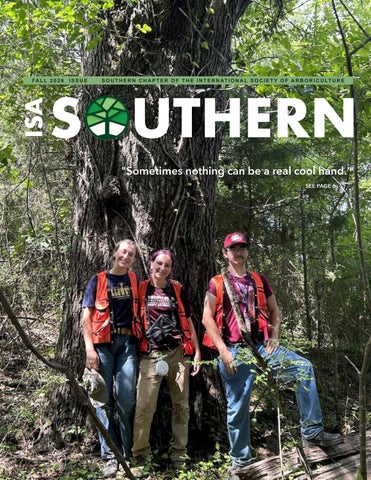
"Sometimes nothing can be a real cool hand." SEE PAGE 6
Message from the President by Brian Watkins, Southern Chapter President
Dear ISA Southern Chapter Members, I want to thank each of you for your continued membership, support, and commitment to our profession. Our Chapter is strengthened by the knowledge, dedication, and passion of the arborists, urban foresters, educators, researchers, students, and industry professionals who make up our membership. As we continue to grow, I believe it is important to reflect on who we are, what we represent, and where we want to go as an organization. Our mission extends beyond trees. We are committed to advancing the practice of arboriculture, promoting responsible tree care, supporting professional development, and educating the communities we serve about the importance of trees and the benefits they provide. As President, one of my primary goals is to ensure that our Chapter remains responsive to the needs of its members. I want ISA Southern Chapter to be an organization where members feel valued, supported, and connected to opportunities that help them grow professionally. Whether you are a seasoned professional, a new arborist, a student entering the industry, or an educator preparing the next generation of tree care professionals, your voice matters. Moving forward, we will continue to explore opportunities to expand educational programming, strengthen professional development, increase access to certification preparation courses, improve communication, and create meaningful connections throughout our region. I also want to encourage greater member participation and engagement. Our Chapter is at its best when members share their ideas, contribute their expertise, volunteer their time, and work together toward common goals. We have entered an important period of transition with Dr. Dominique Werboff becoming our Executive Director. I am excited about the leadership, experience, and opportunities she brings to ISA Southern Chapter. With moving into this next chapter, our focus will remain on continuity, collaboration, and service to our members. While leadership and organizational strategies may evolve, our commitment to the mission and the professionals we serve will remain steadfast. I encourage each of you to stay engaged, attend Chapter events, participate in educational opportunities, share your feedback, and help us identify ways to better serve you. I also invite you to reach out to our leadership with your ideas, concerns, and suggestions. We cannot address the needs of our membership effectively without hearing directly from the people we represent. Serving as your President is both an honor and a responsibility that I take seriously. I recognize that the strength of ISA Southern Chapter does not rest with one individual or a small group of leaders; It rests with all of us. Together, we can build a stronger Chapter, expand our impact, support the next generation of arboriculture professionals, and continue advancing the value of trees and the profession we serve. Thank you for being a part of ISA Southern Chapter. I look forward to working alongside you as we continue to grow, learn, and move our organization forward.
PAGE 2
SOUTHERN CHAPTER ISA • FALL 2026
ONE TRUSTED PARTNER One storm can threaten years of urban forestry stewardship. With our One Asplundh approach, a single point of contact provides municipalities with direct access to a fully integrated team of utility vegetation, infrastructure, engineering and digital solutions professionals ready to respond fast. One call connects you to the right people, equipment and expertise to clear trees, restore roadway access and safeguard essential services. One trusted partner to keep your city and its trees safe and resilient for generations to come.
ASPLUNDH.COM
1.800.248.TREE
SOUTHERN CHAPTER ISA • FALL 2026
PAGE 3
A Message from the Executive Director
The first 90 days by Dr. Dominique Werboff
October 15 marks the completion of my first 90 days as your Executive Director, and it has been an incredibly exciting, illuminating, and productive three months. From day one, my focus has been on listening, learning, and immersing myself in our vibrant community. I have had the privilege of connecting with members, leaders, and partners both locally and from across the globe at several key events: I SA Annual Conference: Connecting with ISA members from around the world and participating in an inspiring Leadership Workshop. REE Fund Tour des Trees: Representing Southern as the host chapter of T this year’s tour and sponsor of the finale dinner, celebrating and supporting the dedicated cyclists who rode across the Carolinas from Greenville, SC, to Asheville, NC, in support of tree research. CUFC Annual Great NC Tree Conference: Joining our North N Carolina partners for an insightful conference and listening session aimed at strengthening our collaboration for the direct benefit of our members. As I look forward to the coming months, I am eager to continue this momentum and excited to meet more members from across the Chapter and listen to their ideas. I will be speaking at the Trees SC Annual Conference later this month, the Professional Arborist Association of Mississippi Annual Conference in January, and, of course, welcoming all of you to our Annual Conference in February 2027 in Winston-Salem, NC. In addition, keep an eye out for upcoming announcements about virtual listening sessions that will offer an open space for members to connect directly with me and members of the Board. We are busy building our 2027 calendar of virtual and in-person learning and CEU opportunities, including numerous TRAQ courses. We will post these on our website and share them via email and social media. Reflecting on my first 90 days, I am grateful and deeply inspired by the warm welcome I have received across our network. Seeing the strong relationships with our state partners, ISA, and the TREE Fund firsthand reinforces what a privilege it is to serve this community and fills me with hope for our shared future. I encourage you to reach out, join our upcoming events, and share your perspectives as we continue growing together. Thank you for everything you do to support our mission and industry!
PAGE 4
SOUTHERN CHAPTER ISA • FALL 2026
BETTER OUTCOMES START WITH TRUST
Behind every insight is a team committed to safety, integrity and ownership. With innovative technology and data-driven solutions, ArborMetrics helps customers make informed decisions, strengthen field performance and achieve better outcomes.
ARBORMETRICS.com | US & CANADA: 1 .866.685.1880
SOUTHERN CHAPTER ISA • FALL 2026
PAGE 5
Cornerstone Park Arboretum takes root in Starkville
"Sometimes nothing can be a real cool hand." Cool Hand Luke (1967) by Joshua J. Granger, ISA Arborist, Department of Forestry, Mississippi State University
As the City of Starkville builds its new Cornerstone Sports Complex, they have been left with 80 acres of wetlands and hardwood brush along its edges. This land was not suited for conventional development due to soils, drainage, and other limitations. So, in 2025, they started with a 1.3-mile walking trail. But Starkville saw further value in the property. Now the walking trail is part of the Cornerstone Arboretum. This was a collaborative effort between the City’s departments, professors and researchers at Mississippi State University, the Starkville Town and Country Garden Club, and The Artful Gardener LLC. The arboretum concept has brought value to this land through conservation, recreation, education, research, and student learning. In 2026, Cornerstone Arboretum received Level I accreditation through ArbNet. The Morton Arboretum manages ArbNet as the world’s only international accreditation program specifically for arboreta. There are standards for four levels of accreditation based on tree care, collections management, education, and conservation. Accreditation is free and valid for five years. A Level 1 accreditation requires labeling 25 distinct species of trees, writing an arboretum plan, establishing a governing group, selecting a staff or volunteer manager, and holding at least one public tree‑related event per year. As a Professor, I value Cornerstone for its potential as an outdoor classroom. Under my direction, undergraduate forestry students are inventorying and documenting woody vegetation across the property. They are applying classroom skills to an actual community tree resource. The baseline information they collect includes species composition, tree size, distribution, and condition.
PAGE 6
SOUTHERN CHAPTER ISA • FALL 2026
Students also learn how important an inventory is to tree management. Before deciding what should be planted, protected, or managed, we first need to understand what is already there. Grand expectations are placed on students as they collect data because it will be part of a permanent record. Trees measured today will be revisited by future students to calculate growth, document mortality, and recruitment, evaluate tree health, and monitor new plantings. Cornerstone Arboretum demonstrates that managing community trees is rarely the responsibility of one entity or profession. Foresters and arborists working alongside municipal officials, landscape architects, engineers, wildlife professionals, community organizations, and residents can accomplish remarkable things together. The landscape will continue to evolve. As the arboretum develops, additional trees, trails, gathering areas, educational programming, and opportunities for research and public engagement are envisioned. Students collecting measurements today will eventually become practicing foresters, arborists, researchers, and natural-resource managers. Meanwhile, the trees they measured will continue growing for future students to study. That continuity captures Cornerstone’s potential value. Starkville gains a natural and educational resource, Mississippi State gains an accessible location for teaching and research, and students can develop their skills in a setting where their work has meaning beyond the classroom. Cornerstone Arboretum is still young. Trees remain to be established, trails developed, and opportunities explored. Like the trees themselves, Cornerstone’s value will be measured not only by what is present today, but by how it grows over time.
WRIGHT TREE
SERVICE SINCE 1933
SCAN ME Vegetation Management | Storm Restoration | Railroad | Construction Employee Owned | 1.800.882.1216 | wrighttree.com
SOUTHERN CHAPTER ISA • FALL 2026
PAGE 7
PAGE 8
SOUTHERN CHAPTER ISA • FALL 2026
How to get into the tree business by Chris White, principle arborist at Blue Ridge Arborist Group
I get the question a few times a year, usually from someone who’s spent the morning watching me work. Sometimes it’s a college student on a summer internship. Sometimes it’s someone in their forties who has had enough of an office.
Career tracks
“How do you get into this?”
Tree Risk Assessment is a specialized credential for evaluating trees for structural failure potential and making defensible recommendations — the kind of work that appears in legal proceedings and insurance claims.
The tree care industry has more entry points, more career tracks, and more room for people than most outsiders know. It also has a persistent shortage of skilled workers, which means the people who show up and apply themselves tend to move quickly. It also has fewer women than almost any outdoor trade that resembles it. Roughly seven percent of arborists in this country are women. In utility vegetation management — the line-clearance work that keeps trees off power lines, every bit as outdoor and every bit as physical — it’s over twenty percent. Nobody has pinned down why the gap is that wide. My own guess is that we did some of it to ourselves: ask most people what an arborist does, and they’ll say climbs trees, because that’s the picture we keep handing them. We rarely hand them the rest — the consulting, the plant health work, city forestry, the utility work. In the meantime, if you’re a young woman wondering whether there’s room for you in this work, or the parent of one, the shortage in the paragraph above doesn’t care who fills it. The ISA Certified Arborist credential The International Society of Arboriculture administers the Certified Arborist exam — the professional baseline for the field, covering tree biology, soil science, risk assessment, pruning standards, pest management, and plant health care. ISA recommends three years of full-time experience before attempting it, though many candidates take it earlier. The credential renews every three years through continuing education — the spotted lanternfly material showing up in CEU courses now is exactly the kind of thing I mean. It’s what separates a tree company that knows what it’s doing from one that owns a chainsaw. Getting started Most people enter one of two ways: they get hired by a tree service company and learn through apprenticeship and onthe-job experience, or they come through a horticulture, forestry, or landscape management program at a community college or university. Tri-County Technical College in Pendleton, just up the road from Seneca, is a reasonable local starting point. For people coming in through the work side: start at a reputable tree service company, ask to be involved in assessments and pruning work rather than just cleanup, and begin ISA exam preparation early. Companies that don’t care whether their staff are certified are telling you something important about how they operate.
The climbing arborist doing removal and pruning work is the most visible role, but far from the only one.
Plant Health Care is the medicine side of arboriculture: diagnosing diseases, managing pests, developing soil health programs. Practitioners who do it well are in steady demand. Urban Forestry is the public sector track — managing municipal street trees and the urban canopy as a whole. Cities, counties, and state agencies hire urban foresters. Consulting Arborists work independently or with specialized firms: expert assessment, litigation support, property appraisals. This is the track I work in — deep credentials, a client base that takes years to build, the most flexible schedule. One more track: utility vegetation management, the specialty that keeps trees off power lines. It comes with a federal mandate and the ISA Certified Arborist Utility Specialist credential built on top of the base certification. The Southeast is not running out of corridors to manage anytime soon. What the work pays Numbers age fast, so check CareerOneStop.org for current figures. As of the 2025 federal numbers, the national median for tree trimmers and pruners was approximately $49,000 a year. Entry-level ground work starts lower — but it starts immediately, with no degree and no debt. Your first ninety days If any of this sounded like you, here is what I would do before the season ends. Ask a local tree crew if you can start on the ground — dragging brush for a summer teaches you more than any brochure. Take a chainsaw safety course and get current on first aid and CPR. Join the ISA and download the Certified Arborist exam outline, not to take it yet, but to see the map of what you will need to know. Start a tree identification habit: ten species by name on sight, then twenty. And talk to Clemson Extension or your county forestry contact. This field runs on relationships, and those start with a conversation. The people who know how to work with this landscape well will have work for as long as the landscape exists — which, if we’re doing our jobs, will be a very long time.
Resources: International Society of Arboriculture; South Carolina Forestry Commission; Tri-County Technical College, Pendleton, SC; Clemson University Extension Service; and the USDA Forest Service Urban and Community Forestry program. SOUTHERN CHAPTER ISA • FALL 2026
PAGE 9
Building Tennessee's arborist workforce through education and collaboration by Imagine Shaw, Vice President
PAGE 10 8
SOUTHERN SOUTHERNCHAPTER CHAPTERISA ISA • • SUMMER FALL 2026 2026
For a second year in a row, two recent ISA Certified Arborist exam preparation courses brought together aspiring arborists, experienced instructors, professional organizations, Extension educators, and community partners with a shared goal: increasing the number of qualified tree care professionals in Tennessee. Although the courses in Nashville and Knoxville were organized separately, both demonstrated the value of collaborative education and the importance of supporting individuals pursuing ISA certification.
Nashville Course Brings Partners Together The Nashville ISA Certified Arborist Prep Course was hosted through a partnership between the ISA Southern Chapter and the Tennessee Urban Forestry Council, with support from the Tennessee Department of Forestry. The course provided participants with the opportunity to review the knowledge and skills represented on the ISA Certified Arborist exam while learning directly from experienced professionals. In addition to helping attendees prepare for the exam, the course encouraged networking and created opportunities for participants to connect with others working in arboriculture and urban forestry. By bringing together educators, industry professionals, and aspiring Certified Arborists, the course supported the continued growth of Tennessee’s professional tree care community.
Knoxville Course Combines Classroom and Field Learning A separate ISA Certified Arborist Prep Course was organized by UT/TSU Knox County Extension in partnership with Trees Knoxville. Trees Knoxville provided valuable support through grant funding that helped secure study manuals for participants and meals for each day of the course. The Knoxville course was structured as two full days of classroom instruction followed by a half-day field experience at the Knoxville Botanical Garden and Arboretum. ISA Certified Arborists who had presented during the classroom sessions were invited to return and join participants for a walking tour of the gardens. Instructors and participants used the landscape as an opportunity to revisit and discuss concepts introduced during the previous two days. Throughout the tour, participants explored how classroom topics could be recognized and applied in real-world settings! More Than Exam Preparation
Growing Arboriculture Across Tennessee
ISA Certified Arborist Prep Courses serve an important role beyond helping participants study for an exam. They introduce attendees to experienced professionals, strengthen connections within the industry, and create opportunities for mentorship and continued learning. As Tennessee communities face challenges involving urban growth, tree health, invasive pests, severe weather, and changing environmental conditions, the need for knowledgeable and qualified arborists continues to increase. These programs help strengthen the state’s arboriculture workforce by giving participants the educational foundation and professional support needed to pursue ISA certification.
The success of the Nashville and Knoxville courses highlights what can be accomplished when professional associations, Extension programs, nonprofit organizations, educators, and local partners work together. Each organization contributed different resources, perspectives, and areas of expertise. Together, those contributions created meaningful educational experiences that supported both individual career development and the broader tree care profession. Most importantly, both courses contributed to a shared statewide objective: growing the number of ISA Certified Arborists serving Tennessee’s communities. By supporting the people responsible for caring for Tennessee’s trees, these programs support healthier urban forests, safer communities, and more resilient ecosystems. SOUTHERN CHAPTER ISA • FALL 2026
PAGE 11
CTSP Profile
A mission rooted in safety
by Tracey Miller, reprinted from Tree Care Industry Magazine | August/September 2026
A U.S. Air Force veteran and native Floridian, Brian Pope began his career working in his father’s tree care business before expanding his experience across nearly every facet of the profession. Over the years, he has served in climbing operations, bucket operations, branch management, business development, disaster response, and large-scale emergency projects throughout the Southeast and the West Coast. Along the way, Pope developed a reputation not only for operational expertise, but for his commitment to safety and education. In 2021, he earned the designation of Certified Treecare Safety Professional (CTSP) through TCIA, later becoming a TCIA Qualified Trainer and instructor. Today, he serves as the Arkansas state director for the ISA Southern Chapter and is a member of its board of directors. Building on experience Like many others, Pope sees a growing problem within the industry – particularly in Arkansas. “There are only around 50 certified arborists in the entire state,” explains Pope. “We are really trying to change that. Arkansas is an untapped opportunity for the arboricultural industry.” That realization became the driving force behind Expert Tree Academy, a nonprofit training organization licensed through the Arkansas Division of Higher Education and founded by Pope and his wife, Logan, in August 2024. For Pope, this is more than a project. It is the culmination of more than three decades spent in the tree care industry and a mission rooted in service, mentorship, and safety. The 60-acre facility in Bald Knob, Arkansas, will combine classroom education with intensive hands-on field experience. The property will feature indoor and outdoor climbing areas, dedicated rigging and climbing skill stations, specialty-equipment training courses, mock utility infrastructure for safety simulations, and Pope teaching an advanced climbing class with student Hector Herrera, an expansive work areas designed specifically for arborist arborist for the Nambe Pueblo reservation in New Mexico. Photo courtesy of training. Brian Pope. The training academy will also include rustic onsite lodging, communal gathering spaces and outdoor kitchens, creating an environment that encourages not only technical learning, but teamwork, camaraderie and mentorship. Inside the main school building, students will have access to two academic classrooms, a dedicated saw room for chainsaw maintenance and sharpening instruction, and a fully equipped gear room housing climbing saddles, ropes, and equipment used for rope systems training and gear inspections. The goal is to provide students with the kind of real-world exposure that cannot be replicated through online instruction alone.
PAGE 12
SOUTHERN CHAPTER ISA • FALL 2026
Participants from an aerial rescue class Pope taught for a large municipality. Photo courtesy of Brian Pope.
Preparing the next generation As the arboricultural workforce continues to age, Pope believes the industry faces a critical turning point. Recruiting and retaining younger workers will require not only better training opportunities, but a different approach to instruction itself. “The younger generations learn differently,” says Pope. “Our workforce is aging out. To be a good instructor, you have to understand how different people learn. The older generation often heard, ‘Don’t do this.’ Younger professionals want to understand both how and why. They want the reasoning behind the process.” Expert Tree Academy is being developed with that mindset at its core. Rather than relying solely on lecture-based instruction, the academy plans to combine interactive classroom education with scenario-based field training, peer collaboration, team-building exercises and mentorship opportunities. Pope also intends to partner with respected organizations and instructors across the industry to ensure students receive diverse, high-quality education from experienced professionals. “There are several good training companies out there and excellent instructors,” he says. “I don’t see it as us versus them; I view it from the perspective of how can we work together to provide the best for the students and our industry as a whole.” Equally important is the culture the Expert Tree Academy hopes to create. “Just because the class is over doesn’t mean students can’t contact me,” says Pope. “If questions come up later, I want them to feel comfortable Participants from a line clearance certification course Pope taught reaching out. We want to be an ongoing resource for in Paris, Tennessee, for Landworx, a TCIA member company. Photo courtesy of Landworx. people throughout their careers.” Conclusion While Brian Pope has worn many hats throughout his career, his role as a CTSP reflects the thread that has connected them all: an unwavering commitment to protecting people. From mentoring the next generation of arborists to sharing best practices with experienced crews, Pope believes safety leadership is about more than teaching procedures. It’s about influencing culture. Through his work as a CTSP, he continues to encourage tree care professionals to lead by example, invest in continual learn-ing and make safety the foundation of every job. For Pope, success isn’t measured by the number of people he trains, but by the number who return home safely because of what they’ve learned. Tracey Miller is manager of content & communications for TCI Magazine. SOUTHERN CHAPTER ISA • FALL 2026
PAGE 13
Pruning fruit trees to an open center by Fred Conrad and Sarah Sikich
Fruit trees serve a different purpose. (Obviously.) And they are needy, on every level and in every sense of the word. You’ve never met a Tulip Tree that could out-needy a fruit tree. You’ve never met an Oak tree with as many parasites, an Elm with as many diseases, or a Sassafras that is so sought out by deer, raccoon, and bear as a good fruit tree. Let’s just zero in on pruning, and ignore soil micronutrients, specialty equipment, and spray regimens for a moment. The problem is that what the fruit tree wants and what we want from the fruit tree are two different things. A fruit tree’s biological destiny is to grow into a tangled dome of bug-infested foliage, with narrow branch crotches with included bark, to become resplendent with water sprouts, and eventually develop into a small grove of genetically cloned infertile trees suckering up like crazy from the rootstock. It’s who they are. Day 1: Show the tree who is boss. You get home with your new fruit tree, a 6’ whip of sapling that resembles, more than anything, a long fishing pole. Dig a nice hole, unwrap the roots, pop them in, backfill, mulch, and water. But you’re not done yet. Or if you are done, you’re also doomed (see above). Pull out your Felco #2s, give them a few test squeezes, close in on that apple tree, bend way over, and head that twig off at about the 24” mark. Your pieeating family will thank you later, but when they look out the window and see you throwing the top 2/3s of your new tree into the chipper, they may be thinking something else.
PAGE 14
SOUTHERN CHAPTER ISA • FALL 2026
That initial heading cut is everything. That cut will cause the tree to grow the low, well-angled, sturdy branches that will bear the weight of fruit. That cut results in the first tier of the scaffold branches that spread out and present fruiting branches that you can examine, prune, spray, and harvest from while your feet are firmly on the ground. The tree will grow a new leader. Give it another two or three feet and do the same thing again. Second tier, a little higher, a little narrower, but still wide and strong, with branches departing the trunk nearly horizontally for the first few feet. You’ve undoubtedly pruned a lot of trees. There may be trees you’ve worked on a couple of times (think power lines!). Now you’ve got a tree that you will prune every year, twice a year more likely. Because of the fruit. Because of that OTHER purpose. Because fruit trees need an open center to develop the fruiting spurs that serve the purpose we have in mind for them. And, because bright ambient light inside the crown is needed for the development of fruiting spurs. It’s not uncommon to remove 1/3 of a fruit tree’s crown every year, and for stone fruit like peach and nectarine, that could go north of ½. A lot of that pruning will be in the middle of the crown, thinning cuts for water sprouts and crossing branches, and heading cuts for vertically inclined branches, and cuts to manage limbs that are long and unbranched. It’s easier to sculpt a tree in the winter when it is free of foliage, and you can more clearly see the shape and
pattern of the scaffold. Aggressive dormant pruning can sometimes result in aggressive regrowth, so in order to control the size of the tree, summer solstice pruning is a common follow-up, especially for pome fruit like apples and pears. For an arborist, some of these instructions can feel wrong. You have likely spent your career learning not to top trees and not to remove large portions of a healthy crown without good reason. But remember where we started: fruit trees serve a different purpose. We aren’t managing trees to become the biggest, tallest, or most structurally impressive versions of themselves. We are managing them to produce fruit and to put that fruit where people can reach it. That means keeping the crown low, open, and full of light. It means creating strong scaffold branches capable of carrying a crop. And it means returning with our pruners, year after year, to keep the tree from becoming exactly what it wants to become. Sometimes, good fruit tree care requires an arborist to rethink a few arborist rules. The cuts may feel aggressive, but the goal is different, and so is the tree. Keep it low. Keep it open. Keep the light coming in and the fruit within reach. Your pie-eating family and neighbors will thank you later! For more information, see these articles and the Giving Grove website: Summer Pruning Guide, Dormant Pruning Guide, and Beginner’s Guide to Summer Pruning blog post.
Fast & Easy Tree Control
Selectively kill trees and brush in utility right-of-ways, buffer zones, drainage areas, roadsides and more. ◆ The systemic herbicide is absorbed by the tree,
effectively killing roots, trunk and foliage and eliminating regrowth or suckers. ◆ Use year-round as the trees may be injected at
any time of the year except when wood is frozen. ◆ ATV and behind-seat friendly with three lance
sizes available.
EzJect.com • 888.395.6732
Gravity-fed, spring loaded head injects shells through bark with minimal operator effort. Load up to 400 herbicide shells through the screw-off end cap.
SOUTHERN CHAPTER ISA • FALL 2026
PAGE 15
Mimosa tree (Albizia julibrissin). Photo: bloom detail Martin Labar CC BY-NC 2.0
Invasive Species Management in NC’s Urban Forests
What is our role? by Leslie Moorman, NC Director
North Carolina’s urban forests are facing a challenge that extends well beyond individual trees: invasive plants are changing the composition, structure and function of the forests in which those trees grow. For arborists and urban foresters, invasive species management is increasingly part of responsible tree care— not simply a task for natural resource managers. I have been working with Cary’s Parks, Recreation & Cultural Resources Department to build a more robust approach to invasive species management. Taking on this additional level of service is not easy. Like many communities, we are working with limited financial resources, incomplete information about where invasive species occur and how extensive infestations are, staff who are adapting to a more ecological management framework, and already-full workloads. These challenges have reinforced an important lesson: successful invasive species management cannot rely on municipal staff alone. It requires partnerships and a shared understanding of everyone’s role. Among the higher-priority invasive plants affecting North Carolina’s urban forests are mimosa (Albizia julibrissin), Chinese tallowtree (Triadica sebifera) and Bradford/Callery pear (Pyrus calleryana). Important invasive shrubs and understory plants include Ligustrum species, autumn olive (Elaeagnus umbellata), Japanese stiltgrass (Microstegium vimineum) and bamboo. These species can establish quickly, displace native vegetation and alter forest structure and wildlife habitat. NC State Extension notes that invasive plants can alter ecosystem processes, reduce biodiversity and displace native vegetation. Timing Matters Successful invasive plant management requires more than selecting the right herbicide or cutting tool. Timing treatment around plant physiology can significantly improve results. For woody invasive trees and shrubs, late summer through fall PAGE 16
SOUTHERN CHAPTER ISA • FALL 2026
is often an effective treatment window because plants are moving carbohydrates toward their roots in preparation for dormancy. This can make techniques such as basal bark, foliar applications and hack-and-squirt effective when appropriately selected and applied. NC State research, for example, has demonstrated the effectiveness of fall hack-and-squirt treatments for larger Callery pears. Cut-stump treatment can be used when woody plants are cut, with herbicide applied promptly to the freshly cut surface and according to the product label. This can be particularly useful when removal occurs near desirable vegetation because it helps reduce resprouting while limiting herbicide exposure to surrounding plants. Spring also presents opportunities. Ligustrum, for example, greens up earlier than many native understory plants, making spring a useful time to identify and address smaller plants before they become established. Japanese stiltgrass requires a different strategy. As a summer annual, management should focus on preventing seed production. Mechanical removal can be effective before seedheads develop, while properly timed postemergence herbicide applications can be used during active growth and before flowering. Think Beyond Eradication In an urban forest, complete eradication is rarely realistic. The goal should instead be prioritized, sustained management. Start with prevention and early detection. Treat small, isolated infestations before they become established populations. Prioritize areas with high ecological value, sensitive natural communities, restoration projects or important native regeneration. Then monitor and retreat. Many invasive species can regenerate from roots, seedbanks or plants missed during the initial treatment. It is equally important to avoid creating conditions that favor
reinvasion. Soil disturbance, canopy openings, construction activities and poorly planned vegetation removal can all create opportunities for invasive plants to establish. Successful management should therefore include restoration—allowing or actively encouraging desirable native vegetation to occupy the space created by invasive plant removal. Everyone Has a Role Arborists and urban foresters are uniquely positioned to influence invasive species management because we are already working where trees, development and natural systems intersect. We can identify invasive plants during tree assessments and work, incorporate invasive species into management recommendations, use appropriate treatment methods and timing, prevent the spread of invasive plants through equipment and material handling, and recommend non-invasive, regionally appropriate plants when replacements are needed. But there is another resource communities should not overlook: volunteers. Neighborhood groups, “friends of ” organizations, Master Gardeners, park volunteers and other community members can become an important extension of municipal capacity. Volunteers can help map and report infestations, remove appropriate seedlings and herbaceous invasives by hand, participate in restoration plantings, maintain previously treated areas and help educate their neighbors. In some cases, a well-organized volunteer workday can accomplish something municipal crews simply do not have the capacity to do—return to a site repeatedly and keep small infestations from becoming large ones. Volunteer programs do require structure. Training, clear
expectations, species-specific guidance and appropriate safety practices are essential. Herbicide application should remain with trained and authorized personnel. But with the right framework, volunteers can become an important part of the long-term management strategy rather than simply another group asking for municipal assistance. This same approach applies to arborists and landscape professionals. Invasive species management can often be incorporated into projects already underway. A tree removal project may present an opportunity to address nearby invasive regeneration. A pruning or assessment visit may provide an opportunity to identify a developing infestation. A landscape renovation can include replacing invasive ornamentals with appropriate alternatives. Ultimately, invasive species management is not separate from urban forestry—it is part of managing the forest as an ecosystem. A healthy urban forest is more than a collection of individual trees. It includes the understory, soils, wildlife, regeneration and ecological processes that support those trees. As arborists and urban foresters, our role is to recognize that bigger picture. We may not be able to control every invasive plant we encounter, but we can help prevent new introductions, identify problems earlier, prioritize where our limited resources will have the greatest impact, and bring others into the effort. That collective approach may be our most effective tool for protecting North Carolina’s urban forests for the long term. Always follow the current pesticide label, applicable regulations and site-specific restrictions when using herbicides. Treatment recommendations should be based on the target species, site conditions and desired management outcome.
SOUTHERN CHAPTER ISA • FALL 2026
PAGE 17
Mentoring the next generation by Juan Contreras, Director of Safety, Wright Tree Service
As an ever-evolving industry, Across nature, many species and one that is not getting any rely on mentorship-like behaviors younger, I continue to hear to transfer critical knowledge. common frustrations directed Chimpanzees, for example, learn toward the generation that will social behaviors, cultural practices, Which image most closely eventually replace us. Whether food acquisition techniques, resembles to your inside or outside our profession, and safety strategies through conversations about generational observation and guidance from childhood playground? differences have become older members of their groups. increasingly common. As if the Humans are no different. Our technical challenges of our industry ability to pass knowledge, were not enough, we also face the skills, and experience from one growing challenge of developing generation to the next is one of the next generation of professionals our greatest strengths. through effective mentorship. Without mentorship, valuable The organizations that succeed expertise disappears. Lessons in attracting and retaining young learned through years of talent are often those that recognize experience can be lost, leaving the strengths and perspectives newcomers bring to the table. future generations to relearn them through trial and error. They create environments where young professionals can For those who are mentoring the next generation, science learn, contribute, and grow. These teams tend to be more suggests a few approaches that can make a meaningful cohesive, more productive, and ultimately more successful. difference: n Stop clashing with them and start inspiring them. While today’s generational challenges may feel unique, n Listen before you lead. they are far from new. In fact, concerns about younger n Lead through connection, not authority. generations have existed for thousands of years. Around n Remember that influence grows from trust, not pressure. 335 BCE, Aristotle described youth as being driven by their desires, quick to act, and unwilling to tolerate perceived Finally, consider the power of what psychologist David slights. Sound familiar? Yeager calls wise feedback. When receiving criticism from What makes these conversations especially interesting is an authority figure, many young professionals are not that we often ask people from vastly different life experiences immediately evaluating the feedback itself. Instead, they may to work side by side. In many ways, we are asking individuals be asking themselves: who grew up in completely different worlds to solve the “Does this person think I’m incompetent?” same problems together. Before people can fully hear criticism, they often need to Consider the role of play and development. Research has feel psychologically safe. Traditional feedback methods, such shown that many of the neural pathways associated with as the “compliment sandwich,” attempt to create that safety. problem-solving, risk assessment, and overcoming challenges However, when the praise feels superficial or insincere, it can are formed during childhood experiences. The environments actually reinforce doubts rather than reduce them. in which each generation grows up help shape how they Effective mentors provide honest feedback while making communicate, collaborate, and respond to challenges later it clear that they believe in the individual’s ability to improve in life. When we combine those developmental differences and succeed. with generational experiences, it is no surprise that workplace As I reflect on the conversations I’ve had across our misunderstandings sometimes occur. industry, one thing becomes clear: every generation has Despite these differences, the need for mentorship struggled to understand the one that follows. Yet every remains constant. In fact, mentorship is essential to the generation also depends on the one before it. survival of our profession. None of us got here without someone who invested time, Mentorship is not unique to humans. Across the animal offered guidance, or shared hard-earned lessons. The best kingdom, younger members learn critical survival skills from way to honor those mentors is to do the same for others. more experienced individuals. Humans rely on the same If we want our industry to remain strong, mentorship principle to transfer knowledge, experience, and culture from cannot be optional. It must be part of our responsibility as one generation to the next. professionals. PAGE 18
SOUTHERN CHAPTER ISA • FALL 2026
SOUTHERN CHAPTER ISA • FALL 2026
PAGE 19
Upcoming Events & CEU Opportunities in the Southern Chapter Region
Check out all the new CEU opportunities listed in the next few pages of this publication. This list is kept current on the Southern Chapter website as well. Save the site to your “favorites” as an easy access portal for events and registration information. If you know of opportunities we haven’t listed, please share! Email isasouthern@isasouthern.org and we’ll get it posted. We have worked hard to partner with organizations to be sure you get a wide range of opportunities to stay sharp. This list contains upcoming events that we are aware of. All the courses and conferences listed provide opportunities to earn ISA CEUs that help you maintain your ISA certifications. ISA is also offering no-cost quizzes for articles to give you more opportunities to earn CEUs.
Educational Events
Webinar Developers and Hosts TREE Fund Urban Forestry Today Forestry Webinars Urban Forest Connections USDA Forest Service Utility Arborist Association North Carolina Urban Forest Council Arborjet Webinars Professional Arborists Association of MS (PAAM) Alabama Extension Rainbow Treecare Scientific Advancements Webinars
Most events are approved for ISA CEUs. Check each registration site for details.
October 22, 2026 West TN Lawn & Landscape Review Jackson, TN University of TN Extension presents sessions on groundcovers, turfgrass mgmt, tree care, woody landscape pests, and weeds. More information HERE.
October 27-28, 2026 Pulmones Criollos Series: Biomechanic and Tree Risk, Technical Arboriculture Workshop 2026 Caguas, Puerto Rico Join the Municipio Autonomo de Caguas for a 1.5-day Biomechanic and Tree Risk workshop. More information HERE.
October 26-28, 2026 REGISTRATION IS CLOSED - CLASS IS FULL TRAQ 3-DAY COURSE Gulf Coast Research and Extension Center Local co-host - Alabama Cooperative Extension Fairhope, AL
October 28, 2026 Trees SC Annual Conference: Pre-Conference Tour Charleston, SC Join Trees SC for a full-day tour. Stops include gardens, food forests, and the Angel Oak. More information HERE.
October 27, 2026 Landscape Tree Care and Maintenance Cullman, AL Join AL Cooperative Extension System, Auburn University, for a one-day workshop. Topics include proper tree pruning, urban tree health, tree selection, risk assessment of hazard trees, trees & construction, tree planting & establishment, and outdoor demonstrations. More information HERE.
October 28, 2026 Pre-Conference Workshop: Urban Forestry Credential Preparation Course Memphis, TN TUFC presents a half-day preparation course led by Dr. Paul Ries for professionals pursuing the ISA Certified Urban Forest Professional or SAF Certified Urban & Community Forester credential. More information HERE.
October 27, 2026 WEBINAR: Pest Monitoring Tools, Resources, and Safety The Hort Life presents all-day training. Same sessions will take place 10/27, 12/1, 12/7, 12/15, 12/17, and 12/18. For more information, email hortlife@gmail.com or call 910-616-1989.
October 29-30, 2026 TUFC Annual Conference: Raising the Canopy Memphis, TN Join Tennessee’s urban forestry community in Memphis for two days of education, field experiences, and networking at the 2026 Tennessee Urban Forestry Conference. More information HERE.
PAGE 20
SOUTHERN CHAPTER ISA • FALL 2026
Educational Events October 31, 2026 Tree Safety Madison, AL Join Stoney Gray Consulting Arborist for a half-day tree safety workshop. Session topics include chipper safety and climbing safety. Email for more information.
November 9, 2026, 1pm EST WEBINAR: Phytophthora Diseases on Trees and Shrubs in Urban and Forest Environments Join Dr. Steve Jeffers, Professor and Extension Specialist from Clemson University, for a one-hour webinar that will cover Phytophthora biology, its impacts, and potential management strategies. More information HERE.
November 4-5, 2026 Commercial Horticulture Expo Memphis, TN University of TN Extension presents a two-day expo with many CEU opportunities for urban forestry and pesticide CEUs. More information HERE.
November 9-11, 2026 REGISTRATION IS CLOSED - CLASS IS FULL TRAQ 3-DAY COURSE Greenway Farm Conference Center Local co-host - City of Chattanooga
November 5, 2026 Proper Pruning: How to Avoid Common Pitfalls Asheville, NC Join the Buncombe County Cooperative Extension for a half-day workshop. Topics include the science of the cut, timing is everything, techniques & styles, and tools of the trade. More information HERE. November 9, 2026 HWA Management Workshop Burnsville, NC The Hemlock Restoration Initiative is hosting a hemlock woolly adelgid management workshop with instructor Olivia Hall. More information HERE.
November 21, 2026 Canopy Class: Business Management - Gear Talk - Making Decisions Under Stress Morganton, NC Are you ready for the next level? Whether you’re starting your own outfit or leading a crew, this class gives you the tools to succeed when the pressure is on. More information HERE. December 1, 2026 WEBINAR: Pest Monitoring Tools, Resources, and Safety The Hort Life presents all-day training. Same sessions will take place 10/27, 12/1, 12/7, 12/15, 12/17, and 12/18. For more information, email hortlife@gmail.com or call 910-616-1989.
From the ground up, we have you covered. Utility companies keep their customers connected. Davey keeps them running at peak performance. With solutions that maximize budgets, ensure compliance and improve reliability, we help utilities operate efficiently while enhancing customer satisfaction. Backed by over a century of vegetation management expertise, we bring hands-on solutions, deep industry knowledge and forward-thinking strategies to every challenge. Consider us an extension of your team—ready to clear the way, protect infrastructure and power the future of your company and the communities you serve.
Vegetation Management
Environmental Consulting
Line Clearance
Storm Response
Explore our solutions through our video series.
Asset Management
Communications Construction
Technology & Software Solutions
DaveyUtilitySolutions.com SOUTHERN CHAPTER ISA • FALL 2026
PAGE 21
December 1, 2026 NC Community Trees Webinar: Phosphite Usage in Tree Care Learn how to utilize phosphites in tree care from Dr. Glynn Percival with Bartlett Tree Experts. We will discuss the benefits, best practices, potential drawbacks, and current as well as future technologies for phosphite usage on community trees. More information HERE. December 7, 2026 Pest Monitoring Tools, Resources, and Safety Raleigh, NC The Hort Life presents all-day training. Same sessions will take place 10/27, 12/1, 12/7, 12/15, 12/17, and 12/18. For more information, email hortlife@gmail.com or call 910-616-1989. December 10, 2026 Forest Health Workshop Florence, SC Join Clemson Extension for a half-day workshop. Topics include Clemson resources; pesticide safety and handling; pine insects and fungi ID and management; hardwood pest ID and management, and plant management basics. More information HERE. December 11, 2026 Urban Tree Health Workshop Conway, SC Join Clemson Extension for this workshop. Topics include Clemson resources; tree stressors and pests; sucking tree pests, invasive tree pests; native ornamentals; pesticide legal overview, and tree planting and care. More information HERE.
January 18-22, 2027 Green & Growin’ 2027 Greensboro, NC NCNLA presents a multi-day conference with many opportunities for ISA CEUs. More information HERE. February 18, 2027 29th Annual Eastern NC Landscape Conference & Trade Show Rocky Mount, NC This conference brings together landscape contractors, turfgrass managers, nursery and greenhouse professionals, arborists, and green industry business owners from across eastern North Carolina. Each year, leading researchers and industry experts address current challenges in landscape management, pest and disease control, plant selection, and business operations. More information HERE.
February 22-24, 2027 ISA Southern Chapter 84th Annual Conference and Trade Show Winston-Salem, NC MONDAY: Workshops, Trade Show, President’s Reception TUESDAY: Educational Sessions & Trade Show WEDNESDAY: Educational Sessions & Trade Show
December 15, 2026 Pest Monitoring Tools, Resources, and Safety Wilmington, NC The Hort Life presents all-day training. Same sessions will take place 10/27, 12/1, 12/7, 12/15, 12/17, and 12/18. For more information, email hortlife@gmail.com or call 910-616-1989.
Keep up with all the details HERE.
February 22-24, 2027 ISA Southern 85th Annual Conference and Trade Show Winston-Salem, NC Planning is underway for workshops, educational sessions, and green-industry networking. More information HERE.
December 17, 2026 WEBINAR: Pest Monitoring Tools, Resources, and Safety The Hort Life presents all-day training. Same sessions will take place 10/27, 12/1, 12/7, 12/15, 12/17, and 12/18. For more information, email hortlife@gmail.com or call 910-616-1989.
February 28, 2027 SC Green Industry Conference & Trade Show Columbia, SC SC Green Industry is offering a handful of sessions for ISA CEUs, topics including soil & water testing, five-step framework to preserve & manage trees, invasive pests in the southeast, and maximizing pesticide efficacy. More information HERE.
December 18, 2026 WEBINAR: Pest Monitoring Tools, Resources, and Safety The Hort Life presents all-day training. Same sessions will take place 10/27, 12/1, 12/7, 12/15, 12/17, and 12/18. For more information, email hortlife@gmail.com or call 910-616-1989.
Honor someone who stands out in our industry Check out the Southern Chapter’s online awards page for an impressive list of honorees, award criteria descriptions, and nomination form.
Award of Merit
Award of Achievement
Honorary Life Membership
Award for Excellence in Arboriculture Education President’s Award Award of Arboricultural Research
PAGE 22
SOUTHERN CHAPTER ISA • FALL 2026
John G. Martin Award Award for Excellence in Arboriculture
85th Annual Conference & Trade Show February 22-24, 2027 Winston-Salem, North Carolina
> GET INVOLVED < • Submit an abstract to present. Have a great idea for a 30-minute presentation? Deadline to submit an abstract is November 1.
• Book a booth or sponsorship. Indoor and outdoor exhibit spaces available. Early rental fee expires on December 15.
• Students—Do a poster presentation. Submit your abstract for review before December 14.
• Volunteer opportunties will be available. • Registration and hotel reservations open in mid-November.
L e ar n m o r e at ISASOUTHERN.ORG/CONFERENCE SOUTHERN CHAPTER ISA • FALL 2026
PAGE 23
Targeting urban forestry challenges in AL by Justin Miller, Alabama Cooperatrive Extension
From aging trees to a nonexistent workforce, many of Alabama’s urban forests are facing major challenges. Over the next five years, the Alabama Cooperative Extension System’s Green Up Alabama program will address these issues to make environmental and economic enhancements to rural Alabama communities. Major components of the program include planting more than 350 trees, improving green spaces, and training a skilled workforce to better manage forests in underserved communities. “By planting trees, the project will help mitigate heat, reduce stormwater runoff and improve air quality, creating healthier and more livable environments,” said Georgios Arseniou, an Alabama Extension urban forestry specialist. “The hands-on training in arboriculture and urban forestry will provide certifications that equip workers with the skills needed to secure higher-paying jobs and contribute to disaster preparedness.” Engaged Communities Alabama’s aging urban forests are points of concern for many towns and communities. Many of the trees in several urban areas were planted when the towns were first established. As trees age, they can become more susceptible to things like storm damage and internal decay. This makes them a potential safety concern that municipalities must manage. Beau Brodbeck, an Alabama Extension assistant director for field operations, has worked on urban forest projects for many years. He said municipalities often do not have the infrastructure to manage their forest spaces. “Towns often have smaller budgets for planting trees, which we know will make their communities more livable and enjoyable,” Brodbeck said. “Also, these towns have smaller capacities to educate and train personnel on caring for municipal trees. Our program aims to help towns establish new trees for future generations and care for aging trees that are safety concerns today.” Community engagement will be a big part of the program’s overall success. The Green Up Alabama team’s first step is to identify eligible communities. The program will direct its efforts toward disadvantaged communities. These are areas that have limited employment opportunities, high poverty rates, and reduced resources for tree planting and maintenance. “To determine these areas, we will collaborate with county Extension directors, who will serve as key liaisons between municipal leaders and the program team,” said Arseniou, also an assistant professor in the Auburn University College of Forestry, Wildlife and Environment. “Our goal is to encourage local communities to take ownership of these tree-planting projects, ensuring their long-term success and sustainability.”
PAGE 24
SOUTHERN CHAPTER ISA • FALL 2026
Strengthened Workforces To ensure this long-term success, a skilled workforce is crucial in these communities. Green Up Alabama will provide workforce training that supports careers in arboriculture, urban forestry, landscaping, and disaster response. “Managing mature trees is very dangerous, as it requires using chain saws, working around power lines, and often working aloft,” Brodbeck said. “We aim to increase workers’ knowledge of basic tree-care and, more importantly, safety.” There will be several areas in which participants can receive a certificate of completion from the program. These include chainsaw safety, electrical hazard and aerial lift operations, ground worker safety, rigging, and basic tree care and maintenance. This training will help prepare participants for entry-level jobs that are in high demand across the state. “This not only empowers residents with marketable skills and employment opportunities but also strengthens disaster preparedness by equipping workers with the knowledge to manage post-storm hazards,” Arseniou said. More Information Green Up Alabama launched in the summer of 2025. Workforce development training is currently underway and offered in many areas throughout the state of Alabama. Training topics will include: chainsaw safety training, tree care and maintenance, electrical hazard & aerial lift safety training, and ground worker training. Many of these trainings may include opportunities to receive ISA CEUs. Be sure to check the Green Up Alabama website and ISA Southern Chapter’s calendar for CEU credit opportunities offered through the Green Up Alabama initiative. Volunteer opportunities and more information will be available at GreenUpAlabama.org. For more information on urban forests, visit aces.edu. Green Up Alabama is possible thanks to funding from the U.S. Forest Service’s Urban and Community Forestry Program.
SOUTHERN CHAPTER ISA • FALL 2026
PAGE 25
From the consultant's corner By Fred Fellner, Louisiana Director
Hi all. Last month I received a call from a resident in New Orleans about the collapse of a large live oak tree into a sinkhole. I thought I would share this one with you as it is an excellent example of a situation when perhaps routine maintenance on utilities can result in catastrophic developments. This 70-year-old plus southern live oak tree dominated the front yard of a home in a subdivision. Near the street was a large water main line that had started leaking, and the leak grew worse until the resident noticed how much water was ponding around the base of the tree. Unfortunately, the maintenance folks responsible had a breakdown in communication, and the severity of the leak was not relayed to the people who could Google Earth Pro™ do something quickly. As a result, the tree simply tipped over and fell into the hole! It was incredible to witness. Certainly, a first for me. In this scenario, I had to estimate the loss value of the tree for the city and client, as well as talk about soil preparation, nutrition, and other factors that would ensure that a healthy PAGE 26
SOUTHERN CHAPTER ISA • FALL 2026
transplant could take place. The leak was visible for a two-week time period, but no significant action occurred. This event resulted in changes to municipal reporting protocol to identify key actionable words and details. For those of you who utilize Google Earth™ or Google Maps™ to assist you in your work, I thought maybe I would talk briefly about one of the features I have found very helpful in addressing the past conditions of trees and fitting a timeline with those conditions. It is helpful to see trees over the years and either manmade or natural growth changes that can help you in your maintenance of the trees and to help you provide advice to clients for tree health and preservation. Example of tree pruning visible on Google Earth Pro™ image dated 6/2026 on the left and image on the right dated 6/2011. As you move the view on the Street View function, the picture dates will change as files are woven together to give you the best view. You must notice this happening, or you think they are all on the same date.
Google Maps™
Now, on Google Maps™, the street view is a bit more functional, as a picture timeline will appear. There is a function to see more dates in the upper left of the screen, and when you use this, a timeline picture bar will appear. Again, this can be very helpful in understanding what the maintenance has been and what may be needed. Additionally, on Maps™ you can zoom in with your mouse and see more detail. At this location, on the image dated June of 2023, I noticed that straps had been installed in the tree due to a basal crack formation. This information was invaluable to understand the history of
the tree and make accurate observations and recommendations for proper future care. This could not be seen on the Google Earth Pro™ screen but became visible on the Google Maps™ street view chronology function. The strapping is red in color. Clients and the Court love to see images, and you can utilize them and your own photography over time to better understand the forces shaping trees and the pruning necessary to work with those forces. (Weight, vectors, moments, etc.) All of this helps us better understand how trees move and respond to their environment.
Google Maps™ (zoom)
SOUTHERN CHAPTER ISA • FALL 2026
PAGE 27
TREE Fund News UAA Scholarship
Oak decline and the Blue Jay's impact by Dana Russell, Tennessee Director
Did you know that blue jays are the number one aerial distributors of acorns? With their striking blue feathers and bold personalities, these birds are more than just backyard visitors—they’re one of the forest’s most effective planters. At a time when oak decline is rapidly increasing, blue jays are an important force in the efforts to preserve oak trees. According to the U.S. National Park Service, drought, soil compaction, fire suppression, and invasive pests are the top causes of oak decline in the U.S. in recent years. These stressors weaken mature oaks, increasing their susceptibility to fungal and bacterial infections, disrupting regeneration, and leaving forests vulnerable to collapse. Extreme weather and shifting seasons can also affect germination rates and disrupt growth cycles. Oaks are champions of biodiversity, supporting more species than any other tree genus in North America (Tallamy, 2021). They provide food and shelter for over 5,000 kinds of moths, butterflies, birds, and mammals. With continued decline, entire ecosystems that depend on oaks—from songbirds to squirrels—could unravel. Blue jays have a unique relationship with oak trees. These intelligent birds rely on acorns as a primary food source, especially in fall and winter. But their role goes far beyond feeding themselves. These striking birds can establish multiple oak forests within their lifetime. Blue jays carry as many as five acorns at a time, tucking three in their gular pouch, one in their mouth, and one in the tip of their bill. From there, they carry acorns miles away from the parent tree and bury them in hidden spots, where many are forgotten and later sprout into new seedlings. In this way, blue jays act as nature’s gardeners, helping oaks regenerate in places where natural reproduction has failed or may not otherwise occur. Blue jays are not alone in their distribution endeavors. Organizations across the country are stepping up to combat oak decline through research, restoration, and conservation efforts. Groups like the U.S. Forest Service, regional environmental nonprofits, and government agriculture programs are planting native oaks and collecting seeds, while organizations like the White Oak Initiative and the Oak Conservation and Research Fund promote sustainable forest management. These are just a few among those promoting Oak health and growth. Prescribed burns are becoming more widely used to restore natural fire cycles, while research and management protocols for issues like oak wilt and sudden oak death are helping land managers protect vulnerable trees. How can we help as arborists and homeowners? By doing our part to plant native oaks in areas where they can thrive, caring for existing trees by having them inspected by an arborist, and controlling the spread of damaging invasive plants on our properties. These efforts, combined with the work of blue jays, offer hope for the future of oak forests. PAGE 28
SOUTHERN CHAPTER ISA • FALL 2026
At the Trees & Utilities Conference in Portland, Oregon, the Utility Arborist Association (UAA) and Tree Research and Education Endowment Fund (TREE Fund) announced a new partnership designed to strengthen and expand the reach of the Utility Arborist Nelsen Money Scholarship. By transitioning administration of the scholarship to TREE Fund, the organizations aim to create long-term sustainability for the program while increasing opportunities for students pursuing careers in utility vegetation management, arboriculture, forestry and related fields. The Utility Arborist Nelsen Money Scholarship supports students preparing for careers in utility line clearance, utility vegetation management, arboriculture, forestry, urban forestry, and related disciplines. As workforce demand continues to grow across the utility and vegetation management sectors, the scholarship helps reduce educational barriers while encouraging talented students to enter and advance within the profession. Through this partnership, the program will benefit from TREE Fund's established scholarship infrastructure and experience supporting the next generation of industry professionals.
Ottman Volunteer Award
During a presentation at the 2026 International Society of Arboriculture Annual Conference in Detroit, MI, TREE Fund announced the 2026 recipient of its Ken Ottman Volunteer Award, Randall Miller, BCMA. Since 2007, TREE Fund has given the Ken Ottman Volunteer Award to an individual whose contributions are exemplary. Named for its first recipient whose dedication to TREE Fund’s programs set a standard for volunteering, it is the highest and only award TREE Fund gives out annually. Miller has held many different volunteer positions on TREE Fund committees, including serving on the Board of Trustees from 2010 to 2021. Miller served as the Chair of the Liaison Committee while the Liaison for the Utah Chapter of the ISA from 2018 to 2021. Miller also served on the Grant and Scholarship Review Committee and has participated in the Tour des Trees 13 times, often choosing to still fundraise during the years he is unable to ride.
TCIA Membership Southern Chptr Sum 2026 7.75 x 10.25.pdf 1 7/10/2026 8:08:09 AM
C
M
Y
CM
MY
CY
CMY
K
SOUTHERN CHAPTER ISA • FALL 2026
PAGE 29
Researchers at LSU's AgCenter and plant ecophysiology lab
What light can and can't tell us about thirsty trees by Tom Pope, At-Large Director
As many of us are all too aware, the first ¾ of 2026 has been very dry across most of the Chapter’s mainland footprint (discussed in Leslie Moorman’s article in our Summer 2026 issue). A particularly severe drought is afflicting much of Arkansas, central North Carolina, the Mississippi Delta, and elsewhere, but abnormally dry conditions prevail across the region in general, with little in the way of tropical storm systems thus far to bring relief and recharge reservoirs and groundwater. Prolonged periods of excessive dryness can of course affect plants in a number of ways, most of them not good. Over eons, plant species even in typically rainy regions like the southeastern United States have evolved various adaptations to stress caused by extended dryness. For most plants, a key response to such dryness is to close the stomata on their leaves, restricting gas exchange and thereby limiting water-loss, albeit at a physiological cost. Plants can still lose water even with their stomata kept closed for extended periods of dryness. They “leak” it residually, through the waxy cuticles coating their leaves and even through their bark. Fairly slender branches and twigs have a great deal of bark surface relative to the water volume held within. Residual water-loss, including through bark, can be a substantial contributor to overall water deficit in dryness-stressed trees.
PAGE 30
SOUTHERN CHAPTER ISA • FALL 2026
At LSU’s AgCenter and its plant ecophysiology lab within the School of Renewable Natural Resources (RNR), researchers work with and study various aspects of trees and other plants. Tree hydraulics and plant-water relations are among their major themes. For example, a study of some Southeastern native tree species, by Yinuo Zhou, Grace Rosseau, Viet Dao, and Dr. Brett T. Wolfe of LSU, published in Tree Physiology, March 2026, found that bending their branches as if simulating exposure to strong wind tended to increase residual water-loss through their bark. Flooding a tree's rootzone had no immediate effect, but over time actually led to a reduction in bark water-loss. Taking these measurements using conventional methodology, however, can be slow and cumbersome, making a more efficient approach alluring. One such newer and more advanced technique which has shown promise is hyperspectral reflectance. Hyperspectral reflectance applies light to a surface, such as the surface of a leaf or bark (or conceivably almost anything), and then measures how much light that surface reflects. The surface reveals hundreds or thousands of narrow wavelengths, both within the visible spectrum and well beyond, on the basis that water, plant tissues, and even pigments each present a characteristic “signature” in the patterns of their light reflectance versus absorption. So conceivably, much about a given surface and its traits can be inferred or “read” from these hyperspectral signatures. In their most recent publicly presented work, Zhou and Wolfe used hyperspectral reflectance to evaluate traits of tree leaves and bark, above all their conductance, as a direct measure of their potential to residually “leak” water. This study involved testing 100 branch samples from 20 different tree species. Researchers took 10 reflectance readings per branch, between 500 and 2400
nm (wavelengths visible to the human eye through shortmore intense due to climate change. And so, the study of tree wave infrared). In total, there were 1000 spectra using three hydraulics continues to be a prime focus for LSU researchers. different modeling approaches to analyze this data, two of In 2023, a study was conducted at the LSU AgCenter’s them powered by machine learning. Burden Woods site, wherein sapling-size loblolly pines (the The results showed that, in this case, hyperspectral most abundant tree species across the Southern Chapter reflectance did well in “predicting” (accurately gauging) footprint) from seven genotypes were mechanically bent, the present amount of water content in leaves, which had again to simulate effects of exposure to strong winds. These been demonstrated previously, and moderately well for were compared to loblollies that were instead staked, and the thickness of outer bark relative to a branch’s diameter, to a control group, using hyperspectral reflectance among which is newer ground. other techniques to assess their responses across various Conductance, both through dimensions. That 2023 study leaves with their stomata formed the basis of a master's closed and through bark, was thesis by then-LSU graduate not well predicted or assessed student Joseph Kankam, under by these techniques in this Dr. Wolfe, and showed that study. In other words, the this bending increased the reflectance could, for example, young pines’ stem diameter read how much water a leaf gain, as expected, but did not holds, but not how readily that measurably change how easily leaf gives it up. water moved up through These findings are not at the trees. This suggests that all the end, but rather serve mechanical stressors like wind to inform and help point the may influence a young tree’s way to further areas of study growth via pathways other than and research. The LSU team’s its vascular “plumbing.” stated next steps include looking in other parts of the All told, this sort of spectrum, and searching more hyperspectral work, whatever carefully within the range its efficacy and applicability, they've already measured remains for now and the nearfor the specific wavelengths term largely a research and carrying the most information laboratory technique. While it's in reflectance. also being employed via drone Other questions follow at the stand-level in forestry naturally: Whether or how and agronomy, it is still some seasonal timing matters in this ways off from being practical Yinuo Zhou reflectance work; whether or or useful to the working field how pairing light with other arborist. But it represents one forms of sensing, such as of various directions in which thermal imaging, might help new technologies can lead the to better capture what a tree science of arboriculture more is doing, rather than merely what it's made of; and much generally. These are worth being aware of and learning from, more. And if it’s ultimately determined that reflectance especially as the trees around us, and those who work with simply cannot read this “leakiness” in trees, that will be and care for and value them, face increasing strain from well worth knowing. increasing challenges on multiple fronts. Thank you to Yinuo Zhou, Dr. Brett Wolfe, and others In any case, the work to better understand how trees at LSU and beyond for their work on these subjects, and for and other plants manage their water-relations, including or contributing to this article. To learn more about their work, especially during periods of drought or excessive dryness, and about LSU’s AgCenter and RNR more generally, check clearly is highly valuable unto itself. Droughty years like the out these sites: https://www.lsuagcenter.com/ one we in the Southeast experienced in 2026, along with https://www.lsu.edu/agriculture/rnr/people/profiles/wolfe.php other weather extremes, have become more frequent and https://yinuo-zhou524.github.io/
SOUTHERN CHAPTER ISA • FALL 2026
PAGE 31
Update your profile and learn how to search the data base
ISA's Find An Arborist Directory by Gabriella de Souza, NC Cooperative Extension
If you are an ISA Certified Arborist, your information needs attention. ISA has launched a new, mobile-friendly "Find an Arborist" directory, and your profile from the old system did not carry over. If you do not take action, residents searching for a certified arborist in your area may not be able to find you. Here is what changed, why it matters, and how to update your profile in just a few minutes. Why this matters This directory is one of the most trusted referral tools available to the public for verifying arborist credentials. If your profile is incomplete or missing from the new system, you may not appear in local search results, even if your ISA certification is current and active. What changed ISA's new Find an Arborist portal replaces both the legacy "Verify a Credential" and "Find an Arborist" tools. For data accuracy and privacy reasons, no information from the old system was transferred to the new one. Every credential holder must log in and enter their information directly. The legacy directory is no longer being updated. It is based on data frozen as of June 30, 2026, and will eventually be phased out entirely.
4. Set your visibility preferences. You can choose whether your profile appears in public search results. If you want to be found by the community, make sure your profile is set to visible. 5. Save and review. Double-check that your location and contact information are accurate. The directory prioritizes more complete profiles in search results, so the more detail you provide, the easier it is for the public to find you. A few things to know n
n
n
Steps to update your profile 1. Go to the new directory. Visit certificates. directory.isa-arbor.com. 2. Log in using the same email address associated with your ISA account. 3. Complete your profile. Make your listing as visible and informative as possible: n n
n n
PAGE 32
Profile photo, avatar, or business logo rofessional bio describing your P services and experience
City, state, and service area inks to your business website and L social media accounts
SOUTHERN CHAPTER ISA • FALL 2026
n
pdating takes about 10 minutes. Most of the work is filling in your U bio, location, and links. ou can edit your profile anytime. Visibility settings and content can be Y changed whenever your information updates. earch by name or ID still works. If a credential holder has not added S location information, they may not appear in geographic searches, but anyone can still verify a credential by searching name or certification/ recipient ID. our skills are tied to your credentials. The services listed on your Y profile reflect the ISA credentials you currently hold. You can describe additional expertise in your bio.
Need Help? ISA support is available by email at isa@isa-arbor.com or by phone at (678) 367-0981. ISA has also published a short video walkthrough of the directory and profile setup process, available on the ISA YouTube channel. Click here or on the image above. If your profile is up to date, thank you. If it is not, please take a few minutes to update it soon. An accurate, complete listing helps ensure our community can find and verify the qualified, certified arborists working in our area.
2026-2027 Southern Chapter Officers
2026-2027 Directors
President: Brian Watkins, Recreation and Park
Alabama: Brian Brown Alabama Cooperative Extension
Commission for the Parish of East Baton Rouge
Vice President: Hannah Imagine Shaw, Rainbow Ecoscience Component Council Rep: David Vandergriff, Griff Arbor|Hort Past President: Chris Diffley, Arbor Ki Tree Solutions Executive Director: Dr. Dominique Werboff
Arkansas: Brian Pope Expert Tree Academy Louisiana: Fred Fellner Mississippi: Steve Dicke Shady Arbor PLLC
Southern Chapter Staff Conference Planner: Connie Hilson Media Director and Editor: Sarah Mitchell
North Carolina: Leslie Moorman Town of Cary Puerto Rico and U.S. Virgin Islands: Christian W. Torres Santana Coccoloba AgroEnvironnemental Consulting and Coccoloba Nursery
Have you been waiting for a special invitation? Here it is:
South Carolina: Paul Mitchell Wright Tree Service
Please join the Southern Chapter online.
Tennessee: Dana Russell Arbor Ki Tree Solutions
Facebook Enjoy daily posts of things to make you think and things to make you laugh.
At-Large: Tom Pope Horticultural Asset Management LLC
LinkedIn Find news, articles, and educational information. This is where green-industry professionals gather.
TREE Fund Liaison: Matt Searels Eocene Environmental Group
Instagram Just the jokes, please.
Community Please share, like, and subscribe to our many social media accounts: Facebook, Instagram, and LinkedIn.
Encouragement Share the word about our scholarship program (application here). Here’s a chance to assist the next generation of green-industry professionals.
Learning Look for educational opportunities on the Southern Chapter website. If you know of opportunities not listed, email us and we’ll post it. Sharing What’s happening in your part of the Southern Chapter? Send in an article for our quarterly newsletter.
Southern Chapter ISA Website: www.isasouthern.org Phone: (314) 215-8010 Email: isasouthern@isasouthern.org Dominique Werboff, Ph.D. Executive Director To contact your State Director, a member of the Executive Board, or Dominique Werboff at the Southern Chapter office, email isasouthern@isasouthern.org.
SOUTHERN CHAPTER ISA • FALL 2026
PAGE 33