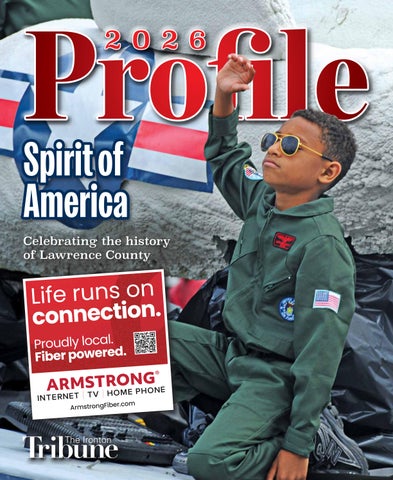
Profile 2026
Spirit of America
Celebrating the history of Lawrence County
Life runs on connection. Proudly local. Fiber powered.
r.com ArmstrongFibe
We volunteer, start businesses, lead, vote, spend time outdoors, and contribute to our community. We take you on journeys through culture and history while embracing new perspectives and energy. We have a diverse economy, entrepreneurs of all stripes, and value creativity and innovation while celebrating traditions. From the young transplants to fourth generation families who call this city home, together...
We Are Ironton.
Samuel Cramblit Mayor of Ironton
irontonohio.org
PROFILE 2026
Table of Contents
Dedication Day: Rich Donohue works to mark graves of soldiers ............................................................4 Making Connections: Linthicum gets to know her biological family..........6 A Century of Pride: 100 Years of Tanks Memorial Stadium.................10 Preserving History: Appalachian Freedom project highlights Underground Railroad in region....14 Looking to the future......................18 Ro-Na Theater.................................21 A Grand Tradition: The IrontonLawrence County Memorial Day Parade is longest running of its kind in U.S.................................................22 Gardner Rea....................................27 Superior: Gone, but not forgotten ..........................................................28 Nannie Kelly Wright.........................31 Memories of S.S. Kresge remain ..........................................................32 Col. William C. Lambert..................33 Bobby Bare......................................34
Profile 2026
Stories for the ages 3
T
his year’s edition of Profile has been themed around the ongoing America250 celebrations in Lawrence County and the nation, and we hope to give you a view of the past, present and future. In this issue, you will find stories of those who are working to preserve local history, those looking in depth into their personal history and the work of those who are committed to continuing and maintaining histori-
cal legacies in the county and region. We have included a look into places and people of the past and how they have shaped our present, and you will also hear from the youngest generation, looking to the future and imagining what the United States tricentennial will be like when they experience it in 2076. This issue is the culmination of several months of work and we hope you enjoy it as you celebrate our national milestone this year.
D
4
PROFILE 2026
edication ay Rich Donohue works to mark graves of soldiers
STORY BY MARK SHAFFER | PHOTOS BY HEATH HARRISON
F
STORY & PHOTOS BY MARK
SHAFFER
or Rich Donohue, making gravestones isn’t a hobby, it is his way to honor veterans. He started off years ago by decorating veterans’ graves with flags. He noticed that many were nearly unreadable after years and decades of harsh weather. So, he started cleaning the stones. He started finding that a lot of the graves of veterans were unmarked. About three years ago, Donohue bought a CNC router and started making gravestones. It was quite a process, since he couldn’t just go on YouTube to watch a tutorial. “It was a lot of trial and error, but I figured out how to use it,” Donohue said. “There is nothing out there on how to engrave marble.” Eventually, a friend of a friend showed him how to use the CNC on wood and work through most of the issues he had. “Now I can do a little bit more than breaking a bit,” he said. “I enjoy it now.” Now he can not only carve in a name, but carve out an image on the gravestone. Donohue is the chairman of Lawrence County America250 committee. And part of the state’s America250 projects is locating as
many of the estimated 7,000 Revolutionary soldiers that are in unmarked graves in Ohio. The issue is finding the grave and then proving that the person served in the Revolutionary War, which is difficult because the state requires at least two documents that proved they were a paid soldier. Many were volunteers who didn’t get paid. And finding two documents is difficult, because the Lawrence County area wasn’t settled until two decades after the Revolutionary War, didn’t have a courthouse until 1815 and didn’t have a newspaper until 1850. That means a lot of the soldiers weren’t well documented at the time and many of records are gone after 250 years. Donohue worked with the genealogy society and found as much information as he could. Sometimes, they could prove that a person lived in Lawrence County, but not that they died here. “Sometimes, you can’t find enough to satisfy what the government wants,” he said, adding he thinks there are around 36 in Lawrence County and “we have located about half of those.” He said he will continue to find as many as he can. “At the end of the day, we have done the best we can,” he said. “If we can say we appreciate their
5
PROFILE 2026
service by putting a stone here, even though he is not buried here, we have honored that man. We can say he was here and we thank him for his service.” One example of this is stones he is making for the Union Baptist Church Cemetery. They never bury in a certain section of the cemetery because it has been passed down that the area contains the remains of Buffalo Soldiers whose names have been lost to history. Donohue is working on a project based on the Tomb of the Unknown Soldier in Washington, DC. It includes multiple pedestals and stones to represent the soldiers and a Jesus statue meant to welcome them.
Among the gravestones that Rich Donohue has a created is this one for the famous illustrator Edward Gorey. His ashes were buried in 2000 in Ironton’s Woodland Cemetery, next to his mother. The grave was unmarked until Donohue created a stone for him in 2025.
Donohue said that this work is just continuing to give back, like his parents, Paul and Wanda, did before him, although they never had much. “They gave a lot, they didn’t have much but they gave a lot,” Donohue said. “I saw my Dad also helping. My parents installed giving. So that’s how I got into giving.” He started after high school running the clock at Rock Hill football games and then was the announcer for the games for decades. He has been on the Ironton-Lawrence County Memorial Day Parade committee for 35 years and was grand marshal in 2018.
6
PROFILE 2026
Making connections Linthicum gets to know her biological family STORY & PHOTOS BY HEATH HARRISON, SUBMITTED
B
URLINGTON — When Angela Linthicum had signed up for Ancestry.com in 2020, she said she was hoping to find out more information on her lineage for health purposes, but she did not expect the communication she received on March 13, 2023, two days before her 39th birthday. A message arrived in her inbox, reading, “You have requested the results from Ancestry, according to the DNA results, I am your biological mother. I look forward to hearing from you to tell you my story.” Linthicum, who works as a secretary at South Point Middle School, said her initial reaction was skepticism. “At first, I thought it was kind of sketchy, until I looked on the family tree and we linked,” she said. Linthicum, the daughter of Charles and Barbara Linthicum, has lived her entire life in Burlington. She said she had known since being told in the fifth grade that the Linthicums adopted her.
7
PROFILE 2026
Angela Linthicum watches a video of her first meeting with her biological mother in Huntington, West Virginia.
“My mom and dad decided to choose adoption, because they had two children before who passed away — and I have two other brothers and they wanted a baby girl, so they decided to go the adoption route,” she said. She describes the Linthicums as wonderful parents and said she had never sought information on her biological family. “I didn’t want to search for the longest time,” she said. “I didn’t want to hurt anybody’s feelings.” A month after receiving the message through Ancestry, Linthicum and her biological mother, Kim Logan, decided to meet, at the Greyhound station in Huntington, West Virginia. Logan, of Richmond, Virginia, grew up in Youngstown, where Linthicum was born. Lithicum said Logan gave her up for adoption when she was 2 ½ months old. She said she was the youngest of Logan’s children and that Logan said she was not able to give Linthicum the “life she deserved.” Linthicum’s biological father is Benjamin Bellman, who lived in Summersville, South Carolina, who would come to visit Logan in Youngstown in the summers. Linthicum said that Bellman, who died in 2001, never knew of her. “The crazy part is, my biological father had no clue and his family had no clue,” Linthicum said, noting that Logan only told her parents at the time. She said her siblings through Logan did not find out until 2023. “When she found me, she told them, I’m just letting you guys know you have a sister,” Linthicum said. Linthicum has a recording of Logan meeting her parents in Burlington for the first time. In the recording, Logan describes it as “a blessing” that Linthicum did not have to wait long to be adopted. “I told them she had to go to a Christian family,” Logan tells Barbara Linthicum in the recording. “We wanted her to be loved.” Linthicum said since meeting Logan, she has been working to build a relationship and they have had regular visits with each other. Linthicum has four children, Lyric, Ezra, Jaden and Joshua, and she says Logan has met them and has been active in their lives, regularly calling and sending gifts. Linthicum said she has also reached out and gotten to know her biological father’s side of the family. She said, at first, this was “tricky,” as they had been unaware of her existence.
8
PROFILE 2026
She said she first heard from her aunt, Jinet, and spoke with her on the phone. “We talked, and I showed her the DNA stuff,” Linthicum said, and said her aunt saw a resemblance to Bellman. “She said, ‘You look just like him.” Linthicum said, last summer, she got to meet her aunt in person, as well as her biological brother and a cousin. “We actually went to Florida for a family vacation and came back through to South Carolina,” she said, adding that her aunt has helped her to learn about her father’s side of the family. “She said my grandfather, her dad, was a preacher,” Linthicum said. “And in his Bible, he put ‘God’s child’ and put my birth date. I thought that was cool, because I’m in the church, singing. And nobody has a music background on her side.” Linthicum has a background in music and has sung publicly for 20 years, and now does so accompanied by her daughter. Linthicum spoke of the fear she had initially, about how her parents would feel about her finding her biological family. “They are happy, but didn’t want me to forget about them,” she said. And she said she told them “everything is good with all that.” “I always tell them God really placed me in right family,” she said of being adopted. She spoke of being raised by Charles, who worked at the oil refinery in Catlettsburg, and Barbara, who worked at Ashland Community College. “It just shows that, when you are placed in the right place, you just flourish,” Linthicum said. “I feel like, from Youngstown to Burlington, I’m in the right spot. And for them to raise me in this community, it’s been wonderful.” Linthicum said it’s been a positive experience expanding her family and that those she has met “are great people.” She said she hopes what she has experienced can be something she can use toward helping children in her work in the South Point School district. In addition to working as a secretary, Linthicum has been a substitute teacher and teaches in Burlington Elementary School’s Ladies Academy afterschool program. “I hope I can help kids that are adopted,” Linthicum said. “And, hopefully, be a positive influence for every child I meet. Every person walks through that door, I hope they feel a positive vibe and feel loved and are accepted by me.”
LEFT: Angela Linthicum’s father, Chuck Linthicum, with her mother, Barbara Linthicum, Linthicum, and Linthicum’s biological mother, Kim Logan.
PROFILE 2026
9
BELOW: Angela Linthicum with her children Lyric, Ezra, Jaden and Joshua.
Angela Linthicum’s biological mother, Kim Logan, with Linthicum’s children, Lyric, Ezra, Jaden and Joshua.
Angela Linthicum’s aunt Jinet with her husband Melonard Bennett and Linthicum.
10
PROFILE 2026
A Century I of Pride
100 Years of Tanks Memorial Stadium STORY BY NICOLE COX | PHOTOS TRIBUNE FILE PHOTOS
n 1926, when the iron furnaces still dotted the riverbank and the clang of industry set the rhythm of daily life, the people of Ironton built something that would endure just as powerfully as steel: a home for their team. 100 years later, Tanks Memorial Stadium still stands — not merely as a structure of concrete and timber, but as a
11
PROFILE 2026
monument to grit, ingenuity and community devotion. The story begins long before the first kickoff under its roof. Semi-professional football in Ironton dates to 1893, when a team known as the Irontonians first took the field. By 1919, two cross-town rivals — the Irish Town Rags and the Lombards — set aside differences to form a unified powerhouse: The Ironton Tanks. The name was no accident. With many players returning from World War I, they likened themselves to battlefield tanks —unyielding, relentless, and flattening the opposition. In a town built on iron, the nickname fit. No other team in the nation adopted it, and none could have worn it more authentically. The Tanks were more than a local curiosity. Over 12 seasons, they compiled an extraordinary record of 85 wins, 19 losses and 14 ties. They faced and defeated clubs from the American Professional Football Association — the organization that would become the National Football
League in 1930 — including victories over the Chicago Bears and the New York Giants. Their innovative looping and angle charges in 1930 helped shape the tactical evolution of professional football, concepts that still echo on Sundays across America. Recognizing the need for a permanent home, civic leaders formed the Beechwood Stadium Corporation on April 16, 1926. In just six months — an astonishing pace by any era’s standards — the stadium was completed. Originally known as Beechwood Stadium and later renamed Tanks Memorial Stadium, it quickly became the epicenter of autumn life in Ironton. When the Tanks disbanded in 1931, their legacy did not fade. Five players advanced to the Portsmouth Spartans — a franchise that would later become the Detroit Lions — while others joined additional NFL clubs. The talent forged here proved that Ironton football belonged on the national stage. Yet the stadium’s greatest achievement may be its
Life runs on connection.
100 Years Family Owned Since 1926
Armstrong Fiber internet is built, engineered, and installed by people who live in and know your community.
Proudly local. Fiber powered.
ArmstrongFiber.com
Iron City HARDWARE AND FURNITURE CO.
114 S. Third St., Ironton, Ohio • 740-532-8414
12
PROFILE 2026
longevity. Tanks Memorial Stadium is one of the few remaining roofed high school football stadiums in the country — a rare architectural survivor and a living museum of the sport’s early era. Generations of Ironton High School athletes have thundered across its field and, in 2009, the playing surface was dedicated as Bob Lutz Field in honor of longtime head coach Bob Lutz, a steward of the program’s enduring excellence. In 2014, the installation of turf ensured that the stadium could continue hosting new memories while preserving its historic soul. But statistics, milestones, and renovations tell only part of the story. What truly defines this centennial is pride — the kind measured not in seasons but in shared experience.
It is heard in the echo beneath the covered grandstand on Friday nights. It is seen in alumni who return year after year, pointing out where they once stood, where they once played, where they once dreamed. It is felt in the pride with which this town speaks the word “Tanks.” For 100 years, this stadium has been Ironton’s gathering place, its proving ground, its cathedral of community. The iron industry may have shaped our economy, but football shaped our identity — and Tanks Memorial Stadium stands at the intersection of both. As we celebrate a century of operation, we do more than honor a building. We honor the workers who raised it in six months. We honor the players who made it legendary. We
PROFILE 2026
honor the coaches who sustained its excellence. And we honor a town that has never wavered in its devotion. Here’s to the next hundred years beneath that roof — where history lives, pride endures, and Ironton loves its Tigers at the Tank. Nicole Cox is the president of the Lawrence County Historical Society and can be reached at nsratliff@gmail.com.
13
14
Preserving history Appalachian Freedom project highlights Underground Railroad in region STORY BY HEATH HARRISON PHOTOS BY HEATH HARRISON, SUBMITTED
A
s director of the Greater Lawrence County Area Chamber of Commerce and Tourism, Marty Conley says that one of the region’s biggest draws could come from its rich past. The Appalachian Freedom Heritage Tourism Initiative in Lawrence County came about during the early days of the COVID-19 pandemic. “Tourism was derailed, as far as things being open,” Conley said. “And, during that time, I looked at a lot of our local history — and obviously, the Underground Railroad
PROFILE 2026
PROFILE 2026
has been a big subject around here. “ Conley said it was at one of their first meetings with other tourism officials, in Chillicothe, that the idea came together. “It was a lot of other tourism folks and we were learning the economic impact of things, and the example they used was the John Rankin house in Ripley,” he said of the home of the abolitionist, who was one of the most active “conductors” on the Underground Railroad in Ohio. “They talked about the amount of folks that visited, the economic impact – it was mind blowing.” Conley said he made the connection that Rankin also resided in Ironton, and died in the home that is now the Lawrence County Museum. “I heard this and, in the back of my mind, I thought ‘John Rankin lived in Ironton,’ so we’ve got to put that story together. On way back home, we got to chatting and the hamster wheels were going. Let’s see what we can package for this.” With a grant from the National Parks Service, Conley and others put together a list of 27 sites throughout Ohio, West Virginia and Kentucky, the last of which was identified in June. He said to be included by NPS, the history must be documented. “And it’s not a little book report,” Conley said. “We have local historians from the area — Shawnee State University, as well as folks from Marshall University who have been working on these projects. It’s pretty in-depth research.”
15
16
PROFILE 2026
Conley said it has been fascinating sitting in on the discussions. “To be at a table with four or five of those folks and hear what they’ve talked about — kind of gives you chills,” he said. “They’ve uncovered a lot of stuff was not talked about.” Conley said the history has required heavy research. “One of the things that intrigued me was fact that the Underground Railroad — it’s hard to validate it,” he said. “It’s not very well documented, because, at that time, it could have cost someone their life. Those articles and things that can be sourced to find out these kind of things — that information has been collected and NPS has a pretty rigorous application process.” In Lawrence County, five sites have been identified and marked for the initiative: • The John Campbell House, Ironton — The home of Ironton’s founder, located at 305 N. 5th St., the residence was a stop on the Under-
ground Railroad, where Campbell and his wife, Elizabeth, helped those escaping slavery in Virginia and Kentucky on their way to locations north in Ohio. • Quinn Chapel AME Church,
Ironton — Founded in 1856 and located at 514 S. 8th St. (its current building was constructed in 1908), the historic Black church, the oldest in Ironton, was a key stop and organizing point on the Underground
PROFILE 2026
Railroad and had a continuous congregation until closing its doors in 2024. • Macedonia Missionary Baptist Church, Burlington — The first Black church west of the Appalachian Mountains, its congregation was comprised of many who had escaped or been freed from slavery, including the Burlington 32, a group who were freed upon the death of Virginia landowner James Twyman, who left them land on which the church was built. The historic building was restored recently, with work completed in 2025, when its Appalachian Freedom Heritage Tourism Initiative was also unveiled. • Union Baptist Church/Poke Patch — Union Baptist Church, in Blackfork, is the longest continuously operating Black church in Ohio, founded in 1819 and has extensive ties to Poke Patch. Located at the border of Lawrence, Gallia and Jackson counties, Poke Patch was a multiracial community, founded in the 1820s, of which many residents were Black people who had escaped slavery. The community also served as a shelter for those who were escaping from Virginia and Kentucky to the north. • Johnson House and Post Office, Burlington — Constructed in 1820 as a combined residence and store, the building was also established as a post office by Benjamin Johnson in 1840. Its ties to the Underground Railroad come from Dr. Camillus Hall, who became postmaster in 1844. Hall was identified by many participants of the Underground Railroad as an active member who aided freedom seekers.
17
The 27 sites, the last identified in June, are listed on the National Park Service’s Network to Freedom and can also be found at www.appalchianfreedom.com. Markers have been placed at each, detailing their history, as well as containing a QR code which can be used to pull up more information. Conley said it is this code, as well as the research posted online that can help to spread the information of the region’s history. “That technological component – a class in California can learn about impact of the Underground Railroad in southern Ohio that they never talked about before,” he said. Conley said that the initiative can help people to see the full picture of the abolitionist history of the region. “I think its realizing, which I didn’t at first, just how much of an impact this Tri-State area had,” he said. “You figure how important the iron furnaces were for the Underground Railroad, and obviously how where the river was at helped. You hear the abolitionist stories and how they were able to help the freedom seekers. Folks identified through this did some amazing things.” Conley spoke of the reaction and feedback the project has received so far. “People are talking about it,” he said. “We’ve been at some of these dedications where we’ve been to churches and descendants of freedom seekers have come back, after multiple generations. And it’s pretty powerful to hear the story of one of the descendants when they talk about that. It really puts it in perspective.”
18
PROFILE 2026
Looking to the future
The Ironton Tribune interviewed six Burlington Elementary third grade students to see how they celebrate the Fourth of July and what they think America’s 300th birthday will be like.
William Patton What is the oldest thing you know? “When I was a baby, when I was born.” Who is your favorite person in American history? “My mom and dad.” Where do you see yourself in 20 years? “Probably going to be in space, because when I grow up, I want to be an astronaut.” What does your family do for Fourth of July? “To be honest, I don’t even remember anymore?” In 50 years, it will be America’s 300th birthday, what do you think will happen then? “Probably might be a parade.”
Isiah Napier What is the oldest thing you know? “When I was born, that’s the first thing I know.” Who is your favorite person in American history? “My mom.” Where do you see yourself in 20 years? “On the couch, watching TV.” What does your family do for Fourth of July? “Watch the fireworks, right by my house. Sometimes I can see them out my window when I go to bed.” In 50 years, it will be America’s 300th birthday, what do you think will happen then? “A parade and a party.”
19
PROFILE 2026
Annaleese Hatfield What is the oldest thing you know? “When I was in preschool.” Who is your favorite person in American history? “Taylor Swift.” Where do you see yourself in 20 years? “A teacher at high school.” What does your family do for Fourth of July? “We go to the park and watch fireworks.” In 50 years, it will be America’s 300th birthday, what do you think will happen then? “There will probably be a parade.”
Myles Smith What is the oldest thing you know? “This school.” Who is your favorite person in American history? “My dad.” Where do you see yourself in 20 years? “Studying to be in cyber security.” What does your family do for Fourth of July? “We usually go to my nana’s house to watch the fireworks. In 50 years, it will be America’s 300th birthday, what do you think will happen then? “Like a giant, giant, giant, giant festival.”
“Above the rest”
591 State Route 650 Ironton, Ohio 740-533-3032 260 Co. Rd. 403 Proctorville, Ohio 740-886-5476
209 S. Third St. • Ironton, Ohio 45638 740-532-8755 • Fax: 740-532-2260
Auto • Home • Mobile Home • Business • Life
www.ArricksPropane.com
20
PROFILE 2026
Rowen Spears What is the oldest thing you know? “My blanket from my house when I was a little baby.” Who is your favorite person in American history? “Justin Bieber.” Where do you see yourself in 20 years? “I would like to be making my kids’ food.” What does your family do for Fourth of July? “We went to a park and watched fireworks.” In 50 years, it will be America’s 300th birthday, what do you think will happen then? “I think there will be parades and parties.”
Maxwell Napier What is the oldest thing you know? “Basketball.” Who is your favorite person in American history? “Forrest Frank, he’s a singer.” Where do you see yourself in 20 years? “In the Corps of Engineers. That’s where my dad works.” What does your family do for Fourth of July? “I forget.” In 50 years, it will be America’s 300th birthday, what do you think will happen then? “I think there is going to be a party and parades.”
PROFILE 2026
21
Ro-Na theater T he Ro-Na theater in downtown Ironton is an example of a historic building saved from the ravages of time. It was built in 1949 and not only showed movies, but had air conditioning, a rare thing at the time, and an attached restaurant. But by 1973, it was shuttered. It was then used as an auto parts store until the late 1990s and began to decay after the roof rotted away and let years of rain and snow pour in, destroying the theater’s beloved murals. In 2008, it was deeded to the city and civic groups began renovations, first replacing the roof and then cleaning it up for events like comedy shows, breakfast with Santa and concerts. In 2014, for the first time in decades, the neon lights of the Ro-Na shined over downtown Ironton again as people gathered for the world premiere of Ironton native Mickey Fisher’s sci-fi television drama “Extant” on CBS. On June 12, 2025, the Ro-Na got a big boost — a $2.7 million grant from the state’s Wonderful Waterfronts Initiative and the Appalachian Community Grant Program that was used to expand the stage, install supports and renovate the balcony area and more. By winter time, the newly renovated theater was used for Ironton Wizardfest and the annual Festival of Trees.
22
A grand tradition The Ironton-Lawrence County Memorial Day Parade is longest running of its kind in U.S. STORY BY HEATH HARRISON PHOTOS BY HEATH HARRISON, JEREMY HOLTZAPFEL, SUBMITTED
T
he roots of the Ironton-Lawrence County Memorial Day Parade date back to the years immediately following the Civil War. Following the conflict, the Grand Army of the Republic was established as a fraternal organization for Union veterans and, in 1868, its commander in chief, Gen. John A. Logan, called for G.A.R. members to decorate the graves of Union soldiers each year on May 30, for what was then known as Decoration Day. And it was that same year that, locally, in Ironton, G.A.R. members heeded the call and began hosting the city’s annual parade, with Capt. William T. McQuigg, a Union veteran and the city’s postmaster, serving as its first grand marshal. The event has endured through several generations and has taken place every year since, holding the distinction of being the longest continually-running Memorial Day parade in the nation.
PROFILE 2026
PROFILE 2026
23
Brent Pyles and Rich Donohue, in 2018.
Lou Pyles, in 2026.
For its modern history, two of the most dedicated participants of the event have been Brent and Lou Pyles, of Ironton, who have served on the parade committee for more than four decades. For Brent, his involvement goes back to childhood, when he was a student at Whitwell School in Ironton. “Children were asked to bring in fresh flowers,” he said, noting that these were then collected and then taken to the county courthouse, where they were placed on veterans’ graves at cemeteries. Brent recalled his grandmother giving him peonies in a one-pound coffee can to take to school. “And the grade school required everyone to march in the parade,” he said. “And all the way through senior year, you marched in the parade. Seniors marched in their caps and gowns. The parade was the last week of school.” He said he worked with his family at Jenkins Garage, in Ironton, which was an International Harvester dealer. “We allowed participants of the parade to use our garage to build floats,” he said. “And I drove tractors to pull them in the parade.”
24
Brent said he went off to college and it was after returning to Ironton and marrying Lou in 1978 that the two of them became involved in the parade committee and organizing. “This was about 1982,” he said, noting that Lou became involved first, at the urging of Frank McCown, a Lawrence County Common Pleas judge who was deeply active in the event. “It’s been a good thing that we became involved with,” Lou said. “We’ve both enjoyed it and tried to make it better. And the parade has a history of its own.” Both have served as grand marshal of the event multiple times, with Brent taking that position in 2007 and in 2018, the parade’s 150th year, while Lou has served three times, 2006, 2021 and this year’s parade, which was themed around the America250 celebration and the largest in decades in number of participants and spectators. They said work on the parade takes place year-round, as soon as one ends, planning goes into the next one. But things get going in earnest in September, when the parade committee has its first organizational meeting. “At that time, we elect new trustees,” Brent said. “We elect a grand marshal and select a parade commander.” He said the committee meets monthly, through March, then twice a month in April and then, as the parade draws near, weekly in May. They said besides managing the entrants and planning the parade itself, the parade committee is responsible for things such as fireworks that weekend, purchasing and placing flags on
PROFILE 2026
PROFILE 2026
graves at Woodland Cemetery in Ironton, as well as decorations around the city the week of parade. Many have helped make the event what it is over the years and Brent and Lou cited a few of the key contributors. “Frank McCown was a big part of the parade,” Brent said. “And, before him, there was Harold Spears — he was a World War II veteran and very instrumental in getting Navy Night started.” They also cited Virginia Bryant, of the Lawrence County Historical Society, and her husband, Louis Bryant for getting numerous organizations involved. Over the years, the parade has drawn several prominent visitors, such as Gov. Ted Strickland, who marched in it in 2010, while first lady Frances Strickland appeared another year. Lawrence County native and Country Music Hall of Famer Bobby Bare rode in the parade in the early 2000s, while Brent recalls a Miss America from Ohio riding in the parade decades ago.
25
26
PROFILE 2026
In 2024, the parade had probably its most well-known spectator, when Academy Award-winning actress Rita Moreno watched from the lawn of a Sixth Street home, along with her manager John Ferguson, an Ironton resident. Probably the biggest challenge for the event in Brent and Lou’s time involved, as well as its history, was the COVID-19 pandemic and its ban on large-scale gatherings in 2020. Lou said she was in contact with Gov. Mike DeWine and the county health department constantly for weeks. In the end, the parade was allowed, but in a scaled-down form (as opposed to its usual two-hour length) without spectators and livestreamed to the public. “We got to a point where the governor said ‘no more,’” Lou said of the parade’s length that year. “A lot of people were so irate, but we cut it down to 17-minute parade, with only one division.”
But it was that plan that saved the event from being canceled and kept its longevity title. Lou said, had it come to it, she told the governor “if it’s just six people with American flag or the flag of the parade, we’ll walk around the courthouse.” Brent and Lou said they are thankful for all of the volunteers who work on the event each year, as well as community groups such as the Scouts, who help. They said the one thing they hope for is more youth involvement in the planning and committee meetings. “What we would like to see is more young folks come take part, Brent said. “We really do this for our concern for future of parade.” Lou agreed and said more involvement is vital. “We want people to understand that this doesn’t happen overnight,” she said. “This is our community. This is where this parade is born. And we all want to be proud of it.”
Sanctuary of the Ohio Valley Skilled Nursing & Rehab
2932 S. Fifth St., Ironton, Ohio • www.AHFOhio.com • 740-532-6188
It’s peace of mind, a safe haven...
a place you can call home!
• Skilled RNs and LPNs 24/7 • Full therapy services (PT, OT, Speech) • IV therapy • Wound care • Medication management Respite stays require a physician’s order, an H&P within the last 30 days, medication list and level of care from AAA7. In case of emergency placement from the ER or physician’s office, this process can be expedited based on the needs of the patient.
We accept the following insurances: • Medicare • Ohio Medicaid • VA Contract • Major Insurance Plans « United Healthcare « Aetna « Medical Mutual « Humana « CareSource and more
27
PROFILE 2026
Gardner Rea G
ardner Rea was born in Ironton in 1894, into a family known for their artistic talent. Rea had originally intended to become a painter, but in 1909, at the age of 15, he submitted a gag cartoon to Life magazine and made his first sale, setting him on his career path. The family moved to Columbus, where he attended high school and then college at The Ohio State University. At OSU, he co-founded and served as editor of the humor magazine, The Sundial. By 1914, he was working as a freelance writer and artist in New York City. Rea served in World War I and, upon returning home, married artist Dorothy Julia Calkins. His work would eventually be published by magazines, including Life, Judge, Collier’s and The Saturday Evening Post, but it was at The New Yorker where he would achieve his greatest fame. Rea was one of the founding cartoonists at The New Yorker when it was launched in 1925 and his covers and gag strips helped to shape that magazines style of humor. A phrase, which has entered the popular lexicon, “Does Gimbels tell Macy’s?,” referring to two department store chains and the idea of sharing secrets with a competitor, originated from one of Rea’s cartoons, which featured two street vendors engaged in a sidewalk conference. He was known for comprising dozens of gag ideas a week and, at The New Yorker, wrote ideas for cartoonists Helen Hokinson and Charles Addams (creator of The Addams Family.) Rea was known as a recluse in his later years, according to his New York Times obituary. He died at age 72 on Dec. 29, 1966 and is buried at Oaklawn Cemetery in Brookhaven, New York.
Superior
28
PROFILE 2026
Gone, but not forgotten
STORY & PHOTOS BY NICOLE COX
I
f you could step back into the July heat of 1906, you’d find yourself standing in a small Ohio village that buzzed with purpose and promise. The place was called Superior, though, at the time, it was still shaking off its older name, Center Furnace, and it sat quietly along the Elizabeth–Decatur township line, waiting for its moment. Superior had humble beginnings. In the 1830s, smoke once curled from a 40-foot furnace stack that gave the village its first identity. Decades
PROFILE 2026
later, progress came rolling in on iron rails. Across what would one day be State Route 522, a spur of the DT&I Railroad ran parallel to the furnace, its wooden trestles creaking under the weight of industry. Some of those timbers still linger today, stubborn reminders of what once was. In 1907, Superior earned its official name, when a post office opened on March 6, tucked neatly inside the company store. The village took its name, not from grandeur or geography, but from what it was becoming — a cement town, built around a factory still under construction. That original store burned in 1927, replaced by a stucco building that served generations of Marquette and Lone Star employees. Though the structure itself was torn down in 2000, its thick-walled cellar, laid in the 1800s, continues to hold its ground. Life in Superior gathered around the furnace and the store. Nearby stood a boardinghouse — once the furnace manager’s home — complete with 10 rooms, a wide verandah, a pantry and a long dining table where workers gathered after hard days. Faith found its place too: a Methodist church rose in 1908, followed by a Catholic church in 1912. Baptists met in the little red schoolhouse at the mouth of Bear Run Hollow, while a newer two-room school stood just beyond the furnace. Rows of houses lined both sides of the road, a cemetery watched from the hill above, and to the south, the Honeymoon Hotel welcomed
29
30
PROFILE 2026
guests before giving way to Schwerman Trucking years later. Then came that pivotal July moment in 1906. Under a blazing sun, ground was broken for what would become a sprawling cement factory — an undertaking that promised steady work and a future. When the plant officially opened on Oct. 28, 1907, it employed 300 people and produced roughly 2,400 barrels — about 450 tons — of Portland cement each day. Each barrel held four hefty 94-pound bags, drawn from the rich raw materials buried in the surrounding land. For a time, the old Center Furnace carried on beside the new operation, but it couldn’t keep pace. Too small and too costly to modernize, it was eventually left behind as Superior marched forward. Change came again in 1953, when the Marquette Cement Manufacturing Company acquired the plant and rebuilt it to produce an astonishing 1,400 tons per day. But progress has a
way of cutting both ways. Plans to strip-mine the hills behind the village made life there uncertain, and families slowly began to move away. In the 1940s, rent for a two-story home in Superior was $12 a month if it had a bathroom — and $9 if it didn’t. The last train passed through Superior in 1982, its rails echoing with finality. A few years later, after a strike, the plant shut down for good. Today, Superior exists mostly in memory. A few house foundations remain. Scattered furnace stones lie quiet in the grass. But for those who grew up there — and those who took the time to tell the stories — the village still lives on, passed lovingly from one generation to the next. Nicole Cox is the President of the Lawrence County Historical Society and can be reached at nsratliff@gmail.com.
PROFILE 2026
Nannie Kelly Wright N
annie Kelly Wright was born on Sept. 8, 1856 in Catlettsburg, Kentucky, the daughter of Washington Honshell, a riverboat captain and co-founder of the White Collar line of
Cincinnati. She married Ohio legislator Lindsey Kelly in 1879, when she was 23 years old. Coming from a pig iron magnate family, Lindsey Kelly owned Center Furnace, a charcoal iron furnace in Lawrence County. When he died 1902 at age 61, his wife became the furnace’s owner, as well as that of the Kelly Nail and Iron Company, based in Ironton. She remarried in 1906, this time to Daniel Gregory Wright, a financier 21 years younger, of Philadelphia. That same year, she sold the furnace, for $100,000. Her marriage to Wright ended in divorce in 1919. At the peak of her wealth, Kelly was said to be the second-richest woman in the world, behind only the United Kingdom’s Queen Victoria. Despite her lavish lifestyle, Kelly, the only woman in the world to be an ironmaster, sided with progressive U.S. President Theodore Roosevelt in the early 1900s on his efforts to pass antitrust legislation to rein in big business. Kelly lost most of her money in the 1929 stock crash that began the Great Depression. She lived another 17 years, maintaining a stable life by selling off items from her large jewelry collection. She died at age 90 on Dec. 13, 1946 and is buried at Woodland Cemetery in Ironton, next to her first husband and their son, Lindsey Kelly Jr.
31
32
PROFILE 2026
Memories of S.S. Kresge remain
L
awrence Countians of a certain age still lament the loss of the Kresge department store in downtown Ironton. The S.S. Kresge Company, was located on the corner of Third and Center streets, was built in 1924 and opened in 1925. The store sold a wide variety of items in its departments and featured a popular lunch counter that people still talk about. It was a pioneer in the five and dime store format, the chain was the forerunner of the Kmart discount chain, to which it was renamed in 1977. The store remained in business in the city until 1987, when it was sold and converted to the McCrory Variety Store. Over the decades, it has been used for a number of businesses including Dollar General. It is now the home of Central Furniture store and even features an old Kresge sign.
Kresge employees Carol Ruth, Barb Murnahan, Ruth Roush and Sue Lunsford take part in Old Fashion Days at the store in 1976. (Submitted photo)
Sebastian Spering Kresge, of Allentown, Pennsylvania, was the creator of the S.S. Kresge Company.
PROFILE 2026
Col. William C. Lambert W
illiam C. Lambert was born on Aug. 18, 1894 in Ironton. At the age of 15, Lambert got his first taste of his future career in aviation, when he experienced his first airplane flight in a Wright biplane on July 4, 1910. Lambert was working as a chemist in Buffalo, New York, when he quit that job and enlisted in the Royal Regiment of Canadian Artillery, but found no openings. In 1917, Lambert was among the Americans who joined the No. 24 Squadron of the British Royal Air Force so he could fly in World War I. In 1918, he is credited with downing either 18 or 22 enemy planes, depending on the source. Lambert would receive a Distinguished Flying Cross, awarded to Royal Air Force pilots who showed acts of valor while engaging the enemy. He is believed to be the second-ranked ace pilot of the war, only eight victories behind fellow Ohioan Eddie Rickenbacker. Lambert continued to fly and worked as an engineer in Ironton after World War I. When World War II began, he joined the U.S. Air Service and served with the Army Air Forces, He retired as a lieutenant colonel from the U.S. Air Force in 1954. He compiled his memoirs, “Combat Report” in 1973. Lambert died at age 87 on March 19, 1982. The William C. Lambert – Military Museum and Archive in Ironton hosts many artifacts from his career.
33
34
PROFILE 2026
Bobby Bare A
s a member of the Grand Ole Opry, the Country Music Hall of Fame, a Grammy Award winner and a music legend, Bobby Bare may easily be the most famous person ever to come from Lawrence County. The Pedro native grew up working on a farm and factory, and, a lover of music, built his first guitar from a coffee can and a stick, which he recalled, in an interview with PBS’s Ken Burns, wiring with strings from a screen door. Bare moved to Nashville and was signed to RCA by the legendary Chet Adkins. His first hit, “The All-American Boy,” was credited under the name “Bill Parsons,” and reached No. 2 on
the Billboard charts in 1958. Five years later, his two signature songs, “Detroit City” and “500 Miles Away From Home,” reached the top 10 on the country charts, this time under his own name. Bare became well-known for his partnership with songwriter Shel Silverstein, recording numerous songs by him, including the 1974 No. 1 country hit, “Marie Laveau.” Bare’s career has spanned more than six decades. His last studio album, “Things Change,” was released in 2017, followed by “lost” album with Silverstein, “Great American Saturday Night,” in 2020. Bare, 91, was honored with a star on Nashville’s Music City Walk of Fame in 2022.
SOMC Ironton Family Health Center
Urgent Care Services, CT Scan, X-ray, Lab Monday - Friday from 8 am - 8 pm Saturday - Sunday from 9 am - 5 pm
Family Practice
Monday - Friday from 8 am - 6 pm 1015 East Ring Road | Ironton, OH
740-534-9830
SOMC Ironton Family Practice & Specialty Associates Sunday - Friday from 8 am - 8 pm
Ultrasound available!
SOMC Park Avenue Plaza
Community Pharmacy & Outpatient Rehab Pharmacy Transfer your prescriptions today!
740-377-1197
Open 7 days a week from 8 am - 9 pm
Outpatient Rehab Now accepting Physical Therapy Referrals
Monday - Thursday from 8 am - 6 pm
Monday - Friday from 8 am - 6 pm
740-442-7300
740-377-1160
1041 Ironton Hills Dr., Unit B-1 | Ironton, Ohio
715 Park Ave. | Ironton, OH
Proctors Landing
SENIOR APARTMENTS • 1-2 Bedrooms 7894 County Road 107, Proctorville, Ohio • 740-886-1300
CHESAPEAKE LANDING
SENIOR APARTMENTS Winter 2027
Applewood Apts. 1, 2, and 3 Bedrooms. 10699 Co. Rd. 107 Proctorville Ohio 740-886-1300 Nearby to Day Care, schools, and medical care. The bus transportation system makes regular stops there.
Park Ave. Apts. 1-2 Bedrooms In-house senior center Ironton Ohio 740-534-0375
Storms Creek Apts. 2-3 Bedrooms 1505 Lawrence St. Ironton, Ohio 740-534-0375
Riverview Apts. 2-3 Bedrooms 784 Co. Rd. 411 Proctorville, Ohio 740-886-5009
10th Street Apts. 1-2 Bedrooms 10th St., Ironton, Ohio 740-534-0375
MYCHART IS GETTING A BIG BLUE UPGRADE Beginning Saturday, June 27, UK HealthCare, UK King’s Daughters and UK St. Claire will be using the same MyChart electronic health record. All UK King’s Daughters hospitals, and primary and specialty care locations — plus UK HealthCare in Lexington and UK St. Claire in Morehead — will have the vital information essential to providing you and your loved ones the very best care.
WHAT’S NEW IN THE NEW MYCHART? • See and manage appointments for providers • Ability to request Family Pharmacy refills directly in MyChart • Virtual visits will be available directly in MyChart • Pay new bills for any visits across all locations
BEGINNING JUNE 1
The UK King’s Daughters version of MyChart will show patient information up to Friday, June 26. Beginning June 27, users should begin using the new version that includes all three hospitals.
I HAVE A QUESTION ABOUT MY INFORMATION For current UK King’s Daughters patients, three years of clinical data is being migrated to the new MyChart. If you are interested in getting legacy information beyond three years, please contact our Health Information Management team. We can provide you with copies of your records via a PDF sent to your MyChart account, email, or fax. • Email: UKHCMyChartrecords@uky.edu • Call: (606) 408-1859
I NEED TECHNICAL HELP
If you use MyChart now, getting the new version is a snap!
MyChart technical support (everything except medical records questions) is available 8 a.m. - 5 p.m., Monday - Friday:
• Open the MyChart app.
• Email: UKHCMyChart@uky.edu
• Select Edit Organizations at the top.
• Call: (859) 218-6221 or 1-844-820-7344
• Select Add Another Organization. • Search for “UK,” and choose the app showing the University of Kentucky icon. • For desktop users, a link will be available at KingsDaughtersHealth.com The King’s Daughters version of MyChart will become read-only (no new medical information will be added) Saturday, June 27. It will remain available for paying bills through October 2027.