Supply Chain Logistics Management
The McGraw Hill Series in Operations and Decision Sciences
SUPPLY CHAIN MANAGEMENT
Bowersox, Closs, Cooper, and Bowersox
Supply Chain Logistics Management
Sixth Edition
Burt, Petcavage, and Pinkerton
Supply Management
Eighth Edition
Johnson
Purchasing and Supply Management
Seventeenth Edition
Simchi-Levi, Kaminsky, and Simchi-Levi
Designing and Managing the Supply Chain: Concepts, Strategies, Case Studies
Fourth Edition
PROJECT MANAGEMENT
Larson
Project Management: The Managerial Process
Eighth Edition
SERVICE OPERATIONS MANAGEMENT
Bordoloi, Fitzsimmons, and Fitzsimmons
Service Management: Operations, Strategy, Information Technology
Tenth Edition
MANAGEMENT SCIENCE
Hillier and Hillier
Introduction to Management Science: A Modeling and Case Studies Approach with Spreadsheets
Seventh Edition
BUSINESS RESEARCH METHODS
Schindler
Business Research Methods
Fourteenth Edition
BUSINESS FORECASTING
Keating and Wilson
Business Forecasting
Seventh Edition
LINEAR STATISTICS AND REGRESSION
BUSINESS SYSTEMS DYNAMICS
Sterman
Business Dynamics: Systems Thinking and Modeling for a Complex World
OPERATIONS MANAGEMENT
Cachon and Terwiesch
Matching Supply with Demand: An Introduction to Operations Management
Fifth Edition
Cachon and Terwiesch
Operations Management
Third Edition
Jacobs and Chase
Operations and Supply Chain Management
Seventeenth Edition
Jacobs and Chase
Operations and Supply Chain Management: The Core
Sixth Edition
Schroeder and Goldstein
Operations Management in the Supply Chain: Decisions and Cases
Eighth Edition
Stevenson
Operations Management
Fourteenth Edition
Swink, Melnyk, Cooper, and Hartley
Managing Operations across the Supply Chain
Fifth Edition
BUSINESS MATH
Slater and Wittry
Math for Business and Finance: An Algebraic Approach
Third Edition
Slater and Wittry
Practical Business Math Procedures
Fourteenth Edition
BUSINESS STATISTICS
Bowerman, Drougas, Duckworth, Froelich, Hummel, Moninger, and Schur
Business Statistics and Analytics in Practice
Ninth Edition
Doane and Seward
Applied Statistics in Business and Economics
Seventh Edition
Doane and Seward
Essential Statistics in Business and Economics
Third Edition
Lind, Marchal, and Wathen
Basic Statistics for Business and Economics
Tenth Edition
Lind, Marchal, and Wathen
Statistical Techniques in Business and Economics
Nineteenth Edition
Jaggia and Kelly
Business Statistics: Communicating with Numbers
Fourth Edition
Jaggia and Kelly
Essentials of Business Statistics: Communicating with Numbers
Third Edition
Jaggia,
Kelly, Lertwachara, and Chen
Business Analytics: Communicating with Numbers
Second Edition
About the Authors
Donald J. Bowersox (1932–2011) is the former University Professor and Dean Emeritus at Michigan State University. He received his Ph.D. at Michigan State and worked with industry throughout his career. He is the author of numerous articles in publications such as the Harvard Business Review, Journal of Marketing, Journal of Business Logistics, and Supply Chain Management Review Bowersox was the co-author of what is widely recognized as the first Supply Chain academic text: Physical Distribution Management Logistics Problems of The Firm, first published in 1961. He is the co-author of Start Pulling Your Chain: Leading Responsive Supply Chain Transformation, published in 2008 Throughout this career, Bowersox led a number of industry-supported research studies investigating the best practices of Logisticians in North America and around the world. Bowersox is recognized by many as the “Grandfather of Supply Chain” and was recognized by the Council of Supply Chain Management (CSCMP) receiving both the Distinguished Service Award (1966) and in 2011, after his death, with the renaming of the annual Doctoral Symposium in his honor as the Donald J. Bowersox Doctoral Symposium. Don’s memory and many accomplishments are cherished and live on in his family, friends, and industry peers.
David J. Closs is the John H. McConnell Chair Emeritus of Business Administration and former Chairperson in the Department of Supply Chain Management at Michigan State University. He received his Ph.D. in marketing and logistics from Michigan State. Dr. Closs is the author and coauthor of many books and publications in journals, proceedings, and industry reports. He was also a principal researcher for World Class Logistics: The Challenge of Managing Continuous Change and 21st Century Logistics: Making Supply Chain Integration a Reality. Dr. Closs is a frequent speaker at industry and academic conferences and presenter at executive education programs throughout the world. Dr. Closs formerly served as the editor of the Journal of Business Logistics
M. Bixby Cooper is an Associate Professor Emeritus in the Department of Supply Chain Management at Michigan State University He is coauthor of three texts on distribution and logistics, including World Class Logistics: The Challenge of Managing Continuous Change and Strategic Marketing Channel Management. He is also coauthor of Managing Operations Across the Supply Chain published by McGraw Hill He served for four years on the Executive Board of the International Customer Service Association as head of the Research and Education Committee.
John C. Bowersox is the Chief Supply Chain Officer and Senior Vice President of Information Technology and Ecommerce for Fleet Farm, a Midwestern lifestyle retailer He is a graduate of Michigan State University. Prior to joining Fleet Farm, he worked for True Value Company and Kohler Co. In conjunction with his late father Donald and Brother Ed, he is a recipient of the DSC Movers and Thinkers Award for Innovation in Supply Chain Management. He is an active member of the Council of Supply Chain Management Professionals (CSCMP), having served as a charter member of the Young Professional Committee and prior member of the Board of Directors.
Preface
Over the last eight decades, the discipline of business logistics has advanced from the warehouse floor and transportation dock to the boardroom of leading global enterprises and to the front porch of nearly every residence in the world. We have had the opportunity to be actively involved in this evolution through research, education, advising, and doing. Supply Chain Logistics Management encompasses the development and fundamentals of the logistics discipline within a supply chain framework. It also presents our vision for the future of business logistics and supply chain management and their roles in enterprise competitiveness.
Although individually and collectively the four authors have practiced, taught, and written extensively on various aspects of logistics and supply chain management, the decision to initially write the original version of this text and subsequent revisions represents the synthesis of many years of research, augmenting and, in many ways, supplanting earlier works of the authors published by McGraw Hill. The synthesis of ideas presented in this text provides an integrated supply chain framework for the study of logistics, serves to expand the treatment of supply chain management by placing it firmly in the context of integrated business strategy, and highlights the increasing importance of logistics in supply chain supporting a global economy. The latest version of the text also acknowledges the continued rapid advancement of technology and its impact on the discipline as well as providing highlights relative to the COVID-19 global pandemic of early 2020.
Logistics includes all the activities required to move product and information to, from, and between partners in a supply chain. The supply chain provides the framework for businesses and their suppliers to jointly deliver goods, services, and information effectively, efficiently, relevantly, and in a sustainable manner to consumers Supply Chain Logistics Management presents the missions, business processes, and strategies needed to achieve integrated logistical management. We hope the text achieves three fundamental objectives: (1) presents a comprehensive description of existing logistical practices in a global economy, (2) describes ways and means to apply logistics principles to achieve competitive advantage, and (3) provides a conceptual approach for integrating logistics as a core competency within enterprise supply chain strategy. This edition has benefited greatly from thoughtful suggestions from students, colleagues, and reviewers. We note several changes and additions to this new edition:
Expanded and revised the discussion in Chapter 1 on the broad application of Logistics and Supply Chain Management to include other applications beyond just the movement of goods.
Updated the discussion on Information Technology in Chapter 2 to provide a broad perspective of the impacts of technology on modern supply chain practice. Updated sections on technology in subsequent application-specific chapters.
Added discussion on how consumer and technology disruptors have and will continue to impact Logistics and Supply Chain Management.
Added commentary on the COVID-19 pandemic and examples of the impacts to Logistics and Supply Chain Management
Updated the materials regarding transportation regulation, modern trends, challenges, and opportunities.
Updated materials regarding Warehousing, Materials Handling, and Packaging.
Streamlined the discussion of Supply Chain Network Design to include principles that can be applied to nontraditional supply chain applications and a highlight of major drivers in supply chain design.
Updated the discussion on the future trends in Logistics and Supply Chain management in the final chapter.
Modified and updated company examples throughout the text.
Page vii
Over the past 57 years, the business executives who have attended the annual Michigan State University Logistics Management Executive Development Seminar have been exposed to the basic concepts presented in the text and have given freely of their time and experience. We also acknowledge the long-standing support to Michigan State Department of Supply Chain Management, through the funding of the endowed chairs, provided by the late John H McConnell, founder of Worthington Industries, and Rob Thull, who is the primary donor for the Bowersox-Thull Chair in Logistics and Supply Chain Management. We would also like to acknowledge the Bowersox family and the hundreds of additional individual donors who have contributed to the Bowersox-Thull Chair.
The number of individuals involved in teaching logistics around the world expands daily. To this group in general, and in particular to our colleagues at Michigan State University, whose advice and assistance made it possible to complete and enhance this text, we express our sincere appreciation.
Teachers receive continuous inspiration from students over the years, and in many ways the day of judgment in an academic career comes in the seminar or classroom We have been fortunate to have the counsel of many outstanding young scholars who currently are making substantial impact on the academic and business worlds. In particular, we appreciate the input of students who have used this text in manuscript form and made suggestions for improvement We also acknowledge the contributions of Drs Judith Whipple, Stan Griffis, Yem Bolumole, and Thomas Goldsby, who contributed extensively in case and concept development.
We would like to thank the following instructors for their thoughtful contributions to the previous edition review: Gurkan Akalin, Joe T. Felan, EunSu Lee, Penina Orenstein, Thomas Passero, James L Patterson, Frank R Scheer, and George Young
We wish to acknowledge the contributions of Felicia Kramer and Pamela Kingsburg for manuscript preparation on several earlier versions of this text, and we would also like to acknowledge Cheryl Lundeen who prepared many drafts of the manuscripts. On this most recent version, we would also like to thank and acknowledge Anycia Bowersox and Patti Nieuwenhuis for their support in manuscript preparation.
Finally, we would also like to acknowledge and thank McGraw Hill and the affiliated production-support teams with a specific acknowledgment to Eric Weber and Sarah Wood for their patience and support. Without this group, both past and present, this longpublished text in its many variations would not be a reality.
With so much able assistance, it is difficult to offer excuses for any shortcomings that might appear. Any faults are solely our responsibility.
David J. Closs
M Bixby Cooper
John C Bowersox
Supplemental Features
Instructor Library
A wealth of information is available online through McGraw Hill’s Connect In the Connect Instructor Library, you will have access to supplementary materials specifically created for this text, such as:
Instructor Solutions Manual
PowerPoint Presentations
Case Solutions
Sample Syllabi
Test Builder
Quizzes
Data Sets for Cases
Assurance of Learning
Many educational institutions today are focused on the notion of assurance of learning, an important element of some accreditation standards Supply Chain Logistics Management is designed specifically to support your assurance of learning initiatives with a simple, yet powerful, solution.
Each test bank and end-of-chapter question for Supply Chain Logistics Management maps to a specific chapter learning goal listed in the text. You can use the test bank software to easily query for learning goals that directly relate to the learning objectives for your course You then can use the reporting features of the software to aggregate student results in similar fashion, making the collection and presentation of assurance of learning data simple and easy.
Proctorio
Remote Proctoring & Browser-Locking Capabilities
Remote proctoring and browser-locking capabilities, hosted by Proctorio within Connect, provide control of the assessment environment by enabling security options and verifying the identity of the student.
Seamlessly integrated within Connect, these services allow instructors to control the assessment experience by verifying identification, restricting browser activity, and monitoring student actions.
Instant and detailed reporting gives instructors an at-a-glance view of potential academic integrity concerns, thereby avoiding personal bias and supporting evidence-based claims.
Tegrity: Lectures 24/7
Tegrity in Connect is a tool that makes class time available 24/7 by automatically capturing every lecture. With a simple one-click start-and-stop process, you capture all computer screens and corresponding audio in a format that is easy to search, frame by frame Students can replay any part of any class with easy-to-use, browser-based viewing on a PC, Mac, or mobile device.
Educators know that the more students can see, hear, and experience class resources, the better they learn. In fact, studies prove it. Tegrity’s unique search feature helps students efficiently find what they need, when they need it, across an entire semester of class recordings. Help turn your students’ study time into learning moments immediately supported by your lecture. With Tegrity, you also increase intent listening and class participation by easing students’ concerns about note-taking. Using Tegrity in Connect will make it more likely you will see students’ faces, not the tops of their heads
Test Builder in Connect
Available within Connect, Test Builder is a cloud-based tool that enables instructors to format tests that can be printed, administered within a Learning Management System, or exported as a Word document. Test Builder offers a modern, streamlined interface for easy content configuration that matches course needs, without requiring a download
Test Builder allows you to:
access all test bank content from a particular title easily pinpoint the most relevant content through robust filtering options. manipulate the order of questions or scramble questions and/or answers pin questions to a specific location within a test.
determine your preferred treatment of algorithmic questions choose the layout and spacing.
add instructions and configure default settings
Test Builder provides a secure interface for better protection of content and allows for justin-time updates to flow directly into assessments.
Writing Assignment
Available within Connect and Connect Master, the Writing Assignment tool delivers a learning experience to help students improve their written communication skills and conceptual understanding As an instructor, you can assign, monitor, grade, and provide feedback on writing more efficiently and effectively.
Application-Based Activities in Connect
Application-Based Activities in Connect are highly interactive, assignable exercises that provide students a safe space to apply the concepts they have learned to real-world, coursespecific problems Each Application-Based Activity involves the application of multiple concepts, allowing students to synthesize information and use critical thinking skills to solve realistic scenarios.
Create Your Book, Your Way
McGraw Hill’s Content Collections Powered by Create® is a self-service website that enables instructors to create custom course materials—print and eBooks—by drawing upon McGraw Hill’s comprehensive, cross-disciplinary content. Choose what you want from our high-quality textbooks, articles, and cases Combine it with your own content quickly and easily, and tap into other rights-secured, third-party content such as readings, cases, and articles. Content can be arranged in a way that makes the most sense for your course, and you can include the course name and information as well. Choose the best format for your
course: color print, black-and-white print, or eBook. The eBook can be included in your Connect course and is available on the free ReadAnywhere® app for smartphone or tablet access as well. When you are finished customizing, you will receive a free digital copy to review in just minutes! Visit McGraw Hill Create®—www.mcgrawhillcreate.com—today and begin building!
Reflecting the Diverse World Around Us
McGraw Hill believes in unlocking the potential of every learner at every stage of life To accomplish that, we are dedicated to creating products that reflect, and are accessible to, all the diverse, global customers we serve. Within McGraw Hill, we foster a culture of belonging, and we work with partners who share our commitment to equity, inclusion, and diversity in all forms In McGraw Hill Higher Education, this includes, but is not limited to, the following:
Refreshing and implementing inclusive content guidelines around topics including generalizations and stereotypes, gender, abilities/disabilities, race/ethnicity, sexual orientation, diversity of names, and age.
Enhancing best practices in assessment creation to eliminate cultural, cognitive, and affective bias.
Maintaining and continually updating a robust photo library of diverse images that reflect our student populations
Including more diverse voices in the development and review of our content.
Strengthening art guidelines to improve accessibility by ensuring meaningful text and images are distinguishable and perceivable by users with limited color vision and moderately low vision.
Instructors
The Power of Connections
A complete course platform
Connect enables you to build deeper connections with your students through cohesive digital content and tools, creating engaging learning experiences We are committed to providing you with the right resources and tools to support all your students along their personal learning journeys
Every learner is unique
In Connect, instructors can assign an adaptive reading experience with SmartBook® 2.0. Rooted in advanced learning science principles, SmartBook 2.0 delivers each student a personalized experience, focusing students on their learning gaps, ensuring that the time they spend studying is time well-spent. mheduc ation.com/highered/connect/smartbook
Affordable solutions, added value Solutions for your challenges
Make technology work for you with LMS integration for single sign-on access, mobile access to the digital textbook, and reports to quickly show you how each of
A product isn’t a solution. Real solutions are affordable, reliable, and come with training and ongoing support when you need it and
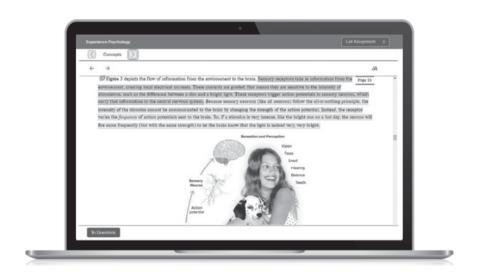
Laptop: Getty Images; Woman/dog: George Doyle/Getty Images
your students is doing. And with our Inclusive Access program, you can provide all these tools at the lowest available market price to your students. Ask your McGraw Hill representative for more information
how you want it. Visit supportateverystep.c om for videos and resources both you and your students can use throughout the term.
Page xiii
Students Get Learning that Fits You
Effective tools for efficient studying
Connect is designed to help you be more productive with simple, flexible, intuitive tools that maximize your study time and meet your individual learning needs. Get learning that works for you with Connect
Study anytime, anywhere
Download the free ReadAnywhere® app and access your online eBook, SmartBook® 2 0, or Adaptive Learning Assignments when it’s convenient, even if you’re offline. And since the app automatically syncs with your Connect account, all of your work is available every time you open it. Find out more at mheducation.com/readanywhere
Everything you need in one place
Your Connect course has everything you need whether reading your digital eBook or completing assignments for class Connect makes it easy to get your work done.
iPhone: Getty Images
Learning for everyone
McGraw Hill works directly with Accessibility Services Departments and faculty to meet the learning needs of all students Please contact your Accessibility Services Office and ask them to email acce ssibility@mheducation.com, or visit mhedu cation.com/about/accessibility for more information.
Contents
About the Authors vi
Preface vii
PART ONE
SUPPLY CHAIN LOGISTICS MANAGEMENT 1
CHAPTER 1SUPPLY CHAIN LOGISTICS MANAGEMENT 1
21st-Century Supply Chains 2
The Supply Chain Revolution 4
Why Integration Creates Value 5
Generalized Supply Chain Model and Supply Chain Applications 6
Generalized Supply Chain Model 8
Supply Chain Definitions and Activities 8
Integrative Management and Supply Chain Processes 10
Enterprise Extension 13
Integrated Service Providers 13
Collaboration 15
Supply Chain Value Proposition 16
Effectiveness 17
Efficiency 17
Relevancy 17
Sustainability 17
Value Proposition Conclusion 18
Responsiveness 18
Anticipatory Business Model (Push) 18
Responsive Business Model (Pull) 19
Barriers to Implementing Responsive Systems 20
Supply Chain Challenges 21
Risk Management 21
Complexity Management 22
Globalization 22
Summary 23
Industry Disruptors 23
Consumer Requirements 24
Technology Adoption 24
Conclusion 26
Summary 26
Study Questions 26
Challenge Questions 27
CHAPTER 2
Supply Chain Information Technology 28
Information System Functionality 29
Supply Chain Information System Modules 33
Enterprise Integration and Administration 33
Enterprise Supply Chain Operations 34
Enterprise Planning and Monitoring 36
Communication Technology 37
Consumer Connectivity 37
Uncertainty and Risk Mitigation 38
Blockchain 38
Logistics Operations Modules 40
Summary 41
Study Questions 41
Challenge Questions 41
CHAPTER 3
Logistics 42
The Logistics of Business Is Big and Important 43
The Logistical Value Proposition 45
Service Benefits 45
Cost Minimization 46
Logistics Value Generation 47
The Work of Logistics 48
Order Processing 49
Inventory 49
Transportation 50
Warehousing, Materials Handling, and Packaging 51
Facility Network Design 52
Logistical Operations 53
Inventory Flow 53
Information Flow 55
Logistical Integration Objectives 56
Responsiveness 56
Variance Reduction 56
Inventory Reduction 56
Shipment Consolidation 57
Quality 57
Life Cycle Support 57
Logistical Operating Arrangements 58
Echelon 58
Direct 59
Combined 59
Flexible Structure 60
Supply Chain Synchronization 63
Performance Cycle Structure 63
Performance Cycle Uncertainty 64
Summary 67
Study Questions 68
Challenge Questions 68
CHAPTER 4
Customer Accommodation 69
Customer-Focused Marketing 70
Transactional versus Relationship Marketing 72
Supply Chain Service Outputs 72
Omnichannel Marketing 75
Customer Service 76
Availability 76
Operational Performance 78
Service Reliability 79
The Perfect Order 80
Logistics Service Platforms 81
Customer Satisfaction 81
Customer Expectations 82
A Model of Customer Satisfaction 83
Increasing Customer Expectations 85
Limitations of Customer Satisfaction 86
Customer Success 87
Achieving Customer Success 88
Value-Added Services 88
Developing Customer Accommodation Strategy 89
Framework for Strategic Choice 90
Customer Relationship Management Technology 91
Summary 94
Study Questions 95
Challenge Questions 95
PART TWO
SUPPLY CHAIN OPERATIONS 97
CHAPTER 5
Integrated Operations Planning 98
Supply Chain Planning 99
Supply Chain Visibility 99
Simultaneous Resource Consideration 99
Resource Utilization 100
Supply Chain Planning Applications 100
Demand Planning 100
Production Planning 101
Logistics Planning 101
Inventory Management 102
Sales and Operations Planning (S&OP) 102
S&OP Process 103
Making S&OP Work 106
APS System Overview 108
APS System Components 109
Supply Chain Planning Benefits 111
Supply Chain Planning Considerations 112
Integrated Business Planning 114
Supply Chain Planning Summary 114
Collaborative Planning, Forecasting, and Replenishment 114
Forecasting 116
Forecasting Requirements 117
Forecasting Components 118
Forecasting Process 120
Forecasting Techniques 123
Forecasting Accuracy 126
Summary 128
Study Questions 129
Challenge Questions 129
CHAPTER 6
Procurement and Manufacturing 131
The Quality Imperative 132
Dimensions of Product Quality 132
Total Quality Management 134
Procurement Importance 135
Procurement Objectives 136
Continuous Supply 136
Rationalized Inventory Investment 136
Quality Improvement 136
Technology and Innovation 137
Lowest Total Cost of Ownership 137
Procurement Strategy 138
Insourcing versus Outsourcing 139
Alternative Procurement Strategies 140
Procurement Strategy Portfolio 143
Global Sourcing 144
Rationale for Low-Cost-Country Sourcing 145
Challenges for Low-Cost-Country Sourcing 145
Guidelines for Sourcing 146
Global Comparison of Supply Chain Characteristics 147
Logistical Interfaces with Procurement 147
Just-in-Time 148
Procurement of Logistics Services 148
Performance-Based Logistics 149
Manufacturing 149
Manufacturing Processes 149
Job Shop Process 150
Batch Process 150
Line Flow Process 151
Continuous Process 151
Matching Manufacturing Strategy to Market Requirements 151
Manufacturing Strategies 152
Engineer-to-Order 152
Make-to-Order 152
Assemble-to-Order 152
Make-to-Plan 153
Mass Customization 154
Lean Systems 155
Six-Sigma 156
Design-for-Logistics 156
Summary 157
Study Questions 158
Challenge Questions 158
PART THREE
SUPPLY CHAIN LOGISTICS OPERATIONS 159
CHAPTER 7
Inventory 160
Inventory Functionality and Definitions 161
Inventory Functionality 162
Inventory Definitions 164
Inventory Carrying Cost 168
Capital 168
Taxes 168
Insurance 168
Obsolescence 169
Storage 169
Planning Inventory 169
When to Order 169
How Much to Order 170
Managing Uncertainty 175
Demand Uncertainty 175
Performance Cycle Uncertainty 179
Safety Stock with Combined Uncertainty 179
Estimating Fill Rate 182
Dependent Demand Replenishment 184
Inventory Management Policies 185
Inventory Control 185
Reactive Methods 187
Planning Methods 189
Collaborative Inventory Replenishment 194
Postponement 195
Inventory Management Practices 198
Product/Market Classification 198
Segment Strategy Definition 199
Policies and Parameters 200
Summary 200
Study Questions 201
Challenge Questions 201
CHAPTER 8
Transportation 203
Transport Functionality and Participants 204
Functionality 204
Participants 205
From Regulation to a Free Market System 207
Transportation Modal Structure 209
Rail 211
Truck 211
Water 213
Pipeline 214
Air 215
Modal Comparative Characteristics and Capabilities 216
Infrastructure in Crisis 217
Specialized Transportation Services 218
Parcel Service 218
Intermodal 220
Nonoperating Intermediaries 222
Transportation Economics and Pricing 222
Economy of Distance 222
Economy of Weight 223
Economy of Density 223
Other Pricing Factors 223
Costing Freight 225
Pricing Freight 226
Transportation Operations Management 230
Transportation Management Systems 231