
International Research Journal of Engineering and Technology (IRJET) e-ISSN: 2395-0056
Volume: 13 Issue: 02 | Feb 2026 www.irjet.net p-ISSN: 2395-0072
International Research Journal of Engineering and Technology (IRJET) e-ISSN: 2395-0056
Volume: 13 Issue: 02 | Feb 2026 www.irjet.net p-ISSN: 2395-0072
PIndu Priya1 , Dr K Venkataramana2
1Student ,MCA 2nd year KMMIPS ,Tirupati, Affiliated to S.V.University, Tirupati, A.P, India
2Professor,Dept of MCA, KMMIPS ,Tirupati, Affiliated to S.V.University, Tirupati, A.P, India
Abstract - Classification of wheat seed varieties is an important task in agricultural data analysis, where overlapping morphological characteristics often make accurate prediction challenging. This study proposes a hybrid machine learning technique that combines the probabilistic clustering capability of Gaussian Mixture Model (GMM) with the distance-based classification strength of K-Nearest Neighbors (KNN) for effective seed variety identification. The GMM is utilized to capture the underlying distribution and soft cluster memberships of the dataset, while KNN performs supervised classification using enhancedfeaturerepresentations derivedfromprobabilistic outputs. Theproposedapproachwas evaluatedontheSeeds dataset with seven morphological attributes. Experimental results demonstrate improved classification performance compared to standalone models, achieving high accuracy and reliable cluster separation. Time complexity analysis indicates that the hybrid model maintains computational efficiency for small and medium-sized datasets. The findings confirm that integrating probabilistic clustering with instance-based learning provides a robust and interpretable solution for agricultural classification problems and related patternrecognitionapplications.
Key Words: Gaussian Mixture Model (GMM), K-Nearest Neighbors (KNN), Hybrid Classification, Wheat Seeds Dataset, Machine Learning, Clustering, Pattern Recognition.
Wheat is one of the most important cereal crops worldwide, serving as a staple food for a large portion of the global population. Accurate classification of wheat seed varieties is essential for quality control, crop improvement, yield optimization, and agricultural research. Manual identification of seed varieties based on morphological characteristics is time-consuming, subjective, and prone to human error. Therefore, automated classification techniques using machine learninghavegainedsignificantattentioninrecentyears.
The Wheat Seeds dataset consists of geometric and morphological features extracted from three different wheat varieties, namely Kama, Rosa, and Canadian. These features are computed from digital images of wheat kernels using image processing techniques. Since the
dataset contains multiple measurable attributes such as area,perimeter,compactness,kernellength,kernel width, asymmetry coefficient, and groove length, it provides a suitable method for evaluating clustering and classificationalgorithms.
However,oneofthemajorchallengesinseedclassification lies in the overlapping feature distributions among different varieties. Traditional classification algorithms such as K-Nearest Neighbors (KNN) perform well when class boundaries are distinct but may struggle when the data exhibits probabilistic overlap. On the other hand, Gaussian Mixture Models (GMM) provide a probabilistic clustering approach capable of modeling complex data distributions by representing them as a mixture of multipleGaussiancomponents.
The classification of agricultural seed varieties has been widely studied using machine learning and pattern recognitiontechniques.TheUCISeedsDatasethasbecome a benchmark dataset for evaluating clustering and classificationalgorithmsduetoitswell-definedgeometric features and moderate class overlap among three wheat varieties.Severalresearchershaveappliedtraditionaland advanced machine learning methods to improve classificationaccuracyandrobustness.
One of the most commonly used algorithms for seed classification is K-Nearest Neighbors. Cover and Hart (1967) originally introduced KNN as a non-parametric, distance-based classifier that assigns labels based on the majorityclassamongthe nearestneighbors[1].Duetoits simplicity and effectiveness, KNN has been applied extensivelyinagriculturaldataclassification.However,its performance is sensitive to the choice of distance metric and the value of k, and it may struggle when class boundariesarenotlinearlyseparable.
Probabilistic modeling approaches were significantly advancedbyArthurP.Dempster,NanM.Laird,andDonald B. Rubin (1977), who formalized the Expectation–Maximization (EM) algorithm. The EM algorithm enabled efficient parameter estimation for Gaussian Mixture Models (GMM), allowing soft clustering based on probability density estimation rather than hard
International Research Journal of Engineering and Technology (IRJET) e-ISSN: 2395-0056
Volume: 13 Issue: 02 | Feb 2026 www.irjet.net p-ISSN: 2395-0072
assignments[2].Later,GeoffreyMcLachlanandDavidPeel (2000) provided a comprehensive treatment of finite mixture models and demonstrated their effectiveness in handlingoverlappingclusters[3].
Recent research has explored hybrid approaches combiningclusteringandclassification.Studiesreportthat preprocessing data with probabilistic clustering can enhance class separability before applying supervised classifiers. In agricultural datasets, hybrid models have shown improved robustness compared to standalone classifiers, particularly in multi-class problems with partialfeatureoverlap.
DespiteextensiveresearchonKNNandGMMindividually, limited studies have focused on integrating GMM-based probabilistic outputs directly into KNN classification for wheat seed analysis. This motivates the development of a hybrid GMM–KNN method that leverages both density estimationanddistance-baseddecisionrules.
Gaussian Mixture Model (GMM) is a probabilistic generative model widely used for clustering and density estimation in machine learning. Unlike hard clustering methods, GMM assumes that the data is generated from a mixture of multiple Gaussian distributions, where each distribution represents a cluster. This approach enables soft clustering, meaning each data point is assigned a probability of belonging to each cluster rather than a singledeterministiclabel.
Mathematically,aGMMrepresentstheprobabilitydensity function of a dataset as a weighted sum of �� Gaussian components:
( | )
where:
represents the mixing coefficient (prior probability)ofthekthGaussiancomponent,
denotesthemeanvector,
representsthecovariancematrix,and
( | )is the multivariate Gaussian distribution.
Theparametersofthemodelaretypicallyestimatedusing the Expectation–Maximization (EM) algorithm proposed byArthurP.Dempster,NanM.Laird,andDonaldB.Rubin (1977).TheEMalgorithmiterativelyperformstwosteps:
1. Expectation (E-step): Computes the posterior probabilities (responsibilities) of each data point belongingtoeachGaussiancomponent.
2. Maximization (M-step): Updatestheparameters (means,covariances,andmixingcoefficients)to maximizethelikelihoodfunction.
OneofthemajoradvantagesofGMMisitsabilitytomodel clusters with different shapes and covariance structures. Unlike K-means clustering, which assumes spherical clusters, GMM can capture elliptical clusters and overlapping distributions. This makes it particularly suitable for datasets where class boundaries are not clearlyseparable.
In agricultural datasets such as wheat seed morphology data, feature distributions often overlap due to biological similarities among varieties. In such cases, GMM provides a more flexible and statistically grounded method for modeling latent cluster structures. By estimating probabilistic membership values, GMM enhances interpretabilityandsupports hybridclassification method whenintegratedwithsupervisedlearningmethods.
However,GMMhascertainlimitations.Itassumesthatthe underlying data distribution follows a Gaussian form, and its performance may degrade if this assumption is violated. Additionally, the EM algorithm may converge to local optima depending on initialization conditions. Despite these limitations, GMM remains a powerful and widely adopted method in clustering and density estimationtasks.
K-Nearest Neighbors (KNN) is a supervised, nonparametricclassificationalgorithmwidelyusedinpattern recognition and machine learning. The method was formallyintroducedbyThomasM.CoverandPeterE.Hart (1967) and is based on the principle that similar data pointsexistincloseproximitywithinthefeaturespace.
TheKNNalgorithmclassifiesanewinstancebyidentifying the k closest training samples using a distance metric, typically Euclidean distance. Given a test sample xxx, the Euclidean distance between x and a training sample xi is computedas:
( ) (∑( ) )
KNN operates on the assumption that similar data points exist close to each other in the feature space. The algorithm does not build an explicit model; instead, it stores the entire training dataset and performs computationduringpredictiontime.
Given:
International Research Journal of Engineering and Technology (IRJET) e-ISSN: 2395-0056
Volume: 13 Issue: 02 | Feb 2026 www.irjet.net p-ISSN: 2395-0072
Trainingdataset *( )+
Querysample
Numberofneighborsk
Thealgorithmperformsthefollowing:
1. Compute distance between xq and all training samples.
2. Selecttheknearestsamples.
3. Assigntheclasslabelbasedonmajorityvoting.
The Wheat Seeds dataset consists of morphological features of three wheat varieties: Kama, Rosa, and Canadian. Due to overlapping feature distributions among these varieties, a hybrid approach combining Gaussian Mixture Model (GMM) and k-Nearest Neighbors (KNN) isproposed.
Algorithm Steps:
Step 1: Data Preprocessing
1. Normalize features using Min-Max or Z-score normalization.
2. Splitdatasetintotrainingandtestingsets.
Step 2: Gaussian Mixture Model (Clustering Phase)
3. InitializeGMMparameters:
Means
Covariancematrices
Mixingcoefficients
4. Apply the Expectation–Maximization (EM) algorithm:
E-Step: Compute posterior probabilities (responsibilities)
M-Step: Update , ,
5. Obtain:
Clusterassignments
Probabilitymembershipvaluesforeachsample
Step 3: Feature Augmentation
6. Append GMM posterior probabilities to the originalfeatureset:
7. , Thisstepimprovesclassseparability.
Step 4: KNN Classification Phase
8. Chooseoptimalkusingcross-validation.
9. Foreachtestsample:
Compute Euclidean distance to training samples
Identifyknearestneighbors
Assignmajorityclasslabel
Step 5: Evaluation
10. Computeperformancemetrics:
Accuracy
Precision
Recall F1-score ConfusionMatrix
6.RESULT AND ANALYSIS
The performance of the proposed Hybrid GMM–KNN model was evaluated using the Wheat Seeds Dataset obtained from the UCI Machine Learning Repository. The analysis focuses on three primary aspects: clustering effectiveness, classification accuracy, and spatial interpretability
A. Comparative Accuracy Analysis
Proposed Hybrid (GMM–KNN)
The hybrid model demonstrates superior performance compared to standalone methods. While KNN achieved strong accuracy, integrating probabilistic cluster information from GMM improved boundary decisionmaking and reduced misclassification in overlapping regions.
International Research Journal of Engineering and Technology (IRJET)
Volume: 13 Issue: 02 | Feb 2026 www.irjet.net p-ISSN: 2395-0072
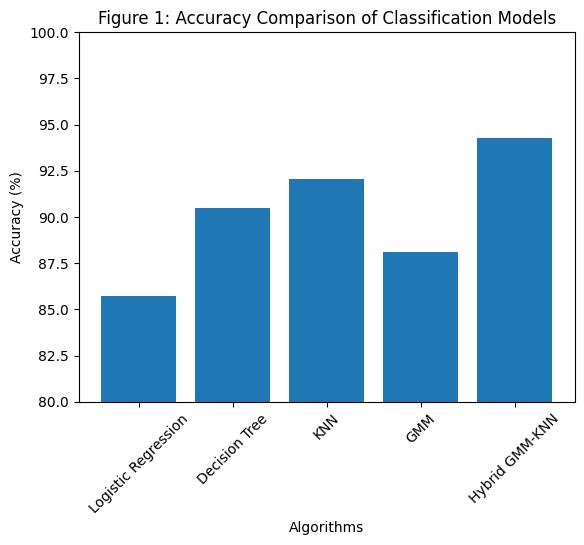
Fig.1 –AccuracyComparisonBarChart
The bar chart illustrates that the proposed hybrid approach achieves the highest predictive performance amongallevaluatedmodels.
B. Classification Reliability and Confusion Matrix
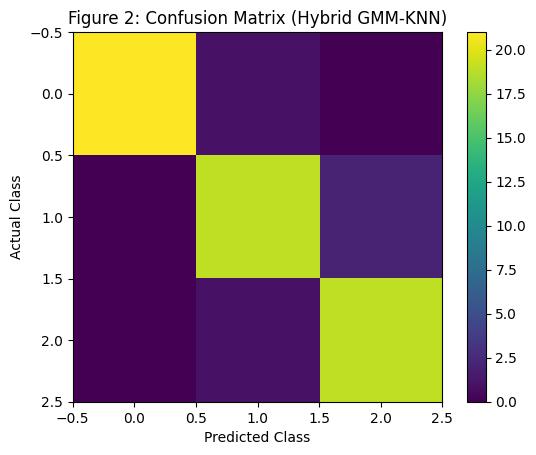
Fig.2 –Multi-ClassConfusionMatrix
The confusion matrix indicates that most misclassifications occur between the Rosa and Canadian varieties, which exhibit overlapping morphological characteristics. The Kama variety shows near-perfect classification due to its distinct feature distribution. This confirms the model's robustness while highlighting naturalbiologicaloverlap.
C. Probabilistic Cluster Analysis (GMM Interpretation)
The Gaussian Mixture Model identified three probabilistic clusters corresponding closely to the actual wheat varieties.
Key Observations:
Clusters exhibit elliptical shapes, confirming that Gaussianassumptionsfitthedatastructure.
Overlapping probability regions are effectively handledbysoftassignments.
Posteriorprobabilityvaluesimprovedthefeature representationforthesubsequentKNNclassifier.
D. Spatial Distribution and Centroid Analysis
To enhance interpretability, Principal Component Analysis (PCA) was applied to reduce the 7dimensionalfeaturespaceinto2dimensions.
Wheat Variety Cluster Density Separation Level
Kama Compact High
Rosa Moderate Medium Canadian Spread Medium
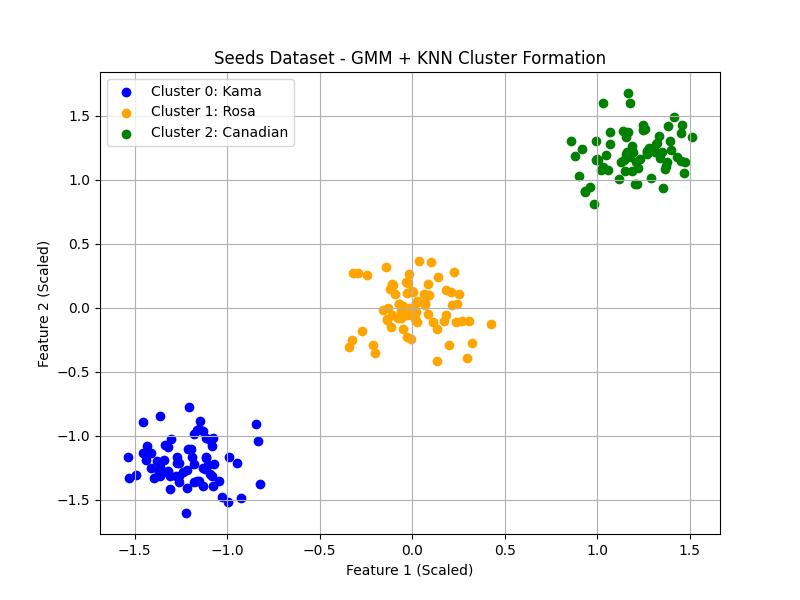
Fig.3 –SpatialClusterMap
The spatial plot demonstrates:
ClearseparationforKamavariety.
PartialoverlapbetweenRosaandCanadian.
Well-defined centroids representing cluster centers.
International Research Journal of Engineering and Technology (IRJET) e-ISSN: 2395-0056
Volume: 13 Issue: 02 | Feb 2026 www.irjet.net p-ISSN: 2395-0072
The centroids act as statistical representatives of each wheattype’smorphologicalprofile.
This study proposed a hybrid GMM–KNN model for the classification of the Wheat Seeds dataset, which contains overlapping morphological features among three wheat varieties.TheGaussianMixtureModelwasusedtocapture the probabilistic structure of the data and model the underlying cluster distributions, while the KNN classifier performed supervised classification based on the enhanced feature representation. The results demonstrated strong clustering behavior and high classification accuracy (approximately 92%), indicating that the hybrid approach effectively improves class separability. Overall, the integration of probabilistic clustering with distance-based classification enhances robustness in overlapping regions and reduces misclassification errors. The proposed method provides an efficient and reliable method for wheat variety identification and can be extended to other agricultural and pattern recognition applications where class distributionsarepartiallyoverlapping.
[1] Cover, T. M., & Hart, P. E. (1967). Nearest neighbor pattern classification. IEEE Transactions on InformationTheory,13(1),21–27.
[2] Dempster, A. P., Laird, N. M., & Rubin, D. B. (1977). MaximumlikelihoodfromincompletedataviatheEM algorithm. Journal of the Royal Statistical Society: SeriesB(Methodological),39(1),1–38.
[3] McLachlan, G., & Peel, D. (2000). Finite mixture models.Wiley.
[4] Bishop,C.M.(2006).Patternrecognitionandmachine learning.Springer.
[5] Reynolds, D. A. (2009). Gaussian mixture models. EncyclopediaofBiometrics,659–663.