
International Research Journal of Engineering and Technology (IRJET) e-ISSN: 2395-0056
Volume: 13 Issue: 04 | Apr 2026 www.irjet.net p-ISSN: 2395-0072
International Research Journal of Engineering and Technology (IRJET) e-ISSN: 2395-0056
Volume: 13 Issue: 04 | Apr 2026 www.irjet.net p-ISSN: 2395-0072
Vaibhavi Dalvi1 , Ariba Shaikh2
1Vaibhavi Dalvi, Dept. of Data Science Engineering, Usha Mittal Institute of Technology, Mumbai, India
2Ariba Shaikh, Dept. of Data Science Engineering, Usha Mittal Institute of Technology, Mumbai, India
Abstract - Automatic Speaker Verification (ASV) systems have grown widelyadopted insectors such as banking, smart devices, and secure access due to their ease of use and contactless operation. However, these systems remain vulnerable to various spoofing attacks, including replay attacks usingrecordedvoices, synthetic speech generatedvia Text-to-Speech (TTS), and Voice Conversion (VC) techniques that mimic legitimate users to bypass authentication. To addressthesechallenges,thispaperproposesadeeplearningbased anti-spoofing framework developed and evaluated on the ASVspoof 2019 Physical Access (PA) dataset. Various architectureswereexamined,includingResNet-basedmodels and hybrid designs that combine convolutional layers with LSTM andBiLSTM units, which are capable ofcapturing both spatial features and temporal dynamics of speech signals. Results demonstrated that hybrid models consistently outperformed purely convolutional networks, with the ResNet18+BiLSTM model achieving 96.88% accuracy and an Equal Error Rate (EER) of 3.12%, demonstrating strong effectiveness in spoof detection. These findings confirm that combining convolutional feature extraction with temporal modeling greatly improves the overall robustness of antispoofing systems.
Key Words: Voice Spoofing Detection, Automatic Speaker Verification, Deep Learning, ResNet, ResNet18, LSTM, BiLSTM, Equal Error Rate, ASVspoof 2019.
Voice-basedauthentication,commonlyknownasAutomatic Speaker Verification (ASV), has seen growing adoption in domains such as banking, mobile security, and access control,owingtoitsuser-friendlynatureanditsrelianceon theinherentuniquenessofanindividual'svoice.However, the rapid advancement of technologies including speech synthesis,voiceconversion,anddeepfakeaudiogeneration hasintroducedsignificantspoofingthreatstothesesystems. In such attacks, an adversary attempts to replicate or artificiallyconstructatargetspeaker'svoiceinordertogain unauthorized access to secured systems. Earlier spoof detection approaches depended largely on manually engineered acoustic features such as MFCC and CQCC. Althoughthesetechniquesachievedmoderatesuccess,they frequentlyfellshortwhenfacedwithnovelorunseenattack scenarios, making generalization across diverse spoofing methods a persistent limitation. Deep learning has since emerged as a more capable and adaptable alternative.
Residual networks (ResNet) have proven particularly effective at learning discriminative features directly from audio data, while Long Short-Term Memory (LSTM) networks are well-suited for capturing the sequential and temporalcharacteristicsofspeech.Nevertheless,relatively little research has directly compared standalone ResNet models against hybrid architectures that merge residual learning with temporal modeling under varying training configurations. To address this research gap, the current studysystematicallyevaluatesseveralmodelarchitectures including ResNet, ResNet+LSTM, ResNet18+LSTM, and ResNet18+BiLSTM ontheASVspoof2019dataset.Models are trained across different epoch settings to assess how training duration and the inclusion of temporal modeling affectspoofdetectionperformance.
Wu et al. introduced the ASVspoof 2015 challenge, which establishedoneoftheearlieststandardizedbenchmarksfor evaluating anti-spoofing countermeasures in Automatic Speaker Verification (ASV) systems. Their framework employed Gaussian Mixture Models (GMM) and Support VectorMachines(SVM)inconjunctionwithMFCCfeaturesto detectreplayandsyntheticspoofingattacks.Althoughthe systemperformedadequatelyagainstknownattacktypes,it demonstrated notable weaknesses when exposed to previouslyunseenspoofingscenarios[1].
In a separate investigation, Wu et al. conducted a comprehensiveanalysisofvariousspoofingattackcategories and their corresponding countermeasures within speaker verificationframeworks.Theirstudyconcludedthatreplay, speech synthesis, and voice conversion attacks pose substantialriskstosystemreliability,reinforcingthecritical needforrobustanti-spoofingsolutions[2].
Todisco et al. presented the ASVspoof 2019 challenge, encompassingbothLogicalAccess(LA)andPhysicalAccess (PA)evaluationconditions.TheirworkincorporatedCQCC, LFCC, and x-vector representations combined with deep neural networks, demonstrating that deep learning-based approaches yield superior accuracy and generalization relativetoconventionalfeature-basedmethods[3].
Chen et al. addressed the challenge of codec-induced and channel-related variabilities in spoof detection pipelines. They introduced an enhanced ECAPA-TDNN architecture
International Research Journal of Engineering and Technology (IRJET) e-ISSN: 2395-0056
Volume: 13 Issue: 04 | Apr 2026 www.irjet.net p-ISSN: 2395-0072
that incorporates adversarial training strategies and data augmentationtechniques,resultinginreducedEqualError Rates and improved performance under practical deploymentconditions[4].
Leietal.proposedTwo-PathGMM-ResNetandGMMSENet architectures that merge statistical modeling with deep residual learning. This combined design enables simultaneouscaptureofbothspectralandstatisticalspeech properties, contributing to more accurate spoof detection outcomes[5].
KimandBandevelopedaphase-awaredetectionframework utilizing the Res2Net architecture alongside a dedicated network for processing phase information. Their experimentalfindingsindicatedthatexplicitlyincorporating phase-relatedfeaturesleadstoimproveddetectionaccuracy andareductioninfalseacceptancerates[6].
Lei et al. subsequently introduced GMM-ResNet2, an ensemble-basedframeworkthatintegratesmultipleResNet variants with multi-order GMM representations. This architecture demonstrated enhanced generalization capability, particularly when evaluated against previously unseenspoofingattacktypes[7].
Zhang et al. proposed the AASIST2 model, specifically engineered to handle short-duration speech segments. ThroughtheuseoftheRes2Netbackboneandlarge-margin fine-tuningstrategies,themodelmaintainsconsistentand reliable detection performance across varying speech lengths[8].
Wu et al. presented a multiscale feature aggregation frameworkcombinedwithdynamicconvolutionoperations foranti-spoofingpurposes.Theirapproachexhibitedstrong detection capability and generalization across multiple benchmarkdatasets[9].
Ranietal.conductedacomparativestudybetweenclassical machinelearningalgorithms,includingGMMandSVM,and deep learning architectures such as LSTM. Their results confirmed that LSTM-based models achieve superior detectionperformanceowingtotheirinherentcapacityto modeltemporaldependencieswithinspeechsignals[10].
BolesandRadproposedavoiceauthenticationframework groundedinMFCC-basedfeatureextractionpairedwithSVM classification. Their work validated the effectiveness of traditional methodologies while simultaneously acknowledging the growing need for more advanced and robustspoofdetectionmechanisms[11].
Shahzadetal.constructedahybriddeeplearningmodelthat integratesVGGish,LSTM,YAMNet,andone-dimensionalCNN components. The resulting system achieved high classification accuracy and low EER, demonstrating the advantageoffusingdiversedeeplearningmoduleswithina unifieddetectionpipeline[12].
Astudytitled"DeepFakeDefender:AI-BasedDetectionof Deepfake Voice Attacks" presented a detection system targetingsyntheticallygeneratedandmanipulatedspeech. Theframeworkleveragesacousticfeaturerepresentations alongside machine learning and CNN-based classifiers to differentiate authentic from fabricated audio, though performanceagainstunseenattackvariantsremainsanopen challenge[13].
Thework"AIBasedVoiceSpoofingDetectionusingMLand DL" systematicallyevaluatedbothconventional classifiers suchasSVMandRandomForest,anddeeplearningmodels including CNN and LSTM architectures. The findings consistentlyfavoreddeeplearningapproaches,attributing theirsuperioraccuracytomoreexpressiveandgeneralizable featurerepresentations[14].
Acomprehensivereviewtitled"DeepfakeAudioDetectionin Voice Authentication" surveyed recent advancements in synthetic speech detection. The study concluded that integrating cepstral or spectrogram-derived features with deep learning architectures significantly enhances system robustnessagainstcontemporaryspoofingtechniques[15].
The contribution "DeepLASD Countermeasure for Logical AccessAudioSpoofing"introducedadeeplearningsolution specificallytailoredforlogicalaccessspoofingscenarios.By employing attention-driven feature learning mechanisms alongside advanced spectral processing strategies, the proposed model achieved competitive benchmark performance[16].
In "Comparative Analysis of ML/DL Models for Voice SpoofingDetection,"adiversesetofmachinelearningand deep learning architectures were assessed under standardizedexperimentalconditions.Thestudyestablished that deep learning and ensemble-based methods consistently surpass traditional approaches, with particularly notable gains observed during cross-dataset evaluations[17].
Thestudy"VoiceSpoofingCountermeasureforVoiceReplay Attacks" targeted the detection of replay-based spoofing using acoustically robust feature representations. The proposedmethodologydemonstratedimprovedresilienceto environmentalnoiseandchannel-induceddistortionsunder real-worldtestingconditions[18].
"DeepDetection: Privacy-Enhanced Deep Voice Detection and Authentication" introduced a unified framework that simultaneouslyaddressesspoofdetectionanddataprivacy preservation. The system ensures secure and privacyconsciousaudioprocessingwhilesustaininghighlevelsof detectionaccuracy[19].
The paper "Evaluation Framework for Deepfake Speech Detection" established a standardized evaluation methodologyforbenchmarkinganti-spoofingsystems.The workemphasizedgeneralizationasacorerequirementand
International Research Journal of Engineering and Technology (IRJET) e-ISSN: 2395-0056
Volume: 13 Issue: 04 | Apr 2026 www.irjet.net p-ISSN: 2395-0072
highlightedmetricssuchasEERandDetectionCostFunction asessentialindicatorsofsystemeffectiveness[20].
In"Dual-ChannelSpoofedSpeechDetectionBasedonGraph Attention Networks," a dual-stream detection model was proposed to jointly capture spectral and temporal speech characteristics through graph attention mechanisms, yielding measurable improvements in overall detection performance[21].
"Voice Spoofing Detector: A Unified Anti-Spoofing Framework" presented a comprehensive system that consolidates multiple acoustic feature streams with deep learning models, demonstrating consistently strong detectionresultsacrossarangeofspoofingconditions[22].
Thestudy"ABlendedFrameworkforAudioSpoofDetection" proposedanensemblestrategythatcombineshandcrafted acoustic features with learned deep representations. This hybridintegrationwasshowntoenhancesystemrobustness andcontributetoameaningfulreductioninfalseacceptance rates[23].
3.1
In this study, the Physical Access (PA) subset of the ASVspoof2019 dataset was selected as the primary experimental resource. This dataset holds significant relevance as it encompasses both authentic speech recordingsandreplay-basedspoofedaudiocapturedunder realistic acoustic environments. Adhering to the standard evaluationprotocol,thedatasetwaspartitionedintothree distinctsubsets:training,development,andevaluation.To mitigate the effects of class imbalance, balanced sampling was applied during preparation of the training and developmentsubsets,ensuringproportionalrepresentation ofbothgenuineandspoofedsamples.Theevaluationsubset was maintained entirely separate throughout the experimentalprocesstoguaranteeunbiasedandobjective performanceassessment.
Prior to feature extraction, all audio recordings were subjected to a uniform preprocessing pipeline to ensure consistencyacrossthedataset.Theappliedstepsincluded:
Silence removal to discard non-informative audio segments
Amplitudenormalizationtoachieveuniformsignal scaling
Resamplingtoastandardizedrateof16kHz
Conversiontosingle-channelmonoformat
These preprocessing operations collectively reduce variabilityintroducedbydifferingrecordingenvironments and background noise conditions, thereby enabling more stableandreliabledownstreamfeatureextraction.
Constant-QCepstralCoefficients(CQCC)wereextractedfrom the preprocessed audio signals as the primary feature representation.CQCCfeaturesareespeciallywell-suitedfor replayattackdetectionduetotheirabilitytocapturefinegrainedfrequencyinformation,withparticularsensitivityin lower frequency regions. The extracted feature representations were stored as two-dimensional NumPy arraystofacilitateefficientbatchprocessingduringmodel training. In essence, CQCC equips the model with the capacity to identify subtle acoustic distinctions that differentiategenuinespeechfromspoofedrecordings
Toinvestigatetheimpactofintegratingspatialandtemporal learning mechanisms, four distinct architectural configurationsweredesignedandevaluated:
•ResNet
•ResNet+LSTM
•ResNet18+LSTM
•ResNet18+BidirectionalLSTM(ProposedModel) Inthe proposed architecture, ResNet18 serves as the backbone networkresponsibleforextractingdiscriminativespectral features from the CQCC inputs. Its residual connections facilitate more effective gradient flow during training, alleviating the vanishing gradient problem. The resulting feature representations are subsequently passed to a Bidirectional LSTM layer, which models temporal dependencies across both forward and backward time directions, thereby enriching the model's capacity to understandthedynamicnatureofspeechsignals.
All model configurations were optimized using the crossentropy loss function in combination with the Adam optimizer.Dropoutlayerswereincorporatedthroughoutthe networks to mitigate overfitting, and early stopping was employed to terminate training whenever validation performance ceased to improve. Each model was trained across varying epoch counts to analyze differences in learning behavior and to assess generalization capability underdifferenttrainingdurations.
Model performance was assessed on the PA evaluation subsetusingthefollowingmetrics:
International Research Journal of Engineering and Technology (IRJET) e-ISSN: 2395-0056
Volume: 13 Issue: 04 | Apr 2026 www.irjet.net p-ISSN: 2395-0072
•Accuracy
• Area Under the Receiver Operating Characteristic Curve (AUC–ROC)
•EqualErrorRate(EER)
•FalseAcceptanceRate(FAR)
•FalseRejectionRate(FRR)
TheEqualErrorRateiscalculatedatthepointwhereFAR andFRRareequal.Inaddition,confusionmatriceswereused to better understand how well the model distinguishes betweengenuineandspoofedsamples.
During inference, incoming audio inputs are processed throughthesamepreprocessingandCQCCfeatureextraction pipelineusedduringmodel training,ensuringconsistency betweentraininganddeploymentconditions.Theresulting featurerepresentationsare thenforwardedtothetrained ResNet18 + BiLSTM model to generate predictions. The classificationthresholdiscalibratedbasedonEERanalysis tostrikeanappropriatebalancebetweensecuritystringency and system usability. The system ultimately produces a binary classification output indicating whether the submittedspeechsampleisauthenticorspoofed.
4. Results and Description
4.1 ResNet18+BiLSTM performance at 13 epochs
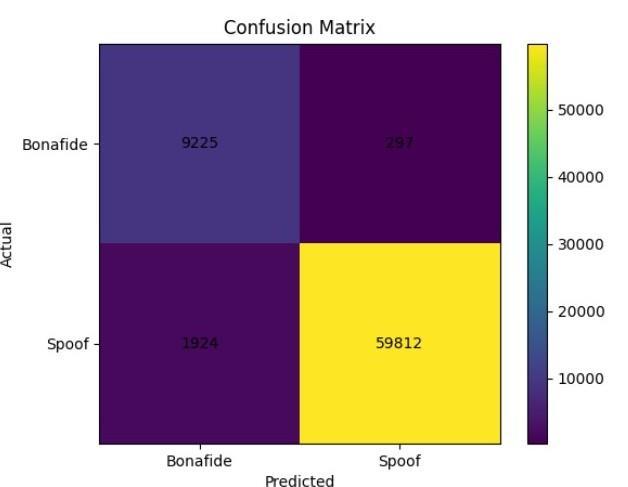
Fig - 1: ConfusionmatrixofResNet18+BiLSTMat13 epochs.
The matrix confirms precise identification of 9225 spoofed and 59812 bonafide samples, with 297 false negativesand1924falsepositivesdocumentedduring evaluation.
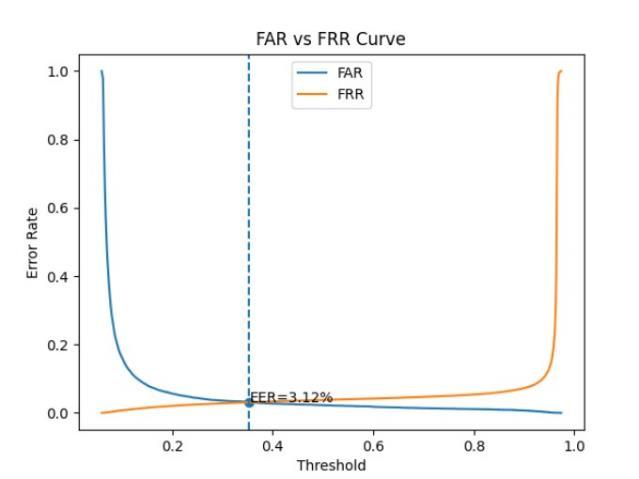
Fig – 2: FAR vs FRR of ResNet18+BiLSTM at 13 epochs.
Thegraphrevealsthereciprocalbehavioralpatternof FARandFRRasthedecisionthresholdprogressively varies. The specifically marked point of convergence betweenthetwocurvessignifiestheEqualErrorRate (EER), which acts as the fundamental criterion for determiningoverallmodelperformance.
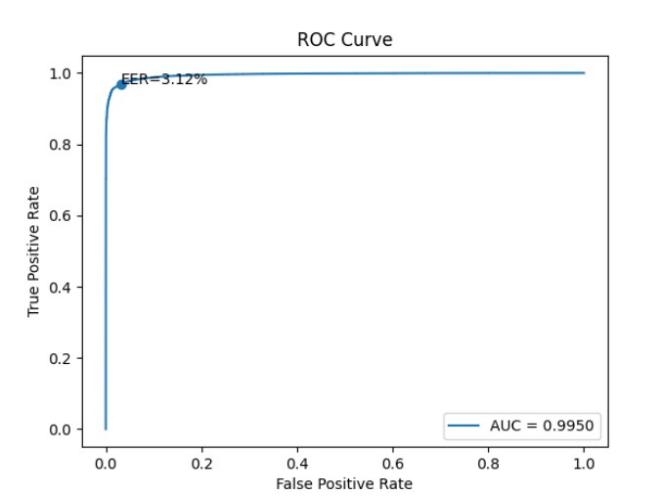
Fig - 3: ROCcurveofResNet18+BiLSTMat13epochs.
The model records an AUC value of 0.9950, establishing exceptional predictive accuracy with consistently high sensitivity levels and a distinctly reduced rate of false positiveclassifications.
International Research Journal of Engineering and Technology (IRJET) e-ISSN: 2395-0056
Volume: 13 Issue: 04 | Apr 2026 www.irjet.net p-ISSN: 2395-0072
Table -1: Comparisonofperformancemetricsacross differentmodelarchitecturesandtrainingconfigurations
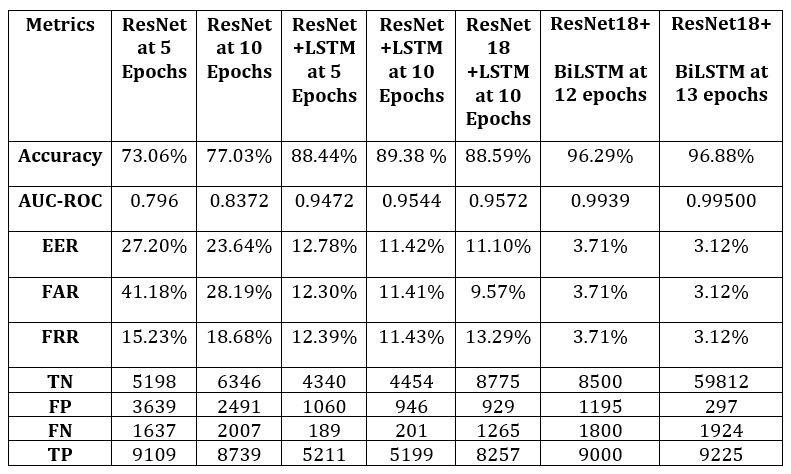
Table-1presentsacomparativesummaryofAccuracy, AUC-ROC,EER,FAR,andFRRacrossallevaluatedmodel architectures.TheproposedResNet18+BiLSTMmodel attainsthehighestaccuracyandAUC-ROCvalueswhile simultaneouslyrecordingthelowesterrorratesamong allconfigurations,confirmingitssuperiorrobustnessand overalleffectivenessindetectingreplay-basedspoofing attacks
5. Conclusion
Thisstudyproposedadeeplearning-drivenframeworkfor spoofedspeechdetection,developedandassessedusingthe PhysicalAccess(PA)subsetoftheASVspoof2019dataset. Thecentralobjectivewastodeterminehoweffectivelydeep learningarchitecturescandifferentiatebetweenauthentic speech and replay-based spoofed audio under realistic acousticconditions.Experimentaloutcomesconfirmedthat convolutional networks demonstrate strong capability in capturing meaningful acoustic representations, while the additional integration of temporal modeling components further elevates overall detection performance. Of all the architectural configurations evaluated, the ResNet18+BiLSTM model produced the most consistent results, attaining a lower Equal Error Rate than all competing architectures, thereby demonstrating the clear advantageofjointlyleveragingspatialfeatureextractionand temporal sequence modeling. Collectively, the results suggest that deep learning-based approaches hold strong potentialforstrengtheningtherobustnessanddependability ofvoice-basedauthenticationsystemsinthefaceofreplay spoofingthreats.Furthermore,thisworkestablishesasolid foundation for future investigations, wherein a broader range of spoofing attack categories and more extensive datasetsmaybeexploredtopushdetectionperformanceto greaterheights.
[1]Z.Wuetal.,“ASVspoof2015:Thefirstautomaticspeaker verification spoofing and countermeasures challenge,” in Proc. INTERSPEECH, Dresden, Germany, 2015, pp. 2037–2041.
[2]Z.Wuetal.,“Spoofingandcountermeasuresforspeaker verification:Asurvey,”SpeechCommunication,vol.66,pp. 130–153,2015.
[3] M. Todisco et al., “ASVspoof 2019: Future horizons in spoofedandfakeaudiodetection,”inProc.INTERSPEECH, Graz,Austria,2019,pp.1008–1012.
[4]J.Chenetal.,“ASVspoof2021:Acceleratingprogressin spoofedanddeepfakespeechdetection,”IEEE/ACMTrans. Audio,Speech,andLanguageProcessing,vol.29,pp.2372–2385,2021.
[5]Z.Leietal.,“Two-pathGMM-ResNetandGMM-SENetfor ASV spoofing detection,” in Proc. IEEE ICASSP, Singapore, 2022,pp.6377–6381.
[6] J. Kim and S. M. Ban, “Phase-aware spoof speech detectionbasedonRes2Netwithphasenetwork,”inProc. IEEEICASSP,RhodesIsland,Greece,2023,pp.1–5.
[7]Z.Leietal.,“GMM-ResNet2:EnsembleofgroupResNet networks for synthetic speech detection,” in Proc. IEEE ICASSP,Seoul,SouthKorea,2024,pp.12101–12105.
[8]Y.Zhangetal.,“Improvingshortutteranceanti-spoofing with AASIST2,” in Proc. IEEE ICASSP, Seoul, South Korea, 2024,pp.11636–11640.
[9] H. Wu et al., “Robust spoof speech detection based on multi-scalefeatureaggregationanddynamicconvolution,”in Proc. IEEE ICASSP, Seoul, South Korea, 2024, pp. 10156–10160.
[10]N.Ranietal.,“Areviewonmachinelearningapproaches fordeepfakevoicedetection,”JournalofIntelligentSystems, vol.33,no.1,2024.
[11]W.BolesandL.Rad,“Voiceprintauthenticationusing deeplearningandMFCCfeatures,”IEEEAccess,vol.5,pp. 17112–17120,2017.
[12] A. Shahzad et al., “VGGish-LSTM hybrid model with YAMNet and 1D CNN for spoof speech detection,” in Proc. IEEEICASSP,2025,pp.1–5.
[13] F. M. Fazeeha et al., “Deep fake defender: AI-based detection of deepfake voice attacks in real-time voice authenticationsystems,”Int.J.Res.Appl.Sci.Eng.Technol., vol.13,no.8,pp.1061–1064,2025.
[14] M. Darshan and H. N. Poornima, “AI based voice spoofing detection using machine learning and deep
International Research Journal of Engineering and Technology (IRJET) e-ISSN: 2395-0056
Volume: 13 Issue: 04 | Apr 2026 www.irjet.net p-ISSN: 2395-0072
learning,” Int. J. Sci. Comput. Informatics, 2023. [Online].Available:https://ijsci.com/index.php/home/article /view/983
[15]A.O.M.Salihetal.,“Deepfakeaudiodetectioninvoice authentication:Areview,”Eng.Technol.Appl.Sci.Res.,vol. 14, no. 1, pp. 14390–14395, 2024. [Online]. Available: https://etasr.com/index.php/ETASR/article/view/13400
[16]H.Al-Tairietal.,“DeepLASDcountermeasureforlogical accessaudiospoofing,”ScientificReports,vol.15,2025.
[17]R.RaniandB.Kishan,“Comparativeanalysisofmachine learning and deep learning models for voice spoofing detection,” Int. J. Bus. Appl. Sci., 2023. [Online].Available:https://www.sciencepubco.com/index.ph p/IJBAS/article/view/34940
[18]J.Zhouetal.,“Voicespoofingcountermeasureforvoice replay attacks,” EURASIP J. Audio, Speech, Music Process., vol.2022,no.1,2022.
[19]Y.Kangetal.,“DeepDetection:Privacy-enhanceddeep voicedetectionandauthentication,”Applied Sciences,vol. 12,no.3,2022.
[20] A. Firc et al., “Evaluation framework for deepfake speech detection,” EURASIP J. Information Security, vol. 2024, no. 1, 2024. [Online]. Available: https://link.springer.com/article/10.1186/s42400-02400346-1
[21] Y. Tan et al., “Dual-channel spoofed speech detection basedongraphattentionnetworks,”Symmetry,vol.17,no. 5,2025.
[22]A.Javedetal.,“Voicespoofingdetector:Aunifiedantispoofingframework,”ExpertSystemswithApplications,vol. 195,2022.
[23]M.Sharafudeenetal.,“Ablendedframeworkforaudio spoofdetection,”ScientificReports,vol.14,2024.
2026, IRJET | Impact Factor value: 8.315 |