
International Research Journal of Engineering and Technology (IRJET) e-ISSN: 2395-0056
Volume: 13 Issue: 03 | Mar 2026 www.irjet.net p-ISSN: 2395-0072
International Research Journal of Engineering and Technology (IRJET) e-ISSN: 2395-0056
Volume: 13 Issue: 03 | Mar 2026 www.irjet.net p-ISSN: 2395-0072
Mulllu manoj kumar1 , Meesala Radha2 , Uttaravalli Mahesh3, Kantapureddi Jahnavi4 , Sattala Ramya5 , Routhu Santoshamma6
Dept. of Electronics & Communication Engineering
Avanthi'S St.Theressa Institute of Engineering & Technology, Vizianagaram, India
Dept. of Electronics & Communication Engineering
Avanthi'S St.Theressa Institute of Engineering & Technology, Vizianagaram, India
Dept. of Electronics & Communication Engineering
Avanthi'S St.Theressa Institute of Engineering & Technology, Vizianagaram, India
Dept. of Electronics & Communication Engineering
Avanthi'S St.Theressa Institute of Engineering & Technology, Vizianagaram, India ***
Abstract The rapid advancement of quantum computing has increased the need for efficient classical hardwaresupportfor quantumcircuitrealization,control, and simulation. Among quantum logic primitives, the Controlled-NOT (CNOT) and Toffoli (CCNOT) gates play a fundamental role in quantum algorithms, reversible computing, and quantum error correction. This work presentsaVLSIimplementationofCNOT-andToffoli-based quantumcircuitsusingsynthesizableVerilogHDL,enabling compatibility with both FPGA and ASIC design flows. The proposedarchitecturemapsquantumreversibleoperations into classical CMOS logic using XOR and AND–XOR realizations while preserving reversibility and minimizing information loss. Functional verification is performed throughlogicsimulation,andsynthesisresultsdemonstrate low area overhead and reduced power consumption compared to conventional irreversible logic designs. The presented implementation provides a scalable and technology-independent framework suitable for quantum circuit emulation, quantum control electronics, and quantum-inspired accelerators, thereby bridging the gap between abstract quantum logic and practical VLSI hardware realization. Further the work is extended for multi-controlled Toffoli gates-based fault tolerant reversiblearchitecturessuchasreversibleDflipflop.
Keywords- CNOT Gate, Low-Power CMOS, QuantumInspired Hardware, Reversible Logic, Toffoli Gate, VLSI Implementation.
With exponential or polynomial speedups over classicalcounterparts,quantumcomputinghasbecomea breakthrough computational paradigm that can solve specific kinds of problems. Quantum algorithms provide benefits in large-scale arithmetic processing, optimization, quantum system simulation, and cryptographybytakingadvantageofquantummechanical
concepts including superposition, entanglement, and interference. However, technological constraints such as limited qubit connectivity, gate fidelity degradation, decoherence, and limited coherence duration in Noisy Intermediate-Scale Quantum (NISQ) devices continue to impedethepracticalimplementationofquantumcircuits. Because of these limitations, quantum circuits must be carefully optimized before being implemented on hardwareplatforms.
TheControlled-NOT(CNOT)andToffoli(CCNOT) gates are two of the few universal reversible logic primitivesthatareattheheartofthemajorityofquantum algorithms. As the basic two-qubit entangling operation, the CNOT gate finds extensive application in arithmetic circuits,statepreparationprocedures,andquantumerror correction. By flipping a target qubit only when many controlqubitsmeetapredeterminedcondition,theToffoli gate also known as the controlled-controlled-NOT gate expandsconditionallogic.Crucially,everyclassical Boolean function may be built from a network of Toffoli gates since the Toffoli gate is universal for reversible Boolean processing. Because of this characteristic, it is essential to both reversible classical structures and quantumcomputers.
The optimization of layout mapping and quantumlogicsynthesishasbeenthemainfocusofrecent research efforts. Multi-controlled Toffoli gates must be broken down into single-qubit and two-qubit gates, primarily CNOT gates, in order to be directly run in quantum hardware. Additionally, additional SWAP operations are frequently needed to bring non-adjacent qubits closer together because to restricted qubit connectivity, which greatly increases circuit depth and error probability. Advanced layout synthesis techniques co-optimizequbitmappingandgatedecompositioninan efforttoreducetheseoverheads.Althoughthesemethods increase the efficiency of execution on quantum
International Research Journal of Engineering and Technology (IRJET) e-ISSN: 2395-0056
Volume: 13 Issue: 03 | Mar 2026 www.irjet.net p-ISSN: 2395-0072
processors, they do not address transistor-level implementationandinsteadconcentrateonabstractgate changes.
Reversible logic circuits and quantum-inspired classical computing architectures are gaining popularity at the same time as quantum hardware. Each piece of information lost in irreversible computation loses a minimalamountofenergyproportionaltothermalnoise, according to Landauer's principle. By guaranteeing bijective input-output mapping, reversible circuits prevent information loss and, in theory, lower energy dissipation.Thisideadrivesthecreationofreversiblegate classical CMOS implementations like CNOT and Toffoli, whichcanbeusedasbuildingblocksforquantumcontrol electronics, low-power CPUs, and cryptographic accelerators.
Comprehensive VLSI frameworks that convert quantumlogicprimitivesintoscalableCMOSdesignsare still scarce, despite the fundamental significance of reversiblegates.Thereisagapbetweentheabstractionof quantumcircuitsandtheirphysicalhardwarerealization becausemostofthecurrentworkfocusesoneitherhighlevel reversible logic theory or quantum compilation approaches.BysuggestingasynthesizableVLSIdesignfor CNOT and Toffoli-based circuits, together with enhancements toward multi-controlled topologies and reversiblesequentialelements,thecurrentstudyfillsthis gap. The goal is to create a link between realistic FPGA/ASICimplementationsandquantumlogicsynthesis techniques so that reversible hardware systems can be realizedeffectively.
[1] By concentrating primarily on meeting hardware restrictions for CNOT gates, state-of-the-art quantum layout synthesis techniques simplify the challenge by assumingthatcircuitsonlycontainsingle-andtwo-qubit gates. However, multi-controlled Toffoli (MCT) gates are commonly used in practical quantum circuit design, and their direct decomposition using preset routines overlooks optimization opportunities from other logic synthesisapproaches.ByfirstbreakingdownMCTgates intoToffoligatesandthenestablishinganeffectivequbitmapping verification procedure for SWAP-free layout creation,thisstudysuggestsaco-optimizationframework thatsimultaneouslycarriesoutquantumlogicandlayout synthesis. The approach takes into account both decompositionand SWAPoverheadsto reducetotal cost whenSWAP-freesolutionsarenotpractical.Experimental results provide a roughly 25× runtime gain over current methodsanda16%decreaseinadditionalCNOTgates.[2] For scalable quantum implementation, multi-bit Toffoli gates essential parts of quantum algorithms must be effectivelybrokendownintoelementarygateslikeCNOT,
T, and Hadamard. Using two optimization models and closed-form solutions for optimal decomposition, this work suggests a workable engineering approach for creatingmulti-bitToffoligates.Themodelsuselinearized multi-objectiveintegerprogramming,takingintoaccount variables like available basis gates, ancilla states, and targetancillacount.Thesuggestedmethodshowsefficacy fornoisyintermediate-scalequantumenvironmentswith a variety of hardware specifications by methodically addressinghardwarelimitationssuchasqubitavailability and circuit depth.[3] In contrast to current heuristic approachesthatneedanaverageof9.29gates,thisstudy showsforthefirsttimethatany4-inputBooleanfunction maybeachievedwithamaximumoffiveToffoligates.The outcome is useful for quantum Boolean circuit design frameworks based on LUT-network synthesis, both conceptually and practically. Complex Toffoli gates are a novel concept that was introduced because traditional SAT-based exact design methodologies are unable to establish the true minimum gate count. This idea effectively formulates the problem as an SMT model, significantlynarrowingthesearchspaceforthebestway to synthesize quantum circuits.[4] Applications in cryptanalysis, image processing, and secure communication are made possible by quantum modular adders, which are crucial building blocks for complex quantum operations like subtraction and multiplication. Four architectures that simultaneously compute regular andmodulosums for residuenumber systemarithmetic are shown in this paper, which presents the earliest known designs of quantum modulo (2ⁿ+1) adders. Throughgateoptimizationandzero-resetapproaches,the suggested designs gradually improve performance while achieving notable decreases in CNOT count and depth, Toffoliusage,andqubitrequirements.Upto28.8%error reductionisshowninexperimentsonthe127-qubitIBM Washington processor, confirming the suggested adders' usefulness.[5] Although cryptanalysis and quantum computingresearchhasexpandedquickly,littleisknown about finite field inversion, which is essential for algorithms like Shor's solution to the Elliptic Curve Discrete Logarithm Problem. This work eliminates inverse squaring operations and adopts a full waterfall translation of the Itoh–Tsujii approach to minimize the depth of existing quantum inversion circuits based on Fermat's Little Theorem. Implementation and resource analysis in the Qiskit simulation environment confirm that the suggested design reduces the number of CNOT gates and circuit depth. A more time-efficient quantum inversion architecture is made possible by employing Gidney's relative-phase Toffoli gate, which yields further advancements.[6]Sinceaddersareessentialtoprocessor speed, reversible computing has drawn interest for its potential to lower power consumption and heat dissipation. Reversible Toffoli gates are used in place of traditionallook-aheadlogicinthesuggestedarchitecture,
International Research Journal of Engineering and Technology (IRJET) e-ISSN: 2395-0056
Volume: 13 Issue: 03 | Mar 2026 www.irjet.net p-ISSN: 2395-0072
which also incorporates a hybrid variable-latency extension to reduce energy consumption without appreciablyreducingspeed.Reversiblecircuitsareuseful in low-power VLSI systems, photonic computing, and nanotechnologybecausetheymaintainanequalnumber ofinputsand outputs.Incomparisonto current designs, the proposed reversible carry look-ahead adder exhibits lower trash outputs, fewer gates, and better quantum efficiency.[7]Quantumdotcellularautomata(QCA)have becomeaviablesubstituteforCMOStechnologyasitgets closertophysicalscalinglimitsfornanoscalecomputing. Inadditiontoallowingthedevelopmentofreversiblelogic circuits that circumvent the energy dissipation seen in traditional gates, QCA has benefits like high packing density, low power consumption, and faster operation. Withjust14cellstakingup0.02μm²,thisworkproposes arevolutionaryToffoligatearchitecturethatexploresthe constructionofpower-andarea-efficientreversiblelogic utilizing QCA. Improved functionality and efficiency are confirmedbysimulationusingQCADesigner2.0.3,which qualifies the design for use in upcoming nanoscale integrated circuit applications.[8] Though efficient quantum circuit designs with reduced qubit count, gate count, and depth are necessary for practical adoption, large-scale quantum computers hold the potential of solving challenges beyond the scope of classical computing.Thefundamentalfunctionfₖ(S)=max(S K,0) is implemented and optimized as a quantum circuit for financial applications in this work to address quantum optionpricing.Usingstrategieslikeparallelization,qubit reuse,andoptimaladderselection,anumberofefficient designsarecreatedwhiletakingtrade-offsbetweenqubit utilization and circuit depth into account. To accommodatearangeofapplicationneeds,severalcircuit variations with various adder configurations and Toffoli decompositionsareoffered.[9]Sinceeven4-bitreversible functionsgive16!possibilities,itisdifficulttosynthesize reversible functions optimally due to the vast search space,whichrequiresmorethan100terabytestostoreall Toffoli-based implementations. In order to make the challenge computationally feasible, this paper describes twoalgorithmsthatproduceanoptimalcircuitforeach4bit reversible specification and list all optimal implementations. In order to determine the toughest instancesandexaminethedistributionofidealsolutions, extensive experiments are carried out on benchmark functions, randompermutations,and linearcircuits. The method is further expanded to include physical restrictions like LNN architecture, proving its applicability to heuristic evaluation and quantum circuit design.[10] By utilizing quantum mechanical principles, quantum computing provides a new paradigm for problem-solving that goes beyond what is possible with classical methods. Based on a complete adder built with CNOTandCCNOTgates,thisworksuggestslowquantumcostadderarchitecturesthatcanbeusedtocreateparallel
and carry select adders. The carry select adder uses CSWAPgates,whicharemodeledas2×1multiplexers,to chooseoutputsfromparalleladders,whereastheparallel adder doesn't need any extra gates. The IBM Qiskit framework is used to analyze performance indicators during the design and evaluation of every circuit.[11] Powerful algorithms like Grover's search and Shor's factorization are made possible by quantum computing, whichusessuperposition,entanglement,andinterference to reach exponential parallelism beyond classical processing. Scalability, coherence, and error correction are issues that several physical platforms, such as superconducting, photonic, spin-based, and trapped-ion systems, must deal with. Applications in artificial intelligence, optimization, drug discovery, and cryptography are being accelerated by developments in cloud computing and hybrid quantum-classical models. Quantum computing is continuing to advance toward revolutionary real-world effects through ongoing research on fault tolerance and qubit scaling.[12] Practical circuit synthesis is hampered by the Nearest Neighbor Architecture's (NNA) restriction of quantum operations to nearby qubits. An SMT-solver-based approachtocreatingquantumcircuitswithCNOT,H,and T gates that completely satisfies the NNA constraint is showninthisstudy.IncontrasttocurrentSMTmethods, the suggested method optimizes CNOT use by taking advantage of"Don't Care" circumstancesatintermediate stages and directly handling H and T gate functionality. Comparing experimental evaluation to traditional approachesthatdisregardtheseconstraints,theaverage reduction of CNOT gates is 58.11%.[13] A vertically symmetric Fin-based architecture is proposed in this studytoachievehigh-fidelityCNOTgateoperationswith a small device footprint. Fine tuning of qubit states is made possible by a surrounding mid-gate, while the tunnel coupling and exchange interaction are efficiently regulated by designing the high-k oxide and interlayer thickness.ThedesignachievesaCNOToperatingtimeof 45.3nsundera gradientmagneticfield, whichissimilar totopsemiconductorimplementations.Agate fidelityof 99.81% is demonstrated by noise analysis taking into account1/fandLorentzianspectra,suggestingascalable CMOS-compatible method for silicon quantum processors.[14] In this research, we propose an exact SMT-basedapproachto minimize noisyCNOT utilization whilesynthesizingCNOT networksthatcomply withthe Nearest Neighbor Architecture on 2-D quantum devices. The suggested method, in contrast to earlier methods, permits variable T-gate relocation, allowing for better optimization and more freedom in the placement of surrounding logic. In order to loosen reliance on T-gate positions and generate circuits more efficiently, new constraint formulations are presented. The solution delivers58.11%lowerquantumcostand29.22%runtime reduction when compared to Ding et al. and IBM Sabre
International Research Journal of Engineering and Technology (IRJET) e-ISSN: 2395-0056
Volume: 13 Issue: 03 | Mar 2026 www.irjet.net p-ISSN: 2395-0072
Swap.[15] This research suggests a paradigm for safe delegated quantum computing that combines the Quantum One-Time Pad with the Quantum Approximate Optimization Algorithm to tackle optimization problems like MAX-CUT while maintaining data confidentiality. Using randomly generated keys, the client prepares and encryptstheinitialquantumstatebeforesendingittothe cloud server for processing. Without gaining access to privatedata,theservercarriesoutthenecessaryquantum operations. The client then decrypts and measures the outcometogetanapproximatesolution.Forcloud-based quantum services, the method combines robust security guarantees with quantum optimization capabilities.[16] Limitedqubitcountsandgatefidelitylimitthescalability ofquantumcircuitsintheNISQera,andcurrentsynthesis techniques frequently overlook the spatial structure of Booleanfunctions.Inorder toimproveoptimizationand lower circuit complexity, this work presents Spatial Structure-based Hypercube Reduction (SSHR), which takes advantage of parallelotope properties in the Booleanhypercube.Twovariationsaresuggested:SSHRI, which uses integer linear programming for deeper structural exploitation, and SSHR-H, which uses quick heuristicsynthesis.ByloweringCNOTcountsby56%and 81%, respectively, the strategy outperforms ESOP and XAG techniques.[17] Despite its significance in quantum optimization, the efficiency of entanglement and state preparation in Variational Quantum Eigensolver (VQE) circuitsis still unknown.Thisstudyexaminesthe effects ofCNOT-basedentanglementandHadamardinitialization by evaluating eight circuit designs on 100 randomly generated MaxCut tasks. The findings show that while entanglement frequently lowers solution quality, especiallyascircuit depthgrows,initial Hadamard gates offerlittleperformanceimprovement.Theseresultspoint to important areas for the development of hybrid algorithmsinthefuture byindicatingthat entanglement may have a coordinating function that can be harmful whenabused.
Instead of treating layout synthesis and logic synthesis as separate steps, state-of-the-art research in quantum circuit optimization has increasingly acknowledgedthesignificanceoftakingbothintoaccount together. Layout Synthesis for Quantum Circuits Considering Toffoli Gate Decomposition is the reference study, offers a co-optimization approach that combines qubitmappingandToffoligatedecompositiontechniques while taking hardware connectivity limitations into account.
Toffoli Gate Definition
In traditional quantum compilation procedures, layout synthesis is used to allocate logical qubits to
physicalqubitsonthetargetdeviceaftermulti-controlled Toffoli(MCT)gatesarefirstbrokendownintosingle-and two-qubit gates according to a preset strategy. On the other hand, different decomposition decisions result in uniqueinteractiongraphs,whichhaveadirectimpacton routing complexity. According to the reference study, when connectivity constraints are applied, a fixed decomposition technique may yield less-than-ideal outcomes. The authors present a versatile method that concurrently takes into account several decomposition optionsduringmappinginordertosolvethisproblem.
Two main decomposition techniques for the 2controlledToffoligateareexamined.Thefirsttechnique, whichisalsoknownastheC-typedecomposition,creates atriangleinteractionpatternbetweenthreequbitsusing six CNOT gates. When three-clique connection is supportedbythedestinationhardware,thisdesignworks well;but,ifitisnot,additionalSWAPgatescanbeneeded. The second technique, called the V-type decomposition, uses a linear chain topology with eight CNOT gates. Its linear structure makes it easier to align with normal couplinggraphs,whichmayreduceSWAPinsertion,even thoughitaddsagreaterintrinsicCNOTcount.
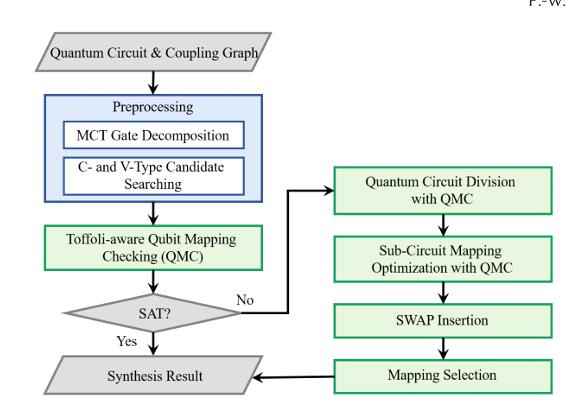
The analysis in the reference publication is expandedtoincludemulti-controlledToffoligates.These gatesmustbebrokendownintonetworksofToffoligates utilizing supplementary qubits because gates with more thantwocontrolscannotbedirectlyexecutedbypresent quantumhardware.Thereisdiscussionofbothcleanand dirtyancillamethods.Whilefilthyancilladecomposition lowersqubitutilizationatthecostofgreatercircuitdepth, clean ancilla decomposition minimizes gate count but demands more qubit resources. The overall cost and mapping flexibility are directly impacted by the breakdownapproachchosen.
The reference work formulates the mapping problemasaninstance of SatisfiabilityModuloTheories (SMT)tofindthebestqubitplacements.Thisformulation dynamically chooses between C-type and V-type decompositions, guarantees that logical qubits are
International Research Journal of Engineering and Technology (IRJET) e-ISSN: 2395-0056
Volume: 13 Issue: 03 | Mar 2026 www.irjet.net p-ISSN: 2395-0072
assigned to different physical qubits, and includes nearest-neighbour constraints. The SMT solver instantly detects a complete SWAP-free mapping solution if one exists. In the absence of this, the circuit is split up into maximallySWAP-freesub-circuits,andcostfunctionsthat take into consideration CNOT and SWAP overhead are usedtobuildoptimaltransitionsbetweensub-circuits.
During SWAP insertion, an improved gain function is added to avoid endless routing loops. Furthermore, the mapping configuration that minimizes the overall CNOT cost including both decomposition and routing overhead is chosen using a shortest-pathbased solution selection method. In comparison to previous two-stage methods, experimental results show significantruntimeimprovementsandareductioninthe numberofadditionalCNOTgates.
Althoughthereferenceworkisasignificantstep forwardin quantumlayout synthesis,itisstill limited to quantum hardware compilation. It discusses mapping efficiencyandlogicalgatetransformations,butitignores power optimization, CMOS transistor-level implementation,andthetraditionalhardwarerealization of reversible logic. As a result, it does not offer a foundationforimplementingreversiblequantumgatesin VLSI systems, despite lowering the overhead of logical gates for quantum processors. The necessity for an additional hardware-oriented strategy is driven by this constraint.
The proposed approach focuses on the classical VLSI realization of quantum logic primitives instead of mapping quantum hardware. The goal is to build synthesizable CMOS architectures that properly execute CNOT, Toffoli, and multi-controlled Toffoli operations whilemaintainingreversibilityandminimizinghardware complexity, rather than maximizing qubit placement undercouplinglimitations.
A target signal is conditionally inverted by the Controlled-NOT gate in response to a control input. The XORofthecontrolsignalandtheinitialtargetishowthe target output is represented in Boolean form. A static CMOSXORgatetopologycanbesimplytransferredtothis functionality. Full voltage swing, balanced propagation latency,andlessdynamicswitchingareallguaranteedby the optimized XOR implementation in the suggested architecture. Reversibility is naturally maintained by leavingthecontrolsignalsattheoutputunaltered.
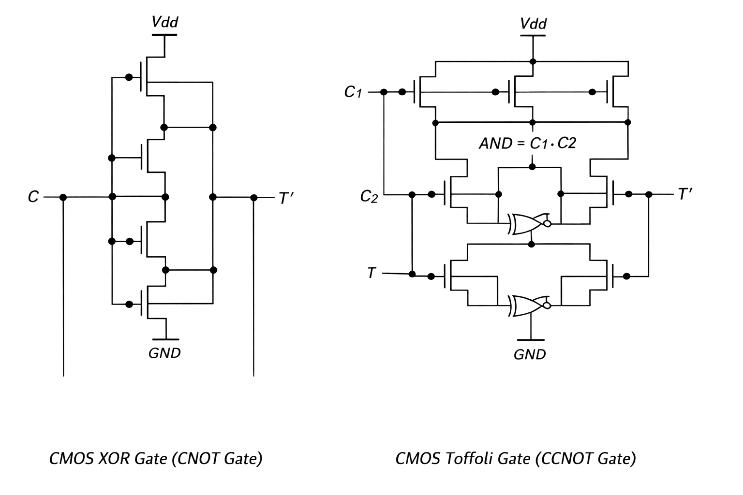
Byaddingasecondcontrolinput,theToffoligateexpands onthisfunction.ThelogicalANDoftwocontrolinputsand the XOR of the target input can be used to define its Booleanfunction.Atwo-stageAND–XORstructureisused inthesuggestedarchitecturetoprovidethisbehaviour.An XOR stage that conditionally flips the target is driven by theintermediatesignalthatisproducedafterthecontrol signals are initially merged using a low-fan-in AND gate. By using this structured decomposition, needless signal buffering is avoided and logic depth is reduced. The suggested mapping guarantees bijective transformation between input and output vectors, in contrast to irreversiblemethodsthatmightrecalculateintermediate signalsoreliminateinformation.
The architectureis extendedto multi-controlled Toffoligatesinordertoallowforscalability.Thecombined control condition for a gate with n control inputs is calculated using a hierarchical AND-tree structure. The tree is set up to avoid excessive propagation latency by limitingfan-inandbalancingdelayateachstage.OneXOR stagethatisconnectedtothetargetinputisdrivenbythe finalANDoutput.Verilogmodulesthatareparameterized are used to define the design, enabling synthesis for arbitrary control widths without requiring structural changes.
ThesuggestedworkpresentsareversibleDflipflop architecture in addition to combinational reversible logic. Reversibility is violated by conventional flip-flops, which by nature delete data during state transitions. Toffoli-based gating and regulated feedback are used in theproposedreversibleDflip-floptoguaranteethatstate transitions are still logically invertible. Building larger reversibleprocessorsandfault-tolerantcontrolcircuitsis madepossiblebythissequentialextension.
International Research Journal of Engineering and Technology (IRJET) e-ISSN: 2395-0056
Volume: 13 Issue: 03 | Mar 2026 www.irjet.net p-ISSN: 2395-0072
Multi-Control AND-Tree Delay Equation
Dynamic Power Equation
Reversible D Flip-Flop Equation
Synthesizable Verilog HDL is used to implement the entire architecture, and simulation is used for validation. While ASIC synthesis verifies viability using standard-cell libraries, FPGA synthesis shows compatibility with LUT-based mapping. Due mainly to controlled switching activity and structured AND–XOR mapping, area utilization and power consumption are lower than with traditional logic blocks implementing equivalentconditionalfunctionality.
The proposed technique targets physical hardware realization as opposed to current quantum layoutsynthesisframeworksthatreduceSWAPinsertion andCNOTcountatthelogicalabstractionlevel.Itbridges the gap between traditional VLSI design and quantum logic theory by translating reversible quantum gate behaviour into effective CMOS circuits. The resulting architecture serves as a basis for safe hardware implementations, quantum-inspired accelerators, and low-powerreversiblecomputingsystems.
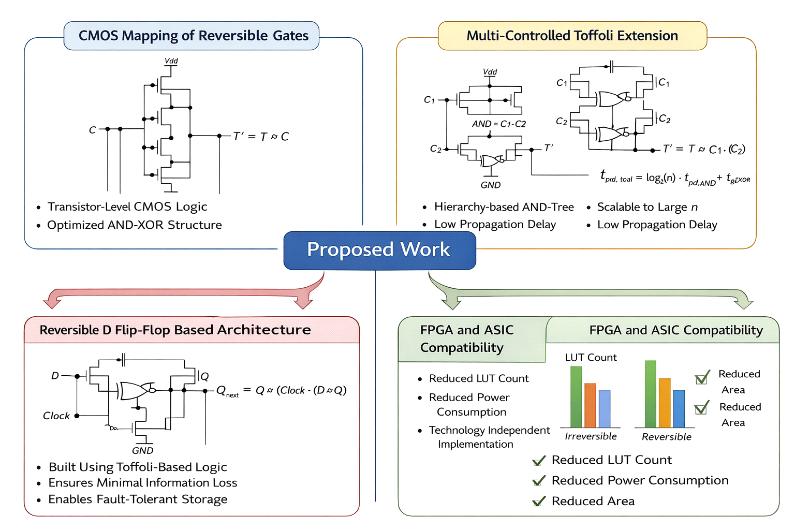
• Transistor level CMOS Realization of CNOT and Toffoli gates overall architecture of the proposed reversible VLSI framework including CMOS mapping, multi-controlled extension, reversible sequential design, andFPGA/ASICcompatibility.
• Thetransistor-levelimplementationofreversible gatesemployingoptimizedAND-XORCMOSarchitectures isshowninthefirstblock.Inthisstep,atwo-stageAND–XORcascadeisused toactualizethe Toffoli gate, while a static CMOS XOR network is used to achieve the basic CNOT operation. This mapping reduces the number of transistors and switching overhead while maintaining reversibility. This block allows synthesis in common
digital design flows by explicitly translating reversible Boolean behavior into physical CMOS pull-up and pulldown networks, in contrast to abstract quantum gate representations.
The architectureis extendedto multi-controlled Toffoli gates in the second block. The composite control conditioniscalculatedusingahierarchy-basedAND-tree structureratherthanhighfan-inlogic.Withregardtothe amount of control inputs, this structured decomposition lowers the propagation delay growth from linear to logarithmic.AfinalXORstagethatconditionallyupdates the target line is then driven by the calculated control signal. Without causing undue routing congestion, this modular architecture enables adjustable scalability and effective mapping onto FPGA lookup tables or ASIC standardcells.
A reversible D flip-flop architecture built with Toffoli-based logic primitives is presented in the third block. Traditional sequential elements violate reversibility restrictions because they naturally lose information during state transitions. The suggested reversible flip-flop uses controlled XOR operations poweredbyclockanddatainputstoselectivelyupdatethe output state while maintaining logical bijectivity. Deterministic backward computing and fault-tolerant storage techniques, which are necessary for hardware accelerators inspired by quantum mechanics, are supportedbythisframework.
Compatibility with realistic implementation is thefocusofthelastsubsystem.Thesuggesteddesigncan be immediately mapped onto FPGA devices using LUTbased synthesis or onto ASIC technologies utilizing standard-cell libraries because it is specified using synthesizable Verilog HDL. Compared to analogous irreversible implementations, the structured AND–XOR mapping improves area efficiency and lowers dynamic power consumption by reducing logic depth and switching activity. Furthermore, mobility across various fabrication nodes is guaranteed by the technologyindependentdesign.
The designs are developed in Xilinx Vivado tool for the hardware of choice is 28nm CMOS technology basedArtix-7FPGAboard(xc7z020clg484-1).Thesystem requirementsincludewindows10OS,4GBRAMinstalled withXilinxVivado2023.2.Thesimulationresultofexisting andproposeddesignsareshownfig.4.(a)&(b).
International Research Journal of Engineering and Technology (IRJET) e-ISSN: 2395-0056
Volume: 13 Issue: 03 | Mar 2026 www.irjet.net p-ISSN: 2395-0072
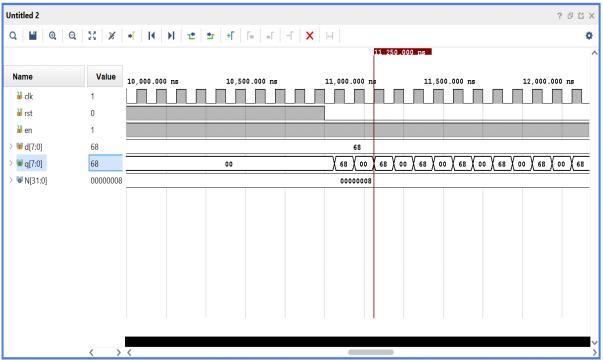
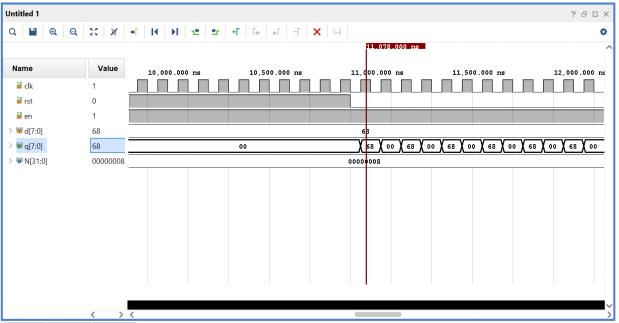
VerilogHDLwasusedtobuildthesuggestedVLSI implementation of CNOT and Toffoli-based reversible quantum circuits, which were then synthesized in Xilinx Vivado.Thesynthesistechnologyschematicconfirmsthat thereversiblequantumgatesareimplementedusingXOR and AND–XOR based CMOS logic structures. The multicontrolledToffolicircuituses28cells,19inputports,and 39 nets because of extra control signals, whereas the CNOTreversiblecircuitusesabout27cells,8inputports, and37nets.
LUTs,buffers,andflip-flopsareusedtoconstruct the internal reversible control module, which has nine cells,sixI/Oports,and fifteen nets.Thefindingsshow that the suggested design achieves effective hardware realizationwithminimalspaceoverhead,whichqualifies it for reversible VLSI designs and quantum circuit emulation.
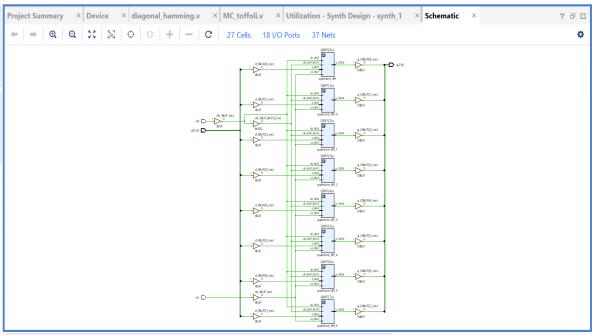
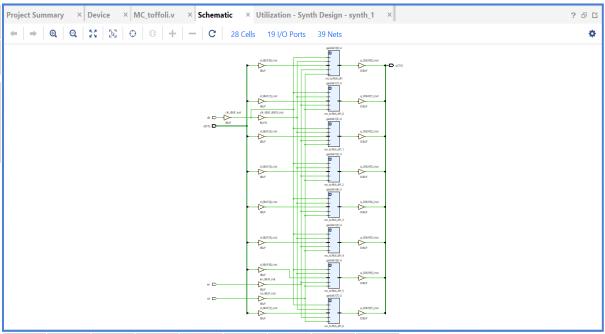
TechnologySchematicoftoffolireversible quantumcircuit
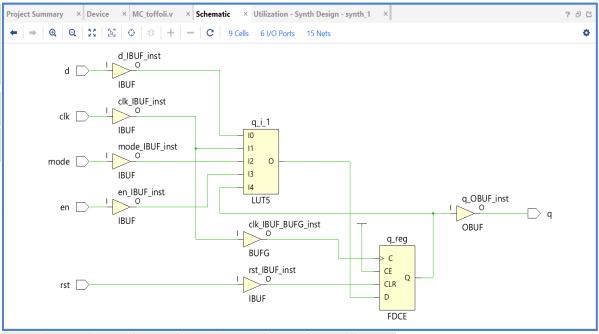
Fig 4:(c) TechnologySchematicoftoffolireversible quantumcircuitwith4controlsignals
International Research Journal of Engineering and Technology (IRJET) e-ISSN: 2395-0056
Volume: 13 Issue: 03 | Mar 2026 www.irjet.net p-ISSN: 2395-0072
inspiredapplications.Futureresearchcanconcentrateon refiningthearchitectureforASIC-basedquantumcontrol andfault-tolerantquantumcomputingsystems,aswellas constructing larger reversible circuits like registers, counters,andarithmeticunits.
7. References
1. PO-WEICHEN , SHENG-TANHUANG,SHAO-YUNFANG, LayoutSynthesisforQuantumCircuitsConsideringToffoli GateDecomposition,https://doi.org/10.1145/3744646.
2. Y.-M.JunandI.-C.Choi,"OptimalMulti-BitToffoliGate Synthesis," inIEEE Access, vol. 11, pp. 27342-27351, 2023,doi:10.1109/ACCESS.2023.3243798.
3. S. Yamashita, T. Horiyama, N. Yasuda and T. Nakao, "Realizing 4-input Functions with the Minimum Toffoli GateCount,"2025IEEE55thInternationalSymposiumon Multiple-Valued Logic (ISMVL), Montreal, QC, Canada, 2025, pp. 110-116, doi: 10.1109/ISMVL64713.2025.00030.
4. B.GaurandH.Thapliyal,"NovelOptimizedDesignsof Modulo 2n+1 Adder for Quantum Computing," inIEEE Transactions on Very Large-Scale Integration (VLSI) Systems, vol. 32, no. 9, pp. 1759-1763, Sept. 2024, doi: 10.1109/TVLSI.2024.3418930.
When compared to the current and MC Toffoli designs, the comparison results demonstrate that the suggestedMC4ToffolibasedreversibleDflip-flopgreatly increases power efficiency. The overall on-chip power is loweredfrom4.246Wto0.27W,indicating a significant decrease in switching and I/O power. Better timing performance is also indicated by the maximum setup delay,whichdropsto4.783ns.Thesefindingsverifythat the suggested architecture offers an effective low-power reversible logic implementation appropriate for VLSI systemswithquantuminspiration.
6. Conclusion
Inthispaper,reversiblequantumcircuitsbasedonCNOT and Toffoli were implemented in VLSI utilizing Verilog HDL and FPGA synthesis. Timing and power analyses were performed on the suggested multi-controlled Toffoli-based reversible D flip-flop. The findings demonstrate that the suggested design significantly reduces power consumption while preserving stable timingperformance,makingitappropriateforreversible computing and low-power quantum-
5. H.T.Larasati,D.S.C.Putranto,R.W.Wardhani,J.Park and H. Kim, "Depth Optimization of FLT-Based Quantum Inversion Circuit," inIEEE Access, vol. 11, pp. 5491054927,2023,doi:10.1109/ACCESS.2023.3280632.
6. M.A,G.V,J.A.RandK.A,"ModularAdderDesignbased on Reversible Toffoli CLA,"2023 7th International Conference on Computing Methodologies and Communication(ICCMC),Erode,India,2023,pp.513-517, doi:10.1109/ICCMC56507.2023.10084302.
7. S. Seyedi and H. Abdoli, "Optimized Design of Lower Complexity Reversible Toffoli Gate in QCA Technology,"2024 6th Iranian International Conference onMicroelectronics(IICM),Tabriz,Iran,IslamicRepublic of,2024,pp.1-5,doi:10.1109/IICM65053.2024.10824486.
8. S. Limet al., "Optimized Quantum Circuit ImplementationofPayoffFunction,"2023IFIP/IEEE31st InternationalConferenceonVeryLargeScaleIntegration (VLSI-SoC), Dubai, United Arab Emirates, 2023, pp. 1-6, doi:10.1109/VLSI-SoC57769.2023.10321843.
9. O.GolubitskyandD.Maslov,"AStudyofOptimal4-Bit Reversible Toffoli Circuits and Their Synthesis," inIEEE TransactionsonComputers,vol.61,no.9,pp.1341-1353, Sept.2012,doi:10.1109/TC.2011.144.
International Research Journal of Engineering and Technology (IRJET) e-ISSN: 2395-0056
Volume: 13 Issue: 03 | Mar 2026 www.irjet.net p-ISSN: 2395-0072
10.R.Maheswari,S.Shaistha,U.Sravani,V.MonikaandE. H.Shaik,"CSWAPOperator as2×1Multiplexer to Design CNOT and CCNOTGatesbasedCarrySelect Adder,"2021 InternationalConferenceonCommunication,Controland InformationSciences(ICCISc),Idukki,India,2021,pp.16,doi:10.1109/ICCISc52257.2021.9484889.
11.D. Kumar, B. Raj and G. Singh, "Analysis and Implementation of Quantum Logic Gates and Circuits,"2025 International Conference on Electronics, AIandComputing(EAIC),Jalandhar,India,2025,pp.1-6, doi:10.1109/EAIC66483.2025.11101348.
12.K. Seino and S. Yamashita, "An SMT-Solver-based SynthesisofNNA-CompliantQuantumCircuitsConsisting ofCNOT,HandTGates,"202328thAsiaandSouthPacific Design Automation Conference (ASP-DAC), Tokyo, Japan, 2023,pp.196-201.
13.W. -Y. Lai, H. Yang and Y. -T. Tang, "High-Fidelity and Noise-Resilient CNOT Gate Implementation Using Vertically Symmetric Fin-Based Architecture," inIEEE Electron Device Letters, vol. 47, no. 2, pp. 221-224, Feb. 2026,doi:10.1109/LED.2025.3648448.
14.D. Clarino, K. Seino, A. Matsuo and S. Yamashita, "UtilizingDon't-CarestoMinimizeCNOTsinSynthesizing NNA Compliant Quantum Circuits,"2024 IEEE International Conference on Quantum Computing and Engineering(QCE),Montreal,QC,Canada,2024,pp.500501,doi:10.1109/QCE60285.2024.10375.
15.J. Kim and D. Chung, "Secure Delegated Quantum ApproximateOptimizationAlgorithmwithQuantumOneTimePadforMAX-CUTProblem,"inIEEETransactionson Emerging Topics in Computing, doi: 10.1109/TETC.2025.3626768.
16.Q. Zheng, Y. Xu, J. Zhang, Z. Su and S. Zheng, "CNOT Oriented Synthesis for Small-Scale Boolean Functions Using Spatial Structures of Parallelotopes,"2025 IEEE/ACMInternational Conference OnComputerAided Design (ICCAD), Munich, Germany, 2025, pp. 1-9, doi: 10.1109/ICCAD66269.2025.11240690.
17.T.Rohe,D.Schuman,J.Nublein,L.Sunkel,J.Steinand C. Linnhoff-Popien, "The Questionable Influence of Entanglement in Quantum Optimisation Algorithms,"2024 IEEE International Conference on Quantum Computing and Engineering (QCE), Montreal, QC, Canada, 2024, pp. 1497-1503, doi: 10.1109/QCE60285.2024.00176.