
International Research Journal of Engineering and Technology (IRJET) e-ISSN:2395-0056
Volume: 12 Issue: 02 | Feb 2025 www.irjet.net p-ISSN:2395-0072
International Research Journal of Engineering and Technology (IRJET) e-ISSN:2395-0056
Volume: 12 Issue: 02 | Feb 2025 www.irjet.net p-ISSN:2395-0072
Naman Bishambhu1
1 B.Tech, Department of Environmental Engineering, Delhi Technological University, Delhi, India.
Abstract - Urban heat islands (UHIs), characterized by elevated temperatures in urban areas compared to rural surroundings, pose significant environmental challenges, especially in densely populated cities like Delhi. Some contributingfactorsincludeinfrastructurethatretainsheat, vehicular emissions, andlimitedvegetation. Simultaneously, theimproperdisposalofelectronicwaste(e-waste)worsens environmental degradation. This research explores the innovative use of e-waste to develop pollution-sensing drones that monitor environmental parameters and contribute to UHI mitigation strategies in Delhi. The drones can be constructed using components reused from e-waste, such as motors, sensors, microcontrollers, and communication modules. Equipped with advanced pollution sensors, these drones can detect particulate matter (PM2.5 and PM10), greenhouse gases (CO₂, CH₄), volatile organic compounds (VOCs), and other air pollutants. Thermal imaging capabilities assess urban heat zones, vegetation health, and the efficiency of cooling interventions like green roofs and reflective materials, further helping mitigate UHI. By identifying pollution and thermal hotspots, these drones can facilitate data-driven urban planning and targeted interventions to reduce heat absorption and pollution. This paper demonstrates the feasibility of recycling e-waste to address the two crises - urban heat and pollution. This approach offers scalable solutions by integrating e-waste management, real-time monitoring, and urban planning, contributing to effective UHI mitigation in Delhi. The findings can underscore the potential of pollution-sensing drones derived from e-waste as a cost-effective, eco-friendly toolforurbanresilience,especiallyincitieslikeDelhi,where rapidurbanizationworsenstheUHIeffect.
Key Words: E-Waste, Pollution-Sensing Drones, Urban Heat Islands (UHIs), Air Pollutants, Delhi
Urban Heat Islands (UHIs) are localized areas within urban environments that exhibit significantly higher temperatures compared to their rural surroundings. This phenomenon arises due to various factors such as heatretaining infrastructure, dense vehicular emissions and limited vegetation [1] [2] . Cities such as Delhi, which are undergoing rapid urbanization coupled with a dense population, are particularly susceptible to UHIs, exacerbating adverse effects on public health, energy consumption,andenvironmentalquality[3]
Atthesametime,theimproper managementofelectronic waste (e-waste) shows a growing environmental challenge.E-wastecontains valuablematerialslikemetals and plastics, which, if disposed improperly, release hazardous substances into the environment, contributing topollutionandresourcewastage.[4][5]
The global surge in e-waste generation has necessitated innovative approaches to its sustainable management [6].This research addresses these interconnected challenges by proposing a novel approach: the utilization of components recovered from e-waste to develop costeffective and eco-friendly pollution-sensing drones. These drones will be designed to monitor important environmental parameters, including air pollutants such as PM2.5, PM10, greenhouse gases (CO₂, CH₄, NOₓ), and volatile organic compounds (VOCs), as well as identify thermal hotspots through thermal imaging[7][8] . Such capabilities make drones a promising tool for understanding the spatial and temporal distribution of pollutants and heat anomalies that increases the UHI effect.
By using motors, sensors, microcontrollers, and communication modules recovered from e-waste, this research aims to demonstrate the feasibility of creating low-cost monitoring solutions. Also the data collected by thesedronescanserveasvaluableandimportantinputfor urban planners to implement targeted UHI mitigation strategies, such as increasing urban vegetation, incorporatingreflectivebuildingmaterials,andoptimizing citylayouts[9][10]
This study, while theoretical, highlights a scalable and sustainable approach to addressing urban environmental issues.Bybridging the gap between e-waste management and advanced monitoring technologies, this research offers a pathway to enhance urban resilience in rapidly expandingcitieslikeDelhi[11][12]
2.1. E-Waste Sourcing and Segregation
In a crowded and busy city like Delhi, e-waste is everywhere from old computers and smartphones gatheringdustinhomestopilesofdiscardedelectronicsin landfills. This study explores how these materials can be given a second life by reusing them for building drones.
International Research Journal of Engineering and Technology (IRJET) e-ISSN:2395-0056
Volume: 12 Issue: 02 | Feb 2025 www.irjet.net
The idea is simple-source e-waste from places like recyclingcenters,collection drives,orevenlargebinsand landfills.
Once collected, the focus shifts to identifying components that can be salvaged like motors, circuit boards, sensors, batteries, and microcontroller parts that can be extracted and transformed into essential building materials for drones.AshighlightedbyCucchiella[13]recyclingnotonly reduces the burden on landfills but also creates an opportunity to recover valuable resources in a costeffectiveway.
Then,thesecomponentsmustbesortedoutbasedontheir functionality and compatibility with the drone’s design and structure. This ensures that every piece, no matter how small or big it is, plays its part in creating a fully functional drone. It's about finding value in what’s been discarded and turning waste into something that helps us solve real-world problems, like pollution and urban heat islands,whichDelhistruggleswithdaily.
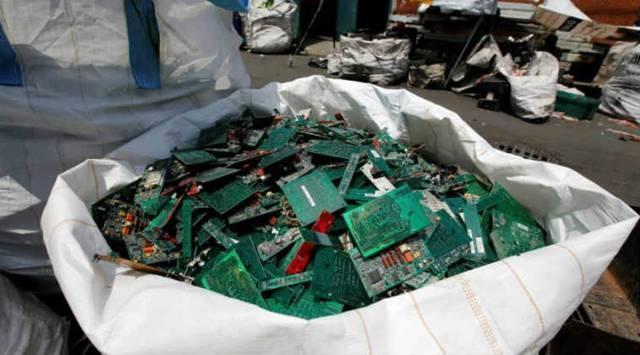
Figure 1 -shows e-waste collection in East Delhi. (Sourceindianexpress)[Ewastecollection,Delhi,indianexpress
This conceptual stage involves designing the drone’s frameworkandintegratingthecomponentssalvagedfrom e-waste.
● Frame Design: Lightweightmaterialslikerepurposed aluminum and plastic from e-waste can be proposed forconstructingtheframe.
● Component Integration: Theoretical integration of motors, sensors (air quality, thermal imaging), microcontrollers, and communication modules into thedronedesign.
● Power Supply: Recycled batteries from e-waste may serveastheprimaryenergysourceforthedrone.
p-ISSN:2395-0072
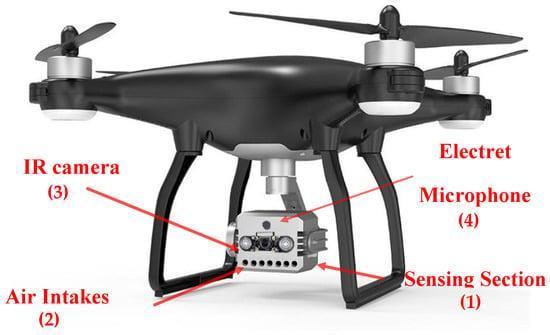
[ASensor-BasedDroneforPollutantsDetection... Roberto De Fazio, Leonardo Matteo Dinoi, Massimo De Vittorio PaoloVisconti] [14]
In the above Figure 2, the lower end of the drone is used to host a Sensing Section. That section incorporates advanced sensors that are sensitive to particulate pollutants,includingPM2.5,CO₂,NOₓ,CH₄,andSOₓ.These sensors can be used to produce maps of the spatial distribution of pollution alongside the mobility of drones. Air Intakes (2) play a very important role in sampling ambientairduringtheflight.Thus,atdifferentheightsand zones of interest such as industrial, traffic-dense areas, and residential societies, the pollutant levels are being recorded accurately. The IR Camera (3) further adds functionality for thermal imaging for heat mapping, directlyrelatedwiththeeffectsofUrbanHeatIsland(UHI) [15]. The IR camera can capture temperature variations across zones and identify hotspots worsened by pollution and heat retention in materials like asphalt and concrete. Moreover, the integration of sensors into drones to monitorUHIsandanalyzetemperaturepatternsisbuilton the research by Santamouris [16] This ensures that the dronedesignnotonlycancapturepollutionlevelsbutalso contributes to a more comprehensive understanding of urban environmental challenges. Also, the Electret Microphone (4) helps to monitor noise pollution, which oftencoincideswithvehiculardensityandindustrialzones that are key contributors to overall environmental degradationespeciallyinDelhi.
2.3. Calibration of Sensors
To ensure the drones give accurate and reliable data, it’s very important to properly set up and maintain their sensors. These drones use a variety of sensors, like air quality sensors to measure air pollutants like PM2.5 and PM10,gassensorstodetectharmfulgasessuchasCO,SOx, and NOx, and thermal sensors to identify heat-retention
International Research Journal of Engineering and Technology (IRJET) e-ISSN:2395-0056
Volume: 12 Issue: 02 | Feb 2025 www.irjet.net p-ISSN:2395-0072
areasinurbanland.Eachsensorplaysanimportantrolein painting a complete picture of environmental challenges likepollutionandurbanheat.
Calibration is the process of fine-tuning these sensors so they give precise readings. For example, in Delhi’s winter months,pollution(especiallyair)increasesduetostubble burning in Punjab which causes smoke to travel in Delhi through air pressure and weather conditions like smog. If the air quality sensors on drones aren’t calibrated correctly, they might underestimate or overestimate pollutant levels, leading to poor decision-making. Similarly, thermal sensors used to map and identify heatstressed zones in cities need to be regularly adjusted, especiallyinextremeweather.GuttikundaandGurjar[17] highlighted the critical role of accurate data in understanding urban air pollution dynamics, particularly in cities like Delhi, where complex air pollution sources such as stubble burning and vehicular emissions interact. A real-world example can be seen in cities like Los Angeles, where drones equipped with gas sensors have been used to detect methane leaks. The success of such projects shows the importance of well-calibrated sensors thatdeliveractionable,real-timedata.
Toevaluatethepotentialperformanceofthedronedesign, theoretical simulations could be conducted in virtual or controlledenvironments.
Data Collection: Proposemethodsforthedronetogather dataonairpollutionlevels&thermalimaging.
Simulation Setup: Hypothetical creation of a small-scale urban layout with heat sources, vegetation patches, and pollutionemitters.
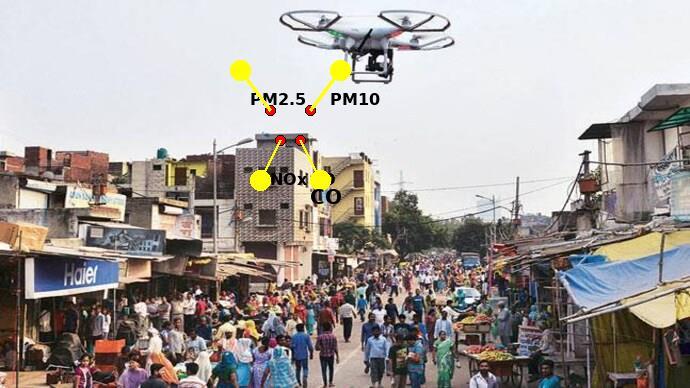
The above Figure3depictsaviewofthedeployment ofpollution-sensing droneswhoseobjective is tomonitor andanalyzeatmospheric pollutants,whichincludecarbon
monoxide (CO),particulate matter 2.5 (PM 2.5), particulate matter 10(PM 10) nitrogen oxides (NOₓ), etc byusingthermalandgassensors.InthecontextofDelhi-a cityfacingsevere air pollutionduetovehicular emissions, industrial activities, and seasonalimpactslike stubble burning,this simulationisavery important method forobtainingdatathatcouldbeusedbypolicymakersand environmentalengineerstocombatUHIseffectinDelhi.
Drones with gas detection sensors and infrared imaging sensors in this controlled testing environment are able to fly at varied altitudes over the key hotspots, such as industrial areas (Narela, Bawana), congested roads (Ring Road, Anand Vihar), and even residential neighborhoods. These drones can produce spatial heat maps showing the pollutant distribution, which can be then visually represented, to pinpoint local sources of pollution. For example, high levels of NOₓ and CO₂ in highly trafficked areas/regions or industrial centers may indicate significant emissions, and therefore, policymakers can target their interventions at traffic management or emission reduction. Studies, such as those by Li and BouZeid[18],showstheimportanceofleveragingsuchdatato understandurbanmicroclimatesandheatretention,while we also see the role of drones in providing real-time localized insights for urban environmental management [19]
When looking at the costs involved in this project, it’s importanttobreakthingsdownstepbystep.First,wecan think about the expenses to collect e-waste, building the drone,andaddingthenecessarysensors.Whilethisisjust a hypothetical scenario,thesefiguresgivea senseofwhat similareffortsmightrequireintherealworld.Addressing UHI through targeted methods like green infrastructure andsustainableurbanplanningisimportantforimproving thecomfortandenvironmentalhealthofcities.[20]
On the sustainability side, we can look at measurable impacts, like the percentage of recycled materials used in the drone and how much e-waste is being diverted from landfills in Delhi. Additionally, there’s the potential environmental benefit i.e. reducing the Urban Heat Island (UHI) effect and air pollution in a way that directly impactsurbanlivingconditions.
This section delves into the theoretical outcomes derived from the proposed methodology for designing pollutionsensing drones using e-waste. These outcomes provide insights into the effectiveness of the approach in addressing urban environmental challenges like air pollutionandurbanheatislands(UHIs).
International Research Journal of Engineering and Technology (IRJET) e-ISSN:2395-0056
Volume: 12 Issue: 02 | Feb 2025 www.irjet.net p-ISSN:2395-0072
The theoretical deployment of drones equipped with air quality sensors could provide granular data on pollutant concentrations (e.g., PM2.5, PM10, CO₂, CH₄, VOCs) across different areas of a city like Delhi. This data can help identify high-risk zones with poor air quality and sources ofpollution.
Figure 4 – Bar graph of PM2.5 pollutant conc. In Delhi
for measureslike better trafficcontrol,dust management, andcreatingmoregreenspaces.
Thesedronescouldalsohelpusunderstandhowpollution behavesacrossdifferentpartsofthecitybycapturingdata atdifferentaltitudes,providingamorecompletepictureof the air we breathe. By giving policymakers this kind of actionable, real-time data, pollution-sensing drones could play a key role in tackling Delhi’s air quality crisis and improvingthelivesofitsresidents.
Figure 4- A bar graph comparing PM2.5 pollutants in differentzonesofDelhi
(DataderivedfromAccuWeatheronDecember2024)
A key example is the bar graph (Data derived from AccuWeather on December 2024) [Figure 4] PM2.5 pollutant concentrations across various zones of Delhi reveals critical insights into air quality disparities in the region.The PM 2.5 concentration bar graph highlightsa concerning reality for Delhi- air pollution levels remain criticallyhighacrossallzones.WithPM2.5valuesranging from 170 µg/m³ in North Shahdara to a staggering 214 µg/m³ in Karol Bagh, every part of the city far exceeds safe air quality limits. Areas like Karol Bagh, Central Zone,and Keshav Puram standoutassomeof the worst affected,reflectingtheimpactofheavytraffic,construction dust, and industrial emissions. This is where pollutionsensing drones could make a real difference. Equipped with air quality sensors derived from e-waste, these drones can fly across Delhi’s zones and measure PM 2.5 concentrations in real time. Unlike static monitoring systems, drones can cover a wider area quickly and identify pollution hotspots that are often missed, such as congested roads, construction sites, and industrial pockets.Thedatacollectedbythesedronescanbeturned into pollution heat maps, offering a clear, visual representation of which areas need urgent attention. For example, zones like Karol Bagh and West Zone where pollutionlevelsareconsistentlyhigh couldbeprioritized
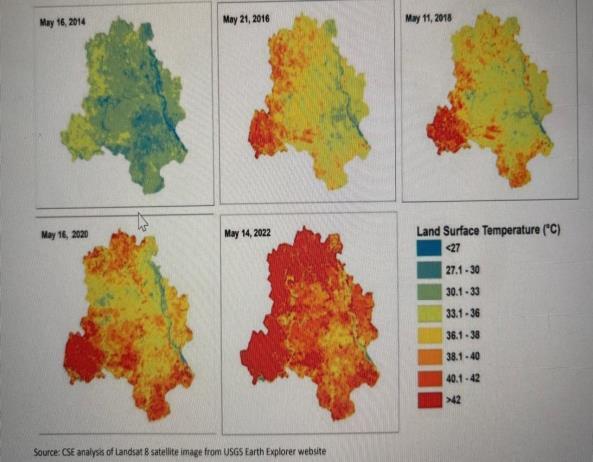
The integration of thermal imaging sensorswithinthe proposed pollution-sensing drones,aims at supporting comprehensive hotspot temperature exploration in cities, whichcanthenaidinadequate urban heat islandanalysis. The designed drones can recognize and map high- land, surface temperature regions, givinguseful information for planners on interventions such as enhanced greenery or reflective materials to mitigate heat stress.A strong evidenceforthegrowth ofUHIis provided in land surface temperaturemapsofDelhifromthe years 2014 to2022 (Figure 5). These are obtained from the Centre of EnvironmentSciences,whichexhibit the growingstrength of UHIsovertime along with increasingsize and area of hot zones.Such data underlines theneed todevelop real-time monitoring systems such as pollution-sensing drones which complement existing research and drive mitigation measures. LST Progression in Delhi 2014–2022: Graphical representationofUHIintensification Source: CSEurbanheat stressDelhi
[Figure5]-Urbanheatstressoveraperiodof5years
International Research Journal of Engineering and Technology (IRJET) e-ISSN:2395-0056
Volume: 12 Issue: 02 | Feb 2025 www.irjet.net p-ISSN:2395-0072
The proposed methodology is feasible and scalable. The method applied here uses parts from electronic wastes, hence addressing financial constraints while advancing environmental sustainability. Drones made of recycled materials offer inexpensive yet functional means of intensive environmental monitoring, especially about the Delhicase.Applicationsoflow-costdronesalreadyexistin developing countries, like India and Kenya, where air quality measurement in informal settlements is observed, which proves the functionality of drone designs based on e-waste.
This further means that the scalability of drone systems can cut across cities with different monitoring needs.The adaptability of e-waste components will ensure that the system is specialized to collect environmental and meteorological data for certain urban heat zones. Some examples are the drones that monitor UHI patterns in cities like Tokyo in Japan have shown how local temperature data can be used to inform mitigation strategieslikeurbangreeningandreflectivesurfaces.
3.3.
Thisresearchcanchangethemannerinwhichwepractice urban management and can also improve environmental conservationpractices.Forexample,informationgathered by these drones could help urban planners determine regions with the highest pollution levels and heat. After that,theycandesignvariousstrategiessuchasincreasing thecoverageoftreecanopyorreducingvehiculartrafficat specific locations or adopting green roofing systems to reduce temperatures. Cities like New York have already used similar ideas and started to cut down the heat in theirurbanareasbyfocusingongreenprojects.
Thedronescanalsohelpinmakingbetterlawsandrules. Since the data they provide is real-time and specific to eachlocation,itcanguidepolicymakerstodesignsmarter rulesfordifferentzones.Forexample,ifadroneindicates elevated pollution levels in a specific location, traffic restrictions or more strict pollution regulations may be implementedpreciselywheretheyaremostrequired.This type of strategy can enhance the effectiveness of urban managementpractices.
3.4. Challenges and Limitations
Incorporation of components from electronic waste into pollution sensing drone systems is filled with many challenges,particularlyregardingthecompatibilityofsuch components. For example, electronic waste recovered fromobsoletedevicesoftenhasvariablequality,whichcan lead to failure during operation. Another instance is that dronesmaybedeployedinthepollutionhotspotsofDelhi inwhichPM2.5andPM10,andharmfulgaseslikeSO₂and
NO₂,increasethedegradationof recoveredmaterial.Also, the issue of precision of sensors has been observed since environmental monitoring is heavily reliant on fine calibration. Various Studies in Delhi have also shown that repeated temperature fluctuations and high humidity levelscanalsodistortsensorreadingswhichresultindata that is not reliable. Moreover, this research is still largely theoretical, and it needs pilot tests to establish the feasibilityandpracticalityofsuchsystemsinreallife.One example is the thick urban texture and high electromagnetic interference in the industrial zones of Delhiwouldmakeitevenmorechallengingtodeploysuch dronesinpractice.
3.5.
Thisproposed approach in my opinionholds ahugepotentialforinnovation, which can open up vastdevelopmentopportunitiesin urban environmental managementsectorsofcityandeventuallythecountry.
ImaginethebusystreetsofDelhiandindustrial areas of the city that are filled with AI-powered drones, sensing pollution metrics, and even making predictions. These smart drones might be able to help the administration prepare and solve issues even before they even escalate, likereducingdipsinairqualityduringthe smoggywinter season, managing heat stress in the most populous areas or developing tactics to control air pollution during Diwali Finally, why stop at Delhi? We can extend this concept toother cities like Mumbai or Bengaluru, and the difference could be transformational. Each city has its own challenges- from the coastal humidity of Mumbai to thetech-driven sprawl of Bengaluru. Testing these drones in all these cities will help develop the technology enough to make it versatile for use in cities around the world, building a future where urban life and environmental health can go hand in hand.
Thedatasupportingthefindingsofthisstudyareavailable upon request from the corresponding author, subject to reasonablerequests.
[1] RIZWANAhmed Memon ,DENNISLeung Y.C., LIUChunho (2008) A review on the generation, determination and mitigation of Urban Heat Island, Journal of Environmental Sciences 20(1):120-128 https://doi.org/10.1016/S1001-0742(08)60019-4
[2] Patrick E. Phelan ,Kamil Kaloush ,Mark Miner,Jay Golden,Bernadette Phelan,Humberto Silva III,andRobert A. Taylor 2015 Urban Heat Island: Mechanisms,
International Research Journal of Engineering and Technology (IRJET) e-ISSN:2395-0056
Volume: 12 Issue: 02 | Feb 2025 www.irjet.net p-ISSN:2395-0072
Implications, and Possible Remedies 40:285–307 https://doi.org/10.1146/annurev-environ-102014021155
[3] RichaSharma,P.K.Joshi (2014) Identifying seasonal heat islands in urban settings of Delhi (India) using remotely sensed data– An anomaly based approach, The Egyptian Journal of Remote Sensing and Space Science, 17(1):111-117. https://doi.org/10.1016/j.uclim.2014.05.003
[4] Brett H.Robinson (2009), E-waste: An assessment of global production and environmental impacts Science of the Total Environment, 408(2): 183-191. https://doi.org/10.1016/j.scitotenv.2009.09.044
[5] KristenGrantMIPH,Fiona CGoldizenBA,ProfPeter DSlyMD, NoelBruneMSc, Maria Neira MD,ProfMartinvan den BergPhD,Rosana ENormanPhD (2013) Health consequences of exposure to e-waste: a systematic review The Lancet Global Health, 1(6): e350e361.https://doi.org/10.1016/S2214-109X(13)70101-3
[6] Forti, Vanessa, Balde, Cornelis P., Kuehr, Ruediger and Bel, Garam,The Global E-waste Monitor (2020): Quantities, flows and the circular economy potential, United Nations University/United Nations Institute for Training and Research, Bonn/Geneva/Rotterdam. https://ewastemonitor.info/wpcontent/uploads/2020/11/GEM_2020_def_july1_low.pdf
[7] Justyna Jońca, Marcin Pawnuk, Yaroslav Bezyk, Adalbert Arsen and Izabela Sówka (2022) Drone-Assisted Monitoring of Atmospheric Pollution A Comprehensive Review, International Journal of Mechanical and Production Engineering Research and Development, 9(2):527-536.https://doi.org/10.3390/su141811516
[8] Ommaso Francesco Villa, Farhad Salimi, Kye Morton, Lidia Morawskaand Felipe Gonzalez (2016) Development and Validation of a UAV Based System for Air Pollution Measurements, Sensors, 16(12): 2202. https://doi.org/10.3390/s16122202
[9] PrashantKumar, BoulentImam (2013) Footprints of air pollution and changing environment on the sustainability of built infrastructure, Science of the Total Environment, 444, 85-101. https://doi.org/10.1016/j.scitotenv.2012.11.056
[10] M.Santamouris (2014) Cooling the cities – A review ofreflectiveandgreenroofmitigationtechnologiestofight heat island and improve comfort in urban environments, Solar Energy, 103, 682-703. https://doi.org/10.1016/j.solener.2012.07.003
[11] SteffenLehmann (2014) Low carbon districts: Mitigating the urban heat island with green roof
2025, IRJET | Impact Factor value: 8.315 |
infrastructure, City, Culture and Society, 4(1):1-8. https://doi.org/10.1016/j.ccs.2014.02.002
[12] PeeranartKiddee,RaviNaidu,Ming H.Wong(2013) Electronic waste management approaches: An overview , Waste Management, 33(5):1237-1250. https://doi.org/10.1016/j.wasman.2013.01.006
[13]Cucchiella,F.,D’Adamo,I.,LennyKoh,S.C.,&Rosa,P. (2015). Recycling of WEEEs: An economic assessment of present and future e-waste streams. Renewable and Sustainable Energy Reviews, 51: 263-272. https://doi.org/10.1016/j.rser.2015.06.010
[14] Roberto De Fazio, Leonardo Matteo Dinoi, Massimo De Vittorio and Paolo Visconti (2021) A Sensor-Based Drone for Pollutants Detection in Eco-Friendly Cities: Hardware Design and Data Analysis Application, Electronics 2022, 11(1):52. https://doi.org/10.3390/electronics11010052
[15] Voogt, J. A., & Oke, T. R. (2003). Thermal remote sensingofurbanclimates.RemoteSensingofEnvironment, 86(3): 370-384. https://doi.org/10.1016/S00344257(03)00079-8
[16] Santamouris, M. (2015). Analyzing the heat island magnitude and characteristics in one hundred Asian and Australian cities and regions. Science of the Total Environment, 512-513, 582-598. https://doi.org/10.1016/j.scitotenv.2015.01.060
[17] Guttikunda, S. K., & Gurjar, B. R. (2012). Role of meteorology in seasonality of air pollution in megacity Delhi, India. Environmental Monitoring and Assessment, 184(5): 3199-3211. https://doi.org/10.1007/s10661011-2182-8
[18]Li, D., & Bou-Zeid, E. (2013). Synergistic interactions betweenurbanheatislandsandheatwaves:Theimpactin citiesislargerthanthesumofitsparts.JournalofApplied Meteorology and Climatology, 52(9): 2051–2064 https://doi.org/10.1175/JAMC-D-13-02.1
[19] Norhan Bayomi, John Fernández (2023) Eyes in The Sky: Drones Applications in the Built Environment under Climate Change Challenges,7(10):637. https://doi.org/10.3390/drones7100637
[20]Oke,T.R.(1982). Theenergeticbasisoftheurbanheat island. Quarterly Journal of the Royal Meteorological Society, 108(455):1-24. https://doi.org/10.1002/qj.49710845502