
International Research Journal of Engineering and Technology (IRJET) e-ISSN: 2395-0056
Volume: 13 Issue: 05 | May 2026 www.irjet.net p-ISSN: 2395-0072

International Research Journal of Engineering and Technology (IRJET) e-ISSN: 2395-0056
Volume: 13 Issue: 05 | May 2026 www.irjet.net p-ISSN: 2395-0072
Vaishali D. Jaysingpure1, Dr. Preeti Gajghate2, Shruti Bodele 3, Supriya Bhagat 4, Pratiksha Yadav5, Kalyani Ghemad 6
1,2Assistant Professor, Dept. of Civil Engineering, JSPM’s Rajarshi Shahu College of Engineering, Tathawade-411033, Pune, Maharashtra, India. 3,4,5,6Final Year Students, Dept. of Civil Engineering, JSPM’s Rajarshi Shahu College of Engineering, Tathawade-411033, Pune, Maharashtra, India. ***
Abstract -Domestic Wastewater Contains Suspended Solids, Dissolved Impurities, And Harmful Microorganisms. These Pose Significant Environmental And Public Health Risks, In Developing Regions With Limited Treatment Options. Traditional Methods Often Rely On Chemical Coagulants Like Alum Which Can Be Expensive And May Lead To Secondary Pollution And Sludge Disposal Issues. So There Is A Need For An Economical And Environmentally Friendly Alternative. This Study Examines The Effectiveness Of Moringa Oleifera Seed Powder As A Coagulant For Treating Domestic Wastewater. In This Investigation Mature Moringa Oleifera Seeds Were Collected, Cleaned, Dried, And Ground Into Powder. The Coagulant Was Applied To Wastewater Samples At Dosages Using A Jar Test Method Under Controlled Laboratory Conditions. Key Parameters LikePh,Turbidity,TotalDissolvedSolids,TotalSuspended Solids, Hardness, And Alkalinity Were Analyzed Before. After Treatment Using Standard Methods. The Results IndicatedThatMoringaOleiferaSeedPowderSignificantly Improved Water Quality. There Was A Reduction In Turbidity And Suspended Solids Demonstrating Effective Coagulation And Flocculation. Also Decreases In Total DissolvedSolids,Hardness,AndAlkalinityWereObserved, Reflecting The Removal Of Dissolved And Colloidal Impurities. The Ph Of Treated Water Approached Neutral Levels,MakingItSafeForDischarge.TreatmentEfficiency Depended On Coagulant Dosage With Performance At Specific Concentrations. Overall Moringa Oleifera Seed Powder Serves As A Cost-Eco-Friendly And Sustainable Option For Wastewater Treatment In Resource-Limited Areas.
Key Words: Coagulation, Moringa Oleifera Sustainable Treatment, Turbidity, Wastewater Treatment
DomesticWastewaterContainsALotOfSuspendedSolids DissolvedContaminants,AndPathogenicMicroorganisms, WhichPoseSeriousRisksToEnvironmentalSustainability And Public Health. This Problem Is Critical In Developing
Regions Where Advanced Wastewater Treatment Infrastructure Is Lacking. Traditional Wastewater Treatment Processes Often Use Chemical Coagulants Like Alum.TheirContinuousUseComesWithHighOperational Costs, Large Sludge Generation And Potential Secondary Environmental Contamination. Therefore There Is An Increasing Need For Cost-Effective, Sustainable. EcoFriendly Alternatives To Conventional Chemical Coagulants. This Study Investigates The Coagulation Efficiency Of Moringa Oleifera Seed Powder As A Coagulant, For Domestic Wastewater Treatment Aiming To Improve Water Quality While Minimizing EnvironmentalImpact.WaterContaminationIsaProblem For Our Environment. This Is Because Of The Growth Of Industries,CitiesAndFarms.DomesticSewage,WasteAnd Farm Runoff Are Putting Bad Things Like Organic Matter, HeavyMetals,DyesAndPathogensIntoOurWaterBodies. This Is Making The Water Quality Bad And Threatening The Ecosystems And Our Health. This Problem Is Very Severe In Developing Countries. They Do Not Have The Infrastructure And The Cost Of Treatment Is Very High. Chemical Coagulants Like Aluminum Sulfate And Ferric ChlorideAre CommonlyUsed..TheyHave SomeProblems Like Making Sludge, Metal Toxicity, Corrosion And Health Risks. These Problems Have Made Us Look For More Sustainable Alternatives. Recently People Have Started Looking At Plant-Based Coagulants. They Are Biodegradable, Renewable And Good For The Environment. Moringa Oleifera And Moringa Stenopetala Seeds Have Water- Cationic Proteins And Bioactive Compounds. They Help In Removing Impurities By NeutralizingChargedParticlesAndMakingFlocFormation Easier. Studies Have Shown That Moringa Seed Powder Can Remove 85–99% Of Turbidity And Cut Down Suspended Solids And Heavy Metals In Wastewater. The Process WorksBestAta Range Of 5To8.NaturallyDried Seeds Gave The Results With Up To 95% Turbidity Removal.
This Study Aims To Reduce Turbidity In Wastewater Collected From The Canteen Of Rscoe Using a Coagulant Made From Moringa Seeds. Matured Moringa Oleifera
International Research Journal of Engineering and Technology (IRJET) e-ISSN: 2395-0056
Volume: 13 Issue: 05 | May 2026 www.irjet.net p-ISSN: 2395-0072
Seeds Were Collected And Processed To Create a Fine Powdered Coagulant. The Prepared Natural Coagulant Was Then Applied To Wastewater Samples In Varying Dosages. Treatment Efficiency Was Assessed By Measuring Physicochemical Characteristics Of The Wastewater. Parameters Such As Ph, Turbidity, Total Suspended Solids Were Determined Before. After The CoagulationProcess.
Toanalyzethewastewatersampleforvariousparameters To treat the collected waste water sample with experimental setup.Comparative study through detail analysisofthebeforeandafterresult.
Moringa oleifera seeds were used in thisstudy. Theseeds were. Dried. Then they were turned into powder. This powder was used to clean wastewater. We used equipment like a pH meter and a turbidity meter. We did tests to see how well the Moringa oleifera seed powder worked.
3.1 RAW MATERIAL USED :
Moringaoleiferaseedswerethemainmaterialusedinthis study.
In this study we collected wastewater samples from the college food court and domestic sources to try out a method for treating wastewater. We looked at types of wastewater including domestic wastewater, river water andcommercialwastewaterfromthefoodcourt.Basedon what we saw at first and the characteristics of the contamination we chose to focus on treating wastewater fromthefoodcourt.
Seed preparation:
To prepare the Moringa oleifera seeds we first collected the seeds. Removed their outer shells. Then we dried the seedsproperlytogetridofanymoisture.Afterdrying we groundtheseedsintoapowderusingagrinder.Wesieved thepowdertoremoveanyparticlesandgetauniformsize. Finallywestoredtheseedpowderinanairtightcontainer touselaterinthecleaningprocess.
For the analysis of wastewater samples, the following tests were conducted using standard laboratory equipmentrefertable3.1:
Table3.1 listofEquipmentUsedforWastewater TreatmentandWaterQualityAnalysis.
Sr. no Name of theTest Equipment Purpose
1. pHTest pHMeter To measure the acidity or alkalinity (pH value) of the wastewater samples before and aftertreatment.
2. Turbidity Test Turbidity Meter Todeterminetheturbiditylevel of the wastewater and evaluate the removal efficiency of suspendedparticles.
3. Coagulation –Flocculation Test Jar Test Apparatus To perform coagulation and flocculation experiments using Moringa oleifera seed powder under controlled mixing conditions.
4. Drying Process HotAirOven Toconductingtotalsolidtest.
5. Weight Measureme nt Digital Weighing Machine To accurately measure the required dosage of Moringa oleifera seed powder and other materials used in the experiments.
In this study we treated wastewater using Moringa oleifera seed powder as a natural cleaner. We did experiments to see how well the treatment reduced parameters like turbidity, pH and total solids. The treatment process involved coagulation and flocculation which we did using the jar test method under controlled laboratory conditions. After mixing and settling we analyzed the treated samples to see how much the water quality improved and how well Moringa oleifera seed powderworkedasaneco-cost-effectivecleaner.
For the analysis of wastewater samples, the following laboratorytestswereconducteditisdiscussedindetailin thefollowingsections.
3.4
To analyze the wastewater samples we did the following tests:
3.4.1 pH
InthisanalysisadigitalpHmetertoseehowwellMoringa oleifera seed powderstabilized the pH of the wastewater. took500millilitersofwastewater.MeasureditsinitialPH.
International Research
Volume: 13 Issue: 05 | May 2026 www.irjet.net p-ISSN: 2395-0072
ThenweaddeddifferentamountsofMoringaseedpowder andmixeditwell.AftersettlingwemeasuredthepHagain. Recordedthefinalvalues.TheinitialpHofthewastewater was 10.13, which's very alkaline. After adding Moringa oleifera seed powder the pH gradually moved towards neutral. The best result was at 0.40 grams of powder wherethepHreached7.17.ThisshowsthatMoringaseed powdereffectivelystabilizedthepHofthewastewater.
3.3.2
In this analysis, the turbidity test was conducted using a Turbidity Meter to evaluate the removal of efficiency of suspendedparticles.
We did a turbidity test using a turbidity meter to see howwell thetreatment removed suspended particles. We measuredtheturbidityofthewastewaterandthenadded different amounts of Moringa seed powder. After mixing and settling we measured the turbidity again. Calculated the removal efficiency. The initial turbidity was 5 NTU. After treatment it reduced to 1.1 NTU, which is an 86.6% removal.Thebestresultwasat0.40gramsofpowder.
3.3.3
In this analysis, the Coagulation–Flocculation Test was conducted using a Jar Test Apparatus to evaluate the removal of efficiency of suspended particles. A coagulation-flocculation test was conducted using a jar test apparatus to see how well the treatment removed suspended particles. Wetook wastewatersamples.Added requiredamountsofMoringa seedpowder.Wemixedthe samples rapidly. Then slowly and after settling we observedflocformation.
3.3.4 Total Solid test-
Inthisanalysis,theTotalsolidTestwasconductedusinga oven to evaluate the removal of efficiency of suspended particles. Took the wastewater sample and evaporated it to dryness. The sample was then dried completely to remove moisture. The remaining residue indicated the totalsolidspresentinthewastewater.
The total solids (TS) of the water sample were determined with an initial dish weight of 34.25 mg and a samplevolumeof500ml.Afterevaporation,theincreasein weightwasusedtocalculateTSvalues,whichrangedfrom 200mg/Lto800mg/L.Itwasobservedthatthetotalsolids increasedwithanincreaseinthefinalweightoftheresidue. TheaverageTSvaluewasfoundtobe500mg/L,indicating a moderate presence ofdissolved andsuspendedsolids in thewatersample.
The results were analyzedtoevaluatethe effectiveness of Moringa oleifera seed powder in wastewater treatment. Parameters such as pH, turbidity, jar test performance,
and total solids showed significant improvement after treatment.ThefindingsconfirmthatMoringa seedsactas an effective natural coagulant for improving water quality.The results of the experiments are shown in the followingsections.
4.1 PH Test-
Balancing Water pH Using Natural Moringa Seeds
Checking how the seeds help turn alkaline water into neutral water which is shown below The results of the experimentsreshowninthefollowingsections.
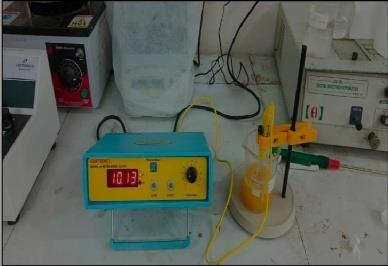


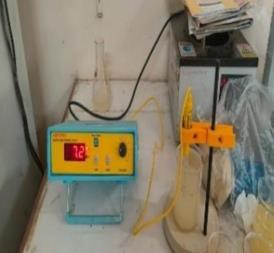
ThewastewatersamplesweretestedtocheckwhatthepH levels were at the initial and final stages. We used a pH metertodothis testtheresultsinFig4.1.1and4.1.2 The wastewatersamplethatwasnottreatedhadapHof10.13 whichmeansitwasveryalkaline.AfterweaddedMoringa oleiferaseedpowdertoitthepHlevelreducedto7.2.This shows that using Moringa oleifera seed powder helped to reducethealkalinityofthewastewaterandmadeitcloser toneutral.
• The volume of the water sample we used was 500 ml, which'sthesameas0.5L.
• The coagulant we used was Moringa oleifera seed powder.
Using Moringa oleifera seed powder as a coagulant worked well to adjust the level of the wastewater. This makes the wastewater more suitable for discharge or, for
International Research Journal of Engineering and Technology (IRJET) e-ISSN: 2395-0056
Volume: 13 Issue: 05 | May 2026 www.irjet.net p-ISSN: 2395-0072
treatment. The Moringa oleifera seed powder really helpedtomakethewastewaterbetter.
Table 4.1 Resultsshowingphreduction
moring a powder
AverageFinalpHCalculation:
AvgpH=∑Ph/NoofSamples ..Eq(1)
AveragepH=∑(8.9+8.1+7.6+7.2)/4=7.95
The final pH level was observed in the desired range, around7.95(showninequation1).
Table4.1showstheresultsofthetest..TheinitialpHwas 10.13andaftertreatmentitreducedto7.2.Thebestresult wasat0.40gramsofpowder.TheaveragefinalpHwas 7.95whichiswithinthedesiredrange.
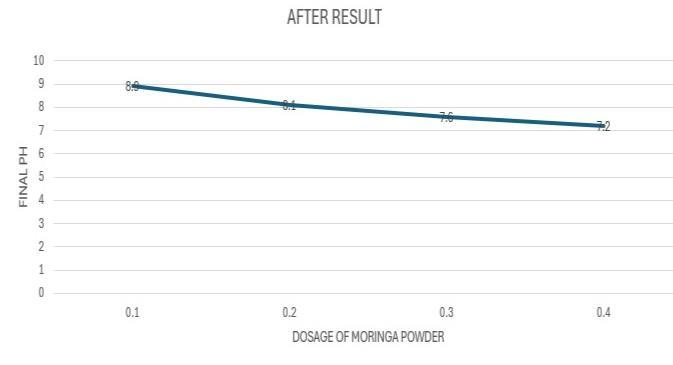
Fig 4.1.3GraphshowingvarationofpHwithrespectto dosageofMoringaPowder.
Fig 4.1.3 The graph shows how the pH of the wastewater changed with the addition of Moringa oleifera seed powder. The pH decreased from 10.13 to 7.2 as the amount of powder increased from 0.10 grams to 0.40 grams. The biggest drop happened at 0.40 grams, which seems to be the amount for treating wastewater. The Moringaoleiferapowderweadded,themorethepHofthe wastewaterdecreased.
This graph shows that Moringa oleifera seed powder works well in reducing pH. Moringa oleifera dosage helps intreatmentofwastewaterbyreducingpH
The figure 4.2.1 and 4.2.2 shows a lab setup with a machinethatmeasureshowturbid wateris.Thismachine iscalledanepheloturbiditymeter.Itmeasurestheturbid levelsofwatersamples.Thenumbersitgivesarearound5 to1.1NTU. This means the waterhas particlesfloating in it. These particles help with checking the quality of the water.In this study Moringa oleifera seed powder is used to make the water less turbid . We use this powder because it helps the particles in the water stick. The Moringa oleifera seed powder is used to remove turbid fromthewater.

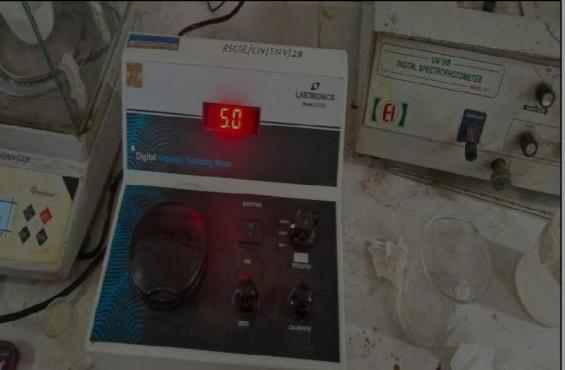
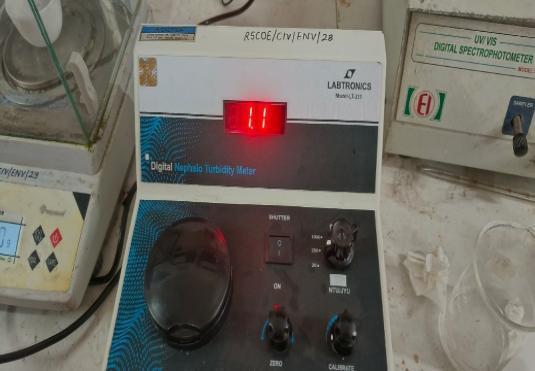

Inthisstudy,Moringaoleiferaseedpowderwasused as a natural coagulant to reduce turbidity. The seed powder caused suspended particles to coagulate and settle at the bottom, which improved the clarity of the treated water. The results indicated that the application
International Research Journal of Engineering and Technology (IRJET) e-ISSN: 2395-0056
of the optimum dosage of Moringa seed powder effectively enhanced water quality by reducing turbidity levels.
Table 4.2 resultsshowingpercentageturbidity removal Sr. No Moringa Dose
% Turbidity Removal = (Initial Turbidity Final Turbidity) / Initial Turbidity × 100
% Turbidity Removal = (Initial Turbidity Final Turbidity) / Initial Turbidity × 100 …..Eq 2
The table 4.2 show that using Moringa oleifera seed powder to remove turbiity works when we increase the dose but only up to a point. After that it does not work well. When the water was highly turbid at 5 NTU using 0.20 grams of Moringa oleifera seed powder in 500 milliliters of water removed the turbid a total of 78 percent. Made the water much clearer at 1.1 NTU. If you useMoringaoleiferaseedpowder,like0.10gramsormore like 0.40 grams it does not remove much turbid only 42 percent and 48 percent respectively. This means there is an amount of Moringa oleifera seed powder to use to removeturbid fromthewater.
aseedpowdertousetoremoveturbidityfromthewater.
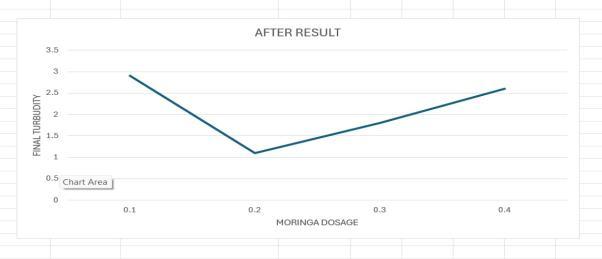
Fig 4.2Graphshowingvarationofturbiditywith respecttodosageofMoringaPowder.
The fig 4.2 graph shows that the final turbidity gets decreasesasaddingMoringaoleiferafrom0.1gto0.2g.It reachesitspoint,around1.1NTU.Ifweaddmore,thanthis
dose, the turbidity starts to increase again at higher dosages, like 0.4 g. This means it does not work well. This graphconfirmthat0.2g/500ml ofMoringa oleifera isthe requireddosetoremovemaximumturbidity.
Jar test is performed in the laboratory and the results are showninfig4.3.1and fig4.3.2

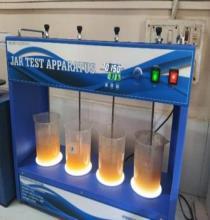
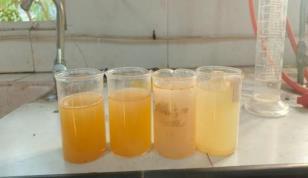

Thefigure4.3.1showsajartestapparatusinalaboratory. Ithascontainersthataremixedatthetimebutatdifferent speeds.Firstthesamplewasmixedataspeedof150rpm for 30 minutes followed by mixing at 60 rpm for another 30minutes.Aftermixingthesamplewasallowedtosettle for30minutestocompletethesettlingprocess.Thegoalis to see how well Moringa oleifera seed powder works in makingthewaterclearer.Thetestisdonewithamountsof Moringaoleiferaseedpowdertofindoutwhichoneworks best.Thefigure4.3.2showswatersamplesaftertheywere treated with amounts of Moringa oleifera. It shows a difference in how clear the water's. The samples that got the dose of Moringa oleifera are much clearer. The water samples that got the dose of Moringa oleifera look very clear which shows that Moringa oleifera is very good at removingstufffromthewater.
Table 4.3 Coagulation-FlocculationResultsshowing PercentageRemovalEfficiencyatDifferentMoringaSeed PowderDosages
Volume: 13 Issue: 05 | May 2026 www.irjet.net p-ISSN: 2395-0072 © 2026, IRJET | Impact
International Research Journal of Engineering and Technology (IRJET) e-ISSN: 2395-0056
Volume: 13 Issue: 05 | May 2026 www.irjet.net p-ISSN: 2395-0072
The table 4.3 shows how well Moringa oleifera removes turbid at amounts. We used 0.10 to 0.40 g of Moringa oleifera. The water was really cloudy to start with at 8.2 NTU. When we used 0.20 grams of Moringa oleifera it removed the turbid , a total of 86.6 percent. If we used more or less Moringa oleifera it did not work well. This study gives the amount of Moringa oleifera to use to get thebestresults.
4.4 Totalsolidtest-
Total solid test is performed in the laboratory by measuringanddryingsamplestofindsolids.

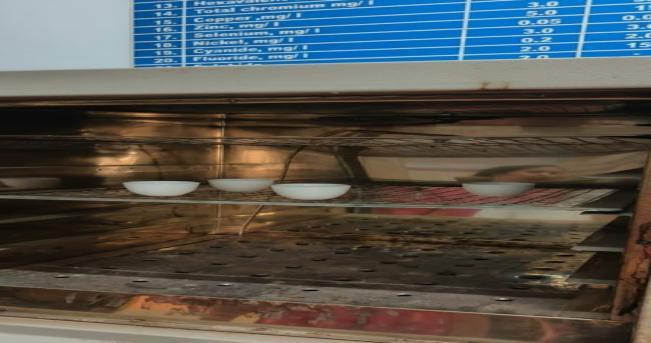

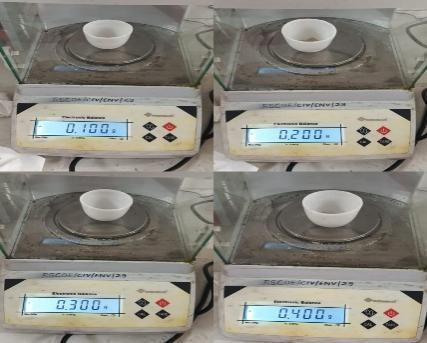
Fig4.4.1showanevaporatingdishona balanceatdifferent stages.Thebalanceshowsweights:0.100g,0.200g,0.300g and 0.400 g. These weights are the solids left after evaporation.Theweightstellushowmuchsolidsareineach water sample. The solids are what is left behind after the water dries. We call these solids or TS. The weights go up with each sample. This means each sample has solids than the last one. These solids are. Suspended in the water. The samples have more solids. The balance shows this with weights. The weights are for solids, in each water sample. Thisfig5.4.2showsdishesbeingdriedinahotairovenina lab:Thesamplesgetheatedtoatemperatureusuallyaround 103 to105 degrees Celsius, toget ridofthemoisture.After they dry only the solid leftovers are. Then we weigh them. Thisstepisreallyimportant,forfiguringouttheTotalSolids becauseitmakessureallthewaterisgonefromthesamples. Afterovendryingat105°C,thedrysolidsobtainedwere:
TS = (W2 W1) × 10^6 / Volume of Sample (ml) …………………………….eq(5)
W1=34.25mg(Initialwt)andtheVolumeofsampleis 500ml
Table 4.4.1 showingresultsofTotalSolids(TS)in WaterSamples Sr n o Initi al wt. Fina lwt. W2-W1(mg)
TS = (W2 W1) × 10^6 / Volume of Sample (ml)
The table 4.4.1 shows us the calculation of Total Solids in fourwatersamplesusingthemethod.Wehavetheweight of the evaporating dish. It is always the same at 34.25 grams.Thefinalweightoftheevaporatingdishisdifferent each time. It goes from 34.35 grams to 34.65 grams. This meansthatthereisresidueleftafterdryingeachtime.We calculate the Total Solids by finding the difference in weight. We do this by subtracting the weight from the weight. This gives us the Total Solids in milligrams per liter.
International Research Journal of Engineering and Technology (IRJET) e-ISSN: 2395-0056
Volume: 13 Issue: 05 | May 2026 www.irjet.net p-ISSN: 2395-0072
The results obtained from the experiments indicate that Moringa oleifera seedpowdercan be effectivelyusedas a coagulant for wastewater treatment. The pH test results showedthattheinitialpHof10.13decreasedgraduallyto 7.2 as the dosage of Moringa powder increased. This change in pH indicates that the alkaline nature of the wastewater was reduced and the treated water moved closertoacondition,whichisdesirableforsafedisposal.
The cloudiness test also showed improvement in water clarityaftertreatment.Thecloudinessvaluereducedfrom 5 NTU to 1.1 NTU with the removal efficiency of 78% observed at a dosage of 0.20 g. When the dosage was increased beyond this level a slight decrease in efficiency was observed. This may be due to overdosing, which can disturb formed particles and reduce settling efficiency. These results indicate that selecting the dosage is importantforachievingbettertreatmentperformance.
Observations from the jar test showed the formation of flocsandclearerwaterintreatedsamplesconfirmingthat coagulation and flocculation processes were successfully carriedout.Thehighestcloudinessremovalof86.6% was observed at a dosage of 0.20 g, which was considered the level.Thetotalsolidstestshowedvaluesrangingfrom200 mg/L to 800 mg/L indicating that impurities were separated and settled during treatment. Based on these findingsMoringaoleiferaseedpowdercanbeconsidereda low-cost and environmentally friendly alternative to chemical coagulants for wastewater treatment especially insmall-scaleapplications.
i. The study confirmed that Moringa oleifera seed powder is an effective natural coagulant for wastewatertreatment.
ii. The pH of wastewater improved from 6.30 to 7.17,with the application of optimum dose of coagulant7.95 bringingitclosertotheneutralrange and making the treated water more suitable for safe discharge.
iii. A significant reduction in turbidity was observed, decreasing from 8.2 NTU to 1.1 NTU, achieving approximately 86.6% turbidity removal efficiency, which indicates effective removal of suspended particles.
iv. The jar test results showed proper coagulation and floc formation, confirming the effectiveness of the treatmentprocess.
v. The optimum dosage of Moringa oleifera seed powder wasfoundto beapproximately 20 gper500 ml, beyond which treatment efficiency slightly decreasedduetoparticledestabilization.
vi. The total solids test indicated increased sludge formation with higher dosages, confirming the successfulsettlingofimpuritiesduringtreatment.
[1]K.A.Adeniran,T.D.Akpenpuun,B.A.Akinyemi,andR. A. Wasiu, “Effectiveness of Moringa oleifera seed as a coagulant in domestic wastewater treatment,” African Journal of Science, Technology, Innovation and Development,vol.9,no.3,pp.323–328,2017.
[2]F.K.AmaglohandA.Benang,“EffectivenessofMoringa oleifera seed as coagulant for water purification,” African JournalofAgriculturalResearch,vol.4,no.1,pp.119–123, 2009.
[3] A. Abiyu, D. Yan, A. Girma, X. Song, and H. Wang, “Wastewater treatment potential of Moringa stenopetala overMoringaoleiferaasanaturalcoagulant,antimicrobial agent and heavy metal removals,” Cogent Environmental Science,vol.4,no.1,2018
[4] M. S. Azad and M. S. Hassan, “Importance of Moringa oleiferaforwastewatertreatment:Areview,”International Journal of Sustainable Energy Development, vol. 8, no. 3, pp.1–6,2020.
[5] W. M. Desta and M. E. Bote, “Wastewater treatment using a natural coagulant (Moringa oleifera seeds): Optimization through response surface methodology,” Heliyon,vol.7,no.11,e08451,2021.
[6] M. Dehghani and M. H. Alizadeh, “The effects of the naturalcoagulantMoringaoleiferaandaluminwastewater treatment at the Bandar Abbas Oil Refinery,” Environmental Health Engineering and Management Journal,vol.3,no.4,pp.225–230,2016.
[7] N. A. Eman, C. S. Tan, and E. A. Makky, “Impact of Moringa oleifera cake residue application on wastewater treatment: A case study,” Journal of Water Resource and Protection,vol.6,no.7,pp.677–687,2014.
[8]S.M.Mangale,S.G.Chonde,A.S.Jadhav,andP.D.Raut, “Study of Moringa oleifera (drumstick) seed as natural absorbent and antimicrobial agent for river water treatment,” Journal of Natural Product and Plant Resources,vol.2,no.1,pp.89–100,2012.
[9]S.N.A.Mohd-Salleh,N.S.Mohd-Zin,andN.Othman,“A reviewofwastewatertreatmentusingnaturalmaterialand its potential as aid and composite coagulant,” Sains Malaysiana,vol.48,no.1,pp.155–164,2019.
International Research Journal of Engineering and Technology (IRJET) e-ISSN: 2395-0056
Volume: 13 Issue: 05 | May 2026 www.irjet.net p-ISSN: 2395-0072
[10] C. V. Narasimha Murthy, “Remediation of aquaculture wastewaterwithMoringaoleiferaseedpowder,”Journalof EmergingTechnologiesandInnovativeResearch,vol.5,no. 6,p.593,2018.
[11]H.T.Nhutetal.,“UseofMoringaoleiferaseedspowder as bio-coagulants for the surface water treatment,” International Journal of Environmental Science and Technology,vol.18,no.8,pp.2173–2180,2020.
[12]B.S.NzeyimanaandA.D.C.Mary,“Sustainablesewage watertreatmentbasedonnaturalplantcoagulant:Moringa oleifera,”DiscoverWater,vol.4,no.1,p.15,2024.
[13]M.S.Ogunshina,O.M.Abioye,K.A.Adeniran,andD.A. Olasheinde,“Moringaoleiferacoagulationcharacteristicsin wastewater treatment in a university dormitory,” Nature Environment and Pollution Technology, vol. 22, no. 2, pp. 699–707,2023.
[14] N. Sané, M. Mbengue, A. Laffite, S. Stoll, J. Poté, andP. Le Coustumer, “Development of a process for domestic wastewater treatment using Moringa oleifera for pathogens and antibiotic-resistant bacteria inhibition undertropicalconditions,”Water,vol.14,p.2379,2022.
[15]V.C.S.Ubah,M.O.Nwachukwu,C.E.Ubah,J.N.Azorji, and O. C. Amoke, “Determination of phytochemical properties of Moringa oleifera seed powder as biocoagulant in wastewater and groundwater treatment,” International Journal of Environment and Pollution Research,vol.12,no.3,pp.8–18,2024.
[16] M. P. Wagh, Y. Aher, and A. Mandalik, “Potential of Moringa oleifera seed as a natural adsorbent for wastewater treatment,” Trends in Sciences, vol. 19, no. 2, Art.no.2019,2022.
[17] I. R. Yuliastri, E. Rohaeti, H. Effendi, and L. K. Darusman, “The use of Moringa oleifera seed powder as coagulanttoimprovethequalityofwastewaterandground water,” IOP Conference Series: Earth and Environmental Science,vol.31,012033,2016.
[18]“Application of Moringa oleifera Lam. seeds in wastewatertreatments,”PlantArchives,2021.
BIOGRAPHIES

Final Year Students,Dept. ofCivil Engineering, JSPM’s Rajarshi Shahu College of Engineering, Tathawade-411033, Pune, Maharashtra,India. Email:supriyabhagat400@gmail.c om



Final Year Students,Dept. ofCivil Engineering, JSPM’s Rajarshi Shahu College of Engineering, Tathawade-411033, Pune, Maharashtra,India.
Email:kalyanighemad04@gmail.com
Final Year Students,Dept. ofCivil Engineering, JSPM’s Rajarshi Shahu College of Engineering, Tathawade-411033, Pune, Maharashtra,India.
Email:bodeleshruti663@gmail.com
Final Year Students,Dept. ofCivil Engineering, JSPM’s Rajarshi Shahu College of Engineering, Tathawade-411033, Pune, Maharashtra,India.
Email:pratikshayadav0007@gmail.com