
International Research Journal of Engineering and Technology (IRJET) e-ISSN: 2395-0056
Volume: 13 Issue: 05 | May 2026 www.irjet.net p-ISSN: 2395-0072

International Research Journal of Engineering and Technology (IRJET) e-ISSN: 2395-0056
Volume: 13 Issue: 05 | May 2026 www.irjet.net p-ISSN: 2395-0072
1Sayed Najibullah Hashimi , 2Prof.Dr. Nagendra. H.N, 3Abdul Nabi Rahmani
1,2 School of Planning and Architecture University of Mysore Department of Planning, Manasagangothri, Mysore, India
3 Design of Structural Buildings Faculty of Engineering Salam University, Kabul, Afghanistan
Abstract - Kabul City's transportation infrastructure has been severely strained by decades of conflict, rapid population growth, and unplanned urban expansion, particularly in the domain of public bus transit. This study examines the urban transportation challenges arising from Kabul's near-total absence of formal bus terminal infrastructure. This study uses a mixed-methods research methodology based on secondary data and thorough literature analysis, which includes a review of previous studies, policy papers, and transport records in addition to a spatial analysis of 47 informal transit nodes. The results show that the lack of designated bus terminals has cascading systemic effects in five interconnected domains: traffic congestion (average commute times have increased by about 68% over the past ten years); road safety risks resulting from unregulated on-street loading and unloading practices; environmental degradation caused by uncontrolled vehicle emissions at informal transit nodes; spatial disparities in mobility access across socioeconomic groups; and governance issues in transportation planning and regulation.Drawing on urban mobility theory, transport justice frameworks, and comparative analysis with cities in analogous development contexts Dhaka, Nairobi, Kathmandu, and Addis Ababa the paper argues that bus terminal infrastructure constitutes an essential organizational component of functional urban transport systems rather than a supplementary amenity. In response to Kabul's financial, institutional, and post-conflict constraints, the study proposes a phased Hierarchical Bus Terminal Development Framework (HBTDF), recommending an integrated three-tier network comprising seven major intermodal terminals, twenty-four secondary distribution hubs, and 112 community-level transit stops. The findings offer both theoretical contributions and policy-relevant recommendations for Kabul's transportation sector, while advancing broader scholarly debates on infrastructure governance in fragile and conflict-affected urban environments.
Keywords: Urban transport; Bus terminal infrastructure; Kabul City; Traffic congestion; Afghanistan; Public transit; Urban mobility; Transport governance; Informal transit; Sustainable transport
In any large metropolis, urban transportation plays a crucial role in determining social justice, economic productivity, and quality of life. One of the most urgent governance issues facing Kabul, a metropolis of more than 4.5 million people that has experienceddecadesofconflictandreconstruction,isthelackofaworkingpublictransportationinfrastructure.Private taxis and minivans dominate Kabul's fragmented, mostly informal transportation system, in contrast to many international cities where bus terminals act as organizational hubs for route planning, fare enforcement, and passenger safety (Noori, Walid Ahmad 2010) In cities all over the world, urban transport infrastructure is universally acknowledged as being essential to social justice, economic productivity, and environmental sustainability (Cervero & Kockelman, 1997; Rodrigue, Comtois, & Slack, 2016). Bus terminals play a crucial role among the many elements of urban transportation systems; they are the functionalhubsthatplan,coordinate,andmanagetheflowofpeopleandcarsthroughoutcities(Vuchic,2005;Wright&Hook, 2007). The lack of such infrastructure indicates a systemic failure with repercussions that affect traffic management, environmental quality, public safety, economic activity, and social cohesion. It is not just a gap in physical amenities (PagetSeekins,2015;Salon&Aligula,2012).AmongAsiancapitals,KabulCityexhibitsoneofthemostsevereexamplesofthisissue. Duetorural-to-urbanmigration,post-conflictdisplacement,andnaturalpopulationgrowth,Kabul'spopulationhasincreased fromabout1.5millionin2001toanestimated6–7millionin2023.Thisurbanizationhasoccurredataratethatsignificantly outpacesthedevelopmentofitssupportinginfrastructure(Barakat&Chard,2006;UNHABITAT,2015;WorldBank,2016).An estimated 800,000 registered cars and an unknown number of unregistered motorcycles and rickshaws currently strain the city's road system, which was initially built for a small portion of its present population (Afghanistan Ministry of Urban DevelopmentandLand,2022;JICA,2011).Thereisn'tasingleofficialbusterminalintheentiremetropolitanarea,despitethe factthatpublicbus serviceisavailableindispersedand unofficial forms(Kabul Municipality,2021).Twoconnectedfindings
International Research Journal of Engineering and Technology (IRJET) e-ISSN: 2395-0056
Volume: 13 Issue: 05 | May 2026 www.irjet.net p-ISSN: 2395-0072
serve as the inspiration for this investigation. First, despite the magnitude and prominence of Kabul's transportation crisis, there is still a dearth of scholarly research on urban mobility in Afghanistan, especially with relation to the public transportationinfrastructuredeficit(Pain&Sutton,2007;Suhrke,2011).
Due to the past devastation of transportation infrastructure throughout civil wars, there is a greater demand for public transportationinKabul thanthereissupply,necessitatinga rise in busesand a change fromfixed to distance-basedcharges (Mirzada,R.,&Maruyama,T.2016).TheurbantransportationsysteminKabul,Afghanistan,isthesubjectofthisstudy.Rapid urbanization,growingprivatecarownership(63%ofthefleet),andadearthofpublictransportationallcontributetoKabul's extreme traffic congestion, air pollution, and inefficient mobility. After evaluating the current road networks, policies, and transportation system, the authors come to the conclusion that the current paradigm is unsustainable. They suggest eight options, including transportation-land use integration, transit-oriented development, non-motorized networks, economic tools(congestionpricing),low-costtransportationforthepoor,andanumberofalternatives(walking,cycling,electricbuses, bicycle taxis). By putting these tactics into practice, Kabul's urban transportation system may become more ecologically friendly and sustainable (Regina Maihan and Ebru Vesile Ocalir2023) In order to solve Kabul's urban transportation issues, rehabilitatingcurrentfacilitiesisgivenfirstpriority,withanemphasisonenhancingpublictransportationandtrafficcontrol. To guide these advancements, the study examines policies from significant Chinese and Indian cities. (Danesh, A., Ma, W., & Wang,L.2019).ThisresearchexaminestheserioustrafficprobleminKabul.Theonlycapitalcityintheworldwithoutapublic transitsystemisKabul.The absenceoftrafficsignalsormulti-level intersections,streetvendorsobstructingtraffic,unlawful speed breakers, corruption, security roadblocks, and packed government buildings in the city center are some of the main issues facing the city's more than 5 million residents and one million automobiles. Building a bypass route, shifting governmentbuildingsandmarketplaces,eliminatingspeedbumpsandstreetsellers,settingupparkingandbusstops,putting trafficsignals,enforcingthelaw,andconstructingametroortramsystemaresomeofthesuggestedremediesbasedonfield surveys conducted in 2016. Strong political will and investment are necessary, the author says (Amirzada Ahmadzai2019) Theoperational level ofpublictransportation,andparticularlyterminal infrastructure,isunderstudied becausethe majority of current research concentrates on macro-level economic reconstruction or road network repair (Barfield, 2010; Jones, 2020). Second, when it comes to Afghanistan's urban sector, policymakers and foreign development partners have continuously placed a higher priority on hardware investments (roads, bridges) than on the organizational infrastructure (terminals,depots,regulations)thatmakestransitsystemswork(USAID,2018;WorldBank,2016).
The Economics, geography, urban planning, and engineering are all covered in the vast body of academic research on urban transportation infrastructure. Transportation infrastructure impacts urban form, economic efficiency, and quality of life, accordingtobasicframeworkscreatedbyclassicwork(Downs2004)ontrafficcongestion(MeyerandMiller2001)onurban transportation planning. The particular function of transit infrastructure nodesstations, terminals, and hubsin organizing urban mobility systems has been the subject of more recent contributions (Bertolini, 2017; Curtis, Renne, & Bertolini, 2009).Bus terminals serve as what Bertolini and Spit (1998) referred to as "station areas"places where urban land uses and transportation networks converge, creating highly accessible and economically active environments. In addition to being a physical building, the terminal is an institutional tool that arranges the intricate coordination issues that arise in public transportation, such as coordinating schedules, matching vehicle supply with passenger demand, offering waiting areas, controlling driver behavior, andfacilitatingroutetransfers(Vuchic,2005).AccordingtoBlack (1995),intheabsenceofsuch organizational nodes, public transportation falls back on unofficial, self-organized arrangements, which are usually less effective, secure, and fair.The literature on bus terminals in the Global South has shown that a number of transportation diseases are correlated with their absence. Cities with clearly defined terminal hierarchies earned 40–60% higher transit modal shares than comparable cities relying on dispersed on-street operations, according to Cervero's (2000) comparative analysis of developing-country transit systems. According to Salon and Aligula (2012), Nairobi's matatu (minibus) system caused persistent traffic jams, a high accident rate, and the transport network's spatial fragmentation because it lacked authorizedterminals.Studiesconductedin Dhaka (Hoque& Hasan, 2017),Lagos (Oduola,2016), and Dar es Salaam(Kiunsi, 2013)producedsimilarresults.
International Research Journal of Engineering and Technology (IRJET) e-ISSN: 2395-0056
Volume: 13 Issue: 05 | May 2026 www.irjet.net p-ISSN: 2395-0072
This research makes use of three complementary theoretical frameworks. First, the Mobility Paradigm proposed by Urry (2007) and Sheller and Urry (2006) rethinks transportation as a social activity entrenched in systems of infrastructure, culture, and power rather than as simple movement between fixed sources and destinations. This perspective is helpful in comprehending how larger societal injustices, especially those based on gender, class, and ethnicity, are reflected in and perpetuated by Kabul's unofficial transportation arrangements. Second, the co-evolutionary interaction between transport infrastructureandurbanspatial organizationis emphasizedby theTransportandLandUseInteraction(TLUI) model, which was developed by Wegener and Münst (1999) and more recently by Ewing and Cervero (2010). According to the model, suboptimallandusepatterns,suchassprawl,traffic,andtheconcentration ofeconomicactivityinvehicle-accessibleareasat the expense of pedestrian and transit-dependent populations, will result from deficiencies in transport infrastructure, including the lack of bus terminals. Third, Martens (2016) introduced the idea of "Transport Justice," which is based on Rawlsian distributive principles and offers a normative foundation for determining who pays for infrastructure deficiencies and who gains from their correction. According to Pereira, Schwanen, and Banister (2017), transport justice is a tangible indicator of whether the urban poor, who disproportionately depend on public transportation, can access jobs, services, and educationinareasofextremepovertylikeKabul.
Incitieswithnoorinsufficientformalpublictransportationinfrastructure,informaltransit alsoknownasparatransit,jitney services,orinformalpublictransportisthepreferredmodeoftransportation,accordingtoalargebodyofresearch(Cervero, 2000;Behrens,McCormick,&Mfinanga,2016;Pojani&Stead,2015).Despiteofferingvitalmobilityservices,informaltransit systemshavestructural drawbacks,includingerratic routes,laxsafety regulations, unstable fares, anda lack of coordinating infrastructureliketerminalsanddepots(Klopp&Cavoli,2019;Paget-Seekins,2015). Crucially,theabsenceofinfrastructure andinformalityhaveareciprocalrelationship.AccordingtoKloppandCavoli(2019),informaltransportationdoesmorethan just bridge the gap left by inadequate infrastructure; it also establishes institutional path dependencies that make formalizationmoredifficult.Aroundparticularstreetcorners,unofficialstops,anduncontrolleddepots,driversandoperators establish spatial routines, economic niches, and political connections. According to Cervero and Golub's (2007) comparative assessment of formalization projects in Johannesburg, Istanbul, and Bogotá, these interests might become roadblocks to infrastructuredevelopment.
After experiencesinKabul,Baghdad,Mogadishu,Monrovia,andotherconflict-affectedcities,therelationshipbetweenurban transportation and post-conflict reconstruction has drawn increasing scholarly attention (Barakat, 2016; Colenbrander, Dodman, & Mitlin, 2018; Graham, 2010). The literature highlights a number of unique aspects of post-conflict urban transportation, including the need to rebuild physical infrastructure, institutional capacity deficiencies in transportation planning and regulation, sudden demand spikes caused by displaced populations, security constraints on planning and fieldwork, and the predominance of humanitarian and emergency imperatives over longer-term transportation system development (Barakat & Chard, 2006; Jones, 2020).The term "networked urbanism" was first used by Graham (2010) to characterize how infrastructure systems in cities devastated by conflict become sites of both political contestation and devastation,withinfrastructurerestorationactingasasignalofgovernmentallegitimacyandregeneration.Similarlogicwas used to transportation infrastructure by Colenbrander et al. (2018), who contended that bus terminals in post-conflict environmentshadsymbolicmeaningbeyondtheirpracticaluse,signifyingthestate'sabilityanddesiretostructureurbanlife.
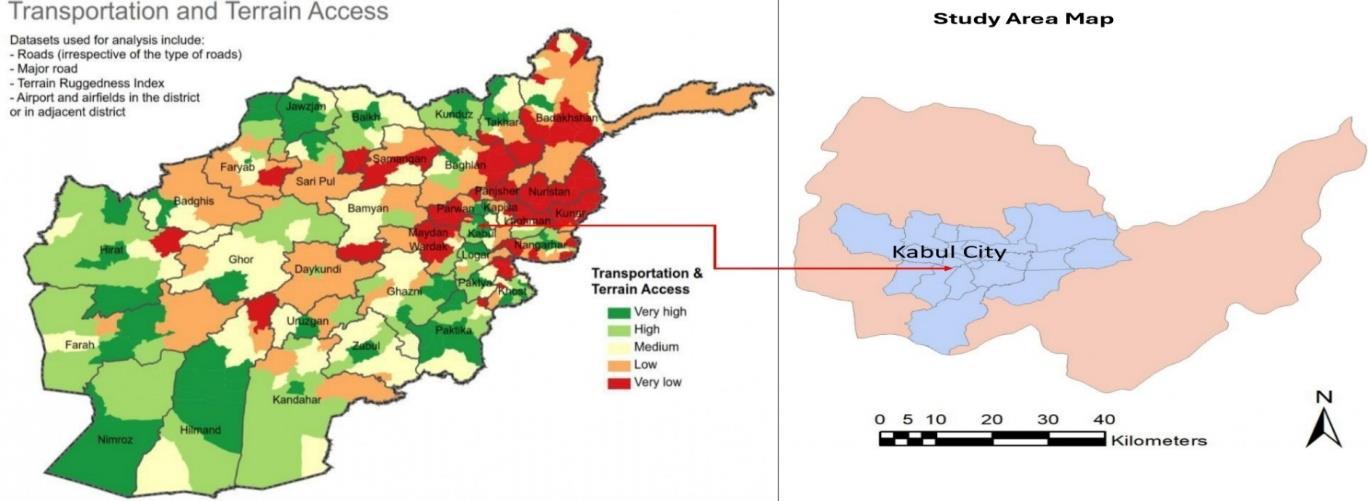
Kabul the capital of Afghanistan is situated in a mountainous basin and is the main administrative and economic hub of the nation. From over 1.5 million in 2001 to over 6 million in recent years, the city's population has grown quickly. Unplanned urbangrowthhasresultedinaconsiderablenumberofinformalcommunities.Theroadnetworkisunderalotofstrainsince the transportation infrastructure has not kept up with this increase. With neither a subway nor a rail system, Kabul's
International Research Journal of Engineering and Technology (IRJET) e-ISSN: 2395-0056
Volume: 13 Issue: 05 | May 2026 www.irjet.net p-ISSN: 2395-0072
transportationsystemismostlyroad-based.Thelackoforganizedpublictransportation,especiallybusterminals,isadefining featureofthecity'smobilityissues.
Source:Compiledbytheauthors
4.1 Existing Transport Infrastructure
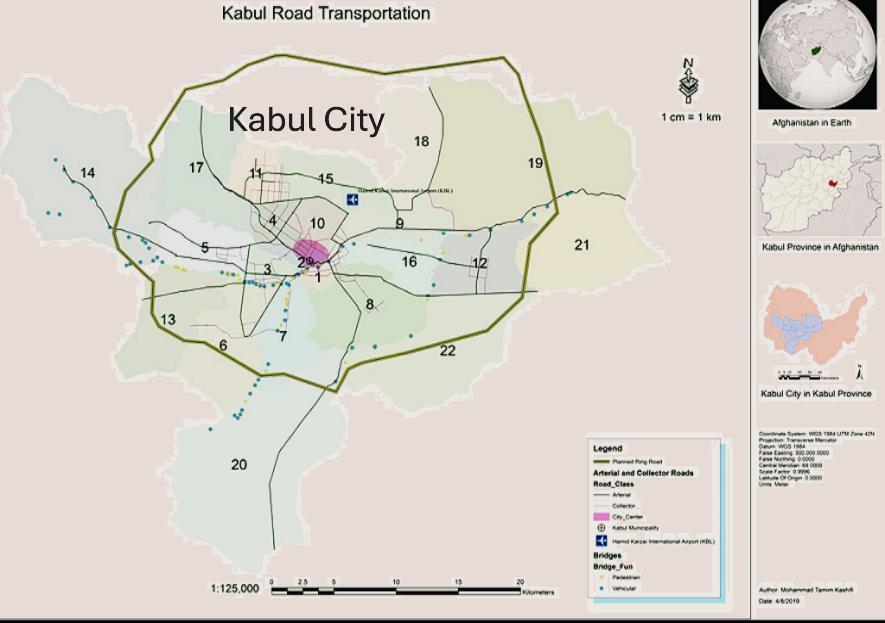
TheRoad-basedmobilityisthemaincomponentofKabul'stransportationsystem,withasmallamountofairsupport.There areroughly141kmoflocalroadsand215kmofarterialhighwaysinthecity'sradialroadnetwork,whichiscenteredonthe metropolitan core. A large portion of the infrastructure is still limited despite post-2001 improvements because of previous conflicts,poormaintenance,andfasturbangrowth.
© 2025, IRJET | Impact Factor value: 8.315 | ISO 9001:2008 Certified Journal | Page270
International Research Journal of Engineering and Technology (IRJET) e-ISSN: 2395-0056
Volume: 13 Issue: 05 | May 2026 www.irjet.net p-ISSN: 2395-0072
Kabul's mobility system is dominated by unofficial transportation options like minibuses and shared taxis, which don't have setschedulesor designated stops.Vehicles rely on unregulated roadsidepick-upanddrop-off locations in the lack ofofficial bus terminals, which worsens traffic, raises safety concerns, and decreases operational effectiveness. These difficulties are madeworsebythefrequentrequirementthatpassengers boardanddisembarkinbusytrafficlanes.Asaresult,anetworkof unofficial transit hubs has developed around the city. These usually occur in three main places: (i) at the intersection of planned and unplanned residential areas, where formal routes end and informal services start; (ii) in the city center, where high demand and poor connectivity require intermediate stopping points; and (iii) close to important activity hubs, like markets and educational institutions, where passenger volumes surpass the capacity of formal transportation. These places aremostlyunregulatedandsometimesrunbyunofficialorganizationsthatchargetransportationcompaniesfortheirservices. They thus contribute to unsafe boarding circumstances, ineffective traffic flow, and general system dysfunction. Although informal transportationoffersnecessarymobility,itslack ofinfrastructure,coordination,andcontrol emphasizesthecritical needforintegratedtransportplanningandanorganizedbusterminalsystem.
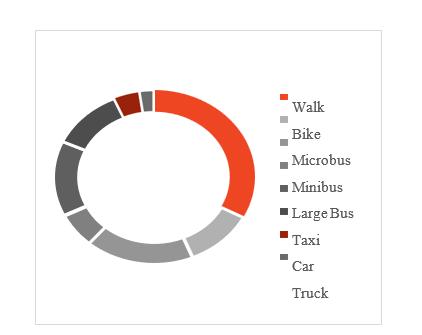
Sustainable ways of transportation are greatly favored in Kabul because to the city's high population density and economic conditions. A 2009 survey by the Japan International Cooperation Agency found that just 4.5% of travel is done in private vehicles, which is rather decent. According to the following figure (JICA, 2009), walking and bicycling are the next most commonmodes,afterpublictransportation.
InordertocaptureboththequantifiableaspectsoftransportationissuesandthelivedexperiencesofurbanmobilityinKabul, this study uses a mixed-methods research methodology that combines quantitative spatial analysis with qualitative inquiry (Creswell&Clark,2017;Tashakkori&Teddlie,2010).Forcomplicatedurbanissues,wherequantitativedataalonemaymask the social, institutional, and experiential aspects that are crucial for developing contextually relevant policy solutions, the mixed-methodsapproachisespeciallysuitable(Yin,2018).AccordingtoFlyvbjerg's(2006)reasoning,acasestudyissuitable
International Research Journal of Engineering and Technology (IRJET) e-ISSN: 2395-0056
Volume: 13 Issue: 05 | May 2026 www.irjet.net p-ISSN: 2395-0072
whenresearchaimstoproducecontext-richunderstandingofphenomenathatcannotbereducedtovariablesandstatistical relationships.ThisiswhythestudyisorganizedasacasestudyofKabulCity.ThetransportationsituationinKabulisacrucial example where the severe lack of bus terminal infrastructure makes it possible to clearly identify the effects of this lack, offeringinsightswithwidertheoreticalsignificance(Flyvbjerg,2006;Stake,2005).
The analysis reveals that the absence of formal bus terminal infrastructure in Kabul has led to the dominance of informal transportsystems,significantlyaffectingtheefficiency,safety,andequityoftheurbantransportnetwork.
In Kabul's central and commercial districts, traffic count surveys showed widespread and severe congestion, with average volume-to-capacity (V/C) ratios exceeding 1.5 at 8 of the 12 surveyed intersections during peak hourswell above the 0.85 thresholdtypicallylinkedtosystemfailure(TransportationResearchBoard,2010).Twoapproacheswereusedtoidentifythe lack of bus terminals as a major contributing factor: terminal function displacement onto arterial routes and indiscriminate on-street halting. Informal minibuses and shared taxis stop at self-selected roadside places, usually at crossroads or next to commercialfrontages,tomaximizepassengeraccesswhentherearenorecognizedbusterminals.Onthefivemostcongested arterialsPashtunistanRoad,JadeMaiwand,JadeNoor,Kabul–JalalabadHighwayapproaches,andDarulAmanRoadanaverage of4.2vehiclesper100metersweresimultaneouslyhaltedforpassengerloadingorunloadingduringpeakhours,accordingto field observations. On roadways that are already running close to capacity, this essentially reduces usable road width by 2040%.According to statistics from a household study, 74% of participants said that the uncontrolled halting of public transportation vehicles was the main or significant cause of traffic congestion. The lack of bus pull-out spaces and terminals was regularly cited by traffic police officers in key informant interviews as their main operational challenge: "We attempt to movethem[minibusdrivers]along,butwherewouldyouhavethemgo?Thereisn'tarecognizedarea.Asaresult,theyalways stopinthecenteroftheroadwherepeopleare.(TrafficPoliceOfficer,Interview12,2023).
This study calculated that congestion caused by informal transit operations (on-street stopping and related downstream queuing) adds an average of 18 minutes per trip to peak-hour journeys in central Kabulequivalent to a 32% increase over congestion-free travel timesusing origin-destination data from the travel survey cross-referenced with GPS tracking of 12 study vehicles over a two-week period. For Kabul's estimated 2.8 million working-age people, assuming an average of two round-trip trips per working day, this equates to almost 201 million person-hours wasted to traffic per year. The economic impact of this time loss surpasses USD 125 million per year at Afghanistan's average daily pay of about USD 5 (World Bank, 2023).
Cross-referenced field observations and traffic accident data from the Kabul Traffic Police (2022) demonstrated that pedestrian-vehicle encounters occurred disproportionately at informal transit nodes. 38% (n=702) of the 1,847 pedestrian injuriesthatwerereportedinKabulin2022occurredwithin50metersofillegaltransithaltingareas,despitecomprisingup an estimated 8% of the road network. The relative risk of pedestrian injury at informal transit nodes was found to be 4.75 (95% CI: 3.89–5.82) in contrast to other road segments, indicating a nearly five-fold greater risk. Thebehavioralcharacteristicsproducingtheseriskswerenotedbydirectobservation,andoperatorquestionnairesconfirmed this. Fast, erratic stops and accelerations are made by minibus drivers vying for passengers, which can cause collisions with oncoming cars and pedestrians. In order to board and exit transit vehicles in active traffic lanes, passengers must maneuver through flowing traffic in the absence of sheltered waiting zones, raised kerbs, or protected crossing sections. Community leadersrecognizedthosewithimpairments,elderlypassengers,andschool-agechildrenasespeciallyvulnerablegroups.
International Research Journal of Engineering and Technology (IRJET) e-ISSN: 2395-0056
Volume: 13 Issue: 05 | May 2026 www.irjet.net p-ISSN: 2395-0072
Significant gender variations in perceived and actual safety at informal transportation nodes were found in disaggregated householdsurveydata.Comparedto23%ofmalerespondents,61%offemalerespondentssaidtheyavoidedspecifictransit routes or travel times because of safety concerns at unofficial transit stops. Three aspects of women's safety concerns were identifiedthroughfocusgroupdiscussionsaspartofKIIpreparation:physicalsafetyfrommovingvehicles(reportedby78% offemalefocusgroupparticipants);harassmentbymalepassengersandbystandersatcrowdedinformalstops(71%);andthe inability to observe or monitor transit vehicle routes prior to boarding (54%). These results align with the global body of researchongenderandtransitsafety(Gekoskietal.,2017;Loukaitou-Sideris&Bornstein,2008).
With PM2.5 levels often surpassing WHO standards by factors of 10–20 throughout the winter months, Kabul already ranks among the world's most severely air-polluted cities (WHO, 2022; NEPA, 2022). PM2.5 levels at informal transit nodes averaged287µg/m³duringpeaktrafficperiods,accordingtothisstudy'sportablesensormeasurements.Thisisincontrastto 184µg/m³atsimilarnon-transitroadsideareasand95µg/m³atoff-streetresidentiallocationsinthesamedistricts.Themix ofidlevehicleemissions(whiledriverswaitforpassengers),accelerationemissions(aftervehicledeparture), andbrakeand tireparticlesfromfrequentstoppingisreflectedintheincreasedconcentrationsatinformaltransitnodes.Vehicles manyof whichareolddieselminibuseswithinadequatepollutioncontrols idleforlongperiodsoftimeinpopulousareasduetothe lackofbusterminalswithoff-streetidlingplaces.Accordingtooperatorsurveys,minibuseswaitforfullpassengerloadsforan average of2.3hours every daywhile either motionlessordrivingslowlyatunofficial stopping sites. Withoutanyventilation system,this"dwelltime"producesconcentratedemissions.
The WHO's recommended daytime outdoor limit of 55 dB(A) and the nighttime limit of 45 dB(A) were exceeded by the averagenoiselevelreadingsatinformaltransithubsduringpeakhours,whichwere82dB(A)(WHO,2018).Chronicexposure tonoiselevelshigherthan70dB(A)hasbeenlinkedtopsychologicalstress,sleepdisturbance,increasedcardiovascularrisk, and cognitive impairment in children (Basner et al., 2014; WHO, 2018). During fieldwork, residents of nearby buildings many of whom own street-level stores or reside in ground-floor apartments reported these effects in unstructured conversations.
According to Martens (2016) and Pereira et al. (2017), the effects of inadequate transportation infrastructure are dispersed along pre-existing lines of social stratification, meaning that not every urban inhabitant is equally affected. The poorest householdsbearadisproportionateamountofthetimeandtransportationcostsassociatedwithKabul'slackofbusterminal infrastructure,accordingto ananalysisofhouseholdsurvey data byincome quintile.Comparedtohouseholds inthehighest incomequintile(whoaremorelikelytopossessprivatevehicles),householdsinthe lowestincomequintilespentanaverage of 22% of household income on transportation, mostly informal minibus fares. These results are consistent with global researchontransportpoverty(Titheridgeetal.,2014).
Severespatial inequalitywasfound intheGISanalysisoftransitaccessibility, whichisdefinedastheproportionof jobhubs that can be reached within 60 minutes by public transport. Transit accessibility scores ranged from 72–84% in central districts(Districts1–3)to18–34%inoutlyingdistricts(Districts10,16,17,18,and20).Low-incomeandinternallydisplaced households are concentrated in these periphery locations, which correlate to informal settlements. This creates a spatial povertytrapwheretheurbanpoorconfrontthemosttransportationobstaclestotakingadvantageofeconomicopportunities (Lucas,2012).
International Research Journal of Engineering and Technology (IRJET) e-ISSN: 2395-0056
Volume: 13 Issue: 05 | May 2026 www.irjet.net p-ISSN: 2395-0072
Thelackofbusterminalinfrastructurehasvaryingeffectsonseveraldimensionsofvulnerabilityinadditiontoincome. Dueto thelackofaccessibleboardinginfrastructure(raisedplatforms,kerbsidestops)andtheerraticconductofvehiclesatinformal stops, people with disabilities are almost completely excluded from informal transportation. According to the poll, 89% of participants with mobility limitations said they were unable to use public transportation on the majority of days. An estimated 5% of Kabul's population is elderly, and they cited comparable access issues. According to 63% of the families surveyed, schoolchildren who depend on transit for regular journeys are at increased risk because of unsafe boarding circumstancesatunofficialstopsclosetoschoolgrounds.
InKabul'surbantransportationsystem,thelackofbusterminalinfrastructurebothreflectsandperpetuatesaregulatorygap. KabulMunicipalitylacksadedicatedtransportplanningdivisionwithtechnicalcapacityforterminaldevelopment,according to key informant interviews with municipal officials. Transport functions are dispersed among at least six agencies (Municipality,MinistryofUrbanDevelopmentandLand,MinistryofPublicWorks,MinistryofInterior/TrafficPolice,Ministry ofFinance,andprovincialadministration),resultingincoordinationissuesandaccountabilitygaps(KabulMunicipality,2021). The post-2001 reconstruction emphasis on road infrastructure unintentionally crowded out investment in institutional development for transport governance, according to international development partner representatives: "We could show a road built. The value of a passed legislation or a staffed planning office was difficult to demonstrate (International DevelopmentPartner,Interview24,2023).Thisfinding isconsistentwithacademic criticismsofpost-conflictreconstruction strategiesthatprioritizeinfrastructure(Barakat,2016;Jones,2020).
7.2 Revenue and Financing Gaps
Kabul Municipality is not in a position to independently fund the capital investment needed for the construction of bus terminalinfrastructure.Afghanistan'smunicipalrevenuesareseverelylimited:userfeesforurbanservicesarelow,property tax collection is expected to be between 5 and 10% of possible yield, and political shifts since 2021 have interrupted intergovernmentalfiscaltransfers(WorldBank,2016).Accordingtokeyinformantinterviewswithmunicipalfinanceofficials, the 2023 municipal capital budget did not include any funding for the development of transportation infrastructure beyond standard road maintenance. The possible role of the private sector in terminal finance was shown by operator surveys. Seventy-onepercentofoperatorssaidtheywouldbereadytopayadailyormonthlyterminalaccesschargeifformalterminal facilities offered advantages including weather-protected waiting rooms, well-organized queue management, less police harassment,andaccesstofuelandmaintenanceservices.IfappliedtoallofKabul'sestimated15,000informaltransitvehicles, themedianacceptabledailyterminalcostofUSD1.50–2.00pervehiclewouldearnaboutUSD8.2–10.9millionyearly,enough tocoverfinanceforamodestterminaldevelopmentprogram.
8. DISCUSSION: POLICY FRAMEWORK AND COMPARATIVE LESSONS
Theoretical Implications
The results of this study add to a variety of scholarly discussions. The concept of transport infrastructure as an organizing mechanisminurbanmobilitynetworksisfirstextendedandsupportedempirically(Bertolini,2017;Vuchic,2005).TheKabul caseshowsthatintheabsenceofthisorganizingfunction,urbantransportationreorganizesaroundinformalspatialpractices that create their own path dependencies and political economies, making formalization more difficult. Second, by describing thedistributionaleffectsofalackofinfrastructureinanextremepovertysetting,theresultsaddtothebodyofknowledgeon transportation justice. According to Martens's (2016) theoretical predictions, the concentration of transportation costs and dangersamongthepoorestandmostvulnerableurbanpeoplesupportstheclaimthatinvestingintransportinfrastructureisa socialjusticeobligationratherthanjustaneconomicefficiencymeasure.Third,bydescribinghowinstitutionalfragmentation, financial limitations, and the legacy of reconstruction priorities impact municipal governments' ability to build fundamental urban infrastructure, the study adds to the body of knowledge on urban governance on fragile and post-conflict cities
International Research Journal of Engineering and Technology (IRJET) e-ISSN: 2395-0056
Volume: 13 Issue: 05 | May 2026 www.irjet.net p-ISSN: 2395-0072
(Colenbranderetal.,2018;Graham,2010).TheKabulcaseshowsthatinorderfortechnicalplanningsolutionstobeeffective, theymustbecombinedwithsustainablefinancialsourcesandgovernanceimprovements.
A comparison of formalization experiences in Nairobi and Dhaka offers important insights for Kabul's terminal growth. Despiteimplementationdifficulties,theGabtoliandMohakhalibusterminalsbuiltinDhakathroughoutthe1980sand1990s clearlyreducedtrafficonapproachcorridorsandenhancedpedestriansafety(Hoque&Hasan,2017;Rahman&Islam,2017). ThelessonfromDhakaisthatsimpleinfrastructuresuchasanoff-streetwaitingspace,structuredloadingzones,andcovered passengershelterproducesmajoroperationalbenefits,thusterminalsdonotnecessarilyneedtobearchitecturallycomplexto operate.While offering cautionary lessons about too ambitious system design in resource-constrained situations, Nairobi's experiencewiththeBusRapidTransit(BRT)effortshowedtheimportanceofcommunitystakeholderengagementinterminal placement decisions (Klopp & Cavoli, 2019). The failure to include operators in design and governance decisions was a contributing factor in Nairobi's matatu operators' resistance to formalization measures; this lesson is directly applicable to Kabul,whereoperatorbuy-inwouldbecrucial.
9. Proposed Policy Framework: Hierarchical Bus Terminal Development for Kabul
International Research Journal of Engineering and Technology (IRJET) e-ISSN: 2395-0056
Volume: 13 Issue: 05 | May 2026 www.irjet.net p-ISSN: 2395-0072
Source: Compiled by the authors
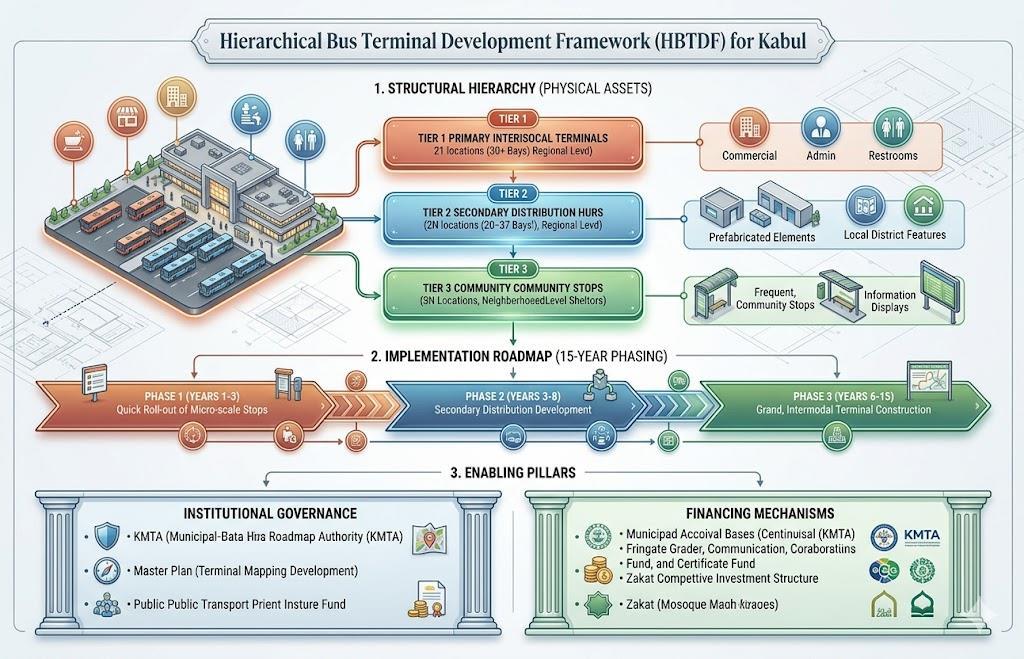
The Hierarchical Bus Terminal Development Framework (HBTDF) diagram illustrates how geographical hierarchy, phased implementation, and supporting institutional and financial mechanisms interact to organize Kabul's urban Public transport infrastructure in an integrated, systems-based manner. A three-tier functional hierarchy that organizes passenger mobility across scales is at the heart of it. The fundamental layer is made up of Tier 3 community transport stops, which capture scattered neighbourhood-level demand and guarantee first- and last-mile connectivity through regular, easily accessible facilities. TheseflowsarecombinedatTier2secondary distributionhubs,whichfunctionasorganizedtransferpointsatthe district level, enhancing service coordination and decreasing route fragmentation. At the top, Tier 1 major intermodal terminals serve as high-capacity regional hubs that house cross-city and long-distance services in structured, integrated facilities.Atime-basedimplementationstrategyisalsoincludedintheflowchart.Ittakesabottom-up,phasedapproachover ten to fifteen years, starting with the quick deployment of Tier 3 stops, moving on to Tier 2 hubs, and ending with the construction of Tier 1 terminals. The necessity for early service enhancements, institutional viability, and cost effectiveness are all reflected in this sequencing. Enabling pillars, such as institutional governance (such as the creation of a metropolitan transport authority, regulatory frameworks, and strategic planning) and diverse financing mechanisms (from private sector involvement and municipal revenue instruments to international development funding and context-specific investment models)supporttheentireframework.Whentakenasawhole,theseelementsshowacoordinatedandscalableparadigmthat transformsKabul'stransportationsystemfromadisjointedstructureintoaneffective,hierarchical,andlong-lastingnetwork. Basedonthetheoreticalframeworks,empiricalresults,andcomparativelessonsdiscussedabove,thisstudysuggestsathreetiered,phasedHierarchicalBusTerminalDevelopmentFramework(HBTDF)forKabulCity.
Tier 1: Seven primary intermodal terminals. The main hubs for long-distance and cross-district services would be these terminals, which would be built at Kabul's main inter-district and inter-city transit lines. Kot-e-Sangi (western gateway), the Police Headquarters area (central hub), Microrayon (northeastern hub), Khairkhana (northern hub), Deh Sabz (eastern development corridor), Char Rahi Qambar (southern hub), and Pul-e-Charkhi (eastern gateway) are among the suggested locations. At least 80 bus bays, a passenger arrival and departure hall, commercial facilities that generate cross-subsidy money,administrativeofficesfortransportationcontrol,andpublicrestroomswithaccessibleamenitiesshouldallbepresent ineveryTier1terminal.
Tier 2:HubsforSecondaryDistribution(24locations).Thesesmallerfacilitieswouldlinkneighborhood-leveltransportation withTier1 terminalsbyactingasdistributionhubs withindistricts.Eachhub wouldhave basiccovered waitingareas, wellorganized queue management, and public restrooms to handle 20–30 vehicles. To cut costs and construction time, Tier 2 facilitiesshouldbebuiltquicklyusingmodularprefabricatedcomponents.
Tier 3:CommunityTransportationStops(112locations).Frequent,shelteredbusstops onspecifiedtransitroutesthat,atthe at least, include a covered waiting area for 20 people, a display of route information, lighting, and an emergency call facility. While larger terminal facilities are being planned, these stops should be given priority for early deployment since they representthemostreadilyattainablecomponentofthearchitectureandwillproducenoticeableimprovementsinthetransit userexperience.
TheHBTDFshouldbeimplementedgraduallyovertentofifteenyears,withTier3stationsinYears1–3,Tier2hubsinYears 3–8, and Tier 1 terminals in Years 6–15, in light of Kabul's institutional and financial limitations. Municipal revenue bonds backedbyterminalaccessfees,privatesectorconcessionsforcommercialdevelopmentwithinterminalfacilities,international developmentfinancing(ADB,WorldBank,IslamicDevelopmentBank),andzakat-compatibleinvestmentstructuresthatcould encourage domestic religious philanthropy are some examples of financing mechanisms. Physical growth must be accompaniedbygovernanceimprovements.EstablishingaspecificKabulMetropolitanTransportAuthority(KMTA)withlegal authorityoverterminaldevelopmentandregulation,developingaKabulUrbanMobility MasterPlanwithterminalhierarchy as a fundamental component, putting in place a vehicle operator licensing system connected to terminal access, and establishingapublic-privateTransportInfrastructureFundaresomeofthesuggestedinstitutionalmeasures.
International Research Journal of Engineering and Technology (IRJET) e-ISSN: 2395-0056
Volume: 13 Issue: 05 | May 2026 www.irjet.net p-ISSN: 2395-0072
Theresultsofthisstudyshouldbeevaluatedinthecontextofanumberoflimitations.Datacollectiontookplaceduringa time of major political change in Afghanistan, which would have affected important informants' responses and limited access to some government data sources. Data from traffic counts and geographical analyses may not accurately reflect seasonal or inter-annualvariationsintrafficpatternsbecausetheyweregatheredacrosspredetermined observationperiods.Sincemany instances are settled amicably without official documentation, the accident data obtained from the Kabul Traffic Police probably understates the true incidence of pedestrian injuries. There should be multiple avenues for further investigation. Rigorous before-and-after assessment of infrastructure impacts would be made possible by longitudinal studies of Kabul's transportation system evolution, especially if terminal development continues. The empirical foundation for planning in fragile situations would be expanded by comparative case studies of terminal development processes in other post-conflict towns(Monrovia,Mogadishu,Juba).Mostimportantly,iftheproposedHBTDFistomeetbothitsoperationalandsocialjustice goals,participatorydesignresearchthatcentersthevoicesandexperiencesofmobility-marginalizedcommunitiesparticularly women,peoplewithdisabilities,andtheurbanpoorinshapinginfrastructuresolutionsiscrucial.
The multifaceted transportation issues caused by Kabul City's nearly complete lack of bus terminal facilities have been thoroughlydocumentedinthispaperusingrigorousmixed-methodsresearch.Theresultsshowthatthelackofinfrastructure is a primary cause of urban transport dysfunction in five interrelated domains: traffic congestion and time loss; road safety and pedestrian hazards; environmental degradation; social inequality and mobility poverty; and institutional governance failures. The study has claimed that rather than treating bus terminal infrastructure as a secondary concern behind road buildingorvehicleregulation,understandingKabul'stransportationcrisisnecessitatesplacingitatthe centreofanalysis.The organizational framework of urban transportation systems is provided by terminal infrastructure; its absence necessitates unofficial, self-organized arrangements that are less effective, secure, fair, and environmentally sustainable. Kabul is a prime example of the cascading effects of this absence in a post-conflict metropolis that is quickly urbanizing and has significant institutional and financial restrictions. The suggested Hierarchical Bus Terminal construction Framework provides a methodical,systematic,and contextuallyrelevantapproachto theconstructionoftransportationinfrastructureinKabul.The frameworkshouldbeviewedasamedium-to-long-termstrategicvisionratherthananimmediateoperationalplanbecauseits realization would need not only physically building but also fundamental institutional reform and creative finance. This study'scontributiontotheacademiccommunityistoanchorabstracttheoreticalframeworks suchasnetworkedurbanism, transport justice, and urban mobility theory in the tangible empirical reality of one of the most transportation-challenged cities in the world. Longitudinal studies of Kabul's transportation system's evolution, comparative case studies of terminal development in similar post-conflict cities, and participatory design research that centres the voices of transportationmarginalized communities especially women, people with disabilities, and the urban poor in shaping infrastructure solutionsareallwaysthatfutureresearchshouldexpandthisanalysis.ResidentsofKabulperceivethetransportationissues they face as everyday reality rather than abstract concepts: hazardous commutes, missed employment, contaminated neighbourhoods,andtheharshinjusticeofmobilitypoor.Itisbothasocialjusticedutyandagovernancenecessitytoaddress theseissuesthroughevidence-based,ethicalinfrastructureinvestment.
[1]AfghanistanMinistryofUrbanDevelopmentandLand,KabulMetropolitanAreaUrbanTransportAssessmentReport2022, Kabul,Afghanistan,2022.
[2]AsianDevelopmentBank,AfghanistanTransportSectorMasterPlanUpdate(2017–2036),2017.
[3] A. Ahmadzai, “Traffic and transportation in Kabul City: Proposed solutions,” Kardan Journal of Engineering and Technology,vol.1,no.1,pp.69–81,2019.
[4]AsianDevelopmentBank,UrbanTransportinAsia:IssuesandChallenges,2019.
[5]S.Barakat,Ed.,AftertheConflict:ReconstructionandDevelopmentintheAftermathofWar.London:I.B.Tauris,2016.
[6] S. Barakat and M. Chard, “Theories, rhetoric and practice: Recovering the capacities of war-torn societies,” Third World Quarterly,vol.23,no.5,pp.817–835,2006,doi:10.1080/0143659022000010901.
[7]T.Barfield,Afghanistan:ACulturalandPoliticalHistory.Princeton,NJ:PrincetonUniversityPress,2010.
International Research Journal of Engineering and Technology (IRJET) e-ISSN: 2395-0056
Volume: 13 Issue: 05 | May 2026 www.irjet.net p-ISSN: 2395-0072
[8] M. Basner et al., “Auditory and non-auditory effects of noise on health,” The Lancet, vol. 383, no. 9925, pp. 1325–1332, 2014,doi:10.1016/S0140-6736(13)61613-X.
[9]R.Behrens,D.McCormick,andD.Mfinanga,Eds.,ParatransitinAfricanCities:Operations,RegulationandReform.London: Routledge,2016.
[10] L. Bertolini, Planning the Mobile Metropolis: Transport for People, Places and the Planet. Cham: Palgrave Macmillan, 2017.
[11]L.BertoliniandT.Spit,CitiesonRails:TheRedevelopmentofRailwayStationAreas.London:E&FNSpon,1998.
[12]A.Black,UrbanMassTransportationPlanning.NewYork:McGraw-Hill,1995.
[13]V.BraunandV.Clarke,“Usingthematicanalysisinpsychology,”QualitativeResearchinPsychology,vol.3,no.2,pp. 77–101,2006,doi:10.1191/1478088706qp063oa.
[14]R.Cervero,InformalTransportintheDevelopingWorld.Nairobi:UN-HABITAT,2000.
[15] R. Cervero and A. Golub, “Informal transport: A global perspective,” Transport Policy, vol. 14, no. 6, pp. 445–457, 2007, doi:10.1016/j.tranpol.2007.04.011.
[16]R.CerveroandK.Kockelman,“Traveldemandandthe3Ds:Density,diversity,anddesign,”TransportationResearchPart D,vol.2,no.3,pp.199–219,1997,doi:10.1016/S1361-9209(97)00009-6.
[17]S.Colenbrander,D.Dodman,andD.Mitlin,“Usingclimatefinancetoadvanceclimatejustice,”ClimatePolicy,vol.18,no.7, pp.902–915,2018,doi:10.1080/14693062.2017.1388212.
[18] J. W. Creswell and V. L. P. Clark, Designing and Conducting Mixed Methods Research, 3rd ed. Thousand Oaks, CA: SAGE, 2017.
[19]C.Curtis,J.L.Renne,andL.Bertolini,Eds.,Transit-OrientedDevelopment:MakingItHappen.Farnham:Ashgate,2009.
[20]A.Danesh,W.Ma,andL.Wang,“Policysolutionsfortransportation-relatedproblemsinKabul,”inProc.CICTP,2019.
[21]A.Downs,StillStuckinTraffic.Washington,DC:BrookingsInstitutionPress,2004.
[22]R.EwingandR.Cervero,“Travelandthebuiltenvironment,”JournaloftheAmericanPlanningAssociation,vol.76,no. 3, pp.265–294,2010,doi:10.1080/01944361003766766.
[23] B. Flyvbjerg, “Five misunderstandings about case-study research,” Qualitative Inquiry, vol. 12, no. 2, pp. 219–245, 2006, doi:10.1177/1077800405284363.
[24] A. Gekoski et al., “What Works” in Reducing Sexual Harassment on Public Transport. London: British Transport Police, 2017.
[25]S.Graham,Ed.,DisruptedCities:WhenInfrastructureFails.London:Routledge,2010.
[26]V.Gregorian,TheEmergenceofModernAfghanistan.Stanford,CA:StanfordUniversityPress,1969.
[27]A.Habibzai,S.Habibzai,andS.C.Carlos,OverviewofTransportationinKabulCity,Afghanistan,unpublishedmanuscript, 2016.
[28] M. S. Hoque and M. Hasan, “Public transportation system of Dhaka,” Journal of Civil Engineering and Construction Technology,vol.8,no.3,pp.21–35,2017.
[29]JapanInternationalCooperationAgency,KabulUrbanDevelopmentMasterPlan,2011.
[30]B.Jones,Afghanistan:LongWar,ForgottenPeace.NewHaven,CT:YaleUniversityPress,2020.
[31]KabulMunicipality,KabulCityTransportandTrafficManagementReport,2021.
[32]M.T.Kashifi,TransportationofAfghanistan.KFUPM,2019.
[33]KabulTrafficPolice,AnnualTrafficAccidentStatisticsReport,KabulCity2022,2022.
[34]M.H.Kamali,TheMiddlePathofModerationinIslam.Oxford:OxfordUniversityPress,2014.
[35]A.Khan,“UrbantransportchallengesinKarachi,”PakistanJournalofUrbanAffairs,vol.12,no.2,pp.44–67,2015.
[36] R. B. Kiunsi, “Traffic congestion in Dar es Salaam,” Journal of Sustainable Development, vol. 6, no. 2, pp. 94–103, 2013, doi:10.5539/jsd.v6n2p94.
[37] J. M. Klopp and C. Cavoli, “Mapping minibuses in African cities,” Transport Reviews, vol. 39, no. 5, pp. 657–676, 2019, doi:10.1080/01441647.2018.1557836.
[38]A.Loukaitou-SiderisandA.Bornstein,“PlanningsolutionsfromLosAngeles,”JournalofPlanningLiterature,vol.23,no.2, pp.99–122,2008.
[39] K. Lucas, “Transport and social exclusion,” Transport Policy, vol. 20, pp. 105–113, 2012, doi:10.1016/j.tranpol.2012.01.013.
[40]R.MaihanandE.V.Ocalir,UrbanMobilityandTransportationStrategiesforSustainableCities,unpublishedmanuscript, 2023.
[41]K.Martens,TransportJustice.London:Routledge,2016.
© 2025, IRJET | Impact Factor value: 8.315 | ISO 9001:2008 Certified Journal | Page278
International Research Journal of Engineering and Technology (IRJET) e-ISSN: 2395-0056
Volume: 13 Issue: 05 | May 2026 www.irjet.net p-ISSN: 2395-0072
[42]M.D.MeyerandE.J.Miller,UrbanTransportationPlanning,2nded.NewYork:McGraw-Hill,2001.
[43] R. Mirzada and T. Maruyama, “Bus transit demand modeling in Kabul,” WASET International Journal, vol. 10, pp. 2517–2530,2016.
[44]NEPA,AfghanistanAirQualityMonitoringAnnualReport2022,2022.
[45]W.A.Noori,ChallengesofTrafficDevelopmentinKabulCity.Justus-LiebigUniversity,2010.
[46]F.Oduola,“UrbantransportinLagos,”AfricanJournalofTransportStudies,vol.3,no.1,pp.12–29,2016.
[47]L.Paget-Seekins,“Busrapidtransitasa neoliberal contradiction,” Journal ofTransportGeography,vol.48, pp.115–120, 2015.
[48]A.PainandJ.Sutton,Eds.,ReconstructingAgricultureinAfghanistan.FAO,2007.
[49]R.H.M.Pereiraetal.,“Distributivejusticeintransportation,”TransportReviews,vol.37,no.2,pp.170–191,2017.
[50]D.PojaniandD.Stead,“Sustainableurbantransport,”Sustainability,vol.7,no.6,pp.7784–7805,2015.
[51]M.RahmanandR.Islam,“TrafficcongestioninDhaka,”BangladeshUrbanStudiesJournal,vol.9,no.1,pp.33–56,2017.
[52]J.P.Rodrigue,C.Comtois,andB.Slack,TheGeographyofTransportSystems,4thed.NewYork:Routledge,2016.
[53]D.SalonandE.M.Aligula,“UrbantravelinNairobi,”JournalofTransportGeography,vol.22,pp.196–207,2012.
[54]M.ShellerandJ.Urry,“Thenewmobilitiesparadigm,”EnvironmentandPlanningA,vol.38,no.2,pp.207–226,2006.
[55]R.E.Stake,“Qualitativecasestudies,”inTheSAGEHandbookofQualitativeResearch,3rded.,2005.
[56]A.Suhrke,WhenMoreIsLess.NewYork:ColumbiaUniversityPress,2011.
[57]A.TashakkoriandC.Teddlie,Eds.,SAGEHandbookofMixedMethodsResearch,2nded.,2010.
[58]H.Titheridgeetal.,TransportandPoverty:AReviewoftheEvidence.UCL,2014.
[59]TransportationResearchBoard,HighwayCapacityManual2010.Washington,DC,2010.
[60]UN-HABITAT,KabulCityProfile,2015.
[61]J.Urry,Mobilities.Cambridge:PolityPress,2007.
[62]USAID,AfghanistanInfrastructureAssessment:TransportSectorReview,2018.
[63]V.R.Vuchic,UrbanTransit:Operations,Planning,andEconomics.Hoboken,NJ:Wiley,2005.
[64]M.WegenerandF.Fürst,Land-UseTransportInteraction,1999.
[65]WorldBank,KabulUrbanDevelopmentProject:TechnicalAssessment,2016.
[66]WorldBank,AfghanistanEconomicMonitor2023,2023.
[67]WorldHealthOrganization,EnvironmentalNoiseGuidelines,2018.
[68]WorldHealthOrganization,WorldAirQualityReport2022,2022.
[69]L.WrightandW.Hook,Eds.,BusRapidTransitPlanningGuide,3rded.,2007.
[70]R.K.Yin,CaseStudyResearchandApplications,6thed.ThousandOaks,CA:SAGE,2018.
© 2025, IRJET | Impact Factor value: 8.315 | ISO 9001:2008 Certified Journal | Page279