
International Research Journal of Engineering and Technology (IRJET) e-ISSN: 2395-0056
Volume: 13 Issue: 04 | Apr 2026 www.irjet.net p-ISSN: 2395-0072
International Research Journal of Engineering and Technology (IRJET) e-ISSN: 2395-0056
Volume: 13 Issue: 04 | Apr 2026 www.irjet.net p-ISSN: 2395-0072
Mudimadugula Sai krishna1, Daram Abhilash2, Pothula Shiva Reddy3 , Kummari Anil kumar4
,Ms.G.Surekha
5
1,2,3,4 B Tech final year students of Electronics & Communication Engineering, 5 Assistant professor, Department of Electronics & Communication Engineering, JB Institute of Engineering and Technology (UGC Autonomous),Yenkepally, Hyderabad, 500075, Telangana. ***
Abstract-The fast progress of embedded systems and Internet of Things technology has made it possible to create smart healthcare monitoring solutions. One important sign of human health is body temperature. Traditional thermometers need to touch the body, which can cause hygiene problems and infection risks. This project presents a contactless temperature monitoring system that uses an ESP32 microcontroller, an MLX90614 infrared sensor, an SSD1306 OLED display, and a laser module to accurately targetthearea.The system measures temperature without touching the body by detecting the infrared radiation it gives off. The ESP32 processes the dataandshows the real-timereadings onthe OLEDscreen. The temperature data is also sent to the ThingSpeak cloud platform so it can be monitored remotely, and alerts are sent through Telegram. This system is easy to carry, doesn't cost too much, and is suitable for modern healthcare needs. It's a great example of how technology can help us take care of our health in a more convenient and safe way. By using this system, we can avoid the risks associated with traditional thermometers and get accurate temperature readings from a distance. This can be especially useful in healthcare settings where infection control is a top priority. Overall, this contactless temperature monitoring system has the potential to make a big impact in the healthcare industry and improve the waywe monitorandmanage our health.
Key Words: Contactless Temperature Monitoring, InternetofThings(IoT),ESP32,MLX90614Sensor,OLED Display, Thing Speak, Telegram, Embedded Systems, SmartHealthcare.
The rapid advancement of embedded systems and Internet of Things (IoT) technologies has significantly transformed the healthcare sector by enabling smart, efficient, and real-time monitoring solutions. Among various health parameters, body temperature is one of the most important indicators used to detect infections and monitor overall health conditions. Traditional temperature measurement methods, such as mercury anddigitalthermometers,requiredirectphysicalcontact with the human body, which can lead to hygiene issues and increase the risk of cross-contamination, especially inenvironmentswheremultipleusersareinvolved.
Togetaroundtheseproblems,specialsystemshavebeen made that can check temperature without touching anything, using a technology that senses infrared. These systems work by finding the infrared radiation that the human body sends out, so they are safe, clean, and fast. When we combine these systems with special tiny computers and the Internet of Things, they get even better,becausetheycanprocessinformationinrealtime, let people monitor things from far away, and send out automaticwarningswhensomethinggoeswrong.
This project is about creating a smart system that can monitor temperature without touching anything. It uses a special tiny computer called an ESP32, a temperature sensor that can measure heat from a distance, a small screen to show the temperature, and a laser to help aim the sensor. The system shows the temperature in realtimeandcanalsosendthedatatotheinternetandnotify people,makingitagreattoolforhealthcare.
Modernhealthcaresystemsaregettingsmarterbyusing advanced technologies like tiny computers, internetconnecteddevices,andcloudstorage.Thishelpsdoctors and nurses keep a close eye on patients' health around the clock. These systems can collect and analyze data in real-time and even let medical staff check in on patients from far away. This makes healthcare better and more convenient. Devices that use the internet to connect to
International Research Journal of Engineering and Technology (IRJET) e-ISSN: 2395-0056
Volume: 13 Issue: 04 | Apr 2026 www.irjet.net p-ISSN: 2395-0072
the healthcare system let patients be monitored from anywhere, which means they don't have to go to the hospital as often. It also helps doctors catch health problemsearly,whichcanmakeabigdifference.
Checking your body temperature is a simple way to figure out if you're sick or not. It's really important to keep an eye on it, especially when there are a lot of people getting sick at the same time. If you can catch something early, you can get treated sooner and feel better faster. So, having good tools to measure temperature is crucial, not just in hospitals, but also in other placeswhere people gather.This way, we can stop sicknessfromspreadingquickly.
2.1 Introduction
The field of healthcare monitoring has come a long way, thankstoadvancesinembeddedsystems,theInternetof Things, and sensor technologies. When it comes to medical diagnostics, body temperature is a crucial parameter- it can be anearlywarningsign ofinfections and other physiological issues. But traditional thermometersthatrequire contactcanbe ahygienerisk andaren'tpracticalforlarge-scaleorrapidscreening.So, researchers have been working on developing systems that can monitor temperature without making contact, using infrared sensing and IoT-based communication technologies. This approach has a lot of potential for improvinghealthcaremonitoring,especiallyinsituations where speed and accuracy are critical. By leveraging these technologies, we can create more effective and efficientwaystotrackbodytemperatureandrespondto potentialhealthissues.
Measuring temperature has come a long way, from oldschool mercury thermometers to super cool infrared devices that don't even need to touch you. These new thermometers work by picking up the heat signals your body sends out, making them faster and safer to use. Some really smart sensors, like the MLX90614, have made these thermometers way more accurate and reliable, and they can even measure the temperature of objectsandtheairaroundthem.But,therearestillsome problemswiththesesystems,likewhentheenvironment interferes with the readings or if they're not positioned just right. To make them even better, researchers have been trying out new ways to sense and calibrate the temperature, so we can get the most accurate readings possible. This is pretty important, because temperature measurementisusedinallsortsoffields,frommedicine
to engineering, and having the right tools can make all the difference. By improving these systems, we can get more precise measurements, and that can lead to better decisionsandoutcomesinallsortsofareas.
IoT has transformed healthcare by enabling real-time data transmission, remote monitoring, and cloud-based storage. In temperature monitoring systems, microcontrollers such as ESP32 are widely used due to their built-in WiFi capability and efficient data processing.
Cloud platforms like ThingSpeak allow storage, visualization,and analysis oftemperature data,enabling users to track trends over time. These systems improve accessibility and reduce the need for manual data recording. However, some implementations require complex configurations or additional hardware, limiting easeofuseandscalability.
In today's healthcare systems, being able to communicate in real time is crucial for keeping a close eye on patients. To make this happen, technologies like WiFi, GSM, and Bluetooth are used to send health information back and forth. More recent systems have started using messaging platforms to send alerts and notifications straight to the people who need them. For example, some systems use Telegram to send updates right away. These systems help people react faster, but they can also have some limitations. For instance, they might not work well if the network is down or if the connection is slow, which can delay the transmission of importantdata.
Several research works have focused on improving contactless temperature monitoring systems. Infrared sensor-based systems provide fast and hygienic measurement,whileembeddedsystemsenablereal-time processing. IoT integration allows remote monitoring anddata analysis.However, manyexistingsystemsfocus on individual functionalities such as temperature measurementordatatransmissionratherthanproviding a fully integrated solution. Some designs lack real-time alert mechanisms, while others require additional components or complex setups. Accuracy issues due to improper alignment and environmental factors are also commonlimitations.
Even with all the progress that's been made, most systems still don't have all the features you'd want, like being able to sense things without touching them,
International Research Journal of Engineering and Technology (IRJET) e-ISSN: 2395-0056
Volume: 13 Issue: 04 | Apr 2026 www.irjet.net p-ISSN: 2395-0072
showingwhat'sgoingoninreal-time,storingdatainthe cloud,andsendingnotificationstoyourphone,allinone place. A lot of solutions out there just aren't practical because they're too expensive, not portable, or hard to use.
There are still some issues that need to be fixed, like when the equipment isn't accurate or when there aren't smartalertstoletpeopleknowwhat'sgoingon.Also,we don'tusemodernwaysofcommunicatingasmuchaswe could. So, it's clear that we need a system that brings everything together in one place, is easy to use, and works well. This kind of system would make healthcare monitoring better, more accurate, and more useful. It would be great to have something that combines all the important features into one device, making it easier and moreefficienttouse.
3.1. System Architecture
3.1.1 Overall Architecture of the System
The proposed contactless temperature monitoring system is designed as an integrated embedded system that combines sensing, processing, display, and communicationfunctionalitiesintoasingleplatform.The ESP32 microcontroller acts as the central unit, interfacing with all system components including the MLX90614 infrared temperature sensor, SSD1306 OLED display,andlasermodule.
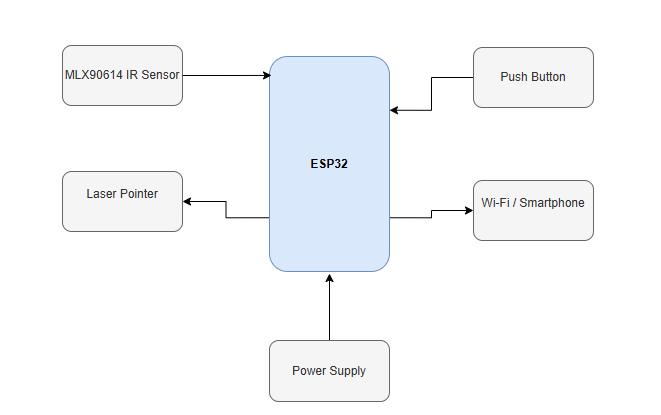
Tostartwith,allthepartsofthehardwarearesetupand they can all talk to each other. The MLX90614 sensor is always checking the infrared radiation that comes from the human body and it turns this into temperature readings. These readings are then sent to the ESP32 microcontroller using I2C communication. The ESP32 takes the data it gets and shows the temperature on the OLEDscreenrightaway,sotheusercanseewhat'sgoing onimmediately.Thisway,theusergetsinstantfeedback, whichisreallyuseful.Thewholeprocesshappensinreal
time,meaningthetemperatureisupdatedallthetime,so theusercanseeanychangesastheyhappen.
The ESP32 sets up a WiFi connection to send temperature data to the ThingSpeak cloud platform, whereit'sstoredandvisualized.Atthesametime,ituses Telegram to send temperature readings as real-time notifications to the user's mobile device. To help with alignment, a laser module is included, making sure the sensor and target are properly lined up for accurate measurements. All the components work together to provide real-time monitoring and good performance. This way, the system can give the user instant updates andreliabledata.
The system is made up of several parts that work together to get the job done. One of these parts is the temperaturesensingmodule,whichusesaspecialsensor calledtheMLX90614tomeasurebodytemperature.This sensor is really good because it can do its job without actually touching the person, which helps keep everythingcleanandhygienic.Anotherimportantpartis the processing module, which is based on a tiny computer called the ESP32 microcontroller. This little computer is in charge of collecting data, processing it, and helping all the different components of the system talktoeachother.
The system has a display part that uses an OLED screen to show the temperature in real time, so you can see it clearly. It also has a communication part that sends the temperature data to the ThingSpeak cloud, where you can store it, look at it, and check it from far away. Plus, it's connected to Telegram, which sends you messages right away if something's up. There's even a laser part thathelpsaimexactly,sothemeasurementsareaccurate and consistent. All these parts work together, controlled bytheESP32,makingsureeverythingrunssmoothlyand atthesametime.
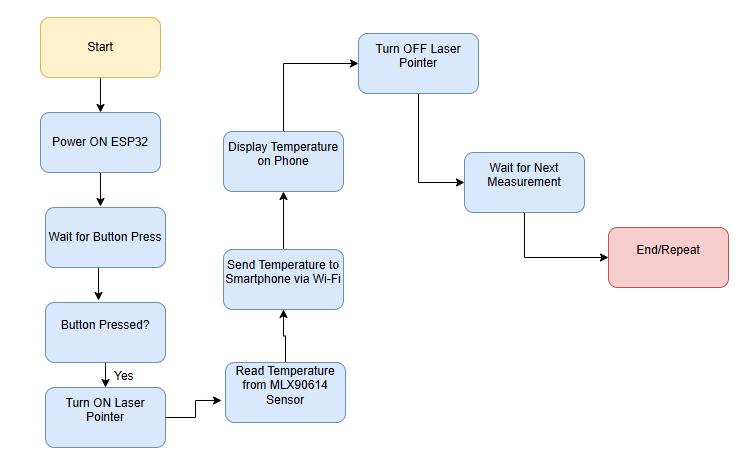
Fig - 3.2: Flowchart
Volume: 13 Issue: 04 | Apr 2026 www.irjet.net p-ISSN: 2395-0072
The system runs all the time to keep an eye on the temperatureinrealtime.Whenyouturniton,theESP32 gets everything ready and starts talking to the sensor, display, and WiFi network. The MLX90614 sensor is always checking the temperature by feeling the infrared radiation coming from the human body. It does this by usingtheinfraredradiationtofigureouthowhotorcold somethingis.Thisway,thesystemcanalwaysknowwhat the temperature is and show it on the display. The WiFi network also helps the system send and receive information, so it can be controlled and monitored from afar.
Here's how the system works: the ESP32 takes the data from the sensors, processes it, and then shows it on the OLED screen so you can see it right away. At the same time, it sends the temperature data to the ThingSpeak cloud platform, where it's stored and can be looked at from anywhere. The system also sends updates on the temperature to the user through Telegram, so they alwaysknowwhat'sgoingon.Whenthesystemistaking measurements, it uses a laser module to make sure the sensorisintherightspot.Allthishappenscontinuously, which means the system can monitor temperatures efficiently,accurately,andwithouttouchinganything.
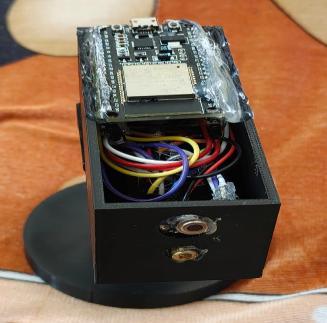
The hardware implementation involves interfacing all components with the ESP32 microcontroller. The MLX90614sensorandOLEDdisplayareconnectedusing theI2Ccommunicationprotocol,whichsimplifieswiring and ensures reliable data transfer. The laser module is connectedtoadigitaloutputpinoftheESP32forcontrol duringmeasurement.
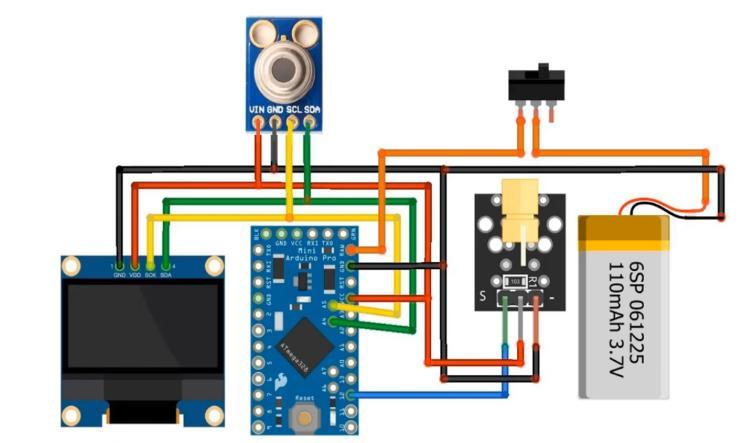
- 3.3:
Tomakesureeverythingworkscorrectly,asteadypower supply is given to all parts of the system. This power supply can come from a USB connection or a battery, whichmakesthesystemeasytomovearoundandusein different situations. The connections are made carefully and the voltage is controlled to get accurate results and
keep the system working consistently. This is important becauseithelpspreventproblemsthatcanhappenwhen the power supply is not stable. By keeping the power supplysteady,thesystemcanworkwellandgivereliable results, whether it's being used in a lab, at home, or in someothersetting.
Thecontactlesstemperaturemonitoringsystemthatwas developed underwent testing to see how well it worked in real-world situations. It was able to successfully measure body temperature using a special sensor called the MLX90614 infrared sensor. This sensor sends the temperaturedatatotheuser'smobiledevicethroughthe Telegram app. If you look at Figure 6.1, you can see that the temperature readings show up on the user's mobile device, along with status messages like "Normal". This givesthe userclearandinstantfeedback,whichisreally useful. The system is designed to be easy to use and understand, so the user can quickly see if everything is okayorifthere'saproblem.
The temperature readings we got were between 35.3°C and 36.9°C, which is pretty much normal for a human body. What's really good is that the system gave us consistent readings every time we measured, so we can trustthesensorsareworkingright.Wealsogotthedata sent to us in real time, with hardly any delay, which showsthat the WiFiconnection is strong and the ESP32 microcontrollerisworkingwellwithTelegram.
The system also responded quickly to each temperature reading,processinganddeliveringtheinformationtothe user right away, without needing any manual help. Plus, with the IoT-based communication, it's possible to keep an eye on things constantly and easily look back at past data through the messaging interface. This makes it reallyconvenienttostayontopoftemperature readings andseehowtheychangeovertime.
International Research Journal of Engineering and Technology (IRJET) e-ISSN: 2395-0056
Volume: 13 Issue: 04 | Apr 2026 www.irjet.net p-ISSN: 2395-0072
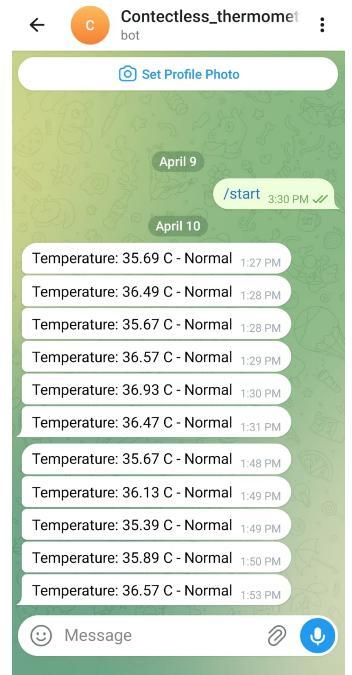
Fig -5.4: TelegramOutputResult
Overall, the results indicate that the system provides accurate, fast, and reliable temperature monitoring. The integration of contactless sensing and real-time communicationenhancesusabilityandmakesthesystem suitable for healthcare and public monitoring applications.
The new system is a game-changer for monitoring temperatures without touching anything. It combines infrared sensors, built-in processing, real-time displays, andinternet-basedcommunicationallinone.Thismeans it can show temperatures right away and send the information to other devices. The best part is that it doesn't need to touch anything, which makes it cleaner and safer for use in hospitals and public places. By not having to make physical contact, it reduces the risk of spreadinggermsandkeepspeoplehealthier.
The system uses a special sensor called MLX90614 to measuretemperature.Thissensordetectstheheatgiven off by the human body and sends the information to a tiny computer called ESP32. The ESP32 then shows the temperature reading on a small screen in real-time. But that's not all - it also sends the temperature data to a cloudplatformcalledThingSpeak,whereitcanbestored and looked at later. And if someone wants to check the temperature from somewhere else, they can get instant updatesonTelegram.Thisway,thesystemmakesiteasy tokeeptrackoftemperaturereadingsfromanywhere,at anytime.
The addition of a laser module helps to improve the accuracy of measurements by making sure the sensor is
properly aligned with the area being measured. This system works well in real-time and all its parts work together smoothly. It's reliable and efficient, making it a greattoolforgettingaccuratereadingsquickly.
The system works well despite a few limitations, like being sensitive to its surroundings and needing to be positioned just right. But overall, it's a great solution that'seasyon the budget, portable,andsimple touse.It makes temperature monitoring more accessible and helps with remote health checks, which is a big step towards creating smart healthcare systems that really work.Byusingthissystem,wecankeepaneyeonhealth from afar and make sure people get the care they need, whichisespeciallyimportantintoday'sworld.
The proposed contactless temperature monitoring system can be further enhanced to improve its functionality, accuracy, and applicability in advanced healthcare systems. One of the major improvements is the integration of additional health monitoring sensors such as heart rate, SpO₂ (oxygen saturation), and blood pressure sensors, which would enable the system to monitor multiple vital parameters simultaneously and provideamorecomprehensivehealthanalysis.
The system is getting a big upgrade with the addition of artificialintelligenceandmachinelearning.Thismeansit can look at past temperature data on platforms like ThingSpeak and predict when something might go wrong, giving us a heads up so we can take action early. This is really helpful for keeping people healthy. Also, instead of just using Telegram, a special mobile app is being made that will make it easier for users to keep an eye on things, get alerts,andmanage data. This app will be more user-friendly and make it simpler for people to use the system. By doing this, the system will be more effective and people will be able to take better care of themselves.
Tomakethesystemevenbetter,wecanaddsensorsthat measuredistance,likeultrasonicsensors,togetaccurate positioning when taking temperature readings, which makes it more reliable. We should also use secure ways of sending information and encrypting data to keep it private and safe. This will help prevent any problems with the data and make sure it's handled correctly. By doingthis,wecantrustthesystemmoreandbesurethat theinformationitgivesusisaccurateandprotected.
Future work may alsofocus on making the system more compact and portable by designing a proper enclosure and integrating rechargeable battery support for continuous operation. The system can be extended to support multi-user data storage and integration with hospital databases and smart healthcare networks for large-scaledeployment.
International Research Journal of Engineering and Technology (IRJET) e-ISSN: 2395-0056
Volume: 13 Issue: 04 | Apr 2026 www.irjet.net p-ISSN: 2395-0072
1. N. Wivanius et al., “IoT-based temperature and humidity monitoring system with real-time data transmission,”2026.[Online].Available:ViewPaper
2. M. D. Albianto et al.,“InternetofThings(IoT)-based temperature monitoring system on LVSDP busbar,” IJRVOCAS,2023.[Online].Available:ViewPaper
3. I. Ghadge et al., “Industrial environment monitoring usingIoT:temperatureandhumiditycontrol,”2025. [Online].Available:ViewPaper
4. J. Nabão, “IoT-based real-time temperature monitoring in critical systems: A review,” 2025. [Online].Available:ViewPaper
5. M. P. Cabezas et al., “Smart monitoring system for temperature and humidity in healthcare environments,” 2025. [Online]. Available: View Paper
6. A. Thomas et al., “IoT-based weather monitoring system with real-time data acquisition,” 2025. [Online].Available:ViewPaper
7. H. Andre et al., “Implementation of IoT-based environmental monitoring system,” 2024. [Online]. Available:ViewPaper
8. M. P. Cabezas et al., “Smart monitoring system for temperature and relative humidity in healthcare environments,” MDPI Sensors, 2025. [Online]. Available: https://www.mdpi.com/2624831X/6/1/15
9. N. Wivanius et al., “IoT-based temperature and humidity monitoring system with real-time data transmissionandautomaticalertmechanism,”2026. [Online]. Available: https://www.researchgate.net/publication/400489 290
10. M. A. Navarrete et al., “IoT-based classroom temperature monitoring and data prediction using ESP32,” 2025. [Online]. Available: https://www.researchgate.net/publication/388644 775(ResearchGate)
11. A.B.Atioğlu,“InternetofThingsbasedremotebody temperature monitoring system,” 2024. [Online]. Available: https://journals.orclever.com/ejrnd/article/view/5 80(Orclever)
12. A. Lamberty et al., “Technical and sustainability requirementsforIoT-basedtemperaturemonitoring systems,” 2025. [Online]. Available: https://link.springer.com/article/10.1007/s44187025-00427-1(SpringerLink)
13. C. Kamyod et al., “IoT-based real-time monitoring system with energy-efficient operation,” 2025. [Online]. Available: https://www.mdpi.com/14248220/25/24/7475(MDPI)