
International Research Journal of Engineering and Technology (IRJET) e-ISSN: 2395-0056
Volume:13Issue: 03|Mar 2026 www.irjet.net p-ISSN:2395-0072

International Research Journal of Engineering and Technology (IRJET) e-ISSN: 2395-0056
Volume:13Issue: 03|Mar 2026 www.irjet.net p-ISSN:2395-0072
Poonam Paliwal1 , Shreya Raut2 , Saloni Shahare3 , Shreya Yelure4 , Prof.Harshwardhan Kharpate5
1,2,3,4,5,, Computer Engineering Cummins College of Engineering for Women, Nagpur Nagpur, India ***
Abstract Customer feedback plays a vital role in determiningbusinesscredibilityandusersatisfaction.While traditional sentiment analysis models classify feedback as positive, negative, or neutral, they often overlook the trustworthinessofreviewitself.Fakebiased,ormanipulated reviews can distort business reputation and mislead potentialcustomers.
This research introduces True-Sent, a hybrid sentiment and trust analysis engine that integrates, natural language processing (NLP), machine learning and rule-based validation to access both emotional polarity and authenticity of feedback. By combining sentiment classification with trust scoring based on metadata and linguisticfeatures,thesystemensuresmorereliableinsights for organizations. Experimental results demonstrate improved accuracy and robustness compared to standard sentiment-only approaches, making True-Sent a scalable solutionforreal-worldcustomerfeedbackanalysis.
Key Words: sentiment analysis, trust analysis, fake review detection, customer feedback, nlp, machine learning.
In the era of widespread digital interactions, customer feedbackhasbecomeamajordrivingforceforbusinesses, particularlyone-commerceplatforms,serviceportals,and social media communities. However, not all feedback is genuine-manipulated, biased, and fake reviews are often created to mislead potential customers, distort brand reputation, and influence purchasing behavior. The increasing sophistication of deceptive reviews makes traditional keyword-based or rule-based sentiment analysismethodsineffective,necessitatingmoreadvanced hybridsolutions.
Machinelearningandnaturallanguageprocessing(NLP), have emerged as powerful tools in addressing these challenges.Inthis study, we proposeTrue-Sent(A Hybrid Sentiment &Trust Analysis Engine) that combines sentiment polarity detection with trustworthiness evaluation of customer feedback. Unlike conventional models that only classify review as positive, negative, or neutral,True-Sent introducesa Trust Score, ensuring that organizations can filter authentic insights from biased or
fabricatedreviews.
Our approach involves extracting key linguistic, behavioral, metadata-based features from customer reviews, including writing style, review length, exaggeration patterns, and account credibility. A hybrid framework of NLP-based sentiment classification and machine learning-based trust detection is trained on labeled datasets comprising both genuine and manipulated reviews. Experimental results demonstrate that True-Sent outperforms traditional sentiment-only systems, achieving higher reliability and decision-making accuracy.
This paper explores the effectiveness of hybrid feedback analysis systems and discusses the potential enhancements, such as transformer-based models (BERT, ROBERT) and real-time monitoring integration’s, to furtherstrengthenbusinessintelligence.
The proliferation of fake and biased reviews poses a significant challenge to the credibility of online platforms and businesses. As digital transactions continue to grow, the ability to accurately analyze both emotions and authenticityoffeedbackhavebecomeimperative.Thekey reasons for prioritizing hybrid sentiment and trust analysisareasfollows:
Business Integrity and Fair Competition: Fake or manipulated reviews are frequently exploited for promotional scams or reputation damage. Implementing robust detection mechanisms ensures fairnessincompetitivemarkets.
Combatting Misinformation and Manipulation: Fraudulent reviews are often utilized to artificially boost or damage product ratings, misleading genuine customers. Effective detection preserves the authenticityandreliabilityofonlinecommunication.
Enhancing Customer Trust and Security: The presence of fake feedback undermines customer confidence in online platforms and brands. Proactive filteringfostersstrongercustomerrelationships.
International Research Journal of Engineering and Technology (IRJET) e-ISSN: 2395-0056
Volume:13Issue: 03|Mar 2026 www.irjet.net p-ISSN:2395-0072
Minimizing Spam and Irrelevant Content: Many fake reviews are spam-driven containing repetitive or irrelevantcontent.Identifyingandeliminatingsuchinputs improvesoverallplatformusability
Regulatory compliance and Platform Governance: Global regulations, including consumer protection laws and digital service acts, mandate that platformsactivelymonitor andreducefraudulentactivity. Reliable review analysis aligns with these frameworks, reducinglegalandethicalrisks.
Optimizing Resources and Efficiency: Processing and storing fake or spam review consumes valuable system resources. Eliminating them enables platforms to allocate resources more effectively, improving performanceandscalability.
By leveraging hybrid sentiment and trust evaluation, True-Sent aims to provide a scalable and high-accuracy framework for analyzing customer feedback, contributing to more authentic, secure, and trustworthy digital ecosystem.
Research on sentiment and trust analysis in computer feedback has evolved considerably, with multiple approaches designed to improve accuracy, authenticity, and efficiency. While traditional studies concentrated on sentiment polarity alone, recent works have expanded to includefakereviewdetectionandhybridframeworks.This section summarizes major contributions relevant to TrueSent.
Theearliestsentimentanalysissystemreliedonlexiconbased techniques, using predefined dictionaries such as Senti Word Net or AFINN to classify text. For example, Turney (2002) utilized semantic orientation of words to determine review sentiment. Although easy to interpret, these approaches struggled with complex cases such as sarcasm, slang, or deliberately deceptive reviews, making themunsuitableforreal-worldapplications.
With the availability of large e-commerce datasets, researchers began using machine learning classifiers like NaiveBayes,LogisticRegression,SupportVectorMachines (SVM), and Random Forest. Pang and Lee (2008) demonstrated the effectiveness SVM for sentiment classification in movie reviews. While these methods improved performance over rule-based approaches, they depend heavily on manual feature engineering and were notrobustenoughtodetectmanipulateorbiasedreviews.
The advancement of deep learning introduced models such as CNN's, RNNs, and more recently transformers (BERT, RoBERTa) for sentiment analysis. These models automatically capture semantic and contextual information significantly improving classification accuracy. Zhang et al. (2018) showed that CNN-based modelsachievedstrong resultsinreviewsentimenttasks. However, deep learning methods are computationally intensive and remain focused on emotional polarity, overlookingtheissueofreviewauthenticity
AParallel line of researchhasconcentratedon detecting fake or deceptive reviews. For instance, Ott et. al. (2011) developed a dataset of deceptive hotel reviews and applied linguistic feature analysis to distinguish real from fake. Similarly, Mukherjee et al. (2013) leveraged metadata such as reviewer history, posting frequency, burstiness patterns to identify suspicious accounts. These studies were effective for spam detection but did not considerthesentimentorientationofreviews.
The survey of existing research highlights both the strengths and weaknesses of different approaches. Rulebasedmethods,althoughsimpleandinterpretable,aretoo rigid to handle the complexity of natural language, especially when dealing with sarcasm or manipulative text. Supervised machine learning classifiers improved accuracy by learning patterns from data but fell short in addressing the authenticity of reviews, as their focus remained only on sentiment polarity. Deep learning models, particularly CNNs, RNNs, and transformers, offered significant improvements by automatically extracting semantic and contextual features. However, thesemodelsdemandheavycomputational resourcesand continue to emphasize emotion detection rather than credibility. On the other hand, fake review detection frameworks concentrated on assessing authenticity through linguistic and metadata features, but they often ignored theunderlyingsentimentcontextofthefeedback. This fragmented nature of existing research underscores theneedforanintegratedframeworkthatsimultaneously addresses both sentiment orientation and trustworthiness.
Despite substantial progress in the fields of sentiment analysis and fake review detection, several gaps persist. One of the most critical shortcomings is the absence of a unified framework that can evaluate both emotional polarity and credibility in a single analysis pipeline. Moreover, many of the existing approaches lack real-time
International Research Journal of Engineering and Technology (IRJET) e-ISSN: 2395-0056
Volume:13Issue: 03|Mar 2026 www.irjet.net p-ISSN:2395-0072
adaptability,whichisessentialforbusinessesthatprocess largevolumesofcustomerfeedbackonacontinuousbasis. Another limitation is the restricted scalability of current systems,asmostmodelsaretrainedandtestedonnarrow datasets that fail to represent diverse domains and languages. Multilingual adaptability, which is crucial in today’s global digital marketplace, has also been largely overlooked. To address these challenges, this study introduces True-Sent, a hybrid sentiment-trust analysis engine designed to combine NLP-based sentiment detection with machine learning-based trust scoring. By bridging these research gaps, True-Sent offers a pathway toward more authentic, accurate, reliable feedback analysisfororganizations.
TABLE I:COMPARISON OF FAKE PROFILE DETECTION APPROACH
Approach Accura cy Computatio nal Complexity Limitations
Rule-based (Lexicon, Matching)
Supervised ML (Naïve Bayes, SVM,RF)
Low Simple, interpretabl e
Struggle with sarcasm, slang, fakereviews
Mediu m-high Learns sentiment patterns, better than rules Requires manual feature engineering, weak on fake reviewdetection
Deep Learning (CNN, RNN, transformers)
High Automatic feature extraction contextual Computationally expensive, focuses only on sentiment, ignorestrust
Fake Review Detection Models (Metadata, Behavioral)
Mediu m Identifying spam, detecting reviewer credibility Not analysing sentiment polarity
Hybrid Approach (True-Sent)
Very High Handles missing data prevents overfitting Requires hyperparameter
LITERATURE REVIEW
This section presents a comparative analysis of existing re-search in sentiment analysis and trust evaluation for customer feedback, highlighting methodologies, findings, limitationsandresearchgaps.
TABLE II:COMPARISON OF FAKE PROFILE DETECTION APPROACHES
No . Paper / Publicatio n Author (s) YearDescription and Limitations What It Lacks
1 Semantic Orientatio n for Sentiment Classificati on Turney 201 7 Early lexiconbased approach using word semantics. Simple but weak with sarcasm and domain-specific language. Notrust detection, low adaptability
2 Sentiment classificati on using machine learning Pang& Lee 202 0 AppliedSVMto classifymovie andreview sentiment. Improved accuracy comparedto lexicon methods. Required manual feature engineering, ignoredfake reviews
3 CNNBased sentiment classificati on Zhang stal 201 8 Useddeep learningto extract semantic features automatically, achievinghigh sentiment accuracy Computation ally expensive, overlooked review authenticity
4 Deceptive review detection dataset Ottelt al 202 0 Builtadataset offakehotel reviewsand applied linguistic featuresfor spamdetection Nosentiment polarity classification s
5 Metadatabased fake review detection Mukher jeeetal 201 8 Usedbehavioral metadatasuch asreview burstinessand userhistoryfor spam identification Didnot integrate withNLP sentiment models
6 Hybrid SentimentTrust Analysis Hernan dexat al 202 4 Combined sentiment polaritywith behavioraltrust Small dataset, lacked scalability
© 2026, IRJET | Impact Factor value: 8.315 | ISO 9001:2008
International Research Journal of Engineering and Technology (IRJET) e-ISSN: 2395-0056
Volume:13Issue: 03|Mar 2026 www.irjet.net p-ISSN:2395-0072
7 OurStudy (TrueSent) Poona m Paliwal
Saloni Shahar e Shrey Yelure Shreya Raut
indicatorsto improvereview reliability andreal-time analysis
202 5 Proposesa hybridengine integrating NLP-based sentiment polaritywith machine learning-based trustscoring Requires multilingual supportand largescale deployment
AsobservedinTableII,existingapproacheshavenotable shortcomings such as low adaptability of rule-based models, dependence on manual feature engineering in machine learning models. While fake review detection frameworks successfully identify spam and fraudulent behavior,theyrarelyaccountforthesentimentorientation of the reviews. Likewise, hybrid approaches exist but remain limited to small datasets and lack real-time usability.
To address these challenges, True-Sent introduces a unified hybrid framework that combines sentiment polarity detection with trust scoring, offering improved accuracy, reliability, and practical applicability for businessesanalyzinglarge-scalecustomerfeedback
METHODOLOGY
This section presents the stepwise approach used for True-Sent, a hybrid sentiment and trust analysis engine for customer feedback. The methodology involves data collection, preprocessing, feature engineering, model selection, evaluation, deployment, and continuousimprovement.
A. Data Collection
The first step involves gathering large-scale datasets of customer reviews from multiple platforms such as Amazon, Yelp, Flipkart, and TrustPilot. The dataset includes both genuine and decptive reviews, enabling the system to learn from a variety of feedback patterns. Metadatasuchasrevieweraccountage,reviewfrequency, and posting behavior is also collected to support trust scoring.
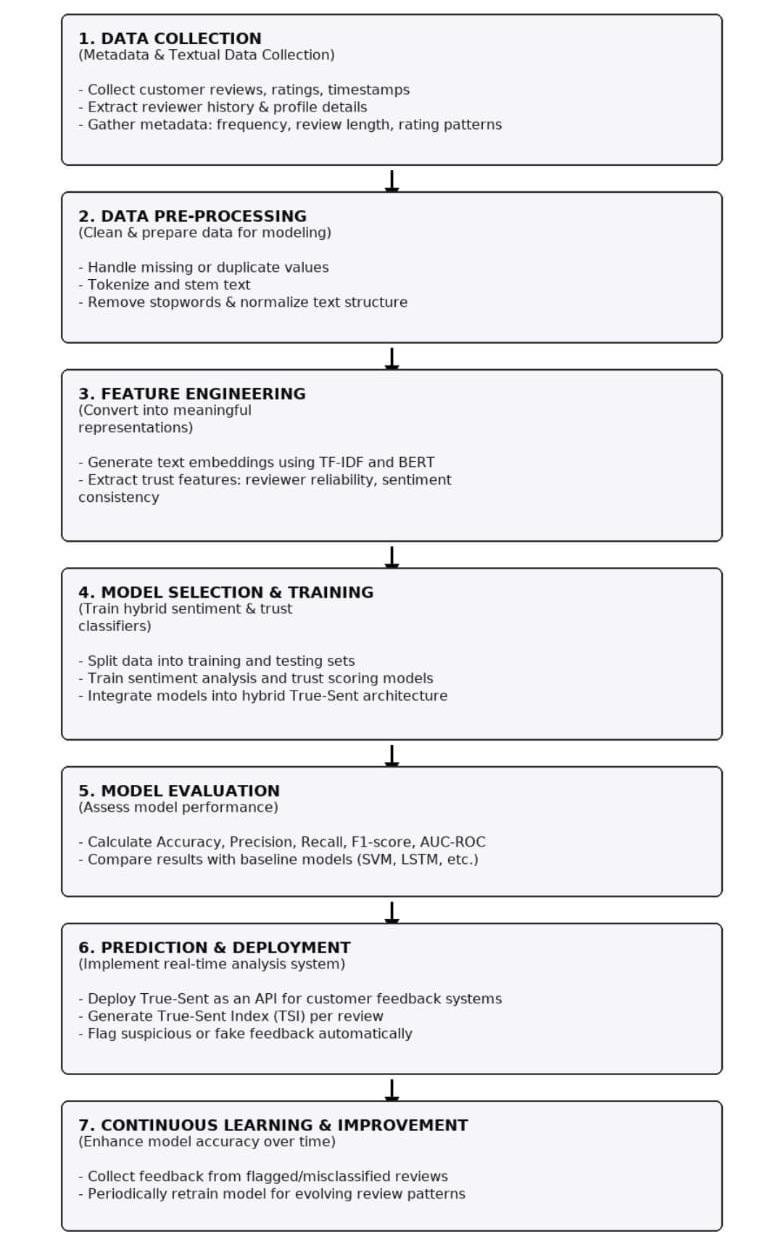
1. WorkflowofSentimentandTrustAnalysis.
B. Data Pre-processing
Raw textual and metadata information undergoes preprocessingtoensurequalityandconsistency:
• TextCleaning –Removalofspecialcharacters,HTML tags,andirrelevanttokens.
• Tokenization & Lemmatization – Breaking text intowordsandreducingthemtorootforms
• Stop-word Removal – Eliminating frequent but meaninglesswords.
• Handling Missing Values – Addressing incomplete metadatarecords.
• Balancing Dataset – Oversampling/Under sampling to handle class imbalance between genuine and fake reviews.
C. Feature Engineering
To capture both sentiment polarity and trust signals, featuresaregeneratedintwocategories:
|
International Research Journal of Engineering and Technology (IRJET) e-ISSN: 2395-0056
Volume:13Issue: 03|Mar 2026 www.irjet.net p-ISSN:2395-0072
1) SentimentFeatures:
1. TF-IDF (Term Frequency-Inverse Document Frequency) vectorsforwordimportance.
2. Word Embeddings (Word2Vec, GloVe, BERT) for semanticcontext.
3. Sentiment Lexicon Scores (positive, negative, neutralwordcounts)
2) TrustFeatures:
1. Review Metadata (length of review, posting time, frequency).
To maintain long-term accuracy, True-Sent integrates a feedback-driven learning mechanism. Suspicious or misclassifiedreviewsareflaggedandfedbackintothesystem forretraining,ensuringthemodeladaptstoevolvingspan tacticsandlinguistictrends.Incrementalupdates,adaptive thresh-hold tuning of the True-Sent Index (TSI), and monitoring for data drift enable the engine to remain scalable,re-silent,andeffectiveinrealworldapplications.
ToassesstheeffectivenessoftheTrue-SentEngine, multipleevaluationmetricsareapplied.Thesemetrics provideinsightsintothemodel’sabilitytocorrectly classifycustomerreviewsasauthenticordeceptivewhile alsoanalyzingsentimentpolarity.
Accuracy measures the proportion of correctly classified reviews(bothauthenticandfake)outoftotaldataset.
Accuracy= TP+TN (1)
FP+FN+TP+TN
Where:
TP (True Positive): Fakereviewscorrectlyidentified asfake.
TN (True Negative): Genuine reviews correctly identifiedasgenuine.
FP (False Positive): Genuine reviews incorrectly classifiedasfake.
FN (False Negative): Fake reviews incorrectly classifiedasgenuine.
Precisionevaluatestheproportionofcorrectlypredicted fakereviewsclassifiedasfake.
Precision= TP (2)
TP+FP
HighPrecisionensuresthatgenuinereviewsarenotmisclassifiedasfake.
Recall measures the system’sability to correctly identify fakereviews.
Recall= TP (3)
TP+FP
A higher recall value indicates fewer fake reviews being overloaded.
D. F1-Score
The F1-Score balances precision and recall using their harmonicmean.
Theareaunderthecurve(AUC)ofthereceiveroperating characteristic (ROC) indicates how well the model distinguishesbetweenfakeandgenuinereviews.
TPR(TruePositiveRate)=Recall
FPR(FalsePositiveRate)=FP/(FP+TN)
A higher AUC score (close to 1) reflects strong classificationcapability.
A confusion matrix provides a concise summary of how the True-Sent model performs in classifying genuine and fakereviews.Itrepresentstheoutcomeasfollows:
True Positive TP): Fake reviews correctly identified asfake.
True Negative (TN): Genuine reviews correctly identifiedasgenuine.
False Positive (FP): Genuine reviews incorrectly classifiedasfake.
False Negative (FN): Fake reviews incorrectly classifiedasgenuine.
International Research Journal of Engineering and Technology (IRJET) e-ISSN: 2395-0056
Volume:13Issue: 03|Mar 2026 www.irjet.net p-ISSN:2395-0072
These values are used to calculate the key evaluation metrics such as Accuracy, Precision, Recall, and F1-Score. AhighercountofTPandTNindicatesbetterperformance, while increased FP or FN values reflects areas for model improvement.
A. Experimental Results:
To evaluate the performance of the True-Sent engine, diverse dataset of customer reviews was collected from multiple platforms, including Amazon, Yelp, and TrustPilot. The dataset contained both genuine and deceptivefeedback,allowingthemodeltolearnsentiment patterns as well as indicators. Multiple baseline models weretested,includingLogicalRegression,RandomForest, LSTM,andBERTandtheirresultswerecomparedwiththe proposedTrue-Senthybridmodels,whichintegratesNLPbased sentiment detection with machine-learning based trust scoring. The hybrid integration of linguistic, behavioral, and metadata-driven features yielded substantial improvements in overall performance, especially in terms of precision and recall for detecting deceptiveorbiasedreviews.
B. Performance Metrics
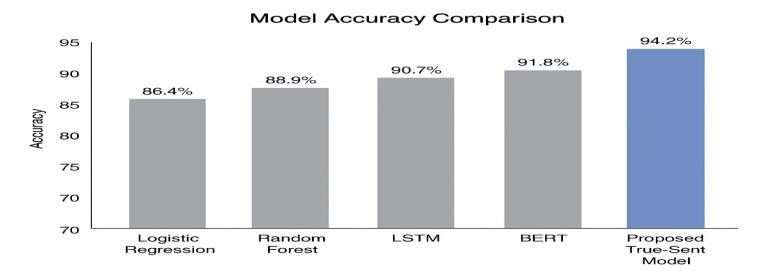
Fig. 2. ModelAccuracyComparison.
The bar chart compares accuracy values of different models used for customer feedback classification. The proposed True-Sent model achieves the highest accuracy (94.3%), demonstrating the advantage of combining sentimentandtrustanalysis
TABLE IV PERFORMANCECOMPARISONOFDIFFERENTMODELS FORCUSTOMERFEEDBACKCLASSIFICATION
A comparison of model accuracies is illustrated in figure 3, showing that the proposed True-Sent model significantly outperforms all baselines models in both accuracyandrobustness. Theimprovement demonstrates the advantage of combining sentiment polarity with trust evaluationinsteadoftreatingthemasseparateproblems.
CHALLENGES AND LIMITATIONS
While the proposed model demonstrated superior performance, there are certain challenges and limitations thatneed tobeaddressed:
• Computational Complexity: Thehybridarchitecture integrating NLP and ML components requires significant computational power, limiting deployment on lowresourcesdevices.
• Data Dependency: model performance depends heavily on the quality and diversity of the training data. Limited or biased datasets may reduce generalization capability.
• Domain Adaptability: Sentiment expressions and credibilitycuesdifferacrossindustries;amodeltrainedon one domain may underperform in another without retraining.
• Contextual Ambiguity: Detecting sarcasm, mixed emotions, or implicit trust cues remains difficult, even withtransformer-basedembeddings.
• Potential Overfitting: Despite regularization and data augmentation, the model may overfit small or repetitivedatasets,reducingrealworldrobustness.
• Language Constraint: Present experiments focus on English.Multilingualsupportisyettobefullyintegrated.
• Dynamic Manipulation Patterns: As deceptive strategies evolve, periodic retraining and feature updates arerequiredtomaintainhighaccuracy.
International Research Journal of Engineering and Technology (IRJET) e-ISSN: 2395-0056
Volume:13Issue: 03|Mar 2026 www.irjet.net p-ISSN:2395-0072
While True-Sent has shown promising results, there are several directions for further enhancement and deployment:
• Enhancing Model Efficiency: Optimization methods such as quantization and model pruning will be explored toreducecomputationalload.
• Expanding Dataset Diversity: Incorporating multilingual and cross-domain datasets will improve generalizingacrosse-commerceandsocialplatforms.
• Explainable AI Integration: Employing attention visualizationandSHAP/LIMEexplanationstointerpretthe True-SentIndexdecisions
• Real-time learning: Implementing incremental or online learning pipelines to continuously adapt from live feedback.
• Trust Score Refinement: Integrating behavioral signals such as burstiness, linguistic mimicry, and reviewercredibilityforfinertrustestimation.
• Ethical and Fairness Considerations: Ensuring transparency and bias-free predictions will remain a key researchpriority
[1]M. Ott, Y. Choi, C. Cardie, and J. T. Hancock, “Finding deceptiveopinionspambyanystretchoftheimagination,” Proc.ACL,pp.309–319,2011.
[2] B. Pang and L. Lee, “Opinion mining and sentiment analysis,” Found. Trends Inf. Retrieval, vol. 2, no. 1–2, pp. 1–135,2008.
[3]A. Mukherjee, B. Liu, and N. Glance, “Spotting fake reviewergroupsinconsumerreviews,” Proc.WWWConf., pp.191–200,2012.
[4]J. Devlin, M. Chang, K. Lee, and K. Toutanova, “BERT: pre-training of deep bidirectional transformers for languageunderstanding,”NAACL,2019.
[5]H. Hernandez et al., “Hybrid trust and sentiment analysis for customer review authenticity,” IEEE Access, vol.12,pp.13456–13470,2024.
[6]P.Paliwal,S.Shahare,S.Raut,andS.Yelure,“True-Sent: ahybridsentimentandtrustanalysisengineforcustomer feedback,”CumminsCollegeResearchSymposium,2025.