
International Research Journal of Engineering and Technology (IRJET) e-ISSN: 2395-0056 p-ISSN: 2395-0072
Volume: 13 Issue: 04 | Apr 2026 www.irjet.net

International Research Journal of Engineering and Technology (IRJET) e-ISSN: 2395-0056 p-ISSN: 2395-0072
Volume: 13 Issue: 04 | Apr 2026 www.irjet.net
B.S. Sruthi Sriya¹, P. Reetu², S. Asha³, T. Shresta Sree⁴
¹⁻⁴ Department of Computer Science and Engineering, Keshav Memorial Institute of Technology, Hyderabad, India
Under the guidance of Mr. E. Srinath
Assistant Professor, Department of Computer Science and Engineering Keshav Memorial Institute of Technology, Hyderabad, India ***
Abstract - This paper presents Trayati, a real-time emergency alert system designed to provide immediate assistance during critical situations. Traditional emergency systemsoften dependonmanual actions,which may not be feasible during emergencies. The proposed systemautomatestheprocessofsendingalertsandsharing real-time location with pre-registered contacts.
The system is developed using Python and the Django framework, integrating technologies such as GPS tracking and WhatsApp automation through PyWhatKit. When the SOS feature is activated, the system automatically sends emergency messages along with the user’s live location. Continuous locationtracking ensures accurate monitoring until safety is restored.
The proposed solution improves response time, minimizes user effort, and enhances communication reliability by using widely adopted platforms. The system is user-friendly, efficient, and scalable, making it suitable for real-world safetyapplications.
Key Words: Emergency Alert System, GPS Tracking, SOS, Django, WhatsApp Automation, Real-Time Location,PublicSafety
In today’s rapidly evolving world, ensuring personal safety has become increasingly important due to rising incidents of accidents, crimes, and unexpected emergencies. Individuals may findthemselves in critical situations where immediate help is required, but they maynotbeabletocommunicate effectivelyduetopanic, injury,orenvironmentalconstraints.
Traditional emergency systems rely heavily on manual interaction such as dialing phone numbers, typing messages, or navigating through mobile applications. During emergencies, such actions may not be feasible, resultingindelayedcommunicationandreducedchances oftimelyassistance.
An emergency alert system is a technological solution
thatenablesuserstoquicklynotifytheirtrustedcontacts during distress situations. However, many existing systems provideonly basicfunctionalitiesandlack automation, real-timetracking,andseamlesscommunication.
The main objective of this project is to design and develop a real-time emergency alert system that minimizes user effort and maximizes response efficiency.Theproposedsystem,Trayati,allowsusersto triggeranSOSalertinstantly,whichautomaticallysends messages along with live GPS location to emergency contacts.
The system utilizes Python and Django for backend development and integrates GPS services and WhatsApp automation for communication. Continuous locationtrackingensuresthatcontacts receive updated information,improvingrescueeffectiveness.
This project aims to provide a reliable, user-friendly, andefficientsolutionforenhancingpersonalsafetyand emergencyresponsesystems.
Emergency alert systems and personal safety applications have been widely developed to improve communication duringcritical situations. Early systems mainlyreliedonSMS-basedalerts,whereusersmanually sentmessagestoemergencycontacts.Althoughsimple, these systems lacked real-time tracking and were not reliableindynamicsituations.
Modernapplicationssuchas“112India,”“bSafe,”and “My Safetipin” introduced features like GPS tracking, emergency calling, and alert notifications. While these applications improved safety, they still depend on manual user interaction, which may not be possible duringpanicorinjury.
Recentstudieshighlighttheimportance ofreal-time locationtracking,asitallowscontinuousmonitoringof
International Research Journal of Engineering and Technology (IRJET) e-ISSN: 2395-0056 p-ISSN: 2395-0072
Volume: 13 Issue: 04 | Apr 2026 www.irjet.net
the user’s movement. However, many existing systems provide only static location sharing, which becomes ineffectiveiftheuserchangeslocation.
Researchers have also explored the use of popular communication platforms for faster alert delivery. Platforms like WhatsApp are widely used and provide instant message delivery,increasingthechancesofquick response compared to traditional SMS or app notifications.
Despite these advancements, most systems lack completeautomation,continuoustracking,andseamless integration with user-friendly interfaces. The proposed system,Trayati,addressestheselimitationsbycombining real-time GPS trackingwithautomatedWhatsAppalerts, ensuring efficient and reliable emergency communication.
Intoday’sfast-pacedworld,emergencysituationssuchas accidents, medical issues, and safety threats require immediate communication and quick response. However, manyexistingemergency alertsystems arenot fully effective in real-world scenarios due to several limitations.
Oneofthemajorchallengesisthedependenceonmanual user interaction. Most systems require users to unlock their devices, open applications, and send messages or makecalls.Duringcriticalsituations,usersmaybeunder stress, panic, or physical difficulty, making it hard to performtheseactions.Thisdelaycanreducethechances ofreceivingtimelyhelp.
Another important limitation is related to location tracking.Manyapplicationsprovideonlyasingleorstatic location update when the alert is triggered. In real-life situations, the user’s position may change continuously, and static location sharing becomes insufficient for accurate tracking. This makes it difficult for emergency contactstolocatetheuserquickly.
In addition, several systems do not integrate withcommonly used communication platforms. Alerts maybesentthroughlessfrequentlyusedapplicationsor notifications,whichcan beeasilymissedordelayed.This reducestheeffectivenessofemergencycommunication.
Furthermore, some existing systems lack proper automation and user-friendly design, making them less accessibletoalltypesofusers.Theselimitationshighlight theneedforamoreefficientandreliablesolution.
Therefore, there is a need to develop an automated
emergency alert system that minimizes user effort, provides continuous real-time location tracking, and ensures fastand reliable communication through widely used platforms. The proposed system aims to address these issues and improve overall emergency response efficiency.
Theproposedsystem, Trayati,is areal-timeemergency alert and communication platform designed to provide immediate assistance during critical situations. The system focuses on reducing user effort, improving response time, and ensuring reliable communication throughautomationandcontinuouslocationtracking.
Thecorefunctionalityofthesystemisbasedona oneclick SOSactivationfeature.Whentheusertriggersthe SOSalert,thesystemautomaticallyinitiatesasequence of operations without requiring further manual input. This includes fetching the user’s current GPS location, generating an emergency message, and sending it to pre-registeredemergencycontacts.
Oneofthe keyfeaturesoftheproposedsystemisrealtimeGPStracking.Unliketraditionalsystemsthatshare onlyastaticlocation,Trayaticontinuouslyupdatesthe user’s location at regular intervals. This allows emergencycontacts to monitor the user’s movement in real time and take appropriate action quickly. Continuoustrackingsignificantlyimprovestheaccuracy andeffectivenessofemergencyresponse.
ThesystemintegratesWhatsAppautomationusingthe PyWhatKit library. Once the SOS alert is activated, the systemautomaticallyopensWhatsAppWebandsends emergencymessagesalong with the user’s live location toall registered contacts. Using WhatsApp as a communication platform increases the chances of immediateattention,asitiswidelyusedandfrequently accessedbyusers.
The application is developed using Python and the Django framework, which provides a robust backend for handling user authentication, data processing, and system logic. The system alsouses additionallibraries such as PyAutoGUI for automation, Requests for handlingAPIcalls,andCryptographyforsecuringuser data. These technologies ensure smooth operation, security,andscalabilityofthesystem.
The proposed system also includes a user-friendly interface that allows users to register, log in, and managetheiremergencycontactseasily.Thedashboard provides quick accesstothe SOS button, ensuring that users can trigger alerts without delay. The design
International Research Journal of Engineering and Technology (IRJET) e-ISSN: 2395-0056 p-ISSN: 2395-0072
Volume: 13 Issue: 04 | Apr 2026 www.irjet.net
focuses on simplicity and accessibility, making it suitableforusersofallagegroups.
Inadditiontoalertgeneration,the systemmaintainsa recordoflocationdataandemergencyevents,whichcan be useful for analysis and future reference. The system is designed to handle network interruptions gracefully and ensure that messages are delivered reliably.
Overall,theproposedsystemcombinesautomation,realtimetracking,andreliablecommunicationtoprovidean efficient emergency alert solution. It addresses the limitations of existing systems by minimizing manual effort,improvingaccuracy,andensuringfasterresponse duringemergencies.
The methodology of the Trayati system describes the structured approach followed to detect emergencies, processuserdata,andsendalertsefficiently.Thesystem is divided into simple modules, each responsible for a specific task. This modular approach ensures that the system is easy to understand, reliable, and capable of providingfastresponseduringemergencysituations.
Thismoduleisresponsibleformanaginguseraccessand ensuring thatonlyauthorizeduserscanuse the system. Itprovidesasecureenvironmentwhereuserscanregister andlogintoaccessemergencyfeatures.
•Users create an account by entering details such as name,email,phonenumber,andemergencycontacts
•The system verifies login credentials using authenticationmechanisms
• User information is stored securely in the database forfutureuse
• Proper validation ensures that the entered details arecorrectandreliable
This module forms the foundation of the system by maintaininguseridentityandensuringdatasecurity.
The SOS alert feature is the core component of the system,designedtoprovideimmediateresponseduring emergencies.Itisdevelopedtominimizeusereffortand reducedelayincommunication.
•A dedicated SOS button is provided on the dashboard forquickaccess
•Theusercantriggerthealertwithasingleclick
• Once activated, the system automatically initiates the emergencyprocess
• Noadditionalstepssuchastypingmessagesormaking callsarerequired
This module ensures that even in panic or stressful situations, users can easily send alerts without complexity.
Thismoduleplaysacrucialroleinidentifyingtheexact locationoftheuserduringanemergency.Accurateand continuouslocationtrackinghelpsemergencycontacts respondeffectively.
• The system retrieves the current GPS location usinglocationservices
• Latitude and longitude coordinates are captured to determineexactposition
•Thelocationiscontinuouslyupdatedatregularintervals
• Real-time tracking allows contacts to monitor user movement
This feature improves the accuracy of emergency response, especially when the user is moving or traveling.
This module handles the communication process by sending emergency alerts through WhatsApp. It uses automation to ensure fast and reliable message delivery.
• PyWhatKit library is used to open WhatsApp Web automatically
•The system generates an emergency message containinguserdetailsandlocationlink
• Messages are sent instantly to all registered emergencycontacts
• Automation eliminates manual effort and ensures quickcommunication
Using WhatsApp increases the chances of immediate attention,asitiswidelyusedandfrequentlyaccessed.
This module manages all system data and provides a user-friendly interface for interaction. It ensures smoothfunctioningandeasyaccessibilityoffeatures.
• User data, emergencycontacts, and location details arestoredinthedatabase
•The system maintains records of alerts and location history
•A simple and clean interface is designed for easy navigation
•The dashboard provides quick access to important
International Research Journal of Engineering and Technology (IRJET) e-ISSN: 2395-0056 p-ISSN: 2395-0072
Volume: 13 Issue: 04 | Apr 2026 www.irjet.net
featureslikeSOSactivation
Thismoduleensuresthatthesystemremainsefficient, organized,andeasytouseforallusers.
Overall, the methodology combines automation, realtimetracking,and securecommunication tocreate an effective emergency alert system. Each module works together to provide a fast, reliable, and user-friendly solutionforhandlingemergencysituations.
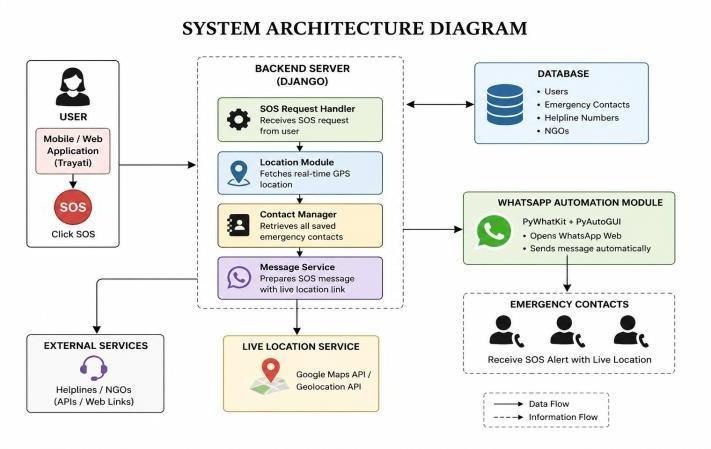
Fig-1: Trayati System Architecture Diagram throg
ThesystemarchitectureoftheTrayatiemergencyalert system illustrates the flow of data and interaction betweendifferentcomponentsinvolvedinhandlingan emergency.Thesystembeginswiththeuseraccessing the application through a mobile or web interface. WhentheuserpressestheSOSbutton,arequestissent tothebackendserverbuiltusingtheDjangoframework.
Thebackendserveractsasthecentralprocessingunitof thesystem.ItfirsthandlestheSOSrequestthroughthe SOS Request Handler, which initiates the emergency process.TheLocationModulethenretrievestheuser’s real-time GPS coordinates using geolocation services. This ensures that the exact position of the user is identifiedaccurately.
Once the location is obtained, the Contact Manager module fetches all the pre-registered emergency contacts from the database. The Message Service then prepares an emergency message that includes the user’s details along with a live locationlink generated usingserviceslikeGoogleMapsAPI.
The system then interacts with the WhatsApp Automation Module, which uses libraries such as PyWhatKit and PyAutoGUI to automatically open WhatsApp Web and send emergency messages to all
emergency contacts. This automation ensures fast and reliablecommunicationwithoutrequiringmanualinput fromtheuser.
The database plays an important role by storing user details,emergency contacts, helpline numbers, and NGO
information.Itensuresthatallrequireddataisreadily availableduringemergencysituations.Additionally,the system can integrate with external services such as helplines and NGOs through APIs or web links to provideextendedsupport.
Finally, the emergency contacts receive the SOS alert alongwiththelivelocationoftheuser,allowingthemto respond quickly. The overall architecture ensures smooth data flow, real-time communication, and efficientcoordinationbetweenallmodules,makingthe systemreliableandeffectiveforemergencyresponse.
Thearchitectureisdesignedtobescalableandefficient, allowing future enhancements such as mobile app integration, voice-based SOS activation, and direct communicationwithemergencyservices.Themodular structureensuresthateachcomponentcanbeupgraded independently without affecting the overall system performance. This makes the system adaptable to different environments and capable of handling realworldemergencyscenarioseffectively.
The Trayati emergency alert system was successfully implemented and tested under different scenarios to evaluateits performance and reliability.Thesystemwas able to trigger SOS alerts instantly and perform all required operations such as location tracking and messagedeliverywithoutsignificantdelay.
During execution, the system accurately fetched the user’s real-time GPS location and generated a live locationlink.Thislocationinformationwassuccessfully sharedwithallregisteredemergencycontactsthrough WhatsApp automation. The use of a widely adopted communication platform ensured that alerts were delivered quickly and were easily noticeable by recipients.
The continuous location tracking proved to be highly effective, as it allowed emergency contacts to monitor the user’s movement in real time. This is particularly useful in situations where the user is traveling or changinglocation,asitprovidesupdatedandaccurate informationforquickresponse.
International Research Journal of Engineering and Technology (IRJET) e-ISSN: 2395-0056 p-ISSN: 2395-0072
Volume: 13 Issue: 04 | Apr 2026 www.irjet.net
TheWhatsAppautomationmoduleperformedefficiently by opening WhatsApp Web and sending messages automaticallywithoutrequiringuserintervention.This reduced the time taken for communication and eliminated the need for manual actions during emergencies.
The user interface of the system was designed to be simple and intuitive, allowing users to access features easily.The
SOS buttonwasclearlyvisibleandresponsive,ensuring quickactivationevenunderstressfulconditions.
Performance analysis showed that the system operates withminimalresponsetimeandmaintainsconsistencyin differentnetworkconditions.Theintegrationofmultiple modulessuchasGPStracking,automation,anddatabase managementworkedsmoothlywithoutconflicts.
Overall,theresultsdemonstratethattheTrayatisystem effectively improves emergency communication by providing fast alerts, accurate location tracking, and reliablemessagedelivery.Thesystemmeetsitsobjective of offering a user-friendly and efficient solution for realtimeemergencyresponse.
The Trayati emergency alert system was successfully developedtoprovideareliableandefficientsolutionfor real-time emergency communication. The system enablesuserstosendinstantSOSalertsalongwiththeir liveGPSlocation,ensuringquickresponseduringcritical situations.
The integration of real-time location tracking and WhatsApp automation reduces manual effort and improvescommunicationspeed.Thecontinuouslocation updatefeatureenhancesaccuracybyallowingemergency contactstotracktheuser’smovementeffectively.
The system demonstrated stable performance with minimal delay and reliable message delivery. Its simple and user-friendly interface ensures easy access to emergencyfeatures,evenduringstressfulconditions.
Overall,the proposedsystemprovides a fast,automated, andpracticalsolutionforimprovingpersonalsafetyand emergencyresponse.
The Trayati emergency alert system can be further improved by adding advanced features to enhance usability and performance. A dedicated mobile application can be developed to provide better accessibilityandfasterresponse.
Future enhancements may include voice-based SOS activation, allowing users to trigger alerts without manualinteraction.Integrationwithemergencyservices suchaspolice,hospitals,andambulancenetworkscanalso improveresponsetime.
Additionally, the system can be extended with cloud storage, improved security features, and support for multiple communication channels such as SMS and email along with WhatsApp. These improvements will makethesystemmoreefficient,scalable,andsuitablefor real-worldapplications.
[1] Django Software Foundation, “Django Documentation,” [Online]. Available: https://docs.djangoproject.com/
[2] PyWhatKit Library, “PyWhatKit Documentation,” [Online]. Available: https://pypi.org/project/pywhatkit/
[3] GoogleDevelopers,“GoogleMapsGeolocationAPI,” [Online]. Available: https://developers.google.com/maps
[4]Python Software Foundation, “Python Documentation,” [Online]. Available: https://docs.python.org/
[5] WhatsApp Inc., “WhatsApp Web,” [Online]. Available:https://web.whatsapp.com/
[6] M.A.Rahmanetal.,“SmartEmergencyAlertSystem UsingGPSTracking,”InternationalJournalofAdvanced ComputerScience,2021.
[7] S. Sharma and R. Gupta, “Real-Time Location Tracking and Emergency Response System,” IEEE ConferenceonSmartSystems,2020.
[8] N. Kumar and P. Singh, “Automated Emergency Communication System Using Mobile Applications,” JournalofComputerNetworks,2022.
[9]A.Vermaetal., “WomenSafetyApplicationUsingGPS
International Research Journal of Engineering and Technology (IRJET) e-ISSN: 2395-0056 p-ISSN: 2395-0072
Volume: 13 Issue: 04 | Apr 2026 www.irjet.net
and Alert Mechanism,” International Research Journal ofEngineeringandTechnology,2021.
[10]J.Smith,“DesignofReal-TimeAlertSystemsUsing WebTechnologies,”SpringerPublications,2020.
[11]K.PatelandR.Mehta,“IoT-BasedEmergencyAlert and Tracking System,” IEEE International Conference onIoTSystems,2022.
[12]P. Singh et al., “Location-Based Services for Emergency Management Systems,” Journal of InformationTechnology,2021.
[13] R.GuptaandS.Jain,“SecureDataCommunication inWebApplications,”InternationalJournalofComputer Science,2020.
|