
International Research Journal of Engineering and Technology (IRJET) e-ISSN: 2395-0056
Volume: 13 Issue: 04 | Apr 2026 www.irjet.net p-ISSN: 2395-0072
TRANSMISSION LINE FAULT PROTECTION SYSTEM
Gaurav Dewangan1 , David Kumar2 , Amisha Kumari3 , Karan Kumar4 , Suresh Kumar⁵, Prof. Vikas Chandra⁶
12345UG Student, Department of Electrical & Electronics Engineering, CEC Bilaspur, Chhattisgarh, India
6Professor , Department of Electrical & Electronics Engineering, CEC Bilaspur, Chhattisgarh, India
ABSTRACT – The stability and reliability of power systems depend heavily on efficient fault detection in transmission lines, which are prone to issues like short circuits, open circuits, and ground faults. Traditional methods such as impedance-based and traveling wave techniques have limitations. Recent advancements in sensors, communicationsystems, andmachine learninghave improved real-time faultdetectionandaccuracy. This paper reviews both conventional and modern approaches, highlighting the advantages of integrated techniquesforenhancingpowersystemperformanceandreliability.
INTRODUCTION
Thereliableoperationofelectricalpowersystemsisessentialformodernsociety,andtransmissionlinesplaya key role in delivering electricity from generating stations to consumers. Due to their extensive length and exposuretoenvironmentalconditions,transmissionlinesarehighlysusceptibletofaultssuchasshortcircuits, groundfaults,andopenconductorconditions.Thesefaultscanleadtopowerinterruptions,equipmentdamage, and reduced system stability if not detected and cleared promptly. Therefore, an efficient and fast fault protectionsystemiscriticaltoensurethesafety,reliability,andcontinuityofpowersupply.
Atransmissionlinefaultprotectionsystemisdesignedtodetectabnormalconditions,classifythetypeoffault, and isolate the affected section within a minimal time. Traditional protection schemes, including overcurrent, distance(impedance-based),anddifferentialprotection,havebeenwidelyimplementedduetotheirsimplicity and effectiveness. However, these methods often face challenges such as sensitivity to system parameter variations,limitedaccuracyundercomplexfaultconditions,anddependencyonprecisesettings.
With the advancement of modern technologies, there has been a growing shift toward intelligent protection systems. The integration of advanced sensors, communication networks, and digital relays enables real-time monitoringandfasterresponse.Furthermore,theapplicationofmachinelearninganddata-driventechniques has opened new possibilities for improving fault detection accuracy, classification, and predictive analysis by learningfromhistoricalandreal-timedata.
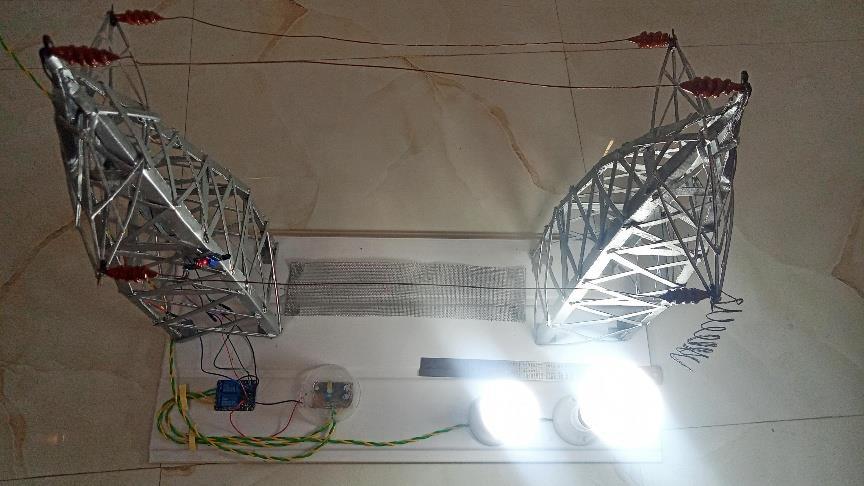
This project focuses on the design and analysis of a transmission line fault protection system that combines conventional protection methods with modern intelligent techniques. The objective Is to enhance the speed, accuracy,andreliabilityoffaultdetectionandisolation,therebyimprovingoverallpowersystemperformance. The study also highlights the importance of adopting advanced technologies to address the increasing complexityofmodernelectricalnetworks.
LITERATURE SURVEY
Transmission line fault detection plays a vital role in ensuring the stability and reliability of power systems. Conventional techniques, such as impedance-based methods and traveling wave analysis, have been widely usedandstudied.ResearcherslikeWangetal.(2013)andSekar&Karthikeyan(2015)haveemphasizedboth the effectiveness and the drawbacks of these approaches, including their sensitivity to system variations and theneedforadvancedequipment.
International Research Journal of Engineering and Technology (IRJET) e-ISSN: 2395-0056
Volume: 13 Issue: 04 | Apr 2026 www.irjet.net p-ISSN: 2395-0072
The development of modern sensor and communication technologies has greatly improved fault detection performance. Studies by Luo et al. (2018) and Ahmed & Ali (2020) highlight how high-frequency data acquisition and real-time communication enhance detection accuracy and reduce response time. In recent years,machinelearninghasgainedsignificantattentionasaneffectivesolutioninthisfield.ResearchbyZhang et al. (2019) and Chen et al. (2017) demonstrates that techniques such as supervised, unsupervised, and reinforcementlearningcangreatlyimprovethespeedandaccuracyoffaultdetection.
Additionally, machine learning models are capable of analyzing large datasets to identify patterns and irregularities,asdiscussedbyGhosh&Giri(2019)andKumar&Singh(2020).Hybridapproachesthatcombine traditional methods with machine learning have shown promising results. Mishra et al. (2021) and Raj et al. (2020) indicate that such integrated techniques enhance both robustness and accuracy. Furthermore, studies byHuangetal.(2021)andJainetal.(2018)stresstheimportanceofpredictivemaintenanceandproperdata preprocessinginimprovingoverallsystemperformance.Overall,continuousadvancementsandtheintegration of these methods are essential for developing more efficient and reliable transmission line fault detection systems.
OBJECTIVE
The objective of this project is to design an efficient transmission line fault detection system by integrating conventional approaches, such as impedance-based detection and traveling wave analysis, with modern machine learning techniques. The goal is to improve the accuracy, speed, and reliability of fault identification through the useof advancedsensorsandcommunicationtechnologies. Additionally, the projectaimsto tackle practical issues related to data quality, computational limitations, and system integration, thereby enhancing theoverallreliabilityandresilienceofpowernetworks.
PROJECT SCOPE
This project focuses on an in-depth analysis of fault detection techniques, along with the assessment of advancedsensingandcommunicationtechnologies.Itinvolvesdesigningmachinelearningmodelsspecifically for fault detectionandintegrating them with conventional methods. The work also covers data preprocessing andthedevelopmentofreal-timeprocessingsystems.
The integrated solution will be tested and validated through both simulation and practical experiments, supportedbycasestudiestohighlightreal-worldapplications.Comprehensivedocumentationwillbeprepared, detailingthemethodologies,systemarchitecture,andexperimentaloutcomes,alongwithsuggestionsforfuture improvementsandadvancements.
PROJECT REQUIREMENT
The project involves an extensive study of both conventional and modern fault detection techniques, such as impedance-based methods, traveling wave analysis, and machine learning approaches. It includes the developmentofmachinelearningmodels, alongwith theintegrationofadvanced sensors andcommunication technologiestoenableefficientsystemperformance.
Theworkalso requires implementingreal-time data processingandensuringthat the hardwareandsoftware setup can handle high-frequency data acquisition and analysis. The proposed system will be tested and validatedthroughsimulationsaswellaspracticalfieldtesting.
Inaddition, thorough documentationwill be prepared, coveringmethodologies, experimental results,andkey findings.Properprojectmanagement,efficientuseofresources,andtrainingofpersonnelarealsonecessaryto ensurethesuccessfuldevelopmentanddeploymentofthesystem.
International Research Journal of Engineering and Technology (IRJET) e-ISSN: 2395-0056
Volume: 13 Issue: 04 | Apr 2026 www.irjet.net p-ISSN: 2395-0072
HARDWARE SPECIFICATION
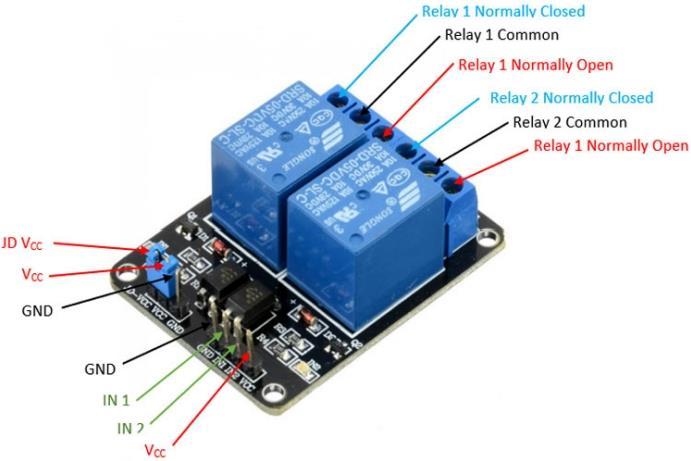
1)Dualchannel5vRelaymodule/Relay
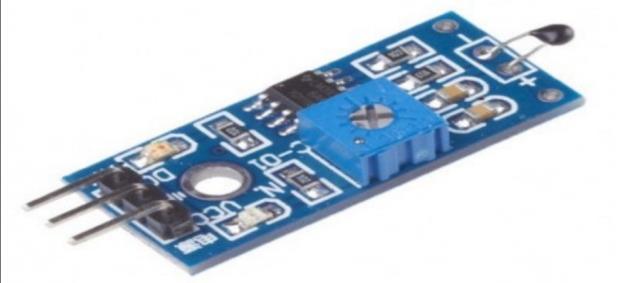
2) Tempraturemodule
3)LEDBulb
4)Resistor
5)5vAdoptercircuit
6)steelplate
7)PCB
8)ACBulbHolder
9)Jumperwires
10)Hardcoverwire
SYSTEM DIAGRAM
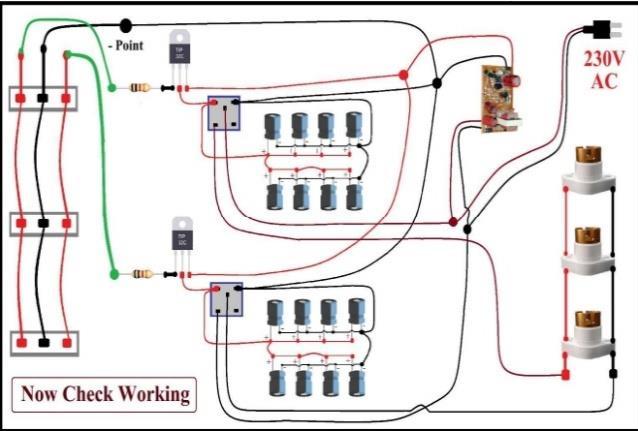
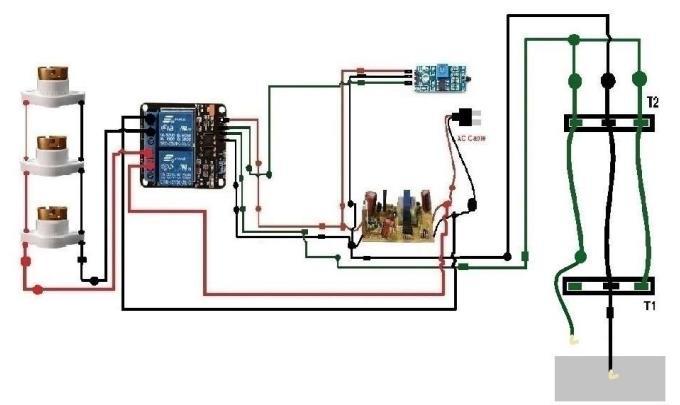
1) SystemDiagram
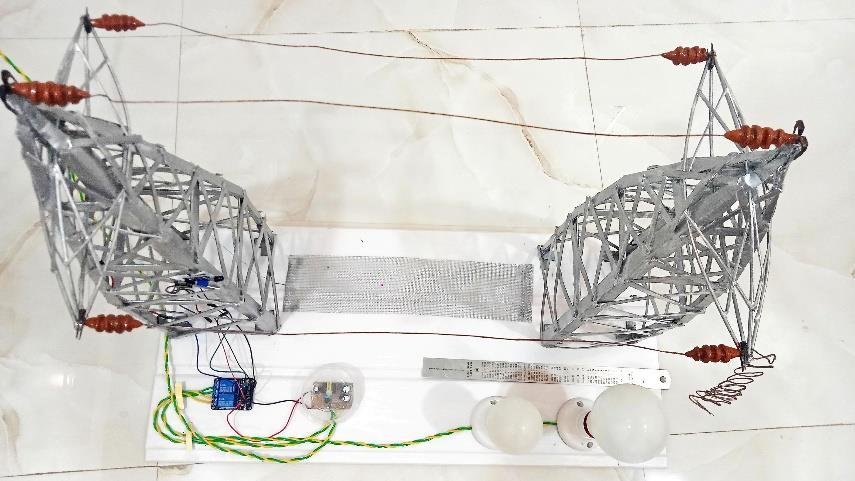
A Transmission Line Fault Safety Project is designed to improve the reliability of electrical power systems by quickly identifying and isolating faults, thereby preventing widespread outages. The system architecture incorporates sensors that detect abnormalities and send data to a central processing unit (CPU). This unit processes the information and activates protective mechanisms to disconnect the affected section of the transmissionline.
In addition, communication modules enable real-time notifications to grid operators, allowing for faster decision-making and response. A feedback mechanism continuously monitors system performance and supportsongoingoptimization.Overall,thisframeworkensureseffectivefaultmanagement,reducesdowntime, andenhancesthesafetyanddependabilityoftransmissionnetworks.
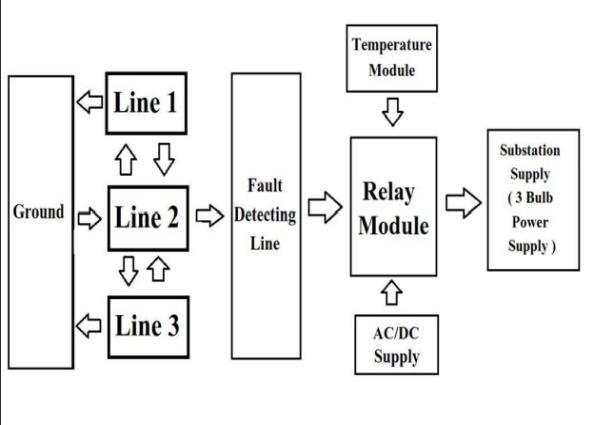
2) BlockDiagram
International Research Journal of Engineering and Technology (IRJET) e-ISSN: 2395-0056
Volume: 13 Issue: 04 | Apr 2026 www.irjet.net p-ISSN: 2395-0072