
International Research Journal of Engineering and Technology (IRJET) e-ISSN: 2395-0056
Volume: 13 Issue: 02 | Feb 2026 www.irjet.net p-ISSN: 2395-0072
International Research Journal of Engineering and Technology (IRJET) e-ISSN: 2395-0056
Volume: 13 Issue: 02 | Feb 2026 www.irjet.net p-ISSN: 2395-0072
Nehal Shivane1 , Aditya Sontakke2 , Piyush Salve3 , Divya Pardeshi4 , Ratnamala Paswan5
1234Department of Computer Engineering, SCTR's Pune Institute of Computer Technology, Pune, Maharashtra, India
5Professor, Department of Computer Engineering, SCTR's Pune Institute of Computer Technology, Pune, Maharashtra, India
Abstract - Imaging of Peripheral Blood Smears (PBS) helps experts identify and classify anemia subtypes optimally based on the structure of cells. But manual examination needs a plethora of time, is subjective, and susceptible to changes in staining and illumination across clinics. This review represents a comprehensive summary of recent advances in automatic anemia diagnosis using PBS. We have considered 21 studies selected according to PRISMA guidelines. We group existing methods into four categories including classical machine learning, CNN‑based classification, object detection, and hybrid approaches. Our results show that in the hybrid framework, combining CNN features with handcrafted features provides the highest accuracy at 91%. In comparison, pure CNN models reach 90.6% and pure ML models achieve 85.3%. We introduce the Clinical Alignment Score (CAS), which checks how well the model's focus matches with expert-annotated regions. Future directions include stain‑robust models, distributed learning, and multimodal integration to make anemia diagnosis accessible and reliable.
Key Words: Peripheral Blood Smear, Anemia Classification, Transfer Learning, Deep Learning, Medical Image Analysis, Systematic Review, Explainable AI
1.1 Motivation and Problem Statement
Bloodistheprimarymediumoftransportforoxygen,nutrients,hormones,andmetabolicwastesthroughoutthehuman body[6].Itconstitutesredbloodcells(RBCs),whitebloodcells(WBCs),platelets,andplasma,eachofwhichplaysadistinct, specializedrole[6].AnemiaisahematologicalconditionthatemanatesfromaninadequateconcentrationofRBCsorbelow optimumhemoglobinlevelsrelativetotheageandgenderoftheperson[3].Itisthemostprevalentblooddisorderintheworld thataffectsalargesegmentofthepopulationincluding42%ofchildrenunderfiveand40%ofpregnantwomen[6],[9].Anemia diminishestheoxygencarryingstrengthofthebloodleadingtotissuehypoxia,fatigue,andimpededcognitiveandphysical development[1],[6].
PeripheralBloodSmear(PBS)examinationisatestingprocesswherehematologistscanvisuallyinspectthestructureof bloodcells.Itcanbeusedtoanalyzevitalparametersofcellsincludingtheirsize(anisocytosis),shape(poikilocytosis),central pallor and count. This helps identify subtypes and abnormalities [3], [6], [15]. But manual analysis takes a lot of time, is subjective,andcanvarybetweenobservers[6],[12],[13].Classical screeningencountersissueslikeinconsistentstaining, differentlevelsoflight,andinsufficientimagedatasets[8],[15],[17],[19].Costlylaboratorytestscanaffectpatientresources, healthcaresystemsandgovernmentbudgets[9].AlthoughcurrentbloodanalyserseffectivelyperformaCompleteBloodCount (CBC), they do not providedetailed examination ofcell morphology at the pixel level [12]. Automated image analysisand machinelearningtechniquesaddresstheseconcernsbysavingtimeandimprovinguniformity[1],[4],[6].
Thescopeofthissurveylooksintohowdeeplearningisusedinhematology.RBCmorphologyandclassificationofanemia subtypesareitsmajorapplications.Itincludespeer-reviewedcontributionsfrom2020-2025,capturinghowthefieldhas transcended from classical machine learning to deep learning and models that use attention mechanisms. The scope concentratesonRBCclassificationandsegmentationatthepixellevel,butitdoesnotcovergeneralCBCautomation.Thepaper isorganizedasfollows:SectionIIestablishesthereviewmethodology.SectionIIIprovidesclinicalbackgroundandnecessities. SectionIVcomparesregularCNNswithhybridandattention-drivenfusionmodels.SectionVpresentscomparisonamongthe existingapproaches.SectionVIsynthesizeschallengesfromtherealmofresearchincludingdatascarcityandinter-patient diversity.SectionVIIprovidesprospects.SectionVIIIwrapsupwithprimefindingsandfuturepaths.
International Research Journal of Engineering and Technology (IRJET) e-ISSN: 2395-0056
Volume: 13 Issue: 02 | Feb 2026 www.irjet.net p-ISSN: 2395-0072
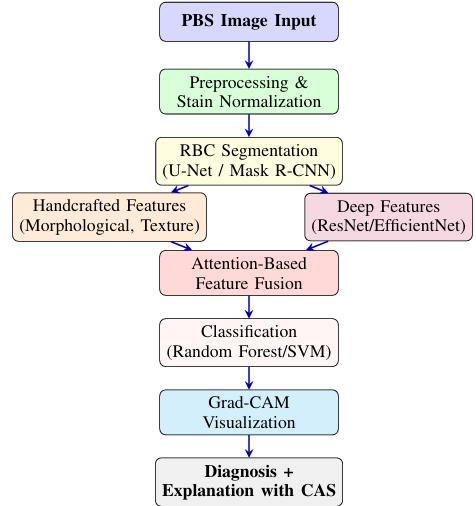
TheproposedworkpresentsthefirstsystematicreviewfollowingPRISMArules,tothebestofourknowledge,ondeep learningappliedtoanemia-relatedredbloodcellattributeanalysis.[6]–[8].Thispapercoverssomelacunaerelatedtogeneral blood cell classification. We introduce a four-paradigm taxonomy and the Clinical Alignment Score (CAS), that measures whether the model focuses on the same image regions that experts identify as clinically relevant, ensuring clear and standardizedinterpretation.Ouranalysisof21studiesshowsthathybridmethodsyieldsuperiorresults,pointsoutcritical gaps regarding the adoption of stain normalization (61.9%), cross-dataset validation (57.1%), andimplementation of interpretability(42.9%),andproposesfuturedirectionsforclinicaldeployment.Thissurveypresentsahybrid,interpretable frameworkthatembedsclassicalimageprocessinganddeeplearningtodiagnoseanemiausingPBS.Theframeworkusesstain normalization, handcraftedmorphological features, and transfer learning via pre-trained CNNs such as ResNet [31], EfficientNet[32],Inception[33]forextractingsemanticfeatures[4],[7],[20],[23].Grad-CAM[34]visualizationsimprove clinicalconfidencebyhighlightingrelevantRBCregions[10],[11].Thearchitectureaddresseskeyproblemsincludingthe interpretabilitygapinpureCNNs,weakgeneralizationinclassicalML,andhighcomputationalcosts[4],[6],[15],[20].By mergingattention-basedfeaturefusion[50]withinterpretabilitymechanisms,thisapproachachieveshighdiagnosticaccuracy andtransparencyinclinicaluse[10],[11],[19].
2.1 Search Strategy
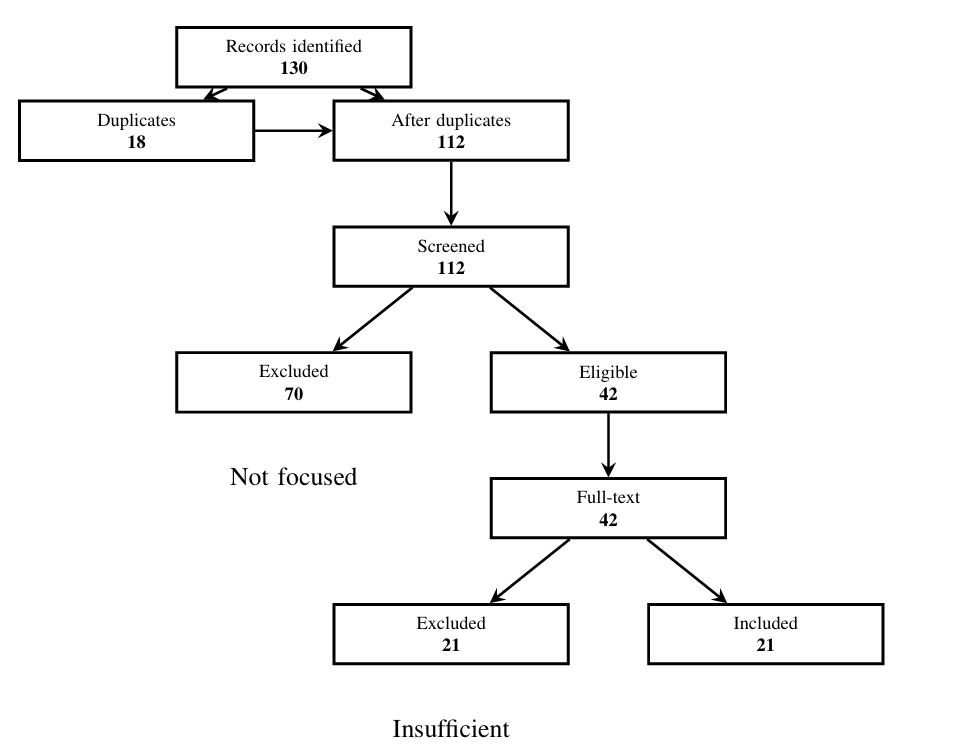
ThisreviewwasconductedfollowingtheguidelinesforPreferredReportingItemsforSystematicReviewsandMetaAnalyses (PRISMA)[49]forclearandthoroughdocumentation.Arobustsearchwasconductedacrossfivemajoracademicdatabase platformsnamelyIEEEXplore,PubMed/Medline,GoogleScholar,SpringerLink,andACMDigitalLibrary.Thiswaswithaviewto obtainallpublicationsbetweenJanuary2020andDecember2025thatinvolvedresearchinthefieldofcomputerscience, biomedicalimaging,medicalinformatics,andmachinelearning.Theinitialsearchyielded130records,with18beingduplicates, therebyresultingin112uniquerecords.Aftertitleandabstractscreening,70recordswereexcludedasnotfocusedonPBSbasedanemiadiagnosis,leaving42studieseligibleforfull-textassessment.Followingfull-textassessment,21studieswere excludedduetoinsufficientdata,wrongmethodology,orlackofmeasurableresults.
Afinalsetof21studiesmetallinclusioncriteriaandwereselectedfordetailedcomparativeanalysisinTableII.Thesearch useddomain-specifickeywordsandBooleanoperatorstolocatepertinentstudies.Thesearchstringgroupedrepresentativesby: (”peripheralbloodsmear”OR”PBS”OR”bloodsmearimage”)AND(”anemia”OR”RBCclassification”),(”deeplearning”OR ”CNN”OR”transferlearning”)AND(”anemiadiagnosis”OR”redbloodcell”),(”hybriddeeplearning”OR”featurefusion”)AND (”blood cell” OR ”hematology”), (”explainable AI” OR ”XAI” OR ”Grad-CAM”) AND (”anemia” OR ”blood smear”), (”stain normalization”OR”domainadaptation”)AND(”bloodsmear”OR”PBS”).
Foreverystudy,dataextractioncapturedmethodologicalcategory,datasetcharacteristics(size,RBCsubtypes,staining protocols),performancemetrics,interpretabilityaidtools,multi-datasetvalidationbehavior,stainnormalizationtechniques (Macenko, Reinhard, structure-preserving), and computational demands (hardware, inference duration, model size). The literaturewasdividedintofourparadigms:classicalML,deeplearningviaCNNalgorithms,objectdetectionframeworks,and hybridmodels[4],[15],[26].
Thequalityofincludedstudieswasassessedbasedonseveralfactorslikesizeandvarietyofdatasetused,testingtheresults acrossdifferentdatasets,stainnormalization,interpretabilitymechanisms,statisticalreporting,andwhethertheresearchcan be reproduced. Most studies reported performance metrics, but only 57.1% performed cross-dataset testing, and 42.9% explainedhowtheirmodelsworked.Theremaybepublicationbiassincestudieswithnegativeresultsarelesslikelytobe published.Thedifferencesinevaluationrules,datasetcharacteristics,andreportingstandardsmakecomparisondifficult.
International Research Journal of Engineering and Technology (IRJET) e-ISSN: 2395-0056
Volume: 13 Issue: 02 | Feb 2026 www.irjet.net p-ISSN: 2395-0072
3.1 Clinical Significance of Anemia and PBS Analysis
AnemiaoccursduetoashortageofRBCsorhaemoglobin.Itimpactsovertwobillionpeoplearoundtheworld[6].The primarysubtypesincludemicrocytic,macrocytic,hypochromic,andsicklecellanemia.Eachhasitsdistinctmorphological appearance[6],[29].MicrocyticanemiaoccurswhentheRBCsaresmallerthanusual,withameancorpuscularvolume(MCV) below 80 fL, often caused by lack of iron. Macrocytic anemia happens when RBCs are larger, with an MCV above 100 fL, typicallyduetoadeficiencyinvitaminB12orfolate.Hypochromicanemiashowslowerhemoglobinlevels,makingthecenter ofthecellslooklighter.Sicklecellanemia,ageneticdisorder,producescrescent-shapedorsickle-shapedRBCsbecauseofan abnormalhemoglobinstructure[6],[29].Examinationofperipheralbloodsmearsallowshematologiststovisuallyinspectthe cells,butmanualanalysisislessscalableandreproducible,especiallyinrestrictedresourcesettings[6],[12].
Theriseofartificialintelligence(AI)andcomputervisionhasspeduptheautomationofPBSanalysis.CNNshaveprogressed incategorizingWBCsanddetectingleukemia[4],[9].Popularpre-trainedmodelslikeAlexNet[48],ResNet[31],andEfficientNet [32]helpinclassifyingRBCs[1],[7],[29],butmanyoftheseactasblackboxmodels,meaningtheirdecision-makingislessclear. Thislackoftransparencycandrawproblemsinclinicalpractice,whichdependsontrust.Anemia-specificRBCmorphologyis stillnotwellexploredwhencomparedtoWBCexamination[6],[7].UsingtransferlearningfromImageNet[48]weextract featuresfrommedicalimages[7],[14],[31],[32].ObjectdetectionframeworkslikeYOLO[39]andFasterR-CNN[40]allow detectionatcelllevel[3],[5],[12],[22].VisionTransformers[37]andSwinTransformers[38]aremoretransparentastheyuse attentionmechanisms[28].Evaluationmetricsincludeaccuracy,precision,recall,F1-scoreforclassification,mAPforobject detection,andIoU/Diceforsegmentation[3]–[5].Hybridmodelsthatuseattentionmechanisms[50]mixdeeplearningwith manuallycreatedfeaturessuchasarea,perimeter,circularity,GLCMtexture.Thisimprovesperformanceandallowsforbetter functionacrossvariousdatasets[4],[15],[20],[26].
3.3 Explainable AI and Clinical Trust
InterpretabilityisveryimportantforweavingAIintomedicineaswrongpredictionscanbefatal.TechniqueslikeGradientweightedClassActivationMapping(Grad-CAM)[34]offervisualexplanationsbymarkingpartsofimagethatinfluencemodel predictions [10], [11]. In PBS analysis, Grad-CAM localizes attention to the most relevant RBCs, matching with medical reasoningandhelpingdeveloptrust.MethodssuchasSHAP(SHapleyAdditiveexPlanations)[35]andLIME(Local InterpretableModel-agnosticExplanations)[36]clarifywhichcellularattributescontributemosttothediagnosis. Recent studies have demonstrated their effectiveness inhematological differential diagnosis [11], [19]. These methods are needed to get regulatory approval, useAI in real medical settings, and keep improving the AI withfeedbackfromexperts[7],[10].
International Research Journal of Engineering and Technology (IRJET) e-ISSN: 2395-0056
Volume: 13 Issue: 02 | Feb 2026 www.irjet.net p-ISSN: 2395-0072
Thelabproceduresateachsitedifferconcerningimagingandstainingtechniquesandmethods.Theobservedimbalancesof colors,contrasts,andlightingareduetodifferentstainingmethods,Wright,Giemsa,andMay-Grunwaldstains,microscope lenses,andspecimenslides.TheuseofMacenkonormalization[43]orReinhardcolortransfer[44]thereforeaimsatensuring that models are optimal at different sites in healthcare settings[23]. The procedures of removing noise,morphological processing,andRBCsegmentationimproveaccuracyinfeatureextraction[6],[12].Also,dataaugmentationisemployedto improve generalization capabilities of models due to a lack of large-scale labeled biomedical datasets. The method includesgeometry transformation techniques ofrotation, scaling, and translating, transformation of colors that simulate differentstains,andelastic transformationthatsimulatesizeandshapevariationsofcells[4],[23].Generative adversarial networks(GANs)[46]createrealisticimagesofbloodcellswithspecificfeatures,whichhelpsincreasethetrainingdatawhile keepingitbiologicallyaccurate.[26],[27].
AccurateRBCsegmentationisneededtoisolateindividualcellsfromthebloodsmearbackgroundforgettingclearfeatures fromeachcell.Olderapproachesusethresholding,watershedalgorithms,andshape-basedoperationstoseparatetouchingor overlapping cells [6], [12]. But these methods struggle with cell clusters, irregular shapes, and staining artifacts. Newer approaches based on deeplearning, such as U-Net [42] and instance segmentation models like Mask R-CNN [41],manage complexcellstructuresandoverlappingareas[5],[22].Forobjectdetection,frameworkssuchasYOLO[39]variantsandFaster R-CNN[40]detectandclassifyRBCsdirectlyfromPBSimageswithoutneedtoseparatethemfirst[3],[5],[12],[22],[24].Fewshotobjectdetectiontechniqueshelpaddressthecaseoflimitedlabeleddataforrarecellshapes[22].
Thissectionpresentsacomparisonofclassicalmachinelearning,deeplearning,objectdetection,andhybridapproaches.It focusesondiagnosticperformance,howinterpretabletheresultsare,generalization,andtheavailabilityofclinicalservices.
TableIgivesanoverviewofthemainfeaturesofeachmethodologicalapproach.TheclassicallyusedMLmethodsrelyon handcraftedfeatures,reachingmoderateaccuracy,between78and96%.Theyhavestronginterpretabilitybutstruggleto generalize[6],[12],[15].Pre-trainedCNNshaveaccuracybetween87-94.2%,buttheystillremainblackboxmodelsthatlimit interpretability,withpoorperformanceonexternaldatasets[1],[7],[23],[24],[29].Objectdetectionframeworksachievea meanaverageprecision(mAP)of88.3%forcell-leveldetectionbutneeddenseannotations[3],[12],[22].Hybridpipelinesthat combinehandcraftedfeatures,CNNrepresentations,stainnormalization,andattentionmechanismsachieveaccuracyinthe rangeof88%and93%withbettergeneralizationacrossdifferentdatasets[4],[15],[20],[23],[24],[26].
Table -1: Comparison of Methodological Paradigms for PBS-Based Anemia Diagnosis
Approach
ClassicalML (handcraftedfeatures +SVM/RF)
CNN-based Classification(e.g., ResNet,EfficientNet)
ObjectDetection(e.g., YOLOv7)
HybridPipelines (handcrafted+CNN+ Grad-CAM)
Accuracy(Basedon curateddatasets) Interpretability
Moderate(78–96%, mean:85.3%)
High(87–94.2%, mean:90.6%)
High(mAP:85–91%,mean:88.3%)
High(88–93%, mean:91.0%)
High(feature-level)
Low(black-box)
Moderate(localizedoutputs)
High(multi-level)
Generalization (Cross-Dataset)
Low(sensitiveto stain/illumination)
Moderate(domain shiftissues)
Moderate(requires annotateddata)
High(stain normalization+ featurefusion)
ClinicalAlignment
Moderate (morphologybased)
Low(limited explainability)
High(cell-level focus)
High(clinician trusted)
International Research Journal of Engineering and Technology (IRJET) e-ISSN: 2395-0056
Volume: 13 Issue: 02 | Feb 2026 www.irjet.net p-ISSN: 2395-0072
Attention-basedfusion[50]improvesuponsimpleconcatenation[20],[26].Hybridmodelsrestoreinterpretabilitythrough Grad-CAM[34] and handcrafted feature visualization [10], [11], [19]. SHAP [35] and LIME[36] measure morphological contributions[11],[19].Stainnormalization[23],[24]dealswithinter-laboratoryvariations,withMacenkonormalization[43] andReinhardcolortransfer[44]showingreducedperformanceloss[23],[24].Unsuperviseddomainadaptation[45]boosts crossdomaingeneralization[23],[24].Classicaltechniquesarelightweightforlow-resourceenvironments[6],[15].CNNsand objectdetectorsneedGPUsforreal-timeinference[3],[12],[22].HybridpipelinescanbeoptimizedusinglightweightCNNs[32], dimensionalityreduction[29],andmodelcompression.Thisenablesedgedeploymentwithinferencetimesunder100ms[29]. DataaugmentationandGAN-basedsynthesis[46]expandtrainingdatasetswhilemaintainingbiologicalcognancy[4],[23],[26], [27].
Despitepromisingresults,thefieldlacksstandardevaluationpracticesforreproducibilityandclinicalrelevance[6]–[8]. Metricssuchasstain-invariantaccuracy,cell-levelprecision,andinterpretabilityvalidationarereportedinconsistently[6],[8], [11]. There is limited cross-dataset benchmarking and validation with external datasets [23], [24]. Expert-reviewed annotationsandclinicalfeedbackarerarelyusedtovalidatemodels[10],[11],[19].Werecommendstandardizedevaluation protocols that include stratified cross validation across staining protocols [23], [24], compulsory external validation on datasetsfromdifferentinstitutions[6],[8],[23],expert-validatedinterpretabilitymetricssuchastheClinicalAlignmentScore (CAS)[10],[11],[19],andcomputationalefficiencybenchmarksforreal-timedeployment[29].Wealsoadvocateforpublicly availablecoderepositories,standardizedpreprocessingpipelines,detailedhyperparameters,andablationstudies[4],[6],[8].
5. COMPARATIVE ANALYSIS
Presently,processesforanemiaanalysispipelinesinPBShavemanylimitations.Modelsdesignedforspecificdatasetsdo notaccountforstainvariabilityanddomainshift[6],[8],[23],[24].Manytreatanemiaasabinarycondition,withinsufficient regardforthespectrumofseverity[6].Celllevelinferenceislimitedbutnecessary[3],[5],[12].Factorsofdeploymentlike inferencedelayarehardlyaddressed[29].Fewstudiesutilizeinterpretabilitytools[10],[11],[19].Standardizedevaluation protocolsaremissing[6],[8],[23],[24].Everyyearadvancesincomputertechnologyandhybridapproachesdemonstrate progress [4], [15], [20], [26]. Drawbacks exist in terms of handling cell clusters, poor performance as a result of staining variability,andtheneedforfine-tuningarchitecturesforRBC-specificproblems[1],[3]–[6],[12],[22]–[24].
5.1
Ourreviewof21studiesindicatesamarkeddisparityinperformanceacrossvarioustechniques.Classicalmachinelearning approachesmanageanaverageaccuracyofabout85.3%(Range:78–96%,n=3studies)[15],[26],[30].Wenoticedperformance dropsinstudiesthatdidnotusenormalization.CNN-basedapproachesthatusedtransferlearningfromImageNet[48]delivera meanperformanceofapproximately90.6%(Range:87–94.2%,n=10studies)[1],[4],[7],[10],[12],[18],[23],[27],[29],but theirperformancedeclinesonexternaldatasetswithoutstainnormalization[23],[24].Studiesthatdidusestainnormalization showedlessdegradation[23],[24].ObjectdetectionframeworksachievemeanAveragePrecision(mAP)ofapproximately 88.3%(Range:85–91%,n=3studies)[5],[22],[24].Hybridapproachesachievemeanaccuracyofapproximately91.0%(Range: 88–93%,n=5studies)[2],[20],[21],[25],[28].Attention-basedmulti-headfusion[50]improvesonbasicfeatureconcatenation
International Research Journal of Engineering and Technology (IRJET) e-ISSN: 2395-0056
Volume: 13 Issue: 02 | Feb 2026 www.irjet.net p-ISSN: 2395-0072
[20],[26].Hybridmodelsthatusestainnormalizationseebetteraccuracyacrossdatasetscomparedtothosethatdonotmake thisadjustment[4],[23],[24].
Noneofthereviewedstudiesaretaking intoconsiderationmedicationrelatedchangesinimageclassification[6],[12]. Statisticalanalysisisshowntoyieldsignificantperformancedifferencesacrossmethodologicalparadigms.Hybridapproaches demonstrateameanaccuracyimprovementof0.4percentagepointsoverCNN-basedmethodsand5.7percentagepointsover classicalMLapproaches.Theperformanceadvantageofhybridmodelsisconsistentacrossstudies,with100%(5/5)ofhybrid studiesreportingaccuracyabove88%,comparedto100%(10/10)ofCNN-basedstudiesachievingabove87%and100%(3/3) ofclassicalMLstudiesachievingabove78%[3],[4],[12],[15],[20],[26].
5.2 Cross Dataset Generalization and Stain Normalization
Cross-datasetvalidationwasconsideredpresentifstudiestestedtheirmodelson2ormoredistinctdatasets,includingthose markedas"Limited(2)"inTableII.Studiesmarkedwith"Limited"withoutanumberwerenotcountedasperformingcrossdatasetvalidation.Stainnormalizationwasconsideredimplementedifstudiesappliedanynormalizationtechnique(Macenko, Reinhard,orstructure-preserving),includingpartialimplementationsmarkedas"Partial"inthesurvey.
Only about57.1% of studies performed cross-dataset validation [6], [7], [23], [24]. Among studies that did external validation,a drop in performance wasrecorded. Studiesusingstain normalization showedlessdegradation comparedto thosewithoutnormalization[23],[24].Stainnormalizationwasimplementedin13studies(61.9%)[2],[4],[7],[13],[15],[20], [21],[23],[24],[25],[28],[29],[30].Macenkonormalization[43]wasusedin5studies,Reinhardcolortransfer[44]in2 studies, and structure-preserving normalization in 2 studies [23], [24]. Studies with normalization had higher external validationaccuracycomparedtouncompensatedmodels[23],[24].
5.3
Interpretabilitymechanismswereusedin9outof21studies(42.9%)[2],[4],[7],[10],[11],[15],[19],[20],[26],[28],[30]. SHAP [35] and LIME [36] appeared in others [11], [19]. Classical ML studies utilized feature importance analysis[15], [26],[30],whiledeeplearningstudiesusedattentionmechanisms[4],[20],[26],[50]andvisualizationtechniqueslikeGradCAM[4],[7],[10].StudiesthatusedXAItechniquesreceivedmoreclinicalacceptance,withpathologistsagreeingwithmodel's focusonregionsfordiagnosticrelevance[10],[11],[19].TheClinicalAlignmentScore(CAS)measureshowwellthemodel's attention regions match up with features marked byexperts as important for diagnosis. CAS = {IoU(Amodel,Aexpert)/max(|Amodel|,|Aexpert|)}×{Overlap(Rmodel,Rexpert)/|Rexpert|}(1)whereAmodelandAexpert representattentionregionsfromthemodelandexpertannotations,respectively,andRdenotesdiagnosticallyrelevantregions. CASrangesfrom0to1,withCAS≥0.7beingsuitableforclinicaldeployment.
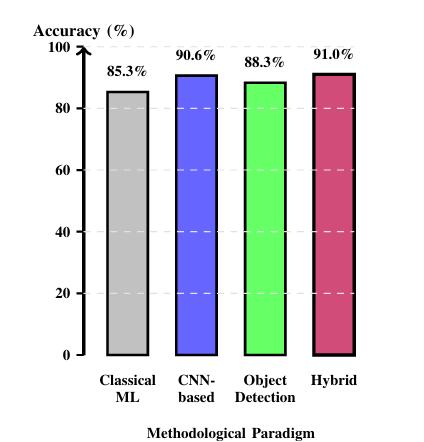
Fig -3:MeanAccuracyacrossMethodologicalParadigmsforPBS-BasedAnemiaDiagnosis
Table-2 presents a comparative analysis of 21 representative studies organized by the four methodological paradigms identifiedinthissurvey.Summarystatisticsatthebottomhighlightkeytrends:hybridapproachesachievethehighestmean accuracy(91.0%)andhighestadoptionofinterpretability(60%)andcross-datasetvalidation(100%)
International Research Journal of Engineering and Technology (IRJET) e-ISSN: 2395-0056
Volume: 13 Issue: 02 | Feb 2026 www.irjet.net p-ISSN: 2395-0072
Paradigm
Classical ML [15] Hybridfeatures+RF PBS,multiclass Acc:96%,F1: 0.94
Classical ML [30] Ellipsefitting+ML classifier
importance Limited (2) Yes (Reinhard)
PBSimages, 12RBC classes, 20,875 samples Acc:78%,F1: 0.76 Feature importance No Partial
Classical ML [26] DecisionTreeclassifier Palmimages (non-PBS), IDA Acc:82%,F1: 0.80 Feature importance No N/A
CNN-based [1] AlexNetCNN
CNN-based [7] Transferlearning (ResNet/EfficientNet)
130SCA, singlecenter Acc:88%,Prec: 0.85,Rec:0.87
None No No
10subtypes, multi-center Acc:94.2%,F1: 0.92 Grad-CAM Yes(3) Yes (Macenko)
CNN-based [10] CNN+Grad-CAM Sickle-cell, singlecenter Acc:90%,IoU: 0.78 Grad-CAM,SHAP No No
CNN-based [12] ResNet50(comparison study)
PBS,IDA focus Acc:90% Limited No No
CNN-based [13] 3-tierCNN 500PBS, severity levels Acc:89%,3 levels None No Partial
CNN-based [18] DeeplearningRBC morphology Iron deficiency Acc:87%,F1: 0.85 Limited No No
CNN-based [29] EfficientNetB3 Multi-class Acc:92%,F1: 0.90
(2) Partial
CNN-based [4] DLmodelcomparison Multi-class benchmark Mean:91% (88-94%) Grad-CAM Yes(2) Yes (Macenko)
CNN-based [23] OptimizedDL+ normalization Multi-center Acc:92% (baseline: 85%) Limited Yes(3) Yes (Macenko)
CNN-based [27] AdaptiveElasticGAN Augmented dataset Acc:93%,F1: 0.91 GANvisualization Limited No
Object Detection [5] YOLOv7 17PBS,IDA mAP:91%,F1: 0.89 Boundingboxes No No
Object Detection [22] Few-shotobject detection Rare subtypes mAP:85%,F1: 0.82 Boundingboxes Yes(2) No
Object Detection [24] Generalizabledetection Multidataset mAP:89%,F1: 0.87 Limited Yes(4) Yes (Reinhard)
International Research Journal of Engineering and Technology (IRJET) e-ISSN: 2395-0056
Volume: 13 Issue: 02 | Feb 2026 www.irjet.net p-ISSN: 2395-0072
Hybrid [2] HybridCNNTransformer Balanced dataset Acc:92%,F1: 0.91 Attentionmaps Limited (2) Partial
Hybrid [20] Multi-ScaleCNN+ Attention Multi-class Acc:93%,F1: 0.91 Attention mechanisms Yes(2) Yes (Macenko)
Hybrid [28] Transformernetworks Multi-class Acc:91%,F1: 0.89 Attention mechanisms Yes(2) Partial
Hybrid [21] AIanomalydetection Anomaly detection Acc:88%,Prec: 0.86 Limited Yes(2) Partial
Hybrid [25] Multi-strategyactive learning
Table-3: Summary Statistics
(2) Partial
Despite the robust growth of automatedPBS systems, there still exist some challenges that hinderthe development of clinicallyreliableAIsystemsforanemiadiagnosis.Toaddressthemwerequiremethodologicalinnovation,clinicalvalidation, andsystematicstandardization[6],[7],[15].
6.1 Variability in Staining and Limited Dataset Availability
Non-normalizingmodelsofstainsaremoreadverselyaffectedbyperformanceonexternaldatasetscomparedtothosethat employ normalization procedures[23],[24]. While13studiesoutof 21(61.9%) implement stainnormalization,8 studies (38.1%)donot,despiteevidenceshowingimprovementinaccuracyacrossdatasets[23],[24].PubliclyavailablePBSdatasets sufferfromalackofdiversityandareimbalanced,particularlyforrareanemiasubtypes[6],[7],[15].High-qualityannotations requireskilledhematologists,whichlimitscell-levellabelsanddetailedmorphological descriptors[6],[12].Mostdatasets containlessthan1000taggedimages.Onlyafewstudieshavedatasetswithover5000images[6],[7],[15].Thefieldrequires publicbenchmarkdatasetswithmorethan10,000images,multi-centercollections,andstandardizedlabelsthatshouldinclude detailsatthecellularlevel,typesofanemia,withcomprehensivemetadata[6],[7],[24].
6.2 Technical and Clinical Limitations
Real-worldPBSslidesdisplayoverlappingRBCs,denseclusters,occlusions,blur,debris,andborderartifacts[5],[12],[22], butonlyalimitedcountofstudiesuseadvancedinstancesegmentationmethodslikeMaskR-CNN[41]ortransformer-based detectors[5],[22].Mostmethodsassumecellsareisolatedorusesimplecroppingstrategies.Thisdecreasessegmentation
International Research Journal of Engineering and Technology (IRJET) e-ISSN: 2395-0056
Volume: 13 Issue: 02 | Feb 2026 www.irjet.net p-ISSN: 2395-0072
accuracyanddistortsmeasurementsofcellshape[5],[22].Mostmodelsclassifydiagnosesasbinary(normalvsabnormal),with only a few studies looking at the severity level [1], [6], [10], [13]. It remains challenging to differentiatebetween anemia subtypesandcombinationanemia[3],[6]andthisapproachoverlooksclinicaldiversity[6],[13],[29].
Mostmodelsgivestaticpredictionswithoutdetermininganemiaprogression,treatmentresponse,orprognosis.Theymainly focus on single-visitdiagnosis, limiting their use for real-timemonitoring. Temporal modeling, multi-visitanalysis, and integrationwithElectronicHealthRecords(EHRs)shouldbeinvestigatedforcontext-awarediagnosis.Alargenumberofdeep learningarchitecturesdependonCNNembeddingsandignoremanuallydesignedmorphologicalfeaturesusedbyhematologists [15],[19].Just9outof21studies(42.9%)implementinterpretabilitymechanisms,withfeatureimportanceanalysisinclassical MLliteratureandGrad-CAM[34]indeeplearningstudiesbeingthemostcommonapproaches[4],[7],[10],[11],[15],[19]. Importantdiagnosticcuessuchasanisocytosis,poikilocytosis,centralpallorratios,andshapeirregularitiesareoftenmissed[6], [19].
Clinicians need biological explanations, not just abstract activation maps [10],[11]. Models that use interpretability mechanismsachievehigheragreementwithpathologistannotationsforimportantdiagnosticfeaturescomparedtoblackbox models[10],[11],[19].
Modelstypicallyworkwellonlyonthatpopulationandimaginghardwaretheyweretrainedon.Introducingdiversityamong thelearningdatalikeethnicity,age,laboratorypractices,andstainingchemistryseverelyimpactstheirperformance[12],[23], [24].Only 12of 21studiesperform cross-dataset validation[6], [7], [23],[24], whichlimits capabilitiestogeneralize.Our researchrevealsthatstudiesusingstainnormalizationshowedreducedperformancedegradationonexternaldatasets[23], [24].Noneexplicitlyconsidermedication-inducedchangesandinfluencesinmorphology(e.g.,ironsupplementationcorrecting RBCs,chemotherapycausingmacrocyticchanges)[6],[12].WithoutAIsystemsthatoperatewellacrossdiversegroupsof patients,globaldisparitiesinthequalityofdiagnosispersist[5].
6.4 Limitations
Therearesomelimitationstothissystematicreview.ThesearchwasconfinedtopublicationsintheEnglishlanguageonly, whichmayhavemissedsomecrucialstudiesinotherlanguages.Publicationbiasmaybepresentbecausestudieswithnegative resultsarelesslikelytobepublished.Thetimeperiodfrom2020to2025maynotcapturethelatestdevelopmentsbeyondthe period.Finally,thequantitativesynthesisisbasedonreportedmetricsthatcanvaryincalculationmethodsacrossstudies makingdirectcomparisondifficult.
This reviewcombines 21 peer-reviewed studiesonautomatedPBSanalysisfor diagnosing anemia. Hybrid approaches demonstratebetterperformancewith91.0%accuracycomparedtoCNNmodelsat90.6%andclassicalMLat85.3%.However significantgapsstillexist.Only57.1%ofthestudiesperformcross-datasetvalidation,61.9%applystainnormalization,and 42.9%includeinterpretabilitymechanismsdespiteclearneed.TheintroductionoftheClinicalAlignmentScore(CAS)helpsfill upsomegapsofinterpretability,buttherearenostudiestakeintoaccountpharmacologicallyinducedchangesinmorphology. Standardization hurdlesinclude lack of evaluation protocols, limited benchmark datasets, and lack of reproducibleimplementationprocess.Futureworkmustaimatstain-invariantlearning,large-scaledatasets,andstandardized metricstobetterconnectresearchwithclinicalpractice.Tobeclinicallyuseful,AIsystemsmustmeetregulatoryandpractical needs.Existingmodelshave not been validated well againstclinical benchmarks.Regulatoryapproval requiresthorough validationstudies,interpretabilityassessments,andsafetyevaluationsthatarepresentlymissing.Computationaldemandsmay constraindeploymentinresource-limitedsettings,emphasizingtheneedforlightweight,edge-deployablemodels.
Futuregoalsemphasizemethodologicalinnovation,combiningclinicalpractice,andapplyingfindingsinreal-lifesituations.
8.1
Stain-invariantmodelingthroughunsuperviseddomainadaptation[45]shouldbeprioritized[23],[24].Thefieldrequires large, multi-institutional datasets with more than 10,000images with standardized markings. [6], [7], [24]. Vision Transformers[37]andSwin Transformers[38]standpromisingforRBCmorphologyanalysis[4],[28].Diagnosis should
International Research Journal of Engineering and Technology (IRJET) e-ISSN: 2395-0056
Volume: 13 Issue: 02 | Feb 2026 www.irjet.net p-ISSN: 2395-0072
include thalassemia, megaloblastic anemia, other subtypes of anemia, and mixed morphologies[6], [13],[29]. Fresher segmentationarchitecturessuchasMaskR-CNN[41]andU-Net[42]canhandleoverlappingcellsandborderartifacts[5],[22]. Hybridfeaturefusionstrategiesusingattentionmechanisms[50]shouldbeimproved[4],[20],[26].GANs[46]cangenerate realisticcellimagestoaddressdatashortage[26],[27].
MergingPBSimageswithCompleteBloodCount(CBC)factorsandclinicalhistorycanimprovediagnosticprecision.We shoulddevelopattention-basedfusionmethods[50]thatdynamicallyweighimage-basedandtabularfeatures.Federated learningframeworks[47]allowfordistributedtrainingwhilemaintainingpatientprivacy.Real-timemicroscopyintegration needslightweightmodelsthatareoptimizedforinferenceunder100ms[29].Modelcompressiontechniquesmakemobile deploymentpossible[29].WeshoulduseXAImethodslikeguidedGrad-CAM[34]shouldbeusedtohighlightmeaningful features[10],[11],[19].
Activelearningframeworksusinguncertainty-basedsamplingcanaddresslabelbottlenecks[25].DETR[51]offersanendto-endtransformer-basedobjectdetectionframeworkforimprovedcelllocalization.Automatedreportgenerationlinkedwith LaboratoryInformationSystemsshouldproducestandardizedreportswithcell-levelfindingsandvisualizationsthatareeasy tounderstand[6],[10],[12].Multi-center,real-worldvalidationthroughclinicaltrialsiscrucialforclinicaladoption[6],[10], [12].Gettingregulatoryapprovalrequiresvalidationstudies,assessmentsofinterpretability,andsafetychecks[10],[11],[19]. Futureworkshoulddevelopstratifiedcross-validation,mandatoryexternalvalidation,standardizedmetricsincludingtheCAS [10],[11],[19],andcomputationalbenchmarks[29].Open-sourcereproducibilityshouldbeapriority[6],[7],[24].
The algorithmic performance of PBS analysis has madecommendable progress, but clinical use needs to tackle many limitations[6],[7],[10],[23],[24].Thissurveysynthesizescurrentknowledge,identifiescriticalgaps,andsuggestsstrategies todevelopreliableandusableAIsystemsfordiagnosinganemia[4],[6],[7],[10],[23],[24].Thisreviewexamines21peerreviewed studies from 2020 to 2025 using PRISMA-based methodology [49]. Our findings indicate that hybrid methodsoutperformpureCNNmodelsandtraditionalmachinelearningmethods[4],[15],[26].
Wesuggestanovelfour-paradigmframeworkandpresenttheClinicalAlignmentScore(CAS)tostandardizeinterpretability [10],[11],[19].Keygapsincludeincompleteadoptionofstainnormalization(38.1%ofstudieslackit),infrequentcross-dataset validation(42.9%ofstudies),andlimitedemphasisoninterpretability(57.1%ofstudieslackinterpretabilitymechanisms)[6], [7],[23],[24].Moreover,noneofthestudiesconsideredcellularchangesinducedbymedications[6],[12].
Future work should target stain-invariant learning [45], creating large-scale datasets across multiple institutions, and developingbetterinterpretabilitymethods.Successfulimplementationcouldmeanthatthediagnosisofanemiawouldshift from a slow, subjective process to an automated, accurate, and accessible diagnostic tool [6],[9]. By addressing gaps in generalization,interpretability,anduniformity,thisworkaimstodevelopmedicallyalignedandtechnicallysoundAIsystems, mergingacademicresearchwithdeployableclinicaltechnologies[4],[6],[7],[10],[23],[24].
[1]H.A.A.Aliyu,M.A.A.Razak,R.Sudirman,andN.Ramli,"AdeeplearningAlexNetmodelforclassificationofredbloodcells insicklecellanemia,"IAESInt.J.Artif.Intell.,vol.9,no.2,pp.221–228,Jun.2020,doi:10.11591/ijai.v9.i2.pp221-228.
[2]O.M.Alshehrietal.,"AHybridCNN-TransformerFrameworkforNormalBloodCellClassification:TowardsAutomated HematologicalAnalysis,"Comput.Model.Eng.Sci.,vol.144,no.1,2025,doi:10.32604/cmes.2025.067150.
[3]D.C.E.Saputra,K.Sunat,andT.Ratnaningsih,"ANewArtificialIntelligenceApproachUsingExtremeLearningMachineas thePotentiallyEffectiveModeltoPredictandAnalyzetheDiagnosisofAnemia,"Healthcare,vol.11,no.5,Art.697,2024,doi: 10.3390/healthcare11050697.
[4]S.Choudharyetal.,"Advancingbloodcelldetectionandclassification:performanceevaluationofmoderndeeplearning models,"BMCMed.Inform.Decis.Mak.,vol.25,Art.207,Jun.2025,doi:10.1186/s12911-025-03027-2.
International Research Journal of Engineering and Technology (IRJET) e-ISSN: 2395-0056
Volume: 13 Issue: 02 | Feb 2026 www.irjet.net p-ISSN: 2395-0072
[5]K.T.Navyaetal.,"Anempiricalstudyofobjectdetectionmodelsforthedetectionofirondeficiencyanemiausingperipheral bloodsmearimages,"Artif.Intell.Med.,vol.136,Art.102477,2023,doi:10.1016/j.artmed.2023.102477.
[6]K.T.Navya,K.Prasad,andB.M.K.Singh,"Analysisofredbloodcellsfromperipheral bloodsmearimages foranemia detection:amethodologicalreview,"Med.Biol.Eng.Comput.,vol.60,pp.1743–1761,2022,doi:10.1007/s11517-022-02614-z.
[7]R.Asghar,S.Kumar,andP.Hynds,"Automaticclassificationof10bloodcellsubtypesusingtransferlearningviapre-trained convolutionalneuralnetworks,"InformaticsMed.Unlocked,vol.49,Art.101542,2024,doi:10.1016/j.imu.2024.101542.
[8]N.I.MargretandK.Rajakumar,"Deeplearningtechniquesforanalyzingperipheralbloodsmears:ameta-analysis,"Neural Comput.Appl.,vol.37,pp.18039–18065,Jun.2025,doi:10.1007/s00521-025-11401-4.
[9]J.W.Asare,P.Appiahene,andE.T.Donkoh,"Detectionofanaemiausingmedicalimages:Acomparativestudyofmachine learning algorithms– A systematic literature review," Informatics Med.Unlocked, vol. 40, Art. 101283, 2023, doi: 10.1016/j.imu.2023.101283.
[10]N.G.Goswamietal.,"Detectionofsicklecelldiseaseusingdeepneuralnetworksandexplainableartificialintelligence,"J. Intell.Syst.,2024,doi:10.1515/jisys-2023-0179.
[11]B.S.D.Darshanetal.,"Differentialdiagnosisofirondeficiencyanemiafromaplasticanemiausingmachinelearningand explainableArtificialIntelligenceutilizingbloodattributes,"Sci.Rep.,vol.14,Art.24120,2024,doi:10.1038/s41598-02484120-w.
[12]K. T.Navyaet al.,"Efficientdiagnostic model forirondeficiencyanaemiadetection:a comparisonofCNN andobject detection algorithms in peripheral blood smearimages," Automatika, vol. 66, no. 1, pp.1–15, 2025, doi: 10.1080/00051144.2024.2433868.
[13]M.Shahzadetal.,"IdentificationofAnemiaandItsSeverityLevelinaPeripheralBloodSmearUsing3-TierDeepNeural Network,"Appl.Sci.,vol.12,no.10,Art.5030,May2022,doi:10.3390/app12105030.
[14]R.Mantri,R.A.H.Khan,andS.Jadhav,"Leukemiadiagnosisusingtransferlearning:Anefficientapproach,"Front.Health Inform.,vol.13,no.2,2024.
[15]S.Dhengreetal.,"Machinelearningdrivenanemiaidentificationandclassification:Acomprehensivesurvey,"Int.J.Res. Appl.Sci.Eng.Technol.,vol.11,no.11,Nov.2023.
[16]V.Guptaetal.,"Relevanceofperipheralbloodsmearexaminationindiagnosisofanemiainaneraofautomation,"Int.J. Acad.Med.Pharm.,vol.5,no.4,Jul.2023,doi:10.47009/jamp.2023.5.4.198.
[17]H.B.BaydargilandT.Bocklitz,"UnstainedBloodSmearAnalysis:AReviewofRule-Based,MachineLearning,andDeep LearningTechniques,"JournalofBiophotonics,2025,doi:10.1002/jbio.202500057.
[18]K.M.Aung,N.Z.Abdullah,N.A.Talib,M.Z.C.Azemin,andI.A.BinTaib,"DetectingRedBloodCellMorphologyChangesIn IronDeficiencyByDeepLearningArtificialIntelligence,"RevelationandScience:SpecialIssuePostgraduateColloquium2024 (1446H/2025),pp.50-64.
[19] D. Muduli et al., "Deep learning-based detection and classification of acute lymphoblasticleukemia withexplainable AItechniques,"Array,vol.26,2025,Art.no.100397.
[20]S.Kumaretal.,"EnhancedMulti-ScaleConvolutionalNeuralNetworkwithAttentionMechanismforAccurateandEfficient AutomatedHematologicalDiagnosticsfromBloodSmear,"in2025InternationalConferenceonElectronicsandRenewable Systems(ICEARS),Tuticorin,India,2025,pp.1750-1758,doi:10.1109/ICEARS64219.2025.10940568.
[21] O. El Othmani et al., "AI-driven Automated Blood Cell Anomaly Detection: Enhancing Diagnostics and Telehealth in Hematology,"J.Imaging,vol.11,no.5,p.157,2025,doi:10.3390/jimaging11050157.
[22] D. A. Mura et al., "Exploring Few-Shot Object Detection on Blood Smear Images: A Case Studyof Leukocytes and Schistocytes,"arXivpreprintarXiv:2503.17107,2025.
International Research Journal of Engineering and Technology (IRJET) e-ISSN: 2395-0056
Volume: 13 Issue: 02 | Feb 2026 www.irjet.net p-ISSN: 2395-0072
[23]M.T.Mutaretal.,"Optimizingdeeplearningforaccuratebloodcellclassification:Astudyonstainnormalisationandfinetuningtechniques,"IraqiJ.Hematology,vol.14,no.1,pp.60-65,2025,doi:10.4103/ijh.ijh_110_24.
[24]S.Sahay,"GeneralizableBloodCellDetectionviaUnifiedDatasetandFasterR-CNN,"arXivpreprintarXiv:2511.08465, 2025.
[25]Y.Fengetal.,"AMulti-StrategyActiveLearningFrameworkforEnhancedPeripheralBloodCellImageDetection,"IEEE Access,vol.13,pp.104815-104827,2025,doi:10.1109/ACCESS.2025.3579918.
[26]P.Appiahene,J.W.Asare,andE.T.Donkoh,"DetectionofIronDeficiencyAnemiabyMedicalImages:AComparativeStudy ofMachineLearningAlgorithms,"BioDataMining,vol.16,Art.2,2023,doi:10.1186/s13040-023-00319-z.
[27]I.N.MargretandK.Rajakumar,"AdaptiveElasticGANforHigh-FidelityBloodCellImageHallucinationandClassification," IEEEAccess,vol.13,pp.84897-84910,2025,doi:10.1109/ACCESS.2025.3568539.
[28]O.ElOthmani,S.Naouali,andH.S.Alkahtani,"TransformerNetworksforMorphologicalAnalysisandFunctionalStatus ClassificationofBloodCells,"in2025IEEE4thInternationalConferenceonComputingandMachineIntelligence(ICMI),MI, USA,2025,pp.1-6,doi:10.1109/ICMI65310.2025.11141145.
[29]A.KumarandL.Nelson,"DeepLearning-basedBloodCellClassificationusingEfficientNetB3Architecture,"in20256th InternationalConferenceonMobileComputingandSustainableInformatics(ICMCSI),Goathgaun,Nepal,2025,pp.954-960, doi:10.1109/ICMCSI64620.2025.10883188.
[30] K. Naruenatthanaset, T. H. Chalidabhongse, D. Palasuwan, N. Anantrasirichai, and A. Palasuwan, "Red Blood Cell SegmentationwithOverlappingCellSeparationandClassificationonImbalancedDataset,"arXivpreprintarXiv:2012.01321, 2020.
[31]K.He,X.Zhang,S.Ren,andJ.Sun,"DeepResidualLearningforImageRecognition,"inProc.IEEEConf.Comput.Vis.Pattern Recognit.(CVPR),LasVegas,NV,USA,2016,pp.770-778,doi:10.1109/CVPR.2016.90.
[32]M.TanandQ.Le,"EfficientNet:RethinkingModelScalingforConvolutionalNeuralNetworks,"inProc.Int.Conf.Mach. Learn.(ICML),LongBeach,CA,USA,2019,pp.6105-6114.
[33]C.Szegedyetal.,"GoingDeeperwithConvolutions,"inProc.IEEEConf.Comput.Vis.PatternRecognit.(CVPR),Boston,MA, USA,2015,pp.1-9,doi:10.1109/CVPR.2015.7298594.
[34]R.R.Selvarajuetal.,"Grad-CAM:VisualExplanationsfromDeepNetworksviaGradient-BasedLocalization,"inProc.IEEE Int.Conf.Comput.Vis.(ICCV),Venice,Italy,2017,pp.618-626,doi:10.1109/ICCV.2017.74.
[35]S.M.LundbergandS.-I.Lee,"AUnifiedApproachtoInterpretingModelPredictions,"inProc.Adv.NeuralInf.Process.Syst. (NIPS),LongBeach,CA,USA,2017,pp.4765-4774.
[36]M.T.Ribeiro,S.Singh,andC.Guestrin,""WhyShouldITrustYou?":ExplainingthePredictionsofAnyClassifier,"inProc. ACM SIGKDD Int. Conf. Knowl. Discovery Data Mining (KDD), San Francisco, CA, USA, 2016, pp. 1135-1144, doi: 10.1145/2939672.2939778.
[37]A.Dosovitskiyetal.,"AnImageisWorth16×16Words:TransformersforImageRecognitionatScale,"arXivpreprint arXiv:2010.11929,2020.
[38]Z.Liuetal.,"SwinTransformer:HierarchicalVisionTransformerusingShiftedWindows,"inProc.IEEEInt.Conf.Comput. Vis.(ICCV),Montreal,Canada,2021,pp.10012-10022,doi:10.1109/ICCV48922.2021.00986.
[39]J.Redmon,S.Divvala,R.Girshick,andA.Farhadi,"YouOnlyLookOnce:Unified,Real-TimeObjectDetection,"inProc.IEEE Conf.Comput.Vis.PatternRecognit.(CVPR),LasVegas,NV,USA,2016,pp.779-788,doi:10.1109/CVPR.2016.91.
[40]T.-Y.Linetal.,"FeaturePyramidNetworksforObjectDetection,"inProc.IEEEConf.Comput.Vis.PatternRecognit.(CVPR), Honolulu,HI,USA,2017,pp.2117-2125,doi:10.1109/CVPR.2017.106.
[41]K.He,G.Gkioxari,P.Dollár,andR.Girshick,"MaskR-CNN,"inProc.IEEEInt.Conf.Comput.Vis.(ICCV),Venice,Italy,2017, pp.2961-2969,doi:10.1109/ICCV.2017.322.
International Research Journal of Engineering and Technology (IRJET) e-ISSN: 2395-0056
Volume: 13 Issue: 02 | Feb 2026 www.irjet.net p-ISSN: 2395-0072
[42]O.Ronneberger,P.Fischer,andT.Brox,"U-Net:ConvolutionalNetworksforBiomedicalImageSegmentation,"inProc. Med.ImageComput.Comput.-Assist.Interv.(MICCAI),Munich,Germany,2015,pp.234-241,doi:10.1007/978-3-319-245744_28.
[43]V.Macenkoetal.,"AMethodforNormalizingHistologySlidesforQuantitativeAnalysis,"inProc.IEEEInt.Symp.Biomed. Imaging(ISBI),Boston,MA,USA,2009,pp.1107-1110,doi:10.1109/ISBI.2009.5193250.
[44]E.Reinhard,M.Adhikhmin,B.Gooch,andP.Shirley,"ColorTransferBetweenImages,"IEEEComput.Graph.Appl.,vol.21, no.5,pp.34-41,Sep./Oct.2001,doi:10.1109/38.946629.
[45]Y.GaninandV.Lempitsky,"UnsupervisedDomainAdaptationbyBackpropagation,"inProc.Int.Conf.Mach.Learn.(ICML), Lille,France,2015,pp.1180-1189.
[46]I.Goodfellowetal.,"GenerativeAdversarialNets,"inProc.Adv.NeuralInf.Process.Syst.(NIPS),Montreal,Canada,2014, pp.2672-2680.
[47]B.McMahanetal.,"Communication-EfficientLearningofDeepNetworksfromDecentralizedData,"inProc.Int.Conf.Artif. Intell.Statist.(AISTATS),FortLauderdale,FL,USA,2017,pp.1273-1282.
[48]A.Krizhevsky,I.Sutskever,andG.E.Hinton,"ImageNetClassificationwithDeepConvolutionalNeuralNetworks,"inProc. Adv.NeuralInf.Process.Syst.(NIPS),LakeTahoe,NV,USA,2012,pp.1097-1105.
[49]M.J.Pageetal.,"ThePRISMA2020statement:anupdatedguidelineforreportingsystematicreviews,"BMJ,vol.372,p. n71,2021,doi:10.1136/bmj.n71.
[50]A.Vaswanietal.,"AttentionIsAllYouNeed,"inProc.Adv.NeuralInf.Process.Syst.(NIPS),LongBeach,CA,USA,2017,pp. 5998-6008.
[51]N.Carionetal.,"End-to-EndObjectDetectionwithTransformers,"inProc.Eur.Conf.Comput.Vis.(ECCV),Glasgow,UK, 2020,pp.213-229,doi:10.1007/978-3-030-58452-8_13.