
International Research Journal of Engineering and Technology (IRJET) e-ISSN: 2395-0056
Volume: 13 Issue: 03 | Mar 2026 www.irjet.net p-ISSN: 2395-0072
International Research Journal of Engineering and Technology (IRJET) e-ISSN: 2395-0056
Volume: 13 Issue: 03 | Mar 2026 www.irjet.net p-ISSN: 2395-0072
Filbert Manggala Sulianto 1 , Sulardjaka Sulardjaka 2 , Budi Setiyana 2
1P.G, Student, Department of Mechanical Engineering, Diponegoro University, Semarang, Central Java, Indonesia
2Professor, Department of Mechanical Engineering, Diponegoro University, Semarang, Central Java, Indonesia
Abstract - Simultaneous double-sided friction stir welding (SDFSW) offers advantages in producing more symmetric heat input and material flow compared with conventional friction stir welding, which can lead to improved joint performance. Although SDFSW has been successfully applied to butt joint configurations, limited studies have investigated the throughthickness mechanical behavior of thick aluminum joints produced by this process. In this study, AA6061-T6 butt-welded plates with a thickness of 8 mm were investigated to evaluate the variation of mechanical properties along the plate thickness. Welding was performed using identical upper and lower tool rotational speeds of 1500 rpm, a tool traverse speed of 30 mm/min, and a tool tilt angle of 2°. Three standardized ASTM E8 sub-sized tensile specimens were extracted from the welded plates. Each specimen was subsequently divided into three regions along the thickness direction, namely the upper, middle, and lower regions. The mechanical performance was evaluated through ultimate tensile strength (UTS) and microhardness distribution across the weld joint. The results show that the UTS values among the three regions are relatively comparable, although a slight increasing trend from the upper to the lower region was observed. The average UTS values were 155.320 MPa in the upper region, 157.573 MPa in the middle region, and 160.039 MPa in the lower region. The minimum hardness of approximately 40-50 HV was observed in the HAZ, which also corresponded to the fracture location of all tensile specimens. These findings indicate that SDFSW can produce relatively uniform mechanical properties through the thickness of AA6061-T6 butt joints.
Key Words: SDFSW, AA6061-T6, Through-thickness properties, Tensile strength, Microhardness.
Aluminumalloysareextensivelyusedinawiderangeof structuralapplications,includingaerospace,automotive,and marineindustries,primarilyduetotheirlowdensity,high strength-to-weightratio,andexcellentcorrosionresistance [1] Among the available aluminum alloys, AA6061-T6 is widely used in engineering structures because of its good mechanical performance and favorable weldability characteristics [2]. However, traditional fusion welding techniquesfrequentlyintroducemetallurgicalproblemssuch as residual stresses, porosity, solidification cracking, and distortion, which can negatively affect the mechanical integrity of welded joints [1,3]. These limitations have encouragedthedevelopmentofalternativeweldingmethods
capable of producing higher-quality joints with improved mechanicalreliability.Frictionstirwelding(FSW)hasbeen recognizedasaneffectivesolid-statejoiningprocessthatcan mitigate many of the issues associated with conventional fusion welding techniques [4]. During the FSW process, a rotatingnon-consumabletoolgeneratesfrictionalheatand severe plastic deformation, enabling material mixing and bonding without melting the base material. Owing to its relativelylowheatinput,minimal distortion,and reduced residualstresses,FSWhasbecomeawidelyadoptedjoining technique for aluminum alloys, particularly in butt joint configurationsusedinstructuralapplicationsthatrequire highjointreliability[3]
Despite these advantages, conventional FSW presents certainlimitationswhenappliedtothickplates.Theprocess requires a relatively long stirring pin to ensure sufficient materialmixingthroughtheplatethickness,whichincreases the possibility of tool failure during welding [5] Furthermore,theheatinputgeneratedbyasingletoolacting on only one side of the workpiece may produce an asymmetricthermaldistribution.Thisconditioncanleadto non-uniformmaterialflowandtemperaturegradientsalong thethicknessdirectionoftheweldedjoint[6].Consequently, variationsinmicrostructureandmechanicalpropertiesmay occuracrossthethicknessoftheweld,potentiallyaffecting theoverallperformanceofthejoint.
Toovercomethesechallenges,severalmodifiedfriction stirweldingconfigurationshavebeenproposed,including conventionaldouble-sidedfrictionstirwelding(CDFSW)and simultaneousdouble-sidedfrictionstirwelding(SDFSW).In the CDFSW approach, a single welding tool is used sequentially on both sides of the plate by flipping the workpieceaftercompletingthefirstweldingpass.However, this method increases fixture complexity and exposes the jointtotwoseparatethermalcycles,whichmayinfluencethe resulting microstructure and mechanical properties. In contrast, SDFSW employs two welding tools operating simultaneously from the upper and lower surfaces of the plates.Thisconfigurationcangeneratemorebalancedheat inputandfacilitatemoresymmetricmaterialflowthrough the weld thickness during the welding process [3,6]. Previous studies have reported that SDFSW can enhance weldqualitybyreducingdefects,improvingmaterialmixing, and producing better mechanical performance compared with conventional FSW and CDFSW processes [5–8] However,mostofthesestudiesmainlyfocusonoveralljoint
International Research Journal of Engineering and Technology (IRJET) e-ISSN: 2395-0056
Volume: 13 Issue: 03 | Mar 2026 www.irjet.net p-ISSN: 2395-0072
strength, microstructural characteristics, and welding parameteroptimization.Limitedattentionhasbeengivento thevariationofmechanicalpropertiesalongthethickness directionofSDFSWjoints,particularlyforthickaluminum plates.
Inthickweldedstructures,differencesinthermalhistory, materialflowbehavior,andcoolingconditionsmayleadto variationsinmechanical propertiesalongthethicknessof the joint. Such variations can influence the structural reliabilityandserviceperformanceofweldedcomponents [9]. Therefore, investigating the through-thickness mechanical behavior of SDFSW joints is important for evaluating the uniformity and structural integrity of the weld. The findings of this study provide insight into the variation of mechanical properties along the thickness direction and contribute to a better understanding of the mechanicalperformanceofSDFSWjointsinthickaluminum plates.
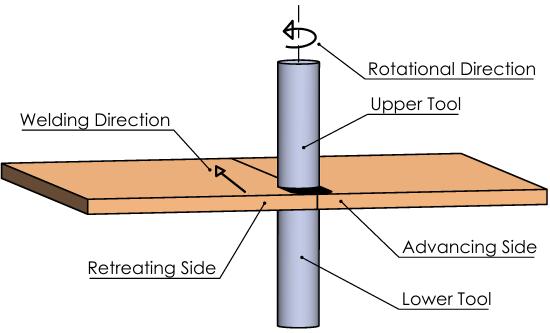
This experiment employed a heat-treatable aluminum alloyAA6061-T6withdimensionsof200×125×8mm.Two plates were joined in a butt joint configuration Simultaneouslydouble-sidedfrictionstirweldingSDFSWwas performedusingtwopintoolsoperatingfromtheupperand lowersurfacesasshowninFig1.
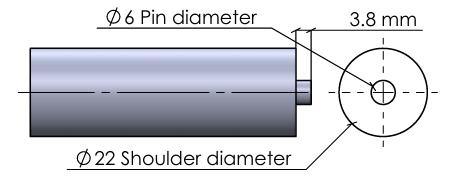
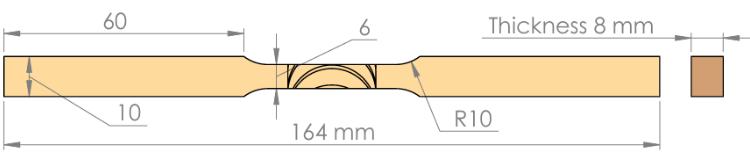
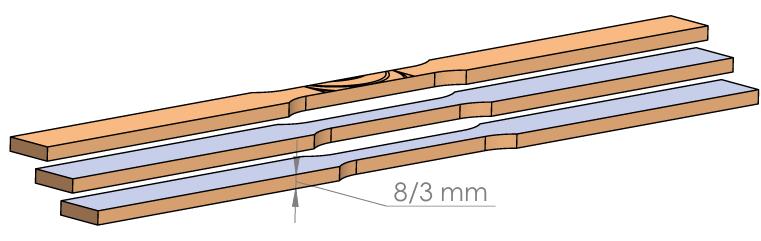
Thepintoolshadacylindricalgeometrywithapinheightof 3.8 mm and a pin diameter of 6 mm. The detailed tool geometryanddimensionsarepresentedinFig2.Atotalof threetensiletestspecimenswereextractedfromthewelded plates in accordance with the ASTM E8 sub-sized tensile specimen standard. The geometry and dimensions of the tensilespecimensareillustratedinFig3.Specimencutting wascarriedoutusingafive-axiswaterjetcuttingmachine manufactured by Foshan Ruichi Technology to minimize thermal and mechanical effects. Each standardized tensile specimen wassubsequently dividedinto three equal parts alongtheplatethicknessdirection,referredtoastheupper, middle,andlowerregions.Astheplatethicknesswas8mm, eachregioncorrespondedtoapproximatelyonethirdofthe total thickness. Theslicing process was performed usinga wire electrical discharge machining system MV1200-S manufactured by Mitsubishi Electric to ensure cutting precision.Theillustrationofslicedspecimenarepresentedin Fig 4. Tensile tests were conducted at room temperature using a 100 kN universal testing machine to evaluate the
International Research Journal of Engineering and Technology (IRJET) e-ISSN: 2395-0056
Volume: 13 Issue: 03 | Mar 2026 www.irjet.net p-ISSN: 2395-0072
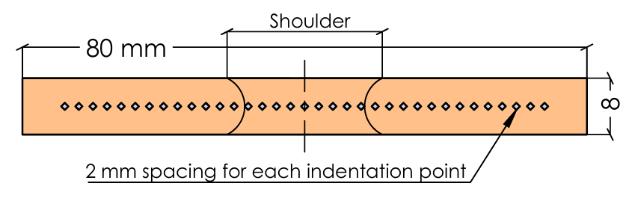
through-thickness tensile strength. Vickers microhardness measurements were performed to assess the hardness distributionacrosstheweldjoint.Hardnessmeasurements were taken at the middle section of the weld, and the indentationlayoutisshowninFig5.AShimadzuHMV2000 micro Vickers hardness tester was used for all hardness measurements.
3.1
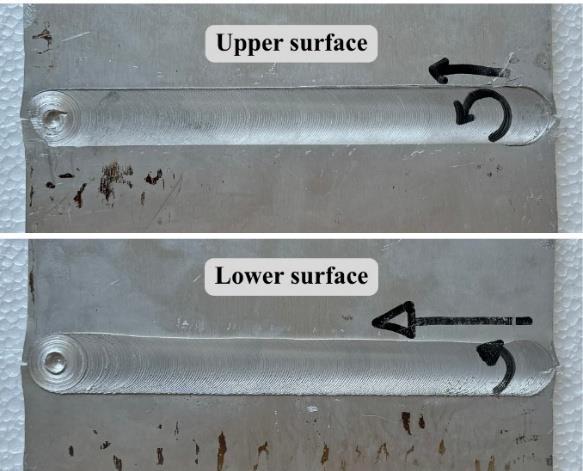
The surface appearance of the weld produced by the simultaneous double-sided friction stir welding process is showninFig.6.Thefigurepresentstheweldbeadobserved fromtheupperandlowersurfacesoftheweldedplates.A continuousanduniformweldsurfacecanbeobservedalong theentireweldingdirectionwithoutvisibledefectssuchas surfacecracks,voids,orexcessiveflash.
Table -1: Ultimate tensile strength values of the tensile specimens
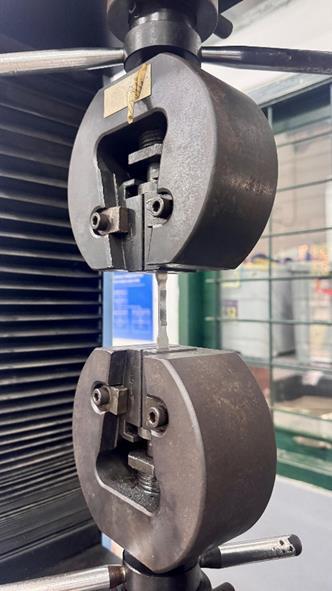
Thetensiletestresultsobtainedfromtheupper,middle,and lowerregionsoftheweldedjointaresummarizedinTable1. The table presents the ultimate tensile strength values of three standardized ASTM E8 sub-sized tensile specimens extractedfromtheSDFSWweldedplate.Eachspecimenwas dividedintothreeregionsalongthethicknessdirectionand subjectedtotensiletestingtoexaminethevariationoftensile properties through the plate thickness. The tensile testing processandspecimenduringtestingareshowninFig.7.
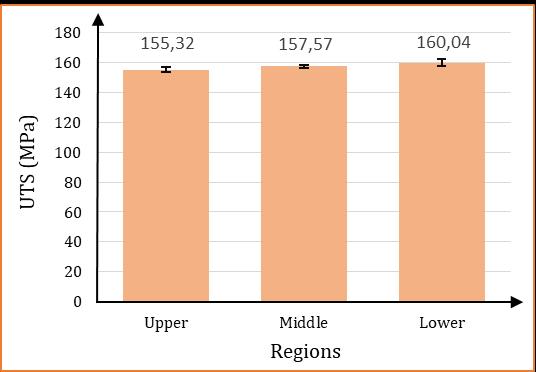
The average ultimate tensile strength values for each regionareillustratedinFig.8.Theupperregionexhibitedan average tensile strength of 155.32 MPa, while the middle region showed a slightly higher value of 157.57 MPa. The
Volume: 13 Issue: 03 | Mar 2026 www.irjet.net p-ISSN: 2395-0072
lowerregionpresentedthehighestaveragetensilestrength of160.04MPa.Althoughthedifferencesarerelativelysmall,a gradual increase in tensilestrength from the upper region towardthelowerregioncanbeobserved.Tofurtherevaluate thevariationoftensilestrengthamongthethreeregions,a statisticalanalysiswasconducted.Theresultsindicatethat the differences in ultimate tensile strength between the upper,middle,andlowerregionsarestatisticallyinsignificant (p>0.05).Thisfindingsuggeststhatthetensileproperties across the thickness of the welded plate are relatively consistent.
Therelativelyuniformtensilebehaviorcanbeassociated withthecharacteristicsoftheSDFSWprocess.Inthiswelding configuration, two tools operate simultaneously from the upper and lower surfaces of the plates, which promotes a more balanced heat input and material flow along the thicknessdirection[5,8,10].Thisconditionmaycontributeto a more homogeneous plastic deformation and thermal distributioncomparedwithconventionalsingle-sidedfriction stir welding, whereasymmetricheat input often resultsin greater variation of mechanical properties through the thickness[11]
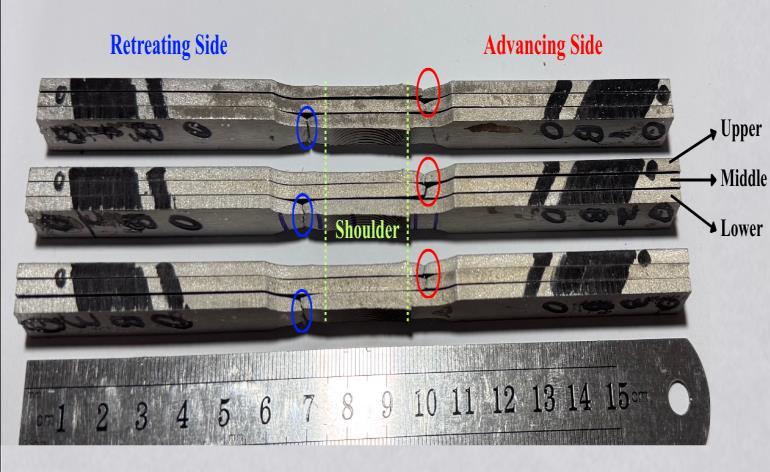
The fracture locations of the tensile specimens are presented in Fig. 9. All specimens fractured in the heataffectedzone(HAZ)about16–18mmawayfromtheweld centreline.TheoccurrenceoffractureintheHAZindicates that this region represents the weakest zone within the weldedjoint.ThereducedstrengthintheHAZisassociated with the thermal cycle experienced during the welding process.Inprecipitation-hardenedaluminumalloyssuchas AA6061-T6, exposure to elevated temperatures during weldingcancausedissolutionorcoarseningofstrengthening precipitates [11,12]. This phenomenon leads to local softening of the material, which makes the HAZ more susceptibletotensilefailurecomparedwithotherregionsof theweld[13].
Amongtheninetestedspecimens,sixfracturesoccurred intheHAZontheadvancingside,whilethreefractureswere observed in the HAZ on the retreating side. The higher fracturefrequencyontheadvancingsidecanbeattributedto theasymmetrictemperaturedistributionduringthewelding process, where the advancing side generally experiences highertemperaturesthantheretreatingside.Thiscondition maypromotegreateroveragingofstrengtheningprecipitates, resultinginahighertendencyforfractureinthisregion[14]
upper,middle,andlowerregions.
Themicrohardnessdistributionacrosstheweldjointat the mid-thickness region is presented in Fig. 10. The hardnessprofileshowsatypicalvariationacrossthewelded jointconsistingofthebasemetal(BM),heat-affectedzone (HAZ),thermo-mechanicallyaffectedzone(TMAZ),andstir zone(SZ).
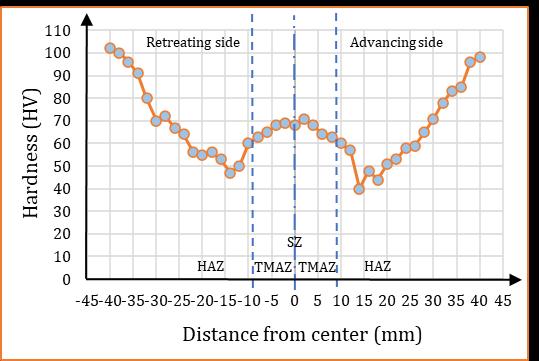
Anoticeabledecreaseinhardnessisobservedinthe heat-affected zone (HAZ). The lowest hardness values, approximately40–50HV,weremeasuredinthisregion.This reductioninhardnessisassociatedwiththethermalcycle experiencedduringtheweldingprocess,whichcanleadto dissolution or coarsening of strengthening precipitates in precipitation-hardenedaluminumalloyssuchasAA6061-T6. As a result, the material in the HAZ undergoes significant softeningcomparedwiththebasemetal.[11,15,16]
Withinthethermo-mechanicallyaffectedzone(TMAZ) and stir zone (SZ), the hardness values increase slightly comparedwiththeHAZ,reachingapproximately60–70HV near the weld center. This is related to the plastic
International Research Journal of Engineering and Technology (IRJET) e-ISSN: 2395-0056
Volume: 13 Issue: 03 | Mar 2026 www.irjet.net p-ISSN: 2395-0072
deformation high density of dislocations and dynamic recrystallizationthatoccurduringthefrictionstirwelding process,whichcanrefinethegrainstructureandresultedin anenhancedhardnessvalueofthematerial.[16,17]
The hardness profile across the weld joint exhibits a characteristic W-shaped distribution, which is commonly reported in friction stir welded aluminum alloys. This hardness distribution is consistent with the tensile test resultsdiscussedintheprevioussection,wherealltensile specimens fractured in the HAZ region. The coincidence between the lowest hardness values and the fracture location indicates that the softening occurring in the HAZ significantlyreducesthelocalstrength,makingthisregion themostsusceptibletotensilefailureintheSDFSWjoint.
TheSDFSWprocesssuccessfullyproducedacontinuous anddefect-freeweldsurfaceon boththe upperandlower sides of the plate. Based on the experimental results, the followingconclusionscanbedrawn:
The average ultimate tensile strength values for the upper, middle, and lower regions were 155.320 MPa, 157.573 MPa, and 160.039 MPa, respectively, showing onlyslightvariationalongthethickness.andstatistical analysisindicatesthatthedifferencesarenotstatistically significant(p>0.05).
Alltensilespecimensfracturedintheheat-affectedzone (HAZ),withsixfracturesontheadvancingsideandthree on the retreating side, indicating that the HAZ is the weakestregionofthejoint.
The hardness profile showed a W-shaped distribution, withthelowesthardnessofabout40–50HVlocatedin theHAZ.
Thecoincidencebetweenthelowesthardnessvaluesand thetensiletestfracturelocationintheHAZconfirmsthat thesofteninginthisregionsignificantlyreducesthelocal strengthandgovernsthetensilefailurebehaviorofthe SDFSWjoint.
Overall, the results demonstrate that the simultaneous double-sided friction stir welding processcan produce relatively uniform mechanical properties through the thicknessofAA6061-T6buttjoints.
ACKNOWLEDGEMENT
[1] PatilS,NagamadhuM,MalyadriT.Acriticalreview onmicrostructureandhardnessofaluminumalloy 6061 joints obtained by friction stir welding-past , present , and its prospects. Mater Today Proc
2023;82:75–8. https://doi.org/10.1016/j.matpr.2022.11.362.
[2] GuzmI,GrandaE,AcevedoJ,MartA.Comparativein Mechanical Behavior of 6061 Aluminum Alloy Welded by Pulsed GMAW with Di ff erent Filler Metals and Heat Treatments. Materials (Basel) 2019:1–14.
[3] Dharavathu R, Shetty K, Muvvala G. A study on mitigationoftunnelingdefectsandinvestigationon themechanicalbehaviorofdouble-sidedfrictionstir welded Al 2014 plates. J Manuf Process 2026;159:460–80.
[4] Thomas; WM, Nicholas ED, Needham JC, Murch ichaelG,PeterTemple-Smith,ChristopherJ.Dawes. UnitedStatesPatent,1995.
[5] EkoY,UematsuY,IstiyantoJ.Comparativeanalysis of bobbin tool and one-step double-acting tool in frictionstirweldingofaluminumAA1100.IntJLight MaterManuf82025;8:577–94.
[6] Xu Q, Liu H, Meng S, Ding Y, Liu Y, Xiao J, et al. A methodforpredictingthestrengthofsimultaneous double-sidedfrictionstirweldingjointsinasmallsample data environment. Chinese J Mech Eng 2025:100113. https://doi.org/10.1016/j.cjme.2025.100113.
[7] MengS,ZhaoH,DongJ,LiuW,LiuH,XiaoJ.Effectof ProcessParametersontheMechanicalPropertiesof Simultaneous Double ‑ Sided Friction Stir Welding Joints. Chinese J Mech Eng 2024:1–11. https://doi.org/10.1186/s10033-024-01126-1.
[8] Budiana EP, Gading S, Hapsari H, Mahmoud ERI. Mechanical Engineering for Society and Industry Temperatureandmaterialflowinone-stepdoubleacting friction stir welding process of aluminum alloy :Modelingandexperimental.MechEngSocInd 2025;5.
[9] Su HAO, Chen JI, Wu C. Elucidation for the CorrelationBetweenMaterialFlowandIntermixing Behavior and Joint Performances in Friction Stir Welding of Al / Cu Dissimilar Alloys. Metall Mater Trans B 2025;56:3282–308. https://doi.org/10.1007/s11663-025-03574-z.
[10] NathRK,JhaV,MajiP,BarmaJD.Anoveldouble-side welding approach for friction stir welding of polypropylene plate. Int J Adv Manuf Technol 2021:691–703.
[11] YangC,ZhangJF,MaGN,WuLH,ZhangXM,HeGZ,et al. Journal of Materials Science & Technology Microstructureandmechanicalpropertiesofdouble-
International Research Journal of Engineering and Technology (IRJET) e-ISSN: 2395-0056
Volume: 13 Issue: 03 | Mar 2026 www.irjet.net p-ISSN: 2395-0072
sidefrictionstirwelded6082Alultra-thickplates.J MaterSciTechnol2020;41:105–16. https://doi.org/10.1016/j.jmst.2019.10.005.
[12] OgunsemiBT,AbioyeTE,OgedengbeTI,Zuhailawati H. A review of various improvement strategies for jointqualityofAA6061-T6frictionstirweldments.J Mater Res Technol 2021;11:1061–89. https://doi.org/10.1016/j.jmrt.2021.01.070.
[13] MehriA,Abdollah-zadehA,EntesariS,SaeidT,TaoJ. Results in Engineering The effects of friction stir weldingonmicrostructureandformabilityof7075T6 sheet. Results Eng 2023;18:101041. https://doi.org/10.1016/j.rineng.2023.101041.
[14] Harachai K, Prasomthong S. Investigation of the optimal parametersfor butt jointsina frictionstir welding(FSW)processwithdissimilaraluminium alloys Investigation of the optimal parameters for buttjointsinafrictionstirwelding(FSW)process with dissimilar aluminiu. Mater Res Express Pap 2023;10.
[15] WonJ,RyutaroC,KohsakuH,HidetoshiU,SeungF, LeeJ.CriticalReviewofSolid‑StateWeldingforAl Alloys with High Joint Efficiency : Friction Stir Welding(FSW)vs.LinearFrictionWelding(LFW). Met Mater Int 2026;32:139–63. https://doi.org/10.1007/s12540-025-02007-5.
[16] Ambriz RR, Jaramillo D. Mechanical Behavior of Precipitation Hardened Aluminum Alloys Welds. Light Met. Alloy. Appl., 2014. https://doi.org/http://dx.doi.org/10.5772/58418.
[17] NguyenT,SinghC,SubY,HyunJ,LeeD,LeeK,etal. Mechanical properties of base metal and heataffectedzone in friction-stir-weldedAA6061-T6 at ultra-lowtemperatureof20K.JMaterResTechnol 2024;31:1547–56. https://doi.org/10.1016/j.jmrt.2024.06.165.
2026, IRJET | Impact Factor value: 8.315 |