
International Research Journal of Engineering and Technology (IRJET) e-ISSN: 2395-0056
Volume: 13 Issue: 06 | Jun 2026 www.irjet.net p-ISSN: 2395-0072

International Research Journal of Engineering and Technology (IRJET) e-ISSN: 2395-0056
Volume: 13 Issue: 06 | Jun 2026 www.irjet.net p-ISSN: 2395-0072
Aditya
Vikram Singh1 , Shailendra Kumar2
1M. Tech Student, Department of Mechanical Engineering, Goel Institute of Technology & Management, Lucknow (U.P) – 226028
2Assistant Professor, Department of Mechanical Engineering, Goel Institute of Technology & Management, Lucknow (U.P) – 226028
Abstract - The growing need for sustainable and green energy systems has accelerated the study of high-efficiency renewable power generation technologies. Solar energy has emerged as a particularly promising optionamongrenewable energy supplies due to its abundance, cleanliness and widespread availability. The present thesis develops a thermodynamic analysis of a solar aided heliumBraytoncycle coupled with an organic Rankine cycleforefficientandcarbon neutral power generation The helium Brayton cycle plays a big role in total power generation with a net power output of 13,051kW while the ORC is a good waste heat recoverysystem with an additional generation of 3,002kW. Comparative validation with previous studies showed that the present arrangement delivers higher thermodynamic performance with fewer system components, lower complexity and higher waste heat recovery efficiency. The exergy analysis showed that high irreversibility’s are observed in the solar receiver and heat exchanger components due to large temperature changes in heat transfer activities
Keywords: Solar-Assisted Helium Brayton Cycle, Organic Rankine Cycle, Waste Heat Recovery, Energy and Exergy Analysis, Concentrated Solar Thermal Power.
Increasing worldwide demand for clean, reliable and sustainable energy has driven research efforts to develop novelpower-generationtechnologieswithimprovedthermal efficiencies and reduced environmental footprints. Traditionalfossilfuelpowerplantsarestillthemainenergy industrypowersource;however,theirhighdependenceon non-renewable resources and greenhouse gas emissions have raised great environmental concerns [1]. Climate change,depletionoffossilfuelresourcesandgrowingenergy demand have motivated scientists and governments to explore renewable energy alternatives that would enable futuresustainabledevelopment.Oneofthemostpromising renewable energy sources is solar energy, because it is abundant,widelyavailableandeco-friendly[2].Figure1.1 depictsCO2 emissionfrom1990-2024asperInternational EnergyAgency(IEA)[3] TheBraytoncycleisanimportant thermodynamic cycle used in power generation and propulsionapplications.Itworksbycompressingaworking fluid,addingheatatconstantpressure,andthenexpanding
the fluid via a turbine to get useful work out of it. Air has beentraditionallyusedastheworkingfluidinBraytoncycle systems, but other gases, such helium, have been of great interestduetotheirimprovedthermophysical properties. Heliumisaninertgaswithgoodthermalconductivity,low molecular weight, good heat transfer ability and steady performance at high temperature. These properties make helium highly attractive for advanced high temperature powergenerationsystems,especiallyinthecaseofnuclear reactorsandsolarthermalenergysystems[5]
Engineering Equation Solver (EES) is a powerful computationalsoftwareoftenusedtosolveengineeringand thermodynamicproblemsinvolvingcomplexalgebraicand differential equations. EES is mainly designed for thermal engineeringapplicationsandprovidesanefficientplatform for energy, exergy, heat transfer, fluid flow and thermodynamic analysis. It is used in academic research, industrialdesignandsimulationstudiesbecausetoitsuser friendlyinterfaceandpowerfulnumericalsolvingfeatures, Rankinecycles,refrigerationsystems,heatexchangers,and solarthermalsystems.Thesoftwarecansolvelargesetsof nonlinearequationswithhighaccuracyandfastconvergence simultaneously. It also provides tools for parametric analysis, optimization, sensitivity analysis, and graphical plottingwhicharequiteusefulinperformanceassessment and improvement of the system. EES can be used for thermodynamicstudiestoinvestigatetheeffectofdifferent operating parameters on system performance, work, heat transport,andexergydestruction.Thesoftwareallowsboth steady-stateandtransientresearch,andisaversatiletoolfor complicated engineering applications. Furthermore, EES enables easy integration of mathematical equations with engineering principles which reduces the computing complexityandenhancesthesimulationperformance.Due toitsflexibility,accuracy,andeaseofuse,EESisoneofthe most widely used software tools in energy engineering researchforthermodynamicmodelingandsimulation.
International
Volume: 13 Issue: 06 | Jun 2026 www.irjet.net p-ISSN: 2395-0072
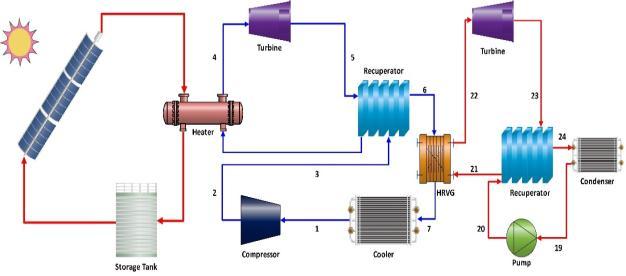
A comparative study is being out carried between the presentworkandtheworkperformedbyV.Zareetal.[32] The previous study consists of recuperated intercooled helium Brayton as a topping cycle and the two organic Rankine cycles using R123 as a working fluid. Table 4.1 Represents the comparative analysisbetween the present workandthepreviouswork.
Table 4.1 Comparative study of present work with V. Zare et al. [32] work
Sr
.
Themainthermodynamicperformanceparametersobtained from the analysis of the solar aided helium Brayton cycle integrated with organic Rankine cycle are summarized in Table4.2.Theresultsindicatethattheproposedcombined cyclesystemyieldsanetpoweroutputof16,052kWoverall which shows its feasibility for medium scale power generation purposes. The overall energy efficiency of 51.74%impliesthatmorethanhalfofthesuppliedthermal energy is efficiently converted to useful work. The exergy efficiency of 73.95% shows the effective utilization of available energy with the minimum thermodynamic irreversibilities. The Helium Brayton cycle boosts the system’s overall performance significantly, generating a power output of 13,051 kW, with an energy efficiency of 42.06%andanexergyefficiencyof60.12%.Thismeansthat the topping cycle operates as the main power generation unit. The ORC subsystem utilizes the waste heat from the exhaustgasesoftheBraytoncycletoproduce3002kW.This shows the effectiveness of having a bottoming cycle for wasteheatrecoveryandbetteroverallefficiency.Thetable alsoreportstheair,heliumandORCworkingfluidmassflow rates.ThehighmassflowrateoftheORCfluidhighlightsits importanceinabsorbingandconvertinglow-gradethermal energy. The thermodynamic data confirms that the suggested integrated system can achieve high power generation,improvedthermalefficiencyandreducedenergy losses,whichissuitableforadvancedrenewableandhybrid powergenerationsystems.
International Research Journal of Engineering and Technology (IRJET) e-ISSN: 2395-0056
Volume: 13 Issue: 06 | Jun 2026 www.irjet.net p-ISSN: 2395-0072
Fig.2showsthedistributionofexergydestructionrateand second law efficiency of numerous componentsinside the helium Brayton cycle (HBC). Figure 4.1(a) displays the components that contribute the most to the exergy degradationinthesystem.Thermodynamicirreversibilities leadingtoexergydestructionareheattransmissionacross finitetemperaturedifferences,friction, pressuredropand mixing of fluids. The results demonstrate that the highest exergydestructionisobservedinthesolarreceiverorheat exchanger section due to large temperature differences during heat transfer. The exergy losses in the mechanical systemandthefluidfrictioncauselargeexergylossesinthe turbinesandcompressorscomponents.Therecuperatorhas verysmallexergydestructionbecauseitrecoversthewaste heatfromtheturbineexhausteffectivelyandpreheatsthe compressedheliumbeforeitenterstheheatingsection.This heatrecoverytechniquereducesthefuelorsolarheatinput and increases the overall system efficiency. Figure 1(b) shows the second law efficiency of different HBC components. Higher second-law efficiency components operate closer to optimal thermodynamic conditions and thereby minimize irreversibility. The turbine has a good conversion of thermal energy to mechanical energy and henceahighsecondlawefficiency.Ontheotherhand,the efficiencyofcompressorsandheatexchangersissomewhat reduced due to pressure losses and limitations in heat transmission.
Figure 2 illustrates the importance of limiting exergy degradation in critical components to boost the system’s performance. The results indicate that the overall thermodynamic performance of the helium Brayton cycle can be improved greatly by improving the heat transfer devicesandreducingthepressurelosses.
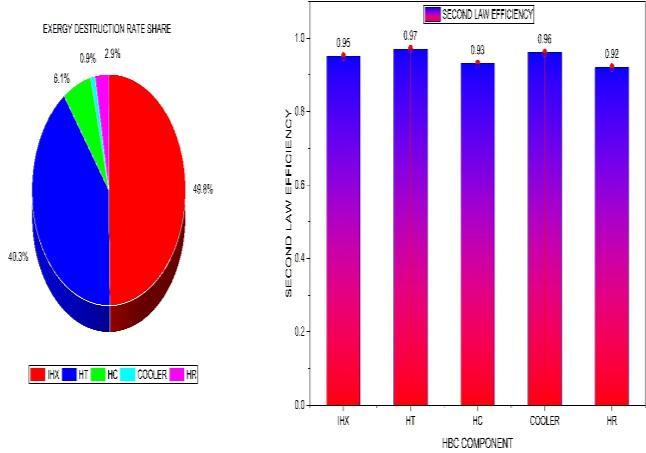
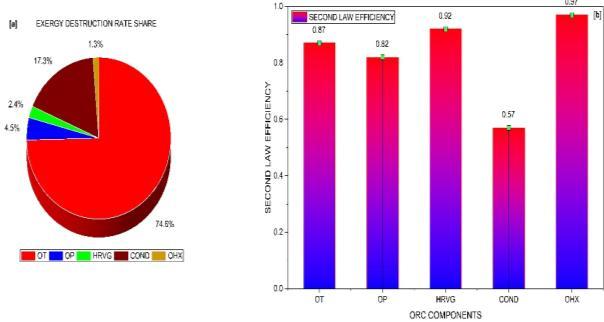
Fig.3showsthedistributionofexergydestructionandthe second law efficiency of organic Rankine cycle (ORC) components in the combined power generation system. Figure3(a)showsthe%distributionofexergydestruction amongthemain ORCcomponents, evaporator,condenser, turbine pump and recuperator. The evaporator usually experiences the most exergy degradation due to large temperature differences between the heat source and the
working fluid in the heat transfer. This irreversibility reducestheavailableusefulenergyinthesystem.Themain componentthatcausesexergydestructionisthecondenser, becauseitrejectsheattotheenvironment,whichisawaste of useful energy. In contrast, the ORC turbine has lower exergy destruction due to its high efficiency in converting thermalenergyintomechanicalpower.Likewisethepump haslowexergylossesduetothelowerpowerconsumption requirements.Therecuperatorimprovesthecycleefficiency byrecoveringtheleftoverheatfromtheturbineexhaustand transferring it to the working fluid before it enters the evaporator.Figure3(b)presentsthesecondlawefficiency of the components of Organic Rankine Cycle. The turbine usuallyhasabettersecondlawefficiencyduetotheeffective expansionoperations.Ingeneral,Figure3indicatesthatthe integrationofORCiseffectiveinutilizingthewasteheatof the helium Brayton cycle and significantly improves the overallenergyandexergyefficiencyofthecombinedsystem.
PARAMETRIC ANALYSIS
Effect Of HBC Compressor Pressure Ratio on System Performance
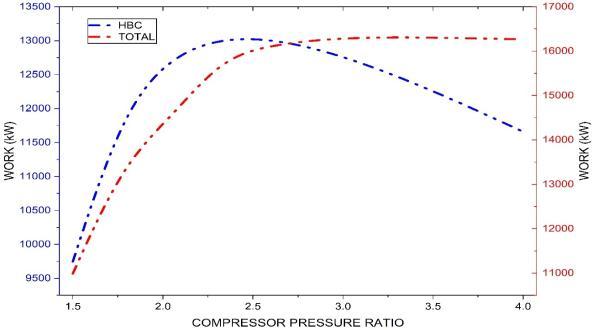
Figure 4 shows the variation of work production with compressorpressureratiofortheheliumBraytoncycle.The compressor pressure ratio is one of the most important operatingcharacteristicswithahighinfluenceonthecycle performance. Higher pressure ratios increase the temperature rise during heat addition and increase the availableenthalpydropacrosstheturbine.Theconsequence is better power output and better thermal efficiency. But abovesomepressureratio,theincreaseincompressorwork exceeds the increase in turbine effort. This causes the networkoutputtostartdecreasingorremainingconstant. Excessively high pressure ratios also result in increased irreversibilityduetofluidfrictionandpressurelosses.There is an optimum pressure ratio at which the maximum net work output is obtained. The figure illustrates the importanceofselectingtherightcompressorpressureratio in the design of a system. Good optimization will lead to minimumenergylossesandcompressorpowerconsumption and will result in optimum power production. The trends observedagreewiththethermodynamicfeaturesofBrayton
International Research Journal of Engineering and Technology (IRJET) e-ISSN: 2395-0056
Volume: 13 Issue: 06 | Jun 2026 www.irjet.net p-ISSN: 2395-0072
cycle systems and highlight the importance of the appropriateoperatingconditionsforhigherefficiencyofthe combinedcycle.
Thiswas followed bya comparative validation analysisin conjunctionwiththepreviouspublishedworkbyV.Zareet al.,whichvalidatedthereliabilityandaccuracyofthecurrent thermodynamicmodel.Theproposedarrangementshowed animprovedthermodynamicperformancewhileusingless numberofsystemcomponentstherebyreducingthesystem complexityandimprovingtheoperationalpracticality.The presentsystemachievedanetpoweroutputof16,052kW whichismorethanthatofthereferencesystem.Thetotal energy efficiency and exergy efficiency were calculated as 51.74% and 73.95%, respectively, which indicates an efficient usage of the provided thermal energy and lower thermodynamic irreversibilities.The exergy analysis revealedlargeirreversibility’sinsidethesolarreceiver,heat exchanger sections, compressor and turbine due to finite temperaturedifferences,pressuredropsandfluidfriction. Therelativeexergydestructionwaslowerfortherecuperate because of the effective heat recovery from the turbine exhaust gases. The ORC evaporator and condenser were identifiedasthemajorcausesofexergydeteriorationinthe bottoming cycle. The results show that the overall performance of the system might be further improved by designing the heat exchanger optimally and reducing the pressurelosses.
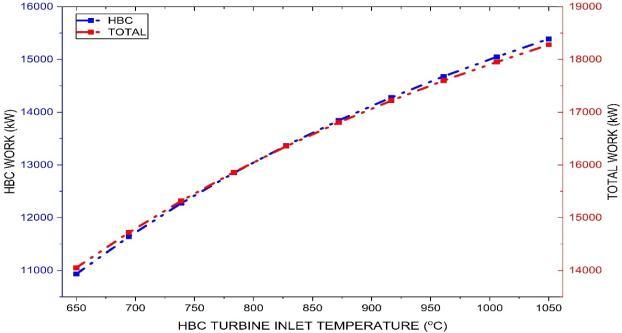
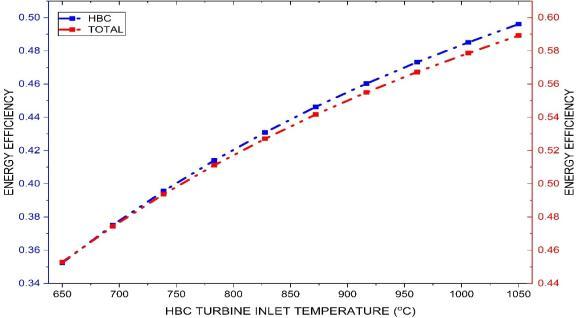
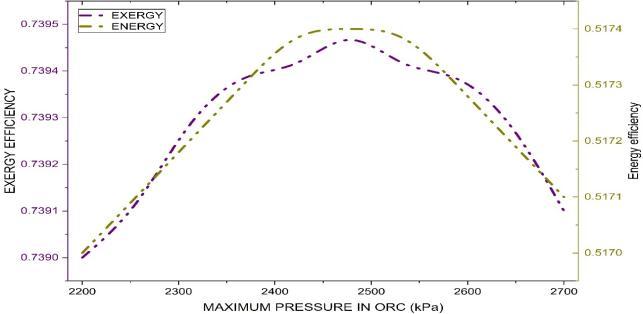
The parametric analysis showed that the compressor pressureratio,turbineinlettemperatureandORCmaximum pressurehavegreatinfluenceonthesystemperformance.It was observed that network production, energy efficiency and exergy efficiency are considerably enhanced by increasing the turbine inlet temperature owing to better turbine expansion and optimum heat utilization. The compressor pressureratio hadanoptimal workingrange, beyondwhichanexcessworkcausedadecreaseinsystem performance. The ORC maximum pressure had excellent values for waste heat recovery and cycle efficiency. The suggestedsolar-assistedheliumBraytoncyclecoupledwith recuperated ORC showed improved thermodynamic efficiency, efficient waste heat recovery, reduced system complexity,andmaximizeduseofrenewablesolarenergy. The obtained results verify the feasibility of the proposed combined cycle system for future sustainable and high efficiencypowerproductionapplications.
[1] A.H.Alamietal.,“Concentratingsolarpower(CSP) technologies: Status and analysis,” Int. J. Thermofluids,vol.18,no.March,p.100340,2023, doi:10.1016/j.ijft.2023.100340.
[2] S. Wang, Z. Liu, C. Liu, and X. Wang, “ThermodynamicAnalysisofOperatingStrategies forWasteHeatRecoveryofCombinedHeatingand Power Systems,” SSRN Electron. J., vol. 258, p. 124803,2021,doi:10.2139/ssrn.3958616.
International Research Journal of Engineering and Technology (IRJET) e-ISSN: 2395-0056
Volume: 13 Issue: 06 | Jun 2026 www.irjet.net p-ISSN: 2395-0072
[3] “IEA,GlobalCO2emissionsfromenergycombustion and industrial processes, 1900-2022, IEA, Paris https://www.iea.org/data-andstatistics/charts/global-co2-emissions-fromenergy-combustion-and-industrial-processes-19002022,IEA.Licence:CCBY4.0”.
[4] A. K. Yadav, A. Kumar, and S. Sinha, “A review of concentratedsolarpowerstatusandchallengesin India,” Sol. Compass, vol. 12, no. April, p. 100079, Dec.2024,doi:10.1016/j.solcom.2024.100079.
[5] A.Sharma,A.Kumar,S.Onkar,andS.Meeta,“Energy , exergy , exergoeconomic investigations , and working fluid selection of a solar based energy generation system,” J. Therm. Anal. Calorim., vol. 151, no. 3, pp. 2587–2601, 2026, doi: 10.1007/s10973-026-15308-7.
[6] O. Mahian, M. R. Mirzaie, A. Kasaeian, and S. H. Mousavi, “Exergy analysis in combined heat and powersystems:Areview,”EnergyConvers.Manag., vol. 226, no. October, p. 113467, 2020, doi: 10.1016/j.enconman.2020.113467.
[7] C.Şirin,J.Goggins,andM.Hajdukiewicz,“Areview on building-integrated photovoltaic/thermal systemsforgreenbuildings,”Appl.Therm.Eng.,vol. 229, no. April, 2023, doi: 10.1016/j.applthermaleng.2023.120607.
[8] Z. Su, L. Yang, and N. Zhao, “Multi-criteria assessmentofanenvironmentally-friendlyscheme integrating solid oxide fuel cell hybrid power and renewableenergyauxiliarysupply,”J.Clean.Prod., vol. 369, no. August, p. 133410, 2022, doi: 10.1016/j.jclepro.2022.133410.
[9] C.Ogbonnaya,C.Abeykoon,A.Nasser,A.Turan,and C.S.Ume,“Prospectsofintegratedphotovoltaic-fuel cell systems in a hydrogen economy: A comprehensivereview,”Energies,vol.14,no.20,pp. 1–33,2021,doi:10.3390/en14206827.
[10] E. Ghirardi, G. Brumana, G. Franchini, and A. Perdichizzi, “The optimal share of PV and CSP for highlyrenewablepowersystemsintheGCCregion,” Renew.Energy,vol.179,pp.1990–2003,2021,doi: 10.1016/j.renene.2021.08.005.
[11] M.N.Karimi,A.Dutta,A.Kaushik,H.Bansal,andS. Z.Haque,“AReviewofOrganicRankine,Kalinaand GoswamiCycle,”Int. J.Eng. Technol.Manag.Appl. Sci. www . ijetmas . com, vol. 3, no. October, pp. 2349–4476,2015.
[12] T.Li,R.Gao,andX.Gao,“Energy,exergy,economic, andenvironment(4E)assessmentoftrans-critical organic Rankine cycle for combined heating and power in wastewater treatment plant,” Energy Convers. Manag., vol. 267, no. April, p. 115932, 2022,doi:10.1016/j.enconman.2022.115932.
[13] Z.Yueetal.,“Facileco-synthesisandutilizationof ultrafineandhighlyactivePrBa0.8Ca0.2Co2O5+δGd0.2Ce0.8O1.9compositecathodesforsolidoxide fuel cells,” Electrochim. Acta, vol. 403, 2022, doi:
10.1016/j.electacta.2021.139673.
[14] A. Sharma, A. K. Shukla, and O. Singh, “Technoeconomicassessmentofasolar-basednovelpower generationsystemformedfroma heliumBrayton cycleandanorganicRankineflashcycle,”vol.2024, no. November, pp. 1–16, 2024, doi: 10.3389/fenrg.2024.1499447.
[15] M. T. Dunham and B. D. Iverson, “High-efficiency thermodynamicpowercyclesforconcentratedsolar powersystems,”Renew.Sustain.EnergyRev.,vol. 30, pp. 758–770, 2014, doi: 10.1016/j.rser.2013.11.010.
[16] A. Javanshir, N. Sarunac, and Z. Razzaghpanah, “Thermodynamic analysis of simple and regenerative Brayton cycles for the concentrated solarpowerapplications,”EnergyConvers.Manag., vol. 163, no. February, pp. 428–443, 2018, doi: 10.1016/j.enconman.2018.02.079.
[17] V. Dostal, P. Hejzlar, M. J. Driscoll, V. Dostal, P. Hejzlar,andM.J.Driscoll,“TheSupercriticalCarbon Dioxide Power Cycle : Comparison to Other Advanced Power Cycles THE SUPERCRITICAL CARBON DIOXIDE POWER CYCLE : COMPARISON TOOTHERADVANCEDPOWERCYCLES,”vol.5450, no.June,2017.


Aditya Vikram Singh , M. Tech Student, Department of Mechanical Engineering, Goel Institute of Technology & Management,Lucknow(U.P)–226028
Shailendra Kumar, Department of Mechanical Engineering, Assistant Professor, Goel Institute of Technology and Management, Lucknow, researcher, academician, engineering educator, interested in manufacturing, thermal engineering, and innovative mechanical systems.