International Research Journal of Engineering and Technology (IRJET)
e-ISSN: 2395-0056
Volume: 13 Issue: 06 | Jun 2026
p-ISSN: 2395-0072
www.irjet.net
Thermal Performance Improvement of a Triple Basin Solar Still Using Evacuated Tubes, Heat Pipes, and Energy Storage Materials Mohammad Mujtaba1 and Shiv Kumar2 1M. Tech Student, Department of Mechanical Engineering, Goel Institute of Technology & Management, Lucknow
(U.P) – 226028
2Assistant Professor, Department of Mechanical Engineering, Goel Institute of Technology & Management,
Lucknow (U.P) – 226028 ---------------------------------------------------------------------***--------------------------------------------------------------------2. RESEARCH WORKS ON SOLAR STILL WITH Abstract-This study reviews multiple strategies aimed at EVACUATED TUBES boosting solar still efficiency, such as the incorporation of evacuated tube collectors (ETCs), optimization of insulation layer thickness, addition of extended surfaces (fins), glass cover cooling modifications, and the use of thermal energy storage materials (ESMs). According to the literature, combining ETCs with solar distillation units can raise productivity by as much as 67%. Insulation materials, particularly carbon-impregnated foam (CIF), have been shown to enhance yield by 38.7%. The inclusion of fins improves heat transfer, leading to a 25% increase in output, while waterbased cooling of the glass cover raises efficiency by up to 81%. Furthermore, adjusting water depth and utilizing nanoparticles contribute to additional performance gains. Despite these improvements, challenges related to costeffectiveness, material longevity, and system scalability persist. This review consolidates key technological advances and outlines future research needs to make solar stills more viable for real-world freshwater production, especially in remote and water-scarce regions.
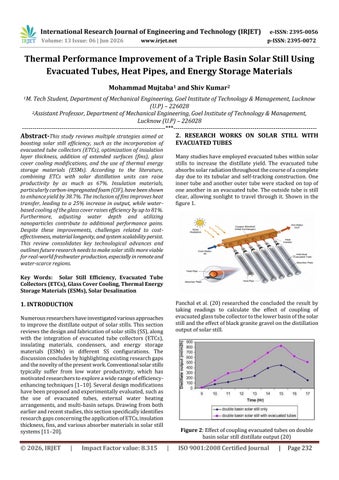
Many studies have employed evacuated tubes within solar stills to increase the distillate yield. The evacuated tube absorbs solar radiation throughout the course of a complete day due to its tubular and self-tracking construction. One inner tube and another outer tube were stacked on top of one another in an evacuated tube. The outside tube is still clear, allowing sunlight to travel through it. Shown in the figure 1.
Key Words: Solar Still Efficiency, Evacuated Tube Collectors (ETCs), Glass Cover Cooling, Thermal Energy Storage Materials (ESMs), Solar Desalination Panchal et al. (20) researched the concluded the result by taking readings to calculate the effect of coupling of evacuated glass tube collector to the lower basin of the solar still and the effect of black granite gravel on the distillation output of solar still.
1. INTRODUCTION Numerous researchers have investigated various approaches to improve the distillate output of solar stills. This section reviews the design and fabrication of solar stills (SS), along with the integration of evacuated tube collectors (ETCs), insulating materials, condensers, and energy storage materials (ESMs) in different SS configurations. The discussion concludes by highlighting existing research gaps and the novelty of the present work. Conventional solar stills typically suffer from low water productivity, which has motivated researchers to explore a wide range of efficiencyenhancing techniques [1–10]. Several design modifications have been proposed and experimentally evaluated, such as the use of evacuated tubes, external water heating arrangements, and multi-basin setups. Drawing from both earlier and recent studies, this section specifically identifies research gaps concerning the application of ETCs, insulation thickness, fins, and various absorber materials in solar still systems [11–20].
© 2026, IRJET
|
Impact Factor value: 8.315
Figure 2: Effect of coupling evacuated tubes on double basin solar still distillate output (20)
|
ISO 9001:2008 Certified Journal
|
Page 232