
International Research Journal of Engineering and Technology (IRJET) e-ISSN: 2395-0056
Volume: 13 Issue: 02 | Feb 2026 www.irjet.net p-ISSN: 2395-0072
SYNTHESIS OF AN HETEROCYCLIC COMPOUND 5-PHENYL-1, 3, 4-
THIADIAZOLE-2-AMINE
Dr. P. D. Gokulan*1, Dr. K. L. Senthil kumar*2, S. S. Nigash*3, G. Nandhu*4, C. Naveen Kumar*5 , P. Srivishnu*6
*1Head Of the Department of Pharmaceutical Chemistry, Sri Vijay Vidyalaya College Of pharmacy, Dharmapuri, Tamil Nadu, India.
*2Principal, Sri Vijay Vidyalaya College of Pharmacy, Dharmapuri, Tamil Nadu, India. *3, *4, *5, *6B. Pharm Students, Sri Vijay Vidyalaya College of Pharmacy, Dharmapuri, Tamil Nadu, India.
***
ABSTRACT- The present work describes an efficient synthetic approach for the preparation of 5-phenyl-1,3,4-thiadiazole2-amine using phenyl hydrazine as the starting material. The synthesis was carried out through a multi-step reaction involving cyclization, acidification, and animation processes. Initially, phenyl hydrazine was reacted with carbon disulfide in ethanol in the presence of sodium hydroxide under reflux conditions to form an intermediate salt, which subsequently underwent intermolecular cyclization to generate the thiadiazole framework. Controlled acidification with hydrochloric acid facilitated the isolation of the thiol intermediate. The obtained intermediate was then subjected to amination using ammonia under reflux to afford the desired amine derivative. The crude product was isolated by filtration and purified by recrystallization form ethanol to obtain the final compound in good purity. The synthesized 5-phenyl-1,3,4-thiadiazole-2amine was characterized by infrared (IR) spectroscopy, which confirmed the formation of the thaiodiazole nucleus and functional groups. The adopted synthetic route is simple, cost-effective, and reproducible, making it suitable for laboratory scale preparation. This methodology also provides a convenient platform for the synthesis of related 1,3,4-thiadiazole derivatives with potential pharmaceutical significance.
Keywords: Cyclization, Acidification, Amination, Recrystallization, Infrared spectroscopy.
INTRODUCTION
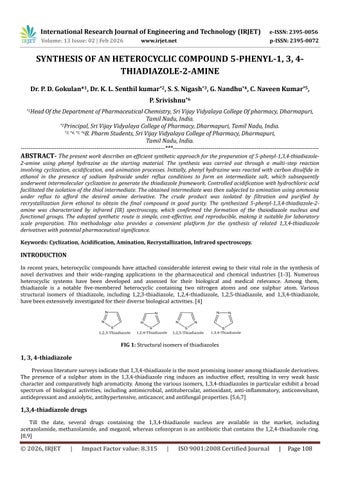
In recent years, heterocyclic compounds have attached considerable interest owing to their vital role in the synthesis of novel derivatives and their wide-ranging applications in the pharmaceutical and chemical industries [1-3]. Numerous heterocyclic systems have been developed and assessed for their biological and medical relevance. Among them, thiadiazole is a notable five-membered heterocyclic containing two nitrogen atoms and one sulphur atom. Various structural isomers of thiadiazole, including 1,2,3-thiadiazole, 1,2,4-thiadiazole, 1,2,5-thiadiazole, and 1,3,4-thiadiazole, havebeenextensivelyinvestigatedfortheirdiversebiologicalactivities [4]
1, 3, 4-
Previousliteraturesurveysindicatethat1,3,4-thiadiazoleisthemostpromisingisomeramongthiadiazolederivatives. The presence of a sulphur atom in the 1,3,4-thiadiazole ring induces an inductive effect, resulting in very weak basic characterandcomparativelyhigharomaticity. Amongthevariousisomers,1,3,4-thiadiazolesinparticularexhibitabroad spectrum of biological activities, including antimicrobial, antitubercular, antioxidant, anti-inflammatory, anticonvulsant, antidepressantandanxiolytic,antihypertensive,anticancer,andantifungalproperties.[5,6,7]
1,3,4-thiadiazole drugs
Till the date, several drugs containing the 1,3,4-thiadiazole nucleus are available in the market, including acetazolamide, methazolamide, and megazol, whereascefozopran isanantibiotic thatcontainsthe 1,2,4-thiadiazole ring. [8,9]
International Research Journal of Engineering and Technology (IRJET) e-ISSN: 2395-0056
Volume: 13 Issue: 02 | Feb 2026 www.irjet.net p-ISSN: 2395-0072
SYNTHESIS
a)Synthesisof1,3,4-thiadiazole.
b)Synthesisof5-phenyl-1,3,4-thiadiazole-2-amine
Synthesis of 1,3,4-thiadiazole
Structure and Characteristics: 1,3,4-thiadiazoleis a five-membered heteroaromaticringcontaining two nitrogen atoms andonesulphuratom.Theringsystemisplanarandconjugated,followingHuckle’sruleandexhibitingaromaticcharacter. Substitution generally occurs at the 2- and 5- positions, enabling structural variation. These structural features provide highstabilityandmakethe1,3,4-thiadiazolescaffoldvaluableinmedicalchemistry.
Synthesis: 1,3,4-thiadiazolederivativesarecommonlysynthesizedbycyclizationofthiosemicarbazidesusingdehydrating agents. The reaction usually involves condensation of carboxylic acids or acid chlorides with thiosemicarbazide to form intermediates.
Chemical and physical properties: It has a molecular weight of approximately 102.12 g/mol and exists as a stable heteroaromatic compound. It exhibits a relatively high melting point and low volatility due to strong intermolecular interactions, including dipole-dipole forces. These interactions contribute to its solid-solid stability, density, and welldefinedphysiochemicalbehaviour.
Uses
Pharmaceuticals:antimicrobial,anticancer,anti-inflammatory,andantitubercular.
Industry:usedinagrochemicals,dyes,polymers,andfunctionalmaterial.
This1,3,4-thiadiazoleplaysavitalroleinchemicalsynthesis,pharmaceuticaldevelopment,andasasolvent.Itssynthesis, applications,andtoxicityrequirecarefulhandlingandanalysis.
Synthesis of 5-phenyl-1,3,4-thiadiazole-2-amine
Chemicalsandreagents:
PhenylHydrazine
Carbondisulfide
Hydrochloricacid
Ethanol
Ammonia
Sodiumhydroxide
EquipmentandInstruments
International Research Journal of Engineering and Technology (IRJET) e-ISSN: 2395-0056
Volume: 13 Issue: 02 | Feb 2026 www.irjet.net p-ISSN: 2395-0072
Magneticstirrer
Thermometer
Laboratorycondenser
Heatingmantle
PROCEDURE:
Phenyl hydrazine was reacted with carbon disulfide in absolute ethanol in the presence of a base such as anhydrous sodiumcarbonatetoformaDithiocarbamateintermediate.Thereactionmixturewasrefluxedfor4-8hours,readingtothe formation of a potassium hydrazothicarbonamide dithiocarboxylate salt, which subsequently underwent cyclization to yield5-phenyl-1,3,4-thiadiazole-2-thioloritssaltform. Aftercompletionofthereaction,themixturewascooledinanice bath,andconcentratedhydrochloricacidwasaddedslowlywithcontinuousstirringtocontroltheexothermicprocessand precipitate the thiol intermediate. The resulting solid was collected and dissolved in ethanol, followed by the addition of ammoniasolution.Themixturewasthenrefluxedfor8-10hours,allowingnucleophilicsubstitutionofthesulphuratomby anaminegrouptoform5-phenyl-1,3,4-thiadiazole-2-amine.Uponcompletion,thereactionmixturewascooledorpoured intoicewatertoinduceprecipitation.Ifrequired,thesolutionwasneutralizedtopH8-9usingamildalkalinesolution.The precipitatedproductwasfiltered,washedthoroughly,andrecrystallizedfromethanoltoobtainthefinalcompoundinhigh purity.
RESULT:
In this experiment,the5-phenyl-1,3,4-thiadiazole-2-amine weresuccessfullysynthesizedusingthe outlined synthetic routes.Thecompoundwasobtainedinasatisfactoryyieldandcharacterizedbasedonitsphysicalandchemicalproperties. The structure of the compound, identified as 5-phenyl-1,3,4-thiadiazole-2-amine, was confirmed using its molecular formula and chemical name. The synthesized product exhibits the expected characteristics, including its physical properties appearance, high melting point, and molecular weight, all of which were consistent with the expected properties of 5-phenyl-1,3,4-thiadiazole-2-amine. The details of the compound’s properties are summarized in the followingtable.
© 2026, IRJET | Impact Factor value: 8.315 | ISO 9001:2008 Certified Journal | Page110
International Research Journal of Engineering and Technology (IRJET) e-ISSN: 2395-0056
Volume: 13 Issue: 02 | Feb 2026 www.irjet.net p-ISSN: 2395-0072
Molecular
C:\Users\Public\Documents\Bruker\OPUS_8.7.10\MEAS\PM02012023.896
FIG 5: FT-IRSpectroscopyof5-phenyl-1,3,4-thiadiazole-2-amine
C:\Users\Public\Documents\Bruker\OPUS_8.7.10\MEAS\PM02012023.896
FIG 6: FT-IRspectroscopyof5-phenyl-1,3,4-thiadiazole-2-aminewithpeaklines
International Research Journal of Engineering and Technology (IRJET) e-ISSN: 2395-0056
DISCUSSION:
The test compounds were synthesized by adopting the synthetic route depicted in the scheme. The key intermediate wasDi thiocarbamate prepared by reacting phenyl hydrazine, anhydrous sodium hydroxideandammonia solutionin the presence of ethanol and hydrochloric acid. The IR spectrum of the synthesized compound, 5-phenyl-1,3,4-thiadiazole-2amine, wasanalysed to confirm itsstructure. Thespectrum exhibited characteristic absorption bands thatare consistent withtheexpectedfunctionalgroups.Thespectrumdatafor5-phenyl-1,3,4-thiadiazole-2-amineisgivenbelow.,
TABLE 2
(cm-1)
3029cm-1
1584cm-1
1622cm-1
1248cm-1
1078cm-1
864cm-1
Assignment
AromaticC-Hstretching
C-Nstretching
N-Hbending
C-Nstretching
C-SandN-Nstretching
C-Houtofplanebending
TheIRspectrumdataprovidesstrongevidenceforthesuccessfulsynthesisofthe5-phenyl-1,3,4-thiadiazole-2-amine The presence of characteristics absorption bands corresponding to the expected functional groups confirms the structure of thecompound.
CONCLUSION:
The 5-phenyl-1,3,4-thiadiazole-2-amine was successfully synthesized through a well-defined multi-step procedure involving intermediate salt formation, controlled acidification, and amination. The reaction conditions were optimized to ensure smooth cyclization and high product stability. The synthesized compounds were subjected to IR spectroscopic analysis, which confirmed the presence of the thiadiazole framework and functional groups, supporting the successful formationofthetargetmolecule.Theoverallprocedure wasfoundtobereproducibleandoperationallysimple. Thefinal product was isolated as a solid and purified effectively by recrystallization, yielding a compound of high purity. The syntheticrouteemployediscost-effectiveandsuitableforlaboratory-scalepreparation.Thismethodalsooffersflexibility for further structural modifications. Hence, the approach is promising for the synthesis of related 1,3,4-thiadiazole derivativeswithpotentialbiologicalapplications.
REFERENCE:
1. Visagaperumal D, Ramalingam J, Chandy V (2018) 1,3,4-Thiadiazoles: An Overview. Curr Res Bioorg Org Chem: CRBOC-103.DOI:10.29011/CRBOC-101.100003.
2. RoblinRO,ClappJW(1950)Thepreparationofheterocyclicsulfonamides.JAmChemSoc72:4890-4892.
3. MarenTH(1967)CarbonicAnhydrase:Chemistry,PhysiologyandInhibition.PhysiolRev47:595-781.
4. Gupta RR, Kumar M, Gupta V (2005) Heterocyclic Chemistry II, Five membered heterocycles, Springer (India) privateLTD566-578.
5. KetanCParmar,NikitaHUmrigar(2017)Reviewonsynthesisof1,3,4-thiadiazolederivatives.ISSN:0975-7384
6. NSMahajan,SRPattan,RLJadhav,NVPimpodhkar,AMManikrao.IntJChemSci.2008,6(2),800-806.
7. KMBasavaraja,BSomasekhar,SAppalaraju.IndianJHeterocyclicChem.2008,18,69-72.
Volume: 13 Issue: 02 | Feb 2026 www.irjet.net p-ISSN: 2395-0072 © 2026, IRJET | Impact Factor value: 8.315 | ISO 9001:2008 Certified
International Research Journal of Engineering and Technology (IRJET) e-ISSN: 2395-0056
Volume: 13 Issue: 02 | Feb 2026 www.irjet.net p-ISSN: 2395-0072 © 2026, IRJET | Impact Factor value: 8.315 | ISO 9001:2008 Certified Journal | Page113
8. AAChowki,CSMagdum,PLLadda,SKMohite.IntJChemSci.2008.6(3),1600-1605.
9. AHetzhein,AMockel.AdvHeterocycleChem.1996,7,183.