
International Research Journal of Engineering and Technology (IRJET) e-ISSN: 2395-0056
Volume: 13 Issue: 01 | Jan 2026 www.irjet.net p-ISSN: 2395-0072
SYNERGISTIC ANTIBACTERIAL ACTIVITY OF RICINUS COMMUNIS LEAF EXTRACTS WITH CHLORAMPHENICOL AGAINST STREPTOCOCCUS
AUREUS, ENTEROCOCCUS FAECALIS, KLEBSIELLA PNEUMONIAE, AND PROTEUS VULGARIS.
M.Kavitha*1 , S.Sonali*2 , R.Sowmiya*3 , K.Sriganth*4
1 Assistant Professor, Sri Vijay Vidyalaya College of Pharmacy, Dharmapuri, Tamil Nadu (India) 2, 3, 4 B. Pharm Students, Sri Vijay Vidyalaya College of Pharmacy, Dharmapuri, Tamil Nadu (India) ***
ABSTRACT- The study investigated the synergistic antibacterial effect of Ricinus communis extracts combined with chloramphenicol against selected Gram-positive and Gram-negative bacteria. Ethanolic and acetone extracts were evaluated using the agar well diffusion method. The combined treatment showed greater antibacterial activity than plant extracts alone, with the ethanolic extract being more effective than the acetone extract. Notable synergistic effects were observed, particularly against Klebsiella pneumoniae and Proteus vulgaris. These results indicate that Ricinus communis can enhance the efficacy of chloramphenicol and may be useful as an adjunct in antimicrobial therapy.
Keywords: Synergistic activity, Chloramphenicol, Antibacterial activity.
I. INTRODUCTION:
Rising antibiotic resistance has made bacterial infections a serious global health threat, creating an urgent need for new, effective,andsaferantimicrobialagents.
Medicinal plants are valuable alternatives to synthetic drugs because they are easily available, biodegradable, less toxic, andrichinantimicrobialsecondarymetaboliteslikealkaloids,flavonoids,tannins,andterpenoids.
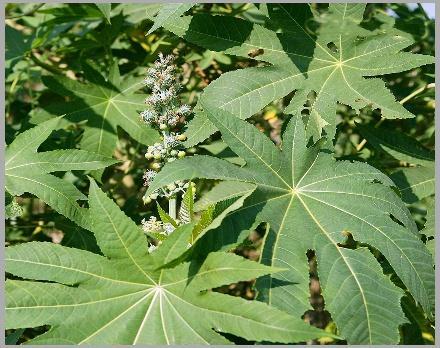
Ricinus communis (castor plant) is widely used in traditional medicine, and its leaves are known for treating infections, inflammation,andwounds,suggestingstrongantimicrobialpotential.Extractionsolventsinfluenceantimicrobialactivity
This study evaluates ethanol and acetone leaf extracts of R. communis using the agar diffusion method against Grampositive and Gram-negative bacteria, comparing their effectiveness with the standard antibiotic chloramphenicol to supportthedevelopmentofplant-basedantimicrobials.
II. MATERIALS AND METHODS:
Collection and identification of plant:
The plant leaves were gathered in December 2025 from the Dharmapuri district, and the specimen was verified by a siddhamedicinalplantsgarden(CentralCouncilforResearchinSiddha),MinistryofAyush,Govt.ofIndia.
International Research Journal of Engineering and Technology (IRJET) e-ISSN: 2395-0056
Volume: 13 Issue: 01 | Jan 2026 www.irjet.net p-ISSN: 2395-0072
Preparation:
CollectfreshleavesfromtheRicinuscommunisplantandwashthemwellwithdistilledwatertogetridofanydirt,dust,or other debris. The cleaned leaves usually dry at room temperature for five to eighteen days. Then, using a mechanical or hand grinder, the dried ones are ground into a coarse or fine powder. This increases the surface area for effective extraction.
Getting plant material out:
Weighing25gramsofpowderedleavesonananalyticalbalance,weaddedthemto250mlofabsoluteethanolandacetone inaconicalflaskataratioof1:10.Afterthat,westartedthemacerationextractionwithanelectronmagneticstirrer, which lastedfor6hours.Afterthat,theextractthathadbeencollectedwasfilteredthroughmuslincloth.Afiltrateofextract was concentratedinarotaryevaporatorat40°Cuntilthecrudeextractswerefurtherdriedtoeliminateresidualsolventsand storedat4°Cuntilrequired.
III. PRELIMINARY PHYTOCHEMICAL SCREENING:
To identify the chemical components, phytochemical screening was conducted to detect alkaloids, flavonoids, phenols, tannins,glycosides,steroids,saponins,carbohydrates,andotherconstituents,adheringtoestablishedprotocols.
Alkaloid test:
Weboiled0.2gofthesamplewith5mlof1%aqueousHClinawaterbathfor45minutes.Wefilteredthemixtureandput 1mlofthefiltrateevenlyintotwotesttubes,eachwithtwodropsofthefollowingreagents.
• Drangendorff's reagent: Anorange-redsolidshowsthatalkaloidsarepresent.
• Meyer’s reagent: Aprecipitatethatiscreamywhiteshowsthatalkaloidsarepresent.
Flavonoids test:
Acertainamount,0.5g,ofthesamplewasdissolvedinethanol,heated,andthenfiltered.Threepiecesofmagnesiumchips were added to the filtrate, and then a few drops of concentrated HCl were added. If the colour is pink, orange, red, or purple,itmeansthatflavonoidsarepresent.
Tannins:
Split 0.5 g of the extract into two test tubes, dissolve it in 10 ml of hot saline solution, and wash it three times with petroleumether.Onetubereceivedtwotothreedropsofferricchloride,whiletheothertubereceivedtwotothreedrops of the gelatine salts reagent. Tannins are evident from the blackish-blue colour of the first test tube and the hazy appearanceofthesecondtesttube.
Saponins:
0.5goftheextractwasplacedinasteriletesttubetocheckforsaponins.Ten millilitresofdistilledwaterwereadded,the tube was stoppered, and it was vigorously shaken for approximately thirty seconds. The presence of saponins was subsequentlyconfirmedbythefoamthatdevelopedwhenitwasallowedtositforatleastanhour.
Phenol:
0.5gofthecrudeextractwasmixedwith3–4dropsofferricchloridesolution.Abluish-blackorblue-greencolourmeans thatthetestforphenolispositive.
Glycosides:
Add1mlofdistilledwatertotheextractandanaqueoussolutionofNaOH.Ifthesolutionturnsyellow,thetestispositive forglycosides.
International Research Journal of Engineering and Technology (IRJET) e-ISSN: 2395-0056
Volume: 13 Issue: 01 | Jan 2026 www.irjet.net p-ISSN: 2395-0072
Carbohydrates:
Add2mlofBenedict'sreagenttotheextractandheatitinaboilingwaterbathfor2minutes.Areddish-brownprecipitate showsthatcarbohydratesarepresent.
Steroids:
Mix 0.5 g of the sample with 5 ml of 1% lead acetate solution and 10 ml of ethanol in water. The mixture was put in a boiling water bath for two minutes, and then it was cooled and filtered. We took 15 ml of chloroform out of the filtrate twice. Five millilitres of the chloroform layer were allowed to evaporate. After the water had evaporated, 2,3dinitrobenzoicacidand1mlof1NNaOHwereadded.Ifsomethingisred,itmeansithassteroidsinit.
Proteins and amino acids:
Wemixedplantextractswith2 dropsoffresh0.2%ninhydrinsolutionandheatedthemtoboilingfor1–2minutes.Then weletthemcool.Ifsomethingisblue,itmeansithasaminoacids,proteins,orpeptidesinit.
Table 1: Qualitative analysis of phytochemicals presents in the ethanol and acetone extract of Ricinus communis leaf
IV. Ricinus communis has antibacterial properties.
Microorganisms for testing:
Fourdifferentstrainsofbacteria wereusedinthestudy.TheMicrobial TypeCultureCollection(MTCC)attheInstituteof Microbial Technology in Chandigarh, India, provided all of the bacterial cultures. The bacteria that were used were Enterococcusfaecalis,Streptococcusaureus,Klebsiellapneumoniae,andProteusvulgaris.
Test for antibacterial activity
i. Getting the inoculum ready
We kept stock cultures on slopes of nutrient agar at 4°C. We made active culturesfor the experiment by movingaloopfulofcellsfromthestockculturestoatesttubeofMuller-Hintonbroth(MHB)forbacteria. The test tube was then incubated without agitation for 24 hours at 37°C. To get optical densities that matched 2.0 X 10⁶ colony-forming units (CFU/ml) for bacteria, the cultures were diluted with fresh Muller-Hintonbroth(Smith&Doe2018).
ii. Making sterile swabs
We made and sterilized cotton wool swabs on wooden or plastic applicators by autoclaving or dry heat (onlyforthewoodenswabs).Theswabswereputinculturetubes,papers,tins,orothercontainerstokill germs.
iii. Cleaning forceps
Youcansterilizeforcepsbydippingtheminalcoholandthenburningoffthealcohol.
International Research Journal of Engineering and Technology (IRJET) e-ISSN: 2395-0056
Volume: 13 Issue: 01 | Jan 2026 www.irjet.net p-ISSN: 2395-0072
ANTIBACTERIAL ASSAY UTILIZING AGAR WELL DIFFUSION TECHNIQUE:
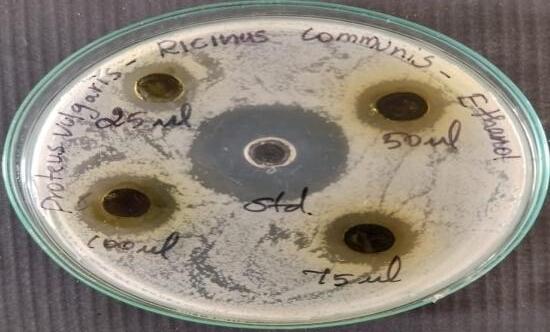
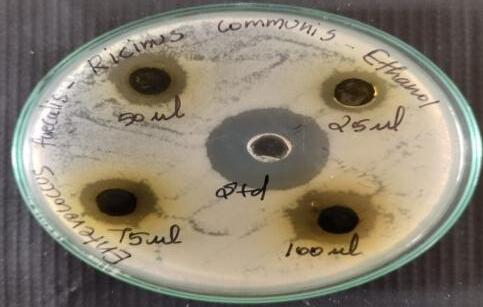
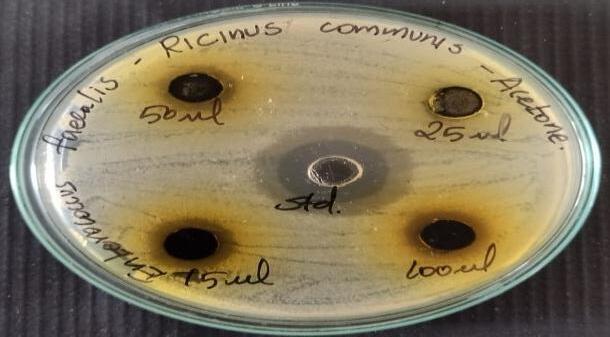
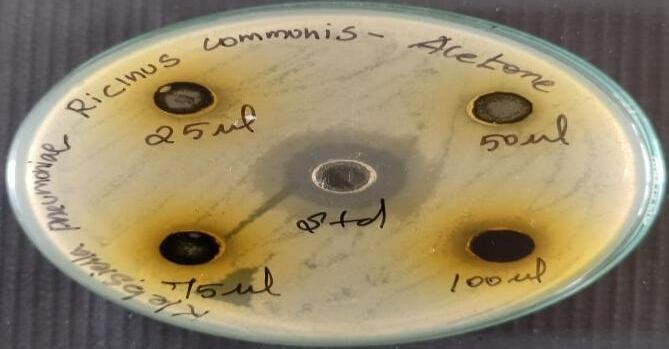
Antimicrobial activity was tested using the well diffusion method. We tested the antibacterial activity in vitro using HI media’s Muller Hinton Agar (MHA) in Mumbai. 15 millilitres of melted medium were added to sterilized petri plates to createtheMHAplates.The0.1%inoculumsuspensionwasuniformlyswabbedaftertheplateswereallowedtosolidifyfor five minutes. The inoculum could then be allowed to dry for five minutes. Twenty microliters of the test medication at various concentrations were introduced to wells. The plates were then stored for a full day at 37°C. The size of the inhibition zone that developed around the well was used to gauge the antibacterial activity (NCCLS, 1993). As a positive control,weemployedachloramphenicoldisc.
ANTIBACTERIAL SYNERGISTIC
Antibacterial synergic activity of ricinus communis leaf
International Research Journal of Engineering and Technology (IRJET) e-ISSN: 2395-0056
Volume: 13 Issue: 01 | Jan 2026 www.irjet.net p-ISSN: 2395-0072
International Research Journal of Engineering and Technology (IRJET) e-ISSN: 2395-0056
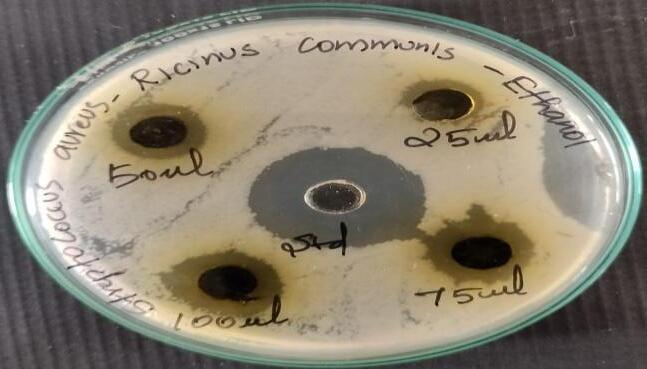
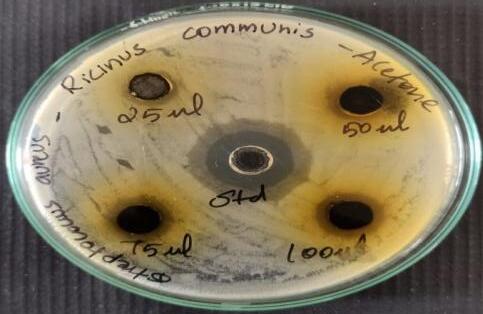
CHLORAMPHENICOL:
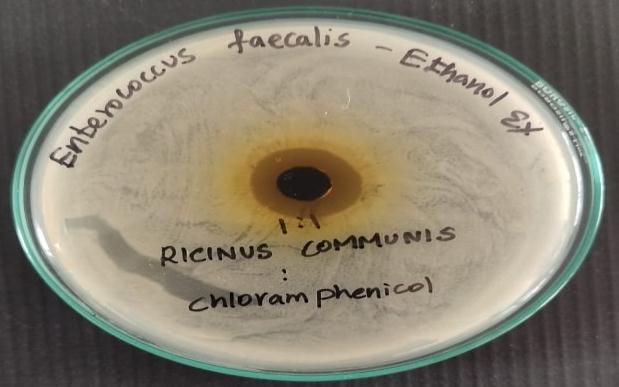
11 Enterococcusfaecalis
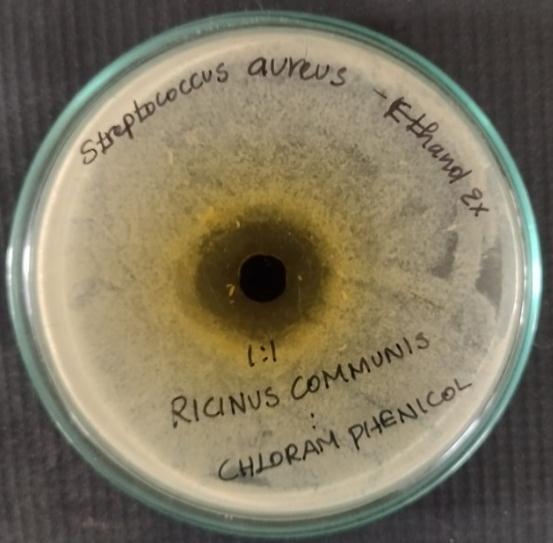
12 Streptococcusaureus (ethanolextractandchloramphenicol) (ethanolextractandchloramphenicol)
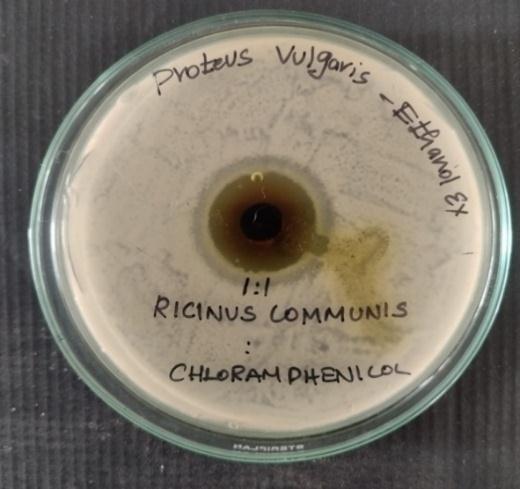
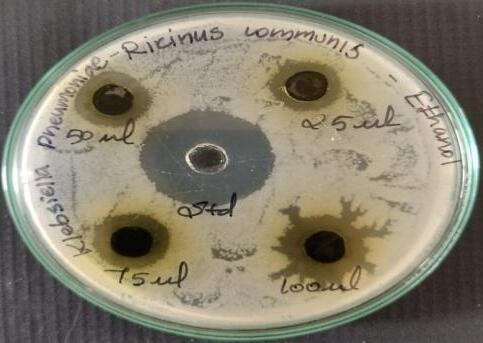
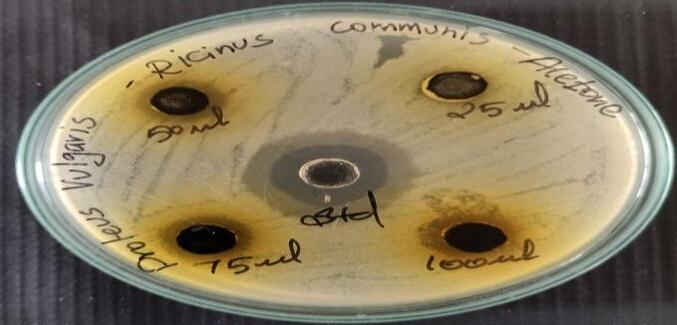
Fig. 13 Proteusvulgaris
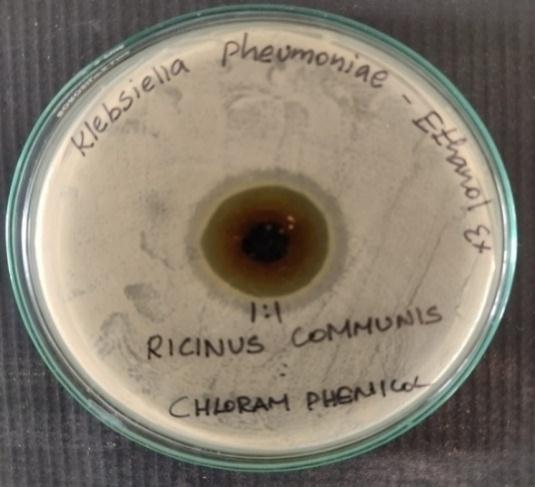
Fig. 14 Klebsiellapneumoniae (ethanolextractandchloramphenicol) (ethanolextractandchloramphenicol)
V. CONCLUSION:
The study demonstrated that Ricinus communis leaf extracts possess significant antibacterial activity against both GrampositiveandGram-negativebacteria.Phytochemicalscreeningconfirmedthepresenceofbioactivecompoundsresponsible forthisactivity.Theethanolicextractshowedbetterantibacterial efficacythantheacetone extract. Whencombined with chloramphenicol, the plant extract exhibited enhanced antibacterial effects, indicating a synergistic interaction. Notable synergismwasobservedagainst Klebsiella pneumoniae and Proteus vulgaris.Thesefindingssuggestthat Ricinus communis canserveasapotentialadjunctinantimicrobialtherapy.
REFERENCE:
[1] Donkor,A.-M.,Ahenkorah,B.,Yakubu,A.,&Donkor,M.N.(2023).SynergismamongextractsofSennaalata,Ricinus communis, and Lannea barteri against pathogenic microbes. The study investigates extract–extract interactions, showingreducedMICvaluesincombinations,indicatingsynergisticantibacterialeffects.
[2] Addai-MensahDonkor,A.,Ahenkorah,B.,Yakubu,A.,&Donkor,M.N.(2024). Enhancing Antibiotic Efficacy: Exploring Synergistic Interactions between Plant Extracts and Conventional Antibiotics.FineChemicalEngineering,5(1),73–87. This research includes Ricinus communis in combination studies with antibiotics showing synergistic interactions(FICIvalues).
Volume: 13 Issue: 01 | Jan 2026 www.irjet.net p-ISSN: 2395-0072 © 2026, IRJET | Impact Factor value: 8.315 | ISO 9001:2008 Certified Journal | Page565
International Research Journal of Engineering and Technology (IRJET) e-ISSN: 2395-0056
Volume: 13 Issue: 01 | Jan 2026 www.irjet.net p-ISSN: 2395-0072
[3] Shahzadetal.(2021).AntibacterialactivityofRicinuscommunisplantextractagainstantibiotic-resistantbacteria fromapplejuicesamples.BrazilianJournalofBiology.DemonstratesantibacterialactivityofR.communisextracts againstresistantisolates helpfulforsupportingactivitydata.
[4] Archana Voleti et al. (2022). Antibacterial activity of Ricinus communis extracts against common human pathogensfromsurgicalwoundinfections.JournalofClinicalandDiagnosticResearch,16(2).Providesrecentdata onantibacterialactivityandMIC/MBCevaluationofRicinuscommunisextracts.
[5] Synergistic antibacterial activity of herbal extracts with antibiotics on periodontopathic bacteria (2021/2022). This study shows that combining plant extracts with antibiotics exhibits enhanced antibacterial effects against multiplepathogens supportingyourprojectthemeofsynergy.
[6] Smith, J. A., & Doe, R. B. Evaluation of the antimicrobial activity of herbal extracts against clinical pathogens. JournalofMicrobialResearch,2018.
[7] National Committee for Clinical Laboratory Standards (NCCLS). (1993). Methods for dilution antimicrobial susceptibilitytestsforbacteriathatgrowaerobically(3rd ed.).NCCLS.