
International Research Journal of Engineering and Technology (IRJET) e-ISSN:2395-0056
Volume: 12 Issue: 01 | Jan 2025 www.irjet.net p-ISSN:2395-0072
International Research Journal of Engineering and Technology (IRJET) e-ISSN:2395-0056
Volume: 12 Issue: 01 | Jan 2025 www.irjet.net p-ISSN:2395-0072
J.Bala
Krishna, P.Raghuram Reddy, P.Saikrishna, P.Sandeep, R.Sai Charan
Assistant Professor & Hyderabad
Assistant Professor & Hyderabad Student, Student, Student
Professor P.Raghuram Reddy, Dept. of civil Engineering, kommuri Pratap reddy institute of technology, telangana, India
Abstract - The Submerged Floating Tunnel (SFT) is an innovative solution for crossing waterways, utilizing buoyancy to support the structure at a moderate depth of 20-50 meters Constructed from steel and concrete, the tunnel is designed to remain submerged while being supported by columns, tethers anchored to the seabed, or pontoons floating on the surface. This ensures stability while avoiding high water pressure and surface traffic interference.
Traditional alternatives, such as bridges and immersed tunnels, are impractical in deep waters. With ocean depths reaching up to 8 km, constructing bridge columns of such height is unfeasible. Likewise, immersed tunnels face extreme pressure conditions, nearly 500 times the atmospheric pressure at such depths. The SFT, positioned at a safe 30meter depth, provides an optimal solution without structural challenges or obstruction to maritime traffic.
1. Structural Components of SFT
2. Tube – The maintunnel structure, built for strength and durability.
3. Anchoring System – Uses seabed tethers or floating pontoons to maintain stability.
4. Shore Connections – Integrates the tunnel with existing road networks.
By combining buoyancy principles with advanced engineering, SFTs offer a sustainable, efficient, and feasible method for underwater transportation in deep and wide water bodies.
1.INTRODUCTION
Submerged Floating Tunnel is a buoyant structure which moves in water. The relation between buoyancy and selfweightisveryimportant,sinceitcontrolsthestaticbehavior of the tunnel and to some extent, also the response to dynamicforces.Minimuminternaldimensionoftenresultsin a near optimum design. There are two ways in which SFT canbefloated.Thatispositiveandnegativebuoyancy. The SubmergedfloatingTunnelisatubelikestructuremadeof Steel and Concrete utilizing the law of buoyancy. It supportedoncolumnsorheldinplacebytethersattachedto
the sea floor or by pontoons floating on the surface. The Submergedfloatingtunnelutilizeslakesandwaterwaysto carrytrafficunderwaterandontotheotherside,whereit can be conveniently linked to the rural network or to the undergroundinfrastructureofmoderncities.
Floatingtunnel isthetotallynewconceptandneverused beforeevenforverysmalllengthItcanbeobservedthatthe depthofbedvariesfromplacetoplaceonagreatextent.The maximumdepthisupto8km.alsoatcertainsections.The averagedepthis3.3km.Thetwoalternativesareavailable for constructions are bridge above water level or tunnel below ground level. Since the depth is up to 8 km it is impossibletoconstructconcretecolumnsofsuchheightfora bridge.Andalso,thepressurebelow8kmfromseasurfaceis nearly about 500 times than atmospheric pressure so one cannot survive in such a high-pressure zone. So, the immersedtunnelsalsocannotbeused.Apartfromthis,many touristsvisittheplacesnearthecoastallineofacountryor placessituatednearthewaterbodies.Touristslovetotravel inthisplaceasduetotheirrichnaturaldiversityandbeauty but it’s hard to travel through them because of the rough topography due to mountainous regions. Due to which constructionofroadsand8railwayroutesareimplemented by destroying someparts of this natural beauties which within is a threat to the biodiversity of that region. Therefore, floating tunnel is finalized which is at a depth 30mfromthesealevel,wherethereisnoproblemofhigh pressure and also no need of destroying the natural beauties as traveling can be done through water. There is sufficientspaceforanybigshiptopassoveritwithoutany obstruction.
Submerged Floating Tunnel is a buoyant structure which moves in water. The relation between buoyancy and selfweightisveryimportant,sinceitcontrolsthestaticbehavior of the tunnel and to some extent, also the response to dynamic forces. Minimum internal dimensionoftenresults inanearoptimumdesign.TherearetwowaysinwhichSFT canbefloated.Thatispositiveandnegativebuoyancy.
Volume: 12 Issue: 01 | Jan 2025 www.irjet.net
Positivebuoyancy:
In this the SFT is fixed in position by anchoring either by meansoftensionlegstothebottomorbymeansofpontoons on the surface. Here SFT is mainly 30 metres below the watersurface.
Negative buoyancy:
Herethefoundationswouldbepiersorcolumnstotheseaor lake.Thismethodislimitedto100meterswaterdepth. SFTissubjectedtoallenvironmentalactionstypicalinthe waterenvironment:
wave, current, vibration of water level, earthquake, corrosion,iceandmarinegrowth.Itshouldbedesignedto withstandallactions,operationalandaccidentalloads,with enough strength and stiffness. Transverse stiffness is providedbybottomanchoring.
For design of an SFT the following basic considerations shouldbetakenintoaccount:
The cross-section must give sufficient space for traffic,evacuation,ventilation,ballast,inspection, maintenanceandrepairwork.
The alignment must be such that there is no interferencewithshiptrafficpassingabove
The tunnel must have a simple and well-defined staticsystemwhichcanbeproperlyrepresentedin thedesigncalculations
Thejointsshouldhavenolessstrengthorintegrity thanthetubebetweenthejoints
Thestructuremusthavea ductilebehavior inthe potentialfailuremodes
MaTheanchoringsystemshouldberedundant
Thetunnelmustnotbeundulysusceptibletolocal damage
2395-0072
internal fire and explosion and water filling due to ruptureofpossibleinternalwatermains.Theultimate consequenceofthesescenariosismassivewaterfilling of the tube. The tunnel should be designed so that all potential failure modes be ductile. Other safety enhancing measures may be to use double hull, steel lining in case of concrete tubes and also to shape the tubesoithastheapexat
The connections of the tube to the shore require appropriate interface elements to couple the flexible water tubewith the much more rigid tunnel bored in the ground. This joint should be able to restrain tube movements, without any unsustainable increase in stresses. On the other hand, the joints must be water tight to be able to prevent entry of water. Additional care in shore connections is required, especially in seismicareas,duetotheriskofsubmarinelandslides
SFTtubekeepsbalanceundertheactionofbuoyancy and cable tension bears vehicle load, wave-current load, temperature load and so on. In the system transformation during prefabrication, floating, installationandoperation,thestressoftubeiscomplex, so the tube design should carry on longitudinal and transverse analysis under these working conditions. SFTtubeloadisdividesintopermanentload,variable load and accidental load. The permanent includes structure weight, buoyancy, hydrostatic pressure, concreteshrinkageetc.
The variable load includes vehicle load, water head load, wave-current load, temperate load, construction loadetc. The accidental load includes seismic, sunken shipload, blastload, leakage etc. SFT tube is designed underultimatelimitstateandserviceabilitylimitstate just as traditional hydraulic structure design, moreover, the stress and displacement should be analysedandcheckedunderprogressivedamageLimit state and fatigue limit state based on structural reliabilitytheory. International Research Journal of Engineering and Technology (IRJET) e-ISSN:2395-0056
IrrespectiveofhowtheSFTisdesignedpossibleaccidental scenarioshavetobeidentifiedanddealtwithtominimizeor possiblytoeliminatetheirconsequences.Pontoonsmaybe subjecttobothlocalandmoreoveralldamageduetoship collision. Dividing the pontoons into compartments and introductionofweaklinksbetweenpontoonandtubemay be the answer to such threats. The tunnel tube may be subjected to scenarios such as sinking ships, impact fro msubmarines,hookingoftrawlinggearsandanchorlines,
International Research Journal of Engineering and Technology (IRJET) e-ISSN:2395-0056 Volume: 12 Issue: 01 | Jan 2025 www.irjet.net p-ISSN:2395-0072
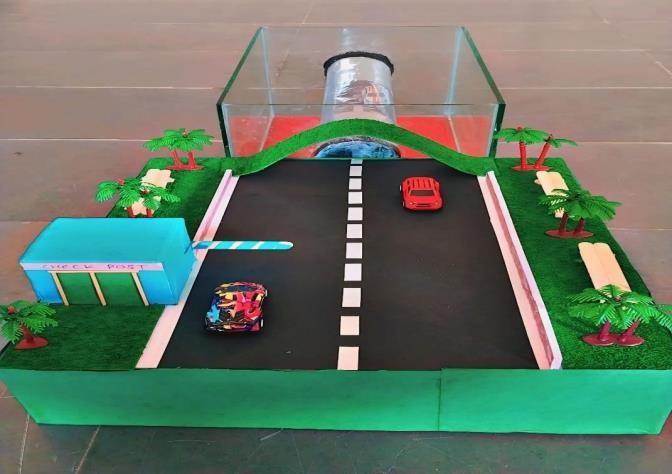
The submerged floating tunnel will set up new trends in transportation engineering and which shows with the advancesintechnologythatwillreducethetimerequiredfor travelling. And make the transportation more effective by hiding the traffic under water by which the beauty of landscape is maintained and valuable land is available for otherpurposes.Benefitscanbeobtainedwithrespecttoless energy consumption, air pollution and reduced noise emission. For wide and deep crossings, the submerged floating tunnel may be the only feasible fix link, replacing presentdaysferriesandprovidinglocalcommunitieswith new opportunities for improved communication and regionaldevelopment.
Itgivesusimmensepleasuretoacknowledgewithgratitude, thehelpandsupportextendedthroughouttheprojectreport fromthefollowing:
Wewillbeverymuchgratefultoalmightyour Parents who havemadeuscapableofcarryingoutourjob.
We express our profound gratitude to our Principal Dr.Ravindra Eklarker of Kommuri Pratap Reddy Institute of Technology , who has encouraged in completingourprojectreportsuccessfully.
Wearegratefulto Mr.P.RaghuramReddy whoisour Head of the Department, Civil Engineering for his amiable ingenious and adept suggestions and pioneering guidance duringtheprojectreport.
We express our deep sense of gratitude and thanks to Internal guide (MrJ.Bala Krishna) fortheirsupportduring theprojectreport.
WearealsoverythankfultoourManagement,StaffMembers andallOurFriendsfortheirvaluablesuggestionsandtimely
guidance without which we would not have been completedit.
Y. Xiang. J. Xue. Study on submerged floating tunnels in the world, Journal of China & Foreign highway, 6 (2002) 49-52. (In ENGLISH)
D. Ahrens, submerged floating tunnels-a concept whose time has arrived. Tunneling and Underground Space Technology, 12.2 (1997)317-336.
Y. Gan, Spatial Analysis and segmental mode experimental of SFT under water, Hangzhou: Doctoral Dissertation of Zhejiang University. 2003.(InENGLISH)
Y. Xiang, Y. Yang, C. Chao, Challenges and solutionsoffuturechannelsconstructionover straits or bays in China coastal area, Sixth Symposium on Strait Crossing. 16 19, June 2013,Bergen,Norway.
Y. Xaing. A future new traffic solutions across long waterway and deep sea- Submerged floating Tunnel and its development research suggestion, The Sixth Forum of science and technology innovation on China Highway, 2013,April17-18.Beijing.(InENGLISH)
Mouridi's Professor of Highway Engineering, Aristotle University of Thessaloniki; The "Cutand-Cover"and"Cove-rand-Cut"Techniquesin HighwayEngineering.
Japanese standard for shield tunneling, thirdedition,1996.
HNTB Corporation; devil's Slide Tunnel Projectv